Ralph Solonitz : Killer Brew!

Political cartoon by Ralph Solonitz / The Rag Blog.

The Rag Blog / Posted January 12, 2011

Posted in Rag Bloggers | Tagged , | 7 Comments

Jonah Raskin : Chickens Come Home to Roost in Arizona

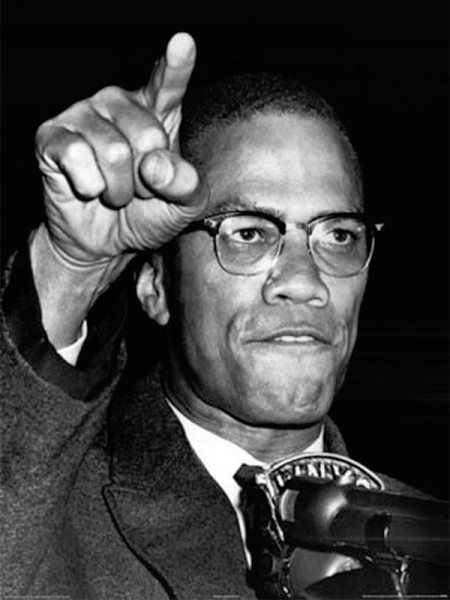
Malcolm X at Harlem rally, December 31, 1969. Photo from New York World-Telegram & Sun Collection.

On chickens coming home to roost:
Armageddon in Arizona

By Jonah Raskin / The Rag Blog / January 11, 2011

Shortly after JFK was shot and killed, Malcolm X, the Black Muslim leader, observed, “The chickens have come home to roost.” His comment did not endear him to the Kennedy family or to large swath of the American public, but Malcolm wasn’t trying to make friends or to be nice.

He wanted to tell the truth as he saw it, and he felt that those who live by the gun, whether they are presidents of the U.S.A., or street thugs, die by the gun. In his view, it was the American way. Another African American from the same era, H. Rap Brown, noted that, “Violence is as American as cherry pie.”

The shootings in Arizona show once again, after all these many years, the staying power of Malcolm X’s and Rap Brown’s words. Indeed, their words have all the force of bullets, and perhaps more, though they have caused far less violence.

Undoubtedly, much will be written about the suspect, Jared L. Loughner, and new information will emerge about him. Moreover, as we gain distance from the event, it may emerge with greater clarity, and we may have deeper insights than we now do. But reporters, columnists, and editorial writers have already piled high heated words about the incident, and, before attitudes harden, it might be helpful to float a few ideas and add them to the mix.

It seems clear from where I stand, that the suspect, Jarden L. Loughner — who allegedly shot and killed a federal judge, a nine-year old-child and others, and seriously wounded a U.S. Congresswoman — is a terrorist. That’s spelled T-E-R-R-O-R-I-S-T. What he did was terrorism — it has had the effect of frightening many citizens, though not all, of course. It has made people feel terrorized.

Loughner might be a madman and a right-wing fanatic. The picture of him that the Pima County Sheriff’s office released makes him look deranged. But his armed attack was political, overtly political. It sent a clear political message. If you support health care, as Congresswoman Giffords did, and if you care about immigrants, as Federal Judge John M. Roll did, then you are a marked man or woman.

Giffords knew that she was a marked woman. Indeed, she was targeted by the Tea Baggers for her political stance on the issues, and she knew it.

“We’re on Sarah Palin’s targeted list,” she said. “Crosshairs of a gunsight over our district. When people do that, they’ve got to realize there’s consequences.” Giffords probably did not realize how accurate her words would prove to be.

If the shooter had been an Arab or a Muslim he undoubtedly would have been labeled a terrorist. If he were from Yemen, for example, politicians would by now be calling for the invasion of Yemen. Only the fact that he has a white skin and is a U.S. citizen has so far spared him the label of “terrorist” in much of the mass media.

Reporters have focused attention on the suspect’s mental state and on the gun he used. More attention ought to be focused on his political views and actions, though that will take some doing because Americans have a hard time understanding politics unless it’s an election year and Democrats are running against Republicans. Politics is about power, and ultimately power comes out of the barrel of a gun. Loughner must have known that.

It’s no accident that this terrorist attack took place in Arizona. Indeed, Arizona seems like the perfect or near-perfect place for an act of terrorism to take place, at least on domestic soil. Arizona politicians have been whipping up hatred for Mexicans, liberals, and Democrats. They have been lighting a fire under the citizenry, and sooner or later, given the volatile atmosphere they created, it was likely that an armed and a dangerous man would take action.

Loughner’s lawyer, Judy Clarke, who defended the Unabomber, Theodore J. Kacznski, and also the alleged Al Qaeda operative, Zacarias Moussaoui, might well point out that Loughner did not act in a vacuum. In fact, he was cooped up in a tinderbox waiting to be exploded.

Could he have chosen “better” targets? Perhaps. He chose political figures close to home and to whom he had access. Surely, his white skin and his American citizenship enabled him to get close to Congressman Gabrielle Giffords and Judge Roll without raising suspicions. Again and again, as a society, we do not seem to be alert to the white terrorists in our midst.

President Obama spoke about “grieving” and about “the tragedy.” But unless he and we do more than grieve and remain in shock, acts like the one that just took place in Arizona will take place again — sadly, shockingly, and tragically.

H. Rap Brown was insightful in what he said: Violence is as American as cherry pie. It’s as violent a place now as it was when he made his remark in the 1960s — and perhaps more so. We are a society that lives by the gun, worships the gun, and adores gunmen. We also die by the gun. Look around and there seems to be no end to the violence.

[Jonah Raskin has lived through the violence of the 1960s, 1970s, 1980s, 1990s, and now, twenty-first century. He is the author of American Scream, and For the Hell of It: The Life and Times of Abbie Hoffman.

The Rag Blog

Posted in Rag Bloggers | Tagged , , , , , , , , , , , | 4 Comments

Robert Jensen : Machines Change, Our Work Remains the Same

Early computer. Image from Corbis-Bettmann.

The limits of internet activism:
Machines change, the work remains the same

By Robert Jensen / The Rag Blog / January 11, 2011

When I first got involved in left/radical political organizing in the 1990s, I don’t recall any of us referring to our efforts as “phone activism” or calling ourselves “fax activists.” A friend who started organizing in the early 1960s assured me that he never heard the term “mimeograph activism” in those days. We used telephones, fax machines, and mimeographs in our organizing work, but the machines didn’t define our work and we didn’t spend a lot of time arguing about the implications of using them.

Today the terms “online activism” and “internet activist” are common, as are discussions about the positive and negative effects of computer-mediated communication (CMC) on left/progressive political organizing. (See interview with Joss Hands on “Activism in a digital culture.”)

Is CMC so dramatically different, or is the left simply caught up in the larger culture’s obsession with life online? I will start with observations that likely are not controversial, and then step back to frame the question in ways that may not be widely accepted.

Two basic points:

First, CMC makes possible the distribution of information to a larger number of people at lower financial cost than previous technologies (though the ecological cost of a communication technology that creates highly toxic e-waste and consumes enormous amounts of energy may make this technology prohibitively expensive in the long run) and allows for easier and faster feedback from the recipients of that information.

Second, while the technology is too new for definitive assertions, there is a seductive quality to CMC that leads some groups and individuals to spend too much of their time and resources online, even when there’s ample reason to suspect that expense of energy isn’t productive.

Two corollary cautions:

First, political information is not political action. Being able to distribute more information more widely more quickly does not automatically lead to people acting on that information. The information must be presented in ways that lead people to believe they should act, and there must be vehicles for that action.

Second, what appears to be wasting time online is not always a waste of time. Just as we solidify bonds with people face-to-face by chatting about the mundane aspects of our lives, we sometimes do that online. Political organizing — like all of life — includes such interaction.

So, it’s true that the things we do with a computer online are often like the things we do, or did, with telephone calls, faxes, and mimeographs; the question is how to most effectively apportion our time, energy, and resources on these machines as part of a larger organizing strategy. In that sense, deciding whether to focus on an email or a door-knocking campaign is a straightforward calculation about resources and the likely outcomes of using those resources in different ways.

It’s also true that we should be more critically self-reflective about our use of computers for political organizing, lest we be seduced by how productive we imagine we are being online simply because of the speed and reach of CMC. Because an email campaign can reach more people quickly, we are tempted to believe it will lead to the more effective outcomes, though the patient work of door-knocking may yield better long-term results if it builds deeper support that endures.

As our organizing tools change rapidly, these calculations of the likely success of different tactics are not always easy to make, but they are relatively simple questions to formulate. Much more vexing are questions about the complex changes in the world in which we are organizing.

We like to say the internet has changed everything, perhaps in as dramatic a fashion as the printing press changed the act of reading. But the world of the 15th century was not changing at anything like the speed that the world is changing today. We need to think about the “everything” in which our email messages are bouncing around. We need to be clearer about the scale of the problems we face, the scope of the changes necessary to address the problems, and the time available to us for creating meaningful change. To illustrate these issues, I’ll talk about the state of the ecosphere.

Scale of the problems

For many years activists focused on “environmental problems,” offering ways that humans could adjust the way we live to cope with problems of dirty air, dirty water, and dirty land. The assumption behind those projects was that an environment consistent with long-term human flourishing was possible within existing economic, social, and political systems.

That assumption was wrong, and evidence continues to pile up that the ecosphere cannot sustain billions of people when even a fraction of them live at First-World levels. Look at any crucial measure of the health of our ecosphere — groundwater depletion, topsoil loss, chemical contamination, increased toxicity in our own bodies, the number and size of “dead zones” in the oceans, accelerating extinction of species and reduction of bio-diversity — and the news is bad and getting worse.

And we live in an oil-based world that is fast running out of oil with no viable replacement fuels. And we can’t forget global warming and climate instability. Add all that up and it’s not a pretty picture, especially when we abandon the technological fundamentalism of the culture and stop believing in fantasy quick fixes for deeply rooted problems.

Our troubles are not the result of the bad behavior within the systems in which we live but of the systems themselves. We have to go to the root and acknowledge that human attempts to control and dominate the non-human world have failed. We are destroying the planet and in the process destroying ourselves.

Scope of the changes

So, we either abandon the industrial model of development based on the concentrated energy in fossil fuels or we face a significant human die-off in a grim future that is within view. Abandoning that industrial model means a sudden shift in human living arrangements that would be unprecedented in history. We have to redefine what it means to live a good life, dramatically lowering our energy use and reducing our expectations about the material goods we consume.

That means that we not only won’t be getting a new flat-screen television, but that we won’t be amusing ourselves with new Hollywood movies and TV. It means not only that we won’t be able to buy an SUV, but that we won’t be using cars for routine personal transportation. It means a whole lot less of everything, and such changes in living arrangements are impossible within capitalism.

While capitalism is not the only unsustainable economic system in history, it is the system that structures the global economy today, and it has to be scrapped. If a transition to a sustainable economy is possible, it also means we will have to abandon the nation-state as the primary unit of political organization and find functional political systems at a much lower level.

These changes in economic, social, and political systems mean significant changes in how we understand the nature of the self, the relationship to other humans, and the human place in the larger living world. When we redefine what it means to live a good life, we will be defining what it means to be human.

Time available

No one can predict the trajectory of a full-scale ecological collapse, in part because it is complex beyond human understanding and in part because how we act in the present can affect that trajectory. But even without the capacity to predict with precision, we have to make our best guesses to guide our choices in organizing.

The best-case scenario is that we have a few decades to accomplish these changes. The worst-case scenario is that we are past the point of no return and that the systems in place will exhaust the ecosphere’s capacity to sustain human life as we know it before we can adjust.

If ecological collapse is either coming soon or already in motion, then traditional organizing strategies may be obsolete. The problem is not just that existing economic, social, and political systems are incapable of producing a more just and sustainable world, but that there isn’t time available for working out new ways of understanding our self, others, and the world. There is no reason to assume that the non-human world will wait while we slowly come to terms with all this; the ecosphere isn’t going to conform to our timetable.

Where this leaves us

Though I made no claims to special predictive powers, two things seem likely to me: (1) All human activity will become dramatically more local in the coming decades, and (2) Without coordinated global action to change course, there is little hope for the survival of human society as we know it.

When I offer such an assessment, I am routinely accused of being hysterical and apocalyptic. But I don’t feel caught up in an emotional frenzy, and I am not preaching a dramatic ending of the human presence on Earth. Instead, I’m taking seriously the available evidence and doing my best to make sense of that evidence to guide my political choices. I believe we all have a moral obligation to do that.

As a result, I have recommitted to local organizing that aims mainly to strengthen institutions and networks on the ground where I live, rooted in a belief that those local connections will be more important than ever in coming decades. At the same time, I try to maintain and extend connections to like-minded people around the world, hoping that those connections can contribute to the possibility of coordinated global action.

In short, I am trying to become more tribal and more universal at the same time, recognizing there is no guarantee that of a smooth transition or success in the long run.

In these efforts, I engage in a considerable amount of computer-mediated communication. Whenever it’s feasible, I favor direct human communication in face-to-face settings, on the assumption that local networks will be strengthened by such communication in ways that CMC cannot foster.

I also use CMC to reach out beyond the local, both to learn about global initiatives and to contribute to such initiatives. I try to take advantage of the opportunities offered by CMC without being seduced by illusions of easy organizing through the send button.

So, a summary that likely isn’t controversial: These days almost all left/radical organizers will communicate online, but the social justice and ecological sustainability at the heart of left/radical politics isn’t going to be achieved online.

It’s tempting to leave the discussion at that level, but the questions about scale/scope/time aren’t addressed by that easy summary. With a larger focus, the trouble with CMC — with all the time and effort it takes to learn new programs, keep up with the constant changes on the internet, think about the role of the virtual world in real-world politics — is that it keeps us stuck in the past.

That may seem paradoxical; we’re used to talking about the people who don’t embrace computers as being the ones stuck in the past. After all, isn’t the internet the key to the future? Not if the future is going to be defined by less energy and less advanced technology.

If the changes outlined above are an unavoidable part of our future, then we would be well advised to start weaning ourselves from the high-energy/high-technology world, not only in our personal lives but in our organizing as well. That doesn’t mean immediately abandoning all the gadgets we use, but rather always realizing that our efforts to make the most effective use of the gadgets in the short term shouldn’t crowd out the long-term planning for a dramatically different world.

That different world may well impose changes on us before we have been able to face them ourselves. Novelist/poet/critic Wendell Berry captures this when he writes, “We are going to have to learn to give up things that we have learned (in only a few years, after all) to ‘need.’ I am not an optimist; I am afraid that I won’t live long enough to escape my bondage to the machines.”

The task is daunting, but it is our task nonetheless. Berry is not optimistic about the future, but he concludes with our charge:

“Nevertheless, on every day left to me I will search my mind and circumstances for the means of escape. And I am not without hope. I knew a man who, in the age of chainsaws, went right on cutting his wood with a handsaw and an axe. He was a healthier and a saner man than I am. I shall let his memory trouble my thoughts.”[1]

When we lack answers to difficult questions — or even a way to imagine finding answers — it’s easy to put the questions aside. Better, I think, to let the questions continually disturb us.

Every time I touch the keyboard of my laptop to write an essay that will be posted on a web site, which I will send to editors via email, my thoughts are troubled.

[Robert Jensen is a journalism professor at the University of Texas at Austin and board member of the Third Coast Activist Resource Center in Austin, and one of the partners in the community center “5604 Manor.” He is the author of All My Bones Shake: Seeking a Progressive Path to the Prophetic Voice, (Soft Skull Press, 2009) and Getting Off: Pornography and the End of Masculinity (South End Press, 2007); Jensen is also co-producer of the documentary film Abe Osheroff: One Foot in the Grave, the Other Still Dancing, which chronicles the life and philosophy of the longtime radical activist. Robert Jensen can be reached at rjensen@uts.cc.utexas.edu. This article also appears at the New Left Project.]

[1] Wendell Berry, What Are People For? (San Francisco: North Point Press, 1990), p. 196.

The Rag Blog

Posted in Rag Bloggers | Tagged , , , , , , | Leave a comment

At The Rag Blog, we asked some of our old-school colleagues to share with us their unique experiences and adventures in the political and cultural movements of the radical Sixties, and Ray Reece obliges in spades! Ray combines the story of his baptism by fire into the anti-war movement with his introduction to a “passionate reverence for living things.”

Posted in RagBlog | Leave a comment


Type your summary here

Type rest of the post here

Source /

The Rag Blog

Posted in RagBlog | Leave a comment

Patricia Vonne Headlines Jan. 23 Rag Blog Benefit Bash

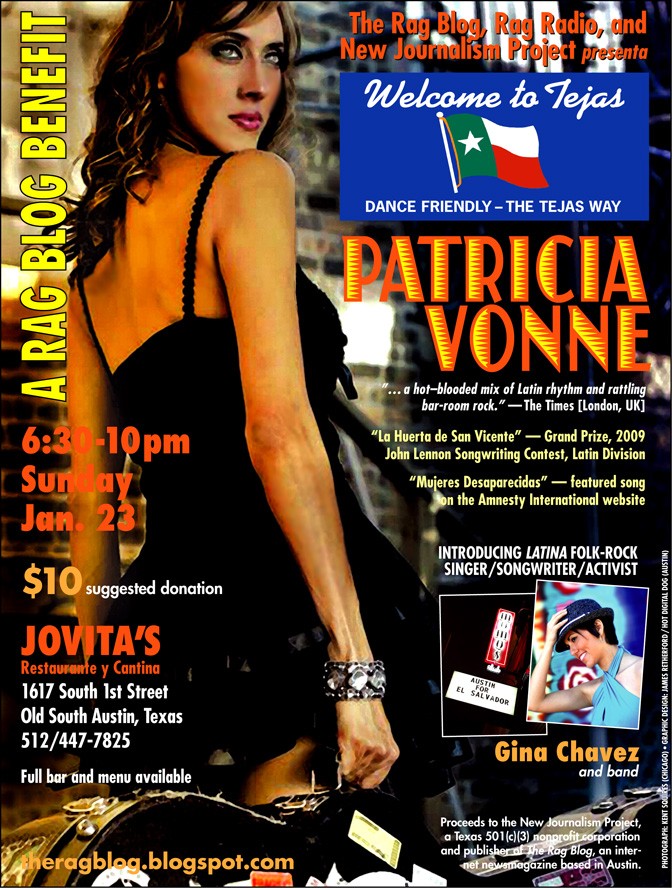
Graphic by James Retherford / Hot Digital Dog Design / The Rag Blog.

CLICK ON IMAGE TO ENLARGE.

Latina rocker Patricia Vonne
headlines Rag Blog benefit at Jovita’s

What: Rag Blog Benefit
Who: Latina rocker Patricia Vonne and singer-songwriter Gina Chavez
Where: Jovita’s, 1617 South First Street, Austin, Texas
When: Sunday, Jan. 23, 2010, 6:30-10 p.m.
How much: $10 recommended donation

The Rag Blog and Rag Radio present acclaimed Latina rocker Patricia Vonne and folk-rock singer-songwriter Gina Chavez at Jovita’s, 1617 South First Street, Austin, Texas, on Sunday, Jan. 23, from 6:30-10 p.m. Suggested donation is $10. Jovita’s full bar and restaurant menu will be available.

The event benefits the New Journalism Project, inc., a Texas 501(c)(3) nonprofit corporation that publishes The Rag Blog, an influential Austin-based progressive internet newsmagazine with roots in Austin’s legendary 60s underground newspaper, The Rag.

Rag Radio is a public affairs program hosted by Rag Blog editor Thorne Dreyer that airs on KOOP 91.7 FM, Austin’s community radio station, every Friday from 2-3 p.m. and streams live on the internet.

Patricia Vonne and Gina Chavez will by Thorne Dreyer’s guests on Rag Radio, Friday, Jan. 21. The show will include live performance.

Patricia Vonne is a Latin-roots rocker and song stylist. The Times of London called Vonne, who has toured Europe 19 times, “a hot-blooded mix of Latin Rhythm and rollicking bar-room rock,” and the Austin Chronicle said she “is quickly taking her place among Texas’ musical treasures.”

Vonne’s song “La Huerta de San Vicente” won the grand prize in the Latin division at the 2009 John Lennon Songwriting Contest, and her “Mujeres Desaparecidas” is featured on the Amnesty International website. Vonne is the sister of famed Austin filmmaker Robert Rodriguez.

Gina Chavez is an indie folk-rock singer-songwriter whose style has been called a cross between Sheryl Crow and Selena. Chavez is also an activist who established Austin 4 El Salvador, a college scholarship fund for girls from a gang-dominated suburb of San Salvador where Chavez spends time working in the community.

Those unable to attend can still help out with a much-needed contribution to the New Journalism Project. Please go here to donate through PayPal, or send a check to the New Journalism Project, inc, P.O. Box 126442, Austin, Texas 78761-6442.

For more information, contact Thorne Dreyer at tdreyer@austin.rr.com, or Alice Embree at alice@nuevoanden.com.

The Rag Blog

Posted in RagBlog | Tagged , , , , , , , , , | Leave a comment

Marc Estrin : Infiltrations

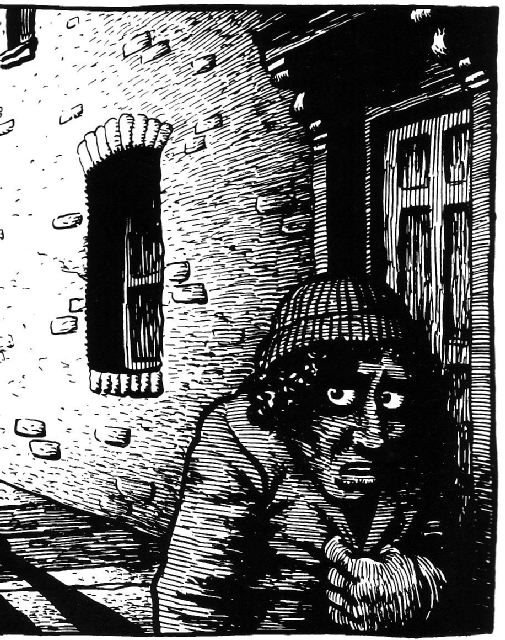
Skulker by R. Crumb.

INFILTRATIONS

By Marc Estrin / The Rag Blog / January 11, 2011

Last week, I wrote about what I consider politically unearned infiltrations supporting rampant consumerism. I will not sing Hallelujah in the mall.

Infiltrations, however, do have real potential for thought-provoking events.

When I was in theater grad school in the 60s, everybody was all hot for Artaud’s Theater of Cruelty, in which the audience was made to shit in its pants, and paradoxically for Brecht’s teaching plays which asked the audience to think cooly and carefully about society’s givens. We young directors were concerned with breaking down barriers between audience and actors — new kinds of staging, new kinds of scripts.

But for me, the prior problem was one of “audience” itself — that there should be people who buy (usually high-priced) tickets, sit comfortably in chairs, applaud, then go out for a meal or a drink to socialize, and perhaps, perhaps, “discuss the play.”

Too compartmentalized, too boxed in, too unengaged with reality.

So I gathered a group interested in practicing Infiltrations — theater pieces which would not be perceived as such, but which would just be reported at home as “something interesting that happened to me today.”

Here are two such Infiltrations to give you an idea of what we were up to, one in an emporium, and one in a smaller store. Next week I will discuss the ethics involved.

Cost Plus and American imperialism

Cost Plus is a mammoth import store on the San Francisco waterfront which caters to tourists and Bay Area bobos by supplying them with hand-wrought goods from around the world — from inexpensive mass-produced trinkets to costly one-of-a-kind curiosities. It is self-help, with no sales personnel on the floor. We began to wonder about the flow of goods that went through the store, and after getting some information from one of the buyers we came up with the following piece.

Five of us, looking as straight as possible, dispersed throughout the store as customer aides. We approach people who were inspecting possible purchases. A typical dialog went like this:

US: may I help you?

CUSTOMER, generally unsuspicious: No, thank you.

US, waiting a bit, watching over customer’s shoulder: Isn’t it amazing how we can bring you such an intricately carved box for only $4.99?

CUSTOMER: Why, yes it is.

US: Do you know how we can do it?

CUSTOMER: No.

US: Well, the man who carves this box — he’s very good at it, he can do two a day — gets 25¢ a day for his work.

CUSTOMER: Oh?

US: Yes. You see, there’s a lot of famine and disease in India, and he has to work for whatever he can get.

CUSTOMER: Oh.

US: He has no choice.

CUSTOMER: Uh-huh.

US: And since we control the world economy, more or less, we can decide on the right price.

Silence.

Yes, and you have to realize that what you pay includes the markup for the buyer, the warehouse, the shipper, the import duty, and our own small overhead — so it’s really an incredible bargain.

Thoughtful, non-hostile silence. This was usually a turning point: either the customer began reacting to what we were saying or else we carried it further.

I think it’s right — don’t you — that we in this country should be able to benefit from people’s work around the world? After all, we give them a market. They’d starve without it. And we can have these really nice things. I mean Americans work really hard, right? We have to put up with so much — like the war and everything — we deserve these kind of beautiful things.

People who work hard should be rewarded. Don’t you think so? And the natives? They’re hard workers too, but I mean 25¢ a day is a lot for them, right? Did you know that although we’re only 6% of the world’s population, we consume 60% of its natural resources? That just shows — we’re sort of 10 times ahead of everybody else because were willing to work hard and bring home the bacon.

Etc., etc. Eventually these customers drifted away with an embarrassed “Thank you.” But none of them bought the items they had been looking at.

After an agreed upon two hours, we all met outside the store to trade stories. We were never caught, and the customers, too, would have their stories to tell.

City Lights Ripoff

Lawrence Ferlinghetti started the City Lights Bookstore on $500 in the early 50s; it has since become one of the most complete paperback shops in the Bay Area. The store has been busted several times for selling radical or obscene material, and has an open door policy toward its customers: the police are never called.

Once, City Lights was ripped off for $8,000 worth of books and went that much in the hole. This seemed to me like a typical example of Movement bullshit — brothers undoing each other in the name of “liberation” or conflicting ideologies — so we decided to explore our own and the customers’ attitudes toward ripping off City Lights.

During rehearsal, the group rejected playing “roles” in favor of exploring each member’s own position. We lined up pretty heavily for the legitimacy of ripping-off. I was one of the few spokesmen against. But the balance worked out in performance, since most of the customers at least started off by defending the store.

The piece took an hour to an hour and a half to develop (we did it three times) and was done with the cooperation of the management and, as it turned out, at their expense. It’s hard to record the complexities and meanderings of the performances, but the salient points are as follows:

Beat 1

One of us, previously agreed, steals a book, and hides it in his pants. Very quietly, a young woman (one of us) goes up to him and says she doesn’t think he ought to do that here. His very quiet response is “Mind your own business, lady.” Totally private so far.

Beat 2

The woman retreats but keeps her eye on the guy. Some minutes later, he attempts to stash another book, and the exchange begins again, just as quietly. This time the guy is a little more pissed off, and the exchange ends with a little louder than necessary “Fuck off!” For the first time, real customers are aware of tension somewhere in the store.

Beat 3

I wander over and ask the woman what’s happening. She reluctantly and quietly informs me that some guy is trying to rip off books. I approach him very quietly and ask him why doesn’t he do that at Doubleday’s or Brentano’s. He begins to get uneasy and tries to terminate our encounter as quickly as possible, until another one of us, overhearing, supports the thief by asking me,

“Hey, what are you, a cop or something? Let the guy do his thing.”

Beat 4

By now it’s apparent to the thief that things aren’t working out as planned. But on the other hand, he has support, so he doesn’t split. For the first time I chastise the thief publicly.

“Hey man, look, why don’t you go down to Doubleday’s and rip off the book if you need it? Why rip off your brothers?”

“Brothers, my ass! This place is the fucking pig establishment.”

This is the first theme to be taken up — it generally called up a lot of customer support for the store. Other topics for discussion we planted among the 10 to 20 customers are:

  1. Who are brothers; who is the enemy?
  2. Are there alternatives to a retail book store?
  3. Are “liberals” like Ferlinghetti and City Lights just greasing the capitalist machine?

Our group, more vocal now than at first, pushes the balance way over to the thief’s side. This helps justify his sticking around. He’s not an outlaw but is acting within the mores of the local population — and this brings an emotional response from the customers. Each time, someone offers to buy him the book or take up a collection. We follow their trips wherever they go.

Beat 5

1 get more and more pissed off with what I consider poor analysis. I station myself on the steps so I can be heard by everyone, wait for a lull, and say to the thief,

“All right, that’s all.”

“What do you mean?”

“You’re not taking those books.”

“Oh yeah? Why not?”

“’Cause I’m going upstairs with you and tell Shig [the guy at the desk] you’ve got them.”

A new uproar! Even the customers don’t like it. (There are a few who come over to quietly tell me they agree with me and think I should do it, but no one defends my action publicly.) I am accused of being a pig, of laying my trip on other people, of exceeding my rights.

“What is this, the second grade, you’re gonna tell the teacher?”

I argue briefly that when this man rips off City Lights, he’s ripping me off (I need the store), and that I intend to defend myself. From that time on, I am generally silent, stubbornly waiting for the thief’s exit.

Beat 6

One of us calls for a “rip-in,” and tries to get customers to liberate books together. So far, only our own group has done this publicly, although it’s hard to tell what walks out when we do.

Beat 7

Confrontation at the desk. The first time we did it the day clerk got completely flustered. He had been told what was happening and was asked to act in any way he wanted. He couldn’t get it together, and three people walked out with books. That evening we confronted Shig who, with some kind of invisible karate approach, retrieved two books. A third was grabbed by a customer at the door.

The next night we had a big argument at the desk. Shig surprised us by saying, “Take the books,” and several people did so — to a lot of customers’ anger. Shig just felt that that was his prerogative. That really set off some of the people who had been defending the store for the last hour downstairs.

We still haven’t resolved for ourselves the implications of our positions and actions. We know the piece is credible and sets a lot of people thinking and talking (and stealing?). But when someone in our group presented me with the complete Beethoven string quartets as a present, I had to send Shig a check before I could enjoy it.

[Marc Estrin is a writer, activist, and cellist, living in Burlington, Vermont. His novels, Insect Dreams, The Half Life of Gregor Samsa, The Education of Arnold Hitler, Golem Song, and The Lamentations of Julius Marantz have won critical acclaim. His memoir, Rehearsing With Gods: Photographs and Essays on the Bread & Puppet Theater (with Ron Simon, photographer) won a 2004 theater book of the year award. He is currently working on a novel about the dead Tchaikovsky.]

The Rag Blog

Posted in RagBlog | Tagged , , , | Leave a comment

Glenn W. Smith : Gabrielle Giffords and The Blood of Eden

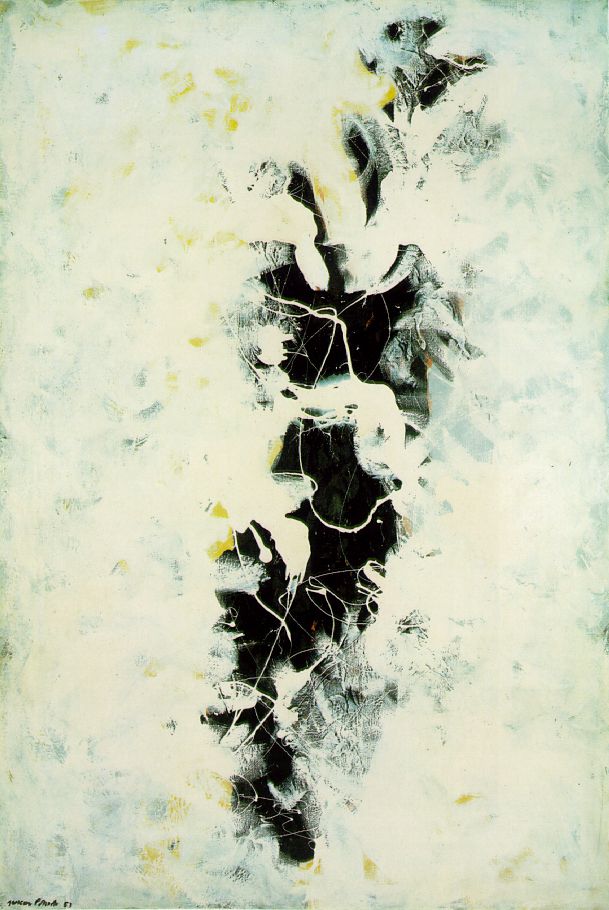
Jackson Pollock’s The Deep. Oil and enamel on Canvas (1953).

The Blood of Eden:
Our escalating political violence

By Glenn W. Smith / The Rag Blog / January 9, 2011

I caught sight of my reflection
I caught it in the window
I saw the darkness in my heart
I saw the signs of my undoing
They had been there from the start

So many American bodies are sprayed with blood, their own, their lover’s, their mother’s and father’s, their brother’s and sister’s. Oh we are so certain of our innocence, but we are a nation tattooed in crimson, eyes to belly, with Jackson Pollock’s “The Deep.”

We called it a New World then carved a Trail of Tears for those who knew it to be ancient: the Choctaw, the Cherokee, the Seminole. And now we walk that Trail ourselves, lost and tormented, crying for Gabrielle Giffords, U.S. Judge John Roll, and the other victims of the Tucson shootings.

The “Rawhide Orator,” Choctaw Chief George Washington Harkins, in 1831 wrote to the American people before leaving for the Trail of Tears:

I could cheerfully hope, that those of another age and generation may not feel the effects of those oppressive measures that have been so illiberally dealt out to us; and that peace and happiness may be their reward.

A cheerful hope, and one unfulfilled, as the ghosts of dead immigrants whisper to us from the Arizona desert.

Within a few short hours of Saturday’s shootings, pundits and politicians were decrying the violent political rhetoric and symbolism that feeds the fires of hell. The conversations could have — and should have — taken place long before Saturday. They all knew what was coming.

And the darkness still has work to do
The knotted chord’s untying
The heated and the holy
Oh they’re sitting there on high
So secure with everything they’re buying

Just Friday I did an interview with Thorne Dreyer of Texas’ The Rag Blog and Austin’s KOOP-FM in which I warned again of our escalating political violence and compared our era to the years preceding the Civil War. Gods, I should have prayed hard to be wrong.

Gabrielle, you are named for the angel who foretold the coming of eternal peace. In your remarkable March 2010 MSNBC interview following the vandalism of your office, you saw a different future:

They really do need to realize that their rhetoric and firing people up and even things for example where on Sarah Palin’s targeted list… the way she has it depicted, it has the crosshairs of a gun sight over our district. When people do that they have to realize there are consequences to that action.

What haunts us is not a momentary collapse of good manners. We have spoken often here about the loss of sociality in the public sphere. It is a fact that many in power have very consciously promoted hatred and violence. I suppose they meant it poetically. They will all plead innocence now and wear modest garlands of grace about them. It’s a thin disguise.

My grip is surely slipping
I think I’ve lost my hold
Yes I think I’ve lost my hold
I cannot get insurance any more
They don’t take credit, only gold
Is that a dagger or a crucifix I see
You hold so tightly in your hand
And all the while the distance grows between you and me
I do not understand

We are a polarized people, and violence races like a water snake through the river of our history. We are attracted to those who kill for their prejudices or beliefs. But as John Wayne’s Ethan Edwards discovered in The Searchers, such is the path to the death of the soul.

And it does not need to be this way. Our greatness lies less in violent victories than in moments of democratic transcendence, from the Bill of Rights to women’s suffrage. We are linked to one another, like it or not. When one falls to the bloody ground, so will the other.

This is not a game. It is a great struggle for human freedom and peace, and we can no longer tolerate the cowardly murderers who stir the beasts in us for a few gold coins. Pilate’s hands, they may be reminded, have not yet been washed.

At my request you take me in
In that tenderness I am floating away
No certainty, nothing to rely on
Holding still for a moment
What a moment this is
Oh for a moment of forgetting
A moment of bliss
Oh…

As it happens, as the shots were fired in Tuscon we were safe and unaware in our home, holding still in a moment of forgetting and bliss, as the song says. And I’m reminded that we must make of love not a refuge from the world but the world itself, and that will be the end of forgetting.

I can hear the distant thunder
Of a million unheard souls
Watch each one reach for creature comfort
For the filling of their holes

One another to hold — that is all we are given in this life, and I mean that with a fierceness that ought to set the violent to wondering. And we’ll hold them tenderly, too, because if we’re to love we must acknowledge and extinguish the fear that can twist the hearts of those who very briefly share this place with us.

In the blood of Eden we have done everything we can
In the blood of Eden, so we end as we began
With the man in the woman and the woman in the man
It was all for the union, oh the union of the woman, the woman and the man

[Austin’s Glenn W. Smith, according to Daily Kos founder Markos Moulitsas, is a “legendary political consultant and all-around good guy.” His excellent blog on politics and culture is DogCanyon, This article was also posted at Firedoglake and DogCanyon.

The Rag Blog

Posted in Rag Bloggers | Tagged , , , , , , , , | 1 Comment

James Noland : Sarah Palin and JFK’s Houston Speech

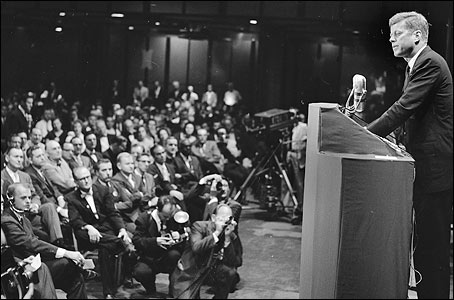
John F. Kennedy, then a candidate for president of the United States, speaks before a group of Protestant ministers at Houston’s Rice Hotel, September 12, 1960. Photo from AP.

Palin wrong about JFK:
Kennedy’s famous speech on church and state

As the clergyman primarily responsible for inviting Kennedy to speak before Houston ministers, I take issue with Ms. Palin.

By James Noland / The Rag Blog / January 6, 2011

I need to set the record straight. In her new book, America by Heart, Sarah Palin discusses John Kennedy’s speech before the Ministerial Association of Greater Houston on September 12, 1960.

Palin admits that the speech was given before she was born, but she claims to have studied it and has some serious issues with Kennedy. In her critique, she takes his address out of context and distorts what he said.

Palin puts Kennedy down while elevating Mitt Romney. She writes that Kennedy’s speech “was irrelevant to the kind of country we are.” While praising Mormon Romney, she attacks Catholic Kennedy by saying his speech “did not resolve the issue” and “dodged the crucial question.”

The crucial question to Palin was Kennedy’s embrace of what nearly every Protestant clergyman holds dear — namely, that the church is a separate and independent institution from any form of government.

Palin believes that Kennedy made a fundamental error when he affirmed: “I believe in an America where the separation of church and state are absolute.”

As the clergyman primarily responsible for inviting Kennedy to speak before Houston ministers, I take issue with Ms. Palin. She does not seem to realize that in 1960 Kennedy was burdened by what was known as “the Catholic problem.” Many ministers in Houston and throughout the United States agreed with Dr. Norman Vincent Peale, author of The Power of Positive Thinking, when he charged:

Faced with the election of a Catholic, our culture is at stake. It is inconceivable that a Roman Catholic president would not be under extreme pressure by the hierarchy of his church to accede to its policies with respect to foreign interest.

He went on to say that the election of a Catholic might even end free speech in America.

To me this argument was appalling and personally offensive. To eliminate any candidate from running for President because of his or her religious beliefs is a violation of the constitutional guarantee that there shall be no religious test for public office.

I am a graduate of Yale Divinity School and a Methodist minister. In 1960 I was the head of an interchurch agency charged with promoting Protestant ecumenism in Houston, Texas, and I felt bold steps needed to be taken to confront the growing bitterness among my fellow clergymen.

Luckily, I was able to persuade the Ministerial Association to ask both Kennedy and his opponent, Richard Nixon, to speak before the ministers of this area. Nixon declined but Kennedy accepted.

On the evening of the meeting, clergymen filled the Rice Hotel Ballroom. Many were vehemently opposed to this Roman Catholic. Some said that, if elected, Kennedy would move the Pope from Rome and install him in the White House. At the very least, they felt that Kennedy’s religion would affect his decision making.

Kennedy began by outlining critical issues facing his campaign:

…the spread of Communist influence… hungry children… in West Virginia… old people who cannot pay their doctors bills… families forced to give up their farms — an America with too many slums, with too few schools, and too late to the moon and outer space… war and hunger and ignorance and despair know no religious barrier.

Next he argued:

I believe in an America where the separation of church and state is absolute; where no Catholic prelate would tell the President — should he be Catholic — how to act, and no Protestant minister would tell his parishioners for whom to vote; where no church or church school is granted any public funds or political preference, and where no man is denied public office merely because his religion differs from the President who might appoint him, or the people who might elect him.

Palin recoils at Kennedy’s “repeated objection to governmental assistance to religious schools.” What is the alternative to the absolute separation of church and state? Does she want church schools to be granted public funds? She makes it clear that this is her preference and she seems eager to blur the demarcation between the federal government and organized religion.

Contrary to Palin’s critique, the speech I heard did not dodge the issues that Kennedy had to confront to be the first and only Roman Catholic to be elected President of the United States since the country started in 1789. Every minister present wanted to hear Kennedy acknowledge that he believed in a complete and unqualified partition between the national government and religious institutions.

Palin unfavorably compares Kennedy to Romney. She writes that Kennedy was “defensive” and “seemed to want to run away from religion.” Then she praises Romney for saying: “Freedom and religion endure together, or perish alone.”

The truth is that Kennedy was on the offensive. He had to take a strong stand on the position that religious institutions that use government power in support of themselves and force their views on persons of other faiths, or of no faith, undermine all our civil rights.

Erecting the wall of separation between church and state, to Kennedy, was absolutely essential in a free society. “I am not the Catholic candidate for President. I am the Democratic Party’s candidate for President who also happens to be a Roman Catholic. I do not speak for my church on public matters — and the church does not speak for me.”

Palin feels that Romney was “relevant” when he exclaimed that religious liberty is “fundamental to America’s greatness,” while Kennedy “assured voters that your faith will have nothing to do with your presidency.”

Palin is disappointed that Kennedy did not “tell the country how his faith had enriched him.” Rather, he dismissed it as “a private matter.”

Those who doubt the wisdom of Kennedy’s decision to keep his religious faith private should remember that he was not a Pharisee, whom Christ censured. I applaud the fact that Thomas Jefferson attacked those “fallible and uninspired men (who) have assumed dominion over the faith of others, setting up their own opinions and modes of thinking as the only true and infallible…”

Why did Sarah Palin condemn John Kennedy? Is she trying to position herself to make a run for the presidency with Romney as her partner?

Would Palin disagree with Kennedy when he advocated:

I believe in an America where religious intolerance will someday end, where all men and all churches are treated as equals, where every man… has the same right to attend or not to attend the church of his choice… where Catholics, Protestants, and Jews… will refrain from those attitudes of disdain and division… and promote instead the American ideal of brotherhood.

How effective was Kennedy’s speech? To answer this question, l refer you to Sargent Shriver, Kennedy’s brother-in-law, who was manager of Kennedy’s political campaign and later became director of the anti-poverty program known as the Office of Economic Opportunity.

After the election I was invited to the White House and given the red carpet treatment. Then the executive assistant with whom I visited sent me in a limousine to see Sargent Shriver, who was waiting for me when I arrived and proclaimed:

Mr. Noland, I personally want to thank you for what you did to organize the Houston ministers meeting. Jack and I feel that this was the turning point in our campaign. It was a very rough session and the auditorium was dripping with fear, prejudice, and sheer disdain for Roman Catholics.

“Those in attendance seemed to be unaware that the meeting was being televised and being shown simultaneously all over the United States. Also, we videotaped the entire program and selectively showed it again and again in heavily Roman Catholic areas and this helped to galvanize Catholics’ commitment to go to the polls. This carried the day for us. Thank you!

In summary, I am glad to have had a minor role in helping John F. Kennedy to move into 1600 Pennsylvania Avenue. I especially appreciate his defense of the separation of church and state. He did not forget Jefferson’s maxim: “The price for freedom is eternal vigilance.”

In addition, Thomas Jefferson cautioned against those who fallaciously judge the religious sentiments of others “only as they square or differ from his own…” This certainly seems to be the case with Ms. Palin.

[James Noland worked with Federal Judge Woodrow Seals and the Ministerial Association of Greater Houston to bring presidential candidate John F. Kennedy to Houston to speak before the South Texas Protestant clergymen, where JFK gave his famous speech on the separation of church and state. Noland later taught at Rice University, the University of Houston, and St. Thomas University, and served as Assistant to the Mayor of Houston.]

Rare video of John F.Kennedy’s speech in Houston, Sept. 12, 1960

The Rag Blog

Posted in Rag Bloggers | Tagged , , , , , , , | 4 Comments

Glenn W. Smith : Aristotle and the Cyberpoke

Photo of cyberpoke by Willie Pipkin / DogCanyon.

Making real connections:
Aristotle and the cyberpoke

By Glenn W. Smith / The Rag Blog / January 6, 2011

Democratic political consultant and progressive Texas blogger Glenn W. Smith will be Thorne Dreyer’s guest on Rag Radio, Friday, Jan. 7, 2011, 2-3 p.m. (CST), on KOOP 91.7 FM in Austin. To stream Rag Radio live on the internet, go here. To listen to this interview after it is broadcast — and to other shows on the Rag Radio archives — go here.

WEST TEXAS — I’m partial to the desert mountains of West Texas, but on my frequent visits out here I’m always surprised — and touched — by the strong spirit of friendship and community that marks the place.

“Friendship holds political communities together,” said Aristotle, and he was on to something. American political culture has deteriorated as the various perils of modernity weakened the role of friendship in our political life. It’s a weighty, complicated topic. I just don’t want to be friendly with Glenn Beck.

It seems appropriate to kick off the New Year with a reminder that “concord” — the word Aristotle used — is instrumental to a community’s pursuit of justice. The loss of some sense of reciprocity and mutual concern for others is a dangerous consequence of a political culture lost in myths of hyper-individuality and zero-sum thinking in which one’s gains seem to depend upon the losses of others.

Out here for a West Texas New Years with large groups of friends from all over America, I find a common understanding of our absolute dependence upon one another. And this is a place our myths tell is a veritable source of the independent rugged individualist.

There are some rugged folks, and they understand that concord doesn’t mean conformity. But by God if your truck breaks down, they’re there to help you, and they expect the same in return.

Every year some of my friends and I give a small New Years Eve country concert on the front porch of the old Stillwell Store not far from the Rio Grande and Big Bend National Park. Ranch folk come from all over. The Stillwell family puts out a nice spread of food. We hail from very different worlds, but those differences disappear on this day because we’re all here for one reason: a shared moment of concord.

Look at the picture above. This old cyberpoke is taking advantage of the wireless on the patio the Marathon Motel (you might have seen it Wim Wenders 1984 film, Paris, Texas). He was sittin’ there at his computer when we checked in early last week.

It’s a cool picture (taken by Austin guitarist Willie Pipkin), and it tells us something. The possibilities for connection among us are nearly infinite, even though it sometimes seems like the web adds a bit of fragmentation, isolation, and loss of real-world community.

We tend to gather on the web with those we’re pretty sure will agree with us, and we lose (if it’s all we do) the wordless, emotional lessons of connections with strangers, with different others who, say, work a mountain ranch while we race around our cities.

Aristotle said true friendship transcends simple utilitarian relations, making justice possible and the political community stronger. And that’s another danger of distant internet connections: it often seems to come with a utilitarian end in mind. We need to take this action, make this point, cause this political consequence.

But these downsides and dangers are outweighed, I think, by the magnified possibilities of authentic connection — and even concord. But it will take an effort, maybe a special effort, to bring such a spirit to the digital world.

By the way, the thin gruel of what’s called “bipartisanship” shouldn’t be mistaken for authentic friendship. Real friendship requires moral steadfastness and honesty. I may not win the given political argument, but if I’m to be a friend to others, the least they should expect is sincerity and moral courage.

[Austin’s Glenn W. Smith, according to Daily Kos founder Markos Moulitsas, is a “legendary political consultant and all-around good guy.” His excellent blog on politics and culture is DogCanyon, where this article also appears.]

The Rag Blog

Posted in Rag Bloggers | Tagged , , , , , | Leave a comment

Alan Waldman : My 10 Favorite Films of 2010

Scene from City Island with Emily Mortimer, Andy Garcia. Image from Rotten Tomatoes.

City Island tops the list:
My 10 favorite films of 2010

By Alan Waldman / The Rag Blog / January 6, 2011

Many people believe The King’s Speech is the best film of 2010, but at this writing it has not come to my town, so I will consider it for next year’s list. Over the decades that I have been compiling my lists of favorites, they have ranged from 15 movies to 30.This year there were fewer good films, but then I went to theaters less and spent more time watching excellent older films on Netflix (see below).

My top 10:

  1. CITY ISLAND is a wonderful comedy drama about keeping secrets from your family. It only played briefly in theaters, but it is a real treasure that I am 99% certain you will love. Andy Garcia, Julianna Margulies, Emily Mortimer, Alan Arkin, and three unknowns are absolutely terrific. The script is great — funny, insightful, surprising, sweet, offbeat, warm-hearted, and thoroughly enjoyable.
  2. INSIDE JOB accomplishes the difficult task of making the labyrinthine financial crisis of 2008-2009 understandable — and therefore infuriating. At a worldwide cost over $30 trillion, the great economic crime put millions of people out of work, just so a handful of greedy banks could further enrich themselves. The film is smart, brilliantly edited, and compelling. It includes succinct interviews with top financial insiders, politicians, journalists, and academics. Despite the seemingly dry subject matter, it never stalls out but keeps driving forward. At rottentomatoes.com, 97% of the 92 critics surveyed gave it thumbs-up.
  3. IN THE LOOP is one of the most hilarious films of the decade. I seriously recommend watching it on DVD with the English subtitles. It is in English, but the jokes and funny insults come so fast and furiously that you sometimes have to back up and read them to catch everything. Scottish actor Peter Capaldi steals the film with his astonishing range of insults and wisecracks, but the fine American/British cast also includes James Gandolfini, Tom Hollander, Gina McKee, and some funny folks with whom we are unfamiliar. The plot deals with the efforts of British and American bureaucrats and officials to try and prevent their countries from getting into a Middle East war. Fully 94% of 150 reviewers liked this film.
  4. THE SOCIAL NETWORK is great for several reasons, but most of all for Aaron Sorkin’s brilliant, brilliant script. The film deals with the creation of Facebook by a couple of Harvard undergraduates. At first it was just a way to evaluate datable girls, but it has since grown to a global phenomenon with 500 million users. The journey to that success is highly entertaining, and the bright young cast adds a lot. At Rotten Tomatoes, 97% of 258 critics liked this one.
  5. FAIR GAME is both a gripping thriller and a true history of how Karl Rove and other Bush Administration officials, to cover up their lies about Niger yellowcake uranium allegedly sent to Iraq, outed CIA undercover agent Valerie Plame (well created by Naomi Watts) and demonized her husband, Joe Wilson (nicely limned by Sean Penn). The film has lots of compelling detail that was not in the news, such as the fact that the Bushies’ illegally identifying Plame directly cost the lives of 18 Iraqi nuclear scientists she was trying to help escape. This is a supremely well-made film that grabs you early and doesn’t let up.
  6. THE SECRET IN THEIR EYES is an outstanding Argentinean film noir murder mystery that justifiably won the 2010 Oscar for best foreign-language picture. Dealing with an investigation into a murder 25 years earlier, it is a gripping, complex, fascinating thriller (and love story), enriched by the performance of great Argentine actor Ricardo Darin (also terrific in the fine films Nine Queens and Son of the Bride). This one was a hit with 91% of 126 critics.
  7. THE GIRL WITH THE DRAGON TATTOO is an electrifying Swedish revenge thriller, based on one book of the global best-selling trilogy of novels by the late Stieg Larsson. A disgraced financial journalist and a brilliant-but-troubled computer hacker investigate the disappearance of a woman 40 years before and dig up all kinds of dark family secrets. There is lots of graphic violence, but the quality of the drama will justify it for most viewers.
  8. PASSING STRANGE is Spike Lee’s film of the extraordinary Broadway musical of the same name by writer/singer/composer Stew. All 24 critics tallied at Rotten Tomatoes liked it. It combines superb songs, imaginative staging, fine performances and splendid stage and film direction to tell a story that captures a lot of a young black men’s experience, going from a religious youth to mind-boggling political and sexual adventures in Europe. This one is a real hidden treasure.
  9. SOUTH OF THE BORDER is a solid Oliver Stone documentary that incisively refutes Bush Administration and Fox News lies about Venezuela’s President Hugo Chavez and several other Latin American leaders who have bravely freed themselves from U.S. and International Monetary Fund dominance. Full of provocative insights, it includes fascinating interviews with the gutsy presidents of Argentina, Bolivia, Cuba, Ecuador, Paraguay and Brazil.
  10. DATE NIGHT is a very funny mistaken-identity comedy with splendid performances from Tina Fey and Steve Carrell.

My wife Sharon and I Netflixed many good older films, including Elsa and Fred, For Roseanna, The Memory of a Killer, Understanding Betty, Boogie Man: The Lee Atwater Story, Charlie Chan in Reno, Vantage Point, The Assignment, Me and Orson Welles, Wasabi, James Taylor: A Musicares Tribute, Cream: Disraeli Gears, You Don’t Know Jack, Good Hair, Bill Maher: But I’m Not Wrong, Yoo Hoo Mrs. Goldberg, Sneakers, and Owl and the Sparrow.

We also enjoyed Netflixing lots of great (primarily British) TV. These recommendations are in addition to our perennial favorites, including the legendary comedies The Thin Blue Line, The Vicar of Dibley, Blackadder, Absolutely Fabulous, Fawlty Towers, League of Gentlemen, Not Going Out and Gavin & Stacey, and the great Brit mysteries, including A Touch of Frost, Midsomer Murders, Cracker, Inspector Morse (followed by Inspector Lewis), Poirot, Miss Marple, New Tricks, Inspector Lynley Mysteries, and Jonathan Creek.

We watched and enjoyed episodes of each of these Brit series in 2010: Trial & Retribution, The Rivals of Sherlock Holmes, Life on Mars, The Last Detective, The Commander, Wycliffe, and Judge John Deed.

We also thoroughly enjoyed the Brit series Desperate Romantics, about the Pre-Raphaelite Brotherhood, the Henry VIII saga The Tudors, the small-town comedy/drama Doc Martin, and episodes of the excellent U.S. series Damages, Nurse Jackie, The Job, and Leverage.

[Houston native Alan Waldman is a former editor at Honolulu Magazine and The Hollywood Reporter.]

The Rag Blog

Posted in Rag Bloggers | Tagged , , , | 2 Comments

Lamar W. Hankins : ‘Death Panel’ Hysteria Gets New Life

Cartoon by Steve Sack / Minneapolis Star-Tribune / GoComics.

Tales from the crypt, dept.
A new attack on end-of-life counseling

By Lamar W. Hankins / The Rag Blog / January 5, 2011

Charles Krauthammer, the right-wing political columnist, ended 2010 with an old, noxious story-line dressed up in new clothing. In a December 31 column, Krauthammer negates the value of end-of-life planning done with the assistance of physicians who might be paid by Medicare for their advice.

He loads his rhetorical shotgun with words and phrases intended to alarm, scare, and misdirect readers into ignoring the truth, including “notorious (provision),” “administrative fiat,” “nicely buried,” “another power grab,” “Obama bureaucrat.”

Krauthammer’s new screed opposes giving physicians permission to bill Medicare for providing end-of-life counseling to their Medicare patients. Recently-issued regulations would allow physicians to be reimbursed for counseling Medicare patients about end-of-life decision-making. Doctors counsel patients about managing their diabetes, managing their weight, managing their medicines, exercising, and dozens of other medical matters for which Medicare pays the bill.

It is only when it comes to deciding how to manage end-of-life care that America’s troglodytes believe that paying doctors for their time spent in counseling a patient is wrong.

Krauthammer suggests that counseling about end-of-life care is such “a possible first slippery step on the road to state-mandated late-life rationing that the Senate never included it in the final health-care law.” Of course, mandatory end-of-life rationing of health care has nothing whatever to do with end-of-life planning, as Krauthammer should know.

He is a graduate of the Harvard Medical School and was a trained psychiatrist before working for the Jimmy Carter administration as a psychiatric researcher. If anyone should understand the importance of end-of-life health care planning, Krauthammer should.

Seventeen years ago, my parents read a Dear Abby column in which she advocated the use of advance directives to make clear one’s wishes about end-of-life care. My mother was then a retired RN and my father a retired machinist. They thought that making one’s own choices about end-of-life care made a great deal of sense. Placing those choices in writing makes clear to one’s family, physicians, and health care agent (for those who have one) exactly what should be done if a person’s health deteriorates at the end of life and that person is unable to make clear his or her wishes because of mental disease or incapacity.

Of course, my parents were practical people, not political ideologues like Krauthammer. They did not know the history of end-of-life decision-making, but they had had enough experience with death and dying to know that making such decisions in advance, to the extent that is possible, is wise.

It helps remove a burden that often falls on family members. It allows people to decide their own views on the end of life. If they do not want to be maintained by medical regimens that do not afford meaningful life, they can say so. If they want every medical procedure that can be applied regardless of its efficacy, that too is their decision. My parents liked the idea that they could choose what sort of care they would receive at the end of life.

As it turned out, my mother did not want feeding tubes and other measures that would prolong the functioning of her organs without any meaningful ability to participate in life. Her wishes were carried out with the assistance of hospice. Her last few weeks were pain-free. She died at home, with care provided in those last weeks by family, friends, hospice, and other care-givers.

My mother’s choices may not be yours, but we all have the right to make those decisions for ourselves. Virtually every legislature in every state in the nation has accepted the importance of such end-of-life decision-making by adopting standard forms that can be used to make one’s end-of-life medical decisions known.

By law, these decisions must be honored. If a physician will not honor them, we all have the right to have a physician who will follow our wishes. And we all have the right to write out our own wishes without regard to the state forms, and to supplement the state forms with additional choices.

Directives about life-sustaining medical treatment were first proposed and promoted in this country in the 1930s, but did not begin to fully develop until the 1960s, and were boosted by the Karen Ann Quinlan case, decided by the New Jersey Supreme Court in 1976, when Quinlan’s parents were given the right to make end-of-life medical decisions for her since she had no written directives.

The Nancy Cruzan case, decided by the U.S. Supreme Court in 1990, made clearer the law on end-of-life care, recognizing important rights. Cruzan, age 25, was injured in a car accident in Missouri and drifted into a persistent vegetative state. She was provided artificial nutrition and fluids through a gastrostomy tube (commonly called a feeding tube).

After four and a half years, her parents sought to have the tube removed through a court order. After a hearing and an appeal, the case was heard by the U.S. Supreme Court, which held that in the absence of an advance directive, a person’s wishes about medical treatment, including receiving artificial nutrition and fluids, must be proved by “clear and convincing evidence.”

The court recognized a constitutional right of an individual to make decisions about life-sustaining medical treatment and held that that right did not end if the person became incompetent.

After another court hearing in Missouri, that court found that there was “clear and convincing evidence” that Nancy Cruzan would not want to be fed permanently through a gastrostomy tube. The tube was removed, and Nancy Cruzan died 12 days later, nine years after her accident.

The Cruzan decisions predated by 15 years the death of Terry Schiavo, the Florida woman who was maintained by a “feeding” tube from 1990 until her death in 2005, after the tube was removed, yet ideologues like Krauthammer tried to make the Schiavo tragedy into something it never was. It was a case about what one person’s end-of-life decisions were. Now, Krauthammer is trying to convince us that there is something sinister in paying doctors to give counseling and advice to their patients as they try to make their own end-of-life decisions.

The Quinlan, Cruzan, and Schiavo rulings, along with others made by courts all over the country, confirm that we all have the constitutional right to decide the kind of health-care treatment we want before we need it, and to appoint a surrogate to make health-care decisions for us if we become incapable of making them ourselves. In the absence of such written directions, courts will direct these medical decisions as best they can.

While all three cases clarified the law on end-of-life care, they also illustrate the tragedy of not having end-of-life medical care plans, no matter one’s age. Quinlan was 21 when she experienced the medical emergency that left her in a persistent vegetative state; Cruzan, as noted above, was 25 when injured; Schiavo was 26 when she experienced cardiac arrest which led to massive brain damage.

Most people would not want to spend years in a persistent vegetative state like these three young women did, or suffer for years from other conditions that make life impossible to enjoy and participate in when all medical treatments are futile to restore them to functioning human beings. But whatever your feelings about these matters, advance directives give all mentally competent adults a way to make their views known about these medical issues before they confront a serious medical problem. Such decisions are in the control of each individual who uses advance directives.

In “Perspectives on Death and Dying,” authors Gere Fulton and Eileen Metress explain the importance of advance directives: “First, they help ensure that your wishes concerning treatment options will be respected. Second, they protect your family members, health care professionals, and others from the stress and potential conflict of making critical decisions without sufficient information concerning your wishes if you are incompetent.”

The federal Patient Self-Determination Act was signed into law in 1990 by President George H. W. Bush. It requires all health care facilities and programs serving Medicare and Medicaid patients to establish written policies and procedures to determine their patients’ wishes about end-of-life care and to make sure these wishes are honored.

Such facilities and programs must also implement ways to educate their staff and community about advance directives. This is why most hospital patients are asked if they have advance directives when they enter the hospital.

It would be unreasonable to expect doctors to provide medical advice and counseling about the use of these forms without being paid for their time. It is a measure of the bankruptcy of our political system that it has taken 20 years since the inception of the Patient Self-Determination Act to implement a rational system for providing medical advice and counseling about such matters. Though the system recently promulgated is limited to Medicare recipients, as noted earlier, all people, no matter their age, should do end-of-life planning.

While Krauthammer’s attack was aimed at President Obama for deciding to pay physicians for rendering a valuable medical service through the Medicare program, it is irresponsible, demonstrates a disregard for the welfare of Medicare recipients, and has the potential for causing great harm. His musings are a complete fabrication and serve to scare the elderly, the disabled, and the sick, as well as their family members.

Regulations that promote counseling about end-of-life care are supported by the American Medical Association, the National Hospice and Palliative Care Organization, Consumers Union (the publisher of Consumer Reports) and the AARP, among other widely respected organizations.

[Lamar W. Hankins, a former San Marcos, Texas, city attorney, is also a columnist for the San Marcos Mercury. This article © Freethought San Marcos, Lamar W. Hankins.]

The Rag Blog

Posted in Rag Bloggers | Tagged , , , | 3 Comments