Dick Cheney Isn’t the Only One Who Planned Assassinations

When a person repeats precisely the same behaviour over and over again, but expects the result to be different, that is Einstein’s definition of insanity.

Americans have been doing the same thing over and over again for 200 years, somehow expecting things to turn out differently. Until we get it through our thick skulls that voting for the establishment will result in the same establishment garbage over and over and over, we will not change America.

Richard Jehn / The Rag Blog


The Democrats’ Selective Amnesia on Assassination: Clinton Did It and Obama Does It Too
By Jeremy Scahill / July 15, 2009

While the focus is on Dick Cheney’s role, the U.S. has long had a bi-partisan assassination program.

Members of Congress have expressed outrage over the “secret” CIA assassination program that former vice president Dick Cheney allegedly ordered concealed from Congress. But this program—and the media descriptions of it—sounds a lot like the assassination policy implemented by President Bill Clinton, particularly during his second term in office.

Partisan politics often require selective amnesia. Over the past decade, we have seen this amnesia take hold when it comes to many of President Bush’s most vile policies. And we are now seeing a pretty severe case overtake several leading Democrats. It makes for good speechifying to act as though all criminality began with Bush and—particularly these days—Cheney, but that is extreme intellectual dishonesty. The fact is that many of Bush’s worst policies (now being highlighted by leading Democrats) were based in some form or another in a Clinton-initiated policy or were supported by the Democrats in Congress with their votes. To name a few: the USA PATRIOT Act, the invasion of Iraq, the attack against Afghanistan, the CIA’s extraordinary rendition program, the widespread use of mercenaries and other private contractors in US war zones and warrant-less wire-tapping.

Regarding the Bush-era assassination program, there is great reason to be skeptical that the program CIA Director Leon Panetta alleges was concealed from Congress is actually the program the public is currently being led to believe it is. Why would the CIA need to conceal a program that never was implemented and, if it never was implemented, why did Panetta need to shut it down? Moreover, who was running this inactive program from the minute Obama was sworn in until June 24 when Panetta supposedly announced its cancellation? This program—as it is currently being described— should hardly be a major scandal to members of the House and Senate Intelligence Committees, as some are now treating it. As they well know, President Obama has continued the Bush targeted assassination program using weaponized drones and special forces teams hunting “high value targets.” As former CIA Counter-terrorism chief Vincent Cannistraro and others have pointed out, “The CIA runs drones and targets al Qaeda safe houses all the time.” Cannistraro told Talking Points Memo that there is no important difference between those kinds of attacks and “assassinations” with a gun or a knife.

Now, if it turns out that the actual plan Cheney allegedly concealed is something other than what has been publicly described, that will be a different matter. For instance, if the CIA had a secret post-9/11 program planning assassinations on US soil or of US citizens and it was ordered concealed by Cheney. Or, if it was a plan to target in other ways “enemies of the state” within the U.S. as Seymour Hersh has suggested: “The Central Intelligence Agency was very deeply involved in domestic activities against people they thought to be enemies of the state,” Hersh said in March. “Without any legal authority for it. They haven’t been called on it yet. That does happen.”

Let’s look at the program the Democrats claim was kept secret. The Bush administration reportedly authorized the CIA to use small paramilitary teams to hunt down and assassinate “al Qaeda” leaders around the world. It is currently being reported that this plan was never implemented and was born after 9/11. Both of these assertions are very, very doubtful.

The plan, as currently described in the press and by Democrats, is one that continues to exist under the Obama administration right now. In fact, this program has been part of official U.S. policy—under Democratic and Republican administrations—for decades.

By way of background, there is technically a U.S. ban on assassination that dates back to President Ford in 1976. “No employee of the United States Government shall engage in, or conspire to engage in, political assassination,” states Executive Order 11905. That was then updated by President Carter who dropped the term “political” simply prohibiting “assassination.” The current Executive Order, 12333, was signed by president Reagan in 1981 and has remained on the books through every administration since. What is brutally ironic about Reagan signing this ban was that he authorized repeated assassinations, notably the 1986 attempt on Col. Moammar Gadhafi, which failed to kill Gadhafi but instead killed his infant daughter. But in that brutal apparent contradiction is the truth: the U.S. does not have a ban on assassinations as long as government lawyers can figure out some legal acrobats for the president to use in sidelining the ban. Every president from Reagan to Obama has reserved the right to assassinate kill “terrorists” by claiming it as a military operation or a preemptive strike.

It is pretty clear that when the Bush administration took over, it picked up the Clinton administration’s policy on assassination and ran with it—albeit with more of a missionary zeal for killing and a removal of some of the layers of lawyering. In short, the Bush team expanded and streamlined the longstanding U.S. government assassination program.

Throughout the 1990s, the question of covert assassinations was a source of major discussion within the Clinton White House and it is clear assassinations were attempted with presidential approval. Newsweek magazine reported on how, in 1995, U.S. Special Forces facilitated the assassination of a Libyan “terrorist” in Bosnia, saying, “American authorities justified the assassination under a little-known 1993 ‘lethal finding’ signed by President Bill Clinton that gave permission to target terrorists.” A former senior Clinton official speaking shortly after 9/11 called on the Bush administration not to escalate the U.S. assassination program, saying “We have a war on drugs, too, but we don’t kill drug lords.” But then, with no apparent sense of contradiction, the official added, “we have proxies who do.”

Clinton-era officials’ attempt to hide behind “proxies” is a stunning trampling of the assassination ban as it currently exists. Not only does it ban U.S. government personnel from engaging in or conspiring to engage in “assassination,” it also bans “Indirect Participation,” stating: “No agency of the Intelligence Community shall participate in or request any person to undertake activities forbidden by this Order.”

The truth is, under Clinton, it wasn’t just proxies authorized to do the assassinations.

The Clinton White House worked for years with the CIA to craft an assassination policy—specifically relating to “al Qaeda” in general and Osama bin-Laden and his top deputies specifically. CIA operatives like Billy Waugh complained in the early and middle years of the Clinton presidencies that they were lawyered to death by Clinton’s attorneys in their attempts to get the green light to kill bin Laden in Sudan. “[I]n the early 1990s we were forced to adhere to the sanctimonious legal counsel and the do-gooders,” recalled Waugh. Among Waugh’s rejected ideas was an alleged plot to kill bin Laden in Khartoum, Sudan and dump his body at the Iranian Eembassy in an effort to pin the blame on Tehran. Eventually, however, Clinton did authorize what amounted to assassination squads to hunt down and kill bin Laden and other “al Qaeda leaders.” That happened officially in 1998 with Clinton’s signing of a Memorandum of Notification authorizing the CIA to carry out covert assassinations. George W Bush was not the president and Dick Cheney was not the vice president. Of course, current CIA Director Leon Panetta was Clinton’s chief of staff from 1994 to 1997 and would have been party to years worth of discussion on this issue when Clinton was president.

Under Clinton, the Justice Department’s Office of Legal Counsel issued secret rulings stating that the Ford/Reagan ban on assassinations did not apply to “military targets or “to attacks carried out in preemptive self-defense,” according to Steve Coll, Pulitzer-Prize winning author of Ghost Wars.

Shortly after 9/11, Clinton stated this position publicly, supporting the Bush administration’s “war on terror” targeted assassination policy, saying on NBC News, “The ban that was put in effect under President Ford only applies to heads of state. It doesn’t apply to terrorists.” That is a stunning statement that is a true legal stretch given the explicit language of the ban. Moreover, Clinton did, in fact, try to kill a head of state on April 22, 1999, when he ordered a NATO airstrike on the home of Yugoslav President Slobodan Milosevic. Clinton and Gen. Wesley Clark also authorized an assassination attempt on Serbian Information Minister, Aleksander Vucic, bombing Radio Television Serbia when Vucic was scheduled to appear via satellite on CNN’s “Larry King Live.” Vucic was not killed, but 16 media workers were.

Clinton also publicly acknowledged his own administration’s attempt to assassinate bin Laden. “I worked hard to try to kill him,” Clinton said. “I authorized a finding for the CIA to kill him. We contracted with people to kill him. I got closer to killing him than anybody has gotten since.” Clinton’s National Security Advisor Sandy Berger said after Clinton issued his 1998 “lethal finding,” U.S. operatives worked with Afghan rebels for two years in an attempt to kill Bin Laden. “There were a few points when the pulse quickened, when we thought we were close,” Berger later recalled. Among the alleged attempts on bin Laden’s life taken by Clinton was the 1998 bombing of Afghanistan (which was coupled with a massive strike on the Al Shifa pharmaceutical plant in Sudan).

As Coll observed of the Clinton policy: “Clinton had demonstrated his willingness to kill bin Laden, without any pretense of seeking his arrest.”

After 9/11, the CIA, which had been frustrated by some of the hurdles to assassination posed by the Clinton administration’s legal team, now had the conditions and the commander-in-chief it needed to take its assassination program to the next level. The main operations were run out of the CIA’s Counter-Terrorism Center (CTC) headed by J. Cofer Black, who had served as Clinton’s CIA station chief in Sudan when bin Laden was there in the 1990s. After 9/11, Black’s division at the CIA was authorized by President Bush —with the consent of Congress—to hunt down bin Laden and others alleged to be responsible for 9/11. As I describe in my book, Blackwater: The Rise of the World’s Most Powerful Mercenary Army:

Before the core CIA team, Jawbreaker, deployed [to Afghanistan] on September 27, 2001, Black gave his men direct and macabre directions. “Gentlemen, I want to give you your marching orders, and I want to make them very clear. I have discussed this with the President, and he is in full agreement,” Black told covert CIA operative Gary Schroen. “I don’t want bin Laden and his thugs captured, I want them dead… . They must be killed. I want to see photos of their heads on pikes. I want bin Laden’s head shipped back in a box filled with dry ice. I want to be able to show bin Laden’s head to the President. I promised him I would do that.” Schroen said it was the first time in his thirty-year career he had been ordered to assassinate an adversary rather than attempting a capture. Black asked if he had made himself clear. “Perfectly clear, Cofer,” Schroen told him. “I don’t know where we’ll find dry ice out there in Afghanistan, but I think we can certainly manufacture pikes in the field.” Black later explained why this would be necessary. “You’d need some DNA,” Black said. “There’s a good way to do it. Take a machete, and whack off his head, and you’ll get a bucketful of DNA, so you can see it and test it. It beats lugging the whole body back!”

The actions of the teams run by Cofer Black were certainly known to Congress. In fact, Black himself testified in front of Congress in 2002 about what he called the new “operational flexibility” being employed in the “war on terror.” “This is a very highly classified area, but I have to say that all you need to know: There was a before 9/11, and there was an after 9/11,” Black said. “After 9/11 the gloves come off.” By 2004, Black claimed that “over 70 percent” of Al Qaeda’s leadership had been arrested, detained, or killed, and “more than 3,400 of their operatives and supporters have also been detained and put out of an action.” The existence of this program is not secret. It has been documented in books by former CIA operatives, is discussed in public speeches by former officials and is a reflected extensively in the Congressional record.

Obviously, the House and Senate Intelligence Committees should investigate the assassination policy under the Bush administration. Cheney’s role is central to that. Prosecutors should also be authorized to do the same. If there is a nefarious program that the public is unaware of and was unlawfully concealed, it should be brought out into the light. But, the truth is that a real investigation—one that actually seeks to get to the broader truths of these matters— would require investigating the current assassination program under Obama and the roots of the program that preceded the day when George W Bush took power. That means looking at the Clinton White House and further back. It means looking at both Democratic and Republican assassination teams. The sad fact is that nobody on Capitol Hill has demonstrated in any way that they have the political courage to do that.

Source / Rebel Reports

The Rag Blog

Posted in RagBlog | Tagged , , | 2 Comments

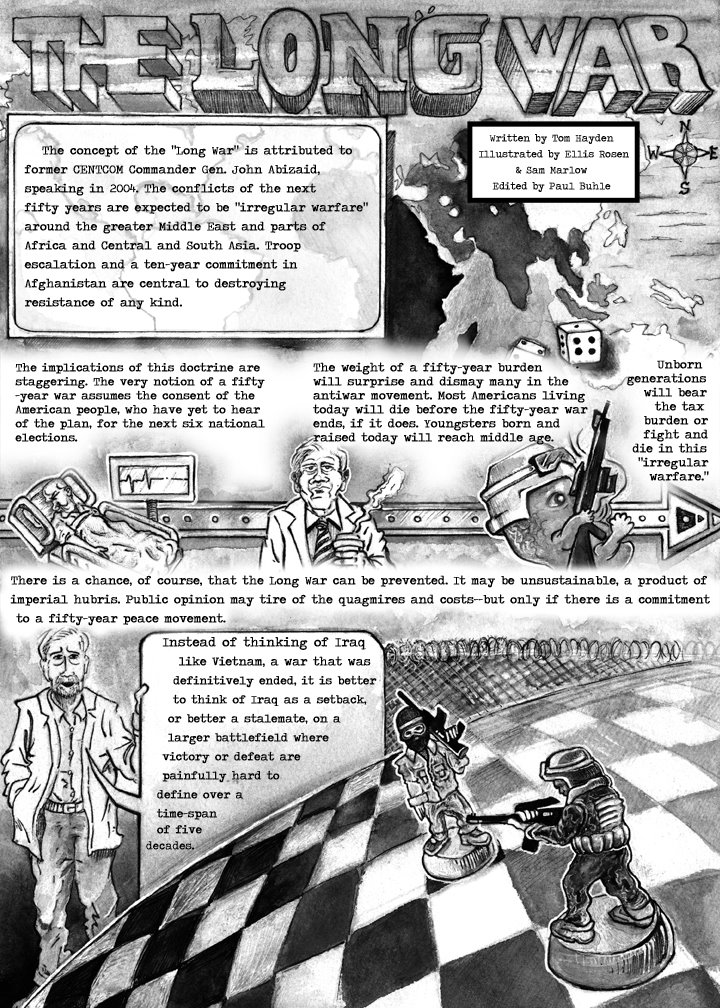
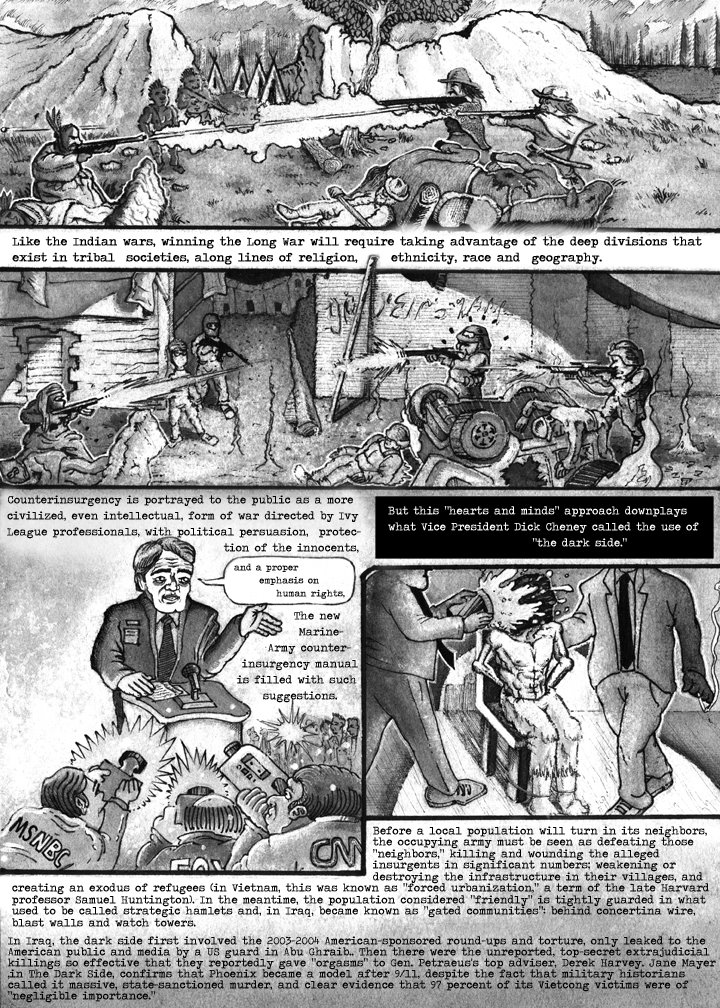
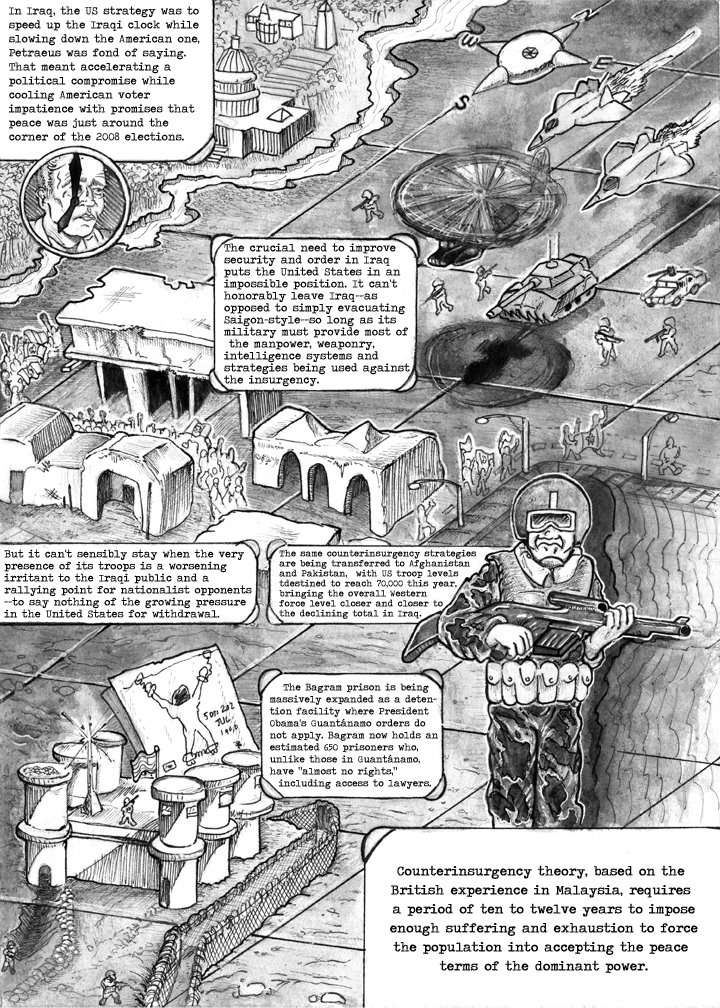
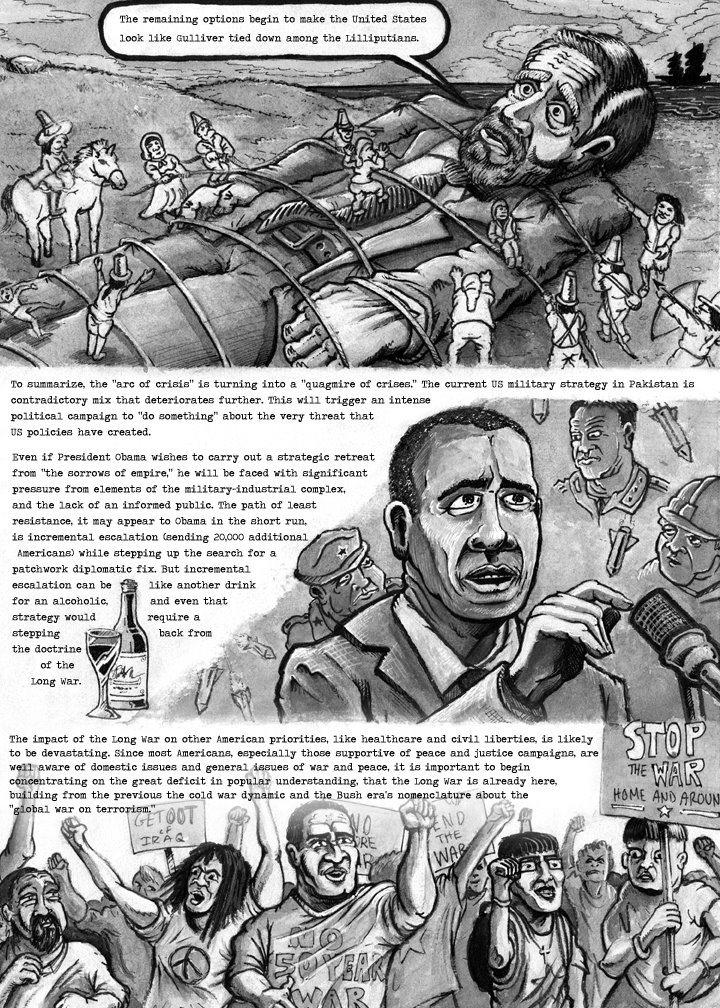
Tom Hayden Comic : The Long War

The Long War
Text by Tom Hayden.
Illustrated by Sam Marlow and Ellis Rosen. Edited by Paul Buhle.

Published by The Rag Blog.

CLICK IMAGE TO ENLARGE

See additional frames, Below.

CLICK IMAGE TO ENLARGE

CLICK IMAGE TO ENLARGE

CLICK IMAGE TO ENLARGE

[Tom Hayden, a prime mover in the Sixties New Left, was a California State Senator. A respected activist and author, he was a founder of Progressives for Obama and is the author of Ending the War in Iraq (2007), The Voices of the Chicago Eight (2008), and Writings for a Democratic Society, the Tom Hayden Reader (2008).]

[Sam Marlow and Ellis Rosen are graduates of the School of the Art Institute of Chicago. Together they self-published two comics. Marlowe also worked as a digital colorist for Chicago comic artist, Paul Hornshemeier, on titles such as “The Three Paradoxes”, and Marvel Comics’ “Omega the Unknown.” He recently completed a short science fiction comic about the end of the world. He is currently volunteering at the Museum of Comic and Cartoon Art. Rosen lives in NewYork where he also works part time at the Barry Friedman Gallery.]

[Paul Buhle is an educator and a historian. He published the New Left journal Radical America during the 1960s and has written or edited many books on radicalism and culture. He now organizes leftwing comic books.]

Go here for earlier Tom Hayden comics published by The Rag Blog.

The Rag Blog

Posted in Rag Bloggers | Tagged , , , , , , , | 2 Comments

Robert Jensen : Getting Radicalized, Slow and Painful

Portrait of Robert Jensen by Robert Shetterly.

Becoming a radical:
The grief and the joy

Becoming radicalized politically allowed me to see that I was suffering because I didn’t want to fit into a world shaped by unjust systems; the problem wasn’t my values and desires but the pathology of those systems.

By Robert Jensen / The Rag Blog / July 15, 2009

[Rob Shetterly, the artist who created the Americans Who Tell the Truth website, asked some of the people he painted to respond to this query: “Everywhere I go, kids and adults want to know how you got started. What was the defining moment that triggered your dedication to fighting for justice or peace, or the environment?” Below are my thoughts.]

My transition to political radicalism — going to the root of problems, recognizing that dramatic and fundamental change in the way society is organized is necessary if there is to be a decent human future — involved a lot of pain, in two different ways.

The first concerned the process of coming to know about the pain of the world. I had never been a naïve person who thought the world was a happy place, but like many people who have privilege (in my case, being white, male, a U.S. citizen, and economically secure, though never wealthy) I was able to remain ignorant of the depth of the routine suffering in the world.

I was able to ignore how white supremacy, patriarchy, U.S. imperialism, and a predatory capitalist economic system routinely destroy the bodies and spirits of millions of people around the world. When I made a conscious choice to stop ignoring those realities — in my case, when I returned to a university for graduate education with the time to read and study — the process of coming to know about that pain was wrenching. But I found myself wanting to know more.

Why would someone with privilege press to know more about the pain of the world when that knowledge creates tension and emotional turmoil? In my case, coming to understand that the world’s pain is the product of profoundly unjust social systems helped me understand a different kind of personal pain I had been struggling with.

Most of my life I had felt like a bit of a freak, like someone out of step with the culture around him. There’s nothing dramatically wrong with me physically or psychologically, but I always struggled to fit in. I had always had a lingering sense that I didn’t want what others around me seemed to want.

Because of my privilege, the world offered me a lot, and I am grateful for much of what I have — work I have usually enjoyed, an adequate income, relative safety. But I could never figure out how to be normal — how to kick back with the guys; how to get excited about sports, television, or the latest hit music; how to care about what kind of car I drove. In many ways I had it made, on the surface, but that sense of being out of step always dragged me down.

The best way to deal with our individual struggles is to put them in a larger context. That means both understanding the forces that shape our world as well as placing our problems in perspective. Becoming radicalized politically allowed me to see that I was suffering because I didn’t want to fit into a world shaped by unjust systems; the problem wasn’t my values and desires but the pathology of those systems.

That didn’t solve all my personal problems, but it sure helped. Radical politics also helped me understand more clearly how others were suffering much more than I; it shook me out of my self-absorption. Both realizations led me to want to continue the search for more knowledge and understanding about how this all worked, and to commit as much time and energy as I had to movements for social justice.

The paradox is that since I have immersed myself in the pain of the world, I have been able to find new joy. I still understand that the world is not a happy place, and to be truly alive we must face what my friend Jim Koplin calls the “sense of profound grief” that comes with looking honestly at the world. As the writer Wendell Berry has put it, we live on “the human estate of grief and joy” [The Unsettling of America: Culture and Agriculture, 3rd ed. (San Francisco: Sierra Club Books, 1996), p. 106].

Grief is inevitable, and it is only through an honest embrace of the grief that real joy is possible. The conventional world tries to sell us many pleasures, but it offers us little joy. That’s because the conventional world is also trying to sell us many ways to numb our pain, which keeps us from that grief. So long as we are out of touch with the grief, we are unable to feel the joy. We are left only with the desperate search for pleasure and a panicked scramble to avoid pain.

This process has, for me, been slow and gradual — there have been no epiphanies. I don’t believe in epiphanies, and I don’t trust people who claim to have epiphanies. I don’t think the deep understanding of the world that we strive for can come in a single moment. It comes from the long and painful struggle, with the world and with ourselves. Insight doesn’t magically descend upon us. We have to work for it, and that always takes time.

As the singer/songwriter Eliza Gilkyson (who also happens to be my partner) has put it, “Those are lost who/try to cross through/the sorrow fields too easily” [“He Waits for Me,” from the CD “Beautiful World,” Red House Records, 2008]. To expand on her metaphor, we cross those fields not in search of a utopia somewhere ahead. Our life is that journey across those fields, facing the grief and celebrating the joy along the way.

[Robert Jensen is a journalism professor at the University of Texas at Austin and board member of the Third Coast Activist Resource Center. His latest book is All My Bones Shake: Seeking a Progressive Path to the Prophetic Voice (Soft Skull Press, 2009). Jensen can be reached at rjensen@uts.cc.utexas.edu. His posts to The Rag Blog are here, and his articles can also be found here.

The Rag Blog

Posted in Rag Bloggers | Tagged , , | 4 Comments

A Stimulus Plan With Jubilee Vouchers. Hallelujah!


Keeping the bear at bay:
Jubilee Vouchers and a complete stimulus plan

If we don’t get a serious world-historical plan in place before the real Bear Market hits we’ll soon be thinking of ‘mere unemployment’ as the good old days.

By Greg Moses / The Rag Blog / July 15, 2009

In a world where one class manufactures credit and the other class clings to hope, how bad can a debt economy be? Of course, we could have that long-awaited revolution where the hopeful class clobbers the lending class and puts an end to the disparities that make borrowing necessary. But what would happen the week after that?

On the other hand we could recover the wisdom of the legendary Jubilee by placing the lending class on notice that every seven years we’re going to have a write-down party, beginning with the summer of 2009.

I offer this as a “mustard seed” (with kudos to Larry Kudlow for the Gospel term that he applies to the salvation of capitalism). Jubilee Vouchers could be sown into “green shoots” and harvested as part of the next stimulus plan. If such debt-relief were offered directly to all the people, all at once, you would surely short the future of any politician who tried to get in the way.

The only moral problem with this idea is how to respect and reward all the good people who didn’t get caught up in debt mania. We should acknowledge their moral superiority and sacrifice.

Therefore, the Federal Reserve Bank shall distribute to each taxpayer a book of Jubilee Vouchers totaling $10,000 which shall be accepted by any creditor in return for debt relief. Any unused Jubilee Vouchers held by people of moral superiority and good sense may be presented to the IRS for tax credits that will be good for as many years as the balance may last.

We’ll let the big brains at the Federal Reserve Bank work out the technicalities of what happens next. Maybe they can open up a $2.25 trillion jubilee line of credit to be paid down with interest from the lenders they support. They could call it The People’s Bank.

Or the Fed could refuse to redeem Jubilee Vouchers from lenders who have proven to be predatory, forcing them into immediate bankruptcy. Where the Fed is concerned the world has full faith that when it comes to credit, if there’s a will, there’s a way. (Cap and trade on the national debt anyone?)

Perhaps there is a moral concept of modern economics that will be transgressed by the revival of Jubilee wisdom, but since we’re borrowing our financial language from the Gospel, why not invite those without financial sin to cast the first stones?

For example, there are people who get paid by huge broadcasting conglomerates who sometimes puff themselves up as saints — as if the whole credit scheme never leaks into the advertising budgets that fund their creditable livelihoods. We could invite them to stone us, but they’d stone us anyway.

The point is that credit mania became a thoroughgoing social mood that ate and fed all of us with the same collective spoon. Nobody stopped it why? Because we were all hooked into the accelerated experience of the leveraged life.

Since we haven’t got the appetite to prosecute debt pushers or their officious collaborators, and since it is probably true what Greenspan says — that we will never outlaw greed — at least we might offer some meaningful ritual comforts to all the addicts who get left with nothing but the spasm of withdrawal.

In addition to Jubilee Vouchers, two other fronts need funding — which we can visualize via that odd couple at CNBC, Cramer and Kudlow.

Jim Cramer says we need a real New Deal jobs program. Kudlow says we need business tax cuts. Publisher Mortimer Zuckerman has joined issue with Cramer in calling for a real job-stimulus program. And any number of old supply-siders are lining up along the Kudlow-Laffer axis to fight for Capital first.

But enough of the bickering already. Do we need labor or capital? Cramer or Kudlow? Why not both?

At any rate let’s not do as a nation what the readers of the Wall Street Journal did in their online responses to Zuckerman’s sober proposal. Zuckerman stayed focused on the needs of the people and how the government might do its duty. The readers of the Wall Street Journal diverted precious pixels into a childish blame game of whose fault?

Fact is, there are very few of us behaving like part of the solution these days, and Congress could probably get all this done in early August if we make it a condition of their summer break. Get Zuckerman to print the bill, roll it down the aisle in a wheelbarrow, and nothing of the usual diligence or transparency of American democracy would be sacrificed

But if we don’t get a serious world-historical plan in place before the real Bear Market hits we’ll soon be thinking of “mere unemployment” as the good old days.

[Greg Moses is a frequent contributor to these pages. He can be reached at gmosesx@gmail.com.]

The Rag Blog

Posted in Rag Bloggers | Tagged , | Leave a comment

Juan Cole on Cheney’s Criminal Irrelevance – II


Truth Commission Needed to Examine Cheney, Assassination Squads, Cover-Ups
By Juan Cole / July 13, 2009

It turns out that the secret CIA program that Leon Panetta cancelled, and which former VP Richard Bruce Cheney ordered hidden from Congress, was in fact an assassination squad focusing on al-Qaeda figures.

The problem with assassination teams is that they are extra-judicial. They are killing people who have not been proven to have done anything wrong. The long litany of mistakes that security organizations have made in recent years, targeting innocents, should form a legion of cautionary tales about just killing people. Maher Arar, for instance, might as well have simply been shot down like a dog as shackled and sent for torture by the Baath Party in Damascus. He was innocent. Murat Kurnaz might have as easily had two bullets put behind his right ear as to have been arrested and sent for “interrogation” to Guantanamo (this is the link for his book). Then there was that little Khaled el-Masri ‘oops’ moment, which would have been even more embarrassing to the US government if he had been shot between the eyes by a US government sniper. I could go on and on (the majority of prisoners at Guantanamo Bay now appears to have been clueless innocents, and Bush-Cheney appears to have wanted to sentence them to life imprisonment without a trial; they could have as easily just been shot on sight).

It could be argued that the CIA would be more careful about who it killed than about who it had detained or had tortured, but we cannot really be sure of that, can we? In fact, Cheney did the CIA itself a grave disservice by putting it in the position of having to plan, at least, to act extra-judicially and beyond the reach of any oversight except his own (shudder). A bureaucracy dedicated to fighting a struggle needs mechanisms for judging its performance and needs to be told when it has gone too far.

My neighbor congressman Pete Hoekstra (R-MI) seems to think that the issue is how much money was spent on this program, which apparently never got off the ground. That it was a small program is not important. September 11 itself probably only cost al-Qaeda $500,000 or so, yet resulted in large loss of innocent life. The issues are ones of constitutionality, good governance, and ethics.

Since we now know that the CIA 007’s were only in training and it is alleged at least, that they were not actually put into the field with a mission, a dark thought crosses my mind. What if Cheney, who notoriously disliked the CIA, decided to give the assassination missions to the military special ops, the Joint Special Operations Command (JSOC), as detailed by Seymour Hersh, instead? That is, the program Panetta closed down may not be the one that went operational. Who is in charge of JSOC now? Anyone? Still Cheney?

Then there is the issue of congressional oversight. I know Congress can be leaky. But frankly you cannot have any sort of democracy if you have a covert organization carrying out black operations with no oversight from any branch of government but the Executive. The CIA is in the executive branch and so can hardly be policed by it. There will always be the temptation to use covert operations to influence American public opinion, and even to influence the outcome of elections. In the 1962 Operation Northwoods, even the Joint Chiefs of Staff proposed committing terrorism against Americans to whip up sentiment in favor of intervention in Cuba. And the JCS is not even a covert organization. Some assassinations could drag the United States into war if their circumstances became known, and you could never be sure they would not be. Even just a supposedly simple rendition (kidnapping), like that of Abu Omar from Milan, unwound like a silent-era Keystone Cops episode; then what about actually killing someone? Nor would all the agents involved defend their actions in Milan; if they regret that, how would they feel if they had been ordered to kill Abu Omar (who, by the way, may never have committed any crimes)?

Me, I think terrorists operating in societies at peace are criminals and should be dealt with as a police matter. I don’t deny that there may be extraordinary circumstances in which direct and immediate action might save a lot of lives; but then, I would put that under the rubric of policing, as well.

Senator Diane Feinstein thinks Cheney may have broken the law by keeping Congress in the dark about the program. If he didn’t, then the law needs to be rewritten!

Now that it is becoming clear that Cheney’s warrantless wiretapping program at the National Security Agency was just enormous, and that he was at the heart of efforts to stonewall after the Valerie Plame leak, it seems to me only a matter of time until so many of Cheney’s crimes become public that pressure will grow to at least have a fact-finding commission on his dirty deeds.

Cheney is a traitor for his role in outing Valerie Plame (and yes, he had Irv Lewis Libby, his chief of staff, try like hell to out her; it is not relevant that Bob Novak took the information from Armitage first). He hid covert operations from Congress. He contemplated assassination squads and for all we know ran some. If Congress doesn’t want to look mean-spirited or to risk disillusioning the public with government by prosecuting the former vice president, let’s at least have a truth commission that gets documents declassified and lays out his full role so we don’t have to wait until 2039 to judge it.

The only thing worse than impunity for crimes is a decades-long cover-up of those crimes from the American people. Complete sunshine on Richard Bruce Cheney’s misdeeds is the minimum necessary to work against them being repeated by the next administration.

Source / Informed Comment

The Rag Blog

Posted in RagBlog | Tagged , , | 3 Comments

Obama’s Non-Nuclear World: A Hiroshima Survivor’s Thoughts

Hiroshima: Ten Years Later. “I’m Just Waiting For Death.” Those are the words of Mrs. Yoskio Nishikawa, 43, bedridden “A-Bomb widow” who lives on $22 a month in charity. Yukiko, 15, one of her four children, cools her forehead with a wet towel as the 70-pound widow rests in their nine-foot square room, part of a frame charity home housing families of 20 widows. A small wooden Shinto shrine, in memory of her blacksmith husband who was killed while riding to work, occupies a place of honor. Mrs. Nishikawa suffers from radiation effects because she combed the city searching for her husband after the bomb fell. She has a bad heart and liver trouble. (1955) Photo: Source.

A Flash of Memory
By Issey Miyake / July 13, 2009

Tokyo — IN April, President Obama pledged to seek peace and security in a world without nuclear weapons. He called for not simply a reduction, but elimination. His words awakened something buried deeply within me, something about which I have until now been reluctant to discuss.

I realized that I have, perhaps now more than ever, a personal and moral responsibility to speak out as one who survived what Mr. Obama called the “flash of light.”

On Aug. 6, 1945, the first atomic bomb was dropped on my hometown, Hiroshima. I was there, and only 7 years old. When I close my eyes, I still see things no one should ever experience: a bright red light, the black cloud soon after, people running in every direction trying desperately to escape — I remember it all. Within three years, my mother died from radiation exposure.

I have never chosen to share my memories or thoughts of that day. I have tried, albeit unsuccessfully, to put them behind me, preferring to think of things that can be created, not destroyed, and that bring beauty and joy. I gravitated toward the field of clothing design, partly because it is a creative format that is modern and optimistic.

I tried never to be defined by my past. I did not want to be labeled “the designer who survived the atomic bomb,” and therefore I have always avoided questions about Hiroshima. They made me uncomfortable.

But now I realize it is a subject that must be discussed if we are ever to rid the world of nuclear weapons. There is a movement in Hiroshima to invite Mr. Obama to Universal Peace Day on Aug. 6 — the annual commemoration of that fateful day. I hope he will accept. My wish is motivated by a desire not to dwell on the past, but rather to give a sign to the world that the American president’s goal is to work to eliminate nuclear wars in the future.

Last week, Russia and the United States signed an agreement to reduce nuclear arms. This was an important event. However, we are not naïve: no one person or country can stop nuclear warfare. In Japan, we live with the constant threat from our nuclear-armed neighbor North Korea. There are reports of other countries acquiring nuclear technology, too. For there to be any hope of peace, people around the world must add their voices to President Obama’s.

If Mr. Obama could walk across the Peace Bridge in Hiroshima — whose balustrades were designed by the Japanese-American sculptor Isamu Noguchi as a reminder both of his ties to East and West and of what humans do to one another out of hatred — it would be both a real and a symbolic step toward creating a world that knows no fear of nuclear threat. Every step taken is another step closer to world peace.

[Issey Miyake is a clothing designer. This article was translated by members of his staff from the Japanese.]

Source / New York Times

The Rag Blog

Posted in RagBlog | Tagged , | 3 Comments

Food Safety Meets Organic Farming: Destroying the Conceptual Foundations by Hyper-Technologizing

Farmworkers harvest organically grown lettuce at Lakeside Organic Gardens Farm in Watsonville. Photo: Paul Chinn/The Chronicle.

Crops, ponds destroyed in quest for food safety
By Carolyn Lochhead / July 13, 2009

Washington — Dick Peixoto planted hedges of fennel and flowering cilantro around his organic vegetable fields in the Pajaro Valley near Watsonville to harbor beneficial insects, an alternative to pesticides.

He has since ripped out such plants in the name of food safety, because his big customers demand sterile buffers around his crops. No vegetation. No water. No wildlife of any kind.

“I was driving by a field where a squirrel fed off the end of the field, and so 30 feet in we had to destroy the crop,” he said. “On one field where a deer walked through, didn’t eat anything, just walked through and you could see the tracks, we had to take out 30 feet on each side of the tracks and annihilate the crop.”

In the verdant farmland surrounding Monterey Bay, a national marine sanctuary and one of the world’s biological jewels, scorched-earth strategies are being imposed on hundreds of thousands of acres in the quest for an antiseptic field of greens. And the scheme is about to go national.

Invisible to a public that sees only the headlines of the latest food-safety scare – spinach, peppers and now cookie dough – ponds are being poisoned and bulldozed. Vegetation harboring pollinators and filtering storm runoff is being cleared. Fences and poison baits line wildlife corridors. Birds, frogs, mice and deer – and anything that shelters them – are caught in a raging battle in the Salinas Valley against E. coli O157:H7, a lethal, food-borne bacteria.

In pending legislation and in proposed federal regulations, the push for food safety butts up against the movement toward biologically diverse farming methods, while evidence suggests that industrial agriculture may be the bigger culprit.

‘Foolhardy’ approach

“Sanitizing American agriculture, aside from being impossible, is foolhardy,” said UC Berkeley food guru Michael Pollan, who most recently made his case for smaller-scale farming in the documentary film “Food, Inc.” “You have to think about what’s the logical end point of looking at food this way. It’s food grown indoors hydroponically.”

Scientists do not know how the killer E. coli pathogen, which dwells mainly in the guts of cattle, made its way to a spinach field near San Juan Bautista (San Benito County) in 2006, leaving four people dead, 35 with acute kidney failure and 103 hospitalized.

The deadly bug first appeared in hamburger meat in the early 1980s and migrated to certain kinds of produce, mainly lettuce and other leafy greens that are cut, mixed and bagged for the convenience of supermarket shoppers. Hundreds of thousands of the bug can fit on the head of a pin; as few as 10 can lodge in a salad and end in lifelong disability, including organ failure.

Going national

For many giant food retailers, the choice between a dead pond and a dead child is no choice at all. Industry has paid more than $100 million in court settlements and verdicts in spinach and lettuce lawsuits, a fraction of the lost sales involved.

Galvanized by the spinach disaster, large growers instituted a quasi-governmental program of new protocols for growing greens safely, called the “leafy greens marketing agreement.” A proposal was submitted last month in Washington to take these rules nationwide.

A food safety bill sponsored by Rep. Henry Waxman, D-Los Angeles, passed this month in the House Energy and Commerce Committee. It would give new powers to the Food and Drug Administration to regulate all farms and produce in an attempt to fix the problem. The bill would require consideration of farm diversity and environmental rules, but would leave much to the FDA.

An Amish farmer in Ohio who uses horses to plow his fields could find himself caught in a net aimed 2,000 miles away at a feral pig in San Benito County. While he may pick, pack and sell his greens in one day because he does not refrigerate, the bagged lettuce trucked from Salinas with a 17-day shelf life may be considered safer.

The leafy-green agreement is based on available science, but it is just a jumping-off point.

Large produce buyers have compiled secret “super metrics” that go much further. Farmers must follow them if they expect to sell their crops. These can include vast bare-dirt buffers, elimination of wildlife, and strict rules on water sources. To enforce these rules, retail buyers have sent forth armies of food-safety auditors, many of them trained in indoor processing plants, to inspect fields.

Keeping children out

“They’re used to working inside the factory walls,” said Ken Kimes, owner of New Natives farms in Aptos (Santa Cruz County) and a board member of the Community Alliance With Family Farmers, a California group. “If they’re not prepared for the farm landscape, it can come as quite a shock to them. Some of this stuff that they want, you just can’t actually do.”

Auditors have told Kimes that no children younger than 5 can be allowed on his farm for fear of diapers. He has been asked to issue identification badges to all visitors.

Not only do the rules conflict with organic and environmental standards; many are simply unscientific. Surprisingly little is known about how E. coli is transmitted from cow to table.

Reducing E. coli

Scientists have created a vaccine to reduce E. coli in livestock, and a White House working group announced plans Tuesday to boost safety standards for eggs and meat. This month, the group is expected to issue draft guidelines for reducing E. coli contamination in leafy greens, tomatoes and melons.

Some science suggests that removing vegetation near field crops could make food less safe. Vegetation and wetlands are a landscape’s lungs and kidneys, filtering out not just fertilizers, sediments and pesticides, but also pathogens. UC Davis scientists found that vegetation buffers can remove as much as 98 percent of E. coli from surface water. UC Davis advisers warn that some rodents prefer cleared areas.

Produce buyers compete to demand the most draconian standards, said Jo Ann Baumgartner, head of the Wild Farm Alliance in Watsonville, so that they can sell their products as the “safest.”

State agencies responsible for California’s water, air and wildlife have been unable to find out from buyers what they are demanding.

They do know that trees have been bulldozed along the riparian corridors of the Salinas Valley, while poison-filled tubes targeting rodents dot lettuce fields. Dying rodents have led to deaths of owls and hawks that naturally control rodents.

Unscientific approach

“It’s all based on panic and fear, and the science is not there,” said Dr. Andy Gordus, an environmental scientist with the California Department of Fish and Game.

Preliminary results released in April from a two-year study by the state wildlife agency, UC Davis and the U.S. Department of Agriculture found that less than one-half of 1 percent of 866 wild animals tested positive for E. coli O157:H7 in Central California.

Frogs are unrelated to E. coli, but their remains in bags of mechanically harvested greens are unsightly, Gordus said, so “the industry has been using food safety as a premise to eliminate frogs.”

Farmers are told that ponds used to recycle irrigation water are unsafe. So they bulldoze the ponds and pump more groundwater, opening more of the aquifer to saltwater intrusion, said Jill Wilson, an environmental scientist at the Central Coast Regional Water Quality Control Board in San Luis Obispo.

Wilson said demands for 450-foot dirt buffers remove the agency’s chief means of preventing pollution from entering streams and rivers. Jovita Pajarillo, associate director of the water division in the San Francisco office of the Environmental Protection Agency, said removal of vegetative buffers threatens Arroyo Seco, one of the last remaining stretches of habitat for steelhead trout.

Turning down clients

“It’s been a problem for us trying to balance the organic growing methods with the food safety requirements,” Peixoto said. “At some point, we can’t really meet their criteria. We just tell them that’s all we can do, and we have to turn down that customer.”

Large retailers did not respond to requests for comment. Food trade groups in Washington suggested calling other trade groups, which didn’t comment.

Chiquita/Fresh Express, a large Salinas produce handler, told the advocacy group Food and Water Watch that the company has “developed extensive additional guidelines for the procurement of leafy greens and other produce, but we consider such guidelines to be our confidential and proprietary information.”

Seattle trial lawyer Bill Marler, who represented many of the plaintiffs in the 2006 E. coli outbreak in spinach, said, “If we want to have bagged spinach and lettuce available 24/7, 12 months of the year, it comes with costs.”

Still, he said, the industry rules won’t stop lawsuits or eliminate the risk of processed greens cut in fields, mingled in large baths, put in bags that must be chilled from packing plant to kitchen, and shipped thousands of miles away.

“In 16 years of handling nearly every major food-borne illness outbreak in America, I can tell you I’ve never had a case where it’s been linked to a farmers’ market,” Marler said.

“Could it happen? Absolutely. But the big problem has been the mass-produced product. What you’re seeing is this rub between trying to make it as clean as possible so they don’t poison anybody, but still not wanting to come to the reality that it may be the industrialized process that’s making it all so risky.”

Some major recent outbreaks of food-borne illness

The Food and Drug Administration lists 40 food-borne pathogens. Among the more common: E-coli O157:H7, salmonella, listeria, campylobacter, botulism and hepatitis A.

June 2009: E. coli O157:H7 found in Nestle Toll House refrigerated cookie dough manufactured in Danville, Va., resulted in the recall of 3.6 million packages. Seventy-two people in 30 states were sickened. No traces found on equipment or workers; investigators are looking at flour and other ingredients.

October 2008: Salmonella found in peanut butter from a Peanut Corp. of America plant in Georgia. Nine people died, and an estimated 22,500 were sickened. Criminal negligence was alleged after the product tested positive and was shipped.

June 2008: Salmonella Saintpaul traced to serrano peppers grown in Mexico. More than 1,000 people were sickened in 41 states, with 203 reported hospitalizations and at least one death. Tomatoes were suspected, devastating growers.

April 2007: E. coli O157:H7 found in beef, sickening 14 people. United Food Group recalled 5.7 million pounds of meat.

December 2006: E. coli O157:H7 traced to Taco Bell restaurants in New Jersey and Long Island, N.Y. Green onions suspected, then lettuce. Thirty-nine people were sickened, some with acute kidney failure.

September 2006: E. coli O157:H7 found in Dole bagged spinach processed at Earthbound Farms in San Juan Bautista (San Benito County). The outbreak killed four people, sent 103 to hospitals, and devastated the spinach industry.

Source / San Francisco Chronicle

Thanks to Janet Gilles / The Rag Blog

Posted in RagBlog | Tagged , , | 1 Comment

Sen. Sessions : Alabama Hypocrite Would Sit in Judgment

Graphic: US News & World Report, June, 16, 1986.

Click on image to enlarge.

There is great irony here in the once rejected nominee [for federal judge] now trying to sharpen his claws on Judge Sotomayor. But she is lots tougher and sharper than Sessions could ever be, and is letting him claw away, as he loudly displays his lightweight duplicity and demagoguery.

By Larry Ray / The Rag Blog / July 14, 2009

The Republican Party’s finest continue to exhibit just how sorry, brazen, and unprincipled many of them can be as questioning of Supreme Court nominee, Sonia Sotomayor has gotten underway. One of the worst and most shameless of the GOP interrogators is Alabama junior senator, Jeff Sessions.

In 1986 Sessions himself sat in front of the Senate Judiciary Committee as a Reagan nominee for a federal judgeship, and was promptly rejected because of his history of racially insensitive remarks and a poor civil rights record. One of those questioning Sessions was Senator Edward Kennedy who even back in 1986 called him “a throwback to a shameful era.”

Today, after 23 years of playing the good old boy politician, becoming a U.S. Senator in 1997, Sessions, who switched from the Democratic to the Republican party, was assigned to be the Ranking Member on the Senate Judiciary Committee less than three months ago.

There is great irony here in the once rejected nominee now trying to sharpen his claws on Judge Sotomayor. But she is lots tougher and sharper than Sessions could ever be, and is letting him claw away, as he loudly displays his lightweight duplicity and demagoguery.

In his confrontational opening statement of the confirmation hearings for Sonia Sotomayor, Sessions, in his high nasal whine, he lectured the nominee about ‘prejudice’ in the legal system.

Twenty years ago when Sessions sat before the very panel he now heads, he was asked about well documented reports of his publicly recognized racism. His response, “I may have said something about the NAACP being un-American or Communist, but I meant no harm by it.”

Sessions allegedly referred to the (NAACP) and the (ACLU) as “un-American” and “Communist inspired” because they “forced civil rights down the throats of people.” At his confirmation hearings, Sessions said that the groups could be un-American when “they involve themselves in un-American positions” in foreign policy.

Sessions had been frequently accused of “gross insensitivity” on racial issues by his detractors. Among a variety of blatant racial comments his opponents pointed to, was his joking reference to the Ku Klux Klan which he said “was not so bad until he found out that some of them smoked marijuana.” Sessions, with a straight face, claimed his remarks were made in jest.

The panel didn’t buy it, and rejected him. One of those voting against him was Alabama Democratic Senator Howell Heflin.

Today Republican Senator Sessions is but one more example of GOP leadership tinged with documented hate, racism, anti immigration xenaphobia, and unrealistic conservative dreams of “keeping things like they have always been.”

The almost certain approval of Judge Sotomayor will, indeed, not be the way things have always been. That is the point of President Obama’s having nominated her to the join the ranks of what has historically been the dominion of white men only, with only recent minor exceptions.

Meanwhile Senator Sessions may well be called into other hearings since he was one of of only nine opponents of Senator John McCain’s anti-torture amendment. Sessions supports former Vice President Dick Cheney’s proposal to exempt the (CIA) from any ban on the use of torture.

Session’s is a real humanist too. Last month reportedly during testimony by a 42-year-old Filipino woman scheduled to be deported, the mother of two American children, who had been in the USA for 23 years, Sessions was clearly heard telling one one of his aides, “Enough with the histrionics,” when the woman’s 12-year-old son began crying during the testimony.

And now he lectures a Supreme Court nominee about “prejudice in the legal system.”

The only thing more disgusting and upsetting than Sessions’ troubling racist past are the voters out there who are nodding their heads in agreement with his “tough questioning.”

[Retired journalist Larry Ray is a Texas native and former Austin television news anchor. He also posts at The iHandbill.]

The Rag Blog

Posted in Rag Bloggers | Tagged , , , , , , | 4 Comments

Obama’s Nuclear Gambit : Savvy or Softy?

Above, John Bolton: a neocon looks backward. Below, Barack Obama with Russian president Dmitry Medvedev. Photo by Dmitry Astakhov / AFP / Getty Images.

Obama’s nuclear gambit:
Cold warrior Bolton says he gave too much

These views never made much sense during the dreary days of the Cold War. They are even sillier and more self-defeating in the present context.

By Steve Weissman / July 14, 2009

Former UN Ambassador John Bolton, the mustachioed neocon, sometimes gets it half right. President Barack Obama is, in fact, reducing America’s nuclear advantage over Russia, just as Bolton argues. But the hell-for-leather Bolton fails completely to understand what Obama is doing and why, as do many Obama supporters.

“Americans may have voted for a lower profile in Iraq, but they did not vote for a weaker United States globally,” Bolton wrote right before Obama’s trip to Moscow.

Obama would, in Bolton’s view, give the Russians everything they wanted: “Major new restrictions on strategic nuclear weapons, postponing construction on US missile-defense installations in Poland and the Czech Republic and, indeed, downsizing America’s entire missile-defense program, sidelining Georgia’s and Ukraine’s NATO membership applications, and leaning hard on Israel to stop all West Bank settlement construction and accept a Palestinian state.”

Caught up in yesterday’s Cold War, Bolton can only see these as unwarranted concessions to an unrelenting rival, for which the United States would get little in return.

After the signing of the “Joint Understanding” in Moscow, Bolton berated Obama even more. “Obama’s policy is risky for America and its global allies who shelter under our nuclear umbrella,” Bolton wrote. “Although Obama hopes dramatic US nuclear weapons reductions will discourage proliferation, the actual result will be the exact opposite.”

No doubt, Bolton is playing Republican politics by painting Obama as a naïve idealist who would endanger American security and that of our allies, notably the Israelis.

Sadly, many nonpartisan analysts join Bolton in seeing Obama’s efforts through the prism of an outdated arms race with the Soviet Union. They also see American military power as the prime deterrent to the nuclear ambitions of Iran, North Korea and any other nation that might seek the bomb.

These views never made much sense during the dreary days of the Cold War. They are even sillier and more self-defeating in the present context.

To expand on Henry Kissinger’s recent remark in Der Spiegel, Obama works like a chess master playing several matches at the same time. In playing the Russians, he started from a simple calculation. The United States has enjoyed an overwhelming nuclear superiority over both Russia and the Chinese, as Keir A. Lieber and Daryl G. Press explained in the March 2006 issue of Foreign Affairs.

“Today, for the first time in almost 50 years, the United States stands on the verge of attaining nuclear primacy,” they wrote. “It will probably soon be possible for the United States to destroy the long-range nuclear arsenals of Russia or China with a first strike.”

With increasing tensions between the Russians and the West since 2006, they have apparently made some efforts to catch up. But, even with America’s nuclear advantage, Washington found no way to use it to modify Russia’s behavior, not even in Georgia and Ukraine. Short of threatening a nuclear shoot-out, having more nukes than Moscow actually hurt rather than helped.

Obama has opted to play a softer game against the Russians, to which they responded by not standing in the way of a new deal for an airbase in Kyrgyzstan and opening their own airspace for American supply flights to US and NATO troops in Afghanistan. Better that Russia help persuade Obama to get out of Afghanistan while he still can, but give the two governments credit for moving toward win-win agreements rather than the win-lose confrontations of the past.

Obama’s second chess game tries to get Moscow to help pressure Tehran to rein in its nuclear energy program and stop short of atomic weapons. Here the Russians have mixed interests. They do not look happily on the prospect of nearby Iran getting the bomb and have quietly put obstacles in the way during its construction of the Iranian nuclear reactor in Bushehr. But the Russians have a large commercial interest in providing the reactor and other nuclear equipment, and also in selling costly conventional weapons, not the least anti-aircraft defenses to protect Iran against Israel or American air strikes.

In a third chess game, Obama is playing directly with Iran and other countries looking for nuclear arsenals of their own. Without Russia and the United States cutting their own nuclear arsenals, as the two countries committed to do in the Nuclear Proliferation Treaty, Obama has no chance of bringing Iran and the others to the table.

This is where Bolton and those who share his views most misunderstand reality. American military power failed utterly to prevent China, India, Pakistan and Israel from getting nuclear weapons, and it will not stop any other nation that sees the bomb as a way to deter a military attack by rivals, large or small.

The most dramatic evidence of this came from the former Iraqi dictator Saddam Hussein, in the recently released transcripts of his interrogations by and casual conversations with the FBI. Saddam, it turns out, let the Bush administration believe he had nukes and other weapons of mass destruction because he feared looking weak to Iran.

As the Arabic-speaking FBI interrogator summed it up, “Hussein stated he was more concerned about Iran discovering Iraq’s weaknesses and vulnerabilities than the repercussions of the United States for his refusal to allow UN inspectors back into Iraq.”

The ruse cost Saddam his country and his life. But that is how important nuclear deterrence has become to the less-than-Great Powers of the Middle East and Persian Gulf. Obama, the chess master, hopes to find a way around the problem with his nuclear summit in Washington next March. In the meantime, he would do well to stop the threats to Iran coming from the Israelis and from within his own administration.

[A veteran of the Berkeley Free Speech Movement and the New Left monthly Ramparts, Steve Weissman lived for many years in London, working as a magazine writer and television producer. He now lives and works in France.]

Source / truthout

The Rag Blog

Posted in RagBlog | Tagged , , , | 2 Comments

Robert Jensen : The Color of the Race Problem is White (Video)

The Color of the Race Problem is White
By Robert Jensen / The Rag Blog

“The Color of the Race Problem Is White” was a lecture by Professor Robert Jensen, recorded at the University of Texas at Austin on March 30, 2009. The lecture itself is 28 minutes and also includes 24 minutes of discussion. Jensen is the author of The Heart of Whiteness: Confronting Race, Racism, and White Privilege.

In The Souls of Black Folk, W.E.B. DuBois suggested that the question white people so often want to ask black people is, “How does it feel to be a problem?” This program turns the tables and recognizes some simple facts: Race problems have their roots in a system of white supremacy. White people invented white supremacy. Therefore, the color of the race problem is white. White people are the problem. White people have to ask ourselves: How does it feel to be a problem?

Following the ideas in his book The Heart of Whiteness, Jensen argues that — even decades after the significant achievements of the civil rights movement and with an African-American president — it is still appropriate to describe the United States as a white-supremacist society, in terms of how we think and how we live.

Through an analysis of contemporary racial ideology, Jensen presents a framework for critiquing the naturalizing of power and privilege in other arenas of our lives (gender, class, nationality, and ecology). How have we come to accept so easily systems of domination and subordination? How did we become resigned to hierarchy? How can we challenge the unjust and unsustainable nature of the systems in which we live?

[Robert Jensen is a journalism professor at the University of Texas at Austin and board member of the Third Coast Activist Resource Center. Among his books is The Heart of Whiteness: Confronting Race, Racism and White Privilege (City Lights, 2005) Jensen is also co-producer of the documentary filmAbe Osheroff: One Foot in the Grave, the Other Still Dancing, which chronicles the life and philosophy of the longtime radical activist. Jensen can be reached at rjensen@uts.cc.utexas.edu and his articles can be found online here.]

The Rag Blog / Posted July 14, 2009

Posted in Rag Bloggers | Tagged , , , | 3 Comments

‘Magic’ Poet, ‘Weed Ambassador’ Simon Vinkenoog Dead at 80

Poet Simon Vinkenoog, a Sixties icon.

With the death of Simon Vinkenoog Amsterdam loses one more of its iconic ambassadors of the ‘Swinging Sixties’… when the Dutch capital gained its reputation as a drugs-friendly Magic Centre…

By Rob Kievit / July 14, 2009

AMSTERDAM — Poet and author Simon Vinkenoog, who had been known as Amsterdam’s “weed ambassador” since the 1960s, has died aged 80, his family said on Sunday. He had been ill for some time, having undergone a leg amputation and suffered a fatal brain hemorrhage.

His first volume of poems, entitled Wondkoorts (“Traumatic Fever”), appeared in 1950; one of his last works was a bundle of translations of Allen Ginsberg’s poetry, Me and my peepee (2001). Twenty years earlier he had also turned his attention to the American Beat Poets of the 1950s, publishing Jack Kerouac in Amsterdam. Vinkenoog loved the city where he was born and where he lived, as he expressed in his ode to his native town Am*dam Madmaster, published last year.

In 2004 Simon Vinkenoog was elected Poet of the Fatherland (Dutch poet laureate), a position which he held until 2005.

Drugs advocate

In 1965 he served six weeks in jail for possessing marijuana, a drug he continued to enjoy until he died. Vinkenoog was an advocate of recreational drugs use, as illustrated by titles like How to Enjoy Reality (1968). He often appeared in public reciting his poetry. One of his most recent appearances was in 2007, when he lent his support to a demonstration in Amsterdam against a proposed ban on magic mushrooms. In the 2006 general elections, he was a figurehead candidate for a small party which promoted the legalisation of cannabis. The party did not succeed in winning any seats in the Lower House.

In addition to his purely literary work, Vinkenoog wrote profusely about his experiences with drugs. Esoteric magazine Bres published an apparently never-ending series of articles, starting with an exploration of LSD in 1968, and ending in 2004.

1960s fading away

With the death of Simon Vinkenoog Amsterdam loses one more of its iconic ambassadors of the ‘Swinging Sixties’ (1960s), when the Dutch capital gained its reputation as a drugs-friendly Magic Centre, which it has managed to retain to this day. Earlier this year, performance artist Robert Jasper Grootveld died. Grootveld was known for his large-scale open-air ceremonies in the mid-Sixties in which he mocked bourgeois hypocrisy.

Source / RNW

Thanks to Mariann Wizard / The Rag Blog

Posted in RagBlog | Tagged , , , , , , | 2 Comments

Darth Vader Redux : Cheney and the CIA’s ‘Executive Assassination Ring’

President George W. Bush and George J. Tenet, then director of the CIA, meet at the agency headquarters in 2001, the year the secret program began. Photo by Pablo Martinez Monsivais / AP / Washington Post.

Dick Cheney and the CIA:
The hits just keep on coming

By mcjoan / July 14, 2009

CIA linked to Bhutto’s murder? Video Below.

The Wall Street Journal is reporting that the secret CIA program Dick Cheney ordered kept from Congress was aimed at capturing and killing al Qaeda members.

According to current and former government officials, the agency spent money on planning and possibly some training. It was acting on a 2001 presidential legal pronouncement, known as a finding, which authorized the CIA to pursue such efforts. The initiative hadn’t become fully operational at the time Mr. Panetta ended it.

In 2001, the CIA also examined the subject of targeted assassinations of al Qaeda leaders, according to three former intelligence officials. It appears that those discussions tapered off within six months. It isn’t clear whether they were an early part of the CIA initiative that Mr. Panetta stopped.

Those discussions must have “tapered off” when Cheney decided that it was more important to start torturing detainees to get false intelligence to justify an invasion of Iraq. And then of course, the actual invasion of Iraq, which pretty much ended any real effort to fight al Qaeda–the enemy actually responsible for the 9/11 attacks.

This report contradicts other reporting that the program was “an ‘on-again, off-again’ attempt to create a new intelligence capability and said it was related to the collection of information on suspected terrorists that was instituted after the Sept. 11, 2001, attacks.” If true, it goes far beyond intelligence collection. It also circles us back to the speculation that arose when the story first broke that the program might be related to Sy Hersh’s allegations of an “executive assassination ring” that reported to Cheney.

That’s one possibility, but it raises more questions, as Zachary Roth details. Would the reaction of Panetta and the Democrats be warranted by this program?

Perhaps most importantly, a program, launched immediately after September 11 to capture or kill top al Qeada operatives just doesn’t seem sufficiently radioactive to have provoked the kerfuffle it has. To be sure, Congress outlawed targeted CIA assassinations in the 1970s in response to the excesses of 50s and 60s, and the issue played a key role in the move during the same period to give Congress greater powers to oversee the agency. And if the program allowed CIA to act without the consent or knowledge of liaison services in the countries where the targets were located, that’s obviously a big deal.

Still, the US military has openly been trying to get Osama Bin Laden and other top Qaeda leaders “dead or alive” since shortly after the 9/11 attacks. Would CIA involvement in that effort be so explosive that it would not only need to be kept from Congress in the first place, but would also have been shut down by Panetta as soon as he learned about it?

By the same token, it was Democratic lawmakers who brought the issue into the news last week by complaining that they had for years been kept in the dark on the unidentified program. Would they have chosen to initiate that spat when it seems to allow them to be portrayed as opposing an effort to hunt down al Qaeda terrorists?

Or, was it something else entirely? TIME says maybe domestic spying:

[T]wo former ranking CIA officials have told TIME that there’s another equally plausible possibility: The program could have required the Agency to spy on Americans. Domestic surveillance is outside the CIA’s purview -– it’s usually the FBI’s job –- and it’s easy to see why Cheney would have wanted to keep it from Congress.

Both officials say they were never told what was in the program, and that they’re only making calculated guesses. But their theory gibes with other reports, quoting ex-CIA officials, that say the program had to do with intelligence collection, not assassinations.

“People may want this to be about hit squads bumping off shady Saudis in Geneva, but that’s very unlikely,” says one official. “More likely, it was a plan to spy on some suspicious American citizens or organizations, without telling the FBI.”

The IGs’ report released last week demonstrated that there was a greater CIA involvement in the NSA warrantless wiretapping scheme than was previously known, but did it go beyond threat assessments to its own spying program? You couldn’t put it past either the CIA or Cheney.

Source / Daily Kos

CIA linked to Bhutto’s murder?

Thanks to Carl Davidson / The Rag Blog

Posted in RagBlog | Tagged , , , , | 2 Comments