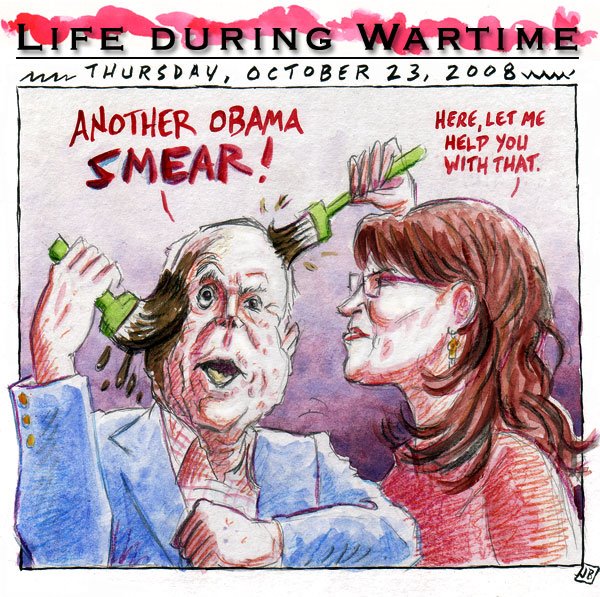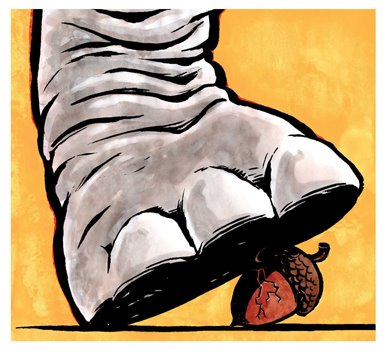
Here, Let Me Help You With That…

Cartoon by Joshua Brown.

Thanks to S. R. Keister / The Rag Blog

Posted in RagBlog | Tagged , , , , | Leave a comment

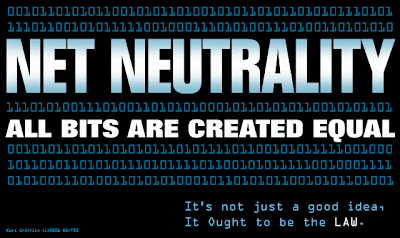
Net Neutrality : Not a Sexy Issue, But Worth Fighting For


‘The concept of net neutrality is the guiding principle of a free and open Internet.’
By Dustin Michael Harris / October 23, 2008

Does anyone remember Y2K?

I realize eight years ago seems like an eternity, another lifetime even, but think back and recall how you approached the Y2K “crisis.”

Did you stock up on canned goods and batteries? Did you spend the New Year in an underground bunker?

Don’t get me wrong, I’m not making fun of you if you did. At the time, a lot of people were nervous. Some people even thought it might be the end of the world. Planes were supposed to fall out of the sky, while your kitchen appliances finally exacted their revenge on you and your family.

Largely, nothing happened. Y2K was a wash. The ball dropped, the planes kept motoring along and the blender stayed put.

I bring up Y2K not because I like mentioning irrelevant pop culture items, although that is a favorite hobby of mine. Does anyone remember “Alf?” But I digress …

No, I bring up Y2K because something good came out of it – institutions and government realized how important technology is to our society.

Many local, state and federal institutions upgraded their computer systems and improved the technology infrastructure as a result of the Y2K threat. The same is true for some corporations and private businesses.

Now, eight years later, the role of technology is even more important. We are a wired world with a wired global economy. It’s no wonder that both Barack Obama and John McCain address the issue of technology and network neutrality in their campaign literature.

Network neutrality is not something you’ll hear a lot about on CNN. It’s not a hot button issue, but it is very important and could have lasting effects on how the Internet shapes and delivers information.

The concept of net neutrality is the guiding principle of a free and open Internet. Net neutrality prevents Internet service providers from blocking, speeding up or slowing down content based on the source.

For example, net neutrality prevents Comcast from tampering with the bandwidth regarding certain sites, essentially deciding which pages open right up and which pages won’t load at all.

Understandably, major communications giants are against the concept of net neutrality. There’s a lot of money to be made should ISPs be allowed to function as gatekeepers to the Internet. Users might have to purchase extra applications to open familiar sites or be forced to “pay for speed” at certain sites.

The site SavetheInternet.com has been a leader in the fight to preserve net neutrality because obviously there’s more at stake than simply being able to quickly download that old Devo tune you’ve been dying to hear. Allowing major corporations the ability to make difficult, even restrict, some of the information we view on the Internet is a very slippery slope. In many ways, it could become the digital version of burning books.

According to each of their Web sites, Obama and McCain differ in their support for network neutrality. Obama firmly supports it, while McCain “does not believe in prescriptive regulation like ‘net-neutrality,’ but rather he believes that an open marketplace with a variety of consumer choices is the best deterrent against unfair practices.” The McCain site goes on to champion the senator’s efforts to protect consumer privacy and prevent spam.

Net neutrality is one of the many issues that will get lost in the economic firestorm we find ourselves in. But the question is, can we afford to ignore it?

Source / Naperville Sun

Thanks to Media Reform Daily / The Rag Blog

Posted in RagBlog | Tagged , , , , | Leave a comment

The GOP’s Blame-ACORN Game

Graphic by Christopher Serra / The Nation.

‘Since the 1970s ACORN, which has 400,000 low- and moderate-income “member families,” has been warning Congress to protect borrowers from the banking industry’s irresponsible, risky and predatory practices.’
By Peter Dreier & John Atlas / October 22, 2008

An increasingly desperate Republican attack machine has recently identified the community organizing group ACORN as Public Enemy Number One. Among ACORN’s alleged crimes, perhaps the most serious is that it caused, nearly single-handedly, the world’s financial crisis. That’s the fantasy. In the reality-based world, it was ACORN that sounded the alarm about the exploitative lending practices that led to the current mortgage meltdown and financial crisis.

Since the 1970s ACORN, which has 400,000 low- and moderate-income “member families” in more than 100 cities in forty states, has been warning Congress to protect borrowers from the banking industry’s irresponsible, risky and predatory practices–subprime loans, racial discrimination (called “redlining”) and rip-off fees. ACORN has persistently called for stronger regulations on banks, private mortgage companies, mortgage brokers and rating agencies. For years, ACORN has alerted public officials that the industry was hoodwinking many families into taking out risky loans they couldn’t afford and whose fine print they couldn’t understand.

Now John McCain and his fellow conservatives are accusing ACORN of strong-arming Congress and big Wall Street banks into making subprime loans to poor families who couldn’t afford them, thus causing the economic disaster. McCain’s campaign is running a one-and-a-half-minute video that claims Barack Obama once worked for ACORN, repeats the accusation that ACORN is responsible for widespread voter registration fraud and accuses ACORN of “bullying banks, intimidation tactics, and disruption of business.” The ad claims that ACORN “forced banks to issue risky home loans–the same types of loans that caused the financial crisis we’re in today.”

For months, the right-wing echo chamber–bloggers, columnists, editorial writers and TV and radio talk-show hosts–has pitched in with a well-orchestrated campaign to blame the mortgage crisis on ACORN and the Community Reinvestment Act (CRA), the 1977 anti-redlining law. In a September 27 editorial, the Wall Street Journal wrote that “ACORN has promoted laws like the Community Reinvestment Act, which laid the foundation for the house of cards built out of subprime loans” and then falsely claimed the bailout bill would create a trust fund “pipeline” to fill ACORN’s coffers. On October 14 the Journal’s lead editorial, Obama and ACORN, described ACORN as a “shady outfit” and accused the group of being “a major contributor to the subprime meltdown by pushing lenders to make home loans on easy terms, conducting ‘strikes’ against banks so they’d lower credit standards.”

Discussing the mortgage crisis on his Fox News show, Your World, Neil Cavuto commented, “Loaning to minorities and risky folks is a disaster.”

Over at the Washington Post, columnist Charles Krauthammer complained that the CRA had led banks and other lenders “to extend mortgages to people who were borrowing over their heads.” Holding forth on The O’Reilly Factor, Laura Ingraham laid the foreclosure problem on Bill Clinton, who “pushed all these institutions to lend to minority communities.” Many of the loans, she said, were “very risky.” Former Arkansas Governor Mike Huckabee, a putative populist, echoed on the Hannity & Colmes Show: “The truth is that Democrats controlled the ability to fix this [the mortgage crisis]. It was their harsh regulation under the Community Reinvestment Act that started this ball rolling down the hill. “

On September 10 on Fox & Friends, National Review columnist Stanley Kurtz described ACORN as “a group of community organizers [who] specialize in putting pressure, really kind of intimidation tactics, on banks, to get these banks to make high-risk loans to low-credit customers…. They even show up at the homes of bank officials to scare them and their families. They send demonstrators into the lobbies of banks, all to get the banks to make these high-risk loans to people with low credit.” McCain’s anti-ACORN attack video is almost a word-for-word duplication of Kurtz’s comments.

The right-wing case against the CRA is entirely bogus–a diversionary tactic to take the heat off the financial services industry and its allies, like McCain. The CRA applies only to depository institutions, like commercial and savings banks, but thanks to Congress’s deregulation mania, there are now many other lenders, including private mortgage companies like CitiMortgage, Household Finance and Countrywide Financial (which was recently bought out by Bank of America). These outfits, which exist in a shadow world without government oversight, account for most of the predatory loans in trouble today.

When Congress enacted the CRA in 1977, the vast majority of all mortgage loans were made by lenders regulated by the law. In 2006 only about 43 percent of home loans were made by companies subject to the CRA. Indeed, the main culprits in the subprime scandal–the nonbank mortgage companies, which successfully grabbed the bulk of the mortgage market away from the CRA-regulated banking industry–were not covered by the CRA.

Wall Street investment firms–including Lehman Brothers, Goldman Sachs, Bear Stearns and Citigroup–set up special units, provided mortgage companies with lines of credit, then purchased the subprime mortgages from the lenders, bundled them into “mortgage-backed securities” and sold them for a fat fee to wealthy investors worldwide, typically without scrutiny. By 2007 the subprime business had become a $1.5 trillion global market for investors seeking high returns. Because lenders didn’t have to keep the loans on their books, they didn’t worry about the risk of losses.

Congress passed the CRA after many studies, using the banks’ lending data, had documented widespread racial discrimination in mortgage lending. The CRA encourages federally chartered banks to examine the credit needs of the communities they serve and to lend based on these needs–for small businesses, homes and other types of loans. It does not require banks to make loans to businesses or people who can’t repay them. It does not ask banks to engage in charity. It simply tells banks: don’t discriminate against qualified borrowers.

At first, many banks were reluctant to make loans to minority borrowers seeking to fix up their homes, buy new ones or start new businesses in urban neighborhoods. In the late 1970s and early ’80s, community organizing groups like ACORN, National People’s Action and others pushed banks and federal regulators to remove their racial blinders. Once they did so, banks discovered that many working- and middle-class black and Latino borrowers were excellent customers with good credit histories. These new markets generated good profits on stable loans with little risk.

The explosion of subprime mortgages was touched off in the early twenty-first century, as the number of lenders regulated by the government and covered by the CRA dramatically dwindled. In 2002 subprime loans made up 8 percent of all mortgages; by 2006 they had soared to 20 percent. Since 2004 more than 90 percent of subprime mortgages have come with exploding adjustable rates.

Not surprisingly, the foreclosure rates on subprime, adjustable-rate and other exotic mortgage loans have run four to five times higher than the foreclosure rates on conventional CRA mortgages. Testifying before the House Financial Services Committee in February, University of Michigan law professor Michael Barr reported that only about 20 percent of subprime mortgages were issued by banks regulated by the CRA. The other 80 percent of predatory and high-interest subprime loans were offered by financial institutions not covered by the CRA and not subject to routine examination or supervision. “The worst and most widespread abuses occurred in the institutions with the least federal oversight,” Barr told Congress.

In contrast, the CRA actually penalizes banks for reckless, irresponsible or otherwise predatory lending. According to Ellen Seidman, director of the Treasury Department’s Office of Thrift Supervision from 1997 to 2001, federal regulators warned CRA-covered institutions that “badly underwritten subprime products that ignored consumer protections were not acceptable.” Lenders not subject to CRA did not receive similar warnings.

And unlike the institutions that offer unregulated predatory subprime loans, banks that make CRA loans are required by federal regulation to verify borrowers’ incomes to make sure they can afford the mortgages. In 2006 the Federal Reserve reported that just 11.5 percent of mortgages made by CRA-regulated institutions were high-cost loans, compared with 33.5 percent for lenders not covered by the CRA. Janet Yellen, president and CEO of the Federal Reserve Bank of San Francisco, has criticized those who blame CRA lending for the subprime crisis: “Most of the loans made by depository institutions examined under the CRA have not been higher-priced loans, and studies have shown that the CRA has increased the volume of responsible lending to low- and moderate-income households.”

While the CRA helped boost the nation’s homeownership rate, particularly among black and Latino borrowers, subprime and other exotic mortgages had very little impact on homeownership. Most subprime loans were refinances of existing mortgages. From 1998 through 2005, more than half of all subprime mortgages were for refinancing, while less than 10 percent of subprime loans went to first-time home buyers. Moreover, a significant number of borrowers who took out subprime loans could have qualified for conventional, prime-rate mortgages with much better terms. Even the Wall Street Journal acknowledges that “plenty of people with seemingly good credit are also caught in the subprime trap.” Brokers and lenders misled many of these homeowners, replacing safe thirty-year fixed-rate mortgages with deceptive, risky loans.

The CRA gave federal regulators the power to deny approval for lucrative bank mergers or acquisitions if the companies engaged in persistently irresponsible or discriminatory lending. Under Reagan and George W. Bush, regulators failed to enforce the law, so activist groups like ACORN used the CRA to hold banks accountable. They conducted their own studies, uncovered banks with a pattern of irresponsible lending, exposed these practices to the media and demanded that regulators do their job. To avoid costly and harmful confrontations, many lenders forged “community reinvestment agreements” with ACORN and other community groups, pledging to make loans to borrowers who could afford them and whose neighborhood banks had ignored them. According to a study by the Harvard Joint Center for Housing Studies, the CRA helped catalyze more than $1 trillion in bank lending.

ACORN and its allies, including the Center for Responsible Lending, the Greenlining Institute, the Center for Community Change and the National Community Reinvestment Coalition, carried on the battle against abusive lenders on many fronts to ensure that loans in minority areas did not put borrowers in risky situations. ACORN’s homeownership counseling program for prospective borrowers was successful in helping families avoid taking out loans they could not afford. In 2006 the foreclosure rate of loans to borrowers who went through ACORN’s homeowner counseling program stood at .032 percent.

ACORN and other consumer groups fought for rules requiring lenders to document that borrowers had the ability to repay. They warned that adjustable-rate mortgages–those that started with a low “teaser” rate, which would adjust to a much higher rate later–were a ticking time bomb and that such loans should be made only to people who were able to afford the regular rates after the teasers had run out. But the lenders and the securitizers (Wall Street firms that packaged loans into mortgage-backed securities and sold them)–and too often the regulators and the lawmakers–didn’t heed the warnings. The industry convinced its political cronies that government regulation was too costly and cumbersome.

ACORN and its allies opposed banks whose fees and other charges inflated the cost of loans while padding their profits from transactions and diminishing the long-term safety of these loans. These groups denounced compensation systems that rewarded lenders and brokers for putting borrowers in higher-cost loans regardless of their credit-worthiness. They exposed the outrageous practice called “yield spread premium.” This is a kickback from lenders to brokers for selling loans that are more expensive than what borrowers qualify for. It is essentially a bonus for cheating the borrower and upping the risk of default. Earlier this year, after a long battle by the Center for Responsible Lending, the first state–North Carolina–made this practice illegal.

ACORN joined other consumer advocates and lawyers to promote the notion of “assignee liability”–arguing that companies that buy, and profit from, loans bear responsibility for illegal acts committed when those loans were originally made. Without it, the mortgage originators, who typically hold loans briefly before they sell them, can make fraudulent or risky loans without suffering any consequences. Again and again, Wall Street argued that it was too burdensome to scrutinize the loans they were buying or to be held responsible for the original transactions.

Several of ACORN’s battles were notably successful. It got some major lenders to reduce the outrageously high interest rates and fees they charged borrowers. For example, in 2001 ACORN persuaded Household Finance Corporation to abolish its practice of selling bogus credit insurance that had been costing a billion dollars a year straight out of homeowners’ pockets. ACORN’s activism spurred state attorneys general to sue Household Finance in 2002, forcing the firm to distribute a record $484 million to abused borrowers. In a separate suit against Household Finance, ACORN won a $150 million settlement that it put partly into a foreclosure prevention fund.

But ACORN and its counterparts have only been able to stick their fingers in the crumbling dike of American finance. Their warnings were prescient, but their victories were too small, their opponents too strong. So it is richly ironic that John McCain–a longtime ally of the banking industry whose mentor Phil Gramm orchestrated the 1999 Financial Modernization Act, opening the floodgates to irresponsible lending practices–is trying to scapegoat ACORN for the subprime crisis. Powerful business groups and their right-wing allies will continue to attack ACORN because it exposed and battled the real culprits of the financial crisis.

Peter Dreier is professor of politics and director of the Urban & Environmental Policy program at Occidental College. He is co-author of The Next Los Angeles: The Struggle for a Livable City (University of California Press, 2005) and Place Matters: Metropolitics for the 21st Century (2nd edition, University Press of Kansas, 2005) and co-editor of Up Against the Sprawl.

John Atlas, president of the New Jersey-based National Housing Institute–a nonprofit think tank, which publishes Shelterforce magazine–is writing a book, Seeds of Hope, about democracy, community organizing, poverty and the work of ACORN.

Source / The Nation

The Rag Blog

Posted in RagBlog | Tagged , , , , , , , , , | 2 Comments

Afghanistan: Kabul Is Under a Siege of Sorts

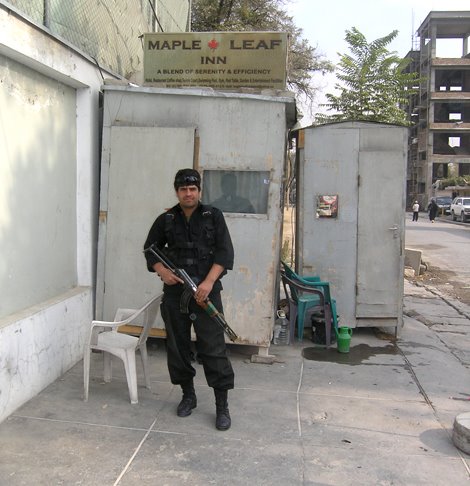
A typical doorman at a Kabul hotel. Photo: Tom Blackwell/National Post.

Tom Blackwell in Afghanistan: The bubble has burst
By Tom Blackwell / October 22, 2008

When I was last on assignment in Afghanistan, in May 2007, my few days in Kabul seemed in retrospect like a bit of an escape. They used to call the capital city a bubble: not immune from the terror that beset the country’s south, but relatively safe and fairly welcoming to foreigners. In Kandahar city, reporters have always had to be cautious, never lingering anywhere in public for long, being as inconspicuous as possible in traditional clothing. In Kabul last year, I walked the streets on my own without fear and did my job, with a translator, relatively freely. I recall buying Afghan naan bread and delicous pastries from street-front vendors, and found almost everyone curious and friendly. We would eat in restaurants catering chiefly to locals and not think twice about it. Well, 18 months later, the bubble has burst.

I arrived in Kabul from Kandahar last Saturday with some eagerness, realizing security throughout the country was deteriorating but expecting to enjoy a freer-wheeling time during my three-day visit. My translator – or fixer as we say – delivered the bad news before we even left the airport. I could no longer leave my well-barricaded guest house without escort, I should probably wear a shalwar kameez – the typical Afghan male dress – when we ventured into public places, and must keep the car doors locked at all times, he said. A spate of kidnappings and assassinations, more brazen bombings and an insurgency creeping ever closer to the city gates had made Kabul a very different place.

Much as I would like to publicly recognize my brave and resourceful fixer, I cannot name him. He is afraid that if his connection to Western media becomes known to the Taliban, his days would be numbered. Before we drove into a neighbourhood that was a little less safe than the city centre, he removed all the contact numbers from his cell phone for foreigners and government officials. The Taliban are known to check phones for such links, which amount to an offence that, in their world, is punishable by death. The city itself seemed more dominated than ever by concrete walls and barriers. Kalishnikov-toting security was everywhere.

All this was before Monday morning. As we drove to an interview, my fixer pointed to the radio, which was broadcasting the news in Dari. Just an hour or so earlier, a foreign aid worker had been shot dead in the street, walking to work. She was later identified as Gayle Williams, a 33-year-old Brit. The Taliban said she had been killed because she worked for a Christian-based organization and was prosletyzing. Her job, though, involved helping disabled Afghans.

Hope is not lost in Kabul, or Afghanistan. In fact, people remain remarkably hopeful. But they appear deeply depressed about the current reality, and for good reason it would seem. The capital city, with its billions in foreign money and its legions of foreign troops, is under a siege of sorts. Already, I was told, many business people – and their desperately needed investment dollars – have left for safer havens. What is needed now is for countries like Canada to publicly, bluntly acknowledge the direness of the situation, and focus like never before on somehow fixing it. Yet as the embassy and UN and NGO staff – all dedicated people, I know – speed by the roadblocks in their armoured, bullet-proofed Toyota Land Cruisers, one wonders if the reality has sunk in.

Source / National Post

The Rag Blog

Posted in RagBlog | Tagged , | Leave a comment

Mike Davis : Can Obama See the Grand Canyon?


‘Like the Grand Canyon’s first explorers, we are looking into an unprecedented abyss of economic and social turmoil that confounds our previous perceptions of historical risk.’
By Mike Davis / October 19, 2008

Let me begin, very obliquely, with the Grand Canyon and the paradox of trying to see beyond cultural or historical precedent.

The first European to look into the depths of the great gorge was the conquistador Garcia Lopez de Cardenas in 1540. He was horrified by the sight and quickly retreated from the South Rim.

More than three centuries passed before Lieutenant Joseph Christmas Ives of the U.S. Army Corps of Topographical Engineers led the second major expedition to the rim. Like Garcia Lopez, he recorded an “awe that was almost painful to behold.” Ives’s expedition included a well-known German artist, but his sketch of the Canyon was wildly distorted, almost hysterical.

Neither the conquistadors nor the Army engineers, in other words, could make sense of what they saw; they were simply overwhelmed by unexpected revelation. In a fundamental sense, they were blind because they lacked the concepts necessary to organize a coherent vision of an utterly new landscape.

Accurate portrayal of the Canyon only arrived a generation later when the Colorado River became the obsession of the one-armed Civil War hero John Wesley Powell and his celebrated teams of geologists and artists. They were like Victorian astronauts reconnoitering another planet. It took years of brilliant fieldwork to construct a conceptual framework for taking in the canyon. With “deep time” added as the critical dimension, it was finally possible for raw perception to be transformed into consistent vision.

The result of their work, The Tertiary History of the Grand Canyon District, published in 1882, is illustrated by masterpieces of draftsmanship that, as Powell’s biographer Wallace Stegner once pointed out, “are more accurate than any photograph.” That is because they reproduce details of stratigraphy usually obscured in camera images. When we visit one of the famous viewpoints today, most of us are oblivious to how profoundly our eyes have been trained by these iconic images or how much we have been influenced by the idea, popularized by Powell, of the Canyon as a museum of geological time.

Author and activist Mike Davis.

But why am I talking about geology? Because, like the Grand Canyon’s first explorers, we are looking into an unprecedented abyss of economic and social turmoil that confounds our previous perceptions of historical risk. Our vertigo is intensified by our ignorance of the depth of the crisis or any sense of how far we might ultimately fall.

Weimar Returns in Limbaughland

Let me confess that, as an aging socialist, I suddenly find myself like the Jehovah’s Witness who opens his window to see the stars actually falling out of the sky. Although I’ve been studying Marxist crisis theory for decades, I never believed I’d actually live to see financial capitalism commit suicide. Or hear the International Monetary Fund warn of imminent “systemic meltdown.”

Thus, my initial reaction to Wall Street’s infamous 777.7 point plunge a few weeks ago was a very sixties retro elation. “Right on, Karl!” I shouted. “Eat your derivatives and die, Wall Street swine!” Like the Grand Canyon, the fall of the banks can be a terrifying but sublime spectacle.

But the real culprits, of course, are not being trundled off to the guillotine; they’re gently floating to earth in golden parachutes. The rest of us may be trapped on the burning plane without a pilot, but the despicable Richard Fuld, who used Lehman Brothers to loot pension funds and retirement accounts, merely sulks on his yacht.

Out in the stucco deserts of Limbaughland, moreover, fear is already being distilled into a good ol’ boy version of the “stab in the back” myth that rallied the ruined German petite bourgeoisie to the swastika. If you listen to the rage on commute AM, you’ll know that ‘socialism’ has already taken a lien on America, Barack Hussein Obama is terrorism’s Manchurian candidate, the collapse of Wall Street was caused by elderly black people with Fannie Mae loans, and ACORN in its voter registration drives has long been padding the voting rolls with illegal brown hordes.

In other times, Sarah Palin’s imitation of Father Charles Coughlin — the priest who preached an American Reich in the 1930s — in drag might be hilarious camp, but with the American way of life in sudden freefall, the specter of star-spangled fascism doesn’t seem quite so far-fetched. The Right may lose the election, but it already possesses a sinister, historically-proven blueprint for rapid recovery.

Progressives have no time to waste. In the face of a new depression that promises folks from Wasilla to Timbuktu an unknown world of pain, how do we reconstruct our understanding of the globalized economy? To what extent can we look to either Obama or any of the Democrats to help us analyze the crisis and then act effectively to resolve it?

Is Obama FDR?

If the Nashville “town hall” debate is any guide, we will soon have another blind president. Neither candidate had the guts or information to answer the simple questions posed by the anxious audience: What will happen to our jobs? How bad will it get? What urgent steps should be taken?

Instead, the candidates stuck like flypaper to their obsolete talking points. McCain’s only surprise was yet another innovation in deceit: a mortgage relief plan that would reward banks and investors without necessarily saving homeowners.

Obama recited his four-point program, infinitely better in principle than his opponent’s preferential option for the rich, but abstract and lacking in detail. It remains more a rhetorical promise than the blueprint for the actual machinery of reform. He made only passing reference to the next phase of the crisis: the slump of the real economy and likely mass unemployment on a scale not seen for 70 years.

With baffling courtesy to the Bush administration, he failed to highlight any of the other weak links in the economic system: the dangerous overhang of credit-default swap obligations left over from the fall of Lehman Brothers; the trillion-dollar black hole of consumer credit-card debt that may threaten the solvency of JPMorgan Chase and Bank of America; the implacable decline of General Motors and the American auto industry; the crumbling foundations of municipal and state finance; the massacre of tech equity and venture capital in Silicon Valley; and, most unexpectedly, sudden fissures in the financial solidity of even General Electric.

In addition, both Obama and his vice presidential partner Joe Biden, in their support for Secretary of the Treasury Paulson’s plan, avoid any discussion of the inevitable result of cataclysmic restructuring and government bailouts: not “socialism,” but ultra-capitalism—one that is likely to concentrate control of credit in a few leviathan banks, controlled in large part by sovereign wealth funds but subsidized by generations of public debt and domestic austerity.

Never have so many ordinary Americans been nailed to a cross of gold (or derivatives), yet Obama is the most mild-mannered William Jennings Bryan imaginable. Unlike Sarah Palin who masticates the phrase “the working class” with defiant glee, he hews to a party line that acknowledges only the needs of an amorphous “middle class” living on a largely mythical “Main Street.”

If we are especially concerned about the fate of the poor or unemployed, we are left to read between the lines, with no help from his talking points that espouse clean coal technology, nuclear power, and a bigger military, but elide the urgency of a renewed war on poverty as championed by John Edwards in his tragically self destructed primary campaign. But perhaps inside the cautious candidate is a man whosehumane passions transcend his own nearsighted centrist campaign. As a close friend, exasperated by my chronic pessimism, chided me the other day, “don’t be so unfair. FDR didn’t have a nuts and bolts program either in 1933. Nobody did.”

Franklin Delano Roosevelt

What Franklin D. Roosevelt did possess in that year of breadlines and bank failures, according to my friend, was enormous empathy for the common people and a willingness to experiment with government intervention, even in the face of the monolithic hostility of the wealthy classes. In this view, Obama is MoveOn.org’s re-imagining of our 32nd president: calm, strong, deeply in touch with ordinary needs, and willing to accept the advice of the country’s best and brightest.

The Death of Keynesianism

But even if we concede to the Illinois senator a truly Rooseveltian or, even better, Lincolnian strength of character, this hopeful analogy is flawed in at least three principal ways:

First, we can’t rely on the Great Depression as analog to the current crisis, nor upon the New Deal as the template for its solution. Certainly, there is a great deal of déjà vu in the frantic attempts to quiet panic and reassure the public that the worst has passed. Many of Paulson’s statements, indeed, could have been directly plagiarized from Herbert Hoover’s Secretary of the Treasury Andrew Mellon, and both presidential campaigns are frantically cribbing heroic rhetoric from the early New Deal. But just as the business press has been insisting for years, this is not the Old American Economy, but an entirely new-fangledcontraption built from outsourced parts and supercharged by instantaneous world markets in everything from dollars and defaults to hog bellies and disaster futures.

We are seeing the consequences of a perverse restructuring that began with the presidency of Ronald Reagan and which has inverted the national income shares of manufacturing (21% in 1980; 12% in 2005) and those of financial services (15% in 1980; 21% in 2005). In 1930, the factories may have been shuttered but the machinery was still intact; it hadn’t been auctioned off at five cents on the dollar to China.

On the other hand, we shouldn’t disparage the miracles of contemporary market technology. Casino capitalism has proven its mettle by transmitting the deadly virus of Wall Street at unprecedented velocity to every financial center on the planet. What took three years at the beginning of the 1930s—that is, the full globalization of the crisis—has taken only three weeks this time around. God help us, if, as seems to be happening, unemployment tops the levees at anything like the same speed.

Second, Obama won’t inherit Roosevelt’s ultimate situational advantage—having emergent tools of state intervention and demand management (later to be called “Keynesianism”) empowered by an epochal uprising of industrial workers in the world’s most productive factories.

If you’ve been watching the sad parade of economic gurus on McNeil-Lehrer, you know that the intellectual shelves in Washington are now almost bare. Neither major party retains more than a few enigmatic shards of policy traditions different from the neo-liberal consensus on trade and privatization. Indeed, posturing pseudo-populists aside, it is unclear whether anyone inside the Beltway, including Obama’s economic advisors, can think clearly beyond the indoctrinated mindset of Goldman Sachs, the source of the two most prominent secretaries of the treasury over the last decade.

British economist John Maynard Keynes.

Keynes, now suddenly mourned, is actually quite dead. More importantly, the New Deal did not arise spontaneously from the goodwill or imagination of the White House. On the contrary, the social contract for the post-1935 Second New Deal was a complex, adaptive response to the greatest working-class movement in our history, in a period when powerful third parties still roamed the political landscape and Marxism exercised extraordinary influence on American intellectual life.

Even with the greatest optimism of the will, it is difficult to imagine the American labor movement recovering from defeat as dramatically as it did in 1934-1937. The decisive difference is structural rather than ideological. (Indeed, today’s union movement is much more progressive than the decrepit, nativist American Federation of Labor in 1930.) The power of labor within a Walmart-ized service economy is simply more dispersed and difficult to mobilize than in the era of giant urban-industrial concentrations and ubiquitous factory neighborhoods.

Is War the Answer?

The third problem with the New Deal analogy is perhaps the most important. Military Keynesianism is no longer an available deus ex machina. Let me explain.

In 1933, when FDR was inaugurated, the United States was in full retreat from foreign entanglements, and there was little controversy about bringing a few hundred Marines home from the occupations of Haiti and Nicaragua. It took two years of world war, the defeat of France, and the near collapse of England to finally win a majority in Congress for rearmament, but when war production finally started up in late 1940 it became a huge engine for the reemployment of the American work force, the real cure for the depressed job markets of the 1930s. Subsequently, American world power and full employment would align in a way that won the loyalty of several generations of working-class voters.

Today, of course, the situation is radically different. A bigger Pentagon budget no longer creates hundreds of thousands of stable factory jobs, since significant parts of its weapons production is now actually outsourced, and the ideological link between high-wage employment and intervention—good jobs and Old Glory on a foreign shore—while hardly extinct is structurally weaker than at any time since the early 1940s. Even in the new military (largely a hereditary caste of poor whites, blacks, and Latinos) demoralization is reaching the stage of active discontent and opening up new spaces for alternative ideas.

Although both candidates have endorsed programs, including expansion of Army and Marine combat strength, missile defense (aka “Star Wars”), and an intensified war in Afghanistan, that will enlarge the military-industrial complex, none of this will replenish the supply of decent jobs nor prime a broken national pump. However, in the midst of a deep slump, what a huge military budget can do is obliterate the modest but essential reforms that make up Obama’s plans for healthcare,

In other words, Rooseveltian guns and butter have become a contradiction in terms, which means that the Obama campaign is engineering a catastrophic collision between its national security priorities and its domestic policy goals.

The Fate of Obama-ism

Why don’t such smart people see the Grand Canyon?

Maybe they do, in which case deception is truly the mother’s milk of American politics; or perhaps Obama has become the reluctant prisoner, intellectually as well as politically, of Clintonism: that is say, of a culturally permissive neo-liberalism whose New Deal rhetoric masks the policy spirit of Richard Nixon.

It’s worth asking, for instance, what in the actual substance of his foreign policy agenda differentiates the Democratic candidate from the radioactive legacy of the Bush Doctrine? Yes, he would close Guantanamo, talk to the Iranians, and thrill hearts in Europe. He also promises to renew the Global War on Terror (in much the same way that Bush senior and Clinton sustained the core policies of Reaganism, albeit with a “more human face”).

In case anyone has missed the debates, let me remind you that the Democratic candidate has chained himself, come hell or high water, to a global strategy in which “victory” in the Middle East (and Central Asia) remains the chief premise of foreign policy, with the Iraqi-style nation-building hubris of Dick Cheney and Paul Wolfowitz repackaged as a “realist” faith in global “stabilization.”

True, the enormity of the economic crisis may compel President Obama to renege on some of candidate Obama’s ringing promises to support an idiotic missile defense system or provocative NATO memberships for Georgia and Ukraine. Nonetheless, as he emphasizes in almost every speech and in each debate, defeating the Taliban and Al-Qaeda, together with a robust defense of Israel, constitute the keystone of his national security agenda.

Under huge pressure from Republicans and Blue Dog Democrats alike to cut the budget and reduce the exponential increase in the national debt, what choices would President Obama be forced to make early in his administration? More than likely comprehensive health-care will be whittled down to a barebones plan, “alternative energy” will simply mean the fraud of “clean coal,” and anything that remains in the Treasury, after Wall Street’s finished its looting spree, will buy bombs to pulverize more Pashtun villages, ensuring yet more generations of embittered mujahideen and jihadis.

Am I unduly cynical? Perhaps, but I lived through the Lyndon Johnson years and watched the War on Poverty, the last true New Deal program, destroyed to pay for slaughter in Vietnam.

It is bitterly ironic, but, I suppose, historically predictable that a presidential campaign millions of voters have supported for its promise to end the war in Iraq has now mortgaged itself to a “tougher than McCain” escalation of a hopeless conflict in Afghanistan and the Pakistani tribal frontier. In the best of outcomes, the Democrats will merely trade one brutal, losing war for another. In the worst case, their failed policies may set the stage for the return of Cheney and Rove, or their even more sinister avatars.

[Mike Davis is the author of In Praise of Barbarians: Essays Against Empire (Haymarket Books, 2008) and Buda’s Wagon: A Brief History of the Car Bomb (Verso, 2007). He is currently working on a book about cities, poverty, and global change. Copyright 2008 Mike Davis]

Source / Progressives for Obama

Thanks to Carl Davidson / The Rag Blog

Posted in RagBlog | Tagged , , , , , , , | 4 Comments

Censorship Revisited : Tommy Smothers Gets his Due

Tommy Smothers overlooking a valley in his Sonoma vineyard – he still gets together with brother Dick to perform their routine. Photo by Kim Komenich / San Francisco Chronicle

Tommy Smothers: ‘I dedicate this Emmy to all people who feel compelled to speak out, not afraid to speak to power, won’t shut up and refuse to be silent.’
By Joel Selvin / October 22, 2008

“No comedian’s wife thinks he’s funny,” Tommy Smothers says as he surveys the panoramic vista from his hilltop home and vineyard in the middle of Sonoma’s Valley of the Moon. “The first few years of the marriage, maybe. I was funny as hell the first couple of years.”

Smothers first repaired to this peak 40 years ago to lick his wounds after CBS abruptly pulled the rug out from under the top-rated “Smothers Brothers Comedy Hour” on the eve of its fourth season, the culmination of constant harassment and surveillance by the network’s censors during the show’s three seasons.

At last month’s Emmy Awards, Smothers accepted a belated trophy for his contributions to the team that won the 1968 writing award for the show’s final season; Smothers left his name off at the time, fearing the inclusion would draw controversy. When he accepted his Emmy last month, he was typically plainspoken and eloquent at the same time, a Smothers hallmark. (The speech is on YouTube.)

“Freedom of expression and freedom of speech aren’t really important,” he told the audience, “unless they’re heard. The freedom of hearing is as important as the freedom of speaking. It’s hard for me to stay silent when I keep hearing that peace is only attainable through war. There’s nothing more scary than watching ignorance in action. So I dedicate this Emmy to all people who feel compelled to speak out, not afraid to speak to power, won’t shut up and refuse to be silent.”

September was a watershed moment for the Smothers Brothers in another respect: The long-awaited release of the comedy show’s third and final season on DVD, this time including the portions of the show CBS censored, including Harry Belafonte singing “Don’t Stop the Carnival” as footage of violence outside the 1968 Democratic National Convention in Chicago rolled behind him.

NPR television critic David Bianculli will publish his oral history of the Smothers Brothers show next year. What started as a last-ditch effort by the network to salvage TV’s dying variety-show format became a landmark series in television history.

Act of repression

The muzzling of the Smothers Brothers at the height of the Vietnam War and the era of student protest was an emblematic act of political repression three months after Richard Nixon was elected president. But the firing of the Smothers Brothers has echoed through the years, becoming a case study in mass media censorship. The brothers, who arrived on the small screen as clean-cut, wholesome folk song parodists, stumbled into the turbulent times.

“Instead of vacuous comedy, we thought, ‘Let’s do something with some bite,’ ” Smothers, says. “There was the Vietnam War, voters’ rights – all sorts of issues that we thought we could reflect and develop a point of view. We didn’t even know it was important until they said ‘You can’t say this.’ Forty years later, people are still talking about it. Isn’t that amazing?”

The Emmy sits on the top of a grand piano cluttered with family photos. Smothers, 71, and his wife of 18 years, Marcy, have two teenagers (Smothers also has a grown son from an earlier marriage). Medical school skeletons, some wearing costumes, are stationed around the spacious living room that looks out over the valley. Smothers sits in a chair next to a table with a pair of lamps shaped like giant kernels of candy corn.

“I had mixed feelings,” he says about the award. “It’s in the past – what’s the difference? Then my wife and kids got excited about it, and I started to think maybe this is pretty cool. I started to think about what am I going to say. Because we were silenced for it 40 years ago doesn’t mean we have been converted. So I made my little statement. Steve Martin introduced me. My brother thought it was cool, pretty neat.”

From the standpoint of today’s TV fare, the old Smothers Brothers shows look decidedly tame. One of the first bits that raised the network’s ire involved nothing more flagrant than comedian David Steinberg saying Moses burned his feet on the bush, and “there are many Old Testament scholars who to this day believe it was the first mention of Christ in the Bible.”

But it wasn’t the lame anti-war jokes or comedian and presidential candidate Pat Paulsen’s editorials on gun control that earned the “Smothers Brothers Comedy Hour” its place in history. “The silencing made it more important, the issue of being censored,” Smothers says. “If they had just not picked up the show, it wouldn’t have been that big an issue.”

Government censorship isn’t necessary in a free-enterprise system, Smothers says, citing reasons that prove he hasn’t mellowed a bit in four decades. “The country doesn’t have to stop people from saying stuff. The corporations do it for them. Look at the Dixie Chicks. The corporations are fighting things for other people. That’s fascism in action. Fascism is when private industry owns the government.”

Tom and Dick Smothers started out as a folk-singing comedy team, then got political on their “Comedy Hour” in the ’60s. SF Chronicle File Photo 1971.

Developing the act

The two brothers (and a sister – Tom, Dick and Sherry) grew up in Southern California. Tommy and Dickie began to develop an act while students at San Jose State, an act they polished at North Beach nightclubs in the ’50s. Their 1961 album, “Live at the Purple Onion,” established them as leading clowns on the folk-music scene. They are celebrating their 50th anniversary in show business and perform as many as 60 concerts a year.

“We were famous before we were good,” Smothers says. “Now we’re good, not famous.”

The act has changed little over the years. Tommy Smothers started playing yo-yo about 25 years ago – when he does yo-yo tricks, they are funny, and when they don’t work, even funnier – and he usually carries one in his pocket.

Tom and Dick Smothers not only mined the fascination of the day with folk songs, but also the passive-aggressive relationship between brothers – “Mom always liked you best” – a role that often spilled over into their offstage life.

“We’ve been 2 feet apart for 50 years. He’s always on my left. I’m always on his right. Same with our baby pictures. We’ve been looking at each other that far away. We’ll get offstage and he’ll look at me and say, ‘When are you going to have that cyst fixed?’ “

Smothers says all that stopped after an 18-hour couples-counseling session about 15 years ago.

The counselor “changed everything basically by saying, ‘Stop the nonsense – you’re professionals, cut out all this brother s-,’ ” Smothers says. “We could fight. We could clear a room.”

Smothers replanted 45 acres on the hillsides surrounding his home after phylloxera took the old grapevines. When he and Dick, 68, first moved to Sonoma and bought property outside Kenwood, they started producing Smothers Brothers Wine, but long ago changed the name to Remick Ridge, after their grandfather.

“People would say Smothers Brothers is a good wine, but it has a funny finish – things like that,” says Smothers.

Dick left Sonoma long ago for Florida, but his older brother has developed a keen appreciation of the role the straight man plays in comedy teams.

“The straight man in vaudeville was paid more than the comic,” he says. “That was the skilled position. The straight man could introduce acts, and you could put him with a funny guy and have him control that. If you don’t believe the straight man, you don’t believe the comic. Look at Bud Abbott, Dean Martin, Dan Rowan. I learned this in 50 years in the business – the quality of the straight man defines how good the act is.”

When he first moved to the property, he lived in a cabana next to the swimming pool and then slowly built a barn, garage and magnificent home over the years. He has grapevines trained to grow along his rooftop, a tomato plant sprawling onto his patio and rosebushes he prunes himself.

The firing clobbered the Smothers Brothers, who spent years recovering their careers and, in many ways, their lives as well.

“It took three years to get my sense of humor back,” he says. “I started taking everything seriously. I became the temporary poster boy for the First Amendment, freedom of speech. Twenty years later, there’s Howard Stern.”

Humor reclaimed

He and his brother went off separately, as Smothers struggled to find himself. “Everything was so serious,” he says. “Then I saw Jane Fonda on the ‘Tonight Show’ one night talking about burning babies. I think Cesar Chavez was on the same show. It was like an epiphany for me – there was no joy, no sense of humor, no laughter. It just turned me around.”

He leaves and returns with a calligraphic print he and his wife sent out some years before as a Christmas card. It is a quote from Alistair Cooke that reads:

“In the best of times, our days are numbered anyway. So it would be a crime against nature for any generation to take the world crisis so solemnly, that it put off enjoying those things for which we were designed in the first place: the opportunity to do good work, to enjoy friends, to fall in love, to hit a ball, and to bounce a baby.”

With a playwright’s timing, his wife arrives, fresh from working out, a trim woman who hosts a radio talk show in Santa Rosa.

“OK, so she’s 25 years younger,” says Smothers. “If she dies, she dies.”

“I didn’t think that was funny the first time,” says his wife.

In Tommy Smothers’ life, everybody else is a straight man.

Source / SFGate

Thanks to Carlos Lowry / The Rag Blog

Posted in RagBlog | Tagged , , , , , , , , , , | Leave a comment

Hannah Strange :
McCain Operative Makes ACORN Seem Like Peanuts

photo of Nathan Sproul

Republican operative Nathan Sproul has been investigated for voter suppression.


McCain campaign paid Republican operative accused of voter fraud

By Hannah Strange | October 22, 2008

See Keating law firm donates $50,000 to McCain campaign,’ Below.

John McCain paid $175,000 of campaign money to a Republican operative accused of massive voter registration fraud in several states, it has emerged.

As the McCain camp attempts to tie Barack Obama to claims of registration irregularities by the activist group ACORN, campaign finance records detailing the payment to the firm of Nathan Sproul, investigated several times for fraud, threatens to derail that argument

The documents show that a joint committee of the McCain-Palin campaign, the Republican National Committee and the California Republican Party, made the payment to Lincoln Strategy, of which Mr Sproul is the managing partner, for the purposes of “voter registration”.

Mr Sproul has been investigated on numerous occasions for preventing Democrats from voting, destroying registration forms and leading efforts to get Ralph Nader on ballots to leach the Democratic vote.

In October last year, the House Judiciary Committee wrote to the Attorney General requesting answers regarding a number of allegations against Mr Sproul’s firm, then known as Sproul and Associates. It referred to evidence that ahead of the 2004 national elections, the firm trained staff only to register Republican voters and destroyed any other registration cards, citing affidavits from former staff members and investigations by television news programmes.

One former worker testified that “fooling people was key to the job” and that “canvassers were told to act as if they were non-partisan, to hide that they were working for the RNC, especially if approached by the media,” according to the committee’s letter. It also cited reports from public libraries across the country that the firm had asked to set up voter registration tables claiming it was working on behalf of the non-partisan group America Votes, though in fact no such link existed.

Such activities “clearly suppress votes and violate the law”, wrote John Conyers, the Chairman of the House Judiciary Committee. The letter suggested that the Judiciary Department had failed to take sufficient action on the allegations because of the politicisation of the department under the then-attorney general, John Ashcroft.

The career of Mr Sproul, a former leader of the Arizona Republican Party, is littered with accusations of foul play. In Minnesota in 2004, his firm was accused of sacking workers who submitted Democratic registration forms, while other canvassers were allegedly paid bonuses for registering Bush voters. There were similar charges in Pennsylvania, West Virginia, Oregon and Nevada.

That year, Mr Sproul’s firm was paid $8,359,161 by the Republican Party, according to a 2005 article in the Baltimore Chronicle, which claimed that this was far more than what had been reported to the Federal Elections Commission.

Mr McCain and his running mate Sarah Palin have been linking allegations of registration fraud by ACORN, the community group, to the Obama campaign.

ACORN has been accused of registering non-existent voters during its nationwide drive, with reports of cartoon characters such as Donald Duck and Mickey Mouse being signed up.

The organisation insisted that these are isolated incidents carried out by a handful of workers who have since been dismissed.

However, the Republican nominee insists that the group is involved in fraudulent activities, noting that Mr Obama, before leaving the legal profession to enter politics, was once part of a team which defended the organisation. At last week’s debate, he said that ACORN was “perpetrating one of the greatest frauds in voter history”, a claim which the Obama campaign says represents political smear.

The revelation of Mr Sproul’s involvement with the McCain campaign – he has also donated $30,000 to the ticket and received at least another $37,000 directly from the RNC – could undermine his case.

“It should certainly take away from McCain’s argument,” Bob Grossfeld, an Arizona political consultant who has watched Mr Sproul’s career closely, told the Huffington Post. “Without knowing anything of what is going on with ACORN, there is a clear history with Mr Sproul either going over the line or sure as hell kicking dirt on it, and doing it for profit and usually fairly substantive profit.”

In May this year, both ACORN and Mr Sproul were discussed at a hearing of the House subcommittee on commercial and administrative law. One Republican member, Congressman Chris Cannon, concluded: “The difference between ACORN and Sproul is that ACORN doesn’t throw away or change registration documents after they have been filled out.”

Source / Times Online, U.K.

Law firm founded by convicted racketeer Charles Keating is big McCain donor.

Keating law firm donates $50,000 to McCain campaign.

Those voting for the first time this year may not have even been alive during the Keating Five scandal, the political corruption case that threatened to end John McCain’s political career back in 1989. Much to the chagrin of those Democrats gesticulating wildly at the very silent elephant in the room, the Obama campaign has largely refrained from touching upon the issue, perhaps preferring to leave past associations well alone, for understandable reasons.

But sometimes history throws little reminders into our present path, and this is one of those times. Campaign finance records have revealed that the law firm founded by Charles Keating – before he went to jail for fraud, racketeering, and conspiracy for his activities as chairman of Lincoln Savings and Loans – has made donations totalling over $50,000 to McCain’s campaign.

The Center for Responsive Politics has done the maths, and says: “In amounts ranging from $200 to $2,300, about 30 partners and employees of the legal firm Keating, Muething and Klekamp, as well as their family members, have contributed $50,200 to McCain’s 2008 campaign. All but two of the contributions came in July, and all but three of those July donations were logged on July 31, suggesting they were delivered at the same time. As with any bundle of campaign contributions, it’s difficult to determine which donor was the “bundler,” the person who solicited the contributions on the campaign’s behalf. McCain’s online roster of bundlers, which purports to name any individual bundling $50,000 or more for the campaign, does not associate any of McCain’s major fundraisers with the Keating firm.”

This is not improper in itself, and the only Keating included in the bundle is William J. Keating, Jr., Charles Keating’s nephew, who is listed as a partner in the firm and contributed $1,000.

But it reminds us of McCain’s role in “The Keating Five,” a group of senators who received a total of $1.4 million in campaign contributions connected to Keating and personally intervened with government regulators to allow Lincoln Savings and Loans to make highly risky investments that defrauded thousands of investors and cost taxpayers $3.4 billion.

Keating, now 84, once wrote to McCain that “I’m yours till death do us part”. Could he be keeping his promise?

Sarah Strange / Source / Times Online / Oct. 22, 2008

The Rag Blog

Posted in RagBlog | Tagged , , , , , , , | 1 Comment

Bachmann to Talk Radio : Obama’s Views are ‘Against America’

“I’m very concerned that he may have anti-American views…

“The people that Barack Obama has been associating with are anti-American, by and large…”

U.S. Rep. Michele Bachmann, Republican of Minnesota.

Bachmann Doubles Down:
‘Barack Obama’s Views Are Against America’

By Matt Corley / October 22, 2008

On the defensive over her controversial Hardball appearance last Friday, Rep. Michele Bachmann (R-MN) told the St. Cloud Times yesterday that she regretted suggesting that Barack Obama held “anti-American” views. But at the same time Bachmann was apologizing for her remarks to traditional media outlets, Bachmann continued to cast aspersions on Obama’s patriotism in a series of appearances on right-wing radio shows.

On Hugh Hewitt’s radio show yesterday, Bachmann declared that “Barack Obama’s views are against America”:

BACHMANN: All I did on Chris Matthews is I questioned Chris Matthews and said, “look, if John McCain had friends like Jeremiah Wright and Bill Ayers and Father Pfleger, you’d be all over him Chris, but you’ve laid off of Barack Obama.” And so, he was using the word “Anti-American” and I told Chris, what I question are Barack Obama’s views. Because Barack Obama’s views are against America. They won’t be good for our country.

On Mike Gallagher’s radio show this morning, Bachmann attacked Obama’s policy proposals, asking rhetorically, “Are they for America or will they be against traditional American ideals and values?”:

BACHMANN: And they can’t take it because the point is what are Barack Obama’s policies? Are they for America or will they be against traditional American ideals and values? And I’ll tell you what. Punishing tax rates, redistribution of wealth, socialized medicine, inputing censorship in the form of the un-Fairness Doctrine and taking away the secret ballot from the worker has nothing to do with traditional American values. That’s why your listeners need to know. Otherwise the United States may be literally changed forever.

When Gallagher asked, “How is it not reasonable to wonder if that’s anti-American?,” Bachmann did not disagree with him. Instead, she simply replied, “what I did is touch a nerve, just like Joe the Plumber touched a nerve.”

During her appearance on Gallagher’s show, Bachmann claimed that media scrutiny of her “anti-American” comments was a coordinated effort “to get my scalp on a platter.”

Transcript:

HEWITT: Now Michele, you’ve got a great organization, you’ve got a great great reputation and so, I assume your guys are not folding under the pressure that they’re rallying. Is that true?

BACHMANN: Yes, I mean, we’re working hard, but we just don’t have the financial resources that they have. I did all the work that I needed to. Laid all the foundation, but this will be like nothing we’ve ever seen. Plus, it’s the in kind donation that all the local media, local TV stations, they’re all running statements saying that I’m Joe McCarthy and that I am saying that Barack Obama is anti-American.

All I did on Chris Matthews is I questioned Chris Matthews and said, “look, if John McCain had friends like Jeremiah Wright and Bill Ayers and Father Pfleger, you’d be all over him Chris, but you’ve laid off of Barack Obama.” And so, he was using the word “Anti-American” and I told Chris, what I question are Barack Obama’s views. Because Barack Obama’s views are against America. They won’t be good for our country. And so, anyway, it went on from there. And if people want to read the transcript, you know, I encourage them to please read the transcript. But all of a sudden this is out of control and the Speaker of the House made a visit here to Minnesota to make sure that I’m taken out.

[…]

BACHMANN: I touched something that’s off limits. I called Chris Matthews on the carpet and I said, “Chris, look, if John McCain had named as two of his three life mentors, Jeremiah Wright and Father Pfleger.”

GALLAGHER: Right.

BACHMANN: “You would have been all over him. You have failed to do your due dilligence as the national media to check out Barack Obama.” And they can’t take it because the point is what are Barack Obama’s policies? Are they for America or will they be against traditional American ideals and values? And I’ll tell you what. Punishing tax rates, redistribution of wealth, socialized medicine, inputing censorship in the form of the un-Fairness Doctrine and taking away the secret ballot from the worker has nothing to do with traditional American values. That’s why your listeners need to know. Otherwise the United States may be literally changed forever. If Barack Obama becomes the next president, Nancy Pelosi, the speaker of the House, Harry “We lost the war” Reid, the head of the Senate. And then they have the power to appoint three more Ruth Bader Ginsburgs to the Supreme Court. What are we going to do then?

GALLAGHER: Well, that’s precisely whats at play here. I mean, you know, I was watching CNN, Willie Brown from San Francisco talk about all, the agenda of pushing forth gay marriage, and you know, under a liberal Democrat president and Democrats in the Congress, I mean, as San Francisco goes, let’s face it, so goes the rest of the country. I mean we’ll see a different country than the one we recognize. And yet your comments were so mainstream. I mean, and that’s what’s fascinating. There’s nothing you said, even on the show, and I know that you’ve been now, people tried to corner you about your comments on the show. You didn’t say anything that isn’t what ordinary Americans are wondering about a presidential candidate who talks about spreading around the wealth and cavorting with a guy like Bill Ayers and a woman like Bernadine Dohrn who wants to overthrow capitalism. How is it not reasonable to wonder if that’s anti-American?

BACHMANN: And what I did is touch a nerve, just like Joe the Plumber touched a nerve by questioning Barack Obama’s punishing high tax rates.

GALLAGHER: Right.

BACHMANN: And then Barack Obama saying that he wants to spread the wealth around. That’s exactly what happened to me on Chris Matthews. I touched a nerve, which shows how ultra hyper-sensitive leftists are right now in this country. They know we’re a center-right country and they know Americans would shrink back if they truly come to understand how Obama will radically change this country. I mean they’re so afraid, Nancy Pelosi came here to Minnesota. She went in front of the media and she said to the Minnesota media that me, Michele Bachmann, has dishonored the position that I hold in Congress and that my statements discredit me as a person.

GALLAGHER: Wow.

BACHMANN: And then she got on her plane and left. I’ll tell you, right now…

GALLAGHER: She’s got a bigger plane, by the way, she didn’t like the plane she had originally. She demanded a bigger plane so she could fly around the country and discredit people like Michele Bachmann.

BACHMANN: And that’s why shows like the Today Show are banding together with Keith Olbermann and Chris Matthews to get my scalp on a platter. Keith Olbermann and Chris Matthews alone have raised $1 million for my opponent just since last Friday.

GALLAGHER: You’re kidding me.

BACHMANN: No no, over a million dollars in online contributions.

GALLAGHER: Wow.

BACHMANN: In that amount of time to take out my scalp. They’re serious about it. Because they can’t stand that I’m fighting them. And Nancy Pelosi also pledged to donate $1 million toward my opponent. So, $2 million have come in since Friday to make sure that I lose this election. That’s why I need. I’m desperate for help right now or else I lose.

Source / ThinkProgress

Bachmann Calls For McCarthyite Investigation Into Anti-American Activities Of Liberals

Appearing on MSNBC’s Hardball today, Rep. Michele Bachmann (R-MN) attacked the patriotism of Sen. Barack Obama (D-IL), based on his alleged relationship to former Weather Underground member William Ayers and the values of Obama’s former pastor, Rev. Jeremiah Wright. “I’m very concerned that he may have anti-American views,” said Bachmann. “That’s what the American people are concerned about.”

She then went further, suggesting that all liberal views — held by people such as Nancy Pelosi, Harry Reid, professors, and all Americans who identify themselves as “liberals” — are “anti-American.” When host Chris Matthews, stunned by her remarks, asked Bachmann how many people in Congress hold anti-American views, she responded, “You’ll have to ask them.”

Bachmann called on the media to conduct investigations into the anti-American activities of members of Congress, similar to Sen. Joseph McCarthy’s discredited House Un-American Activities Committee hearings in the 1950s. “I think people would love to see an exposé like that,” she claimed. Watch it:

Source / ThinkProgress / Oct. 17, 2008

Also see GOP, eyeing House losses, pulls out of key races / AP / Oct. 22, 2008

And Suddenly, Bachmann race looks different by Pat Doyle / Star-Tribune / Oct. 21, 2008

And Oops! Bachmann regrets anti-Obama statement by Jimmy Orr / Christian Science Monitor / Oct. 22, 2008

The Rag Blog

Posted in RagBlog | Tagged , , , , , , | 1 Comment

Republican Smear Ad : License to Drive


The Worst Campaign Ad of the Entire Season?
By Kyle Munzenrieder / October 20, 2008

Wonkette has this ad starring America’s (and by that I mean, the America Michelle Bachman and Sarah Palin talk about, the “pro-American America”) two most feared terrorists from the National Republican Trust PAC (as in, not directly related to McCain). Ha ha, yes it is hysterically, ridiculously, sad and desperate, and not at all based in any sort of fact. Actually, the version of Mohamed Atta’s drivers license they feature is a fake.

For one, the expiration date is 09-11-01. Morbid.

Also it said it was issued in September ’99, but Atta didn’t get his license until April ’01. And wait, who was in charge of Florida then? Jeb Bush and a Republican-controlled Legislature. Not that they’re at fault either, but if I had a PAC, I could make a pretty good smear ad out of it, that is if I decided I didn’t really need any semblance of dignity.

Oh, look there’s a moving image version too. Ugh.

For the record, disgraced formed NY Gov. Elliot “Client 9” Spitzer had this whole “give driver licenses to illegal immigrants” plan, and in the primaries, Obama said he supported it. It was mainly an issue because Hillary changed her stance on it a couple of time. Now it’s linked, for absolutely no reason, to terrorism, because people are horrible, horrible racists or deeply partisan twats who aren’t above using the worst fear-based tactics to score a win for their guy.

Source / Miami New Times

The Rag Blog

Posted in RagBlog | Tagged , , , , | 2 Comments

Robbed Blind by Those Who Control Our Society


The Rules Are Set in Stone For the Rabble
By Peter Offermann / October 22, 2008

I am struggling lately with finding meaningful and rational events to provide a basis for sanity.

The world events that are currently happening are surreal in themselves but what I really struggle with is people’s reaction to them. It appears like most everyone is hypnotized to not see the predator terror birds currently in our living rooms. It’s business as usual as the birds wreak havoc and pick off choice morsels [victims] with impunity.

I guess people can’t cope with the emotional fall from grace of going from feeling invincible to realizing that they are but puny prey to a much more powerful predator. I rarely see anyone these days and when I do I am mostly at a loss for words because my reality is so different from theirs.

My neighbors are mostly nice people but simply see a different world than I do. A few of them are starting to get it and now take me a bit more seriously as they see [then unthinkable] events I told them were going to happen 3 years ago going on around them now. Almost all of them still see this as a temporary blip on the event horizon and continue on about their business assuming the terror birds will transform back into budgies and things will return to normal soon.

What people are going through now is similar to what I went through in 1999 when overnight I went from being wealthy and on top of the world to penniless without influence as a result of a bank fraud.

Current world events are at a stage relative to the first few weeks of my realizing in 1999 that I and 64,000 other people were caught in a bank fraud. First there was optimism that events weren’t as bad as they appeared but this soon changed to the grim realization that “yes” it was indeed that bad. Then for a few months there was hope that the protections built into modern society by our governments would save us from the worst of the events.

This is where the world is now; people realize their lifestyles are imperiled but they still have faith that justice will prevail and that the government they support to protect them will mentor their cause and put right an illegal wrong. There is still hope of returning to the past.

I’ll continue to describe the stages I went through after 1999 as I think world events taking place now will follow the same progression because the same group of people who perpetrated the fraud in 1999 are behind the events taking place now.

Once I realized that the events I was caught in were more than a temporary blip I became proactive in seeking justice. I very quickly came to the shockingly surreal realization from utilizing the official channels of justice that they [channels of justice] were not what they appear to be to naive people like myself. Instead of being constructed to provide justice for all it became obvious that they are designed to protect the privileged few from the rabble like me.

The order our courts keep is mostly to train the rabble to follow the rules. The rules are set in stone for the rabble; however it quickly became apparent that for the chosen few the rules are infinitely flexible. For this elite class of people the courts are designed to manipulate the rabble to allow them, the rulers, whatever they desire. Laws can be/are created, changed or ignored to suit their tastes.

Then as now my life was surreal as those around me continue[d] to live their lives as if the edifices of justice are real. Trying to explain otherwise to people just made them think I was crazy. Sure they saw what happened to me but they assumed I did something wrong and it would/could never happen to them.

I started to research those behind the “isolated” incident I had been caught in and soon came to the even more surreal realization that the incident wasn’t isolated and that the whole world was/is at the mercy of a small group of predators who can do whatever they please, wherever they please, whenever they please. I now realize that any sense of power we have while living within the system they control is nothing more than a mirage. We are completely at their mercy.

While this was playing out emotionally my physical circumstances were dire. I was a foreigner in Mexico with no lifeline to big brother. It was sink or swim on my own even for the most basic necessities such as food and shelter. Even the lowest of the poor were now above me as they at least knew how to get along without money and mostly had minimal shelter.

Obviously I survived. I was mostly shunned by those that had been my contemporaries although a few did give a helping hand in the form of work or shelter in the form of house sitting arrangements. This help was appreciated but it was a huge fall from grace as I now was dependent on the goodwill of others.

I went from being able to have virtually any toy I desired to having nothing but an old truck, a laptop and about $250 in a matter of weeks. It was an emotional struggle but surprisingly as I continued to survive without all the trimmings I began to appreciate that almost everything I had previously owned was excess baggage that weighed me down instead of making me more fit/powerful/happy. I began to rejoice in the freedom of not needing to carry all that weight.

I also realized that our sense of dependence on our “baggage” is what keeps us controllable by our masters. If we fear life without our toys we will tow the line no matter how onerous the task.

A lot of our baggage dependence relates to keeping up with the Jones’ and provides the means to the masters to profit from the labours of those who “need” to keep up with their neighbors.

After spending time among the poor in Mexico I realized that for them their homes and bodies were not temples to be garnished with bangles to make them attractive to their peers, they were simply maintained in usable condition with the least amount of effort possible. Even in Mexico only the very poorest of the poor live this way. Most mexicans have fallen prey to television and revel in conspicuous consumption.

Conspicuous consumption is the norm in the modern world and is what I struggle with the most since returning to Canada after 12 years away. I see the majority of people around me working their butts off in order to conform with some societal ideal of successful living. Most of their activity is now meaningless to me.

I have again become encumbered with a fair amount of baggage but it is with the clear realization that life can and does go on without it if one is prepared to take responsibility for their own lives. This means independence from those intent on managing others for their own benefit. My home and self are now maintained solely to provide maximum benefit/enjoyment to me, not to impress others with my success/power/wealth.

Knowing I can (prefer to) survive without excessive baggage allows me to consider not following the rules/norm of the masters and instead build a life according to my own desires.

It is currently still a very lonely endeavor as the majority still struggles towards a very different goal leaving little in common to communicate about. However I have hopes that as more people realize they have been robbed blind by those who control their society they will come to appreciate the aspects of life which are important to me.

Peter Offermann – peter@oceanfalls.org.

Source / Information Clearing House

The Rag Blog

Posted in RagBlog | Tagged | Leave a comment

Abstention: The Vote of the Unrepresented

Why don’t we have the choice “None of the above” on our ballots? It is a legitimate question and one that an honest electoral reform would address. The big piece of election reform can never be enacted as long as lobbyists remain such a powerful force in the US. When corporate and private finance is removed from all elections and replaced by closely-regulated public finance, we will achieve a modicum of meaningful election reform.

Richard Jehn / The Rag Blog


Elections USA: do they matter? 100 million nonvoters send a stinging message of disenchantment
By Linda Averill / October 2008

Legions of people opt out of voting in the U.S. But they are not civic slackers. They’re on to something. Whether disinterested or disgusted, they are casting a vote of no confidence in the electoral system. And it is entirely justified.

The real point of elections is to get enough people voting to legitimize the authority of politicians. Then, they can drag us into wars, bail out bankers in the middle of an economic meltdown, and “earmark” tax dollars to their biggest donors. It happens at every level of government, from City Hall to the White House.

Just as riot is the language of the unheard, abstention has become the vote of the unrepresented. In a debate on voter apathy, blogger Bud Wood put it this way: “It just doesn’t make much difference who or what gets into office. The results are more of the same.”

Whose democracy? There are 100 million nonvoters in the U.S., and they are overwhelmingly people who are economically disenfranchised. They are poor, young, disabled, unemployed and foreign-born, especially Asian and Latino.

Only 48 percent of folks in the bottom income bracket go to the polls. Compare this to 77 percent among those with annual incomes above $50,000. Those earning over $100,000 per year make up 15 percent of eligible voters, but 19 percent of actual ballot-casters. And this percentage rises on up the wealth ladder.

But even active voters are turned off. A study called the “Vanishing Voter” showed disenchantment among voters and abstentionists alike. More than 75 percent felt that “candidates will say almost anything to get elected.” Over one third agreed that “most politicians are liars or crooks.” The only statement that doubled in support among nonvoters was that “Republicans and Democrats are alike.”

It’s true. Big bucks dictate the agendas of both parties. In 2008, Obama and McCain will set new records for spending —over a half billion dollars. Goldman Sachs and JP Morgan, champions of banking and investment deregulation, are top donors to Obama and Biden, a darling of credit card sharks. Exxon and Chevron back McCain and Palin, a proselytizer for drilling in the Alaska Wildlife Refuge.

Even new Democrats and Republicans find it difficult to enter government. In 2006, 407 House seats were up for reelection, with 383 held by incumbents. Of these incumbents, 94 percent prevailed, because they got all the money and media. A good many ran unopposed! This helps explain why turnout drops well below 40 percent during midterm elections.

Meanwhile, workingclass voters are kicked to the curb. Take Latinos for example. Voter forums showed that their concerns include basics such as “buying gas or buying food,” insufficient medical care, soaring war costs, and immigration. So what do both parties offer? Nothing.

In June, the Senate voted 92 to six for $257.5 billion in unrestricted war funds. The House vote was 416 to 12.

On healthcare, McCain and Obama leave untouched the sacred profits of the medical/pharmaceutical industry. On immigration, they offer more crackdowns.

It’s rigged! Actually, many abstainers would vote if they could. Other countries give people a day off to go to the polls, but not the U.S.

In 2004, 45 percent didn’t vote because they were too busy or exhausted, disabled or ill. Another 12 percent were stopped by registration problems, inconvenient polling locations and transportation issues. Translation? This means millions of workingclass voters face insurmountable obstacles, from electoral incompetence to outright dirty tricks on the part of politicians.

In Florida, the notorious ballot software is still flawed, and polls close by 7 p.m. A county in Virginia recently misled students to believe they could lose dependent tax status — and the benefits that bestows — if they registered to vote at their school address. In Wisconsin, the attorney general wants to cross-check every voter who registered since January 2006. This means long voting lines and disenfranchisement for those who can’t resolve discrepancies, including typos.

The list goes on. And systemic, undisguised racism explains why the overwhelming majority of those denied the vote each election are workingpeople of color.

Another 4-5 million are disenfranchised by states that deny the vote to ex-felons, 36 percent of them African American. Noncitizens have no representation, even though they are affected by everything the government does and may have lived here for years.

Minor parties? With such a gap between politicians and people, third parties should flourish. Instead they are blockaded by the money and might of the Democrats and Republicans. Election laws, written by the major parties, make it extremely difficult for minor parties even to appear on the ballot.

Outrageous rules, media censorship, private financing of campaigns, and sheer thuggery have marginalized political parties that compete with labor’s fake friend, the Democratic Party. This includes even parties like the Greens, who simply want to reform capitalism.

It’s not people who vote socialist or Green who throw away their votes. The system does it! U.S. elections are “winner take all.” If a socialist gets 20 percent of the vote, a Green gets 15 percent, and a Democrat gets 51 percent — all votes go to the Democrat.

Things weren’t always so sewn up. At the start of the 20th century, socialists ran on explicitly pro-labor, anti-capitalist platforms. And they won seats — more than 1,200 offices nationwide.

To eliminate the threat this posed, the Democrats and Republicans launched a political witch-hunt. Socialist party offices were raided, pro-labor representatives were denied their seats, radicals were tossed in jail, and restrictive ballot laws were passed.

Raise hell, whoever wins! After this country revolted against the English king, only a few white men with money and property could vote. The fight to gain the franchise by workers without land and Blacks and women was long and brave. It presumed that voting equals democracy and is the path to making society better.

If only it were true. Instead, wealth has concentrated into the hands of fewer people, alongside political power.

The economic elite write the laws to meet their needs. Karl Marx called it bourgeois democracy: by and for the capitalists. Its opposite is democratic socialism: the economic and political rule of the majority, the working class.

Today, politicians may look and sound more like ordinary working people; history is being made with the first Black Democratic presidential nominee and female Republican vice-presidential candidate.

But the empire under the make-over hasn’t changed.

Both parties put on quite a spectacle during elections to persuade voters of how different they are. Election 2008 is no exception. And true, there are minor differences. But whoever wins, things keep getting worse for working and poor people — whether they vote or abstain.

The answer is ringing in a whole new social system, and the way to get there isn’t at the ballot box. The route is through mass radical action that will settle for nothing less.

But your vote isn’t worthless. Send a message — use it to protest your false choices and demand real ones!

Then follow the advice of union organizer Mother Jones. More than a century ago, she declared, “I have never had a vote, and I have raised hell all over this country. You don’t need a vote to raise hell! You need convictions and a voice!”

Linda Averill, a bus driver and union activist, has twice run for Seattle City Council on the Freedom Socialist Party ticket. Email her at LindaEAverill@peoplepc.com.

Source / Freedom Socialist Newspaper

The Rag Blog

Posted in RagBlog | Tagged , | 1 Comment

545 People – Let’s Kick the Bastards Out !!


The 545 People Responsible For All Of U.S. Woes
By Charley Reese

Politicians are the only people in the world who create problems and then campaign against them.

Have you ever wondered why, if both the Democrats and the Republicans are against deficits, we have deficits? Have you ever wondered why, if all the politicians are against inflation and high taxes, we have inflation and high taxes?

You and I don’t propose a federal budget. The president does. You and I don’t have the Constitutional authority to vote on appropriations. The House of Representatives does. You and I don’t write the tax code. Congress does. You and I don’t set fiscal policy. Congress does. You and I don’t control monetary policy. The Federal Reserve Bank does.

One hundred senators, 435 congressmen, one president and nine Supreme Court justices – 545 human beings out of the 235 million – are directly, legally, morally and individually responsible for the domestic problems that plague this country.

I excluded the members of the Federal Reserve Board because that problem was created by the Congress. In 1913, Congress delegated its Constitutional duty to provide a sound currency to a federally chartered but private central bank.

I excluded all but the special interests and lobbyists for a sound reason. They have no legal authority. They have no ability to coerce a senator, a congressman or a president to do one cotton-picking thing. I don’t care if they offer a politician $1 million dollars in cash. The politician has the power to accept or reject it.

No matter what the lobbyist promises, it is the legislation’s responsibility to determine how he votes.

A CONFIDENCE CONSPIRACY

Don’t you see how the con game that is played on the people by the politicians? Those 545 human beings spend much of their energy convincing you that what they did is not their fault. They cooperate in this common con regardless of party.

What separates a politician from a normal human being is an excessive amount of gall. No normal human being would have the gall of Tip O’Neill, who stood up and criticized Ronald Reagan for creating deficits.

The president can only propose a budget. He cannot force the Congress to accept it. The Constitution, which is the supreme law of the land, gives sole responsibility to the House of Representatives for originating appropriations and taxes.

O’neill is the speaker of the House. He is the leader of the majority party. He and his fellow Democrats, not the president, can approve any budget they want. If the president vetos it, they can pass it over his veto.

REPLACE SCOUNDRELS

It seems inconceivable to me that a nation of 235 million cannot replace 545 people who stand convicted — by present facts – of incompetence and irresponsibility.

I can’t think of a single domestic problem, from an unfair tax code to defense overruns, that is not traceable directly to those 545 people.

When you fully grasp the plain truth that 545 people exercise power of the federal government, then it must follow that what exists is what they want to exist.

If the tax code is unfair, it’s because they want it unfair. If the budget is in the red, it’s because they want it in the red. If the Marines are in Lebanon, it’s because they want them in Lebanon.

There are no insoluble government problems. Do not let these 545 people shift the blame to bureaucrats, whom they hire and whose jobs they can abolish; to lobbyists, whose gifts and advice they can reject; to regulators, to whom they give the power to regulate and from whom they can take it.

Above all, do not let them con you into the belief that there exist disembodied mystical forces like “the economy,” “inflation” or “politics” that prevent them from doing what they take an oath to do.

Those 545 people and they alone are responsible. They and they alone have the power. They and they alone should be held accountable by the people who are their bosses – provided they have the gumption to manage their own employees.

This article was first published by the Orlando Sentinel Star newspaper

Source / Information Clearing House / Original publication date unknown

The Rag Blog

Posted in RagBlog | Tagged | Leave a comment