Worst Offender : eBay Bans Ivory Sales


‘eBay auctions account for nearly two-thirds of the global trade in endangered species.’
By Casey Miner / October 24, 2008

eBay announced this week that it would ban all sales of elephant ivory on its site after the International Fund for Animal Welfare (IFAW) reported (.pdf) that eBay auctions account for nearly two-thirds of the global trade in endangered species.

The animal-rights group tracked 7,000 online listings in 11 countries, cross-referencing the names of animals on endangered species lists with product keywords like trophy, oil, claw, and rug. The amount of trade in the US, they said, was ten times higher than the next-highest countries, China and the UK. Nearly 75 percent of trades were in elephant ivory; another 20 percent were exotic birds. Primates, cats, and other animals made up the difference.

Part of what’s so insidious about online trading is how difficult it is to police. The sheer volume of auctions on big sites like eBay, where close to $2,000 worth of goods changes hands every second, makes it hard to verify every seller’s claims. So, for example, a seller who claims his ivory earrings are “pre-ban”—made from ivory obtained before the US banned such imports in 1989—covers his back legally, but may not have documentation to back up his claims.

In light of these difficulties, it make sense to institute a global ban, which eBay has now said it will do for ivory sales by the beginning of 2009. But as IFAW points out in its report, the scope of internet trading far exceeds the ability of any one group to track, and the online black market is likely much bigger than we know.

Source / Blue Marble / Mother Jones

The Rag Blog

Posted in RagBlog | Tagged , , , | Leave a comment

Shouldn’t a Global Treaty Against Guns Be Next?


Too Many Guns
By Frida Berrigan / October 23, 2008

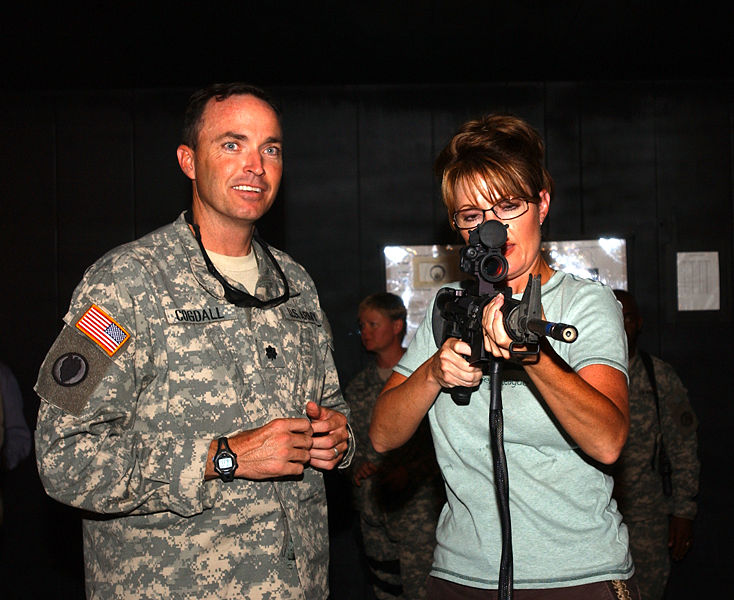
We’ve heard a lot about gun control and the second amendment in this election season. A McCain-Palin poster, featuring Alaska’s 44-year-old governor with a big gun and the viewer in her rifle sights, is just one of the more graphic indications that gun control is a lightning-rod issue that distracts, distorts, and dismays.

More than 200 years after our founding fathers enshrined the right to “bear arms” in our Constitution, we have more arms than we can bear. Wars are fought, fortunes are made, and nations rise and fall on these weapons. At the human-to-human level crimes are committed, vengeance is taken, rage is given full range, and terror is wreaked from the barrel of these weapons.

The United States is the world’s largest arms-supplying nation. In 2007, the United States entered into over $19.1 billion in Foreign Military Sales (FMS) agreements with other nations and for 2008, sales of military goods and services mushroomed to $34 billion — triple the volume of the Bush administration’s first year.

U.S. exports range from combat aircraft to Pakistan, Greece, and Chile to small arms and light weapons to the Philippines, Egypt, and Georgia. Since the beginning of the war on terror, the United States has transferred more than $88 billion in weapons and military material through the Foreign Military Sales channel. In 2006 and 2007, U.S. weapons and military training went to over 168 states and territories. But it’s not just big weapons systems transferred legally.

Illegal Weapons Sales

U.S. small arms are briskly — and illegally — sold all over the world. And we need not look further than our southern border to see the intersection of small arms trade and big military policy. The newspapers are full of stories of horrific violence between drug cartels and the Mexican military and police. The New York Times reported recently that 3,700 people have been killed in violent incidents related to the drug trade and organized crime so far this year. In the article “Killings Haunt Mexican School Children,” Times reporter Marc Lacey documents the impact drug violence is having on Mexican school children. The headmaster at a school near where 11 mutilated bodies were dumped relates that his students are asking questions like: “Why did they die?”

Since a military-led crackdown on drug traffickers began more than 18 months ago, thousands have died in drug-related violence, including police officers and soldiers, as well as cartel members, corrupt officials, and countless innocent bystanders according to Mexican authorities.

The violence is fueled in part by the high-tech, high-quality weapons bought at gun shows and shops in the United States. According to the U.S. Bureau of Alcohol, Tobacco, Firearms and Explosives, more than 90% of guns seized after shootings or police raids in Mexico or at the border can be traced back to the United States. Last year alone, 2,455 weapons traces concluded that the guns had been purchased in the United States.

Where do they come from? There are more than 6,700 licensed gun dealers across four states within a short drive of the United States’ 2,000-mile border with Mexico — three dealers for every mile of border territory. Each state has its own set of laws for gun sales. California has instituted a 30-day waiting period and banned the sale of assault rifles; neighboring Nevada and Arizona have not. The ease with which huge numbers of deadly weapons are bought and smuggled has led law-enforcement officials to dub the region an “iron river of guns.”

This is our right to bear arms in practice. And it’s not saving lives or guarding liberties. A glut in arms production and patchwork state-by-state laws regulating the sale of guns means that it’s relatively easy for narco-traffickers and criminals to get their hands on everything from assault rifles to handguns, as well as all the ammunition they need.

In the last 10 years, the international community succeeded in establishing a global treaty against antipersonnel landmines and a global ban on cluster bombs — weapons of indiscriminate effect that can leave behind thousands of unexploded “bomblets” that pose a threat to military personnel and civilians alike.

A common thread that unites these efforts is the demand that human rights and humanitarian concerns be placed front and center in decisions on what weapons are transferred, and how they are used.

In addition, each campaign has made effective arguments suggesting that beyond the humanitarian benefits of curbing these weapons, there are national security and economic benefits as well: promoting stability, removing risks to traditional armed forces and peacekeeping operations, and making the nations of the global South safe for development.

Shouldn’t a global treaty against guns be next?

Foreign Policy In Focus columnist Frida Berrigan is a senior program associate at the Arms and Security Initiative of the New America Foundation.

Source / Foreign Policy in Focus

The Rag Blog

Posted in RagBlog | Tagged , , | 2 Comments

For the Dart Players in the Audience

Being a long-time birder and having participated in league darts for years in Edmonton, Alberta, I had to post this. My apologies to those who are offended by an innocent hummer being so “mistreated,” but I believe he was fine after the photographic ordeal. And I don’t think he would’ve listened to direction regarding his target anyway.

Richard Jehn / The Rag Blog

Thanks to Diane Stirling-Stevens / The Rag Blog

Posted in RagBlog | Tagged | 1 Comment

Latest on the McCain Hoax : Campaign Role in Sensationalized News

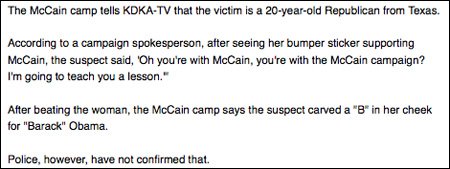
Graphic by Talking Points Memo.

McCain Communications Director Gave Reporters Incendiary Version Of “Carved B” Story Before Facts Were Known
By Greg Sargent / October 24, 2008

See ‘Rick Sanchez Calls Out Media That Fell For “Mutilation” Hoax’ by Sam Stein — and two Videos — below.

John McCain’s Pennsylvania communications director told reporters in the state an incendiary version of the hoax story about the attack on a McCain volunteer well before the facts of the case were known or established — and even told reporters outright that the “B” carved into the victim’s cheek stood for “Barack,” according to multiple sources familiar with the discussions.

John Verrilli, the news director for KDKA in Pittsburgh, told TPM Election Central that McCain’s Pennsylvania campaign communications director gave one of his reporters a detailed version of the attack that included a claim that the alleged attacker said, “You’re with the McCain campaign? I’m going to teach you a lesson.”

Verrilli also told TPM that the McCain spokesperson had claimed that the “B” stood for Barack. According to Verrilli, the spokesperson also told KDKA that Sarah Palin had called the victim of the alleged attack, who has since admitted the story was a hoax.

The KDKA reporter had called McCain’s campaign office for details after seeing the story — sans details — teased on Drudge.

The McCain spokesperson’s claims — which came in the midst of extraordinary and heated conversations late yesterday between the McCain campaign, local TV stations, and the Obama camp, as the early version of the story rocketed around the political world — is significant because it reveals a McCain official pushing a version of the story that was far more explosive than the available or confirmed facts permitted at the time.

The claims to KDKA from the McCain campaign were included in an early story that ran late yesterday on KDKA’s Web site. The paragraphs containing these assertions were quickly removed from the story after the Obama campaign privately complained that KDKA was letting the McCain campaign spin a racially-charged version of the story before the facts had been established, according to two sources familiar with the discussions.

The story with the removed grafs is still right here. We preserved the three missing grafs from yesterday:


A source familiar with what happened yesterday confirmed that the unnamed spokesperson was communications director Peter Feldman. Feldman was also quoted yesterday making virtually identical assertions on the Web site of another local TV station, WPXI. But those quotes, which we also preserved here, are also no longer available on WPXI’s site, for reasons that are unclear.

This is problematic because the McCain campaign doesn’t want to have been perceived as pushing an incendiary story that not only turned out to be a hoax but which police officials said today risked blowing up into a “national incident” and has local police preparing to file charges against the hoaxster.

There’s no evidence that anyone from McCain national headquarters put out a version of events like this.

After the story appeared on KDKA’s site and this and other pieces in the local press started flying around the political world, an Obama spokesperson in the state angrily insisted to KDKA that it was irresponsible for the station to air the McCain spokesperson’s incendiary version of events before the facts were fully known, according to two sources familiar with the discussions.

After that, KDKA went back to McCain’s Pennsylvania spokesperson, Feldman, and asked if he stood by the story as he’d earlier told it, but he started backing off the story, a source familiar with the talks says. That prompted KDKA to remove the grafs.

Feldman couldn’t immediately be reached, and a McCain HQ spokesperson declined to comment.

Source / TPM

Ashley’s Perp Walk:

Rick Sanchez Calls Out Media That Fell For “Mutilation” Hoax
By Sam Stein / October 24, 2008

The big political story of the day revolves around what turned out to be a non-story. Several media outlets (the vast majority conservative) were left with egg on their faces after they trumpeted up the tale of a McCain volunteer who claimed to have been assaulted by a large black man because of a McCain bumper sticker on her car. On her face was carved a backwards ‘B’ (meant to represent Obama’s name). The Drudge Report called it “mutilation.”

It was a hoax. And now, some in the fourth estate are left to explain why they pushed this apparent political ploy. Those in the business who showed some prudence are calling out their competitors for taking the bait.

On CNN today, anchor Rick Sanchez did just that, naming the outlets that not only reported but actively pushed the story of Ashley Todd. In addition to explaining why his station didn’t report the story, Sanchez dug the knife in a bit deeper when it came to Hugh Hewitt, the conservative radio talk show host who appeared on CNN Thursday and blamed “that side” (i.e. the Democrats) for engaging in “extraordinarily” disturbing acts.

“Part of the story is the fact that it was reported by the media,” said Sanchez. “We would not be telling the story now had it not been carried by so many outlets. As I mentioned before, it was mentioned on, as a matter of fact I have a list and not to mention names, but the initials of the news organizations are Fox News, the Pittsburgh Post-Gazette and Newsday. And also radio talk show hosts went on their radio stations and talked ad infinitum about the story yesterday, one of them even seemingly being a braggadocio about it when he was on the air with our own Wolf Blitzer yesterday.”

Separately, the College Republicans — a group of which Todd is a member — sought to distance themselves from the whole affair, telling the Huffington Post: “When Ms. Todd initially contacted us claiming to have been attacked, our first reaction was obviously to be concerned for her safety … We are as upset as anyone to learn of her deceit. Ashley must take full responsibility for her actions.”

Source / The Huffington Post

The Rag Blog

Posted in RagBlog | Tagged , , , , , | 2 Comments

Poverty: Governments Can Be Forced to Do Right

More than 116 million people stood against poverty this weekend.
© Global Call to Action against Poverty

Anti-Poverty Rallies Smash World Record
By Haider Rizvi / October 23, 2008

UNITED NATIONS – The worldwide anti-poverty mass action that took place last weekend has broken all previous records for coordinated public demonstrations on a single issue, says Guinness World Records, the ultimate authority on evaluating achievements.

Guinness said Wednesday more than 116 million people took part in public gatherings and demonstrations organized by anti-poverty activists in 131 countries across the world, making it “the biggest mobilization ever on a single issue.”

Organizers said the mass action on Oct. 17-19, which drew nearly 2 percent of the world’s population, sent a clear message to world leaders that people will not stay seated while promises to end poverty remain unfulfilled.

“This is a wonderful statement of global determination and commitment to end the injustice of extreme poverty,” said Desmond Tutu, archbishop of Cape Town, adding: “116 million people have stood together to say [that]. This message must be heard by leaders.”

The worldwide actions, billed as “Stand Up and Take Action,” were jointly organized by two international groups, the Global Call to Action against Poverty (GCAP) and the UN Millennium Campaign.

“The largest Stand Up is truly an historical event and as keepers and adjudicators of world records we are delighted to ratify such an important record and make this official,” said Craig Glenday, editor-in-chief of Guinness World Records.

“Mass mobilization has the power to change the course of history, and we will not stop mobilizing and advocating for action until the MDGs are achieved for the poorest people in the world.” – Salil Shetty, Millennium Campaign

In a statement, Glenday congratulated “every individual” for taking part in the event and said he welcomed them to the “family of Guinness World Records.”

The UN Millennium Campaign’s Eveline Herkens said the event shows that, “business as usual cannot go on. Leaders must take note and act now.”

The UN Millennium Campaign was established by the former UN chief Kofi Annan in 2002, about two years after world leaders agreed to set the Millennium Development Goals (MDGs) — a series of measures to effectively reduce poverty, illiteracy, diseases, and environmental pollution by 2015.

Like his predecessor, the current UN Secretary General Ban Ki-moon is urging both the governments of rich and poor countries to do more to achieve all the MDGs and to end extreme poverty by half in the next 7 years in accordance with their pledge.

The Millennium Campaign says it is the responsibility of developing countries to work toward the Goals on reducing poverty and improving healthcare, education, and the environment, especially by “[ensuring] greater accountability to citizens and efficient use of resources.”

For their part, adds the Campaign, the world’s wealthier countries must “deliver on their end of the bargain with more and more effective aid, more sustainable debt relief, and fairer trade rules, well in advance of 2015.”

Asia Leads Way

Guinness said people in Asia came in the largest numbers to participate in the “Stand Up and Take Action” campaign against poverty. Its verified record shows 73,151,847 people took part in the campaign in Asia, the largest continent on Earth.

The list shows 24,496,151 participants in Africa; 17,847,870 in Arab States; 951,788 in Europe; 211,250 in Latin America; 210,803 in Oceania; and 123,920 in North America.

UN staff in Bonn stand up against poverty. © MT_bulli (flickr)

The Guinness records show that in the Philippines, more than 35 million people participated, which is equivalent to one third of the country’s population. The group mentions Afghanistan, Bangladesh, Egypt, India, Indonesia, Malawi, Nepal, Nigeria, Pakistan, Rwanda, Thailand, and Uganda as countries where people raised their concerns about poverty in massive numbers.

In the industrialized world, major events took place in Italy and Germany where hundreds of thousands of people demanded more and better aid to developing countries and the implementation of fair international trade rules.

Are World Leaders Listening?

“This is a new kind of action the world is seeing,” said GCAP’s Sylvia Borren. “It’s the local influencing the global. Women in villages in Africa are connecting and joining millions of citizens and other countries. The young people are taking ownership of the MDGs like never before.”

Inspired by the unprecedented turnout at the anti-poverty events, Martin Luther King III said it’s now up to the leaders of the world to match the passion and commitment of their people and deliver on their commitments. “My father,” he added in a statement, “proved that when the voices of citizens become too loud to ignore, governments are forced to do the right thing.”

The son of America’s great civil rights leader may be right.

According to the Millenium Campaign’s Salil Shetty, world leaders have already started to respond. “Mass mobilization has the power to change the course of history,” said Shetty, “and we will not stop mobilizing and advocating for action until the MDGs are achieved for the poorest people in the world.”

Source / OneWorld.net

The Rag Blog

Posted in RagBlog | Tagged , , | 1 Comment

Blackmail in California : Businesses Warned Against Support of Gay Rights

Ballot initiative stirrring up a storm: Pastor volunteers at phone bank in conservative-leaning Orange County on Oct. 16 to urge Californians to vote no on Prop. 8, which would outlaw same-sex marriages in the state. Photo by David McNew / Getty.

Certified letter from Proposition 8 umbrella group: Don’t support gay marriage.
By Lisa Leff / October 23, 2008

SAN FRANCISCO — Leaders of the campaign to outlaw same-sex marriage in California are warning businesses that have given money to the state’s largest gay rights group they will be publicly identified as opponents of traditional unions unless they contribute to the gay marriage ban, too.

ProtectMarriage.com, the umbrella group behind a ballot initiative that would overturn the California Supreme Court decision that legalized gay marriage, sent a certified letter this week asking companies to withdraw their support of Equality California, a nonprofit organization that is helping lead the campaign against Proposition 8.

“Make a donation of a like amount to ProtectMarriage.com which will help us correct this error,” reads the letter. “Were you to elect not to donate comparably, it would be a clear indication that you are in opposition to traditional marriage. … The names of any companies and organizations that choose not to donate in like manner to ProtectMarriage.com but have given to Equality California will be published.”

The letter was signed by four members of the group’s executive committee: campaign chairman Ron Prentice; Edward Dolejsi, executive director of the California Catholic Conference; Mark Jansson, a member of The Church of Jesus Christ of Latter-day Saints; and Andrew Pugno, the lawyer for ProtectMarriage.com. A donation form was attached. The letter did not say where the names would be published.

The unusual appeal reflects the increasing tension surrounding the tight race over Proposition 8, which would change the California Constitution to limit marriage to a man and a woman. In recent days, both sides in the debate have accused their opponents of threatening their respective campaign volunteers and misleading voters.

San Diego businessman Jim Abbott, who owns a real estate company and is a member of Equality California’s board of directors, received one of the letters late Wednesday afternoon. His adult son called Abbott to read it to him.

“He characterized it as a bit ‘Mafioso,'” Abbott said. “It was a little distressing, but it’s consistent with how the ‘yes’ side of this campaign has been run, which is a bit over the top.”

Abbott, who married his same-sex partner at the end of August, estimated that over the last decade he has given $50,000 to Equality California, including a recent $10,000 gift to underwrite a San Diego event that raised money to defeat Proposition 8.

When asked whether ProtectMarriage.com planned to name businesses that have supported the No on 8 campaign, Prentice initially said he was unaware of any such effort.

“I’m not familiar of any organized attack against organizations that have given to No on 8,” he said Thursday.

But when asked about the letter to Equality California donors, Prentice confirmed they were authentic and said the ProtectMarriage.com campaign was asking businesses backing the other side “to reconsider taking a position on a moral issue in California.”

Prentice said it was his understanding it was intended for large corporations such as cable operators Time Warner and Comcast instead of small business owners like Abbott. Both Time Warner and Comcast are listed on Equality California’s Web site as corporate sponsors that gave $50,000 each to the group.

Companies that have contributed directly to one of the campaign committees collecting cash to fight Proposition 8, including one set up by Equality California, also were recipients of the letter, Prentice said. That list includes companies such as Pacific Gas & Electric, Levi Strauss and AT&T.

“I think the IDing of, or outing of, any company is very secondary to the question of why especially a public corporation would choose to take a side knowing it would splinter it’s own clientele,” he said.

Equality California executive director Geoffrey Kors said Thursday he has heard from two other business owners besides Abbott.

“It’s truly an outrageous attempt to extort people,” Kors said.

While an anti-Proposition 8 group called Californians Against Hate has posted lists of gay marriage ban donors on the Internet and even launched boycotts of selected businesses, Kors said that work has been independent of the official No on 8 campaign.

“They are going after our long-term funding and trying to intimidate Equality California donors from giving any more to the No on 8 campaign and from giving to Equality California ever again.”

While corporations often give to rival candidates for public office as a way of preserving their government access no matter who wins, tit-for-tat solicitations are almost unheard of in ballot initiative campaigns, said Robert Stern, president of the nonpartisan Center for Governmental Studies.

“This is a proposition where you are on one side or the other. You vote yes or no, not yes and no,” Stern said.

Though unusual and disturbing, Stern said there was nothing illegal about ProtectMarriage.com hitting up Equality California supporters for money.

Sonya Eddings Brown, a ProtectMarriage.com spokeswoman, estimated that 36 companies were targeted for the letter and said those that do not respond with a contribution would be highlighted in a press release and on the campaign Web site.

She called the tactic “a frustrated response” to the intimidation felt by Proposition 8 supporters, who have had their lawn signs stolen and property vandalized in the closing days of the heated campaign.

Source / AP / SF Gate

The Rag Blog

Posted in RagBlog | Tagged , , , , , | 1 Comment

Health of All Is Affected by Preventable Pollution

These children are developmentally impaired as a result of lead poisoning. Haina, Dominican Republic. Photo: Blacksmith Institute.

Worst Forms of Pollution Killing Millions
By Stephen Leahy / October 23, 2008

UXBRIDGE, Canada – Gold mining and recycling car batteries are two of the world’s Top 10 most dangerous pollution problems, and the least known, according a new report.

The health of hundreds of millions of people is affected and millions die because of preventable pollution problems like toxic waste, air pollution, ground and surface water contamination, metal smelting and processing, used car battery recycling and artisanal gold mining, the “Top Ten” report found.

“The global health burden from pollution is astonishing, and mainly affects women and children,” said Richard Fuller, director of the New York- based Blacksmith Institute, a independent environmental group that released the list Tuesday in partnership with Green Cross Switzerland.

“The world community needs to wake up to this fact,” Fuller told IPS.

In previous years, the Blacksmith Institute has released a Top Ten list of toxic sites. The Institute continues to compile a detailed database with over 600 toxic sites and will release the world’s first detailed global inventory in a couple of years.

However, this year, rather than focus on places, it wants to bring specific pollution issues to world attention. And in particular highlight the health impacts — a 2007 Cornell University study that 40 percent of all deaths worldwide are directly attributable to pollution, he said.

Remediation and preventing much of this pollution are not only possible but cost-effective, especially when compared to other international efforts to improve health in developing countries.

Sometimes it is simply a matter of information and alternatives, as Fuller learned on a recent investigation in Dakar, the capital of Senegal, where children had died from lead poisoning. “Women from some poor areas of Dakar were hoping to make some money recycling car batteries and ended up accidentally killing their children,” he said.

In the tropics, car batteries only last a year or two and so there is a thriving recycling industry. However, much of this is done by very poor people who break open the batteries with axes and melt them down on open fires. Lead dust fills the air and children playing nearby inhaled the toxic lead dust, and some died.

“It is very difficult to die from lead poisoning, it takes an awful lot of lead,” Fuller said.

Fuller and colleagues measured the lead levels in the blood of surviving children and found levels 10 times the maximum allowed in the U.S. Lead is a potent neurotoxin and children are especially sensitive, as it affects their developing nervous systems and brains. “These are now the brain-damaged children of Dakar,” he said.

Blacksmith arranged to have the site in Dakar cleaned up but because it is an important source of income for the poor, the batteries are still collected but are now being shipped to proper recycling facilities. The World Health Organisation is trying to treat the affected children, he said.

“There is no simple, universal solution. It has to be solved on step by step, one place at a time basis,” Fuller noted.

Another of the biggest overlooked pollution issues comes from artisanal and small-scale mining involving some 15 million miners, including 4.5 million women and 600,000 children, the report finds. As much as 95 percent of the mercury used to recover the gold ends up in the environment. That mercury represents 30 percent of all mercury emitted into the global environment each year from all sources including power plants, according to the U.N. Industrial Development Organisation.

“It’s an enormous problem that transcends boundaries. That mercury ends up in the tuna we eat here in North America,” Fuller said.

Mercury is another potent neurotoxin and is dangerous in extremely small quantities. Hundreds of kilogrammes are used every day for gold recovery. “Artisanal miners are the poorest of the poor and you can’t just tell them to stop,” he said.

There are safer and more effective ways of recover gold using a simple tool called a “retort” but education and retraining is required. Blacksmith and its partners have had good success in teaching and then paying a leader in the community to train local miners on the safer technique.

“It doesn’t take that much money to solve these pollution problems,” he said.

And the pollution that affects the health of nearly a billion people and impairs countries’ economy development could be fixed in just 20 to 30 years with a concerted effort by the international community. “Governments are becoming interested in this. I’m cautiously optimistic,” Fuller said.

Education and other international development assistance efforts will fail without reducing the pollution burden that affects the mental and physical capacity of so many people. Even with a downturn in the global economy, the argument for cleaning up pollution is so “compelling that it will not stop countries from taking action”.

“Clean air, water and soil are human rights,” he said.

The World’s Worst Pollution Problems list is unranked and includes:

• Indoor air pollution: adverse air conditions in indoor spaces

• Urban air quality: adverse outdoor air conditions in urban areas

• Untreated sewage: untreated waste water

• Groundwater contamination: pollution of underground water sources as a result of human activity

• Contaminated surface water: pollution of rivers or shallow dug wells mainly used for drinking and cooking

• Artisanal gold mining: small scale mining activities that use the most basic methods to extract and process minerals and metals

• Industrial mining activities: larger scale mining activities with excessive mineral wastes

• Metals smelting and other processing: extractive, industrial, and pollutant-emitting processes

• Radioactive waste and uranium mining: pollution resulting from the improper management of uranium mine tailings and nuclear waste

• Used lead acid battery recycling: smelting of batteries used in cars, trucks and back-up power supplies

Source / IPS (Interpress Service)

The Rag Blog

Posted in RagBlog | Tagged , | Leave a comment

Lloyd Doggett Quizzes Ben Bernanke About the Bailout Debacle

In Congressman Lloyd Doggett (D., Texas) we have one of the clearer, more conscientious voices in Washington representing some of us.

This is a reminder to keep him informed of your best thinking on these and other subjects of federal concern. You can sign up to receive Lloyd’s newsletter at his official site, and that has gotta be a good thing, too.

I just received the following from Cong. Doggett about the bailout and his renewed communication with the Fed’s Ben Bernanke.

Mariann Wizard / The Rag Blog / October 24, 2008


Questioning Bernanke about the alleged oversight of the Bailout
By Lloyd Doggett / October 23, 2008

[United States Rep. Lloyd Doggett, a Democrat, represents the 25th District of Texas.]

Returning to Washington on Monday for a House Budget Committee hearing, I questioned Ben Bernanke, Chairman of the Federal Reserve and the Financial Stability Oversight Board, which is supposed to ensure proper execution of the bailout.

As you recall, over my opposition, President Bush signed the bailout into law.

… (Bernanke’s) responses reveal that no federal regulator has been fired or disciplined as a result of the regulatory failures that led to the bailout. Nor have any executives from troubled institutions benefiting from the bailout been required to forgo pay raises and bonuses.

Additionally, since the bailout, the Treasury Department has further weakened the very modest limitations contained in the legislation for ‘golden parachutes’ or departure bonuses. For example, if an executive earned $10 million in compensation annually and exercised stock options worth a total of $30 million in the prior three years, then his average annual pay would rise to $20 million, still entitling him to a golden parachute of $59.9 million. That is not a trimmed parachute.

Because my time was very limited, I could not raise all of my questions with Chairman Bernanke, but I did make additional observations with other witnesses… (W)e now have reports of yet another contradiction from bailout promoters. After being repeatedly told that some financial institutions are too big to permit them to fail, we are advised that some major banks, with the encouragement of the Treasury Secretary Paulson, will use their new taxpayer-funded loans to get bigger. Instead of making new loans available, they plan to acquire other banks.

Texas Cong. Lloyd Doggett Questions Ben Bernanke

Go to Cong. Lloyd Doggett’s website.

The Rag Blog

Posted in RagBlog | Tagged , , , , , | Leave a comment

Bill Ayers and the Poisonous Nature of American Electoral Politics

What’s most remarkable about this article is the collection of quotes at the end of it from both Democrats and Republicans condemning the university for inviting Ayers to speak in the first place. What hypocrisy: this is a putative academic environment where all views are welcome. Electoral politics in this nation has become so poisoned that it would almost be better to cancel all of it and crown an emperor, or (my personal preference) drop everything and live in absolute anarchy.

Richard Jehn / The Rag Blog


University of Nebraska-Lincoln Disinvites William Ayers after Death Threats, Financial Pressure
By Matthew Rothschild / October 23, 2008

William Ayers can’t catch a break.

After the McCain campaign has dragged his name through the mud and tried to attach it to Obama’s, Ayers is finding himself shunned even on a university campus.

Ayers, a professor of education at the University of Illinois at Chicago, was invited to deliver the keynote speech at an education conference at the University of Nebraska-Lincoln on November 15.

His address was billed as: “We Are Each Other’s Keepers: Research to Change the World.”

But on October 17, the University of Nebraska-Lincoln canceled the speech.

“The university’s threat assessment group monitored e-mails and other information UNL received regarding Ayers’s scheduled Nov. 15 visit, and identified safety concerns which resulted in the university canceling the event,” the administration said in a press release.

On October 23, the university released further details about these threats.

Mario Scalora, associate professor of psychology, was on the school’s threat assessment team. In an e-mail to the chancellor on the morning of October 17, he cited “substantial security concerns,” though he added, “We do not have any active death threats as yet.”

But a further analysis that he provided did contain thinly veiled death threats.

“Give me a sniper rifle and a good firing position, and I shall move Bill Ayers’ gray matter,” wrote one blogger who identified himself as “Lee Harvey Cornhusker.”

Another blogger wrote, “I wonder what flag he wants on his coffin.”

One caller was described as “very upset” and said there will be “hell to pay” if Ayers is not disinvited within 24 hours.

“Several subjects,” Scalora noted, were “making multiple contacts escalating in their rhetoric and emotion.”

There was other pressure, as well.

“Some donors threatened to withhold financial support to the university unless Ayers was disinvited,” the Lincoln Journal Star reported, including a foundation that has provided millions.

Many e-mails poured into the paper from people saying they would stop contributing. Kim Morsett wrote: ‘I say to all ALUMS NO MORE $$$$$$$$$ if he speaks.”

Another one said: “This is absolutely disgusting! Whoever made this decision should be removed from their position at UNL. No more contributions from me!!!!!!!!”

Someone named John wrote: “Every year for the past few years, I have donated $5,000 to the University of Nebraska. If Ayers is allowed to set foot on campus, that will end. Not a threat. A promise.”

State politicians also weighed in.

“This is an embarrassment to the University of Nebraska and the State of Nebraska,” Governor Dave Heineman told the paper. “Bill Ayers is a well-known radical who should never have been invited to the University of Nebraska.”

Nebraska’s Democratic Senator, Ben Nelson, urged the university to reconsider its invitation.

“I join many Nebraskans in disappointment that Bill Ayers has been invited to the University of Nebraska at Lincoln,” Nelson said. “His past involvement in a violent protest group and incendiary comments are not consistent with the agenda of unity that we need in America today.”

The chancellor of the University of Nebraska at Lincoln, Harvey Perlman, sent out an e-mail to the faculty and staff on October 20 defending the initial invitation to Ayers and bemoaning the fact that the threats of violence impelled him to rescind that invitation.

“Most alarming,” he wrote, “were some responses that were threatening to the security of the campus. . . . The tone and tenor of the e-mails, the phone calls, and the blogs, suggested that the reaction to any Ayers’ visit would represent a significant threat to the safety of the campus. . . . I find it difficult to accept that the actions of a few individuals can deprive this university of its right to select speakers who can contribute to the education of our students. Nonetheless I take seriously the responsibility I have for the safety of members of this community, particularly the students. It seemed cancellation was the most responsible action. This university has always been able to invite and to host controversial speakers from all walks of life and all matters of persuasion. It is unnerving that the apparent escalating passion and violence of recent years makes the exercise of our traditional values more difficult.”

Some faculty members sharply criticized this decision.

It is a “chilling blow to academic freedom on our campus,” said one, “and there is a lot of frustration and anger from faculty, including some threats to leave.”

Source / The Progressive

The Rag Blog

Posted in RagBlog | Tagged , | 1 Comment

Ecuador : Nature has Inherent Rights


‘Breaking with tradition and establishing a bold legal precedent, Ecuador recently decided that nature should have rights of its own.’
By Anna Cederstav / October 23, 2008

Most environmentalists believe that nature has a right to exist for its own sake, but that’s not how the law works in our country.

In the United States, nature is defensible only if a human will miss the forest, species, or clean water when it is gone. To use the law, a human must first prove harm to their person.

If that proverbial tree falls in the woods and no human cares, no laws were broken. But if a tree falls and the hiker who depended on its shade is harmed, the U.S. legal system may provide some relief.

Breaking with tradition and establishing a bold legal precedent, Ecuador recently decided that nature should have rights of its own. Just for the sake of protecting nature and the intricate web of life that depends on it.

Although constitutions in other countries have long provided stronger protections than those available in the United States, guaranteeing for example the right of all citizens to enjoy an environment that is healthy and in equilibrium, as in Costa Rica, the right of nature to simply exist and continue to evolve for its own sake has not yet been guaranteed.

However, the Rights of Nature section in the Ecuadorian constitution that recently became law does just that. In Ecuador today, an ecosystem:

* Has the “right to exist” and—perhaps more importantly—to “persist.”

* Has the right to “maintain and regenerate its vital cycles, structure, and functions.”

* Has the right to “its processes in evolution.”

And most important, any person, people, or community can take legal action to defend those rights without showing personal harm.

Rights of Nature provisions may finally provide balance in legal systems around the world that tend to view nature as only an economic resource for humans.

We congratulate our colleagues in AIDA and ECOLEX who contributed to the efforts that led to this great precedent.

There are some worries that this new take on the inherent importance of defending nature may be too associated with President Rafael Correa, and that these new provisions are only as strong as the party currently holding power in Ecuador.

But if the country remains stable, the Ecuadorian Rights of Nature could be a model for what may someday become standard practice in constitutions around the world.

Each year, the Earthjustice International Program tracks changes in national environmental laws from around the world. See recent reports from EarthJustice.

Source / Earthjustice

Thanks to Richard Kendrick / The Rag Blog

Posted in RagBlog | Tagged , , , , , | Leave a comment

The Nonexistent Good News from Baghdad

Electrical wires span the streets in Baghdad, fed by private generators that provide backup for districts without power from the central grid. Photo: Marko Georgiev for The New York Times.

Wrecked Iraq: What the Good News from Iraq Really Means
By Michael Schwartz / October 23, 2008

As the Smoke Clears in Iraq: Even before the spectacular presidential election campaign became a national obsession, and the worst economic crisis since the Great Depression crowded out other news, coverage of the Iraq War had dwindled to next to nothing. National newspapers had long since discontinued their daily feasts of multiple — usually front page – reports on the country, replacing them with meager meals of mostly inside-the-fold summary stories. On broadcast and cable TV channels, where violence in Iraq had once been the nightly lead, whole news cycles went by without a mention of the war.

The tone of the coverage also changed. The powerful reports of desperate battles and miserable Iraqis disappeared. There are still occasional stories about high-profile bombings or military campaigns in obscure places, but the bulk of the news is about quiescence in old hot spots, political maneuvering by Iraqi factions, and the newly emerging routines of ordinary life.

A typical “return to normal life” piece appeared October 11th in the New York Times under the headline, “Schools Open, and the First Test is Iraqi Safety.” Featured was a Baghdad schoolteacher welcoming her students by assuring them that “security has returned to Baghdad, city of peace.”

Even as his report began, though, Times reporter Sam Dagher hedged the “return to normal” theme. Here was his first paragraph in full:

“On the first day of school, 10-year-old Basma Osama looked uneasy standing in formation under an already stifling morning sun. She and dozens of schoolmates listened to a teacher’s pep talk — probably a necessary one, given the barren and garbage-strewn playground.”

This glimpse of the degraded conditions at one Baghdad public school, amplified in the body of Dagher’s article by other examples, is symptomatic of the larger reality in Iraq. In a sense, the (often exaggerated) decline in violence in that country has allowed foreign reporters to move around enough to report on the real conditions facing Iraqis, and so should have provided U.S. readers with a far fuller picture of the devastation George Bush’s war wrought.

In reality, though, since there are far fewer foreign reporters moving around a quieter Iraq, far less news is coming out of that wrecked land. The major newspapers and networks have drastically reduced their staffs there and — with a relative trickle of exceptions like Dagher’s fine report — what’s left is often little more than a collection of pronouncements from the U.S. military, or Iraqi and American political leaders in Baghdad and Washington, framing the American public’s image of the situation there.

In addition, the devastation that is now Iraq is not of a kind that can always be easily explained in a short report, nor for that matter is it any longer easily repaired. In many cities, an American reliance on artillery and air power during the worst days of fighting helped devastate the Iraqi infrastructure. Political and economic changes imposed by the American occupation did damage of another kind, often depriving Iraqis not just of their livelihoods but of the very tools they would now need to launch a major reconstruction effort in their own country.

As a consequence, what was once the most advanced Middle Eastern society — economically, socially, and technologically — has become an economic basket case, rivaling the most desperate countries in the world. Only the (as yet unfulfilled) promise of oil riches, which probably cannot be effectively accessed or used until U.S. forces withdraw from the country, provides a glimmer of hope that Iraq will someday lift itself out of the abyss into which the U.S. invasion pushed it.

Consider only a small sampling of the devastation.

The Economy: Fundamental to the American occupation was the desire to annihilate Saddam Hussein’s Baathist state apparatus and the economic system it commanded. A key aspect of this was the closing down of the vast majority of state-owned economic enterprises (with the exception of those involved in oil extraction and electrical generation).

In all, 192 establishments, adding up to 35% of the Iraqi economy, were shuttered in the summer and fall of 2003. These included basic manufacturing processes like leather tanning and tractor assembly that supplied other sectors, transportation firms that dominated national commerce, and maintenance enterprises that housed virtually all the technicians and engineers qualified to service the electrical, water, oil, and other infrastructural systems in the country.

Justified as the way to bring a modern free-enterprise system to backward Iraq, this draconian program was put in place by the President’s proconsul in Baghdad, L. Paul Bremer III. The result? An immediate depression that only deepened in the years to follow.

One measure of this policy’s impact can be found in the demise of the leather goods industry, a key pre-invasion sector of Iraq’s non-petroleum economy. When a government-owned tanning operation, which all by itself employed 30,000 workers and supplied leather to an entire industry, was shuttered in late 2003, it deprived shoe-makers and other leather goods establishments of their key resource. Within a year, employment in the industry had dropped from 200,000 workers to a mere 20,000.

By the time Bremer left Iraq in the spring of 2004, the inhabitants of many cities faced 60% unemployment. Meanwhile, the country’s agriculture, a key component of its economy, was also victimized by the dismantling of government establishments and services. The lush farming areas between the Tigris and Euphrates rivers suffered badly. The once-thriving date palm industry was a typical casualty. It suffered deadly infestations of pests when the occupation eliminated a government-run insecticide spraying program. Even oil refinery-based industrial towns like Baiji became cities of slums when plants devoted to non-petroleum activities were shuttered.

This economic devastation fueled the insurgency by generating desperation, anger, and willing recruits. The explosion of resistance, in turn, tended to obscure — at least for western news services — the desperate circumstances under which ordinary Iraqis labored.

As violence has subsided in Baghdad and elsewhere, demands for relief have come to the fore. These are not easily answered by a still largely non-functional central government in Baghdad whose administrative and economic apparatus was long ago dismantled, and many of whose key technical personnel had fled into exile. Meanwhile, in early 2006, the American occupation declared that further reconstruction work would be the responsibility of Iraqis. It is not clear into what channels the growing discontent over an economy that remains largely in the tank and a government that still cannot deliver ordinary services will flow.

Electricity: A critical factor in Iraq’s collapse has been its decaying electrical grid. In areas where the insurgency raged, facilities involved in producing and transmitting electricity were targeted, both by the insurgents and U.S. forces, each trying to deprive the other of needed resources. In addition, Bremer eliminated the government-owned maintenance and engineering enterprises that had been holding the electrical system together ever since the U.N. sanctions regime after the 1991 Gulf War deprived Iraq of material needed to repair and upgrade its facilities. Maintenance and replacement contracts were given instead to multinational companies with little knowledge of the existing system and — due to cost-plus contracting — every incentive to replace facilities with their own proprietary technology. In the meantime, many Iraqi technicians left the country.

The successor Iraqi governments, deprived of the capacity to manage the system’s reconstruction, continued the U.S. occupation policy of contracting with foreign companies. Even in areas of the country relatively unaffected by the fighting, those companies did the lucrative thing, replacing entire sections of the electric grid, often with inappropriate but exquisitely expensive equipment and technology.

A combination of factors — including pressure from the insurgency, the soaring costs of security, and an almost unparalleled record of endemic waste and corruption — led to costs well beyond those originally offered for the already overpriced projects. Many were then abandoned before completion as funding ran out. Completed projects were often shabbily done and just as often proved incompatible with existing facilities, introducing new inefficiencies.

In one altogether-too-typical case, Bechtel installed 26 natural gas turbines in areas where no natural gas was available. The turbines were then converted to oil, which reduced their capacity by 50% and led to a rapid sludge build-up in the equipment requiring expensive maintenance no Iraqi technicians had been trained to perform. In location after location, the turbines became inoperative.

Even before the invasion, the decrepit electrical system could not meet national demand. No province had uninterrupted service and certain areas had far less than 12 hours of service per day. The vast investments by the occupation and its successor regimes have increased electrical capacity since the invasion of 2003, but these gains have not come close to keeping up with skyrocketing demand created by the presence of hundreds of thousands of troops, private security personnel, and occupation officials, as well as by the introduction of all manner of electronic devices and products in the post-invasion period. Recent U.N. reports indicate that, in the last year, electrical capacity has slipped to less than half of demand. With priority going to military and government operations, many Baghdad neighborhoods experience less than two hours of publicly provided electricity a day, forcing citizens and business enterprises to utilize expensive and polluting gasoline generators.

In spring of this year, 81% of Iraqis reported that they had experienced inadequate electricity in the previous month. During the heat of summer and the cold of winter, these shortages create real health emergencies.

In 2004, the U.N. estimated that $20 billion in reconstruction funds would be needed for a fully operative electrical grid. The estimates now range from $40 billion to $80 billion.

Water: The Tigris and Euphrates rivers, which flow through the country from the northwest to the southeast, have since time immemorial irrigated the rich farming land that lay between them, nurtured the fish that are a staple of the Iraqi diet, and provided water for animal and human consumption. American-style warfare, with its reliance on tank, artillery, and air power, often resulted in the cratering of streets in upstream Sunni cities like Tal Afar, Falluja, and Samarra where the insurgency was strongest. One result was the wrecking of already weakened underground sewage systems. In the Sadr City section of Baghdad, for instance, where much fighting has taken place and American air power was called in regularly, there is now a lake of sewage clearly visible on satellite photographs.

The ultimate destination of significant parts of the filth from devastated sewage systems was the two rivers. Five years worth of such waste flowing through the streets and into those rivers has left them thoroughly contaminated. Their water can no longer be safely drunk by humans or animals, the remaining fish cannot be safely eaten, and the contaminated water reportedly withers the crops it irrigates.

Iraq’s never-adequate water purification system has proven woefully insufficient to handle this massive flow of contamination, while inadequate electric supplies insure that the country’s few functional purification plants are less than effective.

In many cities, the sewage system must be entirely reconstructed, but repairs cannot even begin without a viable electrical system, a reinvigorated engineering and construction sector, and a government capable of marshalling these resources. None of these prerequisites currently exist.

Schools: Education has been a victim of all the various pathologies current in Iraqi society. During the initial invasion, the U.S. military often commandeered schools as forward bases, attracted by their well-defined perimeters, open spaces for vehicles, and many rooms for offices and barracks. Two incidents in which American gunfire from an occupied elementary school killed Iraqi civilians in the conservative Sunni city of Falluja may have been the literal sparks that started the insurgency. Many schools would subsequently be rendered uninhabitable by destructive battles fought in or near them.

Under the U.S. occupation’s de-Baathification policy, thousands of teachers who belonged to the Baath Party were fired, leaving hundreds of thousands of students teacherless. In addition, the shuttering of government enterprises deprived the schools of supplies — including books and teaching materials — as well as urgently needed maintenance.

The American solution, as with the electric grid, was to hire multinational firms to repair the schools and rehabilitate school systems. The result was an orgy of corruption accompanied by very little practical aid. Local school officials complained that facilities with no windows, heating, or toilet facilities were repainted and declared fit for use.

The dwindling central government presence made schools inviting arenas for sectarian conflict, with administrators, teachers, and especially college professors removed, kidnapped, or assassinated for ideological reasons. This, in turn, stimulated a mass exodus of teachers, intellectuals, and scientists from the country, removing precious human capital essential for future reconstruction.

Finally, in Baghdad, the U.S. military began installing ten-foot tall cement walls around scores of communities and neighborhoods to wall off participants in the sectarian violence. As a result, schoolchildren were often separated from their schools, reducing attendance at the few intact facilities to those students who happened to live within the imprisoning walls.

This fall, as some of these walls were dismantled, residents discovered that many of the schools were virtually unusable. The Times’s Dagher offered a vivid description, for instance, of a school in the Dolaie neighborhood which “is falling apart, and overwhelmed by the children of almost 4,000 Shiite refugee families who have settled in the Chukouk camp nearby. The roof is caving in, classroom floors and hallways are stripped bare, and in the playground a pile of burnt trash was smoldering.”

The Dysfunctional Society: Much has been made in the U.S. presidential campaign of the $70 billion oil surplus the Iraqi government built up in these last years as oil prices soared. In actuality, most of it is currently being held in American financial institutions, with various American politicians threatening to confiscate it if it is not constructively spent. Yet even this bounty reflects the devastation of the war.

De-Baathification and subsequent chaos rendered the Iraqi government incapable of effectively administering projects that lay outside the fortified, American-controlled Green Zone in the heart of Baghdad. A vast flight of the educated class to Syria, Jordan, and other countries also deprived it of the managers and technicians needed to undertake serious reconstruction on a large scale.

As a consequence, less than 25% of the funds budgeted for facility construction and reconstruction last year were even spent. Some government ministries spent less than 1% of their allocations. In the meantime, the large oil surpluses have become magnets for massive governmental corruption, further infuriating frustrated citizens who, after five years, still often lack the most basic services. Transparency International’s 2008 “corruption perceptions index” listed Iraq as tied for 178th place among the 180 countries evaluated.

The Iraq that has emerged from the American invasion and occupation is now a thoroughly wrecked land, housing a largely dysfunctional society. More than a million Iraqis may have died; millions have fled their homes; many millions of others have been scarred by war, insurgency and counterinsurgency operations, extreme sectarian violence, and soaring levels of common criminality. Education and medical systems have essentially collapsed and, even today, with every kind of violence in decline, Iraq remains one of the most dangerous societies on earth.

As its crisis deepened, the various areas of social and technical devastation became ever more entwined, reinforcing one another. The country’s degraded sewage and water systems, for example, have spawned two consecutive years of widespread cholera. It seems likely that this year, the disease will only subside when the cold weather makes further contagion impossible, but this “solution” also guarantees its reoccurrence each year until water purification systems are rebuilt.

In the meantime, cholera victims cannot rely on Iraq’s once vaunted medical system, since two-thirds of the country’s doctors have fled, its hospitals are often in a state of advanced decay and disrepair, drugs remain scarce, and equipment, if available at all, is outdated. The rebuilding of the water and medical systems, however, cannot get fully underway unless the electrical system is restored to reasonable shape. Repair of the electrical grid awaits a reliable oil and gas pipeline system to provide fuel for generators, and this cannot be constructed without the expertise of technicians who have left the country, or newly trained specialists that the educational system is now incapable of producing. And so it goes.

On a daily basis, this cauldron of misery renews powerful feelings of discontent, which explains why American military leaders regularly insist that the country’s current relative quiescence is, at best, “fragile.” They believe only the most minimal reductions in U.S. forces in Iraq (still hovering at close to 150,000 troops) are advisable.

Even if Washington prefers to ignore Iraqi realities, military officials working close to the ground know that the country’s state of disrepair, and an inability to deal with it in any reasonably prompt way, leaves a population in steaming discontent. At any moment, this could explode in further sectarian violence or yet another violent effort to expel the U.S. forces from the country.

Michael Schwartz’s new book, War Without End: The Iraq War in Context (Haymarket, 2008), has just been released. It explains just how the militarized geopolitics of oil led the U.S. to dismantle the Iraqi state and economy while fueling sectarian civil war inside that country. A professor of sociology at Stony Brook State University, Schwartz has written extensively on popular protest and insurgency. His work on Iraq has appeared in numerous outlets, including TomDispatch, Asia Times, Mother Jones, and Contexts. A video of him discussing “wrecked Iraq” can be seen by clicking here. His email address is ms42@optonline.net.

Source / TomDispatch

The Rag Blog

Posted in RagBlog | Tagged , , | 2 Comments

Seeking to Stop the Military Recruiters Dead

Barbara Harris discussing ways to educate parents about their right to keep information on their children from the military. Photo: Yana Paskova for The New York Times.

‘Counter-Recruiter’ Seeks to Block Students’ Data From the Military
By Javier C. Hernandez / October 22, 2008

Barbara G. Harris, 72, looked her troops in the eye. Staring out at mohawks on one side of the room, salt-white bobs on the other, she said in her delicately firm way: “Hold your ground. You have every right to stand there, and if anyone tells you differently, tell them your rights.”

Barbara Harris discussing ways to educate parents about their right to keep information on their children from the military.

A retired teacher and longtime peace advocate, Ms. Harris was tutoring 20 new enlistees in the art of “counter-recruitment,” her personal crusade to block recruiters for the United States military from contacting New York City high school students.

She had assembled the group in her war room, a space near Union Square lent by a sympathetic organization, where plants and antiwar signs line the walls, in preparation for a blitz Thursday evening at parent-teacher conferences, where Ms. Harris and the others plan to stand on sidewalks outside school buildings armed with opt-out forms and their best sales pitches.

“You don’t have a whole lot of time — that’s the point,” Ms. Harris told the volunteers, who ranged in age from college students to the Granny Peace Brigade, a New York group of older women started in 2005 to protest the Iraq war. “Don’t be frustrated by that. They do stop.”

Ms. Harris’s efforts this week come as the Department of Education is facing renewed criticism from the New York Civil Liberties Union on the issue of military recruitment, after changing its policy in September to allow recruiters to get data about high school students from a central office. In the past, recruiters had to go from school to school to get names, addresses and phone numbers for students.

Federal law requires that schools provide the military the same access as colleges and other prospective employers. Parents are allowed to block access to a child’s information by signing an opt-out form.

Douglas Smith, a spokesman for the United States Army recruiting command, said that he was unaware of Ms. Harris but that the military did not object to counter-recruitment efforts. “We would hope that we would have an open discourse and not have one group try to stifle the ability of the other group to speak,” he said.

Ms. Harris, who lives in Midtown, started counter-recruiting three years ago, troubled by what she saw as an increasingly aggressive attempt to recruit low-income and minority students into the armed forces (she calls it a “poverty draft”). She has made it her mission to inform students, parents and teachers of alternatives to joining the military. She was among 18 members of the Granny Peace Brigade arrested and charged with disorderly conduct at the Times Square recruitment center in 2005; they were later acquitted of all charges.

Her latest campaign caps a half-century of protests. In the 1950s, while her friends ducked under desks and talked of fallout shelters, Ms. Harris took to the streets, rallying against the proliferation of nuclear weapons.

As the Vietnam War roiled, she focused on peace and women’s rights. She got a job teaching special-needs children at a public school in Pleasantville, N.Y., followed by a 21-year stint as a corporate trainer at AT&T. In the 1990s, Ms. Harris returned to the classroom, teaching English as a second language at the New School until her retirement in 2002. She has two children and two grandchildren.

Friends describe her as a protester who rarely raises her voice and makes it a point not to talk over others.

“She is an absolute wonder,” said Nancy Kricorian, coordinator for the city’s chapter of Code Pink, a women’s antiwar group Ms. Harris belongs to. “She can talk to the most rabid person, somebody who totally disagrees with what we’re doing, in an even and convincing way.”

Bev Rice, a member of the Granny Peace Brigade who planned to help with Thursday’s counter-recruitment effort, said: “Nothing appears to upset her. She’s just the type of person you want to do something for.”

Ms. Harris, who canvasses on parent-teacher nights in fall and spring, and talks with community groups about high school recruiting in between, estimated that 9 out of 10 parents she speaks with do not know about the opt-out form, despite the city’s requirement that principals distribute information about it.

“You give them the information, you see them change their minds,” she said. “They know their kids are vulnerable. They say: ‘They’re calling my baby and I don’t want them to speak to my child. What should I do?’ ”

Over the years, Ms. Harris watched as military recruiters became, in her eyes, unduly forceful in the hallways of New York high schools. Recruiters formed friendships with students, she said, and gave them the impression that being a soldier can cure all their struggles.

Ms. Harris said she does not mind if students join the military, as long as they are informed of the risks and other opportunities, and meet with recruiters off school grounds. But she said that as she spoke with students in poor neighborhoods like East Harlem, she discovered that many of them were unaware that they could get financial aid for college on their own and saw the military as their only option.

“For many of these young kids, especially boys, it’s a macho thing — you’re strong, you’re one of the team, you get this respect if you join,” she said. “If a young person wants to enlist, at least he or she knows what it’s about, what the truth about recruiting is. They can decide if that’s the best choice for them.”

Source / New York Times

The Rag Blog

Posted in RagBlog | Tagged , | Leave a comment