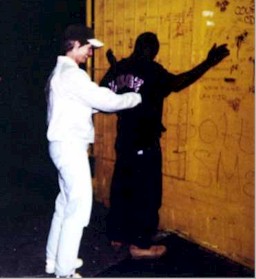
When Will We Become So Ashamed We Stop?

Smiling ex-New Jersey Gov. Christie Todd Whitman goes through the motions of searching suspect Sherron Rolax while accompanying Camden police officers on patrol. (AP Photo)
[For more about the episode pictured above, click here.]

Police make life hell for youth of color
By Kathy Durkin / May 17, 2008

Going to the grocery store, visiting a friend and walking home from work or school are all ordinary, everyday occurrences. But not so for hundreds of thousands of people, mostly from African-American and Latin@ communities, who are stopped, questioned, asked for their I.D., searched and often arrested here in New York—and around the country. It happens to many youth and even to children.

At a time when more white people appear to be rejecting racism at the polls, racial profiling by police departments and other state agencies is on the rise. It is systemic and deeply entrenched in the “criminal justice system” nationwide.

Statistics given in new studies and reports starkly bear this out. But the statistics cannot convey the intimidation, anxiety and anger that so many people, especially Black and Latin@ youth, must live with on a daily basis, nor the effect this can have throughout their lives on them and their families.

In the first quarter of this year, New York City police, by their own report, stopped, questioned and/or searched 145,098 people, more than half of them African Americans. At this alarming rate, a record 600,000 people will be stopped this year.

In the last two years, nearly 1 million New Yorkers were harassed by police in this manner—90 percent of them people of color. That’s 1,300 a day. And it’s legally allowed.

These operations, just in the past two years, have put more than 1 million innocent people, mostly African-American and Latino, into the huge police database; they are subject to future criminal investigations merely by their inclusion there.

Read the rest here. / Axis of Logic

The Rag Blog

Posted in RagBlog | Tagged , , | Leave a comment

Freaky Fish, Episode 3

This is Mike’s sturgeon

Huge “sturgeon ball” in Columbia a mystery
By Michael Milstein / May 18, 2008

PORTLAND — When sonar surveys spotted a vast pile of rubble in the Columbia River below Bonneville Dam a few months ago, officials suddenly worried that part of the dam structure was eroding into the river.

“Everybody said, ‘Oh my gosh, we need to get divers out there right away,’ ” recalled Dennis Schwartz, a fisheries biologist with the Army Corps of Engineers, which oversees the dam.

What they found below the spillways in February was not a giant pile of rock at all, but a humongous pile of thousands upon thousands of sturgeon — some of them 14 feet long or longer — lounging together in frigid water at the bottom of the river.

“We call it the big sturgeon ball,” Schwartz said.

The mountain of white sturgeon contained around 60,000 fish, according to a rough estimate by Michael Parsley, a research fisheries biologist with the U.S. Geological Survey’s Columbia River Research Laboratory in Cook, Skamania County. He described that estimate as “probably conservative.”

Sturgeon ball

It was an aquatic phenomenon nobody had ever seen at such a monstrous scale, offering a startling glimpse into the life of the Columbia’s largest and most ancient fish.

Read the rest here. / Seattle Times

The Rag Blog

Posted in RagBlog | Tagged , | Leave a comment

Singin’ on Sunday – Connie Evingson

Connie Evingson and Pearl Django at Jazz Alley in Seattle, 30 April 2008.
Photo by Richard Jehn

I was in Seattle a couple of weeks ago at the tail end of a wonderful trip to Austin to meet up with all the other Rag folks, and to attend to some other foolishness (e.g., my 40th high school reunion). I had planned before I left to stop for a night in the Emerald City to see Pearl Django play at Jazz Alley. Also on the bill was a woman I’d never heard of before, Connie Evingson. Well, let me tell ya, this talent is a real heart-stopper. If you ever see her advertised, don’t even think about it, just buy a ticket.

This is a tune from her album Gypsy in My Soul, titled “Nuages.” It is the Clearwater Hot Club backing her on this recording. When she sang this for us on 30 April, I cried. If you’d like to find out more about her, or hear other samples of her singing, here is her Web site.

Richard Jehn / The Rag Blog

Posted in Rag Bloggers | Tagged , | Leave a comment

Blogging for Freedom : Black Activism on the Internet


The Civil Rights Battle Moves From The Streets To The Internet
By Heather Faison

PHILADELPHIA — One of the most important e-mails to land in Kourtney Addison’s inbox was seconds away from being cyber trash.

As her eyes scrolled down the computer screen, the forwarded message read like a scene from a Jim Crow-era documentary. A tree that only Whites could sit under, nooses hung in a schoolyard, a Black teen facing a 22-year sentence for beating a White classmate.

Immediately, she thought it was a joke. “It just seemed so unreal,” she recalled of the story later known as the Jena Six.

“It was just blatant racism.”

Wearing a white T-shirt with the words “Free The Jena 6” painted in red block letters, the Temple University sophomore joined more than 700 students in a demonstration in front of City Hall last September. It was Addison’s first protest. As she pumped her fist in the air letting her oversized cowry shell bracelet drop to her elbow, the 19-year-old was brought to tears by the passion displayed by her peers and the realization that “Dr. King’s dream had not been fully realized yet.”

The events of last year – the Jena Six protest, the firing of racist disc jockey Don Imus and the campaign for Genarlow Wilson, a Georgia teen sentenced to prison for consensual sex with a White classmate – resulted in a rebirth of political activism among African-Americans, unseen in recent years.

Many have wondered who is behind this surge. The leader of this movement is not on CNN or holding press conferences on the evening news. This revolution will not be televised – but you may find it in your e-mail.

Today’s generation is turning technology into activism and using the Internet as a tool to carry its messages. With social media sites and e-mail blasts, a story about an injustice can be sent to millions in one mouse-click, garnering support en masse.

“The early Civil Rights Movement had the mimeograph and the Black press. Today, we have e-mail, blogs, text messaging, online petitions, instant messaging, social networking sites like Facebook and MySpace,” said Chris Rabb, Philadelphia-based Netroots activist.

Netroots (taken from Internet and grassroots) was coined after Internet users ignited the campaign of 2004 presidential candidate Howard Dean through mass e-mails and blogs, bringing him national support and millions in fundraising dollars. Netroots uses the Internet as a platform to voice opinions and draw online users to a particular cause.

Though Netroots activism for African Americans is nascent, says Rabb, “it is by no means a fad.”

Through grassroots petition signing and e-mail campaigns, these online activists raised the profiles of stories such as the Sean Bell shooting, long before the media or Black leaders noticed. Cutting no slack for offenders regardless of race, these individuals successfully challenged BET networks’ negative portrayal of African-Americans and have exposed the faults of Black leaders in their candid blog commentaries.

“Black activists Jesse Jackson and Al Sharpton are pimping the ‘man’ in the name of civil rights,” read a tongue-in-cheek entry from blogger, The Field Negro.

The mobilization strength of African-American bloggers has been the force behind this movement. These individuals share their views and social commentaries on blog sites that allow readers to comment, e-mail or link stories to other sites. While most blogs are created for leisure and better reflect an online diary, a group of bloggers known as the Afrosphere is dedicating its efforts to the progress of African-Americans. This pool of activists successfully motivates its readers to political participation, says Antoinette Pole, a political science professor at Southern Connecticut State University.

In her study “Black Bloggers and the Blogosphere,” which was the first academic examination of this group, Pole found that Black bloggers had a greater desire and ability to encourage readers towards social awareness issues moreso than their White counterparts. Most Black bloggers used their sites to engage political activism by suggesting readers: vote or register to vote in elections, sign petitions supporting a cause, attend a rally or protest and donate to charitable causes.

Since Pole’s November 2005 study, which is included in her upcoming book exploring political participation among bloggers, Black bloggers have grown from a sparse group and have situated themselves at the forefront of civil rights activism.

The number of Black-operated blogs is growing daily with 900 tracked in March by Electric Villager’s Black Blog Rankings (BBR). A giant leap from the 75 blogs accounted for in September 2007.

The sites in the Top Ten Black Blog rankings attract an average of 500 visitors daily.

This network has used its heft to rally around social causes and draw the nation’s attention to overlooked injustices, such as in the town of the once little-known Jena.

Though many have vied for credit, the organization of the mammoth descent in Jena was the property of Black bloggers, wrote Raquel Christie of the American Journalism Review in the first assessment of the media’s response to the story. For months after the fight involving the Jena High School students now known as the Jena Six, the media and traditional civil rights organizations were silent.

While the mainstream media trailed in their coverage – even after Chicago Tribune reporter Howard Witt broke the story nationally – and Black leaders stood oblivious to the Deep South injustice, a network of bloggers and Internet-based civil rights organizations reportedly galvanized more than 220,000 people who signed online petitions and contributed more than $130,000 to the legal defense fund in support of the teenagers months before the protest.

James Rucker, co-founder of colorofchange.org, says his group helped set up the fund and organized a “blog-in” where thousands of interlinked bloggers wrote solely about the story for one day to focus their readers’ attentions to the case.

Playing catch-up along with the media, the Rev. Al Sharpton said it was through the Internet that he found out about the Jena Six story.

The influence of Black bloggers was first realized when their online petitions brought national attention to the case of 14-year-old Shaquanda Cotton who was sentenced to seven years in prison for shoving a school hall monitor in Paris, Texas. Citing racial discrimination, bloggers called a “Day of Action” where they united under the cause and simultaneously posted stories solely about Cotton’s case. The bloggers and their readers began flooding the Texas governor and Texas prison authority with letters and holding protests in front of the courthouse. Their collective effort resulted in Cotton’s release and an examination of the Texas juvenile justice system.

“That one issue kind of coalesced everyone around one central issue; that’s when we began to link to one another,” says Shawn Williams, creator of the blog Dallas South, which is based in Dallas, Texas. “Before that we were all sort of blogging in our own worlds.”

Cotton’s story was the catalyst for what would become the Afrospear, says Williams, which is a blog site for discussion among all bloggers in African Diaspora, to share ideas and plan solutions.

The diverse landscape of the Afrosphere mirrors a movement that transcends labels of class, gender and partisanship. These bloggers discuss a range of insights from conservative politics (Jack and Jill Politics) to Black misogyny (What About Our Daughters) to gay rights (The Republic of T) and are airing out topics once reserved for barber shops and sister circles.

Little technical skill is required to start a blog or engage in the conversations. Compared to the preparation and training needed during the Civil Rights Movement, activists today can fight injustice without extensive knowledge and with little time commitment, allowing everyone to make a contribution, says Rucker.

This culture of inclusion bodes well for closing the digital divide in which African Americans are statistically behind in Internet use and access.

“An increasing percentage of civic-minded Black people are becoming more and more web savvy,” observed Rabb. “At the same time there is a proliferation of web-based resources and other technologies that make it free, easy and powerful for private citizens to amplify their voices and impact in ways unimaginable even during the dot-com craze a decade ago.”

After the Jena Six protest there was an eagerness to coin this political drive the “new civil rights movement.” Though flattered by the comparison, many bloggers avoid that moniker saying that it “puts them in a box” too concentrated on the ways of the past. One precedent they defy in the Afrosphere is the old-age idea that a movement requires a chosen leader.

“There’s no one persona or personality that’s kind of at the center of things,” says Rucker. “I think hopefully we’re able to move beyond centralized personality-based leadership that has plagued us in the past.”

Many bloggers write under an alias to maintain anonymity, which Rabb likens to the Underground Railroad agents who could conduct their missions without ever meeting face-to-face.

This “faceless” leadership is especially appealing to youth who are discovering their voices through Netroots activism. While civil rights veterans are toiling over how this generation would fall in line with the rules set by their forbearers, they have overlooked a charge already in progress.

“The movement may not be as visible as it was in the ’60s, but that’s because the issues we face are not as visible. Racism and things of that nature are institutionalized now,” says Addison.

The events that unfolded last year struck a cord with those in a younger generation, specifically Generation Y, igniting a display of activism and pride. The stories of Mychal Bell (the face of the Jena Six), Genarlow Wilson and the young women of the Rutgers University basketball team, who were object of Imus’ verbal attack, resonated with younger generations. In those cases the victims were the same age as their best friends and classmates, which made them realize that the fight was no longer just their parents’.

For a generation that was introduced to a computer before a pen and a pad, this movement has come to Generation Y’s favorite hangout spot – the Internet. The popular social network Web site Facebook has been instrumental in helping young activists share their opinions with peers and brand their own causes.

When a group of Temple students wanted a Black student union to bridge the gap with the community and create a support system for Black students, they created a Facebook group to rallying the university and the community behind their cause. Addison, an officer in the student organization, says the site has been a viral avenue of communication, with 707 people having joined.

“Because our aim is so wide its imperative that we reach out to a lot of people at one time, so we use the World Wide Web,” says the New Jersey native.

“If each coordinator invites all of their friends on Facebook to an event we’re holding, we can get the word out to literally thousands of people within a matter of minutes.” The Black student union raised $800 for the Jena Six legal fund and organized the Temple protest that went from the campus Bell Tower to the steps of City Hall.

In these tech-rich times, one place these young activists don’t seem to be running to is traditional civil rights organizations. Williams, a one-time NAACP college chapter leader, has seen first hand the exodus of youth from such organizations.

In recent years the NAACP has struggled to increase membership and remain relevant to today’s youth who are more likely to meet with friends over instant messenger than at the library – a common gathering place for NAACP meetings. The organization’s presumed shortcomings have more to do with a digital disconnect than with its “cool factor,” according to Williams.

“A lot of the NAACP chapters are a little bit behind the times,” he says, noting one local chapter that has a blog linked to the Afrosphere. “When it comes to activism and advocacy today, it moves at lightning speed.”

This disconnection can prevent local chapters from furthering their agendas outside of their regional borders, adds Pole.

Efforts by the Louisiana NAACP and local chapters fell short when a rally they organized last March in support of the Jena Six teens drew only a few dozen people. Though well-intended, their outcome paled in comparison to the whirlwind of support that followed as a result of Internet campaigns.

Resources and skill sets from both online efforts and tradition organizations are needed and each could find greater success in a collaborative effort, Mary Frances Berry, a history professor at the University of Pennsylvania, noted in a recent interview with NPR. The former chairperson of the U.S. Commission on Civil Rights suggested that when the NAACP selects its future president, the candidate should be someone who can bridge the gap with online activists.

“They need to get with it, and plug in with these folks. All this energy needs to be mobilized, so that it doesn’t become a one-week show,” says Berry.

And if the old guard refuses collaboration, she stated ominously, “new organizations will simply have to displace them.”

[Heather Faison, a former Black Press fellow at the NNPA News Service, is a copy editor at the Philadelphia Tribune.]

Source. / TransGriot / May 12, 2008

The Rag Blog

Posted in RagBlog | Tagged , , , , | Leave a comment

Quote of the Day : Hobgoblins

The whole aim of practical politics is to keep the populace alarmed (and hence clamorous to be led to safety) by menacing it with an endless series of hobgoblins, all of them imaginary.

H.L. Mencken

Thanks to Doug Zachary / The Rag Blog

Posted in RagBlog | Tagged | Leave a comment

At Holly Beach With You

Holly Beach,LA.

a thousand cheap vacations
with free seagulls and sunburns
all you can step on beach jetsam
and the purifying grit of Gulf waters
a working family’s paradise spree
population you and me

in a couple hundred cobbled cottages
shambled alongside cramped alleys
with ample crawl space for cars
shacks but for location and personality
Aunt Sally’s Sea Side Pelican’s Pouch
Imitation Crab Cake Kitchenette By the
Day or Week No Pets Please Wipe Your Feet

with spawling lopside family-owned general store
Asian mercantile and cajun-fried deli counter
with overripe produce abandoned even by flies
boiled eggs suspended in time’s pungent solution
and even older sausage that could salinate a bathtub
frozen-in-imagination seashell accretion creations
racks of gimme cap signage and road map anthologies
the translucent miracle of Virgin Mary nightlight row

and zinc-nosed oddly shaped thorax people
flopping around in too-loose and too-tight
bulk-sale trunks and undaring two-pieces
dashing gleefully toward the water while
picking their way around fish bones carefully
being examined by an extended dog family
and finally hamming it up gently in the mild surf
rechristening their kids in the refreshing froth
this is fun, you are fun, your name shall be fun

tyke-size plastic pails and shovels
children’s heirlooms
burrow into glinty grains washed smooth
and worn to a dazzle
packed shining into rising mounds
patted expertly into bulging redoubts
that hermit crabs will sidle around
once sunlight subsides and
the spreading edge of horizon
becomes the cooling saline haze of night
removing from sight the distant offshore
platform hulks with their derrick spires
and towering grain elevators at the port
all scattering anew to the limits of thought
vanquished once and again until
partway through the drive home
and especially Monday morning
but now far down the curving shore
just the gas station lights and overhead
the occasional breakthrough star

At Holly Beach With You

Larry Piltz
Indian Cove / Austin, Texas / May 2008

Sunset at Holly Beach.

The Rag Blog

Posted in Rag Bloggers | Tagged , , | 1 Comment

The Needle and the Damage Done


The Days of Wine and Oil-Soaked Roses
by Paul Dean / May 17th, 2008

Our valiant Prez once again in a recent interview shared his insight with Americans that we are “addicted to oil.” The solution? Bush says the country needs to commit critical resources to drilling and oil infrastructure, and build more refineries in order to create more supply. Excellent. This kind of talk implies that Bush once again recognizes the critical need to allocate billions more in Federal funds to create even greater subsidies and tax breaks for corporations that are right now reaping record-breaking profits. What did you expect? A real attempt to develop solar, wind and other renewable energy sources?

The president (whose expertise on the subject of addiction is said to have been built upon a solid foundation of direct experience) seems to have proposed a bold strategy here to cure our ills. If we define addiction as a disease, the approach bears scrutiny to see if it can have crossover potential as a cure for other forms of this same disease.

Let’s deal with just the obvious: perhaps America’s Drug Czar should announce that the country has a drug addiction problem, but that we are taking bold steps to increase production of heroin and cocaine, with the goal of providing every addict enough substance to meet demand.

You see where I’m going with this. We’re talking Enron-style, heavyweight Republican outside-the-box stuff, like “gambling therapy” bus tours to Las Vegas casinos for gaming addicts.

Here is a news flash for Mr. Bush: This “addiction” to oil he has only recently discovered was built into our cities and suburbs, into our transportation systems, our agricultural production systems, our manufacturing systems, and our political structure as a matter of deliberate policy over decades. Millions of Americans and citizens of other industrial societies have been acutely aware for more than thirty years that there are and will continue to be huge social, economic and environmental problems associated with our increasing reliance on oil. Many serious questions, which demand real answers, have also arisen from insightful critiques on the negative effects to society of the huge accumulation of capital and political power as a result of the emergence of oil-based multinational corporate economies with near-monopoly power and nearly unlimited wealth. People have for years been questioning what effect oil depletion will have on the availability and affordability of oil as a reliable commodity into the future. These are not trivial questions, especially in light of our increasing societal dependence on the stuff for survival.

Read the rest here. / Dissident Voice

The Rag Blog

Posted in RagBlog | Tagged , | Leave a comment

Manipulating Highly-Educated Doctors


Pharmaceutical Payola — Drug Marketing to Doctors
by Robert Weissman / May 17, 2008

Last week, a Congressional committee properly raked Big Pharma over the coals for misleading advertising of pharmaceuticals.

A hearing of the House Energy and Commerce Committee’s oversight subcommittee focused on advertising campaigns for three drugs, including the remarkable case of Robert Jarvik. Jarvik is featured in endlessly re-run ads for Pfizer’s blockbuster cholesterol drug Lipitor. Known as the inventor of the Jarvik artificial heart, he is not a cardiologist, not a licensed medical doctor and not authorized to prescribe pharmaceuticals. He’s shown in the ads engaged in vigorous rowing activity, but in fact he doesn’t row. Pfizer pulled the ads in February after controversy started brewing.

Among industrialized countries, only the United States and New Zealand permit drug companies to market directly to consumers. It’s a bad idea, it drives bad medicine, and it should be banned.

But although it has the highest profile, direct-to-consumer advertising is a small part of Pharma’s marketing machine. Researchers Marc-André Gagnon and Joel Lexchin conclude in a recent issue of the journal PLOS Medicine that direct-to-consumer ads make up less than a tenth of industry marketing expenditures ($4 billion of $57.5 billion in 2004). And Gagnon and Lexchin’s estimate of $57.5 billion on marketing excludes many industry expenditures that are really driven by marketing, including clinical trials conducted for marketing purposes.

The bulk of the industry marketing effort — more than 70 percent by Gagnon and Lexchin’s calculation — is directed at doctors.

Why?

Because it works.

The companies spend huge amounts paying firms that carefully track what doctors prescribe, and then they use the information to tailor messages to doctors, distribute samples and develop continuing medical education programs.

Gagnon and Lexchin report that Pharma spends more than $20 billion a year on “detailers” — the pharma reps that knock on doctor doors, ply the staff with free coffee and lunches, distribute samples ($16 billion worth), and prod docs to prescribe their drugs.

This is complemented by a host of tactics that in other circumstances might be called bribes.

“Virtually all physicians in America take cash or gifts from the drug companies,” says Melody Petersen, author of Our Daily Meds: How the Pharmaceutical Companies Transformed Themselves into Slick Marketing Machines and Hooked the Nation on Prescription Drugs, and a former New York Times reporter. “A recent survey said 94 percent of physicians took something of value from the drug companies. Some doctors take hundreds of thousands of dollars a year from these companies, and there’s no law that says they can’t.”

Read all of it here. / Common Dreams

The Rag Blog

Posted in RagBlog | Tagged , | Leave a comment

Robert Fisk on Junior’s Words in Israel

Photo by Michael Totten

So Just Where Does the Madness End?
All the monsters buried in the mass graves of the civil war have been dug up

by Robert Fisk / May 17, 2008

I am not sure what was the worse part of this week. Living in Lebanon? Or reading the outrageous words of George Bush? Several times, I have asked myself this question: have words lost their meaning?

So let’s start with lunch at the Cocteau restaurant in Beirut. Yes, it’s named after Jean Cocteau, and it is one of the chicest places in town. Magnificent flowers on the table, impeccable service, wonderful food. Yes, there was shooting at Sodeco — 20 yards away — the day before; yes, we were already worried about the virtual collapse of the Lebanese government, the humiliation of Sunni Muslims (and the Saudis) in the face of what we must acknowledge as a Hizbollah victory (don’t expect George Bush to understand this) and the danger of more street shooting. But I brought up the tiny matter of the little massacre in northern Lebanon in which 10 or 12 militiamen were captured and then murdered before being handed over to the Lebanese army. Their bodies were — I fear this is correct — mutilated after death.

“They deserved it,” the elegant woman on my left said. I was appalled, overwhelmed, disgusted, deeply saddened. How could she say such a thing? But this is Lebanon and a huge number of people — 62 by my count — have been killed in the past few days and all the monsters buried in the mass graves of the civil war have been dug up.

I chose escalope du veau at the Cocteau — I am sickened by how quickly I decided on it — and tried to explain to my dear Lebanese friends (and they are all dear to me) how much fury I have witnessed in Lebanon.

When Abed drove me up to the north of the country three days ago, bullets were spitting off the walls of Tripoli and one of the customs officials at the Syrian border asked me to stay with him and his friends because they were frightened. I did. They are OK.

But being from the wrong religion is suddenly crucial again. Who your driver is, what is the religion of your landlord, is suddenly a matter of immense importance.

Yesterday morning (and here I will spoil the story by telling the end of it), the schools reopened round my seafront apartment and I saw a woman in a hijab riding a bicycle down the Corniche and I took a call from my travel agent about my next trip to Europe — Beirut airport reopened — and I realised that Lebanon had “returned to normal”.

The roads were open again; the hooded gunmen had disappeared; the government had abandoned its confrontation with Hizbollah — the suspension of the Shia Muslim security chief at the airport (who bought me a bottle of champagne a year ago, I seem to remember — some Hizbollah “agent” he!) and the abandonment of the government’s demand to dismantle Hizbollah’s secret telecommunication system was a final seal of its failure — and I opened my newspaper and what did I read?

That George Bush declared in Jerusalem that “al-Qa’ida, Hizbollah and Hamas will be defeated, as Muslims across the region recognise the emptiness of the terrorists’ vision and the injustice of their cause”.

Where does the madness end? Where do words lose their meaning? Al-Qa’ida is not being defeated. Hizbollah has just won a domestic war in Lebanon, as total as Hamas’s war in Gaza. Afghanistan and Iraq and Lebanon and Gaza are hell disasters — I need no apology to quote Churchill’s description of 1948 Palestine yet again — and this foolish, stupid, vicious man is lying to the world yet again.

He holds a “closed door” meeting with Lord Blair of Kut al-Amara — a man stupendously unfit to run any Middle East “peace”, which is presumably why the meeting had to be “closed door” — but tells the world of the blessings of Israeli democracy. As if the Palestinians benefit from a democracy which is continuing to take from them the land which they have owned for generations.

Do we really have to accept this? Bush tells us that “we consider it a source of shame that the United Nations routinely passes more human rights resolutions against the freest democracy in the Middle East than any other nation in the world”.

The truth is that it is a source of shame that the United States continues to give unfettered permission to Israel to steal Palestinian land — which is why it should be a source of shame (to Washington) that the UN passes human rights resolutions against America’s only real ally in the region.

Read all of it here. / Common Dreams / The Independent

The Rag Blog

Posted in RagBlog | Tagged , , , | Leave a comment

Austin Family Joins War Against Stuff

Like many young couples, Aimee and Jeff Harris spent the first years of their marriage eagerly accumulating stuff: cars, furniture, clothes, appliances, and, after a son, Quinn, 5, and daughter, Nichola, 15 months, came along, toys, toys, toys. Photo by Ben Sklar / NYT.

Chasing Utopia, Family Imagines No Possessions
By Ralph Blumenthal and Rachel Mosteller / May 17, 2008

AUSTIN — Like many other young couples, Aimee and Jeff Harris spent the first years of their marriage eagerly accumulating stuff: cars, furniture, clothes, appliances and, after a son and a daughter came along, toys, toys, toys.

Jeff Harris and his son, Quinn, at home in Austin, Tex. Now they are trying to get rid of it all, down to their fancy wedding bands. Chasing a utopian vision of a self-sustaining life on the land as partisans of a movement some call voluntary simplicity, they are donating virtually all their possessions to charity and hitting the road at the end of May.

“It’s amazing the amount of things a family can acquire,” said Mrs. Harris, 28, attributing their good life to “the ridiculous amount of money” her husband earned as a computer network engineer in this early Wi-Fi mecca.

The Harrises now hope to end up as organic homesteaders in Vermont.

“We’re not attached to any outcome,” said Mrs. Harris, a would-be doctor before dropping out of college, who grew up poverty-stricken in a family that traces its lineage back through the Delanos and President Franklin D. Roosevelt to a Mayflower settler, Isaac Allerton.

Mr. Harris, 30, who dropped out of high school and “rode the Internet wave,” agreed, saying they were “letting the universe take us for a ride.”

They are not alone.

Matt and Sara Janssen, who traded down from their house in Iowa to a studio apartment in Montana and finally an R.V. powered by vegetable oil, now crisscross the country with their 4-year-old daughter, highway nomads living on $1,500 a month.

Not that simplicity need be that spartan. Cindy Wallach and her husband, Doug Vibbert, of Annapolis, Md., moved out of their apartment with an “everything must go” party and, along with their 3-year-old son, now sail and make their home on a 44-by-24-foot catamaran.

“We never wanted four walls and beige carpet,” Ms. Wallach said.

Though it may not be the stuff of the typical American dream, the voluntary simplicity movement, which traces its inception to 1980s Seattle, is drawing a great deal of renewed interest, some experts say.

“If you think about some of the shifts we’re having economically — shifts in oil and energy — it may be the right time,” said Mary E. Grigsby, associate professor of rural sociology at the University of Missouri and the author of “Buying Time and Getting By: The Voluntary Simplicity Movement.”

“The idea in the movement was ‘everything you own owns you,’ ” said Dr. Grigsby, who sees roots of the philosophy in the lives of the Puritans. “You have to care for it, store it. It becomes an appendage, I think. If it enhances your life and helps you do the things you want to do, great. If you are burdened by these things and they become the center of what you have to do to live, is that really positive?”

Juliet B. Schor, a sociology professor at Boston College and author of “The Overspent American,” said the modern “downshifters,” as she called them, owed debts to the hippies and the travel romance of Jack Kerouac.

“Their previous lives have become too stressful,” Dr. Schor said. “They have a lack of meaning because their jobs are too demanding.”

“It’s amazing the amount of things a family can acquire,” said Aimee Harris, who with her husband is giving away nearly all of it.

Mrs. Harris, who with her husband home-schools their son, Quinn, 5, and plans to do the same with their 15-month-old daughter, Nichola, agreed that there was something of the hippies in their quest: “the ideals, the peace and love, the giving and freedom.”

But she said they had no tolerance for idleness or drugs. “Any state that can be induced by drugs, the mind and body are already capable of,” she said.

Mrs. Harris grew up in Wisconsin with her mother and sister. They were so poor, she says, that they nearly froze to death in the winter and had to cook their meals in the fireplace. She developed a weight problem, ballooning to 200 pounds — she has since shed half of it — and suffered for years from the chronic pain disorder fibromyalgia, which she overcame, she says, by improving her diet.

In April, the Harrises began detailing their story on a blog (www.cagefreefamily.com). They were taken aback by some of the hostile responses. “Some people seem to be threatened that they’re not making the same choice,” Mrs. Harris said.

The timing was right, she said. They had been feuding with their landlord over conditions in the simple house they rent in Austin for $1,650 a month, and felt they had to get out.

At first they intended to auction what they owned. But “we were unable to define the worth of something we didn’t want or need,” she said. They finally decided to donate much of it to a children’s home in the Texas Hill Country and the bulk of the rest to an agency for the homeless in Austin.

But, Mrs. Harris said, their calls for pickups have gone unreturned, and they are now rushing to find new recipients. “You wouldn’t think, O.K., I’m going to give away all my fine things, but at the end of the day they’re still in the house,” she said.

Their rings — his gold band and her one-carat diamond — may be “red-paper-clipped,” Mrs. Harris said: bartered for something better that could in turn be bartered for something better still, as in the Internet celebrity Kyle MacDonald’s tale of a paper clip that ultimately produced a house.

“They don’t fit us anymore,” Mr. Harris said. Sure enough, his band was loose on his finger, but that was not what he meant. “They don’t fit our lifestyle,” he explained.

They have already given away some property, Mrs. Harris said, including their big-screen television, presented to a neighbor. It had bad karma anyway, she said: her father had gotten it as an employee of the year just before he was fired.

Their goal, she said, is to retain one personal carton per family member, plus bedding and kitchen utensils. They hope to sell or barter their two vehicles — a new Honda Odyssey minivan and a 2004 Dodge Intrepid — for a school bus or a four-wheel drive.

They are exchanging e-mail with a woman who has a remote cabin available in central Vermont. There is no electricity, Mr. Harris said, just propane power and a wood stove.

“We want to be in clean country with like-minded people with access to clean food,” Mrs. Harris said.

Mr. Harris does have a concern, though. He now telecommutes from his job as a Web systems administrator and is hoping to stay employed through the move. “The question is, Do I have Internet access in the woods?” he said.

They plan to travel first to Wyoming for the Rainbow Gathering, a free-spirited annual outdoor convocation, then head to Vermont.

In her garage strewn with cartons to be given away, Mrs. Harris shook her head. “Stuff, stuff that a family has,” she said.

Then she noticed a box of Christmas decorations, and at least for the moment grew wistful.

“I won’t lie,” she said. “I’ll cry when that goes.”

“When what goes?” Quinn asked.

Mrs. Harris seemed to struggle. “The stuff of our lives,” she said.

Source. / New York Times

Thanks to Jim Retherford / The Rag Blog

Posted in RagBlog | Tagged , , | Leave a comment

The Astounding Power of Empty Words


Military Matters: Iraq state fantasy
By William S. Lind

WASHINGTON — When Iraqi Prime Minister Nouri al-Maliki sent his “army” to fight the Mahdi Army in Basra, U.S. President Bush called it “a defining moment.” It turned out instead to be a confirming moment. It confirmed that there is no state in Mesopotamia — the geographical territory known as the nation of Iraq.

One of the most common signs that America’s leadership is clueless about Fourth Generation war is the language they use.

Fourth Generation war has few if any defining moments. Nor does it have “turning points,” another common Bushism. In his testimony to Congress, U.S. Gen. David Petraeus revealed the limits on his own grasp of 4GW when he said, “We’ve got to continue. We have our teeth into the jugular, and we need to keep it (sic) there.”

Opponents in 4GW have no jugular. 4GW is war of the capillaries. What U.S. forces have their teeth into in Iraq is a jellyfish.

If we are to see Iraq and other Fourth Generation conflicts as they are and not through the looking glass, we need to use words more carefully.

Because there is no state in Iraq, there is also no government. Orders given in Baghdad have no meaning, because there are no state institutions to carry them out. The governmental positions of Iraqi leaders have no substance. Their power is a function of their relationship to various militias, not of their offices. Maliki has no militia, which means he is a figurehead.

The Iraqi “army” and “police” are groupings of Shiite militias that exist to fight other militias and take orders from militia leaders, not the government. Government revenues are slush funds militia leaders use to pay their militiamen. All of these phenomena, and many more, are products of the one basic reality: there is no state.

The failure of Maliki’s “big push” into Basra put Iraq’s statelessness on display. Ordered to do something it did not want to do, the Iraqi “army” fell apart, as militias usually fall apart when given unwelcome directives. Iraqi “soldiers” and “police” went over or went home, in considerable numbers. Those who did fight had little fight in them; the affair reportedly ended with the Mahdi Army controlling more of Basra than it did at the beginning. Maliki, desperate for a cease-fire, had to agree in advance to any conditions Moqtada Sadr cared to impose.

American policy proved even more reckless than that of Maliki. To win in Iraq, U.S. policymakers must see a state re-emerge. That means U.S. forces should stay out of the way of anyone with the potential to recreate a state. Sadr is at or near the head of the list. The Maliki “government” isn’t even on it.

So what did the U.S. government do? Why, it went to war against Sadr on behalf of Maliki, of course. The American leadership cannot grasp one of the most basic facts about 4GW, namely that the splintering of factions makes it more difficult to generate a state. Should the United States have the bad luck to “win” this latest fight and destroy the Mahdi Army, it will move not toward but further away from that goal.

In the end, the Bush administration’s — and the Pentagon’s — insistence that the Iraqi state, government, army and police are real blinds only themselves. Iraqis know they are not. The American public knows they are not. Anyone in Africa or Asia probably knows they are not. Do the members of the U.S. Senate committees on Armed Services and Foreign Relations know less that the average inhabitant of Africa or Asia? So the congressional hearings on Iraq suggest, and such is the power of empty words.

Source / United Press International / April 22, 2008

The Rag Blog

Posted in RagBlog | Tagged , , | Leave a comment

Iraqi Women Are Still Suffering the Most


How picture phones have fuelled frenzy of honour killing in Iraq
By Patrick Cockburn / May 17, 2008

SULAYMANIYAH — A dark pool of dried blood and a fallen red scarf mark the place where Ronak, who had fled to a woman’s shelter in the Kurdish city of Sulaymaniyah when she was accused of adultery by her husband, was shot three times by a man hiding on the roof of a nearby building.

Ronak was wounded by bullets in the neck, side and leg and only survived after a four-hour operation. She was the latest victim of a huge increase across Iraq in the number of “honour” killings of women for alleged immorality by their own families.

Many are burnt to death by having petrol or paraffin poured over them and set ablaze. Others are shot or strangled. The United Nations estimates that at least 255 women died in honour-related killings in Kurdistan, home to one fifth of Iraqis, in the first six months of 2007 alone.

The murder of women who are deemed to have disobeyed traditional codes of morality is even more common in the rest of Iraq where government authority has broken down since the overthrow of Saddam Hussein in 2003.

A surprising reason explaining the massive increase in the number of honour killings is the availability of cheap mobile phones able to take pictures. Men photograph themselves making love to their girlfriends and pass the pictures to their friends. This often turns out to be a lethal act of bravado in a society where premarital or extra-marital sex justifies killing.

The first known case of sex recorded on a mobile leading to murder was in 2004. Film of a boy making love with a 17-year-old girl circulated in the Kurdish capital, Arbil. Two days later she was killed by her family and a week later he was murdered by his.

Read all of it here. / The Independent

The Rag Blog

Posted in RagBlog | Tagged , | 1 Comment