TARA’s Senior Solidarity campaign focuses on four issues – Social Security, Medicare, Medicaid, and Voting Rights. We want to make sure candidates hear from seniors about these issues. If elected, we want to see them co-sponsor four pieces of legislation in the U.S. Congress. TARA will take this campaign to voters, community groups, and union locals as well as to candidate forums and congressional offices.
SOCIAL SECURITY: SS Trustees project that the trust fund will become insolvent in 2033 after which SS will only pay 77% of scheduled benefits.
Take immediate action to guarantee long-term SS solvency. Scrap the cap AND restore cuts to Social Security Field Offices. SUPPORT The Social Security Expansion Act S.770 and H.R. 1700 to extend Social Security’s solvency for 75 years. SUPPORT Keeping Our Field Offices Open Act H.R. 1876.
MEDICARE: The CMS WISeR (Wasteful & Inappropriate Service Reduction) pilot program expands AI-generated prior authorization into Traditional Medicare in AZ, NJ, OH, OK, TX and WA, paying AI companies to deny claims.
Tell CMS to end the WISeR pilot program NOW! SUPPORT The Smarter Act H.R. 5940 and S. 3480 to prohibit implementation of the WISeR model.
MEDICAID: Deep cuts to Medicaid in the Republican Budget Bill put many health care services for seniors at risk including home and community-based services and nursing home care. The cuts put rural hospitals and nursing homes at risk of closure.
Ensure that Medicaid is fully funded and accessible.SUPPORT legislation to fully restore Medicaid funding and staffing levels.
VOTING RIGHTS: States have erected barriers that make it harder to vote. Federal officials promote gerrymandering designed to maintain power, demand confidential state voter data, and erode the Constitutional right of states to conduct elections.
SUPPORT the John R. Lewis Voting Rights Advancement Act to strengthen legal protections against discriminatory voting policies and practices. OPPOSE new versions of the Save Act,
[Jan Lance is President of the Austin Chapter of Texas Alliance for Retired American (TARA Austin) and Secretary of the TARA state executive board. She is a retired public school teacher and textbook editor. Jan has the great fortune to be Yaya to two perfect grandchildren.]
By Michael Meeropol / The Rag Blog / March 23, 2026
People in the media have been scrambling in an attempt to actually figure out the reasoning behind Trump’s decision to launch a full-scale war against Iran. And they are right to note the many different versions of the justification: Israel was going to do it so decided to do it first (Secretary of State Rubio). No, we [the U.S.] pre-empted Israel because we knew Iran was going to attack us (President Trump). One of Trump’s former national security advisors, Nadia Schadlow, was recently interviewed by Ezra Klein.
The long (ridiculously long) transcript is available but I advise people not to bother reading it. Her main argument is that Iran was always a “threat” — which she defines as attempting to acquire a nuclear weapon and supporting various militias in the area — Hezbollah in Lebanon, Hamas in Palestine. What she never explains (and Klein lets her get away with it) is why it suddenly became so urgent now.
If we recognize the Trump Administration justifications for what they are — garbage — then how do we explain this war of choice? I think it might be possible to make a case on U.S. empire grounds. As readers of my work know, I am a follower of the historian William Appleman Williams whose book The Tragedy of American Diplomacy was widely read in the years when the movement struggled to stop the U.S. from making war against the peoples of Indochina. His explanation of the U.S. “ruling class’s” desire for an open door for markets and investments in the entire world led to U.S. expansionism beyond the continentalUnited States — first in Latin America and Asia – Cuba and the Phillipines — and later in the entire world
Williams points out that this became a recipe for conflict — whether with Mexican revolutionaries after the 1910 revolution, or with the Bolsheviks after 1917. Later the rising Japanese empire led to our entry into World War II. Finally, after partnering with the Soviet Union to win the war, the desire for an open door in Eastern Europe and post-war Asia led toboth the Cold War and two mini-hot wars.
As a general rule, according to Williams’ analysis, nationalists who stand in the way of such expansionism are considered dangers to long run American prosperity. This applied to Vietnamese nationalist-communists fighting the French in the early 1950s, Iranian or Guatemalan nationalists in 1953 and 1954, or Cuban Nationalist-Communists in the 1960s.
[For a cliff notes discussion of the original Open Door Notes from the State Department see https://history.state.gov/milestones/1899-1913/hay-and-china. Williams’ main point is that the principles articulated in those notes became the basis of U.S. foreign policy from that point forward.]
With the victory of the U.S. in the Cold War, it seems there was an initial hope that the entire world would soon be open for the United States international corporations. Eastern Europe and Russia were wide open after 1990, and 11 years of negotiation later, China joined the World Trade Organization which set limits on the amount of state intervention by the government into the economy. When George W. Bush was president he announced that there was an “axis of evil” in the world — which included Iraq, Iran, and North Korea. The plan of his brain trust was to quickly defeat Saddam Hussein in Iraq and then turn attention to Iran. In addition, he tightened the long U.S. embargo on Cuba hoping to put enough pressure on them to change their political and economic system. With these pesky dots of nationalism out of the way, the entire world would be open to U.S. expansion.
Unfortunately for the celebratory leaders of the Bush II foreign policy, Iraq proved a quagmire, China remained a highly controlled economy, and Vladimir Putin came to power in Russia and solidified control. Thus, many of the so-called “open doors” were closing or remained closed. If the U.S. political and economic leadership continues to believe we need “open doors” all over the world, then the idea of defeating the nationalist government of Iran remained high on the “to do” list. If this interpretation is correct, an administration like Trump’s would only be waiting for the “right moment” to attempt to deliver a death blow to the Iranian regime. But it’s hard to imagine Trump and Hegseth having the sophistication to even understand this rationale.
Thus, I do not for a minute believe Trump or Hegseth (or even Rubio) have thought this out. Rubio actually is hoping that success in Iran will lead Trump to take over Cuba – and he has personal reasons for that. For Trump and Hegseth they are just flexing their muscles like a teenage bully in the playground — with disgusting dire consequences for thousands of Iranians and many others, including some American military personnel.
In December of 2014, I presented a commentary to WAMC-FM which focused on the imperial nature of American Foreign Policy. In it, I made the argument that the costs of creating and maintaining an American Empire amounts to a massive redistribution of income from ordinary taxpayers to those particular businesses which benefit from supplying the war machine and those that benefit from the control of international sources of raw materials and access to foreign markets. We the people get nothing out of having an empire — except that from time to time our young people have to fight and bleed and die for it.
It is ridiculously ironic and as I prepare this article, we are four weeks into President Trump’s seventh military assault of his second term. And this is the man who makes believe he has “ended” a whole bunch of wars (most of which we Americans had never heard of — and most of which are still going on) and deserves the Nobel Peace Prize. On the contrary, he has already unilaterally attacked six separate countries plus boats on the high seas. Since most of these attacks did not provoke retaliation one can hardly call them wars but they certainly are not the acts of a peace-maker. Let’s remind ourselves what he has done: shooting boats out of the water claiming (falsely) that they were bringing drugs to the United States — invading Venezuela to kidnap its president — illegally blockading Cuba, attempting to destroy their economy by keeping out oil — bombing assaults on Syria, Iraq, Yemen (the Houthi rebels) and now we have that full scale war with Iran.
Why is he doing this? I noted above that it is highly unlikely that Trump, Hegseth, and others have developed the “case for the American empire” that I summarized. Instead, I think there are two potential reasons to explain why Trump has started this war: First, he is doing this because he can. As commander in chief of the armed forces he has a great deal of leeway. Congressional Republicans have so far enabled him. What are the arguments we hear in favor of these activities? Well, most of them are lies but let’s see.
Here are three points he makes: “Iran poses a threat to global order by way of its damaged but abiding nuclear ambitions, its deep strategic ties to Moscow and Beijing, its persistent threats to maritime commerce and its support for international terrorism.”
One could argue that should Iran acquire nuclear weapons, that would stabilize things because countries like Israel and the U.S. would think twice before attacking them. Notice that after a few exchanges of letters between Trump and the dictator of North Korea, Kim Jong-Un, there appears to be no danger of war on that Korean peninsula. The idea about persistent threats to maritime commerce is laughable. Iran has proven that it can close off the Strait of Hormuz anytime it wishes to and it has not done so at any time since the end of the Iran-Iraq war in 1988. It is Trump’s war that has closed off the Strait of Hormuz.
Stephens again: “[Iran] poses a threat to regional stability, not just through its support for anti-Israel proxies like Hamas and Hezbollah, but also by its meddling in Lebanon, Iraq, Yemen and (until the overthrow of the Bashar al-Assad regime) Syria.” One could make the case that Israel is the real threat to regional stability with its many interventions in Lebanon in particular. As for meddling in Iraq — wasn’t it the United States that invaded Iraq deposing Saddam Hussein and turning the country into a cauldron of internal conflict? Iran’s interventions in the various civil wars in that region is not the only cause of on-going conflict.
And finally, Stephens plays the “humanitarian intervention” card: “And [Iran is] a mortal threat to the life and safety of its own people, many thousands of whom it slaughtered last month.
There was a time not long ago when Americans, both left and right, cared enough about human rights to believe it could, in some circumstances, justify military intervention.” Humanitarian intervention is all the rage ever since the Bosnian Civil War of the 1990s. It rarely works out the way its supporters claim. Trying to effect regime change in Iran would be a major undertaking — making the American lives and treasure expended in Iraq and Afghanistan look like chump change. One could make the case that the best way to support democracy in Iran is to renegotiate the deal that President Obama made with the Iranians about keeping their nuclear ambitions limited.
After that and the dropping of sanctions, Iran could rejoin the family of nations so it can prosper — a prosperous country might loosen the grip of the religious autocracy on the population. Certainly, what the U.S is doing in Iran now is not helping the Iranian people get out from under the jack-boots of the religious autocracy.
Another not-so-far fetched reason for Trump’s war-making, however, is that the war is getting (at least temporarily) the Jeffery Epstein scandal off the front pages. And this is just when information is finally coming out about a source the FBI interviewed who claimed she was sexually exploited by Trump himself when she was a teenager.
Based on recent testimony from Epstein’s accountant, that same alleged victim received a settlement payment from the Epstein estate. See Daily Beast, “Epstein Accountant Spills Bombshell Payout to Alleged Trump Victim.” And according to recent polling data, it appears my “guess” is not all that “crazy.”
This piece is being published after 27 days of war. At times during this period, Trump has asserted that the war is “almost over” that he has achieved “almost all” of his objectives — mind you, this is without ever explaining those objectives — though at least once he said he wanted “unconditional surrender” — a complete impossibility without total occupation of the entire territory of Iran, just as happened at the end of World War II in Germany and Japan. But during the period from March 14 to 21 Iran kept most shipping from going through the Strait of Hormuz and the U.S. kept bombing more and more sites in Iran.
During the weekend of March 14-15, Trump suddenly began to demand that his allies (and even non-allies like China) send ships to escort tankers through the Gulf of Hormuz. He had plans to send ships to escort vessels through that narrow passage. Thus, the price of oil continued to rise and the inability of ships (carrying all sorts of things besides oil) to traverse that passage remained the centerpiece of Iran’s resistance to the U.S. attack.
A number of writers have made it clear that as the chance of a quick end to the war has receded, the main dynamic is that the Iranian regime “wins” merely by surviving. Meanwhile, the United States is in no position to “declare victory” and end the war because the Iranians can continue to make shipping through the Strait of Hormuz impossible for the foreseeable future. In other words –- Iran needs some kind of “deal” with the United States before it will let shipping resume through the Strait.
On Tuesday, March 17, Joe Kent, the head of the National Counter-Terrorism Center resigned because he could not, “in good conscience” support Trump’s war. In his resignation letter, which he made public, he asserted what virtually everyone watching Trump’s absurd assertion that Iran was about to attack the U.S. knew to be true. There was no such threat from Iran — the argument of an imminent attack was “a lie.”
Kent was a strong supporter of Trump’s “America First” foreign policy. Many Democrats opposed his confirmation because he was a 2020 election denier who claimed the people who stormed the capitol on January 6, 2021, were “political prisoners.” He, in other words, was not opposed to Trump and had happily served his Administration in Trump’s first term. But he saw what he saw and he knew what he knew and — unlike many of the cowards who still enable Trump from within his administration — he had the courage to say, enough.
(Unfortunately, he also is an anti-semite as is made clear in the following article: https://www.vox.com/politics/482918/joe-kent-iran-war-resign-trump-antisemitism. He is part of a group that goes back to Patrick Buchanan’s opposition to Bush II’s Iraq War which he (Buchanan) laid at the doorstep of the “amen corner” — a clear reference to American Jews who support Israel. I think Kent and Buchanan are both wrong that Israel called the shots on U.S. foreign policy in the Middle East. Netanyahu has attempted to persuade many American presidents to go to war against Iran — only Trump with his cowboy mentality decided to do it!)
On Wednesday the 18th of March, economist Paul Krugman took a deep dive into the idea that investments by petro-states (particularly Saudi Arabia) which have enriched the Trump family as well as promising to increase economic activity within the US have perhaps been a major influence on Trump’s decision to go to war in Iran.
On March 19, the British Guardian published an article reporting that a British expert who had attended the US-Iran talks in Geneva right up to the point where the Israelis and Americans launched this war claimed that real progress towards a deal was being made. This suggests that the U.S. and Israel launched the war to head off a possible deal.
Sometime during the week of March 16-20, the issue of occupying some Iranian territory with ground troops arose — a major escalation and one that might actually lead to significant U.S. casualties and a split in the Republican Party.
I wonder how long it will take the American public to get so mad about this war that they force. Trump to (falsely) claim victory and declare a full cease fire. And I wonder how long after that the Iranians will keep the Strait of Hormuz closed — they will have a say as to when this war actually ends. This means, as the N Y Times asserts in an opinion piece from March 17, 2026, Trump Cannot Spin His Way Out Of This War.
Finally, I wonder if between the time I submit this article and the time it is published, Trump will have committed a marine expeditionary force to attempt to take over Iranian territory. It would be a disaster for him politically but he just might have the arrogance to do it anyway.
At age 20, all I knew about migrant farmworkers was found in Woody Guthrie’s song “Plane Wreck at Los Gatos.” Earlier in 1965 I had applied to VISTA (Volunteers in Service to America). I was impatient with college and wanted to become part of the effort to bring forth a more just, fair, and equality-oriented America. VISTA offered me an opportunity to become a participant in a nonprofit project in Florida that was working to improve the lives of farmworkers. I learned a great deal more about the system that was built on the backs of an underclass that had largely escaped my attention.
Throughout the United States, migrant farmworkers — braceros, the poor of all colors (men, women, and children), workers from Puerto Rico, Filipinos, and a few others — rose early each morning wherever there were crops to be harvested, rode on trucks and buses to farming fields, and worked in all conditions gathering crops to feed families in America who could afford to shop at grocery stores and super markets for produce, whether fresh, canned, dried, or frozen. Historically, farmworkers included Japanese immigrants, Filipinos, and Mexicans brought in under various government-sponsored efforts to help farmers harvest their crops.
These farmworkers, wherever they came from, often followed harvests from the warmest parts of the United States, where harvests began early in the year, moving northward as crops were harvested later. There were what were called migrant streams that began in Florida and moved up the east coast to New Jersey and beyond. Farmworkers in Texas might work their way to the Midwest. Others might begin harvesting crops in Arizona and southern California before heading to the northern west coast states as crops were ready to harvest there.
Three years before my arrival in southern Florida to begin six weeks of VISTA training, Cesar Chavez, Dolores Huerta, Gilbert Padilla, and others, building on 60 years of efforts, had begun organizing a farmworkers’ union in Delano, California. To pressure farmers who owned table-grape orchards in California to pay a living wage to farmworkers, they began a table-grape boycott. Eventually, the boycott was successful, and farmworkers in the grape orchards around Delano negotiated a contract to provide better pay and working conditions for those farmworkers. Even after the grape boycott ended, I felt so strongly about their cause that, for several decades, I could not eat table grapes.
Until I saw the exploitation of these human beings first hand, it was difficult to imagine how they were forced to live. They were 20th-century slaves working and, in many cases, living on or near successive plantations. The people who gathered the food we put on our tables often could not afford more than subsistence food for themselves. Children were often, maybe usually, under-nourished or malnourished. Growers often provided places to live that were hovels, places little bigger than a jail cell with one bare light bulb. Their clothing was mostly that cast off by the affluent. Medical care was minimal, usually dependent on what a county or state might provide, which meant that it was available only occasionally, if at all. In south Florida, cooking fuel was usually kerosene, a smelly petroleum product that left a lingering, unmistakable odor, especially when mixed with cooked food odors. They often lived in isolated areas without access to reasonably-priced grocery stores.
Few of these workers had their own transportation, which often meant they relied on crew leaders, who had contracted with farmers to supply workers. The farmers blamed the crew leaders for these conditions and abusing migrant farmworkers, who were made to pay exorbitant prices for food and drink to the crew leaders because of their isolation; the crew leaders blamed the farmers. Congressional representatives never acknowledged their subservience to the powerful farmer organizations that lobbied them for protection from the vagaries of the marketplace and the weather. I blamed the politicians for allowing such abuse to continue in this land of the free and home of the brave. I still blame the politicians.
As Woody put it in his song:
Some of us are illegal, and some are not wanted Our work contract’s out and we have to move on; Six hundred miles to that Mexican border They chase us like outlaws, like rustlers, like thieves
We died in your hills, we died in your deserts We died in your valleys and died on your plains We died ‘neath your trees and we died in your bushes Both sides of the river, we died just the same . . .
Is this the best way we can grow our big orchards? Is this the best way we can grow our good fruit? To fall like dry leaves to rot on my topsoil And be called by no name except “deportees”?
One wall of my home office is covered with pictures of people who have influenced me on my eight-decade journey. Instead of removing the picture of Cesar Chavez from my wall, I have covered it with a picture of Dolores Huerta. There is no question that Chavez influenced my life, but in light of the apparently true allegations of his sexual exploitations and abuse, I no longer want to see his picture each day. I would rather credit another person who deserves such personal recognition.
Viva Huerta! Viva United Farm Workers! Viva La Huelga!
[Rag Blog columnist Lamar W. Hankins, a former San Marcos, Texas, City Attorney, has a Doctor of Jurisprudence degree from the University of Houston.]
Clyde W. Barrow, a professor of political science at the University of Texas Rio Grande Valley, is the author of a recent article in Jacobin, “Reading C. Wright Mills in the Age of Trump.” Barrow’s article, published February 5, 2026, has stirred up memories of C. Wright Mills and his influence among an older generation of 60s activists. More importantly though, it has brought C. Wright Mills to the attention of contemporary activists. As Barrow points out, C. Wright Mills’ description of a powerful elite has not lost relevance:
Seventy years ago, C. Wright Mills published The Power Elite, a scathing indictment of corporate executives, state officials, and their academic apologists. His analysis has lost none of its bite as we confront an increasingly degenerate U.S. power elite.
If you came of age in the turbulent ’60s, you will likely be familiar with C. Wright Mills’ book, The Power Elite. But you may not know he was a Texan. Mills was born in Waco, Texas, in 1916. He studied briefly at Texas A&M before making his way to the University of Texas in Austin, where he began his studies of sociology. By the time he got his undergraduate degree, he had published two articles in sociology journals. Wright earned his Ph.D. at the University of Wisconsin at Madison; in 1946, he became an assistant professor at Columbia University. As Barrow notes, he stood out:
Profiles of Mills often portrayed him as an angry and rebellious lone wolf, cast in the 1950s image of an intellectual James Dean or Marlon Brando. Mills played to this image as he rode to his office each day on a BMW motorcycle dressed in a black leather jacket and work boots, rather than the suit, bow tie, and Oxford shoes customary among his Columbia University colleagues.
Mills also stood out for his plainspoken style of writing and his departure from academic norms. Barrow elaborates:
Mills castigated mainstream sociology and political science for having devolved into “a set of bureaucratic techniques,” “methodological pretensions,” and “obscurantist conceptions,” which disguised the fact that contemporary social scientists were obsessively preoccupied “with minor problems unconnected with publicly relevant issues.”
Organized Irresponsibility
In a section titled, “Organized Irresponsibility,” Barrow quotes Mills:
As he put it in The Power Elite:
The men of the higher circles are not representative men; their high position is not a result of moral virtue; their fabulous success is not firmly connected with meritorious ability. Those who sit in the seats of the high and the mighty are selected and formed by the means of power, the sources of wealth, the mechanics of celebrity, which prevail in their society. . . . Commanders of power unequaled in human history, they have succeeded within the American system of organized irresponsibility.
Mills’ critique of the powerful is a spot-on description of the incompetents in power today and the apparent impunity they face as we learn about the Epstein disclosures. Here are Barrow’s reflections:
Mills brilliantly exposed to the public the reality that members of the U.S. “power elite” were not geniuses, nor even exceptionally talented individuals. They were often incompetent and regularly engaged in reckless and self-aggrandizing behavior that led them to make monumental mistakes. Those mistakes resulted in catastrophic consequences for ordinary people, who seemed helpless in the face of the enormous and irresponsible power wielded by the power elite, while those who committed crimes in the name of the people typically walked away with more money and celebrity.
Influence on SDS
C. Wright Mills was a major influence on early members of Students for a Democratic Society (SDS). Tom Hayden is a case in point. Hayden co-authored The Port Huron Statement, in 1962. In that document, SDS laid out a vision of participatory democracy. The same year, Hayden finished a master’s thesis on the intellectual work of C. Wright Mills. Hayden’s thesis, along with a collection of essays, was published in 2006 under the title Radical Nomad: C. Wright Mills and His Times.
Other early SDSers chimed in on a list serve when Bruce Schmiechen posted a link to Barrow’s Jacobin article. Here’s what Schmiechen said:
C. Wright Mills had a profound impact on early SDS — Hayden was immersed in his work. I happened to read The Power Elite in high school. In tandem with getting involved in CORE in St. Louis, it was transformative.
I remember printing up hundreds of copies of Mills’ “Letter to the New Left” in the [SDS] National Office. It was among the top two or three most requested pieces of literature, prior to Paul Potter’s speech at the April 1965, march on Washington. This current article on Mills from Jacobin is the best thing I’ve seen on him recently.
Jim Russell, an early SDS member, wrote:
Mills had a charismatic effect on me. I first heard of him at an off-campus discussion group on Marx at the University of Oklahoma. We read his The Marxists. I then read and tried to understand everything I could by him, including one pamphlet I picked up in the New York SDS national office.
Al Haber, an SDS founder, shared this memory:
SDS had a debate arranged between C. Wright Mills and Daniel Bell for the Spring of 1962. We were hoping this would be a notable public opportunity to clarify our new left politics and critique of liberalism. Sadly, Mills died just before the debate could happen.
On the list serve, Bruce Schmiechen also shared “C. Wright Mills: Before His Time,” written by Dan Wakefield and published in the Nation 3/18/2009. Wakefield, a former student of Mills, wrote:
Against the awful image of Willy Loman’s wasted life which haunted our dreams of the future in the 1950s, against the lock-step fate of The Lonely Crowd and The Organization Man which seemed to lie in wait for us after graduation, Mills gave us more hopeful possibilities. His withering critique of the stifling elements he saw in society (as expressed in White Collar, on the American middle class, and in The Power Elite, on the ruling circles) was not simply negative. The very audacity of Mills’s attacks on the status quo carried with it a promise of something better.
Power and Agency
It was the optimism thatMills conveyed in “Letter to the New Left,” the pamphlet that rolled off the SDS press, that made it so popular. He spoke to the 60s generation of activists about the “sickness of complacency”:
It is no exaggeration to say that since the end of World War II in Britain and the United States smug conservatives, tired liberals and disillusioned radicals have carried on a very wearied discourse in which issues are blurred and potential debate muted; the sickness of complacency has prevailed, the bi-partisan banality flourished.
In “Letter to the New Left,” Mills railed against the “end of ideology.” He also wrestled with the idea of agency – who could make change. He was a Marxist but found the industrial proletariat to be an inadequate vehicle for transformation. Mills died in 1962 just as a student left emerged – a movement propelled by the Student Non-Violent Coordinating Committee (SNCC) and Students for a Democratic Society (SDS). Mills never witnessed the returning GIs who made the Vietnam Veterans Against the War (VVAW) such an effective voice against a “forever war.”
NACLA Pamphlet published at the time of the May 1968 student strike at Columbia University.
Influence on Power Structure Research
Two weeks after Barrow’s C. Wright Mills article appeared in Jacobin, the magazine published “The Power of Power Structure Research.” It featured an interview with Mike Locker who had been a founder of the North American Congress on Latin America (NACLA) in New York.
I had read The Power Elite and taken it to heart when I joined up with NACLA in New York in 1967. I worked with Mike Locker on the pamphlet, Who Rules Columbia?, published during the student strike of 1968. Six years after C. Wright Mills’ death, student radicals mapped out the power elite at the same campus where Mills had taught.
A large, folded insert connected the dots of Columbia’s Board of Trustees, showing their nodes of power, and intersections on corporate and foundation boards. I’m sure that Mills would have found it to be a delightfully practical application of his theory.
In the Jacobin’s interview, Mike Locker spoke of Mill’s impact:
Voting is, of course, one way to achieve political objectives. But social movements are another way to achieve those objectives. And how do you give social movements the tools to create a strategy and tactics that are effective for creating change? That’s the overarching theme of how I was beginning to approach power research.
That’s also what Mills was talking about. He wanted to understand what was controlling U.S. politics and economics that the American people were not aware of. And he thought that more awareness and consciousness of this would allow people to… develop a strategy and tactics to challenge that power.
Clyde W. Barrow’s article on C. Wright Mills sheds new light on his insight and lasting impact.
It is increasingly likely that Republicans will make Texas the first state in the country to mandate all public school students read passages from the bible. There are several reasons for this. One is that legislators don’t believe in the U.S. Constitution’s proscription against forcing one religion or any religion on citizens.
In the nearly unanimous (8-1) 1963 Supreme Court decision, Abington School District v. Schempp, the court held that mandatory bible readings and prayer in public schools were unconstitutional, in violation of the Establishment Clause of the First Amendment. The decision emphasized the separation of church and state, ensuring that public schools cannot promote religious activities. The Establishment Clause prohibits the government favoring any religion. The Court reasoned that, to avoid violation of the Establishment Clause, legislation must serve a legitimate secular purpose, which is the supposed basis for the new law: it will help public school students understand literary and historical references.
Another reason for the passage of the compulsory bible-reading law is that many legislators are Christian Nationalists, self-identified Christians who want to increase their power using their religion and their belief in Jesus to control others, who nevertheless have the right to freely practice and follow any religion or none at all. If there is any tenet in Christianity that sums up Jesus’s teaching it is that Christians should love all people, regardless of their creed or the lack thereof. But Christian Nationalists don’t want to follow that tenet. They don’t want the government to be free from religion. They want the government to favor one over others, demonstrating hostility to any religious viewpoint that differs from theirs. This is the opposite of the principle of separation between government and church, as found in the First Amendment. It is unfair and degrading to all non-Christians for the government to promote Christianity and its scripture.
I’ve always been confused by the eagerness of some people, including Christian Nationalists, to push the bible on children. I’ve concluded that such people must not have read the bible themselves, or they are reckless about subjecting children to injustice, immorality, lasciviousness, indiscriminate murder, and other less-than-virtuous behavior, much of it commanded by God.
Some bible reading suggestions
Nevertheless, to assist Republicans in their changes to public school curriculum, I offer some selections from the bible to aid in educating our children about our history and culture for the past 3,200 years or so.
We could begin with the “Ten Commandments” (maybe more than 10, maybe less) that offer ethical and religious requirements. They are presented in Exodus 20, another set in Deuteronomy 5, and a third known as the “Ritual Decalogue” from Exodus 34, though it prescribes only eight items. However, I doubt that the points the Republicans want to get across to children have anything to do with how a goat is cooked or teaching about the Festival of Unleavened Bread. And there is the problem of wording, order, and emphasis between the Catholic and Protestant versions, though Lutherans generally follow the Catholic version.
Some religious people might want to begin with Genesis, the first book of what Christians call the Old Testament. To do so, however, creates enormous problems that might require a lot of theological dialogue to explain to children the violence and sexual degradation of women, but in the interest of understanding our cultural history, we can’t overlook what is found in the first book.
Dangerous, Dirty, Violent, and Young: A Fugitive Family in the Revolutionary Underground. By Zayd Ayers Dohrn; W. W.Norton & Company, 2026
By Jonah Raskin / The Rag Blog / February 26, 2026
On July 26, 1982, the 23rd anniversary of the Cuban Revolution, a young mother wrote to her young son to tell him, “When you meet new people, grown ups, you must say hello and look at them.” She added — as though to say it wasn’t only a matter of good manners — “it is a way of respecting people and being part of the human community.” That letter might not seem unusual. My own mother expressed the same sentiments to me when I was a boy. But the July 26th letter was unusual.
It was written by Bernardine Dohrn who was behind bars, having been held in contempt of court for failing to cooperate with a grand jury investigating radicals. Bernardine wrote the letter to Zayd, the older of her two sons, who was named after Zayd Shakur, the Minister of Information for the Bronx Black Panther Party, shot and killed in 1973 by New Jersey cops.
Zayd Ayers Dohrn was then four years and already a veteran of the Weather Underground, the clandestine organization whose members mostly evaded capture by the FBI for a decade and who planted and set off bombs in the US Capitol, The Pentagon, the headquarters of ITT and police stations from coast to coast.
In case you don’t remember or perhaps never knew, Zayd’s parents had been charismatic stars of Students for A Democratic Society (SDS) who helped to forge Revolutionary Youth Movement (RYM) I, which morphed into Weatherman and then into the Weather Underground.
In his new profoundly personal and yet intensely political memoir, Dangerous, Dirty, Violent and Young, Zayd offers a history of what’s been called the “Long Sixties,” the era of sex, drugs, rock and rebellion that began in 1955 and that came to an end in 1975.
At the same time, Zayd presents a narrative about his own biological family, their friends and allies and that includes a complex portrait of his parents, Bernardine and Bill, who aimed to make a revolution in “Babylon,” as the Panthers called the U.S. and also to live life to the fullest, and squeeze joy from every moment.
The title for Zayd’s book, which might well be called explosive, comes from a song by the Jefferson Airplane, the rock band that Bill befriended and that their lyricist Paul Kanter reciprocated with songs like “Diana,” an anthem for weatherwoman Diana Oughton who died in a bomb blast in an Manhattan apartment building in March 1970 that also ended the lives of Teddy Gold and Terry Robbins. The full title for the song includes the words, “Hideous” and “obscenity,” which don’t exactly fit Weatherman or the Weather Underground, though some actions bordered on the obscene and the repulsive.
I don’t accept all of Zayd’s accounts of the underground, especially his account of what was called in code “The Big Top.” I lived in the Weather “safe house” on Amity Street in Brooklyn in 1971. I watched the fugitive who made the explosive devices that went off in the Capitol.
I saw him connect wires safely. I saw the team get into their red Volvo with the bomb and set off for Washington, D.C. I heard the story of what happened next — the failure of the bomb to go off and the return of the team who added a small booster bomb that triggered the first big bomb. Kathy Boudin was not involved, though Zayd suggests that she was. I won’t name names.
When Zayd asked Bernardine about The Big Top, she said, “I’m not going to tell you who put it there, And I’m not going to tell you who worked on it.” If he had asked me, I’d have explained what I just explained. I also watched a fugitive burn in the fireplace the wrappers for the sticks of dynamite used in the explosion.
But I would echo Zayd’s assertion that “the first few years in the underground would wind up being some of the weirdest, wildest, and most fun parts of my parents’ story.” They were the most fun part of my Weather underground years.
Teachers now, as in the past, often urge students to ” write what you know.” Zayd has taken that advice to heart and made it his credo. He probably knows more about the Weather Underground than anyone else alive today. His mother, now 84, was recently diagnosed with dementia and is, as she has said, “on the road to Alzheimers.”
Her memories of her years underground are frayed. Bill’s memory is selective; ditto for most of the members of the organization who have in the interest of survival intentionally erased memories. Some matters are best forgotten.
Zayd lived the underground life as a child and as a boy. He understands its machinations better than anyone I know. Bill explained to him that going underground was a “state of mind.” He added that it’s what exists “on the fringe,” and that there are right wing as well as leftwing undergrounds.
Zayd has interviewed everyone who could be interviewed, read almost all of the books and articles on the subject and thought deeply about it for more than a decade. More than 10 years ago, he wrote and produced an 11-part podcast about his parents and their comrades titled Mother Country Radicals, with the subtitle “A Family History of the Weather Underground” produced by Crooked Media.
That podcast anticipated some of the same material contained in Dangerous, Dirty, Violent and Young, though it’s not as in-depth and doesn’t have what might accurately be called the “soul searching” of the book. There isn’t an action, a gesture or a political statement by Weatherman and the Weather Underground that Zayd doesn’t interrogate. He accepts nothing at face value and always goes behind the scenes.
But if he seems eminently suited to write about mother country radicals he’s also very much an odd man for the job. “I could never quite reconcile my own resistance to a mass movement with my radical upbring,” he writes. “I’ve always prefered solitude to the crowd.” With that attitude, there would be no crowds and no revolutions.
A few pages on, Zayd expresses what might be called heresy in some radical circles: “too many revolutions have led to repressive regimes.” And he offers a quotation from Frederick Nietzsche who said, “Beware when fighting monsters, lest you become a monster.” In these pages, Terry Robbins appears as a young idealist who became a monster.
Probably the words that appear more often than any other words in the text are “contradiction” and “contradictions.” Zayd sees them, along with paradoxes and ambivalences, almost everywhere he looks: in himself, in his family and in the revolution itself.
The last 100 pages of Dangerous, Dirty, Violent and Young can be rough going. Zayd describes the implosion in the Weather Underground, the rise of an internal ideological sect that denounced Bernardine and Bill, followed by Bernardine’s denunciation of herself that included a confession about her “counterrevolutionary actions.” Her comrade, Kathy Boudin, told her, “If you go above ground you’re a racist.” Ouch. In the fall out, The Ayers- Dohrn family cracked up and was nearly destroyed.
It’s painful to read how Bernardine’s ideological foes broke her down; painful to read that she agreed to denounce herself and her friends and in writing. In hindsight she observed, “It makes me sick that I wrote that.” Her worst enemy wasn’t Hoover and the FBI but her so-called revolutionary sisters. So Zayd’s book is a cautionary tale about the dangers of movements and ideologies, though it’s also a plug for honorable family ties and legacies.
I knew Zayd before he knew me. That was in the late 1970s before his parents surfaced, and when they visited me in Sonoma County and we went swimming and sunbathing at a neighbor’s pool. When Bill changed Zayd’s diapers I asked him how he liked it. “I love it,” he said. Zayd wasn’t always sure that his father loved him unconditionally.
At times, Bill seemed to love the revolution more than he loved his own flesh and blood. That sounds like my Ukrainian-born socialist grandfather Aaron who, it was said by his own children, would rather take the shirt of his own back and give it to a stranger than clothe my mother and her sister. Ah, yes, contradictions! Can’t live with them. Can’t live without them.
Please please do read Zayd’s exciting, thoughtful book which explores the undergrounds, both Black and white, of the Long Sixties, and that explores the terrible beauty of the revolutionary movement that rose and fell and that will rise again.
By Roxann Wedegartner / The Rag Blog / February 14, 2026
Royalston, Maine, resident, author, and journalist, Allen Young, is at it again. His latest book, From the Octagon – People, Places, News, Views, is an informative, delightful, easy-read collection of 59 profiles, articles, and opinion pieces from his days as a reporter and columnist at the Athol Daily News, along with his writings for TheRag Blog out of Austin, TX. The Rag Blog is, in its publisher’s words, “… the latest in news and views from the progressive front.” It’s founded and produced by “old friends” of Allen’s from his Underground Press days. I confess that I know a couple of those founders as well. Decades ago, before moving to Franklin County, I was a journalist in Houston, Texas, writing for the Houston Chronicle and friendly with what passed for progressive activists.
In the interest of full disclosure, I’ve known Allen personally for many years and consider him a friend and colleague. Now that all the confessions are out of the way, let’s get to this latest book. OK, one more confession. When I first moved to Franklin County, I covered eastern Franklin County towns, school districts, and Orange District Court as a reporter for The Recorder. Many of the people and places in this book are also familiar to me.
The Octagon featured in the title and pictured on the book cover does not refer to the geometric shape we know, but rather to Allen’s handmade octagon-shaped house, located at Butterworth Farm, an intentional community in this remote Worcester County town. Allen’s office, or writing lair, is on the top floor of the house, where most of his writing takes place. The stories are compiled into four sections, starting with People and ending with Views. Again, not the beautiful views that this part of Massachusetts is known for, but rather Allen’s opinions on everything from the Vermont Yankee Nuclear Plant to Drag Queens and the proper siting of solar arrays to Ethel Rosenberg, an American woman who, along with her husband Julius, was convicted of spying for the Soviet Union and executed by the United States government in 1953. Allen’s parents were also active in the American and International Communist movement. Coincidentally, as a college student in New York City, he visited family friends who lived in an apartment building across the hall from an apartment where the couple who adopted the Rosenbergs’ two boys, now Robert and Michael Meeropol, lived.
The bulk of the book is devoted to his profiles of eastern Franklin County and North Quabbin residents, each with their own great story. The People section is my favorite part of From the Octagon, People, Places, News, Views. I think of it as a book of life lessons taught by everyday people living among us. Some of the captivating stories include At Ninety-four Jerry Chaisson is Still Drumming, which tells of a nonagenarian drummer, Jerry Chaisson, and his much younger millennial friend and musician, Ethan Stone. Together, they performed monthly music sessions at the senior center where Jerry lived with his wife, Jerry on drums, and Ethan, a recording artist, playing songs from days gone by. Another story, Athol’s Last Iceman Shares Some Memories, features Ronald Legrande, whose family once operated the Athol Ice Company, which harvested large cakes of ice from local ponds and delivered smaller cakes to homes for “ice boxes,” which were early refrigerators cooled by placing the ice in a compartment below the food shelves. Ron and other local teenagers often helped with the ice harvest. As electric refrigerators became standard, these ice companies closed.
Additional familiar names may resonate with residents, such as Michael Humphries from Warwick and Northfield — a furniture designer and cabinet maker known for using locally sourced, unique wood in his creations; Gene Bishop and Herman Goldfarb are remembered as doctors and peace activists in Remembering Gene Bishop and Herman Goldfarb, Two Doctors and Activists for Peace; Larry Buell, profiled in At Seventy, Petersham’s Larry Buell Maintains His Environmental Vision; Abbey Plotkin, honored in Abbey Plotkin: Her Good Heart Gave Out; and two artists: Susan Marshall of Orange and Sonja Vaccari of Royalston, featured in Is a Muralist a Contortionist? An Acrobat? Read About It Here.
In the Places section, readers are presented with several accounts detailing Allen’s travel experiences. For example, A Visit to Provincetown provides insights into his journey by fast ferry with his sister, offering both a personal perspective and a concise history of Provincetown’s transformation from a predominantly Portuguese fishing community with a substantial maritime industry into a significant Massachusetts tourist destination inclusive of gay men, lesbians, and heterosexual visitors alike. Additionally, Monkeys, Birds, Beaches, People, and Planes: A Trip to Costa Rica narrates his activities as a 69-year-old traveler among younger companions in their twenties and thirties, engaging in river rafting, wilderness camping, and zip-lining.
Another noteworthy entry is Small Monuments Found in Many Places, which examines the origins of various “unexpected plaques and structures throughout the Quabbin region.” This article caters to readers interested in uncovering the histories behind local historical markers. Specific examples include Orange’s Peace Statue in Memorial Park; the plaque in Hardwick identifying the Hardwick Fair as the oldest in the United States; the Athol History Trail, which features signs commemorating significant past events such as Indian-Settler conflicts, the Sentinel Elm, and the Underground Railway; and Barre, MA’s prominent Civil War Monument.
In News, there is A Peek into the Massachusetts Legalized Cannabis Business, about the early days of the legalized cannabis business in the North Quabbin, juxtaposed with A Deadly Disease Hits the North Quabbin: Heroin Addiction, about two physicians, Ruth Potee, MD and her husband Stephen Martin, MD who have committed to “combatting a deadly disease that destroys people’s lives.” It profiles their work in their capacity as local physicians in the North Quabbin and Franklin County, treating heroin-addicted patients and fighting the opioid epidemic. Workers Credit Union’s Rich History Linked to Immigrants recounts the history of this credit union founded in Fitchburg, with a branch in Athol, and its ties to North Quabbin’s Finnish Community. It contains a surprising account of its beginnings as a radical financial institution. Rarely are the parts of a published book, such as Acknowledgements orAbout the Author, interesting to readers. However, I would also encourage you to read these sections.I will end this book review where it began, with the author’s Dedication, his idea of who the ideal reader would be, which states: “for people everywhere striving for community, social justice, peace, democracy, and a healthy planet Earth.” Enjoy!
Bad Bunny in Los Angeles, California, on October 11, 2019. Photo by Glenn Francis of www.PacificProDigital.com
By Dave Zirin / The Rag Blog / February 10, 2026
Cross-posted with permission from Edge of Sports.
The past year in Stephen Miller’s America has been unbearably bleak. When masked thugs with “blanket immunity” kidnap five year olds and murder nurses, it tends to darken the national mood. But international mega-star Benito Antonio Martínez Ocasio (a.k.a Bad Bunny) took the stage during the Super Bowl halftime show and gave the best possible response to Miller’s dystopic dreams: a burst of unbridled joy and a dizzying celebration of love, labor, and the power of living our everyday lives despite hardships, all performed in a lyrical language that Miller, in every possible way, lacks the capacity to understand.
People should view Bad Bunny’s singular performance as the second part of a political two-step aimed at the white-nativist heart of this racist regime. Part one was a week ago, when, after winning the Grammy for album of the year, Bad Bunny began his acceptance speech by saying, “Before I say thanks to God, I’m going to say: ICE out,” to rapturous cheers. It was an ingenious first step, teeing up the halftime show as a future instrument for broadcasting the anti-ICE fervor hitting red and blue states alike.
Then came step two: bringing the technicolor beauty of Puerto Rican culture to the Super Bowl stage. In a time of monsters, Bad Bunny was posing an alternative world: a place where laborers are seen and celebrated, where hurricanes and their victims aren’t forgotten, and where community—not atomization—fuels society. In the swirl of his irrepressible music, sung only in Spanish, and an elaborate set design that conjured the Caribbean in rich and playful detail, Bad Bunny refused to step into our dismal world. Instead, he brought us into his.
I saw the game in a bar, where the people watching around me initially seemed more interested in the halftime show because of the controversy around Bad Bunny’s selection as a performer—the prospect of his Spanish-only music had predictably enraged right-wingers and prompted them to launch a counter halftime show, which spectacularly failed. In 30 seconds, though, many were standing and dancing, everyone locked into every move on the stage. When Ricky Martin came out as a surprise guest, you could feel the room swoon. At the end, everyone rose in an actual ovation.
The performance was so dense with meaning that, during the fourth quarter, people around me turned to discussing what part of the show they connected with the most—and not only because that was more fun than debating whether the Patriots were going to punt again.
For me, the most powerful moment was when Bad Bunny name checked, one after the other, every country in the Americas: a bold, delightfully unsubtle statement against white ethnocentrism and USA puffery. When Bad Bunny said during his Grammy speech,“We’re not savage, we’re not animals, we’re not aliens. We are humans, and we are Americans,” the “we are Americans” part had rankled some in immigrant rights circles because it seemed to differentiate the foreign-born. Bad Bunny’s rapid-fire listing — which pointedly did not ignore Cuba or Venezuela — could be seen as a response to that, telling Trump’s cruel regime that “America” is more than just the United States, it’s a region that goes from the top of Canada to the southern tip of Chile. The United States is a part of a community of nations — though it hasn’t been acting like it, instead targeting fishing boats of other members of this community and blasting them out of the sky like some fascist Death Star.
Bad Bunny’s performance will launch a thousand term papers intent on decoding every last moment, including when he gave a Grammy to a young child who had been watching from a staged living room seemingly set in Puerto Rico. Such a scene was particularly resonant knowing that, earlier in January, a five-year-old boy from Minnesota named Liam Ramos had been abducted from his school by ICE and sent to a Texas detention center. Immediately after the show, people began debating online whether or not the child on stage was Ramos himself. He wasn’t, but it speaks to how deftly Bad Bunny pulled off his two-step that masses of people thought so.
In response, of course, Trump had a racist temper tantrum. Perhaps he was offended by a billboard in the background—in English, for his benefit—that read, “The only thing more powerful than hate is love.” For this cowardly regime, it’s now a political act just to acknowledge the cultural power of Puerto Rico, to speak a beautiful language, to sing, and to dance, and to live in peace.
During this show of shows, it was difficult to not think about a more serious moment at a recent Bad Bunny concert in Chile. There, the artist led the crowd in a song by legendary Chilean folk singer Victor Jara, who was something like the Bob Dylan of Chile, and whose songs of protest were known around the world. Shortly after the 1973 coup, Augusto Pinochet’s thugs mutilated his guitar-playing hands before the dictator had him publicly executed. Perhaps Jara’s most famous song was “El Derecho De Vivir En Paz.” Bad Bunny had the entire crowd singing this 60-year-old song. For those who don’t know what it means, the title translates to “The Right to Live in Peace.”
One of Pinochet’s early orders was to paint over the vibrant, revolutionary murals of Chile, covering them in grey. Bad Bunny’s performance was an act of protest against such evil. It was the revenge of the muralistas. And not a moment too soon.
By Mariann Garner-Wizard / The Rag Blog / January 27, 2026
Published 2001 by Shire Press
Robert Pardun was born June 30, 1941 and passed away January 16, 2026 after a long struggle with Parkinson’s Disease. The following is an excerpt from the cover of Robert Pardun’s book, Prairie Radical: A Journey Through the Sixties.
Robert Pardun was born in Kansas and raised on the edge of the prairie in Pueblo, Colorado. As a graduate student, he was a founder of the Students for a Democratic Society (SDS) chapter at the University of Texas in 1964, became a regional SDS organizer, and then an SDS national officer in 1967-1968. This put him in the SDS national office at the height of the antiwar movement. After the collapse of SDS, he spent 1971-1976 on a commune in the Ozarks. Robert has been a math instructor, metal worker, and served as associate producer of the SDS documentary, Rebels with a Cause. [It is also the history of the vibrant and innovative SDS chapter at the University of Texas, one of the Prairie Power strongholds, where the cultural and political rebellion were united]…
The following was written by his long-time friend and colleague in Austin SDS and other ventures, Mariann Garner-Wizard, who now lives in Belize.
I met Bob in spring of 1965, when I first started meeting people in the UT Austin chapter of Students for a Democratic Society (SDS).
Bob was an SDS campus organizer and I was a freshman newbie.
At Easter there was a peace vigil outside then-President Lyndon B Johnson’s ranch. I didn’t go; I went home to see my family. Easter morning, flipping through the Ft. Worth Star-Telegram, there was a picture of Bob, who I’d still barely met, sitting on the ground chatting with some other students. Bob was a nice-looking man, slim, with short pale hair and a nice, neat moustache. I pointed him out excitedly to my mom, “Look, Ma, I know this guy. He’s really smart and nice.” My mother, who rarely judged anyone, much less from a newspaper photo, adjusted her glasses and raised her eyebrows and studied the image. “Hmph!” she finally said. “He looks like a Communist to me!”
Needless to say I was totally indignant!
Back in Austin in the fall, after I’d started living with George Vizard, we visited Bob and Judy’s little bungalow in the back yard of a small house on King Street. I think Judy was at work when we got there but came in later. She was and is a tiny beauty, with great strength at her core.
What struck me most about Pardun’s house, however, was not the coffee, or the intelligent conversation that I tried to just take in, or how neat and clean and efficient-looking it was for the tiny space they shared; it was the books! Books by the dozens, big hardbound books to flimsy booklets, all arranged on cinder-block-and-board shelves against the walls, with more radical and socialist and anarchist literature than I knew existed, including the complete works of V.I. Lenin. Yes, Mama was right; Bob was the first conscious natural-born communist I ever knew.
On January 24, 2026, Glenn Scott from Austin was inducted into the Texas AFL-CIO Labor Hall of Fame. It was icy cold outside, but warm hearts honored a woman who ran a marathon in her life as a labor organizer. I was asked by Glenn’s partner to make some remarks at the event. I’m sharing them because Glenn embodied the spirit we need during these dark times – the sustained effort, pacing, and endurance of a marathon runner.
Glenn Scott was an organizer. She was born in Fort Worth in 1948. Her father died when she was nine. Her mom, Eula Mae, raised Glenn and her brother with Social Security as the primary source of income. She attended Texas Tech where she got a degree in Latin American Studies and met her partner for life, Richard Croxdale. After a stint teaching school in Fort Worth, she and Richard moved to Austin. I met them fifty years ago.
Determined to get information about women’s history into Texas schools, Glenn founded People’s History in Texas in 1975. She reached out to Latane Lambert who had a long labor history. Latane became her mentor and helped Glenn contact women who were involved in the historic strikes of pecan shellers and garment workers in the 30s and 40s. People’s History in Texas gathered oral histories and produced a documentary about them.
That work inspired Glenn’s long career in labor organizing – something she could do well in both English and Spanish.
She started in 1982 organizing for AFSCME. Then, with the Amalgamated Clothing and Textile Workers, she organized hat and clothing workers and boot makers all over Texas. It began her trademark love for union-made hats and boots.
After working with the Texas AFL-CIO Workforce Transition Project, Glenn started organizing with the American Federation of Teachers in 1996. Louis Malfaro remembers standing with Glenn at a union table outside a school. No one was coming to the table. Glenn went marching into the school and returned with a long line of teachers and staff. She was involved with the merger of AFT and the National Education Association that formed Education Austin. In 2007, AFT National drafted Glenn as rep, sending her to organize in special hot spots all over the country.
In 2011 she began working with the National Nurses United in El Paso. When the Ebola crisis came to a Dallas hospital in 2012, she saw the doctors on the news in Haz Mat suits and the nurses in uniforms that didn’t protect them. She immediately organized a press conference to make sure nurses received the protective gear they needed.
By Michael Meeropol / The Rag Blog / January 17, 2026
The following is a version of a commentary delivered over WAMC-FM by Michael Meeropol, Professor Emeritus of Economics at Western New England University on January 9, 2026. This version is expanded and revised for The Rag Blog as of January 17, 2026.Meeropol, Rag Blog host Thorne Dreyer and co-host Alice Embree will discuss the commentary on the air on KOOP 91.7-FM and streamed on KOOP.org Friday, Jan. 23, from 2-3 p.m.
So which is it? Is the U.S. economy doing extremely well and we are about to have a “great” year in 2026? Or are there signs of serious problems in the economy, especially for middle – class and working-class people who are not in the top ten, five or one percent of the population in terms of income and wealth?
Well, it just so happens that the substack economist, Paul Krugman, came out a few days ago with a summary of the year with a full analysis of what Trump’s economics have meant to the U.S. economy. This has given me much more important data to share than I had when I recorded this commentary and submitted a version to the WAMC-FM website. Thus, we can actually say this is exclusive to The Rag Blog.
First, Krugman gives us the year-end jobs report which either was very weak or completely flat [meaning no job creation for the whole year!], depending on what kind of revisions there are to the data over the next few months. If it wasn’t flat, it was the weakest job growth in over a decade except for the year of the pandemic when there was a terrible loss of jobs.
Krugman then goes on to explain two things — why has unemployment risen so little AND why does it “feel” like the economy is in such bad shape? This probably has to do with the fact that there seems to be what Politico calls a “frozen” labor market: In this situation there are no mass layoffs and jumps in unemployment. Instead, businesses have cut back on hiring which means new entrants into the labor force (recent college graduates for example) as well as people looking to change jobs are facing few job opportunities.
First of all, the reason measured unemployment hasn’t jumped is because all the deportations have reduced the number of people actively looking for work. Meanwhile, those who are looking for work are having a hard time finding jobs and the result is a serious decline in consumer confidence. Krugman’s evidence of this is the fact that long-term unemployment — the number of people who have been unemployed for 15 weeks or more — has risen much more than total unemployment. And the public understands this. “The Conference Board, which conducts a monthly survey of consumers, reports a measure called the “labor market differential” — the difference between the number of people saying that jobs are “plentiful” and those saying jobs are “hard to get.” While this measure turned upwards during the last quarter of 2024, it has turned sharply downward since then.” [Krugman]
And overall Consumer Confidence has declined for most of 2025: It reached a low point in early 2025, rose a bit through July, and has been falling ever since.
Now let’s check out the stock market. So far this year, the main index (the S and P 500) has produced a 16% rate of return. That means that if you owned $1 million worth of stock on January 1 of this year, you would have an extra $160,000 of wealth after December 31. Though lots of people own some stock (I owned some in my retirement account for most of my working life) very few people own enough stock for the proceeds to be a significant part of their income: 10% of Americans own 93% of all stocks, while the bottom half owns only about 1-2%.
So, no matter how you slice it, claiming that a booming stock market means we are “all” doing well is garbage.
Krugman goes further and notes that the improvement in the stock market is based on about seven individual firms that are heavily invested in developing artificial intelligence — which may or may not turn out to be a dangerous bubble rather than evidence of real successful company growth.
In fact, the run-up in the stock market is part of what is being called a “K – shaped” economy. The top part of the letter “K” represents the tremendous successes of the billionaires and others who are heavily invested in the stock market (that top ten percent). The lower part represents the difficulty that the middle class and working class has keeping their heads above water. So, if you are claiming “the economy” is doing great because you are focused on the top ten percent, you are right. To understand what is happening for the rest of us, we need much more information about many different trends.
Or consider this set of facts: On Christmas Eve, MSNBC’s Ron Asana pointed out that the top 20% of the households account for 63% of consumption spending; the bottom 80% for 37%.
What about national statistics — Gross Domestic Product, Investment, Incomes of full-time workers? The growth rate in GDP was lower in 2025 than in 2024. Now it is true in moments of candor members of the Trump Administration refrain from asserting the blatant falsehood that the economy is the “hottest” it’s ever been, etc. etc. Some even spent most of 2025 assuring us that 2026 will be a “boom” year — which of course it might be — As Yogi Berra once said — “It’s difficult to make predictions, especiallyabout the future!”
But so far, there is no indication that the U.S. economy as a whole is booming. In the following diagram it is clear that the U.S. economy WAS “booming” — but that was 2024 when Joe Biden was president. In 2025, there has been a slowdown which is not surprising — the uncertainties created by Trump’s tariffs, the mass deportations which in some industries is reducing the labor force, the meat-axe approach to cutting government activities all have slowed growth. No recession — but a definite slowdown in growth
The behavior of investment during 2025 doesn’t give us any clues. It went up in the first quarter of 2025 only to fall in the next two quarters. In other words, Trump’s rhetoric about how rotten the economy was in 2024 is false and his rhetoric that 2025 was the “hottest” economy is also false.
[The following data is presented by the Federal Reserve Bank of St. Louis — abbreviated FRED. Folks can click on the link and then restrict the data to the last five years to see the trend. Investment did not “boom” in 2025.
But to move from “the economy” to the people living in it, I consider the real income of full-time workers a very important measure of well-being. (“Real” income takes the actually numbers in your paycheck and relates them to the ability of that paycheck to actually buy goods and services. “Median” is the best way to judge the wage of the TYPICAL worker. If you take an average, it can be tilted because of the very small number of super-rich individuals. If Bill Gates walked into a room of 99 people all making $50,000 a year, the “average” income would suddenly shoot up but $50,000 would still be the typical income. The numbers that follow relate to a base year which is why they seem rather low — the important thing is not the absolute number but whether we can see any trend.)
The weekly real median wage averaged $370 for 2024 (reaching a high point of $375 at the end of the year.) In the first quarter of 2025 it fell back to $373 and inched upwards to $376 in the second and third quarters — virtually no growth at all. For details see:
First, the high-tech sector has invested heavily in developing Artificial Intelligence (AI) capabilities. Many businesses believe that increased use of AI will permit the replacement of many workers.
We can actually hear that happening when we call doctors’ offices and a voice that identifies itself as a “virtual assistant” (clearly an AI system) asks how “she” can direct your call. A human being used to be the person who answered that phone call and then directed the call — now It’s a machine. With the “promise” of AI, many businesses are reluctant to increase their labor force when they might not need that many people in the not-so-distant future.
The following is from the New York Times from last October:
In one particular area that was supposed to improve as President Trump’s tariffs took hold, there is nothing good to report. If you are a voter who wanted more factory jobs, you must be disappointed. If you promised the voters that there would be many more factory positions, you failed. This year [2025] factory jobs are down by 58,000. Nothing new. In Trump’s first term they fell by about 200,000 between January of 2017 and January of 2021. Seems like there is a lesson in here somewhere.
And look at the long-term trends. Although the non-farm labor force has grown by more than 20,000,000 since January of 2014, the total number of jobs in the manufacturing sector has not moved much. In 143 months beginning in January of 2014, total jobs in the factory sector have always been between 12,000,000and 13,000,000 except for five months in the spring and summer of 2020 when they fell below 12,000,000 for a while. Overall, no long-term increases even though the economy is much bigger today.
“Amazon Plans to Replace More Than a Half Million Jobs with Robots.”
Thus, Trump’s tariffs have not created a surge in manufacturing jobs. Instead,they have created a great deal of uncertainty within the business sector. So far, American importers have been able to “eat” the tariffs because they built up significant inventories in anticipation that these tariffs will increase their costs. However, it is unlikely that they will be able to sustain this into 2026 and therefore, the tariffs will probably start to push prices up.
On top of all this, there is a very important intangible. As I mentioned above, the uncertainties created by those Trump tariffs and the failure of the Trump Administration to knock inflation down dramatically has dealt a blow to consumer confidence — and this is despite the fact that the average rate of inflation for 2025 has fallen from 2.9 percent in 2024 to 2.7 percent.
In other words, in answer to the question I posed at the beginning of this broadcast, there remains great uncertainty. The economy could start chugging along – it could remain in a kind of stasis with slow growth and slowly rising unemployment as inflation remains the same or slows further — or it could experience a surge in prices and an increase in unemployment.
Based on the analysis by Krugman of the 2025 statistics, I think the chance of a strong 2026 is very slim. In my oral presentation a few weeks ago I was more equivocal than I am now. I think the best the economy can hope for would be to muddle along but it might be much worse. The most important take-away from the experience of 2025 is that the economy has not done what Trump predicted and it is not doing what he claims it is. In other words, public opinion that believes the economy is in lousy shape is probably correct.
Carl Davidson is the editor of Carl’s Left Links Newsletter, a Substack publication with thousands of subscribers. Carl is a former leader of the American New Left and a past Vice President and National Secretary of SDS (the Students for a Democratic Society). Carl was a guest on Rag Radio with Thorne Dreyer and Alice Embree on Jan. 16, 2026, discussing this article and its implications.
We opened the year 2025 with a stark assessment of the political terrain. Trump and the far-right clique around him were taking the Oval Office and key cabinet positions. We made a point, correctly, of defining this clique as fascist, but reminded everyone that taking high offices was not the same as consolidating fascist rule across all 50 states and 100 major cities.
We went further than simply using “fascism” as a nasty label. Our current fascism was not a carbon copy of Hitler’s Germany or Mussolini’s Italy. It was something more important, a “fascism with American characteristics.” We followed that up with a summary of the counter-revolution of 1876, the Jim Crow years of lynching and terror in the South and Southwest, the hidden stories of plots to overthrow FDR, the sizable pro-Nazi “America First” campaign, and postwar McCarthyism. We described how a Second Reconstruction reversed much of that, with the Civil Rights and Voting Rights Acts, followed up with a strong antiwar movement and Black Power election campaigns. Then the 1970s ended with violent repression, and the careful organization of the ‘New Right’ that led, step-by-step, to Trump’s MAGA bloc.
In brief, we took the first step in Sun Tzu’s Art of War: Know your enemy. The next step was to know ourselves. Again, we had a brief summary, we were a small left represented by AOC’s Justice Democrats, but operating within a wider anti-MAGA progressive trend. We also pointed out that progressives were still a large minority — but so was Trump’s MAGA bloc. In addition to the White House, Trump held the Supreme Court and both Houses of Congress, but with very thin margins.
We thus had a good assessment of the terrain. But the future is always open and full of surprises. Trump immediately had Elon Musk take center stage, with his DOGE unit slashing away at critical government programs. But on Feb. 5, 2025, Team Trump (and the rest of us, to be frank) faced a big surprise, the first “50501” elemental rising of anti-Trump millions emerged across the country. “50501” initially meant fifty anti-MAGA protest actions at fifty state capitols on one day. It turned out much larger than anyone had expected, including those who did much of the local organizing, Indivisible, Working Families Party, and Bernie’s “Our Revolution” people.
The second 50501 elemental rising arrived in June as “No Kings Day.” It drew even more millions and knocked the wind out of Trump’s ridiculous military parade for himself in D.C., which was sparsely attended. In this No Kings round, local progressive Democrats and some of the socialist left joined together to build turnout and shape sets of demands.
Trump was unfazed. At the beginning of July, Trump and his anti-immigrant henchman Stephen Miller announced a major upgrade of ICE, from a relatively small arm of the Department of Homeland Security with a $9 billion budget, to a paramilitary force with a $170 billion budget, larger than most standing armies in the developed world. Trump’s “Brown Shirts” proved to be an accurate label for the new ICE project.
A national opposition voice emerged within two weeks, the “Good Trouble” protests set for July 18 in memory of Rep. John Lewis (D-GA) on his birthday. Mass rallies took place in 1200 cities, but with subdued media coverage. ICE ran rampant for months, and Trump tried to get the National Guard and the U.S. Army into the fray as well. But the second “No Kings Day” arrived on Oct 18, with even more millions turning up everywhere, aiming for a “Blue Wave” in whatever elections are taking place in November. Thus, Election Day saw the incredible victories of Zohran Mamdani in New York City and Katie Wilson as mayor of Seattle, both of them democratic socialists, as well as other regular Dems taking down MAGA people elsewhere.
We can thus fairly say that 2025 was a turning point year. Trump still has his MAGA bloc of about one-third of the electorate, but the luster has worn off. Even his MAGA base is troubled by what they are seeing with MAGA dragging teachers out of schools and seizing workers at Home Depots. They were expecting roundups of “the worst of the worst,” but saw Latino neighbors and friends in hiding or being mistreated. Reality didn’t match the political advertisements. Mass resistance in a wide common front, moreover, forced the military out of Los Angeles and has held them at bay elsewhere.
Trump now has power but not respect. Once a commanding force in both the Republican Party and the broader arena of American life, Trump’s grip loosened amid mounting legal challenges, rising scandals around the Epstein files, waning support from party leaders, and a shift in the electorate’s priorities. Rather than guiding the national conversation, Trump’s voice was increasingly sidelined. This has opened space for new debates and a realignment of party power. It also signals exhaustion from MAGA’s polarizations and spectacles.
Amidst this power shift, the intensification of ICE raids in 2025 cast a long shadow over communities nationwide. With stories of abrupt detainments and families torn apart, the raids underscored the enduring complexities of America’s immigration debate. Add on the debacle in Gaza and threats of war in Venezuela, and these actions reignited public discourse on civil rights and government accountability, galvanizing both criticism and calls for reform.
The unexpected emergence of the No Kings Risings, alongside the leadership of Mamdani, AOC, Bernie and other Justice Democrats, offers us a beacon for future progress in 2026. Mass action campaigns captured the imagination of a new generation seeking alternatives to entrenched power structures of either party. Mamdani’s articulate vision and DSA’s organizing prowess helped transform frustration into constructive activism, suggesting that real and lasting change is possible. Let’s work on building the organizational infrastructure for a Third Reconstruction, and let’s hope the new year holds new pleasant surprises to help us on our way.


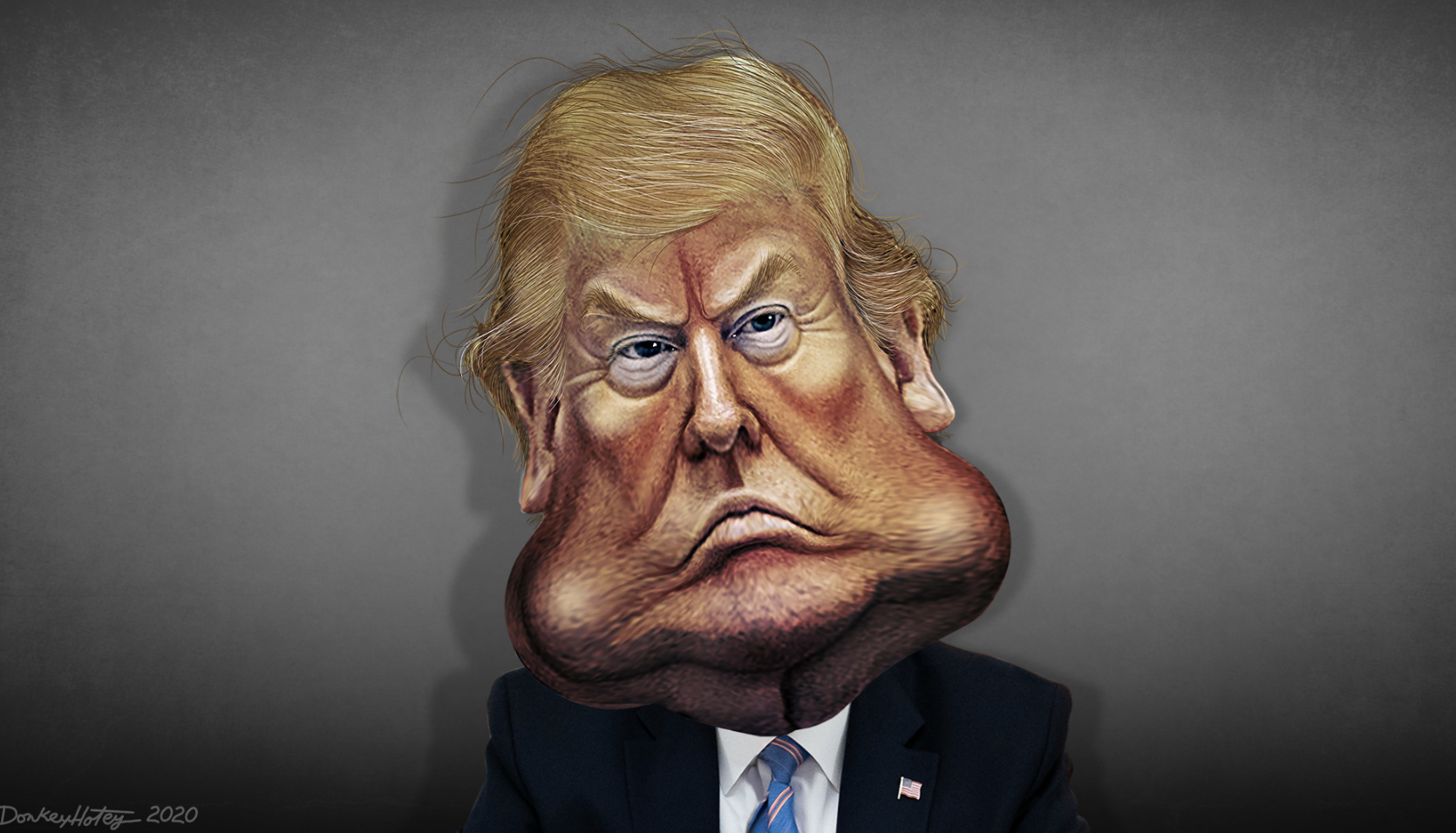
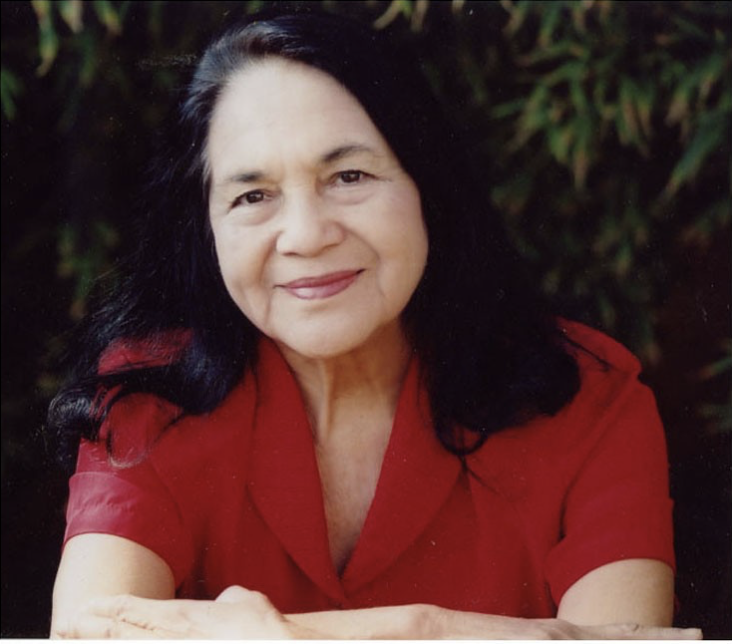

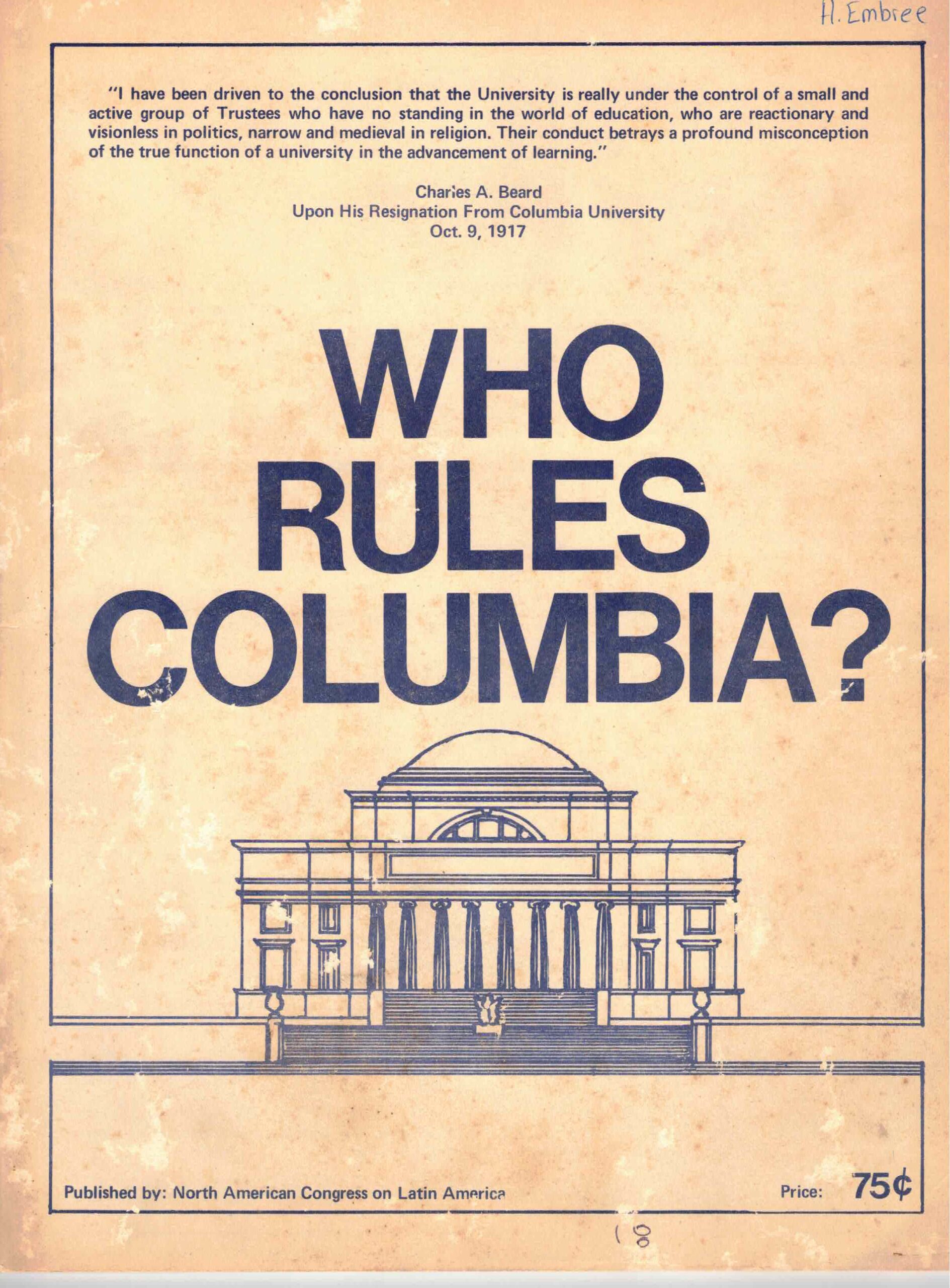
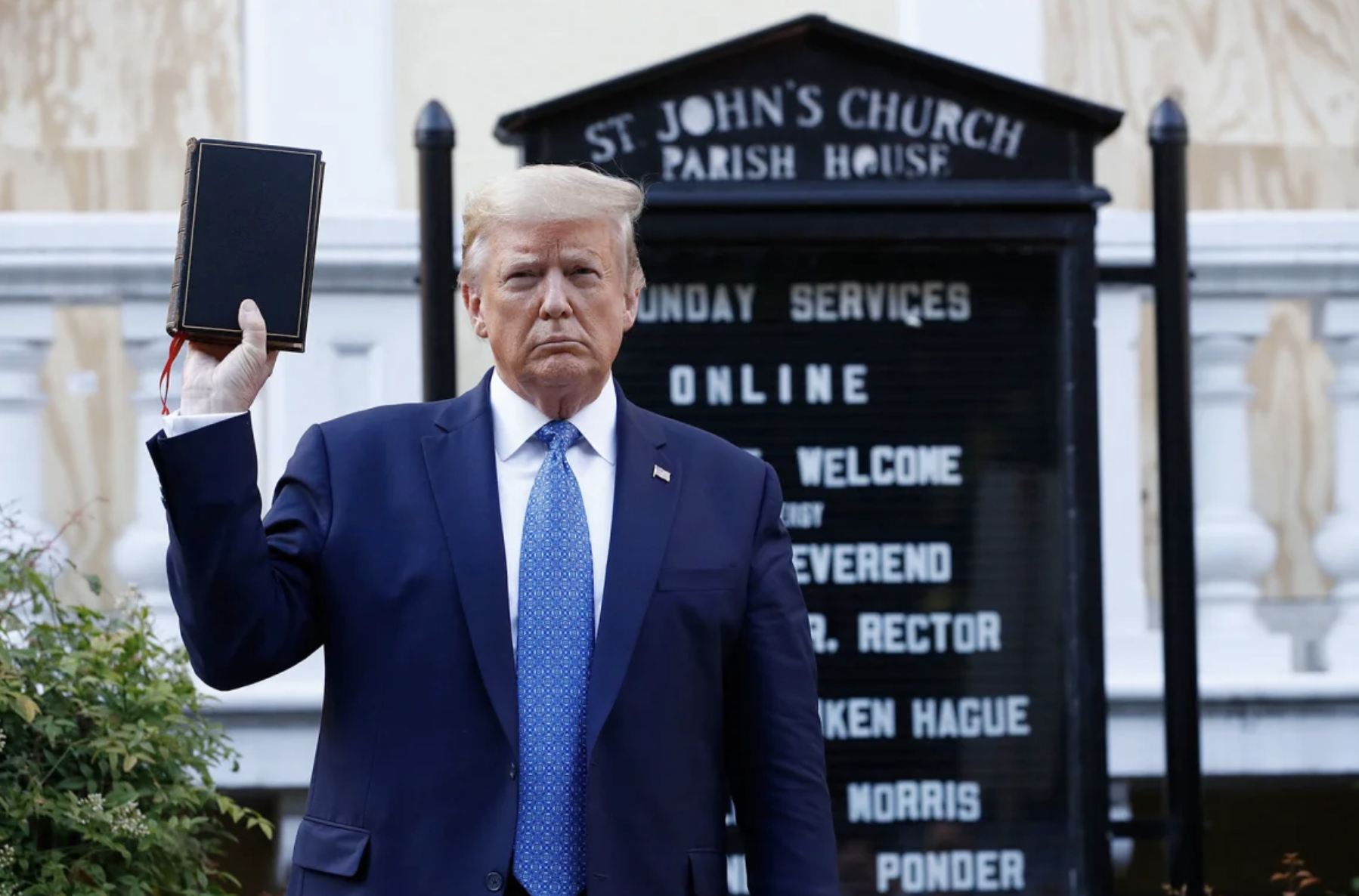

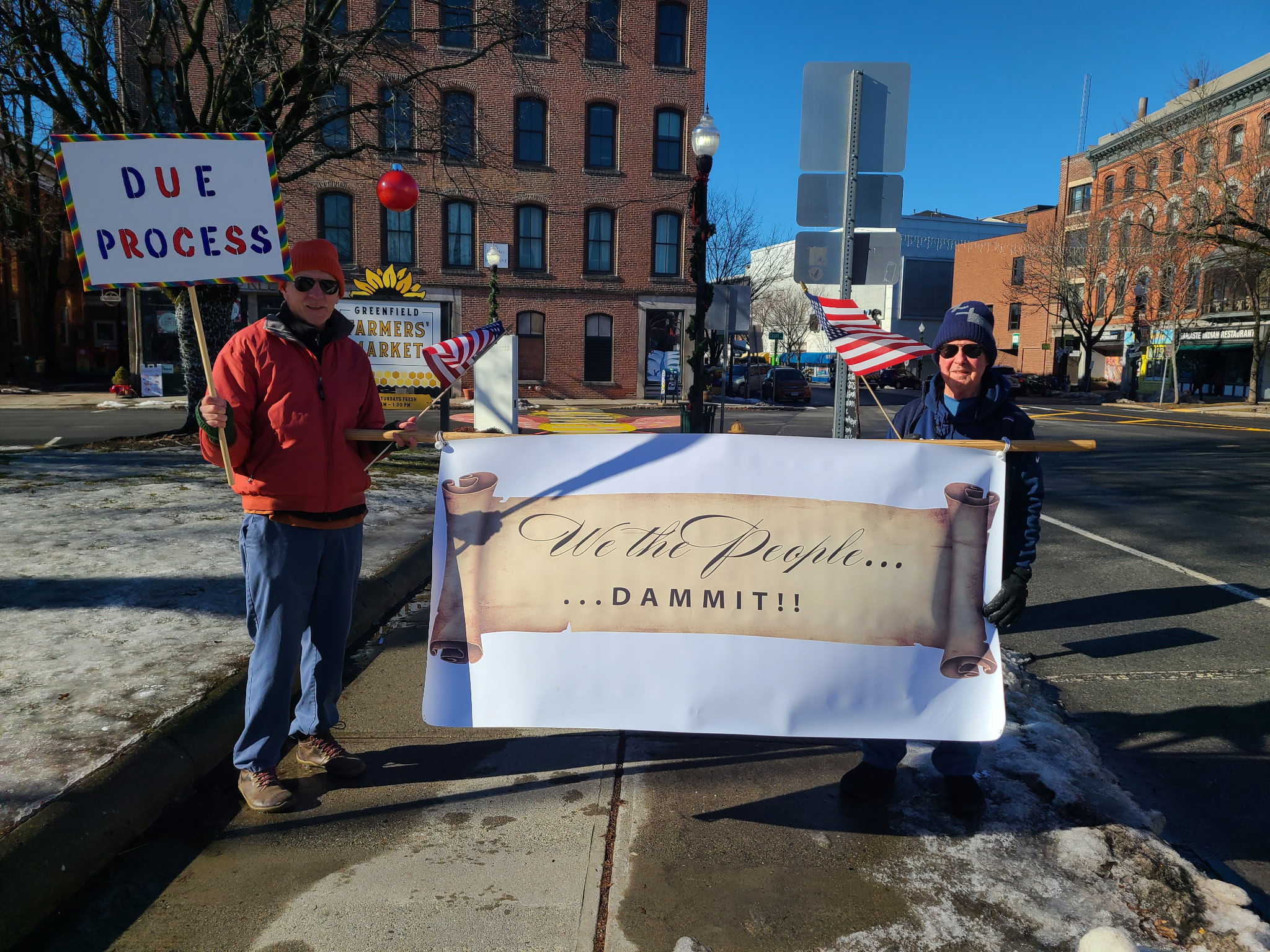

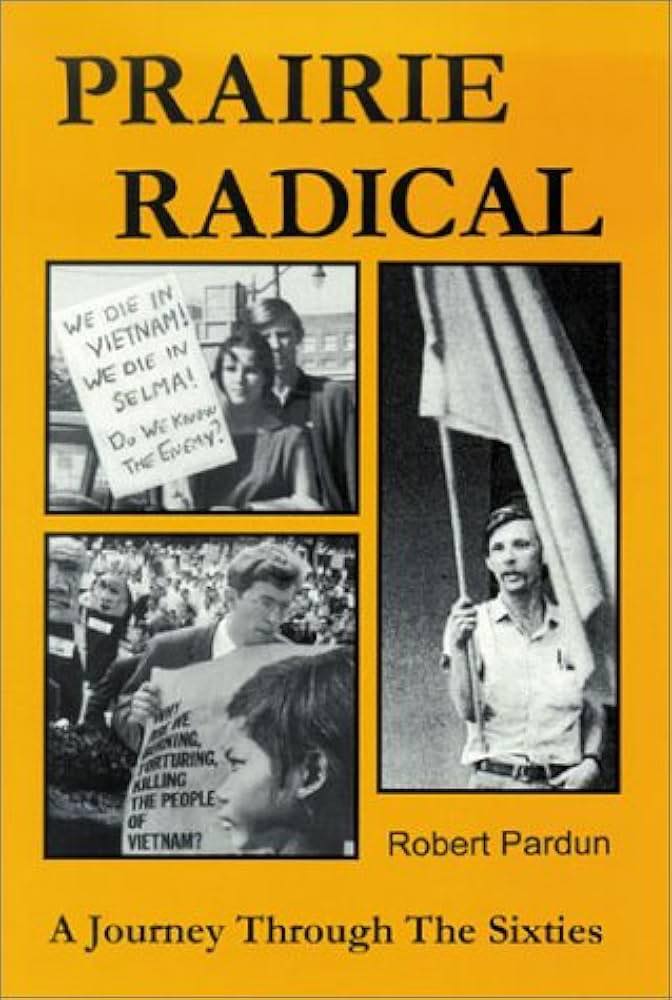
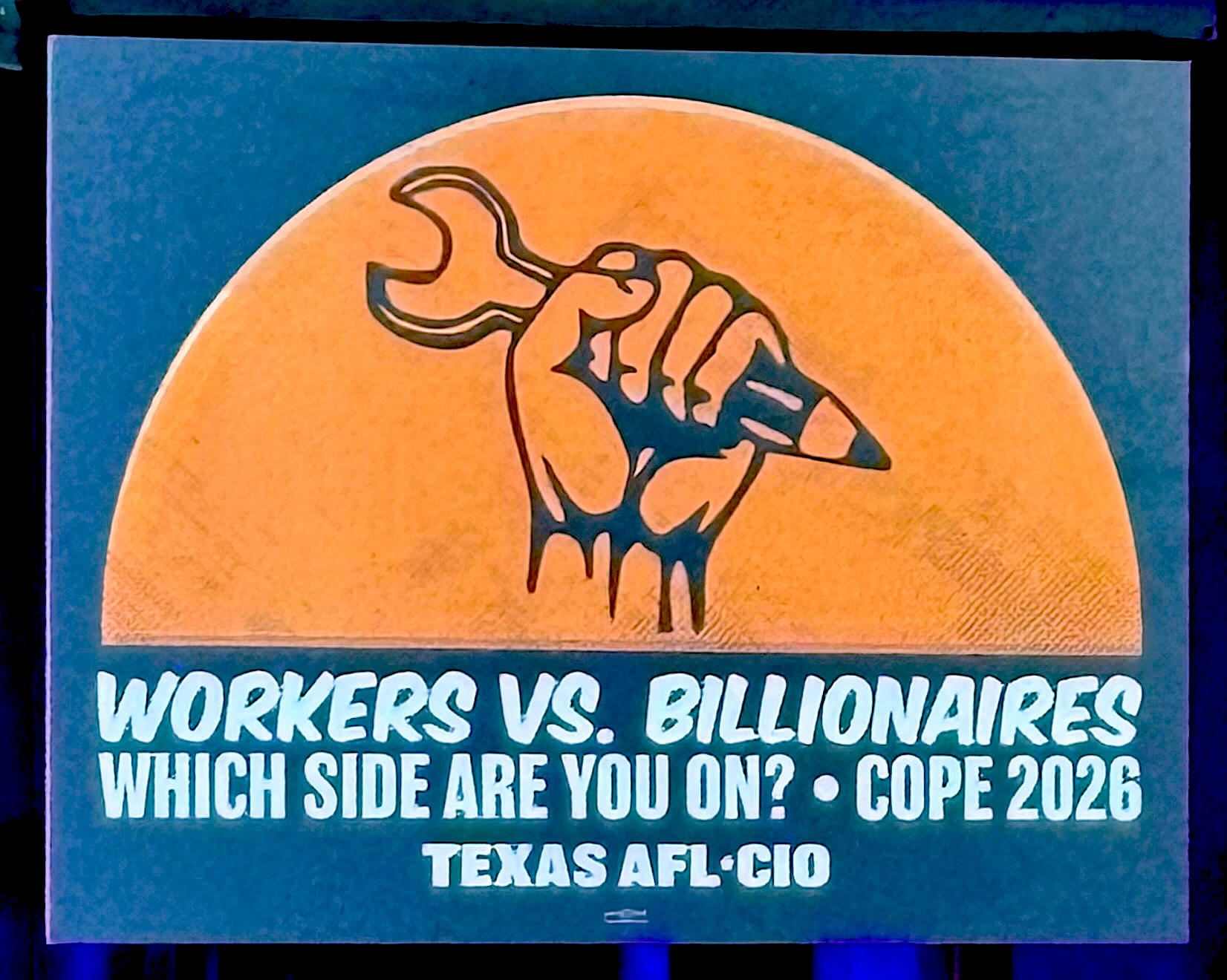





MICHAEL MEEROPOL / ECONOMICS / Are there signs of serious problems in the economy?
By Michael Meeropol / The Rag Blog / January 17, 2026
The following is a version of a commentary delivered over WAMC-FM by Michael Meeropol, Professor Emeritus of Economics at Western New England University on January 9, 2026. This version is expanded and revised for The Rag Blog as of January 17, 2026. Meeropol, Rag Blog host Thorne Dreyer and co-host Alice Embree will discuss the commentary on the air on KOOP 91.7-FM and streamed on KOOP.org Friday, Jan. 23, from 2-3 p.m.
So which is it? Is the U.S. economy doing extremely well and we are about to have a “great” year in 2026? Or are there signs of serious problems in the economy, especially for middle – class and working-class people who are not in the top ten, five or one percent of the population in terms of income and wealth?
Well, it just so happens that the substack economist, Paul Krugman, came out a few days ago with a summary of the year with a full analysis of what Trump’s economics have meant to the U.S. economy. This has given me much more important data to share than I had when I recorded this commentary and submitted a version to the WAMC-FM website. Thus, we can actually say this is exclusive to The Rag Blog.
For the full Krugman presentation, one needs a subscription but here is the link:
https://paulkrugman.substack.com/p/one-year-of-trumponomics
First, Krugman gives us the year-end jobs report which either was very weak or completely flat [meaning no job creation for the whole year!], depending on what kind of revisions there are to the data over the next few months. If it wasn’t flat, it was the weakest job growth in over a decade except for the year of the pandemic when there was a terrible loss of jobs.
Krugman then goes on to explain two things — why has unemployment risen so little AND why does it “feel” like the economy is in such bad shape? This probably has to do with the fact that there seems to be what Politico calls a “frozen” labor market: In this situation there are no mass layoffs and jumps in unemployment. Instead, businesses have cut back on hiring which means new entrants into the labor force (recent college graduates for example) as well as people looking to change jobs are facing few job opportunities.
[For details see “The US labor market ground to a halt in 2025. The risk in 2026 is that it “cracks.” It was a tough year to be looking for work — and the job market is not expected get much better,” available at https://finance.yahoo.com/news/the-us-labor-market-ground-to-a-halt-in-2025-the-risk-in-2026-is-that-it-cracks-140026614.html]
First of all, the reason measured unemployment hasn’t jumped is because all the deportations have reduced the number of people actively looking for work. Meanwhile, those who are looking for work are having a hard time finding jobs and the result is a serious decline in consumer confidence. Krugman’s evidence of this is the fact that long-term unemployment — the number of people who have been unemployed for 15 weeks or more — has risen much more than total unemployment. And the public understands this. “The Conference Board, which conducts a monthly survey of consumers, reports a measure called the “labor market differential” — the difference between the number of people saying that jobs are “plentiful” and those saying jobs are “hard to get.” While this measure turned upwards during the last quarter of 2024, it has turned sharply downward since then.” [Krugman]
And overall Consumer Confidence has declined for most of 2025: It reached a low point in early 2025, rose a bit through July, and has been falling ever since.
Now let’s check out the stock market. So far this year, the main index (the S and P 500) has produced a 16% rate of return. That means that if you owned $1 million worth of stock on January 1 of this year, you would have an extra $160,000 of wealth after December 31. Though lots of people own some stock (I owned some in my retirement account for most of my working life) very few people own enough stock for the proceeds to be a significant part of their income: 10% of Americans own 93% of all stocks, while the bottom half owns only about 1-2%.
So, no matter how you slice it, claiming that a booming stock market means we are “all” doing well is garbage.
Krugman goes further and notes that the improvement in the stock market is based on about seven individual firms that are heavily invested in developing artificial intelligence — which may or may not turn out to be a dangerous bubble rather than evidence of real successful company growth.
In fact, the run-up in the stock market is part of what is being called a “K – shaped” economy. The top part of the letter “K” represents the tremendous successes of the billionaires and others who are heavily invested in the stock market (that top ten percent). The lower part represents the difficulty that the middle class and working class has keeping their heads above water. So, if you are claiming “the economy” is doing great because you are focused on the top ten percent, you are right. To understand what is happening for the rest of us, we need much more information about many different trends.
[For details on stock ownership see: https://finance.yahoo.com/news/wealthiest-10-americans-own-93-033623827.html]
Or consider this set of facts: On Christmas Eve, MSNBC’s Ron Asana pointed out that the top 20% of the households account for 63% of consumption spending; the bottom 80% for 37%.
What about national statistics — Gross Domestic Product, Investment, Incomes of full-time workers? The growth rate in GDP was lower in 2025 than in 2024. Now it is true in moments of candor members of the Trump Administration refrain from asserting the blatant falsehood that the economy is the “hottest” it’s ever been, etc. etc. Some even spent most of 2025 assuring us that 2026 will be a “boom” year — which of course it might be — As Yogi Berra once said — “It’s difficult to make predictions, especiallyabout the future!”
But so far, there is no indication that the U.S. economy as a whole is booming. In the following diagram it is clear that the U.S. economy WAS “booming” — but that was 2024 when Joe Biden was president. In 2025, there has been a slowdown which is not surprising — the uncertainties created by Trump’s tariffs, the mass deportations which in some industries is reducing the labor force, the meat-axe approach to cutting government activities all have slowed growth. No recession — but a definite slowdown in growth
For the actual numbers in visual form, see
https://tradingeconomics.com/united-states/gdp-growth-annual
The behavior of investment during 2025 doesn’t give us any clues. It went up in the first quarter of 2025 only to fall in the next two quarters. In other words, Trump’s rhetoric about how rotten the economy was in 2024 is false and his rhetoric that 2025 was the “hottest” economy is also false.
[The following data is presented by the Federal Reserve Bank of St. Louis — abbreviated FRED. Folks can click on the link and then restrict the data to the last five years to see the trend. Investment did not “boom” in 2025.
https://fred.stlouisfed.org/series/A006RE1Q156NBEA]
But to move from “the economy” to the people living in it, I consider the real income of full-time workers a very important measure of well-being. (“Real” income takes the actually numbers in your paycheck and relates them to the ability of that paycheck to actually buy goods and services. “Median” is the best way to judge the wage of the TYPICAL worker. If you take an average, it can be tilted because of the very small number of super-rich individuals. If Bill Gates walked into a room of 99 people all making $50,000 a year, the “average” income would suddenly shoot up but $50,000 would still be the typical income. The numbers that follow relate to a base year which is why they seem rather low — the important thing is not the absolute number but whether we can see any trend.)
The weekly real median wage averaged $370 for 2024 (reaching a high point of $375 at the end of the year.) In the first quarter of 2025 it fell back to $373 and inched upwards to $376 in the second and third quarters — virtually no growth at all. For details see:
https://www.bls.gov/news.release/wkyeng.t01.htm
What’s going on?
First, the high-tech sector has invested heavily in developing Artificial Intelligence (AI) capabilities. Many businesses believe that increased use of AI will permit the replacement of many workers.
We can actually hear that happening when we call doctors’ offices and a voice that identifies itself as a “virtual assistant” (clearly an AI system) asks how “she” can direct your call. A human being used to be the person who answered that phone call and then directed the call — now It’s a machine. With the “promise” of AI, many businesses are reluctant to increase their labor force when they might not need that many people in the not-so-distant future.
The following is from the New York Times from last October:
In one particular area that was supposed to improve as President Trump’s tariffs took hold, there is nothing good to report. If you are a voter who wanted more factory jobs, you must be disappointed. If you promised the voters that there would be many more factory positions, you failed. This year [2025] factory jobs are down by 58,000. Nothing new. In Trump’s first term they fell by about 200,000 between January of 2017 and January of 2021. Seems like there is a lesson in here somewhere.
And look at the long-term trends. Although the non-farm labor force has grown by more than 20,000,000 since January of 2014, the total number of jobs in the manufacturing sector has not moved much. In 143 months beginning in January of 2014, total jobs in the factory sector have always been between 12,000,000and 13,000,000 except for five months in the spring and summer of 2020 when they fell below 12,000,000 for a while. Overall, no long-term increases even though the economy is much bigger today.
“Amazon Plans to Replace More Than a Half Million Jobs with Robots.”
(Karen Weise, New York Times, October 21, 2025)
[For more details see https://www.dollarsandsense.org/jobs-factories-and-inequalities/?ref=dollarsandsense-newsletter]
Thus, Trump’s tariffs have not created a surge in manufacturing jobs. Instead,they have created a great deal of uncertainty within the business sector. So far, American importers have been able to “eat” the tariffs because they built up significant inventories in anticipation that these tariffs will increase their costs. However, it is unlikely that they will be able to sustain this into 2026 and therefore, the tariffs will probably start to push prices up.
On top of all this, there is a very important intangible. As I mentioned above, the uncertainties created by those Trump tariffs and the failure of the Trump Administration to knock inflation down dramatically has dealt a blow to consumer confidence — and this is despite the fact that the average rate of inflation for 2025 has fallen from 2.9 percent in 2024 to 2.7 percent.
In other words, in answer to the question I posed at the beginning of this broadcast, there remains great uncertainty. The economy could start chugging along – it could remain in a kind of stasis with slow growth and slowly rising unemployment as inflation remains the same or slows further — or it could experience a surge in prices and an increase in unemployment.
Based on the analysis by Krugman of the 2025 statistics, I think the chance of a strong 2026 is very slim. In my oral presentation a few weeks ago I was more equivocal than I am now. I think the best the economy can hope for would be to muddle along but it might be much worse. The most important take-away from the experience of 2025 is that the economy has not done what Trump predicted and it is not doing what he claims it is. In other words, public opinion that believes the economy is in lousy shape is probably correct.