|
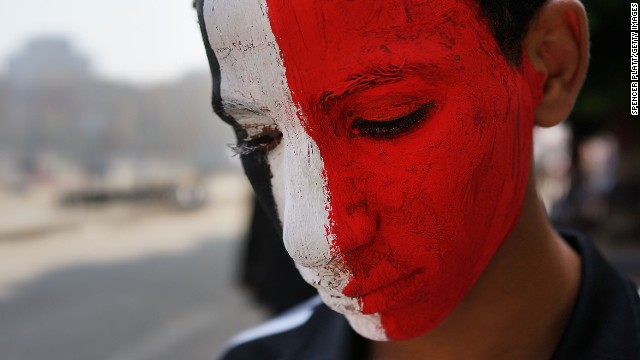
| A man in Tahrir Square with his face painted in Egyptian colors. Image from CNN. |
Egypt’s coup:
Progressive or regressive?
It is ironic that the military — formerly loathed for upholding the dictatorship for decades, then further reviled during its controversial 17-month governance until Morsi took office — is now supported by nearly the entire opposition.
By Jack A. Smith | The Rag Blog | August 8, 2013
What is really happening in Egypt? Are the latest developments a progressive step forward or a regressive step backward for the millions of Egyptians seeking political change primarily through prolonged mass mobilizations in the streets?
It’s been over a month since a military coup d’état, with popular support, ousted the country’s first democratically elected government July 3 after only one year in office, following an earlier military coup with popular support that brought down dictator Hosni Mubarak.
There are diametrically opposed interpretations about what is taking place in Egypt. One fact remains certain, however. In 1952 during the overthrow of the monarchy, and in 2011 during the overthrow of the dictatorship, and in 2013 during the overthrow of the newly elected government, the military was the ultimate power. It has no intention to forego that power regardless of the outcome of the next election in 2014.
President Mohamed Morsi of the Muslim Brotherhood (MB), the candidate of the Freedom and Justice Party, remains in jail (or “incommunicado, as the media prefers), along with other imprisoned former government functionaries and MB followers. Most are awaiting trial on a variety of charges, as though it was the Brotherhood that launched the coup.
Some 250 people, almost all of them Morsi supporters, have been slain by military and security forces while demonstrating against the coup. The protests are continuing, and the military crackdown is becoming increasingly fierce.
The 450,000-strong armed forces, led by Gen. Abdul Fatah al-Sisi, dismissed the government just after popular anti-Morsi protests brought many millions of Egyptians into the streets June 30 to demand the president’s ouster. (In terms of the unusually huge crowds, this article just says “millions” because both sides tend to exaggerate their protest numbers.)
Sisi, who was named defense minister by Morsi, selected an interim government until new elections. Not one of the chosen 34 cabinet members belongs to the Muslim Brotherhood, but 11 of them are veterans of the Mubarak regime. It seems doubtful that the MB and its political groups and associates that have produced majorities in five elections (presidential and parliamentary), will be allowed to contend for power.
The return of elements of the Mubarak regime is beginning to draw media attention. Writing in the Washington Post from Cairo July 19, Abigail Hauslohner stated: “Egypt’s new power dynamic following the coup is eerily familiar. Gone are the Islamist rulers from the Muslim Brotherhood. Back are the faces of the old guard, many closely linked to Mubarak’s reign or to the all-
powerful generals.”
Professor Joseph Massad, who teaches Modern Arab Politics and Intellectual History at Columbia University, was highly critical of the coup in a July 14 article in CounterPunch:
What is clear for now, with the massive increase of police and army repression with the participation of the public, is that what this coalition has done is strengthen the Mubarakists and the army and weakened calls for a future Egyptian democracy, real or just procedural. Egypt is now ruled by an army whose top leadership was appointed and served under Mubarak, and is presided over by a judge appointed by Mubarak (Interim President Adly Mansour) and is policed by the same police used by Mubarak. People are free to call it a coup or not, but what Egypt has now is Mubarakism without Mubarak.
There is no direct evidence that the U.S. was behind the coup. Of course Washington has long maintained intimate contact with the leaders of the armed forces and the Cairo government. It seems to have had as close a relationship with Morsi as it did with Mubarak and now with coup leader Gen. Sisi. There is an indirect connection, however, according to journalist Emad Mekay, writing in Al Jazeera, July 10:
A review of dozens of U.S. federal government documents shows Washington has quietly funded senior Egyptian opposition figures who called for toppling of the country’s now-deposed president Mohamed Morsi. Documents obtained by the Investigative Reporting Program at UC Berkeley show the U.S. channeled funding through a State Department program to promote democracy in the Middle East region. This program vigorously supported activists and politicians who have fomented unrest in Egypt, after autocratic president Hosni Mubarak was ousted in a popular uprising.
The State Department’s program, dubbed by U.S. officials as a “democracy assistance” initiative, is part of a wider Obama administration effort to try to stop the retreat of pro-Washington secularists, and to win back influence in Arab Spring countries that saw the rise of Islamists, who largely oppose U.S. interests in the Middle East. Activists bankrolled by the program include an exiled Egyptian police officer who plotted the violent overthrow of the Morsi government, an anti-Islamist politician who advocated closing mosques and dragging preachers out by force, as well as a coterie of opposition politicians who pushed for the ouster of the country’s first democratically elected leader, government documents show.
President Obama has proclaimed neutrality in this matter and seems to have positioned himself above the conflict, but Washington’s every practical deed has been supportive of the military and the military-dominated interim civilian leadership.
President Obama refused to characterize the overthrow as a coup, which of course it was, because to do so would legally terminate the annual bribe of $1.3 billion to the Egyptian armed forces — a token of America’s gratitude for maintaining good relations with Israel. On July 31 U.S. Defense Secretary Chuck Hagel announced that the Pentagon would participate in mid-September war games with the Egyptian army as its had done throughout the years of dictatorship.
The task of obliquely justifying the putsch fell to Secretary of State John Kerry. On July 17 he opined that before the coup there was “an extraordinary situation in Egypt of life and death, of the potential of civil war and enormous violence and you now have a constitutional process proceeding forward very rapidly. So we have to measure all of those facts against the law, and that’s exactly what we will do.”
On August 1, he went further, alleging that the Egyptian army was “restoring order.” The next day, Egypt Independent reported, that an MB spokesperson “called Kerry’s comments ‘alarming,’ and accused the U.S. administration of being ‘complicit’ in the military coup.”
The U.S. and several countries, mostly western, are leading a very public “reconciliation” campaign essentially aimed at convincing the leadership of the MB to capitulate, accept the overthrow, end the protests and “swallow the reality” of defeat. It is being portrayed as a peace effort, with no criticism directed toward the military that broke the law and evidently future jail terms for some MB leaders including Morsi who didn’t.
Clearly, it is just a matter of time — an “I” to be dotted, a “T” to be crossed — before Obama and Sisi will embrace in public.
A curious anti-Morsi coalition — a seemingly unprincipled amalgam of left, center, and right, each with somewhat different agendas that they expect to advance by liquidating the Islamist government — has galvanized behind the military junta and is following its “roadmap” to the next elections.
Included in the coup-supporting coalition are (1) a large portion of the youthful protestors who launched the January 2011 Tahrir Square freedom struggle against the single-party rule of Mubarak’s now disbanded National Democratic Party, including such organizations as the April 6 Youth Movement and Tamarod; (2) opposition liberal, left, and secularist groups who have combined in the National Salvation Front, plus worker groups who demonstrated in the name of their unions; and (3) the many supporters of the old Mubarak regime joyfully emerging from the shadows to support the military that in 2011 forced their leader’s resignation and imprisonment.
Communist groups, underground for decades, materialized during the 2011 uprising. They all supported the second uprising too, but are not playing a significant role. The Egyptian Communist Party heartily backed Morsi’s overthrow and strongly argued it was a popular revolt, not a military coup. Other Marxist groups, viewing the MB as a reactionary right-wing formation, similarly backed the anti-MB rebellion.
Most anti-Morsi organizations, including groups affiliated with the National Salvation Front, joined pro-military demonstrations July 26 called by Gen. Sisi himself to provide an additional popular mandate for increasing the suppression of “violence and terrorism,” primarily to crush continuing Brotherhood demonstrations.
The interim cabinet declared: “Based on the mandate given by the people to the state… the cabinet has delegated the interior ministry to proceed with all legal measures to confront acts of terrorism and road-blocking.” The MB has not perpetrated any acts of “terrorism,” so the reference must have been to the Salafi struggle for power in Sinai. Road-blocking refers to two large long-lasting sit-down protests in Cairo by anti-coup forces.
On July 27, police slaughtered 82 Morsi supporters to break up one protest. They used live ammunition and shot to kill nonviolent demonstrators. In response, the Obama Administration muttered a few words lacking any significance. Imagine the outcry from Washington and the mass media had the slaughter taken place in Beijing, Moscow, or Caracas.
The conservative Economist magazine noted August 3, “the new government is resurrecting the hated arms of Hosni Mubarak’s security state… The liberal Egyptians who teamed up with the army to oust Mr. Morsi will come to regret their enthusiasm.”
Among such liberals, reported Los Angeles Times correspondent Jeffrey Fleishman July 3, was
Nobel laureate Mohamed ElBaradei, who once vilified army control, [but was] now asking the generals to reenter the scene in a moment of opportunity for both. “Every minute that passes without the armed forces intervention to perform its duties and protect the lives of Egyptians will waste more blood, especially since the person in the presidential position has lost his legitimacy and eligibility, and maybe even his mind,” ElBaradei said.
For his selfless efforts ElBaradei has been promoted to be the junta’s “Vice President for Foreign Affairs,” and from this exalted position he is now a big voice in the “reconciliation” campaign. Once the MB and its many millions of supporters “understand that Morsi failed” — that is, accept defeat — “they should continue to be part of the political process” and participate in the nation’s political affairs.
Some opposition groups stayed away from Sisi’s provocative military rally, such as the April 6 youth group. The Revolutionary Socialists, a Trotskyist formation, backed the anti-Morsi coup but declared: “Giving the army a popular mandate to finish off the Muslim Brotherhood will inevitably lead to the consolidation of the regime which the revolution arose to overthrow. We must use the downfall of the Brotherhood to deepen the revolution, not to support the regime.”
The New York Times noted in an editorial July 31:
Whatever Egypt’s new military strongman…thought he was doing by summoning people to Tahrir Square [July 26] to demand a ‘mandate’ to fight terrorism, the result was to undermine Egypt’s prospects for stability even further. Whatever self-described pro-democracy groups thought they were doing by endorsing his call, the result was to strengthen the military and inflame raw divisions between civilian parties.
The pro-military Tamarod — a youthful key group in building for the overthrow — encouraged all the opposition to attend Sisi’s rally. Tamarod (the name translates into “mutiny” or “rebellion,” depending on usage) justly rose to fame after collecting multi-millions of signatures demanding the ouster of Morsi, then by calling for the huge June 30 rally that drew many millions across the country. This protest provided an immediate excuse for Sisi to publicly give Morsi 48 hours to meet opposition demands or be removed.
Writing in the July 22 New Yorker, author Peter Hessler suggested the Tamarod was convinced beforehand the armed forces would intervene after the protest. During interviews in the Tamarod office just before the coup, he asked how they knew this would happen, and was told: “We know our army.” One source of this knowledge, undoubtedly shared with a number of groups, were the hints of a takeover emanating from some army officers for a few months and days before the coup, including from Sisi.
Tamarod maintains it has no outside funding for the extensive petition campaign but a millionaire businessman subsequently took credit for the funding, saying the youthful organizers may not have known where it came from. The group says 22 million people signed petitions but there has not been an independent count.
It is ironic that the military — formerly loathed for upholding the dictatorship for decades, then further reviled during its controversial 17-month governance until Morsi took office — is now supported by nearly the entire opposition. The officer corps only changed sides in 2011 to preserve and increase its power and privileges, rising to the occasion again in 2013 to enhance its position.
General Sisi, who is described as a dedicated Islamist, is now adored by multitudes in the increasingly national chauvinist atmosphere engulfing the opposition, most members of which have averted their eyes to the murderous violence by military and police units against Morsi demonstrators. Rumors abound that Sisi himself is considering a run for president.
New York Times Cairo correspondent David Kirkpatrick reported July 16 that in
the square where liberals and Islamists once chanted together for democracy, demonstrators now carry posters hailing as a national hero the general who ousted the country’s first elected president… The voices on the left who might be expected to raise alarms about the military’s ouster of a freely elected government are instead reveling in what they see as the country’s escape from the threat that an Islamist majority would steadily push Egypt to the right.
Both those who applaud or resist the coup claim to support electoral democracy and the creation of a better society for Egypt’s 83 million people. From a left perspective, the various points of view about Morsi’s ejection revolve around one main question: Is a military-led coup against an elected government, backed by millions of demonstrators who prefer to elect another government (and could have done so in three years) — a progressive or regressive change within the capitalist context? (The issue of anti-capitalism is not on the agenda so far.)
The opposition forces claim theirs is a progressive step forward, and that the military “joined with the masses” to oust a “failed” regime. The Muslim Brotherhood, by far the country’s largest political organization, maintains that a regressive military coup illegally destroyed a democratically elected government and jailed its leaders.
In order to provide context for determining whether this is a progressive or regressive coup, it is important to understand whether there have been changes in the “deep state” power relations since the days of the dictatorship in four key areas — the military, the ruling class, the bureaucracy and the security forces. This will be followed by a discussion of the MB government’s year in office, the possible reasons for the coup, the politics and actions of the military and civil opposition, the needs of the Egyptian people, and the role of various countries in and around the Middle East.
- The military has not changed. It has enjoyed near autonomy and virtual control of the government, openly or behind the scenes, for some 60 years, beginning as a left exponent of pan-Arab socialism and developing close relations with the Soviet Union. During the 1970s, President Anwar Sadat broke with Moscow in order to develop closer relations with the United States and capitalism. Since that time Cairo has become increasingly subject to American influence, receiving cash subsidies, training, equipment, international backing, and guidance from Washington.
The armed forces were the power behind the dictatorial throne of President Mubarak, a former air force general, from 1981 to 2011 when he was ousted by the military in league with mass popular demonstrations seeking Western-type democratic elections. As soon as it was understood American interests would not be subverted, President Obama dropped Mubarak. The military continued as the ultimate power behind the democratic presidency of Morsi until he, too, was overthrown. The military always claims it does not want to be involved in the politics of running the country, but it has every intention of continuing its traditional role in the next government.
Gen. Sisi, who has just named himself first deputy prime minister as well as retaining his position of defense minister and head of the Supreme Council of the Armed Forces (SCAF), received his master’s degree at the U.S. Army War College in Pennsylvania in 2006. Last year the pro-opposition newspaper al-Tahrir reported that Sisi had “strong ties with U.S. officials on both diplomatic and military levels.” Doubtless, both the Pentagon and SCAF communicate daily these days.
- The ruling class has not changed. Perhaps a few Islamist millionaires who honestly supported the Morsi government will no longer be welcome, but the moneyed interests, the bankers, the big investors, the corporate heads, the owners of the mass media, the military leaders, and the security chiefs will remain in place. Virtually all supported Mubarak during his long years in power. They easily survived the transition to Morsi as they will the next regime, probably expanding their powers in the process.
- The government bureaucracy has not changed. While heads of various government departments were mostly replaced when Morsi took power last year, and will be so again under the new regime, the basic organization and politics of the bureaucracy remains very similar to the Mubarak years. Morsi had to make do with a long-established officialdom that knew the ropes (as he didn’t), and which largely opposed him. The New York Times July 17 pointed out there is a “widespread perception that Egypt’s sprawling state bureaucracy had stopped cooperating with Mr. Morsi” before the latest coup.
- The security forces have not changed. The national police and other security forces were only formally under Morsi government control. They remained largely the same repressive apparatus that Mubarak built to control the population. They fought actively during the first uprising in 2011 to oppose the demonstrations against dictatorial authority but often turned their backs when MB facilities were trashed by anti-Morsi protestors.
Morsi’s interior minister, Mohamed Ibrahim (a former general with close ties to the military), who did nothing to reform Mubarak’s brutal security and police apparatus, was reappointed to his position by the new government. In essence, according to The Economist July 6, “since the 2011 revolution, Egypt’s police force has abandoned many of its duties, helping generate a threefold surge in serious crime.” They appear to have returned with a vengeance.
So what has changed in Egypt since early 2011 when the Arab Spring began? Two main things.
- The Egyptian masses in their many millions diverted the course of history when they bravely took to the streets to oust the dictatorship in quest of a form of democracy that would bring about improvements in the lives of the people. The causes were extremely high poverty (nearly 50%), devastating unemployment, weak and further reduced social services and subsidies due to the economic crisis, and the lack of political freedom.
Young people inspired by the Tunisian revolution weeks earlier initiated the uprising, They called for a demonstration in Tahrir Square January 25, 2011. Unexpectedly, gigantic numbers of people joined the protest seeking a free and more open democratic society, jobs, and a much improved economy. Within weeks there were millions of protesters in Tahrir Square and throughout the country. The MB did not join the Tahrir uprising at first but eventually entered the struggle. They were very cautious, having recently emerged from decades of government repression.
By mid-February Mubarak and vice president Omar Suleiman handed power to the armed forces, which facilitated their departures and ruled for the next year and a half. The U.S. effortlessly transferred its 30-year support for the old dictator to Gen. Sisi and the SCAF — an institution with which Washington had long enjoyed deep and fruitful ties. Mubarak was tried and sentenced to life in prison for allowing the army to kill peaceful protestors. The military disbanded parliament, ended “emergency laws,” suspended the constitution, and appointed an interim leadership pending elections. Sharp protests continued from time to time because the ruling SCAF was both distrusted and not moving fast enough to bring about a democratic structure.
- The political system was transformed from a capitalist dictatorship to a capitalist electoral democracy — a step forward that allowed the Egyptian people to elect their leadership for the first time in thousands of years. One year later, of course, a second military coup removed the elected government, backed by the same popular forces that fought to establish elections.
Morsi won the June 2012 election honestly with 51.73% of the vote but there are reasons to believe that a proportion of his majority backed him grudgingly. Four candidates ran in phase one of the balloting. Morsi won with 24.78% of the vote, which mainly came from the MB and other Islamic parties. Second was Ahmed Shafiq with 23.66% of the vote — presumably from supporters of the old regime, considering that he was a former air force commander who served a decade in Mubarak’s cabinet and was the dictator’s last prime minister, serving five weeks until early March 2011.
 |
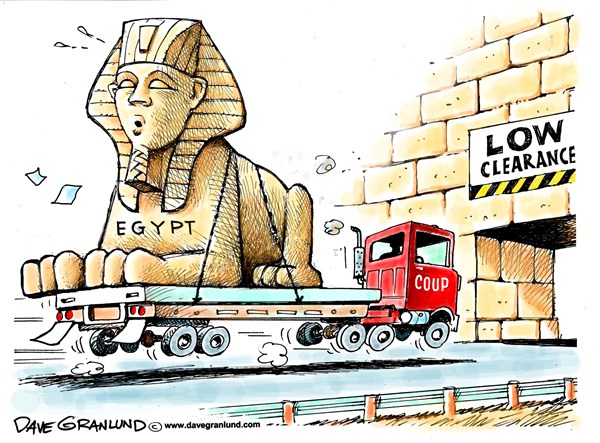
| Political cartoon by Dave Grunlund / The Cagle Post. |
In the runoff election — given the choice of a candidate who had been a Mubarak man or one from a powerful religious organization that was harassed by the old regime, a majority voted for Morsi. Shafiq, however, won a startling 47.27% of the vote.
Virtually as soon as he became Egypt’s first democratically elected president Morsi was confronted by fairly strong opposition waiting for him to fail. The honeymoon period lasted less than two months before there were protests seeking to remove him from office. Much of the mass media, mostly owned by Mubarak supporters, began criticizing him almost immediately, some viciously.
The New York Times reported, only a few months after he took office, that “Morsi’s advisers and Brotherhood leaders acknowledged that outside his core base of Islamist supporters he feels increasingly isolated in the political arena and even within his own government.”
One of the more interesting facts about the removal of the Islamist president is that the popularity of the MB, the Freedom and Justice Party (the vehicle for Morsi’s election victory), and to an extent Morsi himself is not terribly low — at least about three months before the coup. Here are the basic results from a public opinion poll conducted March 3-23, 2013, by the respected Pew Global Attitudes Project:
Only 30% of Egyptians think the country is headed in the right direction, down from 53% last year and 65% in 2011, in the days after the revolution… Despite the negative views about the country’s direction, most Egyptians still have a positive view of the Muslim Brotherhood, the organization that has been the dominant political force in post-Mubarak Egypt.
Still, the group’s ratings have declined somewhat over the past two years — 63% give it a positive rating today, compared with 75% in 2011. About half (52%) express a favorable opinion of the Muslim Brotherhood-affiliated Freedom and Justice Party… The National Salvation Front (NSF), a relatively secular coalition of opposition forces, receives more negative reviews than the MB an NSF. In time this seeming contradiction may be clarified.
Clearly there were strong doubts about Morsi and the MB, not only from those who backed Shafiq but from many who supported the MB candidate to keep the former regime out of power. This was hardly an auspicious beginning for Morsi.
Another factor was distrust of a religious regime. Islam has been Egypt’s state religion for many years. But ever since the leftist Free Officers Movement led by Gamal Abdel Nasser seized power in 1952 Egypt has kept religious parties off the ballot. Morsi was not only the first elected president, and the first non-military president, he was also the first Islamist president.
In seeking office the MB conveyed the impression it did not seek to impose an extreme Islamist government upon the country. Of the three main organized currents in Sunni Islam — the Muslim Brotherhood, the Wahhabi movement (and associated Salafism), and al-Qaeda (plus allied jihadist groupings) — the MB is the mildest and most open to modern governing structures. However, it is considered hyper-conservative on cultural issues, such as the rights of women, and it wasn’t trusted by large numbers of Egyptians.
The Morsi government committed a number of political miscalculations and blunders. Chief among them was its refusal in office to take meaningful steps to convince dubious constituencies that compose the opposition that he wanted to govern collegially by giving their concerns serious consideration. The MB and Morsi had no experience in governing or sophistication in relating to liberal and progressive Muslims and non-Muslims.
Morsi governed as a majoritarian — a politician who thinks an electoral majority entitles a regime to do as it pleases without regard for the views of the opposition. A mature democracy may be able to survive this but it is unwise in a society’s first elected government when the opposition entertains deep worries.
During the campaign the MB, according to The Economist,
refrained from pushing an overtly Islamic agenda, for instance banning alcohol or enforcing corporal punishment, with the zeal which might have been feared. But in power the Brotherhood began to abandon its previous caution regarding its foes. Morsi appeared to dismiss secular opponents and minorities [Coptic Christians or Shia Muslims] as politically negligible. Instead of enacting the deeper reforms that had been a focus of popular revolutionary demands, such as choosing provincial governors by election rather than presidential appointment, or punishing corrupt Mubarak-era officials, the Brothers simply inserted themselves in key positions.
“The Brotherhood’s single most divisive act,” writes socialist journalist Mazda Majidi of the Party for Socialism and Liberation,
was passing a constitution that was strongly opposed by all secular forces. The constitution trampled the rights of women and laid the basis for the oppression of religious minorities. Far from creating a consensus of the wide array of forces that overthrew the Hosni Mubarak dictatorship, the Brotherhood codified its own reactionary social policies into the constitution.
Morsi offered some concessions to quell the constitutional uproar, “but opposition leaders turned a deaf ear, reiterating their demands to begin an overhaul of the Islamist-dominated constitutional assembly itself,” reported The New York Times December 7. The assembly passed the constitution in a very low turnout election.
The MB made a big error in developing the constitution by seeking to please the ultra-conservative Islamist Salafi to strengthen Egypt’s Islamic bloc. In return the Salafi al-Nour Party eventually broke with the Brotherhood and joined the opposition when it saw a coup was on the agenda. The anti-Morsi side welcomed this important new addition. (The Salafi party withdrew from the opposition camp to save its reputation after the junta’s police massacred unarmed Islamist MB supporters.)
In its brief one year in office the Morsi government was never able to control the military or police so it ended up catering to these powerful institutions lest they make more trouble. Writing in CounterPunch July 7, Franklin Lamb explained:
Some Congressional analysts believe that one of Morsi’s biggest mistakes
resulted from a deliberate policy of accommodation and not, as is commonly believed, confrontation. He allowed the military to retain its corporate autonomy [it controls businesses] and remain beyond civilian control.
Furthermore, he included in
his cabinet a large number of non-Muslim Brotherhood figures who
abandoned him within months when the going got tough, thus presenting to the public an image that the government was on the verge of collapse.
Some have suggested that Morsi should have brought the military to heel
soon after he assumed power and was at the height of his popularity, just as the military was at its lowest point in public perception.
Morsi faced a plethora of serious problems from day one. The worst was the dilapidated condition of the free-falling economy, the root cause of Egypt’s most pressing problems. The culprit was grave economic mismanagement during the Mubarak years drastically compounded by the worldwide capitalist recession, its lingering effects and the last two years of political disruption.
The MB’s struggling government was helped by gifts of billions of dollars, mostly from oil-rich Qatar ($7 billion) and lesser amounts from friendly Turkey and some other sources. This helped, but not enough. The new military-guided regime was immediately gifted with $12 billion from Saudi Arabia, Kuwait and the United Arab Emirates.
The Cairo government is dependent on tourism, which brought in 17% of the country’s GNP until it vanished abruptly with the first mass demonstrations in early 2011. Investment dropped for the same reason. The price of food imports, largely wheat, increased after Morsi won the election.
In January 2011, when the first uprising began, unemployment was 8.9%. When Morsi took office it in July 2012 it was 12.6%, and today it is 13.2%. About 80% of the jobless are workers under 30 years old. In urban areas, more than 50% of young men are unemployed — a politically volatile statistic. This situation was worsened in recent months when public anger boiled over due to fuel and electricity shortages. (The shortages ended virtually the day after Morsi was ousted, a coincidence that led critics to suspect that anti-MB sabotage intentionally caused the problem as an incentive for the uprising.)
The Brotherhood’s rise to power exposed a sharp dispute between the key Sunni factions in the region — the MB on one side and the more extreme Wahhabi, Salafi, and al-Qaeda orientations on the other.
Indian news analyst M. K. Bhadrakumar commented in Asia Times July 9:
The autocratic Persian Gulf oligarchies rushed to celebrate the overthrow of the elected government under Mohamed Morsi by the Egyptian military. Saudi Arabia’s King Abdullah dispatched his congratulatory cable to Cairo within hours of the announcement of Morsi’s ouster. The sense of jubilation is palpable that the Muslim Brotherhood, which spearheads popular stirrings against the Persian Gulf regimes, has lost power in Egypt.
(Saudi Arabia helps finance the Egyptian Salafi and cheered when the al-Nour Party joined the opposition.)
“In that respect,” William McCants wrote in Foreign Affairs July 7:
No Salafi is likely more pleased with the turn of events in Egypt than Ayman al-Zawahiri, the leader of al-Qaeda. For decades, Zawahiri has argued that the Muslim Brotherhood’s engagement in party politics does nothing more than strengthen the hands of its adversaries and ratify an un-Islamic system of rule. Since the beginning of the Arab Spring, he has continued to make his argument that the West and its local proxies will never allow an Islamist government to actually rule. He doubtless views the coup as a final vindication of his argument.
Syria was also elated by Egypt’s coup since Morsi called for the overthrow of the Assad government and even suggested that Egyptian Islamists consider joining the fight. However, Syria’s main ally, Iran, condemned the coup. Oil rich Qatar (which also opposes Assad in Syria) is the odd monarchy out among the Gulf states, having provided generous funding to Morsi’s government and deploring the coup.
Turkey, which had very close relations with the MB regime in Egypt, strongly opposed the coup. Foreign Minister Ahmed Davutoglu said:
A leader who came [to power] with the support of the people can only be removed through elections. It is unacceptable for democratically elected leaders, for whatever reason, to be toppled through illegal means, even a coup… Turkey will take sides with the Egyptian people.
Interestingly, although they are on opposite sides of the volatile Syrian civil war, Turkey and Iran are strongly united against the coup, despite Tehran’s silent reservations about Morsi’s recent anti-Shi’a comments and his backing for rebel forces in Syria. The interim regime in Cairo has already made friendly overtures to Damascus.
Remarking on the unusual Ankara-Tehran coupling, Bhadrakumar wrote: “The two key regional powers in the Middle East have now openly challenged the military junta in Egypt. It will have a profound impact on the so-called Arab Street. A Turkish-Iranian platform will be hard to resist, in geopolitical terms, for the coup’s Arab enthusiasts — Saudi Arabia and the United Arab Emirates,”
Stratfor, the private geopolitical intelligence company, argues that the
coup does not bode well for international efforts to bring radical Islamists into the mainstream. However, it does serve the interests of Arab monarchies, particularly those of the energy-rich Gulf Cooperation Council states (and especially Saudi Arabia), most of which see the Brotherhood-style Islamist forces as a challenge to their legitimacy. The fall of the Morsi government has given them cause to celebrate because the Brotherhood’s political ideals run counter to their political interests.
The Egypt-centered Brotherhood has branches in Syria, Jordan, Gaza (Hamas), Tunisia, and Morocco. It governs in the latter two countries. “Each group will be affected according to its particular geopolitical circumstances,” says Stratfor.
What lessons are to be deduced from the extraordinary mass demonstrations of the Egyptian people from 2011 to 2013. There are two important lessons, among others.
First, what occurred was an incredible display of the political power that can be generated when unprecedented numbers of people respond to mass popular dissatisfaction — in this case mammoth economic, political and social problems — uniting in prolonged militant actions in the streets, where everyone can see them and hear them. They booted out a dictator and elected a president.
Such actions do not often achieve a change of government, of course. But they certainly are — or should be — an inspiration for those who wish to change especially onerous or harmful government policies, if not government itself.
Second, while the people in the streets of Egypt were inspiring and they certainly changed history, the absence of a strong political organization with clear detailed goals and respected leadership, greatly weakened their accomplishment.
The army, which served a dictatorship for 59 of its 61 years, still rules, stronger than ever, having made the transition from a decrepit, failed Mubarak regime to a weak and pliable democracy. A difficult but worthwhile first experiment in electoral democracy was crushed by the military acting in the name of the mass opposition.
Now, key figures from the old dictatorship have reappeared. There is no chance the next government will be politically left enough to resolve the grave problems plaguing the Egyptian people. The Muslim Brotherhood is about to be repressed again, and there is no telling how it will respond.
A number of the people who took an important part in the mass demonstrations seemed to believe that organization, goals, and leadership could be replaced by individual or small group initiatives, enthusiasm, and spontaneity. These qualities can go so far, but no further.
For the Egyptian people to build a viable capitalist electoral democracy with a program that puts the needs of the working masses first, they require an organization, leadership, allies, finances, strategy, and tactics sufficient to attain that goal. The same methods exist for building socialism, which will be considerably more difficult to attain but offers far more benefits for the working class, middle class, and the poor.
A number of left commentators have questioned the preference of some groups involved in the mass actions, such as Tamarod, a key player, to minimize the need for organization and leadership. In this regard here is a quote from an article in the July 7 CounterPunch titled, “The End of the ‘Leaderless’ Revolution,” by Cihan Tugal, who teaches Sociology at the University of California-Berkeley:
Multiple anti-representation theses from rival ideological corners (anarchist, liberal, autonomist, postmodernist, etc.) all boil down to the following assumption: when there is no meta-discourse and no leadership, plurality will win. This might be true in the short-run. Indeed, in the case of Egypt, the anonymity of Tamarod’s spokespersons initially helped: the spokespersons (who are not leaders, it is held) could not be demonized as partisan populists. Moreover, thanks to uniting people only through their negative identity (being anti-Brotherhood), as well as to its innovative tactics, Tamarod mobilized people of all kinds. Still, the mobilized people fell prey to the only existing option: the old regime!
When the revolutionaries do not produce ideology, demands and leaders, this does not mean that the revolt will have no ideology, demands and leaders. In fact, Tamarod’s spontaneous ideology turned out to be militarist nationalism, its demand a postmodern coup, its leader the feloul (remnants of the old regime). This is the danger that awaits any allegedly leaderless revolt: Appropriation by the main institutional alternatives of the institutions they are fighting against.
It is time to globalize the lessons from the [actions of] 2011-2013. Let’s start with the U.S. and Egypt. What we learn from this case is that when movements don’t have (or claim not to have) ideologies, agendas, demands and leaders, they can go in two directions: they can dissipate (as did Occupy), or serve the agendas of others… The end of the leaderless revolution does not mean the end of the Egyptian revolutionary process. But it spells the end of the fallacy that the people can take power without an agenda, an alternative platform, an ideology, and leaders.
The accomplishment of the Egyptian masses in ridding themselves of a dictatorship is immense. The move toward bourgeois democracy is progressive within the confines of capitalism. But a variety of factors noted above have stalled this hopefully continuing progress, not least because of the absence of a unifying political organization with a point of view based upon the needs of the working people and a course of action leading to victory.
The MB won the election because it was an experienced large organization, toughened by government repression, that knew what it wanted. Had there been a similar secular organization with an enlightened progressive program representing the interests of the people, the MB may have lost. In general it seems the people prefer a secular progressive government that will do everything possible to serve their needs and interests.
Instead of building such an organization out of the willing masses that spontaneously answered the call for action against the dictatorship — and organization that could enter the next election — the army destroyed the first government and is guiding the masses toward a new conservative regime. The increasingly glorified and powerful military is not only welcoming back the reactionary Mubarakists, but is making certain that the honored members of the deep state will be happy in their new accommodations.
Morsi made many mistakes, but he was not a repressive force, and the mistakes could have been rectified through the democratic process without a military coup and the violence now directed at protesting supporters of the illegally deposed president.
There is still time to pursue the progressive course of revolution that began in January of 2011. The millions who took to the streets for democracy are still waiting for the political mechanism that will propel them to attaining their goals. As long as the masses remain active and prepared to take to the streets, and as long as there are forces that recognize the necessity for building an organization to take power, the revolution continues.
[Jack A. Smith was editor of the Guardian — for decades the nation’s preeminent leftist newsweekly — that closed shop in 1992. Smith now edits the Hudson Valley Activist Newsletter. Read more articles by Jack A. Smith on The Rag Blog.]
The Rag Blog