



Type your summary here
Type rest of the post here
Source /
 |
| Driving in rural France. Image from InterNations. |
What Americans won’t see
while driving across France
Near Paris, there are extensive wheat fields for kilometers without fences, interspersed with old mixed deciduous forests, pastures of fat cows, and the occasional 12th century abbey.
By David P. Hamilton | The Rag Blog | July 16, 2013
PARIS — These thoughts arose during a recent drive to a friend’s country cottage three hours south of Paris, on every road type from superhighways to one lane, unpaved country lanes. What’s missing from the landscape in France that I would see routinely while traveling across Texas?
1. “Manufactured housing,” aka trailer houses. This is not a relative matter. It is an absolute. You never see trailer houses in France. I’m told that they are illegal, in violation of national building codes. You do see vacation campers that can actually be towed behind cars. Some people doubtless live in them, but that is illegitimate usage.
There is no such thing as cheap prefabricated housing in France. The carcases of such dwellings do not litter the landscape. Hence, there is no direct French translation of “trailer trash”. As an alternative, they have affordable public housing.
2. Houses constructed on 2×4 wood frames. In the U.S., the typical house is built using a 2×4 wood frame on a concrete slab with siding outside and sheetrock inside. They don’t build houses like that in France. Apparently, such houses aren’t good enough to satisfy the building codes or the French commitment to quality.
The idea of producing houses that wear out in a generation seems to have never caught on here. Instead, houses in France are typically built of reinforced cinder block and stone covered by stucco inside and out. The older ones are usually stone and mortar with heavy rough-cut wooden beams that are more like 12x12s. This reminds one of the central theme of “The Three Little Pigs.” Along comes a wolf (or tornado) and down goes that stick version.
Most U.S. housing has built-in planned obsolescence so that the construction industry gets to sell a new one to every generation and the banks get a new secured loan. Stone houses that, with proper maintenance, can last for centuries are part of the socialist conspiracy to undermine the proper market functioning of the housing industry.
3. Pickup trucks. As a pickup truck owner, I can’t really explain this, but there are almost no pickup trucks in France. Instead, there are panel trucks, often completely covered with extravagant graffiti. No French car maker produces a pickup. Neither do the Germans or Italians. There are a few Nissans and Toyotas here, but not the pickup models. I was told that pickups are “stupid” because they don’t provide security. If nothing else, this aversion to pickups means less highway litter.
I suspect that many pickup trucks parked in suburban U.S. driveways primarily satisfy the symbolic function of identifying the owner with his lost rural past and manly physical work; a reactionary cultural tendril reaching back toward the mythic old West in an attempt to replicate the supposed values of yore in the absence of horses, cows, and sweat.
4. American-made cars. There are a few Fords and Chevys that are made in Europe, but it doesn’t look like American made cars are imported in quantity. There may be Mercedes dealers all over the U.S., but there are no Cadillac dealers in Germany.
Almost the only American-made cars I’ve seen in Paris were collector items — the late 60’s Mustang convertible being transported on a flatbed truck or the Hummer parked off-street in upscale western Paris, probably seldom used since it is impossible to park on the street (too wide, automatic ticket) and exorbitant to operate.
About 70% of the cars in France are French-made, either Renault, Citroen, or Peugeot. They all make very fine cars these days, mostly clean-burning diesel-powered sedans that get about 70 kilometers per gallon. All are exported widely, but not to the U.S. The high percentage of diesel powered cars here is also due to diesel being significantly cheaper than gasoline, logical since diesel is much easier to refine. The lower price here for diesel points up the fact that diesel owners in the U.S. are getting screwed.
Gasoline in France currently costs about 1.60 euros per liter or about $8 per gallon. Most of that is taxes, which are used to develop and promote public transportation. The super-mini smart cars are a big hit in Paris. But the metro (1.5 billion rides a year), hundreds of buses, the bateaubus river boats, public electric cars, and thousands of public bicycles are much bigger hits.
5. Bumper stickers. I can’t recall ever seeing a political bumper sticker on a car in France — or a joke bumper sticker either — or any kind of sign or bumper sticker other than very occasionally “Bebe Aborde.” An American friend who has lived in Paris 35 years says that is because bumper stickers are “tacky”.
Regardless, it is clear that while the French are willing to demonstrate in massive numbers at the drop of a political hat, they are not ostentatious about those beliefs while driving. Nor do they brag about their child’s accomplishments in kindergarten or flaunt their twisted sense of humor or advertise their favorite band.
I’ve never seen a French car with a French flag sticker either, let alone flying French flags on little plastic poles attached to the windows — not even on Bastille Day. I guess they don’t feel that their patriotism is in question, so it doesn’t require perpetual demonstration. Or maybe patriotism isn’t so cool here anymore after they lost a few million citizens during several centuries of “patriotic” wars.
6. College affiliation stickers. The French equivalent of my University of Texas Alumni Association sticker seems not to exist. There is nothing like the ubiquitous orange Longhorn decal one sees continually in Austin. No “Sciences Po” on the back window.
I suspect this has to do with French schools somehow managing to educate young people without fostering spectator sports addiction among them. It could also be partly explained by all French public schools having the same curriculum and teacher pool.
Publicly flaunting your supposed educational accomplishments in the U.S. is primarily a means to express your particular tribal allegiance. Such tribalism is encouraged in the U.S. as a diversion from the danger of people becoming unified around shared interests rather than divided over Longhorns vs. Aggies, Cowboys vs. Redskins, etc, ad nauseum. The French instead teach something called “solidarity.”
7. Junked cars. There are no roadside car burial grounds, aka, junk yards. In fact, I didn’t see any junk cars at all. I don’t really know what is done with them, but I suspect some communal solution that takes place in the dead of night in some remote industrial area. Cars parked in one spot too long on a Paris street, evidenced by deep layers of bird poop and parking tickets, seem to disappear on specially constructed flatbed trucks equipped with car-sized forklifts that scour the streets in the early morning.
Of course, there were old cars parked beside houses in the countryside that were not in motion. But none of them were up on bricks, had flat tires, were rusted out, had tall weeds growing around them, or were otherwise obviously debilitated. My friend’s car on this trip was a 25-year-old Volvo.
So maybe they just keep them going, oblivious of the fact that such a lack of consumer “confidence” jeopardizes capitalism’s need for perpetual renewal and expansion.
8. Billboards. There are evidently strict laws regulating “outdoor advertising” in France. There are only a few commercial signs decorating the roadsides, perhaps 1% of what you see in the U.S. The roadside signs you normally see are small ones clustered on the edge of towns and around commercial centers. These are typically one meter by two meters or less and refer to local establishments.
If you drive through large industrial and commercial areas outside major towns, there are more and they are bigger. But there are no commercial signs at all on superhighways and there are no U.S. billboard-size commercial signs anywhere. The public authorities apparently recognize that such signs are a distraction to drivers and have opted for safety over sales, another significant socialist infringement on your God-given right to consume without restraint.
9. Fences, especially barbed wire fences. There are fences along superhighways that attempt to impede animals from crossing them, but once on secondary roads, fences become scarce, generally only surrounding pastured animals and almost never with barbed wire. It seems that the French commitment to property rights doesn’t go so far as barbs. In the U.S., real property is almost always fenced. In France it usually is not.
On the back roads, kilometers roll by among fields, forests, and little villages without a fence in sight. I’m told that France long ago required rural property owners who “enclosed the commons” to provide the public with a means to cross that land. That tradition remains. We walked hours along paths over rolling hills beside fields and through forests without encountering a fence or a “Keep Out” sign. There was strangely no question as to whether we had a right to be there.
10. “No Trespassing” or “Posted: Keep Out” signs. I did see a couple of “Chemin privee” signs, which mean “private road.” But as we took our walks through the countryside, I never saw a sign saying “No Trespassing” or anything of the kind. I am told such signs do exist, but since property owners must provide a means to cross their land, they are uncommon.
Clearly, property rights are not well-respected in this country. This lack of separation between mine and yours also reflects that French “fraternity,” which contrasts markedly with the state religion of individualism practiced by much of the population in the U.S.
11. Any reference to interscholastic or intercollegiate athletics. No sign pops up on the edge of a quaint village saying “Go Hippos!” No billboard screams “Gig Um Aggies!” — whatever that might mean. This is due largely to the utterly inconceivable sacrilege committed by French educational institutions by not sponsoring competitive athletic teams. Here, if you want to play football on a team (aka soccer in the U.S.), you must actually join a football club that has no formal connection to a school.
You also will find no reference to “American football” whatsoever, anywhere in France. I know it is hard to imagine how the male population here endures life without it, but football, as only Americans conceive it, literally does not exist in France — or really anywhere else other than the U.S. Can you possibly imagine the pathetic state to which my own suburban high school would descend without its $50 million dollar football stadium, its $200,000-a-year football coach, the pep rallies, the cheer leaders – the “traditions”?
12. Highway Patrol cars. It’s not that France doesn’t have highway cops and enforce its highway traffic laws. They just don’t do it with high-powered vehicles driven by power-drunk young men lurking beside the road. In the course of several thousand miles of driving across France, I’ve seen perhaps two incidents where motorcycle cops stopped vehicles on highways.
One rarely sees marked highway police vehicles at all. France does have unmarked traffic cop cars that will photograph your license plate while you are committing an offense and send you a fine in the mail. They also have radar in fixed sites that do the same thing. But very rarely does anyone actually pull you over. This no-stopping policy cuts down on problematic cop-citizen interactions on the roadside leading to more serious issues, such as the common U.S. criminal offense of young black male driving a Mercedes.
13. Tractor/trailer trucks outside the right lane on superhighways. A tractor-trailer strays out of the right hand lane on a high-speed highway only when one slow truck is passing an even slower one. It is rare, momentary, and often results in flashing lights and blaring horns from passing cars. This is due to the simple fact that trucks are restricted to a maximum speed of 90 kph (56 mph) on superhighways while cars can go 130 kph (81 mph).
The left lane is used exclusively by cars due to the simple fact that they are allowed to go so much faster than trucks. This segregation of cars and trucks makes superhighways in France much safer. Due to very tight restrictions on money in politics, ( i.e., bribes), the trucking industry lobby in France obviously lacks the political clout of its American counterpart.
14. Fly-overs. You never encounter a high speed curving road 100 feet in the air in France. You know how fun those are with a couple of those tractor trailers doing 80 on your butt. Tunnels are the preferred alternative. My acrophobic wife much prefers the French highways for their ground hugging approach to traffic management.
15. Long stretches of superhighway with no facilities. The roadside facilities include fuel, edible food, decent coffee, clean toilets that don’t require getting a key from a surly teenager, playgrounds, picnic tables, ample parking, green space, and various other amenities. They are regular built-in features of major highways, occurring about every 25 kilometers.
These “aires” are publicly owned and leased out to private companies to operate. Superhighways are almost all toll roads and you don’t exit them in order to visit an “aire.” This means that these highways usually don’t have “frontage roads,” which means that they are not lined with commercial enterprises. And that means that such enterprises stay in the towns nearby so those towns are less likely to dry up and blow away like so many small towns in the U.S. that had the misfortune to be located a mile or so from the interstate highway.
16. Fields of GMO corn or GMO anything else. In the U.S., over 90% of the corn, cotton, and sorghum raised is genetically modified. In France, food products that contain greater than 0.1 percent GMO components must be labeled to indicate the use of GMOs. If so labeled, people won’t buy them in sufficient quantities to make their sale profitable. Hence, they hardly exist.
Many packaged food products here do have labels that prominently declare that they have no GMO components, apparently a major selling point. The average French person spends a much higher percentage of their disposable income on food than does the average American, despite having similar incomes and food prices.
Here, being a “foodie” has deep cultural roots. There are hundreds of registered types of French cheese. Despite the proliferation of supermarkets, it remains very common for consumers to patronize specialty food stores and street markets almost exclusively, even though they are more expensive. People here who are serious about their food, don’t buy perishable food products in supermarkets and are willing to spend more for better quality products.
17. Empty fields and unused farmland. If you drive from Austin to Dallas or Houston, you will likely see only two or three different crops being raised commercially. Corn and hay mainly. Maybe some cotton or sorghum. You will see great expanses of land that could be farmed, not being farmed. Or grazing land with nothing grazing.
Here, the land is used much more intensively. Even if the purpose is to keep an area natural, that purpose is pursued with intent. Forests are distinct, usually surrounded by equally distinct planted fields. Near Paris, there are extensive wheat fields for kilometers without fences, interspersed with old mixed deciduous forests, pastures of fat cows, and the occasional 12th century abbey. The whole countryside looks purposeful. In Burgundy, the vines of the world’s best wines stretch across rolling hills mixed with yellow blooming rape seed (canola oil) and green wheat fields, a checkerboard of color that would make a Baylor fan ecstatic.
18. Dying small towns. France had about 20 million inhabitants in 1300. 300 years of plague and war diminished that number by about half. Hence, many villages in France today are very old and have a medieval core. There are so many quaint and charming thousand-year-old villages dotting the French countryside, they become a cliché. There are volumes entitled “the 100 most picturesque villages in (fill in the region of your choice)” and the competition to get listed is stiff.
Most small towns in rural France are not drying up and blowing away. They instead are experiencing a resurgence as the trends of second homes and urban dwellers retiring to the country grow and large numbers of foreigners continue to invest in French real estate, 250,000 British alone. We have rented apartments in France that were owned by expat-Americans, British, Irish, and Italians as well as French.
In addition, the French have the world’s highest rate of second home ownership, mostly in rural settings. Towns of a few hundred people have excellent restaurants and charming boutique hotels set in 200-year-old farmhouses. Village street markets present a cornucopia of locally produced food items to eager crowds of generally older folk.
We lined up at the weekly street market in the public square of the small town of Levroux, hardly a common destination, to buy the local white asparagus and goat cheeses with the other seniors. This market offered a considerable array of gourmet food products in a town of roughly 3,000 inhabitants. Most of our fellow shoppers had walked to the market pulling their little two-wheeled grocery carts, a device about as common in the U.S. as walking to the grocery store.
The “supermarket” across the street from this market is the size of a U.S. convenience store and was quiet on market day.
19. Exception (something you see more of in France): Road rage. You will see a lot more road rage while driving in France. People yell, honk, and shoot the finger with relative abandon compared to the U.S. French drivers are aggressive and vocal. I attribute this to Latin temperament and the extreme rarity of handguns. And it’s all bluster.
There are occasional moments when the French landscape is unattractive. Industrial areas and large commercial centers are growing on the outskirts of the larger of those lovely villages. The French retailer Carrefour is second only to Walmart. Some parts of the “banlieu” outside Paris are notorious for their grimness.
The “outdoor advertising” industry is small, but growing. McDonalds, Subway, and Starbucks are plentiful in cities. The Americanization of France is a continuous force. But the American driving through rural France should be warned in advance that things are different there in ways that don’t necessarily reflect well on what they assume is “the best of all possible worlds.”
[David P. Hamilton, a graduate of the University of Texas at Austin in history and government was an activist in 1960s-’70s Austin and was a contributor to the original Rag. David and wife Sally spend part of every year in France. Read more articles by David P. Hamilton on The Rag Blog.]
‘Fire and Flames’:
Spontis, squats, and West Germany
The squats served as living spaces and community meeting places. By 1973, they would become the site of some of the fiercest street battles ever seen in postwar Frankfurt.
By Ron Jacobs | The Rag Blog | July 16, 2013
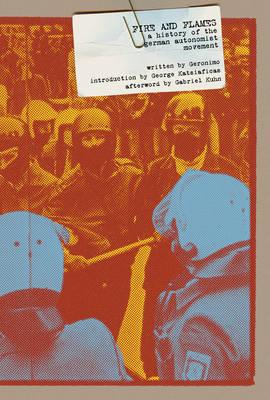
[Fire and Flames: A History of the German Autonomist Movement by Geronimo, Introduction by George Katsiaficas, Afterword by Gabriel Kuhn (2012: PM Press); Paperback; 256 pp; $19.95.]
My latest novel is situated in Frankfurt am Main in what was then West Germany (or the Bundesrepublik Deutschland for you German speakers). The time period is 1971-1972 and two of the main protagonists live in a squatted building across from the U.S. military’s Post Exchange.
This squat really existed. In fact, there were several squatted buildings in Frankfurt, especially in the part of the city known as the Westend. The squats served as living spaces and community meeting places. By 1973, they would become the site of some of the fiercest street battles ever seen in postwar Frankfurt. The battles took place because the police had been instructed to take the buildings back by the banks that owned them and the politicians that served those banks.
I mention this because I just finished reading a testament to the movement that grew up in the wake of the early 1970s squatting movement, the demise of the German New Left, and the rise of the West German terror groups like the Rote Armee Fraktion (Red Army Faction).
This testament, written by a participant in this movement who goes by the name Geronimo, is titled Fire and Flame. Originally published in Germany in 1990, it was translated from the original German in 2012 and published by the left/anarcho PM Press out of Oakland, CA.
The book is a brief survey of the numerous left and anarchist movements that characterized extraparliamentary West German politics in the 1970s until the end of East Germany in 1989. The squats, the red cell groups, the antinuclear movement, the Spontis, the Red Army Faction, and the alternative movement are presented and briefly discussed. In addition to relating stories of actions and events, Geronimo also discusses the politics of the different groups from what can best be termed a libertarian left perspective.
Unlike in the United States, the left libertarian and anarchist groups in Europe tend to have a clear understanding of how capitalism works. Instead of identifying as anti-capitalist without the theory to back that position up, the groups discussed in Fire and Flames (who would become known as Autonomen) usually professed their anti-capitalism in clear Marxist terms.
The areas where the Autonomen differed the most with Marxist organization, whether they were small and cadre-oriented like the Rote Zellen and the Rote Zora, or larger party organizations bearing the term Kommunistische somewhere in their name, was in how they organized. In short, the Autonomen were against leaders and against cooperation with the authorities. They expressed their politics through protest, lifestyle, and attitude. Naturally, this frustrated those with more long term goals.
Fire and Flames is introduced by George Katsiaficas, author of The Global Imagination of 1968 and several other books examining various protest movements around the globe, including his look at the European squatters’ movement of the 1980s.
The choice of Katsiaificas is an intelligent one. His approach to modern social movements extends well beyond a traditional Marxist-Leninist or anarchist understanding. The phenomenon he calls the “eros effect” is similar to what Immanuel Wallerstein calls “antisystemic movements.” While incorporating a Marxian analysis of capitalism and its history and its mechanics, both reject the approach to systemic change experienced in previous modern revolutions.
In other words, for these men the vanguardist model is dead. Meanwhile, both consider the changes in consciousness and culture brought on by the events of 1968 (and in Wallerstein’s thesis, 1848 as well) to be intrinsically revolutionary in a perhaps even greater sense than the bourgeois revolutions of the late 18th century and the Leninist ones of the 20th.
One of the most intense protests I ever attended was in spring of 1973. A German-American friend of mine had introduced me to a squatted set of apartments in the Westend of Frankfurt am Main. The main attraction for me was a small Gasthaus and meeting room on the ground floor of one of the buildings. I would occasionally visit the place to listen to music, drink beer, smoke hash, and maybe talk to a German girl.
That spring there was an impending sense that a showdown with the authorities was coming. The speculators who had purchased the buildings were tired of letting squatters live in them. They wanted to tear them down to build much more profitable office buildings. The Social Democratic city council was ready to cave and the Polizei were ready to kick ass.
I convinced myself that I was ready for whatever happened and took the streetcar to a stop near the protest that April weekend. The fight was already underway when I got off the tram. I lasted perhaps four hours and left when a couple hundred more cops arrived.
This protest was an early part of the movement described by Geronimo. From the squats to protests against nuclear power; from struggles against prison terror to rallies against abortion laws and more. This quick catalog of the West German street movements of 1968-1989 suffers from only one thing: its brevity. Thanks to PM Press for introducing it to the English-speaking audience.
[Rag Blog contributor Ron Jacobs is the author of The Way The Wind Blew: A History of the Weather Underground. He recently released a collection of essays and musings titled Tripping Through the American Night. His novels, The Co-Conspirator’s Tale, and Short Order Frame Up will be republished by Fomite in April 2013 along with the third novel in the series All the Sinners Saints. Ron Jacobs can be reached at ronj1955@gmail.com. Find more articles by Ron Jacobs on The Rag Blog.]
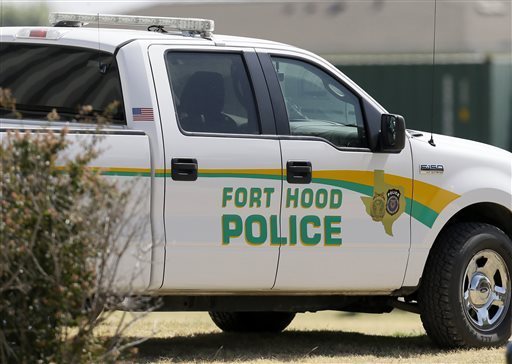 |
| Police car outside judicial hearing at Fort Hood, Texas, July 9, 2013. Photo by Tony Gutierrez / AP. |
Workplace violence:
Unfriendly fire at Fort Hood, Texas
I am gobsmacked by a particular elevation of form over substance being practiced before our eyes by the Army.
By Steve Russell | The Rag Blog | July 16, 2013
The Rag Blog‘s Steve Russell — a Texas trial judge by assignment and a member of the Cherokee Nation of Oklahoma — will hold a book signing event at Austin’s Black Star Co-op Brewpub, Thursday, July 18, 2013, from 4:30-7:30 p.m. He will sign his three books — Sequoyah Rising: Problems in Post-Colonial Tribal Governance, Wicked Dew, and Ceremonies of Innocence: Essays from the Indian Wars — and all three books will be available for purchase. The Black Star Co-op is located at 7020 Easy Wind Drive, Austin, Texas.
Meanings vary when people repeat that things can be done “the right way, the wrong way, or the Army way.” “The Army way” may represent teamwork so instinctive that orders are not necessary. For most GIs, “the Army way” is elevation of form over substance.
I am gobsmacked by a particular elevation of form over substance being practiced before our eyes by the Army. The substance began on November 5, 2009. My son was due back from his second tour in Iraq any day and the question in the family was whether he would be home for the holidays.
Ft. Hood is covered by local media in Austin, so when Maj. Nidal Malik Hasan walked into the Soldier Readiness Processing Center and opened fire, I was probably paying attention before the firing stopped. Where was Paul? Iraq? Kuwait? Or was he in SRP, though which every soldier passes being deployed or coming home?
My son was not in SRP, but of those who were, 13 died. The victims were soldiers ranging in age from 21 to 56 and in rank from PFC to Lt. Colonel, as well as one civilian, 62 year old Michael Cahill, who died trying to stop the shooter. The youngest soldier killed, PFC Francheska Velez, was pregnant, and the fetus also died. Another 31 soldiers were wounded by gunfire, along with civilian police Sgt. Kimberly Munley, who was wounded while exchanging gunfire with the shooter.
The shooter was seriously wounded in the gunfight with civilian police. While waiting for him to recover so he could be put on trial for mass murder, we learned that Maj. Hasan admired the teachings of Anwar al-Awlaki, the New Mexico born imam who had presided at his father’s funeral. Hasan and al-Awlaki had substantial email communication before the killings at Ft. Hood.
In March 2010, al-Awlaki released a statement complaining that the Obama administration was failing to credit him properly, saying in part:
Until this moment the administration is refusing to release the e-mails exchanged between myself and Nidal. And after the operation of our brother Umar Farouk the initial comments coming from the administration were looking the same — another attempt at covering up the truth. But Al Qaeda cut off Obama from deceiving the world again by issuing their statement claiming responsibility for the operation.
The “brother” referred to was Umar Farouk Abdulmutallab AKA “the underwear bomber” because he was inspired by al-Awlaki to attempt blowing up an airliner but succeeded only in lighting up his tidy whities.
A month later, to a chorus of criticism, Obama placed al-Awaki on the CIA “kill list.” His father filed a lawsuit to get him removed from the “kill list” on due process grounds, but the case was thrown out because the father lacked standing. al-Awaki himself would, of course, have had standing, but if he came to court, the reason he was on the list would disappear.
When al-Awaki was not directly counseling on how to kill Americans, he was overseeing the editing of Inspire, Al Qaeda’s English language organ where the Boston Marathon bombers allegedly read, “Make a Bomb in the Kitchen of Your Mom.” The criticism of Obama fired up again when a CIA drone strike nailed al-Awaki in September of 2011.
At the time of the drone strike, al-Awaki was hiding in the lawless areas of Yemen and a Yemeni court had issued a warrant for his arrest on terrorism charges. Obama is supposed to have violated his rights by putting him on the “kill list,” but the way I read the law, a violent felon who poses a continuing danger and cannot be arrested can be killed.
This is the case without regard to citizenship and across national borders in the sense that a violation of state sovereignty is a beef between governments, not between the U.S. government and the individual targeted. Further, the standard for deciding the fact of the matter — that he’s a continuing danger and can’t be taken into custody — is not “beyond a reasonable doubt.” It’s “probable cause,” or what a reasonable person would believe about the facts as they sit. If the target wants more facts developed and the reasonable doubt standard met, then he can come to court, where more process is due.
Therefore, the only reason there’s any more legal or moral problem with the drone strikes than with the cops shooting a fleeing robber or rapist is the secrecy. You can’t turn yourself in if you don’t know you are wanted. But secrecy was not an issue in al-Awaki’s case. I’m sure he considered himself a soldier who died on an active battlefield, which is highly ironic given that the whole argument about the unlawfulness of drone strikes turns on claiming there was no active battlefield where he was killed and therefore he was simply assassinated.
But I digress.
After Hasan became physically able to come to court, the first military judge assigned to the case elevated form over function by engaging in a six-month battle with a dead man over shaving his full fundamentalist Muslim beard.
Nidal Hasan is a dead man rolling, since he can no longer walk as a result of his gunshot wounds. Apparently proud of his “accomplishment, “ he wished to plead guilty, but the Army won’t allow a guilty plea in a capital case and the prosecutors won’t waive the death penalty.
Those of us who oppose the death penalty can’t make an exception for Hasan like most of us did for Osama bin Laden, because Hasan would not be a hostage magnet if allowed to live in custody. But the posture of the case is what it is, and if you want to attack the death penalty, Nidal Hasan is not your poster child.
Since there is no question that Hasan did the shooting, the lawyers tasked with defending him must bring forward evidence of his mental state — a complete defense if he’s legally insane or a mitigating circumstance if he’s sane. Understandably, Hasan does not wish to litigate his mental state, so he fired his lawyers.
Hasan informed the new and more goal-directed judge that he wishes to argue that his conduct was justified as “defense of third parties.” What third parties? Mullah Omar and the rest of the Taliban.
This will not fly because the soldiers murdered were not about to harm Mullah Omar, among many other reasons. One of the more interesting reasons is that a defender of a third party can have no more right to use deadly force than the third party would have had. Nidal Hasan is stretching for some way to put the Afghanistan war on trial, since the force he was allegedly defending against would have to be “unlawful.”
U.S. soldiers are taught that they must refuse unlawful orders, and I remember no war in my lifetime when somebody did not refuse deployment for the purpose of making a court rule on the legality. They lost, but they got to make the argument. I don’t think you can raise that argument as a justification for shooting fellow soldiers.
I understand why we generally don’t let people plead guilty in a death penalty case. We want to see the evidence. We don’t want innocent persons executed even if they volunteer to save guilty persons. In the Hasan case, that can’t happen.
Not accepting his guilty plea turns the “trial” into a slow motion guilty plea and a political circus. I’m OK with the political circus part, having been the ringmaster of several. It’s the nature of our system that trials are political, even though many of us try to pretend otherwise. But I am offended by a slow motion guilty plea.
Meanwhile, the Army has categorized the shootings as “workplace violence” rather than terrorism. There are substantial benefits for the families of soldiers killed or wounded in combat. These benefits are not available to the soldiers who signed up to fight the “war on terror” and then got shot by a turncoat whose stated purpose was to protect the enemy from his fellow soldiers on the instructions of a radical imam who repeatedly called killing Americans a religious duty.
Had my son been in the SRP that day, I would have to sue the Army for the good of my daughter in law and my grandchildren. Because he wasn’t, I’m just another opinion from the cheap seats when I say that respect for the law is the right way, but denying benefits to the victims’ families is the wrong way, and this entire process is making a mockery of the Army way.
[Steve Russell lives in Sun City, Texas, near Austin. He is a Texas trial court judge by assignment and associate professor emeritus of criminal justice at Indiana University-Bloomington. Steve was an activist in Austin in the sixties and seventies, and wrote for Austin’s underground paper, The Rag. Steve, who belongs to the Cherokee Nation of Oklahoma, is also a columnist for Indian Country Today. He can be reached at swrussel@indiana.edu. Read more articles by Steve Russell on The Rag Blog.]
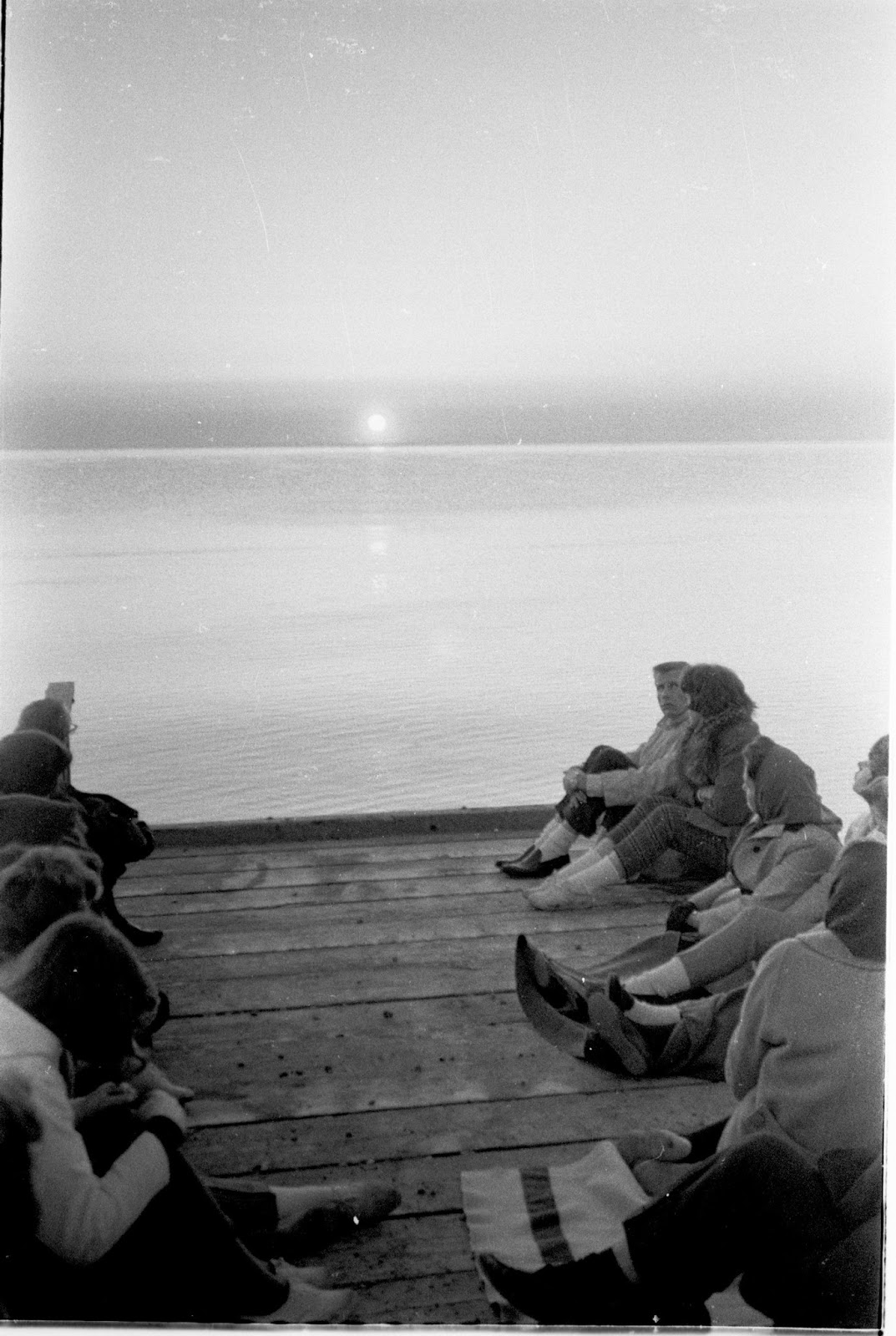 |
| Sunrise on Lake Michigan, 1961. Photo by Michael James from his forthcoming book, Michael Gaylord James‘ Pictures from the Long Haul. |
Pictures from the Long Haul:
Sunrise on Lake Michigan,
Lake Forest, Illinois, 1961
In Chicago I am introduced to Polish sausages at a hot dog stand on North Avenue by Bill “Notso” Smart, who also took me to a strip club in Calumet City. I visit the Art Institute and I start going to jazz and blues clubs on the South Side.
By Michael James | The Rag Blog | July 14, 2013
[In this series, Michael James is sharing images from his rich past, accompanied by reflections about — and inspired by — those images. This photo will be included in his forthcoming book, Michael Gaylord James’ Pictures from the Long Haul.]
There I was 33 miles outside Chicago, learning, meeting, hearing, and seeing so many new things. Yet the most dominant theme-issue-memory of my first year at Lake Forest College is of being 948 miles away from my girlfriend Susan who was at U Conn — not Siberia, but seemingly so.
I too wanted to go to U Conn, but my dad encouraged (forced) me to go to “away to school,” away from my Connecticut homeland. His influence is why I had driven to California in the summer of 60, instead of staying home close to my team dream girlfriend.
We called each other regularly; we wrote each other almost daily, and to this day I have a giant envelope of letters Sue returned many moons back. Someday I may read them.
The Phi Deltas got me a job washing dishes at Lake Forest Academy, a private school for bourgeois lads. This was where influential trumpeter and jazz legend Bix Beiderbecke had been sent off to school from Davenport back in the 1920’s, and from where he snuck out of to go to Chicago to make music.
And on another musical note, the Academy was not far from a bar out on Illinois Route176 that older guys on the football team took me to. A Black woman performer sang a song with the unforgettable line “who put the sand in the petroleum jelly?”
Later I took a job as an assistant counselor at Arden Shore, a home for gifted boys with behavioral and emotional problems. My dormmate was David George, an ex-Marine from a pottery making family in Canonsburg, Pennsylvania. He helps me get over my dislike of cheese, and we make many a grilled cheese sandwiche late at night in the cafeteria. And he teaches me to drink my coffee black.
In search of a gym off campus I make my way north, past the Great Lakes Navel Training Center (years later I’ll help organize a demonstration at a park nearby, SOS — Stop our Ships, Save Our Sailors!). I go past Abbott Labs in North Chicago (an incubator for high drug prices) ending up at the Waukegan YMCA.
I am a product of YMCA activities. I have a letter of introduction from the Director of my hometown Y. I will do a sociology paper at LFC on the YMCA as and Occupational Institution.
Ahh, but the Waukegan YMCA is segregated. I check out and then get a part time job instructing weight lifting and working with little kids at the all-Black (except now for me) Genesee Street Branch YMCA in North Chicago.
Venturing further off campus I go to the Friday afternoon cattle auctions further west out on Route 176, and join others on a run to Madison where we drink beers in the Student Union. I head to Grinnell, Iowa, and visit my hometown friend and writer Ken Schiff during a folk fest at Grinnell College. I remember the legendary “Blind” Reverend Gary Davis pinching a coed’s ass.
In Chicago I am introduced to Polish sausages at a hot dog stand on North Avenue by Bill “Notso” Smart, who also took me to a strip club in Calumet City. I visit the Art Institute and I start going to jazz and blues clubs on the South Side.
There was the Wonder Inn where wordsmith Ken Nordine performed his “word jazz,” and the Sutherland Lounge where I am thrilled by the likes of Sonny Stitt, Gene Ammons, and the amazing Roland Kirk who played multiple instruments at once, including strange saxophones, the stritch, and the manzello.
Reading Downbeat Magazine I learn of “Crow Jim,” reverse segregation in jazz circles. The article says that the phenomenal Ira Sullivan, who played with Charlie Parker, cannot get a gig. I start working on a sociology paper: “The Socialization of the Negro Jazz Musician.”
On a Saturday on Chicago’s Near North Side I talk with Sullivan at his home. I am still in a time in my life where you dress up and I am wearing a sport jacket and tie. Sullivan seemed preoccupied, and he and others were probably high. I asked questions; he did not bad mouth any Black brothers, basically dismissing the issue.
At McKey Fitzhugh’s Disc Jockey Show lounge on Cottage Grove I try and talk with drummer Chico Hamilton, who basically laughed me off. (I still play his music.) At another club I met Johnny Hartman who would later sing beautiful vocals with John Coltrane.
The U.S. Marine recruiters show up on campus. I wanted to be a Marine, years earlier practicing crawling around on my stomach in kid war games, and learned to play “From the Halls of Montezuma” on the piano. I signed up for their Platoon Leader’s Corp, the plan being that I would spend summers training at Camp Lejeune in North Carolina and then serve two years as an officer in that fighting force.
However, an event on campus began to move me in another direction. There was something going on in the World called the San Francisco to Moscow Peace March. The American Friends Service Committee (AFSC), an outfit that I was being introduced to while checking out religion (Unitarians, Bahia, Quakers, etc.), sponsored a two-day peace walk in March of 1961.
A scraggly band of beatnik types showed up on campus, and I talked with them about peace and atomic testing. I credit this encounter with encouraging me to move in a new direction. I never did follow through and become a member of the Marine Corps and I am grateful for that.
I was still missing Susan and began trying to transfer to a school back East. She came to visit and I was happy. I photographed her smoking a cigar on the same morning we attended an Easter morning sunrise service at the Lake Forest beach.
Yet when I visited her a short time later in Storrs, Connecticut, that was not fun. She was becoming friendly with my childhood pal Doug Fenton’s roommate. I took solace in following my 4H club instincts, visiting the campus’s dairy barns.
Another major and transformational shift-event in my life was about to take place.
[Michael James is a former SDS national officer, the founder of Rising Up Angry, co-founder of Chicago’s Heartland Café (1976 and still going), and co-host of the Saturday morning (9-10 a.m. CDT) Live from the Heartland radio show, here and on YouTube. He is reachable by one and all at michael@heartlandcafe.com. Find more articles by Michael James on The Rag Blog.]
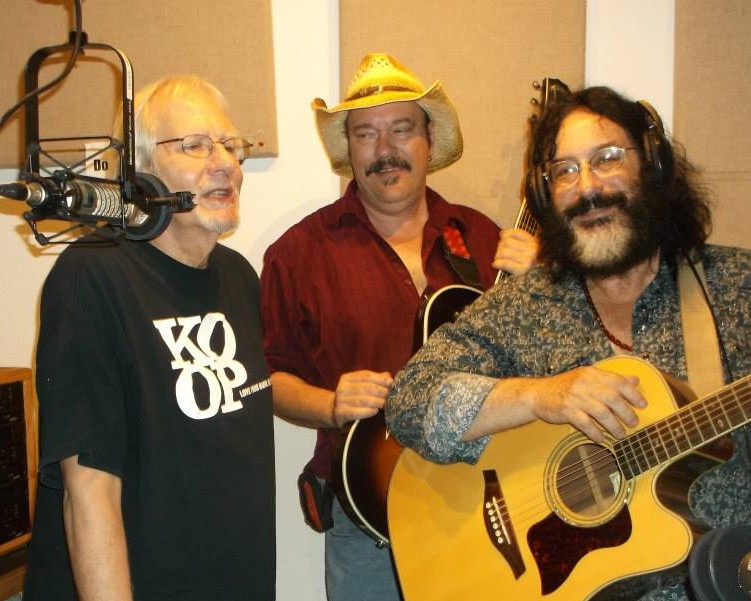 |
| Rag Radio’s Thorne Dreyer, left, with Billy Bourbon and Guy Schwartz in the studios of KOOP-FM in Austin, Texas, July 5, 2013. Photo by Marlo Blue / The Rag Blog. |
Rag Radio podcast:
Houston rock and blues artist
Guy Schwartz with band
Houston’s Guy Schwartz — whose bands have included Relayer, Z-Rocks, the New Jack Hippies, and the Austin-based Guy Schwartz & the Affordables — was called the ‘Godfather of the local music scene’ by the Houston Press.
By Rag Radio | The Rag Blog | July 14, 2013
See video of the show below.
Houston rock and blues musician Guy Schwartz was Thorne Dreyer’s guest — in interview and performance — on Rag Radio, Friday, July 5, 2013. Schwartz was joined on the show by Marlo Blue of Houston’s KPFT-FM and was backed by musicians Billy Bourbon, Roger Tausz, and Rick Lyon.
Rag Radio is a syndicated radio program produced at the studios of KOOP 91.7-FM, a cooperatively-run all-volunteer community radio station in Austin, Texas.
Listen to or download this episode of Rag Radio here:
Guy Schwartz has played with music legends ranging from Lightnin’ Hopkins and B.W. Stevenson to Lionel Hampton and The Monkees. and his groups have included the progressive underground band, Relayer, formed in 1977; the power-pop band Z-Rocks, started in 1980; the New Jack Hippies, which toured the U.S. and Western Europe from 1999-2004 and still perform regionally in Texas; and the Austin-based Guy Schwartz and the Affordables.
Noting his continuing work on behalf of Houston musicians, the Houston Press called Schwartz “the Godfather of the local music scene.”
Schwartz also produces a cable-television show on Texas music and musicians, and is producer and creator — with Marlo Blue — of the annual Houston indie music and video festival, South By Due East. Schwartz and Billy Bourbon recently recorded the album, Weed at Walmart.
Rag Radio is hosted and produced by Rag Blog editor and long-time alternative journalist Thorne Dreyer, a pioneer of the Sixties underground press movement.
The show has aired since September 2009 on KOOP 91.7-FM, an all-volunteer cooperatively-run community radio station in Austin, Texas. Rag Radio is broadcast live every Friday from 2-3 p.m. (CDT) on KOOP and is rebroadcast on Sundays at 10 a.m. (EDT) on WFTE, 90.3-FM in Mt. Cobb, PA, and 105.7-FM in Scranton, PA.
 The show is streamed live on the web by both stations and, after broadcast, all Rag Radio shows are posted as podcasts at the Internet Archive.
Rag Radio is produced in association with The Rag Blog, a progressive Internet newsmagazine, and the New Journalism Project, a Texas 501(c)(3) nonprofit corporation. Tracey Schulz is the show’s engineer and co-producer.
Rag Radio can be contacted at ragradio@koop.org.
Coming up on Rag Radio:
THIS FRIDAY, July 19, 2013: Sociologist, media critic, and author Todd Gitlin.
 |
| Gamal Abdel Nasser emerged as a powerful charismatic figure in Middle East politics. Image from The Majalla. |
Egypt, popular uprisings, and complexity
of 21st century social movements
On one side are those who remember military coups supported by the United States all around the world. On the other, the case can be made that each rupture in a society must be understood in its own historical context.
By Harry Targ | The Rag Blog | July 13, 2013
Egyptian history
Egypt secured its formal independence from British colonial control in 1922. Nevertheless, the British continued to dominate Egyptian military and political life until 1952 when the “Free Officers” Movement led by Gamal Abdel Nasser launched a coup that toppled King Farouk, the British man in Egypt.
Following Egypt’s real independence Nasser emerged as a powerful charismatic figure in Middle East politics, seeking to create a zone of “Arab Socialism.” He established economic and political ties with the former Soviet Union, initiated efforts to construct a “United Arab Republic” with Syria, and militarily opposed former European colonial powers and Israel in reference to control of the Suez Canal in 1956 and the “Six Day War” against Israel in 1967.
Nasser died in 1970 and his successor Anwar El Sadat led the Arab assault on Israel in the Yom Kippur War of 1973.
Before Sadat was assassinated in 1981, Egypt reversed course, ending ties with the Soviet Union; tilted toward the West; signed the Camp David Accords with Israel under the tutelage of President Jimmy Carter; and began its long-term relationship with the United States, despite anger from the Arab world.
Egypt became one of the major recipients of United States military assistance from 1980 to the present (receiving $1.3 billion per annum). By the 1980s, the Egyptian military gained control of a large portion of the economy of the country. After Sadat’s assassination Hosni Mubarak, the third leader from the military, began his 30-year rule.
Arab Spring, the massive street mobilizations in the Middle East which started in Tunisia in January 2011, quickly spread to Egypt and elsewhere in the region. These revolts had large representations from the working class, youth, and women and others demanding democratization.
As a result of the revolt in Cairo’s Tahrir Square in February 2011, the military stepped in to replace the former dictator, Hosni Mubarak, to stabilize a country on the verge of fundamental social and economic change; established an interim military government; and constructed a new constitution that would mollify protestors, provide for elections, and at the same time would maintain its own institutional power.
Elections were held in 2012 and Muslim Brotherhood candidate Mohammed Morsi was elected president. In the year Morsi served as Egyptian president, he declared the presidency’s ultimate power over the courts, used his position to expand the influence of the Muslim Brotherhood over the political system, repressed the 10 percent of the population affiliated with the Coptic Christian Church, stalled efforts to expand the rights of women in Egyptian society, and most recently declared Egypt’s full support of the rebels fighting against the government of Syria.
Two weeks ago a movement of young people calling themselves the rebels (the Tamarrud) circulated a call to rally in Tahrir Square. On June 30, a massive mobilization (some say the largest in modern history) was launched demanding the ouster of Morsi from office. The military issued a statement urging the Egyptian president to achieve some sort of compromise with the protestors and, when he refused, they carried out a coup putting in place an acting president. Subsequent to the coup there have been massive mobilizations in opposition to and in support of Morsi.
Economic context
In a recent article in The Guardian (July 4, 2013), Dr. Nafeez Ahmed, executive director of the Institute for Policy Research and Development, scholar and reporter, discussed the state of the Egyptian economy.
Generally he characterized the Egyptian economic policy embraced at least since the 1990s as involving “structural failures rooted in an unsustainable global model of industrial civilization — addicted to fossil fuels, wedded fanatically to casino capitalism, and convinced, ostrich-like, that somehow technology alone will save us.”
Ahmed pointed out that oil production has declined by 26 percent since 1996 and a once food sustaining economy now requires the importation of 75 percent of its wheat. Inflation has increased in recent years, particularly regarding the price of food. Egyptian debt constitutes over 80 percent of GDP and the Egyptian government began to institute neoliberal structural adjustment policies in the 1990s. The population has experienced declining safety net policies and generalized programs of austerity as experienced elsewhere in the world.
Meanwhile, financial support of the military remains unchanged. Austerity programs and increased taxes have been designed to get approval for a new $4.8 billion IMF loan. And most critical, “with 40 percent of Egyptians already below the UN poverty line of less than 2 pounds a day, Morsi’s IMF-inspired policies amounted to a form of economic warfare on the Egyptian people.”
What Now?
Debate about the legitimacy of the ouster of Morsi from office has begun to occur within the peace movement. On one side are those who remember, with good reason, military coups supported by the United States all around the world.
The brutality of the U.S.-sponsored coup in Chile on September 11, 1973, comes to mind. The Chilean people suffered from a brutal dictatorship leading to thousands of assassinations and people “disappeared,” the end to formal democracy, the crushing of trade unions, and the imposition of a brutal program of neoliberal economic policies that increased economic inequality, reduced the quality of life of most Chileans, and conformed to the dictates of the transnational capitalist class.
On the other hand, the case can be made that each rupture in a society must be understood in its own historical context.
The historic role of socialist organizations and visions remains critical to 21st century social transformations. But the programmatic character of contemporary mobilizations; the inspirational connectivity of movements across borders, classes, genders, and races; and the recognition by participants that each is part of a historic process may be somewhat new.
Social movements today often see the need to “compromise” with institutions such as the military to advance the condition of the people. At the same time, as the movement in Egypt suggests, they remain mindful of the limitations of alliances of convenience.
Therefore, there are lessons from Egypt for the peace movement in the United States. Peace activists should analyze moments of instability and change in their historical, economic, cultural, and political complexity. They need to assess specific situations to understand which social forces are more likely to represent the values that they support.
Then in each concrete case they should ask how activism in the United States can best support the just struggles of 21st century social movements.
[Harry Targ is a professor of political science at Purdue University and is a member of the National Executive Committee of the Committees of Correspondence for Democracy and Socialism. He lives in West Lafayette, Indiana, and blogs at Diary of a Heartland Radical. Read more of Harry Targ’s articles on The Rag Blog.]
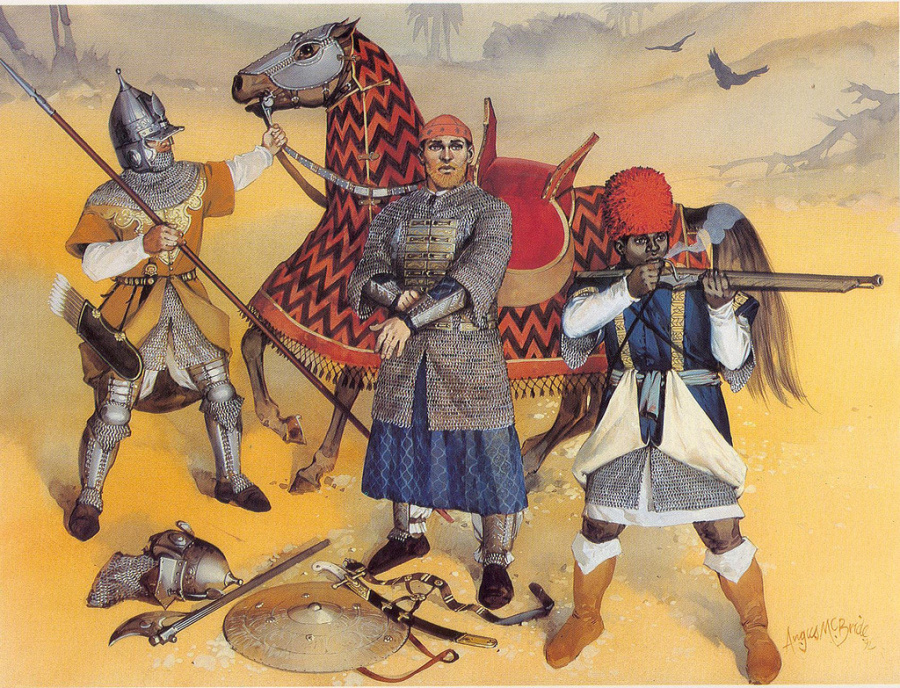 |
| Egyptian Mamluk warriors serving in the Ottoman Empire in the 16th century. Image from The Lost Treasure Chest. |
A people’s history:
The movement to democratize Egypt
Part 2: 641-1805 period — Egypt under many rulers.
By Bob Feldman | The Rag Blog | July 11, 2013
[With all the dramatic activity in Egypt, Bob Feldman’s Rag Blog “people’s history” series, “The Movement to Democratize Egypt,” could not be more timely. Also see Feldman’s “hidden history” of Texas series on The Rag Blog.]
Egypt became part of the Islamic Arab Empire in 641 when Arab armies replaced Egypt’s Byzantine Empire rulers “thanks in part to aid from the indigenous [Egyptian] population of Coptic Christians,” according to Egypt from Independence to Revolution, 1919-1952 by Selma Botman.
But the indigenous Coptic Christians in Egypt eventually became a religious minority, as Egypt was Arabized and Islamized. And by 834 Egypt was an autonomous state of the Baghdad-based Islamic Arab Empire, which generally permitted it to be ruled by a locally-based elite of Turkish ethnic background.
In 969, however, the religious leaders of a Tunisia-based Shiite Islamic sect, the Fatimids, moved their troops into Egypt from western North Africa, started construction of the new city of Cairo and began ruling Egypt until 1171.
Between 1171 and 1250, Sunni Islamic religious leaders next ruled Egypt. And then, between 1250 and 1517, the Mamluks — a military dynasty of former soldier-slaves of mostly ethnic Turkish or Caucasian origin — were the rulers of the autonomous state of Egypt. And it was during the period when the Mamluks controlled Egypt that the bubonic plague spread from Europe to Egypt in 1347; and, by 1349, the plague had caused the death of 33 percent of the people who had lived in Egypt in 1347 and damaged the economic base of the Mamluk regime.
Then, in the 15th century, “another serious blow to the Mamluk economy came…when the Portuguese found the ocean route around Africa, providing Europe with a direct connection to India, the Far East, and the east coast of Africa, disrupting the Mamluks’ lucrative Red Sea trade and diminishing the importance of Egypt as a commercial connection between the Mediterranean and the Red Sea,” according to Jason Thompson’s A History of Egypt.
But after the better organized, more disciplined, more numerous, and better-armed troops of Turkey’s Ottoman Dynasty defeated the Mamluk forces in the August 1516 Battle of Marj Dabiq in Syria and marched into Egypt in 1517, Egypt became a subject Arab province of Turkey’s Ottoman Empire for most of the next 400 years.
Yet as The Rough Guide To Egypt observed, “even after the Turkish conquest, the Mamluks remained powerful figures in the administration of what was now a province of the Ottoman Empire” and “the Mamluk army continued to grow with the import of Caucasian slaves.”
According, to A History of Egypt:
One can speak of a neo-Mamluk system that prevailed within Ottoman Egypt… The neo-Mamluks…quickly reinserted themselves into Egypt’s overall military establishment and again became the most powerful force in the land….. The Ottomans basically kept the commanding heights under their supervision, but left many administrative tasks to…religious endowments, or waqfs… About 20 percent of the land was religiously held by the end of the 18th century. The Mamluks…continued to control much of the rest.”
As a province of the Ottoman Empire, Egypt was exploited as a “breadbasket” and a “land tax” source for the Turkish imperial government’s treasury; and “Egypt also provided a valuable base for Ottoman operations in the Red Sea,” according to the same book.
But between July 1798 and September 1801, Napoleon’s French troops temporarily occupied Egypt until UK troops and Ottoman troops jointly recaptured Egypt for Turkey’s Ottoman Empire in 1801. A new local ruler, a Turkish military officer named Muhammad Ali, was then appointed as viceroy/governor/pasha of Egypt by the Turkish government in Istanbul in July, 1805; and the royal dynasty in Egypt which he founded governed Egypt — usually as puppet rulers for foreign imperialists — until 1952.
[Bob Feldman is an East Coast-based writer-activist and a former member of the Columbia SDS Steering Committee of the late 1960s. Read more articles by Bob Feldman on The Rag Blog.]

Waldman’s film and TV
treasures you may have missed:
Martin Clunes, terrific as a crabby, small-town doc who’s afraid of blood, is supported by a wonderful cast playing loony locals.
By Alan Waldman | The Rag Blog | July 9, 2013
[In his weekly column, Alan Waldman reviews some of his favorite films and TV series that readers may have missed, including TV dramas, mysteries, and comedies from Canada, England, Ireland, and Scotland. Most are available on DVD and/or Netflix, and some episodes are on YouTube.]
Doc Martin, now shooting its sixth charming season, is popular in more than 30 countries around the world, including Slovenia and Saudi Arabia. Foreign-language adaptations have aired in Germany, France, Spain, The Netherlands, and Greece — and Russia may be next. So far, 39 episodes have aired in the U.S. since 2004, and re-runs can often be seen on local PBS stations. Mine shows them on Saturday evenings.
Martin Clunes is Martin Ellingham (his surname’s an anagram for the name of creator Dominic Minghella), a London surgeon who develops a phobia to blood and who relocates to the picturesque Cornwall Village of Port Wenn, becoming the area’s general practitioner. He is gruff, intolerant, and rude to people, but over time he develops a relationship with, marries, and has a child with local headmistress Louisa Glasson (Caroline Catz).
 |
| Martin Clunes and Caroline Catz. |
The community is full of quirky, amusing characters, including a plumber-turned-restaurateur (Ian McNeice), his son (Joe Absolom), Martin’s aunts (Stephanie Cole, followed by Dame Eileen Atkins), local cops, and a series of three dippy receptionists, among others.
Doc Martin won the British Comedy Award and was nominated for 10 other honors — eight for Clunes as Best Actor or Most Popular Actor. The series’s huge popularity may be due to its combination of character comedy and medical drama. The final episode of Season 3 attracted a massive audience of 10.37 million people.
All episodes are on DVD, Netflix, and Netflix streaming, and most are on YouTube. Here’s one. See why millions around the world love this funny, odd-ball series.
Clunes is truly delightful in Doc Martin, and as I mentioned in a previous review, he is hilarious in the wonderfully madcap TV series Reggie Perrin.
[Oregon writer and Houston native Alan Waldman holds a B.A. in theater arts from Brandeis University and has worked as an editor at The Hollywood Reporter and Honolulu magazine. Read more of Alan Waldman’s articles on The Rag Blog.]
 |
| First quarter moon at dusk. Photo by A.K.Entingh / AccuWeather.com. |
Moon Musings:
First Quarter Moon
(July 9–11, 2013)
By Kate Braun | The Rag Blog | July 9, 2013
“Grow, grow, within and without; moving forward is what I’m about; strength is mine, honor is mine, success is mine, all will be fine.”
First quarter moons are times to start projects, both those you expect to finish within a month and those that will take longer. The focus should be on growth, be it of income, savings, information, knowledge, or whatever you have growing in your garden. If you are still planting things in the garden, this is the time to plant above-ground crops.
While preparing your magickal site, nibble on spicy foods such as tamales and nachos; they will help accelerate your energies. Ripe pears and a good blue cheese also make a delicious and nourishing snack. Drinking tea, fruit punch, and water is recommended, but don’t let yourself become so heavy with food to digest that you lose your spiritual focus.
If you choose to celebrate on Tuesday, July 9, Mars rules the day and will be helpful with developing courage and protecting property. Use the color red, incorporate the element Fire, and repeat your chant five times. You may also invoke Thor’s help. The day is named for him.
If Wednesday, July 10, is your preferred day to celebrate, Mercury is the planet to keep in mind while making your preparations. Use the color yellow and make sure you feel air moving across your body as you repeat your chant eight times. This will be easy if you are outdoors. If you stay inside, turn on a fan. This is a day to focus on career matters most of all. It is also Odin’s day, so you may invoke him or any deity associated with paternal leadership to assist you.
If Thursday, July 11, is when you opt to celebrate, the ruling planet is Jupiter, the planet of expansion. Listening to energizing music with a bouncy beat as you create your site will help keep positivity around you. Make magick regarding money and legal matters. Use the color blue, the element Water, and repeat your chant four times.
Keep your chant simple and to-the-point. You create whatever words most accurately indicate your intentions. Here is a suggestion: “Grow, grow, within and without; moving forward is what I’m about; strength is mine, honor is mine, success is mine, all will be fine.”
Notice that whatever day you pick for your celebrations, masculine energies will be dominant. Call on them to help get your projects off to a good start. Rev the engines, so to speak, and hit the ground running. When momentum is well-built, then you can relax and coast.
Before you put away your tools and decorations, I recommend you take a moment to reflect on what you have just manifested. Hold the image of your finished projects in your mind. Breathe deeply. Feel the sense of accomplishment that is sure to come. Then you may find it helpful and balancing to recite:
May I be at peace;
May love live in my heart;
May I awaken to the light of my own true nature;
May I be open to the positive changes begun today;
May the love within me flow to all living beings.
[Kate Braun‘s website is www.tarotbykatebraun.com. She can be reached at kate_braun2000@yahoo.com. Read more of Kate Braun’s writing on The Rag Blog.]
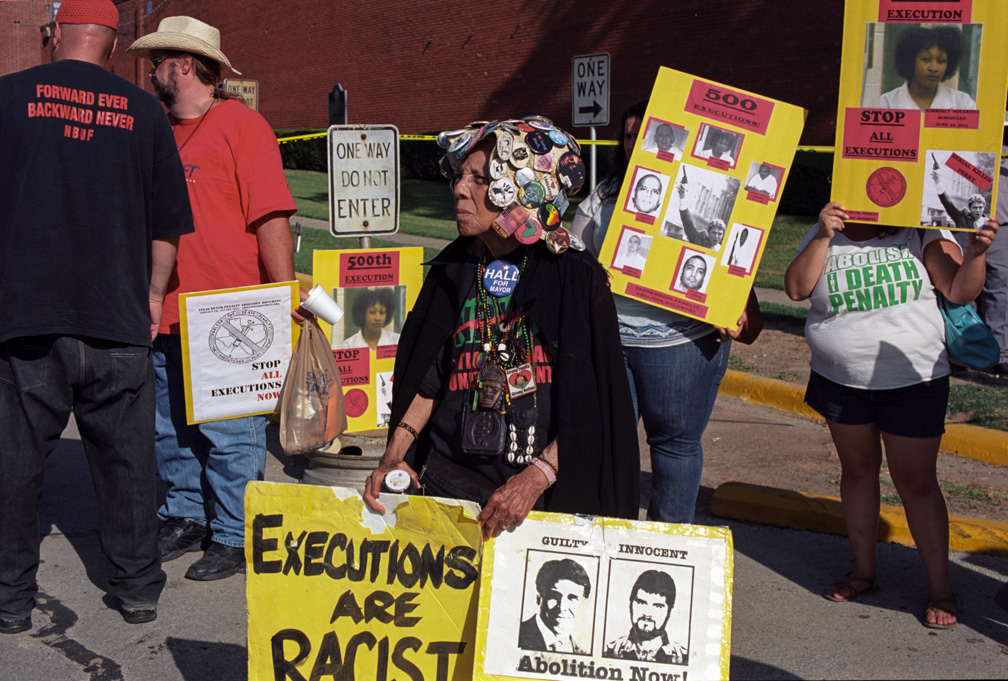 |
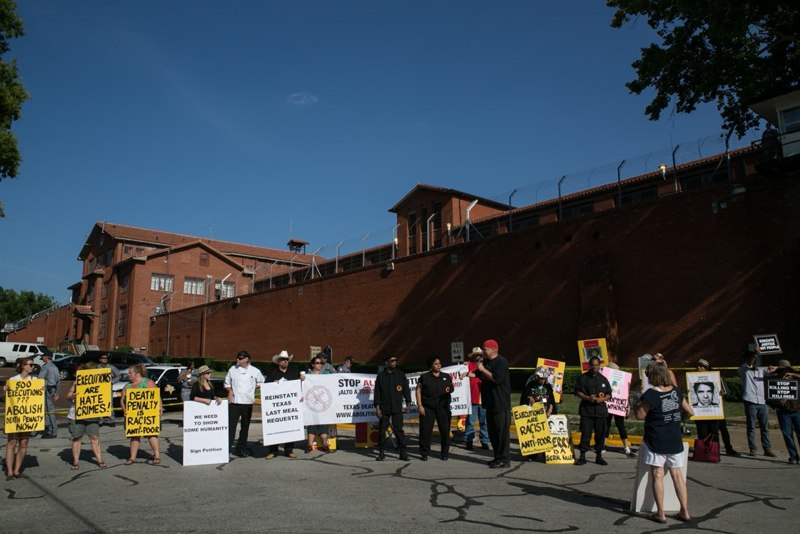
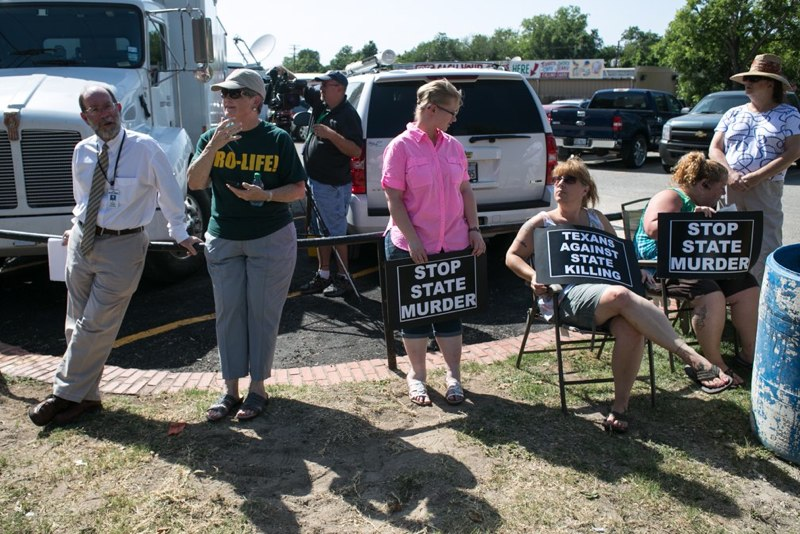
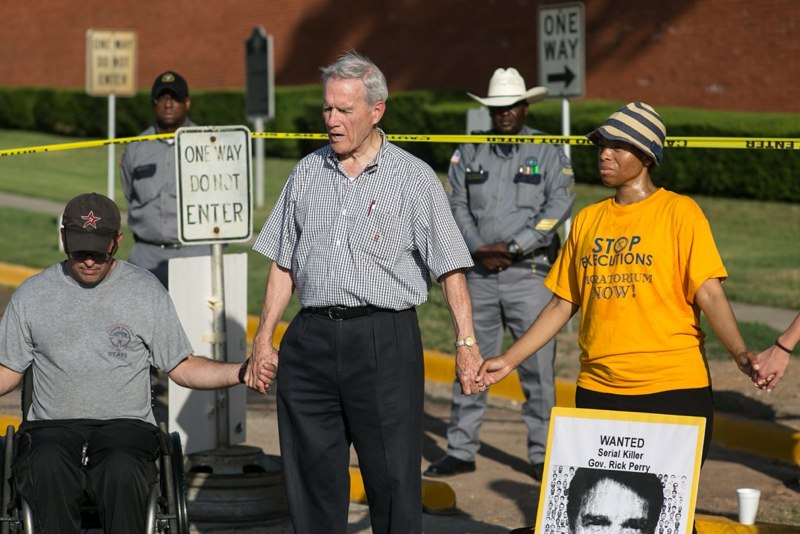
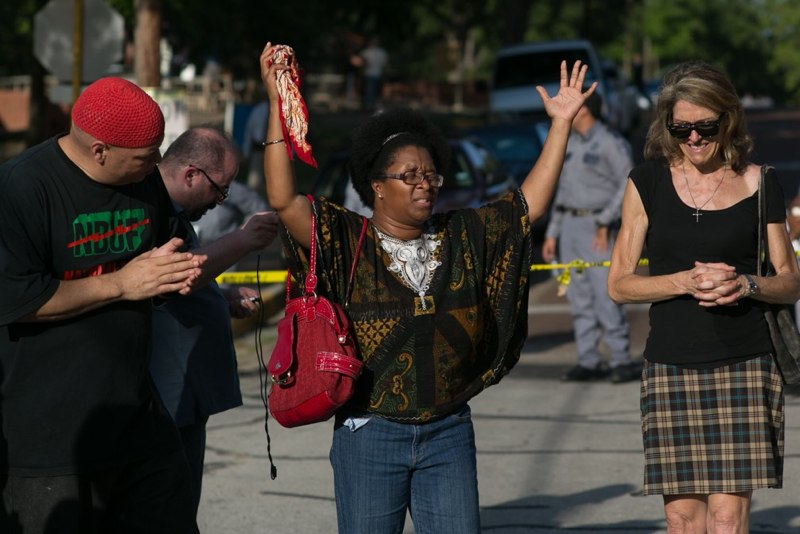
| Demonstrators protest the death penalty at the Huntsville Unit in Huntsville, Texas, Wednesday, June 26, 2013. Kimberly McCarthy was put to death, the 500th execution by the State of Texas. Photo by Otis Ike / The Rag Blog. |
Pictures at an execution:
Texas hits the 500 mark
I felt like a player without a team, an interloper, an uninvited party guest. Nothing felt portentous or grave, just awkward.
By Laura Lark | The Rag Blog | July 8, 2013
See gallery of photos by Otis Ike, Below.
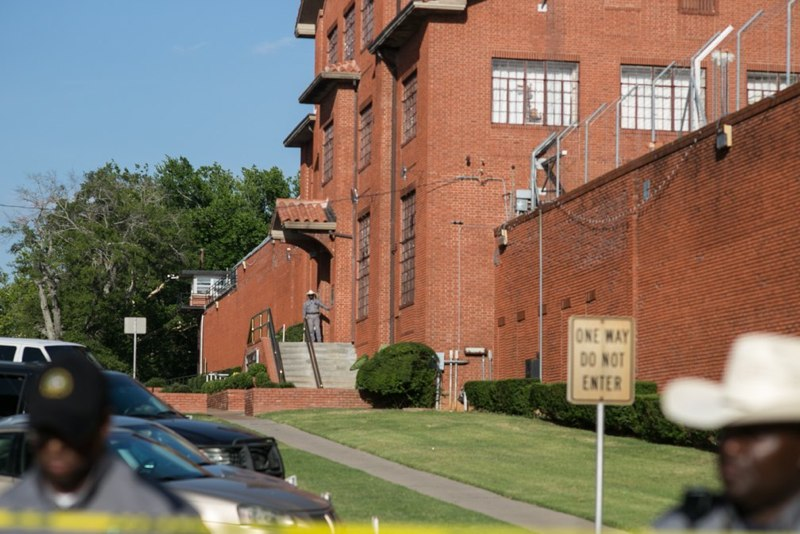
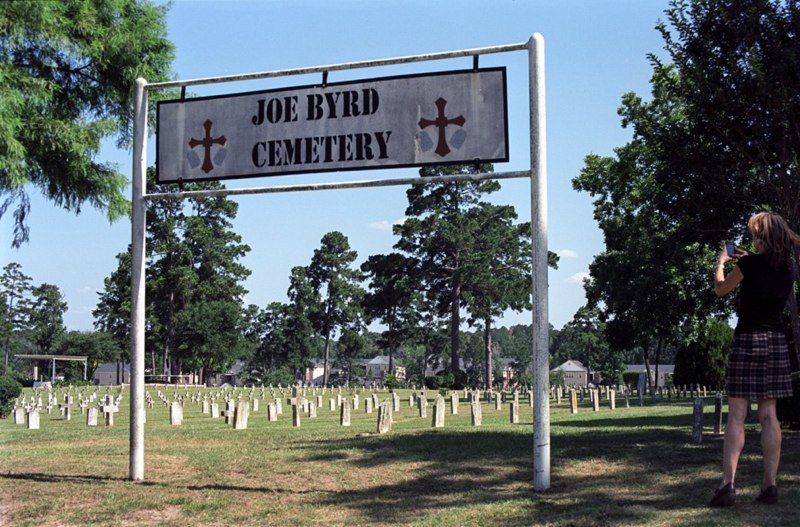
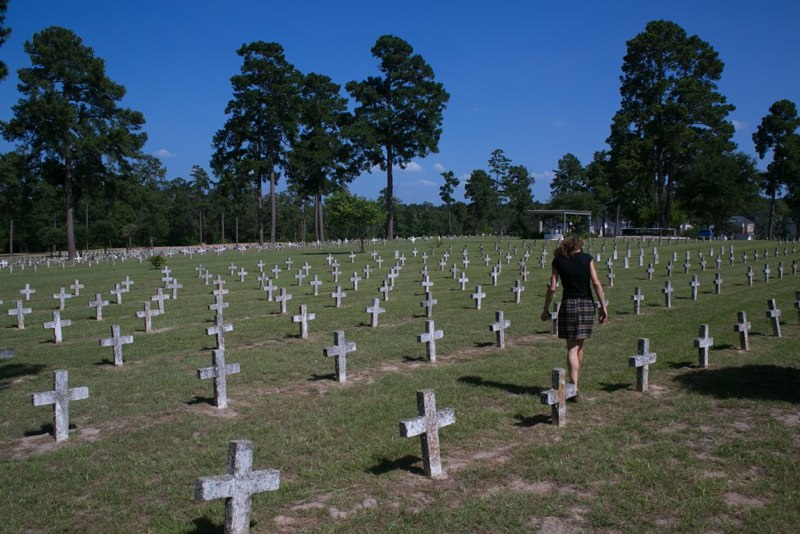
HUNTSVILLE, Texas — It seems that Kimberly McCarthy’s execution by lethal injection at Huntsville State Penitentiary should have been a more, well, special occasion. It was, after all, a record-breaking 500th execution in the state of Texas, and McCarthy’s credentials: female, African-American, the ex-wife of a Black Panther — lent the affair everything it needed for a truly charged and politicized scene.
Patrick Bresnan and I, both residents of nearby Houston, expected something extreme. Maybe sinister. Violent. Redemptive.
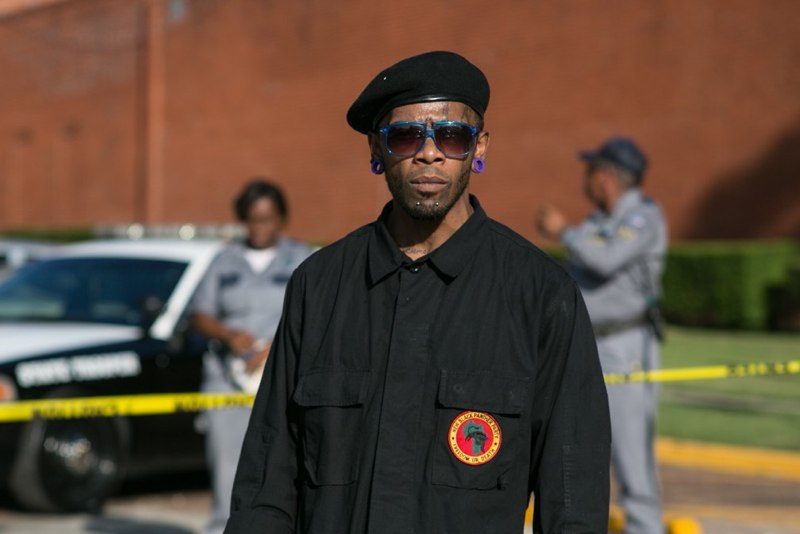
It was, rather, despite the presence of a few megaphone-wielding Panthers decrying white devils, Rick Perry, in particular, the protesting on the anti-death penalty side was pretty lackluster.
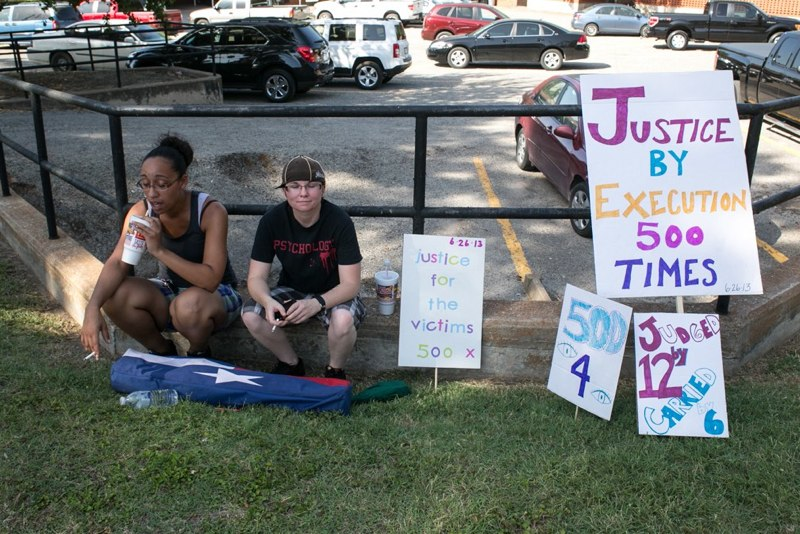
The five women on the pro-death penalty side weren’t much more interesting, either, and it was an odd mix: a biracial lesbian couple from Houston, the wife of a corrections officer, her mother-in-law, and her little girl.
“It’s her second execution,” the woman beamed, bouncing her fat, pink-and-white-frocked child on one hip.
The kid was two and probably ready for a nap. I nodded, looking back and forth from one self-satisfied face to the next.
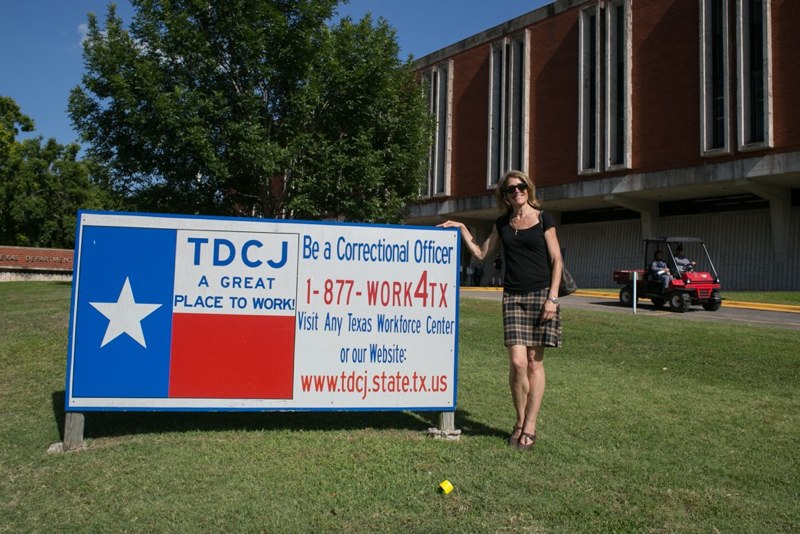
I felt like a player without a team, an interloper, an uninvited party guest. Nothing felt portentous or grave, just awkward. Walking back and forth from one side to the other, I had my photo taken near the “Be a corrections officer!” recruitment sign a few times.
It seemed fitting.
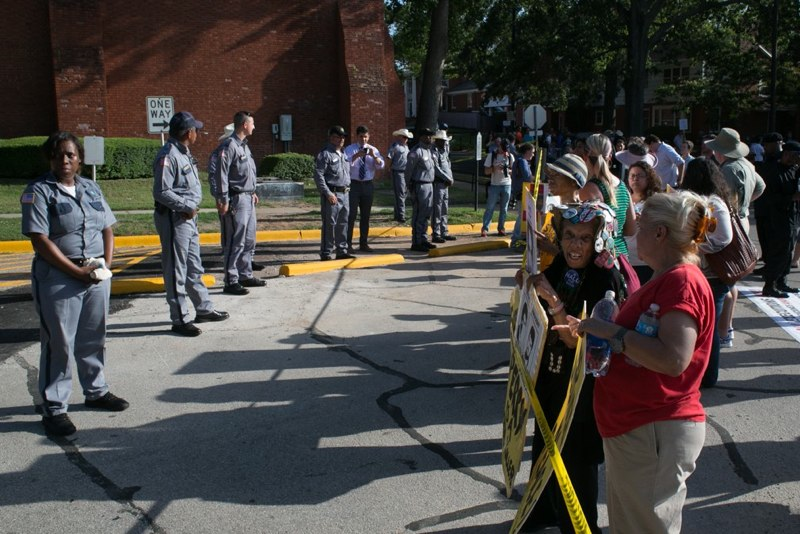
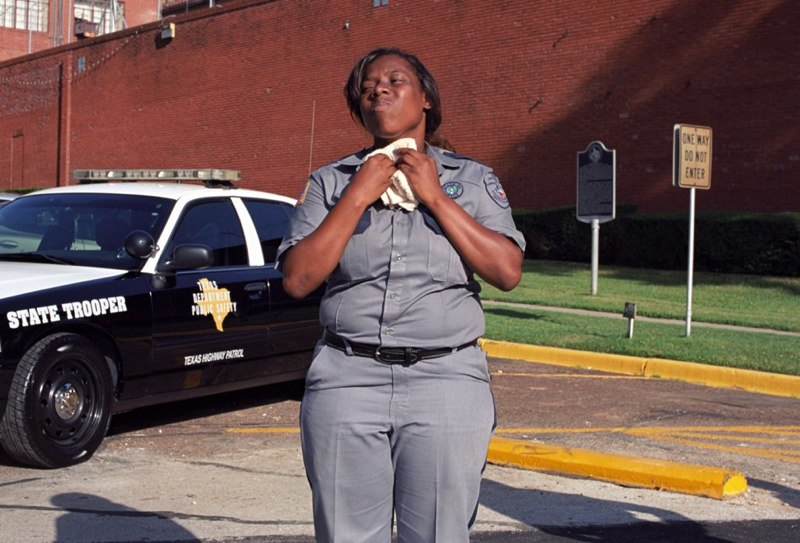
Perhaps it was the hundred degree heat and stifling humidity; perhaps, post-Occupy Wall Street, demonstrators understand how truly futile efforts are against the system. Whatever the case, neither side demonstrated much energy. It all came off as practical, perfunctory.
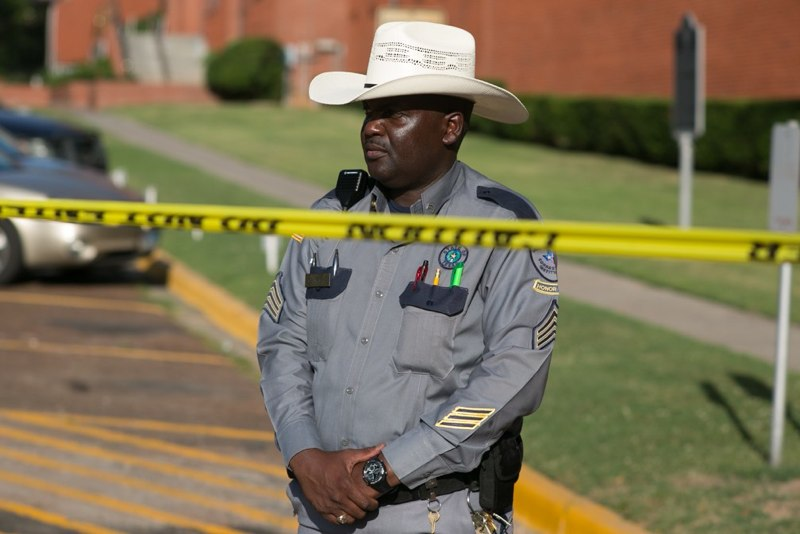
It didn’t matter whether people were pleading for forgiveness or demanding an eye for an eye, even the angriest and most passionate did nothing to provoke the line of stern, Stetson-sporting armed officers on the other side of the tape.
Relatively peaceful protesting never appeared more resigned, rote, or pointless.
It wasn’t much of a show. And then it was over: Kimberly McCarthy was declared dead.
Even the following scene — one that should have been shocking and cinematic — in which a chubby guy in a white button shirt, a tie designed to look like a Texas state flag, and a pair of dark shades, following the announcement of McCarthy’s passing, strode from officer to officer and gave each a firm, congratulatory handshake.
A big high-five.
Even holding hands with the most vocal of the protestors and praying didn’t change much for me. I recall looking at all of the faces of the angry and sorrowful and horrified and feeling as if nothing, anywhere, had or would ever change. As always in these situations, I felt lazy, ineffectual, and impotent. I walked away feeling as if I’d eaten dirt.
Immediately afterwards, Patrick Bresnan and I, along with the penitentiary chaplain and three associated with the deceased, arrived at the funeral home to view McCarthy’s body. One of the women, a relative, recognized me from earlier that afternoon.
“Please,” she said, leading Patrick and me to the body, “Touch her.” Noticing my reticence, she took my hand. “Please. She didn’t touch hardly anybody for the whole time she was on death row. She would have wanted to be touched.”
The woman guided my hand over the dead woman’s face and head. I looked at her grayish, lifeless face — something neither good nor evil. Just dead.
The chaplain smiled, telling us that she left at peace with herself and the world. That her final words were, “God is good.”
With my hand to the ashen cheek of Kimberly McCarthy, I felt shame and pain and sorrow and loss throughout my entire body. For the first time that day, the waste of a human life and the lost possibility of redemption truly overwhelmed me. I found myself unable to stop crying.
I sobbed as Patrick led me to his car.
And then, again, it was over, and we drove home.
[Laura Lark is an award-winning visual artist and a widely-published writer. She has an MFA in Painting and an M.A. in Creative Writing/Literature, both from the University of Houston.Otis Ike, aka Patrick Bresnan, is a widely-exhibited photographer, a documentary filmmaker, an affordable housing activist, and a builder. He holds a masters degree in Sustainable Design from the School of Architecture at the University of Texas .]







 |
| Texas Sen. Wendy Davis speaks to a crowd of thousands at the Texas State Capitol, Austin, Texas, July 1, 2013. Photo by Phillip Martin / The Frisky. |
Deep in the heart of Texas:
Women who misbehave
While pro-life sentiment is used to cut funding for women’s health, sanctity of life has not affected the State’s number one status in executions.
By Anne Lewis | The Rag Blog | July 8, 2013
“They never preached or sat in a deacon’s bench. Nor did they vote or attend Harvard. Neither, because they were virtuous women, did they question God or the magistrates. They prayed secretly, read the Bible through at least once a year, and went to hear the minister preach even when it snowed. Hoping for an eternal crown, they never asked to be remembered on earth. And they haven’t been. Well-behaved women seldom make history; against Antinomians and witches, these pious matrons have had little chance at all.” — Laurel Thatcher Ulrich, 1976
AUSTIN, Texas — Around midnight on Tuesday, June 26, 2013, thousands of Texans took their Capitol. The crowd, predominantly young women, defied a group of sour and narrow legislators by yelling at them so loudly that they couldn’t vote for the bill that they planned to pass.
The “pro-life” bill is designed to shut down all but five of the abortion clinics in the state, forcing them to meet state requirements for “surgical ambulatory care.” It’s interesting that Milla Perry Jones, Texas Governor Rick Perry’s sister, serves as Vice President for Government Affairs for United Surgical Partners International, a major provider of surgical ambulatory care. Doctors, even those dispensing pills, would be required to have privileges at a hospital within 30 miles of the clinic.
The law would prohibit abortions after 20 weeks — the time when, according to a disputed study, the fetus can feel pain. Or pleasure, as U.S. Congressman Michael Burgess (R-Texas), an OB/GYN, appears to believe. Burgess, when arguing before a House committee in June that abortion should be banned at 15 weeks, suggested that that’s when male fetuses start masturbating.
Rape and incest and the mental health of the mother were not exceptions — only the mother’s physical health and “serious” abnormalities of the fetus.
Planned Parenthood, NARAL, and the Texas Democratic Party, along with many local progressive and radical organizations — the Workers Defense Project, the International Socialist Organization, the United Students Against Sweatshops, TSEU women, the Freedom Road Socialist Organization, Rise Up Texas, Occupy Austin, and others — had come to the Capital that night.
The Capital vibrated with the yelling of the crowd. It was the largest, most energetic, and by far noisiest indoor protest I’ve ever seen.
The Texas legislature is dominated by right-wing fundamentalist Republicans who rose to power through gerrymandering, redistricting, and voter suppression in the midst of significant demographic change. Texas is majority non-white and Latino according to the 2010 census: 45.3% white, 11.8% African-American, 3.8% Asian, 37.6% Hispanic, and 3.5% other (including Native American).
The Republican attacks have a white supremacist edge. Right after the June 25th Supreme Court repeal of Section 4 of the Voting Rights Act, Texas Attorney General Greg Abbott said that the Legislature’s 2011 redistricting plan should be immediately implemented along with Voter ID. Federal judges in Washington had blocked the redistricting plan, saying that it intentionally discriminated against minorities.
An on-going legislative attack on the public sector has placed Texas 49th among states in spending per pupil, 46th in students graduating from high school. Texas has the most people without health insurance in the U.S. and ranks 47th in expenditures for mental health. Texas ranks 49th in reproductive health, including 46th in teen birth rates and 4th from the bottom in sex education.
 |
| “Pro-life” demonstrator at Capitol. Photo by Anne Lewis / The Rag Blog. |
While pro-life sentiment is used to cut funding for women’s health, sanctity of life has not affected the State’s number one status in executions. Since 1982 Texas has executed 500 prisoners, more than half of them coming during Rick Perry’s time as governor.
The anti-abortion bill was filed by Rep. Jodie Laubenberg (R-Parker) who made national news herself. When Rep. Senfronia Thompson (D-Houston), a wire coat hanger attached to the podium, called for the exemption of victims of rape and incest from the anti-abortion bill that Laubenberg had filed, Laubenberg objected: “In the emergency room they have what’s called rape kits where a woman can get cleaned out.”
She instantly became the subject of national ridicule.
Laudenberg speaks for more than Christian fundamentalists in the Texas House. She is the Texas State Chair of the American Legislative Council (ALEC) — a behind-the-scenes organization that is anti-union, anti-choice, anti-environment, and anti-immigrant. ALEC is responsible for the “shoot first” legislation that in part caused the killing of Trayvon Martin.
The sad life of the Anti-Abortion Bill: SB5
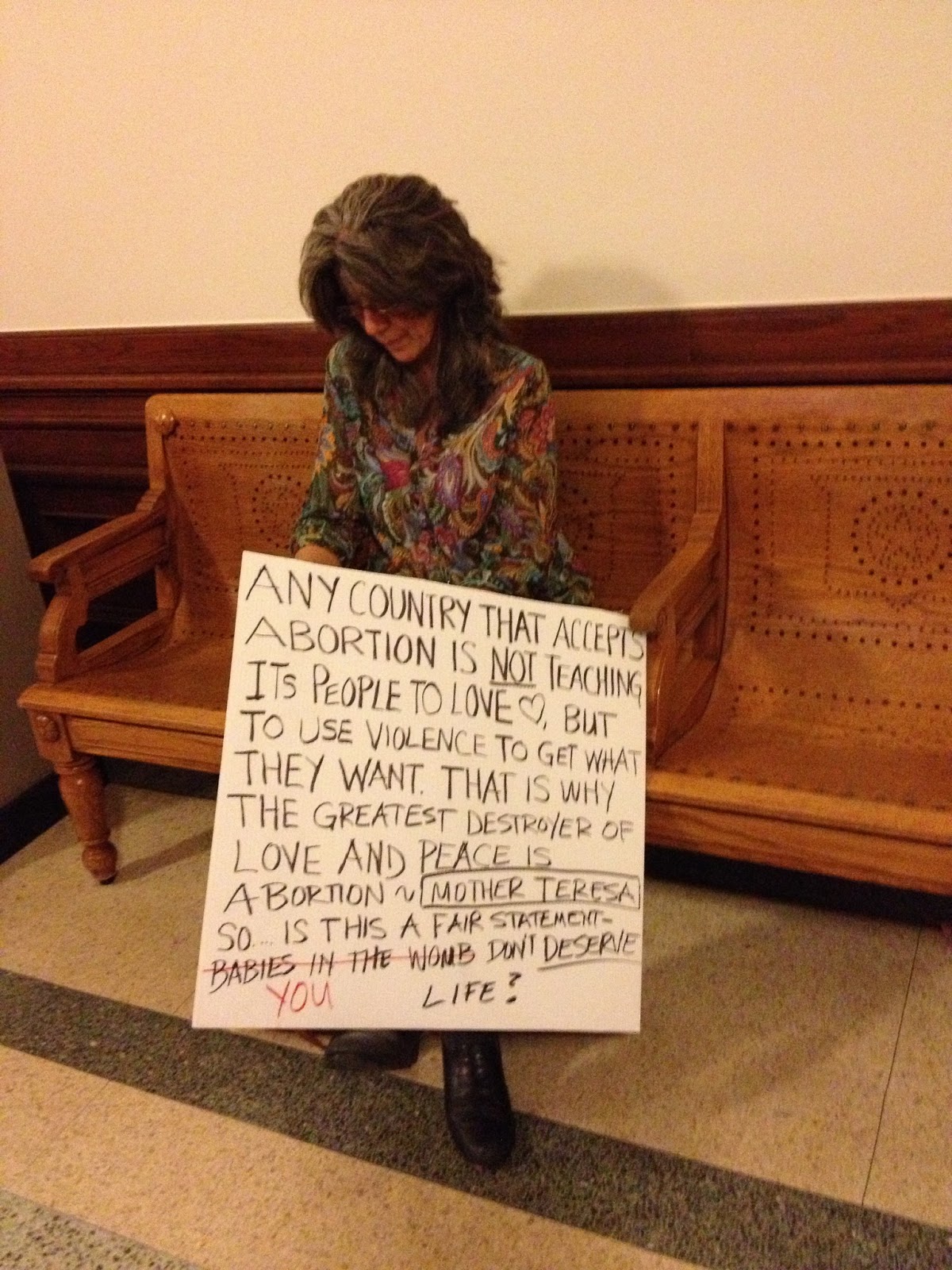
I went to the Capitol on Sunday, June 23, to join the people trying to stall the vote in the Texas House. We stood in the hallway leading to the House Gallery waiting to greet the Representatives. A few “pro-life” people had also gathered with tape over their mouths, I suppose pretending to be fetuses.
One miserable looking man in a shiny blue shirt and black tie shouldered me aside. Then they began to hum “Amazing Grace,” written by a reformed slave trader, sung by the Cherokee on the Trail of Tears, brought to life by Mahalia Jackson for use in both the mass Civil Rights movement and in opposition to the Vietnam War, and a source of inspiration on union picket lines. It was as if all that is good and holy had been twisted and perverted.
 |
| Demonstrators fill the Capitol stairs. Photo by Anne Lewis / The Rag Blog. |
Finally inside the House Gallery I heard the articulate amendment by Rep. Donna Howard (D-Austin). Supported by the Journal of the American Medical Association, the Texas Medical Association, and the Texas Hospital Association, Howard wanted to strike language that might keep doctors and nurses from acting in the best interests of both mother and fetus.
Rep. Laubenberg got up to state her opposition, was asked simple questions about her bill by Lon Burnham (D-Ft Worth), and mumbled something about it gutting the bill. Burnham persisted with specifics. As a result, Laubenberg moved to table all subsequent proposed amendments to the bill without returning to the microphone. This included an amendment by Mary González (D-El Paso) who spoke of the disproportionate impact on women in her community who would have to travel 600 miles each way to the nearest abortion clinic in San Antonio.
We sat in the gallery, occasionally giving voice but quickly silenced by Planned Parenthood and Democratic Party organizers. A succession of amendments by House Democrats and procedural issues delayed voting on the bill into early Monday morning, giving the Senate filibuster a chance to succeed.
 |
| Wendy Davis during filibuster.. |
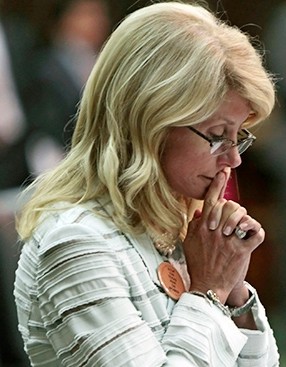
Like many, I returned to the Capitol Tuesday evening and became part of a long line trying to get into the Senate Gallery to observe Wendy Davis’ filibuster. We snaked in circles. I was thrilled to see my students and former students, young women whom I had not considered activists, in the crowd. Once more we were told to be quiet and follow the rules of decorum. And we did, for the most part, remain quiet and contained.
The “third strike” against the Wendy Davis filibuster took place at 10 p.m., filed by Sen. Donna Campbell (R-New Braunfels) who claimed that the sonogram bill — which Davis was addressing — had nothing to do with abortion. I was by then in the Senate Gallery. Campbell stood down below us, the sharpness of her features complemented by a thoroughly unpleasant expression.
The Gallery erupted when Lt. Gov. David Dewhurst ruled in Campbell’s favor. We yelled “Shame” and “Let her speak.” I remember a man with a shoe in his hand and an older woman pointing down at the legislators and yelling at them. Both were removed along with nearly all the people who happened to be nearest the door. Every time the door opened we could hear the crowd outside. They yelled, “Let us in.” The troopers locked the door and the only way out was through the Senate Chambers.
“Let her Speak” June 25 2013 10 07 to 10 10 Texas Capitol from Anne Lewis on Vimeo.
On Wednesday, June 26, Gov. Perry called for a new special session to pass the anti-abortion bill. Just hours later, Perry spoke at the National Right to Life Convention in Dallas, saying, “Texans value life and want to protect women and the unborn.”
He attacked Wendy Davis: “It’s just unfortunate that she hasn’t learned from her own example: that every life must be given a chance to realize its full potential and that every life matters.” I wonder at his inconsistencies — the political opportunism of priorities that shift so quickly from pro-life to pro-death.
There’s an element in Perry’s and the other Republican legislators’ reactions to Wendy Davis that reminds me of the way white supremacists branded white Southerners who took up the banner of racial equality as “race traitors.” How could she, a white woman, betray him? But it wasn’t mainly white women who stood up to the majority in the Legislature.
During the session, Senfronia Thompson, Leticia Van de Putte, Dawnna Dukes, Mary Gonzales, Alma Allen, Judith Zaffirini, Yvonne Davis, and others proved themselves smarter than all of those right-wing men put together and far more competent to govern. I remember the image of this man with a wooden stick poking around on the Senate floor while Wendy Davis filibustered hour after hour — not allowed to eat, drink, sit down, or use the bathroom.
And it’s not just the Republican men, but also those infantilized right-wing women. Baby dolls that men protect and control, they are sanctimonious, hidden, and vicious when someone calls them out — very much Ulrich’s well-behaved pious matrons. It’s all about the white man’s party and its ability to rule. Those of us at the Capitol were there to stop them.
At 11:45 p.m. on Tuesday, June 25th, 15 minutes before the end of the session, Sen. Leticia Van de Putte (D-San Antonio) — who had returned from her father’s funeral in order to be heard — stood to demand that her colleagues recognize her. It was not the first time she had defied those in power.
In response to the sonogram bill, she had said, in parody of Grover Norquist’s promise to shrink government to a size that could fit in a bathtub, “Texas is going to shrink government until it fits into a woman’s uterus.” On Tuesday night she asked, “At what point must a female senator raise her hand or her voice to be recognized over her male colleagues?”
That line — so solidly expressive of misuse of power and male supremacy — was the cue for the gallery. They yelled and chanted and took over the Chamber.
We could hear the Gallery through the locked door. The whole Capitol filled with a giant roar. We cheered, yelled, and chanted.
“Vote Stopped by Protesters” Texas Capitol June 25, 2013 11:50pm to June 26, 2013 12:01am from Anne Lewis on Vimeo.
I was reminded of those special times during the mass civil rights movement — and the movement that ended the war in Vietnam — moments when our relatively minor differences go away, when we act in one loud clear voice against a system of oppression, when we are willing to be obnoxious or even go to jail for our deep-felt beliefs. As Joe Begley from the eastern Kentucky coalfields put it: “Everyone should go to jail for a night or two.”
What a wonderful night of misbehavior it was!
[Anne Lewis, a senior lecturer at the University of Texas and a member of TSEU-CWA Local 6186 and NABET-CWA, is an independent filmmaker associated with Appalshop. She is co-director of Anne Braden: Southern Patriot, associate director of Harlan County, U.S.A, and the producer/director of Fast Food Women, To Save the Land and People, Morristown: in the air and sun, and a number of other social issue and cultural documentaries. Her website is annelewis.org. Read more articles by and about Anne Lewis at The Rag Blog.]
Thorne Webb Dreyer, Editor