Turk Pipkin : Remembering James Gandolfini

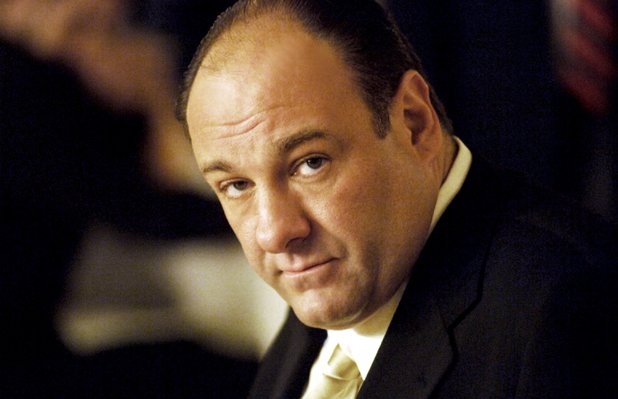
James Gandolfini as Tony Soprano from season six of The Sopranos.

Sleep well, Jimmy:
Remembering James Gandolfini

Though I’d worked a long while in film and television, I never dreamed that a tall drink of water from Texas would end up acting alongside Gandolfini in the show that I loved…

By Turk Pipkin / The Huffington Post / June 26, 2013

From the premiere episode forward, I was a huge fan of The Sopranos and the show’s amazing lead actor James Gandolfini. What David Chase and team were creating week after week was quite amazing, but what Gandolfini was creating and living moment by moment was a timeless work of art and passion that we will not see again for a very long time.

Though I’d worked a long while in film and television, I never dreamed that a tall drink of water from Texas would end up acting alongside Gandolfini in the show that I loved, even when I was invited by the Austin Film Festival to do a panel with Sopranos creator David Chase and to honor Chase with their lovely writing award.

David and I spent some enjoyable time talking about his hit show and about the past months I’d spent in Italy writing a book about the Calabrian mafia, the Ndrangheta. I’d recently been in La Stampa prison interviewing Ndrangheta hitmen, one of whom told me of taking a target into the woods and ordering him to dig a grave. When the man ran away, the bad guys had cut his achilles tendons, then made him continue digging. “Let’s see you run now,” they laughed.

A few days later, Sopranos casting agents called to ask if I’d audition for a part in the show. The scene came over my fax and I read the pages trembling, my eyes pouring over the lines of Aaron Arkaway, Janice’s born-again, narcoleptic boyfriend. The title of the episode was one of my lines, “Have you heard the good news?”

I shot the audition in Austin, Fedexed the tape and was on the plane to New York to start shooting by the next week. The first day on the set — with one of the greatest casts and crews ever assembled — I ran through the first scene with the full cast with the exception of James Gandolfini, who I believe was still in makeup.

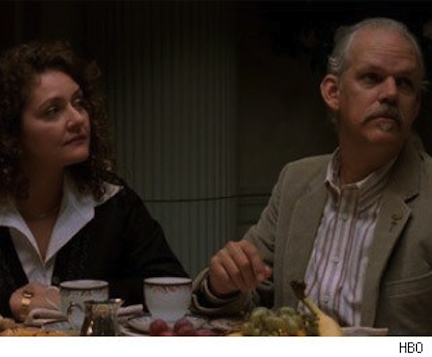
Turk Pipkin, as the narcoleptic Aaron Arkaway, with Aida Turturro, who played Janice Soprano. Photo from HBO.

The Sopranos family was watching football on Thanksgiving Day and I had the easy task of taking a deep narcoleptic nap. I asked the director if it would be okay for me to fall asleep on Tony’s shoulder and he said to give it a shot with Gandolfini’s stand-in.

Here’s the thing. I’d been up all night — a great way to look sleepy and as it would turn out, one of Gandolfini’s own tricks to create a look and feel he wanted — so when we ran the scene a second time, I didn’t actually notice that my head was not resting on a stand-in but on the man himself. Just before “action,” Gandolfini leaned down to my drooling face on his shoulder and introduced himself.

One episode turned into two and then into three. There wasn’t a lot of broad comic relief on the show and I was loving being a part of it, especially being in the spell of the great and kind James Gandolfini. Filming the show was a marathon for all involved. Late one night, Gandolfini had a rare break where he wasn’t in a scene. When he came back for a post-midnight scene, he brought back enough sushi for the cast and crew to cover a 20-foot table. Those type of gestures were not uncommon.

When I’d fallen asleep on the dining room table during Thanksgiving dinner, he bounced nuts off my noggin from the other end of the table, and between takes kept saying, “Man, am I throwing those too hard?” I said, “Is that all you got?” And it turned out that indeed he had a little more.

Gandolfini was a cigar smoker and between scenes would retire to the back porch of the Soprano family home for a stogie. This is on an indoor soundstage at Silver Cup Studios in Queens mind you, a definite “No Smoking” zone. I asked him what it takes to get that privilege and he said, “All it takes is asking. And you’re the first to ask.”

So there I was, looking at the painted swimming pool chroma-key of the Sopranos family back yard, smoking a Cuban cigar with the greatest actor of my day. Thank you Jimmy, for that and for so much more.

I was just a tiny cog in the great wheel that was The Sopranos, just one of thousands who James Gandolfini treated with kindness and respect. There are few so great who remain so humble, who are able to grasp their own incredible abilities and still recognize them as a gift.

James Gandolfini was a gift. And he will be missed beyond measure. Luckily we have his incredible body of work to keep us company. Thanks, Jimmy, for showing us the way. And thanks, David, for letting me lean on the shoulder of greatness.

[Turk Pipkin, an Austin-based writer, actor, and filmmaker, played a recurring role on The Sopranos. Pipkin founded the education and social action nonprofit, The Nobelity Project, and his films include Nobelity, One Peace at a Time, and Raising Hope. He is the author of 10 books including the New York Times bestseller, The Tao of Willie, written with Willie Nelson.]

The Rag Blog

Posted in RagBlog | Tagged , , , , , , , | Leave a comment

Michael James : Baseball in Moscow and ‘Turf Accountant’ in Belfast

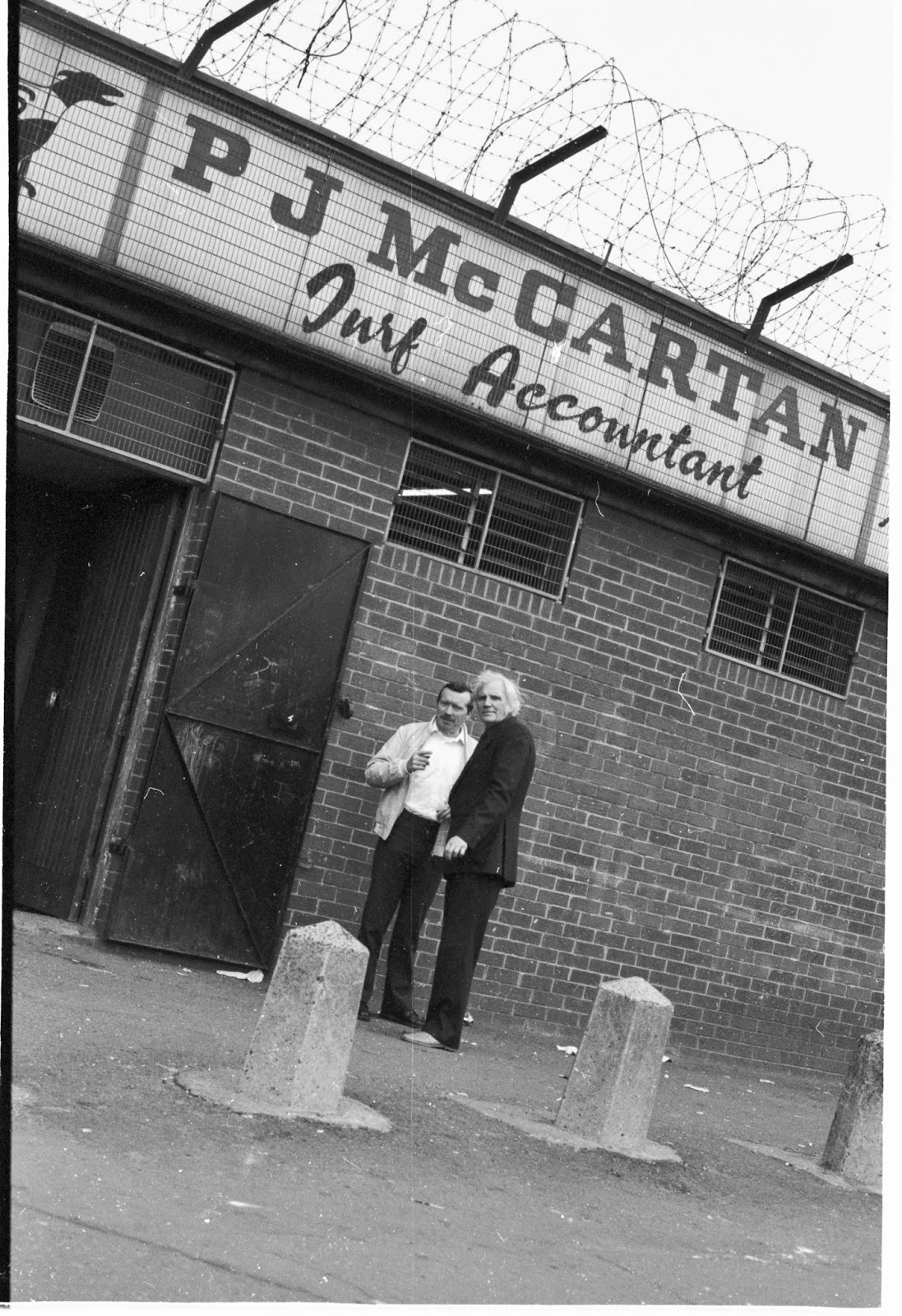
Turf Accountant, a betting parlor in Belfast, Northern Ireland, August 7, 1990. Photo by Michael James from his forthcoming book, Michael Gaylord James Pictures from the Long Haul.

Pictures from the Long Haul:
Playing baseball in the USSR and
drinking Guinness in Belfast

In Belfast we drive to the battlefield called the Falls Road, working class and traditionally socialist. I shoot pictures of buildings and people, and a betting parlor that is called ‘Turf Accountant.’

By Michael James | The Rag Blog | June 26, 2013

[In this series, Michael James is sharing images from his rich past, accompanied by reflections about — and inspired by — those images. This photo will be included in his forthcoming book, Michael Gaylord James’ Pictures from the Long Haul.]

I have to go through Shannon, Ireland, to get to the Soviet Union in 1990 — both going and coming — and both ways I observe people drinking Guinness early in the morning, when getting off planes and before boarding planes. Another observation: I like the Soviet/Russian planes, particularly that the armrest on the aisle goes up, freeing you to turn and talk to your neighbors, put your legs in the aisle somewhere over Poland, to move around.

In the USSR our delegation of already aging left-wing Athletes United for Peace plays baseball at Moscow State on a beautiful baseball diamond built by the Japanese. In Donetsk we play ball in a soccer stadium, run a baseball clinic, meet with striking miners, and run in a race with striking miners, many running barefoot.

We visit Sochi and Leningrad too. The husband/dad of the family I stay with in Leningrad was a member of the Soviet Olympic Volleyball team He takes me to a wonderful ancient bathhouse, and — being Jewish — fills me in on some Soviet realities.

On the trip I bond with comrade brother Mike Klonsky; we are roommates and share some swell activities and observations. We are tovarischs — comrades — forever. On the plane back are lots of Cubans; I trade them my rubles for their pesos. In Shannon, I say goodbye to Klonsky and others, and head off with Guy Benjamin and Dan Goich, retired pro football players.

We rent a car and head for the Fitzgerald’s in Tullah. Relatives of my longtime friend and business partner Katy Hogan, they treat us to nips of whiskey and sandwiches. Then on toward the West Coast, Galway, and a place to stay in Ennis, a bed and breakfast owned by Mary Monahan. I just assume she is a relative of the Monahan’s in my Chicago neighborhood, the so-called Peoples Republic of Rogers Park. We fall out by 9:30.

In the morning Mary nourishes us, and then we’re off. Guy stops in town for a Guinness at Mahoney’s thatch-roofed pub. I buy film, and two tapes, one by my man George Jones, the other a collection of Tulla bands, 1946-1986. We stop by the water in Galway, and then drive to a town called Westport. My hometown is Westport, Connecticut, so I buy saltwater taffy that says Westport on it, and drive the next leg to Sligo by the Atlantic. Driving while sitting on the right side of a blue Ford, and driving on the left side of the road, is very strange.

We stay in Sligo, but backtrack a bit to a place we learn about, Kilcullen’s Seaweed Baths in Enniscrone, Sligo County. They were great: a big tub of seaweed and hot seawater — plenty of it with a cold freshwater shower overhead the middle of the tub.

We cross into Northern Ireland. I had spent two weeks in the USSR and saw zilch for guns and weaponry. Crossing into Northern Ireland there were machine gun turrets, barbed wire, cement barriers, zig zag-driving lanes, and guys in full-bore combat outfits. Whoa and wow. Wow and whoa.

In Belfast we drive to the battlefield called the Falls Road, working class and traditionally socialist. I shoot pictures of buildings and people, and a betting parlor that is called “Turf Accountant.” Back in Belfast center Dan buys us a big steak lunch at a nice place.

We make our way south, through another checkpoint, drive over to the Irish Sea at Clogherhead, and find a bed and breakfast around sunset that’s run by the McEvoy family, in a place called Termonfeckin. That’s Termonfeckin! We settle in, take a walk on the beach, and then go for more Guinness at a local pub.

Jim McEvoy turns out to be a masters 800-meter champion. He knows the Irish running scene, and I tell him about my Loyola track coach pal Gordon Thomson. Jim also raises barley for Guinness, and raises Belgium Blue cattle. In the morning we hang out with Jim, his nine-year-old daughter Bernette, and a humongous 16-month-old bull, who acts like a cute, passive, and loveable puppy.

On to Dublin, we walk around this urban energy city, have coffee at Brawley’s, see a store called Chicago, and have big lamb chops at The Old Stand in the financial district. We take in Trinity University, dig its’ ancient vibe, and then head out. By evening we’re on the bank of the River Shannon near Limerick, staying at the Anchor Inn, sleeping upstairs from Irish Molly’s traditional music pub. The music and revelry goes on late into the night.

In the morning its cereal, sausage, Irish bacon, eggs, cooked tomatoes, OJ, toast and coffee. Before you know it, we’re in the Shannon airport. Guy gets another Guinness, we board, and after two weeks in the USSR and 96 hours in Ireland, we cross the blue waters to New York and west, back to life in the good old US of A.

[Michael James is a former SDS national officer, the founder of Rising Up Angry, co-founder of Chicago’s Heartland Café (1976 and still going), and co-host of the Saturday morning (9-10 a.m. CDT) Live from the Heartland radio show, here and on YouTube. He is reachable by one and all at michael@heartlandcafe.com. Find more articles by Michael James on The Rag Blog.]

The Rag Blog

Posted in Rag Bloggers | Tagged , , , , , , , , | Leave a comment

James McEnteer : Escape to Ecuador

Edward Snowden and the flag of Ecuador. Image from Salon.com.

Rehanging the crepe paper:
Escape to Ecuador

Edward Snowden is the latest insider who pulled back the curtain to reveal the wizardry of American Freedom as the diabolical machinations of a surveillance state.

By James McEnteer | The Rag Blog | June 25, 2013

QUITO, Ecuador — The colored crepe paper we hung up has tattered and fallen. The balloons we tied to the walls and ceiling have deflated or popped. Confetti remains in bags, unthrown. The welcome party we planned for the arrival of Julian Assange has had to be postponed indefinitely. Graffiti on the city walls prophesying his advent have begun to chip and fade away.

We know Assange is safe and still active in his Ecuadorian Embassy sanctuary in London. But we can’t help feeling disappointed that he never actually landed here among us. It’s not simply that we wanted the spotlight of his celebrity to shine a bit on the rest of us. There is so much here that we wanted to show him.

The bracing air of the Andes would revive his spirits. The sight of snow-covered volcanic peaks bespeaks a primordial reality which dwarfs the foolish vanity and paranoia of the people and the governments who want him silenced and punished. Julian Assange and Wikileaks have spotlighted the new political reality.

Our primary struggle now is not a conflict of countries or religions or ideologies against one another, but the wars of governments against their own peoples. The governments of China, Russia, and the United States have more in common with one another than they do with their own populations. Ours is a battle between state control and personal freedom.

The Turkish people know this. So do the Syrians and the Brazilians and the Egyptians. They have fewer illusions than Americans do because they can’t afford them. They have learned to trust their own eyes and ears rather than rely on the televised, predigested propaganda churned out by corporate U.S. media in service to the state.

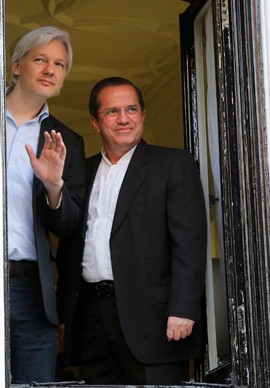
Julian Assange and Ecuador’s Foreign
Affairs Minister Ricardo Patiño Aroca
at Embassy in London.

Americans cling to their comforting delusions, that we are the greatest, freest country on earth, that the political landscape is painted blue and red, that liberals and conservatives are battling for dominance, and the extremes of tea-party libertarianism and radical leftist socialism should be reviled and feared.

All this is irrelevant and distracting, like the clash of Christianity versus Islam. Or the flood of professional sporting events and pornography that drowns our awareness with vivid images. Americans are bad at organizing, still suffering from the cult of rugged individualism. But when we do form trade unions or progressive political groups or student protests against wars or the depredations of Wall Street, the tentacles of government are quick to infiltrate, defame, and destroy.

Edward Snowden is the latest insider who pulled back the curtain to reveal the wizardry of American Freedom as the diabolical machinations of a surveillance state. Is he a hero or a traitor? Where you stand depends on where you sit. For all those growing fat off the surveillance state, the toady media, the corporate Congress, the social networks and other minions of the ruling oligarchy, Snowden is a trouble-maker, messing with the dominance of their masters.

For the rest of us, trying to survive and live our lives as well as we can, Snowden is a freedom fighter, exposing the intrusion of the state apparatus into our private affairs. That is why we have begun to rehang the crepe paper here, inflate new balloons and prepare once again for a welcome party fit for a man of principle and courage.

Snowden would add luster and gravitas to our community. We can only hope he really comes. Then we have to find a way to spring Bradley Manning. Manning’s only crime was believing he could appeal to the conscience of the American people over and above the violent authoritarian regime masquerading as a democracy.

It would be great to have Assange, Manning, and Snowden all here in Ecuador. They could all have faculty positions at the IIF (International Institute of Freedom). I think they’d have a lot of valuable lessons to teach. You know we’ll have a good time then.

[James McEnteer is the author of Shooting the Truth: the Rise of American Political Documentaries (Praeger). He lives in Quito, Ecuador. Read more of James McEnteer’s articles on The Rag Blog.]

The Rag Blog

Posted in Rag Bloggers | Tagged , , , , , | 2 Comments

Jean Trounstine : Censoring What Prisoners Read

Werewolf erotica: Too sexy for prisoners? Image from The Atlantic Wire.

‘Werewolf erotica’ too ‘sexy’?
Censoring what prisoners read

The truth is that prisons want to control behavior. They want to ‘reform’ prisoners, which usually means they want to turn out people who are as conformist as possible.

By Jean Trounstine | The Rag Blog | June 25, 2013

Some astute judges are standing up and challenging prisons which think they have the right to tell prisoners what they can and cannot read.

Just after I wrote a blog about the wonders of Changing Lives Through Literature, a program begun in Massachusetts where a judge, probation officer, and facilitator discuss books together in a “democratic” reading group, offering those on probation a chance at rehabilitation (see “What You Need to Know About Changing Lives Through Literature“), I came across an article at the Christian Science Monitor (CSM) titled “Should prison inmates be allowed to read whatever they choose?”

We know prisons only let in certain kinds of material, sent in certain packages and provided in certain formats. At least that is what Framingham Women’s Prison told me some years ago when they rejected my hardback book Shakespeare Behind Bars being housed in the prison library. Forget that I had worked there, directing plays and teaching college classes for almost 10 years. They also don’t want books critical of their practices in any way. Apparently, my book raised their hackles.

Now prisons are going even farther: they don’t want books that have subjects someone deems unfit.

Madden work ‘Problematic’?

Husna Haq, in his CSM, article mentions that recently the 1st District Court of Appeal in San Francisco overturned a previous ruling barring a prisoner from receiving a book he requested deemed “problematic” by prison officials. The book in question was The Silver Crown by Mathilde Madden “which has widely become known as ‘werewolf erotica,’ and was considered too sexual by corrections officers.”

What? Corrections Officers are deciding that a book is too sexual for prisoners to read?

Get a load of this other recent news article posted in Business Insider. Called “America’s Prison Guards Are The ‘Ugly Stepchildren’ Of The Criminal Justice System,” the article reveals how guards “allegedly snuck cell phones and other contraband to Black Guerrilla Family (BGF) prison gangsters.” They allowed them to do whatever they wanted apparently, having the run of the prison, and now BGF leader Tavon White is accused of impregnating four guards, two of whom got tattoos with his name.

Thankfully, as Salon reported, the Court found that the prison had overstepped its bounds in the case, engaging in an “arbitrary and capricious application of the regulation.” The judge declared that “The Silver Crown did not meet the famous ‘three-pronged’ standard by which American courts have determined obscenity since the Supreme Court of the United States’ decision on Miller v. California in 1973.”

A 2011 suit by the American Civil Liberties Union charged a South Carolina prison with denying its prisoners all reading material other than the Bible. Other cases include an Alabama prison that barred a prisoner from reading the Pulitzer Prize-winning Slavery by Another Name: The Re-Enslavement of Black Americans From the Civil War to World War II by Douglas Blackmon.

Hurston ‘too racial’?

Why? Because it was too controversial? That’s another problem prisons have with texts. And also what I was told at Framingham, when I wanted to teach a June Jordan essay and direct a version of Zora Neale Hurston’s Their Eyes Were Watching God. Way before Oprah produced a movie of this novel, I had planned a production. But the prison said that involving my theatre troupe in such an effort was “too racial.” And I quote.

The truth is that prisons want to control behavior. They want to “reform” prisoners, which usually means they want to turn out people who are as conformist as possible. Read, write, paint, and draw? Only as long as prisoners don’t overstep their boundaries.

The idea that a prisoner can’t vote, can’t write, and can’t read what he or she wants are different kinds of “crime against person.” Restricting such freedoms could be considered unconstitutional if not illegal. But the idea that a prison will ever honor such rights for prisoners without a judge intervening — considering that a prison’s aim is to “correct” — is pure illusion.

[Jean Trounstine is an author/editor of five published books and many articles, professor at Middlesex Community College in Massachusetts, and a prison activist. For 10 years, she worked at Framingham Women’s Prison and directed eight plays, publishing Shakespeare Behind Bars: The Power of Drama in a Women’s Prison about that work. She blogs for Boston Magazine and takes apart the criminal justice system brick by brick at jeantrounstine.com where she blogs weekly at “Justice with Jean.” Find her contributions to The Rag Blog here.]

The Rag Blog

Posted in Rag Bloggers | Tagged , , , , , | Leave a comment

Type your summary here

Type rest of the post here

Source The Rag Blog

Posted in RagBlog | Leave a comment

Ron Jacobs : Onward, Through the Fog of War

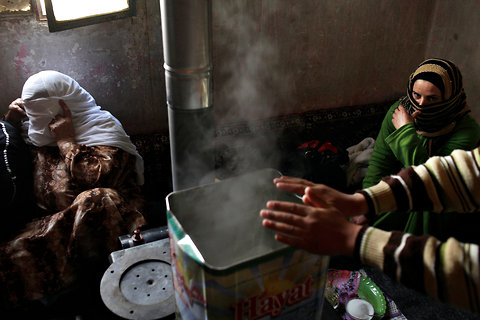
Syrian refugees in Arsaal, Lebanon, on the Syrian border. Photo by Ed Ou / NYT.

Enter Obama:
Onward, through the fog of war

There will be no progressive secular government in Syria after the bloodshed ends. Indeed, there may not even be the nation the world now knows as Syria.

By Ron Jacobs | The Rag Blog | June 25, 2013

The world waits. Washington and other western capitals ponder war. Tehran and Moscow assume their positions, wary of their flanks and the rear. Syria suffers.

Groups within and without Syria’s borders position themselves as representatives of the Syrian people, almost every one of them hoping for some kind of Western support now that Obama and his White House have decided to publicly join the fray.

The question remains: How much military aid and of what nature? Does the White House honestly think it can get away with providing small arms and ammunition to the rebels in Syria? Or is it quietly planning to jump into the shitstorm with the the wild man and warmonger John McCain, eventually providing anti-tank weapons, lethal air support, and RPGs to the rebel elements with the greatest chance of victory?

Meanwhile, opposition to the White House decision remains muted, despite opinion polls showing over 80% disapproval of the decision. In fact, the primary opposition comes from libertarian and other right-wing quarters, some of them who oppose it only because Obama is spearheading it.

As for members of the left? If they spoke 10 times as loud they would still be but a whisper.

Syria is in the throes of a civil war. The government is winning, thanks in some part to the recent entrance of Hezbollah forces into the battle. The rebellion which began almost three years ago as popular protests against a repressive regime sold to the neoliberal marketplace has long since stopped being what it originally was. The violent repression of those protests by the Assad government provoked a violent response and the formation of what is called the Free Syrian Army.

Since that time, various regional governments and groups with their own agendas have sent in fighters, provided funds and weapons, and generally helped expand the conflict into almost every sector of Syrian society. The politics of the rebel forces grow murkier each day while the influence of outside forces seems to grow. This latter phenomenon will grow exponentially once Washington begins to play its latest hand.

There will be no progressive secular government in Syria after the bloodshed ends. Indeed, there may not even be the nation the world now knows as Syria.

If we are to use recent history as an example, the rationale of the previous statement is clear. Iraq, a once singular state run by an authoritarian Baathist government is now a fragmented collection of regions controlled by local rulers often at odds with the nominally central government in Baghdad.

The reasons for Iraq’s current situation are related directly to Washington’s 1991 invasion, a decade of low-intensity warfare against Iraq, and the culminating invasion by U.S. forces in 2003. Since none of these series of actions were able to install a regime beholden to Washington, the resulting fragmentation has had to do.

If nothing else, it has made the once regional power of Iraq a non-factor. This pleases not only Washington and Tel Aviv, but Saudi Arabia and the other emirates as well. If Washington is unable to install a client government in Damascus, one imagines that a weakened and fragmented Syria will suffice. Given the current role of Hezbollah, one assumes that Washington also hopes to weaken its role in the region.

These are at least some of Washington’s desired goals. After all, Assad’s authoritarian rule has never been too much of a problem before, especially when one understands that Washington maintained relations of various kinds with the Assad regime until quite recently.

Much like the relationship various U.S. administrations shared with Iraqi ruler Saddam Hussein, the commonality of interests and enemies insured numerous joint ventures between Damascus and Washington, including the rendition of U.S. captives to Syria for interrogation under torture. Now, however, it appears that Washington is going to throw its lot in with whatever lies past the long and brutal history of the Assads.

Like Libya and Iraq, this decision means that Washington’s new commitment will be broader than it is letting on to the U.S. public. What are now small arms shipments to certain groups in Syria could soon become no-fly zones and bombing raids; drone strikes and helicopter gunships; bombardment from the sea and Marines on the ground.

If the usual contingencies are being followed, it is fairly safe to assume that special forces and CIA paramilitaries are already involved inside Syria. If the military piece of this war continues like it has, Syrian government forces and their allies will continue to win. That, in turn, means that the only way in which the forces Washington prefers can win is with ever greater U.S. support. If the scenario begins to include Iranian forces and more sophisticated Russian weaponry, all bets are off.

The decision by Obama and his henchmen to arm some Syrian rebels came in the wake of those forces suffering some major defeats. It also makes the moves toward negotiations touted about a couple weeks ago moot. In other words, Washington has chosen war over negotiation once again. The reasons are numerous and certainly include a desire to decrease Iran’s stature in the Middle East. The lives of the Syrians, already made cheap by the armed assaults of their government, have been made even cheaper by this decision.

There is nothing noble in Obama’s decision. Like so many U.S. leaders before him, he has chosen to expand a war instead of negotiating to end it. In doing so, he has calculated that the Syrian people will continue to pay the ultimate price in hopes that Washington’s hegemony in the region can continue.

As I write this, Robert Fisk is reporting in the British newspaper The Guardian that Iran will be sending at least 4,000 troops to Syria in support of the Assad government. If true, this move almost demands that Washington step up its support for its favorite rebels in response.

There are those on the left who are convinced that the rebel forces they support can accept arms from Washington and maintain their hopes for a progressive, secular, and democratic government when all the killing is done. This type of thinking is as naive as that of the liberals who believe Washington’s entrance into the war is a humanitarian act devoid of imperial machinations.

To begin with, those who believe this assume that U.S. support will go to leftist and progressive forces. The likelihood of this is minimal, especially since there are elements in the opposition that share Washington’s plans for Syria and the Middle East. For the most part, the leftist elements do not.

The plain truth is that imperialist acts never flow from pure humanitarian motives. The very nature of imperialism demands that any action, especially in the arena of warfare, is taken to further the goal of hegemony.

You can bet your bottom dollar that Barack Obama understands this. No matter what he or any of his spokespeople say in the upcoming months regarding the U.S. commitment in Syria, the fact is that his decisions are based on his understanding of the risks involved and the potential benefits to be gained — for Washington, Tel Aviv, himself, and whomever else he and his regime are beholden to (and that doesn’t include the U.S. public).

[Rag Blog contributor Ron Jacobs is the author of The Way The Wind Blew: A History of the Weather Underground. He recently released a collection of essays and musings titled Tripping Through the American Night. His novels, The Co-Conspirator’s Tale, and Short Order Frame Up will be republished by Fomite in April 2013 along with the third novel in the series All the Sinners Saints. Ron Jacobs can be reached at ronj1955@gmail.com. Find more articles by Ron Jacobs on The Rag Blog.]

The Rag Blog

Posted in Rag Bloggers | Tagged , , , , , , | Leave a comment

BOOKS / Alan Wieder : Thai Jones Draws ‘A Radical Line’

Generations in the struggle:
A ‘retro-review’ of 
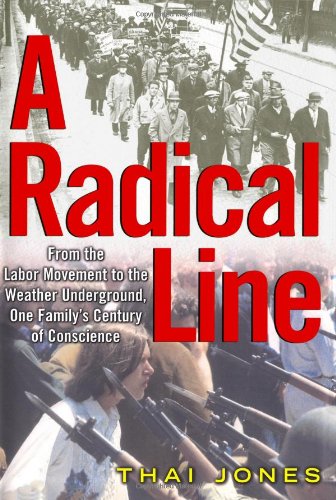
Thai Jones’ A Radical Line

Throughout A Radical Line the progressive fights of Thai Jones’ extended families, Weather Underground and earlier, are connected to the collective struggle against class disparity, racism, and the Viet Nam War.

By Alan Wieder | The Rag Blog | June 24, 2013

[A Radical Line: From the Labor Movement to the Weather Underground, One Family’s Century of Conscience by Thai Jones (2004: Free Press); Hardcover; 336 pp; $26.]

Reading Neil Gordon’s novel and then viewing Robert Redford’s film, The Company You Keep, a fictitious portrayal of the Weather Underground Organization (WUO), led me to re-read Thai Jones’ book on his family — his mom and dad, WUO people Eleanor Stein and Jeff Jones, as well as their parents, Albert Jones a Quaker and WWII conscientious objector and Annie and Arthur Stein, labor movement people and both members of the Communist Party.

While I actually liked Redford’s film, and the book even more, A Radical Line is much more encompassing as it portrays generations and real lives in the continuing struggle for a democratic, socialist America — yes, Eleanor and Jeff and I think Thai, as well as many of their WUO comrades and their children, continue the fight today.

I had no intention of writing a review as I began to re-read A Radical Line. The story, though, is so engrossing, and Thai Jones’ combination of detail, thoughtfulness, and drama pull you in as words bring depth to his extended family as well as the collective, progressive struggle in the United States.

Jones’ craft as a writer shows in the book’s poignant beginning, as Jones describes his parents being arrested — reflecting on his own memories of the event as a four year old child.

There had to be something I could do to help my parents. I made a fast survey of my possessions: a cowboy outfit, a coloring book, a stuffed Tyrannosaurus. I opened the drawer of my little desk and picked up my child’s scissors. The ends were rounded, and the blades were covered by blue plastic guards. Bouncing them in my hand and snipping at the air, I considered putting on the cowboy hat and charging into the hallway with scissors blazing to defeat these men who had come to hurt our family. Even then, I knew it was a battle against long odds. But I didn’t realize it was a question that many in my family had already faced. They had chosen to fight.

Throughout A Radical Line the progressive fights of Thai Jones’ extended families, Weather Underground and earlier, are connected to the collective struggle against class disparity, racism, and the Viet Nam War. Jeff Jones was raised in Southern California and his father worked for Walt Disney Corporation. But as already noted, Albert Jones was a pacifist, and his experience working as a conscientious objector at Civilian Public Service Camp #37 in Coleville, California, during WWII is itself a story.

 His path was not easy as his father disapproved and church people at the Methodist congregation that nurtured his views abandoned him — Camp #37 became home:

He was surrounded by pacifists. Each Sunday they held a silent Quaker meeting, and that was the only time in the week that the men were not in heated discussions about their faith. Coming here, Albert finally felt welcome.

Jeff Jones’ early lessons were pacifism and peace and not a long leap to the civil rights movement and opposing the Viet Nam War.

Eleanor Stein’s parents were much more political. Annie was introduced to socialism in high school and was politicized even further as a student at Hunter College. Thai Jones describes her early participation in the National Student League and the Communist Party.

It was Annie who politicized Arthur. Initially she was disheartened because her husband was apolitical, but she began leaving copies of The Daily Worker around their apartment and soon Arthur was attending meetings and demonstrations.

Like Albert Jones’s lifelong commitment to nonviolence, Annie and Arthur Stein never stopped fighting class disparity and racism. In the book, Thai remembers Albert’s assertion to Jeff before the Days of Rage: “Son, I believe very strongly in your goals. But if you set out to hurt somebody, I would hope and pray that you are hurt first.”

Concurrently, Eleanor was clearly nurtured by Annie’s work with civil rights stalwart Mary Church Terrell and her political work on education in New York City. She was also nurtured by her father’s labor activism, his founding of the Fair Play for Cuba Committee chapter in Brooklyn, and his appearance before HUAC, where he was represented by Victor Rabinowitz, the attorney who also represented Paul Robeson and Pete Seeger.

Annie and Arthur sent Eleanor to Camp Lakeside, a “red diaper” summer camp. Eleanor recalled her mother’s expulsion from the CP over China and mother continued to lecture daughter throughout Eleanor’s WUO years:

“Look,” Annie would tell Eleanor, “I lived through the 1930s when the capitalist system was on the ropes. Labor unions were strong and men were out of work, on breadlines.” Pausing for effect, she would light a cigarette, sip her scotch and soda, and go to the bookshelf for her copy of Lenin’s What Is to Be Done? “It was obvious in 1917,” she would say, waving the book in her daughter’s face. “The workers were in the streets. Who is going to run the means of production in your revolution? The hippies? You’ve got to be kidding.”

The heart of A Radical Line, however, is Jeff and Eleanor’s lives in SDS and the Weather Underground and their coming together as a couple. There are rich photographs in the center of the book — especially one of Eleanor wearing her lambswool jacket with a raised fist salute in front of Columbia University Law School. Most endearing is a page with portraits of both Thai, as a very young child, and Jeff in running gear.

We learn about Eleanor quitting law school after participating in the Columbia University student takeover in 1968 and of Jeff joining SDS while a student at Antioch. There are other events that have been written about by Mark Rudd, Cathy Wilkerson, Bill Ayers, and others; but Thai Jones presents a different take, new insights, and of course issues that still leave us with questions about the Weather Underground and the struggle in general.

We learn a great deal about WUO life underground but for the purpose of this review I would like to address one particular issue.

It begins in early July 1969, when Eleanor was part of a delegation that went to Cuba to meet with representatives of the National Liberation Front and of the North Vietnamese government. Others on the trip included Bernardine Dohrn and Diana Oughton.

The North Vietnamese had invited Eleanor and her comrades so that they could interact and learn how the anti-war movement in the United States might help to end the War in Vietnam. One of the first lessons was on the lack of focus of American activism. The teacher pointed out that day that anti-war slogans and chants, like

“No More Vietnams” vs.Two, Three, Many Vietnams”
“No More Wars” vs “Bring the War Home”
“Long Live the Victory of the People’s War” vs. “Make Love not War”

were contradictory. What was the goal?

The Americans traveled Cuba with their Vietnamese mentors and one man, Nguyen Thai, stood out — the man from whom Thai Jones inherited his name. There were hours and hours of discussions and Eleanor and the other Americans became focused on taking one message to the masses back home: “End the War Now.”

When they returned to the U.S., however, they were informed that their leadership had decided to form small collectives; their job was not to organize the masses. Thai Jones writes, “Before Eleanor had even clanked down the gangway to the shore, Nguyen Thai’s plan for an all-encompassing mass movement was sunk.”

And I would argue, that it was at this point, before the forming of the Weather Underground, before the Townhouse bombing, before the manifestos and armed propaganda, before freeing and then being betrayed by Timothy Leary, and before the breakup of WUO, the youth movement for social justice and equality in the United States was doomed. That is, doomed as a movement.

While the Vietnamese spoke of — and represented — a people’s movement, people on the ground weren’t included in the United States. The people of WUO and the anti-war movement in general were young — we didn’t take the lessons that others taught us. We didn’t pay attention to how different Fidel and Che’s revolution in Cuba was from Che’s adventurist foray into Bolivia. We didn’t know how to organize a people’s war.

My analysis, of course, is only about a small part of Thai Jones’s book. And the people that he writes about, particularly his parents Eleanor Stein and Jeff Jones, as well as their WUO comrades, have continued, maybe not as a movement, but nevertheless continued, the fight to end class disparity and racism in the United States and throughout the World.

Their mistakes as well as their continuing commitment and passion offer important lessons. As does Thai Jones’ book, A Radical Line.

[Alan Wieder is an oral historian who lives in Portland, Oregon. His new book, from Monthly Review Books is titled Ruth First and Joe Slovo in the War Against Apartheid.]

The Rag Blog

Posted in Rag Bloggers | Tagged , , , , , , , , , , | Leave a comment

Alan Waldman : ‘The Kumars at No. 42’ is Funny and Original British Fake Talk Show

Waldman’s film and TV
treasures you may have missed:

A side-splitting 53 episodes of this faux chat show aired from 2001 to 2006.

By Alan Waldman | The Rag Blog | June 24, 2013

[In his weekly column, Alan Waldman reviews some of his favorite films and TV series that readers may have missed, including TV dramas, mysteries, and comedies from Canada, England, Ireland, and Scotland. Most are available on DVD and/or Netflix, and some episodes are on YouTube.]

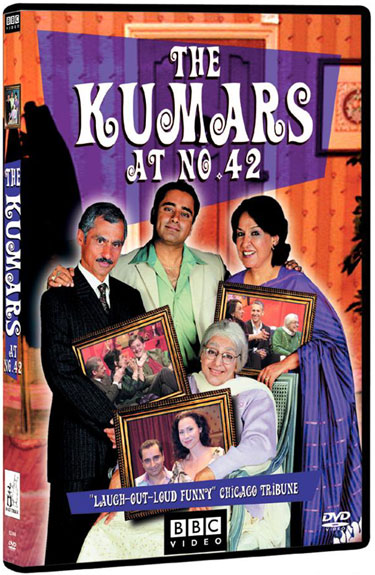
The Kumars at No.42 is a series of extremely funny “talk shows” conducted by a fictional Anglo-Indian family who welcome 106 British and American celebrities into their home and backyard TV studio. Part of each show was brilliantly scripted, but the cast didn’t know what guest comments they’d have to spontaneously respond to. So there was lots of brilliant improvisation.

The show won International Emmy Awards in 2002 and 2003, plus three more honors and six other nominations. It ran for seven seasons and 53 episodes, from 2001 to 2006.

Kumars stars and was co-written by very talented Sanjeev Bhaskar. His fictional family was composed of his parents Madhuri and Ashwin Kumar (played by Indira Joshi and Vincent Ebrahim) and Sushila, Sanjeev’s naughty grandmother (Meera Syal). They supported Sanjeev’s aspirations to host a talk show by having a TV studio built on what used to be their back garden.

Running jokes include Sanjeev’s apparent social ineptitude, Grandma’s coming on to all the male guests, and Ashwin’s obsession with financial matters as well as his tendency to tell long stories with no real point. A regular conceit is that the guests’ appearance fees are paid in chutney.

Bhaskar said in a 2009 interview, “We never rehearsed the guests, and the best ones were those who could keep the ball in the air.” Here’s an episode.

There were three Anglo-Indian male writers on Kumars. Sadly, one of them, Sharat Sardana, died of a streptococcal infection at age 40.

Meera Syal stole the show..

Myra Syal, who stole the show each week with her hilarious antics as the randy grandmother, is a true Renaissance woman. She wrote the screenplay of the excellent film Bhaji on the Beach, she wrote Britain’s best-selling 1999 book Life Isn’t All Ha Ha Hee Hee and she sang the number one record, “Spirit in the Sky,” from a Kumars episode on the Comic Relief show. In 1997 she was awarded the cherished MBE in the New Year Honors, and in 2005 she married Sanjeev Bhaskar, who played her grandson on Kumars.

Guests who appeared on the show included Patrick Stewart, Cybill Shepherd, Minnie Driver, Richard E. Grant, Helena Bonham Carter, Stephen Fry, Jennifer Saunders, Joanna Lumley, Jane Seymour, Donny Osmond, Lulu, Boy George, Tom Jones, Phil Collins, Elvis Costello, David Hasselhoff, Alan Alda, and scores of Brit celebs we never heard of.

The Kumars at No.42 aired on many international channels and in the U.S. on Comedy Central. In America there was talk of remaking the franchise, changing the family to a Mexican one called The Ortegas, but the idea was abandoned. Eighteen episodes of Kumars are on DVD and Netflix, and many episodes are on YouTube.

Previously, from1998 to 2000, Bhaskar, Syal, and Kumars co-writer Richard Pinto penned the wildly hilarious 19-episode sketch comedy series Goodness Gracious Me. In it, Syal, Bhaskar, Nina Wadia, and Kulvinder Ghir poked fun at Indians in Britain and their cultural peculiarities. Some of the outlandish sketches included a father who thinks everything comes from India, parents who tell their children that they could get everything cheaper somewhere else, teenage girls who mistakenly think boys are pursuing them, and our favorites: “Skipender the Punjabi Kangaroo.”

The two Skipender clips were segments of the popular 1967-1970 Australian kids’ show, Skippy, with a kangaroo playing the Oz equivalent of Lassie. In the parody, an Indian actor voices the roo’s thoughts, talking about drunkenness, bestiality, Henry Kissinger, and other children’s issues. When it first aired on BBC America, I would videotape the episodes and play them later for my wife, Sharon. One day she came home from work and wanted to see “Skipinder.” To her horror, I confessed that I had taped a later episode over it.

Fortunately, soon thereafter I met and befriended the then-head of BBC America and begged him to mail me copies of the two “Skipender” episodes. “Listen,” I pleaded, “since I deleted them, my marriage is hanging by a thread!” He generously mailed me 16 episodes, and as a result, two decades later I am still married to Sharon. Here is one of the “Skipender” bits.

[Oregon writer and Houston native Alan Waldman holds a B.A. in theater arts from Brandeis University and has worked as an editor at The Hollywood Reporter and Honolulu magazine. Read more of Alan Waldman’s articles on The Rag Blog.]

The Rag Blog

Posted in Rag Bloggers | Tagged , , , , , , | Leave a comment

TRAVEL / David P. Hamilton : Aubervilliers Is Paris ‘Red Belt’ Suburb That Defies Expectations

Some public housing units were interspersed with gardens and balconies, connected by curving pedestrian walkways. Photos by Sally Hamilton / The Rag Blog.

Paris suburb defies expectations:
Visiting Aubervilliers in the ‘Red Belt’

Although Aubervilliers at night might be a scary proposition for an American senior with less than perfect French, it is safer than hundreds of places in the U.S. because the population doesn’t have guns.

By David P. Hamilton | The Rag Blog | June 20, 2013

PARIS — Recently my wife, Sally, and I accompanied our in-laws on an unusual Paris tour they had arranged. This tour took us to Aubervilliers, adjacent to Paris to the north, a site not one American tourist in a thousand chooses to visit.

Aubervilliers is in the center of the “Red Belt” north of Paris, a chain of working class towns adjacent to Paris in the “banlieu” (suburbs) that have been governed by the French Communist Party for decades.

Aubervilliers had Communist Party mayors continuously from WWII until 2008. It has a public housing project named after Julius and Ethel Rosenberg, Americans alleged to be Soviet spies who were executed by the U.S. government. Another large housing unit is named after Maurice Thorez, leader of the French Communist Party during its postwar prime. And it has a secondary school named after Rosa Luxemburg, martyred founder of the German Communist Party.

Located on the St. Denis Canal, Aubervilliers has been an industrial center since the early 19th century. It has been a melting pot for immigrants coming to the metropolis since then, at first from provincial France, now from almost everywhere, especially from Africa.

Roughly 40% of its population was born outside metropolitan France, and many of those born in France are second generation sons and daughters of immigrants. Our guide, Ingrid, told us that there are nearly 100 nationalities represented among its 80,000 inhabitants. Like her, many of the second generation are of mixed ethnic heritage. This town embodies diversity on steroids, besides being decidedly proletarian.

Aubervilliers is, however, more famous outside France as the scene of some of the worst poverty and rioting in recent French history. Communities of shacks called “bidonvilles” were photographed there in the 1950s as representative of the darkest side of the City of Light. By 1972, these slums were gone, replaced by public housing. In 2005, Aubervilliers was a major center of the rioting by young people protesting police brutality and job discrimination. Hundreds of cars were torched there, but no one was killed.

Most Americans with any awareness of the area have an image of vast, ugly, dirty, alienating public housing blocks with few amenities and poor transportation, filled with unemployed and disaffected people dealing drugs and inflicting violence on the more affluent who might wander into their midst. This image springs readily to the minds of Americans who are accustomed to the abysmally decrepit state and violent reputation of most urban public housing in the U.S.

Although we were only in Aubervilliers a few hours on a sunny spring day and we were being guided by a local, our impressions were quite different.

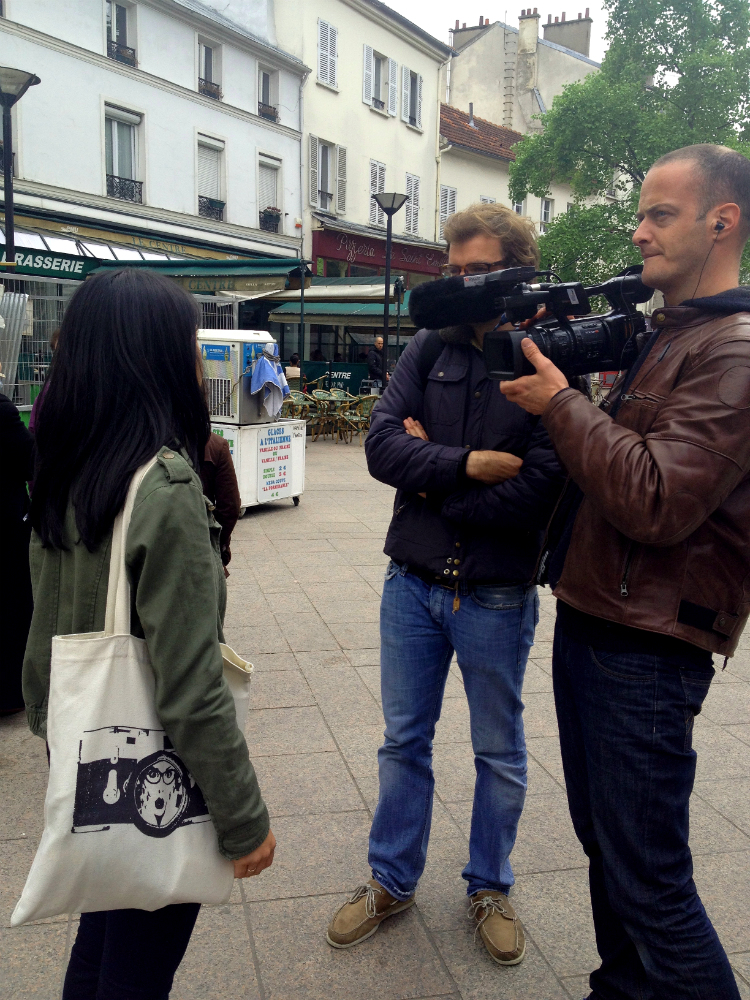
Olivier and Guillaume, our camera crew,
interview our tour guide, Ingrid.

Our guide, Ingrid, is a young women of Thai-French ancestry who is a native of Aubervilliers. She is a “greeter,” who volunteers to show tourists around her hometown. The way the “greeter” program works is that you make a nominal contribution to their organization and then they tell you what unconventional site you’re going to visit. This tour service to someplace you may have never heard of is otherwise free. We just lucked out getting Aubervilliers. Our expectations were to be challenged.

This private tour by four Americans was apparently so unique that it was filmed by a two-man crew under contract with a major French television channel that saw Americans in Aubervilliers as a rare and newsworthy event. So Olivier and Guillaume came along with their camera and microphone every foot of the way, shooting film and asking questions. Our tour became something of a moving spectacle as this miniature television crew followed us through town.

Although Aubervilliers has been around since at least 1069, this tour had nothing to do with medieval churches or civic monuments. Ingrid did point out an ancient wall that had been left standing as part of a public garden and an abandoned old paint factory, now a French “superfund” site. But these were just among the random sights as we walked through town on our way to meet her friends.

First we visited Julian at the “Association Freres Poussiere,” a small community arts facility. Julian showed us their art gallery-hangout space and theater and told us that the principal object of the center was to bring together Aubervilliers’ diverse groups in creative enterprises. Their facilities were humble, but their enthusiasm was strong and their explicit goal was multicultural harmony.

Next, our little group went up into the very bowels of one of those massive and supposedly dehumanizing public housing buildings to visit Fado, a 63-year-old woman from Senegal, bedecked for the occasion and probably all occasions in vibrantly colorful traditional Senegalese dress. She has been in France since the late 1970’s and has three children who were born here. Fado lived on the 18th floor.

Arriving at her building we found that one of the two elevators serving her sector of the building was broken and repairmen were busy repairing it. We were told that elevator breakdowns were not uncommon and that there had been times when both were broken simultaneously. Fado referred to other building maintenance complaints, but from our random visit, it appeared that the building was clean and reasonably well-maintained and the exterior nicely landscaped.

Fado’s apartment had two bedrooms, a living room, a kitchen with adjoining dining area, a bathroom, and storage space. The rooms were small by American standards, but not by Parisian standards. The apartment had roughly 7-800 square feet. It also had a great view, including Sacre Coeur and the Eiffel Tower.

Ingrid told us that Fabo paid rent, but it was on a sliding scale and quite reasonable. “Five hundred euros ($650) a month?,” we asked. “Less,” Ingrid responded.

Getting an apartment there requires proper qualifications (resident status plus low income or disability, etc) and some time on a waiting list. Fabo had lived in hers since the late 1980s. Her apartment was nice, clean and orderly, with a big flat-screen TV and comfortable leather couches in good condition in the living room. She served fruit juices and cookies. She had done domestic work for many years, but had been on disability due to a back injury for the past four. Her children were grown and lived elsewhere in the Paris area.

Brothers on the street.

Other people we saw in the halls, on the elevator, and around the building were of every racial and ethnic type: white French ladies with their kids, black African and Arab ladies with their kids, old white mostly native French guys playing boules in the adjacent park, older Muslim men wearing skull caps, and a few orthodox Jews in their distinctive black suits and broad-brimmed hats strolling by, and mixed groups of idle young men of every complexion lounging around the grounds.

These people were generally well-dressed and friendly. No one looked especially poor and ragged or noticeably miserable or threatening. Unlike upscale central Paris, there were no homeless people living on the sidewalks and no beggars.

The groups of young men were of particular interest and concern. Under-30 unemployment is reputedly very high in Aubervilliers, maybe 50%. These are clearly the type of guys who have on occasion set a couple hundred cars on fire in protests. These are the guys who would reputedly have no livelihood were it not for the continuation of marijuana prohibition in France.

We were told that job seekers from this area lie about their zip codes when applying in Paris. These groups of young guys were thoroughly integrated, ranging from variations on white to very black, with a lot of North African Arab ancestry in the mix along with a few each of several varieties of Asians, plus growing numbers of “others,” such as our guide.

These guys were attracted by the filming, being done by two white native Frenchmen in their thirties, both over six-feet tall and fit. Our camera team interacted with these Aubervilliers street kids in a friendly and animated manner, but later told us that the situation was always delicate. You had to know how to act. Be outgoing and show no fear. Show them you’re on the same side. Otherwise, it could become dicey. And your security would be a much more risky proposition after dark when the area turns into the modern version of the Cour des Miracles.

Next we popped into a tea room in a shopping mall at the foot of one of the public housing complexes. There we were treated to tea and pastries by the two ladies from Tunisia who owned and operated the establishment. One of them had once spent two months living with a family in Wisconsin and spoke English. Their pouring of the tea into small, highly decorated glasses was quite formal. They could not have been more charming. Their pastries were delicious. We were served more than we could eat without having ordered anything. If there was a bill, I didn’t see it.

Tunisian ladies in the Tea Room.

Finally, on the way back to the metro, we walked trough more public housing, these buildings only three to five stories with irregular orientations, interspersed with gardens and balconies, connected by curving pedestrian walkways named after famous artists like Matisse and Modigliani.

Though constructed primarily of interlocking concrete slabs, they were attractively landscaped, looked more spacious and individualized, and had a less overwhelming scale. We were told that almost half the residents of Aubervillers live in some form of publicly-owned housing.

What can we conclude from our brief visit to Aubervilliers? There are doubtless serious social issues there that are at a level worthy to inspire serious concern, but this wasn’t some hopeless, grimy, crumbling slum like those I’ve seen all my life in the U.S.

Housing is the most obvious contrast. Instead of aging, dilapidated wood frame houses and poorly maintained, privately owned apartment buildings so typical of virtually every U.S. city, Aubervilliers has an enormous stock of decent public housing. It may not be ideal, but it is considerably better for poor and working class people than what is typically offered them in the U.S.

The public housing highrise we entered was not trashed out. There was no smell of urine in the stairwells. There was no garbage piling up in the halls. It was quiet. Windows weren’t broken. The broken elevator was being fixed.

The buildings were surrounded by green spaces that were regularly tended. There were attractive parks nearby. Many apartments had balconies with views over Paris. There were publicly-owned commercial centers adjacent to the housing units, filled with privately-operated shops, many run by locals. Rents are controlled and manageable, even for the long-term unemployed.

This community was built by communist-led local governments in cooperation with socialist-led federal governments with the guiding principle being to provide decent low-cost housing for people of modest means.

In the U.S, most low income housing is provided by private entrepreneurs whose priority is maximizing their profits. The principal concern of private owners is that their properties cost them as little as possible while yielding as much revenue as possible. The capitalist’s profit motive and the interests of the residents for quality maintenance and improved amenities naturally conflict. That is not the case with public housing in Aubervilliers.

While walking through the central part of Aubervilliers, we passed a large building project nearing completion that Ingrid said was a new recreation center that would include an olympic-sized swimming pool. She also said that there were plans to open a branch campus of the University of Paris there soon and a new metro line.

Some of this government effort is doubtless motivated by the desire not to see the recurrence of the past riots. In addition, the central government continues to invest significantly in places like Aubervilliers as a part of a larger strategy to break down the historic barriers between Paris and the surrounding banlieu.

Besides housing, the boys hanging out on the corner in Aubervilliers have a few other things going for them that boys in a similar situation in the U.S. do not have. They have access to a universal health care system that has been judged the best in the world. They grew up with access to a publicly-funded educational system beginning virtually at birth in which one continues to advance based almost entirely on merit.

No one graduates from a French university owing $30,000 in student loans. They have access to more job training programs and, if they get a job, better-protected worker rights and long-lasting unemployment insurance. And if one of these young men becomes a parent, the government will provide all prenatal and postnatal services, besides paying the parent(s) a monthly stipend until the child is 18, more if the child has a disability.

Although Aubervilliers at night might be a scary proposition for an American senior with less than perfect French, it is fundamentally safer than hundreds of places in the U.S. because the population doesn’t have guns. You might get robbed, even beaten up, or be forced to dance for hours to Algerian rap music while toking spliffs, but you won’t get shot.

The high-rise public housing was surrounded by green space with public parks nearby.

As a consequence of having a citizenry without firearms, the police are also less likely to shoot people. The old police justification — “I thought he had a gun” — doesn’t compute. You can actually fight the cops in France without worrying about being blown away. The French riot police may look scary in their protective body armor and may use water cannons, tear gas, and truncheons, but they won’t shot you with a 9mm if you throw a rock at them.

Aubervilliers is a marvelous example of the integration process of highly divergent groups of people. It has succeeded at achieving this goal on many levels and on a large scale for a long time. It has played this integrative role for almost 200 years now, originally with provincial Frenchmen. Even the disaffected youth of today are an example of its success.

We were told that there are no ethnically-based youth gangs in Aubervilliers. There may be gang-related crime, but it’s well-integrated gang-related crime. Given its extreme diversity, racism within Aubervilliers has plenty of potential, but it seemed minimal in our brief observation.

So if some day fate confronts you with the bizarre choice of either Detroit or Aubervilliers, don’t hesitate to start working on your French. And rest assured that speaking it with a strange accent won’t bother your new neighbors.

[David P. Hamilton, a graduate of the University of Texas at Austin in history and government was an activist in 1960s-’70s Austin and was a contributor to the original Rag. David and wife Sally spend part of every year in France. Read more articles by David P. Hamilton on The Rag Blog.]

The Rag Blog

Posted in Rag Bloggers | Tagged , , , , , , , , , , | 3 Comments

Harry Targ : Waist Deep in the Big Muddy, Again!

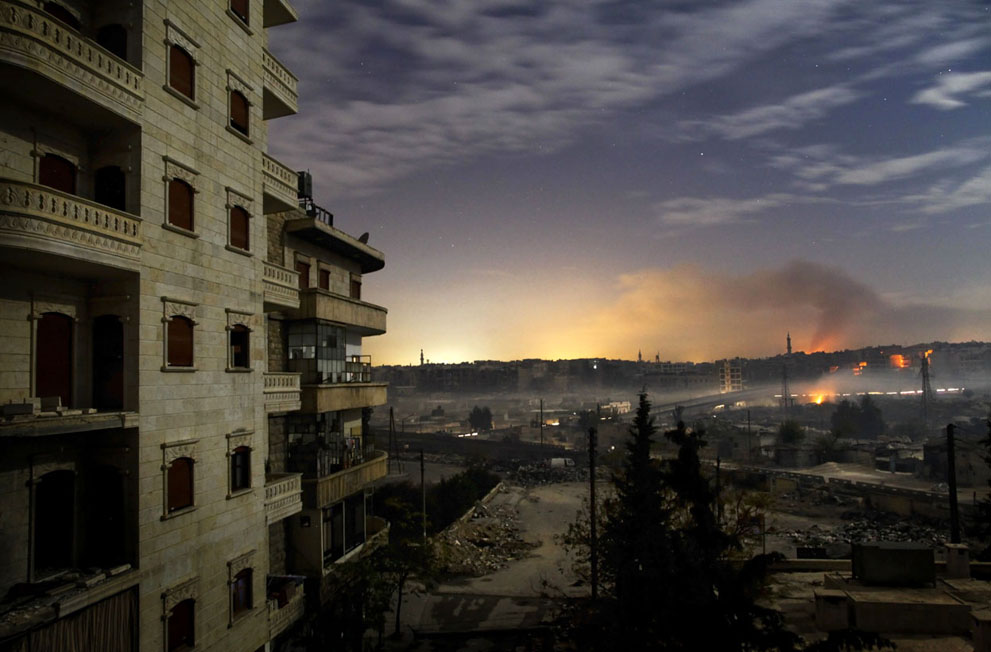
Smoke from fighting in the northern Syrian city of Aleppo, December 1, 2012. Photo by Javier Manzano / AFP / Getty Images.

One more time:
Waist deep in the Big Muddy

The case is clear that increasing the United States’ military involvement in Syria has negative consequences for the Middle East, international relations, the inspiration of Arab Spring, American politics, and the people of Syria.

By Harry Targ | The Rag Blog | June 20, 2013

In 2011 the grassroots revolts that spread all across the Middle East caught the traditional imperial powers in the region — the United States, Great Britain, and France — by surprise. Even more so, the Middle East theocracies and dictatorships — Saudi Arabia, Tunisia, Egypt, Bahrain, Jordan, Kuwait, Qatar, and others — were threatened by those young people, workers, unemployed, and women, who took to the streets motivated by the vision of another world.

The United States watched the street protests hoping against hope that the authoritarian regimes in Tunisia and Egypt would weather the storm. The Obama administration did not move publicly to aid these regimes to crush the protest but withheld its endorsement of the grassroots democracy movement.

The idea of popular revolt spread to places all across the globe including Madison, Wisconsin; Santiago, Chile; Athens, Greece; Madrid, Spain; and Quebec, Canada. The Occupy Movement in the United States expanded.

Globally, movements for a 21st century democratization seemed to be replicating 1968.

In this historic context, the imperial powers needed to transform the Middle East narrative from demands for jobs, worker rights, women’s rights, and democratization, to the more traditional religious and ethnic conflict model of Middle East politics.

The United States organized a United Nations/NATO coalition to intervene to encourage rebellion in Libya coupled with a game-changing air war against the Libyan military. The result was the overthrow of the government of Muammar Gaddafi and its replacement by a quarrelsome ungovernable regime rife with ethnic strife.

The UN/NATO war on Libya was billed as the next phase of Arab Spring, while actually it imposed religious and ethnic conflict on a relatively stable but authoritarian regime.

The anger over the U.S. encouragement and military intervention in the Libyan civil war was reflected in the killings by Libyan terrorists of CIA operatives in Benghazi, Libya, in September 2012. What intervention in Libya did was to destabilize that society and eliminate its former dictator who was opposed to the growing U.S. military expansion in North Africa.

Most important, it took off the front pages and the hearts and minds of youth, the poor, women, and trade unionists the hope of mass movements to bring about democratic change in the region.

U.S. covert and military intervention has shifted now from Libya to Syria. Mobilization against the Bashar al-Assad dictatorship in Syria was applauded by the United States. As the protest escalated into civil war in that country with contestants including secular and religious groups fighting against Assad’s army, the United States, Sunni countries of the Arab League, and NATO countries escalated their support to the rebels.

Another Libya-style UN/NATO military operation was thwarted by strong opposition from Russia and China and the threat of growing military support for the Syrian regime by Iran.

Part of the ongoing story of Syria is the following:

  1. The United States launched its diplomatic involvement in the Syrian civil war by insisting that Bashar al-Assad must step down. This precluded any possibility of a diplomatic settlement of the civil war and the eventual dismantling of the Assad regime. Most important, the United States’ non-negotiable demand made diplomatic collaboration between the United States and Russia all but impossible.
  2. Support for various rebel factions, diplomatic and presumably covert, has encouraged the escalation of opposition violence which has been matched by state violence.
  3. Rebel factions, ironically, have included groups with profiles that resemble the terrorists who were responsible for the 9/11 murders in the United States and terrorist attacks on various targets in the Middle East and Afghanistan.
  4. Violence and political instability have begun to spread to Lebanon, Turkey, and Jordan, and have drawn Israel and Iran closer into regional war.
  5. As the Syrian civil war has escalated it has become a “proxy” war between the United States and Russia and Sunni and Shia Muslims.
  6. In the United States, the civil war in Syria has rekindled the war factions. These include the “neoconservatives” who were responsible for the wars in Afghanistan and Iraq. Using 9/11 and lies about weapons of mass destruction, the neoconservatives influenced the Bush administration to pursue their agenda to use United States power to transform the globe in its interests.
  7. The neoconservatives, advocates of United States military intervention in Syria, are now joined by the “humanitarian interventionists” who in the Clinton Administration supported bombing campaigns in Iraq, Serbia, and Bosnia and live by the ideology that the United States must use its military power to promote human rights around the world.

    It is important to note that recent polling data suggests that only a small percentage of the American people, about 20 percent, give any support to United States involvement in Syria. Most Americans are suffering from declining jobs, income, and social safety nets, and reject the war economy and militarism that has characterized the U.S. role in the world since 1945.

  8. The escalation of the civil war, the growing military role of the United States, Russia, Iran, Turkey, NATO, Hezbollah from Lebanon, and Israel has led to nearly 100,000 Syrian deaths and more than a million refugees. As in most international wars, innocent people suffer and die as military decisions are made in government capitals.

The case is clear that increasing the United States’ military involvement in Syria has negative consequences for the Middle East, international relations, the inspiration of Arab Spring, American politics, and the people of Syria.

The hope for a more just and peaceful future requires support for the resumption of the spirit and vision of the original Arab Spring that began in Tunisia and Egypt and spread all across the globe. Otherwise the United States will once again be “waist deep in the big muddy” as in Vietnam, Iraq, and Afghanistan.

[Harry Targ is a professor of political science at Purdue University and is a member of the National Executive Committee of the Committees of Correspondence for Democracy and Socialism. He lives in West Lafayette, Indiana, and blogs at Diary of a Heartland Radical. Read more of Harry Targ’s articles on The Rag Blog.]

The Rag Blog

Posted in Rag Bloggers | Tagged , , , , , , , | 1 Comment

Jack A. Smith : Obama, China, and the Middle East

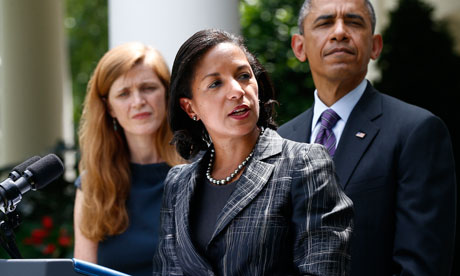
Samantha Powers, Susan Rice (“two cats among pigeons”), and President Obama. Photo by Charles Dharapak / AP.

Foreign policy pivot?
Obama, China, and the Middle East

Obama has transferred the brunt of U.S. foreign/military policy away from the Middle East and the war on terrorism and toward Asia to better manipulate the conditions of China’s inevitable return to big power status.

By Jack A. Smith | The Rag Blog | June 20, 2013

There is an obvious connection between the first summit conference attended by Chinese President Xi Jinping and President Barrack Obama in California June 7-8 and Obama’s major speech two weeks earlier redefining the future of America’s 12-year military role in the Middle East.

In effect, Obama has transferred the brunt of U.S. foreign/military policy away from the Middle East and the war on terrorism and toward Asia to better manipulate the conditions of China’s inevitable return to big power status. The process Washington began two years ago to contain China’s influence — the “pivot” to Asia, now termed the “Asia Pacific rebalancing strategy” — can now be accelerated.

I have located no mention of this connection in the Chinese press, but it undoubtedly added to President Xi’s concern about the “rebalancing” just before his talks with Obama. The only mention in the U.S. mass media I know of was a single paragraph in a March 25 New York Times article about Obama’s comments:

Left unsaid in Mr. Obama’s speech was one of the biggest motivations for his new focus: a desire to extricate the United States from the Middle East so that it can focus on the faster-growing region of Asia.

The switch makes practical sense. It has evidently occurred to the Oval Office that a monomaniacal obsession with a small, scattered enemy possessing primitive weapons undermines America’s imperial interests. The main geopolitical prize for the U.S. government obviously is in East and South Asia, not the Middle East, which has transfixed Washington’s attention since September 11, 2001, at a huge cost in prestige and treasure — probably $5 trillion or more when it’s finally paid off in several decades.

Clarifying this new foreign/military policy thrust is the main reason President Obama delivered his important speech May 23 redefining America’s wars, drones, and Guantanamo. His main message was that “we must define our effort not as a boundless ‘global war on terror,’ but rather as a series of persistent, targeted efforts to dismantle specific networks of violent extremists that threaten America.”

“Rebalancing” to Asia does not signify the Obama Administration has the slightest intention to ignore the Middle East. It means these small so-called terror wars are no longer Washington’s first international priority. The U.S. will continue the fighting, but with much smaller numbers of special forces, drones and other cheaper means of domination, not with large armies of occupation and trillions in treasure.

The Afghan, Iraq, and “terror” wars combined with a conservative political atmosphere, regressive economic and political trends, and the impotence of the two-party system in these first years of the 21st century have made a mockery of American democracy: Massive government erosion of civil liberties and the right to privacy; an election system based on corporate money, not the voters; and a ruling elite indifferent to burgeoning inequality and the plight of the poor and destitute.

Osama bin-Laden, the symbol of the terror wars is dead (USA!, USA!,USA!), but not before he tricked the world’s most powerful country into launching two unnecessary and embarrassingly stalemated wars against much weaker foes, creating havoc in those two countries and criticism of American aggression throughout much of the region. Credit card war spending created a mile-high domestic deficit that Congress is using as a hatchet to cut social programs and substantially weaken civil liberties and privacy rights.


The Obama-Xi talks

More details about the speech follow but I’ll focus now on President Xi’s visit first. It is too early to fully assess the June 7-8 meetings during which the two heads of state spent eight hours together in discussions with hardly any of the usual formalities. There were two main issues, from Washington’s point of view, cyber theft and North Korea, plus several other discussions and agreements.

Cyber theft: Obama informed Xi of his extreme displeasure over China’s alleged massive “cyber-enabled economic theft of intellectual property and other kinds of property in the public and private realm in the United States by entities based in China.” Last March, National Intelligence Director James Clapper testified that cyber threats appear to have largely replaced terrorism as posing the greatest risks to U.S. national security.

Obama directed considerable pressure upon his Chinese guest, but did not obtain much satisfaction. At the end of the cyber meetings, Tom Donilon, Obama’s national security advisor (soon to be replaced by UN Delegate Susan Rice), could only report: “It’s quite obvious now that the Chinese senior leadership understand clearly the importance of this issue to the United States.”

The American leader’s cyber presentation was somewhat upstaged the same day when the Guardian (UK) reported, “Obama has ordered his senior national security and intelligence officials to draw up a list of potential overseas targets for U.S. cyber-attacks.” This top-secret 18-page presidential directive was provided to columnist Glen Greenwald by NSA whistleblower Edward Snowden. Obviously, the U.S. engages in cyber crime as do most major countries. It even launched the first cyber “war” by corrupting Iran’s computer network.

Xi criticized the U.S. media for ignoring cyber attacks against China. He also commented, “by conducting good-faith cooperation we can remove misgivings and make information security and cyber security a positive area of cooperation between China and the U.S. Because China and the United States both have a need and both share a concern, and China is a victim of cyber attacks and we hope that earnest measures can be taken to resolve this matter.”

Soon after the summit, according to Associated Press, “China’s Internet security chief told state media that Beijing has amassed huge amounts of data on U.S.-based hacking. The official held off blaming the U.S. government, saying it would be irresponsible and that the better approach is to cooperate in the fight against cyberattacks.”

On June 13, whistleblower Snowden, in Hong Kong, revealed to the South China Morning Post that the National Security Agency was spying on China and Hong Kong. The same day, Ministry of Foreign Affairs spokeswoman Hua Chungying said China is a “major victim” of cyber attacks but did not lay blame.

North Korea: Both sides discussed relations with the Democratic People’s Republic of Korea (North Korea). At the end of the meetings, Donilon announced what the White House perceives as a victory:

With respect to North Korea, I think the important point here is full agreement on the goals — that is denuclearization; full agreement that in fact the Security Council resolutions which put pressure on North Korea need to be enforced, and full agreement that we will work together to look at steps that need to be taken in order to achieve the goal.

Rumors were circulating before the meetings that this might be China’s new position toward its old ally, but in summing up the talks on Korea a leading member of the Chinese delegation only said that Xi and Obama “talked about co-operation and did not shy away from differences.”

New relationship: The Beijing government stresses that China seeks a “a harmonious, peaceful rise to power and on becoming a responsible stakeholder in the international system.” During the meetings President Xi said he favored a “new type of great power relationship” based on mutual trust, respect, cooperation on important issues, and better ways to resolve differences.

Xinhua news agency reported:

According to Yang Jiechi, Xi’s senior foreign policy adviser, Obama responded actively to the proposal, saying that the U.S. side placed high importance on its relations with China and is willing to construct a new state-to-state cooperation modal with China based on mutual benefit and mutual respect, so as to jointly meet various global challenges.

Climate change: The U.S. is history’s biggest emitter of greenhouse gases into the atmosphere, but relative newcomer China is biggest in recent individual years. At the summit, both agreed to reduce hydrofluorocarbon emissions, one of the most potent of the greenhouse gases. This is not a major step but a beginning. China on its own made an important announcement last month, vowing to put a ceiling on greenhouse gas emissions starting in 2016. This is considered a major breakthrough that will influence other nations, possibly even the U.S.

Omitted from the meeting was Washington’s customary complaint that China manipulated its currency to America’s disadvantage. For the last several years Beijing has been cautiously but systematically appreciating the value of its currency until it now approximates natural value.

The summit was productive in its way, but that does not change either Washington’s geopolitical objectives or the threats implicit in its “rebalancing” to Asia.

Beijing is exceptionally anxious to keep the peace with Washington. It is a developing country with many crucial tasks ahead for decades to consolidate the economic and social conditions of a country which must feed, house, educate, and gainfully employ 1.3 billion people in a land area somewhat smaller than the U.S. with 314 million people.

China is also decades behind the U.S. in military terms, a gap that will continue indefinitely because the Pentagon constantly spends fortunes to maintain its weapons and logistic superiority. A war would wipe out the incredible advances China has made since the success of the communist revolution 64 years ago, which includes bringing about 700 million people out of poverty, creating a substantial middle class, and becoming the center of world production.

Washington wants friendly relations with the Beijing government, as it does with all countries. However, it imposes strict conditions for such relations. This is based on the fact that the U.S. has been one of two sharply contending, dominant global powers from the end of World War II in 1945 to1991, when the Soviet Union dissolved, and the single dominant world power — indeed, the mightiest hegemonic state in history — ever since.

Those who rule the U.S. believe that it is the “indispensible nation,” ordained to lead, even as its economy suffers stagnation and Washington appears to have a penchant for “leading” the world from one war to another.

The great majority of countries enjoy friendly relations with Washington because they are willing to recognize the U.S. as world leader with special privileges and dispensations up to, and often including, getting away with the murder attendant to its illegal wars. Only a handful of countries do not accept U.S. hegemony — Cuba, Venezuela, and Iran among them — and Uncle Sam extracts a hefty price for such insolence.

Beijing seeks friendly relations with Washington for obvious reasons. Successive Chinese leaders have assured the U.S. government that China does not seek world leadership.

China does not challenge American dominion, at least openly, but it is extremely independent. Its tilt toward Iran and Syria, which frustrates the White House, are examples, as is its protection of what it believes are China’s economic, political, and territorial prerogatives regardless of intense U.S. criticism in certain areas. In theory, China opposes unipolar (one country) world leadership, preferring a multipolar system, as do a number of developed and developing countries, but no nation will push the issue for the foreseeable future.

America’s leaders are apprehensive that if China largely continues for the next 10 or 20 years the unprecedented development of the last 20 years its mere success in relation to what could be America’s slow decline will result in Washington’s displacement.

That seems to be where the “Asia Pacific rebalancing strategy” comes into play. It has several purposes but two stand out. The main purpose is not to prevent China’s rise or economic success but to confine it in terms of global power, not that Beijing has evidenced a desire to wield such authority. The other purpose is to further integrate the U.S. into the region’s dynamic economic climate.

The U.S. is bringing three of its strengths into the endeavor — alliances, money/trade, and military power.

  1. Alliances: Washington is organizing the many Asia/Pacific countries historically within its superpower orbit to join a united crusade to keep China from exercising leadership even within its own geographical sphere of interest.

    Such clients include Japan, South Korea, the Philippines, Vietnam (lately), Australia, and quite possibly those on the periphery — India, perhaps Myanmar and Cambodia. Indonesia and Taiwan may not want to get involved. Since Obama first announced his focus on Asia two years ago, the U.S. has been inserting itself into regional squabbles, particularly the territorial disputes in the South China Sea, always on the side of Beijing’s opponents to make them more grateful to their protector.

    Most of these countries are rising economically or are already established, and they are beginning to develop close economic, political and military ties with each other, but it is unlikely they could form a possible bloc that would some day “balance” China without the U.S.

  2. Money and trade: The U.S. is in the process of forming a free trade association of nations in the Asia/Pacific region, including countries in the Americas bordering the Pacific. It’s called the Trans-Pacific Partnership. China supports the Association of Southeast Asian Nations’ Regional Comprehensive Economic Partnership (RCEP), but is “considering” membership in the TPP as well.

    The U.S.-dominated TPP will bring some economic benefits to all its members, but the main objective is to provide the United States with an important vehicle to become a major player in the region, political as well as economic, and thus a rival to China in East Asia.

    There are various complications and intrigues involved with the TTP that I won’t go into, except for one progressive critique from the Council of Canadians:

    The TPP is globally controversial because of how it will entrench a myopic vision of market-based globalization that is the main cause of runaway climate change and which has done little to create good, sustainable jobs or reduce poverty worldwide. The TPP also enhances corporate rights to sue governments when public policies interfere with how, when and where they make profits.

  3. Military power: The unparalleled supremacy of the U.S. military/national security/surveillance apparatus — inefficient against guerrilla war (Vietnam, Iraq, Afghanistan) but capable of becoming an unparalleled death machine if deployed against China — is not only coming to the Asia/Pacific region but it’s mostly there already, in certain places going back to World War II.

    The U.S. pivoted to Asia 70 years ago and never left. China has been virtually surrounded for years with U.S. naval, air, and troop bases through the region from small islands dotting the western Pacific to Japan and South Korea in the northeast to the Philippines in the southeast, to Afghanistan in the west. This does not include air power, long-range missiles, surveillance satellites, and nuclear weapons at the ready.

    More recently Obama opened a new Marine base in western Australia and ordered the majority of the U.S. fleet, from aircraft carriers to nuclear submarines, to move from the Atlantic to the Pacific. Why does the Obama Administration feel the need to show the flag and its martial trappings, up close, intentionally too close for Beijing’s comfort? To show who’s boss. If Beijing ever dared provoke Washington in such manner, the U.S. would prepare for war.

An article titled “The Problem With The Pivot” appeared in the December 2012 Foreign Affairs, declaring: “Obama’s new Asia policy is unnecessary and counterproductive.” Written by Robert S. Ross of Boston College and Harvard’s Fairbank Center for Chinese Studies, the essay stated:

[T]he Obama Administration’s pivot has not contributed to stability in Asia. Quite the opposite: it has made the region more tense and conflict-prone. Military aircraft and naval ships now crowd the region’s skies and waters. And the United States risks getting involved in hostilities over strategically irrelevant and economically marginal island [in the South China Sea]….

Washington’s increased activity on China’s periphery has led Beijing to conclude that the United States has abandoned “strategic engagement,” the cornerstone of U.S. policy toward China since the end of the Cold War. In contrast to previous administrations, the Obama Administration has dismissed China’s legitimate security interests in its border regions, including even those that are not vital to U.S. security.


Obama and the Middle East

Now I’ll return to Obama’s May 23 speech “ending: the war on terrorism,” and the “new” U.S. policy in the Middle East. Aside from clearing the way for deeper involvement in Asia, what are we to make of this manipulative and defensive 7,000-word lecture?

Obama sought to convey the impression — in the words of a New York Times article the next day —

that it was time to narrow the scope of the grinding battle against terrorists and begin the transition to a day when the country will no longer be on a war footing…. As part of a realignment of counterterrorism policy, he said he would curtail the use of drones, recommit to closing the prison at Guantánamo Bay, Cuba, and seek new limits on his own war power.

Progressive and left commentators excoriated the speech with a “there he goes again” approach to what they viewed as a deceptive, self-justifying attempt to deflect criticism of his war policies.

President Obama’s pledge to take steps toward removing the U.S. from its “perpetual war footing” was widely questioned. A May 25 front page article in The New York Times noted:

Nor can Mr. Obama escape his own role in putting the United States on a war footing. He came into office pledging to wind down America’s wars in Iraq and Afghanistan, but within a year had ordered 30,000 more troops to Afghanistan and oversaw a significant expansion of the Bush administration’s use of clandestine drone strikes.

Anthony Romero, ACLU executive director, commented:

President Obama is right to say that we cannot be on a war footing forever — but the time to take our country off the global warpath and fully restore the rule of law is now, not at some indeterminate future point.

The antiwar Answer Coalition summed up the speech in these words:

While there is much to dissect in his speech, the bottom line is that President Obama is attempting to respond to criticism of his war on terror policies while creating a new framework to institutionalize many of these same policies.

Answer was convinced that the

speech must be seen as a direct response to the individuals and organizations who have consistently been challenging the actions of the administration on these issues. It is unavoidably clear that the firestorm of criticism around drone strikes, Guantanamo Bay Prison, and the extent of domestic surveillance created a climate in which Obama was forced to defend his policies.

Other commentators tore apart Obama’s efforts to rationalize his killer drone policy when he declared: “Beyond the Afghan theater, we only target al-Qaeda and its associated forces. And even then, the use of drones is heavily constrained.” (The Afghan theater includes western Pakistan.) Critics also panned the few superficial reforms he promised to introduce into the program.

Progressives refused to accept his justification for not closing Guantanamo concentration camp as he promised five years ago. Some articles pointed out that despite a recalcitrant Congress, Obama could have used the vast authority of the presidency to actually close the prison and release its hapless inmates. When Obama boasted that he “ended torture” it was pointed out that the forced-feeding of hunger striking Guantanamo prisoners was torture according to the American Medical Association.


Unfinished business: Iran and Syria

The Obama Administration still has much unfinished business in the Middle East that guarantees it will remain indefinitely — though not in “global war on terrorism” rampages as in Iraq. Tens of thousands of U.S. troops will be stationed in or close to the region, on land and at sea. Special forces troops and drones will continue to kill suspected terrorists in the Middle East and now deeper into Africa. In addition, Obama seeks to keep 10,000 U.S. troops and nine bases in Afghanistan to 2024, 10 years after “combat forces” withdraw at the end of 2014.

The White House has many other plans for the Middle East and North Africa. The first task is to insure that Israel, America’s main dependency and factotum in the region, remains the Pentagon’s virtual forward base in the Arab world. America’s second task, at which it has been laboring for many years, is regime change in Iran and Syria — the only two countries in the entire region not within Washington’s hegemonic orbit. Iraq and Libya used to make it four countries, until Bush (2003), then Obama (2012), reduced the number.

Iran, now an Islamic Republic that adheres to the Shia branch of Islam, is the main target because it is a powerful, oil-rich state that will not bend the knee to Washington. The Iranian people have not been forgiven for the last 34 years for the intolerable affront of kicking out the vicious dictatorial monarch, Mohammad Reza Shah Pahlavi, installed on the Peacock Throne by American-British imperialism a quarter-century earlier. Were Iran willing to kowtow to the U.S. today, it wouldn’t be suffering extreme sanctions and the constant threat of U.S.-Israeli war.

Iran was greatly strengthened when the U.S. invaded its main enemy, Iraq, bringing down the minority Sunni government in Baghdad led by secularist Saddam Hussein. The majority Shia Iraqi population then elected a government of their own. Now there are Shia regimes in Tehran, Baghdad, and Damascus (secular President Bashar Assad and government leaders are Alawites, a branch of Shia Islam), forming a contiguous Shia region 1,500 miles wide, bordered by Turkey on the west and Afghanistan to the east.

The Sunnis are the great majority in the Middle East and throughout Islam. Certain Sunni Arab countries — such as Saudi Arabia and other Gulf dictatorships, among others — seek to reduce Shia power by supporting the overthrow of the minority Alawite government led by President Assad, weakening Iran with the loss of its main Arab supporter. The moderate Islamist government of NATO member Turkey is a big supporter of the rebels, partly to gain influence in the Sunni Arab world, partly to impress the U.S.


Escalation in Syria?

The beginning of the popular struggle for democracy in Syria two years ago consisted largely of nonviolent protests that were met with government repression. We will never know if certain government concessions to the original peaceful protests would have led to reform instead of mayhem. The conflict, however, very soon transformed beyond calls for a broader democracy into a deadly civil war led by Sunni rebels, including jihadist elements, seeking to eliminate the secular regime and take power.

This war, in its second year, has become exceptionally vicious, destructive of people and infrastructure. The UN says at minimum 93,000 Syrians have been killed. A large number of the dead have been soldiers on both sides.

The U.S. and its closest NATO allies have supported regime change from the beginning, but only if it is possible to place a government submissive to Washington’s dictates in Damascus. That proviso is important.

It is incorrect to assume Obama is disinterested in overthrowing the Assad regime simply because he refused to commit to an American air and ground war to support of the anti-government forces. Obama’s problem is that the insurgents are thoroughly disunited despite receiving arms and money from Sunni countries and “non-lethal” aid from the U.S. and others for well over a year.

White House efforts to form a reliable, united pro-U.S. rebel front have failed repeatedly. At the same time, Islamic jihadist fighting elements are stronger than the other warring groups in the Free Syrian Army. This suits the wealthy Saudi Arabian dictatorship, the major sponsor of the war, but is anathema to Washington for obvious reasons.

As we write, the Obama Administration has just announced, “following a deliberative review, our intelligence community assesses that the Assad regime has used chemical weapons, including the nerve agent sarin, on a small scale against the opposition multiple times in the last year.” Up to 150 people are alleged to have died from the gas.

Nerve gas may have been used but I remain dubious that the Syrian government ordered its use. Assad fully understood that if even a small amount of gas was deployed it would cross Obama’s “red line,” leading anywhere from a marked increase in U.S. support for the rebels to massive retaliation.

Assad clings tenaciously to his life, his office, and his constituency. Why would he, in effect, toss it all away by approving the use of a small amount of sarin knowing it could trigger his doom? War hawks in Washington — liberal and conservative, as well as within the State Department — are demanding a drastic response from the White House, from arming the rebels with sophisticated weapons to establishing a no-fly zone to putting “boots on the ground.”

Obama is hesitant. According to The New York Times he has “decided to begin supplying the rebels for the first time with small arms and ammunition.” I suspect he will insist that the shipments must not end up with jihadist rebels. He can be expected to resist pressure to establish a no-fly zone in Syria backed with U.S. jets, as he did in Libya. Syria has sophisticated air defenses as opposed to nearly defenseless Libya.

Another factor causing hesitation is that despite a year of press and U.S. government exaggerations that Assad is on the precipice of defeat, the Alawite government controls most of the territory and nearly all the large cities. Recent battlefield support from Lebanon’s Shia self-defense organization Hezbollah has been an important asset for the government and has contributed to rebel setbacks and loss of territory in recent months.

The sarin announcement, and the subsequent American decision to openly send arms, benefits the insurgents at a time when they need a morale boost and an infusion of weapons with which to mount counterattacks. Obama will do what he can to keep the rebels in the field and bring about regime change. But he knows history will be unforgiving if he aligns with known terrorists, and justly suspects that the American people will oppose another U.S. ground war in the Middle East.

There is one important unknown factor: the influence on Obama from newly named security adviser Susan Rice, the former UN Delegate, and her replacement, Obama adviser Samantha Powers. Both are liberal war hawks and staunch advocates of so-called “humanitarian intervention.” They may push for a tougher line on Syria and elsewhere.

At the UN Rice has been publicly rude to chief delegates from both China and Russia. Powers is said to have been a major influence on Obama’s decision to attack Libya. Veteran analyst M.K. Bhadrakumar, writing June 8 in India Punchline, commented that by advancing both advisers Obama “is letting loose two cats among pigeons, a reference to State and Defense Secretaries Kerry and Hagel.”

[Jack A. Smith was editor of the Guardian — for decades the nation’s preeminent leftist newsweekly — that closed shop in 1992. Smith now edits the Hudson Valley Activist Newsletter. Read more articles by Jack A. Smith on The Rag Blog.]

The Rag Blog

Posted in Rag Bloggers | Tagged , , , , , , , , | Leave a comment

Lamar W. Hankins : Government Lies and Secrecy Destroy Credibility

Whistleblower Edward Snowden. Image from MGN Online.

Government lies and
secrecy destroy credibility

“Those who would give up essential Liberty, to purchase a little temporary Safety, deserve neither Liberty nor Safety.” — Benjamin Franklin.

By Lamar W. Hankins | The Rag Blog | June 20, 2013

When a high government official blatantly lies in testimony before Congress, it is rare that we learn of the lie as quickly as we did this past week. Sometimes, such misconduct takes decades to be revealed.

But thanks to whistleblower Edward Snowden, who once worked for the CIA and was, until recently, a civilian employee of Booz Allen Hamilton, a National Security Agency (NSA) private contractor, we now know of the lie.

In March, James Clapper, Director of National Intelligence, boldly and knowingly lied in response to Sen. Ron Wyden’s question, “Does the NSA collect any type of data at all on millions or hundreds of millions of Americans?” Clapper replied “No.”

When Snowden released proof of vast electronic spying on all Americans who use telephones and the internet, Clapper’s lie became obvious. However, President Obama has made no move to oust Clapper for his lie or take other corrective action.

Actually, Clapper’s demeanor during and immediately after the lie made me suspicious from the beginning — his rapid eye-blinking and nervous extended spot-rubbing of a spot on his bald head are behaviors that have been identified by some psychological research as indications of lying.

But I did not know until the Guardian published Glenn Greenwald’s essay on his interview with Snowden that my suspicions were confirmed. Even more remarkable to me is that Clapper knew he would be asked Wyden’s question the day before he testified, and still he lied.

Now, Greenwald and Rep. Loretta Sanchez, who has been briefed in a classified meeting about the extent of the National Security Agency’s electronic spying on Americans, have both confirmed that what has been revealed so far by Snowden is just the “tip of the iceberg” regarding NSA’s domestic electronic spying.

The Washington Post has now reported that actual phone conversations have been listened to, and emails have been read, all without specific judicial approval. Sen. John Tester, a member of the Homeland Security Committee, has said that he was not aware of the electronic spying that Snowden revealed.

Ever since this story broke, we have been bombarded by columns and essays from various pundits and arguments by electronic spying supporters that the real problem is the character, personality, and motivation of Edward Snowden. Thanks to political columnist Juan Cole, we have a list of ways Snowden will be smeared in order to discredit him with the public.

Snowden will be labeled a traitor and a defector (for going to Hong Kong); his mental health will be questioned; it will be claimed that he didn’t understand the spying program he revealed; his accusations will be called untrue; charges Snowden did not make will be labeled incorrect (attack by misdirection or a “red herring”); claims will be made that the spying is legal (which can’t be confirmed because the courts will not allow anyone standing to sue); minor parts of the allegations may be acknowledged to divert attention from the major intrusion on Americans’ lives; it will be claimed that Snowden has given aid and comfort to terrorists; and since this is a democracy we can always have a debate about the spying (although meaningful debate is impossible with regard to a secret program).

Already, every one of Cole’s points have been used by some writer or politician to attack Snowden.

Similar propaganda was directed at Bradley Manning, Julian Assange (a conduit of whistleblowing information through Wikileaks), and most other whistleblowers and reporters who have revealed unsavory, if not illegal, secret government actions.

Perhaps the most thorough personal attack on Snowden, bearing out Cole’s prognostications, was by New York Times columnist and PBS NewsHour commentator David Brooks. What seems to bother Brooks more than the real or imagined events of Snowden’s life, is that Snowden has no respect for authority or loyalty to authority.

Brooks seems to believe that such respect and loyalty are bestowed on government like a divine right of kings, mainly because respect and loyalty are essential for a democratic society to function properly. Brooks doesn’t believe that respect and loyalty must be earned by the government, just as it must be by individuals.

When members of Congress don’t know the extent of our government’s activities, especially those activities that appear to violate our constitutional rights, the system of checks and balances has failed, and trust in our government is nearly impossible for many Americans. But when the source of our distrust comes by way of whistleblowers, the American public seems confused. Even so, a Reuter’s poll shows that more Americans approve of Snowden’s actions than disapprove.

From my limited personal experience with whistleblowing, I have concluded that the institutional culture of large organizations in both the private and public spheres is not to make waves and to protect colleagues, as well as higher-ups. This trait is so ingrained that there is often little chance that anything will be done about wrong-doing that is reported within an organization. Worse, the wrong-doing will not become known by the public.

Bradley Manning seemed to know what I have figured out from my limited experience with corrupt authority — the only way to get the information about U.S. atrocities to the people of the U.S. is to bypass the military and the politicians entirely.

Without Manning’s actions, we would not know how eager those with their fingers on the triggers were to kill innocent Iraqi civilians and members of the news media. We would not know how we were conducting the Middle East wars. We would not know our government’s policies and practices nearly as well as we know them now.

Manning has admitted to what he did, but the government wants to convict him of aiding the enemy — treason. The charge would be true if the American public were the enemy. Article Three, Section Three, of the U.S. Constitution, appears to require collaboration with an actual wartime enemy of the United States (though the Supreme Court has yet to clarify this matter).

Manning released his information to the media, and it was published by such notable news purveyors as The New York Times and The Washington Post. In truth, the government was embarrassed by Manning’s disclosures and had to explain itself, which it has not been able to do successfully.

Manning’s disclosures could be termed “treason-by-embarrassment.” No enemy received a tactical or strategic advantage by seeing video of the intentional murder of innocents by Americans. If al-Qaeda got some propaganda value from the release, it is of little more value than the entire immoral Afghanistan-Iraq-Pakistan-Yemen-Somalia debacle we call our War on Terror.

During Clapper’s hearing, Sen. Diane Feinstein sat silent as Clapper lied, and she has defended him since by attacking Snowden, as have many other members of Congress and the administration. Even serial liar Dick Cheney has weighed in on the electronic spying. Cheney’s position is that if elected officials in Congress and the administration approved the actions, we should trust that they are appropriate and legal. No surprise there.

But Clapper’s perjury, the propaganda attack on Snowden and the other whistleblowers, and the continuing cover-up by the administration and the Congress make it difficult to trust the government. It has little credibility, which is unfortunately true of most governments that prefer keeping the people in the dark about what the government is really doing.

Congress has oversight responsibilities, but its members would rather look into made-up scandals to hurt political opponents than keep tabs on policies that can harm the country and its people, and violate the Constitution. Most Americans have good reason to believe that the Fourth Amendment protects us from governments that engage in secret, unaccountable searches and seizures:

The right of the people to be secure in their persons, houses, papers, and effects, against unreasonable searches and seizures, shall not be violated, and no warrants shall issue, but upon probable cause, supported by oath or affirmation, and particularly describing the place to be searched, and the persons or things to be seized.

And the American people assume that they are protected further by the Fifth Amendment, which provides in pertinent part: “No person shall be… deprived of life, liberty, or property, without due process of law.”

When the government engages in massive electronic spying on its citizens on a scale that rivals or exceeds the abandoned Total Information Awareness program adopted after 9/11, the liberty we have accepted as our birthright has been taken from us without due process. All three branches of government — legislative, administrative, and judicial — have worked together to keep us from finding out how much our rights have been abused by keeping the information secret.

As Glenn Greenwald has written,

…the Obama DOJ has repeatedly thwarted efforts by the ACLU, EFF [Electronic Frontier Foundation] and others to obtain judicial rulings on their legality and constitutionality by invoking procedural claims of secrecy, immunity and standing. If Democrats are so sure these spying programs are legal, why has the Obama DOJ been so eager to block courts from adjudicating that question?

One of the most troubling aspects of what has happened to us over the last nearly twelve years, is that we have acquiesced to this violation of basic rights, largely out of fear of another terrorist attack under the mistaken belief that only by diminishing our rights can we be safe.

Benjamin Franklin’s statement made in the Revolutionary period seems apt for this situation: “Those who would give up essential Liberty, to purchase a little temporary Safety, deserve neither Liberty nor Safety.”

But when none of the three branches of our government will allow us even to seek a remedy for apparent rights violations, perhaps it is unfair to use Franklin’s words to suggest that “we the people” have acquiesced to our loss of liberty.

Once again, the ACLU is attempting to obtain a court ruling on the constitutionality of NSA’s electronic spying. Jameel Jaffer, the ACLU deputy legal director, had this to say about the lawsuit the ACLU filed last week:

This dragnet program is surely one of the largest surveillance efforts ever launched by a democratic government against its own citizens. It is the equivalent of requiring every American to file a daily report with the government of every location they visited, every person they talked to on the phone, the time of each call, and the length of every conversation. The program goes far beyond even the permissive limits set by the Patriot Act and represents a gross infringement of the freedom of association and the right to privacy.

Along with many Americans, I am worried about another terrorist attack in the U.S. But unlike New York Times columnists Tom Friedman and Bill Keller, I don’t find the NSA’s activities “well-regulated” when data mining has allowed the government to access anyone’s phone conversations or email communication without obtaining a warrant from an appropriate court — even the almost-always-obliging FISA court.

And I suggest that the government’s electronic spying is different from commercial data-gathering: there is a difference between having a corporation’s computer, using an algorithm, determine our buying interests and showing us an advertisement for a product we may be interested in buying, and allowing the NSA to read our emails and listen to our phone conversations based on its access to data it acquires directly from the servers of Yahoo, Google, and other internet sources without participation by those companies.

This activity is an unprecedented breach of our constitutional rights to privacy and freedom of speech.

It is time we elected people to office who will put a stop to such activity, or our government will never again be trusted, or be worthy of our trust. A government that fights accountability at every turn cannot be trusted.

[Lamar W. Hankins, a former San Marcos, Texas, city attorney, is also a columnist for the San Marcos Mercury. This article © Freethought San Marcos, Lamar W. Hankins. Read more articles by Lamar W. Hankins on The Rag Blog.]

The Rag Blog

Posted in Rag Bloggers | Tagged , , , , , , , , , , , | Leave a comment