Steve Russell : Will Rogers on Occupy Wall Street

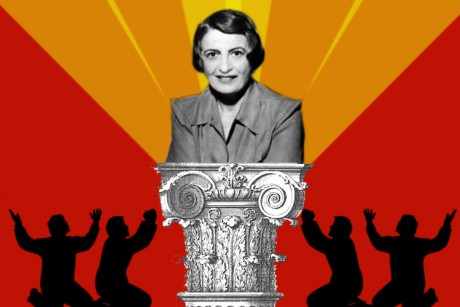
Get the point? Image of Will Rogers from the Will Rogers Museum.

Will Rogers on Occupy Wall Street

By Steve Russell | The Rag Blog | November 23, 2011

“It’s all right to let Wall Street bet each other millions of dollars every day but why make these bets affect the fellow who is plowing a field out in Claremore, Oklahoma?”

My all time favorite Cherokee, Will Rogers, wrote that in 1924. Today, most of the fellows plowing fields in Claremore, Oklahoma, are still Cherokee — but a lot fewer of them own the land they are plowing.

Nine years after Will Rogers made that complaint, the New Deal was beginning to roll, and Congress passed the Glass-Steagall Act in response. Glass (D-VA) and Steagall (D-AL) created the Federal Deposit Insurance Corporation. In the Great Depression, when a bank went belly up your money was just gone. Even now, it’s not widely known that the FDIC does not cost the taxpayers a penny. Fees assessed on the commercial banks fund it.

Just as important, the Glass-Steagall Act created a firewall between commercial banks and investment banks. Investment banks were not insured by the FDIC, did not have to pay the assessments, and were free to gamble with the money of anybody dumb enough to entrust it to them for the purpose.

Commercial banks are the places you go to get your crop loan, your car loan, or your mortgage. They had strict capital reserve requirements, which placed a limit on the amount of “leverage” they could bring to bear — that is, the multiple of customer deposits they could invest.

Bankers always thought this limit cramped their style, and I suppose it did. They were free to gamble with their own money, but they were limited in how much they could gamble with the money deposited by that fellow plowing his field in Claremore, OK.

This terrible injustice to the banksters, I mean bankers, was corrected by Gramm (R-TX), Leach (R-IA), and Bliley (R-VA) in 1999. Their bill, tearing down the wall between investment and commercial banking, was signed into law by President Clinton, who should have known better, but the political zeitgeist of the times was still deregulation. “Government,” in the famous words of President Reagan, “is the problem.”

Phil Gramm was John McCain’s principal economic advisor until he got canned for referring to Americans as “a nation of whiners.” The “whiners” did not know it at the time, but the gamblers unleashed by Gramm’s deregulation had leveraged their assets 30:1 and had, by spinning out derivative instruments of mind-bending complexity, become “too big to fail.”

That is, if they went broke they would take down so many businesses and people with them that the farmer in Claremore would get knocked right off his tractor. Of course, some people doubted any investment bank was “too big to fail,” and so the folks in charge let Lehman Brothers go down in 2008, apparently to see how bad it could get.

The Dow Jones average took the greatest one-day dive in history and racked up a trading range of 1,000 points. Lehman’s failure set off a cascade of smaller failures that played out for months. If you once had a retirement account but you don’t anymore, you can thank that experiment.

I remember back when I was young enough to be shocked, an undergraduate at the University of Texas. A law professor who was on President Nixon’s defense team in the Watergate scandal was asked whether some new cover-up revelation was “serious.” “Serious?” the professor asked, “the Dow Jones dropped 50 points on the news!” Fifty points. Serious. How times do change.

So we had to bail out the banksters from the consequences of their own recklessness or kiss our retirement plans goodbye. No problem, right? Wasn’t the major issue of the 2000 elections what to do with the budget surplus?

It was the issue, indeed. Bush said, “it’s your money and you know better than the government how to spend it.” Al Gore said this is our chance to “put Social Security in a lock box” and end the bipartisan accounting tricks with the trust fund.

Oh, now I remember. Bush won, and cut our taxes.

“When a party can’t think of anything else they always fall back on Lower Taxes. It has a magic sound to a voter, just like Fairyland…” Will Rogers wrote that in 1924, not 2000, and in the same year he expressed the only thing that will get us out of this even if we do, as Occupy Wall Street demands, quit allowing unlimited gambling with other people’s money:

“People want JUST taxes, more than they want lower taxes. They want to know that every man is paying his proportionate share according to his wealth.”

Maybe I’m biased by my Cherokee genes, but any man who could write that in 1924 deserves our attention today. There was about to be an event called the Great Depression.

[Steve Russell, Cherokee Nation of Oklahoma, lives in Sun City, Texas, near Austin. He is a Texas trial court judge by assignment and associate professor emeritus of criminal justice at Indiana University-Bloomington. Steve was an activist in Austin in the Sixties and Seventies, and wrote for Austin’s underground paper, The Rag. Steve is also a columnist for Indian Country Today, where a version of this article also appeared. He can be reached at swrussel@indiana.edu. Read more articles by Steve Russell on The Rag Blog.]

The Rag Blog

Posted in Rag Bloggers | Tagged , , , | 2 Comments

Paul Krassner : Sex, Corruption, and the Kool-Aid Massacre

The Rev. Jim Jones.

Sex, Corruption,
and the Kool-Aid Massacre

By Paul Krassner / The Rag Blog / November 23, 2011

November 18th marked the 33rd anniversary of the Jonestown massacre.

Jim Jones, founder of the 8,000-member People’s Temple in San Francisco, once asked Margo St. James, founder of the prostitutes’ rights group, COYOTE (Call Off Your Old Tired Ethics), how he could obtain political power.

She answered, sardonically, “Arrange for some of your women to have sex with the bigwigs.”

Jones in turn offered to supply busloads of his congregation for any protest demonstration that COYOTE organized, but Margo declined his offer.

“I never liked him,” she told me. “I never saw his eyes. Even in the dimmest light, he never removed his shades. He was hiding something. I figured it was his real feelings. I thought he was a slimy creep.”

Margo’s instincts were correct.

Potential recruits for People’s Temple were checked out in advance by Jones’ representatives, who would rummage through their garbage and report to him on their findings -– discarded letters, food preferences and other clues. Temple members would visit their homes, and while one would initiate conversation, the other would use the bathroom, copying names of doctors and types of medicine.

They would also phone relatives of a recruit in the guise of conducting a survey and gather other information that would all be taped to the inside of Jones’ podium, from which he would proceed to demonstrate his magical powers at a lecture by “sensing the presence” of an individual, mentioning specific details.

When People’s Temple moved to Guyana and became Jonestown, Jim Jones would publicly humiliate his followers. For example, he required them to remove their clothing and participate in boxing matches, pitting an elderly person against a young one. He forced one man to participate in a homosexual act in the presence of his girlfriend. There were paddle beatings and compulsory practice-suicide sessions called “White Nights.”

On November 18, 1978, Congressman Leo Ryan, who had been investigating Jonestown, was slain at the Guyana airport, along with three newspeople and several disillusioned members of the cult. Jones then orchestrated the mass suicide-murder of 900 men, women and children, mostly black.

Jones: “What’s going to happen here in a matter of a few minutes is that one of a few on that plane is gonna –- gonna shoot the pilot. I know that. I didn’t plan it, but I know it’s gonna happen. They’re gonna shoot that pilot and down comes the plane into the jungle. And we had better not have any of our children left when it’s over ’cause they’ll parachute in here on us. So my opinion is that we’d be kind to children and be kind to seniors and take over quietly, because we are not committing suicide. It’s a revolutionary act.”

Christine Miller: “I feel like that as long as there’s life, there’s hope. There’s hope. That’s my feeling.”

Jones: “Well, someday everybody dies. Someplace that hope runs out ’cause everybody dies.”

Miller: “But, uh, I look at all the babies and I think they deserve to live…”

Jones: “But also they deserve much more. They deserve peace.”

Unidentified man: “It’s over, sister, it’s over. We’ve made that day. We made a beautiful day. And let’s make it a beautiful day.”

Unidentified woman: [Sobbing] “We’re all ready to go. If you tell us we have to give our lives now, we’re ready…”

Jones: “The congressman has been murdered –- the congressman’s dead. Please get us some medication. It’s simple. It’s simple, there’s no convulsions with it, it’s just simple. Just please get it before it’s too late. The GDF [Guyanese army] will be here. I tell you, get moving, get moving, get moving. How many are dead? Aw, God almighty, God almighty — it’s too late, the congressman’s dead. The congressman’s aide’s dead. Many of our traitors are dead. They’re all layin’ out there dead.”

Nurse: “You have to move, and the people that are standing there in the aisle, go stay in the radio-room yard. So everybody get behind the table and back this way, okay? There’s nothing to worry about. So everybody keep calm, and try to keep your children calm. And the older children are to help lead the little children and reassure them. They aren’t crying from pain. It’s just a little bitter tasting, but that’s — they’re not crying out of any pain.”

Unidentified woman: “I just wanna say something to everyone that I see that is standing around and, uh, crying. This is nothing to cry about. This is something we could all rejoice about. We could be happy about this.”

Jones: “Please, for God’s sake, let’s get on with it. We’ve lived –- let’s just be done with it, let’s be done with the agony of it. [There is noise, confusion and applause.] Let’s get calm, let’s get calm. [There are screams in the background.] I don’t know who fired the shot, I don’t know who killed the congressman, but as far as I’m concerned, I killed him. You understand what I’m saying? I killed him. He had no business coming. I told him not to come. Die with respect. Die with a degree of dignity. Don’t lay down with tears and agony. Stop this hysterics. This is not the way for people who are socialistic communists to die. No way for us to die. We must die with some dignity.

“Children, it’s just something to put you to rest. Oh, God! [Crying in the background] I tell you, I don’t care how many screams you hear, I don’t care how many anguished cries, death is a million times preferable to ten more days of this life. If you’ll quit telling them they’re dying, if you adults will stop this nonsense -– I call on you to quit exciting your children when all they’re doing is going to a quiet rest. All they’re doing is taking a drink they take to go to sleep. That’s what death is, sleep. Take our life from us. We laid it down. We got tired. We didn’t commit suicide. We committed an act of revolutionary suicide, protesting the conditions of an inhuman world…”

Those who refused to drink the grape-flavored punch laced with potassium cyanide were either shot or killed by injections in their armpits. Jim Jones either shot himself or was murdered.

The Black Panther newspaper editorialized: “It is quite possible that the neutron bomb was used at Jonestown.”

Rev. Jim Jones and friends in 1952. Image from Indianapolis Star.

When San Francisco District Attorney Joe Freitas learned of the killings, he was in Washington, D.C., conferring with the State Department about the mass suicide-murder in Jonestown. He immediately assumed that Moscone and Milk had been assassinated by a People’s Temple hit squad. After all, George Moscone was number one on their hit list.

Freitas had been a close friend of Jim Jones. After the massacre in Guyana, he released a previously “confidential” report, which stated that his office had uncovered evidence to support charges of homicide, child abduction, extortion, arson, battery, drug use, diversion of welfare funds, kidnapping, and sexual abuse against members of the sect. The purported investigation had not begun until after Jones left San Francisco. No charges were ever filed, and the People’s Temple case was put on “inactive status.”

Busloads of illegally registered People’s Temple members had voted in the 1975 San Francisco election, as well as in the runoff that put George Moscone in office. Freitas appointed lawyer Tim Stoen to look into possible voter fraud. At the time, Stoen was serving as Jim Jones’ chief legal adviser. Freitas later piously accused him of short-circuiting the investigation, but after Stoen left the case, the D.A.’s office assured the registrar that there was no need to retain the voting rosters, and they were destroyed.

Several former members of People’s Temple had heard about this fraudulent voting, but the eyewitnesses all died at Jonestown. In addition, the San Francisco Examiner reported that Mayor Moscone had called off a police investigation of gun-running by the Temple, which had arranged to ship explosives, weapons, and large amounts of cash to South America via Canada.

George Moscone’s body was buried. Harvey Milk’s body was cremated. His ashes were placed in a box, which was wrapped in Doonesbury comic strips, then scattered at sea. The ashes had been mixed with the contents of two packets of grape Kool-Aid, forming a purple patch on the Pacific. Harvey would’ve liked that touch.

COYOTE’s Margo St. James.

It was well known around City Hall that Moscone had a predilection for black women. Police almost arrested him once with a black prostitute in a car at a supermarket parking lot.

Soon after the Dan White trial, I got a phone call from Lee Cole, an ex-Scientologist I had met in Chicago while researching the Charles Manson case. He wanted to visit me, but I said no.

“Suppose I just come over?” he said.

“You don’t know where I live.”

“I can find out.”

“If you find out, and you tell me how you did it, you can come over.”

I wanted to determine how carefully I had covered my tracks, or see which friend would give out my address. A little while later, Lee Cole called again and told me my address — he said that he had obtained it from the voter registration files — so I told him to come over.

He took me to see Lowell Streiker, author of The Cults Are Coming! and a deprogrammer who had counseled one-third of the Jonestown survivors. In the course of our conversation, I mentioned my theory that Jim Jones had served as a pimp at City Hall and maintained power by implied blackmail.

Dr. Streiker told me of his friend — a member of Jones’ planning commission — who had told him about the technique that People’s Temple had used on Mayor Moscone. They sent a young black female member to service him, as a gift, then called the next week about a serious problem — she had lied, said she was 18, when in fact she was underage, but don’t worry, we have it under control — just the way J. Edgar Hoover used to manipulate top politicians with his juicy FBI files.

So Jim Jones had taken Margo St. James’ sardonic advice after all, on how to achieve political power: “Arrange for some of your women to have sex with the bigwigs.” And he had taken it all the way to a mass suicide-murder — which occurred simultaneously with a mass demonstration by the women’s movement in San Francisco, called “Take Back the Night!”

They completely shut down traffic on Broadway. But there was not a word about that event in any of the media. It was knocked totally out of the news by the massacre in Jonestown.

Jonestown and Kool-Aid continue to serve as occasional joke references for stand-up comedians and metaphors for politicians and pundits alike.

[Paul Krassner edited The Realist, America’s premier satirical rag. He was also a founder of the Yippies. Find Paul’s autobiography, Confessions of a Raving Unconfined Nut: Misadventures in the Counterculture at paulkrassner.com. Paul Krassner’s dialogue with Andrew Breitbart appears in the December issue of Playboy. Read more articles by Paul Krassner on The Rag Blog.]

The Rag Blog

Posted in Rag Bloggers | Tagged , , , , , | 3 Comments

Mike Davis : Protest in the Driver’s Seat

Image from the Schumin Web.

Chevy to the levee:
Protest in the driver’s seat

This is the ultimate American way: protesting in a car (or on a bike) while obeying the law. The possibilities for serene family tourism are endless and mind-boggling.

By Mike Davis / The Rag Blog / November 23, 2011

The sickening repercussion of hardwood against a protestor’s skull is the soundtrack to too much of American history.

If you think being a heavyweight boxer or an NFL wide receiver is an invitation to brain damage, try being an anti-capitalist.

Especially when you face an unholy alliance of arrogant bankers, sneering stockbrokers, and “liberal” Democratic mayors, as in L.A., Portland, Seattle, and Atlanta. Or when your civil liberties exist purely at the sufferance of a billionaire municipal autocrat with Louis XIV tendencies like Bloomberg.

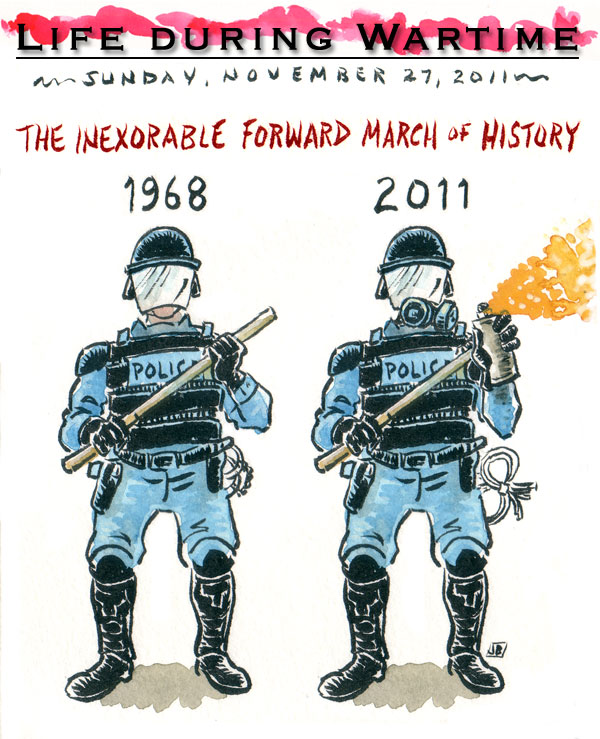
Few events in a young activist’s life are as memorably disturbing as the first time you look into cop’s eyes a few anxious inches from your face and find only robotic murderous hatred staring back at you.

In my day this dehumanizing fury had usually been programmed somewhere in Vietnam’s Central Highlands or Mekong Delta. Today it was likely implanted in a place called Fallujah or Kandahar.

No doubt it is an important rite of passage to a fuller humanity to become, at least for a few terrifying moments, just another body to be beaten.

But — ouch — I’m not very brave and don’t like being clubbed, pummeled, tightly handcuffed, or dragged by my hair (one reason, I suppose, why I’ve always worn a crew cut).

I prefer to lock myself safely in my car and drive to protest, carefully obeying speed limits and traffic signs. Perhaps humming a crackled version of “drove my Chevy to the levee” or singing a few rousing verses from “O, Canada.”

Indeed it was Canadian autoworkers during a brutal Ford strike in fall 1945 who first turned the class struggle into a drive-in.

At the end of World War II, the Ford complex in Windsor, Ontario, was the largest factory in Canada (about 15,000 workers) and Ford management counted on provincial Tories to break the strike with unprecedented police violence.

After days of being harassed by Ontario cops and less-than–heroic Mounties (actually Canada’s FBI), the autoworkers borrowed an idea from an earlier UAW protest in Detroit and simply parked 2,000 family Fords around the Ford plant.

The Tories’ only answer to the great auto blockade was a briefly-mulled-over plan to use army tanks to crash through the strikers’ cars. An armored regiment was put on alert. Then Ford and their political allies blinked.

Good idea?

Darn right.

Independent owner-operator truckers have used the same tactic on numerous occasions in the last 40 years, beginning with the oil price crisis in the 1970s.

They’ve shut down interstates and blockaded city halls, while their sound systems blasted out “Convoy,” C. W. McCall’s great anthem of 18-wheel rebellion.

‘Cause we got a great big convoy rockin’ thru the night,
yeah, we got a great big convoy, ain’t she a beautiful sight?
Come on and join our convoy, ain’t nothin’ gonna get in our way.
We gonna roll this truckin’ convoy ‘cross the USA

No need, of course, to use Fords. As Dinah Shore used to sing, “See the USA in Your Chevrolet” — or a Toyota, VW, a slope-nosed Kenworth “Anteater,” or, more correctly, your Schwinn retro-city bike. Just keep the convoy rollin’.

Indeed, the next stage of protest could be considered a nostalgic analogy to an old-fashioned family Sunday drive.

Cruise slowly by the Stock Exchange (“Look, kids, here’s where the dudes who stole our house work”) or keep circling and ogling your local police headquarters (“Awesome architecture — let’s stop and wave”).

Or, best of all, “That’s Lloyd Bankfein’s home. Now whatyathinkofthat?”

“He’s president of Goldman Sachs. He got paid $58 million in 2007, so he must really work harder than anyone else on earth.”

“Let’s honk the horn and say howdy to good ole Lloyd.”

Remember, safety first, so don’t drive like that little old lady from Pasadena.

Stay at the exact speed limit, or, better, at the legal minimum. Always set a good example for the 2,000 similarly inclined leisure drivers behind you. They may also want to slow down and sightsee.

This is the ultimate American way: protesting in a car (or on a bike) while obeying the law. The possibilities for serene family tourism are endless and mind-boggling.

Wow, perhaps even apocalyptic.

But, out of respect to Bill McKibben and the anti-global warming movement, please carpool to shut down Wall Street.

[Mike Davis is a Distinguished Professor in the Department of Creative Writing at the University of California, Riverside. An urban theorist, historian, and social activist, Davis is the author of City of Quartz: Excavating the Future in Los Angeles and In Praise of Barbarians: Essays against Empire. Read more articles by Mike Davis on The Rag Blog.]

The Rag Blog

Posted in Rag Bloggers | Tagged , , , , , | 1 Comment

Sex, Corruption and the Kool-Aid Massacre

By Paul Krassner / The Rag Blog / November 23, 2011

November 18th marked the 33rd anniversary of the Jonestown massacre.

Jim Jones, founder of the 8,000-member People’s Temple in San Francisco, once asked Margo St. James, founder of the prostitutes’ rights group, COYOTE (Call Off Your Old Tired Ethics), how he could obtain political power.

She answered, sardonically, “Arrange for some of your women to have sex with the bigwigs.”

Jones in turn offered to supply busloads of his congregation for any protest demonstration that COYOTE organized, but Margo declined his offer.

“I never liked him,” she told me. “I never saw his eyes. Even in the dimmest light, he never removed his shades. He was hiding something. I figured it was his real feelings. I thought he was a slimy creep.”

Margo’s instincts were correct.

Potential recruits for People’s Temple were checked out in advance by Jones’ representatives, who would rummage through their garbage and report to him on their findings -– discarded letters, food preferences and other clues. Temple members would visit their homes, and while one would initiate conversation, the other would use the bathroom, copying names of doctors and types of medicine.

They would also phone relatives of a recruit in the guise of conducting a survey and gather other information that would all be taped to the inside of Jones’ podium, from which he would proceed to demonstrate his magical powers at a lecture by “sensing the presence” of an individual, mentioning specific details.

When People’s Temple moved to Guyana and became Jonestown, Jim Jones would publicly humiliate his followers. For example, he required them to remove their clothing and participate in boxing matches, pitting an elderly person against a young one. He forced one man to participate in a homosexual act in the presence of his girlfriend. There were paddle beatings and compulsory practice-suicide sessions called “White Nights.”

On November 18, 1978, Congressman Leo Ryan, who had been investigating Jonestown, was slain at the Guyana airport, along with three newspeople and several disillusioned members of the cult. Jones then orchestrated the mass suicide-murder of 900 men, women and children, mostly black.

Jones: “What’s going to happen here in a matter of a few minutes is that one of a few on that plane is gonna –- gonna shoot the pilot. I know that. I didn’t plan it, but I know it’s gonna happen. They’re gonna shoot that pilot and down comes the plane into the jungle. And we had better not have any of our children left when it’s over ’cause they’ll parachute in here on us. So my opinion is that we’d be kind to children and be kind to seniors and take over quietly, because we are not committing suicide. It’s a revolutionary act.”

Christine Miller: “I feel like that as long as there’s life, there’s hope. There’s hope. That’s my feeling.”

Jones: “Well, someday everybody dies. Someplace that hope runs out ’cause everybody dies.”

Miller: “But, uh, I look at all the babies and I think they deserve to live . . .”

Jones: “But also they deserve much more. They deserve peace.”

Unidentified man: “It’s over, sister, it’s over. We’ve made that day. We made a beautiful day. And let’s make it a beautiful day.”

Unidentified woman: [Sobbing] “We’re all ready to go. If you tell us we have to give our lives now, we’re ready . . .”

Jones: “The congressman has been murdered –- the congressman’s dead. Please get us some medication. It’s simple. It’s simple, there’s no convulsions with it, it’s just simple. Just please get it before it’s too late. The GDF [Guyanese army] will be here. I tell you, get moving, get moving, get moving. How many are dead? Aw, God almighty, God almighty — it’s too late, the congressman’s dead. The congressman’s aide’s dead. Many of our traitors are dead. They’re all layin’ out there dead.”

Nurse: “You have to move, and the people that are standing there in the aisle, go stay in the radio-room yard. So everybody get behind the table and back this way, okay? There’s nothing to worry about. So everybody keep calm, and try to keep your children calm. And the older children are to help lead the little children and reassure them. They aren’t crying from pain. It’s just a little bitter tasting, but that’s — they’re not crying out of any pain.”

Unidentified woman: “I just wanna say something to everyone that I see that is standing around and, uh, crying. This is nothing to cry about. This is something we could all rejoice about. We could be happy about this.”

Jones: “Please, for God’s sake, let’s get on with it. We’ve lived –- let’s just be done with it, let’s be done with the agony of it. [There is noise, confusion and applause.] Let’s get calm, let’s get calm. [There are screams in the background.] I don’t know who fired the shot, I don’t know who killed the congressman, but as far as I’m concerned, I killed him. You understand what I’m saying? I killed him. He had no business coming. I told him not to come. Die with respect. Die with a degree of dignity. Don’t lay down with tears and agony. Stop this hysterics. This is not the way for people who are socialistic communists to die. No way for us to die. We must die with some dignity.

“Children, it’s just something to put you to rest. Oh, God! [Crying in the background] I tell you, I don’t care how many screams you hear, I don’t care how many anguished cries, death is a million times preferable to ten more days of this life. It you’ll quit telling them they’re dying, if you adults will stop this nonsense -– I call on you to quit exciting your children when all they’re doing is going to a quiet rest. All they’re doing is taking a drink they take to go to sleep. That’s what death is, sleep. Take our life from us. We laid it down. We got tired. We didn’t commit suicide. We committed an act of revolutionary suicide, protesting the conditions of an inhuman world…”

Those who refused to drink the grape-flavored punch laced with potassium cyanide were either shot or killed by injections in their armpits. Jim Jones either shot himself or was murdered.

The Black Panther newspaper editorialized: “It is quite possible that the neutron bomb was used at Jonestown.”

* * *

When San Francisco District Attorney Joe Freitas learned of the killings, he was in Washington, D.C., conferring with the State Department about the mass suicide-murder in Jonestown. He immediately assumed that Moscone and Milk had been assassinated by a People’s Temple hit squad. After all, George Moscone was number one on their hit list.

Freitas had been a close friend of Jim Jones. After the massacre in Guyana, he released a previously “confidential” report, which stated that his office had uncovered evidence to support charges of homicide, child abduction, extortion, arson, battery, drug use, diversion of welfare funds, kidnapping, and sexual abuse against members of the sect. The purported investigation had not begun until after Jones left San Francisco. No charges were ever filed, and the People’s Temple case was put on “inactive status.”

Busloads of illegally registered People’s Temple members had voted in the 1975 San Francisco election, as well as in the runoff that put George Moscone in office. Freitas appointed lawyer Tim Stoen to look into possible voter fraud. At the time, Stoen was serving as Jim Jones’ chief legal adviser. Freitas later piously accused him of short-circuiting the investigation, but after Stoen left the case, the D.A.’s office assured the registrar that there was no need to retain the voting rosters, and they were destroyed.

Several former members of People’s Temple had heard about this fraudulent voting, but the eyewitnesses all died at Jonestown. In addition, the San Francisco Examiner reported that Mayor Moscone had called off a police investigation of gun-running by the Temple, which had arranged to ship explosives, weapons, and large amounts of cash to South America via Canada.

George Moscone’s body was buried. Harvey Milk’s body was cremated. His ashes were placed in a box, which was wrapped in Doonesbury comic strips, then scattered at sea. The ashes had been mixed with the contents of two packets of grape Kool-Aid, forming a purple patch on the Pacific. Harvey would’ve liked that touch.

* * *

It was well known around City Hall that Moscone had a predilection for black women. Police almost arrested him once with a black prostitute in a car at a supermarket parking lot.

Soon after the Dan White trial, I got a phone call from Lee Cole, an ex-Scientologist I had met in Chicago while researching the Charles Manson case. He wanted to visit me, but I said no.

“Suppose I just come over?” he said.

“You don’t know where I live.”

“I can find out.”

“If you find out, and you tell me how you did it, you can come over.”

I wanted to determine how carefully I had covered my tracks, or see which friend would give out my address. A little while later, Lee Cole called again and told me my address — he said that he had obtained it from the voter registration files — so I told him to come over.

He took me to see Lowell Streiker, author of The Cults Are Coming! and a deprogrammer who had counseled one-third of the Jonestown survivors. In the course of our conversation, I mentioned my theory that Jim Jones had served as a pimp at City Hall and maintained power by implied blackmail.

Dr. Streiker told me of his friend — a member of Jones’ planning commission — who had told him about the technique that People’s Temple had used on Mayor Moscone. They sent a young black female member to service him, as a gift, then called the next week about a serious problem — she had lied, said she was 18, when in fact she was underage, but don’t worry, we have it under control — just the way J. Edgar Hoover used to manipulate top politicians with his juicy FBI files.

So Jim Jones had taken Margo St. James’ sardonic advice after all, on how to achieve political power: “Arrange for some of your women to have sex with the bigwigs.” And he had taken it all the way to a mass suicide-murder — which occurred simultaneously with a mass demonstration by the women’s movement in San Francisco, called “Take Back the Night!”

They completely shut down traffic on Broadway. But there was not a word about that event in any of the media. It was knocked totally out of the news by the massacre in Jonestown.

Jonestown and Kool-Aid continue to serve as occasional joke references for stand-up comedians and metaphors for politicians and pundits alike.

[Paul Krassner edited The Realist, America’s premier satirical rag. He was also a founder of the Yippies. Find Paul’s autobiography, Confessions of a Raving Unconfined Nut: Misadventures in the Counterculture at paulkrassner.com. Paul Krassner’s dialogue with Andrew Breitbart appears in the December issue of Playboy. Read more articles by Paul Krassner on The Rag Blog.]

Source /

The Rag Blog

Posted in RagBlog | Leave a comment

Sex, Corruption and the Kool-Aid Massacre

By Paul Krassner / The Rag Blog / November 23, 2011

November 18th marked the 33rd anniversary of the Jonestown massacre.

Jim Jones, founder of the 8,000-member People’s Temple in San Francisco, once asked Margo St. James, founder of the prostitutes’ rights group, COYOTE (Call Off Your Old Tired Ethics), how he could obtain political power.

She answered, sardonically, “Arrange for some of your women to have sex with the bigwigs.”

Jones in turn offered to supply busloads of his congregation for any protest demonstration that COYOTE organized, but Margo declined his offer.

“I never liked him,” she told me. “I never saw his eyes. Even in the dimmest light, he never removed his shades. He was hiding something. I figured it was his real feelings. I thought he was a slimy creep.”

Margo’s instincts were correct.

Potential recruits for People’s Temple were checked out in advance by Jones’ representatives, who would rummage through their garbage and report to him on their findings -– discarded letters, food preferences and other clues. Temple members would visit their homes, and while one would initiate conversation, the other would use the bathroom, copying names of doctors and types of medicine.

They would also phone relatives of a recruit in the guise of conducting a survey and gather other information that would all be taped to the inside of Jones’ podium, from which he would proceed to demonstrate his magical powers at a lecture by “sensing the presence” of an individual, mentioning specific details.

When People’s Temple moved to Guyana and became Jonestown, Jim Jones would publicly humiliate his followers. For example, he required them to remove their clothing and participate in boxing matches, pitting an elderly person against a young one. He forced one man to participate in a homosexual act in the presence of his girlfriend. There were paddle beatings and compulsory practice-suicide sessions called “White Nights.”

On November 18, 1978, Congressman Leo Ryan, who had been investigating Jonestown, was slain at the Guyana airport, along with three newspeople and several disillusioned members of the cult. Jones then orchestrated the mass suicide-murder of 900 men, women and children, mostly black.

Jones: “What’s going to happen here in a matter of a few minutes is that one of a few on that plane is gonna –- gonna shoot the pilot. I know that. I didn’t plan it, but I know it’s gonna happen. They’re gonna shoot that pilot and down comes the plane into the jungle. And we had better not have any of our children left when it’s over ’cause they’ll parachute in here on us. So my opinion is that we’d be kind to children and be kind to seniors and take over quietly, because we are not committing suicide. It’s a revolutionary act.”

Christine Miller: “I feel like that as long as there’s life, there’s hope. There’s hope. That’s my feeling.”

Jones: “Well, someday everybody dies. Someplace that hope runs out ’cause everybody dies.”

Miller: “But, uh, I look at all the babies and I think they deserve to live . . .”

Jones: “But also they deserve much more. They deserve peace.”

Unidentified man: “It’s over, sister, it’s over. We’ve made that day. We made a beautiful day. And let’s make it a beautiful day.”

Unidentified woman: [Sobbing] “We’re all ready to go. If you tell us we have to give our lives now, we’re ready . . .”

Jones: “The congressman has been murdered –- the congressman’s dead. Please get us some medication. It’s simple. It’s simple, there’s no convulsions with it, it’s just simple. Just please get it before it’s too late. The GDF [Guyanese army] will be here. I tell you, get moving, get moving, get moving. How many are dead? Aw, God almighty, God almighty — it’s too late, the congressman’s dead. The congressman’s aide’s dead. Many of our traitors are dead. They’re all layin’ out there dead.”

Nurse: “You have to move, and the people that are standing there in the aisle, go stay in the radio-room yard. So everybody get behind the table and back this way, okay? There’s nothing to worry about. So everybody keep calm, and try to keep your children calm. And the older children are to help lead the little children and reassure them. They aren’t crying from pain. It’s just a little bitter tasting, but that’s — they’re not crying out of any pain.”

Unidentified woman: “I just wanna say something to everyone that I see that is standing around and, uh, crying. This is nothing to cry about. This is something we could all rejoice about. We could be happy about this.”

Jones: “Please, for God’s sake, let’s get on with it. We’ve lived –- let’s just be done with it, let’s be done with the agony of it. [There is noise, confusion and applause.] Let’s get calm, let’s get calm. [There are screams in the background.] I don’t know who fired the shot, I don’t know who killed the congressman, but as far as I’m concerned, I killed him. You understand what I’m saying? I killed him. He had no business coming. I told him not to come. Die with respect. Die with a degree of dignity. Don’t lay down with tears and agony. Stop this hysterics. This is not the way for people who are socialistic communists to die. No way for us to die. We must die with some dignity.

“Children, it’s just something to put you to rest. Oh, God! [Crying in the background] I tell you, I don’t care how many screams you hear, I don’t care how many anguished cries, death is a million times preferable to ten more days of this life. It you’ll quit telling them they’re dying, if you adults will stop this nonsense -– I call on you to quit exciting your children when all they’re doing is going to a quiet rest. All they’re doing is taking a drink they take to go to sleep. That’s what death is, sleep. Take our life from us. We laid it down. We got tired. We didn’t commit suicide. We committed an act of revolutionary suicide, protesting the conditions of an inhuman world…”

Those who refused to drink the grape-flavored punch laced with potassium cyanide were either shot or killed by injections in their armpits. Jim Jones either shot himself or was murdered.

The Black Panther newspaper editorialized: “It is quite possible that the neutron bomb was used at Jonestown.”

* * *

When San Francisco District Attorney Joe Freitas learned of the killings, he was in Washington, D.C., conferring with the State Department about the mass suicide-murder in Jonestown. He immediately assumed that Moscone and Milk had been assassinated by a People’s Temple hit squad. After all, George Moscone was number one on their hit list.

Freitas had been a close friend of Jim Jones. After the massacre in Guyana, he released a previously “confidential” report, which stated that his office had uncovered evidence to support charges of homicide, child abduction, extortion, arson, battery, drug use, diversion of welfare funds, kidnapping, and sexual abuse against members of the sect. The purported investigation had not begun until after Jones left San Francisco. No charges were ever filed, and the People’s Temple case was put on “inactive status.”

Busloads of illegally registered People’s Temple members had voted in the 1975 San Francisco election, as well as in the runoff that put George Moscone in office. Freitas appointed lawyer Tim Stoen to look into possible voter fraud. At the time, Stoen was serving as Jim Jones’ chief legal adviser. Freitas later piously accused him of short-circuiting the investigation, but after Stoen left the case, the D.A.’s office assured the registrar that there was no need to retain the voting rosters, and they were destroyed.

Several former members of People’s Temple had heard about this fraudulent voting, but the eyewitnesses all died at Jonestown. In addition, the San Francisco Examiner reported that Mayor Moscone had called off a police investigation of gun-running by the Temple, which had arranged to ship explosives, weapons, and large amounts of cash to South America via Canada.

George Moscone’s body was buried. Harvey Milk’s body was cremated. His ashes were placed in a box, which was wrapped in Doonesbury comic strips, then scattered at sea. The ashes had been mixed with the contents of two packets of grape Kool-Aid, forming a purple patch on the Pacific. Harvey would’ve liked that touch.

* * *

It was well known around City Hall that Moscone had a predilection for black women. Police almost arrested him once with a black prostitute in a car at a supermarket parking lot.

Soon after the Dan White trial, I got a phone call from Lee Cole, an ex-Scientologist I had met in Chicago while researching the Charles Manson case. He wanted to visit me, but I said no.

“Suppose I just come over?” he said.

“You don’t know where I live.”

“I can find out.”

“If you find out, and you tell me how you did it, you can come over.”

I wanted to determine how carefully I had covered my tracks, or see which friend would give out my address. A little while later, Lee Cole called again and told me my address — he said that he had obtained it from the voter registration files — so I told him to come over.

He took me to see Lowell Streiker, author of The Cults Are Coming! and a deprogrammer who had counseled one-third of the Jonestown survivors. In the course of our conversation, I mentioned my theory that Jim Jones had served as a pimp at City Hall and maintained power by implied blackmail.

Dr. Streiker told me of his friend — a member of Jones’ planning commission — who had told him about the technique that People’s Temple had used on Mayor Moscone. They sent a young black female member to service him, as a gift, then called the next week about a serious problem — she had lied, said she was 18, when in fact she was underage, but don’t worry, we have it under control — just the way J. Edgar Hoover used to manipulate top politicians with his juicy FBI files.

So Jim Jones had taken Margo St. James’ sardonic advice after all, on how to achieve political power: “Arrange for some of your women to have sex with the bigwigs.” And he had taken it all the way to a mass suicide-murder — which occurred simultaneously with a mass demonstration by the women’s movement in San Francisco, called “Take Back the Night!”

They completely shut down traffic on Broadway. But there was not a word about that event in any of the media. It was knocked totally out of the news by the massacre in Jonestown.

Jonestown and Kool-Aid continue to serve as occasional joke references for stand-up comedians and metaphors for politicians and pundits alike.

[Paul Krassner edited The Realist, America’s premier satirical rag. He was also a founder of the Yippies. Find Paul’s autobiography, Confessions of a Raving Unconfined Nut: Misadventures in the Counterculture at paulkrassner.com. Paul Krassner’s dialogue with Andrew Breitbart appears in the December issue of Playboy. Read more articles by Paul Krassner on The Rag Blog.]

Source /

The Rag Blog

Posted in RagBlog | Leave a comment

Lamar W. Hankins : Judge Ken Anderson Still Can’t Tell the Truth

Former Williamson County prosecutor Ken Anderson, now a county judge, shown before testifying about his role in the murder trial of Michael Morton. Photo by the Texas Tribune / KUT News.

Judge Ken Anderson still can’t
tell the truth about the Morton case

There is nothing new in Anderson’s conduct… While prosecutors love to tell jurors that they have a duty to see that justice is done, what they really like to do is convict people of crimes.

By Lamar W. Hankins / The Rag Blog / November 22, 2011

SAN MARCOS, Texas — Former Williamson County District Attorney Ken Anderson, now a Williamson County District Judge, who wrongfully secured the conviction of Michael Morton 25 years ago for killing his wife Christine, has apologized in a press conference held a few days ago.

Anderson’s apology appears taken right out of the Politics 101 Manual — admit that a mistake was made, but explain the mistake away. The first problem with his apology, however, is that he began it with telling a lie.

Anderson said, “Twenty-five years ago, Michael Morton was convicted of murdering his wife in this very courthouse. The jury’s verdict was based on the evidence as we knew it at the time.” Thanks to the work of the Innocence Project, we now know that the evidence Anderson had available to him at the time of trial, but Morton’s defense attorneys did not have, included a statement made by Morton’s three-year old son to his grandmother that a “monster” with a mustache killed his mother, not Morton.

Had defense attorneys been given this information, which Anderson was required by law to reveal, Morton might not have been convicted. Anderson violated his sworn duty to reveal that information.

In addition, Anderson knew that a check to Christine Morton had been cashed nine days after her murder by someone who forged Christine’s signature, but Anderson withheld this evidence from defense attorneys. Anderson violated his sworn duty to reveal that information.

And there was evidence that someone had used Christine Morton’s credit card in San Antonio after she was killed, but Anderson failed to tell defense attorneys, and no law enforcement agency apparently followed up on this information after it was received by the Williamson County Sheriff’s Office (WCSO). Anderson violated his sworn duty to reveal that information.

One final piece of nondisclosed evidence that Anderson knew about or should have known about was a report by a neighbor that around the time of Christine Morton’s murder, he had seen a suspicious person park a green van behind the Mortons’ house on several occasions and walk into the adjacent wooded area. A second neighbor also had information about this suspicious person. Anderson violated his sworn duty to reveal that information.

The Texas Code of Criminal procedure provides that “It shall be the primary duty of all prosecuting attorneys… not to convict, but to see that justice is done. They shall not suppress facts or secrete witnesses capable of establishing the innocence of the accused.”

In 1963, the U.S. Supreme Court held in Brady v. Maryland that “the suppression by the prosecution of evidence favorable to an accused… violates due process where the evidence is material either to guilt or to punishment, irrespective of the good faith or bad faith of the prosecution.” Furthermore, Article I, Section 19 of the Texas Constitution gives an accused the same rights recognized in the Brady decision.

And the prosecution has a duty to learn of and disclose the exculpatory evidence in the possession of all members of the prosecution team, which includes the police, other law enforcement agencies, such as the WCSO, and other investigators working with or on behalf of the state.

In 1985, the U.S. Supreme Court held that evidence is material “if there is a reasonable probability that, had the evidence been disclosed to the defense, the result of the proceedings would have been different.”

All of the withheld evidence would have met that standard. We know this because immediately after the trial the assistant prosecutor in Morton’s case, Mike Davis, told some of the trial jurors that the state had failed to disclose some “investigatory materials to the defense.” Davis said that if the defense had gotten the materials, it would have been able to raise even more doubt than it did about Morton’s guilt. (See the Motion for New Trial filed on March 17, 1987, by defense attorney William P. Allison.)

While a bandanna with blood and hair fibers on it was found near the Mortons’ house during the investigation, it provided no help to Morton because DNA testing was in its infancy, but Anderson is using the earlier absence of DNA evidence as a smokescreen to hide his malfeasance, claiming that this new evidence is all that matters in showing Morton’s innocence.

Convicted murderer Michael Morton was exonerated after 25 years in Texas prison. Photo by Jay Janner / Austin American-Statesman.

Judge Anderson now wants to pretend that he did nothing wrong and should be forgiven for securing a wrongful conviction, but he fought a subpoena to give testimony under oath for weeks, exhausting all appeals before being compelled to answer questions posed by Morton’s post-conviction attorneys, who represent the Innocence Project. Morton was released from prison a few weeks ago after the DNA evidence on the bandanna implicated another man in his wife’s murder.

This past week, the Austin American-Statesman reported:

On Nov. 9, Williamson County sheriff’s officers charged Mark Norwood, a Bastrop dishwasher and former carpet installer, with the murder of Christine Morton. DNA tests conducted last summer found Norwood’s DNA on a bandanna that had been collected from a construction site behind the Morton home the day after the murder.

Tests on the cloth were inconclusive in 1986, but the recent DNA tests confirmed that the bandanna also contained Christine Morton’s blood and one of her hairs. Norwood also is a suspect in the 1988 Austin murder of Debra Masters Baker. Like Morton, Baker had been beaten to death in her bed. No charges have been filed in the Baker case, which had remained unsolved.

Judge Anderson says he believes that 25 years ago he complied with the requirements then in place to disclose evidence that might tend to show the innocence of Morton. After refreshing his memory by reviewing the files that he compiled then, Anderson said, “I believe that the state’s prosecution team complied with all orders from the court and with the law on pretrial discovery and disclosures as it existed in 1987.”

Once again, Anderson will not admit the essential wrongdoing that he committed while serving as Williamson County District Attorney.

If Anderson continues to insist that he did nothing wrong 25 years ago, he further diminishes the reputation of another Williamson County district judge, the late Judge Bill Lott, who presided over the Morton trial. Anderson claims that he submitted to Judge Lott files that were not given to the defense for Judge Lott’s review to determine whether they included exculpatory evidence. Judge Lott did not find any exculpatory evidence in the files.

If Anderson gave Judge Lott any of the exculpatory evidence discussed above, and Lott ruled it was not exculpatory, he is implicated in this ongoing cover-up, as well.

There is nothing new in Anderson’s conduct. For anyone who has spent much time working in what is mistakenly called “the criminal justice system,” misconduct by prosecutors is not only common, but widely known. While prosecutors love to tell jurors that they have a duty to see that justice is done, what they really like to do is convict people of crimes.

The less scrupulous ones don’t care about what is termed “exculpatory evidence.” Anderson was one of that kind of prosecutor. He helped build the reputation of the Williamson County District Attorney’s office as a hard-nosed, “hang’em high” fiefdom, destitute of actual justice.

I have known prosecutors who bragged that the milk of human kindness did not flow through their veins. I have seen prosecutors who worked out their own sociopathic tendencies by being as hard, mean, and indifferent to human welfare as the most callous criminal. In fact, prosecuting is one of the professions where sociopathic behavior is regularly rewarded by advancement in the profession and sometimes by election to the position of district attorney.

Fortunately, not all district attorneys and prosecutors take out their own personality defects through their work. There are many hard-working, diligent prosecutors who primarily seek justice, not convictions, but Williamson County in recent decades has not produced too many of this kind. Judge Anderson and the current occupant of his former position, John Bradley, have done a disservice to the notion of justice. Bradley fought even the testing of the DNA evidence in Morton’s case until he had exhausted all avenues of interposition.

During this same period, Bradley served as Gov. Rick Perry’s minion as the head of the Texas Forensic Science Commission in an attempt to keep evidence of Cameron Todd Willingham’s wrongful conviction and execution from being officially acknowledged. Bradley now claims to have had a Damascus Road experience and to be a changed man, following only the path of righteousness as a prosecutor. I’ll believe that when Willingham comes back to life.

The average citizen does not know the level of corruption that can exist in a system such as the Williamson County District Attorney’s office. When a prosecutor is working in a courtroom with a prosecutor-friendly judge, there is nothing that can be done in the prosecution of a defendant that is too extreme.

Many defense attorneys are too timid to vigorously defend their clients in such a hostile environment. I have known attorneys who have gone from being prosecutors to defense attorneys and vice versa, and those who have gone from being prosecutors or defense attorneys to being District Attorneys or judges. Most of them do so with integrity and faithfulness to the highest ideals of the profession.

Unfortunately, Ken Anderson and John Bradley do not represent this latter group. They have been comfortable with ignoring the requirements of the law, judicial decisions, and the ethical code they are sworn to uphold, which provides that, “The prosecutor in a criminal case shall… make timely disclosure to the defense of all evidence or information known to the prosecutor that tends to negate the guilt of the accused or mitigates the offense.”

Whatever Ken Anderson says now, the record shows that he failed in his legal and ethical duties in the Morton case. It was a personal moral failure, a professional failure, and a failure to do justice to Michael Morton, Christine Morton, the Mortons’ young son, the entire Morton family, the actual murderer of Christine Morton and Debra Baker, the citizens of Williamson County and the State of Texas, and to the system of justice that Americans believe makes us special among nations. Maybe our system is not so special after all.

[Lamar W. Hankins, a former San Marcos, Texas, city attorney, is also a columnist for the San Marcos Mercury. This article © Freethought San Marcos, Lamar W. Hankins. Read more articles by Lamar W. Hankins on The Rag Blog.]

The Rag Blog

Posted in Rag Bloggers | Tagged , , , , | 1 Comment

Steve Russell : Will Rogers on Occupy Wall Street

Get the point? Image of Will Rogers from the Will Rogers Museum.

Will Rogers on Occupy Wall Street

By Steve Russell / The Rag Blog / November 23, 2011

It’s all right to let Wall Street bet each other millions of dollars every day but why make these bets affect the fellow who is plowing a field out in Claremore, Oklahoma?

My all time favorite Cherokee, Will Rogers, wrote that in 1924. Today, most of the fellows plowing fields in Claremore, Oklahoma, are still Cherokee — but a lot fewer of them own the land they are plowing.

Nine years after Will Rogers made that complaint, the New Deal was beginning to roll, and Congress passed the Glass-Steagall Act in response. Glass (D-VA) and Steagall (D-AL) created the Federal Deposit Insurance Corporation. In the Great Depression, when a bank went belly up your money was just gone. Even now, it’s not widely known that the FDIC does not cost the taxpayers a penny. Fees assessed on the commercial banks fund it.

Just as important, the Glass-Steagall Act created a firewall between commercial banks and investment banks. Investment banks were not insured by the FDIC, did not have to pay the assessments, and were free to gamble with the money of anybody dumb enough to entrust it to them for the purpose.

Commercial banks are the places you go to get your crop loan, your car loan, or your mortgage. They had strict capital reserve requirements, which placed a limit on the amount of “leverage” they could bring to bear — that is, the multiple of customer deposits they could invest.

Bankers always thought this limit cramped their style, and I suppose it did. They were free to gamble with their own money, but they were limited in how much they could gamble with the money deposited by that fellow plowing his field in Claremore, OK.

This terrible injustice to the banksters, I mean bankers, was corrected by Gramm (R-TX), Leach (R-IA), and Bliley (R-VA) in 1999. Their bill, tearing down the wall between investment and commercial banking, was signed into law by President Clinton, who should have known better, but the political zeitgeist of the times was still deregulation. “Government,” in the famous words of President Reagan, “is the problem.”

Phil Gramm was John McCain’s principal economic advisor until he got canned for referring to Americans as “a nation of whiners.” The “whiners” did not know it at the time, but the gamblers unleashed by Gramm’s deregulation had leveraged their assets 30:1 and had, by spinning out derivative instruments of mind-bending complexity, become “too big to fail.”

That is, if they went broke they would take down so many businesses and people with them that the farmer in Claremore would get knocked right off his tractor. Of course, some people doubted any investment bank was “too big to fail,” and so the folks in charge let Lehman Brothers go down in 2008, apparently to see how bad it could get.

The Dow Jones average took the greatest one-day dive in history and racked up a trading range of 1,000 points. Lehman’s failure set off a cascade of smaller failures that played out for months. If you once had a retirement account but you don’t anymore, you can thank that experiment.

I remember back when I was young enough to be shocked, an undergraduate at the University of Texas. A law professor who was on President Nixon’s defense team in the Watergate scandal was asked whether some new cover-up revelation was “serious.” “Serious?” the professor asked, “the Dow Jones dropped 50 points on the news!” Fifty points. Serious. How times do change.

So we had to bail out the banksters from the consequences of their own recklessness or kiss our retirement plans goodbye. No problem, right? Wasn’t the major issue of the 2000 elections what to do with the budget surplus?

It was the issue, indeed. Bush said, “it’s your money and you know better than the government how to spend it.” Al Gore said this is our chance to “put Social Security in a lock box” and end the bipartisan accounting tricks with the trust fund.

Oh, now I remember. Bush won, and cut our taxes.

“When a party can’t think of anything else they always fall back on Lower Taxes. It has a magic sound to a voter, just like Fairyland…” Will Rogers wrote that in 1924, not 2000, and in the same year he expressed the only thing that will get us out of this even if we do, as Occupy Wall Street demands, quit allowing unlimited gambling with other people’s money:

“People want JUST taxes, more than they want lower taxes. They want to know that every man is paying his proportionate share according to his wealth.”

Maybe I’m biased by my Cherokee genes, but any man who could write that in 1924 deserves our attention today. There was about to be an event called the Great Depression.

[Steve Russell, Cherokee Nation of Oklahoma, lives in Sun City, Texas, near Austin. He is a Texas trial court judge by assignment and associate professor emeritus of criminal justice at Indiana University-Bloomington. Steve was an activist in Austin in the Sixties and Seventies, and wrote for Austin’s underground paper, The Rag. Steve is also a columnist for Indian Country Today, where a version of this article also appeared. He can be reached at swrussel@indiana.edu. Read more articles by Steve Russell on The Rag Blog.]

The Rag Blog

Posted in Rag Bloggers | Tagged , , , | Leave a comment

Nicole Berland : Occupying Ideas in Austin

Photos from Occupy Austin Reading Group / Facebook.

The ideas behind the actions:
Occupy Austin Reading Group

By Nicole Berland / Fringe Magazine / November 22, 2011

[The Occupy Wall Street movement is often judged by its most visible and dramatic and mediagenic aspects. By the size of its gatherings, by the zanier of its participants, by the occasional acts of civil disobedience, and by the increasingly violent police response. And when there doesn’t seem to be a lot happening, at least not much for the media to cover, the assumption is that the movement is on the wane. And, of course, the occupiers are continually criticized for not having a sharp enough focus, for lacking well-defined and -articulated demands — for being more style than substance.

But there is, in fact, much to the Occupy movement that does not meet the eye, as testified to by Nicole Berland in her article on the Occupy Austin Reading Group. I recently attended one of these gatherings — a lively discussion about economics held outside Austin City Hall and led by The Rag Blog’s Roger Baker. Roger used an article by journalist Chris Hedges, which he distributed to the circle of 25 or so, as a point of departure for a rap session that was of a surprisingly high level. This was a smart and thoughtful — and disciplined — group. And this is a movement with much more substance than you might imagine. — Thorne Dreyer / The Rag Blog]

AUSTIN — When I first heard about the Occupy Wall Street movement, I regarded it with the same attitude I reserve for my fantasies about other important moments in history; it felt distant and impenetrable — a story available only for my passive, albeit passionate, consumption.

So, when I learned that Austin was about to begin its very own occupation, I eagerly took an inventory of which of my skills and interests I could contribute to the cause. I went to a few preliminary general assemblies and sat quietly in the back, understanding that my presence mattered, but feeling nonetheless like dead weight. Here were energetic people who collected donations, organized childcare, and drafted mission statements, but, despite my best efforts, I couldn’t envision myself filling any of these roles.

Then, during one meeting, my mind wandered to a text I had recently taught to a group of college students. In the first book of Gulliver’s Travels, Jonathan Swift maroons his titular character on an island full of tiny people (called Lilliputians), who signify their political affiliations by modifying the height of their shoe heels — a difference that, imperceptible to the comparably gigantic Gulliver, limits each Lilliputian to choosing either one or the other political party, lest he walk with a limp.

I won’t analyze this episode here because I am less interested in telling people what to think than in helping to create environments in which they can explore their own ideas. What my internal digression helped me realize, however, was that I did have one potentially valuable resource that I could easily share with the occupation: my experience teaching literature at the high school and college levels.

At the general assembly that night, an impressive young man named Jorge made a proposal to initiate “discussion circles” starting the first day of Austin’s occupation. I thought these discussion circles could provide a unique opportunity for open dialogue — a space where we didn’t have to follow the common educational model in which experts transmit their knowledge to mostly passive groups of students.

So, with Jorge’s help, I started the Occupy Austin Reading Group, which meets three times a week now. Each meeting features a new discussion leader, who chooses what we will read that day and sometimes poses discussion questions. So far, we’ve read poetry, fiction, theory, iconic speeches, news articles, and an assortment of other texts.

During one meeting, a group member brought in excerpts from Saul Alinsky’s Rules for Radicals, in which Alinsky contends that an organizer should be “sensitive to any opportunities, any handles to grab on to, even though they involve other issues than those he may have in mind at that particular time.” One of the many resources that Austin lacks in comparison to, say, New York, is size, but, true to Alinsky’s model, our little group struggles to turn this seeming disadvantage into an opportunity.

Austin’s occupation is intimate. Sometimes this intimacy generates conflict; political differences can lead to personal differences, which can then lead to people feeling attacked or underappreciated. Other times, the intimacy helps us unify around our tasks or come together to support a community member in need. The reading group tries to tap into this intimacy and use it the best we can.


By pinning our conversations to texts, we are often able to step outside of our immediate frustrations to focus on the greater implications of the movement. This, I believe, helps us to deescalate tension and promote positive dialogue — not only with each other, but also with the great thinkers who authored our texts. With some few, and short-lived, exceptions, participants generally respect each other’s opinions, whether or not the opinions square with their own. At this point, many of us have also become friends.

In my few years as a teacher, I learned not to assume that I could predict what would happen in any given discussion. Despite my early dreams of leading classrooms full of eager minds to feel and understand the things I felt and understood, I found a much more enriching reality in which I came to appreciate how defied expectations can sometimes yield the most rewarding results.

Like my first classes, the reading group also continually defies my expectations. At first, I imagined we would spend our time talking about how art informs and is informed by social movements, and, actually, sometimes we do that. More often than not, however, my fellow readers bring in texts that surprise me — speeches by people I’ve never heard of, poems about forgotten massacres, even some old union songs (which we, together, sang). The more and more the group has moved outside of my vision, the happier I’ve become.

This is not to say that the group is perfect. In many ways, I view the reading group as a microcosm of the larger movement. Despite our difficulties, we are growing and adapting because we have the intelligence and motivation to do so. We’ve come together with a common purpose, and we will remain as democratic, flexible, and dynamic as we can.

My hope is not that we keep doing what we’re doing — in the reading group or the movement as a whole. My hope is rather that what we’re doing helps us to create a foundation for a system in which we can listen to each other, educate ourselves, and constantly self-improve.

[Nicole Berland recently moved back to Austin after several years living, studying, and teaching in Chicago. She currently organizes the Occupy Austin Reading Group and watches lots of Star Trek (TNG). She wrote this for the Fringe Blog (“Fringe: The noun that verbs your world.”) Fringe Magazine is currently giving over its blog to the Occupy Movement; they can be reached at FringeTheMagazine@gmail.com.]

The Rag Blog

Posted in RagBlog | Tagged , , , , | 3 Comments

Image from Occupy Austin Reading Group.

Occupy Ideas:
Occupy Austin Reading Group

By Nicole Berland / Fringe Magazine / November 22, 2011

AUSTIN — When I first heard about the Occupy Wall Street movement, I regarded it with the same attitude I reserve for my fantasies about other important moments in history; it felt distant and impenetrable — a story available only for my passive, albeit passionate, consumption.

So, when I learned that Austin was about to begin its very own occupation, I eagerly took an inventory of which of my skills and interests I could contribute to the cause. I went to a few preliminary general assemblies and sat quietly in the back, understanding that my presence mattered, but feeling nonetheless like dead weight. Here were energetic people who collected donations, organized childcare, and drafted mission statements, but, despite my best efforts, I couldn’t envision myself filling any of these roles.

Then, during one meeting, my mind wandered to a text I had recently taught to a group of college students. In the first book of Gulliver’s Travels, Jonathan Swift maroons his titular character on an island full of tiny people (called Lilliputians), who signify their political affiliations by modifying the height of their shoe heels — a difference that, imperceptible to the comparably gigantic Gulliver, limits each Lilliputian to choosing either one or the other political party, lest he walk with a limp.

I won’t analyze this episode here because I am less interested in telling people what to think than in helping to create environments in which they can explore their own ideas. What my internal digression helped me realize, however, was that I did have one potentially valuable resource that I could easily share with the occupation: my experience teaching literature at the high school and college levels.

At the general assembly that night, an impressive young man named Jorge made a proposal to initiate “discussion circles” starting the first day of Austin’s occupation. I thought these discussion circles could provide a unique opportunity for open dialogue — a space where we didn’t have to follow the common educational model in which experts transmit their knowledge to mostly passive groups of students.

So, with Jorge’s help, I started the Occupy Austin Reading Group, which meets three times a week now. Each meeting features a new discussion leader, who chooses what we will read that day and sometimes poses discussion questions. So far, we’ve read poetry, fiction, theory, iconic speeches, news articles, and an assortment of other texts.

During one meeting, a group member brought in excerpts from Saul Alinsky’s Rules for Radicals, in which Alinsky contends that an organizer should be “sensitive to any opportunities, any handles to grab on to, even though they involve other issues than those he may have in mind at that particular time.” One of the many resources that Austin lacks in comparison to, say, New York, is size, but, true to Alinsky’s model, our little group struggles to turn this seeming disadvantage into an opportunity.

Austin’s occupation is intimate. Sometimes this intimacy generates conflict; political differences can lead to personal differences, which can then lead to people feeling attacked or underappreciated. Other times, the intimacy helps us unify around our tasks or come together to support a community member in need. The reading group tries to tap into this intimacy and use it the best we can.

By pinning our conversations to texts, we are often able to step outside of our immediate frustrations to focus on the greater implications of the movement. This, I believe, helps us to deescalate tension and promote positive dialogue — not only with each other, but also with the great thinkers who authored our texts. With some few, and short-lived, exceptions, participants generally respect each other’s opinions, whether or not the opinions square with their own. At this point, many of us have also become friends.

In my few years as a teacher, I learned not to assume that I could predict what would happen in any given discussion. Despite my early dreams of leading classrooms full of eager minds to feel and understand the things I felt and understood, I found a much more enriching reality in which I came to appreciate how defied expectations can sometimes yield the most rewarding results.

Like my first classes, the reading group also continually defies my expectations. At first, I imagined we would spend our time talking about how art informs and is informed by social movements, and, actually, sometimes we do that. More often than not, however, my fellow readers bring in texts that surprise me — speeches by people I’ve never heard of, poems about forgotten massacres, even some old union songs (which we, together, sang). The more and more the group has moved outside of my vision, the happier I’ve become.

This is not to say that the group is perfect. In many ways, I view the reading group as a microcosm of the larger movement. Despite our difficulties, we are growing and adapting because we have the intelligence and motivation to do so. We’ve come together with a common purpose, and we will remain as democratic, flexible, and dynamic as we can.

My hope is not that we keep doing what we’re doing — in the reading group or the movement as a whole. My hope is rather that what we’re doing helps us to create a foundation for a system in which we can listen to each other, educate ourselves, and constantly self-improve.

[Nicole Berland recently moved back to Austin after several years living, studying, and teaching in Chicago. She currently organizes the Occupy Austin Reading Group and watches lots of Star Trek (TNG). She wrote this for the Fringe Blog (“Fringe: The noun that verbs your world.”) Fringe Magazine is currently giving over its blog to the Occupy Movement; they can be reached at FringeTheMagazine@gmail.com.]

The Rag Blog

Posted in RagBlog | Leave a comment

Rag Radio : Singer/Songwriter, Author, and Actor Bobby Bridger

Bobby Bridger performs live on Rag Radio, Friday, November 18, 2011, at the KOOP studios in Austin. Photos by Carlos Lowry / The Rag Blog.

Singer/Songwriter, Author, Actor, and Artist Bobby Bridger
on Rag Radio with Thorne Dreyer. Listen to it here:

Also listen to Author and Sustainabilty Advocate Ellen LaConte on Rag Radio, Below.

Bobby Bridger, who was our guest on Rag Radio Friday, November 18, 2011, has recorded with Monument, RCA, and Golden Egg Records. He is the composer of the anthem of the Kerrville Folk Festival — “Heal in the Wisdom” — which was Number 3 in a group of 100 Austin songs placed in a time capsule at City Hall.

His newest book is Where the Tall Grass Grows: Becoming Indigenous and the Mythological Legacy of the American West, which “explores the impact of Native American culture on the American psyche…” and on “the development of modern popular entertainment.”

He is also the author of A Ballad of the West, Buffalo Bill and Sitting Bull: Inventing the Wild West, and a biography, Bridger, which famed singer/songwriter Eliza Gilkyson said “reads like an epic poem… as he crosses paths with the icons of modern American music, art, literature, family, and culture,” while “sculpting his own unique artistic expression via the winds of fate, desire, synchronicity, and a large dose of providence.”

(Eliza Gilkyson will be Thorne Dreyer’s guest on Rag Radio, Friday, December 16, 2011 from 2-3 p.m. CST on KOOP 91.7-FM in Austin and streamed live on the Internet.)

Bobby Bridger has traveled the globe performing his historical epic trilogy, A Ballad of the West, as a one-man show. London-based Qube Pictures released a boxed set DVD collection of A Ballad of the West and a 90-minute documentary, Quest of an Epic Balladeer, based on Bridger’s life and work. He has appeared twice on PBS’s Austin City Limits, on PBS’s American Experience, on C-SPAN/Booknotes, CNN, Good Morning America, A&E, NPR, and the Australian Broadcasting Company.

In 1988 Bridger was invited to Oxford University to perform “Heal in the Wisdom” for closing ceremonies of the First Global Forum of Spiritual and Parliamentary Leaders on Human Survival where featured presenters included Nobel Prize winners the Dalai Lama, Mother Teresa, the Archbishop of Canterbury, and astronomer Carl Sagan.

Bridger also is a trained artist and art educator who has painted since age 12; his best known works were inspired by Australian aboriginal “dot” or “dreamtime” paintings.

From left, Rag Radio’s Tracey Schulz and Thorne Dreyer with singer/songwriter and author Bobby Bridger at the KOOP studios in Austin, November 18, 2011. Photo by Carlos Lowry / The Rag Blog.

Also listen to Author and Sustainability Advocate Ellen LaConte
on Rag Radio with Thorne Dreyer. Listen to it here:


Ellen LaConte, who was our guest on November 11, 2011, refers to herself as an “independent scholar, organic gardener, gregarious recluse, and freelance writer living in the Yadkin River watershed of the Piedmont bioregion of North Carolina.”

A contributor to The Rag Blog, LaConte is the author of a controversial, widely-endorsed “meta-synthesis” book, Life Rules: Why so much is going wrong everywhere at once and how Life teaches us to fix it. A summary of her philosophy: “The global economy has gone viral. It is ravaging Earth’s immune system, triggering a Critical Mass of mutually reinforcing environmental, economic, social, cultural, and political crises that are compromising the ability of Earth’s human and natural communities to provide for, protect, and heal themselves.”

Rag Radio — hosted and produced by Rag Blog editor Thorne Dreyer — is broadcast every Friday from 2-3 p.m. (CST) on KOOP 91.7-FM in Austin, and streamed live on the web. KOOP is an all-volunteer cooperatively-run community radio station in Austin, Texas.
Rag Radio, which has been aired since September 2009, features hour-long in-depth interviews and discussion about issues of progressive politics, culture, and history. After broadcast, all episodes are posted as podcasts and can be downloaded at the Internet Archive. Tracey Schulz is the show’s engineer and co-producer.

Rag Radio is also rebroadcast on Sundays at 10 a.m. (Eastern) on WFTE, 90.3-FM in Mt. Cobb, PA, and 105.7-FM in Scranton, PA. Rag Radio is produced in the KOOP studios, in association with The Rag Blog, a progressive internet newsmagazine, and the New Journalism Project, a Texas 501(c)(3) nonprofit corporation.

Coming up on Rag Radio:

  • Dec. 2, 2011: Author, Economist & NY Times Columnist Robert H. Frank.
  • Dec. 9, 2011: Nonviolent Activist Val Liveoak, of Peacebuilding en las Americas.
  • Dec. 16, 2011: Texas Music Hall of Fame Singer/Songwriter & Activist Eliza Gilkyson.

The Rag Blog

Posted in RagBlog | Tagged , , , , , , , , | Leave a comment

FILM / Jonah Raskin : Eastwood’s Biopic of Kinky Hoover

Former FBI director J. Edgar Hoover, the subject of Clint Eastwood’s new biopic, is shown here in a still from a 1936 documentary, You Can’t Get Away With It.

Kinky Hoover:
Clint Eastwood’s biopic of the FBI director

Eastwood presents Hoover as a crusader who protected the nation against the bomb throwers of the 1920s… What J. Edgar doesn’t show is how out-of-control Hoover and his band of thugs really were.

By Jonah Raskin / The Rag Blog / November 22, 2011

[This is the second of two Rag Blog reviews of Clint Eastwood’s new film, J. Edgar. Also see “Clint Eastwood’s ‘J. Edgar’” by David McReynolds.]

By calling his new biopic about the long-time director of the FBI, J. Edgar, rather than Hoover, or even J. Edgar Hoover, Clint Eastwood announces from the start that his picture will offer a personal look at the man behind the badge and the newspaper headlines. The audience is invited to be on a first-name basis with the hero or anti-hero of the film, as the case may be.

Indeed, Eastwood provides plenty of behind-the-scenes images of J. Edgar Hoover, as the world knew him for decades, and as I have always thought of him.

Eastwood shows Hoover with his long-time companion and devoted friend, Clyde Tolson, as well as with his over-protective mother. He shows Hoover alone before a mirror after his mother’s death trying on her clothes and jewelry. And there’s a very brief scene in which he stutters. All of these glimpses into the private life of the head of the FBI surely would have been regarded as libelous and as invasions of privacy during Hoover’s lifetime. (He died in 1972 at the age of 77.)

Moreover, he surely would have made life extremely difficult if not downright miserable for any movie director or book author who denigrated his image as a gang-buster and super-patriot in much the same way that he made life difficult for communists, anarchists, liberals, and “pinkos,” as anyone left of center was called during the Red Scare which lasted from about 1917 and the outbreak of the Russian Revolution to the fall of the Soviet Union and Russian communism in 1989.

Hoover held sway for much of that time, serving under Herbert Hoover, FDR, Truman, Eisenhower, JFK, LBJ, and Nixon, which suggests that beneath their differences, American presidents whether Republican or Democrat shared a fear, hatred, and also a basic ignorance of communists, communism and the Soviet Union. The FBI — America’s secret police — operated for most of the twentieth century under Hoover’s thumb and without much oversight and public scrutiny. What J. Edgar doesn’t show is how out-of-control Hoover and his band of thugs really were.

I first learned about Hoover and about his FBI in the late 1940s when I was a boy and when Truman was President. I learned more about him as I grew up and began to protest segregation and the testing of nuclear weapons and at the same time urged integration and peace.

Early on, I was intimidated by the name J. Edgar Hoover itself and by the image of him and the FBI. My parents — who had been Communist Party members for much of the 1930s and 1940s — told me never to talk to an agent, and I never did. I never thought of the FBI as a protective force but as a menace — akin to Big Brother in George Orwell’s 1949 novel 1984 — who watched everyone constantly and created a police state.

It wasn’t until the 1970s, with help from the Freedom of Information Act, that I learned that the FBI had started to monitor my own political activity in 1962 when I, along with classmates at Columbia College, called for the abolition of the House Committee on Un-American Activities (HUAC), which worked in tandem with Hoover. I learned, too, that the agency continued to monitor me all through the 1960s and 1970s, with a little help on occasion from the CIA, especially when I went to Algeria to meet with Eldridge Cleaver of the Black Panther Party and Timothy Leary, the apostle of LSD.

By 1968 or 1969, I — and a whole generation — ceased for the most part to be fearful of Hoover. I even began to issue my own Yippie “Wanted Posters,” including one for Richard Nixon, whom I described as a “war criminal,” a poster that Abbie Hoffman reprinted in Steal This Book.

In the 1990s, while conducting research on Hoffman at FBI headquarters in Washington, D.C., I had to walk in front of a statue of Hoover every day, and I found it ironical that he was still keeping an eye on me. Of course, a flesh-and-blood FBI agent sat alongside of me in the library and watched as I turned some 17,000 pages of text about Abbie.

That was characteristic of the agency — that it watched and maintained surveillance of citizens even when they posed no real threat to the government, the state, or its institutions. At FBI Headquarters in Washington, D.C., I sat next to Taylor Branch, the historian and biographer of Dr. Martin Luther King, Jr., whose bedroom trysts were monitored by the FBI. Those scenes appear briefly in Eastwood’s movie and suggest that the director was a voyeur and kinky.

J. Edgar does not present the FBI director as a saint; it shows him as a human with incredible strength of character and with a profound need for love and admiration. Eastwood’s Hoover is a “mother’s boy” unable to have a mature sexual or romantic relationship with an adult man or woman, though he did inspire great loyalty in both men and women.

Naomi Watts, who played the role of the beautiful blond in the remake of King Kong, plays the role of Helen Gandy, Hoover’s real life private secretary who shreds his secret files after his death, rather than allow them to fall into the hands of Richard Nixon, the only character in the film who uses real obscenities and who serves as Eastwood’s arch villain.

By comparison with Richard Nixon, Eastwood’s J. Edgar is a loving beast and a misunderstood king with noble intentions and a clean mouth. If he maintains files on presidents and on ordinary citizens, it’s for a good cause. He wants to protect America — American freedom, democracy and happiness — from internal and external enemies.

Some of those enemies were indeed real, though real enemies such as the Nazis and KKK members didn’t seem to trouble Hoover. A great many others were figments of his own vivid imagination, though he hounded them nonetheless, persecuted them, and ensured that they were prosecuted, jailed, and deported.

These included Emma Goldman, the Russian-born anarchist who appears early in the film wearing granny glasses just before she’s booted out of the country. Goldman the feminist, environmentalist, defender of the working class, and the rights of women just doesn’t appear at all in J. Edgar. For Eastwood, she’s a dangerous anarchist who deserved to be deported.

In Eastwood’s eyes, Hoover really did love his country and sought to defend it, and, while he also shows that Hoover falsified his role in fighting crime and criminals, he does not show how he falsified, distorted, and, lied about the role of anarchists, communists, union organizers, civil rights activists, peaceniks, and artists and musicians who happened to smoke marijuana and didn’t conform to middle class values and conventions.

In the 1950s, Hoover said that the Beats and the Beatniks were as big a threat to America as communism itself. Using all the resources of the Counter Intelligence Program (COINTELPRO), which was formed in the 1950s and that lasted well into the 1970s, the FBI actively aimed to destroy legitimate political organizations that opposed the war in Vietnam and advocated social and political justice. At the same time, Hoover and the FBI failed to combat the Mafia and “organized crime.” In fact, for decades Hoover insisted that organized crime wasn’t his concern.

During the Red Scare of the 1950s, Hoover and his agency ruined the lives of hundreds of thousands and perhaps millions of ordinary citizens, much as the KGB ruined the lives of Soviet citizens during the Stalin era. Eastwood doesn’t see the similarities between their secret police and ours. He presents the FBI director as a crusader who protected the nation against the bomb throwers and the terrorists of the 1920s, and in so doing he makes Hoover into a hero for today’s war against terrorists and terrorism, and as an honorable predecessor to the authors of the Patriot Act.

Leonardo DiCaprio plays Hoover as a man tightly wound, with repressed sexual desires, and little if any overt ideology. Much of the time, he seems to be trying to look and act like Orson Wells in Citizen Kane. At times, it appears as though Eastwood meant his movie to be a kind of “Citizen Hoover.” DiCaprio spends a lot of time on screen in elegant suits, talking to reporters, and to members of Congress.

The single case that’s dissected in the movie is the kidnapping of Charles Lindberg’s baby, which allows Eastwood to make J. Edgar into a likeable cop rather than a monomaniacal anti-communist. Indeed, the film whitewashes Hoover’s war on communism and communists and that’s whitewashing a huge chapter in twentieth-century American history.

George Orwell, who noted that “all art is propaganda,” but that “not all propaganda is art,” might call Eastwood’s J. Edgar “artful propaganda.” Orson Wells just might find it all too comical. Kinky Hoover doesn’t seem destined to join the cavalcade of immortal Hollywood movie images.

[Jonah Raskin is a professor at Sonoma State University and the author of For the Hell of It: The Life and Times of Abbie Hoffman and American Scream: Allen Ginsberg’s Howl and the Making of the Beat Generation. Read more articles by Jonah Raskin on The Rag Blog.]

The Rag Blog

Posted in Rag Bloggers | Tagged , , , , , , | 3 Comments


Occupy Fringe: Occupy Austin Reading Group

By Nicole Berland / Fringe Magazine / November 22, 2011

AUSTIN — When I first heard about the Occupy Wall Street movement, I regarded it with the same attitude I reserve for my fantasies about other important moments in history; it felt distant and impenetrable—a story available only for my passive, albeit passionate, consumption.

So, when I learned that Austin was about to begin its very own occupation, I eagerly took an inventory of which of my skills and interests I could contribute to the cause. I went to a few preliminary general assemblies and sat quietly in the back, understanding that my presence mattered, but feeling nonetheless like dead weight. Here were energetic people who collected donations, organized childcare, and drafted mission statements, but, despite my best efforts, I couldn’t envision myself filling any of these roles.

Then, during one meeting, my mind wandered to a text I had recently taught to a group of college students. In the first book of Gulliver’s Travels, Jonathan Swift maroons his titular character on an island full of tiny people (called Lilliputians), who signify their political affiliations by modifying the height of their shoe heels — a difference that, imperceptible to the comparably gigantic Gulliver, limits each Lilliputian to choosing either one or the other political party, lest he walk with a limp.

I won’t analyze this episode here because I am less interested in telling people what to think than in helping to create environments in which they can explore their own ideas. What my internal digression helped me realize, however, was that I did have one potentially valuable resource that I could easily share with the occupation: my experience teaching literature at the high school and college levels.

At the general assembly that night, an impressive young man named Jorge made a proposal to initiate “discussion circles” starting the first day of Austin’s occupation. I thought these discussion circles could provide a unique opportunity for open dialogue — a space where we didn’t have to follow the common educational model in which experts transmit their knowledge to mostly passive groups of students.

So, with Jorge’s help, I started the Occupy Austin Reading Group, which meets three times a week now. Each meeting features a new discussion leader, who chooses what we will read that day and sometimes poses discussion questions. So far, we’ve read poetry, fiction, theory, iconic speeches, news articles, and an assortment of other texts.

During one meeting, a group member brought in excerpts from Saul Alinsky’s Rules for Radicals, in which Alinsky contends that an organizer should be “sensitive to any opportunities, any handles to grab on to, even though they involve other issues than those he may have in mind at that particular time.” One of the many resources that Austin lacks in comparison to, say, New York, is size, but, true to Alinsky’s model, our little group struggles to turn this seeming disadvantage into an opportunity.

Austin’s occupation is intimate. Sometimes this intimacy generates conflict; political differences can lead to personal differences, which can then lead to people feeling attacked or underappreciated. Other times, the intimacy helps us unify around our tasks or come together to support a community member in need. The reading group tries to tap into this intimacy and use it the best we can.

By pinning our conversations to texts, we are often able to step outside of our immediate frustrations to focus on the greater implications of the movement. This, I believe, helps us to deescalate tension and promote positive dialogue — not only with each other, but also with the great thinkers who authored our texts. With some few, and short-lived, exceptions, participants generally respect each other’s opinions, whether or not the opinions square with their own. At this point, many of us have also become friends.

In my few years as a teacher, I learned not to assume that I could predict what would happen in any given discussion. Despite my early dreams of leading classrooms full of eager minds to feel and understand the things I felt and understood, I found a much more enriching reality in which I came to appreciate how defied expectations can sometimes yield the most rewarding results.

Like my first classes, the reading group also continually defies my expectations. At first, I imagined we would spend our time talking about how art informs and is informed by social movements, and, actually, sometimes we do that. More often than not, however, my fellow readers bring in texts that surprise me — speeches by people I’ve never heard of, poems about forgotten massacres, even some old union songs (which we, together, sang). The more and more the group has moved outside of my vision, the happier I’ve become.

This is not to say that the group is perfect. In many ways, I view the reading group as a microcosm of the larger movement. Despite our difficulties, we are growing and adapting because we have the intelligence and motivation to do so. We’ve come together with a common purpose, and we will remain as democratic, flexible, and dynamic as we can.

My hope is not that we keep doing what we’re doing — in the reading group or the movement as a whole. My hope is rather that what we’re doing helps us to create a foundation for a system in which we can listen to each other, educate ourselves, and constantly self-improve.

(Editor’s note: For as long as it takes, Fringe is giving over its blog to original work inspired by the Occupy protests. Send your essays, poetry, short stories, artwork, photography and whatever else you’ve got, including questions, to FringeTheMagazine@gmail.com. See guidelines here, and catch up with previous posts.)

[Nicole Berland recently moved back to Austin after several years living, studying, and teaching in Chicago, IL. She currently organizes the Occupy Austin Reading Group and watches lots of Star Trek (TNG). She wrote this for the Fringe Blog (Fringe: The noun that verbs your world.) Fringe is currently giving over its blog to the Occupy Movement; they can be reached at FringeTheMagazine@gmail.com.]


Type rest of the post here

Source

The Rag Blog

Posted in RagBlog | Leave a comment