

By Alice Embree / The Rag Blog / March 3, 2026
Clyde W. Barrow, a professor of political science at the University of Texas Rio Grande Valley, is the author of a recent article in Jacobin, “Reading C. Wright Mills in the Age of Trump.” Barrow’s article, published February 5, 2026, has stirred up memories of C. Wright Mills and his influence among an older generation of 60s activists. More importantly though, it has brought C. Wright Mills to the attention of contemporary activists. As Barrow points out, C. Wright Mills’ description of a powerful elite has not lost relevance:
Seventy years ago, C. Wright Mills published The Power Elite, a scathing indictment of corporate executives, state officials, and their academic apologists. His analysis has lost none of its bite as we confront an increasingly degenerate U.S. power elite.
Listen to Rag Radio’s interview with Clyde W. Barrow.
The interview aired March 6, 2026, on KOOP 91.7 FM.
If you came of age in the turbulent ’60s, you will likely be familiar with C. Wright Mills’ book, The Power Elite. But you may not know he was a Texan. Mills was born in Waco, Texas, in 1916. He studied briefly at Texas A&M before making his way to the University of Texas in Austin, where he began his studies of sociology. By the time he got his undergraduate degree, he had published two articles in sociology journals. Wright earned his Ph.D. at the University of Wisconsin at Madison; in 1946, he became an assistant professor at Columbia University. As Barrow notes, he stood out:
Profiles of Mills often portrayed him as an angry and rebellious lone wolf, cast in the 1950s image of an intellectual James Dean or Marlon Brando. Mills played to this image as he rode to his office each day on a BMW motorcycle dressed in a black leather jacket and work boots, rather than the suit, bow tie, and Oxford shoes customary among his Columbia University colleagues.
Mills also stood out for his plainspoken style of writing and his departure from academic norms. Barrow elaborates:
Mills castigated mainstream sociology and political science for having devolved into “a set of bureaucratic techniques,” “methodological pretensions,” and “obscurantist conceptions,” which disguised the fact that contemporary social scientists were obsessively preoccupied “with minor problems unconnected with publicly relevant issues.”
Organized Irresponsibility
In a section titled, “Organized Irresponsibility,” Barrow quotes Mills:
As he put it in The Power Elite:
The men of the higher circles are not representative men; their high position is not a result of moral virtue; their fabulous success is not firmly connected with meritorious ability. Those who sit in the seats of the high and the mighty are selected and formed by the means of power, the sources of wealth, the mechanics of celebrity, which prevail in their society. . . . Commanders of power unequaled in human history, they have succeeded within the American system of organized irresponsibility.
Mills’ critique of the powerful is a spot-on description of the incompetents in power today and the apparent impunity they face as we learn about the Epstein disclosures. Here are Barrow’s reflections:
Mills brilliantly exposed to the public the reality that members of the U.S. “power elite” were not geniuses, nor even exceptionally talented individuals. They were often incompetent and regularly engaged in reckless and self-aggrandizing behavior that led them to make monumental mistakes. Those mistakes resulted in catastrophic consequences for ordinary people, who seemed helpless in the face of the enormous and irresponsible power wielded by the power elite, while those who committed crimes in the name of the people typically walked away with more money and celebrity.
Influence on SDS
C. Wright Mills was a major influence on early members of Students for a Democratic Society (SDS). Tom Hayden is a case in point. Hayden co-authored The Port Huron Statement, in 1962. In that document, SDS laid out a vision of participatory democracy. The same year, Hayden finished a master’s thesis on the intellectual work of C. Wright Mills. Hayden’s thesis, along with a collection of essays, was published in 2006 under the title Radical Nomad: C. Wright Mills and His Times.
Other early SDSers chimed in on a list serve when Bruce Schmiechen posted a link to Barrow’s Jacobin article. Here’s what Schmiechen said:
C. Wright Mills had a profound impact on early SDS — Hayden was immersed in his work. I happened to read The Power Elite in high school. In tandem with getting involved in CORE in St. Louis, it was transformative.
I remember printing up hundreds of copies of Mills’ “Letter to the New Left” in the [SDS] National Office. It was among the top two or three most requested pieces of literature, prior to Paul Potter’s speech at the April 1965, march on Washington. This current article on Mills from Jacobin is the best thing I’ve seen on him recently.
Jim Russell, an early SDS member, wrote:
Mills had a charismatic effect on me. I first heard of him at an off-campus discussion group on Marx at the University of Oklahoma. We read his The Marxists. I then read and tried to understand everything I could by him, including one pamphlet I picked up in the New York SDS national office.
Al Haber, an SDS founder, shared this memory:
SDS had a debate arranged between C. Wright Mills and Daniel Bell for the Spring of 1962. We were hoping this would be a notable public opportunity to clarify our new left politics and critique of liberalism. Sadly, Mills died just before the debate could happen.
On the list serve, Bruce Schmiechen also shared “C. Wright Mills: Before His Time,” written by Dan Wakefield and published in the Nation 3/18/2009. Wakefield, a former student of Mills, wrote:
Against the awful image of Willy Loman’s wasted life which haunted our dreams of the future in the 1950s, against the lock-step fate of The Lonely Crowd and The Organization Man which seemed to lie in wait for us after graduation, Mills gave us more hopeful possibilities. His withering critique of the stifling elements he saw in society (as expressed in White Collar, on the American middle class, and in The Power Elite, on the ruling circles) was not simply negative. The very audacity of Mills’s attacks on the status quo carried with it a promise of something better.
Power and Agency
It was the optimism that Mills conveyed in “Letter to the New Left,” the pamphlet that rolled off the SDS press, that made it so popular. He spoke to the 60s generation of activists about the “sickness of complacency”:
It is no exaggeration to say that since the end of World War II in Britain and the United States smug conservatives, tired liberals and disillusioned radicals have carried on a very wearied discourse in which issues are blurred and potential debate muted; the sickness of complacency has prevailed, the bi-partisan banality flourished.
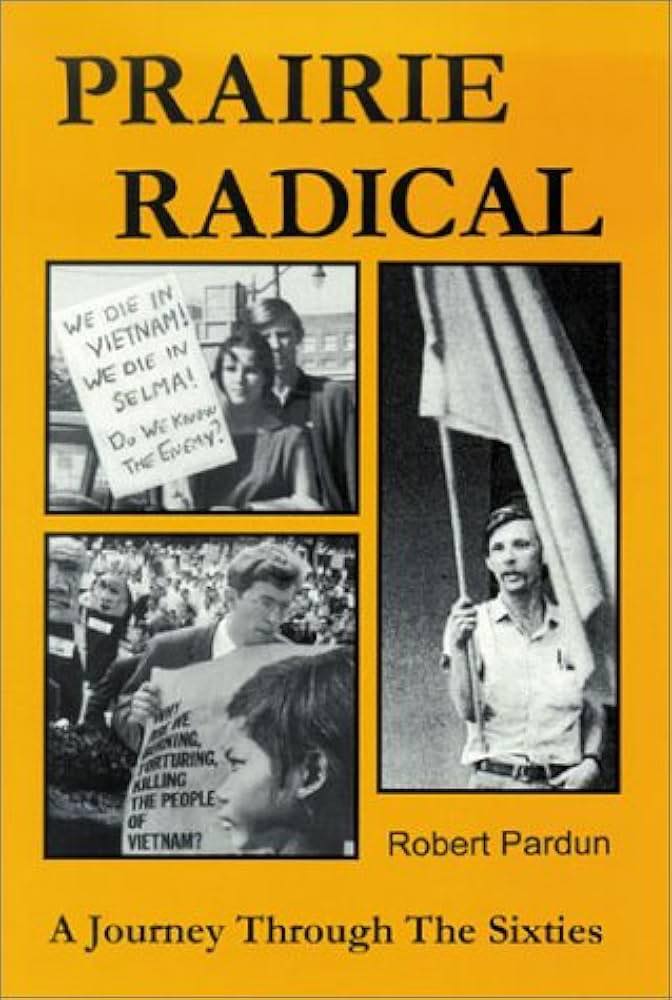
In “Letter to the New Left,” Mills railed against the “end of ideology.” He also wrestled with the idea of agency – who could make change. He was a Marxist but found the industrial proletariat to be an inadequate vehicle for transformation. Mills died in 1962 just as a student left emerged – a movement propelled by the Student Non-Violent Coordinating Committee (SNCC) and Students for a Democratic Society (SDS). Mills never witnessed the returning GIs who made the Vietnam Veterans Against the War (VVAW) such an effective voice against a “forever war.”
Influence on Power Structure Research
Two weeks after Barrow’s C. Wright Mills article appeared in Jacobin, the magazine published “The Power of Power Structure Research.” It featured an interview with Mike Locker who had been a founder of the North American Congress on Latin America (NACLA) in New York.
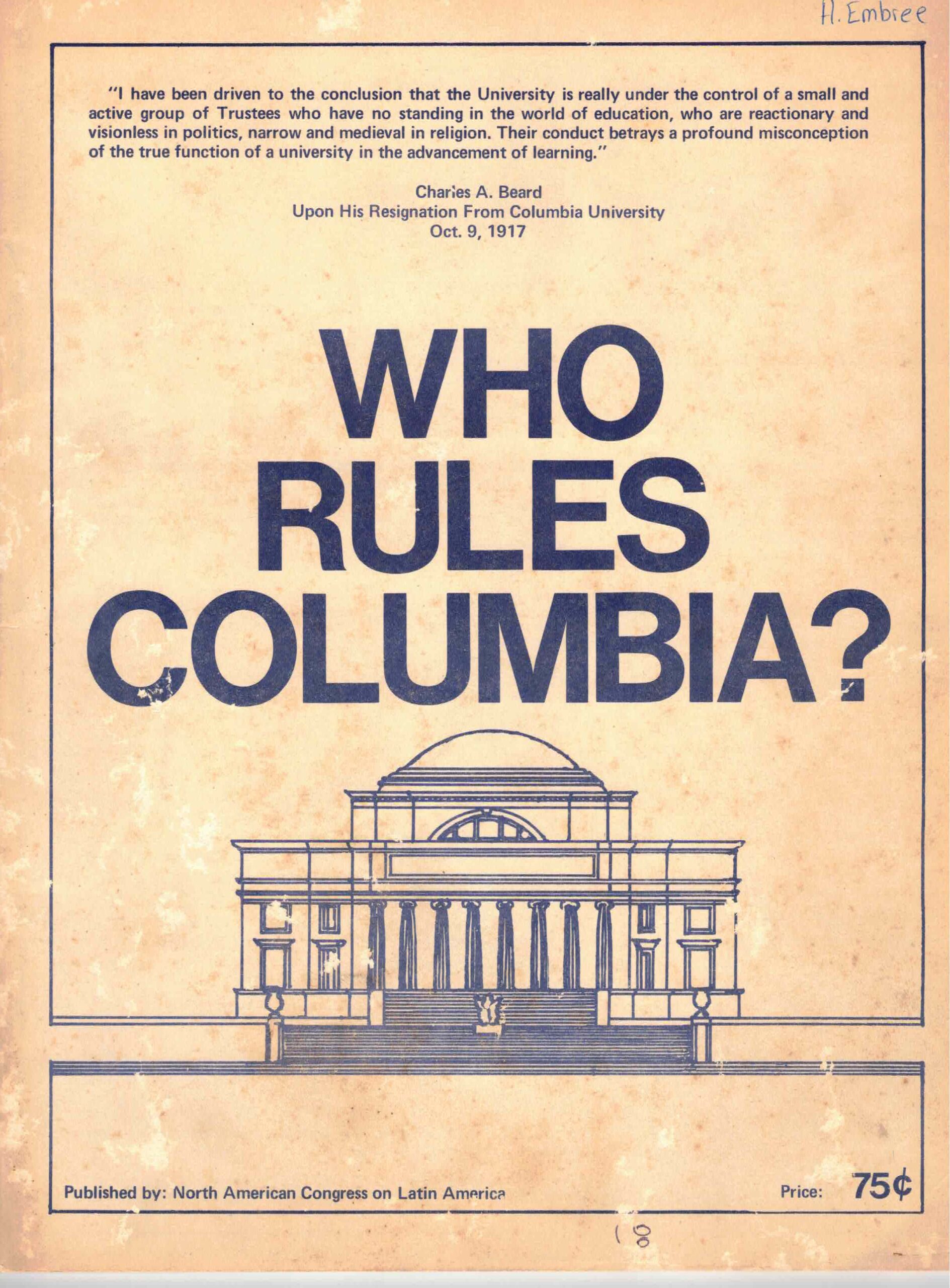
I had read The Power Elite and taken it to heart when I joined up with NACLA in New York in 1967. I worked with Mike Locker on the pamphlet, Who Rules Columbia?, published during the student strike of 1968. Six years after C. Wright Mills’ death, student radicals mapped out the power elite at the same campus where Mills had taught.
A large, folded insert connected the dots of Columbia’s Board of Trustees, showing their nodes of power, and intersections on corporate and foundation boards. I’m sure that Mills would have found it to be a delightfully practical application of his theory.
In the Jacobin’s interview, Mike Locker spoke of Mill’s impact:
Voting is, of course, one way to achieve political objectives. But social movements are another way to achieve those objectives. And how do you give social movements the tools to create a strategy and tactics that are effective for creating change? That’s the overarching theme of how I was beginning to approach power research.
That’s also what Mills was talking about. He wanted to understand what was controlling U.S. politics and economics that the American people were not aware of. And he thought that more awareness and consciousness of this would allow people to… develop a strategy and tactics to challenge that power.
Clyde W. Barrow’s article on C. Wright Mills sheds new light on his insight and lasting impact.












MICHAEL MEEROPOL / ECONOMICS / Are there signs of serious problems in the economy?
By Michael Meeropol / The Rag Blog / January 17, 2026
The following is a version of a commentary delivered over WAMC-FM by Michael Meeropol, Professor Emeritus of Economics at Western New England University on January 9, 2026. This version is expanded and revised for The Rag Blog as of January 17, 2026. Meeropol, Rag Blog host Thorne Dreyer and co-host Alice Embree will discuss the commentary on the air on KOOP 91.7-FM and streamed on KOOP.org Friday, Jan. 23, from 2-3 p.m.
So which is it? Is the U.S. economy doing extremely well and we are about to have a “great” year in 2026? Or are there signs of serious problems in the economy, especially for middle – class and working-class people who are not in the top ten, five or one percent of the population in terms of income and wealth?
Well, it just so happens that the substack economist, Paul Krugman, came out a few days ago with a summary of the year with a full analysis of what Trump’s economics have meant to the U.S. economy. This has given me much more important data to share than I had when I recorded this commentary and submitted a version to the WAMC-FM website. Thus, we can actually say this is exclusive to The Rag Blog.
For the full Krugman presentation, one needs a subscription but here is the link:
https://paulkrugman.substack.com/p/one-year-of-trumponomics
First, Krugman gives us the year-end jobs report which either was very weak or completely flat [meaning no job creation for the whole year!], depending on what kind of revisions there are to the data over the next few months. If it wasn’t flat, it was the weakest job growth in over a decade except for the year of the pandemic when there was a terrible loss of jobs.
Krugman then goes on to explain two things — why has unemployment risen so little AND why does it “feel” like the economy is in such bad shape? This probably has to do with the fact that there seems to be what Politico calls a “frozen” labor market: In this situation there are no mass layoffs and jumps in unemployment. Instead, businesses have cut back on hiring which means new entrants into the labor force (recent college graduates for example) as well as people looking to change jobs are facing few job opportunities.
[For details see “The US labor market ground to a halt in 2025. The risk in 2026 is that it “cracks.” It was a tough year to be looking for work — and the job market is not expected get much better,” available at https://finance.yahoo.com/news/the-us-labor-market-ground-to-a-halt-in-2025-the-risk-in-2026-is-that-it-cracks-140026614.html]
First of all, the reason measured unemployment hasn’t jumped is because all the deportations have reduced the number of people actively looking for work. Meanwhile, those who are looking for work are having a hard time finding jobs and the result is a serious decline in consumer confidence. Krugman’s evidence of this is the fact that long-term unemployment — the number of people who have been unemployed for 15 weeks or more — has risen much more than total unemployment. And the public understands this. “The Conference Board, which conducts a monthly survey of consumers, reports a measure called the “labor market differential” — the difference between the number of people saying that jobs are “plentiful” and those saying jobs are “hard to get.” While this measure turned upwards during the last quarter of 2024, it has turned sharply downward since then.” [Krugman]
And overall Consumer Confidence has declined for most of 2025: It reached a low point in early 2025, rose a bit through July, and has been falling ever since.
Now let’s check out the stock market. So far this year, the main index (the S and P 500) has produced a 16% rate of return. That means that if you owned $1 million worth of stock on January 1 of this year, you would have an extra $160,000 of wealth after December 31. Though lots of people own some stock (I owned some in my retirement account for most of my working life) very few people own enough stock for the proceeds to be a significant part of their income: 10% of Americans own 93% of all stocks, while the bottom half owns only about 1-2%.
So, no matter how you slice it, claiming that a booming stock market means we are “all” doing well is garbage.
Krugman goes further and notes that the improvement in the stock market is based on about seven individual firms that are heavily invested in developing artificial intelligence — which may or may not turn out to be a dangerous bubble rather than evidence of real successful company growth.
In fact, the run-up in the stock market is part of what is being called a “K – shaped” economy. The top part of the letter “K” represents the tremendous successes of the billionaires and others who are heavily invested in the stock market (that top ten percent). The lower part represents the difficulty that the middle class and working class has keeping their heads above water. So, if you are claiming “the economy” is doing great because you are focused on the top ten percent, you are right. To understand what is happening for the rest of us, we need much more information about many different trends.
[For details on stock ownership see: https://finance.yahoo.com/news/wealthiest-10-americans-own-93-033623827.html]
Or consider this set of facts: On Christmas Eve, MSNBC’s Ron Asana pointed out that the top 20% of the households account for 63% of consumption spending; the bottom 80% for 37%.
What about national statistics — Gross Domestic Product, Investment, Incomes of full-time workers? The growth rate in GDP was lower in 2025 than in 2024. Now it is true in moments of candor members of the Trump Administration refrain from asserting the blatant falsehood that the economy is the “hottest” it’s ever been, etc. etc. Some even spent most of 2025 assuring us that 2026 will be a “boom” year — which of course it might be — As Yogi Berra once said — “It’s difficult to make predictions, especiallyabout the future!”
But so far, there is no indication that the U.S. economy as a whole is booming. In the following diagram it is clear that the U.S. economy WAS “booming” — but that was 2024 when Joe Biden was president. In 2025, there has been a slowdown which is not surprising — the uncertainties created by Trump’s tariffs, the mass deportations which in some industries is reducing the labor force, the meat-axe approach to cutting government activities all have slowed growth. No recession — but a definite slowdown in growth
For the actual numbers in visual form, see
https://tradingeconomics.com/united-states/gdp-growth-annual
The behavior of investment during 2025 doesn’t give us any clues. It went up in the first quarter of 2025 only to fall in the next two quarters. In other words, Trump’s rhetoric about how rotten the economy was in 2024 is false and his rhetoric that 2025 was the “hottest” economy is also false.
[The following data is presented by the Federal Reserve Bank of St. Louis — abbreviated FRED. Folks can click on the link and then restrict the data to the last five years to see the trend. Investment did not “boom” in 2025.
https://fred.stlouisfed.org/series/A006RE1Q156NBEA]
But to move from “the economy” to the people living in it, I consider the real income of full-time workers a very important measure of well-being. (“Real” income takes the actually numbers in your paycheck and relates them to the ability of that paycheck to actually buy goods and services. “Median” is the best way to judge the wage of the TYPICAL worker. If you take an average, it can be tilted because of the very small number of super-rich individuals. If Bill Gates walked into a room of 99 people all making $50,000 a year, the “average” income would suddenly shoot up but $50,000 would still be the typical income. The numbers that follow relate to a base year which is why they seem rather low — the important thing is not the absolute number but whether we can see any trend.)
The weekly real median wage averaged $370 for 2024 (reaching a high point of $375 at the end of the year.) In the first quarter of 2025 it fell back to $373 and inched upwards to $376 in the second and third quarters — virtually no growth at all. For details see:
https://www.bls.gov/news.release/wkyeng.t01.htm
What’s going on?
First, the high-tech sector has invested heavily in developing Artificial Intelligence (AI) capabilities. Many businesses believe that increased use of AI will permit the replacement of many workers.
We can actually hear that happening when we call doctors’ offices and a voice that identifies itself as a “virtual assistant” (clearly an AI system) asks how “she” can direct your call. A human being used to be the person who answered that phone call and then directed the call — now It’s a machine. With the “promise” of AI, many businesses are reluctant to increase their labor force when they might not need that many people in the not-so-distant future.
The following is from the New York Times from last October:
In one particular area that was supposed to improve as President Trump’s tariffs took hold, there is nothing good to report. If you are a voter who wanted more factory jobs, you must be disappointed. If you promised the voters that there would be many more factory positions, you failed. This year [2025] factory jobs are down by 58,000. Nothing new. In Trump’s first term they fell by about 200,000 between January of 2017 and January of 2021. Seems like there is a lesson in here somewhere.
And look at the long-term trends. Although the non-farm labor force has grown by more than 20,000,000 since January of 2014, the total number of jobs in the manufacturing sector has not moved much. In 143 months beginning in January of 2014, total jobs in the factory sector have always been between 12,000,000and 13,000,000 except for five months in the spring and summer of 2020 when they fell below 12,000,000 for a while. Overall, no long-term increases even though the economy is much bigger today.
“Amazon Plans to Replace More Than a Half Million Jobs with Robots.”
(Karen Weise, New York Times, October 21, 2025)
[For more details see https://www.dollarsandsense.org/jobs-factories-and-inequalities/?ref=dollarsandsense-newsletter]
Thus, Trump’s tariffs have not created a surge in manufacturing jobs. Instead,they have created a great deal of uncertainty within the business sector. So far, American importers have been able to “eat” the tariffs because they built up significant inventories in anticipation that these tariffs will increase their costs. However, it is unlikely that they will be able to sustain this into 2026 and therefore, the tariffs will probably start to push prices up.
On top of all this, there is a very important intangible. As I mentioned above, the uncertainties created by those Trump tariffs and the failure of the Trump Administration to knock inflation down dramatically has dealt a blow to consumer confidence — and this is despite the fact that the average rate of inflation for 2025 has fallen from 2.9 percent in 2024 to 2.7 percent.
In other words, in answer to the question I posed at the beginning of this broadcast, there remains great uncertainty. The economy could start chugging along – it could remain in a kind of stasis with slow growth and slowly rising unemployment as inflation remains the same or slows further — or it could experience a surge in prices and an increase in unemployment.
Based on the analysis by Krugman of the 2025 statistics, I think the chance of a strong 2026 is very slim. In my oral presentation a few weeks ago I was more equivocal than I am now. I think the best the economy can hope for would be to muddle along but it might be much worse. The most important take-away from the experience of 2025 is that the economy has not done what Trump predicted and it is not doing what he claims it is. In other words, public opinion that believes the economy is in lousy shape is probably correct.