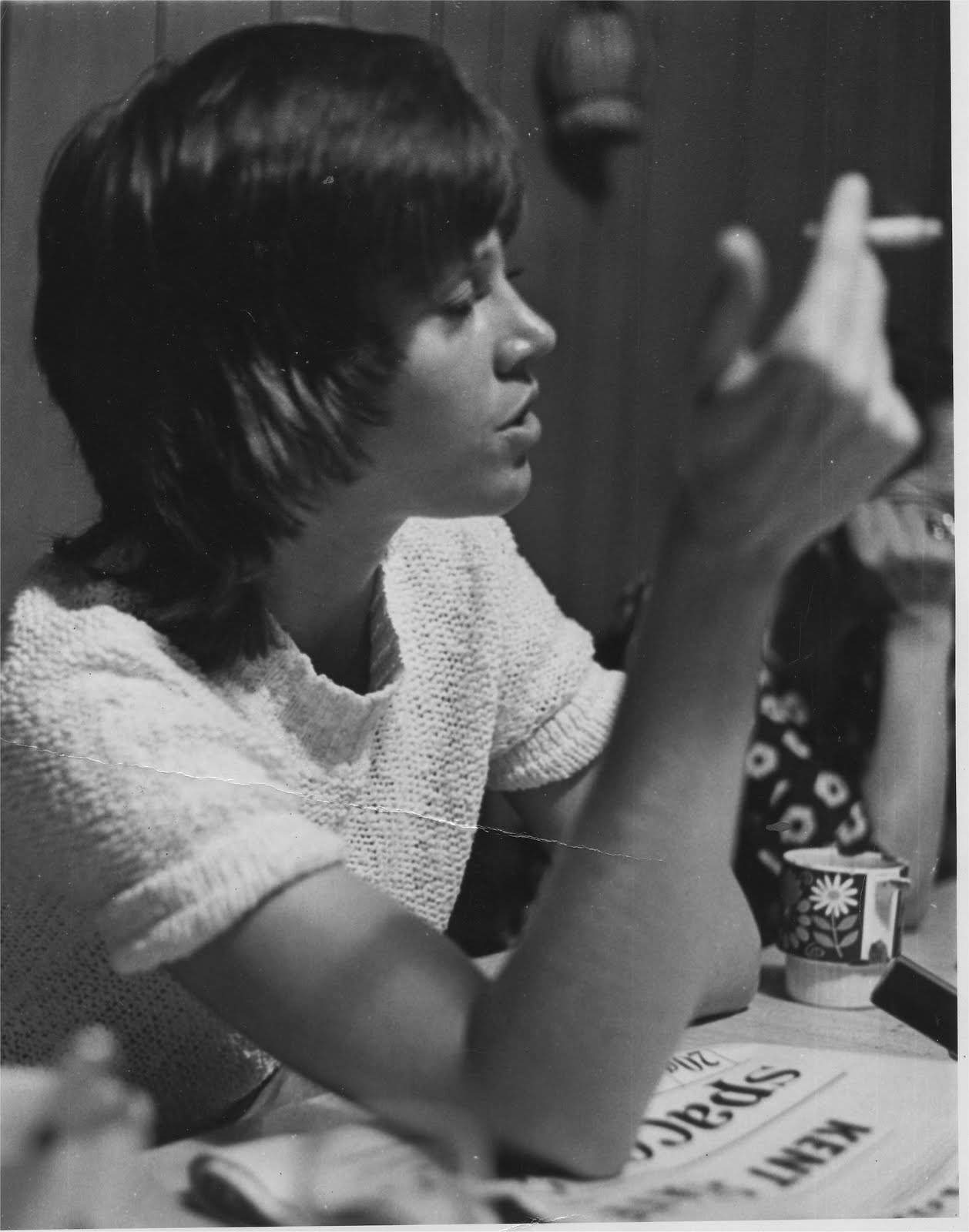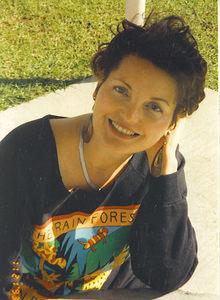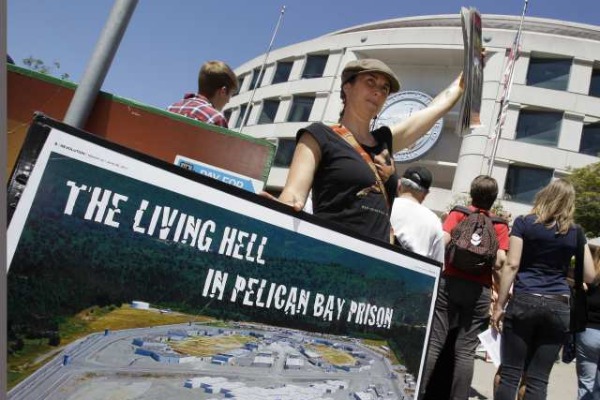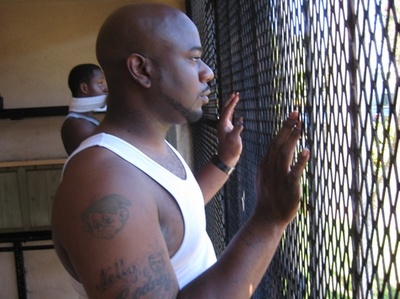
hey, marilyn

From august
through Black august
the drum beat us
all black and blue
and back again
where we live
inside shadows
with you

*

Here on the sad
fuming planet
comes a laughing ghost
beloved fugitive
our first anniversary
spun from these burning strands
our sensitive memory
of the afterlife without you
oh marilyn
a toast to your year
a salute to our tears
for the shadow of the panthers
cetewayo, shasha
smitty, dc and g (eronimo)*
now passing by

*

Here in my heart
a branch of middle summer
intermingles the past
with life’s juggly light
flowing like fire
over the river wide
your red kite
tangled, unescaped
high among
the maple trees

We are your family
the red blood cells
in & out of prison cells
the red resistance cells
grouped by transience
side by side
overcoming
great misfortune
in the lonely outside

*

Last night I dreamed
of walking down storied halls
a familiar house
after the typhoon
people known by their resemblances
returned, some drained of smiles
some doing yoga
some replacing mislayed objects
overcome in bedrooms
A daring girl led me closer to the last window
beyond where I can see
There where the backyard
ought to be
was the outdoor visiting patio
of FCI Dublin
*

We come to recollect your absence
with ourselves
to feel your palm
resting on each hand
To receive your
loving encouragment
and your example:
That to live we must risk ourselves
for the uncertain future
with dignity

*

Marilyn because
you were charming
and unb0wed
because you had
miles of style and acres of smiles
because you were a generous
citizen of earth
sister and god mother
I am throwing open the door
to release the bars
to forget the cancer and the tears
so that I can see
your shining face

*

When it’s quiet
when i lay deep down to sleep
i whisper kindness and
when I rise up
i sing of how
you wanted us to be happy and strong
when we were with you

Now a year after you have gone
I will We will

felix shafer 8.3.11


Type rest of the post here

Source /

The Rag Blog

Posted in RagBlog | Leave a comment

Carl Davidson : Winter of Our Discontent?

Summer of our discontent: Buildings set on fire in Tottenham, a poor neighborhood in north London. Photo from Politicol News.


Son of ‘Shock Doctrine’:

The approaching winter of our discontent

By Carl Davidson / The Rag Blog / August 11, 2011

Watching the rebellions of the young and poor continue in London and now spread to other industrial centers in the UK raises an interesting question: Will the Arab spring and the European summer lead to a fall and winter of discontent here in the USA?

All the makings for it are there. We have impoverished communities of the unemployed where there are huge numbers of young people who have never had a regular job of any sort. Now that any form of taxing the rich for funding a jobs program like that proposed by Rep. John Conyers’ HR 870 has been declared “off the table,” it doesn’t appear likely to change, either.


Add to that the GOP-led “Shock Doctrine” (with an assist from the White House) of creating a neoliberal deficit hoax to take from the working class and give to Wall Street, and you spread deeper misery across all of Main Street.

Now the AFL-CIO, thank goodness, is calling for a new round of mass actions against austerity and in defense of the tattered safety net. Add to that the October2011.org project, where the peace and justice movement is planning to camp out in downtown DC’s Freedom Plaza until all the troops are brought home from the wars.

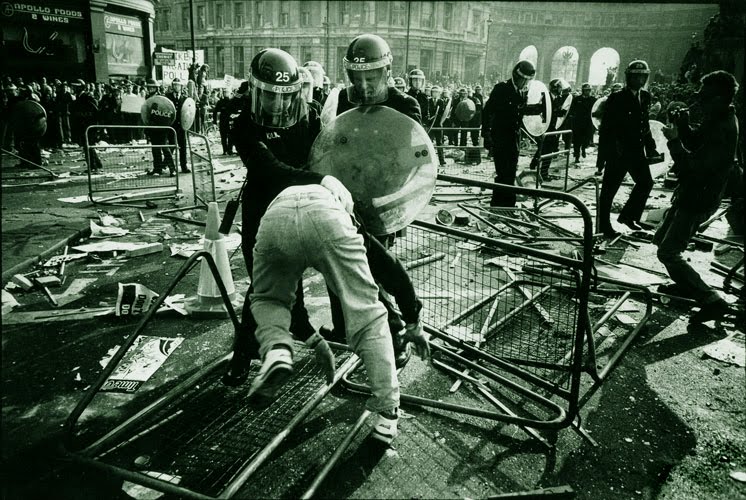
It’s a perfect storm shaping up. Hopefully, many of our young unemployed and underemployed will be drawn to them. But any police outrage could set off a chain reaction — we’ve seen this many times in our history.

We have a few decent politicians facing up to the problem, like the 80 votes of the Congressional Progressive Caucus behind the People’s Budget. But our top political class has declared their efforts “off the table,” too.

In brief, they’re telling us our views don’t count and we have nowhere to go.

That’s what the bigwigs in London thought, too. Now they’re all in a tizzy about riots and violence. In contrast, in one NBC report, a young man in Tottenham was asked if rioting really achieved anything:

“Yes,” said the young man. “You wouldn’t be talking to me now if we didn’t riot, would you? Two months ago we marched to Scotland Yard, more than 2,000 of us, all blacks, and it was peaceful and calm and you know what? Not a word in the press. Last night a bit of rioting and looting and look around you.”

Of course, many small shops and working-class homes, unfortunately, are being harmed in the UK events. Street heat is best when the target is narrowed on the upper class, and you keep the moral high ground. That way you can draw even more millions into relatively peaceful assembly with powerful and lasting implications. But when long-ignored social dynamite explodes, things don’t always work out that way, with the well-controlled niceties of a tea party, no pun intended.

It is right to rebel against outrages and unjust conditions imposed from above. The “Shock Doctrine” is a two-way street, and once it erupts, more than you might think will know which side of the barricades to gather on.

[Carl Davidson is a national co-chair of the Committees of Correspondence for Democracy and Socialism, a national board member of Solidarity Economy Network, and a local Beaver County, PA member of Steelworkers Associates. In the 1960s, he was a national leader of SDS and a writer and editor for the Guardian newsweekly. He is also the co-author, with Jerry Harris, of CyberRadicalism: A New Left for a Global Age. He serves as webmaster for SolidarityEconomy.net and Beaver County Blue. This article was first published on Carl’s blog, Keep On Keepin’ On. Read more articles by Carl Davidson on The Rag Blog.]

The Rag Blog

Posted in Rag Bloggers | Tagged , , | 3 Comments

Harry Targ : Sometimes We Have to Sing

The banks are made of marble:

Sometimes we have to sing

By Harry Targ / The Rag Blog / August 10, 2011

Fred was dating a young woman who gave him the two Weavers Carnegie Hall albums for Chanukah in the winter, 1958. He brought the albums over to my house so I could listen. He never got them back.

I’m not a Red Diaper baby. I didn’t read Marx until the 1970s. I don’t know when I decided I was a Marxist. I didn’t start teaching Marx and political economy until the late 1970s. But I became a small “r” red when I first heard those albums. Then on to Pete Seeger alone, Woody Guthrie, Cisco Houston, and later Arlo Guthrie, Phil Ochs, and even Kris Kristofferson and Bruce Springsteen.


From time to time I reminisce about all this as I still listen to the music that makes me mad, makes me cry, and makes me want to hit the streets. I forget the fine tuned lectures I listen to and even give myself, on neoliberal globalization, the tendency of the rate of profit to fall, over-production and under-consumption, and financialization, and break into song and tears as I hear the old music in the car or at home.

The deficit battle, which is a farce except for the pain the outcome will cause working people, reminded me of the Weavers blasting out “The Banks Are Made of Marble.” They sang of travels around the country seeing all the suffering that the capitalist system was causing; “the weary farmer,” the idle seaman, the miner scrubbing coal dust from off his back, “heard the children cryin” as they froze in their shacks, and the suffering of workers everywhere.

Why does the song suggest there is so much suffering all across America? The answer is so simple:

…the banks are made of marble

With a guard at every door

And the vaults are stuffed with silver

That the miner sweated for

The song, written by Les Rice in 1948 said the antidote to this situation was workers getting together and together making a stand. He predicted that the result would be a good one:

Then we’d own those banks of marble

With a guard at every door

And we’d share those vaults of silver

That we have sweated for

I also was thinking about an old Robin Hood song written by Woody Guthrie in the 1930s about an Oklahoma legend, Pretty Boy Floyd. According to Woody’s rendition, Pretty Boy Floyd got into a fight with a deputy sheriff and killed him. Floyd was forced to flee and allegedly took up a life of crime. At least authorities and journalists blamed Floyd for every robbery or killing that occurred in the state of Oklahoma. “Every crime in Oklahoma was added to his name.”

But in true Robin Hood fashion Pretty Boy Floyd stole from the rich and gave to the poor. Floyd, the outlaw, paid the mortgage for a starving farmer. Another time when Floyd begged for and received a meal in a rural household, he placed a thousand dollar bill under his napkin when he finished dinner. One Christmas Day Floyd left a carload of groceries for starving families on relief in Oklahoma City.

And in these days of massive unemployment, mortgage foreclosures, criminal wealth, and staggering poverty, through the voice of Pretty Boy Floyd, Woody Guthrie tells the wrenching story of capitalism that today is not too much different from during his time.

Yes, as through this world I’ve wandered

I’ve seen lots of funny men;

Some will rob you with a six-gun,

And some with a fountain pen.

And as through your life you travel,

Yes, as through your life you roam,

You won’t never see an outlaw

Drive a family from their home.

[Harry Targ is a professor of political science at Purdue University who lives in West Lafayette, Indiana. He blogs at Diary of a Heartland Radical — and that’s also the name of his new book which can be found at Lulu.com. Read more of Harry Targ’s articles on The Rag Blog.]

The Rag Blog

Posted in Rag Bloggers | Tagged , , , , | Leave a comment

Bob Feldman : The Hidden History of Texas

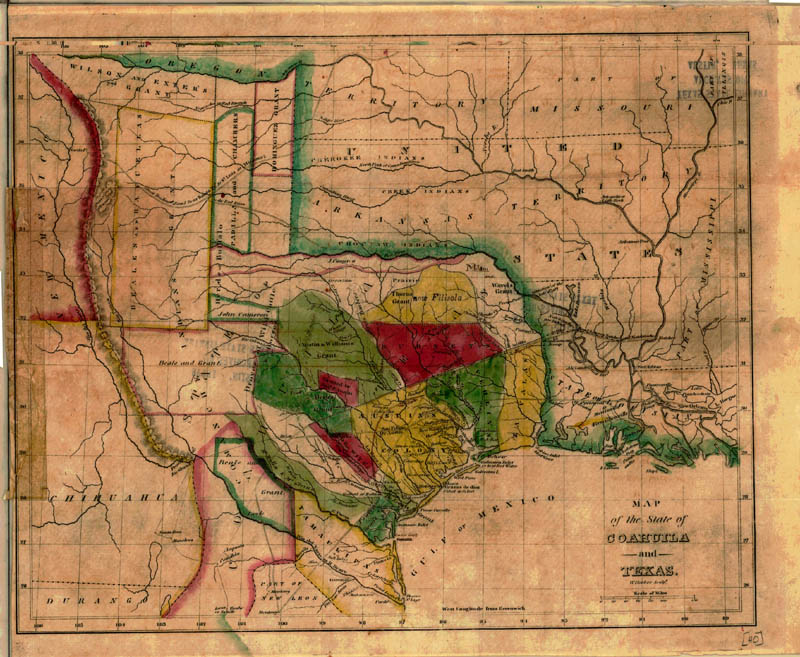
Map of the State of Coahuila and Texas, 1836. Image from the Texas State Library and Archives Commission.


The hidden history of Texas

Part 1: The pre-1821 years

By Bob Feldman / The Rag Blog / August 10, 2011

[This is the first installment of Bob Feldman’s new Rag Blog series on the hidden history of Texas.]

Since 1965 at least three high-profile Texas politicians — former U.S. Sen. Lyndon B. Johnson, former U.S. Rep. George H. W. Bush and former Texas Gov. George W. Bush — have used their decision-making power in the White House as U.S. presidents to involve the United States in major morally disastrous and economically wasteful military interventions overseas.


The general populace knows a lot about Texas politics and history, yet most people in the United States who didn’t grow up in Texas and who never have lived in Texas probably know very little about the hidden history of Texas.

Prior to 1821, for example, people of Jewish religious background who wanted to openly practice Judaism were, at least in theory, not allowed to become residents of Texas because the Spanish authorities in Texas required people who lived in Texas to worship openly only as Catholics.

And, even today, only about 131,000 of the over 25.1 million people who live in Texas appear to be of Jewish background, although the land area of Texas is a lot larger than the land area of Manhattan Island — where about 243,000 of the 1.6 million residents are of Jewish background.

But long before white Europeans of Christian religious background arrived and explored Texas in the 1500s, Native American people had been living in the South Plains in what is now Texas for over 10,000 years.

The first permanent settlement of white Europeans in Texas didn’t happen until 1682, when Spanish-speaking people established a settlement a few miles east of what is now El Paso. And over 80 years later, in the 1760s, there were still only 1,000 Spanish-speaking settlers in San Antonio and only 500 Spanish-speaking settlers in East Texas.

Even in the late 1770s, fewer than 4,000 Spanish-speaking settlers of European descent actually lived in what is now Texas.

Of the over 3,000 people who lived in these settlements in 1777, around 50 percent were born in Spain, 25 percent were either mestizo or mulatto, and 25 percent were Native American. But, at the same time, about 20,000 Native Americans still lived in Texas in areas outside the Spanish-speaking settlements at the end of the 1770s. In addition, 20 known slaves of African-American descent also lived in Texas in the 1770s.

As late as 1792, Texas still had only about 3,169 Spanish-speaking residents, including 34 blacks and 414 mulattos of African-American descent. So, not surprisingly, the majority of people who lived throughout all areas of Texas in 1799 were still Native American.

When Texas was part of the New Spain colony in North America under Spanish rule during the late 18th century, the legal status of women who owned property in Texas was actually better than it had been when the 13 U.S. colonies on North America’s East Coast were ruled by the UK prior to 1776.

According to the Spanish laws that governed Texas in the 1770s, for example, unmarried women in Texas who owned property retained title to their own property after marriage; and they also shared equally in the ownership of any property they and their husbands acquired after marrying. In addition, the husband of a woman in Texas in the 1770s could not, under Spanish law, sell the married couple’s community property without the consent of his wife.

In August 1813, an attempt was made by some of the fewer than 4,000 Spanish-speaking residents of Texas to establish a Texas republic that would no longer be either ruled by a royalist viceroy who represented the monarchical Spanish government or be part of New Spain.

But after a leader of the Spanish-speaking rebels named Gutierrez declared Texas independent from Spain on Aug. 6, 1813, the new Texas Republic’s Army of North Mexico (which numbered 1,400 men), led by Jose Alverez de Toledo, was defeated at the Battle of Medina (in what is now the area around San Antonio) on Aug. 18, 1813, by a Spanish royalist force of 2,000, led by Joaquin de Arrendo.

Some 1,000 of the combatants involved in the Battle of Medina were killed during the battle; and the royalist troops of Arrendo then “executed 327 soldiers from the republican army who surrendered or were captured after the battle,” according to University of North Texas Professor of History Randoph Campbell’s 2003 book Gone To Texas: A History of the Lone Star State.

In addition, “in San Antonio 40 men suspected of supporting Gutierrez and/or Toledo paid with their lives,” “eight women and children from their families died of suffocation while packed into prison compounds,” and a detachment of Arrendo’s Spanish royalist army “advanced towards Nacogdoches, executing 71 more accused rebels along the way,” according to the same book.

Six years later, in the summer of 1819, Texas was invaded by an army of about 300 Anglo-American men, led by an Anglo-American merchant named James Long — who also tried to set up an independent Texas republic that would no longer be ruled by Spain or be part of New Spain.

But by the fall of 1819, royalist Spanish troops had driven Long’s army of Anglo-American invaders back across the East Texas border and back into U.S. territory; and after Long led a second unsuccessful invasion of Texas by armed Anglo men two years later, he was imprisoned and then killed by local Spanish-speaking Texas authorities, after the armed Anglo invaders were again defeated by Spanish-speaking troops in the late summer of 1821.

Shortly before Long’s second invasion of Texas was beaten back, an alliance between the white Creole elite landowners in New Spain (who had been born in New Spain and, thus — under Spanish rule — did not enjoy the same political and economic rights as Spanish-born residents of New Spain), New Spain’s clerical leaders and Spanish royalist army general Agustin de Iturbide was successful in pressuring the royalist viceroy to sign the Aug. 24, 1821 Treaty of Cordoba.

Under the terms of the Treaty of Cordoba, New Spain ceased to exist as a political entity and the independent Empire of Mexico was established (although the Spanish government in Madrid later declared the Treaty of Cordoba null and void in February 1822, unsuccessfully attempted to reconquer its former Mexican colony in 1829, and did not formally recognize the independence of Mexico until 1839).

So after Aug. 24, 1821, Texas would become part of the newly independent Empire of Mexico. And after the white Creole military commander of Vera Cruz, Antonio Lopez de Santa Anna, led a white Creole landowning elite-supported Mexican Army revolt in December 1822 which set up a federal republican form of government in Mexico in 1823, Texas now became a part of the Republic of Mexico’s state of Coahuila y Texas in 1824.

[Bob Feldman is an East Coast-based writer-activist and a former member of the Columbia SDS Steering Committee of the late 1960s. Read more articles by Bob Feldman on The Rag Blog.]

The Rag Blog

Posted in Rag Bloggers | Tagged , | 4 Comments

David P. Hamilton : France is on Vacation

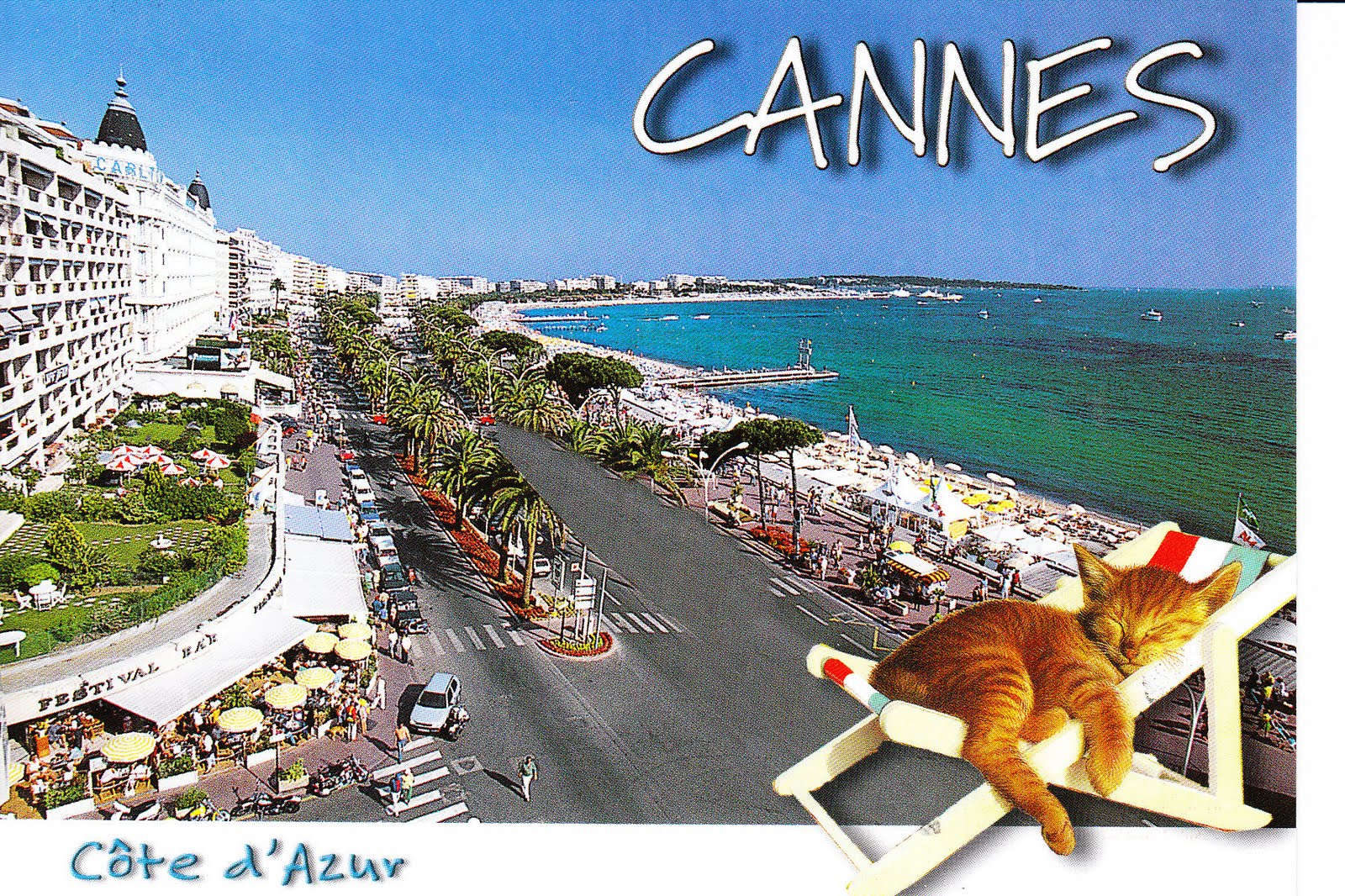
Image from Gem’s World Postcards.


Letters from France VII:

En vacances payé…

Paid vacations and how we live

The value placed on time off from work holds leisure, family, and the pursuit of happiness more important than the pursuit of profits.

By David P. Hamilton / The Rag Blog /August 9, 2011

[This is the seventh in a series of dispatches from France by The Rag Blog‘s David P. Hamilton.]

PARIS — It’s August and France is on vacation. If you are an American tourist visiting Paris for the first time this month, you will find it strange that most restaurants that are not part of international chains are closed for the month. That famous boulangerie that makes award-winning baquettes you read about in the guide book will be closed too. If you’re renting a short term apartment, don’t dream of calling a plumber.


Strange too will be how few Parisians are in evidence. The metro isn’t crowded. It seems they have abandoned the place to the tourists. Those Parisians that remain may be more surly than usual. They’re resentful for having to work in August providing services to vacationing Americans while all their friends are at the beach.

By one measure, there are two types of French: juilletistes and aoutiens (those who take their extended summer vacation in July and those who take it in August). Regardless, the mass exodus from the workplace to vacation destinations is annual, sudden, and on a vast scale.

Before the development of the network of modern super highways, major roads leading south out of Paris were made one-way for 24 hours on August 1st. Now the vacation time is somewhat staggered, but literally hundreds of thousands of Parisians leave every year at virtually the same time, most headed south. The population center of the whole country shifts several kilometers southward within a matter of hours. If you awoke from a hundred-year sleep, you would think the Prussians were advancing on Paris once again.

To some degree this concentration of vacation is compulsory. Employers are required by law to grant an extended paid leave between May and October. School vacation is in July and August. Many businesses just close down for the month.

This lull in activity is reflected in measures of the French economy. There is an annual third quarter contraction. Manufacturing can be off as much as 25% for the month. But France is the world’s number one tourist destination and the French love to travel within their own country more than any other, so facilities specifically related to tourism will be bustling. It’s high season and that especially refers to prices, which throughout the country become those that Parisians are already accustomed to paying.

To Americans it seems quite phenomenal that a major country can run its affairs in this way. Much of France literally shuts down for the month. Even political campaigns pack it up and go to the beach. Sègoléne Royale, attempting to revive her faltering campaign for the Parti Socialiste nomination for president in October, announced she would reduce her vacation to nine days, clearly a sacrifice of significant proportions meant to signal her extreme seriousness.

The value placed on time off from work holds leisure, family, and the pursuit of happiness more important than the pursuit of profits.

The World Tourism Organization studied “the average number of paid vacation days per year employees receive” in nine developed countries. France ranked second with 37 days a year, behind Italy’s 42. The U.S. was a very distant last, trailing eighth place Japan by 12 days. According to this study, the typical U.S. worker gets only 13 paid vacation days a year, IF they meet certain criteria, such as having a decade of seniority.

Nationmaster.com says workers in France get “seven weeks, the most significant vacation time of any country in the world,” plus public holidays, while paid vacations for U.S. workers are “not required, but typically [are] 10 working days with eight national holidays.”

CNN Money says “typical practice among large U.S. companies” is that workers with 10 years seniority get an average of 15 days paid vacation and 10 paid public holidays a year. All French workers get at least 30 and 10 by legal right regardless of their tenure on the job.

CNN also points out that “unlike in most other countries (including all the EU), there is no U.S. federal law mandating that companies pay employees for time off or that they grant them a minimum amount of vacation days unpaid.” Indeed, according the Center for Economic Policy and Research, the U.S. is “the only advanced economy in the world that does not guarantee its workers paid vacation.”

Most U.S. workers actually get much less than the “typical” cited above. When CNN considered “companies of all sizes and workers of all tenures,” the number of paid vacation days and public holidays for U.S. workers dropped to nine and six. A quarter of U.S. workers get no paid vacation time at all.

Another way to look at this is that, according to the Organization for Economic Cooperation and Development, in 2008 the average U.S. worker worked 1,792 hours a year compared to 1,560 hours a year for the worker in France. That’s 29 more eight-hour days a year for the U.S. worker, more than a month of additional work.

Some results attributed in part to this extended time off are that productivity is higher in France than in the U.S., French workers are paid better for the time they work, and the pay scale is more equitable. The minimum wage in France is about $13 an hour, compared to $7.25 in the U.S. and unions are much stronger there, especially in the public sector. The official poverty rate in France is the seventh lowest among 152 nations listed and less than half the poverty rate in the U.S., according to the 2009 CIA World Factbook.

Paid vacations are not the only time off from work the French enjoy. A new mother gets 16 to 26 weeks of maternity leave at full pay, depending on how many children she has. She can get up to a year off with her employment guaranteed. Fathers get two weeks off paid paternity leave and can share up to two years of unpaid time off with the mother, their employments guaranteed.

Families also get approximately 2,000 euros ($2,900) when they have a child followed by payments of around 100 euros ($145) a month per child until the child is 20 years old. If you are adopting a child, you get more. The family of a child with disabilities gets much more. Add to this the fact that with a note from a doctor sick leaves are unlimited and the French work week is only 35 hours long.

American workers have for decades been taught to internalize values that make the interests of their employer paramount. Depending on which study you read, in 2007 between one third and half of employed U.S. adults don’t use all the vacation time they have coming to them. 39% of U.S. men and 30% of women feel guilty about taking time off from work. 25% of U.S. workers and 33% of managers have bosses who expect them to be on-call while on vacation.

And the situation is getting worse. According to the Bureau of Labor Statistics, the average American man today works 100 more hours a year than he did in the 1970s, the average woman 200 hours more. With high unemployment, job insecurity, weak unions, and poor benefits for the unemployed, the worker’s forced subservience to the needs and values of the employer is amplified.

The typical American sleeps one to two hours a night less than his or her parents did. Those extra work hours come at the expense of rest and time spent with family and friends, and in creative or leisure activities. They come with a price measured in anxiety, stress, dissatisfaction, depression, and poor health.

According to Cornell economist Robert Frank, in the U.S. the incentives are set up to systematically underemphasize leisure and overemphasize consumption. He who dies with the most toys wins. We must consume on a level that keeps us abreast or ahead of our peers and on a level that keeps the profits of the capitalists growing.

Frank argues that this value reflects a classic failure of collective action. An individual would be worse off if he or she were to unilaterally opt out of the “positional competition.” But we would all be better off if we decided collectively to ratchet down the economic one-upmanship of consumerism and instead devote a bit more time and resources to the leisure time we claim to desire.

However, collective action by workers is anathema in the U.S. capitalist hegemony. Our rulers prefer a society of rugged individualists, standing tall in the sunset puffing Marlboros beside their new 4X4 super heavy duty pickup truck.

Not surprisingly, France’s policy on paid vacations was initiated by the Popular Front government composed of Socialists and Communists soon after they took power in the election of June 1936. The right to an extended paid vacation was part of the Matignon Agreements that also included winning the 40-hour work week, the right to join a union, bargain collectively, and strike, the removal of all obstacles to union organization, and a 7-12% pay increase for all workers.

These concessions were won in one afternoon meeting that included representatives of unions, employers, and the government. The Popular Front had just won the election to control the National Assembly, Leon Blum had become the first Socialist (and Jewish) prime minister, and a million French workers were honoring a general strike that had swept France after the Popular Front electoral victory. Hundreds of factories had been occupied by their workers to prevent lockouts.

Under those circumstances, the capitalists readily capitulated on all points. Given France’s long history of multiple popular insurrections, they had little choice. Every expansion of these benefits and defense of them since 1936 has come about as a result of initiatives from the organized and militant left.

Extended vacations are now considered a tradition and a necessity by the French, a part of their collective consciousness for the entire year. Beginning in the spring, conversation turns to vacation plans. The experience itself builds family bonds and gives life variety and perspective.

In the fall, you share memories of last summer. The cold, gray winter is warmed by dreams of where you might go when summer vacation comes again. A co-worker not taking a vacation is pitied. The most vivid childhood memories are those of long family vacations. Paid time off and travel are now firmly ingrained elements of modern French culture.

Through generations of collective struggle they have won that benefit in order to pursue their muse or their decadence, but regardless, to better define their own existence. Although otherwise generally positive, my own memories of family vacations in France include watching a relative spend hours running up over $3,000 in phone bills from a Paris hotel room while trying to keep up with business responsibilities back in the USA.

It is said that Americans live to work and the French work to live. That truism reflects the stage of the class struggle in our collective mentalities.

[David P. Hamilton has been a political activist in Austin since the late 1960s when he worked with SDS and wrote for The Rag, Austin’s underground newspaper. Read more articles by David P. Hamilton on The Rag Blog.]

The Rag Blog

Posted in Rag Bloggers | Tagged , | 1 Comment

Nature bats last: Notes on revolution and resistance, revelation and redemption

by Robert Jensen

[An edited version of this talk was presented to the Veterans for Peace conference in Portland, OR, on August 4, 2011.]

My title is ambitious and ambiguous: revolution and resistance (which tend to be associated with left politics), revelation and redemption (typically associated with right-wing religion), all framed by a warning about ecological collapse. My goal is to connect these concepts to support an argument for a radical political theology — let me add to the ambiguity here — that can help us claim our power at the moment when we are more powerless than ever, and identify the sources of hope when there is no hope.

First, I realize that the term “radical political theology” may be annoying. Some people will dislike “radical” and prefer a more pragmatic approach. Others will argue that theology shouldn’t be political. Still others will want nothing to do with theology of any kind. At various times in my life, I would have offered all of those objections. Today, I think a politics without a theology is dangerous, a theology without a politics is irrelevant, and radical is realistic.

By politics, I don’t mean we need to pretend to have worked out a traditional political program that will lead us to the land of milk and honey; instead, I’m merely suggesting that we always foreground the basic struggle for power in whatever work we do at whatever level. By theology, I don’t mean that we need to believe in supernatural forces that will lead us to a land of milk and honey; instead, I’m merely pointing out that we all construct a worldview that is not reducible to evidence and logic. In politics and theology, it’s important to be clear about what we know, and even more important to recognize what we don’t know, what we can’t know, what is instinct and emotion.

And all this needs to be radical — not in the self-indulgent “more radical than thou” style that crops up now and then on the left — but rather in the sense of an unflinching honesty about that unjust and unsustainable nature of the systems in which we live. Whatever pragmatic steps we may decide to take in the world, they should be based on radical analysis if they are to be realistic.

Revolution

I’m not interested in speculating about future revolutions, I don’t take seriously anyone who predicts a coming revolution in the United States, and I doubt that the traditional concept of a revolution is even relevant today — the dramatic changes that lie ahead likely won’t arrive that way. Rather than dream of revolutions to come, it’s more productive to think about the revolutions that brought us to this moment.

Ask an audience to name the three most important revolutions in human history, and the most common answers are the American, French, and Russian. But to understand our current situation, the better answer is the agricultural, industrial, and delusional revolutions. While those national revolutions had dramatic effects, not only on those nations but on the course of the history of the past two centuries, these other revolutions not only reshaped the lives of every human but remade the world in ways that may spell the end of human history as we know it. The agricultural, industrial, and delusional revolutions were — to use a current political cliché — real game-changers.

The agricultural revolution started about 10,000 years ago when a gathering-hunting species discovered how to cultivate plants for food and domesticate animals. Two crucial things resulted, one political and one ecological. Politically, the ability to stockpile food made possible concentrations of power and resulting hierarchies that were foreign to band-level gathering-hunting societies, which were highly egalitarian and based on cooperation. This is not to say that humans were not capable of doing bad things to each other prior to agriculture, but only that large-scale institutionalized oppression has its roots in agriculture. We need not romanticize pre-agricultural life but simply recognize that it was organized in far more egalitarian fashion than what we call “civilization.”

Ecologically, the invention of agriculture kicked off an intensive human assault on natural systems. While gathering-hunting humans were capable of damaging a local ecosystem in limited ways, the large-scale destruction we cope with today has its origins in agriculture, in the way humans started exhausting the energy-rich carbon of the planet, first in soil. Human agricultural practices have varied over time and place but have never been sustainable over the long term. There are better and worse farming practices, but soil erosion has been a consistent feature of agriculture, which makes it the first step in the entrenchment of an unsustainable human economy based on extraction.

We are trained to think that advances in technology constitute progress, but the post-World War II “advances” in oil-based industrial agriculture have accelerated the ecological destruction. Soil from large monoculture fields drenched in petrochemicals not only continues to erode but also threatens groundwater supplies and contributes to dead zones in oceans. While it’s true that this industrial agriculture has produced tremendous yield increases during the last century, no one has come up with a sustainable system for perpetuating that kind of agricultural productivity. Those high yields mask what Wes Jackson has called “the failure of success”: Production remains high while the health of the soil continues to decline dramatically.[1] That kind of “success” guarantees the inevitable collapse of the system. We have less soil that is more degraded, with no technological substitute for healthy soil; we are exhausting and contaminating groundwater; and we are dependent on an agriculture tied to a fuel source that is running out.

That industrialization of agriculture was made possible, of course, by the larger industrial revolution that began in the last half of the 18th century in Great Britain, which intensified the magnitude of the human assault on ecosystems and humans assaults on each other. This revolution unleashed the concentrated energy of coal, oil, and natural gas to run the new steam engine and machines in textile manufacturing that dramatically increased productivity. That energy — harnessed by the predatory capitalist economic system that was beginning to dominate the planet — not only eventually transformed all manufacturing, transportation, and communication, but disrupted social relations. People were pushed off the land, out of communities, and into cities that grew rapidly, often without planning. Traditional ways of knowing and living were destroyed, by force or by the allure of affluence. World population soared from about 1 billion in 1800 to the current 7 billion, far beyond the long-term carrying capacity of the planet.

This move from a sun-powered and muscle-based world to a fossil fuel-powered and machine-based world has produced unparalleled material comfort for some. Whatever one thinks of the effect of such levels of comfort on human well-being — in my view, the effect has been mixed at best[2] — the processes that produce the comfort are destroying the capacity of the ecosystem to sustain human life as we know it into the future, and in the present those comforts are not distributed in a fashion that is consistent with any meaningful conception of justice. In short, our world is unsustainable and unjust — the way we live is in direct conflict with common sense and the ethical principles on which we claim to base our lives. How is that possible? Enter the third revolution.

The delusional revolution is my term for the development of sophisticated propaganda techniques in the 20th century (especially a highly emotive, image-based advertising/marketing system) that have produced in the bulk of the population (especially in First World societies) a distinctly delusional state of being. Although any person or group can employ these techniques, wealthy individuals and corporations — and their representatives in government — take advantage of their disproportionate share of resources to flood the culture with their stories that reinforce their dominance. Journalism and education, idealized as spaces for rationally based truth-telling, sometimes provide a counter to those propaganda systems, but just as often are co-opted by the powerful forces behind them.

Perhaps the most stunning example of this is that during the 2000s, as the evidence for human-caused climate disruption became more compelling, the percentage of the population that rejects that science increased. Why would people who, in most every other aspect of life accept without question the results of peer-reviewed science, reject the overwhelming consensus of climate scientists in this case? Some have theological reasons, and for others perhaps it is simply easier to disbelieve than to face the implications. But it’s clear that the well-funded media campaigns using these propaganda techniques to create doubt have been effective.[3]

Even those of us who try to resist it often can’t help but be drawn into parts of the delusion; it’s difficult to keep track of, let alone understand, all of the fronts on which we are facing serious challenges to a just and sustainable future. As a culture, these delusions leave us acting as if unsustainable systems can be sustained simply because we want them to be. Much of the culture’s story-telling — particularly that which comes through almost all of the mass media — remains committed to maintaining this delusional state. In such a culture, it becomes hard to extract oneself from that story. Singer/songwriter Greg Brown captures the trajectory of this delusional revolution when he speculates that one day, “There’ll be one corporation selling one little box/it’ll do what you want and tell you what you want and cost whatever you got.”[4]

In summary: The agricultural revolution set us on a road to destruction. The industrial revolution ramped up our speed. The delusional revolution has prevented us from coming to terms with the reality of where we are and where we are heading.
Resistance

Even if a revolutionary program is not viable at the moment, strategies and tactics for resistance are crucial. To acknowledge that the social, economic, and political systems that have produced this death spiral can’t be overthrown from the revolutionary playbooks of the past does not mean there are no ways to affirm life. We face planetary problems that seem to defy solutions, but the U.S. empire and predatory corporate capitalism remain immediate threats and should be resisted. An honest, radical assessment of our situation doesn’t mean giving up, but it requires us to be tough-minded. We need to understand which resistance strategies and tactics are likely to be most productive at this moment in history.

To advance that discussion, let’s think back to February 15, 2003. Many of us on that Saturday participated in actions in opposition to the planned U.S. invasion of Iraq. It was an exhilarating day, the largest coordinated political protest in the history of the world. At least 10 million people participated across the globe, with a clear message for U.S. policymakers: The invasion being planned is illegal and immoral, and we reject not only this war but your right to use violence to achieve your political and economic goals. I was the emcee of the event in Austin, and I remember being amazed at the thousands who gathered at the Texas Capitol, stretching back so far that our loudspeakers couldn’t reach the entire crowd.

We had a compelling message, rooted in international law, political principles, and moral values. We had huge numbers of people. We had an international presence. And none of it mattered; the war came. Why could U.S. policymakers ignore us without consequence? First, those elites knew that a large segment of the public either actively supported the war or would passively support almost any war that was out of sight/out of mind. Second, they knew that when that day of protest was over, most of the people in the streets would go home, satisfied with their public statement and unlikely to go beyond that polite expression of dissent. Political movements are most potent when people are willing to take risks; without a large number of such people, the powerful know they can wait out protests.

For most people, attending an anti-war rally posed no risk. Immigrants and people in targeted groups (Arabs, South Asians, Muslims) had reason to feel threatened, but people who look like me — with only rare exceptions — don’t face serious repression in the United States today for engaging in peaceful political activity, though that can change quickly. What were most of us willing to do beyond attending a rally in opposition to a war being planned? A month later, when the war came, we got a partial answer. The crowd for the standing call to come to the Capitol when the bombs fell was at best one-fourth of the pre-war rally. Most of the people who came on February 15 weren’t willing to come out in public once the nation was at war; even that trivial a risk was too much.

I could be cocky and say that in 2003 I was willing to risk my job, my physical safety, even my life to stop the war. It might be true; I certainly felt the urgency of the moment. But the question is moot, because at that time there was no strategy for taking such risks. These decisions about risk are made by individuals but in the context of options developed collectively, and the movement I was part of had not discussed such options.

So, when certain resistance tactics don’t work as part of a strategy that’s not clearly articulated, it’s time to rethink. I have no grand strategy to offer, and I am skeptical about anyone who claims they have worked out such a strategy. But I am reasonably confident that this is not a mass-movement moment, not a time in which large numbers of Americans are likely to engage in political activity that challenges basic systems of power and wealth. I believe we are in a period in which the most important work is creating the organizations and networks that will be important in the future, when the political conditions change, for better or worse. Whatever is coming, we need sharper analysis, stronger vehicles for action, and more resilient connections among people. In short, this is a cadre-building moment.

Although for some people the phrase “cadre-building” may invoke the worst of the left’s revolutionary dogmatism, I have something different in mind. For me, “cadre” doesn’t mean “vanguard” or “self-appointed bearers of truth.” It signals commitment, but with an openness to rethinking theory and practice. I see this kind of organizing in some groups in Austin, TX, where I live. Not surprisingly, they are groups led by younger people who are drawing on longstanding radical ideas, updating as needed to fit a changing world. These organizers don’t have all the answers, and I don’t agree with some of the answers they do have, but I am drawn to them because they recognize the need to dig in.

Revelation

Most discussions of revelation and apocalypse in contemporary America focus on the Book of Revelation, also known as The Apocalypse of John, the final book of the Christian New Testament. The two terms are synonymous in their original meaning — “revelation” from Latin and “apocalypse” from Greek both mean a lifting of the veil, a disclosure of something hidden from most people, a coming to clarity. What is the nature of this unveiling today? What is being revealed to us?

A reactionary end-times theology turns that particular book of the Bible into the handbook for a death cult, fantasizing about an easy way out. That isn’t the direction I will be heading. Rather than thinking of revelation as divine delivery of a clear message about some fantastic future above, we can think of it as a process that requires tremendous effort on our part about our very real struggles on this planet. That notion of revelation doesn’t offer a one-way ticket to a better place, but reminds us that there are no tickets available to any other place; we humans live and die on this planet, and we have a lot of work to do if, as a species, we want to keep living.

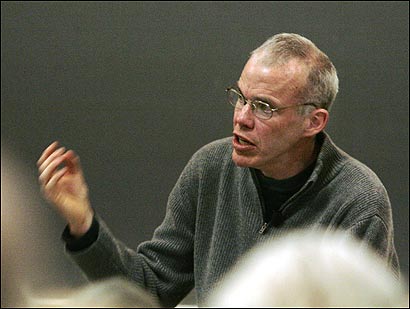
That process begins with an honest analysis of where we stand. There is a growing realization that we have disrupted natural forces in ways we cannot control and do not fully understand. We need not adopt an end-times theology to recognize that on our current trajectory, there will come a point when the ecosphere cannot sustain human life as we know it. As Bill McKibben puts it, “The world hasn’t ended, but the world as we know it has — even if we don’t quite know it yet.”[5]

McKibben, the first popular writer to alert the world to the threat of climate change, argues that humans have so dramatically changed the planet’s ecosystems that we should rename the Earth, call it Eaarth:

The planet on which our civilization evolved no longer exists. The stability that produced that civilization has vanished; epic changes have begun. We may, with commitment and luck, yet be able to maintain a planet that will sustain some kind of civilization, but it won’t be the same planet, and hence it won’t be the same civilization. The earth that we knew — the only earth that we ever knew — is gone.[6]

If McKibben is accurate — and I think the evidence clearly supports his assessment — then we can’t pretend all that’s needed is tinkering with existing systems to fix a few environmental problems; massive changes in how we live are required, what McKibben characterizes as a new kind of civilization. No matter where any one of us sits in the social and economic hierarchies, there is no escape from the dislocations of such changes. Money and power might insulate some from the most wrenching consequences of these shifts, but there is no escape. We do not live in stable societies and no longer live on a stable planet. We may feel safe and secure in specific places at specific times, but it’s hard to believe in any safety and security in a collective sense.

This is a revelation not of a coming rapture but of a deepening rupture. The end times are not coming, they are unfolding now.
Redemption

Just as revelation can be about more than explosions during the end times, redemption can be understood as about more than a savior’s blood washing away our sin. In a world in which so many decent people have been psychologically and theologically abused by being called “sinner” by jealous and judgmental scolds, sin and redemption are tricky terms. But we shouldn’t give up on the concept of sin, for we are in fact all sinners — we all do things that fall short of the principles on which we claim to base our lives. Everyone I know has at some point lied to avoid accountability, failed to offer help to someone in need, taken more than their fair share. Given that we all sin, we all should seek redemption, understood as the struggle to come back into right relation with those we have injured. If we are to live up to our own moral standards, we must deepen our understanding of sin and its causes so that we can understand the path to redemption.

For Christians, sin traditionally has been marked as original and individual — we are born with it, and we can deal with it through an individual profession of faith. In some sense, of course, sin is obviously original. At some point in our lives we all do things that violate our own principles, which suggests the capacity to do nasty things it is a part of normal human psychology. Equally obvious is that even though we live interdependently and our actions are conditioned by how we are socialized, we are distinct moral agents and we make choices. Responsibility for those choices must in part be ours as individuals.

But an individual focus isn’t going to solve our most pressing problems, which is why it is crucial to focus on the sins we commit that are created, not original, and solutions that are collective, not individual. These sins, which do much greater damage, are the result of — we might say, created by — political, economic, and social systems. Those systems create war and poverty, discrimination and oppression, not simply through the freely chosen actions of individuals but because of the nature of these systems of empire and capitalism, rooted in white supremacy and patriarchy. Humans’ ordinary capacity to sin is intensified, reaching a different order of magnitude, and responsibility for the resulting sins is shared.

There is a politics to sin, and therefore there has to be a politics to redemption. That desire to return to right relation with others in our personal lives is not enough; collectively we have to struggle for the same thing, which requires us to always be working to dismantle those hierarchical systems that define our lives. Within hierarchy, right relation is impossible; assertions of dominance and concentrations of power create domination and abuses of power. That includes the most abusive of all hierarchies: The human claim to a right to dominate everything else. Our most important struggle for redemption concerns our most profound sin: Our willingness to destroy the larger living world of which we are a part.

The first step in redemption is to not turn away from that lifting of the veil, to face honestly what we have done, to contest the culture’s delusions wherever possible. Then we can face what we must do to enhance justice and build sustainable living arrangements.

What does this kind of redemption look like in practice? I think we should proceed along two basic tracks. First, we should commit some of our energy to the familiar movements that focus on the question of justice in this world, such as anti-war struggles. We redeem ourselves — especially those of us with privilege that is rooted in that injustice — through that commitment to fighting empire, capitalism, white supremacy, and patriarchy.

But I also think there is important work to be done in experiments to prepare for what will come in this new future we can’t yet describe in detail. Whatever the limits of our predictive capacity, we can be pretty sure we will need ways of organizing ourselves to help us live in a world with less energy and fewer material goods. We have to all develop the skills needed for that world (such as gardening with fewer inputs, food preparation and storage, and basic tinkering), and we will need to recover a deep sense of community that has disappeared from many of our lives. McKibben puts this in terms of a new scale for our work:

“The project we’re now undertaking — maintenance, graceful decline, hunkering down, holding on against the storm — requires a different scale. Instead of continents and vast nations, we need to think about states, about town, about neighborhoods, about blocks. … We need to scale back, to go to ground. We need to take what wealth we have left and figure out how we’re going to use it, not to spin the wheel one more time but to slow the wheel down. … We need, as it were, to trade in the big house for something that suits our circumstances on this new Eaarth. We need to feel our vulnerability.”[7]

Nature bats last

The phrase “nature bats last” circulates these days among people who have their eye on the multiple, cascading ecological crises. The metaphor reminds us that nature is the home team and has the final word. We humans may be particularly impressed with our own achievements — all of the spectacular homeruns we have hit with science and technology — but when those achievements are at odds with how nature operates, then nature is going to bring in the ultimate designated hitter and knock the human race out of the ballpark. OK, let’s not try to stretch this too far — no single metaphor can work at every level needed. The point is simple: We are not as powerful as the forces that govern that larger living world.

The metaphor offers one other crucial lesson, in this case because of its limitations. When we say “nature bats last,” it implies we are one team and nature is on another, as if it were possible for us to compete with nature. But we are, of course, simply part of nature, one species in an indescribably diverse living world. To imagine ourselves as competing with nature would be like our lungs competing with our heart — either those organs work together, or an individual human dies.

Unfortunately, the architects of modern science didn’t see the world that way. One of the most often-quoted, Francis Bacon, believed that modern science and technology “have the power to conquer and subdue [nature], to shake her to her foundations.” Rene Descartes, another of these founding fathers, believed humans could achieve the knowledge and develop the means to know:

the force and action of fire, water, air, the stars, the heavens, and all the other bodies that surround us, as distinctly as we know the various crafts of our artisans, we might also apply them in the same way to all the uses to which they are adapted, and thus render ourselves the lords and possessors of nature.

These thinkers also contributed to our understanding of the workings and power of the natural world. But this language of domination — to conquer and subdue, becoming lords and possessors — is the language not of a baseball game but of war, which brings us to the relevance of this to Veterans for Peace. VFP members have seen through and gone beyond the egotistical rhetoric of our national fundamentalism — with all its fraudulent claims about “fighting for freedom” — to reject the U.S. wars of empire and stake out an audacious goal: “To abolish war as an instrument of national policy.”

We also need to see beyond the egotistical rhetoric of our technological fundamentalism — the claims that infinitely clever humans will solve all problems with gadgets — and stake out an even more audacious goal: To end the human war on the rest of living world.

Life is hard

If all this seems too much to ask of ourselves, that’s because it is. We live in a time when we must face honestly the whole truth, but to do that is too much to bear. We struggle to claim our power at the moment when we are more powerless than ever, and find hope where there is no hope.

On power: Those of us in dissident movements understand we face difficult odds, fighting entrenched forces of the state and corporation. We know the keys to prevailing: Fight organized money with organized people; compromise to build a power base but never abandon core principles; find ways to delegitimize authority; raise the social costs for elites to pursue unjust policies; hang in for the long haul. Those organizing basics don’t change, though the application of them must constantly adapt to changes in the structure of power. But the ecological crises change things the big picture.

First, we should not assume the long haul is as long as we’ve always imagined. No one can predict the rate of collapse if we stay on this trajectory, and we don’t know if we can change the trajectory. There is much we don’t know, but everything I see suggests that the world in which we will pursue political goals will change dramatically in the next decade or two, almost certainly for the worse. Organizing has to adapt not only to changes in societies but to these fundamental changes in the ecosphere. We are organizing in a period of contraction, not expansion.

Second, we can’t be satisfied with contesting imperialism in the nation-state and the concentration of wealth in corporate capitalism, but also must change the human relationship to the living world. Dissident movements have an advantage, given that a larger percentage of people involved in left/radical politics have less of a commitment to maintaining the dominant culture’s delusions. Radicals don’t have the wealth and power that can appear to insulate us from collapse, which means we have more room to think about what living arrangements are consistent with reality. Elites, who typically mistake temporary domination for real power, have a harder time recognizing that humans are powerless in the face of the forces we have been trying to conquer and subdue. In the end, we can never be the lords and possessors of something larger and more enduring in time. Many traditions recognize this basic reality: We don’t own the earth, the earth owns us. Our power comes in recognizing our powerlessness and adapting to the world as it is, not the world as we imagine it to be.

How does this approach give people hope? It doesn’t, and it shouldn’t, because hope is not something you give to people. The political organizers on the liberal/left who are always touting a new way to restore the American Dream are peddlers of false hope, offering allegedly exciting opportunities to an allegedly new movements that are stuck in the same old failed ideology of the dominant culture, steadfastly ignoring the depth and scope of the ecological crises. Real hope comes with abandoning the false prophets and moving on to accomplish something. Authentic hope comes when we honestly confront our condition and dig in to create new, or revive old, forms of community. Hope comes from proving to ourselves that we are competent to manage our own lives. Hope doesn’t fall from the sky but rather is built from the ground up.

That hope doesn’t ask for guarantees that our movements will prevail. That hope doesn’t require us to pretend we know whether the human experiment will go on forever. That hope comes from the understanding that while we did not choose to live in a desecrated world, such is the world into which we were born. All we can do is act out of respect for ourselves, for each other, and for nature, in the hope that we can restore the sacredness of the individual, the human community in which individuals find meaning, and the living world of which human communities are a part.

Organizers have long said that the key to successful organizing is making it easy for people to do the right thing. Today, our task is to be honest about how difficult it is to do the right thing. Anyone who thinks it can be easy to do the right thing is part of the delusional culture. Rather than delude ourselves, let’s face the truth and recognize the difficulty of the path that lies ahead. Other social movements have prevailed in the face of great difficulty, but no social movement has had to face this simple but profound reality: We have to become the first species on the planet to practice restraint in the scramble for energy-rich carbon. All life on this planet is based on that scramble, but if we continue on the path unchecked the planet will be incapable of sustaining human life as we know it. That is a brand new organizing challenge. In facing it, we need to leave the platitudes at home.

The radical political theology I believe we need for this moment in history would acknowledge, rather than try to mask, our confusion and uncertainty. We know we are in deep trouble; beyond that, it’s guesswork. Facing that takes a new kind of courage. We usually think of courage as rooted in clarity and certainty — we act with courage when we are sure of what we know. Today, the courage we need must be rooted in the limits of what we can know and trust in something beyond human knowledge. In many times and places, that something has gone by the name “God.”

Religious fundamentalism offers a God who will protect us if we follow orders. Technological fundamentalism gives us the illusion that we are God and can arrange the world as we like it. A radical political theology leaves behind fear-based protection rackets and arrogance-driven control fantasies.

The God for our journey is neither above us nor inside us but around us, a reminder of the sacredness of the living world of which we are a part. That God shares the anxiety and anguish of life in a desecrated world. With such a God we can be at peace with our powerlessness and alive in hope. With such a God, we can live in peace.

———————–

Robert Jensen is a journalism professor at the University of Texas at Austin and board member of the Third Coast Activist Resource Center in Austin. He is the author of All My Bones Shake: Seeking a Progressive Path to the Prophetic Voice, (Soft Skull Press, 2009); Getting Off: Pornography and the End of Masculinity (South End Press, 2007); The Heart of Whiteness: Confronting Race, Racism and White Privilege (City Lights, 2005); Citizens of the Empire: The Struggle to Claim Our Humanity (City Lights, 2004); and Writing Dissent: Taking Radical Ideas from the Margins to the Mainstream (Peter Lang, 2002). Jensen is also co-producer of the documentary film “Abe Osheroff: One Foot in the Grave, the Other Still Dancing,” which chronicles the life and philosophy of the longtime radical activist. Information about the film, distributed by the Media Education Foundation, and an extended interview Jensen conducted with Osheroff are online at http://thirdcoastactivist.org/osheroff.html.

Jensen can be reached at rjensen@uts.cc.utexas.edu and his articles can be found online at http://uts.cc.utexas.edu/~rjensen/index.html. To join an email list to receive articles by Jensen, go to http://www.thirdcoastactivist.org/jensenupdates-info.html

[1] Wes Jackson, New Roots for Agriculture (Lincoln: University of Nebraska Press, 1980), chapter 2. Many of my points in this talk were greatly influence by the work of Jackson and The Land Institute, http://www.landinstitute.org/.

[2] Tim Kasser, The High Price of Materialism (Cambridge, MA: MIT Press, 2002).

[3] Naomi Oreskes and Erik M. Conway, Merchants of Doubt: How a Handful of Scientists Obscured the Truth on Issues from Tobacco Smoke to Global Warming (New York: Bloomsbury Press, 2010).

[4] Greg Brown, “Where Is Maria?” from the CD “Further In,” Red House Records, 1996.

[5] Bill McKibben, Eaarth: Making Life on a Tough New Planet (New York: Times Books/Henry Holt, 2010), p. 2.

[6] McKibben, Eaarth, p. 25.

[7] McKibben, Eaarth, p. 123.

Type rest of the post here

Source /

The Rag Blog

Posted in RagBlog | Leave a comment

ROTC Resurgent

By Jay D. Jurie

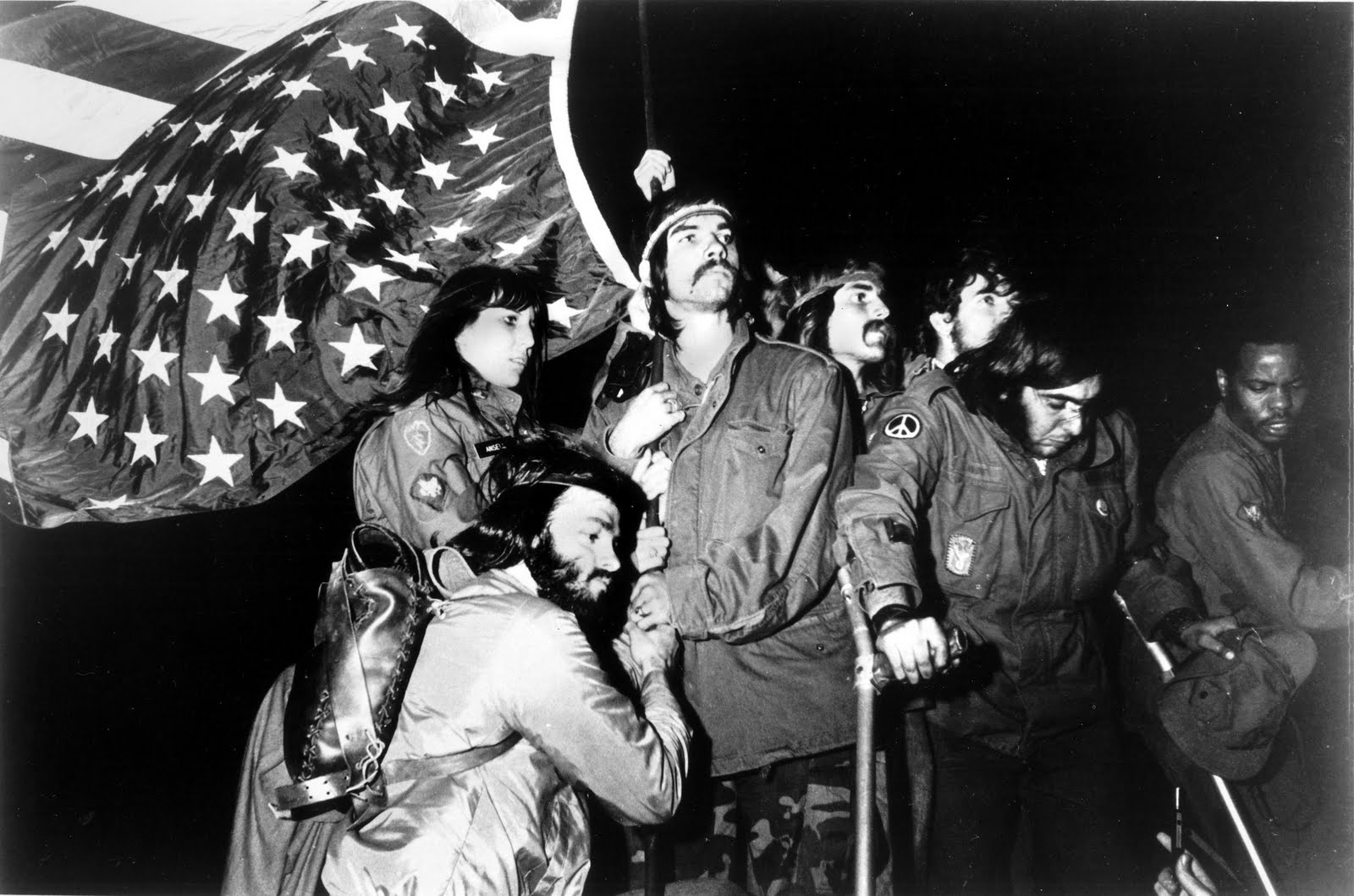
Carrying an upside-down U.S. flag tacked onto a short wooden pole, a student at the head of a column of anti-Vietnam war students marching onto a University practice field was tackled by several pro-war student athletes. As the protest column continued to press onto the field the “jocks” and police struggled to bring it to a halt. They were unsuccessful and the protestors made their way through the ranks of parading cadets, turning the drill into a melee. This April 30, 1970 event was not the first time such a drill had been disrupted on the Boulder campus.

Early in the fall of 1969, the Student Peace Union (SPU) chapter approached their counterparts in the Students for a Democratic Society (SDS) with a proposal.

SPU had decided the Reserve Officer Training Program (ROTC, pronounced “rotsee” by friend and foe alike) was the most visible manifestation of the Vietnam War on campus. While SDS elsewhere had devoted some attention to ROTC, this had not particularly filtered down to the Boulder chapter as an “action item.” SPU’s proposal was that SDS partner in demonstrating against ROTC.

At that time, ROTC held regular drills on an open field approximately two blocks from the heart of campus. SDS readily agreed with the SPU proposal, not only because of the high profile, but because it was viewed as an affront that ROTC paraded so openly while the carnage mounted in Vietnam. It was agreed the target of the protest would not be the individual cadets enrolled in ROTC, but the program itself and its relation to the University, the military and the war. SDS put out a very simple flyer that read only: “1) end ROTC. 2) reimburse students on ROTC scholarships.”

When the day of protest came, the two organizations, along with supporters, met at the student union fountain area and marched to the field where the ROTC drill was already under way. Proceeding onto the field protestors marched to and fro through the ranks of parading cadets and confusion reigned. There was no violence, but the drill was disrupted. ROTC instructors sized up the situation and called off the exercise.

At the next ROTC parade, the protest was repeated. Though they again marched from the fountain area together, relations between SPU and SDS were cool. From the outset it was clear there was a tactical dispute. SPU wanted to be a visible presence and make a statement in opposition to the war and ROTC on campus, while SDS wanted to do everything in its power to “stop the war machine” and end the killing.
Nearing arrival at the field, the column of protestors split into two, with SPU heading to the side of the field, and SDS marching toward the drill. This time, campus police were better prepared. They formed a cordon along the edge of the parade ground to prevent the SDS contingent from reaching the drill. However, SDS moved quickly and did an end run around the police line. As before, protestors managed to run through the ranks of drilling cadets and chaos ensued. There was no violence, but the drill was again disrupted.

Apparently the police realized if they chased the protestors across the field they would only contribute to the disruption. Again, ROTC instructors called off the drill. SDS was elated, believing the system had been beaten twice and one small corner of the war machine had been shut down, at least temporarily.

There was one more “ROTC smash” that fall, but by this time, in disagreement with SDS tactics, SPU had dropped out of the partnership. SDS figured the police would be too well prepared for a third successful march onto the field. Instead, when the marchers neared the field, they abruptly veered off and headed toward the stadium, where ROTC had its offices. Campus police rapidly redeployed and kept pace with the SDS march.

Outside the ROTC offices, a couple SDS leaders were making the usual anti-war speeches when the campus police chief noticed smoke billowing from the area where the ROTC parade was underway. He quickly realized they’d been duped. Several police officers stayed with the rally to keep an eye on the demonstrators and ensure the ROTC offices were protected, while the main force ran back to the field.

At that point, the protestors had a good laugh and dispersed. In the planning for the event a couple SDS members had volunteered to throw smoke bombs onto the field. This was not done in such a way as to cause any harm, but to make a symbolic point about the bombing of Vietnam, and to sow confusion and hopefully yet again cause disruption. In this respect the action was a success, as were all the ROTC “smashes” that fall. No one was injured, and remarkably, no one was kicked out of school and there were no arrests.

By the spring of 1970 both the SPU and SDS chapters were defunct. Filling the void of campus anti-war activism at the University of Colorado was the Student Mobilization Committee (SMC), a front group for the Young Socialist Alliance (YSA), the youth affiliate of the Trotskyite Socialist Workers Party (SWP). Meanwhile, the depredations of the Nixon-Kissinger regime in Southeast Asia had intensified. Campus awareness and activism across the country, and at the University of Colorado, reached its zenith that spring.

Students who were more militant, including many previously affiliated with SDS, became the very uneasy left-wing “junior partner” under the SMC umbrella. The dominant YSA faction, strategically if not ideologically, fulfilled the role played by SPU the previous fall. While a variety of anti-war actions took place early in the year, including an occupation of the first floor of the administration building, ROTC was not forgotten.

It was decided by late April ROTC would once again be a “smash” target. This time, it was understood well in advance by all in SMC there would be a divergence over tactics. As before, marchers gathered at the fountain area and set off for the ROTC drill field. This time the protest was larger, there were somewhere between 300 to 500 who participated. When the field was reached, the larger YSA-affliated contingent peeled off and in keeping with their strategy of mass rallies, like SPU the preceding fall, assumed positions along the sidelines.

Campus police turned out in full force, accompanying the march all the way to the field, where they formed a much larger cordon than before and were more fully equipped for a riot. Determined they were not going to be stopped, the more militant faction of SMC marched directly toward the line of police. Aligned with the police was a contingent of about 30 “jocks.”

As the two sides converged, the previously described scuffle broke out. Police chased demonstrators on and off the field. Police parked in cruisers adjacent to the field pursued some who fled across campus. Some students were handcuffed to a nearby chain link fence as the arresting officers returned to the fray. A student who thoughtfully came equipped with a handcuff key surreptitiously set them free.

On this occasion, a number people were tackled, knocked down, shoved, punched, or grabbed. While there was violence, there were no serious injuries. Most of the violence was initiated by the jocks, which the police ignored, and no jocks were arrested. It was widely believed by protestors that an understanding had been reached between the police and jocks beforehand.

Since some of those arrested had stayed on the sidelines, it was abundantly clear the University strategy was to target and get rid of those they identified as leaders of the campus anti-war movement. Nine of the anti-war students were arrested at the scene and nine more were subsequently charged with violating Colorado’s newly-enacted “Campus Disorder Act.” As it turned out, no one was ever tried for the Boulder “ROTC smashes” of 1969-70. Eventually, the case of the “Boulder 18” wound up in front of the Colorado Supreme Court, which ruled the statute unconstitutionally vague, threw it out, and quashed the charges.

After the final “smash” in 1970 the University moved all ROTC drills inside the football stadium, where access was able to be controlled. For their part, Boulder’s anti-war protestors won at least a minor victory by visibly exposing University complicity with the military and the war. While ROTC was not forced off campus, the protests resulted in some change of “business as usual.”

While what occurred in Boulder was unique, it was far from the only protest against ROTC during the anti-Vietnam war era, or even well before that era. Since its inception, ROTC has proven controversial. Part of the original purpose of ROTC was found in the Morrill Land Grant Act of 1862, which gave states federal land that included a stipulation for military coursework. In 1898 the War Department attempted to clarify this by proposing military instruction be provided by officers assigned as faculty, that students in those courses be required to wear uniforms, and that this instruction be made mandatory. Enactment of the National Defense Act of 1916 formally established ROTC and extended it to private as well as public colleges.

Some have argued ROTC played an essential role in keeping the military grounded in civil society. According to Michael S. Neiberg, as opposed to officers trained in elite military academies, one perspective held that “civilian educated officers would bring to military service a wider and more rounded background. They would also bring to the military a value system more consistent with American society by virtue of having lived in a civilian environment.” On the other hand, some have argued that ROTC desensitizes the civilian population to the militarization of society and the inimical purposes that may be served by the military. University of Washington SDS in 1969 was quoted by Neiberg as contending that “If the university’s role in cooperating with ROTC is the production of officers, our universities have become, in part, mere extension schools of our government’s military establishment…The university continues to produce the tools to make possible policies such as those which led the U.S. into war in Asia.”

ROTC had become so well-established by the 1920s that John Dewey and others created a Committee on Militarism and Education. By the 1930s a few educational institutions either dropped the program or changed its status from mandatory to voluntary. However, most schools that had the program retained it, usually with the requirement that two years of participation in the program were obligatory for all male students.

ROTC received a boost during World War II, but after the war controversy returned. Motivated by the Cold War and the threat of nuclear annihilation in the late 1950s and early 1960s, ROTC sparked protest. In May 1960, protestors at Boston University picketed, leafletted, petitioned, and placed a table with a protest sign in a ROTC parade route.

As the Vietnam war heated up in the mid and late 1960s, so did protests against ROTC. In addition to demonstrations, ROTC facilities were set on fire at Stanford, Michigan, Kent State, and the University of Colorado. There was a perception held by a number in the anti-war movement that this violence paled in comparison with, and was justified by, the widespread use of napalm and the tonnage of bombs dropped in Vietnam. Some schools, in response to these protests, removed the mandatory requirement. Others, like the Colorado School of Mines, kept it in place into the 1970s.

Even where ROTC was no longer compulsory, such as the University of Colorado, the program became a focal point of the anti-war movement. During the late 1960s and into the 1970s over 80 ROTC programs were dropped, mostly from the elite universities where it had drawn the most opposition. While ROTC was dropped from some schools, it was established in less “controversial” mostly public university locations.

Nonetheless, a rough status quo was maintained for decades after the Vietnam war ended. During that time frame many colleges and universities enacted clauses banning discrimination against gays. Because the military engaged in such discrimination, this effectively kept ROTC off campus at those schools. When the military “don’t ask don’t tell” policy was dropped in 2010, some institutions began to reconsider re-establishing their relationship with ROTC.

Harvard, Yale, and Columbia are among those that have brought ROTC back onto campus, and Brown has been considering the matter. ROTC has regained a certain popularity among students. Not only have the draft and the memory of Vietnam faded, but military service is seen as patriotic in the wake of the September 11, 2001 terrorist attacks, and an employment option in a tough economy.

While the military may no longer be engaged in overt discrimination against gays, the earlier objections to ROTC largely remain in place. So long as the U.S. maintains a foreign policy based on dominance, resource exploitation, and the containment of those believed to be at odds with the elite interests, it is evident that resurgent ROTC programs will continue to provide officers to serve those interests.

Sources: Allan Brick, The Campus Protest Against ROTC, Southern Student Organizing Committee, no date; Editorial: Reconsidering ROTC, The Brown Daily Herald; Larry Gordon, Once a Campus Outcast, ROTC is Booming at Universities, Los Angeles Times, June 1, 2011; Tara W. Merrigan & Zoe A.Y. Weinberg, Harvard to Officially Recognize Naval ROTC, Harvard Crimson, March 3, 2011; Michael S. Neiberg, Making Citizen-Soldiers: ROTC and the Ideology of American Military Service, Cambridge: Harvard, 2000; Fahmida Y. Rashid, The Return of ROTC to Columbia, The Village Voice, April 6, 2011.

Type rest of the post here

Source /

The Rag Blog

Posted in RagBlog | Leave a comment

Texas became part of the State of Coahuila and Texas in 1824. Image from the Texas State Library and Archives Commission.

Texas’s hidden history:
Part 1: The pre-1821 years

By Bob Feldman / The Rag Blog / August 9, 2011

[This is the first installment of Bob Feldman’s new Rag Blog series on Texas history.]

Since 1965 at least three high-profile Texas politicians — former U.S. Sen. Lyndon B. Johnson, former U.S. Rep. George H. W. Bush and former Texas Gov. George W. Bush — have used their decision-making power in the White House as U.S. presidents to involve the United States in major morally disastrous and economically wasteful military interventions overseas.

Yet most people in the United States who didn’t grow up in Texas and who never have lived in Texas probably know very little about the hidden history of Texas.

Prior to 1821, for example, people of Jewish religious background who wanted to openly practice Judaism were apparently not allowed to become residents of Texas because the Spanish authorities in Texas required people who lived in Texas to worship openly only as Catholics.

And, even today, only about 131,000 of the over 25.1 million people who live in Texas appear to be of Jewish background, although the land area of Texas is a lot larger than the land area of Manhattan Island — where about 243,000 of the 1.6 million residents are of Jewish background.

But long before white Europeans of Christian religious background arrived and explored Texas in the 1500s, Native American people had been living in the South Plains in what is now Texas for over 10,000 years.

The first permanent settlement of white Europeans in Texas didn’t happen until 1682, when Spanish-speaking people established a settlement a few miles east of what is now El Paso. And over 80 years later, in the 1760s, there were still only 1,000 Spanish-speaking settlers in San Antonio and only 500 Spanish-speaking settlers in East Texas.

Even in the late 1770s, fewer than 4,000 Spanish-speaking settlers of European descent actually lived in what is now Texas.

Of the over 3,000 people who lived in these settlements in 1777, around 50 percent were born in Spain, 25 percent were either mestizo or mulatto, and 25 percent were Native American. But, at the same time, about 20,000 Native Americans still lived in Texas in areas outside the Spanish-speaking settlements at the end of the 1770s. In addition, 20 slaves of African-American descent also lived in Texas in the 1770s.

As late as 1792, Texas still had only about 3,169 Spanish-speaking residents, including 34 blacks and 414 mulattos of African-American descent. So, not surprisingly, the majority of people who lived throughout all areas of Texas in 1799 were still Native American.

As part of the New Spain colony in North America under Spanish rule during the late 18th century, the legal status of women who owned property in Texas was actually better than it had been when the 13 U.S. colonies on North America’s East Coast were ruled by the UK prior to 1776.

According to the Spanish laws that governed Texas in the 1770s, for example, unmarried women in Texas who owned property retained title to their own property after marriage; and they also shared equally in the ownership of any property they and their husbands acquired after marrying. In addition, the husband of a woman in Texas in the 1770s could not, under Spanish law, sell the married couple’s community property without the consent of his wife.

In August 1813, an attempt was made by some of the fewer than 4,000 Spanish-speaking residents of Texas to establish a Texas republic that would no longer be either ruled by a royalist viceroy who represented the monarchical Spanish government or be part of New Spain.

But after a leader of the Spanish-speaking rebels named Gutierrez declared Texas independent from Spain on Aug. 6, 1813, the new Texas Republic’s Army of North Mexico (which numbered 1,400 men), led by Jose Alverez de Toledo, was defeated at the Battle of Medina (in what is now the area around San Antonio) on Aug. 18, 1813, by a Spanish royalist force of 2,000, led by Joaquin de Arrendo.

Some 1,000 of the combatants involved in the Battle of Medina were killed during the battle; and the royalist troops of Arrendo then “executed 327 soldiers from the republican army who surrendered or were captured after the battle,” according to University of North Texas Professor of History Randoph Campbell’s 2003 book Gone To Texas: A History of the Lone Star State.

In addition, “in San Antonio 40 men suspected of supporting Gutierrez and/or Toledo paid with their lives,” “eight women and children from their families died of suffocation while packed into prison compounds,” and a detachment of Arrendo’s Spanish royalist army “advanced towards Nacogdoches, executing 71 more accused rebels along the way,” according to the same book.

Six years later, in the summer of 1819, Texas was invaded by an army of about 300 Anglo-American men, led by an Anglo-American merchant named James Long — who also tried to set up an independent Texas republic that would no longer be ruled by Spain or be part of New Spain.

But by the fall of 1819, royalist Spanish troops had driven Long’s army of Anglo-American invaders back across the East Texas border and back into U.S. territory; and after Long led a second unsuccessful invasion of Texas by armed Anglo men two years later, he was imprisoned and then killed by local Spanish-speaking Texas authorities, after the armed Anglo invaders were again defeated by Spanish-speaking troops in the late summer of 1821.

Shortly before Long’s second invasion of Texas was beaten back, an alliance between the white Creole elite landowners in New Spain (who had been born in New Spain and, thus — under Spanish rule — did not enjoy the same political and economic rights as Spanish-born residents of New Spain), New Spain’s clerical leaders and Spanish royalist army general Agustin de Iturbide was successful in pressuring the royalist viceroy to sign the Aug. 24, 1821 Treaty of Cordoba.

Under the terms of the Treaty of Cordoba, New Spain ceased to exist as a political entity and the independent Empire of Mexico was established (although the Spanish government in Madrid later declared the Treaty of Cordoba null and void in February 1822, unsuccessfully attempted to reconquer its former Mexican colony in 1829, and did not formally recognize the independence of Mexico until 1839).

So after Aug. 24, 1821, Texas was part of the newly independent Empire of Mexico. And after the white Creole military commander of Vera Cruz, Antonio Lopez de Santa Anna, led a white Creole landowning elite-supported Mexican Army revolt in December 1822 which set up a federal republican form of government in Mexico in 1823, Texas now became a part of the Republic of Mexico’s state of Coahuila y Texas in 1824.

[Bob Feldman is an East Coast-based writer-activist and a former member of the Columbia SDS Steering Committee of the late 1960s. Read more articles by Bob Feldman on The Rag Blog.]

Source /

The Rag Blog

Posted in RagBlog | Leave a comment

Tony Platt : Prison Strike at Pelican Bay

Image from Los Angeles Times.


The shame of California:

Prison strike at Pelican Bay

This strike has drawn worldwide attention to the widespread use of torturous practices by the United States against its own citizens.

By Tony Platt / The Rag Blog / August 9, 2011

BIG LAGOON, California — I’ve been eating well this summer, enjoying the local fruits and vegetables of Northwest California, while 60 miles away a group of men risked their health by refusing to eat for three weeks.

I’m in Big Lagoon, surrounded by ocean, lagoon, and forest in an area of coastal California described by National Geographic as among the top 20 “unspoiled” tourist destinations in the world. An hour’s drive north of here is Pelican Bay State Prison, a state-of-the-art hellhole that was recently the center of a three-week hunger strike led by prisoners in the Secure Housing Units (SHU).


Pelican Bay was California’s first supermax prison, built in 1989 on 275 acres of clear-cut forest near Crescent City. With an annual budget of $180 million, it has a payroll of more than 1,600 guards and service workers.

The prison was built for 2,280 prisoners, but its current census is close to 3,500, almost half of whom are housed in a prison within the prison, the SHU, an X-shaped cluster of brutalist concrete buildings, surrounded by guard towers, electronic fencing, and barren ground.

Here, more than a thousand men, whose families live hundreds of miles away, are imprisoned 23 hours a day in 8 x 10 foot, windowless, constantly lit cells, subject to sensory deprivation and social isolation, sometimes for years.

The hunger strike at Pelican Bay, which lasted from July 1st to July 22nd, was led by long-term prisoners in the SHU. It is estimated that on any given day in the United States, at least 25,000 prisoners are held in isolation, and perhaps as many as another 80,000 are kept in segregation units, typically in isolation. Writing in The New Yorker (“Hellhole,” 30 March 2009), Atul Gawande calls this practice “legalized torture,” resulting in long-term physical and mental damage to many of its victims.

Pelican Bay, like many of California’s prisons, was built on formerly agricultural land in a region seeking to resuscitate its depressed economy. The hardscrabble Crescent City, briefly a boomtown during the Gold Rush and once a beneficiary of the lumber and commercial fishing industries, has one of the state’s highest unemployment rates and among the most stingy public services.

When the state borrowed from public funds to build the high security prison at a cost of $277.5 million to taxpayers, it was supposed to boost the local economy. But the benefits primarily went to local landowners, and construction and utility companies; to national chains like K-Mart, Ace Hardware, and Safeway; and to the politically powerful guards’ union. Meanwhile, the county’s unemployment rate is almost 14 percent and one out of three people live in hand-to-mouth poverty.

Secure Housing Unit at Pelican Bay State Prison in Crescent City, California. Photo by Adam Tanner / Reuters.


The city’s misery is compounded by its record rainfall and susceptibility to tsunamis. Unless work or family requires you to stay in Crescent City, this is a place to drive through on the way to somewhere else. No wonder that prisoners comprise about 46 percent of the city’s 7,600 population. Small towns that hoped for a bonanza by inviting prison construction, says Ruth Gilmore in Golden Gulag, are victims of a boondoggle.

California may lag behind many other states in high school graduation rates, welfare benefits, and investment in public health, but when it comes to punishment, we rank at or near the top. Between 1852 and 1964, California built only 12 prisons. Since 1984, the state has erected 43 penal institutions, making it a global leader in prison construction. Today, 90 penitentiaries, small prisons, and minimum-security camps stretch across 900 miles of the fifth largest economy in the world.

In 1982, the prison system cost taxpayers 2 percent of the General Fund; by 2006, it cost almost 8 percent. In 2008, more than one out of six state workers in California was employed by the Department of Corrections, almost three times as many as were employed in Health and Human Services.

In the last decade, “corrections” (with 61,000 employees) has increased its share of state workers, passing the state university system (46,000), second only to the University of California (86,000). Meanwhile, prison suicide and recidivism rates approach twice the national average. And we have one of the most extravagant penal systems in the country, costing taxpayers about the same as the state spends on higher education.

Most of the new prisons have been built in out-of-the way rural areas, like Crescent City, making it easier to lose sight of the humanity of the people we warehouse: mostly men (93 percent), mostly Latinos and African Americans (two-thirds), mostly from big cities (60 percent from Los Angeles), and mostly unemployed or the working poor, victimized by drastic changes in California’s economy over the last 20 years. The prison system is the shame of California, testimony to the persistence of institutionalized racism, the widening economic divide, and the gutting of social programs.

Prisons function as an unemployment program comparable to early capitalist workhouses, except they’ve become warehouses for unused labor rather than sites of production. When prisoners return to their communities, observes Gilmore, the cycle is repeated: they are locked out of “education, employment, housing, and many other stabilizing institutions of everyday life. In such inhospitable places, everybody isolates.”

On July 1st, a small group of prisoners in Pelican Bay’s SHU, calling themselves the Short Corridor Collective, initiated a hunger strike, calling for the abolition of long-term solitary confinement, improvement in programs for SHU prisoners, and an end to various abusive administrative procedures.

Unlike a similar action by prisoners in 2002, this strike drew the support of thousands of prisoners throughout the state. Moreover, Prison Hunger Strike Solidarity was so successful in getting out information about the strike that European human rights organizations urged the Governor to respond to prisoners’ demands and The New York Times carried an Op Ed condemning the “bestial treatment” of prisoners in Pelican Bay State Prison (Colin Dayan, “Barbarous Confinement,” 17 July 2011).

During the strike, according to the Short Corridor Collective, at least 17 strikers, including three leaders, were transferred to another prison for medical treatment. The Collective ended the action on July 22nd after gaining the right to wear cold weather caps, to have calendars in their cells, and to have access to educational programs in the SHU.

Though these concessions by prison authorities are modest, we should not underestimate the larger significance of the strike. It draws worldwide attention to the widespread use of torturous practices by the United States against its own citizens; it forces the government of California to sit down, face-to-face, and negotiate with people who have been demonized as semi-human beasts; and it raises the possibility of once again incorporating prisoners into a larger struggle for social justice.

The civil rights movement in the 1960s and 1970s regarded prisoners as an important constituency, forging intimate ties between community and prison. It fought for massive decarceration, abolition of capital punishment, and ending the racial double standard of arrest and incarceration.

It will take a similar movement today to expose the tragedy of American injustice and make prisoners human again. Thanks to the Short Corridor Collective and thousands of activist prisoners, we now have an opportunity to renew the struggle.

For more information about the strike at Pelican Bay and its consequences, go to Prisoner Hunger Strike Solidarity.

[Tony Platt is the author of 10 books and 150 essays and articles dealing with issues of race, inequality, and social justice in American history. He has written for the Los Angeles Times, San Francisco Chronicle, Truthdig, History News Network, Z Magazine, Monthly Review, and the Guardian. Platt, now an emeritus professor living in Berkeley, California, taught at the University of Chicago, University of California (Berkeley), and California State University (Sacramento). This article was also posted to his blog, GoodToGo.]

The Rag Blog

Posted in Rag Bloggers | Tagged , , , , , , | Leave a comment

Jordan Flaherty : Historic NOPD Verdict Reveals Post-Katrina Cops Run Amuck

Rev. Raymond Brown pumps his fist outside New Orleans Federal Court Friday in celebration of conviction of cops involved in the post-Katrina Danziger Bridge shootings. Photo by Ted Jackson / The Times-Picayune


From heroes to villains:

NOPD verdict reveals post-Katrina

history of police violence, cover-up

By Jordan Flaherty / The Rag Blog / August 9, 2011

NEW ORLEANS — In an historic verdict with national implications, five New Orleans police officers were convicted on Friday of civil rights violations for killing unarmed African Americans in the aftermath of Hurricane Katrina and could face life in prison when sentenced later this year. The case, involving a grisly encounter on the Danziger Bridge, was the most high profile of a number of prosecutions that seek to hold police accountable for violence in the storm’s wake.


The officers’ conviction on all 25 counts (on two counts, the jury found the men guilty but with partial disagreements on the nature of the crime, which could slightly affect sentencing) comes nearly six years after the city was devastated by floodwaters and government inaction. The verdict helps rewrite the history of what happened in the chaotic days after the levees broke. And the story of how these convictions happened is important for anyone around the U.S. seeking to combat law enforcement violence.

The results of this trial also have national implications for those seeking federal support in challenges to police abuses in other cities. New Orleans is one of four major cities in which the Department of Justice has stepped in to look at police departments. Any success here has far-reaching implications for federal investigations in Denver, Seattle, Newark, and other cities.

The Danziger Bridge case begins with Hurricane Katrina. As images of desperate survivors played on television, people around the world felt sympathy for people waiting for rescue after the storm. But then images of families trapped on rooftops were replaced by stories of armed gangs and criminals roaming the streets.

News reports famously described white people as “finding” food while depicting black people as “looting.” Then-Chief of Police Eddie Compass told Oprah Winfrey that “little babies (are) getting raped” in the Superdome. Then-Gov. Kathleen Blanco announced she had sent in troops with orders to shoot to kill, and the second in charge of the police department reportedly told officers to fire at will on looters.

Evidence suggests that the NOPD acted on these instructions. On Sept. 2, just days after the storm, a black man named Henry Glover was shot by a police sniper as he walked through a parking lot. When a good Samaritan tried to help Glover get medical help, he was beaten by officers, who burned Glover’s body and left it behind a levee.

The next day, a 45-year-old named Danny Brumfield, Sr., was killed by officers in front of scores of witnesses outside the New Orleans convention center when he ran after a police car to demand that they stop and provide aid.

The following morning, two families were crossing New Orleans’ Danziger Bridge, which connects Gentilly and New Orleans East, two mostly middle-to-upper-class African American neighborhoods. Without warning, a Budget rental truck carrying police officers arrived and cops jumped out. The officers did not identify themselves, and began firing before their vehicle had even stopped.

Officers had heard a radio call about shootings in the area, and according to prosecutors, they were seeking revenge. James Brisette, a 17-year-old called studious and nerdy by his friends, was shot nearly a dozen times and died at the scene. Many of the bullets hit him as he lay on the ground bleeding.

Four other people were wounded, including Susan Bartholomew, a 38-year-old mother who had her arm shot off of her body, and her 17-year old daughter Lesha, who was shot while crawling on top of her mother’s body, trying to shield her from bullets. Lesha’s cousin Jose was shot point-blank in the stomach and nearly died. He needed a colostomy bag for years afterwards.

Lance Madison, left, whose brother, Ronald, was shot and killed on the Danziger bridge by New Orleans Police Sept. 5, 2005, gets a hug from prosecutor Cindy Chung outside the Federal Court building Friday. Lead prosecutor Barbara “Bobbi” Bernstein is on the right. Photo by Matthew Hinton / The Times-Picayune.


Further up the bridge, officers chased down Ronald Madison, a mentally-challenged man, who was traveling with his brother Lance. Ronald was shot in the back by one officer and then stomped and kicked to death by another. Lance was arrested and charged with firing at officers, and spent weeks behind bars.

At the time, the New Orleans Times-Picayune reported that officers “sent up a cheer” when word came over police radios that suspects had been shot and killed.

A cursory investigation by the NOPD justified the shooting, and it appeared that the matter was closed. In fact, for years every check and balance in the city’s criminal justice system failed to find any fault in this or other officer-involved shootings from the days after the storm.

Eddie Jordan, the city’s first black district attorney, pursued charges against the officers in late 2006. When the cops went to turn themselves in, they were greeted by a crowd of hundreds of officers who cheered for them and called them heroes. Before the case could make it to trial, it was dismissed by a judge with close ties to the defense lawyers, and soon after that Jordan was forced to resign.

After the dismissal of Jordan’s charges, the story of police violence after Katrina remained untold. Jordan believes an indifferent local media bears partial responsibility for the years of cover-up.

“They were looking for heroes,” he says.

They had a cozy relationship with the police. They got tips from the police; they were in bed with the police. It was an atmosphere of tolerance for atrocities from the police. They abdicated their responsibility to be critical in their reporting. If a few people got killed that was a small price to pay.

Other elected officials, like the city coroner, went along with the police version of events. For example, the coroner’s office never flagged Henry Glover’s body, found burned in a car, as a potential homicide.

But the Madisons, the Bartholomews, and the Glovers, along with family members of other police violence victims, refused to be silent. They continued to speak out at press conferences, rallies, and directly to reporters. They worked with organizations like Safe Streets Strong Communities, which was founded by criminal justice activists in the days after Katrina, and Community United for Change, which was formed in response to police abuses.

Monique Harden, a community activist and co-director of Advocates for Environmental Human Rights, helped to bring testimony about these issues to the United Nations. Another post-Katrina organization, People’s Hurricane Relief Fund, presented the charges to an international tribunal.

Activists worked to not only raise awareness of specific issues of police violence, but to say that these problems are structural and that any solution must get at the root causes.

“This is about an entire system that was completely broken and in crisis,” says former Safe Streets co-director Rosana Cruz.

Everyone’s job in the criminal justice system depends on there being a lot of crime in the city. The district attorney’s office doesn’t work on getting the city safer, they work on getting convictions at any cost. As long as that’s the case, we’re not going to have safety.

Former District Attorney Jordan feels that investigators should pursue charges up to the very top of the department, including Warren Riley, who was promoted to police chief shortly after Hurricane Katrina and served in that role until 2010.

“Riley, by his own admission, never even read the report on Danziger,” Jordan points out. “It’s so outrageous, it’s unspeakable. It’s one of the worst things that anyone can do. It’s hard to understand why he’s not on trial as well.”

“Fish starts rotting at the head,” adds Jordan. “This was all done in the backdrop of police opposition at the very top. It’s not surprising that there was a cover-up. You just have to wonder how far that cover-up went.”

In 2008, journalist A.C. Thompson did what New Orleans media had failed to do, and seriously investigated the accusations of police violence. His reporting, published on ProPublica and in The Nation, spelled out the shocking details of Glover’s killing and pointed toward police coordination with white vigilantes in widespread violence. It brought national attention to the stories that had been ignored. Activists took advantage of the exposure and lobbied the Congressional Black Caucus and the Justice Department for an investigation.

Demonstrators protest Danziger Bridge killings in 2010 New Orleans march. Photo by Jordan Flaherty / The Rag Blog.


In early 2009, a newly empowered civil rights division of the Justice Department decided to look into the cases. Federal agents interviewed witnesses who had never been talked to, reconstructed crime scenes, and even confiscated NOPD computers. They found evidence that the Danziger officers had radically rewritten their version of what happened on the bridge that day.

When FBI agents confronted officers involved in the Danziger case, five officers pleaded guilty and agreed to testify about the conspiracy to cover up what happened. They revealed that officers had planted evidence, invented witnesses, arrested innocent people, and held secret meetings where they worked to line up their stories.

Before last week’s verdict, the Justice Department had already won four previous police violence convictions, including of the officers who shot Glover and burned his body, as well as of two officers who killed Raymond Robair, a pre-Katrina case in which officers beat a man to death and claimed (with the support of the city coroner) he had sustained his injuries from falling down. About half a dozen other investigations are ongoing.

The Justice Department is also looking at federal oversight of the NOPD, a process by which they can dictate vast changes from hiring and firing to training and policy writing.

The Danziger trial has been the most high-profile aspect of the federal intervention in New Orleans, and this verdict will have far-reaching implications for how the effectiveness of federal intervention is perceived. The convictions and guilty pleas in the case reveal a wide-ranging conspiracy that reaches up to sergeants and lieutenants. Marlon Defillo, the second-in-charge of the NOPD, was recently forced to retire because of his role in helping cover up the Glover killing.

Most important, the verdict has helped shift the narrative of what happened in those days after Katrina.

The defense team for the Danziger officers was steadfast in describing their clients as heroes. Attorney Paul Fleming described the cops as “proactive,” saying, “They go out and get things done. They go out and get the bad guys.”

Police attorneys in the Glover and Danziger trials also sought to use the so-called “Katrina defense,” arguing that the exceptional circumstances following the storm justified extra-legal actions on the part of officers. With these convictions, the juries have definitively refuted this excuse.

In her closing arguments, Bobbi Bernstein, deputy chief of the Justice Department’s Civil Rights Division, fought back against the claim that the officers were heroes, saying the family members of those killed deserved the title more. Noting that the official cover-up had “perverted” the system, she said, “The real heroes are the victims who stayed with an imperfect justice system that initially betrayed them.”

Officers went out with a mission to deliver “their own kind of post-apocalyptic justice,” she added. “The law is what it is because this is not a police state.”

In comments immediately after the verdict, family members of those killed on the bridge expressed gratitude for those who had helped them reach this point, but stressed that their pain continued.

Speaking outside the courthouse after the verdict, Sherrel Johnson, the mother of James Brisette, said that the officers, “took the twinkle out of my eye, the song out of my voice, and blew out my candle,” when they killed her son.

Jacqueline Madison Brown, the sister of Ronald Madison, told assembled press, “Ronald Madison brought great love to our family. Shooting him down was like shooting an innocent child.” Commenting on officers who had testified for the prosecution in exchange for lesser charges, she added, “We regret that they did not have the courage and strength to come forward sooner.”

Kenneth Bowen, Robert Gisevius, Anthony Villavaso, and Faulcon, the officers involved in the shooting, could receive life sentences. Sergeant Arthur Kaufman, who was not on the bridge, but was convicted of leading the conspiracy, could receive a maximum of 120 years. Sentencing is scheduled for December, but will likely be delayed.

[Jordan Flaherty is a journalist and staffer with the Louisiana Justice Institute. His award-winning reporting from the Gulf Coast has been featured in a range of outlets including The New York Times ,Al Jazeera, and Argentina’s Clarin newspaper. His new book is FLOODLINES: Community and Resistance from Katrina to the Jena Six. He can be reached at neworleans@leftturn.org, and more information about Floodlines can be found at floodlines.org. This article was first published at ColorLines. Find more articles by Jordan Flaherty on The Rag Blog, including previous reporting on the Danziger Bridge incident and post-Katrina police violence.]

The Rag Blog

Posted in Rag Bloggers | Tagged , , , , , | 1 Comment

FILM / Ed Felien : Harry Potter Through the Eyes of an Afghan Child

Harry Potter and the Deadly Hallows, Part Two.


Harry Potter through the

eyes of an Afghan child

Understanding the lesson of Harry Potter is essential to understanding the cultural values that underpin our need for the vindication of war.

By Ed Felien / The Rag Blog / August 8, 2011

SPOILER ALERT: Read this only if you already know how Harry Potter and the Deadly Hallows, Part Two and the war in Afghanistan end.

A large part of the charm of Harry Potter is nostalgia for the simple naiveté of childhood. We are willing to believe in supernatural powers because up to the age of four or five we believed we were the center of the universe. We believed we had magical powers. If we didn’t like something we would cry, and Mommy and Daddy would change it.


The pull of this nostalgia in the Harry Potter series is intensified by encapsulating the fantasy in the context of a 1930’s English boarding school. Hogwarts could easily pass for the “playing fields of Eton,” a familiar and archetypical educational experience.

Would any of this make sense to an Afghan child?

Perhaps the reference to the English boarding school might seem confusing, but the magical powers of childhood would seem familiar. But, more than that, the life or death struggle between Harry Potter and Voldemort would seem like current events.

Voldemort (literally, from the French, “theft of death”) has achieved a kind of immortality by transferring his soul into material objects called horcruxes. If anything happens to his body, then the material objects into which he has poured his soul can reanimate his corpse.

This must be the way the Afghans see the U.S. occupation of their country. If they defeat U.S. troops at one place, the foreign invader springs up even larger somewhere else. Voldemort has set up a stooge to run Hogwarts in the same way the U.S. has set up a CIA stooge, Karzai, to run Afghanistan.

In the final battle Voldemort sends unmanned magic flying discs to bomb and murder the students and faculty in much the same way the U.S. now sends drones against the Afghan, Pakistan, Yemeni, and Somali populations.

The movie begins with Harry, Ron, and Hermione on a quest to destroy the horcruxes. By using disguises and an invisibility cloak they sneak into Death Eater Bellatrix Lestrange’s vault at the Wizarding Bank and recover Helga Hufflepuff’s cup. Harry destroys it with the Sword of Godric Gryffindor and then learns another horcrux is hidden in Hogwarts. Ron and Hermione find the Diadem of Ravenclaw and destroy it with the sword.

An Afghan child would immediately recognize and identify with the seemingly impossible pursuit of trying to destroy the material objects that embody the soul of their oppressor. When material objects multiply simply by touching them, how would it be possible to destroy them all?

Yet, they persist. Whether with a Sword of Godric Gryffindor in Harry Potter or an I.E.D. in Afghanistan, they blow up the material objects that have been used as an instrument of their oppression. Their only hope is to exhaust their power and drain their treasury.

By the final battle, there is but one horcrux left to Voldemort, his trained killer python, Nagini. But there is one other horcrux protecting Voldemort of which he is unaware. When he murdered Harry Potter’s parents, he tried unsuccessfully to murder Harry as well, but he only scarred his forehead. In his effort to murder Harry he poured part of his soul into him, and, so, Harry Potter is himself a horcrux for Voldemort. Which means, as long as Harry is alive, Voldemort cannot die. Voldemort does not know this and continues trying to kill him.

After an epic battle that has left many dead and wounded and Hogwarts in ruins reminiscent of the Church of St. Luke in Liverpool after the Blitz in World War II, Voldemort calls for a truce and issues an ultimatum. He will spare the remains of Hogwarts if he can have Harry Potter.

Harry has no choice. The suffering of his friends and the destruction of his school are too much for him, and he alone knows that Voldemort will never die as long as he lives. So he sacrifices himself.

Voldemort issues the killing curse: “Avada Kedavra,” which means instant death for Harry. Harry goes to a limbo-like place that looks like the waiting room in a train station. His deceased headmaster, Dumbledore, is there and explains that Voldemort couldn’t kill him. When he drained the blood out of him he became invulnerable to Voldemort’s curse, and when Voldemort attacked him he drained him of the horcrux that protected Voldemort.

Meanwhile, back at Hogwarts, Voldemort is insisting that all the remaining students and faculty swear allegiance to him. Neville Longbottom tries to rally the students to resist. Voldemort places the Sorting Witch’s hat on Neville’s head and causes it to burst into flames. Neville pulls the Sword of Godric Gryffindor out of the burning hat and slays Nagini, the last remaining horcrux protecting Voldemort.

At this point Harry comes back to life and battles once again with Voldemort. This time they are both mortal, and this time Harry wins and peace is restored.

What would an Afghan child think of this?

Wouldn’t he identify with Harry in his quest to try to destroy the material objects that are destroying his country and killing his friends? Wouldn’t he understand Harry’s sacrifice of himself as the only way to stop the destruction? And wouldn’t the afterlife, the final battle between virtue and evil and the ultimate triumph of goodness seem real to an innocent and religious child?

Understanding the lesson of Harry Potter is essential to understanding the cultural values that underpin our need for the vindication of war and for understanding how every culture uses those values to justify murder and suicide bombers.

Come all ye young rebels, and list while I sing,

For the love of one’s country is a terrible thing.

It banishes fear with the speed of a flame,

And it makes us all part of the patriot game.

— Dominic Behan

[Ed Felien is publisher and editor of Southside Pride, a South Minneapolis monthly. Read more articles by Ed Felien on The Rag Blog]

The Rag Blog

Posted in Rag Bloggers | Tagged , , , , , | Leave a comment

Lamar W. Hankins : Beating the Bullies of the Wealthy Class

Schoolyard Bully. Photo by Igor Dutina /New York Times.


Defeating the political and economic

bullies that are destroying America

When Barack Obama was elected president, many of us thought that here, finally was a real live Superman, who would save us from the bullying behavior of the wealthy class.

By Lamar W. Hankins / The Rag Blog / August 8, 2011

Let me tell you a fictionalized story about true events in my life.

When I was growing up, there was a disagreeable kid in my neighborhood. I’ll call him Al. As some of us walked to school each day, he would sneak up behind us and grab our lunch, look in it, take what he wanted, and give the sack or lunch box back, leaving us with whatever he didn’t want.


At school recess, Al would often get a kid alone and demand some money for a soft drink or a snack. During lunch, Al would walk by and grab whatever he wanted off another kid’s plate.

He was careful to make sure that teachers monitoring the lunch room were looking the other way. If a kid told a teacher what Al had done, there would be the usual denials from Al, and the teacher might give both kids a warning, and Al would skate by. But any kid who told on Al had better find a new way to walk home from school that day because Al would be looking for the tattletale to rough him up or put him on the ground and bend his arm until he squealed in pain.

Playing with Al was asking for trouble, or at least was no fun. A game of baseball didn’t follow the usual rules. We had to follow Al’s rules, which changed to assure that he would win. If his own rules wouldn’t help him, Al would just lie about whether a ball was foul or a pitch was a strike or how many strikes he had taken when he batted.

Al intimidated, frightened, and dominated the others kids in our neighborhood. Parents were of no help. The few efforts made to talk with Al’s parents did no good, and only made Al madder at the kid who had squealed to his parents. The next day or the next week was a time of torment for the offending kid who had dared to tell his parents about Al’s behavior.

And Al had his group of followers, who were only too glad to do whatever Al asked, and participate in his intimidating the rest of us. What we needed was someone to stand up to Al and his pals, but the usual sources of help — teachers and parents — weren’t of much use, even when they tried. Oh, how we wished for Superman to sweep down and take care of Al and his pals. But, of course, Superman was fiction.

Al and his pals were bullies, ruffians, tyrants, and terrorists. The behavior of Al and his pals was not far different from the behavior of the corporate and financial classes and their willing minions and friends on Capitol Hill. When Barack Obama was elected president, many of us thought that here, finally was a real live Superman, who would save us from the bullying behavior of the wealthy class.

For those of us who fought in the civil rights, and women’s, and anti-war, and gay rights, and disability rights movements of the past half century, there was the double pleasure of not only getting someone to right the wrongs we had been suffering, but of having an African-American be that person. What fools we were.

Barack Obama was not a political incarnation of Martin Luther King. He saw and sees the world much differently than King did. King opposed war as a solution to problems. Obama embraced an expansion of the Afghanistan war. King would have abhorred torture and never participated in it. Obama promised to close that torture center called Guantanamo, but he has not done so, and he has opened up new ones in Afghanistan and allowed others to continue with both direct and indirect American involvement, mainly in the Middle East.

King stood with the oppressed, whether they were garbage workers in Memphis, poor whites in Appalachia, Native Americans, or farm workers throughout our country. He never curried favor with the wealthy elites. He had a habit of pointing out the injustices they fomented. Obama has done little of this. King knew that change comes only with conflict. Obama believes that there can be a post-partisan America, which is as foolish a notion as my belief that his administration would usher in an era devoted to the needs of average Americans.

If Obama were to play Superman against the wealthy elite bullies of Wall Street, he would not hire as his advisers some of those same people. He would spend money to reform the oppressive mortgages that are sapping the lifeblood from middle-American families rather than rescue the financial institutions that made those unjustified mortgage loans knowing that they would be bailed out when they failed, as they did spectacularly.

Some of us saw Obama as a modern-day Franklin Delano Roosevelt who would take dramatic steps to put Americans back to work on public works projects much as FDR did through the Civilian Conservation Corps and the Works Progress Administration. But Obama is no FDR any more than he is an MLK.

It is impossible to imagine that President Obama would tell the American people the truth about the financial sector as FDR did in 1933 when he wrote, “The real truth of the matter is, as you and I know, that a financial element in the large centers has owned the government of the U.S. since the days of Andrew Jackson.”

Today, economic inequality in this nation is as bad as it’s ever been. The top 20% own 85% of the wealth, leaving only 15% of the wealth for the other 260 million Americans. In fact, the top 1% own 43% of the wealth. And the gap between the top one-tenth of 1% and the rest of us has not been as great since the Great Depression.

Given the naked economic inequality now apparent in our country, it should not be too much to expect that a President Obama would be as forthright about our circumstances as was FDR in 1936:

For too many of us the political equality we once had won was meaningless in the face of economic inequality. A small group had concentrated into their own hands an almost complete control over other people’s property, other people’s money, other people’s labor — other people’s lives. For too many of us life was no longer free; liberty no longer real; men could no longer follow the pursuit of happiness… Against economic tyranny such as this, the American citizen could appeal only to the organized power of government. The collapse of 1929 showed up the despotism for what it was…

These economic royalists complain that we seek to overthrow the institutions of America. What they really complain of is that we seek to take away their power. Our allegiance to American institutions requires the overthrow of this kind of power. In vain they seek to hide behind the flag and the Constitution. In their blindness they forget what the flag and the Constitution stand for. Now, as always, they stand for democracy, not tyranny; for freedom, not subjection; and against a dictatorship by mob rule and the over-privileged alike.

Roosevelt explained the politics of what he sought for the country in this way:

The true conservative seeks to protect the system of private property and free enterprise by correcting such injustices and inequalities as arise from it. The most serious threat to our institutions comes from those who refuse to face the need for change. Liberalism becomes the protection for the far-sighted conservative…Wise and prudent men — intelligent conservatives — have long known that in a changing world worthy institutions can be conserved only by adjusting them to the changing time… I am that kind of conservative because I am that kind of liberal.

President Obama has failed to explain to the American people that the wealthy class has become the bully terrorizing the rest of us. His failure is due in part to his close relationship with those bullies. He has already raised nearly $100 million for his re-election campaign and is expected to amass more than $1 billion for his re-election effort.

Such money does not come from the bottom 80% of Americans. It comes from the very wealthy, the same ones who have gamed the American economic system for their own benefit at the expense of everyone else.

But there is another thing I have learned about bullies since I was a school kid. Bullies don’t like to be exposed and confronted. If there is any hope for us in the future, it will come only from massive exposure of the way the economic elites have gained control of this country, and how they have done it, followed by a confrontation they cannot avoid.

They have bought our politicians, who are willing to do their bidding. Perhaps three-fourths of the Congress, as well as the president, can be expected to help the wealthy elites maintain their stranglehold on our economic freedoms. Only if we stop being passive and apathetic about politics, focused primarily on consumerism and entertainment, can we become organized sufficiently to defeat the interests of the wealthy elites.

The American people need to understand why the real unemployment level is nearly as bad as it was in the Great Depression, and why our government manipulates the statistics to make us think otherwise. The people need to understand that the true “nanny state” is not the one that gives a pittance in unemployment benefits and Medicaid to those who need the help, but the one that bails out the banks and other financial institutions that have become “too big to fail,” while it leaves everyone else scratching for the scraps that may have fallen from the moneybags filled from the public trough by the wealthy.

Even if we don’t have a president or more than a handful of politicians who will tell us the truth about how this country has come to be controlled by about one-tenth of 1% of the most wealthy, the American people are still capable of understanding what Adam Smith realized 235 years ago — that concentration of economic power leads to the concentration of political power.

The only way around this circumstance is for the people to fight the elites, understand the dynamics of the economic-political system, and vote into office politicians who will reverse this economic concentration of power. It’s time to identify the bullies, take names, expose their game plan, and beat organized money with organized people.

There are many groups aiming to organize people to take back the country from the wealthy elites. They include groups of organized workers, business leaders, veterans, students, those from the faith community, civil rights workers, women’s rights advocates, immigrant rights defenders, LGBT supporters, environmentalists, academics, artists, celebrities, and other community activists.

Do an internet search for an affinity group that appeals to you and start working. If we challenge the bullies together, they can be defeated.

[Lamar W. Hankins, a former San Marcos, Texas, city attorney, is also a columnist for the San Marcos Mercury. This article © Freethought San Marcos, Lamar W. Hankins. Read more articles by Lamar W. Hankins on The Rag Blog.]

The Rag Blog

Posted in Rag Bloggers | Tagged , , , , | Leave a comment