Lauren Kelley : Packing Heat on Texas Campuses

Texas Governor Rick Perry fires a six shooter at an event in Fort Worth. Photo by Rodger Mallison / AP.

Pretty scary:
Texas about to make it legal

to carry guns on college campuses

By Lauren Kelley / AlterNet / February 21, 2011

From the annals of bad ideas: the Texas legislature is poised to pass a bill that will make it legal for both students and professors to carry concealed handguns on college campuses, in the name of self-defense.

From AP:

More than half the members of the Texas House have signed on as co-authors of a measure directing universities to allow concealed handguns. The Senate passed a similar bill in 2009 and is expected to do so again. Republican Gov. Rick Perry, who sometimes packs a pistol when he jogs, has said he’s in favor of the idea.

Texas has become a prime battleground for the issue because of its gun culture and its size, with 38 public universities and more than 500,000 students. It would become the second state, following Utah, to pass such a broad-based law. Colorado gives colleges the option and several have allowed handguns.

This move isn’t a huge surprise, since Texas is clearly one of the more gun-friendly states in the country (the governor “sometimes packs a pistol when he jogs,” for goodness sake). But the measure has drawn its fair share of criticism, most notably from the victims of the Virginia Tech shooting — a group that knows a thing or two about the consequences of carrying guns on campuses. Some of the Virginia Tech victims traveled to the Texas state Capitol on Thursday:

Colin Goddard, who was shot four times during the Virginia Tech rampage and survived by playing dead, urged Texas lawmakers on Thursday not to allow concealed handguns in college classrooms. He and John Woods, another former Virginia Tech student whose girlfriend was among the more than 30 people killed in the April 2007 carnage, were at the Capitol to fight against guns on campus bills pending in the House and Senate….

I was there that day. It was the craziest day of my life with one person walking around with two guns,” Goddard said. “I can’t even imagine what it would have been like with multiple students and multiple guns.”

Another group against the bill? Leaders of Texas’ own community colleges.

Collin College chief of police Ed Leathers says he is a supporter of Texas’ concealed handgun laws, and even has a concealed handgun license himself. But he adds that “Our officers are trained to go immediately to the location of where shots are reported to be fired, and they’re trained not to ask any questions but stop the person who they identify with a weapon” — possibly causing confusion about who the criminal is, which could have tragic consequences.

San Jacinto College spokesperson Teri Fowlé adds, “If you have students who are constantly wary of who is carrying a gun and who is not, how does that facilitate education?”

[Lauren Kelley is an associate editor at AlterNet and a freelance journalist based in New York City. This article was distributed by AlterNet.]

The Rag Blog

Posted in RagBlog | Tagged , , , , | 7 Comments

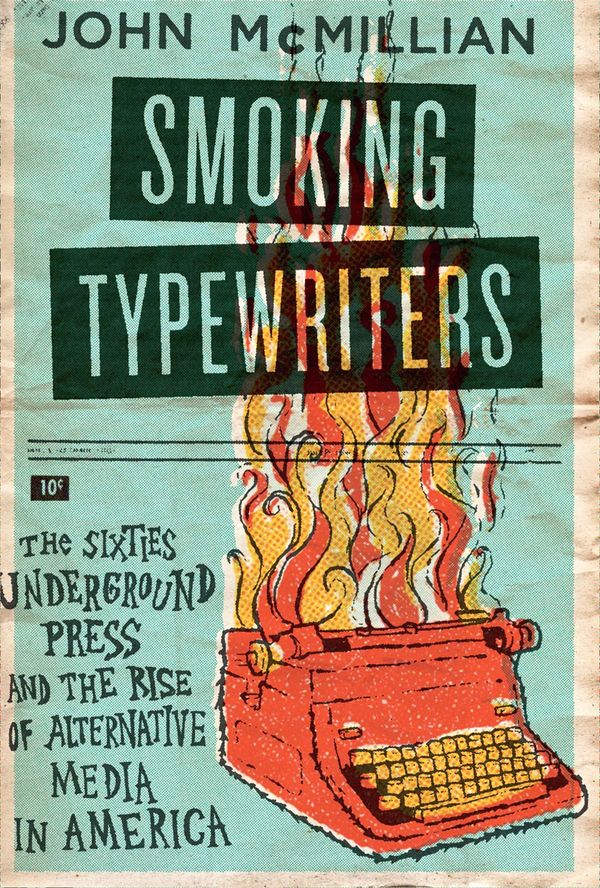
John McMillian’s “Smoking Typewriters,” in telling the historic tale of the Sixties underground press, “puts readers in the cockpit of the era. He conjures up the radical style, the exuberant mood, and the bravado…” The book profiles the “loud, colorful, unconvential” papers like the Los Angeles Free Press, the Great Speckled Bird, The Berkeley Barb, and The Rag in Austin, that “sparked the rebellion of a generation.”

Type rest of the post here

Source /

The Rag Blog

Posted in RagBlog | Leave a comment

Jonah Raskin :
BOOKS | John McMillian’s ‘Smoking Typewriters’

The curious case of the 1960s underground press.

Smoking Typewriters lg

By Jonah Raskin | The Rag Blog | February 21, 2011

John McMillian, author of Smoking Typewriters, will appear at BookPeople, 603 N. Lamar Blvd, Austin, at 7 p.m., Friday, Feb. 25, 2011, for a reading and signing of his book about the Sixties underground press. John will also be our special guest at a Rag Blog Happy Hour, Friday, Feb. 25, 5-7 p.m., at Maria’s Taco Xpress, 2529 S. Lamar Blvd., Austin. The public is 853px-Rag_radio2welcome. And John McMillian will be Thorne Dreyer’s guest on Rag Radio, Friday, March 4, 2011, 2-3 p.m. (CST) on KOOP 91.7FM in Austin, and streamed live on the internet. Listen to the podcast of this show, here.


[Smoking Typewriters: The Sixties Underground Press and the Rise of Alternative Media in America, by John McMillian (Oxford University Press, Feb. 17, 2011); Hardcover; 276 pp.; $27.95]

Art Kunkin was born into a Jewish family in New York in 1928. A brainy kid, he attended Bronx High School of Science, became a follower of Leon Trotsky, moved to Southern California, and recreated himself in the burgeoning bohemian world of Venice.

He would probably not be remembered today and he would certainly not appear in John McMillian’s Smoking Typewriters were it not for the fact that he founded the L.A. Free Press — the Freep — and became one of the curious fathers of the underground newspapers of the 1960s.

McMillian writes about Kunkin and the Freep near the very start of his new book in which he tells his version of the 1960s through the eyes and ears of its loud, colorful, unconventional papers such as the Freep, Rat, The Seed, The Great Speckled Bird, The Barb, The Rag, and many others with equally provocative names.

Smoking Typewriters provides a fast-moving narrative about the birth, the death, and the second life of the newspapers that were spawned by the upheavals of the 1960s and that were also spurred on by those upheavals. Part agitprop in a radical American tradition that went back at least as far as the 1930s, and part agitpop in the unique style of the 1960s, papers such as The Barb, The Seed, and Rat sparked the rebellion of a generation, even as they reported the latest news, gossip, and rumors from the barricades, the communes, the rock concerts, and the on-going spectacle of the streets.

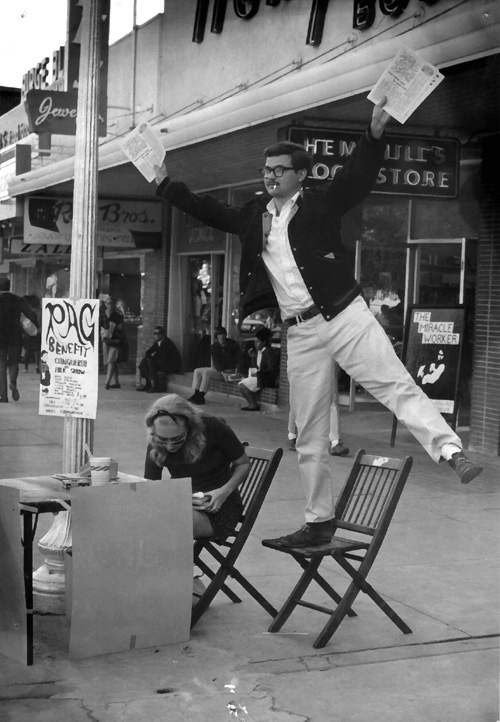
George Vizard Sells Rag

Austin SDS leader George Vizard, later murdered under questionable circumstances, peddles an early issue of The Rag on the Drag near the University of Texas campus in 1966. At left is Mariann Vizard (now Wizard). Image from Smoking Typewriters / Oxford Press.

One of the early papers McMillian discusses in depth is Austin’s Rag, the first underground paper in the South. The Rag, now reborn as The Rag Blog, was a model for many papers that would come later, he says, because it was the first to emerge directly out of a radical community, the first to be run collectively, and the first to merge the hippie and New Left cultures.

McMillian puts readers in the cockpit of the era. He conjures up the radical style, the exuberant mood, and the bravado — no mean feat given the fact that he wasn’t there to live it himself. An historian, he looks back at the era with the benefit of hindsight and with a certain detachment, too, that enables him to tell the story without aiming to grind obvious ideological axes.

He focuses attention on Los Angeles, Austin, and East Lansing, Michigan, as well as on Chicago and New York, and makes it clear that the 1960s as a state of mind and as a way of being in the world, took place everywhere in the United States.

To write his book, McMillian interviewed many of the pivotal figures from that time — both men and women — who wrote for and edited the underground newspapers, such as Harvey Wasserman, Allen Young, John Holmstrom, Thorne Dreyer, Alice Embree, Ray Mungo, Sheila Ryan, and others. In Smoking Typewriters he looks at the sexual politics of the papers, and at the tangled, complex relationships between men and women as they played themselves out in newspaper offices.

Smoking Typewriters takes readers from the early days of SDS, through the rise of the anti-war movement, to the Rolling Stones concert at Altamont in 1969 that has often been described as the culminating event of the decade. Ten pages of photos from the 1960s put faces to the names mentioned in the book.

There’s a brief last chapter that looks at trends in alternative media since 1969, and an afterward that touches on zines, blogs, and bloggers, and in which McMillian predicts that, “we are going to see a collapsing of private space and a diffusion of power around knowledge and information.” For those who would like to dig deeper into the subject, there’s also an extensive bibliography and more than 50-pages of footnotes

The most controversial aspect of the book from my point-of-view as a writer for the underground press and as a contributor to Liberation News Service (LNS) is McMillian’s privileging of SDS and the New Left. SDS was obviously influential; New Leftists changed life on college campuses. I was an SDS member and a New Leftist myself. But I was also a hippie, and a member of the counterculture, and from where I stood the underground newspapers were as much a product of the hippie counterculture as they were of SDS and the New Left.

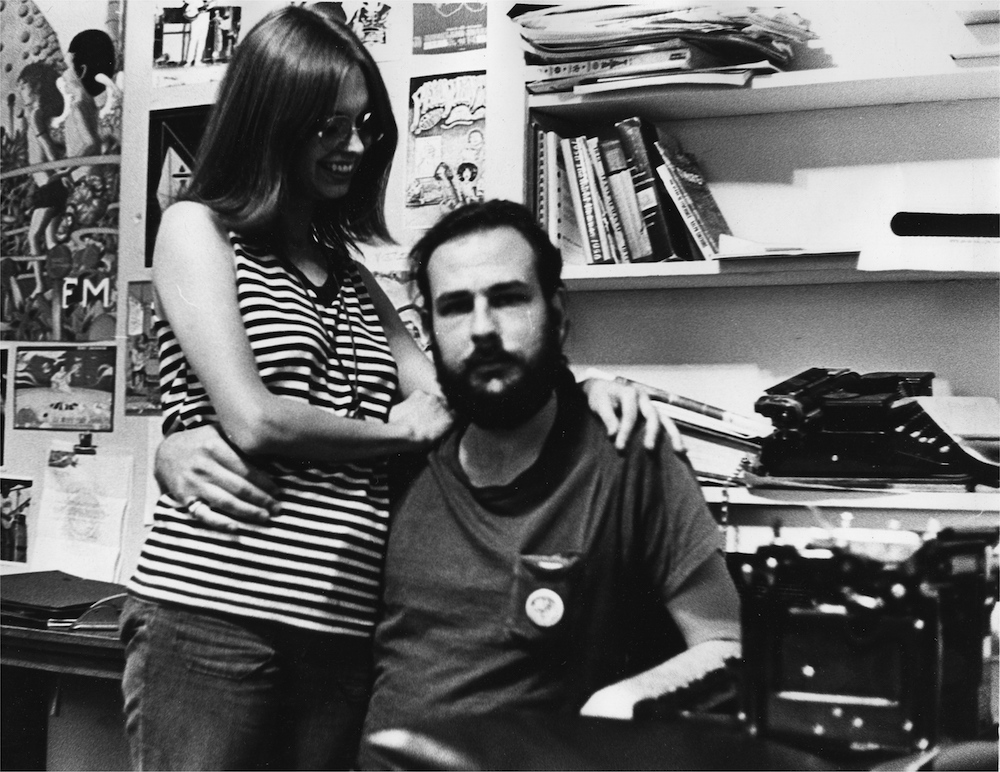
Victoria Smith and Dreyer at Space City News Office sm

Thorne Dreyer, now editor of The Rag Blog, and the late Victoria Smith, shown at the offices of Space City! in Houston in 1970. Image from Smoking Typewriters, / Oxford Press.

McMillian gives more emphasis to the overtly political figures of the era, and to the ideological nature of the papers, and minimizes aspects of the cultural revolution of the 1960s. In some ways, the evidence provided in the book goes counter to McMillian’s own argument. So, for example, he offers a pithy quotation from Abbie Hoffman, one of the founders of the Yippies, who said of the underground press, “It is a visible manifestation of an alternative culture. It helps to create a national identity.”

Granted, McMillian discusses nomenclature such as “New Left,” “hippies,” and “politicos” in the introduction to his book. He might have taken the discussion to a deeper level and provided more insight. Still, his book will be appreciated by both ex-New Leftists and ex-hippies because it looks again at the push and pull that took place between those who followed Marx, Mao, and Lenin, and those who followed Timothy Leary, Allen Ginsberg, and the Beatles.

Moreover, as McMillian recognizes, there was no clear-cut schism between the hippies and the politicos. So, for example, he offers a useful comment about those two seminal 1960s figures, Marshall Bloom and Ray Mungo, the founders of LNS: “They were a curious duo, dope smoking, hip, full of far-out incredulousness, yet terribly concerned about Vietnam, the urban crisis and politics.”

In the 1960s, we were all — if I may speak for a whole generation — very curious in the sense that we were an odd and unpredictable mix of cultures, values, and identities, especially in the eyes of the Joneses who just couldn’t keep up. As Bob Dylan put it, “something is happening here, but you don’t know what it is, do you Mr. Jones?”

The writers for the underground press, as McMillian shows, not only knew what was happening, but also provided maps and blueprints for others who wanted to join the happenings, the be-ins, the love-ins, the sit-ins, and the whole spectacle of the cultural revolution.

[Jonah Raskin is the author of For the Hell of It: The Life and Times of Abbie Hoffman, and Out of the Whale: Growing up in the American Left. He teaches at Sonoma State University.

The Rag Blog

Posted in Rag Bloggers | Tagged , , , , , , , , , , , , , , | 5 Comments

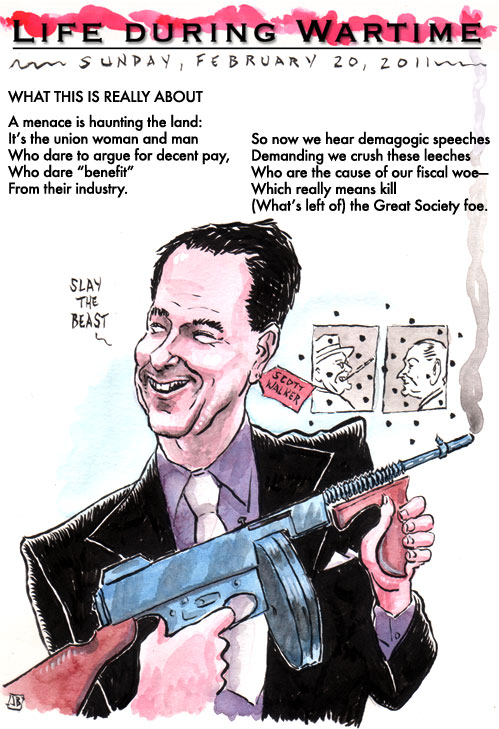
Joshua Brown : Life During Wartime: Slay the Beast

CLICK ON IMAGE TO ENLARGE

Political cartoon and verse by Joshua Brown / The Rag Blog / February 20, 2011.
The Rag Blog

Posted in RagBlog | Tagged , , , , , | 2 Comments

David P. Hamilton : The 1969 Chuck Wagon Riot

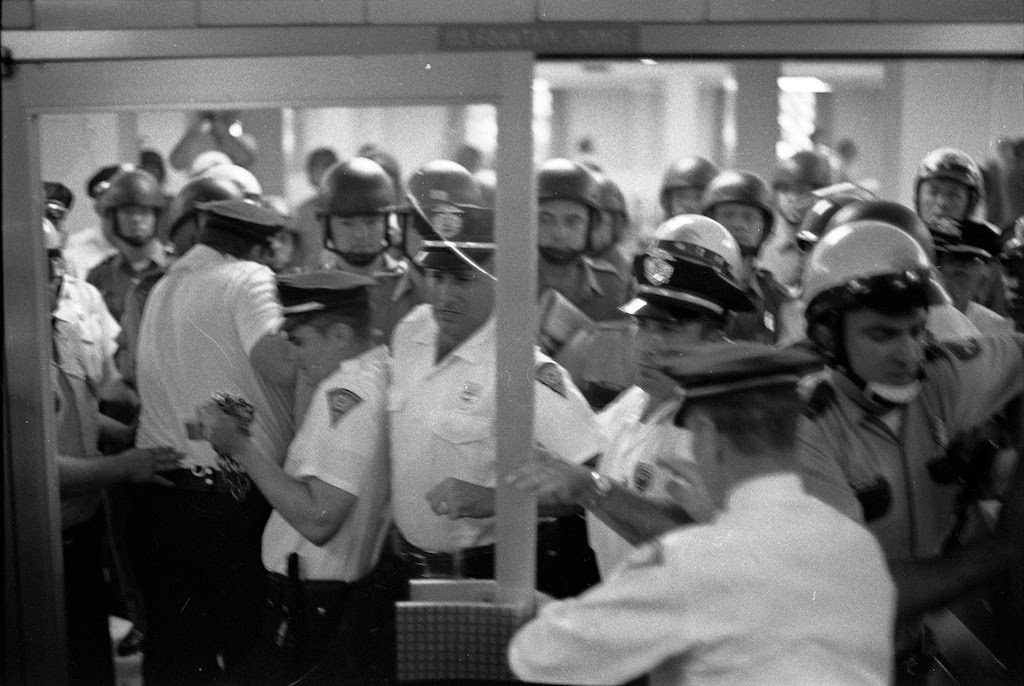
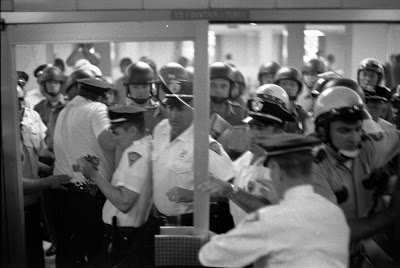
Police riot at the Chuck Wagon on the University of Texas campus in Austin in November 1969. Photo by Alan Pogue / The Rag Blog.

1969 in Austin:
The famous Chuck Wagon police riot

By David P. Hamilton / The Rag Blog / February 17, 2010

‘…Another hero of the revolution stepped forth from the crowd and threw open the truck’s rear door, allowing our captured comrades inside to escape. The cops were mightily pissed.’

[Several Rag Bloggers who are veterans of the Sixties have contributed articles reflecting their memories from those days. This essay is part of David Pratt Hamilton’s developing memoir, working title: Lucky Guy.]

In early November 1969 the University of Texas campus in Austin experienced another upheaval, this one based more on generational rebellion against the arbitrary power of the University’s Board of Regents than on the weighty issues of war and racism that had been sweeping the world, UT included.

A growing number of street kids were hanging out — if not living — on The Drag, the bustling street that ran along the west side of the UT campus. Some of them tended to seek refuge in the Chuck Wagon, the bohemian quarter among student eating facilities. The local newspaper editorialized against this outrage, labeling the denizens of the CW “pot smokers” and “non-student scum,” and called for this situation to be “cleaned up” precipitously.

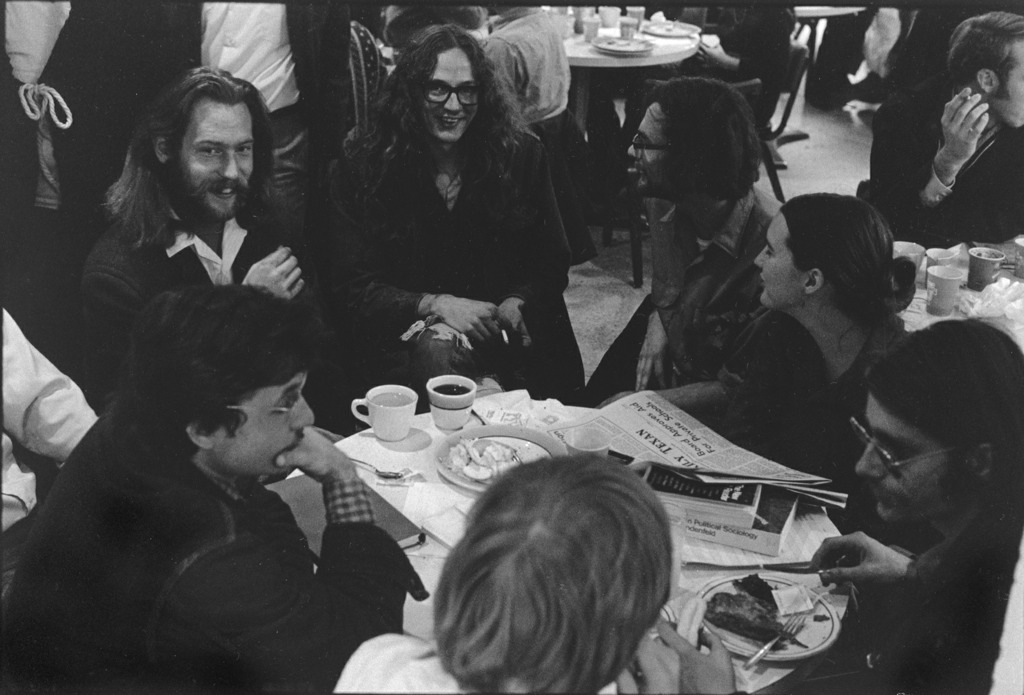
The Chuck Wagon was the principal eatery in the Student Union, cheap and located right on the Drag (known to some as Guadalupe Street). It was also very popular with leftist students. SDS radicals and counterculture types were frequently found there and it was the scene of a great deal of personal organizing as we mixed easily with other students interested in listening to our positions in a relaxed atmosphere.

It was the only place on campus where the radicals dominated, our liberated territory. If you wanted to rub shoulders with the militants, the CW was where you went.

There actually weren’t hordes of street kids there. Maybe a dozen or so regulars depending on the weather, but this somehow became a big problem for the “authorities.” Shortly after the inflammatory editorial appeared, the city police stormed in to capture a runaway known as Sunshine, the name likely derived from a then popular variety of LSD.

It would have been fair to be suspicious when a large contingent of police suddenly became so concerned with a bedraggled street urchin that they staged an aggressive assault in an environment where they know their actions would not be appreciated by most of those present.

This provocation was the opening salvo in a show of force by the Regents and assorted University elders to reclaim lost turf, knowing the police assault would spark a confrontation and that confrontations inspire new rules. In the process, they would dislodge the radicals, their real target.

Some of the street guys with Sunshine obliged by pelting the departing cop cars with bottles — or at least one bottle. This incident was a set-up for a war the University wanted to have.

Although the Student Union was supposedly governed by an autonomous board with a student majority, word came down from on high that henceforth anyone entering the Chuck Wagon would be required to show a University ID, a new rule clearly aimed at the imaginary non-student menace.

A significant number of those anti-war and SDS activists who hung out there may not have been in good standing with the University at any given moment, although virtually all those not currently enrolled had been recently and would be again, as many of us dropped in and out of school but remained a part of the university community. Despite frequent allegations to the contrary, there were no real “outside agitators” on campus other than the city’s ruling establishment.

At an emergency meeting held that Friday around midnight, the Student Union board folded to the pressure and passed the new rule dictated to them by the Regents.

My roommate Paul Spencer and I somehow heard of the decision early the next morning — it was probably on the local radio — and reflexively decided to challenge it. Since I was a registered graduate student and employee of the Government Department, our plan was for me to hit the door first to case the situation.
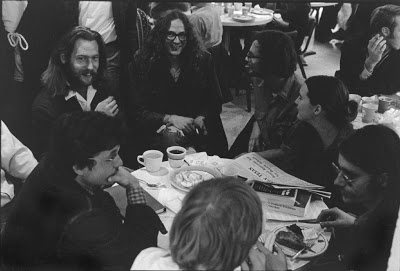
Typical gathering at the Chuck Wagon back in the day. At rear left is David MacBryde, then a staffer at The Rag (the Sixties Austin underground paper) and now Rag Blog correspondent in Berlin. Rag Blog photo by Alan Pogue, then The Rag‘s staff photographer. (What goes around comes around!)

Early that Saturday morning I walked into the Chuck Wagon and, sure enough, was asked for an ID by some student employee standing by the entrance. I reproached him for being a collaborator with the forces of repression and left, without complying, to inform Paul who was waiting in the hall.

Paul had been a student for several semesters, but at this point was not enrolled. On principle, he wouldn’t have shown his ID anyway. Paul marched through the CW door, hurled pithy but withering verbiage at the young collaborator, and proceeded inside. There Paul was immediately confronted by the president of the University, Bryce Jordan, who sternly said, “Paul, you know you’re not supposed to be in here.”

Of course, it was completely astounding that the president of the university, a Frank Erwin flunky [Frank Erwin was the chairman of the UT Board of Regents and a close crony of Lyndon Johnson] was in the Chuck Wagon before 9 a.m. to personally help enforce a minor rule enacted only hours earlier by a board that was supposed to be autonomous of his control.

Even more revealing was that Prez Jordan knew Paul’s name and status. Clearly, the University’s rulers were orchestrating this power play and were way ahead of us in preparation. Regardless, we went for the bait.

Prez Jordan was backed up by two not particularly imposing campus cops. I don’t think they even had guns, a testament to the unmilitarized atmosphere of that earlier era, a condition that has been totally rectified since. Were a similar incident to occur now, the Prez would have 40 fully decked-out riot police waiting in the kitchen, a SWAT team in a room down the hall, the National Guard on call, and would be packin’ heat himself.

Although I was standing right beside Paul and had shown no ID either, Prez ignored me, probably because he knew that I was in good standing. Paul began to offer the Prez his take on the illegitimate nature of the dictate put forth by the tyrannical Regents to the Student Union Board. Not surprisingly, Prez Jordan did not want to get involved in a debate with someone much smarter than he was and who also had the advantage of being fundamentally correct and who was surrounded by 200 or so skeptical and judgmental students.

Hence, he precipitously escalated to the physical plane by motioning for the cops to step in, since Paul failed to respond quickly to his order to leave. They grabbed Paul. That was a tactical error. Although only weighing about 165 pounds, Paul was an excellent athlete and in his physical prime. They were not.

Together, the two cops couldn’t pen him. It was all they could do to hang on. Some student decided to help the cops until I propelled him through a couple of tables. Then I unsuccessfully exhorted the crowd to liberate Paul. But while talking the talk, I was unwilling to walk the walk. I choked at leading them by example.

In retrospect, I’ve always wished that I had just jumped on Prez Jordan, whereupon the cops would have had to come to his rescue, perhaps allowing Paul and me to both escape. But, despite my having spent the previous year “on the barricades” with hard-core types, I was unwilling to jump in and mix it up with the two rather vulnerable cops who already had their hands full.

Collectively the students could have freed Paul easily, but I didn’t provide the leadership in doing it. Since the Prez knew who we were, my inaction in this regard kept me temporarily out of jail, and in school, but hardly covered me in glory. More cops showed up shortly and Paul was carted away. To cover for my failure, I ran off to find a lawyer and raise his bail money.

The following Monday, the first day of classes after this first incident, there was a big lunch hour protest demonstration on the West Mall just outside the Student Union that drew a sizable crowd ready for action. After an hour of rousing speeches concerning the abuse of our rights by the dictatorial Regents, hundreds of us marched into the building and entered the CW en masse without showing ID’s. It was an occupation.

Paul, having already been arrested once — and only recently getting out of jail — stayed in the background and didn’t speak at the rally or come inside the CW during the occupation. The University had its military on call, hordes of city cops geared up for action. They surrounded the building outside the CW and gave us a deadline to get out by 4 p.m. This allowed us a couple of hours to decide how to respond.

Some civil disobedience volunteers decided that they would stay inside and get arrested in nonviolent protest while the rest of us, having pledged to bail them out, left in time to make the deadline. No such luck. In a paradigm of the cop-riot fashion of the day, the police stormed in at exactly 4 p.m. through the same two glass doors that the protesters inside were clearly using to leave.

The cops could have simply come through the outside door of the kitchen and been patient while all the people who were trying to leave did so. Instead, their frontal assault trapped lots of people inside trying to get out. Naturally, there developed a wild, panic-stricken bottleneck around the two heavily congested exits with MACE spraying, chairs flying, and glass breaking.

Those of us who had exited ahead of the cops’ charge turned around to converge on them from their rear. I grabbed a screaming young woman who had been hit directly in the face with MACE and couldn’t see and took her to get first aid at the University Y across the street.

In the meantime, the police had brought in a large panel truck to haul away prisoners. They had succeeded in rounding up some of the protesters and putting them inside it when some heroic comrade slit one of the truck’s tires. This rendered it unable to proceed to the jailhouse except on the rim, the alternative being to change the tire on the spot while surrounded by hundreds of angry students hurling verbal abuse if not more tangible articles.

In their confusion, the police left the rear door of the truck momentarily unguarded. Another hero of the revolution stepped forth from the crowd at that crucial moment and threw open the truck’s rear door, allowing our captured comrades inside to escape.

The cops were mightily pissed. They then formed a phalanx that plunged into the crowd with the specific goal of grabbing Paul. He had been doing nothing beyond standing in the middle of a large crowd outside — perhaps chanting — and had not participated in the occupation, but they arrested him again anyway.
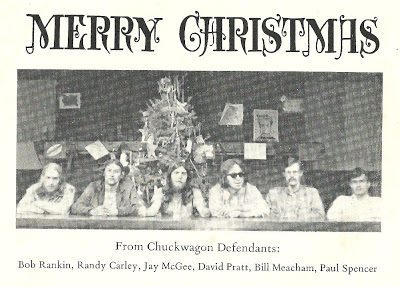
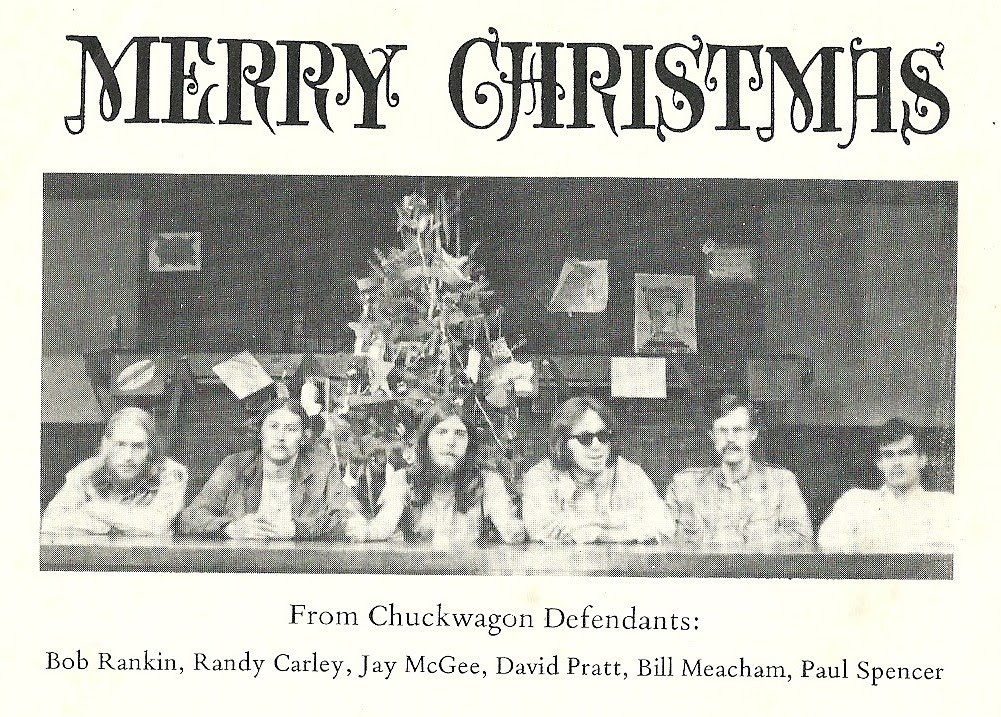
This 1969 Christmas card was sent by Chuck Wagon defendants. Left to right: Bob Rankin, Randy Carley, Jay McGee (Jay Motherfucker), David Pratt (Hamilton), Bill Meacham, and Paul Spencer.

A few weeks later, 21 of us were indicted by the Travis County Grand Jury as co-conspirators in the felonious destruction of public property, to wit, one truck tire worth $200. We became known as “the Chuckwagon 21” and a minor local cause célébre. It was my first local arrest, but number three for Paul. The cops came to my door to arrest me while I was smoking a joint, but luckily they failed to notice.

This was the only time in my life that I spent time locked up in a jail cell. Actually, I was only inside about 10 hours before we were bailed out, but it made a big negative impression on me regardless. The high point was getting a mug shot taken that later appeared in my FBI files wherein I was identified as an “SDS organizer.” It will forever be one of my proudest possessions.

Among those arrested besides Paul and me were Bill Meacham and a couple of the “motherfuckers,” Jay and Randy. The motherfuckers [the group was actually called “Up Against the Wall Motherfucker”] were an SDS offshoot, militantly dedicated to sex, drugs, rock and roll, and anarchy.

As an expression of their dedication to radical leveling and their alienation from the prevailing order, they all used Motherfucker as a last name. Hence, my comrade Jay McGee became Jay Motherfucker. He was in jail with us and some years later became my first wife Diane’s second husband with my blessing.

Having the Motherfuckers involved provided lots of energy and style, but somewhat complicated our public image at that trying moment when we were technically facing up to 20 years in prison.

Fighting the charges against us became our political work over the next several months. We bemoaned that fact at the time, realizing the forces of evil were tying us up in this sideshow so we could not continue to oppose their more serious crimes.

Miraculously, several very prominent liberal lawyers volunteered to serve as our defense team pro bono. They included the then famous criminal defense attorney from Odessa, Warren Burnett, a “whiskey-swigging, Shakespeare-quoting Texas lawyer who achieved near-legendary status” according to his New York Times obituary.

Famed San Antonio lawyer and politician Maury Maverick, Jr. and David Richards, constitutional law professor at UT and husband of future governor Ann Richards, also signed on, mainly just for a show of strength.

One of our defense arguments was to ask why we could all be held responsible for damage done by one person to one truck tire. The state said we had all conspired to commit this crime by our participation in the events. Constitutional issues of free speech and questions of procedure were also raised in our defense. Most of the actual legal work was done by young local progressive lawyers, Jim Simons and Cam Cunningham.

The DA, Bob Smith, had only recently been very publicly embarrassed when Burnett had successfully defended local writer Gary Cartwright on a pot possession charge. Not wanting to be again subjected to Burnett’s superior legal abilities, Smith was appropriately intimidated and dropped the charges altogether, at least against those of us he didn’t have something else on. So my charges were dropped, but he refused to drop those against Paul for assaulting a cop.

The DA wanted a plea bargain for 30 days in jail and probation. Paul, believing that he had been the one assaulted and that he had acted appropriately in support of lawful procedure, wouldn’t buy the deal and eventually bolted. They never chased him. Running him out of town was a sufficient victory for them. Austin’s loss was great.

[David P. Hamilton has been a political activist in Austin since the late 1960s when he worked with SDS and wrote for The Rag, Austin’s underground newspaper.]

The Rag Blog

Posted in Rag Bloggers | Tagged , , , , , , , , | 11 Comments

IDEAS / Bill Meacham : Alain de Botton Dodges the Question

Pop philosopher Alain de Botton, shown at Heathrow Airport flacking his 2009 book, A Week at the Airport. Photo from Frank Bures.com.

Sophism for fun and profit:
Alain de Botton dodges the question

By Bill Meacham / The Rag Blog / February 17, 2011

Pop philosopher Alain de Botton is undeniably entertaining. He talks a mile a minute, spewing forth an impressive array of insightful ideas and wry humor peppered with staccato interjections, the effect of which is to mesmerize his audience into uncritical adulation. You can see his performance at a recent TED conference here.

De Botton’s best outcome is to provoke the listener — or reader, as he has written several books — to entertain new ideas. His worst is to encourage us to treat these ideas as mere baubles, fascinating to contemplate for a while but without lasting effect. De Botton appears to be of that class of philosophers who make trenchant observations about life and the world rather than those who think analytically and step by step. In this, he resembles Nietzsche, not Descartes. Nor is he a grand synthesizer in the tradition of Aristotle, Aquinas, or Whitehead. What he really is is a modern-day sophist.

Sophistry has a bad name, largely because Plato and others portrayed the sophists as fallacious reasoners more interested in rhetorical persuasion than truth. The Greek word sophos or sophia originally meant wisdom, or more specifically expertise in a particular domain such as shipbuilding or sculpture.

It came to mean wisdom in human affairs generally; and by the time of Socrates, in the second half of the fifth century BC, the term “sophist” meant a teacher who used the tools of philosophy and rhetoric to teach the skills of public discourse to young noblemen. The goal was to train them to prevail in public argument, a skill critical to success in the contentious social life of Athens. And the best of the sophists commanded a very high price for their work.

By proclaiming that they taught excellence in general, not merely skills in rhetoric, they earned the scorn of Plato, who portrayed them in several of his dialogues as not really knowing what they were talking about. But at their best they really did teach people some important things about life.

I call de Botton a sophist because his philosophy is of a commercial sort, intended to sell books and to enroll students in his “School of Life” in London. Like the best sophists he has a wide range of knowledge and the ability to engage his listeners and readers. Like the worst, he ignores some important facts about reality and uses rhetorical sleight-of-hand to dodge embarassing questions.

Consider this statement from his lecture, “A kinder, gentler philosophy of success,” referred to above:

It’s perhaps easier now than ever before to make a good living. It’s perhaps harder than ever before to stay calm, to be free of career anxiety.

This was in 2009, right in the middle of a global financial crisis that left thousands of people without income. Easier than ever to make a good living? Was he living on another planet? No; he was addressing an audience of fortunates who could afford to attend a TED conference that cost upwards of $5,000. Such an audience would not be pleased to be reminded of the suffering caused by the larger economic context in which they made their wealth.

It is instructive to examine how de Botton responds to a question outside his paradigm. The audience has applauded his performance, and the master of ceremonies asks him a follow-up question.

Question: Do you believe that you can combine your kind of kinder, gentler philosophy of work with a successful economy? Or do you think that you can’t? But it doesn’t matter too much, that we’re putting too much emphasis on that?

Alain de Botton: The nightmare thought is that frightening people is the best way to get work out of them. And that somehow the crueler the environment the more people will rise to the challenge. You want to think, who would you like as your ideal dad? And your ideal dad is somebody who is tough but gentle. And it’s a very hard line to make. We need fathers, as it were, the exemplary father figures in society, avoiding the two extremes. Which is the authoritarian, disciplinarian, on the one hand. And on the other, the lax, no rules option.

His answer completely avoids the question of the economy, which at the time was reeling, and instead goes off about father figures. He does not at all address what a successful economy might look like, nor how to achieve it. His focus is solely on how to operate within the economy that we have, taking it as a given.

De Botton is a victim of ideology, the normative sense of reality produced by our culture without our quite realizing it. Social discourse tells us what is real, and our perception of reality depends as much on that discourse as it does on our senses.

More specifically, ideology is a set of ideas espoused by the dominant class of society, who tell the rest of us how the world is and should be. The social discourse, the way we all frame our questions and discussions about life, the world and the economy, assumes that the economic interests of the dominant class are the economic interests of the entire society.

This is a Marxist notion, but you do not have to swallow Marxism whole in order to see the truth of it. At a superficial level, the fashions of several years ago seem hopelessly out of date and funny to us today, but a few years from now we’ll feel the same about what we are wearing now. The sense of fashion is wholly grounded in social, not physical, reality.

At a deeper level, ideology tells us that the question of what a successful economy might look like is irrelevant to our own career. It tells us that the important question is how to get the best work out of someone, and de Botton’s answer is to be like a firm but loving dad. (And note that his answer is directed to managers, who have careers, not to workers, who have jobs.) No doubt that is good advice as far as it goes, but it does not address the question.

If you are a firm but loving manager in a company that is polluting the environment or lobbying lawmakers for anti-competitive special treatment or hiding evidence that your products are dangerous or moving jobs off-shore to the detriment of the local community, then you may be doing a good job within the context of your employment, but you are not addressing the greater good.

An economy that fosters such behavior is not a success for the majority of us. And even within that context your own career may not be secure. There have been numerous instances of middle managers getting told to sack their employees and then, having done that dirty work, been given the boot themselves.

The dominant ideology tells us that managers have more in common with owners than workers, even though they too work at the whim of the owners.

The dominant ideology tells us that it is perfectly OK for derivatives traders, who do not actually produce any wealth themselves, to be paid exhorbitant sums of money while others, such as factory workers or teachers or many others who provide much more value to society, get paid far less.

The dominant ideology tells us that free trade is of such a preeminent value that we should not be concerned about the environmental impact of how goods are made or the social impact of how the workers who produce those goods are treated.

The dominant ideology tells us that corporations are persons and should have the same legal rights to freedom of speech as the rest of us, despite the fact that they are clearly not living beings and have powers no living being has, such as the ability to be in more than one place at once and, in theory at least, the power to live on indefinitely.

All these are political questions. To coin a phrase, the philosophical is political. The ancient Athenians certainly knew that. The sophists could make a living because they taught young men how to succeed in the assembly of citizens through persuasive argument. Socrates got himself in trouble because he encouraged people to question assumptions and to think for themselves, to seek truth, not expediency. In doing so, he judged his life as having been worth living. Can we do the same?

[Bill Meacham is an independent scholar in philosophy. A former staffer at Austin’s 60’s underground paper, The Rag, Bill received his Ph.D. in philosophy from the University of Texas at Austin. Meacham spent many years working as a computer programmer, systems analyst and project manager.]

References

Alain de Botton: http://www.alaindebotton.com/

Sophism:http://en.wikipedia.org/wiki/Sophism

Ideology: http://en.wikipedia.org/wiki/Ideology

Free trade: http://en.wikipedia.org/wiki/Free_trade

Environmental effects of free trade: http://www.citizen.org/Page.aspx?pid=1218 and http://www.cec.org/files/pdf/ECONOMY/symposium-e.pdf

Social effects of free trade: http://www.epi.org/publications/entry/briefingpapers_bp147/

Corporations as persons: http://en.wikipedia.org/wiki/Corporate_personhood and http://www.straightdope.com/columns/read/2469/how-can-a-corporation-be-legally-considered-a-person

The Rag Blog

Posted in Rag Bloggers | Tagged , , , | 1 Comment

IDEAS / Bill Meacham : Alain de Botton Dodges the Question

Pop philosopher Alain de Botton, shown at Heathrow Airport flacking his 2009 book, A Week at the Airport. Photo from Frank Bures.com.

Sophism for fun and profit:
Alain de Botton dodges the question

By Bill Meacham / The Rag Blog / February 15, 2011

Pop philosopher Alain de Botton is undeniably entertaining. He talks a mile a minute, spewing forth an impressive array of insightful ideas and wry humor peppered with staccato interjections, the effect of which is to mesmerize his audience into uncritical adulation. You can see his performance at a recent TED conference here.

De Botton’s best outcome is to provoke the listener — or reader, as he has written several books — to entertain new ideas. His worst is to encourage us to treat these ideas as mere baubles, fascinating to contemplate for a while but without lasting effect. De Botton appears to be of that class of philosophers who make trenchant observations about life and the world rather than those who think analytically and step by step. In this, he resembles Nietzsche, not Descartes. Nor is he a grand synthesizer in the tradition of Aristotle, Aquinas, or Whitehead. What he really is is a modern-day sophist.

Sophistry has a bad name, largely because Plato and others portrayed the sophists as fallacious reasoners more interested in rhetorical persuasion than truth. The Greek word sophos or sophia originally meant wisdom, or more specifically expertise in a particular domain such as shipbuilding or sculpture.

It came to mean wisdom in human affairs generally; and by the time of Socrates, in the second half of the fifth century BC, the term “sophist” meant a teacher who used the tools of philosophy and rhetoric to teach the skills of public discourse to young noblemen. The goal was to train them to prevail in public argument, a skill critical to success in the contentious social life of Athens. And the best of the sophists commanded a very high price for their work.

By proclaiming that they taught excellence in general, not merely skills in rhetoric, they earned the scorn of Plato, who portrayed them in several of his dialogues as not really knowing what they were talking about. But at their best they really did teach people some important things about life.

I call de Botton a sophist because his philosophy is of a commercial sort, intended to sell books and to enroll students in his “School of Life” in London. Like the best sophists he has a wide range of knowledge and the ability to engage his listeners and readers. Like the worst, he ignores some important facts about reality and uses rhetorical sleight-of-hand to dodge embarassing questions.

Consider this statement from his lecture, “A kinder, gentler philosophy of success,” referred to above:

It’s perhaps easier now than ever before to make a good living. It’s perhaps harder than ever before to stay calm, to be free of career anxiety.

This was in 2009, right in the middle of a global financial crisis that left thousands of people without income. Easier than ever to make a good living? Was he living on another planet? No; he was addressing an audience of fortunates who could afford to attend a TED conference that cost upwards of $5,000. Such an audience would not be pleased to be reminded of the suffering caused by the larger economic context in which they made their wealth.

It is instructive to examine how de Botton responds to a question outside his paradigm. The audience has applauded his performance, and the master of ceremonies asks him a follow-up question.

Question: Do you believe that you can combine your kind of kinder, gentler philosophy of work with a successful economy? Or do you think that you can’t? But it doesn’t matter too much, that we’re putting too much emphasis on that?

Alain de Botton: The nightmare thought is that frightening people is the best way to get work out of them. And that somehow the crueler the environment the more people will rise to the challenge. You want to think, who would you like as your ideal dad? And your ideal dad is somebody who is tough but gentle. And it’s a very hard line to make. We need fathers, as it were, the exemplary father figures in society, avoiding the two extremes. Which is the authoritarian, disciplinarian, on the one hand. And on the other, the lax, no rules option.

His answer completely avoids the question of the economy, which at the time was reeling, and instead goes off about father figures. He does not at all address what a successful economy might look like, nor how to achieve it. His focus is solely on how to operate within the economy that we have, taking it as a given.

De Botton is a victim of ideology, the normative sense of reality produced by our culture without our quite realizing it. Social discourse tells us what is real, and our perception of reality depends as much on that discourse as it does on our senses.

More specifically, ideology is a set of ideas espoused by the dominant class of society, who tell the rest of us how the world is and should be. The social discourse, the way we all frame our questions and discussions about life, the world and the economy, assumes that the economic interests of the dominant class are the economic interests of the entire society.

This is a Marxist notion, but you do not have to swallow Marxism whole in order to see the truth of it. At a superficial level, the fashions of several years ago seem hopelessly out of date and funny to us today, but a few years from now we’ll feel the same about what we are wearing now. The sense of fashion is wholly grounded in social, not physical, reality.

At a deeper level, ideology tells us that the question of what a successful economy might look like is irrelevant to our own career. It tells us that the important question is how to get the best work out of someone, and de Botton’s answer is to be like a firm but loving dad. (And note that his answer is directed to managers, who have careers, not to workers, who have jobs.) No doubt that is good advice as far as it goes, but it does not address the question.

If you are a firm but loving manager in a company that is polluting the environment or lobbying lawmakers for anti-competitive special treatment or hiding evidence that your products are dangerous or moving jobs off-shore to the detriment of the local community, then you may be doing a good job within the context of your employment, but you are not addressing the greater good.

An economy that fosters such behavior is not a success for the majority of us. And even within that context your own career may not be secure. There have been numerous instances of middle managers getting told to sack their employees and then, having done that dirty work, been given the boot themselves.

The dominant ideology tells us that managers have more in common with owners than workers, even though they too work at the whim of the owners.

The dominant ideology tells us that it is perfectly OK for derivatives traders, who do not actually produce any wealth themselves, to be paid exhorbitant sums of money while others, such as factory workers or teachers or many others who provide much more value to society, get paid far less.

The dominant ideology tells us that free trade is of such a preeminent value that we should not be concerned about the environmental impact of how goods are made or the social impact of how the workers who produce those goods are treated.

The dominant ideology tells us that corporations are persons and should have the same legal rights to freedom of speech as the rest of us, despite the fact that they are clearly not living beings and have powers no living being has, such as the ability to be in more than one place at once and, in theory at least, the power to live on indefinitely.

All these are political questions. To coin a phrase, the philosophical is political. The ancient Athenians certainly knew that. The sophists could make a living because they taught young men how to succeed in the assembly of citizens through persuasive argument. Socrates got himself in trouble because he encouraged people to question assumptions and to think for themselves, to seek truth, not expediency. In doing so, he judged his life as having been worth living. Can we do the same?

[Bill Meacham is an independent scholar in philosophy. A former staffer at Austin’s 60’s underground paper, The Rag, Bill received his Ph.D. in philosophy from the University of Texas at Austin. Meacham spent many years working as a computer programmer, systems analyst, and project manager.]

References

Alain de Botton: http://www.alaindebotton.com/

Sophism:http://en.wikipedia.org/wiki/Sophism

Ideology: http://en.wikipedia.org/wiki/Ideology

Free trade: http://en.wikipedia.org/wiki/Free_trade

Environmental effects of free trade: http://www.citizen.org/Page.aspx?pid=1218 and http://www.cec.org/files/pdf/ECONOMY/symposium-e.pdf

Social effects of free trade: http://www.epi.org/publications/entry/briefingpapers_bp147/

Corporations as persons: http://en.wikipedia.org/wiki/Corporate_personhood and http://www.straightdope.com/columns/read/2469/how-can-a-corporation-be-legally-considered-a-person

The Rag Blog

Posted in RagBlog | Leave a comment

A ‘let me get this straight’ moment

By Lamar W. Hankins / The Rag Blog / February 16, 2011

Every now and then I have what I call a “let me get this straight” moment. I never know when one will hit, but I had one today as I was thinking about the WikiLeaks postings, President Obama’s earlier statement that we had no choice but to attack Afghanistan (to justify his escalation of that war), and the recent effort to extend some provisions in the USA PATRIOT Act.

About nine and a half years ago, a small group of militant, suicidal jihadists succeeded in killing about 3,000 people in the U.S. (some weren’t Americans, but their lives are as important as are American lives). Our leaders, in order to be seen as leaders, attacked Afghanistan, the country where the jihadist leaders of the terrorism of 9/11/01 were believed to be living.

The attack on Afghanistan occurred after President Bush demanded that the Afghan government, controlled by the Taliban, turn over to us Osama bin Laden and his henchmen. Such demands had been made for several years by the U.S. because of earlier acts of terror believed to have been perpetrated by bin Laden.

The Afghan government responded to the 2001 and earlier entreaties with several offers. They were willing to prosecute bin Laden if we would supply the evidence that bin Laden was responsible for the terrorist acts.

In another gesture indicating a willingness to cooperate, the Taliban offered to turn bin Laden over to a neutral, Muslim third country for prosecution. Another proposal was for bin Laden to be prosecuted before a tribunal of Islamic jurists. Afghanistan, Saudi Arabia, and the United States would each choose one of the jurists.

A subsequent proposal called for only one Islamic jurist on the panel. Other proposals included one to rely on some Saudi clerics to approve turning over bin Laden for prosecution. None of the proposals was acceptable to the U.S.

Diplomatic efforts to prosecute bin Laden in this country began under Clinton in 1996 after bin Laden was suspected of terrorist activity. Efforts were renewed in 1998 after bombings of U.S. embassies in Kenya and Tanzania were attributed to bin Laden. In 1999, the UN demanded, at U.S. insistence, that bin Laden be surrendered so that he could be tried somewhere else besides the U.S.

These and other efforts never bore fruit before the bombing started about four weeks after 9/11 because Presidents Clinton and Bush would not provide the requested evidence of bin Laden’s transgressions.

Part of the problem was the lack of appreciation by U.S. diplomats of the Afghan culture, dominated by the Pashtuns. Taliban leader Mohammad Omar told U.S. officials that bin Laden was a guest and they were honor-bound to protect him unless just cause was shown to expel him; even so, over several years of negotiations, the Afghans may have provided opportunities to get bin Laden that U.S. officials missed.

Twice Taliban officials indicated that they were not then protecting bin Laden, but the hints that these were openings to allow the U.S to get bin Laden without Afghan interference were missed by the State Department, probably because of cultural insensitivity, normally a requisite for diplomatic work.

On other occasions, the Taliban wanted documentary evidence of bin Laden’s responsibility for 9/11 to be reviewed by Islamic legal scholars, a reasonable desire for those attuned to Islamic sensibilities, but rejected by the Bush administration.

Reports about these activities appeared in The New York Times, The Washington Post, the Los Angeles Times, the Guardian, and elsewhere before the bombing of Afghanistan began. But most Americans did not read or learn of this information, or care about it, at a time when the Bush administration wanted desperately to go to war to take advantage of the appetite for revenge that permeated the country.

Bush’s attitude was that there was “no need to discuss innocence or guilt (because) we know he’s guilty.” Even after the bombing started, the Taliban was willing to negotiate turning over bin Laden to a third country that could not be controlled by the U.S.

So, if I have this straight, in retaliation for the deaths of 3,000 people on U.S. soil, the impatience of our President, and the failure of our diplomatic corps, President Bush started a war with Afghanistan that has resulted in the deaths of over 2,300 coalition military service men and women, over 300 contractors, 19 journalists, over 8,800 Afghan civilians, and over 8,500 Afghan troops.

All together, the Afghan War has resulted in nearly 20,000 deaths (and I have omitted the “collateral damage” in Pakistan) to avenge the killing of 3,000 people, and Osama bin Laden has not been killed or captured so far as we know. All of this has cost the American taxpayers in borrowed money about $380 billion.

And before we forget, we have President Ronald Reagan (along with Donald Rumsfeld, Reagan’s Special Envoy to the Middle East) to thank for creating the terrorist capability of Osama bin Laden and the fighting capability of the Taliban as Reagan fought a proxy war with the former Soviet Union in Afghanistan in the 1980s. Reagan trained, armed, equipped, and funded Islamist mujahidin fighters to oppose the Soviets, giving them top-secret intelligence and sophisticated weapons with the help of the Pakistani intelligence service.

Osama bin Laden became a prominent mujahidin commander during the Soviets’ Afghan war. Reagan even continued the war after the Soviets were ready to retreat so that he could cause them additional economic and military damage, a move that increased bin Laden’s prominence in Afghanistan and throughout the Muslim world.

In the aftermath of the 9/11 terrorism, some of our political leaders pumped up the patriotic emotions that are never far below the surface for most Americans. It was reminiscent of what President John Adams did in 1798 during some conflicts with France as he pumped up support for the Alien and Sedition Acts, which banned opposition to government policies and forbade speaking ill of the president.

He used a series of slogans: “National dishonor was a greater evil than war!” – “It was cowardice to shrink from war!” – “The national character would be ruined if the populace failed to resist tyranny!” – “This generation would betray its colonial forefathers if it proved to be spineless!”

The same intensity of propaganda was used by the Bush administration to take us to war in Afghanistan and secure the passage of the USA PATRIOT Act, an act that severely curtailed our rights to be free from unreasonable search and seizure and to enjoy the benefits of privacy that we the once took for granted.

President Obama is now in the midst of an escalation of the Afghan War at a time when documents obtained through WikiLeaks indicate most military leaders involved with the Afghan War realize that it is a lost cause, an impossible mission. Brian Becker, the Director of the American anti-war A.N.S.W.E.R. Coalition, explained the significance of the leaked documents:

In its broadest context these documents prove that the war in Afghanistan cannot be won and that the leaders of the U.S. government know that it cannot be won, but they don’t want to tell the American people the truth because they don’t want to take responsibility. They don’t want it to be known in history that, on our watch — Obama or Petraeus — the great United States lost a war against an armed insurgency in Afghanistan.

In a real sense, the Afghan War is yet another war begun on false pretenses because we could have solved the problem of Osama bin Laden and his group if we had been better diplomats and had restrained our desire for revenge. Once again, we chose war, partly to satisfy the desire of George W. Bush to fulfill his dream of playing a Commander in Chief role, and partly to satisfy the American appetite for war — the dark, camouflaged part of the American character that we don’t like to acknowledge.

© Lamar W. Hankins, Freethought San Marcos

Type rest of the post here

Source /

The Rag Blog

Posted in RagBlog | Leave a comment

BOOKS / Harry Targ : The Struggle Continues in the Global South


The struggle continues:
People’s history and the Global South

Vijay Prashad’s book reframes world history from a ‘bottom-up’ perspective.

By Harry Targ / The Rag Blog / February 16, 2011

From the streets to the classroom

I am teaching a course this semester on United States relations with the Caribbean and Central America. I use the course to explore the historic patterns of United States foreign policy from the industrial revolution to the present. I open the course with reference to Greg Grandin’s thesis that U.S. conduct in the Western Hemisphere has served as a template or experiment for its global role as an imperial power.

The course also examines the rise of dependent capitalist regimes in the region but most importantly resistance to the Colossus of the North. Course discussion includes assessments of revolution in Haiti, Cuba, Chile, Nicaragua, and El Salvador and how the United States sought to forestall them and undermine their successes.

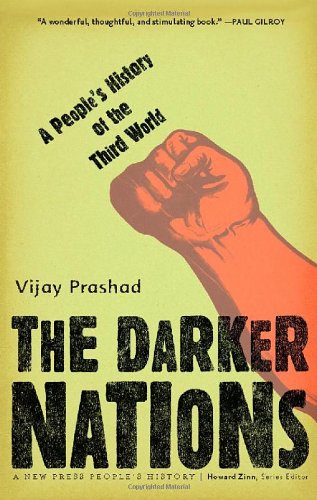
This time I chose as the first text a book that reframes world history from a “bottom-up” perspective. I am using Vijay Prashad’s book, The Darker Nations: A People’s History of the Third World, which presents a view of twentieth century world history that gives voice to the peoples of Asia, Africa, and Latin America.

It turns out that the Prashad book has become extraordinarily timely (I make no claims about whether my students agree or not) in that it describes in historical and theoretical terms the rise of what we used to call “Third World,” or what he calls “The Darker Nation,” beginning with the era of global colonial empire.

It identifies leaders, nations, movements, organizations such as the Non-Aligned Movement (NAM), policies, successes and failures. Although it was published in 2007, it leads the reader to reflect on the burgeoning mass movements today in the Middle East, suggesting pitfalls and possible strengths in terms of global progressive social change.

The rise of the Third World: An historical project

Prashad’s book identifies three periods of the history of the Darker Nations that he identifies in chapters as “Quest,” “Pitfalls,” and “Assassinations.” In each period there are dominant actors — individuals and nations, visions, policies, and patterns of interaction with rich and powerful countries.

The chapter Prashad called “Quest” summarizes the coming together of anti-colonial movements and the successive victories that occurred against the European colonial powers that occupied much of the world’s land mass from the mid-nineteenth century until the end of World War II.

“Quest” begins with an interesting discussion of the meeting of the new League Against Imperialism held in Brussels in 1927. It is there that the Third World project is formulated. It is a project inspired by communists, socialists, and nationalists who abhorred colonialism and sought to build a global movement to overthrow it.

In subsequent chapters Prashad traces the development and institutionalization of the movement, from anti-colonial struggle to independence to the drive to establish a Third World bloc that would stand between western capitalism and Soviet socialism.

The early leaders of this movement were the leaders of independence in their own countries: such figures as Jawaharlal Nehru (India); Ahmed Sukarno (Indonesia); Marshall Tito (Yugoslavia); and Gamal Abdel Nasser (Egypt). These and other leaders, representing countries from Asia, Africa, Latin America, and the Middle East, had diverse political ideologies but all supported political sovereignty and economic development. In general, their vision was a social democratic one.

For a time, given the East/West competition the Third World Project had some influence on debate and policy primarily through the United Nations. The Third World Project advocated for a New International Economic Order (NIEO), designed to regulate and control unbridled global capitalism. As the Socialist bloc deconstructed the advocacy for the NIEO declined.

Prashad discusses a second “stage” of the Third World Project that surfaced in the 1970s and beyond. The movement of Darker Nations becomes compromised by the rise of political elitism, bureaucratization, the demobilization of masses of people, the crushing of left forces, the rise of particular institutions such as the military that challenge grassroots politics, and the failure to bring rural agricultural reforms to the process of modernization.

Perhaps most important to the Prashad narrative is the growing debt crisis, the incorporation of many Darker Nations into the grip of the International Monetary Fund and the World Bank, and the rise of a new generation of post colonial elites who did not share the passion, vision, or experience of their predecessors.

The third part of Prashad’s book, loosely covering the 1980s to the present, he calls “Assassinations.” It describes, through case studies, the continuation of the deformations of the Third World Project described above. The “neoliberal” policy agenda embraced by many leaders reduced the role of states in shaping their own economies, deregulated and downsized public institutions, opened economies to foreign investors, and shifted from production for domestic consumption to export-based economies.

Gaps between rich and poor grew and as a result political institutions, particularly armies and police, became more repressive. However, a few regimes experienced economic growth, the so-called “Asian Tigers” for example. Others, Saudi Arabia being a prime example, supported and fostered on a global basis religious fundamentalism and ethnic hostilities to debase and virtually eliminate the unity embedded in the original vision of the Third World Project.

The project of the Darker Nations today

What we have witnessed over the last 20 days perhaps constitutes what Preshad might regard as a new stage in the development of the Third World Project.

First, the Middle East revolution, if we wish to call it that for shorthand reasons, can be seen as a direct reaction to the profound global economic crisis that has been brought on by neoliberal globalization.

Second, it clearly is motivated by goals similar to those NAM endorsed in the 1950s, that is some kind of New International Economic Order.

Third, the movements seem to be largely secular, perhaps reflecting a rejection of the counterrevolutionary programs of Third World elites who promoted division and reaction to further their own interests.

Fourth, the movements appear to incorporate vast numbers of young people, men and women, workers and small business people, intellectuals and artists, as well as those who identify with their religious traditions.

Fifth, the labor movement and the growing percentages of unemployed and underemployed workers have been playing a passionate and committed role in the struggles. The estimated 40 percent of the world’s population in the so-called “informal sector” have a stake in revolutionary change as do workers in transportation, electronics, construction, and manufacturing.

Sixth, this revolution is a nonviolent revolution. “Revolutionaries” are saying no or enough, and are doing so in such numbers that the institutions of government and the economy can not continue to operate. This culls up memories of the Gandhi struggles against the British empire and the civil rights movement in the U.S. South.

Seventh, this is an electronic revolution. As a result of the computer age time and space as factors confounding communicating and organizing have been eliminated. Cell phones and social networks do not make revolutions but they facilitate the kind of organizing that historically was more tedious and problematic.

And, the new technology insures that revolutionary ferment in one part of the world can be connected to revolutionary ferment elsewhere. In a certain sense, now all youth can be participants, not just observers.

In a recent interview Prashad summarized some of these elements of the ongoing struggles:

The Arab revolt that we now witness is something akin to a “1968” for the Arab World. Sixty per cent of the Arab population is under 30 (70 per cent in Egypt). Their slogans are about dignity and employment. The resource curse brought wealth to a small population of their societies, but little economic development. Social development came to some parts of the Arab world…

The educated lower-middle-class and middle-class youth have not been able to find jobs. The concatenations of humiliations revolts these young people: no job, no respect from an authoritarian state, and then to top it off the general malaise of being a second-class citizen on the world stage…was overwhelming. The chants on the streets are about this combination of dignity, justice, and jobs” (MRZINE Monthly Review.org, February 4, 2011).

Some of the differences from before

Comparing the period of the Third World Project with today suggests some differences and similarities. As Prashad and other historians of the Third World make clear, the rise of the non-aligned movement gained some influence because of the Cold War contest between the Soviet Union and the United States.

Now the world consists of a variety of new powers, some from the original movement (such as India, China, Egypt, and Brazil) whose economic, political, and military capabilities are challenging the traditional power structures of international relations. Also, global capitalism is in profound crisis and the causes of the revolutionary ferment as well as its escalation are intimately connected with the Middle East revolutions.

Today the danger of escalating state violence and repression remains significant. Global capitalism is in crisis. Some third world regimes are still driven by fundamentalisms of one sort or another. And, finally, key decision makers in centers of global power seem committed still to archaic ideologies, for example suggesting that Islamic fundamentalism will take over revolutions, democracy is dangerous, and that the one “democracy” in the Middle East, Israel, will be further threatened by the movements in the region.

In addition, the Egyptian revolution, while exciting and inspirational, suffers from some of the same weaknesses Prashad described at the dawn of the Third World Project. Looking back 50 years, the leaders, and the various participating sectors of the mass movement, had not articulated a systematic and compelling ideology, beyond the programmatic demands of the NIEO.

Several countries in the forefront of the NAM were military regimes. Placards of Nasser were prominently displayed in Liberation Square last week. Nasser was a military leader of the “Free Colonels” movement that overthrew King Farouk in 1952. The same “revolutionary” military created a Hasni Mubarak many years later. While the military in Egypt today may act in ways that curry the favor of the protesters, it must be clear that military institutions are driven by their own interests, not the interests of the people.

So the mass mobilization of the last 20 days that is so exciting, inspiring hope for the world, is fraught with danger. The people now must struggle to articulate, advocate for, and institutionalize a program of humane socialism in every country where they are victorious. The task of progressives in the Global North is to support the new project and to link its causes and visions to the struggles that are experienced everywhere.

[Harry Targ is a professor of political science at Purdue University who lives in West Lafayette, Indiana. He blogs at Diary of a Heartland Radical.]

The Rag Blog

Posted in Rag Bloggers | Tagged , , , , , | 1 Comment

Marc Estrin : Acromegaly

Art from the ACLU.

ACROMEGALY

By Marc Estrin / The Rag Blog / February 15, 2011

Acronyms, I think, bring out the worst in people. For example, the USAPATRIOT act is not an act for American Patriots as it would appear, but rather the U.S.A.P.A.T.R.I.O.T. Act — Uniting and Strengthening America by Providing Appropriate Tools Required to Intercept and
Obstruct Terrorists Act.

Imagine the wordsmithing over that one. Imagine how many taxpayer dollars went into the choice of those acronymic wonders. And the marvellous mendacities therein — “uniting,” “strengthening,” “appropriate,” “required” — all hidden behind the mask. Truly a work of the devil. There are masks that hide, like that one, and masks that reveal. It’s important to distinguish them.

Acromegaly is a disease resulting from a pituitary tumor overproducing growth hormone. In children it produces giants, and in adults, overgrown jaws, thick skulls, and thick skin. You can see an acromegalic giant in action in Kurosawa’s great film, Yojimbo. He wields a mean sledge hammer against his enemies.

Big jaw, thick skull, thick skin. Could this syndrome describe the US approach to the world?

Our president is about to pull a Joshua (10:8-14), to try to stop the sun from setting. During one campaign in an early Operation Cast Lead, while the children of Israel were smiting the Amorites, man, woman, and child, Joshua, in a fit of chutzpah, bade the sun stand still so smiting time might be longer and smiting more complete.

And behold,
the sun stood still,
and the moon stayed,
until the people had avenged themselves upon their enemies.
The sun stood still in the midst of heaven,
and hasted not to go down about a whole day.
And there was no day that like that before it or after it,
that the LORD hearkened unto the voice of a man:
for the LORD fought for Israel.

The 342-page USA PATRIOT ACT — clearly already prepared and lying in wait — was passed by Congress (357-66 in the House, and 98-1 in the Senate), and signed by George W. Bush on October 26, 2001. Many legislators admitted to not having read it through before voting. Most of the bill’s provisions were due to sunset after December 31, 2005, four years after passage, and safely after the 2004 election. But by March 2006 Congress had voted to reauthorize the bill so as not to tie the president’s hands in his Global War on Terror.

Sunset now six years late.

Though having campaigned for greater oversight, the White House is now out-republicaning the Republicans by asking to further delay its sunset until December 2013, giving the new Republican majority, and perhaps a new Republican president plenty of time to authorize permanent status.

The Children of Israel no doubt approve.

And it’s not as if the abuses of the bill have disappeared as GWOT has aged and mellowed.

Rather, the jawbone and skin continue to thicken, and the skull grows ever more dense as we resist and punish those on the side of freedom.

[Marc Estrin is a writer, activist, and cellist, living in Burlington, Vermont. His novels, Insect Dreams, The Half Life of Gregor Samsa, The Education of Arnold Hitler, Golem Song, and The Lamentations of Julius Marantz have won critical acclaim. His memoir, Rehearsing With Gods: Photographs and Essays on the Bread & Puppet Theater (with Ron Simon, photographer) won a 2004 theater book of the year award. He is currently working on a novel about the dead Tchaikovsky.]

The Rag Blog

Posted in Rag Bloggers | Tagged , , , | 2 Comments

Eric Boehlert : Fox Insider Says ‘Stuff Is Just Made Up’

Fox’s Roger Ailes. Image from Scene Magazine

Fox News Insider:
‘Stuff Is Just Made Up’

By Eric Boehlert / Media Matters / February 15, 2011

Asked what most viewers and observers of Fox News would be surprised to learn about the controversial cable channel, a former insider from the world of Rupert Murdoch was quick with a response: “I don’t think people would believe it’s as concocted as it is; that stuff is just made up.”

Indeed, a former Fox News employee who recently agreed to talk with Media Matters confirmed what critics have been saying for years about Murdoch’s cable channel. Namely, that Fox News is run as a purely partisan operation, virtually every news story is actively spun by the staff, its primary goal is to prop up Republicans and knock down Democrats, and that staffers at Fox News routinely operate without the slightest regard for fairness or fact checking.

“It is their M.O. to undermine the administration and to undermine Democrats,” says the source. “They’re a propaganda outfit but they call themselves news.”

And that’s the word from inside Fox News.

Note that the story here isn’t that Fox News leans right. Everyone knows the channel pushes a conservative-friendly version of the news. Everyone who’s been paying attention has known that since the channel’s inception more than a decade ago.

The real story, and the real danger posed by the cable outlet, is that over time Fox News stopped simply leaning to the right and instead became an open and active political player, sort of one-part character assassin and one-part propagandist, depending on which party was in power. And that the operation thrives on fabrications and falsehoods.

“They say one thing and do another. They insist on maintaining this charade, this façade, that they’re balanced or that they’re not right-wing extreme propagandist,” says the source. But it’s all a well-orchestrated lie, according to this former insider. It’s a lie that permeates the entire Fox News culture and one that staffers and producers have to learn quickly in order to survive professionally.

“You have to work there for a while to understand the nods and the winks,” says the source. “And God help you if you don’t because sooner or later you’re going to get burned.”

The source explains:

Like any news channel there’s lot of room for non-news content. The content that wasn’t “news,” they didn’t care what we did with as long as it was amusing or quirky or entertaining; as along as it brought in eyeballs. But anything — anything — that was a news story you had to understand what the spin should be on it.

If it was a big enough story it was explained to you in the morning [editorial] meeting. If it wasn’t explained, it was up to you to know the conservative take on it. There’s a conservative take on every story no matter what it is. So you either get told what it is or you better intuitively know what it is.

What if Fox News staffers aren’t instinctively conservative or don’t have an intuitive feeling for what the spin on a story should be? “My internal compass was to think like an intolerant meathead,” the source explains. “You could never error on the side of not being intolerant enough.”

The source recalls how Fox News changed over time:

When I first got there back in the day, and I don’t know how they indoctrinate people now, but back in the day when they were “training” you, as it were, they would say, “Here’s how we’re different.” They’d say if there is an execution of a condemned man at midnight and there are all the live trucks outside the prison and all the live shots. CNN would go, “Yes, tonight John Jackson, 25 of Mississippi, is going to die by lethal injection for the murder of two girls.” MSNBC would say the same thing.

We would come out and say, “Tonight, John Jackson who kidnapped an innocent two-year-old, raped her, sawed her head off and threw it in the school yard, is going to get the punishment that a jury of his peers thought he should get.” And they say that’s the way we do it here. And you’re going, alright, it’s a bit of an extreme example but it’s something to think about. It’s not unreasonable.

When you first get in they tell you we’re a bit of a counterpart to the screaming left-wing lib media. So automatically you have to buy into the idea that the other media is howling left-wing. Don’t even start arguing that or you won’t even last your first day.

For the first few years it was, let’s take the conservative take on things. And then after a few years it evolved into, well it’s not just the conservative take on things, we’re going to take the Republican take on things which is not necessarily in lock step with the conservative point of view.

And then two, three, five years into that it was, we’re taking the Bush line on things, which was different than the GOP. We were a Stalinesque mouthpiece. It was just what Bush says goes on our channel. And by that point it was just totally dangerous. Hopefully most people understand how dangerous it is for a media outfit to be a straight, unfiltered mouthpiece for an unchecked president.

It’s worth noting that Fox News employees, either current or former, rarely speak to the press, even anonymously. And it’s even rarer for Fox News sources to bad-mouth Murdoch’s channel. That’s partly because of strict non-disclosure agreements that most exiting employees sign and which forbid them from discussing their former employer. But it also stems from a pervasive us-vs-them attitude that permeates Fox News. It’s a siege mentality that network boss Roger Ailes encourages, and one that colors the coverage his team produces.

“It was a kick-ass mentality too,” says the former Fox News insider. “It was relentless and it never went away. If one controversy faded, goddamn it they would find another one. They were in search of these points of friction real or imagined. And most of them were imagined or fabricated. You always have to seem to be under siege. You always have to seem like your values are under attack. The brain trust just knew instinctively which stories to do, like the War on Christmas.”

According to the insider, Ailes is obsessed with presenting a unified Fox News front to the outside world; an obsession that may explain Ailes’ refusal to publicly criticize or even critique his own team regardless of how outlandish their on-air behavior.

“There may be internal squabbles. But what [Ailes] continually preaches is never piss outside the tent,” says the source. “When he gets really crazy is when stuff leaks out the door. He goes mental on that. He can’t stand that. He says in a dynamic enterprise like a network newsroom there’s going to be in-fighting and ego, but he says keep it in the house.”

It’s clear that Fox News has become a misleading, partisan outlet. But here’s what the source stresses: Fox News is designed to mislead its viewers and designed to engage in a purely political enterprise.

In 2010, all sorts of evidence tumbled out to confirm that fact, like the recently leaked emails from inside Fox News, in which a top editor instructed his newsroom staffers (not just the opinion show hosts) to slant the news when reporting on key stories such as climate change and health care reform.

Meanwhile, Media Matters revealed that during the 2009-2010 election cycle, dozens of Fox News personalities endorsed, raised money, or campaigned for Republican candidates or organizations in more than 600 instances. And in terms of free TV airtime, Media Matters calculated the channel essentially donated $55 million worth of airtime last year to Republican presidential hopefuls who also collect Fox News paychecks.

And of course, that’s when Murdoch wasn’t writing $1 million checks in the hopes of electing more Republican politicians.

So, Fox News as a legitimate news outlet? The source laughs at the suggestion, and thinks much of the public, along with the Beltway press corps, has been duped by Murdoch’s marketing campaign over the years. “People assume you need a license to call yourself a news channel. You don’t. So because they call themselves Fox News, people probably give them a pass on a lot of things,” says the source.

The source continues:

I don’t think people understand that it’s an organization that’s built and functions by intimidation and bullying, and its goal is to prop up and support Republicans and the GOP and to knock down Democrats. People tend to think that stuff that’s on TV is real, especially under the guise of news. You’d think that people would wise up, but they don’t.

As for the press, the former Fox News employee gives reporters and pundits low grades for refusing, over the years, to call out Fox News for being the propaganda outlet that it so clearly is. The source suggests there are a variety of reasons for the newsroom timidity.

“They don’t have enough staff or enough balls or don’t have enough money or don’t have enough interest to spend the time it takes to expose Fox News. Or it’s not worth the trouble. If you take on Fox, they’ll kick you in the ass,” says the source.

“I’m sure most [journalists] know that. It’s not worth being Swift Boated for your effort,” a reference to how Fox News traditionally attacks journalists who write, or are perceived to have written, anything negative about the channel.

The former insider admits to being perplexed in late 2009 when the Obama White House called out Murdoch’s operation as not being a legitimate news source, only to have major Beltway media players rush to the aid of Fox News and admonish the White House for daring to criticize the cable channel.

“That blew me away,” says the source, who stresses the White House’s critique of Fox News “happens to be true.”

[Eric Boehlert is the author of Lapdogs: How the Press Rolled Over for Bush (Free Press, 2006) and Bloggers on the Bus: How the Internet Changed Politics and the Press (Free Press, 2009). He was a senior writer for Salon.com and a contributing editor at Rolling Stone. Boehlert is a Senior Fellow at Media Matters for America, where this article was first published.]

The Rag Blog

Posted in RagBlog | Tagged , , , , , , | 9 Comments

Kate Braun : Full Moon on Frigga’s Day

Full moon over Austin. Image from Haggard & Halloo / Matt Schiavenza.

Moon Musings:
Full Moon on Frigga’s Day
(Friday, February 18, 2011)

By Kate Braun / The Rag Blog / February 15, 2011

Friday is Frigga’s day: Frigga who is wife to Odin, Frigga who is a child of Earth, Frigga who personifies the Matron-goddess energy called upon in this moon-phase ritualing. Venus, a watery planet also called “Frigga’s Star,” rules this day and should be prominently featured in your activities along with the color green, the number seven, and the elements Earth and Water.

It is traditional, although not mandatory, to perform Full Moon rituals at midnight. It is not good to run low on energy, and neither is it good to have energy sapped with the effort of digesting a hearty meal — so snack lightly on cheese and crackers or bread, fruits, water, fruit punch, and vegan fare before commencing whatever activities you select to observe this night.

If possible, celebrate outdoors and with bare feet so as to better feel your connection with Earth. If the weather precludes outdoor activities, use a room where there is at least one window through which you can see the Moon. If there is no direct view of the Moon, you may either position a mirror to reflect the Moon into your chosen space or place an image of the Moon on your altar to help you invoke Moon-energy. Notice the color of this Full Moon. Lore tells us that a pale Full Moon indicates rain, while a red Full Moon promises wind.

Center yourself with seven soft and easy yoga-breaths: in through the nose and out through the mouth, filling all the empty spaces in your body with the inhalations and emptying those spaces completely with the exhalations. No huffing or puffing, no hurrying in this activity. Take your time. Be aware of the spaces in the sinus cavities and between the joints of the fingers and toes as well as the filling and emptying of the lungs.

These seven inhalations and exhalations not only center you and connect you to Earth, they also ease you into an Alpha-rhythm that facilitates the meditative state. If you prefer to sit or lie down as you visualize the realization of whatever goals you are setting, please do so. There is no requirement to assume any specific posture.

If you choose to burn incense or play music, these things should be in harmony with your intent. If you choose to chant or sing or speak a mantra, it should be repeated seven times in a measured tone at a measured pace. If you choose to light candles, use white and green candles only.

Invoke the matron goddess of your choice to help you in contacting your Guides, also to show you the path you will be walking until the next New Moon. Place bowls of water at the cardinal compass-points (north, east, south, west) of your ritual area and dip your fingers into them as Spirit moves you, sprinkling the water about and on you and the space around you.

Focus your energies and intent on positive workings within the fields of artistic endeavors, health and fitness, health and healing, self-improvement, change and the decisions change brings, and motivation to achieve the goals you set this night. You may also perform rituals for protection and success in legal undertakings.

When you have finished your activities, hold a moonstone in your mouth as you contemplate the goals you have set and the direction you plan to follow. Then place the moonstone in the pillowcase with the pillow you lay your head upon. Pay attention to your dreams this night. The Lore is that to dream of a clear Moon is an indicator of success, also that your dreams this night will reveal your future.

[Kate Braun’s website is www.tarotbykatebraun.com. She can be reached at kate_braun2000@yahoo.com.]

The Rag Blog

Posted in Rag Bloggers | Tagged , , , , , | 3 Comments