Robert Jensen : Consciousness Rising, World Fading

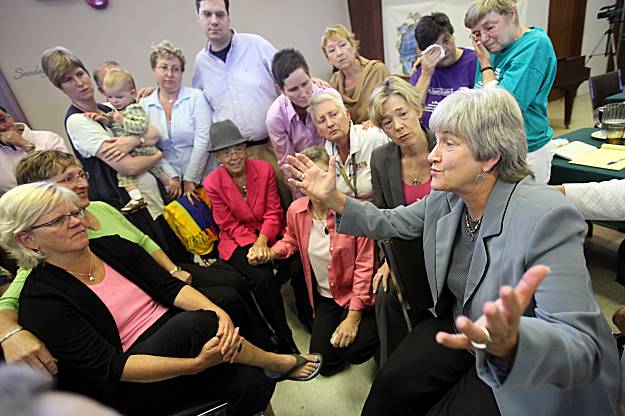
Image from photobucket.

Accepting the reality of decline:
Consciousness rising, world fading

By Robert Jensen / The Rag Blog / March 1, 2011

Our stories of awakenings — whether moral, intellectual, religious, artistic, or sexual — are tricky. Honest self-reflection doesn’t come easy, and self-satisfied accounts are the norm; we love to be the heroes of our own epics.

That’s true of accounts of political awakening as well, especially for those of us born into unearned privilege as a result of systems of illegitimate authority. Not only do we love to tell stories in which we come out looking good, but we know how to decorate the narrative with the trappings of humility to avoid seeming arrogant. We use our failures to set up the story of our transformation; even when we speak of our limitations we are highlighting our wisdom in seeing those limitations.

So, when I got a request from a researcher to tell my story about how my political consciousness was raised, I was hesitant. I don’t like feeling like a fraud, and something always feels a bit fraudulent about my account, even when I am being as honest as I can. But, like most people, I feel driven to tell my story, mostly to try to explain myself to myself. So, here I go again:

As a teenager coming of age in the 1970s in mainstream culture in the upper Midwest, I missed the United States’ radicalizing movements by a decade and several hundred miles. I developed conventional liberal politics in reaction to the conventional conservative politics of my father and his generation. But in a more basic sense, I grew up depoliticized — like most contemporary Americans, I was never taught to analyze systems and structures of power, and so my banal liberal positions seemed like cutting edge critique to me.

After college I worked as a journalist at mainstream newspapers, which further retarded my ability to think critically about power; reporters who don’t have a political consciousness coming into the field are unlikely to develop one in an industry that claims neutrality but is fanatically devoted to the conventional wisdom.

The raising of my consciousness began when I started a journalism/mass communication doctoral program in 1988, a time when U.S. universities were somewhat more intellectually and politically open than today. After years of the daily grind in newsrooms, I felt liberated by the freedom to read, think, and talk to others about all the new ideas I was encountering.

My study of the First Amendment led me to the feminist critique of pornography, which at the time was an important focus for debate about the meaning of freedom of expression. My first graduate courses were taught by liberal defenders of pornography, who were the norm in the academy then and now.

But I also began talking with activists in a local group that was fighting the sexual-exploitation industries (pornography, prostitution, stripping), and I realized there was a rich, complex, and exciting feminist critique, which required me to rethink what I thought I knew about freedom, choice, and liberation.

As a result of those first conversations, I started reading feminist work and taking feminist classes, and I kept talking with folks from the community group, which led me to get involved in their educational activities. I didn’t make those choices with any sense that I was constructing a radical philosophical and political framework. I was just following the ideas that seemed the most compelling intellectually and the people who seemed the most decent personally. Those ad hoc decisions changed my life, in two ways.

First, they opened up to me an alternative to the suffocating conventional wisdom, in which liberals and conservatives argue within narrow ideological boundaries. This exposure to feminist thinking, especially those people and ideas most commonly described as radical feminist, allowed me to step outside those boundaries and ask two simple questions: Where does real power lie and how does it operate, in both formal institutions and informal arrangements?

Second, they helped me realize the importance of always having a political life outside the university. Instead of putting all my energy into my teaching and research, I was anchored in a community project and connected to people who weren’t preoccupied with publishing marginally relevant research in marginally relevant academic journals.

Although I had to publish scholarly articles for my first six years as an assistant professor, once I got tenure and job security I immediately returned to community organizing and ignored the pseudo-intellectual pretensions that dominate in most of the so-called scholarly world in the social sciences and humanities. I had developed respect for rigorous and relevant scholarship but had come to realize how little of it there was in my fields in the contemporary academy.

From those first inquiries into the sexual-exploitation industries and the role of a pornographic culture in men’s violence, I continued to think about how power is organized and operates around other dimensions of our identities and statuses in the world. After opening the gender door, it was inevitable that I would have to open the race door.

From there, questions about the inherent economic injustice in capitalism and the violence required for U.S. imperial domination of the world became central. Finally, I began thinking more about how human domination of the living world is destroying the ecosphere’s capacity to sustain life as we know it.

All of those inquiries led me to the same conclusion: We live in a world structured by illegitimate hierarchies and based on a domination/subordination dynamic. For those of us with unearned privilege, the rewards for ignoring this conclusion are whatever status and money we can squeeze out of the system, while the cost of capitulation to power is a surrender of some essential part of our humanity.

More than 20 years after embarking on this investigation, I can see that clearly. But when I first started confronting these issues, I only knew that the conventional wisdom seemed inadequate, that the platitudes uttered by people in power seemed empty, and that the rationalizations offered by the intellectuals in the service of power seemed self-serving. I didn’t know what I wanted, but I knew I didn’t want that kind of career or life.

All that seems clear to me now, but it wasn’t at the start. The researcher’s query that prompted this essay asked about my “earliest consciousness-raising memory.” I have no simple answer, because my awakening was such a gradual process.

But there were some moments along the way, such as the day I read Andrea Dworkin’s 1983 speech entitled “I Want a Twenty-Four-Hour Truce During Which There Is No Rape,” in which she asked men for “one day in which no new bodies are piled up, one day in which no new agony is added to the old.”[1] In that speech she pointed out that feminists don’t hate men, but instead “believe in your humanity, against all the evidence.”[2]

I also remember the crucial role of one friend in the anti-pornography group, a white man who was older than I and was a part of not only the feminist movement but the civil-rights, anti-war, and environmental struggles. He provided me with a model for how someone with privilege could contribute to radical politics in a principled fashion. In my book on pornography, I wrote about one particularly important moment with Jim Koplin, when we talked about my motivation in volunteering with the group.

“If you want to be part of this because you want to save women, we don’t want you,” he said. At first I was confused — wasn’t the point of critiquing the sexual exploitation of women in pornography to help women? Yes, Jim explained, but too many men who get involved in such work see themselves as knights in shining armor, riding in like the hero to save women, and they usually turn out not to be trustworthy allies. They are in it for themselves, not to challenge masculinity but to play out the role of heroic man in a new, pseudo-feminist context. You have to be in it for yourself, but in a different way, he said.

“You have to be here to save your own life,” Jim told me.

I didn’t understand exactly what he meant at that moment, but something about those words resonated in my gut. This is what feminism offered men — not just a way to help those being hurt, but a way to understand that the same system of male dominance that hurt so many women also made it impossible for men to be fully human.[3]

Jim challenged me to ask myself why I was there and what I hoped to gain, and I came to understand that my interest in feminist politics was driven in large part by my own alienation from traditional definitions of masculinity. For me to tell a simple story about doing the right thing, implying nobility on my part wasn’t going to cut it.

More than 20 years later, I’m still wrestling with these questions about why I make the choices I make. I am a man who is part of a feminist movement and a white guy who critiques the white supremacy deeply embedded in mainstream culture. I am an American who opposes U.S. imperial foreign policy and a middle-class academic working with a local group that organizes immigrant workers.

For these efforts, I get attention and praise that is disproportionate to my effort and ability, a fact I point out as often as possible. People sometimes listen to me not because I’m smarter than feminist women, but because I am a man. My writing on race is not better than the work of non-white authors, but I’m appreciated because I’m white.

This is the tricky part of my awakening story. I was lucky to learn to see the world from the point of view of those who struggle against power, and I’m rewarded in many ways when I speak, write, or act in public in these movements. But I recognize that those rewards are unfair, and so my professed humility becomes another mark of my alleged sophistication.

Yet if I were to refuse to use my privilege — if I dealt with this angst by fading into the background — I would be throwing away resources that come with my position in the world and which I can offer to these movements.

I am trapped, yet I am trapped in a system that makes my life relatively easy. Even when there is some threat of punishment for my political activities, such as during the fallout from critical essays about U.S. war crimes that I wrote after 9/11, I have so much support from outside the power structure and so much privilege as an educated white guy that I never really felt threatened. Even if I had been fired from my university position after 9/11, I likely would have landed on my feet.

I realize not all who adopt a critical perspective, even those in privileged categories, fare as well as I have. But in recent decades in the United States, in which dissent by people who look like me is mostly tolerated, there has been no widespread repression of people in the privileged sectors.

People in targeted groups (particularly immigrants, Muslims, Arabs) have had to be careful, and there’s no guarantee that a more widespread repression won’t return to the United States, especially as U.S. power continues to decline around the world and elites get nervous.

But for now, white men with U.S. citizenship are pretty safe. We may risk losing a job, but that’s trivial compared with the fates suffered by radicals in other eras in U.S. history or in other places today.

So, here’s my consciousness raising story summarized: I wandered through the first 30 years of my life mostly oblivious to the workings of power, protected by my privilege. For the past 20 years I’ve been struggling to contribute to a variety of movements for social justice and ecological sustainability, getting my consciousness raised on a regular basis whenever I seek out new experiences that push me beyond what I have come to take for granted (lately for me that has been happening at 5604 Manor, our progressive community center in Austin, Texas).

Although I love teaching and put considerable energy into my job as a professor, my community and political activities are just as important to me — and a greater source of intellectual vitality. If consciousness-raising is an ongoing project, it’s not likely to happen in moribund institutions such as universities but will come through engagement with people taking real risks in political work.

That’s as accurate an account as I can offer about how I became, and continue becoming, the political person I am. But telling this story always makes me a bit queasy; I have yet to find a way to describe my political development that doesn’t sound self-aggrandizing, as if I am casting myself as an epic hero.

That longstanding discomfort in telling my story is further complicated by new concerns in the past few years. More than ever I’m aware that no matter how high anyone’s consciousness in the United States is raised, there may be very little we can do to reverse the consequences of modern industrial society’s assault on the living world.

I don’t mean that there is nothing we can or should do to promote ecological sustainability, but only that the processes set in motion during the industrial era may be beyond the point of no return, that the health of the ecosphere that makes our own lives possible may be compromised beyond recovery.

In contemporary left/progressive organizing, we typically focus on those small victories we achieve in the moment and on a vision for social change that sustains us over the long haul. With no revolution on the horizon, we pursue reforms within existing systems but hold onto radical ideals that inform those activities.

We are willing to work without guarantees, bolstered by a faith that, as Martin Luther King, Jr. put it, “the arc of the moral universe is long, but it bends toward justice.”[4] That’s supposed to get us through; even if our movements don’t prevail in our own lifetime, we contribute to a better future.

But what if we are no longer bending toward justice? What if the arc of the moral universe has bent back and the cascading ecological crises will eventually overwhelm our collective moral capacities? Put bluntly: What if homo sapiens are an evolutionary dead-end?

That’s the central problem with my consciousness-raising story. When I was politicized 20 years ago, I made a commitment to facing the truth to the best of my ability, even when that truth is unpleasant and painful.

My ideals haven’t changed and my commitment to organizing hasn’t waned, but the weight of the evidence suggests to me that our species is moving into a period of permanent decline during which much of what we have learned will be swamped by rapidly worsening ecological conditions. I think we’re in more trouble than most are willing to acknowledge.

This is not an argument for giving up on or dropping out of radical politics. It’s simply a description of what seems true to me, and I can’t see how our movements can afford to avoid these issues. I’m not sure I’m right about everything, though I am sure this analysis is plausible and should be on our agenda. Yet it’s my experience that most people want to push it out of view.

In trying to make sense of my political consciousness-raising, I try to avoid the temptation to cast myself as an epic hero who overcomes adversity to see the truth. That’s a struggle but is possible when one is part of a vibrant political community in which people hold each other accountable, and for all my fretting in this essay, I think I’ve done a reasonably good job of keeping on track. We can overcome our individual arrogance.

More difficult is facing the possibility that the human species has been cast as a tragic hero. Tragic heroes aren’t characters who have just run into a bit of bad luck but are protagonists brought down by an error in judgment that results from inherent flaws in their character. The arrogance with which we modern humans have treated the living world — the hubris of the high-energy/high-technology era — may well turn out to be that tragic flaw.

Surrounded by the big majestic buildings and tiny sophisticated electronic gadgets created through human cleverness, it’s easy for us to believe we are smart enough to run a complex world. But cleverness is not wisdom, and the ability to create does not guarantee the ability to control the destruction we have unleashed.

Not every human society has gone down this road, but we live in a world dominated by those who not only exhibit that arrogance but embrace it, refusing to accept the reality of decline. That means our individual awakenings may be taking place within a much larger dying. To face that is to live in a profound state of grief. To stay true to a radical political consciousness is to face that grief.

[Robert Jensen is a journalism professor at the University of Texas at Austin and board member of the Third Coast Activist Resource Center in Austin. He is the author of All My Bones Shake: Seeking a Progressive Path to the Prophetic Voice, (Soft Skull Press, 2009) and Getting Off: Pornography and the End of Masculinity (South End Press, 2007); Jensen is also co-producer of the documentary film Abe Osheroff: One Foot in the Grave, the Other Still Dancing, which chronicles the life and philosophy of the longtime radical activist. Robert Jensen can be reached at rjensen@uts.cc.utexas.edu. This article was also posted at The Progressive Christian.]

References

[1] Andrea Dworkin, Letters from a War Zone: Writings 1976-1987 (London: Secker & Warburg, 1988/Chicago: Lawrence Hill Books 1993), pp. 170-171.

[2] Ibid., pp. 169-170.

[3] Robert Jensen, Getting Off: Pornography and the End of Masculinity (Boston: South End Press, 2007), p. 9.

[4] “Where Do We Go From Here?” (annual report to the Southern Christian Leadership Conference), August 16, 1967. http://www.stanford.edu/group/King/publications/speeches/Where_do_we_go_from_here.html


The Rag Blog

Posted in Rag Bloggers | Tagged , , , , | 2 Comments

Tom Miller : Phil Ochs: Sensitive in a Parking Lot

Phil Ochs in New York in 1965. Still image from Phil Ochs: There But for Fortune / First Run Features.

Phil Ochs: Sensitive in a parking lot

By Tom Miller / The Rag Blog / February 28, 2011

Show me a prison, show me a jail
Show me a prisoner whose face has grown pale

And I’ll show you a young man
With so many reasons why
And there but for fortune, may go you or I

— Phil Ochs

[There But for Fortune, the new documentary about folksinger Phil Ochs, provoked this piece by Rag Blog contributor Tom Miller]

Phil Ochs was singing from the back of a flatbed truck in a Florida parking lot to 80 people at a benefit concert supporting defendants in the 1973 “Gainesville Eight” trial. The eight had been charged with conspiring to disrupt the previous summer’s political conventions in Miami, and Ochs volunteered to sing on their behalf.

The sound system was awful, the afternoon sun was sweltering, and people slowly drifted away. In the middle of Ochs’ poignant ballad, “Pleasures of the Harbor,” a two-ton truck revved up, parting the slim audience as it left. Uninterrupted, Ochs finished the song to light, half-hearted applause. “You know,” he said softly, “it’s tough to be sensitive in a parking lot.”

It was illustrative of Phil Ochs’ life, which ended abruptly at the age of 35 on April 9, 35 years ago. Ochs, one of the prominent topical singers from the fertile Greenwich Village folkie scene of the early ‘60s, carved a niche for himself by consciously blending a politically radical awareness with an appreciation of mainstream American culture.

His was the face you saw on television screens singing at civil rights and anti-war rallies, lending cultural affirmation to what we knew was right. Dry politicos never understood his constant allusions to mythic movieland characters; loyalists booed him at a 1970 concert when he mixed songs by Merle Haggard, Buddy Holly, and Elvis Presley with his own. He exploited this contradiction, seldom losing his socialist vision.

Among his best-known anti-war melodies are “I Ain’t Marchin’ Any More” and “I Declare the War is Over,” But Phil’s perspective was wide, and he wrote about other American misadventures, too, using sarcasm, outrage and irony to clarify confusion and dilute the obvious. As a troubadour he affected the collective consciousness of an era with songs mocking wishy-washy liberals, intervention in Caribbean islands, and political fear.

Ochs occupied a position of major influence in a decade of dramatic upheaval, a role with a rich history in most revolutionary societies. He felt a special kinship with Chilean poet Victor Jara whom he met in a 1972 visit to Chile; it was Jara’s death during Augusto Pinochet’s September 1973 military coup that sparked Ochs’ most ambitious project — organizing a Madison Square Garden concert in support of Chilean refugees and the underground freedom-fighters they left behind.

The concert, a sloppy and joyous affair, included Arlo Guthrie, Pete Seeger, Bob Dylan, Dave Von Ronk, and scores of others paying tribute to the fallen Allende government. The benefit was a smashing success, raising money and consciousness for the cause, using folk-art as the medium. It was, by his own admission, the high point of Ochs’ life.

One of Phil’s lifetime goals was to visit every country in the world; at the time of his death he was one-third there. He had traveled extensively through Europe and Africa, mixing courtesy calls on music industry personnel alongside meetings with revolutionary forces in the same countries.

It was an intoxicating mix of acquaintances, equaling the engaging blend his own writing produced. He could write moving tributes to migrant labor (“Bracero”) on one album and show self-deprecation (“Bach, Beethoven, Mozart, and Me”) on another.

Movies played a large part in Phil Ochs’ life and his songs. In his movie-going prime, he took in twenty films a month. For a short while he wrote a movie column for the L.A. Free Press, juxtaposing Marxism with Bruce Lee shows, all of which he had seen. He knew theater schedules in both New York and Los Angeles, where he kept sloppy apartments, and was known to time his flights between the two cities to catch movies within an hour of arrival. Because Arizona churns out “B” movies like few other places, we talked now and then about him coming out for a month just to watch them in production, but it was mainly just talk.

When his career was at its peak, when he played gatherings like the Newport Folk Festival, circumstances wrote his songs. He was in the creative vanguard, maintaining high energy for himself and those he sang for. Less acknowledged but quite good were his nonpolitical works on later albums.

The catalyst for his creativity was the friction produced by civil rights activity and support for countries the U.S. was invading. When that friction took other forms, Phil’s sensitivity remained, but there was little to write about. Sparks of ideas would come and he’d write them in his journal, but no songs came forth.

His record company was content to keep him on, knowing that if he ever wrote again his material would surely be successful. They even printed buttons reading INSPIRE PHIL OCHS. During Watergate he released a 45 rpm record, a remake of his early civil rights song called “Here’s to the State of Mississippi,” with “Richard Nixon” substituted for “Mississippi.” But he wasn’t fooling anyone.

In the two years following the Chile benefit Ochs went through manic-depressive cycles, sometimes obnoxious and arrogant to those he was close to, then retreating into himself for long periods. A few months before he died I found him living at a New York City flophouse. He told me that in the previous months he had been careening around the country in and out of jails under various names, drunk and involved in outrageous scams with unbelievable characters of high and low life.

His name was prominent among those considered for Bob Dylan’s famous Rolling Thunder Review. He had had an off and on relationship with Dylan over the years, but his unpredictability got him axed from the tour before it began.

At this point friends had been suggesting various therapies but he never really followed through. When we spoke last he was living in Queens, Long Island, with his sister’s family, and it sounded like his depression was bottoming out. His suicide a few weeks later ended the pain.

A month after Ochs hanged himself, New York’s Felt Forum filled with thousands of his fans for “An Evening with Phil Ochs and Friends.” As he had at the Allende affair, Dave Van Ronk sang “He Was a Friend of Mine.” After the show, family and friends gathered at a Village bar to toast our friend and brother. We raised our glasses: “There but for fortune,” we agreed.

[Tom Miller’s 10 books include Revenge of the Saguaro: Offbeat Travels Through America’s Southwest.” His web site is www.tommillerbooks.com.]

‘There But for Fortune’ — Phil Ochs, Live at the Bitter End

‘I Ain’t Marching Anymore’ — Phil Ochs

The Rag Blog

Posted in Rag Bloggers | Tagged , , , , , | 1 Comment

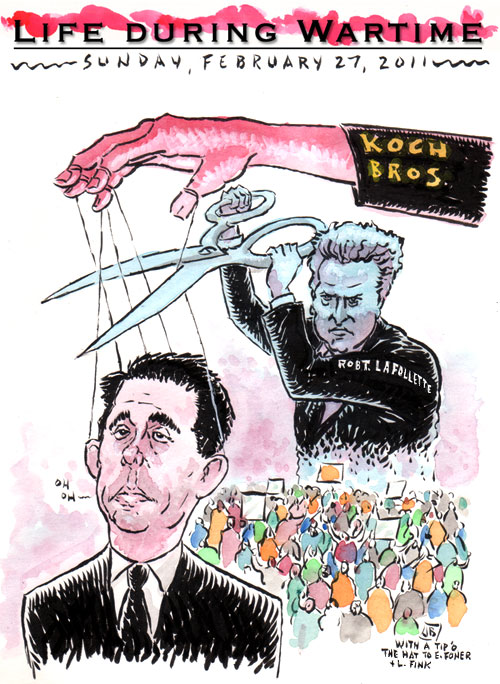
Joshua Brown : Life During Wartime: Puppet Master

Political cartoon by Joshua Brown / The Rag Blog / February 28, 2011.

CLICK ON IMAGE TO ENLARGE.

The Rag Blog

Posted in Rag Bloggers | Tagged , , , , | Leave a comment

Harry Targ : Hoosiers Protest Right-to-Work Laws

Trade unionists and progressives rally at Indiana State House in Indianapolis Feb. 22. Photo by Alan Petersime / AP.

Protesting Right-to-Work laws:
Hoosiers rally at Indiana State House

By Harry Targ / The Rag Blog / February 28, 2011

“A word on apathy — I generally consider it to be a non-issue. Workers are not apathetic; there are lots they care about. But they have to have restored faith in their unions and legislators to act — we are working on that one. Apathy is a label used by the hegemonic few to cover fear, intimidation, and hopelessness.”

Ruth Needleman, Professor of Labor Studies, Indiana University/Gary and author of Black Freedom Fighters in Steel: The Struggle for Democratic Unionism (2003), in an e-mail, February 24, 2011

INDIANAPOLIS — Until late last week, the general media practice, including NPR and Democracy Now, had been to ignore labor militancy in Indiana. However, the movement here in Indiana has been much more energized and larger than many expected.

A state issues forum that was held during the afternoon, February 20, in Lafayette, Indiana on the draconian Republican legislative agenda drew a standing room crowd, about 150, largely public school teachers but with a number of Building Trades, Steel and UAW unionized workers. The event was sponsored by the Obama group Yes We Can Tippecanoe with support from the Lafayette Area Peace Coalition.

The response to the threats to workers, teachers, and public education was a collective expression of anger coupled with a general recognition that the Indiana Republican agenda is a threat to the entire working population of the state.

From Monday to Friday with an anticipation of continuation next week, trade unionists and other activists have been traveling to the state capital building in Indianapolis to protest an array of bills including Right-to-Work, promotion of charter schools, establishment of student-performance-based evaluation of teachers, an Arizona style anti-immigration bill, and a ban on same-sex marriage. (At the February 20 forum articulate spokespersons drew connections between all these issues and even the concept of “class struggle” was raised.)

An estimated 10,000 trade unionists and other progressives mobilized at the State House on Tuesday. February 22. Democratic members of the Republican-controlled legislature began to absent themselves from sessions, forestalling a required quorum. Similar to the actions of Wisconsin politicians, Hoosier legislators assembled in Illinois. Their agenda was to say “no” to Right-to-Work legislation and to demand real dialogue on a variety of bills on the legislative docket that would radically transform education in the state and hit employed and unemployed workers even harder than RTW alone.

I attended the Thursday State House rally organized by the Indiana State AFL-CIO. As we were going through the security check we heard a roaring crowd inside the rotunda of the old-fashioned State House building. As we entered the rotunda we saw about 2,000 workers from the ground level to the third floor cheering a militant speech from the president of the Kentucky AFL-CIO.

Other speakers condemned the attack on workers, exhorted them to continue the struggle, and connected the issues — Right-to-Work, draconian cuts in unemployment benefits, threats to pensions and benefits, destruction of collective bargaining for public employees, and all the efforts of Governor Mitch Daniels to privatize and destroy public education.

Angry workers showed placards from the UAW, SEIU, various Building Trades unions, including locals representing electricians, plumbers, carpenters, and painters. A speaker from the Indiana State Teachers Association thanked the State AFL-CIO for connecting the fight-backs of manufacturing, service, and construction workers with those of education workers.

Talking to business agents and other labor leaders, I learned that the Republicans had offered a deal to the construction and manufacturing unions to take RTW off the table if rallies were ended. The leaders made it clear that organized labor in Indiana saw this proposal for what it was, an effort to split the labor movement and the working class.

One labor leader claimed that a deal beneficial to teachers had been offered the Indiana State Teachers Association, which is not affiliated with the AFL-CIO. Apparently the teachers rejected it. Workers of all kinds have become aware of this standard practice political elites use to split the working class and it has been rejected.

Protesters were also suspicious of press reports that the Governor and the legislature had “pulled” RTW off the table. Legislative procedures, several said, made the situation fluid. The discourse, speeches, informal conversations, chants, and picket signs all spoke to the emergence of real class consciousness this time.

Over the next days and weeks the trick will be to keep the momentum, militancy, and sense of solidarity alive. And, as one friend put it, rank-and-file trade unionists, particularly younger members, need to understand that whatever the outcome of this immediate campaign, vigilance will be necessary.

A good labor history lesson would make it clear that factions of the capitalist class resumed the struggle to push labor back even before the ink was dry on President Roosevelt’s signature making the Wagner Act of 1935 labor’s “Magna Carta” law. By 1947, Republican majorities successfully turned back significant worker rights with the Taft-Hartley Act which made state laws, such as Right-to-Work, possible.

The Indiana, Wisconsin, and Ohio cases show the possibilities that can be achieved by progressives, including trade unionists, working with some members of the Democratic Party.

The legislators in Indiana and Wisconsin have been forced to act in ways that demonstrate their real support of workers. The level of worker anger and mobilization made it clear to Senators in Wisconsin and House members in Indiana that they need to give concrete support to the mass mobilizations that are taking place.

As an old labor film ends, a life-long activist is quoted as saying “You think this is the end? It’s just the beginning.” The fight-backs in Wisconsin, Indiana, Ohio, and elsewhere have rekindled labor militancy, and the rudiments of class consciousness.

The most reactionary sectors of the capitalist class will not bow to mass movements without much more mobilization and struggle. Without falling prey to romantic comparisons with the ferment in the Middle East, it may be the case that, as with Egypt, a general strike is the only action that will stop the drift toward unbearable and deepening misery of the working class.

[Harry Targ is a professor of political science at Purdue University who lives in West Lafayette, Indiana. He blogs at Diary of a Heartland Radical.]

The Rag Blog

Posted in Rag Bloggers | Tagged , , , , , | 2 Comments

Alice Embree : Spirited Pro-Choice and Pro-Union Rallies in Austin

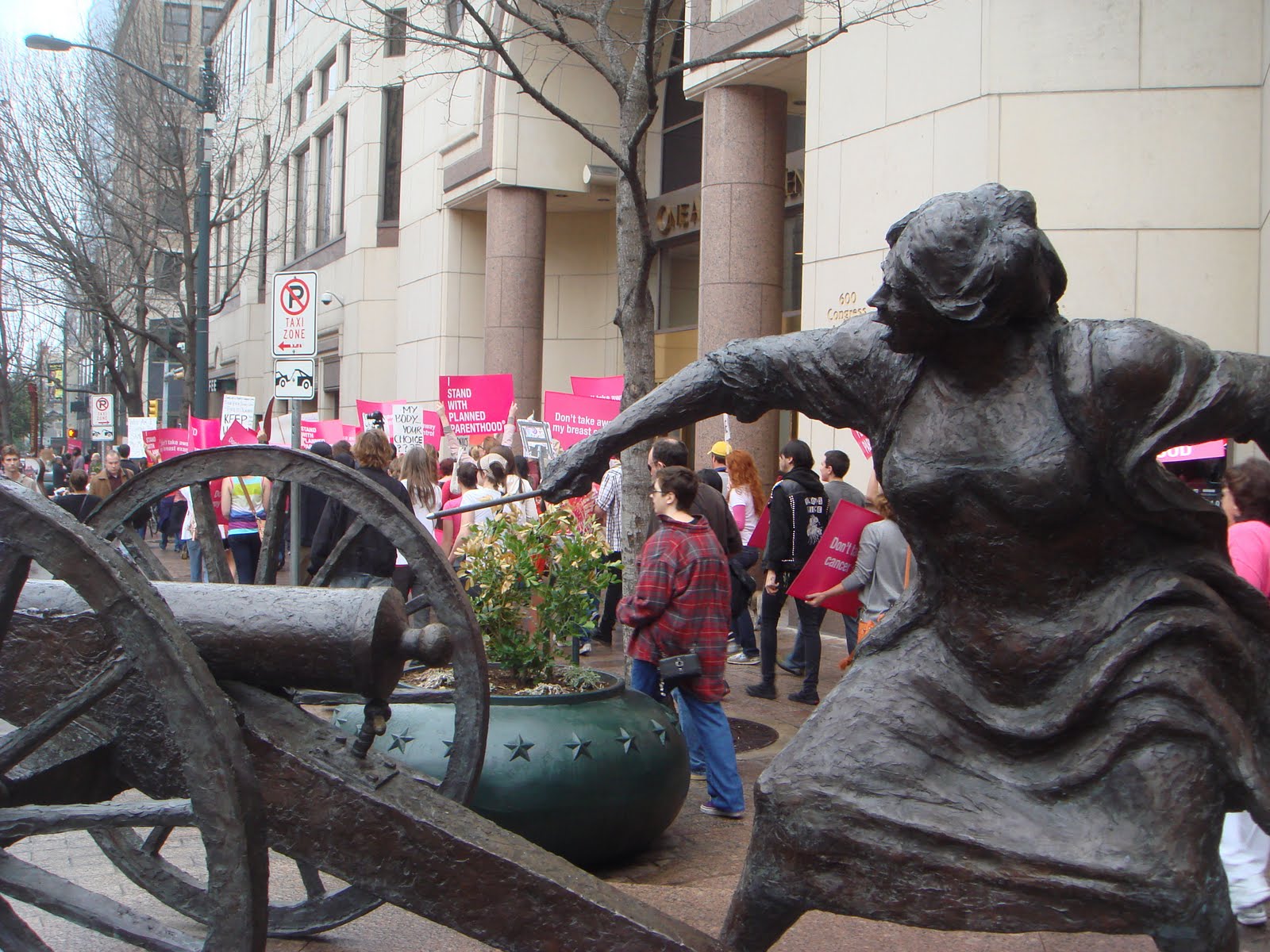
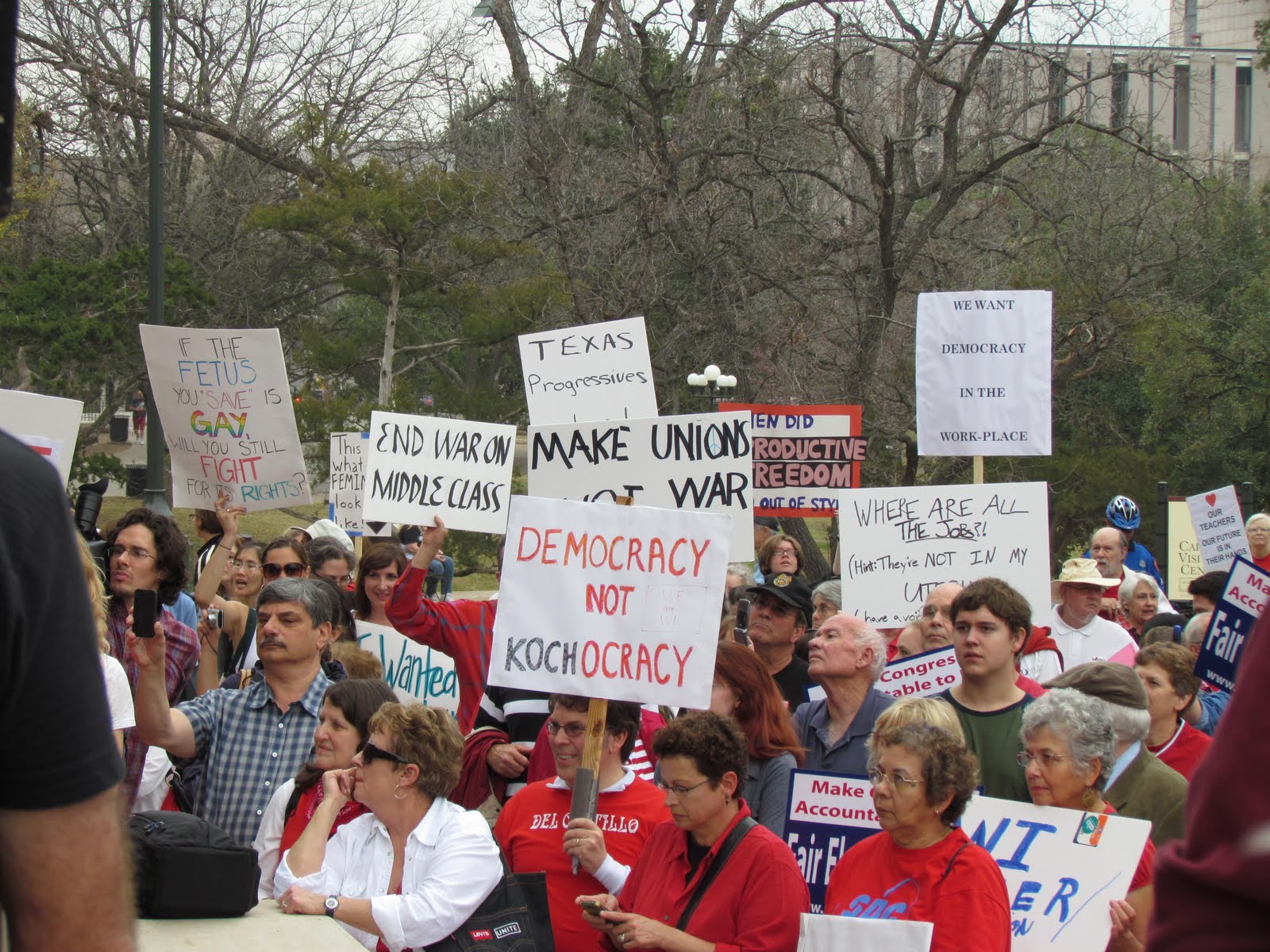
Hundreds of pro-choice demonstrators marched down Congress Ave. in Austin Saturday, Feb. 26 (above), and then joined with supporters of Wisconsin workers for an enthusiastic rally on the steps of the Texas state Capitol. Photos by Terry DuBose / The Rag Blog.

Rallies at Texas state Capitol:
Pro-choice demonstrators join
supporters of Wisconsin workers

See more photos below.

By Alice Embree / The Rag Blog / February 28, 2011

AUSTIN — Two spirited demonstrations took place in front of Austin’s state Capitol on Saturday, February 26th. The Austin American-Statesman failed to cover the pro-choice rally and carried two paragraphs on the second Austin rally in a larger AP story on nationwide events supporting Wisconsin workers.

Hundreds of demonstrators showed up at noon at the south steps of the Capitol to defend women’s reproductive rights and later marched down Congress Ave. Speakers from Planned Parenthood, Whole Women’s Health, National Abortion Rights Action League (NARAL) Texas, the Lilith Fund and CodePink addressed the crowd. Pink was prominent and bright pink placards read: “I Stand with Planned Parenthood,” “Don’t take away my birth control,” “Don’t take away my breast exams.” Four of CodePink’s Pink Police led the march decked out with their crime prevention badges.

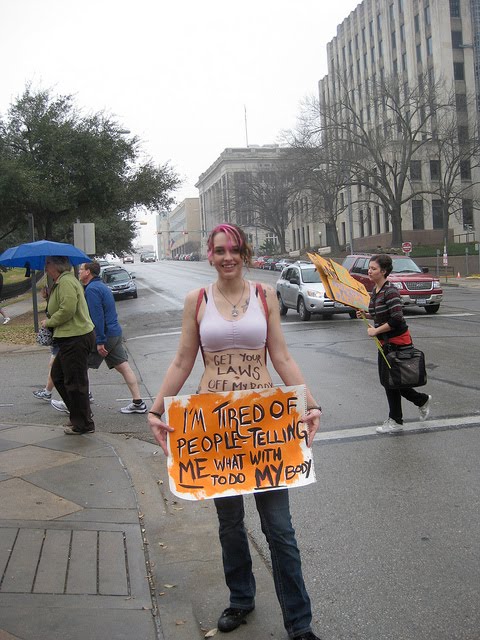
The crowd was mostly young and mostly female. Chanting: “Women’s rights under attack. What do you do? Stand up, fight back!” and “Not the church, not the state, we’re the ones who ovulate.” Placards were both informative and inflammatory. A homemade sign read: “Keep your Boehner out of my uterus.” One woman had lettered: “Get your laws off my body” on her exposed belly. Another woman had constructed a box around her lower body that read: “Think outside my box.”

Marchers split off from the south steps of the Capitol and went down the sidewalks on both the east and west side of Congress, trading sides at Sixth Street as the two lines returned. Passers-by honked and returned peace signs and fists. It was an impressive turnout, organized primarily with word spread through Facebook and listserves.

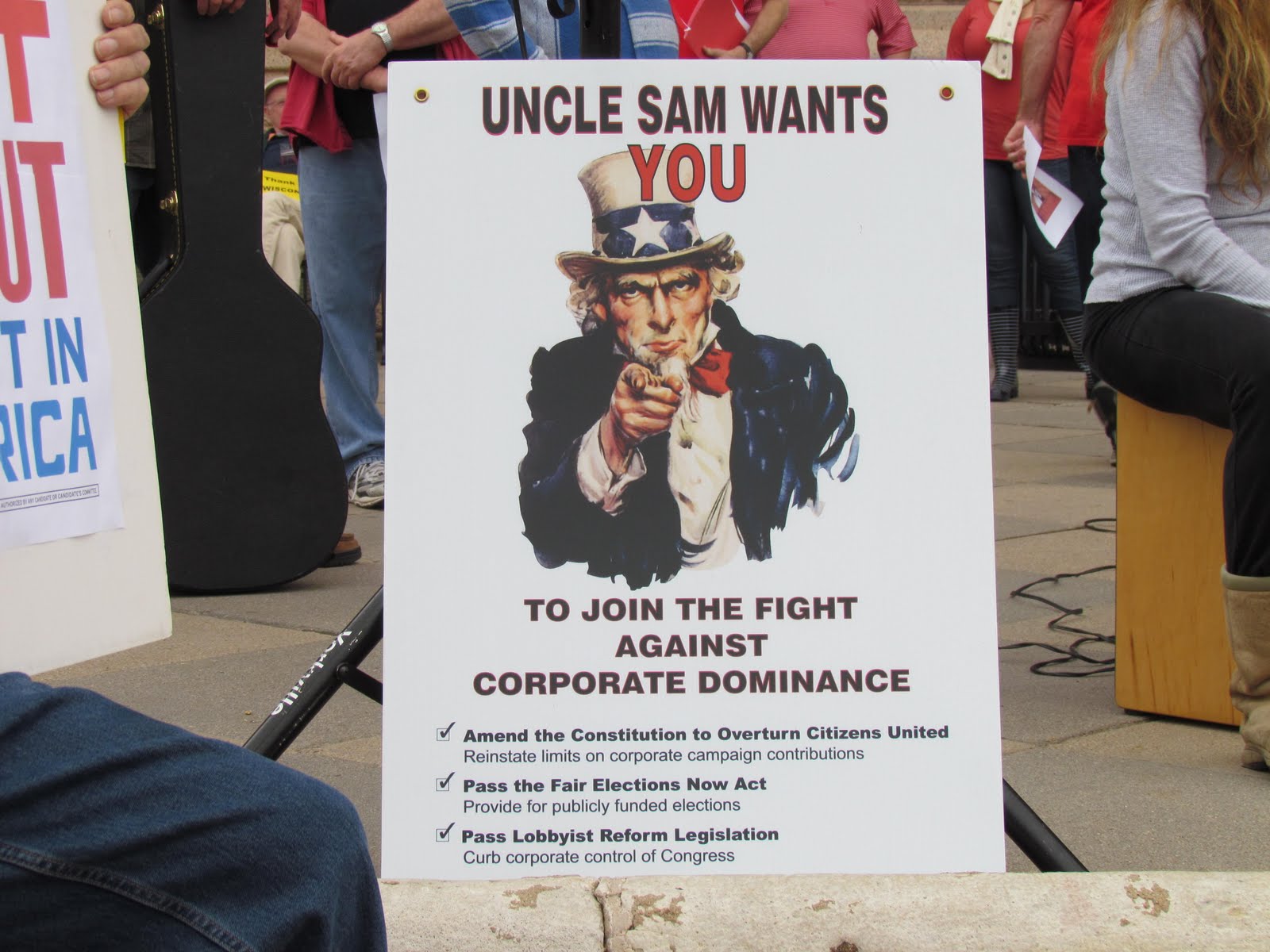
In some ways, just as impressive was the decision by the pro-choice demonstrators to march up the sidewalk to the Capitol steps and join a 2 p.m. rally organized by MoveOn.org in support of Wisconsin workers. DPS troopers attempted to block the newcomers, but union advocates welcomed them.

A crowd of about 1,000 listened to music led by Bill Oliver and friends. Texas Democratic Congressman Lloyd Doggett addressed the crowd, as did former Texas Agricultural Commissioner and populist pundit, Jim Hightower. Austin’s demonstration was one of many throughout the country and coincided with the largest turnout in Madison to date. More than 70,000 demonstrators gathered in Madison despite freezing temperatures.

Hightower said: “You are the Koch brothers’ worst nightmare.” The reference is to conservative donors Charles and David Koch who made huge contributions to conservative candidates in the last midterm elections and who, according to Reuters, “are playing an influential role in the drive to strip public employee unions of their rights to bargain in several U.S. states.”

Wisconsin’s newly elected Governor Walker returned the funding favors with over $100 million in tax breaks to corporations in January before he named teachers and public workers in his state as the cause of Wisconsin deficits.

This was the second mobilization by Austin union supporters in one week. A demonstration organized by the AFL-CIO attracted hundreds to the south steps of the Capitol on Monday night.

Austin’s teachers’ union, Education Austin, is calling for a large turnout at the AISD School Board meeting on Monday evening, February 28, where layoffs and school closures are on the agenda. It seems that the aggressive actions of conservatives who feel empowered by midterm elections are prompting nationwide mobilizations to defend rights ranging from the right to collective bargaining to family planning.

On a related front, the Workers Defense Project is convening a march and rally to commemorate the 138 workers who lost their lives while working at Texas construction sites. The March 2 event, a “Day of the Fallen,” begins at 3:30 p.m. at the federal building and ends at the Capitol.

[Alice Embree is a long-time Austin activist and organizer, a former staff member of The Rag in Austin and RAT in New York, and a veteran of SDS and the women’s liberation movement. She is active with CodePink Austin and Under the Hood Café. Embree is a contributing editor to The Rag Blog and is treasurer of the New Journalism Project.]

Photo by Alice Embree / The Rag Blog.

Photo by Terry DuBose / The Rag Blog.

Photo by Terry DuBose / The Rag Blog.

Photo by Alice Embree / The Rag Blog.

Photo by Alice Embree / The Rag Blog.

Photo by Terry DuBose /The Rag Blog.

The Rag Blog

Posted in Rag Bloggers | Tagged , , , , , , | 3 Comments

John McMillian : Gimme Shelter: Altamont and the Underground Press

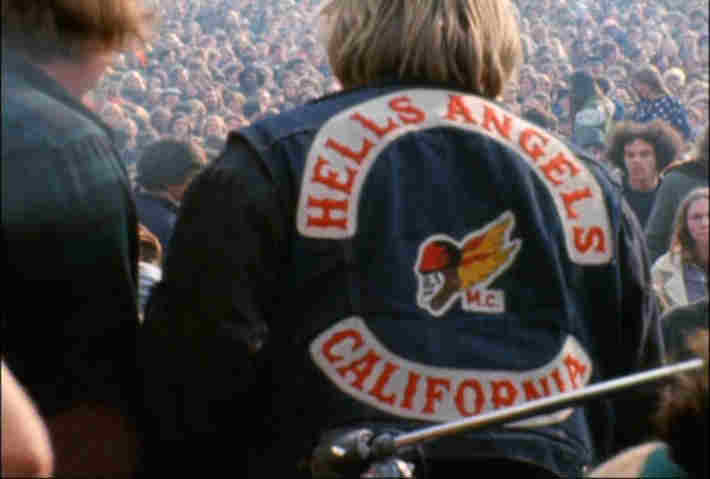
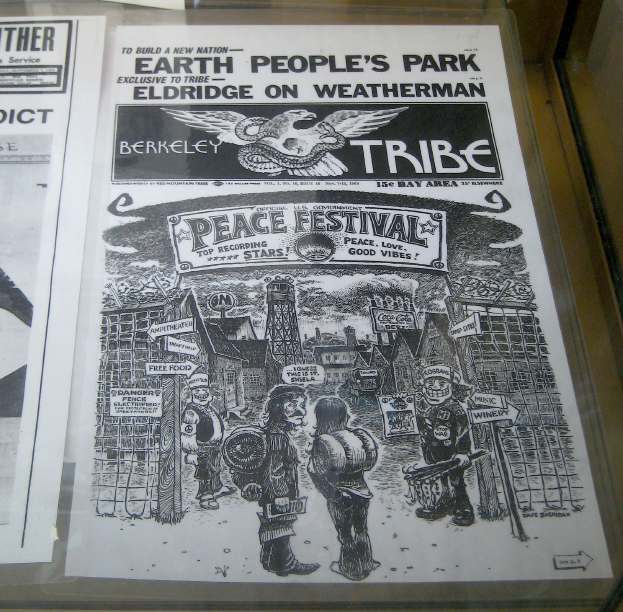
Hell’s Angel takes the cue. The contrasting coverage of the disastrous Altamont rock festival by the Berkeley Tribe and the San Francisco Examiner tells us much about why the underground press became such a force. Image from morethings.com.

When America was up for grabs:
What media coverage of Altamont teaches
us about the Sixties underground press

By John McMillian / The Rag Blog / February 24, 2010

[The following is an excerpt from John McMillian’s excellent new book, Smoking Typewriters: The Sixties Underground Press and the Rise of Alternative Media in America, published in January 2011 by Oxford University Press. Much has been written about the underground press and its seminal role in the Sixties cultural revolution, but this may be the definitive work on the subject. To say nothing of the fact that it’s a very exciting read!]

“STONES CONCERT ENDS IT,” blared the front-page headline of the underground Berkeley Tribe, dated December 12-19, 1969. “America Now Up For Grabs.”

The Rolling Stones concert that the Tribe described was supposed to have been a triumphant affair. Coming just four months after half a million hippie youths drew international attention by gathering peaceably at Max Yasgur’s farm, some had even hyped the free, day-long event — which was held at Altamont Speedway, some 60 miles east of San Francisco, and which also featured Santana, the Jefferson Airplane, and the Flying Burrito Brothers — as “Woodstock West.”

But this was no festival of peace and love. As almost everyone knew, the idea for the free show only came about after the Stones were nettled by criticisms that they had alienated fans with exorbitant ticket prices and arrogant behavior on their 1969 American tour. What’s more, Altamont proved to be a dirty, bleak space for a rock festival, almost completely lacking in amenities for the 300,000 concertgoers. Asked to guard the performers — allegedly in exchange for a truckload of beer — the Hell’s Angels went on a drug-and-booze soaked rampage, assaulting countless hippies with weighted pool cues and kicks to the head.

When the Stones finally started their set after sundown, they found it impossible to gain momentum; they could only play in fits and starts, as the Angels roughed up spectators and commotion swirled around them. Albert and David Maysles’ classic documentary, Gimme Shelter, captured Mick Jagger nervously trying to soothe the crowd: “Brothers and sisters, come on now. That means everybody — just cool out.” “All I can do is ask you — beg you — to keep it together. It’s within your power.” “If we are all one, let’s fucking well show we’re all one!”

But Jagger’s entreaties were in vain. Just as the Stones were starting “Under My Thumb,” the Angles set their sights on an African-American teenager in a flashy lime suit: Meredith Hunter. By one eyewitness account, the whole thing began when a heavyset Angel was toying with Hunter, laughing as he yanked him by the ear and by the hair. Then, when Hunter pulled himself away, he ran into a pack of perhaps four more Angels, who started punching him.

Trying to escape, Hunger whipped out a long-barreled revolver and held it high over his head; in an instant, an Angel plunged a knife between his neck and shoulder. Autopsy reports confirmed that Hunger was tweaking on methamphetamines when he was killed. His last words, supposedly, were: “I wasn’t going to shoot you.”

Ever since, writers and historians have found it tempting to describe Altamont as a generation-shattering event, the proverbial “end of an era.” If the early Sixties was a time of gauzy idealism, characterized by JFK’s youthful vigor, righteous lunch-counter sit ins, and the first flush of Beatlemania, then the Altamont disaster ranks alongside the 1968 Democratic National Convention riots, the Manson Family murders, and the Weather Underground’s townhouse explosion as evidence of the era’s swift decline.

Less well known, however, is that the trope arose in the underground press. “Altamont … exploded the myth of innocence for a section of America,” wrote 21 year old George Paul Csicsery (now a respected filmmaker) in the Tribe’s lead article. Just a little while earlier, he said, it had been “cool” for large groups of youths to assemble at parks and rock festivals. “People would play together, performing, participating, sharing and going home with a feeling that somehow the communal idea would replace the grim isolation wrought on us by a jealous competitive mother culture.”

But on the bleak, dry hills around Altamont, the feeling was entirely different: “Our one-day micro society was bound to the death-throes of capitalist greed.” The Angels’ violence had “united the crowd in fear” while Jagger strutted the stage like a “diabolical prince.” To Csiscery, the concert was a metaphor for a society on the brink: “Clearly, nobody is in control. Not the Angels, not the people. Not Richard Nixon, or his pigs. Nobody.”

Elsewhere in the Tribe, readers could find several more pieces on the Altamont debacle, all of them written by participant-observers, all of them done in a familiar, even informal style. Several writers made liberal use of the editorial “we” (as in, “We’re turning into a generation whose thing is to be an Audience, whose life-style is the mass get-together for ‘good vibes.’”) Others sprinkled their reports with song lyrics, hallucinatory images, or whimsical asides.

The Tribe also featured an elliptical poem about the Altamont debacle, as well as a comic strip by the artist Greg Irons that skewered a local radio station for irresponsibly hyping the event and then fulminating against it after things went bad. Almost all of this material struck a portentous tone; the Tribe’s radical politicos and youth-culture aficionados who caravanned to Altamont came away feeling grubby, mortified, and concerned. “I realize some people just had a good time,” said one writer. “Me, I saw a guy get killed.”

Altamont received front-page attention in the San Francisco Examiner, too, but nothing like the blanket coverage that was found in the Tribe, and besides, the Bay Area’s leading evening paper completely missed the concert’s significance; its reports and analysis could not have been more wrong-headed.

On December 6, the Examiner stressed that the biggest problem associated with the concert was the traffic headache it caused on Interstate 5/580; it specifically added that the police reported “no violence.” The next day, the paper mentioned that one person had been killed, but in fact four people died: two were run over by a car while sitting at a campfire, and another drowned in a swift-moving irrigation canal while zonked out on drugs.

“But for the stabbing,” the Examiner reported, “all appeared peaceful at the concert… The record-breaking crowd was for the most part orderly, but enthusiastic. The listeners heeded the advice of the Jefferson Airplane: ‘We should be together.’”

Then on December 9, the paper’s editorial writers fumbled to explain why 300,000 youths would even want to attend a free rock festival headlined by the Rolling Stones in the first place. They literally could not come up with an explanation that they deemed fully satisfactory.

Finally, on December 14, Dick Nolan, an op-ed columnist, stressed that the event had been a disaster for the counterculture, but his tone was so priggish and excoriating that it’s hard to imagine very many younger readers taking him seriously. “Maybe it’s wishful thinking,” he wrote. “But to me that Altamont rock fiasco looked like the last gasp of the whole hippie-drug thing.”

There were the Stones, he said, “peddling their idiot doggerel and primitive beat” before that most mindless of animals, the human mob. Altamont was just another manifestation “of the rock-drug-slobbery cult,” to which Nolan could only say good riddance.

This is not a book [Smoking Typewriters] about Altamont, of course. But by quickly glancing at how two local newssheets covered the Stones concert, we can begin apprehending the powerful appeal of the underground press in the late 1960s and early 1970s.

Issue of the underground paper, The Berkeley Tribe. Image from zomblog.

Amateurishly produced by a collective of unabashed radicals, the Berkeley Tribe had a fleet of reporters who actively participated in the events they covered. Lacking any pretense of objectivity, they put across forcefully opinionated accounts of events that mattered deeply to them — that grew out of their culture — and they used a language and a sensibility of their own fashioning; their hip vernacular was something they shared with most of their readership.

By contrast, the professionals who staffed the Examiner — the flagship of the Hearst newspaper chain — approached Altamont with a prefabricated template. Their first instinct was to cloak the free concert in gooey, Woodstock-style sentimentalism. Then after that proved untenable, their editorialists proved totally uncomprehending of the rock and youth cultures they sought to explain.

It is little wonder, then, that many New Leftists never bothered to read daily newspapers, at least not when they wanted to know what was going on in their own milieu. Instead, beginning in the mid-1960s, in cities and campuses across the country, they began creating and distributing their own radical community newssheets, with which they aimed to promote avant-garde sensibilities and inspire political tumult.

Amplitude and conviction were hallmarks of the underground press: this is where they set forth their guiding principles concerning the unfairness of racism, the moral and political tragedy of the Vietnam War, the need to make leaders and institutions democratically accountable, and the existential rewards of a committed life.

And their success was astonishing. According to cultural critic Louis Menand, underground newspapers “were one of the most spontaneous and aggressive growths in publishing history.” In 1965, the New Left could claim only five such newspapers, mostly in large cities; within a few years, several hundred papers were in circulation, with a combined readership that stretched into the millions.

In addition to trying to build an intellectual framework for the Movement’s expansion, New Leftists imbued their newspapers with an ethos that socialized people into the Movement, fostered a spirit of mutuality among them, and raised their democratic expectations.

The community-building work that New Leftists brought about in this way was neither incidental nor marginal. Instead, it played a crucial role in helping youths to break away from the complacency and resignation that prevailed in postwar America, in order to build an indigenous, highly stylized protest culture.

Given the obstacles confronting those who have attempted to build mass democratic movements in the United States, this was a considerable achievement. Simply put, much of what we associate with the late 1960s youth rebellion — its size, intensity, and contrapuntal expressions of furious anger and joyful bliss — might not have been possible without the advent of new printing technologies that put the cost of newspaper production within reach of most activists, or without the institutions they built that allowed their press to flourish.”

[John McMillian is Assistant Professor of History at Georgia Sate University. His latest book is Smoking Typewriters: The Sixties Underground Press and the Rise of Alternative Media in America, published by Oxford University Press.]

John McMillian, author of Smoking Typewriters, will be our special guest at a Rag Blog Happy Hour, Friday, Feb. 25, 2011, 5-7 p.m., at Maria’s Taco Xpress, 2529 S. Lamar Blvd., Austin. The public is welcome. John will also appear at BookPeople, 603 N. Lamar Blvd, Austin, at 7 p.m. Friday for a reading and book-signing. And John McMillian will be Thorne Dreyer‘s guest on Rag Radio, Friday, March 4, 2011, 2-3 p.m. (CST) on KOOP-91.7 FM in Austin, and streamed live on the internet.

Also see:

The Rag Blog

Posted in Rag Bloggers | Tagged , , , , , , , | 4 Comments

Harry Targ : Fundamentalism and the Attack on Planned Parenthood

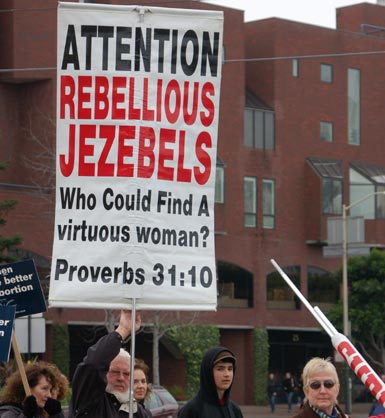
Image from Feministe.

In the fundamentalist tradition:
The attack on Planned Parenthood

By Harry Targ / The Rag Blog / February 24, 2011

Often politicians using religious dogma as their rhetorical tool, support public policies that punish poor women, women of color, and progressive women in general.

Vivay Prashad, in his fascinating book, The Darker Nations, traced the rise and subsequent demise of the Third World Project from the 1950s to the 1980s. The Third World Project, mainly the mobilization of poor and marginalized peoples around the world, envisioned the construction of progressive governments that would provide for basic social and economic needs and institutionalize democratic participation in political life.

This project was derailed for several reasons. One of the most significant was the willful construction by threatened elites of fundamentalist religious institutions.

In the Middle East, the tottering dictatorships plowed financial resources into the creation of fundamentalist Islamic organizations. “Political Islam” was introduced into global political culture to divert and divide social movements for fundamental change.

Political Islam called for a return to the past and a rejection of modern secular ideas about social and political institutions. Religious dogma worked to replace visions of egalitarian societies. Ironically, in order to maintain stability, United States foreign policy supported insurgent Islamic fundamentalist movements in various places such as Afghanistan.

In Latin America, religious fundamentalism took a variety of forms. The leadership of the Catholic Church launched a frontal assault on newly created radical regimes, such as in Nicaragua, that based their political principles on a theology of “liberation.” Also, evangelical Christian organizations, with funding from worldwide economic elites, infiltrated Latin American countries experiencing revolutionary ferment, urging the poor to reject earthly solutions to their problems.

In North America, the religious right mobilized financial resources to appeal to an electorate frustrated by challenges to U.S. hegemony overseas and economic stagnation at home. In each political venue, whether dominated by Islam, Christianity, or Judaism in the case of Israel, religion was used to divide and conquer.

The sector of the population most impacted by fundamentalisms of every kind is women. Women are forced out of the political process as patriarchies reinstitute top-down control of their political, economic, and cultural lives and their bodies. Women’s institutions, particularly ones that encourage progressive public policies, are marginalized.

Often politicians using religious dogma as their rhetorical tool, support public policies that punish poor women, women of color, and progressive women in general. In sum, the resurgence of religious fundamentalism has been used to divide majorities of people along various lines that defuse their solidarity and the targets of such assaults are most often women.

A current example of this strategy of attacking women by raising the specter of religious orthodoxy occured Friday, February 18, when the House of Representatives approved an amendment to budgetary legislation that would end all funding of Planned Parenthood, a national organization that provides vital reproductive health services to low-income women.

Congressman Mike Pence (R-IN), who introduced the proposal, declared that American taxpayers should not have to pay for abortions. He failed to mention that they don’t because the government currently forbids the use of federal dollars for most abortions. Consequently, that could not have been the motivation for this legislation.

Rather, most of the 240 House members who voted to cut all allocations to Planned Parenthood wished to raise the religious issue to justify their general goal of ending public health care and guarantees for basic public health services for all. Pence failed to make note of the fact that Planned Parenthood gives contraceptive assistance to poor women, does HIV tests, screens women for cancer, and provides reproductive health care for women.

Planned Parenthood, like ACORN the community organization that was victimized last year, is under assault to achieve political goals. The attacks serve to divide the electorate in order to destroy another organization that serves the needs of the working class, in this case working class women.

Data from the Guttmacher Institute points out that in recent years almost half of women who need reproductive health care are not able to afford it. Four in 10 women of reproductive age have no health insurance.

The health care reform legislation of 2010 opens the door for expanded insurance coverage for reproductive health and family planning. Among those without health care as of 2009 were 14 million women of reproductive age. According to the new health care law, if not defied by state governments, Medicaid programs will expand family planning services to lower income families in years ahead.

As the Pence amendment suggests, existing health services for women and prospective new ones are under threat from health care opponents. They want to destroy major providers of health care for women such as Planned Parenthood. And, in the end, they want to destroy any form of public health for people.

How to do it? Transform the discourse from providing health care for the people, a broadly accepted idea, to religious dogma, in this case anti-abortion dogma.

It is time for progressives to respond. Attacks on Planned Parenthood are attacks on the working class, especially people of color, and women, and the very idea that governments are created to serve the needs of the people.

[Harry Targ is a professor of political science at Purdue University who lives in West Lafayette, Indiana. He blogs at Diary of a Heartland Radical.]

The Rag Blog

Posted in Rag Bloggers | Tagged , , , , , | Leave a comment

Jim Rigby : Our Nation of Weeping Executioners

Rev. Jane Adams Spahr. Image from One More Lesbian.

Our nation of weeping executioners:
The religious tribunal of Rev. Jane Adams Spahr

By Jim Rigby / The Rag Blog / February 23, 2011

Rev. Jim Rigby, human rights activist and pastor at St. Andrew’s Presbyterian Church in Austin, will be Thorne Dreyer’s guest on Rag Radio, Friday, Feb. 25, 2011, 2-3 p.m. (CST), on KOOP 91.7 FM in Austin. To stream Rag Radio live on the internet, go here. To listen to this interview after it is broadcast — and to other shows on the Rag Radio archives — go here.

A recent Los Angeles Times profile of Rev. Jane Adams Spahr wonderfully captured the loving spirit of one of my few heroes in the Presbyterian Church. This courageous lesbian minister has fought prejudice and fear within our denomination, refusing to surrender to voices of intolerance within the church.

The article also captured the sense of helplessness which threatens to unravel not only the Presbyterian system of democratic government, but, possibly, our nation’s as well.

The Times reporter noted that at Rev. Spahr’s third trial, a religious tribunal found her guilty of violating the Presbyterian constitution because she conducted same-sex marriage ceremonies. The story explains:

But then several of [the tribunal] members apologized to Spahr, and their decision admonished not the faithful minister but the faith itself. “We call upon the church to reexamine our own fear and ignorance that continues to reject the inclusiveness of the Gospel of Jesus Christ,” panel members wrote while finding Spahr guilty in Napa last August. “We as a church need to be able to respond to… reality as Dr. Jane Spahr has done with faithfulness and compassion.”

In other words, the liberal members of the church court agreed with Rev. Spahr’s theology and practice but found her guilty anyway, apparently unable to step out of a system they themselves described as unjust.

Some of the committee wept as they read their verdict which reminded me of a term coined by Walt Herbert, emeritus professor of English at Southwestern University. Dr. Herbert used the term, “weeping executioners” to describe those who express concern for the oppressed, but will not leave their place in the hierarchy of that oppression.

Democracy demands a rare courage and sense of personal responsibility. The Presbyterian denomination originally began as an attempt at a democratic form of church government. Some in England called the American Revolution “that Presbyterian rebellion” because that denomination inspired much of the democratic structure of American government and some of its revolutionary spirit.

The Presbyterian idea of democracy was not mob rule. It emphasized personal responsibility over and against any human group. The Westminster Confession of Faith went so far as to forbid surrendering one’s conscience to any human council. The refusal to surrender responsibility applied to national as well as church governments. Needless to say, that revolutionary spark now lies buried under centuries of accumulated ash.

For many years, Janie Spahr has been a much needed thorn in the side of the Presbyterian Church, charging us to give every person their full human rights. Rev. Spahr was already married and ordained when she finally faced the reality that she was attracted to other women. Her husband Jimmy was fully supportive and they divorced amicably. At that point, she was an out lesbian Presbyterian pastor.

Because the issue of homosexuality had not been dealt with yet, there wasn’t a provision to strip her of ordination. She was denied a position as a pastor of a church but became the “lesbian evangelist” of the Presbyterian Church, ministering to all those rejected by the church. She became gay and lesbian Presbyterians’ best hope, and homophobic Presbyterians’ worst nightmare.

In August 2010, a judicial committee of the Presbyterian Church convicted Rev. Spahr of marrying 11 same sex couples. I went to the trial to observe and to express my support for Rev. Spahr. The day before the verdict was announced members of the judicial committee spoke about the need for inclusivity and for justice. The moderator read a verse from James Russell Lowell’s prophetic poem, “Once to Every Soul and Nation.” He promised that the verdict would be in the spirit of the poem. As soon as I got back to a computer I printed out the whole poem and read these stanzas (modified a bit to remove sexist language):

Once to every soul and nation, comes the moment to decide.
In the strife of truth with falsehood, for the good or evil side.
Some great cause, some great decision, offering each the bloom or blight.
And that choice goes by forever twixt that darkness and that light.

Then it is the brave soul chooses while the coward stands aside.
Till the multitude make virtue of the faith they had denied.
New occasions teach new duties. Time makes ancient good uncouth.
They must upward still and onward who would keep abreast of truth.

Looking at those noble words, I was certain the committee would find the courage to oppose rules they themselves said were discriminatory. I showed the lines to my gay and lesbian friends at the trial and said assuredly, “they are going to do something prophetic.”

When their guilty verdict was read, some of the judicial committee wept. They agreed that the church’s discrimination against gay and lesbian persons was wrong, but because of earlier rulings by church courts, they felt they had no choice but to convict her.

One woman from the judicial committee stood crying and said to the 11 same-sex couples, “We want you to know how hard this was for us.” Another member of the committee said, choking back sobs, “We want you to know… that we love you.”

When those words were spoken, a muted but profound groan crept through the room. The dagger of condemnation wrapped in bandages of deedless compassion cut deeper than any words of hate. Once again, the gospel of kindness had been betrayed with a kiss.

I looked around at all the beautiful people from the gay and lesbian community who had accepted me into their families. One of my lesbian friends collapsed in her chair. A gay couple embraced, staring vacuously forward, both of their shirts wet with tears.

The committee seemed genuinely surprised by the response. One of the committee members confided afterward that they had given Rev. Spahr grounds for appeal “served on a platter.” That “gift” was, of course, based on the premise that someone else down the line would be braver than they.

The Rev. Jane Adams Spahr talks with supporters after a Presbyterian Church court handed down its ruling. Photo by Christopher Chung / AP.

Most democracies are born out of revolution and begin to die on the day they choose tradition over their own revolutionary principles. Nothing is more perilous than the human tendency to grow conservative in times of great transition. Because life is change, sanity is not an unchanging state, but a commitment to change by certain standards.

The revolutionary “soul” of democracy is not submission to the will of the majority, but the conviction that every human being has certain inalienable rights that cannot be put up for a vote. When a majority deprives the minority of inalienable rights, every decent citizen must be willing to leave the majority and stand with the minority.

When citizens in a democracy feel their only power is to vote for candidates who then tell them what to do, they have forgotten what liberty means. They become beasts of burden who think they are free if they can vote on who rides them.

Democracy demands an active courage. Unless citizens are brave enough to follow its principles in times of crisis, democracy loses its sinew and dies. Issues like immigration and gay marriage test whether our nation will follow living principles into new understandings, or perish repeating the comfortable wisdoms of the dead.

Martin Luther King wrote a letter from the Birmingham Jail to his own weeping executioners to say “justice delayed is justice denied.” Later, he also wrote the following call to courage:

I say to you, this morning, that if you have never found something so dear and precious to you that you will die for it, then you aren’t fit to live. You may be 38 years old, as I happen to be, and one day, some great opportunity stands before you and calls upon you to stand for some great principle, some great issue, some great cause. And you refuse to do it because you are afraid.

You refuse to do it because you want to live longer. You’re afraid that you will lose your job, or you are afraid that you will be criticized or that you will lose your popularity, or you’re afraid that somebody will stab or shoot or bomb your house. So you refuse to take a stand.

Well, you may go on and live until you are 90, but you are just as dead at 38 as you would be at 90. And the cessation of breathing in your life is but the belated announcement of an earlier death of the spirit. You died when you refused to stand up for right. You died when you refused to stand up for truth. You died when you refused to stand up for justice.

James Russell Lowell is still right: “Once to every soul and nation comes the moment to decide.” Issues like immigration and gay marriage force us to choose between our principles and our traditions. We will not get these moments back. If we choose tradition over our revolutionary principles, democracy will surely die. Our ship of state will be a vessel that is all anchor and no sail.

Furthermore, if we do not stop surrendering our human agency to hierarchical systems of power, we are doomed to either being the sacrificial victims of that system, or of being its “weeping executioners.” Such is my denomination. Such is our beloved nation.

What would it look like to step out of the system? I saw that as well. One night, during the week of the trial, the 11 couples met for an evening service. Each couple came forward to light a candle to honor the love that held their family together. Janie Spahr’s partner got up to light a candle and looked out for Janie to come join her.

My eyes filled with tears as Janie’s ex-husband Jimmy got up to stand beside them to honor their love. Then his wife got up to stand beside them as well. Finally, the children of Jane and Jimmy got up to stand beside them.. When I saw that beautiful family I knew I was seeing the world that Isaiah was talking about when he said the human beings rejected by religion and by nations have become the foundation of a new humanity. Humanity’s new cathedral will be built with the shattered stones of unjust nations and unkind religions.

Leaving our role in the hierarchy of oppression is really as simple as giving others every right we claim for ourselves, and ceasing to work for justice within the parameters of unjust systems. We have become like ants who built bridges out of our own bodies and now consider those bridges more real than ourselves.

And it is as simple as Einstein’s charge that we should remember our humanity and forget the rest. At some point, if you will not disobey an unjust law, you are not working within the system to dismantle oppression, you are the oppression.

[Jim Rigby is a human rights activist and the pastor of St. Andrew’s Presbyterian Church in Austin. He is a member of the board of the Third Coast Activist Resource Center. He can be reached at jrigby0000@aol.com. This article was originally posted to Faith and Reason and to CommonDreams.]

The Rag Blog

Posted in Rag Bloggers | Tagged , , , , , , | Leave a comment

Marc Estrin : Ian McEwan Speaks Half-Truths to Power

Image from webshots.

Ian McEwan:
Speaking half-truths to power

By Marc Estrin / The Rag Blog / February 23, 2011

The action

In the midst of cries for freedom in the Middle East and Africa, Ian McEwan claimed the Jerusalem Prize for Literature, in a sumptuous convention center in a city officially described as the eternal and undivided capital of Israel.

In his acceptance speech he addressed the president of Israel, the minister of culture, the mayor of Jerusalem, and the “Israeli and Palestinian citizens of this beautiful city,” and thanked them for honoring him with a prize which “promotes the idea of the freedom of the individual in society.” He then proceeded to schmooze with the literary celebrities and political and military enforcers that gather at such events.

His speech was gracefully written, a short lecture on the history and purpose of the novel as an exploration of the individual, along with some ruminations concerning the political “situation,” and his acceptance of the prize. Haaretz headlined the speech as courageously “slamming” Israeli policies, while Britain’s First Post described him as “hitting out” at Israel’s “great injustice.”

While I acknowledge McEwan’s accurate listing of major Israeli crimes, and admire his courage in enumerating them to such an audience, I found the speech on the whole to be intellectually, and perhaps psychologically dishonest, calling up many frequent Zionist tropes to mask and distort the reality on the ground — and in the hearts and minds of many of his listeners.

The words

First, in spite of his claiming disinterest in “arguments of equivalence,” he repeatedly denounces “both sides,” as if they were equivalent players in the ongoing tragedy.

He speaks of Hamas’ “nihilism,” which “has embraced the suicide bomber” — though such tactics began only after intolerable Israeli provocations, and lasted for only a few years. They are not a current tactic, though McEwan describes them as if they are. Meantime, the Israelis have killed more than 3,000 Palestinians, without committing suicide.

He goes on to speak of the nihilism of “rockets fired blindly into towns.” These home-made explosives, fired in the general direction of towns over the border, land mostly in empty fields without injury to person or place — hardly equivalent to the high-tech weaponry targeted and used against the Palestinians.

He claims that Hamas has “embraced the nihilism of an extinctionist policy toward Israel” with no nod to its many-times offered long-term truce proposals, or the clear and oft-stated purposes of the Zionists to possess the land “between the river and the sea” by dispossessing its Palestinian inhabitants.

And while he fearlessly mentions Israeli killings in the occupied territories, evictions and demolitions, the “tsunami of concrete” poured in the West Bank, the “relentless purchases of Palestinian homes in East Jerusalem, and the right of return granted to Jews but not Arabs,” I stand back from these “equivalent” listings of evil, and think they are not equivalent at all — quantitatively or qualitatively, or with regard to their motivations. One side is the oppressor, one the oppressed. Would McEwan dispute which is which?

A second common trope for Israel apologists often surfaces in their descriptions of the Israeli project. McEwan contextualizes his evaluation in the rhetoric of the occasion:

Everybody knows this simple fact: once you’ve instituted a prize for philosophers and creative writers, you have embraced freedom of thought and open discourse, and I take the continued existence of the Jerusalem Prize as a tribute to the precious tradition of a democracy of ideas in Israel.

(These words, by the way, uttered in the same week as the Knesset passed a bill which calls for heavy fines to be imposed on Israeli citizens who initiate or incite boycotts against Israeli individuals, companies, factories, and organizations.)

This is shoddy, dishonest thinking, considering the history and rhetoric of Zionist thought. Even McEwan recognizes this, noting that while the Jerusalem prize “recognizes writing which promotes the idea of the freedom of the individual in society,” that idea “sits so awkwardly” with the situation in Jerusalem. Part for the whole, perhaps, a writer’s gambit, but it sits awkwardly in the West Bank and Gaza as well, the ganze geschichte.

And again, a false equivalence: “A great and self-evident injustice hangs in the air, people have been and are being displaced. On the other hand, a valuable democracy is threatened by unfriendly neighbours, even to the point of extinction by a state that could soon possess a nuclear bomb.”

Actual displacements and killings taking place as he speaks — versus some theoretical threat “even to the point of extinction,” by I suppose Iran. Does he know the real translation of Amadinejad’s “threat”? Is he aware of any Iranian nuclear arms program? Would Iran use a nuclear weapon against Israel even if it had one? These are all right-wing canards, embarrassing in the mouth of an informed, presumably progressive, person.

The final, show-stopping, conversation and thought-ending Zionist trope in McEwan’s speech is the invocation of the, THE, Holocaust, “that industrialised cruelty which will remain always the ultimate measure of human depravity, of how far we can fall.” Are there not other holocausts afoot, a main one planned and executed by the people in that very room? Are the billions spent, and the technological plans made for ever greater use of joystick drone and space warfare not a competitor on the human depravity scale?

The place

Granted, the ability to speak truth to power rides on getting access to that power. I don’t know why the elite ever granted a ticket to Lewis Lapham to anything. And the politicos and their sycophant press were clearly blindsided by Stephen Colbert’s still remarkable 2006 roast of George Bush at the Washington Press Club.

Once bitten, twice shy: anything like that will never happen again.

And so, by being “nice” and “balanced,” Ian McEwan earned himself some reluctant ears to fleetingly assault with some nasty truths. But having been awarded the prize, would he not have had those same ears — and more — by turning the prize down? I understand his rationalization about art promoting freedom. But contrast his route to access, voice and freedom, with that of the people in the squares of North Africa. Is there not something more genuine about these which do not end in wine and cheese?

The effect

As McEwan traced the tradition of the novel, imagine a bulldozer audibly demolishing the building next door, the cries of the inhabitants leaking through the convention center windows. Oh, but that’s on the other side of town.

This great writer admits that “whatever I believed about literature, its nobility and reach, I couldn’t escape the politics of my decision. Reluctantly, sadly, I must concede that this is the case.” Why reluctantly, and above all, why sadly? Is not the polis of politics a collection of those individuals he writes so sensitively about? Does collecting a prize concerned with “the freedom of the individual in society” annul its social aspects?

If there were any doubt, McEwan had only to listen to Mayor Nir Barkat’s speech, asserting that while Jerusalem “has conflict, big-time,” he could nevertheless boast of the city’s “pluralism” and “openness,” and of his conviction that the “renaissance of arts” taking place in the capital is acting to “mediate tensions.”

Tell it to the Palestinians.

[Marc Estrin is a writer, activist, and cellist, living in Burlington, Vermont. His novels, Insect Dreams, The Half Life of Gregor Samsa, The Education of Arnold Hitler, Golem Song, and The Lamentations of Julius Marantz have won critical acclaim. His memoir, Rehearsing With Gods: Photographs and Essays on the Bread & Puppet Theater (with Ron Simon, photographer) won a 2004 theater book of the year award. He is currently working on a novel about the dead Tchaikovsky.]

The Rag Blog

Posted in Rag Bloggers | Tagged , , , , , , , | Leave a comment

VERSE / Mariann G. Wizard : Egypt-Land

Image from Egypt Web.

Egypt-Land

“Freedom breeze, makes me feel fine;
blowin’ through the jasmine in my mind!”1

Before Greece, you were the home of scholars.
Before Rome, you were an empire.
Before last week, you were slaves.

The birth of your society is shrouded in Time’s burqua.
The birth of your revolution now reveals
        the best-kept secret of the Sphinx:
it’s all about the people.

History is read from monuments of rulers and kings;
their grandiose self-glorifications dot every desert.
But this hasn’t been the first time, has it? – that Egypt’s
laborers have laid down their work, their very lives,
and stood up for change.

“Go down, Moses, go down to Egypt-Land;
go tell old Pharoah: let my people go!”2

The people of Tahrir Square are telling
Pharoah to go, with all his autocrats and aristocrats;
and leave Egypt to them, poor men and women;
o, the Sphinx is talking now!

The pyramid scheme is crumbling,
the lack of princely substance is seen by all.
The dance of the seven veils has been danced,
the veils cast aside, and stale promises with it.

        Ripples spread in sand
        as in water; dunes
        shift slowly, then all at once.

Mariann G. Wizard / The Rag Blog
18 February 2011

1 apologies to Seals & Crofts, “Summer Breeze”
2 traditional Negro spiritual

The Rag Blog / Posted February 22, 2011

Posted in Rag Bloggers | Tagged , , , , | 1 Comment

Lamar W. Hankins : Budget-Gutting Protects the Rich

Rio Grande Farm Workers: The Cortez family at the State Capitol in Austin, Texas, 1979. Photo by Alan Pogue.

We are all in this together:
Republican budget-gutting protects the rich

By Lamar W. Hankins / The Rag Blog / February 22, 2011

In that year in VISTA, I came to value some who are considered the least among us, those we don’t think about or acknowledge. I decided that to be a moral person meant that I could not ignore the needs of others.

Reading some of the Republican plans for cutting — or gutting — the budget took me back a few years. On the chopping block is the federal program AmeriCorps. It is the program that currently funds VISTA — Volunteers In Service To America.

I was a VISTA volunteer in 1965-66. Along with hundreds of other mostly idealistic young people and a smattering of retired folks as well, VISTA volunteers worked in migrant labor camps, on Indian reservations, and in the inner cities to help poor people improve their lives. I even learned to say “soy miembro de un grupo que se llama VISTA Volunteers.” VISTA was a seminal experience that helped me establish what was important in life.

Working with migrant laborers in south Florida taught me about how incredibly hard their lives are. They live typically in squalid camps provided by growers. They don’t have access to much health care — occasional vaccines provided by county health services and emergency rooms when they are very sick.

It was while taking a migrant worker to the emergency room one evening at a Miami hospital I learned for the first time about gangrene. An injury to his leg, which had been treated earlier, had become so severely infected that gangrene had set in. It took 10 hours to get him help at the emergency room. We returned to his shack in south Dade County as the sun was rising.

Migrant farm workers suffer the effects of prolonged exposure to pesticides, which include neurological damage (especially to children), birth defects, skin diseases, and cancer. Though they work harder than most people, their pay is incredibly low — the median pay is less than $900 per month for a family of four.

Three-fourths of migrant farm workers earn less than $10,000 per year, and 60% earn below the poverty line. They have no job security and must travel constantly to earn their meager pay. They are abused and financially exploited by the growers and crew leaders, who contract directly with the growers in many areas.

When 20 migrant men from Puerto Rico were killed when the bus in which they were riding was hit by a train at a crossing on their way to a migrant labor camp after working in the fields one day, I learned about the avarice of the insurance industry. Within 24 hours, insurance company representatives were in Puerto Rico getting the families of those killed to take $500 checks as payment in full for the lives of their loved ones.

We notified the Puerto Rican Department of Labor, which took action to immediately expel the insurance company representatives from Puerto Rico. It was an example of a government agency acting on behalf of workers, something that has occurred all too infrequently in my experience.

In that year in VISTA, I came to value some who are considered the least among us, those we don’t think about or acknowledge. I decided that to be a moral person meant that I could not ignore the needs of others. It meant also that there had to be a communal responsibility for the welfare of all in our society.

We are all interrelated. We are all in this together, a sort of union of people doing our part to make this society function as well as possible, recognizing the basic human needs of all. While I have failed personally to always honor my values, I have accepted that this is part of the human condition. All we can do is start each day or week or month or year determined to do better.

I can understand why some believe there is no role for the government to help fulfill a communal responsibility to all. They see the world through different lenses. For them, we are not a community, but individuals living near one another. If someone manages to get the upper hand, it is because that person is superior or more deserving. Expressed in its extreme, it comes out as this Ayn Rand idea: “What are your masses but mud to be ground underfoot, fuel to be burned for those who deserve it?”

Migrant farm workers, I learned, are easily ground underfoot, both figuratively and literally. These people who pick most of our fruits and vegetables live miserable lives compared to the American ideal. Growers use them to increase profits. After all, the growers own the agricultural businesses, so who are we to question their management? Our society uses them. After all, those fruits and vegetables won’t get on our dining room tables by magic, and we have to have them to live.

Such views ignore the communal reality that there would be no water to nourish the crops, no roads to get the crops to market, no assurance that the crops are safe to eat, without the communal allocation of adequate water, the building of roads, and the development and enforcement of regulations to protect the health of consumers. Just these three concerns lead to disagreements that must be resolved. Those resolutions are what politics is about.

Unfortunately, we have a significant segment of the population that believes there is no role for government. If you care about the well-being of everyone in this communal system we call the United States, such a position is untenable. To not care is counter to the values on which this country was founded.

The Declaration of Independence and the Constitution are the documents that created a unifying bond among all Americans. Some refer to this bond as the social contract, which most people like when it benefits them. But too many Americans fail to recognize the need to assure that the social contract works for everyone, or ultimately it will fail.

With respect to migrant farm workers, we have abrogated that social contract. Now, all over the nation, governors and legislators are seeking to abrogate it further by denying government workers (and private sector workers, as well) their First Amendment rights of free association through participation in unions to secure their rights to satisfactory working conditions and appropriate compensation and benefits.

As I write, large demonstrations are occurring in Wisconsin. If the government workers in that state, with its long history of support for workers’ rights, fail in their efforts to preserve this basic right, there is little hope for other government workers around the country.

Unions have made a difference in my own life (my father was a union worker) and they have made a difference in scattered instances for farm laborers in the grape fields of California and in the tomato fields of Immokalee, Florida, where the Coalition of Immokalee Workers started the Campaign for Fair Food 10 years ago to improve working conditions and wages for farmworkers, but most such workers remain impoverished, sickened, and abused by their work for growers. Little has changed in the 51 years since Edward R. Murrow’s documentary “Harvest of Shame” revealed the plight of farmworkers in prime time.

Real patriots would be on the side of workers, not their overlords. I learned this lesson 45 years ago as a VISTA Volunteer. That is probably as good a reason as the moneyed interests need to shut down that program. Until workers everywhere start shouting “Viva la huelga!” and Americans support their efforts, there will be no balance in the relations between workers and their exploiters.

[Lamar W. Hankins, a former San Marcos, Texas, city attorney, is also a columnist for the San Marcos Mercury. This article © Freethought San Marcos, Lamar W. Hankins.]

The Rag Blog

Posted in Rag Bloggers | Tagged , , , | 3 Comments

Ted McLaughlin : States Flouting Gun Buyer Background Checks

Still image from KETK NBC.

Gun purchase background checks:
Many states are dodging the law

By Ted McLaughlin / The Rag Blog / February 21, 2011

Back in 2007, the massacre at Virginia Tech by a mentally ill student caused many in the United States to re-think our gun laws. It became obvious that background checks were important to keep not only convicted criminals, but also those exhibiting a dangerous mental illness, from purchasing a handgun.

Legislation was passed that required states to submit records of the dangerously mentally ill to a federal database (such as those thought to be a danger to themselves or others, those involuntarily committed, those found not guilty by reason of insanity, and those deemed too mentally ill to stand trial).

This was not a cure-all solution, since the criminal element and the dangerously mentally ill could still purchase a gun at a gun show (where individual sellers are not required to perform background checks), but it was a good start. At least they could not purchase a firearm from their local gun dealer since they wouldn’t be able to pass the background check.

At least that was the impression given to the general public. Unfortunately, it turns out that it’s just not true. While a convicted criminal would probably be caught by the background check, many of the dangerously mentally ill would not show up on that background check — allowing them to purchase a gun without any problems.

Why is this true? Because many states are not complying with the federal requirement to submit those names to the database. The deadline for submitting the names of the dangerously mentally ill was last month, but so far more than half of all states have failed to fully comply with the requirement.

Nine states have not submitted a single mental health record. These states are Alaska, Delaware, Idaho, Massachusetts, Minnesota, New Mexico, Pennsylvania, Rhode Island, and South Dakota.

Another 17 states have submitted fewer than 25 names each (which is ridiculous considering their populations). These states are Hawaii, Illinois, Kentucky, Louisiana, Maine, Mississippi, Montana, Nebraska, New Hampshire, New Jersey, North Dakota, Oklahoma, Oregon, South Carolina, Vermont, Wisconsin, and Wyoming.

Why are they not cooperating to complete the background check database? Some are struggling to change privacy laws that don’t allow them to release that information. These states simply need to change their laws. Citizens have a right to be protected from those deemed to be dangerously mentally ill, and failure to submit those names to the database is a violation of that right.

But some states have just decided that the punishment for not complying (a possible loss of 5% of federal crime-fighting funds) is cheaper than the cost of complying. This is inexcusable. I realize we’re in the middle of a recession and state governments are short of funds, but this is a public safety issue — not a budget issue. Failure to comply with the requirement will wind up costing some innocent citizens their lives.

More action is required of the federal government. They must either adequately fund the states to complete this notification requirement, or they must significantly increase the punishment for not complying. Sadly, with the Republicans controlling the House of Representatives, neither is likely to happen.

The background check was a very good idea (and should be extended to include gun shows), but it is useless if the individual states refuse to do their part. A law that is unenforced or unenforceable is worse than no law at all, because it gives citizens a false sense of security. A huge majority of American citizens believe that convicted criminals and the dangerously mentally ill should be barred from purchasing firearms. It is time to make that a reality.

[Rag Blog contributor Ted McLaughlin also posts at jobsanger.]

The Rag Blog

Posted in Rag Bloggers | Tagged , | Leave a comment