A ‘let me get this straight’ moment

By Lamar W. Hankins / The Rag Blog / February 16, 2011

Every now and then I have what I call a “let me get this straight” moment. I never know when one will hit, but I had one today as I was thinking about the WikiLeaks postings, President Obama’s earlier statement that we had no choice but to attack Afghanistan (to justify his escalation of that war), and the recent effort to extend some provisions in the USA PATRIOT Act.

About nine and a half years ago, a small group of militant, suicidal jihadists succeeded in killing about 3,000 people in the U.S. (some weren’t Americans, but their lives are as important as are American lives). Our leaders, in order to be seen as leaders, attacked Afghanistan, the country where the jihadist leaders of the terrorism of 9/11/01 were believed to be living.

The attack on Afghanistan occurred after President Bush demanded that the Afghan government, controlled by the Taliban, turn over to us Osama bin Laden and his henchmen. Such demands had been made for several years by the U.S. because of earlier acts of terror believed to have been perpetrated by bin Laden.

The Afghan government responded to the 2001 and earlier entreaties with several offers. They were willing to prosecute bin Laden if we would supply the evidence that bin Laden was responsible for the terrorist acts.

In another gesture indicating a willingness to cooperate, the Taliban offered to turn bin Laden over to a neutral, Muslim third country for prosecution. Another proposal was for bin Laden to be prosecuted before a tribunal of Islamic jurists. Afghanistan, Saudi Arabia, and the United States would each choose one of the jurists.

A subsequent proposal called for only one Islamic jurist on the panel. Other proposals included one to rely on some Saudi clerics to approve turning over bin Laden for prosecution. None of the proposals was acceptable to the U.S.

Diplomatic efforts to prosecute bin Laden in this country began under Clinton in 1996 after bin Laden was suspected of terrorist activity. Efforts were renewed in 1998 after bombings of U.S. embassies in Kenya and Tanzania were attributed to bin Laden. In 1999, the UN demanded, at U.S. insistence, that bin Laden be surrendered so that he could be tried somewhere else besides the U.S.

These and other efforts never bore fruit before the bombing started about four weeks after 9/11 because Presidents Clinton and Bush would not provide the requested evidence of bin Laden’s transgressions.

Part of the problem was the lack of appreciation by U.S. diplomats of the Afghan culture, dominated by the Pashtuns. Taliban leader Mohammad Omar told U.S. officials that bin Laden was a guest and they were honor-bound to protect him unless just cause was shown to expel him; even so, over several years of negotiations, the Afghans may have provided opportunities to get bin Laden that U.S. officials missed.

Twice Taliban officials indicated that they were not then protecting bin Laden, but the hints that these were openings to allow the U.S to get bin Laden without Afghan interference were missed by the State Department, probably because of cultural insensitivity, normally a requisite for diplomatic work.

On other occasions, the Taliban wanted documentary evidence of bin Laden’s responsibility for 9/11 to be reviewed by Islamic legal scholars, a reasonable desire for those attuned to Islamic sensibilities, but rejected by the Bush administration.

Reports about these activities appeared in The New York Times, The Washington Post, the Los Angeles Times, the Guardian, and elsewhere before the bombing of Afghanistan began. But most Americans did not read or learn of this information, or care about it, at a time when the Bush administration wanted desperately to go to war to take advantage of the appetite for revenge that permeated the country.

Bush’s attitude was that there was “no need to discuss innocence or guilt (because) we know he’s guilty.” Even after the bombing started, the Taliban was willing to negotiate turning over bin Laden to a third country that could not be controlled by the U.S.

So, if I have this straight, in retaliation for the deaths of 3,000 people on U.S. soil, the impatience of our President, and the failure of our diplomatic corps, President Bush started a war with Afghanistan that has resulted in the deaths of over 2,300 coalition military service men and women, over 300 contractors, 19 journalists, over 8,800 Afghan civilians, and over 8,500 Afghan troops.

All together, the Afghan War has resulted in nearly 20,000 deaths (and I have omitted the “collateral damage” in Pakistan) to avenge the killing of 3,000 people, and Osama bin Laden has not been killed or captured so far as we know. All of this has cost the American taxpayers in borrowed money about $380 billion.

And before we forget, we have President Ronald Reagan (along with Donald Rumsfeld, Reagan’s Special Envoy to the Middle East) to thank for creating the terrorist capability of Osama bin Laden and the fighting capability of the Taliban as Reagan fought a proxy war with the former Soviet Union in Afghanistan in the 1980s. Reagan trained, armed, equipped, and funded Islamist mujahidin fighters to oppose the Soviets, giving them top-secret intelligence and sophisticated weapons with the help of the Pakistani intelligence service.

Osama bin Laden became a prominent mujahidin commander during the Soviets’ Afghan war. Reagan even continued the war after the Soviets were ready to retreat so that he could cause them additional economic and military damage, a move that increased bin Laden’s prominence in Afghanistan and throughout the Muslim world.

In the aftermath of the 9/11 terrorism, some of our political leaders pumped up the patriotic emotions that are never far below the surface for most Americans. It was reminiscent of what President John Adams did in 1798 during some conflicts with France as he pumped up support for the Alien and Sedition Acts, which banned opposition to government policies and forbade speaking ill of the president.

He used a series of slogans: “National dishonor was a greater evil than war!” – “It was cowardice to shrink from war!” – “The national character would be ruined if the populace failed to resist tyranny!” – “This generation would betray its colonial forefathers if it proved to be spineless!”

The same intensity of propaganda was used by the Bush administration to take us to war in Afghanistan and secure the passage of the USA PATRIOT Act, an act that severely curtailed our rights to be free from unreasonable search and seizure and to enjoy the benefits of privacy that we the once took for granted.

President Obama is now in the midst of an escalation of the Afghan War at a time when documents obtained through WikiLeaks indicate most military leaders involved with the Afghan War realize that it is a lost cause, an impossible mission. Brian Becker, the Director of the American anti-war A.N.S.W.E.R. Coalition, explained the significance of the leaked documents:

In its broadest context these documents prove that the war in Afghanistan cannot be won and that the leaders of the U.S. government know that it cannot be won, but they don’t want to tell the American people the truth because they don’t want to take responsibility. They don’t want it to be known in history that, on our watch — Obama or Petraeus — the great United States lost a war against an armed insurgency in Afghanistan.

In a real sense, the Afghan War is yet another war begun on false pretenses because we could have solved the problem of Osama bin Laden and his group if we had been better diplomats and had restrained our desire for revenge. Once again, we chose war, partly to satisfy the desire of George W. Bush to fulfill his dream of playing a Commander in Chief role, and partly to satisfy the American appetite for war — the dark, camouflaged part of the American character that we don’t like to acknowledge.

© Lamar W. Hankins, Freethought San Marcos

Type rest of the post here

Source /

The Rag Blog

Posted in RagBlog | Leave a comment

BOOKS / Harry Targ : The Struggle Continues in the Global South


The struggle continues:
People’s history and the Global South

Vijay Prashad’s book reframes world history from a ‘bottom-up’ perspective.

By Harry Targ / The Rag Blog / February 16, 2011

From the streets to the classroom

I am teaching a course this semester on United States relations with the Caribbean and Central America. I use the course to explore the historic patterns of United States foreign policy from the industrial revolution to the present. I open the course with reference to Greg Grandin’s thesis that U.S. conduct in the Western Hemisphere has served as a template or experiment for its global role as an imperial power.

The course also examines the rise of dependent capitalist regimes in the region but most importantly resistance to the Colossus of the North. Course discussion includes assessments of revolution in Haiti, Cuba, Chile, Nicaragua, and El Salvador and how the United States sought to forestall them and undermine their successes.

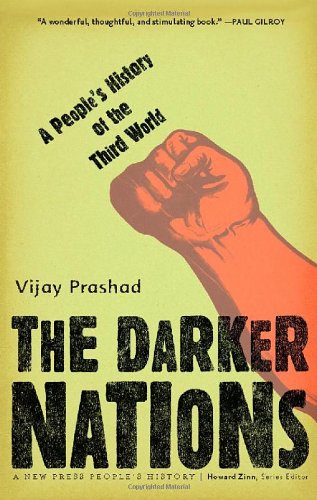
This time I chose as the first text a book that reframes world history from a “bottom-up” perspective. I am using Vijay Prashad’s book, The Darker Nations: A People’s History of the Third World, which presents a view of twentieth century world history that gives voice to the peoples of Asia, Africa, and Latin America.

It turns out that the Prashad book has become extraordinarily timely (I make no claims about whether my students agree or not) in that it describes in historical and theoretical terms the rise of what we used to call “Third World,” or what he calls “The Darker Nation,” beginning with the era of global colonial empire.

It identifies leaders, nations, movements, organizations such as the Non-Aligned Movement (NAM), policies, successes and failures. Although it was published in 2007, it leads the reader to reflect on the burgeoning mass movements today in the Middle East, suggesting pitfalls and possible strengths in terms of global progressive social change.

The rise of the Third World: An historical project

Prashad’s book identifies three periods of the history of the Darker Nations that he identifies in chapters as “Quest,” “Pitfalls,” and “Assassinations.” In each period there are dominant actors — individuals and nations, visions, policies, and patterns of interaction with rich and powerful countries.

The chapter Prashad called “Quest” summarizes the coming together of anti-colonial movements and the successive victories that occurred against the European colonial powers that occupied much of the world’s land mass from the mid-nineteenth century until the end of World War II.

“Quest” begins with an interesting discussion of the meeting of the new League Against Imperialism held in Brussels in 1927. It is there that the Third World project is formulated. It is a project inspired by communists, socialists, and nationalists who abhorred colonialism and sought to build a global movement to overthrow it.

In subsequent chapters Prashad traces the development and institutionalization of the movement, from anti-colonial struggle to independence to the drive to establish a Third World bloc that would stand between western capitalism and Soviet socialism.

The early leaders of this movement were the leaders of independence in their own countries: such figures as Jawaharlal Nehru (India); Ahmed Sukarno (Indonesia); Marshall Tito (Yugoslavia); and Gamal Abdel Nasser (Egypt). These and other leaders, representing countries from Asia, Africa, Latin America, and the Middle East, had diverse political ideologies but all supported political sovereignty and economic development. In general, their vision was a social democratic one.

For a time, given the East/West competition the Third World Project had some influence on debate and policy primarily through the United Nations. The Third World Project advocated for a New International Economic Order (NIEO), designed to regulate and control unbridled global capitalism. As the Socialist bloc deconstructed the advocacy for the NIEO declined.

Prashad discusses a second “stage” of the Third World Project that surfaced in the 1970s and beyond. The movement of Darker Nations becomes compromised by the rise of political elitism, bureaucratization, the demobilization of masses of people, the crushing of left forces, the rise of particular institutions such as the military that challenge grassroots politics, and the failure to bring rural agricultural reforms to the process of modernization.

Perhaps most important to the Prashad narrative is the growing debt crisis, the incorporation of many Darker Nations into the grip of the International Monetary Fund and the World Bank, and the rise of a new generation of post colonial elites who did not share the passion, vision, or experience of their predecessors.

The third part of Prashad’s book, loosely covering the 1980s to the present, he calls “Assassinations.” It describes, through case studies, the continuation of the deformations of the Third World Project described above. The “neoliberal” policy agenda embraced by many leaders reduced the role of states in shaping their own economies, deregulated and downsized public institutions, opened economies to foreign investors, and shifted from production for domestic consumption to export-based economies.

Gaps between rich and poor grew and as a result political institutions, particularly armies and police, became more repressive. However, a few regimes experienced economic growth, the so-called “Asian Tigers” for example. Others, Saudi Arabia being a prime example, supported and fostered on a global basis religious fundamentalism and ethnic hostilities to debase and virtually eliminate the unity embedded in the original vision of the Third World Project.

The project of the Darker Nations today

What we have witnessed over the last 20 days perhaps constitutes what Preshad might regard as a new stage in the development of the Third World Project.

First, the Middle East revolution, if we wish to call it that for shorthand reasons, can be seen as a direct reaction to the profound global economic crisis that has been brought on by neoliberal globalization.

Second, it clearly is motivated by goals similar to those NAM endorsed in the 1950s, that is some kind of New International Economic Order.

Third, the movements seem to be largely secular, perhaps reflecting a rejection of the counterrevolutionary programs of Third World elites who promoted division and reaction to further their own interests.

Fourth, the movements appear to incorporate vast numbers of young people, men and women, workers and small business people, intellectuals and artists, as well as those who identify with their religious traditions.

Fifth, the labor movement and the growing percentages of unemployed and underemployed workers have been playing a passionate and committed role in the struggles. The estimated 40 percent of the world’s population in the so-called “informal sector” have a stake in revolutionary change as do workers in transportation, electronics, construction, and manufacturing.

Sixth, this revolution is a nonviolent revolution. “Revolutionaries” are saying no or enough, and are doing so in such numbers that the institutions of government and the economy can not continue to operate. This culls up memories of the Gandhi struggles against the British empire and the civil rights movement in the U.S. South.

Seventh, this is an electronic revolution. As a result of the computer age time and space as factors confounding communicating and organizing have been eliminated. Cell phones and social networks do not make revolutions but they facilitate the kind of organizing that historically was more tedious and problematic.

And, the new technology insures that revolutionary ferment in one part of the world can be connected to revolutionary ferment elsewhere. In a certain sense, now all youth can be participants, not just observers.

In a recent interview Prashad summarized some of these elements of the ongoing struggles:

The Arab revolt that we now witness is something akin to a “1968” for the Arab World. Sixty per cent of the Arab population is under 30 (70 per cent in Egypt). Their slogans are about dignity and employment. The resource curse brought wealth to a small population of their societies, but little economic development. Social development came to some parts of the Arab world…

The educated lower-middle-class and middle-class youth have not been able to find jobs. The concatenations of humiliations revolts these young people: no job, no respect from an authoritarian state, and then to top it off the general malaise of being a second-class citizen on the world stage…was overwhelming. The chants on the streets are about this combination of dignity, justice, and jobs” (MRZINE Monthly Review.org, February 4, 2011).

Some of the differences from before

Comparing the period of the Third World Project with today suggests some differences and similarities. As Prashad and other historians of the Third World make clear, the rise of the non-aligned movement gained some influence because of the Cold War contest between the Soviet Union and the United States.

Now the world consists of a variety of new powers, some from the original movement (such as India, China, Egypt, and Brazil) whose economic, political, and military capabilities are challenging the traditional power structures of international relations. Also, global capitalism is in profound crisis and the causes of the revolutionary ferment as well as its escalation are intimately connected with the Middle East revolutions.

Today the danger of escalating state violence and repression remains significant. Global capitalism is in crisis. Some third world regimes are still driven by fundamentalisms of one sort or another. And, finally, key decision makers in centers of global power seem committed still to archaic ideologies, for example suggesting that Islamic fundamentalism will take over revolutions, democracy is dangerous, and that the one “democracy” in the Middle East, Israel, will be further threatened by the movements in the region.

In addition, the Egyptian revolution, while exciting and inspirational, suffers from some of the same weaknesses Prashad described at the dawn of the Third World Project. Looking back 50 years, the leaders, and the various participating sectors of the mass movement, had not articulated a systematic and compelling ideology, beyond the programmatic demands of the NIEO.

Several countries in the forefront of the NAM were military regimes. Placards of Nasser were prominently displayed in Liberation Square last week. Nasser was a military leader of the “Free Colonels” movement that overthrew King Farouk in 1952. The same “revolutionary” military created a Hasni Mubarak many years later. While the military in Egypt today may act in ways that curry the favor of the protesters, it must be clear that military institutions are driven by their own interests, not the interests of the people.

So the mass mobilization of the last 20 days that is so exciting, inspiring hope for the world, is fraught with danger. The people now must struggle to articulate, advocate for, and institutionalize a program of humane socialism in every country where they are victorious. The task of progressives in the Global North is to support the new project and to link its causes and visions to the struggles that are experienced everywhere.

[Harry Targ is a professor of political science at Purdue University who lives in West Lafayette, Indiana. He blogs at Diary of a Heartland Radical.]

The Rag Blog

Posted in Rag Bloggers | Tagged , , , , , | 1 Comment

Marc Estrin : Acromegaly

Art from the ACLU.

ACROMEGALY

By Marc Estrin / The Rag Blog / February 15, 2011

Acronyms, I think, bring out the worst in people. For example, the USAPATRIOT act is not an act for American Patriots as it would appear, but rather the U.S.A.P.A.T.R.I.O.T. Act — Uniting and Strengthening America by Providing Appropriate Tools Required to Intercept and
Obstruct Terrorists Act.

Imagine the wordsmithing over that one. Imagine how many taxpayer dollars went into the choice of those acronymic wonders. And the marvellous mendacities therein — “uniting,” “strengthening,” “appropriate,” “required” — all hidden behind the mask. Truly a work of the devil. There are masks that hide, like that one, and masks that reveal. It’s important to distinguish them.

Acromegaly is a disease resulting from a pituitary tumor overproducing growth hormone. In children it produces giants, and in adults, overgrown jaws, thick skulls, and thick skin. You can see an acromegalic giant in action in Kurosawa’s great film, Yojimbo. He wields a mean sledge hammer against his enemies.

Big jaw, thick skull, thick skin. Could this syndrome describe the US approach to the world?

Our president is about to pull a Joshua (10:8-14), to try to stop the sun from setting. During one campaign in an early Operation Cast Lead, while the children of Israel were smiting the Amorites, man, woman, and child, Joshua, in a fit of chutzpah, bade the sun stand still so smiting time might be longer and smiting more complete.

And behold,
the sun stood still,
and the moon stayed,
until the people had avenged themselves upon their enemies.
The sun stood still in the midst of heaven,
and hasted not to go down about a whole day.
And there was no day that like that before it or after it,
that the LORD hearkened unto the voice of a man:
for the LORD fought for Israel.

The 342-page USA PATRIOT ACT — clearly already prepared and lying in wait — was passed by Congress (357-66 in the House, and 98-1 in the Senate), and signed by George W. Bush on October 26, 2001. Many legislators admitted to not having read it through before voting. Most of the bill’s provisions were due to sunset after December 31, 2005, four years after passage, and safely after the 2004 election. But by March 2006 Congress had voted to reauthorize the bill so as not to tie the president’s hands in his Global War on Terror.

Sunset now six years late.

Though having campaigned for greater oversight, the White House is now out-republicaning the Republicans by asking to further delay its sunset until December 2013, giving the new Republican majority, and perhaps a new Republican president plenty of time to authorize permanent status.

The Children of Israel no doubt approve.

And it’s not as if the abuses of the bill have disappeared as GWOT has aged and mellowed.

Rather, the jawbone and skin continue to thicken, and the skull grows ever more dense as we resist and punish those on the side of freedom.

[Marc Estrin is a writer, activist, and cellist, living in Burlington, Vermont. His novels, Insect Dreams, The Half Life of Gregor Samsa, The Education of Arnold Hitler, Golem Song, and The Lamentations of Julius Marantz have won critical acclaim. His memoir, Rehearsing With Gods: Photographs and Essays on the Bread & Puppet Theater (with Ron Simon, photographer) won a 2004 theater book of the year award. He is currently working on a novel about the dead Tchaikovsky.]

The Rag Blog

Posted in Rag Bloggers | Tagged , , , | 2 Comments

Eric Boehlert : Fox Insider Says ‘Stuff Is Just Made Up’

Fox’s Roger Ailes. Image from Scene Magazine

Fox News Insider:
‘Stuff Is Just Made Up’

By Eric Boehlert / Media Matters / February 15, 2011

Asked what most viewers and observers of Fox News would be surprised to learn about the controversial cable channel, a former insider from the world of Rupert Murdoch was quick with a response: “I don’t think people would believe it’s as concocted as it is; that stuff is just made up.”

Indeed, a former Fox News employee who recently agreed to talk with Media Matters confirmed what critics have been saying for years about Murdoch’s cable channel. Namely, that Fox News is run as a purely partisan operation, virtually every news story is actively spun by the staff, its primary goal is to prop up Republicans and knock down Democrats, and that staffers at Fox News routinely operate without the slightest regard for fairness or fact checking.

“It is their M.O. to undermine the administration and to undermine Democrats,” says the source. “They’re a propaganda outfit but they call themselves news.”

And that’s the word from inside Fox News.

Note that the story here isn’t that Fox News leans right. Everyone knows the channel pushes a conservative-friendly version of the news. Everyone who’s been paying attention has known that since the channel’s inception more than a decade ago.

The real story, and the real danger posed by the cable outlet, is that over time Fox News stopped simply leaning to the right and instead became an open and active political player, sort of one-part character assassin and one-part propagandist, depending on which party was in power. And that the operation thrives on fabrications and falsehoods.

“They say one thing and do another. They insist on maintaining this charade, this façade, that they’re balanced or that they’re not right-wing extreme propagandist,” says the source. But it’s all a well-orchestrated lie, according to this former insider. It’s a lie that permeates the entire Fox News culture and one that staffers and producers have to learn quickly in order to survive professionally.

“You have to work there for a while to understand the nods and the winks,” says the source. “And God help you if you don’t because sooner or later you’re going to get burned.”

The source explains:

Like any news channel there’s lot of room for non-news content. The content that wasn’t “news,” they didn’t care what we did with as long as it was amusing or quirky or entertaining; as along as it brought in eyeballs. But anything — anything — that was a news story you had to understand what the spin should be on it.

If it was a big enough story it was explained to you in the morning [editorial] meeting. If it wasn’t explained, it was up to you to know the conservative take on it. There’s a conservative take on every story no matter what it is. So you either get told what it is or you better intuitively know what it is.

What if Fox News staffers aren’t instinctively conservative or don’t have an intuitive feeling for what the spin on a story should be? “My internal compass was to think like an intolerant meathead,” the source explains. “You could never error on the side of not being intolerant enough.”

The source recalls how Fox News changed over time:

When I first got there back in the day, and I don’t know how they indoctrinate people now, but back in the day when they were “training” you, as it were, they would say, “Here’s how we’re different.” They’d say if there is an execution of a condemned man at midnight and there are all the live trucks outside the prison and all the live shots. CNN would go, “Yes, tonight John Jackson, 25 of Mississippi, is going to die by lethal injection for the murder of two girls.” MSNBC would say the same thing.

We would come out and say, “Tonight, John Jackson who kidnapped an innocent two-year-old, raped her, sawed her head off and threw it in the school yard, is going to get the punishment that a jury of his peers thought he should get.” And they say that’s the way we do it here. And you’re going, alright, it’s a bit of an extreme example but it’s something to think about. It’s not unreasonable.

When you first get in they tell you we’re a bit of a counterpart to the screaming left-wing lib media. So automatically you have to buy into the idea that the other media is howling left-wing. Don’t even start arguing that or you won’t even last your first day.

For the first few years it was, let’s take the conservative take on things. And then after a few years it evolved into, well it’s not just the conservative take on things, we’re going to take the Republican take on things which is not necessarily in lock step with the conservative point of view.

And then two, three, five years into that it was, we’re taking the Bush line on things, which was different than the GOP. We were a Stalinesque mouthpiece. It was just what Bush says goes on our channel. And by that point it was just totally dangerous. Hopefully most people understand how dangerous it is for a media outfit to be a straight, unfiltered mouthpiece for an unchecked president.

It’s worth noting that Fox News employees, either current or former, rarely speak to the press, even anonymously. And it’s even rarer for Fox News sources to bad-mouth Murdoch’s channel. That’s partly because of strict non-disclosure agreements that most exiting employees sign and which forbid them from discussing their former employer. But it also stems from a pervasive us-vs-them attitude that permeates Fox News. It’s a siege mentality that network boss Roger Ailes encourages, and one that colors the coverage his team produces.

“It was a kick-ass mentality too,” says the former Fox News insider. “It was relentless and it never went away. If one controversy faded, goddamn it they would find another one. They were in search of these points of friction real or imagined. And most of them were imagined or fabricated. You always have to seem to be under siege. You always have to seem like your values are under attack. The brain trust just knew instinctively which stories to do, like the War on Christmas.”

According to the insider, Ailes is obsessed with presenting a unified Fox News front to the outside world; an obsession that may explain Ailes’ refusal to publicly criticize or even critique his own team regardless of how outlandish their on-air behavior.

“There may be internal squabbles. But what [Ailes] continually preaches is never piss outside the tent,” says the source. “When he gets really crazy is when stuff leaks out the door. He goes mental on that. He can’t stand that. He says in a dynamic enterprise like a network newsroom there’s going to be in-fighting and ego, but he says keep it in the house.”

It’s clear that Fox News has become a misleading, partisan outlet. But here’s what the source stresses: Fox News is designed to mislead its viewers and designed to engage in a purely political enterprise.

In 2010, all sorts of evidence tumbled out to confirm that fact, like the recently leaked emails from inside Fox News, in which a top editor instructed his newsroom staffers (not just the opinion show hosts) to slant the news when reporting on key stories such as climate change and health care reform.

Meanwhile, Media Matters revealed that during the 2009-2010 election cycle, dozens of Fox News personalities endorsed, raised money, or campaigned for Republican candidates or organizations in more than 600 instances. And in terms of free TV airtime, Media Matters calculated the channel essentially donated $55 million worth of airtime last year to Republican presidential hopefuls who also collect Fox News paychecks.

And of course, that’s when Murdoch wasn’t writing $1 million checks in the hopes of electing more Republican politicians.

So, Fox News as a legitimate news outlet? The source laughs at the suggestion, and thinks much of the public, along with the Beltway press corps, has been duped by Murdoch’s marketing campaign over the years. “People assume you need a license to call yourself a news channel. You don’t. So because they call themselves Fox News, people probably give them a pass on a lot of things,” says the source.

The source continues:

I don’t think people understand that it’s an organization that’s built and functions by intimidation and bullying, and its goal is to prop up and support Republicans and the GOP and to knock down Democrats. People tend to think that stuff that’s on TV is real, especially under the guise of news. You’d think that people would wise up, but they don’t.

As for the press, the former Fox News employee gives reporters and pundits low grades for refusing, over the years, to call out Fox News for being the propaganda outlet that it so clearly is. The source suggests there are a variety of reasons for the newsroom timidity.

“They don’t have enough staff or enough balls or don’t have enough money or don’t have enough interest to spend the time it takes to expose Fox News. Or it’s not worth the trouble. If you take on Fox, they’ll kick you in the ass,” says the source.

“I’m sure most [journalists] know that. It’s not worth being Swift Boated for your effort,” a reference to how Fox News traditionally attacks journalists who write, or are perceived to have written, anything negative about the channel.

The former insider admits to being perplexed in late 2009 when the Obama White House called out Murdoch’s operation as not being a legitimate news source, only to have major Beltway media players rush to the aid of Fox News and admonish the White House for daring to criticize the cable channel.

“That blew me away,” says the source, who stresses the White House’s critique of Fox News “happens to be true.”

[Eric Boehlert is the author of Lapdogs: How the Press Rolled Over for Bush (Free Press, 2006) and Bloggers on the Bus: How the Internet Changed Politics and the Press (Free Press, 2009). He was a senior writer for Salon.com and a contributing editor at Rolling Stone. Boehlert is a Senior Fellow at Media Matters for America, where this article was first published.]

The Rag Blog

Posted in RagBlog | Tagged , , , , , , | 9 Comments

Kate Braun : Full Moon on Frigga’s Day

Full moon over Austin. Image from Haggard & Halloo / Matt Schiavenza.

Moon Musings:
Full Moon on Frigga’s Day
(Friday, February 18, 2011)

By Kate Braun / The Rag Blog / February 15, 2011

Friday is Frigga’s day: Frigga who is wife to Odin, Frigga who is a child of Earth, Frigga who personifies the Matron-goddess energy called upon in this moon-phase ritualing. Venus, a watery planet also called “Frigga’s Star,” rules this day and should be prominently featured in your activities along with the color green, the number seven, and the elements Earth and Water.

It is traditional, although not mandatory, to perform Full Moon rituals at midnight. It is not good to run low on energy, and neither is it good to have energy sapped with the effort of digesting a hearty meal — so snack lightly on cheese and crackers or bread, fruits, water, fruit punch, and vegan fare before commencing whatever activities you select to observe this night.

If possible, celebrate outdoors and with bare feet so as to better feel your connection with Earth. If the weather precludes outdoor activities, use a room where there is at least one window through which you can see the Moon. If there is no direct view of the Moon, you may either position a mirror to reflect the Moon into your chosen space or place an image of the Moon on your altar to help you invoke Moon-energy. Notice the color of this Full Moon. Lore tells us that a pale Full Moon indicates rain, while a red Full Moon promises wind.

Center yourself with seven soft and easy yoga-breaths: in through the nose and out through the mouth, filling all the empty spaces in your body with the inhalations and emptying those spaces completely with the exhalations. No huffing or puffing, no hurrying in this activity. Take your time. Be aware of the spaces in the sinus cavities and between the joints of the fingers and toes as well as the filling and emptying of the lungs.

These seven inhalations and exhalations not only center you and connect you to Earth, they also ease you into an Alpha-rhythm that facilitates the meditative state. If you prefer to sit or lie down as you visualize the realization of whatever goals you are setting, please do so. There is no requirement to assume any specific posture.

If you choose to burn incense or play music, these things should be in harmony with your intent. If you choose to chant or sing or speak a mantra, it should be repeated seven times in a measured tone at a measured pace. If you choose to light candles, use white and green candles only.

Invoke the matron goddess of your choice to help you in contacting your Guides, also to show you the path you will be walking until the next New Moon. Place bowls of water at the cardinal compass-points (north, east, south, west) of your ritual area and dip your fingers into them as Spirit moves you, sprinkling the water about and on you and the space around you.

Focus your energies and intent on positive workings within the fields of artistic endeavors, health and fitness, health and healing, self-improvement, change and the decisions change brings, and motivation to achieve the goals you set this night. You may also perform rituals for protection and success in legal undertakings.

When you have finished your activities, hold a moonstone in your mouth as you contemplate the goals you have set and the direction you plan to follow. Then place the moonstone in the pillowcase with the pillow you lay your head upon. Pay attention to your dreams this night. The Lore is that to dream of a clear Moon is an indicator of success, also that your dreams this night will reveal your future.

[Kate Braun’s website is www.tarotbykatebraun.com. She can be reached at kate_braun2000@yahoo.com.]

The Rag Blog

Posted in Rag Bloggers | Tagged , , , , , | 3 Comments

Carl Davidson : Fighting for Green Jobs against Right-Wing Wave

Photo from treehugger.

Blue-Green Alliance:
Organizing the fight for green jobs
in conservative political climate

By Carl Davidson / The Rag Blog / February 14, 2011

‘What brings us together is the commitment to make those jobs green jobs and to make them good jobs.’

WASHINGTON, D.C. — Nearly 2,000 people gathered at the Marriott Wardman Park Hotel over three bitterly cold days in Washington, DC, Feb. 8-10, for the fourth annual Good Job, Green Jobs conference. The attendees were a vibrant mixture of seasoned trade union organizers, representatives of government agencies, and young environmental activists waging a variety of battles around climate change and the green economy.

“We want everyone to work at a green job in a green and clean economy,” declared David Foster, executive director of the sponsor, the Blue-Green Alliance, opening the first plenary. “But what stands in our way?” The answer was a new Congress stalemated by neoliberal resurgence centered in a bloc of the GOP and the far right. “It’s not going to be easy. We’re going to have to fight for it the old-fashioned way, from the bottom up, brick by brick, and floor by floor.”

The Blue-Green Alliance today is a coalition of hundreds of environmental groups, trade unions, and green business enterprises. It was founded less than five years ago, largely by the efforts of Carl Pope of the Sierra Club, one of the largest U.S. environmental nonprofits, and Leo Gerard, international president of the United Steelworkers, one of the country’s largest industrial unions.

“We’ve come a long way,” said USW’s Leo Gerard, the next speaker up. “Today we have dozens of affiliated sponsors and members with a combined membership of 14.5 million. Those fighting harder against us are going to meet some serious resistance.” The participants at the conference represented more than 700 organizations and came from 48 of the 50 states.

Still, attendance was down from the past two years. The solid core of trade unionists and environmental youth were present, but wider allies like the hip-hop community mobilized by Green For All were absent or only had small representation.

Gerard went on to explain the core idea of the alliance. The old notion that one had to chose between job growth and environmental protection was dead wrong. “Rather than ‘either-or’ we’ve come to see that’s it’s ‘both-or-neither.’ We will have both good green jobs in a green and clean economy, or we will have neither. That’s what it boils down to.”

“I also want to raise a new idea,” Gerard continued. “Sustainable development is something we hear a lot. But what about ‘restorative development’? It’s not enough simply to build sustainable new things, we have to repair and recover the damage we’ve done with the old ones. He went on to describe the “Smart Grid,” the need to deliver clean electric power to the same high standards as the internet and telecommunications, retrofitting the old grids in the process. “In the process, we create an abundance of new high-skilled green jobs that pay for themselves by saving energy and cleaning the environment at the same time.”

Labor opposed to austerity solutions

Along with other labor leaders, Gerard spoke several times throughout the conference, often on panels with Obama’s cabinet officials. Even though they greeted each other warmly, there was a noticeable distancing from officialdom on the part of labor. However valuable any proposals made in Congress, the labor officials were astute enough to know that an anti-deficit “austerity” was still the watchword of the period, and any gains would have to be fought for at the grassroots and in the streets.

Gerard symbolized the problem when he introduced Lisa Jackson, head of the Environmental Protection Agency, and part of Obama’s cabinet. Noting that it was her birthday, he presented her not only with a card from the BGA, but also a huge pair of boxing gloves as a gift “for going into the battles ahead of us.”

Jackson’s speech was an effort to turn the tables on the right-wing effort to gut or neuter what they termed “the job killing EPA.” “When people turn of the water to cook their oatmeal or take a shower,” she explained, “they don’t want to worry whether toxic wastes or sewage sludge is going to come out of the faucet. Our regulations enhance markets and create economic benefits, with a $2 savings for every dollar invested.”

Regulations in health and safety, in the end, created far more jobs than they eliminated by creating confidence in products, safety for workers, and stability for markets in clean-up equipment.

“Winning the future also means winning the race for innovation,” explained Jackson.

“The history of environmental protection has been a history of innovation. Innovation made everything we do cleaner, healthier, and more efficient — and led to the creation of good jobs. The catalytic converters that are manufactured to reduce toxic air pollution from our cars, the invention of more effective water treatment mechanisms to free our drinking water of lead, or smokestack scrubbers that are installed to keep sulfuric acid pollution out of the air we breathe mean new orders for American companies and jobs for American workers.”

All the speakers from the administration hammered away on the “win the future” theme from President Obama’s State of the Union speech — likewise with the phrases about “out-innovating” and “out-performing” against all contenders in every critical sector of the economy. But given the relation of forces in Congress and even his own Cabinet, and the slashing of programs that the deficit-cutters had already launched, the participants tended to take it all with a grain of salt.

The EPA’s Lisa Jackson speaks on the first day of the conference. Image from the Sierra Club Compass.

Frustration with resistance at the top

If one key word popped up in nearly every workshop, it was “frustration.” The participants, after all, had been working steadily for nearly four years researching, designing, and organizing for solutions to a range of critical problems — jobs, clean energy, toxic waste, youth entrepreneurship and so on. The first two conferences were full of hope and energy, especially with Obama’s victory and the appointment of Van Jones to head up green jobs. The third year was marked by going deeper into practical solutions, and growing concern about the political climate.

But now, armed with an array of practical programs, the young people especially seemed to conclude that they were banging their heads against a brick wall created by Blue Dogs, neoliberals, and the far right. One option was discussed repeatedly: stop wasting too much time in DC and return to the base. Build organization at the county and state level, and try to win some local victories, even if done piecemeal, and gather more strength.

A case in point was an early workshop on “Building a Movement to Change America: Strategies to Forge Ahead to Create Good, Green Jobs.” It asked participants to step back and assess their alliances, their adversaries, and their tactics. It’s worth examining in some detail to see the overall problems facing the conference.

“We took a beating in the 2010 elections,” said Cathy Duvall of the Sierra Club, opening up the subject. “Our campaign for a comprehensive climate change bill with a cap on carbon got turned around into the ‘job killing energy tax.’ We learned that we simply don’t yet have the power to do what we want to do.”

Duvall’s answer was to go back to localities, and focus on setting standards and regulating markets “in favor of Main Street over Wall Street.” She summed up with three points: 1) the need for industrial policy with high domestic content, 2) the need for broader coalitions with people who don’t always agree, and 3) to mount head-on challenges to the oil-military complexes preventing productive investment. “But most of all, we need new coalitions at the local base.”

Ron Collins, a vice president of the Communications Workers of America, picked up where Duvall left off. “We have to do things differently,” he said, “or we have to turn off the lights.” The “One Nation” rally in October, he continued, was a good start, but not much has happened at the local or state level. “‘We need to be building ‘One Maryland’ or ‘One Virginia’ or ‘One Baltimore.’ We need a deeper unity at the base, or the right is going to take us out, one by one. As for some of our fair-weather friends, we have to say, ‘If you’re not with us on the issues, then we’re not with you,’ and then act on it.”

In this context, the issue of immigrant rights was rising as a difficult wedge issue, and was taken up by Ali Noorani of the Immigration Forum. “People don’t like to move from their home countries lightly,” he said, “but only do so for compelling reasons of survival.” Noorani gave the example of U.S. agribusiness dumping corn in Mexico at prices below its cost of production, thereby bankrupting Mexican farmers and driving them to border town factories. When those factories closed, many had little choice but to move across the border.

“Look at every player in this drama,” he continued. “There is only one beneficiary, the crooked employer. We need to stop pointing fingers in the wrong directions, and start finding solutions. Our method in the past has been to mobilize our base, persuade the middle and isolate the opposition. If we can combine that with a view that the pie can grow bigger, then we can all win.”

Melanie Campbell of the National Coalition on Black Civic Participation closed up the panel. “I think we have to be mad and strategic at the same time,” she declared. She went on to observe some lessons from the Tea Party, noting that while they had considerable differences, they were able to come together to fight. “But what did we do after the ‘One Nation’ rally? Too many of us just went back to our separate silos.”

Need for ‘street heat’ from the bottom up

In the discussion, one participant offered a critical point from the floor: “For our strategy to work, we need some cracks at the top, but with Obama’s ‘bipartisan’ center-right bloc, all the cracks have closed up, at least for now. It seems we need more organized strength from the bottom up, more street heat to break things open again.” “Exactly,” said Collins from CWA. ‘We need to be drawing some lessons from the people in Egypt.”

There was a lot of discussion about the need to build new alliances. This was not just a search for common ground. Rather it was recognition of the necessity for respecting the traditions, the work, and the sacrifice of potential allies in a situation in which conditions, for them, are changing.

A good example is the attitude expressed toward coal and miners. “We have to recognize that without coal miners we would not have the standard of living that we have, the technology that we have, that makes it possible to talk about a sustainable economy with good jobs and a rising quality of life,” said one workshop speaker. “These men and women, the coal miners and their communities, should be our heroes. They are not our enemies.”

There were also warnings to stay away from language that stimulates a fear reaction about what those organizers are trying to win. Examples from coal: solar power and wind that are presented as if they will replace the jobs of miners, with not enough attention given to conversion and re-employment.

Other workshops over the two-day period covered a wide range. Topics included wind manufacturing opportunities, workforce training for solar industries, women in the green economy, sustainable agribusiness, inner city school reform, protecting workers and their families from toxics, high-speed rail, and fighting right-wing science-deniers in elections, among many others.

One Tuesday afternoon workshop, entitled “Building the Wind Energy Supply Chain: Moving from Rhetoric to Reality,” brought together a number of issues — job creation, domestic productive capacity, and industrial policy. Wind energy as a vital part of a clean energy economy was taken as a given. The key question was whether it would lead to new manufacturing and green jobs in the U.S., since the more mature technologies and factories had been developed in Spain, the Netherlands, and China.

Dillep Thatte of the Manufacturing Extension Partnership, a federal agency, was optimistic. “Anything you need for wind energy can be competitively obtained domestically; the problem is simply in making the connections and relationships.” He was particularly strong on smaller businesses with less than 500 workers: “These are the innovators creating new jobs today.”

Rob Witherell of the United Steel Workers was skeptical. “High-speed rail is in the news today; Obama wants to spend some major money on it. But how many plants in the country right now can actually build high-speed train cars? Only a handful. Can we do it? The answer is, ‘Yes, but…’ It will take some time and investment to get domestic firms up and running.”

Helping to form supply chains of small component manufacturers, however, was something the USW could do fairly easily, he added, since the union was connected with some 6,000 firms.

As for the quality of production, Dee Holdy of the Global Wind Network explained how her group’s task was to sort out who could effectively be in or out of global competition. “We take a lot of surveys and analyze a lot of reports, but some of it is done by walking around production facilities to find any duct tape or C-clamps holding equipment together.”

Taking on the neoliberal alliance with the far right

Another workshop narrowed the target on the far right. Entitled “Confronting Science Deniers: Lessons from Minnesota’s Sixth District,” it featured Tarryl Clark, the former assistant majority leader of the Minnesota State Senate. Clark had run and lost against Tea Party firebrand Michele Bachman, who got 52 percent of the vote.

“Michele Bachman was perhaps the only member of Congress to stick up for BP during the Gulf Oil spill crisis,” Clark started off, “but she’s more widely known for calling on people to become ‘armed and dangerous’ against legislators working for Cap and Trade and Climate Change laws.”

She explained that the race became one of the most expensive in the state’s history, with Bachman raising over $13 million, largely from wealthy rightists, while she raised some $5 million in smaller contributions, and from labor unions.

“We did well in televised debates,” Clack continued, “but there was no way we could match her massive direct mail operation, which were filled with falsehoods. They were not above absolutely fabricating information while being very good at playing the victim.” One example of a bold headline from a Tea Party website: “Tarryl Clark… Backed by Foreign Contributors Who Murder Irish-American Korean War Veterans in U.S. Healthcare Facilities!”

Despite the lies and wackiness, Clark explained that, even with her crafted persona of being slightly unhinged, “Bachman is very smart; she knows exactly what she’s doing, and she knows that most of her claims are misleading at best. The truth simply doesn’t matter to her; it’s the results that count.” Clark concluded that the only alternative was to keep organizing and keep fighting, or “otherwise the Darth Vader side wins.”

The final plenary on Wednesday morning focused on green transportation. The session was opened by AFL-CIO vice president Arlene Holt Baker, who noted the prevalence of clean energy manufacturing and high-speed rail in Europe and China, and the need to promote it here:

“What brings us together here,” Baker explained, “is the commitment to make those jobs green jobs and to make them good jobs. Good jobs that provide the wages and benefits needed to sustain families and enable them to buy the products we will be making. Good jobs that can put our economy back in working order. Good jobs that afford workers the opportunity to choose for themselves whether to join a union to have a strong voice on the job for quality American-made products and services.”

Baker went on to give the examples of several new high-design battery plants, including one near New Castle, PA, that had been aided by stimulus money from Obama initiatives. “We are opposed to the idea that the only way out of this crisis is through austerity; we have to invest in the ways to build our way out.”

Baker was followed by Deputy Secretary of Transportation John Porcari. A strong advocate of high-speed rail, he noted that our current transportation system consumes one-third of our oil and produces more than one third of harmful emissions. “Modern high-speed trains can operate at one-third less energy per mile than either planes or trucks. For decades, we have blindly refused to invest in our rail system, and we have to turn this around.”

Conference summary panel: (L-R)Manus, Herwig, Hanley, Rep. Ellison, and Nnamdi. Image from the Sierra Club Compass.

The need for ‘industrial policy’ of a new type

The case for Obama’s current economic policies was presented next by Jared Bernstein, the chief economic advisor to Vice President Joe Biden. “Let me start by declaring that neither five-year planners nor laissez-faire ideologues are going to get us what we want.”

The former, he explained, could never get pricing right, while the latter ignores “externalities” like pollution and waste. No single firm or cluster of firms could rise to the task of basic research, less than 20 percent of which is privately funded. Nor is a major and vital infrastructure project like the “smart grid” even conceivable without a role for government in public-private partnerships.

The conference organizers prepared a summary panel on stage to take off from these final presentations, guided by talk show host Kojo Nnamdi. Panel participants included Rep. Keith Ellison (D-MN), Lawrence Hanley of the Transit Workers Union, Kathy Gerwig of Kaiser-Permanente, and Clark Manus of the American Institute of Architects.

“Good jobs, clean energy, sustainable communities — everyone wants these things,” said Nnamdi, posing a question to the group. “But how do we get there? That’s where we differ, isn’t it?

“Some mean it, and some don’t,” replied Congressman Ellison. “The fact is, we have no urban policy; we have no energy policy. We need a multi-city campaign of town meetings, culminating in a national rally in DC. We need to organize and strengthen the progressive Democratic base, and we need to expand the Progressive Caucus.”

Hanley added that where there’s no will, there’s no money. In mass transit, people are facing massive fare increases along with cutbacks in service and mass layoffs. “Yet we have money for wars and the military,” he noted. “There no way out of this without taking on the War Lobby.

“We are living on our grandparent’s infrastructure,” added Ellison. “The rich got tax cuts while we got school cuts.”

The prospect of hard struggle against a recalcitrant neoliberal-dominated Congress, and key parts of the White House as well, were duly taken as a challenge. For many, it also suggested the shift to more local base-building that was a common theme of many panels and workshops.

The issues that seem best suited for local focus are diverse:

  • Green building codes for new construction;
  • Mass transit investment and lower fares;
  • Local tax credits/deductions for green capital investment for companies, and for individuals (homes, cars, etc.);
  • Local renewable energy goals and requirements;
  • Local vehicle fuel economy standards;
  • Incentives for local/urban agriculture.

In the last round of workshops, there were some hopeful signs for the future. One panel on partnership for technical education and green jobs was presented by Erica Swinney of the Center for Labor and Community Research and focused on the Austin Polytechical Academy, an innovative neighborhood public school on Chicago’s West Side.

Swinney, who serves as the school’s communications director, started with a PBS NewsHour clip on the school’s achievements, bringing together unions and dozens of manufacturing firms to create both a high school and an engine for community economic development.

Another workshop following hers focused on a high school in a low-income West Philadelphia neighborhood with a unique after-school program. They design and build hybrid gas-electric “X-Cars” that can get over 150 miles per gallon, and have won in design fairs over teams from MIT and industry groups.

Students from both schools stressed a common theme: “We are problem solvers, not test takers.”They voiced their opposition to a one-sided and undue emphasis on standardized testing, rather than more creative approaches to education needed for a clean-energy and green-economy future.

The final day, February 10, was “Advocacy Day,” where attendees headed for Capitol Hill. David Foster estimated that there were more people participating in this event than last year. Several delegations were very large, mainly from the Steelworkers, Teamsters, and Electrical Workers. They flooded the House and Senate Office Buildings for meetings with congrespeople and senatorial staffs.

“Large groups of workers roaming the halls of Congress were an inspiring sight,” said Ted Pearson, a national committee member of the Committees of Correspondence for Democracy and Socialism from Chicago, who was attending the conference.

“Union members and other activists from Illinois, for instance, met with 5th CD Representative Mike Quigley and his legislative aide, who pledged support for all the Blue-Green target issues. Other meetings were held with staff for Jerry Costello (D-12th CD, Southeastern Illinois), and Chicago’s Bobby Rush and Danny Davis.”

Whether it will all amount to a winning campaign for a new clean energy and green manufacturing industrial policy to replace the old oil-military-industrial policy remains to be seen. But the ongoing work of the Blue Green Alliance and its annual conferences have helped to draw clear and informed lines of demarcation in the battlefield.

[Carl Davidson is a USW (United Steelworkers) associate member now living in Aliquippa, Pa. He is a national board member of the Solidarity Economy Network and a National Co-Chair of the Committees of Correspondence for Democracy and Socialism, and was a leader in the 60’s New Left. Together with Jerry Harris, a former Chicago steelworker, he is author of CyberRadicalism: A New Left for a Global Age and editor of Solidarity Economy: Building Alternatives for People and Planet. Carl also writes and lectures on the topic of the Mondragon Cooperatives, a network of 120 worker-owned factories centered in Spain, and writes for The Rag Blog and the Beaver County Blue, where this article was also posted.]

The Rag Blog

Posted in Rag Bloggers | Tagged , , , , , | Leave a comment

Zaid Jilani : Arab Countries Where the ‘Jasmine Revolution’ Could Spread

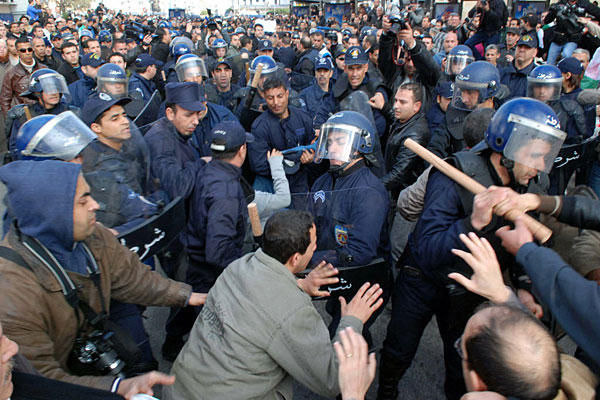
Algerian riot Police scuffle with protesters in Algiers, Algeria, Saturday. Thousands defied a government ban on demonstrations,but were outnumbered by police. Photo by Sidali Djarboub / AP.

Who’s next?
The ‘Jasmine Revolution’ and the Arab world

By Zaid Jilani / ThinkProgress / February 14, 2011

Last month, the world was shocked as the Tunisian autocrat Zine el-Abidine Ben Ali, who had ruled his country for 23 years, was overthrown in a protest movement that lasted only 29 days. The event was soon dubbed the “Jasmine Revolution,” a symbolic reference to a blooming flower.

While many doubted that this revolution would spread, it was only days later that massive protests rocked Cairo, resulting in the resignation of Egyptian President Hosni Mubarak, who had been in power for more than 30 years. While the fate of both countries is still unresolved, one thing is clear: the people are demanding democracy, and they have forced massive changes in their government to get it.

Now, many are wondering if this pro-democracy movement that swept Tunisia and Egypt will spread throughout the rest of the Arab world. ThinkProgress has assembled a short list of other autocratic regimes in the region that are facing protests, particularly today, and which may soon be the next to go in the Middle East’s next “Jasmine Revolution”:

  • ALGERIA: Algeria has been in the iron grip of a military government since 1991, when the regime canceled elections after an Islamist party won the first round. This set off a bloody civil war in the country, which peaked in violence between 1993 and 1997. In recent days, Algerians, inspired by their Tunisian and Egyptian neighbors, have organized large protest marches demanding democratic reforms.

    On Saturday, Feb. 12, despite officials outlawing the protest, nearly 10,000 people marched in Algiers anyway, facing off with three times as many riot police. Perhaps fearing that they will be the targets of the next revolution, Algerian officials recently announced that they will be lifting the country’s own emergency law — which has been in place for decades — in the “very near future.”

  • BAHRAIN: Bahrain’s Sunni leader, King Hamad bin Isa al-Khalifa, has long oppressed his country’s Shi’a-majority population. Last August, his ruling party arrested hundreds of Shi’a activists and shut down the main opposition party’s websites right before the parliamentary election, fearing that it may lose its grip on power.

    Yet recent events in the Middle East have the king fearing for his rule, too. He has ordered “a hike in food subsidies and reinstated welfare support for low-income families to compensate for inflation,” and was to deliver a speech Sunday where he was expected to offer further concessions. Additionally, Bahrain’s government announced that it will be giving $2,650 to each Bahraini family. Yet pro-democracy activists planned to march Monday anyway, demanding real reforms in the country.

  • JORDAN: Likely also fearing a Tunisian-style revolution, Jordan’s King Abdullah sacked his government and appointed a new Prime Minister at the beginning of this month. Yet some of the largest protests in modern history have rocked the nation in recent weeks, indicating that Jordanians do not see the concessions as enough. In perhaps a sign of the regime’s weakness, President Obama dispatched Adm. Mike Mullen, the head of Joint Chiefs of Staff, to meet with Abdullah this weekend.
  • SYRIA: Earlier this month, protesters planned a “day of rage” where they would protest their grievances against the unelected president Basher al-Assad. While the protesters ended up being few in number, the regime did deploy its security services in increased numbers across the country, visibly fearful of a protest movement like the ones in Egypt and Tunisia. The government also lifted a five-year ban on Facebook, in a move widely seen as appeasing a nascent protest movement.
  • YEMEN: The president of Yemen, “one of America’s foremost allies” in the region, promised to step down in 2013, as his people began to demonstrate against the ruling elite. Saturday, thousands of pro-regime demonstrators attacked anti-government demonstrators with clubs and knives, an eerie parallel to an Egyptian tactic that failed to quell protests and destroyed the regime’s public reputation and international support.

An American abroad in Yemen captured the protests there, where Yemenis spontaneously erupted in protest and began marching to the country’s own iconic capital square — which is actually named Tahrir, just like Egypt’s. Watch it:

This list is far from comprehensive, as movements are being organized in a number of other countries such as Saudi Arabia and Oman. Whether these movements will ultimately be successful is unknown, but they symbolize a growing grassroots call for democracy that has been virtually unseen in the region. Given that the United States is a sponsor of many of the intelligence and military apparatuses of these countries and a close ally to their governments, we have not just an opportunity but a responsibility to work with the people towards a more democratic future.

  • Update: Algeria has moved to restrict access to Facebook and Twitter in order to stop protests

[Zaid Jilani is a reporter for ThinkProgres and The Progress Report at the Center for American Progress Action Fund. He is a co-founder of Stand Up Magazine, a co-editor at the Georgia-based blog Georgia Liberal and on staff at BasedonBooks, the first website ever dedicated to movie reviews of book adaptations. This article was originall posted at ThinkProgress and was distributed by Truthout.]

ITN News has coverage of the protests in Algeria and Yemen:

The Rag Blog

Posted in RagBlog | Tagged , , , , , | Leave a comment

Ted McLaughlin : Post-Racial America? Yeah, Right.

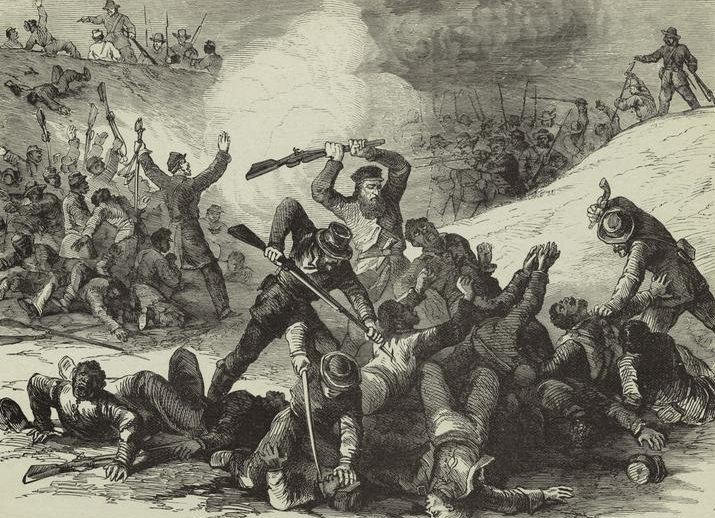
Confederate massacre of black Union troops after the surrender at Fort Pillow, April 12, 1864 — under the command by Confederate Lt. Gen. Nathan Bedford Forrest. Image from Wikimedia Commons.

Post-racial America?
Some would honor Confederate
Gen. Nathan Bedford Forrest

By Ted McLaughlin / The Rag Blog / February 14, 2011

A couple of years ago some people were saying that America had entered its post-racial phase. The ides was that because the United States had elected an African-American as its president, surely we were beginning to get past the terrible racism that has plagued this country since its founding (when slaves were only considered 3/5 of a person).

And that endemic racism has been very hard to get rid of. It took a Civil War costing the lives of many thousands of Americans to end slavery. But even after slavery was abolished and the Fourteenth Amendment was passed, racism did not go away. It just changed forms and assumed the guise of segregation, the KKK, and other forms of Jim Crow-ism. It then took another 100 years to outlaw those forms of racism.

After the civil rights battles of the 1950s and 1960s, racism did not disappear but it did go underground: it was not quite as upfront and in-your-face as it had been in the past. Even in the South it was starting to be considered gauche to be overtly racist in public. The war against racism had not been won, but many battles were beginning to be won.

Then we progressed enough to elect Barack Obama as president. But don’t think this meant the country was post-racial — far from it. If anything, having an African-American president seemed to give the racists permission to crawl back out from under the rocks where they had been hiding, and once again make their odious views public.

Once again racism became a public menace — a menace that could now be disguised as conservative politics (which must make conservative thinkers like William F. Buckley turn over in their graves).

Politicians have been favoring the rich over everyone else since the Reagan administration, and this has resulted in a very unfair America — and in George W. Bush’s final term it culminated in the current recession. But those were white presidents, and while there was some complaining, poor, working class, and middle class whites generally went along with what was happening.

But when Obama was elected that all changed. Now we had the teabaggers complaining loudly about socialism and big government takeovers — even though the president and his policies were actually center-right on the political scale (and rather embarrassing to real progressives). Even the great socialist evil health care reform was only a slight reform and, in fact, a strengthening of the prevailing capitalist system — and most of the reforms had been proposed by Republicans in the past.

Obama’s great sin is not in being a socialist or even a liberal — he’s neither. It is the color of his skin. The teabaggers just can’t stand having an African-American president (just look at their signs when they rally) and their political views are a thinly-veiled excuse for their racism. The “birthers” are even more obvious about their racism. They never worried about a birth certificate when whites were president (or even when McCain ran for president, and he was actually born in a foreign country).

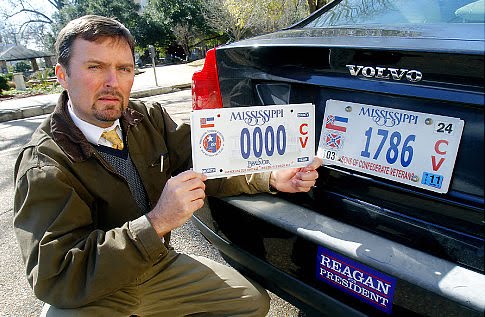
Greg Stewart of the Mississippi chapter of the Sons of Confederate Veterans displays mississippi license plate commemorating the 150th anniversary of the Civil War. They’re considering another to honor Confederate general and KKK pioneer Lt. Gen. Nathan Bedford Forrest. Photo by Solis / AP.

And its worse than just the teabaggers or the birthers. The KKK and white-only militias are seeing growth once again, after a couple of decades of declining membership. And even some state leaders are again starting to celebrate white privilege. Some states are celebrating the 150 anniversary of the formation of the Confederacy (an act of treachery by 13 Southern states). And in Mississippi, the state is considering a license plate that would honor the racist hero Nathan Bedford Forrest.

I’m sure those wanting to honor the Confederate general with a license plate will say it is just a celebration of “Southern heritage.” That’s nonsense. It’s nothing less than a celebration of racism. And a cursory glance at the life of Forrest will confirm that. During the Civil War, at Fort Pillow, he massacred hundreds of African-American troops — after they had thrown down their weapons and surrendered! After the war, he was very active in the KKK. Although he did not found the organization, he did centralize the disparate KKK groups under one banner and gave them a recognizable leader after being chosen Grand Wizard.

Honoring Nathan Bedford Forrest isn’t a celebration of Southern heritage — it’s a slap in the face not only to minorities, but to all decent Americans. And it’s just one more example of racism in America.

The election of Barack Obama to be president did not mean America was post-racial. It just showed how racist the country still is. We still have a long way to go before we live up to the dream of equality written in our Constitution.

[Rag Blog contributor Ted McLaughlin also posts at jobsanger.]

The Rag Blog

Posted in Rag Bloggers | Tagged , , , , , , | 4 Comments

Rick Ayers : ‘Terrible Beauty’ Is Born in Tahrir Square

A terrible beauty. Photo by Tara Todras-Whitehill / AP.

Tahrir Square:
A terrible beauty is born

By Rick Ayers
/ The Rag Blog / February 13, 2011

All changed, changed utterly:
A terrible beauty is born.

William Butler Yeats penned those lines after the Irish Easter uprising of 1916. And how haunting and true they remain. Watch the explosions of joy at Tahrir Square and across the Middle East. The people of Egypt have changed much more than the experts grasp in their cramped little calculations of power and containment can even imagine.

They have shattered the myths of powerlessness, the notion that a regime built on repression and violence is impregnable. For a generation, in the Middle East and around the world, the smothering blanket of cynicism, hung over demonstrations, mobilizations, and activism.

But the people of Tunisia and Egypt have shattered that picture. They have reinvented once again, as every generation must, the innovative dance that is a mass movement. Gone — or at least for a long time — is the idea that the people cannot make history.

And the Egyptian people have changed so much more. For example:

The Israeli authorities like to claim that they are the only democracy in the Middle East. Sadly, though, they seem to balk whenever democratic efforts are attempted. The Egyptians have shattered the myth that Arabs have no interest in, or understanding of democracy.

Hillary Clinton, in a U.S. effort to slow down the struggle, has recently discovered that Egypt has a constitution and decided it must be followed. This had not been a problem to the U.S. for all these years that martial law was imposed. Giving the dictatorship $1.5 billion per year, mainly for military hardware, has been a burden on the people that they won’t soon forget.

Other authoritarian regimes, from Saudi Arabia and Libya to China and Burma, must be wondering when and if the same fate awaits them. And people are stirring in all these places.

Many of us recognize that the U.S. empire, that costly and violent hegemony that each administration seeks to preserve, is slowly crumbling. The Egyptians remind us that this is not something to fear. It can also be something joyful, creative, and hopeful.

Watching Tahrir Square, I’m sure many in the U.S. begin to imagine how much more lovely it would be to live in a world with greater equity in the distribution of resources, with a real participatory democracy, and with the possibility of deep human solidarity.

Many dangers lie ahead. But the genie is out of the bottle and cannot be stuffed back in. It is indeed true: a terrible beauty is born.

[Rick Ayers was co-founder of and lead teacher at the Communication Arts and Sciences small school at Berkeley High School, and is currently Adjunct Professor in Teacher Education at the University of San Francisco. He is author, with his brother William Ayers, of Teaching the Taboo: Courage and Imagination in the Classroom, published by Teachers College Press. He can be reached at rayers@berkeley.edu.This article was also posted at The Huffington Post.]

The Rag Blog

Posted in Rag Bloggers | Tagged , , , | Leave a comment

Karen Lee Wald : Posada Carriles and the Puppies That Got Away

Caricature of Luis Posada Carriles from Progreso Weekly.

Posada Carriles and Cubana 455:
The puppies that got away

By Karen Lee Wald/ The Rag Blog / February 11, 2011

See “The Posada trial takes a historic turn,” by Peter Kornbluh, Below.

Flying through the night on the way back to California from two months of research and interviews in Cuba, I’d dozed off when the voice of the pilot over the intercom woke me up. I almost fell back asleep as he told us our altitude. But when he added that the lights we could see below were the city of El Paso, Texas, I sat bolt upright, a shiver running up my spine.

Somewhere below me was the man who’d escaped from a Venezuelan prison while being tried for masterminding the world’s first mid-flight bombing of a passenger airline — Cubana 455 — killing all 73 aboard.

Years later, that same man boasted to a New York Times reporter that he was behind the string of hotel and restaurant bombings that shook Cuba in 1997 — leaving vast material damage, a number of hotel workers and guests injured or badly shaken, and one Italian hotel guest dead.

But Luis Posada Carriles isn’t facing trial in El Paso for any of those crimes.

He’s been charged only with lying to immigration authorities when he reentered the U.S. secretly in 2005; then he blew his cover by holding a press conference and announcing he wanted political asylum.

All the phases of this Castro-hating, CIA-trained terrorist came rushing back to me as the pilot informed us that we were flying over the city where this man is free to walk the streets until a jury decides whether he should be punished for failing to tell the truth about his exploits. It hit me with special force, because I had just come from interviewing one of his near-victims. This is what she told me:

“Elena, Elena, that man left a bag there!” exclaimed Alex, a 12-year-old boy who was waiting with his two sisters and their tour guide in the lobby of the Triton Hotel in Havana for their father to return from the airlines ticketing office. Moments before, across from them on the lobby couches, an olive-skinned man wearing shorts and a baseball cap had been shuffling through photographs he had removed from his backpack, glancing from time to time at his watch.

Thirty-year old Elena, a divorced mother of a six-year-old girl, loved her work showing visitors from the world the natural beauty of her homeland. Among her recent clients was a Latin American family that had won her heart; three children were left motherless the year before by the ravages of cancer. In the hope that a change of scenery would lift their spirits, their father brought the children to Cuba in September 1997, the first anniversary of their mother’s death.

Elena initially did not respond to Alex’s agitation — she had seen nothing unusual — and his sisters, Sandra and Xochi, laughed and teased him, “There’s nothing there; you’ve been watching too many horror movies!”

But Alex refused to be put off and shouted, “Yes, there is. I saw him put it there. He took a bag out of his backpack and put it behind the couch.”

Finally, to appease him, Elena went over to the couch where the man had been sitting, with the two girls scurrying after her. Finding nothing on the couch, they looked behind it. There they spotted a white plastic shopping bag hidden among the planter shrubs. As Sandra reached for it Elena apprehensively pushed her away.

“I don’t know why I did that. I wasn’t thinking of a bomb,” she recalls years later, the first time she has spoken to the press about that fateful day. “If I thought anything, it was that maybe someone had left something gross, like a headless chicken. Some people in Cuba still practice ‘brujeria,’ and someone could have left something to bless or curse someone in the hotel.”

But when she hurried over to tell the hotel doorman about the bag, he shouted for her to get the children out of there. Just as Elena pushed the children up against a wall and spread her arms to protect them, the bomb exploded.

“There was a tremendous roar, a gust — like nothing I’d ever experienced. People were running around, shouting and crying,” Elena recalls. “We threw ourselves down on the floor. The children were screaming, calling for their father. Alex kept repeating, ‘I told you! I told you!'”

They only found out later that moments earlier two similar time bombs had detonated in other nearby Havana hotels; one was at the Chateau Miramar, the other at the Copacabana where an Italian, Fabio Di Celmo, was killed by flying glass. Elena and the children were lucky: because of the bomb’s positioning the blast force was directed outward towards the windows instead of inwards; otherwise Elena and the children likely would have been badly maimed or killed.

According to the testimony of several captured terrorists and declassified CIA and FBI files, the mastermind behind these and other attacks was CIA operative, Luis Posada Carriles, who emigrated to Venezuela as a passionate anti-Castro militant, perhaps with his long-time co-conspirator Orlando Bosch, head of the Miami-based counterrevolutionary group “CORU.”

Their most horrendous terror attack done together was the two time bombs that exploded aboard Cubana Flight 455 in October 1976, killing all 73 on board: the pilots and flight attendants; five members of a cultural delegation from the Democratic Peoples Republic of Korea; Guyanese teenagers flying to Cuba to begin medical school; and Cuban teens and young adults who had just won gold medals at a fencing competition in Caracas, Venezuela.

After the bomb exploded and the plane crashed into the sea, one of the two men hired by Posada placed a chilling phone call to Posada’s co-conspirator, Orlando Bosch, with the coded message: ”A bus with 73 dogs went off a cliff and all were killed…”

Both had the silent backing of then-president of Venezuela, Carlos Andres Prestes, and the complicity of U.S. government agencies that knew the group was planning to “take out a plane” but said nothing to warn the Cuban government.

CIA documents released in 2005 indicate that the agency “had concrete advance intelligence,” as early as June 1976, on plans by Cuban exile terrorist groups to bomb a Cubana airliner.

Two of Posada’s employees in his private “security” agency in Caracas — Freddy Lugo and Ricardo Hernan — were arrested in Trinidad-Tobago immediately after the bombing, and implicated Posada and Bosch. They were later convicted and served sentences in Venezuela.

Although Posada and Bosch were arrested and held in prison through several mock “trials,” they were never brought to justice. After numerous threats to prosecutors and the attempted murder of one judge which left his son and chauffeur dead, most judges were afraid to convict them. Venezuela’s president at that time, Carlos Andres Prestes, assured the two ringleaders he would intercede on their behalf, and Bosch was eventually released.

Posada — perhaps because he didn’t believe President Prestes would keep his word in freeing him, or because he tired of waiting in jail — escaped from prison mid-trial. Accounts differ, but either the CIA or the Cuban American National Foundation [CANF] in Miami financed his flight out of the country, and Posada soon appeared at a U..S military base in El Salvador as “Ramon Medina,” where he became part of Oliver North’s “drugs for guns” network supplying the Nicaraguan Contras and Central American death squads.

Having gotten away with history’s first mass murder aboard an airliner, both Posada and Bosch were eager for more actions designed to oust or kill their arch enemy, Fidel Castro. Posada was convicted in 2000 of a plot in Panama to blow up a university auditorium where the Cuban president was scheduled to speak. But in 2005, he and four others convicted in the plot were pardoned and released by outgoing President Mireya Moscoso.

Posada remained in hiding for several years, but eventually rumors that he’d secretly returned to Miami proved to be true. At a press conference he announced he wanted to seek political asylum, despite laws barring emigrating criminals from receiving it.

After his press conference, Bush’s immigration authorities were forced to arrest him for illegal entry. Venezuela, which had an outstanding warrant for Posada, asked the U.S. to honor its decades-old extradition treaty. However, a U.S. immigration judge ruled that while Posada should be deported, he could not be sent to either Cuba or Venezuela because he might be subjected to torture.

In 2007, Congressman Bill Delahunt and Jose Pertierra, an immigration lawyer representing the government of Venezuela, argued the hypocrisy of the U.S. policy of extraordinary rendition of suspected terrorists to Syria and Egypt, both of which practice torture.

In an interview with a New York Times reporter in 1998, Posada, boasting that he had planned and financed the bombings of tourist spots in Cuba, qualified his comments by explaining that the bombs were intended only to “break windows and cause minor damage.” When asked about the Italian businessman who’d been killed in the Copacabana, he said that “the poor Italian” had been “in the wrong place at the wrong time.” He added, “I don’t lose any sleep over it. I sleep like a baby.”

Not so for the three children and the tour guide who happened to be in the hotel lobby on September 4, 1997

Elena, recounts that after the explosion she and the still screaming children hid under a table in the hotel lobby. “I kept trying to get the kids to be quiet, because I was afraid that the bomber would come back and kill us. Because we’d seen him. We’d seen who put the bomb there.” Terrified, eventually they were urged by security men to come out from under the table,

Later, she and the children were taken to a room for questioning. She gave a general description of the man they’d seen, but says, “Alex did much better. He’d been staring at the young man, and was able to describe him in detail. He even noticed the kind of watch he was wearing and the insignia on the cap.” Elena was driven to the airport to see if she could recognize the terrorist attempting to flee the country, but she didn’t spot him.

Later that night, the terrorist, eventually identified as Raul Ernesto Cruz Leon, placed another bomb at the popular Bodeguita del Medio restaurant. There, as in other places Cruz Leon had left his timed explosives, people were able to describe someone who looked like Cruz Leon among people in the crowd before the bomb went off. But Elena and the children were the only ones to actually see him place a bomb, which is why, Elena explains,

…we’ve kept so quiet about it all these years, and have never given anyone the names of the children. Their father said they would cooperate with the police in any way they could, but he asked for complete discretion so his children wouldn’t be in danger. He said, “In your country (Cuba), the government will protect you, but in our country terrorists have free reign and I don’t want any of them to know my children were involved here. I don’t know how I could protect them.”

Elena admits that for a long time she was nervous, afraid other killers would come after her. She had trouble sleeping, waking from fearful nightmares.

Over time the memories faded, and after the trial in which the Salvadorian bombers — who testified that Posada paid them to place the bombs — were convicted and sentenced, she felt a sense of relief.

But now a series of events has awakened memories and fears from that fateful day: the appeal of the captured bombers was recently heard by Cuba’s highest court, where their death penalties were commuted to 30-year sentences. And the trial of Luis Posada Carriles in El Paso, Texas, is in the news every day.

While many believe that Luis Posada Carriles should be convicted for murder and terrorism, instead the 82-year-old is currently facing only charges federal perjury, obstruction, and immigration fraud — not crimes that are likely to put him away for life. And despite abundant evidence about how he really entered the country, Posada has pleaded not guilty, claiming to have slipped into the U.S. across the Mexican border into Texas.

Prosecutors insist that he arrived in Miami using a forged passport on the boat of a “benefactor” — a Miami tycoon named Santiago Alvarez. The key witness in the trial against Posada was also the FBI informant who forced Alvarez and another of his violent anti-Castro cohorts to take a plea deal for possession of a veritable arsenal of guns and explosives. But that information has been kept from the jury by a judge who bends over backwards to rule out any testimony that might be “prejudicial” to the terrorist standing trial for lying.

In an about-face from his boastful claims to the New York Times, Posada is now also distancing himself from the hotel bombings in Cuba. He knows that his bragging is what is most likely to undermine his claim to the U.S. as a safe haven. He now claims his English is poor and he was “misunderstood” in that interview.

But U.S. prosecutors have filed numerous FBI documents showing Posada hired two men to plant the hotel bombs as part of his strategy to disrupt tourism in communist Cuba. In a major breakthrough, one of his intermediaries, Francisco Chavez Abarca, was recently captured in Venezuela and extradited to Cuba, where he testified against his boss.

In an unusual cooperative effort, the Cuban government is sending two policemen and the forensic experts who performed the autopsy on the murdered Italian to testify at the Texas trial, along with reams of other evidence against Posada. Likely to antagonize Florida’s powerful Cuban-Americans, the trial also highlights the lax treatment Posada has received compared to others coordinating international terrorist acts.

When asked how she feels about the Posada trial and the commuted death sentences of the bombers, Elena said,

If that bomb blast had gone in the other direction, we wouldn’t be here to talk about it. You’d have had three dead children and a motherless six-year-old [her daughter]… But I blame Posada more than Cruz Leon. He was a victim, too. He was dirt poor, and he saw it as a way to survive, to get out of poverty. Posada was the mastermind. He says he sleeps like a baby. To me, that means he’s a man with no conscience. It just doesn’t matter to him that we could have all been killed.

“A bus with 73 dogs went off a cliff and all got killed.”

Recalling the phoned-in code for the 73 Cubana Airline passengers and crew killed in 1976, she pauses, then adds, “What would his code have been then? ‘Three puppies and a bitch fell off a balcony’?

“If there is any justice in the world, he should pay for what he’s done.”

[Karen Lee Wald is a writer and researcher who has been reporting on Latin America for many decades.]

Luis Posada Carriles leaves court with his lawyers in El Paso last month. Photo by Gonzalez / Reuters.

The Posada trial takes a historic turn

By Peter Kornbluh / The Nation / February 9, 2011

EL PASO — In El Paso, Texas, the perjury trial of the infamous violent Cuban exile Luis Posada Carriles took a historic turn today. For the first time in a long dramatic history dominated by hostility and aggression, U.S. government prosecutors formally presented evidence of terrorism committed against Cuba in a court of law — against one of its own former CIA operatives.

Even more extraordinary, the evidence comes in the form of a Cuban Ministry of Interior investigator explaining photographs and police reports to the jury relating to a series of explosions in Havana hotels, including the Hotel Copacabana which killed a young Italian businessman Fabio Di Celmo on September 4, 1997.

“Cuba Cooperating in U.S. case against ex-CIA agent,” reads tomorrow’s news headlines.

The godfather of anti-Castro Cuban violence over the last four decades, Posada is being prosecuted for immigration fraud relating to how he illegally entered the United States in March 2005. But the Obama Justice Department added three counts of perjury relating to a far more important crime: Posada’s role in a series of seven bombings that rocked Havana hotels and other tourist sites between April and September 1997.

“The defendant is alleged to have lied about his involvement in planning the bombings in Havana,” state court filings by the Justice Department’s Counterterrorism Division. “The United States intends to prove that the bombings in Cuba actually occurred.”

This week marks the first time that concrete evidence is being presented to the jury on how those bombings took place and the damage they wrought. The jury has been shown photographs taken by Cuban authorities of the bloodstained floor of the hotel. Portions of a Cuban investigative study, known as the “Volcan report,” which discusses the cause of, and circumstances surrounding, Fabio Di Celmo’s death, are due to be introduced as evidence during the testimony of Major Roberto Hernandez Caballero — he was Cuba’s lead detective on the hotel bombing investigation — who took the stand today.

The importance of this moment in US-Cuban relations cannot be overstated. Posada was originally trained in demolitions by the U.S. military and put on the CIA payroll in 1965 to train and supervise other exile groups in sabotage, explosives, and violent operations.

Declassified CIA and FBI intelligence reports, posted on the website of the National Security Archive, identify him as a mastermind of a mid-air bombing of a Cuban jetliner that took the lives of all 73 men, women and children on board in October 1976.

Most recently, Posada was arrested in Panama with a carload of C-4 and dynamite in what he admitted to U.S. officials was a plot to assassinate Fidel Castro at the Ibero-American summit in November 2000. By prosecuting him on charges related to his acts of terrorism, even if they are only perjury charges, the United States is effectively repudiating a dark past that its own Cold War officials and covert operatives set in motion.

For Cuba, where Posada is public enemy number one, having its day in court is also a turning point in a longstanding effort to collaborate with U.S. officials to put Posada behind bars. Cuban authorities have been forced to set aside their understandable suspicion that the trial is all for show, not for justice

(After all, how can the United States, which purports to be the leader in the campaign to fight international terrorism, prosecute one of the world’s most infamous terrorists only on perjury charges?)

Since Posada popped up in Miami some six years ago, Cuban authorities have repeatedly welcomed teams of FBI investigators and Justice Department lawyers to Havana. They turned over almost 1,500 pages of investigative records for use in the trial and made Posada’s accomplices, now in prison in Cuba, available for interrogation.

And they have sent three witnesses to El Paso — another police investigator and a forensic doctor to present the autopsy of the murdered Italian to the jury — who have been waiting for over a week to testify.

If this unprecedented level of Cuban judicial support helps convict the 82-year old Posada and he spends the rest of his natural life behind bars, the United States and Cuba will have arrived at a new level of cooperation and collaboration on fighting terrorism.

More importantly, together Washington and Havana will have turned a page on the dark history of US-sponsored violence against the Cuban revolution and Washington can begin what President Obama refers to as “a new chapter” in U.S. relations with Cuba.

The Rag Blog

Posted in Rag Bloggers | Tagged , , , , | 3 Comments

Paul Krassner : I Was a Facebook Junkie

Prison break? Paul Krassner’s Facebook profile pic.

Cold turkey:
I was a Facebook junkie

By Paul Krassner / The Rag Blog / February 10, 2011

I posted this farewell message on Facebook last night, and then I went cold turkey. Look, Ma, no rehab…

I had no friends in high school and college, and now I have 5,000+ Facebook friends. Maybe 25 of them are actual friends, so I assume that the rest of you liked my work. And the irony is that I’m quitting Facebook because it’s become a distraction from my work — what Ken Kesey would’ve called my “current obsession” — writing my first novel, about a contemporary Lenny Bruce-type performer.

I’ve truly appreciated your feedback, wit, imagination, insight, information, argument, and compassion. Incidentally, my decision was made before my Facebook identity was hacked (through my own clueless moment) and you all were spammed as a result. I apologize for that. Although I’m a professional prankster, this wasn’t my prank, or it would’ve had a purpose beyond electronic vandalism.

Recently, when I self-published an expanded edition of my autobiography, which is not available in bookstores, I felt that sharing and spreading an announcement of a link to its existence on my website was simultaneously self-serving and other-serving; ideally, two sides of the same coin. I repeated it at different times of the day for a week because I wanted to reach as many people as possible.

Facebook has enabled communication to span the spectrum from the trivial (what someone vomited for breakfast) to the profound (an organizing tool for the revolution in Egypt), and I have conflicting emotions about leaving. I realize that this isn’t exactly like Dave Chappelle leaving behind his successful Chappelle’s Show and a $50-million development deal, but I do hope that you understand my priorities.

[For years, Paul Krassner edited The Realist, America’s premier satirical rag. He was also a founder of the Yippies. Find Paul’s autobiography, Confessions of a Raving Unconfined Nut: Misadventures in the Counterculture at paulkrassner.com.]

The Rag Blog

Posted in Rag Bloggers | Tagged , , , | Leave a comment

James McEnteer : Our Chickens Will Come Home to Roost

Roosting chicken from Yesteryear’s News

Whose side are we on?
Our chickens come home to roost

The U.S. styles itself a beacon of liberty but has turned its back on the democratic aspirations of human beings in every region of this planet.

By James McEnteer / The Rag Blog / February 10, 2011

The current crisis in Egypt has represented a profound dilemma for the United States, as Brookings Fellow Shadi Hamid, notes in The Atlantic. For 30 years, the U.S. has been the largest supporter of the Mubarak dictatorship. The United States has struck that same devil’s bargain repeatedly all over the world, supporting regimes which abuse the human rights of their own citizens, but which offer regional “stability.” We pay governments to support American political and economic interests over and against the popular will of their own people.

We supported Saddam Hussein for many years, until he crossed us. We support the murderous Colombian government because they protect Chiquita Brands and Coca Cola and Occidental Petroleum. Many such private U.S. corporations are themselves human rights abusers outside their home country, with no fear of reprisal from governments, domestic or foreign.

We bribe repressive Middle Eastern regimes like Egypt to make nice with Israel and repress their own dissidents. And of course, we support the oppressive Israeli regime itself, which seems to be taking its revenge for the Holocaust of World War Two by re-inflicting it on the Palestinians.

The U.S. styles itself a beacon of liberty but has turned its back on the democratic aspirations of human beings in every region of this planet. We want to keep the world safe, not for democracy, but for U.S. corporate profit.

Most Americans, and American mass media, are in denial about our muscular foreign policy, though it has remained consistent at least since the U.S.-Mexican War of the 1840s. Two-time Congressional Medal of Honor winner General Smedley Butler laid out U.S. corporate-military strategy succinctly in his classic War is a Racket.

Mr. Hamid’s article asks: “Could the U.S. find itself on the wrong side of history?” With all due respect, the U.S. has been proudly marching up and down the wrong side of history since World War II. The U.S. military triumph in that conflict proved a Pyrrhic victory. The United States became a world power and adopted a paranoid, proprietary approach to the planet, a tragedy that continues to haunt us. We developed Frankenstein security agencies and mega-weapons: the CIA, the NSA, the atom bomb, the hydrogen bomb and on and on.

Our official paranoia conjured The Communist Menace as a monolithic bogeyman to justify our own interventions on behalf of capitalism worldwide. Tim Weiner’s account of the CIA’s creation and operation in its earliest decades — Legacy of Ashes — details how the early failures of the agency begot ever larger catastrophes as their secret budgets mushroomed.

We began to overthrow democratically elected leaders (starting in Iran and Guatemala) and replace them with authoritarian rulers amenable to bribery, all in the name of national security and regional stability. But the world was neither more stable nor more secure.

We lost the Cold War too, because the process of waging it demanded a cynicism that undermined our American ideals more effectively than any Soviet propaganda ever could. The simplistic Manichean sensibility we developed in the Cold War era — of East vs. West, Us vs. Them — continued after the Soviet Union collapsed under the weight of its own mismanagement. It continues today.

Remember the Peace Dividend? That was supposed to be the glorious redirection of our military expenditures to domestic and humanitarian projects after the Cold War ended and the Berlin Wall came down. We could at last beat our swords into plowshares and rebuild our schools and roads and medical system. Surprise! There was no dividend because peace was a non-starter. The U.S. government could not imagine how to function in a world without enemies.

We still propped up useful despots. George H.W. Bush told Ferdinand Marcos, the Filipino dictator who imposed martial law and jailed or killed his political opponents: “We love your adherence to democratic principles and to the democratic process…” When Bush the younger declared that the 9/11 suicide pilots “hate us for our freedoms,” perhaps it was the Marcos-Mubarak brand of freedom he inadvertently meant. We supplied weapons to both sides in the Iran-Iraq war of the 1980s, but like all good things, it came to an end.

The United States needed a post-Cold War demonic other to justify metastasizing Pentagon budgets and military-industrial bloat. U.S. policymakers declared a war on drugs, but it proved a disappointing stopgap. Drugs were everywhere and nowhere. The more tons of drugs the U.S. interdicted and the more smugglers they busted, the more drugs and smugglers arose to take their place. Every victory showcased more defeat.

The War on Terror — featuring Radical Islam, Al Qaida, Osama bin Laden, and a shadowy cast of millions — proved a godsend for the megadeath war machine the U.S. government has become, justifying Strangelovian expenditures on armaments and foreign bases, along with multiple invasions of “strategic” countries. But the U.S. tendency to support repressive regimes only works if those regimes play ball. We can’t invade them all. Can we?

Popular Democracy — once the acknowledged U.S. brand — now seems to threaten the American political establishment, at home and abroad. Right-wing demagogues and the corporate political stooges in Congress and the Supreme Court have thus far kept the locals in line by misdirecting popular anger, invoking Jesus and stoking nativist fears of foreigners and infidels, including the president.

But Obama wants to show Wall Street he’s a pussycat, not a tiger: Let’s play. I won’t hurt you! The Mad Hatter runs the Tea Party but it doesn’t matter that it makes no sense, only that the party continues, with Glenn Beck as the White Rabbit (o my o my) and Rupert Murdoch as March Hare. One lump or two?

Obama’s Chicago pastor, the Reverand Jeremiah Wright, drew self-righteous media scorn in 2008 when he described the September 11 attacks as payback for U.S. terrorism and said “American’s chickens are coming home to roost.” He was merely stating the obvious, but America failed to learn from that event or to do any soul-searching. The Bush-Cheney junta simply used those attacks to justify more waves of violence which have never ended.

America’s chickens will continue coming home to roost, in Egypt and throughout the Middle East and Latin America. Popular uprisings are not an Islamic plot against The Free World — wherever that may be now — but simply a logical consequence of denying people their basic human rights and hoping they’ll be too intimidated to object. But it is only the majority of Americans who appear intimidated.

We the people have outsourced our own justifiable political outrage and our capacity to protest wrongs. Do we figure others — in say, Egypt and Tunisia — can do it more cheaply that we can? Maybe this time the revolution will be televised and we can just sit back, relax with our favorite beverage, and watch. No one does passivity better than we do. Ask any dittohead. And anyone who tells you any different is a liar or a foreigner or probably both.

So, uh, who we cheering for, again? And… who’s cheering for us?

[James McEnteer lives near Durban, South Africa. “You say it’s weird there. You know it’s weird here too.” — Greg Brown.]

The Rag Blog

Posted in Rag Bloggers | Tagged , , | 2 Comments