John Ross : ‘Los Barrenderos’ are Mexico City’s ‘Working Class Heroes’

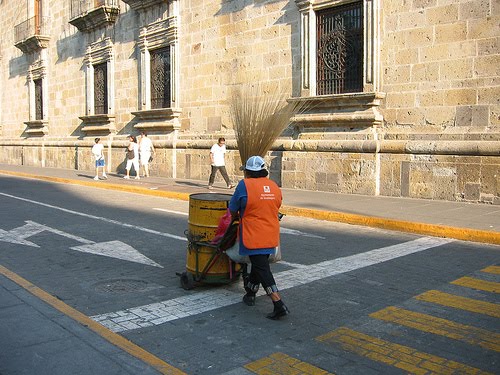
Barrendero. Photo by jmolagar / flickriver.

“If a man is called to be a street sweeper, he should sweep streets even as Michelangelo painted, or Beethoven composed music, or Shakespeare wrote poetry. He should sweep streets so well that all the hosts of heaven and earth will pause to say, here lived a great street sweeper who did his job well.” — Martin Luther King, Jr.

Working class heroes:
Mexico city’s army of barrenderos

‘We don’t sweep the streets just for ourselves… Our ancestors, the Great Aztecs, come from this place and now it belongs to all of humanity.’

By John Ross / The Rag Blog / August 26, 2010

MEXICO CITY — A small army of men and women in florescent orange and green uniforms pushing bright yellow carts hovers on the edge of the overflow crowd in the great Zocalo plaza of this city, ready to pounce. Whether it’s the 62 matches of the World Cup “FIFA Fan Fest” shown on giant screens for the diversion of the masses or a rally of tens of thousands of disgruntled citizens who have gathered to protest the policies of their government, the “barrenderos” are prepared to move in and haul away the mess the “fanaticos” have left behind.

“These Mexicanos are real ‘cochinos‘ (pigs),” kvetched my young pal Alejandro Daniel, a member of the corps of “barrenderos” or street sweepers who are charged with the hopeless mission of keeping Mexico City’s Centro Historico, the old quarter of this ancient capitol, free of debris, as he scooped up plastic cups, half-melted paletas (popsicles), the gnawed butts of tacos and “perros calientes” (hot dogs), several flattened plastic horns, and a sea of greasy waste paper, and artfully stuffed them into his cart.

Alejandro, 22, a second generation barrendero whose mom worked in the city’s street cleaning department before him, is one of 8,500 street sweepers on the Cuauhtemoc borough’s pay roll, 400 of them assigned to patrol the old quarter, a neighborhood which is roughly the configuration of Tenochtitlan, the island kingdom that was the crown jewel of the Aztec empire and is now listed on the UNESCO roster of world heritage sites.

The barrenderos work three shifts around the clock, but keeping the Centro Historico spic and span is an impossible job. By day, the neighborhood is a chaotic confluence of 2 million automobiles, trucks, buses, bicycles, and rickshaws and untold millions of pedestrians — government workers, ambulantes (freelance venders), tourists, demonstrators, and residents — who dump vast cordilleras of “basura” (garbage) onto the city streets.

Alejandro’s “tramo” or route extends down Isabel la Catolica, a narrow street where this writer has lived for the past quarter of a century, eight blocks north to the national pawn shop (“Monte de Piedad” or “Mountain of Piety.”) Along the way, the young barrendero sweeps up the gutters (the sidewalks are cleaned by residents and store owners), and dumps plastic public trash baskets lined up six to a block into his cart.

He also picks up garbage bags from private customers — this take-out service (“la finca“) is strictly prohibited by his bosses in the borough government but Alejandro’s salary is only 1,300 pesos every 15 days (“La Quincena“), approximately $100 Americano, and he desperately needs his finca to make ends meet.

The barrenderos are also charged with following demonstrations through the Centro (there are an average 3.2 a day), sweeping up after the “cochino” marchers, painting out “pintas” or spray-painted slogans scrawled on the walls of the ancient neighborhood, and ripping down leaflets posted by militants. “We leave the ones against (President) Calderon,” confides Alejandro, a partisan of former left mayor Andres Manuel Lopez Obrador.

The worst day of the year for the street sweeper is October 2nd, the annual anniversary of the 1968 student massacre (300 killed) in the Tlatelolco housing complex just north of the Centro Historico. For generations, students have marched to commemorate those who fell in the government-ordered slaughter, spray painting every surface in the neighborhood, battling riot police, and looting convenience stores. When the barrenderos try to wipe out the wall scrawls, they are attacked. “Once they sprayed me from top to bottom and then dumped my cart on top of me,” rues Alejandro.

Mexico City, the largest urban stain in the Americas with 23 million sentient human beings packed into its metropolitan zone, generates a bit under 20,000 tons of garbage daily, about 1.45 kilos of basura per chilango (Mexico City resident). The capitol, which holds a fifth of the population, accounts for a third of the country’s garbage.
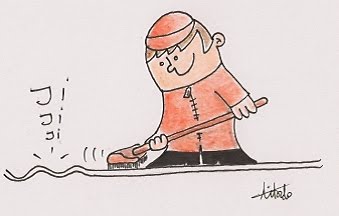
“El barrendero hace cosquillas a la calle.” (“The sweeper tickles the street.”) Cartoon by Aitorelo.

Much of the effluvia is recycled by the workers themselves to augment their meager salaries and the leftovers buried in two pestilent landfills — the “Bordo Poniente” out on the dried bed of Lake Texcoco behind the airport in the east of the city and now dramatically running out of room, is thought to be the largest garbage dump on the continent.

Recycling is mostly the domain of the collectors — the barrenderos and the basureros or garbage men. At the dumps, “pepinadores,” garbage pickers, sift through the waste for recyclables that the crews have missed.

From the crack of dawn through high noon, elephantine green trucks swamp the inner city, picking up the residue from shops and restaurants, private businesses and working class colonias, their arrivals still heralded by the ringing of a brass bell.

The garbage men (there are no women although half the street sweepers are female) toss overflowing waste barrels into grinders mounted on the back of the trucks, dump buckets of industrial grease and organic slop, often spewing debris into the gutters for the sweepers to clean up.

Although the barrenderos and the basureros are fierce competitors for the city’s garbage, they have had to forge strategic alliances to get the job done. “We consider the garbage crews to be our companeros,” Alejandro affirms.

I follow Alejandro and his flailing broom through traffic as he darts down Isabel La Catolica, often squeezing between parked cars to retrieve a banana peel or a discarded newspaper. The barrendero wrestles the contents of the street trash baskets into his cart but hesitates outside the dozens of fast food franchises here in the Centro so that the hungry and the homeless can fish for discarded food first.

These days, he is often challenged by can collectors — with unemployment at a record high and old people scraping by on meager pensions, recycled cans bring in a few coins for the underclass. Alejandro is also wary of “pirates” who steal unguarded carts and brooms and swipe the barrenderos’ fincas.

The street sweepers’ brooms are emblematic of their “oficio” (profession) but lately they have become the source of labor tensions. Their bosses, bureaucrats in a city government that has been administrated by the left Party of the Democratic Revolution (PRD) for the past 13 years, insist upon buying commercial brooms rather than the picturesque bundled tree branches with which the barrenderos have historically swept the city’s streets. If the street sweepers want an old-fashioned broom, they have to buy or fashion it themselves.

Alejandro’s gaze is fixed on the gutter. Sometimes he finds coins or lost cell phones, but mostly these days the streets are littered with cigarette butts. Ever since this left-run city barred smoking in office buildings, restaurants, and bars, the streets have been converted into public ashtrays.

Between Uruguay and Carranza streets, the street sweeper bends to retrieve a plastic bag that has escaped from a nearby Sanborn’s department store and wrapped itself around a scraggly tree planted in a tiny square of dirt, one of the few green spaces in the congested heart of the Monster. Although a city ordinance now obligates dog owners to pick up after their curs, street dogs are attracted to these dirt patches and Alejandro has to step smartly to avoid the dogshit.

Just then a driver pulls up to curbside and throws open the car door without looking, a classic “portazo” that knocks the barrandero flat. I offer him a hand.

“Even though we wear these bright orange uniforms so we don’t get run down in traffic, people never see us,” he complains, “we are brooms to them — not people. Its like we are invisible.”

Los Invisibles” is, in fact, the name of a troupe of barrenderos who do street performances around the Centro Historico.

“We see that we are underappreciated. Sometimes people are personally offensive to us. They call us ‘mugreros‘ (dirty ones) and much worse so we are trying to educate the public to respect us more,” explains Pia V., a founder of The Invisibles. “Our shows also give us an opportunity to make the neighbors more aware of their environment and encourage them to do recycling and help us keep the streets clean.”

Pia and Alejandro invite me to a rehearsal of Los Invisibles on Regina Street, a block devastated by the great 8.1 1985 earthquake here that the city has transformed into a pedestrian cultural passageway. A stage has been cobbled together by the community.

Poster for El Barrendero, starring Cantinflas.

Moni, the diminutive mother of two girls (the kids have come out to see her perform) opens the show with a bouncy number, “Caminando Por El Centro“:

Walking through the Centro/I encountered a broom/that didn’t have an owner/so I started to sweep up Allende Street.

“When I start to sweep/I think about my family/of which I am the strong arm/that maintains them…”

The two girls jump up on the stage and embrace their mom.

Dani follows with a rant about “El Pinche Viejo” (“The Fucking Old Man”), a supervisor who is taking his time about assigning her a street to clean. She frets that she will miss her finca:

Tell me pinche viejo/how long do I have to wait/for you to make up your mind?

The barrenderos raise their brooms in a martial salute. Alejandro launches into a rap about “Derechos de Senoridad” (“Seniority Rights”):

There are people with too much money/while others don’t have enough to eat/the rich are the ones who make all the frauds/our job is to sweep up this black history…

Pia takes on the tourists who flock to the Centro and do not use the public trash baskets:

I ask you please/Not to dirty the streets/In whatever city you come from/And that someday you will remember us/Sweeping up our country.

Neighbors gather in front of the “vecindades,” the spruced up old slum buildings that line Regina Street and laugh and applaud. The barrenderos are popular figures in the inner city barrios of Mexico’s meotroplises, often seen pushing their carts and cans in the company of a string of mangy garbage dogs who live in the “depositos” or collection centers.

Street sweepers are intensely focused on the neighborhoods they clean and often the source of fresh “chisme” (gossip), the secret fuel that powers Mexican society. Back in the 1960s, barrenderos were often the source of popular troubadour Chava Flores’ urban ballads and the immortal Cantinflas’s final Mexican movie El Barrendero (1982) is about a heroic street sweeper who rescues a stolen painting he finds in the garbage from a gang of thieves.

But too often the city’s barrenderos are seen as little more than street furniture, part of the mob of shoeshine men, newspaper venders, organ grinders, buskers, beggars, “toreros” (freelance ambulantes), and “rateros” (street thugs) who fill up the streets of the Centro. Working class heroes are hard to find and the barrenderos certainly qualify.

The street sweeper brigades were an early feature of the city’s left governments. They came into their own after the two-year long renovation of the Centro Historico under Mayor Lopez Obrador that was financed by the world’s richest tycoon, Carlos Slim, who indeed grew up on these mean streets and is now the virtual owner of the old neighborhood with a reported portfolio of 160 buildings.

“We don’t sweep the streets just for ourselves,” Alejandro explains, “our ancestors, the Great Aztecs, come from this place and now it belongs to all of humanity.”

“When I was a kid I would go to the Alameda Park and the Zocalo with my family and I would wonder who sweeps up these places?” Pia remembers. “Now it is me. It is my responsibility. Although the people are rude to us and pretend not to see us, our city couldn’t breathe without our brooms. Everyone would be buried under the basura.”

[John Ross, the author of El Monstruo: Dread and Redemption in Mexico City, will be walking the garbage-strewn streets of San Francisco for the next weeks.]
The Rag Blog

Posted in Rag Bloggers | Tagged , , , , | Leave a comment

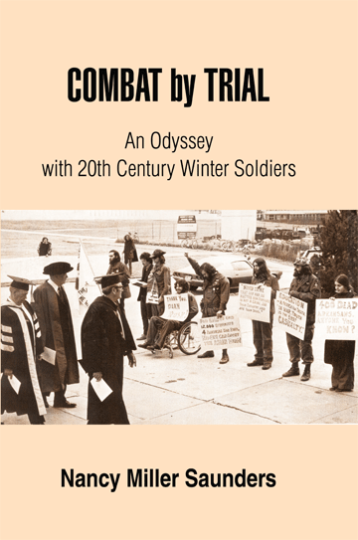
Mariann Wizard reviews Nancy Miller Saunders’ book, “Combat by Trial: An Odyssey with 20th Century Winter Soldiers,” about the historically significant anti-war movement that developed among GIs and veterans of the Vietnam War — and the IVAW, the group that led that movement. Mariann herself was involved in those efforts, along with her vet husband, Larry G. Waterhouse, and she also discusses the book she and Larry wrote together in 1971: “Turning the Guns Around: Notes on the GI Movement.”

Posted in RagBlog | Leave a comment

Jim Turpin : Assassinations, Anyone?

Image from Assassins / IMFDB.

Due process and special ops:
Assassinations, anyone?

By Jim Turpin / The Rag Blog / August 25, 2010

Every American citizen has heard the legal phrase “due process of law,” but do you really know what that means?

The Fifth Amendment of the U.S. Constitution states:

No person shall be held to answer for a capital, or otherwise infamous crime, unless on a presentment or indictment of a Grand Jury, except in cases arising in the land or naval forces, or in the Militia, when in actual service in time of War or public danger; nor shall any person be subject for the same to be twice put in jeopardy of life or limb; nor shall be compelled in any criminal case to be a witness against himself, nor be deprived of life, liberty, or property, without due process of law; nor shall private property be taken for public use, without just compensation.

The Fifth Amendment’s Due Process Clause has two aspects: procedural and substantive. Procedural due process is concerned with the process by which legal proceedings are conducted. It requires that all persons who will be materially affected by a legal proceeding receive notice of its time, place, and subject matter so that they will have an adequate opportunity to prepare. It also requires that legal proceedings be conducted in a fair manner by an impartial judge who will allow the interested parties to present fully their complaints, grievances, and defenses. The Due Process Clause governs civil, criminal, and administrative proceedings from the pretrial stage through final appeal, and proceedings that produce arbitrary or capricious results will be overturned as unconstitutional.

It surfaced earlier this year that our President (a former constitutional professor of law and senior lecturer at the University of Chicago) is now authorizing, without Congressional consent, and against constitutional authority, assassinations of U.S. citizens abroad. Dana Priest in the Washington Post reported:

As part of the operations, Obama approved a Dec. 24 (2009) strike against a compound where a U.S. citizen, Anwar al-Aulaqi, was thought to be meeting with other regional al-Qaeda leaders. Although he was not the focus of the strike and was not killed, he has since been added to a shortlist of U.S. citizens specifically targeted for killing or capture by the JSOC, military officials said…

The Obama administration has adopted the same stance. If a U.S. citizen joins al-Qaeda, “it doesn’t really change anything from the standpoint of whether we can target them,” a senior administration official said. “They are then part of the enemy.

Both the CIA and the Joint Special Operations Command (JSOC) maintain lists of individuals, called “High Value Targets” and “High Value Individuals,” whom they seek to kill or capture. The JSOC list includes three Americans, including Aulaqi, whose name was added late last year.

Interestingly, during George W. Bush’s reign, there was intense and heated debated over the indefinite detention and torture of “high value individuals” at Black Ops sites across the world (Bagram Air Force Base, Syria, Egypt, etc.). Even Obama criticized the Bush administration during the presidential race and then promised to close Guantanamo after taking office. This has not happened and most likely never will, even though intelligence shows that Guantanamo remains a recruiting tool, used by extremists around the world.

There have been a number of reports that show the complete innocence of these accused “terrorists” whether U.S. citizens or not:

“There are still innocent people there (Guantanamo),” Lawrence B. Wilkerson, a Republican who was chief of staff to then-Secretary of State Colin Powell, told The Associated Press. “Some have been there six or seven years…” Wilkerson told the AP in a telephone interview that many detainees “clearly had no connection to al-Qaida and the Taliban and were in the wrong place at the wrong time. Pakistanis turned many over for $5,000 a head.”

Glenn Greenwald in Salon (1/27/2010) wrote:

Just think about this for a minute. Barack Obama, like George Bush before him, has claimed the authority to order American citizens murdered based solely on the unverified, uncharged, unchecked claim that they are associated with Terrorism and pose “a continuing and imminent threat to U.S. persons and interests.” They’re entitled to no charges, no trial, no ability to contest the accusations… That’s why we have what are called “trials” — or at least some process — before we assume that government accusations are true and then mete out punishment accordingly.

But now, there seems to be little or no discussion over the assassination of U.S. citizens for their alleged ties to “terrorist organizations.”

The only recent outcry has been from Rep. Dennis Kucinich (D-OH) who introduced a bill (HR 6010) titled: “To prohibit the extrajudicial killing of United States citizens, and for other purposes.”

Democratic Congressman Kucinich’s draft bill H.R. 6010 states in part, “No one, including the president, may instruct a person acting within the scope of employment with the United States Government or an agent acting on behalf of the United States Government to engage in, or conspire to engage in, the extrajudicial killing of a United States citizen… As Kucinich points out, “The US government cannot act as judge, jury, and executioner.”

So the Joint Special Operations Command (JSOC) along with the CIA seems to be carrying out these “extrajudicial” (outside of the law) assassinations all over the world.

Who or what is JSOC?

The Joint Special Operations Command (JSOC) is a component command of the United States Special Operations Command (USSOCOM) and is charged to study special operations requirements and techniques to ensure interoperability and equipment standardization, plan and conduct special operations exercises and training, and develop Joint Special Operations Tactics.

In March 2009, investigative reporter Seymour Hersh described JSOC as “a special wing of our special operations community that is set up independently… They do not report to anybody, except in the Bush-Cheney days, they reported directly to the Cheney office… Congress has no oversight of it.

A few months later, when it was reported that General Stanley McChrystal would be taking over command of U.S. forces in Afghanistan, journalist Gareth Porter noted that McChrystal had been commander of JSOC from April 2003 to August 2008 and commented that his “long specialisation in counter-terrorism operations suggests an officer who is likely to have more interest in targeted killings than in the kind of politically sensitive counterinsurgency programmes that the Obama administration has said it intends to carry out.”

So JSOC is the assassination squad for U.S. citizens or other “high value targets” of interest.

But does the United States train others to do assassinations by proxy? In other words, do the dirty work of eliminating leaders, politicians, social movements or others that are in direct conflict with our “national interest” or “sphere of influence.”

The Western Hemisphere Institute for Security Cooperation (WHINSEC) (formerly known as the School of the Americas (“SOA”), is a United States Department of Defense facility at Ft. Benning, Georgia. This benign sounding “school” or “institute,” established in 1946, has been responsible for training more than 61,000 Latin American soldiers and policemen who have been responsible for some of the most heinous human rights abuses in the 20th century.

From 1946-2001, such infamous dictators (that the U.S. propped up and supported) as Manuel Noriega (Panama) and Augusto Pinochet (Chile) and many others had soldiers and police trained at the SOA. The brutal tactics of “counterinsurgency” taught at the SOA included torture, indefinite detention and extrajudicial killings.

“The U.S. Army School of the Americas (SOA) used training materials that condoned executions of guerillas, extortion, physical abuse, coercion, and false imprisonment” asserts an Intelligence Oversight Board (IOB) Report issued June 28, 1996, in Washington, DC. The IOB, a four-person, independent board created three years ago(1993) by President Clinton, is charged with investigating excesses and abuses by the US intelligence community.

The term “death squads” is closely associated with the training received at the SOA. Many of the countries (Chile, Bolivia, etc.) that formerly sent soldiers for training, now have refused this offer from the United States.

To counter the operations at WHINSEC (the new and “improved” name as of 2001), the “School of Americas Watch” was founded by Mary Knoll Father Roy Bourgeois and a small group of supporters in 1990 to protest the training of mainly Latin American military officers at the School of Americas. Most notably, SOA Watch conducts a vigil each November at the site of the academy, located on the grounds of Fort Benning, a U.S. Army military base near Columbus, Georgia, in protest over myriad human rights abuses committed by graduates of the academy.

So are “extrajudicial” killings (code for assassinations) OK with the American people? Most would most likely answer “NO,” but what can you do to stop these abuses by the U.S. government?

A first step is to call or email your congressional representative and insist that they support Rep. Kucinich’s bill (HR 6010) to stop “extrajudicial” killings of U.S. citizens.

Ironically, Abraham Lincoln signed General Order 100 in Section IX entitled “Assassinations” in April 1863 that stated:

The law of war does not allow proclaiming either an individual belonging to the hostile army, or a citizen, or a subject of the hostile government, an outlaw, who may be slain without trial by any captor, any more than the modern law of peace allows such intentional outlawry; on the contrary, it abhors such outrage. The sternest retaliation should follow the murder committed in consequence of such proclamation, made by whatever authority. Civilized nations look with horror upon offers of rewards for the assassination of enemies as relapses into barbarism.

[Jim Turpin is a native Austinite and member of CodePink Austin. He also volunteers for the GI coffeehouse Under the Hood Cafe at Ft. Hood in Killeen, Texas.]

The Rag Blog

Posted in Rag Bloggers | Tagged , , , , , | 4 Comments

BOOKS / Mariann G. Wizard : The Odyssey of Our Winter Soldiers


Nancy Miller Saunders’ Combat by Trial:
Documenting 20th century ‘winter soldiers’

By Mariann G. Wizard / The Rag Blog / August 25, 2010

Combat by Trial: An Odyssey with 20th Century Winter Soldiers by Nancy Miller Saunders. (iUniverse, Inc., 2008.) 591 pp, $34.95. Available at www.iuniverse.com.

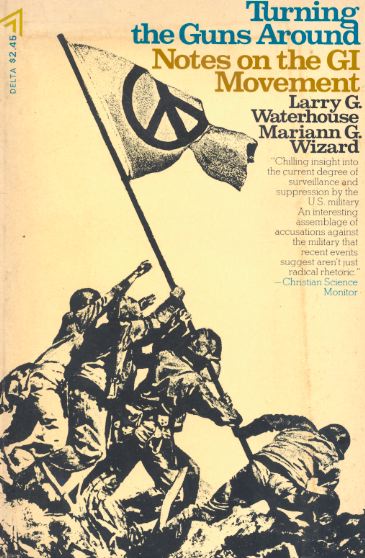
Turning the Guns Around: Notes on the GI Movement by Larry G. Waterhouse and Mariann G. Wizard (Praeger, 1971). 221 pp., published at $6.95.

In 1971, my second husband and good friend Larry Waterhouse and I, through a fortuitous series of chances and choices, wrote a book on antiwar activity in the U.S. armed forces for a respected New York publisher. Turning the Guns Around: Notes on the GI Movement (Praeger) was researched and written entirely in four months to conform to a deadline occasioned by the failure of a previously contracted writer to deliver a manuscript.

Following Robert Sherrill’s successful Military Justice is to Justice as Military Music is to Music (HarperCollins,1970), Praeger was eager to jump on the military dissent bandwagon, and to fill the hole in their spring line-up.

Turning the Guns Around gave ’em more than they bargained for. With chapter titles like, “Gen. Baconfat vs. the Red Menace” and “Today’s Pig is Tomorrow’s Bacon,” and copiously drawing from the irreverent and often profane underground GI press of the day, we proclaimed the entry of activist grunts, swabbies, jarheads and/or flyboys, along with some servicewomen, into the ranks of revolution.

Drafted out of graduate school at UT Austin on November 25, 1969, Larry made no secret of his sympathy for Vietnam’s National Liberation Front during induction and basic training. As a result, he spent his entire 14-month military career at Ft. Ord, California, near Monterey.

By the time I joined him the next summer, he’d made the transition from leadership in UT’s Students for a Democratic Society (SDS) to leadership in the Ord chapter of Movement for a Democratic Military (MDM). The group rented a house off-post where off-duty soldiers could meet, hang out, and talk; published an erratic newspaper; and engaged in anti-war actions as well as solidarity actions with, groups like the lettuce-boycotting Farmworkers Union, protesting the enormous amounts of lettuce being served in Army mess halls.

We had each worked with individual anti-war vets in Austin, and with anti-war GIs somewhat through the Oleo Strut, an anti-war coffeehouse in Killeen, Texas, near Ft. Hood, and knew from history the potential importance of rising dissent within America’s armed forces.

Despite rising rapidly to a responsible and even rather sensitive position in Ft. Ord’s payroll office, Larry never earned a stripe, remaining a proud buck private throughout his military servitude. His only bling was a Sharpshooter medal.

We signed our book contract at Christmas in 1970, in a Houston hospital, at the bedside of his Mom, who we thought might not live to see the book (she did). We’d flown to Texas on emergency leave when Gretchen had a heart attack, but tried to save money on the way back by delivering a “drive-away” car to Los Angeles. This became a marathon trip-from-Hell that landed us back in Monterey on Jan. 2, 1971, at about 4 a.m. I fell into bed. Larry put on his uniform and went to work.

An hour or so later he woke me with amazing news: he was being summarily, and honorably, discharged. Apparently the brass didn’t want an active duty private authoring a book about dissent in the armed forces!

Back in Austin, we finished the book, found a place to live, figured out what was next in terms of employment and school, and along the way met and started working with a good-natured Army vet, Terry DuBose, to organize an Austin chapter of Vietnam Veterans Against the War (VVAW).

It wasn’t long, however, until we found ourselves in the best place organizers can be: not needed. By the fall of 1971, VVAW was an organization of, by, and for combat vets and their spouses, and Larry and I were politely asked to step out. We continued opposing the seemingly endless Vietnam conflict in other ways.

VVAW continued to emerge as a leading anti-war organization, especially as the beleaguered student movement imploded, until the war finally ended and the last U.S. troops came home.

Nancy Miller Saunders’ memoir, Combat by Trial, tells VVAW’s story not only from her point of view, that of a non-veteran “insider,” but also, by skillfully interweaving the stories of veterans, government documents and vintage press reports, paints a collective memoir of a very crazy time. She was not, and does not present herself, as a VVAW leader, but was a trusted collaborator and confidante of many of VVAW’s key players, especially in the Southern region, over several years.

The liberal film school graduate encountered VVAW as a member of Winterfilm, a collective documenting testimony at VVAW’s first nationally-noted action, the Winter Soldier Investigation.

Held in late January and February 1971, WSI grouped combat vets by service and division to give public testimony about atrocities and war crimes in which they had participated, and/or had witnessed. The first panel was made up of veterans of the Marine Corps’ highly decorated First Division that had been in Vietnam since 1965.

From painfully detailed testimony in this and subsequent panels a pattern of officially-sanctioned brutality over overlapping tours of duty emerged, demonstrating unequivocally that the recently-revealed massacre at My Lai had been no accident, and no particular exception.

Saunders describes the haggard, haunted, but still child-like men who made these bloody confessions, and her own growing awareness that these gallant, all-American boys had been maimed not only, all too often, in their bodies, but in their souls. VVAW’s quest for an end to the war was at once a quest for their own healing, and for the healing of a nation.

Describing her journey, that of her then-partner, Arkansas VVAW coordinator Don Donner, and of VVAW as a whole from concerned patriots to targets of government intrigue, Saunders dips willingly into her own interpretations, but takes care to label them as such, urging readers to draw their own conclusions.

Her point of view differs from mine, for example, on the role of more radical anti-war groups, who she generally regarded then and now as “crazies” who drew attention from VVAW’s powerful statements and needlessly endangered peaceful protesters. However, her own militancy was raised by threatening events and the intense persecution of VVAW. This internal shift, from being a total pacifist to someone who, on occasion, could not sleep without knowing that a loaded pistol was within reach, is powerfully evoked.

The book made me remember walking into the MDM house in Monterey for the first time and seeing the sandbags lining the walls to protect against occasional drive-by shootings. The story of her and Donner’s reception by the New Orleans “Red Squad” gave me a chill; the Monterey police department knew of my arrival almost before I did.

If you are among those who can’t imagine what led some anti-war protesters of the 1960s and 1970s, as well as Black liberationists, to consider violence, this book is “must reading”! The short version: the U.S. government, through its willful lies, delusional fantasies, and brutally destructive acts, brought much enmity upon itself.

Turning the Guns Around. Dell paperback edition.

Those who read with interest in The Rag Blog about Federal Bureau of Investigation informer Brandon Darby and the impact of his unmasking will be fascinated with the story of VVAW’s snitches. Even now, with the perspective of years and Saunders’ deep research into FBI files, the motivations of such individuals remain obscure, but the VVAW experience demonstrates that this must be a secondary consideration.

Deliberately false “intelligence” was the result of a political program that aimed to destroy VVAW’s credibility through accusations of planned violence and expensive trials, draining group resources. That this was accomplished, in part, through the testimony of paid informers and provocateurs worked eventually to bring in “not guilty” verdicts for most VVAW members charged with crimes, but the damage had been done. The question of how to defend against such betrayals remains open, and urgent.

In the biggest legal case, veterans were charged with conspiring to riot at the 1972 Republican National Convention in Miami. The trial of the Gainesville 6, that then became the Gainesville 8, and of the “Forgotten 4,” involved Austin’s own “movement lawyers,” most notably Cameron Cunningham for the defense.

Saunders recalls the bickering between and among defendants and defenders; between VVAW’s southern regional leaders — most of those accused in the case — and its compromised national office; as well as the convoluted legal wrangling that led to complete acquittal in Gainesville — but only after the RNC was over and Nixon anointed once more as the nominee.

Although Saunders and Donner were not active here, Austin VVAW’s actions are amply chronicled, largely through Saunders’ conversations with and letters from local leader John Kniffen, one of the Gainesville 8, as well as through her direct observations of VVAW actions in the Dallas-Ft. Worth area and in Killeen.

Kniffin, a taciturn, wiry, former tank commander who did 32 months in-country, joined Austin VVAW in 1971, and became a force regionally, and then in national VVAW, where he demanded — and got — more democratic decision-making.

His recollections, and those of his widow, Cathy, who continues, after John’s death from Agent Orange exposure, to work for veterans’ rights, brought back vivid memories of actions here in which Larry and I participated, the most awesome of which was a gigantic outpouring of peace and justice forces at the official dedication of the Lyndon Baines Johnson Presidential Library, attended by a Who’s Who of U.S. imperialism, including then-President Richard “Tricky Dick” Nixon.

While there are a few errors that old Austinites will readily spot (e.g., the University’s West Mall is referred to repeatedly as the East Mall), it’s also fun figuring out who certain unnamed activists must be, simply from their descriptions.

In what I believe to be an original contribution, using FBI and press reports, Saunders alluringly links dirty tricks played against VVAW with Nixon’s Watergate burglary team. Offices and homes of VVAW members and attorneys were burgled, especially in Florida, where Nixon’s plumbers were based; as in the better-known Washington, D.C. break-ins that ultimately brought down the President, only certain papers were stolen.

In the weeks before the 1972 national political conventions, both of which were in Miami, Florida leaders of VVAW were in discussion with Democratic Party headquarters — one of the targets of Nixon’s buggers — about security for demonstrators (“nondelegates”) who would attend. Democrats feared, and hoped to avoid, a repeat of the 1968 Chicago convention debacle, where anti-war youth had been clubbed through the streets on national television.

Was this discussion the reason Nixon bugged Democratic Party HQ? Did the same crew that burgled Pentagon papers whistle-blower Daniel Ellsburg’s psychiatrist’s office burgle VVAW files in Gainesville? Did Nixon hope to tie national Democratic leaders to VVAW’s alleged conspiracy to riot? While no conclusive proof is presented, “coincidences” of timing and personnel movement are compelling. Has anyone offered a more reasoned explanation of what Watergate was all about?

Saunders also presents evidence that on at least two occasions, VVAW’s release of information gleaned from active-duty contacts (the anti-war movement within the military having continued to grow despite its own problems and persecutions) about U.S. troop and materiel build-ups prevented the war from being intensified on Nixon’s watch, rather than eventually being abandoned. This seems a plausible enough reason for the vengeful, plotting Nixon to want the organization destroyed!

The collective nature of Saunders’ memoir is its true strength. By giving free voice to the many vets who entrusted her with their papers, their unpublished memoirs, their own FBI files, etc., she avoids the self-centered quality common in such memoirs, while still allowing herself free voice.

She knows that no one person has the full story, and in fact not even a group of people such as she draws from see everything that happened around them and to them. Part of the immense satisfaction I found in the book came from seeing other views of events I had seen peripherally, in a time that seems both very long ago and strangely like this morning.

In a funny circle-of-life coincidence, a bus Terry DuBose drove with other veterans to Washington, D.C. — a bus belonging to John Kniffin — and wrote about in an epilogue for Turning the Guns Around, pops up in Nancy’s book, stranded by the side of the road, from a completely different source.

DuBose electronically introduced me to Saunders and her husband, Budd — a sometimes contributor to The Rag Blog from rural “Arkansaw” — a year or so ago, which is how I heard about her book, and requested a swap. As a sometimes self-published author myself, I’m happy to recommend this Internet publication in overall quality and value.

You’ll find as many typos in any book these days, and none of Saunders’ are very off-putting. Spelling errors, etc., in sources quoted, add, in several cases, to the authenticity of her documentary. Saunders still sees life through a film editor’s eye, and has a good gift both for description, especially of people and the places where action takes place, and for dialogue, as well as voluminous resources.

Turning the Guns Around was a snapshot of an emerging movement, a Rorschach blot of a moment. Combat by Trial is a deeper, longer, and more nuanced look at that same movement — military opposition to U.S. military adventurism — as it grew, rose, and fell in the 1970s.

Now it is rising again, in our younger brothers and sisters, sons and daughters, who have been to war in the cauldrons of Iraq and Afghanistan. Saunders doesn’t shy away from drawing parallels between Vietnam and the “Afraq” conflicts, and I will not shy away from pointing out that Turning the Guns Around predicted these wars in some detail 39 years ago. Unlike some Vietnam-era memoirs, Combat by Trial has plenty to offer today’s peace warriors.

[Mariann Wizard, a Sixties radical activist and contributor to The Rag, Austin’s underground newspaper from the 60s and 70s, is a poet, a professional science writer specializing in natural health therapies, and a regular contributor to The Rag Blog.]

The Rag Blog

Posted in Rag Bloggers | Tagged , , , , , , , , | 4 Comments

Tom reports on the dueling demonstrations in New York City near the proposed Ground Zero Muslim community center. He discusses the “objectification of Other as evil incarnate,” and points out how it is easier to hate than to love. He quotes one anti-mosque protester, “If you had a Qur’an here, I’d piss on it.” The grief of those who lost loved ones on 9/11 is real, he says, but it is not ideological, and calls for healing, not hatred.

Posted in RagBlog | Leave a comment

A group of protesters — including veterans of the wars in Iraq and Afghanistan and an army wife — protested in Killeen, Texas, against the deployment of the 3rd Armored Cavalry Regiment to Iraq — and temporarily blocked buses carrying soldiers. They were beaten out of the roadway by cops with dogs and automatic weapons, but were not arrested. The posting includes statements from some of the vets who participated.

Posted in RagBlog | Leave a comment

RTÉ News : Iceland to Be Free Press Haven?

No more of this? Image from Susan Loone’s Blog.

Iceland set to become free haven
For journalists and whistleblowers

By RTÉ News / August 24, 2010

After Iceland’s near-economic collapse laid bare deep-seated corruption, the country aims to become a safe haven for journalists and whistleblowers from around the globe by creating the world’s most far-reaching freedom of information legislation.

The project is being developed with the help of WikiLeaks founder Julian Assange.

It flies in the face of a growing tendency of governments trying to stifle a barrage of secret and sometimes embarrassing information made readily available by the internet.

On 16 June a unanimous parliament voted in favour of the Icelandic Modern Media Initiative, a resolution aimed at protecting investigative journalists and their sources.

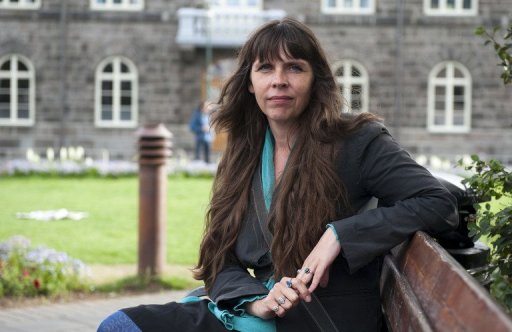
“We took all the best laws from around the world and pulled them together, just like tax havens do, in order to create freedom of information and expression, a transparency haven,” Birgitta Jonsdottir, the member of parliament behind the initiative, said.

Describing herself as an “anarchist,” the 43-year-old said she had decided to get into politics to seize the opportunities to change the system in Iceland following its dramatic financial collapse at the end of 2008.

Ms Jonsdottir was shocked to witness the attempts at censorship in her country, which had long been held up as a model democracy.

In the most resounding example, a court injunction in August 2009 forced Icelandic public broadcaster RUV to back down at the last minute from transmitting a report on one of the country’s three largest banks that all collapsed less than a year earlier, pushing Iceland to the verge of bankruptcy.

Instead of its report on the Kaupthing bank’s loanbook, RUV broadcast images from whistleblower site WikiLeaks, which had published the incriminating documents, in an attempt to draw attention to the limits being put on freedom of expression in Iceland.

“Freedom of information and freedom of speech are the pillars of democracy. Now, if you don’t have that, you don’t really have a democracy,” said Ms Jonsdottir, wearing “Free Tibet” and “WikiLeaks” pins on her jacket.

Icelandic parliament deputy Birgitta Jonsdottir. Photo from AFP.

Blaming the threat of terrorism, “all countries are facing new sets of laws which are making it more difficult in particular for investigative journalists and book writers,” she said.

The aspiring “island of transparency” aims to strengthen source protection, encourage whistleblowers to leak information and help counter so-called “libel tourism,” which consists in dragging journalists before foreign courts in countries with laws that best suit the prosecution.

The idea is to imitate and combine the existing most far-reaching laws in countries renowned for their freedom of expression, like the U.S., Sweden, and Belgium.

“I don’t think that there is anything radical in (IMMI). The radicalism around it is to pull these laws together,” Jonsdottir said.

“We have seen that really (such protections) are necessary,” said WikiLeaks founder Assange, whose name became known after his site last month published nearly 77,000 classified U.S. military documents on the war in Afghanistan.

“That’s our experience in the developing world and in most developed countries: that the press is being routinely censored by abusive legal actions,” he said recently in a video posted on YouTube.

Mr Assange, who spends much of his time in Iceland and other countries where the legislation is more in his favour, created WikiLeaks’ first global scoop in Reykjavik earlier this year.

Locked up for weeks at a time in a house in the Icelandic capital, he and a handful of other WikiLeaks supporters managed to decrypt and post online a military video showing a U.S. military Apache helicopter strike in Baghdad in 2007 that killed two Reuters employees and a number of other people.

WikiLeaks along with a number of non-governmental organisations and international celebrities like European member of parliament Eva Joly have contributed to developing IMMI.

Journalists in Iceland and abroad have applauded the initiative.

“By offering tight protection to the sources, it will be a lot safer to report on abuses in the government or in the corporate community,” said WikiLeaks insider and Icelandic freelance reporter Kristinn Hrafnsson.

“When you know you can pass on information safely, you’re more prone to do it,” he said.

But the resolution will also have implications beyond Iceland’s borders.

“In countries where they are oppressed such as China and Sri Lanka, journalists risk their lives,” Ms Jonsdottir said.

“We can’t help them with that, but at least we can ensure that their stories won’t be removed” from the internet, by posting them on servers located in Iceland where the censors cannot get at them, she said.

According to Ms Jonsdottir, it will take about a year and a half — the estimated time required to change at least 13 existing laws — before IMMI will go into effect.

© 2010 RTÉ

[This article was originally published on August 19, 2010 by RTÉ News>, a division of Raidió Teilifís Éireann (RTÉ), an Irish national public service radio and television broadcast service. It was distributed by CommonDreams.]

Source / CommonDreams

The Rag Blog

Posted in Rag Bloggers | Tagged , , | Leave a comment

Thomas Good : Hatred and Healing at Ground Zero

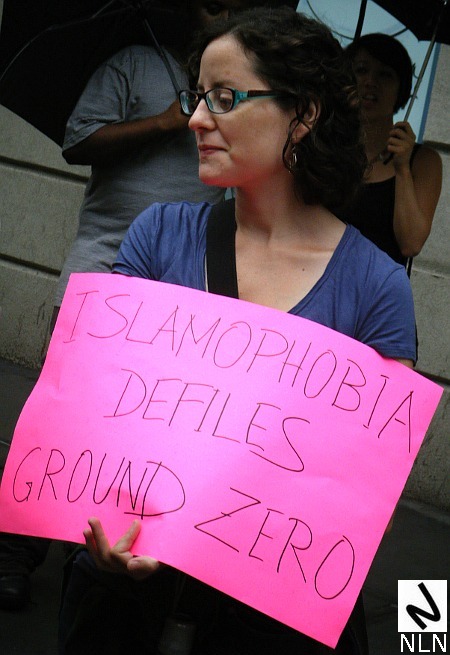
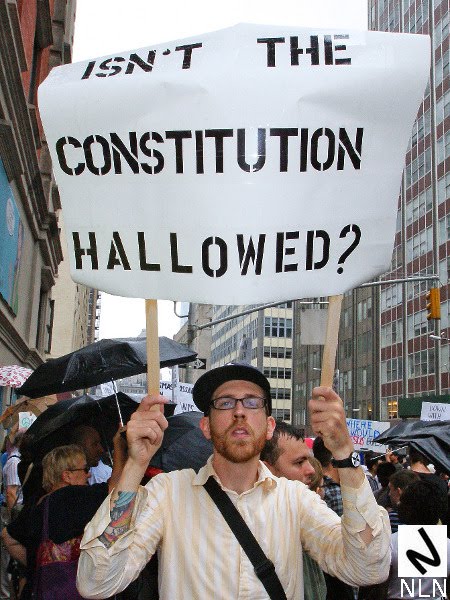
Photo by Bud Korotzer / NLN.

The objectification of Other:
Hatred and healing at Ground Zero

By Thomas Good / The Rag Blog / August 23, 2010

See photo gallery, Below.

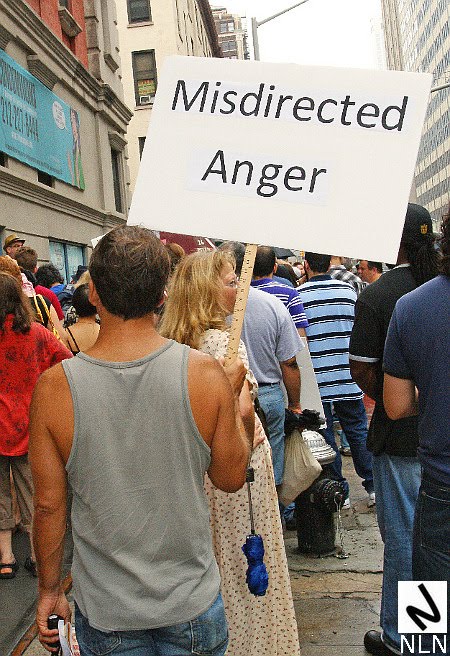
NEW YORK — Sunday was another rainy day in New York City, as two sides of the Ground Zero mosque issue squared off in dueling protests — two sides who are responding to a catastrophe with two mutually exclusive answers: hatred and healing.

Lost

If volume validated an argument then the motorcycle contingent bound for Sunday’s anti-mosque protest would win, hands down. With loud pipes and shrill voices, the bikers from out of town who thundered down Broadway en route to the demonstration — apparently going the wrong direction — would have the final word in any debate whose outcome is measured only in decibels.

But it isn’t that simple. And just as the issues surrounding the proposed building of a mosque-slash-community center in the general area of Ground Zero aren’t so simple — it’s too simplistic to write off all of the bikers as stereotypic toughs, incapable of compassion or human emotion

Some of them lost relatives in the September 11, 2001 attack on the Trade Center.

A short time after the loud cavalcade drove past this reporter, several of their number, now dismounted, emerged on a street corner looking confused, vulnerable, and maybe even a little embarrassed. It was hard to deny their humanity. We’ve all been lost before — alone, wandering unfamiliar territory.

Us vs. them

To those who see the world from the vantage point of an “us versus them” perspective — there is no middle ground, no room for freedom of religion, no Constitution to defend, no reason to wince at racist epithets hurled at the Other side. To those who embrace an ideology based on interpreting 9/11 as a clash of two cultures, as an apocalyptic harbinger of a holy war — one protester’s angry outburst sums up the world view: “Islam is not a religion, it’s a cult.”

This was the statement one New Yorker hurled at another on Sunday.

And as if this statement was not sufficient to choke off discussion, to demonize and objectify an entire faith, the anti-mosque protester continued: “If you had a Qur’an here, I’d piss on it.”

The Others

The objectification of Other as evil incarnate, the demonization of billions of believers, is not a rational construct but it is one that has currency, perhaps because choosing hatred over healing, choosing to adopt bumper sticker slogans over calm dialogue is less threatening, less intimidating than attempting to grasp elusive nuances. There is no doubt that it is easier to hate than to love, to assimilate rather than to accommodate, to shout rather than to listen. This is the sad trajectory of terrorism itself.

The man who uttered that sad statement, who argued that Islam is not a religion, was eventually quieted by a white-shirted NYPD senior officer. The target of the protester’s venom — who had responded angrily — walked off to join the Other demonstration of the day: the group of civil rights activists, peace protesters, and interfaith clerics who support the Muslims looking to build the Cordoba House mosque and community center on 51 Park Place.

From NYC to Oklahoma — and back again

At the anti-Islamophobia rally, Alan Stolzer of the Military Project asked me a question.

“Has anyone built a church near the Oklahoma City bomb site?”

His rhetorical question was pointed: Timothy McVeigh was a blond and blue Christian. A home grown killer. The analogy was not ideal. McVeigh did not profess to kill in the name of his religion. But in our history other Americans have killed in the name of their faith, some acting in concert with other true believers. And yet in these cases, it was the killers who were judged, not the professed faith, not the religion in its entirety. It could not be otherwise. And yet it’s different for Muslims in America.

Beyond binaries

Somewhere in between the 9/11 ideologues — the Islamophobes and racists who look to burning books as a solution — and the Muslim community left holding a fractured First Amendment are the families of 9/11. Their grief is not ideological in nature but their numbers, their “hearts and minds,” are the perceived prize for those who would market rabid xenophobia disguised as patriotism.

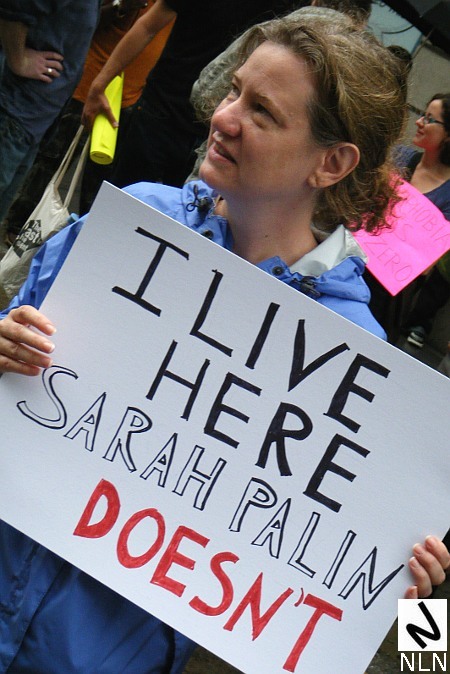
The Sarah Palins and other rank opportunists, none of whom have ever lived in New York, some of whom can’t spell xenophobia — even if they can see it from their back yard — are eager to profit from appeals to hatred and racism. But for those who lost loved ones, healing will have to be accomplished without hate. However this is done, whatever path is chosen, healing involves overcoming hate, not embracing it.

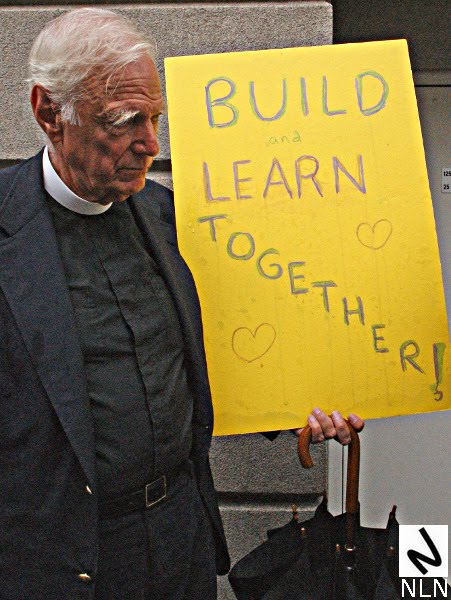
As the rain fell on the protesters who challenge the binary world view, those who want to heal and move beyond Islamophobia and the scourge of racism, as the mainstream media swarmed to get their soundbites from the “pro-mosque protesters” — a man in a priest’s collar quietly held up a sign. It read: “Build and Learn Together.”

[Thomas Good is editor of Next Left Notes, where this article also appears.]

Photo by Thomas Good / NLN.

Photo by Thomas Good / NLN.

Photo by Thomas Good / NLN.

Photo by Bud Korotzer / NLN.

Photo by Bud Korotzer / NLN.

The Rag Blog

Posted in Rag Bloggers | Tagged , , , , , , | 2 Comments

Barbara Hines is a famed immigration attorney and a clinical law professor at the University of Texas at Austin. She is co-director of the immigration clinic at the UT School of Law. A two-time Fulbright scholar, Hines has practiced immigration law since 1975, and has been involved in landmark litigation defending the constitutional and statutory rights of immigrants. She and her clinic received international attention in recent years for their work in drawing attention to the T. Don Hutto family detention center in Taylor, Texas, leading to a successful ACLU lawsuit that greatly improved conditions at the facility.

In 2000, Texas Lawyer Magazine named Barbara one of 100 Texas “Legal Legends” of the 20th century. This year the National Immigration Project of the National Lawyers Guild named her the 2010 recipient of its Carol Weiss King Award for excellence in the pursuit of social justice through organizing, litigating, and teaching.

In the early Seventies, Barbara Hines was active in the women’s movement and the movement against the War in Vietnam. She was also a contributor to Austin’s underground newspaper, The Rag.

Posted in RagBlog | Leave a comment

Alice Embree : Protesters Block Fort Hood Troop Deployment

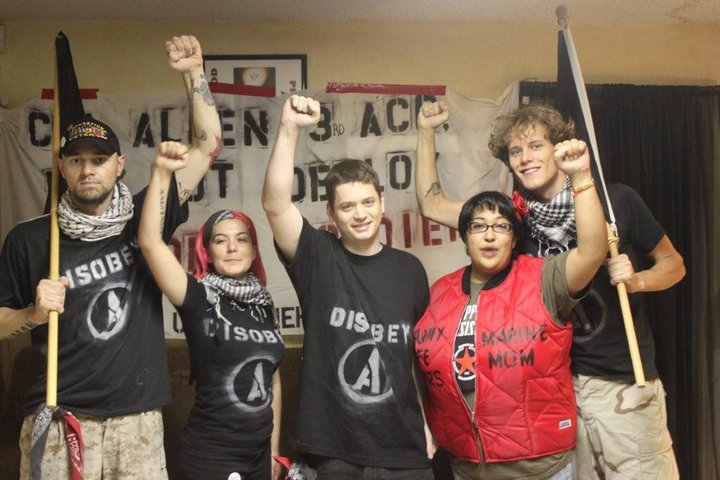
Participants in the blockade action at Fort Hood, Texas, on August 23, 2010. Left to right: Iraq Veterans Bobby Whittenberg-James and Crystal Colon, Jeff Grant, Military Spouse Cynthia Thomas and Afghanistan Veteran Matthis Chiroux. Photo from Fort Hood Disobeys.

Protesters at Fort Hood in Killeen
Block buses deploying troops to Iraq

By Alice Embree / The Rag Blog / August 23, 2010

KILLEEN, Texas — Under darkness at about 4 a.m. this morning, buses carrying the 3rd Armored Cavalry Regiment (3rd ACR) to planes were stopped by a group of five protesters that included two Iraq veterans, one Afghanistan veteran, and one military spouse whose husband had been deployed to Iraq three times.

The Fort Hood Disobeys group clambered down from a highway overpass where supporters held banners and signs. Holding banners that said, “Occupation is a Crime” and “Please Don’t Make the Same Mistake We Did. RESIST NOW,” the protesters spread across Clarke Road. Police with automatic weapons and dogs beat them out of the roadway. They were not arrested.

Deployments are usually scheduled for the afternoon with family members present as soldiers board the buses. Whether this deployment left in the dead of night because of planned protests is unknown, but averting media attention was undoubtedly part of the Army calculus.

As the corporate media heralds the “end of combat missions,” the truth about the troops deploying to Iraq has not made mainstream news. Two more deployments of the 3rd ACR, a combat regiment, are scheduled this week. The total 3rd ACR troop deployment to Iraq from Fort Hood will be about 3,000. These will be added to the 50,000 troops remaining.

“Operation New Dawn” is the new brand for the U.S. occupation in Iraq. As combat deployments continue, it rings as hollow as George Bush’s proclamation of “Mission Accomplished.”

Two more upcoming events are aimed at peeling back the mass deception surrounding the “end of combat operations.”

Dahlia Wasfi, an Iraqi-American doctor, will speak next Sunday in Austin about the U.S. Policy in Iraq: A Humanitarian Disaster. The event is co-sponsored by Texas Labor Against the War and CodePink Austin and will take place at the Texas State Employees Union meeting hall, 5 p.m., Sunday, August 29, 1700 South First, Austin.

The following morning, there will be a press conference at Under the Hood GI Cafe in Killeen that will highlight many facets of the Iraq debacle, including the impact on soldiers, military families, Iraqis, and funding to meet domestic needs. Dahlia Wasfi will speak at this press conference and will be joined by Rep. Lon Burnam from Fort Worth, Texas. Representatives from several groups including Iraq Veterans Against the War, Veterans for Peace, CodePink, and Texas Labor Against the War will be present. The press conference will take place at 10 a.m., Monday, August 30, Under the Hood, 17 South College, Killeen, Texas.

[Alice Embree is a long-time Austin activist and organizer, a former staff member of The Rag in Austin and RAT in New York, and a veteran of SDS and the women’s liberation movement. She is a regular contributor to The Rag Blog and is treasurer of the New Journalism Project.]

Following are personal statements from four of the participants in the action:

Bobby Whittenberg-James:

I am a Marine veteran of the war against the people of Iraq, a Purple Heart recipient, and a third generation military service member. I joined the Marines in June of 2003, believing the lies about weapons of mass destruction and an imminent threat to our safety. I have since come to learn that these wars and occupations do not keep the people of the United States or the Middle East safe, but instead serve the interests of politicians, capitalists, and corporations: the ruling elite.

These unjust wars and occupations rob the people of Iraq, Afghanistan, Pakistan, and Yemen of their dignity and their right to self-determination and serve to make the people of both the Middle East and the United States less safe. They also serve to further destabilize a region that has suffered under the boot-heel of western colonialism for over a century. The U.S. Empire also supports both financially and militarily the brutal apartheid regime that occupies Palestine. All of this is done in our name with our money, and I am here to say “Not in my name!”

The recent information leaks about the U.S. Empire’s wars lay bare their war crimes and crimes against humanity. We must face the truth, even if it makes us uncomfortable or shows us something about ourselves that we don’t want to see. When we find the truth, we must respond accordingly. I will not be complicit in the killing of people. Since I do not believe that the government or the capitalists will end these wars, I will vote with my body.

Bobby Whittenberg-James
Disobedient

Crystal Colon:

I was a sergeant in the Army for five years, stationed at Fort Hood the entire time, save two deployments to Iraq totaling 26 months. I was a Signal Support Systems Noncommissioned Officer, coordinating communications for various commands. I was honorably discharged in Jan., 2010, and have been organizing in the veterans peace movement ever since.

I first began to question the war in Iraq during my first deployment in ’05-’06. After my friend Robbie was killed, I was very deeply affected. I started questioning why we were in Iraq. It felt like he had died for nothing. After returning from Iraq, I planned to leave the military. I was stop-lossed and forced to return to Iraq for 15 months, in total held beyond the length of my enlistment more than 450 days. Since leaving the military, I have been active with the veterans peace movement, speaking out about my experiences and supporting troops who refuse to fight.

I am doing this today because I can’t allow this war in which I have fought to continue. I can’t allow other soldiers to make the same mistake I did, deploying in support of a war crime. As a veteran of Iraq, how could I not do this today? For the people I helped occupy, for the friends I lost and stilI have over there, for the soldiers on those buses. How could I not do this today? I should have disobeyed. I should have never boarded those buses to Iraq. I wish someone had tried to stop me.

Crystal Colon
Disobedient

Matthis Chiroux:

I am a former Army sergeant and war resister. I was press-ganged into the Army by the Alabama Juvenile “Justice” System in 2002. While in the military, I occupied the nations of Japan and Germany for more than four years, with shorter tours in the Philippines and Afghanistan. I was a Public Affairs noncommissioned officer specializing in strategic communications. In reality, I was a propaganda artist. I was discharged honorably to the Individual Ready Reserve in 2007.

While I have always been against the war in Iraq, I began resisting it actively in 2008, after I received mobilization orders for a year-long deployment to Iraq. I refused those orders in Congress in May of 2008, calling my orders illegal and unconstitutional. I believed appealing to Congress would end the war. When 13 Members signed a letter of support for my decision and sent it to Bush, I thought we had won a victory for peace. This was more than two years ago. The president has changed, and the wars and destruction drag on.

Today, I am blocking the deployment of the 3rd Armored Cavalry Regiment with my fellow vets and military family members because the wars will continue to victimize our communities until we halt this bloody machine from within. I am putting my body on the line in solidarity with the people of the Middle East, whose bodies have been shot, burned, tortured, raped, and violated by our men and women in and out of uniform. I cannot willfully allow Americans in uniform to put their lives and the lives of Iraqis in jeopardy for a crime. We are here because we have a responsibility to ourselves as veterans and as humans of the world. I will not rest until my people, ALL PEOPLE, are free.

In Struggle and Solidarity,

Matthis Chiroux
Disobedient

Cynthia Thomas:

I have been an Army wife for 18 years. My husband has been deployed three times since the wars began. During his second deployment, he was severely wounded and medevaced to Walter Reed Army Hospital on life support. Even though he had posttraumatic stress disorder and traumatic brain injury,and suffered three fractures in his back, three fractures on his pelvis, and countless other injuries, the Army deployed him a third time. This was devastating to our two daughters, our step-son and to me.

Three months after my husband deployed for the third time, our stepson called to inform me he was joining the Marines. That was the exact moment I realized that our children would be fighting these endless wars. I decided that I needed to start resisting.

The reason I am doing this today is because for the past three years that I have been speaking out and advocating for Soldiers, things have only gotten worse. I have heard countless stories from vets and activevduty soldiers that give people nightmares. I have heard stories from family members that would shock people awake if they would just listen! Our military community is being destroyed!

If these wars are destroying our soldiers and military families with 12 to 15-month, often repeat deployments, how do you think the Iraqi and Afghan people doing? They have been living these wars 24/7, 365 days a year for nearly a decade! My youngest daughter is an Operation Iraqi Freedom baby. She was less than one-year-old when her father left to invade Iraq. I look at her, and I see an Iraqi or Afghan child having to live in constant fear with no end in sight! I am doing this for our community, for my girls, for my husband and our Marine. I am doing this for the Iraqi and Afghan People. Enough is enough. If soldiers really want to go fight, they’ll have to go through me.

Cynthia Thomas
Disobedient

The Rag Blog

Posted in Rag Bloggers | Tagged , , , , , , , | 5 Comments

Harry Targ : Religion, Politics, and War

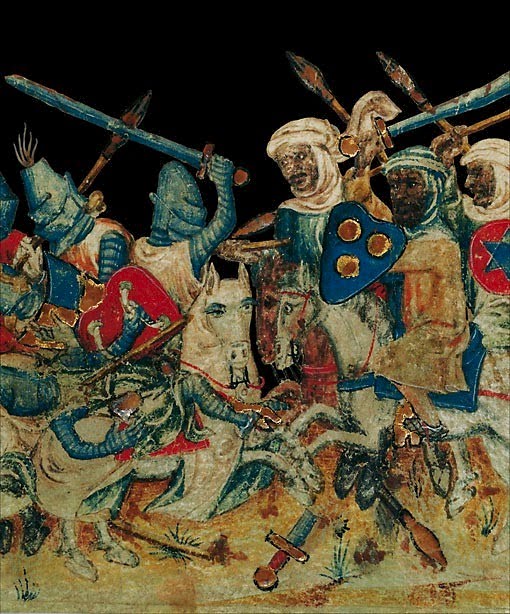
Christians fight Muslims in illustration from medieval manuscript. Image from syllabus, Southern Illinois University Edwardsville.

Sanctioned by a wrathful God:
Religion, politics, and war

By Harry Targ / The Rag Blog / September 22, 2010

Childhood remembrances

When I was a kid I had to go to Hebrew school to prepare for my Bar Mitzvah. I confess I would have preferred being in the school yard playing baseball to studying Hebrew. One of my few remembrances from days of religious study, aside from my resentment about time away from the ball field, was reading the stories of the tribes of Israel conquering or killing political/religious enemies. Acts of violence and hate seemed to me to be sanctioned by a wrathful God, my God.

Down the street from where we lived were St. Timothy’s Church and school. The building was an imposing broad red-brick structure. There was no contact between the children who went to school there and those of us who attended public school a few blocks away.

Ideology and the place of the United States in the world

When I grew up, began to study international relations, became an activist against the war in Vietnam, and started teaching foreign policy, I saw the power of ideology in mobilizing whole peoples to hate others. War, while a byproduct of economic interest, was facilitated by ideologies of hate; by creating “the other,” who were less than human and believed in the wrong God.

Millions died in the Crusades, the Inquisition in Spain, the taking of the lands of the Western Hemisphere and Africa, the occupations of China, Indonesia, Indochina, and the Middle East. Most of those deaths were justified by obedience to the Christian God.

In 1996 I was asked to give a talk at a church on “Is United States Foreign Policy Moral or Not?” I went to Ruth Sivard’s compilation of data on wars over the centuries, World Military and Social Expenditures, 1996. I counted up the war deaths of peoples in wars in which the United States was a direct participant, such as Korea and Vietnam, or in which the United States was indirectly involved such as Guatemala, Afghanistan, Angola, and Nicaragua. The number of those who died in those wars between 1945 and 1995 in which the United States had a role totaled 10 million.

Of course, participation in most of these wars and covert operations was justified by a mix of secular and sacred terms: democracy, markets, and God. President Reagan had reiterated the religious zealotry articulated by virtually every politician, banker, or theologian who called for U.S. militarism. The United States was “the city on the hill,” the “beacon of hope” for the world.

Lloyd Gardner in his recent book, The Long Road to Baghdad, A History of U.S. Foreign Policy From the 1970s to the Present, argues that there is a vision of global perfectibility behind United States foreign policy from its rise to great power status at the dawn of the twentieth century, to Woodrow Wilson’s vision of making the world safe for democracy, to Harry Truman’s announcement of our great struggle against communism in 1947, to John Kennedy’s “new frontier” and Lyndon Johnson’s war in Vietnam, to the Reagan Doctrine, and George W. Bush’s proclamation that nations are either with us or the enemy.

Underlying all this is the proposition, as Bob Dylan suggested, that “God is on our side.” Gardner writes that “Bush equates American foreign policy here with God’s will… God is on the side of justice; America has chosen the side of justice as its goal; therefore, God will bless American policy. Obstacles to this mission were only to be expected from forces on the wrong side of history.”

The campaign against Islam in the United States

Now politicians are demanding that the constitutional right of sectors of the Islamic community in New York to build a community center be denied because they offend the sensibilities of the Christians and Jews living in the city, indeed in the entire nation. They ignore the history of their coreligionists who have misused people’s faith to justify conquest and mass slaughter. They deny the fact that the presence of their religious institutions in other lands or located throughout communities in the United States create fear and anger among those of different faiths or no faith.

Perhaps most scurrilous of all is the way that the public mind is being manipulated and used for purposes of political gain at a time when joblessness, environmental devastation, and hatred spread across the land.

The little boy studying the Old Testament 60 years ago was uncomfortable about aspects of his religion that he could only partially understand. The great American writer, Mark Twain much earlier described the irony of religious fanaticism as he reported on a massacre of Muslim rebels fighting U.S. military occupiers at the dawn of the twentieth century in the Philippines:

Contrast these things with the great statistics which have arrived from that Moro crater! There, with six hundred engaged on each side, we lost fifteen men killed outright, and we had thirty-two wounded. . . The enemy numbered six hundred-including women and children-and we abolished them utterly, leaving not even a baby alive to cry for its dead mother. This is incomparably the greatest victory that was ever achieved by the Christian soldiers of the United States.

[Harry Tarq is a professor in American Studies who lives in West Lafayette, Indiana. He blogs at Diary of a Heartland Radical.]

The Rag Blog

Posted in Rag Bloggers | Tagged , , , , , | 1 Comment

Tom Hayden : Will Iraq ‘Invite’ Us to Stay?

Image from Progressive America Rising.

U.S. combat ends in Iraq
But will Iraq ‘invite’ us to stay?

By Tom Hayden / The Rag Blog / August 21, 2010

See ‘The myth that the combat troops are leaving Iraq’ by Col. Andrew Berdy, Below.

While the Obama administration struggles to keep its pledge to end the Iraq war, a behind-the-scenes plan is developing in which the Baghdad regime “invites” the American military to stay.

Managing the withdrawal of combat troops was a significant achievement for Obama. But while media attention focused this week on the last American combat brigade rolling out of Iraq, US diplomat Ryan Crocker was predicting that if the Iraqis “come to us later on this year requesting that we jointly relook at the post-2011 period, it is going to be in our strategic interest to be responsive.” [NYT, Aug. 19]

That means troops and bases, keeping a U.S. strategic outpost in the Middle East. Otherwise, according to some Pentagon sources, the Iraq war will have been in vain.

To prevent backsliding on the agreement to withdraw all troops and bases by the end of 2011, peace advocates and Congress will have to revisit and reinforce those agreements using hearings and budgetary powers.

To review the history: in late 2008, a secret negotiation resulted in what the Iraqis called “the withdrawal agreement” and the Americans the “status of forces agreement.” The bilateral pact was never debated or approved by the U.S. Congress. By its adoption, the Iraqis could claim a victory for sovereignty while the U.S. could declare a diplomatic end to an unpopular war.

In reality, the Iraq war never ended. U.S. casualties plummeted because fewer Iraqis wanted to shoot Americans who were leaving. Iraqi casualties declined from the feverish high of 2006-7, but continue to be several hundred per month.

Al Qaeda of Mesopotamia, which did not exist when the war began, has survived. The forces of Moktada al-Sadr, who waged two uprisings against the U.S., are a powerful factor in Iraqi politics and on the ground. The Kurdish crisis is unsolved. Overall, Iran has prevailed strategically and politically.

And the Baghdad regime originally installed by the Americans seems hopeless deadlocked, inefficient, and on the edge of imploding. The only Western winners are the oil companies headed by British Petroleum, now contracting for the Basra oil fields.

The State Department is expanding a militarized “civilian” intervention to fill the gap as Pentagon troops depart. Thousands of military contractors will conduct Iraqi police training, protect Iraq’s airspace, and possibly conduct continued counterterrorism operations. State Department operatives will be protected in mine-resistant, ambush-protected vehicles [MRAPS], armored vehicles, helicopters and its own planes.

The immediate future is uncertain. U.S. soldiers currently being sent to Iraq are told their mission is “to shut it down.” But the real story is being hidden by the Obama administration’s insistence that its promise to end the war is being kept. The notion of a continued military presence, according to the Times, “has been all but banished from public discussion.” According to one official, “the administration does not want to touch this question right now.”

A war that started with dreams of bringing democracy to the Middle East is ending by keeping plans for more troops hidden from American voters during an election year. Sound familiar?

[Tom Hayden is a former California state senator and leader of Sixties peace, justice, and environmental movements. He currently teaches at Pitzer College in Los Angeles. His books include The Port Huron Statement, Street Wars and The Zapatista Reader. He is a contributor to Progressive America Rising, where this article also appears.]

The myth that the combat
Troops are leaving Iraq

By Col. Andrew Berdy, U.S. Army (ret.)

Can you explain to me how, or why, the myth of “all combat troops out of Iraq” is allowed to be perpetuated by the press, much less our senior military leadership? Yes, the mission has changed. But units like my son’s Stryker Brigade (not the one that just left!) are, and always will be, combat infantry units.

This is fiction pure and simple. I just don’t get how the nation has swallowed this and why members of the media are not reporting facts the way they are rather than the political PR message the Administration wants portrayed. Does anyone not think that the likelihood of continued combat operations is a reality? When casualties are taken by these “non-combat forces” will those casualties be characterized as “non-combat” as well?

Does the public not understand that the secondary mission of our remaining forces is to be prepared to conduct combat operations either to defend themselves or to support Iraqi forces if requested? And when these train and assist “non-combat” units have to engage in, dare I say, combat operations, what will the Administration say then?

I can tell you, as a former brigade commander responsible for securing and helping to rebuild Port-au-Prince, Haiti, while we went in prepared for battle, and quickly transitioned to peacekeeping/nation building, there was never a moment that my infantry brigade was not prepared to conduct combat operations (which did occur late in the deployment) and there was never a moment when we were anything but a combat force.

I suspect if you ask those troopers on the ground now they would agree with me and take incredible umbrage with what is being trumpeted on TV and in the press.

Source / The Best Defense / Foreign Policy

Thanks to Carl Davidson and Steve Russell / The Rag Blog

Posted in Rag Bloggers | Tagged , , , | 9 Comments