Memorial Day in Texas : Farewell to Nick Travis and Lisa Morris

Nick Travis at the opening of the Under the Hood Café in Killeen, Texas. Photo by Carlos Lowry / The Rag Blog.

Memorial Day:
Texas peace movement
Looses two great friends

By Alice Embree / The Rag Blog / June 6, 2010

Memorial Day 2010 was a day to remember two friends who were mainstays of the Texas peace community. Nick Travis III, 55, passed away suddenly early Monday morning, May 24, in Austin. Lisa Morris, 28, passed away unexpectedly the next day in Copperas Cove.

Nick was a founding member of Instruments for Peace, an organizer along with Richard Bowden, of the annual Million Musicians March for Peace. He was a sustaining member of the Crawford Peace House and a Camp Casey regular. Nick and his wife, Melissa Garner, worked together to rebuild houses in New Orleans after Hurricane Katrina. They were also supporters of Under the Hood Café in Killeen, Texas, a pro-soldier, anti-war space for soldiers and their families, situated less than one mile from Fort Hood, the largest military base in the United States.

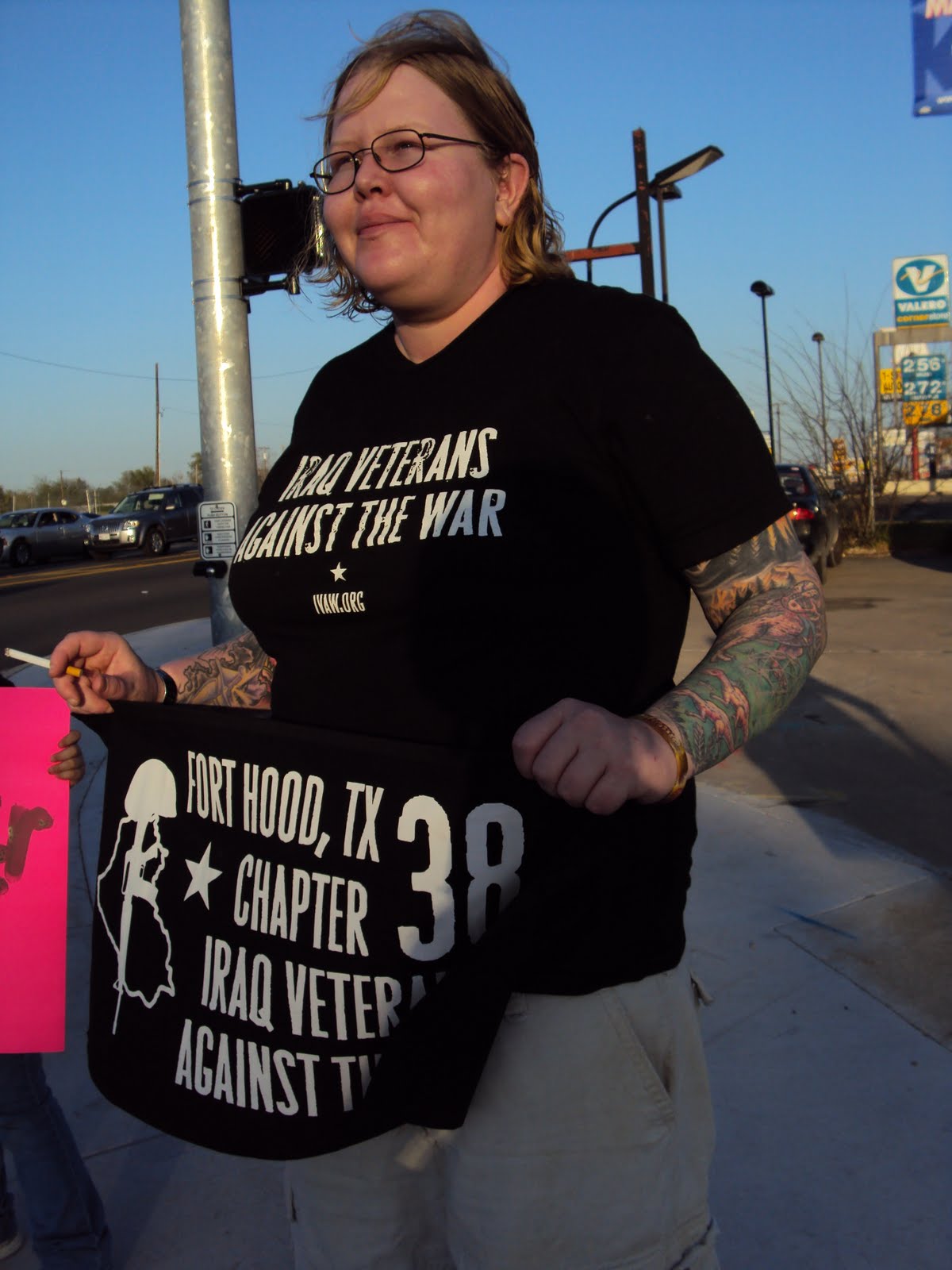
Lisa Morris, at the east gate of Fort Hood. Photo by Heidi Turpin / The Rag Blog.

Lisa Morris was an Under the Hood regular. A graduate of Rockford High School in Michigan, Lisa enlisted in the Army and was deployed to Iraq. She was present during the fierce fighting at Sadr City in 2004 when Tomas Young, subject of the documentary Body of War, was paralyzed. The fighting at Sadr City also took the life of Casey Sheehan, peace activist Cindy Sheehan’s son. Lisa was wounded later at Sadr City. She received a Purple Heart.

Lisa was part of the Under the Hood family. After her discharge, she stayed in the Killeen area, buying a home in Copperas Cove where she was known for her barbequing skills, and was beloved by neighborhood children and adored by all cats and dogs that crossed her path. Like many of the soldiers at Under the Hood, Lisa suffered with symptoms of post-traumatic stress disorder. Days before her death she had been hospitalized for an infection. She died in her sleep at home.

Nick was a musician for 30 years in the Austin area, a bassist performing with Natalie Zoe, The Vanguards, Guy Forsyth, the Paul LeMond Band, and Leeann Atherton. In recent years, he accompanied Miss Lavelle White, John Gaar and the Hopeful Soul, and Julieann Banks. Nick was also an actor, appearing in films and commercials and as a body double for Billy Bob Thornton in “Friday Night Lights.”

With his wide grin and big heart, Nick was always there for the benefits and the marches, getting the stage set up at Camp Casey or City Hall. He would serve as the emcee for the Million Musicians Marches and Instrument for Peace gatherings. More than 150 musicians and friends celebrated his life on Memorial Day at Leeann Atherton’s Barn Dance site in Austin. One peace activist there said, “I feel like one side of the tent has fallen.”

Lisa’s life had only begun to take an activist turn after Iraq. She was a member of Iraq Veterans Against the War. For her Under the Hood family, her loss was devastating. At the memorial for Lisa in Killeen, a neighbor sported a fresh tattoo — a fitting permanent tribute to Lisa whose arms were covered with ink. The tattoo shows “America’s High Five,” a map of Michigan in plaid, and carries these words below the map: “R.I.P Lisa Morris, June 9, 1981 – May 25, 2010.”

In the ninth year of the war in Afghanistan, there are now a thousand U.S. dead. There are uncounted civilian deaths. Drone attacks and ambushes on celebrations occasionally make the news. Injured soldiers like Lisa return from the continuous waves of deployment with physical and psychological wounds.

The peace community must honor the lives of Nick Travis III and Lisa Morris. Then, in their memories, renew every effort to stop these endless wars before they morph across more borders and more decades. As Joe Hill urged before his death, “Don’t mourn, organize.”

[Long-time Austin activist Alice Embree is a contributing editor to The Rag Blog and a member of the board of the New Journalism Project.]

The Rag Blog

Posted in Rag Bloggers | Tagged , , , , , , , , , , , | 2 Comments

Nelson Mandela’s group of “Elders” — including six former winners of the Nobel Peace Prize — condemned Israel’s attack on the Gaza aid flotilla as “completely inexcusable” and called the three-year blockade of Gaza “one of the world’s greatest human rights violations.” Our post also includes a report about released German activists contesting the Israeli version of what happened on the ship — and an analysis of how the mainstream media has covered the events from the Israeli point of view.

Posted in RagBlog | Leave a comment

Larry Ray : BP Means You ‘Better Pray’

Time warp photo montage by Larry Ray / The Rag Blog.

Blessing of the Fleet:
Oil spill anxiety accompanies annual ritual

By Larry Ray / The Rag Blog / June 2, 2010

GULFPORT, Mississippi — The uncertainty of the huge BP oil spill out offshore from Biloxi, Mississippi, has not stopped this old world fishing community from holding its annual “Blessing of the Fleet” this coming weekend as it has every year since 1929. But it will not be quite the same. This year there is a palpable anxiety from the threat of the looming offshore disaster which will quietly mix in with the Cajun music, boiled shrimp, and deep fried mullet better known as “Biloxi bacon.”

The festival really gets rolling on a Saturday after Catholic masses for fishermen lost at sea and other recognitions starting on Thursday. But on Saturday the town turns out for a rollicking all day Cajun fais do do street party with lots of delicious seafood and culminates that evening with the coronation of the Shrimp Queen and King on the Biloxi Town Green. The blessing of the fleet takes place early afternoon on Sunday.

Eighty one years ago the fishing boats all rafted up side by side, with the priest climbing from boat to boat to sprinkle holy water and offer blessings for protection from the sea and bountiful catches. More recent blessings of the fleet have taken place with a special dockside altar for the priest who blesses a long and colorfully decorated parade of boats both large and small as they motor past.

This year, the devoutly Catholic ritual of blessing and protecting the fishing fleet and its largely immigrant boat owners and seafood workers should include a new definition of “BP” which now would now seem to mean, “Better Pray.”

For almost a month and a half, all of the oil exploration industry’s best efforts to staunch a high pressure gusher of thick oil and methane gas from a well blowout 5,000 feet beneath the surface of the Gulf of Mexico have come to naught. Oil giant BP’s efforts to crank up their public relations machinery to a loud and preposterous level has served only to offer false hope to an anxiously watching world.

Quickly stopping this disaster seems akin to stopping an erupting volcano. The maelstrom beneath the earth’s mantel, especially on the barely understood deep sea floor invites disaster if provoked. The rage of unstoppable oil seems to prove the point.

Yet, like wind-up talking toys, well groomed and slickly rehearsed BP top dogs continue to tell all who will listen that none of this is as bad as it seems and that great progress is being made in rounding up the miles of floating oil by either burning it or “collecting” it.

Their promises to clean up every drop of oily sludge that has filled sensitive Louisiana marshes and estuaries have not produced any sort of energetic or effective results. Undeterred, BP spews forth statistics and more promises while being careful to first run everything by their lawyers.

BP spokespersons tell one particular story at every possible opportunity as if all listeners were third graders. With confident, and concerned expressions they tell the tale of the hundreds of thousands of gallons of toxic oil dispersant, “like dish washing liquid” that are breaking the oil up into teensie little droplets so that starving bacterial can ravenously eat up all the oil. The BP bacterial buffet is really a wonderful thing, boys and girls!

However, BP denies the recent findings of a half dozen major universities whose marine exploration efforts now suggest that the dispersant being shot directly into the source of the gusher on the sea floor is merely keeping the oil out of sight on the surface. They are finding miles long areas of the broken-up oil hundreds of feet below the ocean’s surface, being moved and swept about like huge dark tendrils by currents at the water column at different depths. The new data suggests that bacteria won’t make a dent in this movable feast.

Strong currents may move these thick oil ribbons onshore at some point way in the future, or even into the “loop current” in the gulf. This would pull some of the tens of millions of gallons of oil between the tip of Florida and Cuba, and then on up the Atlantic coast.

Oil company big shots don’t like to be ordered around. After eight years of basically no meaningful regulation by the Bush-Cheney Minerals Management staff, and having helped formulate Cheney’s secret energy policy, BP and all the other big oil companies have learned that it is easy to outwit and out-wait the bureaucrats and that it is also much better for the bottom line. A steady flow of campaign money to state and national politicians also greases things nicely.

Smellier and dirtier than the oil slicks are the shameless political attacks from the nay-saying, do-nothing Republicans intent upon tearing down President Obama. Their first order of business is to blame it all on Obama. And the crass move is playing well because people want something done, anything, and aren’t capable of grasping the fact that this disaster may be uncontrollable by Obama, or any other mortal. Again, clear and honest explanations of the difficulty of stopping the oil flow, and the reasons why don’t satisfy three-year-olds.

BP was not required to undertake a detailed worst-case scenario environmental study because of their cozy relationship with Bush-Cheney era Mineral Management employees. Angry Americans should be screaming loudly at the drill baby drill Republicans still in office who, in effect, were in lock step with the Bush no regulation approach to environmental protection.

Meanwhile, the Priest and Catholic Bishop on hand this coming weekend better have plenty of holy water for this year’s blessing of the fleet, which includes many boats that have just rejoined the fleet after being destroyed by Hurricane Katrina in 2005.

This year’s hurricane season starts just a few days before BP… Biloxi’s Prayers.

[Retired journalist Larry Ray is a Texas native and former Austin television news anchor. He also posts at The iHandbill.]

The Rag Blog

Posted in Rag Bloggers | Tagged , , , , , , , , , | 3 Comments

Mission Possible? : Visualize Skimmers and Booms

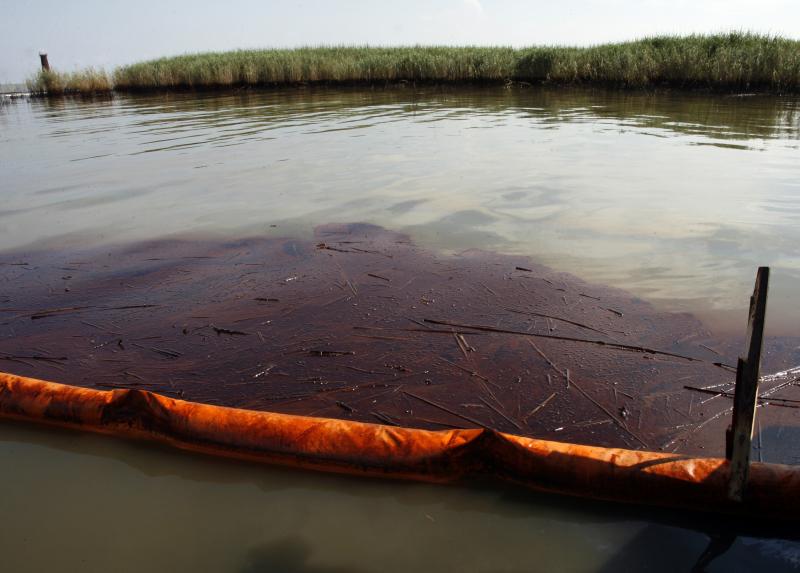
Crude oil collects on the wrong side of an orange containment boom in Pass a Loutre near Venice, Louisiana, May 30, 2010. Photo by A.J. Sisco / UPI.

Skimmers and booms:
Keywords for victory on the Gulf Coast

By Greg Moses / The Rag Blog / June 2, 2010

If Americans want to visualize victory over the oil spill invasion that threatens our beloved Gulf of Mexico, then we should call for a federalized war of skimmers and booms.

We should not be timid about it. We should visualize a series of booms in concentric rings that contain the spill, with skimmers at work within each ring, sucking up the oil. Industry websites claim that extracted oil can then be mixed with chemicals and reused for fuel.

The effort might also be helped by supertankers “that come in empty, with the huge valves and huge pumps that they have to suck the oil off the surface of the sea so it stops drifting into the wetlands,” says former president of Shell Oil John Hofmeister in a recent interview with the BBC.

As part of this winnable war, dispersants must be stopped.

Our winning hope for this war is nicely exemplified by the Coast Guard Cutter Walnut, which just left Hawaii for her 6,000-mile journey to the Gulf.

“The Walnut is 225-feet long, has a crew of about 50 people, and boasts state-of-the-art communications equipment and oil skimming capabilities,” reports Minna Sugimoto for Hawaii News Now. “Designed after the Exxon Valdez disaster in 1989, the Walnut comes equipped with a boom and pump oil collection system.”

“The skimmer sucks the oil in and pumps it into a bladder,” says Jeffrey Randall, U.S. Coast Guard commanding officer. “That bladder is then filled up, transferred to another vessel that takes it away.”

“Coast Guard officials say the crew goes through annual spill response training, but this will be the first time it’ll actually put oil in the equipment,” Sugimoto reports.

As early as April 29 the Los Angeles Times was reporting the Navy’s mobilization of booms and skimmers and the “opening (of) two of its bases in Mississippi and Florida as staging areas.” WLOX- Biloxi reporter Steve Phillips filed an eyewitness account of the activity from the Gulfport Seabee base.

Vice Adm. Kevin McCoy is commander of the U.S. Navy’s Naval Sea Systems Command’s (NAVSEA) which includes the Supervisor of Salvage and Diving (SUPSALV). Within these commands we find initial offerings of equipment, expertise, and training that will be required to defend the Gulf of Mexico against the oil spill invasion.

“A team of NAVSEA professionals are working around the clock to protect the sensitive coast lined with oil booms and perform open-ocean skimming at the source,” says Vice Adm. McCoy at a web page posted by the Naval News Service (NNS).

“NAVSEA’s Chief Engineer for Underwater Salvage (Capt. Patrick Keenan) has been an integral member of BP’s Engineering Command Cell that has assembled the best and brightest minds from around the world to try to stop the leak,” said Vice Adm. McCoy.

“With a single phone call from the U.S. Coast Guard, 66,000 feet of open ocean boom and nine self-contained skimming systems, and the professionals to install and operate them, were dispatched (representing the initial shipment). That’s your Navy — a 24-hour Navy, incredibly ready and trained to respond to a wide variety of national taskings,” boasts Vice Adm. McCoy.

While the Coast Guard and Navy probably do not have enough booms and skimmers on hand to supply the war for the salvation of the Gulf Coast, they do appear to have sufficient knowledge to gather and organize the inventories and people needed. Surely there are enough booms and skimmers in the world that can be air-transported quickly and organized effectively.

Meanwhile, activists and biologists are converging on a consensus that toxic dispersants must be stopped.

“The use of dispersants is a crime on top of a crime, sanctioned by a federal agency, Lisa Jackson, and the EPA,” writes Elizabeth Cook at New Orleans IndyMedia. “It is the rape of the Gulf of Mexico, its sea creatures, and the people who depend on this ecosystem for a living.“

“Diluting the evidence, this (dispersant) solution was designed only for public relations, even as it made the situation much worse,” argues Linh Dinh at CounterPunch. “Imagine Agent Orange in the water. Thousands of people are already sick, with millions more to come.”

With enough booms to contain the spill, and enough skimmers to extract the oil from the water, there would appear to be no need to add the risk of toxic dispersants to the already toxic spill.

When on Sunday’s “State of the Nation” program, CNN’s Candy Crowley asked Joint Chiefs of Staff Chairman Admiral Mike Mullen to describe the military response to the Gulf oil spill, the answer she got was a textbook case of incoherence.

Within the space of 141 words the Chair of the Joint Chiefs zig-zagged between “a support role” that simply responded to BP requests on the one hand to “doing everything we can… with every capability that we have” on the other. His confusing ambivalence was perhaps best expressed in the sentence: “And as best I’ve been able to understand, the technical lead for this in our country really is the industry.”

While it may be true that the deep-water attempt to stop the oil spill belongs primarily to industry engineers (although, along with Dr. John, we may protest why this has to be the case) there is ample evidence that the military is perfectly qualified to take command of pollution control.

Remember Dunkirk or the Berlin Airlift? There are times in military history when impossible missions have been accomplished through mobilized determination. We should not give up hope that the war to the save the Gulf of Mexico can go down in history as one of those remarkable efforts.

Elizabeth Cook of New Orleans IndyMedia helped with research and issue development for this story.

[Greg Moses is editor of the Texas Civil Rights Review and author of Revolution of Conscience: Martin Luther King, Jr. and the Philosophy of Nonviolence. He can be reached at gmosesx@gmail.com.]

The Rag Blog

Posted in Rag Bloggers | Tagged , , , , , | 4 Comments

Big Polluter


Graphic by Mariann G. Wizard and Charlie Loving / The Rag Blog / June 2, 2010

The Rag Blog

Posted in Rag Bloggers | Tagged , , , , | 2 Comments

Textbooks and the Confederacy : Teach the Whole Story

Image from photobucket.

Texas textbooks:
Let’s teach the truth about the Confederacy

By Michael Lind / June 2, 2010

‘Our new government is founded upon… the great truth that the negro is not equal to the white man.’ — Alexander Stephens, Vice President of the Confederacy

The Texas State Board of Education, the most astringently reactionary body since the Spartan Ephorate, has decreed that textbooks for the schoolchildren of Texas are to include Confederate President Jefferson Davis’s inaugural address along with the first inaugural of Abraham Lincoln.

This controversy holds particular interest for me. I am a fifth-generation native of Texas. One ancestor of mine had his farm in Georgia incinerated by Gen. Sherman. Another came to Texas in the federal army of occupation of Gen. Custer. One of the last things that my late grandfather said to me was: “Sam Houston was a traitor to the South!” The Civil War ended in 1865, but clearly its meaning is still contested in the 21st century.

By all means, let schoolchildren in Texas read Jefferson Davis’s inaugural address. But there should be more material from the Confederate side of the conflict than that. For generations, apologists for the Confederacy have claimed that secession was really about the tariff, or states’ rights, or something else — anything other than preserving the right of some human beings to own, buy and sell other human beings.

That being the case, the education of schoolchildren in my state should include a reading of the Cornerstone Speech made by Alexander Stephens, the vice-president of the Confederacy, on March 21, 1861. With remarkable candor, Stephens pointed out that whereas the United States was founded on the idea, enshrined in Thomas Jefferson’s Declaration of Independence, that “all men are created equal,” the new Confederacy was founded on the opposite conception:

The prevailing ideas entertained by [Thomas Jefferson] and most of the leading statesmen at the time of the formation of the old constitution, were that the enslavement of the African was in violation of the laws of nature; that it was wrong in principle, socially, morally, and politically … Those ideas, however, were fundamentally wrong. They rested upon the assumption of the equality of races. This was an error. It was a sandy foundation, and the government built upon it fell when the “storm came and the wind blew.”

Our new government is founded upon exactly the opposite idea; its foundations are laid, its corner-stone rests, upon the great truth that the negro is not equal to the white man; that slavery subordination to the superior race is his natural and normal condition. This, our new government, is the first, in the history of the world, based upon this great physical, philosophical, and moral truth.

Let the children of Texas compare what Stephens had to say about natural rights and human equality with Lincoln’s views on the subject, and contrast the ideals of the American and Confederate Foundings. That should make for interesting classroom discussions.

Let Texas schoolchildren, as well, read the Confederate Constitution. It is surely the most bizarre constitution ever adopted. It is a copy of the U.S. Constitution, rewritten to cripple the central government. The Confederate Constitution bans the government of the new federation from spending money on infrastructure, with a few exceptions like harbors and lighthouses, and prevents the new government of the South from fostering industry.

With a central government that was deliberately weakened at its formation, how did the Confederacy expect to prevail in a war against the forces of the Union? The answer is that the rich oligarchy of slave lords who ruled the South hoped that the British empire would intervene to secure their region’s independence, just as France had intervened in the American Revolution to help the United States win its independence from Britain.

When the British declined the offer, the geniuses in charge of the Confederacy realized that they would have to win their independence with their own resources. This was no easy thing to do in a wannabe country that prided itself on its absence of factories and banks. But they tried anyway. They threw libertarianism overboard and mobilized for war. They instituted a draft. They passed an income tax and inflated the currency to push citizens into higher brackets. Lacking a native Southern capitalist class, they put generals and colonels in charge of government-owned factories and munitions plants.

But conscription, taxation and state socialism were not enough. Too many Southern men were avoiding the draft or deserting, to say nothing of slaves who ran away to freedom or to join the U.S. Army. And there was the resistance. In the semi-mythical “free state of Jones” in Mississippi, in the Big Thicket in East Texas, in the Texas German Hill Country, rebels fought the rebellion, in the name of the United States or their own rights.

The tradition of anti-Confederate resistance survived in the South after the war, to inspire Radical Republican “scalawags,” populists, socialists, and New Deal Democrats. The Southern right and the Northern left have erased the resisters from history. But not all of us have forgotten them.

Toward the end of the war, Robert E. Lee and Jefferson Davis came up with a plan. Following Lincoln’s Emancipation Proclamation, they proposed to save the Confederacy by freeing and arming slaves. In “Confederate Emancipation: Southern Plans to Free and Arm Slaves During the Civil War,” Bruce Levine quotes some typical responses.

Brig. Gen. Clement H. Stevens: “If slavery is to be abolished then I take no more interest in our fight.” Gov. Zebulon Vance of North Carolina: “Our independence is chiefly desirable for the preservation of our political institutions, the principal of which is slavery.” Once it became clear that the only way to save slavery and anti-statism in the South was to abolish slavery and adopt statism, the malfunctioning Confederate Mind short-circuited completely.

That is what my fellow Texans of younger generations should learn about the Lost Cause. Under British protection, the CSA might have evolved into a squalid banana republic run by landlords for the benefit of investors and industrialists in Britain. Without British protection, the CSA might have survived as a proto-fascist regime, with an economy of permanent war socialism and a government run by colonels.

In either case, the victory of the Confederacy would have been far worse for most white and black Southerners than its well-deserved defeat. For ensuring that I would be born in the United States of America instead of a broken-down failed state that combined the least attractive features of apartheid-era South Africa and death squad-era Honduras, I say: Thank you, President Lincoln, and thank you, Gen.Grant.

So let the students of Texas read the inaugural address of Jefferson Davis, and the Cornerstone Speech of Alexander Stephens, and the Confederate Constitution. And let the readings conclude with the speech that Texas Gov. Sam Houston gave on Sept. 22, 1860, in my home town of Austin, the state capital.

Houston had led the successful Texan revolt against Mexico in 1836 and had served as president of the Republic of Texas, then as a United States senator after Texas was admitted to the Union. His final campaign, before he was deposed from office by the Confederates, was his failed attempt to prevent the secession of Texas from the United States.

In front of that audience in Austin, the haggard old soldier mocked the claim that the rights of the Southern states were threatened in any way by the North:

Our forefathers saw the danger to which freedom would be subjected, from the helpless condition of disunited States; and, to “form a more perfect Union,” they established this Government. They saw the effect of foreign influence on rival States, the effect of dissensions at home, and to strengthen all and perpetuate all, to bind all together, yet leave all free, they gave us the Constitution and the Union.

Where are the evidences that their patriotic labor was in vain? Have we not emerged from an infant’s to a giant’s strength? Have not empires been added to our domain, and States been created? All the blessings which they promised their posterity have been vouchsafed; and millions now enjoy them, who without this Union would to-day be oppressed and down-trodden in far-off foreign lands!

What is there that is free that we have not got? Are our rights invaded and no government ready to protect us? No! Are our institutions wrested from us and other foreign to our taste forced upon us? No! Is the right of free speech, a free press, or free sufferage taken from us?

Has our property been taken from us and the government failed to interpose?

No, none of these! The rights of the States and the rights of individuals are still maintained. We have yet the Constitution, we have yet a judiciary, which has never been appealed to in vain — we have yet just laws and officers to administer them; and an army and navy, ready to maintain any and every constitutional right of the citizen.

Whence then this clamor about disunion? Whence this cry of protection to property or disunion, when even the very loudest in the cry, declared under their Senatorial oaths, but a few months since, that no protection was necessary? Are we to sell reality for a phantom?

Class dismissed.

[Michael Lind is policy director of the Economic Growth Program at the New America Foundation and author of What Lincoln Believed: The Values and Convictions of America’s Greatest President.]

Source / Salon

Thanks to Tom Cleaver / The Rag Blog

Posted in RagBlog | Tagged , , , , , , , , , , | 10 Comments

Mandela, Tutu, and ‘The Elders’ : Peace Leaders Condemn Israeli Attack

Former South Africa president Nelson Mandela is shown with The Elders Saturday, three years after launching the group in Johannesburg. Photo from AP.

‘The Elders’:
Peace leaders, Nobel laureates
Deplore Gaza flotilla attack

See ‘German activists contest Israeli version,’ and ‘Media Criticism: Reporting Israeli assault through Israel’s eyes,’ Below.

June 1, 2010

The Elders group of past and present world leaders, including former South African president Nelson Mandela and Archbishop Desmond Tutu, on Monday condemned as “completely inexcusable” the deadly Israeli attack on a flotilla carrying aid for Gaza.

At least 10 [and as many as 16] people are reported to have been killed when Israeli commandos raided the boats on Monday in an operation that has drawn international condemnation.

“The Elders have condemned the reported killing by Israeli forces of more than a dozen people who were attempting to deliver relief supplies to the Gaza Strip by sea,” the 12-member group said in a statement issued in Johannesburg, where it met over the weekend.

The group, which was launched by Mr. Mandela on his birthday in 2007 to try to solve some of the world’s most intractable conflicts, called for a “full investigation” of the incident and urged the UN Security Council “to debate the situation with a view to mandating action to end the closure of the Gaza Strip.” “This tragic incident should draw the world’s attention to the terrible suffering of Gaza’s 1.5 million people, half of whom are children under the age of 18,” the group said.

Israel’s three-year blockade of Gaza was not only “one of the world’s greatest human rights violations” and “illegal” under international law, it was also “counterproductive” because it empowered extremists in the Palestinian territory, they said.

The Elders includes six Nobel peace prize winners — former UN secretary general Kofi Annan, former Finnish president Martti Ahtisaari, former U.S. president Jimmy Carter, detained Burmese leader Aung San Suu Kyi, and Mr. Mandela and Tutu.

Norway’s first female Prime Minister Gro Brundtland; former Brazilian president Fernando Henrique Cardoso; former Irish president and ex—UN High Commissioner for Human Rights Mary Robinson; Mozambican social activist Graca Machel; Indian women’s rights activist Ela Bhatt; and Algerian veteran UN envoy Lakhdar Brahimi are the other members.

Source / The Hindu

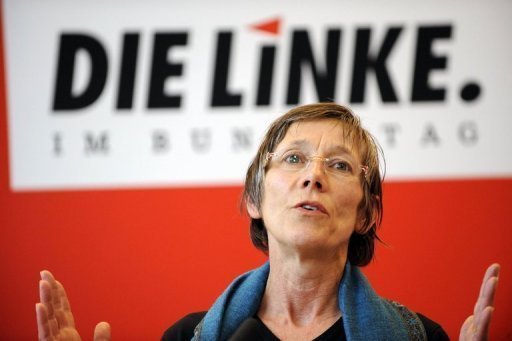
German lawmaker Annette Groth — who was on board the aid convoy when it was raided by Israeli commandos. Photo by AFP.

German activists contest Israeli version

Visibly shaken German activists who were on an aid ship bound for Gaza rejected on Tuesday Israeli claims that commandos were provoked by violence by those on board, saying it was a peaceful convoy…

“The Israeli government justifies the raid because they were attacked. This is absolutely not the case,” former MP Norman Paech, 72, wrapped in a blue blanket, told reporters after being deported back to Berlin…

“We had not prepared in any way to fight. We didn’t even consider it,” he added. “No violence, no resistance — because we knew very well that we would have absolutely no chance against soldiers like this.

“We wanted to show that we were peaceful.” — AFP

Media criticism:
Reporting Israeli assault through Israel’s eyes

Attack on humanitarian flotilla prompts little media skepticism…

By Fairness and Accuracy in Reporting / May 1, 2010

On May 31, the Israeli military attacked a flotilla of boats full of civilians attempting to deliver humanitarian supplies to the Gaza Strip. Reports indicate that at least nine and as many as 16 of the activists on board were killed, though details remain sketchy due to Israel’s censorious limitations on media coverage. Much of the U.S. media coverage has been remarkably unskeptical of Israel’s account of events and their context, and has paid little regard to international law.

The New York Times (6/1/10) glossed over the facts of the devastating Israeli siege of Gaza, where 1.5 million people live in extreme poverty. As reporter Isabel Kershner wrote, “Despite sporadic rocket fire from the Palestinian territory against southern Israel, Israel says it allows enough basic supplies through border crossings to avoid any acute humanitarian crisis.”

Asking Israel to explain the effects of its embargo on the people of Gaza makes little sense, especially when there are plenty of other resources available. The U.N. Office for the Coordination of Humanitarian Affairs reported (IRIN, 5/18/10):

As a consequence of Israel’s blockade of the Gaza Strip, 98 percent of industrial operations have been shut down since 2007 and there are acute shortages of fuel, cash, cooking gas and other basic supplies….

Water-related health problems are widespread in the Strip because of the blockade and Israel’s military operation in Gaza, which destroyed water and sanitation infrastructure, including reservoirs, wells, and thousands of kilometres of piping…

Chronic malnutrition has risen in Gaza over the past few years to reach 10.2 percent…

In Gaza, Israel’s blockade is debilitating the healthcare system, limiting medical supplies and the training of medical personnel and preventing serious medical cases from traveling outside the Strip for specialized treatment.

Israel’s 2008-2009 military operation damaged 15 of the Strip’s 27 hospitals and damaged or destroyed 43 of its 110 primary healthcare facilities, none of which have been repaired or rebuilt because of the construction materials ban. Some 15-20 percent of essential medicines are commonly out of stock and there are shortages of essential spare parts for many items of medical equipment.

Those facts, though, aren’t persuasive to everyone. The Washington Post‘s June 1 editorial page had one of the most appalling takes on the killings: “We have no sympathy for the motives of the participants in the flotilla — a motley collection that included European sympathizers with the Palestinian cause, Israeli Arab leaders and Turkish Islamic activists.”

Many of the analysis pieces in major papers focused on the fallout for Israel and the United States, rather than the civilians killed or the humanitarian crisis they were trying to address. The Post‘s Glenn Kessler (6/1/10) framed the U.S. response, not the Israeli attack, as the complicating factor: “Condemnation of Israeli Assault Complicates Relations With U.S.” Kessler lamented, “The timing of the incident is remarkably bad for Israel and the United States,” while a Los Angeles Times account (6/1/10) called the raid “a public relations nightmare for Israel.” The New York Times‘ Kershner wrote (NYTimes.com, 5/31/10) that “the criticism [of Israel over the attack] offered a propaganda coup to Israel’s foes, particularly the Hamas group that holds sway in Gaza.”

Other news accounts presented misleading context about the circumstances leading to Israel’s blockade. Kershner (New York Times, 6/1/10) stressed that “Israel had vowed not to let the flotilla reach the shores of Gaza, where Hamas, an organization sworn to Israel’s destruction, took over by force in 2007.” The Associated Press (6/1/10) reported that “Israel and Egypt sealed Gaza’s borders after Hamas overran the territory in 2007, wresting control from Abbas-loyal forces” — the latter a reference to Fatah forces affiliated with Mahmoud Abbas.

Both accounts ignore the fact that Hamas won Palestinian elections in 2006, which led the United States and Israel to step up existing economic restrictions on Gaza. An attempt to stoke a civil war in Gaza by arming Fatah militants — reported extensively by David Rose in Vanity Fair (4/08)–backfired, and Hamas prevailed (Extra!, 9-10/07).

Much of the U.S. press coverage takes Israeli government claims at face value, and is based largely on footage made available by Israeli authorities — while Israel keeps the detained activists away from the media (not to mention from lawyers and worried family members). The Washington Post (6/1/10) reported the attack this way:

Upon touching down, the Israeli commandos, who were equipped with paint guns and pistols, were assaulted with steel poles, knives and pepper spray. Video showed at least one commando being lifted up and dumped from the ship’s upper deck to the lower deck. Some commandos later said they jumped into the water to escape being beaten. The Israeli military said some of the demonstrators fired live ammunition. Israeli officials said the activists had fired two guns stolen from the troops.

As Salon.com‘s Glenn Greenwald wrote (5/31/10): “Just ponder what we’d be hearing if Iran had raided a humanitarian ship in international waters and killed 15 or so civilians aboard.”

The Times‘ June 1 report included seven paragraphs of Israel’s account of what happened on board the Turkish ship, the Mavi Marmara, where the civilians were killed; the paper reported that “There were no immediate accounts available from the passengers of the Turkish ship” because the Israeli base they were taken to “was off limits to the news media and declared a closed military zone.”

The Times piece also showed little interest in international law, mentioning Israel’s claim regarding the legality of their actions but providing no analysis from any international law experts to support or debunk the claim: “Israeli officials said that international law allowed for the capture of naval vessels in international waters if they were about to violate a blockade.”

According to Craig Murray (5/31/10), former British ambassador and specialist on maritime law, the legal position “is very plain”: “To attack a foreign flagged vessel in international waters is illegal. It is not piracy, as the Israeli vessels carried a military commission. It is rather an act of illegal warfare.”

© 2010 Fairness and Accuracy in Reporting

Source / CommonDreams

The Rag Blog

Posted in RagBlog | Tagged , , , , , , , , | 17 Comments

Bob Feldman : A People’s History of Afghanistan / 8

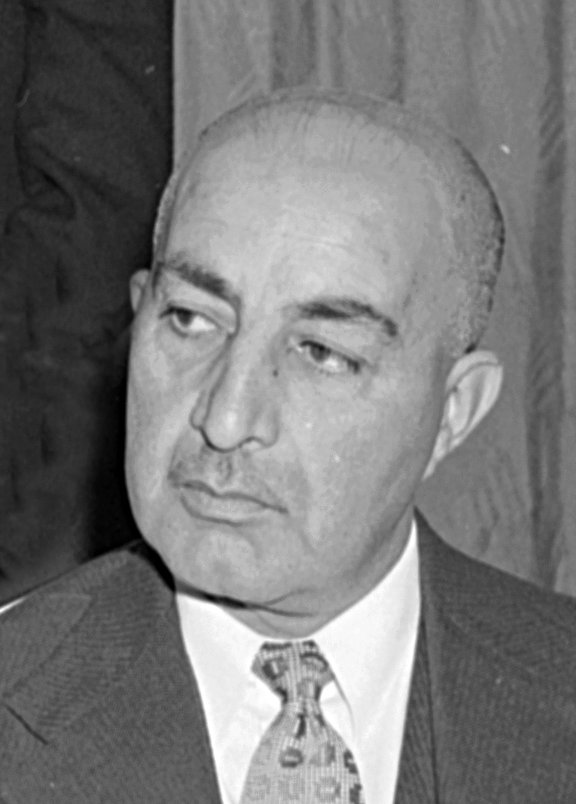
Afghanistan President Mohammad Daoud was killed, along with his family, in “a burst of gunfire” while resisting arrest in 1978. Photo from Wikimedia Commons.

Part 8: 1977-1978
A People’s History of Afghanistan

By Bob Feldman / The Rag Blog / June 1, 2010

[If you’re a Rag Blog reader who wonders how the Pentagon ended up getting stuck “waist deep in the Big Muddy” in Afghanistan (to paraphrase a 1960s Pete Seeger song) — and still can’t understand, “what are we fighting for?” (to paraphrase a 1960s Country Joe McDonald song) — this 15-part “People’s History of Afghanistan” might help you debate more effectively those folks who still don’t oppose the planned June 2010 U.S. military escalation in Afghanistan? The series so far can be found here.]

Right-wing anti-feminist Islamic parties and Mujahideen or Taliban militias have exercised a special influence in Afghan politics since the 1980s. But the history of people in Afghanistan between 1977 and 1978 indicates that the radical secular left People’s Democratic Party of Afghanistan [PDPA] also played an historically significant role in Afghan politics.

In July 1977, for example, Noor Mohammad Taraki’s PDPA-Khalq faction/party and Babrak Karmal’s PDPA- Parcham faction/party agreed to form one united PDPA party, with a 30-member Central Committee in which each faction would be represented equally. After Mohammad Daoud seized control of Afghanistan ’s government in 1973, the Khalq faction of the now-united PDPA had apparently been successful in persuading more members of the Afghan military to join the PDPA.

A key role in the PDPA-Khalq faction’s recruitment of members of the Afghan military into the PDPA was apparently played by a graduate of Kabul University, the University of Wisconsin, and Columbia University Teachers College named Hafizullah Amin, who had lived and studied in the United States in the late 1950s and early 1960s.

But between July 1977 and April 1978, Afghan ruler Daoud was apparently “moving towards a one-party dictatorship by banning all political parties and opposition newspapers and by setting up his own National Revolutionary Party,” according to Afghanistan: A Modern History by Angelo Rasanayagam. Yet 85 percent of Afghanistan ’s 15 million people in March 1978 were still “either peasants who made a precarious living off the land, or nomads.” The same book also indicated how the standard of living for most people in Afghanistan under the Daoud regime compared to the standard of living existing in other countries of the world in March of 1978:

The economic and social indicators relative to Afghanistan were the worst in the world. Per capita income was $157… It was the most backward country in the world with respect to energy consumption, with almost the entire rural population having no access to electricity. The country also ranked among the lowest in the world in terms of public health facilities, with one doctor for every 16,000 Afghans, 80 percent of the doctors being concentrated in Kabul… 76 percent of Afghan children had not received any education, with no more than 4 percent of rural girls having ever attended a primary school. Afghanistan occupied the 127th place in the world in terms of literacy…

While 45 percent of Afghanistan’s cultivated land in March 1978 was owned by just 5 percent of all Afghan landowners (who owned between 25 to 50,000 acres each), 60 percent of all landowners were still impoverished peasants who each only owned between five to 10 acres of cultivated land, from which they earned little money.

But after the autocratic Daoud regime apparently imprisoned or executed numerous PDPA-Parcham leaders and activists — and following the assassination of a leading PDPA-Parcham faction activist and Afghan Marxist intellectual, Mir Akbar Khyber (by the two gunmen who had led him out of his house), on April 17, 1978 — Afghan government ruler Daoud was killed on April 28, 1978, during Afghanistan’s “Saur [April] Revolution” of April 1978. Yet according to Afghanistan: A Modern History, the April 27, 1978, Afghan Revolution “was in fact a military coup carried out by leftist officers of the [Afghan] armed forces under the direction of the PDPA without any popular participation.”

Following the murder of PDPA activist Mir Akbar Khyber (who was the editor of the Parcham faction’s Parcham newspaper), the PDPA had organized a funeral procession and demonstration by 15,000 supporters at which PDPA leaders Babrak Karmal and Noor Mohammad Taraki each gave anti-imperialist speeches.

But the Daoud regime had responded to the demonstration by arresting Karmal, Taraki and a few other PDPA leaders during the night on April 25, 1978, and early hours of April 26, 1978. According to Afghanistan: A Modern History, however, “the arrests of the PDPA leaders implied that their sympathizers in the armed forces had to take urgent action to forestall their own arrests and certain execution by Daoud.”

So, after first taking over the armories, command centers and radio station in Kabul on April 27, 1978 — and announcing on Radio Kabul that a military council led by a pro- PDPA-Parcham faction Afghan Air Force officer, Lt. Col. Abdul Qadir Dagarwal, now controlled Afghan’s government — supporters of the PDPA-Khalq faction within the Afghan military (led by Lt. Col. Mohammad Raf of the Fourth Armored Corps and his troops) overcame the resistance of Daoud’s 2,000-man presidential guard (most of whom were apparently killed in the fighting) — and seized Afghanistan’s presidential palace in the early hours of April 28, 1978.

After Daoud apparently resisted arrest by wounding one of the pro-PDPA military officers who attempted to arrest him, Daoud and his family were then “killed in a burst of gunfire” by other pro-PDPA military officer-led troops, according to Afghanistan: A Modern History. The same book also notes that “except for a strong note… protesting against the arrests of the PDPA leaders… there was no Soviet involvement in what was purely an Afghan affair, not-withstanding Cold War-biased Western reports to the contrary.”

Next: “A People’s History of Afghanistan—Part 9: 1978-1979″

[Bob Feldman is an East Coast-based writer-activist and a former member of the Columbia SDS Steering Committee of the late 1960s.]

  • Previous installments of “A People’s History of Afghanistan” by Bob Feldman on The Rag Blog can be found here.

The Rag Blog

Posted in Rag Bloggers | Tagged , , , | Leave a comment

Stormy Weather Ahead? : Dems Need a New Playbook

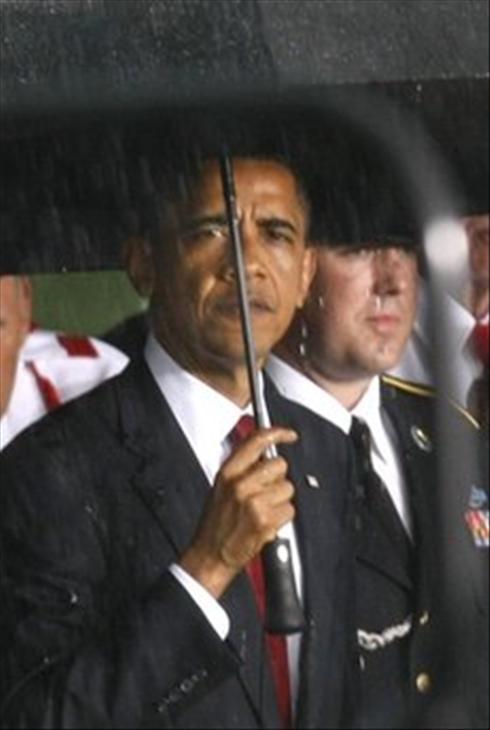
President Obama had a rainy Memorial Day. Meanwhile, the Dems are hoping for a change in the weather. Photo by Charles Rex Arbogast / AP.

Peeking through the clouds:
What’s ahead for the Dems?

By Sherman DeBrosse / The Rag Blog / June 1, 2010

President Barack Obama recently gave the Democrats a theme they should use every day from now until the election. On May 13, 2010, he reminded listeners that the Republicans had created our economic mess and are now unwilling to help solve it.

Many frustrated Americans seem unwilling to remember this and they need to be constantly reminded. It is a matter of facing reality, and that can be tough. It is unlikely that the voters denouncing Democrats and Washington will face reality by November, but perhaps a few will.

If a recent Wall Street Journal-NBC poll is correct, it may be too late to dramatically change the grim results expected in November’s elections. Pollster Peter Hart, a Democrat, said, “A lot has happened, but the basic dynamic of the 2010 elections seems almost set in concrete.”

To make things worse, we now know that our economic situation is very similar to Japan’s long, flat decade. Full recovery and substantially less unemployment are a long way off. And it seems that most of our fellow citizens have been convinced we need policies that will prevent the regeneration of jobs for years to come.

The Republicans and their Tea Bagger wing have misdiagnosed the situation and said our situation is like that of Greece. They have convinced most Americans that the remedy to our situation is to avoid more stimulus, when that is exactly what is needed to avoid the fate of Japan. But when it comes to economics, most people prefer simplistic explanations and remedies, even when those theories underpin the same policies that brought on the Great Recession and the near destruction of our financial system.

Several primaries

What do the recent primaries show us?

The primaries in Pennsylvania were particularly difficult to read, and they even showed Dr. Terry Madonna, perhaps the best political analyst around, to be partly wrong. It is fair to say that many more Democratic activists supported Joe Sestak than Arlen Specter. But we still need to worry about the frustrated Democratic base. In Pennyslvania and elsewhere only 23% of Democrats turned out. If that occurs again in November, the disaster will be even greater than the pundits are now predicting.

Two other facts need to be considered. Sestak ran one of the most effective political advertisements ever, showing Specter saying darkly that he changed parties “to get reelected” and it included a clip of George W. Bush endorsing him. Specter’s age and health were a problem and it is very likely that the next governor will be Republican Tom Corbett, who would appoint a replacement from the far right to replace a deceased Specter.

Sestak had proven to be a good campaigner and has greatly raised his name recognition and can now present himself to voters as the populist who took on the establishment and won. but he will be campaigning in a state described as “Philadelphia and Pittsburgh, with Alabama in between.” That is only a bit inaccurate as Harrisburg, located in central Pennsylvania seems to be becoming more blue. But no matter how bad the economy is, we can expect a large Republican turnout and vote in Pennsylvania’s Alabama.

There is a remarkable unpublished book that sheds light on this. It deals with International Paper’s battle to destroy the union in Lockhaven — an effort aided by a Democratic governor. At the time, the workers were militant and proud of the stand they took, but as the years passed, the vast majority were powerfully reabsorbed by their conservative rural culture and came to think they had been wrong to battle the paper giant.

The great advantage Sestak has is that his opponent will be former Representative Pat Toomey, a rigid ideologue who until recently headed the Wall Street-backed Club for Growth. Toomey can be presented as the Wall Street candidate from now until the cows come home. Toomey speaks for the gamblers who wrecked out 401Ks and put pensions in grave danger. If Sestak hews to that line, he will be elected.

Republicans outspent Democrats 3 to 1 in an effort to seize John Murtha’s old seat and they tried to make the election about Obama and Nancy Pelosi. Mark Critz’s nine point victory in John Murtha’s district is no reason for much cheer. He won by defending guns, anti-abortion positions, and distancing himself from President Barack Obama, health care reform, and cap and trade. No doubt Democrats in other districts carried by John McCain will take note of his successful approach and emulate his tactics.

Murtha’s old district, the 12th in Pennsylvania, includes the communities with the so-called “captive mines” and the many towns that were screwed over and abandoned by the steel companies. This is the same area where hired thugs beat up unionized workers in the late 19th and early 20th Centuries, and where the state sent in rural troops to kill and rough up immigrant workers from time to time.

There was a time when people there had a strong sense of their working class identity and knew exactly who their enemies were. But decades have passed, and more and more have succumbed to being manipulated by the hot button issue politics perfected by the right. This story illustrates how effective the Republican communications machine has been over the decades.

By the 1980s, many there were Reagan Democrats even though Reagan’s party was busy stripping away the benefits of miners and the power of unions. Today, it has almost destroyed non-public unions and is eying entitlements like Social Security for reduction. But still, the GOP manipulation of cultural variables works even where it should have no appeal. Today, only a quarter of Democratic seats in the House are in white, working class districts.

One can think of few areas that needed health care reform more. These are good, friendly people who have had much more than their share of pain and hurt. Driving through the beautiful valleys of the 12th district, one will see many conservative evangelical and Pentecostal churches where people seek solace.

In Arkansas, Senator Blanche Lincoln was forced by Lt. Governor Bill Halter into a runoff election. Halter is more liberal than Lincoln. She has a dubious record on health care reform and a bad record on labor. The unions are punishing her by helping Halter, though it is difficult to imagine how he could win the general election.

A fact some miss is that the banking and financial service industries are also supporting Halter. Senator Lincoln voted for TARP, a position that is very unpopular in rural America. As chairperson of the Agriculture Committee, she tried to balance that vote by successfully inserting language in the finance reform bill that would limit gambling on derivatives. Her language would force banks to live with tougher margin requirements in these trades or spin off the departments that deal in derivatives.

It is a good provision — not ideal, but the best we could expect. She has been unable to explain to voters that, in this instance, she really is doing something for Main Street and protecting ordinary depositors against wild speculators on Wall Street.

The bankers’ game plan now is to make the runoff so difficult that she will be unable to expend energy fighting to preserve her position as finance reform is marked up in conference committee.

On the face of it, a conservative Democrat is being punished. But her opponent has little prospect to win in November, and her defeat might also include still another victory for the bankers.

In Kentucky, libertarian and Tea Bagger Rand Paul defeated the hand-picked candidate of Senate Republican Minority leader Mitch McConnell. Democratic strategists might note that there was a 24 point gap separating Paul and the candidate endorsed by the Republican establishment. The gap does not reflect disdain for the dishonesty of people who employ obstructionism and call it something else, but it might mean that those voters know the Republicans were big spenders and were two faced enough to claim credit for blocking the stimulus bill while getting some goodies for the home folks.

The minority leader quickly embraced Paul and placed a very efficient political machine at his disposal. Rand Paul said Obama’s criticism of BP was un-American and he doubted the constitutionality of the Citizens with Disabilities Act. Dr. Paul was also critical of those who denounced the mining company associated with the recent big accident in West Virginia. Kentucky coal miners might be unsettled by this attitude. His suggestion that civil rights legislation should not extend to segregation in restaurants might not scare away many white Republican voters, but it will alarm blacks and give some white independents reason to think twice.

Republicans and leaders of their Tea Bag wing are not defending Paul’s comments on these matters even though these remarks seem to reflect sentiments found among many in the GOP. Democrats would be wise to hold up Rand Paul as the poster boy for the Tea Baggers and conservative Republicans.

Paul’s nomination may make the Kentucky race a slight possibility for the Democrats. Some say that the defeat of Senator Robert Bennett in Utah had the same effect, but that is very hard to imagine. If the economy improves a little more and some Republican Tea Bag nominees make enough mistakes, the Democrats might not face a complete route.

To the north of Kentucky is Ohio, where the GOP establishment easily brushed aside Tea Bag challengers. Maybe some ordinary Kentuckians had enough of Mitch McConnell or even knew of his very close ties to the mining firm that was connected with the last two mine disasters. At least, the Ohio results, combined with those from the Pennsylvania 12th district, suggests that the Tea Baggers are not uniformly strong everywhere.

In the process of pursuing bipartisanship, Democratic leaders in Washington have failed to win the support of independents and have dampened enthusiasm among their base. They need a new approach that provides reality therapy for the masses and reasons for the Democratic base to return to activism.

Counter big lies

It is too late to counter all Republican lies, but the Democrats must address four.

  1. Remind seniors that the health care reform improves Medicare and does not deprive them of a single benefit.
  2. The two most criticized Democratic programs — cap and trade and health care reform — are almost entirely repackaged proposals originally offered by the Republicans.
  3. Obama and the Democrats bit off too much. The Democratic agenda could have been enacted had it not been for consistent, almost wall-to-wall Republican obstruction. This even included blocking many dozens of Democratic nominees including a head for the Transportation Safety Administration. In the latter case, the Republicans denounced Obama when the TSA did not function perfectly. The election should be about obstructionism because it denies the basic democratic principle of majority rule.
  4. Most people believe that the health care plan will drive up the deficit. The CBO said it will reduce the deficit, and people also need to be reminded that the Democrats extended the life of Medicare by reducing costs without cutting benefits

Reactivate the base

By countering the chief Republican lies, an important first step will be taken to reactivate the Democratic base. The base might develop a better opinion of Obama and the party leadership when they see what we have been up against. Yes, our leaders have been guilty of unbelievable naïveté in their willingness to seek bipartisan solutions, but that it what people in democracies are supposed to do. Part of the debate should be about the wrecking job Republicans have done to our institutions and the refusal of the mainstream media to act as truth tellers or honest referees.

The next step is to start rebuilding enthusiasm by getting in touch with what the party stands for and defining every day how it differs from the GOP.

The Republicans won control of the national agenda in the Senate, and it is there that the Democrats must counterattack with proposals that are good for the country and important to the base. Democrats have only six months more to act before they might lose actual or effective control of that chamber. Perhaps they need to continue their pattern of surrendering to the Republicans and banks on financial reform simply because the present bill, however weak, is needed and might slightly cushion the impact of the next financial collapse.

A new agenda might look like this. If the Republicans try to block votes, Harry Reid should let them carry out real filibusters.

  1. Bring up a modified version of the Employee Free Choice Act. Due to an effective publicity campaign, too much of the public is opposed to the card check provision. Democrats should try to pass those portions that level the playing field and put real teeth into prohibitions against unfair practices on the part of employers. Most people realize that there has been a long and successful campaign to weaken the Wagner Act, beginning in 1947 with the Taft Hartley Act.
  2. Enact an alternate method of enforcing labor law in cases when the NLRB cannot function. At any time when there are two vacancies on the five member board, the departments of Justice and Labor should have the option of bypassing the NLRB by taking charges before federal courts. By filibusters and “holds” the Republicans have prevented the board from acting for 14 months.
  3. Bring up a measure to gradually restore the Glass-Steagall Act provision forbidding traditional banks from highly speculative activity such as purchasing derivatives or investing in hedge funds. Things are now so dicey that this would have to be phased in over a period of years.
  4. Support Blanch Lincoln’s bill regulating derivatives. No one can call this very conservative Democrat a flaming radical. This would be the first step in the right direction.
  5. Repeal all legislation that encourages through tax breaks sending jobs abroad.
  6. Lift the anti-trust exemption from the health insurance industry.
  7. Place an excess profits tax on the energy industry and all providers in the health care field.
  8. Place a heavy tax on the bonuses of investment bankers and traders.
  9. Follow the example of Europeans and place a small tax on all leveraged debt on the books of any firm or bank that deals in derivatives and hedge funds. This might slow down casino finance. This would include some manufacturing firms that use funds for speculation rather than creating more American jobs.
  10. Mine Safety legislation should be strengthened and the number of inspectors greatly increased. Inspectors should have the power to shut down mines where conditions are manifestly unsafe. Mitch McConnell will find some deft way to oppose this, but there might be one Democratic senator smart enough to corner him on this issue.
  11. Provide employer tax incentives and employee subsidies for people who get involved in job sharing. If two or more people agree to share work, each working 80% of the time, they should take home 90% of their previous income and retain benefits. This plan will speak to many women who would welcome job sharing to insure continued employment and more time to be with their children.

If the Democrats fight for as many as six of these proposals, they will succeed in reactivating their base. They may not trim losses in November by much, but they will be on the way toward rebuilding for 2012.

The long term prospect

Americans are basically optimistic and resist the idea that things are not likely to get much better for the middle class. But at some level, most people have a growing sense of what is going on — the slow deterioration of the middle class. They just don’t want to believe it, so they still opt for simplistic answers and rose-colored projections that defy common sense.

Democrats will never do well playing to the emotional issues. The Republicans own that turf. Democrats must bet on the people eventually wanting to see what reality is and to deal with it. Given this situation, liberals must continue to educate the public on how our current problems emerged. Reality therapy will take a lot of effort and may not work immediately. Without it, the GOP will go on convincing people in our economically blighted times that the politics of race and cultural resentment will somehow make their lives better.

We are hearing that unemployment will remain high for years to come. The financial system will not recover anytime soon as banks and investment houses need to hoard cash to cover likely losses and make fresh gambles in hopes of improving their balance sheets and generating large bonuses for their personnel. That means there will not be a lot of money out there for small businesses and manufacturers. This situation also makes it hard to show much mercy to people facing foreclosure.

Eventually people will come to see that our long term debt and preservation of entitlements will require a smaller appetite for wars of choice. This will not happen overnight. We have become a nation of warriors who refuse to recognize that we fight essentially to line the pocket of people in the top 3%. Even single-payer health care will eventually seem reasonable when voters conclude that the present plan is too expensive because Republican obstructionists forced liberals to provide so many goodies for the insurance industry.

All this will take time, but the Democrats need to start rebuilding and preparing for when all the consequences of market fundamentalism and deregulation come home to roost.

[Sherman DeBrosse is a regular contributor to The Rag Blog. A retired history professor, he also blogs at Sherm Says and on DailyKos.]

The Rag Blog

Posted in Rag Bloggers | Tagged , , , , , | 7 Comments

This new Michael Caine vigilante revenge vehicle “thrills and titillates without any socially redeeming value.” And it does it with hints of “Reefer Madness.” But the film echoes recent events in the news — in Kingston, Jamaica, where police have stirred up violent community reaction with their attempts to arrest drug lord/”Robin Hood” figure “Dudus” Coke. All of which raises serious questions about the nature of drug enforcement, and the drug laws themselves — and the core problem of poverty. By Ed Felien.

Posted in RagBlog | Leave a comment

Marc Estrin : Night Dreams of Another Life

Photo by Eric Pouhier / Wikimedia.

Listening to our local Leiermann:
Night dreams of another life

By Marc Estrin / The Rag Blog / May 31, 2010

Every now and then — and again last night — I am awakened at 3 a.m. by the sound of a shopping cart rattling past my house. No voices. Just a lonely, ghostly, shopping cart. It has that eerie sad-ness Woody Guthrie used to sing about — like “that long lonesome train a-whistlin’ down.” Ex-cept it rattles.

The sky is dark, the street lights bright outside my window. All other noise has ceased. Squad cars prowl silently, if at all. Donna is sleeping, and the cats breath quietly at our heads and feet. Wordsworth said it: “The holy time is quiet as a nun/breathless with adoration.” Except there is a shopping cart. Rattling.

Who is out there, pushing? Who is searching the recycle bins and garbage for nickel bottles and cast-off clothing? Who must be up this early in the morning to ensure his meager catch?

In daylight hours I would probably revert to my social/political thought chain: the ghastly state of current American capitalist politics, the ripping away of the safety net from under the free-fall of the poor. But in the middle of the night, my thoughts often go to the amazing end of Schu-bert’s song cycle, Die Winterreise, the Winter Journey.

In the standard frame of nineteenth century romantic poetry, a lover, spurned by his beloved, must “get away” from his memories of her, must avoid the possibility of seeing her with her new husband. He wanders out into the winter, his tears freezing in the icy landscape. He has dreams and nightmares. He longs for mail, though he has no address. He communes with birds and beasts; he hallucinates.

There are many amazing and moving images in these 24 connected songs, but none is more mysterious and compelling than that of the last song, “Der Leiermann,” the Hurdy-Gurdy man. Of all the songs, it is the quietest and simplest, a bare vocal line alternat-ing with a little organ-grinding refrain in the piano.

After all the wildness of nature and passion — this last strange encounter: with an old man out-side a village, playing his music as best he can, his fingers numb, standing near his empty cup, barefoot, on the ice. Nobody listens to the organ-grinder, nobody pays any attention to him — except the dogs, who come — to bark and growl. But the old man just lets it all happen without complaint, grinding out his simple tune, never stopping. Coming upon him, our heart-weary traveler is dumb struck.

We think it is a simple little story, a narration about some striking character met along the path. The first surprise comes in the last verse. Is our sad young man repulsed by the organ grinder, frightened by his situation, thinking “there, but for the grace of God, go I”? No. “Strange old man,” he says to himself, “shall I go with you? Will you grind out music if I sing?” And the sec-ond surprise is — that’s it. That’s the end. The hurdy-gurdy phrase runs it’s course and this in-comparable masterpiece just stops — quietly, with a question, a question leading out into infinity.

As I lie in bed listening to our local Leiermann, his shopping cart singing its sad, repetitive song, I — this person snuggling next to his sleeping wife, nuzzled by his trusting kitties — I want to go out there and join him. I want to experience the emptiness and beauty of the street late at night, the sense of the world stopped around me, the non-hustle and non-bustle and time of my own creation.

I want to give up my deadlines and assignments, my enslavement to the little property I own. I want to simplify my life, and have the basic tasks of my cro-magnon ancestors, to live from day to day, to hunt and gather, to relate to the turning of the sky.

Not to romanticize the brutal life forced on the poor by devil-don’t-care capitalism. My late-night dream does not contain having to figure out where I can poop, or where to get a shower after two weeks without. I don’t have to scrounge for quarters for the laundromat, or worry about my things being stolen while I sleep on someone’s porch to stay dry.

I don’t even have to hang on to my empty bottles and cans — but can give them, a pathetic, inadequate gesture, to those who build their lives around them.

Still, there is freedom out there, late at night. Dream-freedom. We humans have always paid a lot for freedom. At this very moment, somewhere on earth, there is blood being spilled — for free-dom.

[Marc Estrin is a writer and activist, living in Burlington, Vermont. His novels, Insect Dreams, The Half Life of Gregor Samsa, The Education of Arnold Hitler, Golem Song, and The Lamentations of Julius Marantz have won critical acclaim. His memoir, Rehearsing With Gods: Photographs and Essays on the Bread & Puppet Theater (with Ron Simon, photographer) won a 2004 theater book of the year award. He is currently working on a novel about the dead Tchaikovsky.]

The Rag Blog

Posted in Rag Bloggers | Tagged , , , | 1 Comment

TCEQ Blowing Smoke? : Protecting the Texas Environment

Image from Pegasus News / Dallas/Ft.Worth

Texas’ lack of compliance:
EPA challenges TCEQ over air quality

By Ted McLaughlin / The Rag Blog / May 30, 2010

The state agency that is supposed to assure that pollution does not endanger the citizens of Texas is the Texas Commission on Environmental Quality (TCEQ). But they have not been doing an adequate job of protecting Texans for many years now.

Instead of protecting the air quality (and water quality), these Republican appointees seem instead to exist solely to allow the giant oil, gas, and chemical industries to operate without having to obey federal and state pollution laws.

Just look at how they covered up the existence of dangerous toxic substances released from recent gas drilling in the Fort Worth and surrounding areas. Because of charges by environmental groups, the TCEQ recently conducted tests of the air quality in Fort Worth. In January of this year, they gave the city a report showing the air quality in that area was completely safe. The problem was that report was wrong, and the TCEQ knew that very soon after releasing the report.

After releasing the report, the TCEQ realized that the measuring equipment they used was not nearly sensitive enough to detect low levels of poisons generated by the drilling. Worse yet, these low-level toxic emissions were very dangerous if persons were exposed to them over an extended period of time. So while the Forth Worth air quality was probably safe for short-term visitors, the citizens living there were slowly being poisoned by the toxic emissions.

Now one might think that this important fact would immediately be made known to the people of the Fort Worth area by the TCEQ, since they are mandated to protect the air quality for citizen safety. Wrong! The city was not told for several months, and then only because a congressman had asked for the information (and even an agency dedicated to protecting corporate interests can get in serious trouble for lying to a congressman).

The fact is that the state Republican leadership (including those on the TCEQ) were long ago bought and paid for by corporate interests, especially the oil, gas, and chemical industries. The TCEQ knew that a ton of money was being made by gas drilling in the Fort Worth area. They also knew that publicizing the dangers imposed by that drilling could could impede that drilling and hurt the corporate profits. The TCEQ chose to endanger citizens and protect corporate profits.

But that is only a small part of the criminal actions of the TCEQ. The fact is that their negligence has allowed Texas to become, and continue to be, a major polluter. Texas is by far the largest air polluter in the United States — producing far more pollution than other large states like California, New York, Florida, New Jersey, Ohio, and Illinois. In fact if Texas were a country, it would be the seventh largest air polluter in the entire world.

And the TCEQ doesn’t seem to be interested in controlling this pollution. They claim that stricter pollution controls would endanger thousands of Texas jobs. Obviously, they seem to be ignorant of the fact that their mandate is to control pollution — not create or protect jobs.

The truth is that while stopping corporate pollution might slightly reduce the corporation’s massive profits, it would not cost any jobs. The corporations will continue to produce their products and will still need the workers to produce those products, and moving to another state will not reduce the need to obey pollution laws. The clean-up effort will probably actually create new jobs.

The Environmental Protection Agency (EPA) is finally getting tired of Texas’ refusal to come into compliance with the standards of the Clean Air Act, as other states have done. The regional Director of the EPA, Al Armendariz, is now threatening that the EPA may take over the duties of the TCEQ and force Texas to comply with federal environmental law.

The impetus for this threatened action is the practice by the TCEQ of giving corporations flexible permits instead of permits with hard rules on how much pollution they can produce, as other states do. According to the EPA, the flexible permits issued by Texas allow corporations to produce double the amount of pollution allowed by the Clean Air Act.

The EPA is under a court order to make a decision about the flexible permits by June 30th, and it is expected they will outlaw them. Then if the TCEQ doesn’t cooperate, the EPA will take over the duties of the TCEQ. The EPA is already hiring extra workers to do that job.

Of course this has thrown Texas Governor Rick Perry into a tizzy. He is claiming this is a states’ rights issue. He sees nothing wrong with Texas polluting the atmosphere of the state, the other states, and indeed the world, as long as massive corporate profits are maintained. With hat in hand, Perry is now begging President Obama to stop the EPA from making Texas comply with federal law like every other state.

Personally, I think it is about time that the EPA takes over insuring pollution standards in Texas. It has become more than obvious that the state Republican leadership and the TCEQ will not rein in the corporate misbehavior. Someone must do this, and since the TCEQ won’t then the EPA must.

Texas simply does not have the right to endanger the people of Texas, of the United States, and of the rest of the world.

[Rag Blog contributor Ted McLaughlin also posts at jobsanger.]

The Rag Blog

Posted in Rag Bloggers | Tagged , , , , , , , , , | 1 Comment