Ray Reece : Where’s the Outrage?

A dead Portuguese man-of-war floats on rust-colored oil off the Louisiana coast on Tuesday, May 4, 2010. Photo by Eric Gay / AP.

Where’s the outrage?
Just more ‘Happy Motoring’

Given the other threats currently menacing planet Earth and its so-called civilization, this oil-gash disaster ought to qualify as the ultimate wake-up call to citizen outrage and mass sustained political action…

By Ray Reece / The Rag Blog / May 5, 2010

The recent explosion of the offshore oil rig in the Gulf of Mexico promises to become, in my view, the gravest man-made environmental catastrophe since the U.S. rained nuclear death on Hiroshima and Nagasaki in 1945, with Chernobyl and Exxon Valdez bringing up the rear.

Experts are straining to formulate likely scenarios for the subsequent “oil spill,” which is actually a gusher on the ocean floor that is spewing an estimated 5,000 barrels of crude per day. The images we’re seeing of the oil already on the surface of the water are ugly and infuriating, and they’re going to get more so.

They’re going to get surreal. They’re going to get apocalyptic. They’re going to show us devastated beaches and wetlands in wildlife preserves, oil-tainted seabirds, turtles and crabs, destroyed fisheries, and, quite possibly, as a coda not depicted even in Dante’s Inferno, the ocean itself on fire, releasing billows of acrid black smoke to the atmosphere.

Given the other threats currently menacing planet Earth and its so-called civilization, this oil-gash disaster ought to qualify as the ultimate wake-up call to citizen outrage and mass sustained political action, indeed to revolution. Likewise, the blown-up oil rig, under lease to British Petroleum, ought to be studied as a perfect paradigm of the agents at work in the looming demolition of life as we know it in the biosphere.

I speak of the agents of “post-industrial” capitalism and globalization in relentless pursuit of economic expansion and further profit for the corporate elite.

No strategy, no technology, regardless of the risk, is off-limits to these operators and their allies in government, so long as said strategies lead to more profit. That’s why we’re seeing higher-risk oil exploration and production in deep-sea fields where it wasn’t profitable to drill before, i.e. before the advent of Peak Oil, i.e. declining conventional reserves, with corresponding increases in the price of petroleum.

That’s why we’re suffering a clamor for “clean coal” and a return to fashion of nuclear power plants, both of which are riddled with lethal long-term environmental problems that cannot be resolved.

In an honest, soul-searching, intelligent social order, these advanced assaults on the survivability of the planet, certainly including its Homo sapiens species, would trigger a global mass movement toward the revolution above mentioned, a movement demanding the radical reorganization of human society based on the principle, above all, of infinite sustainability of the planet and its biosphere.

That’s a daunting phrase, I know. It means taking the longest conceivable view of the future of the biosphere. It means asking and trying to answer a question that is oddly unimaginable to most people even of generally good faith, even to my fellow progressives, much less to corporate masters of the universe like those we might find in the executive suites of British Petroleum, Goldman Sachs, et. al.

The question is this. What must the citizens of the planet do to ensure the survival and well-being of the natural environment — which of course is their habitat — not just for centuries into the future, not just for millennia, but for the hundreds of millions of years still remaining to life on Earth before it expires in the furnace of the “red giant” phase of a dying sun?

As preposterous as this question will seem to many, it seems more preposterous to me to evade it, to laugh it off as unanswerable and therefore ridiculous. Each generation of Homo sapiens inhabiting the planet has a sacred responsibility to protect and indeed to enhance it — not only for the well-being of that generation but for all the generations of Homo sapiens and all the generations of all the other species yet to follow.

To evade the question of how to accomplish that is an abrogation of the moral and spiritual imperative that alone gives meaning to our existence as human beings in the first place.

It’s not terribly difficult, after all, to visualize the global society that would have to be established to ensure the perpetual well-being of the biosphere. It’s a matter of simple, elementary logic, like, duh, why didn’t we think of that before?

The basic objectives are cut-and-dried: (1) maximize efficiency in the production and distribution of life-support resources; (2) minimize waste; (3) do absolutely nothing to exceed the natural carrying capacity of the geographic area under consideration, from the local to the bioregional to the continental and finally the global.

In practice this would mean, at the macro level, an abandonment of the capitalist demand for constant economic growth in pursuit of constant growth in profit. We would turn rather to the cultivation of steady-state economies, with an emphasis not on profit but on local and regional production of life-support commodities for local and regional consumption.

The giant teeming cities and their rings upon rings of exurban subdivisions and freeways to nowhere would gradually be replaced by a new geography of small to mid-size cities and towns that function primarily as market and processing centers for the rings of family and community farms that supply them.

At every turn, we would strive for the highest possible degree of local and regional self-reliance, thus to minimize fuel-burning imports, among other virtues, including full employment in a necessarily labor-intensive economy. We would also strive to eliminate or at least minimize the use of the automobile as the dominant form of personal mobility, opting instead for trains and buses, trolleys and trams, bicycles, horses and shoe leather.

We would be a sociable society, learning to travel and interact with each other again, and learning we like it. We would be a stable society, too, with strict controls on population growth, aiming to reduce the global total from seven billion — which is where we are now, which is utterly unsustainable — to one billion, say, which is where we were at the turn of the 20th century.

These ideas are hardly original with me. No small number of conscientious people and organizations in the U.S. and abroad have not only visualized a perpetually sustainable social order but are working today to try to effect it.

One such group is the Center for Maximum Potential Building Systems in Austin, co-directed by Pliny Fisk and Gail Vittori. Another is the Institute for Local Self-Reliance in St. Paul, Minnesota, headed by David Morris.

Still others include TransitionNetwork.org in Totnes, England; Radical Relocalization in Kingston, Ontario; and the World Coalition for Local and Regional Self-Reliance, or WOCO, of whose tiny, nascent, ragtag board I am a founding member.

As for individuals who are focused on sustainability, a pioneer thinker and leading verbal bomb-thrower is James Howard Kunstler, author of The Long Emergency, a now-classic text on Peak Oil, and World Made by Hand, a novel set in the post-petroleum era that lies just ahead. Kunstler is much in demand as a speaker. He also maintains a popular blog called Clusterfuck Nation (kunstler.com), where he posts a fresh diatribe every Monday.

A second writer and speaker who has contributed richly to the literature of sustainability is Kirkpatrick Sale, author of Human Scale and Dwellers in the Land, among other works. He is now director of the Middlebury Institute (middleburyinstitute.org), conceived in Vermont, which advocates for dissolution of the American empire through state secession from the union, e.g. a Second Vermont Republic.

Effective as these stalwarts may be, however, they do not trouble the thoughts of the overwhelming majority of the people of the world who need to be reached. Among that majority there is not to be discerned the faintest sign of mass outrage over the BP oil spill catastrophe in the Gulf of Mexico — or any other threat to the biosphere — and certainly no reflex toward revolution.

Why? Because the corporate masters of the universe have long since extended their power and control over not just the physical resources of the planet but indeed over the minds, values, loyalties and habits of the people themselves.

How could we expect the youth of America and Japan, say, to rise in outraged revolt over the Gulf oil spill — its ominous implication for their own futures notwithstanding — while they sit mesmerized in front of their Sony video games? Ditto the American working class, say, mesmerized by the round and round of NASCAR racing and other so-called sports events produced ad nauseum by the corporate masters.

No moral outrage. No revolution. Just a continuation of what Kunstler calls the benighted culture of “Happy Motoring.” This story will not have a happy end.

[Ray Reece is affiliated with the World Coalition for Local and Regional Self-Reliance. He is a former columnist for The Budapest Sun and author of The Sun Betrayed: A Report on the Corporate Seizure of U.S. Solar Energy Development, among other published works. His most recent book is Abigail in Gangland, a novel. He is currently based in Cagli, Italy.]

The Rag Blog

Posted in Rag Bloggers | Tagged , , , , , , | 7 Comments

Dick J. Reavis : Something Missing at Texas Writers’ Festival?

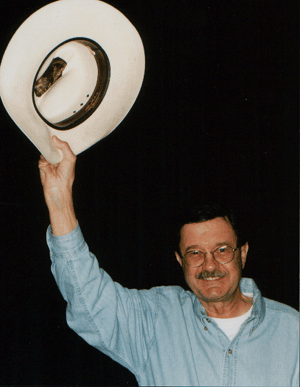
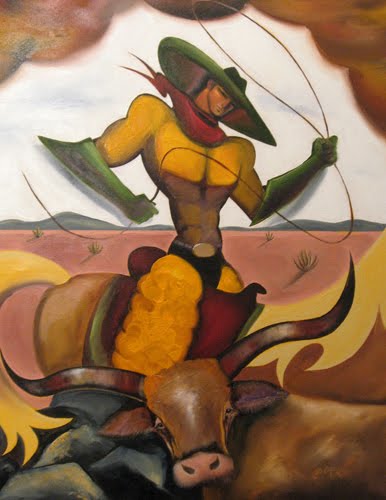
“The Texican.” Painting © Mike Aston /
mikeastonart.com .

Artaud and Arizona:
Tempest at Texas Observer’s writers’ fest

By Dick J. Reavis / The Rag Blog / May 5, 2010

This weekend a startling email come to my inbox and to those of others who are identified with journalism in Texas. Its title line read, “To Liberal Activists Who Happen to be Latina/o/s.” Though I don’t fit either the Liberal or Latino categories, being a nosy former reporter, I read what its poster, antonioartaud@grandecom.net, had to say.

“The revered journal of Texas liberal politics The Texas Observer is having a writer’s festival,” its opening blandly began. “Guess what — they forgot to invite any Tejana /o/s and African Americans. Impossible, you say. Que fue eso? Did we forget to show our papers? How do we prove we’re Texans too?

“And to make matters worse, they’re in cahoots with Texas Monthly,” Artaud continued. “Almost all the writers invited are either the editor of Texas Monthly or former/present Texas Monthly writers. Yes, the same magazine that has ignored us for over 25 years as personas non grata in their Texas.”

The post closed with an exhortation and a warning: “Cancel your subscription, write a letter, protest the event at Scholz Biergarten, but above all, consider yourself on notice.”

I am told that the author of the post, Antonio Artaud, is a student of journalism at a college in San Antonio. His sentiment was, to use an oldster’s term an Anglo journalist friend applied: “Right on!” Artaud knows of what he speaks — and what he pointed to is a scandal.

Monday Artaud followed with a post containing messages of support from, among others, the novelists Dagoberto Gilb of San Marcos and the all-around San Antonio wordsmith, Gregg Barrios (who also wrote for The Rag in Sixties Austin). Something was building. “Latina/o/s” were, for the moment anyway, rising to protest against business as usual in the circles of Texas journalism.

The hubbub died late Monday or early Tuesday when Artaud sent a third post, announcing that the Observer had agreed to include a Latino writers panel and issue an apology. Better late than never, I suppose. But as always in American history, it appears that no arrangement was made to include blacks.

Before the hubbub died, I did some thinking. Placing myself in the shoes of the editors of the Observer and TM, I asked what might be done to permanently integrate those publications without fundamentally altering anything.

I’d have canceled the Writers’ Festival (or “writers’ festival,” as the Observer’s announcement so graphically put it.) I’d have rescheduled it and expanded its panel to include — two or three New York Puerto Ricans or Dominicans! After all, Nuyoriqueños are as much Latinos as Mexican-Americans, and many of them are as African-American as anybody in the United States.

If this idea doesn’t make sense, it should: the Texas nonfiction establishment has already applied the same logic to Anglo Texans.

I may get some of the facts wrong because I’ve been outside of Texas for six years, but to the best of my knowledge, the editors of the daily newspapers in Dallas, Houston, Austin, and San Antonio are white non-Texans. The editors of The Texas Observer and Texas Monthly, Bob Moser and Jake Silverstein, fit the same category, even though the general report is that they’ve improved those publications.

I am less sure about the Observer, but at the Monthly, the tally is plain: the magazine has had four editors, only the first of whom was a Texan. My observations, when I was a journalist in Texas, were that at both dailies and elite magazines in Texas, only about half of the editorial staffers were Texans before they became reporters in Texas.

The Observer and the Monthly are, of course, by now “old media.” The most contemporary entry into the ranks of elite Texas journalism is the online daily, The Texas Tribune. I would note that its first and only editor, Evan Smith, is from the city of New York.

A few years ago I put together a still-unpublished statistical study of the Monthly which showed that Texans, 95 percent of the editorial staff at the magazine’s outset, became a minority during the ‘80s, and stabilized at about half during the ‘90s. The Monthly has never hired a Mexican-American staff writer and its one African-American reporter vanished within months of his engagement.

None of this should surprise anyone, I suppose. It is accepted wisdom among educated Americans today that class and regional differences don’t count for anything: we live in a placeless, classless meritocracy, people believe.

When Texas Monthly, as today, calls itself the “National Magazine of Texas” it in no way means to imply that it is the magazine of a state which sometimes imagines itself a nation. Instead, it is a magazine of national quality — which in the publishing world, means “as good as what’s published in New York” — that, incidentally, happens to be published in Texas.

The sensibilities of the locale mean nothing, the standard of reporting means everything. Journalism is an acultural scientific product, disconnected to land, the past, and tradition. It produces sterile news, cleansed of the smell of the dirt from which it came.

With that as the accepted wisdom, it’s clearly heresy to bring even ethnicity, as Arnaud did, into the equation. Meritocracy knows no gradations, so what difference can it make that the editor of the Tribune is from New York, the editor of the Monthly from California and the editor of the Observer from North Carolina?

I dissent from the accepted view for reasons that are as inchoate and instinctual as sometimes studied and glib. Suspicions haunt me, the latest of them because of the controversy over Mexican immigration in Arizona.

Several years ago Texas was the home to two or three border-control militias, just as Arizona was. I looked into the Texas outfits and found that even though they were led by small-time ranchers whose spreads were near the border, those ranchers — and most of their lieutenants — were recent arrivals from the rural Midwest.

My suspicions and speculations tell me that, Arizona being the retirement destination of the Midwest, as Florida is for New York, Arizona’s anti-Mexican hysteria is probably traceable to the state’s non-natives. In a way, it comes naturally to them: Mexico is as foreign to rural
Midwesterners as Iraq is to most Texans.

Anglo, Latino, and African-American natives of the frontera alike have traditionally regarded immigration restrictions as a joke, though in recent years they have become a real annoyance. But inlanders tend to see border walls, passport requirements, and crossing-bridge shakedowns as dignified embodiments of American law.

As reactionary as Texas may otherwise be, its last president, the Islamophobic George W. Bush, made an honest attempt at humanizing immigration law, and the state’s current governor, Rick Perry — a lifetime member of the Sons of Confederate Veterans, no less! — has said that Arizona’s anti-Mexican ethnocentrism is not for him or his state.

I can find no other factor that uniquely explains the “progressive” character of the Bush and Perry stand except this: growing up even as Anglos in Texas, their attitudes towards Mexico and its descendants took a better-than-American form. Neither regards immigration as a merely legal or economic — or racial — issue, as most Americans do.

According to the theory of meritocracy common to the American empire, success and placement depend, not upon the question of national or regional origin, but instead upon one’s educational credentials. Other differences between Americans have no place in this scheme.

This is why state-supported universities, for example, conduct national talent searches for almost all faculty jobs. The same placelessness has been at bottom of the selection of editors and writers for the Monthly and the Observer and probably, the Tribune as well. If in Texas we hire editors and journalists who are often non-Texans, according to meritocratic ideology, it must be because competent writers are hard to come by in Texas; if we also wind up with editors and writers who are not Mexican-American or black, why would the same conclusion not apply? The theory that marginalizes Anglo Texans downgrades all Texans, Latinos and African-Americans as well.

In his original posting, Artaud attached a copy of the Observer’s announcement of its bash. I counted 13 panelists. Perhaps because I have been away, I recognized the names of only seven of them, among them one writer from the city of New York. I wondered to myself, “how many of these Texas writers are really Texans?” I do not know the answer yet, but my guess is that it’s more than one. Were the same sort of celebration being staged in New York, I do not believe that a single paisano would be on the billing; more than one — certainly not! Yet Texas is today more populous than New York.

The Observer, in deciding to heed Artaud’s complaint, at least in regard to Latinos, may have decided at long last to remedy its lack of sincerity and vision — for a month or two, anyway. But the notion that the self-expression of Texas should be the affair of non-Texans is only an extension of the otherwise-hidden hegemony which skin color makes plain.

Today I was thinking that, perhaps because I’ve been called a “horse’s ass” more than once, I should feel a little bit sorry for horses as well. In the eyes of most of them, I’ll wager, all equine magazines should be written and published — by equines, not by their riders!

Horse sense tells me that in Texas, whites are riding on the back of a culture that has always included Mexican-Americans and African-Americans, and white non-Texans are riding on the back of the cultural mix that only Texans, of any color or ethnicity, fully appreciate or understand.

[Dick J. Reavis is a former staffer at the Moore County News, The Texas Observer, Texas Monthly, the San Antonio Light, the Dallas Observer, Texas Parks & Wildlife Magazine, the Fort Worth Star-Telegram and the San Antonio Express-News. He also wrote for The Rag in Austin in the Sixties. He can be reached at dickjreavis@yahoo.com.]

Antonio Artaud passed along this letter, sent to The Texas Observer by UT professor Emilio Zamora:

Editors,

I published a book on Mexicans and the Texas home front with Texas A&M Press and co-edited an anthology on Latinos and Latinas in WWI with UT Press, both in 2009. I have received two awards for the first book from the Texas State Historical Association and the Institute of Texas Letters. Despite this, I was not invited to participate in your writers’ festival. This is not the first time that public programs on new books have slighted me, but I have recently discovered that this time you have also overlooked other recently published authors of Latino/a descent. You may have included one of these noted authors, Belinda Acosta, but only after she pointed out the glaring problem.

I should add that Latino and Latina writers are also usually absent from the pages of The Observer and this is not necessarily due to our failure to submit materials to you. A case in point is Professor Angela Valenzuela’s excellent review of Avatar which she submitted on February 5, 2010. You have not published the piece nor have you even sent her a note acknowledging her submission.

I cannot help but think that the problem of under-representation and erasure of major portions of U.S. and Texas history (women, minorities, labor, civil rights, for example) in our public school curriculum extends far beyond the Texas State Board of Education. Isn’t it really a sorry shame that we should be talking like this among ourselves when major battles for equal rights (with the State Board of Education, for instance) require our undivided attention.

Emilio Zamora, Professor
Department of History
University of Texas at Austin

The Rag Blog

Posted in Rag Bloggers | Tagged , , , , , , , | 11 Comments

VERSE / Larry Piltz : The Gulf

Art from illusion360.

The Gulf

“The water was fouled at once,
but they drank it none the less,
a mess of mud and blood”
– Thucydides

Oil on the water
blood on the sands
cruel and unusual
big business plans
eleven souls dying
then millions more
of fellow live beings
damn big business whores
crude in their veins
greedy slick hearts
their making a killing
rips lives apart
big oil at the table
pounds on its chest
keeps us addicted
kills all the rest
what becomes of our world
what becomes of our pride
what becomes of our lives
when death comes with the tide

Larry Piltz / The Rag Blog
Austin, TX
(from Back Bay,
Biloxi, MS)
May 4, 2010

The Rag Blog

Posted in Rag Bloggers | Tagged , , , | 4 Comments

In a Changing World : Workers on the Move

Workers in Paris join in massive May Day demonstration. Photo from AFP.

As the nature of work evolves…
A week of worker militancy

Those who proclaimed May Day as the workers’ day over a hundred years ago understood the need for global solidarity to achieve justice.

By Harry Targ / The Rag Blog / May 4, 2010

This was a week of worker militancy. Wednesday, April 28, in large cities and small towns, workers rallied in support of improved health and safety at the workplace. [See “Austin Construction Workers: No los Vamos a Olvidar” by Alice Embree.] This was the fortieth anniversary of the establishment of the Occupational Health and Safety Administration. In the minds and hearts of these workers were the recent deaths in mines in West Virginia and Kentucky and oil rigs in the Gulf of Mexico.

On April 29 masses of workers assembled, thousands in Manhattan, to protest Wall Street’s robbery of the American people, particularly for its creation of an economic crisis that has cost workers all over the globe millions of jobs.

And finally on Saturday, May 1, the international day of workers’ solidarity, inspired by the protests in support of the eight-hour day movement in Chicago in 1886, millions of workers mobilized everywhere; from Hong Kong, Istanbul, Athens, Berlin, Hamburg, Manila, Moscow, Seoul, Tokyo Taiwan, Bangkok, to Havana. In the United States huge throngs marched in support of immigrant rights in Los Angeles, San Francisco, Chicago, New York, Dallas, Austin, and many other cities.

I just finished teaching a course called “The Politics of Capital and Labor in the United States.” We read texts that analyzed the development of capitalism as the dominant mode of production. We discussed its various stages from competitive to monopoly capitalism to today’s era of finance capital. I highlighted the post-World War II period in U.S. and world history emphasizing the establishment of a permanent war economy, deindustrialization, financialization, and neo-liberal globalization.

We then concentrated on the changing nature of the circumstances of work and workers over the last 60 years drawing upon the collection from Dollars and Sense magazine called “Real World Labor.” By way of summary, I prepared a list of the impacts of systemic economic and political changes on workers derived from the various essays in the book. The list, in no particular order, suggests the ways in which the lives of workers have been transformed over the last 60 years and why the mass mobilizations of workers, such as those this week, are so desperately needed.

The list only touches the surface. It includes dramatic increases in state and employer mechanisms to obstruct union organizing. Union density in the United States has declined from a peak of 33% in the early 1950s to 15% today (half in the public sector). Employers skillfully use workplace policies to destroy the potential for worker solidarity, from encouraging racism, and inter-ethnic hostilities, to creating two-tier salary schedules.

Work has been increasingly sub-contracted and outsourced, shifting manufacturing and service employment from once higher paid industrial capitalist countries to poor countries whose traditional economies have been disrupted to accommodate new factories of outsourced work. Sweatshops, initiated in textile mills in Britain and the United States 200 years ago, began to be transferred to countries of the Global South in the 1960s and now, with declining real wages in the United States, are returning to domestic venues.

Work has been casualized. Job creation is increasingly characterized by part-time, contingent, and seasonal work, with significant portions of the work force defined as “illegal.”

For those with jobs, whether in manufacturing or service, modern forms of Taylorism are imposed on work processes. Originally Taylorism inspired efforts to control all the physical movements of workers to maximize their productivity at all costs. Now such techniques are applied in the service sector as well, programming what workers say to customers and the appropriate physical space prescribed for interactions with them. Generally, techniques have been created to maximize the productivity (but not wages) with which all work is performed.

Workplace harassment has been rising in recent years, including demeaning treatment of workers, targeting workers with seniority so that they will be forced to retire, and encouraging racism and sexism on the job.

Similarly, the initiating of workplace regulations in the past has been reversed. Taking occupational health and safety as an example, systems of rules, regulations, and inspections led to a significant decline in workplace deaths and injuries during the 1970s. Those changes that benefited workers have been reversed since the 1980s.

It is estimated that a shop floor or workplace can be expected to be inspected only once every 83 years. The tragedies in mines and on oil rigs this year remind workers that their jobs have become as dangerous again as they were 50 years ago.

And of course real wages, benefits, and jobs have all declined. Economists still debate what should be the “natural unemployment rate.” Everywhere, from U.S. cities to most of Latin America, Africa, Asia, and the Middle East, life-sustaining remunerative activities involve creative street hustling, what economists call “the informal sector.” Good paying secure jobs — as a percentage of all the work in the world — are declining. In factories and service jobs “wage theft” has become common; that is, employers find ways to avoid paying workers what they have earned.

State policies have enforced increasing exploitation of workers. Old fashioned repression, that is using the police and armies to crush union-organizing drives, occurs from time to time. In the United States, business lobbyists pressure state legislatures to pass “right to work” legislation limiting the ability of workers to form unions. Dilatory procedures for certifying union recognition, impediments to elections, prohibitions on strikes, and administrative decisions to prohibit categories of workers from unionizing have become instruments of state policy. Of course, in every country where organizing campaigns occur, leaders are targeted for dismissal and sometimes death squads.

In addition to this modest list, the transforming global economy has created millions of migrant workers who are forced out of their jobs and from their land to become a pool of reserve workers who desperately seek work in other countries. Masses of Latin Americans come to the United States to find low paying jobs while they are threatened by state repression, most immediately illustrated by the new draconian Arizona law.

Mobility also occurs from and to countries of the Global South. A million Bolivians have migrated since 1999 to work in sweatshops in neighborhoods of Buenos Aries, thousands of Nicaraguans pick pineapples in neighboring Costa Rica, and Central Americans work in Mexican factories.

So this week workers everywhere were on the move. Their campaigns and rallies are about worker rights, jobs, benefits, and the capacity to be treated, wherever they live, with human dignity. The annual May Day events suggest that workers’ struggles are truly global. Capitalism in the era of neo-liberal globalization is truly global and in the end organization and resistance must be global.

In one of the essays in the Real World Labor reader Bill Fletcher suggests what is necessary for the U.S. labor movement to participate in the struggle for global justice. The labor movement must “…understand the problem of empire, or if one prefers, imperial ambitions… the American working class resides in a world where corporate/government connections are strengthening, and with them increased repression of progressive and democratic forces in the face of unfolding globalization.”

Those who proclaimed May Day as the workers’ day over a hundred years ago understood the need for global solidarity to achieve justice. Workers need to build off this week’s dynamism to create a movement of global solidarity.

[Harry Tarq is a professor in American Studies who lives in West Lafayette, Indiana. He blogs at Diary of a Heartland Radical.]

The Rag Blog

Posted in Rag Bloggers | Tagged , , , , , | 1 Comment

SPORT / New Era in Arizona : Here Come ‘Los Suns’

Image from IndyPosted.

Here come the Suns!
Taking a stand on Cinco de Mayo

By Dave Zirin / The Rag Blog / May 4, 2010

A battle has been joined for the very soul of Arizona. On one side, there are the Minutemen, the craven state Republican lawmakers, Governor Jan Brewer, and the utterly unprincipled John McCain, all supporting SB 1070, a law that codifies racial profiling of immigrants in the state. On the other are the Sun Belt residents who protested on May 1st, the students who have engaged in walkouts, and the politicians and civic leaders calling for an economic boycott of their own state.

This battle has also been joined in the world of sports. On one side is Major League Baseball’s Arizona Diamondbacks. Owned by state Republican moneyman Ken Kendrick, the team has drawn protestors to parks around the country. On the other side, we now have the Phoenix Suns.

On Tuesday the news came forth that tomorrow on Cinco de Mayo, the team would be wearing jerseys that say simply Los Suns. Team owner Robert Sarver said, after talking to the team, that this will be an act of sartorial solidarity against the bill. Their opponent, the San Antonio Spurs have made clear that they support the gesture.

In a statement released by the team, Sarver said,

The frustration with the federal government’s failure to deal with the issue of illegal immigration resulted in passage of a flawed state law. However intended, the result of passing this law is that our basic principles of equal rights and protection under the law are being called into question, and Arizona’s already struggling economy will suffer even further setbacks at a time when the state can ill-afford them.

He followed up the statement by saying to reporters,

I looked around our plane and looked at our players and the diversity in our organization. I thought we need to go on record that we honor our diversity in our team, in the NBA and we need to show support for that. As for the political part of that, that’s my statement. There are times you need to stand up and be heard. I respect people’s views on the other side but I just felt it was appropriate for me to stand up and make a statement.

After Sarver spoke out, the team chimed in against the passage and signing of SB 1070. Two-time MVP point guard Steve Nash, who in 2003 became the first athlete to go on record against the Iraq war said,

I think the law is very misguided. I think it is unfortunately to the detriment to our society and our civil liberties and I think it is very important for us to stand up for things we believe in. I think the law obviously can target opportunities for racial profiling. Things we don’t want to see and don’t need to see in 2010.

All-Star power forward Amare Stoudamire, who has no political reputation, also chimed in saying, “It’s going to be great to wear Los Suns to let the Latin community know we’re behind them 100%.”

After the story broke, I spoke on the phone with NBA Players Association President Billy Hunter about the Suns audacious move. He said,

It’s phenomenal. This makes it clear to me that it’s a new era. It’s a new time. Athletes can tend to be apolitical and isolated from the issues that impact the general public. But now here come the Suns. I would have expected nothing less from Steve Nash who has been out front on a number of issues over the years. I also want to recognize Amare. I know how strident Amare can be and I’m really impressed to see him channel his intensity. It shows a tremendous growth and maturity on his part. And I have to applaud Bob Sarver because he is really taking a risk by putting himself out there. I commend them. I just think it’s super.

He said that the union would have their own statement out by the end of the week.

This kind of political intervention by a sports team is without precedent and now every athlete and every team has an opening to stand up and be heard. Because when it’s all said and done, this isn’t just a battle for the soul of Arizona. It’s a battle for the soul of the United States. Here come the Suns indeed.

[Dave Zirin is the author of the forthcoming Bad Sports: How Owners are Ruining the Games we Love (Scribner). Receive his column every week by emailing dave@edgeofsports.com. Contact him at edgeofsports@gmail.com .]

The Rag Blog

Posted in Rag Bloggers | Tagged , , , , , | 1 Comment

Type your summary here

Type rest of the post here

Source /

The Rag Blog

Posted in RagBlog | Leave a comment

A Triple Curse : The Corporate Climate Bill

Image from Climatico.

Devil’s brew:
Curse of the climate bill

By Harvey Wasserman / The Rag Blog / May 4, 2010

Legend says curses come in threes. Let’s pray that doesn’t happen with the unholy trinity of the Corporate Climate Bill

It demands drilling for oil, digging for coal, and big money for new nukes. How such a devil’s brew could help save the Earth conjures a corporate cynicism beyond the scope of the human mind and soul.

It all now bears a special curse. It was meant for Earth Day. Then it slipped to the April 26 Chernobyl anniversary. But co-sponsor Lindsay Graham (R-SC) pitched a fit over immigration and pulled his support.

As did Earth herself. Just prior, more than two dozen hill country miners were killed in a veritable Three Mile Island of black carbon. This entirely avoidable accident was built on years of sloppy denial by King Coal and the tacit assent of pliant regulators. With mountains of offal being pitched into rivers and streams, and underground hell holes filled with gas and soot, coal has been slaughtering people and eco-systems here for more than a century. Now, as at TMI, the death has become visible.

Meanwhile, the undersea gusher destroying the Gulf of Mexico may soon pour up the east coast. Like Chernobyl, it defies comprehension.

As the Soviets denied it, Chernobyl gushed radiation that killed some 985,000 people. Based on more than 5,000 studies, a definitive assessment has been authored by three Russian scientists, issued by the New York Academy of Sciences, that should serve as the ultimate warning against atomic energy.

But the third leg of the Climate Bill trifecta has — thankfully — yet to kick in. Like coal and oil, America’s 104 licensed nuclear plants are a catastrophe in progress. They all leak lethal radiation on a regular basis. Their wastes are unmanageable. They emit greenhouses gases in their vital fuel cycle. They pump untold quantities of heat into the air and water. They are sitting ducks for terror and error.

Our aging fleet of rickety reactors continually flirts with disaster. Many are on or near active earthquake faults. Turkey Point, in south Florida, was directly hit by Hurricane Andrew. Ohio’s Davis-Besse came within a fraction of an inch of a breach of its inner containment. A new inspection has shown more than 2 dozen potentially critical new flaws there.

New York’s Indian Point and New Jersey’s Oyster Creek, along with their radioactive siblings, are super-heating the rivers, lakes, bays and oceans on which they sit. Embrittlement, decaying hardware and an overall aging process have this country riding the radioactive brink every moment.

On September 11, 2001, terrorists flew directly over the Indian Point reactors on their way to the World Trade Center.

America’s reactors constitute less than a quarter of those operating worldwide. Despite their inability to get private financing or liability insurance, the Obama Climate Bill is larded with billions in handouts for new reactor construction. Yet the first reactor design proposed (for Georgia) has been strongly criticized by the Nuclear Regulatory Commission, and a key financing scheme has been voided by the courts.

Only one Climate Bill can solve our energy crisis — a Solartopian program for converting the entire economy to renewables, conservation, and efficiency. It would fly in the face of the corporate destroyers who are behind the current Climate Bill. But these are technologies that actually work, that pay, that create jobs and prosperity, and that will preserve rather than destroy our sacred Earth.

The atomic shoe could be dropping as you read this. It is a catastrophe we cannot afford — ecologically, financially, economically, spiritually.

These old reactors must shut before they irradiate the apocalyptic footsteps of their fossil fueled brethren.

The Curse of the Climate Bill is upon us. Let’s transform it to something truly green before it kills again.

[Harvey Wasserman’s Solartopia! Our Green-Powered Earth, is at www.harveywasserman.com . He is senior advisor to Greenpeace USA and senior editor of www.freepress.org, where this was also published.]

The Rag Blog

Posted in Rag Bloggers | Tagged , , , , | Leave a comment

Energy Drain : Peak Oil and the Big Spill


Drill, baby, drill:
Time to get serious about energy policy

By Ted McLaughlin / The Rag Blog / April 3, 2010

Yesterday, President Obama went to Louisiana and met with officials there concerning the growing disaster caused by the explosion of an offshore oil drilling rig. Since the explosion, the well site has poured hundreds of thousands of barrels of oil into Gulf of Mexico waters, and according to Homeland Security Secretary Janet Napolitano, it could still be weeks before the flow of oil can be stopped.

President Obama pledged to dedicate all the available resources of the federal government to the emergency, saying, “I’m not going to rest, and none of the gentlemen and women who are here are going to rest or be satisfied, until the leak is stopped at the source, the oil on the Gulf is contained and cleaned up and the people of this region are able to go back to their lives and their livelihoods. We will spare no resource to clean up whatever damage is caused.”

And that damage is going to be substantial. It is affecting Gulf fishing grounds and wildlife in coastal areas of several states, not to mention the tourist dollars that will be lost because of oil-drenched beaches. Experts are already saying it is worse than the Exxon Valdez disaster in Alaska, and with the source of the oil unlikely to be capped for weeks, it could be much worse than anyone could have expected.

This makes the “drill, baby, drill” statements of Sarah Palin and her Republican cohorts seem rather stupid. They had assured us that modern offshore drilling had advanced technology and posed no danger to the Gulf or the American (and Mexican) coastlines. They were either very stupid, or lying (or both). As we can now easily see, it only takes one offshore oil rig to create a mega-disaster. Just think of the many more rigs that are out there. How many of them are a disaster-in-waiting?

Of course, the “drill, baby, drill” idea was not only simplistic but ridiculously stupid anyway. The Republican idea seemed to be that there was plenty of oil out there and all we had to do was go get it (endangering not only our coastlines and Gulf fishing, but also our national wildlife preserves). The sad fact is that this simplistic concept could not work even if our government fully embraced it.

We have been pulling oil from the ground for over a hundred years now and ignoring one major fact — oil is a limited and non-renewable resource. Someday there will be an end to oil production and there’s nothing the United States or any other country can do to change that. In fact, many people believe that we have reached, or soon will reach “peak oil” — the point at which oil production will begin to drop no matter how much drilling is done.

Just look at the chart above. This was not drawn by some left-wing environmental organization, but by the the United States Department of Energy (and agreed with by the Joint Forces Command of the United States Military). It shows another disaster in the making — one much worse than the current oil disaster, because this one would affect our entire society. If it is not dealt with immediately, it could even destroy American society as we know it.

According to the chart, the world is producing and using nearly 90 million barrels of the world’s liquid fuel supply each day. In just about two years, the production and demand of these two fuels will no longer be equal (demand will start to be greater than production). By the year 2030 (only 20 years away), demand will have risen and production fallen enough for there to be a shortage of 43 millions barrels of fuel each day.

This is a serious shortage that will affect every country — especially the high energy-consuming countries in the industrialized West (that need huge amounts of energy not only to keep their factories running, but also to maintain their high standard of living). The failure of the United States and other countries to find new (and hopefully renewable) sources of energy will result in wars all over the globe to control the dwindling liquid energy resources (the very thing feared by the Joint Forces Command). And there will be no allies in these wars — it will be every country for itself.

We can thank past administrations in this and other countries for this coming disaster. It will happen because they exhibited no foresight and did not develop a sensible and sustainable energy policy. They have simply resorted to “drill, baby, drill” with no thought of the future consequences.

This makes it very important to quickly develop a sustainable energy policy. This will not be easy and will require a major effort by our government (and other governments). We MUST wean ourselves off of oil and other fossil fuels, and find new sustainable sources of energy. President Obama has a bill to begin that change, and it should be approved. It does not do nearly enough, but at least it is a start.

The focus on energy has recently been aimed at slowing global climate change, and that is an important thing that must be addressed. But the coming depletion of the world’s liquid fuels will be equally devastating, if not more so. Fortunately, both problems can be solved with the same solution — development and use of new renewable and sustaining energy sources.

But we are running out of time to solve both problems. I am left to wonder, do the governments in the world have the ability to set aside their differences and find a solution, or will they continue on their current course and allow the coming mega-disasters to happen? Right now, it looks like the latter.

[Rag Blog contributor Ted McLaughlin also posts at jobsanger.]

The Rag Blog

Posted in Rag Bloggers | Tagged , , , , , , | 3 Comments

is an activist and organizer, born and raised in Austin, TX. She first got involved with solidarity activism with El Salvador when she joined the Boston chapter of the Committee in Solidarity with the People of El Salvador (CISPES). CISPES is a grassroots organization dedicated to supporting the Salvadoran people’s struggle for self-determination and social and economic justice. Leah currently works for CISPES and lives in San Salvador, El Salvador.

Posted in RagBlog | Leave a comment

Marc Estrin : M’aidez! M’aidez!

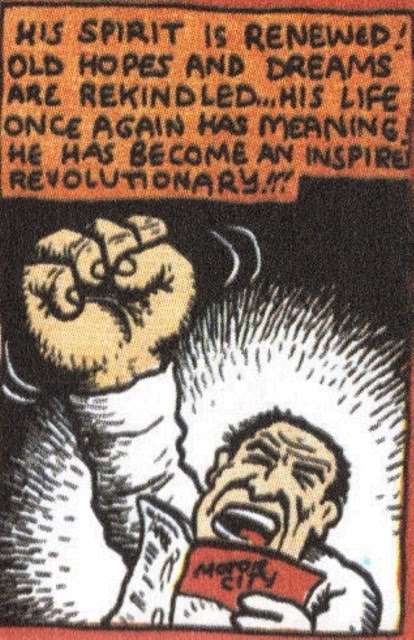
Cartoon by R. Crumb from Motor City Comics.

M’aidez! M’aidez!
The revolutionary and the stinking idol


By Marc Estrin / The Rag Blog / May 2, 2010

SOS was the Morse Code signal requesting aid. Mayday became the oral radio code, probably a corruption of the French m’aidez, “help me.” And “help me” was what political Mayday has traditionally been about — a day of international workers’ solidarity. This notion was eventually too much for capitalist, fortress America, which don’t need no help from nobody, and in 1961 (yes, under JFK), Congress passed a bill creating May 1st as “Law Day.” That’s right, as you watch all those nice blue flowers come up, you can let your mind drift to the men in blue who protect and serve, if you are white and middle or upper class.

A quick web search of “Law Day” sites shows an interesting evolution of the custom. Many are now maintained by lawyers’ and law school organizations, and are dedicated to the notion that lawyers are essential to “freedom under the law.” This may be, if you are rich enough to retain the right one. But there are enough people who remember the political origins of May Day to be using the calendrical energy to combat the oppression of corporate globalization and U.S. imperialism.

You know what? It’s a beautiful, sunny afternoon in early spring, and it thus occurs to me that there was once — and still is — more to Mayday than just politics. Or maybe not. Our Puritan forefathers spent much vituperation on Mayday — and Christmas — (see Hawthorne’s great story “The Maypole of Merrymount”) — which they felt to be superstitious and idolatrous. Here is Philip Stubbes in 1583 railing against a “stinking idol” of a Maypole:

Against Maie Day, Whitsunday, or some other time of the year, every parish, town, or village assemble themselves, both men, women and children; and either all together, or dividing themselves into companies, they goe some to the woods and groves, some to the hills and mountaines, some to one place, some to another, where they spend all the night in pleasant pastimes, and in the morning they return, bringing with them birche boughes and branches of trees to deck their assembles withal. But their chieftest jewel they bring from thence is the Maie-pole, which they bring home with great veneration, as thus — they have twentie or fourtie yoake of oxen, every oxe having a sweet nosegaie of flowers tied to the tip of his horns, and these oxen draw home the May-poale, their stinking idol rather, which they cover all over with flowers and herbes, bound round with strings from the top to the bottome, and sometimes it was painted with variable colours, having two or three hundred men, women, and children following it with great devotion. And thus equipped it was reared with handkerchiefs and flagges streaming on the top. They strawe the ground round about it, they bind green boughs about it, they set up summer halles, bowers and arbours hard by it and then fall they to banquetting and feasting, to leaping and dancing aboiut it, as the heathen people did at the dedication of their idols.

O, well. There is always incorruptible nature:

Im wunderschönen Monat Mai
In the wondrously lovely month of May
Als alle Knospen sprangen,
when all the buds sprang forth
Da ist in meinem Herzen
there, in my heart
Die Liebe aufgagangen.
Love also broke out.

Im wunderschönen Monat Mai
In the wondrously lovely month of May
Als alle Vögel sangen,
when all the birds were singing
Da hab’ ich ihr gestanden
then I confessed to her
Mein Sehnen und Verlangen.
my longing and desire.

— Heinrich Heine/Robert Schumann

These are also Laws.

[Marc Estrin is a writer and activist, living in Burlington, Vermont. His novels, Insect Dreams, The Half Life of Gregor Samsa, The Education of Arnold Hitler, Golem Song, and The Lamentations of Julius Marantz have won critical acclaim. His memoir, Rehearsing With Gods: Photographs and Essays on the Bread & Puppet Theater (with Ron Simon, photographer) won a 2004 theater book of the year award. He is currently working on a novel about the dead Tchaikovsky.]

The Rag Blog

Posted in Rag Bloggers | Tagged , | Leave a comment

Populist Pundit : Lowdown on Hightower

Jim Hightower. Image from Rolling Thunder.

The lowdown:
The Texas populism of Jim Hightower

By Michael Winship / April 2, 2010

I first became aware of Jim Hightower more than 20 years ago, during the 1988 Democratic National Convention in Atlanta. The Democrats were nominating Massachusetts Governor Mike Dukakis to run for president against Reagan’s vice president, George H.W. Bush, and at the time Dukakis looked like he had a pretty good chance at the White House.

This was before a series of events did him in, including the notorious Willie Horton ad that attacked Dukakis for a Massachusetts weekend furlough prison program that allowed a convicted murderer back on the street, where he robbed and raped.

And it was before Dukakis bobbled a harsh debate question about what he would do if his own wife Kitty was raped and murdered. And it was before he was photographed atop an Abrams tank wearing a helmet that made him look like he was starring in Snoopy III: This Time It’s Personal.

All of that misery lay ahead. The Democrats were still in giddy spirits during the convention and had a high old time poking fun at Bush, Sr. That was when the late Ann Richards, then the Texas state treasurer, famously lamented, “Poor George! He can’t help it — he was born with a silver foot in his mouth!”

But it was the convention speech by Hightower that I especially remember. He was the Texas agriculture commissioner in those days — an important job in the Lone Star State — and described Bush as a “toothache of a man,” a cruel but remarkable metaphor. And he said that Bush behaved like someone who was “born on third base and thought he hit a triple… He is threatening to lead this country from tweedle-dum to tweedle-dumber.”

Maybe Hightower didn’t originate those lines (as Milton Berle used to say, “When you steal from me, you steal twice”), but he delivered them with a gusto akin to genuine authorship and over the years has come up with enough original material of his own to absolve him — mostly — from the sin of occasional joke-filching.

Now others steal from him. It was Jim, I believe, who came up with the notion that all elected officials be required to wear brightly colored, NASCAR-like jumpsuits with the corporate logos of their biggest campaign contributors, an idea I’ve heard appropriated by several others without proper attribution.

And I think it was Jim who first said of George W. Bush, “If ignorance ever reaches $40 a barrel, I want the drilling rights to his head.” (On hearing that another politician was learning Spanish, Hightower is supposed to have remarked, “Oh good. Now he’ll be bi-ignorant.”)

These days, Jim Hightower broadcasts daily radio commentaries and edits “The Hightower Lowdown,” an invaluable monthly newsletter. With the passing of both Ann Richards and Molly Ivins, he has became the funniest person in Texas politics — intentionally, that is. But it is his steadfast advocacy of progressive politics, his unyielding embrace of the old time gospel of populism, that made him an especially appropriate guest on the final edition of the PBS series, Bill Moyers Journal.

“Here’s what populism is not,” he told my colleague Bill Moyers. “It is not just an incoherent outburst of anger. And certainly it is not anger that is funded and organized by corporate front groups, as the initial tea party effort [was], and as most of it is still today — though there is legitimate anger within it, in terms of the people who are there. But what populism is at its essence is just a determined focus on helping people be able to get out of the iron grip of the corporate power that is overwhelming our economy, our environment, energy, the media, government.

“…One big difference between real populism and… the tea party thing is that real populists understand that government has become a subsidiary of corporations. So you can’t say, ‘Let’s get rid of government.’ You need to be saying, ‘Let’s take over government.'” As Hightower’s fond of saying, the water won’t clear up until we get the hogs out of the creek. “I see the central issue in politics to be the rise of corporate power,” he reiterated. “Overwhelming, overweening corporate power that is running roughshod over the workaday people of the country. They think they’re the top dogs, and we’re a bunch of fire hydrants, you know?”

Of President Obama he said, “It’s odd to me that we’ve got a president who ran from the outside and won, and now is trying to govern from the inside. You can’t do progressive government from the inside. You have to rally those outsiders and make them a force… Our heavyweight is the people themselves. They’ve got the fat cats, but we’ve got the alley cats…”

This weekend, Jim is being honored at Texas State University-San Marcos with an exhibition celebrating his life’s work as a populist journalist, historian, and advocate. They’re calling the event “Swim Against the Current” because, as Moyers says, “That’s what he does.” In fact, Swim Against the Current also is the title of Hightower’s most recent book, subtitled, Even a Dead Fish Can Go with the Flow.

He comes from a long history of flow resisters, a critical, American political tradition. “I go all the way back to Thomas Paine,” he said. “I mean, that was kind of the ultimate rebellion, when the media tool was a pamphlet.” The men who wrote the Bill of Rights, the Constitution and the Declaration of Independence “didn’t create democracy. [They] made democracy possible.

“What created democracy was Thomas Paine and Shays Rebellion, the suffragists and the abolitionists and on down through the populists and the labor movement, including the Wobblies. Tough, in your face people… Mother Jones, Woody Guthrie… Martin Luther King and Caesar Chavez. And now it’s down to us.

“These are agitators. They extended democracy decade after decade. You know, sometimes we get in the midst of these fights. We think we’re making no progress. But… you look back, we’ve made a lot of progress… The agitator after all is the center post in the washing machine that gets the dirt out. So, we need a lot more agitation… “We can battle back against the powers. But it’s not just going to a rally and shouting. It’s organizing and it’s thinking. And reaching out to others. And building a real people’s movement.”

With this week’s edition, Bill Moyers Journal has gone off the air. But we’ll be continuing the conversation via our web site at PBS.org/moyers. These weekly columns will be continuing for the foreseeable as well.

It has been a delight and honor collaborating with Bill — and the entire production team — so intensely over the last two years. I am always improved in their presence and thank them all, especially Bill and executive editor Judith Davidson Moyers, executive producers Judy Doctoroff and Sally Roy and Diane Domondon and Jesse Adams, the two of whom every week have made sure these scratchings make it out alive, with alacrity and accuracy.

[Michael Winship is senior writer of the weekly public affairs program. Bill Moyers Journal, which concluded Friday night on PBS. Watch online or comment at The Moyers Blog.]

Source / truthout

The Rag Blog

Posted in RagBlog | Tagged , , , , , | 2 Comments

‘We Are All Immigrants’ : 10,000 at Austin May Day March

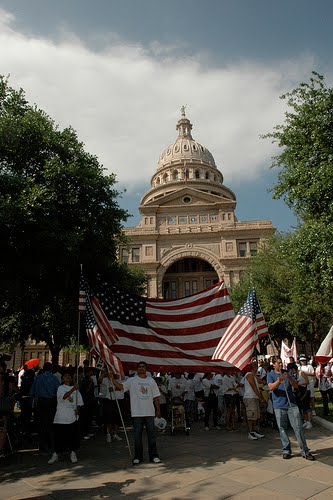
An estimated 10,000 May Day protesters gathered at the Texas State Capitol for a rally and then marched through downtown Austin in support of immigrants’ rights. Photo by Carlos Lowry / The Rag Blog.

Profile this:
Arizona awakens a sleeping giant

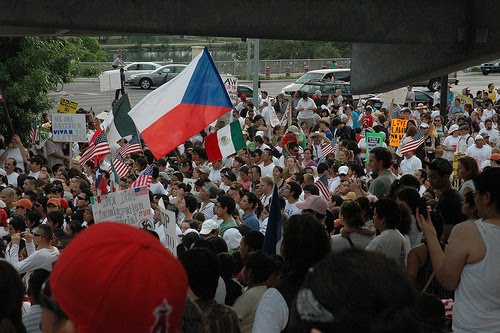
Provided with a hefty kick start from Arizona’s outlandish new immigration law, hundreds of thousands of May Day protesters in at least 80 cities around the country hit the streets yesterday, with as many as 50,000 in Texas alone.

In Austin, 10,000 people filled the Capitol grounds — a large majority of them Latino — for a spirited rally on the steps of the statehouse, and then formed a six-block-long parade down Congress Avenue to City Hall. The biggest crowd in Texas was in Dallas, where Bishop Kevin J. Farrell of the Roman Catholic Diocese of Dallas, led 20-25,000 marchers through downtown streets. 7,500 marched in Houston.

The largest demonstration was in Los Angeles, with a throng estimated as high as 100,000. Singer and Cuban emigrant Gloria Estefan, speaking from a flat bed truck, reminded the massive crowd that we are a nation of immigrants, while LA Mayor Antonio Villaraigosa told the marchers, “We need to write laws that appeal to our better angels.”

In Washington, a demonstration turned to civil disobedience, as U.S. Rep. Luis V. Gutierrez (D-Ill) was one of 35 arrested for sitting down in front of the White House fence, and refusing to “move on.” Gutierrez said he decided to be arrested “to escalate the struggle.” 20,000 marched in Chicago and thousands participated in other cities from coast to coast.

Labor organizer John Delgado told thousands in Manhattan, “I want to thank the governor of Arizona because she’s awakened a sleeping giant.” Meanwhile, anti-immigrant zealot and commentator Lou Dobbs, dismissed it all as a bunch of “political theater.”

— Thorne Dreyer / The Rag Blog

‘Si se puede.’ May Day demonstrators in Austin. Photo by Carlos Lowry / The Rag Blog.

‘Estamos en la lucha’
May Day in Austin

By Alice Embree / The Rag Blog / May 2, 2010

For the first time, my unprofessional crowd estimates were lower than those reported by the Austin American-Statesmen. “Almost 10,000 gather at Capitol to protest controversial Arizona law.”

Austin’s first May Day demonstration focused on immigrant rights was in 2006. I was stunned then by an Austin crowd as large as any I had ever seen — 30,000 — massive numbers, snaking through downtown streets to the federal building. That was the year of the first national mobilizations for comprehensive immigration reform. There were unprecedented turnouts occurring in every major U.S. city, including Los Angeles, Chicago and New York. Other Texas cities — Houston, Dallas, El Paso and San Antonio — had large demonstrations that year.

Those national mobilizations met with considerable blowback. There were rants on cable television about Mexican flags. Vigilante Minute Men got publicity for assembling on the border. More important, there were raids on places of employment, deportations, and jailings. Along with repression, the collapsing U.S. construction sector and increased violence associated with Mexican drug cartels made for a perfect storm of declining participation in subsequent years.

Arizona’s law changed all that. The broad strokes of that recent legislation make the mere suspicion of undocumented status cause for questioning and detention. The potential impact on Latinos ignited Austin’s community as well as communities across the nation.

Organizers at the Austin Immigrant Rights Coalition (AIRC) — www.airc.org — had been holding their meetings in a small office. They moved to a church hall to accommodate the growing interest. AIRC describes itself as a grassroots, action-oriented coalition of immigrants, students, and allies including labor, faith, and community organizations. That is who they turned out for a spirited rally at the state Capitol and a march down Congress Avenue to City Hall.

Conchero dancers reminded those attending of the real non-immigrants in this country — Native Americans. Linda Chavez, former union organizer and Democratic candidate for Lieutenant Governor, addressed the crowd. Marchers chanted:

Si se puede
[Yes, we can]
Obama, escucha, estamos en la lucha
[Obama, listen, we are in the struggle]
El pueblo unido, jamas sera vencido
[The people united will never be defeated]

Like it or not, President Obama, comprehensive immigration reform demands have moved from the shadows onto center stage.

Not sure. Let’s see your profile. Photo by Alice Embree / The Rag Blog.


Speakers, in Spanish and English, singers, and Aztec conchero dancers highlighted the Austin rally. The Rag Blog’s David Holmes Morris has the final word. Photos by Carlos Lowry / The Rag Blog.

The Rag Blog

Posted in Rag Bloggers | Tagged , , , , , | 11 Comments