Sound and Fury Dept. : Karl Rove at UT-Austin

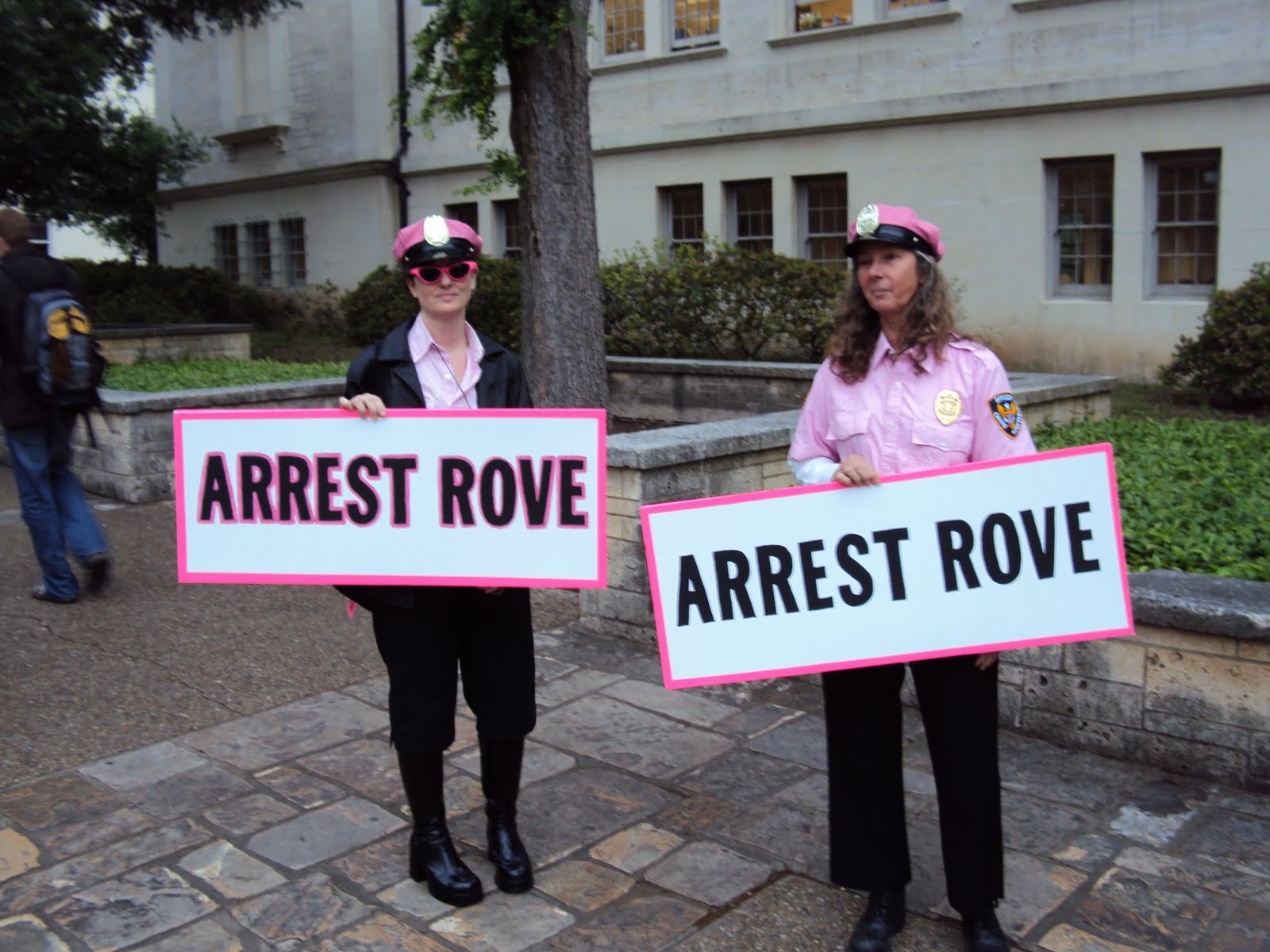
Heidi Turpin (left) and Fran Hanlon, members of CodePink’s “Pink Police,” express their intentions, April 19, 2010, on the campus of the University of Texas at Austin, prior to an appearance by Republican strategist Karl Rove. Photo by Jim Turpin / The Rag Blog.

Karl Rove ignites audience at UT

Both applause and jeering remarks frequently interrupted leading Republican political strategist Karl Rove during his speech at an event hosted by College Republicans at the Texas Union Ballroom on Monday night. …

Protestors from women’s peace organization Code Pink; grassroots justice group We Are Change; and UT Chicano civil rights group MEChA lined the back of the room with signs accusing Rove of war crimes, and many individuals in the audience yelled comments and insults at Rove throughout the course of the evening. …

A total of nine protestors were removed from the ballroom. Two were arrested, and seven were cited for criminal trespassing, UTPD spokeswoman Rhonda Weldon said. …

Rove did not ignore the protestors, referring to them as “malcontents” and telling several to “shut up and sit down.”

The Daily Texan / April 20, 2010

[According to The Raw Story, one of those arrested for shouting at Rove was Aaron Dykes, an associate of libertarian radio talker and conspiracy theorist Alex Jones. (Also see Infowars.)]

Protesters spoil Republican pep rally:
Bush man Rove stirs up UT crowd

By Susan Cook / The Rag Blog / April 24, 2010

Returning to the University of Texas two years ago to finish up my old government degree — so I could then study sustainable design in UT’s School of Architecture — has been a a real gift. I now get an admittedly outsider’s glimpse into the world as seen by a privileged segment of our younger citizens. I am exposed to the latest technologies, the newest and hippest musical styles, the widespread angst and apathy I see as a national epidemic — and last week, I got to see Karl Rove.
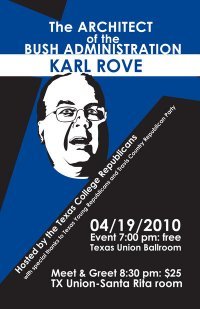

The previous week a brightly-colored flyer with Karl’s face had caught my eye. Copies of it were posted on the bulletin boards that line the halls of the University. There he was amid the offers to study in Mexico, find a Spanish tutor, and join the Islamic students for a talk about the misconceptions swirling around what it means to be a Muslim. There was his big, fat, round visage with that iconic smirk.

The “architect of the Bush administration” was to speak on campus the next Monday, April 19. “Hosted by the Texas College Republicans,” the flyer said, although I was to find out the hard way that they were only the titular hosts of this Republican Big Deal — after I fired off a Letter to the Editor in the Daily Texan‘s Firing Line the next day. My letter questioned whether — in this climate of educational budget cuts and employee layoffs at the University — forking over the bucks to pay for enough security to keep CodePink’s Pink Police’s handcuffs off of this man might not be the best possible way to put my hefty tuition to use.

The response to my letter was swift and vociferous. Not only was I an ill-informed dimwit who hadn’t the intellectual skills to research and find out that the on-campus Young Republicans were (in theory) footing the bill for everything, but I was a disgrace to government majors everywhere due to my obvious connection to unpatriotic terrorists — and I was a “freak/fringe” lefty to boot.

I was a pretty sorry excuse for a student and might not even be worthy of calling myself an American anymore. One writer suggested I be burned in effigy, another, using the name “Ann Coulter,” advised that I should move to Canada where I would be happier. Thank you, Ann.

The College Republicans and their supporters had a field day with me, taking obvious glee in hurling insults in my general direction and painting me with every available slur reserved for their favorite target: liberals.

Came the day of the actual appearance of Karl Rove and — in addition to figuring out what to wear, whether to have a beer first at the Cactus Cafe, and where to find the mobility-impaired entrance to the event — I had to decide if I wanted to get arrested. Or not. I decided that my impending graduation from UT, 40 long years in the making, was not going to be spoiled by Karl Rove, so it was a “not.”
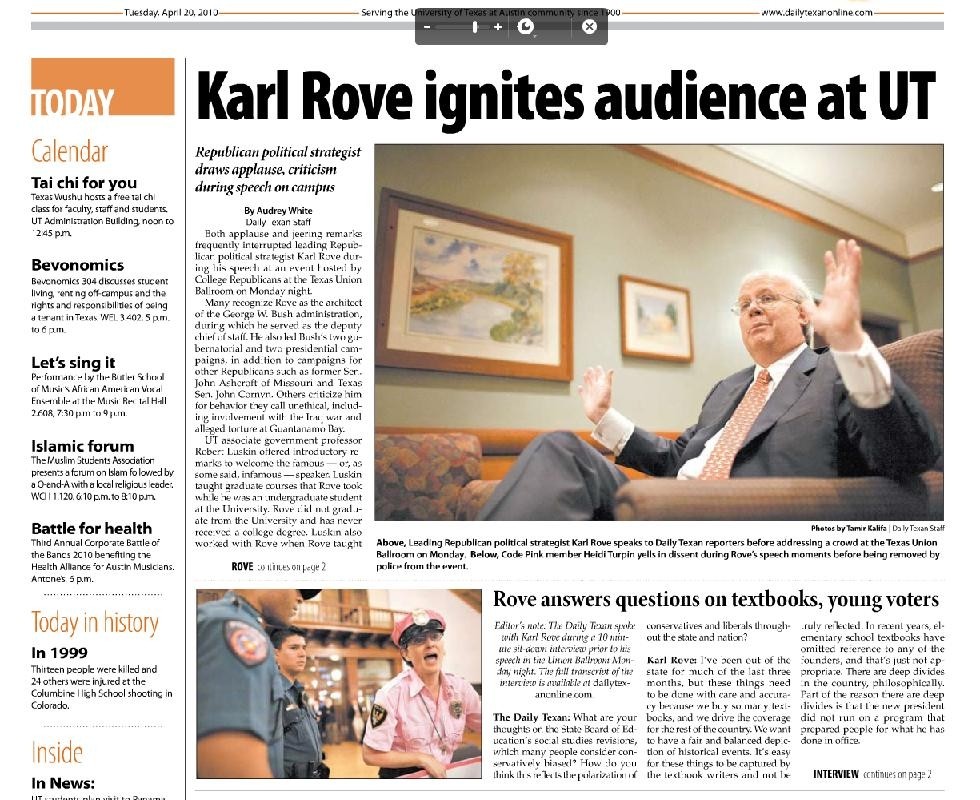
Image from page one of the UT-Austin student newspaper, The Daily Texan, April 20, 2010.

The room was filled with Old Republicans whose generous donations, as I was to find out, were the real source of funding for Rove’s appearance. The first several rows of the Union Ballroom were occupied before the hoi polloi were even allowed in the room; these were the same folks who would later gather for a Meet and Greet with the Great Liar himself at a catered reception down the hall. The silver-hairs were a dead giveaway that this was only nominally a speech for students. This was a Republican pep rally.

As Karl Rove lied his way through an incredibly detailed account of why Obama’s health care bill was the world’s biggest failure and an affront to physicians and patients (and taxpayers) everywhere, I realized that this was a very boring man. He was a symbol of what the Bush Administration had brought to us and what smart, motivated people can accomplish when they put their minds to it. We can have wars-without-end, tax breaks for the wealthy, corporatized everything, and act snooty — all at the same time.

Some lackey from the UT administration got up at the first outburst from a protester in the audience and announced that each ne’er-do-well would be given “three warnings” to pipe down and then would be escorted from the room, perhaps to be arrested. I thought at the time, “how generous, how civilized of them,” but this policy was abandoned after the first unsanctioned speaker was led from the hall and after that one merely had to say something out loud and the UTPD came and got you.
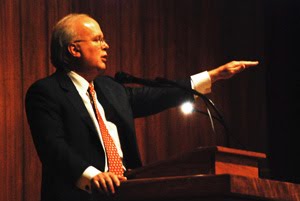
Nice pose, Karl. Rove speaks in Austin to pep rally peppered with malcontents. Photo by Corey Leamon / The Rag Blog.

One by one, as Rove droned on, NINE people were taken from the room for merely speaking out loud. However, if you said something that Rove liked, you got to stay. I did notice that.

Rove had a lie to answer every accusation that came up during the Q&A period following his mind-numbingly dull speech. My favorite: We invaded Iraq to prevent an arms race between Iran and Iraq. News to me.

When questioned about WMD or his involvement with outing CIA operative Valerie Plame, he immediately countered with how many other people were also wrong — or did the same thing he did. Hide among the guilty and it is hard to pick out just one person to blame the crime on. He was not blameless, he was just not the only one. Bush didn’t lie about WMD in Iraq — because Kennedy, Pelosi, and Kerry did, too. He didn’t out Plame — because Armitage and Novak did, too.

When I left the hall after the event was finally over, I had the option, as it turned out, to sneak into the Meet and Greet since the mobility-impaired exit/entrance was the same door where they were collecting tickets to the catered event in the Santa Rita Room down the hall. When asked for my ticket by the cop, I simply informed him that this was my proper exit route and he let me through ticketless.

As I waited for my elevator to flee the massed Republican horde in the Rove reception line, I had to once again ponder whether I should risk arrest or at least embarrassment by posing as one of the faithful. (I looked a lot like them; I had not worn my Che t-shirt that night, opting instead for a nice jacket and clean black slacks and shirt.)

But once again I decided not to get in trouble. Not tonight. Not for Karl Rove.

The Rag Blog

Posted in Rag Bloggers | Tagged , , , , , , | Leave a comment

Eric Jasinski : Treating PTSD With Jail Time

Spc. Eric Jasinski.

Went AWOL seeking help for PTSD:
Eric Jasinski released from Texas jail


By Alice Embree / The Rag Blog / April 23, 2010

Eric Jasinski is being released from the Bell County Jail in Belton, Texas, tomorrow morning, April 24. He will have served 25 days of a 30-day sentence.

Jasinski, 23, who is a member of Iraq Veterans Against the War, went AWOL in 2009 to seek help for his PTSD. His story was reported on by Dahr Jamail in The Rag Blog.

Eric Jasinski enlisted in the Army in 2005, and deployed to Iraq in October 2006 as an intelligence analyst. He collected intelligence used to direct air strikes. After his return to the U.S., Jasinski suffered from severe PTSD resulting from what he did and saw in Iraq. He felt remorse and guilt for the way he contributed to loss of life. He went through a divorce and had friends killed and maimed in combat.

He tried to get treatment for PTSD and finish out his military contract. “In late 2008,” Jasinski said, ”they stop-lossed me [an involuntary extension of contract], and that pushed me over the edge. They were going to send me back to Iraq.” Jasinski went AWOL until December 11, 2009, when he turned himself in to authorities at Fort Hood.

The Army scheduled a Summary Court Martial for March 31. Jasinski was sentenced to 30 days in the Bell County Jail. Laura Barrett, Jasinski’s mother, told the Temple Herald Telegram, “This has been a total outrage. I cannot believe my son who is diagnosed with PTSD from his deployment to Iraq would be sent to jail.”

James Branum, Jasinski’s civilian defense attorney, submitted a clemency request asking that Jasinski be released on mental health grounds or transferred to the psych ward at Darnall Army Medical Center to complete his sentence. The Army did not respond. With Jasinki’s permission, Branum shared a letter written from the Bell County Jail by Jasinski.

Branum said, “We, as Americans, need to see how combat vets are treated today. Eric is in jail because he has PTSD and was denied the care he needed. His ‘desertion’ was an act of desperation, the act of a soldier who had no other options.”

Here is part of what Eric Jasinski wrote from the Bell County Jail in Belton, Texas. We publish it as he wrote it:

When I am taken out of jail back to Fort Hood for any appointments I am led around in handcuffs and ankle shackles in front of crowds of soldiers… which is overwhelming on my mind. My guilt from treating prisoners in Iraq sub-human and I did things to them and watched my unit do cruel actions against prisoners, so being humiliated like that forces me to fall into the dark spiral of guilt. I now know what it feels like to have no rights and have people stare and judge based on your shackles and I feel even more like a monster cause I used to do this to Iraqi people.

Even worse is the fact that this boils down to the military failing to treat my PTSD but I am being punished for it… I feel as if I am being a threat to others or myself and still the Army mental health professional blow me off just like in 2009 when I felt like I had no choice but to go AWOL, since I received a 5 minute mental evaluation and was stop-lossed despite my PTSD, and was told that they could do nothing for me. The insufficient mental evaluation from a doctor I had never seen before, combined with the insufficient actions by the doctor on 9 April show the Army is not trying to make progress…

I have tried to “do the right thing” as those in the Army say and all they do in return is destroy me even more mentally and publicly say that they are going to look out for me while behind closed doors the exact opposite is happening… I have been tossed in the trash just like the brave and honorable resisters of Vietnam. The machine never stops and it never changes.

The Rag Blog

Posted in Rag Bloggers | Tagged , , , , | 22 Comments

May First : High Noon in Nepal

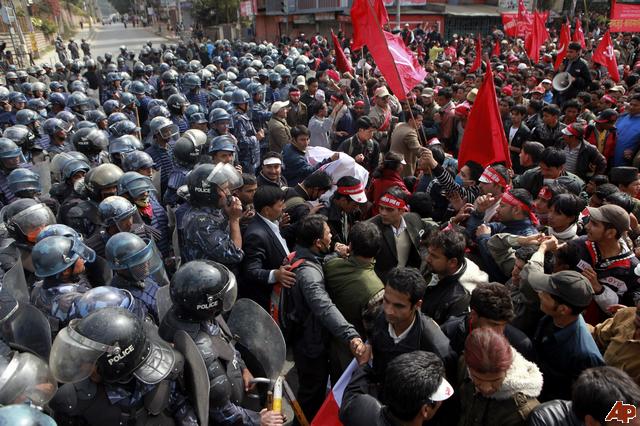
Image from Kasama / May First.

On the edge of revolution:
High Noon in Nepal

By Jed Brandt / April 23, 2010

“You must come to Kathmandu with shroud cloth wrapped around your heads and flour in your bags. It will be our last battle. If we succeed, we survive, else it will be the end of our party.” — General Secretary Badal, Unified Communist Party of Nepal (Maoist)

KATHMANDU, Nepal — There are moments when Kathmandu does not feel like a city on the edge of revolution. People go about all the normal business of life. Venders sell vegetables, nail-clippers, and bootleg Bollywood from the dirt, cramping the already crowded streets.

Uniformed kids tumble out of schools with neat ties in the hot weather. Municipal police loiter at the intersections while traffic ignores them; their armed counterparts patrol in platoons through the city with wood-stocked rifles and dust-masks as they have for years.

New slogans are painted over the old, almost all in Maoist red. Daily blackouts and dry-season water shortages are the normal daily of Nepal’s primitive infrastructure, not the sign of crisis. Revolutions don’t happen outside of life, like an asteroid from space — but from right up the middle, out of the people themselves.

Passing through Kathmandu’s Trichandra college campus after meeting with students in a nearby media program, I walked into the aftermath of bloody attack. Thugs allied with the Congress party student group had cut up leaders of a rival student group with khukuri knives, leaving one in critical condition. Hundreds of technical students were clustered in the street when I arrived by chance. The conflict most often described through the positioning of political leaders is breaking out everywhere.

Indefinite bandhs are paralyzing large parts of the country after the arrest of Young Communist League (YCL) cadre in the isolated far west and Maoist student leaders in Pokhora, the central gateway to the Annapurna mountain range. The southern Terai is in chaos, with several power centers competing and basic security has broken down with banditry, extortion, and kidnapping are now endemic. Government ministers cannot appear anywhere without Maoist pickets waving black flags and throwing rocks.

With no central authority, all sides are claiming the ground they stand on and preparing their base. It’s messy, confused, and coming to a sharp point as the May 28 deadline for a new constitution draws near with no consensus in sight. The weak government holding court in the Constituent Assembly can’t command a majority, not even of their own parties.

Seventy assembly representatives of the status quo UML party signed a letter calling on their own leader to step down from the prime minister’s chair to make way for a Maoist national-unity government. He refuses, repeating demands that the Maoists dissolve their popular organizations and return lands seized by the people who farm them.

The Maoists have more pressing concerns than the legalism of the parliamentary parties. If they can’t restructure the state, by constitutional means or otherwise, the enthusiasm that brought their revolutionary movement this far may turn to disillusionment. With no progress in the assembly, the leaders of the status quo parties now say there will be no resolution on time. The Maoists have rejected any extension as a stalling tactic and are turning to the people. With now-or-never urgency, they are mobilizing all their forces for a decisive showdown in Kathmandu.

Nepal braces for May First

Posters for May First appeared overnight announcing the Maoist call for workers and villagers to converge on Kathmandu for a “final conflict.” The Maoists are calling for a sustained mobilization, with the hope that an overwhelming showing can push the government out with a minimum of bloodshed and stay the hand of the Nepal Army.

May First is International Workers Day, the traditional day of action for communists around the world, but the mobilization has already begun.

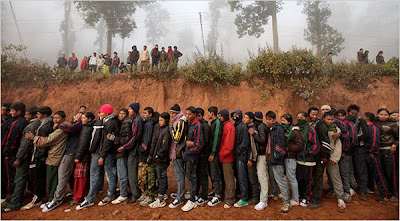
Thousands of recruits are being trained by YCL cadre in districts throughout the country, drilling with bamboo sticks in place of rifles. With threats from Nepal Army commanders to put these protests down with force, the Maoists are preparing to defend their mass organizations, the marches, the party, and the people from attempts at counterrevolution. Their meetings include political orientations and anti-disinformation training to combat the confusing fog of manufactured rumors and lies that are already in the air.

National assemblies of radical students, artists, intellectuals, ethnic federations, women, unions, and trade organizations convened widely during the month of April. All sectors are receiving the same message: The Maoists will not return to the jungle, or replay a guerrilla struggle. They will not retreat. The conflict will be decided frontally in the cities.

Confrontation in Nepal. Photo from Revolution in South Asia.

Dual power:
Class struggle at the tipping point

Nepal has two mutually-exclusive power structures: one is the revolutionary movement led by the Unified Communist Party of Nepal (Maoist), which has a powerful mass base among the people, a disciplined political militia in the YCL, and its People’s Liberation Army. The other is the apparatus of Nepal’s state — held over from the monarchy, unreconstructed, backed by the rifles of the Nepal Army and the heavy weight of feudal tradition.

Land seizures co-exist with plantations. Old judges still sit in their patronage chairs dispensing verdicts to the highest bidder while revolutionary courts turn off and on in the villages. The deposed king Gyanendra lost his crown, but retains vast tracts of land, a near monopoly on tobacco and a “personal” business empire.

Large-scale infrastructure like hydropower remains largely under foreign ownership, but only operates when, and how, the Maoist-allied unions let it. In short, the semi-feudal, semi-colonial system of Nepal is in place but the organized workers and Maoist-led villagers hold a veto.

In Nepal, people were taught that the poor would always be poor. They long believed it. There would always be kings, lords, myriad deities, and foreign patrons to look over them. Caste dictated behavior and expectations for most, justifying dull cruelty and vast human waste.

The tolerance and fatalism so beloved by British travel writers were also consigning the people of Nepal to isolation, ignorance, and the lowest life expectancies in Asia. But the world doesn’t actually stand still, or turn in circles, as some would have it. Things do change.

When urban civil uprisings wrested a parliamentary system from King Birendra in 1990, nothing changed for the people, save for those whose hands got greased for government services. When rising expectations crashed into the closed doors of realpolitik of elite “democracy” — the Maoists blew it open, building an army up from the basic people themselves. From bases of support in Rolpa and Rukum, the People’s War spread to 80% of the country in 10 lightening years. Over 10,000 lost their lives in the greatest uprising in Nepal’s history.

Yubaraj Lama, a prominent actor/director thrust into radical politics by the movement against the king, put it simply: “It was the failure of the political parties to bring democracy, any real social change for the masses of people that fueled the People’s War. This is what the Maoists changed. People were very fatalistic, looking up to politicians like princes. That is over.”

People who had never thought social change is possible now believe they can end their poverty. Kings are not gods and their crown can fall. Women and girls are more than a way to have male children. The heavy hand of foreign domination and its imposed backwardness can be challenged. The Maoists changed the concept of politics from appeal-if-you-dare to revolution from the ground up.

Not everyone is happy with the way the wind is blowing. It is easy to find haughty conservatives who think any hope for the poor comes at their expense and who want to see the Maoists crushed.

Talking with the owner of an English-language bookstore, an outspoken supporter of UML’s embattled prime minister, he insisted that people only attended the Maoist rallies because they were forced to. This plainly isn’t true, but I asked why they won the elections. He told me “these people are stupid” and “believe the Maoist lies that they can live in the big house.” When I noted that all the unions in the neighborhood were Maoist and they hardly seemed forced into it, he laughed. “Of course they are, they want to take all the money from people who own them.”

With all the paranoia of America’s white-fright militias, Nepal’s reactionaries conflate rudimentary democracy, let alone the communist program of the Maoists, with the very end of the world.

Nepal’s embattled elites also can’t simply be brushed aside or nuanced into reform. They do have an army, the former Royal Nepal Army (NA), renamed but unreconstructed. The officer corps is steeped in caste ideology and disdain for the common people, and is supplied with modern weapons and not-so-secret Indian and American advisers.

The PLA is training and waiting within UN-supervised cantonments — military bases scattered across the countryside. The YCL, led by former PLA commanders is training new militias throughout the country. And for its part, the Nepal Army is confined to its barracks, concentrated in and around Kathmandu.

The politics of this moment are intricate. Many forces parry and maneuver for advantage. But the basic situation is this: Dual power has produced a highly unstable stalemate between a revolutionary people and a weakened regime — a paper tiger with real claws — and the moment of decision is fast approaching.

Democracy is just a word

Over the last 20 years, there has been a growing passion to see the people decide Nepal’s future, to have some form of genuine popular democracy. It erupted first in the 1990 Jana Andolan civil uprising. It fueled the People’s War that started in 1996 and animated the powerful mass movement that toppled the king in 2008.

One of the fruits of that sustained struggle was the current Constituent Assembly — where elected representatives of the grassroots were supposed to craft a new framework for a new society, with both open election to seats and sectoral representation to ensure that women, minorities, and workers had direct representation. The very idea of such a constituent assembly comes from communist demands — it was their answer to bourgeois democracy.

Maoists made 40 demands of the King in the mid-1990s before launching their guerrilla war. Despite consistent flexibility on almost everything else, a constituent assembly was the only demand that was never negotiable. It’s profound, the idea of an empowered assembly drawn from every corner — including elected representatives of the poor, women and minorities — for the purpose of remaking the very basis of government and society. This was to be the workshop for a New Nepal.

In a short-lived alliance with the parliamentary parties brokered in 2006, a popular uprising in Kathmandu forced the king out and secularism was established. Elections where held in 2008, and the Maoists emerged the largest party, with more delegates than the old standbys UML and Congress combined. The rest of the seats went to a score of minor parties.

This unprecedented assembly has been gridlocked since it convened. On one side, the old political parties want an Indian-style parliamentary system that is quite compatible with rural feudalism and caste oppression. And opposing those parties, stand the Maoists who speak of a radical new peoples democracy where those excluded from politics will now set the terms.

The Maoists have used their days in this assembly to flesh out their plans for a New Nepal. They drafted and popularized constitutional provisions for a future people’s republic — including land reform, complete state restructuring, equality for women, autonomy for oppressed minorities, and an end to Nepal’s stifling subordination to India.

Ambitious plans to redirect government investment in basic infrastructure like roads, sanitation, and vastly expanded public education were all scuttled when the Nepal Army refused to recognize civilian control after the Maoist victory. Then-Prime Minister Prachanda resigned, leading the Maoists out of government and leaving the Constituent Assembly in gridlock. They are the largest party, the legal and extra-legal opposition.

The same callous ruling classes, who ignored the bitter poverty of people for decades, now claim to be Nepal’s only “democratic” alternative to the Maoists.

Yet everyone knows: It was those Maoists who went deep among the people, who fought with guns, braved torture, and sacrificed many lives for constitutional elections — winning a popular mandate in that voting. Who, then, are the true democrats here? Who really speaks for the people and their aspirations for power?

Maoist soldiers in Nepal. Photo by Kuni Takahashi /NYT.

Time itself is accelerating

All the political forces in the country have now spent the last years in slow-mo maneuvering. They have revealed their programs and exposed their natures — before a closely watching population.

The Maoists are refusing to wait any longer. Leaders of Congress and UML parties admit a constitution can’t be delivered by May 28. The Maoists reject any postponement of that May 28 deadline. No more stalling, they say.

Hundreds of thousands have been mobilized in peaceful mass marches over the last months. Such marches have been a vehicle for intensive mass organizing. They have been used as a gauge of growing partisan strength. The logistics of moving people through the streets to each of the main government offices is practice for seizure. In short, they can be understood as dress rehearsals for a revolution.

On April 6, 2010, Maoists held powerful rallies in all of Nepal’s 75 districts demanding that the unelected prime minister resign to make way for a new Maoist-led government. Further rallies are scheduled leading up to May First.

The Maoists’ program is unlikely to be accomplished through parliamentary procedure and they know it. Maoists have discussed a double-barreled approach: build on the base areas and social transformation of the People’s War to launch popular insurrection in the city. Nepali revolutionaries have been incredibly patient, refusing to over-extend their hand. They are seeking to apply one of Mao Zedong’s most famous principles, the mass line:

It often happens that objectively the masses need a certain change, but subjectively they are not yet conscious of the need, not yet willing or determined to make the change. In such cases, we should not make the change until, through our work, most of the masses have become conscious of the need and are willing and determined to carry it out. Otherwise we shall isolate ourselves from the masses. Unless they are conscious and willing, any kind of work that requires their participation will turn out to be a mere formality and will fail.

This is what Prabhakar, Deputy Commander of the PLA, meant when he said: “We will not take any action against this government. People at large will decide the fate of this government.”

The Maoists have been working hard to make the next push — for the final seizure of power — an act of the people, not a self-isolating putsch by the communists alone.

On April 15, YCL commander Sonam was arrested in Kathmandu on weapons charges. Thousands of people mobilized within the hour for a torchlight march to the jail. Sonam was released.

Backed by the Defense ministry, commanders of the 96,000-man Nepal Army began new recruitment this week in direct violation of prior agreements.

UCPNM leader Ashok calls this “conspiracy to invite civil war.”

For all its complexity, dual power in Nepal rests on two armies. The middle ground is disintegrating under the pressure. Splits are appearing within all kinds of political forces — including the moderate leftist UML and reportedly among the army rank-and-file. The UCPN(M) openly says it is seeking to make its case “directly to the soldiers.”

“If the army acts against democracy, the people won’t stand for it,” said Bishnu Pukar. A human rights activist and former leader of the revolutionary teacher’s union, Pukar was arrested twice in the fight for a new Nepal by the military. “Too many lives have been lost. There will be general rebellion.”

In short: The Maoists are forcing a question of ultimate power that the people of Nepal will have to decide. Look to May First and the days that follow.

[Glenn Beck calls Jed Brandt a “bald communist.” His writing, photography, design, and artistic work have appeared in the Indypendent, and other publications.]

Source / Jed Brandt / Pick Better Fights

Thanks to Carl Davidson / The Rag Blog

Posted in RagBlog | Tagged , , , , | 1 Comment

Kate Braun : Beltane Seasonal Message

Beltane. Image by Janna / deviantArt / Kuoma-stock.

Fire and fertility:
The Goddess is receptive to Lord Sun

By Kate Braun / The Rag Blog / April 23, 2010

“O doo not tell the priest our plight,
For he would call it sin,
For we’ve been out in the woods all night,
A’conjuring summer in.”

Friday, April 30, 2010, closely following the Full Planting Moon on April 28 is Beltane, aka Roodmas, May Day, Walpurgisnacht, and May Eve. Lady Moon starts her 3rd Quarter, in Scorpio, a Fixed Water Sign. Friday is Freya’s day and Freya is a goddess of fertility, among other things, so the emphasis on planting and generation is interesting.

In the Long Ago, Beltane traditionally marked the beginning of Summer. “Bel” is an ancient Sun God name and “Tan” means Fire. This is a fire festival as well as a fertility festival. If possible, celebrate outdoors. The Goddess is now Matron, ripe and receptive to Lord Sun’s attentions, and as we celebrate the changing season we also celebrate the new life to come from their union.

Decorate with flowers, especially roses. Use mirrors to reflect Lord Sun’s light. Representations of honeybees will indicate the fertility aspect of your festivities. Braid your hair and/or beard and wear braided ribbons or cords as part of your attire. Macrame work is also acceptable: the joining of two strands to create a third is another way to represent the union of God and Goddess. Dress yourself, your table, and your altar primarily in white, dark green, and red; use other colors of your choice for accent colors. At this celebration, all colors are appropriate.

Let your menu include dairy foods, sweets of all kinds. breads, cereals, all red fruits, green salads, and honey. As it is taboo to give away fire or food on this day, if you host a pot-luck party, please ask that any leftovers be taken home by whomever brought the dish.

If you have an outdoor fire, when it is reduced to embers toss healing and protective herbs and incense such as rosemary, frankincense, and vanilla on the embers and use a feather or a feather fan to direct the smoke around all your guests. If this is not possible, light a charcoal disc and put it in a safe container such as a cauldron, adding the herbs and incense to the charcoal when it is ready, then fanning the smoke around the room and all those present.

As at Samhain, Beltane is a time when the veil between worlds is very thin. It is a time of Great Magick, The powers of elves and fairies are growing and will reach their peak at the Summer Solstice. Keep these entities content and happy by planting (or allowing to grow) clover, lobelia, red carnations, heliotrope, foxglove, and mushrooms.

Creating a garden shrine by decorating a living tree or bush with bells and ribbons will please fairies and nature spirits who, in turn, will protect your garden and outdoor spaces. This is an activity in which both you and your guests can participate; leftover ribbons and bells may become party favors your guests may take home and use to decorate their own gardens.

[Kate Braun’s website is www.tarotbykatebraun.com. She can be reached at kate_braun2000@yahoo.com.]

The Rag Blog

Posted in Rag Bloggers | Tagged , , , , , | Leave a comment

Psychology of Greed : Protecting the People from Wall Street


A rebuttal of sorts:
Protecting the people from Wall Street

By Steven Porter / The Rag Blog / April 23, 2010

[On April 21, The Rag Blog published an article by Sherman DeBrosse entitled Republican Jujitsu : Protecting Wall Street from the People.]

To argue that the abuses of Wall Street lie at the feet of one political party or another really avoids a deeper issue with which our nation must eventually come to grips. The issue is the psychology of greed which is the progenitor of the abuses. And it is a psychology which is part of our entire nation.

Greed is a neurosis which is not characterized by party label, gender, religion, age, sexual orientation, or any of the other considerations of which the pundits often talk. It is a cultural phenomenon whose roots are in the child-rearing practices and sociological landscape of the society. Both Freud and Karen Horney discuss the process, Horney most eloquently in her book The Neurotic Personality of our Time.

The lies and manipulations which often accompany greed cannot really be legislated. Morality and immorality are not determined by what laws are passed. In fact, given a sufficient lust for the immoral, laws are more often simply things to circumvent rather than statutes to obey.

That said, if immorality cannot be halted by law, it can certainly be prosecuted by law, and that seems to be the great weakness of our government. It is a weakness because Congress is also one of the foxes guarding the chicken coop of finance.

The foxes on Wall Street and those in Congress have been allies for years, as anyone who looks at the record will see. The alliance has taken two traditional paths: campaign contributions from the financial industry to candidates for Congress (by the billions — see www.opensecrets.org) and a revolving door between top financial executives and top government officials.

Goldman Sachs, the focus of our current dilemma, is a particularly egregious offender in this regard having placed more than 45 of its top people in government (including both Rubin and Paulson who went from GS CEO positions to Secretary of the Treasury).

The appearance of President Obama on Wall Street as a spokesperson for a greater fiscal morality is simply laughable. It is part of a charade being played out by all parties to make it seem like the interests of the people are being looked after. Let us remember that it was Obama who eschewed the 2008 campaign spending limits he once proclaimed he would uphold. Let us remember that it was Obama who took $1 million in contributions from Goldman Sachs in the 2008 campaign.

Not that I am saying anything about Obama which is not true of the other candidates. The system has been rigged to aggrandize the greed of special interests, and candidates in both major parties are willing participants.

The question of what we do to protect ourselves against the abuses of the finance industry is thus a far more complex one than the passage of any single piece of legislation. It involves the psychological metamorphosis of our culture from one of spendthrift instant gratification to one of what psychologist Eric Berne called “more Adult behavior.”

To rail against the fiscal and governmental corruptors is to miss the real point. To quote Mr. Shakespeare yet again, “The fault is not in our stars, but in ourselves.”

[Dr. Steven Porter holds BS, MA, PhD, and PD degrees in fine arts and educational administration. He was the Democratic Party candidate for Congress in Pennsylvania’s third district in both 2004 and 2006. His new book is entitled Preserving America: ten things we must change to survive.]

The Rag Blog

Posted in Rag Bloggers | Tagged , , , , , | 2 Comments

Bob Feldman : A People’s History of Afghanistan / 1

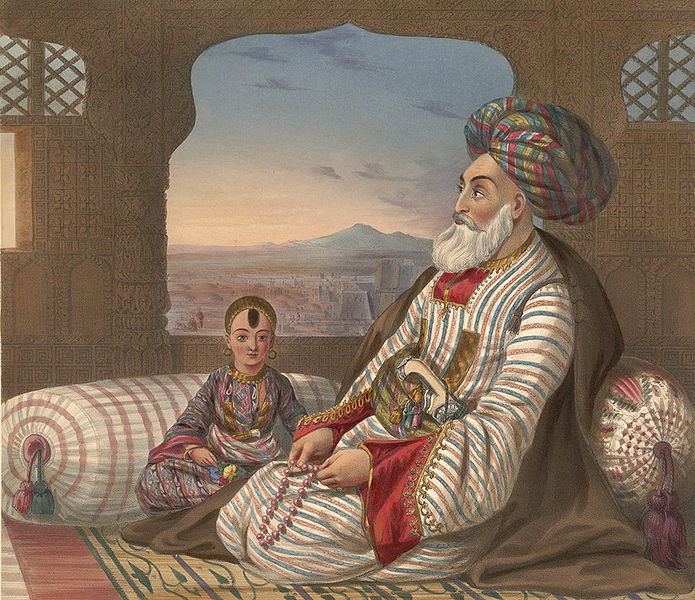
Dost Mohammad Khan, depicted with his son, was the Emir of Afghanistan from 1826 to 1839 and then from 1843 to 1863. Lithograph by James Rattray (1848) / British Library / Wikimedia Commons.

Part 1: 1838 to 1876
A People’s History of Afghanistan

By Bob Feldman / The Rag Blog / April 23, 2010

[If you’re a Rag Blog reader who wonders how the Pentagon ended up getting stuck “waist deep in the Big Muddy” in Afghanistan (to paraphrase a 1960s Pete Seeger song) — and still can’t understand, “what are we fighting for?” (to paraphrase a 1960s Country Joe McDonald song) — this 15-part “People’s History of Afghanistan” might help you debate more effectively those folks who still don’t oppose the planned June 2010 U.S. military escalation in Afghanistan?]

The number of U.S. combat troops in Afghanistan has increased from 51,000 to between 70,000 and 100,000 since Barack Obama’s inauguration as U.S. president in January 2009. And there are still between 60,000 and 101,000 armed private contractors — as well as 38,000 combat troops in NATO’s International Security Assistance Force [ISAF] from countries other than the USA — in Afghanistan in 2010. Yet if you grew up in the USA , your high school social studies teacher was likely to know more about the history of the Palestinian-Israeli conflict than about the history of Afghanistan .

But although no people of Jewish religious background lived in Afghanistan prior to the 19th century, by the end of the 1840s (after the Anglo-Indian army of UK imperialism which had invaded Afghanistan in 1838 was driven out by the Afghan people in the early 1840s), about the same number of people of Jewish background then lived in Afghanistan as then lived in the United States. As Raphael Patai noted in her book Tents of Jacob, “the number of Jews in Afghanistan in the mid-nineteenth century was estimated at 40,000.”

But the aim of the UK government’s military occupation of Kabul between 1839 and 1842, during the First Anglo-Afghan War, was mainly to prop up an ineffectual and unpopular leader named Shah Shuja, whom the UK government had put in power, in place of Afghan King Dost Mohammad Khan, as Afghanistan ’s ruler.

UK troops in Afghanistan, however, found the Afghan people to be opposed to their presence there. Between 1839 and 1842, there were “increasingly effective armed attacks on the British garrison” in Kabul, according to Afghanistan: A Modern History by Angelo Rasanayagam.

The UK troops were soon forced to retreat from Kabul to Jalalabad, “through narrow mountain defiles and passes in the harshest wintry conditions, with the long columns of soldiers” and their civilian camp followers “being continuously shot at and ambushed by ferocious Ghilzai tribesmen from the surrounding hills,” according to the same book.

As a result, around 9,500 (including 600 English officers and their families) of the primarily Indian troops of UK imperialism and 12,000 Indian civilian camp followers lost their lives when they were defeated militarily by people in Afghanistan during the 1839-1842 Anglo-Afghan War.

In revenge for being defeated in the First Anglo-Afghan War, however, UK troops returned to Kabul in 1843 and sacked Kabul . But because of its defeat in the 1839-1842 war, the UK government agreed to invite Dost Mohammad Khan to return to Kabul and resume his position as Afghan King. Twelve years later, on March 30, 1855, a treaty of friendship was signed between the UK government and Dost Mohammad’s feudalist government.

The UK government then started to pay King Dost Mohammad an annual subsidy of 10,000 British pounds to help protect its strategic interests in that area of the world. Dost Mohammad remained on the Afghan throne until 1863; and between 1863 and 1878, Dost Mohammad’s son, Sher Ali Khan, was Afghanistan ’s ruling monarch.

After the UK army again intervened in Afghanistan in October 1856 to force the Persian/Iranian government troops that had occupied the city of Herat in western Afghanistan to withdraw, the UK government did not openly intervene in Afghanistan ’s internal affairs until 1876. But as the book Afghanistan: A Modern History noted, “when Disraeli became [UK] prime minister, the tacit policy of non-intervention in the internal affairs of Afghanistan ended, and was replaced by the `forward policy’…”

Next: “A People’s History of Afghanistan — Part 2: 1876 to 1901.”

[Bob Feldman is an East Coast-based writer-activist and a former member of the Columbia SDS Steering Committee of the late 1960s.]

The Rag Blog

Posted in Rag Bloggers | Tagged , , , , , | 3 Comments

Republicans : Choosing Wall Street Over Main Street

Graphic from USA Today.

The Republicans and financial regulation:
Choosing Wall Street over Main Street

By Ted McLaughlin / The Rag Blog / April 22, 2010

It’s no secret to anyone what kicked off the current recession in America. It was the financial industry and Wall Street that were so greedy that they were willing to throw the entire country under the bus as long as they could keep making their fees and bonuses. They were so concerned with making their own money they even put their own companies at risk to make a fast buck.

Of course, this couldn’t go on forever. Wall Street had convinced Americans that rules were in place that would prevent a financial meltdown like what happened in 1929 and led to the Great Depression. To hear them talk, land and housing values would keep rising forever, the stock market could not bottom out and lose billions of dollars, and the financial industry was too big and smart to fail. None of that was true.

Their greed finally caught up with them. Some companies folded (like Lehman Bros.) and others would have folded if they hadn’t been bailed out by Republican President George Bush creating a $700 billion bailout to keep them afloat. This huge failure by Wall Street banks, brokerages and insurance companies led us into the worst recession since the 1930s. Over 12 million jobs were lost and the economy’s failure was felt in every state and city throughout the country.

After the $700 billion of taxpayer money was pumped into Wall Street, they are now back to their old ways. The stock market is going up, outrageous salaries and bonuses are being paid to the executives, and we are probably well on our way to another financial meltdown in the future because nothing has been changed. And that seems to be the way Wall Street wants it, because they’re pumping over a million dollars a day into lobbying against any changes or new regulations.

But the American people know better. They know that changes on Wall Street must be made and the financial industry must be more closely regulated, because they have shown that they are clearly incapable of controlling their own greed or policing their own industry. This is even true of the teabaggers. While it is true that they are unhappy with government, they are equally unhappy with Wall Street and unhappy that while the financial companies have recovered, ordinary Americans are still mired in the recession.

That’s why I am so puzzled that congressional Republicans are now siding with Wall Street against the ordinary citizens on Main Street. President Obama is trying to get some new regulations passed to rein in some of the most egregious abuses on Wall Street. I think he should do even more than he is proposing, but his proposals will make a good start and bring at least a modicum of sanity back to Wall Street.

But the president may be unable to get his new financial regulations through Congress. This is because the Republicans have decided they are against any reform of Wall Street. That should tell any observer where most of that lobbyist money is going.

Senator Chris Dodd (D-Connecticut) is chairman of the Senate Banking Committee and one of those pushing for new regulations on the financial industry. However, he has received a letter from the Senate Minority Leader (who receives more funds from Wall Street than any other senator) telling him that the Republicans have 41 votes to oppose regulating the financial industry. In fact, he claims they can even prevent Democrats from debating financial reform.

I think the Republicans, while they may be filling their campaign coffers off of Wall Street, are making a big mistake. They are underestimating the rage that the average American feels toward Wall Street and the financial giants. Maybe they think the next election will be fought over health care reform, and they can keep the public’s mind off of Wall Street and our jobless economy caused by Wall Street. They are wrong.

The health care reform is old news, and the more people learn about it, the more they will like it — or at least accept it. The next election will be fought over the economy, and the bill that will be freshest in the minds of voters will be the effort to regulate Wall Street and rein in some of their greed. They are not going to be happy with the protectors of Wall Street.

I think the Republicans are giving the Democrats a great campaign issue. I hope the Republicans continue their efforts to protect Wall Street greed, because it gives Democrats an issue to pound them on. Democrats should repeat over and over again that it is the Republican Party that opposes financial reform. They should make it clear that the Republicans are the ones blocking help for ordinary Americans and acting to protect the rich Wall Street corporations. The issue for Democrats should be simple:

THE REPUBLICANS HAVE CHOSEN WALL STREET OVER MAIN STREET!!!

[Rag Blog contributor Ted McLaughlin also posts at jobsanger.]

The Rag Blog

Posted in Rag Bloggers | Tagged , , , , | 1 Comment

If we look at the world as a whole, we see that almost nothing functions as it should. The Earth is ill. As human beings, because we are also Earth — human, comes from humus — we likewise feel ourselves ill in a certain way.

It seems evident that we cannot continue on this path, because it would lead us to the abyss. We have been so senseless over the last generations that we have made a principle of self-destruction, to which we must add the irreversible global warming. This is not a Hollywood fantasy. Both terrified and perplexed, we ask ourselves: how has it come to this? How are we going to escape this dead-end global situation? What can each person do to help?

First, we must understand the structuring axis of world-society, which is the main culprit for this dangerous itinerary. It is the type of economy we have built, with the culture that goes along with it, one of private accumulation, and non-solidarian consumerism, the price of which is the sacking of nature. Everything has been turned into merchandise for competitive exchange. Within this dynamic only the strong win. The others loose; they either join as subaltern partners, or disappear. The result of this logic of competition, of everyone for him or herself, and of the lack of cooperation, is the incredible transfer of wealth to the few strong ones, the big consortiums, at the price of general impoverishment.

We must recognize that for centuries, this competitive exchange has been able to accommodate everyone, more or less, under its umbrella. It created thousands of facilities for human existence. But now, as the 2008 economic financial crisis made clear, the possibilities of this type of economy are ending. The great majority of countries and people find themselves excluded. Brazil herself is little more than a subaltern partner of the big ones, who is relegated to the role of exporter of raw material, rather than a producer of technological innovations that would give her the means to mold her own future. We still have not totally de-colonized ourselves.

Either we change, or the Earth is in danger. Where can we find the articulating principle of a different form of living together, of a new dream for the future? In moments of total and structural crisis we must consult the original source of everything: Nature. Nature teaches us what the sciences of the Earth and of life have been telling us for a long time: the basic law of the universe is not competition, that divides and excludes, but cooperation, that adds and includes. All the energies, all the elements, all living beings, from bacteria to the more complex beings are interdependent. A net of connections involves them everywhere, making them cooperative and solidarian beings, which is the main component of the socialist project. Thanks to this network we have arrived to where we are, and we may yet have a future ahead of us.

This information accepted, we are in condition to formulate a way out for our societies. We must consciously make cooperation a personal and collective project, something that was not seen in Copenhagen in the COP-15 on climate. Instead of competitive exchange, where only one wins and everyone else loses, we must strengthen the complimentary and cooperative exchange, the great ideal of «good living» (sumak kawsay) of the people of the Andes, in which everyone wins because everyone participates. We must accept what the brilliant mind of mathematics Nobel laureate John Nesh formulated: the principle of win-win, through which everyone, dialoguing and yielding, ends up benefiting, with no losers.

To live together humanly, we invented economics, politics, culture, ethics and religion. But we have denaturalized these «sacred» realities, poisoning them with competition and individualism, thus destroying the social fabric.

The new social centrality and the new necessary and saving rationality are founded on cooperation, pathos, in the profound sense of belonging, of familiarity, hospitality and of brotherhood and sisterhood with all beings. If we do not make that conversion, we must prepare for the worst.

Type rest of the post here

Source / The Rag Blog

Posted in RagBlog | Leave a comment

Republican Jujitsu : Protecting Wall Street from the People

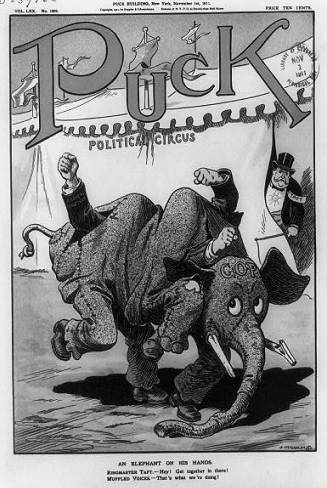
Cartoon by L.M. Glackens, 1911 / Puck / Library of Congress.

Republican Jujitsu:
Protecting Wall Street
From accountability and reform

By Sherman DeBrosse / The Rag Blog / April 21, 2010

We are reading about two firms that sold securities to the unsuspecting public while betting against those same securities in order to line their pockets with ill gotten profits. Then we are told this is not illegal unless they didn’t tell us they were doing it somewhere in the fine print of a prospectus. In such an atmosphere, it should be tough for Republicans to block finance and banking reform.

According to the pundits, the Republicans’ opposition to financial reform — and protection of their Wall Street allies — might cause them problems with their growing Tea Bagger wing that is so angry with the banks.

But not to worry.

The attack on the Dodd Bill

Minority Leader Mitch McConnell and ranking Finance Committee member Richard Shelby approached the microphones wearing the smile of the cats that had swallowed the canaries. We’ve seen it before. In McConnell’s case, the pussy cat smile replaced his usual simper. They were smiling because political genius Frank Luntz had given them another strategy guaranteed to serve special interests while painting the hapless Democrats into another corner.

McConnell announced that the Senate Republicans were opposing the Dodd Bill because it was “another bank bailout.” It was marvelous political and verbal jujitsu because the fact is that the Dodd Bill would reign in Wall Street, and the GOP approach is a sure setup for more bailouts. No wonder they were smiling. It’s tragically funny because it could be another big success for the GOP and another blow to ordinary folks.

Later, one of the Kentuckian’s aides told the press that the minority leader had not seen the rumored Luntz memorandum. Sure! The minority leader ever so deftly (if somewhat indirectly) admitted that he had been huddled with Wall Street bankers plotting ways to derail the Dodd Bill. McConnell said it was just like talking to a few Kentucky bankers and owners of mom and pop stores on Main Street. It was probably just coincidental that, as the deal with the bankers was cemented, money cascaded into the nine most important Republican senate campaigns.

The Dodd Bill provides a process for the orderly dismantling of failed banks, using a $50 billion fund provided by banks — not the federal government. The fund and government supervision are needed to provide for quick, orderly liquidations so that another financial system meltdown can be averted. The amount set to be included in the fund is probably on the low side, and the House bill calls for a healthier amount. The Dodd bill does not provide for government-operated banks; it looks to orderly bankruptcies.

Republicans complain about government “takeovers,” because the term has resonance with so many ill-informed voters. No government takeovers are envisioned in the Senate Finance Committee legislation. Those who follow such things would add that it was all the yammering about “government takeovers” that forced the government in 2008 and 2009 to bail out the banks on their own terms. The Republicans are using a playbook that works all too well.

There is some question if McConnell can keep his 41 troops in lockstep. One called him a “control freak,” and Judd Gregg of New Hampshire admitted the claims that the Dodd Bill is a bailout bill could be “a little over the top.” Nevertheless, Susan Collins of Maine signaled she may stay in line. The “hell no!” strategy will probably help Bob Bennett of Utah and John McCain of Arizona weather tough primary challenges.

Republicans set the scene for more bailouts

The Republican alternative practically guarantees endless bailouts down the road. This has been Republican policy since Ronald Reagan gave Wall Street a huge gift in the form of Brady Bonds.

The GOP alternative scraps the Dodd provisions for orderly bank shutdowns and calls for immediately using ordinary bankruptcy proceedings. There would be no $50 billion emergency fund to cushion the shock to the financial system. Without it, there is the strong probability of meltdowns.

The Republican alternative would also strip away new regulations and the new commission entrusted with looking for signs of financial system breakdown. In other words, the GOP proposal continues deregulation, strips away fail-safe mechanisms, and does not reduce the prospects of another 2008-like financial system collapse.

Here is the key: there is a provision that the federal government can intervene in an “emergency.” Without any substantial new protections in place and no bank-provided rescue fund, the federal government would again be obliged to hand over piles of taxpayer money to the banks and again accept bailout terms dictated by the banks.

The casino-like conditions that prevailed before 2008 exist again, and in fact are even worse. Just look at the huge rewards being given the Wall Street gamblers. Sooner or later, we will be facing another financial system breakdown. The Dodd Bill is very moderate and may not be enough to do more than scale back another catastrophe. The Republican bill, based on the belief that the policies in place in 2008 were essentially correct, would place all of us at great risk.

McConnell is busy getting 41 signatures on a filibuster threat, while others, like Orin Hatch, whine that the Democrats just will not negotiate. The fact is that Senator Dodd spent seven months bargaining with Finance Committee Republicans.

What happened was similar to the health care legislative process. Democrats surrendered one good provision after another in an effort to win a few Republican voters. Senator Charles Grassley of Iowa played the role of the main Republican tease; then, in the end, he denounced the health care plan, and even a clause he wrote, calling it a provision for death panels.

This time, Senator Bob Corker of Tennessee played that role on the Finance Committee, repeatedly assuring the Democrats they were very close to winning a little Republican support. In the end, Dodd got a badly watered down bill and not one Republican vote to report it out of committee.

Tea Bagger power shapes Republican strategy

There was a time when independents punished obstructionism, as well as governing parties that could not produce useful legislation. That was also a time when voters could see through sheer demagoguery and lies. It was a time when they would have been outraged that an attorney general in a northern state — like Pennsylvania — would try to destroy the health care act, using arguments developed by John C. Calhoun to defend slavery. George C. Wallace last used them to prevent school integration in Alabama.

These days hints of violence and secession are not uncommon in Tea Bagger ranks, and it is alarming that their ranks continue to swell. It is not just a small slice of wingnuts that have been activated. Two studies suggest that these people are better educated and more prosperous than the average American. They think too much has been done for the poor, and more of them than in any other group are convinced that Barack Obama was not born in the United States. They talk about smaller government but are determined to hang on to their Social Security and Medicare.

Republican strategists have informed their senators that continued obstruction — and encouragement of fanaticism — will bring the largest harvest in November. It is probably good advice for the Republicans but a poisonous prescription for American democracy.

For three decades, the Republicans have used wedge issues with great success. At first this succeeded in igniting the Religious Right, but soon well-schooled traditional country club Republicans were mouthing the same nonsense. In time they too began to actually believe it. (Days ago, Rupert Murdoch was on television repeating arguments that no intelligent person could hold. Maybe even he has come to believe all the toxic foolishness.)

Then came the “swiftboater” lies that turned around the election of 2004. In 2008, claims about “palling around with terrorists” made some Republican rallies resemble Klan assemblies, and there were threats of violence. It should have been no surprise when extremists showed up at Obama meetings and other gatherings with weapons. Would armed men have been able to get anywhere near George W. Bush or John McCain?

But if these militia types had been asked to leave, millions would have been convinced they would lose their weapons tomorrow. (Of course it didn’t matter, since they rushed to that conclusion anyway.) Then came the “birthers” and now the neo-Confederate “Tenthers.”

It was all part of the degradation of our political process and the infantization of a growing and powerful sector of the electorate. The forces leading to Tea Baggism have been at work for decades, although they accelerated greatly in 2004.

It is unlikely that this extreme form of right-wing populism will diminish anytime soon. For one thing, there is almost no prospect that all the jobs destroyed by George W. Bush’s “great recession” will return, even in a decade’s time. We hear that from sober, moderate economists.

For whatever reason, Republicans, and especially their Tea Bag wing, give Obama no credit for averting a depression or pulling us out of the great recession. Indeed, they blame the lost jobs on him. Tea Baggism is a bit like the Lost Cause mentality that followed the Civil War. People are rushing to embrace the ideas that created their problems in the first place. It’s hard to explain, but it is clearly happening.

Don’t look for the Tea Baggers or independents to check out what is really happening with the GOP and its plan to protect Wall Street. Tea Baggism is about taking back America from urbanites, minorities, and alleged “elites.” It never was about protecting the little guy from the bankers.

Already Representative Marsha Blackburn of Tennessee, a self-anointed Tea Bagger, has joined McConnell in saying the Dodd Bill is another “bailout” and “takeover.” She has rushed to the barricades in defense of poor, beleaguered Wall Street. Look for other Tea Baggers, egged on by Dick Armey, to join her. Of course, those in the mainstream media simply repeat talking points and offer no real analysis or truth-telling as an antidote.

It will be interesting to see if all of the Tea Bag wing of the Republican Party fall into line. Some few like Max Pappas of Freedom Works may not. He has referred to the “Bush Wall Street bailout” and has noted the hypocrisy of mainstream Republicans talking about fiscal responsibility.

Becoming the party of “Hell No!”

It appears that the Republican leadership has decided it is best to go into the November elections as the party of “Hell no!” — following the advice of the ever-eloquent and persuasive Governor Sarah Palin.

Jon Kyl , the second ranking Republican senator, has indicated that there will be a filibuster if President Barrack Obama nominates a Supreme Court justice who opposes letting corporations spend as much as they want on political campaigns.

It is even likely that it will prove impossible to get 67 Senate votes for the new disarmament treaty. Arlen Specter, a former Republican, has already predicted that the treaty cannot be ratified.

Given the present condition of American politics and the state of the electorate, the Republican strategy promises to be highly effective. It is deliciously devilish; the Republicans scuttle effective regulations, save the banks from contributing to a bailout fund, and in turn guarantee endless bailouts without appearing to do so. It will be easy to paint the disarmament treaty as weakening America, and whatever nominee Barack Obama presents for the court can be depicted as too radical, not “mainstream” enough.

What are the Democrats to do?

Only the Supreme Being knows if the Democrats are capable of countering this
Republican jujitsu. Unless they figure out how to frame good counterarguments and learn to stay on message, they could take another big hit.

There is absolutely no evidence that the Democrats have learned anything about message creation and control. We can also expect the Democratic senators to accept damaging amendments from the floor and then be surprised when they garner very little or no Republican support.

The best alternative for the Democrats is to let the Republicans mount a real filibuster against banking and finance reform. Some citizens might actually come to understand that the GOP has become an irresponsible, obstructionist party.

For the moment, Democrats cannot expect to win back many reasonable moderates who will see that health care reform helps them or that Obama pulled us back from the brink of recession. Too much inflammatory rhetoric had gone out unanswered for that.

The best the Democrats can do is expose the Republicans as obstructionists and to sharply define the issues. Every time they speak they must remind voters that a return of the Republicans to power means restoration of the tax cut for the rich and repeal of health care reform.

They should repeatedly remind people how our economy and financial system almost tanked. Most of the lost jobs will not return by 2012. If the GOP regains actual or effective control of Congress, it should be set up for blame when the jobs do not come back in a torrent.

If passage of the Dodd Bill fails after a filibuster, Democrats need to divide the bill into parts and again force votes or filibusters. Reframe the consumer protection section along the lines Elizabeth Warren suggested and force a vote or filibuster.

It is hard to imagine how the GOP could vote against regulating derivatives, but Luntz, the magician, might well pull another rabbit out of his hat.

The biggest problem for Democrats in November 2010 will be reactivating their base. Many loyal Democrats were stunned by the ineptitude of party leaders in 2009 and by all the concessions to Republicans and conservative Democrats.

Given this situation, the Democrats need to change their pusillanimous game plan and start getting combative. Stop making concessions in advance. Even bring up a few improvements to labor law to slow the deterioration of the unions — or at least show they have friends on the Hill. At least add teeth and big fines to anti-collective bargaining practices that are already illegal.

The party might even do something to improve mine safety. They at least need to attach large fines to uncorrected mine safety violations.

Pundits are wed to old ideas, loath to recognize vast changes for the worse in our political process, and absolutely terrified of exposing political lies. Honest columns cost syndication and honest audio commentary reduces television time. The scribes and talking heads are still insisting that independents are likely to punish obstructionists. Maybe, but probably not, this time.

Nothing of the sort can happen as long as the Democrats are wed to the tactics of losers.

[Sherman DeBrosse is a regular contributor to The Rag Blog. A retired history professor, he also blogs at Sherm Says and on DailyKos.]

The Rag Blog

Posted in Rag Bloggers | Tagged , , , , , , | 1 Comment

VERSE / Larry Piltz : We’re Focused in Going Forward

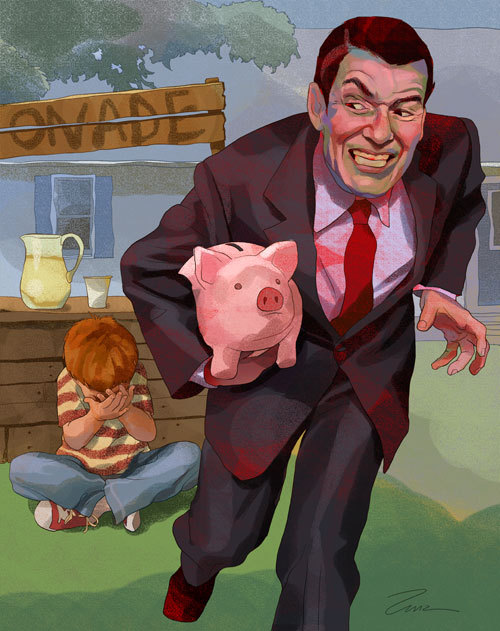
“Piggy Banker.” Painting © Zina Saunders 2009.

We’re Focused In Going Forward (a song)

We’re focused in going forward
hoping we’re not moving backward
that our dreams are not shattered
and we’re doing things that matter

We have a laser-eye view
of what we surgically need to do
but first we synchronize our attitudes
to increase the odds we’re not that screwed

We’ll strategize our paradigm
to turn this tanker on a dime
then magnetize our money bomb
and incentivize remaining calm

Calm, calm, calm, calm
take a powder take a balm
calm, calm, calm, calm
serenity thy name is Rahm

I yearn to actionize my sweetheart deal
get skin in the game and watch it peel
to hybridize across the board
take a flier and pull the cord

I’ll morally hazard deep cramdowns
and turn the plunge team into clowns
creatively destroy the ranks
of dualistic zombie banks

I’ll deconstruct the stewardship
and ride risk-free the double dip
but why I do this I won’t tell
but two key words are soul and sell

soul, sell, soul, sell
I salivate at the first bell
soul, sell, soul, sell
it’s later that I go to hell

We’re focused in going forward
hoping we’re not ass backward
that our dreams were not hackered
by some spoiled rich cracker
we’re focused in going forward

Larry Piltz / The Rag Blog

Indian Cove
Austin, Texas
April 20, 2010

The Rag Blog

Posted in Rag Bloggers | Tagged , , , , , | 1 Comment

Robert Jensen : Holding Ourselves Accountable

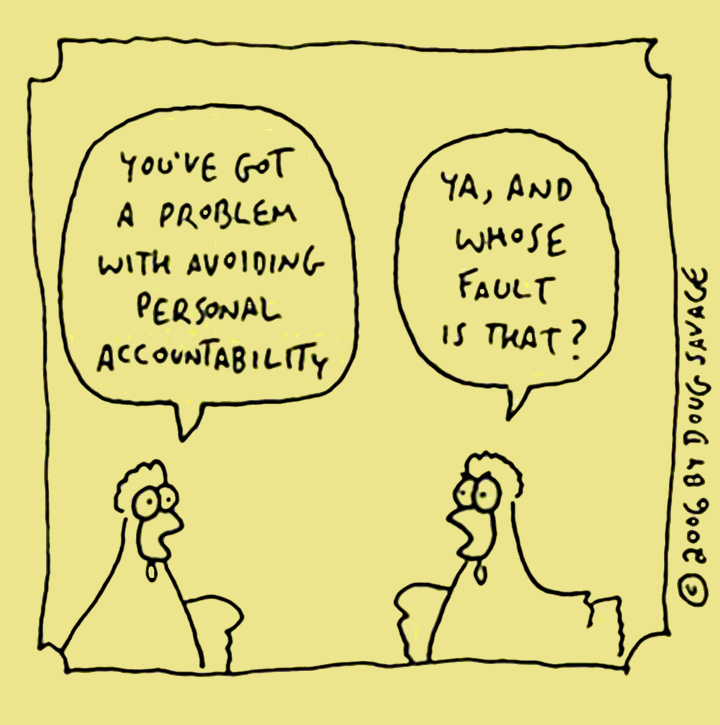
Savage Chickens. Cartoons on Sticky Notes by Doug Savage.

Diversity dead-end:
Inclusiveness without accountability

By Robert Jensen / The Rag Blog / April 20, 2010

After a recent talk on racism and other illegitimate hierarchies at a diversity conference in Dallas, I received a letter from one of the people who had attended that asked “why you feel it necessary to perpetuate and even exacerbate the divisiveness of language when addressing a group of people assembled to learn how to live better together and be more accepting of differences?” He suggested that by being so sharply critical, I was part of the problem not the solution.

Calls for diversity and inclusiveness from people with privilege (such as a white man with a professional job living in the United States) are meaningful only when we are willing to address the systems and structures of power in which inequality and discrimination are rooted. But because such a critique strikes many people as too radical, crafting a response to those who want to avoid that analysis is crucial to the struggle for progressive social change. Below is my letter to him.

Dear ____: Thanks for the note and the challenge to my presentation. It’s clear we disagree, and getting clearer about where we differ is important.

First, I disagree with your suggestion that we should not assess blame for existing patterns of racial inequality and injustice, though I would substitute the word “accountability” for “blame.” I can’t imagine how we could move forward on any question of injustice without holding those responsible for the injustice accountable, which means holding ourselves accountable. This reflects a basic moral principle — those who inflict injuries, or turn away when they see others inflicting injuries, must be accountable for their behavior.

To recognize the injustice, as you do, but then demand that we ignore the patterns at the root of the injustice in order to reach a state of inclusiveness is counterproductive. That simply allows people in positions of power and privilege to escape accountability, which inevitably places the political and psychological burdens on those with less power and privilege. That’s simply not fair.

So, if your suggestion lets white people off the hook and puts the burden on non-white people to cope with the ongoing manifestations of white supremacy, would it not be better for those of us who are white to be accountable? Is that not the base from which real social change becomes possible? I recognize that most white people don’t like that call for accountability, just as most men don’t like the call for accountability when it comes to sexism, for example. But the core values we claim to hold — dignity, solidarity, and equality — require that we not avoid that kind of honesty.

If we do this, as several people suggested in the conference session, many poor and working-class white people will point out that they don’t feel particularly privileged. That’s why we have to connect the struggle against white supremacy to the struggle against economic inequality in capitalism. To raise questions about injustice in our economy isn’t to foment class warfare, as some argue, but is rather to recognize that people with a disproportionate share of the world’s wealth tend to pursue policies to protect that state of affairs. The wealthy engage in class warfare on a daily basis, and hope that those on the bottom will acquiesce.

You suggest that that I “perpetuate and even exacerbate the divisiveness” but I think that misunderstands the nature of the problem. The divisiveness comes from the injustice, not from naming the injustice. People in the United States are divided by the inequality inherent in patriarchy, white supremacy, and capitalism. Naming those systems and the inequality they produce isn’t divisive but rather an attempt to understand the systems so that we can change them. Just as we need accountability we also need analysis to make it possible to move toward justice. How can problems be solved if causes are not identified and critiqued?

None of this has anything to do with stereotyping individuals. There is a difference between identifying patterns in how wealth and power are distributed in a society and making unsupported claims about individuals. In analyzing how unconscious and institutionalized racism operate, and then asking white people to be accountable, we are talking about how systems operate. I didn’t claim that all white people are overt racists, for example, but instead talked about how our society is white supremacist in material and ideological terms. That’s an analysis of systems, not stereotyping of individuals.

Finally, I think your hope for “a softening” of my heart misses the point. I don’t have a hard heart, if by that you mean I am bitter or hateful. The work I do is grounded in love, which leads to a rejection of injustice. My heart softened long ago when I began to look honestly at the extent of that injustice and my own complicity in it. To be “part of the solution,” as you urge, demands that we be honest about that injustice. I would challenge you to think about whether by ignoring these patterns of injustice you might be part of the problem.

I do take a bit of offense at one thing you wrote, the claim that I “find great satisfaction in stirring things up,” as if this is all some kind of game that I play for my personal pleasure. I have been actively involved for the past two decades in movements for justice involving sexism, racism, economic inequality, and the barbarism of war. There isn’t a day that I don’t feel a sense of profound grief about the pain that these systems cause.

The luck of the draw left me in a position of relative privilege, which means I escape virtually all of the suffering imposed by those systems. What satisfaction I find in this world comes from trying to be part of movements that struggle for something better. In those efforts, things inevitably get stirred up. I take no particular pleasure in that and wish it could be otherwise. But none of us get to choose the world into which we are born. All we get to choose is how we respond to it.

In my experience, the position you advocate is the one that is neither constructive nor practical. We cannot ignore the systems from which injustice emerges and expect injustice magically to disappear. I agree that our goal is inclusiveness — the recognition that we are one human family in which all have exactly the same standing — but I disagree that we can move toward that by turning away from the painful truths about the broken world in which we live.

[Robert Jensen is a journalism professor at the University of Texas at Austin and board member of the Third Coast Activist Resource Center in Austin. He is the author of All My Bones Shake: Seeking a Progressive Path to the Prophetic Voice, (Soft Skull Press, 2009); Getting Off: Pornography and the End of Masculinity (South End Press, 2007); and The Heart of Whiteness: Confronting Race, Racism and White Privilege (City Lights, 2005); Jensen is also co-producer of the documentary film Abe Osheroff: One Foot in the Grave, the Other Still Dancing. Jensen can be reached at rjensen@uts.cc.utexas.edu and his articles can also be found online here.]

The Rag Blog

Posted in Rag Bloggers | Tagged , , , , | 5 Comments

Marc Estrin : Endgame (Sam-I’m-Not)

Endgame. Image from Wired.

SAM-I’M-NOT

By Marc Estrin / The Rag Blog / April 20, 2010

Endgame — that’s us. At every level, checkmate threatens — political, environmental, cultural. Samuel Beckett’s 104th birthday last week brought to mind a chapter I had written in The Education of Arnold Hitler. Arnold, new at Harvard, lands the part of Hamm in a university production of Beckett’s masterpiece, and along with it takes a Beckett class with Stanley Cavell. If you don’t know the play, here’s a good introduction — or a reminder if you do.

Arnold’s spring ‘70 semester consisted primarily of Endgame. His other courses — French, Biology, the History of American Fascism — faded into the background in the intensity of its dark light. Odd as Hamm was, it was easy to “get into” him, so many were the nodes of correspondence. That there was to be “no more pain-killer” was frightening, yet somehow bracing. It meshed with Nell’s observation that “Nothing is funnier than unhappiness.” And unhappiness seemed to be the name of the human game, as it was of Arnold’s. Hamm asks Clov if his father is dead.

(Clov raises the lid of Nagg’s bin, stoops, looks into it. Pause.)
Clov: Doesn’t look like it.
(He closes the lid, straightens up.)
Hamm: What’s he doing?
(Clov raises the lid of Nagg’s bin, stoops, looks into it. Pause.)
Clov: He’s crying.
(He closes the lid, straightens up.)
Hamm: Then he’s living.

Then he’s living. If he’s crying, he’s living. What a definition, Arnold thought. For all its weirdness, this may be the most realistic play ever written. “The end is in the beginning.” Surely that must be true. But what would that mean for him? A successful career as some kind of a star? Or the end as in the very beginning, when George Hitler, accursed progenitor, fornicated between the one and a half legs of Anna Giardini, and created another neighing of the H-name. “Scoundrel!” Hamm cries, “Why did you engender me?”

Nagg: I didn’t know.
Hamm: What? What didn’t you know?
Nagg: That it’d be you.

But he did. George did know. He just didn’t think. And what is he thinking now, my once-father? Two short letters since I’ve been here. Four unanswered. Has he forgotten me?

“We let you cry. Then we moved out of earshot, so that we might sleep in peace…

Arnold shuddered in recognition.

For all the joy and labor of nightly work, the highlight of the six weeks was a visit, late in the rehearsal schedule, by Stanley Cavell, Walter M. Cabot Professor of Aesthetics and the General Theory of Value, Professor of Philosophy, literary and film critic, and Ruby’s faculty advisor on the Endgame project — her senior thesis. Ruby, along with Ed Gould, her stage manager, took the night “off” to sit around at Cavell’s house with the cast — Arnold S. Held, Hugh Laffler, the physicist dwarf, and Ted Bair, Clov, a slight and wrinkled graduate student at the Divinity School, to discuss the play.

The initial discussion was somewhat diffuse. Cavell, served up some mean hot chocolate on the cold, late February night, and asked the students what they thought about the play. Ruby held back. She and her teacher had already been over her feelings — how Hamm’s highhanded cruelty, Clov’s inability to escape, and Nell and Nagg’s garbage cans reflect a world darkened by the shadow of Auschwitz. Arnold began to speak of the chess aspects, how Hamm’s tour of the stage and return to center is like a king imagining the boundaries of the pathetic nine-square territory he commands. Hugh observed that it was not only the chess pieces against each other, or against God, but Beckett forcing us to play the very game we play against the world all our lives — trying to understand — a game we are invariably fated to lose.

The group talked about the language of the play, the verbal surface of universal disrespect, the dialogue among people barely still human. Were the characters human? Cavell wanted to know. Ed, a biology major, remarked that of the genus Homo, all its species, with one exception, were extinct. If we had the others for comparison, he thought we might see what difference sapiens makes — whether these four qualified. If they did make it, they only barely did so, so mutilated were they by whatever catastrophe they had been through. Ruby felt that the characters were not recently destroyed, but were playing out, in especially visible ways, the eternal limitations of the race.

“All right,” Cavell said, but what does it all mean? What does it show? Where are we? None of this should affect your acting, but where are we?”

“In some kind of shelter,” said Hugh. “A bunker.”

“Maybe after an atomic war,” added Ed. “I’m sure Beckett still remembered those blackout nights during the bombings.”

“And — 1957? — what about duck and cover?” All the students laughed at the atomic attack drills they had done in elementary school.

“It’s possible,” said Cavell. Anything’s possible. That’s the maddening, wonderful thing about the play. No metaphor plays out; there are no neat interpretations that entirely fit. Beckett is a tease and a torturer, negating and contradicting any line you can seize upon. His denial of closure produces some very complex effects.”

“If you frustrate closure, you keep everything open,” Ted insisted. “That’s why I think it’s a fundamentally optimistic piece. Dr. Cavell, do you have Beckett’s Nobel Prize citation from last year? There’s something in there…”

Cavell pulled it from the shelf, and handed it to the young theologian.

“Here,” Ted said. “The Committee gave him the prize for his quote ‘combination of paradox and mystery, containing a love of mankind that grows in understanding as it plumbs farther into the depths of abhorrence, a courage of despair, a compassion that has to reach the utmost of suffering to discover that there are no bounds of charity.’”

“I think that’s the only way his sponsors could push it through,” said the dwarf. “You think they would offer a Nobel Prize in despair?”

Arnold listened wide-eyed and vulnerable.

“Wait,” said Cavell. “Let’s go back to the question of where the play takes place.”

“Professor Gilman thinks the shelter is the interior of Hamm’s — or someone’s skull — the two little windows, the greyishness, the id being served by the ego, the repression of memory.” Ruby had taken French lit from Gilman.

“What do you think?” asked Cavell.

“I don’t want to come down in any one place. Trish designed the set exactly as Beckett demanded — no more, no less. A bare interior, two small windows, etc. Non-committal.”

“Well, non-committal is appropriate, given Beckett’s infinite intentions. But I do want to share with you where I think it is and what I think is going on.”

Arnold took out a pad for notes — things that might help his characterization.

“Put that pad away. Nothing I say should affect the acting dynamic you’ve all already discovered. That’s why we had this session so late in the game.”

Cavell paused to refresh the hot chocolates.

“Beckett may want to be inscrutable, but the fact is that his explosion reverberates within the medium of Western culture. So whatever his intention, his work makes all sorts of things jiggle in the soup — and the thing that jiggles most for me is the tale of Noah in Genesis. What do tiny windows, telescopes, ladders and gaffs have in common?”

“They’re all ship-type objects.”

“Exactly. What ship is this? All right. I’ve already said. The Ark. What disaster has just happened?”

“The flood.”

“Where are we now in the world?”

“In the Ark.”

“No. Where is the Ark?”

“One window looks out on land, and the other on water.”

“So?”

“So we’re at some shore. Beached.”

“Who is beached? Who is Ham? One M.”

“One of Noah’s sons.”

“The one who saw him drunk and naked,” added the Divinity Schooler.

“Why did God make the flood?”

“To punish sinful humanity.”

“But what about Noah and his family?”

“They were the remnant — and the animals, too — from which all life was to spring again.”

“Where is Noah? Where is his wife?”

“In the cans?”

“Maybe. What was Noah’s curse on Ham after he saw his father naked?”

“He would have to be a servant to men.”

“No,” said Ted. “That’s what everybody thinks. But if you check, you’ll see that his curse was that Canaan — Ham’s son — would serve.”

“And who is Hamm’s son? Two Ms.”

“Maybe Clov.”

“And what does Clov do?”

“Serve.”

“OK then. A little loose, but a plausible set of reverberations. We’re in the Ark, beached, after the flood — with the destruction of the the entire world outside. Will you grant me this much, so far?”

“Sure,” said Arnold. The rest muttered in agreement.

“Now we get to the interesting part. In Genesis the Lord commanded Noah, father of Ham, to build an ark for pairs of all species to insure the continuance of creation. But here Hamm makes every effort to guarantee that his refuge will support no further life, not even fleas or rats. The play is about an effort to undo, to end something, and in particular to end a curse, the most ordinary curse of man — not so much that he was born and must die, but that he has to justify what comes between — that he is not a beast and not a god: in a word, that he is a man, and alone.

“‘Something is taking its course,’ Clov says.” Arnold didn’t quite know why he offered that. Cavell nodded.

“Something is taking its course. Hamm’s contribution — imitating God — is to see the end of all flesh. But God, unlike Hamm wanted to leave a remnant. Why?”

“Because he couldn’t bear not to be God!” asserted Ruby, the Jewish feminist.

“The answer is unclear,” said Cavell. “To Hamm, as well as to us. What does our Hamm think?”

“He can’t understand why he was chosen,” Arnold responded. “I can’t understand why I was chosen.”

The students took this as a simple donning of character, but Cavell seemed to sense otherwise. “God has reneged on his responsibility,” Arnold continued. “That’s what Hamm thinks.”

“Is that what you think?” asked Ted. The group waited. Arnold was silent.

“My feeling,” said the professor, “is that for Beckett what must end is the mutual dependence of God and the world: this world, animated by its God, must be brought to a conclusion. Hamm’s strategy is to paint the rainbow gray, to undo all covenants and to secure — once and for all — fruitlessness.”

“To perform man’s last disobedience,” Hugh the dwarf injected, taking off on Milton. “What a radical move!”

“To uncreate the world,” Arnold thought, “we’d have to become as gods. If we just stay human, we’ll go on hoping, go on waiting for redemption. What was pictured in Godot. This is really a step beyond.”

“Are you ready for such disobedience?” asked Cavell.

“Why not?” the production’s Clov asked. “It’s what my character says: ‘I can’t be punished any more.’”

Arnold wondered whether he had reached his own limit of punishment. As if in response, Ted, the theologian said,

“The main audience member is God. Beckett’s object is to show God not that he must intervene, or even bear witness to our pain, but that he owes it to us, to our suffering and our perfect faithfulness, to leave forever, to witness nothing more. Not to fulfill, but to dismantle all promises for which we await fulfillment. “Lord, I believe; help thou my unbelief” now means Help me not to believe.” Even Cavell was impressed with Ted’s courageous leap of thought.

“Solitude, emptiness, nothingness, meaninglessness, silence,” Ted continued, “ — these are not the givens of Beckett’s characters but their goal, Hamm’s heroic undertaking.”

“Hamm’s problem — my problem — is that where there’s life, there’s hope. I have to be able to kill hope. It’s only middle game.” Arnold seemed determined.

“You get the prize for suffering in this play,” said Ruby, oblivious to Arnold’s track. “What a curse to be singled out like that.”

Arnold: “The end of the world is threatened, redemption is promised — neither is carried through — and we’re left holding the bag. The real earth is blotted out, sealed away by this universal flood of meaning and hope — Splash, splash, splash, always in the same spot in my head. But only a life without hope, a life without meaning, without justification, without waiting…” Here he paused.

“Is free from the curse of God,” Hugh added softly.

Cavell got up and came back with more chocolate as the students stewed in this toxic brew. “How about a life without hot chocolate?” he asked, and quickly realized the inappropriateness of his levity. In self-castigation he sat down.

“Pascal said that all the evil in the world comes from our inability to sit quietly in a room.”

The remark floated in the silence like a pearl onion in hot chocolate — it didn’t quite fit, but it was the last thing everyone sucked on.

[Marc Estrin is a writer and activist, living in Burlington, Vermont. His novels, Insect Dreams, The Half Life of Gregor Samsa, The Education of Arnold Hitler, Golem Song, and The Lamentations of Julius Marantz have won critical acclaim. His memoir, Rehearsing With Gods: Photographs and Essays on the Bread & Puppet Theater (with Ron Simon, photographer) won a 2004 theater book of the year award. He is currently working on a novel about the dead Tchaikovsky.]

Endgame. Photo by Donna Bister / The Rag Blog.

The Rag Blog

Posted in Rag Bloggers | Tagged , , , | Leave a comment