A Real Crime : How the Law Treats Sex Workers in New Orleans


‘Crimes against nature’:
Prosecuting sex workers in New Orleans

More than half of the people on Louisiana’s Sex Offender Registry — which was designed for rapists and child molesters — are indigent women convicted of sex work.

By Jordan Flaherty / The Rag Blog / January 15, 2010

NEW ORLEANS — Tabitha has been working as a prostitute in New Orleans since she was 13. Now 30 years old, she can often be found working on a corner just outside of the French Quarter. A small and slight white woman, she has battled both drug addiction and illness and struggles every day to find a meal or a place to stay for the night.

These days, Tabitha, who asked that her real name not be used in this story, has yet another burden: a stamp printed on her driver’s license labels her a sex offender. Her crime? Offering sex for money.

New Orleans city police and the district attorney’s office are using a state law written for child molesters to charge hundreds of sex workers like Tabitha as sex offenders. The law, which dates back to 1805, declares it a crime against nature to engage in “unnatural copulation” — a term New Orleans cops and the district attorney’s office have interpreted to mean anal or oral sex. Sex workers convicted of breaking this law are charged with felonies, issued longer jail sentences and forced to register as sex offenders.

Of the 861 sex offenders currently registered in New Orleans, 483 were convicted of a crime against nature, according to Doug Cain, a spokesperson with the Louisiana State Police. And of those convicted of a crime against nature, 78 percent are Black and almost all are women.

Impact on women’s lives

The law impacts sex workers in both small and large ways. Tabitha has to register an address in the sex offender database. Her driver’s license has the label “sex offender” printed on it. She also has to purchase and mail postcards with her picture to everyone in the neighborhood informing them of her conviction. If she needs to evacuate to a shelter during a hurricane, she must evacuate to a special shelter for sex offenders, and this shelter has no separate safe spaces for women. She is even prohibited from ordinary activities in New Orleans like wearing a costume at Mardi Gras.

“This law completely disconnects our community members from what remains of a social safety net,” said Deon Haywood, director of Women With A Vision, an organization that promotes wellness and disease prevention for women who live in poverty. Haywood’s group has formed a new coalition of New Orleans activists and health workers who are organizing to fight the way police are abusing the 1805 law.

Activists like Haywood believe that using the law in this way is part of an overall policy by the New Orleans Police Department to go after petty offenses. According to a report from the Metropolitan Crime Commission, New Orleans police arrest more than 58,000 people every year. Of those arrested, nearly 50 percent are for traffic and municipal offenses, and only five percent are for violent crimes.

“What this is really about is over-incarcerating poor and of-color communities,” said Rosana Cruz of VOTE-NOLA, a prison reform organization that is also a part of the new coalition.

Haywood, Cruz and other activists believe they have an opportunity with the mayoral and city council elections next month to change the system. With all of the candidates attempting to distance themselves from Mayor Nagin, who is prevented by term limits from running again, the new mayor is likely to be open to making changes. This includes hiring a new police chief, as all the candidates have pledged to do. Advocates are hoping this is an opportunity to shift the department’s focus. “When there’s a new police chief, we can educate them,” said Haywood.

Many of the women Haywood’s group works with are at the most high-risk tier of sex work. They meet customers on the street and in bars. Most are dealing with addiction and homelessness, and many cannot get food stamps or other public assistance because of felony convictions on their record.

“I’m hoping that the situation will look different because of this coalition,” Haywood said. “I can’t tell you how overwhelmed we’ve been from the needs of this population.”

Condemned

Miss Jackie is one of those women. A Black woman in her 50s, she was arrested for sex work in 1999 and charged as a sex offender. Her name was added to the registry for 10 years. When the registration period was almost over she was arrested for possession of crack. She says the arresting officer didn’t find any drugs on her person, but the judge ruled that she needed to continue to register as a sex offender for another 15 years (the new federal requirement for sex offenders) because her arrest was a violation of her registration period.

“Where is the justice?” she asked, speaking through tears. “How do they expect me to straighten out my life?” Struggling with basic needs like housing, Miss Jackie added: “I feel condemned.”

Advocates and former defendants claim that the decision over who is charged under which penalty is made arbitrarily, at the discretion of police and the district attorney’s office, and that the law disproportionately affects Black people, as well as transgender women. When asked about the allegations of abusing the crime against nature statute, New Orleans Police Department spokesman Bob Young responded: “Persons are charged according to the crime they commit.”

Wendi Cooper’s story, however, paints a different picture.

In 1999, Cooper had recently come out as transgender. A Black transwoman, she tried prostitution a few times and quickly discovered it wasn’t for her. But before she quit, she was arrested. At the time, Cooper was happy to take a plea that allowed her to get out of jail and didn’t think much about what the “crime against nature” conviction would mean on her record. As she got older and began work as a health care professional, the weight of the sex offender label began to upset her more and more. “This is not me,” she said. “I’m not that person who the state labeled me as… it slanders me.”

Cooper appealed to the state to have her record expunged and talked to lawyers about other options, but she still must register for at least another five years and potentially longer. “I feel like I was manipulated, you know, pleading guilty to this crime… And it’s hard, knowing that you are called something that you’re not,” she said. She is also afraid now that the conviction will prevent her from getting her license as a registered nurse or from being hired.

Although some women have tried to fight the sex offender charges in court, they’ve had little success. The penalties they face became even harsher in 2006 when Congress passed the Adam Walsh act, requiring tier-1 (the least serious) sex offenders to stay in the public registry for 15 years. There’s also an added danger to fighting the charges, according to Josh Perry, a former attorney with the Orleans Public Defenders office.

“The way Louisiana’s habitual offender law works, if you challenge your sentence in court and lose, and it’s a third offense, the mandatory minimum is 20 years. The maximum is life,” he explained.

Perry estimates that on an average day two or three people are arrested for prostitution in New Orleans, and about half of them are charged under the crime against nature statute. “Right now, there are 39 people being held at Orleans Parish Prison [for] crimes against nature,” Perry told a gathering of advocates. “And another 15 to 20 people… charged with failure to register as a sex offender.”

Sex workers accused as sex offenders face discrimination in every aspect of the system. In most cases, they cannot get released on bond, because they are seen as a higher risk of flight than people charged with violent crimes. “This is the level of stigma and dysfunction that we’re talking about here,” said Perry. “Realistically, they’re not getting out.”

Organizing for change

Advocates have said the ideal solution would be to get state lawmakers to change the law, but they feel there’s little hope of positive reforms from the current legislature. For now, organizers want to put pressure on police and the district attorney’s office to stop charging sex workers under the crime against nature statute.

There is a great deal of work that needs to be done. Haywood is working with lawyers and national allies to develop a legal strategy, as well as a broad local coalition that includes criminal justice reform organizations like VOTE-NOLA and activist groups like the New Orleans chapters of Critical Resistance and INCITE! Women of Color Against Violence.

“We’re trying to organize, but we’re also working on the human rights side of how it’s affecting their lives,” she said. “This is a population that works in crisis mode all the time.”

Jennifer, a 23-year-old white woman who asked that her real name not be used in this story, has been working as a prostitute since she was a teenager, and also works as a stripper at a club on Bourbon Street. She recently broke free of an eight-year heroin addiction. Unless the law changes, she will have the words “sex offender” on her driver’s license until she is 48 years old.

Haywood said that stories like this show that the law has the effect of forcing women to continue with sex work. “When you charge young women with this — when you label them as a sex offender — this is what they are for the rest of their lives,” she said.

Jennifer said it’s affected her job options. “I’m not sure what they think, but a lot of places won’t hire sex offenders,” she said.

Haywood said the women she sees have few options. Many of them are homeless. They are sleeping in abandoned houses or on the street, or they are trading sex for a place to stay. “The women we work with, they don’t call it sex work,” she said. “They don’t know what that means. They don’t even call it prostitution. They call it survival.”

[Jordan Flaherty is a journalist, an editor of Left Turn Magazine, and a staffer with the Louisiana Justice Institute. He was the first writer to bring the story of the Jena Six to a national audience and audiences around the world have seen the television reports he’s produced for Al-Jazeera, TeleSur, GritTV, and Democracy Now. His post-Katrina reporting for ColorLines shared an award from New America Media for best Katrina-related reporting in ethnic press. Haymarket Press will release his new book, FLOODLINES: Stories of Community and Resistance from Katrina to the Jena Six, in 2010. He can be reached at neworleans@leftturn.org . This article also appears in ColorLines Magazine.]

The Rag Blog

Posted in Rag Bloggers | Tagged , , , , , , , | 2 Comments

Her Crime? Sex Work in New Orleans
More than half of the people on Louisiana’s Sex Offender Registry – which was designed for rapists and child molesters – are indigent women convicted of sex work

By Jordan Flaherty / The Rag Blog / January 15, 2010

Tabitha has been working as a prostitute in New Orleans since she was 13. Now 30 years old, she can often be found working on a corner just outside of the French Quarter. A small and slight white woman, she has battled both drug addiction and illness and struggles every day to find a meal or a place to stay for the night.

These days, Tabitha, who asked that her real name not be used in this story, has yet another burden: a stamp printed on her driver’s license labels her a sex offender. Her crime? Offering sex for money.

New Orleans city police and the district attorney’s office are using a state law written for child molesters to charge hundreds of sex workers like Tabitha as sex offenders. The law, which dates back to 1805, declares it a crime against nature to engage in “unnatural copulation”—a term New Orleans cops and the district attorney’s office have interpreted to mean anal or oral sex. Sex workers convicted of breaking this law are charged with felonies, issued longer jail sentences and forced to register as sex offenders.

Of the 861 sex offenders currently registered in New Orleans, 483 were convicted of a crime against nature, according to Doug Cain, a spokesperson with the Louisiana State Police. And of those convicted of a crime against nature, 78 percent are Black and almost all are women.

Impacts on Women’s Lives

The law impacts sex workers in both small and large ways. Tabitha has to register an address in the sex offender database. Her driver’s license has the label “sex offender” printed on it. She also has to purchase and mail postcards with her picture to everyone in the neighborhood informing them of her conviction. If she needs to evacuate to a shelter during a hurricane, she must evacuate to a special shelter for sex offenders, and this shelter has no separate safe spaces for women. She is even prohibited from ordinary activities in New Orleans like wearing a costume at Mardi Gras.

“This law completely disconnects our community members from what remains of a social safety net,” said Deon Haywood, director of Women With A Vision, an organization that promotes wellness and disease prevention for women who live in poverty. Haywood’s group has formed a new coalition of New Orleans activists and health workers who are organizing to fight the way police are abusing the 1805 law.

Activists like Haywood believe that using the law in this way is part of an overall policy by the New Orleans Police Department to go after petty offenses. According to a report from the Metropolitan Crime Commission, New Orleans police arrest more than 58,000 people every year. Of those arrested, nearly 50 percent are for traffic and municipal offenses, and only 5 percent are for violent crimes.

“What this is really about is over-incarcerating poor and of-color communities,” said Rosana Cruz of VOTE-NOLA, a prison reform organization that is also a part of the new coalition.

Haywood, Cruz and other activists believe they have an opportunity with the mayoral and city council elections next month to change the system. With all of the candidates attempting to distance themselves from Mayor Nagin, who is prevented by term limits from running again, the new mayor is likely to be open to making changes. This includes hiring a new police chief, as all the candidates have pledged to do. Advocates are hoping this is an opportunity to shift the department’s focus. “When there’s a new police chief, we can educate them,” said Haywood.

Many of the women Haywood’s group works with are at the most high-risk tier of sex work. They meet customers on the street and in bars. Most are dealing with addiction and homelessness, and many cannot get food stamps or other public assistance because of felony convictions on their record.

“I’m hoping that the situation will look different because of this coalition,” Haywood said. “I can’t tell you how overwhelmed we’ve been from the needs of this population.”

Condemned

Miss Jackie is one of those women. A Black woman in her 50s, she was arrested for sex work in 1999 and charged as a sex offender. Her name was added to the registry for 10 years. When the registration period was almost over she was arrested for possession of crack. She says the arresting officer didn’t find any drugs on her person, but the judge ruled that she needed to continue to register as a sex offender for another 15 years (the new federal requirement for sex offenders) because her arrest was a violation of her registration period.

“Where is the justice?” she asked, speaking through tears. “How do they expect me to straighten out my life?” Struggling with basic needs like housing, Miss Jackie added: “I feel condemned.”

Advocates and former defendants claim that the decision over who is charged under which penalty is made arbitrarily, at the discretion of police and the district attorney’s office, and that the law disproportionately affects Black people, as well as transgender women. When asked about the allegations of abusing the crime against nature statue, New Orleans Police Department spokesman Bob Young responded: “Persons are charged according to the crime they commit.”

Wendi Cooper’s story, however, paints a different picture.

In 1999, Cooper had recently come out as transgender. A Black transwoman, she tried prostitution a few times and quickly discovered it wasn’t for her. But before she quit, she was arrested. At the time, Cooper was happy to take a plea that allowed her to get out of jail and didn’t think much about what the “crime against nature” conviction would mean on her record. As she got older and began work as a healthcare professional, the weight of the sex offender label began to upset her more and more. “This is not me,” she said. “I’m not that person who the state labeled me as…it slanders me.”

Cooper appealed to the state to have her record expunged and talked to lawyers about other options, but she still must register for at least another five years and potentially longer. “I feel like I was manipulated, you know, pleading guilty to this crime…And it’s hard, knowing that you are called something that you’re not,” she said. She is also afraid now that the conviction will prevent her from getting her license as a registered nurse or from being hired.

Although some women have tried to fight the sex offender charges in court, they’ve had little success. The penalties they face became even harsher in 2006 when Congress passed the Adam Walsh act, requiring tier-1 (the least serious) sex offenders to stay in the public registry for 15 years. There’s also an added danger to fighting the charges, according to Josh Perry, a former attorney with the Orleans Public Defenders office.

“The way Louisiana’s habitual offender law works, if you challenge your sentence in court and lose, and it’s a third offense, the mandatory minimum is 20 years. The maximum is life,” he explained.

Perry estimates that on an average day two or three people are arrested for prostitution in New Orleans, and about half of them are charged under the crime against nature statute. “Right now, there are 39 people being held at Orleans Parish Prison [for] crimes against nature,” Perry told a gathering of advocates. “And another 15 to 20 people…charged with failure to register as a sex offender.”

Sex workers accused as sex offenders face discrimination in every aspect of the system. In most cases, they cannot get released on bond, because they are seen as a higher risk of flight than people charged with violent crimes. “This is the level of stigma and dysfunction that we’re talking about here,” said Perry. “Realistically, they’re not getting out.”

Organizing for Change

Advocates have said the ideal solution would be to get state lawmakers to change the law, but they feel there’s little hope of positive reforms from the current legislature. For now, organizers want to put pressure on police and the district attorney’s office to stop charging sex workers under the crime against nature statute.

There is a great deal of work that needs to be done. Haywood is working with lawyers and national allies to develop a legal strategy, as well as a broad local coalition that includes criminal justice reform organizations like VOTE-NOLA and activist groups like the New Orleans chapters of Critical Resistance and INCITE! Women of Color Against Violence.

“We’re trying to organize, but we’re also working on the human rights side of how it’s affecting their lives,” she said. “This is a population that works in crisis mode all the time.”

Jennifer, a 23-year-old white woman who asked that her real name not be used in this story, has been working as a prostitute since she was a teenager, and also works as a stripper at a club on Bourbon Street. She recently broke free of an eight-year heroin addiction. Unless the law changes, she will have the words “sex offender” on her driver’s license until she is 48 years old.

Haywood said that stories like this show that the law has the effect of forcing women to continue with sex work. “When you charge young women with this—when you label them as a sex offender—this is what they are for the rest of their lives,” she said.

Jennifer said it’s affected her job options. “I’m not sure what they think, but a lot of places wont hire sex offenders,” she said.

Haywood said the women she sees have few options. Many of them are homeless. They are sleeping in abandoned houses or on the street, or they are trading sex for a place to stay. “The women we work with, they don’t call it sex work,” she said. “They don’t know what that means. They don’t even call it prostitution. They call it survival.”

Jordan Flaherty is a journalist, an editor of Left Turn Magazine, and a staffer with the Louisiana Justice Institute. He was the first writer to bring the story of the Jena Six to a national audience and audiences around the world have seen the television reports he’s produced for Al-Jazeera, TeleSur, GritTV, and Democracy Now. His post-Katrina reporting for ColorLines shared an award from New America Media for best Katrina-related reporting in ethnic press. Haymarket Press will release his new book, FLOODLINES: Stories of Community and Resistance from Katrina to the Jena Six, in 2010. He can be reached at neworleans@leftturn.org.

——————————————————————————–


Type rest of the post here

Source /

The Rag Blog

Posted in RagBlog | Leave a comment

Rabbi Arthur Waskow on ‘Avatar’ : Celebrating the Tree of Life


Avatar and Tu B’Shvat:
Celebrating the Great Tree of Life

Avatar is extraordinary. Not only for the superficial but powerful technology… but most of all for its spiritually-rooted progressive politics.

By Rabbi Arthur Waskow / The Rag Blog / January 15, 2010

The film Avatar is an obvious metaphor for the European-USA destruction of Native America and Africa; for the corporate destruction of the Amazon forest and its tribal human eco-partners; for the U.S. destruction of much of Iraq and parts of Afghanistan.

For the indigenous peoples of the film’s quasi-planetary moon Pandora, the most sacred places are ancient living trees that embody the life force of the planet. So for me, the film spoke powerfully in the tongue of Tu B’Shvat, the festival of the Trees’ ReBirthDay.

Avatar is extraordinary. Not only for the superficial but powerful technology of the filming/viewing, 3D and FX, but most of all for its spiritually-rooted progressive politics.

See it!

See it in the spirit of its watchword: “I see you.” For Pandora’s people, these words express what in Hebrew is “yodea,” interactive “knowing” that is emotional, intellectual, physical/sexual, and spiritual all at one — what “grok” is in the English borrowing from High Martian, channeled by Robert Heinlein in Stranger in a Strange Land.

In the film, the indigenous people of Pandora – the Na’vi – (in Hebrew, this would mean “prophet”) stand in the way of an Earthian techno-conquistador corporation that is hungry to gobble up a rare mineral crucial to an Earth that the human race, or at least its corporations and governments, have desolated.

The Na’vi worship/celebrate a biological unity of their planet and all its life-forms — Eywa — especially focused on great trees that are the most sacred centers of their lives. These great trees embody Eywa, the Great Mother – but S/He is more than even these trees, S/He is all life. Spirit incarnate. (Notice that “Eywa” can be heard as “Yahweh” (sometimes misdescribed as the Hebrew Name of God) turned inside-out).

Just as Avatar began appearing in theaters, we began approaching the ecological-mystical festival of Tu B’Shvat. It intertwines celebration of the midwinter rebirth of trees and the rebirth of the Great Tree of Life Itself, God, Whose roots are in heaven and whose fruit is our world.

Tu B’Shvat comes on the 15th day (the full moon) of the midwinter Jewish lunar month of Sh’vat. This year, that falls from Friday evening, January 29, till Saturday evening, January 30. Its observance was shaped by Jewish mystics –- Kabbalists — 500 years ago, but the breadth and depth of its sense of God can embrace all religious and spiritual communities — not Jews alone.

Out of winter, out of seeming death, out of seeds that sank into the earth three months before, the juice of life begins to rise again. Begins invisibly, to sprout in spring.

This is a social and political reality, as well as a biological one. Beneath the official deadly failures of the Copenhagen conference that was supposed to reinvigorate the world’s effort to face the climate crisis, the seeds of rebirth were growing. They were growing in the grassroots activists who will not let our earth die so easily at the hands of Oil and Coal and governmental arrogance as the Crusher tanks and rocket-planes and the robotic Marine generals and corporate exploiters of AVATAR would like to kill Pandora and its God/dess Eywa.

I urge that Jews, Christians, Muslims, Hindus, Buddhists, Wiccans, those who celebrate Manitou/ GreatSpirit in the varied forms of Native practice, join for Tu B’Shvat to celebrate the Sacred Forests of our planet.

I urge that we reach across our boundaries and barricades to celebrate the trees that breathe us into life. The forests that absorb the carbon dioxide that humans are over-producing, the forests that breathe out life-giving oxygen for ourselves and all the other animals to breathe in.

For us, Eywa is YyyyyHhhhWwwwHhhh, “pronounceable” only by breathing, the Interbreathing of all life, Great Mother/Father/Creator of our planet Whose breath, Whose very Name, what we call “climate” or “atmosphere,” is being choked and scorched by corporate rapacity and governmental arrogance.

I urge that we begin by going, anytime from now till January 29, in interfaith, multireligious groups to see AVATAR and then — discuss its meaning in our lives. It is the discussion afterward that will make “seeing” the film into the profound “seeing” God, life, and each other that the film itself calls for. And then I suggest we gather on the evening of January 29 to celebrate the sacred meal of Tu B’Shvat together.

What’s to discuss?

  1. AVATAR teaches that the war against peoples and the war against the earth are the same war, being incited and fought by the same Crusher institutions. If we agree with this, how do we bring together the so-far separate struggles to end the two kinds of war? If we don’t agree, how do we see the relationship?

    Why does the Torah command that even in wartime, we must not destroy the enemy’s fruit trees? (The U.S. Army did precisely this to the forests of Vietnam; the Israeli Army has done this to Palestinian olive trees; in Avatar, the invading Earthians do precisely this to the sacred trees of the Na’vi. Why?)

  2. Avatar teaches that in the struggle to heal our world, birds and animals and trees and grasses can become our active allies if we “see” them as part of ourselves, part of our Beloved Community. Is there a way to make this true for us?
  3. Some knee-jerk leftists have criticized the heroism of Jake Sully as merely another racist case of a “white male Marine” becoming savior of the exploited community. Indeed, some conservatives have stolen that rhetoric to discredit a widely celebrated film that clearly threatens to undermine the corporate-military-conservative alliance. But there are two mistakes in this rhetoric:

    First, it is not Sully who leads the Na’vi; it is his Avatar who joins the resistance; he becomes a blueskin Na’vi transformed from his life as a Marine, just as Moses the Egyptian prince remakes himself into a leader of the Israelite slave revolt.

    More important, it is Eywa Herself, acting through the plants, birds, animals of Pandora, Who saves all life from depredation. The story echoes the biblical story of Exodus, in which Moses may be a spokesperson but it is the locusts, the rivers, the frogs, the hailstorms — what we call the Ten Plagues, the earth itself rising up as an expression of God’s Will to topple Pharaoh — that triumphs. It is YyyyHhhhWwwwHhhh‘s very breath, becoming the Holy Wind that splits the Red Sea, that drowns Pharaoh’s army.

    What do we make of these stories? Can the Earth, God/dess Incarnate, defend Herself? What role do humans play?

  4. Avatar describes how some Earthians turn their backs on the military-corporate attempt to shatter the Na’vi and instead join the Na’vi resistance. They become — let’s not mince words — traitors. Or rather, they transform themselves into the Avatars that actually become Na’vi, loyal not to oppressive Crushers but to the web of life. What do we Americans, we Westerners — who have already done so much to crush the life from many parts of our planet and threaten to destroy the rest by choking its Breath, its Climate — what do we make of that? What do we owe the indigenes of Peru, Bolivia, Brazil, Nigeria, Burma?
  5. In the climax of the film, it is not only the invading Marines in their Crusher machines who use extreme violence. The Na’vi and Eywa‘s life forms use violence too, to defend themselves. There is barely a hint of any attempt to use nonviolent resistance in the mode of King or Gandhi to defend Pandora. Can we imagine an alternative? Why did the film not present one?

Talking together may help us “see” each other; eating together may help even more. On January 29, what’s to eat? A sacred meal, a Seder with four courses of nuts and fruit and four cups of wine. Foods that require the death of no living being, not even a carrot or a radish that dies when its roots are plucked from the earth. For the Trees of Life give forth their nuts and fruit in such profusion that to eat them kills no being. The sacred meal of the Tree Reborn is itself a meal of life.

And the four cups of wine are: all-white; white with a drop of red; red with a drop of white; and all-red: the union of white semen and red blood that the ancients thought was the start of procreation. And the progression from pale winter to the colorful fruitfulness of fall also betokens the growing-forth of life. The theme of Fours embodies the Four Worlds of Kabbalah: Action, Emotion, Intellect, Spirit.

There is much more to learn about this moment that so richly intertwines the mystical, the ecological, and the political. I helped bring together the Tu B’Shvat Anthology called Trees, Earth, & Torah (available in paperback from the Jewish Publication Society at 1.800.234.3151) that traces the festival through all its own flowering across 4,000 years of history.

On the evening of Thursday, January 21, I will lead a teleconference seminar on the meanings of the Trees’ RebirthDay in the context of Avatar and the senate’s crippled debate on a climate bill. All are welcome. To take part, please click here.

I look forward to speaking with you, “seeing” you.

You can also click to this essay on the Shalom Center’s home page and comment there. Share your thoughts about AVATAR, sacred trees, Tu B’Shvat, violence/ nonviolence, and corporate/ military behavior!

With blessings of shalom, salaam, shantih — peace,

Rabbi Arthur Waskow

Since 1969, Rabbi Arthur O. Waskow has been one of the creators and leaders of Jewish renewal and of several important interfaith projects addressing issues of peace, justice, and healing of the earth. He founded The Shalom Center in 1983 and has been its director since then.

His Freedom Seder (1969) seeded a generation of Passover seders that addressed the issues of our time. His book Seasons of Our Joy has become a classic guide to the history, practice, and spiritual meaning of the festival cycle.

Rabbi Waskow pioneered in developing Eco-Judaism, in seeking peace between Israel and the Palestinians, and in applying Jewish wisdom to issues of the nuclear arms race and world peace. In 1995 he was named by the United Nations one of 40 Wisdom-Keepers from around the world. In 2007 Newsweek named him one of the 50 most influential American rabbis. He has also been honored by several Muslim and several interfaith organizations.

Rabbi Arthur Waskow is a regular contributor to The Rag Blog.

The Rag Blog

Posted in Rag Bloggers | Tagged , , , , , , | 4 Comments

Textbooks in Texas : Rehabilitating Joe McCarthy?

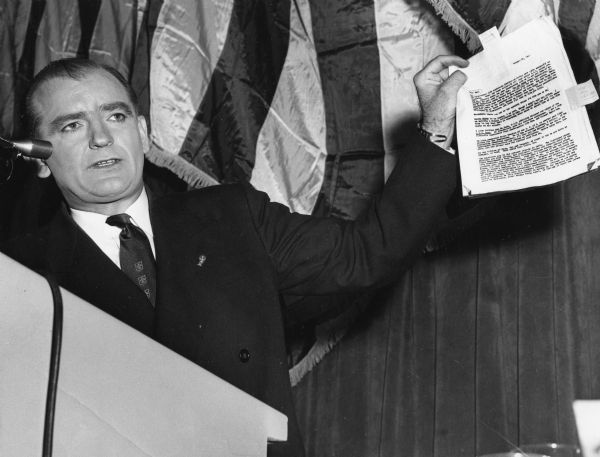
Sen. Joseph McCarthy displays one of his many reports on Communists he found in the woodwork. Photo from Wisconsin History.

What did you learn in school today?
Efforts to vindicate commie-hunting senator

By Justin Elliott / January 15, 2010

See ‘Who stays and who goes? Texas Board of Education meeting in Austin,’ Below.

When we last checked in on the U.S. history textbooks standards setting process in Texas, the conservative-dominated State Board of Education was mulling one-sided requirements to teach high school students about Newt Gingrich, Phyllis Schlafly, and the Moral Majority.

Now, in the home stretch of a process that will set the state’s nationally influential standards, a liberal watchdog group is worried that the State Board of Education will try to push through changes to claim that communist-hunting Sen. Joseph McCarthy has been vindicated by history, among other right-wing pet issues.

The Republican-dominated board is meeting in Austin to vote on amendments to the current draft standards.

“The social conservative bloc is pressing for the standards to turn Joseph McCarthy into an American hero,” says Dan Quinn of the Texas Freedom Network, a group that aims to “counter the religious right.”

The conservative effort to turn public opinion in McCarthy’s favor began way back in 1954 — while the Wisconsin senator was still in office — with the publication of William F. Buckley’s McCarthy And His Enemies.

If such an amendment is proposed, Quinn expects it to come from outspoken conservative board member Don McLeroy, who has been talking up the idea. In a note to curriculum writers last fall, McLeroy encouraged them to “read the latest on McCarthy — he was basically vindicated.”

We last encountered McLeroy in September when he argued that minority groups should be thankful to the majority for granting them rights. (“For instance, the women’s right to vote. … The men passed it for the women.”)

A requirement to teach America’s “Christian or Biblical heritage” is one of the other clauses conservatives may try to get into the standards, Quinn says.

What’s at stake here is not just what Texas students learn in high school. Because the state represents one of two largest markets in the country, publishers tailor their books to the Texas standards. Those same textbooks are then sold in smaller states around the country.

The current standards draft (.pdf) has lost some of the biased requirements that had raised the ire of liberal groups. Back in October, a curriculum writing team made up of educators jettisoned the requirements that students be able to “identify significant conservative advocacy organizations and individuals,” including the Moral Majority and Gingrich. Schlafly remains on a list (see page 54) of political leaders, but she is alongside figures like Thurgood Marshall and Hillary Clinton.

But at this stage, the curriculum writing team as well as an expert review board are out of the picture. Now, the board members will have to vote on amendments proposed by their colleagues. The final vote will come in March.

It was at this same point in the ’08-’09 science textbook standards process that conservative members began to offer technical amendments about purported gaps in the fossil record, and the impossibility of natural selection, Quinn says. Members who were in favor of teaching evolution became confused in some cases about what they were voting on.

While amendments to the history standards may be easier to understand, McLeroy and the rest of the conservative bloc are at least as passionate about leaving their mark this time around.

He told the Washington Monthly (in a lengthy feature very much worth reading):

“The secular humanists may argue that we are a secular nation. But we are a Christian nation founded on Christian principles. The way I evaluate history textbooks is first I see how they cover Christianity and Israel. Then I see how they treat Ronald Reagan — he needs to get credit for saving the world from communism and for the good economy over the last 20 years because he lowered taxes.”

Source / TPM Muckraker

Former San Antonio mayor and HUD secretary: He’s out.

Who stays and who goes?
Texas Board of Education meeting in Austin

AUSTIN – Early efforts by social conservatives on the State Board of Education to give more emphasis to religion in the teaching of U.S. history came up short Thursday as a majority of board members opted for a more traditional approach to the subject.

Among the proposals shot down by a majority of board members was a requirement to include “religious revivals” as among the major events leading up to the American Revolution.

That proposal, offered by board member Terri Leo, R-Spring, would have called on fifth-graders to study religious revivals alongside the Boston Tea Party.

Only members of the social conservative bloc — all Republicans — supported the idea, while other Republicans and Democrats opted to stay with the recommendation of a writing team of Texas teachers and academics on the topic.

The divided vote came as the board on Thursday considered scores of amendments to proposed curriculum standards for social studies, spelling out what students should be taught in history, government, geography and other social studies classes from elementary grades through high school.

The board worked late into the night, concentrating on curriculum standards for elementary and middle schools, before adjourning. It will take up high school standards — expected to generate the most debate — today.

Much of the discussion Thursday night was over which historical figures should be covered in history classes and textbooks, as board members added several new people while deleting others who were recommended by curriculum writing teams last year.

Among those dropped from the elementary school standards were former San Antonio Mayor and Clinton Cabinet member Henry Cisneros and labor leader Delores Huerta, who co-founded the United Farm Workers with Cesar Chavez. Also deleted was the first female governor of Texas, Miriam “Ma” Ferguson.

Board critics said the three were not worthy of inclusion in the standards. Huerta was cited by one board member for her membership in the Democratic Socialists of America.

On the other hand, board members added former Texas Supreme Court Justice Raul Gonzalez, the first Hispanic elected to the high court.
[….]
Social conservatives on the board have called for the new standards to reflect the major role of religion in U.S. history, and they were expected to offer several other amendments to achieve that.

But various groups have cautioned against the board including any requirement that could jeopardize the religious freedom rights of students.

The social studies requirements will remain in place for the next decade, dictating what is taught in government, history and other social studies classes in all elementary and secondary schools.

Terrence Stutz / Dallas Morning News / Jan. 15, 2010

Thanks to Harry Edwards / The Rag Blog

Posted in RagBlog | Tagged , , , , , , , , , , , | 2 Comments

Bush to Haiti : You’ve Got to be Kidding!

George Bush and Bill Clinton: a marriage made in Haiti.

Back to the scene of the crime:
Bush ousted Haiti’s Aristide, blew it with Katrina

This is just the last straw for me with the phony baloney bipartisanship fetish.

By Larry Piltz / The Rag Blog / January 15, 2010

Is it hurricane season already? George W. Bush is bringing his Katrina and Aristide-related skills to Haiti.

This is just the last straw for me with the phony baloney bipartisanship fetish. Teaming Clinton with Bush, either going to Haiti or to front for its rescue and recovery funding efforts, just totally tears it. There is no equivalence between the two leaders. None whatsoever.

First, Clinton made an effort to restore democracy to Haiti. Bush pulled a coup d’etat in Haiti and had its President Aristide kidnapped and dumped in Africa. Bush’s actions caused the murder of hundreds of innocent citizens in Haiti and tormented the island nation, not to mention leaving known human rights abusers in charge of the coup regime. Nice plan, George.

Second, under no circumstances and in no rational person’s imagination could Bush represent anything but efforts at destruction and subversion, not rescue or recovery. Look around the world today. Look at Iraq — destroyed. Look at Afghanistan — criminal neglect and return of the Taliban. Look at Pakistan — frighteningly dangerous deterioration in a nuclear nation’s security.

Sure, the U.S. Navy helped out after the Indian Ocean tsunami, but that was because Bush had pushed us unnecessarily into war against practically the entire southern half of Asia. We happened to be there. Call it a lucky mistake.

Third, which is related to #2, look at New Orleans. Just look at it. No, it’s not returned to anything near normal since the levees failed after Katrina. Not even half-normal. Bush ensured that New Orleans was ethnically cleansed, created a refugee diaspora, and ensured that people in the flood and its immediate aftermath suffered far worse than would have been necessary under Clinton’s FEMA, which Bush largely dismantled through Brownie-style privatization efforts. Though just maybe Bush can claim a little bit of credit for Reggie Bush. No relation. Go Saints.

Fourth, the world’s financial system collapsed under Bush, largely due to his laissez-fail ideology. Where’s the money to rebuild anything? Not even Haiti. Let alone America, Iraq, and Afghanistan.

Bush is no Bill Clinton or Jimmy Carter. Hell, he’s not Bush the Elder or even Gerald Ford. Bush gives ridiculous pep talks with that buffoon Giuliani at so-called positive thinking seminars. Bush wisecracks at a hunting convention. Bush buys the house next door to his Dallas home and tears it down, leaving it empty so he can have a bigger side yard. Next he’ll be cutting ribbons at gun shows. What a guy! At least there won’t be any more important memos to ignore.

Since it looks like he’s going to be the new Bush in the new millenium’s traveling Clinton-Bush puppet show, maybe it could be considered community service, to begin to make up for throwing the world into chaos and suffering for who knows how long. But he’ll have to work it off for the rest of his life, and then pass on his debt to society to his children and grandchildren, and many more begats after that.

So cool it with the stupid obsessive-compulsive bipartisan kabuki theater, media mavens and nebbish “centrists.” Your idiotic “push me-pull you” story line never was real. Regarding Haiti, I’ve never met Bill Clinton, I wasn’t Bill Clinton’s friend, and Bill Clinton was no angel when it came to imperialism, but George W. Bush, you are no Bill Clinton, though George, you may yet get the credit you deserve for being Herbert Hoover, with a side of war crimes thrown in.

God save the people and animals of Haiti, and God save them from George W. Bush, this time.

The Rag Blog

Posted in Rag Bloggers | Tagged , , , , , , , | 10 Comments

Jonah Raskin : Tom Hayden, Abbie Hoffman’s Ghost, and ‘Dirty Water’


Bill Sharpsteen’s Dirty Water:
How a community took on City Hall and won

By Jonah Raskin / The Rag Blog / January 14, 2010

[Dirty Water: One Man’s Fight to Clean Up One of the World’s Most Polluted Bays, by Bill Sharpsteen (University of California Press, January 5, 2010), 288 pp., $27.50.]

When Tom Hayden’s biography is finally written it probably won’t say a lot about the role he played in helping to clean up the waters of Santa Monica Bay — where L.A.’s sewage was dumped for decades. But it’s an important chapter in Hayden’s long life as a political activist, and it says a lot about his passion for the environment.

Bill Sharpsteen, a writer and photographer who lives in Los Angeles, tells the story of Hayden’s fight to clean up the ocean waters off the coast of Los Angeles in his new book, Dirty Water. The book is subtitled “One Man’s Fight to Clean Up One of the World’s Most Polluted Bays.”

The one man who is refereed to in the subtitle is Howard Bennett, a schoolteacher and a long-time swimmer, who discovered just how polluted the waters were by swimming in them. Howard Bennett might be viewed as the hero of this book, as well as the hero of the movement to clean up Santa Monica Bay.

But Dirty Water, which is both entertaining and uplifting, is more than the story of one man. It’s the story of a brave community that dared to take on City Hall, and it has a fascinating cast of characters that includes Tom Hayden and Howard Bennett.

The cast also includes half-a-dozen other colorful players: the idealistic scientist, Dr. Rimmon Fay; the pragmatic L.A. Mayor, Tom Bradley; the well-heeled activist, Dorothy Green; the battling attorney, Felicia Marcus; and, of course the arch-villain Willard Bascom, the executive director of the Southern California Coastal Water Research Project (SCCWRP), who launched a cover-up of the polluted waters off the coast of L.A., and who told members of his staff to keep their mouths shut.

In Dirty Water, Sharpsteen makes it clear that it takes a whole community — and a functioning organization — to fight city hall and to clean up toxic environments. It takes all kinds of people with all sorts of skills. Today’s organizers could learn a great deal by reading this book.

Howard Bennett was probably the most flamboyant of the figures in the fight. Bennett was and still is a kind of Yippie; he’d make an excellent stand-in for Abbie Hoffman because he knows how to stage events for the media to publicize causes. He could well be the ghost of Abbie.

Tom Hayden.

So, Bennett enlisted members of Save the Bay, the environmental organization he helped to create, to encircle L. A. City Hall with a mile long brown ribbon to symbolize the browning of the waters off the coast. He held press conferences and gave out “Dirty Toilet Awards.” Like Abbie Hoffman, he wasn’t afraid to be crude and rude in order to wake up citizens and to inject them with a sense of moral outrage.

Bennett, Fay, Marcus, and Green all played pivotal parts in the battle to clean up L.A.’s dirty waters. But they wouldn’t have gotten as far as they did or been as successful as they were — the waters are a lot cleaner today — if it wasn’t for Hayden who was then a California State Assemblyman and Senator who created the Santa Monica Bay Revitalization Task Force, and used his position to focus national attention on the issue. Hayden brought all his savvy as a 1960s activist and organizer to the campaign to clean up Santa Monica Bay, and while he hasn’t harped on this part of his career, he ought to be remembered for it and applauded too.

Hayden also couldn’t have done what he did without Howard Bennett, the self-styled Yippie guerrilla theater activist who understood, as did Abbie Hoffman, how to garner media attention and globalize local issues. “Heal the Bay — is this the only bay that needs to be taken care of?,” he asked author Bill Sharpsteen. “It’s the whole freakin’ west coast of America and the east coast of America of America and every city on every ocean in the world.

[Jonah Raskin is the author of The Mythology of Imperialism (Monthly Review Press), and Field Days (University of California Press.)]

Find Dirty Water: One Man’s Fight to Clean Up One of the World’s Most Polluted Bays, on Amazon.com.

The Rag Blog

Posted in RagBlog | Tagged , , , , , , | 2 Comments

Haiti and American Colonialism : The Story Behind the Story

A member of François “Papa Doc” Duvalier’s Tonton Macoutes death squad, center, with Haitian soldier to his right. Note the look of terror on the woman vendor’s face. Image from Latin American Studies.

How did Haiti become so poor?
Haitian earthquake: Made in the USA

By Ted Rall / January 14, 2010

Also see ‘What you’re not hearing about Haiti,’ By Carl Lindskoog, Below.

As grim accounts of the earthquake in Haiti came in, the accounts in U.S.-controlled state media all carried the same descriptive sentence: “Haiti is the poorest country in the Western hemisphere…”

Gee, I wonder how that happened?

You’d think Haiti would be loaded. After all, it made a lot of people rich.

How did Haiti get so poor? Despite a century of American colonialism, occupation, and propping up corrupt dictators? Even though the CIA staged coups d’état against every democratically elected president they ever had?

It’s an important question. An earthquake isn’t just an earthquake. The same 7.0 tremor hitting San Francisco wouldn’t kill nearly as many people as in Port-au-Prince.

“Looking at the pictures, essentially it looks as if (the buildings are of) breeze block or cinder block construction, and what you need in an earthquake zone is metal bars that connect the blocks so that they stay together when they get shaken,” notes Sandy Steacey, director of the Environmental Science Research Institute at the University of Ulster in Northern Ireland. “In a wealthy country with good seismic building codes that are enforced, you would have some damage, but not very much.”

When a pile of cinder blocks falls on you, your odds of survival are long. Even if you miraculously survive, a poor country like Haiti doesn’t have the equipment, communications infrastructure or emergency service personnel to pull you out of the rubble in time. And if your neighbors get you out, there’s no ambulance to take you to the hospital — or doctor to treat you once you get there.

Earthquakes are random events. How many people they kill is predetermined. In Haiti this week, don’t blame tectonic plates. Ninety-nine percent of the death toll is attributable to poverty.

So the question is relevant. How’d Haiti become so poor?

The story begins in 1910, when a U.S. State Department-National City Bank of New York (now called Citibank) consortium bought the Banque National d’Haïti — Haiti’s only commercial bank and its national treasury — in effect transferring Haiti’s debts to the Americans. Five years later, President Woodrow Wilson ordered troops to occupy the country in order to keep tabs on “our” investment.

From 1915 to 1934, the U.S. Marines imposed harsh military occupation, murdered Haitians patriots and diverted 40 percent of Haiti’s gross domestic product to U.S. bankers. Haitians were banned from government jobs. Ambitious Haitians were shunted into the puppet military, setting the stage for a half-century of U.S.-backed military dictatorship.

The U.S. kept control of Haiti’s finances until 1947.

Still — why should Haitians complain? Sure, we stole 40 percent of Haiti’s national wealth for 32 years. But we let them keep 60 percent.

Whiners.

Despite having been bled dry by American bankers and generals, civil disorder prevailed until 1957, when the CIA installed President-for-Life François “Papa Doc” Duvalier. Duvalier’s brutal Tonton Macoutes paramilitary goon squads murdered at least 30,000 Haitians and drove educated people to flee into exile. But think of the cup as half-full: fewer people in the population means fewer people competing for the same jobs!

Upon Papa Doc’s death in 1971, the torch passed to his even more dissolute 19-year-old son, Jean-Claude “Baby Doc” Duvalier. The U.S., cool to Papa Doc in his later years, quickly warmed back up to his kleptomaniacal playboy heir. As the U.S. poured in arms and trained his army as a supposed anti-communist bulwark against Castro’s Cuba, Baby Doc stole an estimated $300 to $800 million from the national treasury, according to Transparency International. The money was placed in personal accounts in Switzerland and elsewhere.

Under U.S. influence, Baby Doc virtually eliminated import tariffs for U.S. goods. Soon Haiti was awash with predatory agricultural imports dumped by American firms. Domestic rice farmers went bankrupt. A nation that had been agriculturally self-sustaining collapsed. Farms were abandoned. Hundreds of thousands of farmers migrated to the teeming slums of Port-au-Prince.

The Duvalier era, 29 years in all, came to an end in 1986 when President Ronald Reagan ordered U.S. forces to whisk Baby Doc to exile in France, saving him from a popular uprising.

Once again, Haitians should thank Americans. Duvalierism was “tough love.” Forcing Haitians to make do without their national treasury was our nice way or encouraging them to work harder, to lift themselves up by their bootstraps. Or, in this case, flip-flops.
Anyway.

The U.S. has been all about tough love ever since. We twice deposed the populist and popular democratically-elected president Jean-Bertrand Aristide. The second time, in 2004, we even gave him a free flight to the Central African Republic! (He says the CIA kidnapped him, but whatever.) Hey, he needed a rest. And it was kind of us to support a new government formed by former Tonton Macoutes.

Yet, despite everything we’ve done for Haiti, they’re still a fourth-world failed state on a fault line.

And still, we haven’t given up. American companies like Disney generously pay wages to their sweatshop workers of 28 cents an hour.

What more do these ingrates want?

[Ted Rall is the author of the new book Silk Road to Ruin: Is Central Asia the New Middle East?, an in-depth prose and graphic novel analysis of America’s next big foreign policy challenge.]

Source / CommonDreams.org

“Papa Doc” and “Baby Doc” Duvalier. Photo from AFP.

What you’re not hearing about Haiti
(But should be)

By Carl Lindskoog / January 14, 2010

In the hours following Haiti’s devastating earthquake, CNN, The New York Times and other major news sources adopted a common interpretation for the severe destruction: the 7.0 earthquake was so devastating because it struck an urban area that was extremely over-populated and extremely poor.

Houses “built on top of each other” and constructed by the poor people themselves made for a fragile city. And the country’s many years of underdevelopment and political turmoil made the Haitian government ill-prepared to respond to such a disaster.

True enough. But that’s not the whole story. What’s missing is any explanation of why there are so many Haitians living in and around Port-au-Prince and why so many of them are forced to survive on so little. Indeed, even when an explanation is ventured, it is often outrageously false such as a former U.S. diplomat’s testimony on CNN that Port-au-Prince’s overpopulation was due to the fact that Haitians, like most Third World people, know nothing of birth control.

It may startle news-hungry Americans to learn that these conditions the American media correctly attributes to magnifying the impact of this tremendous disaster were largely the product of American policies and an American-led development model.

From 1957-1971 Haitians lived under the dark shadow of “Papa Doc” Duvalier, a brutal dictator who enjoyed U.S. backing because he was seen by Americans as a reliable anti-Communist. After his death, Duvalier’s son, Jean-Claude “Baby Doc” became President-for-life at the age of 19 and he ruled Haiti until he was finally overthrown in 1986.

It was in the 1970s and 1980s that Baby Doc and the United States government and business community worked together to put Haiti and Haiti’s capitol city on track to become what it was on January 12, 2010.

After the coronation of Baby Doc, American planners inside and outside the U.S. government initiated their plan to transform Haiti into the “Taiwan of the Caribbean.” This small, poor country situated conveniently close to the United States was instructed to abandon its agricultural past and develop a robust, export-oriented manufacturing sector. This, Duvalier and his allies were told, was the way toward modernization and economic development.

From the standpoint of the World Bank and the United States Agency for International Development (USAID) Haiti was the perfect candidate for this neoliberal facelift. The entrenched poverty of the Haitian masses could be used to force them into low-paying jobs sewing baseballs and assembling other products.

But USAID had plans for the countryside too. Not only were Haiti’s cities to become exporting bases but so was the countryside, with Haitian agriculture also reshaped along the lines of export-oriented, market-based production. To accomplish this USAID, along with urban industrialists and large landholders, worked to create agro-processing facilities, even while they increased their practice of dumping surplus agricultural products from the U.S. on the Haitian people.

This “aid” from the Americans, along with the structural changes in the countryside predictably forced Haitian peasants who could no longer survive to migrate to the cities, especially Port-au-Prince where the new manufacturing jobs were supposed to be. However, when they got there they found there weren’t nearly enough manufacturing jobs go around.

The city became more and more crowded. Slum areas expanded. And to meet the housing needs of the displaced peasants, quickly and cheaply constructed housing was put up, sometimes placing houses right “on top of each other.”

Before too long, however, American planners and Haitian elites decided that perhaps their development model didn’t work so well in Haiti and they abandoned it. The consequences of these American-led changes remain, however.

When on the afternoon and evening of January 12, 2010, Haiti experienced that horrible earthquake and round after round of aftershock, the destruction was, no doubt, greatly worsened by the very real over-crowding and poverty of Port-au-Prince and the surrounding areas.

But shocked Americans can do more than shake their heads and, with pity, make a donation. They can confront their own country’s responsibility for the conditions in Port-au-Prince that magnified the earthquake’s impact, and they can acknowledge America’s role in keeping Haiti from achieving meaningful development.

To accept the incomplete story of Haiti offered by CNN and the New York Times is to blame Haitians for being the victims of a scheme that was not of their own making. As John Milton wrote, “they who have put out the people’s eyes, reproach them of their blindness.”

[Carl Lindskoog is a New York City-based activist and historian completing a doctoral degree at the City University of New York. You can contact him at cskoog79@yahoo.com.]

Source / CommonDreams.org

The Rag Blog

Posted in RagBlog | Tagged , , , , , , | 3 Comments

The Blame Game : Reform is Bigger than Obama

Barack Obama: Were expectations unrealistic? Image from Black Agenda Report.

Too simplistic to just blame Obama:
High hopes and the slow pace of reform

By Richard Flacks / The Rag Blog / January 13, 2010

People on the left make a serious mistake by blaming Obama for the slow pace of reform, and becoming disillusioned. Disillusionment leads to demoralization, not action. The one-year anniversary of the presidential election provides a hook for all kinds of venting.

“Now, today, the Big Hope president has virtually nothing of import to show for nearly a year in office,” David Michael Green, a Hofstra University professor, writes on his website, The Regressive Antidote. He then offers a stream of vituperation about Obama’s failure to lead, capitulation to the right, and lack of political sense and vision. Green doesn’t analyze these alleged failures; he simply savages the president’s personal qualities.

Ironically, Green’s attack came as the House of Representatives made history by passing national health insurance reform legislation. Of course, the House bill doesn’t live up to everything the president promised, and the final version that gets through the Senate and reconciliation and then lands on his desk is likely to be even further from ideal. But we have been waiting 70 years to witness any movement toward universal health care and are now on the cusp of seeing it.

Many critics correctly question Obama’s reliance on Wall Street enablers for key economic advice, and doubt the Obama team can reverse the rising tide of unemployment and underemployment. There is deep anxiety about the president’s decision to send more troops to Afghanistan, despite growing evidence that this war is as foolish, futile, and feckless as any military adventure the United States has previously undertaken. And Obama has not consistently taken the high road on global warming, workers’ rights, gay rights, and civil liberties.

Blaming Obama, however, is simplistic. Yes, he has to be held to the promises he articulated and the hope he inspired. But the first question we must ask is why those hopes and promises are so elusive.

Is it really because Obama and his administration have betrayed us, or demonstrated their weakness or cowardice, or were tricksters from the start? A more accurate diagnosis would start instead with the fact that all of the major reforms promised have been fiercely resisted by the main centers of power in society — the corporate elite and the military industrial complex.

People on the left typically use a power structure analysis to explain the limits of democracy in the United States. Yet, for some reason, many people seem to have hoped that Obama would override all that, and do so in less than a year.

Obama, however, knew from the start that his stated goals would be powerfully resisted. Accordingly, he has spent his first year in office devising compromises to help overcome some of that resistance, so that a semblance of reform might happen.

To understand this, consider the positions of the corporate and bureaucratic power centers:

  • Key representatives and senators are financed by the very corporate interests that need to be reformed. If a piece of proposed legislation would harm those corporate interests, those legislators can be counted on to block it and propose more lenient rules. Corporate lobbyists actually write many of the laws that are supposed to regulate their clients.
  • Corporate and military interests have access and influence in the mass media. Any progressive change the president proposes can trigger charges that his administration is weak on national security matters. When JFK contemplated aborting the Bay of Pigs invasion in 1961, he was warned that former President Dwight Eisenhower would publicly campaign against him. Today, we hear rumors in the press that if Obama fails to follow the demands of General McChrystal for a troop buildup in Afghanistan, General Petraeus will resign and run for president against him.
  • Corporate and financial decision-makers — the “investment class” — have a huge influence over markets and the economy as a whole, precisely because they control the flow and pace of investment. Because the most rational health care reform, a type of “Medicare for all,” would wipe out the giant health insurance corporations and shift power away from the pharmaceutical industry, fears of an investor revolt make single payer “politically impossible.” If the president were to push for true health reform, he would risk the wrath of the investment class.

In the face of resistance, President Obama formulated a strategy to deliver needed reforms. He reassured Wall Street by appointing Tim Geithner and Larry Summers to run economic policy and financial reform; he forced key congresspersons to “own” health care reform by giving them responsibility for shaping the legislation, and he compromised with drug and hospital lobbies; he moved slowly with reforms affecting the CIA and Pentagon; and he backed a “cap and trade” approach to carbon emission control.

We remember FDR, JFK and LBJ as bold reformist presidents, forgetting their actual records. FDR made major and harmful compromises on social security, the Wagner Act and civil rights. Kennedy tried mightily to contain the civil rights movement and ordered FBI surveillance of Martin Luther King. He launched a huge arms race with the USSR, was afraid to recognize Communist China and invaded Cuba. Johnson could not figure out how to end the Vietnam War, even though he believed it would destroy his legacy. And his great health care reform, Medicare, was itself a compromise, covering only those over 65.

The entire history of successful reform emanating from the White House is replete with corporate and political compromises. Always ingrained in the thought process of successful politicians is the mantra we now hear channeled through Rahm Emanuel, who says, in effect: “We can’t let the perfect be the enemy of the good. We need to pass something even if it is quite flawed. We can work to improve it down the line.” Such maxims summarize the limits of presidential power in the face of power elite resistance.

People on the left make a serious mistake by blaming the president for the slow pace of reform, and becoming disillusioned. Disillusionment leads to demoralization, not action. On the other hand, the leaders of progressive organizations on the national level have so far been making an even bigger mistake: spending their resources on mobilizing support for the White House agenda.

What we need from here on in is a national coalition aimed at mobilizing grassroots support for “keeping the promises” — a coalition that aims beyond what is immediately possible, and makes strategic demands that challenge the agenda of the president and his party.

Right now, such demands could include:

  • a real jobs program that builds in the green economy but seeks more rapid expansion of employment opportunity than anything now on the agenda;
  • carbon control targets more far-reaching than current legislation contemplates;
  • a binding timetable for ending U.S. troop involvement in Afghanistan as well as Iraq, emphasizing that the massive war budget endangers any hope for change.

These goals are interrelated. A massive investment in renewable energy, conservation and alternative transportation will create jobs. Investment funding can come from reducing the war budgets. Energy alternatives will reduce the obsession with Middle East oil that drives our international policy.

A revitalized progressive coalition at the national level, independent of the Obama administration but embracing its original goals, would be a counterweight to the corporate, financial and military sectors that currently hold sway. Indeed, such a coalition should aim to encourage divisions in the power elite — a vibrant, green economy would benefit businesses, and relief from the wars would be welcomed by many in the military.

During the campaign, Barack Obama repeatedly said that change was up to us. He can be a great president, if and when we make him one.

[Sociologist and educator Richard Flacks has been a progressive activist for 50 years. He can be reached at flacks@soc.ucsb.edu. His blog is here].

Thanks to Carl Davidson / The Rag Blog

Posted in Rag Bloggers | Tagged , , , , , | 4 Comments

Sweet Jesus! : Pat Robertson says Haiti Made Deal With the Devil

Pat Robertson cites deal with the devil
as reason for Haiti quake

By Larry Ray / The Rag Blog / January 14, 2010

Former United States Presidential candidate and Conservative right wing televangelist Pat Robertson is clearly going further off his religious rocker. It could possibly be that neuron-devouring plaque is now invading the far-right side of his brain. Whatever it is, it is more than disturbing.

Wednesday on his cable TV Christian Broadcasting Network, the loopy Robertson, chatting with his co-sidekick told viewers,

Something happened a long time ago in Haiti, and people might not want to talk about it, they were under the heel of the French, uh, you know, Napoleon the third and whatever, and they got together and swore a pact to the devil, they said, we will serve you, if you get us free from the Prince, true story.

True story folks! More outrageous details on the pact with the devil bedtime story in the incredible video above. What is even more frightening than Rev. Robertson is that a substantial national audience never misses his story time, and seems to love his deluded, outrageous claims.

He has also been reverently supported by the hard-core remnants of the Republican Party leadership who seemingly have no problem with his twisted delusional language.

Thousands, perhaps hundreds of thousands are reported to have been killed in the violent, damaging quake. Untold thousands with untreated broken limbs and other grave injuries are without help with existing emergency resources depleted. Reports from those there say the disaster is indescribable. The dead, just 24 hours after the quake, are stacked in the streets.

Robertson’s devoted, responsive audience could have been immediately urged to invoke their Christianity and donate generously, not to the 700 Club, but directly to international aid agencies to speed direct help to the devastated Haitians. Instead he told his viewers that the 7.0 magnitude earthquake was a Faustian payoff for the poor souls in Haiti whom, he clearly suggests, had it coming for Haiti’s “deal with the devil.”

Sweet Jesus . . . .

[Retired journalist Larry Ray is a Texas native and former Austin television news anchor. He also posts at The iHandbill.]

The Rag Blog

Posted in Rag Bloggers | Tagged , , , , , | 4 Comments

Vicky Starr of ‘Union Maids’ : Working Class Hero

Stills from Union Maids. Images from escholarship.org. Vicky Starr (Stella Nowicki) is on right.

Vicky Starr dies at 93:
Socialist, labor organizer, feminist, film star

By Harry Targ / The Rag Blog / January 13, 2010

I read recently that Vicky Starr died on Thanksgiving Day, November 26, 2009. She was 93 years old. Thinking about Vicky Starr (or for fans of the film Union Maids, Stella Nowicki) reminded me about how her life, which many of us learned of through the film, was so inspirational.

As a teenager, Vicky Starr left the family farm in Michigan and arrived on the south side of Chicago in 1933. She stayed in the home of Herb and Jane March, Communist activists who had come to Chicago to organize the packing house workers in the huge Stockyards. Under March’s tutelage she sought employment in the Yards and almost immediately began to network with workers to build a union of workers in the days leading up to the formation of the Congress of Industrial Organizations (CIO).

The processing of meat from the 1880s until the late 1950s was centered in Chicago. The Stockyards, housing the Big Four packers (Armour, Cudahy, Swift, and Wilson), employed thousands of workers. Because the work was so dangerous and unpleasant, it was largely carried out by the most marginalized sectors of the working class.

In the era of Upton Sinclair’s The Jungle workers were primarily immigrants from Eastern and Southern Europe. After World War 1 and the “the Great Migration,” African Americans secured the lowest paid and most dangerous jobs in the Yards. Historic union organizing drives in 1904, and 1921 faltered because of racism and ethnic conflict among workers. Communist and socialist organizers in the Yards, such as March, realized that combating racism was central to organizing industrial unionism in the meat packing industry.

Still from Union Maids. Image from Documentary Starts Here.

And it was rank-and-file activists like Vicky Starr who tirelessly met with workers, helped write leaflets and newsletters, interacted with the radical students from the University of Chicago who had offered their assistance to union organizing drives, and communicated with sympathetic members of the influential Catholic Church in the city.

As a member of the Young Communist League, Starr and her comrades would read classic Marxist and Leninist texts. Since Starr would be identified with organizing campaigns by her bosses she often lost her job in the yards. When that occurred she would apply for work at another packing house company using a different name.

She told Alice and Staughton Lynd (Rank and File, 1973) many years later: “When I look back now, I really think we had a lot of guts. But I didn’t even stop to think about it at the time. It was something that had to be done. We had a goal. That’s what we felt had to be done and we did it.”

In 1937, workers established the Packinghouse Workers Organizing Committee (PWOC). Despite resistance by the major meat packers, state violence, red-baiting against union organizers by the state and the American Federation of Labor’s Amalgamated Meat Cutters (AMC), the United Packinghouse Workers of America (UPWA-CIO) was constituted in 1943.

Until its merger with other unions, it remained a militant trade union that fought racism and red-baiting and publicly opposed United States foreign policies such as participation in the Korean War. And during its formative years in the mid-1940s Vicky Starr served for a time as Education Director for District 1 of UPWA.

Central to Starr’s contribution to the working class from the time she was a member of the Young Communist League, to the budding labor movement, the formation of the UPWA, and later as an organizer of clerical workers at the University of Chicago, was her constant struggle against racism and sexism.

After the formation of UPWA Starr said “We tried to make sure that there were both Negroes and whites as officers, stewards… in all the locals.” She fought residential segregation and participated in building the Back of the Yards Council on Chicago’s south side, and worked to end the exclusion of African Americans from professional sports. And in the end she recalled that the most militant trade unionists on the shop floor, the beef kill, were African Americans.

As an organizer in the 30s and a UPWA staffer in the 40s she combated sexism as well. “Women had an awfully tough time in the union because the men brought their prejudices there.” Women often had the most demeaning jobs in the Yards, wage rates discriminated against them, their special needs such as child care received no attention, and they often were fearful of demanding their rights on the shop floor and in the union.

As a socialist, Starr reflected on those halcyon days of UPWA-CIO organizing. She said that there was a sense that workers were ready to come together. There was a growing feeling of working class solidarity. Union organizers would show up at the Stockyards with literature and speeches. And at the grassroots she and others were on the shop floor spreading the word informally about the union.

And socialism needed to be addressed in terms of the concrete benefits of people’s lives. “You had to talk about it in terms of what it would mean for that person. We learned that you can’t manipulate people but that you really had to be concerned with the interests and needs of the people. However, you also had to have a platform — a projection of where you were going.”

Starr left the Yards in 1945, was forced underground for a time in the McCarthy period, raised four children and returned to work as a secretary at the prestigious University of Chicago. She still had “a platform” at the university, organizing all non-professional staff. Despite predictable resistance from the bastion of liberalism in higher education she applied the grassroots organizing skills she learned as a teenager in the stockyards to achieve victory for clerical workers. Teamsters Local 743 was recognized in 1978. Vicky Starr became the first shop steward of the new local.

Vicky Starr in 1992. Photo from Chicago DSA.

But Starr’s contribution to the American working class, Black and white, male and female, did not remain unnoticed beyond the shop/office. Alice and Staughton Lynd captured her remembrances of CIO organizing in the 1973 book Rank and File and the clerical workers struggle in the 2000 book New Rank and File. And especially, “Stella Nowicki” was one of three stars (the others were Sylvia Woods and Kate Hyndman) in the wonderful documentary (Union Maids, 1977) about women organizing in the CIO in the 1930s.

This last project made Vicky Starr a major celebrity. It brought to the attention of new generations of activists the fighting spirit of the 1930s, the central role Communists played in the battles, and the absolute centrality to organizing the working class of fighting racism and sexism.

Still relevant today, Union Maids (and the Lynds’ collections of interviews), can help inspire, educate, and inform activists about tactics, strategy, and basic principles of organizing.

Vicky Starr concluded her 1973 interview saying: “It was a privilege and a wonderful experience to participate in the excitement of those times.”

It is important to remember Vicky Starr for what she did for the working class, particularly industrial and clerical workers. And reflections on her life and work can still inform activists as they struggle for economic justice today.

[A memorial celebration of Vicky Starr’s life will be held January 23, 2010 at 4 pm at the North Shore Retirement Hotel, 1611 Chicago Avenue, Evanston, Illinois.]

[Harry Tarq is a professor in American Studies who lives in West Lafayette, Indiana. He blogs at Diary of a Heartland Radical, where this article also appears.]

The Rag Blog

Posted in Rag Bloggers | Tagged , , , , , , , , , , , , | 3 Comments

Licensed Murder in Colombia : The Macabre Ruse of ‘False Positives’

Carmenza Gómez Romero of Soacha, Colombia, shows a picture of her son Victor, one of two sons she has lost in “false positive” operations in the Ocaña area. Photo from El Espectador.

Grotesque staged civilian murders:
Colombia’s ‘false positive’ operations

By Marion Delgado / The Rag Blog / January 12, 2010

CARTAGENA DE INDIES, Colombia — On the eve of 2010, Venezuelan President Hugo Chavez accused Colombia and the U.S. of plotting to set up a fake rebel camp on Venezuelan soil to discredit his government.

Chavez accused Colombia of preparing what he called a “false positive” operation, saying “today it’s feasible for the neighboring country to build a makeshift camp in a remote location, then plant corpses and guns to make it seem that a rebel camp had been discovered.”

Colombian officials have said that leftist rebels from their country take refuge as needed in Venezuela. Chavez says the officials are trying to portray him, falsely, as being in cahoots with the Revolutionary Armed Forces of Colombia (FARC), which Colombia has been battling for decades.

“We have evidence that the Colombian government, instructed and supported, or rather directed by the United States, is preparing a “false positive,” Chavez said.

He said Colombian forces could bring bodies to “Venezuelan territory, build some huts, an improvised camp, put some rifles there… and say, ‘There it is, the guerrilla camp in Venezuela.'”

Is this guy really crazy like they say on U.S. TV during the obligatory hate minutes every half hour or so? As far as I know, a “false positive” is what you claim when you get nicked on a drug-war piss test. Is the narco-paraco government of Colombia going to give Hugo a piss test? This sounded strange and a little bit “funny”; I needed to find out what is going on.

Venezuelan President Hugo Chavez, shown inspecting troops December 28, 2009, has accused Colombia of staging “false positive” operations in Venezuela territory. Photo by Juan Carlos Solorzano/ Miraflores Press Office / AP.

It turns out that the macabre story of false positives, while strange, is not funny at all. It’s a new chapter in the story of human rights abuses perpetrated by the Colombian army, in cahoots with their usual partners, the right wing paramilitaries that plague Colombian society.

The phenomenon is well known. A victim is lured under false pretenses to a remote location. He is killed soon after arrival, by members of the military. The scene is manipulated to make it appear as if the victim was legitimately killed in combat. He is commonly photographed wearing a guerrilla uniform, and holding a gun or grenade. Victims are often buried anonymously in communal graves, and their killers rewarded for the “results” they’ve achieved in the fight against drugs and/or rebels.

I started to get a leg up on the false positives talk from recently declassified cables and documents in National Security Archive Electronic Briefing Book No. 266, under the title: Documents Describe History of Abuses by Colombian Army.

CIA and senior U.S. diplomats were aware as early as 1994 that U.S.-backed Colombian security forces engaged in “death squad tactics,” cooperated with drug-running paramilitary groups, and encouraged a “body count syndrome,” according to the declassified documents.

These records shed light on a policy — recently examined in a still-undisclosed Colombian Army (COLAR) report — that influenced Colombian military officers for years, leading to extrajudicial executions and collaboration with paramilitary drug traffickers. The secret report has led to the dismissal of 30 Army officers and the resignation of Gen. Mario Montoya Uribe, (no relation to El Presidente), a Colombian Army Commander who long promoted using body counts to measure progress against guerrillas.

The Los Angeles Times reported in 2007 on a classified CIA report linking Gen. Montoya Uribe to joint military-paramilitary operations in Medellín while he served as brigade commander in 2002. His replacement as Army commander, General Oscar Gonzalez, also commanded the 4th Brigade, as well as other units in the conflict-prone area around Medellín. The 4th Brigade, a traditional launching point for officers seeking to move up the military chain-of-command, has long been accused of collusion with local paramilitary groups.

The NSA documents raise important questions about the historical and legal responsibilities COLAR has to come clean about, and what appear to be longstanding institutional incentives to commit murder. They include:

  • A 1994 report from U.S. Ambassador Myles Frechette that decries “body count mentalities” among Colombian Army officers seeking to advance through the ranks. “Field officers who cannot show track records of aggressive anti-guerrilla activity (wherein the majority of the military’s human rights abuses occur) disadvantage themselves at promotion time.”
  • A CIA intelligence report from 1994 finds that Colombian security forces “employ death squad tactics in their counterinsurgency campaign” and had “a history of assassinating leftwing civilians in guerrilla areas, cooperating with narcotics-related paramilitary groups in attacks against suspected guerrilla sympathizers, and killing captured combatants.”
  • A Colombian Army colonel’s comments in 1997 that there was a “body count syndrome” in COLAR that “fuel[ed] human rights abuses by well-meaning soldiers trying to get their quota to impress superiors,” and a “cavalier, or at least passive, approach when it comes to allowing the paramilitaries to serve as proxies… for the COLAR in contributing to the guerrilla body count.” The same colonel also asserts that military collaboration with illegal paramilitary groups “had gotten much worse” under Gen. Rito Alejo Del Río Rojas, now under investigation for a murder during the same era.
  • A declassified U.S. Embassy cable describing a February 2000 false positives operation in which both the United Self-Defense Forces of Córdoba and Urabá (ACCU) paramilitaries and COLAR almost simultaneously claimed credit for having killed two long-demobilized guerrillas near Medellín. Ambassador Curtis Kamman called it “a clear case of Army-paramilitary complicity,” adding that it was “difficult to conclude anything other than that the paramilitary and Army members simply failed to get their stories straight in advance.”

    The ACCU (which witnesses say kidnapped the two) claims its forces executed them, while the Army’s 4th Brigade (which released the bodies the next day) presented the dead as Ejercito de Liberacion Nacional (ELN — the National Liberation Army) guerrillas killed in combat with the Army. After these competing claims sparked local fears and confusion, armed men stole the cadavers from the morgue.

Obviously, the U.S. has known about these atrocities for years, yet both Bush and Obama have continued to feed billions of tax dollars to the very people who are committing them.

The earliest record in the Archive’s collection referring specifically to the phenomenon of “false positives” is dated 1990. That document, a cable approved by then-U.S. Ambassador Thomas McNamara, reported a disturbing increase in abuses attributed to COLAR. McNamara disputed the military’s claim that it killed nine guerrillas in El Ramal, Santander state, on June 7 of that year: ‘The investigation by Instruccion Criminal (COLAR CID) and the Procuraduría (Inspector-General’s Office) strongly suggests… that the nine were executed by the Army and then dressed in military fatigues. A military judge… on the scene apparently realized that there were no bullet holes in the military uniforms to match the wounds in the victims’ bodies…”

Hence the oxymoron, “Military Intelligence.”

While Colombian Army officials scramble to get their “stories straight,” “body counts” and “false positives” have an institutional history in COLAR going back many years.

The U.S. Embassy’s Defense Attaché Office (DAO) in Colombia reported in 1994 that the claim by then-Minister of Defense Fernando Botero that there was “a growing awareness that committing human rights abuses will block an officer’s path to promotion” reflected “wishful thinking.” These are the people that thousands of our troops will join up with and learn from. U.S. “drug war” money pays for every death and there were and still are thousands of them.

The latest “false positives” story revealed that the Army has murdered perhaps thousands of civilians, who were then dressed in rebel uniforms or had guns placed in their hands. They were then presented to the media as guerrillas or paramilitaries killed in combat. This allowed Army units to fabricate results and officers to gain promotion. The number of victims is believed to be in the thousands.

The story broke last October when it was found that poor young men had been recruited from the slums of Bogotá, promised well-paying jobs in the province of Norte de Santander, then murdered in cold blood and presented by the army as having been killed in combat.

The Fiscalia (Attorney General’s office) has evidence that 30 young men were murdered in such circumstances; so far 17 soldiers have been arrested in connection with the extrajudicial killings.

In Antioquia state, where the most cases have been reported, the AG is investigating COLAR Battalion Bombon, of the COLAR 14th brigade. It is alleged that soldiers were sent to the city of Medellin to round up homeless people, who were later presented as rebels killed in combat. Investigators have identified six cases, and 46 reported operations by the battalion are being scrutinized amid fears that more were simply staged, using murdered civilians.

Former Defense Minister Santos, who is likely to run for the presidency in 2010, has stated that the problems have been resolved and that the human rights abuses will be stopped.

However, last week he admitted that a student, Arnobis Negrete Villadiego, had been snatched off the streets of Monteria, Córdoba, on Christmas day. The corpse of the 18-year-old appeared a day later, presented as a member of a drug-trafficking gang killed in combat.

El Espectador, a Bogota daily newspaper, reported in August 2009 that the Colombia Prosecutor General’s Office was investigating 312 new complaints of people who say members of the armed forces killed civilians to present them as guerrillas killed in combat. Then in late September, 19 bodies were found in common graves in Ocaña, Norte de Santander. Some were identified as missing youths from Soacha. Over 100 bodies have been found in Ocaña so far this year.

Exhumation of bodies has shed light on the alleged atrocities in Colombia. Photo from BBC.

Relatives of the Soacha victims said that before they disappeared, they were offered high-paying work on farms elsewhere in the country by strangers. The youths were killed just a day or two after disappearing, making it unlikely that they would have had time to join and train with an armed rebel movement. An Army investigation was launched in October.

“The cases of Soacha [the most infamous case of so-called ‘false positives’] are just the tip of the iceberg,” UN special rapporteur for extrajudicial killings Philip Alston said when he presented his report on Colombia.

Nearly 1,300 Colombians have been killed for political reasons since Álvaro Uribe became President in 2002, mostly by security forces, according to a new report by the International Observation Mission, a group representing around 100 non-governmental human rights organizations. The report notes a “considerable increase in the number of extrajudicial executions” in a time period that “coincides” with an Uribe security crackdown. A part of that crackdown was a policy of rewarding soldiers for combat casualties to demonstrate progress in the war on Colombia’s guerrillas.

Although the government has said several times there have been no new “false positives” after an Army purge in November 2008, a recent report of the Human Rights Unit of the Procuraduría indicates the opposite. Of 1160 cases of extrajudicial killings, with 1881 victims, that are currently under investigation, 312 were opened this year January and July 2009.

One recent case involved Paez indigenous leader Reynal Dagua. Soldiers took Dagua from his home on July 26, killed him, and presented him as a guerrilla killed in combat, the National Indigenous Organization of Colombia (ONIC) says. Indigenous representative Aida Quilcue brought this case to prosecutors. “I am concerned that it will not be considered as an extrajudicial killing. So far no soldiers were arrested; I don’t see that anything has changed,”

One case which investigators describe in detail is that of Aycardo Antonio Ortiz, 67, a farmer who lived in a humble wooden house in a neighborhood of Yondó, Antioquia. On July 8, 2009, troops from the Calibío Battalion of the 14th Brigade reported his as a guerrilla combat death. According to the Army, he had a 38-caliber revolver, a hand grenade, a radio, two meters of fuse, and camouflage pants. Those are elements that appear in almost all of the false positives cases. Some cynically call those items the “legalization kit.”

The version given by the then-commander of the battalion, Lt. Col. Wilson Ramirez Cedeño, is that a demobilized person had given them information that Ortiz was a member of the FARC, who used the alias “Murciélago” (“Bat”), and that when they attempted to surround his house his men were attacked from inside with gunfire, and responded. They installed a machine gun and initiated combat in which the suspected guerrilla died. Ramirez additionally said that in the same area they had found a guerrilla camp and a minefield.

The commission, after reviewing documents and technical evidence obtained on the ground, was able to prove that the victim was a known farmer from the area, that the demobilized man mentioned by the military never existed, that the operation order was signed the same day in which the murder took place — possibly after its occurrence — and that there never were intelligence reports on any “Murciélago.” Furthermore, there never was machine gun fire from the house, nor minefields, nor guerrilla camps.

Another scandalous episode involves the same Bomboná Battalion mentioned above, in the Magdalena Medio region of Antioquia. A young informant from that battalion, stationed in Puerto Berrio, says that in January 2008 fellow soldier Amílkar Hernandez requested that they look for a friend of his, and they went on this “mission” to the municipality of Vegachí.

The informant says the group went to the home of his friend, Johny Alexander Barbosa, who everyone called the “Tortuga” (“Tortoise”) because he was slow and somewhat lazy. Barbosa really didn’t want to leave his house, but in the end accepted the invitation and everyone went on motorcycles to Vegachi. Hernandez and the young informant slept that night back with the battalion, but “Tortuga” never returned home. According to the informant, now a witness for legal authorities, Hernandez brought street people from Medellín to assassinate them and make them look like combat casualties.

In each of six identical episodes an N.N. (“No-Name”) combat death was reported from whom a revolver or pistol was seized, while the soldiers involved are said to have spent exactly 650 bullets, eight hand grenades, and four mortar grenades. Military investigators question whether those incidents ever occurred, and believe they were used to “legalize” (steal) ammunition that some soldiers sell on the black market to guerrillas and criminal gangs.

The investigating commission examined documents supporting operations in which 11 young men died. Despite the fact that almost all of them were reported as members of criminal gangs, investigators were surprised to find that intelligence sections of the brigades involved had no specific information about these gangs, only generally-known facts. Intelligence officials could not give the name or alias of any gang members, or their location, or modus operandi.

In addition to crimes against humanity, there is evidence that corruption exists at many levels. For example, in the report it is clear that an internal “leaky faucet” of “lost” ammunition feeds the black market that, ironically, benefits the armed groups the Army is fighting.

The U.S handed over $750 million in mostly military aid to Colombia in 2007 that paid for the murder of at least 1,900 innocent civilians and bought ammo that was later sold on the black market. The contribution of U.S. taxpayers’ money to fund the killing of innocent people will almost certainly raise eyebrows among human rights activists and others who have long criticized the Colombian government’s actions in its phony war against cocaine and insurgents.

In a preliminary report, the UN’s rapporteur for extra-judicial executions, Philip Alston, stated that the term “false positives” is in its self false, because it suggests that soldiers committing these killings are doing it accidentally. They aren’t.

All of this raises the question of how the U.S. should proceed with its long-standing policy of supporting the Uribe government in its fight against FARC rebels.

U.S. financial aid to Colombia’s internecine war has spiked from around $86 million per year in 1997 to more than $750 million in 2008, with much of the increase coming during the Bush era. Colombia got $810 million in U.S. blood money in 2009 and will get another $510 million, already passed by Congress, in 2010. That will buy a lot of false positives.

This is the same congress that couldn’t find the money for a measly 3% cost of living increase in my Social Security check.

A free-trade agreement between the U.S. and Colombia, agreed to by the Bush administration in 2006, has had little luck getting passed in Congress. The Obama administration is currently studying “outstanding issues” relating to the deal. It is, however, a sure bet that Congress will pass it and Obama will sign it.

Which brings us back to President Chavez’s claim of a “false positive” guerrilla camp. A little paranoia is suitable when dealing with Colombia’s narco-paraco false positive army. Our troops are not only dealing with them, they are living with them, training with them, and learning from them.

On a more positive note, “false positives” may be the answer to the constant dilemma of trying to keep track of the many columns and fronts of the FARC army. From time to time, COLAR announces the dismantling of various columns or fronts, only to have the same ones reappear months later. Perhaps COLAR is rounding up civilians, killing them, and claiming they were from this or that column! A column is about 100 fighters. Killing 50 or so civilians in an area could be construed as “dismantling” a FARC Column.

Just saying!

The Rag Blog

Posted in Rag Bloggers | Tagged , , , , , , , | 2 Comments

Partners in Demise

By Carl R. Hultberg / The Rag Blog /

Life has a strange way of intertwining existences in ways that defy human reason. Like puns or anagrams that seem to reveal hidden meanings, passings away are also open to interpretation. Like the tea leaves, our leavings are also readable.

What I mean to say is that people die in pairs, creating accidental(?) marriages, pairings on the obituary page. Jacqueline Kennedy Onassis and George Balanchine. Farrah Fawcett and Michael Jackson. Despite all our efforts on our own behalf, dying, like Jury Duty puts us back in the mix. Who will we end up sitting next to on the bench outside St. Peter’s office in Heaven (or equivalent)? Even atheists and agnostics may have to admit to some degree of posthumous mortification looking back at their obits in the newspapers.

So who are the latest couple to have left together to go to tell their human stories to Whomever? None other than Willie Mitchell and Mary Daly. Who? Let’s just say this may be one of the oddest obit couples ever, or perhaps we are distilling ourselves somehow as Humanity.

Willie Mitchell was the trumpeter, bandleader and producer who brought us the third (and final) wave of sweet soul music from Memphis. As you probably know, Memphis sits at the top of the Mississippi Delta, the gateway from the Deep South to the North. The city that brought us Elvis (like Willie Mitchell from neighboring Mississippi), Sun Records (Elvis, Carl Perkins, Jerry Lee Lewis, Johnny Cash, Howling Wolf), Stax Records (Booker T & the MGs, Otis Redding, Isaac Hayes). Originally it was W.C. Handy, another trumpeter/bandleader who “discovered” the Blues in Memphis. That would have been about a hundred years ago.

Willie Mitchell had a sweet band but he was looking to break into record production. He found an awkward kid from Michigan who had a great voice but still hadn’t found his style. Al Green could sound like Marvin Gaye, or Wilson Pickett. Willie Mitchell’s advice was simple: try sounding like Al Green.

The result, “Let’s Stay Together” (from 1971) on Hi Records is perhaps the sweetest soul song ever laid down. Willie Mitchell continued as Al Green’s producer / mentor for years during the periods when Al (like Little Richard) switched from Sacred to secular styles. Willie Mitchell produced sweet soul music after the assassination of Dr. Martin Luther King (also in Memphis).

That was a miracle.

His deathmate couldn’t have been more different. Mary Daly was the quintessential radical lesbian separatist. Instead of “Let’s Stay Together” her message was surely: men stay away. She was a white Jesuit theologian who, once she had been granted tenure at Boston College, defied the Catholic Church to create a woman-based Wicca movement within the university’s teaching environment. It took decades for the school to finally get rid of her.

By that time she had published many books in her own super creative woman language, an alternative to male dominant Indo-European usages. Words like Hag and Crone took on new meanings. You can be sure that if this had been the Middle Ages and not the 1960s, Mary Daly would have burned at the stake. Or maybe dunked to death. Instead she was able to teach a separatist feminist course at a formerly all male seminary and totally exclude men from her classes.

Yes, this was one tough woman.

In some ways her life was reminiscent of that of Anne Lee, who created the Shaker Church in America as a feminist/separatist experiment in the 1780s. Ms. Lee was beaten to death by angry Massachusetts witch hunters but her movement flourished for almost 100 years.

Mary Daly lived to see her defiance of the Catholic Church and her open lesbianism flow into the mainsteam. Perhaps not a remnant of the original all-embracing matriarchy from the ancient past, more like another quasi-male intellectual academic bent on self-differentiation. Still, Mary Daly hit a note that resonated with many other women totally sick of the male world. May their Circle someday open up for all of us…

You’d have to say that Mary Daly and Willie Mitchell represented two totally honest aspects of our life. Hopefully as they journey together through eternity, born in the same year, leaving two days apart, forever wedded together, their spirits can find a way to reinspire us to do both things: stay together, and relearn how to truly respect women.

Type rest of the post here

Source /

The Rag Blog
Posted in RagBlog | Leave a comment