Peter Matthiessen : The Tragedy of Leonard Peltier


The Tragedy of Leonard Peltier
Vs. the United States of America

…this man’s life leaks away behind grim concrete walls for the unworthy purpose of saving face for the FBI and a U.S. Attorney’s Office…

By Peter Matthiessen / November 11, 2009

On July 27, 2009, I drove west from New York to the old riverside town of Lewisburg in central Pennsylvania, the site of the federal penitentiary where early the next morning I would make an appeal to the parole board on behalf of the American Indian Movement (AIM) activist Leonard Peltier in his first parole hearing in fifteen years.

On this soft summer evening, a quiet gathering of Peltier supporters from all over the country had convened in a small park near the Susquehanna River. Despite his long history of defeats in court, these Indians and whites sharing a makeshift picnic at wood tables under the trees were optimistic about a favorable outcome. Surely a new era of justice for minorities and poor people had begun with the Obama administration, and anyway, wasn’t Leonard’s freedom all but assured by the Parole Act of 2005, which mandated release for inmates who had spent thirty or more years in prison?

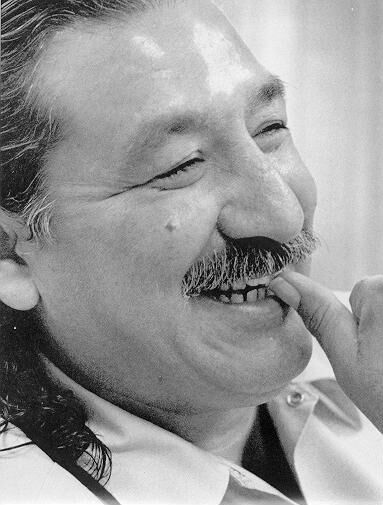
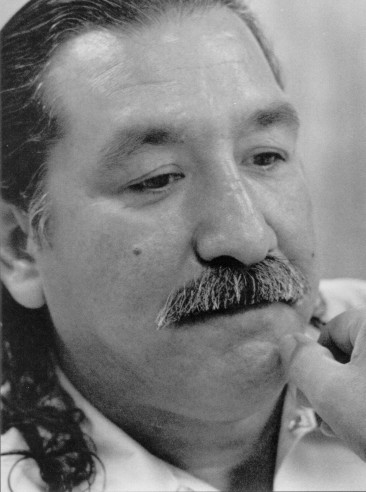
Leonard Peltier, an Ojibwa-Lakota from Turtle Mountain, North Dakota, was one of the three young Indians who were among the participants in a shoot-out with the FBI at Oglala on South Dakota’s Pine Ridge Reservation on a hot dusty day in June 1975. They were later charged with the deaths of FBI agents Jack Coler and Ron Williams.

Ostensibly searching for a suspect in a recent robbery case, the agents had been warned by tribal police not to enter the property where the AIM Indians had their camp. Their intrusion apparently provoked a warning that led to an exchange of gunfire. Understandably outraged by the deaths of Coler and Williams and in particular by the fact that an unknown “shooter” had finished off both wounded men at point-blank range, their fellow agents would also suffer intense frustration and embarrassment when a dozen or more of the Indians involved, using a brushy culvert under a side road, escaped a tight cordon of hundreds of agents, Indian and state police, national guardsmen, and vigilantes who had the area surrounded.

More galling still, Bob Robideau and Dino Butler, two of the three AIM suspects in the killings arrested during the FBI’s huge “ResMurs” (Reservation Murders) investigation, were acquitted a year later in Cedar Rapids, Iowa, on a plea of self-defense, as the third and last suspect, Leonard Peltier, would certainly have been as well, had he not fled to Canada. He was arrested there in February 1976, extradited back to the US, and tried separately.

Though originally indicted with the others on identical evidence, he was barred by a hostile new judge, Paul Benson, from presenting the same argument based on self-defense that had led to Robideau and Butler’s acquittal. Furiously prosecuted as the lone killer and convicted for both deaths on disputed evidence, Peltier was sentenced in February 1977 in Fargo, North Dakota, to two consecutive life terms in federal prison.

The following year, when Peltier’s conviction was appealed, 8th Circuit Court of Appeals Judge Donald Ross denounced the coercion of witnesses and manipulation of evidence in his case as “a clear abuse of the investigative process by the FBI”; the US Attorney’s Office, too, would be sharply criticized for withholding exculpatory evidence.

In October 1984, in an evidentiary hearing in Bismarck, North Dakota, ordered by the appellate court to review the possibility of a new trial, the prosecutor, U.S. Attorney Lynn Crooks, had to concede that the FBI’s own laboratory had failed to verify the claimed ballistics link between Peltier and the murder weapon that was used to nail down his conviction—a shell casing of disputed provenance that Crooks had called “perhaps the most important piece of evidence in this case.” Even so, Judge Benson refused to reconsider the conviction.

The following year when the decision was appealed again, Crooks finally admitted that the identity of “the shooter” had never been proven and was in fact unknown to the prosecution even when it was twisting the evidence to ensure Peltier’s conviction and make certain that its third and last suspect—by its own description, “the only one we got” — was imprisoned for life. Yet the appellate court, while noting that so much tainted evidence had deprived the defendant of his constitutional right to due process of law, found “no compelling legal justification” for ordering a new trial.

In a TV interview after his retirement in 1989, Judge Gerald Heaney, who had signed that astonishing decision, called it “the most difficult I had to make in twenty-two years on the bench.” The following year, in the National Law Journal, this troubled jurist held the FBI “equally responsible” for the deaths of its two agents; in a letter to Senator Daniel Inouye of Hawaii, he urged commutation of Peltier’s sentence.

Questioned on the same 1989 TV show about the perjured affidavits extracted by FBI agents from a frightened alcoholic, U.S. Attorney Crooks declared: “I don’t really know and I don’t really care if they were false. I don’t agree that we did anything wrong, but I can tell you, it don’t bother my conscience one whit if we did.” Properly outraged by this arrogant refusal to repudiate U.S. government use of fabricated evidence, Senator Inouye, as a former U.S. attorney, called Crooks “a disgrace to the profession.”

I first interviewed Leonard Peltier in Marion Penitentiary in 1981, and that same year, with his original codefendant Bob Robideau, I inspected the Jumping Bull Ranch at Oglala where the shoot-out had taken place. Later, after reading many if not most of the pertinent documents, including the FBI field reports and the transcripts of both trials, I returned to Oglala to interview local people and study the scene again.

Like the FBI, I would hear all sorts of rumors about the many young Indians involved without learning which one had fired the fatal shots; however there seemed to me no doubt whatever that Leonard Peltier had been railroaded into prison.

Unfortunately my long book making that case [In the Spirit of Crazy Horse (Viking, 1983)] was quickly suppressed by libel suits brought by South Dakota’s attorney general, William Janklow, and an FBI agent named David Price. Eight years would pass before both suits were summarily dismissed and the book was back in circulation. Meanwhile Peltier’s long fight for a fair trial had won his endorsement as a political prisoner by Amnesty International, and his thousands of supporters throughout the world included the Dalai Lama, Nelson Mandela, Desmond Tutu, and the great majority of his own people in the more than 250 Indian nations that had formally demanded his release.

In Peltier’s first parole hearing in 1996, the examiner filed an internal recommendation in Peltier’s favor. (The U.S. Parole Commission, like the U.S. Attorney’s Office and the FBI, is under the aegis of the Justice Department: its examiner informs himself about the case, questions both sides, and appraises the new evidence, if any.) Yet in actions so belated and irregular as to raise suspicion of undue influence, the commission replaced that first examiner with one more to its liking and denied parole.

By then, the few bold lawmakers who had called for investigations had retreated or retired, and Peltier’s best hope was executive clemency. To that end, I wangled my way into the Oval Office and pressed my book about the case into President Clinton’s hands. In January 2001, during Clinton’s last week in office, as FBI lobbyists — the Association of Retired FBI Agents and No Parole for Peltier — marched in front of the White House, I joined attorney Bruce Ellison and filmmaker Jon Kilik in a long meeting with the presidential and White House counsels in which we argued that granting clemency to an American Indian who could offer nothing in return was a bold symbolic step that could only enhance the President’s last-minute efforts to prop up his legacy.

The lawyers seemed impressed and hopes were high, but when the clemency list appeared on the Saturday morning of Inauguration Day, Peltier’s name was missing. The phone call I dreaded was put through from Leavenworth Prison in early afternoon. “They didn’t give it to me,” mumbled a stunned voice I scarcely recognized — the first time in twenty years of visits, letters, and telephone conversations that Leonard Peltier’s strong spirit sounded broken. With all court appeals exhausted and no hope of mercy from the incoming Republican administration, this aging prisoner was condemned to wait for his next parole hearing in 2009.

In the park in Lewisburg, people agreed that had the shoot-out victims not been “FBIs,” Leonard might never have been convicted; at the very least, he would have been paroled many years before. Someone in the park recalled the fear and disruption on the reservations caused by the FBI’s huge ResMurs investigation (which was widely perceived as the latest chapter in the long history of oppression and revenge against “the redskins who killed Custer” that had led up to the shoot-out).

The killing that day in June 1975 of a young member of the AIM by a marksman’s bullet in the forehead had gone all but unmentioned, someone said, let alone investigated by “the Injustice Department,” doubtless because “Injuns don’t count.” How about Bob Robideau’s statement to an FBI man that he had been “the shooter”? Would the Parole Commission take that into account? And was it suspicious that Robideau had been found dead last February in Barcelona? (The official autopsy concluded that he had struck his head in a fall while suffering a seizure.)

With Peltier’s attorney Eric Seitz and the two other parole advocates — Dr. Thom White Wolf Fassett, a Seneca elder and United Methodist adviser to Congress on Indian affairs, and an Ojibwa woman named Cindy Maleterre representing Peltier’s Turtle Mountain Reservation — I went early the next morning to the prison, passing supporters waving “Free Peltier” signs at the entrance road.

In the hearing room the first to speak were the two sons of the late agent Jack Coler. After testifying to their family’s great loss, they suggested that if this man facing them today were to take responsibility and express remorse for those brutal murders he so stubbornly denies having committed, the Coler family might not protest his parole. But the three FBI spokesmen and the assistant U.S. attorney who spoke next were content to repeat the same vilifications and distortions of the facts that won a conviction back in 1977. Locked long ago into their ResMurs myth, they insisted that Peltier was still a danger to the public and cited those provisions in the Parole Act specifying that parole may be denied if the subject’s release might “depreciate the seriousness of the offense” or “promote disrespect for the law.”

In response to the charge that Peltier has evaded his responsibility for those murders, Eric Seitz countered that the FBI and the U.S. Attorney’s Office have evaded responsibility for their own illegal tactics in his prosecution. Otherwise Seitz made no attempt to retry a long historic case in a few minutes, emphasizing instead the prisoner’s exemplary behavior record, serious health problems, and other strong qualifications for parole under the commission’s geriatric and medical criteria. He reminded Examiner Scott Kubic that in a few weeks, on September 12, when Peltier would turn sixty-five, he would also become eligible for home detention under the new Second Chance program for elderly inmates designed to ease overcrowding in the U.S. prisons.

Thom White Wolf testified that Peltier’s incarceration for nearly thirty-three years has been viewed both nationally and internationally as a gross injustice and a major embarrassment to our country, with a negative effect on the world’s view of how the U.S. government treats its native population.

When my turn came, I spoke to the points made in this article, adding how much this inmate had matured over the three decades of our acquaintance, not only as an articulate spokesman for his people but as an artist, self-taught in the prisons, whose work is admired through-out the U.S. And Cindy Maleterre assured the examiner that the prisoner’s Ojibwa-Dakota people at Turtle Mountain — including grandchildren he has never seen — had already taken care of the parole requirements of social support, adequate housing, and steady employment (as an arts-and-crafts teacher and alcoholism counselor on the reservation), and were planning to welcome him home with a great feast.

That afternoon we left the prison with the feeling that Examiner Kubic had listened carefully and would recommend parole — a guarded optimism we conveyed to the flag-waving supporters awaiting our report on the public road. But no one forgot how the examiner’s finding in Peltier’s favor fifteen years before had been aborted; in the next weeks, as so often in the past, the prisoner would have to suffer the suspense of desperate hope.

On Friday, August 20, federal inmate #89637-132 received terse notice that his petition for parole had been denied: not until his “15-year Reconsideration Hearing in July 2024,” he was informed, would he become eligible to be turned down again. In the unlikely event that he lives long enough to attend that hearing, Inmate Peltier will be eighty years old.

In his angry response, Attorney Seitz accused the commission of “adopting the position of the FBI that anyone who may be implicated in the killings of its agents should never be paroled and should be left to die in prison.” I entirely agree with Seitz and share his anger. For the prisoner and his supporters, the Lewisburg hearing had been hollow, with a predetermined outcome: The United States v. Leonard Peltier had always been a matter less of justice than of retribution.

Americans — those in public office especially — should inform themselves about this painful case and demand an unbiased investigation that might start with one simple question: If, in the thirty-three years since his trial, reputable evidence has ever emerged that Leonard Peltier was the lone killer and deserves to be in prison for life, why hasn’t the Justice Department produced it?

Without public protest, Peltier will not be granted a fair hearing since his prosecutors know that in the absence of honest evidence, “the only one we got” would be set free. Instead, this man’s life leaks away behind grim concrete walls for the unworthy purpose of saving face for the FBI and a U.S. Attorney’s Office that together botched the famous ResMurs case and mean to see somebody pay. And who better for this fate than a “radical” AIM Indian who dared stand up to “legally constituted authority” in defense of his humiliated people, as he was doing with such tragic consequences on that long-ago June day?

In reviewing this case with an open mind, as surely he must in fulfilling his oath of office, Attorney General Eric Holder (the assistant attorney general in 2001) might reflect on his own role in the clemency bestowed by Clinton on Marc Rich, the notorious “fugitive felon.” He might consider, too, Rich’s consequent evasion of even a single day in prison in the harsh light of the eleven thousand days already served by a penniless American Indian who remains innocent before the law, having never been proven guilty.

[Peter Matthiessen won the 2008 National Book Award for his novel Shadow Country. His recent books include End of the Earth: Voyage to Antarctica and The Birds of Heaven: Travels with Cranes (November 2009). This article first appeared in The New York Review of Books (Volume 56, Number 18, dated November 19, 2009).]

Source / New York Review of Books / Upaya Newsletter

  • Go here for other Rag Blog articles about Leonard Peltier.

The Rag Blog

Posted in RagBlog | Tagged , , , , , | 2 Comments

Mariann G. Wizard : Ft. Holabird Haiku

Still life of toy soldiers. Photo by Margaret Bourke-White, Jan 01, 1937 / Time and Life Pictures / Getty Images


Ft. Holabird Haiku

See the soldiers, row on row,
green leaves on trees —
beware defoliant!

Vietnam had soldiers too,
green boys in trees
whose limbs are now burnt black.

In the spring their leaves renew;
people’s roots bring
fresh life to scarred branches.

Mariann G. Wizard
Pacific Grove, CA, 1970

Posted Veterans Day, 2009 / The Rag Blog

Wizard Sez: “For a non-profit group to support this Veterans Day you may not know about yet, check out the Vietnam Agent Orange Relief & Responsibility Campaign. Help veterans here and civilians in Vietnam — including children — still suffering the aftereffects of US defoliation chemicals.”

The Rag Blog

Posted in Rag Bloggers | Tagged , , , , | 3 Comments

Hey Obama : Ride ’em Cowboy!


C’mon Obama,
Let’s have a real buildup in Afghanistan!

Barack Obama told the nation/
‘Have no fear of escalation/
I am trying everyone to please…’
(With apologies to Tom Paxton)

By Richard Lee / The Rag Blog / November 11, 2009

To Barack Obama:

Let’s have a military buildup! You can show those crazy-ass generals at the Pentagon that you aren’t just a chicken-shit weenie from Harvard.

You gotta do it right, however. Stop waffling about a measly 40,000 or 44,000 troops and do it like you mean it! I know you have never fought for or against anything. (That squabble with the Court Clerk to get your papers filed doesn’t count.) But you can do it! Don’t forget to keep that HOPE and CHANGE thingy going, so we won’t see what is really happening behind the curtain.

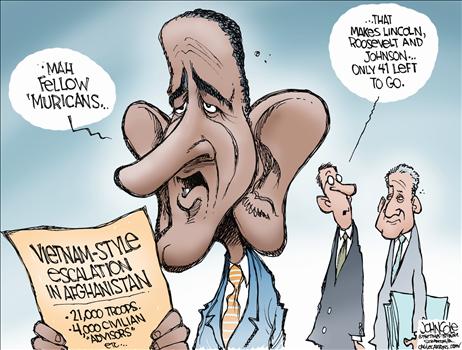
Since you don’t have a clue how to go about it, you should go back and dust off the template that the power-drunk cowboy used way back when. Turn to the record of his build-up, covering March 8, 1965, through, say, the end of January, 1966. Yep, that’s right I’m talking about Vietnam (they told me you were smart); don’t let that slow you down, a buildup is a buildup and you can do it in Afghanistan just like Lyndon and Waste-more-land did it back then.

You’ve already got 68,000 troops and an untold number of mercenaries… uh, contractors there so maybe you can forgo the photo op of the Marines stomping ashore like at Da Nang, or maybe you can arrange something like that, it was a good photo. No one will call you on it; the ignorance of the American people knows no limits. Don’t forget to include the Afghani ARVN; they’ll do you a lot of good.

That done, throw caution to the wind, fire anyone who counsels caution, and begin a real buildup!

Expect casualties. Lyndon was told to expect civilian casualties of 25,000 dead, about 68 men, women and children a day, mostly from “friendly fire” and 50,000 wounded. That was an estimate for the one year the generals said it would take to bring the Vietnamese “to their knees” and initiate their surrender; one year, or maybe 18 months at the most. That number was good enough for Lyndon, so don’t let anybody’s numbers scare you. In 1968 there were 85,000 civilians wounded.

Next, establish free fire zones. Once you get all those troops there, they will need some place to fire off all their ordnance. Go to an inhabited area, drop leaflets or have USAID workers visit and tell the population to get on the road and become refugees. Those who are too old or too infirm to go, or who come up with the excuse that Afghanistan is their country and they ain’t going; well, those are Viet Cong… I mean, Tally Band.

What good is a free fire zone if it doesn’t have any targets to shoot at anyway? While you are busy changing “Viet Cong” to “Taliban,” change the name “free fire zones” to Specified Strike Zones; those pesky Congressional liberals will feel better about it. It worked when Lyndon did it.

Get an air war going. Crank up the SAC B-52’s, they don’t have anything to do now that the Russians opted out of the Cold War. One B-52 at 30,000 feet can drop a payload that will take out everything in a box five eighths of a mile wide and two miles long. You can still call it “Operation Arc Light”; no one will remember that’s been used before.

Don’t forget to let the other planes in on the fun! Fighter bombers can deliver ordnance too. Lyndon, in that first 10 months, got it up to 400 sorties a day, add in the B-52’s and they were able to drop 825 tons of bombs a day. Some even hit their targets.

Drop more than bombs. I hate to suggest a return to Agent Orange. Military science must have come up with better stuff in the last 50 years. If not, then use the leftover Agent Orange, the residual effect is worth it. Not only will those enemy Afghanis (or friendly ones, for that matter) not be able to plant food crops in target areas for decades, but “Taliban fighters” will keep dying from it for years after we’re gone.

During the 10-month Vietnam build-up, specially equipped C-123’s covered 850,000 acres, in 1966 they topped that, “defoliating” 1.5 million acres. By war’s end they’d dropped 18 million gallons of Agent Orange, in addition to millions of gallons of less notorious but still deadly poisons code-named for other colors — Purple, White, Pink, and more — over 20% of the south of Vietnam.

To help keep the buildup affordable, take no costly precautions with our own troops; it’s hot in Afghanistan, so let them take off their shirts while spraying. The afflicted Vietnam vets sued the government over it, they won! My brother Tommy was one of them. What did they win? Well, when they die, they get $300.00 from the government. You can forget about the vets anyway when the war is over, that’s S.O.P.

Now, a buildup ain’t all in the air. Howitzers, Long Tom Cannons and mortars expended enough high explosive and shrapnel in Southeast Asia to equal the tonnage dropped from the air.

And it’s not just troop strength that you’ll need to build up. Your friends The Masters of War have probably already told you that. A build-up is troops and MATERIAL. See how Waste-more-land did it, and more or less copy that. Brown and Root are still in business; have a sit down with them; they can help you sort it out.


Build airfields. With hundreds of thousands more troops you will need lots of airfields. Jet airfields are best for business. Lyndon had three in Vietnam before he started, he quickly built five more. So, discount what you have and get cracking! A 10,000 foot runway to start, and then add parallel taxiways, high speed turnoffs, and tens of thousands of square yards of aprons for maneuvering and parking. Use aluminum matting at first; you can replace it with concrete later. You gotta build hangers, repair shops, offices and operations buildings, barracks, mess halls, and other buildings. Don’t stint on the air conditioning!

Build deep water ports. What? Don’t have an ocean? Kee-rist, what kind of a country are we liberating anyway? Well, you still gotta build ports! Guess you can build them in Kuwait and other countries and truck all the shit through Iraq, they will be pacified by then and welcoming us with open arms and goofy little dances. Pakistan might like one or two, it would be good for business and we can just pay them to be our friend like we do now… only more.

Ports were dredged to 28 feet back then, but the newer boats draw 40 feet. It may be only mud to you, but its gold to the contractors. Half a dozen new ports should get you started.

But wait, there’s more. Four or five central supply and maintenance depots and hundreds of satellite facilities, build them along the lines of the prison gulag you are building in the U.S.

Build thirty more permanent base camps for the new combat and support troops you are sending. Another fifty or so tactical airfields long enough to hold C-130’s. Build two dozen or more hospitals that have a total of nine to ten thousand beds. Be sure there are new plush headquarters buildings for the brass and about four or five thousand staff. Everything has to be connected by secure electronic data systems, secure telephones, two or three hundred communications facilities around the country. Tens of thousands of new circuits will be needed to accommodate the built-up war machine.

You are a smart guy, Mr. President, so I won’t belabor an explanation of each thing. But here is a quick list of bare necessities: Warehouses, ammunitions stowage areas, tank farms for all the petroleum, oil and lubricants, new hard top roads, well ventilated and air conditioned barracks with hot water and flushing toilets (think 6-10,000 septic tanks). Food, not just MRE’s, but for all those REMF’s who will need fresh fruit and vegetables, meat and dairy products. Thousands of cold lockers to store this, and you need to build a milk reconstitution plant, maybe two or three, and ice cream plants.

All this is going to take a lot of electricity, so you will need thousands of permanent and mobile gas-driven generators (better add another tank farm). PX’s, not just for cigarettes and shaving cream, but all the things that the consumer army you will be sending is used to having: video game consoles, blackberries, microwave ovens, computers, slacks and sport shirts (to wear on R&R — could omit that by having no R&R), soft drinks (better build a bottling plant), beer, whiskey, ice cubes (more generators?). Hamburgers, hot dogs, pizza, steaks.

Be sure to stock candy, lingerie, and cosmetics to improve the standard of living of the local women. They will also need to buy electric fans, toasters, percolators, TV’s, CD and DVD players, room air conditioners, and small refrigerators.

Movie theaters, service clubs, bowling alleys… will the list ever end? No!

Well, that will get your buildup started. I haven’t even addressed the more and more and more troops the generals will want, that is way too heavy for me!

In re-creating Johnson’s buildup, it will be better to skip over the second week in November, 1965, and all that stuff about the Drang River Valley, that’s just for historians. Close the book when you get to the end of January, 1966. Don’t read through April, with all those dreary reports from Khe Sanh. Don’t read about Tet 1968. Just remember it was the press and the Congress and the people who lost their will that lost that war, and not the stupid blundering generals or the presidents who didn’t give a shit how many they killed on either side.

One last thing: get your architects busy designing the Bush/Obama wall to put opposite ours on the Mall. Maybe you can even have your vets pay for it themselves like we had to.

I go there whenever I am in that stinking city. I sit on the edge of the grass just before sundown and sometimes I talk to the wall. The wall stands silent then; they are still waiting for an answer to the question of why we went to Vietnam. When it gets dark, sometimes the wall talks back. They say a lot of things, but they never say, “God bless my Commander-in-Chief.”

Richard Lee, Vet
Veterans Day, 2009

The Rag Blog

Posted in Rag Bloggers | Tagged , , , , , | 3 Comments

Stupak Amendment : Rolling Back Women’s Rights


The House Health Care bill:
Compromising away women’s rights

Women put Obama in office; now we have to call in our chips.

By Barbara J. Berg / The Rag Blog / November 10, 2009

The thunderous applause greeting the announcement of the House’s health care reform bill, effectively curtailing women’s access to abortion, drowned out the cries and screams from our nation’s recent past. The cries and screams of everywoman, wretchedly pregnant, with no options but to take matters into her own hands.

We don’t talk much about these women today: the single women, poor women, women who already were caring for far too many little ones, women whose boyfriends or husbands would beat them or leave them if they had a baby, women who wanted to leave their boyfriends or husbands, women who wanted to finish their education or hold onto a job, were too young, too immature, too old, had been raped, were victims of incest, or just plain didn’t want to be mothers.

But fortunately, there are those who remember.

The words of Dr. Edward Keemer of Washington D.C. help us imagine the absolute desperation these women must have felt:

I had treated a woman . . . [who] still had the straightened-out coat hanger hanging from her vagina. Some… died from air embolisms or infections. Over the years I was to encounter hundreds of other women who had resorted to imaginative but deadly methods of self-induced abortion… some would swallow quinine or turpentine. Others would insert a corrosive potassium permanganate tablet into their vaginas… A sixteen-year-old girl… died after douching with a cupful of bleach.

During the 1960s, a million women are estimated to have had illegal abortions. Of those who survived, untold numbers became sterile. By one count seven thousand women died from botched abortions in 1966 (compared to three thousand American deaths that year in Vietnam). Hard as it is verify these statistics, what we know is that the deaths and disabilities from illegal abortions fell disproportionately on poor women and women of color.

Maybe Bart Stupak and the merry band of 64 Democrats and 176 Republicans who voted for his amendment missed the memo, but the last time I checked abortion was still legal in this country. Now, though thanks to their cynical maneuvering, it will be beyond the reach of millions of women who need it, possibly forcing them to resort to the horrifying options of Dr. Keemer’s patients.

According to the National Organization of Women, the Stupak Amendment, if it remains in the final version of health insurance reform, will:

  • Prevent women receiving tax subsidies from using their own money to purchase private insurance that covers abortion;
  • Prevent women participating in the public health insurance exchange administered by private insurance companies from using 100 percent of their own money to purchase private insurance that covers abortion;
  • Prevent low-income women from accessing abortion entirely, in many cases.

As Pulitzer Prize winning cartoonist Herblock commented wryly during the Reagan years, “It’s simple — if you could afford to have children, you could have an abortion.”

What Bart Stupak and Co. want goes way beyond the thirty year old Hyde Amendment, still in place, that forbids federal funds for abortion. There is a chance that the House abortion restrictions will be modified in committee, but I’m not counting on it. Ben Nelson (D-Neb.) has already suggested introducing a measure similar to the Stupak Amendment in the Senate Bill, and Harry Reid will have a hard time fighting the anti-abortionists especially since he personally does not support choice.

Dark clouds are looming on the horizon for women’s fundamental right to self-determination. By pandering to the hard-lobbying U.S. Catholic Bishops who demanded the elimination of abortion coverage from healthcare reform, we will now have to contend with a newly energized religious intrusion into our policies. The movement to grant fetuses, even eggs, personhood, supported by the religious right, is thriving.

Bills have recently been introduced into the state legislatures of Michigan and Tennessee, with the ultimate goal of making abortion murder under the Constitution regardless of the any Supreme Court decision. The Stupak Amendment is another tactic in the increasingly organized and well-financed drive to deprive women of their most fundamental rights.

When President Obama first applauded the House bill he not only didn’t express disappointment over the compromise on women’s health care, he didn’t even mention it! Only a day and a half later did he issue a tepid statement about restoring women to the status quo, steadfastly refusing to utter the dreaded a-word.

Maybe we’re seeing something many of us have tried to overlook. But it’s hard to forget the speed with which the president eliminated provisions to expand access to affordable family planning, cost effective legislation which would have helped millions of low-income women, from the economic stimulus bill. Or to overlook his use of the term partial-birth abortion in the third presidential debate, a phrase deplored by all who are pro-choice.

I’m starting to get the uneasy feeling that the Obama administration, like so many Democrats, considers women’s issues as marginal, even separate from their Progressive agenda. How can they believe they are protecting a woman’s health, while taking away her reproductive freedom?

The answer is they don’t.

This is only one more example of the ongoing rollback of women’s rights that we have been ignoring at our own peril. It’s time to say enough! We hear a lot these days about being on the right side of history. If we, as a nation really believe that, than how can we return to a history filled with the cries and screams of our foremothers?

Women put Obama in office; now we have to call in our chips.

[Barbara Berg is the author of Sexism in America: Alive, Well and Ruining Our Future (Chicago Review Press, Sept, 2009).]

Also see:

The Rag Blog

Posted in Rag Bloggers | Tagged , , , | 4 Comments

Big Pharma : The Orgasm Scam


‘Restless Vagina Syndrome’:
Big Pharma’s newest fake disease

By Terry J. Allen / November 9, 2009

It’s not your fault, ladies (and certainly not your partner’s), that you don’t orgasm every time you have intercourse, or that you lack the libido of a 17-year-old boy. You have a disease: female sexual dysfunction (FSD), and the pharmaceutical industry wants to help.

You are among the “43 percent of American women [who] experience some degree of impaired sexual function,” according to a Journal of the American Medical Association article. The FDA’s evolving definition of FSD includes decreased desire or arousal, sexual pain and orgasm difficulties — but only if the woman feels “personal distress” about it.

So, convincing women to feel distress is a key component of the drug company strategy to market a multi-billion-dollar pill that will cure billions of women of what may not ail them.

By promoting the belief that “normal” women have explosive sex all the time, BigPharma helped launch the disease. However, the FDA has yet to approve a treatment for women who fall short. Until then, they could try the Orgasmatron: a dial-a-delight spinal implant that rarely works — and risks infection and paralysis. Or, for $60/month, pop LexaFem pills — containing (how-could-it-not-work) “horny goat weed extract” in order to “feel like a real woman today.” Its website promises, “You won’t ever feel unhappy again with LexaFem in your arsenal.”

But the big swinging dicks of global FSD marketing (and off-label marketing) are Pfizer — whose stop-gap strategy is selling women Viagra based on the fact that it works for men, and Procter & Gamble (P&G), which, using the same logic, has put its money on testosterone.

Viagra’s failure in trial after trial to work on women has not stopped doctors from writing 1.4 million off-label prescriptions. FSD is “a classic example of starting with some preconceived, and non-evidence based diagnostic categorization for women’s sexual dysfunctions, based on the male model,” said John Bancroft, director of the Kinsey Institute, in an interview with BMJ (British Medical Journal).

No drug follows the male model more literally than testosterone. Despite FDA refusal to approve P&G’s testosterone patch Intrinsa, U.S. doctors wrote 2 million off-label testosterone prescriptions in 2007. Like Pfizer’s little blue pill, the Intrinsa patch doesn’t really work for women. No wonder: Researchers don’t even know what constitutes a “normal” female testosterone level, and women with low levels of the hormone are as likely as those with high levels to be happy with their sex lives. And as filmmaker Liz Canner shows in her excellent new documentary Orgasm, Inc., testosterone is usually teamed with estrogen, which increases risks for stroke, cancers and dementia.

The companies and clinics that narrow the range of sexual normality to porn industry standards suffer their own disease. Symptoms include: a compulsion to concoct illnesses and then develop drugs to treat them, and vice versa. Either way, the syndrome is typically accompanied by a rash of conflicts of interest.

A Pfizer survey in Malaysia found that Malay women are even more diseased than their American counterparts, with “69.6 percent experiencing some form of FSD,” according to the Journal of Sexual Medicine, which also published an industry-supported supplement on FSD. Journal editor and urologist Irwin Goldstein denies a conflict of interest. “Science is science,” he says. “It comes down to the bottom line. What the data shows, the data shows.” Actually, no. Drug company-funded studies are more likely than independent studies to find the new drug superior to the old. Perhaps the bottom line Dr. Goldstein refers to is his income as a paid consultant for drug companies, including P&G and Pfizer.

Goldstein established an FSD clinic with Dr. Jennifer Berman, who now heads a Beverly Hills clinic and appears on Oprah. As one of the health professionals on a 1998 panel that received financial sponsorship from eight pharmaceutical companies, she helped define female sexual dysfunction. Some 22 drug companies, including Pfizer, had financial ties to 18 of the 19 authors of that panel’s report, the BMJ revealed.

“Maybe the best approach is not ineffective, over-hyped drugs with nasty side effects, but an end to disease mongering and a strong dose of comprehensive sex education,” says filmmaker Canner. Her film hits female erogenous zones that pharmaceutical fixes can’t find: your brain and your funny bone. 

© 2009 In These Times. All rights reserved.

Terry J. Allen is a senior editor of In These Times. Her work has appeared in Harper’s, The Nation, New Scientist and other publications.]

Source / In These Times / AlterNet

Thanks to Mariann Wizard / The Rag Blog

Posted in RagBlog | Tagged , , , , | 8 Comments

BBC Poll on Capitalism : Where’s the Love?


Global survey on free market capitalism:
Majority say fix it or ditch it

By James Robbins / November 9, 2009

Twenty years after the fall of the Berlin Wall, a new BBC poll has found widespread dissatisfaction with free-market capitalism.

In the global poll for the BBC World Service, only 11% of those questioned across 27 countries said that it was working well. Most thought regulation and reform of the capitalist system were necessary.

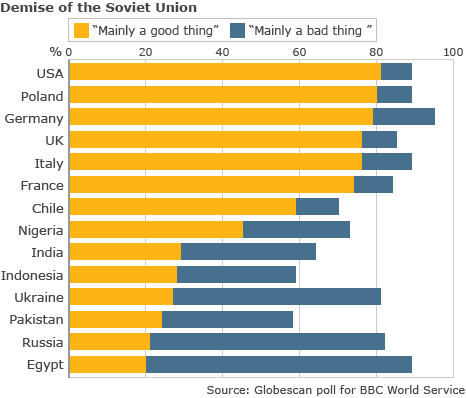
There were also sharp divisions around the world on whether the end of the Soviet Union was a good thing.

Economic regulation

In 1989, as the Berlin Wall fell, it was a victory for ordinary people across Eastern and Central Europe. It also looked at the time like a crushing victory for free-market capitalism.

Twenty years on, this new global poll suggests confidence in free markets has taken heavy blows from the past 12 months of financial and economic crisis. More than 29,000 people in 27 countries were questioned. In only two countries, the United States and Pakistan, did more than one in five people feel that capitalism works well as it stands.

Almost a quarter — 23% of those who responded — feel it is fatally flawed. That is the view of 43% in France, 38% in Mexico and 35% in Brazil. And there is very strong support around the world for governments to distribute wealth more evenly. That is backed by majorities in 22 of the 27 countries.

If there is one issue where a global consensus seems to emerge from the survey it is this: there are majorities almost everywhere wanting government to be more active in regulating business. It is only in Turkey that a majority want less government regulation.

Opinion about the disintegration of the Soviet Union is sharply divided.


Europeans overwhelmingly say it was a good thing: 79% in Germany, 76% in Britain and 74% in France feel that way. But outside the developed West it is a different picture. Almost seven in 10 Egyptians say the end of the Soviet Union was a bad thing and views are sharply divided in India, Kenya and Indonesia.

Source / BBC News

Thanks to Common Dreams / The Rag Blog

Posted in RagBlog | Tagged , , , , , , , , | 7 Comments

The bitter tears of Johnny Cash
The untold story of Johnny Cash, protest singer and Native American activist, and his feud with the music industry

By Antonino D’Ambrosio / November 9, 2009

In July 1972, musician Johnny Cash sat opposite President Richard Nixon in the White House’s Blue Room. As a horde of media huddled a few feet away, the country music superstar had come to discuss prison reform with the self-anointed leader of America’s “silent majority.” “Johnny, would you be willing to play a few songs for us,” Nixon asked Cash. “I like Merle Haggard’s ‘Okie From Muskogee’ and Guy Drake’s ‘Welfare Cadillac.'” The architect of the GOP’s Southern strategy was asking for two famous expressions of white working-class resentment.

“I don’t know those songs,” replied Cash, “but I got a few of my own I can play for you.” Dressed in his trademark black suit, his jet-black hair a little longer than usual, Cash draped the strap of his Martin guitar over his right shoulder and played three songs, all of them decidedly to the left of “Okie From Muskogee.” With the nation still mired in Vietnam, Cash had far more than prison reform on his mind. Nixon listened with a frozen smile to the singer’s rendition of the explicitly antiwar “What Is Truth?” and “Man in Black” (“Each week we lose a hundred fine young men”) and to a folk protest song about the plight of Native Americans called “The Ballad of Ira Hayes.” It was a daring confrontation with a president who was popular with Cash’s fans and about to sweep to a crushing reelection victory, but a glimpse of how Cash saw himself — a foe of hypocrisy, an ally of the downtrodden. An American protest singer, in short, as much as a country music legend.

Years later, “Man in Black” is remembered as a sartorial statement, and “What Is Truth?” as a period piece, if at all. Of the three songs that Cash played for Nixon, the most enduring, and the truest to his vision, was “The Ballad of Ira Hayes.” The song was based on the tragic tale of the Pima Indian war hero who was immortalized in the Iwo Jima flag-raising photo, and in Washington’s Iwo Jima monument, but who died a lonely death brought on by the toxic mixture of alcohol and indifference and alcoholism. The song became part of an album of protest music that his record label didn’t want to promote and that radio stations didn’t want to play, but that Cash would always count among his personal favorites.

* Continue Reading

The story of Cash and “Ira Hayes” began a decade before the meeting with Nixon. On the night of May 10, 1962, Cash made a much-anticipated New York debut at Carnegie Hall. But instead of impressing the cognoscenti, Cash, who had begun struggling with drug addiction, bombed. His voice was hoarse and hard to hear, and he left the stage in what he described as a “deep depression.” Afterward, he consoled himself by heading downtown with a folksinger friend to hear some music at Greenwich Village’s Gaslight Café.

Onstage was protest balladeer Peter La Farge, performing “The Ballad of Ira Hayes.” A former rodeo cowboy, playwright, actor and Navy intelligence operative, La Farge was also the son of longtime Native activist and novelist Oliver La Farge, who had won a Pulitzer Prize for his 1930 Navajo love story, “Laughing Boy.” The younger La Farge had carved out an intriguing niche in the New York folk revival scene by devoting himself to a single issue. “Pete was doing something special and important,” recalls folksinger Pete Seeger. “His heart was so devoted to the Native American cause at a time that no one was really saying anything about it. I think he went deeper than anyone before or since.”

Cash never pretended that music could stay immune from social, but he tried his best to “not mix in politics.” Instead he talked about the things that unite us like the dignity of honest work. “If you were a baker,” he told writer Christopher Wren in 1970, “and you baked a loaf of bread and it fed somebody, then your life has been worthwhile. And if you were a weaver, and you wove some cloth and your cloth kept somebody warm, your life has been worthwhile.”

Raised in rural poverty on the margins of America, Cash empathized with outsiders like convicts, the poor and Native Americans. But his identification with Indians was especially deep — even delusional. During the depths of his early ’60s drug abuse, he convinced himself, and told others, that he was Native American himself, with both Cherokee and Mohawk blood. (He would later recant this claim.)

At the Gaslight, once he had listened to “Ira Hayes’ and La Farge’s other Indian protest tunes, including “As Long as the Grass Shall Grow” and “Custer,” Cash was hooked. “Johnny wanted more than the hillbilly jangle,” Peter La Farge would write later about meeting Cash at the Gaslight. “He was hungry for the depth and truth heard only in the folk field (at least until Johnny came along). The secret is simple, Johnny has the heart of a folksinger in the purest sense.” In fact, Cash had written an Indian folk protest ballad of his own in 1957. “I wrote ‘Old Apache Squaw,'” Cash later explained to Seeger. “Then I forgot the so-called protest song for a while. No one else seemed to speak up for the Indian with any volume or voice [until Peter La Farge].”

Cash, like many in the 1960s, could see that everything that was certain, rigid and hard was breaking apart. Social movements were blossoming. But the thunderous American choir that was singing “We Shall Overcome” and “We Shall All Be Free” drowned out the cry of the loose-knit Native movement. As Martin Luther King and other leaders steered their people toward legislative victories that would further integrate them into a society they were locked out of, the rising tide of Native youth activists wanted something different.

“In my mind, Native people could not have a civil rights movement,” American Indian Movement activist and musician John Trudell says. “The civil rights issue was between the blacks and the whites and I never viewed it as a civil rights issue for us. They’ve been trying to trick us into accepting civil rights but America has a legal responsibility to fulfill those treaty law agreements. If you’re looking at civil rights, you’re basically saying ‘all right treat us like the way you treat the rest of your citizens’. I don’t look at that as a climb up.” Rather than pursue assimilation into the American system, Native American activists wanted to maintain their slipping grip on sovereignty and the little land they still possessed.

By the early ’60s, the burgeoning National Indian Youth Council (NIYC) was attempting to stake its own claim for their equal share of justice. With the expansion of fishing treaty violations and the breach of two major land treaties that led to the loss of thousands of acres of tribal land in upstate New York for the Tuscarora and Allegany Seneca (the story behind La Farge’s “As Long as the Grass Shall Grow”), the NIYC, led by Native activists like Hank Adams, responded by adapting the sit-in protest. Rechristened as the “fish-in,” the NIYC disputed the denial of treaty rights by fishing in defiance of state law. Fish-ins were held in New York and the Pacific Northwest.

The fish-in tactic worked in helping build some public support, but it did little to stop the treaty violations. Instead, the U.S. government ramped up its efforts to crush any momentum the Native movement was building. Oftentimes their tactics were brutal and violent. “This was the time of Selma and there was a lot of unrest in the nation,” remembers Bill Frank Jr. of Washington state’s Nisqually tribe. “Congress had funded some big law enforcement programs and they got all kinds of training and riot gear-shields, helmets. And they got fancy new boats. These guys had a budget. This was a war.”

By 1964, the Native American cause had attracted the interest of another celebrity. On March 2 the NIYC gained national attention as actor Marlon Brando joined a Washington state fish-in. Already an outspoken supporter of the civil rights movement, Brando’s very public support and subsequent arrest for catching salmon “illegally” in Puyallup River helped to boost the Native movement. Brando’s involvement with the Native cause had begun when he contacted D’Arcy McNickle after reading the Flathead Indian’s book “The Surrounded,” a powerful novel depicting reservation life in 1936. Brando’s involvement in Native issues led to government surveillance that lasted decades. His FBI file, bursting with memos detailing possible means of silencing the actor, quickly grew to more than 100 pages.

Three days after Brando’s arrest in Washington, Cash, fresh off the biggest chart success of his career, the single “Ring of Fire,” and having just finished recording a very commercial album called “I Walk the Line,” began recording another, very different album. When Cash left Sun Studios for Columbia in the late 1950s, he believed his rising star would give him the creative capital to produce and record something a little outside the pop and country mainstream — albums of folk music and live prison concerts. He was alternating folky albums like “Blood Sweat and Tears,” a celebration of the working man, with commercial discs laden with radio-ready singles. “Ring of Fire,” which had reached No. 1 on the country charts and had crossed over to pop, had bought him the permission of Columbia to make an album of what he called “Indian protest songs.”

In the two years since Cash had first met La Farge and listened to “The Ballad of Ira Hayes,” Cash had educated himself about Native American issues. “John had really researched a lot of the history,” Cash’s longtime emcee Johnny Western recalled. “It started with Ira Hayes.”

As Cash explained, “I dove into primary and secondary sources, immersing myself in the tragic stories of the Cherokee and the Apache, among others, until I was almost as raw as Peter. By the time I actually recorded the album I carried a heavy load of sadness and outrage.”

But Cash felt a special kinship with Ira Hayes. Both men had served in the military as a way to escape their lives of rural poverty longing to create new opportunities. Plus, both suffered from addiction problems; Cash and his pills and Hayes with alcohol. He decided to anchor the album with “The Ballad of Ira Hayes.” And since the song had provided the spark for Cash’s vision, it just felt right that he should learn more about the song’s subject.

Cash contacted Ira Hayes’ mother and then visited her and her family at the Pima reservation in Arizona. Before Cash left the Pima Reservation, Hayes’ mother presented him with a gift, a smooth black translucent stone. The Pima call it an “Apache tear.” The legend behind the opaque volcanic black glass is rooted in the last U.S. cavalry attack on Native people, which took place on Apaches in the state of Arizona. After the slaughter, the soldiers refused to allow the Apache women to put the dead up on stilts, a sacred Apache tradition. Legend says that overcome by intense grief, Apache women shed tears for the first time ever, and the tears that fell to the earth turned black. Cash, moved by the gift, polished the stone and mounted it on a gold chain.

With the Apache tear draped around his neck, Cash cut his protest album. He recorded five of La Farge’s songs, two of his own, and one he’d co-written with Johnny Horton. All were Native American themed. “When we went back into the studio to record what became ‘Bitter Tears,'” Cash bassist Marshall Grant says, “we could see that John really had a special feeling for this record and these songs.”

Yet the album’s first single, “Ira Hayes,” went nowhere. Few radio stations would play the song. Was the length of the song, four minutes and seven seconds, the problem? Radio stations liked three-minute tracks. Or maybe disc jockeys wanted Cash to “entertain, not educate,” as one Columbia exec put it.

“I know that a lot of people into Johnny Cash weren’t into ‘Bitter Tears,’ ” explains Dick Weissman, a folksinger, ex-member of the Journeymen and friend of La Farge. “They wanted a ‘Ballad of Teenage Queen’ not ‘The Ballad of Ira Hayes.’ They wanted ‘Folsom Prison.’ They didn’t want songs about how American’s mistreated Indians.”

The stations wouldn’t play the song and Columbia Records refused to promote it. According to John Hammond, the legendary producer and Cash champion who worked at Columbia, executives at the label just didn’t think it had commercial potential. Billboard, the music industry trade magazine, wouldn’t review it, even though Cash was at the height of his fame, and had just scored another No. 1 country single with “Understand Your Man” and No. 1 country album with “I Walk the Line.”

One editor of a country music magazine demanded that Cash resign from the Country Music Association because “you and your crowd are just too intelligent to associate with plain country folks, country artists and country DJs.” Johnny Western, a DJ, singer and actor who for many years was part of Cash’s road show, recalls a conversation with “a very popular and powerful DJ.” According to Western, the DJ was “connected to many of the music associations and other influential recording industry groups. He had always been incredibly supportive of John.” Western and the DJ started discussing Cash’s new album and the “Ira Hayes” single. “He asked me why John did this record. I told him that John and all of us had a great feeling for the American Indian cause. He responded that he felt that the music, in his mind, was un-American and that he would never play the record on air and had strongly advised other DJs and radio stations to do the same. Just ignore it until John came back to his senses, is what he told me.”

“When John was attacked for ‘Ira Hayes’ and then ‘Bitter Tears,'” explains Marshall Grant, “it just ripped him apart. Hayes was forced to drink by the abuse and treatment of white people who used and abandoned him. To us, it meant Hayes was being tortured and that’s the story we told and it’s true.”

When “Bitter Tears” and its single did not get the attention he felt they deserved, Cash insisted on having the last word. He composed a letter to the entire record industry and placed it in Billboard as a full-page ad on Aug. 22, 1964.

“D.J.’s — station managers — owners, etc.,” demanded Cash, “Where are your guts?” He referred to his own supposed half Cherokee and Mohawk heritage and spoke of the record as unvarnished truth. “These lyrics take us back to the truth … you’re right! Teenage girls and Beatle record buyers don’t want to hear this sad story of Ira Hayes … This song is not of an unsung hero.” Cash slammed the record industry for its cowardice, “Regardless of the trade charts — the categorizing, classifying and restrictions of air play, this not a country song, not as it is being sold. It is a fine reason though for the gutless [Cash’s emphasis] to give it a thumbs down.”

Cash demanded that the industry explain its resistance to his single. “I had to fight back when I realized that so many stations are afraid of Ira Hayes. Just one question: WHY???” And then Cash answered for them. “‘Ira Hayes’ is strong medicine … So is Rochester, Harlem, Birmingham and Vietnam.”

As Cash later explained, “I talked about them wanting to wallow in meaninglessness and their lack of vision for our music. Predictably enough, it got me off the air in more places than it got me on.” In reality, however, as Cash noted in his letter, “Ira Hayes” was already outselling many country hits. Ultimately, thanks in part to aggressive promotion by Cash, who personally promoted the song to disc jockeys he knew, “Ira Hayes” reached No. 3 on the country singles charts, and “Bitter Tears” peaked at 2 on the album charts.

Later, long after “Bitter Tears,” and after he’d won his battle with drugs, Cash would dial back his claims of Indian ancestry. But he never wavered from his support for the Native cause. He went on to perform benefit shows on reservations — including the Sioux reservation at Wounded Knee in 1968, five years before the armed standoff there between the FBI and the American Indian Movement — to help raise money for schools, hospitals and other critical resources denied by the government. In 1980, Cash told a reporter: “We went to Wounded Knee before Wounded Knee II [the 1973 standoff] to do a show to raise money to build a school on the Rosebud Indian Reservation” and do a movie for “Public Broadcasting System called ‘Trail of Tears.'” He joined with fellow musicians Kris Kristofferson, Willie Nelson and Robbie Robertson to call for the release of jailed AIM leader Leonard Peltier.

Since Cash first recorded “The Ballad of Ira Hayes” in 1964, many musicians have recorded their own versions. Kris Kristofferson is one of those musicians. He summed up the spirit behind Cash’s now nearly forgotten protest album in his eulogy for Cash, who died in 2003. Cash, he said, was a “holy terror … a dark and dangerous force of nature that also stood for mercy and justice for his fellow human beings.” Four years before his famous concert at Folsom Prison, four years before the American Indian Movement formed, and at the pinnacle of his commercial success, Cash insisted on producing an uncommercial, deeply personal protest record that was a close as he could come to truth. He would always cherish it. “I’m still particularly proud of ‘Bitter Tears,'” Cash would say near the end of his life, while talking about the topical music he recorded in the 1960s. “Apart from the Vietnam War being over, I don’t see much reason to change my position today. The old are still neglected, the poor are still poor, the young are still dying before their time, and we’re not making any moves to make things right. There’s still plenty of darkness to carry off.”

[Antonino D’Ambrosio is the author of A Heartbeat and a Guitar: Johnny Cash and the Making of Bitter Tears. Research assistance for this article was provided by the Investigative Fund of the Nation Institute.]


Type rest of the post here

Source /

Source

Thanks to Thomas Cleaver / The Rag Blog

Posted in RagBlog | Leave a comment

History as Politics : Remembering the Berlin Wall

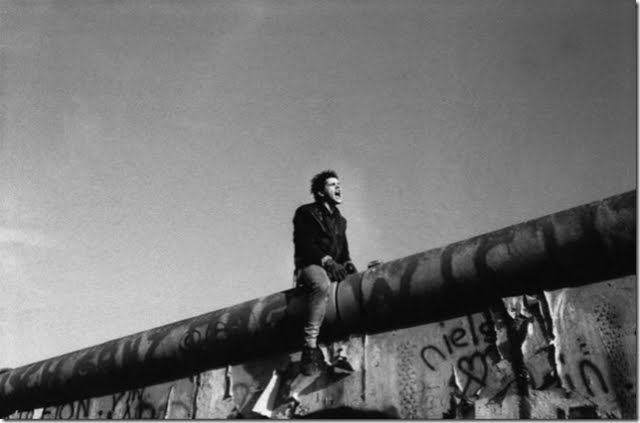
Man straddles Berlin Wall in 1989. Photo from photosfan.com.

History as politics, Politics as history:
Remembering the Berlin Wall

By Harry Targ / The Rag Blog / November 9, 2009

…you are Americans and are meant to carry liberty and justice and the principles of humanity wherever you go, go out and sell goods that will make the world more comfortable and more happy, and convert them to the principles of America.

Woodrow Wilson shortly after the Russian Revolution quoted in L.S. Stavrianos, Global Rift, 1981, 492.

There are two great evils at work in the world today, Absolutism, the power of which is waning, Bolshevism, the power of which is increasing. We have seen the hideous consequences of Bolshevik rule in Russia, and we know that the doctrine is spreading westward. The possibility of proletarian despotism over Central Europe is terrible to contemplate.

Secretary of State Robert Lansing shortly after the Russian Revolution in Stavrianos, 494.

Daniel Barenboim, who was in town the night the Berlin Wall came down in 1989,” … said that “the fall of the wall ‘has changed so much of Europe for the better,’ Barenboim said in an interview at the Berlin Staatsoper, where he is chief conductor. ‘It has given so many thousands, probably millions of people, a better existence’

Catherine Hickley, Washington Post, November 8, 2009

Debasing the Socialist vision

Reflections on the anniversary of the tearing down of the Berlin Wall in 1989 should stimulate a reexamination of the pain and suffering of the twentieth century.

It was a century in which over 100 million died in wars all around the globe (60 million alone in the two World Wars). Nazis killed six million Jews and six million others in Europe: liberals, communists, gays, opponents of genocide of every persuasion. And, during the Cold War years (1945 to 1991) approximately six million Vietnamese and Korean peoples died in wars and hundreds of thousands in Central Europe, Latin American, and South Asia.

The great revolutions of the twentieth century promised a different outcome for humankind: peace, justice, and democracy. Perhaps the biggest disappointment, the gap between the dream and the practice, resulted from the failures of the former Soviet Union. Masses of its citizens died in campaigns to collectivize agriculture and the purge of dissidents.

The regime developed an omnipresent dictatorship and following the revelations about Stalinism evolved into an autocratic state driven by top down bureaucracy. In addition, the Soviet Union would not tolerate political independence from the Socialist states of Eastern Europe, invading both Hungary and Czechoslovakia to crush reform movements. So from this vantage point, the tearing down of the Berlin Wall was cause for celebration.

But history is complicated

However, as the sentiments of President Wilson and his Secretary of State suggest, the United States as superpower emerged from World War I to embark on a global campaign to crush the new Soviet Union economically. As we know, the United States, along with a dozen other nations sent troops into the Soviet Union to help counter-revolutionaries overthrow the new Bolshevik regime.

In subsequent years, until 1933, the United States refused to recognize the Soviet Union. Western powers watched as Germany rearmed and expanded its control across the heartland of Europe. Italian fascist armies and German airpower were used to destroy democratic Spain, again with the United States and the British on the sidelines.

After the war, the Truman Administration launched a “cold war,” against the Soviet Union. It transferred resources to Western Europe to rebuild the capitalist part of it. It unleashed covert operators to infiltrate trade unions and political parties in Europe and Latin America and began beaming propaganda and sending operatives into Eastern Europe to undermine Soviet influence.

Germany was the centerpiece of this new global struggle. As the source of military forces that killed 27 million Soviet citizens in World War II, the status of Germany became most critical to the Soviets. And for the United States a reindustrialized, remilitarized Germany would constitute the centerpiece of the campaign to fight Communism and promote capitalism on the world stage.

Ironically, the Cold War started over Germany and could have ended there with a mutually derived agreement to create a neutralized and united Germany (much as was agreed to in Austria). But western diplomats ignored Soviet offers to negotiate the creation of such a Germany.

Without revisiting all the critical points of contestation between the East and the West, it is important to make clear that the Soviet Union, the weaker of the two “superpowers,” was targeted for challenge and defeat by every United States administration from 1917 to 1991. This cost both countries and their allies trillions of dollars in military spending and millions of lives.

The Soviet Union had something to do with social change

There were some positive developments during the Cold War years for which the Soviet Union may have made a contribution.

In 1945 most of Africa was still living under the yoke of colonialism. The British, French, Dutch and others still controlled territories and peoples in Asia. The Chinese were mired in a violent civil war. And all of Latin America was “in the backyard” of the United States. Within thirty years all this had changed. Africa achieved its independence, the Communist movement came to power in China, Indochina was freed from French and then American colonialism, and the Cuban revolution provided a beacon of hope for peoples living in the Western Hemisphere.

The Soviet Union provided arms, economic assistance, technical assistance, and inspiration for those seeking independence and economic development. Further, and this may be the most important point, the Soviet Union served as a check on the unbridled expansion of military and economic power of the United States and the Western alliance.

What if the Soviet Union had not collapsed?

Of course, we can never know what might have happened since 1991 if the Soviet Union, after its Eastern European allies, had not collapsed. But we do know what has happened. And we can make educated guesses about what might have happened in a world in which a power competitive in military, economic, and ideological resources with the West still existed.

First, the Gulf War might not have occurred in the way it did, (While the Soviet Union did collaborate with President George Herbert Walker Bush in the fall, 1990, on Gulf War policy, the collaboration was from a position of considerable marginalization). For sure, the Soviet Union would have waged a propaganda war against the U.S. military operation and the economic embargo of Iraq and bombing campaigns that continued throughout the 1990s and, particularly, the second war on Iraq in 2003.

Probably, in the bipolar world of the Cold War, the United States would not have been able to launch a war on Afghanistan and continue it for eight years.

And what about the global economy? Neoliberal globalization, initiated in the 1980s but expanded to every corner of the globe in the 1990s, would have been checked by Soviet influence and arguments about overweening reliance on the “free market.” The mal-distribution of wealth and income might not have been as grotesque as it has become if there had been a Soviet Union critiquing International Monetary Fund and World Bank policies.

Without exaggerating the influence or good intentions of a surviving Soviet Union, I would argue that the world since 1991 might have been different; particularly given the hundreds of thousands who have died in war since 1991 and the devastating impacts of growing economic inequality.

And back to Germany

Bruni de la Motte in the Guardian, Nov. 8, 2009, reported that the collapse of the former German Democratic Republic and its integration into West Germany led to social breakdown of society, widespread unemployment, “crass materialism,” the privatization of public enterprises, farms and forests, and two million lost homes. Hundreds of thousands of professional workers including teachers and professors lost their jobs and were blacklisted because they had been credentialed in the old regime.

There is no question, as one U.S. trade unionist once said to me, the former Soviet Union and the GDR were not “workers’ paradises” but they provided basic economic security to workers. That has long since been lost most places around the world.

And about history

It is a common place now to repeat the old adage: “History is written by the winners.” Old adage or not, the celebration of the twentieth anniversary of the tearing down of the Berlin Wall is being orchestrated by the same kinds of imperial voices that have been raised for almost one hundred years now.

As contentious as it might be, it is time for progressives to revisit the history of the Cold War in a way that is not chauvinistic and self-serving and does not justify current and future wars.

[Harry Tarq is a professor in American Studies who lives in West Lafayette, Indiana. He blogs at Diary of a Heartland Radical, where this article also appears.]

The Rag Blog

Posted in Rag Bloggers | Tagged , , , , , , , , | 1 Comment

Development: US fails to measure up on ‘human index’

Nation slumps from 2nd to 12th in global table
· Richest fifth take home $168,000, poorest $11,000

* Buzz up!
* Digg it

* Ashley Seager
* The Guardian, Thursday 17 July 2008

Despite spending $230m (£115m) an hour on healthcare, Americans live shorter lives than citizens of almost every other developed country. And while it has the second-highest income per head in the world, the United States ranks 42nd in terms of life expectancy.

These are some of the startling conclusions from a major new report which attempts to explain why the world’s number-one economy has slipped to 12th place – from 2nd in 1990- in terms of human development.

The American Human Development Report, which applies rankings of health, education and income to the US, paints a surprising picture of a country that spends well over $5bn each day on healthcare – more per person than any other country.

The report, Measure of America, was funded by Oxfam America, the Conrad Hilton Foundation and the Rockefeller Foundation. It shows each of the 11 countries that rank higher than the US in human development has a lower per-capita income.

Those countries score better on the health and knowledge indices that make up the overall human development index (HDI), which is calculated each year by the United Nations Development Programme.

And each has achieved better outcomes in areas such as infant mortality and longevity, with less spending per head.

Japanese, for example, can expect to outlive Americans, on average, by more than four years. In fact, citizens of Israel, Greece, Singapore, Costa Rica, South Korea and every western European and Nordic country save one can expect to live longer than Americans.

There are also wider differences, the report shows. The average Asian woman, for example, lives for almost 89 years, while African-American women live until 76. For men of the same groups, the difference is 14 years.

One of the main problems faced by the US, says the report, is that one in six Americans, or about 47 million people, are not covered by health insurance and so have limited access to healthcare.

As a result, the US is ranked 42nd in global life expectancy and 34th in terms of infants surviving to age one. The US infant mortality rate is on a par with that of Croatia, Cuba, Estonia and Poland. If the US could match top-ranked Sweden, about 20,000 more American babies a year would live to their first birthday.

“Human development is concerned with what I take to be the basic development idea: namely, advancing the richness of human life, rather than the richness of the economy in which human beings live, which is only a part of it,” said the Nobel laureate economist Amartya Sen, who developed the HDI in 1990.

“We get in this report … an evaluation of what the limitations of human development are in the US but also … how the relative place of America has been slipping in comparison with other countries over recent years.”

The US has a higher percentage of children living in poverty than any of the world’s richest countries.

In fact, the report shows that 15% of American children – 10.7 million – live in families with incomes of less than $1,500 per month.

It also reveals 14% of the population – some 40 million Americans – lack the literacy skills to perform simple, everyday tasks such as understanding newspaper articles and instruction manuals.

And while in much of Europe, Canada, Japan and Russia, levels of enrolment of three and four-year-olds in pre-school are running at about 75%, in the US it is little more than 50%.

The report not only highlights the differences between the US and other countries, it also picks up on the huge discrepancies between states, the country’s 436 congressional districts and between ethnic groups.

“The Measure of America reveals huge gaps among some groups in our country to access opportunity and reach their potential,” said the report’s co-author, Sarah Burd-Sharps. “Some Americans are living anywhere from 30 to 50 years behind others when it comes to issues we all care about: health, education and standard of living.

“For example, the state human development index shows that people in last-ranked Mississippi are living 30 years behind those in first-ranked Connecticut.”

Inequality remains stark. The richest fifth of Americans earn on average $168,170 a year, almost 15 times the average of the lowest fifth, who make do with $11,352.

The US is far behind many other countries in the support given to working families, particularly in terms of family leave, sick leave and childcare. The country has no federally mandated maternity leave.

The US also ranks first among the 30 rich countries of the Organisation of Economic Cooperation and Development in terms of the number of people in prison, both in absolute terms and as a percentage of the total population.

It has 5% of the world’s people but 24% of its prisoners.


Type rest of the post here

Source /

The Rag Blog

Posted in RagBlog | Leave a comment

Mexico : Drug Decrim and the 10,000-Ton Monkey

Pot smoker in Mexico City. Mexicans consume an estimated 342 tons of marijuana a year. Photo by Castillo / AP.

Legalization is the only answer…
Mexico’s massive drug problem

As poet Juan Pablo Garcia posited long ago in his 1985 Pacheco (marijuana user) Manifesto: ‘drugs don’t make us criminals but laws against drugs do.’

By John Ross / The Rag Blog / November 9, 2009

MEXICO CITY — Mexico has a 10,000 ton monkey on its back and its name is Washington D.C.

While U.S. drug enforcers gloat that 15-foot walls, high tech sensors, drones, blimps, spotter planes and rampant militarization have put a significant dent in the flow of cocaine across its porous southern border, drug use escalates exponentially south of that border. The reason: Colombian-Mexican cartels are now holding their loads longer in Mexico, waiting for the appropriate arrangements to be made to move the blow into El Norte.

Inevitably, the cocaine and to a lesser extent crystal meth and heroin (marijuana is readily available in the U.S., the world’s largest producer of the weed) leak into the Mexican street where fierce competition for sales and consumption is out of control. As a result, over 13,000 lives have been lost since President Felipe Calderon went to war with the drug cartels in December 2006, many of them in turf battles over trans-shipment routes and retail sales in Mexican cities.

Moreover, in the three years of Calderon’s drug war, which is being underwritten by $3,000,000,000 in Washington’s Merida Initiative funds, the number of “addicts” on this side of the border has risen by 460,000 and now totals almost a million, according to the estimates provided by the National Council on Addictions, and first-time users have jumped from 3.5 million to 4.5 million — some drug experts calculate that 10 million would be closer to the mark, depending on definitions of “user” and “addict.” One dangerous corollary: the Mexican prison system is bursting apart at the seams and lethal violence is on the rise.

Among long-time observers of Mexican drug wars, there are some, this writer included, who suspect that Washington’s militarization of the border and the consequent user boom here was a well-thought out strategy concocted by U.S. drug fighters to force its proxies in this distant neighbor nation to engage and confront the cartels. Viewed from this perspective, the thousands of dead on the ground here are simply cannon fodder in the U.S. War on Drugs initiated by Richard Nixon in 1969, officially declared by Ronald Reagan in 1985, and zealously executed by four U.S. presidents ever since. Barack Obama, a prohibitionist who likens Felipe Calderon to Al Capone’s nemesis Elliot Ness, is only the latest puppet-master in this grotesque dance of death.

Partners in the Drug War: Presidents Calderon and Obama.

With jails exploding — prison riots are reported at least once a week — the Calderon administration has moved to tamp down dangerous overcrowding by “decriminalizing” the possession of small quantities of illicit drugs. This past August 21st, the Mexican president signed off on legislation that gives users and “addicts” (as health officers prefer to lump them) the option of treatment or prison if arrested with small amounts of drugs for personal use — two grams of marijuana (about four skinny joints), a half gram of cocaine, 40 milligrams of meth amphetamines, and 10 milligrams of heroin. Instead of immediate imprisonment, the drugs will be confiscated and the user/addict booked and fingerprinted and their biometrics recorded in a national registry of “addicts.”

Those pulled in are then released with the obligation of enrollment in government treatment programs that are still not operational. If the user/addict fails to show up for treatment or is arrested a third time, prison time is prescribed.

Those nabbed with larger amounts, calculated at a thousand times the minimum quantities, are automatically assigned to terminally overcrowded state prisons as “traffickers” — “traffickers” arrested with any amount over the higher quantities are sent to maximum security federal penitentiaries as kingpins.

There is no middle ground in this schema notes science writer Javier Flores in the national daily La Jornada: one is either a user/addict or a narcotraficante.

The Mexican congress passed similar legislation in 2006 during the waning days of Vicente Fox’s presidency but when the measure hit his desk, the red telephone rang and George W. Bush was on the line threatening grave repercussions if Fox did not veto the decrim bill – which, of course, he did.

What has decrim meant on the streets of Mexico City? A few weeks ago, my friend Xochi (not her real name), a street dealer who makes house calls, and this writer visited a sick friend — Xochi brought along a bag of medicinal marijuana and I some cannabis cookies. The conversation turned to Calderon’s recently promulgated decrim and we consulted our offerings to determine if we were users, “addicts,” or kingpins. It goes without saying that we were criminally over the limit but fortunately the local gendarmes did not bust down the door.

According to Xochi, decrim is turning into a bonanza for Mexico City cops who have taken to carrying scales to weigh confiscated drugs and shaking down those “criminals” who exceed the decreed limits. Shaking down small-time users and dealers is nothing new in this the most corrupt, crime-ridden, and conflictive city in the western hemisphere. Indeed, crooked cops have been planting drugs on unwary citizens as long as cops have patrolled these mean streets. Long before decrim was a gleam in Calderon’s eye, those “found” with drugs in their possession did not immediately go straight to jail if they could come up with the “mordida” (literally “bite” or bribe) to get the cops off their backs.

As poet Juan Pablo Garcia posited long ago in his 1985 Pacheco (marijuana user) Manifesto: “drugs don’t make us criminals but laws against drugs do.”

Overwhelmed by millions of users, addicts, narcotraffickers, and kingpins, Calderon has turned to God for relief. Young people who use drugs do not have God in their (miserable) lives, he explained to Catholic bishops attending a family crisis conference last month, citing the recent death of pop idol Michael Jackson as an example — although there is no evidence that Jacko did not believe in God or was even a user/addict (the official autopsy concluded that Michael was overdosed by a doctor with a lethal anesthetic.)

The president’s hypothesis was promptly shot down on editorial and op-ed pages all over the country. Aside from increased availability in Mexico thanks to Washington’s worldwide crusade against demon drugs, critics pinned the dramatic increase in users-“addicts” on a battered economy in which more than 2,000,000 workers have lost their jobs in the past year as a more pertinent explanation of the boom. With nearly a million young people entering the job market each year, Calderon, who once billed himself as “the president of employment,” has floundered badly as a job creator. On the other hand, drug cropping and retail street dealing (“narcominudeo“) provide gainful employment for millions of kids without jobs.

Prison riots are reported at least once a week. This one, in Tijuana on Sept. 18, 2009, left 19 killed and a dozen wounded.

In fact, there are multiple indicators that drug users, dealers, “addicts”, and kingpins do have God in their (miserable) lives. “We, the Marijuanos, are Guadalupanos (devotees of the Virgin of Guadalupe) not goddamn communist whores,” Juan Pablo Garcia wrote in his Pacheco Manifesto. Narcotraficantes are celebrated for their devotion to their faith, buying Masses, hiring priests for baptisms and weddings and funerals and even building churches. Drug money — “narco-limosnas” (drug alms) are a significant component of Church finances, concedes Bishop Carlos Aguiar Retes, president of the Mexican Bishops Conference (CEM.) For the Catholic Church, explains Aguascalientes bishop Ramon Godinez, turning illegitimate gains into good works is perfectly pardonable.

Although cocaine and meth (Mexico does not produce much heroin) are considered to be killer drugs, reefer madness is alive and kicking south of the border. Mexicans consume 357 tons of drugs annually, advances Secretary of Public Security Genero Garcia Luna, of which marijuana accounts for 343. Marijuana is considered a dangerous drug by crusaders like Garcia Luna and his boss Calderon and those who use it are considered “addicts” in need of “treatment” — actually Mexican marijuana is typically punchless and low in THC content when compared to hot house-grown, high-potency strains in the U.S. where cannabis is considered to be medicinal in some states. What makes treatment propositions even more absurd is that there are no treatment centers to accommodate newly decriminalized pot smokers.

For hard-core addicts desperate to get off the crack pipe or the needle, public detox clinics have been stripped back to the bone. While wealthy user/”addicts” sign themselves into deluxe spas to detox, the poor have few options. Like every other public service the Calderon government is charged with providing, drug treatment has been privatized under the prevailing neoliberal economic model.

Evangelical churches run treatment programs in many working class colonies that force addicts to go cold turkey. Corporal punishment and the Word of God are means of coercion to get young people off drugs.

The drug gangs themselves run their own treatment programs for street dealers that get hooked on the goods they push according to one Ciudad Juarez pistolero Julio Cesar Aleman, a member of a hit squad known as “The Artists of Assassination,” enforcers for the Sinaloa cartel, who are charged by federal authorities with a total of 45 killings — 28 of them at two treatment homes in that Gran Guignol border city. La Linea (a rival drug gang) gets them off drugs, fattens them up, and sends them back out on the street to deal,” he explained to police agents to justify the homicidal assaults.

Decriminalizing drugs in a country through which 80% of the U.S. cocaine supply passes (Drug Enforcement Administration estimates) changes little in Mexico so long as it borders the biggest drug market on the planet. Even as decrim takes root north of the border, more than 800,000 Americans were arrested for possession of marijuana in 2008 according to Ethan Nadelman of the Drug Policy Institute. Legalization and not decrim is the only answer.

Drug reform is catching on in Latin America. In addition to Mexico’s feeble and misplaced efforts at providing alternatives to incarceration, Argentina courts recently ruled that personal possession of marijuana is not criminal. In Colombia, decriminalization of small amounts of cocaine has been the law since the 1990s. In Bolivia, President Evo Morales champions the medicinal properties of the coca leaf, the source of powdered cocaine, and endorses the industrialization of the plant. At a 2008 drug policy conference in Brazil, former presidents Fernando Henrique Cardoso, Cesar Gaviria of Colombia, and Ernesto Zedillo, the squarest Mexican president to ever administrate the affairs of this country, declared that the prohibitionist approach had failed.

So has decrim. The 10,000-ton monkey is not going to get off Mexico’s back until drugs are legalized everywhere in the Americas, including the United States. As the godfather of Jamaican ganja reggae Peter Tosh croons “Doctors smoke it, nurses smoke it, even judges smoke it, and lawyers too: Legalize It! Don’t Criticize It! Legalize It! Don’t Criminalize It!”

Or decriminalize it either.

[John Ross will present his just-published (Nation Books) cult classic, the monstrous El Monstruo — Dread & Redemption in Mexico City, Friday the 13th at Northtown Books in Arcata, CA (7 p.m.); Wednesday, Nov. 18th at Modern Times Bookstore in San Francisco’s Mission District (7 PM); and Nov. 19th at UC-Berkeley’s Center for Latino Policy Studies (3:30 PM.) Admission to all three events is gratis.]

The Rag Blog

Posted in Rag Bloggers | Tagged , , , , , | 18 Comments

Surprise! : Betrayal in Honduras as ‘Golpistas’ Ignore Accord

Manuel Zelaya closes a window at the Brazilian embassy in Tegucigalpa. Photo from AFP.

Celebration was premature;
United States expresses ‘disappointment’

…negotiating with the golpistas for reinstatement of the democratically elected president is like negotiating with thieves for the return of stolen property.

By David Holmes Morris / The Rag Blog / November 8, 2009

See David Morris’ translations of articles by Arturo Cano and Pablo Ordaz, Below.

Within a week of the signing of the agreement that was to end the four-month political crisis in Honduras, the de facto government has betrayed its purpose and the constitutional government has given it up as one last failed attempt to undo the coup d’état.

The Tegucigalpa/San José Accord, signed on October 29, was the result of three weeks of negotiation between representatives of de facto president Roberto Micheletti and democratically elected President Manuel Zelaya. It appeared at first to solve the thorny issue of Zelaya’s restitution by approving it in principle and leaving final approval to the country’s unicameral legislature, thus confirming, symbolically at least, that Zelaya had been removed from office in a coup d’état and not as punishment for criminal acts, as the coup government had claimed.

But delaying resolution of the crisis until after the November 29 elections has been the golpistas’ plan all along and the congressional leadership was more than willing to further the plan. It decided to consult with the Supreme Court and several other institutions before calling a special session of the legislature to consider restitution, a process that could easily stall any action until the next president is elected three weeks from now. The Accord did not establish a deadline for restitution.

In the meantime, Micheletti ceremoniously fulfilled the letter of another provision of the Accord by forming, unilaterally, a government of “national unity and reconciliation” by the deadline established in the Accord. Zelaya refused to submit names for the new government because, he argued, the spirit, if not the letter, of the Accord called for him, as constitutional president, to preside over such a government. Zelaya calls Micheletti’s move crass manipulation, dismisses the Accord as a failure and calls for boycotting the elections and for protests in the streets to continue.

What is left unsaid in official circles is that negotiating with the golpistas for reinstatement of the democratically elected president is like negotiating with thieves for the return of stolen property.

Journalist Arturo Cano has been reporting on events in Honduras for La Jornada of Mexico City since the crisis began. The following is my translation of an article of his published on November 6. Following that is an article from El País of Madrid by Pablo Ordaz about ordinary people in Honduras struggling to survive in bad and worsening circumstances.

Zelaya declares that ‘the Accord is now worthless’

TEGUCIGALPA, Nov. 6, 2009 — The golpistas say everybody condemns them because nobody knows what was really going on in Honduras before June 28. Last week, when everybody thought they knew, as they celebrated the signing of an agreement that, according to news media all over the world, would end more than four months of crisis, it turned out that the golpistas were right: nobody knows what is going on in Honduras.

How else can we explain why, a week after the Tegucigalpa/San José Accord was signed, the United States feels “disappointed” and the Organization of American States “deplores” the “disruption” of compliance with the Accord?

From Washington, OAS Secretary General José Miguel Insulza urges Roberto Micheletti and Manuel Zelaya to reach an agreement on the government of “unity and reconciliation,” which “should be presided over, naturally, by the person the Honduran people elected to carry out the duties of the president of the republic.”

The Union of South American Nations demands the “immediate restitution” of Zelaya and the foreign ministers of Latin America and the Caribbean condemn golpista Micheletti’s unilateral appointment of a cabinet of “national unity.”

The de facto president doesn’t even lose his composure. Night falls in the midst of warnings of the “imminent” appointment of the new cabinet and of threats against anyone daring to organize a boycott of the electoral process.

In practical terms, the only opinion that matters to the de facto government is broadcast time and again on the official television channel: an interview with U.S. Assistant Secretary of State Thomas Shannon, who says Zelaya’s restitution, or otherwise, is the “business of Hondurans.” News shows on the private channels also play it over and over again.

Micheletti appears on television with renewed vigor, happy, accompanied by all his officials, those who are leaving and those who are staying, since even his own office has leaked the names of the ministries in which there will be no change: the ministries of the presidency, foreign affairs, finance, agriculture, defense and security.

Twenty-three days before they are to occur, the elections are the topic of the headlines and of most of the space in all the news media. The golpista government and the media owners who support it don’t doubt that the United States will recognize the elections. By their priorities, the rest of the countries of the world are in a distant second place.

The zelayistas and all those who celebrated the Accord a week ago had placed their trust in the existence of “two Accords, one written and one understood,” Marvin Ponce of the Partido Unificación Democrática explained three days after the signing. “The businessmen and the politicians who orchestrated the coup accepted Zelaya’s restitution because otherwise they would be back at point zero. Now we’ll see whether there is the political will.”

Demonstrators supporting Manuel Zelaya shout slogans in Tegucigalpa, Nov. 2, 2009. Photo by Eduardo Verdugo / AP.

Congress received the document, which had been signed on October 30, on Monday, November 2. Its governing board, controlled by Micheletti’s congressmen, decided on its own to consult the Supreme Court and three other institutions. The justices didn’t receive the petition until Thursday the fifth. “We have acted with the greatest diligence,” says congressional chairman José Alfredo Saavedra.

“The measures agreed to in the Accord are clear and were endorsed freely by all the parties. I would hope that they will be implemented without further evasion in order to re-establish democracy, institutional legitimacy and harmony among Hondurans,” Insulza declared in a statement issued from the U.S. capital.

They don’t see it that way here. “I don’t know why they signed that. They left their flanks exposed,” says a leader of the resistance, his head bowed, his face revealing the mood of the zelayistas, still in the streets for the 131st day since the coup d’état.

The Frente de Resistencia meets again in front of Congress, which isn’t meeting, and then more than 500 people march to the area of the Brazilian embassy, where President Zelaya is in refuge.

“I don’t want Afghan elections for my country,” the constitutional leader tells Radio Globo. “I’m not willing to legitimize fraud or to legitimize the imposition of power or to whitewash this coup d’état.”

His followers in the streets radicalize the discourse: “It’s not a simple matter of not voting. Just as they took the ballot boxes from us (for the poll on the Constituent Assembly) on June 28, we must take the ballot boxes from them as well,” says indigenous leader Salvador Zúñiga.

Although some of the zelayistas, particularly those who are members of the Partido Liberal, hold to the idea of “not leaving the whole cake for the golpistas,” the more active organizations in the resistance have decided not to endorse “the electoral fraud.” From this day forward, “politicians are forbidden from entering our neighborhoods and communities and we are going to forbid them from setting up polling places,” Zúñiga says.

Zelaya, for his part, declares that “the Accord is now worthless” and he rejects it as a failure. His representatives nevertheless still hold meetings with OAS officials, although without much hope for a solution.

The president reaches out again to the continental community. “Let them reach the decisions they consider suitable,” he says of the members of the OAS.

But the voice that matters most sticks with the talks, which favor the golpistas. Ian Kelly, spokesman for the State Department, urges the parties to return to the negotiating table to work out their differences.

“A unilaterally decided government is not a government of unity,” he says of Micheletti’s move. “They have to sit down and start talking again. They need to stop making dire statements that the agreement is dead,” he blurts out against Zelaya. “We’re disappointed that both sides are not following this very clear path which has been laid out in this accord.”

He confirms for certain that Washington is giving technical assistance for the November 29 elections, which will continue as long as “the paties respect and implement this accord, step by step.”

And Pablo Ordaz, a correspondent in Tegucigalpa for the Madrid daily El País describes how the coup has changed the lives of one family. Below is my translation of his article for November 7.

Ángel David’s life, which hadn’t been good, began to get worse

Angel David and his mother show scar from police gunshot wound. Photo from El Pais.

TEGUCIGALPA, Nov. 5, 2009 — Since before the coup, Ángel David has lived in this neighborhood in Tegucigalpa where the only green, level ground is in the cemetery, so the kids take advantage of a hole in the wall to play soccer or hide-and-seek among their grandparents’ graves. Ángel David’s outlook wasn’t very promising. He shared eight square meters in a wooden shanty with his father, an out-of-work gardener, his mother, newly pregnant with her fifth child, and his brothers, the oldest 16 and the youngest two. They hadn’t had a bathroom since the last storm washed it down the hill, but they did have electricity and a telephone, a good upbringing and miraculously clean clothes.

But the coup came along and Ángel David’s life, which hadn’t been good, began to get worse. His country, the second poorest in Latin America, became the object of sanctions by the international community and its 70 percent poor (40 percent getting by on less than a dollar a day) became even more helpless. Ángel David’s father found ever less work. His mother, ever less money to juggle. And he, ever fewer hours in school. As though that were not enough, on the days when Roberto Micheletti’s government declared a curfew, they all had to take off running for fear of the police. They got home on time every day, until September 21.

On that day a rumor spread throughout Honduras that President Manuel Zelaya had managed to return in secret to his country. To celebrate, his supporters called for rallies in different areas of Tegucigalpa and Ángel David’s father decided to attend the one in the February 21st Colonia, next to his own neighborhood. On the way home, as the hour of the curfew approached, they took a shortcut through an alley. They were startled by the noise of a motorcycle approaching them. They turned around. There were two policemen riding it. The one in back aimed at them.. Five shots were heard. Ángel David, 13 years old, fell to the ground. With a gunshot wound in his back.

A month and a half has gone by. The taxi driver makes his way into the June 23rd Colonia. The vehicle can hardly move along among the rocks — the only paved street is long gone — and for fear of the groups of boys hanging out on the corners. At a certain point we can’t go on by car. His mother, Nelly Rodríguez, invites us into her only room, which is orderly and clean, and proudly introduces her sons, who are well brought up and well dressed. Her account of what happened is exact and concise and it portrays with no embellishment the reality of Honduras since the coup. “My husband and my sons were walking along, and the police could see that there were two children, but even so they shot at them. The bullet injured his intestine, his colon, his spleen, his liver and part of his lung too. Show the gentleman the scar.”

Ángel David stands up obediently. He has the mark of the gunshot on his back and a large scar from the surgery. What did you feel at that moment? “Agony, sir.” And pain? “That too.” And did you lose consciousness? “Yes.” What is agony? “Thinking that you’re going to die.” And were you afraid? “Yes.” And did you cry? “No.”

Nelly Rodríguez continues her account. “They performed an emergency operation. He almost died. The operation lasted three hours and he was in a coma for about five days. Until finally he opened his eyes and began to talk to me. He had oxygen and many drugs that they gave him at the teaching hospital. But since they didn’t have all the drugs he needed, we had to buy them ourselves. They didn’t even have needles or adhesive tape or cotton. Not even plasma.”

What followed reveals the degree to which defenders of the coup have persecuted those who resist. “One day a public prosecutor came and told me, ‘Look, I work for the rights of minors and you are at risk of losing your children because it wasn’t the policeman who shot at him who is to blame for what happened to your son, it is you.’ She told me I was the guilty one.” Nelly begins to cry, a slow and quiet sobbing that is touching. The kids around her pay attention. “And she told me that while my son was in a coma, right there, by his bed. Yes. She told me the policeman wasn’t guilty, I was.” Nelly was threatened with the loss of her son until the organization COFADEH, which is concerned with the families of the detained and disappeared in Honduras, came to her assistance.

Ángel David’s story is one of hundreds of dramatic cases. According to UNICEF, “1,600 Hunduran children under the age of five have died since June 28, 2009, at the rate of 13 children a day.” Malnutrition and very poor attention to health conditions in the face of epidemics like haemorrhagic dengue are some of the causes. Every day, some 60 children are taken to the Tegucigalpa hospital afflicted with that disease. But there is no means of treating them. All of this in the midst of a wave of violence that leaves 14 dead every day and an endless number of illegal detentions.

It is true that life in Honduras before the coup was not good, but now it is worse. Right, Ángel David?

[San Antonio native David Holmes Morris is an army veteran, a language major, a retired printer, a sometime journalist, and a gay liberationist.]

  • For previous Rag Blog coverage of Honduras, go here.

The Rag Blog

Posted in Rag Bloggers | Tagged , , , , , | 2 Comments

Through the Gate in ’66 : Howling Wolf Au Go Go

Chester Arthur Burnett, aka Howling Wolf.

When I was sixteen:
Hitting the Village with my grandfather

Wolf sang every song to the pretty hippie boy sitting directly in front of me, who turned out to be Davy Jones of the Monkees.

By Carl R. Hultberg / The Rag Blog / November 8, 2009

When I was sixteen I made a fateful trip to New York City to visit my grandfather, Jazz critic Rudi Blesh. Rudi lived off the Bowery and in the Village he was in his element.

Guiding me out into the New York night he brought me to this brightly lit venue on Bleecker Street. As we entered the dark nightclub and went to the table an amplified voice from a little booth quietly announced Rudi’s entrance. The pianist on stage (Erroll Garner?) quickly segued into a little bit of Trad Jazz (Memories of You?) and a little Ragtime bit. Perhaps even a spotlight might have found us at the table.

At any rate, I was mortified and on pretense of finding the men’s room I slipped out of the club. It was 1966 man, what did I need to be listening to Jazz for?

Coming on a little hole in the wall I realized it was the Night Owl, no longer a real cafe, just a poster shop. Still a teenage band was working out right at eye level. It was probably James Taylor, Danny Kortchmar and the original Flying Machine but it wasn’t the Lovin’ Spoonful so I got out of there with my $5 intact before they hit me for a charge.

Across the street down a flight of stairs was the Cafe au Go Go. The shill at the door was looking to fill some tables. “How much you got?” I told him $3 and he motioned to a second row table. The first act was the Siegal Schwall Blues Band. Having heard the Butterfield unit I wasn’t too impressed. Still they tried hard. The next guy who stumbled onto the platform was none other than Tim Hardin. This was important for me and I was floored, despite the fact that it was a short set and Tim didn’t really seem totally awake.

Art D’Lugoff at the Village Gate. Photo by Béatrice de Géa for The New York Times.

The next act took some time to set up on the main stage. What I got to see and hear next was none other than Howling Wolf with his band. The man sat in a chair with his microphone and harmonicas singing while his sharkskin suited accompianists played flawless electric Blues dancing side to side in lockstep behind him. Wolf sang every song to the pretty hippie boy sitting directly in front of me, who turned out to be Davy Jones of the Monkees.

There really are no words to describe this set for me. Pulling out of the club hours later and returning to the East 4th Street pad I had to smooth things over after ditching Rudi. Telling him I’d seen Howling Wolf didn’t hurt.

The man who’d announced Rudi’s entrance at the Village Gate was owner Art D’Lugoff. The club closed a few years ago (it’s now a CVS drugstore). Art himself passed away this week. He was eighty five years old.

The Rag Blog

Posted in Rag Bloggers | Tagged , , , , , , , | 2 Comments