BushCo: It Was Worse Than We Thought


Bush Admin. Worse Than Our Nightmares
By Juan Cole / August 21, 2009

It was worse.

Back in the bad old days of Bush’s corrupt gang, we on the left were pilloried for suggesting that the administration was manipulating terrorism-related news in order to win the 2004 elections. But when Tom Ridge says it ….

In fact, I argued in summer, 2004, that when Ridge did raise the terrorism alert, it had the unfortunate effect of outing an al-Qaeda double agent who had been turned by the Pakistani government and was helping set a trap for al-Qaeda in the UK. In turn, that caused the British government to have to move against the people it had under surveillance prematurely, harming the case.

Ridge is alleging he was pressured on the eve of the election. But I still wonder about the circumstances of the summer announcement. He might have been being used then, too, and not known it.

And if any of us had said that Dick Cheney was setting up civilian mercenary assassination squads (at least 007 works for the British government), and set things up so that perhaps neither the CIA director nor the president even knew about it, we would have been branded moonbats. But well, that is today’s story.

You shudder to think what hasn’t come out yet.

If Bush and his gang falsely put up the terror alert or even tried to, for partisan political gain, that is a sort of treason. If they thereby ruined a British surveillance operation, they recklessly endangered US and NATO security. If they were arranging for civilian mercenaries to murder people . . . well you’d have to say that they were at least planning to be murderers. (The wingnuts will say that Xe was only being contracted to kill al-Qaeda types; but the wingnuts wouldn’t be able to tell a Barelvi from an al-Qaeda supporter if their lives depended on it, and I wouldn’t exactly trust Mr. Prince to be fair to Muslims.)

The horrible thing is that Wolf Blitzer on CNN assembled David Frum and Frances Townsend, former members of the Bush administration, to sit around on his afternoon news and analysis program on Thursday afternoon and more or less either call Ridge a liar or pooh-pooh the significance of what he is saying. There wasn’t a single centrist or left of center voice to show any outrage. I mean, I know that Time Warner is not made up of people who necessarily care about the little person or social justice or anything. But a little bit of shame?

It isn’t enough that the corporate media lied to us for Bush for 8 years, they are continuing to do it. Give money to Amy Goodman.

Source / Informed Comment

The Rag Blog

Posted in RagBlog | Tagged , , | 1 Comment

A Letter from Dick Motherfucker

Photo of the author by Alan Pogue.

A LETTER: 211 DAYS and counting
By Dick Motherfucker / August 18, 2009

To my Compatriots, comrades, partners, friends and lovers,

Some Q’s:

Ain’t it about time yet? Snap out of it! How long are you gonna continue to bullshit yourselves? Are you going to HOPE forever that things are going to CHANGE? Do you still think that this president is going to stop these senseless, unwinnable wars? Wake the fuck up!! Can you find any difference between obama and bush except that this prez can read and write the English language?

Some A’s

I don’t hate to say “I told you so.” But it gives me no joy to have to remind you that I did tell you so. On several occasions, way back, a year and a half or so ago I tried to open your eyes to the obvious, but, as time passed my warnings were drowned out by Obamamania, and so you had your way.

First you were sucked into voting, you joined the self-righteous masses and went to the polls adding your number to those who “approve” of this CCE (Continuing Criminal Enterprise) that call themselves a government. You should be ashamed of yourselves. Don’t beg the question here, just because a lot of other people did it too, that should not lessen your responsibility.

All right, that was then and this is now. Shit happens. Don’t beat yourself up over your mistakes of the past. On second thought, punch yourself in the face a couple times. I HOPE that woke you up.

You have been prancing around like a bevy of bliss bunnies over Obama’s victory for 211 days now. And what did you win? Squat. Even less than squat.

So, what’s it gonna be? Are you going to stand there hoping and grinning while you are getting fucked or are you going to free yourself, and take a stand to STOP these brutal and criminal wars? It ain’t easy but it can be done, remember we did it before. They are getting away with it because YOU are letting them get away with it.

Let me help you get started with my anarchist/outlaw plan to STOP THE WARS!!

1. ORGANIZE YOURSELVES. Build your anti-war affinity group. Start slow, find the next two and form the basic pact, then plan on adding six to eight more. Practice moving together, learn point and slack, take control of your streets, eat together, sleep together (yeah, anti-war can be fun,) love one another, this is your strength. Love one another.

2. ARM YOURSELVES. Not with anything sharp or that makes a loud noise, (at first) you don’t need any cut fingers or toes blown off. Arm yourself first with information; know your song well before you start singing. Carry: superglue for locks that shouldn’t be opened, red and black magic markers (slicks) to leave the enemy a warning, bolt cutters (learn the pattern of chain link fences,) disguises so you fit in anywhere

2b. Finish this list of arms.

3. TAKE ACTION. That’s right, DO SOMETHING. Every day, two actions a day, one a personal action and one with your AG. DO SOMETHING. Seal a lock, spray paint a pig sign, encourage anarchy wherever you are, cut a fence, be an outlaw for peace. DO SOMETHING to disable the death megamachine….

3b. Finish this list of actions.

Well kiddies there it is, as easy as 1, 2, 3. Start now; our sisters and mothers, brothers and uncles, cousins, are dying; only we can save them. Know this, the face of the murderer behind the mask is not the Tally band, or the mythical Al Kyder, they can only plead self-defense, the face was LBJ/Nixon and now is Bush/Obama.

Armed Love,
Dick Motherfucker (At large)

The Rag Blog

Posted in RagBlog | Tagged , , | 6 Comments

Republicans, Religion and the Triumph of Unreason

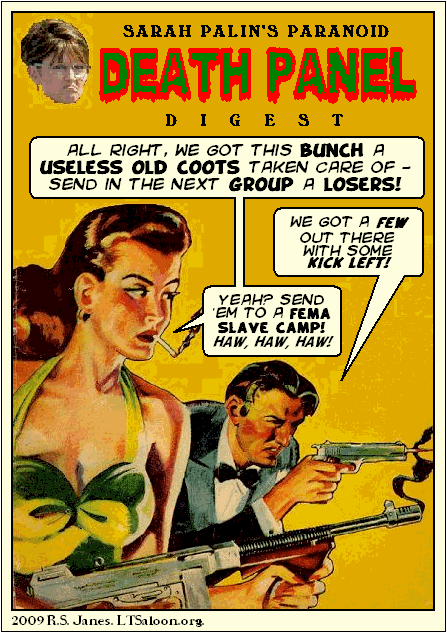
Graphic by R.S. Janes / LT Saloon

Shrill, baby, shrill:
How do they train themselves to be so impervious to reality?

By Johann Hari / August 21, 2009

Something strange has happened in America in the nine months since Barack Obama was elected. It has best been summarised by the comedian Bill Maher: “The Democrats have moved to the right, and the Republicans have moved to a mental hospital.”

The election of Obama –- a black man with an anti-conservative message –- as a successor to George W. Bush has scrambled the core American right’s view of their country. In their gut, they saw the US as a white-skinned, right-wing nation forever shaped like Sarah Palin.

When this image was repudiated by a majority of Americans in a massive landslide, it simply didn’t compute. How could this have happened? How could the cry of “Drill, baby, drill” have been beaten by a supposedly big government black guy? So a streak that has always been there in the American right’s world-view –- to deny reality, and argue against a demonic phantasm of their own creation –- has swollen. Now it is all they can see.

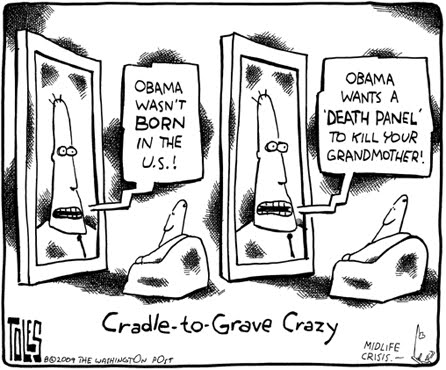
Since Obama’s rise, the US right has been skipping frantically from one fantasy to another, like a person in the throes of a mental breakdown. It started when they claimed he was a secret Muslim, and –- at the same time – that he was a member of a black nationalist church that hated white people. Then, once these arguments were rejected and Obama won, they began to argue that he was born in Kenya and secretly smuggled into the United States as a baby, and the Hawaiian authorities conspired to fake his US birth certificate. So he is ineligible to rule and the office of President should pass to… the Republican runner-up, John McCain.

These aren’t fringe phenomena: a Research 200 poll found that a majority of Republicans and Southerners say Obama wasn’t born in the US, or aren’t sure. A steady steam of Republican congressmen have been jabbering that Obama has “questions to answer.” No amount of hard evidence –- here’s his birth certificate, here’s a picture of his mother heavily pregnant in Hawaii, here’s the announcement of his birth in the local Hawaiian paper –- can pierce this conviction.

This trend has reached its apotheosis this summer with the Republican Party now claiming en masse that Obama wants to set up “death panels” to euthanise the old and disabled. Yes: Sarah Palin really has claimed –- with a straight face –- that Barack Obama wants to kill her baby.

You have to admire the audacity of the right. Here’s what’s actually happening. The US is the only major industrialised country that does not provide regular healthcare to all its citizens. Instead, they are required to provide for themselves – and 50 million people can’t afford the insurance. As a result, 18,000 US citizens die every year needlessly, because they can’t access the care they require. That’s equivalent to six 9/11s, every year, year on year. Yet the Republicans have accused the Democrats who are trying to stop all this death by extending healthcare of being “killers” –- and they have successfully managed to put them on the defensive.

The Republicans want to defend the existing system, not least because they are given massive sums of money by the private medical firms who benefit from the deadly status quo. But they can’t do so honestly: some 70 per cent of Americans say it is “immoral” to retain a medical system that doesn’t cover all citizens. So they have to invent lies to make any life-saving extension of healthcare sound depraved.

A few months ago, a recent board member for several private health corporations called Betsy McCaughey reportedly noticed a clause in the proposed healthcare legislation that would pay for old people to see a doctor and write a living will. They could stipulate when (if at all) they would like care to be withdrawn. It’s totally voluntary. Many people want it: I know I wouldn’t want to be kept alive for a few extra months if I was only going to be in agony and unable to speak.

But McCaughey started the rumour that this was a form of euthanasia, where old people would be forced to agree to death. This was then stretched to include the disabled, like Palin’s youngest child, who she claimed would have to “justify” his existence. It was flatly untrue –- but the right had their talking-point, Palin declared the non-existent proposals “downright evil”, and they were off.

It’s been amazingly successful. Now, every conversation about healthcare has to begin with a Democrat explaining at great length that, no, they are not in favour of killing the elderly –- while Republicans get away with defending a status quo that kills 18,000 people a year. The hypocrisy was startling: when Sarah Palin was Governor of Alaska, she encouraged citizens there to take out living wills. Almost all the Republicans leading the charge against “death panels” have voted for living wills in the past. But the lie has done its work: a confetti of distractions has been thrown up, and support is leaking away from the plan that would save lives.

These increasingly frenzied claims have become so detached from reality that they often seem like black comedy. The right-wing magazine US Investors’ Daily claimed that if Stephen Hawking had been British, he would have been allowed to die at birth by its “socialist” healthcare system. Hawking responded with a polite cough that he is British, and “I wouldn’t be here without the NHS”.

This tendency to simply deny inconvenient facts and invent a fantasy world isn’t new; it’s only becoming more heightened. It ran through the Bush years like a dash of bourbon in water. When it became clear that Saddam Hussein had no weapons of mass destruction, the US right simply claimed they had been shipped to Syria. When the scientific evidence for man-made global warming became unanswerable, they claimed – as one Republican congressman put it – that it was “the greatest hoax in human history”, and that all the world’s climatologists were “liars”. The American media then presents itself as an umpire between “the rival sides”, as if they both had evidence behind them.

It’s a shame, because there are some areas in which a conservative philosophy –- reminding us of the limits of grand human schemes, and advising caution –- could be a useful corrective. But that’s not what these so-called “conservatives” are providing: instead, they are pumping up a hysterical fantasy that serves as a thin skin covering some raw economic interests and base prejudices.

For many of the people at the top of the party, this is merely cynical manipulation. One of Bush’s former advisers, David Kuo, has said the President and Karl Rove would mock evangelicals as “nuts” as soon as they left the Oval Office. But the ordinary Republican base believe this stuff. They are being tricked into opposing their own interests through false fears and invented demons. Last week, one of the Republicans sent to disrupt a healthcare town hall started a fight and was injured – and then complained he had no health insurance. I didn’t laugh; I wanted to weep.

How do they train themselves to be so impervious to reality? It begins, I suspect, with religion. They are taught from a young age that it is good to have “faith” – which is, by definition, a belief without any evidence to back it up. You don’t have “faith” that Australia exists, or that fire burns: you have evidence. You only need “faith” to believe the untrue or unprovable. Indeed, they are taught that faith is the highest aspiration and most noble cause. Is it any surprise this then percolates into their political views? Faith-based thinking spreads and contaminates the rational.

Up to now, Obama has not responded well to this onslaught of unreason. He has had a two-pronged strategy: conciliate the elite economic interests, and joke about the fanatical fringe they are stirring up. He has (shamefully) assured the pharmaceutical companies that an expanded healthcare system will not use the power of government as a purchaser to bargain down drug prices, while wryly saying in public that he “doesn’t want to kill Grandma.” Rather than challenging these hard interests and bizarre fantasies aggressively, he has tried to flatter and soothe them.

This kind of mania can’t be co-opted: it can only be overruled. Sometimes in politics you will have enemies, and they must be democratically defeated. The political system cannot be gummed up by a need to reach out to the maddest people or the greediest constituencies. There is no way to expand healthcare without angering Big Pharma and the Republicaloons. So be it. As Arianna Huffington put it, “It is as though, at the height of the civil rights movement, you thought you had to bring together Martin Luther King and George Wallace and make them agree. It’s not how change happens.”

However strange it seems, the Republican Party really is spinning off into a bizarre cult who believe Barack Obama is a baby-killer plotting to build death panels for the grannies of America. Their new slogan could be –- shrill, baby, shrill.

Source / The Independent, U.K.

Thanks to S.M. Wilhelm / The Rag Blog

Posted in RagBlog | Tagged , , , | 9 Comments

Berlin : A Look at Health Care in Germany

Some U.S. Citizens in Germany comparing, contrasting and acting upon health care issues. That’s The Rag Blog’s David MacBryde hovering in the back and scratching his head (lower picture). Photos by Karen Axelrad / The Rag Blog.

Americans in Germany:
How health care works here

By David MacBryde / The Rag Blog / August 21, 2009

BERLIN — While health care issues are difficult and can be complicated, there was certainly a shared sense that although health care in Germany can be improved, on the whole it is comparatively better than the current situation in the USA.

There was no controversy about the point that some German beers are great. There was lots of controversy about health care issues, but a common sense that on the whole health care in Germany is better and is worth looking at.

Below is a FAQs about some of the issues. This was written by two Americans in Germany, Carolyn Prescott and Ann Wertheimer, to encourage discussion and robust reform, and to urge Americans here to write home to friends and representatives.

Frequently asked questions about health care coverage in Germany


Question: Why should we as Americans consider features of the German system in crafting our own health care reform?

Answer
: In planning our own public health care system, we should investigate the strengths and weaknesses of many other systems. We can then choose the best of some of them and avoid the pitfalls of others.

Question: Does Germany have a single-payer system?

Answer: No, it is a hybrid system: a public plan and private plans. The public option covers about 90% percent of the German population, with most of the rest covered under private insurance.

Question: What does public option mean in Germany?

Answer: Germany has around two hundred nonprofit companies called sickness funds, which comprise the public option. Germans can select from these sickness funds, each of which provides their members with a comprehensive benefit package. The sickness funds are nonprofit entities; there is nevertheless competition for price and quality among them because the funds seek to survive and grow.(1)

Public option sickness funds may not refuse someone on the basis of a pre-existing condition or drop them if they become ill. A centralized agency administers a pool of money to sickness funds to cover their sicker patients; that is, they ensure that sickness funds have the means to cover the health needs of those people they carry who have chronic illnesses such as diabetes or intensive illnesses such as cancer.

Question: Is enrollment in the German system mandated? If so, who pays for people who can’t pay?

Answer: Yes, health care coverage is mandatory; you must be covered by some plan, either public or private. Employed persons generally have half of their premiums paid by their employer. Unemployed persons remain members of the sickness funds they were in when employed. Their contributions are paid by federal and local governments. The contributions of retirees are paid by the pensioners themselves and by their pension funds. Thus, the public health insurance program redistributes from higher to lower income groups, from the healthy to the sick, from the young to the old, from the employed to the unemployed, and from those without children to those with children. The idea is that everybody’s in it together, and nobody should be without health insurance.(2)

Question: How much does the average German pay for health care under the public option?

Answer: State health insurance contributions are based on your gross income (around 15.5% with an income cap), with employers and employees each paying about half of the premium. The individual’s contribution is 8.2%; the employer pays the remaining 7.3%. In addition, Germans are now required to carry long-term nursing care insurance, which is charged at 2.2% of your gross income, with employers paying half.(3)

The income cap is $62,781, or around $5,232 per month (July 28, 2009 conversion rate). So if you make, for example, $85,000,. per year, your contribution would be the same as that of someone who makes $62,781 per year (4 ), even though that would amount to a lower percentage of your income.

Benefits are commensurate with those of most major medical insurance plans in the U.S. and include basic dental care. There are no deductibles and only minimal copayments.

Again, premiums are set according to earnings rather than risk and are not affected by a member’s marital status, family size, or health; they are the same for all members of a particular fund with the same earnings. In a household with two wage earners, each pays the full premium assessed by his or her sickness fund according to his or her income.

Question: How much are health care costs in Germany compared to those in the U.S.?

Answer: Health care costs for an entire country are measured in terms of the percentage of gross national product (GNP). In Germany that percentage is 10.7% of GNP, while in the U.S. it is 15.3% (2008 figures).(5) When the costs for various treatments and procedures are compared, the costs in Germany average about a third of those for the same procedure or medication in the U.S.

Question: Are there waiting lists for surgeries, expensive treatments, etc. in Germany? Are high-tech diagnostic procedures and treatments readily available?

Answer: There is no waiting time in the case of acute illnesses and emergencies. Waiting times to see specialists and to undergo surgeries and treatments tend to be quite similar to those in the U.S. Elective surgeries have an average waiting time of one month. High-tech diagnostic procedures and treatments are readily available.

Question: Do doctors or dentists in Germany bear high costs for their medical education?

Answer: Medical and dental schools, like all other forms of higher education, are virtually free in Germany, requiring only the payment of administrative fees. Of course, medical students, like students in all fields, must pay for their own room and board. Young people who can’t afford their room and board while they are getting an advanced degree are eligible for various kinds of public loans. Repeat: there is no tuition for medical or dental school, or any other advanced degree, in Germany. Tertiary education in Germany is virtually all public.

Germany has more physicians per capita than the United States, and physicians typically make less than in the States. For example, a family doctor in Germany makes about two-thirds as much as he or she would in America.(6)

Question: Do doctors or dentists in Germany bear high costs for malpractice insurance?

Answer: German doctors pay less for malpractice protection through medical protective associations rather than through for-profit medical malpractice insurance companies.

Question: How much are typical deductibles and co-pays for Germans under the public option insurance?

Answer: There are no deductibles. Under the public option, a patient pays 10 euros (about $15 as of this writing) per quarter year; that is, 10 euros are paid for the first doctor’s visit during a quarter of a year. If no visit is made during, let’s say, January 1 through March 31, no payment is required. If there are many visits, the payment is still only 10 euros. The dentist costs another 10 euros for the first visit per quarter. In-patient hospital days now have a co-pay of 10 Euros per day up to 28 days. There are generally no further co-pays except for a few designated treatments; such as dental crowns, for example.

Question: Does public option insurance pay for medication?

Answer: Medications have co-payments of between 5 and 10 euros (around $8 to $15) per prescription.

Question: Do you pay your bills and get reimbursed, or does the insurance pay directly?

Answer: You submit your health insurance identification card to the doctor, dentist or hospital and make your copayment, if there is one. You do not see the bill.

Question: Is there rationing?

Answer: While doctors may feel some pressure to hold down costs, treatment decisions are not generally individually arbitrated through the sickness funds. Some treatment decisions may require evidence of need; for example, a dentist has to show the need for certain types of extensive gum treatments.

Under the law that applies to the German health care system, there is a Joint Federal Committee composed of representatives from associations of physicians, dentists, hospitals and sickness funds. The JFC assesses the effectiveness of traditionally covered services and of new diagnostic and therapeutic procedures. Coverage guidelines are issued after public notice of the subjects under consideration, and comments by interested parties and experts enter into the decision-making. JFC decisions on procedures are made according to evidence-based criteria. Such criteria range from randomized, controlled clinical studies to consensus conferences and expert opinions. Since care under the law must correspond to the generally accepted standard of medical knowledge and the progress of medical science, clinical practice guidelines and prevailing practices are highly relevant for coverage guideline validity. In case of individual sickness fund denials of reimbursement of a treatment not yet addressed by a JFC guideline, patients may appeal to a special court that will consider the evidence; generally one does not need to hire a lawyer to go through this process. Thus there are checks on the power of the JFC to limit clinical autonomy.(7) There is no age rationing for any procedure.

To make this process somewhat more concrete, we offer a few examples of costs refused or limited versus those paid for by one or more sickness funds: Some disallowed treatments under the public option, for example, are homeopathic remedies, Vitamin B injections (except in the case of a proven deficiency), and Viagra (considered a lifestyle drug). In some cases, the sickness funds cover a basic need such as glasses or a hearing aid, but if the patient wants a top-of-the-line, in-the-ear hearing aid or designer glasses, he or she must supplement the basic amount paid by the sickness fund. A few examples of treatments that are fully covered in the German system are very expensive, end-of-life cancer drugs; mental health therapies and medications; and home care hospice services. In addition, some sickness funds pay for preventive measures such as up to 20 yoga sessions per year or Nordic walking courses, both of which have reportedly been shown through clinical trials to be beneficial in preventing certain illnesses or improving health.

Question: Is there a lot of bureaucracy?

Answer: Administration costs of the system, which is another way of referring to and measuring bureaucracy, account for about 6 percent of spending in the public option sickness funds (which again, cover about 90% of the population).(8) Patients experience virtually no bureaucracy; they do not have to deal with any agent or financial paperwork. Among the private insurance companies in Germany, the administrative costs are around 17%. In the U.S. system, administrative costs are estimated at close to one-fifth, or 20%, of total costs. So bureaucracy is actually much less in the public option health care system.

Question: How many Germans go bankrupt in a year because of medical bills?

Answer: In Germany it is impossible to go bankrupt because of medical bills, since even if you declare bankruptcy, the social solidarity system pays for your medical care. The idea is, if you do have financial problems and a lot of worries for other reasons, you do not need to have another burden in not being able to pay medical bills.(9)

Question: If you lose your job or get sick and cannot work, what happens to your health insurance?

Answer: Health insurance continues with no change if you lose a job. Germans simply do not have this worry that they will be without coverage for themselves and their family members.

Question : If the public option is so good, why do some people choose private insurance?

Answer: About 10% of the population is covered under private insurance. Anyone who makes more than $69,187 per year for at least a three-year period has the option of choosing private insurance.(10) People who are civil servants, self-employed or freelance also have this option, even if they do not meet the income requirement. For some people who are still young and healthy and earn high salaries, private health insurance may be (temporarily) cheaper than the public option. Others choose private insurance to ensure that they have certain privileges: a private room in case of hospitalization, payment for homeopathic remedies, or spa cures. Some people also supplement their public insurance with private insurancein order to gain these and other privileges.

Question : What are the problems of the German health care system?

Answer: There is pressure on the health care system because of the relatively high rate of unemployment in Germany. Hospital personnel, including doctors, have demonstrated and lobbied in recent years to get higher allocations (and doctors have just won increases that average out to 7.8%, varying according to specialization and geographic area). Copayments were introduced a few years ago to try to bring more money into the system. Nonetheless, the German health care system dates back to 1883 and has proven to be both flexible and robust. During the last two decades, Germans have tweaked their system, on average, every three years in order to try to address problems and keep costs under control.

————————————————————————
Footnotes:

(1) Interview with Kurt Lauterbach, in Frontline: Sick Around the World: Five Capitalist Democracies and How They Do It, Public Broadcasting System series, April 2008.

(2) “Most Germans Happy with German Health Care,” National Public Radio feature, reported by Richard Knox, produced by Jane Greenhalgh, June, 2008.

(3) Krankenkassentarife, an independent website that provides information (in German) on the German health care laws, 2009:

(4) Krankenkassentarife website.

(5) Frontline: Sick Around the World: Five Capitalist Democracies and How They Do It , Public Broadcasting System series, April 2008. http: www.pbs.org/wgbh/pages/frontline/sickaroundtheworld/etc/graphs.html

(6) Frontline interview with Kurt Lauterbach.

(7) Ursula Weide, “Law and the German Universal Health Care System: A Contemporary Overview,” German Law Journal No. 8 (1 August 2005).

(8) Frontline interview with Kurt Lauterbach.

(9) Frontline interview with Kurt Lauterbach.

(10) Krankenkassentarife website.

[David MacBryde — our correspondent in Berlin — was an Austin activist and a contributor to The Rag Blog’s historical precursor, The Rag , a pioneering member of the Sixties underground press.]

The Rag Blog

Posted in Rag Bloggers | Tagged , , | 2 Comments

Surrealist Group : No War on the Moon!

‘Dark Side of the Moon’ by Al Magnus / photo.net.

In Defense of the Dark Side of the Moon

By The Surrealist Group / The Rag Blog / August 20, 2009

“But, for myself, the Earth’s records had taught me to look for widest ruin as the price of highest civilization.”— Edgar Allan Poe, The Colloquy Of Monos And Una (1850)

Twenty years before a powerful syndicate of military-industrial criminals conspired to plant a U.S. flag on the Moon, a similar clique of fiends plotted to fire a nuclear warhead-tipped intercontinental ballistic missile at the lunar face. Code-named “Project A119,” this plan devised by Cold War-era Air Force and weapons manufacturers called for a massive nuclear explosion that would be clearly visible from anywhere on Earth.

Researchers struggled in vain to find any pretext, any shred of legitimate scientific value, to glean from this sickening display of militarist impunity. But the sole objective of Project A119 was to terrorize into submission every human on the planet (especially those who had never heard of Hiroshima or Nagasaki) with a demonstration of how the U.S. ruling class was technologically adept and morally bankrupt enough to commit such an unimaginable poetic atrocity.

And now, once again, there are plans to bomb the Moon. This time the unilateral strike is aimed at the Moon’s South Pole and the payload will be delivered by the LCROSS (Lunar CRater Observation and Sensing Satellite) spacecraft; the excuse given is that this is an effort to find water deep under lunar surface. The craft was launched in late June and is currently orbiting the Earth until it finds its target; if all goes according to plan, the M-Day bombing will be 8 October 2009.

The plan is this: the LCROSS first shoots off its 2,300-pound spent booster-rocket at the lunar target zone. Four minutes later, in a scheme apparently inspired by fanatical terrorist airline hijackers, the rest of the robotic LCROSS craft slams into the same area. Like crazed kamikaze paparazzi, the craft will snap photos and transmit data on the first strike back to NASA’s mad bombers before immolating itself in a second explosion.

This violent hi-tech sci-fi spectacle will cost anywhere up to $600 million, a price tag that is an outrageous insult to the millions of working people unable to feed, house, or medically treat their families. (As Gil Scott-Heron lamented in 1974: “How come there ain’t no money here? Hmm! Whitey’s on the Moon…”)

Of course, there is much more behind this attack than casual scientific curiosity on whether or not there is water on the Moon. First of all, since the long-range accuracy of intercontinental ballistic missiles has never been proven to work, the LCROSS suicide mission serves as a live-fire test exercise for U.S. war strategists with an interest in the precision of orbiting satellite weapons — in other words, the southern hemisphere of the Moon will be turned into a firing range, making this mission one giant leap for the global reach of space warfare.

Secondly, LCROSS has been promoted as “the vanguard” for the U.S. military-industrial-entertainment complex’s return to the Moon—according to NASA, finding water is a necessary first step for “building a long-term and sustainable human presence” there. Historically, the purpose of exploration has always been the exploitation of resources and the colonization of territory without regard for ecosystems or indigenous peoples, and clearly the Moon is the next territory coveted by imperialists.

Only people with colonized minds believe these things are positive, or that this type of “progress” can be beneficial to anyone beyond a small circle of exploiter-elites. And, as to be expected, there is no end to the number of those who seek to compensate for their own personal impotence by over-identifying with these grotesque displays of obscene state-corporate power. You can hear them chattering on the Internet: “Flying a rocket booster into the Moon at 5,600 mph to trigger a massive explosion is just flat-out cool,” says one, while another sneers “Public discussion? Why should there be a ‘public discussion’ about a NASA experiment?”

Such remarks challenge our contempt. There should be a discussion, not only by the public, but also by oceans, weather patterns, plants, and all sorts of other living things — even the most uninformed know enough about the “butterfly effect” to realize that changing one part of any system is going to have a cascading effect on all those things dependent upon that system.

This so-called “NASA experiment” is a hostile act of aggression and a violent intrusion upon our closest and dearest celestial neighbor. Does any love song or poem or fairy tale worth its salt not mention the Moon? Who can take a walk in the Moonlight with a lover and not feel the romance to your very soul? At night, when the Moon rules, we sleep, and we can visit the Moon in our sleep with ease. The Moon is our night light, our blanket, our grandmother, our mother — it is woman, child, domestic life, tides, bodies of water, liquids, circulation, comfort, nurturing, paintings by Remedios Varo, stories by Jules Verne, and so much more.

Let us assume that ignorance will rule the day and plans go forward. What can we as surrealists or lunatics or astrologers or naturalists or anarcho-primitivists or Greens or werewolves or pagans or psychics or UFO groupies or other concerned members of the general public do? We must soothe the Moon, we bandage her. We implore other celestial bodies and entities to aid her. We will not let her endure this crime or its grim aftermath alone.

We need to communicate to the Moon. Talk to her in our dreams, trances, or meditations, and prepare her for this shock and wound as best we can. Hold her, send out imaginative protection to her, and put our dream bodies out there in front of the bomb. Collectively, we can sabotage the bombing or by imagining all manner of things going wrong, or encouraging the Moon to increase her own magnetic shields. Sing to her. Give her back just a tiny portion of all that she has done for us. We are all created from Moon dust.

We pledge solidarity with the Moon and promise we will do everything that we can to help heal her and to prevent any further such stupid, short-sighted, self-serving, man-made acts of obscene violence against her.

Surrealist Group in the US: Gale Ahrens, Beth Garon, Paul Garon, Joseph Jablonski, Renay Kerkman, Don Lacoss, David Roediger, Penelope Rosemont, Joel Williams, Kate Khatib, John Duda

Surrealistmovement-usa.org

The Rag Blog

Posted in Rag Bloggers | Tagged , , , , , | 1 Comment

Insurance Lobby Presses Ancient Medical Equipment Into Service

Tobacco Smoke Enema (1750’s – 1810). Graphic courtesy of Dr. Charles Rookenpumpher

This old bogus device has been reintroduced
in Washington D.C. by the Health Insurance Lobby
Are You Starting To Feel It Yet ?

By Larry Ray / The Rag Blog / August 20, 2009

The tobacco smoke enema was reportedly used to infuse tobacco smoke into a patient’s rectum for various medical purposes, primarily for resuscitation of drowning victims. A rectal tube was inserted into the anus and attached to a fumigator and bellows used to force the smoke up into the rectum. The warmth of the smoke was thought to promote respiration, but doubts about the effectiveness of tobacco enemas led to the popular expression, “to blow smoke up one’s ass.”

It has been suggested that that faint pumping sound heard in the background of the health insurance industry’s frantic misinformation TV commercials is one of these old machines being pressed back into service.

[Retired journalist Larry Ray is a Texas native and former Austin television news anchor. He also posts at The iHandbill.]

The Rag Blog

Posted in Rag Bloggers | Tagged , , | 6 Comments

Bipartisan Deadlock : How Best NOT to Reform Health Care

Bypartisanship at its best: hammering out a plan that will deny health care to U.S. citizens.

Congress deadlocked over how to not provide health care to American citizens

Senate leaders Harry Reid (D-NV) and Mitch McConnell (R-KY) point to Congress’ failure to pass legislation before a July 31 deadline as proof of just how serious lawmakers are about stringing along the American people and never actually reforming the health care industry in any meaningful way.

By The Onion / August 20, 2009

WASHINGTON — After months of committee meetings and hundreds of hours of heated debate, the United States Congress remained deadlocked this week over the best possible way to deny Americans health care.

“Both parties understand that the current system is broken,” House Speaker Nancy Pelosi told reporters Monday. “But what we can’t seem to agree upon is how to best keep it broken, while still ensuring that no elected official takes any political risk whatsoever. It’s a very complicated issue.”

“Ultimately, though, it’s our responsibility as lawmakers to put these differences aside and focus on refusing Americans the health care they deserve,” Pelosi added.

The legislative stalemate largely stems from competing ideologies deeply rooted along party lines. Democrats want to create a government-run system for not providing health care, while Republicans say coverage is best denied by allowing private insurers to make it unaffordable for as many citizens as possible.

“We have over 40 million people without insurance in this country today, and that is unacceptable,” Sen. Orrin Hatch (R-UT) said. “If we would just quit squabbling so much, we could get that number up to 50 or even 100 million. Why, there’s no reason we can’t work together to deny health care to everyone but the richest 1 percent of the population.”

“That’s what America is all about,” he added.

House Minority Leader John Boehner (R-OH) said on Meet The Press that Republicans would never agree to a plan that doesn’t allow citizens the choice to be denied medical care in the private sector.

“Americans don’t need some government official telling them they don’t have the proper coverage to receive treatment,” Boehner said. “What they need is massive insurance companies to become even more rich and powerful by withholding from average citizens the care they so desperately require. We’re talking about people’s health and the obscene profits associated with that, after all.”

Though there remain irreconcilable points, both parties have reached some common ground in recent weeks. Senate leaders Harry Reid (D-NV) and Mitch McConnell (R-KY) point to Congress’ failure to pass legislation before a July 31 deadline as proof of just how serious lawmakers are about stringing along the American people and never actually reforming the health care industry in any meaningful way.

“People should know that every day we are working without their best interests in mind,” Reid said. “But the goal here is not to push through some watered-down bill that only denies health care to a few Americans here and a few Americans there. The goal is to recognize that all Americans have a God-given right to proper medical attention and then make sure there’s no chance in hell that ever happens.”

“No matter what we come up with,” Reid continued, “rest assured that millions of citizens will remain dangerously uninsured, and the inflated health care industry will continue to bankrupt the country for decades.”

Other lawmakers stressed that, while there has been some progress, the window of cooperation was closing.

“When you get into the nuts and bolts of how best not to provide people with care essential to their survival, there are many things to take into consideration,” Rep. Michele Bachmann (R-MN) said. “I believe we can create a plan for Americans that allows them to not be able to go to the hospital, not get the treatment they need, and ultimately whither away and die. But we’ve got to act fast.”

For his part, President Barack Obama claimed to be optimistic, even saying he believes that a health care denial bill will pass in both houses of Congress by the end of the year.

“We have an opportunity to do something truly historic in 2009,” Obama said to a mostly silent crowd during a town hall meeting in Virginia yesterday. “I promise I will only sign a clear and comprehensive health care bill that fully denies coverage to you, your sick mother, her husband, middle-class Americans, single-parent households, the unemployed, and most importantly, anyone in need of emergency medical attention.”

“This administration is committed to not providing health care,” Obama added. “Not just for this generation of Americans, but for many generations to come.”

Source / The Onion

Thanks to Tom Welsh / The Rag Blog

Posted in RagBlog | Tagged , , | Leave a comment

Lockerbie : A ‘Conspiracy Theory’ Worth Pursuing

Top, Convicted Lockerbie bomber Abdel Baset al-Megrahi, holding release papers, at Glasgow International Airport, after his release Thursday, August 20, 2009. Photo by Danny Lawson / Pool / AP. Below, wreckage of Pan Am 103, Lockerbie, Scotland, Dec. 21, 1988.

Unlocking Lockerbie:
An alternative explanation worth looking at

By Sherman DeBrosse / The Rag Blog / August 20, 2009

Convicted Lockerbie bomber Abdel beset Ali Mohamed al Megrahi is being released from prison because he has only a few months to live. He is terminally ill with prostate cancer.

The cable news channels are milking the story for all it is worth, while summarily dismissing as “conspiracy theories” alternative accounts of what happened at Lockerbie.

One of those explanations is worth looking at.

Pan Am 103 crashed in Lockerbie, Scotland, on December 21, 1988, killing 270 people from 21 countries. Included in this total were eleven residents of the Scottish town. A bomb had been planted on the plane, probably by Hezbollah. Perhaps the organization was taking revenge for Iran-Air Flight 655 that was shot down six months before by a U.S. fighter jet from the carrier Vincennes.

While the Iranians were considering revenge, Major Charles McKee of the Defense Intelligence Agency and five others were in Lebanon looking into the drug trade and trying to find a way of rescuing nine American hostages there. The team appeared to have little or no information about what two other U.S. intelligence units were doing in Beirut.

Unfortunately, they soon learned that one of those units was dealing in drugs and weapons, presumably as a way of gaining leverage to free American hostages. Somehow they also learned that CIA operatives in a team Wiesbaden named COREA were running what seemed to be a rogue drug operation out of Frankfurt. They boarded 103 with evidence but were never able to present it. Later the military claimed they were flying back to the US in violation of their orders.

At the heart of these drug operations was Monzer al-Kassar. This Syrian drug smuggler had moved Polish arms for Oliver North to the Nicaraguan Contras. He was also closely tied to the brother of the Syrian dictator, Hafez al Assad. According to former Reagan aid Barbara Honegger, Al Kassar earlier worked for Reagan and NATO in laundering weapons for Iran through corrupt Italian intelligence people tied to P-2, the secret fascist lodge.

Some of al-Kassar’s drug profits helped to finance the PLO. Al Kassar was the middle man in paying for the release of two French captives in Beruit and he facilitated communications with respect to the remaining nine American hostages in Lebanon. In return for his services, the U.S. protected his drug pipeline into the U.S.

The DEA was then permitting controlled shipments by Al Kassar out of Frankfurt with a view to using the drugs to entrap dealers in the U.S. The code name for the operation was AKhourah.@ Reporter Will Weinberg learned that the DEA and CIA had asked the BKA, the German internal intelligence agency, to let certain suitcases in Frankfurt through without inspection. Apparently, a suitcase full of Semtex explosives was quietly substituted for one that held drugs.

The problem was that the amount getting through was far larger than necessary. When DEA/DIA agent Lester Coleman, using his diaries, later wrote about this, he encountered all sorts of legal problems. Danny Casorolo, a journalist, interviewed Coleman and was knifed in a West Virginia motel. Unfortunately, his body was immediately embalmed, so a full autopsy would not have been possible.

Coleman had been in Beruit for six years as part of a secret unit called MC10, Middle East Collection 10, and his payment came as travelers checks issued by BCCI. Two of his colleagues had been murdered in the year before the loss of Pan Am 103. In subsequent court testimony, he said that his unit was using PROMIS software, even though the government repeatedly said it never used this software.

Two Sampsonite suitcases of drugs were shipped from Frankfort that day in addition to the “controlled delivery.” They were the same kind of bags as those used by Kassar. One was aboard Pan Am 103 and the other was diverted to another flight which arrived in San Francisco. Some theorize that the CIA team in Frankfurt was running a rogue drug operation and that the plane was permitted to explode to cover their misdeeds.

U.S. and German agencies received at least two warnings that a bomb would be aboard PanAm 103. It has been claimed that Oliver “Buch” Ravell, assistant director of the FBI, was privy to one of those warnings and took it seriously enough to remove his son from that flight. Two books and some litigation address this issue.

Eventually, the State Department claimed that it had not forwarded the warnings to the FBI. Robert Mueller headed the investigation. He had also handled the investigation of the collapse of BCCI. However, Ravell was well connected and it was frequently claimed that he worked with Oliver North in hiding much of the information related to the Iran Contra scandal.

In 1996, Gene Wheaton, formerly with the Army Investigative Command, wrote that Revell was one of several security consultants who proposed forming a “Death Squad” to assassinate people identified as terrorists.

Strong evidence developed that U.S. intelligence knew that a bomb was on the plane but did nothing to remove it. The CIA knew Hezbullah had planted a bomb on the plane and had an opportunity to remove it but chose not to. The accident scene was teeming with Americans, including Oliver North’s assistant.

Scottish police said that American authorities restricted their access to the site for two days while Americans feverishly sifted through the wreckage. They carried away a number of pieces of baggage. Both heroin and cocaine were found there. Bob Woodward later reported in the Post that there were documents aboard that tied Lt. Colonel Oliver North to terrorist Abu Nidal.

COREA was being investigated by the Germans and enough of the story was known that there was open speculation in Time, US News and World Report, Barrons, and The New York Times. Susan Lindauer, a Fox and US News and World Report journalist also worked as a CIA asset and claims she knew that the 1988 bombing was a Hezbollah operation in retaliation for the downing of an Iranian airliner.

She added that the CIA had advanced warning of the plot. She served eleven months of incarceration in 2005-2006 without being charged, perhaps because she had operated as a back channel to Bagdad and tried to warn second cousin Andrew Card, Bush’s chief of staff, that the Iraqis did not have weapons of mass destruction.

The U.S. first blamed Syria and the CIA probably correctly hired some group to plant the bomb. Later the U.S. shifted the blame to Libya when it needed Syria’s backing in the 1991 war with Iraq. The only evidence pointing to the Libyan government was a fragment of a circuit board logged in as evidence four days after the explosion. There is some question of when it was logged in and some say it was found months later in a wooded area far from Lockerby. It was said to be made by a Swiss firm which only sold the part to Libya and the East German Stasi.

Dr Richard Fuisz, a CIA agent, medical researcher, and millionaire, claimed that he had solid proof that Lybya was not involved in the bombing and he added that he knew who planned it. Soon thereafter, in October, 1994, a federal court issued a gag order, on the basis of the “military and state secrets privilege.”

Internal U.S. Defense Intelligence Agency documents surfaced in 1994 suggesting that the British and Americans believed that the real bomber was the Syrian operated Popular Front for the Liberation of Palestine. However, the diplomacy of the first Gulf War made it useful to blame Libya.

In 2003, a retired CIA officer told Megrahi’s lawyers that the CIA gihad planted the evidence. In 2005, Scotland Sunday reported that a retired police officer “of assistant chief constable rank or higher” has said that the circuit board fragment had been planted by the CIA. George Esson, former Chief Constable of Dumfries and Galloway, said he knew about the other policeman coming forward. The informant contacted the lawyers for Abdelbaset Ali Mohmed Al Megrahi, who was imprisoned at Greenock Prison for the crime.

The Edinborough Herald reported that there were documents proving that the CIA offered to pay two key witnesses to testify against the accused Lybians and that it offered witness protection and relocation.

[Sherm, your author, believes that that some of these alternative explanations need to be explored but finds that, while they are often at least as convincing as the official explanations, they lack all the information necessary for conclusive proof. In his book on the Republican Party he followed far more conventional rules because he believed the case he was making was so important. His The New Republican Coalition: Its Rise and Impact, The Seventies to Present (Publish America) can be acquired by calling 301-695-1707. On line, go here.]

The Rag Blog

Posted in Rag Bloggers | Tagged , , , , | 3 Comments

Did Obama Make a Deal with Big Pharma?


Internal Memo Confirms Big Giveaways In White House Deal With Big Pharma
By Ryan Grim / August 16, 2009

A memo obtained by the Huffington Post confirms that the White House and the pharmaceutical lobby secretly agreed to precisely the sort of wide-ranging deal that both parties have been denying over the past week.

The memo, which according to a knowledgeable health care lobbyist was prepared by a person directly involved in the negotiations, lists exactly what the White House gave up, and what it got in return.

It says the White House agreed to oppose any congressional efforts to use the government’s leverage to bargain for lower drug prices or import drugs from Canada — and also agreed not to pursue Medicare rebates or shift some drugs from Medicare Part B to Medicare Part D, which would cost Big Pharma billions in reduced reimbursements.

In exchange, the Pharmaceutical Researchers and Manufacturers Association (PhRMA) agreed to cut $80 billion in projected costs to taxpayers and senior citizens over ten years. Or, as the memo says: “Commitment of up to $80 billion, but not more than $80 billion.”

Representatives from both the White House and PhRMA, shown the outline, adamantly denied that it reflected reality. PhRMA senior vice president Ken Johnson said that the outline “is simply not accurate.” “This memo isn’t accurate and does not reflect the agreement with the drug companies,” said White House spokesman Reid Cherlin.

Stories in the Los Angeles Times and the New York Times last week indicated that the administration was confirming that such a deal had been made.

Critics on Capitol Hill and online responded with outrage at the reports that Obama had gone behind their backs and sold the reform movement short. Furthermore, the deal seemed to be a betrayal of several promises made by then-Sen. Obama during the presidential campaign, among them that he would use the power of government to drive down the costs of drugs to Medicare and that negotiations would be conducted in the open.

And over the past several days, both the White House and PhRMA have offered a series of sometimes conflicting accounts of what happened in an attempt to walk back the story.

The White House meeting took place on July 7th, as first reported that evening in the Wall Street Journal. Also on the same day, a health care lobbyist following the talks was provided the outline of the deal by a person inside the negotiations. That outline had been floating around K Street before being obtained by the Huffington Post. In order to learn more about its origin, HuffPost agreed not to reveal the name of the lobbyist who originally received it.

“That is the PhRMA deal,” said the lobbyist of the outline. He then clarified, “It was the PhRMA deal.”

The deal, as outlined in the memo:

Commitment of up to $80 billion, but not more than $80 billion.

1. Agree to increase of Medicaid rebate from 15.1 – 23.1% ($34 billion)

2. Agree to get FOBs done (but no agreement on details — express disagreement on data exclusivity which both sides say does not affect the score of the legislation.) ($9 billion)

3. Sell drugs to patients in the donut hole at 50% discount ($25 billion)
This totals $68 billion

4. Companies will be assessed a tax or fee that will score at $12 billion. There was no agreement as to how or on what this tax/fee will be based.

Total: $80 billion

In exchange for these items, the White House agreed to:

1. Oppose importation

2. Oppose rebates in Medicare Part D

3. Oppose repeal of non-interference

4. Oppose opening Medicare Part B

“Non-interference” is the industry term for the status quo, in which government-driven price negotiations are barred. In other words, the government is “interfering” in the market if it negotiates lower prices. The ban on negotiating was led through Congress in 2003 by then-Rep. Billy Tauzin (R-La.), who is now the head of PhRMA.

The rebates reference is to Medicare overpayments Big Pharma managed to wrangle from the Republican Congress that Democrats are trying to recoup. The House bill would require Big Pharma to return some of that money. The rebate proposal would save $63 billion over ten years, according to the Congressional Budget Office. The White House, given the chance, declined to tell the Wall Street Journal for a July 17th article that it supported the effort to pursue the rebates.

The Medicare Part B item refers to “infusion drugs,” which can be administered at home. If they fall under Part B, Big Pharma gets paid more than under Part D. The agreement would leave infusion drugs in Part B.

In the section on Big Pharma’s concessions, “FOBs” refers to follow-on biological drugs. Democrats have pushed to make it easier to allow generic drug makers to produce cheaper versions of such drugs, an effort Big Pharma has resisted. The Senate health committee bill gives drug makers 12 years of market exclusivity, five more than the White House proposed.

PhRMA’s Johnson cast doubts on the provenance of the outline. “The memo, as described, is simply not accurate,” he said in a statement. “Anyone could have written it. Unless it comes from our board of directors, it’s not worth the paper it’s written on. Clearly, someone is trying to short circuit our efforts to try and make health care reform a reality this year. That’s not going to happen. Too much is at stake for both patients and the U.S. economy. Our new ads supporting health care reform are starting this week, and we are redoubling our efforts to drive awareness of why this issue is so important to America’s future.”

Johnson added that “no outside lobbyists — not a single one — were ever involved in our discussions with the Senate Finance Committee or the White House so someone is blowing smoke.”

But the lobbyist who was given the outline defended its authenticity. And although the White House now says that drug price negotiations and reimportation were not actually discussed in the talks with PhRMA, the lobbyist said: “Well, that’s bull — that’s baloney. That was part of the deal, for them not to push that.”

The new uncertainty surrounding the deal comes after House Speaker Nancy Pelosi (D-Calif.) has repeatedly said that her chamber is not bound by any agreement it is not a party to. On July 8th, the day after the Journal reported some elements of the deal, Energy and Commerce Committee Chairman Henry Waxman (D-Calif.) said in a public speech that his committee would not be tied down by the agreement.

Before recess, he followed through. His committee passed a bill that allowed for re-importation and drug-price negotiations.

In the Senate, Democrats Sherrod Brown (Ohio) and Byron Dorgan (N.D.) pressed White House officials at a closed-door meeting last week, asking whether the White House had tied the Senate’s hands.

The health care lobbyist said that what deal still exists is uncertain, as a result of House pressure. “Now the White House is backing away from it, as you know, because of pressure from the House, because the House was not a party to the deal,” he said. “The Speaker put enormous pressure on the White House, [saying], ‘We weren’t a party to it and we reserve the right to do whatever we want.’ And which they did in the House Energy and Commerce Committee bill, which led the White House to say, ‘Well, maybe it’s not cast in concrete.'”

Obama is walking a tightrope here. He wants to keep PhRMA from opposing the bill, and benefits by having its support, which now includes a $150 million advertising campaign. That’s a fortune in politics — more than Republican presidential candidate John McCain spent on advertising during his entire campaign — but it’s loose change in the pharmaceutical business.

Opponents of the deal with PhRMA hope that Obama is playing a multilayered game, making a deal in order to keep the drug makers in his camp for now, but planning to double-cross them in the end if he needs to in order to pass his signature initiative.

Big Pharma, however, is still comfortable. “As far as the pharmaceutical industry, PhRMA and its member companies, yes, they say a deal is a deal. We’ll see what happens,” said the health care lobbyist.

Source / Global Research

Thanks to Phil Sigmund / The Rag Blog

Posted in RagBlog | Tagged , , , | 3 Comments

Rabbi Arthur Waskow : Healing Health Care NOW

The Healing Tree / Terry the Weaver.

Healing Health Care:
NOW or Never

We who have with illness bled,
Welcome to our gory bed,
Or to victory!

Now’s the time and now’s the hour;
See approach proud Money’s power.
Will we turn and flee?

Big Pharma’s fees are still our foe!
Lay arrogant Insurers low —
With a public option, we’ll be free!


(With no apologies to Robert Burns, who fought for the little guy all his life and would have loved this transformation of his hymn to Scottish freedom.)

By Rabbi Arthur Waskow / The Rag Blog / August 19, 2009

President Obama originally said that a robust public option for health insurance was the only way to keep the insurance corporations honest. He was right then. Even if he has weakened under the pressure of lies about death panels and threats by hoodlums, he was right. The public option is NOT dead. It is up to us. NOW is the time, NOW is the hour.

If the mangled health care bill is passed with no public option, the windfall for Big Insurance and Big Pharma will outdo even their treasure hunt in the Bush Medicare windfall.

Why? How? Because the bill requires practically everybody to buy insurance, and the public will have no way of keeping down what the insurance companies charge all those new and old customers. Another gravy train — on our money. Paid to support lousy care, with private companies refusing payment whenever they decide to boost corporate profits.

If progressive members of the House of Representatives who understand this stand firm, no matter what the Senate does, no matter what the White House does — then no bill can pass without a public option

Better to fight this out, since at least two-thirds of the public supports a real public option. Please write your Member of the House right away with a simple, serious, straight-out message:

No public option, no bill!

You can tell your Congressperson exactly that:

You can write — it’s totally free! Please click here to send a fax, as follows. Here is our suggestion. You can modify the text.

I support health care reform with a robust public option — and most people I know do, too.

The public option is crucial, to keep the private companies honest by competing with them as strongly as possible. Without the public option, the private insurance companies will bankrupt the people who pay their premiums and bankrupt the nation with multiplying costs of health care.

This is our one chance in our lifetimes to get this right. I urge you to stand up for the public option no matter what the Senate or the White House does. Please do what a majority of your constituents want: Vote for health care that works.

I look forward to hearing from you. Thank you.

Please write NOW. Now’s the time and now’s the hour! See approach proud Money’s power — But we can still be free!

Shalom, salaam, peace,

Arthur

[Rabbi Arthur Waskow is director of The Shalom Center. He can be reached at awaskow@shalomctr.org.]

Source /

The Rag Blog

Posted in Rag Bloggers | Tagged , , , | Leave a comment

Ask Yourself, ‘How Valuable Is My Health?’


Death Panels: Let Me Explain
By Bill Freeland / The Rag Blog / August 19, 2009

As regular readers of these pages are aware, we seek to be a resource for information about the health care debate from an industry perspective. So let me begin with a current hot topic: “Death Panels.”

Let me explain.

It should come as no surprise that here we recognize, to borrow Al Gore’s convenient term, “an inconvenient truth”: which is to say that, despite our best efforts, we have yet to achieve the goal of universal immortality for any of our citizens.

The rumored reappearances of Elvis notwithstanding, we must accept that at some point each of us will one day finally “leave the building.”

This is a difficult moment, not merely for the deceased, but for family and friends, among whom we, of course — as providers of primary or secondary health care coverage — count ourselves.

Of course, as in any family, differences arise about priorities in such a close relationship. Which helps to explain why we find it necessary on occasion to take a “tough love” approach when the loved one seeks an experimental treatment, an expensive joint replacement, or more than one night’s hospital stay after surgery.

All of which leads us to this so-called “death panel” option. Predictably, there has been a great deal of misunderstanding about what the industry is actually advocating here. It’s often said that no one can place a premium on human life. Indeed, our critics would have you believe that premiums are our entire life. Absurd! Premiums are in fact merely a society’s mechanism for keeping score in the game of who lives and who dies.

Ask yourself, how valuable is my health? Answer: simply check your monthly insurance statement. Nowhere in the Western world are insurance premiums as high as in this country. Which is as good a gauge as any of the value we place on your well being.

Of course, we would like to say that your life (and our premiums) could go on forever. But they can’t. Which is why we think it prudent from time to time to let us help you review your options.

Let me explain.

Remember that beloved goldfish your parents bought you for your sixth birthday which somehow survived until after you went away to college? Now, remember when it suddenly hit you: a teenage goldfish is a biological impossibility!? And remember how at that moment the crushing realization of mortality descended upon you? How many stand-ins were there for the original “Goldilocks,” you wondered? How could you ever trust your parents — or anyone else for that matter — ever again?

The idea of a “death panel” is in no way meant to balance the scales for that injury as you come to consider the circumstances of your parents’ passing. At least not on a conscious level. No, rather it is merely an attempt to lift that awesome responsibility from you and place it in the hands of a bureaucrat — and I might point out — not an insurance company bureaucrat but a government bureaucrat! That should satisfy the reformers — and help you deal with an empty “family fish bowl.”

Of course, the whole idea is bound to create yet another firestorm of criticism from the other opposite side of the… grave site, so to speak. And we’ll have to accept strict regulation of everything, naturally.

For example, we’ll need special treatment for the few still able to pay for coverage, as distinct from the unfortunately underinsured many. No need to hurry anyone along if they can afford to be made comfortable in a first-class nursing home. And there should also be a sensitivity for facilities that maintain an around-the-clock medical team. Reducing the number of patients in such settings can only increase costs for those not yet at death’s door. Controlling costs must be a priority!

Clearly, we stand on the threshold of change for the living — or as our actuarial specialists prefer, the dying.

Let me explain.

The “inconvenient” question: “when will I die?” would now be determined by an efficient cost-benefit formula: which is to say — whenever the “death panel” says so.

The Rag Blog

Posted in Rag Bloggers | Tagged , , | Leave a comment

Algae: A New Source of Alternative Energy

The Solix Biofuels plant on the Southern Ute Indian Reservation in southwest Colorado. The area averages 300 sunny days a year. Photo: Eric Draper/New York Times.

A New Test for Business and Biofuel
By Kirk Johnson / August 16, 2009

IGNACIO, Colo. — An unusual experiment featuring equal parts science, environmental optimism and Native American capitalist ambition is unfolding here on the Southern Ute Indian Reservation in southwest Colorado.

With the twin goals of making fuel from algae and reducing emissions of heat-trapping gases, a start-up company co-founded by a Colorado State University professor recently introduced a strain of algae that loves carbon dioxide into a water tank next to a natural gas processing plant. The water is already green-tinged with life.

The Southern Utes, one of the nation’s wealthiest American Indian communities thanks to its energy and real-estate investments, is a major investor in the professor’s company. It hopes to gain a toehold in what tribal leaders believe could be the next billion-dollar energy boom.

But from the tribe’s perspective, the business model here is about more than business. “It’s a marriage of an older way of thinking into a modern time,” said the tribe’s chairman, Matthew J. Box, referring to the interplay of environmental consciousness and investment opportunity around algae.

The tribe, whose reservation sits atop one of the world’s richest fields of natural gas from coal-bed methane, had to surmount many hurdles to find an alternative energy idea it considered suitable.

For example, any project that would displace land used for growing food was tossed out for philosophical reasons: the Southern Utes’ belief that energy and food should not compete in a world where people still starve. That eliminated discussion of corn-based ethanol.

Algae produced at the Solix Biofuels plant, a start-up with unusual business partners. Photo: Eric Draper/New York Times.

And whatever was chosen had to be at least technically feasible, if not immediately profitable.

The 1,400-member tribe also has a long history of herbal medicine use that made growing algae for fuel appealing, Mr. Box said. “It reminded people of herbs that are helpful here, like bear root, which is harvested in the mountains,” he said.

The Colorado State professor, Bryan Willson, who teaches mechanical engineering and is a co-founder of the three-year-old company Solix Biofuels, said working with the Southern Utes on their land afforded his company advantages that would have been impossible in mainstream corporate America. The tribe contributed almost one-third of the $20 million in capital raised by Solix, free use of land and more than $1 million in equipment.

“If you’re going with strict venture capital, they’re looking for a blistering return on capital in three to five years,” Dr. Willson said. “The Utes have a very long economic view. They’re making decisions now for future generations as opposed to the next quarter, and that is just fundamentally different.”

But the tale of any start-up is written between the margins of inspiration and hard-edged reality.

More than 200 other companies are also trying to find a cost-effective, scalable way to achieve the same end — turning algae into vegetable oil fuel, according to the National Renewable Energy Laboratory, a federal research center in Golden, Colo. Just last month, Exxon said it planned to throw $600 million into its own algae project, dwarfing Solix’s financial base about fiftyfold. Like most oil-to-fuel efforts, the Solix project focuses on making biodiesel, which can be used in a regular diesel engine.

“This is still a very young industry, with a lot of claims out there that are sometimes difficult to believe,” said Al Darzins, a group manager at the lab’s National Bioenergy Center.

Mr. Darzins said Solix’s model was different from most: the algae is grown in closed bags, lined up vertically in the water tanks, with the intent of increasing yield. But for every hopeful, he said, the crux will be controlling costs.

“Solix has an interesting idea; whether it will work, I don’t know,” Mr. Darzins said. “It’s all going to come down to the economics.”

Solix’s facility project is next to the natural gas processing plant for access to the carbon dioxide waste stream, which will be used to nourish the algae — a kind of biological recycling of carbon dioxide before its discharge into the atmosphere as the vegetable fuel is burned.

The plant also produces waste heat, which could be used to warm the algae beds in winter. In addition, the high desert plateau of southwest Colorado is one of the sunniest spots in the nation, providing solar radiation that accelerates algae growth.

Central to Solix’s business model, Dr. Willson said, is the hope that power plants and other factories now venting carbon dioxide will allow the company to build an algae farm next to their carbon dioxide vent pipes. A plant could sell the oil or biodiesel, and Solix would earn its return by being a part owner-operator, or by licensing the technology.

If Solix can expand its operations to a commercial scale, the Southern Utes will have certain first ownership and operating rights in Solix plants throughout much of the Western United States.

Karl Jacob, the director of public finance in state and local government ratings at the credit rating agency Standard & Poor’s, tracks Native American economics and has assigned the Southern Utes’ debt a AAA rating, the agency’s highest. Mr. Jacob said the tribe had proved a canny investor by doing its homework and not moving too fast.

It operates businesses in 14 states, owns office towers and land from Denver to Oceanside, Calif., and controls a company that processes about 1 percent of the nation’s natural gas. But it has only about $69 million in debt according to S.&P. Compared with most companies, that is a tiny debt-to-asset ratio.

“They have always been very prudent,” Mr. Jacob said, “looking out into the next generation.”

Source / New York Times

The Rag Blog

Posted in RagBlog | Tagged , , | 2 Comments