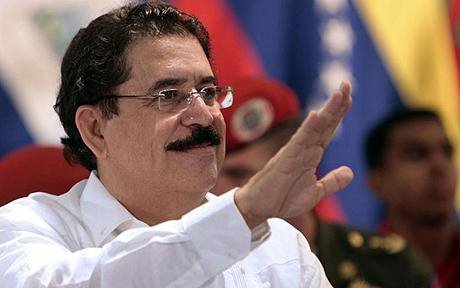
Haiti and Honduras : Considering Two ‘Coups d’État’

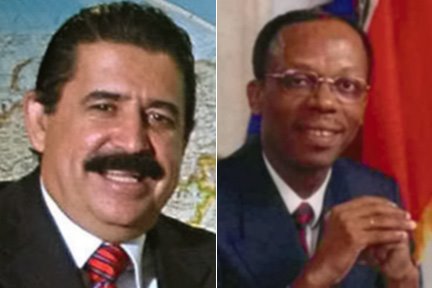
Two victims of coups d’etat, then and now: Manuel Zeyala of Honduras and Haiti’s Jean-Bertrand Aristide.

Coups Past and Present

The same United Nations that now condemns the coup in Honduras and demands Zelaya’s return occupied Haiti militarily during the coup government of Gérard Latortue, often attacking Haitians demonstrating for Aristide’s return, and occupies it still.

By David Holmes Morris / The Rag Blog / July 2, 2009

The soldiers who forced Manuel Zelaya at gunpoint from his bedroom to an airbase near Tegucigalpa could not have imagined the response their actions would bring. Not only has practically every government in Latin America condemned the coup d’état they carried out and demanded the reinstatement of Zelaya, but so have the Organization of American States and the United Nations, and, in a more guarded way, so has the United States.

More important in the long run is the resistance of countless Honduran people, who have defied the curfew declared by Roberto Micheletti, named by congress to be interim president, and who are facing down the soldiers now in control of the streets of the capital city.

President Manuel Zelaya was taken prisoner early Sunday morning after some 200 soldiers arrived at the presidential residence and disarmed his guards. Zelaya, still in his pajamas, was transported to an airfield and flown to Costa Rica. His ouster was similar, at least in superficial ways, to the last military coup in Latin America, which deposed President Jean-Bertrand Aristide of Haiti, for the second time, in February, 2004.

The two countries, despite important ethnic, historical and linguistic differences, are similar as well. They are of about the same size, with populations of around 7.5 million, and they are both among the poorest three or four countries in the hemisphere. Seventy percent of Hondurans live in poverty. The average annual income is $1600. Honduras and Haiti both have historically powerful military forces that have often shown a disposition for brutality. And they have both long been controlled by small wealthy elites.

But the two men are quite different. Aristide, a priest and practitioner of liberation theology, had a long history of direct involvement with the poor before becoming president and had shown great personal courage in their defense on more than one occasion. He received over 70% of the vote in one presidential election, 90% in another. Zelaya, in contrast, is the wealthy landowning son of wealthy landowners. He came to power in 2005 by a narrow margin through the politically centrist Partido Liberal, whose policies he initially supported, favoring CAFTA, for example, the Central America Free Trade Agreement.

It was only later in his presidency that Zelaya turned leftward, raising the minimum wage by 60% and forming alliances with the leftist and left-leaning Pink Tide governments of Latin America, in particular with that of Hugo Chávez. He agreed to join the Alternativa Bolivariana de las Américas, or ALBA, a regional fair-trade alliance, and somehow persuaded the unicameral legislature, dominated by his own Partido Liberal and the rightist Partido Nacional, to ratify his country’s membership in it. He became openly critical of the Honduran elite and of U.S. business interests in the region. He suggested, scandalously, that legalization of drug use was a saner approach than the U.S. drug wars.

Whatever his personal motives might have been, Zelaya, once in office, won the support of the poor of Honduras, who saw promise of improvement in their lives not only through an increase in wages but through membership in ALBA, which offered lower fuel prices through PetroCaribe, for example, and other benefits from an alliance with Venezuela, like the grant of several hundred tractors for Honduran farmers.

The wealthy of Honduras were not impressed, however, and neither were their armed and uniformed representatives in the military.
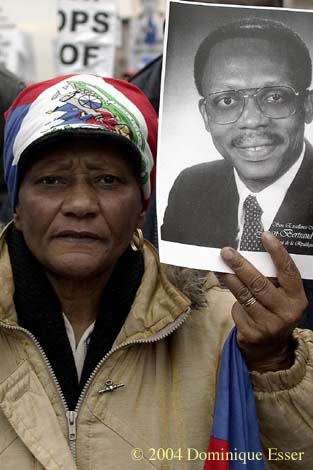
A woman holding up a picture of Jean-Bertrand Aristide in protest of the coup d’état in Haiti. Photo © 2004 Dominique Esser.

In Haiti a few years earlier Aristide had also sought to raise the minimum wage and had resisted the imposition by the World Bank and the International Monetary Fund of the privatization of public enterprises. He had tried to protect Haitian farmers and other producers against subsidized imports from the United States.

But in Honduras as elsewhere power is another question. In Venezuela, Ecuador and Bolivia, leftist governments had written new constitutions to insure the poor a voice in their own governments through new forms of democracy. The current Honduran constitution was written in 1982, during the presidency of Ronald Reagan in the United States and during a time of savage warfare in Central America, specifically in Nicaragua, where counterrevolutionaries supported by the United States attacked the Sandinista government from bases just across the border in Honduras. Honduras was heavily militarized and heavily under U.S. influence and the Honduran elite had no intention at such a time of sharing control of the government with the poor, whose counterparts across the border in Nicaragua had brought the Sandinistas to power.

Zelaya wanted a new constitution and, most probably, so did the people of Honduras. To determine the people’s will, though, Zelaya called for a non-binding poll of public opinion, as stipulated in Honduran law, specifically in the Civil Participation Act of 2006. The poll was scheduled to take place on Sunday, June 28. It would have asked participants if they wanted to include in next November’s general election the question of whether to form a constituent assembly for the purpose of writing a new constitution. As in other countries, the assembly would be made up of popularly elected members who would hammer out a new document, which would then be voted on by the population at large, a process that could take many months.
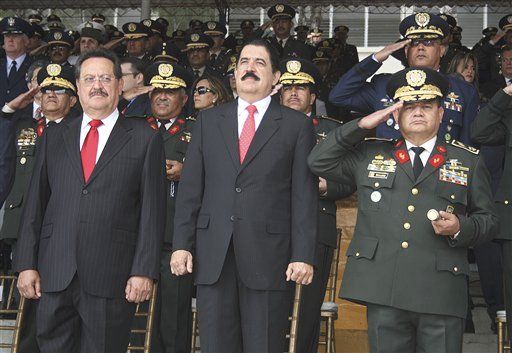
Edmundo Orellano (from left), Manuel Zelaya, Romeo Vásquez. Photo from ABC News.

Since the military in Honduras traditionally takes on the tasks of distributing ballots and ballot boxes for elections, Zelaya ordered the country’s ranking military officer, General Romeo Vásquez to make the arrangements. Vásquez refused. And as was his legal right, Zelaya relieved Vásquez of his duties. Defense Minister Edmundo Orellano quickly resigned in solidarity with Vásquez, as did the heads of the air force and the navy.

Zelaya then organized a group of supporters and marched with them to the air force base where the ballots and ballot boxes were being stored and retrieved them. He announced later that the materials for the polls were being protected by the national police and distributed by volunteers.

It was early in the morning of the day the poll was scheduled that the coup occurred. And almost immediately protest demonstrations began on the streets of Tegucigalpa.

Press accounts in Honduras and later elsewhere described the planned poll as a vote on whether the limit of one four-year term for the presidency should be eliminated, presumably allowing Zelaya to hold office indefinitely, a similar proposal having been voted down in Venezuela. Zelaya denies he has ever had any intention of remaining in office after his term expires next January.

Accounts in the rightist press after the coup said the ballots and ballot boxes had been flown in from Venezuela, that Zelaya had drawn up plans to dissolve the congress after the poll was conducted, and that 500 trained agitators had arrived from Venezuela to demonstrate against the coup. There had already been rumors questioning Zelaya’s sanity, as there had been rumors five years ago about Aristide’s emotional state.

The new government, under former president of the congress Roberto Micheletti, claims Zelaya was arrrested legitimately for attempting to hold an illegal election and that he will be arrested again if he returns to Honduras, as he has pledged to do. But Zelaya points out that no charges have ever been filed against him. The military have attacked journalists covering demonstrations and seven journalists, three from Telesur and four from the Associated Press have been detained briefly, not the actions of a government with nothing to hide.

The United States was clearly behind the Haitian coup of 2004. The United States military was present when Aristide was taken by force out of the country and U.S. troops occupied the country immediately after the coup. The question of direct U.S. involvement in the Honduran coup is naturally a topic of speculation. Honduras has long been almost totally dependent on the U.S. economically and therefore subservient to the U.S. politically. There have long been close ties between the U.S. military and its Honduran counterparts. There are some 500 U.S. servicemen at the Soto Cano Air Base and as many US civilian workers. Many Honduran officers have attended the Western Hemisphere Institute for Security Cooperation at Ft. Benning, formerly the School of the Americas, including General Vásquez and General Luís Javier Prince Suazo, head of the air force.

But considered broadly, it hardly matters whether the U.S. took a direct active part or not. The Honduran elite could have seen their own class interests best served by a coup that happened to correspond with what the U.S. would approve of. And the Honduran military would share the U.S. military’s worries about leftward trends in Latin America.

Demonstrators in Honduras confront military. Photo from Prensa Libre, Guatemala.

If all coups d’état have similarities, there are some puzzling differences in the reaction to the coup in Haiti five years ago and to the coup in Honduras days ago. Many news accounts in this country gave the impression that Aristide had somehow deserved what he got by alienating his own people, who had rebelled against him and run him out of the country or, alternately, that he had resigned of his own volition and fled for his own safety. The United States soldiers were in Haiti merely to keep the peace, as was the United Nations force that replaced them. But the UN forces are seen in Haiti as an army of occupation and there are frequent large demonstrations against them and for the return of Aristide. United Nations troops have been involved in countless acts of violence against Haitians, most recently in the shooting death of one of the thousands of Haitians at the funeral services for Father Gérard Jean Juste, a close associate of Aristide.

News accounts of the coup in Honduras generally describe it accurately as a coup d’état worthy of condemnation. But the same United Nations that now condemns the coup in Honduras and demands Zelaya’s return occupied Haiti militarily during the coup government of Gérard Latortue, often attacking Haitians demonstrating for Aristide’s return, and occupies it still. And the same Brazilian government that has just denounced the coup in Honduras supplies the commander and most of the soldiers for the United Nations occupying army. It was a Brazilian soldier who shot the mourner at Father Jean Juste’s funeral.

A good question these days is whether Latin Americans should now trust the United States and the United Nations. But change is slow and history is the greatest teacher.

[San Antonio native David Holmes Morris is an army veteran, a language major, a retired printer, a sometime journalist, and a gay liberationist.]

See other Rag Blog articles about the Honduran coup d’etat:

The Rag Blog

Posted in Rag Bloggers | Tagged , , , , , | 6 Comments

Larry Ray :
Lt. Dan Choi : Don’t Ask (Or Tell). Just Sign.

Tell the Speaker don't fire Dan!

Bolstered by more than 300,000 signatures to letters of support… Lt. Dan Choi is now taking his fight to repeal the discriminatory ‘Don’t Ask, Don’t Tell’ policy to Congress.

By Larry Ray | The Rag Blog | July 2, 2009

On Tuesday, a military board told Lt. Dan Choi — an Iraq War veteran and Arabic linguist — that it was recommending his discharge from the Army for “moral and professional dereliction” under the military’s “Don’t Ask, Don’t Tell” policy.

Despite this setback, Lt. Choi is not giving up. Bolstered by more than 300,000 signatures to letters of support calling for the repeal of DADT, Dan is now taking his fight to repeal the discriminatory “Don’t Ask, Don’t Tell” policy to Congress.

Dan needs your help as soon as possible. The sooner DADT is repealed, the sooner he can return to service.

I just signed the letter below to Speaker Nancy Pelosi that Lt. Choi is going to personally deliver to her. The letter is being launched on Lt. Choi’s behalf by the Courage Campaign, Knights Out and the Servicemembers Legal Defense Network.

We need Speaker Pelosi to take leadership now and speak out publicly in favor of current legislation in Congress that would repeal the “Don’t Ask, Don’t Tell” policy.

More than 50,000 people, including me, have signed Lt. Choi’s letter in just a few hours. Will you join me in signing it and urge your friends to do the same? Just click on the link below to add your name by clicking here: Courage Campaign

Thanks!

The Rag Blog

Posted in Rag Bloggers | Tagged , , , | Leave a comment

Juan Cole on Dick Cheney’s Criminal Irrelevance

Photo: Mark Wilson/Getty Images.

Cheney Worries about Wasting the Sacrifices made in Iraq on behalf of Big Oil
By Juan Cole / July 2, 2009

Dick Cheney reacted to the cessation of unilateral US patrols of major cities in Iraq, saying that he had concerns that the “insurgents” might launch more attacks and that “I would not want to see the U.S. waste all the tremendous sacrifice that has gotten us to this point.”

First of all, Cheney didn’t make any sacrifices in Iraq. He deferred his own military service five times because he ‘had other things to do.’ The ‘sacrifices’ were caused because he purveyed falsehoods to the US public in order to get up that war, hinting around that Saddam was in bed with Usama Bin Laden and telling senators that Iraq was two years away from having a nuclear bomb. So the sacrifices were of other people’s children, and his role was merely that of an Aztec high priest cutting the heart out of the victims.

Second of all, from the dawn of time until 2003, there had never been a suicide bombing in Iraq. Iraqis are not essentially violent. Like all human beings, they deploy violence at some points to further political goals. Cheney launched a violent illegal war of aggression on Iraq. And Cheney created the “insurgency” by invidious policies that unfairly disadvantaged the Sunni Arabs in the new Iraq he helped midwife.

Third, Cheney’s own administration (it was Bush-Cheney, remember Dick?) that negotiated the Status of Forces agreement under which the cessation of stand-alone US patrols of major Iraqi cities was scheduled for this summer. Cheney is trying to imply that this policy is that of the Obama administration!

Fourth, Cheney kept talking about ‘liberating’ Iraq and democratizing the Middle East. The patrols are ceasing precisely because the elected Iraqi parliament insisted on it! Cheney only likes democracy when it functions as an elective dictatorship for him and his cronies.

Fifth, Jason Leopold reviews the documentary evidence that Dick Cheney combined his energy task force with planning for an overthrow of the Saddam Hussein regime in Iraq.

Leopold writes,

[An] April 2001 report, “Strategic Policy Challenges for the 21st Century,” was prepared by the James A. Baker Institute for Public Policy and the U.S. Council on Foreign Relations at the request of then-Vice President Dick Cheney. In retrospect, it appears that the report helped focus administration thinking on why it made geopolitical sense to oust Hussein, whose country sat on the world’s second largest oil reserves.

“Iraq remains a de-stabilizing influence to the flow of oil to international markets from the Middle East,” the report said.

“Saddam Hussein has also demonstrated a willingness to threaten to use the oil weapon and to use his own export program to manipulate oil markets . . . The advisory committee that helped prepare the report included Luis Giusti, a Shell Corp. non-executive director; John Manzoni, regional president of British Petroleum; and David O’Reilly, chief executive of ChevronTexaco. . . [the notorious crook] Ken Lay, then chairman of the energy-trading Enron Corp., also made recommendations that were included in the Baker report.

And then Leopold adds is this:

The New Yorker ‘s Jane Mayer later made another discovery: a secret NSC document dated Feb. 3, 2001 – only two weeks after Bush took office – instructing NSC officials to cooperate with Cheney’s task force, which was “melding” two previously unrelated areas of policy: “the review of operational policies towards rogue states” and “actions regarding the capture of new and existing oil and gas fields.” [The New Yorker, Feb. 16, 2004]

By March 2001, Cheney’s task force had prepared a set of documents with a map of Iraqi oilfields, pipelines, refineries and terminals, as well as two charts detailing Iraqi oil and gas projects, and a list titled “Foreign Suitors for Iraqi Oilfield Contracts,” according to information released in July 2003 under a Freedom of Information Act lawsuit filed by the conservative watchdog group, Judicial Watch.

In other words, what Cheney is really worried about is that a US military withdrawal from Iraq on the timetable his administration negotiated with the Iraqi parliament might lead to further instability of a sort that would keep the US oil majors from getting at Iraqi petroleum in a big way. His invocation of the ‘sacrifices’ made by other people’s children on the basis of his hateful manipulations is the ultimate desecration.

For my own account of Cheney, Iraq and Big Oil, see Engaging the Muslim World.

Source / Informed Comment

The Rag Blog

Posted in RagBlog | Tagged , , , , | Leave a comment

Honduras and Western Hemisphere : Summer Rerun?


A new day dawns in the Western Hemisphere:
The old day not yet buried

By Harry Targ / The Rag Blog / July 1, 2009

Sunday the Honduran military carried out a coup ousting President Manuel Zelaya from power. Almost immediately leaders of Western Hemisphere nations condemned the actions taken in Tegucigalpa, the capital city. For example, President Luiz Inacio Lula da Silva (Lula) clearly pointed out that the days of military coups as a mechanism of the transfer of power are over in Latin America.

President Obama said on Monday that “It would be a terrible precedent if we start moving backwards into the era in which we are seeing military coups as a means of political transition rather than democratic elections… The region has made enormous progress over the last 20 years in establishing democratic traditions in Central America and Latin America. We don’t want to go back to a dark past.”

On Tuesday, the United Nations General Assembly passed by acclamation a non-binding resolution condemning the military action and demanding that Zelaya be returned to office. Political opposites from Hugo Chavez, Fidel Castro and Evo Morales to Barack Obama have taken the same position on the events in Honduras, although Chavez articulated the view that the United States had a role in the coup.

The New York Times, while reporting these events and the mass mobilizations in Honduras protesting the coup, was careful to point out that ousted President Zelaya after all was closely allied with Hugo Chavez and linked Honduras to the Chavez led “leftist alliance, the Bolivarian Alternative for the Americas.” The Times further reported that there were large scale protests in the capital of Honduras in support of the coup. And after all, they suggested, Zelaya would have had no world significance if it were not for the coup which made him famous.

Rather than framing the coup and global reaction to it as business as usual in Latin America, and business tied to the particular interests of all the parties-leftist elites, generals, the United States, street demonstrators of all sorts-the events in Central America should be seen as part of broader historical forces.

First, the Western Hemisphere has experienced hundreds of years of shifting external interference, mass murder and economic exploitation of natural resources, agricultural lands, cheap labor, and sweat shop workers. The Spanish, the British, and the United States figured most prominently in this unhappy story, referred to by Eduardo Galeano as “five centuries of the pillage of a continent.”

Second, twentieth century Central America was dramatically shaped by over thirty U.S. military incursions and occupations in Central America and the Caribbean between 1898 and the 1930s. For example, U.S. troops were sent to Honduras in 1903, 1907, 1911,1912, 1919, and 1924-25.

Third, economic ruling classes in the Hemisphere and their foreign partners increasingly were forced to rely on strong military forces to crush opposition to elite rule and devastating poverty and exploitation. Particularly in Central America, the military as an institution became a material force, sometimes independent of the economic ruling class. From the early 1930s until the end of World War II military dictatorships ruled each of the five Central American countries. Later, in the height of the Cold War in the 1970s, 2/3 of the land mass and population of Latin America was ruled by brutal military dictatorship; Argentina, Brazil, Chile being the most prominent.

Fourth, in the 1980s, Ronald Reagan brought the struggle against “international communism” to Central America. He launched and supported brutal wars against the Salvadoran and Nicaraguan people and looked the other way as the Guatemalan generals engaged in genocide against the majority indigenous population of that country. Probably 400,000 Central America peoples died in these U.S. supported wars.

Honduras, heretofore a country with less violent military rule and only a modest recipient of U.S. military aid, became the military base for U.S. operations in the region; training the contra rebels fighting against the Nicaraguan government and providing training and military support operations for Salvadoran troops fighting against FMLN rebels. Honduras received more military aid from the United States in the mid-1980s, than it did during the prior thirty years. Thousands of U.S. troops, numerous air strips, and field exercises for summer National Guard troops made Honduras a U.S. armed camp.

Fifth, parallel to the war on communism in the Western Hemisphere, the Reagan administration forced on the countries of the region the neo-liberal economic policies of downsizing government, deregulation, privatization, free trade, and shifts to export-oriented production. In the 1980s, the economic consequences of these policies were referred to by Latin American scholars as “the lost decade.”

While the economies of Central American countries improved since the 1980s, they remain poor and dependent. Honduras is the poorest of the five countries in the region. Its per capital Gross Domestic Product in 2003 was $803 (the regional figure was $1,405). A little over 9 percent of its earnings come from overseas remittances. Honduran debt constitutes 66 percent of total GDP. And life expectancy is 66 years.

This brief review of some of the Latin American experience, and it has been most brutal in Central America, is part of the story of the Sunday coup.

First, we must remember that whenever the interests of foreign investors (particularly from the United States), domestic ruling classes and/or military elites were threatened by international political forces and/or domestic mobilization of workers and peasants, the military moved in to reverse the forces of history.

Second, the United States has played a direct role in such interventions and has provided military assistance and training for military officers of all Latin American militaries ever since the end of World War II. (The training facility used to be called The School of the Americas).

Third, military interventionism and covert operations have been paralleled by economic intervention through the debt system, foreign investment, trade agreements, and quotas and embargoes of goods from Latin American countries.

Fourth, the winds of change that were initiated in the 1960s in the region were first stifled and isolated, then spread in the 1980s and beyond. Most recently, countries as varied as Argentina, Bolivia, Brazil, Chile, Cuba, Ecuador, Nicaragua, Paraguay, Uruguay, and Venezuela have begun to step in a new direction; away from the neo-liberal economic model, away from deference to traditional great powers, and in resistance to the United States. (Honduras has begun to move in this direction as well).

Most importantly, these countries, and other countries from the Global South in Asia and Africa, have begun to construct new economic and political institutions that will transform the International economic and political system after 500 years of North Atlantic rule. The fact that 192 countries in the United Nations said no to the Honduran coup suggests that this battle goes beyond the simplistic New York Times frame that the Honduran battle is merely about competing special interests.

It may be that the Obama administration understands the new global reality, or at least realizes that the United States must figure out ways to adapt to it.

[Harry Tarq is a professor in American Studies who lives in West Lafayette, Indiana. He blogs at Diary of a Heartland Radical.]

The Rag Blog

Posted in Rag Bloggers | Tagged , , , | 1 Comment

And Sunglasses Don’t Help

Senator Larry Craig of Idaho and his wife, Suzanne. Photo: Troy Maben/Associated Press.

Rules of the Wronged
By Maureen Dowd / June 30, 2009

Stay focused, ladies. Here is The Practical Guide to Help Spurned Political Wives Survive Old Problems in the Era of New Technology.

1. Skip the press conference, especially when your husband is copping to call girls, gay pickups in airport bathrooms or “tragic” and “forbidden” telenovela-style love stories. Stoicism at the skunk’s side is overrated and, as Larry Craig’s wife learned, sunglasses don’t help.

2. When there’s an Associated Press bulletin quoting your husband saying that he has found his soul mate but he’s going to try to fall back in love with you, change the locks. (At your second home, too.)

3. If you can’t maintain a dignified Silda Spitzer silence; if you can’t find a girlfriend, a shrink, a personal trainer, a hairdresser or a yoga teacher to confide in; if you must unburden yourself of your fury about your loser husband, go to Jesse Jackson, Al Sharpton or even Deepak Chopra before crying to The A.P. A news wire is not a spiritual adviser.

4. When your husband turns into a Harlequin romance, babbling to The A.P. — yes, even The A.P. thought it was T.M.I. — about a magical encounter on an open-air dance floor in Uruguay, “a soul that touches yours in a way that no one’s ever has,” and the “left brain and right brain” compartmentalization of “the world of ideas that impact this country and state” and “the pursuit of happiness, whatever that is,” just beat it.

5. If you think the worst is over, it’s probably only beginning. On Tuesday, after you thought Mark Sanford had already emoted and burbled more than any man in history, he volunteered to The A.P. (again!) that he had “crossed lines” with a handful of women on trips out of the country, but only “crossed the ultimate line” with his enchanting Maria. And just when you thought John Edwards could not sink any lower, there is news of a sex tape, in which Rielle Hunter shows off her skills not only in videography but pornography.

6. No matter how revolting your husband’s behavior is, don’t be passive-aggressive in public. Refrain from making any remarks that have a veneer of dignity but derogatory subtexts that sound like: “We’re trying to reconcile but it’s going to be tough because he has irreparably damaged my children” or “He has no integrity and I want my kids to have integrity” and “Sure, I’d like to give him a chance if he weren’t such a sleazeball.”

7. Don’t bring the children into it. They suffer enough being the kids of politicians. In the era of Facebook, texting, Google and iPhones, calling him out as a bad father will just go viral in the kids’ circles. Don’t trot out the family on “Oprah,” as Elizabeth Edwards did, or weepily show The A.P. the report cards of your two oldest sons from their elite private school in Columbia, S.C., as Jenny Sanford did.

8. Even if you’re a clever, competent woman, you risk sounding like a stereotypical harridan if you use the kids as a bludgeon and tell the press, as Jenny did: “You would think that a father who didn’t have contact with his children, if he wanted those children, he would toe the line a little bit.” When kids are involved, it’s best to chill when dishing out revenge.

9. Don’t slam his girlfriend for lying when you know she’s telling the truth. Don’t refer to the baby your rival had with your husband as “it.” Don’t trash a mistress, as Hillary and Elizabeth did, as a wacky stalker. No one — except the wife — blames the girlfriend as much as they blame the husband. Besides, you invite The Other Woman’s retaliation, as when Rielle decided — after watching Elizabeth spill to Oprah — that she might want that DNA test after all.

10. High-powered women like Hillary, Elizabeth and Jenny who give up their careers to focus on their husbands’ ambitions feel doubly betrayed. But it’s not your husband’s fault if you sacrifice more for the relationship than he does. Like an investor in a down market, you took a risk without a guarantee it would pay off. If you make your husband your career and you lose your husband, you lose your career, too.

11. Cut your losses and keep going. Don’t let yourself get dragged into his drama or your reputation may follow his down the well. Hillary refused to let that happen. She salvaged her long investment in Bill Clinton and turned a profit when she became a senator.

12. As you stay out of the spotlight that singes your husband, listen to whatever messages he is sending you through the press. When your husband says that is a world-class love story, ask him what this is. Just don’t do it through The A.P.

Source / New York Times

The Rag Blog

Posted in RagBlog | Tagged , | Leave a comment

Israel: Going Out of Their Way to Maintain Their Pariah Status

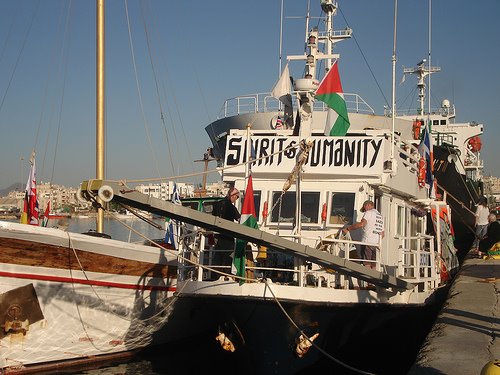
The Spirit of Humanity shortly before leaving Cyprus. Photo: Free Gaza.

Pirates of the Mediterranean
By Yvonne Ridley / July 1, 2009

The arrogance of Israel is nothing short of breath-taking.

On the eve of one of the most damning reports ever to be published on human rights abuses and suspected war crimes, Israel committed an act of piracy.

While western naval fleets are patrolling the waters off the coast of Africa, acts of piracy are being carried out routinely in the Mediterranean.

But the international community leaders couldn’t care less because most of those who are kidnapped, shot at and hijacked at sea are Palestinian fishermen from Gaza.

However yesterday Israel crossed a line after firing on and boarding a boat carrying aid and peace activists to Gaza.

The 21 on board included former US Congresswoman Cynthia McKinney and Nobel laureate Mairead Maguire, who were taken prisoner by the Israeli navy after gunboats surrounded and seized the Free Gaza Movement relief boat ‘Spirit of Humanity’ on Monday.

The aid was seized, their mobile phones confiscated and no doubt cameras capturing the illegal actions of the Israelis were also removed.

“This is an outrageous violation of international law against us. Our boat was not in Israeli waters, and we were on a human rights mission to the Gaza Strip,” said Cynthia McKinney, the Green Party’s 2008 candidate for President of the United States.

“President Obama just told Israel to let in humanitarian and reconstruction supplies, and that’s exactly what we tried to do. We’re asking the international community to demand our release so we can resume our journey.”

In the past the Israeli Navy has claimed that boats have entered their territorial waters and breached their part of the sea in the eastern Med.

However, thousands across the world who followed the progress of the Free Gaza Movement boat Spirit of Humanity by internet, GPS, Twitter and various other means of communications over the last 30 hours know for sure that the boat was illegally stopped in international waters.

This is piracy. Nothing more. Nothing less.

It’s anyone’s guess what will happen to the Humanity’s cargo of medical supplies, cement, olive trees, and children’s toys.

But what we need from Barak Obama and Gordon Brown (there are at least half a dozen Brits on that boat) is strong leadership in which Israel apologises and allows the boat and its passengers to continue the journey into Gaza.

The G8 leaders all know what the Israeli Army did in Gaza and the war crimes that were carried out making it impossible for the Zionist military to travel into most European countries for fear of being arrested.

And in the next 24 hours Amnesty International will spell out exactly what was done on the ground during that 22-day war.

We know that the fourth largest military in the world, a military given weapons by Britain and the US, destroyed 50,000 homes, 800 industrial properties and 200 schools.

During a recent trip to Gaza with the Viva Palestina convoy, I saw the scores of mosques bombed – even orphanages had been targeted. The net result was the slaughter of more than 1,400 civilians, including hundreds of children.

How long is Israel going to be allowed to behave as it wants … and even likes?

I saw, with disbelief, some of the taunting, sadistic messages scrawled on lounge walls in bombed out homes by departing Israeli soldiers – one even left his email for “any complaints”.

I remember when Tony Blair, called the Taliban the most evil, brutal regime in the world and he justified this statement because he said they didn’t even allow children to fly kites.

He wondered at the mentality of a regime which could be so cruel to children.

That was way back in November 2001. Well I wonder what he would think of a regime which blocks cherries, kiwi fruit and chocolate from reaching the hands of the children in Gaza? Yes, that’s how evil this Zionist regime is … it can’t even bear the thought of these poor kids receiving a few tasty treats.

Every week, about 10 officers from the Israel Defense Force’s Coordinator of Government Activities in the Territories (COGAT) unit meet to decide what sort of food the 1.5 million inhabitants of the Gaza Strip can eat.

Let’s name and shame the men this gruesome threesome – Colonel Moshe Levi, Colonel Alex Rosenzweig, and Colonel Doron Segal. All three decided a few days back that apricots, plums, grapes, avocados, cherries, kiwi fruit, green almonds, pomegranates and chocolate were “delicacies” and therefore expressly prohibited.

I will return to these three shameful soldiers at a later date, but let’s return to today’s events which has, in my view, reconfirmed Israel as a rogue state by launching into international piracy yet again.

You will notice the top of this story is called Pirates of the Mediterranean II – that’s because I wrote an article in December revealing how another free Gaza Movement boat, the SS Dignity, was rammed by an Israeli naval gunboat.

The act of aggression on a peace mission was launched in international waters 90 miles off Gaza, without any warning to the captain of the Dignity or the crew. Israel claimed the incident was an accident and that its naval officers had made numerous attempts to communicate with the Dignity. The israelis ‘accidentally’ rammed the boat no less than three times.

The Israelis accused the international activists then of “seeking provocation more than ever.” Isn’t it amazing how the Zionist State suddenly goes belly up and adopts a victim mentality?

Exactly what the hell is Israel up to by banning or trying to prevent boats from entering waters not in its territory? This is the Mediterranean. Just when did Israel assume complete authority of the Med?

Israel’s deplorable attack yesterday, and its previous one on the unarmed Dignity is a violation of both international maritime law and the UN Convention on the Law of the Sea, which states, “the high seas should be reserved for peaceful purposes.”

Delivering aid to the needy is just such a “peaceful purpose.” Deliberately ramming or hijacking mercy ships and endangering its passengers is an act of terrorism and piracy.

I say Western fleets should now head to the Mediterranean to crack down on this breed of pirates who make the Somali gangs look like Captain Pugwash and co.

The Somali pirates are motivated by money – that makes them criminals. The Israelis commit these acts out of sadistic pleasure … what does that make them?

And if they are allowed to continue, what will that make the likes of Obama, Brown and the other cabal of foreign leaders who look the other way?

Enough is enough. The time has come to acknowledge that Israel is a failed project, a rogu e state – and a danger to ordinary, decent, law-abiding members of the public.

Until it comes to heel the international community needs to impose sanctions, freeze its assets, stop selling arms and installing a UN peacekeeping Force to bring it under control because it is a menace to its neighbours and the wider world.

For more information and updates, see the Free Gaza Movement web site, including the latest release on the seizure of the relief boat.

For communications and updates from Cynthia McKinney, visit her Green Party page and blog.

[Journalist Yvonne Ridley and film-maker Aki Nawaz sailed to Gaza with the FGM on the first mission to break the siege in August 2008. Ridley was given a media award at the annual Muslim News awards. Her website is www.yvonneridley.org.]

Source / Information Clearing House

The Rag Blog

Posted in RagBlog | Tagged , , , | 2 Comments

Leonard Peltier : In the Spirit of Crazy Horse

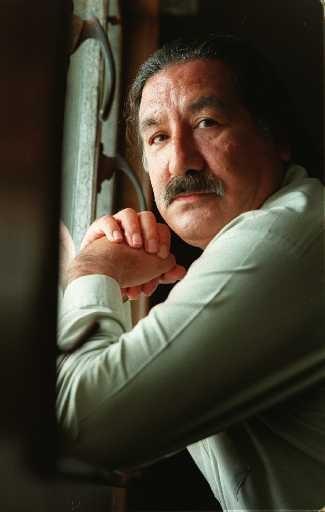
Political Prisoner Leonard Peltier. Photo from High Times.

In the Spirit of Crazy Horse

I don’t want to spend the rest of my life in this prison. And I don’t want you to spend the rest of your life in some prison of the mind, heart or attitude.

By Leonard Peltier

See ‘Free Leonard Peltier’ by Dan Skye, Leonard Peltier’s ‘Open letter to Barack Obama,’ and a Video from Chief Leonard Crow Dog, Below.

[Leonard Peltier, one of America’s longest-serving political prisoners, has spent 34 years of his life behind bars for a crime he didn’t commit. He was an active member of the American Indian Movement in the 1970s and was charged with the murder of two FBI agents on the Lakota Sioux Pine Ridge reservation in June 1975.

On July 28, 2009, Peltier is scheduled to come before a parole hearing. Supporters are mobilizing a campaign of letter-writing and petitioning in an effort to free him. He wrote the following to his supporters on June 26.]

I am but a common man, I am not a speaker but I have spoken. I am not all that tall, but I have stood up. I am not a philosopher or poet or a singer or any of those things that particularly inspire people, but the one thing that I am is the evidence that this country lied when they said there was justice for all…

I am just a common man and I am evidence that the powers that put me here would like to sweep under the carpet. The same way they did all of our past leaders, warriors and people they massacred. Just as at Wounded Knee, the Fifth Cavalry sought its revenge for Custer’s loss and massacred some 300 Indian men women and children, then gave out 23 Medals of Honor and swept the evidence of their wrongdoing aside…

I don’t want to spend the rest of my life in this prison. And I don’t want you to spend the rest of your life in some prison of the mind, heart or attitude. I want you to enjoy your life.

If nothing else give somebody a hug for me and say, “This is from Leonard.”

In the Spirit of Crazy Horse,

Leonard Peltier

Source / Rebel Reports

Free Leonard Peltier!
Leonard Peltier parole hearing set July 28, 2009

by Dan Skye / July 1, 2009

With the rise of the American Indian Movement, intertribal strife broke out on the Pine Ridge Indian Reservation in South Dakota. AIM activists squared off against a corrupt tribal government and police force.

AIM was being closely monitored by the FBI. In June 1975, two FBI agents in an unmarked car sped onto Indian land near Oglala, SD. The Indians living there had no way of knowing whether they were federal agents or anti-AIM tribal police. In a desperate shootout, the agents and one Indian were killed. Though law enforcement swarmed the reservation, Leonard Peltier, a Chippewa Sioux, and more than two dozen others managed to escape.

Eventually, two Indian participants were apprehended. Both pleaded self-defense and, following a tumultuous trial, they were acquitted. But Peltier wasn’t captured until February 1976.

In 1977, he stood trial on double murder charges. Peltier’s conviction is one of the worst examples of government manipulation of the justice process in American history. The FBI submitted false affidavits as evidence and intimidated and coerced witnesses. The judge disallowed testimony describing the state of open warfare that existed on Pine Ridge, nor was Peltier allowed to claim self-defense. Later, an appeals judge called the conduct of the FBI “a clear violation of the investigative process.”

For over 30 years, Leonard Peltier has been denied parole or pardon. But while imprisoned, he has become a leading spokesperson for the causes of indigenous people. He has been nominated for the Nobel Prize six times. Countless organizations including Amnesty International, the Southern Christian Leadership Conference, the National Congress of American Indians, the Robert F. Kennedy Memorial Center for Human Rights, as well as leaders and private citizens, have called for his immediate release.

Behind bars, Peltier has also become an outstanding painter. Prints of his work are for sale. All proceeds go to his defense fund.

Read Leonard Peltier’s full June 26 statement. Peltier is up for parole on July 28. His supporters and friends have launched a letter-writing campaign to support his release from prison after 34 years.

Source / High Times

An open letter to Barack Obama

I have watched with keen interest and renewed hope as your campaign has mobilized millions of Americans behind your message of changing a political system that serves a small economic elite at the expense of the peoples of the United States and the world. Your election as president of the United States, where slaves and Indians were long considered less than human under the law, will undoubtedly constitute a historic moment in race relations in the United States.

Yet symbolism alone will not bring about change. Our young people, black and Native alike, suffer from police brutality and racial profiling, underfunded schools, and discrimination in employment and housing. I sincerely hope your campaign will inspire some hope among our youth to struggle for a better future.
[….]
It is long past time for a congressional investigation to examine the degree of federal complicity in the violent counterinsurgency that followed the occupation of Wounded Knee. The tragic shootout that led to the deaths of two FBI agents and one Native man also led not only to my false conviction, but also the termination of the Church Committee, which was investigating abuses by federal intelligence and law enforcement agents, before it could hold hearings on FBI infiltration of AIM. Despite decades of attempts by my attorneys to obtain government documents related to my case, the FBI continues to withhold thousands of documents that might tend to exonerate me or reveal compromising evidence of judicial collusion with the prosecution.

— Leonard Peltier

Long, long time I come here — and during those trials. Now I’m 68 years old, can hardly walk, can hardly sing. Oh before I go, I want Leonard to be free. Chief Leonard Crow Dog.

To learn more about Leonard Peltier, go here and here.

Thanks to Harry Edwards / The Rag Blog

Posted in RagBlog | Tagged , , , , | 6 Comments

Sign of Times : Coleman Out, Franken In


Sign of the Times… Finally!

The GOP’s worst nightmare has become reality. When Franken is seated next week, the Democrats will have a filibuster-stopping 60 vote majority in the Senate.

By Larry Ray / The Rag Blog / July 1, 2009

One term Republican Minnesota U.S. Senator, Norm Coleman, has finally thrown in the towel conceding the Senate race to Democrat Al Franken, who won by a narrow 312 votes out of 2.9 million ballots cast by Minnesotans last November. A 5-0 Minnesota Supreme Court decision against Coleman ended eight months of GOP delaying tactics in the courts following a total vote recount, and endless legal challenges to Franken’s narrow victory.

The more Coleman desperately claimed voter irregularities, the more the vote recount eliminated his thin 206 vote lead and uncovered votes that eventually shifted a 312 vote victory to Franken.

The GOP’s worst nightmare has become reality. When Franken is seated next week, the Democrats will have a filibuster-stopping 60 vote majority in the Senate.

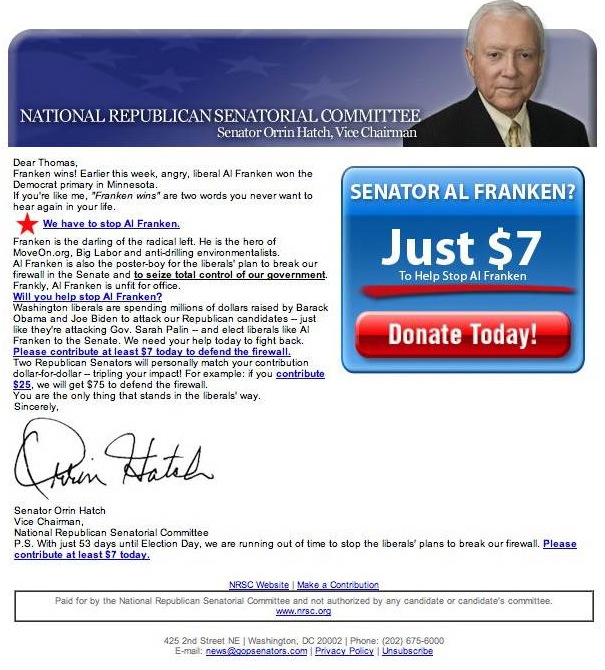
And the old-boy National Republican Senatorial Committee will have a lot of crow to choke down. Below is a reduced version of a November 2008 G.O.P. plea for money to “stop the liberals’ plan to break our firewall!”


Orrin Hatch, in this almost comical appeal for “Just $7” unabashedly vilifies Al Franken:

“If you are like me, ‘Franken wins’ are two words you never want to hear again in your life. We have to stop Al Franken! He is the darling of the radical left. He is the hero of Move-on.org, Big Labor and anti-drilling environmentalists. Al Franken is also the poster boy for the liberal’s plan to break our firewall in the senate and to seize control of our government. Frankly, Al Franken is unfit for office.”

Then Orrin winds up his hysterical diatribe:

“Washington liberals are spending millions of dollars raised by Barack Obama and Joe Biden to attack our Republican candidates, just like they are attacking Gov. Sarah Palin — and elect liberals like Al Franken to the Senate.”

Well, what a difference eight months makes, Orrin. Not only did Poster Boy nemesis Saturday Night Live comedian, Al Franken win, you will now get to smile and shake his hand.

After all the dust settled on the old crumbled firewall, six GOP senators had lost their places on the wall, falling off just like a bunch of Humpty Dumpties including a long-time Dumptyette, Liddy Dole. Add a G.O.P. defection to “the liberals,” the disgrace of Ted Stevens of Alaska, and viola’ the despised ‘liberals’ now tote up a 60 seat majority.

Orrin, you might like to know that Al graduated cum laude from Harvard College, is a highly successful author, and a little occasional SNL humor in the Senate chambers might be a good idea. You really should read Frankin’s, 1993 book, “I’m Good Enough, I’m Smart Enough, and Doggone It, People Like Me.”

[Retired journalist Larry Ray is a Texas native and former Austin television news anchor. He also posts at The iHandbill.]

The Rag Blog

Posted in Rag Bloggers | Tagged , , | 2 Comments

Drone Attacks ‘Violated International Humanitarian Law’ in Gaza War

Israeli drones fly over the Gaza Strip in January 2009, as seen from Gaza City. According to the US-based Human Rights Watch, Israeli armed drones killed scores of Palestinian civilians during the Gaza war despite their cutting-edge targeting technology. Photo: AFP/File/Mahmud Hams.

When Drones Become Indiscriminate
By Jerrold Kessel and Pierre Klochendler / June 30, 2009

JERUSALEM – The concerted effort of international human rights activists to rein in violations of laws of war was given a major impetus when Human Rights Watch researchers presented a report Tuesday on the unbridled use by the Israeli military of unmanned combat aerial vehicles (UCLAV), commonly known as drones, during Israel’s 22-day assault on Hamas in Gaza at the beginning of the year.

Entitled ‘Precisely Wrong’, the Human Rights Watch (HRW) report focuses on six cases of Israeli drone-launched missile attacks in which 29 Palestinian civilians, eight of them children, were killed. Based on cross-referenced eyewitness accounts corroborated by doctors, as well as ballistics and forensic evidence collected on the attack sites, the report asserts that “in none of the cases did HRW find evidence that Palestinian fighters were present in the immediate area of the attack at the time.

“These attacks violated international humanitarian law,” the report states in unequivocal terms, following a ten-day investigation.

Marc Garlasco, senior military analyst at the emergencies programme of HRW, estimates that at least 87 civilians were killed in 42 drone attacks. “Israel’s targeting choices are unacceptable and unlawful,” he declared at a press conference in East Jerusalem, “especially (considering) that UCLAV provide the most precise platform in the military arsenal, and that Israel is the world leader in drone technology.”

The report includes technical information about drones and drone-launched missiles. Israeli drones have advanced sensors, combining radars, electro- optical and infrared cameras, and lasers providing real time imaging by day and night. “Those sensors enable a drone operator to determine if a person on the ground is armed,” stressed Garlasco.

In addition to these high-resolution cameras, a missile fired from a drone has its own cameras that allow the operator to observe the target from the moment of firing. “If a last-second doubt arises about a target, the operator can divert the fired missile with a joystick,” the report notes.

Everything viewed by the drone operator is recorded. “There is no fog of war with such drones,” Garlasco said. “Yet, the Israeli army failed to distinguish between military objectives and civilians.”

According to Palestinian sources, 900 civilians were killed during the military operations, among a total of more than 1,400 killed. The HRW report says a third of the fatalities were from drone-launched missiles. Israeli sources put the civilian death toll at 300.

“HRW is not against the use of drone in warfare. Its accuracy and concentrated blast radius can indeed reduce civilian casualties,” Garlasco conceded. But “drones, much like sniper rifles, are only as good at sparing civilians as the care taken by the people who operate them.”

The Israeli army questions the credibility of the HRW investigation. “The report is based on anonymous Palestinian sources whose knowledge of military issues is doubtful, who are clearly not impartial observers, and who are part of the propaganda machine in Gaza,” it said in a statement.

“We conducted interviews separate from Hamas activists,” counters Garlasco. “If there were fighters, the interviews were stopped immediately; we just did not use them.”

Garlasco acknowledges that the testimonies collected are limited. “Mistakes can happen, but here there is a clear pattern – many civilians were killed. It seems Israeli rules of engagement were very loose – keeping Israeli casualties to a minimum, valuing the lives of soldiers more than those of Palestinian civilians.”

The report calls on Israel to conduct a “case-by-case investigation” into the use of drone-launched missiles. “Military or civilian personnel found responsible for committing or ordering unlawful drone attacks should be disciplined or prosecuted as appropriate.”

“This report has a look to the future,” says Garlasco. “It’s a cautionary tale to the U.S. continued use of UCLAV in Afghanistan and Pakistan.”

Human rights activists have increasingly voiced their concern over U.S. reliance on a drone-launched missile attack policy. In a stinging report submitted earlier this month to the Geneva-based UN Human Rights Council, UN special investigator Philip Alston charged that the U.S. has created “zones of impunity” by rarely investigating private contractors and civilian intelligence agents involved in the killing of civilians from drone attacks. Alston urged that an independent special prosecutor be charged with pursuing criminal allegations against government officials accused of wrongdoing.

“Even when you’re attacking a legitimate military objective, you cannot cause civilian casualties that exceed the value of a legitimate military attack,” says Garlasco. Still, the reliance on drone tactics – and the strategic cutting-edge drones increasingly provide – may surpass the power of human rights in international forums. Last week, Israel’s Channel Two revealed that Israel had conditioned the sale to Russia of a dozen drones, on Moscow not selling Iran advanced anti-aircraft missile technology. Iran has sought to deploy the Russian S300 air defence missile system against a possible Israeli attack on its nuclear facilities.

Moscow became aware of a need for advanced drones during its war with Georgia last summer. Georgia operated Israeli-made spy drones, which proved highly effective. The Russians used a drone of their own without great success. Russian military officials have made no secret of their intention to use Israeli models to improve their drone development programme.

Source / IPS News

The Rag Blog

Posted in RagBlog | Tagged , , , | Leave a comment

Dick J. Reavis : Journalism Faces Full Court Press


Full Court Press

Until and unless the press understands that its mission is to be the champion of the people’s welfare, nobody can plan for its recovery.

By Dick J. Reavis / The Rag Blog / June 30, 2009

As almost everybody knows, the outlook for the mainstream press is bleak. Metro dailies like the Austin American-Statesman are likely to shutter within a decade. National newspapers like The New York Times may survive as ink-on-paper publications, but even the future of their electronic versions is uncertain because nobody has figured out how to “monetize” the web. Trembling before this scenario, friends of the press holler that “if the press dies, democracy dies!”

While nobody can dismiss any of the troubles facing the press, I think that the usual worriers have got the cart before the horse. Changes in technology will not bring about the downfall of the press. Buggy whip makers were sidelined, it is true, but the last buggy-chassis builders were the first auto chassis builders, and the last buggy upholstery workers were the first auto upholstery workers. The same is already true in the press: paper-newspaper editors have become web editors.

But civic life, which provided the content of the front-page sections of newspapers, is ailing, even moribund. If American democracy withers, newspapers that cover its life (usually with reverence and decorum) will wither, too — and that notion is far more menacing to newspapers than anything about the web.

The idea that democracy might die is by no means new with me. I found it several years ago in Robert Putnam’s 2001 book, Bowling Alone, a catalog of the decline of unions, political clubs, PTAs, even bowling leagues — of democratic institutions in the broadest sense of the term. (The book gets its title from the observation that during the 1950s, most bowlers played on teams; today, most bowl alone.) The problem with Putnam’s book isn’t that it isn’t seminal, but instead, that if Karl Marx wrote Capital today, it would be a sensation for six weeks. All of our media are now geared to the pace of talk-entertainment shows. Everything published is a fad.

When I first read Bowling Alone several years ago, my impression was, “Oh, so the U. S. is catching up with Mexico.” Our southern neighbor has long been a country where only 15 percent of households buy newspapers, and in which, as a consequence –as will soon be the case here — carrier delivery is unknown. It is fair to say that at least until 2000 — and things haven’t changed greatly since then — Mexican democracy was an affair of those who had a financial stake in its doings, roughly, the 15 percent who read newspapers. Even today Mexican commoners neither believe that their nation is in good hands, nor that they can do anything about it. For them, the news might as well be a record of hurricanes and tornadoes, of natural forces, acts of God.

It isn’t that Mexicans can’t, or don’t read. They do. For decades, the nation’s leading newspaper has been a soccer daily. Feeling powerless as citizens, Mexicans turn their attention to sports, the music stage, the telenovelas and currently, to cop-and-narco jousts.

American democracy is not as far removed from the Mexican version as Americana buffs would like to think. Hollywood, Nashville and the NBA are the real plazas of our public life, Facebook, our most democratic periodical. Our villains come from the realm of pop culture, more than from public life: while millions clamored for O.J., Michael Jackson and Michael Vick to be brought to the bar, almost nobody clamors for the indictment of Yoo, Cheney or Bush, in part because they are minor-league celebrities, unworthy of spectacle or awe. Our heroes are mostly pop, too. If Obama was the presidential choice of collegians, that was largely because he was cool: had Biden headed the ticket, Salin Palin would be vice-president today.

American newspapers were failing long before the Internet was born. In 1952, the average American family read 1.3 newspapers per day. That figure has steadily declined to below .4. “Readers” of web publications, though more numerous with every count, spend about 20 minutes a week with online newspapers. Twenty minutes per day was the usual time in the heyday of print and public involvement. Older generations still read more than younger ones, but the most recent figures show a drop in all age categories. Joe Six Pack has quit reading and Joe College mainly reads headlines, probably about sports and entertainment stars.

People who consider themselves friends of the press are now spinning ideas to save it. But it may be too late. A new format, tax-supported subsidies or foundation grants won’t revive the press because those measures can’t revive democracy, which was never in the best of health, anyway.

Perhaps the problem is best explained, as everything today, by a sports analogy. Front-page news has essentially been a report on the fortunes of the home team — our representatives in government. The news is as interesting as the scores. Not long ago, students at Sacramento State voted down a fee increase to support campus athletics. A New York Times story on their referendum quoted the student body president as explaining that “I just don’t think that students care too much about it, because they’re not winning the big games.” It’s a fair guess that students at Sacramento State don’t read about their Hornets, either.

It is the same with our government. The disasters that even the youngest of us have witnessed, including the Afghan and Iraq wars and the ongoing financial collapse, were in part the work of the players we put in office to catch special-interest fly balls and to hit home runs. Before Tet, did our press print even the facts about the war in Vietnam? Did it decry the outsourcing of our industrial base, the dismantling our unions? Did its business sections tell us that the housing boom was a looming bust? Reporters at the New York Times won Pulitzers for promoting the myths that justified the war in Iraq, and as Bill Moyers has pointed out in a documentary, Buying the War, most invasion shills are still at work as columnists, telling the nation what is wise.

Our government, the citizenry’s home team, has been failing its fans, and hasn’t hit a homer, by my estimate, since at least 1964, when Medicare was passed. Who wants to read about chronic losers? Who wants to read their apologists? Instead of using the colorful and partisan languages of the sports pages, the front-page press tried to report political affairs in a neutral, “objective” and detached way — as if readers had no home team, nobody to bat for them, nobody who deserved a cheer. Of course, most politicians had been bought to throw the games they played for the people’s team — but the newspapers weren’t leading the fans in any rounds of booing.

The survival of the mainstream press now depends upon the detachment and indifference that it took such pains to cultivate in its readership. It is improbable that readers will rise to save it, in which case, even to talk of its salvation is beside the point. Until and unless the press understands that its mission is to be the champion of the people’s welfare, nobody can plan for its recovery. When Mickey Mantle lay dying, when Barry Bonds was discredited, smart managers didn’t wring their hands and moan. They looked for replacements — or transferred their talents to other teams.

[Dick J. Reavis is an award-winning journalist, educator and author. He wrote for Austin’s underground newspaper The Rag, and was a senior editor at Texas Monthly magazine. Dick Reavis’ book, The Ashes of Waco: An Investigation, about the siege and burning of the Branch Davidian compound, was published by Simon and Schuster and may be the definitive work on the subject.]

The Rag Blog

Posted in Rag Bloggers | Tagged , , , , , | 4 Comments

Steve Russell on Native Hawaiians: Got Indigenous?

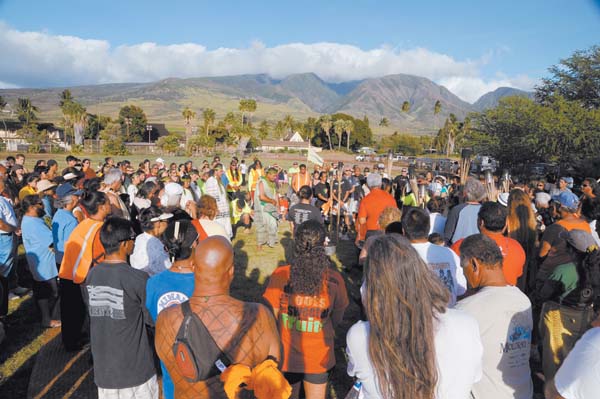
A sea of people of all ages embraced and honi’d, or touched noses, in early March at Lahaina while celebrating the end of a weeklong, 193-mile torch march around Maui to raise attention for Native Hawaiian issues. Photo from Hawaiian Independence Blog.

Got indigenous?

Most Native Hawaiians are living where they have lived from time immemorial… they struggle to preserve their language and customs but their language and customs are not ‘foreign’ — they run with the land.

By Steve Russell / The Rag Blog / June 30, 2009

Legal arguments often revolve around competing analogies. The parties claim the case is more like known case A or known case B and whoever wins the war of analogy wins the lawsuit. If the Cherokee freedmen case is about the right of a tribe to determine citizenship, the racists win. If it is about the sanctity of treaties, the freedmen win. Framing the issue floats outside of “right and wrong” because it’s the law that tribes determine their own citizenship standards and that treaties should be honored.

If you are a Native Hawaiian, is your status more like American Indians or more like an ethnic minority? Addressing this question inevitably requires drawing conclusions about the legal status of American Indians, and this has not escaped the notice of people who oppose Hawaiian sovereignty. Indeed, they are often the same people who opposed Indian sovereignty on the ground that it is a racial special privilege that disadvantages white people.

Once more, the bill to recognize Native Hawaiians as having the same sovereign status as Indian nations is pending in Congress. In the world of right and wrong, the only opponents with a leg to stand on are the minority of Native Hawaiians who oppose the bill because they want their full sovereignty back. Should a majority of Native Hawaiians adopt that position, the bill should be opposed simply because the politics of the Hawaiian relationship with the United States is Hawaiian business.

As long as the argument of the status of Native Hawaiians persists in Congress or in the courts, Indians have a dog in the fight. If Native Hawaiians win, the legal sovereignty of American Indian tribes is more secure. David Yeagley, the rightwing Comanche activist, recognized this when he wrote an op-ed opposing the Hawaiians. Indians who think the current understanding of tribal sovereignty is not worth maintaining should oppose the Hawaiians just like the white people who consider tribal sovereignty to be “race privilege” that disadvantages them.

An Associated Press report on the Native Hawaiian bill quotes Gail Heriot, a member of the U.S. Commission on Civil Rights, as saying that granting sovereign status to Native Hawaiians would be like doing the same for Cajuns in Louisiana or Chicanos in the Southwest. This appears to be the Republican Party line. Sound familiar?

Nothing I am about to say should be construed as opposing civil rights for any ethnic group. I have nothing but respect for the mainstream civil rights movement by and for African-Americans, and the same for the civil rights of the people I am about to discuss. All I’m saying is that American Indians and Native Hawaiians (and Native Alaskans) are indigenous peoples, and that makes all the difference.

Cajuns, or Acadians, were predominantly French colonists who were in a fight with British colonists called, in this country, the French and Indian War and in Europe, the Seven Years War. They emigrated from Canada to Louisiana thinking that they were staying on French soil when, in fact, France had secretly ceded Louisiana to Spain.

All of this is quite tragic if you don’t take into account that at the time, Louisiana was and had been from time immemorial occupied by American Indians to whom the French and Spanish and British and — in 1803, Americans — were just different sets of colonizers, trespassers on Indian land.

Yes, the Cajuns did intermarry with Indians, but so did all the colonists. The Cajun culture is what it is, which is delightful, but it is not indigenous. Yes, the Cajuns were and sometimes are abused, but not because they originally owned Louisiana.

Chicanos in the Southwest are a little harder because their blood is primarily indigenous. How do we know this? Because the Spanish kept very good records and Mexican society was quite racist. A higher degree of indigenous blood meant lower social status. Having Spanish ancestors was very important, and the Spanish ruthlessly suppressed tribalism.

Chicanos have in the past and do to this day in some places suffer from outrageous discrimination. There were the “No Dogs or Mexicans” signs on restaurants in the ’50s. There was the attempt to “desegregate” the public schools in Corpus Christi by mixing brown kids and black kids so as not to contaminate the white kids.

Nowadays, there is a political tendency that infests both major political parties but practically runs the Republican Party that could be called, in shorthand, “hate the Mexicans.” Economy in the toilet? Hate the Mexicans! Lousy schools? Hate the Mexicans! Health care too expensive? Hate the Mexicans! The spokesmen for this movement are Tom Tancredo, who compared the National Council of La Raza to the KKK and Lou Dobbs, who warns of the Brown Peril nightly on CNN.

The policy prescriptions these bozos push are aimed at Hispanics but they almost always cause collateral damage among American Indians. They want to give local police authority to make brown people prove their citizenship, and that means Indians get rousted. They want to make the public use of any language but English illegal. They target Spanish but they hit tribal languages. When they attack bilingual education, they force tribal language preservation programs away from public funding. And if a public worker can’t be paid to interpret Spanish, she can’t be paid to interpret Navajo.

Sociologists call this politics “nativist,” which provides Indians a bit of comic relief, since all the people pushing it are descendants of colonists. The “nativists” want persons of Mexican descent to “go back where they came from.” Apparently, the nativist history books don’t teach about the Mexican War, because lots of those Mexican-Americans were in Mexico when the border moved and put them in the United States.

At the end of that war, the Treaty of Guadalupe Hidalgo said:

“Mexicans now established in territories previously belonging to Mexico, and which remain for the future within the limits of the United States, as defined by the present treaty, shall be free to continue where they now reside, or to remove at any time to the Mexican Republic, retaining the property which they possess in the said territories…

“Those who shall prefer to remain in the said territories may either retain the title and rights of Mexican citizens, or acquire those of citizens of the United States.”

If this treaty means anything, Mexican-Americans living in the Southwest have the full civil rights of American citizens. Like in the case of the Cajuns, these people are abused because they are caught in a struggle between two colonial governments, in this case the U.S. and Mexico. Abusing them is wrong, but abuse does not make them indigenous and neither does intermarriage unless it is coupled with maintaining tribal relations.

Most Native Hawaiians are living where they have lived from time immemorial. Like us, they struggle to preserve their language and customs but their language and customs are not “foreign” — they run with the land. Like us, they have been dispossessed by the colonists. They had an indigenous government that was overthrown by the U.S. government. Native Hawaiians have in common with us that the trespassers seek to treat them as trespassers. That practically defines indigenous, and that is the basis for claims that, like Indian claims, go far beyond equal treatment as citizens.

[Steve Russell, Cherokee Nation of Oklahoma, is a Texas trial court judge by assignment and an associate professor of criminal justice at Indiana University. He is a columnist for Indian Country Today, where this article also appeared. Steve wrote for Austin’s The Rag in the Sixties and seventies and is a regular contributor to The Rag Blog. He lives in Bloomington and can be reached at swrussel@indiana.edu.]

The Rag Blog

Posted in Rag Bloggers | Tagged , , , | 5 Comments

Tom Hayden : Crisis in Honduras Forces Latin America Focus

Manuel Zelaya in Nicaragua. Zelaya is expected to attend meetins at the UN’s General Assembly. Photo from AFP.

Honduras Crisis Forces Obama to Focus on Latin America

The Obama position is complicated by the history of US training of the Honduras armed forces, past involvement with shadowy death squads, and concern over Zelaya’s alliance with the Bolivarian Alternative for the Americas.

By Tom Hayden / June 30, 2009

The military coup against Honduran president Manuel Zelaya puts pressure on President Obama to break sharply with past American policies or risk massive defections in what remains of Latin America’s goodwill.

Yesterday President Obama declared the coup was “not legal” and affirmed the Zelaya government’s legitimacy, statements that were considered “very good” by Venezuelan diplomats interviewed by The Nation.

The Obama position is complicated by the history of US training of the Honduras armed forces, past involvement with shadowy death squads, and concern over Zelaya’s alliance with the Bolivarian Alternative for the Americas. In the background are memories of US complicity in the attempted coup against Venezuela’s Hugo Chávez in 2002.

The issue will become paramount today as foreign ministers of the Organization of American States (OAS) meet in Washington, DC, to consider their response. The Venezuelans will be accompanied by the exiled Honduran foreign minister. Meanwhile, Zelaya is expected to be at the United Nations for meetings at the General Assembly. “This will be a turning point in the history of the OAS,” observed the Venezuelan official.

Some Democratic insiders were expressing mixed feelings over the coup. Michael Tomasky’s blog found it “complicated,” before concluding that “a military coup is a military coup, I guess.” Faith Smith, writing on the blog of Steve Clemons of the New American Foundation, found it “difficult to say which side is democratic.” She noted approvingly that Secretary of State Hillary Clinton, while criticizing the coup, offered “no specific support for Zelaya.”

The choice for Obama is whether to side with a democratically elected government that happens to be a Venezuelan ally, or be ostracized by the governments of Latin America. Obama’s policies have indicated a desire for modest and gradual rapprochement after the Bush years, without rapid or concrete changes. That gradualism will be tested today.

[Tom Hayden is a former California state senator and author of Street Wars (Verso, 2005), as well as a founder of Sixties New Left group SDS, and of Progressives for Obama.]

Source / The Nation

Thanks to Carl Davidson / The Rag Blog

Posted in RagBlog | Tagged , , , | 1 Comment