Repugs : Obama Doesn’t Want You to Eat Meat!

Cow. Check out this dude’s carbon footprint.

The Repugs intend to sell this by claiming that Cass Sunstein is Obama’s ‘economic guru’ and Sunstein wrote a well known (within academia) book on animal rights.

By Steve Russell / The Rag Blog / February 8, 2009

I just got polled by what was plainly the Repug party and it was testing attacks on Obama.

The most interesting one was a claim that Obama wants to ban hunting and force people to become vegetarians.

They intend to sell this by claiming that Cass Sunstein is Obama’s “economic guru” and Sunstein wrote a well known (within academia) book on animal rights. They can use for background filler substantial economic literature demonstrating that the most effective thing humans could do to stop global warming is become vegetarians because meat has a huge carbon footprint compared to veggies and fruit. Therefore, anybody who believes in global warming is a vegetarian, get it?

(I was flashing back on that time before Obama was Prez when he went to a Chicago deli to get a corned beef sandwich and all those cameras followed him. I thought the lesson from that was that he could no longer go alone to get a sandwich. In retrospect, the lesson might be that corned beef sandwiches contain dead cows.)

At least, Sunstein is closer to Obama than Bill Ayers ever was and Obama has indeed consulted with Sunstein… but anybody with two gray cells to rub together should understand by now that Obama has no guru, with the possible exception of the late Saul Alinsky, and that could only alarm people who’ve never read Alinsky (who was also Cesar Chavez’ guru).

I’m beginning to feel sorry for the Repugs because they are so plainly at the bottom of the attack barrel, but every time I see the jobless claims or Iraq deaths the mood passes.

The Rag Blog

Posted in Rag Bloggers | Tagged , , , | 2 Comments

Medical Marijuana : Raids Continue But Policy Change in the Air


The message is clear, said UCLA professor Mark Kleiman, a former Justice Department official and an expert on crime and drug policy. ‘It is no longer federal policy to beat up on hippies.’

By Devlin Barrett / February 7, 2009

See ‘Protests demand end to medical pot shop raids’ by Michael R. Blood, Below.

WASHINGTON — The White House won’t say it explicitly. Neither will the Drug Enforcement Administration. Yet there is a whiff in the air that U.S. policy is about to change when it comes to medical marijuana.

The message is clear, said UCLA professor Mark Kleiman, a former Justice Department official and an expert on crime and drug policy.

“It is no longer federal policy to beat up on hippies,” said Kleiman.

Tell that to the DEA.

In California this past week, agents raided four dispensaries in Los Angeles and seized 500 pounds of pot.

“It’s a little bit surprising, because I think current DEA management didn’t get the message,” said Kleiman. “The message is, this is no longer drug warrior time. We are not on a cultural crusade against pot-smoking.”

California law permits the sale of marijuana for medical purposes, though it is still against federal law.

Thirteen states have laws permitting medicinal use of marijuana. California is unique among them for the presence of dispensaries, businesses that sell marijuana and even advertise their services. Legal under California law, such dispensaries are still illegal under federal law.

“Anyone possessing, distributing or cultivating marijuana for any reason is in violation of federal law,” Sarah Pullen, a DEA spokeswoman in Los Angeles, said Thursday.

That may be the law, but it contradicts the medical marijuana position of the new president.

“The president believes that federal resources should not be used to circumvent state laws, and as he continues to appoint senior leadership to fill out the ranks of the federal government, he expects them to review their policies with that in mind,” said White House spokesman Nick Shapiro, repeating past statements.

So on Friday, DEA officials in Washington declined to comment at all on the subject.

As a presidential candidate, Obama repeatedly promised a change in federal drug policy in situations where state laws allow use of medical marijuana.

“I think the basic concept of using medical marijuana for the same purposes and with the same controls as other drugs prescribed by doctors, I think that’s entirely appropriate,” Obama told the Mail Tribune of Medford, Ore., in March.

A year earlier at a campaign stop in New Hampshire, Obama said: “I would not have the Justice Department prosecuting and raiding medical marijuana users.”

At age 47, Obama is part of a generation that had plenty of exposure to pot.

In his memoir, “Dreams from My Father,” he described time spent as a youth struggling with questions about his race and identity, and turning to drugs — including marijuana and cocaine — to “push questions of who I was out of my mind.”

The new president is unlikely to make any official change in policy before he has a new DEA chief and drug czar in place.

Yet experts believe it is already clear the Obama administration will change the strategy, if not the law, on medical marijuana.

Philip Heymann, a former deputy attorney general in the Clinton administration who is now a Harvard professor, said it’s time for the agency to put more effort into fighting drugs more dangerous than marijuana.

“I do expect him to appoint an administrator who takes marijuana less seriously than is traditional for the DEA, as I think most Americans do,” said Heymann.

Heymann said he expects the Obama administration will eventually instruct the DEA to emphatically scale back raids on dispensaries, and conduct such raids only in instances where investigators believe a business is abusing the dispensary system as a cover for other criminal behavior.

So last week’s raids in California may be the last of their kind.

“The DEA’s not likely to want to confront a new president,” said Heymann. “It may simply be that they’re behaving as they have traditionally, and they haven’t anticipated the change Obama and his spokesman are signaling.”

[Associated Press writer Michael Blood in Los Angeles contributed to this report.]

Source / AP / The Huffington Post

Protests demand end to medical pot shop raids
By Michael R. Blood / February 6, 2009

LOS ANGELES — The Obama administration should halt federal raids of medical marijuana dispensaries, a long-sought turnaround from the policy of the Bush White House, protesters said Thursday.

The Drug Enforcement Administration raided four dispensaries in Los Angeles this week and seized 500 pounds of marijuana, bringing fresh attention to the rift between state and federal law on medical marijuana use. President Obama said during the campaign he would not use the Justice Department, which oversees the DEA, to circumvent state laws.

Dozens of demonstrators gathered outside a downtown federal office building to call on the DEA to cease the raids, which also seized $10,000 in cash. They chanted “Obama stop the raids” and “DEA go away.”

“Somebody forgot to tell them all the rules are changing,” said Don Duncan of Americans for Safe Access, an advocacy group that promotes medical marijuana use and research.

California is among the states that allow the sale of marijuana for medicinal purposes, but the federal government has not recognized those laws. “Anyone possessing, distributing or cultivating marijuana for any reason is in violation of federal law,” said DEA spokeswoman Sarah Pullen.

But Obama has said he will change direction.

“I think the basic concept of using medical marijuana for the same purposes and with the same controls as other drugs prescribed by doctors, I think that’s entirely appropriate,” Obama told the Mail Tribune of Medford, Ore., last March. “I’m not going to be using Justice Department resources to try to circumvent state laws on this issue.”

Pullen directed questions on medical marijuana policy to the Justice Department in Washington. On Thursday, White House spokesman Nick Shapiro said “the president believes that federal resources should not be used to circumvent state laws.”

Source / AP / SFGate

The Rag Blog

Posted in RagBlog | Tagged , , , , | 1 Comment

The Unkindest Cut : Hands Off Boy Scout Forest Land

Graphic by Larry Ray / The Rag Blog.

I hit the damned ceiling when I learned that ‘the Boy Scouts have sold at least 34,000 acres of land to logging corporations, allowing big business to level forests that were supposed to have been preserved for children to learn about and enjoy nature.’

By Larry Ray / The Rag Blog / February 7, 2009

In the early 1950’s the camaraderie of Cub Scouts, Boy Scouts, and Explorer Scouts was the glue that held together small communities like the one in which I grew up in South Texas. In 1953, I got to see America on an old troop train car used to transport Boy Scouts from South Texas via rail from Corpus Christi, Texas to Irvine, California for the World Scout Jamboree, and back. We stopped at Carlsbad Caverns, The Grand Canyon, The Great Salt Lake and other such national landmarks en route. None of us would have ever been able to visit these places otherwise.

No drugs or gangs back then. Young parents were just starting to grab hold of the new, exciting 50’s, raising their kids in a new era of hope and prosperity following WWII. Scouting was good, down to earth, and no tort lawyers were involved in limiting how kids went out played under the guise of “protection.” We were rough and tumble. Camping trips resulted in bee stings, minor burns and scrapes and one buddy even survived using a big poison ivy leaf to do his toilet business in the bushes. Someone suggested paying a nickle each to get to see the huge water-balloon sized blisters that erupted from his buttocks. But we all survived, learning to be decent kids, to respect nature, and to be polite to elders among some other good early life lessons.

So understanding all that, you will not be surprised that I hit the damned ceiling when I learned that a recent Hearst Newspaper investigation has revealed that ” . . . the Boy Scouts have sold at least 34,000 acres of land to logging corporations, allowing big business to level forests that were supposed to have been preserved for children to learn about and enjoy nature.”

Credo Mobile, a 24 year old respected civic advocacy group, has gone to bat to stop the land sale for clear cutting. Credo has the established and respected clout to take on madness like mindless trustees blithely selling off land dedicated to Boy Scouts and intended to instill a respect for nature and the environment.

You can add your voice as well. This kind of Bush-era total disregard has to stop . . . particularly when it is wholesale rape of the environment at the level of the Boy Scouts of America.

Here’s the petition and link so you can let your voice be heard. Hope you will take two minutes and join in.

When you think of the Boy Scouts, the first thing that comes to mind is not clearcutting. It may surprise you to learn, then, that a recent investigation by Hearst Newspapers showed that the Boy Scouts have sold at least 34,000 acres of land to logging corporations, allowing big business to level forests that were supposed to have been preserved for children to learn about and enjoy nature. Additionally, some of the logging in question may have violated state rules. According to the Hearst investigation, one council in Washington state allowed an area to be logged without leaving trees to protect a stream which is home to endangered salmon. I just took action to tell the Boy Scouts of America National Council to end its practice of allowing forests to be logged and endangered species to be put at greater risk. I hope you will, too. Please have a look and take action. Click here.

[Retired journalist Larry Ray is a Texas native and former Austin television news anchor. He also posts at The iHandbill.]

The Rag Blog

Posted in Rag Bloggers | Tagged , , | 7 Comments

The Empire Is the Empire, Regardless of Its Color


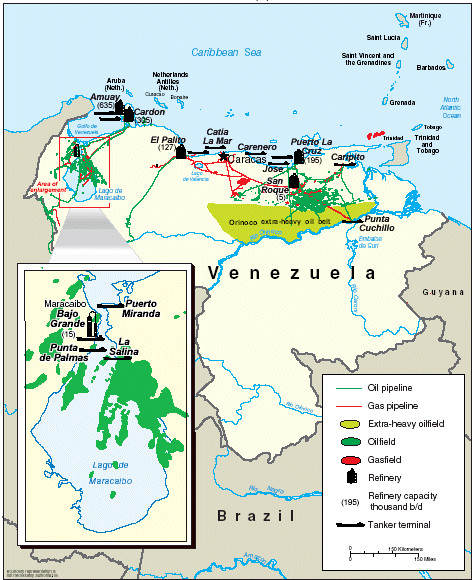
A New Era Between Washington and Venezuela?
By Eva Gollinger / February 07, 2009

For a moment, to please all those who’ve fallen in love with the new president of the United States, let’s forget everything that was said about Venezuela during the last two terms of the ex-president George W. Bush, by spokespeople in his government. And let’s also forget about everything Obama and his Secretary of State Hillary Clinton said during the campaign because, well, sometimes the things that are said during the campaign are just to please the voters. So we’re just going to analyze what Obama and the new members of his team have expressed since he was elected to the most powerful political position in the world.

The new United States president didn’t delay much in repeating the same comments about President Chavez and Venezuela that he made during the campaign. During an interview with the US-Hispanic television channel Univision, January 13, 2009, President Barack Obama, responding to a question about Latin America and specifically Venezuela, declared, “Chavez has been a force that has impeded the progress in the region.” Later he commented, “We must be very firm when we see this news, that Venezuela is exporting terrorist activities or backing malicious groups like the FARC. That creates problems that are unacceptable. That is not the good international behavior that we would expect from anyone in the hemisphere.”

This declaration from President Obama sounds like something coming from the Bush Administration, just as President Chavez pointed out. (Note: here I could say yet again that exactly that is true, that there isn’t much difference between Bush and Obama with respect to the imperialist policies of the United States, but I promise that I won’t say it yet. It’s better that I be able to prove it with his own actions and attitudes.) In that statement, Obama repeated the two main viewpoints promoted by all the Washington agencies, including the Congress headed by the Democratic Party, during the last four years: Chavez is a destabilizing force in the region, and Venezuela has ties with terrorism. But let’s continue.

Later, the new Secretary of State, Hillary Clinton, declared during her confirmation hearing in the U.S. Senate, “We have problems in our own hemisphere with some energy providers, like Hugo Chavez… We have a challenge in Latin America, and our challenges have to do with the way we get involved to make a difference. We should worry less about what Chavez says and more about what we do at the end of the day.” Here it’s valid to compare what the then-incoming Secretary of State Condoleezza said in 2005, when already in her confirmation hearing she stated that “Hugo Chavez is a negative force in the region.” That famous phrase by Rice put the aggressive, hostile, and bellicose plan against Venezuela into action, which is obviously being reinforced by the new administration in Washington, regardless of color or political affiliation. In the United States, be him red or blue, Republican or Democrat, he is an imperialist regardless. Here it should be added that with respect to the analysis, what a candidate to the highest diplomatic position in the United States says in her confirmation hearing is a demonstration of her priorities when she takes the office of Secretary of State. So the fact that two Secretaries of State have spoken of Venezuela and President Chavez as a “negative force” or a “problem” has significant implications for Washington’s foreign policy. Since 2005, Venezuela has been and continues to be a policy priority for security, defense, and intelligence in the United States. It was classified as such in a July 2008 State Department report which highlighted three global priority areas in US foreign policy: Iran’s support for the Iraqi insurgency, the growing presence of Al Qaeda in Afghanistan, and the “association” of Venezuela with “terrorist states.” I’ll repeat, what I have just detailed in this last phrase are the three global priorities for the security, defense, and diplomatic corps of the United States. Venezuela is among these three.

But as if this wasn’t enough, in his swearing-in speech, the new United States president declared, “Each day brings further evidence that the ways we use energy strengthen our adversaries.” Okay, he didn’t necessarily name Venezuela, but there’s no doubt that the South American country with the largest oil reserves in the world was in mind when he made that comment. Further along in his speech, when President Obama was alerting the enemies of the United States that his government would retake and defend its position as world leader (as if it had done something different in recent years), said “To those who cling to power through corruption and deceit and the silencing of dissent, know that you are on the wrong side of history, but that we will extend a hand if you are willing to unclench your fist.” Well, here he didn’t necessarily direct this message indirectly to Venezuela, but still, with everything that has been said about Chavez’s government, it’s quite possible.

And then there’s James Steinberg, the new number two in the State Department. This young gentleman’s résumé includes positions like recent chancellor of the Lyndon B. Johnson School of Public Affairs at the University of Texas at Austin; Analyst for the RAND Corporation, a business contracted by the Pentagon to develop its principal strategies; Assistant National Security Advisor at the White House (1997-2001); and a researcher at the Brookings Institute, one of the three think tanks that develop the imperialist policies of Washington. Steinberg already began to throw darts hard at Venezuela during his United States Senate confirmation hearing on January 22. In response to a question regarding Latin America by Senator Robert Menendez of New Jersey, Steinberg said, “I think that the people have realized that the offers of Chavez don’t lead to a better life or better success of the peoples… For too much time, we’ve ceded the playing field to Chavez, whose actions and vision for the region don’t serve the interests of his citizens nor of the people throughout Latin America.” What? Obviously Senator Menendez is not being well informed about how much things have improved in Venezuela over the last ten years. For example, Venezuela today enjoys the lowest unemployment rate in its history, lower than the unemployment rate in the United States! (In Venezuela it’s at 6 percent while in the United States the unemployment rate is at 7.2 percent). Not even to mention that in Venezuela, under the revolutionary policies of President Chavez, no Venezuelan is without free medical attention at all levels, while the United States healthcare system is deplorable. More than 46 million US citizens live without access to the healthcare system. And statistics in education, infant mortality, life expectancy, industrial development, recovery of cultural traditions, indigenous languages, and the level of electoral participation that the Bolivarian government has accomplished is without precedent in Venezuelan history.

But to top off this treatment from Obama’s government, their website shows that they clearly consider Venezuela to be their number one enemy. In the section of the site where they highlight their political agenda related to energy, one finds the following objective: “Eliminate Our Current Imports from the Middle East and Venezuela within 10 Years.” And in another part of the agenda the same concept is articulated this way: “Within 10 years save more oil than we currently import from the Middle East and Venezuela combined.” This same objective was repeated January 26, 2009, when he said, “The United States will not be a hostage to increasingly limited resources from hostile regimes,” during a White House ceremony. Okay, so Venezuela is considered to be one of the most important objectives of the Obama administration in the area of energy, which is considered part of the security and defense strategy of Washington.

So from everything that’s been said and done in less than a month by the new administration of Barack Obama, is there evidence of any change in the hostile and aggressive tone against Venezuela? I think the answer is a resounding no, unfortunately. What is demonstrated is simply what we’ve been saying: the empire is the empire, regardless of its color. Until it stops viewing itself as the best in the world and the global leader that looks to impose its vision and model on the rest, the empire will continue being the same. Meanwhile, Venezuela, together with other free and honorable peoples, must continue constructing its future, remaining alert to the imperial attacks that threaten its prosperity.

[Translated by Erik Sperlinger.]

Source / Z-Net

The Rag Blog

Posted in RagBlog | Tagged , , | 1 Comment

Economic Stimulus : Try Whips and Chains

Graphic courtesy of The Daily Beast.

Kinkonomics:

With staff jobs evaporating and former nine-to-fivers cobbling together incomes through scattered side projects, freelancing as a dominatrix — or “pro-domme,” as industry types prefer to call it — has become a plausible gig option.

By Tracy Quan / February 7, 2009

As the economy takes a spanking, many women are turning to freelance fetish work to supplement their incomes.

“I’ve seen it before,” says Linda, “during the tech bust in 2002. Women who thought they would always make a decent living in the tech sector lost their jobs.” They came looking to Linda’s industry for freelance work, and now it’s happening again: professional women whose cubicle-bound careers have been downsized are entering Linda’s corner of the “gig economy”—a corner that involves whips, ropes, and occasionally, nipple clamps.

With staff jobs evaporating and former nine-to-fivers cobbling together incomes through scattered side projects, freelancing as a dominatrix—or “pro-domme,” as industry types prefer to call it—has become a plausible gig option. As a former call girl, I know plenty of people in the industry, and I recently spoke to several who have started doing kink work to supplement their incomes. (I’ve changed their names to protect their privacy.) They agree: The sector is poised for expansion as more unemployed and underemployed women begin looking for extra cash.

Linda began working in a dungeon when she was a student. Now she works a regular day job, picking up occasional domination gigs at night to supplement her income as an editor. Throughout her time in the industry, she’s seen “regular” jobs and kink jobs happily coexist—even complement each other. She knows women who were self-employed pro-dommes before the tech boom began. Then, she says, “during the boom, they got tech jobs.” And after the bubble burst, they brought their skills back to the kink industry and built new websites for themselves with the updated skills they’d acquired.

Many freelance dommes prefer to work a regular shift in a commercial dungeon with equipment and advertising provided by management. They do much of what you’d expect, specializing in bondage, verbal humiliation, spanking or paddling, whipping, and genital torture. Some aspects of domme work—nipple-clamping a customer, wearing a strap-on dildo, allowing a man to worship your feet—are familiar to traditional call girls, but the more rigorous assignments could make some prostitutes faint. Still, working a shift at a dungeon can provide a more similar structure to regular work, which adds a level of comfort for those just doing it as a side gig. The busy night shift works well for women with regular day jobs, but some women prefer the early shift—neighbors, relatives, husbands, and children are less likely to wonder what you’re up to while the sun is out.

The money’s not bad, either. Jessica, a pro-domme in her late twenties, apprenticed at a dungeon before striking out on her own. In Manhattan dungeons, she says, the typical cut on a $200 session is 60-40 in the dungeon’s favor. To people who make their entire living in the sex industry—professional escorts who get $500 an hour, for instance—such rates can seem abusive. But freelancers see it differently. “If you’re making $8 an hour at your day job, $80 is awesome,” says Jessica. “There’s no shortage of women willing to work at those rates.”

Jessica recently got a new day job working for a website designer three days a week, leaving her time to see a few regular fetishists. Like other freelancers, she’s responsible for her own health insurance. Does she want a full-time tech job with benefits? “In this economy? Forget it,” she says. “I didn’t really try to get a full-time job.” She embraces her role in the gig economy—one gig, her tech job, enhances her resume, while her fetish work makes life in New York affordable. What’s more, her part-time tech work makes her a legitimate freelancer, which comes with perks. “I joined the Freelancers Union for medical insurance,” she says, an option she wouldn’t have had if working exclusively as a domme.

Freelance kink work is a more viable option for women today than ever before. Over the past two decades, kink has gone thoroughly mainstream, infiltrating everything from liquor ads to sitcom scenarios to school-supported student groups. And while a prostitution arrest is still a serious worry, legit dungeons operate legally and openly—The New York Post recently reported on pro-domme efforts to form a union and a political action committee.

And at $200 an hour, a piquant visit to a Manhattan dungeon for a spanking administered by a good-looking girl with a liberal arts degree is easier on a guy’s wallet than the “girlfriend experience” offered by many an Internet courtesan. If a pro-domme permits him to “satisfy himself,” the end result may be similar enough to what he would get from an escort—and less expensive. Men who pay for kink aren’t all diehard fetishists or submissives—a spanking isn’t essential to their personal happiness. It may be an occasional side thrill. Clients are middle-management types, small-business owners, dentists, young lawyers, even a few single males who see themselves as casualties of the gig economy. A fence-sitter—flirting with, not truly committed to kink—might discover that the antidote to a recession resides in the nearest S&M parlor.

He might also be surprised to learn that the woman whose toes he’s sucking isn’t much kinkier than he is. Because many of these freelance pro-dommes are just supplementing their incomes and don’t plan on staying in sex work forever, they may not be as erotically hardcore in their outside lives. “I wasn’t really that interested” in S&M, says Chloe. “I got involved because it was easy money. The strap-on? I’m OK with it, but it’s not really a personal interest of mine.”

Chloe is a middle-income student about to graduate from the School of Visual Arts. Her dungeon activities pay for school supplies, shoes, laptop equipment, Metro cards, and food. She’s even used freelance kink work to allow her to take an unpaid internship—something you can’t necessarily do if you’re not bankrolled by your parents. In this way, S&M promotes social mobility. Chloe says her mother “would probably cry” and be “very upset” about her fetish gigs, but I suspect some parents would be secretly proud of a daughter resourceful enough to hack the increasingly rigid class system that permeates New York life.

Though dominatrix work is considered by many to be the hardest in the sex industry, being able to avoid actual intercourse is key to its appeal to “everyday” women who are just looking to pick up a little extra money to pay the bills. Because of this, counterintuitive as it sounds, the kink sector tends to attract women who are more risk-averse than traditional call girls—and more law-abiding.

Lyla, for instance, has worked the fetish party circuit as a popular foot model and pro-domme, always “staying within the bounds of what was legal.” She is understandably proud to have “a very particular foot with a high arch.” On a good night, she might bring in $1,000—“you get to keep it all, and it’s completely legal,” she adds, citing a celebrated 1994 decision (New York v. Georgia A.) concerning the definition of “sexual conduct,” a key element of prostitution law.

That court decision has been a blessing and, perhaps, a curse—contributing to an oversupply of talent. Not every pro-domme earns as much as Lyla does because, she says, “dungeon managers take advantage of the social stigma around our work.” Some domination houses pocket a pro-domme’s tips, while others impose wacky fines. Although the work itself is legal, people—especially freelancers—are reluctant to challenge these practices through official channels.

So has kink lost its glamour? Is it just a bunch of office drones slipping it into their schedules of consulting gigs and child rearing? Actually, kink was never as glam as people imagined it to be. Trust me, I know: Even if you’re bossing your client around in a pair of thigh-high boots, you’re still working in a service industry. And after an hour, your feet hurt.

[Tracy Quan’s latest novel is Diary of a Jetsetting Call Girl, set in Provence and praised in The Nation as a “deft account of occupational rigors and anxieties before the crash.” She is the author of the bestsellers Diary of a Manhattan Call Girl and Diary of a Married Call Girl and is a columnist for The Guardian.]

Source / The Daily Beast

Thanks to Jesse James Retherford / The Rag Blog

Posted in RagBlog | Tagged , , , | 1 Comment

Alyce Guynn : Blue, Black and In Between

Poet and novelist Al Young. Photo courtesy of Gabrielle Motta-Passajou / Appalachian State University News.

Blue, Black and In Between

Have you seen her dressed in blue? ….
She comes in colors everywhere
She combs her hair; she’s like a rainbow
Coming, colors in the air
Rolling Stones

I’ve been contemplating the color blue
cultivating it, humming a Rolling Stones’ tune
reading Al Young’s Something About the Blues.
I love his take on the blues; I love his blackness.
More alluring, his kind of story-telling poetry.
More alluring for this whitey, honky Hillsboro hick,
than Elizabeth Bishop’s – don’t get me wrong –
I enjoy Bishop in small doses, very small doses.
With Young, I can put away the teaspoon,
pick up the oversized cup, drink and drink his words,
steeped in music. The music of which he writes is part
of the poetry he makes. The blues.

Blues don’t make you mean; they leave you moved.
The blues can move you to music, move you to poetry.
They can move you to wiggle your bottom, shake your booty,
dance naked, alone in your living room while a full moon
waxes just enough so the man in it looks at you a little lopsided.
That being not the once-in-a-blue moon, but the big ole’
yellow one that invokes images of veaudeaux magic
and humid nights listening to a jazz saxophone.

Can a white girl call him Trane? I think not. It is far too intimate, a term of endearment reserved for his peers. To me, he will remain Coltrane. Just as it would be despicable for me to express the same intimacy two black people can share when they fondly refer to each other as nigger. Even Charlie Mingus and Dizzy Gillespie said jazz was nigger music.
That’s okay.

It was not okay when my uncle would reach over, turn the dial from my favorite radio show, saying I’m not going to listen to that nigger music.
That was not okay.

And it wasn’t even jazz. Probably not even the blues. More ’n likely it was early rock ’n’ roll; quite likely it was from a musician of color, for those were my favorites then: Little Richard, Chuck Berry, The Coasters, The Platters, The El Dorados, Hank Ballard.
Oh, Hank Ballard.

Those songs weren’t what you’d call blues. Howlin’ Wolf, Muddy Waters, Jimmy Reed – those were blue. They were all black. It wasn’t until later I learned to appreciate the mind bending Miles, the cool, cool Coltrane, the crazy chaos of Charlie Mingus. But they knew the blues, long before they called it jazz. It was Duke Ellington who said,
Jazz is just a word.

It was much more than that for me in my late teens. For us, my group at college, it was a way of life. They (not we) called us The Jazzers. We disdained the sorority girls and fraternity boys while we formed our own. We didn’t wear any Alice Blue gowns, I guarantee you. It was black tights for the girls, fruit boots for the guys. We had our own dress code just as surely as did the penny loafer and pleated skirt crowd. It’s no longer black tights for me.
Now I running toward the blues.

Recently, I bought a straw hat, mostly for the wide headband and gargantuan bow in one of the most beautiful shades of blue silk shantung I have ever seen. I went searching for a way to call it. On the Internet I found a palette of blues where the one nearest to white was called “Alice Blue” named after Teddy Roosevelt’s daughter Alice, for whom in 1919 the song “Sweet Little Alice Blue Gown” was penned. Presumably the “Alice Blue” was the shade of her gown memorialized in song. People in my home town had long memories, for even though the song was popular in the twenties, they still quoted it when, in the late forties, they encountered sweet little me. I didn’t want to be Sweet Alyce then or later as a teen. I wanted to be tough – Camel-smoking, boot-stomping, whiskey- drinking tough.
I never was.

I am and always have been Sweet Alyce to the core. It is my nature to be more sweet than tough, which is not to say I can’t pitch a fit and break a lot of glass.

I love it now: my sweetness, my pastelness
that goes better with grey hair.

And while I don’t like to have the blues,
I love to listen.

I’ve been pondering blues.
Expanding the palette: a head band here,
a dangling blue opal there,
a carved blue agate cameo ring
dishing up a huge helping of Young,
slicing out a sultry evening with Coltrane
Seriously Reconsidering with Lowell Folsom
and Hiding Away with Freddie King.

Blues don’t make me mean or even melancholy.
They make me move, they melt me, bring me to a boil,
simmer, shimmer and shake, curl my hair.
They rattle my bones, ease my mind.

They reveal colors
coming everywhere.

© Alyce Guynn

Alyce Guynn / The Rag Blog
Austin, Texas
February 7, 2009

The Rag Blog

Posted in Rag Bloggers | Tagged , , , , | Leave a comment

Israeli Assault on Gaza: Not Even the Zoo Animals Were Spared

Frankly, it is no stretch to claim that this incident is a metaphor for the Israeli assault on Gaza. The Israeli Defense Forces exhibited the same callous disregard for human life during the entire period of the conflict. The government of Israel and the people who sat quietly by as this crime occurred should be deeply ashamed. I can only hope that justice is served by the International Criminal Court.

Richard Jehn / The Rag Blog

Visitors look at 30-month-old lioness Sabrina at the Gaza Zoo July 8 ,2007 in Gaza Strip, Gaza. Photo: Getty Images.

At the Zoo: A Nation of Animal Lovers Closes Its Eyes to the Massacre at the Gaza Zoo
By Missy Comley Beattie / February 6, 2009

For days, the mainstream media talked endlessly about it. Michael Vick. Dogfighting. Blood sport. Killing animals that underperformed. Many defended the professional athlete. Others thought Vick should receive the maximum sentence after his conviction.

Some of us shook our heads, repulsed by the cruelty, but we were utterly dismayed that so many people who expressed outrage over Vick’s crime, seemed to pay little or no attention to the killing of civilians in Iraq and Afghanistan.

Yes, we’re a nation of animal lovers. And, we’re enamored of our sports heroes. Certainly, the Michael Vick/dog abuse narrative was a juicy plate of filet mignon for infotainment peddlers to place upon our television trays. These are the same “reporters” who seldom mention US troop deaths and who never talk about the estimated million plus Iraqi civilians who have died since the occupation of Iraq.

So, why, then, given our attraction to animal stories, were news anchors silent on the massacre at the Gaza Zoo by Israeli troops who shot and killed caged animals during Israel’s recent assault on Gaza?

The answer, of course, is that we’re supposed to believe that Israeli troops are the good guys. Palestinians are “militants.” Israeli soldiers are, well, soldiers.

An article at www.palestinechronicle.com by Ashraf Helmi and Megan Hirons provides the chilling details. Here is an excerpt from their piece and their interview with zookeeper Emad Jameel Qasim:

The zoo opened in late 2005, with money from local and international NGOs. There were 40 types of animals, a children’s library, a playground and cultural centre housed at the facility.

Inside the main building, soldiers defaced the walls, ripped out one of the toilets and removed all of the hard drives from the office computers. We asked him why they targeted the zoo. He laughs. ‘I don’t know. You have to go and ask the Israelis. This is a place where people come to relax and enjoy themselves. It’s not a place of politics.’

Israel has accused Hamas of firing rockets from civilian areas. Qasim reacts angrily when we raise the subject.

‘Let me answer that with a question. We are under attack. There was not a single person in this zoo. Just the animals. We all fled before they came. What purpose does it serve to walk around shooting animals and destroying the place?’

Inside one cage lie three dead monkeys and another two in the cage beside them. Two more escaped and have yet to return. He points to a clay pot. ‘They tried to hide,’ he says of a mother and baby half-tucked inside.

Qasim says that his main two priorities at the moment are rebuilding the zoo and taking the Israeli army to court.

The gruesome attack must have posed a true dilemma when our mainstream media got wind of it: A tragic tale of dead animals vs. exposing the brutality of Israeli troops. Wolf, Anderson, Campbell, Suzanne, Chris, Norah, Contessa, Rachel, Joe, David, Sean, Bill, Megan, and Shephard are probably working on a way to spin this to suit AIPAC. Perhaps, something like convincing us that a Gaza Zoo animal might be used as a shield by Hamas “terrorists.”

[Missy Beattie lives in New York City. She’s written for National Public Radio and Nashville Life Magazine. An outspoken critic of the Bush Administration and the war in Iraq, she’s a member of Gold Star Families for Peace. She completed a novel last year, but since the death of her nephew, Marine Lance Cpl. Chase J. Comley, in Iraq on August 6,’05, she has been writing political articles. She can be reached at: Missybeat@aol.com.]

Source / CounterPunch

The Rag Blog

Posted in RagBlog | Tagged , , | 2 Comments

Bill Ayers : Lawmaker Calls for His Ouster; Graphic Memoir to be Published

University of Illinois at Chicago professor Bill Ayers talks to a reporter in 2008. Illinois State Sen. Larry Bomke wants Ayers removed from his university post under a proposal that says anyone who has committed an act of violence against the governments of the United States or Illinois cannot work at a public university. Photo by Candice C. Cusic / Chicago Tribune.

Bill Ayers in the news. The Chicago educator and former SDS activist later associated with the Weatherman faction, called a proposal by an Illinois state senator to have him fired “absurd.”

Meanwhile Publishers Weekly, referring to Ayers as a “lauded educational theorist,” announced that the scholarly Teachers College Press will publish a graphic novel adaptation of Ayers’ critically acclaimed memoir, “To Teach: The Journey.”

Ayers is a highly regarded professor at the University of Chicago at Illinois. The right wing attempted to make Ayers’ alleged association with Barack Obama an issue during the 2008 presidential campaign.

Thorne Dreyer / The Rag Blog / February 7, 2009

William Ayers calls push for his firing by Illinois state senator ‘frivolous’

By Steve Brosinski / February 6, 2009

See ‘Teachers College Press to Publish Graphic Adaptation of Bill Ayers Memoir’ by Calvin Reid, Below.

Calling a state senator’s push to get him axed from his public university job “frivolous,” William Ayers on Thursday said lawmakers have more important things to do than to go after him.

Ayers, a former member of the radical Weather Underground and a topic of heated discussion during the 2008 presidential and primary campaigns, was responding to a Downstate Republican’s proposal to forbid a public university from employing someone who has “committed a violent act” against the United States or Illinois.

“This is absurd,” Ayers, 64, said in a speech at Riverside-Brookfield High School. “It’s a waste of time.”

The Weather Underground set off bombs at government buildings in protest of the Vietnam War. In a 2001 book, Ayers said he participated but never hurt anyone. Charges were filed against him but were dropped in 1973.

Ayers, a professor at the University of Illinois at Chicago, said the proposal by state Sen. Larry Bomke of Springfield is “working off of a Fox News paradigm.”

Ayers defended his controversial past, and said it would have been wrong to not take a stance against the Vietnam War.

Copyright © 2009, Chicago Tribune

Source / Chicago Tribune

Teachers College Press to publish graphic adaptation of Bill Ayers memoir
By Calvin Reid / February 5, 2009

Teachers College Press, a scholarly, professional and trade publisher focused on the theory and practice of teacher education, has reached agreement on a two-book deal with William Ayers, the University of Illinois at Chicago professor, lauded educational theorist and former leader of the radical 1960s Weather Underground. And, yes, Ayers is indeed the same figure dragooned into the 2008 presidential race in a controversial attempt to use his background in radical politics and a minor acquaintance with Barack Obama to undermine Obama’s presidential run.

In spring 2010, TCP will publish a graphic novel adaptation of To Teach: The Journey, a much-praised memoir of Ayers’s life as a teacher, tentatively to be called To Teach: The Graphic Memoir with art by Xeric Award-winner Ryan Alexander-Tanner. More than a simple memoir, To Teach is also a peer-reviewed work of scholarship on Ayers’s teaching precepts as well as a vivid recollection of his adventures in the classroom. At the same time, TCP will publish a new and revised third edition of the original prose To Teach: The Journey. One of TCP’s all-time bestselling titles, To Teach was originally published in 1993 and has sold more than 75,000 copies over three printings, the last one released in 2001.

“For an academic/scholarly press, that’s a major bestseller,” noted TCP acquisitions editor Meg Lemke, who “co-acquired” the book with TCP director Carol Saltz, who will edit the new prose edition. Lemke will oversee the production of the graphic edition. Despite the media hoopla over his radical past, Ayers is a serious and much respected Chicago-based educational activist and theorist who has been with TCP for years and published at least five books at the house. Ayers is also the series editor of TCP’s Teaching Social Justice series of titles. (Fugitive Days, Ayers’s memoir of his past as a radical political activist is published by Beacon Press.). The idea to produce a graphic novel version of Ayers’s classic education title came after TCP contacted him about an updated edition of To Teach, which was lasted revised in 2001. “It was a collaborative idea among Carol, myself and Bill,” Lemke said.

The artist for the project, Alexander-Tanner, has won a Xeric Award (a grant presented in support of self-published comics). A former student of Ayers’s brother Rick, Alexander-Tanner had done interviews with William Ayers for a series of cartoons about him and was an easy pick to illustrate the project. Alexander-Tanner, who lives in Portland, Ore., even moved to Chicago to live in Ayers’s house for five months to fully collaborate on the adaptation.

Lemke called the graphic novel adaptation “well-written and drawn, serious but still funny and inspiring” and compared it to such graphic nonfiction works as Marjane Satrapi’s Persepolis. She said To Teach is “a popular course adoption text and we think the graphic adaptation will pair with this for courses at the high school as well as college level, and become an even more widely loved ‘gift book’ for aspiring progressive teachers and anyone working with youth.”

Source / Publishers Weekly

The Rag Blog

Posted in RagBlog | Tagged , , , , , | 1 Comment

Wall Street Madam : Bankers Used Corporate Credit Cards for Sex

Shown here at a court appearance last fall, Kristin Davis pleaded guilty to charges of running a prostitution business that used more than 100 women. In an ABC interview Feb. 6, 2009, she tells how Wall Street CEO’s paid her with corporate credit cards. Photo from ABC.

“Some of these guys, I was invoicing on corporate credit cards,” she said. “I was writing up monthly bills for computer consulting, construction expenses, all of these things, I was invoicing them monthly so they could get it by their accountants,” Davis said.

Client list of 9,800:
CEOs, bankers spent hundreds of thousands with credit cards, says New York madam

By Anna Schecter, Rhonda Schwartz and Brian Ross / February 6, 2009

Wall street lawyers, investment bankers, CEOs and media executives often used corporate credit cards to pay for $2,000 an hour prostitutes, according to the madam who ran one of New York’s biggest and most expensive escort services until it was busted last year.

But prosecutors in the Manhattan District Attorney’s office chose not to pursue any of the corporate titans, says Kristin Davis, who pleaded guilty last year to charges of running a prostitution business that used more than a hundred women.

“They showed no interest,” said Davis in an interview for broadcast Friday on the ABC News program 20/20.

“Some of these guys, I was invoicing on corporate credit cards,” she said. “I was writing up monthly bills for computer consulting, construction expenses, all of these things, I was invoicing them monthly so they could get it by their accountants,” Davis said.

A spokesperson said district attorney Robert Morgenthau had “no comment” on the handling of Davis’ case or her allegations.

Davis provided ABC News with a print-out of her computerized client list, the same one she says that was offered to the district attorney.

The document shows Davis kept meticulous notes about her clients, their credit card numbers and mobile phone numbers.

The Clients

Among the names ABC News was able to confirm on the list:

  • a vice president of NBC Universal
  • the part owner of a Major League Baseball team who “loves Kelsey”
  • the CEO of one of the country’s largest private equity firms who met “Cameron” at the Peninsula Hotel
  • a major New York real estate developer who, according to the list, “will come to the door wearing women’s panties,” and who spent nearly $100,000
  • a partner at the Wall Street law firm Cravath Swaine Moore “looking for a party girl to come fully equipped” and spent a total of $20,000
  • an investment banker from Lehman Brothers who saw “Kelsey and Keely together” and later saw “Aria and Skyler at the same time”
  • an investment banker at JP Morgan Securities who “loves Brooke” and spent $41,600
  • an investment banker at Goldman Sachs who “only wanted all-American girls” and spent $27,000
  • a managing director from Merrill Lynch who saw “Lana” using the name “Nataly”
  • a managing director from Deutsche Bank “who called about seeing Nataly again”

Credit card receipts Kristin Davis collected from her list of about 9,800 clients, many of whom spent hundreds of thousands of dollars a year to have sex with prostitutes. Photo from ABC.

A spokesman for JP Morgan said the company is looking into the matter.

Manhattan Madam Says Clients Had Payments Disguised

Some of the men contacted by ABC News denied they used their corporate cards, and ABC News could not independently confirm if the credit card numbers listed were corporate accounts.

Davis says one CEO ordered her to send him invoices for “roof repair on a warehouse” to disguise the payment for prostitutes from corporate funds.

“That is fraud,” said former New York prosecutor Sid Baumgarten, who told 20/20 the district attorney should have investigated the men.

“Not necessarily just for the patronizing but for the use of these business records and credit cards to see what kind of fraud or tax fraud was being used. And if so, that is a major offense,” Baumgarten said.

When ABC News contacted that CEO, he said he used his corporate card to pay for the escort service to entertain clients, but that there was no sex involved.

Brought Down After Revelation of Client #9

Davis operated her escort service as a prostitution conglomerate, with five different “brands” over a four year period, each with its own “price point” and websites.

At the high end was an escort service called Carlyle Trust, mimicking the name, but not connected in any way, to a prestigious investment firm. Davis said she recruited top fashion models who charged up to $2,000 an hour for clients of Carlyle Trust.

Her lower cost services charged $400 an hour for a “body rub,” she said.

The “best little whorehouse on Wall Street” was located just a few blocks from the New York Stock Exchange, in apartment 3A at 136 William Street.

Davis operated three other “in-call” locations in the mid-town area of Manhattan.

The escort business took in as much as $200,000 a week, Davis estimated.

But it came to a screeching halt last year in the crackdown that followed the revelation that then-New York Governor Eliot Spitzer was client #9 of a rival escort service.

In a book to be released Feb. 6, “Manhattan Madam,” Davis claims Spitzer had earlier been a client of her service but was banned because of his aggressive behavior trying to get girls to have unprotected sex with him.

Manhattan psychotherapist Jonathan Alpert, who works with many Wall Street clients, told ABC News that many of his clients who patronize escort services are accustomed to high risks and high stakes on the job, and seeing a prostitute, especially if one is married, provides the same rush. “You’re playing with fire…it’s part of the culture of Wall Street. A lot of drugs, cocaine use, fast times, sex–it’s part of the culture.”

Alpert said people also use adult sexual service as a way to cope with stress in much the same way that one may use alcohol or drugs. “It’s a way to escape,” said Alpert, adding that “A lot of clients I see tell me they simply want someone to speak to, someone to listen to them.”

Treatment Not Fair, Madam Says

In a plea arrangement, Davis pleaded guilty to promoting prostitution and was sentenced to three-months time served. She forfeited about $500,000 in profits as part of the deal, according to court documents.

“I, as the proprietor of a business get arrested and lose everything, when no one that was frequenting my business, spending $200,000, $300,000 a year, has been punished in any way or even looked into.”

Patricia Pileggi, a defense attorney who has represented a Madam, said that targeting the Madam and not the clients does nothing to deter prostitution.

“The DA’s office has some ability to prosecute the clients,” said Pileggi. “If there’s a real interest in deterring this kind of conduct you don’t simply target the Madam, you make an effort to target the clients as well.”

Pileggi added that there is a provision for the different degrees of culpability in the NY statutes: “[Davis] was prosecuted for a felony and the clients would be guilty of misdemeanors.”

She says she has not yet decided whether to release the full client list to the public.

[Kate McCarthy and Andrew Sullivan contributed to this report.]

Copyright © 2009 ABC News Internet Ventures

Source / ABC News

Thanks to S. M. Wilhelm / The Rag Blog

Posted in RagBlog | Tagged , , | 1 Comment

Corn Flakes and the Phelps Flap : Just Say No

Garbage in, garbage out. Photo by Bill Narum / The Rag Blog.

I support freedom of choice, Kellogg’s doesn’t have to sponsor Phelps and I don’t have to eat their products.

By Bill Narum / The Rag Blog / February 6, 2009

As I was about to open a new box of cereal I bought yesterday it struck me that this cereal was produced by the same company that dropped sponsorship of Michael Phelps over his marijuana smoking photo incident. In good conscience I just could not open the box so I threw it out.

Phelps has not been charged with any crime and possession of less than an once of marijuana in South Carolina is only a misdemeanor offense. I support freedom of choice, they don’t have to sponsor Phelps and I don’t have to eat their products. I tried to find an email address to send a complaint to Kellogg but they do not post any email addresses on their site.

Kellogg’s is bailing on Michael Phelps. This is from The Huffington Post,

Cereal and snack maker Kellogg Co. said it won’t renew its sponsorship contract with Olympic swimming star Michael Phelps because of a photo that showed him inhaling from a marijuana pipe.

The Battle Creek, Mich.-based company said Thursday that Phelps’s behavior _ caught on camera and published Sunday in the British tabloid News of the World _ is “not consistent with the image of Kellogg.”
[…]
Among those standing by [Phelps], even if they don’t condone his behavior, are Visa Inc., Speedo, luxury Swiss watchmaker Omega and sports beverage PureSport’s maker Human Performance Labs.

Here, from NORML, is the dope, as it were, on South Carolina Drug Laws:

Action: Possession of 1 ounce or less of marijuana – misdemeanor.

Penalty: Possession of one ounce or less is punishable by up to 30 days in jail and a fine of $100 – $200 for a first offense. Convictions for a first offense are eligible for conditional discharges.

Conditional release: The state allows conditional release or alternative or diversion sentencing for people facing their first prosecutions. Usually, conditional release lets a person opt for probation rather than trial. After successfully completing probation, the individual’s criminal record does not reflect the charge.

Now, a look at who’s calling the kettle black. David Mackay, president and chief executive of Kellogg Co. is one of those $10 million corporate executives. From a an AP story in San Diego.com:

David Mackay, president and chief executive of Kellogg Co., received compensation valued at about $9.08 million for 2007…

Mackay’s package included a salary of $1.1 million, performance-based pay of $2.13 million and $249,230 in other compensation, according to Kellogg’s proxy statement filed Wednesday with the Securities and Exchange Commission.

In addition, Mackay received stock options worth an estimated $5.6 million when granted in February 2007.
[…]
The company also reported that it granted Mackay stock options initially approved from 1998 through 2002 that Kellogg valued at $1.37 million last year. That figure is not included in this compensation total for 2007, however.
[…]
Mackay, 52, took over as Kellogg’s CEO on Dec. 31, 2006. He owns 273,710 shares of company stock and has options for another 1,340,703 shares, for a total beneficial ownership of 1,614,413 shares. Based on Wednesday’s opening price of $50.87 for Kellogg’s stock, his shares and options are worth $82.13 million.

Want to let Kellogg know how you feel? Here’s how:

There are several ways you can make your opinion known to the company.

You can call Kellogg’s main telephone number during east coast business hours, Monday through Friday, at: (269) 961-2000 or toll free at: 1 (800) 962-1413.

You can e-mail Kellogg’s consumer services department by visiting here.

You can contact Kellogg’s media relation department at: 269-961-3799 or via e-mail at mailto:media.hotline@kellogg.com

You can e-mail Kellogg’s investor relations department at: mailto:investor.relations@kellogg.com.

Or finally, you can write the Kellogg Company a letter at:

One Kellogg Square
P.O. Box 3599
Battle Creek, MI 49016-3599

Of course, if you’re going to boycott Kellogg’s, you might want to check this out: Kellogg’s Boycott for Michael Phelps? What You’ll Give up by Brian Childs from Asylum.com.

The Rag Blog

Posted in Rag Bloggers | Tagged , , , | 8 Comments

This Is How the US Conducts Foreign Policy

Binyam Mohamed

See video below.

Letters prove US warning
By Paola Totaro / February 7, 2009

A FLURRY of letters between the British Foreign Office and the US State Department has revealed that Washington did threaten to withdraw intelligence-sharing with Britain if documents related to the alleged torture of a British terrorism detainee in Guantanamo Bay were made public.

The High Court in London said on Wednesday the Foreign Office had refused to allow the torture documents to be revealed because of a “threat” from Washington to stop sharing intelligence with Britain.

The US warning, related to the case of British detainee Binyam Mohamed, was promptly denied by British Foreign Secretary David Miliband, who insisted that there had been no threat from the US to “break off intelligence co-operation”.

But on Thursday night British broadcaster Channel 4 revealed that a letter dated August 21, 2008, from the US State Department, stated the consequences if a British court published American documents on the capture and interrogation of Mohamed.

“I write with respect to proceedings … regarding Mr Binyam Mohamed,” the letter said. “We note the classified documents identified in your letters of June 16 and August 1, 2008, to the acting general counsel of the Department of Defence … the public disclosure of these documents or of the information contained therein is likely to result in serious damage to US national security and could harm … intelligence information sharing arrangements between our two governments.”

Channel 4 revealed that a week later the State Department wrote again to the Foreign Office to make clear the consequences if British courts released the paperwork detailing allegations of torture by US and British intelligence services.

“To the extent the UK proceedings are currently aimed at ensuring that the documents at issue will be before the convening authority before she makes her referral decision, this development further demonstrates the relief sought through these proceedings has been otherwise accomplished and no further action by the court is required,” the letter said.

“Ordering the disclosure of the US intelligence information now would have only the marginal effects of serious and lasting damage to the US-UK intelligence sharing relationship, and thus the national security of the UK …”

The threat has sparked an angry reaction in London after Lord Justice John Thomas and Mr Justice Lloyd Jones told the court lawyers for Mr Miliband had made clear the threat represented too great a risk to national security to be ignored.

The court was also told that Mr Mohamed’s lawyers had tested the new administration of President Barack Obama and that the warning stood.

British newspapers highlighted the hypocrisy of the statement, particularly as it emerged just 24 hours after US Secretary of State Hillary Clinton made much of the “special relationship” between the two countries.

The judges’ statements reveal that top-secret documents that form the linchpin of the case argue “torture or cruel, inhuman or degrading treatment”. In an echo of the Australian case brought by Mamdouh Habib, the paperwork suggests the presence of a British intelligence official at the time Mr Mohamed alleged he was tortured.

Mr Mohamed was born in Ethiopia and sought political asylum in Britain in 1994. He was granted leave to remain, but was captured in Pakistan in 2002 attempting to re-enter the UK on a false British passport.

He was passed to the Americans and was held incommunicado, first in Pakistan and then in a series of secret locations for more than two years. He has alleged he was subject to “extraordinary rendition to Morocco where torture continued in a severe form”.

Between May and September 2004, Mr Mohamed confessed to an involvement with al-Qaeda and plotting terrorist attacks, leading to his being charged with terrorist crimes, including a plot to detonate a dirty bomb. These charges were dropped.

Source / The Age (Australia)

The Rag Blog

Posted in RagBlog | Tagged , , | Leave a comment

Consumer Culture and an Insane Society


Fundamentalist Consumerism and an Insane Society
By Bruce E. Levine / February 2009

At a giant Ikea store in Saudi Arabia in 2004, three people were killed by a stampede of shoppers fighting for one of a limited number of $150 credit vouchers. Similarly, in November 2008, a worker at a New York Wal-Mart was trampled to death by shoppers intent on buying one of a limited number of 50-inch plasma HDTVs.

Jdiniytai Damour, a temporary maintenance worker was killed on “Black Friday.” In the predawn darkness, approximately 2,000 shoppers waited impatiently outside Wal-Mart, chanting, “Push the doors in.” According to Damour’s fellow worker Jimmy Overby, “He was bum-rushed by 200 people. They took the doors off the hinges. He was trampled and killed in front of me.” Witnesses reported that Damour, 34 years old, gasped for air as shoppers continued to surge over him. When police instructed shoppers to leave the store after Damour’s death, many refused, some yelling, “I’ve been in line since yesterday morning.”

The mainstream press covering Damour’s death focused on the mob of crazed shoppers and, to a lesser extent, irresponsible Wal-Mart executives who failed to provide security. However, absent in the corporate press was anything about a consumer culture and an insane society in which marketers, advertisers, and media promote the worship of cheap stuff.

Along with journalists, my fellow mental health professionals have also covered up societal insanity. An exception is the democratic-socialist psychoanalyst Erich Fromm (1900-1980). Fromm, in The Sane Society (1955), wrote: “Yet many psychiatrists and psychologists refuse to entertain the idea that society as a whole may be lacking in sanity. They hold that the problem of mental health in a society is only that of the number of ‘unadjusted’ individuals, and not of a possible unadjustment of the culture itself.”

While people can resist the cheap-stuff propaganda and not worship at Wal-Mart, Ikea, and other big-box cathedrals—and stay out of the path of a mob of fundamentalist consumers—it is difficult to protect oneself from the slow death caused by consumer culture. Human beings are every day and in numerous ways psychologically, socially, and spiritually assaulted by a culture which:

* creates increasing material expectations
* devalues human connectedness
* socializes people to be self-absorbed
* obliterates self-reliance
* alienates people from normal human emotional reactions
* sells false hope that creates more pain

Increasing material expectations. These expectations often go unmet and create pain, which fuels emotional difficulties and destructive behaviors. In a now classic 1998 study examining changes in the mental health of Mexican immigrants who came to the United States, public policy researcher William Vega found that assimilation to U.S. society meant three times the rate of depressive episodes for these immigrants. Vega also found major increases in substance abuse and other harmful behaviors. Many of these immigrants found themselves with the pain of increased material expectations that went dissatisfied and they also reported the pain of diminished social support.

Devaluing of human connectedness. A 2006 study in the American Sociological Review noted that the percentage of Americans who reported being without a single close friend to confide in rose in the last 20 years from 10 percent to almost 25 percent. Social isolation is highly associated with depression and other emotional problems. Increasing loneliness, however, is good news for a consumer economy that thrives on increasing numbers of “buying units”—more lonely people means selling more televisions, DVDs, psychiatric drugs, etc.

Promotes selfishness. Self-absorption is one of many reasons for U.S. skyrocketing rates of depression and other emotional difficulties—and self-absorption is exactly what a consumer culture demands. The Buddha, 2,500 years ago, recognized the relationship between selfish craving and emotional difficulties, and many observers of human beings, from Spinoza to Erich Fromm, have come to similar conclusions.

Obliterates self-reliance. The loss of self-reliance can create painful anxiety, which fuels depression and other problematic behaviors. In modern society, an increasing number of people—women as well as men—cannot cook a simple meal. They will never know the anti-anxiety effects of being secure in their ability to prepare their own food, grow their own vegetables, hunt, fish, or gather food for survival. In a consumer culture, such self-reliance makes no sense. At some level, people know that should they lose their incomes—not impossibilities these days—they have no ability to survive.

Alienation from humanity. The priests of consumer culture — advertisers and marketers — know that fundamentalist consumers will buy more if they are alienated from such normal reactions as boredom, frustration, sadness, and anxiety. If these priests can convince us that a given emotional state is shameful or evidence of a disease, then we will be more likely to buy not only psychiatric drugs, but also all kinds of products to make ourselves feel better. When we become frightened and alienated from a natural human reaction, this “pain over pain” creates more fuel for depression and other self-destructive behaviors and harmful actions.

Pain of false hope. The false hope of fundamentalist consumerism is that we will one day discover a product that can predictably manipulate moods without any downsides. Modern psychiatry is a full member of consumer culture. Its “Holy Grail” is a search for the antidepressant that can take away the pain of despair, but not destroy life. In the late 19th century, Freud thought he had found it with cocaine. In the middle of the 20th century, psychiatrists thought they had found it with amphetamines, and later with tricyclic antidepressants like Tofranil and Elavil. At the end of the 20th century, there were the SSRIs, such as Prozac, Paxil, and Zoloft, which were ultimately found to create dependency and painful withdrawal and to be no more effective than placebos. Whatever the antidepressant drug, it is introduced as taking away depression without destroying life. Time after time, it is then discovered that when one tinkers with neurotransmitters, there is—as there is with electroshock and psycho-surgery—damage to life.

Fundamentalists reject both reason and experience. Fundamentalists are attached to dogma and if their dogma fails, they don’t give it up, but instead resolve to deepen their faith and double down on their dogma.

Erich Fromm, 54 years ago, concluded: “Man [sic] today is confronted with the most fundamental choice; not that between Capitalism or Communism, but that between robotism (of both the capitalist and the communist variety), or Humanistic Communitarian Socialism. Most facts seem to indicate that he is choosing robotism and that means, in the long run, insanity and destruction. But all these facts are not strong enough to destroy faith in man’s reason, good will, and sanity. As long as we can think of other alternatives, we are not lost.”

Breaking free of fundamentalist consumerism means thinking of alternatives and it also means an active defiance: choosing to experience the various dimensions of life that have been excluded by the dogma.

[Bruce E. Levine is a clinical psychologist and author of Surviving America’s Depression Epidemic: How to Find Morale, Energy, and Community in a World Gone Crazy (Chelsea Green Publishing, 2007).]

Source / Z-Mag

The Rag Blog

Posted in RagBlog | Tagged , , | 2 Comments