Hilda Soliz : Republicans Stalling Nomination of Progressive for Labor Secretary

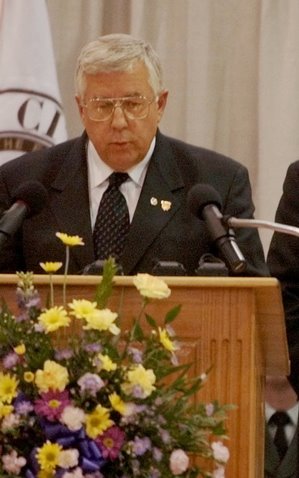
Conservative Wyoming Sen. Michael Enzi, chair of the Senate Committee on Health, Education, Labor & Pensions, is working hard against the nomination of Rep. Hilda Soliz for Labor Secretary. Photo by David Zalubowski / AP.

These guys on the right are intent on waging some class struggle. It’s past time to give them a taste of the real thing in return. Expose the Money behind them, and work to isolate them and take them down, and stiffen the spine of any waverers. Obama said he’d sign EFCA if it was put on his desk. Let’s make sure ‘our’ Reps don’t decide to trade it.

–Carl Davidson / The Rag Blog / January 25, 2009

‘Solis has a strong reputation as a friend of labor — her father was a Teamster, and as a congresswoman, she marched on a high-profile grocery-store picket line in her Southern California congressional district.’

By Lisa Mascaro / January 23, 2009

WASHINGTON — President Barack Obama’s nominee for Labor secretary is running into fierce resistance from Republicans over her reluctance to state her views clearly on legislation that would make it easier for unions to organize

The nomination of Rep. Hilda Solis has yet to be approved by the Senate Health, Education, Labor and Pensions Committee — even though her confirmation hearing two weeks ago was among the first for Obama’s cabinet picks.

The committee, chaired by Sen. Ted Kennedy of Massachusetts, could not say Thursday when it would hold a vote.

Even if the committee approves Solis, her nomination could be blocked by a Republican senator on the floor.

The committee’s ranking Republican, Sen. Mike Enzi of Wyoming, has been pressing for more detailed responses to questions posed on several issues, including the Employee Free Choice Act or card check bill.

The legislation would allow workers to organize simply by handing in enough cards expressing their preference. Under card check, union membership rose steadily in the past century until 1947, when Congress, under pressure from business, began requiring secret ballot elections. Unions claim the election campaigns allow management to dissuade workers with threats. Businesses argue that card check allows unions to pressure workers unduly to organize.

When asked Thursday whether he was satisfied with the answers Solis has given, Enzi said: “What answers?”

“She doesn’t even recognize her own record when giving the answers,” Enzi said. “Right now there are people who don’t want her out of committee. It’s not just me.”

Enzi said that while senators traditionally confirm a president’s nominations, “there’s also the obligation to really get it down on paper what their beliefs are.”

Solis has a strong reputation as a friend of labor — her father was a Teamster, and as a congresswoman, she marched on the picket line during a high-profile grocery-store picket line in her Southern California congressional district.

She voted for the Employee Free Choice Act in the House in 2007. The bill later died in the Senate but is being resurrected in this Congress.

The business community has targeted defeat of the bill among its top goals this year, engaging in a multi-million dollar campaign against it. A full-page ad in Thursday’s Politico portrays congressional leaders, including Senate Majority Leader Harry Reid, as ignoring what opponents call the union “power grab.”

The bill’s progress is being watched on The Strip as it would enable workers at the remaining nonunion casino properties in Las Vegas to more easily join unions.

At Solis’ confirmation hearing two weeks ago, she repeatedly dodged questions about the bill, saying she could not express her opinion on it because she and Obama had not yet discussed the issue.

At the time, Solis’ responses seemed strategic — a way to avoid giving fodder on a hot-button issue to those who may oppose her nomination.

Enzi said he hoped the nominee would talk with the president about the bill, “get an answer, give us an answer.”

The White House did not immediately respond to a request for comment.

Source / Las Vegas Sun

The Rag Blog

Posted in RagBlog | Tagged , , , , | Leave a comment

Singin’ on Sunday: Playing For Change

Playing For Change: Song Around the World “Let’s Don’t Worry”

Playing For Change
January 21, 2009

From the award-winning documentary, “Playing For Change: Peace Through Music”, comes the follow up to the classic “Stand By Me” and the second of many “songs around the world” being released on CD/DVD in April, 2009. Featured is an incredible track written by Pierre Minetti performed by musicians around the world adding their part to the song as it traveled the globe. This video and “Stand By Me” will be available at iTunes 1.27.09 while other songs such as “One Love” will be released as digital downloads soon; followed by the film soundtrack and DVD in stores on 4.18.09.

“Let’s Don’t Worry” can be downloaded here 1.27.09.

Sign up at playingforchange.com for updates and exclusive content.

Join the Movement to help build schools, connect students, and inspire communities in need through music.

Source / YouTube

Thanks to Jeff SegalThe Rag Blog

Posted in RagBlog | Tagged , , | 1 Comment

Texas Death Row : Certain Death, Uncertain Justice

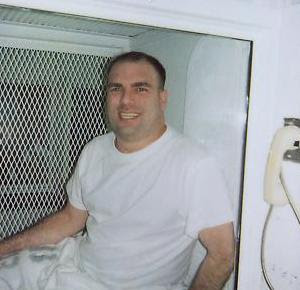
photo of Larry Swearingen

Larry Swearingen is scheduled to be executed Jan. 27 even though the crime he is charged with probably took place while he was locked up.

If the three men are executed they will be counted as numbers 427, 428, and 429 on the official list of persons executed by Texas since the death penalty was re-instated in 1982.

By Greg Moses | The Rag Blog | January 25, 2009

During the last week of January 2009 the state of Texas is scheduled to execute three men by means of lethal injection. Each case raises a significant question about administering certain death in a world of uncertain justice.

If the three men are executed they will be counted as numbers 427, 428, and 429 on the official list of persons executed by Texas since the death penalty was re-instated in 1982. As one of 36 states that has carried out the death penalty since 1976, Texas accounts for nearly 40 percent of the executions (see the fact sheet in pdf format at deathpenaltyinfo.org

On Tuesday, Larry Swearingen is scheduled to be executed for a crime that probably took place while he was in jail. Texas blogger Scott Henson reviews the facts at Grits for Breakfast. Questions about the Swearingen case have been joined by Texas Monthly and The Houston Chronicle. It is difficult to imagine that the execution would be allowed to take place with so many credible doubts being echoed.

On Wednesday, Virgil Martinez is scheduled to be killed for shooting to death an ex-girlfriend, a friend who tried to save her, and two of her children. It was an awful crime. But Martinez was arrested at a mental hospital where he had admitted himself for hearing voices ordering him to kill, and jurors were never told that he suffered from temporal lobe epilepsy (TLE). The Brazosport Facts published a good overview of the Martinez case in 2006.

According to federal court records accessed by the Texas Civil Rights Review, a magistrate judge concluded in 2005, and a federal district judge agreed in 2006, that the trial attorney for Martinez could have made better use of medical evidence about TLE and “post-seizure aggression.”

The federal documents further indicate that Martinez did exhibit “bizarre and at times violent behavior” during his time at a mental hospital.

But in 2007 a federal appeals panel argued that the trial attorney for Martinez was justified in not telling jurors that the defendant had a condition that could cause “savage and uncontrolled” aggressiveness. The attorney argued that presenting the information, along with other facts about Martinez’ history of aggression and jealousy, might have increased the jury’s likelihood of arriving at a penalty of death.

The appeals panel agreed with the magistrate and district judges that the lawyer did not at the time of the trial understand the difference between violence during a seizure and “post-seizure” aggression. And she therefore may have discounted the value of the medical evidence for the wrong reasons. But, giving strict attention to the question that was put to them, the appeals panel refused to label this failure as a mark of attorney incompetence.

The federal review of the Martinez case strengthened the case for “medical” causes that may have played a role in the shooting rampage that left four people dead. But the new medical findings were given no procedural value in the process of appeal.

So it may still be the case that “post-seizure” aggression is a medical condition that affects Martinez, and which affected him at the time of the four killings. Setting aside the question about whether his lawyer was competent in selecting a defense strategy under the circumstances of the trial, the appeals record has produced a fact that is significant.

Perhaps there is a legal way to put the question that will result in a stay for Martinez.

On Thursday, Ricardo Ortiz is scheduled to be killed by lethal injection because he was convicted of lethally injecting a cellmate with a triple dose of heroin.

So far, the Texas Civil Rights Review has found only a few hundred words of documentation in the case, but they are deeply troubling on their face.

Slim facts posted by Texas prison authorities says that Ortiz and two other cellmates cooked up three doses of heroin in an El Paso cell and that Ortiz injected all three doses into the victim who died of an overdose.

The Texas Attorney General stated this week that Ortiz committed the crime in order to prevent his cellmate “from testifying against him” about some bank robberies.

From the little we know, here is what Texas officials would have us believe: they held a prisoner in an El Paso cell with someone who could testify against him. Then they allowed three doses of heroin into the cell along with cooking utensils and at least one syringe. Then they didn’t smell a thing while the heroin was cooking, and didn’t notice a thing until the next cell count revealed a dead prisoner.

In the case of Ricardo Ortiz, the official accounts beg us to ask: are Texas authorities so into lethal injections that they’d set up the ideal conditions for one and then use their own malpractice as a foundation to practice another?

Although three executions in a row are scheduled for Texas next week, a state of more perfect criminal justice will see three stays down there on death row.

[Greg Moses edits the Texas Civil Rights Review.]

Posted in Rag Bloggers | Tagged , , , , | 2 Comments

Tasers: Not As Safe As Law-Enforcement Thinks

Stun guns like this Taser X26 shown in a 2005 photograph are intended as a nonlethal alternative to guns for law enforcement. Photo: Herb Swanson/AP.

UCSF study raises doubts about stun gun safety
By Elizabeth Fernandez / January 24, 2009

The number of in-custody sudden deaths rose dramatically during the first year California law enforcement agencies began using stun guns, raising questions about the safety of the devices, according to a new study at UCSF.

The electronic weapons are intended to be a nonlethal alternative to the gun.

“Tasers are not as safe as thought,” said Dr. Byron Lee, one of the cardiologists involved in studying the death rate related to Tasers, the most widely used stun gun. “And if they are used, they should be used with caution.”

The researchers analyzed sudden death data from 50 law enforcement agencies in the state that use Tasers. They compared the death rate pre- and post-Taser deployment – analyzing data for five years before each agency began using Tasers and five years afterward.

They found a sixfold increase in sudden deaths during the first year of Taser use – amounting to nearly 6 deaths per 100,000 arrests.

“I didn’t expect what we found,” said Lee. “I thought we would find no difference in the rate of sudden death. But there was a rather dramatic rise.”

After the first year, the rate of sudden deaths dropped down to nearly pre-Taser levels, suggesting that police and others in law enforcement altered the way they were using the devices to make them less lethal.

“Sudden deaths are extremely rare events, but it is important to look into why these events happen and whether law enforcement agencies are fully informed of the real-world risks,” Lee said.

California does not have a statewide training standard for stun guns, which have been used in the state for decades.

“The manufacturer provides introductory training, then law enforcement agencies do supplemental training,” said Robert Stresak, a spokesman for the California Commission on Peace Officer Standards and Training, which sets minimum training standards. “It’s on an agency by agency basis. The content of the course could vary widely as to what is taught.”

Tasers, known as “conducted energy” devices, send out high-frequency pulses which can cause a very rapid, dangerous heart rhythm, said senior author Dr. Zian H. Tseng, an assistant clinical professor in cardiology.

“Maybe a simple change of technique is what is necessary,” he said. “The longer you hold the trigger, the higher the danger to the heart. … The fewer pulses the better.”

San Francisco, which does not use the devices, was not part of the study. Tseng declined to give specifics about local jurisdictions involved in the research but said that “Oakland did not give us data. San Jose did give us data.”

Two years ago, Amnesty International reported 156 stun gun-related deaths of people in the United States during the previous five years.

The weapons have generated controversy, but a report last year which suggested a sweeping slate of reforms to the San Francisco Police Department said that allowing the use of Tasers may reduce injuries to officers and suspects.

Tasers are used by more than 12,000 law enforcement, military and correctional agencies in the U.S. and abroad, said UCSF’s Lee.

More intensive research is needed, particularly within law enforcement agencies that show a high sudden death rate, said Samuel Walker, one of the nation’s top police practices experts.

“We need good studies on the physiological impacts,” said Walker, an emeritus professor of criminal justice at the University of Nebraska in Omaha. “I’d want to know more about the deaths, interview the officers to find out if they self-corrected.”

The study’s findings were published online this week by the American Journal of Cardiology.

Source / San Francisco Chronicle

The Rag Blog

Posted in RagBlog | Tagged , | Leave a comment

Another War, Another Defeat
By John J. Mearsheimer / January 26, 2009

The Gaza offensive has succeeded in punishing the Palestinians but not in making Israel more secure.

Israelis and their American supporters claim that Israel learned its lessons well from the disastrous 2006 Lebanon war and has devised a winning strategy for the present war against Hamas. Of course, when a ceasefire comes, Israel will declare victory. Don’t believe it. Israel has foolishly started another war it cannot win.

The campaign in Gaza is said to have two objectives: 1) to put an end to the rockets and mortars that Palestinians have been firing into southern Israel since it withdrew from Gaza in August 2005; 2) to restore Israel’s deterrent, which was said to be diminished by the Lebanon fiasco, by Israel’s withdrawal from Gaza, and by its inability to halt Iran’s nuclear program.

But these are not the real goals of Operation Cast Lead. The actual purpose is connected to Israel’s long-term vision of how it intends to live with millions of Palestinians in its midst. It is part of a broader strategic goal: the creation of a “Greater Israel.” Specifically, Israel’s leaders remain determined to control all of what used to be known as Mandate Palestine, which includes Gaza and the West Bank. The Palestinians would have limited autonomy in a handful of disconnected and economically crippled enclaves, one of which is Gaza. Israel would control the borders around them, movement between them, the air above and the water below them.

The key to achieving this is to inflict massive pain on the Palestinians so that they come to accept the fact that they are a defeated people and that Israel will be largely responsible for controlling their future. This strategy, which was first articulated by Ze’ev Jabotinsky in the 1920s and has heavily influenced Israeli policy since 1948, is commonly referred to as the “Iron Wall.”

What has been happening in Gaza is fully consistent with this strategy.

Let’s begin with Israel’s decision to withdraw from Gaza in 2005. The conventional wisdom is that Israel was serious about making peace with the Palestinians and that its leaders hoped the exit from Gaza would be a major step toward creating a viable Palestinian state. According to the New York Times’ Thomas L. Friedman, Israel was giving the Palestinians an opportunity to “build a decent mini-state there—a Dubai on the Mediterranean,” and if they did so, it would “fundamentally reshape the Israeli debate about whether the Palestinians can be handed most of the West Bank.”

This is pure fiction. Even before Hamas came to power, the Israelis intended to create an open-air prison for the Palestinians in Gaza and inflict great pain on them until they complied with Israel’s wishes. Dov Weisglass, Ariel Sharon’s closest adviser at the time, candidly stated that the disengagement from Gaza was aimed at halting the peace process, not encouraging it. He described the disengagement as “formaldehyde that’s necessary so that there will not be a political process with the Palestinians.” Moreover, he emphasized that the withdrawal “places the Palestinians under tremendous pressure. It forces them into a corner where they hate to be.”

Arnon Soffer, a prominent Israeli demographer who also advised Sharon, elaborated on what that pressure would look like. “When 2.5 million people live in a closed-off Gaza, it’s going to be a human catastrophe. Those people will become even bigger animals than they are today, with the aid of an insane fundamentalist Islam. The pressure at the border will be awful. It’s going to be a terrible war. So, if we want to remain alive, we will have to kill and kill and kill. All day, every day.”

In January 2006, five months after the Israelis pulled their settlers out of Gaza, Hamas won a decisive victory over Fatah in the Palestinian legislative elections. This meant trouble for Israel’s strategy because Hamas was democratically elected, well organized, not corrupt like Fatah, and unwilling to accept Israel’s existence. Israel responded by ratcheting up economic pressure on the Palestinians, but it did not work. In fact, the situation took another turn for the worse in March 2007, when Fatah and Hamas came together to form a national unity government. Hamas’s stature and political power were growing, and Israel’s divide-and-conquer strategy was unraveling.

To make matters worse, the national unity government began pushing for a long-term ceasefire. The Palestinians would end all missile attacks on Israel if the Israelis would stop arresting and assassinating Palestinians and end their economic stranglehold, opening the border crossings into Gaza.

Israel rejected that offer and with American backing set out to foment a civil war between Fatah and Hamas that would wreck the national unity government and put Fatah in charge. The plan backfired when Hamas drove Fatah out of Gaza, leaving Hamas in charge there and the more pliant Fatah in control of the West Bank. Israel then tightened the screws on the blockade around Gaza, causing even greater hardship and suffering among the Palestinians living there.

Hamas responded by continuing to fire rockets and mortars into Israel, while emphasizing that they still sought a long-term ceasefire, perhaps lasting ten years or more. This was not a noble gesture on Hamas’s part: they sought a ceasefire because the balance of power heavily favored Israel. The Israelis had no interest in a ceasefire and merely intensified the economic pressure on Gaza. But in the late spring of 2008, pressure from Israelis living under the rocket attacks led the government to agree to a six-month ceasefire starting on June 19. That agreement, which formally ended on Dec. 19, immediately preceded the present war, which began on Dec. 27.

The official Israeli position blames Hamas for undermining the ceasefire. This view is widely accepted in the United States, but it is not true. Israeli leaders disliked the ceasefire from the start, and Defense Minister Ehud Barak instructed the IDF to begin preparing for the present war while the ceasefire was being negotiated in June 2008. Furthermore, Dan Gillerman, Israel’s former ambassador to the UN, reports that Jerusalem began to prepare the propaganda campaign to sell the present war months before the conflict began. For its part, Hamas drastically reduced the number of missile attacks during the first five months of the ceasefire. A total of two rockets were fired into Israel during September and October, none by Hamas.

How did Israel behave during this same period? It continued arresting and assassinating Palestinians on the West Bank, and it continued the deadly blockade that was slowly strangling Gaza. Then on Nov. 4, as Americans voted for a new president, Israel attacked a tunnel inside Gaza and killed six Palestinians. It was the first major violation of the ceasefire, and the Palestinians—who had been “careful to maintain the ceasefire,” according to Israel’s Intelligence and Terrorism Information Center—responded by resuming rocket attacks. The calm that had prevailed since June vanished as Israel ratcheted up the blockade and its attacks into Gaza and the Palestinians hurled more rockets at Israel. It is worth noting that not a single Israeli was killed by Palestinian missiles between Nov. 4 and the launching of the war on Dec. 27.

As the violence increased, Hamas made clear that it had no interest in extending the ceasefire beyond Dec. 19, which is hardly surprising, since it had not worked as intended. In mid-December, however, Hamas informed Israel that it was still willing to negotiate a long-term ceasefire if it included an end to the arrests and assassinations as well as the lifting of the blockade. But the Israelis, having used the ceasefire to prepare for war against Hamas, rejected this overture. The bombing of Gaza commenced eight days after the failed ceasefire formally ended.

If Israel wanted to stop missile attacks from Gaza, it could have done so by arranging a long-term ceasefire with Hamas. And if Israel were genuinely interested in creating a viable Palestinian state, it could have worked with the national unity government to implement a meaningful ceasefire and change Hamas’s thinking about a two-state solution. But Israel has a different agenda: it is determined to employ the Iron Wall strategy to get the Palestinians in Gaza to accept their fate as hapless subjects of a Greater Israel.

This brutal policy is clearly reflected in Israel’s conduct of the Gaza War. Israel and its supporters claim that the IDF is going to great lengths to avoid civilian casualties, in some cases taking risks that put Israeli soldiers in jeopardy. Hardly. One reason to doubt these claims is that Israel refuses to allow reporters into the war zone: it does not want the world to see what its soldiers and bombs are doing inside Gaza. At the same time, Israel has launched a massive propaganda campaign to put a positive spin on the horror stories that do emerge.

The best evidence, however, that Israel is deliberately seeking to punish the broader population in Gaza is the death and destruction the IDF has wrought on that small piece of real estate. Israel has killed over 1,000 Palestinians and wounded more than 4,000. Over half of the casualties are civilians, and many are children. The IDF’s opening salvo on Dec. 27 took place as children were leaving school, and one of its primary targets that day was a large group of graduating police cadets, who hardly qualified as terrorists. In what Ehud Barak called “an all-out war against Hamas,” Israel has targeted a university, schools, mosques, homes, apartment buildings, government offices, and even ambulances. A senior Israeli military official, speaking on the condition of anonymity, explained the logic behind Israel’s expansive target set: “There are many aspects of Hamas, and we are trying to hit the whole spectrum, because everything is connected and everything supports terrorism against Israel.” In other words, everyone is a terrorist and everything is a legitimate target.

Israelis tend to be blunt, and they occasionally say what they are really doing. After the IDF killed 40 Palestinian civilians in a UN school on Jan. 6, Ha’aretz reported that “senior officers admit that the IDF has been using enormous firepower.” One officer explained, “For us, being cautious means being aggressive. From the minute we entered, we’ve acted like we’re at war. That creates enormous damage on the ground … I just hope those who have fled the area of Gaza City in which we are operating will describe the shock.”

One might accept that Israel is waging “a cruel, all-out war against 1.5 million Palestinian civilians,” as Ha’aretz put it in an editorial, but argue that it will eventually achieve its war aims and the rest of the world will quickly forget the horrors inflicted on the people of Gaza.

This is wishful thinking. For starters, Israel is unlikely to stop the rocket fire for any appreciable period of time unless it agrees to open Gaza’s borders and stop arresting and killing Palestinians. Israelis talk about cutting off the supply of rockets and mortars into Gaza, but weapons will continue to come in via secret tunnels and ships that sneak through Israel’s naval blockade. It will also be impossible to police all of the goods sent into Gaza through legitimate channels.

Israel could try to conquer all of Gaza and lock the place down. That would probably stop the rocket attacks if Israel deployed a large enough force. But then the IDF would be bogged down in a costly occupation against a deeply hostile population. They would eventually have to leave, and the rocket fire would resume. And if Israel fails to stop the rocket fire and keep it stopped, as seems likely, its deterrent will be diminished, not strengthened.

More importantly, there is little reason to think that the Israelis can beat Hamas into submission and get the Palestinians to live quietly in a handful of Bantustans inside Greater Israel. Israel has been humiliating, torturing, and killing Palestinians in the Occupied Territories since 1967 and has not come close to cowing them. Indeed, Hamas’s reaction to Israel’s brutality seems to lend credence to Nietzsche’s remark that what does not kill you makes you stronger.

But even if the unexpected happens and the Palestinians cave, Israel would still lose because it will become an apartheid state. As Prime Minister Ehud Olmert recently said, Israel will “face a South African-style struggle” if the Palestinians do not get a viable state of their own. “As soon as that happens,” he argued, “the state of Israel is finished.” Yet Olmert has done nothing to stop settlement expansion and create a viable Palestinian state, relying instead on the Iron Wall strategy to deal with the Palestinians.

There is also little chance that people around the world who follow the Israeli-Palestinian conflict will soon forget the appalling punishment that Israel is meting out in Gaza. The destruction is just too obvious to miss, and too many people – especially in the Arab and Islamic world — care about the Palestinians’ fate. Moreover, discourse about this longstanding conflict has undergone a sea change in the West in recent years, and many of us who were once wholly sympathetic to Israel now see that the Israelis are the victimizers and the Palestinians are the victims. What is happening in Gaza will accelerate that changing picture of the conflict and long be seen as a dark stain on Israel’s reputation.

The bottom line is that no matter what happens on the battlefield, Israel cannot win its war in Gaza. In fact, it is pursuing a strategy—with lots of help from its so-called friends in the Diaspora—that is placing its long-term future at risk.

[John J. Mearsheimer is a professor of political science at the University of Chicago and coauthor of The Israel Lobby and U.S. Foreign Policy.]

Source / American Conservative Magazine

The Rag Blog

Posted in RagBlog | Leave a comment

Obama Government Bombs Pakistan

Obama bombs Pakistan – from warrantless wiretaps to bombing in countries we are not at war with and who understandably object to this invasion and murder of their people. I am not euphoric yet.

Substitute “Austin” for “Pakistan” in the phrase “missile strikes that killed at least 20 people at suspected terrorist hideouts in northwestern Pakistan”. Personally, I suspect their are plenty of terrorists in Washington D.C.

Alan Pogue / The Rag Blog

Leaders from Pakistan’s North Waziristan tribal area along the border with Afghanistan met with Pakistani Army officials last February. On Friday, the US launched air attacks in Pakistan within the Waziristan area in a concrete demonstration of the Obama administration’s Pakistan policy. Photo: John Moore/Getty Images.

Two US Airstrikes Offer a Concrete Sign of Obama’s Pakistan Policy
By R. Jeffrey Smith, Candace Rondeaux and Joby Warrick / January 24, 2009

Two remote U.S. missile strikes that killed at least 20 people at suspected terrorist hideouts in northwestern Pakistan yesterday offered the first tangible sign of President Obama’s commitment to sustained military pressure on the terrorist groups there, even though Pakistanis broadly oppose such unilateral U.S. actions.

The shaky Pakistani government of Asif Ali Zardari has expressed hopes for warm relations with Obama, but members of Obama’s new national security team have already telegraphed their intention to make firmer demands of Islamabad than the Bush administration, and to back up those demands with a threatened curtailment of the plentiful military aid that has been at the heart of U.S.-Pakistani ties for the past three decades.

The separate strikes on two compounds, coming three hours apart and involving five missiles fired from Afghanistan-based Predator drone aircraft, were the first high-profile hostile military actions taken under Obama’s four-day-old presidency. A Pakistani security official said in Islamabad that the strikes appeared to have killed at least 10 insurgents, including five foreign nationals and possibly even “a high-value target” such as a senior al-Qaeda or Taliban official.

It remained unclear yesterday whether Obama personally authorized the strike or was involved in its final planning, but military officials have previously said the White House is routinely briefed about such attacks in advance.

At his daily White House briefing, press secretary Robert Gibbs declined to answer questions about the strikes, saying, “I’m not going to get into these matters.” Obama convened his first National Security Council meeting on Pakistan and Afghanistan yesterday afternoon, after the strike.

The Pakistani government, which has loudly protested some earlier strikes, was quiet yesterday. In September, U.S. and Pakistani officials reached a tacit agreement to allow such attacks to continue without Pakistani involvement, according to senior officials in both countries.

But some Pakistanis have said they expect a possibly bumpy diplomatic stretch ahead.

“Pakistan hopes that Obama will be more patient while dealing with Pakistan,” Husain Haqqani, Pakistan’s ambassador to Washington, said in an interview Wednesday with Pakistan’s Geo television network. “We will review all options if Obama does not adopt a positive policy towards us.” He urged Obama to “hear us out.”

At least 132 people have been killed in 38 suspected U.S. missile strikes inside Pakistan since August, all conducted by the CIA, in a ramped-up effort by the outgoing Bush administration.

Obama’s August 2007 statement — that he favored taking direct action in Pakistan against potential threats to U.S. security if Pakistani security forces do not act — made him less popular in Pakistan than in any other Muslim nation polled before the election.

Secretary of State Hillary Rodham Clinton indicated during her Senate confirmation hearing that the new administration will not relent in holding Pakistan to account for any shortfalls in the continuing battle against extremists.

Linking Pakistan with neighboring Afghanistan “on the front line of our global counterterrorism efforts,” Clinton told the Senate Foreign Relations Committee that “we will use all the elements of our powers — diplomacy, development and defense — to work with those . . . who want to root out al-Qaeda, the Taliban and other violent extremists.” She also said those in Pakistan who do not join the effort will pay a price, adding a distinctly new element to the long-standing U.S. effort to lure Pakistan closer to the West.

In blunt terms in her written answers to the committee’s questions, Clinton pledged that Washington will “condition” future U.S. military aid on Pakistan’s efforts to close down terrorist training camps and evict foreign fighters. She also demanded that Pakistan “prevent” the continued use of its historically lawless northern territories as a sanctuary by either the Taliban or al-Qaeda. And she promised that Washington would provide all the support Pakistan needs if it specifically goes after targets such as Osama bin Laden, who is believed to be using Pakistani mountains as a hideout.

At the same time, Clinton pledged to triple nonmilitary aid to Pakistan, long dwarfed by the more than $6 billion funneled to Pakistani military forces under President George W. Bush through the Pentagon’s counterterrorism office in Islamabad.

“The conditioning of military aid is substantially different,” as is the planned boost of economic aid, said Daniel Markey, a Council on Foreign Relations senior fellow who handled South Asian matters on the State Department’s policy planning staff from 2003 to 2007.

Bush’s focus on military aid to a Pakistani government that was led by an army general until August eventually drew complaints in both countries that much of the funding was spent without accountability or, instead of being used to root out terrorists, was diverted to forces intended for a potential conflict with India.

A study in 2007 by the Center for Strategic and International Studies reported that economic, humanitarian and development assistance under Bush amounted to no more than a quarter of all aid, less than in most countries.

The criticism helped provoke a group of senators who now have powerful new roles — Joseph R. Biden Jr., Clinton and Obama — to co-sponsor legislation last July requiring that more aid be targeted at political pluralism, the rule of law, human and civil rights, and schools, public health and agriculture.

It also would have allowed U.S. weapons sales and other military aid only if the secretary of state certified that Pakistani military forces were making “concerted efforts” to undermine al-Qaeda and the Taliban. In her confirmation statement, Clinton reiterated her support for such a legislative restructuring of the aid program, while reaffirming that she opposed any “blank check.”

Some Pakistanis have been encouraged by indications that Obama intends to increase aid to the impoverished country, said Shuja Nawaz, a Pakistani who directs the South Asia Center of the Washington-based Atlantic Council of the United States. Nawaz said Pakistanis may be willing to overlook an occasional missile lobbed at foreign terrorists if Obama makes a sincere attempt to improve conditions in Pakistan.

“He can’t just focus on military achievements; he has to win over the people,” Nawaz said. “Relying on military strikes will not do the trick.” Attaching conditions to the aid is wise, Nawaz said, because “people are more cognizant of the need for accountability — for ‘tough love.’ “

[Rondeaux reported from Islamabad. Special correspondent Haq Nawaz Khan in Islamabad contributed to this report.]

Source / Washington Post

Thanks to Alan Pogue / The Rag Blog

Posted in RagBlog | Tagged , , , | 1 Comment

Michelle Obama’s Yellow Dress : Shades of Oshun

“Oshun” by Brigid Ashwood.

Oshun is an Afro-Cuban goddess of love, maternity and marriage.

By Karen Lee Wald
/ The Rag Blog / January 24, 2009

Since several people commented that Michelle Obama was wearing a yellow dress designed by a Cuban American, and that yellow is the color of the African and Afro-Cuban goddess or orisha, Oshun, I thought it worth passing on some information about Oshun, for whatever it is worth to you.

Specialists in the topic can add more, this is just from googling it:

Oshun — with a nod to Wikipedia — is beneficient and generous, and very kind. She does, however, have a horrific temper, though it is difficult to anger her. She is married to Ṣàngó, the god of thunder, and is his favorite wife because of her excellent cooking skills. One of his other wives, Oba, was her rival. They are the goddesses of the Ọṣun and Oba rivers, which meet in a turbulent place with difficult rapids.

Santería

In Cuban Santería, Oshun (sometimes spelled Ochún or Ochun) is an Orisha of love, maternity and marriage. She has been syncretized with Our Lady of Charity (La Virgen de la Caridad del Cobre), Cuba’s patroness. She is associated with the color yellow,

[Karen Wald edits Cuba-Inside-Out.]

Kate Betts wrote in Time:

First Lady Michelle Obama picked fashion insider Isabel Toledo, 47, to design her Inaugural ensemble. The glamorous, creamy yellow dress and matching overcoat were made of satin-backed wool guipure, a kind of lace used most often in French haute couture. Obama accessorized the look with a sparkling crystal necklace and green leather gloves and shoes. […]

Cuban-born Toledo, who has been designing for 25 years and worked for a time at Anne Klein, is known in fashion circles as a “designer’s designer” for her wit and whimsical sense of pattern, fit and fabric. The Manhattan-based designer also made the black tunic and palazzo pants that Obama wore to a fundraiser last June. But for her husband’s swearing-in ceremony, Obama chose an elegantly sunny yellow, a color that for centuries has represented optimism.

Toledo, who works out of a studio on Broadway and 28th Street along with her husband, fashion illustrator Ruben Toledo, was an unlikely choice for today’s ensemble because she is not a mainstream designer. In 1998 the fashion maverick stopped presenting biannual collections, instead choosing to create on her own schedule. […]

“I was so honored to hear that she’s a fan,” Toledo said after learning that Obama had worn one of her designs during the campaign. “She chose to wear a dress made by a Latina and made in the U.S.,” the designer told the New York Daily News. “She chose to support the industry here.”

And George Spyros, in The Huffington Post.

Questions of taste aside, we think it’s great that Cuban-American Toledo did the dress for the first African-American first lady: it’s an inclusive gesture to our country’s latinos and a hopeful nod toward our neighbors in Cuba to the south.

And, to follow the tangent, more about Oshun, this from Lowell:

Sometimes a cigar is just a cigar… but if the Cuban-American designer was thinking of or under the influence of Ochun, I’d like the add this: Ochun is the most powerful, most revered oricha. She was not married to but had affairs with Chango and Oggun, was married to to Orunla, Inle Abata and Babaluaye. Chango was married to Oya Yansan. Ochun was given the river as a domain by Yemaya and Aggayu. Ochun has the last word in all affairs, so she is ONE oricha you never want to piss off, she is the oricha who always wins. Annoy Obatala, but if Ochun has your side, you will come out alright.

One of my favorite patakins [stories/folktales] is when humanity had come to dishonor the gods and be lured into new ways. When death and drought came, the people prayed to the gods for relief; none took pity, having lost faith in human beings. Uniquely, Ochun, the youngest oricha, took her beautiful messenger bird to Heaven to speak on humanity’s behalf. God heard her and brought rain and relief. The beautiful bird Ochun used was forever scarred by the journey so close to the sun: this is how the vulture came to look as it does. The vulture is one of her messengers, as are the partridge and quail.

The arts of divination were the sole propriety of Orunla, until Ochun studied after him with certain limits: so while babalawos may read the full range of texts, priests of oricha retain this limit. One of Ochun’s titles is Apetiba Orunla, wife of Orula, who was a king and was able to spread his divination message thanks to his wife, Ochun’s study. Iyalodde [the crowned woman] is another of Ochun’s titles. Just as Orula would not have had success without Ochun, his priests, the babalawos, have a special place for Ochun in their worship … Obama?

Ochun is the only oricha of LIFE and the FIGHT FOR LIFE. Ochun is the oricha of SOCIAL JUSTICE.

Fidel is from the region of Cuba where Ochun’s basilica is located. When he started fighting, his mother took offerings to the basilica for Ochun [la virgen de caridad del cobre. The persistent rumor is Fidel is a babalawo.

The Rag Blog

Posted in Rag Bloggers | Tagged , , , | 2 Comments

Ruthy and the Pedal People : Taking Out the Trash

Ruthy Woodring: Garbage duty in the Massachusetts winter. Photo courtesy the Pedal People.

I like Ruthy’s special combination of valuing personal independence and community interdependence. I’ve rarely met a young woman who seems as fearless and sanguine about the world, even though she is wise to the hard things in life.

By Susan Van Haitsma / The Rag Blog / January 24, 2009

This week, my partner and I had a most interesting house guest. Ruthy Woodring arrived Monday night by train and made her own way to our house via foot power. She travels light, with her home-made back-pack, a small sleeping bag and a folding scooter. In past trips, she has sometimes traveled with her folding bike. She’s not only a bicycle advocate, she has helped create a bicycle-powered livelihood.

I had met Ruthy a couple of times before — once in Chicago when she was living at a Catholic Worker house. I remembered the beautiful garden she was cultivating there at the time, a productive plot of earth tucked into the urban landscape. Now, she and her partner, Alex Jarrett run a bicycle powered trash and recycling pick-up service in Northampton, MA. They began the business in 2002 and call themselves Pedal People.

Check them out on the web. They’ve established a brilliant niche in a green economy. Northampton doesn’t have municipal trash pick-up, so Ruthy and Alex entered the market by offering to take trash and recycling to the city’s transfer center via bike trailer — year-round. We’re talking winter in Massachusetts, and that’s serious business when you’re hauling 250 pounds through slush and snow. A page on their web site describes what they wear for the weather. If they can carry loads by bike all year in that climate, there is not much standing in the way of other such businesses operating in smallish towns all over.

Ruthy borrowed my bike while she was here to explore Austin, and she was quite impressed with our trails. The home she and Alex bought in MA was chosen because it backs up to a Rails-to-Trails corridor. Their household also has experimented with solar energy — using a single solar panel that they can move around, which powers their fridge (a chest-style, low-energy model) and a couple of LED lights. They have a garden and compost intensely.

I like Ruthy’s special combination of valuing personal independence and community interdependence. I’ve rarely met a young woman who seems as fearless and sanguine about the world, even though she is wise to the hard things in life and has been willing to give up her own freedom for a time when she spent 6 months in a federal prison for crossing the line at the School of the Americas. She thinks carefully about the resources she uses — food, water, even small, day-to-day materials. She left us with some colorful, home-made envelopes she had created during her train trip (she travels with a few tools, like scissors and a bike wrench) from pages of calendars she’d retrieved from her recent recycling pick-ups (a winter bonus).

Check out this article about Pedal People published in the last issue of Orion magazine. And here’s a quote from Ruthy I like from one of the interviews posted on the Pedal People site. When asked if she sometimes uses cars, Ruthy responds,

“Oh, sure, sometimes I carpool, hitch, take the bus or the train. But I try to keep my transportation simple and nonviolent. When I’m in a car, looking out at the houses and trees speeding by, I feel for those whose lives I’m unknowingly impacting — the people who live next to the highway who never hear quiet, the people who have to breathe the air I’m polluting, the people who lost their land to highway construction, their farms to sprawl and strip malls, the animals who can’t roam because they can’t cross the highway… I don’t think any of us uses resources in a way completely consistent with our beliefs. But for me, since I can bike and I like it, this is one way I can minimize my complicity in the violence done to our planet.”

Ruthy took off for Mexico on a late-night Greyhound, and we hope to hear about her adventures when she passes back through Austin on her way north next month. Since her visit, my partner and I have been even more aware of our own footprint on the earth, thinking about ways we can, like Ruthy and Alex, creatively problem-solve to live more compatibly with our neighborhood and planet. As always, the power of example is the greatest teacher, and Ruthy opened us to a wellspring of happy possibility.

[Susan Van Haitsma also blogs as makingpeace at Statesman.com and at makingpeace.]

The Rag Blog

Posted in Rag Bloggers | Tagged , , , | Leave a comment

Ending the War on Drugs: The Story of Howard Wooldridge


Saddling Up for Legalization
By Tom Moates / January 2009

“Cops say, ‘Legalize Pot,’ ask me why.”

The big plain letters spelling this message across an otherwise basic T-shirt popped out at the onlooker, and were easily discernable at considerable distance from wherever the rider sat atop his horse. This simple yet potentially volatile statement sparked conversation, and debate—and the cowboy cop carried it like a human/equestrian billboard through towns, cities, and even deserts all across America…that is, literally across America, the whole way from ocean-to-ocean in one continuous journey.

Howard Wooldridge, a retired officer and detective with a stellar 18-year record, may seem an unlikely candidate to carry a pro-legalization message to the masses. Equally unique is the Paul Revere/Pony Express kind of method he thought up for getting the dialog going with America. But that’s Wooldridge: sincere, outspoken, fluent in four languages, armed with hard facts, and always fearlessly blazing new trails. Plus, Howard and his horse, Misty (Smooth Georgia Mist) already had ridden across the country once, so they knew exactly what lay in store for them on this journey.

In the ranks of Long Riders, Wooldridge holds the distinction of being not only a well respected member of The Long Riders’ Guild, but the only Long Rider known to have traveled coast-to-coast across America in both directions, ever. The Royal Geographical Society (the world’s largest geographical organization, established in 1830, acknowledged the significance of Howard’s saddle-tramping by honoring him as a Fellow. His one-eyed horse, Misty, is famous too for making both journeys, although she walked along beside another saddle horse for the latter part of the second trip. Misty is likewise famous for writing the memoir of their first ride together, Misty’s Long Ride (Howard helped her with the spelling).

The first Long Ride the pair made stretched from the Atlantic to the Pacific in 2003. The second trip from the Pacific back east to the Atlantic in 2005 was spurred by Wooldridge’s motivation to get out and talk to people in America about his firm conviction that the United States can benefit in many extremely important ways by changing its current drug policies.

This equestrian adventurer is hardly alone in the ranks of police feeling this way. He is part of an organization called, Law Enforcement Against Prohibition (LEAP, www.leap.cc), which lobbies hard to change entrenched views and convince lawmakers of real benefits that can result for law enforcement officials, tax payers, and the rest of the country from a change in drug policies.

Wooldridge’s own words certainly best describe his endeavors. The following interview provides some insight into his most unique modern equestrian expeditions.

What got you fired up to ride across country to begin with? And then again?

“Without dreams, the spirit wanes and eventually dies. At 52 I had ridden a horse around the pyramids and walked in the shadow of Mt. Everest. The concept of riding my horse across North America began as a daydream, then an idea, then a project that I made happen.”

“The second trip was pure politics. I knew that while riding across the country, I would generate media attention and thus move my issue of ending Modern Prohibition.”

Tell a little about your partner in this, Misty.

“Misty was bred, born and spent her first two years just north of Fort Worth, Texas. She is three quarters paint and one quarter we don’t know, making her a registered Pinto. Her markings are Tobiano. At 15.2h she was big enough to make the journey, especially with me walking every third mile. She has a natural calm and giving disposition, crucial for the Long Ride next to busy U.S. highways. I received her at five and she was only halter broke. My former wife Lin and I started her. After three months I switched from using a soft bit to a Hackamore bridle. She has not had a bit in her mouth since 1999.”

“Shortly after arriving at our ranchette in Fort Worth, she suffered a severe blunt trauma to her right eye, probably from a kick. Six weeks later the surgeons removed the eye. After a few weeks of adjustment, she accepted her new condition, depending on me to keep her out of trouble. I never allow anyone to ride her outside of a controlled environment because of the eye.”

How would you describe the experience of Long Riding in a few words? Would you recommend it to others?

“Becoming a Long Rider is a life-changing experience. The road teaches humility and fellowship as horse and rider depend on the kindness of strangers to succeed.”

“Would I recommend it? (Wooldridge laughs at the word choice.) Yes. Anyone can do it. One only needs a good pony, an iron discipline and faith in oneself.”

The second ride had the purpose of creating awareness for ending prohibition; can you accurately explain what that means as you promote it?

“This modern prohibition – War on Drugs – has been the most disastrous, dysfunctional and immoral social policy since slavery. The policy generates the majority of felony crime, thus lowering our quality of life. My profession could lock up many more public safety threats like the DUI, child molesters, etc, if we did not spend close to 10 million hours chasing non-violent, adult drug users.”

“I have arrested child rapists. I have an idea of how much pain, suffering and future anguish the victims experience. Knowing that the perpetrators of this are going uncaught and unpunished because my colleagues focus on drug users drives me forward with an unwavering energy and commitment.”

What inspired you to that idea?

“18 years of police service translates that, till the moment of my passing, I will bleed blue if you cut me. I have a strong desire to ‘protect and serve.’ Since I can no longer arrest a DUI, moving the prohibition policy into the history books will improve public safety which is always my goal.”

How were you typically received across the country?

“The first ride was mixed, though overall positive. Wearing the shirt that said: COPS SAY LEGALIZE POT, a gentleman in Colorado, and months later one in Oregon, threatened to go home, get their gun and shoot me out of the saddle. That I was wearing my own 9MM Sig Sauer may have given them pause.”

“Regular folks took us in regardless of my politics. They simply saw a cowboy and horse that needed a good meal and a dry, comfortable stall.”

How did the Long Ride ultimately pan out as a catalyst for conversation and change?

“It was a fantastic tool, which sparked hundreds of conversations. The vast majority walked away with an understanding that changed their opinion.”

Did Misty help open the door for communication when you, a stranger, rode into new places that wouldn’t have happened if, say, you rode up on a Harley or a Toyota or with a backpack walking or bicycling?

“No question Misty was the key to meeting people. Needing water, I knocked on the doors of dozens of homes. Most of the time the person home was a woman, either alone or with small children. I looked tired & worn out but they always looked past that to see Misty. Without exception they opened their door and helped us. Several times I came inside and they fed and watered me. It was amazing.”

“Bicyclists do have some of the same experiences but nowhere near as often. The horse is THE generator of trust.”

What is your current life/work like? How have the Long Rides changed you?

“Currently I work some 50+ hours in the Washington, DC area, spending my hours in the US Congress. There I educate staff and Members of Congress on the need to end Modern Prohibition. The work is challenging and stressful. I always have to be ‘on.’ In its own way, it is much like police work.”

“On the other hand it is a joy to use every bit of knowledge and ability that I have built up over 57 years. I manage to speak my foreign languages on a regular basis. I am constantly creating new concepts to better project the message. Staffers and I have discussed non-drug issues from no-till farming to ocean fish farms to tax polices. I have to be ready to sound intelligent on everything.”

“Has the journey changed me? The Rides reminded me that the vast majority of people are good, giving and trusting. The Rides reminded me that no matter how distant the goal, taking it one day at a time, the goal comes closer every day. Then one morning there is the ocean. Ending Modern Prohibition is much like that as I work the halls of Congress. One day the policy will be over and we will return to Texas.”

Source / Horse Connection

Thanks to Mariann Wizard / The Rag Blog

Posted in RagBlog | Tagged , | Leave a comment

Bolivia : The Victory of Leftist Populism

Bolivian peasant passes by campaign posters for President Evo Morales.

Remember Latin America? Something’s happening down there.

By James Retherford / The Rag Blog / January 24, 2009

See ‘From Rightist Chaos to Leftist Constitutionalism:
The Institutionalization of Bolivian Populism’ by Chris Sweeney, Below.

Will the new administration embrace fundamental democratic change south of the border? Or will neo-liberalism regain cachet with Hillary in charge of the State Department.

Not as “politicized” as Cuba and Venezuela, Bolivia is nonetheless a barometer for how U.S. attempts to apply the Monroe Doctrine in the 21st century.

The following is a fascinating and comprehensive analysis of the historical evolution and establishment of leftist populism in Bolivia. Author Chris Sweeney is a Research Fellow at the Council on Hemispheric Affairs.

From Rightist Chaos to Leftist Constitutionalism:
The Institutionalization of Bolivian Populism

By Chris Sweeney / January 23, 2009

A Historic Moment

Since the start of the new millennium, popular movements in Bolivia have learned to mobilize en masse to form a united front of class and ethnicity to oust two presidents and reject a third candidate. Bolivians have also elected one of their own, who without strong middle class and mestizo support, probably would not have won. Evo Morales, a full-blooded Aymaran indigenous, became Bolivia’s first native president in December 2005 with 53.7 percent of the vote, an unprecedented majority in a country where support from a quarter of the electorate is considered respectable. He took office in January 2006 and has since acted to change the internal structure of the country to reflect the ambitions and interests of those social movements which are intent on rallying behind him.

On October 21, 2008, Bolivia came one step closer to holding a referendum that eventually could have the potential to shape the country for generations to come. On that date, January 25, 2009, Congress approved when the vote would be staged to determine whether or not the country adopts a new constitution. The proposed draft is designed to redress centuries of structural oppression and humiliation faced by Bolivia’s indigenous and working class majority. A second vote would be staged on the referendum on whether to hold a second referendum which was also approved on the same day regarding whether to deal with the unresolved issue of limiting excessive and disproportionate land ownership. People will be given the choice between capping future individual landholdings at levels of either 5,000 or 10,000 hectares.

If it passes as expected, the new constitution will furbish a profound improvement for social progress for those, like the indigenous, who were previously disenfranchised in the country. The new structure would mean the consolidation and institutionalization of Bolivia’s indigenous nationalist movement, composed of workers’ unions, indigenous communities, and popular interest groups across the country. Such a feat has only been made possible because of Morales’ political grouping “Movement towards Socialism” (MAS) ability to harness the momentum of Bolivia’s current social movements towards the political advancement of his cause. As a result, Bolivia now stands ready to implement dramatic social reforms, which have been hundreds of years in the waiting.

A Land Divided

Bolivia has experienced a history of biased development and political corruption that continues to haunt the current MAS administration. As a result, the country has a long legacy of mobilization and activism. Until 1982, it had experienced more coups than it had years of democratic governances. Today, political instability continues to reflect the status quo. This is exemplified in the fact that although technically democratically elected, there have been six presidents in the last eight years. This high turnover can, in part, be attributed to the fractured state of Bolivian society, which is divided along geographic, ethnic, ideological and class-based lines.

Bolivia’s indigenous comprise almost two-thirds of the national population, yet historically have been relegated to the periphery of Bolivia’s civic, economic and political institutions. The two largest indigenous groups are the Quechua, comprising 30 percent of the total population, and the Aymara, another 25 percent. These communities live predominantly as subsistence farmers in the Cochabamban valley and the western highlands of La Paz, Oruro and Potosi respectively. This population ranges from poor to extremely destitute and routinely have been excluded from authentic political, economic, and social processes throughout much of Bolivia’s history. The situation east of the Andes, meanwhile, is quite different. There, a wealthy minority, largely of European descent, has partitioned the country’s best agricultural land and natural gas reserves for their own benefit. A system of elite control Bolivia’s leading businesses, media outlets and traditional political parties, while these residents in the east enjoy a higher standard of living than most South Americans.

The stark contrast of rich and poor Bolivian society is certainly not a recent phenomenon and neither is resistance against the status quo. To appreciate Bolivia’s recent ongoing turmoil, it is important to understand the specific facets of social movement and protest in the country as today’s trends are certainly in part shaped by the successes and failures of years past.

Domination and Resistance

The first major phase of social protest in Bolivia started in 1780 as an indigenous movement against Spanish colonial rule. In August of that year, Tupaj Katari led an insurgency in the Potosí department which sparked a chain of local movements that soon spread unrest across the western altiplano and beyond. Indigenous militias, aided by their intimate knowledge of the land and backed by popular support, were successful in clearing the Spanish from the countryside. However, when it reached the edge of the city of La Paz, the indigenous uprising failed. Katari led a five month siege on La Paz, the stronghold of colonial power, yet was unable to take control. He was ultimately captured in 1781, and the Spanish retained control of the country until 1825, when Bolivia’s independence was declared. This early insurgency set the pattern for subsequent Indian risings. They fought for communal sovereignty and cultural recognition and were led by a strong and charismatic figure. Although the main movement was able to mobilize the countryside en masse, it ultimately failed because it was unable to forge any urban allies.

Over a century and a half later, a different type of social movement broke out. In 1952, an urban insurrection was formed by organized labor, students, intellectuals, and a progressive middle class under the leadership of Víctor Paz Estenssoro. The latter had been elected president on the National Revolutionary Movement (MNR) ticket, yet was prevented at the time from assuming power by the incumbent government. The MNR was a quasi Marxist political party committed to nationalize Bolivia’s mining industry and combat international imperialism. The 1952 uprising was a movement of class consciousness that soon succeeded in placing Estenssoro in power. This was in marked contrast to Katari’s earlier rebellion, which fought in vain for indigenous sovereignty, and while he never succeeded because he lacked support in urban areas, the MNR ultimately failed because it did not address the institutional barriers that excluded the indigenous, on a defacto basis, from civil society. Moreover, Katari was unable to maintain any sort of rural support and neglected to forge close ties among the campesino and alliances with the miners.

In 1964, at the start of his third term, Estenssoro was overthrown by a military coup, followed by nearly two decades of coups and right-wing military dictatorships. However, not all was lost during this time in terms of social activism. In 1973, an indigenous revolutionary group known as the kataristas issued the ‘Manifesto of Tiwanaku,’ a radical document that merged peasant class consciousness with indigenous ethnic consciousness and identified both colonialism and capitalism as responsible for continued exploitation. The kataristas were able to forge alliances with the working class, petty merchants, and the non-indigenous peasantry, forming a powerful alliance between otherwise disconnected groups. Such alliances would set the pattern for successful social movements in the future.

‘Transition’ in the 1980s

The kataristas led a series of mass mobilizations in the late 1970s, and procedural democracy was restored in 1982. In that year, the Democratic Popular Unity (UDP) ticket, a loose coalition of 20-odd leftist and non-aligned political parties and movements, was elected to power with the goal of resuming the nationalist project of the MNR 30 years prior. However, the UDP proved unable to maintain any sort of collective unity, which became the Achilles’ heel of 20th century social movements in Bolivia. Debt and hyperinflation ravaged the country and internal rifts, combined with active opposition forces, crippled the UDP until it folded its reformist attempt and called for early elections in 1985.

The subsequent regime was headed by former MNR president Paz Estenssoro, who now was bitter in his old age. With the help of Planning Minister and future President Gonzalo Sánchez de Lozada, the 78-year old Estenssoro “set out to dismantle whatever remained of the revolution he had forged three decades earlier.” In a manner similar to Augusto Pinochet, and persuaded by the same ‘Chicago Boys’as in Chile, Estenssoro implemented a harsh series of austerity measures drafted by students of Jeffrey Sachs, who was then at Harvard University. In the process, the power and profits of key resource industries were concentrated in the hands of an elite minority of owners in the eastern lowlands and abroad. The political left, still stymied by the failures of the UDP, was unable to present any sort of formidable resistance or alternative model, and the social safety nets that had previously addressed Bolivia’s social crises, at least on a surface level, were all but vanquished.

The result was the best and worst of free markets. Inflation rates dropped from a whopping 8,170 percent to a more manageable 9 percent within a year. Meanwhile 35,000 factory workers and 20,000 miners lost their jobs due to privatization. This, combined with the worst El Niño in 200 years, coincided with a downturn in global tin prices. The cost of commodities in Bolivia soared, the middle class slipped into poverty and thousands were forced to relocate in search of work. According to journalist Benjamin Dangle, the displacement of Bolivia’s once-radical, now-unemployed working class served to “spread the embers of the fire around Bolivia.” The effect of this was that the most ardent opposition to the country’s ruling political elites was no longer limited to a particular region or industry; but rather was diffused throughout the country, along with their nationalist sentiments and honed union labor organizational skills. Many went to look for a new life in the city, namely El Alto and Cochabamba, while others went to work on the plantations in the eastern lowlands. Meanwhile, most militants of the displaced workers resettled in Bolivia’s central regions to work alongside indigenous cocaleros (coca growers). Among them was a young Evo Morales.

The Emergence of ‘Indigenous Nationalism’

Coca farming attracted a sizeable portion of out-of-work campesinos because it offered steady employment and relatively high wages. Not long after, coca became one of Bolivia’s most profitable exports and supported entire regional economies through the influx of cash and the jobs which it created. Coca would be flown out of the Chapare in light aircraft by Colombian cartels to foreign destinations, where it was processed into cocaine. The next stop would be to the United States where a frenzied consumer base avidly awaited its appearances. The US responded to its growing consumer problem with the ‘War on Drugs,’ which was international in scope. Instead of addressing demand at home, the northern behemoth opted to target suppliers of cocaine, as well as growers of coca.

Eradication however, was not well received by indigenous communities, which historically had depended on the social and economic value of coca. The plant is relatively easy to grow, and its leaves are used to remedy the burdensome effects of heavy labor at high altitude. According to current president and cocalero leader, Evo Morales, citing the economic stimulus and the sense of collective identity it provides, coca is “the backbone of quechua-aymara culture.” Accordingly, eradication efforts by the US Drug Enforcement Agency during the ‘coca zero’ campaign were not well received. Cocaleros perceived eradication as an attack on their indigenous culture and way of life, and strongly resisted it. Former miners experienced in unionization and aggressive resistance campaigning a way of mobilizing the frustrations of indigenous cocaleros into a formidable social movement. As momentum grew, the power of the cocaleros was consolidated to form a new political movement that eventually became the current political party: the Movimiento al Socialismo (Movement towards Socialism – MAS). The MAS was created to be the political conduit to the coca growers’ union and other, mostly indigenous peasant social movements. Under the leadership of Evo Morales, MAS would later gain national prominence as a viable political alternative to the existing order.

However, not every Bolivian displaced by neoliberal processes went to grow coca. The city proved to be an equally popular choice, and new liberal policy contributed to the near doubling of Bolivia’s urban population. The country’s regional control points – La Paz, Cochabamba, and Santa Cruz – took in displaced farmers and workers. El Alto, a poor suburb of La Paz, grew substantially, and would prove particularly important, due to its proximity to the capital. This process of urbanization would prove critical for the successes of Bolivian social movements. It allowed for the crossing of indigenous groups with the proletariat on a grand scale, and instead of breaking down traditional ties within specific groups, allowed for solidarities to be forged between groups around a shared sense of exclusion and marginalization. The radicalism and organizational skills of the working class became infused within the collective identity of the indigenous masses to create a sense of ‘indigenous nationalism’ in urban centers which paralleled that of the coca regions. The U.S., as the leading proponent of neoliberalism and coca eradication policies, was branded as imperialist, and vast regions of frustrated Bolivians were able to unite under the same cry.

The growth of this common identity coincided with increased opportunities for political empowerment. In 1993, Sánchez de Lozada became president and enacted the Law of Popular Participation (LPP), which decentralized state power to provincial and municipal levels. From a conservative standpoint, the LPP was meant to create a new space for the opposition by working to incorporate social movements into the mainstream. It was believed that disharmonies and internal power struggles for electoral support would consume the energies of social movements, and perhaps weaken them in the process, creating a stable environment conducive to foreign investment. For some time, the LPP worked as planned. Whereas social movements did achieve some gains – the coca growers’ union won municipal seats in the Cochabamba area in 1995, and six peasant leaders (including Morales) were elected to congress in 1997 – such progress was slow. The new minority leaders were hampered by internal disputes and powerful pundits faithful to the old social order. Otherwise, the status quo was maintained. The empowerment of local political structures demonstrated adherence to “democracy and good governance” by the Bolivian government which was well received by international investors. The LPP provided, however, a foundation from which social movements would legitimately challenge the hegemony of traditional ruling forces in the new millennium, and made real the potential for the “democratic revolution” espoused by Morales.

A Breaking Point

Government violence and mismanagement occurred during the Cochabamba Water War in 2001, and the Water and Gas Wars between the La Paz police and the military in 2003. These events elevated social movements and affiliated political parties to a position of national prominence. In late 1999, President Hugo Banzar, under pressure from international lending organizations, granted control of Cochabamba’s water utilities through a concession to the US-based Bechtel, and rates subsequently were to increase by as much as 200 percent. An ad hoc resistance group, the Coalition for the Defense of Water and Life, protested with marches, strikes and roadblocks. Banzar ordered 1,200 military personnel to regain control of the city; in the ensuing conflicts one person was killed and hundreds injured. In response, 100,000 citizens – including factory workers, farmers, cocaleros, peasants, unionists, former miners, students, intellectuals, civic organizations, neighborhood associations, and environmentalists – converged on the city’s central square where the government realized it had to cancel the concession. Although the Water War was regional in participation, it became the first crack in Bolivia’s neoliberal developmental model.

This crack was blown wide open in 2003 during the September and October Gas War , in which protestors from the La Paz suburb of El Alto and elsewhere resisted the export of gas by pipeline through Chile, a historic rival. In October 2003, scores of protestors were killed by government forces, and Bolivia’s once-limited pockets of resistance exploded onto the national scene. More than 1,000 members of the middle class, mostly white urbanites, conducted a series of hunger strikes in solidarity with the indigenous protestors, who organized marches, strikes, and road blockades. Although the October protests were enough to oust President Sanchez de Lozada from power, both the Water War and the Gas War made it clear that social movements were not enough to create the structural reform that Bolivia demanded. True, the insurgents and demonstrators were enough to paralyze the function of the state temporarily, but without a long-term alternative model, they ultimately lost their momentum. A new political map that prioritized the demands of the protesting social groups was desperately needed.

The Institutionalization of MAS

In every advanced society, the fate of workers, the jobless, and the poor hinges on the capacity of progressive political forces to harness the agency of the state to reduce economic inequality, bridge glaring social gaps, and protect the most vulnerable members of the civic community from the unfettered rule of capital and the blind discipline of the market. -– Loic Wacquant, Review Symposium 2002.

In 2002, MAS achieved important gains within the political arena. For the first time, the party expanded beyond its mountainous origins to the lowland Amazonian jungle of Chaapre. MAS candidates won seats in both the Chamber of Deputies and the Senate, and Morales lost the presidential race by only 1.6 percent. The formal advance of MAS into the political arena reflects its ability to mobilize a variety of protest groups into a common cause. Historians identify the 2002 election results as a “clear sign” that social movements “were tilting the balance of political forces” in Bolivia.

Once in opposition, Morales proceeded to play the political arena so as to advance his party. According to Petras and Veltmeyer, “The line taken by Morales and the MAS executive [following the 2002 election] is very different from the revolutionary line of mass mobilization taken by Morales not that long before as leader of the cocaleros.” He began to advocate for change and reform from within the system, applying “parliamentary rather than mobilizational pressure.” Indeed, Morales took a conciliatory position to the administration of Carlos Mesa, the successor of Sanchez de Lozada. He supported many of Mesa’s moderate proposals, and only disagreed when popular support demanded that he do so. Morales went to the extreme to distance himself from his radical origins. He even ceded his leadership position of Bolivia’s various revolutionary movements to his old adversary, Felipe Quispe. As his prominence grew, Morales gave up some of his old tactics, such as mass rallies and roadblocks, for a more subtle approach: the ballot-box.

There are, of course, difficulties in transforming the energy of social movements into electoral victories. In modern politics, every vote counts equally, and the voice of one lone protestor is reduced to scarcely better than the murmur of a normally disengaged voter. Knowing he had widespread support among rank and file indigenous voters, Morales shifted his attention to the middle class during the 2005 presidential election, which turned out to be a very significant move. He sold his party as the only one that could tame social turmoil, reminding frustrated middle class voters that the only organizations which had proven capable of destabilizing Bolivia’s government were in fact a part of MAS. Indeed, Petras and Veltmeyer list a multitude of social movements in which MAS, “without a doubt,” carries significant political influence.

Evo Morales as President

The 2005 presidential election had an 85 percent voter turnout, the highest Bolivia had ever seen. Winning 53.7 percent of the vote, Evo Morales became Bolivia’s first indigenous president, the only candidate ever to be elected with a majority of the vote and the first winner with origins outside the traditional political system.

Legitimacy brings with it certain responsibilities and drawbacks. As president, Morales is called on to represent all Bolivians. He must satisfy the far left, from which he receives his most ardent support, by making good on the full range of his electoral campaign’s social and economic promises. In addition, however, Morales must appease the more conservative flanks of the opposition which controls practically every privately owned money-making venture in the country not controlled by the State. In fact, Morales has been far from moderate; he reclaimed ownership of Bolivia’s hydrocarbon industry in 2006. Few presidents on the left have made meaningful concessions to the political right, but Morales has, at times, maintained a hard-line approach in government negotiations with labor unions and increased coca eradication efforts in certain regions. Most notably, Morales ceded certain major concessions of his draft constitution in order to set the right to agree to a date for staging the referendum. Such actions have outraged many radical groups, including militant miners’ organizations and cocalero unions. The cocaleros, where Morales got his start, remain firmly with Evo, even though some believe that this represents a step backwards for Bolivia’s social movements, as well as providing the potential for much needed reform that will weaken the left. According to Petras and Veltmeyer, “participation in electoral politics is designed to weaken and demobilize revolutionary movements; every further step in electoral politics is a step backwards or away from … the popular movement.”

The fact of the matter is Morales holds a position far more powerful than most social movement leaders could ever dream of. He is president of a country rich in natural gas, he has widespread support in the legislature’s lower house and has the approval of the electorate on a scale never before envisioned in the country. As a leader in a country where most are out of work, Morales has had an incredibly difficult path to achieve political preeminence. He and his party have gone through stages of necessary radicalism and a movement away from militancy. As with any minority opposition group, MAS in its time has made ties with a variety of actors in seeking increased numbers to support its cause. In the 1990s and 2000s, Bolivians harbored a sentiment of ‘indigenous nationalism’ and sustained a common voice that was against neoliberal policies imposed by the US. Morales and MAS best articulated the shared vision of Bolivia’s primary social movements, and transformed their popular support into key electoral victories. It is to be expected that sacrifices and concessions are required along the way of institutional progress. Morales has sacrificed his most polarizing alliances as bargaining chips to reach a consensus with political foes to neutralize their power and gain hegemonic control for his own side, but this has cost him.

The goal is a new constitution. Although MAS has ascended within Bolivia’s political framework and Morales to the top of its structure, the people, ideas, and movements that the party represents have not yet been institutionalized. This cannot happen until a new constitution is promulgated which is aimed at redressing Bolivia’s uneven development over the years. The country’s social, economic, and political structures demand reform in order to include the entire populace. Whether or not the proposed constitution will be able to accomplish this, if it passes, is a matter for the future. What is clear is that the potential for change exists in the proposed document because the movement became institutionalized once it entered the political process. Morales has followed the most pragmatic route to success of this goal – turning the angst of Bolivia‘s indigenous and working class majority into support at the ballot box. His rise in popularity from three years ago, 54 to 67 percent, as seen in an August 2008 recall vote, has given him the de facto mandate to proceed with reform as planned. The combined ability to mobilize social agents, court the middle class, and negotiate with the traditional aristocracy has made MAS more effective than any of its revolutionary counterparts. In the past it had worked as a social movement by knowing how to act outside the law, and then later succeeded as a political party by knowing when to work within the law. By doing so, MAS is now favored to change the law and to revolutionize the nation’s political structures.

The primary roadblock in Bolivia’s future is an amalgamation of business interests operating under the auspices of the Santa Cruz Civic Committee. SCCC is a powerful grouping of a minority class in the country’s largest and most economically significant city. The group effectively leads the opposition against the government. Gabriela Montano, a government representative in Santa Cruz, has accused the Civic Committee of operating a campaign to de-legitimize the government so as to weaken its ability to enact desired reforms. This can be understood as recognition on behalf of MAS’s opposition that the institutional route taken by the leftist party is working and is most likely to win out

The rich and well placed are scared that their wealth will be expropriated through legal means, and some have turned to advocating violence. Radical youth groups act as de facto street gangs fighting for turf against the ruling political movement. Following August’s contentious recall referendum, the young thugs went on a rampage. In city centers across Bolivia’s eastern region which represents a conservative stronghold, they vandalized, burned, and took over government buildings. They also blew up a gas pipeline going to Brazil, and stoked a climate of fear and polarity across the country. On September 11, a paramilitary band loyal to Leopoldo Fernández, prefect of the Pando department, shot and killed at least 18 peasant MAS supporters. Morales authorized the use of force, a power the leader of a social movement does not wield, and declared martial law in the region. This contrasts sharply to October 2003, when the notorious Sanchez de Lozada ordered martial law against the protests which MAS had helped instigate.

The outrage provoked by the continued violence against MAS has helped to ensure widespread support for pro-government forces. The improper use of state violence in 2001, and especially 2003, opened the door for a new party like the MAS to surface and enter the national political arena. Middle class voters, tired of instability and desiring reform, gave the party an unexpected boost on election day in 2005. The more recent violence once again has rallied support for the MAS, both domestically and abroad.

Similar to his legitimate use of military force, Morales’ institutional positions give him near universal support from the international community that he would not have received as the leader of a confrontational social movement. The calls for autonomy from the eastern departments and the violence to which they led in Pando have worked counterproductively throughout the international community, in Morales’ favor. In light of these challenges to the government, leaders from across Latin America, Europe, and Asia reaffirmed their support for the democratic processes of the current administration. By backing Morales, elected foreign officials are not only supporting their own democratic systems. Indeed, many scholars identify international support for Morales, and the condemnation of the violence committed by the opposition, as the primary reason why the opposition had been weakened enough to set a date for the national referendum on the draft constitution.

Conclusion

Over 10 years ago, Evo Morales and the MAS party made the choice to enter the political arena to advocate the social change they desired. This institutional route to national reform caused Morales and his MAS to lose some allies on the party’s fringe; but it also has provided the opportunity to enact real and lasting change. The driving force behind Morales’ administration has been the implementation of a new constitution, which will be voted on in a matter of hours.

The January vote marks a critical moment in Bolivia’s history, one which could overturn forms of structural oppression and exclusion, and transform society for generations to come. To reach this point, Bolivia has endured a long history of social unrest and protest. A series of economic and political liberal reforms in the 1980s and 1990s led to the amalgamation of existing social movements and the formation of some new ones. Extreme cases of repressive government violence in struggles over basic resources served to mobilize these forces en masse and draw to them the support of some of the middle class. Different social movements representing varied interests and shaped by different pasts were brought together because of, and in response to, government policy and mismanagement under Sanchez de Lozada. In this case, geographical concerns of displacement, migration, urbanization, resource management, government militarization and other controversial issues taken together help explain the current revolutionary epoch in Bolivia.

Now a formidable political party, the MAS has emerged from the chaos of broad social unrest and now represents much of the thrust of Bolivia’s social movements in the political arena. The movement, having secured at least short term power, now looks to implement reform that would institutionalize the fundamental changes sought by social movements around the country and make them permanent.

Source / Council on Hemispheric Affairs

The Rag Blog

Posted in Rag Bloggers | Tagged , , , , | 2 Comments

Robert Redford : A Reprieve for the Utah Wilderness

Mesa Arch at Canyonlands National Park.

Finally, the greater good has prevailed over the profit of the few. For eight long years, the Bush administration acted not as the steward of our natural heritage, but as the broker of shady land deals. Those days of deep cynicism and self interest are over.

By Robert Redford / January 22, 2009

For the past several days, America has been swept up by a wave of hope and possibility. It was fitting, therefore, that a federal court acted last weekend to protect more than 110,000 acres of stunning Utah wilderness that otherwise would have been sold by the outgoing Bush administration to the dirty fuels industry.

These pristine lands sit on the boundaries of some of our nation’s most spectacular parks: Arches, Canyonlands, and Dinosaur National Monument. They are redrock icons of American ruggedness. Yet the Bush administration announced in November that it would auction them off to be torn apart by the oil and gas industry, further polluting delicate environments and endangering public health.

My friends at the Natural Resources Defense Council (NRDC) and their partners quickly filed suit to avert this tragedy, and last Saturday night they succeeded. Judge Ricardo Urbina issued a temporary restraining order that prevents the Bureau of Land Management from moving forward with the contested leases to the oil and gas industry.

What inspired me most was when Judge Urbina wrote that the “development of domestic energy resources… is far outweighed by the public interest in avoiding irreparable damage to public lands and the environment.”

Finally, the greater good has prevailed over the profit of the few. For eight long years, the Bush administration acted not as the steward of our natural heritage, but as the broker of shady land deals. Those days of deep cynicism and self interest are over.

In his inaugural address, President Barack Obama spoke about the responsibility of all Americans to help build a better future for our nation.

I take very seriously my responsibility to help protect the lands I love which belong to all of us, the American people. I have hiked and ridden on horseback through these redrock canyons for decades, and the battle to keep them wild for generations to come always has been deeply personal for me. Destroying our natural heritage will do nothing to solve our energy challenges for the long-term, which to me, is even more reason to act.

I will continue to keep a vigilant watch over these lands, while working to build a cleaner, greener energy foundation for America. With endless untapped reserves of efficiency, solar, and wind power, we do not need to choose between affordable electricity, and one-of-a-kind landscapes. We can have both.

Now that is a greater good worth fighting for.

Source / The Huffington Post

The Rag Blog

Posted in RagBlog | Tagged , , | 1 Comment

To The Rag Blog Community

“The people working on The Rag Blog ‘get it.’ They understand the creative and interactive side of today’s new media. More important, they understand its role as a dynamic and participatory instrument of social change.”

Carl Davidson, Progressives for Obama, writer and political organizer


To members of The Rag Blog Community:

Since the beginning of 2008 The Rag Blog has grown from 50 hits a day to 25,000 visits a month. We have become an influential force in the progressive blogosphere.

We are activist journalists committed to social change. Austin, Texas, is our base but our community is worldwide.

We are published by the New Journalism Project, a nonprofit corporation, and we depend entirely on your support.

Now, for the first time, we are reaching out to our supporters for help.

If you are in Austin, come to the RAGBLOGAPALOOSA
Featuring the Melancholy Ramblers:
Tuesday, Feb. 3, 6-9 p.m., at Scholz Garten, 1607 San Antonio Blvd.
[See poster below.]

And please donate to The Rag Blog through PayPal.

Or send a check to:

The New Journalism Project
P.O. Box 14672
Austin, TX 78761-4672

[The Rag Blog is published by the New Journalism Project, a Texas non-profit corporation in the process of securing 502(c)(3) tax-exempt status. Donations will be treated as tax-deductible retroactively to the date of incorporation. The NJP has not yet received a determination on its request for tax exempt status.]

“Austin’s Rag Rolled off an offset press in 1966 blending cultural and political coverage to become the feisty irreverent voice of a movement making change and writing about it. The Rag Blog has taken that same voice into a digital medium. As we face unprecedented challenges and opportunities, The Rag Blog gives us a new platform for ideas and community building.”

Alice Embree, activist, writer, contributor to The Rag, The Texas Observer and Sisterhood is Powerful.

“The Rag holds a major place in Austin’s political and cultural history and its return is a reason to celebrate. It is the perfect antidote to the meek lack of resistance that saw decent Americans steamrollered for the last 30 years.”

Eddie Wilson, founder and owner, legendary rock hall Armadillo World Headquarters (1970-1981); owner, Threadgill’s, Austin, Texas.

The Rag, founded in 1966, was one of the first and most influential members of the sixties underground press. The Rag Blog has channeled that historic spirit into something altogether new, tapping the exciting potential offered by the radical new digital media — to build a community for progressive social change.

But if we are to continue to flourish, we need your help.

Thank you for being a part of The Rag Blog community,

David P. Hamilton, President
For the Board of Directors, the New Journalism Project

Thorne Dreyer and Richard D. Jehn, Editors
The Rag Blog

“The Rag Blog is in many ways what The Rag was in the middle 1960s, a light in the darkness. It is not only readable but funny. It is the single best place for insights in the entire blogosphere that I follow.”

Paul Buhle, Historian, Brown University professor, and publisher of non-fiction comix; editor of Radical America (1967-1993)


The Rag Blog

Posted in RagBlog | Tagged , | Leave a comment