Granny D : Fear is a Humbug

‘This society has run its course. We the people have long been ready for fresh growth, greener growth, scaled more to the needs of human beings and their communities.’
By Doris “Granny D” Haddock

[These remarks are excerpted from a speech given by Doris “Granny D” Haddock on October 12, 2008, in Philadelphia, as it appears in the December issue of New Hampshire Magazine. Granny D, 97, gained fame by walking across the continental United States in 1999 to advocate campaign finance reform and in 2004 ran unsuccessfully as a Democrat for the US Senate from New Hampshire. The entire speech can be found at NH Mag’s website.]

It seems that the world is changing around us this autumn. I know that some of my feistier friends have been hoping for big social and political changes — for a revolution of some sort — to get us on a new path to a better future on a healthier Earth. I do not think they imagined that the revolution might take the form of strange torpedoes called credit default swap derivatives, exploding our banks and bankrupting our governments, but revolutions rarely arrive or turn out the way you expect. This society has run its course. We the people have long been ready for fresh growth, greener growth, scaled more to the needs of human beings and their communities.

I have been thinking lately of my old Texas writer friend Molly Ivins, who passed away not long ago and left us with an insufficient store of good humor to see all the amusing and satisfying turns of justice in the present economic collapse. She would remind us that Freedom’s just another word for no retirement money left to lose. Yes, the walls have crumbled, but now we are free from all that anxiety about losing all our money. There’s not much left to worry about.

Sticking together, none of us will starve. Besides, we can always grow enough zucchini for everyone, can’t we?

We need not fear Fear Itself this time around, for fear is a humbug. If we have learned anything in all the Aquarian splendor of the last few generations, it is that fear for the loss of material things is but the jitters of an addict, and the jitters go away once we relax into whatever new world we find ourselves come into.

You will hear people on television worrying about the return of the Great Depression. I have heard that several times during the last week or so.

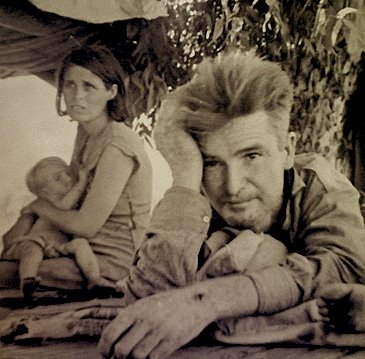
I am old enough to have memories of that time, are any of you? Maybe we were hungry sometimes, but did we starve? No, because we had our friends and family and the earth to sustain us. The earth may have been reluctant to feed us in some of those years, but never our friends nor our families.

If you lived through that time, and if now you hear some young expert on television saying the term “Great Depression” as if it were a great monster who might return, let me ask you — you who remember the last time — there are a few of us left — let me ask you if your memories of that time are not more round and golden than sharp-edged?

My husband, Jim, made an ice rink from a little meadow, and he made a few dollars extra those winters of the Depression. I learned to put on one-woman plays, and performed in women’s clubs here and there, making the rest of what we needed. We were fountains of creativity. We were fountains of friendship to our neighbors. As a nation, we were a mighty river of mutual support.

That same Great Depression made some people in other countries ready for violence, genocide and war. But, somehow, through the exceptional miracle that is America itself, the hard times only made us more willing to help the world when our help was needed.

I am not advocating hardship, and I am not cheerleading for poverty. Indeed, prosperity is the green wreath we cherish most, though it means little without the times between.

Source / NH Magazine

Thanks to Doug Zabel / The Rag Blog

Posted in RagBlog | Tagged , , | 1 Comment

Wanted : Dialogue on the Great Depression of 2009

How prepared are Americans today to cope, adjust, improvise, and to help one another as things really get tough in the coming year or two? Could really bad times that go on and on bring about a forced reset of the American psyche?

By Larry Ray / The Rag Blog / December 25, 2008

What happens after the last strains of Auld Lang Syne fade away on New Year’s Eve, and the glow of the historic inauguration of Barack Obama on January 20th quickly dims? By then, the deep economic mess we face should really start to sink in across America.

Those of us in our Golden Years may see things coming that those of more recent generations can’t even imagine. Its really a matter of what our parents knew about the great depression in the 1930’s and what they taught us when we were young. But if you were born in 1970, by the time you were old enough to remember daily life, things would have probably seemed fine. Your parents grew up when America was taking deep swigs of the new good life and opportunity after WWII. My folks were little kids when the 1929 crash happened. They grew up in the depth of the depression and did without. So, I got stern warnings about spending and saving money. Warnings that 40-somethings today probably didn’t get. And 40-somethings certainly didn’t see thrift and restraint reflected in the America of their youth.

How prepared are Americans today to cope, adjust, improvise, and to help one another as things really get tough in the coming year or two? Could really bad times that go on and on bring about a forced reset of the American psyche? A sea-change in leadership is coming, but a new Obama administration will begin work in the midst of global recession. Our new leaders will inherit record-setting national debt, and the diplomatic debris and great political uncertainty left by Bush and company. Massive government stimulus and work programs will be part of the long term solution but individual responsibility for daily survival will be key on the community level.

Compared to the more than ten years of misery, loss, unemployment, hunger and grinding uncertainty following the crash of 1929, we are a much stronger nation today. But the ability of average Americans to make do and to do without will be an unfolding saga. Will the new jobless again be forced to depend upon soup-kitchens and handouts to survive? Can we even imagine that? Millions, who for decades have been spending money they do not have, using a wallet full of credit cards to get whatever they want, will be forced to take a hard look at themselves. A pay-as-you-go world is a great social leveling force.

I would like to see an exchange of ideas about what you see coming on the basic person to person level. Post a comment and let’s hear your thoughts and observations. Hardship can also create positive changes. Will humbling loss and poverty merely increase crimes like shoplifting and burglaries or will it bring out a renewed American strength and pride? What role will the internet and wireless communication make as times get really tough?

Let’s start by exchanging ideas and talking to one another early on.

[Retired journalist Larry Ray is a Texas native and former Austin television news anchor. He also posts at The iHandbill.]

The Rag Blog

Posted in Rag Bloggers | Tagged , , | 3 Comments

Chris Cook: Changing the Food Policy for America

Graphic source.

A food agenda for Obama
By Christopher D. Cook / December 26, 2008

Now’s the time to reinvent America’s farm and food policies.

San Francisco – Within hours of former Iowa Gov. Tom Vilsack’s nomination last week as Agriculture secretary, websites were humming with well-documented critiques of his affinity for genetically engineered crops, agribusiness giant Monsanto, heavily polluting factory farms, and other Big Farm interests.

Some critics expressed outrage, others surprise, especially since they had mounted a vigorous, 55,000-plus strong online petition to persuade President-elect Barack Obama to nominate someone more progressive who would promote sustainable food and farming.

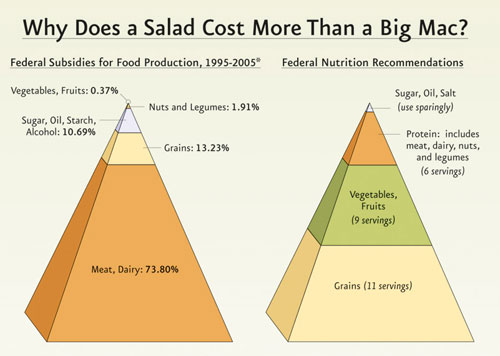
The need for sweeping change could not be clearer when it comes to our food: At taxpayer expense, current policy subsidizes large corporate farms and destructive industrial agriculture, which rob the countryside of economic diversity and precious environmental resources, such as water and topsoil.

These same subsidies, and anemic regulatory enforcement, encourage an increasingly monopolized food system, and a “cheap food” policy that lards us with fatty, processed foods – the cost of which is ultimately dear, more than $100 billion annually for obesity and diet-related diseases. Today’s food system also generates a sizable portion of America’s greenhouse gases, and rests on fast-dwindling and volatile oil supplies.

Now is the time for something different – change we can eat.

As Mr. Obama weighs a massive stimulus package, he should include new funding streams that promote sustainable food – to build up alternatives such as farmer’s markets, local “foodshed” programs that promote consumption of local produce, and farm-to-institution projects that encourage schools, hospitals, and other large buyers to purchase local organic foods when possible.

The change we need in food is as urgent as any we face – changes that affect national health, energy security, global warming, and more. Here, then, is a not-so-modest nine-point platform for food reform, some of which could be included in Obama’s stimulus package. Other elements may require a lengthier policy push:

  1. New public investments targeting sustainable agriculture, defined as organic, small- to mid-sized, diversified farming.
  2. New investments in local/regional food networks and foodsheds – to help build up the connections between farmers and consumers, to open up and expand new markets for organic farmers and those considering the transition; for more farmer’s markets and food stores that feature local produce.
  3. A moratorium on agribusiness mergers, and strenuous antitrust provisions and enforcement to protect what little is left of diversity in the food economy.
  4. A moratorium on all new genetically modified (GMO) products, and an expansion of existing ones, and appointment of a blue-ribbon panel/commission to assess the impact of GMO foods on our environment and our health.
  5. A moratorium on – and gradual phasing out of – concentrated animal feeding operations, aka factory farms, which are among the nation’s top polluters of water and air, and breeders of widespread and virulent bacterial strains.
  6. Dramatically expanded regulatory enforcement and staffing in the US Department of Agriculture and the Food and Drug Administration to protect food safety and meat industry labor and environmental practices.
  7. Slowing the hazardously fast meatpacking (and poultry) assembly line, to protect workers and consumers.
  8. Incentives for small-scale urban, suburban, and rural farming ventures oriented toward diversified local food systems.
  9. Bold public investment in a raft of public awareness campaigns that build support, and expand markets and demand, for sustainable alternatives such as urban agriculture and gardening, and reducing fast-food consumption.
  10. Fill in the blank, and send me your thoughts at www.christopherdcook.com.

Food is a vital cornerstone of both individual life and civil society, and our current system is making us fatter, churning out greenhouse gases, and abusing workers and animals.

With a new administration elected on a “change” agenda, it’s a timely moment to press for the most basic change of all: change in the food that ends up on our plates and in our bodies.

[Christopher D. Cook is a journalist and the author of “Diet for a Dead Planet: Big Business and the Coming Food Crisis.”]

Source / Christian Science Monitor

The Rag Blog

Posted in RagBlog | Tagged , , | Leave a comment

A Practical Guide to Stopping the BushCo Oil and Gas Public Lands Selloff

A view of Dinosaur National Monument. Photo source.

‘Direct action gets the goods’
By Amy Goodman / December 24, 2008

Tim DeChristopher is an economics student at the University of Utah in Salt Lake City. He had just finished his last final exam before winter break. One of the exam questions was: If the oil and gas companies are the only ones that bid on public lands, are the true costs of oil and gas exploitation reflected in the prices paid?

DeChristopher was inspired. He finished the exam, threw on his red parka and went off to the Bureau of Land Management land auction that the Southern Utah Wilderness Alliance called “the Bush administration’s last great gift to the oil and gas industry.” Instead of joining the protest outside, he registered as a bidder, then bought 22,000 acres of public land. That is, he successfully bid on the public properties, located near the Arches and Canyonlands National Parks and Dinosaur National Monument, and other pristine areas. The price tag: more than $1.7 million.

He told me: “Once I started buying up every parcel, they understood pretty clearly what was going on … they stopped the auction, and some federal agents came in and took me out. I guess there was a lot of chaos, and they didn’t really know how to proceed at that point.”

Patrick Shea, a former BLM director, is representing DeChristopher. Shea told the Deseret News: “What Tim did was in the best tradition of civil disobedience, he did this without causing any physical or material harm. His purpose was to draw attention to the illegitimacy and immorality of the process.”

There is a long tradition of disrupting land development in Utah. In his memoir, “Desert Solitaire,” Edward Abbey, the writer and activist, wrote: “Wilderness. The word itself is music. … We scarcely know what we mean by the term, though the sound of it draws all whose nerves and emotions have not yet been irreparably stunned, deadened, numbed by the caterwauling of commerce, the sweating scramble for profit and domination.”

Abbey’s novel “The Monkey Wrench Gang” inspired a generation of environmental activists to take “direct action,” disrupting “development.” As The Salt Lake Tribune reported on DeChristopher: “He didn’t pour sugar into a bulldozer’s gas tank. He didn’t spike a tree or set a billboard on fire. But wielding only a bidder’s paddle, a University of Utah student just as surely monkey-wrenched a federal oil- and gas-lease sale Friday, ensuring that thousands of acres near two southern Utah national parks won’t be opened to drilling anytime soon.”

Likewise, the late Utah Phillips, folk musician, activist and longtime Utah resident, often invoked the Industrial Workers of the World adage: “Direct action gets the goods.”

More than just scenic beauty will be harmed by these BLM sales. Drilling impacts air and water quality. According to High Country News, “The BLM had not analyzed impacts on ozone levels from some 2,300 wells drilled in the area since 2004 … nor had it predicted air impacts from the estimated 6,300 new wells approved in the plan.” ProPublica reports that the Colorado River “powers homes for 3 million people, nourishes 15 percent of the nation’s crops and provides drinking water to one in 12 Americans. Now a rush to develop domestic oil, gas and uranium deposits along the river and its tributaries threatens its future.”

After questioning by federal authorities, DeChristopher was released.

The U.S. attorney is currently weighing charges. DeChristopher reflects: “This has really been emotional and hopeful for me to see the kind of support over the last couple of days … for all the problems that people can talk about in this country and for all the apathy and the eight years of oppression and the decades of eroding civil liberties, America is still very much the kind of place that when you stand up for what is right, you never stand alone.”

His disruption of the auction has temporarily blocked the Bush-enabled land grab by the oil and gas industries. If DeChristopher can come up with $45,000 by Dec. 29, he can make the first payment on the land, possibly avoiding any claim of fraud. If the BLM opts to re-auction the land, it can’t happen until after the Obama administration takes over.

The sales, if they happen, will likely be different, thanks to the direct action of an activist, raising his voice, and his bidding paddle, in opposition.

[Amy Goodman is the host of “Democracy Now!,” a daily international TV/radio news hour. Denis Moynihan contributed research to this column.]

Source / Seattle Post-Intelligencer

The Rag Blog

Posted in RagBlog | Tagged , , | Leave a comment

We Are Citizens of Earth, Not Just Consumers: Fixing the Broken Economy Means Changing It

Although this article explicitly addresses the Canadian economy, the points these authors make apply everywhere.

Richard Jehn / The Rag Blog

Paul Lachine/NewsArt

Don’t fix the economy – change it
By Peter G. Brown and Geoffrey Garver / December 26, 2008

Sticking with the model that is driving us toward ecological catastrophe will eventually kill us

Amid the discordant clash of solutions being served up to address the global financial crisis, a common refrain can be heard: Most global leaders and their economic advisers key their policy prescriptions to “sustained economic growth.” The prevailing debate is how to get there most quickly. In Canada, how this debate plays out could bring down the government in a matter of weeks.

Unfortunately, it is the wrong debate. Neither the Conservative minority nor the opposition has proposed anything that will set Canada on a long-term path toward the kind of economy that will both provide for the well-being of Canadians and enhance and preserve the ecological community of which people are but one dependent part.

All eyes may now be on the kind of fiscal budget the Conservatives might produce next year, but a more essential budget also demands urgent attention: the global ecological budget. The financial crisis has brought into sharp focus the need to fundamentally change, not merely repair or rebuild, our economy. Because, quite simply, sticking with an economic model that is driving toward ecological catastrophe will kill us. So, it is essential to address the financial and ecological crises together.

The ecological budget, on which all life and, consequently, the human economy depends, is already in dramatic deficit. Why is this budget ultimately more important than the fiscal budget? Sept. 23, 2008, was Earth Overshoot Day. The period after Sept. 23 represents the time the human population causes an ecological deficit, using up the Earth faster than it can regenerate.

Every year, Earth Overshoot Day comes earlier. This moving date tells the story of a global environment rapidly losing its ability to support life: accelerating climate change; the loss of species and habitats; declining fisheries; the proliferation of ocean dead zones; diminishing freshwater resources; and more. Ecological overshoot is climate change on steroids.

Here are six steps we can take toward a truly balanced budget that will allow Canadians, and all people on Earth, to live fulfilling, healthy, yet more ecologically compatible, lives.

  • Recognize that the economy is part of the biosphere. A comprehensive economic plan must be based on the scientific fact that the global economy is a subsidiary of the natural order. Economic policies should be attuned to the limited capacity of Earth’s biosphere to provide for humans and other life and to assimilate their waste. Photosynthesis and sunlight are as essential to the framework for economic budgets and expenditures as the laws of supply and demand.
  • Acknowledge that we need new institutions. An economic renewal tailored to the 21st century would establish institutions committed to fitting the human economy to Earth’s limited life-support capacity. Canada, with its token efforts to address climate change, is far off the track. We need something like the central reserve banks, but which look after shares of the Earth’s ecological capacity, not just interest rates and the money supply. Money should be recognized as a social licence to use part of Earth’s life-support capacity. Some functions of governance would have to operate at a global level, through a federation modelled perhaps on the European Union, with enforceable laws designed to assure that individual nations don’t overrun Earth’s limits. The rules for the developed countries that are responsible for the current ecological crisis should be different from those for developing ones.
  • Acknowledge that unlimited growth on a finite planet makes no sense. Most people wrongly believe that unlimited growth and wealth accumulation are the “natural laws” of the economy – inviolable, even though together they undermine the Earth’s ecological and social systems. We face a moral challenge: bring the global economy into a right relationship with the planet and its human and non-human inhabitants or suffer the increasing destruction of Earth’s finite life-support systems and social structures. Growth in consumption is a nonsensical response to the sharp decline in Earth’s biophysical systems that is caused by overconsumption. Our new ecological and climate reality demands new ways to live within the means of the Earth.
  • Fairness matters. A “right” human-Earth relationship would recognize humans as part of an interdependent web of life on a finite planet. The economy must recognize the rights of the human poor and of millions of other species to their place in the sun. In a world awash in money, addressing poverty only with growth reflects a tragic lack of moral imagination. Indeed, in pushing for more “free” trade as it is currently understood, Canada would entrench an ongoing addiction to consumption, pursued in a manner that often ravages the bio-productivity of developing countries.
  • Expand the discussion. The new knowledge that will forever mark this period in human history is the overwhelming scientific evidence that we are overconsuming the planet and accelerating toward ecological catastrophe. The short-term approaches of most ministers of finance and professional economists don’t account for how the planet works, or even that the economy exists on a finite planet. Scientists morally committed to protecting the global commons and researching ecological limits to the global economy need much more funding and influence in policy-making.
  • Look beyond technological fixes. Bold new leadership is needed that will focus on all four policy “theatres” relevant to human ecological impact and provide the moral footing that will lead people, individually and collectively, to choose lifestyles with radically lower impact. The four policy variables are: technology; population; wealth and consumption; and morals and customs. These factors should together shape Parliament’s rethinking of the current economic system. Technology can increase efficiency of energy and resources use, yet it is overemphasized as a solution. Pushing technological solutions like hydrogen cars and genetically modified agriculture is much easier politically than asking people to consume less or have fewer children. Unfortunately, technology alone cannot solve the ecological crisis. For one thing, efficiency gains often lead to greater, not lower, consumption. An example is the squandering of Quebec’s underpriced hydroelectric power.

Investments in new “green” technology need to be coupled to a regulatory structure that ensures that efficiency does not result in more impact, along with massive investment in creating or restoring natural systems that build bioproductivity. Economic policy must promote not more affluence as currently defined, but more sufficiency for all Canadians – so that all may live with self-respect, without overconsumption.

Perhaps most difficult to come to grips with is that Canada is an overpopulated country – if you compare the individual impact of each Canadian with what the Earth can withstand. We should escape from the current treadmill that considers more people necessary for more growth.

Lastly, we must greatly increase investment in educational and civic institutions that teach that we are not “consumers,” but citizens of the Earth, and guardians of life’s prospect on a small, beautiful and finite planet.

[Peter G. Brown is a professor at McGill University. Geoffrey Garver is an environmental consultant and lectures in law at Université de Montréal and Université Laval. They are co-authors of Right Relationship: Building a Whole Earth Economy.]

Source / Toronto Star

The Rag Blog

Posted in RagBlog | Tagged , , | Leave a comment

Pakistan: Urgent Foreign Policy Matter for Obama

This matter becomes all the more urgent with Pakistan moving troops to the Indian border because of the threats coming from that nation over the Mumbai attack. Purohit has some fine suggestions for the incoming administration in order to establish a more realistic relationship with Pakistan and the entire region.

Richard Jehn / The Rag Blog

Protesters burn an Indian flag Friday during a demonstration in Karachi, Pakistan. Photo: Fareed Khan, AP.

Why Solving Pakistan is the Pivot for Obama’s South Asian Security Strategy
By Raj Purohit / December 26, 2008

In the space of 10 days, two terrorist actions in South Asia highlighted why President-elect Obama’s desire to adopt a regional approach to the interlinked crises of Afghanistan, India and Pakistan may ultimately rank among the most strategically significant decisions of his administration.

Last month, the world watched in horror as militants brought the thriving metropolis of Mumbai to a halt with a multi-faceted attack on its hotel, entertainment and transportation system. The attacks, dubbed India’s 9-11, saw 188 civilians killed and hundreds more injured. A few days later militants in Pakistan attacked a market place killing dozens of civilians.

Although the attack in Peshawar had a devastating impact on the local populace, it drew less media attention than those in Mumbai, in part due to the lack of international media in that city and also because the Peshawar bombing was one in a long line of attacks in Pakistan in recent months.

Despite the variation in media attention and the way in which they were reported as two distinct stories, it is important that the new U.S. administration looks at the two attacks and the related foreign policy questions holistically. A careful appraisal of the situation suggests that, once in office, President Obama’s administration must adopt a regional approach to the instability in South Asia and also recognize that Pakistan is at the heart of both the crisis and any resolution.

The fledgling democratic government of Pakistan is faced with three interrelated challenges. First, they must address the security situation on their border with Afghanistan where the Taliban is in the ascendancy despite a vigorous Pakistani military campaign. Second, the government must also deal internally with the open sore that is Kashmir. Despite the best efforts of both India and Pakistan to deemphasize Kashmir in public and seek to build confidence between the two countries through other measures, it is clear that Kashmir is a priority issue to a substantial number of Pakistanis, including those involved in the Mumbai killings. Third, the authorities must also battle the militancy within its own border that grew quickly during the reign of General Musharraf.

The Obama administration can assist their Pakistani counterparts in all three of these areas. On Afghanistan, it can bolster the Pakistani government in the eyes of its own people by acknowledging the sacrifice of its military fighting against the Taliban. It can also reduce U.S. drone activity, and by extension reduce civilian deaths, by increasing human intelligence cooperation. U.S. non-military aid can also be a valuable tool in the effort to win the battle for hearts and minds in the tribal border region.

Additionally, the Obama government can force Afghanistan to accept a fixed border between the two countries i.e. the internationally recognized Durand line. Many regional analysts and commentators have urged the U.S. to pressure Afghanistan to accept the line believing that it will increase domestic Pakistani support for vigorous policing of the border and make it harder for the Taliban and others to move freely between the two countries.

President Obama should assign an envoy to begin a dialogue between the two countries on Kashmir. The best efforts of both countries to deemphasize this issue were ended by the Mumbai attacks and it is time to begin a process that resolves the Kashmir question and removes a grievance that militant leaders use to recruit impressionable individuals to their ranks. It is important to note that by endorsing the Durand line and seeking a resolution to the Kashmir crisis, President Obama would also assuage the fears of Pakistani elites who have been nervously sharing a map drawn by U.S.neo-conservatives that sketches out a truncated Pakistan that had lost land to India and Afghanistan. As Jane Perlez noted in the International Herald Tribune:

“One of the biggest fears of the Pakistani military planners is the collaboration between India and Afghanistan to destroy Pakistan,” said a senior Pakistani government official involved in strategic planning who insisted on anonymity in accordance with diplomatic rules. “Some people feel the United States is colluding in this.”

Finally, early in his administration, President Obama should underscore his support for a democratic Pakistan. Historically, democracy has been an antidote to militancy in Pakistan and it will require the engagement of its people to respond to the militants within its own borders.

[Raj Purohit is an independent consultant and associate professor at American University, Washington College of Law. He served as the Director and CEO for Citizens for Global Solutions until July 2008. Prior to joining CGS, Raj was Legislative Director for Human Rights First, where he was responsible for leading the organization’s advocacy efforts in Congress, with a focus on international relations, judiciary and security issues. Raj helped develop and implement new legislative initiatives and lobbying strategies. He also represented Human Rights First in a range of coalitions, including the Washington Working Group on the International Criminal Court, and was a media spokesperson.

Before joining Human Rights First, Raj served as Legislative Director for the National Association of Criminal Defense Lawyers. He has alsoserved as Director of Legal Services at the Center on Conscience and War. Raj received his Bachelor of Laws (LL.B) from Sussex University (1995) and his LL.M. in International Legal Studies from American University, Washington College of Law (1997).]

Source / Informed Comment

The Rag Blog

Posted in RagBlog | Tagged , , , | Leave a comment

Harold Pinter and Eartha Kitt : Artists and Rebels

Both lived long, productive, exciting lives and went out celebrated by their peers and countless fans; none of us could reasonably ask for more than they wrung out of life.

By Chris Thompson / December 26, 2008

See ‘Remembering Nobel Laureate Harold Pinter: Is Our Conscience Dead?,’ by Ann Wright; ‘Art, Truth and Politics,’ by Harold Pinter; ‘Eartha Kitt versus the LBJs’ by Frank James; and Video of Eartha Kitt singing ‘Everything Changes,’ Below.

It’s naturally standard practice to mourn the dead, but we find ourselves checking that impulse when it comes to Eartha Kitt and Harold Pinter. The fact is, both lived long, productive, exciting lives and went out celebrated by their peers and countless fans; none of us could reasonably ask for more than they wrung out of life. Kitt started life picking cotton in South Carolina by day and being beaten by her own family by night; she ended it as one of the most elegant sex symbols, songstresses, and dancers to charm the modern world. Along the way, she threw the Vietnam War right in Lady Bird Johnson’s face and made her cry. Nixon put her on his enemies list, a badge of honor in most people’s books. Pinter carved out an entirely new sensibility in modern drama, got his name turned into an adjective, and spent his remaining years using his arsenal to dice up George W. Bush quite nicely. And both beat the actuarial tables, so there’s that. A tip o’ the hat to the both a youse.

Source / East Bay Express

Remembering Nobel Laureate Harold Pinter: ‘Is Our Conscience Dead?’
By Ann Wright / December 26, 2008

On the news today of the death of Harold Pinter, the winner of the 2005 Nobel Prize for Literature, I remembered hearing his Nobel Laureate lecture/acceptance speech. I was in London in December 2005, speaking at the annual Stop the War conference when Pinter delivered his speech – not in Oslo, as Pinter was very sick and could not travel, but in London via TV link.

I was amazed and thrilled that he chose to use the Nobel Prize platform and devote a huge portion of his speech to shining an international spotlight on the tragic effects of the past decades of US foreign policy and particularly, on George Bush and Tony Blair’s decisions to invade and occupy Iraq, on Guantanamo and on torture.

Pinter’s Laureate speech question, “Is Our Conscience Dead?” is most relevant today when three years after his acceptance speech, “Art, Truth and Politics,” Bush, Cheney, Rice and other administration officials are either trying to rewrite history or, as in Cheney’s case – purposefully revealing his role in specific criminal acts of torture and daring the American legal system and people to hold him accountable.

Following is the part of Pinter’s lecture that speaks to the invasion of Iraq, torture and Guantanamo – and our collective and individual conscience.

Art, Truth and Politics
By Harold Pinter

[The following is excerpted from Harold Pinter’s Nobel Lecture delivered on December 7, 2005.]

The United States no longer… sees any point in being reticent or even devious. It puts its cards on the table without fear or favour. It quite simply doesn’t give a damn about the United Nations, international law or critical dissent, which it regards as impotent and irrelevant.

It also has its own bleating little lamb tagging behind it on a lead, the pathetic and supine Great Britain.

What has happened to our moral sensibility? Did we ever have any? What do these words mean? Do they refer to a term very rarely employed these days – conscience? A conscience to do not only with our own acts but to do with our shared responsibility in the acts of others? Is all this dead?

Look at Guantanamo Bay. Hundreds of people detained without charge for over three years, with no legal representation or due process, technically detained forever. This totally illegitimate structure is maintained in defiance of the Geneva Convention. It is not only tolerated but hardly thought about by what’s called the ‘international community’. This criminal outrage is being committed by a country, which declares itself to be ‘the leader of the free world’. Do we think about the inhabitants of Guantanamo Bay? What does the media say about them? They pop up occasionally – a small item on page six. They have been consigned to a no man’s land from which indeed they may never return. At present many are on hunger strike, being force-fed, including British residents. No niceties in these force-feeding procedures. No sedative or anesthetic. Just a tube stuck up your nose and into your throat. You vomit blood. This is torture.

What has the British Foreign Secretary said about this? Nothing. What has the British Prime Minister said about this? Nothing. Why not? Because the United States has said: to criticise our conduct in Guantanamo Bay constitutes an unfriendly act. You’re either with us or against us. So Blair shuts up.

The invasion of Iraq was a bandit act, an act of blatant state terrorism, demonstrating absolute contempt for the concept of international law. The invasion was an arbitrary military action inspired by a series of lies upon lies and gross manipulation of the media and therefore of the public; an act intended to consolidate American military and economic control of the Middle East masquerading – as a last resort – all other justifications having failed to justify themselves – as liberation. A formidable assertion of military force responsible for the death and mutilation of thousands and thousands of innocent people.

We have brought torture, cluster bombs, depleted uranium, innumerable acts of random murder, misery, degradation and death to the Iraqi people and call it ‘bringing freedom and democracy to the Middle East’.

How many people do you have to kill before you qualify to be described as a mass murderer and a war criminal? One hundred thousand?

More than enough, I would have thought. Therefore it is just that Bush and Blair be arraigned before the International Criminal Court of Justice. But Bush has been clever. He has not ratified the International Criminal Court of Justice. Therefore if any American soldier or for that matter politician finds himself in the dock Bush has warned that he will send in the marines. But Tony Blair has ratified the Court and is therefore available for prosecution. We can let the Court have his address if they’re interested. It is Number 10, Downing Street, London.

Death in this context is irrelevant. Both Bush and Blair place death well away on the back burner. At least 100,000 Iraqis were killed by American bombs and missiles before the Iraq insurgency began. These people are of no moment. Their deaths don’t exist. They are blank. They are not even recorded as being dead. ‘We don’t do body counts,’ said the American general Tommy Franks.

Early in the invasion there was a photograph published on the front page of British newspapers of Tony Blair kissing the cheek of a little Iraqi boy. ‘A grateful child,’ said the caption. A few days later there was a story and photograph, on an inside page, of another four-year-old boy with no arms. His family had been blown up by a missile. He was the only survivor. ‘When do I get my arms back?’ he asked. The story was dropped. Well, Tony Blair wasn’t holding him in his arms, nor the body of any other mutilated child, nor the body of any bloody corpse. Blood is dirty. It dirties your shirt and tie when you’re making a sincere speech on television.

The 2,000 American dead are an embarrassment. They are transported to their graves in the dark. Funerals are unobtrusive, out of harm’s way. The mutilated rot in their beds, some for the rest of their lives. So the dead and the mutilated both rot, in different kinds of graves.

I have said earlier that the United States is now totally frank about putting its cards on the table. That is the case. Its official declared policy is now defined as ‘full spectrum dominance’. That is not my term, it is theirs. ‘Full spectrum dominance’ means control of land, sea, air and space and all attendant resources.

The United States now occupies 702 military installations throughout the world in 132 countries, with the honourable exception of Sweden, of course. We don’t quite know how they got there but they are there all right.

The United States possesses 8,000 active and operational nuclear warheads. Two thousand are on hair trigger alert, ready to be launched with 15 minutes warning. It is developing new systems of nuclear force, known as bunker busters. The British, ever cooperative, are intending to replace their own nuclear missile, Trident. Who, I wonder, are they aiming at? Osama bin Laden? You? Me? Joe Dokes? China? Paris? Who knows? What we do know is that this infantile insanity – the possession and threatened use of nuclear weapons – is at the heart of present American political philosophy. We must remind ourselves that the United States is on a permanent military footing and show no sign of relaxing it.

Many thousands, if not millions, of people in the United States itself are demonstrably sickened, shamed and angered by their government’s actions, but as things stand they are not a coherent political force – yet. But the anxiety, uncertainty and fear which we can see growing daily in the United States is unlikely to diminish.

I know that President Bush has many extremely competent speech writers but I would like to volunteer for the job myself. I propose the following short address which he can make on television to the nation. I see him grave, hair carefully combed, serious, winning, sincere, often beguiling, sometimes employing a wry smile, curiously attractive, a man’s man.

‘God is good. God is great. God is good. My God is good. Bin Laden’s God is bad. His is a bad God. Saddam’s God was bad, except he didn’t have one. He was a barbarian. We are not barbarians. We don’t chop people’s heads off. We believe in freedom. So does God. I am not a barbarian. I am the democratically elected leader of a freedom-loving democracy. We are a compassionate society. We give compassionate electrocution and compassionate lethal injection. We are a great nation. I am not a dictator. He is. I am not a barbarian. He is. And he is. They all are. I possess moral authority. You see this fist? This is my moral authority. And don’t you forget it.’

I hope you will decide that yes, we do have a conscience and that you will join the millions of Americans who say we must hold accountable those who have committed criminal acts while in government – the policy makers as well as the implementers.

Write and call the new President and the new Congress and demand official investigations into war crimes and other criminal acts committed by members of the Bush administration and join us on Inauguration day to remind the new President of his responsibilities.

Source / truthout

Eartha Kitt sings ‘Everything Changes’ from Mimi le Duck

Eartha Kitt versus the LBJs
by Frank James / December 26, 2008

Say what you will about Eartha Kitt, the American original of a performer who died at 81 on Christmas Day, she certainly knew how to disrupt a White House event.

One of the best Kitt stories ever has to be how she gave First Lady Lady Bird Johnson the blues in 1968. A petite woman, Kitt had an out-sized ego and just as sizable chip on her shoulder, the latter the result of an unhappy childhood she often talked of (a biracial child born out of wedlock in 1927 small-town South Carolina. You get the picture.)

The White House story was captured by David Murphy in a biography of Mrs. Johnson called “Texas Bluebonnet: Lady Bird Johnson.”

As the president was contemplating his future, Lady Bird went on with her official duties and hosted a Women Doers lunch on Jan. 18, 1968 that was to focus on crime. Singer and actress Eartha Kitt was invited upon the recommendation of Sharon Francis and Liz Carpenter since Kitt had testified to Congress in favor of the President’s anti-crime legislation. When President Johnson entered the room, Kitt confronted him, “Mr. President, what do you do about delinquent parents, those who have to work and are too busy to look after their children?” He told her that Social Security legislation was just passed that provided millions of dollars for daycare centers. Kitt was not pleased but Johnson told her those were issues for the women to discuss at the lunch.

During the question period, Kitt stood up and confronted Lady Bird, “Boys I know across the nation feel it doesn’t pay to be a good guy.” She moved into (sic) closer to the First Lady and said that boys don’t want to behave for fear of being sent to Vietnam saying, “You are a mother too though you have had daughters and not sons. I am a mother and I know the feeling of having a baby come out of my guts. I have a baby and then you send him off to war. No wonder the kids rebel and take pot. And Mrs. Johnson, in case you don’t understand the lingo, that’s marijuana.

Lady Bird was proud to match her stare for stare and Sharon Francis said she sat ready to stand up in between Mrs. Johnson and Kitt since Francis was closer than the Secret Service. After Kitt finished her tirade, Betty Hughes, wife of the New Jersey governor, rose to her feet and recalled how she had lost a husband in World War II and had sons in Vietnam and said, “I think that anybody who takes pot because there is a war on is a kook. These young people are still juniors. They have to be regulated. I hope we adults are still in control.” After the wife of the Washignton mayor, Benetta Washington, who, like Kitt, was African-American, spoke up and said we must channel our anger in constructive manners, Lady Bird spoke:

“Because there is a war on, and I pray that there will be a just and honest peace — that still doesn’t give us a free ticket not to try to work for better things — against crime in the streets and for better education and health for our people. I cannot identify as much as I should. I have not lived the background that you have nor can I speak as passionately or as well, but we must keep our eyes and our hearts and our energies fixed on constructive areas and try to do something that will make this a happier, better educated land.” The room broke into applause. Kitt’s confrontations with Mrs. Johnson lead (sic) to a slow decline of her career and she told Newsweek shortly after the luncheon, “if Mrs. Johnson was embarrassed, that’s her problem.”

As a Lady Bird sympathizer, biographer Murphy clearly had little use for Kitt.

A more dispassionate writer might have observed that Kitt showed a rare courage for an American, especially a black one in 1968, to be as confrontational as she was with a first lady.

The White House has a way of intimidating people, even those who are famous and powerful in their own spheres.

But she obviously wasn’t overwhelmed by the trappings that surround the presidency. She spoke truth as she saw it to power. And she did that knowing it wasn’t going to help her career, that she ran the risk of being blacklisted, as it were.

Still, it didn’t matter. For that alone, she deserves to be remembered.

Source / The Swamp

The Rag Blog

Posted in RagBlog | Tagged , , , , , , , | Leave a comment

Poor Junior: The Free Markets Say Shoe-Throwing Is the Next Olympic Sport

The shoe maker said the black polyurethane-soled shoes have been renamed Bush Shoes.

Maker of Bush-attack shoes swamped by orders
December 22, 2008

Received orders for 370,000 pairs

ISTANBUL – The alleged maker of the shoes that an Iraqi journalist hurled at U.S. President George W. Bush has had to take on 100 extra staff to cope with a surge in demand for his footwear, he said on Monday.

“Between the day of the incident and 1:00 pm today we have received orders totaling 370,000 pairs”, Istanbul-based Serkan Turk, head of sales at Baydan Shoes, told AFP.

Normally the firm sold only 15,000 pairs a year of the model that Muntazer al-Zaidi threw at the U.S. president at a press conference in Baghdad on December 14 to become an instant hero across the Arab world, he said.

Turk said orders had initially flooded in from Iraq, followed by other Middle East countries and finally from the rest of the world, including for 19,000 pairs from the United States.

Formerly prosaically dubbed Model 271, the black polyurethane-soled shoes have been renamed Bush Shoes, he said.

Turk insisted the company was not profiting from the soaring demand to up the factory price from the $27 (19.30 euros) it had been charging, while adding that it was “delighted from all points of view” at its unexpected success.

Throwing shoes is considered a grave insult in the Arab world, but Turk indicated that they would probably not have done Bush much harm had they hit him.

“They look heavier than they are,” he said. “They only weigh 300 grams (10 ounces).”
Top

Judge says shoes destroyed

Turk’s claims come after the investigating judge in the Zaidi case said last week the famous shoes were detsroyed by security agents durning checks to ensure they did not contain explosives.

Zaidi, 29, has been charged with “aggression against a foreign head of state during an official visit,” an offence that carries a prison term of between five and 15 years under Iraqi law.

He is to go on trial on December 31, an investigating judge said Monday, rejecting allegations by the journalist’s family that he had been tortured in custody.

Source / Al Arabiya

Thanks to Mariann Wizard / The Rag Blog

Posted in RagBlog | Tagged , , | Leave a comment

Brooksley Born Could Have Saved Us From This Financial Catastrophe

Brooksley Born. Photo source.

The Woman Greenspan, Rubin & Summers Silenced
By Katrina vanden Heuvel

“Break the Glass” was the code-name high-level Treasury Department figures gave the $700 billion bailout; it was to be used only as a last- resort measure.

Now millions have been sprayed and damaged by broken glass.

But more than a decade ago, a woman you’re likely never to have heard of, Brooksley Born, head of the Commodity Futures Trading Commission– a federal agency that regulates options and futures trading–was the oracle whose warnings about the dangerous boom in derivatives trading just might have averted the calamitous bust now engulfing the US and global markets. Instead she was met with scorn, condescension and outright anger by former Federal Reserve Chair Alan Greenspan, former Treasury Secretary Robert Rubin and his deputy Lawrence Summers. In fact, Greenspan, the man some affectionately called “The Oracle,” spent his political capital cheerleading these disastrous financial instruments.

On Thursday [October 8, 2008], the New York Times ran a masterful and revealing front page article exposing the culpability of Greenspan, Rubin and Summers for the era of dangerous turbulence we live in.

What these “three marketeers” — as they were called in a 1999 Time magazine cover story — were adept at was peddling the timebombs at the heart of this complex crisis: exotic and opaque financial instruments known as derivatives–contracts intended to hedge against risk and whose values are derived from underlying assets. To cut to the quick, Greenspan, Rubin and Summers opposed regulating them. “Proposals to bring even minimalist regulation were basically rebuffed by Greenspan and various people in the Treasury,” recalls Alan Blinder, a former Federal Reserve board member and economist at Princeton University, in the Times article.

In 1997, Brooksley Born warned in congressional testimony that unregulated trading in derivatives could “threaten our regulated markets or, indeed, our economy without any federal agency knowing about it.” Born called for greater transparency–disclosure of trades and reserves as a buffer against losses.

Instead of heeding this oracle’s warnings, Greenspan, Rubin & Summers rushed to silence her. As the Times story reveals, Born’s wise warnings “incited fierce opposition” from Greenspan and Rubin who “concluded that merely discussing new rules threatened the derivatives market.” Greenspan deployed condescension and told Born she didn’t know what she doing and she’d cause a financial crisis. (A senior Commission director who worked with Born suggests that Greenspan and the guys didn’t like her independence. ” Brooksley was this woman who was not playing tennis with these guys and not having lunch with these guys. There was a little bit of the feeling that this woman was not of Wall Street.”)

In early 1998, according to the Times story, one of the guys, Larry Summers, called Born to “chastise her for taking steps he said would lead to a financial crisis. But Born kept at it, unwilling to let arrogant men undermine her good judgment. But it got tougher out there. In June 1998, Greenspan, Rubin and the then head of the SEC, Arthur Levitt, Jr., called on Congress “to prevent Ms. Born from acting until more senior regulators developed their own recommendations.” (Levitt now says he regrets that decision.) Months later, the huge hedge fund Long Term Capital Management nearly collapsed — confirming some of Born’s warnings. (Bets on derivatives were a key reason.)

“Despite that event,” the Times reports, ” Congress (apparently as a result of Greenspan & Summer’s urging, influence-peddling and pressure) “froze” Born’s Commissions’ regulatory authority. The next year, Born left as head of the Commission. Born did not talk to the Times for their article.

What emerges is a story of reckless, willful and arrogant action and behaviour designed to undermine a wise woman’s good judgment. The three marketeers’ disdain for modest regulation of new and risky financial instruments reveals a faith-based fundamentalist approach to the management of markets and risk. If there is any accountability left in our system, Greenspan, Rubin and Summers should not be telling anyone how to run anything. Instead, Barack Obama might do well to bring back Brooksley Born and promote to his team economists who haven’t contributed to the ugly mess we’re in.

Source / The Nation, October 9, 2008

Thanks to Mariann Wizard and Mike Wood / The Rag Blog

Posted in RagBlog | Tagged , , , | 1 Comment

Unregulated Markets Led to Economic Ruin

Source.

Laissez-Faire Capitalism Should Be as Dead as Soviet Communism
By Arianna Huffington / December 22, 2008

The collapse of Communism as a political system sounded the death knell for Marxism as an ideology. But while laissez-faire capitalism has been a monumental failure in practice, and soundly defeated at the polls, the ideology is still alive and kicking.

The only place you can find an American Marxist these days is teaching a college linguistic theory class. But you can find all manner of free market fundamentalists still on the Senate floor or in Governor’s mansions or showing up on TV trying to peddle the deregulation snake oil.

Take Sen. John Ensign, chairman of the National Republican Senatorial Committee, who went on Face the Nation and, with a straight face, said of the economic meltdown: “Unfortunately, it was allowed to be portrayed that this was a result of deregulation, when in fact it was a result of overregulation.”

Or Gov. Mark Sanford, who told Joe Scarborough he was against bailing out the auto industry because it would “threaten the very market-based system that has created the wealth that this country has enjoyed.”

If a politician announced he was running on a platform of “from each according to his ability, to each according to his need” he would be laughed off the stage. That is also the correct response to anyone who continues to make the case that markets do best when left alone.

It’s time to drive the final nail into the coffin of laissez-faire capitalism by treating it like the discredited ideology it inarguably is. If not, the Dr. Frankensteins of the right will surely try to revive the monster and send it marauding through our economy once again.

We’ve only just begun to bury the financially dead, and the free market fundamentalists are already looking to deflect the blame.

In a comprehensive piece on what led to the mortgage crisis and the subsequent financial meltdown, the New York Times shows how the Bush administration’s devotion to unregulated markets was a primary cause of our economy to ruin. But the otherwise fascinating piece puts too much focus on the “mistakes” the Bush team made by not paying attention to the warning signs popping up all around them.

“There is no question we did not recognize the severity of the problems,” claimed Al Hubbard, Bush’s former chief economic adviser. “Had we, we would have attacked them.”

But the mistake wasn’t in not recognizing the “severity of the problems” — the mistake was the ideology that led to the problems. Communism didn’t fail because Soviet leaders didn’t execute it well enough. Same with free market fundamentalism. In fact, Bush and his team did a bang-up job executing a defective theory. The problem wasn’t just the bathwater; the baby itself is rotten to the core.

William Seidman, the longtime GOP economic advisor who oversaw the S&L bailout in 1991, cuts to the chase: “This administration made decisions that allowed the free market to operate as a barroom brawl instead of a prize fight. To make the market work well, you have to have a lot of rules.”

Even Alan Greenspan, whose owl-eyed visage would adorn a Mount Rushmore of unregulated capitalists, has begun to see the light, telling a House committee in October that he “made a mistake in presuming that the self-interests of organizations, specifically banks and others, were such that they were best capable of protecting their own shareholders and their equity in the firms.”

But most Republicans are still refusing to see what’s right in front of them. Especially Bush, our CEO president, who lays the blame not on the failures of the marketplace but on past administrations and corporate greed. “Wall Street got drunk,” he says. Maybe so, but who made the last 8 years Happy Hour, and kept serving up the drinks?

Last week, Ben Smith reported that the GOP was launching “a new, in-house think tank aimed at reviving the party’s policy heft.” In a private memo explaining the think tank, RNC chairman Mike Duncan wrote: “We must show how our ideology can be applied to solve problems.” But, of course, it’s that very ideology that’s causing the problems. It’s like the old horror movie cliché: “We’ve traced the call — it’s coming from inside the house!”

We’ve got to do everything we can to make sure there will be no sequels to this political horror. The blame shifters cannot be allowed to make their case without the truth being pointed out at every turn. It’s time to relegate free market fundamentalists to the same standing as Marxist ideologues: intellectual curiosities occasionally trotted out as relics of a failed philosophy.

Source / Huffington Post

The Rag Blog

Posted in RagBlog | Tagged , , | Leave a comment

An American Icon, the SUV, Is Slowly Vanishing

Billy Bob Grahn, a county official, paid tribute Tuesday as a G.M. plant in Janesville, Wis., became one of three to close. Photo: Andy Manis for The New York Times.

Nearly the End of the Line for S.U.V.’s
By Nick Bunkley and Bill Vlasic / December 23, 2008

JANESVILLE, Wis. — Even a federal bailout could not save three of the last remaining plants in the United States still making sport utility vehicles.

Reeling from its financial problems and a collapsing S.U.V. market, General Motors on Tuesday closed its factories in this city and in Moraine, Ohio, marking the passing of an era when big S.U.V.’s ruled the road. The moves followed the shutdown last Friday of Chrysler’s factory in Newark, Del., which produced full-size S.U.V.’s.

The last Chevrolet Tahoe rolled off the line here in Janesville shortly after 7 a.m. in the 90-year-old plant, which had built more than 3.7 million big S.U.V.’s since the early 1990s.

Most of the plant’s 1,100 remaining workers were not scheduled to work the final day, but many showed up for an emotional closing ceremony. Dan Doubleday, who had 22 years on the job, broke down in the plant’s snowy parking lot afterward.

“I was a fork lift driver,” he said, glancing at his watch through welling tears. “Until about seven minutes ago.”

At the Mocha Moment coffee shop around the corner, two co-workers, Michael Berberich and Lisa Gonzalez, exchanged Christmas presents just as they had most years since they were both hired in 1986.

“For a while we had it made,” Ms. Gonzalez said. “I just wish it would have lasted.”

The fate of the Janesville, Moraine, and Newark plants was sealed this spring, when rising gas prices suddenly made S.U.V.’s unpopular, and long before President Bush approved $17.4 billion in emergency loans last week to keep G.M. and Chrysler out of bankruptcy.

While the overall new vehicle market has dropped 16 percent so far this year, sales of big S.U.V.’s have plummeted 40 percent.

With consumers shifting rapidly to smaller, more fuel-efficient cars, G.M. no longer needed to produce big S.U.V.’s in Janesville as well as in a plant in Texas.

Still, some Janesville workers felt G.M. broke a pledge in its 2007 contract with the United Automobile Workers to keep the factory running.

“We didn’t deserve this,” said John Dohner Jr., shop chairman at U.A.W. Local 95. “We’ve all put a lot of hard work into trying to secure a future here.”

Shrinking market shares have forced G.M., Chrysler and the Ford Motor Company to close more than a dozen assembly plants and shed tens of thousands of workers in recent years. The moves have devastated communities from Georgia to New Jersey and from Michigan to Oklahoma.

Even so, G.M. and Chrysler are likely to close more manufacturing facilities as they overhaul their operations to meet conditions of the federal loans.

“The companies are moving very fast now to close plants, but it may be too little, too late,” said John Casesa, a principal in the Casesa Shapiro Group, a consulting firm. “They’re doing now what they should have done 15 or 20 years ago.”

G.M.’s Moraine plant was the last to build the midsize Chevrolet Blazers and GMC Envoys that were once among the best-selling vehicles in the country.

The Janesville factory built three of the biggest and most profitable vehicles in G.M.’s lineup, the Chevrolet Tahoe and Suburban and GMC Yukon. The Chrysler plant in Newark also made big S.U.V.’s — the Dodge Durango and Chrysler Aspen.

Their closings leave the Big Three with only one factory each still devoted to making traditional big S.U.V.’s — Ford in Kentucky, G.M. in Texas, and Chrysler in Detroit.

The Janesville plant once employed more than 5,000 workers and turned out 20,000 Tahoes, Yukons and Suburbans each month. With its closing, residents worried about the future of this city of 64,000 people, about 75 miles southwest of Milwaukee.

“Janesville will lose a lot,” said Patti Homan, as she finished a strawberry-topped waffle at the nearby Eagle Inn restaurant. “I expect my electricity to go up, water rates to go up, property taxes to go up, and the value of my home to go down.”

Ms. Homan worked in the plant for 23 years, and her father, brother and husband all retired from the factory. “It’s generation after generation for so many families here,” she said.

The empty feelings in Janesville were echoed in Moraine, a suburb of Dayton and last week at the Chrysler plant in Newark.

More than 1,000 workers were laid off at the Moraine plant. Under terms of the U.A.W. contract for all its members, they and the workers in Janesville and Newark will collect unemployment checks and payments from G.M. that together equal about 80 percent of their take-home pay.

“It’s been a good ride, man,” said Frank Hereford as he left the G.M. Janesville plant. Photo: Andy Manis for The New York Times.

But those payments will only last about a year. And with the U.A.W. prepared to suspend its “jobs bank” program as a condition of the federal loans, there will be no safety net after that.

Some workers will have an opportunity to transfer to other plants. But with the industry contracting so quickly, there is little job security in making a move.

“I can’t risk transferring,” said David Williams, one of the remaining 1,100 workers at the Newark plant when it closed. “I don’t want to go 1,200 miles away to get laid off again.”

Mr. Williams installed a sunroof on the last Dodge Durango to come down the assembly line in Newark. Now he plans to take massage-therapy classes and pursue a new career far from the factory floor.

“Enough with the concrete,” he said. “It’s time for some carpet and climate control.”

On the last day for the Newark plant, 84-year-old Woody Bevans unlocked the weight room at the U.A.W. union hall and began brewing coffee for a handful of retirees who passed the time there.

A Texan who started work at the plant when it opened in 1952, Mr. Bevans recalled how the factory was first used to build tanks for the Korean War. He retired in 1983, but thought the plant would go on forever.

“We had hope right up until the last,” Mr. Bevans said. “We’re really going to feel it when it shuts down. There’s a big chain reaction, believe me.”

The University of Delaware is negotiating with Chrysler to buy the plant and redevelop the 270-acre site with academic buildings and a technology park.

After the plant closed, one of the workers, Merle Black, drove directly to a Delaware Department of Labor office and registered for job openings. He is hoping to become a heavy equipment operator, and possibly be involved in the demolition of the factory where he used to install airbag parts.

“If I can get in there to help take it apart, I don’t mind,” Mr. Black said. “That’s where I spent the last 19 years. That’s what I know.”

The closing of an auto plant draws a crowd, with some people somber and nostalgic and others defiant and energized.

Outside the Janesville plant on Tuesday, a few workers posed for pictures in front of the building while others said their goodbyes as they loaded gear in their snow-covered S.U.V.’s

One man had two small children with him on the last day. Another man wearing an orange ski mask waved a large American flag as departing workers drove by.

Many of the workers trudged over to a one-story, cinder-block building on the grounds of the factory, a bar called the Zoxx 411 Club. A sign said “customers only” and forbade reporters and media from entering.

Outside, a cluster of reporters, including a documentary film crew from Japan, tried to interview workers about the last days of the S.U.V. plant.

“It’s been a good ride, man,” said Frank Hereford, a body shop worker, as he left the plant with a microwave oven that heated up countless lunches during many of his 38 years with G.M. “Good people worked down here.”

Source / The New York Times

Thanks to Betsy Gaines / The Rag Blog

Posted in RagBlog | Tagged , , | Leave a comment

Some Assembly Required

Thanks to Harry Edwards / The Rag Blog

Posted in RagBlog | Tagged , | Leave a comment