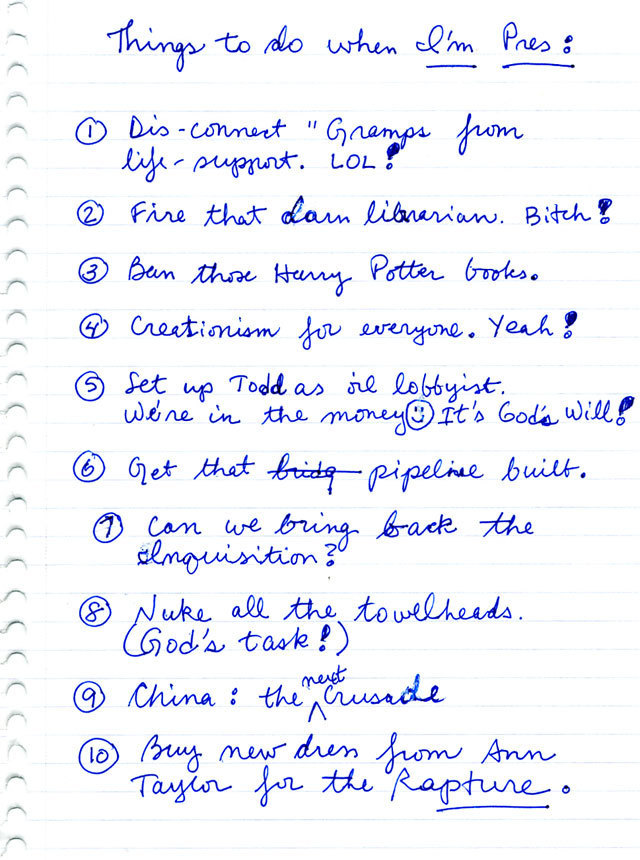
Sarah Palin’s Presidential To Do List
By Trish Wend / September 5, 2008
Source / 23/6
Thanks to Diane Stirling-StevensThe Rag Blog / Posted September 5, 2008
Sarah Palin’s Presidential To Do List
By Trish Wend / September 5, 2008
Source / 23/6
Thanks to Diane Stirling-StevensThe Rag Blog / Posted September 5, 2008





Source / Ramin Talaie | the BLOG
Thanks to Diane Stirling-Stevens / The Rag Blog
Updated September 5, 2008
This provocative article by Thomas Cleaver, written for The Rag Blog, was originally posted on August 30, 2008. We are publishing it again today with some very interesting discussion added.
Thorne Dreyer / The Rag Blog
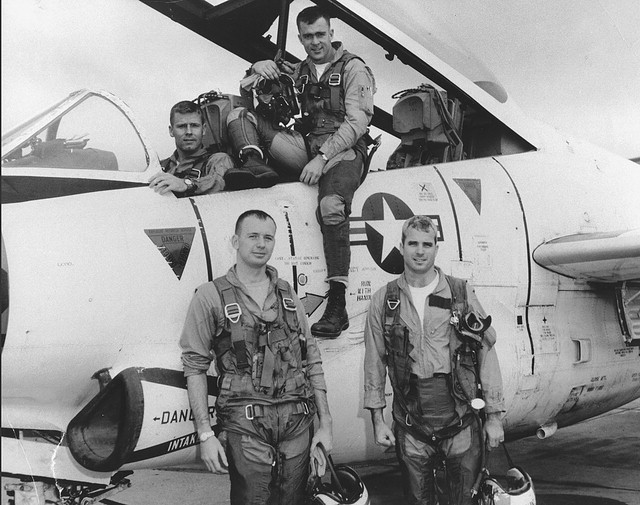
A NOUN, A VERB, AND POW: The Truth About John McCain
By Thomas McKelvey Cleaver / The Rag Blog / August 30, 2008
While all good Democrats were being wowed by Michelle Obama this past Monday night (For the record, this political junkie with a 48 year history of involvement has never ever seen a campaign speech to beat this one given by Michelle Obama – it’s the greatest speech ever given by a political wife ever, for any office, period.), the sad fact is that about the same number of Americans watched John S. McCain III feed Jay Leno his patented barbecued baloney three hours later on “The Tonight Show.”
Last question of Jay’s interview: “How many houses do you have, Senator McCain?”
To which “the man who doesn’t really want to speak at length about his Vietnam experience” said “Well, for five and a half years I didn’t have a house, didn’t have a kitchen table, didn’t have a chair.” Ah yes, John S. McCain III was a POW, so you can’t ask him any question and you have to give him a lifetime pass on everything.
To which I call BULLSHIT!!!
Many of you reading this are among that overwhelming majority of Americans who don’t know that the pointed end of an airplane goes in front, and you certainly don’t know about the esoteric topic of “Naval Aviation.”
Allow me to educate you, so far as the topic refers to a certain presidential candidate.
As background, I was personally involved in Naval Aviation in Vietnam (as en enlisted man), and I write about aviation history for Flight Journal. I have studied the subject since the first word I ever said was “O-pane” when an airplane flew over the park we were in, and I am a recognized “subject matter expert” on this topic.
Most of you haven’t likely noticed this fact, but it’s important: in all of John S. McCain III’s political career, he has never had a Naval Aviator of his generation come out and publicly support him, publicly speak for him. Naval Aviation is a tight fraternity, and it is very judgmental of its members. If you don’t have “the Right Stuff” (i.e., the ability to land an airplane on a ship in any weather, day or night – one of the hardest jobs there is for a human to do – and if you crash, get up and “ride the horse” at the next available opportunity, and be a “man of honor”), then you aren’t really in the fraternity. You won’t be thrown out publicly, but you will know you’re out.
John S. McCain III has been “out” of the fraternity since before he became a POW.
The name McCain is lauded in naval history. The senator’s grandfather was one of Bull Halsey’s “fighting admirals” of the Third Fleet who defeated Japan in World War II. This is the American equivalent of being one of “Nelson’s captains” at Trafalgar. His father commanded the naval air forces in the Pacific through most of the Vietnam War. John S. McCain and John S. McCain Jr.
Unfortunately – like his friend George W. Bush – John S. McCain III is living proof of the old saw “the first generation makes it, the second generation saves it, and the third generation loses it.”
As has been noted by others, John S. McCain III graduated 494 in a class of 499 from Annapolis. Naval aviation is picky — they pride themselves on taking the best and making it hard to pass the test to get in. Outside of John S. McCain III, all other Annapolis graduates who have received a Naval Aviation assignment upon receiving their commission graduated in the upper third of their class. Not Johnny. After having to repeat three sections of his pilot training, John S. McCain III managed to crash five airplanes. In three of those events, the crash investigators wanted to say it was “pilot error” (a career-ender for any pilot anywhere), but the Navy wasn’t ready to give the boot to the progeny of two of its most famous commanders of the 20th Century.
Right wingers will tell you (and will send you to a You-Tube video they claim proves their case), that John McCain didn’t kill 137 of his fellow sailors and wound over 300 of them in what is known in Navy History as “The Forrestfire.” Unfortunately for the Righties, the bits of video are not conclusive proof. No time stamps, and the “map” of the flight deck of the USS Forrestal – and the position of McCain’s airplane and his escape route from the explosion – is not proven by anything more than assertion. Unfortunately, the websites that have put forward the relevant information are far right/white supremacist sites, so it is easy for the McCain campaign to “tar” these facts with the rest of the site.
But take note, they only tar the sites for their bad politics, not for the inaccuracy of these facts.
On July 29, 1967, the USS Forrestal was at Yankee Station in the Tonkin Gulf, preparing to launch an “Alpha Strike” against North Vietnam: 12 A-4 Skyhawks with 12 F-4 Phantoms for fighter escort. LCDR John S. McCain III was a Skyhawk pilot. He had a reputation for “breaking the rules” (being son of an Admiral your superiors may have to answer to gives you “latitude”). This time, he decided on a “wet start.” This is something against the rules; it involves feeding gas to the engine before lighting it off, and results in a flame shooting 6-12 feet out the tail of the jet. Everybody in the near vicinity “gets a shock.” In some circles of Naval Aviation this is considered a “joke”.
This time, the flame was more than 12 feet, and it caught the F-4 Phantom positioned right behind the Skyhawk, enveloping it in flame. The pilot and the “guy in back” didn’t get out — victims #1 and #2 — and more importantly, the flames cooked off the 600-gallon drop tank the Phantom was carrying. The flames spread to the two Zuni rocket pods on the inboard pylons, which heated to the point where 10 rockets ignited and went flying into the 12 fully-fueled, fully-armed Skyhawks, which went off like the 12,000 lb. bombs each was.
Eight hours later, the USS Forrestal – first of today’s supercarriers – was “hors de combat” with 137 dead, several hundred more injured, and damage to the ship sufficiently bad that this carrier would spend the rest of the Vietnam War in repair.
The righties say there’s no proof John S. McCain III was responsible, but at the end of the day, the only unwounded man transferred from the Forrestal to the carrier USS Oriskany was LCDR John S. McCain III. Coincidence???
The next month — August 1967 — LCDR John S. MCain III was privately informed he had failed promotion to Commander (CDR) that coming November, for the third time. In the Navy it’s “three strikes and you’re out.” This meant that LCDR John S. McCain III would never follow his father or grandfather to the heights of the Navy. If he wanted to stay in the Navy another nine years, that would be it. No more promotions and an involuntary retirement at 20 years’ service. According to Admirals I have interviewed, when a junior officer fails to make the cut from Lieutenent (LT) to Lieutenant Commander (LCDR) of from Lieutenant Commander to Commander (CDR), the real reason — according to a very senior Admiral — is “lack of maturity, which the officer dropped will either quickly disprove as a civilian or spend the rest of their lives proving the judgment correct.”
This brings us now to October, 1967. LCDR John S. McCain III gets shot down.
Rule #1 of Attack Aviation is: “Never turn around and fly over the target you just bombed low and slow when they’re ready for you.” LCDR John S. McCain III broke the rule as he has so many others, and he was shot down.
For most of us, becoming a POW would not be a “career-maker’ but not for our Johnny-boy.
Once he’s confirmed as a POW, he enters the armed services’ “Joint POW fast-track promotion policy,” i.e., the first time a POW is eligible for promotion, they get promoted.
So in November, 1967 — rather than being drummed out of the Navy — John S. McCain III gets a promotion to CDR. By the time he gets out of the Hanoi Hilton in 1973, he’s a Captain (Navy equivalent of a Colonel). The incompetent who failed promotion to CDR gets an assignment for a Captain: commander of the Navy’s Replacement Air Group for Attack Squadrons in the Atlantic Fleet. He flunks it.
Eighteen months later he’s told there won’t be a third Admiral McCain, but the Navy needs him in Washington, where they can use his “celebrity status” as a POW as a liaison with Congress, where his job is to keep congressmen well-laid and well-liquored up, so they’ll vote for more Big Boys Toys for the boys in Navy Blue.
It’s at a party in Hawaii thrown by the Naval Congressional Liason Office that soon-to-be-an-official-loser CAPT McCain meets the 24 year old daughter of a convicted Arizona bootlegger who is still considered an indicted participant in the assassination of investigative reporter Don Bolles in 1967 (Bolles’ was investigating the Arizona crime syndicate that Cindy’s dad was a capo regime in.)
And the rest is history.
As an aside about POWs, there have been Prisoners of War in every war America has ever fought. Those captured by our now-erstwhile allies the Brits during the Revolution suffered worse treatment than any other American POWs in any other war: 80% of them died in captivity. I have a good friend who survived the Bataan Death March and three and a half years’ captivity in Japan — no one ever made any sort of “big deal” out of his experience, which was only equaled by my own great-great-grandfather when he was imprisoned in Libby Prison in Richmond after being captured at Cold Harbor. (Historical note: 60% of American POWs in the Civil War – on both sides – starved to death). The Korean War POWs came home to be doubted by those for whom they had gone to war for possibly being “brainwashed.”
The only time in American history that POWs were turned into “heroes” was the war in Vietnam , when LBJ and Nixon needed something to con the rubes with to continue “the good fight” as they searched for “peace with honor.”
All hail John S. MCain III – product of “special treatment” from the day he was born, whether he had the competence to deserve it or not.
Discussion about this article by Ragbloggers, posted September 5, 2008.
Tom Cleaver would have it that McCain caused the US Forrestal fire with a childish prank.
See
NavSource Online: Aircraft Carrier Photo Archive,
and
Wikipedia: 1967 USS Forrestal fire.
These and other sources agree that an electric malfunction of a rocket loaded on a F-4 was the cause. McCain was in an A-4 Skyhawk.
The wikipedia article supplies 8 references and 8 external links.
Cleaver supplies no references.
The dead and wounded were transferred to the hospital ship USS Repose according to the logs of the Forrestal (reproduced on the top link above). Cleaver has the wounded transferred to the USS Oriskany which is an aircraft carrier.
You be the judge.
Michael Eisenstadt
Actually, the Wikipedia article is bullshit, being written by right-wingers. But we must always trust what we read on the internet, right? Particularly the stuff we find on sites that can be edited by anyone who stops by.
The facts as I laid them out are still facts. McCain was the only unwounded guy transferred to the Oriskany, and none of the “eividence” presented about the fire is conclusive of anything (I wish it was). And despite numerous FOIA requests, the Navy has never released the results of the investigation into the incident.
Thomas Cleaver
The logs of the USS Forrestal are available on line. The Wikipedia article and the logs for July 29 are in close agreement.
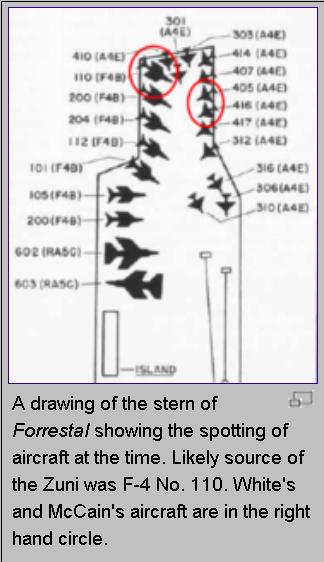
The planes on the deck that day were pointed inboard. Cleaver claims that McCain and his plane caused the fire by lighting off his engine prematurely as a prank.
In other words, Cleaver has the plane’s position backwards. The spotting diagram of the planes is reproduced in the Wikipedia article. I forwarded the diagram in my initial email to show the impossibility of Cleaver’s claim. Cleaver either borrowed this from another liar or made up the lie himself.
See attached diagram and read the caption on the bottom of the diagram explaining the accident.
McCain was apparently a total screwup during his navy career but he did not cause the fire on the USS Forrestal.
[Eisenstadt’s own empirical evidence was a freaking Wikipedia piece, a source as unsubstantiated as they get.]
No, I looked for and found corroborative evidence. The logs for the USS Forrestal are on line and are maintained by a navy veteran who was aboard the Forrestal on July
29, 1967.Check it out here.
Generally Wikipedia articles are quite good and do not freak.
Mike Eisenstadt
Michael,
I remain agnostic in regards to the specific debate concerning McCain’s responsibility for the fire on the USS Forrestal. I do believe that Thomas Cleaver is correct in asserting that McCain’s military record contains ample evidence of his poor judgment and character. However, it is not appropriate for you to call Mr. Cleaver a liar. It is fine for you to argue that he is mistaken or ill informed, but to call him a liar is an inappropriate personal attack.
David Hamilton
David,
You cant remain agnostic about an impossibility. The planes on the stern of aircraft carriers face inboard. The engine is at the back. The planes have to be turned in the right direction long before the engines are lighted off.
Whoever made up this lie, Cleaver or someone else, wasnt aware of how planes are spotted on an aircraft carrier. Case closed.
I adopt the role which conforms in my mind as best supporting the truth and morality.
Cleaver may not be a habitual liar but once one is caught doing it, it is bad for one’s reputation.
Like Chomsky lying his head off in his reportage on the nighttime bombing of the pharmeceutical factory in the Sudan where the nightwatchman was killed.
Mike Eisenstadt
I see that M.E. wants to pour more jet fuel on the fire …
So let me get this straight. The military can be trusted ABSOLUTELY to tell the truth the whole truth and nothing but the truth, so help me Admiral McCain.
Tell that to Pat Tillman’s family.
Or more to what I suspect is Eisenstadt’s underlying point, tell that to the families of the 34 seaman killed during Israel’s June 8, 1967, aerial and torpedo-boat attack on NSA spyship USS Liberty on day four of the Six Day War. Many many many people think that Admiral Papa John McCain covered up that story:
New Details in Attack on American Spy Ship / Chicago Tribune / Oct. 3, 2007 / Military.com.
The Liberty incident was only six weeks before the admiral’s son was involved in the Forrestal fire, and freelance journalist/cybersleuth Wayne Madsen smells a burning connection. In particular, he suggests that Bush-Cheney neocons may have found something in the Pentagon’s classified files to hold over McCain’s head — he notes that they have had seven years to dig. Madsen’s conjecture includes references to Forrestal survivors “and those who have investigated the case” who believed “that McCain deliberately ‘wet-started’ his A-4E” as a hotdog stunt. Madsen provides no names — not itself especially surprising given the high profile of these allegations — but in a later report he writes that “previous reports on McCain’s direct involvement in causing the worst non-combat-related disaster in the history of the Navy has since been verified by a senior Naval officer who was assigned to the Naval War College.”
See McCain’s past makes him a Neocon puppet / Feb. 5, 2008 / Portland Indymedia.
As for the flight deck diagram cited by Eisenstadt as proof that a McCain wet-start could not have started the Forrestal’s conflagration, I would point out that this sketch only shows how the planes were positioned before moving into launch position. The Forrestal fire broke out as pilots were firing up engines preparing for a mission over Vietnam. If the A-4s were moving into line for launch, McCain would have been in position to play a little prank.
All in all, Madsen provides interesting things to ponder about John McCain’s glossy flyboy image — and the five expensive aircraft he lost during his Navy service.
A final note: Madsen’s conjecture shows up in a bizarrely twisted version on an anti-Zionist website called Judicial Inc, and this link provides interesting things to ponder about why Mike Eisenstadt might be so anxious to discredit Tom Cleaver as a liar. Judicial Inc features both the Forrestal and Liberty stories in a silly attempt to prove that the McCain family reputation is controlled by Zionists.
What do I take from all of this? Not much beyond the observation that whenever I see Michael Eisenstadt’s name on an MDS post, I get ready for the Silly Season to commence.
Liar liar
pants on fire.
Jim Retherford
The fire broke out while planes were parked
at the stern before being moved. See attached diagram and read the accompanying caption.This diagram published in the Naval Aviation News, October 1967, was described as follows:
Deck plan of the U.S. aircraft carrier USS Forrestal (CVA-59) on 29 July 1967 in the Gulf of Tonking during the Vietnam war, when an accidentially launched rocket led to a catastrophe that killed 134, and injured 62. 21 aircraft of Attack Carrier Air Wing
17 (CVW-17) (tail code “AA”) were destroyed.Perhaps we should now assume that the Naval Aviation News was lying in their role as agents of the Zionists.
Mike Eisenstadt
The Naval Aviation News was restating the military review findings, not doing any new groundbreaking reporting.
Mike, I can’t decide whether you have an overall authority problem or a problem selecting authorities. If the Navy’s own review of the Forrestal disaster was tainted by “orders from above” (ie, Admiral Johh McCain Jr. or others acting to protect his interests) — as is believed by military journalist Bryant Jordan in the USS Liberty case and as was the case during the Pat Tillman cover-up (before overwhelming contravening evidence blew that fiction up) — so then will all of the subsequent stories, including Naval Aviation News and Wikipedia, etc.
Such is how fiction often passes for history –until someone begins to poke at the myths or accidently stumbles onto the truth.
All you are proving to the readers of this group is that you cherrypick your sources, selecting only that which supports your own chiseled-in-stone belief system while discarding any countervailing opinions as lies.
I’ll not call this lying. I’d call this lousy self-serving scholarship.
Jim Retherford

Here’s the good news: Women have become so politically powerful that even the anti-feminist right wing — the folks with a headlock on the Republican Party — are trying to appease the gender gap with a first-ever female vice president. We owe this to women — and to many men too — who have picketed, gone on hunger strikes or confronted violence at the polls so women can vote. We owe it to Shirley Chisholm, who first took the “white-male-only” sign off the White House, and to Hillary Rodham Clinton, who hung in there through ridicule and misogyny to win 18 million votes
But here is even better news: It won’t work. This isn’t the first time a boss has picked an unqualified woman just because she agrees with him and opposes everything most other women want and need. Feminism has never been about getting a job for one woman. It’s about making life more fair for women everywhere. It’s not about a piece of the existing pie; there are too many of us for that. It’s about baking a new pie.
Selecting Sarah Palin, who was touted all summer by Rush Limbaugh, is no way to attract most women, including die-hard Clinton supporters. Palin shares nothing but a chromosome with Clinton. Her down-home, divisive and deceptive speech did nothing to cosmeticize a Republican convention that has more than twice as many male delegates as female, a presidential candidate who is owned and operated by the right wing and a platform that opposes pretty much everything Clinton’s candidacy stood for — and that Barack Obama’s still does. To vote in protest for McCain/Palin would be like saying, “Somebody stole my shoes, so I’ll amputate my legs.”
This is not to beat up on Palin. I defend her right to be wrong, even on issues that matter most to me. I regret that people say she can’t do the job because she has children in need of care, especially if they wouldn’t say the same about a father. I get no pleasure from imagining her in the spotlight on national and foreign policy issues about which she has zero background, with one month to learn to compete with Sen. Joe Biden’s 37 years’ experience.
Palin has been honest about what she doesn’t know. When asked last month about the vice presidency, she said, “I still can’t answer that question until someone answers for me: What is it exactly that the VP does every day?” When asked about Iraq, she said, “I haven’t really focused much on the war in Iraq.”
She was elected governor largely because the incumbent was unpopular, and she’s won over Alaskans mostly by using unprecedented oil wealth to give a $1,200 rebate to every resident. Now she is being praised by McCain’s campaign as a tax cutter, despite the fact that Alaska has no state income or sales tax. Perhaps McCain has opposed affirmative action for so long that he doesn’t know it’s about inviting more people to meet standards, not lowering them. Or perhaps McCain is following the Bush administration habit, as in the Justice Department, of putting a job candidate’s views on “God, guns and gays” ahead of competence. The difference is that McCain is filling a job one 72-year-old heartbeat away from the presidency.
So let’s be clear: The culprit is John McCain. He may have chosen Palin out of change-envy, or a belief that women can’t tell the difference between form and content, but the main motive was to please right-wing ideologues; the same ones who nixed anyone who is now or ever has been a supporter of reproductive freedom. If that were not the case, McCain could have chosen a woman who knows what a vice president does and who has thought about Iraq; someone like Texas Sen. Kay Bailey Hutchison or Sen. Olympia Snowe of Maine. McCain could have taken a baby step away from right-wing patriarchs who determine his actions, right down to opposing the Violence Against Women Act.
Palin’s value to those patriarchs is clear: She opposes just about every issue that women support by a majority or plurality. She believes that creationism should be taught in public schools but disbelieves global warming; she opposes gun control but supports government control of women’s wombs; she opposes stem cell research but approves “abstinence-only” programs, which increase unwanted births, sexually transmitted diseases and abortions; she tried to use taxpayers’ millions for a state program to shoot wolves from the air but didn’t spend enough money to fix a state school system with the lowest high-school graduation rate in the nation; she runs with a candidate who opposes the Fair Pay Act but supports $500 million in subsidies for a natural gas pipeline across Alaska; she supports drilling in the Arctic National Wildlife Reserve, though even McCain has opted for the lesser evil of offshore drilling. She is Phyllis Schlafly, only younger.
I don’t doubt her sincerity. As a lifetime member of the National Rifle Assn., she doesn’t just support killing animals from helicopters, she does it herself. She doesn’t just talk about increasing the use of fossil fuels but puts a coal-burning power plant in her own small town. She doesn’t just echo McCain’s pledge to criminalize abortion by overturning Roe vs. Wade, she says that if one of her daughters were impregnated by rape or incest, she should bear the child. She not only opposes reproductive freedom as a human right but implies that it dictates abortion, without saying that it also protects the right to have a child.
So far, the major new McCain supporter that Palin has attracted is James Dobson of Focus on the Family. Of course, for Dobson, “women are merely waiting for their husbands to assume leadership,” so he may be voting for Palin’s husband.
Being a hope-a-holic, however, I can see two long-term bipartisan gains from this contest.
Republicans may learn they can’t appeal to right-wing patriarchs and most women at the same time. A loss in November could cause the centrist majority of Republicans to take back their party, which was the first to support the Equal Rights Amendment and should be the last to want to invite government into the wombs of women.
And American women, who suffer more because of having two full-time jobs than from any other single injustice, finally have support on a national stage from male leaders who know that women can’t be equal outside the home until men are equal in it. Barack Obama and Joe Biden are campaigning on their belief that men should be, can be and want to be at home for their children.
This could be huge.
[Gloria Steinem is an author, feminist organizer and co-founder of the Women’s Media Center. She supported Hillary Clinton and is now supporting Barack Obama.]
Source / Los Angeles Times
Thanks to Kathy Tomlinson / The Rag Blog
Going on an Imperial Bender: How the U.S. Garrisons the Planet and Doesn’t Even Notice
By Tom Engelhardt / September 4, 2008
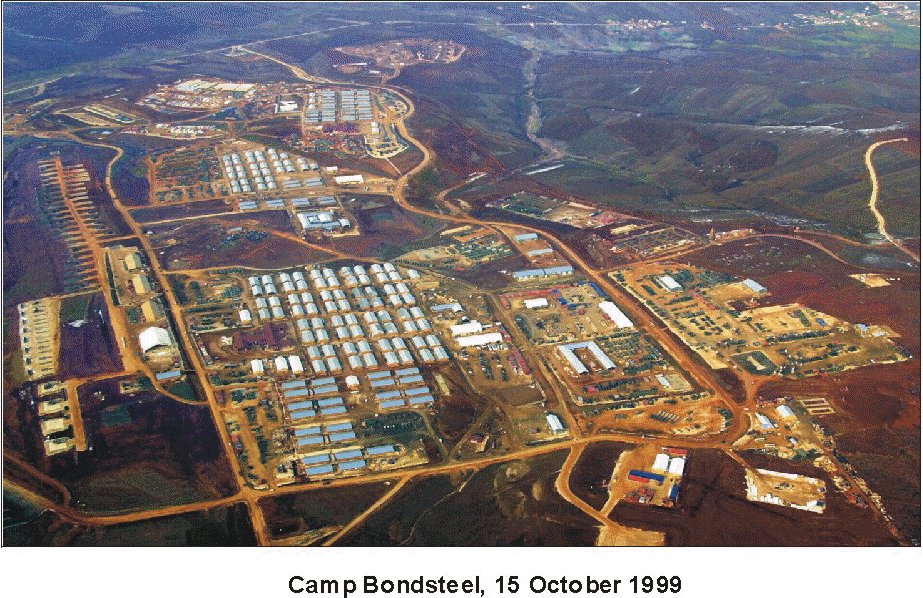
Here it is, as simply as I can put it: In the course of any year, there must be relatively few countries on this planet on which U.S. soldiers do not set foot, whether with guns blazing, humanitarian aid in hand, or just for a friendly visit. In startling numbers of countries, our soldiers not only arrive, but stay interminably, if not indefinitely. Sometimes they live on military bases built to the tune of billions of dollars that amount to sizeable American towns (with accompanying amenities), sometimes on stripped down forward operating bases that may not even have showers. When those troops don’t stay, often American equipment does — carefully stored for further use at tiny “cooperative security locations,” known informally as “lily pads” (from which U.S. troops, like so many frogs, could assumedly leap quickly into a region in crisis).
At the height of the Roman Empire, the Romans had an estimated 37 major military bases scattered around their dominions. At the height of the British Empire, the British had 36 of them planetwide. Depending on just who you listen to and how you count, we have hundreds of bases. According to Pentagon records, in fact, there are 761 active military “sites” abroad.
The fact is: We garrison the planet north to south, east to west, and even on the seven seas, thanks to our various fleets and our massive aircraft carriers which, with 5,000-6,000 personnel aboard — that is, the population of an American town — are functionally floating bases.
And here’s the other half of that simple truth: We don’t care to know about it. We, the American people, aided and abetted by our politicians, the Pentagon, and the mainstream media, are knee-deep in base denial.
Now, that’s the gist of it. If, like most Americans, that’s more than you care to know, stop here.
Where the Sun Never Sets
Let’s face it, we’re on an imperial bender and it’s been a long, long night. Even now, in the wee hours, the Pentagon continues its massive expansion of recent years; we spend militarily as if there were no tomorrow; we’re still building bases as if the world were our oyster; and we’re still in denial. Someone should phone the imperial equivalent of Alcoholics Anonymous.
But let’s start in a sunnier time, less than two decades ago, when it seemed that there would be many tomorrows, all painted red, white, and blue. Remember the 1990s when the U.S. was hailed — or perhaps more accurately, Washington hailed itself — not just as the planet’s “sole superpower” or even its unique “hyperpower,” but as its “global policeman,” the only cop on the block? As it happened, our leaders took that label seriously and our central police headquarters, that famed five-sided building in Washington D.C, promptly began dropping police stations — aka military bases — in or near the oil heartlands of the planet (Kosovo, Saudi Arabia, Qatar, Kuwait) after successful wars in the former Yugoslavia and the Persian Gulf.
As those bases multiplied, it seemed that we were embarking on a new, post-Soviet version of “containment.” With the USSR gone, however, what we were containing grew a lot vaguer and, before 9/11, no one spoke its name. Nonetheless, it was, in essence, Muslims who happened to live on so many of the key oil lands of the planet.
Yes, for a while we also kept intact our old bases from our triumphant mega-war against Japan and Germany, and then the stalemated “police action” in South Korea (1950-1953) — vast structures which added up to something like an all-military American version of the old British Raj. According to the Pentagon, we still have a total of 124 bases in Japan, up to 38 on the small island of Okinawa, and 87 in South Korea. (Of course, there were setbacks. The giant bases we built in South Vietnam were lost in 1975, and we were peaceably ejected from our major bases in the Philippines in 1992.)
But imagine the hubris involved in the idea of being “global policeman” or “sheriff” and marching into a Dodge City that was nothing less than Planet Earth itself. Naturally, with a whole passel of bad guys out there, a global “swamp” to be “drained,” as key Bush administration officials loved to describe it post-9/11, we armed ourselves to kill, not stun. And the police stations… Well, they were often something to behold — and they still are.
Let’s start with the basics: Almost 70 years after World War II, the sun is still incapable of setting on the American “empire of bases” — in Chalmers Johnson’s phrase — which at this moment stretches from Australia to Italy, Japan to Qatar, Iraq to Colombia, Greenland to the Indian Ocean island of Diego Garcia, Rumania to Okinawa. And new bases of various kinds are going up all the time (always with rumors of more to come). For instance, an American missile system is slated to go into Poland and a radar system into Israel. That will mean Americans stationed in both countries and, undoubtedly, modest bases of one sort or another to go with them. (The Israeli one — “the first American base on Israeli territory” — reports Aluf Benn of Haaretz, will be in the Negev desert.)
There are 194 countries on the planet (more or less), and officially 39 of them have American “facilities,” large and/or small. But those are only the bases the Pentagon officially acknowledges. Others simply aren’t counted, either because, as in the case of Jordan, a country finds it politically preferable not to acknowledge such bases; because, as in the case of Pakistan, the American military shares bases that are officially Pakistani; or because bases in war zones, no matter how elaborate, somehow don’t count. In other words, that 39 figure doesn’t even include Iraq or Afghanistan. By 2005, according to the Washington Post, there were 106 American bases in Iraq, ranging from tiny outposts to mega-bases like Balad Air Base and the ill-named Camp Victory that house tens of thousands of troops, private contractors, Defense Department civilians, have bus routes, traffic lights, PXes, big name fast-food restaurants, and so on.
Some of these bases are, in effect, “American towns” on foreign soil. In Afghanistan, Bagram Air Base, previously used by the Soviets in their occupation of the country, is the largest and best known. There are, however, many more, large and small, including Kandahar Air Base, located in what was once the unofficial capital of the Taliban, which even has a full-scale hockey rink (evidently for its Canadian contingent of troops).
You would think that all of this would be genuine news, that the establishment of new bases would regularly generate significant news stories, that books by the score would pour out on America’s version of imperial control. But here’s the strange thing: We garrison the globe in ways that really are — not to put too fine a point on it — unprecedented, and yet, if you happen to live in the United States, you basically wouldn’t know it; or, thought about another way, you wouldn’t have to know it.
In Washington, our garrisoning of the world is so taken for granted that no one seems to blink when billions go into a new base in some exotic, embattled, war-torn land. There’s no discussion, no debate at all. News about bases abroad, and Pentagon basing strategy, is, at best, inside-the-fold stuff, meant for policy wonks and news jockeys. There may be no subject more taken for granted in Washington, less seriously attended to, or more deserving of coverage.
Read all of it here. / TomDispatch

It’s only one Melanoma Away
(to the theme song from the Titanic)
By Diane Stirling-Stevens / The Rag Blog / September 4, 2008
For Sarah Palin,
Every time I see you, I fear you’ll be
Dying
Every night I hope you’ll live
On
Each time you stumble, I worry and
Mumble
“Why didn’t I remain in the
Yukon”
Near, far, wherever you are
When I ride in that car
To the White House
…or shoot grouse
I worry,
‘Dear John, are you
‘gawn, gawn, gawn’…………………..
I was just a ‘guvnah’ – a lass
From Alaska
Kicking ass – raising glass
In the North
I was keeping secrets; chasing egrets
No regrets, then we met
And you said the White House
We’d ‘get’….
You showed me your white face
Your puffed face
Asked me to
‘keep pace’
‘…join your race’…
……Could I help you
Belooooooong…….
Clear, now, I don’t really
Know how
To lead and I’m reluctant
To say,
You’re old; you’re
Sick, you’re no
Maverick
your wife
Is a bitch
….I wanna
switch
cuz
“You’re only a Melanoma
……awaaaaaaaaaaaaay…..”
“Only a Melanoma awaaaaaaaaaaaaaaay.”
I know it’s not ‘perfect’, but close enough for ‘government work’ …

See Nicole Salazar Video below.
Why We Were Falsely Arrested
By Amy Goodman / September 3, 2008
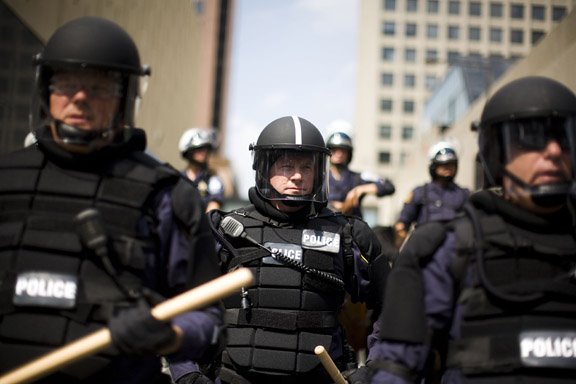
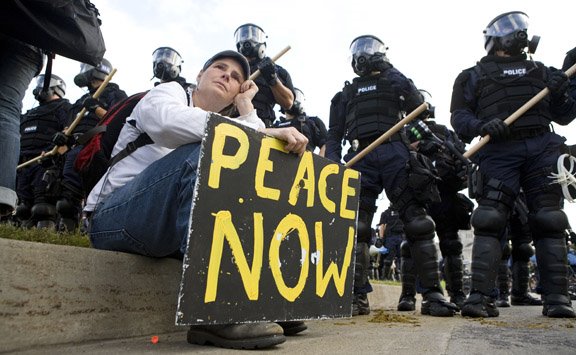
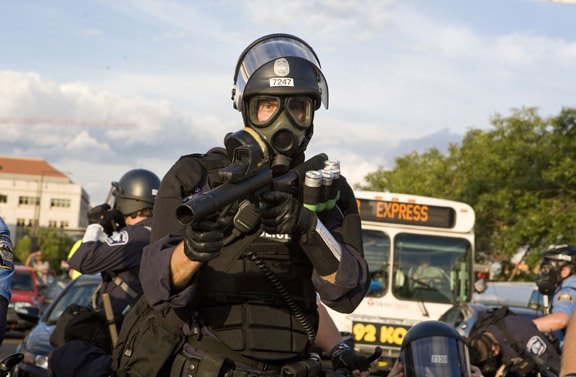
ST. PAUL, Minn.—Government crackdowns on journalists are a true threat to democracy. As the Republican National Convention meets in St. Paul, Minn., this week, police are systematically targeting journalists. I was arrested with my two colleagues, “Democracy Now!” producers Sharif Abdel Kouddous and Nicole Salazar, while reporting on the first day of the RNC. I have been wrongly charged with a misdemeanor. My co-workers, who were simply reporting, may be charged with felony riot.
The Democratic and Republican national conventions have become very expensive and protracted acts of political theater, essentially four-day-long advertisements for the major presidential candidates. Outside the fences, they have become major gatherings for grass-roots movements—for people to come, amidst the banners, bunting, flags and confetti, to express the rights enumerated in the Constitution’s First Amendment: “Congress shall make no law respecting an establishment of religion, or prohibiting the free exercise thereof; or abridging the freedom of speech, or of the press, or the right of the people peaceably to assemble, and to petition the Government for a redress of grievances.”
Behind all the patriotic hyperbole that accompanies the conventions, and the thousands of journalists and media workers who arrive to cover the staged events, there are serious violations of the basic right of freedom of the press. Here on the streets of St. Paul, the press is free to report on the official proceedings of the RNC, but not to report on the police violence and mass arrests directed at those who have come to petition their government, to protest.
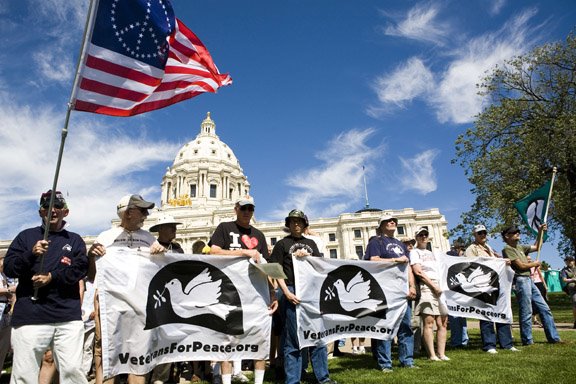
It was Labor Day, and there was an anti-war march, with a huge turnout, with local families, students, veterans and people from around the country gathered to oppose the war. The protesters greatly outnumbered the Republican delegates.
There was a positive, festive feeling, coupled with a growing anxiety about the course that Hurricane Gustav was taking, and whether New Orleans would be devastated anew. Later in the day, there was a splinter march. The police—clad in full body armor, with helmets, face shields, batons and canisters of pepper spray—charged. They forced marchers, onlookers and working journalists into a nearby parking lot, then surrounded the people and began handcuffing them.
Nicole was videotaping. Her tape of her own violent arrest is chilling. Police in riot gear charged her, yelling, “Get down on your face.” You hear her voice, clearly and repeatedly announcing “Press! Press! Where are we supposed to go?” She was trapped between parked cars. The camera drops to the pavement amidst Nicole’s screams of pain. Her face was smashed into the pavement, and she was bleeding from the nose, with the heavy officer with a boot or knee on her back. Another officer was pulling on her leg. Sharif was thrown up against the wall and kicked in the chest, and he was bleeding from his arm.
Nicole Salazar Arrest
I was at the Xcel Center on the convention floor, interviewing delegates. I had just made it to the Minnesota delegation when I got a call on my cell phone with news that Sharif and Nicole were being bloody arrested, in every sense. Filmmaker Rick Rowley of Big Noise Films and I raced on foot to the scene. Out of breath, we arrived at the parking lot. I went up to the line of riot police and asked to speak to a commanding officer, saying that they had arrested accredited journalists.
Within seconds, they grabbed me, pulled me behind the police line and forcibly twisted my arms behind my back and handcuffed me, the rigid plastic cuffs digging into my wrists. I saw Sharif, his arm bloody, his credentials hanging from his neck. I repeated we were accredited journalists, whereupon a Secret Service agent came over and ripped my convention credential from my neck. I was taken to the St. Paul police garage where cages were set up for protesters. I was charged with obstruction of a peace officer. Nicole and Sharif were taken to jail, facing riot charges.
The attack on and arrest of me and the “Democracy Now!” producers was not an isolated event. A video group called I-Witness Video was raided two days earlier. Another video documentary group, the Glass Bead Collective, was detained, with its computers and video cameras confiscated. On Wednesday, I-Witness Video was again raided, forced out of its office location. When I asked St. Paul Police Chief John Harrington how reporters are to operate in this atmosphere, he suggested, “By embedding reporters in our mobile field force.”
On Monday night, hours after we were arrested, after much public outcry, Nicole, Sharif and I were released. That was our Labor Day. It’s all in a day’s work.
Amy Goodman is the host of “Democracy Now!,” a daily international TV/radio news hour airing on more than 700 stations in North America.
© 2008 Amy Goodman
Source / TruthDig

Cheney colleague admits bribery in Halliburton oil deals
By Stephen Foley / September 4, 2008
A former colleague of the US Vice-President, Dick Cheney, has pleaded guilty to funnelling millions of dollars in bribes to win lucrative contracts in Nigeria for Halliburton, during the period in the Nineties when Mr Cheney ran the giant oil and gas services company.
Albert Stanley, who was appointed by Mr Cheney as chief executive of Halliburton’s subsidiary KBR, admitted using a north London lawyer to channel payments to Nigerian officials as part of a bribery scheme that landed some $6bn of work in the country over a decade.
The guilty plea, announced yesterday, came after a four-year investigation by US attorneys and threatens to stir up old controversies just as eyes are trained on the Republican party convention. Mr Cheney, who pulled out of an address to the convention because of Hurricane Gustav earlier this week, led Halliburton from 1995 until returning to government in 2000. He had previously been Defence Secretary under the first President George Bush, and the links with Halliburton have been a constant thorn in the side of the current administration as the company has gone on to win billions of dollars of contracts in Iraq and other US military spheres.
The corruption scandal which exploded back into life yesterday centres on more than $180m channelled into Nigeria via intermediaries between 1994 – before Mr Stanley’s employer was acquired by Halliburton – and 2004. Prosecutors allege that the payments were vital to a KBR-led consortium securing a succession of construction projects related to a liquefied natural gas plant at Bonny Island, on the Atlantic coast of Nigeria.
KBR suspended Stanley in 2004 after $5m was found in his Swiss bank account.
The investigation – which began in 2004 and has involved investigators in Nigeria, Switzerland, France and the UK, as well as the US – has turned up handwritten notes by a former KBR executive that bribes may have reached the former Nigerian dictator Sani Abacha, whose regime was accused of human rights abuses.
Bringing its legal action yesterday, the Department of Justice and the Securities and Exchange Commission – America’s corporate watchdog – said Stanley and others met high-ranking Nigerian government officials and their representatives on at least four occasions to arrange the bribe payments. To conceal the illicit payments, Stanley and others approved entering into sham contracts with two “agents” to funnel money to the Nigerian officials.
Investigations by French officials several years ago revealed that one of the agents was Jeffrey Tesler, a small-time solicitor based on a run-down high street in Tottenham, north London. Mr Tesler has long-standing ties in Nigeria, and worked as consultant to KBR’s Nigerian joint venture. Mr Tesler was identified in yesterday’s legal actions only as “the UK agent”, and has not been charged with any crime. Attempts to contact Mr Tesler last night were unsuccessful.
Stanley admitted one count under the Foreign Corrupt Practices Act – which outlaws bribery by executives and companies operating in the US, regardless of where in the world the corruption is taking place – and a further count of fraud. He faces 10 years in jail, and has agreed to pay $10.8m in restitution. He has also agreed to co-operate with the authorities as they continue their investigation into the bribery scandal.
Mr Cheney appointed Stanley to run KBR in 1999, when the subsidiary was created after Halliburton’s acquisition of UK-controlled MW Kellogg, where Stanley had been an executive. There is no suggestion that Mr Cheney knew at the time of the acquisition, or subsequently, that bribery was involved in the Nigerian contracts.
“The Department of Justice is committed to aggressively enforcing the Foreign Corrupt Practices Act,” said acting assistant Attorney General Matthew Friedrich.
Source / The Independent

Senate Democrats to push bipartisan drilling bill
By Mary Clare Jalonick / September 4, 2008
Democratic leaders in the Senate plan to push a bipartisan energy proposal that would allow for some expansion of offshore drilling when Congress returns next week from a five-week recess.
WASHINGTON — Democratic leaders in the Senate plan to push a bipartisan energy proposal that would allow for some expansion of offshore drilling when Congress returns next week from a five-week recess.
The plan that would allow Virginia, Georgia, North Carolina and South Carolina to opt into leasing programs starting 50 miles off their shores now has the support of 16 senators – eight Democrats and eight Republicans.
However, it is expected to face opposition from lawmakers in both parties, and with Congress planning to meet for only three weeks before recessing again for the November election, its prospects are dim.
The proposal, not yet introduced as legislation, would also lift a ban on drilling off the Gulf coast of Florida, invest $20 billion on developing petroleum-free motor vehicles and extend expiring tax credits for renewable energy.
Many Republicans, including President Bush, would like to see the moratorium on drilling lifted along the entire Atlantic and Pacific coasts. Some Democrats are unlikely to support any measure that includes increased offshore drilling.
“This is going to be hard to do, we are under no illusion here,” said Sen. Kent Conrad, D-N.D., who led the negotiations on the proposal with Sen. Saxby Chambliss, R-Ga. “But we’ve tried to put something together that is responsible and broad-based and bipartisan, and I think it’s got a shot.”
Senate Majority Leader Harry Reid, D-Nev., is working with the supporters to get it on the floor “as quickly as possible” after the Senate returns Monday, said Reid spokesman Jim Manley. “It appears that this proposal is picking up steam on both sides of the aisle,” Manley added.
When the proposal was introduced in early August, Reid said he did not agree with every part of it. Manley said Reid still believes drilling “is not the answer to everything” but is a comprehensive approach that could be a way to forge a compromise on the issue.
Six senators signed on to the proposal last week, including Republican Sens. Norm Coleman of Minnesota and John Sununu of New Hampshire. Both are facing competitive re-election bids this fall as high energy prices have become a touchy political issue.
Other Republicans supporting the proposal are John Thune of South Dakota, Lindsey Graham of South Carolina, Johnny Isakson of Georgia, Bob Corker of Tennessee and John Warner of Virginia.
Democratic supporters include Sens. Blanche Lincoln and Mark Pryor of Arkansas, Mary Landrieu of Louisiana, Ben Nelson of Nebraska, Tim Johnson of South Dakota, Tom Carper of Delaware and Ken Salazar of Colorado. Landrieu also is in a tight race for re-election in November.
Source / The Seattle Times
Thanks to Diane Stirling-Stevens / The Rag Blog

John was in the fertilized egg business. He had several hundred young laying hens, called “pullets”, and ten roosters to fertilize the eggs. He kept records, and any rooster not performing went into the soup pot and was replaced.
This took a lot of time, so he bought some tiny bells and attached them to his roosters. Each bell had a different tone, so he could tell from a distance which rooster was performing. Now, he could sit on the porch and fill out an efficiency report by just listening to the bells.
John’s favorite rooster, old Butch, was a very fine specimen, but this morning he noticed old Butch’s bell hadn’t rung at all! When he went to investigate, he saw the other roosters were busy chasing pullets, bells-a-ringing, but the pullets, hearing the roosters coming, could run for cover.
To John’s amazement, old Butch had his bell in his beak so it couldn’t ring. He’d sneak up on a pullet, do his job and walk on to the next one.
John was so proud of old Butch that he entered him in the Renfrew County Fair, and he became an overnight sensation among the judges. The result was the judges not only awarded old Butch the No Bell Piece Prize but they also awarded him the Pulletsurprise as well.
Clearly old Butch was a politician in the making. Who else but a politician could figure out how to win two of the most highly coveted awards on our planet by being the best at sneaking up on the populace and screwing them when they weren’t paying attention?
Vote carefully this year … the bells are not always audible.
(Peace)
Thanks to Diane Stirling-Stevens | The Rag Blog | Posted September 4, 2008
And there’s this closely related story about the Northwest Tribal areas of Pakistan:
The Rag Blog / Posted September 4, 2008
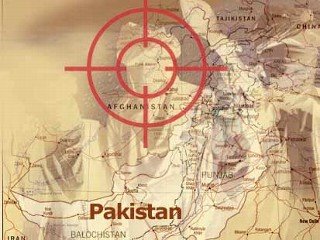
NATO ground troops attack Taliban stronghold in Pakistan, officials say
By Huma Yusuf / September 3, 2008
The raid may be the first time the US has sent troops into Pakistan. Prior attacks attributed to US forces were conducted with drones.
NATO and US ground troops attacked three houses near a Taliban and Al Qaeda stronghold in South Waziristan, a tribal area in Pakistan, on Wednesday, Pakistani officials said. At least 15 people – mostly civilians – are said to have been killed in the attack. Unlike previous NATO airstrikes in the region, this involved the deployment of ground troops. The attack comes in the wake of the Pakistan military’s announcement of a cease-fire with militants in the northern and tribal areas to observe the Muslim holy month of Ramadan.
According to The New York Times, the attack has been confirmed by the governor of the North West Frontier Province, a Taliban commander, and eyewitnesses. US and NATO officials in Afghanistan have not yet commented on the reported strike.
The attacks were aimed at three houses in the village of Jala Khel in the Angoor Adda area of South Waziristan, less than a mile from the border with Afghanistan, the Taliban commander and local residents said.
The helicopter attacks occurred at about 3 a.m. and killed 20 people, according to the provincial governor, Owais Ahmed Ghani said….
A Taliban commander, known by the nom de guerre Commander Malang, said the attack took place close to a Pakistani military position on the border and killed 15 people. But the Pakistani military took no action, he said.
The BBC reports that ground troops were deployed as part of the attack. The report emphasizes that while airstrikes by coalition forces in Afghanistan against Pakistani militant targets have previously occurred, “a raid by ground troops would be rare.”
Locals say three helicopter gunships dropped international troops in the Musa Nikeh area of South Waziristan, located on the border with Afghanistan, overnight.
They say the soldiers killed more than a dozen people with gunfire and bombs, including women and children.
“Troops came in helicopters and carried out action in three houses,” Gul Nawaz, a shopkeeper, told Reuters news agency.
Witnesses told the BBC Urdu service that troops entered the house of a local tribesman, opened fire and then lobbed a bomb in the house. They said at least nine bodies had been recovered from the debris. The witnesses said the family was not known for links with militants.
According to a private Pakistani cable channel, local tribesmen, who were awake at the time of the attack to prepare for the day’s fast, responded by chanting anti-American slogans, reports United Press International.
Pakistani authorities believe the attack was aimed at a particular militant target, reports Voice of America.
Pakistan Defense Minister Ahmed Mukhtar told reporters in Lahore that the country’s foreign office is investigating.
He says he does not have details. Mukthar says three houses were targeted by NATO forces and theorizes the strike had a specific target.
NATO and US-led airstrikes against militant targets in Pakistan are controversial as they are perceived to violate national sovereignty, reports the Associated Press.
The United States and Pakistan, allies in the war on terror, have had tensions over cross-border attacks, including a series of suspected American missile strikes which have killed two senior al-Qaida operatives in Pakistani territory this year….
AP reported last year that U.S. rules of engagement allowed ground forces to go a little over six miles into Pakistan when in hot pursuit, and when forces were targeted or fired on by the enemy. U.S. rules allow aircraft to go 10 miles into Pakistan air space.
Pakistani officials protest that cross-border strikes are a violation of their sovereignty. They plead with U.S. and NATO commanders to share intelligence and allow Pakistani troops to carry out all raids on their territory.
In a separate incident on Wednesday, bullets were fired at the motorcade of Pakistani Prime Minister Yousaf Raza Gilani on the Islamabad Highway, reports Pakistani daily The News. The prime minister and his entourage were not harmed in the attack. The News also reports that militants from the Swat Valley, the site of recent military operations, have claimed responsibility for the attack.
Source / Christian Science Monitor
Reported U.S. attack upsets Pakistan
By Mark Sappenfield, Staff writer of The Christian Science Monitor / September 4, 2008US forces may have sent in ground troops for the first time Wednesday. Were they targetting a top Taliban or Al Qaeda figure?
New Delhi – A high-ranking Pakistani official has alleged that American ground forces crossed over from Afghanistan to carry out an attack on Pakistan soil.
While the United States has frequently been connected with missile attacks in Pakistan – usually carried out by pilotless drone aircraft – this claim, if true, would mark “a threshold being crossed,” says Ikram Sehgal, editor of Defence Journal in Karachi, Pakistan.
US forces have so far not been definitively linked to any ground operations in Pakistan, and the Pakistan government has repeatedly said it will not allow such an operation – which it calls a violation of national sovereignty – to take place.
Yet Owais Ahmed Ghani, who oversees Pakistan’s restive tribal areas as governor of the North West Frontier Province, said American commandos with support from three helicopter gunships attacked a Pakistani village near the Afghan border.
“At least 20 innocent civilians of Pakistan including women and children were martyred,” he said.
The attack took place near Angoor Ada, a town in the South Waziristan tribal agency, according to Pakistan Army spokesman Maj. Murad Khan.
But claims of a NATO raid could not be verified. Indeed there was some confusion within Pakistan itself as to the nature of the attack. The Pakistani defense minister, Ahmad Mukhtar, referred to the attack as an airstrike. He also speculated that the raid targeted a specific Taliban or Al Qaeda figure.
A spokesman for US forces in Afghanistan refused comment. Defense officials at the Pentagon and at US Central Command, Tampa, Fla., would not confirm the incident and also had no further comment Wednesday morning.
The US says Pakistan’s tribal regions along the Afghan border have become a haven for Al Qaeda and the Taliban. It has pressured Pakistan to fight militancy in its country, while also weighing how aggressively it can carry out strikes of its own.
Even on a day when Prime Minister Yousuf Raza Gilani’s motorcade was fired upon, the allegations of a US attack in South Waziristan was leading Pakistani news. “People are not going to take it lightly,” says Mr. Sehgal.
Pakistanis have long resented what they see as US interference in their country, most notably in the support the US gave to a succession of military dictators, most recently former President Pervez Musharraf. Many will take this as confirmation of US meddling. The government must strongly condemn the attack if it is to retain some of the progress it has made in recent months on the security issue, says Mahmood Shah, a former secretary of the Federally Administered Tribal Areas.
Since talks with the Taliban broke down and Pakistan resumed military operations in FATA, several tribal leaders have joined the government’s side, forming militias to fight the Taliban.
In the hours after the allegations of an attack, “people have already started talking against the government,” Mr. Shah says, suggesting that people see the government as complicit or too weak to stand up to the Americans.
“If America starts pulling their [the government’s] leg in this fashion, then it will go the same way as General Pervez Musharraf,” who resigned as president last month, he adds.
The top presidential contender in Saturday’s election to replace Mr. Musharraf, Asif Zardari, is “seen as supported by the US,” says Sehgal.
Mr. Zardari recently called for a cease-fire in the tribal regions in observance of the Muslim holy month of Ramadan – in part to distance himself from this perception and to win votes for the election. His election seems assured, since the president is elected by provincial parliaments and the national assembly. His coalition has a majority. But the allegations of the attack could undermine what public support he has. “The timing is a bit of a surprise,” says Sehgal.
Gordon Lubold contributed from Washington. Wire material was also used.
Source / Christian Science Monitor
Thanks to Diane Stirling-Stevens / The Rag Blog
Thorne Webb Dreyer, Editor