Burning Man : Snail Car Is Born When Math, Dreams Collide

John Sarriugarte, a blacksmith and fire artist, makes adjustments to the flame-emitting feelers on the front of The Golden Mean, his snail-shaped art car. Photo by Emily Lang.

Kyrsten Mate woke up and said, ‘We have to build this giant snail’
By Emily Lang / August 29, 2008

OAKLAND, California — In a project that would make Franz Kafka grin, a 30-year-old bug has metamorphosed into a snail. The resulting creation, an art car called The Golden Mean, is a golden gastropod that glows in the dark and shoots rings of fire from its feelers. It also seats six comfortably.

Blacksmith John Sarriugarte, who fabricates custom home furnishings, worked with his wife, Kyrsten Mate, to transform a 1966 VW Bug into the rolling piece of art. The Golden Mean is making its debut at the Burning Man art festival this year.

Mate says she literally dreamed up the concept.

“I woke up and said, ‘We have to build this giant snail,'” she said. “It totally wasn’t planned. This whole project has been weird coincidences and math.”

The visually stunning vehicle takes its name from the golden ratio, a mathematical proportion that’s said to produce aesthetically pleasing art and architecture. The spiral in the snail’s shell is shockingly close to the ratio. Other inspirations for the project include the giant pink snail from Doctor Dolittle, giant mechanical elephant puppets by Royal de Luxe and Jules Verne’s imaginative creations.

For a peek at last-minute preparations that took place in Sarriugarte’s Form & Reform shop before Golden Mean headed off for its date with the playa, go here.

Source / Wired

The Rag Blog

Posted in RagBlog | Tagged , , , | 1 Comment

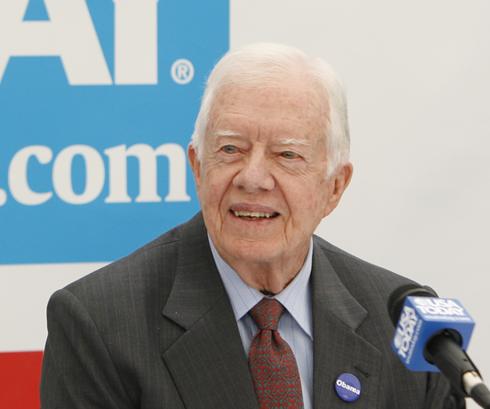
Jimmy Carter : McCain ‘Milking’ POW Time

Photo by Kate Patterson, USA Today.

McCain is ‘milking every possible drop of advantage’ from vietnam experience
By Alan Gomez / August 29, 2008

DENVER — Former president Jimmy Carter called Republican presidential candidate John McCain a “distinguished naval officer,” but he said the Arizona senator has been “milking every possible drop of advantage” from his time served as a prisoner of war in Vietnam.

Carter spoke Thursday with USA TODAY and Gannett News Service reporters before Barack Obama’s acceptance speech to cap off the Democratic National Convention. Carter spoke of Obama’s challenges facing the lingering effects of racism in the United States and the ability of the Clintons to bring their supporters over to Obama. He decried Connecticut Sen. Joe Lieberman’s decision to “abandon” the Democrats by speaking at the Republican convention next week.

Carter, however, focused heavily on McCain. He said he was bewildered by McCain’s performance at the Saddleback Presidential Forum hosted by pastor and author Rick Warren in Lake Forest, Calif., earlier this month.

Carter said that whether he was asked about religion, domestic or foreign affairs, every answer came back to McCain’s 5½ years as a POW.

“John McCain was able to weave in his experience in a Vietnam prison camp, no matter what the question was,” Carter said. “It’s much better than talking about how he’s changed his total character between being a senator, a kind of a maverick … and his acquiescence in the last few months with every kind of lobbyist pressure that the right-wing Republicans have presented.”

Carter said Lieberman, Al Gore’s running mate in 2000 and now an independent, had cast his lot with the GOP by deciding to speak at the party’s convention.

Lieberman switched his party registration after losing the 2006 Democratic senatorial primary to Ned Lamont, who made opposition to the Iraq war central to his campaign. Lieberman kept his seat and has helped Democrats maintain a 51-49 voting edge.

“I would hope that the Democrats could have enough senators elected in November so that we would not any longer need to include Joe Lieberman among the senators,” Carter said.

Carter called Hillary Rodham Clinton’s speech at the convention Tuesday “superb” but questioned her for pointing out her accomplishments in some areas and merely saying that Obama shared those concerns.

Carter said former president Bill Clinton’s speech Wednesday was “perfect.” Carter said the two speeches took pressure off Obama by uniting the party and ensuring that Clinton supporters would support Obama.

Carter cited a USA TODAY/Gallup Poll last week that found 47% of Clinton supporters said they were solidly behind Obama and 30% said they would vote for McCain, someone else or no one at all. “I think that this week has eliminated that disparity,” he said.

Carter also spoke of the segregation he saw growing up and said racism is “always a subtle factor” in American politics. He called this November’s election possibly the most “momentous, important” U.S. election in the past 100 years, and he was confident that Obama could overcome the racial divide.

But he said race could ultimately be the deciding factor.

Source / USA Today

The Rag Blog

Posted in RagBlog | Tagged , , | Leave a comment

A Nightmare on Wall Street

The credit crunch is morphing from an American-centred financial crisis into a global economic crisis,” says David Bowers of Absolute Strategy Research…

‘Borrowing our way to prosperity’
By Roger Baker / The Rag Blog / August 29, 2008

Damnation! The problems we create when our bankers gamble on maintaining exponential growth on a finite planet. Borrowing our way to prosperity using Chinese loans by pledging our houses as collateral does not seem to be working so well lately. Who would have thought somebody would expect to be paid back before they would lend us some more?

Fortunately all we have to do is print up a ton of money and we can make the problem go away. And with bank bailouts we don’t even need to mess around with all those messy printing presses, do we?

And aren’t you glad this will all have a happy ending with a man like Obama as president?

A Nightmare on Wall Street
Aug 28th 2008

Why the credit crunch has lasted so long

LIKE a Hollywood monster that is impervious to bullets, the credit crisis refuses to lie down and die. The authorities have bombarded it with interest-rate reductions, tax cuts, special liquidity schemes and bank bail-outs, but still the creature lumbers forward, threatening new victims with every step. Global stockmarkets are suffering double-digit losses this year, and credit markets are once again gummed up.

For investors who cut their teeth in the 1980s and 1990s, the persistence of the crisis must be a surprise. Prompt action by central banks, after Black Monday in 1987 (when America’s stockmarket fell by almost 23%), or following the collapse of Long-Term Capital Management, a hedge fund, in 1998, suggested it was always worthwhile to “buy on the dips”.

One reason why things are different this time is that there has been a double shock. On top of the decline in house prices and the associated drop in the prices of asset-backed securities, the markets have also had to face a surge in commodity prices. That has constrained central banks from easing monetary policy as much as they might have done, particularly in Britain and the euro zone. Even in America, rates might now perhaps be 1% (as they were in 2003) without the commodity boom.

In addition, the combination of the two shocks has created uncertainty about the direction of monetary and regulatory policy. Will the central banks be forced to “do a Turkey” and adjust their inflation targets upward (implicitly or explicitly) to reflect reality? Alternatively, will they crack down so hard on inflation that they force their economies into recession? And will the price of investment-bank rescues be a harsh new regulatory regime that restricts the scope for future credit (and economic) growth? In the face of all this uncertainty, investors can hardly be blamed for being cautious.

The way that the crisis has centred on the banking industry also explains its duration. Stephen King, an economist at HSBC, points out that the financial crises of the 1990s were also prolonged, from the savings and loan collapses in America through the Swedish banking rescues to the extremes of Japan’s debt deflation. As Mr King says, “if banks are unable or unwilling to lend, monetary policy doesn’t work so well.”

Worse still, bank problems create a feedback loop with the rest of the economy. When banks get into difficulty, they restrict their lending. That in turn makes life more difficult for companies and consumers, causing them to cut their spending and making it harder for them to repay their debts. That forces further caution on the banks.

Recent economic data have highlighted how the gloom is spreading. Neither Germany nor Japan enjoyed a credit boom earlier this decade but both economies are suffering. Business confidence in Germany fell to its lowest level in three years, according to the latest Ifo survey, released on August 26th. “The credit crunch is morphing from an American-centred financial crisis into a global economic crisis,” says David Bowers of Absolute Strategy Research, a consultancy.

Another reason why the crisis is lasting so long stems from the nature of the previous boom. Everyone was borrowing money, from homeowners buying houses they could not afford in the hope of capital gains, to investors buying complex debt products with high yields because of the extra “carry”.

These investors were, directly or indirectly, beholden to the banks. Even when money was borrowed from “the market”, the lenders may well have been hedge funds, conduits or structured-investment vehicles, all of which had themselves borrowed money from banks in the first place. That former wellhead of finance has now run fairly dry.

In turn, that explains the absence of bargain hunters, particularly in the debt markets. Investment-grade debt might look attractive on a five-year view, if all you have to worry about is the risk of default. But most investors in that market have a three- or six-month view; they cannot afford for things to get worse before they get better, in case they are forced into a fire-sale of their assets.

So the markets (and the developed economies) are waiting for a catalyst for recovery. Lower commodity prices helped for a while, and may help further if they encourage central banks to cut rates. Evidence of a bottom in the American housing market may also do the trick. But the crisis seems certain to linger into 2009, and could even make it into the following year. Successful horror movies tend, after all, to have several sequels.

Source / The Economist

The Rag Blog

Posted in Rag Bloggers | Tagged , , , , , | Leave a comment

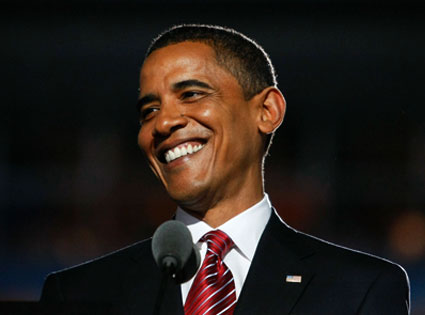
Obama’s Grand Speech : Reason for Hope

Photo by Joe Raedle / Getty Images.

‘A historic speech on a historic night’
By David Corn / August 28, 2008

It was a historic speech on a historic night–in a remarkable setting. A crowd of tens of thousands of Americans, filling an entire stadium in the middle of the country, waved American flags and signs calling for “Change.” Never in the nation’s history had more Americans attended such an event. Never before had an African-American accepted the presidential nomination of a major party in the United States. And the speech of Barack Obama matched the moment.

He connected his own history–the history of a not-quite-ordinary American family–to the mythical promise of America. His rhetoric soared–as usual–but it was tethered to reality: in particular, the stark differences between how Obama would approach the challenges the nation now faces and how John McCain would do so. Obama laced his criticism of the Bush years and the possible McCain years with a dose of populism, which gave portions of the speech a sharp edge. And he brought his pitch for hope and change down to the ground with a succinct description of policy ideas he would work for as president.

Obama, as convention dictates, began with a high-minded theme: America is a land of promise, but, he declared, that promise–especially for hardworking Americans–is in jeopardy, placing the nation at a critical juncture. “These challenges are not all of government’s making,” he said. “But the failure to respond is a direct result of a broken politics in Washington and the failed policies of George W. Bush. America, we are better than these last eight years. We are a better country than this.” Given that polls show that at least seven out of ten Americans–maybe more–believe the country is on the wrong track and a similar number of Americans disapprove of Bush, his criticism was not at all radical.

In one of the more important passages, Obama, taking a populist turn, made the case that his opponent does not understand this:

The truth is, on issue after issue that would make a difference in your lives–on health care and education and the economy–Senator McCain has been anything but independent. He said that our economy has made “great progress” under this President. He said that the fundamentals of the economy are strong. And when one of his chief advisors–the man who wrote his economic plan–was talking about the anxiety Americans are feeling, he said that we were just suffering from a “mental recession,” and that we’ve become, and I quote, “a nation of whiners.”

A nation of whiners? Tell that to the proud auto workers at a Michigan plant who, after they found out it was closing, kept showing up every day and working as hard as ever, because they knew there were people who counted on the brakes that they made. Tell that to the military families who shoulder their burdens silently as they watch their loved ones leave for their third or fourth or fifth tour of duty. These are not whiners. They work hard and give back and keep going without complaint. These are the Americans that I know.

Now, I don’t believe that Senator McCain doesn’t care what’s going on in the lives of Americans. I just think he doesn’t know. Why else would he define middle-class as someone making under five million dollars a year? How else could he propose hundreds of billions in tax breaks for big corporations and oil companies but not one penny of tax relief to more than one hundred million Americans? How else could he offer a health care plan that would actually tax people’s benefits, or an education plan that would do nothing to help families pay for college, or a plan that would privatize Social Security and gamble your retirement? It’s not because John McCain doesn’t care. It’s because John McCain doesn’t get it.

Obama blasted McCain for embracing the “that old, discredited Republican philosophy–give more and more to those with the most and hope that prosperity trickles down to everyone else.” He proclaimed that it was time for GOPers, “to own their failure. It’s time for us to change America. And that’s why I’m running for president of the United States.”

He did not say–as Hillary Clinton did during the primaries–that he was running to fight for you. His is still a campaign of collective action–us, not me– and that might continue to make it hard for voters facing tough economic times to identify with Obama. (Some people desire a champion slugging for them, not a movement to join.) But on tax cuts, health care, outsourcing, energy independence, and education, Obama vigorously outlined the stark differences between him and McCain–and he presented those differences in language designed to appeal to working-class voters.

On national security, Obama ceded no ground to McCain. “If John McCain wants to have a debate about who has the temperament, and judgment, to serve as the next Commander-in-Chief, that’s a debate I’m ready to have,” he said. None of his arguments were new–he blasted McCain for being overly eager to go to war in Iraq before the job was done in Afghanistan–but he did so with great confidence. “John McCain likes to say that he’ll follow bin Laden to the Gates of Hell–but he won’t even follow him to the cave where he lives,” he remarked.

Obama sounded strong; he looked strong. “If John McCain wants to follow George Bush with more tough talk and bad strategy, that is his choice–but it is not the change that America needs,” he said. Obama warned McCain to stop questioning his patriotism: “I’ve got news for you, John McCain. We all put our country first.” And, he said, don’t go pulling the same-old, Rove-like stunts, accusing Democrats of being nothing but tax-raisers and national security weaklings:

The times are too serious, the stakes are too high for this same partisan playbook. So let us agree that patriotism has no party. I love this country, and so do you, and so does John McCain. The men and women who serve in our battlefields may be Democrats and Republicans and Independents, but they have fought together and bled together and some died together under the same proud flag. They have not served a Red America or a Blue America–they have served the United States of America.

Throughout the entire speech, Obama’s delivery was powerful. He stuck with his now-familiar message of hope and change. He reiterated his call for a politics that transcends pettiness and distractions. But he really took it to the other side–issuing specific charges and offering specific ideas for policy changes. Obama still has one failing as a great speaker: he does not quite step out of the moment of the Grand Speech to talk directly to the individual on the couch who is watching and weighing. He seeks to inspire and attract support with political poetry–but there’s a touch of abstraction to the exercise.

Nevertheless, what was in the speech was far more important than what might have been missing. Anyone watching could see that Obama has an economic vision. He showed he had no reluctance to challenge McCain on national security. He linked the policy debates of the moment to the noble currents of American history, noting that this day was the forty-fifth anniversary of the “I Have a Dream” speech of Martin Luther King Jr. He soared high. He punched hard. He was tough without being mean. It was a near-perfect–or maybe perfect–blend of positive and negative.

Can an acceptance speech make a difference in an election? This was one with the potential to do so. And as the Democrats’ convention concluded with fireworks exploding at Denver’s Invesco Field and stately orchestral music playing from the loudspeakers, Democrats were entitled to look at their once-improbable leader and say, Mission Accomplished. But the Republicans will have their chance to rip Obama apart at their convention next week–and in the weeks following that. This will be a fierce and bloody election. There will be no more big speeches for Obama, though the debates between the candidates could end up mattering much. Yet on a night when the fast trajectory of Obama’s extraordinary life intersected with the slow trajectory of American history, Obama made a passionate and forceful case for himself, for his campaign, and for his view of America and what must be done to serve its citizens. He gave his supporters cause for hope.

Source / MotherJones.com

Thanks to David Hamilton / The Rag Blog

Posted in RagBlog | Tagged , , | Leave a comment

Joan Baez: A Core Message of Pacifism

Joan Baez, the queen of America’s folk scene in the Sixties, says she has ’never really been a songwriter’ (Source: TimesOnline)

Joan Baez: ‘I Was Right 40 Years Ago and I Am Right Now!’
by Will Hodgkinson / August 29, 2008

Age has not wearied Joan Baez, the queen of protest, but it’s calmed her down … a bit

Time has been kind to Joan Baez. Over peppermint tea in the restaurant of a South London hotel, the queen of America’s folk scene in the Sixties appears extremely youthful for someone in the fifth decade of her career. “We’ll sit here until we get thrown out,” she says, firmly but quietly, after the manager protests at our not wanting dinner. She appears the model of calm, unwavering serenity, but something about her unblinking stare – and her swift dismissal of a fussy maitre d’ – suggests that you wouldn’t want to get on the wrong side of her.

Perhaps the company she keeps has maintained her youth. Day After Tomorrow, her new album, is produced by the much younger country singer Steve Earle and it features songs by her favourite songwriters, including the British singer Thea Gilmore, who is half her age.

“Steve’s so like me in a lot of ways,” says Baez, who holds herself in a poised way that has a tinge of therapy about it (she underwent a lot of it in the Eighties) and reveals an awareness of her status as a diva, albeit one that would rather see the poor clothed and fed than swathe herself in diamonds. “We share the same beliefs, although he’s so left of me that I call him Mr Pinko, and there’s something about his gruffness and my voice that gels.”

Baez is a good advertisement for not getting caught up in stardom. Born to a liberal Quaker family in 1941, she’d already lived in France, Italy and Iraq by the time her Mexican father, a physicist who worked for Unesco, and Scottish mother settled down in Boston when she was 17. It was only a year later that she was thrust into fame after a triumphant appearance at the 1959 Newport Folk Festival. Her first album was already out by the time a young, hungry and extremely ambitious Bob Dylan hit Greenwich Village in 1961.

Joan Baez performs at a protest rally for the Free Speech Movement on the University of California’s Berkeley campus in 1964 (Source: TimesOnline)

For a brief moment in the early Sixties Dylan and Baez were the king and queen of the folk movement, the perfect couple to lead the young of America towards a new consciousness. But while Baez stuck to cover versions and causes, Dylan took off on a poetic journey all his own, hitching on the coat-tails of Baez’s fame and then leaving her behind to become the foremost songwriter of the 20th century.

“I’ve never really been a songwriter,” Baez says of the path she’s taken. “Steve Earle wrote a song for me called I Am a Wanderer that expresses a sentiment I relate to far better than anything I could write.”

These days, the warbling falsetto that Baez brought to We Shall Overcome and Babe I’m Gonna Leave You in the Sixties has been deepened by age, but she’s still using the songs to get across her core messages of pacifism, social responsibility and, for the first time, party allegiance, saying of her endorsement of Barack Obama: “For years I chose not to engage in party politics. At this time, however, changing that posture feels like the responsible thing to do.”

Her strident sincerity is something that doesn’t always sit well with audiences as radical politics fall in and out of fashion. “After 9/11 nobody wanted to hear anything bad about America,” says Baez, growing animated as she enters into political territory. “Nobody loves a war better than the President, and a few years ago it got to the point where if I said anything I truly believed about the Iraq war or global warming during a concert, people would get up and leave. That’s fine with me. Actually, it’s a badge of honour.”

Baez is used to hostility. One senses that she thrives on it. At school in California she upset teachers by refusing to leave class during a bomb drill, reasoning that if the school was to be nuked, running outside would hardly do anyone much good. Later, as a teenage folk singer she would stop singing and glower at anyone who dared to talk during one of her performances. She and her first husband, David Harris, served jail sentences for their resistance to the Vietnam War (he refused the draft; she refused to pay a portion of her taxes to the war effort). It’s no surprise that the rebirth of her career coincided with an increasing dissatisfaction with the Bush presidency and its foreign policy.

“Little by little it became clear that Bush was bizarre – and dangerous,” she says. “I would do concerts where I would see people in the audience sitting with their arms crossed, looking angry as I said: ‘I was right 40 years ago and I am right now!’ and throw my fist in the air. Now they’re listening. Bush’s great trick is to suggest that to go against him is to be unpatriotic. Slowly people realised that.”

Baez acknowledges that, to her generation at least, she eternally represents the Sixties protest movement. “I’m a part of history,” she says with calm resignation. “I represent so much before I’ve even opened my mouth. But I was more active when I was young, and it’s only now that I’m spending time with my family.”

Like so many of her contemporaries, Baez put bringing her message of peace to the world before raising kids. When she was divorced from Harris in 1972 their son Gabe went to live with his father, and it’s only recently that she has become close to him. “I live with my mother, who is 95, I have a four-year-old grandchild, and it’s a turning for me. It’s confusing, too – am I really allowed to hang around the home and look after my mom?

“I don’t regret what I did in the Sixties, but you can’t stay on the biting edge of radicalism all your life. My core beliefs of non-violence haven’t changed, but my lifestyle has.”

Baez accepts that the Vietnam War and the civil rights movement gave her a purpose, and that when they came to an end she was left floundering. “It’s natural,” she says with a shrug. “The Vietnamese developed all sorts of neuroses and phobias after the war ended because they were no longer spending every day in the heightened state that comes with not knowing if you’re going to be killed or not. When the war ended a lot of us lost direction. I certainly did.”

It’s also taken Baez a long time to relax and actually enjoy herself. She was, by her own admission, “far too neurotic” to appreciate early fame, and her image as an overly earnest Virgin Mary figure worked against her as the concerned citizenship of the counterculture gave way to hippy experimentation in the late Sixties. “I had this great fear of going commercial. As a result of becoming well-known at such a young age I was afraid of the wider world. But I did also have deeply held beliefs that I clung on to tenaciously. The big event was meeting Martin Luther King in 1956 at a Quaker seminar. That pretty much shaped the direction my life took.”

In 1963 Baez was given the job of driving King and Jesse Jackson from an airport to a march. “They laughed all the time and told racist jokes about themselves, and I realised that nobody could see that side of them. They had to be seen as serious, and I related to that. We got to a restaurant and I asked them: ‘Don’t you have a big march to organise?’ They said: ‘We just have.’ You get a public image that you have to live up to but your private reality is often very different.”

After years of being written off as an unsmiling anachronism, Joan Baez is relevant once more. She thrives on political and economic tension – such as now. “At times of great uncertainty music and politics are fused,” she says. “I would never have sung We Shall Overcome to an American audience during the Eighties because it would have been a nostalgia trip. Now it’s appropriate again because it’s relevant. I’m happiest when that happens.”

© 2008 Times Online

Source / Times OnLine

The Rag Blog

Posted in RagBlog | Tagged , | Leave a comment

Palin’s Wikipedia Entry Overhauled Overnight

Sarah Palin’s Bio Gets Padded
By Yuki Noguchi / August 29, 2008

If you happened to check Sarah Palin’s Wikipedia entry Thursday, you might have had a good tip about today’s announcement. Someone — and apparently it was just one person — felt like the existing biography wasn’t appropriate for a vice-presidential candidate.

To listen to NPR’s report, go here / National Public Radio

NPR just had a story about a flurry of mostly-positive edits that occurred to Sarah Palin’s wikipedia page, 45 minutes before her VP candidacy was leaked–including edits that removed/downplayed references to the brother-in-law scandal. The author of those edits? An anonymous user with the handle “YoungTrig.” Trig–I’m sure just coincidentally–is the name of Palin’s infant son.

The NPR story noted that editing your own page on wikipedia is considered a “no-no,” according to their terms of use.

S.L / Talking Points Memo / August 29, 2008

Thanks to Jesse James Retherford / The Rag Blog

Posted in RagBlog | Tagged , , , , | Leave a comment

William Greider on Sarah Palin : McCain’s Hail Mary Pass


‘You mean, if John McCain croaks, she becomes our president?’
By William Greider / August 29, 2008

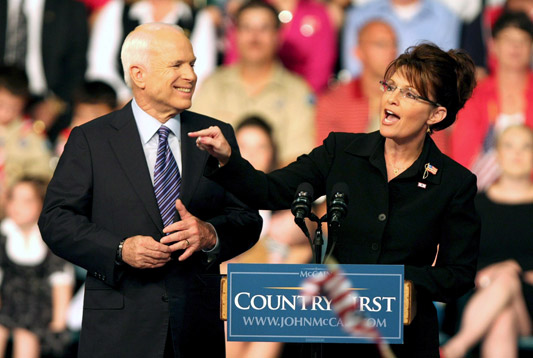
The news was so stunning I refused to believe it until I saw John McCain on the TV screen announcing his pick for Vice President. There’s no need to disparage Sarah Palin. She’s seems like a smart, serious person. But what the choice reveals about McCain is devastating with a capital D for Desperation.

Within forty-eight hours, all America will be talking about her. What people will say is, “You mean, if John McCain croaks, she becomes our president?” Gasp, yes. That is what McCain has decided. So much for “experience” and wise judgment as a campaign issue.

The Senator was widely thought to be on the fifty-yard line, nose to nose with Barack Obama. But this selection reveals the Republican campaign strategists knew better. Picking the obscure and under-experienced governor from Alaska for veep means McCain and his people recognize they are in a very weak position for the fall campaign. So weak they decided to throw a forty-year Hail Mary pass and hope audaciously for a lucky catch.

It won’t succeed. In fact, I expect this gambit is going to drive far more voters to Obama’s column than it does for McCain.

Choosing Palin kills the “experience” argument. Republicans must have recognized from their own market research that it wasn’t working for them. For two months or more, McCain and his handlers have smeared and slandered Obama, mocked his star quality talents, belittled his lack of tenure in Washington back rooms and accused him of unpatriotic egotism. Clearly, their internal polling told them this line of character attack wasn’t grabbing the public. Playing the wise old man was not going to be enough to overcome McCain’s other significant handicaps, his somewhat doddering style and memory lapses, his deadly embrace of right-wing cant and G.W. Bush.

So, what the hell, let’s take a wild shot and see what happens. The other veep possibilities are dull guys in good suits. Let’s go with the young gal from Alaska. She’s not only a woman–she’s a mother! You want history-making? We Republicans can do history-making.

Their internal logic was obvious, it was also pathetic. Putting a woman on the ticket is supposed to draw away those discontented Clinton voters in the Democratic party. Not going to happen, I think. First, that group has dwindled considerably in the last few days–thanks to Hillary Clinton’s straight-shooting endorsement of Obama and especially to Bill Clinton’s brilliant blessing. The former President went the full mile in defending Obama as ready to be President by reminding everyone that he too had been dogged for a youthful lack of experience. Any remaining bitterness among Clinton voters will not be salved by supporting a hardcore right-winger on feminist issues.

The early returns I am hearing from people suggest that McCain’s gambit may prove to be a home run (mixing my sports metaphors) for Obama. One young friend first heard the news from his mother who called to say, okay, she was switching to Obama. For months, she had rooted for Hillary and insisted Obama was too wet behind the ears. “You can stop arguing with your mother,” she said.

Palin’s previous political experience was as mayor in a town of 6,000. Did they mention this to John McCain? Or did he perhaps forget? Senator McCain says he has seasoned judgment, but he may have been over-cooked.

Source / The Nation

The Rag Blog

Posted in RagBlog | Tagged , , , , | Leave a comment

A Chance to Be Heard Above the Propaganda

Federal Reserve building

A Master-Slave Society: Democrats in Denver Should Skip One of Their Parties and Read the American Monetary Act
By Richard C. Cook / August 28, 2008

How are things going at the Democratic Party National Convention in Denver this week?

Are they talking about the fact that the Western world is run by an international financial elite headquartered in London, the financial capitals of mainland Europe (such as Frankfurt, Hamburg, Amsterdam, Paris, and Milan), and, of course, New York City?

Are they mentioning at their cocktail parties that the financial elite exert control over the world’s population through the cartels that make up the world’s producing economies and through the civilian and military bureaucracies who work for the governments that kow-tow to them?

Of course they know that the most important cartels are those which control energy resources. And that of these, the commodity of central importance is oil. But is any of this helping them draw conclusions regarding the doubling of oil prices during the last year or about the largest oil company profits in history?

Also, they should be drawing the right conclusions from the fact that every private and pubic enterprise operates on the basis of a money economy, though it would be more accurate to call it a credit economy. This means that whoever controls the issuance of money and credit controls the world. And the world’s monetary systems function on the basis of money and credit being introduced into circulation through loans from the banking system, loans for which interest is charged. So what should that tell them?

In fact, they should be pointing out to each other and their TV viewers that the charging of interest for the use of money is a chain around the neck of everyone on earth. Further, that these cumulative interest charges are built into the price of every product that is manufactured or consumed. And that growth of debt means price increases too.

They should be honest in making it clear that the world is a master-slave society, that the slaves are those who borrow and pay interest, that the masters are those who collect the interest, and that this unjust system has existed in one form or another for thousands of years.

The candidates and delegates are talking about the aspirations of the American people and how everyone should have an opportunity to achieve their dreams. But if the United States were a free nation, they would also be talking about a financial system that destroys people’s dreams.

Unfortunately, the highest rung the candidates and delegates have been able to reach on the ladder of modern-day slavery is the need for more jobs—but they fail to note that jobs are not only the means by which people live, but also the instruments for them to pay the heavy burden of interest the masters of finance require.

What they won’t say is that the world economy is based on usury, something religions used to consider a crime (and which Islam still does). Usury is the charging of interest for the use of money. As the religions backed off from their prohibitions of interest, usury became just excess interest. But that’s not what the word really means.

So what have over two centuries of usury done to the United States?

The best answer ever given to that question was contained in a paper entitled “Revisiting U.S. Public and Private Debt” published in January 2005 by Dr. Bob Blain, Emeritus Professor of Sociology at Southern Illinois University. The paper updated an earlier study by Dr. Blain published for the United Nations Educational, Scientific, and Cultural Organization (UNESCO) in the International Social Science Journal, November, 1987, Paris, pages 577-591.

In his paper, Dr. Blain examined the growth of total public and private debt in the U.S. Total debt includes “the debts of governments (federal, state, and local), corporations, farmers, home mortgages, and consumer, commercial, and financial debts.”

In his analysis, Dr. Blain began with data from the Bureau of Economic Analyses of the United States Department of Commerce which covered the years 1916-1976. After that year the Bureau stopped publishing the data.

The figures showed that from 1916-1976, total U.S. debt grew from $82 billion to $3,800 billion ($3.8 trillion). But most of that growth was during the last 21 years, from 1955-1976, when it began to grow exponentially. Dr. Blain wrote, “The consistency of the pattern suggests that some imperative is at work, something that requires debt to increase.”

Dr. Blain found the answer by researching American history. He wrote: “Then I read G.R. Taylor’s 1950 book, Hamilton and the National Debt, which described the debate over Alexander Hamilton’s plan to fund the new economy with borrowed money.” He continued:

“The most revealing account was a speech by the first congressman from Georgia, James Jackson, on February 9, 1790, in which he predicted that adoption of Hamilton’s funding plan would lead to the explosive growth of debt. Jackson said, ‘Though our present debt be but a few millions, in the course of a single century it may be multiplied to an extent we dare not think of.’” (Annals of Congress, Vol. I, February 1790, pp. 1141-2)

From the very beginning, the U.S. had a monetary system based on borrowing and debt. First came the thousands of state chartered banks that began operating late in the Revolutionary War period and continued in one form or another until today. Then there were the two early central banks: the First Bank of the United States (1791-1811) and the Second Bank of the United States (1816-1836). Today’s national banking system began during the Civil War with the National Banking Acts of 1863-64. Then there is the system we are living under today, the Federal Reserve, chartered by Congress in 1913. Even during the times when the government has sold its debt directly to the public, as with war bonds, savings bonds, and Treasury notes and bills, that too has been money borrowed at interest.

Although there have been times in history when money entered into circulation other than through debt, such as with coinage and the Civil War greenbacks, those were exceptions and today are of little importance.

Dr. Blain estimated that from the time Alexander Hamilton placed the U.S. under a debt-based monetary system until today, the debt has compounded at 5.8 percent annually. The big problem with this system, he said, was “that no money was created to pay interest.” He continued:

“Loans created only the principal. Interest had to be paid out of principal. So payment of interest reduced the money supply and slowed economic activity. Recovery could come only when new loans were taken out at least equal to interest paid.”

Dr. Blain concluded, “As long as the money supply of a nation is created as debt costing interest, debt must grow by compound interest.” From a longer-range view, it’s a system that is constantly collapsing and that must constantly be bailed out.

Dr. Blain next sought to update his figures past the 1976 data from the Bureau of Economic Analyses. Turning to the Federal Reserve’s series on “Total Credit Market Debt Outstanding,” he found remarkably similar indicators.

He found that adding data from the Federal Reserve from 1945 to 2003 showed the “debt explosion” continuing. In 1945 total debt was $463.4 billion. In 2003 it was $44,967.7 billion ($45.0 trillion). When he projected the debt level for 2010, he arrived at a figure of $74.9 trillion. By this time the debt curve was climbing so steeply there would be almost a doubling of the amount of total debt in only nine years.

It might be argued that these figures do not take into account inflation. This is because lending at interest is the cause of inflation. The dollars still have to be repaid with interest. The problem occurs when economic growth, measured by GDP, does not keep up.

Looking at the growth of GDP from 1945 to 2003, the increase was from $223.1 billion to $10,987.9 billion, a factor of 49. But the debt ($463.4 billion vs. $44,967.7 billion) grew by a factor of 97, almost twice the rate of GDP growth. Thus the total debt burden on the economy has doubled from a ratio of 2:1 to more than 4:1 (though it was much less than that during the early days of the nation).

But with continued compound growth of debt and a slow- or no-growth state of the economy as we head into a recession, we are starting to see what Dr. Blain called an “acceleration to meltdown.” He wrote:

“We are buying more and more in the same amount of time. Witness the efforts of people to get rid of their excess through yard sales, storage units, and big trash pickup days, and the massive size of what are euphemistically called landfills. While two billion people in the world lack basics such as clean water, food, and shelter, Americans throw away their microwave ovens, televisions, computers, refrigerators, furniture, and cars. Meanwhile, acceleration is applauded as increasing productivity. It’s like arguing that cancer is good because it grows.”

These are the things the Democrats in Denver should be talking about, instead of going to so many parties. They should be making note that the U.S., to quote economists close to the Federal Reserve, is “functionally bankrupt.”

In fact, the debt this nation owes to the banks, to foreign creditors, and to each other can never be paid off. Further, one big reason for all of our fruitless military endeavors overseas may simply be to escape unpleasant economic realities at home. But this is pointless. Nothing creates more debt than war, as the bankers have always known.

The only solution is to adopt a monetary system that is not based on debt. Dr. Blain makes a couple of specific recommendations: 1) “Stop using percentage rates to calculate charges for the use of money”; and 2) “Congress must supply the economy with a money base that is debt-free and interest-free.”

The second point is a call for a new monetary system, not one based solely on lending by the banks or on government borrowing. One organization that has developed a blueprint for such a system is the American Monetary Institute (AMI), headquartered in Chicago. The director of the AMI is Stephen Zarlenga, author of a massive, groundbreaking work: The Lost Science of Money (AMI, 2002). Zarlenga’s assistant is Jamie Walton, a monetary reformer from New Zealand.

AMI will be holding its fourth annual conference in Chicago on September 25-28. Expected as keynote speaker is Congressman Dennis Kucinich, whose wife Elizabeth once worked as an intern at AMI. Dr. Bob Blain will be a featured speaker.

On the AMI website at www.monetary.org is a remarkable document, the American Monetary Act. The product of several years of work by Zarlenga and his network, which now includes a number of local chapters around the country, the American Monetary Act would replace today’s debt-based monetary system with one where the government spends or loans money directly into circulation.

Under the Act, the Federal Reserve would be retained as a national financial clearinghouse but would no longer be a bank of issue. The system would be overseen by a Monetary Control Board within the U.S. Treasury Department. The Act also includes a provision for a citizens’ dividend, similar in some respects to the Alaska Permanent Fund, which would inject desperately needed purchasing power into the economy without additional government debt or taxation.

Also promoting a citizens’ dividend, by the way, is Stephen Shafarman in his important new book, Peaceful, Positive Revolution. (Tendril Press, 2008)

It’s the American Monetary Act the candidates and delegates in Denver should skip one of their parties to read, because it’s the only way any of their hopes for America can ever be realized. Says AMI’s Jamie Walton:

“This is a crucial time. Things are happening. We have got some key media people talking and writing about our kind of reforms. The inertia is starting to yield. Things are starting to roll. The worsening conditions in 2009 will give us a once-in-a-lifetime chance to be heard above the propaganda.”

Copyright 2008 by Richard C. Cook

Richard C. Cook is a former U.S. federal government analyst, whose career included service with the U.S. Civil Service Commission, the Food and Drug Administration, the Carter White House, NASA, and the U.S. Treasury Department. He is a contributor to the American Monetary Act. His articles on economics, politics, and space policy have appeared in numerous websites and print magazines. His book on monetary reform, entitled We Hold These Truths: The Hope of Monetary Reform, will soon be published by Tendril Press. He is the author of Challenger Revealed: An Insider’s Account of How the Reagan Administration Caused the Greatest Tragedy of the Space Age, called by one reviewer, “the most important spaceflight book of the last twenty years.” His website is www.richardccook.com. Comments or requests to be added to his mailing list may be sent to WhiteLightPress@gmail.com.

Source / Information Clearing House

The Rag Blog

Posted in RagBlog | Tagged , , | Leave a comment

US Presidential Politics: Really Only for Comedians


A “Papa and Daughter” Ticket?
By Diane Stirling-Stevens / The Rag Blog / August 29, 2008

I was delighted to find someone has already put my opinion of McCain’s pick (and reason for it) into a picture! McCain dumped his first wife for Cindy; claims she has a pre-nuptial (and owns most or all of the homes they have), and has riden on her skirt. Now he intends to ride on the skirt of a young woman; a ‘papa and daughter’ ticket?

If you take Palin’s experience and educational history; use that ‘resume’ as a guideline, and handed it to a ‘guy’ – telling him, ‘…hey, give this to McCain, and he’ll pick you for his running mate’, don’t you think he’d laugh himself to tears? Don’t you think he’d tell you to have your head examined? Then again, as I write this, maybe it’s McCain who likes having his ‘head’ examined (I know – bad taste on my part; no pun intended of course).

In any case, I hope Oprah jumps on this ridiculous decision; I hope she reminds all of us women, that it’s an insult to our intelligence, and Palin is nothing more than a token female who’ll get McCain what he wants. I’m sickened by this man; the one and only time I met him over 20 years ago, I couldn’t stand his smile; the way he ‘lusted’ after every single woman at the gathering I went to in California!

In any case, this is my personal rant and opinion, but I think whoever the artist was who promptly got this picture completed in record time, has said it perfectly!

Worse Than Quayle
by Trapper John / August 29, 2008

So it’s official – John McCain has thrown a Hail Mary and tapped Alaska Governor Sarah Palin as his running mate. The trad med types are ga-ga about what a game-changing choice Palin is. And they’re right. It is a game-changer. The Palin pick takes a race already leaning toward Obama and pushes it further into his corner.

Why? Because Sarah Palin is the most unqualified VP nominee in modern history, with the possible exception of Admiral Stockdale.

She’s worse than Quayle.

After his selection in 1988, Dan Quayle was rightly lambasted as a dim, inexperienced lightweight with no real pertinent experience who was named by George H. W. Bush as a gimmick – a case of an old, out-of touch candidate trying to appear relevant by teaming up with a much younger pol. Now, Palin’s not Quayle – by all accounts, she’s quite bright. But she’s fantastically inexperienced, far more so than Quayle was when he was tapped. And she possesses an attribute far worse than Quayle’s stupidity – she’s a big corrupt wheel in Alaska’s big corrupt Republican Party, arguably the most corrupt political apparatus in the United States.

We’re told that McCain really wanted to pick his old friend Joe Lieberman to run with him, but that Karl Rove and the rest of the elite Republican politburo nixed the idea, and told McCain that he had to take a conservative. And as he has at every step of his campaign, the one-time “maverick” sold out to the venal, icy core of the Republican leadership, and acquiesced by selecting Palin. Palin is really a Republican after Rove’s heart – she’s a product of the party that produced the indicted Ted Stevens and ethically tarred Don Young, and she’s embroiled in a Troopergate scandal of her own, with state investigators looking at serious allegations that Palin abused her office by pressuring the state Public Safety Commissioner to fire “an Alaska state trooper involved in a rough divorce from Palin’s sister.” Sounds like a woman after Karl Rove’s heart.

In addition to further associating McCain with the Republican culture of corruption, the Palin pick undermines one of his main anti-Obama narratives. It’s going to be laughable to hear McCain assail Obama’s supposed lack of experience after naming the first-term governor — only one-and-a-half years into her term — of the 47th largest state to be his running mate. Palin lacks any foreign policy experience, and is bereft of even the two core areas of policy expertise that governors are supposed to bring to a ticket — ag policy (Alaska doesn’t have much in the way of traditional agriculture) and urban affairs (Anchorage is the 65th largest city in the US, behind giants such as Corpus Christi). She’s easily the least experienced running mate in recent memory, which is pretty scary, given McCain’s age and his history of cancer.

By picking Palin, McCain revealed his desperation to make a splash to rival the genuine excitement generated by the Obama campaign. But desperation leads to poor decisions — and McCain’s Hail Mary, like most last second desperation moves, is destined to fail miserably. He’s smeared himself with the pungent mud of Alaska Republican corruption, while cutting the legs out from one of his most reliable attacks against Obama. And he’s presented Americans with the prospect of electing a dangerous neophyte to be a heartbeat away from the presidency, behind a man whose life expectancy is less than two presidential terms.

We all expected McCain to pick someone underwhelming to run with him. But we never could have expected a pick worse than Quayle. Yet that’s what we got. Thanks, John!

(And for those who are certain to point out that Bush-Quayle won in ’88 — do you really think that Barack Obama is remotely close to Michael Dukakis in political skill? No? Didn’t think so.)

Source / Daily Kos

The Rag Blog

Posted in RagBlog | Tagged , | 1 Comment

UN Ambassador Wolff: Just Making Sure We All Understood the Hypocrisy

Alejandro Wolff, trained all-American hypocrite

Russia and U.S trade barbs over Iraq
By Louis Charbonneau / August 28, 2008

UNITED NATIONS — U.S. and Russian envoys exchanged sharp words on Thursday over Iraq and Kosovo at a U.N. Security Council meeting on Georgia, at which Russia found little support for its actions in the Caucasus.

It was the council’s sixth emergency session on the crisis in the former Soviet republic, which Russia invaded earlier this month to thwart an attempt by Tbilisi to restore its control over a breakaway region.

Like the five previous council meetings on the brief war this month between Russia and Georgia, the 15-nation body passed no resolution or statement due to Russia’s veto powers.

The meeting was characterized by Cold War-style exchanges of insults between the U.S. and Russian U.N. ambassadors that reflected the growing tensions between the two countries.

U.S. Deputy Ambassador Alejandro Wolff told the meeting it was a violation of the U.N. charter for member states to use force against others, or threaten to use it, and suggested that Moscow’s claims to be protecting Russian citizens in Georgia’s South Ossetia region were a sham.

Russia’s U.N. envoy, Vitaly Churkin, suggested Wolff’s statement was hypocritical and referred to the U.S.-led March 2003 invasion of Iraq, which Moscow strongly opposed.

“I would like to ask the distinguished representative of the United States — weapons of mass destruction. Have you found them yet in Iraq or are you still looking for them?”

The United States justified the invasion of Iraq by saying it had to find and secure what it said were caches of nuclear, chemical and biological weapons hidden by then-President Saddam Hussein. The weapons were never found.

Wolff accused Churkin of making false comparisons. “I’m not a psychologist and I don’t know what brought on the free association we heard from Ambassador Churkin,” he said.

“There were divisions on the Iraq war,” he said. “Those are well known. We thought we had overcome them. Apparently there are still some lingering frustrations. But there is no territorial ambition or desire to dismember Iraq.”

‘JUST LIKE KOSOVO’

Churkin also cited NATO’s 1999 bombing campaign against Serbia to force it to withdraw from its Kosovo region. He likened the declaration of independence by South Ossetia and another Georgian separatist enclave, Abkhazia, to Kosovo’s Western-backed secession from Serbia in February 2008.

British Ambassador John Sawers rejected the comparison, saying, “I’m afraid this assertion, Ambassador Churkin, simply does not stand up to scrutiny.”

Sawers said NATO’s 1999 military intervention in Kosovo was multilateral, was intended to prevent an impending humanitarian crisis and took place after all peaceful avenues had been exhausted. He added that Kosovo’s declaration of independence followed nine years of U.N. administration.

The Security Council has so far refused to accept a request from envoys of South Ossetia and Abkhazia, which Russia recognized this week as independent states, to address it.

Only South African Ambassador Dumisani Kumalo supported Russia on the issue of inviting the separatist envoys, who have applied for U.S. visas in Moscow using Russian passports, to speak before the council.

The Chinese delegation, Russia’s traditional ally on the council, did not speak, which Western diplomats said was a defeat for Russia and proved that Moscow enjoyed virtually no support on the council.

Source / Yahoo News

The Rag Blog

Posted in RagBlog | Tagged , , | Leave a comment

Because the Empire Is Never, Ever Wrong

Jose Nazario (right) with lawyers

Ex-Marine Acquitted in Killing of Iraqis
By Chelsea J. Carter / August 29, 2008

RIVERSIDE, Calif. — Jurors wept and embraced former Marine Jose Luis Nazario Jr. after acquitting him of voluntary manslaughter in the killings of unarmed Iraqi detainees during a fierce 2004 battle.

Tears rolled down Nazario’s cheeks and courtroom spectators openly sobbed and cheered Thursday. He is the first U.S. veteran tried by a civilian court for alleged actions in combat.

“It’s been a long, hard year for my family,” Nazario said outside the courtroom. “I need a moment to catch my breath and try to get my life back together.”

Jurors took less than six hours over two days to find the former sergeant not guilty of charges that he killed or caused others to kill four detainees in Fallujah, Iraq, on Nov. 9, 2004. The detainees were shot during a battle — marked by house-to-house fighting — that was considered one of the fiercest of the Iraq war.

Nazario had been charged with voluntary manslaughter, assault with a deadly weapon and discharging a firearm during a crime of violence. He could have faced more than 10 years in prison if found guilty.

Prosecutors had urged the jury to convict Nazario, saying he violated his duty as a Marine and must be held accountable for his actions in Fallujah.

Juror Ted Grinell said the panel acquitted Nazario because no witnesses testified to actually seeing the shootings and there was “not enough evidence to point that he was guilty.”

Jury forewoman Ingrid Wicken said the panel was not making a statement with its verdict, but added: “I think you don’t know what goes on in combat until you are in combat.”

Minutes after the verdict was read, jurors shook hands with and hugged Nazario and his sobbing mother, Sandra Montanez.

Nazario’s attorney, Kevin McDermott, said he believes the verdict will curb similar federal prosecutions in the future.

Read the rest of it here. / America On Line

The Rag Blog

Posted in RagBlog | Tagged , , | 1 Comment

Jack Abramoff Has Been Singin’ the Blues

Frankly, I cannot agree with the suggestion that this weasel deserves leniency, but I’m a hard-nosed radical bastard. We can perhaps remain hopeful that his ‘singing’ will result in a few other deserving crooks professional colleagues also doing a little hard time.

Richard Jehn / The Rag Blog


Abramoff’s Cooperation Brings Call for Leniency
By James V. Grimaldi / August 28, 2008

Since his conviction on fraud and conspiracy charges, former lobbyist Jack Abramoff has spent more than 3,000 hours helping more than 100 law enforcement agents in an ongoing federal corruption probe that has implicated “scores of other persons not yet charged,” lawyers said in court filings yesterday.

The extent of Abramoff’s cooperation was described in documents from prosecutors and defense attorneys. They are seeking leniency from the judges who heard the two cases that landed the Republican influence broker in federal prison in Cumberland, Md.

If a federal judge in Washington accepts the recommendation from the Justice Department, Abramoff would serve no more than an additional three years and three months in prison, not accounting for credit for good behavior awarded by the Federal Bureau of Prisons. Abramoff’s attorneys are seeking more leniency, which could have him released from prison by 2010.

In November 2006, Abramoff began serving a sentence of five years and 10 months for fraud in his purchase of a Florida casino cruise line. The Justice Department is seeking a reduction to three years and nine months. Abramoff’s sentencing in a parallel case of tax evasion, fraud and conspiracy to ply public officials with gifts in exchange for official actions was delayed until he had mostly completed his cooperation. The sentencing is set for Sept. 4 before U.S. District Judge Ellen Huvelle.

In the public-corruption case, the Justice Department is asking Huvelle to sentence Abramoff to five years and four months rather than the maximum 11 years and three months he could receive. The sentences in the two cases would be served concurrently. The government also is seeking about $23 million in restitution.

Abramoff attorneys Abbe D. Lowell of Washington and Neal R. Sonnett of Miami noted in a memorandum that in addition to the meeting with FBI and other agents, Abramoff had reviewed more than a half-million documents.

They also noted that Abramoff has helped convict more than a dozen people, in addition to admitting guilt himself, and that his case has prompted reforms that the lawyers said are known as “Abramoff Ethics Rules.” Among those who have pleaded guilty are former congressman Robert W. Ney (R-Ohio), who was released this month after he completed his prison sentence, and J. Steven Griles, former deputy secretary of the interior.

The court papers indicate an extensive ongoing probe by referencing a document that is sealed because it contains grand jury information. Former House majority leader Tom DeLay (R-Tex.) and retiring Rep. John T. Doolittle (R-Calif.), among others, are still under investigation.

One new scheme revealed involves Abramoff and his team of K Street lobbyists padding their billing records — not to cheat clients, most of whom had hired them on retainer — but to bilk additional bonuses out of their firm, Greenberg Traurig, because “padded hours possibly resulted in higher bonuses,” according to a brief signed by William M. Welch II, head of the Justice Department’s public integrity section, and prosecutor Mary Butler.

Abramoff’s attorneys also cited a statement by Noel Hillman, the former chief of the public integrity office and now a federal judge in New Jersey. Hillman said that Mr. Abramoff’s decision to plead guilty and expose the wrongs he and others did was a ‘watershed’ event in addressing public corruption.”

Source / Washington Post

h/t Bad Attitudes / The Rag Blog

Posted in RagBlog | Tagged , , | Leave a comment