When I Covered My First Democratic Convention: Chicago 1968

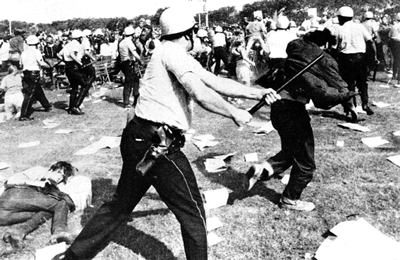
Chicago cops brutally attack demonstrators (and journalists, and bystanders) outside Democratic Convention, 1968.

‘It culminated in the crushing of Sen. Eugene McCarthy’s anti-Vietnam crusade inside the convention hall and the cracking of peacenik skulls by Mayor Richard Daley’s police in the streets’
By Greg Mitchell / August 21, 2008

NEW YORK — With the 2008 Democratic national convention about to begin in Denver, I can’t help recalling the first DNC that I covered in 1968, exactly 40 years ago next week. Yes, it was the infamous gathering in Chicago, when the conflict turned bloody. I never made it inside the convention hall — but I did grab a front row seat for what “went down,” as we used to say.

It culminated in the crushing of Sen. Eugene McCarthy’s anti-Vietnam crusade inside the convention hall and the cracking of peacenik skulls by Mayor Richard Daley’s police in the streets. Together, this doomed Hubert Humphrey to defeat in November at the hands of my old hero, Richard Nixon.

I’ve been a political-campaign junkie all my life. At the age of 8, I paraded in front of my boyhood home in Niagara Falls, N.Y., waving an “I Like Ike” sign. Four years later, in 1960, I represented Nixon in a 7th grade debate, and when the votes were counted, Kennedy had carried the class by about 20-2. Traumatized, I’ve never publicly endorsed a candidate since. But in 1968 I got to cover my first presidential campaign when one of Sen. McCarthy’s nephews came to town, before the state primary, and I interviewed him for the Niagara Falls Gazette, where I worked as a summer reporter during college.

My mentor at the Gazette was a young, irreverent City Hall reporter named John Hanchette. He went on to an illustrious career at other papers, and as a Pulitzer Prize-winning national correspondent for Gannett News Service, but back then he was best known for his weekly column. It featured a comic creation known as “Falls Street Louie,” who had all the inside dirt on the local politicos.

Hanchette was in Chicago that week to cover party politics as a Gazette reporter and contributor to the Gannett News Service (GNS). I was to hang out with the young McCarthyites and the anti-war protestors. To get to Chicago I took my first ride on a jetliner.

To make a long story short: On the climactic night of Aug. 28, 1968, Hanchette and I ended up just floors apart in the same building: the Conrad Hilton Hotel in downtown Chicago. I was in McCarthy headquarters and Hanchette was in one of Gannett’s makeshift newsrooms. Probably at about the same time, we pulled back the curtains and looked out our separate windows to see police savagely attacking protestors with nightsticks at the intersection directly below.

Besides writing his own stories, Hanchette was expected to “run” copy from columnist Dave Beetle to GNS at the convention hall. Also on hand in that room was the GNS fashion writer, who was composing a piece on Muriel Humphrey’s wardrobe. After spotting the carnage in the streets, Hanchette recalls asking Beetle to come to the window for a look. The older reporter didn’t seem that impressed until tear gas started seeping into the room through the vents. Then Beetle said, “Hmm, this may be serious.”

Like me, Hanchette headed for the streets. By that time, the peak violence had passed, but cops were still pushing reporters and other innocent bystanders through plate glass windows at the front of the hotel.

While I screwed up my courage and crossed to Grant Park where the angry protest crowd gathered, Hanchette hailed a gypsy cab and headed for the convention hall out by the stockyards. When he got to the Gannett tent he told GNS honcho John C. Quinn what he had seen and suggested that the bad-cop angle should lead the wire report. Quinn was not always confident about the young Hanchette’s news judgment, based on his earlier suggestion that an interview with Allen Ginsberg (or the Yippies nominating Pigasus the Pig for president) should play prominently on the GNS wire.

But dramatic film footage of what would later be labeled a “police riot” had just hit network TV, so Quinn went with it.

When we returned to Niagara Falls that Friday, we each wrote columns for that Sunday’s paper. I described the eerie feeling of sitting in Grant Park, with machine guns on Army Jeeps pointed at the crowd, and thousands around me yelling at the soldiers and the media, “The whole world is watching!” — and knowing that, for once, it was true.

Regretfully, Hanchette told his readers that Falls Street Louie would not be filing a report. Hanchette had sent him home early. Mayor Daley’s Chicago was just a little too dangerous for Louie.

More than 35 years later, after I had written two books on other infamous political campaigns, I returned to Chicago for a staged performance of a musical based on one of them. As I got out of a cab to make my way to the theater, I had an eerie feeling and, sure enough, looking up the street I noticed Grant Park a block away– and the very intersection in front of the Hilton where skulls were cracked that night in 1968.

Greg Mitchell is editor of Editor and Publisher. Among his nine books are: “The Campaign of the Century” (about Upton Sinclair’s race for governor of California in 1934) and “Tricky Dick and the Pink Lady” (the Nixon-Douglas contest in 1950). His latest book on Iraq and the media is “So Wrong for So Long.”

Source / Editor and Publisher

The Rag Blog

Posted in RagBlog | Tagged , , , , , | Leave a comment

Now, We Seem to Have Lost the Dots


Flaws Found In Watch List For Terrorists
By Siobhan Gorman / August 22, 2008

The government’s main terrorist-watch-list system is hobbled by technology challenges, and the $500 million program designed to upgrade it is on the verge of collapse, according to a preliminary congressional investigation.

The database, which includes an estimated 400,000 people and as many as 1 million names, has been criticized for flagging ordinary Americans. Now, the congressional report finds that the system has problems identifying true potential terrorists, as well.

Additional Resources
• Read highly technical internal documents identifying problems with the watch list systems. Document 1 Document 2
Read a government fact sheet of the current TIDE database.
Read the letter from Rep. Brad Miller to Director of National Intelligence Inspector General Edward Maguire.
Read the Subcommittee staff memo explaining the findings of their review of the watch list programs.

Among the flaws in the database, which was quickly built by Lockheed Martin Corp. in the wake of the Sept. 11, 2001, terrorist attacks, is its inability to do key-word searches. Instead, an analyst needs to rely on an indexing system to query the database, according to congressional investigators who learned of the issues from a whistleblower. Lockheed spokesman Tom Jurkowsky said he could not comment on a report he had not read.

Meanwhile, tens of thousands of “potentially vital” messages from the Central Intelligence Agency have not been included in the database, known as the Terrorist Identities Datamart Environment, or TIDE, congressional investigators found.

The system provides data to all federal-government terrorist watch lists, including the “no-fly” list maintained by the Transportation Security Administration and the Terrorist Screening Center, a clearinghouse for federal, state and local officials.

Thursday, lawmakers called on the inspector general who oversees the office of Director of National Intelligence Mike McConnell to investigate the problems. The database “may have left us less able to connect the dots than we were before,” Rep. Brad Miller (D., N.C.) said in an interview. “Now, we seem to have lost the dots.” The database’s search engine, he added, “is blindfolded.”

Rep. Miller, chairman of the House Science and Technology subcommittee that conducted the investigation, wrote to Inspector General Edward Maguire on Wednesday to ask him to look into the programs. The current system “has been crippled by technical flaws” and the system designed to replace it, dubbed Railhead, “if actually deployed, will leave our country more vulnerable than the existing yet flawed system today,” Rep. Miller wrote.

Mr. McConnell’s spokesman, Ross Feinstein, said his office has not seen the letter and would not comment. Lawmakers did not discuss their findings with Mr. McConnell or his staff prior to requesting the inspector-general investigation.

When tested, the new system failed to find matches for terrorist-suspect names that were spelled slightly different from the name entered into the system, a common challenge when translating names from Arabic to English. It also could not perform basic searches of multiple words connected with terms such as “and” and “or.”

Because the format of the data in the current database is “complex, undocumented, and brittle,” some significant data will be lost when the system is replaced by Railhead, according to the congressional report. For example, scraps of information such as phone and credit-card numbers found when law-enforcement and intelligence officials empty a suspect’s pocket, often called “pocket litter,” will not be moved to the new system.

Railhead was supposed to be completed by year’s end but has been delayed. Nearly half of the 72 so-called “action items” for the program were delayed as of June, congressional investigators found.

In recent weeks, the government has fired most of the 862 private contractors from dozens of companies working on the Railhead project, and only a skeleton crew remains, one congressional aide said. The two leading contractors on the program are Boeing Co. and SRI International. Calls to officials of Boeing and SRI were not immediately returned.

The congressional aide said the subcommittee found evidence of warring between the two contractors, which significantly hampered progress.

August Cole contributed to this article. Write to Siobhan Gorman at siobhan.gorman@wsj.com.

Source / The Wall Street Journal

The Rag Blog

Posted in RagBlog | Tagged , , | 1 Comment

Jonathan Franzen : ‘I Just Called to Say I Love You’

Skull-with-cell-phone by Spazmat in downtown New York City. Photo by Ivan Corsa. /Global Graphica

Cell phones, sentimentality, and the decline of public space.
By Jonathan Franzen

This article appears in full in the September/October 2008 issue of Technology Review.

One of the great irritations of modern technology is that when some new development has made my life palpably worse and is continuing to find new and different ways to bedevil it, I’m still allowed to complain for only a year or two before the peddlers of coolness start telling me to get over it already Grampaw–this is just the way life is now.

I’m not opposed to technological developments. Digital voice mail and caller ID, which together destroyed the tyranny of the ringing telephone, seem to me two of the truly great inventions of the late 20th century. And how I love my BlackBerry, which lets me deal with lengthy, unwelcome e-mails in a few breathless telegraphic lines for which the recipient is nevertheless obliged to feel grateful, because I did it with my thumbs. And my noise-canceling headphones, on which I can blast frequency-shifted white noise (“pink noise”) that drowns out even the most determined woofing of a neighbor’s television set: I love them. And the whole wonderful world of DVD technology and high-definition screens, which have already spared me from so many sticky theater floors, so many rudely whispering cinema-goers, so many open-mouthed crunchers of popcorn: yes.

Privacy, to me, is not about keeping my personal life hidden from other people. It’s about sparing me from the intrusion of other people’s personal lives. And so, although my very favorite gadgets are actively privacy enhancing, I look kindly on pretty much any development that doesn’t force me to interact with it. If you choose to spend an hour every day tinkering with your Facebook profile, or if you don’t see any difference between reading Jane Austen on a Kindle and reading her on a printed page, or if you think Grand Theft Auto IV is the greatest Gesamtkunstwerk since Wagner, I’m very happy for you, as long as you keep it to yourself.

The developments I have a problem with are the insults that keep on insulting, the injuries of yesteryear that keep on giving pain. Airport TV, for example: it seems to be actively watched by about one traveler in ten (unless there’s football on) while creating an active nuisance for the other nine. Year after year; in airport after airport; a small but apparently permanent diminution in the quality of the average traveler’s life. Or, another example, the planned obsolescence of great software and its replacement by bad software. I’m still unable to accept that the best word-processing program ever written, WordPerfect 5.0 for DOS, won’t even run on any computer I can buy now. Oh, sure, in theory you can still run it in Windows’ little DOS-emulating window, but the tininess and graphical crudeness of that emulator are like a deliberate insult on Microsoft’s part to those of us who would prefer not to use a feature-heavy behemoth. WordPerfect 5.0 was hopelessly primitive for desktop publishing but unsurpassable for writers who wanted only to write. Elegant, bug-free, negligible in size, it was bludgeoned out of existence by the obese, intrusive, monopolistic, crash-prone Word. If I hadn’t been collecting old 386s and 486s in my office closet, I wouldn’t be able to use WordPerfect at all by now. And already I’m down to my last old 486. And yet people have the nerve to be annoyed with me if I won’t send them texts in a format intelligible to all-powerful Word. We live in a Word world now, Grampaw. Time to take your GOI pill.

But these are mere annoyances. The technological development that has done lasting harm of real social significance–the development that, despite the continuing harm it does, you risk ridicule if you publicly complain about today–is the cell phone.

Just 10 years ago, New York City (where I live) still abounded with collectively maintained public spaces in which citizens demonstrated respect for their community by not inflicting their banal bedroom lives on it. The world 10 years ago was not yet fully conquered by yak. It was still possible to see the use of Nokias as an ostentation or an affectation of the affluent. Or, more generously, as an affliction or a disability or a crutch. There was unfolding, after all, in New York in the late 1990s, a seamless citywide transition from nicotine culture to cellular culture. One day the lump in the shirt pocket was Marlboros, the next day it was Motorola. One day the vulnerably unaccompanied pretty girl was occupying her hands and mouth and attention with a cigarette, the next day she was occupying them with a very important conversation with a person who wasn’t you. One day a crowd gathered around the first kid on the playground with a pack of Kools, the next day around the first kid with a color screen. One day travelers were clicking lighters the second they were off an airplane, the next day they were speed-dialing. Pack-a-day habits became hundred-dollar monthly Verizon bills. Smoke pollution became sonic pollution. Although the irritant changed overnight, the suffering of a self-restrained majority at the hands of a compulsive minority, in restaurants and airports and other public spaces, remained eerily constant. Back in 1998, not long after I’d quit cigarettes, I would sit on the subway and watch other riders nervously folding and unfolding phones, or nibbling on the teatlike antennae that all the phones then had, or just quietly clutching their devices like a mother’s hand, and I would feel something close to sorry for them. It still seemed to me an open question how far the trend would go: whether New York truly wanted to become a city of phone addicts sleepwalking down the sidewalks in icky little clouds of private life, or whether the notion of a more restrained public self might somehow prevail.

Read all of this article here. / Technology Review

Thanks to Carlos Lowry / The Rag Blog

Posted in RagBlog | Tagged , , , | 1 Comment

Free Gaza: Making a World We Want to Live In


Gaza mission set to leave today
By Stefanos Evripidou / August 22, 2008

THE TWO boats set to challenge Israel’s tight control over the Gaza Strip are finally due to leave Cyprus this morning.

After days of waiting, the 40-plus international peace activists gathered their things and loaded the 21-metre SS Free Gaza and 18-metre SS Liberty docked at Larnaca port in preparation for today’s voyage.

Their hope is to reach Gaza’s shore uninterrupted by tomorrow and open a channel of communication for the 1.4 million Palestinians living there. Movement of goods and people has been strictly restricted by the Israeli authorities since Hamas took over government last year.

Human rights organisations say the situation is close to a “humanitarian catastrophe” with access to medical supplies limited, while day to day trade and aid remains bottlenecked at Gaza borders. The all-round restrictions leave even Fulbright scholars stranded in Gaza, unable to get back to their studies in the US.

Members of the Free Gaza Movement, including Palestinians and Israelis, are well aware that the chances of reaching Gaza are slim. Israel has insisted on its right to control everything that comes in and out of Gaza, including two boats carrying hearing aids for children affected by the sonic boom of Israeli planes and 5,000 balloons.

According to a Greek member of the group, Israel is claiming control over 36 nautical miles of water from Gaza’s shore, as opposed to the international standards of six or 12, because of military manoeuvres underway.

“Greek boats have been sailing these Mediterranean waters for three to four thousand years. How is it possible for Israel to act like the police and say who can enter the sea and who can’t… and then say it wants peaceful co-existence with the Mediterranean people,” said Vangelis Pisias.

Another Greek national, Petros Yiotis, said the mission was to reach Gaza and tell the world that “the Palestinians who are imprisoned in this huge open prison have the same human rights as people the world over. They have the right to use their sea freely, like the rest of the Mediterranean people”.

One of the main organisers, Paul Larudee, said the trip was not about humanitarian aid, but “about the right of Palestinians to live freely, as freely as Israelis, Cypriots, Greeks and Americans”.

“We can all use a little freedom but no one more than the Palestinians,” he added.

The mission’s medical officer, Dr Bill Dienst, said he was preparing for the worst and hoping for the best.

“I’m an emergency room physician from a small town, so I’m pretty good at what you call ‘wilderness medicine’,” said Dienst.

The doctor first went to Gaza in 1983. “There were no walls back then, it was easy to go back and forth. Palestinians were used as cheap labour back then. There was oppression but it wasn’t a lockdown like today.”

He last went two years ago. “Every time I go back I say, ‘this is horrible, things couldn’t get worse than this’ but they do.”

The captain of the SS Free Gaza, John Klusmire from California, only arrived on the island five days ago, just weeks after having surgery on a broken foot. Limping with his foot in a cast, the captain said there were many important reasons for getting to Gaza, even though he didn’t originally intend on going himself.

“They needed a captain, so I came. I only checked out the boat today, she’s a beauty,” he said.

THOMAS Nelson, a 64-year-old attorney from Oregon, says there are international and US lawyers ready to respond if the Israelis take the boats while in Gazan waters and arrest those on board.

“If they pull us in, there’s an argument for kidnapping. We’ve got both US and international lawyers, academics, theoreticians ready to get involved.

“When you are not violating international law and someone drags you against your will somewhere else, that’s kidnapping,” he said.

Nelson said there were two routes to take: one, against Israel itself in the International Court of Justice, or two, by looking at the personal liability of the Israeli navy commanders through a growing area of law called “universal jurisdiction”.

“The Israelis claim they have rights over Gazan territorial waters from the Oslo Accords, but they don’t. They only have the right to patrol the waters for security reasons, and it’s already been acknowledged we are not a security threat. That’s very clear,” said Nelson, one of the many retired or ready for retirement members of the group.

The Israeli Foreign Ministry has written to the organisers saying that if they insist on sailing to Gaza they will be seen as supporting a terrorist organisation.

“We have nothing to do with Hamas. We are going to a population that’s imprisoned. This is what states do, they try to scare people by telling them they’re helping terrorism. Like in the 1950s when everyone was seen as a communist threat,” said Nelson.

FOR HUWAIDA Arraf, a Palestinian with Israeli citizenship, the reasons for making the symbolic voyage to Gaza are much closer to home.

“As an Israeli citizen, I can’t go to Gaza to see friends, and they can’t come to see us,” she said.

“As a Palestinian, for too long Israel has tried to make us feel powerless. I’m part of a new generation of Palestinians who refuses to accept our predicament. We are trying to organise ourselves, to connect with each other despite the difficulties of being scattered all over the world with various travel restrictions.

“And as a human being, I’m appalled by what’s happening and horrified that governments, world leaders and institutions established to uphold people’s dignity and human rights are not doing anything about what Israel is doing to Palestine.”

Arraf said when governments and institutions fail to act, it’s up to the people to do so.

“We Palestinians have the power to mobilise, to make change. We deserve the freedom to live with dignity, and won’t rest until that happens.

“People of the world are not powerless to make a world they want to live in. Not one where people are punished, starved and humiliated because they are of a certain race, religion or ethnicity,” said Arraf.

Copyright © Cyprus Mail 2008

Source / Cyprus Mail

Thanks to Alan Pogue / The Rag Blog

Posted in RagBlog | Tagged , , | Leave a comment

All These Methods Were First Tested in Laos

A view of Long Chen. The most secret location in ‘the secret war’ against Laos was the former CIA air base of Long Chen, a place that remains off limits even today.

LAOS: Film Reveals CIA’s ‘Most Secret Place on Earth’
By Andrew Nette / August 22, 2008

PHNOM PENH – – It was known as the ‘secret war’, a covert operation waged by the U.S. Central Intelligence Agency (CIA) throughout the sixties and early seventies against communist guerrillas in Laos.

And the most secret location in this clandestine war was the former CIA air base of Long Chen, in central Laos, a place that remains off limits even today.

A new film, ‘The Most Secret Place on Earth’, to be released in cinemas across Europe later this year, explores this little known conflict.

The film, which previewed for the first time in Phnom Penh in mid-August, includes images of Long Chen shot by the first Western camera crew to enter the base since the communists took control of the country in 1975.

“I first got the idea to do the film when I visited the Plain of Jars in Laos in 2002,” recalled Marc Eberle,36, the German director in an interview with IPS.

“You could still see the craters from the air bombing and unexploded ordnance was everywhere.”

“Then I heard about Long Chen and the fact that no one had got there since the war and I thought, how do I visit and how do I make a film about it?”

Little is known about the Lao conflict despite the fact that it remains the largest and most expensive paramilitary operation ever run by the U.S.

It was completely run by the CIA using largely civilian pilots from the agency’s own airline, Air America, and mercenaries recruited from the Hmong, an ethnic tribe living in mountainous areas in central and northern Laos.

Despite being the centre of the covert operation and, at its peak, one of the world’s busiest airports with a population of 50,000 people, Long Chen’s location was never marked on any map.

“I found it bizarre that at one time this was the second biggest city in Laos and it was completely secret,” Eberle says.

Long Chen remains off limits to foreigners and most Lao due to clashes with remnants of the CIA’s Hmong army. Until recently it formed part of a special administrative zone under the direct control of the Lao army.

Renewed interest in the Laos’ secret war was briefly rekindled in 2003 when two Western journalists made contact with members of the Hmong resistance, the first white people they had seen since the CIA abandoned them 27 years ago.

Although pictures from the encounter were printed in Time Asia and won a world press award, U.S. media failed to pick up the story and it died.

The decades-old conflict again made headlines last year when U.S. authorities arrested 78 year-old Vang Pao, the head of the CIA’s Hmong forces in the sixties, and indicted him on terrorism charges relating to his alleged involvement in a plot to over throw the Lao government.

Eberle also believes what happened in Laos in the sixties is relevant in that it shares strong parallels with the conflict in Iraq.

“Laos was the progenitor of the way America fights wars in the 21st century,” he says.

“Outsourcing the war to private companies, gathering public support by falsifying intelligence and documents, embedded journalism and automated warfare including the use of so-called ‘smart weapons’, all these methods were first tested in Laos.”

The conflict began in the late fifties, as Washington sought to counter communist Pathet Lao forces and their North Vietnamese allies who had began building the Ho Chi Minh trail through the jungles running down the eastern border of Laos.

The operation was placed under CIA control to get around Laos’ supposed political neutrality and the conditions set by the Geneva Accords.

Vang Pao, then an officer in the Royal Lao Army, was recruited in 1960 to lead the Hmong troops drafted to fight the communists, which at the peak of the fighting numbered up to 30,000.

The largest of hundreds of airstrips built by the CIA throughout Laos, Long Chen was established soon after.

The Most Secret Place examines the conflict through the stories of players involved in the covert, diplomatic and military aspects of the conflict, including former diplomats, CIA officers and Air America pilots.

It also draws on critics such as Alfred McCoy, author of The Politics of Heroin: CIA Complicity in the Global Drug Trade and a reporter in Laos at the time, and Fred Branfman, an aid worker turned anti-war activist who worked to expose the conflict.

Ordinary Lao people at the receiving end of the world’s most technologically sophisticated military machine get a chance to tell their story.

Although there is a short interview with Vang Pao, the one aspect of the story not adequately dealt with is the plight of the Hmong, who bore the brunt of some of the most savage fighting. With the exception of senior officers like Vang Pao and their families, the Hmong fighters were abandoned when the U.S. pulled out.

One of the most interesting aspects of ‘The Most Secret Place’ is that it incorporates previously unused footage Eberle managed to collect, including film of actual combat missions and day-to-day life at Long Chen.

This was gathered from myriad sources, including the U.S. National Film Archive and footage held by television stations from across Europe.

“The CIA had just declassified a whole lot of material so that helped as well,” he says. “The most important source was the guys who were over there filming with their little Super 8 cameras, often illegally.”

This film’s analysis sets it apart from other books and documentaries on the subject, most of which justify the conflict, lauding the CIA operatives and their Air America pilots as heroes.

The reality, as Alfred McCoy says towards the end of the film, was very different. “We destroyed a whole civilisation, we wiped it off the map. We incinerated, atomised human remains in this air war and what happened in the end? We lost.”

The covert nature of the conflict meant that U.S. forces were able to ignore virtually all the rules of engagement operating in Vietnam. Every building was a potential target and the civilian toll was huge.

The situation grew worse in 1970 when U.S. President Nixon authorised massive B-52 bombing strikes on Laos, which remained classified information until many years later.

American planes dropped an average of one planeload of bombs on targets in Laos every eight minutes, 24 hours a day for nine years, making it the most heavily bombed country on earth per capita in the history of warfare.

Eberle remains cagey about exactly how he managed to gain access to film at Long Chen. “It was a matter of having the right contacts,” he says.

The last film crew to try and get there were caught and convicted to 15 years prison, although they were eventually freed after four weeks due to international pressure.

“After we went another UK crew tried to get there but they were caught and deported,” he adds.

“There are some places in the world that have a different energy and Long Chen is one of these. You look down the runway and think this is the place were it all happened. The planes took off from here and bombed all those people.”

The film, which contains aerial footage of the base as well as shots from the ground, shows Long Chen today as an overgrown airstrip surrounded by heavily forested mountains.

“It’s just an army outpost now. A small village, a couple of hundred people, soldiers and their families.”

The buildings, including Californian bungalows and a number of other structures designed in sixties style, largely lie vacant and derelict.

“The golden age of Long Chen is over. It used to be the high-tech oasis for spooks in Laos. There were allegedly more antennas there than trees. Now they do not even have power.”

The 2007 arrest of Vang Pao in California, along with eight other Hmong and a former U.S. army ranger who served in Vietnam, on charges of allegedly plotting to topple the Lao government, has highlighted the current state of Hmong resistance inside Laos.

Eberle believes, as do many other observers in Laos, that the resistance is on its last legs.

“There are still some groups but they are not organised. They are certainly not politically or militarily organised. They are remnants, the children and grandchildren of those involved in the war who are scared to come out of the jungle because they have never known anything else.”

“Whether Vang Pao is guilty or not of the charges he is facing, one thing that is true is that he and other expatriate Hmong have used these people as pawns,” maintains Eberle.

“Vang Pao has also got millions [of dollars] out of the Hmong community in the U.S. under the guise of liberating their homeland.”

The decline in the resistance has been accompanied by talk of opening up Long Chen and the area around it to tourism.

“I do not see that happening in the next few years. It is still far too sensitive on the part of the Lao government,” says Eberle. “They are also keen not to risk unsettling relations with the Americans by opening it up.”

“It is the last chapter of the Vietnam War and both governments have an interest in making sure it is forgotten.”

Source / IPS News

The Rag Blog

Posted in RagBlog | Tagged , , | Leave a comment

My Generation Didn’t Exactly Live Up to Expectations


Goodbye and Get Lost! The Devolution of the Baby Boom Generation
By John F. Miglio / August 22, 2008

Some people say that I’m a dreamer, but I’m not the only one. — John Lennon

Although Albert Camus died before baby boomers took charge of the world and placed their redoubtable imprimatur on the political scene, he foreshadowed their eventual devolution in this prescient statement: “Conformity is one of the nihilistic temptations of rebellion which dominate a large part of our intellectual history. It demonstrates how the rebel who takes to action is tempted to succumb, if he forgets his origins, to the most absolute conformity. And so explains the twentieth century.

Camus was right, of course. As a baby boomer, it doesn’t make me happy to say this; however, how else does one explain the “absolute conformity” (not to mention hypocrisy) of my once-rebellious generation? How else does one explain the disgraceful situation in which our country now finds itself?

We can’t blame Nixon any more, although it would be fun to still kick him around. No, we have to look inward. We’re the ones who created this mess. We’re the ones who abrogated our political idealism and slowly but surely conformed to establishment power and corporate materialism. And we’re the ones who allowed George W. Bush, a baby boomer of the worst sort, to slime his way into the presidency and bankrupt the country both economically and morally.

No wonder young people and Europeans hate our guts. The sad truth is, if you had told me in 1968 (40 years ago) that in 2008 the United States would be bogged down in another unnecessary war of choice that would kill thousands of American soldiers and hundreds of thousands of innocent civilians, I wouldn’t have believed you. In fact, I would have said, “No, I think Americans have learned their lesson with Vietnam and won’t make that mistake again.”

If you had told me 40 years ago that proportionate to inflation, average Americans would be worse off economically than they were in the late 1960s, I would have said, “Impossible! Every generation since World War II is destined to do better than their parents.”

If you had told me 40 years ago that Americans would eventually embrace free market economics, become slaves to multinational corporations, and allow the upper one per cent of the population to own 40% of its wealth, I would have laughed and said, “I agree with Mencken that Americans are not the brightest inhabitants on the planet, but they’re at least smart enough to know when they’re being played for saps!”

If you had told me 40 years ago that the stock market would crash in the late 1990s, that hundreds of thousands of citizens would lose their homes to foreclosures and that major banks would fail in 2008, I would have said, “Not possible! We learned our lesson from the Great Depression regarding the importance of strong government regulations and oversight of the real estate and financial markets!”

If you had told me 40 years ago that in 2008, the price of gas would be over $4 a gallon and that the country still wouldn’t have an energy policy based on renewable energy rather than fossil fuels, I would have said, “Are you kidding? I just read the latest issue of Popular Science, and by the turn of the century Americans will all be riding in electric cars.”

If you had told me 40 years ago that marijuana would still be illegal in 2008 and that over a third of our prison population would be in jail not because they hurt anyone but merely because they possessed drugs, I would have said, “Nah, by the turn of the century, even the most conservative stiffs will wake up and realize that making drugs illegal is a huge mistake.”

If you had told me 40 years ago that 47 million Americans would not have health insurance in 2008 and that the accumulated debt on their medical bills would be the leading cause of bankruptcy, I would have said, “Americans are compassionate people. That could never happen.”

If you had told me 40 years ago that there would be a television show in 2008 called Jackass and that one of its “stars” would literally jump into a cesspool at a waste treatment plant on an episode called “pooh diving,” I would have said, “That’s ridiculous! No one would do that on TV– even for a lot of money.”

If you had told me 40 years ago that the presidential elections of 2000 and 2004 would be stolen by the Republicans courtesy of the Supreme Court and Diebold, I would have said, “Nonsense! The Democratic Party would never stand for that!”

If you had told me 40 years ago that the 43rd President of the United States would be this spoiled, dumb-ass, rich kid who would make Lyndon Johnson look like a compassionate genius, a noble King Arthur, I would have said, “No, Americans are becoming more sophisticated after being deceived about Vietnam and will demand much more truth and authenticity from future presidents.”

I could go on, of course, but you get the idea. So maybe I was a dreamer 40 years ago. Then again, my generation didn’t exactly live up to expectations. So what’s next for baby boomers? What’s next for America? If Camus thought the 20th Century was an age of conformity, imagine what he would say about the 21st Century!

Lucky for us, no one reads Camus anymore. After all, he was French… and an intellectual… and a left-wing radical; everything Americans despise and distrust. They would never have a beer (much less a glass of wine) with someone like Camus. Americans like regular guys, like George W. Bush and John McCain.

Perhaps Barack Obama can change this paradigm. The young seem to like him, and so do the Europeans. And at least he’s not a baby boomer. But will he be any better?

Source / CounterPunch

The Rag Blog

Posted in RagBlog | Tagged , | 1 Comment

More Perspective on the Conflict in South Ossetia


Under Moscow’s wing
By James Denselow / August 22, 2008

Events in Georgia have had some surprising repercussions in the Middle East, leaving Syria looking perkier than usual

Israel’s involvement with the Georgian military has been somewhat overlooked in light of more blatant US support, such as the airlift of some 2,000 Georgian troops from Iraq at the start of the conflict. However Misha Glenny spotted it, writing in the New Statesman that Prime Minister Putin warned President Shimon Peres to “pull out your trainers and weapons or we will escalate our co-operation with Syria and Iran” – after which Israel dutifully complied.

Hizbullah’s leader, Hassan Nasrallah also spotted it and subsequently mocked Israel’s withdrawal, claiming that “the entire front line of the [Israeli] army’s brass stepped down because of the [Lebanon] war. Gal Hirsch, who was defeated in Lebanon, went to Georgia and they too lost because of him.”

The Russians are indeed emboldened by their sweeping victory which has highlighted the impotence of both the US and Nato. Jonathan Spyer, in the Jerusalem Post, described Russian action as throwing down “a direct challenge to the US-dominated post Cold-war international order” and expressed concern over Moscow’s willingness to supply Syria with the S-300 long-range anti-aircraft missile system, a defensive measure that has the potential to impede Israeli airstrikes such as the one that targeted a suspected Syrian nuclear site last September.

Then the BBC reported yesterday that Syria’s President Assad met with President Medvedev at the Black Sea resort of Sochi to discuss “deals on anti-aircraft and anti-tank missile systems”.

Like any customer visiting his main arms dealer, Assad praised Russian actions in Georgia, explaining that “we understand the Russian stance and the Russian military response as a result of the provocations which took place. We appreciate the courageous decision taken by the Russian leadership in responding to the international initiatives and the start of withdrawing its forces”.

Assad also signalled his willingness to have Russian Iskander missiles (which according to GlobalSecurity.org are capable of overcoming the enemy’s anti-missile defences and hitting targets at a distance of 280 kilometers) situated on Syrian territory, although he refused to commit to any timeline for such a deployment.

The Syrians have survived six years of Isolation led by Washington and Tel Aviv following 9/11, an isolation that has only shown recent signs of ending. If a small country like Syria can survive years of western isolation then the Russian bear empowered with petrodollars and a stable, if undemocratic, leadership, will surely feel more confident in throwing its foreign policy weight around.

The Times reported that Russia’s activism, particularly in arms dealing, was sparking fears of a Middle East “Cold War”. In previous years Russia has respected US/Israeli “red lines” on supplying equipment to Syria; however with the potential red lines crossed by the other side in terms of support for Georgia and signing Poland up to the anti-ballistic missile treaty, all bets may be off. Indeed, the BBC reported the Russian reaction as an ominous foreign ministry statement saying that Moscow “will be forced to react, and not only through diplomatic demarches”.

Syria has a number of offensive and defensive weapon orders pending, however what could radically alter the balance of power is a more overt Russian presence in the country itself. Over the past few years defence analysts have kept a close eye on the Russian navy’s activity at the Syrian port of Tartus. There are real fears that the Russians are keen to transform what was little more than a refuelling station into a fully-fledged Russian Mediterranean fleet naval base where they can relocate much of the Black Sea fleet currently held up in Sevastopol.

Satellite shots of Russian involvement in dredging the port to allow access to larger vessels provide more evidence to support this theory which would place an aggressive Russia right on the doorstep of Israel and in close proximity to the strategic Turkish port of Ceyhan, the terminus of a major new oil pipeline linked to the Azerbaijani port city of Baku – an incendiary combination with huge tactical ramifications.

This makes grim reading for the lame duck leaders, Bush and Olmert, neither of whom have the political capital of the Russian Putin-Medvedev alliance. Perhaps the only manoeuvre that can undermine an aggressive Syrian-Iranian-Russian alliance is the Israeli-Syrian peace talks, which are still ongoing. If they result in an unlikely peace treaty there is hope yet that this new and dangerous cold war will not emerge.

Source / Information Clearing House

Then there’s this background:

War in Georgia: The Israeli connection
By Arie Egozi / August 10, 2008

For past seven years, Israeli companies have been helping Georgian army to prepare for war against Russia through arms deals, training of infantry units and security advice

The fighting which broke out over the weekend between Russia and Georgia has brought Israel’s intensive involvement in the region into the limelight. This involvement includes the sale of advanced weapons to Georgia and the training of the Georgian army’s infantry forces.

The Defense Ministry held a special meeting Sunday to discuss the various arms deals held by Israelis in Georgia, but no change in policy has been announced as of yet.

“The subject is closely monitored,” said sources in the Defense Ministry. “We are not operating in any way which may counter Israeli interests. We have turned down many requests involving arms sales to Georgia; and the ones which have been approves have been duly scrutinized. So far, we have placed no limitations on the sale of protective measures.”

Israel began selling arms to Georgia about seven years ago following an initiative by Georgian citizens who immigrated to Israel and became businesspeople.

“They contacted defense industry officials and arms dealers and told them that Georgia had relatively large budgets and could be interested in purchasing Israeli weapons,” says a source involved in arms exports.

The military cooperation between the countries developed swiftly. The fact that Georgia’s defense minister, Davit Kezerashvili, is a former Israeli who is fluent in Hebrew contributed to this cooperation.

“His door was always open to the Israelis who came and offered his country arms systems made in Israel,” the source said. “Compared to countries in Eastern Europe, the deals in this country were conducted fast, mainly due to the defense minister’s personal involvement.”

Among the Israelis who took advantage of the opportunity and began doing business in Georgia were former Minister Roni Milo and his brother Shlomo, former director-general of the Military Industries, Brigadier-General (Res.) Gal Hirsch and Major-General (Res.) Yisrael Ziv.

Roni Milo conducted business in Georgia for Elbit Systems and the Military Industries, and with his help Israel’s defense industries managed to sell to Georgia remote-piloted vehicles (RPVs), automatic turrets for armored vehicles, antiaircraft systems, communication systems, shells and rockets.

According to Israeli sources, Gal Hirsch gave the Georgian army advice on the establishment of elite units such as Sayeret Matkal and on rearmament, and gave various courses in the fields of combat intelligence and fighting in built-up areas.

‘Don’t anger the Russians’

The Israelis operating in Georgia attempted to convince the Israeli Aerospace Industries to sell various systems to the Georgian air force, but were turned down. The reason for the refusal was “special” relations created between the Aerospace Industries and Russia in terms of improving fighter jets produced in the former USSR and the fear that selling weapons to Georgia would anger the Russians and prompt them to cancel the deals.

Israelis’ activity in Georgia and the deals they struck there were all authorized by the Defense Ministry. Israel viewed Georgia as a friendly state to which there is no reason not to sell arms systems similar to those Israel exports to other countries in the world.

As the tension between Russia and Georgia grew, however, increasing voices were heard in Israel – particularly in the Foreign Ministry – calling on the Defense Ministry to be more selective in the approval of the deals with Georgia for fear that they would anger Russia.

“It was clear that too many unmistakable Israeli systems in the possesion of the Georgian army would be like a red cloth in the face of a raging bull as far as Russia is concerned,” explained a source in the defense establishment.

For instance, the Russians viewed the operation of the Elbit System’s RPVs as a real provocation.

“It was clear that the Russians were angry,” says a defense establishment source, “and that the interception of three of these RPVs in the past three months was an expression of this anger. Not everyone in Israel understood the sensitive nerve Israel touched when it supplied such an advanced arms system to a country whose relations with Russia are highly tense.”

In May it was eventually decide to approve future deals with Georgia only for the sale of non-offensive weapon systems, such as intelligence, communications and computer systems, and not to approve deals for the sale of rifles, aircraft, sells, etc.

A senior source in the Military Industry said Saturday that despite some reporters, the activity of Georgia’s military industry was extremely limited.

“We conducted a small job for them several years ago,” he said. “The rest of the deals remained on paper.”

Dov Pikulin, one of the owners of the Authentico company specializing in trips and journeys to the area, says however that “the Israeli is the main investor in the Georgian economy. Everyone is there, directly or indirectly.”

Georgian minister: Israel should be proud

“The Israelis should be proud of themselves for the Israeli training and education received by the Georgian soldiers,” Georgian Minister Temur Yakobashvili said Saturday.

Yakobashvili is a Jew and is fluent in Hebrew. “We are now in a fight against the great Russia,” he said, “and our hope is to receive assistance from the White House, because Georgia cannot survive on its own.

“It’s important that the entire world understands that what is happening in Georgia now will affect the entire world order. It’s not just Georgia’s business, but the entire world’s business.”

One of the Georgian parliament members did not settle Saturday for the call for American aid, urging Israel to help stop the Russian offensive as well: “We need help from the UN and from our friends, headed by the United States and Israel. Today Georgia is in danger – tomorrow all the democratic countries in the region and in the entire world will be in danger too.”

Zvi Zinger and Hanan Greenberg contributed to this report

Source / YNet News

The Rag Blog

Posted in RagBlog | Tagged , , , | Leave a comment

Burning Man: Puts Other Festivals in the Shade

Each year is based around a different theme, last year was The Green Man. Photo by Piers Moore Ede.

America’s premier counter-culture event is far more than just a naked camping fest
By Piers Moore Ede / August 20, 2008

In late 1986, a beach party celebrating the summer solstice marked the first official Burning Man. Within a few years, its participants had become so many, and its activities so outlandish, that founder Larry Harvey and his friends decided to move the festival to somewhere more appropriate. They chose the Black Rock desert, a 100-mile prehistoric lakebed in north-western Nevada, where temperatures regularly reach 110°F.

By 1997, Burning Man was already well on the way to becoming a cultural phenomenon. That year 10,000 people turned up to experience a week of desert living, far outside the mainstream culture of the United States. Within “Black Rock City”, participants abide by a gift economy, in which commerce of any type is expressly forbidden. “Burners” must bring all their own food, camping equipment and water; and are expected to “participate” in one form or another. Many choose to construct extraordinary temporal pieces of art: full size buildings made of driftwood and junk, flashing sculptures belching flames into the night. Walking around the desert after dark, this formerly empty expanse shimmers with a thousand projections and creations, impromptu performances, DJ booths, fantastical art cars resembling pirate ships and dragonflies. “It’s like stepping through the looking glass,” one Burner told me. “The default world – which is what we call the world outside – just can’t compare with this.”

In 2007, numbers at Burning Man reached 35,000. There were people of every age group, from every stratum of society. I was among them, knowing no one, expecting little more than a fun week in a somewhat surreal environment. And yet, like thousands before me, the week was transformative, life changing, instantly addictive. This third largest city in Nevada (vanishing “without a trace” after the festival’) was spotlessly clean, full of highly creative and considerate individuals. People travelled everywhere by bicycle, some of them naked. Everywhere I went, people offered me food, free rides on their “mutant vehicles”, invitations to all-night parties, yoga lessons, fire juggling demonstrations. Dressed in bizarre costumes, wearing sand goggles and dust masks, it seemed easy to take people at face value, little caring what they did outside Black Rock. The annual theme, which last year was entitled Green Man, seemed to perfectly mesh with the zeitgeist. Invention and great creativity was needed to rethink the carbon-based structure of our world. At Burning Man that world seemed to rise up in the present moment, ecologically sound and full of laughter.

It would be all to easy to write off Burning Man as a desert rave, an escape valve for overstressed executives, a 21st-century update on Woodstock. But more than any of those things, Burning Man is a philosophy, an attempt to reinvent the parameters and constraints of society. Within the most advanced capitalist economy in the world, participants choose to free themselves from commerce. Art works are anonymous, often destroyed at the end of the week, even in the case of colossal structures taking months to build. People make an effort to help each other – a necessary step, actually, given the potentially hostile natural environment. Unlike any other festival I’ve visited, it’s one without celebrity, corporate logos, or personal egos of any kind.

“Given the current cultural and political climate in the United States,” Geoffrey told me, a veteran Burner of seven years, “this is really the only sane place left. I’ve been incredibly broke this year and wasn’t sure I was going to make it, but then I realised that I had to be here, it’s the only truly sacred experience open to me right now.”

Perhaps more even than the enlightening effects of doing without money, running water or cell phone connection, Burning Man seems to effect a spiritual magnetism on those who attend. From above, the circular design of the city, carefully zoned each year, seems akin to some ancient pagan site. With its fire worship, close connection to nature, and emphasis on participation, Burning Man offers a transcendent experience to all comers. Each year, a Temple of Forgiveness invites people to inscribe the names of loved ones who have passed away on its walls and ceilings, before the whole structure goes up in flames, in a grand gesture of emancipation. A central tent hosts Wiccan dances, group zazen, chanting and tribal drum circles, invoking a spiritual dimension without dogma or belief.

For myself, as I rode my bicycle far out on to the prehistoric lakebed at midnight, looking backwards on the glittering utopia that is Black Rock City, Burning Man seemed like the freest place on earth. Behind me, people from all over the world were gathered in what felt like some kind of non denominational worship. I wasn’t exactly sure what we were worshipping, but it felt significant. Significant enough that back in the ‘default’ world, my first act was to book my ticket for 2008.

* The Burning Man Project: August 25-September 1 2008-08 (tickets must be bought beforehand, they’re not sold on the gate), burningman.com

* Getting there: British Airways flies to Reno via Dallas or Chicago (with onward flights on American Airlines) from £549.20. Black Rock is more than 100 miles north of Reno, and gives a new meaning to the term “middle of nowhere”. It takes roughly three hours by car, and you should be prepared to share the road with livestock and wildlife.

Source / Guardian, U.K.

Thanks to Roger Baker / The Rag Blog

Posted in RagBlog | Tagged , , , , | Leave a comment

FCC Decision : Milestone in the Fight for Internet Rights

Kevin Martin says Comcast’s actions are like a post office blocking mail. Photo by AP.

‘It’s the first time the FCC has gone to such lengths to assert users’ right to an open Internet’
By tkarr / August 20, 2008

It’s official. The Federal Communications Commission published its order today lowering the hammer on Comcast for derailing Internet users’ Web access and then pretending that the cable giant was doing nothing wrong.

The order, approved by a bipartisan FCC majority at the beginning of the month, demands that Comcast “must stop” its ongoing practice of blocking Internet content by year’s end.

As we have written before, this action carries considerable weight.

It’s the first time the FCC has gone to such lengths to assert users’ right to an open Internet. And it sends a warning shot across the bow of other major ISPs that are flirting with the idea of blocking, filtering or degrading content, or favoring certain Web sites and services over others.

The FCC Delivers

“This order marks a major milestone in Internet policy,” says Ben Scott, Free Press policy director. “For years, the FCC declared that it would take action against any Internet service provider caught violating the online rights guaranteed by the agency. Today, the commission has delivered on that promise.”

The order concludes the FCC’s months-long investigation, which included two public hearings at Harvard and Stanford universities — and more than 25,000 public comments.

“This clear legal precedent signals that the future of the Net Neutrality debate will be over how, not whether, to protect users’ right to an open Internet,” Scott says.

Comcast’s Smokescreen

Comcast and its Astroturf allies swamped the FCC with filings that challenged the agency’s authority and outright denied any wrongdoing. But the smackdown of Comcast’s claims issued today makes clear that the agency is on solid legal footing, and Comcast clearly in the wrong.

“The Communications Act has long established the federal agency’s authority to promote the competition, consumer choice, and diverse information across all communications platforms,” explains Marvin Ammori, Free Press’ legal counsel, who authored the 2007 complaint against the cable giant.

In 2005, the agency unanimously adopted an Internet policy statement that “extended these rights to Internet users – including the right to access the lawful content, applications and services of their choice.”

That statement served the basis for the Free Press complaint, which set the wheels of the FCC churning towards today’s welcome result.

A Scathing Rebuke

The FCC was unconvinced by Comcast’s attempts to evade accountability. The order finds that Comcast’s repeated “verbal gymnastics” and attempts to muddy the issue of blocking were “unpersuasive and beside the point.”

The commissioners were especially outraged by Comcast’s lies and deception. When it first got caught blocking the Internet, the cable giant “misleadingly disclaimed any responsibility for its customers’ problems,” according to the FCC order, followed by “at best misdirection and obfuscation.”

Contrary to the spin of Comcast’s lawyers, the FCC can protect the rights of Internet users, and promote openness, free speech and competition on the Web.

ISPs Don’t Own the Internet

“The Internet is a world-wide system that does not belong to any one operator,” wrote David Reed, a pioneer in the design of the Internet’s fundamental architecture. “The design of the Internet Protocols specifies clear limits on what operators can and cannot do… Happily, the FCC recognized and exposed Comcast’s transgressions of those limits.”

Still, the FCC cannot act without first receiving complaints from users. Cable and phone companies would now be wise to obey the order and resist their gatekeeper tendencies.

But the public also needs to continue to keep watch over the Internet, and to call for FCC action against abuses of our Internet rights.

Source / Save the Internet

In all of my experience reviewing government decisions affecting the Internet, I have read none that are more subtle and sophisticated in their understanding of the Internet, and few that are as important for setting the conditions under which innovation and competition on the Internet will flourish.

As the Order makes clear, the Commission has clearly recognized the importance of the Internet as a platform for technological growth and innovation. It is also an extraordinarily important platform for free speech. Innovation and technological growth are essential components to economic prosperity. Free speech is the single most important element in a democracy.

…By secretly adding a layer of secret sauce into the Internet that interferes with legitimate applications and network services, Comcast has injured the value of the Internet to other innovators. By denying that it has done this, it has added insult to that injury. The Commission has done us all a great service by stating clearly that it will assure that the platform for innovation that the Internet is will not be compromised by such behavior.

Professor Lawrence Lessig / Stanford Law

Also see FCC Orders Comcast to Stop Blocking Some Large Files / Washington Post / August 21, 2008

The Rag Blog

Posted in RagBlog | Tagged , , , , | 1 Comment

San Marcos : Officer Receives Threats After Allowing Dog to Die

Missy died en route to a veterinary clinic while San Marcos cop wrote a ticket. Family photo.

Texas cop who wrote a ticket while dog choked to death, received oral reprimand.
August 21, 2008

SAN MARCOS, Texas — A police officer who delayed a couple racing their dying dog to an emergency vet clinic while he wrote them a ticket has received death threats, the mayor said Thursday.

A statement issued by San Marcos Mayor Susan Narvaiz said Officer Paul Stephens was inappropriate and insensitive and that he has been disciplined, but the threats against the officer are “extremely unfortunate.”

Narvaiz’ statement did not elaborate on the threats. She did release some new details of the incident, including that a second officer had tried to help the choking dog, a teacup poodle named Missy.

“Without question, the situation was not handled very well by Officer Stephens. But the characterization of the story has led to death threats against the officer and his family,” Narvaiz said.

Michael Gonzalez and Krystal Hernandez were allegedly driving 95 mph when Stephens pulled them over after midnight Aug. 5 on Interstate 35.

According to Narvaiz, Gonzalez first pulled over on an overpass. Using his patrol car public address system, Stephens asked him to go somewhere safer and Gonzalez drove another two miles at a “high rate of speed,” despite the officer’s lights and siren.

When he finally pulled over, Gonzalez pleaded with Stephens to let them get to the clinic.

The patrol car’s dashboard camera showed Stephens telling Gonzalez: “It’s just a dog. You can buy another one. Relax.”

Officer Joyce Bender arrived and approached Hernandez on the passenger side of the car. When told Missy was choking, she took the dog and tried to clear its airway to allow it to breath, but failed, Narvaiz said.

At that point, the officers believed the dog was already dead and Stephens issued the ticket. The incident lasted 17 minutes, Narvaiz said.

Gonzalez and Hernandez filed a complaint the next day and San Marcos Police Chief Howard Williams issued Stephens a reprimand. Williams also wrote a letter of apology to Gonzalez.

Narvaiz said Stephens is an Iraq war vet who joined the department in March 2007 and has no history of previous complaints. She said the discipline for Stephens was appropriate.

Gonzalez said Tuesday he thought an oral reprimand was not sufficient.

“That’s not really a punishment at all,” he said. “I don’t feel a person like that should be working in law enforcement.”

Source / AP / Houston Chronicle

Please see our original story: San Marcos : Dog Dies After Traffic Cop Ignores Owners’ Pleas / The Rag Blog / August 19, 2008.

The Rag Blog

Posted in RagBlog | Tagged , , , , , | Leave a comment

Sen. John Cornyn, R-Texas : Big Bad Dawg (Video)

Sen. Corndog : All Hat and no Cattle

Thanks to Telebob / The Rag Blog / Posted August 21, 2008

Posted in RagBlog | Tagged , , , , | Leave a comment

Junior’s Legacy : As Little As Possible


White House May Have Lost 7 Months of E-mail Since 2003
by Pete Yost / August 21, 2008

WASHINGTON – The White House is missing as many as 225 days of e-mail dating back to 2003, and there is little likelihood that a recovery effort will be completed by the time President Bush leaves office, according to an internal White House draft document obtained by the Associated Press.

The nine-page outline of the White House’s e-mail problems invites companies to bid on a project to recover the missing electronic messages.

The work would be carried out through April 19, 2009, according to the Office of Administration request for contractors’ proposals dated June 20. The new president will be inaugurated three months before that completion date.

Last week, the White House declined to comment on the document. On Wednesday, the White House refused to discuss internal contracting procedures but said the information was “outdated and seriously inaccurate.” It would not elaborate. Nor would it say whether anyone had been hired.

“With an eye on the clock, the White House continues to drag its feet and do everything possible to postpone public access to the records of this presidency,” said Anne L. Weismann, chief counsel of Citizens for Responsibility and Ethics in Washington, a private watchdog group.

The draft document outlines a process in which private contractors would attempt to retrieve lost e-mail from 35,000 disaster recovery backup tapes dating to October 2003, a period covering such events as growing violence in Iraq, the Abu Ghraib prison scandal and the criminal inquiry into the disclosure that Valerie Plame, wife of an administration critic, worked for the CIA.

The recovery project would not use backup tapes going back to March 2003, according to the draft document, even though an earlier White House assessment suggested that e-mail was missing from that period as well.

Industry experts point out that relying on the backup system to ensure accurate retention, preservation and retrieval of all e-mail is problematic because it does not take into account deleted e-mail.

“A backup system isn’t designed to be a 100% complete inventory of all e-mails,” said William P. Lyons, chairman and chief executive of AXS-One, a provider of records compliance management solutions. “It’s designed to make a copy of data at a specific point in time.”

The White House draft document says the number of days of missing e-mail ranges from 25 to 225, a range that industry experts say would make it difficult to bid on a recovery project.

“Generally, when the scope of the work is expected to fluctuate by a factor of nearly 10, I can only take you so seriously,” said Steven L. Schooner, co-director of the government procurement law program at George Washington University.

At a hearing on Capitol Hill in February, the White House told Congress it was trying to determine how many e-mail messages were missing.

© 2008 Associated Press

Source / Common Dreams

The Rag Blog

Posted in RagBlog | Tagged , , | Leave a comment