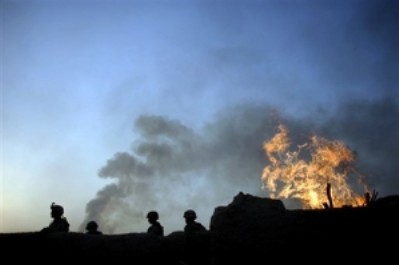
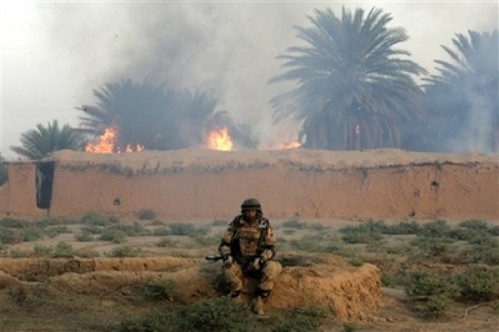
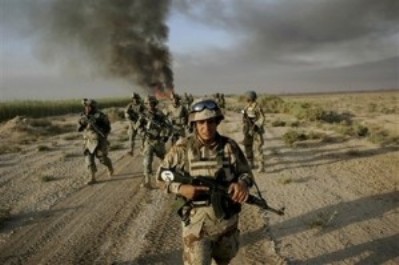
Why Does This Look So Much Like Vietnam?


Occupation’s security: “Burning a village to the ground in order to save it”
By Imad Khadduri

On August 10, 2008 (in Arabic with pictures – not to be seen on CNN or FOX), an entire Iraqi village in Baladrouz, Diyala was destroyed, its mud cottages and date trees burned to the ground, by members of the American 3rd Infantry Division and its puppet Iraqi army as punishment for harbouring Resistance fighters.

Source / Free Iraq

The Rag Blog / Posted August 18, 2008

Posted in RagBlog | Tagged , , , | Leave a comment

I Will Always Be Watched, Or Far Worse, Hunted

Photo of the SS Liberty, Aug 10, 2008

See press release below concerning arrival of SS Liberty and SS Free Gaza in Gaza earlier today.

Intimidation Will Not Stop Our Mission: Sailing to Gaza
By Osama Qashoo / August 23, 2008

This morning I am sorry to find myself back on dry land in Cyprus, separated from my fellow sailors who are now completing the final leg of their trip to Gaza. They are carrying humanitarian and medical aid to a people now suffering both an international boycott and the illegal Israeli occupation. On board the refurbished fishing boats, SS Free Gaza and SS Liberty, are more than 50 activists from 17 nations – Jews, Muslims, Christians, Buddhists, farmers, fishermen, officials, language teachers, piano technicians and one 85-year-old Holocaust survivor – all united in their determination to break the Israeli siege.

After months of preparation, the Free Gaza Movement’s perilous relief mission is under way. But I am not with them, despite the fact that I am the only Palestinian-born organiser involved. Last week, my immediate family, who still live in the West Bank, were attacked and terrorised, and I also received numerous anonymous death threats. My family were warned that I must leave the project, and that I must not contact the media. This psychological terrorism now forces me to make a public protest. Though I am no longer on board, I will not leave this mission, even as potential confrontation with the Israeli military looms closer.

The UN has called the situation in Gaza a humanitarian disaster, but the inhumanity goes on. More than 200 civilians have died due to the refusal to let people leave Gaza to seek medical care. The United States, the country that assumes stewardship of the world and whose influence could change the situation, stands by. Worse still, it endorses absurd Israeli claims, such as the recent labelling of innocent Fulbright scholars as “potential security threats” to bar them from taking up their scholarships abroad.

Internationally, the thin veneer of diplomacy has shattered again. On June 19 Israel agreed to halt military invasion and the indiscriminate shelling of Gaza, in return for an end to the launching of homemade rockets towards Israel. Israel has not met its obligations. Gaza’s borders, gates that imprison 1.5 million civilians, remain locked, and scant supplies get through. Even medical supplies are being blocked.

I grew up in Palestine and have lived in fear since childhood. The horror of witnessing elders of my family being bullied and humiliated, the daily terror of losing my parents. Watching my family elders being humiliated, the child’s voice inside me would cry out silently: “How can I stop this?”

While I was on board the Liberty, I listened to the threatening messages hijacking the ship’s emergency channel, illegal for use unless in distress. These voices reawakened a deep, familiar feeling in me: that no matter how civil, kind, non-violent I am, I will always be watched, or far worse, hunted.

Now I realise that the biggest friend of psychological terror is silence. The Free Gaza Movement aims to challenge the physical stranglehold on Gaza, but more importantly, this mission seeks to break the silence for millions of voiceless civilians whose daily stories of persecution go so cruelly ignored by the international community.

When our boats arrived in Cyprus on August 20 to collect the rest of our 40-plus group, news reached us that Israel’s deputy prime minister and minister of foreign affairs, Tzipi Livni, had finally responded to our invitation. The Free Gaza Movement had invited her to join the Cypriot authorities, who were coming aboard to search our boats in order to address their security concerns. Citing the Oslo accords, a document from the legal department of the foreign ministry asserted Israel’s right to use force against our boats. It claimed that security forces were permitted to detain the vessels upon entry to Gaza’s territorial waters, and that the peaceful, unarmed activists on board could be forcibly arrested, detained and “interrogated” in Israel. Why does a peaceful relief mission bring fury, fear and threat from the Israeli government?

Is this the way Israel observes its responsibilities under the Oslo accords? Under the accords and the Gaza-Jericho agreement, the only authority Israel reserved for itself was for “security” purposes. Our boats are no threat. Our David and Goliath mission is a focused, direct action to challenge the inertia of the international community which allows the “humanitarian disaster” suffered by the people of Gaza to continue. The activists carry no arms or threat of violence. If the Israeli government orders the destruction of this mission, it will surely be an act unequalled since the blowing up of the USS Liberty more than 30 years ago, a secret mission of sabotage to draw the Americans into the war against Egypt.

The prospect casts a shadow on our mission. But Liberty and Free Gaza will bring their peaceful cargo to the people of Gaza. Many families will now be gathered on the Gaza beaches, waiting and praying for the boats’ safe arrival. For those families, simply to be afloat in these crystal blue seas, enjoying the freedom of international waters, would be a truly wonderful thing indeed.

Osama Qashoo is a documentary film-maker and broadcaster.

Source / CounterPunch

Update / August 23, 2008:Source / FreeGaza.org

The Rag Blog

Posted in RagBlog | Tagged , , | Leave a comment

The Man Hiding Behind the Mask of War Hero


Why the Senator is Not a War Hero: John McCain in a New Context
By Patty O’Grady / August 23, 2008

Did you know that when John McCain was away from home for extended periods of time working as a U.S. Senator, Mrs. Cindy McCain would tell her children with his acquiescence that he was “deployed” and imagined herself just another lonely – albeit very, very wealthy – naval wife?

As a military wife and daughter I don’t think living in D.C. – wining and dining lobbyists – is the equivalent of deployment to Afghanistan, Iraq or Vietnam.

Why is this story worth repeating? The Cinderella quality of such imaginings provides a telling context – revealing the man and his presumptions hiding behind the mask of war hero.

In this election season, understanding the full context of presumptions is very important. My husband, also a former Vietnam Prisoner of War (1970-1973), spent time in both the “Hanoi Hilton” and a secondary camp -“Plantation Gardens” – as did John McCain who never mentions time spent in the latter. I am also the daughter of Colonel John F. O’Grady who was known to be a POW captured on the border of Laos and Vietnam in 1967 and who never returned. Like John McCain, John O’Grady was a graduate of the U.S. Naval Academy (1952). John O’Grady earned 7 military commendations for heroic service including the Silver Star and two Distinguished Flying Crosses.

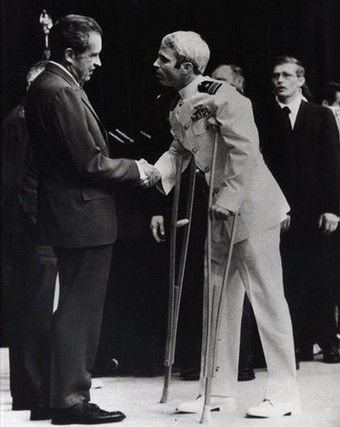
There were many heroes in Vietnam – and there are many freshly bloodied heroes returning from new wars started by old men – and John McCain’s claim is tarnished by long forgotten historical facts that few are brave enough to proffer today for fear of vicious attack on their “patriotism”. My father’s legacy protects me from such attack and so demands that I ask the unspoken questions and remind voters of the forgotten history. When the Vietnam POWS came home in 1973, President Nixon traded a small group of them celebrity status – anointing them as “heroes” – for political support of his failed war policies. John McCain was one of the anointed heroes while others were virtually discarded in exchange for their continued support of the false Nixon plan of “peace with honor” in Vietnam.

Politics can magnify or ignore heroism as it suits. In turn, the select POWS were introduced to very wealthy and influential members of the Republican Party, their records were elevated over other POW heroes with more compelling stories, and many difficult questions were not asked of them.

Today, some of those same POWS are employees of the neo-conservative American Enterprise Institute and many others have profited greatly from their staunch affiliations within the Republican Party.

In 1973, “patriotism” was traded like a commodity and heroes were used as political props. Essentially, the architects of both Vietnam and Iraq (Cheney, Rumsfeld, et. al.) launched a highly successful propaganda campaign (remember the Private First Class Jessica Lynch POW shameful sequel) using Vietnam POWS – at least the ones that were willing to be used wittingly or unwittingly – in an attempt to prop up the failing Nixon administration. Yet, if Mr. McCain is now intent on running on his character and his war record almost – because he has nothing else to offer – while suggesting that others do not care about their country as much as he does – then the wife and daughter of two other Vietnam heroes has a few questions for him:

In the interest of full disclosure why do you refuse to release your Department of Defense POW debriefing?

In the interest of full disclosure why have you failed to release all military medical records including psychological studies – 1973-1993?

Why do you only reference the time spent as a prisoner in the Hanoi Hilton”?

When will you provide details about the time spent in the prison referred to as “Plantation Gardens”?

Did you ever receive any preferential or atypical treatment while a POW in any location where you were held? How soon and when did you reveal your true identity to your Vietnamese captors – did you simply give name, rank and serial number?

Has any other former Vietnam Prisoners of War or Vietnam veteran questioned the record that you claim particularly your claims of “torture”?

What was your connection to the “Peace Committee”?

Have you ever referenced the “blue files” in any speech that you have given? What are the “blue files”? Where are those files housed? Why do you not want those files released?

Have you ever lost your temper with military families who challenged your position?

Have you ever acted in an inappropriate way or in a less than gentlemanly manner with any female spouse of any active duty military personnel member?

Why not let citizens, who know the personal and painful history better than anyone else, ask the questions? Why not let these questions prompt more thorough investigation and scrutiny and less shilling by the press? Why shouldn’t change really mean accountability as framed by ordinary people who also made an extraordinary sacrifice? The answers might provide all citizens the context needed to fully judge some less than credible claims that have aged into myths over time.

There is always the context to consider…

[Patty O’Grady, Ph.D., teaches in the Department of Education at the University of Tampa.]

Source / CounterPunch

The Rag Blog

Posted in RagBlog | Tagged , | 2 Comments

Same Sex Marriage Affects the Whole Country


What impact will it have on the elections? Maybe not much.
By Suzi Steffen / August 22, 2008

Patchwork, partying, pessimism, politics: That’s the state, so to speak, of same-sex marriage around the U.S. since same-sex couples began lining up to get married in California on the afternoon of June 16.

News of the California Supreme Court’s May 15 decision, which said that denying marriage licenses to gay and lesbian couples was unconstitutional, surprised some observers because it came from a Republican-appointed court — and thrilled couples across the country because California does not have residency requirements for marriage.

At the time, Massachusetts, which began offering same-sex couples marriage licenses in 2004, had routinely been denying them to couples from other states thanks to a 1913 law intended to ensure that interracial couples from other states didn’t get married in Massachusetts. That law changed at the end of July.

Many marriage equality proponents hailed California’s decision as a major step forward, but one of the first reactions for some political wonks was markedly more guarded or even pessimistic.

First, the good news, by the numbers. During the first month that licenses were available to same-sex and opposite-sex couples equally, counties in the Bay Area reported larger numbers of licenses granted and of ceremonies performed in clerk’s offices, according to a mid-July Associated Press report.

California does not keep separate count of same-sex marriages, according to the California Department of Public Health, so those curious about the numbers must track county-by-county records or simply look at increases. The AP says that San Francisco, not surprisingly, reported a 131 percent increase in licenses granted, but Sonoma County (a romantic destination in the heart of California’s wine country) also reported an increase of 160 percent, from 340 to 546, and a quadrupling of ceremonies performed in the clerk’s offices. That number went down in at least one California county, however: Kern County, which includes Bakersfield, stopped performing any civil ceremonies at all, whether between opposite- or same-sex couples, on June 15. But the county clerk’s office there must still grant marriage licenses to those who legally qualify.

The economic impact on a budget-constrained state has not been small. According to the AP, the 44 counties in California took in over a quarter of a million dollars more this June than last June. The UCLA School of Law’s Williams Institute released a study in early June, before same-sex marriages began in California, estimating that if the state’s voters didn’t approve a constitutional ban on same-sex marriage on the ballot in November, the ceremonies would “boost California’s economy by over $683.6 million in direct spending over the next three years.”

Massachusetts hasn’t ignored those findings. A study commissioned by the Executive Office of Housing and Economic Development estimated that repealing the 1913 law, which said that the state would not marry those whose marriages would be illegal in other states, could bring in at least $111 million into the state economy over the next three years. The Massachusetts Senate voted for repeal on July 15, and the House added its vote two weeks later. Bay State Governor Deval Patrick added his signature July 31. The bill repealing the old law contained an emergency preamble allowing out-of-state same-sex couples to obtain marriage licenses immediately, and reports in the New York Times indicate that New York couples took advantage of the repeal as soon as it was signed. When a reporter asked Patrick about couples coming to Massachusetts to get married from other states that expressly forbid same-sex marriages, Patrick said, “What we can do is tend our own garden and make sure that it’s weeded, and I think we’ve weeded out a discriminatory law.”

But the state of the union isn’t all wine and roses, cakes decorated with two brides or grandmothers finally able to give their grandsons the heirloom china.

For one thing, in many states, same-sex couples won’t see any legal benefits from getting married in California or Massachusetts. Indeed, Lambda Legal reported earlier this summer that same-sex couples from Wisconsin may face harsh legal penalties if they get hitched on one of the coasts. According to the Milwaukee Journal-Sentinel, the penalty for a marriage “that’s prohibited or declared void in Wisconsin” can range up to a $10,000 fine and up to a nine-month prison sentence — though Wisconsin prosecutors seem uninterested in using what one called “scarce resources” to prosecute same-sex couples. Still, the Wisconsin law (apparently passed in order to discourage underage heterosexual couples from marrying in other states) indicates one of the many concerns progressive voters felt when the California law passed.

It’s not that they didn’t want same sex couples to be able to marry. They were simply worried about what the New York Times reported in 2004 as an increase in conservative voters who voted for Bush at the same time they voted for state initiatives banning same sex marriage.

During the November election in 2004, 11 states — including Oregon, Michigan and Ohio, which were considered battleground states between Republican President George W. Bush and Democratic candidate John Kerry — passed initiatives barring state recognition of same-sex marriages (and in some states, barring state recognition of civil unions or domestic partnerships as well). Though Michigan and Oregon both passed their anti-marriage state initiatives, both states also went for Kerry.

But as you probably recall, Bush won a close election after Kerry decided not to dispute contested results in Ohio. Conventional wisdom then said that Republican strategists like Karl Rove used 2004’s various gay marriage issues as a way to get out the money and get out the vote for their presidential and Congressional candidates. Some religious conservatives, including former GOP presidential candidate Gary Bauer, have since claimed that the California Supreme Court decision will likewise affect the 2008 presidential election.

Even an L.A. Times reporter who wrote about the decision weighed in, stating that the Supreme Court “tossed a highly emotional issue into the election year.” Before the decision, a conservative group wrote an initiative banning same-sex marriage. It will appear on the November ballot in California.

A quick fact check, however, shows that conventional wisdom may have been wrong to begin with. Mark Mellman, a Democratic pollster, wrote in a June op-ed for TheHill.com (an online Congressional newspaper) that of the 11 states with anti-same sex marriage initiatives on the ballot, “no one could reasonably assert” that Kerry would have won eight of the states no matter what else was on the ballot. Kerry won two of the others, and, Mellman says, in Ohio, four times as many people voted on the presidential race but not on the anti-marriage initiative as voted on the initiative but not the presidential race, indicating that the race itself was the important draw. In other words, he concludes, “while casting initiatives as the secret determinant of presidential elections makes for an interesting narrative, it is largely a work of fiction.”

In Oregon, an anti-civil union initiative failed to make the ballot this year, thanks in part to LGBT civil rights group Basic Rights Oregon. BRO Director Jeana Frazzini says that same-sex marriage initiatives are highly unlikely to affect the presidential election. “I think there are some pretty major issues on the minds of voters that are going to take precedence,” she says. On Aug. 14, just after the U.S. 9th Circuit Court of Appeals removed any chance for the initiative to land on the Oregon ballot, Frazzini wrote to BRO supporters that the decision freed time and money to help work on other issues in Oregon — like opposing an initiative outlawing ESL classes — along with supporting California LGBT groups in their fight against Prop. 8.

Even in places that coastal progressives view as conservative, some politicians don’t think the religious right will be able to alter the election because of same-sex marriage. Senator Tom Harkin, D-Iowa, told the rightwing news group CNSNews.com that he believes Iowa’s voters “care about the economic issues and the health care issues and getting out of Iraq,” not “hot-button issues” like same-sex marriage. That’s important because Iowa may be one of the next same-sex marriage battleground states: In August, 2007, a district court declared Iowa’s law defining marriage as between one man and one woman “the most intrusive means by the state to regulate marriage” and struck down the law. One male couple married in Iowa before the district court judge issued a stay on his ruling and sent the case to Iowa’s Supreme Court, which has not yet issued a decision.

But it’s not only liberals and Democrats thinking that same-sex marriage won’t be an issue in 2004. Karl Rove told the L.A. Times on Aug. 14 that “the bigger issues will be the economy, terrorism, healthcare, energy.” Three states now have anti-same-sex marriage initiatives on their ballots in the fall: Arizona, Republican presidential candidate John McCain’s home state; California, where an Obama win seems almost certain; and Florida, the one possible swing state in the mix. The L.A. Times notes that Florida Governor Charlie Crist, a Republican, has “distanced” himself from Florida’s proposition, but he recently changed his mind (he’s rumored to be seeking the VP nomination) and said he supports Amendment 2, which would define marriage as between one man and one woman in Florida’s constitution.

Polls on California’s Proposition 8, which would overturn the California Supreme Court decision, have varied. The most recent, a Field Poll released on July 18, showed that 51 percent of likely voters said they would vote no, while 42 percent said they would vote yes. (A no vote upholds the legality of same-sex marriage.) Perhaps that’s partially because of state Attorney General Jerry Brown, who altered the title of the initiative after the Supreme Court ruling — it had been “Limit on Marriage” when same-sex marriage wasn’t legal, and he changed it to “Eliminates Rights of Same-Sex Couples to Marry.” Though backers of Prop. 8 challenged that change, two court rulings in Brown’s favor convinced them to drop the challenge. Details of the Field Poll revealed splits that politicians and LGBT activists will no doubt take into account during the campaign: among voters who knew someone gay or lesbian, the opposition to Prop. 8 was 54 percent to 40 percent; African-Americans, Asians and white non-Hispanic voters were against the proposition and Latinos for it, both by a margin of five to four; and although Protestant voters were largely in support, Catholic voters were evenly split.

“Polls are notoriously unreliable,” says Dan Savage, “but all the movement is in our direction.” Seattleite Savage, who writes the “Savage Love” sex advice column and is a strong advocate for same-sex marriage, doesn’t feel purely optimistic because of recent history — states locking the definition of marriage into their constitutions, which is hard to undo. But, Savage says, “with gas approaching $5 a gallon and the mortgage crisis, hopefully people are less easily whipped up with bullshit social issues and right-wing fear and smear tactics.”

Meanwhile, as states across the country watch what happens in California, Jeana Frazzini of Oregon says the issue has moved on from 2004’s “political football.” Now, she says, “the dialogue is happening on a personal level. Folks are talking about what it means for their families.” Because of the 2004 ballot initiative that amended Oregon’s constitution, she says that what’s going on in California has a limited impact on couples in Oregon, “but it gives people that sense of hope that things are headed in the right direction.”

Source / AlterNet

The Rag Blog

Posted in RagBlog | Tagged , , , , | Leave a comment

Democrats Have Turned Sharply to the Left


‘They are more liberal than at any time in a generation’
By Steven Thomma / August 22, 2008

DENVER — As they meet for their national convention Monday through Thursday, Democrats are poised to shift their party’s course — and the country’s.

They’re turning to the left — deeply against the war in Iraq, ready to use tax policy to take from the rich and give to the poor and middle class, and growing hungry, after years of centrist politics, for big-government solutions, such as a health-care overhaul, to steer the nation through a time of sweeping economic change.

They are, in short, more liberal than at any time in a generation and eager to end the Reagan era, which dominated not just the other party, but also their own, for nearly three decades.

“Every generation . . . there are changes in people’s relationship with government,” said Sen. Charles Schumer, D-N.Y. This, he said, is such a time.

The shift of the party also reflects a change in much of the population — evidenced in the policy positions advocated by rank-and-file voters as well as the party’s presumptive presidential nominee, Sen. Barack Obama of Illinois.

“Government SHOULD do more, especially when you’re spending tens of billions of dollars in Iraq protecting the interests of millionaires,” said Rebecca Washington, a Democrat and an accountant from Cleveland Heights, Ohio.

“We’ve got to revoke the tax cuts for the wealthy,” said Vicki Balzer, a Democrat and retired teacher from the Cleveland suburb of Berea. “We definitely need to do something more for the economically disadvantaged. . . . We’ve allowed big corporations to take millions for corporate leaders while workers get nothing.”

Nationally, 40 percent of Democrats in the 2006 midterm elections called themselves liberal, the highest since the American National Election Studies program started asking in 1972.

At the same time, the number of Democrats who support a government safety net for the poor — such as guaranteeing food and shelter for the needy and spending to help them even if it means more debt — jumped by 14 percentage points from 1994 to 2007, according to the Pew Research Center.

Support for that safety net also rose by 15 points among independents and 9 points among Republicans.

That’s a remarkable change since the mid-’90s, the decade when centrist Bill Clinton dominated the Democratic Party, signed a welfare overhaul into law that forced recipients to work, expanded free trade against the wishes of organized labor and famously declared the era of big government to be over.

“During the era when Bill Clinton was president, there was a clear re-centering of the party,” said Democratic Gov. Kathleen Sebelius of Kansas.

Today, she added, “there is a growing understanding that government can play a positive role in investing in our country.”

What changed? Several things:

* The Iraq war lasted longer, cost more lives and money, and proved deeply unpopular. A few years ago, Obama was a rare voice in the party opposing the war; today he’s one of a chorus.

* Anxiety about a slowing economy resurrected fears about American jobs and paychecks in the global economy. Promises to change trade deals such as the North American Free Trade Agreement punctuated the Democratic primaries.

Also, Obama promises a dramatically different tax policy, one that would raise taxes on the wealthy, cut taxes for the middle class and offer new “refundable” tax credits to the working poor that would wipe out tax liabilities and deliver anything left over in the form of checks.

He also wants to tax oil companies and use the money to give checks to the poor to pay for high fuel costs, or anything else.

* Many Americans recoiled at the weak federal government response to Hurricane Katrina in 2005.

* Republican George W. Bush turned into one of the most unpopular presidents in modern history. Just as American revulsion at Democrat Jimmy Carter in 1980 helped usher in the Reagan era, rejection of the Bush era could help swing the pendulum the other way.

At the same time, the party has new power centers in liberal groups such as Moveon.org and blogs such as dailykos.com, where antiwar fever and anti-Bush anger are magnified.

They helped propel Howard Dean to an early lead for the 2004 Democratic nomination, lost, then regrouped to help defeat pro-war Democratic Sen. Joseph Lieberman of Connecticut in a 2006 primary, though he went on to win re-election as an independent.

“Enormous dissatisfaction with the Republican Party has brought out the base more,” said Democratic Gov. Bill Richardson of New Mexico.

Ever more vocal and influential heading into this year’s election, that base fed the sense that the party should “return to its core values,” Richardson said. “The rise of the Internet and bloggers have made the party more progressive.”

Schumer also thinks that it’s all part of a historic cycle in American politics — or at least he hopes it is.

He said Americans encouraged and grew accustomed to an activist federal government during the Great Depression of the 1930s, one that Democrat Franklin Roosevelt delivered and Democrat Lyndon Johnson accelerated in the 1960s.

They grew disenchanted with that big government by the 1970s, a government seen as corrupt in the Nixon days, unable to stop oil crises or runaway inflation, and unable to rescue Americans whom Iran had taken hostage.

“By 1980, the average person said, ‘I don’t need government anymore. I’m fine on my own,’ ” Schumer said.

That sentiment drove U.S. politics for years, helping Republicans win five out of seven presidential elections and giving the Democrats two victories only when they nominated a Southern centrist in Clinton.

This year, however, Democrats rejected Hillary Clinton, who, while arguably more liberal than her husband, was to the right of Obama on big issues such as tax policy and had a history of being more hawkish on national security.

Perhaps it’s because Obama was simply a more appealing candidate. But it also might be because times are changing.

Now, Schumer said, Americans feel shaken by big forces such as globalization, terrorism and a sputtering economy. “The whole world changes, and people feel a little bit at sea, and they need help,” Schumer said.

Whether the country will turn to a resurgent-liberal Democratic Party to navigate that less-certain world won’t be known until November. But for Democrats watching their national convention, it’s clear they want something very different.

Source / McClatchy

Thanks to truthout / The Rag Blog

Posted in RagBlog | Tagged , , , , , | Leave a comment

Anyone Who Feels Disappointed Will Go Back

UNDER PRESSURE: Two Sunni Arab fighters in the Sons of Iraq look on this year during a military operation involving American and Iraqi forces south of Baghdad. The U.S. plans for the group to be “out of business” by June. Photo: Petros Giannakouris / Associated Press

Iraq seeks breakup of U.S.-funded Sunni fighters
By Ned Parker / August 23, 2008

Distrusted by the Shiite-led government, the Sons of Iraq face arrests and could return to insurgency. They have been key in helping calm the violence.

BAGHDAD — An emboldened Iraqi government has launched an aggressive campaign to disband a U.S.-funded force of Sunni Arab fighters that has been key to Iraq’s fragile peace, arresting prominent members and sending others into hiding or exile as their former patrons in the American military reluctantly stand by.

The Shiite Muslim-led government has long distrusted the fighters, many of whom are former insurgents. Senior Shiite politicians label some of the members murderers, and warn that there is no long-term obligation to employ them after their units are disbanded.

“The ones in Baghdad and Diyala province just changed their T-shirts. There are large numbers who were really Al Qaeda. We have to really look hard for those elements without blood on their hands,” said Haidar Abadi, a lawmaker from Prime Minister Nouri Maliki’s Islamic Dawa Party.

Amid fears that the Sunnis’ treatment could rekindle Iraq’s insurgency, the Americans are caught between their wish to support the fighters and their stronger ties to Maliki’s government, which has challenged the Sunni paramilitaries in recent months as it grows increasingly confident about its fledgling army.

“We want to have our cake and eat it too, support Maliki and the Sons of Iraq. . . . Maliki wants to make that as hard for us as possible. He wants us to choose him,” said Stephen Biddle, a Council on Foreign Relations defense expert who has served as an advisor on strategy to Army Gen. David H. Petraeus, the U.S. commander in Iraq. “What it looks like we are getting is a Maliki government that won’t behave itself and wants to crush the Sons of Iraq.”

The chief U.S. military spokesman here denied Maliki was targeting the Sons of Iraq, or that the Americans were tilting toward the government at the expense of the Sunni fighters.

“Just last week, the prime minister gave his personal commitment to the program,” Brig. Gen. David Perkins said. “They are well aware of the sacrifices the Sons of Iraq have made, that they were a critical element in bringing the security situation under control and that it is in their strategic advantage to assimilate them peacefully and orderly into Iraqi society.”

Maliki has grown powerful after successful military operations in spring against Shiite cleric Muqtada Sadr’s militia in southern Iraq and Baghdad. His transformation has provided the Americans a partner they can work with as they look for a way to hand over the reins in Iraq, the long-term U.S. goal here.

A Western advisor to the Iraqi government said the U.S. military couldn’t stop the Iraqi security forces now even if it wanted to — they are larger in size and have their own chain of command.

The Iraqi government first challenged the U.S. military over the Sons of Iraq program in the spring — basically freezing the activities of the Iraqi reconciliation committee charged with integrating the 99,000 fighters into the security forces and civilian jobs, according to a Shiite advisor to the government.

In July, Maliki informed the Americans that he wanted the entire program handed over to him as soon as possible, said Mohammed Salman, the head of the committee. In response, the U.S. military has drafted plans to dissolve the group by next summer, integrating 20% of its members into the police and finding the rest such jobs as mechanics, electricians and carpenters. The Americans want to slash the Sons of Iraq to 60,000 by the end of the year.

“Our goal is that by June 2009, the Sons of Iraq are out of business,” said Lt. Col. Jeffrey Kulmayer, who is charged with the Sunni paramilitary file.

Just over 9,000 of the Sunni fighters have been hired into the security forces so far. And the government has warned that any program to provide the majority of the fighters job training once their paramilitary units are disbanded will be temporary.

“We have the same problems around the country. We can’t just create a program to pay some people and not others,” said Abadi, the lawmaker.

Such comments raise concerns in U.S. military circles that the men will be pushed back to joining dwindling militant groups such as Al Qaeda in Iraq.

“If the government of Iraq doesn’t decide to employ all of them, you have jobless rates that skyrocket,” said a U.S. intelligence analyst who, like some others who spoke for this report, did so on condition of anonymity. “I don’t know what will happen.”

Many of the fighters are now on the run. The Iraqi military has mostly dismantled the group in the Baghdad suburb of Abu Ghraib, once a hub for militant attacks, and it has arrested Sunni fighters in Baqubah, 35 miles northeast of the capital. Influential Sunni paramilitary leaders, from the Baghdad and Baqubah areas, have gone into hiding or are in exile.

In the past, U.S. commanders had deflected arrest warrants for key fighters, but there has been an apparent shift. “We don’t have a ‘get out of jail free’ card for the Sons of Iraq. There is law and order in this country, and we respect the Iraqi government,” Kulmayer said.

The men feel increasingly vulnerable — they have been attacked by Al Qaeda and Shiite militias and subjected to Iraqi army raids. Since January, 462 of them have been killed in attacks by militants. If disbanded, their leaders warn, the men could revolt, but the Sons of Iraq are holding out hope that local elections, still without a date, will improve their lot.

“In the event that the U.S. military and government don’t live up to their promises, it could turn back to a violent form of resistance,” said a leader, Abu Abed, from the north Baghdad neighborhood of Adhamiya. “Every action breeds a reaction.”

Read the rest of it here. / Los Angeles Times

The Rag Blog

Posted in RagBlog | Tagged , | Leave a comment

Joe Biden : Senator MasterCard

Faux Photomontage.

Biden’s bankrupt policy causing people to lose their homes
By Tom Cleaver / The Rag Blog / August 23, 2008

Has anyone else noted the irony that Joe Biden is the Senator who led the “bi-partisan” charge for “banktruptcy reform”? You know, the law that’s now wiping out the people losing their homes, who Obama has been claiming all week he’s in favor of helping?

There’s a reason why every Hollywood contract I ever signed says that the site for legal remedies if I want to go after the bastards for their thieving is the State of Delaware and that the applicable law will be the Corporation Laws of the State of Delaware. Trust me, that reason is not because of the fact that Delaware believes in helping the little guy in a fight over corporate injustice.

This decision is actually a bit harder to swallow than the FISA business, since this is (theoretically) a “pro-people” campaign, as opposed to John McCain’s “pro-corporation” campaign.

“Chicago politics” indeed.

The Rag Blog

Posted in Rag Bloggers | Tagged , , , , , | Leave a comment

Ronnie Dugger : LBJ, The Texas Observer and Me

Former Texas Observer editor Ronnie Dugger with President Lyndon Johnson. Photo by Yoichi Yokamoto / Courtesty LBJ Library / Texas Observer.

‘None of us knew it yet, but we Americans were about to be trapped in the history that Lyndon Johnson would make’
By Ronnie Dugger / August 22, 2008

The confrontation between Lyndon Johnson on one side and The Texas Observer and me on the other arrived on its own terms at his ranch in the Hill Country in 1955.

He was the senior United States senator from Texas and the new majority leader of the Democrats in the Senate. He had developed his concept of journalism as the editor of his college paper sucking up to the college president, and by 1955 he was hell-bent on the presidency. A group of national liberal Democrats and I, chosen as editor, had launched the Observer the preceding December. I had been editor of my high school and college newspapers, a sportswriter, columnist, an occasional correspondent for the San Antonio Express-News, and a hanger-out with Edward R. Murrow’s boys at CBS News in London when I was studying in England. Johnson was 47; I was 25.

None of us knew it yet, but we Americans were about to be trapped in the history that Lyndon Johnson would make, and I was about to be trapped in his persona and career. He was not an idealist, but he served ideals when it suited and expressed him. He was not a reactionary, but he fanned reaction when it helped him advance himself. As I wrote in my 1982 book about him, “Lyndon Johnson was rude, intelligent, shrewd, charming, compassionate, vindictive, maudlin, selfish, passionate, volcanic and cold, vicious and generous. He played every part, he left out no emotion; in him one saw one’s self and all the others. I think he was everything that is human. The pulsing within him, his energy, will, daring, guile, and greed for power and money, were altogether phenomenal, a continuous astonishment.” Ahead of us lay his ascension to the presidency after the assassination of John Kennedy and his calamitous Vietnam presidency, but also his presidency of Medicare, Medicaid, the Voting Rights Act, the Fair Housing Act, Head Start, federal aid for the education of the poor, bilingual education, affirmative action, and the establishment of public radio and television.

Lyndon was the driven son of an ambitious, all-empowering mother and a failed liberal politician who made it no higher than elected membership in the Texas House of Representatives. After a lot of hell-raising, Lyndon, following his mother’s lead, took $100 from his folks and enrolled at Southwest Texas State Teachers’ College in San Marcos. The 700 students there came from the farms and towns in the area. They were almost all white, only a few Mexican-American. Already aiming to be president, Lyndon was set on getting power even in school, and having watched his father, he knew how to try and how not to try for it. Since he got not another nickel from his parents, he had to work his way through Southwest Texas, but after a stint janitoring around the campus, he simply strode into the office of Cecil Evans, the president of the school, and talked his way into a slightly better job.

Walking on campus with his cousin Ava, Lyndon divulged to her his theory of how to get ahead. “The first thing you want to do,” he told her, “is to know people—and don’t play sandlot ball; play in the big leagues … get to know the first team.”

“Why, Lyndon,” she exclaimed, “I wouldn’t dare to go up to President Evans’ office.”

“That’s where you want to start,” he told her.

“I knew there was only one way to get to know him, and that was to work for him directly,” Johnson told me later in the White House. For most of his time at Southwest Texas, he was special assistant to the president’s secretary, with his desk next to the secretary’s. This paid him $37.50 a month, but he wanted to be editor of the student paper because that would pay him another $30.

In his first signed editorial in the student paper, the College Star, Lyndon rebuked fellow students—“celebrities,” he called them—who were using the college bulletin board for personal messages. The board “must be kept free for school matters,” he wrote, of course thereby pleasing Cecil Evans. Lyndon “knew how to ingratiate himself,” as one of the English teachers there said, and when the student council made him editor of the Star, he demonstrated further that he would use the paper as a tool for personal advancement. Profiling his own boss, Lyndon wrote: “Dr. Evans is greatest as a man,” what with “his depth of human sympathy . . . unfailing cheerfulness, geniality, kind firmness,” and so on.

Throughout his career on the make, Johnson cottoned up to selected powerful political leaders, both accommodating and abetting them, and thus predictably becoming a favored protégé. He did this, for example, with House Speaker Sam Rayburn, President Roosevelt, and Sen. Richard Russell, as well as with business leaders such as contractors George and Herman Brown. In flattering Dr. Evans in the college paper that he edited, he was just warming up his game of protegeship through the opportunities provided him by his temporary status as a journalist.

In 1955, Rayburn and Johnson, the Democratic Party’s bosses over the two branches of the distant Congress, were gigantic figures in one-party Texas politics. The Democrats in Texas were venomously divided between the “loyal Democrats”—also called national Democrats, who generally favored the policies advanced by Roosevelt and Truman—and the reactionary governor, Allan Shivers, and his fellow segregationists and conservatives, who had total control of the state Democratic Party. The previous October, a group of about 100 “loyal,” that is, national, Democrats in Texas, sensing that Shivers and his followers would go for Eisenhower for president in 1956 (as they did), gathered in Austin to found a liberal journal and asked me to edit it.

They knew, of course, that my views were liberal. They had some knowledge of my years of reporting on the thoroughly corrupt Texas Legislature in The Daily Texan, the student paper at the University of Texas in Austin, and my year as editor there championing racial integration, repeal of the oil depletion allowance, and other liberal causes. For a year my columns from abroad, laced with some of my policy opinions, had run in the San Antonio daily. A speech I had given to the Houston Rotary Club advocating, among other things, national health insurance, had provoked the physicians in the club to issue an outraged written objection.

Most of the liberals who had assembled in the hotel downtown, however, appeared to want a party organ, its editorial voice subordinated to the calculations of the national Democrats in Texas. My models for reporting were: the great muckrakers; Ed Murrow; James Reston. My idea of journalism included standing enough apart from government and political parties to report independently of them and to criticize any institution when that was called for. Although party organs have their place, I did not want to work on one.

Acting through Jack Strong, a lawyer in East Texas, the liberals offered me the editorship on the Friday before the Monday when I was leaving for Corpus Christi to work on a shrimp boat and jump ship in Mexico, eventually to write a novel about the Mexicans who (then as now) were wading, swimming, and drowning in the Rio Grande in search of work. That night I batted out a long letter to the group addressed to Mrs. R.D. Randolph, one of the group’s leaders who was an heiress to the Kirby lumber fortune in East Texas, outlining what sorts of stories I would want the Observer to investigate and what sorts of editorial crusades we likely would launch, but also my position on a party organ. Addressing the group in the hotel downtown, I told them I was not interested in editing a party organ, but I would stay and edit the new journal, provided I had exclusive control of all the editorial content. The paper’s publisher could fire me at any time for any reason, but as long as I was the editor, I would determine the editorial content. This arrangement, which protects the journalists and the journalism from politics or the business of publishing, I later, as Observer publisher until 1994, explicitly ceded to every editor who succeeded me.

Bob Eckhardt, the great legislator of my generation in Texas and soon to become one of my closest friends, told me later that a fierce debate occurred after I left the hotel. He said that Mark Adams, a New Dealer and a yeoman printer, said that “if ever a rattlesnake rattled before he struck, Dugger has.” Mark, who became my first printer at the Observer, denied saying it.

But they accepted my terms, and as we prepared to begin, I settled on a motto for the front-page masthead, Thoreau’s “The one great rule of composition is to speak the truth,” and wrote a policy credo that contained the sentence, “We will serve no group or party but will hew hard to the truth as we find it and the right as we see it.”

I had no sting out for Johnson, far from it. While a student at UT, I had worked downtown in Austin as a reporter and news announcer for his and Lady Bird’s radio station, KTBC. His senatorial office, that is, he, had helped me get a job in Washington one summer in the division of international organizations at the Department of State. Returning from abroad, I had applied unsuccessfully for a job on his Senate staff. I learned that Horace Busby, one of his top advisers, had said to him something like, “Ronnie’s not our kind of guy,” but I didn’t know that for many years.

The first year or so at the Observer, I was the only reporter and editor, and we had one subscription person. The founding group watched quietly as I did my best to begin to wreak havoc on racism, corruption, poverty, discrimination, and the rancidness of the plutocratic ideals blatted forth by the allegedly Democratic Gov. Allan Shivers. When I reported the racial murders of two black children in Mayflower, Texas, near Tyler, I was told that one of the Observer founders, Franklin Jones Sr., a very successful plaintiff’s lawyer in Marshall, exploded profanely on seeing my photograph of the body of one of the dead children on the front page: “Here I am working my ass off getting subscriptions for the Observer, and Dugger sends us pictures of dead Negroes all over the front page.” But if Franklin did say that, or something like it, he said nothing to me.

A new Democratic National Committee member from Texas had to be chosen, and it became known that Sen. Johnson had exerted his power to achieve the selection for that honor of the reactionary and racist Lt. Gov. Ben Ramsey, who presided as the dictator over the Texas Senate to the purring pleasure, protection, and profit of every corporate fat cat in the state, the oilmen most of all. In editorials, I damned Johnson to hell and back for it.

Johnson had been opposing the Texas liberals—on Ben Ramsey, by effectively favoring conservative Price Daniel over the liberal Ralph Yarborough for governor, and in other ways—to get Texas reactionaries behind him, or at least to quiet them down, for his candidacy for president, which Rayburn and he would soon make public. Nearly all of us at the Observer and all our readers were in agreement on a new drive to build a grassroots uprising of the liberal and populist Democrats to throw Ramsey and his ilk—Shivers, Sen. Daniel, the lot of them—into the Republican Party where they belonged. Obviously a Democratic Party answering to well-organized Democrats in the cities directly challenged and would at least diminish the boss-rule powers that Rayburn and Johnson exercised and enjoyed, and Johnson went to calling all of us involved in this organizing effort “the redhots.”

At some point that fall, with the Ramsey controversy smoking, I received a phone call that Sen. Johnson would like to see me, and would I call on him at the ranch at a certain hour on a certain afternoon. I had never been out there. After wheeling my family’s 1948 Chevrolet, which we called the Green Hornet, through the Pedernales River muscling itself shallowly over Johnson’s low-water bridge, I pulled up in front of his grand spread and saw that he was swimming in the pool, off to the right there. We greeted, nodding, and for some time I shifted from one foot to the other by the pool, feeling rather high in the air, as he continued his swim and, desultorily, we talked.


Toweling off and sitting us down on the pool furniture, cocking his long face toward me, Sen. Johnson asked me:

“Ronnie, what’s the circulation of your paper?”

“Oh, about 6,000.”

“Stick with me and we’ll make it 60,000,” Johnson said.

I knew at once what he meant. “Stick with me” meant support his policies and decisions, about Ben Ramsey and anything else, celebrate his sagacity and wisdom in all that I wrote about him, and support his presidential ambitions; “and we’ll make it 60,000” meant that in return, he would employ his standing, power, and connections to build up the Observer. The one great rule of composition would be to promote Lyndon Johnson. The Observer would be not a party organ, but a Johnson pipe organ that his nod could cause to bellow forth with Wagnerian splendor. The senior senator from Texas and the Democratic majority leader of the U.S. Senate had called me out here to propose straightforwardly that the Observer and I replace journalistic integrity with loyalty to him. He was trying to bribe me and The Texas Observer, or, if this was not to be a bribe, the deal—the secret understanding—the quid pro quo, obedient loyalty and feigned adulation in return for the other’s use of his power on your behalf, would have been not different from a bribe by a dime.

Johnson’s problem was, he would soon make public his campaign for the presidency. He knew the Observer was a novelty, conspicuous in reactionary Texas, reporting long-covered-up events and expressing unpredictable opinions; he knew that national newspeople, traipsing to and from his ranch from Austin, would often drop by the Observer offices for inside dope or just for the devilment of it, as in fact they were to do for the rest of the decade; and he knew that if his sellouts to the Texas yahoos and rednecks on the way to the White House became clear to the national Democrats, they might not nominate him for president.

My problem was how to get out of there. I could have just said, “I’m sorry, senator, no deal,” but this was not my style while practicing rebellious journalism in Texas. I extended myself and taxed my fellow Observer reporters to be fair and accurate, both in order to be fair and accurate and in self-defense, although, that done, in editorials I let miscreants and villains have it straight on. In person, in my life day after day, I was carefully polite and civil with all parties. If I was formally polite to a fault, well, it was a kind of protective coloration. On this afternoon with Johnson, I realized that the Observer and I had been misgauged and underestimated, but that for the rest of the occasion my part was to avoid any accusative remarks or implications, any incautious, offensive, or popinjay responses, and to graciously take my leave as soon as that might appear mannerly.

Sitting there side by side on plastic chaise lounges—someone brought us cold drinks, I believe lemonades—we talked along gingerly for maybe an hour. Well, senator, it’s an honor to have met you, and I appreciate your having me out—don’t want to overstay, I’d better be getting back to town—I said something like this, starting to rise to head back to my Green Hornet.

No, he said, why don’t you stay to dinner. No trouble, Bird’ll have plenty.

Although I had nothing more to say to him, I had not said no, and he had something more to say to me.

After an interim during which nothing happened, I sat down to dinner in a half-dark chamber at the center of the Johnsons’ well-staged home with Lady Bird Johnson and Johnson’s personal secretary, Mary Margaret Wiley, who had been my managing editor in high school in San Antonio when I had edited the Brackenridge Times. Mary Margaret is a beautiful person. While I had perceived no romantic flash in our friendship and work together in high school, we admired and respected each other; I was glad she was there.

As Johnson sat down at my left at the head of his table, though, I realized, silently appalled, “My God, the subject is at hand, all I can do is explain journalism to him as if he actually doesn’t know what it is.” If the situation had not been unbelievable, it would have been incredible.

I struck forth uncertainly, as if we were dining on a pitching log, addressing only Johnson to describe, as best I could, the role of journalism, the Fourth Estate, separation from government, providing facts and explanations, democracy’s inexpendable need for an independently informed electorate. I may even have quoted Jefferson. I might as well have been talking to the log I was riding. Johnson said to me, No, the thing a smart young reporter does, and should do, is survey the field of candidates, pick the best one, and enter into a deal to help that one win whatever office and prevail in whatever controversy, subordinating his reporting and comment to the interests of the candidate.

Johnson was far too smart to really think that is what journalism is or should be. He was feigning adherence to a theory of journalism, a blend of his own practice on his college paper and his political strategy of protegeship upended for the advance of his juniors, that might work somewhat, with me and others, as a disguise for his use of journalists to serve his will to power. Later it became embarrassingly clear that he had induced some of the leading reporters and columnists in Texas and the nation to make some such a deal with him or assent to some such understanding: Leslie Carpenter, William S. White, Joseph Alsop, some of the authors of those surprising articles in the big magazines in the late 1950s promoting the lanky Lyndon Johnson of Texas for president of the United States.

I remember (I am not referring, for this essay, to my notes on all of this) that neither Lady Bird nor Mary Margaret said one word all evening. Oh, perhaps one or two, but I don’t remember even one. They sat silent and still as good women of old were supposed to during an argument among the men. Yet both Bird and Mary Margaret were highly intelligent. How strange the evening must have seemed to them, their guy trying to turn a journalist into his secretly bought public promoter, their senator and this younger guy battling over irreconcilable opinions, completely missing each other, reaching no agreement.

Many’s the time since that evening there has replayed on the stage in my mind a vivid re-seeing of what happened upon my departure that evening. I am five or six feet away from Lyndon and me, watching the two of us illuminated by the ranch-house lighting locked in animated argument in front of his house at his low wire fence, he inside the fence, I outside, our knees braced against it and each other, intensely disputing directly into each other’s faces a few inches apart, he leaning first a little into my face, and then a little more, and then so much my head is bent back, and I shift my heels backward to be able to stand up straight to him again.

My first associate editor at the Observer, Billy Lee Brammer, a reporter on the Austin daily (and later the author of the classic Texas novel The Gay Place), started showing up unbidden evenings and helping me clip the 3-foot-high mounds of the rotgut Texas daily newspapers of that era, then quit downtown and came on staff. He flourished in reporting Texas politics for us, most memorably “the Port Arthur story” and the Austin lobby’s junket for Texas legislators to the Kentucky Derby, until Johnson hired him onto his Washington staff.

The liberal Democratic organizing of the ’50s caught hold in the cities, especially in Houston and San Antonio. In the 1956 Democratic state convention, over the furious objections of Johnson and his operatives there, the delegates elected Mrs. Randolph, who had become the de facto publisher of the Observer, to the Democratic National Committee. Four years later, favorite son Johnson trounced his opponents in Texas and swept into that year’s state convention, where he had Mrs. Randolph replaced. In one of these conventions, Mrs. Randolph told me, Johnson sent her word asking her to call on him, and when she did he asked expansively, “Well, Mrs. Randolph, what can I do for you?” She replied: “Nothing.”

Texas labor leaders Fred Schmidt and Hank Brown told me that, when they lobbied the Democrats’ Senate leader in Washington, he railed against the Observer and me, on some specified occasion with a copy of the journal on his desk. Mrs. Randolph said that when he asked her to get me to do something or other she replied, “Talk to him.” At least I could think, when for example I wrote a series of columns on the horrors of nuclear weapons, or during the Vietnam war when I ran a headline across the front page, “Will Johnson Bomb China?” that the man himself might be reading it.

During one state Democratic convention, I was running tandem some with Mark Sullivan, the Southwest bureau chief for Time-Life, for which I was a stringer. Mark and I approached Johnson on the convention floor for an interview. Johnson barked out that he wouldn’t talk to us with me there because “that boy prints lies about me.” We left him—or at least I did; I am not sure what Mark did.

That was the first and has been the only time in my life when I have directly experienced from another person the will to ruin me. The Time-Life connection was enabling me to hold up my financial end with my wife and children despite my annual Observer salary of $6,500. With this one ferocious remark to my boss at Time-Life, Johnson surely meant to kill me professionally. Deep in my convention story in the Observer, I reported the scene and what Johnson had said about me. I was deeply offended, and a year or two had to pass before my anger about it subsided. But Time-Life stood by me (in fact in 1961, after a lunch with Henry Luce, I was invited to join the staff of Time, which I did not).

In 1959, preparing a special focus for the Observer on Johnson’s candidacy for president, I asked him for an interview in Washington, and he granted it. I remember that on my way into his regal office as majority leader, I saw Mary Margaret at her desk, and we exchanged cautious smiles and slight nods when my eyes briefly met hers as I passed. The interview went well enough. This time I got the full Johnson treatment of persuasion, charm, raillery, and menace—stories, brags, ridicules of his colleagues, jokes, hands on my knees—again and again the leaning into my face.

Perhaps I should also record that, in the early 1960s when Johnson was vice president, I became a correspondent in Texas for the then-liberal Washington Post, and I intuitively suspect on the basis of the facts and context of what happened, but I have no evidence, that Johnson used his extremely close ties to that newspaper’s executives to have them eventually drop me.

The Observer never endorsed Johnson for president except in his contest with Barry Goldwater in 1964. In columns, I was for Estes Kefauver in 1956, Averell Harriman in 1960.

Except for an oblique column in the Observer full of obscurities after the confrontation at the ranch, this is the first report I have written about these events since they occurred half a century ago. Initially there was the off-the-record problem, but that’s gone now. I have not wanted to write about it, too, because how could I without being perceived as possibly self-serving? I relate them here now because the Observer editor asked me to.

In November 1965, I was one of the eight speakers who addressed the first massive demonstration against Johnson’s escalation of the Vietnam war, and afterward I typed out a copy of my speech and sent it to President Johnson (the Observer ran the text of it). Johnson had George Reedy, then his press secretary, send me a note that “the President asked me to tell you he seeks no wider war,” the first time I saw or heard him hide behind that lying bromide.

In 1967, having signed a contract with W.W. Norton for a book on Johnson, I wrote him asking him for biographical interviews and telling him that I intended a fair and accurate book worthy of the attention of serious people, and he gave me extensive interviews in the White House in late 1967 and 1968. He introduced me around the White House as “the leading liberal in the Southwest.” Discounting that as the Texas blarney it was, he had given off accusing me, or the Observer, of printing lies about him.

He tried to bring you into his field of overmastering personal power; that failing, he tried to ruin you; that failing, well, OK, he would deal with you again. In my last interview with him in the White House, on March 23, 1968, we were carrying along merrily. He was telling me a story when he suddenly interrupted himself and said, “Now, Ronnie, I’m giving you all these great stories, I want a friendly book!” I leaned forward and began, “Well, now, Mr. President—” but he shut me off and continued with the story. He was so charming, engaging, such an engrossing person, funny, fun to be with, such a good raconteur, I did not remember that he had said that until I was outside the White House that night. I went on back in and spoke with his press secretary then, my old friend George Christian, whom I had reported alongside years earlier in the offices of the International News Service in the Texas Capitol. I reminded George I had told Johnson I intended to write a fair and accurate book worthy of the interest of serious people, but that during our interview that evening he had said he wanted “a friendly book.” Oh, hell, George said, you know Lyndon, he didn’t mean anything by it. Maybe George was right, but “Yes, he did,” I said, “and please tell him from me, on that point, no deal.”

The next day, I suspected pro forma in light of what had occurred, I asked that my next interview with the president be scheduled, and then I waited some days in the Hay-Adams Hotel across Lafayette Park from the White House, where I was staying. No call came. A week later Johnson quit the presidency. Another week later, he began his interviews with Doris Kearns.

The Observer maintained its integrity and its independence of Lyndon Johnson before and during his presidency. He was who and what he was, the Observer and I were what and who we were and are, and this is the story of Lyndon Johnson, The Texas Observer, and me.

Click for larger image.

Ronnie Dugger, founding editor of the Observer and, later, its publisher until 1994, is the author of Dark Star, Hiroshima Reconsidered (World, 1967), Our Invaded Universities (W.W. Norton, 1973), The Politician: The Life and Times of Lyndon Johnson (W.W. Norton, 1982), and On Reagan (McGraw Hill, 1983). His work on stealing elections by manipulating computer-counted votes, beginning in The New Yorker and the Observer in 1988 and continuing since in other periodicals, initiated the reporting that predicted the potential for the current scandals and laid the foundation for needed reforms on that subject. He now works in Cambridge, Massachusetts, on books and his poetry; his e-mail is rdugger123@aol.com.

Source / Texas Observer

The Rag Blog

Posted in RagBlog | Tagged , , , , , , , , , | 1 Comment

Endangered Species : Angered Scientists, Green Groups Confront Administration

Interior secretary Dirk Kempthorne, winner of the 2007 Rubber Dodo Award, is drawing the wrath of scientists and green groups.

Environmental groups plea for public comment on endangered species law changes
By Elana Schor / August 22, 2008

A coalition of scientists and advocates from 105 environmental groups across the US is pressing the Bush administration to allow more public input before it restructures the country’s endangered species law.

Environmentalists got a shock to the system 10 days ago when the Bush administration revealed it would end the 35-year-old requirement that government agencies consult with independent scientists before building roads, dams or mines that could harm threatened species.

The interior secretary who proposed the rule, Dirk Kempthorne, defended the move as necessary to make sure climate change is not used to justify more endangered species protections. Activists cried foul, accusing the Bush administration of launching a “sneak attack” on wildlife during its last days in office.

But what made the Bush administration’s plans even more alarming to environmentalists was the limited outreach that Kempthorne’s department plans to do before changing the endangered species law.

Every US government agency must seek public comment on a rules change before making it. Comments are generally accepted for several months — but the species protections are scheduled to pass after only 30 days of discussion.

“It appears as if the [Bush] administration is doing whatever it can to discourage participation in the democratic process,” National Wildlife Federation executive director John Kostyack said.

“I think we can expect more sneaky assaults like this on our public land and wildlife laws as this administration heads for the exits.”

In addition, public comments will only be accepted by mail or through a government website that automatically shares one’s personal information. The limited comments could prevent green groups from generating mass opposition to the new rule via fax and email.

While they battle to prevent the species law from being changed, environmental groups are also pushing for Kempthorne to open up the process and allow the public greater say over wildlife protections.

“The abbreviated timeline and restrictive commenting options raise serious concerns that the department of the interior is attempting to rewrite a bedrock environmental statute without allowing for adequate public involvement,” 105 environmental groups wrote in a letter to Kempthorne yesterday.

The groups also urged Kempthorne to hold public hearings on the new rule where advocates from both sides of the endangered species debate could exchange views.

Signers of the letter hail from nearly every state in America and a cornucopia of scientific institutions, from the Gulf Restoration Network to the Missouri Botanical Garden to California Trout Incorporated.

Source / Guardian, U.K.

Also see Bush officials sneak-attack nation’s wildlife / salon.com

The Rag Blog

Posted in RagBlog | Tagged , , , , , , | 2 Comments

And We Aren’t Gonna Take It Anymore!!

Room 641A is an alleged intercept facility operated by AT&T for the U.S. National Security Agency, beginning in 2003. Room 641A is located in the SBC Communications building at 611 Folsom Street, San Francisco, three floors of which were occupied by AT&T before SBC purchased AT&T and changed its name to AT&T. The room was referred to in internal AT&T documents as the SG3 [Study Group 3] Secure Room. It is fed by fiber optic lines from beam splitters installed in fiber optic trunks carrying Internet backbone traffic and, therefore, presumably has access to all Internet traffic that passes through the building. Source.

Rights Group Suing AT&T for Spying Will Sue Government Too
By Ryan Singel / August 22, 2008

A civil liberties group suing AT&T for helping the government warrantlessly spy on Americans isn’t abandoning its lawsuit after Congress voted to give retroactive immunity to the nation’s telcoms.

Instead, the scrappy San Francisco-based Electronic Frontier Foundation now says that it will expand its efforts and sue the government over the spy program that operated outside of the court system for more than six years.

“If Congress wants to shut down one avenue, we will go down another,” EFF legal director Cindy Cohn said, noting that the amnesty provisions in the FISA Amendments Act of 2008 do not apply the government itself as the Administration had first wanted.

The full extent of the government’s warrantless spying has yet to be revealed, but it is reported to involve massive data-mining of Americans’ phone records, and broad wiretapping of communications that enter or leave the U.S. border .

After the portion that targeted Americans’ international communications was submitted to the nation’s acquiescent secret spying court for blanket approval in January 2007, the program was quickly found to be illegal.

That prompted the Bush Administration to scare Congress into giving it wide, but temporary powers to turn American internet and phone companies into de facto extensions of the nation’s spooks.

After a few months of standing up to the Administration’s typical terrorism rhetoric, a Democratic-controlled Congress caved to political pressure in July and handed a significant victory to President Bush by approving retroactive amnesty to telecoms that spied on Americans without following the st helping the government warrantlessly and secretly spy on Americans.

Other groups have attempted to sue the government over the warrantless spying, but even the most successful of them have eventually failed since the plaintiffs can’t convince a court that they were spied on.

The EFF will rely on the same evidence its civil suit does — wiring documents and a signed declaration from former AT&T engineer Mark Klein. Klein alleges that AT&T siphoned off internet traffic into a secret room in San Francisco controlled by the NSA. (See Wired.com’s publication of the Klein documents that remain under partial seal in federal court.)

Though the EFF didn’t want to sue the government originally, the amnesty issue forced their hand, according to Cohn.

“If it was illegal for AT&T to turn over the data, then it was illegal for government to receive it,” Cohn said.

Cohn admits the government has many sovereign immunity defenses that can protect it from lawsuits, but says they aren’t insurmountable and that the program clearly violates the Fourth Amendment.

As for the unexpectedly long-lived suit against AT&T, the government and the EFF are discussing when and how the government will attempt to have the case dismissed using the amnesty provision. The EFF wants to challenge the legality of the amnesty before it is actually applied, while the government prefers to have the case dismissed first — then have the EFF fight the dismissal.

Lawyers for both sides will meet with the judge in the case in early September, setting a likely date for the next court appearance in December.

The case is known as Hepting vs. AT&T.

Source / Wired

Thanks to Diane Stirling-Stevens / The Rag Blog

Posted in RagBlog | Tagged , , , | 2 Comments

MUSIC : David Crosby Not Shy About Which Side He’s On


‘Barack has dignity and moral values, and I believe he loves his country.’
By Ricardo Baca / August 22, 2008

It’s hard to believe, but David Crosby, an artist celebrated for his liberal activism as much as for inspired songwriting, will attend his first-ever Democratic National Convention, in Denver next week.

“Usually the people who try to get celebrities to come around to conventions and stuff want bigger ones than me,” Crosby said via telephone from his Santa Barbara, Calif., home earlier this week. “They want Jennifer Lopez or something.”

And mind you, Crosby won’t attend the convention itself. He’s going to the Buell Theatre to play an etown show Tuesday with buddies Graham Nash, James Taylor and Ani DiFranco.

“I don’t like most politicians, so I don’t see what the attraction is to go and be in the middle of a bunch of them,” Crosby said. “I’m definitely not going to the convention. I’m going to etown. I have a very high opinion of etown. They’re good people, and they do really good work. And I don’t think you can say that about most politicians.”

What about the dude getting ready to accept the Democratic nomination?

“I think he’s a very encouraging guy, a very intelligent man — which is, of course, a complete 180 degree shift from where we’ve been the last eight years,” Crosby said. “The idea of having a guy who can speak in complete sentences is extremely attractive. Barack has dignity and moral values, and I believe he loves his country.”

Crosby is just one of many musicians making their way to the Mile High City in the next 10 days. Conventions have grown into media circuses where entertainers and politicos share the same ground for a few days. It’s going to be an incredibly busy music week in Denver with performers as varied as Willie Nelson and the Black Eyed Peas, Fall Out Boy and Rage Against the Machine, Daughtry and Melissa Etheridge, the Blue Scholars and Silversun Pickups, Moby and Ted Leo and the Pharmacists — and maybe Dave Matthews, Kanye West and Bruce Springsteen.

While some bold names will be in Denver all week — playing this party, getting spotted at that party, hobnobbing at another party — Crosby is fine with getting in and out.

“I have a friend who does a show on Air America, David Bender, and I’ll probably do his show while I’m there,” said Crosby. “If we get roped into something else, we get roped into something else.”

Crosby understands the weight of the current presidential race, not to mention the great divide in America today. There’s a scene in the recent Crosby, Stills, Nash & Young documentary, “Déj… Vu,” that films angry fans leaving in the middle of a CSNY concert in Atlanta as the group spoke against President Bush and sang songs such as “Let’s Impeach the President.” The group knew their political views would make an impact in the South, and that’s why they were filming it for the documentary, but they didn’t know the reaction would be so severe.

“When you look at the people, the ones who were disgruntled, they’re not the people who I really give a (expletive) about,” Crosby said. “Truth is, it’s good to stir things up. It’s good to make people have a dialogue with each other, even if it starts out with people yelling and pointing fingers.”

When asked about the dichotomy of an artist-fan relationship — they love your music but not your personality or politics — Crosby changed his tune a bit.

“I do give a (expletive) about them, but I think they’re kind of funny when they come to a CSNY concert and get mad about there being politics,” he said. “I don’t have a lot of sympathy for them. We’ve been probably the most political band in the world — or at least one of them. Anybody who comes to a concert of ours and expects us to not be anti-war and pro-human and anti-George Bush is crazy. They should have gone to a different concert.”

Source / Denver Post

The Rag Blog

Posted in RagBlog | Tagged , , , , , , , | 1 Comment

BOOKS : But Is That All He Should Be Charged With?

The Prosecution of George W. Bush for Murder is currently number 10 on the New York Times bestseller list. Thanks to Susie Madrak at Suburban Guerilla for pointing that out.

Richard Jehn / The Rag Blog


A review of Bugliosi’s The Prosecution of George W. Bush for Murder: The Prosecutor and the President
By Michael Collins / August 21, 2008

Vincent Bugliosi wants George W. Bush prosecuted for murder. There are others who are complicit in the crime, namely the Vice President and Condoleezza Rice, but Bush is the target of this famed former Los Angeles prosecutor (the Charles Manson case) and best selling author (Helter Skelter and The Betrayal of America as two examples). He is undeterred by the virtual major media blackout on interviews and advertising. He’s taking his case directly to the people through alternate media and the internet.

Bugliosi constructs a devastating case in The Prosecution of George W. Bush for Murder. As I write this review, it is still difficult to grasp my sense of shock at this title with this author’s name below it. A legendary prosecutor with a near perfect record in big cases, Bugliosi articulates one of the most revolutionary ideas imaginable in a mix of today’s otherwise vapid and obtuse political thinking. But first, the book and how the prosecutor makes his case.

He wastes no time in following up on the shock generated by the title. In the first sentence, we’re told:

The book you are about to read deals with what I believe to be the most serious crime ever committed in American history – – the president of the nation, George W. Bush, knowingly and deliberately taking this country to war in Iraq under false presences, a war that condemned over 100,000 human beings, including 4,000 American soldiers, to horrific, violent deaths.” (V. Bugliosi, p. 3)

The president “knowingly and deliberately” caused the deaths of U.S. soldiers and Iraqi civilians and that’s called murder, plain and simple. This is not a hypothetical case that could happen under special legal interpretations. When the president leaves office, he is subject to the same law as the rest of us. Bugliosi explains the ability to prosecute the case against George W. Bush by a district attorney or states attorney in any local jurisdiction where a life was lost in the Iraq war. Federal prosecutors also have that option. Bugliosi’s detailed analysis of this phenomenon offers some of the best analysis in the book and the detailed end notes.

Read all of it here. / ePluribus Media

The Rag Blog

Posted in RagBlog | Tagged , , , , , | Leave a comment