Austin Police : Fear-Mongering About the Homeless

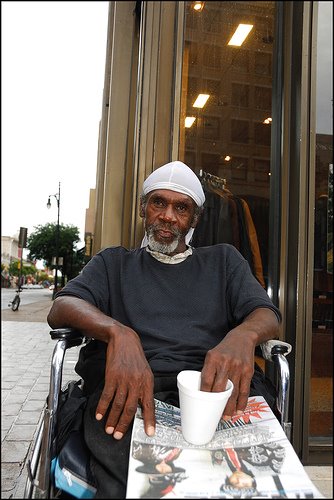
Mr. George, 6th & Congress, Austin, September 2007. Photo by Brian K. George.

‘Police Chief Art Acevedo spoke about the homeless, panhandlers and drug users being the cause of the ills of our society’
By Debbie Russell / The Rag Blog / August 18, 2008

Last Tuesday night I attended the South Central Commander’s forum where Austin Police Chief Art Acevedo spoke in fear-mongering tones about the homeless, panhandlers and drug users being the cause of the ills of our society and that Austin is a “magnet for the needy,” suggesting we should deplete, rather than increase services. Meanwhile, according to sources, across town at the Northwest Commander’s Forum, Command Sergeant Jim O’ Leary was parroting this meme.

The Commander, though, went a bit further in his assessment…after failing to correct a participant for touting that everyone should call 911 to report panhandlers (since the act of panhandling is not illegal), he dismissed a statistic offered by an audience member: that 25% of Austin’s homeless population are veterans. This has been documented,* and, in fact, Austin City Councilmember Lee Leffingwell noted such from the dais a few months ago during discussion of a panhandling survey. So is Cmdr. O’Leary calling the Councilmember a liar? He also spoke of former Councilmember Kim’s “flip-flopping” on the subject of an expanded solicitation ordinance, so it seems Cmdr. O’Leary is using his position to politic and lobby. As I recall…an officer’s duty, while in uniform, is to enforce the law, not seek to change it.

Who is this man? Cmdr. James O’ Leary, #854, former head of the Training Division, is known to many anti-war protesters as the vindictive initiator of the massive pepper-spraying of peaceful people on the sidewalk of the Congress Ave. bridge the night the war started,** and later introduced to the general public as the officer who was briefly suspended in 2006 for a drunk driving accident*** (he was sentenced a $1000 fine and 1 year probation/no time served).

So, is this APD’s official line? That we don’t need to concern ourselves with the homeless population (other than by generally outlawing homelessness) because they don’t believe that there are as many homeless veterans as studies say? And are we to only care about the homeless because of the percentage, whatever it is, of veterans within it? If not, then it sure seems the Chiefs need to realign their messaging on this point and properly address out-of-step Commanders who are already sullying APD with their past actions.

More to come on upside down police priorities and police-targeting of the most vulnerable and how that only perpetuates the problem.

Please see the following:

* O’Leary’s quote: “I don’t believe that; we all know how wrong those surveys are.” There are varying statistics, but 25% seems to be the accepted figure, and is the one the City has touted repeatedly:

Beside the Point: South by Solicitation / Austin Chronicle / March 14, 2008.

Homeless Veterans Facts / Community Partnership for the Homeless.

Stand Down Austin [Of 226 homeless people receiving services, 64 were vets.]

12,000 homeless vets in Austin and that’s 2006: Nonprofit calls for better housing for homeless veterans / Daily Texas online / Sept. 13, 2006.

640 homeless vets on any given day: CAN Community Council Meeting / Community Partnership for the homeless / March 2008.

**Point Austin: Not So Smart / Austin Chronicle / Feb. 17, 2006. [Video shows a wild-eyed O’Leary, without warning or provocation, launching his pump-gun sprayer at folks including 2 disabled people, who were merely waiting for instruction since APD had been giving conflicting information to that point.]

***Austin Police Department Memorandum / August 25, 2006.

The Rag Blog

Posted in Rag Bloggers | Tagged , , , , , | 3 Comments

A Video Series on World Agriculture: Monsanto, Part 7

The World According to Monsanto (Part 7 of 8)

Right now, there is probably no other company that is doing more to endanger the health of this planet, and it’s inhabitants, than Monsanto. With Nazi-like attitude, they are leading the world in shear destructive evil greed. First they were a drug company, and then they expanded to become a drugs and genetic engineering company, and now Monsanto is attempting to acquire water rights in countries with water shortages in a move to control the people’s basic means of survival, and production of the global food supply. Giant transnational corporations like Monsanto, in collusion with the World Bank and the World Trade Organization, seek to commodify and privatize the world’s water and put it on the open market for sale to the highest bidder. Millions of the world’s citizens are being deprived of this fundamental human right, and vast ecological damage is being wrought as massive industry claims water once used to sustain communities and replenish nature.

Click here for more information.

Thanks to Diane Stirling-Stevens / The Rag Blog

Posted in RagBlog | Tagged , | 1 Comment

The Siege of Gaza Must Be Broken


Can a handful of international activists and two boats break the siege of Gaza?
by Sharat G. Lin / August 18, 2008

The voyage to “break the siege of Gaza” was originally planned for the summer of 2007. But it did not materialize for lack of funds and because of logistical challenges in arranging for purchase and delivery of the boats. Many observers wondered whether the ambitious grassroots project without the backing of any major organization or agency would ever get off the ground.

But on August 10, 2008, two small Greek-flagged boats finally arrived from Greece to Chania, Cyprus. They were the 21-metre long SS Free Gaza (غزة الحرة) and the 18-metre SS Liberty, named in memory of the 34 American sailors who were killed when Israel attacked the USS Liberty in apparent error during the Six Day War in 1967. Before their arrival in Chania, the identity of the vessels had been a closely-guarded secret for genuine fear of Israeli sabotage. Once the vessels were renamed and presented at a press conference, activists remained on board both vessels 24 hours a day for security reasons.

After days of additional delays due to soaring prices for supplies and diesel fuel, a shortfall in funds, and turbulent weather, the vessels finally departed Crete en route to Cyprus, where they will take on the remaining half of the activists waiting apprehensively in Nicosia. Along the way, the activists have received tremendous support, including material assistance, from local residents in Crete and Cyprus.

Some forty peace and justice activists from 17 countries will be on board, including Israeli peace activist Jeff Halper, founder of the Israeli Committee Against House Demolitions (ICAHD) and nominee for the Nobel Peace Prize. Other notable individuals include 84-year-old Holocaust survivor Hedy Epstein of Saint Louis, Missouri; Lauren Booth, sister-in-law of former British Prime Minister Tony Blair; members of the European Parliament; a survivor of the Palestinian catastrophe (al-Nakbah); and Free Gaza Movement co-founders Paul Larudee and Greta Berlin. Including professional crewmembers and journalists, the number of people on the two boats could reach as high as sixty.

Threats

The Israeli government and Zionist organizations like the Anti-Defamation League have tried (unconvincingly) to link the Free Gaza Movement and its affiliations to the International Solidarity Movement to armed Palestinian resistance organizations that they have labelled as “terrorists.” In fact, the Free Gaza Movement and the Break the Siege campaign in particular have received no funding from any Palestinian organizations, armed or otherwise. The $200,000-300,000 raised for the voyage from Cyprus to Gaza has been entirely from small fundraising dinners in private homes and restaurants, individual contributions, and from the sale of fair-trade Palestinian olive oil rebottled in Berkeley, California by community volunteers. Donna and Darlene Wallach, twin sisters of Eastern European Jewish descent who have lived for many years in Israel and the Palestinian territories, were among those tireless volunteers and will be on the boats to Gaza.

More ominously, Lauren Booth reported on August 15, 2008 that a dozen threatening anonymous calls, text messages, and voice mails had been received by Free Gaza participants in Nicosia. This escalated to family members of activists. Booth reported that on August 14, an anonymous call to her husband in France threatened, “Your wife is in great danger. These ships will be blown up.” Who but a state intelligence agency like the Mossad could readily obtain private telephone and mobile numbers around the world?

Meanwhile, the Israeli daily newspaper Ha’aretz reported on August 17, 2008 that Israeli “defense officials favor forcefully blocking two boats which a group of U.S.-based activists plan to sail to Gaza to protest what they call ‘the Israeli siege on the Strip.’” The statement was based on a position paper by the legal department of the Israeli Foreign Ministry, arguing that Israel has the right to use force against the protesters under the Oslo Accords, which gives Israel responsibility for Gaza’s territorial waters.

Why Gaza?

When the Israeli government withdrew thousands of Israeli settlers and troops from Gaza at the end of 2005, it called the move “disengagement.” Many thought that the occupation of Gaza would come to an end. But on January 25, 2006, the day of Palestinian elections, Israel sealed off Gaza by closing the last open crossing at Erez owing to “security concerns” relating to the anticipated strong turnout for Hamas. Karni crossing had been closed since January 15, 2006, and three other checkpoints had been open only intermittently.

The final election results gave Hamas 74 seats out of 132 in the Palestinian Legislative Council, and an overwhelming majority in Gaza. After the elections, Israel proceeded to tighten control over the flow of goods and people into and out of Gaza in an attempt to destabilize popular support for Hamas and block Hamas’ participation in the Palestinian government headquartered in Ramallah in the West Bank.

Gaza is a strip of land approximately 40 kilometres long by 7 kilometres wide. It includes cities, towns, 8 major refugee camps and several minor ones, agricultural land, and uncultivable sand dunes and saline intrusion areas. With nearly 1.5 million people, Gaza has an overall population density twice that of a typical large U.S. city or roughly comparable to a European city. Gaza cannot possibly feed itself. It has no natural sources of energy — neither fossil fuels nor hydroelectric potential. It has no natural aquifers to provide a renewable source of fresh water. As a relatively unindustrialized territory, it is completely dependent on the outside for nearly all of its consumption needs and the majority of its viable employment.

After 1967, Gaza residents gained employment inside Israel and became dependent on the crossings for daily commutes to their jobs in Ashkelon, Tel Aviv, the Negev, and elsewhere. But that source of employment was largely cut off by Israel during the Second Intifada, and completely eliminated with the economic siege imposed on Hamas in Gaza in 2006. In reality, the drastic lack of employment, and the obstacles placed on the supply of food, drinking water, medicines, fuel, and electricity became a chronic collective punishment on all Gaza residents in full violation of international law.

Israeli “disengagement” from Gaza changed nothing with respect to the wall and fence that completely encircle Gaza from its northern boundary with Israel to its southern boundary with Egypt. Even the Rafah crossing between Gaza and Egypt is effectively controlled by Israel through European Union monitors who have acceded to Israeli demands to have veto power over any person or baggage moving through the Rafah crossing. The Kerem Shalom crossing for goods from and to Egypt is controlled directly by Israel because it operates on an intervening sliver of Israeli territory. The remaining checkpoints not only are opened by Israel very sparingly, but are each used by Israel for very restricted purposes. The Erez crossing in the north is the primary gateway for people, but not for goods. Nahal Oz crossing is exclusively for liquid fuels. Karni crossing is the primary entry point for food, medicines, and manufactured goods. Sufa crossing is mainly for bulk aggregates and building materials. Kissufim and Elie Sinai crossings are effectively closed.

Gaza has a commercial airport southeast of Rafah, but all Palestinian air traffic is banned by Israel. That leaves the sea. The Israeli Navy controls all waters around Gaza and does not allow any vessels in or out of Gaza’s fishing limits. There are over 700 boats, mostly fishing boats, registered in Gaza. The boats provide a livelihood for 3000 Palestinian fishermen according to a United Nations survey. Under the 1993 Oslo Agreement, the fishing limit for Gaza fishermen was set at 20 nautical miles from the shore. A “no fishing zone” 2 nautical miles wide was established as a security buffer from the Israeli sea boundary (as if fishermen were a threat to Israel’s security) within Gaza’s territorial waters and extending out from shore to the fishing limit. A similar “no fishing zone” one nautical mile wide was established on the sea border with Egypt. But in 2002 as a result of the comprehensive Israeli military assault on all the occupied Palestinian territories launched at the end of April, the Bertini Agreement restricted Gaza’s fishing limit to 12 nautical miles. Then, as part of the ever-tightening noose around Hamas-ruled Gaza, the Israeli Defense Forces began enforcing a 6-nautical-mile fishing limit from October 2006. Not only has Gaza effectively become the world’s largest open-air prison, but some of the walls of the prison have been progressively closing in on the inmate population.

So it is not surprising that perhaps hundreds of Gaza fishing boats may be preparing to greet the uncertain arrival of the SS Free Gaza and the SS Liberty. In Gaza Port alone, there are over 470 registered boats. If the Israeli siege is broken by sea, it will be a tremendous morale boost to Gaza fishermen whose operating territory has shrunken from the Eastern Mediterranean before 1967 to a mere sliver of coastal water under Israeli military control. Even in the years following the Israeli occupation, Gaza Port continued to be a bustling hub not only for fishing but for international shipping as well. I remember well in 1973 how ocean freighters used to wait in queue offshore for a berth in Gaza City’s cargo port. Few places on Earth have witnessed such a drastic and comprehensive economic decline under military occupation.

The SS Free Gaza and the SS Liberty either may pave the way for unrestricted international access to Gaza by symbolically breaking the Israeli naval blockade, or they will be stopped by the Israeli Navy which will prove that Israel still occupies Gaza despite its denials. The action places the Israeli government on the horns of dilemma, out of which neither outcome will work in its favor. It is only regrettable that no Arab government or organization has had the courage to challenge the Israeli blockade.

It is the responsibility of all activists for human rights and social justice worldwide to stand behind the courageous passengers of the SS Free Gaza and SS Liberty in the coming critical days as they prepare to depart from Cyprus. This is an act of nonviolent civil disobedience following in the footsteps of Mahatma Gandhi — unarmed ordinary people with an unshakable moral conviction facing down one of the most powerful military machines on Earth. Global awareness is key. The probability that they will be harmed is drastically reduced if the eyes of the world are focused on Gaza’s coastal waters. The siege of Gaza must be broken!

[Sharat G. Lin writes on migrant labor, global political economy, the Middle East, India, public health, and the environment.]

Source / Dissident Voice

The Rag Blog

Posted in RagBlog | Tagged , , , | Leave a comment

Alan Pogue and Steve Russell : Somalia and Big Oil

Oil exploration in Somalia. Chevron photo.

‘The point is that the oil is there and the U.S. energy companies, among others, want it.’

A Ragblogger dialogue with Alan Pogue and Steve Russell.

‘What would Obama do? Hillary? It was her husband who sent in the Marines in 1993 on an oil mission covered up as a humanitarian mission.’
By Alan Pogue
/ The Rag Blog / August 18, 2008

I continue to keep informed on Somalia. The BushCo U.S. encouraged North Korea (former axis of evil member) to sell weapons to Ethiopia so Ethiopia can be the proxy army for U.S. oil company interests in Somalia. We are not supposed to know about this. As in Haiti (soon in Sudan) the U.N. is the tool of U.S. foreign policy.

I don’t have any “action” ideas. What would Obama do? Hillary? It was her husband who sent in the Marines in 1993 on an oil mission covered up as a humanitarian mission. Bill Clinton and the Marines were embarrassed so rather than go through that again the Ethiopians get to do the dirty work for Chevron and all.

Please read Somalia: Troops killing people ‘like goats’ by slitting throats / amnesty.org.uk.

Response from Steve Russell:

And pray tell, Alan, how much oil have US companies taken out of Somalia?

How much oil has ANYBODY taken out of Somalia?

China sits on the spigot in Darfur to the extent there is a spigot.

I remember an article we ran in The Rag that attributed the Vietnam War to oil companies. I thought it was a crock, but if somebody said there was oil there….well, I didn’t know any better. Now that Vietnam is run by the Vietnamese I don’t see oil riches pouring in. Their economy seems pretty similar to other Indochinese nations, based on agriculture surplus (which had been destroyed by the war) plus a work ethic that draws manufacturing jobs.

And while we’re at it, how much oil have US companies taken though (not “out of”) Afghanistan?

How much oil have US companies taken out of Iraq? Now, that one has some legs since the occupation government redid all the leases. However, it does not appear to have had much impact on bottom lines yet. Not to say it won’t and anybody who thinks we invaded Iraq because Saddam was a naughty fellow needs a brain transplant, right after those who think we invaded Afghanistan to improve the conditions of Afghan women.

What would Obama do?

I expect a major push to get off the oil teat for transportation. If we manage that, we can actually meet our oil needs domestically for the first time in a long time. What Obama has not said and I would like to see happen is an end to our obligation to defend Saudi Arabia, which after all had more to do with the atmosphere that produced 9-11 than anything Iraq did. Since that agreement is not exactly public, I’m not sure what getting out of it will entail…but we sure as hell can’t get out of it while we depend on Saudi oil. Another thing Bush has bequeathed us is that Saudi Arabia is a big big big buyer of our T-bills that have enabled us to fight a war, increase domestic spending, and cut taxes all at once. This can be looked up, but my recollection is that it goes China, Japan, Saudi Arabia.

I also expect a major push to put together miliary interventions in Africa, although I don’t think he will go solo. I’m not sure there’s a lot of opportunity for Africa without military interventions to tamp down the ongoing legacies of colonialism. Can this be done without re-colonization? If it can minimize mass murder, who cares? But I think so because the international discourse on colonialism is so negative. Some protectorates are probably necessary. Is that bad? Well, Namibia has revived pretty well. All of the colonies the US stole off Spain in that “splendid little war” have prospered except Cuba and it has great potential if the bureaucracy can handle the post-Fidel transition. The former Portuguese colonies that were a major issue when we were undergraduates are moving right along toward the 20th century — unfortunately, the calendar reads 21st, but the violence has quieted and they are about the business of feeding themselves for a change.

Zimbabwe is a horrible mess that is suffering from black South Africa’s learning curve on how to govern, but, geez, that whole deal could have been so much worse. When South Africa withdraws support from Mugabe, he’s gone, and Zimbabwe may again export food instead of importing it. The SA government hestitates to cut the bastard loose because of the close ties during the apartheid years among the liberation movements. Therefore, I lay this one at the door of colonialism, too, albeit
indirectly.

I’ve always favored engagement economically and socially. Militarily only to save lives in an immediate sense. However….

As I’ve said before on this list, Bush’s inattention to Latin America has been a boon for democracy and economic progress. Latin America has done really well in the last eight years. Yes, there are nasty exceptions of meddling but there is no real focus down there like there was under Reagan. Brazil, Chile, Argentina–wow! Bolivia has great potential, for the first time in my life…no thanks to the US.

So I look at Latin America and wonder if Africa should just be left the hell alone by the developed countries?

The thing that makes that hard is sheer body count. Lots of people died during CIA adventures in Argentina, Chile, El Salvador, Nicaragua, Guatamala….but the body counts have been orders of magnitude greater in Africa. Also, Africa has the problem of recurring famine, which also kills more people in Africa than military misadventures have killed in Latin America.

When you see starving children with distended bellies….and you know that your country has plenty of chow…it’s really hard not to respond.

While Latin America recently might make a case for hands off in Africa, I think Obama is committed to hands on in Africa but his goals involve admitting black Africans (like his late father) to the human race, being as concerned about them as we are about white folks for a change.

Sure, capitalists will always try to profit from disasters. The bigger the emergency, the greater the chance to get a contract without bidding and the less likely anybody will track the money.

As much as I despise Bill Clinton, I don’t think oil had a damn thing to do with our ill-fated enterprise in Somalia. And the biggest capitalist reason for intervention in Somalia right now is not oil–it is suppressing piracy off the Horn of Africa. That capitalist goal, I suggest, dovetails perfectly with the interests of the people on land who are preyed upon by the pirates.

“Law and order” may have been a racist code that elected Richard Nixon, but just try living without it. That’s Somalia, and it benefits nobody to turn a blind eye to it.

Steve Russell

The point is that the oil is there and the U.S. energy companies, among others, want it. They have a long view. The oil runs from South Yemen under the Gulf of Aden and then under north Somalia. Below is “The Strategic Question,” part of a F.A.I.R. report. It contains a reference to Mark Fineman’s story on Somalia’s oil. One may Google “Mark Fineman” for the entire article plus a lot more. Unfortunately for us all Mark died of a heart attack in Baghdad. F.A.I.R. had Mark Fineman’s story in the L.A. Times as one of the ten most underreported stories of 1993. Google “North Korea Somalia Oil” for many reports on the U.S. backed North Korean arms sales to Ethiopia.

Go to USAID and type in Sudan Oil and you will get a map of the known deposits in Sudan and who controls them. China is big in south Sudan but so is Malaysia and a Swiss consortium. The French (TOTAL) have Chad’s oil. Darfur has oil but so far no one has the rights to it. The U.S. is fighting hard for those rights and has top State Department fellows there working on it. I have a file on them as well. Neither the U.S. State Department nor the Sudanese government wants peace , just yet, in Darfur. They have not killed as many of the indigenous political figures as they want to kill (rebels to us, soon to be referred to as “Al Qaeda” you can bet) that vie for the oil resources.

I have a friend whose father was an oil geologist and was looking for oil off the coast of Vietnam. He said they didn’t find out there was no oil to be had until 1968. If I can get the report I will.

My interests are not the same as the U.S. State Department’s so I do not use the word “we” when talking about U.S. foreign policy. If “we” are going to do anything good anywhere it will have to be along the lines of the Lincoln Brigade because the present military of the U.S. is up to no good. I am happy to say I am not part of the present team. Maybe Obama will call me.

The strategic question

“If the U.S. has not consistently acted in an altruistic manner toward starving people in Africa, why did it dispatch troops to Somalia at this point? There have been frequent media denials that geopolitical considerations might have entered in to the decision. The Washington Post reported (12/6/92) that “unlike previous large-scale operations, there is no U.S. strategic or economic interest in the Somalia deployments.”

“But The Nation (12/21/92) referred to Somalia as “one of the most strategically sensitive spots in the world today: astride the Horn of Africa, where oil, Islamic fundamentalism and Israeli, Iranian and Arab ambitions and arms are apt to crash and collide.” Given that the U.S. and U.S.S.R. jousted over the Horn of Africa for years, The Nation’s assessment may have been more realistic.

“There was also little discussion of the fact that northern Somalia (which has declared itself independent under the name Somaliland–Oakland Tribune, 12/21/92) contains mineral deposits and potential oil reserves. Considered geologically analogous to oil-rich Yemen across the Red Sea, it has been the site of oil exploration by such companies as Amoco, Chevron and Conoco. Not until six weeks into the operation (1/18/93) did a journalist for a major media outlet, Mark Fineman of the L.A. Times, report on the “close relationship between Conoco and the U.S. intervention force,” which used Conoco’s Mogadishu headquarters as a “de facto U.S. embassy.”

In Vietnam there was thought to be oil off the coast but finally in 1968 the various oil companies discovered there was not enough.”

Alan Pogue

Well Alan, I take it we could agree on the following:

As long as the US is dependent on oil, the position that “what’s good for Exxon Mobil is good for the USA” is arguable.

That position has been dominant in Washington.

Looking at the oil money in the Presidential race, we see the oil companies making “insurance bets” on Obama but the bulk of support going to McCain. I see two reasons for this from the oilman’s perspective.

First, McCain has supported the Repug position in Congress tying the reenactment of renewable tax benefits to continued favorable tax treatment for oil exploration. Obama not.

Second, McCain is fully committed to unilateral use of military force whenever our national interests are at stake. Obama is equivocal on the use of force and flat against using it unilaterally. As we move toward or past peak oil (depending on your point of view) dependence on oil will mean willingness to use force to get it.

Agree?

And one more thing. I’m getting impatient with cant in my old age.

When facing to the right, I’m determined to quit treating the anti-gay position as rational. It’s not. It’s bigotry, plain and simple.

When facing to the left, I’m not going to parse my language to avoid saying anything that might be construed as pro-American. It may be an old story to say that my personal story could not have happened in most other countries but that does not make it false. Ditto Obama’s story. American exceptionalism is way overblown.

However, America is exceptional in a number of ways and not all of them are negative. Leaving aside the truism that you can’t aspire to leadership by democratic means in a polity you despise except by lying.

Steve Russell / August 18, 2008

What is good for Exxon/Mobil is death for us all. Utter misery for many right now

The energy companies care only for their own profits and do not care (cannot care, cannot care) at all about the U.S.A. or any other nation state. G.E. is moving to Dubai. They have artificially constructed our dependence on them, their oil. They have successfully crushed mass transportation and any alternative to an oil based economy. Los Angeles is a prime example. The movie “Who Framed Roger Rabbit” was based on fact, on actual history. We may tinker on the edges with wind and solar power. (Today The New York Times has yet another article putting down wind power.) Individuals may make totally electric cars. A few cities may improve their public transportation systems against all odds.

If one thinks I exaggerate then please give this site a look and then get back to me:

McCain being the front man for Big Oil, Bechtel and the rest, will use the military to keep them in power. This is the exact opposite of any rational national, dare I say, human interest. Circular logic at its finest: we are dependent on oil so we must have it to maintain the dependence. Heroin, anyone? (A reality , not an analogy.) The military is nothing but the strong arm enforcers for the multinational pushers. Again, I suggest that you not use the pronouns “our” and “we” when you really mean “them.” Their interests are not our interests. “We,” as in you and I and regular folks, are being forced at gun point into a confrontation with peak oil that was purposefully made to happen by multinational energy companies that do not and cannot care if they destroy the planet in their ultimately narrow view of Profit as God. They really cannot entertain the smallest notion that there is any other good aside from amassing personal gain. Capitalism is a religious (non-rational) faith in itself which may not be questioned. So they want to privatize Social Security. There can be no exception to worshiping the God of Private Profit. They crushed tiny Haiti because there can be no exception to global capital.

They used force to make it happen and they will use force to keep it the way it is until we, the all inclusive “we,” are all dead. One recalls “Pinkerton,” “Rockefellor,” “Standard Oil,” “AT&T v. Allende,” the whole sordid attack on the labor movement both here and everywhere.

If all the oil disappeared tonight then we, all of us, would be in a world of hurt, for sure. But the point is that those who are in power and could make the transition very much less painful have no desire to do that.

Alan Pogue

The Rag Blog

Posted in Rag Bloggers | Tagged , , , , , , | 1 Comment

Perspectives on the Conflict in South Ossetia

And then there’s the near total silence about the strategic importance of Georgia in relation to the transport of oil and natural gas from the central Asian region. This is played out in US news as a clash between eastern and western ideologies, while it appears with little digging, to be considerably more pragmatic than that. Check the video below created by a young Russian student.

Richard Jehn / The Rag Blog

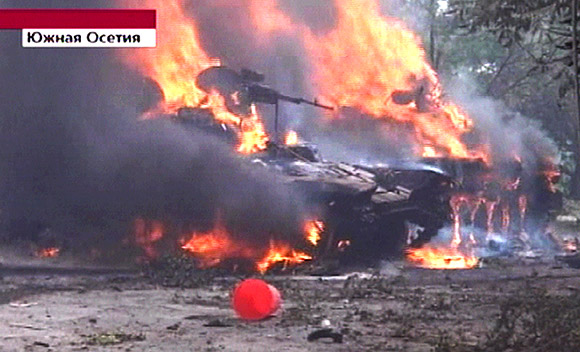
On August 8, Russian armored vehicles rolled into South Ossetia, a pro-Russian separatist region of Georgia. A week later, Russian troops are still in Georgia, a vital conduit of Caspian oil and natural gas to the West. Tensions between Moscow and Washington are rising. Here, Russian television shows a Georgian tank burning in Tskhinvali on the first day of clashes.

Washington’s hypocrisy
By Dmitry Rogozin / August 18, 2008

BRUSSELS — The U.S. administration is trying to stick the label of “bad guy” on Russia for exceeding the peacekeeping mandate and using “disproportionate force” in the peace-enforcement operation in Georgia.

Maybe our American friends have gone blind and deaf at the same time. Mikheil Saakashvili, the president of Georgia, is known as a tough nationalist who didn’t hide his intentions of forcing Ossetians and Abkhazians to live in his country.

We were hoping that the U.S. administration, which had displayed so much kindness and touching care for the Georgian leader, would be able to save him from the maniacal desire to deal with the small and disobedient peoples of the Caucasus.

But a terrible thing happened. The dog bit its master. Saakashvili gave an order to wipe Tskhinvali, the capital of South Ossetia, from the face of earth.

The Georgian air force and artillery struck the sleeping town at midnight. More than 1,500 civilians perished in the very first hours of the shelling. At the same time, Georgian special forces shot 10 Russian peacekeepers who didn’t expect such a betrayal from their Georgian colleagues.

The Kremlin attempted to reach Saakashvili, who was hiding, by phone. All this time the Russian Joint Staff forbid the surviving peacekeepers to open return fire. Finally our patience was exhausted. The Russian forces came to help Tskhinvali and its civilian population.

In reply to the insulting criticism by President Bush that Russia used “disproportionate force,” I’d like to cite some legal grounds for our response. Can shooting peacekeepers and the mass extermination of a civilian population – mainly Russian citizens – be regarded as hostile action against a state? Is it ground enough to use armed force in self-defense and to safeguard the security of these citizens?

Tbilisi concealed the scope of the humanitarian catastrophe in South Ossetia. Saakashvili’s constant lies about the true state of affairs in Georgia were attempts to lay the fault at somebody else’s door.

The Russian response is entirely justified and is consistent with both international law and the humanitarian goals of the peacekeeping operation conducted in South Ossetia. I will try to explain.

The Georgian aggression against South Ossetia, which came as a straightforward, wide-scale attack on the Russian peacekeeping contingent – Russian armed forces legally based on the territory of Georgia – should be classified as an armed attack on the Russian Federation, giving grounds to fulfill the right to self-defense – the right of every state according to Article 51 of the UN Charter.

As for the defense of our citizens outside the country, the use of force to defend one’s compatriots is traditionally regarded as a form of self-defense. Countries such as the United States, Britain, France and Israel have at numerous times resorted to the use of armed force to defend their citizens outside national borders.

Such incidents include the armed operation of Belgian paratroopers in 1965 to defend 2,000 foreigners in Zaire; the U.S. military intervention in Grenada in 1983 under the pretext of protecting thousands of American nationals, who found themselves in danger due to a coup d’êtat in this island state; the sending of American troops to Panama in 1989 to defend, among others, American nationals.

We also have to keep in mind the present-day military interventions by the U.S. and its allies in Yugoslavia, Iraq and Afghanistan. By the way, the last three cases are examples of tough American interventions when its own citizens did not need direct protection. But in spite of those countries’ massive civilian losses at the hands of American soldiers, no one blamed Washington for a “disproportionate use of force.”

Of course, the history of international relations is full of abuses committed under the pretext of defending citizens.

In order to draw a clear line between lawful and unlawful use of force, one can single out a number of objective criteria: first, the existence of a real threat to life or systematic and violations of human rights; second, the absence of other, peaceful means of resolving the conflict; third, a humanitarian aim for an armed operation; and four, proportionality – i.e., limitation on the time and means of rescue.

Russia’s actions were in full compliance with these criteria. In conducting its military action, Russian troops also strictly observed the requirements of international humanitarian law. The Russian military did not subject civil objects and civilians on the territory of Georgia to deliberate attacks.

It is hard to believe that in such a situation any other country would have remained idle. Let me quote two statements:

One: “We are against cruelty. We are against ethnic cleansing. A right to come back home should be guaranteed to the refugees. We all agree that murders, property destruction, annihilation of culture and religion are not to be tolerated. That is what we are fighting against. Bombardments of the aggressor will be mercilessly intensified.”

Two: “We appeal to all free countries to join us but our actions are not determined by others. I will defend the freedom and security of my citizens, whatever actions are needed for it. Our special forces have seized airports and bridges… air forces and missiles have struck essential targets.”

Who do you think is the author of these words? Medvedev? Putin? No. The first quote belongs to Bill Clinton, talking about NATO operation against Yugoslavia. The author of the second quote is the current resident of the White House, talking about the U.S. intervention in Iraq.

Does that mean that the United States and NATO can use brute force where they want to, and Russia has to abstain from it even if it has to look at thousands of its own citizens being shot? If it’s not hypocrisy, then what IS hypocrisy?

Dmitry Rogozin is Russia’s ambassador to NATO.

Source / International Herald Tribune

President Mikheil Saakashvili of Georgia. Photograph by: Vano Shlamov/AFP/Getty Images

New York Law to Russian Claw
by Kit R. Roane Aug 15 2008

The idealism and ambitions of Georgia’s embattled leader were shaped in Manhattan.

More than a decade before he became Georgia’s president, Mikheil Saakashvili was just another struggling law student with big plans tooling around Manhattan on his bicycle.

“He was ambitious, idealistic, and I think he had something of the American messianic sense that you could use law to change the world,” recalls professor Lori Damrosch, who taught Saakashvili in a Columbia law seminar entitled International Institutions in Transition.

“This was at a time of turmoil in the ex-Soviet republics, and he had a lot to say on those topics,” she adds, noting that students at the law school were “imbued with this idealistic spirit” and that Saakashvili “absorbed these values.”

With his country now bloodied after a clash with Russia and his leadership questioned, the overarching idealism of his New York student days would seem to have been finally shaken.

Critics have certainly come out of the woodwork, saying that the loss of Georgia’s breakaway regions, particularly that of South Ossetia, would foment protest to Saakashvili’s rule. Italy’s foreign minister, Franco Frattini, has said that the war brought on by Saakashvili’s futile and perhaps rash attempt to secure the areas “pushed Georgia further away not just from Europe, but also complicates the NATO council in December.” And Michael Evans, defense editor for the Times of London, noted that Saakashvili’s “military adventure had all the hallmarks of rushed planning and a finger-crossed strategy,” adding that the Georgian president gave Vladimir Putin “the opportunity he was waiting for to stamp his authority over Georgia and at the same time to cock a snoot at the West.”

So far, Saakashvili has not wavered. He continues to hammer out a drumbeat of statements aimed at presenting himself as the biblical David, Russia as the corrupt Goliath intent upon creating a new iron curtain, and Georgia as the thin edge of the wedge.

“Let us be frank: This conflict is about the future of freedom in Europe,” he wrote in the Wall Street Journal.

He has failed to persuade the West to send in reinforcements. With Russia still marching into new cities, the best news that Georgia could muster so far this week was word that its Olympic beach volleyball team had trounced the Russians in two out of three rounds.

Saakashvili would have likely modeled for a more robust response from the West. Well studied in the intricate dance among nations, he wrote a seminar paper on humanitarian intervention, which focused on ethnic conflicts in the former Soviet satellite states.

Unlike many other 1994 graduates of Columbia Law School, Saakashvili put his training to the test on the world stage.

By 1996, Saakashvili, who idolizes John F. Kennedy and leans politically toward John McCain, had already jettisoned a doctoral thesis at George Washington University Law School, quit the high-power law firm of Patterson Belknap and won a parliamentary seat in the Republic of Georgia (population 4.4 million).

This was the first of many leaps that would, in a short and bloodless coup, move Saakashvili into the presidency, an ascendancy that Saakashvili has said was helped along by the knowledge that he acquired while a law student in the United States.

“He clearly knew what he wanted when he was at Columbia, and he chose his courses very carefully and in a conscious way that didn’t follow the usual diet, which is corporate and securities law,” says professor George Bermann, who taught Saakashvili courses in European Union law, and transnational litigation and arbitration.

Despite Georgia’s setbacks, no one should count Saakashvili out just yet. He has spent the last decade and a half proving that idealism in the most adept hands can be a strong bulwark against even the strongest and most depressing reality.

The man known as Misha abandoned a life of Knicks games and opera nights to turn around the poor, corrupt, and complicated country from which he sprang. He also became a leading light among the wave of twentysomething rat-packers who had washed onto our shores hungry for American-style democracy, then eagerly trekked back home to plant this new-found seed in the dark soil left vacant following the Soviet Union’s collapse.

“He is a western person, and a very dedicated person, very dedicated to human rights,” notes professor Dinah Shelton, of George Washington University’s Law School, adding that when Saakashvili failed to finish his dissertation, his professors joked that his tackling Georgia’s weighty issues as its president was no excuse.

Little seemed to stop Saakashvili once back in Georgia. When his mentor, then-president Eduard Shevardnadze, balked at Saakashvili’s attempts to tackle official corruption, Saakashvili quit the government and went to work forming an opposition party.

After winning election to the head of the Tbilisi city council, he then used his populist appeal to claw his way back into power during the Rose Revolution of 2003. Again, he was unyielding, breaking with other opposition leaders who proposed talks with Sheverdnadze and sought a more measured approach. Instead Saakashvili and his supporters stormed the parliament chamber where Shevardnadze was holed up, then reportedly chased him from the building under the threat of flowers instead of guns.

Answering critics, Saakashvili told reporters at the time that his style was the type that “mobilizes people here,” noting later that “Georgia needs a new way” and that every moment Shevardnadze remained in power meant “losing time.”

Despite criticism of some of Saakashvili’s methods—and despite evidence that a frustrated Saakashvili turned to a more thuggish approach himself during crackdowns on demonstrators last fall—his many successes spring from the same tight-rope approach.

He has overhauled the police, brought about important economic reforms, increased average salaries, and improved the country’s power supply, notes Alexandra Stiglmayer, a senior Brussels-based policy analyst with the independent think tank European Stability Initiative.

“Saakashvili may be a complex personality and he has certainly made mistakes. But he has given the civil society breathing space,” she says. “Compared with its neighbors in the region, such as the Northern Caucasus region in Russia, but also Armenia, Azerbaijan, and eastern Turkey, Georgia is more liberal, more open, and more committed to the rule of law.”

The question now is whether he can stay in power. His old professors certainly hope their favored son will weather this latest storm.

Professor Damrosch recalls happening upon Saakashvili riding his bicycle when she was visiting Washington at the same time he was pursuing his doctoral studies there. She waved and Saakashvili sailed through several lanes of traffic just to chat.

“The image of Misha on a bicycle—whether in Washington, New York, or the more mountainous terrain of Georgia —conveys something of his energetic spirit,” says Damrosch. “I can’t think of anything that would slow him down.”

Source / Portfolio.com

The Rag Blog

Posted in RagBlog | Tagged , , , | Leave a comment

Ashamed and Disgusted at What is Happening

A Canadian Jew’s visit to the territory left him ashamed by what he saw

Gaza’s shocking devastation
By Harry Shannon / August 14, 2008

I had expected conditions in Gaza to be bad, but I was still shocked at the devastation when I went there in July.

Last month my companion and I entered Gaza at the Erez crossing through a modern building reminiscent of an airport terminal. After questioning by the Israeli border police, we left the building and had a kilometre walk to pick up transportation.

It was as if we had travelled to another planet. The sandy track is surrounded by the blown-up remnants of Gaza’s former industrial district. Rubble stretching for hundreds of metres lines the route.

Even on the main road through Gaza, driving is a slalom course around potholes. The air reeks of burnt oil and stale food from exhaust fumes (cars rely on used cooking oil for fuel.)

There are not many cars on the road, anyway. Donkey carts are common.

Despite the 35 C temperatures, drivers don’t use air conditioning in cars so they can save fuel.

Every so often, the smell of sewage fills the air. Lack of treatment facilities means that much of it is dumped raw into the Mediterranean.

We went first to a children’s hospital on the edge of Gaza City. The hospital director and doctors described the conditions. Of 100 beds, 40 were occupied by children with bacterial meningitis, an extremely serious disease.

There’s a shortage of basic medicines and supplies, even simple things such as alcohol swabs.

The hospital has three ventilators; only one is working. Israel won’t let in spare parts for the others.

The working machine is for a “hopeless case” who can’t be taken off. Meanwhile, patients who could benefit have no working machine.

There are many cases of malnutrition — for example, children nearly a year old weighing 3 kilograms (6.6 pounds). Their families can’t afford the special formula they need to improve.

Because of lack of equipment and qualified personnel, there is no radiotherapy and limited chemotherapy in Gaza.

Treatment for many conditions can only be obtained in Israel. Physicians for Human Rights — Israel reports that, despite the ceasefire in the last few weeks, emergency medical cases are still refused entry into Israel, where they could have life-saving treatment. PHR has documented many cases of people dying before they are treated.

Indeed the proportion of patients denied exit from Gaza for treatment has increased since last year.

PHR will soon release a report on “medical extortion.” Some sick Palestinians are interrogated at the Erez crossing and asked to become informants or collaborators as a condition of permission to leave Gaza for medical treatment.

After leaving the hospital, we travelled to the southern end of Gaza. We stopped at the Rafah crossing, the border with Egypt. It was closed, as it is most of the time.

A cluster of people were waiting, hoping against hope that they would be allowed to cross. Egypt is under pressure from both Israel and the U.S. not to open the border, and in any event, they do not want large numbers of refugees to flood in.

We drove into the city of Rafah, which has come under bombardment by the Israeli military. A huge number of buildings have been severely damaged or completely destroyed.

For street after street, barely any building is untouched. Makeshift shacks of corrugated metal and cloth sheets are now homes for those who have lost their housing.

We returned north along the coast road. The beauty of the sea view contrasted sharply with the rest of what we had seen.

After passing the Ash-Shati refugee camp, we went by modern hotels. They wait in vain for customers. The Gazan economy, devastated by Israel’s border controls, continues to languish.

My sister and her husband are Orthodox Jews living near Tel Aviv. They are outraged at Israel’s behaviour, especially the restrictions on sick patients needing to leave Gaza. My brother-in-law, a former chair of family medicine at Tel Aviv University and a specialist in medical ethics, has complained publicly about this.

As a Jew, I, too, am ashamed and disgusted at what is happening. Yes, Israel needs security. But what is happening goes far beyond security needs.Israel’s actions amount to collective punishment, forbidden under international law.

I am ashamed that the Harper government has tilted toward unconditional support for Israel against the Palestinians. The current policy is unconscionable, as anyone who visits Gaza can see only too well.

[Harry Shannon is a professor of clinical epidemiology and bio- statistics at McMaster University, and a member of Independent Jewish Voices. He lives in Dundas.]

Source / Hamilton Spectator

The Rag Blog

Posted in RagBlog | Tagged , , | Leave a comment

Much of Iraqi Oil Remains "Off-Line"

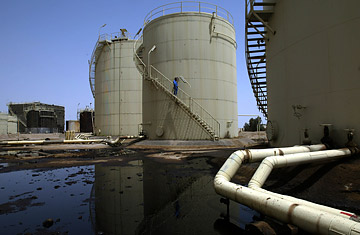
An oil refinery in Basra, Iraq. Oleg Nikishin / Getty

Why Iraq is Still Oil Poor
By Mark Kukis / August 15, 2008

BASRA — Roughly once a week a flotilla of half a dozen or so tankers heaves into the steamy southern Iraqi port of Khur al-Zubar, and the normally sleepy docks jump to life. Teams of workers scramble over ships arriving mainly from Dubai, Bahrain and other points around the Persian Gulf to connect hoses for the flow of diesel, kerosene and gasoline. Old-fashioned gas station tickers beside the ships clatter as thousands of liquid tons begin moving.

All that would seem business as usual at a harbor for a major oil producer, except that much of what’s flowing through Khur al-Zubar is coming into Iraq rather than heading out. These days, the facility, originally built more than 30 years ago for exporting oil, takes in roughly 66,460 metric tons of fuel a month, only slightly less than the amount of oil the area pumps for sale on the world market. (Iraq, as a whole, imports roughly a fifth of its oil.) “It’s a problem,” says port manager Hussein Hamid al-Maliki, who’s working on building another jetty to up the inflow still further. “Iraq bringing benzene and gasoline from outside? It’s a joke.”

Few are laughing. Frustration over the sluggish pace of Iraq’s oil production is rising in the country and abroad as global prices soar. (At the same time, current oil revenues account for 90% of the government’s substantial budget surplus of roughly $50 billion, unspent because of inefficient infrastructure and bureaucracy.) Much of Iraq starves for electricity and fuel as vast amounts of oil and gas sit untapped in the ground. Iraq’s oil industry needs a virtual overhaul to reach a level of production that could erase chronic fuel shortages in the country and rake in windfall profits to be had on the world market. The Iraqi government and more than two dozen oil companies are in the midst of drafting plans to begin the work. But the chances of success anytime soon are far from certain. Political pitfalls in Baghdad and ground realities in areas where resources rest could undo the long awaited bonanza before it begins.

In April, Iraq’s Ministry of Oil drew up an elite roster of companies ranging from Malaysia’s Petronas to Russia’s Gazprom. The list of 35 corporations, including six American giants, reads like a who’s who of global oil players, all of whom are invited to bid on eight major oil and gas projects Iraq wants to launch next year. The goal is to get Iraq, currently producing about 2 million barrels a day, pumping up to 3 million by the end of 2009. The eight oil projects on offer to outside companies chiefly involve refurbishing and developing various oil and gas fields in southern Iraq. American and Iraqi officials say the projects can go forward without passage of a long-delayed national oil law, as long as each contract individually is approved by the Iraqi government and endorsed by the parliament.

In the largely autonomous Kurdish territories of northern Iraq, the regional government is already moving ahead with oil deals of its own that the central government in Baghdad considers illegal. For the most part only small wildcatter firms have bypassed Baghdad for such deals, since their future legality remains uncertain in the absence of a national oil law. Most big players at present appear to be eyeing potential ventures in Iraq’s vast oil territory around Basra instead. Years of neglect have left many oil fields there looking like junkyards. Rusting vehicles, heaps of trash and pools of spilled oil litter a hazy expanse dotted with plumes of flames from gas flares. “We need equipment, we need instruments, we need a lot of technical help,” says Jabbar al-Ueaibi, the head of South Oil Company, an arm of Iraq’s Ministry of Oil.

Al-Ueaibi says South Oil Company is in the process of rehabilitating about 200 wells that could increase production by about a quarter million barrels a day by the end of the year. Perhaps as much as 2.5 million barrels a day could be flowing from Iraq within a year if South Oil Company can get some further outside help from companies in the coming months before any major deals are signed. Production levels beyond that, al-Ueaibi says, will depend on how much outside help Iraq can get.

But any oil company looking to get involved in Iraq faces some major disincentives. Without an oil law, which appears unlikely any time soon because of political bickering, companies wanting to start work in Iraq must essentially lobby both the Iraqi parliament and the government, which rarely find consensus. Two of the biggest projects, gas fields in the provinces of Anbar and Diyala, sit in territory plagued by violence and tribal politics. And none of the ventures are likely to allow companies to have a stake in any newly discovered oil reserves, the real moneymaking prize. “These deals themselves are not likely to be hugely lucrative,” says Charles Ries, the American embassy’s economic coordinator in Iraq.

That leaves much of the oil in the world’s third-largest reserves effectively off line for the time being and hopes for a sharp drop in prices at the pump in Iraq, the United States and around the world still distant. “This is a hope,” says al-Ueaibi of Iraq’s potential rise in oil production. “Let’s say hopeful wishing.”

Source / Time

The Rag Blog

Posted in RagBlog | Tagged , | Leave a comment

A Video Series on World Agriculture: Monsanto, Part 6

The World According to Monsanto (Part 6 of 8)

Right now, there is probably no other company that is doing more to endanger the health of this planet, and it’s inhabitants, than Monsanto. With Nazi-like attitude, they are leading the world in shear destructive evil greed. First they were a drug company, and then they expanded to become a drugs and genetic engineering company, and now Monsanto is attempting to acquire water rights in countries with water shortages in a move to control the people’s basic means of survival, and production of the global food supply. Giant transnational corporations like Monsanto, in collusion with the World Bank and the World Trade Organization, seek to commodify and privatize the world’s water and put it on the open market for sale to the highest bidder. Millions of the world’s citizens are being deprived of this fundamental human right, and vast ecological damage is being wrought as massive industry claims water once used to sustain communities and replenish nature.

Click here for more information.

Thanks to Diane Stirling-Stevens / The Rag Blog

Posted in RagBlog | Tagged , | 2 Comments

Tom Hayden : Same Social Expectations Amid a Very Different War

‘The similarities between the movements for RFK and Barack Obama (the fervor and the interracial character) have been often noted. If anything, the Obama constituency is larger because of the mobilization of so many more young people’
By Tom Hayden / August 15, 2008

As the Democratic National Convention approaches, people inevitably think about the parallels between 1968 and 2008.

The times are different. True, there were unpopular wars raging in those days, but the American casualties in Vietnam were 15 times more than in Iraq today. Every young man faced the draft. Those under the age of 21, like the college students for Eugene McCarthy, could not vote.

The demonstrations of the ’60s finally opened the institutional channels that were closed to my generation of protesters.

Today, anti-war sentiment is occasionally expressed in the streets: There have been 11 protests over the war in Iraq with more than 100,000 participants — but it is diffused less visibly across the mainstream.

It is difficult to call for law and order or speak for a “silent majority” (as Richard Nixon did) against 55 percent of American voters who favor a one-year withdrawal, and impossible to indict the likes of Michael Moore, the Dixie Chicks or Cindy Sheehan.

If anyone should be indicted for urging riots at the Democratic National Convention, it would be Rush Limbaugh, who in April told listeners that he was “dreaming” of riots at the DNC. (U.S. Sen. Ken Salazar called Limbaugh’s comments “incendiary.”)

In 1968, the Democratic establishment was carrying out and defending the Vietnam War against rebellions in the ghettos, on campuses, and among its own rank and file. The Democratic delegate-selection system was rigged from within.

In that situation there arose a movement of African-Americans, Mexican-Americans and a “conscience” constituency on campuses around the candidacy of Robert Kennedy — who, shortly after Martin Luther King’s assassination, was murdered at a moment when our history was beginning to turn around.

The similarities between the movements for RFK and Barack Obama (the fervor and the interracial character) have been often noted. If anything, the Obama constituency is larger because of the mobilization of so many more young people.

In both instances, the movements were more progressive on issues than the candidates themselves. Kennedy campaigned on a general anti-war pledge without proposing complete withdrawal. But onlookers had to be clueless not to know that Kennedy intended to end that war. The tide of anti-war feeling that first made Obama a viable candidate and now holds him to a timetable for withdrawal will continue to rise if he becomes bogged down in future quagmires.

Since the death of Robert Kennedy, I have never been inspired by an electoral movement like that for Obama. There are no certainties, however. He may not win because of the Electoral College’s twisted logic, ironically rooted in our founding compromise over slavery. Many of my generation are haunted by the knowledge that there are killers out there in the shadowlands, making us admire Obama’s audacity all the more.

If Obama does win, experience suggests that his victory might stimulate a new social movement like the one connected to another Kennedy in the early ’60s, which was based on rising expectations after the dreary years of suspicious elections, fabricated wars, environmental denial, spreading inequality, Gilded Age corruption and Katrina-type disasters.

John F. Kennedy was at first cautious in the face of that movement. He disastrously invaded Cuba and sent Green Berets to Vietnam. He resisted the 1963 March on Washington but then embraced it fully. After the Cuban fiasco, he began to rethink the Cold War worldview and move along a path of domestic reform. Then came his murder, followed by the worst years of the ’60s, which his brother Robert, in one brief moment, tried to reverse.

Our global generation revolted against the constrictions of the Cold War on all sides. We lived with the terror of atomic weapons, being told as children to crawl under our school desks and that our world might be incinerated over the Cuban missile crisis. We opposed a two-dimensional world, which made every country a satellite and every individual a dependent on two nation-states competing with the indescribable threat of nuclear weapons. The more the nuclear arms race grew, the more proxy wars were fought, the more the possibilities of dissent and democracy seemed to shrink.

It is forgotten that our generation knew terrorism, too. We struggled not only for human rights and peace in Vietnam, but for the end of the Cold War-approach of mutually assured nuclear destruction.

The long-term challenge for the Obama generation is not only to end the present wars and deal with new crises like global warming, but also to challenge the framework of the war on terror and the shadow it casts over the future.

A President Obama may have to go through a Bay of Pigs in Pakistan or Afghanistan before he begins, like the Kennedy brothers, to reconsider the assumptions of the war on terror. But the parallels are identical.

During the Cold War, the enemy threat was defined as a conspiracy in Moscow, carried out through hidden guerrilla armies across the world. Vietnam was only a pawn of Moscow and, it was added, perhaps China. To combat this menace, trillions of dollars were spent on the nuclear arsenal, conventional armed forces and secret operations from Iran to Guatemala. Expenditures on anti-poverty programs simply dried up, because it wasn’t possible to afford both guns and butter. Anyone who protested the Vietnam War in the streets was considered by Lyndon Johnson, Richard Nixon and J. Edgar Hoover to be an instrument of this internationally based conspiracy.

The recent conflict between Russia and Georgia reveals that the Cold War is not entirely over. A faction of neoconservatives, along with John McCain, have supported sending U.S. advisers and funds to support the fledgling state of Georgia in its efforts to dominate several breakaway areas on the Russian border. This policy of supporting Georgia’s designs on South Ossetia, and promoting Georgia in an expanded NATO alliance, has been shaped by McCain and his foreign policy adviser Randy Scheunemann, a lobbyist who has been on the payroll of Georgia for several years, according to a Washington Post story last week.

Scheunemann previously led the “Iraq lobby” as head of the Committee for the Liberation of Iraq, and as a director of the Project for a New American Century. McCain and Scheunemann now are reviving a Cold War with Russia while at the same time pursuing multiple fronts in the war on terror. Their hardline ideological commitment, combined with lucrative lobbying contracts, fuels a dangerous and costly thrust toward a war until the last Communists and Islamic militants surrender.

If Vietnam was the focal point of the Cold War, Iraq and now Afghanistan are focal points in the new war on terror. The conspiratorial center, we are told, is an al-Qaeda headquartered in places like North and South Waziristan. Its agents are secretly feeding money and weapons to insurgents loyal to a global jihad. They must be annihilated by military force, at whatever expense to domestic programs and civil liberties. Our country will be devastated by nuclear suitcase bombs unless we crush al-Qaeda in its cave.

This is the same crackpot realism that passed for common sense in the ’60s. It overemphasizes organizational targets while underestimating the forces of nationalism and religious hatred ignited by the nature of our policies toward Muslim countries. When we bomb wedding parties in Afghanistan, we give birth to hundreds of raging new jihadists. When we fail to act on the knowledge that Afghanistan is the 122nd-poorest country on the United Nations’ development index of 127 nations, we set in motion the possible attacks on our country that we claim to fear.

If the Obama generation does not find a way to avoid this treadmill to death, there will never be more than token resources for economic development in our inner cities or a new green economy, to cite two urgent domestic priorities. Our young men and women will die in ambiguous quagmires. Most of the world will be hostile to our plight. If the only change is that a black man will be running our empire, is that change worth fighting for?

Obama himself cannot make this larger change. It will be difficult enough to withdraw from Iraq and eventually reach compromise on Afghanistan and Pakistan. As commander in chief and the person in charge of our superpower reputation, he will feel compelled toward military action even if his visionary instincts have to be set aside. It will take the movement, which is stirring now, to lead him in the direction of his dreams, as the movements of the ’60s helped bring forth the greatness in the Kennedys.

Tom Hayden, a founder of Students for a Democratic Society (sds) in the sixties, is a retired California state senator, author, and political and social activist. His latest book, with Ron Sossi and Frank Condon, is “Voices of the Chicago Eight: A Generation on Trial” (City Lights, July 2008).

Source / Denver Post

Thanks to Carl Davidson / The Rag Blog

Posted in RagBlog | Tagged , , , , , , , , , | 2 Comments

Jerry Wexler: Invented Rhythm & Blues, Boosted Austin Artists Like Willie Nelson, Doug Sahm

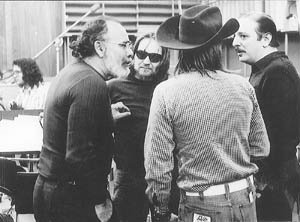
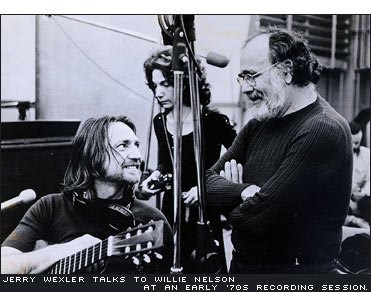
Jerry Wexler with Willie Nelon in the late 1970s.

Aretha Franklin producer, Atlantic Records co-chief and music business pioneer dies at age 91
By Ashley Kahn / August 15, 2008

See ‘Wexler worked with Austin musicians like Willie Nelson…’ below.

Jerry Wexler, the legendary record man, music producer and ageless hipster, died at 3:45 a.m. August 15 at the age of 91. Wexler was one of the great music business pioneers of the 20th century: as co-head of Atlantic Records from 1953 to ’75, he and his partner Ahmet Ertegun grew the small independent R&B label into the major record company that it is today.

Wexler was much more than a top executive — he was a national tastemaker and a prophet of roots and rhythm. The impact of his deeds matched his larger-than-life personality. Because of him, we use the term “rhythm and blues” and we hail Ray Charles as “Genius” and Aretha Franklin as “Queen.” We came to know of a record label called Stax and a small town called Muscle Shoals, Alabama. We witnessed the rise of Led Zeppelin and the Allman Brothers, and we care about a thing called soul.

In the ’50s, Wexler’s studio work helped introduce white ears to the royalty of R&B: Ray Charles, Big Joe Turner, the Drifters, LaVern Baker, Chuck Willis. In the ’60s as the age of R&B gave way to the rock and soul era, Wexler and Ertegun steered Atlantic into a lead position among labels, releasing music by Otis Redding and Aretha Franklin, Cream and Led Zeppelin, Solomon Burke and Wilson Pickett, Duane Allman, and Willie Nelson. In the ’70s, Wexler departed Atlantic and went freelance, producing soundtracks for films by Louis Malle and Richard Pryor, and recording albums with Bob Dylan, Dire Straits, and Etta James and others.

Wexler was a throwback to a time when record men could be found in the studio and the office, producing the music and running the company. Blessed with big ears — they really were large — his productions generated a staggering number of gold and platinum records. The collective impact of the music he personally produced or somehow ushered into being won him nearly every lifetime honor in the music world.

In 1987, he was inducted into the Rock and Roll Hall of Fame, one of the first non-performers to receive the honor. Tuxedoed and hale, he summed up his work at Atlantic: “We were making rhythm and blues music — black music by black musicians for black adult buyers perpetrated by white Jewish and Turkish entrepreneurs.”

Laughing, Wexler added, “Incidentally, two weeks ago I hit three score and 10 — the Biblical allotment. So this is my first posthumous award.”

He was born Gerald Wexler in 1917 to a working class family, and grew up during the Depression in the upper Manhattan neighborhood of Washington Heights. His youth was marked by poolrooms and truancy, until the mid-1930s when he was distracted by a music called jazz. Wexler became part of a loosely knit group of record collectors and streetwise intellectuals, praising trumpeter Henry “Red” Allen and quoting Spinoza. Many members of this circle eventually became captains of the music industry: John Hammond and George Avakian at Columbia Records, Milt Gabler and Bob Thiele at Decca, Alfred Lion and Frank Wolff at Blue Note, and Wexler’s future partners at Atlantic, Ahmet and Nesuhi Ertegun.

“If somebody asked me who I was,” Wexler said, “an aspiring journalist, a stick ball player from Washington Heights, the son of a window cleaner? No, I was a record collector. And we all felt that way.

“We were absolutely a cult. It was ‘we happy few’ as the English say. We used to hang out at the Commodore Record Shop, this little in-group, and get together in the evening. We loved McSorley’s Ale and maybe we’d smoke a cigarette without any name on it. People would bring their favorite records and we’d be listening to Louis and his Hot Five, Hot Seven, whatever.”

A mother who was convinced she had birthed the next Faulkner, and a Stateside stint in the Army during WWII (spent partly in Miami) helped steer Wexler down a more accomplished path. He attended college in Kansas upon being discharged, and in 1946 returned to New York to pursue a career in journalism and the music business. In a day when music publishers held more power than record companies, he first worked as a song-plugger, and then as a Billboard reporter. In 1949, he coined the term “Rhythm and Blues” for the magazine’s black music chart to replace the term “Race Music.”

Wexler was the wordsmith, and revered and respected his favorite authors — Hemingway, Fitzgerald, James M. Cain and John O’Hara — as he did his favorite jazz and bluesmen. Praising a Big Joe Turner big band album, he wrote that it had been created sub specie aeternitatis. Look it up — the Latin and the album.

Ertegun thought and felt the same way. They became friends and in 1953, when he asked Wexler to join Atlantic Records, partners as well. It was a gesture Wexler never forgot. “In a way,” he said after Ertegun’s death in 2006, “he handed me a life.”

Wexler’s first years at Atlantic found him recording the music that built the foundation of rock — songs about partying, romancing and one about shaking, rattling and rolling, that really had more to do with what happened in car backseats than in the kitchen. Some went further: Clyde McPhatter’s “Honey Love” (banned by some radio stations for indecency) and the Clovers’ “Down in the Alley” (“I’ll plant you now and dig you later/Because you’re my sweet potato”) were a refreshing poke at the propriety of the ’50s.

For Wexler, it was on-the-job training: “No one really knew how to make a record when I started. You simply went into the studio, turned on the mike and said play.” Atlantic’s forte was a sound that was clear, precise, and heavy on the groove — the label was one of the first to mike the rhythm section separately. “My rubric [for the sound] was ‘Immaculate Funk,’ ” he wrote in his autobiography Rhythm and the Blues (a must-read for anyone seeking a handle on how American music came to be).

When most radio stations were playing Perry Como and Doris Day, Wexler pleaded, cajoled, bullied and even paid to get airplay for the latest Atlantic singles.

Everyone — black and white — was listening. As Ertegun once put it, “they could segregate everything else, but they couldn’t segregate the radio dial.”

With Ertegun sitting one desk away in their small office on Manhattan’s West 56th Street, Wexler fought a righteous fight: hassling distributors for payment, battling other labels for market share, at times getting what was needed by sheer force of personality. He was no angel — he could be imperious and had a reputation for unusually erudite, red-faced rants.

Working together, the two made a formidable pair, balancing their love of music and music-makers with their will to survive. “Wexler and Ertegun could be ruthless opportunists on one hand and enormously generous on the other,” says Jerry Leiber, who would know. He was one half of Leiber and Stoller, the famous songwriting/production team that provided Atlantic an unbroken string of hit recordings by the Coasters, the Drifters and Ben E. King.

Wexler increased Atlantic’s fortune by forging innovative contracts with songwriters, producers, labels and studios — many have since become common practice in the industry. In 1957, he brought Leiber and Stoller to New York from the West Coast and structured a distribution deal allowing them to work as independent A&R men for the label. Similar arrangements with upstart producers Phil Spector and Bert Berns followed.

Wexler initiated another specialty in the early ’60s: launching subsidiary labels under the Atlantic umbrella (Rolling Stone Records, and Led Zeppelin’s Swan Song, Capricorn Records, home to the Allman Brothers, were three hugely profitable imprints made possible by his innovation). At the close of the decade, Wexler flew British songbird Dusty Springfield to Memphis to record an album that stands as her career best. To secure her signing with Atlantic, Wexler agreed to personally produce the session: a precursor to the ubiquitous “key-man” clause in today’s contracts.

In Memphis, Wexler discovered Stax Records and developed a distribution deal that brought to Atlantic the brightest stars of Southern soul: Rufus and Carla Thomas, Booker T. & the MGs, Otis Redding. At Stax, and in a few studios in nearby Muscle Shoals, Wexler learned a new way of making records: more organic and improvised than the pressured, pre-written approach typical of New York City studios. He was soon bringing Atlantic artists south to record; Wilson Pickett, Don Covay and Sam & Dave were among the many to benefit from Wexler’s change of venue.

The stage was set for what today stands as Wexler’s greatest single triumph. In 1966, he signed a singer whose Columbia Records contract had lapsed, and whose potential had yet to be realized. Wexler asked Aretha Franklin to drop the Judy Garland cabaret act, play the piano herself and focus on her natural, church-trained way of singing. Before one could spell “respect,” a legend was born, and a new way of singing became the standard — it’s impossible to imagine Whitney, Mariah or Christina today without Aretha. More significantly, Franklin’s ascendancy marked a seismic cultural shift: What black America was listening to — in its full unbleached form — became a significant and permanent part of the popular playlist.

By the late ’60s, Atlantic’s legacy proved to be a dividend as many British rock groups chose to be on the same label as their R&B and soul heroes. Cream, Yes, King Crimson, the Bee Gees, Emerson, Lake and Palmer all signed to Atlantic. On a tip from Dusty, Wexler signed Led Zeppelin, crafting a contract that allowed the band to produce themselves. Blown away by a young electric slide guitar player in Muscle Shoals, he bought out Duane Allman’s studio contract, effectively releasing him to form the Allman Brothers. He signed Southern gospel-tinged rockers Delaney and Bonnie, and the proto-metal band Vanilla Fudge.

Not every move was a good one. In 1968, Wexler convinced the Ertegun brothers to sell Atlantic to Warner Brothers (then known as Warner Seven Arts) but left major money on the table. Wexler regretted the decision the rest of his life. “What a mistake. Worst thing we ever did. It was because of my own insecurity when I saw all these other independent record companies going out of existence. We were sort of done in by the broker who was supposed to be representing us. He undersold us.”

Generous contracts notwithstanding, the three partners became employees for the first time, answering to a board of directors. For Wexler it was a rough fit. The irony is that Ertegun, who resisted going corporate, eventually thrived in that environment, his diplomatic pedigree helping him navigate boardroom culture.

The move did liberate Wexler from the overriding concern with the company’s bottom line. As he had when he first arrived at Atlantic, he focused on the music he wanted to hear. Noticing a new blend of Southern rock, country and R&B he dubbed “Swamp,” he produced sessions for the likes of Ronnie Hawkins, Donnie Fritts and Tony Joe White. Some soul productions — like Donny Hathaway — fared well saleswise; others did not. “The two albums I’m proudest of are Dr. John’s Gumbo and Doug Sahm and Band. And they both tanked. Two of Atlantic’s worst sellers.”

In 1974, Wexler led a failed attempt to establish Atlantic in Nashville; two classic albums that paired him with Willie Nelson were the most that came from the effort.

In 1975, Wexler departed Atlantic and — save for a brief run heading East Coast A&R for Warner Bros. where he signed the B-52s and the Gang of Four — he freelanced for the remainder of his career, producing albums for Bob Dylan, Dire Straits, Etta James, Allen Toussaint, the Staple Singers, George Michael, Jose Feliciano, Linda Ronstadt and Carlos Santana.

In the late ’90s, Wexler retired to his Florida home and canceled his Billboard subscription, disengaging himself from the music business. While Ertegun remained an industry fixture atop Atlantic, Wexler was visited by a steady stream of journalists and TV crews wanting to talk about the past. He could be irascible at times, but he wasn’t turning them away.

“They keep coming time and again and I do them and sometimes they’re good. Well they’re never really bad because they’re dealing with state of the art here in an interview — not everybody can deliver a paragraph extemporaneously,” Wexler laughed. “More hubris.”

This reporter visited Wexler in his Sarasota, Florida home over a year ago: We spent a long afternoon in his living room, surrounded by photographs of him smiling with Ray, Willie, Bob, Aretha and the Muscle Shoals rhythm section. At 89, he was energetic and totally unenthused at the idea of turning 90. He was happy to speak of the Atlantic years, and dismissive of his and Ahmet’s portrayal in the Ray movie (“Two stick figures, empty suits? That’s not who we were. But it had to be seen for two reasons — the music and Jamie Foxx.”). He lit up when talking of early jazz heroes like trumpeter Henry “Red” Allen and saxophonist Bud Freeman, and at one point broke into a verse from an obscure 1926 song: “I want a big butter and egg man/Don’t some butter and egg man want me?”

Jerry Wexler died peacefully, and leaves behind his wife, the novelist Jean Arnold, his children Paul and Lisa, and an undying legacy. Less than two weeks before he died, he was still taking calls. “Always answer the phone,” was a personal motto of his. “You never know if it’s a hit calling.”

Source / Rollingstone.com
An arrangement was needed for ‘Bubbles in My Beer,’ and Mardin (r), Wexler (l), Willie, and Sahm talked about it . Photo By David Gahr / Austin Chronicle.

Wexler worked with Austin musicians like Willie Nelson, Doug Sahm, Marcia Ball and Lou Ann Barton

In the studio, Wexler “knew what he wanted, and he got what he wanted,” Augie Meyers, who was [Doug] Sahm’s keyboard player, said Friday. Wexler picked up Sahm’s contract from Mercury Records, producing and releasing the Texas music landmark album “Doug Sahm and Band” in 1973. …

In the 1970s, he welcomed Willie Nelson to Atlantic, where he released “Shotgun Willie” in 1973 and “Phases and Stages” in ’74, the albums that began what we now think of as Nelson’s classic “outlaw” period (most of which was recorded for Columbia).

Nelson’s publicist said he had not commented on Wexler’s passing.

In 1972, Wexler produced an album by Austin’s Freda & the Firedogs, a band that included Bobby Earl Smith and a young Marcia Ball. A mix of country, folk and blues, the record was shelved when the band balked at signing with Atlantic.

“Meeting Wexler was one of those events that really made a huge difference in my life,” Smith said Friday. “He stuck his neck way out for what was happening in Austin.”

In 1999, when Smith and Ball decided to issue the Firedogs record themselves, Smith was forced to call Wexler for the masters.

“He said the masters burned in a fire,” Smith said. “But he gave us his personal copy. His generosity in just giving me the tapes when we had strung him along when he was sticking his neck out for us was just a boon. I really didn’t have words to thank him.”

In 1980, Wexler offered to produce a record by Fort Worth native Lou Ann Barton after seeing her in a New York club. The result, “Old Enough,” was released on Asylum in 1982 and launched her onto the national stage. Wexler visited Austin to help promote her when she was a frequent act at Antone’s.

Joe Gross / Austin American- Statesman / Austin360

The Rag Blog

Posted in RagBlog | Tagged , , , , , , , , , , | Leave a comment

Houston : Few Cops Disciplined for Taser Abuse

Houston cop with Taser drawn. Photo by Dylan / Houston Independent Media.

No wrongdoing found in 1,700 incidents where HPD officers intentionally fired a Taser
By Roma Khanna / August 17, 2008

The Houston Police Department has found no wrongdoing in some 1,700 incidents in which its officers intentionally fired a Taser, despite investigating about 70 complaints — including one officer who shocked his own stepson and another who discharged his stun gun on a 59-year-old woman during a dispute over laundry.

Over the last four years, only five officers have been disciplined for misusing their Tasers, although not one of the five actually shocked a suspect, according to records obtained by the Houston Chronicle. Instead, HPD reprimanded officers for threatening people with their stun guns, repeatedly discharging them while off duty and brandishing the weapon in a dispute in an elementary school carpool line.

“If that is how they deal with family problems, how are they dealing with the public?” asked Shirley Baker, whose grandson was shocked by his officer stepfather.

Use of Tasers, sold as an alternative to the deadly force of firearms, has been controversial since HPD first purchased hundreds of them late in 2004. The weapon quickly triggered public criticism with findings that officers often used them on unarmed people who committed no crime and that the vast majority were black.

Houston Mayor Bill White in November 2006 called for an independent analysis, overseen by Controller Annise Parker’s office, which is expected to be made public Sept. 8. Parker has been publicly critical, saying last year that HPD’s system for tracking Taser use is insufficient and despite claims that each deployment is reviewed, it “can’t (be proven) with a paper trail.”

Police officials maintain the Taser is a useful tool that has reduced injuries to both officers and suspects. Each incident, they say, is closely scrutinized.

“To have (69) complaints and only a few sustained — that is reflective of successful use,” said Assistant Chief Brian Lumpkin, who oversees the HPD internal affairs division. “The numbers show that we have used Tasers responsibly.”

HPD officers deployed their Tasers 1,724 times between December 2004 and May 2008, triggering 69 internal affairs investigations. More than half began after citizens filed complaints. Five probes remain open, but investigators found no wrongdoing in 56 others.

Among the people who filed complaints were Thoang Do, 59, a woman shocked during an altercation at her laundromat.

Do and her husband, Van Chau, 72, crossed paths with officer Troy Triplett on April 19, 2007, after a customer, attempting to pick up clothes without a ticket, summoned police. An effort to sort out the confusion escalated into a struggle between Triplett and the 5-foot-4-inch Chau, according to witness statements obtained by the family’s attorney, Michael Nguyen.

No criminal charges

The store’s glass door shattered. Chau lay on his stomach in jagged glass and blood. He would later require 28 stitches. Triplett, with a knee on Chau’s back, attempted to restrain him.

“His wife ran outside screaming ‘Nooo, Nooooo,’ seeing her husband bleeding and rolling in the glass as the officer continued to manhandle him,” a customer, Aaron Greenlee, said in a statement.

Triplett told Do to back away and, when she continued to reach out, he used his Taser.

Prosecutors charged Chau with felony assault of a public servant and Do with misdemeanor resisting arrest. A grand jury declined to indict Chau; Do’s case was dismissed.

The couple filed a formal complaint with HPD’s internal affairs division but no discipline has followed. Triplett directed questions to HPD’s media relations officials, who did not comment.

“It makes me wonder whether they really looked at what happened,” said the couple’s daughter Linh Chau, 29. “If they had, how could they do nothing?”

It is not uncommon for people shocked with Tasers to face no criminal charges.

A Houston Chronicle analysis of the first 900 incidents in which officers deployed their Tasers, published in January 2007, found that more than one-third of the people whom officers shocked faced no charges. In about 50 other cases, charges were filed but dropped by prosecutors or dismissed by judges and juries.

The Chronicle found that the majority of Taser incidents escalated from common police calls including traffic stops, nuisance calls and reports of suspicious people.

HPD officials have said they do not track those criminal cases and that their outcomes do not affect whether officers’ actions are ruled justified. None of the five Taser incidents in which Chief Harold Hurtt called for disciplinary action involve an officer shocking a suspect.

Hurtt suspended officer Douglas Randall Boyer for discharging five-second “spark tests” of his Taser 30 times while off-duty at home or while working an extra job. Internal affairs investigators found Boyer violated HPD protocols, which require officers to test their Tasers in front of a supervisor before each shift.

For that, Boyer received a one-day suspension. But, investigators found no problem with Boyer’s actions in a December 2005 domestic dispute in which Boyer shocked his stepson.

Boyer, who has a long disciplinary history including a 10-day suspension after a domestic violence incident with his then-wife, was at home and off-duty when he got into an argument with his 17-year-old stepson. Tensions escalated and the 27-year veteran officer turned to his Taser and shocked the teen.

Officers from the Harris County Sheriff’s Department and HPD came to his home, reported Boyer’s action to internal affairs and took the boy to his grandmother’s home, according to HPD documents.

“I can’t believe that this is how they want officers to use their Taser,” the grandmother, Shirley Baker said. “At home, on their kids?”

Boyer, who retired from HPD, declined to comment.

Hurtt also authorized discipline against officer Nichole P. Medrano, accused of threatening to use her Taser during a dispute in front of her children’s elementary school.

Medrano was off-duty but wearing her uniform Jan. 26, 2006, waiting in her children’s carpool line, when she confronted a woman who the officer said drove recklessly as she pulled up to the school.

According to police records, Medrano confronted the woman, who got angry.

“Officer Medrano took the woman’s keys and returned to her (Medrano’s) car,” said Lumpkin, the assistant chief over internal affairs.

Medrano used her cell phone to call for police and, while waiting, the officer threatened the woman with her Taser and her firearm, Lumpkin said.

Several suspensions

Dispatch tapes captured Medrano warning the woman that “I will shoot your ass.”

The officer received a written reprimand.

“At the time of the incident, (the woman) was unarmed, and you used unsound judgment by threatening to use deadly force without sufficient cause to believe you were in danger of serious bodily injury or death,” reads the disciplinary letter.

Medrano did not respond to queries for a comment.

Three other officers have been suspended over Taser use.

Officer John B. Woods received a one-day suspension for mistakenly using his Taser while handcuffing a theft suspect in June 2007. Officer Song Kim received a five-day suspension for taunting a shoplifter with his Taser while working an off-duty job. A third officer, Dong Hoang, received a three-day suspension in 2005 for test-firing his Taser but not documenting the incidents.

Officer Gary Blankinship, president of the Houston Police Officers Union, defended HPD’s investigations of Taser use.

“Short of deadly force, Tasers are the most scrutinized tool in the department,” he said.

Copyright 2008 Houston Chronicle

Source / Houston Chronicle

The Rag Blog

Posted in RagBlog | Tagged , , , , | Leave a comment

Charges Likely Against Blackwater Guards in Shooting of Iraqi Citizens

An Iraqi policeman inspects a car that was destroyed when Blackwater security guards opened fire in Baghdad, killing 17 civilians. Photo by Khalid Mohammed / AP.

‘An Iraqi government investigation concluded that the security contractors fired without provocation’
By Del Quentin Wilber and Karen DeYoung / August 17, 2008

Federal prosecutors have sent target letters to six Blackwater Worldwide security guards involved in a September shooting that left 17 Iraqi civilians dead, indicating a high likelihood the Justice Department will seek to indict at least some of the men, according to three sources close to the case.

The guards, all former U.S. military personnel, were working as security contractors for the State Department, assigned to protect U.S. diplomats and other non-military officials in Iraq. The shooting occurred when their convoy arrived at a busy square in central Baghdad and guards tried to stop traffic.

Blackwater has said its personnel acted in self-defense.

The sources said that any charges against the guards would likely be brought under the Military Extraterritorial Jurisdiction Act, which has previously been used to prosecute only the cases referred to the Justice Department by the Defense Department for crimes committed by military personnel and contractors overseas. Legal experts have questioned whether contractors working for the State Department can be prosecuted under its provisions.

The sources cautioned that prosecutors are still weighing evidence gathered in a 10-month investigation that began shortly after the shootings. A federal grand jury has heard testimony from about three dozen witnesses since November, including U.S. and Blackwater officials and Iraqis, according to two of the sources.

Target letters, often considered a prelude to indictment, offer suspects the opportunity to contest evidence brought before the grand jury and give their own version of events. The letters were sent this summer, although the sources, who agreed to discuss the case only on the condition of anonymity because of its sensitivity, said a final decision on whether to indict may not be made until October, about a year after the incident.

The U.S. attorney’s office in Washington and the Justice Department’s National Security Division are leading the investigation. Channing Phillips, a spokesman for the U.S. attorney’s office, declined to comment, as did Justice Department spokesman Dean Boyd. A spokeswoman for the FBI’s Washington field office, which investigated the shooting on the ground in Iraq in the weeks after the incident, also declined to comment.

Anne E. Tyrell, a spokeswoman for North Carolina-based Blackwater, said that the company believes the guards fired their weapons “in response to a hostile threat” and is monitoring the investigation closely.

“If it is determined that an individual acted improperly, Blackwater would support holding that person accountable,” Tyrell said in a statement. “But at this stage, without being able to review evidence collected in an ongoing investigation, we will not prejudge the actions of any individual. The company is cooperating fully with ongoing investigations and believes that accountability is important.”

Earlier reports on the investigation indicated that the FBI had focused on three Blackwater guards among a larger but unknown number present at the time of the Sept. 16 incident in Baghdad’s Nisoor Square. None has been publicly identified, and authorities did not say which six received the target letters.

The shooting, and the perceived failure to hold anyone accountable for it, has fueled congressional dissatisfaction with the government’s use of private security contractors in a combat zone. Contractors working for the Defense Department are now explicitly liable for crimes under laws covering the military, but several efforts in Congress to extend that jurisdiction to State Department contractors have failed.

The incident also angered Iraqi political leaders. U.S. contractors have been exempt from Iraqi law under a decree imposed by the U.S. occupation administration in 2003.

Seeking to respond to widespread fury among Iraqis over the Nisoor Square incident, the government of Prime Minister Nouri al-Maliki insisted in negotiations over a new bilateral security agreement with the United States that all contractors come under Iraqi legal jurisdiction. Facing pressure to finalize an agreement by the end of the year, the Bush administration agreed to meet the Iraqi demand, according to officials close to the discussions. But the administration continues to insist on immunity from Iraqi law for military and official Defense Department personnel, the officials said.

Blackwater is one of three U.S. security firms under contract with the State Department to provide personal security in Iraq. The State Department in May extended Blackwater’s contract for another year, saying that while the case was still under investigation it had no enforceable cause to cancel it.

Lawyers for the Blackwater guards have argued in ongoing discussions with prosecutors that the Military Extraterritorial Jurisdiction Act, known as MEJA, can be applied only to contractors working for the Defense Department, two sources said. That position appeared to be buttressed by the Congressional Budget Office, which said in a report on contractors in Iraq released last week that MEJA “does not apply to civilians working . . . for federal departments or agencies other than DOD [the Department of Defense].”

Legislative proposals to extend MEJA’s provisions beyond the Defense Department — which have been repeatedly opposed by the White House — have made the same point.

But the question has never been tested in court. Some outside legal experts said that prosecutors would be able to make a compelling argument that MEJA covers Blackwater guards involved in the shooting under a 2005 amendment that expanded MEJA’s provisions to include contractors “supporting the mission of the Department of Defense.”

“You are dealing with a military environment,” said Scott Silliman, a law professor at Duke University who specializes in national security matters. “If the contractors were not there, those State Department folks would be guarded by the military. Prosecutors could argue to the judge that those facts fit within the definition of furthering the [Defense Department] mission in Iraq.”

Among other possible complications in potential legal action against the Blackwater contractors are interviews some of the guards gave to officials from the State Department’s Bureau of Diplomatic Security immediately after the incident. The interviews were conducted under legal protections against self-incrimination granted to government employees, and the guards were informed that they could not be used by FBI investigators or in a potential prosecution.

Several former prosecutors and defense attorneys said that the government would have a difficult time proving the case even if it overcame the jurisdictional question. They noted the hurdles facing prosecutors in domestic police shooting cases, adding that such cases are exceedingly hard to win.

Trying to convince jurors that guards committed a crime by opening fire in a war zone “makes it an exponentially tougher case to prove” than a bad police shooting, said George Parry, a former federal and state prosecutor in Pennsylvania who handled law enforcement shootings as a prosecutor and defense attorney. Parry does not represent anyone in the Blackwater matter.

The former prosecutors and defense attorneys said defense lawyers would work hard to put jurors inside the war zone and portray the guards as having to make split-second decisions in an environment where insurgents dress like civilians and attacks could occur anywhere, at any moment. Witnesses in such situations also often contradict each other, and evidence gathered in Baghdad may not meet the same forensic standards that jurors are used to seeing in the United States, the lawyers said.

The Nisoor Square incident took place on a Tuesday afternoon. A Blackwater team arrived in several vehicles at the intersection — accounts differ as to why they were there — and tried to stop traffic. Shooting erupted, leaving numerous Iraqis dead and wounded. Blackwater officials have said the guards came under fire; investigations by the U.S. military and the Iraqi government — and initial findings by the FBI — concluded that no one fired except the contractors.

Source / Washington Post

The Rag Blog

Posted in RagBlog | Tagged , , , , , | Leave a comment