
Type your summary here
Type rest of the post here
Source /
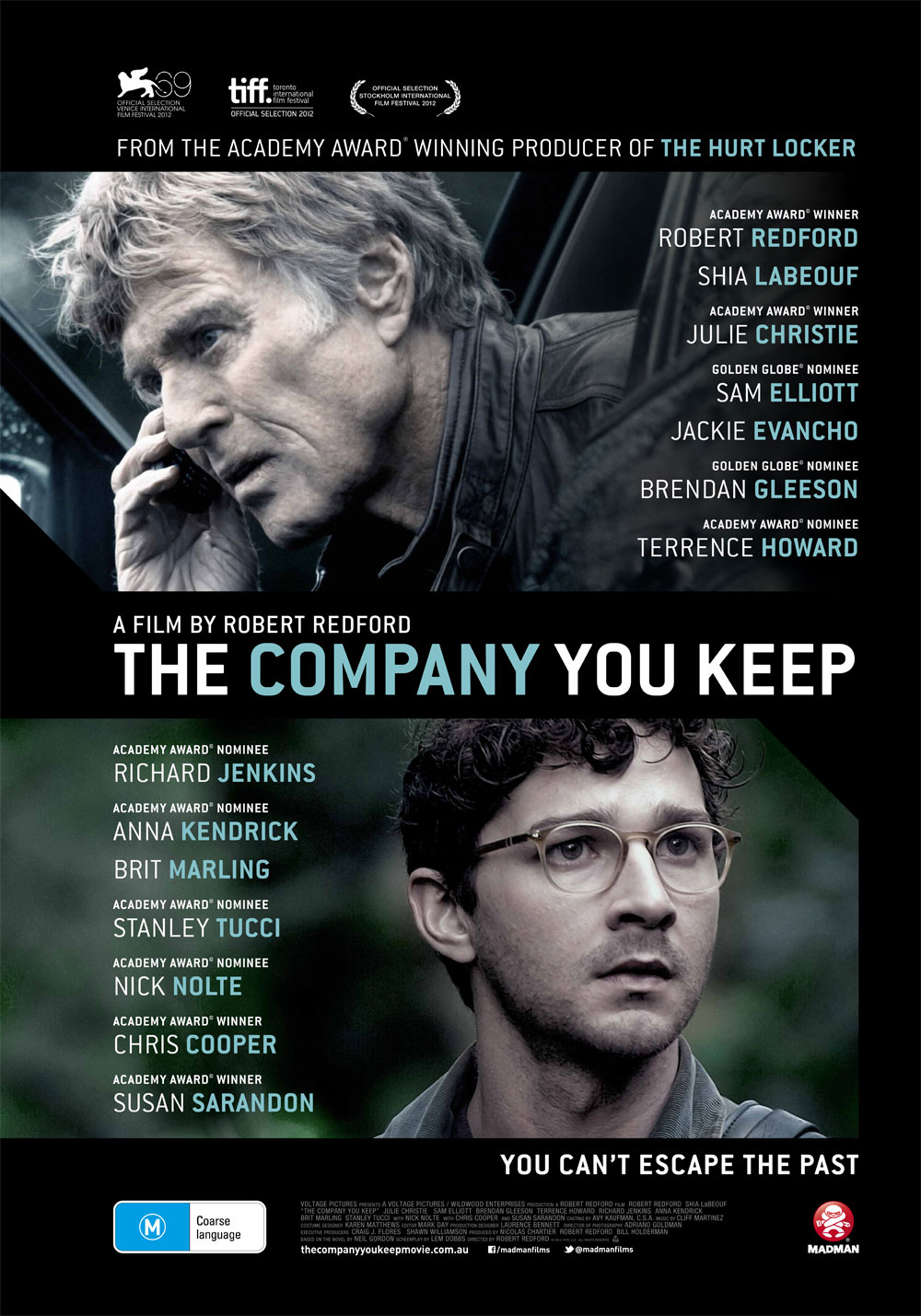
‘The Company You Keep’:
Robert Redford’s overambitious
take on the Sixties underground
He clearly wanted to make an epic about then and now, about Sixties radicals and their kids, and he couldn’t pull it off.
By Jonah Raskin | The Rag Blog | May 1, 2013
The Company You Keep, released in December 2012, was directed by Robert Redford with a screenplay by Lem Dobbs based on the novel of the same name by Neil Gordon.
Robert Redford’s new movie, The Company You Keep, boasts a huge cast of characters that includes cops, reporters, FBI agents, and former members of an organization of 1960s/1970s radicals that resembles the Weather Underground. A few of the characters are on the run and the target of a manhunt, while others have crept back into the halls of respectability and want nothing to do with their former comrades.
Redford himself certainly remembers that era of seemingly unending protest, resistance, and an invincible underground as well as anyone else in the movie industry today, except perhaps the director and screenwriter Haskell Wexler (best known for Medium Cool, 1969).
Indeed, Redford was near the height of his movie career when fugitives in the Weather Underground set off bombs in federal, state, and local government buildings to protest the war machine, the criminal justice system, along with imperialism, capitalism, colonialism, sexism, racism, and more.
Redford is, of course, also familiar with Sam Green’s 2002 documentary, The Weather Underground, which tends to romanticize the fugitives and their clandestine organization. The picture was nominated for an Oscar after it made the rounds at Redford’s Sundance Film Festival.
Neil Gordon, the author of the novel that inspired the movie, had the cooperation of former members of the Weather Underground. Like Sam Green, Gordon also romanticizes the characters he portrays. He once told me he thought of the Weather Underground as the American equivalent of the African National Conference (ANC), the organization that helped end apartheid in South Africa. Like others before him, Gordon fell prey to myth.
There’s something about fugitives that makes them endearing, even when they’re desperados such as Duke Mantee, the gangster on the run played by Humphrey Bogart in the 1936 classic, The Petrified Forest. But perhaps that endearing quality has vanished in the era of terrorists and terrorism when whole neighborhoods are locked down.
I know the pitfalls of writing about fugitives, though I often found the actualities of fugitive life mundane. I remember an occasion more than 30 years ago when the FBI launched a massive hunt for the Weathermen and Weatherwomen. Curiously, they didn’t panic. Instead, they calmly and deliberately destroyed everything in their possession that might have led to their capture.
And they spent days wearing rubber gloves, wiping every surface perfectly clean in an apartment to eradicate fingerprints. That took dedication, but it certainly wasn’t glamorous. From the actualities of fugitives cleaning an apartment with Ajax you can’t really make a dramatic picture.
Mimi, the most fetching of the fugitives in Redford’s picture — played to perfection by Julie Christie — makes a speech in which she says that everything she once protested against is as insidious as ever before, and perhaps even more so. She’s eloquent and so is the character that Redford plays.
He’s an ex-radical who has reinvented himself as a liberal lawyer. His past catches up with him and so he goes in search of his own past to clear his name. The hunter is hunted. Mimi is the only person who can help him. By the end of the movie, he finds her and convinces her to come out of hiding and rescue him.
The character Redford plays is also a widower with a young daughter who doesn’t know who he really is or what he’s done in the past. Between the two of them, there’s a huge generation gap. Redford also has a beautiful older daughter — his love child — who was born underground, then adopted and raised by a police officer and his wife. (That part of the story doesn’t make any sense. When the picture tries to tie-up loose ends it only makes more of a mess.)
Both daughters are in the dark. Like the younger daughter, the older daughter doesn’t know that her real father was a Sixties radical who went on the lam. Nor does she know that she has a half-sister. The two sisters don’t ever meet. Family secrets flourish until the FBI flushes them out. Moreover, the older sister never meets her biological mother, Mimi, who has survived underground as a drug smuggler.
All the pieces in this big jigsaw puzzle of a picture don’t fit together.
Redford was overly ambitious. He clearly wanted to make an epic about then and now, about Sixties radicals and their kids, and he couldn’t pull it off. His ending is anti-climactic, though it also avoids a great many Hollywood clichés. There are no bombings and nothing is blown up — a real virtue in a picture about bombers and bombers.
There’s a long chase by car, train and on foot. Indeed, Redford’s character is on the run most of the time, though he’s long past his prime running days. Even his designer running shoes don’t help him. An old, ex-radical trying to run from the FBI presents a rather comic figure. Old fugitives can’t run. That much is clear, though it’s also clear that the acting is stellar. Redford elicited stunning performances from his team.
Along with Julie Christie, there’s Nick Nolte, Susan Sarandon, Richard Jenkins, Sam Elliott, and Chris Cooper. It’s almost as if Redford called all of his old Hollywood pals and asked them to join with him and to make a picture that would pay homage to the Sixties and bury ideological hatchets.
It’s a kinder, gentler America that Redford would like — along with integrity in journalism and fresh organic food from local farms. But nothing bigger or bolder. Even Mimi, the most revolutionary of the characters, hasn’t any hope for revolution.
The personal is more important than the political for Redford and for the character he plays. In The Company You Keep, family and friends carry more weight than ideology, and in that sense the picture does seem to accurately reflect the lives of former Weather Underground members who have almost all married, embraced monogamy, become moms and dads, raised families, become lawyers and doctors, joined the middle class and remained loyal to one another.
But has no one really become a moral monster? Or poor? Or serve a life sentence in prison? The picture gives the impression that all the old New Leftists became solidly middle class with cars, toys, and gadgets. Perhaps so, though Dave Gilbert and Judy Clark, two Weather Undergrounders, are both behind bars.
Watching the picture, I found myself caring about the characters. I kept waiting to see whether Redford would be captured by the cops — or if he’d remain at large. Still, there’s something musty and outdated about the picture that prevented me from getting emotionally caught up in the dramatic conflicts. The news got in the way.
Think about the recent bombings in Boston and the manhunt for the two brothers suspected of planting the explosives, and then think of Redford’s movie, and it’s clear that we’re in another era with a whole other set of rules. The Company You Keep is mostly an exercise in nostalgia.
The bombers of today bear little if any resemblance to the Weather Underground bombers of yesterday who were white, middle class, college educated, well-read in Marx and Mao, atheists or agnostics, and not motivated by religion or ethnicity.
I never once met a single member of the Weather Underground who knew a thing about Chechnya or about Islam. Geopolitics have changed, and the power of law enforcement has grown exponentially. If today’s tactics had been applied to the Weather Undergrounders they wouldn’t have remained at-large for a decade.
It’s too bad Redford didn’t make his picture in, say, 1980. It would have seemed a lot more relevant then. Now, it’s a curiosity, though it’s also a reminder that older actors such as Nick Nolte, Julie Christie, and Susan Sarandon can still give strong performances. The young Shia LaBeouf does a credible job as an idealistic, fledgling reporter carrying on the tradition of Bob Woodward and Carl Bernstein.
You remember those guys don’t you? Redford starred in the picture, All the President’s Men, as Bob Woodward of The Washington Post and Watergate fame who helped bring down President Nixon. And surely you remember Butch Cassidy and the Sundance Kid (1969), another movie about outlaws and fugitives that stars Redford and Paul Newman and that inspired the Weather Undergrounders. All the guys wanted to be Butch or Sundance and to go out in a blaze of glory.
What hasn’t changed, of course, after all all these years, is the chemistry of the company you keep. The title of Redford’s movie about fugitives on the run seems to suggest that one ought to be careful about choosing one’s associates. Guilt by association goes a long way.
In the era of Homeland Security, the company one keeps can be as harmful to one’s health, as it was during the Salem witch trials more than 300 years ago or during the McCarthyism of the 1950s. So, if you’re going to conspire, make sure you conspire with the ones you really love.
[Jonah Raskin, a long-time journalist and activist and a regular contributor to The Rag Blog, was involved with the Yippies and, tangentially, with the Weather Underground. He is the author of For the Hell of It: The Life and Times of Abbie Hoffman. Read more articles by Jonah Raskin on The Rag Blog.]
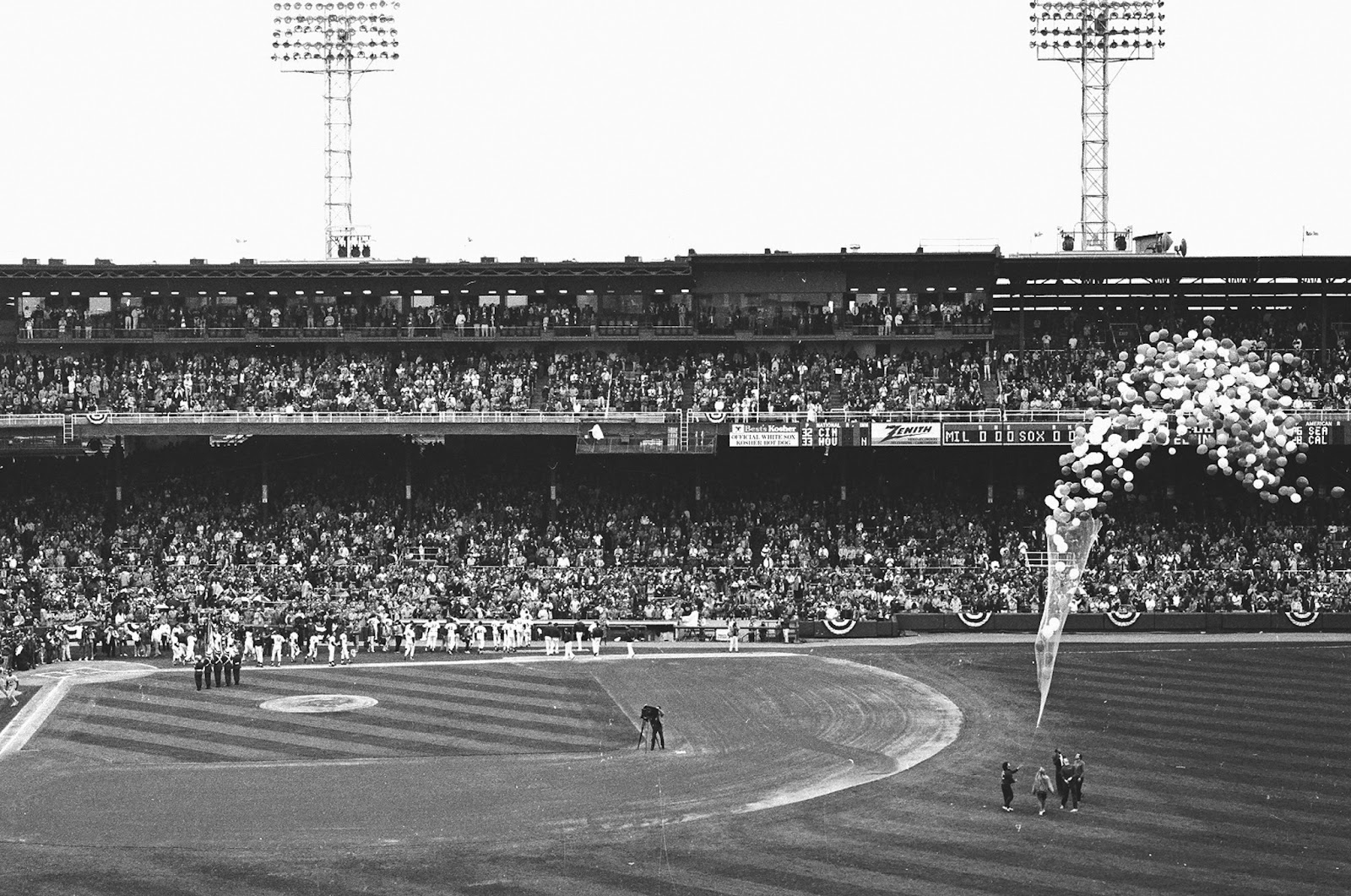 |
| Comiskey Park, Chicago, 1990. Photo by Michael James from his forthcoming book, Michael Gaylord James’ Pictures from the Long Haul. |
Pictures from the Long Haul:
Hope springs eternal on
opening day at Comiskey Park
By Michael James | The Rag Blog | May 1, 2013
[In this series, Michael James is sharing images from his rich past, accompanied by reflections about — and inspired by — those images. This photo will be included in his forthcoming book, Michael Gaylord James’ Pictures from the Long Haul.]
Today is opening day. Yea!
This is opening day 1990, the last year of the wonderful old White Sox park, aka Comiskey Park. Was there for this final opening, and, more sadly, the last day of that season when police on horseback kept the masses from going on the field. Ahh, and again at the new park in 1991. My dislike of the new park has diminished, but I would have preferred keeping the old park and fixing it up.
Having grown up loving the Brooklyn Dodgers, I went to my first White Sox game in the summer of 1966 with Paul Booth. By 1976, the year we opened the Heartland Cafe, I was a dedicated Sox fan.
I loved Bill Veeck (who not only wanted to integrate baseball, but wanted to incorporate the old Negro Leagues into the Majors), the shower in the outfield stands, Harry Caray when he was the Sox announcer, the food, the Southside Hitmen motorcycle club, the activity on 35th street, and… that summer of 1976 that saw both the Sox and the Cubs in first place, for awhile.
Ahh, and let’s not forget the White Sox were the World Champions in 2005.
[Michael James is a former SDS national officer, the founder of Rising Up Angry, co-founder of Chicago’s Heartland Café (1976 and still going), and co-host of the Saturday morning (9-10 a.m. CDT) Live from the Heartland radio show, here and on YouTube. He is reachable by one and all at michael@heartlandcafe.com. Find more articles by Michael James on The Rag Blog.]
 |
| Window into violence: A boy and his bird in Gaza. Image from chemicalcollisions / Tumblr. |
Towards a just society:
Speaking truth about violence
Violence engendered by the rich and powerful and responses from the poor and powerless are embedded in the system of structural violence.
By Harry Targ | The Rag Blog | May 1, 2013
Establishing causal connections between “variables” and violence is a form of mystification. The reality of this world is that of grotesque inequalities in wealth, power, respect for humankind and the environment, a world awash in instrumentalities of death, and a global culture that celebrates it. Recent reports from the World Bank and the World Economic Forum (of all places) document the continuing and growing inequalities in wealth and income on a worldwide basis.
Could it be a surprise that seemingly indiscriminate acts of violence occur all across the globe? Only a humane global movement for fundamental change can radically transform the world we live in but movements of protest can make constructive changes along the way.
— Harry Targ, Facebook, April 23, 2013
Each violent tragedy in the United States brings an outpouring of wrenching and “expert” analyses of what was behind the acts that led to so much pain and suffering. Most of the soul-searching about tragedies from Arizona, to Colorado, to Connecticut, to Boston is about domestic events (the repeated killings of Iraqis, Afghan peoples, Pakistanis, Yemenis and others generate much less empathy).
Explanations usually involve deranged “others,” usually poor “others,” “others” of color, and “others with fundamentalist religious beliefs.” Their crimes are described as perpetrated against victims who are the “normal” people.
Make no mistake about it, violence against any individuals, communities, and nations must be opposed, even among those who in the end are the root cause of it. But we need to be clear about the economic, social, political, cultural, and military/police context in which violence occurs. And, in no small measure, violence itself is celebrated in the societies where it is most prevalent.
Peace researchers have written about “direct,” “cultural,” and “structural” violence for years. While each of these is seen as having its own characteristics and causes, for the most part analysts regard the three as inextricably interconnected.
Direct violence refers to physical assault, shooting, bombing, gassing, and torture. It is about killing people. Cultural violence refers to dominant cultures whose apparatuses, such as the media and laws, portray their own institutions and values as superior to others and rituals that seek to honor the violence engaged in by one’s own country or group while demeaning other countries or groups. What is most vicious about cultural violence is its effort to make the victimized groups hate themselves.
Structural violence occurs when economic, political, cultural, and military institutions create relationships in which some human beings gain disproportionately from the labor, the talents, and the pain and suffering of others. Structural violence is institutionalized violence most often organized around class exploitation, racism, and patterns of gendered forms of domination and subordination. The key concepts that shape efforts to understand the causes and effects of structural violence are class, race, and gender.
Ironically, reports issued this year between the Newtown and Boston massacres by the World Bank and the World Economic Forum tell us much about the fundamentals of structural violence on a worldwide basis. These reports clearly describe why we do not live in a better world, why people do not treat each other with more respect, and why vast majorities of humanity and their natural habitats are in danger of extinction.
And they imply that violence engendered by the rich and powerful and responses from the poor and powerless are embedded in the system of structural violence.
The World Bank Report
The World Bank issued a press release on April 17, 2013 summarizing “The State of the Poor: Where are the Poor and Where are the Poorest?” It reported that the number of the world’s citizens living on less than $1.25 a day has declined markedly between 1981 and 2010 from half the world’s population to 21 percent. But still, they say, 1.2 billion people live in extreme poverty (below $1.25 per day). Sub-Saharan Africa accounts for more than one-third of those who live in such poverty worldwide.
A World Bank spokesperson noted that “We have made strides in cutting down poverty, but with nearly one-fifth of the world population still below the poverty line, not enough.” (This particular World Bank report does not include data on those living just above the poverty line. For example, another 20 percent live on $2 per day.)
Oxfam reports on the World Economic Forum’s “Global Risk Report”
In an Oxfam Media Briefing (January 18, 2013), the authors site a recent World Economic Forum warning that rising global inequality constitutes one of the top “global risks of 2013.” Oxfam points out that lifting masses of people out of absolute poverty has been the goal of economic elites over the last decade but “inequality and the extreme wealth that contributes to it were seen as either not relevant, or a prerequisite for the growth that would also help the poorest, as the wealth created trickled down to the benefit of everyone.”
The Oxfam Media Briefing suggests reasons why the WEF might correctly regard growing global inequality as a “risk.” They highlight the following:
So if you grow up in urban America or rural Africa, the Middle East, or almost anywhere else, and you are young, intelligent, and experience the world through the globalization of a racist, sexist, violent media, does your view of the world look bright? No job, no respect, hungry, alienated, and imbued with the cultural values about violence and racism that are used to define you, you may act in the same ways the rich and powerful act against you and your people.
The conversation that should come out of Newtown, Boston, and West, Texas, or Baghdad, Kabul, and Gaza, or almost anyplace else, is how to change the structural violence that gave rise to direct and cultural violence. This discussion should lead to the mobilization of progressives to create a just society, one in which people will not want to kill each other.
[Harry Targ is a professor of political science at Purdue University and is a member of the National Executive Committee of the Committees of Correspondence for Democracy and Socialism. He lives in West Lafayette, Indiana, and blogs at Diary of a Heartland Radical. Read more of Harry Targ’s articles on The Rag Blog.]

Waldman’s film and TV
treasures you may have missed:
Former comedy star Robbie Coltrane is outstanding as an obese, alcoholic, degenerate gambler and psychologist who profiles sicko criminals for the Manchester Police.
By Alan Waldman | The Rag Blog | April 30, 2013
[In his weekly column, Alan Waldman reviews some of his favorite films and TV series that readers may have missed, including TV dramas, mysteries, and comedies from Canada, England, Ireland, and Scotland. Most are available on DVD and/or Netflix, and some episodes are on YouTube.]
One of the best crime series ever was Britain’s Cracker, starring a brilliant Robbie Coltrane. Three series originally aired from 1993 to 1995, a 100-minute special set in Hong Kong followed in 1996, and another two-hour story was broadcast in 2006. All 25 episodes are on Netflix and Netflix Instant, and most can be seen on YouTube. Here is an episode.
Obese Eddie “Fitz” Fitzgerald (Coltrane), smokes, drinks, gambles and cheats on his wife. He’s also a brilliant criminal psychologist, or “cracker,” employed by the police to aid them in profiling and questioning Manchester’s worst criminals. Fitz has an uncanny knack for drilling directly into the hearts and minds of his warped subjects.
 |
| Robbie Coltrane. |
Cracker was a critical and audience hit, earning 20 awards plus 14 other nominations, including six best actor statuettes for Coltrane, seven best drama series wins, three awards for writer Jimmy McGovern, and a best supporting actor for Robert Carlyle (in one of the most chilling performances my wife and I have ever seen). The first new Cracker in a decade was a UK ratings winner in 2006, pulling in 8.1 million viewers (in a country of 63 million).
Writer/Creator Jimmy McGovern, one of Britain’s greatest drama/mystery writers, earned a total of 16 awards and 16 other noms for Cracker and six other series. Two of his Cracker episodes won the Mystery Writers of America’s Edgar award. Writer-Producer Paul Abbott won 14 awards plus 17 noms for great works including Cracker, Shameless, State of Play, Touching Evil, The Girl in the Café, and four other series.
Coltrane heads a strong cast, including fine character actors Geraldine Sommerville, Barbara Flynn, Lorcan Cranitch, and Ricky Tomlinson.
Coltrane and McGovern worked on bringing Fitz to life for months.”Though I am a car maniac,” Coltrane says, “we decided he wouldn’t drive, because we thought it would be quite funny if he would have to rush places and wait for the bus, like real people have to and not have all that macho screeching of tires and nonsense.”
Some of the plot lines in the cases took as their starting point real events, such as the 1989 Hillsborough disaster, in which police misjudgment resulted in 96 soccer fans being crushed to death and 766 others being injured.
Several different psychotic types with increasingly complex psychological motivations were explored during the run of the show. As the series entered the middle of the second season, the story lines became as much about the interactions of the regulars as they were about the crimes. To emphasize how fine a line the police (and Fitz) walk in their close interaction with criminals, all three series featured several stories in which the police themselves commit criminal acts or become victims of crime.
Because of the remarkable characters, highly intelligent and dramatic plots, and fine production values, Cracker is a series that crime/detective fans should definitely check out.
[Oregon writer and Houston native Alan Waldman holds a B.A. in theater arts from Brandeis University and has worked as an editor at The Hollywood Reporter and Honolulu magazine. Read more of Alan Waldman’s articles on The Rag Blog.]
 |
| Yemini writer Farea al-Muslimi testified before the Senate Judiciary Committee. Screen grab from Democracy Now!. |
Dirty Wars:
The terror of Bush-Obama era foreign policy
While some Bush policies may have been changed, the Obama administration has found new ways to accomplish the same purposes using Bush’s and Cheney’s tactics in slightly different ways.
By Lamar W. Hankins | The Rag Blog | April 30, 2013
Fairness and Accuracy In Reporting (FAIR) noted critically this past week that most members of the mass media gave no coverage or gave short shrift to the Senate Judiciary Committee testimony of the young, partly American-educated Yemini writer and activist Farea al-Muslimi, who talked about the effect of American drone strikes on his village.
Al-Muslimi had a great love for America after spending a year here to further his education. He went home to convey to his people his love for America, only to have his views decimated by the drone bombs that have terrorized his villagers.
In the past, what Wessab’s villagers knew of the U.S. was based on my stories about my wonderful experiences here. The friendships and values I experienced and described to the villagers helped them understand the America that I know and that I love. Now, however, when they think of America, they think of the terror they feel from the drones that hover over their heads, ready to fire missiles at any time. What the violent militants had previously failed to achieve, one drone strike accomplished in an instant. There is now an intense anger against America in Wessab.
This is not an isolated incident. The drone strikes are the face of America to many Yemenis. I have spoken to many victims of U.S. drone strikes, like a mother in Jaar who had to identify her innocent 18-year-old son’s body through a video in a stranger’s cellphone, or the father in Shaqra who held his four- and six-year-old children as they died in his arms.
FAIR reported that both The New York Times and the Washington Post covered the hearing, but there was nothing on the broadcast networks or cable channels, except for an interview with Al-Muslimi on Chris Hayes’ MSNBC program. Even National Public Radio found room only on Morning Edition to mention the hearing. Only Democracy Now! gave the hearing and the issues related to drones extensive coverage.
Yet many people, including Americans, believe that our drone program violates international treaties that have been adopted by the U.S., making us international pariahs, if not terrorists in our own right.
These drone attacks are intended to kill or assassinate certain people that we deem enemies. As Thomas Jefferson School of Law professor Marjorie Cohn has written: “Targeted or political assassinations — sometimes known as extra-judicial executions — run afoul of the Geneva Conventions, which include willful killing as a grave breach. Grave breaches of Geneva are punishable as war crimes under the U.S. War Crimes Act.”
The International Committee of the Red Cross describes the significance of the Geneva Conventions (the original four treaties of the Conventions have been ratified by the U.S.):
The Geneva Conventions and their Additional Protocols are at the core of international humanitarian law, the body of international law that regulates the conduct of armed conflict and seeks to limit its effects. They specifically protect people who are not taking part in the hostilities (civilians, health workers and aid workers) and those who are no longer participating in the hostilities, such as wounded, sick and shipwrecked soldiers and prisoners of war.
If you doubt that official U.S. policy is to commit terrorism, take a look at the official law of the U.S. found in the United States Code, which defines an “act of terrorism” as an activity that would violate our own laws if carried out in the U.S. and is intended “to affect the conduct of a government by assassination.” The definition is expansive, but this part of it makes clear that U.S. drone assassinations are terrorism by our own definition.
 A new book, Dirty Wars: The World Is a Battlefield, by Jeremy Scahill, and a film based on the book — document secret military and paramilitary operations in Yemen, Somalia, Afghanistan, and elsewhere that are being carried out by the CIA and the Joint Special Operations Command (JSOC) under the leadership of our entire national security apparatus, from the President on down.
Scahill details the assassination of three American citizens, one of whom, a 16-year-old, had no connection with terrorism except that his father was involved with al Qaeda. However, he was killed by a drone, two weeks after his father’s death by drone in Yemen, while he was searching for his father.
Both JSOC and the CIA are carrying out assassinations based on the weekly meetings held in the White House to determine who will be targeted and killed by drone attacks. These meetings directly involve the President, who makes the final decisions on who will be killed. As described by Scahill in an interview on Democracy Now!:
…we now know that there’s these things that are called Terror Tuesdays, where they look at rosters of potential targets and present them to the president. And the president, my understanding, is very, very involved with plucking names off and deciding who stays on. And, you know, you have a working group… that’s essentially focused around the clock on figuring out who to kill next around the world. And… what I think is really both disturbing and interesting is that there are multiple — I know that there are at least three separate sets of kill lists.
There’s the kill list that the CIA has, and then there’s the Joint Special Operations Command, and then there’s another National Security Council list that contains certain high-value individuals that the U.S. wants taken out. And so, in a country like Yemen, you have both the CIA and JSOC conducting operations. In Pakistan, that’s been true for a very long time. In Somalia, JSOC has conducted operations on the ground, the CIA has done drone strikes, and JSOC has also come in by helicopter and launched missiles at people.
Scahill went on in that same interview to explain that it may be true (he doesn’t know) that the U.S. is no longer operating secret prisons to which people are rendered to be tortured and interrogated. But he does know that the U.S. uses secret prisons operated by the Somalis, to which we order people captured in other countries to be taken (rendered) so that U.S. officials can then go to those secret prisons, where the prisoners are tortured and interrogated.
While some Bush policies may have been changed, the Obama administration has found new ways to accomplish the same purposes using Bush’s and Cheney’s tactics in slightly different ways. The immoral and illegal practices of the Bush administration are continuing under Obama, though Obama doesn’t sound as belligerent as Bush and Cheney and Rumsfeld and Rice.
Foremost among these practices, of course, is the prison known as Guantanamo, which houses 86 men approved for release (along with 80 others being held), who continue to be detained in violation of the due process of law and fairness principles identified in the Magna Carta nearly eight centuries ago.
Our political system exalts the military above all else. And the military-industrial-congressional complex exercises autocratic policies that assure we are constantly engaged in military control or action toward most of the rest of the world.
We find in our country extreme militaristic nationalism, contempt for electoral democracy both here and abroad, and a belief in the natural rule of elites. Fascism is not a term I wish to apply to my own country, but there may be none other that adequately characterizes the nature of our government.
The direction and purpose of American foreign policy is so established in the very fabric of America that I see no way that it can be turned around. Our purpose since the end of World War II, if not before, has been to spread our military power and control so widely throughout the world that we can extract any of the world’s natural resources that we want, keep other peoples from deciding their own fates, and kill anyone who gets in our way.
Many Americans claim we have the right to do these things because we are an exceptional country, ordained by God to create the world in our own image.
Even Dwight Eisenhower, who warned us of the direction we were heading, could do nothing to stop it and, during his eight years as president, furthered the very evil he spoke about as he left office in 1960. Now, we are seeing the lawless, murderous policies begun in the late 1940s and followed by every president since develop into the most frightening, evil, deathly, and inhumane policies since Adolph Hitler.
What is a patriotic American to do in the face of such atrocities? I can’t fully answer that question for myself, and certainly not for others. But I know that a first step is to acknowledge that what our government is doing is hideous, inhumane, degrading, and illegal.
A second step is to let our politicians know that we do not approve of these practices. As soon as it is possible to do so, I plan to see Scahill’s new film and read the book. Video excerpts related to the film and book can be viewed at Democracy Now!.
Finally, I don’t know how best to respond to these things that my government is doing in my name, but I will be guided by a 1965 statement by Martin Luther King, Jr.: “The ultimate test of a man is not where he stands in moments of comfort and moments of convenience, but where he stands in moments of challenge and moments of controversy.”
The drone killings around the world are just such a moment of challenge and controversy. We must accept their challenge and end the controversy they present for the good of the people of the U.S. as well as the people of the world.
[Lamar W. Hankins, a former San Marcos, Texas, city attorney, is also a columnist for the San Marcos Mercury. This article © Freethought San Marcos, Lamar W. Hankins. Read more articles by Lamar W. Hankins on The Rag Blog.]
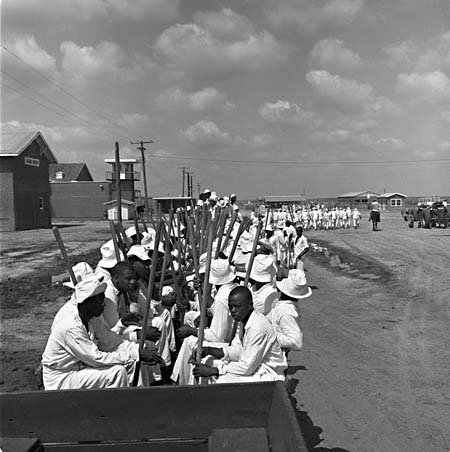 |
| Hoe squad from Texas’ Clemens Unit in early 1970s. Photo from Texas Prison Museum. |
The hidden history of Texas
Part 14: 1974-1995/1 — More African-Americans in politics, prison
By Bob Feldman | The Rag Blog | April 30, 2013
[This is the first section of Part 14 of Bob Feldman’s Rag Blog series on the hidden history of Texas.]
Between 1970 and 1990 the number of African-Americans who lived in Texas increased from 1.4 million to 2 million, but the percentage of Texas residents who were African-Americans remained at 12 percent. More African-Americans lived in Texas in 1990 than in any other state except for New York and California, and 90 percent of African-Americans in Texas lived in towns and cities by 1990.
Although the percentage of African-Americans in Texas who were registered voters dropped from 83 percent in 1968 to around 65 percent during the 1980s, the number of African-Americans who held political office in Texas increased from 45 in 1971 to 472 in 1992. And even though no African-American was elected to serve as a Governor of Texas or a U.S. Senator from Texas between 1970 and 1995, an African-American, Barbara Jordan, had been elected by 1972 to represent one of Texas’s congressional districts in the House of Representatives.
By 1985, 15 African-Americans had been elected to sit in the Texas state legislature, and by 1990 there were 12 African-American mayors and 138 African-American city council members in various cities and towns in Texas. In Austin, the first African-American man to sit on the Austin City Council since the 1880s — Berl Handcox — had been elected in 1971.
The first African-American mayor of Dallas, former Texas Secretary of State Ron Kirk (who later became the U.S. Trade Ambassador in the Democratic Obama Administration), was elected in 1995. In addition, between 1990 and 1992, an African-American woman named Marguerite Ross Barnett was the president of the University of Houston, and in 1991 the birthday of Martin Luther King was made a state holiday in Texas.
Yet between 1960 and 1984, the number of African-Americans in Texas who still owned their own farms had decreased from 15,000 to 5,000, and as late as 1993 “the University of Texas at Austin could count only 52 African-Americans among its faculty of 2,300 — about 2 percent,” according to Alwyn Barr’s Black Texans. In addition, “in Austin , expansion of the University of Texas into an African-American community displaced people into more crowded neighborhoods” between 1974 and 1995, according to the same book.
Around 30 percent of all African-Americans who lived in Texas in 1990 still lived in poverty; and in 1987, the U.S. Equal Opportunities Commission office in Dallas still received 5,800 complaints of racial discrimination from African-Americans who lived in Texas.
Of the 37,532 people locked inside state and federal prisons in Texas in 1985, 36 percent were African-American prisoners; and 29 percent of all the imprisoned people in Texas who were executed by the State of Texas in the 1980s and early 1990s were African-Americans. Historically, “261 of 316 men executed by Texas between 1924 and 1995 were black,” according to Black Texans.
In addition, while 9 percent of college students in Texas were African-American in 1993, between 1985 and 1991 the percentage of people locked inside Texas prisons who were African-American had increased from 36 to 41 percent. And in 1990, 40 percent of all African-American families in Texas were now headed by women.
The total number of people imprisoned in state and federal prisons in Texas increased from 16,833 to 127,766 (including 7,935 female prisoners) between 1974 and 1995; and, between 1991 and 1996, Texas — whose imprisoned population grew by 156 percent during these five years — was the state with the highest percentage increase in the number of people incarcerated during this historical period.
In the 1980 Ruiz v. Estelle court decision, “the entire state prison system” of Texas “was declared unconstitutional on overcrowding and conditions,” according to the ACLU National Prison Project’s 1995 “Status Report: State Prisons and the Courts;” and, in 1996, Texas — with an incarceration rate of 686 prisoners per every 100,000 residents — was the state with the highest rate of incarceration in the United States.
Between 1970 and 1985, the number of people who lived in Austin increased from 250,000 to 436,000 and “from 1980 to 1990, Austin’s Jewish-affiliated population more than doubled, from 2,100 to 5,000,” according to an essay by Cathy Schechter, titled “Forty Acres and a Shul: `It’s Easy as Dell,’” that appeared in Hollace Ava Weiner and Kenneth Roseman’s book Lone Stars of David: the Jews of Texas.
By 1988, around 90,000 people of Jewish religious background now lived in Texas, according to the www.texasalmanac.com website, and of the nearly 17 million people who lived in Texas in 1990, around 108,000 were now of Jewish religious background.
Despite the continued presence of local anti-war movement activists in Austin in the 1980s, “Lockheed Austin Division [LAD] was formed in August 1981 by Lockheed Missiles & Space Companies to develop military tactical support programs and systems” in Austin;” and the programs under development at LAD in the 1980s fell “under two general headings of command and control systems and target location systems,” according to David Humphrey’s Austin: An Illustrated History.
The same book also revealed that “the equipment developed through these programs [was] used to provide military commanders with current information on the location of military units within their operating area”“employment reached 2,000 by July 1984” and a year later the number of LAD employees: had “risen to 2,500.”
[Bob Feldman is an East Coast-based writer-activist and a former member of the Columbia SDS Steering Committee of the late 1960s. Read more articles by Bob Feldman on The Rag Blog.]
 |
| Putting on the makeup. Television reporter on the scene at the fertilizer plant explosion in West Texas, Thursday, April 18, 2013. Photo by Patrick Bresnan / The Rag Blog. |
Getting the picture:
Corporate crime scene in West, Texas
How do we avoid the news story framework that gives us nothing but heroes and victims when tragedy strikes? How can those narratives, as seductive as they may be, possibly move us towards an honest search for the truth?
By Anne Lewis | The Rag Blog | April 30, 2013
See a gallery of photos by Patrick Bresnan, Below.
AUSTIN — This is about the fertilizer explosion in West, Texas, on the night of April 17, 2013. It’s also about Patrick Bresnan who found himself in West on the night of the explosion and his photographs in the aftermath of the tragedy.
Governor Perry called it a crime scene; the progressive community says, yes, corporate crime. Neither the paranoid fantasy of Governor Perry who is stuck in an ideology that says that companies can do no wrong, nor the abstract politics of progressives blaming the state’s lack of regulation — “We shouldn’t produce fertilizer anyway because it’s not good for the planet,” I overheard in a coffee shop — seem to get at any real truth.
I ask myself the question: how one can be kind and dignified in the face of such sorrow and loss? I try to collect myself and cannot help but think about the Central Appalachian coalfields.
The dangers of coal mining both for the environment and the workers permeated my senses. I was married to an underground coal miner. I knew not to have an argument before he went to work. He might not come back. And we would patch things up, even when we shouldn’t have.
Time slowed in the hour that I expected him to come home. The most intimate relationship was distorted by the fear of injury and death. Then Rocky Peck, a young miner with a wife and daughter who wrote the song that ended my film about the Massey strike, was killed in a non-union mine three years after the strike was lost and the film was completed.
I saw raw footage of mining disasters — family members waiting for loved ones who would not come out alive, calling to God for comfort, the exhausted children. I heard statements of attempted compassion by local mine managers who opened their offices to suffering families but protected the absent company, denying information and economic aid and never accepting guilt by apologizing.
I remember an eloquent piece by Michael Kline, a radio story with Sarah Koznoski who lost her husband in the Mannington, West Virginia, mine explosion in 1968. Seventy-eight men were buried alive. Michael asked Sarah to describe every moment of the last day with her husband.
That was all. There was no mention of Consolidation Coal Company, still the largest underground mining company in the U.S., or the corrupt United Mine Workers union that said Consolidation was a safe company after the explosion, or the lack of regulation or protection by the government. There was just Sarah’s voice describing an ordinary day with her husband. And it was enough.
Then came the rage. “They didn’t want us to know what was going on in their damn dirty filthy mines,” another of the widows would tell us five years later. Those seven widows, who refused the $10,000 death money from Consolidation Coal Company, organized a response across the coalfields. Coalminers and their communities rose up from the grassroots. They reclaimed their union for the rank and file, and they forced the new laws and regulations that have saved countless lives.
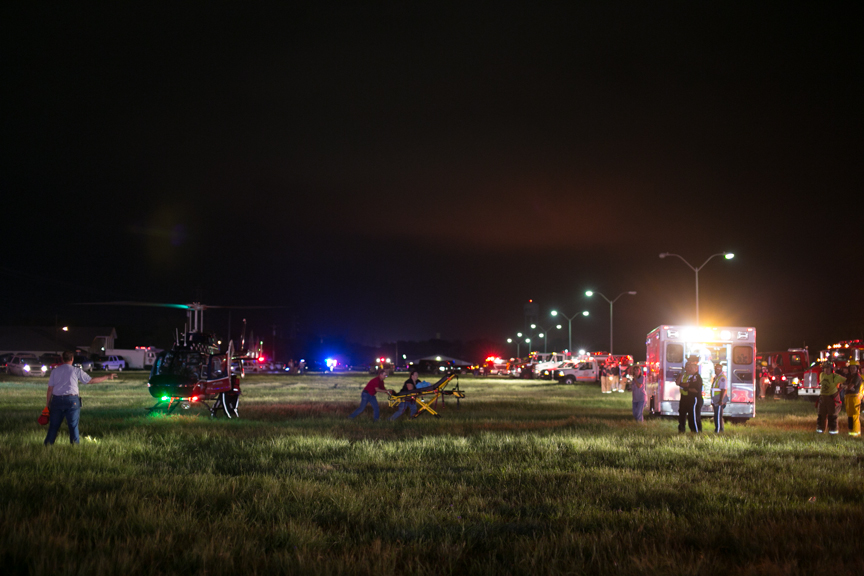 |
| Field of first response. Triage area, West, Texas. Wednesday, April 17, 2013. Photo by Patrick Bresnan/ The Rag Blog. |
We have heard none of these things from West — none of the deep sorrow, none of the purposeful rage, no clear expression of collective purpose — that this will never happen to other people in another community, especially not to those most loved in any community — the firefighters and first responders. Perhaps it’s just too soon.
Patrick’s experience in West began the warm evening of the explosion. A European film director had wanted to document the last day of life of a young black man who was next on the Texas execution list. Patrick traveled to Waco to locate the man’s family and ask them to participate in the film. He was using the Internet at Starbucks when he saw a steady stream of ambulances and heard about a huge explosion in a nearby town. He drove to West.
There he found himself stalled in a traffic jam filled with ambulances, emergency responders, police, firefighters, people who had come from as far away as three hundred miles to help. A call had gone out to bring needed wheelchairs to the community center and community people waited to get through, wheelchairs in the backs of pickups.
Some tried to reach relatives in the community center but only the injured and the elderly were allowed in. Patrick described the smell of heavy chemicals and urine. 133 patients had been evacuated from the West Rest Haven Nursing Home and there was no way to help them use the bathroom.
He decided to see if he could get pictures of the fire and drove to the part of town that had been evacuated. He began to walk towards the fire but the air was hot. It was windy and so heavy with chemicals that he was forced to turn around. Patrick returned to his truck, took off his shirt, and went to sleep.
Wednesday morning was cold and rainy. By the time Patrick got back to the community center, most of the firefighters had left. Then a mass of new people descended on the town — roaming the streets, doing their makeup and practicing their lines out loud, “Live from West, Texas — a town that will never be the same. This small tightly-knit community,” over and over. Anderson Cooper popped up and Patrick succumbed like many others and took a photograph of himself with Cooper.
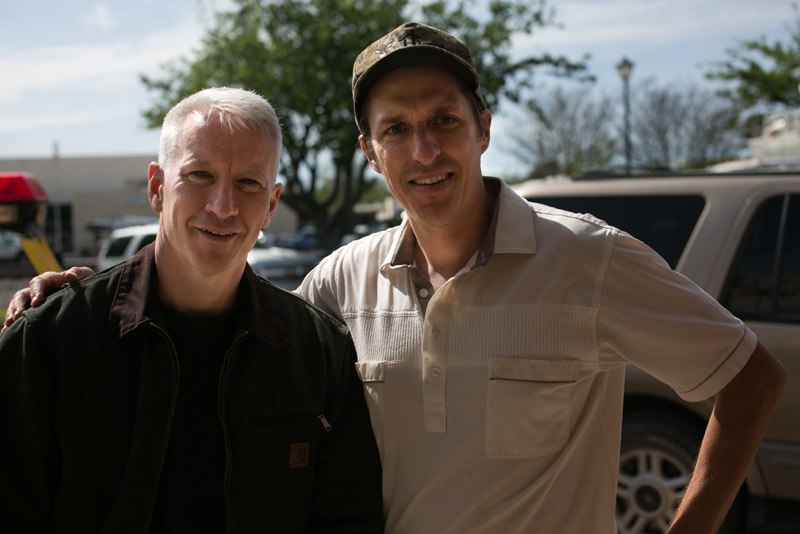 |
| Succumbing to the celebrity presence! Photographer Bresnan takes his own picture with CNN’s Anderson Cooper. Photo by Patrick Bresnan / The Rag Blog. |
Patrick didn’t see reporters doing any kind of research or having serious interviews with local people. They were in West to do their makeup and read a few contrived lines to the camera. At the West Cattle Auction the media appeared to him like a group of animals. Patrick returned a week later to take a few additional pictures and attend the memorial. He told me of a Catholic priest who spoke from the heart about what had happened, but nobody mentioned the fertilizer plant.
At about that time I was on a shuttle bus at the Austin airport coming home from a weekend trip. The Latina shuttle bus driver announced, “Welcome home.” A woman on the bus said that she had no home to return to, that she lived in West. She pulled out a newspaper with before-and-after pictures and pointed to her house which was within the 1,500 foot blast perimeter. She had been at a far off hospital visiting her son who had been shot in Afghanistan when the explosion occurred.
When another woman on the bus asked if the plant was old and dilapidated, the woman said she really didn’t remember. It had always been there. She was just glad that her family had survived. She would go home to look for her missing cat. As she got off the shuttle bus, the driver gave her a big hug and handed her all of her tip money. She said, “Take it” and the woman did.
How do we avoid the news story framework that gives us nothing but heroes and victims when tragedy strikes? How can those narratives, as seductive as they may be, possibly move us towards an honest search for the truth? The patriotic frenzy, the flag waving, the church going and singing of popular songs don’t come close to the pictures of mine disasters that stay in my mind’s eye. Patrick’s pictures, as scattered and spontaneous as they may be, seem to get closer to the truth than endless newspaper images of worship and sorrow.
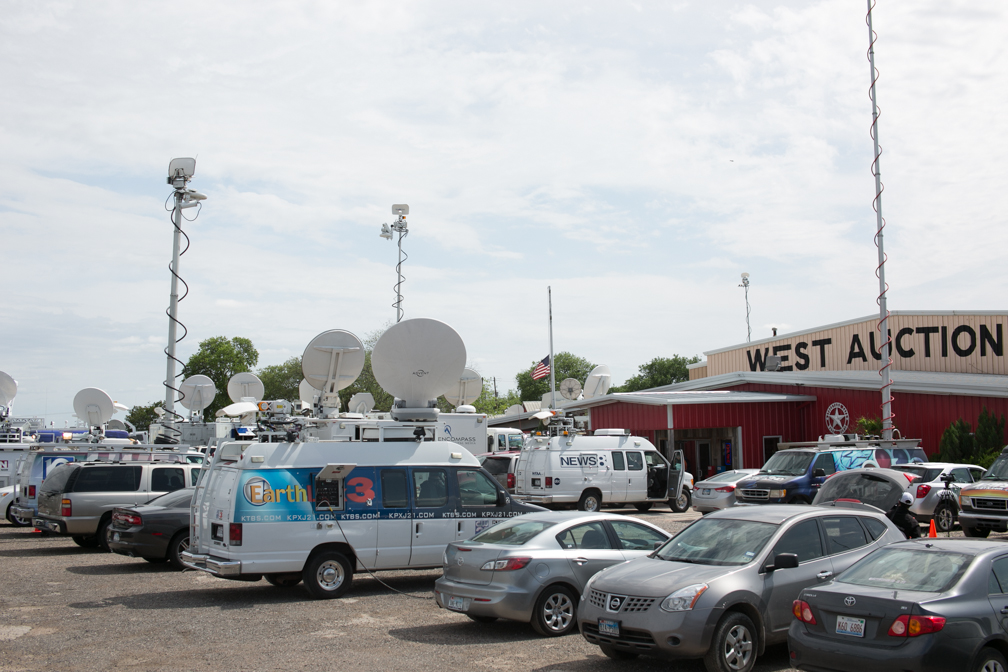 |
| Media gathered at the West Auction House, West, Texas, Thursday, April 18, 2013. Photo by Patrick Bresnan / The Rag Blog. |
Thirteen people worked at the fertilizer plant in West, but we have heard nothing about them. The news talks about a close-knit community with few jobs, but I’m quite sure that many more livelihoods and lives were damaged at the nursing home, apartment complex, and three damaged schools.
Why didn’t the workers at the fertilizer plant complain about the danger they experienced every day at work and the potential disaster that their work imposed on the community? Was it alienation from their own lives, a lack of power over their own safety, a misplaced loyalty or belief in the power of a supposedly benevolent boss?
The plant had 250 tons of ammonium nitrate on site last year — that’s more than a thousand times the trigger limit for oversight. That deadly factory somehow remained invisible to those who might have intervened.
What about the farmers in this “close knit community”? Surely they were aware of the dangers of the product they purchased and the conditions of its manufacture. Then there’s the religious factory owner who, we read, purchased the plant as an economic contribution to the community. Patrick couldn’t help but compare him to the young man on death row who was the cause of his trip to Waco. That man killed one security guard in comparison to the deaths of 14 people and more than a hundred injured including a child who was playing on a nearby playground when the blast blew him four feet in the air and broke his ribs.
The factory owner hired a Dallas public relations firm to represent him as he opened the doors of his church for the mourning residents of West and spoke through an outside source of his own broken heart.
A coal mine manager once said in one of my films, “If what we are doing in eastern Kentucky is wrong, then the whole country is wrong.” One could say the same about the murderous explosion in West, Texas. There’s something very rotten in our mistaken loyalties to companies over neighbors, our dependence on paternalism for our safety, our willed ignorance, the sacrifices we make to the dollar. Ultimately we all share some part of responsibility for what happened in West, Texas.
I think about the power of transformation, knowing that it must come from rage, knowledge, and love. I believe that deep within the community of West and our own, an independent, courageous, and collective voice can emerge to shake the foundations of what must change.
[Anne Lewis, a senior lecturer at the University of Texas and a member of TSEU-CWA Local 6186 and NABET-CWA, is an independent filmmaker associated with Appalshop. She is co-director of Anne Braden: Southern Patriot, associate director of Harlan County, U.S.A, and the producer/director of Fast Food Women, To Save the Land and People, Morristown: in the air and sun, and a number of other social issue and cultural documentaries. Her website is annelewis.org. Read more articles by and about Anne Lewis at The Rag Blog.]
Some of the photos accompanying this article were also published, under the name Otis Ike, in a gallery at the Austin Chronicle.
 |
| The next morning. House in West, Texas, Thursday, April 8, 2013. Photos by Patrick Bresnan / The Rag Blog. |
 |
| School in West, Texas, Thursday, April 23, 2013. |
 |
| Evacuation area, Thursday, April 18, 2013. |
 |
| Missing dog sign. Thursday, April 23, 2013. |
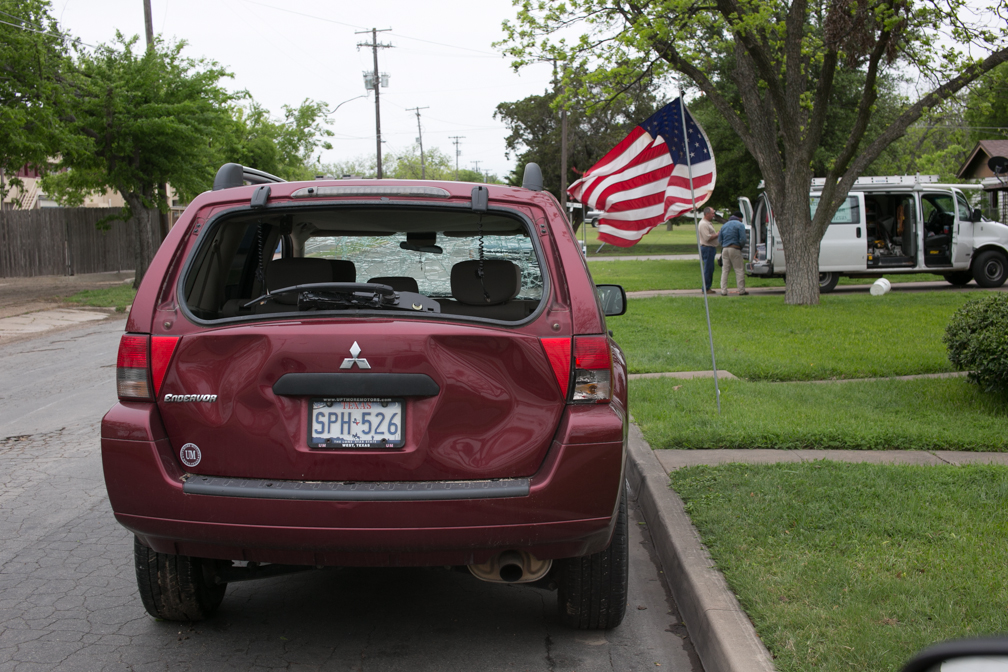 |
| Car and flag. Thursday, April 23, 2013. |
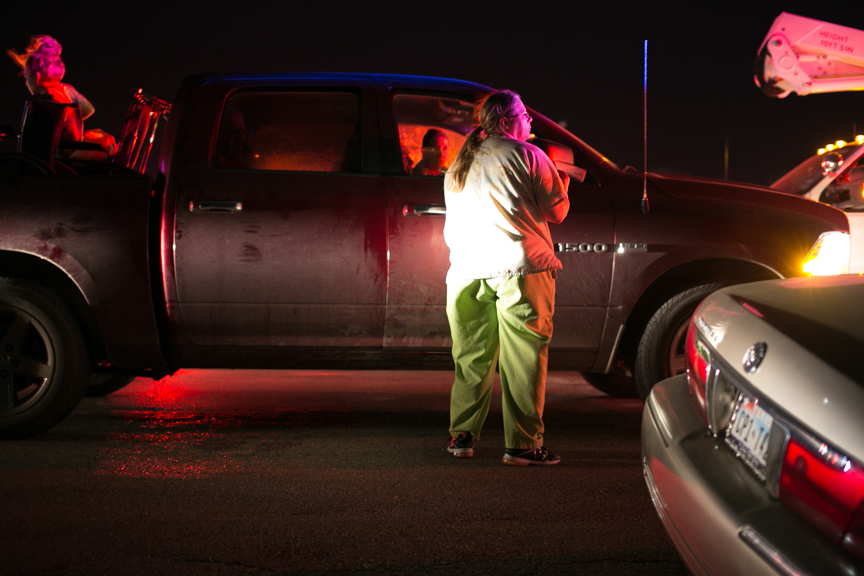 |
| Residents respond to call for wheelchairs. Wednesday, April 17, 2013. |
 |
| Memorial service at Church of the Assumption, Thursday, April 18, 2013. |
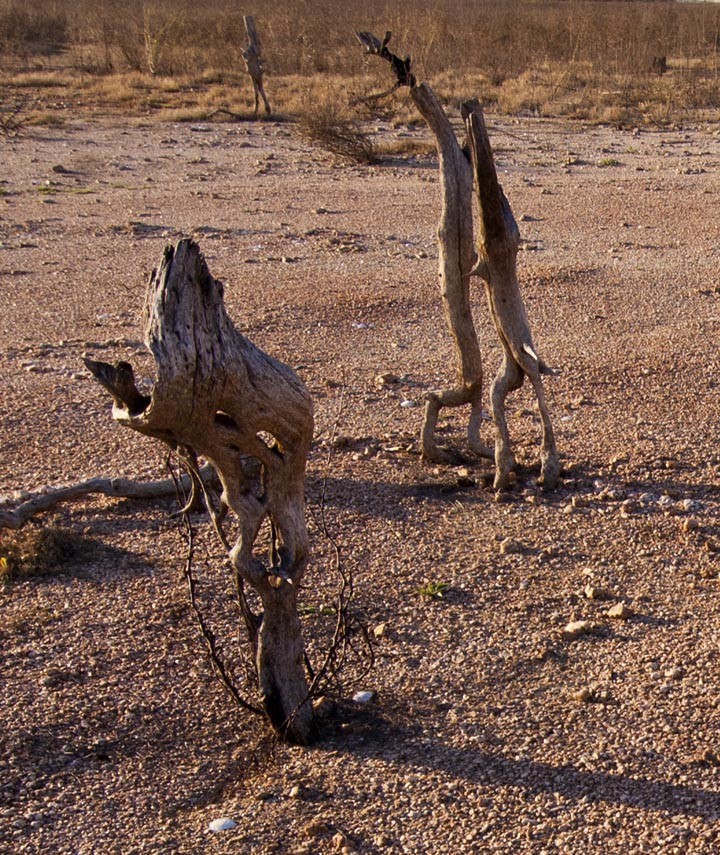 |
| Alien beings emerge from “What Was Once Lake Buchanan” as the water level falls. Photos by Bruce Melton / The Rag Blog. |
Calling all earthlings:
Climate change communications
may as well be from aliens
Relative to most of the 20th century, Austin’s January highs and lows were not 2.9 and 1.4 degrees above normal, but 9.9 and 10.4 degrees above normal!
By Bruce Melton | The Rag Blog | July 25, 2013
AUSTIN — Average temperatures have risen rapidly at the Austin reporting station since the turn of the century but the National Weather Service’s 30-year average “normal” temperatures show little of this change yet. Average April highs and lows have risen 3.5 and 5 degrees respectively. The average August temperature has risen 5 degrees and the average January high and low has risen 6 and 9 degrees respectively.
Because the National Weather Service’s 30-year averaging procedures mask this recent rapid warming, a valuable tool in climate change communications lies unused.
We Earthlings who are not climate scientists do not have the telepathic powers necessary to understand how our climate is truly changing. Someone must tell us directly. Local temperature change is a prime example. We’ve heard a lot of “warmer than normal” since about the turn of the century, but when the details get broken down, accuracy falls behind.
Climate change is so far different from what most of us think that a change in communication tactics must happen very soon; otherwise we will continue on this business as usual path of denial and delay until we have a global climate catastrophe that cripples the world’s economy.
The challenge is akin to that frog in a pot on the stove. This is a terribly cruel “cooked alive” analogy, but is it any more cruel than what we are doing to our future society because of delay on climate pollution action? As the analogy goes, the water in the pot gradually heats, the frog does not notice until it is too hot and he is dinner.
Climate change is insidious. The definition of insidious fits the process well. Insidious: proceeding in a gradual, subtle way, but with harmful effects; working in a subtle or apparently innocuous way, but nevertheless deadly. It has snuck up on us because it only changes a little bit every year. It is already creating dangerous impacts to our society on a planetary scale, yet we as that society know very little of these impacts.
The way the weather is presented to us is one of the major reasons for our ignorance. There are many things that our media weather presenters could do that would help us Earthlings understand climate a truckload better than we do, but one stands atop the heap. Every 10 years the National Weather Service (NWS) refigures their “normal temperatures” that we hear on the weather report every day. They look back to the previous 30 years for these calculations. So every ten years, the averages change a little bit. In 2010, the averages were refigured for the period 1980 to 2010. In 2000 they were refigured for 1970 to 2000, etc.
This is fine and dandy when our climate is stable. Our climate has changed a lot lately and this technique masks the changes. The process is designed on purpose to mask relatively short term weather changes (less than 30 years) because traditional meteorology acknowledges that short term chaos in weather does not reflect “climate.”
But in our carbon-saturated 21st century new rules have arrived. Climate scientists warned us for decades that their models said an abrupt climate change would occur if we did not begin to reduce our emissions of greenhouse gases. Instead of reducing greenhouse gas emissions, we ignored this counsel and almost doubled our emissions. Not surprisingly, this abrupt change is now happening and 20th century meteorology is hiding the abrupt change in its 30-year temperature averages.
Urban heat island
Before I go further, let me address the urban heat island because the temperature records I am talking about could be influenced by the heat island. This is one of the biggest of the perceived controversies in the so-called debate, and rightly so. Anyone who has driven into or out of the city on a cool night has experienced the extra heat that is absorbed by concrete and buildings in urban areas.
Climate scientists (not meteorologists) correct for the heat island by looking at rural weather stations surrounding urban areas and applying a correction factor to the urban records. The corrected global average temperature change, what is presented to us by the media as the effects of climate change, are corrected for the urban heat island. But the everyday weather stats presented to us on teevee are not.
In the last several years climate scientists have even begun to use satellite images of night lights to help locate those truly rural weather stations that they use for their corrections. Time goes on. Science moves ahead. We get more accurate information as a result (most of the time).
 |
| NASA brings us night vision satellites for a deeper look at our planet. Climate scientists use these “nightlight” images to help correct for the urban heat island effect in their average global temperature records. Shown is a crop of the Texas coast. Houston, Corpus, Brownsville, San Antonio, and Austin are the largest masses of lights. New in the last several years however is an odd crescent of lights that run from southwest of San Antonio to the northeast. These lights are all oil rigs drilling the Eagle Ford Shale in the latest oil fracking boom. The white spots in the Gulf are oil platforms. |
To bring the heat island effect into perspective for the historic average temperature records that I want to discuss for the Austin Mabry station, we need to understand how the heat island has historically impacted the weather recording station in Austin. To do this is easy enough in a generalized way. Simplistically, all we have to do is compare the historic average temperature in Austin to population growth. If the urban heat island is impacting the weather station, the temperature should rise as does the population.
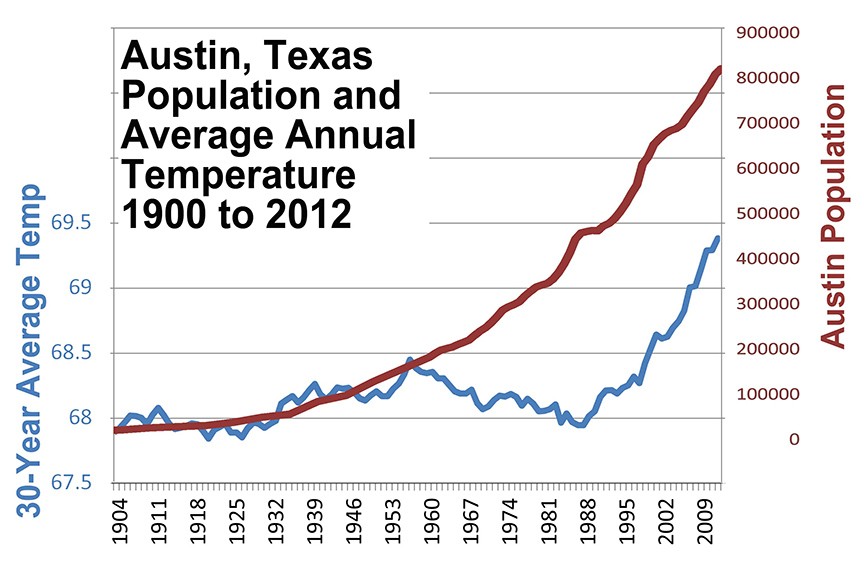 |
| Average Temperature and Population for Austin Texas 1900 to 2012. All weather stations are different. Some respond more adversely to the urban heat island effect than others. Austin’s is one that does not show a lock-step similarity in the urbanization/heat island effect. If it did, it is quite likely that the local average temperature would have continued to rise in the late 1950s as Austin’s local population began to soar. |
This is by no means a scientific evaluation, but it does shed light on the issue of the heat island, at least relative to the official temperature record for Austin. The red line shows our rapid population growth and the blue is the average annual temperature. I will not deny that the heat island effect is strong in Austin, but to say that the heat island effect is strong “at the weather station” in Austin is a different animal altogether.
Weather stations are set up by design to minimize the influence of the surrounding geography on the temperature measured at the weather station. It can be blisteringly hot in the middle of a giant asphalt parking lot but just a couple of hundred feet away in the middle of a grass covered ball field, or in a forested area for sure, the temperature can be much cooler.
The techniques used to assure that weather station thermometers record an accurate temperature have been refined for over 200 years. Some places still need to be adjusted though, so these techniques are being ever-more refined as is the case with the nightlight satellite imagery.
What the numbers are telling us about the average temperature for April (1948 through 2012) at the Austin Mabry Station are:
The 2 to 2.5 degrees of warming in 30 years may just be normal climate fluctuations (probably not), but the 10-year changes are likely what climate scientists have been warning us would happen. This is the abrupt climate change that their models have been predicting for a generation. As we continue to use the 30-year averages without effectively communicating our current temperatures relative to the normal temps of the last century, our frog is being cooked without our realizing it.
The warnings have been that at some point the “lag” in climate change would catch up to greenhouse gas concentrations and we would begin to see a rapid rise in temperature. This “lag” is generally considered to be two to several or more decades. In other words, today’s temperatures are what they are because of greenhouse gas levels in our sky from the 1980s, not greenhouse gas levels in the sky today.
Since 1980, the carbon dioxide concentration in our atmosphere has increased from about 335 ppm to about 397 ppm. Between the mid-1800s and 1980 the CO2 concentration increased from about 280 ppm to 335 ppm. So we have doubled the amount of greenhouse gases in our sky since the 1980s.
Because of the climate lag, we have another 4 degrees F or more of warming already built into our climate — even if we were to stop emitting all greenhouse gasses this instant. This “lag” is caused mainly by the cooling effect of the oceans. Who in Texas hasn’t enjoyed a wonderfully cool summer day at the beach when just a few dozen miles away it was a sizzling 100 degrees?
Flattening temperature myth
Let me address another huge myth now. This is the “Flattening Temperature Myth.” Some would have us believe that Earth stopped warming about the turn of the century, and if we look at the temperature record it looks like this is a valid statement — but we must understand the context. This flattening is simply a product of the massive high temperature record set with the Super El Niño of 1998. Erase that 1998 Super El Niño record and global temperature has not “flattened” at all.
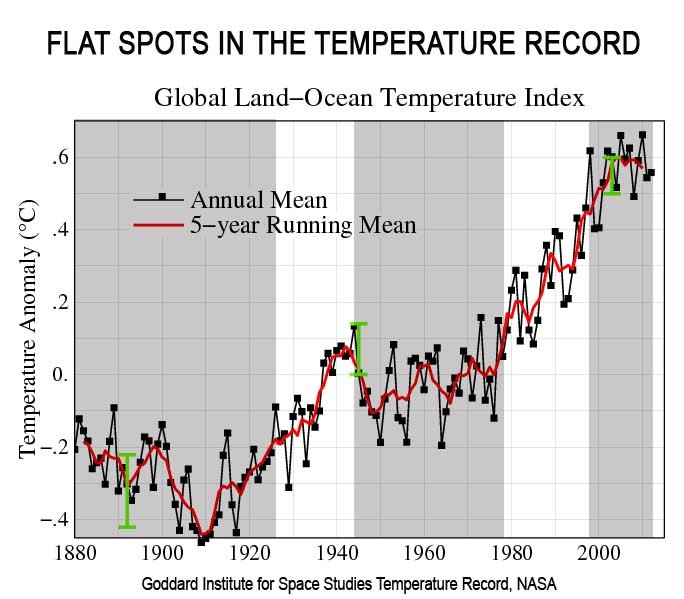 |
| The thermometer record has experienced two major flattening trends: from the late 1800s (end of the Little Ice Age) to the 1920s and then from the 1940s to about 1980. The current flattening is a product of the great Super El Niño of 1998. If we remove the Super El Niño from the record, the flattening trend that remains is similar to many more “flat” periods in the thermometer record other than just the two mentioned. |
Austin’s average temperature record does not have a giant high temperature spike in 1998 so this myth does not float in this boat. And for Austin’s record to be different from the global record is quite normal. Some places will warm more than others and some places (a very few) will even cool a bit, at least for a while.
Abrupt climate change is here, it has caught up with the lag, and from here on it’s toast or be toasted. The models have been quite accurate so far and they tell us that things continue to get worse even faster. It’s the 10-year averages that are important now because climate changes like we are now undergoing — abrupt climate changes — happen far faster than 30-year time frames. It is time that we recognize this not only in the media, but in the science as well. Things change, we live, we learn and then apply that new knowledge to life. If we don’t, we is frog legs.
In the last 100,000 years, based on highly accurate temperature records from Greenland ice two miles deep, we have seen 23 abrupt climate changes where global temperature changed up to a dozen degrees F in as little as several decades or less. The ice shows the biggest of these changes, that happened when climate was being forced the fastest, happened (in Greenland at least) in several years or less. Remember two things now: warming over land is twice or more what it is over water and we are changing our carbon dioxide concentration 14,000 times faster than anytime normal in the climate record in the last 610,000 years.
So, because climate change impacts have skyrocketed since the turn of the century (Greenland melt, Arctic melt, Antarctic melt, increasing sea level rise, forest impacts, and here in Austin, record drought and wildfires) we need to be looking at non-traditional climate averages, not the 30-year averages of 20th century climate. This is no longer our old climate. It has changed and is rapidly changing further.
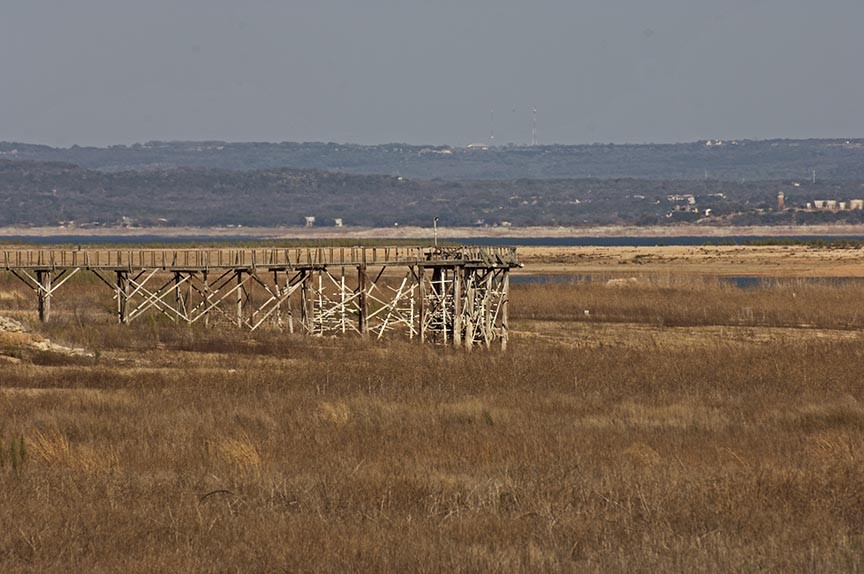 |
| Greenwood acres Pier on Lake Buchanan. |
The new normal
January’s averages are even more astounding. Climate scientists have been telling us their models show more warming in winter and more warming at night in winter. Since the 1980s, the 30-year NWS highs and lows at Austin Mabry have warmed 4 and 2.5 degrees respectively but the 10-year highs and lows have warmed 6 and 9 degrees! Do you remember hearing any of this on the nightly weather report?
When the weather person says the weather today should be exactly normal, there’s a large inaccuracy in his or her statement. In January in Austin, the NWS normal low today is almost 10 degrees warmer than what it was in the 1980s! But J.Q. Citizen goes about his business thinking that the weather is as normal as normal is normal.
The NWS tells us that January’s (2013 average) high was 2.9 degrees above normal and the low was 1.4 degrees above normal. But this is the NWS 30-year average. Relative to most of the 20th century, Austin’s January highs and lows were not 2.9 and 1.4 degrees above normal, but 9.9 and 10.4 degrees above normal!
This is one of the simplest and likely most effective techniques to educate the public about climate change. Our media weather presenters simply need to talk about it. They need to talk about it all the time. This information is endlessly available to the meteorologists who give us the forecast every night, but ferretting out these statistics and reporting them is not something they are accustomed to doing.
Almost everything of importance in the weather is based on long-term averages. With abrupt climate change, these averages need to be seriously reconsidered. Our climate is no longer stable. Why should we be using statistics that are based on a stable climate?
Please try and talk with your local weather information source and tell them that it is their responsibility to inform the public of this kind of information. It’s time to kick the delayers off the island and get along with the solutions to climate pollution.
It’s OK to start talking about climate change. It’s important that we get this moving. The delayers are now among the minority. The number of people offended by actively discussing climate issues is diminishing rapidly. And besides, we the “believers” now have a majority of votes — even in Texas.
[Bruce Melton, a regular contributor to The Rag Blog, is a professional engineer, environmental researcher, filmmaker, and author in Austin, Texas. Information on Melton’s new book, Climate Discovery Chronicles, as well as more climate change writing, climate science outreach, and critical environmental issue documentary films can be found on his website and at climatediscovery.com. Read more articles by Bruce Melton on The Rag Blog.]
 |
| Is ‘Earth Night’ coming? Image from Wikimedia Commons. |
Earth Night
Al Gore wrote in 1992, ‘the maximum that is politically feasible still falls short of the minimum that is truly effective.’ Making it ‘politically feasible’ to tackle extreme climate change remains the task two frustrating decades later.
By Tom Hayden / The Rag Blog/ April 25, 2013
Monday, April 22, 2013, marked the 43rd celebration of Earth Day. Founded in 1970, the event is observed each year in nearly 200 countries.
After 43 years of Earth Days, it is past time to contemplate the possible coming of Earth Night.
There is little promise, so far, of a coming “reverse polarization” or evolutionary leap that might prevent the piracy of our life support — clean air, water, soil, and healthy eco-systems — nor much sign that our institutions will heed the warnings of climate scientists, and even the CIA, about the deepening eco-crisis.
There is no indication among the dominant think tanks of re-thinking beyond the models of market or state capitalism, which mindlessly measure “growth” by stealing natural resources from future generations. Nor is there evidence that the power grab by corporations over democracy will soon diminish.
This is the dire context in which many, like NASA’s Dr. James Hansen, assert that excavating the Alberta Tar Sands for the Keystone XL pipeline will be a “game over” for the climate, propelling humanity into a terminal and irreversible crisis. With Canada’s liberal hope, Justine Trudeau, endorsing XL last week, with the growing appetite by the Chinese for Tar Sands takeout, with an apparent U.S. Senate majority favoring the XL project, the options before President Barack Obama are dwindling.
The “game over” concept means Earth Night. Its troubling implication for many is that we all give up on saving the planet or ourselves. That encourages suicidal depression, or perhaps a new wave of Beat existentialism, as the earth’s energy systems wane.
The “game over” concept is inflexible, leaving no space for resurgence, much less mundane efforts to strengthen everyday life. What are idealists to do if it is really “game over”? Or are we supposed to accept a global Jonestown? These are terrible questions to ponder, much less share with our children.
Yes, life will go on even after the game is over, but life will be more miserable and traumatic. Daily decisions will have to be made to mitigate the disaster, feed, educate and provide medical care for whole populations. The important missions will resemble that of the health teams in Albert Camus’ The Plague. Dreams of utopia or environmental restoration will become unattainable, obsolete.
To date, the environmental movement’s symbols have been polar bears, seals, butterflies, and salmon — all visible species tottering on the brink of extinction (we even had a charismatic tree-sitting advocate named Julia Butterfly). Environmentalists during Earth Night, on the other hand, may find the earthworm, the nightcrawler, more suitable. Like community organizers, they enrich the soil, toiling in darkness, avoiding the spotlight. If the earth is in decline, they simply work harder until there is nothing left to do.
If the nightcrawler is too distasteful an image, consider an alternative, courtesy an aged Buddhist monk I once interviewed in Kyoto. I wanted to know how the Buddhist philosophy could support social action. He stirred our green tea for a long time before answering in two succinct sentences. “The earth is slowly dying. In the face of death, we must act with compassion.”
So even in the worst-case scenario, there is work to do, either to mitigate the effects of extreme climate change or simply to express compassion and solidarity. Since it is hard to precisely define “game over” — how quickly, how pervasively, in what order, etc. — it is also possible that “the game” might extend indefinitely, into overtime, so to speak.
The “game” is not over with a State Department pipeline permit being issued; what Hansen must mean is that it is over if all the bituminous muck in Alberta is excavated, transported and used — which suggests a more gradual timetable toward the unsustainable Night.
A comparison with the threat of nuclear war is perhaps appropriate here. For my generation, the expectation of a nuclear apocalypse was the equivalent of today’s predictions of collapsing ecosystems. During the 1962 Cuban missile crisis, the fear of immanent extinction was bone deep; the Bulletin of the Atomic Scientists warned that the Doomsday Clock was mere minutes to midnight.
While some might argue that we are learning to manage the danger, the threat we face now is just as real. We are fast approaching midnight, even though the tragic realization of the consequences may be deferred. How will we forever manage to live on the brink of extinction?
The possibility of change
“Natural selection acts solely by accumulating slight successive favourable variations, it can produce no great or sudden modification; it can act only by very short steps.” — Charles Darwin
Assuming that we may have indefinite time before game over, let us consider the possibilities for action. Thought unlikely by most environmentalists, what if Obama surprises us by rejecting the Keystone XL pipeline in a historic pivot toward a different energy future?
Obama’s recent standing up to the Gun Lobby could be the model for a bold change in direction. Conventional wisdom, however, says he will issue a limited approval for the pipeline, guaranteeing a prolonged fight in the years ahead, while around the same time announcing new executive orders on pollution and energy efficiency that will make it impossible for new coal plants to be licensed, while winding down the lifetimes of those that exist. We can be sure that Obama’s new appointees at EPA and Energy are preparing the options.
It is only speculation, but a connecting political link for Obama between gun control and climate control is New York Mayor Michael Bloomberg, who is pumping millions into “common sense gun control” campaigns, and who gave the Sierra Club $50 million for its grassroots campaigns against coal. The Democrats have reason to worry about an independent Bloomberg-financed presidential campaign in 2016.
It is even possible that Obama, the Democrats, and some Republicans will endorse a carbon tax — a regressive market approach to reducing emissions, though one which could make a difference with tightened energy efficiency regulations. The New York Times’ Tom Friedman, often scorned on the left as a Pied Piper of corporate globalization, has been an insistent voice favoring carbon taxes as essential to battling global warming.
Friedman favors what he calls a “radical grand bargain” — carbon taxes, corporate and individual tax cuts, public investments in education, and deficit reduction. Republican heavyweights like George Schultz favor the revenue-neutral option, with direct rebates of the revenue back to citizens and businesses. A tax of $20-25 per ton would generate some one trillion dollars over10 years and be an incentive for conservation.
Another option could be combining Obama’s tougher federal regulations with green infrastructure investments in states like California and New York. That was the model in the 1970s when the automobile industry was saved by fuel-efficiency regulations they opposed.
At the very least, Obama “has made a huge down payment on a greener economy,” according to Michael Grunwald’s counterintuitive book, The New New Deal. Just 10 years after Bill Clinton proposed a five-year clean energy initiative that was considered “hopelessly unrealistic,” Obama spent $90 billion on clean energy, and leveraged $110 billion in private capital with a one-year stimulus.
The U.S. solar industry was on “the brink of death” before Obama’s stimulus legislation, but it then grew six-fold in three years, along with a doubling of renewable electricity. By the end of 201l, the federal government financed the weatherization of 680,000 low-income homes and retrofitted 110,000 buildings. Whatever initiatives next come to pass, the measure for progressives might be how many new jobs — and for whom — will be created by a rapid transition to a Green New Deal.
While the crisis worsens and Obama’s green stimulus suggests significant gains, those seem paltry in the face of the challenge, however.
Roots and new growth
Al Gore wrote in 1992, “the maximum that is politically feasible still falls short of the minimum that is truly effective.” Making it “politically feasible” to tackle extreme climate change remains the task two frustrating decades later. Though the environmental movement has long since approached critical mass, it has been foiled time and again.
Will someone like Gore arise from the present crisis? Could it be Gore again, beginning a campaign in 2015? Perhaps the younger Andrew Cuomo, who has been calling loudly and consistently for action on climate change? Or might Hillary Clinton awaken from her midlife centrism to lead such a campaign? Might there be a candidate as unknown today as Barack Obama was in 2007?
There must be a push from a national campaign to shift the center of gravity of political decision-making. Even if 57,000 Americans are arrested following a potential XL pipeline approval, a vacuum will exist the following day, which could attract a serious presidential candidate for 2016. The very threat of such a candidacy will loosen the hammerlock of the fossil fuel industry on the two parties.
The factor of presidential politics, beyond pressuring Obama, is hardly mentioned in the present discussions on the theme of “what happened to Earth Day?” The most vibrant environmental movement in America today, 350.org, contains a healthy disrespect for electoral processes; the 350 movement counts on direct action and divestment strategies to move the world off fossil fuel addiction.
In the tradition of past campaigns to save redwood forests and stop nuclear power plants, their success at movement building has been admirable. On the other hand, the Sierra Club and the League of Conservation Voters have little to show for their millions spent on electoral politics, except the worthy achievement of slowing the rate at which conditions worsen.
The time of the nightcrawler?
My own experience has been along two tracks, outside and inside. The first, rooted in deep ecological understandings and expressed in civil disobedience, is a broad renewable river in American history and global culture, the fountain of many great achievements. The second, arising from the first, is more like a climactic rapids that reconfigures the institutional barriers that stand in the way.
The first Earth Day and the 1970s anti-nuclear movements were examples of the former. Indicators of the latter are Jerry Brown, Al Gore, and the UN Earth Summits.
The theft of the presidency from Al Gore in 2000 destroyed the emergence of a genuine environmental presidency. Until then, the environmental movement was following the trajectory of many other social movements, from a spectacular birth to a march through mainstream institutions. Earth Day was an extraordinary expression of a new consciousness, at a time when photos from space first revealed the beauty — rapturous to millions — of our fragile home in the universe.
Yes, Earth Day required organizers, people like Denis Hayes and Senator Gaylord Nelson among the committed few, but it was self-organized in its very nature. The roots of the 2000 Gore candidacy lay in the original Earth Day, a movement co-opted early and successfully by the Nixon administration and conservatives fearing its radical threat.
The Nixon administration and corporate America took charge of managing the politics that followed Earth Day. They accepted a reformist model of stewardship — far better than plunder, but far less than the rising spirit of kinship that millions were feeling toward their earth home. They engineered significant legislation: the Clear Air Act, Clean Water Act, the Environmental Protection Agency, and the Endangered Species Act. Though isolating themselves quite well, radicals were institutionally isolated from leadership of the movement.
The first hope for a radical political shift in politics from Earth Day came in the successful California gubernatorial campaign of Jerry Brown (1974). He immediately opened his doors to Earth Day visionaries, blocked the expansion of nuclear plants and an LNG terminal, and launched an unprecedented push toward energy efficiency and renewables.
Brown was ahead of his times nationally, however, representing constituencies of the future against the dinosaur lobbies of the present. He was too “weird” for the national elites, including the Clinton Democrats. Jimmy Carter took up Brown’s conservation themes during his one-term presidency (perhaps to block Brown’s possible campaign against him). But Carter, like Brown, was frowned upon for being outside the national corporate-labor consensus favoring growth.
Both leaders eventually fell to the countermovement symbolized by Ronald Reagan, and the Democratic Party slipped back into its familiar model of political economy, in which environmental costs were treated as mere “externalities,” and failed.
For a time, both parties opened safe channels inside the institutions for a growing culture of non-government organizations that specialized in advocacy before judges and regulators, and lobbying politicians whose staffs they sometimes joined. They adopted wherever possible a “win-win” model of partnerships between environmental advocates and companies like Duke Energy, BP, and General Electric. They raised funds from wealthy liberals for candidates to their liking. Their budgets rose to the tens of millions.
From these organizational roots came the draft climate bill — the “US Climate Action Partnership” — which passed the House on a partisan vote in 2009, but stalled to death in the Senate, never to be raised in Congress in the subsequent years.
A recent New Yorker article by Nicholas Lemann, based on two in-depth studies of the environmental movement, blames “the inside game” played by environmental organizations “at the expense of broad-based organizing” for the failure to much advance the movement against global warming since Obama’s election in 2008 and, by implication, for decades since the Nixon legislation four decades prior.
As evidence, Lemann points to an inability to pressure Senate Pro Tem Harry Reid to bring the House bill to a 2010 vote on the Senate floor, which Reid agreed to do in the recent case of the gun control package.
Having repeated what many others have said about the DC-based environmental bureaucracies, Lemann does not offer much new in the way of solutions. He cites the study by Harvard globalization expert Dr. Theda Scokpol, who argues, “reformers will have to build organizational networks across the country, and they will need to orchestrate sustained political efforts that stretch far beyond friendly Congressional offices, comfy board rooms, and posh retreats.”
Scokpol’s is a withering intellectual critique, unfair in some ways to the environmental NGOs. She says the environmentalists should build “federated” chapter-based national networks starting at local and state levels, which sounds like a neat version of what many environmental groups have already attempted to do.
She opposes the obsession with market-based cap-and-trade, and instead suggests a “cap and dividend,” another market model but one based on consumers pocketing the revenue from low-carbon products, thereby creating a bottom-up market that might win favor with Republicans.
But none of these analyses suggest an alternative to the two pathways already carved by history: a radical awakening expressed through civil disobedience and boycott campaigns, or a complementary political awakening like the one that carried Al Gore to an majority of votes for an environment-centered presidency, only to be snatched away by the Supreme Court.
This is not 1992, nor 2000. Awareness of the climate crisis is both broader and deeper; its connection to our economic recession still requires further public explanation and coalition building. A new environmentally aware generation has risen to influence globally. Where my generation was compelled to overthrow apathy toward the scandal of racism and impending threat of nuclear war, the challenges before this new generation are arguably worse: entrenched inequality, disappearing jobs and economic opportunities, and widespread helplessness at reports of the end of a habitable planet.
What happened to Earth Day? It accomplished great things, then receded and was folded into the labyrinths of its success. We lost the chance to experience and test our first — and the world’s first — environmental presidency. We lost a generation’s greatest opportunity.
But movements and leaders always rise again, if only because of the creative and adaptive intelligence of evolution itself. We are the agents of natural selection and, even as we imagine apocalypse, we should heed Darwin’s careful words: that we act only by ”accumulating slight successive favorable variations”; that we can produce “no great or sudden modification”; that change is achieved only “by very short steps.”
If Darwin is misunderstood, it may be the interpretation that natural selection is an objective force outside human nature, rather than one acting through human agency. It is natural then that we try and fail; natural, too, that we breed mutations; natural that we struggle and compete for life.
According to Aldo Leopold, we are evolving toward an Evolutionary Ethic, a more cooperative one. We will see. The darkest hour is before the dawn. We may still end the Night.
This article was also published at TomHayden.com.
[Tom Hayden is a former California state senator and leader of Sixties peace, justice, and environmental movements. He currently teaches at Pitzer College in Los Angeles. His latest book is The Long Sixties. Hayden is director of the Peace and Justice Resource center and editor of The Peace Exchange Bulletin. Read more of Tom Hayden’s writing on The Rag Blog.]
Thorne Webb Dreyer, Editor





