Michael James : Heading to the Finish Line

photo horse race

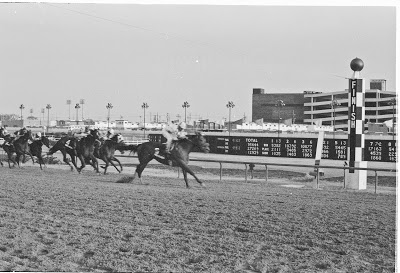
Sportsman’s Park, Cicero, Illinois, 1986. Photo by Michael James from his forthcoming book, Michael Gaylord James’ Pictures from the Long Haul.

Sportsman’s Park, Cicero, Illinois, 1986. Photo by Michael James from his forthcoming book, Michael Gaylord James’ Pictures from the Long Haul.

Pictures from the Long Haul:
Heading to the finish line at
Sportsman’s Park in Cicero

Straight up: horses were my first love — before cowboys and Indians, Jackie Robinson and the Brooklyn Dodgers, Wally Parks and the National Hot Rod Association… before Chicago itself.

By Michael James | The Rag Blog | May 7, 2013

[In this series, Michael James is sharing images from his rich past, accompanied by reflections about — and inspired by — those images. This photo will be included in his forthcoming book, Michael Gaylord James’ Pictures from the Long Haul.]

I have a friend named Cheri. Back in 1986 we dated. Her dad was into the ponies and had a race horse named Big Sparkle. We went out to Sportsman’s Park to see number three run. I brought along my friends Jason and his wife Jessie.

Jason used to run track at the University of Illinois. He and Jessie are serious horseplayers. Jason refers to this late racetrack as the “beloved Sportsman’s Park, killed off by the greedy Bidwill family by a metaphorical attempted conversion to auto-racing, after having once served as Al Capone’s local playground.”

When I was a kid I remember my dad saying: “I’m not a gambler” as in betting and playing cards. He did add that he bet on bigger things in life as in joining others to produce plays and go after a radio or TV franchise.

I myself am not much of a gambler. I did win some money in a slot machine driving through Nevada in the 1960’s. And I got roulette-wheel-hot one night out with the stunt men and fellow “fishermen” working on the flick The Guardian in Shreveport. I’ve won friendly bets on football, basketball, and baseball games, never betting against a Chicago team unless it was the Cubs when they played the White Sox.

Several times during the past 25 years I’ve gone to Sportsman or Arlington Park with Jason. I kind of act as his corner man. I’ll find him a nice place to sit, help him spread out his racing forms and other information sheets and notes, make sure he’s got a pen, get him coffee, and generally try to keep him comfortable and focused on the complex handicapping tasks at hand; he grasps them; I do not. I invest in his activities on such race days and actually have won a few hundred smackeroos on occasion.

I met Jason back in the 1960’s. He knew someone who was a neighbor of a famed radical I knew well. As an aside, for a future tale, let me just say that the particular neighbor was once called to U.S. Customs when some other acquaintances shipped him a monkey from India, the cage floor being lined with hashish.

Yes, I know there are ethical issues confronting the horse racing industry. But I do like going to the track; racetrack outings are fun. I like the people, the peeps. I like the scene. I like the rush when you win a few bucks or come close to winning a few bucks.

Most of all I like the horses. Straight up: horses were my first love — before cowboys and Indians, Jackie Robinson and the Brooklyn Dodgers, Wally Parks and the National Hot Rod Association, Bill Veeck and the Chicago White Sox, Joakim Noah and the Chicago Bulls, and before Chicago itself.

My first book was Michael the Colt. I read Sea Star, Misty of Chincoteague and other horse books by Marguerite Henry. I once traveled through Chincoteague when hugging the coast moving north and was surrounded by the “wild ponies.” We broke the rules and petted them.

A great thrill in the 1940’s was the yearly trip to New York City and the rodeo at Madison Square Garden. I got to pet Champion’s colt Star on the New York-New Haven Rodeo Train. My kid brother got to shake the hand of Champion’s rider, Gene Autry.

I loved riding lessons as a kid, though I protested having to use an English saddle. My uncle David in Florida had a horse named Beauty. A horse named Mariah, a pinto, ditched me out on the desert outside of Placitas, New Mexico. I chased her — literally ran after her — for two miles back to my buddy’s crib, swearing and laughing the entire way.

I drew pictures of horses, watched movies with horses in them, liked cowboys on horses and rooted for the Indians on horses. When I was a pre-driving teen I helped a woman named Mary up the road clean out her horses’ stable on Saturday mornings.

My dad was in advertising and he produced the Saturday races on NBC from the Hialeah racetrack in Miami, the first horse races I watched — on TV. Sammy Renick, the famed jockey turned announcer and “pioneer in racing television,” gave our family a boxer puppy. Dad named her Gabby as in Gabriel of Mi-Beau-Mel (his kids —  Michael, Beau and Melody).

In 1947 my kindergarten friend David Soskin’s mom would drive us to their house in a 1936 Ford convertible. We sat in the rumble seat. We hung out by the fence trying to feed hay to the horses in the field next door. When we weren’t hanging out by the pasture we were in the hayloft with bread-on-a-stick trying to catch swallows per the mom’s instructions.

I don’t remember how Big Sparkle did that day at Sportsman’s Park. I do know she was born in Louisiana in 1980, started 82 times, won 20 times, placed 10, showed 14, and won $212,375. On that race day in 1986 Cheri’s dad introduced Ms. Jessie and Jason to Ronnie Ebanks, a Caymanian who was then a jockey but went on to become a leading jockey agent. Jessie liked that. She too is from the Cayman Islands.

Leading up to the Kentucky Derby 2013 I read about jockey Rosie Napravnik who might be the first woman to win the big race, and about Kevin Krigger who would be the first Blackman to win the big one since 1902 (before blacks were jim-crowed out of that racing role). With a dose of Derby fever I called Jason to get in on the action. He said to bring him the moola.

At noon Saturday, May 4, 2013, with son Cadien riding shotgun, I headed down Lake Shore Drive and out North Avenue to meet Jason. He was at the Mudbug, an off track betting location on Weed Street. He said it was mobbed, so I met him in the parking lot at North and Sheffield. I handed him my share of the stakes, $100 bucks.

He explained various betting plans, basically telling me we were rooting for Revolutionary, Normandy Invasion, Mylute, Goldencents, and Its My Lucky Day in all kinds of permutations and combinations. Krigger and Napravnik were each on one of our horses.

I watched the prelims and the race. According to my man Jason, “we did cash a separate bet for a 50-cent pick4 including the winner (Orb at 7-1) which returned just under $90, so the net result was a $55 deficit on both accounts.

Normandy Invasion took the lead into the stretch but may have moved too soon and faded to fourth. The common plodder Golden Soul edged out Revolutionary for second, which cost us a break-even exacta saver bet. Fast pace and slop determined outcome…”

It was not our lucky day on the horses. I do have a $45 rebate coming. So for $55 I hung out with a son, took a spring ride down LSD, visited with an old pal, then headed home for an afternoon of stretching and arm curls in my living room, watching all the Derby TV action, and got to spend a few race-time minutes with my wife Paige who joined in for the rooting, all leading up to the Bulls-Nets-playoff-game-seven an hour and a half later. It was a good day and on the Bulls front it was a lucky day!

Yet a day later, thinking about my relationship with Jason, I realize that I like the role of investor and corner man at the track better than being an investor viewing the action on television. My next bet will be at a racetrack somewhere, probably making Jason comfortable, then down track-side-on-the-rail cheering on some noble beast prancing and dancing, heading home to the finish line.

[Michael James is a former SDS national officer, the founder of Rising Up Angry, co-founder of Chicago’s Heartland Café (1976 and still going), and co-host of the Saturday morning (9-10 a.m. CDT) Live from the Heartland radio show, here and on YouTube. He is reachable by one and all at michael@heartlandcafe.com. Find more articles by Michael James on The Rag Blog.]
The Rag Blog

Posted in Rag Bloggers | Tagged , , , , , , | 1 Comment

Alan Waldman : ‘Fawlty Towers’ is a Dozen Classic Comic Gems

Waldman’s film and TV
treasures you may have missed:

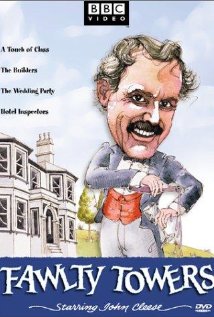
Former Monty Python star John Cleese and wife Connie Booth carefully crafted 12 unforgettable, hilarious episodes.

By Alan Waldman | The Rag Blog | May 7, 2013

[In his weekly column, Alan Waldman reviews some of his favorite films and TV series that readers may have missed, including TV dramas, mysteries, and comedies from Canada, England, Ireland, and Scotland. Most are available on DVD and/or Netflix, and some episodes are on YouTube.]

In a list drawn up by the British Film Institute in 2000, voted by industry professionals, Fawlty Towers was named the best British television series of all time. (Other classic programs on that list that I have so far recommended on The Rag Blog include: Yes Minister/Yes Prime Minister, Blackadder, Cracker, Inspector Morse, and Father Ted.)

Six episodes, all painstakingly written by Monty Python genius John Cleese and his American then-wife Connie Booth, appeared in 1975, followed by another half-dozen jewels in 1979.

Fawlty won two BAFTAs as “Best Situation Comedy,” and Cleese took a BAFTA for “Best Light Entertainment Performance.” Cleese was nominated for 22 major awards, including an Oscar for A Fish Named Wanda and other honors for that film, Monty Python’s Flying Circus, Monty Python and the Holy Grail, Harry Potter and the Chamber of Secrets, Clockwise, The Human Face, Shrek the Third and guest shots on Cheers, 3rd Rock from the Sun and Will & Grace. He won 14 of them.

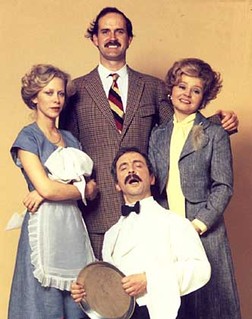
The series is set in a fictional hotel in the seaside town of Torquay and revolves around angry, rude, snobbish, misanthropic, and put-upon owner/manager Basil Fawlty (Cleese); his bossy wife Sybil (Prunella Scales); chambermaid Polly (Booth) and hapless Spanish waiter-porter Manuel (a truly hilarious Andrew Sachs), and their attempts to run the hotel amidst farcical situations and an array of demanding and eccentric guests.

In 1997, “The Germans” episode was ranked No. 12 on TV Guide‘s “100 Greatest Episodes of All Time” list.

Fawlty Towers cast.

Basil is terrified of Sybil and refers to her with such terms of endearment as “my little piranha fish,” “that golfing puff-adder,” “my little nest of vipers,” “toxic midget,” “my little commandant” and “you rancorous, coiffured old sow.” He once asks a guest: “Did you ever see that film, How to Murder Your Wife? Awfully good. I saw it six times.”

Basil’s verbal and physical outbursts are primarily directed at Manuel, whose limited and confused English vocabulary leads him to many elementary misunderstandings and mistakes. Basil also insults his guests, telling one couple, “May I suggest that you consider moving to a hotel closer to the sea? Or preferably in it.”

Each episode’s opening shot is of the hotel and its “Fawlty Towers” sign, which is often misspelled (“fatty owls,” “flay otters,” “flowery twats,” and “farty towels”).

Cleese got revenge on one critic of the show, TV reviewer Richard Ingrams, by naming a guest who is caught in his room with a blow-up doll after him.

Booth and Cleese spent months perfecting each script, sometimes writing as many as 10 drafts. The production team spent nearly an hour editing each minute of every program, spending up to 25 hours per show. Fawlty Towers came second only to America’s Frasier in The 2006 Ultimate Sitcom poll of comedy writers, and Basil topped 1997’s Britain’s Funniest Comedy Character poll.

In 1977 and 1978 alone, Fawlty was sold to 45 stations in 17 countries and was the BBC’s best selling overseas program for each year. But it was initially a flop in Spain, because of the portrayal of the Spanish waiter Manuel. It was successfully resold, with Manuel’s nationality changed to Italian. (In the Catalan region of Spain, Manuel was Mexican.)

The idea for Fawlty Towers came when the Monty Python cast was taping on location in Torquay and staying at a terrible small hotel run by a person Cleese calls “the rudest man I ever met in my life.” The hotelier threw a timetable at a guest who asked when the next bus would arrive, placed Eric Idle’s briefcase behind a garden wall claiming he suspected it contained a bomb, served Graham Chapman (who ordered a three-egg omlette) an omlette with three fried eggs stacked on top, and criticized American Python Terry Gilliam for his “non-British” table manners (switching hands with fork and knife while eating).

If you are among the handful of unfortunate Americans who have not seen all 12 of these priceless Fawlty Towers episodes, they are all available on Netflix, Netflix Instant, and YouTube.

Let me leave you with three Basil Fawlty lines. He refers to Sybil’s laugh as “someone machine-gunning a seal.” He says “Manuel will show you to your rooms…if you are lucky.” And he states, “I’ll go and have a lie-down. No I won’t; I’ll go and hit some guests.”

[Oregon writer and Houston native Alan Waldman holds a B.A. in theater arts from Brandeis University and has worked as an editor at The Hollywood Reporter and Honolulu magazine. Read more of Alan Waldman’s articles on The Rag Blog.]

The Rag Blog

Posted in Rag Bloggers | Tagged , , , , , , , | Leave a comment

Bob Feldman : The Influence of Texas’ ‘Big Rich,’ 1974-1995

Texas oil patriarch H. L. Hunt. The Hunt family was reputed to be the world’s wealthiest. Image from The Famous People.

The hidden history of Texas

Part 14: 1974-1995/2 — The influence of Texas’ ‘big rich’

By Bob Feldman | The Rag Blog | May 7, 2013

[This is the second section of Part 14 of Bob Feldman’s Rag Blog series on the hidden history of Texas.]

During the 1970s and early 1980s the folks who inherited the oil industry-based wealth of ultra-rich white Texans like Sid Richardson and H. L. Hunt continued to make big money — and to use that big money to exercise a special influence in both Texas state politics and U.S. national politics.

As Bryan Burrough’s The Big Rich observed:

For the state’s actual oilmen, the party that began with the 1973 [Arab oil] embargo, ran for 5 solid years. Drilling boomed. Profits mushroomed. Then, in 1978, things got even better… In just 7 short years prices rose 2,000 percent… By 1976…the children of H.L. Hunt’s two Dallas families and the corporations they controlled, were thriving as never before.

Thanks in large part to rising oil prices, the Hunts were probably the world’s wealthiest family… Their net worth hovered in the $6 billion to $8 billion range, easily topping the next wealthiest American families, the Mellons and Rockefellers…

The most successful Hunt during the 1970s was Ray, who began making over his father’s old Hunt Oil Company much as his Reunion project was changing the face of downtown Dallas… In 3 short years he quadrupled the size of Hunt Oil’s staff, increased its offshore leases from 100,000 to 1 million acres… Ray started a new magazine just for Dallas, D… By 1982 Texas Oil had luxuriated in a solid 10 years of record-high prices…

And, coincidentally, the sixth-largest contributor of campaign funds for one of Texas’s representatives in the U.S. Senate during the 1980s and 1990s, Phil Gramm, came from the Bass Enterprises investment firm that the Bass family relatives of Sid Richardson formed after Richardson’s death, while the seventh-largest contributor of campaign funds for former U.S. Senator Gramm during this period was Ray Hunt’s Hunt Corporation, according to the Center for Public Integrity’s 1996 book, The Buying of the President.

But once the demand and market price for oil began to drop after 1982, many of the independent local oil companies in Texas began to lose money or go out of business; and many could not pay off the loans that major banks in Texas had given them during the boom years of the 1970s and early 1980s. So “in October 1983… First National of Midland collapsed” and “in the next decade 9 of the 10 largest Texas banks would follow suit,” according to The Big Rich.

In 1981, membership in the Texas labor union locals that were affiliated with the Texas AFL-CIO had “peaked at more than 290,000,” according to the www.texasaflcio.org website. But the number of Texas workers who were Texas AFL-CIO-affiliated union members “then dropped dramatically during the oil bust of the 1980s;” and by 1995 membership was just 197,462, according to the Texas AFL-CIO’s website.

By the end of the 1980s many of the deregulated Savings and Loan (S&L) thrift institutions in Texas’s banking industry also had collapsed in a big way, after “real estate developers bought thrifts so they could have a private piggy bank to finance office buildings and condos no one needed,” “con artists set up loan scams and used thrifts to launder money,” and “thrift executives cooked the books and paid themselves high bonuses when their banks were actually losing money,” according to the 1991 edition of Louis Rukeyser’s Business Almanac.

As The Buying of the President observed in 1996, “Texas has the unpleasant distinction of topping the list of states with the most S&L failures with 65,” and “the state was second only to California in terms of the value of assets held by failed thrifts: California thrifts had $18,358 billion in assets compared with Texas’s $18,279 billion.”

And, coincidentally, the U.S. president who signed the S&L industry bail-out bill in 1989, George Herbert Walker Bush, was both a former Texas oil industry and banking executive and the father of Neil Bush — who was sued by federal regulators “for regulation violations that allegedly contributed to the $1 billion collapse of Silverado Banking, a Denver thrift,” according to Louis Rukeyser’s Business Almanac.

Between 1974 and 1995 another son of the U.S. President who launched Gulf War I against Iraq in early 1991 (who, himself, would become the governor of Texas in 1995 and the U.S. President who launched both the endless U.S. war in Afghanistan in October 2001 and the endless U.S. war in Iraq in March 2003) — George W. Bush II — also worked as an executive in Texas’s oil industry.

Before joining with the Bass family’s former money manager and other business partners to purchase the Texas Rangers baseball team in 1989, former Republican Texas Governor Bush was an executive at the Harken Oil and Gas firm that both Harvard University and the ultra-rich Bass family financially backed.

Another ultra-rich Texas billionaire, Ross Perot, was able to exercise a special influence on the direction of U.S. presidential politics during the 1990s — by spending $65 million of his surplus personal wealth to finance his own 1992 campaign to gain control of the White House — for which over 19.7 million U.S. voters cast ballots in November, 1992 (and for which over 7.8 million U.S. voters also cast ballots in November, 1996).

Perot had gained his initial big wealth in 1966 after his private family business, Electronic Data Systems (EDS), suddenly became super-profitable when Texas Blue Shield/Blue Cross — whose computer/data processing department Perot then headed — received a lucrative contract from the U.S. government’s Social Security Administration to develop a computerized system for paying the Medicare bills;” and Perot’s Texas Blue Shield/Blue Cross employer then gave Perot’s private EDS firm “a subcontract to take over their data processing on the new Medicare program using, of course, the system just developed at government expense” (by the same firm whose computer/data processing department Perot headed), according to a November 1971 Ramparts magazine article.

And it was also during the 1974 to 1995 period of Texas history that a Democrat, Ann Richards, was the governor of Texas (between 1991 and 1995), and that more than 70 people were killed on April 19, 1993, following a 51-day siege and an armed attack by U.S. federal government law enforcement agents on the Branch Davidian compound in Waco, Texas.

[Bob Feldman is an East Coast-based writer-activist and a former member of the Columbia SDS Steering Committee of the late 1960s. Read more articles by Bob Feldman on The Rag Blog.]

The Rag Blog

Posted in Rag Bloggers | Tagged , , , , , , , , , , , | Leave a comment

SPORT / Dave Zirin : RGIII Is Trending with Muhammad Ali

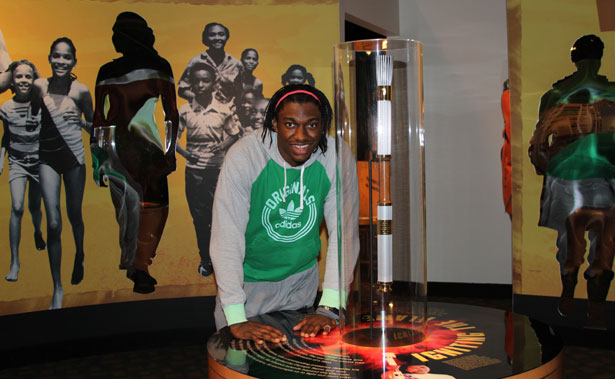
Robert Griffin III. Photo courtesy of Muhammad Ali Center. Image from The Nation.

What did RGIII learn at
the Muhammad Ali Center?

The social-media-savvy RGIII tweeted, ‘What Ali stood for and the way he expressed it from the boxing ring to the streets of everyday life would have him trending for weeks.’

By Dave Zirin | The Rag Blog | May 6, 2013

See Thorne Dreyer’s articles about progressive sportswriter Dave Zirin at The Rag Blog, and at Truthout, and listen to our March 22, 2013, Rag Radio interview with Zirin.

It should be enough that Redskins quarterback Robert Griffin III is the most exciting athlete to enter professional sports since Lionel Messi and has restored the thrill of the possible to our football-obsessed community in Washington, DC.

It should be enough at this moment to learn that RGIII is focused solely upon rehabilitating his knee, torn to shreds in last year’s playoffs. But the Heisman Trophy winner, who also found time in college to graduate from Baylor with a degree in political science and a 3.67 GPA, has clearly committed this off-season to exercising his mind as well.

According to his running Twitter commentary, RGIII spent Saturday at the museum that in my view is the Mecca of the intersection of sports and politics: the Muhammad Ali Center in Louisville, Kentucky.

The Muhammad Ali Center is a remarkable testament to the courage of an athlete willing to take unpopular stands because of political principle. The fact that Ali took these stands at the height of his athletic powers when he was between the ages of 22 and 26, clearly had an impact on Mr. Griffin. RGIII’s first tweet said simply that “seeing in depth what Ali did and who he was is so inspiring.”

The quarterback then soaked in just how much Ali suffered for his unpopular stands against racism and the war in Vietnam and put himself in the Champ’s shoes. He wrote, “An athlete like Ali would get destroyed in today’s world even more than in his own time.” The social-media-savvy RGIII then tweeted, “What Ali stood for and the way he expressed it from the boxing ring to the streets of everyday life would have him trending for weeks.”

He then retweeted someone who wrote to him, “Ali transcended sports and sacrificed his most productive boxing years to stand for his beliefs. Name a modern athlete that would.”

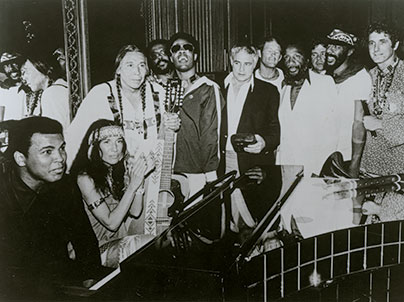
From left: Muhammad Ali, Buffy St. Marie, Floyd Red Crow Westerman, Harold Smith, Stevie Wonder, Marlon Brando, Max Gail, Dick Gregory, Richie Havens, and David Amram at a 1978 concert at the end of the Longest Walk, a 3,600-mile protest march from San Francisco to Washington, D.C., in the name of Native-American self-determination. Image from IndiVisible.

I must say that it’s thrilling that Muhammad Ali still has such a strong effect on athletes born a decade after he last set foot in a boxing ring. It’s also quite a statement that Robert Griffin III, who comes from a proud military family, would pay tribute to the most famous war resister in human history. Yes, Ali’s radical stance in 1968 has been smoothed out for mass consumption.

Yes, in today’s myriad Ali tributes, few quote him saying, “I’m not going 10,000 miles from home to help murder and burn another poor nation simply to continue the domination of white slave masters of the darker people the world over… The real enemy of my people is here.”

But the museum, to its credit, does not engage in a whitewash. RGIII was confronted with the actuality of Ali’s ideas and was deeply in awe of his sacrifice.

Lastly, I would point out that in today’s age of social media, an athlete like Ali would get far more support than in 1964. Back then, a small cabal of hard-bitten sportswriters, who were conservative, calloused, and Caucasian, dominated public commentary, and were deeply resentful of the man they called “The Louisville Lip.”

Today, in addition to the hate, there would be a public outpouring of support, which would also shape the coverage. The trend-lines of Ali’s resistance would have ample amplification.

There’s another side of this, however, that could not have escaped RGIII’s precise mind as he considered the concepts of sports and sacrifice: There is no way in heaven or hell Muhammad Ali, who is of African, Native American, and Irish ancestry, would have ever accepted being called a Redskin.

RGIII had to notice that the question of names and what we choose to call ourselves figures strongly at the Ali Center. You learn that Muhammad Ali was born Cassius Marcellus Clay Jr., named not only after his own father but also a famous 19th Century white abolitionist. The political history of that name didn’t stop him from changing it upon joining the Nation of Islam. As he said, “Cassius Clay was my slave name. I don’t use it because I am no longer a slave.”

The museum speaks about the boxers, reporters, and even members of the draft board who called him “Clay” and how he responded with at different times “say my name,” “what’s my name?” and my personal favorite, “what’s my name fool?”

Ali’s belief that a name was something far more precious than just a brand has found echoes across the culture in multiple forms, from Destiny’s Child, to Ravens Coach John Harbaugh’s Super Bowl victory speech, to perhaps the most famous scene in the classic television show The Wire. Names matter. What you call yourself and what others choose to call you is a question of respect.

I wonder if RGIII took notice that the Muhammad Ali Center has a proud history of doing traveling exhibits with the Smithsonian National Museum of the American Indian, including one called “IndiVisble: African-Native American Lives in the Americas.”

The 2012 press release for the exhibit reads, “Prejudice, laws and twists of history have often divided them from others, yet African-Native American people were united in the struggle against slavery and dispossession, and then for self-determination and freedom. For African-Native Americans, their double heritage is truly indivisible.”

I wonder if RGIII would ask himself how that heritage is served by the fans in feather headdresses and war paint, and the stained crimson face on the side of his helmet.

There was much made this week about a poll taken by ESPN, which showed that 79 percent of people in the U.S. find nothing wrong with the Redskins name. RGIII — the athlete, the brand, the corporate pitchman — is someone who could look at that poll and think, “Great. Now I don’t need to say anything.” RGIII, the human being inspired by Muhammad Ali, has to look at those numbers and think, “Whether it’s 79 percent or 97 percent, right is right.”

The Redskins name is racist as all hell, the creation of a segregationist owner and only possible because the people being insulted were subject to genocide: thinning their ranks, political power, and voice. It’s a name RGIII’s boss Dan Snyder will only defend in the most controlled of public settings. It’s a name that Muhammad Ali would have hated because it’s a damn disgrace.

At the end of his Twitter commentary about The Champ, Robert Griffin III wrote, “The Ali Center confirmed my belief that although we, as people around this world, are different, we can all help & learn from each other.”

He’s correct. But a precondition of helping and learning from one another is respect. RGIII is under no obligation to say anything about the Redskins name. But if he learned nothing else from the Muhammad Ali Center, it should be that sometimes you just have to speak out no matter the risk, no matter the trends or trend-lines.

It’s a little known part of The Champ’s history, but In 1978, Muhammad Ali joined Buffy St. Marie, Floyd Red Crow Westerman, Stevie Wonder and the recently departed Richie Havens to rally at the end of the Longest Walk, a 3,600-mile protest march from San Francisco to Washington, DC, in the name of Native American self-determination.

That was Muhammad Ali. He was nobody’s Redskin.

This article was also posted to The Nation blog.

[Dave Zirin is sports editor at The Nation and the author of the new book, Game Over: How Politics Has Turned the Sports World Upside Down (The New Press). Contact him at edgeofsports@gmail.com. Read more articles by Dave Zirin on The Rag Blog.]

The Rag Blog

Posted in Rag Bloggers | Tagged , , , , , , , , , | Leave a comment

Type your summary here

Type rest of the post here

Source The Rag Blog

Posted in RagBlog | Leave a comment

Type your summary here

Type rest of the post here

Source /

The Rag Blog

Posted in RagBlog | Leave a comment

Lamar W. Hankins : Talking Guns with Wayne

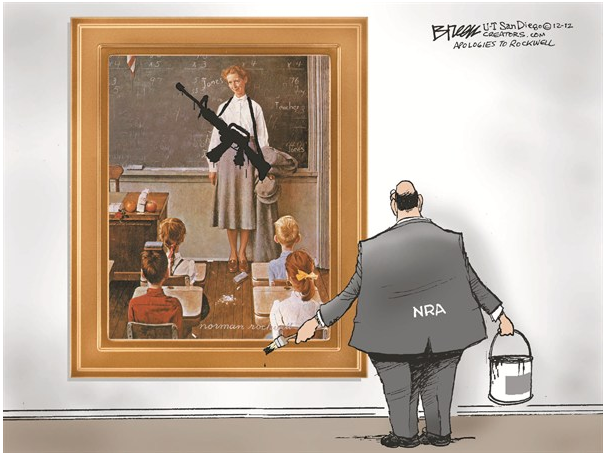
Cartoon by Steve Breen / San Diego Union Tribune. Image from The English Blog.

The liberty to live:
Talking guns with Wayne

Wayne seemed to be growing frustrated with our discussion. ‘I don’t want kids killed,’ he said, ‘but I don’t want anyone taking away my right to own an AR-15 semi-automatic.’

By Lamar W. Hankins | The Rag Blog | May 6, 2013

I had a talk with my old friend Wayne the other day. We hadn’t seen each other for a while, so we had a lot of catching up to do. After we talked about our work and compared how many fish each of us had caught on our last fishing trips, talk turned to politics. Wayne owns several guns, so it was no surprise to me that he had gun control on his mind.

Wayne said that he had been following the new gun legislation being considered by Congress. He said it concerned him even though he didn’t think there was much chance any kind of gun control laws were going to pass this Congress. “Hell,” he said, “both of our Texas senators are completely behind the right to own guns. In fact, Sen. Ted Cruz is completely against unreasonable and burdensome gun restrictions that limit our liberty.”

I asked. “So you think requiring background checks is unreasonable and burdensome?”

“Well,” said Wayne, “Sen. Cruz thinks all of this new regulation won’t do anything to stop violent crime. It’ll just undermine the constitutional rights of all citizens to own whatever guns they want to own. That boy up in Connecticut who killed all those children and teachers was just a criminal using guns inappropriately.”

“Well, how could we have prevented that criminal from getting the guns he used?” I asked.

Wayne responded, “We need to keep the mentally ill from getting access to guns.” I acknowledged that this was a good idea, but I wondered how we could accomplish that.

“As I recall,” I told him, “the mentally ill criminal in Connecticut who killed those kids and their teachers got his semi-automatic weapon and large clips of bullets from his own mother’s stash of weapons, and he even killed her before he left for Sandy Hook Elementary School.”

Wayne replied that every gun purchaser should be checked for mental illness. When I noted that this wouldn’t have prevented the Connecticut shooter from taking his mother’s guns from the home that he shared with her, Wayne suggested that maybe family members of gun purchasers needed to be checked out also. I said, “Ted Cruz is not going to like that idea.”

Wayne agreed. “Maybe we just need to require people to keep their guns locked in a secure gun safe.”

“That sounds like a good idea,” I responded, “but wouldn’t that cost a lot and involve the government even more in my life?” Wayne agreed that maybe this wasn’t such a good plan. “What if we just close the gun show loophole that allows people to purchase guns without a background check?” I suggested.

Wayne agreed, but pointed out that this step would not have prevented the Sandy Hook killings. He had another idea.

“What if we put armed police officers at every school,” Wayne asked. “Wouldn’t that have stopped the Sandy Hook killer?”

“I don’t know,” I responded, “I seem to remember that there was a sheriff’s deputy assigned to the Columbine high school, and he was easily outgunned by the two kids who killed those 12 students and injured 21 more out there in Colorado. And that brings up even more questions. How many officers would we need at every school in America — over 132,000 schools — to provide it adequate protection?

“Officers make an average of of over $56,000. Just 10 officers at every school (and that may not be enough) would cost over half a million dollars per school, and more for their benefits. That’s over $6.6 billion per year, plus benefits. Do you think that the taxpayers would go along with even those minimal increases in costs?”

“Well, why don’t we arm all the teachers?” Wayne asked. “One of them should be able to kill or stop a shooter.”

I replied, “Teachers are not trained to use guns and might have difficulty taking on the combined roles of police officer and teacher. Some may not want to carry guns, and others just might not have the right personality or disposition to be good police officers. If firefighters resist cross-training as police officers, which they often do, how much more difficult would it be to cross-train teachers as police officers? It is not currently part of a teacher’s job description to shoot and kill someone.”

Wayne agreed that those points were worth considering. After thinking about it for a minute, he asked, “Why don’t we redesign our schools to be as safe as prisons?” he asked.

I replied, “Wouldn’t that still require a large number of police officers to provide security? How would we pay for all those extra officers, not to mention the costs of making our schools as safe as prisons?”

“That is a lot of money,” Wayne said. “But I’m not a politician. Why can’t they figure out how to keep our schools safe from gun-wielding killers?”

“They keep trying, but every time a bill comes up the NRA defeats it,” I said. “Do you know that the NRA has even prevented government agencies from studying the problem? And they don’t even want to prohibit what are called cop-killer bullets or put tracers in gun powder so that law enforcement agencies can solve crimes after they are committed.”

Wayne agreed that not allowing government agencies to study those ideas didn’t make a lot of sense. He avoided my other points.

Wayne seemed to be growing frustrated with our discussion. “I don’t want kids killed,” he said, “but I don’t want anyone taking away my right to own an AR-15 semi-automatic. I paid over $1,000 for that gun last year. Maybe we need to realize that just because a bad person does something bad doesn’t mean that you get to put some government bureaucrat in charge of my life.

“I’m sorry those children in Sandy Hook were killed, but you know what? Deal with it, and don’t force me to lose my liberty to buy any gun I want without a hassle, which would be a greater tragedy than having 20 children killed by some deranged guy.”

“I guess your liberty to buy any gun you want, anytime you want, is more important than the lives of our children,” I said. Wayne agreed.

Author’s note: If you have difficulty accepting Wayne’s views about this, check out and/or participate in an initiative of the survivors of Sandy Hook who are interested in finding common sense solutions to senseless violence.

[Lamar W. Hankins, a former San Marcos, Texas, city attorney, is also a columnist for the San Marcos Mercury. This article © Freethought San Marcos, Lamar W. Hankins. Read more articles by Lamar W. Hankins on The Rag Blog.]

The Rag Blog

Posted in Rag Bloggers | Tagged , , , , , , , , | 1 Comment

FILM / Michael Simmons : How Bob Fass Revolutionized Late-Night Radio

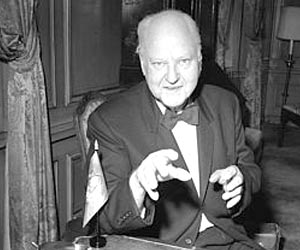
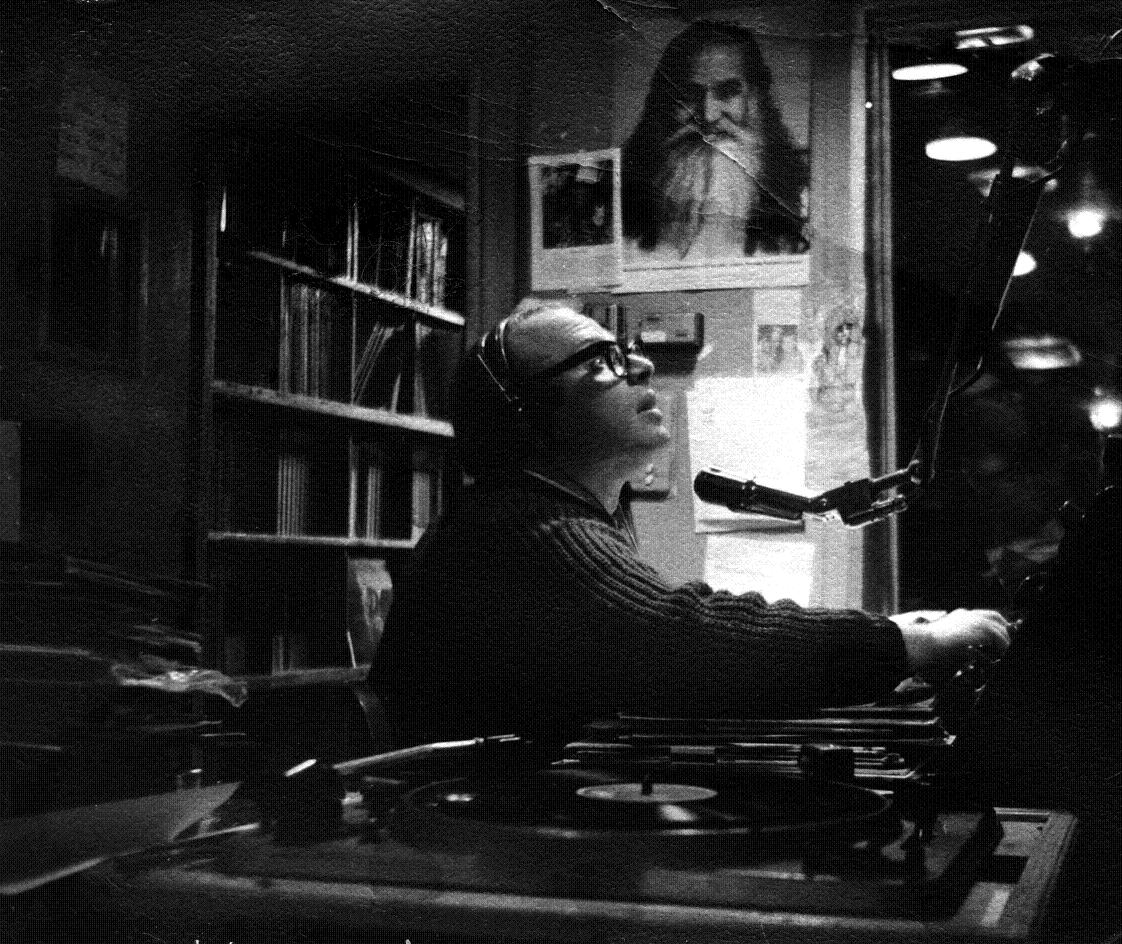
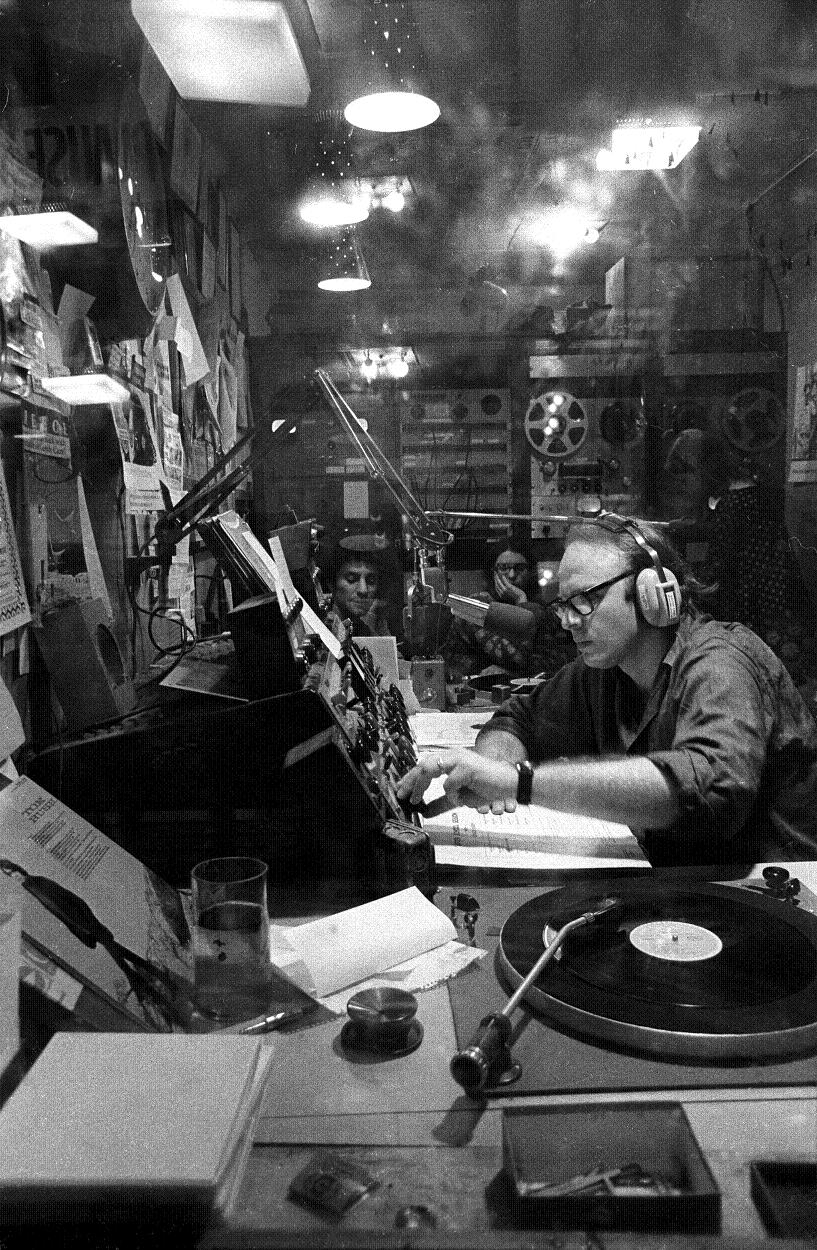
Bob Fass in the WBAI studios in New York. Photo by, yes, Bob Fass. Photos courtesy Radio Unnameable.

Radio Unnameable:
Bob Fass revolutionized late-night radio

Fass and ‘Cabal’ changed history and deserve the credit and Lovelace and Wolfson have provided the first in-depth cinematic look. It resonates like an epic tale with the hero emerging as a long-shot survivor.

By Michael Simmons | The Rag Blog | May 2, 2013

Radio legend Bob Fass and filmmaker Paul Lovelace will be Thorne Dreyer’s guests on Rag Radio this Friday, May 3, from 2-3 p.m. (CDT) on KOOP 91.7-FM in Austin, and streamed live to the world. The show will be rebroadcast by WFTE-FM in Mt. Cobb and Scranton, PA, Sunday morning, May 5, at 10 a.m. (EDT), and the podcast of this interview can be listened to or downloaded at the Internet Archive.

[Paul Lovelace and Jessica Wolfson’s remarkable film, Radio Unnameable, about free-form radio pioneer Bob Fass, is currently being featured at screenings around the country and the DVD will be released later this year. When the film was screened by the Austin Film Society last December, famed singer-songwriter Jerry Jeff Walker — who first performed “Mr. Bojangles” on Fass’ radio show — introduced the film to the Austin audience.]

“I wanna be a neuron — I don’t wanna be the brain,” said all-night radio host Bob Fass in the 1960s to his audience. “We’re all the brain.”

Bob Fass began his show Radio Unnameable at non-commercial, listener-sponsored WBAI-FM in New York City in 1963. By 1966 when I began listening as a fledgling nonconformist, Fass was on the air Monday through Friday from midnight to 5 or 6 a.m. Radio Unnameable was completely free-form and improvisational — radio jazz, as opposed to jazz radio.

Bob would play two or more records simultaneously of eclectic music and spoken word. Musicians would show up unexpectedly and perform. His friends came and shpritzed free-associative comedy routines or rapped about politics du jour or cultural happenings in the underground that were being created in real time. Friends included Bob Dylan, Abbie Hoffman, Paul Krassner, and Wavy Gravy. These characters were in cahoots with Fass’ audience whom he called “Cabal” — a handle that connoted subversion and conspiracy.

Bob Fass. In back, on left, is Abbie Hoffman.
Photo by Robert Altman.

An actor in his youth, Fass knew how to underplay. His voice was like a muted baritone saxophone — calm and reassuring, but at moments — always the right ones — he was capable of removing the mute and that bari would modulate, rising in excited exhortation. He entertained, comforted, educated, organized, raised consciousness, and inspired.

I was 11-years old in 1966 and I too wanted to be a neuron. A child of Top 40 radio (“W-A-Beatle-C!”), I was one of those kids with transistor radio and earplugs under the sheets when I was supposed to be asleep. One day while futzing with the dial at 2 a.m., I landed on WBAI and heard Phil Ochs sing “Draft Dodger Rag,” an absurdist satire about the serious subject of avoiding the military draft and thus the human meat-grinder that was The War In/On Vietnam. The combination of Ochs’ idealism and irony was irresistible and I was hooked on Fass at 99.5 on my FM dial.

Every night with Bob was different. There was no playlist, no formula, no commercials. Fass took phone calls and a techie had rigged a system that enabled 10 callers to yap at once — a pre-internet chat room. At times the show was indecipherable chaos, but mostly it was compelling for a restless and skeptical nipper like myself who’d been raised on rules and unquestioning respect for the authority of parents and so-called teachers and leaders.

Bob’s willingness to screw up in pursuit of the sublime — the audacity of failure, to quote filmmaker Jennifer Montgomery — was a lesson in the creative process — being unafraid to fall on one’s tuchus so that the practice of obliterating limits could reveal higher levels of artistry and consciousness. Ultimately we Cabalists discovered that the medium of radio alone could not only get one high, but get many high simultaneously.

Being a Fass listener in those days was to witness an emerging counterculture, watching it form on a molecular level in real time through experimentation and connection. One night in early ’67, Bob announced a Fly-In at a JFK Airport terminal and a thousand young people showed up to give flowers to passengers arriving from Hong Kong or Barcelona, giving birth to Flower Power. The Sweep-In followed and young ‘uns armed with brooms and mops helped clean up the untended ghetto of East Village streets.

These events led to the founding of the Youth International Party — the Yippies — and were all aired on Radio Unnameable. Even though I was initially too young to participate, the energetic positivity — the desire to change the human dynamic for the better — was infectious. I got bit and so did tens of thousands — eventually millions — of others. Within a year of my first listen, I was in the streets, at the barricades, on the front lines.

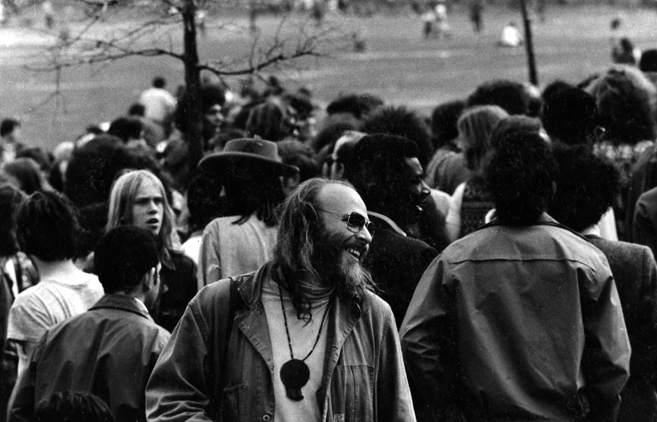
Fass c. 1969. Photo by Jim Demetropoulis.

Plenty more happened to Fass — both good and bad — but 40-sumpin’ years later, Bob is still on WBAI, Thursday night/Friday morning from midnight to 3 a.m. For the rest of the Bob Fass story, check out the extraordinary documentary Radio Unnameable by filmmakers Paul Lovelace and Jessica Wolfson. Fass and “Cabal” changed history and deserve the credit and Lovelace and Wolfson have provided the first in-depth cinematic look. It resonates like an epic tale with the hero emerging as a long-shot survivor.

Like so many young people in any era, I had a difficult adolescence. Mainstream adults with their arbitrary expectations and — worse — greed and slaughter were all transparently fucked up. At the age of 58 I still view most of conventional society with horror. But Bob Fass has helped keep me sane in an insane world for a half-century.

Radio Unnameable is a roadmap for rebels, those who believe — as the saying goes — that another world is possible. Fass and Lovelace and Wolfson show that political and cultural transformation are often generated in the wee small hours of the morning — that perfect time when the moon shines, the squares sleep, and dreamers share dreams while wide awake.

[As leader of the band Slewfoot, Michael Simmons was dubbed “The Father Of Country Punk” by Creem magazine in the 1970s. He was an editor at the National Lampoon in the ’80s where he wrote the popular column “Drinking Tips And Other War Stories.” He won a Los Angeles Press Club Award in the ’90s for investigative journalism and has written for MOJO, LA Weekly, Rolling Stone, Penthouse, High Times, the Los Angeles Times, The New York Times, CounterPunch, and The Progressive. Currently wrapping a solo album, Michael can be reached at guydebord@sbcglobal.net.]

The Rag Blog

Posted in Rag Bloggers | Tagged , , , , , , , , , , , | Leave a comment

Kristin Moe : Polluted Houston Neighborhood Draws the Line at Tar Sands

Children from the Manchester neighborhood in Houston with oil refinery smokestack in the background. Photo by Tar Sands Blockade. Photo by Tar Sands Blockade / YES! Magazine.

Houston’s most polluted neighborhood
draws the line at Alberta Tar Sands

East Texas is the belly of the beast: the heart of America’s oil country and the seat of power for the fossil fuels industry.

By Kristin Moe / YES! Magazine / May 2, 2013

HOUSTON — If the Keystone XL pipeline is approved, 90 percent of the tar sands crude that flows through it will be processed near an embattled Houston neighborhood called Manchester. Residents are joining up to demand a healthier future.

The playground in Manchester, a neighborhood on Houston’s east side, is empty much of the time. Children who play for too long here often start to cough. They go back inside, leaving an empty swing set in the shadow of a nearby oil refinery.

Yudith Nieto, 24, has lived in Manchester since her family came from Mexico when she was a small child. While it’s OK to visit the playground, she says, it’s not OK to bring her camera. On several occasions, security guards from the Valero refinery next door have appeared and asked her to leave, claiming that taking pictures in the park was “illegal.” They’ve even brought in Houston police as reinforcements.

Valero, one of the major oil companies operating in this industrial part of Houston, keeps its security busy: Nieto says that they have harassed documentary filmmakers and journalists. And when college students participating in an “alternative spring break” program came to the park to talk to her about the neighborhood’s problems, a guard drove up in an unmarked vehicle and took video of the meeting on his cellphone.

“I’m not afraid of the attention I’m getting from these people,” Nieto says, “because we want people to know that we’re aware.”

Manchester, one of Houston’s oldest neighborhoods, is surrounded by industry on all sides: a Rhodia chemical plant; a car-crushing facility; a water treatment plant; a train yard for hazardous cargo; a Goodyear synthetic rubber plant; oil refineries belonging to Lyondell Basell, Valero, and Texas Petro-Chemicals; as well as one of the busiest highways in the city.

Industrial development continues uninterrupted down the Houston Ship Channel for another 50 miles south to the Gulf of Mexico. The refineries around Houston have been called the “keystone to Keystone” because they’re expected to process 90 percent of tar sands crude from Alberta if the controversial Keystone XL pipeline is completed.

It’s one of the most polluted neighborhoods in the U.S., one where smokestacks grace every backyard view. But it’s taking on a new significance as the terminus of Keystone because the pipeline is at the center of the highest-stakes environmental battle in recent years. As international pressure builds, residents are beginning to organize, educate themselves, and speak out for the health of their families.

For them, the struggle over Keystone is not a political game. It’s not even about climate change, at least not exclusively. The effects of the pipeline will be right next door.

A grassroots movement begins to grow

Manchester is in some ways typical of low-income urban neighborhoods: it’s almost entirely Latino and African American, with a large number of undocumented immigrants. A full third of residents live below the poverty line. Drugs, unemployment, and gangs are a problem. And there’s a strange smell in the air: sometimes sweet, sometimes sulfurous, often reeking of diesel.

The most striking thing is that people here always seem to be sick. They have chronic headaches, nosebleeds, sore throats, and red sores on their skin that take months to heal.

Playground with Valero refinery
in background.

It took a groundbreaking study by the Houston Chronicle in 2005 to reveal for the first time the extent of the air pollution here. It identified five human carcinogens (a 2010 EPA study identified eight), including enough benzene that one scientist told the Chronicle that living in Manchester was “like sitting in traffic 24/7.” Toxin levels “were high enough that they would trigger a full-scale federal investigation if these communities were hazardous waste sites,” the Chronicle wrote.

Given this, it’s easy to understand why there are so many chronic respiratory problems. But the health risks go beyond asthma: for children living within two miles of the Houston Ship Channel, chances of contracting acute lymphocytic leukemia are 56 percent higher than for children only 10 miles away. “Children are being bombarded with toxins every day of their lives,” Nieto says.

Nieto, like many others in Manchester, grew up with asthma. Now an after-school teacher at Southwest Elementary, she spends her spare time working to organize this community, which has long been paralyzed by poverty, language barriers, and lack of access to information about exactly what is making them sick.

But the business of grassroots organizing is a slow one. It’s family to family, house to house. Many residents have reasons to resist taking action. They’re preoccupied with earning a living, fearful of authorities — often because of their legal status — and hesitant to accept just how bad their air might be.

Most people, Nieto says, just want to get out of Manchester. But they can’t afford rents anywhere else, and it’s impossible to sell. After all, who would buy a house with an oil refinery in the backyard?

So far, government representatives have been unwilling to act on behalf of residents who live along the Ship Channel. Juan Parras, a community organizer who founded Texas Environmental Justice Advocacy Services, or TEJAS, says that a major goal is simply holding public officials accountable and enforcing the laws already in place under the Clean Air Act.

But in a state where oil is king, he says, “our elected officials are more responsive to industry than they are to community needs.” Fossil-fuel companies — and the politicians whose campaigns they fund — stand to profit enormously from projects like the Keystone XL pipeline, Parras says. “They have our elected officials in their back pockets.”

Where grassroots meets DIY

But residents of Manchester are finding ways to take action that don’t depend on those representatives. Alongside two organizers from the group Tar Sands Blockade, Nieto, her partner Emmanuel, and a few other young people have set up a “free store” with regular hours.

It’s an outdoor community space based in a neighbor’s yard, a tent and some tables crammed with information and arts-and-crafts materials for children. The store offers free donated clothes, food, information on air pollution, meetings of local government officials, and trainings in skills like talking to the media and filing pollution complaints with the city.

The free store starts to address some of the immediate, daily needs for things like clothing and healthy food, which might prevent residents from engaging politically. It seems tiny in comparison with the industrial behemoth that’s so close. But it represents a critical shift towards mutual aid and self-sufficiency, an alternative to the feelings of helplessness that have long been dominant here.

By creating a space where neighbors can come together to take control of their own needs, organizers hope they’ll pave the way for deeper empowerment.

After a small rally and march last year, two activists from the Gulf Coast locked themselves to trucks entering a Valero facility in Manchester and launched a 45-day hunger strike, demanding that Valero divest from the Keystone XL pipeline. For now, the people risking arrest in these actions remain outsiders — U.S. citizens with greater access to resources and support. For many locals who struggle with supporting families under already difficult conditions, civil disobedience isn’t an option.

For Nieto, though, it’s about “building the support from people that I’ve known all my life.” Residents are mistrustful of even the most well-intentioned outsiders. That puts Nieto and the small handful of other young people from Manchester in a unique position to create change from the inside.

A critical position

The Alberta tar sands and the Keystone XL pipeline have taken on a monumental significance for the North American environmental movement. It’s not just another pipeline; former NASA climate scientist James Hansen famously referred to it as “the fuse to the biggest carbon bomb on the planet.” In February, it was a rallying point for the largest demonstration on climate change in U.S. history. Over 60,000 people have already signed a pledge to engage in civil disobedience should the final leg of the pipeline be approved.

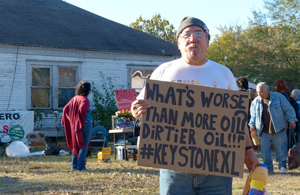
East Houston man pickets pipeline.

If that happens, almost all of the tar sands crude that flows through Keystone will be processed at refineries in East Houston. Activists from Tar Sands Blockade say that Valero has contract rights with TransCanada, which will allow them to purchase up to three-quarters of Keystone’s capacity. Tar sands crude oil is much more toxic than regular crude, and contains 11 times more sulfur and nickel, and five times more lead.

That puts neighborhoods like Manchester in a critical position not only to affect the future of the pipeline — and by extension the fight against climate change — but to raise environmental justice issues around race and class into the national conversation.

After decades in the shadow of the refineries, Ship Channel residents have the potential to play a major role in the debate. The political pressure around Keystone might be just big enough to catalyze both residents and public officials to change the composition of the air in East Houston and the carbon in our atmosphere.

What’s more, East Texas is the belly of the beast: the heart of America’s oil country and the seat of power for the fossil fuels industry. Juan Parras of TEJAS says he tells national environmental groups concerned about climate change to get involved in Manchester. “Because if you can fight them here,” he says, “and beat them to the punch, it’s going to have a huge impact on the rest of the nation.”

But Parras also worries that spotlighting Keystone will allow the media to forget the myriad other issues faced by residents of Manchester — that even if the pipeline is stopped, public attention will move on, and local people will still be dealing with polluted air, cancer and asthma, and the poverty that makes it impossible to leave.

Yudith Nieto, through her activism, has started to travel. She has met organizers from places all along Keystone’s path, including indigenous people from the Alberta tar sands.

Meeting them only deepened her sense of shared destiny, she says, the sense that she and her neighbors are not alone. “It put everything else into perspective,” she says. “This has been going on for such a long time. I became an ally to those people, and they became allies to me.”

Keystone is a threat to the health of communities along its path, from the source in Alberta to the terminus in Texas. But it also presents a challenge, and an opportunity, for those communities to realize what they have in common and make their voices heard. What’s at stake is not only the air quality in East Houston, but the stability of the climate across the planet.

This article was originally published by YES! Magazine and distributed by Truthout under a Creative Commons License.

[Kristin Moe writes for YES! Magazine, a national, nonprofit media project that fuses powerful ideas and practical actions. Kristin writes about climate, grassroots movements and social change. Follow her on Twitter @yo_Kmoe.]

The Rag Blog

Posted in RagBlog | Tagged , , , , , , , , , , , , | Leave a comment

Type your summary here

Type rest of the post here

Source /

The Rag Blog

Posted in RagBlog | Leave a comment

Bob Fass leads East Village Sweep-In. Type your summary here

Type rest of the post here

Source /

The Rag Blog

Posted in RagBlog | Leave a comment

RAG RADIO / Thorne Dreyer : Pedro Gatos and Val Liveoak on Nicaragua, Cuba, and the Global South

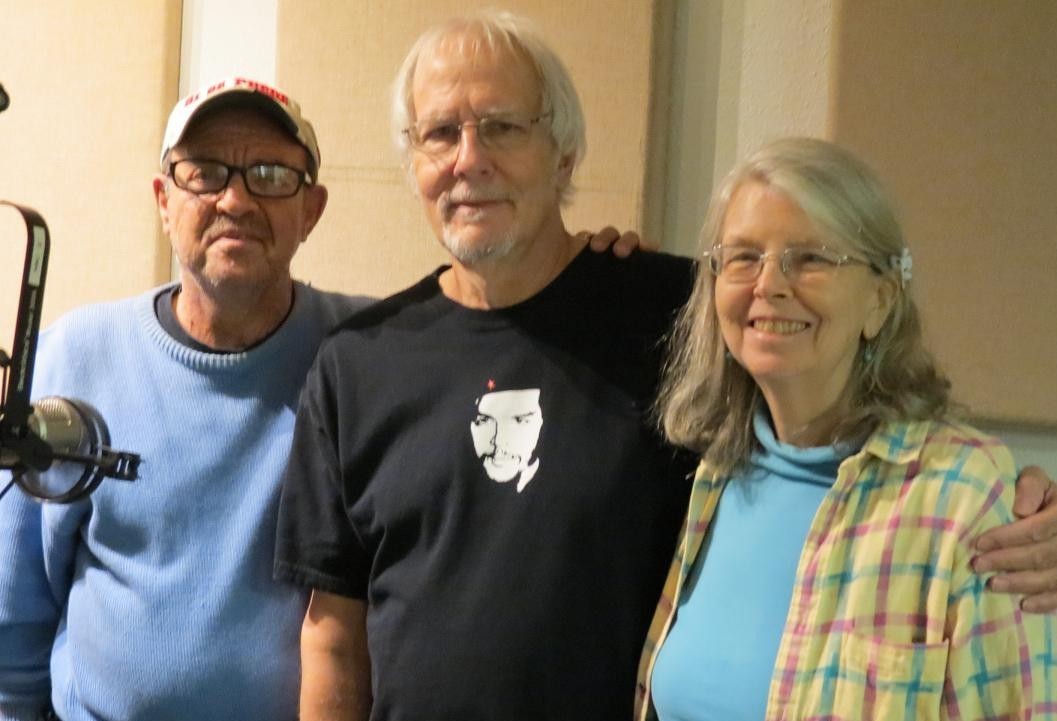
From left, Pedro Gatos, Rag Radio’s Thorne Dreyer, and Val Liveoak, in the studios of KOOP-FM in Austin, Texas, Friday, April 26, 2013. Photo by Roger Baker / The Rag Blog.

Rag Radio podcast:
Pedro Gatos and Val Liveoak on changes
in Cuba, Nicaragua, and the Global South

We discuss the legacy of Hugo Chavez, the state of the Cuban revolution, the landmark genocide trials in Guatemala, and the growing challenge to U.S. hegemony in the hemisphere.

By Rag Radio | The Rag Blog | May 1, 2013

Peace activists Pedro Gatos and Val Liveoak joined Rag Radio host Thorne Dreyer in a discussion of recent developments in Cuba, Nicaragua, Guatemala, and the Global South on Friday, April 26, 2013. Rag Radio is a syndicated radio program produced at the studios of KOOP 91.7-FM in Austin, Texas.

Listen to or download our interview with Pedro Gatos and Val Liveoak here:


Among the topics Gatos and Liveoak discussed on the show were the legacy of Hugo Chavez in Nicaragua and the recent narrow victory of Nicolas Maduro; Cuba in transition and the state of the continuing revolution; the landmark genocide trials in Guatemala of former head of state Efraín Ríos Montt and former military intelligence chief José Mauricio Rodríguez Sanchez; and the region’s growing challenge to U.S. hegemony.

Pedro Gatos (aka Pete Katz) is an activist, a specialist in Latin American politics and history, a radio show host, and a licensed chemical dependency counselor. He was employed in the Travis County Justice System in Austin, Texas, for 24 years.

He founded the Pedro Gatos Institute on Addiction, Health and Social Theory. He has facilitated workshops on subjects ranging from addiction and the War on Drugs to U.S. foreign policy and “The Bay of Pigs 50 Years Later.”

Gatos has visited Cuba five times since 2000 and has had exclusive interviews with then National Assembly President Ricardo Alarcón and many others. Pedro hosts Bringing Light into Darkness Mondays at 6 p.m. on KOOP-FM in Austin.

Val Liveoak is the volunteer Coordinator of Friends Peace Teams’ Peacebuilding en las Américas program. An activist since 1971, she founded the Friends Peace Teams in 1993, and has been involved with many community organizations and nonviolent struggles.

For 21 years, she has been a facilitator with the Alternatives to Violence Project (AVP), working in Mexico, Canada, Burundi, Rwanda, Kenya, Guatemala, Nicaragua, Cuba, St. Croix, St. Kitts, Bolivia, Colombia, Honduras, and El Salvador.

Val lives in San Antonio, but spends most of the year in Suchitoto, El Salvador, and travels throughout the region. She has been named a “Woman of Peace” by Womens’ Peacepower Foundation (2009) and Peacemaker of the Year by the Austin Peace and Justice Center (1986).

Listen to our December 9, 2011, Rag Radio interview with Val Liveoak here.

Rag Radio has aired since September 2009 on KOOP 91.7-FM, an all-volunteer cooperatively-run community radio station in Austin, Texas. Hosted and produced by Rag Blog editor and long-time alternative journalist Thorne Dreyer, a pioneer of the Sixties underground press movement, Rag Radio is broadcast every Friday from 2-3 p.m. (CDT) on KOOP, and is rebroadcast on Sundays at 10 a.m. (EDT) on WFTE, 90.3-FM in Mt. Cobb, PA, and 105.7-FM in Scranton, PA.

The show is streamed live on the web by both stations and, after broadcast, all Rag Radio shows are posted as podcasts at the Internet Archive.

Rag Radio is produced in association with The Rag Blog, a progressive Internet newsmagazine, and the New Journalism Project, a Texas 501(c)(3) nonprofit corporation. Tracey Schulz is the show’s engineer and co-producer.

Rag Radio can be contacted at ragradio@koop.org.

Coming up on Rag Radio:
THIS FRIDAY, May 3, 2013:
Free-form radio pioneer Bob Fass of Pacifica Radio’s WBAI-FM in New York, with filmmaker Paul Lovelace (Radio Unnameable).
Friday, May 10, 2013: Journalism professor & activist Robert Jensen, author of Arguing for Our Lives: A User’s Guide to Constructive Dialog.
Friday, May 17, 2013: Political economist Gar Alperovitz, author of What Then Must We Do?
May 24, 2013 (RESCHEDULED): Amsterdam-based poet John Sinclair, legendary founder of the White Panther Party and former manager of the MC5.

The Rag Blog

Posted in Rag Bloggers | Tagged , , , , , , , , , , , | Leave a comment