Norman Pagett and Josephine Smit : Can We ‘Downsize’ and Survive?

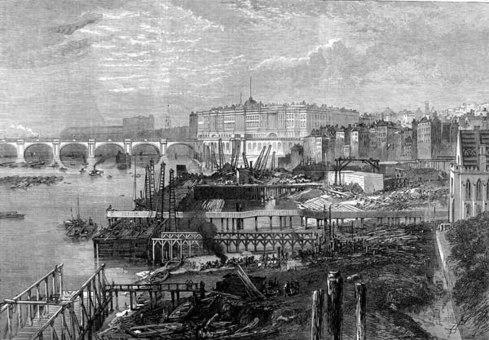
Sewers under construction, north bank of the Thames looking west. Image from End of More.

The end of more:
Can we ‘downsize’ and survive?

We continue to delude ourselves that ‘downsizing’ will somehow allow us to carry on with our current lifestyle with perhaps only minor inconveniences.

By Norman Pagett and Josephine Smit / The End of More / April 25, 2013

“Healthy citizens are the greatest asset any country can have.” — Winston Churchill

LONDON — Faced with inevitable decline in our access to hydrocarbon resources, we read of numerous ways in which we will have to downsize, use less, work less, grow our own food, use goods and services close to home, consume only what we can manufacture within our own personal environment, or within walking distance.

If we are to survive, we must “live local” because the means to exist in any other context is likely to become very difficult. There is rarely, if ever, any mention of the healthcare we currently enjoy, which has given us a reasonably fit and healthy 80-year average lifespan.

There seems to be a strange expectation that we will remain as healthy as we are now, or become even healthier still through a less stressful lifestyle of bucolic bliss, tending our vegetable gardens and chicken coops, irrespective of any other problems we face.

And while “downsizing” — a somewhat bizarre concept in itself — might affect every other aspect of our lives, it will not apply to doctors, medical staff, hospitals and the vast power-hungry pharmaceutical factories and supply chains that give them round the clock backup.

Nor does downsizing appear to apply to the other emergency services we can call on if our home is on fire or those of criminal intent wish to relieve us of what is rightfully ours. Alternative lifestylers seem to have blanked out the detail that fire engines, ambulances and police cars need fuel, and the people who man them need to get paid, fed, and moved around quickly.

In other words “we” can reduce our imprint on the environment, as long as those who support our way of life do not. Humanity, at least our “Western” developed segment of it, is enjoying a phase of good health and longevity that is an anomaly in historical terms. There is a refusal to recognize that our health and well-being will only last as long as we have cheap hydrocarbon energy available to support it.

Only 150 years ago average life expectancy was around 40 years and medical care was primitive, basic, and dangerous. Children had only a 50/50 chance of reaching their fifth birthday. Death was accepted as unfortunate and inevitable, but big families ultimately allowed survival of a few offspring to maturity, which gave some insurance against the inevitable privations of old age.

The causes of disease, many of which we know to be the result of the filth and chaos of crowded living, contaminated water. and sewage, were merely guessed at. The overpowering smell of this waste was generally accepted as a cause of a great deal of otherwise unexplained sickness.

Even the ancient Romans built their sewers to contain the smells they considered dangerous; getting rid of sewage was a bonus. Malaria literally meant “bad air,” and the name of the disease has stayed with us even though we now know its true cause.

Prevailing winds

As cities developed, particularly in Europe, the more prosperous quarters were, and still are, built in the south and west, to take advantage of the general prevailing winds blowing the smells of the city eastwards. Thus the east side of many cities had to endure the industrialization that created the prosperity of the western suburbs.

In many respects the populations of European cities of the eighteenth and nineteenth centuries reflected the problems of our own times: they were growing faster than any means could be found to sustain them. Cities were seen as sources of wealth and prosperity, so people crowded together in them, but in so doing they created the seedbeds for the diseases that were making the cities ultimately untenable.

To quote from Samuel Pepys’ Diary:

This morning one came to me to advise with me where to make me a window into my cellar in lieu of one that Sir W Batten had stopped up; and going down into my cellar to look, I put my foot into a great heap of turds, by which I find that My Turner’s house of office is full and comes into my cellar, which doth trouble me. October 20th 1660; …

People were being debilitated and killed by the toxicity of their own wastes and that of the animals used for muscle power and food. By 1810 the million inhabitants of London (by then the biggest city in the world) used 200,000 cesspits; their contents could only be cleared out manually and so were usually neglected. Waste simply accumulated because no authority took final responsibility for doing anything about it, and any laws on the matter were widely flouted.

By the 1840s, water closets were coming into general use in more affluent homes through the availability of pumped water. While these were seen as an improvement on the chamber pots of previous eras, the water closets resulted in greater quantities of water flowing into the cesspits.

This water in turn overflowed into street drains that had only been created to take rainwater into ditches and tributaries of the River Thames. Improvements in personal hygiene, allowing the upper classes to “flush and forget,” had unwittingly created an even bigger danger to public health for everyone else.

Cities and towns were expanding under the pressure of industrialization, but by continuing to use a pre-industrial infrastructure of waste disposal they were being constantly hit by outbreaks of diseases that swept through huddled tenements and luxury homes alike.

Draw off points for public drinking water were often carelessly close to sewage discharges, or the water came from town wells that were contaminated by overflowing cesspits. Cholera and typhoid fever became the scourge of Victorian London.

The Thames as it ran through the city became an open sewer, as tidal flows washed effluent back and forth twice a day. It was a problem that grew throughout the early part of the nineteenth century, culminating in the unusually hot summer of 1858 when bacteria thriving in the fetid water created what became known as the “great stink.”

Even the business of government itself was overcome, and plans were made to evacuate parliament to Oxford or St Albans, such was the overpowering stench of the river. Even curtains soaked in chloride of lime could not counteract the smell of raw sewage coming up from the Thames outside, but at least it focused minds and money on the problem.

Numerous proposals were made to deal with it, but only Joseph Bazalgette, chief engineer of the London Metropolitan Board of Works, came up with a workable solution. This was a truly stupendous undertaking that involved building 82 miles of intercepting sewers on the north and south banks of the Thames serving 450 miles of main sewers, linking to 13,000 miles of minor street drains. The completed system could deal with a daily waste output of half a million gallons of sewage.

The sewers were designed to take the raw effluent out to the coast to the north and south of London by gravity, terminating in giant pumping stations driven by Cornish beam engines each needing 5,000 tons of coal a year to keep them running. They lifted the sewage into giant reservoirs that discharged it out to sea on ebb tides. No attempt was made to treat the sewage, merely to get rid of it.

To build those sewers required 315 million bricks, and almost a million tons of mortar and cement. You can’t make bricks and mortar without heat, and lots of it. The only source of heat on that scale was coal, which could only be got in quantity by deep mining. With the heat energy from coal, Victorian engineers could manufacture top quality bricks by the million in enormous new kilns, rather than on the relatively small scale previously allowed by using wood as a heat source.
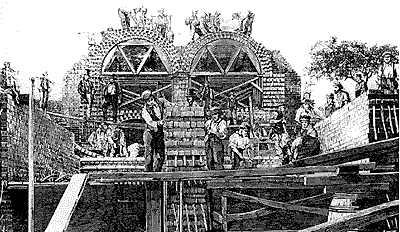
London embankment sewer brickwork under construction. Image from End of More.

A marvel of Victorian engineering

The entire scheme was completed between 1856 and 1870 and was a marvel of Victorian engineering, but it was only made feasible by fossil fuel energy. Coal from deep mines had only become widely available in the late 1700s, when the invention of the viable steam engine allowed miners to pump out flood water from deep shafts (the same type of steam engines that pumped the sewage to the sea).

Bazalgette’s enterprise was the biggest undertaking of civil works in the world at that time, and from firing the bricks to discharging waste into the open sea it depended entirely on the availability of cheap energy from coal. Even the delivery of the bricks and materials into the heart of the city could only have been done by the recently constructed steam powered railways.

The sewer system is out of sight and largely out of mind but remains a stark example of how we need continual energy inputs at the most basic level to sustain our health. The same sewers still keep London healthy today, and they discharge a hundred times the volume anticipated by Bazalgette’s original design.

It was ironic that burning cheap coal would save thousands of lives in the capital city by providing the means to build its sewers, while simultaneously causing thousands of deaths over the following century by poisoning its air until the introduction of the clean air act in 1956.

Every developed town and city across the world now safeguards the health of its citizens in the same way, by pumping away wastes to a safe distance before treatment. But to do it there must be constant availability of hydrocarbon energy. Electricity will enable you to pump water and sewage but it cannot provide all the infrastructure needed to build or maintain a fresh water or waste treatment plant; for that you need oil, coal, and gas.

Modern domestic plumbing systems are now made largely of plastic, which is manufactured exclusively from oil feedstock, while concrete main sewer pipes are produced using processes that are equally energy intensive. The safe discharge of human waste and the input of fresh water have been critical to health and prosperity across the developed world, yet we continue to delude ourselves that “downsizing” will somehow allow us to carry on with our current lifestyle with perhaps only minor inconveniences.

But we are even more deluded when it comes to the medical profession and all of the advanced treatments and technologies it can provide to keep us in good health for ever longer lifespans and make our lives as pain-free as possible. We have a blind faith that we can continue to benefit from a highly complex, energy-intensive healthcare system, irrespective of what happens to our energy supplies.

We read of the conditions endured by our not-so-distant forebears, and recoil in horror at the prevalence of the dirt and diseases they had to accept as part of their lives. We should perhaps stop to consider that they did not have the means to make it otherwise. In the absence of any real medical help, people who could afford them carried a pomander, a small container of scented herbs held to the nose as some kind of protection against disease and the worst of the city odours.

We think of ourselves as somehow different, but our modern health system will survive only as long as the modern day pomander of our hydrocarbon shield is there to protect it.

The last century saw massive advances in healthcare, driven by both fossil fuel and world war. The new technology and energy sources available at the start of the First World War allowed killing on an industrial scale but it also drove innovation and industrialization of medical care. The war saw the development of the triage system of prioritizing treatment for the wounded, and new means of transporting patients away from the dangers of the battlefield quickly.

In 1914 Marie Curie adapted her X-ray equipment into mobile units, specifically designed to be used in battlefield conditions. At the same time, disease was being contained with the help of mobile laboratories, tetanus antitoxin, and vaccination against typhoid. All this was no defence against the virus of the so called Spanish flu, which broke out and spread among troops and civilians alike, killing more people than the previous four years of conflict in a pandemic that ran from 1918 till 1920.

The war had killed 37 million people, and estimates put the total number of fatalities of the flu epidemic at up to another 50 million, but even those enormous numbers show as barely a blip when we look back on the inexorable rise in population in the last century.

Laying a foundation for modern medical care

The skills that had been employed to create the sewage disposal and fresh water pumping works of the nineteenth century now provided the foundations for making medical care and childbirth cleaner and safer in the twentieth.

But every innovation demanded energy input. Even the production of chlorine based bleach, which kills the bacteria of tetanus, cholera, typhus, carbuncle, hepatitis, enterovirus, streptococcus, and staphylococcus, and which we now take for granted, would not have been be possible without the industrial backup to manufacture and distribute it.

Incorrectly handled, chlorine will kill almost anything, including us. Progress in healthcare might have appeared slow to those involved, but in historical terms it began to move rapidly. Fossil fuel energy provided a cleaner environment for humanity to breed, and we began to make up the numbers lost between 1914 and 1920.

While human ingenuity was critical to such rapid progress, none of it would have been possible without the driving force of oil, coal, and gas. Our collective health today still hangs by that thread of hydrocarbon.

As the industrial power of nations forced technology ahead at an ever increasing pace after World War One, the underlying energy driving our factory production systems increased general prosperity, and that in turn financed research into unknown areas of disease.

Alexander Fleming, professor of bacteriology at St Mary’s Hospital in London first identified Penicillium mould in a petri dish in his laboratory in 1928, and began to recognize its potential for preventing post-surgical wound infections. But its full potential was not brought into play until World War Two, just over a decade later.

The drug had been created on the laboratory bench, but it needed the power of energy-driven industry to make it available in quantity. Constraints in Britain’s wartime manufacturing capacity meant that production had to be carried out in the U.S., and even there it proved difficult to refine the process to produce penicillin on an industrial scale.

John L Smith, who was to become president and chairman of Pfizer and who worked on the deep-tank fermentation process that provided a successful solution to large scale production, said of penicillin:

The mold is as temperamental as an opera singer, the yields are low, the isolation is difficult, the extraction is murder, the purification invites disaster, and the assay is unsatisfactory.

Even with the power of American industry behind it, penicillin only became available for limited use on war wounds by 1944/5, and was not made available for general use until after the war.

For little more than a century developments in safe drinking water supply, sanitation, and medical science have allowed us progressively to tackle many once-fatal diseases and illnesses. We minimized the risk of infection and created vaccines, cures, or life-prolonging treatments for everything from measles to cancers.

Western affluence and medical technologies support lives that would not otherwise be viable, for those who are born prematurely or who suffer serious injury, disability or illness. Medical treatment now incorporates preventative measures to extend lives and keep people in “perfect” health for as long as possible. As a result, average life expectancy across the global population has grown from just under 50 years in the 1950s to 67 years today.

So-called “miracle” drugs gave man a sense of omnipotence that tipped into hubris when, in 1969, U.S. Surgeon General William Stewart, was reported to have said it was time to “close the book on infectious disease.”

Fighting a losing battle

But we have not closed that book, nor are we likely to. Sir Alexander Fleming forecast that bacteria killed by his new wonder drug would eventually mutate a resistance to it. Within decades the effectiveness of antibiotics in tackling staphylococcus aureus bacteria was diminishing and the methicilin-resistant staphylococcus aureus, or MRSA “superbug,” was taking hold.

It is easy to forget that before the development of the antibiotic the medical profession could provide no effective cure for infections such as pneumonia, and a slight scratch from a rose thorn bush could be enough to cause death from blood poisoning.

We are fighting a losing battle against nature; bacteria will always win the war of numbers. No matter what medication we add to our arsenal, bacteria will always mutate to resist it. Since the emergence of MRSA, hospitals have had to deal with constantly mutating new strains, each one more virulent than the last, testing our ingenuity in dealing with them, and killing patients we thought could be protected from such infection.

In some regions of the world the malaria parasite is becoming resistant to the anti-malarial drug artemisinin, while drug-resistant tuberculosis has been reported in 77 countries, according to research by the U.S. Centers for Disease Control and Prevention.

In our arrogance we have failed to take account of nature’s resilience, and have also neglected to consider human nature and our instinct to put self-interest above the common good, even if contagion is spread in the process. The behavior of the human race is less easily controlled than bacteria in a petri dish.

In less developed parts of the world, notably Africa, HIV/Aids and other infectious diseases continue to claim nearly 10 million lives a year. Global political directives and programmes to prevent and tackle disease are commonly falling short of their objectives for a variety of reasons, including localised corruption, lack of financial support from the wealthy West and misinformation propagated through local superstition or by religious groups.

Tending to the rich

In spite of the good intentions of global leaders, there continues to be a huge disparity between the health risks and care of rich and poor within cities, nations,and regions of the world. The U.S. has more than a third of the world’s health workers, tending the diseases of the affluent: heart disease, stroke, and cancer.

Many of the consuming world’s ills are being caused by people’s excesses, eating too much of the wrong foods, drinking too much alcohol, smoking, or sunbathing. A billion of the world’s people are overweight, a figure that is balanced in the cruelest of ironies by the billion who cannot find enough to eat.

At the same time, the poor of the world often lack access to medical facilities, doctors, and drugs, and also to the basics of safe drinking water, sanitation, and waste disposal. It is estimated that almost half of the developing world’s population live without sanitation, and as increasing numbers of people are living in overcrowded, urban conditions the potential for transmission of infectious disease grows.

The consuming nations had the geological good fortune to be sitting on resources — coal and iron — that could be used to build water and waste disposal systems, but others have been far less fortunate. We now see megacities like Lagos and others with populations of 10 million or more with little or no water or sewage infrastructure, in tropical heat.

For them, the energy to build a modern health infrastructure is a dream that will never materialize: there is too little energy left and it has all become too expensive.

It is also becoming too expensive for the consuming countries of the west, as can be seen in the government cuts in health service budgets now taking place. We have developed extremely successful and innovative medical technologies, a pill for every ill and a physical infrastructure of surgeries, clinics and hospital buildings: all are highly sophisticated luxuries that we can no longer afford and consume vast amounts of energy.

The U.S. Environmental Protection Agency estimates that hospitals use twice as much energy per square foot as a comparable office block, to keep the lights, heating, ventilation, and air conditioning on 24/7 and run an array of equipment from refrigerators to MRI scanners.

But don’t take our word for it. Dan Bednarz, PhD, health-care consultant and editor of the Health after Oil blog, presented his view of the future at a nurses’ conference in Pennsylvania, USA:

Fossil fuel costs will continue to rise and eventually the healthcare system will be forced to downsize — just as the baby boomers and (possibly) climate change effects inundate the system.

Without energy input our hospitals and medical systems cannot be maintained at their present levels, and concepts of health and care become very different.

We are already seeing a resurgence of alternative medical therapies, often using herbs similar to those in the historic pomander. This foreshadows what will happen in your post-industrial future as well-fed health and wellbeing give way to weakness and disease, accentuated by poor nutrition, and the energy-driven skills of modern medicine are no longer readily available.

A doctor might have a knowledge of what ails you, but that might be almost his only advantage over his medieval counterpart. Knowing that you need an antibiotic to stop a raging infection will be of little use if there’s no means of getting hold of it.

Just contemplate the “innovative” methods of the surgeons in northern Italy’s medieval universities in the 1400s:

“They washed the wound with wine, scrupulously removing every foreign particle; then they brought the edges together, not allowing wine nor anything to remain within — dry adhesive surfaces were their desire. Nature, they said, produce the means of union in a viscous exudation, or natural as it was afterwards called by Paracelsus, Pare, and Wurtz. in older wounds they did their best to obtain union by desiccation, and refreshing of the edges. Upon the outer surface they laid only lint steeped in wine.” — Sir Clifford Allbutt, regius professor of physic, University of Cambridge

The modern health system has replaced our need to take responsibility for our own bodies. It cannot give us immortality, but it has given us the next best thing: long, safe, and comfortable lives. We built our good health on hydrocarbon energy, but in the future a wealth of factors will make it progressively more difficult for us to exert control over disease as that energy source slips from our grasp.

Disease will become more prevalent, not only in localized outbreaks, but at epidemic and even pandemic levels. Your healthcare system cannot downsize, it’s either there or it isn’t.

[Norman Pagett is a UK-based professional technical writer and communicator, working in the engineering, building, transport, environmental, health, and food industries. Josephine Smit is a UK-based journalist specializing in architecture and environmental issues and policy who has freelanced for British newspapers including the Sunday Times.Together they edit and write The End of More.]

The Rag Blog

Posted in RagBlog | Tagged , , , , , , , , , , , | Leave a comment

Judy Gumbo Albert : Writing for the Hell of It

Yippie Girl: Judy Gumbo Albert on the cover of the Berkeley Tribe, 1970. Image from Babylon Falling.

How to bug a Yippie Girl:
Writing for the hell of it

My 1960s and ’70s had been a Dostoyevskian drama of love, honor, loyalty, and betrayal embedded in the American revolution of my time.

By Judy Gumbo Albert | The Rag Blog | April 24, 2013

Listen to the podcast of Thorne Dreyer’s April 13, 2013, Rag Radio interview with original Yippies Judy Gumbo Albert and Nancy Kurshan at the Internet Archive and read about it on The Rag Blog. Also, see Jonah Raskin’s Rag Blog interview with Judy Gumbo Albert.

I recently entered a contest for women writers that focused on personal narrative of life-changing experiences that evoke the ’60s and ’70s. I submitted an adaptation of a chapter from Yippie Girl, my memoir-in-progress — and won third prize!

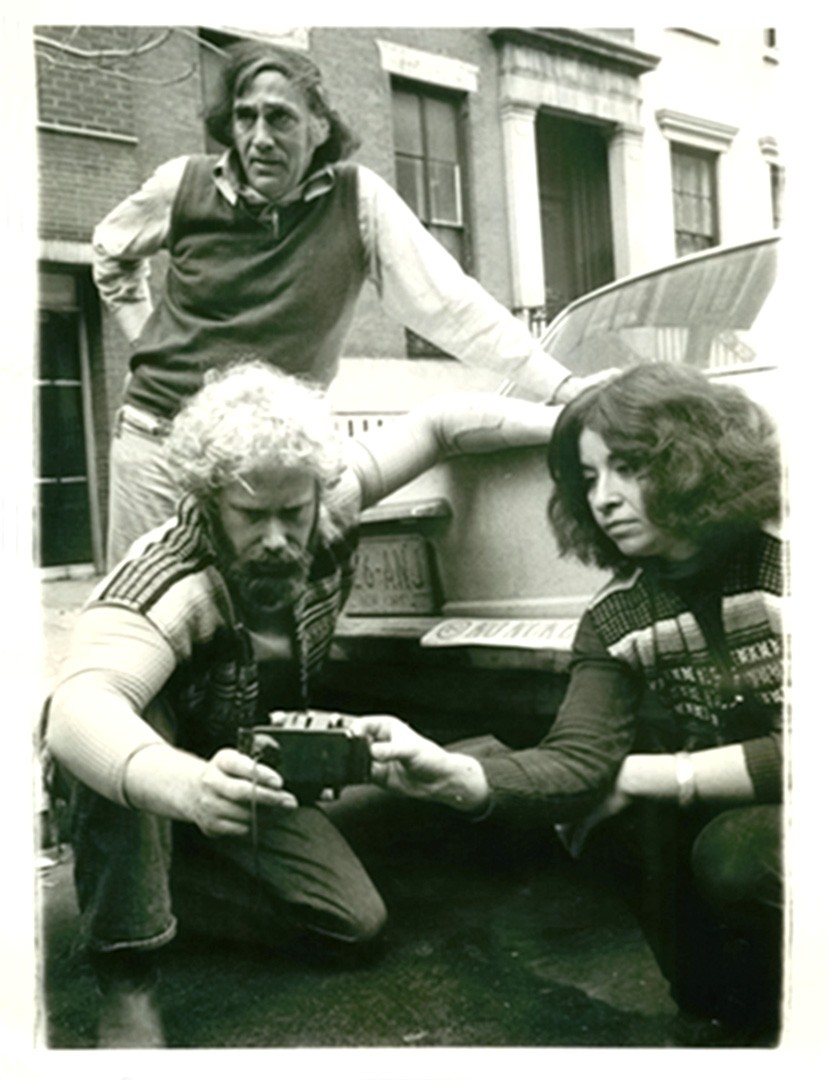
My piece, “Bugged,” is about the time I discovered an FBI tracking device on my car in 1975. It will be published this fall in an anthology, Times They Were a Changing, edited by Kate Farrell, Linda Joy Myers, and Amber Lee Starfire. Here’s what one of the editors said about “Bugged”:

We are all so pleased to include your work in the anthology — it does embrace so many wonderful elements in one short piece: romance, humor, revolution, urban & country. Brava!

If you’re interested in the story of my writing process — how I came to write Bugged — read on. Updates on publication will be available here at The Rag Blog or on my website, www.yippiegirl.com, or The Times They Were A-Changing website.

Bringing It All Back Home

My submission to the Times They Were A-Changing contest is titled “Bugged.” It’s adapted from a chapter in Yippie Girl, my memoir-in-progress that I began in 2008. The previous two years could have occupied any psychotherapist’s A-list of major life crises.

Stew Albert, my lover and husband of almost 40 years, died. We had five weeks between diagnosis and death. I quit my job as a fundraiser for Planned Parenthood, sold my bungalow in Portland where Stew and I had raised our daughter, and with two months remaining of that excruciating first year during which widows are not supposed to make major decisions, I moved to Berkeley.

I bought a new house, got a different high-level job, got fired and was diagnosed with breast cancer.

I wrote my outline between radiation treatments. I’d deflect depression with fantasies of publication. Mine would be a traditional love story with the 1960s and 1970s as backdrop: girl meets boy, girl dumps boy, girl and boy get back together and live happily ever after until boy dies. Grieving is not linear. Writing helped me work through loss. Writing “Bugged” helped me remember the Catskill cabin Stew and I shared, and reminded me to laugh.

But I did get frustrated writing the book. I lacked a memoirist’s technical skills. I wallowed in adverbs and piled on descriptive adjectives like the proverbial kid in a candy store. I had no idea what a sensory detail was, how to set a scene, to go from close in to distant view, to write narrative summary.

Thanks to a terrific memoir teacher, I came to feel more confident in my craft. At the same time, the voice of my mother — a busty, blonde, Jewish alcoholic, long dead — reminded me that whatever I wrote would never be good enough.

Bugged: Stew Albert, William
Kunstler (top), and Judy.

Daniel Handler once remarked that there are times you must throw the baby out of the lifeboat. I’d waste weeks rescuing an anecdote with rewrite only to throw it back, like the striped bass I used to catch in Lake Muskoka as a child. I learned to recognize and discard the sentence or paragraph that, no matter how well written, took a reader out of the story.

My 1960s and ’70s had been a Dostoyevskian drama of love, honor, loyalty, and betrayal embedded in the American revolution of my time. I agonized over how much information to disclose after 40 years.

“Tell the truth,” one friend, an editor at a major university press, told me.

“Cover your ass,” a former Black Panther said.

I’d been told that an individual loses privacy rights after death. Luckily for me but not for them, most of my characters were gone. I could disclose without being disloyal. Until I discovered that individual rights of privacy for the dead vary by country and state.

To be safe and ethical, I decided to pass a draft by anyone still alive who might be hurt. One friend turned out not to care that I’d revealed her husband’s infidelities. She volunteered the name of his lover, but got incensed when I intimated her husband might have been an FBI informant. I’d wasted my agony on the wrong sin.

I still struggle to keep the charisma of the 1960s and ’70s from overwhelming my narrative. In that sense, writing “Bugged” was easy. I could move from Dostoyevsky to Thoreau, and turn my cabin in the Catskills into Walden on a grey-green mountaintop without a pond.

Arriving in the slush of New York City represented a metaphoric transition from rural peace to paranoia. When I mixed in comic FBI agents and a chase scene, I had “Bugged.”

In 2010, I ended “Bugged” with this statement, “Every illegal act the FBI committed against Stew and me in 1975 is entirely legal today.” In 2012, the Supreme Court ruled that police could no longer place a GPS tracking device on a suspect’s car without a warrant. In the space of f40 years, this act has gone from illegal to legal and back to illegal again.

I am learning not to make statements that appear definitive in the moment that I write them. My chapter “Bugged” and my memoir Yippie Girl need to rise above time.

This article also appears at The Times They Were A-Changing website.

[Judy Gumbo Albert is an original Yippie, along with Abbie and Anita Hoffman, Jerry Rubin and Nancy Kurshan, Paul Krassner, and Judy’s late husband Stew Albert. Judy has remarried, lives in Berkeley, California, and is currently writing her memoir, Yippie Girl. She can be found at www.yippiegirl.com. You can contact her at judygumboalbert@gmail.com or on Facebook at Judy Gumbo Albert or Yippie Girl. Read more articles by and about Judy Gumbo Albert on The Rag Blog.]

The Rag Blog

Posted in Rag Bloggers | Tagged , , , , , , , | 1 Comment

RAG RADIO / Thorne Dreyer : Yippie Pioneers Judy Gumbo Albert and Nancy Kurshan ‘Tell It Like It Was’

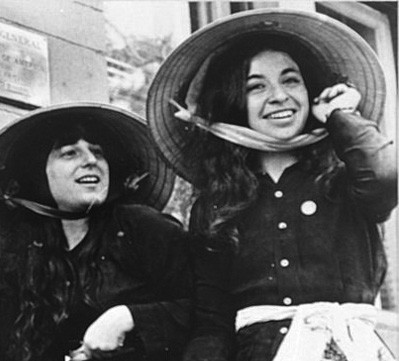
 Judy Gumbo Albert, left, and Nancy Kurshan, photographed in Hanoi, January 2013, were our guests on Rag Radio April 13, 2013.

Rag Radio podcast:
Sixties activists and original Yippies
Judy Gumbo Albert and Nancy Kurshan

Judy and Nancy discuss their recent trip to Vietnam and reminisce about their experiences in the Sixties, the legacy of the Yippies, and their lives and work in the ensuing years.

By Rag Radio | The Rag Blog | April 24, 2013

Writers and activists Judy Gumbo Albert and Nancy Kurshan, who were original members of the historic Youth International Party (Yippies) — the theatrical New Left activist group that was founded in 1967 — were Thorne Dreyer’s guests on Rag Radio, Friday, April 13, 2013.

Rag Radio is a syndicated radio program produced at the studios of KOOP 91.7-FM in Austin, Texas.

Listen to or download our interview with Judy Gumbo Albert and Nancy Kurshan here:

Judy and Nancy — and their respective partners at the time, Stew Albert and Jerry Rubin —  were original Yippies, along with Abbie Hoffman, Anita Hoffman, and Paul Krassner.

The Yippies were an anarchist-leaning Sixties group known for their street theater and symbolic political actions that merged New Left and countercultural values. They gained mass exposure through actions like throwing money onto the floor of the New York Stock Exchange and running a pig for president.

Early this year, Albert and Kurshan visited North Vietnam as part of a delegation of activists who had originally visited the country during the war and were now celebrating the 40th Anniversary of the Paris Peace Accords. The two of them had also been part of a Yippie trip to North Vietnam in 1970.

In a photo essay about the recent trip — which was published in The Rag Blog — Judy wrote: “Everywhere we traveled we were warmly welcomed. The Vietnamese still feel grateful to the U.S. peace movement. I came to understand that while my trip in 1970 was life changing, this trip was life affirming.”

Judy and Nancy discussed their trip to Vietnam with the Rag Radio audience, and also reminisced about their experiences in the Sixties and the legacy of the Yippies, and about their lives and work in the ensuing years. They also reflected on sexism in the Yippies and other Sixties groups and addressed continuing issues like women’s reproductive rights and prison reform.

Nancy Kurshan, left, and Judy Gumbo Albert in Vietnam, 1970.

Judy Gumbo Albert, Ph.D., who also wrote for underground newspapers the Berkeley Barb and the Berkeley Tribe, helped stage the Women’s March on the Pentagon and the Mayday demonstrations in Washington D.C., in 1971.

In 1975, Albert discovered a tracking device on her car and was part of a lawsuit that successfully challenged warrantless wiretapping. She recently won an award for an essay, “Bugged,” about the incident; her story will be included in an upcoming anthology of women’s writings about the Sixties and seventies.

Albert has taught Sociology and Women’s Studies at East and West Coast colleges and for years was an award-winning fundraiser for Planned Parenthood. She is co-author of The Sixties Papers: Documents of a Rebellious Decade (1984) and is currently completing her memoir, Yippie Girl. Judy lives in Berkeley Cohousing in Berkeley, California.

Nancy Kurshan was a staff member of the National Mobilization Committee to End the War in Vietnam, helped organize the 1968 Democratic Convention protests, and worked on the Chicago 8 trial. She attended the 1970 Stockholm Peace Conference and helped stage anti-war demonstrations outside the U.S. Consulate in Moscow and elsewhere. Nancy was also a founder of the feminist guerrilla theater group, W.I.T.C.H.

Nancy was a social worker for 20 years in the Chicago public schools. A prison reform activist, she was a founding member of the Committee to End the Marion Lockdown; her prison work has focused on racist aspects of incarceration, the issue of political prisoners, and the proliferation of long-term solitary confinement. She is the author of Out of Control: A 15 Year Battle Against Control Unit Prisons published by the Freedom Archives in January 2013.

See Jonah Raskin’s fascinating and revealing Rag Blog interviews with Nancy Kurshan and Judy Gumbo Albert. Also see “Writing for the Hell of it” by Judy Gumbo Albert on The Rag Blog.

Rag Radio has aired since September 2009 on KOOP 91.7-FM, an all-volunteer cooperatively-run community radio station in Austin, Texas. Hosted and produced by Rag Blog editor and long-time alternative journalist Thorne Dreyer, a pioneer of the Sixties underground press movement, Rag Radio is broadcast every Friday from 2-3 p.m. (CDT) on KOOP, and is rebroadcast on Sundays at 10 a.m. (EDT) on WFTE, 90.3-FM in Mt. Cobb, PA, and 105.7-FM in Scranton, PA.

The show is streamed live on the web by both stations and, after broadcast, all Rag Radio shows are posted as podcasts at the Internet Archive.

Rag Radio is produced in association with The Rag Blog, a progressive Internet newsmagazine, and the New Journalism Project, a Texas 501(c)(3) nonprofit corporation. Tracey Schulz is the show’s engineer and co-producer.

Rag Radio can be contacted at ragradio@koop.org.

Coming up on Rag Radio:
THIS FRIDAY, April 26, 2013:
Activist and radio host Pedro Gatos and Val Liveoak of Friends’ Peace Teams’ Peacebuilding en las Americas on changes in Cuba, Venezuela & the Global South.
May 3, 2013: Free-form radio pioneer Bob Fass of Pacifica Radio’s WBAI-FM in New York, with filmmaker Paul Lovelace (Radio Unnameable).
May 17, 2013: Political economist Gar Alperovitz, author of What Then Must We Do?
May 24, 2013 (RESCHEDULED): Amsterdam-based poet John Sinclair, legendary founder of the White Panther Party and former manager of the MC5.

The Rag Blog

Posted in Rag Bloggers | Tagged , , , , , , , , , | Leave a comment

Jean Trounstine : Compassion Cannot Be Piecemeal

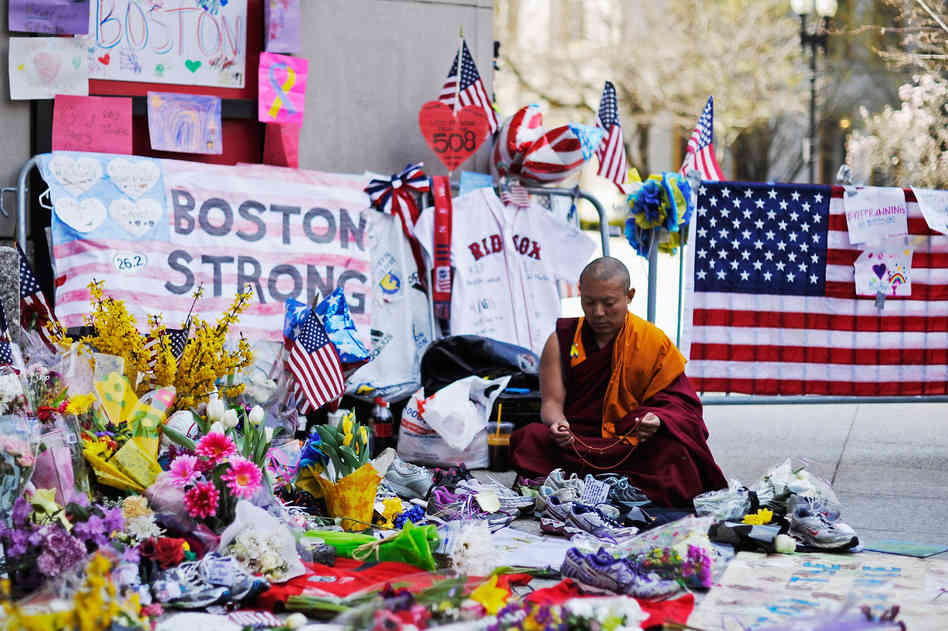
Compassion cannot be piecemeal. Image from NPR.

Reflections on the past week:
Compassion cannot be piecemeal

Justice does not mean mercy. That I know. But justice must be tempered by mercy.

By Jean Trounstine | The Rag Blog | April 24, 2013

BOSTON — This was a difficult week to be a prison activist in Boston, Massachusetts. Just as it was undoubtedly difficult to work for the rights of immigrants and the mentally ill. It was a week in Boston where four lives were lost and more than 260 wounded by a truly senseless act of violence allegedly committed by two young men bent on something we do not yet understand.

And the last thing anyone wanted to discuss was how we need to make sure Dzhokhar Tsarnaev gets a fair trial and is not mistreated behind bars.

As I listened to the cheering on the night that Dzhokhar Tsarnaev was caught, watched television and saw all our officials expressing hopes and prayers for the 58, many who, as of today, are being released from the hospital, I thought of moments from the past week.

My students had told me stories: one went to the hospital to visit her ailing uncle in the Brigham and Women’s ICU when those who had lost limbs were wheeled in; another rushed from Lowell into Boston to try and find her father because she didn’t know if he’d been hurt; and a Vietnam vet who had gone to see the Red Sox got lost on his way home because of the confusion.

A friend’s husband saw his company’s restaurant’s windows blown out, just across the street from the grandstand at the finish line; a friend’s son who had been in New York and close to the tragedy of 9/11 was about to get on the above-ground subway and instead turned around when he heard screams nearby.

A friend still doesn’t have hearing back in one ear.

It was a very unsettling experience to feel that our houses, our business, our institutions, and our loved ones in the city we call home, could be unsafe.

And yet, Dzhokhar Tsarnaev is 19. He is the age of the students I teach. He went to U Mass Dartmouth and wanted to go into the medical profession. In fact, for whatever reason, he was seen at U Mass in his dorm, just two days after the horrific act he is accused of perpetrating with his brother.

He had friends. He supposedly had a girlfriend. He is, and I say it again, a student. I do not want him to be mistreated in prison; I do not want him to get the death penalty. I do not want any less for him than I want for any of the prisoners who commit heinous acts and live behind bars.

For most of them, I want change, believe they are capable of transformation, and deserve options behind bars. Perhaps it is even more important to hold to our values when it gets personal. If my loved one had lost a limb, I would want revenge and I would feel hatred, but I also want legislation that is not built on emotions.

Justice does not mean mercy. That I know. But justice must be tempered by mercy. As we send out love to all the victims and their families in Texas and in Massachusetts, I hope we can remember the family of the Tsarnaevs.

I hope we can remember that everyone who enters our criminal justice system has a story. Just like the doctors who labor to heal all who are hurt — no matter what the injured have done or who they are — we too, need to keep in our hearts that compassion cannot be piecemeal.

Dzhokhar Tsarnaev’s alleged acts were evil, but can we really say that he is only the sum of this horrible crime?

[Jean Trounstine is an author/editor of five published books and many articles, professor at Middlesex Community College in Massachusetts, and a prison activist. For 10 years, she worked at Framingham Women’s Prison and directed eight plays, publishing Shakespeare Behind Bars: The Power of Drama in a Women’s Prison about that work. She blogs for Boston Magazine and takes apart the criminal justice system brick by brick at jeantrounstine.com where she blogs weekly at “Justice with Jean.” Find her contributions to The Rag Blog here.]

The Rag Blog

Posted in Rag Bloggers | Tagged , , , , , , | Leave a comment

Type your summary here

Type rest of the post here

Source /

The Rag Blog

Posted in RagBlog | Leave a comment

Alan Waldman : Two Very Funny, Politically Incisive British Series That Are Well Worth Watching

Waldman’s film and TV
treasures you may have missed:

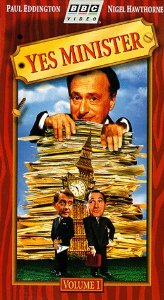
Paul Eddington and Nigel Hawthorne are outstanding as a British Minister and his civil servant nemesis in Yes Minister and Yes Prime Minister.

By Alan Waldman | The Rag Blog | April 23, 2013

[In his weekly column, Alan Waldman reviews some of his favorite films and TV series that readers may have missed, including TV dramas, mysteries, and comedies from Canada, England, Ireland, and Scotland. Most are available on DVD and/or Netflix, and some episodes are on YouTube.]

Two comic TV series beloved by British audiences, critics, and Prime Minister Margaret Thatcher (who claimed it gave her “hours of pure joy”) were the 23-episode 1980-84 political comedy Yes Minister and its 16-episode 1986-88 sequel, Yes Prime Minister. All episodes are available on Netflix, and most can be seen on YouTube.

Nigel Hawthorne justifiably won five acting awards for the two series; Yes Minister won three Best Comedy honors (in four years); Yes Prime Minister won Best Entertainment, and two other awards went to the series writers, Antony Jay and Jonathan Lynn.

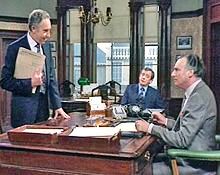
The first series is mostly set in the private office of M.P. Jim Hacker (beautifully played by Paul Eddington), who holds the (fictional) title of Minister of Administrative Affairs. He is constantly coming up with legislation and suggested departmental changes, but, alas, he is eternally undercut by his Permanent Private Secretary, Sir Humphrey Appleby (a magnificent Nigel Hawthorne), who like all true bureaucrats doggedly wants to maintain the status quo.

Caught in the perpetual crossfire is Principal Private Secretary Bernard Woolley (a very funny Derek Fowlds). In the sequel series, Hacker has risen to prime minister and Sir Humphrey and Bernard have followed him to 10 Downing Street

Sometimes Sir Humphrey succeeds in thwarting Hacker’s latest reform effort, but on other occasions the minister outsmarts the big bad bureaucrat and gets his way. Sir Humphrey is snobbish and supercilious, has cynical views of government, speaks in complicated sentences, and is a master of obfuscation.

Yes Minister: Incisive political comedy.

Usually once per episode he delivers a towering oratorical aria that viewers (like comic Stephen Fry) looked forward to and adored. Hacker is a well-intentioned, indecisive, publicity-mad bungler. Bernard frequently strikes comic gold by pedantically pointing out the impossibility of Hacker’s or Humphrey’s mixed metaphors.

Here is a sample episode of Yes Prime Minister.

Political scientists have praised the two series for their accurate and sophisticated portrayal of the relationships between civil servants and politicians. The shows are actually quoted in some British political textbooks. They have significantly changed the way viewers regard politicians and career civil servants, because they so brilliantly expose the bullshit beneath governmental and political public utterances.

The Guinness Television Encyclopedia suggests that “real politicians enjoyed the show’s cynical dismissal of Whitehall intrigue and its insights into the machinations of government.”

In an interview, Fowlds explains the show’s near-universal popularity: “Both political sides believe that it satirizes their opponents, and civil servants love it because it depicts them as being more powerful than either.” The programs avoided having Hacker belong to any specific party, perhaps because writer Lynn supported Labour while co-writer Jay was a Thatcher fan.

The idea for the series dates back to when Lynn, thinking he might like to enter politics one day, joined the Cambridge Union debating society. He recalls: “All of the main debaters there, aged 20, were the most pompous, self-satisfied, self-important bunch of clowns that I’ve ever clapped eyes on. They were all behaving as if they were on the government front bench,” and 20 years later many of them were.

Lynn decided that the best way he could ever contribute to politics was in making fun of the politicians. He and co-writer Jay did so magnificently in these masterful comedies.

Yes Minister/Prime Minister led to radio programs, books, and remakes of the shows in Portuguese, Hindi, Dutch, and Hebrew. In 2013, a six-episode revival of Yes Prime Minister, starring David Haig and Henry Goodman, began taping in England.

[Oregon writer and Houston native Alan Waldman holds a B.A. in theater arts from Brandeis University and has worked as an editor at The Hollywood Reporter and Honolulu magazine. Read more of Alan Waldman’s articles on The Rag Blog.]

The Rag Blog

Posted in Rag Bloggers | Tagged , , , , , , , | Leave a comment

BOOKS / Ron Jacobs : ‘Conversations on U.S. State Terrorism’

‘Weapon of the Strong’
Interviews from ‘State of Nature

Throughout the text is an underlying question of language and its meaning. Why is one act considered terrorism while another act that is essentially the same not considered so?

By Ron Jacobs | The Rag Blog | April 23, 2013

Weapon of the Strong: Conversations on U.S. State Terrorism, edited by Jon Bailes and Cihan Aksan (2012: Pluto Press); Paperback; 224 pp; $24.

The interview is one of the journalist’s best tools. If done right, an interview provides a considerable amount of information about the views of the interviewee and interviewer, while also informing the reader about the subjects covered.

Certain journalists made the interview an art form in its own right. Relatively recent examples of this include Jann Wenner’s Rolling Stone interview with John Lennon in 1971, David Frost’s interview of Richard Nixon in 1977, Alex Haley’s interview of Malcolm X, and Ignacio Ramonet’s interview of Fidel Castro.

Two of these interviews have been published in book form (Ramonet and Castro; Wenner and Lennon, with the Lennon interview being twice made into a book); one was related to one of the best-selling books of the 20th Century (Alex Haley’s Malcolm X); and the Frost-Nixon interviews were watched by millions on television, while also being remade into a film drama almost 30 years later.

I mention these interviews as a means of introducing the first book by the editors of the political-cultural web magazine State of Nature. This book, titled Weapon of the Strong: Conversations on U.S. State Terrorism, features 13 interviews.

The interviewees are philosophically from the left side of the political spectrum and come from five different countries. They include Noam Chomsky, attorney Marjorie Cohn, several professors and the director of the Swiss Institute for Peace and Energy Research. The interviewers and editors are Cihan Aksan and Jon Bailes.

The conversations cover topics that include state-sponsored terrorism, the Unites States as a terrorist state, the nature of economic terrorism as facilitated by the International Monetary Fund (IMF) and the World Bank, the role of the United Nations, and the U.S. role in the Middle East, to name but a few.

Throughout the text is an underlying question of language and its meaning. Why is one act considered terrorism while another act that is essentially the same not considered so? Is it the actor that determines whether or not an act is terroristic? Why is the U.S. hesitant to accept the commonly held definition of terrorism? Is the reason that doing so would indict the United States as a terrorist state?

These are just a small number of the questions raised and addressed in this tightly edited and intellectually stimulating collection.

Chomsky discusses the pointlessness of international law given the fact that it is the most powerful nations (most specifically, the U.S. and UK, although Russia and China have managed to counterbalance some excesses) that set up structures to implement it. Furthermore, their sheer power creates a situation where their actions define the nature of those structures, Should a group of smaller nations decide to go against that nature, the more powerful just ignore those demands.

In South African Patrick Bond’s discussion of Washington’s economic terrorism, Bond brings up the inability of Nelson Mandela to refuse the IMF structural adjustment forced on his nation after the end of apartheid. This “adjustment” included insisting that the new government pay off the prior government’s debts. Bond and the editors rightly point out that South Africa was a victim of U.S. economic terrorism.

One need look no further than Cyprus to see the latest victim of this form of terrorism. It can be argued that the terrorist regime in the case of Cyprus (and Greece, Spain and Portugal) was the European Union and Germany, but in doing so, one would have to ignore the role played by giant U.S.-based financial houses in the manipulation of those nations’ economies the past decade.

The editors’ introduction ties the 13 interviews together. They draw a line from Roosevelt to Obama, pointing to the continuity of policy when it comes to the pursuit of U.S. dominance in the world. In one instance, they discuss the U.S. support for the Suharto regime in Indonesia and the slaughter in East Timor under Nixon; in another, they discuss the U.S. support for the Shah of Iran and Jimmy Carter’s unabashed support for the man who sat on the Peacock Throne.

They tie up these and other instances of U.S.-sponsored genocide and brutality with the knot of U.S. imperialism, still humanity’s number one enemy.

This is a valuable text. Building on themes addressed on their State of Nature website, Aksan and Bailes have compiled an intellectually challenging and forthright collection of conversations certain to create further conversations of their own. Each interview could easily stand alone. Together, they overwhelm.

[Rag Blog contributor Ron Jacobs is the author of The Way The Wind Blew: A History of the Weather Underground. He recently released a collection of essays and musings titled Tripping Through the American Night. His novels, The Co-Conspirator’s Tale, and Short Order Frame Up will be republished by Fomite in April 2013 along with the third novel in the series All the Sinners Saints. Ron Jacobs can be reached at ronj1955@gmail.com. Find more articles by Ron Jacobs on The Rag Blog.]

The Rag Blog

Posted in Rag Bloggers | Tagged , , , , , , , , | 1 Comment

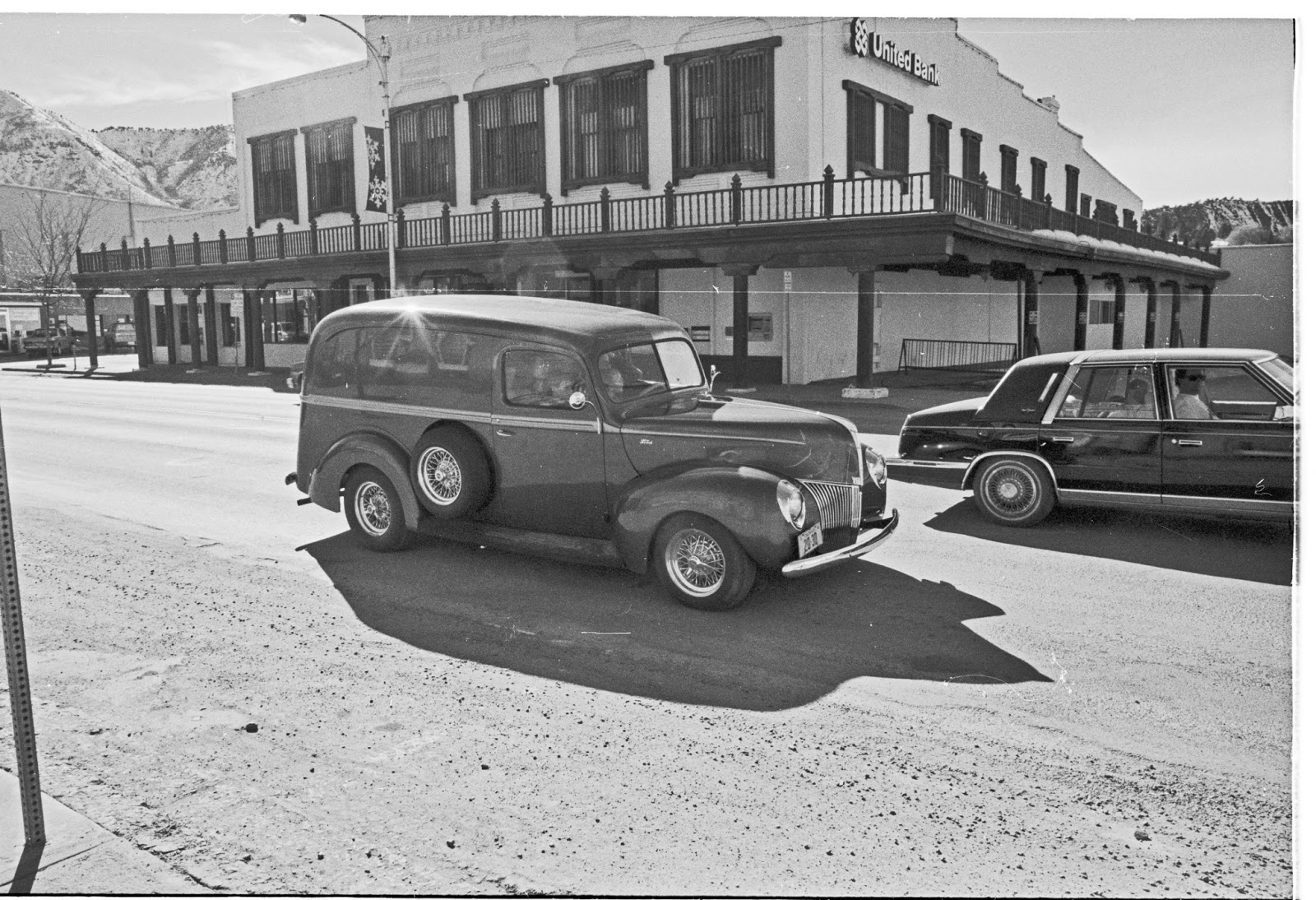
Michael James : 1939 Hot Rod Ford Rolling Through Town

1939 hot rod Ford, Durango, Colorado, February 1989. Photo by Michael James from his forthcoming book, Michael Gaylord James’ Pictures from the Long Haul.

Pictures from the Long Haul:
1939 hot rod Ford rolling,
rumbling, and purring through town

By Michael James | The Rag Blog | April 23, 2013

[In this series, Michael James is sharing images from his rich past, accompanied by reflections about — and inspired by — those images. This photo will be included in his forthcoming book, Michael Gaylord James’ Pictures from the Long Haul.]

Hot rod cars, especially Fords, have always given me jolts of happiness. Discovering them and coming to love them coincided with early rebellion and working on cool.

I come out of the Downshifters Hot Rod Club. I helped found the Club in 1956. We met on Friday nights at the Westport (CT) YMCA: old business, new business, club plaques-jackets-and cards, new members, etc.

Our garage (except in summer) was the camp hall at the Y’s Camp Mahackeno. Together we worked on our hot rod and custom cars. And while we peeled out of zillions of places zillions of times and drove fast on occasion, we did discipline our members for such activities, as I was for peeling out of the Staples High parking lot.

Yes, those early rebellious rock-and-roll hot-rod-car teen years became constructively channeled by numerous people and community institutions in my New England hometown.

A picture of club members and their cars, standing by a statue commemorating the Revolutionary War, was published in the local Town Crier.

We learned about organization, publicity and promotion, how the town was run, and how cars work. And we learned about serving in the community. We held safety checks. We had a safety campaign, cautioning the commuters speeding to the train station for their commute to New York City.

We held rod and custom shows in the police parking lot, did car washes for charity, helped stranded motorists with broken cars or flat tires, and worked with clubs statewide (Nutmeg State Timing Association) campaigning for the state’s first drag strip.

We spoke to the Rotary Club, putting hot rodders in a positive light. And we got some satisfaction when the superintendent of schools — at a special dinner at the YMCA — presented us with an award from Parents’ Magazine, for being named one of America’s “fourteen outstanding youth groups in 1959.”

My attention is pretty much immediately captured when I see a modified machine. And that happened to me on a warm February afternoon in ’89 when I spotted this 1939 Ford panel truck as it rolled, rumbled, and purred through downtown Durango.

I had taken a tumble earlier in the day — crashed and rolled on a ski run up at Purgatory. I was in Durango as a guest of pal David Meggyesy at a National Football League Players’ Association event to benefit skiers with disabilities. Pro football players and disabled athletes were paired up for runs down the mountain.

After a lesson and a little practice I took the lift to the take-off spot for what turned out to be the most difficult ski run at Purgatory. My friend Guy Benjamin (quarterback for Stanford, SF 49ers, etc.) and a friend of his were both experienced in the art of speeding down a mountain. I was not.

Following them, I promptly crashed onto my left shoulder and rolled to a stop in the snow. I slowly tacked my way down the run to the bottom, and found a lift back to the top. Back top, wounded, I slowly descended down the other side to the lodge, falling once or twice.

My shoulder has never been the same. I have been working on it ever since, and I’m talking stretching, pulling, hanging, and all manner of manipulation. Lifting weights, doing the breaststroke, treading water, swinging my arm, getting acupuncture, and applying ice, heat, tiger balm, and lots of salves and elixirs. Yet while it remains restricted and is certainly deteriorated, the shoulder is working good enough to keep on going.

Working on my body reminds me of working on wonderful old hot rod clunkers back in the day. But now I’m a little less concerned with looking cool than with the keeping it running.

[Michael James is a former SDS national officer, the founder of Rising Up Angry, co-founder of Chicago’s Heartland Café (1976 and still going), and co-host of the Saturday morning (9-10 a.m. CDT) Live from the Heartland radio show, here and on YouTube. He is also president of the local progressive 49th Ward Democratic Party, a member of the Screen Actors Guild, a board member of Athletes United for Peace, and on the advisory panel of the organic watchdog organization, The Cornucopia Institute. He is reachable by one and all at michael@heartlandcafe.com. Find more articles by Michael James on The Rag Blog.]

The Rag Blog

Posted in Rag Bloggers | Tagged , , , , , , , | 1 Comment

Kate Braun : Beltane is a Time of Great Magick

May Pole. Image from deviantART.

A time of Great Magick:
Celebrate Beltane on April 30 or May 1

By Kate Braun | The Rag Blog | April 23, 2013

“All things ripen and grow… Abundance in Eternal Flow/ As one the Lord and Lady…”

Either Tuesday, April 30, or Wednesday, May 1, is a good time to celebrate Beltane, also known as Roodmas, Walpurgisnacht, and May Eve. This is a time of Great Magick, second only to Samhain in power.

The powers of elves and fairies are growing and will reach their peak at Summer Solstice, so be nice to them! One way to do this is to decorate a living tree or bush with bells and ribbons. When these elementals are happy, they will protect your outdoor spaces.

All colors are acceptable to use in your decorations, but be sure to use white, dark green, and red. This is a Fire Festival, a Wedding Feast honoring the union of God and Goddess, a time to take action on the activities and projects planned at the Vernal Equinox. As it is the last of the three springtime fertility festivals, plan to generate energy centered on growth of all kinds: growth in spiritual awareness, growth in the garden, growth in your bank accounts.

Serve your guests dairy foods, sweets of all kinds, red fruits, green salads, and cereals. A menu incorporating these elements would be a buffet of: an assortment of breads, crackers, and cheeses; apple slices; strawberries and yogurt; salad of lettuces, baby spinach, sprouts, and parsley; honey-vinaigrette salad dressing; ice cream and oatmeal cookies; red velvet cake; sweet muffins; sangria; mint-hibiscus tea.

May Pole: Life emerging.

Your decorations should include braiding of some sort. May Poles are a traditional sight at Beltane, the red and white streamers a manifestation of the life emerging in the Planet Earth. A small pole with red and white ribbon woven around it would make an appropriate centerpiece. If your hair is long enough, braid it. The intertwining represents the union of God and Goddess.

You could also provide the materials for you and your guests to each make a May Basket: small woven baskets, greenery (real or artificial) to fill the baskets, flowers and sprigs of herbs (real or artificial) to add to the greenery, red and white ribbons to make bows for the finished basket.

When choosing flowers to use in the May Baskets, keep in mind that roses can represent spirituality as well as the goddess, red carnations will attract fairies who enjoy healing animals, clover is wildly attractive to fairies, lobelia helps attract winged fairies, heliotrope is enjoyed by fire elementals, morning glory repels unwanted night fairies, and rosemary protects from baneful fairies. But do not use mistletoe, as it can attract unpleasant tree fairies and be aware that fairies tend to not like the smell of dill.

Another activity associated with Beltane is to make a joyful noise. Encourage your guests to bring wind instruments and use them at some point in your festivities. Trumpets, recorders, whistles, flutes, and ocarinas fit the category, as do many other breath-powered instruments. Be creative.

Above all, make it a joyful and joyous event. This is a time to celebrate life, love, and vitality!

[Kate Braun‘s website is www.tarotbykatebraun.com. She can be reached at kate_braun2000@yahoo.com. Read more of Kate Braun’s writing on The Rag Blog.]

The Rag Blog

Posted in Rag Bloggers | Tagged , , , , , , , , | 1 Comment

Bob Feldman : African-Americans and Institutional Racism in Texas, 1954-1973

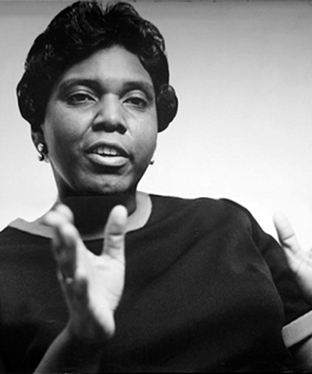
Barbara Jordan was elected to the Texas State Legislature in 1966.

The hidden history of Texas

Part 13: 1954-1973/3 — African-Americans elected to office but institutional racism continues

By Bob Feldman | The Rag Blog | April 17, 2013

[This is the third section of Part 13 of Bob Feldman’s Rag Blog series on the hidden history of Texas.]

In 1966 an African-American, Barbara Jordan, was elected to the Texas State Legislature, and by 1971 African-American City Council members had been elected in Austin, Bryan, Fort Worth, Galveston, Hearne, Houston, Huntsville, Malakoff, Port Arthur, San Antonio, Waco, and Wichita Falls.

But institutional racism in Texas did not disappear during the last half of the 1960s and the early 1970s, despite the victories achieved by local civil rights movement activists in the early 1960s struggle to end legal forms of racial discrimination, white supremacy, and racial segregation in Texas.

In Austin , for example, local residents voted to repeal a Fair Housing Ordinance in a May 1968 referendum; and the U.S. Justice Department initiated a lawsuit against the Austin School District in August 1970 because of the failure of city officials to desegregate Austin’s public school system.

In addition, in the early 1970s the Austin Human Relations Commission reported that discrimination in employment in Austin was still “widespread and well-documented,” according to David Humphrey’s Austin: An Illustrated History.

In 1969, the University of Texas administration still only employed one African-American faculty member. And although the poll tax in Texas was finally declared unconstitutional in 1966, as late as 1966 the Texas Rangers law enforcement agency still included no African-Americans.

African-Americans in Texas were still also likely to live in poverty. Around 39 percent of all African-American residents of Texas still lived in poverty in 1970, for example, whereas 90 percent of all white Anglo residents of Texas did not live in poverty.

Dormitories at Texas Southern University that housed African-American students were shot up by Houston police in 1967; and in the late 1960s, “Lee Otis Johnson, who led anti-war protests at Texas Southern University and publicly criticized the mayor and police of Houston at a Martin Luther King memorial rally, received a 30-year sentence for giving a police undercover agent a marijuana cigarette,” according to Alwyn Barr’s Black Texans.

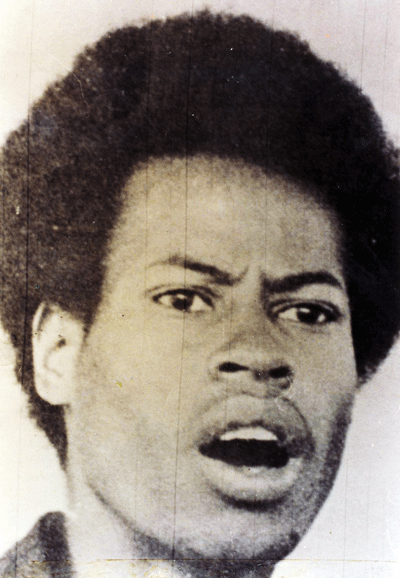
Peoples Party II leader
Carl Hampton.

After People’s Party II was formed in Houston in the summer of 1970, its African-American chairman, Carl Hampton, was killed by Houston police on July 26, 1970; and three African-American supporters and a white supporter of People’s Party II were wounded by the Houston police in the same incident.

During the late 1960s and early 1970s, “Negroes in many Texas cities continued to complain that police stopped and searched them without reason, used dogs to move non-violent persons or groups, and still used… profane terms in addressing black people,” according to Black Texans. Not surprisingly, there was an African-American urban rebellion in Midland, Texas, in July 1968 and an African-American urban rebellion in Lubbock, Texas, in September 1971.

Affordable housing opportunities for African-Americans who lived in Texas cities like Dallas, Houston, and San Antonio were also still limited in 1970 because residential segregation still existed in these three cities at that time — although 26 percent of all Houston residents and 25 percent of all Dallas residents were now African-American in 1970.

And in Austin, “as a result of the Keating urban renewal project in Austin during the 1960s… one-third of the families in the `renewed’ area did not get decent homes, 70 percent paid more rent or higher house payments afterward, and 19 percent of the pre-project home owners had become renters;” and “highway construction in Austin went far toward eliminating the small black enclave called Clarksville on the overwhelmingly white west side of the city,” according to Black Texans.

The official unemployment rate for African-American workers in Texas also continued to be nearly double the official unemployment rate for white workers in the state during the late 1960s and early 1970s. Between 1967 and 1970, the jobless rate for African-American workers in Texas was between 5.7 and 7.6 percent, while the jobless rate for white workers in Texas was between 2.7 and 4 percent.

And as late as 1970, African-American workers were still apparently being excluded from membership in the construction worker unions and skilled trades unions in Texas. And, although in the late 1960s “Negroes formed 20 to 25 percent of the population in Dallas and Houston, they owned only about 3 percent of the businesses in each city” and whites still “owned a majority of the businesses in the black community,” according to Black Texans.

[Bob Feldman is an East Coast-based writer-activist and a former member of the Columbia SDS Steering Committee of the late 1960s. Read more articles by Bob Feldman on The Rag Blog.]

The Rag Blog

Posted in Rag Bloggers | Tagged , , , , , , , , , | Leave a comment

Lamar W. Hankins : Politicians Refuse to Protect the Public

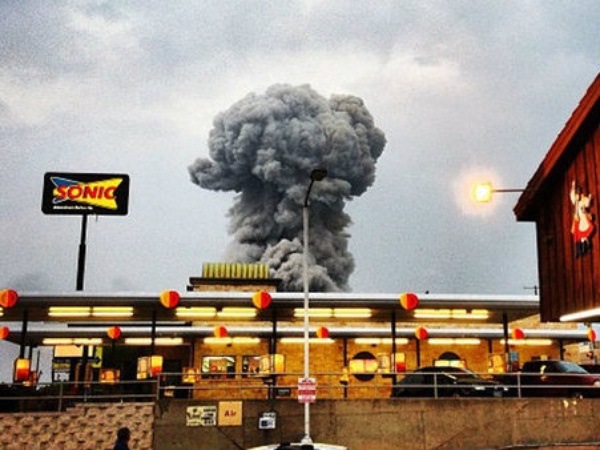
Explosion at fertilizer plant in West, Texas, April 17, 2013. Photo by Andy Bartee / KVUE.com.

Texas explosion, guns, and fracking:
Politicians refuse to protect the public

Only a dramatic revolution of values focused on respect for people, creatures great and small, and the natural world can make life worth living for our descendants.

By Lamar W. Hankins | The Rag Blog | April 22, 2013

While the safety and welfare of the public should be the minimal standard to judge the actions of politicians, recent events and public debates demonstrate the inadequacies of our political system and the failure of our politicians to assure public safety.

People throughout the U.S. learned in their local newspapers and on television of the April 18 explosion of a fertilizer plant in West, Texas, that killed and maimed over a hundred people, and destroyed homes and businesses located in a five-block radius of the plant. Inadequate regulation of such inherently dangerous operations put the people and buildings of the town of just over 2,800 residents in grave danger. The explosion destroyed 50 homes and an apartment building, and it damaged a middle school and a nursing home.

After so many lives are lost, it is not enough merely to declare a state of emergency, as did Gov. Rick Perry, who opposes most government regulation for the safety of citizens. With adequate regulation, most of those lives would have been spared. But saving lives requires a “state of care” before emergencies happen. And most politicians don’t care enough to fix the problem.

A second event, which will cost many more lives, occurred in the United States Senate this past week on the same day as the West explosion. An ineffective bill to address gun violence failed to get enough support to expand background checks for gun buyers (much less ban assault weapons, and ban high-capacity gun magazines). The National Rifle Association (NRA) incited its members to badger senators to oppose the measure through phone calls, e-mails, and letters. The NRA spent $500,000 on the day of the vote alone on an advertising campaign against the pitifully inadequate legislation.

The public safety cannot be adequately protected from gun violence with anything short of total gun registration and severe penalties for possessing an unregistered gun. Registration, reports of all transfers of guns, universal background checks, and mandatory reporting of stolen guns would enable law enforcement agencies to track guns used in criminal activities, arrest and prosecute offenders, and gradually reduce gun possession by criminals and the mentally unstable. None of these measures are unconstitutional under Supreme Court decisions, and they do not violate the Second Amendment.

As Robert Parry explained recently citing (research by Steven Krulick), “the key point about the Second Amendment is that it was never about an individual’s right to possess guns without restrictions. It was framed mostly out of concern that a standing army could become excessively powerful and that the states should maintain their own citizen militias.” Certainly, it had nothing to do with the modern libertarian claim that it is about the right to possess guns so that we can occasionally revolt anew and kill elected representatives.

Nevertheless, four Senate Democrats voted against the weak gun control bill introduced in the Senate: Max Baucus of Montana, Mark Pryor of Arkansas, Mark Begich of Alaska, and Heidi Heitkamp of North Dakota. As Joe Nocera, a New York Times columnist explained it, “The four Democrats — along with many Republicans — quake in fear of the National Rifle Association.”

With overwhelming public support for gun control, even among members of the NRA, only the money in politics, focused on selected members of Congress by groups like the NRA, can explain the unwillingness of so many public officials to protect the public from gun violence like that at Sandy Hook Elementary School last year or the persistent gun violence that results in nearly 1,000 intentional deaths each month in the U.S. (over 30 per day).

As reported by journalist Ezra Klein, the Harvard Injury Control Research Center has found “substantial evidence that indicates more guns means more murders. This holds true whether you’re looking at different countries or different states.”

Klein also reports a clear correlation between states with stricter gun control laws and fewer deaths from gun-related violence:

Last year, economist Richard Florida dove deep into the correlations between gun deaths and other kinds of social indicators. Some of what he found was, perhaps, unexpected: Higher populations, more stress, more immigrants, and more mental illness were not correlated with more deaths from gun violence. But one thing he found was, perhaps, perfectly predictable: States with tighter gun control laws appear to have fewer gun-related deaths. The disclaimer here is that correlation is not causation. But correlations can be suggestive.

Florida explains that states which have one of three gun control restrictions in place — assault weapons bans, trigger locks, or safe storage requirements — have firearm death rates that are significantly lower than in states without the stricter gun control.

A third failure to protect the public safety involves the unregulated practice of fracking in the search for oil and gas in the U.S. The recent appearance of biologist, mother, and environmental activist Sandra Steingraber on Moyers & Company was a reminder that we don’t know much about the safety of the many chemicals used in fracking. Many of us have seen the images of water so contaminated with methane as a result of fracking that it can be lit on fire as it comes out of a home’s water faucet.

But Steingraber is concerned, as well, about other toxins she says are threatening our health by contaminating our air, water, and food. She calls these substances “toxic trespassers.” These substances are leading to earlier sexual maturation in girls. They are contaminating breast milk and affecting our children’s bodies at the molecular level. As Steingraber explains, breast milk “now has more dioxins, more toilet deodorizers, more mothproofing agents, dry cleaning fluid, pesticides, and P.C.B.’s than any other human food. And they didn’t get there on purpose. They were carried to us by ecological forces outside of our individual control. They represent a form of toxic trespass.”

Toxic trespass occurs because our laws do not require that before a new substance is introduced into our environment (and into our bodies) it be proven safe. Our regulatory system benefits the economic interests of the corporations that produce the toxic trespassers rather than the health of the American people.

All of these matters concern the liberty interests of Americans to be free from human-made threats to our right to life and the pursuit of happiness. Public policy should be decided on the basis of what will protect the liberty of most of us, balanced against the liberty interests of the few. The right to be safe in our homes and neighborhoods can be protected by a government that serves the public interest.

The founders never intended gun ownership to be a personal right, no matter what five right-wingers on the Supreme Court now claim. The right to be free from contaminates in our water and air that may be carcinogenic should not even be a debate — it should be as self-evident as Euclid’s first common notion.

But our real liberties — as opposed to those imagined by some people — are under greater threat today than they were in 1776. These threats are pushing the United States closer to becoming a failed state largely because our politicians have sold their souls to the wealthy who fund their political campaigns or threaten their re-election. This is no less true of Democrats than of Republicans, and involves most of the politicians in Congress and our state legislatures.

The American people don’t know what to do to take back their government from those who serve the wealthy special interests rather than the health, safety, and welfare of the vast majority of people — the 99% who have insufficient money to buy influence and are not organized to take control of their government.

Perhaps we will become another in a long line of dead empires from Eastern dynasties to the Ottoman, the Roman, the Mongol, and the British empires, to name a few. We will continue to exist in some form, but there will be no luster. We will continue to tell ourselves that we are great and wonderful, but this will be self-delusion.

The so-called “world’s greatest democracy” will be a shell of democratic promise. The peoples of this planet will remember us as having been built first on the exploitation of the indigenous inhabitants of North America and Africa, then on the exploitation of the entire world’s natural resources, and finally on the degradation of human beings everywhere.

Our disrespect for people and nature will exhaust us morally and physically. Neither religion nor science will save us from such a fate. Only a dramatic revolution of values focused on respect for people, creatures great and small, and the natural world can make life worth living for our descendants. I wish I had more hope that such a revolution will occur.

[Lamar W. Hankins, a former San Marcos, Texas, city attorney, is also a columnist for the San Marcos Mercury. This article © Freethought San Marcos, Lamar W. Hankins. Read more articles by Lamar W. Hankins on The Rag Blog.]

The Rag Blog

Posted in Rag Bloggers | Tagged , , , , , , , , , , | 4 Comments

Michael James : Moving Right Along

rolling wheels photo

Rapid rolling wheels at U.S. Track and Field Championships, Haywood Field, Eugene, Oregon, 1993. Photo by Michael James from his forthcoming book, Michael Gaylord James’ Pictures from the Long Haul.

Rapid rolling wheels at U.S. Track and Field Championships, Haywood Field, Eugene, Oregon, 1993. Photo by Michael James from his forthcoming book, Michael Gaylord James’  Pictures from the Long Haul.

Pictures from the Long Haul:
Rapid rolling wheels and
the momentum of Boston

For me the Boston bombings have kindled memories, images, and observations of people who — despite their challenges — go about their lives with an apparent good attitude.

By Michael James | The Rag Blog | April 18, 2013

[In this series, Michael James is sharing images from his rich past, accompanied by reflections about — and inspired by — those images. This photo will be included in his forthcoming book, Michael Gaylord James’ Pictures from the Long Haul.]

I am truly inspired by the outpouring of concern, support, and action over the bombings at the Boston Marathon. Many incidents and events have saddened me, but his one is leaving a big impact — on many of us. This morning on AOL’s top stories there was a picture of a disabled athlete offering to counsel those injured in Boston. It triggered finding and posting this picture of athletes in their rapid rolling wheels.

For me the Boston bombings have kindled memories, images, and observations of people who — despite their challenges — go about their lives with an apparent good attitude.

I remember a trip to the old Soviet Union and seeing a woman with no legs, but moving around on a small wooden platform with tiny wheels. There were no banked inclines on sidewalks there.

I recall a trip with my son Jesse James to Oaxaca in the 1980’s where we hung out with a man from Los Angeles who lived most of his waking hours in a wheel chair. For a week I watched and admired him — his mental, spiritual, and upper-arm strength in going through his daily activities. At Loyola Park in Chicago I have watched the so-impressive full tilt basketball games played by 10 guys in wheel chairs. I remember the marathons I’ve run, and those I’ve watched, and seeing the disabled athletes who compete.

I am thinking now about people I’ve observed — whether physically-, emotionally-, spiritually-, or economically-challenged — who go about their lives with a strong will and positive attitude. Everywhere I’ve been and gone I am impressed too by old folks carrying on in their backside of the mountain years.

I was at the U.S. Track and Field Championships at Haywood Field, Eugene, Oregon in 1993. All the athletes inspired me, but especially those in the rapid rolling wheels. My pal Gordon Thomson, then the track and field coach at Loyola University, had invited me to the Championships. Haywood Field was the home track of the legendary runner Steve Prefontaine, who was tragically killed in a car accident in the hills above Haywood after a track meet. We visited the accident site and paid our respects.

Power to the people, especially those many who carry on through thick and thin. Thank you. Thanks too to all who inspire!

[Michael James is a former SDS national officer, the founder of Rising Up Angry, co-founder of Chicago’s Heartland Café (1976 and still going), and co-host of the Saturday morning (9-10 a.m. CDT) Live from the Heartland radio show, here and on YouTube. He is also president of the local progressive 49th Ward Democratic Party, a member of the Screen Actors Guild, a board member of Athletes United for Peace, and on the advisory panel of the organic watchdog organization, The Cornucopia Institute. He is reachable by one and all at michael@heartlandcafe.com. Find more articles by Michael James on The Rag Blog.]

The Rag Blog

Posted in Rag Bloggers | Tagged , , , , , , , , | Leave a comment