Roger Baker : Is Capitalism in Deep Trouble?

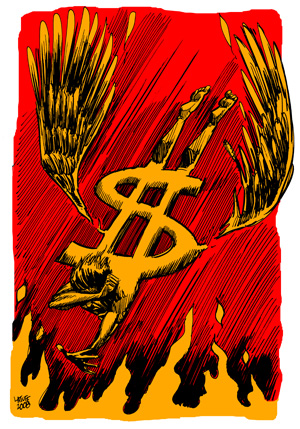
Illustration by Latuff / Marxist.com.

Before the fall?
Terminal Capitalism / Part 2

We take a closer look at the role natural resource limits in combination with the excesses of unregulated finance capital are playing in blocking a global economic recovery.

By Roger Baker | The Rag Blog | April 12, 2013

In the first part of this series about “terminal capitalism,” we saw a collection of evidence that the global system of capitalism, the organized basis for most world trade, is in deep trouble. The situation has become so serious and the problems so self-evident that the polls show many average American citizens are questioning the viability of capitalism itself.

A U.S. economic recovery now seems little closer than when the current economic crisis hit hard about five years ago, with U.S. unemployment still at a near-depression level. The BRIC countries of Brazil, Russia, India, and China have done better than the U.S., but recently slower growth has affected these countries too. In “Terminal Capitalism / Part 2” we will take a closer look at the role natural resource limits in combination with the excesses of unregulated finance capital are playing in blocking a global economic recovery.

The capitalist imperative: 
Grow or die

Richard Heinberg, director of the Post Carbon Institute, begins his book, The End of Growth, as follows: “The central assertion of this book is both simple and startling: Economic growth as we have known it is over and done with.” He then presents over 300 pages of various kinds of supportive evidence backing up this conclusion. I will touch on some evidence in this essay, while saying that since the book was published in 2011, the evidence in support of this conclusion seems stronger than ever.

If that is indeed the case, the end of growth is very bad news for capitalism itself, since capitalism is based on an inherently expanding economy that needs to keep growing or it dies. The way the capitalist system works is basically that bankers or finance capitalists extend credit; they lend money that is invested in the production of goods that are then sold to pay off the loans plus make a profit sufficient to pay back the lenders, with enough left over to reward the lenders with interest.

If and when such a system starts contracting, profits suffer or may disappear entirely and there is an economic crisis until confidence in the system is restored and growth resumes. It is in the nature of the capitalist system to be subject to periodic booms and busts that comprise the capitalist business cycle. Most economists including Marx have been well aware of this fact. The remedy proposed by Keynes was to stimulate a contracting economy with government-sanctioned deficit spending, as I described in “Terminal Capitalism / Part 1.”

However, if the contracting global economy is unable to grow in real material terms due to some deeply rooted physical constraint or resource limit, then no governmental policy can revive the growth on which the system depends.

Governments can print money and inject it into the economy to try to revive spending, but If there is not enough cheap energy to permit a real economic expansion in terms of marketable goods, then the money will be spent sooner or later. Then the deception will be revealed by inflation due to a surplus of money and a shortage of goods.

There is a factor called the velocity of circulation of money, which is really psychological in nature amounting to a shift in consumer spending behavior from saving to spending. That leads easily to inflation or hyperinflation initiated when the public finally understands that there is more money than goods like food available for purchase. Governments can revive spending behavior by printing sufficient money, but they can’t restore genuine prosperity without more real goods being produced and made available for purchase.

The remainder of this essay will attempt to explain the physical factors which are working in opposition to a real revival of the global economy in terms of its ability to expand the production of material goods. If that can’t happen, then capitalists can no longer earn interest on their investments. Whenever a dollar invested or deposited in a bank is seen to buy less than before it was invested or banked, the incentive to invest, on which capitalism depends, disappears and the urge to buy commodities like gold that preserve their exchange value increases.

Growth may have already reached its limits and stopped forever! The global economy as a whole has not expanded since the energy and economic crisis hit in 2008. The numbers tell the tale. Stuart Staniford’s excellent blog, Early Warning, tracks many interesting and important trends, including in this case the volume of world trade as measured by the WTO.

The following is Staniford’s description of the situation about six months ago, featuring a seasonally corrected chart which shows that the volume of global trade seems to have stalled at about the same level that it had reached in mid-2008. Since the BRIC group has done a little better than most, it follows that the USA, Europe, and Japan have lost ground.

“…after the 2008 financial crisis, global trade collapsed and then recovered strongly till early 2011. For the last eighteen months, however, it’s been basically stagnant. This likely reflects a combination of a sluggish U.S. recovery, a double-dip recession in Europe, and the slowdown in China. The global economy continues to act like an engine firing on only three cylinders.”

Grounds for denial

Anyone familiar with world history knows that both the global economy and human population have been growing, at least fitfully, for thousands of years, and that the rate of growth accelerated greatly following the industrial revolution in England hundreds of years ago, with the advent of steam power and vast factories and improved machines to produce ever cheaper marketplace goods..

We like to tell ourselves that continual progress in science and technology will keep paying off by creating the new energy sources and the improved technology that we need to maintain ourselves and solve our problems, especially when we take care to grow in a smart way with sensible restraints.

When there were few factories, there was little need to regulate toxic discharges into lakes and rivers. Now with many more people and factories, most of us are willing to accept that stronger regulation is needed for the benefit of the general public. Increasingly we can see there are limits imposed by nature. Expansion of industry in China using coal for power is becoming a major health threat.

Few economists in the day of Adam Smith or Marx, with the notable exception of Malthus, could foresee a day that there would be any important limits to economic expansion that could not be overcome by human ingenuity and continually improving technology. If there were such limits, it was presumed that these were local limits that could be dealt with rather easily. If natural resources such as metal mines were exhausted in one area, one could always move to a fresh area, and use the advantages of continually improving technology to keep production expanding, ad infinitum.

In reality it is found that technology tends to harvest the low hanging fruit in terms of available resources first and then moves on. While there was an abundance of cheap energy available, this exhaustion of resources and a simultaneous increase in unwelcome consequences could be concealed for a time. In the USA, there has been a well-funded, right-wing corporate disinformation campaign to lead the public to deny that burning fossil fuel is changing the climate for the worse. Now people are beginning to realize the unhappy truth.

According to a growing number of skeptics, including Heinberg, the fatal flaw of economics, as traditionally practiced, is that it is an abstract discipline, oblivious to the limits of the finite world that it claims to study and to model. Since economics is a system that assumes exponential growth, it is apparent that at some point an expanding economy has to run into natural resource limits on our finite planet. Most people have assumed that most such limits were far in the future.

As individuals, the human participants in the growth process have been unlikely to be very conscious of global limits; they were mostly concerned with the everyday challenges of surviving, or raising and feeding a family. However, now, when there are more than 7 billion people collectively involved in an effort to keep the global economy growing to satisfy their own needs, limits are starting to crop up everywhere.
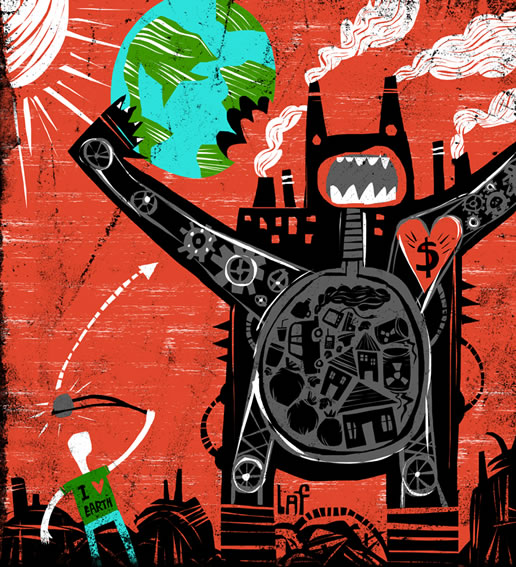
Illustration from India Resists.

Scientists have been warning us, 
but are we ready to listen yet?

The end of growth is not a far-fetched possibility. In fact, there have been a number of credible predictions that this is bound to happen sooner or later because of the increasingly serious side effects of growth itself. The 1972 book The Limits to Growth by the Club of Rome used a computer model to arrive at the conclusion that there are limits to the expansion of the global economy imposed by nature that are likely to lead to overshoot and collapse within the lifetimes of many now living .

The conclusions were updated in a sequel 30 years later. “Overshoot: The Ecological Basis of Revolutionary Change” is another classic work that pointed out the radical implications of an expanding human population overshooting the resources of a finite planet, followed by collapse.

There has been no shortage of warnings from the scientific community that continuing economic growth would lead to disaster. It has now been more than 20 years since a majority of the world’s then-living Nobel Prize-winning scientists issued the “1992 World Scientists’ Warning to Humanity”. This is taken from the introduction:

Human beings and the natural world are on a collision course. Human activities inflict harsh and often irreversible damage on the environment and on critical resources. If not checked, many of our current practices put at serious risk the future that we wish for human society and the plant and animal kingdoms, and may so alter the living world that it will be unable to sustain life in the manner that we know. Fundamental changes are urgent if we are to avoid the collision our present course will bring about.

One might imagine that when the world’s most eminent scientists warn humans that they had better shift course to avoid a looming environmental disaster, their warning would get a lot of media attention. That didn’t happen. The World Scientists’ warning was mostly ignored because it interfered with the nearest thing most humans have to a global religion; a belief in endless progress based on the blessings of modern science in combination with expanding world trade.

New investment based on improvement in technology has always brought benefits like easy communication and an improved standard of living. The fact that the few capitalists who maintain control of the investment and economic expansion process tend to be the major beneficiaries has tended to be overlooked.

Global warming by itself probably has the potential to cripple the global economy, as does human population overshooting food supply. With a global population of 7.5 billion, we see natural limits of one kind or another cropping up everywhere and interacting to create converging crises. More and more, solving one growth-related problem tends to create other problems. Trying to deal with any one limit tends to reveal other limits.

These include such factors as a limit on arable land for farming, potable water availability, increasing soil erosion and depletion, air and water pollution, the fertilizer needed to maintain high crop yield, and the list goes on. “Convergent Crises and Why We Deny Them” discusses the fact that these limits tend to interact.

An excellent and easily accessible explanation of the natural limits to growth by Charles Hall (see below) and John Day is here.

If we are very lucky, the global economic expansion forces will be forced into an orderly retreat before they overshoot the resource base. If not, humans everywhere are likely to face an abrupt economic collapse in which the decline is a lot steeper than the preceding economic expansion. This tendency for decline to be faster than growth has been called the Seneca Effect.

Why expansionist economics can’t deal with a
falling energy return on energy investment (EROI) 

Rising energy cost, and oil in particular, is the factor that has the greatest ability to interfere with business as usual. The historical rate of global growth has fallen sharply in the last decade, and an important factor is the economic burden of rising energy costs. In Terminal Capitalism / Part 1, I cited the January 26, 2012, article in the distinguished science journal Nature by James Murray and David King, titled “Oil’s tipping point has passed.” This paper points out that the global economy seems to have permanently shifted to slower growth after the world supply of cheap conventional oil peaked in 2005, when we started to use much higher priced oil, like the oil we get by drilling in the Gulf of Mexico.

The International Energy Agency has made it very clear that the global economy is at risk when oil prices are greater than $100 per barrel — as they have been in recent years, and will surely continue to be, given the inelastic response of global production. Historically, there has been a tight link between oil production and global economic growth. If oil production can’t grow, the implication is that the economy can’t grow either. This is such a frightening prospect that many have simply avoided considering it.

Domestic oil used to be very abundant and cheap to produce in the United States; however U.S. oil production peaked in 1970, so the U.S. turned to cheaper imported oil. Now the cost of imported oil has risen sharply too, especially after the cheap conventional oil production hit its global peak.

The cost of oil or any other traded commodity is generally determined by the amount of work that it takes to produce that commodity. The concept of “energy return on investment” or EROI essentially means the payback ratio, or the amount of energy you need to put in in order to get even more energy back out.

The EROI concept is important from an economic standpoint whether it is applied to drilling for oil, or for the work expended in building a dam to generate hydroelectric power, or when building and using a wind turbine, or any other means of generating power. The April 2013 issue of Scientific American has an article by Mason Inman, “The True Cost of Fossil Fuels,” which explains the EROI concept and its important implications for our existing economy. The same EROI concept has important implications for any human economy, whether ancient or modern, capitalist or socialist.

The EROI concept was developed by environmental scientist Charles Hall, who says of oil and gas, “Everywhere you look, the EROI is declining.”

The Scientific American article is accompanied by an interview with Hall where he explains that different EROIs support different kinds of economic organization, and the mostly unwelcome economic implications of the currently falling EROI in the USA. As Hall says in this interview,

We know that the middle class has not increased its income now for 20 years. Behind that — not always the immediate cause, but looking over the shoulder of the causes — I find the decline in the availability of energy. It’s terrifying to people — politicians and economists — who base everything on growth. I think they won’t talk about it because the concept is terrifying.

Most people have little idea of how rapidly the EROI has been falling, and what this steep rate of decline implies for the U.S. economy, and indeed for the global economy. Richard Heinberg’s book The End of Growth, in Chapter 3, gives some numbers and EROI estimates by Hall (pages 118-119). It is estimated that circa 1930 we could get back as much as 100 barrels of oil for every barrel we expended through drilling, giving an EROI of 100.

Photo by Albert Bridge / Geograph / Earth Times.

By 1970, this had fallen to about a 30-to-one payback or EROI. By 2005, the EROI had fallen domestically to about 15, A fairly recent paper by Hall, et al, indicates a current U.S. oil and gas EROI below 11. However the EROI for imported oil produced where the fields are less depleted has stayed higher and is now estimated by the Scientific American article to globally be about 16.

Meanwhile, the EROI from coal is still about 20, as is the payback ratio from wind in a good location. Photovoltaic solar EROI is much lower at about six. These numbers are rough averages and of course vary with location. Chinese coal payback economics is different from that in the USA, but these numbers give a rough idea, and indicate a steady EROI decline.

A falling EROI tends to show up as a price increase for everything. There is no way to avoid using increasingly costly liquid fuels to transport coal and in the course of producing and transporting all other commodities.

The steady decline in EROI for liquid fuels is particularly worrisome because almost all global transportation is powered by liquid fuels. That is why an economic peak to the global oil supply can cripple the world economy. Even a nation that uses a lot of coal for power like China is in trouble if it tries to convert its coal energy into liquid fuel energy. It can be done, but this results in a much lower EROI for the coal-based liquid. Liquid fuel energy, electric power energy, and thermal energy each have their own EROI economics.

It is estimated that a modern industrial economy needs an EROI of at least five or greater to function properly. If global oil supplies have already fallen to only 16, and are still falling pretty fast, it is apparent that some economies, and especially an oil-addictive economy like the USA, is in trouble no matter what kind of leadership it has. This is true until the economy has the time needed to make a transition which, as the “Hirsch report” indicates, necessarily requires several decades of serious effort.

There is a theory of maximum possible complexity of a society related to the EROI level at its economic base. Without economic growth, the whole system, what was once termed the “political economy” runs into political trouble too. You can’t have a very technically sophisticated and centralized economy based on a low EROI. Nor can you maintain a complex legal and military support structure for global finance capital investment. Without cheap energy you cannot have a global system of finance capital that maintains an orderly system of global trade with its highly sophisticated and centralized production of complex goods.

American anthropologist and historian Joseph Tainter has written an important book, Collapse of Complex Societies in which he analyzes why civilizations like ancient Rome probably rose and fell in accord with a changing EROI, just as much as because of the abilities of their leaders. Ancient civilizations can’t control the far reaches of an empire if they can’t afford to feed the armies that maintain their central control.

There are analogies to be found today when the United States attempts to project its military power globally without the advantage of cheap oil. Similar limits apply when investment bankers attempt to organize complex global production systems which depend on complex global supply networks.

Why alternative energy probably
can’t keep our economy growing

Since the cheap energy that built the U.S. economy is rapidly being depleted and is being replaced by more expensive energy, there is a natural desire to try to replace our energy with renewable energy, especially with wind and solar power as an alternative. How hard that would be, what it would cost, and how long it would take are the key issues.

In 2009 the Post Carbon Institute did a study of this question and put out a report, “Searching for a Miracle: Net Energy Limits and the Fate of Industrial Societies,” which can be downloaded at this link. The abstract of this report concludes as follows:

Perhaps the most significant limit to future energy supplies is the “net energy” factor — the requirement that energy systems yield more energy than is invested in their construction and operation. There is a strong likelihood that future energy systems, both conventional and alternative, will have higher energy input costs than those that powered industrial societies during the last century. We will come back to this point repeatedly.

The report explores some of the presently proposed energy transition scenarios, showing why, up to this time, most are overly optimistic, as they do not address all of the relevant limiting factors to the expansion of alternative energy sources. Finally, it shows why energy conservation (using less energy, and also less resource materials) combined with humane, gradual population decline must become primary strategies for achieving sustainability.

Currently the degree of alternative energy market penetration is low and is likely to stay that way. It is possible to cover our roofs with solar panels now, but if it were not difficult and expensive to get off the grid, it would probably already be common. President Obama started advocating wind and solar alternatives when he first came into office, yet these numbers are not increasing at nearly the rate that would be needed to replace fossil fuel energy before a declining EROI interferes.

Both Germany and China have industrial polices in place that mandate switching to alternative energy as soon as possible. Germany is running into limits caused by the need for backup power when the alternative energy level reaches about 10-20%. In China, about 70% of their power now comes from coal, with imported oil used as a supplement for transportation.

Making the switch from black to green energy is creating severe air pollution from the coal used for the transition. It is true that photovoltaic solar energy has gotten a lot cheaper in the last several years, due to a big push by China to expand its alternative energy industry. China has the advantage of a command economy to promote alternative energy which the USA lacks except for sporadic and controversial attempts like Solyndra.

Since the EROI for U.S. fossil fuel energy has been falling, it is becoming more and more costly to make the transition to wind and solar power alternatives. The average U.S. family is still in debt, and without real economic growth, those who can find jobs must now often work at the minimum wage. The economy is sending the message that alternative energy is becoming less affordable, even with much less expensive silicon photo-voltaic panels made in China.

Both wind and solar energy have the disadvantage of requiring high up-front capital costs. By contrast, gas turbines are an inexpensive way to generate electric power, and the natural gas produced by hydrofracturing or “fracking,” is cheap for now. However this low cost is probably unsustainable, both because of rapid horizontal well depletion and because we are drilling and depleting the best locations first.

Besides a falling EROI to power the transition to alternative energy, there are other problems. Intermittent power sources require storage or backup when the wind isn’t blowing and the sun isn’t shining. Texas has had a policy of subsidizing the power grid to deliver power from West Texas where wind energy is cheapest, but the grid itself is expensive and the state is strapped for cash.

At certain times of the day when the sun is shining, PV energy can already cost less than fossil fuel energy, but most people demand power when they need it. Rooftop power requires very expensive battery storage (lead acid batteries are expensive and only last about five years whereas nickel-iron batteries are durable but expensive). If the energy comes from a public power grid, a backup source of fossil fuel power is still needed due to the intermittent generation factor.

Certain types of solar energy, like home water heating and solar ovens for cooking, are already cost-effective, and will likely come into common use when people are obliged to conserve energy because of its rising cost. Better thermal insulation is likewise very cost-effective.

Illustration from Theprisma.

Capitalism has become a global Ponzi scheme

A global peak in oil production is likely to be fatal for capitalism soon thereafter, as the globally prevailing economic institution, as the author has argued here. Given the choice, it seems better to face economic crisis sooner rather than later, both in terms of the lesser total damage done and the better chances for eventual recovery. Of course such an outlook is not apt to be well received, or to be adopted as policy, but the argument seems valid.

Recently Gail Tverberg’s excellent blog, Our Finite World, has done a good job of explaining and updating the problems facing an economy based on lending and credit; to generate a real return on invested capital it must necessarily face a decline in growth. The situation is outlined in her recent post, “How Resource Limits Lead to Financial Collapse.” As Tverberg says; “Many from the ‘peak oil’ community say that what we should worry about is a decline in the world oil supply. In my view, the danger is quite different: The real danger is financial collapse coming much earlier than a decline in oil supply.”

In theory, the world of banking, of finance capitalism, is supposed to be closely in tune with the physical world, since it controls and impacts the real world through investments like mines and factories that produce goods for markets and consumers with money to spend.

A close link between the world of banking and money and the real physical world was once maintained and enforced by declaring that dollars could be redeemed on demand for gold or silver. There is now nothing to link the dollars created by the Federal Reserve to the physical world. Nowadays the dollar is a fiat currency, backed up by nothing except its prevalence as the standard reserve currency used for most global trade, and the fact that it has little competition in this regard. The worth of a dollar is only to be judged by what it will buy. This has changed over time, and nearly always for the worse.

Since the availability of oil for transportation is arguably the single factor that currently limits the growth of the global economy, the real worth of a dollar might as well be judged by the fact that it will now buy about a quart and a half of Brent crude oil on the global marketplace. Since there is a long-standing agreement in place to price globally traded oil solely in dollars, and since all countries need oil, this has tended to preserve the status of the dollar as the one currency needed to buy the oil which every country needs.

In effect, this means that all dollars should really be seen as petrodollars. The dollar lacks any plausible value except for its current purchasing power in oil or other liquid fuel, which has declined sharply over the last decade.

With all this in mind, lets try to put our current global situation in perspective. The system of capitalism, which is the foundation of the global economy and world trade, needs to keep expanding to maintain its health and avoid sinking into a deflationary world depression. A handful of giant investment banks indirectly control the entire U.S. economy, because they function as the board of directors for the Federal Reserve. The unelected Fed sets the prime interest rate and regulates the creation of dollars, by allowing the banks to loan dollars into existence.

In the absence of effective banking regulation to maintain discipline, the system has become strongly biased toward permitting the infinite exponential expansion of fiat currency and investment in defiance of our finite world. In other words, the global economy has become a vast Ponzi scheme. The distinctions between investment bankers, finance capitalists, and global corporations have become blurred.

Strip away the smoke and mirrors and bankers are revealed as respectable, well-paid gamblers who risk public money on investments that are likely to fail because of a constantly falling energy return on energy investment. With the end of meaningful banking regulation, the giant investment banks have been free to place bets on practically anything that involves money, with the wagers insured by the federal government.

The biggest investment bankers and their banks are regarded as too big to fail, and so they are essentially permitted to gamble without risk. The elimination of risk has, over time, actually led them to gamble on the riskiest ventures. These tend to pay the best returns, exactly because of the high risk. This interview — “Our System is so Flawed that Fraud is Mathematically Guaranteed” — features Chris Martenson interviewing banking expert Professor Bill Black. It paints an appalling picture of investment banking as a racket and a confidence game, where capital investment has shifted to the areas of greatest risk.

The biggest banks now hold hundreds of trillions of dollars worth of paper agreements, pledges to pay off a huge accumulation of speculations and hedges amounting to gambling debts still on the books. These speculative paper banking agreements dwarf the entire global economy, which is only about $70 trillion a year.

Bank of America’s holding company — the parent of both the retail bank and the Merrill Lynch securities unit — held almost $75 trillion of derivatives at the end of June, according to data compiled by the OCC. About $53 trillion, or 71 percent, were within Bank of America NA, according to the data, which represent the notional values of the trades. That compares with JPMorgan’s deposit-taking entity, JPMorgan Chase Bank NA, which contained 99 percent of the New York-based firm’s $79 trillion of notional derivatives, the OCC data show.

This being the case, it becomes apparent that the American dollar is at the center of a vast global Ponzi scheme which can never pay back its lenders in terms of the anticipated buying power, simply because there is no longer enough cheap fossil fuel remaining for the global economy to recover after a severe crisis.

Nobody can accurately predict how long the current situation can be maintained but, given the facts of the matter, we can see that there is certainly going to be a global economic crisis. Only the timing, which is based on investor psychology and the Federal Reserve’s ability to keep the game going, is uncertain.

To sum up the situation we face, the scientists are warning us that even at best, a well-managed global economy can only avoid a severe environmental crisis for perhaps three more decades, because of the fundamental limits of nature. However, the chances of our poorly managed system of global capitalism lasting even that long are slight. Given the time typically needed to recover from a severe economic crisis like the Great Depression, this suggests that a severe global economic crisis or collapse must put an end to capitalism as we know it in the not very distant future.

James Howard Kunstler has outlined some of the social response scenarios in his books The Long Emergency and Too Much Magic. The potential for transition communities to help us through the hard times to come are a topic of frequent discussion on Resilience.org, sponsored by the Post Carbon Institute, a think tank devoted to coping with these sorts of problems.

Local economies centered around local agriculture and local production of the goods needed for survival are likely to be an important part of our future. We cannot start planning soon enough.

[Roger Baker is a long time transportation-oriented environmental activist, an amateur energy-oriented economist, an amateur scientist and science writer, and a founding member of and an advisor to the Association for the Study of Peak Oil-USA. He is active in the Green Party and the ACLU, and is a director of the Save Our Springs Association and the Save Barton Creek Association in Austin. Mostly he enjoys being an irreverent policy wonk and writing irreverent wonkish articles for The Rag Blog. Read more articles by Roger Baker on The Rag Blog.]
The Rag Blog

Posted in Rag Bloggers | Tagged , , , , , , , , , , | 7 Comments

James McEnteer : How Mass Media Enable the Zombie Apocalypse

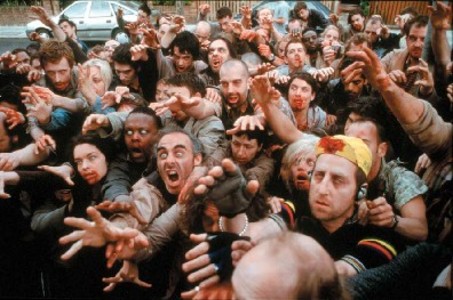
Zombies from Shaun of the Dead. Image from TheModerateVoice.

What if the dead stop staying dead?
How mass media enable the Zombie Apocalypse

When Mitt Romney rose from the grave of his own hypocrisy and insular privilege to oppose Barack Obama, even Americans who dislike Obama’s policies voted for him anyway, simply because he was a live human being.

By James McEnteer | The Rag Blog | April 11, 2013

Zombies dominate our nation’s airwaves. They have already devoured much of our rational public discourse and now threaten our social sanity. Zombies are hot commodities. They sell. That’s why they cannot be stopped or killed. Some editors and producers understand that zombies carry dangerous mental and moral infections that may already have doomed civilization as we (used to) know it. But profits outweigh the risks of parading zombies in prominent places.

Two factions promote the prevalence of zombies in mass media: True Believers and Snarky Ironists. Believer media managers feature the living dead as hosts or guests to flaunt their twisted catechism. Media Ironists recognize zombies for the frightening freaks they are, but trumpet their grotesque views anyway to whip up outrage and energize their often demoralized “normal” base.

Unsurprisingly, many True Believers are zombies themselves, like Roger Ailes, who presides over the Fox zombie empire. Ailes spent decades promoting undead candidates such as Nixon and Reagan and Bush, all of whom were morally moribund before entering the White House. Like all zombies, Ailes has never had any actual ideas, only tactics, an obsession with ratings, and an urge to rule.

He employs other soulless creatures like Sean Hannity and Bill O’Reilly, who substitute truculence for wit and shrillness for substance. Such tactics mesmerize the gullible and unwary, who fall under the zombie spell as their minds disintegrate and they too are doomed to wander empty-headed over the earth.

So-called progressive media are as guilty as Fox for promoting the zombie agenda. Salon and Raw Story and Talking Points Memo cannot resist quoting the mindless, outrageous comments of zombies such as Pat Robertson or Rick Santorum or Donald Trump, just to stir the pot. For liberal media, zombies are the freak show that helps lure rubes and readers into the main tent.

Irrational assertions by Robertson or other undead “ministers” who pretend to speak from religious conviction make for hilarious and/or infuriating headlines in otherwise supposedly rational publications. Robertson’s pronouncements, that Ivy League schools are preventing God’s miracles in America or that feminism causes women to kill their children and practice witchcraft, are simply too wackola not to report.

But this mockery — often in bold headlines — still spreads the soul-destroying zombie creed. And even ironic renderings of zombie madness have actual consequences. Consider Newt Gingrich. Though politically dead since the last millennium, when he resigned from Congress in disgrace, Gingrich was kept artificially “alive” long years after his political demise by constant exposure on cryogenic “news” programs, enabling his 2012 zombie candidacy for president.

Fox sustains political zombies long after their sell-by dates in public life: Sarah Palin and Dick Morris and Herman Cain are some of Fox’s dead talking heads. Other mumbling, unkillable corpses haunt radio airwaves, like Oliver North and Mike Huckabee. Sunday morning TV talk shows feature zombie panels grilling zombie guests, though it’s likely only zombies watch these shows.

The Republican presidential primary season was a veritable zombie jamboree. When Mitt Romney rose from the grave of his own hypocrisy and insular privilege to oppose Barack Obama, even Americans who dislike Obama’s policies voted for him anyway, simply because he was a live human being. That could have been his campaign slogan: Obama. He’s not a zombie.

Americans are still hungover from the Bush-Cheney zombie era of death and detention. We watched horrified as humans degenerated into zombies in front of our eyes, like Colin Powell at the United Nations. Rumsfeld, Wolfowitz, Rice, Woo — their names still sends shudders down the spine. Or the echo of their strange incantation: “We don’t want the smoking gun to be a mushroom cloud…”

The legions of political zombies who haunt Congress — McConnell, McCain, Hatch, Inhofe, Chambliss, Graham, et. al. — are a media cliché. Who keeps voting these creatures into office? Apparently others of their kind. Many so-called “reality” shows are mere zombie voyeurism: Survivor Housewives of the Jersey Shore. Shoot them, they get back up and keep coming.

For the common weal, it’s time for a mass media ban on zombies. True Believers cannot be dissuaded from their soulless course. Fox will be Fox. But progressive and mainstream media must cease offering zombies platforms to spout their venomous anti-life invective, even for scornful laughs. Exposure prolongs the power of the undead. Let them perish in a well-earned oblivion.

There is no reason to hear from — or about — the Westboro Baptist Church ever again. The living dead should not be given space to proselytize for their anti-human views, even when presented as freaks or perverts. Or from preachers of anti-gay sermons who turn out to be gay themselves. Religious hypocrisy is old news. Let Pat Robertson rant and rave only in the catacombs under the 700 Club.

Nor should media cover the mad posturings of notoriety-sucking undead like Donald Trump. Yes, Trump has completely missed the point of what it means to be human. But how often do we need to see him demonstrate that? Trump is like a race car driver with no brakes or pit crew, careening in circles. We watch him, waiting for his wheels to fly off, hoping no bystanders are seriously injured.

When you start to notice them, zombies are everywhere. We tend to take them for granted. But giving them free rein is a fatal mistake. Zombies won’t be content until they convert every last one of us to their ghastly ghetto of ghouls.

We’re fast approaching an apocalyptic tipping point. If we lived there we’d be home now. And we almost are. Klaatu barada nikto.

[James McEnteer is the author of Shooting the Truth: the Rise of American Political Documentaries (Praeger). He lives in Quito, Ecuador. Read more of James McEnteer’s articles on The Rag Blog.]

The Rag Blog

Posted in Rag Bloggers | Tagged , , , , | 2 Comments

Type your summary here

Type rest of the post here

Source /

The Rag Blog

Posted in RagBlog | Leave a comment

Type your summary here

Type rest of the post here

Source /

The Rag Blog

Posted in RagBlog | Leave a comment

FILM / David McReynolds : ‘How to Survive a Plague’ Is the Remarkable Story of ACT UP’s Battle Against AIDS

How to Survive a Plague:
The remarkable story of ACT UP

Panic spread slowly. Rock Hudson’s death gave the disease a public face, but took us no closer to the cause.

By David McReynolds | The Rag Blog | April 10, 2013

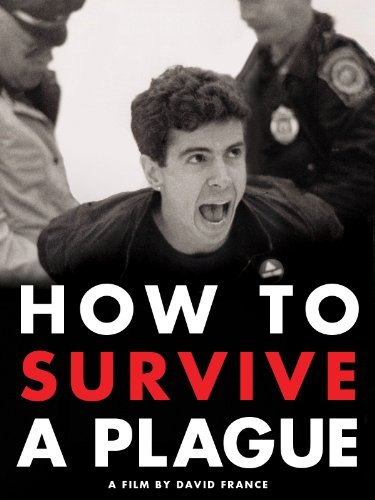
[David France’s critically-acclaimed and award-winning documentary film, How to Survive a Plague, saw limited release in the United States in 2012.]

Clancy Sigal’s advice to me is to keep it short — a skill he has mastered and I’ve not. This is a quick review of David France’s film (now on DVD), How To Survive a Plague, largely the story of ACT UP (AIDS Coalition to Unleash Power) and TAG (Treatment Activist Group), the nonprofit organization that grew out of ACT UP.

As films go, this feels almost like a “rough draft” of a documentary, but how could it be otherwise? The technical limitations of this short documentary are overwhelmed by a remarkable story, one that makes the film worth watching by anyone concerned with social change. The producers had to hunt for bits and pieces of film over a period of years — this was not a film which had been assigned a staff photographer to follow events.

I’ve said to friends that if I were 10 years younger I’d have been dead long ago — but when AIDS was given a name, in 1982, I was already 53. It wasn’t just a “gay disease” — it was almost entirely a disease of the youth. It’s first name was GRID — Gay-Related Immune Deficiency — and even when it was given a name a year later, no one had any idea what caused it. Panic spread slowly. Rock Hudson’s death gave the disease a public face, but took us no closer to the cause.

My local bar — once probably the best gay bar in New York, right on my corner, at Fourth Street and Second Avenue — slowly emptied out. Bob, the sweet young bartender, fell ill, and then fell dead. Bar traffic slowed, as if perhaps breathing the same air would transmit the disease.

By 1987 ACT UP was formed. It had the enormous energy of youth. Watching this film reminded me, again, of why the young are almost always the cutting edge of social change. They are not always right — ACT UP made more than its share of errors, suffered the almost inevitable splits — but to watch this film is to see young men and women, frightened by the death which was marching straight towards them, organize and act. And to act with imagination and love — in things such as the moving “quilt” project.

They provided the people-power for major political demonstrations, but they did much more than that — they studied the disease, they examined alternative treatments, and methods for running trials that would speed up the information on what might work. In the end they cooperated with the scientists in finding the answer.

And that answer was not easy to find. The AIDS virus is remarkably tricky and defeating it has been an incredibly complex task. It was, for the men and women in ACT UP, a race against time.

Watching the film I felt a sense of guilt that I had not been more involved. AIDS, even though we didn’t know its cause, was around me. A neighbor who lived a floor above me came down with it, and while I was able to visit him at first, simply walking into his room (he had Kaposi’s Syndrome), when he was taken to the hospital his room was guarded as if a particle of the disease might escape. One had to put on gloves, mask, a gown before going in, and they were taken off and destroyed when you left his room.

All of us have sins of omission; I won’t belabor mine. I write this brief review because the beautiful young men and women in this film, so vital, so very young, so fierce in their struggle, and most of them now dead, succeeded in pushing until the labs delivered the drugs which have made it possible to defeat AIDS.

It isn’t, of course, defeated, not here (where unsafe sex is sometimes seen as exciting), much less in Africa. But because of ACT UP we have the means. The film, made in 2012, is one hour and 49 minutes. You can get it from Netflix.

[David McReynolds was for nearly 40 years a member of the staff of the War Resisters League, and was twice the Socialist Party’s candidate for president. He and the late Barbara Deming are the subjects of a dual biography, A Saving Remnant, by historian Martin Duberman. David retired in 1999, and lives on the Lower East Side of Manhattan with his two cats. He posts at Edge Left.org and can be reached at davidmcreynolds7@gmail.com. Read more articles by David McReynolds on The Rag Blog.]

The Rag Blog

Posted in Rag Bloggers | Tagged , , , , , , | Leave a comment

Harry Targ : Global Challenges to the International Order

Women protest in Cairo during Arab Spring. Image from Organizing Upgrade.

The empire in disarray:
Global challenges to the international order

Latin American and African dependency theorists and “bottom-up” historians have argued for a long time that resistance must be part of the understanding of any theory of imperialism.

By Harry Targ | The Rag Blog | April 10, 2013

A whole generation of activists has “grown up” conversant with the central place of empire in human history. Children of the Cold War and the “Sixties” generation realized that the United States was the latest of a multiplicity of imperial powers which sought to dominate and control human beings, physical space, natural resources, and human labor power.

We learned from the Marxist tradition, radical historians, scholar/activists with historical roots in Africa, and revolutionaries from the Philippines and Vietnam to Southern Africa, to Latin America. But we often concluded that imperialism was hegemonic; that is it was all powerful, beyond challenge.

A “theory of imperialism” for the 21st century should include four interconnected variables that explain empire building as well as responses to it.

First, as an original motivation for empire, economic interests are primary. The most recent imperial power, the United States, needed to secure customers for its products, outlets for manufacturing investment opportunities, an open door for financial speculation, and vital natural resources such as oil.

Second, the pursuit of military control parallels and supports the pursuit of economic domination. The United States, beginning in the 1890s, built a two-ocean navy to become a Pacific power, as well as institutionalizing its control of the Western Hemisphere. It crushed revolutionary ferment in the Philippines during the Spanish, Cuban, American War and began a program of military intervention in Central American and the Caribbean. The “Asian pivot” of the 21st century and continued opposition to the Cuban and Bolivarian revolutions reflect the 100-year extension of the convergence of economics and militarism in U.S. foreign policy.

Third, as imperial nations flex their muscles on the world stage they need to rationalize exploitation and military brutality to convince others and their own citizens of the humanistic goals they wish to achieve. In short, ideology matters. In the U.S. case, “manifest destiny” and the “city on the hill,” that is the dogma that the United States has a special mission as a beacon of hope for the world, have been embedded in the dominant national narrative of the country for 150 years.

However, what has often been missing from the left-wing theoretical calculus is an understanding of resistance. Latin American and African dependency theorists and “bottom-up” historians have argued for a long time that resistance must be part of the understanding of any theory of imperialism. In fact, the imperial system is directly related to the level of resistance the imperial power encounters.

Resistance generates more attempts at economic hegemony, political subversion, the application of military power, and patterns of “humanitarian interventionism” and diplomatic techniques, called “soft power,” to defuse it. But as recent events sugge, resistance of various kinds is spreading throughout global society.

The impetus for adding resistance to any understanding of imperialism has many sources including Howard Zinn’s seminal history of popular movements in the United States, The People’s History of the United States. Zinn argued convincingly that in each period of American history ruling classes were challenged, shaped, weakened, and in a few cases defeated because of movements of indigenous people, workers, women, people of color, middle class progressives, and others who stood up to challenge the status quo.

More recently, Vijay Prashad, author of The Darker Nations, compiled a narrative of post-World War II international relations that privileged the resistance from the Global South. World history was as much shaped by anti-colonial movements, the construction of the non-aligned movement, conferences and programs supporting liberation struggles and women’s rights, as it was by big power contestation. The Prashad book was subtitled A People’s History of the Third World.

The 21st century has witnessed a variety of forms of resistance to global hegemony and the perpetuation of neoliberal globalization all across the face of the globe. First, various forms of systemic resistance have emerged. These often emphasize the reconfiguration of nation-states and their relationships that have long been ignored.

The two largest economies in the world, China and India, have experienced economic growth rates well in excess of the industrial capitalist countries. China has developed a global export and investment program in Latin America and Africa that exceeds that of the United States and Europe.

In addition, the rising economic powers have begun a process of global institution building to rework the international economic institutions and rules of decision-making on the world stage. On March 26-27, 2013, the BRICS met in Durban, South Africa. While critical of BRICS shortcomings Patrick Bond, Senior Professor of Development Studies and Director of the University of KwaZulu-Natal Centre for Civil Society, in a collection of readings on the subject, introduces BRICS with an emphasis on its potential:

In Durban, five heads of state meet to assure the rest of Africa that their countries’ corporations are better investors in infrastructure, mining, oil and agriculture than the traditional European and U.S. multinationals. The Brazil-Russia-India-China-SA summit also includes 16 heads of state from Africa, including notorious tyrants. A new “BRICS bank” will probably be launched. There will be more talk about monetary alternatives to the U.S. dollar.

On the Latin American continent, most residents of the region are mourning the death of Hugo Chavez, the leader of the Bolivarian Revolution. Under Chavez’s leadership, inspiration, and support from oil revenues, Venezuela launched the latest round of state resistance to the colossus of the north, the United States.

Along with the world’s third largest trade bloc MERCOSUR (Argentina, Brazil, Paraguay, Uruguay, Venezuela and associate memberships including Bolivia, Chile, Colombia, Ecuador, and Peru), Latin Americans have participated in the construction of financial institutions and economic assistance programs to challenge the traditional hegemony of the International Monetary Fund, the World Bank, and the World Trade Organization.

The Bolivarian Revolution also has stimulated political change based on various degrees of grassroots democratization, the construction of workers’ cooperatives, and a shift from neoliberal economic policy to economic populism. With a growing web of participants, Bolivia, Ecuador, Brazil, Argentina, Uruguay, Nicaragua, El Salvador, and, of course, Cuba, the tragic loss of Chavez will not mean the end to the Bolivarian Revolution. It might lead to its deepening.

But the story of 21st century resistance is not just about countries, alliances, new economic institutions that mimic the old. Grassroots social movements have been spreading like wildfire all across the face of the globe. The story can begin in many places and at various times: the new social movements of the 1980s; the Zapatistas of the 1990s; the anti-globalization/anti-IMF campaigns going back to the 1960s and continuing off and on until the new century; or repeated mass mobilizations against a Free Trade Agreement for the Americas.

Since 2011, the world has been inspired by Arab Spring, workers’ mobilizations all across the industrial heartland of the United States, student strikes in Quebec, the state of California, and in Santiago, Chile. Beginning in 2001 mass organizations from around the world began to assemble in Porto Alegre, Brazil, billing their meeting of some 10,000 strong, the World Social Forum.

They did not wish to create a common political program. They wished to launch a global social movement where ideas could be shared, issues and demands from the base of societies could be raised, and in general the neoliberal global agenda reinforced at the World Economic Forum in Switzerland could be challenged.

The World Social Forum has been meeting annually ever since in Latin America, Asia, Africa, and the United States. Most recently, the last week in March, 2013, 50,000 people from 5,000 organizations in 127 countries from five continents met in Tunis, the site of the protest that sparked Arab Spring two years ago. Planners wanted to bring mass movements from the Middle East and North Africa into the collective narrative of this global mobilization.

Medea Benjamin, founder of Code Pink, reported that a Tunisian student, when asked whether the Social Forum movement should continue, answered in the affirmative. The student paid homage to the Tunisian street vendor, Mohamed Bouazizi, who committed suicide and launched Arab Spring. He declared that “for all those who have died struggling for justice, we must continue to learn from each other how to build a world that does not respond to the greed of dictators, bankers or corporations, but to the needs of simple people like Mohamed Bouazizi.”

[Harry Targ is a professor of political science at Purdue University and is a member of the National Executive Committee of the Committees of Correspondence for Democracy and Socialism. He lives in West Lafayette, Indiana, and blogs at Diary of a Heartland Radical. Read more of Harry Targ’s articles on The Rag Blog.]

The Rag Blog

Posted in Rag Bloggers | Tagged , , , , , , | Leave a comment

Contingent of women participating in three-hour march to kick off World Social Forum in Tunis in the last week of March 2013. Photo by Mohamed Messara / EPA / Guardian.


Type rest of the post here

Source /

The Rag Blog

Posted in RagBlog | Leave a comment

Type your summary here

Type rest of the post here

Source /

The Rag Blog

Posted in RagBlog | Leave a comment

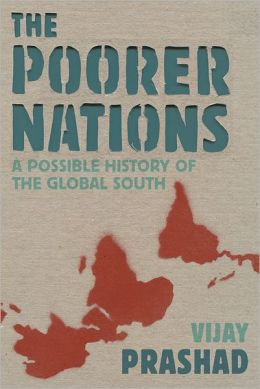
BOOKS / Ron Jacobs : Vijay Prashad and the Lessons of the Global South

Vijay Prashad’s ‘possible history’:
The lessons of the Global South

Prashad paints a sweeping indictment of those who want to rule the earth with little or no regard for most of its inhabitants.

By Ron Jacobs | The Rag Blog | April 10, 2013

The Poorer Nations: A Possible History of the Global South by Vijay Prashad (2013: Verso); Hardback; 300 pp; $26.95.

Vijay Prashad is fast becoming the historian of the Global South. His books and articles discussing the relationships between the oligarchs of global capitalism and the people and institutions of those it manipulates into its money pit of debt are detailed discussions of the intricacies of those relationships.

His newest book, titled The Poorer Nations: A Possible History of the Global South, is as detailed and well-cited as anything written by Noam Chomsky. Therein, Prashad turns the statistics and descriptions he writes into prose that is understandable and simmering with a justified rage at the robbery it describes.

Most fundamentally, Prashad’s book is a full frontal assault on neoliberal capitalism. Deservedly, he spares no political party, bank, or government linked to this most devastating edition of capitalism. Whether the collusion was willingly engaged in or merely the result of an unwillingness to lose personal or political power, Prashad paints a sweeping indictment of those who want to rule the earth with little or no regard for most of its inhabitants.

While keeping firm hold to his left anti-imperialist foundation, Prashad acknowledges the shortcomings of social democrats in their attempts to compromise with the ravenous beast of neoliberal capital. Naturally, these politicians and parties get some of the blame for the economic devastation caused by the banks and other machinery of that beast; Prashad saves the bulk of the blame, however, for its rightful targets: the IMF, World Bank, finance capital, and the men and women who operate that beast.

Since the crash of 2008, commentators have pointed to various financial manipulations from the 10 years prior to the crash when looking for reasons for the crash. The shortcoming in this approach is clear. One needs to go back much further. The Poorer Nations does that. As a result, the role of financial capital in today’s economic crisis can be better understood, as we examine its role in the impoverishment of the Global South and its role in the market crashes of 1989 and in Asia around the same time.

This rich history of the capitalist project’s last several decades makes one thing clear. The oligarchs of finance will do whatever it takes to maintain and, if possible, increase its profits. Another thing that becomes clear in Prashad’s telling is that capitalism is parasitical, constantly seeking new hosts to attach to and consume. This is especially the case in its current configuration — a configuration dependent on the production of capital, not goods; and interested solely in increasing profit, not industry.

This stage of capital, based on credit and the accumulation of debt, is known as neoliberalism. It is the curse of the modern world and may well be its downfall. Reading The Poorer Nations in the current situation, it is difficult not to consider that Prashad’s history might very well be our future. The fate of the nations he describes: indebtedness, deindustrialization, destruction of agrarian economies; all of these and more can be seen in the daily newspaper.

The nation of Cyprus is but the latest country to suffer a parasitical raid of its assets. In this case, the finance capitalists went straight to individual savings accounts. The theft becomes more blatant with each succeeding crisis.

The Poorer Nations makes clear what many have always said and even more have suspected. This transfer of wealth was made possible with (at the least) the tacit complicity of many European social democrats and democratic socialists. All too many of these individuals and parties were involved at the very beginning of the neoliberal project. Their belief in capitalism and the importance of profit insured their rejection of the welfare states they championed.

Perhaps the only social democrat in power during the period Prashad discusses who did not fold almost immediately when Wall Street began its final play to take over the world economy was the West German Willy Brandt. Unfortunately, his play was too late.

Even though other economic methods of organization have proven to be more beneficial for everyone but the greediest, argues Prashad, the faith in the market by those who benefit from it the most denies that fact. This includes the various national upper classes as well as the international financiers.

Although capitalism does not require greed to flourish, it certainly ensures that it does, especially in its current phase. As to be expected, those without qualms benefit the most from this fact. Prashad relays their story too; leaders and officials of the Global South spending their nations’ treasuries (earned and borrowed) on luxury vehicles and villas and military hardware to protect the assets of the powerful.

Despite the dismal tale told in these pages, Prashad ends The Poorer Nations with hope. In his final chapter he discusses the situation of the world’s dispossessed, whose numbers have multiplied exponentially as a result of the financial and political machinations described in the previous chapters. Many of these millions live in urban slums of their own creation and work at low-paying jobs or in marginalized activities.

Recently, however, they have begun to realize the political power of their numbers. This, writes Prashad, is where the hope for a new and more just world is to be found. It is the power they hold that can change the world and wrest it back from the ecological and impoverished future the masters of finance and their political and military lapdogs are heading towards.

[Rag Blog contributor Ron Jacobs is the author of The Way The Wind Blew: A History of the Weather Underground. He recently released a collection of essays and musings titled Tripping Through the American Night. His novels, The Co-Conspirator’s Tale, and Short Order Frame Up will be republished by Fomite in April 2013 along with the third novel in the series All the Sinners Saints. Ron Jacobs can be reached at ronj1955@gmail.com. Find more articles by Ron Jacobs on The Rag Blog.]

The Rag Blog

Posted in Rag Bloggers | Tagged , , , , , , | Leave a comment

Larry Ray : The Right of Americans to Love and Marry

There’s a problem when the stars and stripes exclude some Americans, forcing them to have their own flag. Image from iHandbill.

The right to love and marry:
Picking the fly specks out of the pepper

Conservative judges on the Supreme Court were literally stewing and sputtering as they questioned attorneys speaking in support of same-sex marriage.

By Larry Ray | The Rag Blog | April 9, 2013

It would seem reasonable that most folks could agree that no person decided to be born with red hair, or with a club foot, or as a prodigy, or with black skin or white skin, or as a government issue “normal” person. An embryo doesn’t get to decide that kind of stuff.

So, when a male and a female produce a child, how much does their genetic material, their parenting, and their environment have to do with that child’s eventual sexual orientation? And if the kid is homosexual are the parents OK with that kid eventually living like a second class citizen in America?

Prior to the Middle Ages we don’t hear much about homosexual acts other than they seem to have been accepted with no big problem back then, even by the Christian Church. But the Renaissance of the 12th Century saw a birth of intellectual revitalization and a steady growth of open hostility against homosexuals. This vilification was taken up and quickly spread through the Christian Church and also into secular organizations.

The normative characteristics of human sexuality have been debated probably since homo erectus learned to talk. In the late 1600’s the most influential of the so-called Enlightenment thinkers, John Locke, argued that the mind is a “tabula rasa” or blank slate and that the environment in which a child is raised determines its sexuality. In the early 1900’s Sigmund Freud’s papers on sexuality ultimately held that sexual drives are instinctive and a central source of personality. And in recent years most researchers ask whether either of those ideas ever had much merit whatsoever.

What has never changed is the fact there have always been people born who have a sexual attraction to their own sex, and that has always seemed to others to be rather, well, queer.

So by the end of the 19th century, in addition to long having been being labeled a sin by the Church, homosexuality also became viewed as a deviant mental disorder. And it was not until 1986 that the American Psychiatric Association finally completely removed the classification of homosexuality as a mental illness from its Diagnostic and Statistical Manual.

And now not quite 30 years after that milestone, the Supreme Court has finally heard two sets of oral arguments regarding same-sex marriage. One argument basically deals with the Constitutionality of the 1996 Federal Defense of Marriage Act, or DOMA, and the other whether California’s Proposition 8 can single out any group of people and prevent them from being legally married in that state.

But in both instances the arguments don’t come right out and talk about homosexuality itself. Instead, the arguments are about marriage, both religious and secular. The Christian Church makes a singular claim to marriage as a sacred and crucial part of the religious life of their adherents and their definition of marriage is that it can only be between a man and woman. Anything else and Leviticus is loudly quoted.

Section 3 of The Federal Defense of Marriage Act codifies the non-recognition of same-sex marriages for all federal purposes, including insurance benefits for government employees, Social Security survivors’ benefits, immigration, and the filing of joint tax returns. Not recognizing same-sex marriage is federal law.

President Clinton, under whose administration DOMA was created and passed, now says same-sex marriages should be just like any other marriage. Clinton and a number of other elected career politicians have recently disavowed DOMA and called for its repeal… but since 1996 none of them have stepped up and done anything to see that it is, in fact, repealed.

President Obama has simply dodged the issue by saying Section 3 is unconstitutional, but that he would still continue to enforce the law, but, however, that he would no longer defend it in court. No profile in courage here. More like the statement of a Lewis Carroll character from Alice in Wonderland.

Reaffirming their blatant discrimination and clearly indicating strong opposition to same-sex marriage, the U.S. House Republican leadership quickly instructed the House General Counsel to defend the the Defense of Marriage Act in place of the Department of Justice.

Public opinion polling now shows consistently that around 58% of the country supports homosexuals marrying one another. And their message is that this should not be such a big deal.

The trend in a 2012 Mercer survey of employee health benefits shows “about half, or 47% of employers with more than 500 workers made health coverage available to same-sex domestic partners, with large employers it’s even more prevalent, with figures in the 60-75% range.”

So imagine America’s politicians, particularly conservative Republicans now in a 2014 election minefield, where not voting to finally recognize homosexuals as equal to all other Americans might cost them votes back home.

Conservative judges on the Supreme Court were literally stewing and sputtering as they questioned attorneys speaking in support of same-sex marriage. And attorneys questioning the Court about the issue of alienating a group of citizens from the institution of marriage brought forth not answers but more questions as answers.

Justice Scalia replied, asking, “…when did it become unconstitutional to exclude homosexual couples from marriage?” clearly indicating Scalia’s view that society has always excluded homosexuals. And Justice Alito lightly commented that same-sex marriage is “newer than cell phones and the Internet,” suggesting that perhaps all of a sudden homosexuals just up and decided they want the same rights as every other American citizen. Risible and disappointing evasion from the high court.

The U.S. Supreme Court’s position on marriage was once crystal clear when it came to a black marrying a white. That meant a prison sentence in many states if a white man married a black woman or vice versa. That law stayed on the books for 84 years until a case was brought before the Supreme Court in 1967 by Mildred Loving, a black woman, and Richard Loving, a white man, who had been sentenced to a year in prison in the State of Virginia for marrying each other.

After the Loving case was championed by Attorney General Robert Kennedy and the ACLU, the Supreme Court, in a unanimous decision,  overturned the 1883 Supreme Court ruling which had affirmed that Alabama’s anti-miscegenation statute was constitutional.

It was overturned after 84 years of a court-approved, hate-defined prohibition of marraige between blacks and whites. The law clearly was finally struck down because of the Civil Rights act of 1964… and then only because Mr. and Mrs Loving filed suit for the right to legally love one another and marry.

Yet in 2013, the Civil Rights Act of 1964 that outlawed major forms of discrimination against racial, ethnic, national, and religious minorities, and women still does not seem to apply to homosexuals. Those American citizens whom the Catholic and Protestant Christian churches define as sinners, are not allowed to legally marry with all rights and benefits guaranteed by the Federal government. It is fair to ask if Church and State are indeed separated in this case?

What the Supreme Court and our politicians are doing is what in Texas we call “picking the fly specks out of the pepper,” an earthy expression meaning delaying, ridiculously arguing, failing to act through use of excuses or plain old bullheadedness.

Same-sex marriage poses no more threat to our society than did black folks who were not allowed to sip a soda at Walgreens. We have mostly gotten over the ugliness of our racist American past.

Now it is time to also end the hate and judgmental exclusion that still makes it illegal for some folks in America to get married to the person they love.

[Retired journalist Larry Ray is a Texas native and former Austin television news anchor who now lives in Gulfport, Mississippi. He also posts at The iHandbill. Read more articles by Larry Ray on The Rag Blog.]

The Rag Blog

Posted in Rag Bloggers | Tagged , , , , , , | Leave a comment

Glenn Gaven : The Sad Saga of Austin’s $10 Million Concrete Path

Austin City Councilman Chris Riley on his trusty steed.
Image from chrisforaustin.com.

Taken for a ride:
The sad saga of the
$10 million concrete path

It is no coincidence that this segment of concrete treasure will run along part of Austin Councilmember Chris Riley’s pet project, a New Urbanist rezoning wet dream known as the Airport Boulevard Renovation Project.

By Glenn Gaven | The Rag Blog | April 9, 2013

AUSTIN — With a zillion bicyclists and a historically dismal voting turnout, Austin, Texas, is a city where the bicycle lobby has more power than the Koch brothers. Realizing this, the transit authority, Capital Metro, and train enthusiasts turned to the two-wheeled mafia for help in passing a 2004 referendum to build a train system to bring commuters from the suburbs into the city.

The package the transit authority created was branded “All Systems Go,” and promised a glorious system of bicycle trails alongside the 162 miles of train track the Authority had already purchased over the years using the generous 1% sales tax dedicated to transit. The trail was to be built by 2007.

The referendum, which also promised a Bus Rapid Transit component by 2007 that has yet to be seen, passed and it was full steam ahead.

By 2007 the transit authority boasted having already spent 7.2 million dollars on the “Rails with Trails” program. That money had been spent on a feasibility study and presumably other prep work like surveying and engineering studies as no actual trail was in evidence as recently as January 2013.

In 2009, Capital Metro was awarded an American Recovery and Reinvestment Act grant for $1.9 million in free stimulus money to build bike trails. As you may recall the major stipulations for ARRA grants were that projects be “shovel ready,” and create new jobs. The transit authority happily accepted the money and promised the bike path would be built by 2010.

In February 2013, Smith Construction began demolishing a nearly new sidewalk adjacent a short section of Airport Blvd. to replace it with a “concrete path,” using $787,386 of the ARAA money. With the obligatory overruns associated with all Capital Metro contracts, Smith will likely collect a cool million to build the .9 (yes 9-tenths!) mile pathway that will run alongside a long-established bike lane, where there was already a sidewalk.

The rest of the money was given to McGray & McGray Land Surveyors and Klotz Associates, Inc, for “surveys” and “engineering studies.”

It is no coincidence that this segment of concrete treasure will run along part of Austin Councilmember Chris Riley’s pet project, a New Urbanist rezoning wet dream known as the Airport Boulevard Renovation Project. Riley and fellow Councilmember Mike Martinez represent Austin on the transit authority’s board of directors by night.

So, for a total of at least $10 million (7.2 + 1.9 + 15% built-in overruns etc.) we get almost a mile of what is basically a sidewalk where there was already a sidewalk and already a bike lane. According to City of Austin sidewalk coordinator John Eastman a .9 mile sidewalk outside of downtown typically costs $570,000. Those of us who used it can attest to its functionality and newness. That sidewalk is gone. Gone also is most of our $10 million which went into the pockets of consultants and contractors who have grown fat over the years feeding at the public troughs kept full by Mike Martinez and Chris Riley.

Next year, Riley and Martinez, along with the contractors like Paul Bury who built Martinez’ mansion, and train enthusiasts like Lyndon Henry and Glenn Gadbois will be asking Austin voters to give them the money to build a billion-dollar streetcar system in downtown Austin. Bicycling voters will determine yea or nay. It should only take the 90 seconds or so ride on Airport Blvd. between the Lamar Blvd. and Highland Mall to decide if we got our $10 million worth the last time.

[Glenn Gaven is a long-time Austin union activist who worked with the UT Shuttle Workers Union (ATU Local #1549) and was co-founder of the Bus Riders Union-ATX. Read more articles by Glenn Gaven on The Rag Blog.]

The Rag Blog

Posted in RagBlog | Tagged , , , , , , , , | Leave a comment

RAG RADIO / Thorne Dreyer : ‘Bronx Butch’ Memoirist & Performance Artist Annie Rachele Lanzillotto

Annie Rachele Lanzillotto.

Rag Radio podcast:
‘Bronx Butch’ memoirist & performance
artist, Annie Rachele Lanzillotto

“Annie Lanzillotto, the bard of Bronx Italian butch, is an American original, a performance artist and cultural anthropologist whose work is unique… an astonishing writer possessed of an utterly inimitable voice.” — Author John Gennari

By Rag Radio | The Rag Blog | April 9, 2013

Author, poet, and performance artist Annie Rachele Lanzillotto was Thorne Dreyer’s guest on Rag Radio, Friday, March 29, 2013. Rag Radio is a syndicated radio program produced at the studios of KOOP 91.7-FM in Austin, Texas.

Listen to or download our interview with Annie Rachele Lanzillotto here:


Annie Lanzillotto is an Italian-American lesbian memoirist, poet, performance artist, singer, and songwriter who lives in New York. She is the author of L is for Lion: An Italian Bronx Butch Freedom Memoir, published in 2013 by the State University of New York Press.

On Rag Radio Lanzillotto discusses her rich and multi-faceted life and art. She talks about and reads from her lusty, wise, and very witty memoir, which deals with a range of issues including her Italian-American upbringing, her father’s PTSD and his physical abuse of her mother; her two bouts with cancer, and her coming to terms with her sexuality.

An American original.

As author John Gennari says, Annie’s memoir “indelibly portrays the iconic Italian American spaces of kitchen, stoop, sidewalk, and street; the body as a site of humor and tragedy; and, above all, the family war zone as an uncanny intermingle of poignancy and brutality.”

Annie Lanzillotto was born and raised in the Westchester Square neighborhood of the Bronx, and in Yonkers, New York, of Barese heritage. She received a B.A. with honors in medical anthropology from Brown University and an MFA in writing from Sarah Lawrence College. In 2012, she received a Franklin Furnace Archive Inc. Performance Commission and a Petracca Award in Poetry from Philadelphia Poets, and has received grants from the Rockefeller Foundation Next Generation Leadership Program, Dancing In the Streets, and the Puffin Foundation.

Lanzillotto is also the author of a book of poetry, Schistsong, and teaches master classes in solo performance for the Acting Apprentice Company at Actors Theatre of Louisville. She was selected as one of “200 essential New Yorkers” by The New York Times for her performance and installation at the 2000 Smithsonian Folklife Festival. She is included in Marquis Who’s Who of American Women.

Rag Radio has aired since September 2009 on KOOP 91.7-FM, an all-volunteer cooperatively-run community radio station in Austin, Texas. Hosted and produced by Rag Blog editor and long-time alternative journalist Thorne Dreyer, a pioneer of the Sixties underground press movement, Rag Radio is broadcast every Friday from 2-3 p.m. (CDT) on KOOP, and is rebroadcast on Sundays at 10 a.m. (EDT) on WFTE, 90.3-FM in Mt. Cobb, PA, and 105.7-FM in Scranton, PA.

The show is streamed live on the web by both stations and, after broadcast, all Rag Radio shows are posted as podcasts at the Internet Archive.

Rag Radio is produced in association with The Rag Blog, a progressive Internet newsmagazine, and the New Journalism Project, a Texas 501(c)(3) nonprofit corporation. Tracey Schulz is the show’s engineer and co-producer.

Rag Radio can be contacted at ragradio@koop.org.

Coming up on Rag Radio:
THIS FRIDAY,
April 12: Sixties activists and Yippie founders Judy Gumbo Albert and Nancy Kurshan.
Friday, April 19: Amsterdam-based poet John Sinclair, founder of the White Panther Party and former manager of the MC5.

The Rag Blog

Posted in Rag Bloggers | Tagged , , , , , , , , , | Leave a comment