RAG RADIO / Thorne Dreyer : ‘Austin Noir’ with Musician and Author Jesse Sublett

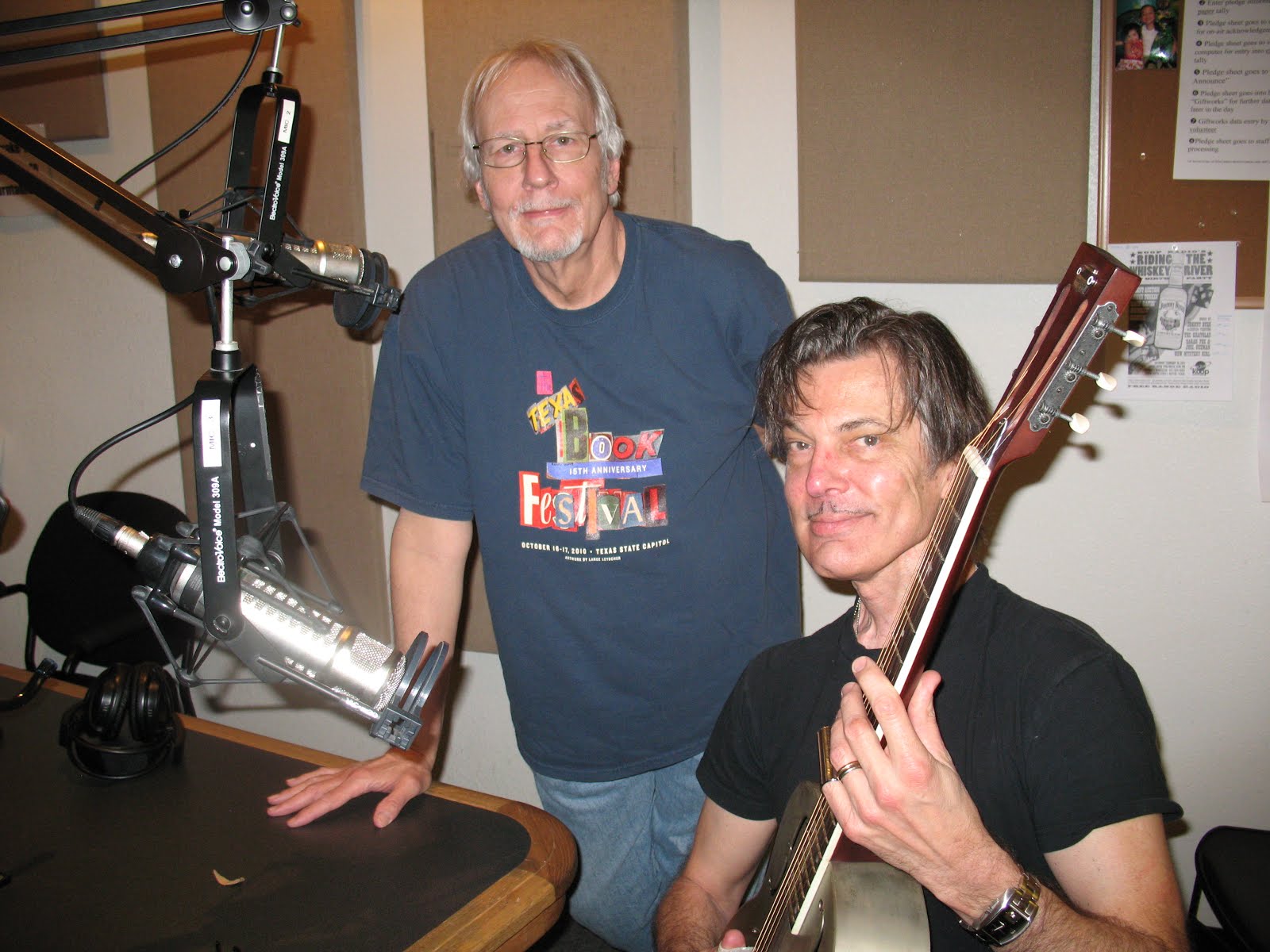
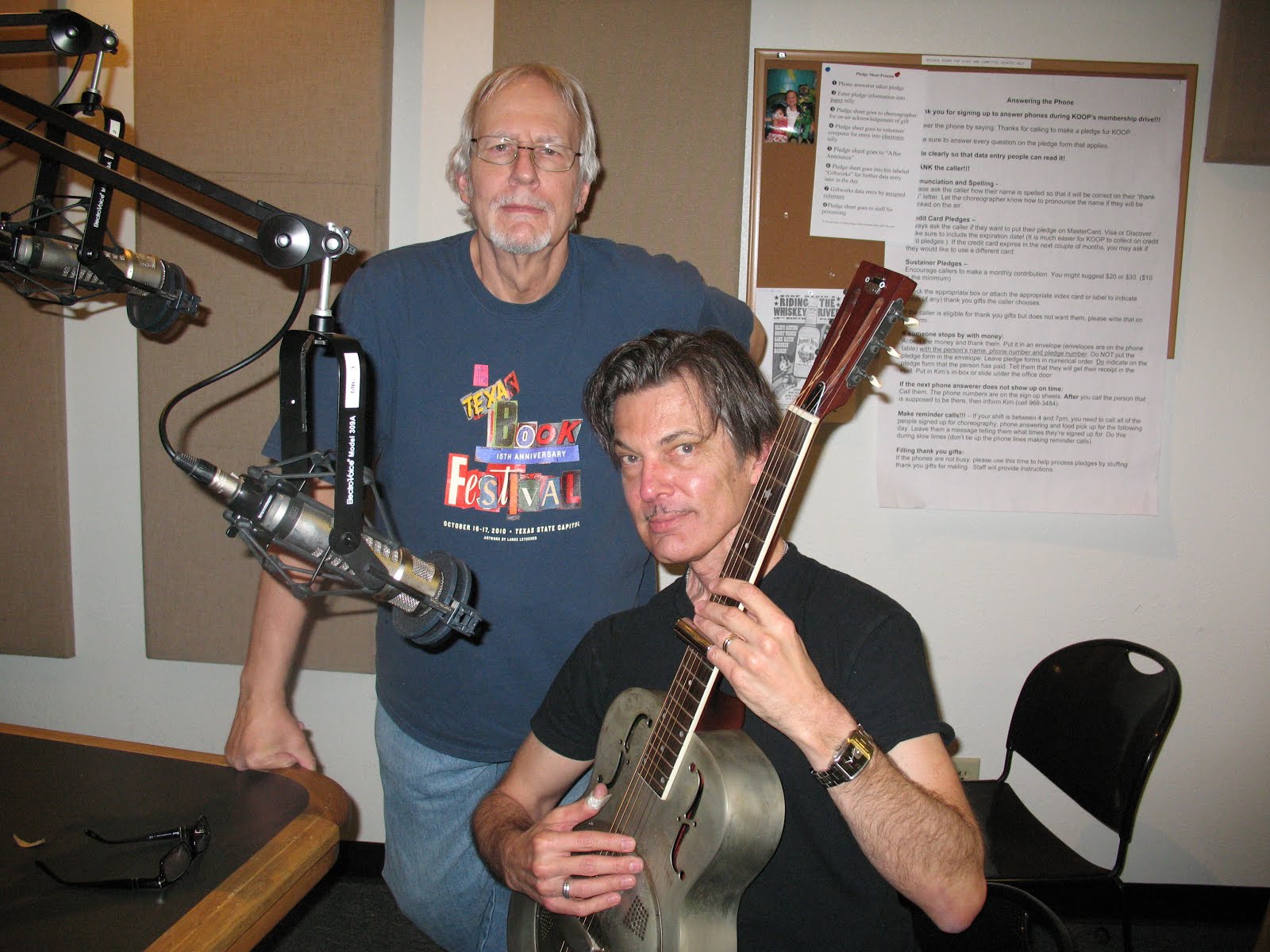
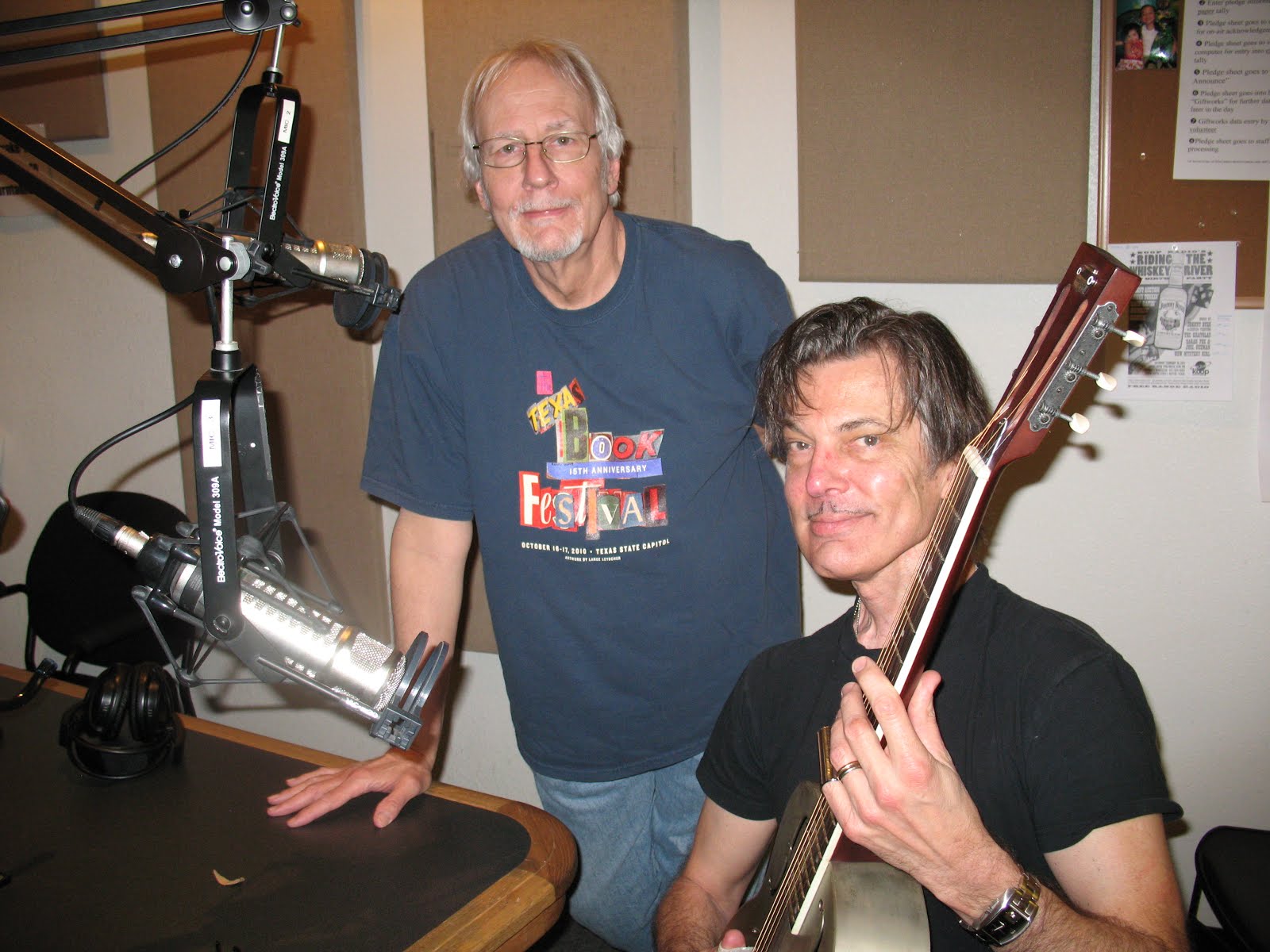
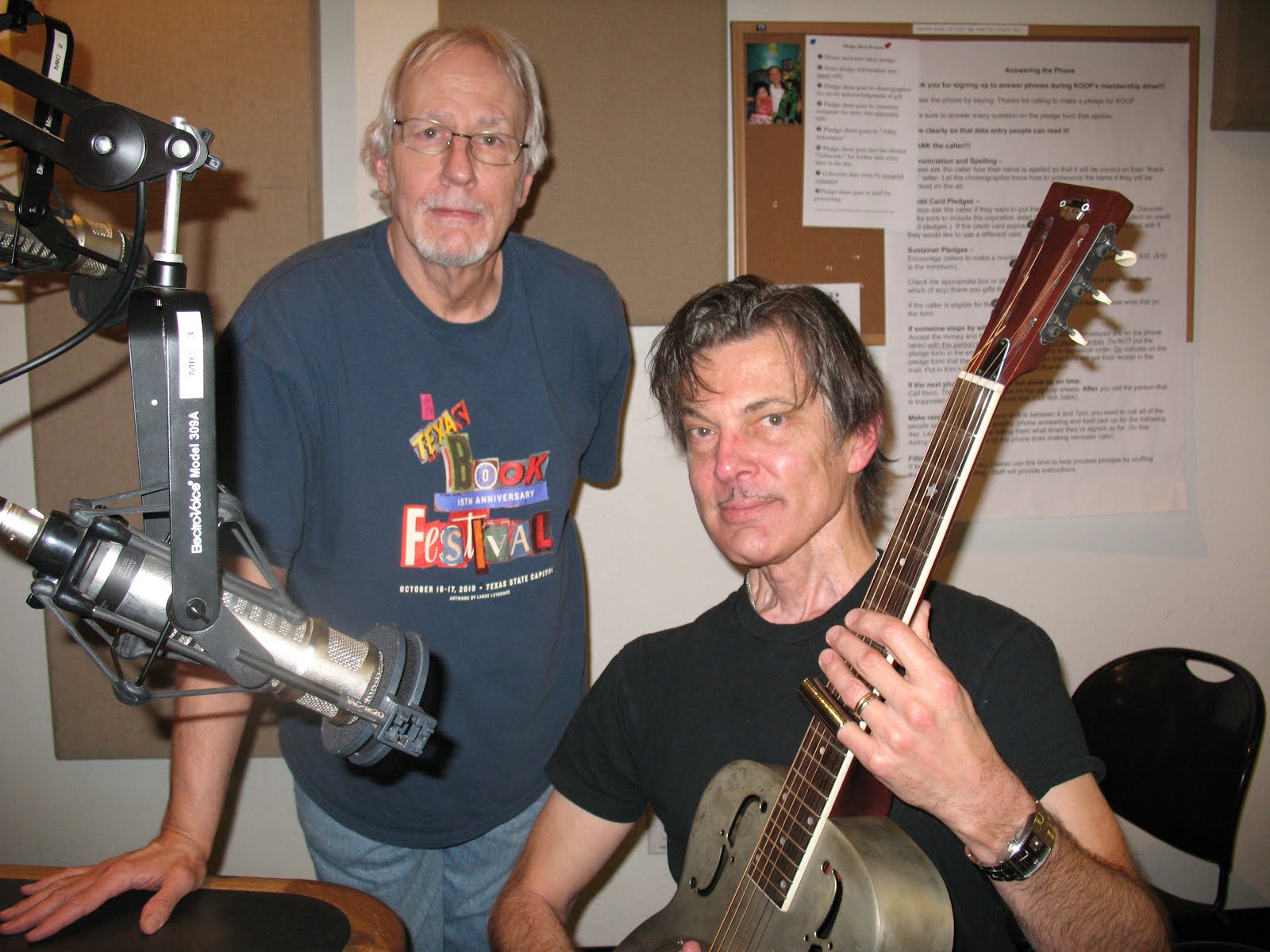
Musician and author Jesse Sublett, on right, with Rag Radio host Thorne Dreyer, in the studios of KOOP-FM in Austin, Texas, Friday, February 1, 2013. Photo by Charlie Martin / KOOP.

Rag Radio podcast:
‘Austin Noir‘ with musician and writer 
Jesse Sublett, author of ‘Grave Digger Blues

By Rag Radio | The Rag Blog | February 7, 2013

Austin-based musician and author Jesse Sublett was Thorne Dreyer’s guest Friday, February 1, 2013, on Rag Radio, a syndicated radio show produced at the studios of KOOP 91.7-FM in Austin, Texas. The show includes live musical performance by Sublett, and spoken-word performance by Sublett and host Dreyer.

Jesse Sublett is a historical figure in the Austin music scene; his influence dates to the late 1970s, when he founded the seminal punk band, The Skunks, and continues today. His published books include three crime novels set in the Austin music scene, a critically-acclaimed memoir, and the new eBook, Grave Digger Blues, a post-apocalyptic detective story.

Listen to Thorne Dreyer’s interview with Jesse Sublett, here:


Jesse Sublett’s Austin-noir novels, Rock Critic Murders, Tough Baby, and Boiled In Concrete — which were written in the late ’80s and early ’90s — featured bass-playing sleuth Martin Fender, a character based loosely on Jesse himself. His memoir, Never the Same Again, in which Sublett dealt with his personal bout with throat cancer and with his investigation into the murder of his girlfriend, was hailed by artists like James Ellroy, Michael Connelly, and Rick Linklater.

Jesse has been experimenting with combining music and pulp fiction since the mid-1980s, and his blog, Jesse Sublett’s Little Black Book, combines crime fiction, film, art, and liberal politics. Recently he has been active in social media and ePublishing, where he has channeled the old punk/DIY spirit into the new digital age.

His latest eBook, Grave Digger Blues — available on Kindle, iPad, and in a bare-bones version at Smashwords — “is a wild joy ride that Jesse’s longtime fans will recognize for its relentless lyrical drive, dark humor, bright splashes of violence and absurdity.” The iPad version includes more than an hour of audio, with an original blues soundtrack and audio chapters produced by Jesse and the Fort Worth jazz musician, Johnny Reno.

Jesse performs three songs live on the Rag Radio show, which also features a snippet of audio from the eBook and a live reading of a chapter from Grave Digger Blues, performed by Sublett and host Dreyer.

Also, go here to listen to an earlier Rag Radio interview with Jesse Sublett — featuring more about the Skunks and Jesse’s musical career — originally recorded on April 8, 2011, at the KOOP studios.

Rag Radio has aired since September 2009 on KOOP 91.7-FM in Austin. Hosted and produced by Rag Blog editor and long-time alternative journalist Thorne Dreyer, a pioneer of the Sixties underground press movement, Rag Radio is broadcast every Friday from 2-3 p.m. (CST) on KOOP, and is rebroadcast on Sundays at 10 a.m. (EST) on WFTE, 90.3-FM in Mt. Cobb, PA, and 105.7-FM in Scranton, PA.

The show is streamed live on the web by both stations and, after broadcast, all Rag Radio shows are posted as podcasts at the Internet Archive.

Rag Radio is produced in association with The Rag Blog, a progressive internet newsmagazine, and the New Journalism Project, a Texas 501(c)(3) nonprofit corporation. Tracey Schulz is the show’s engineer and co-producer.

Rag Radio can be contacted at ragradio@koop.org.

Coming up on Rag Radio:
THIS FRIDAY, February 8, 2013:
Marjorie Heins, author of Priests of our Democracy: The Supreme Court, Academic Freedom, and the Anti-Communist Purge.

The Rag Blog

Posted in Rag Bloggers | Tagged , , , , , , , , | 2 Comments

RAG RADIO / Thorne Dreyer : Austin Noir with Musician Jesse Sublett, Author of ‘Grave Digger Blues’

Musician and author Jesse Sublett, on right, with Rag Radio host Thorne Dreyer, in the studios of KOOP-FM in Austin, Texas, Friday, February 1, 2013. Photo by Charlie Martin / KOOP.

Rag Radio podcast:
Austin Noir‘ with musician and writer 
Jesse Sublett, author of ‘Grave Digger Blues

By Rag Radio | The Rag Blog | February 7, 2013

Austin-based musician and author Jesse Sublett was Thorne Dreyer’s guest Friday, February 1, 2013, on Rag Radio, a syndicated radio show produced at the studios of KOOP 91.7-FM in Austin, Texas. The show includes live musical performance by Sublett, and spoken-word performance by Sublett and host Dreyer.

Jesse Sublett is a historical figure in the Austin music scene; his influence dates to the late 1970s, when he founded the seminal punk band, The Skunks, and continues today. His published books include three crime novels set in the Austin music scene, a critically-acclaimed memoir, and the new eBook, Grave Digger Blues, a post-apocalyptic detective story.

Listen to Thorne Dreyer’s interview with Jesse Sublett, here:


Jesse Sublett’s Austin-noir novels, Rock Critic Murders, Tough Baby, and Boiled In Concrete — which were written in the late ’80s and early ’90s — featured bass-playing sleuth Martin Fender, a character based loosely on Jesse himself. His memoir, Never the Same Again, in which Sublett dealt with his personal bout with throat cancer and with his investigation into the murder of his girlfriend, was hailed by artists like James Ellroy, Michael Connelly, and Rick Linklater.

Jesse has been experimenting with combining music and pulp fiction since the mid-1980s, and his blog, Jesse Sublett’s Little Black Book, combines crime fiction, film, art, and liberal politics. Recently he has been active in social media and ePublishing, where he has channeled the old punk/DIY spirit into the new digital age.

His latest eBook, Grave Digger Blues — available on Kindle, iPad, and in a bare-bones version at Smashwords — “is a wild joy ride that Jesse’s longtime fans will recognize for its relentless lyrical drive, dark humor, bright splashes of violence and absurdity.” The iPad version includes more than an hour of audio, with an original blues soundtrack and audio chapters produced by Jesse and the Fort Worth jazz musician Johnny Reno.

Jesse performs three songs live on the Rag Radio show, which also features live audio from the eBook and a live reading of a chapter from Grave Digger Blues, performed by Sublett and host Dreyer .

Also listen to our earlier Rag Radio interview with Jesse Sublett, originally recorded on April 8, 2011, here.

Rag Radio has aired since September 2009 on KOOP 91.7-FM in Austin. Hosted and produced by Rag Blog editor and long-time alternative journalist Thorne Dreyer, a pioneer of the Sixties underground press movement, Rag Radio is broadcast every Friday from 2-3 p.m. (CST) on KOOP, and is rebroadcast on Sundays at 10 a.m. (EST) on WFTE, 90.3-FM in Mt. Cobb, PA, and 105.7-FM in Scranton, PA.

The show is streamed live on the web by both stations and, after broadcast, all Rag Radio shows are posted as podcasts at the Internet Archive.

Rag Radio is produced in association with The Rag Blog, a progressive internet newsmagazine, and the New Journalism Project, a Texas 501(c)(3) nonprofit corporation. Tracey Schulz is the show’s engineer and co-producer.

Rag Radio can be contacted at ragradio@koop.org.

Coming up on Rag Radio:
THIS FRIDAY, February 8, 2013:
Marjorie Heins, author of Priests of our Democracy: The Supreme Court, Academic Freedom, and the Anti-Communist Purge.


Type rest of the post here

Source /

The Rag Blog

Posted in RagBlog | Leave a comment

Type your summary here

Type rest of the post here

Source /

The Rag Blog

Posted in RagBlog | Leave a comment

IDEAS / Bill Meacham : Free Will or Free Won’t?

Image from InspireD2.

Free Will or Free Won’t?

Human beings act on their desires and beliefs, and the way we predict what people will do is not by examining their brain waves but by understanding what they want and what they think is true.

By Bill Meacham | The Rag Blog | February 7, 2013

I’ve heard a number of people say that a well-known experiment performed by neuroscientist Benjamin Libet proves that human beings do not have free will. It doesn’t. As is often the case with such research the experimental results are replicable, but the theoretical implications are subject to interpretation. Interpretations differ, and the one given by free-will deniers is, I believe, shortsighted.

Benjamin Libet was a researcher in the physiology department of the University of California, San Francisco who was intrigued by the difficulty of investigating human consciousness.(1) The difficulty is this: unlike most of what science investigates, consciousness, or subjective experience, is not available for public inspection. Scientific advance depends on researchers’ being able to replicate experiments, to observe the same things that others observe. The public, or objective, world is out there for anybody (or anybody with suitable training) to see. But subjective experiences are, in Libet’s words, “available only to the individual subject who is experiencing them.”(2)

We can observe brain activity through the means of electroencephalography (EEG), positron emission tomography (PET), magnetic resonance imaging (MRI), and the like. We have reason to believe that brain activity is correlated with subjective experience. But we have no way of observing subjective experience publicly. It is private, detectable only by the person whose experience it is. So how can we correlate the two?

Libet’s answer was to observe what people report about their experience. He would wire a subject up in order to observe brain activity and then apply a stimulus and ask the subject to report on what he or she experienced. In this way he could tell how strong the stimulus needed to be and how long it had to be applied in order to produce a conscious experience of it. He could distinguish between how long it took for someone to detect an event, as evidenced by their involuntary reaction to it, and how long it took for someone to become conscious of it, as evidenced by their report.

As it turns out, we take about a half a second to become conscious of something after it happens, but we can react to it without being conscious of it much more rapidly (for example, blinking our eye when something flies toward it).(3) That finding raises interesting questions about our knowledge of the world — Are we always a half-second behind what really happens? If so, how is it that we get around in the world successfully? — but they are not my topic in this essay.

The experiment that has gotten the most attention was an attempt to find out something about voluntary acts, acts in which the subject consciously and deliberately does something. Are voluntary acts similarly delayed?

Prior research had established that shortly before a voluntary act is done, such as flexing one’s wrist at a time of one’s own choosing, electrical activity in the brain arises, an event termed “readiness potential” (RP). The RP occurs in the brain up to 800 milliseconds before the physical act.(4) Libet wanted to find out when the subject becomes conscious of the will to act, when consciously wanting or wishing or willing to act occurs, an event he termed “W.” W certainly happens before the physical act, but does it occur before or after the RP?

Here is the experiment. The subject, who is wired up, sits before a clock-like device in which a dot of light sweeps around a circle quite rapidly, about two and half seconds per revolution instead of the usual 60 seconds. This device allows measurement of time differences in the hundreds of milliseconds. The subject is told to flex their wrist whenever they choose — a voluntary act — and to note the position of the dot of light when they decide to do it.

The experimenter can detect and record when the RP happens and can detect and record when the physical movement happens. The experimenter also records the subject’s report of when W happens, so the experiment gathers three data points. The results are then averaged over many trials.(5) The findings are surprising:

What we found, in short, was that the brain exhibited an initiating process beginning 550 msec [milliseconds] before the freely voluntary act; but the awareness of the conscious will to perform the act appeared only 150-200 msec before the act. The voluntary process is therefore initiated unconsciously, some 400 msec before the subject becomes aware of her will or intention to perform the act.(6)

So how can we be said to have free will if our choice is actually initiated by brain activity before we even know it? Many people take these results as evidence that our will is not in fact free, but is determined by physical events in the brain.

Libet himself had his doubts. He devised another experiment in which the subject was told to prepare to act at a certain time on the clock-like device, but to veto that expected act when the device reached 100 to 200 milliseconds before the preset time. In this case the RP for the act developed, but then flattened just as the subject was vetoing the act. “This at least demonstrated that a person could veto an expected act within the 100-200 msec before the preset time … .”(7)

Commentators have called this phenomenon “free won’t”;(8) and Libet thought it demonstrated that we do have free will, but it is limited to vetoing processes that are initiated unconsciously. He distinguishes between an initiation process and a control process, the former being unconscious and the latter conscious.(9)

That distinction seems dubious to me, as the experiments are not directly comparable. In one case the subject is told to act when he (or she) chooses; and in the other case he is told to act, not whenever he wants, but at a certain time and to veto the act at a slightly earlier time.

On the face of it, it seems as if our will is indeed determined and not free, but there are numerous objections to this conclusion. The most obvious, perhaps, is that we have no warrant to generalize from the results of a simplified experiment to our experience of willing in general. Libet responds that it is common in science to study a simple system and then find similar behavior in more complicated systems, and the fact that other experimenters have found similar results in variants of the original experiment give us justification to believe that the findings apply to voluntary acts in general.(10)

OK, but there are other ways to challenge Libet’s conclusions says the author of the blog Conscious Entities:

We could… question whether RPs really have the significance attributed to them. We could question whether the unusual circumstances of the experiment, with subjects thinking in advance about making a decision, and then making one for no reason whatever, properly represent normal thought processes. We could take the view that the experiments involve at least two mental reporting processes, one to do with the occurrence of the decision, one to do with the state of the clock, which makes any judgement of simultaneity highly problematic.(11)

A stronger objection is this:

Libet often seems to take it for granted that every free act is preceded by a specific act of will, but that isn’t really the case. Often the conscious mind sets a general plan, on which we then act more or less automatically. A tennis player has thought in general terms about how to play the next stroke long before the need for actual action; drivers have a kind of running rule in the back of their mind to the effect that if something suddenly appears in front of them, they hit the brake.

Free will operates at this higher level, with all our actions being managed in detail by unconscious processes. I don’t have to think about where I want to hit the ball at the very moment of decision in order to control my game of tennis any more than I have to think separately about each of the individual muscles I am implicitly proposing to contract.(12)

As this objection suggests, when we think that brain activity causes what we do, we are not looking in the right place for free will. It has to do with who is acting, who the agent is. When we say “I made the choice” and “I did not make the choice, my brain did it” we are using the term “I” to mean different things.

In the former case, when we say “I made the choice,” I means the whole constellation of elements that constitutes me. I, and not someone else, made the choice; and I am an ongoing pattern of decisions, reactions, thoughts, feelings, emotions, and so forth, not to mention a physical body. But in the latter case, when we say “I did not make the choice; it was determined by brain activity,” I seems to mean some subset of the elements that constitute me.

It’s as if we are thinking of ourselves as a tiny person who lives in the nooks and crannies of the brain and gets buffeted by electrical activity and forced to take action. But that’s not who we are. We are (each of us is) a whole person, and the ascription of agency and free will is properly made to the whole person, not a subset.

Libet has discovered one of the mechanisms by which choice operates in a specific, constrained situation. But you are not the mechanism, you are the agent who incorporates the mechanism; and the laws of agency operate at a higher level than the laws governing the mechanism. The laws that most usefully describe us as whole persons are agential, not mechanical, laws.

By “agential laws” I mean that human beings act on their desires and beliefs, and the way we predict what people will do is not by examining their brain waves but by understanding what they want and what they think is true. And, as I have written elsewhere,(13) the way we get them to do something, especially if we want their willing cooperation, is by influencing their desires and beliefs. We change their desires through enticement, persuasion, cajoling, bribery, offers of exchange, reward or punishment and so forth; or we provide evidence to convince them of certain facts; or we do both.

Artificial intelligence researcher Ray Kurzweil makes the point that it is important to model systems at the right (by which he means the most useful) level.

Although chemistry is theoretically based on physics and could be derived entirely from physics, this would be unwieldy and infeasible in practice, so chemistry has established its own rules and models. Similarly, we should be able to deduce the laws of thermodynamics from physics, but once we have a bunch of particles, solving equations for the physics of each particle interaction becomes hopeless, whereas the laws of thermodynamics work quite well. Biology likewise has its own rules and models. A single pancreatic islet cell is enormously complicated, especially if we model it at the level of molecules; modeling what a pancreas actually does in terms of regulating levels of insulin and digestive enzymes is considerably less complex.(14)

Similarly, it works much better to think of ourselves as agents with free will, the ability to decide for ourselves what to do, than to think of ourselves as the effects of neural mechanisms. And in fact even those who profess a belief in determinism act in actual practice as if they can make choices. We have found out a lot about the workings of the brain, and no doubt we will find out more. But knowing how the carburetor works is not the same as being able to drive the car skillfully.

That said, it is certainly useful to know how the mechanisms work so we can notice when they are operating and what they are doing and decide what to do about it. There are other mechanisms besides brain activity that influence our behavior, a topic to which I hope to return next time.

[Bill Meacham is an independent scholar in philosophy. A former staffer at Austin’s ’60s underground paper, The Rag, Bill received his Ph.D. in philosophy from the University of Texas at Austin. Meacham spent many years working as a computer programmer, systems analyst, and project manager. He posts at Philosophy for Real Life, where this article also appears. Read more articles by Bill Meacham on The Rag Blog.]

Notes
(1) Wikipedia, “Benjamin Libet.”
(2) Libet, Mind Time, p. 1.
(3) Ibid., chapter two.
(4) Ibid., p. 124.
(5) Ibid., pp. 126-129.
(6) Ibid., pp. 123-124.
(7) Ibid., pp. 138-139.
(8) Wikipedia, “Benjamin Libet.”
(9) Libet, Mind Time, pp. 143-147.
(10) Ibid., p. 148.
(11) Conscious Entities, “Astonishing Experiments.”
(12) Conscious Entities, “Libet’s short delay.”
(13) Meacham, “Do Humans Have Free Will?”
(14) Kurzweil, How To Create A Mind, p. 37.

References
Conscious Entities. “Astonishing Experiments.” Online publication http://www.consciousentities.com/experiments.htm as of 27 January 2013.
Conscious Entities. “Libet’s Short Delay.” Online publication http://www.consciousentities.com/libet.htm as of 27 January 2013.
Kurzweil, Ray. How To Create A Mind: The Secret of Human Thought Revealed. New York: Viking, 2012.
Libet, Benjamin. “Do We Have Free Will?” Journal of Consciousness Studies, 6, No. 8-9, 1999, pp. 47-57. Online publication http://www.centenary.edu/attachments/philosophy/aizawa/courses/intros2009/libetjcs1999.pdf as of 27 January 2013.
Libet, Benjamin. Mind Time: The Temporal Factor in Consciousness. Cambridge: Harvard University Press, 2004. The crucial fourth chapter appears in substantially the same form in Libet, “Do We Have Free Will?”
Meacham, Bill. “Do Humans Have Free Will?” Online publication, http://www.bmeacham.com/whatswhat/FreeWill.html .
Wikipedia. “Benjamin Libet.” Online publication http://en.wikipedia.org/wiki/Benjamin_Libet as of 29 January 2013.

The Rag Blog

Posted in Rag Bloggers | Tagged , , , , , | Leave a comment

IDEAS / Bill Meacham : Free Will or Free Won’t?

Image from InspireD2.

Free Will or Free Won’t?

Human beings act on their desires and beliefs, and the way we predict what people will do is not by examining their brain waves but by understanding what they want and what they think is true.

By Bill Meacham | The Rag Blog | February 7, 2013

I’ve heard a number of people say that a well-known experiment performed by neuroscientist Benjamin Libet proves that human beings do not have free will. It doesn’t. As is often the case with such research the experimental results are replicable, but the theoretical implications are subject to interpretation. Interpretations differ, and the one given by free-will deniers is, I believe, shortsighted.

Benjamin Libet was a researcher in the physiology department of the University of California, San Francisco who was intrigued by the difficulty of investigating human consciousness.(1) The difficulty is this: unlike most of what science investigates, consciousness, or subjective experience, is not available for public inspection. Scientific advance depends on researchers’ being able to replicate experiments, to observe the same things that others observe. The public, or objective, world is out there for anybody (or anybody with suitable training) to see. But subjective experiences are, in Libet’s words, “available only to the individual subject who is experiencing them.”(2)

We can observe brain activity through the means of electroencephalography (EEG), positron emission tomography (PET), magnetic resonance imaging (MRI), and the like. We have reason to believe that brain activity is correlated with subjective experience. But we have no way of observing subjective experience publicly. It is private, detectable only by the person whose experience it is. So how can we correlate the two?

Libet’s answer was to observe what people report about their experience. He would wire a subject up in order to observe brain activity and then apply a stimulus and ask the subject to report on what he or she experienced. In this way he could tell how strong the stimulus needed to be and how long it had to be applied in order to produce a conscious experience of it. He could distinguish between how long it took for someone to detect an event, as evidenced by their involuntary reaction to it, and how long it took for someone to become conscious of it, as evidenced by their report.

As it turns out, we take about a half a second to become conscious of something after it happens, but we can react to it without being conscious of it much more rapidly (for example, blinking our eye when something flies toward it).(3) That finding raises interesting questions about our knowledge of the world — Are we always a half-second behind what really happens? If so, how is it that we get around in the world successfully? — but they are not my topic in this essay.

The experiment that has gotten the most attention was an attempt to find out something about voluntary acts, acts in which the subject consciously and deliberately does something. Are voluntary acts similarly delayed?

Prior research had established that shortly before a voluntary act is done, such as flexing one’s wrist at a time of one’s own choosing, electrical activity in the brain arises, an event termed “readiness potential” (RP). The RP occurs in the brain up to 800 milliseconds before the physical act.(4) Libet wanted to find out when the subject becomes conscious of the will to act, when consciously wanting or wishing or willing to act occurs, an event he termed “W.” W certainly happens before the physical act, but does it occur before or after the RP?

Here is the experiment. The subject, who is wired up, sits before a clock-like device in which a dot of light sweeps around a circle quite rapidly, about two and half seconds per revolution instead of the usual 60 seconds. This device allows measurement of time differences in the hundreds of milliseconds. The subject is told to flex their wrist whenever they choose — a voluntary act — and to note the position of the dot of light when they decide to do it.

The experimenter can detect and record when the RP happens and can detect and record when the physical movement happens. The experimenter also records the subject’s report of when W happens, so the experiment gathers three data points. The results are then averaged over many trials.(5) The findings are surprising:

What we found, in short, was that the brain exhibited an initiating process beginning 550 msec [milliseconds] before the freely voluntary act; but the awareness of the conscious will to perform the act appeared only 150-200 msec before the act. The voluntary process is therefore initiated unconsciously, some 400 msec before the subject becomes aware of her will or intention to perform the act.(6)

So how can we be said to have free will if our choice is actually initiated by brain activity before we even know it? Many people take these results as evidence that our will is not in fact free, but is determined by physical events in the brain.

Libet himself had his doubts. He devised another experiment in which the subject was told to prepare to act at a certain time on the clock-like device, but to veto that expected act when the device reached 100 to 200 milliseconds before the preset time. In this case the RP for the act developed, but then flattened just as the subject was vetoing the act. “This at least demonstrated that a person could veto an expected act within the 100-200 msec before the preset time … .”(7)

Commentators have called this phenomenon “free won’t”;(8) and Libet thought it demonstrated that we do have free will, but it is limited to vetoing processes that are initiated unconsciously. He distinguishes between an initiation process and a control process, the former being unconscious and the latter conscious.(9)

That distinction seems dubious to me, as the experiments are not directly comparable. In one case the subject is told to act when he (or she) chooses; and in the other case he is told to act, not whenever he wants, but at a certain time and to veto the act at a slightly earlier time.

On the face of it, it seems as if our will is indeed determined and not free, but there are numerous objections to this conclusion. The most obvious, perhaps, is that we have no warrant to generalize from the results of a simplified experiment to our experience of willing in general. Libet responds that it is common in science to study a simple system and then find similar behavior in more complicated systems, and the fact that other experimenters have found similar results in variants of the original experiment give us justification to believe that the findings apply to voluntary acts in general.(10)

OK, but there are other ways to challenge Libet’s conclusions says the author of the blog Conscious Entities:

We could… question whether RPs really have the significance attributed to them. We could question whether the unusual circumstances of the experiment, with subjects thinking in advance about making a decision, and then making one for no reason whatever, properly represent normal thought processes. We could take the view that the experiments involve at least two mental reporting processes, one to do with the occurrence of the decision, one to do with the state of the clock, which makes any judgement of simultaneity highly problematic.(11)

A stronger objection is this:

Libet often seems to take it for granted that every free act is preceded by a specific act of will, but that isn’t really the case. Often the conscious mind sets a general plan, on which we then act more or less automatically. A tennis player has thought in general terms about how to play the next stroke long before the need for actual action; drivers have a kind of running rule in the back of their mind to the effect that if something suddenly appears in front of them, they hit the brake.

Free will operates at this higher level, with all our actions being managed in detail by unconscious processes. I don’t have to think about where I want to hit the ball at the very moment of decision in order to control my game of tennis any more than I have to think separately about each of the individual muscles I am implicitly proposing to contract.(12)

As this objection suggests, when we think that brain activity causes what we do, we are not looking in the right place for free will. It has to do with who is acting, who the agent is. When we say “I made the choice” and “I did not make the choice, my brain did it” we are using the term “I” to mean different things.

In the former case, when we say “I made the choice,” I means the whole constellation of elements that constitutes me. I, and not someone else, made the choice; and I am an ongoing pattern of decisions, reactions, thoughts, feelings, emotions, and so forth, not to mention a physical body. But in the latter case, when we say “I did not make the choice; it was determined by brain activity,” I seems to mean some subset of the elements that constitute me.

It’s as if we are thinking of ourselves as a tiny person who lives in the nooks and crannies of the brain and gets buffeted by electrical activity and forced to take action. But that’s not who we are. We are (each of us is) a whole person, and the ascription of agency and free will is properly made to the whole person, not a subset.

Libet has discovered one of the mechanisms by which choice operates in a specific, constrained situation. But you are not the mechanism, you are the agent who incorporates the mechanism; and the laws of agency operate at a higher level than the laws governing the mechanism. The laws that most usefully describe us as whole persons are agential, not mechanical, laws.

By “agential laws” I mean that human beings act on their desires and beliefs, and the way we predict what people will do is not by examining their brain waves but by understanding what they want and what they think is true. And, as I have written elsewhere,(13) the way we get them to do something, especially if we want their willing cooperation, is by influencing their desires and beliefs. We change their desires through enticement, persuasion, cajoling, bribery, offers of exchange, reward or punishment and so forth; or we provide evidence to convince them of certain facts; or we do both.

Artificial intelligence researcher Ray Kurzweil makes the point that it is important to model systems at the right (by which he means the most useful) level.

Although chemistry is theoretically based on physics and could be derived entirely from physics, this would be unwieldy and infeasible in practice, so chemistry has established its own rules and models. Similarly, we should be able to deduce the laws of thermodynamics from physics, but once we have a bunch of particles, solving equations for the physics of each particle interaction becomes hopeless, whereas the laws of thermodynamics work quite well. Biology likewise has its own rules and models. A single pancreatic islet cell is enormously complicated, especially if we model it at the level of molecules; modeling what a pancreas actually does in terms of regulating levels of insulin and digestive enzymes is considerably less complex.(14)

Similarly, it works much better to think of ourselves as agents with free will, the ability to decide for ourselves what to do, than to think of ourselves as the effects of neural mechanisms. And in fact even those who profess a belief in determinism act in actual practice as if they can make choices. We have found out a lot about the workings of the brain, and no doubt we will find out more. But knowing how the carburetor works is not the same as being able to drive the car skillfully.

That said, it is certainly useful to know how the mechanisms work so we can notice when they are operating and what they are doing and decide what to do about it. There are other mechanisms besides brain activity that influence our behavior, a topic to which I hope to return next time.

[Bill Meacham is an independent scholar in philosophy. A former staffer at Austin’s ’60s underground paper, The Rag, Bill received his Ph.D. in philosophy from the University of Texas at Austin. Meacham spent many years working as a computer programmer, systems analyst, and project manager. He posts at Philosophy for Real Life, where this article also appears. Read more articles by Bill Meacham on The Rag Blog.]

Notes
(1) Wikipedia, “Benjamin Libet.”
(2) Libet, Mind Time, p. 1.
(3) Ibid., chapter two.
(4) Ibid., p. 124.
(5) Ibid., pp. 126-129.
(6) Ibid., pp. 123-124.
(7) Ibid., pp. 138-139.
(8) Wikipedia, “Benjamin Libet.”
(9) Libet, Mind Time, pp. 143-147.
(10) Ibid., p. 148.
(11) Conscious Entities, “Astonishing Experiments.”
(12) Conscious Entities, “Libet’s short delay.”
(13) Meacham, “Do Humans Have Free Will?”
(14) Kurzweil, How To Create A Mind, p. 37.

References
Conscious Entities. “Astonishing Experiments.” Online publication http://www.consciousentities.com/experiments.htm as of 27 January 2013.
Conscious Entities. “Libet’s Short Delay.” Online publication http://www.consciousentities.com/libet.htm as of 27 January 2013.
Kurzweil, Ray. How To Create A Mind: The Secret of Human Thought Revealed. New York: Viking, 2012.
Libet, Benjamin. “Do We Have Free Will?” Journal of Consciousness Studies, 6, No. 8-9, 1999, pp. 47-57. Online publication http://www.centenary.edu/attachments/philosophy/aizawa/courses/intros2009/libetjcs1999.pdf as of 27 January 2013.
Libet, Benjamin. Mind Time: The Temporal Factor in Consciousness. Cambridge: Harvard University Press, 2004. The crucial fourth chapter appears in substantially the same form in Libet, “Do We Have Free Will?”
Meacham, Bill. “Do Humans Have Free Will?” Online publication, http://www.bmeacham.com/whatswhat/FreeWill.html .
Wikipedia. “Benjamin Libet.” Online publication http://en.wikipedia.org/wiki/Benjamin_Libet as of 29 January 2013.

Type rest of the post here

Source /

The Rag Blog

Posted in RagBlog | Leave a comment

Type your summary here

Type rest of the post here

Source The Rag Blog

Posted in RagBlog | Leave a comment

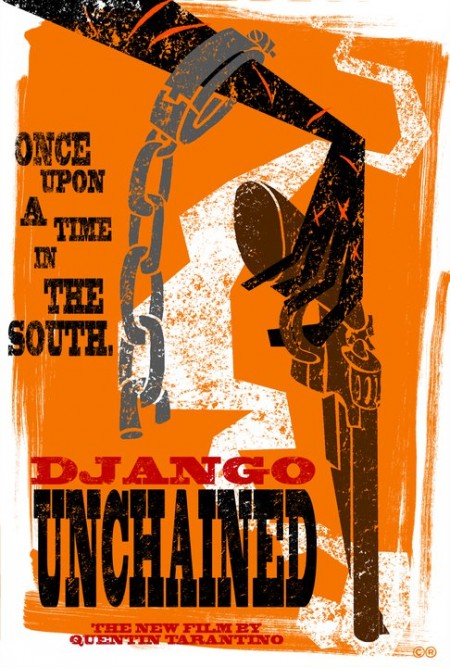
FILM / Jonah Raskin : ‘Django Unchained’ is Quentin Tarantino in Blackface

Django Unchained:
Quentin Tarantino in Blackface

At times, the movie seems like an advertisement for integration on the bounty hunting circuit, and for friendship between a black and a white man who both kill without compunction.

By Jonah Raskin / The Rag Blog / February 7, 2013

The director, Quentin Tarantino, appears on screen near the end of his new movie, Django Unchained, that has been nominated for several Oscars including best picture, best original screenplay, and best cinematography. In Django Unchained, Tarantino plays the kind of low-life character that he also plays in his classic, Pulp Fiction, which starred Samuel Jackson and John Travolta as a couple of hipster hit men.

Jackson appears in Django Unchained as an old, white-haired servant (yes, an African-American) on a sinister plantation in Mississippi before the American Civil War. He’s as sinister as the white master himself and he dies an agonizing death, as do almost all of the other characters in this retro shoot-‘em-up.

Tarantino makes his actors suffer so, or at least makes them sound as though they’re suffering. They scream and shout and wail as though they’re in extreme pain as they wriggle about bloodstained floors and bloodstained soil. You might think the director was sadistic.

Alas, John Travolta doesn’t make an appearance in this new film, though the two main characters in Django Unchained are hit men as they are in Pulp Fiction. One of them — Dr. King Schultz — is German-born; the other — Django himself — is a black slave, or rather an ex-slave. Schultz liberates him. He’s the Great Liberator.

For a time, the two men team up to kill outlaws who have prices on their heads and then collect the hefty financial rewards. It’s a good living, though they don’t ever spend it or have the opportunity to enjoy it. At times, the movie seems like an advertisement for integration on the bounty hunting circuit, and for friendship between a black and a white man who kill without compunction.

The bounty hunting life wears thin after a season and the two vicious, albeit virtuous, hit men travel into the belly of the beast of slavery to liberate Django’s slave wife who has a beautiful face, and, on her black back, another kind of beauty, if you can call the scars of a brutal beating beautiful.

Quentin Tarantino’s latest movie is his first set in the American South and it’s the first to have a large cast of African-American actors playing the roles of mostly subservient African-American slaves. Still, in many ways Django Unchained is like many of his previous movies, including Pulp Fiction. Django Unchained offers more pulp fiction — this time with an historical setting and historical costumes. The dresses are very lovely.

From nearly the first scene to nearly the last, there’s violence on the screen and almost uninterrupted violence all the way through. In that sense, Django Unchained duplicates Pulp Fiction. There are no chase scenes, but there’s a barrage of bullets, buckets of blood, and plenty of unpatriotic gore.

At the end, there’s a big explosion. Django blows up the plantation mansion with its stately white columns and rides off into the night — not the sunset — with his wife, whom he has liberated and who speaks German as well as English, but doesn’t seem to have any kind of street smarts.

All on their own, the two carpetbagger gunslingers bring a civil war of their own making to what would soon become the Confederate States of America.

Django’s pal, Dr. Schultz, dies fighting the good fight against the nasty slave owners and for the downtrodden slaves, who don’t lift a black finger to free themselves in this comic melodrama. No, sir, there is no black slave revolt in this picture. The back masses don’t seem to know what freedom is or where to find it. Dr. Schultz has to tell them to follow the North Star to freedom after he gives a group of black men the opportunity to escape bondage.

Here, as in the Westerns of old, it’s the lone gunman who makes a difference, and, though Django’s skin is black, he’s not much different, if at all, from lone white gunmen. He wears a cowboy hat and a holster, rides a horse, carries a gun, and, as one of the characters says of him, he’s “the fastest gun in the South.”

Jamie Foxx plays Django as Samuel Jackson might have played him if he were still a young man. Christoph Waltz plays a wry Dr. Schultz and Leonardo DiCaprio inhabits the role of the white plantation owner, Calvin Candie, a sadistic, sexually perverted Southern Calvinist.

Kerry Washington doesn’t speak much. But she does an admirable job as Broomhilda, Django’s long-suffering wife. Beaten, bound, gagged, and sold down the river, she’s freed by her husband who slays the dragon of slavery — on one plantation — and rescues her. She’s the archetypal black maiden; he’s the knight without shining armor but with the virtues of a Christian warrior.

Tarantino offers something for film students, something for lovers of Westerns, and something for his own cult followers. I suppose students and scholars of American history will find scenes to analyze and interpret. The best parts of the movie are pure comedy, as in the very last scene in which one of the characters looks at Django as he rides off, and asks, “Who is that black man?” Those who watched the Lone Ranger on TV will get the reference. Those who love old Westerns will also notice allusions to High Noon.

I found the whole film largely predictable. I knew that Django would rescue his wife and that they would live happily ever after. Surprisingly, I found the torture scenes more graphic and more realistic than the torture scene in Zero Ground Thirty which tracks 10 years or so in the life of the war on terrorism.

Tarantino always was effective depicting both psychological and physical torture. In Django Unchained he shows that he hasn’t lost his touch. Once again, he’s a master, and for all his gestures toward freedom and tolerance, his latest picture feels like yet another exercise in black-faced comedy.

There are no white characters who darken their faces to play black men. But the whole film feels like master Tarantino in blackface, making fun of Hollywood Westerns, Southern crackers, and the kind of Uncle Toms who first appeared in Harriet Beecher Stowe’s Uncle Tom’s Cabin. How many clichés did I count in Django? There were so many I lost count.

[Jonah Raskin is a professor emeritus at Sonoma State University, a frequent contributor to The Rag Blog, and the author of For the Hell of It: The Life and Times of Abbie Hoffman, and the editor of The Radical Jack London: Writings on War and Revolution. Read more articles by Jonah Raskin on The Rag Blog.]

The Rag Blog

Posted in Rag Bloggers | Tagged , , , , , | 1 Comment

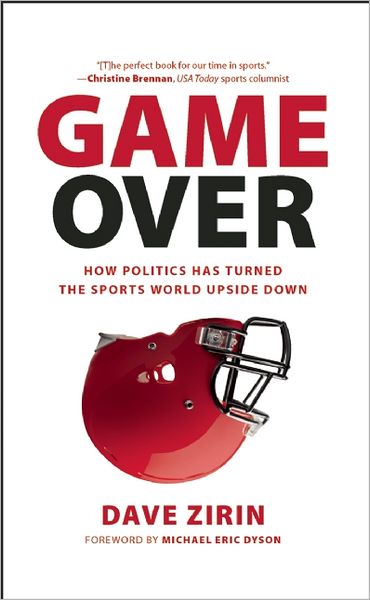
BOOKS / Ron Jacobs : Dave Zirin, the Man Who Politicized the Sports Pages

A look at Dave Zirin’s latest:
The man who politicized the sports pages

No longer can owners, managers, and commissioners argue that sports and politics must and should be separated. The taboo has been trashed. The silence has been shattered.

By Ron Jacobs | The Rag Blog | February 7, 2013

[Game Over: How Politics Has Turned the Sports World Upside Down by Dave Zirin. (2013: The New Press); Paperback; 240 pp; $18.95.]

When journalists wanted to paint crazy pictures using alliteration and description, then the place for them to write used to be in the sports section. Speculation and flights of poetic fancy were not only allowed but expected.

That most iridescent of journalists, Hunter S. Thompson, began his fabled writing career reporting on sports. One of his earliest national pieces was an impressionistic, iconoclastic report on the most famous of horse races, The Kentucky Derby.

As the reader knows, Thompson went on to produce some of the best cultural criticism and political reportage of the 1960s and 1970s. In his later years his books and articles combined his twin passions of sports and politics into a series of incisive and funny collections on the decline of U.S. civilization in the name of profit.

Thompson has never been replaced. Most sports journalists nowadays use up their ink rewriting the words of management and ownership or attacking superstars they seem to build up just to knock down. Mock expressions of shock accompany reports of steroid use and pot possession, yet there is little analysis of how and why athletes might feel the need to use either type of drug. No matter what they write about, the writing itself is all too often nothing but a repetition of press releases, especially when compared to a master like Thompson.

But wait, there is a sportswriter out there whose writing is different. His reportage includes political critique and is laced with humor and sarcasm that make your sides hurt. Considerably more radical than Thompson (especially in his later years) Dave Zirin takes the world of sports and rips it open for all to see. His latest book, titled Game Over: How Politics has Turned the Sports World Upside Down, examines the world of sports in the age of the Arab Spring, Occupy Wall Street, and their opposite in the halls of power and capital.

CLR James wrote about the meaning of cricket in the colonialist world of Trinidad; Curt Flood and Jackie Robinson, each in their own way, ripped away the mantle of racism in Major League Baseball; Jon Carlos and Tommy Smith raised their fists against the racism of Avery Brundage’s country club apartheid Olympics; Lester Rodney ripped away the white robe of racism in U.S. sport.

Dave Zirin carries this legacy into the twenty-first century, taking on those people and institutions that have crippled sports in the name of profit and power while championing those athletes and others who have used their name and position to make sports a force for change.

In his introductory remarks, Dave Zirin discusses the return of politics to the field of play. Once again, the basketball court, football field, baseball park, and hockey rink have become forums where players dare to vocalize their opinions on issues of the time. From gay rights to labor rights, racism, and war, players are once again making their opinions public and using the forum their career provides to sway public opinion.

Although Zirin concerns himself primarily with the U.S. sports world, he covers international soccer and the Olympics, too. In fact, one of his most evocative pieces in this book is titled “Today’s World Cup and Olympics.” Perhaps the most unique chapter is the chapter discussing Egypt’s Ultras.

For those who don’t know, Ultras are soccer fans found in almost every country where soccer is played who literally live and die for their team. In the case of the Egyptian Ultras, they involved themselves in the ongoing uprising in that nation and were crucial to Mubarak’s overthrow. In a very real way, these fans changed the course of their nation’s history.

Although he would probably never acknowledge it, Dave Zirin is a big part of the reason politics is back in sports. His commentary, lectures, and other appearances have challenged athletes to speak out and sportswriters to respond to the political role sports plays in the world.

No longer can owners, managers, and commissioners argue that sports and politics must and should be separated. The taboo has been trashed. The silence has been shattered.

Who would have thought when his first columns were published in the small-time Maryland weekly The Prince George’s Post a little over a decade ago that he would become a regular on ESPN, a sportswriter for The Nation and SLAM Magazine, and the author of several books; that his words would be read in the corporate boardrooms of professional sports teams and attacked by shills?

There was obviously a need for the type of writing that Zirin does and he does a remarkable job of filling that need.

One does not have to go too far back to a time when Michael Jordan’s hang time and George Steinbrenner’s Yankees were what people talked about in U.S. sports; when no player dared to speak out about issues of the day. The combination of a growing grassroots movement against imperial war, the economic policies of the “1%,” the ongoing struggle against racism, and the movement for LGBT equality have changed that.

With Zirin helping to lead the charge, the world of sports will never be the same. That, my friends, is a good thing.

Read articles by Dave Zirin at The Rag Blog.

[Rag Blog contributor Ron Jacobs is the author of The Way The Wind Blew: A History of the Weather Underground. He recently released a collection of essays and musings titled Tripping Through the American Night. His latest novel, The Co-Conspirator’s Tale, is published by Fomite. His first novel, Short Order Frame Up, is published by Mainstay Press. Ron Jacobs can be reached at ronj1955@gmail.com. Find more articles by Ron Jacobs on The Rag Blog.]

The Rag Blog

Posted in Rag Bloggers | Tagged , , , , , , | 1 Comment

Jean Trounstine : Yoga Behind Bars

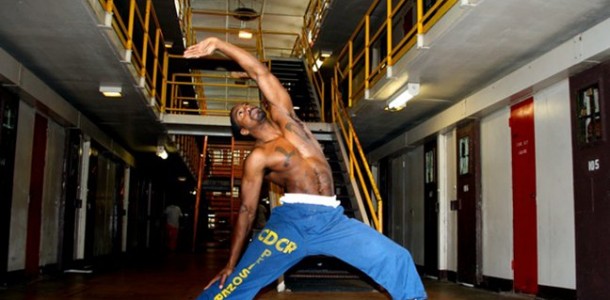
Image from the Prison Yoga Project.

Yoga behind bars

With over 2.2 million behind bars, can the ancient practice help break the cycle of recidivism and improve overall quality of life for prisoners? Here’s why prisons are willing to give yoga a shot.

By Jean Trounstine | The Rag Blog | February 6, 2013

Now that yoga is the big thing in fitness — with hot yoga, power yoga, rejuvenating yoga, and all sorts of other varieties — it is no surprise that the practice has catapulted past ashrams and wellness centers into gyms. But it might be a surprise to some that yoga has made it into prisons.

A recent article by Mary Polon in The New York Times points out “When many states have cut… programs for inmates, citing cost and political pressures, some wardens looking for a low-cost, low-risk way for inmates to reflect on their crimes, improve their fitness and cope with the stress of overcrowded prison life are turning to yoga.” You only need loose fitting clothing and mats. Particularly cheap if your teachers are volunteers.

The picture above is from one program in California where there are 20 or so yoga programs flourishing in prisons across the state. In Texas, Inside Mediation offers programs behind bars, and Geoff O’Meara, Community Yoga’s Prison Program Director, has taken yoga to incarcerated populations. While yoga programs have not yet been tracked state-wide or nationally; more and more are bound to crop up. Research studies are showing that those who take yoga classes are less likely to return to prison.

Men and women behind bars say that they are getting in on the practice as a way to learn patience, quiet their minds, and deal with the stresses of isolation. “For those of us sentenced to a life term,” wrote S.L., “time is inexorable. We are challenged to draw vitality and meaning from our circumstances. Yoga has helped me to understand that it is in quietness and stillness that time becomes an ally not a foe.”

In one male program, says the Times, prisoners helped each other do handstands. “Then, after 90 minutes of class, one hit the light switch. In the pitch-black room, the men lay on their backs,” and the teacher “led them in breathing exercises.”

Most people don’t realize how radical this is inside a prison. Turning lights out in a group of prisoners requires courage and trust on the part of the incarcerated. There is so much fear behind bars, often resulting in “You have to watch your back.” These fears, of course, are not unfounded. In addition, many prisoners are terrified to close their eyes at night, worrying that something could happen to them. Getting to a deep level of quiet and calm can be a great success, and a source of finding true moments of freedom, however brief.

When I taught at Framingham Women’s Prison in Massachusetts where I directed eight plays in 10 years, I often did breathing and meditation exercises with the women before rehearsals. Good teachers must make their students feel that they are watching out for them, that they are safe. At times, some women insisted on having their eyes open. It took a lot for them to breathe slowly, to not be afraid; others broke out into laughter. But ultimately, as trust got deeper, they did get wonderful benefits from relaxation, which is essentially a kind of meditation in stillness.

Meditation has also gained some new-found cred in prison. Meditation can help with anger, taking responsibility for one’s life, and as I learned in Sunday School, a willingness to listen to one’s own “still small voice.” A good NPR show on meditation in prison can be found here.

According to a 2011 report from the Pew Charitable Trusts, states’ spending on corrections has “quadrupled during the past two decades, to $52 billion a year.” Prisons are more willing to try programs that seem a little off the beaten path as long as they have a track record, especially as they want to improve recidivism rates and to save money.

While yoga and meditation can’t help a prisoner find a job, get a college degree, or take away stigma in our society when he returns, they are great tools for a better quality of life.

[Jean Trounstine is an author/editor of five published books and many articles, professor at Middlesex Community College in Massachusetts, and a prison activist. For 10 years, she worked at Framingham Women’s Prison and directed eight plays, publishing Shakespeare Behind Bars: The Power of Drama in a Women’s Prison about that work. She blogs for Boston Magazine and takes apart the criminal justice system brick by brick at jeantrounstine.com where she blogs weekly at “Justice with Jean.” Find her contributions to The Rag Blog here.]

The Rag Blog

Posted in Rag Bloggers | Tagged , , , | Leave a comment

Alan Waldman : ‘Waiting for God’ is My Favorite TV Sitcom Ever!

Waldman’s film and TV
treasures you may have missed:

Graham Crowden and Stephanie Cole are priceless as feisty seniors in an English retirement home.

By Alan Waldman | The Rag Blog | February 6, 2013

[In his weekly column, Alan Waldman reviews some of his favorite films and TV series that readers may have missed, including TV dramas, mysteries, and comedies from Canada, England, Ireland, and Scotland. Most are available on DVD and/or Netflix, and some episodes are on YouTube.]

It’s hard to pick my favorite TV comedy of all time because there are so many brilliantly funny ones (none of them American!) — Father Ted, Fawlty Towers, Absolutely Fabulous, The Vicar of Dibley, Chef, As Time Goes By, Blackadder, and The Thin Blue Line — but Waiting for God probably noses them all out, because its characters are so adorable, its performances are so masterful, and its writing (by Michael Aitken) is so very witty.

Also, incredibly, it deals intelligently with important issues affecting the elderly, such as marginalization, prostate problems, and senior sex.

Because our local Los Angeles PBS station ran its brilliant 48 episodes again and again, my wife and I watched and loved Waiting for God repeatedly — even though we knew which jokes were coming.

This 1990-1994 Britcom was nominated for a Best Comedy BAFTA, and Stephanie Cole justifiably was chosen the Best TV Comedy Actress at the British Comedy Awards. More than 92.8% of those rating the series at imdb.com gave it thumbs up, and 37.1% considered it a perfect 10. All five seasons are available on DVD and Netflix/Netflix Instant, and many episodes, including this one, can (and should) be enjoyed on YouTube.

Retired accountant Tom Ballard (marvelous Graham Crowden), whose mild dementia sometimes makes him think he is in swashbuckling old movies, is put away in Bayview Retirement Village in Bournemouth, England, by his milquetoast, shelving-obsessed accountant son Geoffrey (Andrew Tourelle) and his scheming, alky, serial-adulterous and pill-popping wife Marion (Sandra Payne).

There he meets, befriends, and falls in love and in league with cynical, grumpy, atheist, retired combat photojournalist Diana Trent (simply sublime Stephanie Cole) and they soon shock the community and his children with their enthusiastic sex life. Each week they cleverly conspire to thwart the machinations of vain, slimy, tightwad Bayview boss Harvey Baines (a very funny Daniel Hill). Harvey is devotedly assisted and worshipped by maddeningly cheerful, prudish, plain assistant Jane Edwards (a fabulous Janine Duvitski).

Another very funny and lovable character is little octogenarian Basil Makepeace who is forever propositioning the old lady residents and then outlandishly bragging of his conquests. One unique aspect of the series is that it is primarily told from the points-of-view of the elderly characters, with most of the younger ones depicted as buffoons.

Over the five seasons there are many surprising and enjoyable plot developments. We delighted in watching this series over and over again because it is like watching great music, with Diana’s tirades against “the idiot Baines” or Basil’s bedroom boasts becoming beloved favorite, much-anticipated arias. Check it out!

[Oregon writer and Houston native Alan Waldman holds a B.A. in theater arts from Brandeis University and has worked as an editor at The Hollywood Reporter and Honolulu magazine. Read more of Alan Waldman’s articles on The Rag Blog.]

The Rag Blog

Posted in Rag Bloggers | Tagged , , , , | Leave a comment

Bob Feldman : Labor Unions and the Communist Party Are Active in Texas, 1930-1940

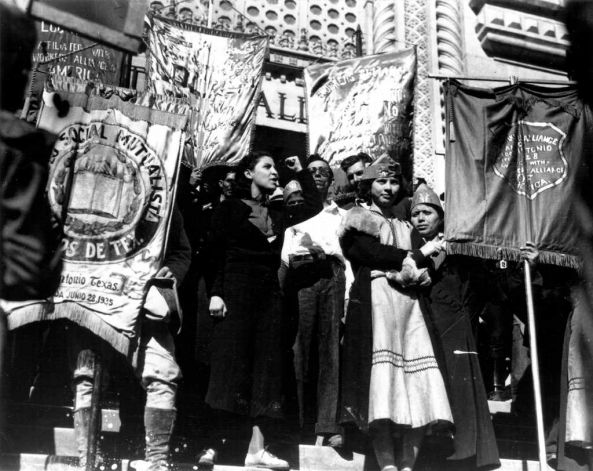
Emma Tenayuca, leader of the pecan shellers’ strike at the age of 21, stands on the steps of San Antonio’s City Hall in 1938. Tenayuca was also active in the Communist Party in Texas. Image from the Institute of Texan Cultures.

The hidden history of Texas

Part 11: 1930-1940/3 — Labor Unions and the Communist Party gain foothold in Texas.

By Bob Feldman | The Rag Blog | February 6, 2013

[This is the third section of Part 11 of Bob Feldman’s Rag Blog series on the hidden history of Texas.]

Although “throughout the 1930s, the Communist Party in Texas (Houston included) remained small and ineffectual, with no more than 200 members at any given time,” according to Merline Pitre’s In Struggle Against Jim Crow, “by the fall of 1935, the Texas Communist Party was firmly established in Houston, and literature bearing its logo was passed out everywhere along the Gulf Coast, especially where strikes occurred.”

And, coincidentally, 111,000 workers in Texas — or about 10.3 percent of all non-agricultural workers in Texas — were now organized and were members of labor unions in Texas by 1939. As F. Ray Marshall’s Labor in the South recalled:

Editorial writers at Austin had formed the first Texas American Newspaper Guild by January 1934. In May [1934] it was reported that the first contract had been negotiated with the Austin American-Statesman and “the three Austin newspapers report 100 percent membership.”…

The ILGWU organized Petrillo and Company in Dallas peacefully, but three other firms there had signed agreements only after bitter strikes following the ILGWU’s campaign in the fall of 1936. The Ladies’ Garment Workers had about 3,100 southern members in 1939, 2,100 of whom were in Texas… The Sinclair [oil workers union] local in Houston, Texas had 1,157 members in 1939 — the largest local in the South. The local was the main base for organization on the Gulf Coast, and Sinclair was the only major refinery to sign a national agreement with the oil workers.

The first major oil workers’ local in the Gulf Coast area was Local 227 at Sinclair in Houston… The Pasadena local had an average membership of 677 during 1939. The oil workers established Local 1229 for Negroes and Local 243 for whites at the Magnolia refinery at Beaumont, Texas, in 1933, but they did not win bargaining rights… Local 23 at Port Arthur, Texas, was reorganized in 1933 and attempted to win contracts from Gulf and Texaco, but the oil workers’ activities in Port Arthur were impeded by conflicts between craft and industrial unions within the refineries… The oil workers did not succeed in winning an election at the important Texas Company and Gulf refineries until 1942…

Members of the International Longshoremen’s Union [ILA] also held a strike on October 10, 1935; and “in 1938, some 12,000 pecan shellers went on strike, creating the largest labor stoppage in Texas history” and won pay increases as a result of this strike, according to Randolph Campbell’s Gone To Texas. The www.labordallas.org website described what provoked the 1938 Pecan Shellers Strike in San Antonio, Texas and what happened during the strike before a settlement was reached:

Julius Seligman hired 12,000 low-wage Mexican-Americans who labored 60 or more hours a week for an average of $2.50 per week, or about 4 cents an hour. On Feb. 1, 1938, Seligman ordered a 20 percent wage cut. The workers organized and went on strike… Police tear gassed and clubbed peaceful picketers. They invaded homes and threatened to gas people if they did not return to work.

The same Texas Labor History web site also recalled that “Emma Tenayuca of San Antonio… was the most prominent public leader of the pecan shellers’ strike that was called the most important labor action in the Southwest up to that time;” and that, coincidentally, “Tenayuca was a member of the Communist Party (CPUSA).”

In response to protests by farmers, street demonstrations of unemployed workers, and the labor movement activism of the early 1930s around the United States, the Democratic Roosevelt Administration also created federal public programs between 1933 and 1940 like the Works Progress Administration [WPA] — which provided jobs for “some 600,000… Texans without regard to gender or race” between 1935 and 1943, according to Gone To Texas.

Also, in Austin, the Public Works Administration [PWA] “pumped millions of dollars into Austin’s sagging economy and generated thousands of jobs,” according to David Humphrey’s Austin: An Illustrated History. The same book also noted that “by 1936 the PWA would provide at least $6 million in grants and loans for Austin, more than for any other Texas city during the same period;” and “the University of Texas also wangled several million dollars out of the PWA, including money for dormitories and a 27-story tower.”

And another reason Lyndon Johnson was able to first get elected to Congress in 1937 may have been that he had previously gained some local popularity with Austin voters — by  helping to provide some federally-funded work opportunities for young people in his appointed position in the New Deal’s National Youth Administration.

[Bob Feldman is an East Coast-based writer-activist and a former member of the Columbia SDS Steering Committee of the late 1960s. Read more articles by Bob Feldman on The Rag Blog.]

The Rag Blog

Posted in Rag Bloggers | Tagged , , , | 1 Comment

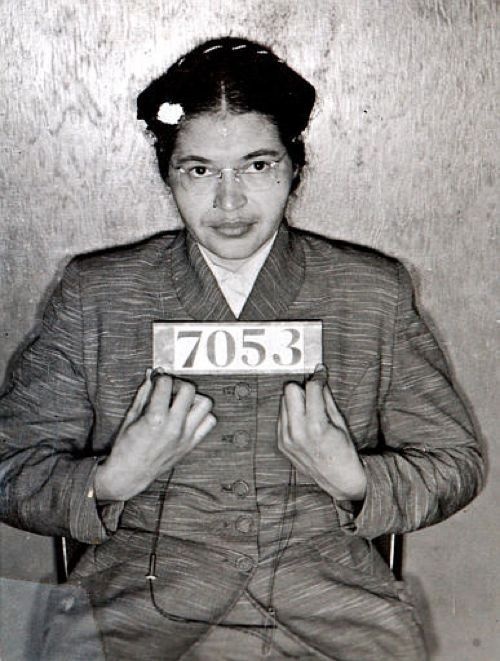
Lamar W. Hankins : Sanitizing Black History Every February

Rosa Parks, agitator. Image from Jezebel.

Sanitizing Black history every February

Rosa Parks had a life-long history of activism against injustice, but school children are seldom told the true story about her life of agitation and struggle against oppression.

By Lamar W. Hankins | The Rag Blog | February 5, 2013

I don’t like to read about Black history during February each year because most of what I find is so sanitized. Black history is full of the stuff of human history — courage, anger, intellect, rebellion, fear, intimidation, foolishness, agitation and, a hundred other descriptors. But what I hear less about than almost anything is agitation.

Dick Gregory used to say that an agitator is that thing in a washing machine that gets the dirt out. Others (notably Jim Hightower) have used that same idea to explain why agitators are needed.

The earliest use of that formulation that I have found is recounted by Mike Miller, a veteran of the Berkeley Free Speech Movement, SNCC, and the Industrial Areas Foundation (Saul Alinsky’s organization), in an article about working with SNCC in 1963 in Mississippi:

I went to a mass meeting in Ruleville — you all know that Ruleville was the home of Fannie Lou Hamer. There were maybe 20, 30 people, but we called that a mass meeting in those days. And at this mass meeting, an old Black man got up, and as he spoke he put an arm up like this, and he started moving it. And he said: “You know” — his voice was trembling — “they call you Freedom Riders outside agitators. I got an old style washing machine in my home. It has a thing at the top; it goes back and forth like this.” He pointed to his arm. He said: “You know what that thing is called? It’s called an agitator. You know what that agitator does? It gets the dirt out.”

The history of Blacks in America is filled with agitators. Of course, Martin Luther King, Jr., was an agitator, but mostly we hear only about his “I Have A Dream” speech. Malcolm X was an agitator, but most of what we hear about him is — well, we don’t hear much about him in the mainstream media.

But now we have a new book about Rosa Parks that sheds some needed light on the myth that she was just a poor seamstress whose feet were too tired to walk another step when the bus conductor in Montgomery ordered her to give up her seat to a white man.

Charles Blow reviews The Rebellious Life of Mrs. Rosa Parks in The New York Times. The book explains that Rosa Parks had grown up in a family that would not allow its members to be treated as second-class. Parks had been trained for community organization work (agitation) at the Highlander Folk School.

She had encouraged and helped to defend women who had been ordered to give up their bus seats to a white person. She was ready when the bus driver ordered her to do the same, and she refused to move, leading to her arrest and the subsequent Montgomery bus boycott that lasted over a year until the buses were desegregated. She had a life-long history of activism against injustice, but school children are seldom told the true story about her life of agitation and struggle against oppression.

If we go back to the beginning of American slavery, we find many similar stories among Blacks in North America — stories of rebellion, agitation, and often death. Africans did not go willingly into the slave ships after their capture and detention on the west coast of that continent. These Africans came mostly from the west coast and from two to three hundred miles inland from an area bordered by the Senegal River and what is now Angola.

They were from tropical rain forests and grasslands. They came from tribal backgrounds, as well as from city-states then found in the Niger Delta, and from large, complex kingdoms that had existed for several centuries in the Sudan, with whom Europeans traded. They spoke many different languages and had many different cultural traditions.

The Portuguese began the African slave trade to benefit Portugal about 50 years before slave ships headed for the North American continent. Rebellions on the slave ships led many ship owners to take out what historian Benjamin Quarles has called “revolt insurance.” Beginning in 1522, slave revolts occurred in the Caribbean from Hispaniola to Cuba, Puerto Rico, Martinique, Antigua, Barbados, Jamaica, St. Vincent, and the Virgin Islands, along with a famous one in Saint Dominique (which later became known as Haiti).

By the mid 1700s on the mainland, slaves could be found from Delaware to Texas. In the South, slave owners depended on militias to keep rebellions under control. Thom Hartmann recently explained how this worked :

In Georgia, for example, a generation before the American Revolution, laws were passed in 1755 and 1757 that required all plantation owners or their male white employees to be members of the Georgia Militia, and for those armed militia members to make monthly inspections of the quarters of all slaves in the state. The law defined which counties had which armed militias and even required armed militia members to keep a keen eye out for slaves who may be planning uprisings.

The same practices were followed elsewhere in the South, where slave patrols kept order among slaves to prevent rebellions and punish those thought to be planning to revolt. Still, slave revolts did occur. Perhaps the largest slave revolt in the continental U.S. was in 1811 near New Orleans. It took both the militias and the U.S. army to quell it.

The unsuccessful revolt planned by Denmark Vesey in Charleston, South Carolina, in 1822 was thwarted by the betrayal of some participants. Slave owners were so fearful that other slaves would learn of Vesey’s plan that a trial record of that history was destroyed so that it could not be seen by slaves or others sympathetic to their cause.

Many Americans have heard of Nat Turner’s rebellion in Virginia, which occurred nine years later, in which about 70 slaves escaped and rampaged from plantation to plantation, killing at least 55 people. Had their ammunition not run out, Turner and his group may have been successful in freeing many slaves, but realistically the odds were stacked against them.

Virginia had over 100,000 men in militias, heavily armed and outfitted, who stood ready to protect the financial interests of the slave owners. It is no wonder that more rebellions did not occur, but when they did, it was because someone was willing to be an agitator against an unjust and inhumane system.

Agitation and its companion — rebellion — also made itself known in efforts to escape slavery. Perhaps the most famous agitator for escape to freedom was Harriet Tubman, a Black woman born into slavery. She escaped from slavery when she was 19 and subsequently helped more than 300 other slaves escape.

She reportedly always carried a gun because she had no intention of ever being enslaved again or having the fugitives she helped enslaved. For Tubman, she would either be free or dead: “There was one of two things I had a right to, liberty or death; if I could not have one, I would have the other; for no man would take me alive.”

Another escaped slave who became one of the most famous Black people of his time, both before and after the Civil War, was Frederick Douglass, who was a lecturer, newspaper editor, and writer. Perhaps Douglass’s most famous words are these:

The whole history of the progress of human liberty shows that all concessions yet made to her august claims have been born of struggle… If there is not struggle, there is no progress. Those who profess to favor freedom and yet deprecate agitation, are men who want crops without plowing the ground. They want rain without the thunder and lightning. They want the ocean without the awful roar of its many waters. The struggle may be a moral one; or it may be a physical one; or it may be both moral and physical, but it must be a struggle. Power concedes nothing without a demand. It never did and it never will.

While I’ve barely scratched the surface of the Black agitators who helped move this country forward and helped it escape its disgusting past, we need always remember that progress does not come without the agitators. Especially during Black history month, we should remember this lesson, and teach our children, as well as the adults, about our agitators, especially our Black agitators.

We need to stop whitewashing these agitators, sentimentalizing and sanitizing what they did, and acknowledge that it was their agitation that made the difference in our struggle to achieve freedom, equality, and justice for all people — whether they are black, brown, yellow, white, or a blend of colors.

[Lamar W. Hankins, a former San Marcos, Texas, city attorney, is also a columnist for the San Marcos Mercury. This article © Freethought San Marcos, Lamar W. Hankins. Read more articles by Lamar W. Hankins on The Rag Blog.]

The Rag Blog

Posted in Rag Bloggers | Tagged , , , , , | Leave a comment