Word Passed Down
through Forbidden Radio

for Chuck Kinder and John Sinclair on their birthdays, October 2012

The voices beside your pillow, friends past midnight, Wailing from the River, whistling through the Gaps, Bring tales and tones so pure and sexual they lift you like a knife. Their guitars and drums like Indians, slaves and Gospels freed, Raise heroes from the outlaw, racing in the streets, All they say truer than what’s on your parents’ new TV.

The Hill!–the Hill!–shines beyond Highways’ humming fins The Hill!–the Hill!–gives you Muddy Waters and Hazel Dickens The Hill!–the Hill!–is gained by going out past Main Street The Hill!–the Hill!–asks you to dance like one who can’t be seen Ree-bel! Ree-bel! Ree-bel! Ree-bel!

What is this America but promises That those left out May rise according to their worth? What is it but best minds and hearts In red jackets ripped apart? What Wars and wars haunt Desks of Insurance agents? What results are outright when the Road is open, Fields are level, and choices abundant? What more might happen to Motor Cities After Bebop, Doowop, and John Coltrane chords– Yes, chords from notes– Joined with Highland melodies? What more might you do with your pillows’ pain, Hungry ears’ wound and bow?

John reached out to make Rock free as jazz. John reached out to bring White into Black. John reached out to smoke and drink and fuck Upside-down or any other way he liked. John risked his life for all he felt gave some light. Chuck punched his way out of West Virginia parking-lots. Chuck claimed seven Armed Robberies when age seventeen. Chuck dove into Elizabethans, Matthew Arnold, The Golden Bough, and McCluhan with the same drive. Chuck brought friends West to share in edges’ glow.

Decades pass. Partners split and losses wrench. Knives of Indians and Blacks show up outside bars. Water Follies lap against corpses found in the Ocean. Jimmy Carter, Ronald Reagan, a Bush and a Clinton Are President. John and Chuck smoke and drink, Teach, create, promote and inspire More who listen and talk around their tables. They maintain Forbidden radio. They can be ignored but not stopped. Their beards thin to catch light.

What is that word abideth Night? What is that sound of Spirit bright? What holds the hand that grips your hand On what might have been your death-bed? What plays the horns of devotees who want to be For all time and a force for good? What is that force made strangers by your pillow friends? What is that word? That word is Love.

Gather round the company, Share the love around.

Bring on wine. Bring on Fats. Bring on Eric And thousands welcome gamblers and clowns. Bring on Jack, bring on herb. Bring on Aunt Tee, bring on Aunt Bea. Bring on Demons of basepaths and night-sweats. Bring on Mardi Gras Black Indians’ gifts every year Of brilliance sewn into design. Bring on the giant night and whole works of sunsets over water. The word–the thing, the thing we know, Beyond our words, at last, that thing we heard So ‘way back when, our out and light and balm, That thing is Love. Gods bless this merry company, Share the love around. Don Paul

Type rest of the post here

Source /

The Rag Blog

Posted in RagBlog | Leave a comment

I drank the booze today, oh boy Losing the Plot James McEnteer Down at the neighborhood tavern, I was listening for the umpteenth time to my friend Barney lament how food stamps are not accepted for alcohol. Like me, Barney’s been out of work almost two years now. He’s been through the five stages of grief more than once. About the third beer he segued into his second-favorite topic, the terrible conflicts caused by religious intolerance. Barney considers himself devoted to the Rodney King school of public thought: why can’t we all just get along? News came on the TV that some Iranian cleric raised the bounty on the life of Salman Rushdie, from $2.8 to $3.3 million dollars. “Those guys are nuts,” I said. “Rushdie didn’t even do anything. It was some bozo in California made that anti-Islam movie that pissed off all the Muslims. So why are they getting back on his case again?” “Those California people are kind of obscure. Rushdie’s high profile…” “So they go after the famous guy instead of the guys who actually did it?” “Hey, I don’t think he’s worried. I mean, they couldn’t get Rushdie before. They put that original price on his head back in 1989, when three million bucks really meant something. And nobody ever got near him. He finally quit hiding and went back to his normal life of international celebrity.” “Three point three million isn’t exactly chump change…” “How do you suppose a bunch of Iranian religious fanatics happened to come by that much cabbage anyhow?” “Maybe they put the squeeze on the faithful.” “Maybe we ought to go after that money ourselves,” said Barney. “What? Assassinate Salman Rushdie? Are you nuts?” “Well, I mean, we wouldn’t really have to kill him. We could just make him disappear and pretend he’s dead…” “The Iranians would never believe it.” “Hey, it worked with Osama bin Laden, no? Is he really dead? Was he buried at sea, like they said? There was no corpse. Did he ever really exist?” “How could we make Rushdie disappear?” “Well, he’d have to help us.” “And why would he do that?” “To take the pressure off himself. If the Iranians think he’s dead, they’ll stop coming after him, won’t they? Maybe we could sweeten the pot for him too. You know, split the fatwa cash. Give him the half million the Iranians just added…” “But Rushdie loves the limelight. He’s not just going to walk away.” “Give me limelight and give me death? What kind of a choice is that? Even Rushdie must realize that discretion is the better part of valor…” “He would never go along with those kind of cliches,” I said. “And even if Rushdie agreed to such a crazy scheme, we’d still have to offer some kind of proof to the Iranians.” “How hard could it be to come up with a body? People die every day in one disaster or another. We could pay a Hollywood makeup genius to craft Rushdie’s head out of silicon, then hire some starving crazies to parade it through the streets of Benghazi on a stick, shouting ‘God is great!’” “Sounds sketchy to me, Barn. What if the Iranians refused to pay up?” “Then it’s back to the Power Ball Lottery for us, I guess. And let Netanyahu kick off World War Three. If the Iranians won’t pay up, fuck em.” “Yeah, they probably don’t even have the dough. What’re you drinkin?” “Well, I’d like to try some of whatever Mitt Romney sucked down before he gave that speech calling half of Americans freeloaders. He had to be high…” “No, man. He’s a Mormon. He doesn’t drink booze.” “You mean, he was just being Mormonic?” “Something like that…” “Well, there’s always the Hong Kong option.” “What do you mean?” “There’s a wealthy Hong Kong tycoon offering $ 65 million dollars to any guy who’ll marry his daughter. He says: ‘I don’t care if he’s rich or poor. The important thing is that he’s generous and kind-hearted’…” “That could be either one of us. What’s wrong with her?” “Nothing. I saw her photo. She’s very nice looking, in her early thirties.” “There must be a line of guys around the block.” “There is one complication. She’s already married to her girlfriend.” “Ah, so… Well, nobody’s perfect.” “You are generous and kind-hearted…” “Yeah, but that’s what keeps me from the only other get rich quick scheme I know.” “Which is what?” “Running for political office.” “You gotta draw the line somewhere.” “See, you’re not cut out for politics either.” “This presidential election is too spooky anyway.” “What do you mean?” “An empty chair running against an empty suit. That’s just weird. “When’s the next Power Ball draw anyway?” “Friday night.” “Then there’s still time.” James McEnteer lives in Quito, Ecuador.

Type rest of the post here

Source /

The Rag Blog

Posted in RagBlog | Leave a comment

Tom Hayden : Dark-Skinned Democracy Wins in Venezuela

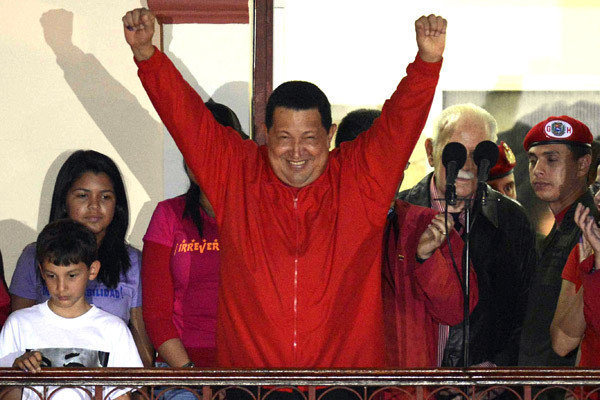
Venezuelan President Hugo Chavez celebrates with a crowd of supporters after winning reelection. Photo by Juan Barreto / Getty Images.

Chavez’ Bolivarian Revolution:
Dark-skinned democracy
wins in Venezuela

Modern liberals see something ominous in the Chavez mandate. They frequently opine that the dark-skinned poor are an uneducated, worshipful, populist mass of people subject to the Leader’s hypnotic speeches.

By Tom Hayden | The Rag Blog | October 11, 2012

Hugo Chavez was reelected president of Venezuela by a 56-44 percent margin on October 7, extending his 14-year revolutionary tenure for another six-year term. The margin was significantly closer than in previous campaigns, and set the stage for legislative elections this December.

Chavez was carried to victory by the dark-skinned voters who form the core of his revolutionary experiment, and against the continuing skepticism of mainstream liberal media like The New York Times and leaders of both U.S. political parties. At the beginning of his term, President Obama offered a friendly handshake to Chavez at a summit of the Americas, but hard-line administration officials, whom Obama both inherited and kept on their jobs, smothered that initial thaw.

In the established consensus view, Latin America was divided by a “good” left — for example, Brazil and Chile — and a “bad” left led by Chavez along with Cuba, Bolivia, Ecuador, Argentina, Nicaragua, occasionally Peru, and Honduras before the coup. The dividing line seemed not to be whether the countries in question held democratic elections, but whether they adjusted to the agenda of international financial institutions (IFIs). The division was awkwardly constructed on the model of the Cold War.

The official Obama Venezuela policy, articulated by his former security adviser, Daniel Restrepo, has been to de-escalate the tension and threats of open destabilization, while at the same time doing little to nothing publicly to improve the bilateral relationship.

Mitt Romney condemned Obama on Monday as being too soft on Venezuela.

Chavez’ opponent, Henrique Capriles Radonski, a 40-year-old former legislator and scion of a wealthy developer, managed to unite a fragmented Venezuelan opposition. The United States was invisibly neutral in the process.

Chavez is being treated for cancer in Cuba, not only because of the medical skills of Cuban doctors, but because the Cuban government has held tightly to any news of his condition, which would have been the subject of daily tabloid gossip if Chavez was being treated in Caracas.

Nevertheless, Chavez has been away for prolonged periods, indicating to many Venezuelans that his time in power might be short-lived and the future uncertain. Continuing problems of crime, violence, and institutional dysfunction formed the basis of Capriles’ challenge. But Chavez’s indisputable claims to have sharply reduced poverty and improved health care for the poor sustained his march to victory.

The core, though not all, of Chavez’ support came from the long-disenfranchised, dark-skinned sector of Venezuelans. According to most accounts, one-fifth of the population is white, while the rest are mestizo (mixed), African and indigenous, historically the most oppressed sectors of Venezuelan society.

Electoral turnout was 80 percent for the election, consistent with a pattern of high mobilization during Chavez’ tenure in office. Venezuela under Chavez has been the site of more presidential, legislative, and local elections and referenda than any country on earth. Reputable observers like former President Jimmy Carter have recognized its electoral process to be fair.

But The New York Times, the U.S. State Department, and some on the liberal-left spectrum remain hostile to the Venezuelan government no matter how many elections it wins. Their skepticism ranges from legitimate issues such as Chavez’ caudillo style of governing to a belief that Chavez is building a dictatorship through democratic elections.

For example, Obama’s adviser to the 2009 Summit of the Americas, Jeffrey Davidow, a former ambassador to Venezuela during the era preceding Chavez, warned in 2007 of a “creeping coup” through democratic elections. Chairing a regional meeting of the Trilateral Commission in Cancun, Davidow asked, “What do other countries do when a country votes itself out of democracy? It’s an interesting question. At least it’s interesting to me.” (Hayden, Tom. “Obama and His Dinosaur in Trinidad,” April 21, 2009)

Corporate-oriented diplomats like Davidow may fear that Venezuelan democratic socialism is a creeping democratic threat to private American economic interests — including oil — in the future. Or they harbor an unconscious imperial bias going back to the Monroe Doctrine.

But modern liberals like the Times editors and reporters also see something ominous in the Chavez mandate. They frequently opine that the dark-skinned poor are an uneducated, worshipful, populist mass of people subject to the Leader’s hypnotic speeches. They complain that the Chavez base is subsidized by grants for eye care, preventive health care, housing, schooling, and, above all, government jobs. Thus, their argument suggests, Chavez has an unfair structural advantage, a lock on the electorate, due to his misiones (government programs).

For good measure, a front-page Times article asserted last week that the majority would vote for Chavez out of fear that he would somehow read their ballots and have them fired. (Neuman, William. New York Times, “Fears Persist Among Venezuelan Voters Ahead of Election,” October 5, 2012.)

On the surface, the argument would seem specious when 45 percent of the electorate votes, rallies, and protests loudly against Chavez year after year. They even voted against Chavez in 2007 when he sought to run for reelection indefinitely. Venezuela is a wildly argumentative society.

But there is an establishment fear that resembles that of Mitt Romney in his off-the-record condemnation of the “shiftless” 47 percent who will vote for Obama because they are blindly dependent on federal spending. In this view, such people are an unqualified populist mass of voters, whether they live in Harlem or Caracas.

Chavez runs “a well-oiled patronage system, a Tammany Hall-like operation,” according to the Times. What is ignored in this criticism is the historic discrimination and exclusion that made possible the rise of Tammany politics, and the fact that most people will excuse corruption if the corrupt machine delivers, which Chavez is so far able to do.

These are the same assumptions that underlie the modern neoliberal opposition to public (that is, government) spending, public works projects, public education, and public radio and television programming. The implicit “solution” is not to make these programs more transparent and accountable, but to privatize every sector of life possible. And that the voters of Venezuela will not do.

It is true that some Chavistas are so reflexively protective of the Bolivarian Revolution that they have difficulty criticizing the regime on any count. But any radical or revolutionary movement in power is bound to encounter intractable policy problems and harbor a tendency toward insulation and aggrandizement.

It appears that the Chavez era is beginning to wane, if only because of time and mortality. How to manage a gradual transition is a major challenge the Bolivarian civil society, party activists and intellectuals all face. The regional power balance will be at stake. Tragically, the United States and its mainstream policy intellectuals are unlikely to be constructive good neighbors.

[Tom Hayden is a former California state senator and leader of Sixties peace, justice, and environmental movements. He currently teaches at Pitzer College in Los Angeles. His latest book is The Long Sixties. Hayden is director of the Peace and Justice Resource center and editor of The Peace Exchange Bulletin. Read more of Tom Hayden’s writing on The Rag Blog.]

The Rag Blog

Posted in Rag Bloggers | Tagged , , , , , | Leave a comment

RAG RADIO / Thorne Webb Dreyer : Tova Andrea Wang & Harvey Wasserman on Voter Suppression in America

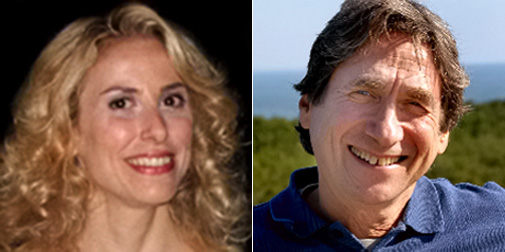
Author Tova Andrea Wang and journalist Harvey Wasserman were Thorne Dreyer’s guests on Rag Radio, produced in the studios of KOOP-FM in Austin, on Friday, Oct. 5, 2012.

Rag Radio podcast:
Tova Andrea Wang and Harvey Wasserman
on voter suppression in America

By Thorne Webb Dreyer | The Rag Blog | October 11, 2012

Author Tova Andrea Wang and journalist Harvey Wasserman discussed voter suppression and voter theft in America on Rag Radio, Friday, October 5. Rag Radio is a syndicated radio show produced in the studios of KOOP-FM, a cooperatively-run, all-volunteer community radio station in Austin, Texas.

Wang and Wasserman talked about the racially-charged issue of “voter fraud” and the controversy over Voter IDs and the related court cases; the dangers posed by electronic voting machines and the history of alleged election theft in Ohio, Florida, and elsewhere; and the use of voter suppression in partisan politics, almost exclusively (in recent history) by the Republican Party.

Listen to Thorne Dreyer’s Rag Radio interview with Tova Andrea Wang and Harvey Wasserman here.


Rag Radio features hour-long in-depth interviews and discussion about issues of progressive politics, culture, and history. It is broadcast live on KOOP Fridays at 2 p.m. (CDT) and streamed live on the Internet, and is rebroadcast on WFTE-FM in Mt. Cobb and Scranton, PA., on Sunday mornings at 10 (EDT).

Tova Andrea Wang, a nationally-known expert on election reform and political participation, is Senior Democracy Fellow at Demos. She was Executive Director of the Century Foundation’s Post-2004 Election Reform Group, and was staff person to the National Commission on Federal Election Reform. She is the author of The Politics of Voter Suppression: Defending and Expanding Americans’ Right to Vote, a Century Foundation Book published this year by Cornell University Press.

Wang told the Rag Radio audience that “voter fraud at the polling places is virtually nonexistent, as has been proven time and time again,” but that efforts at voter suppression, especially on the part of Republican-led state legislatures,  “has been extraordinary. An assault on voting rights that we haven’t seen in many years. Probably not since the civil rights movement in the Sixties.”

She also pointed to right-wing groups like the Houston-based True the Vote (“a bunch of white people going primarily to African-American precincts and challenging people”) that is “vowing to recruit a million people to go to the polls” and harass potential voters.

“Of course, historically, race has been a factor,” in voter disenfranchisement, she said. “But it has always been to some degree coupled with partisanship. It’s no secret to anyone that African-Americans vote overwhelmingly for Democrats. And so, from the Republican perspective, if you’re willing to go to any lengths to win an election, then excluding blacks from the voting process is part of your campaign strategy.”

And now, with polls showing that Latinos are going “probably more than two-to-one” for the Democrats, they “have a big target on them, as people that the Republicans will want to keep from voting,” Wang said. “And it all gets tied up in anti-immigrant rhetoric… to make people fearful, even people who are lawful citizens.”

Tova Andrea Wang’s commentary on election reform has appeared in The New York Times, The Washington Post, and numerous other print outlets, and she has frequently appeared on national radio and television programs, including NBC’s Today Show and ABC’s Nightly News and Good Morning America, and on CBS, CNN, MSNBC, and NPR.

Joining Wang on Rag Radio was longtime alternative journalist Harvey Wasserman, who is the author or co-author of a dozen books. With Bob Fitrakis, he broke a number of stories about the alleged theft of the 2004 presidential election in Ohio. Their investigative reporting at www.freepress.org prompted Rev. Jesse Jackson to call them “the Woodward and Bernstein of the 2004 election.” Will the GOP Steal America’s 2012 Election? is their fifth book on election protection.

Wasserman believes that, “unless Barack Obama is way, way ahead on election day… it is a virtual guarantee that Mitt Romney is going to become president — because of the voter suppression that could eliminate 10 million or more likely Democratic voters,” as has been estimated by the Brennan Center at New York University, and because of “the relative ease by which the electronic voting machines can be flipped” in nine key states with Republican governors.

“We saw it happen in 2004 in Columbus, Ohio. John Kerry was ahead by four points on election night,” he said, “and then there was a so-called glitch in the vote count, and the tallies stopped coming. And then suddenly at two in the morning George W. Bush was ahead by two points. That was a flip of six points which is a virtual statistical impossibility.”

Wasserman says that electronic voting machines are a special danger because “legitimate monitoring” of them “is not physically possible,” and that most “are owned and operated by Republican companies.” He thinks that there should at least “be paper ballots as a backup at every polling station.”

Another related issue, according to Wasserman, is the Electoral College (“the only college in which George Bush actually excelled”). “We still have in place this anachronism that allows the guy who comes in second to become president,” he said. “The electoral college narrows down the number of states you have to steal or buy in order to put someone in the White House,” and it discourages political involvement in parts of the country that aren’t in play in the presidential election.

“No one else has an electoral college like this. It’s a holdover from slavery.”

Harvey Wasserman is also a political activist who, with Bonnie Raitt, Jackson Browne, Graham Nash, and others, helped found www.nukefree.org. His writing is published at The Huffington Post, BuzzFlash, and CounterPunch, and his reports on election theft and nuclear power issues appear regularly on The Rag Blog.

The news isn’t all bad, according to Tova Wang. “A coalition of civil rights groups has been able to have a great impact over the last year, and were able to get a number of governors to veto voter ID laws,” she said. “And in some places, like Virginia for example, we were able to soften the type of ID law.”

“But there is tremendous confusion” about the laws, and, “between now and election day, we need to educate, educate, educate.”

“We have had some success in the courts” against repressive ID laws, Wang says, but “it’s kind of sad that we’re back to relying on the courts for voting rights.”

Harvey Wasserman adds, “It’s part of our American heritage that people have the right to vote, and we need to get people to come out to be poll workers,” and to make sure that potential voters aren’t intimidated.

And Tova Wang points out that “we were all excited with a 61 percent turnout in 2008. That’s terrible.”

“The problem in this country is that not enough people vote. Let’s talk about what we’re going to do about that, which is the real crisis in our democracy.”

Rag Radio, which has aired since September 2009, is produced in association with The Rag Blog, a progressive internet newsmagazine, and the New Journalism Project, a Texas 501(c)(3) nonprofit corporation.

The host and producer of Rag Radio is Rag Blog editor and long-time alternative journalist Thorne Dreyer, a pioneer of the Sixties underground press movement. Tracey Schulz is the show’s engineer and co-producer.

All Rag Radio shows are posted as podcasts and can be found at the Internet Archive.

Rag Radio can be contacted at ragradio@koop.org.

Coming up on Rag Radio:
THIS FRIDAY, October 12, 2012: Peace and Justice activist Tom Hayden speaks on “The Peace Movement, the Drug War, and the Legacy of Port Huron.”
October 19, 2012: Singer-Songwriter, Satirist, Mystery Writer, and Politician Kinky Friedman.
October 26, 2012: Historian Martin Duberman, author of Howard Zinn: A Life on the Left.

The Rag Blog

Posted in Rag Bloggers | Tagged , , , , , , , , | Leave a comment

Jack A. Smith : Obama and Romney Differ Little on Foreign Policy

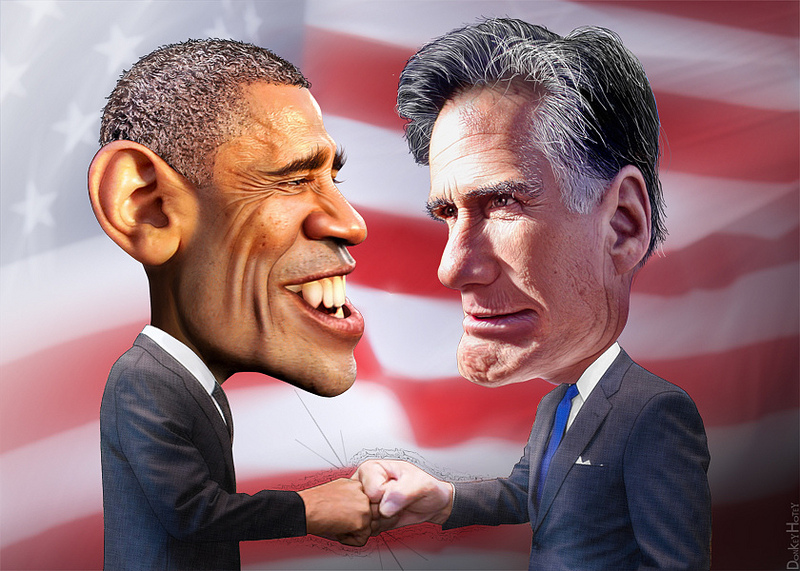
Obama and Romney: Birds of a feather? Caricature by DonkeyHotey.

Birds of a feather?
Obama and Romney have
similar views on foreign policy

The back and forth between the candidates on international issues is largely about appearance, not substance.

By Jack A. Smith | The Rag Blog | October 11, 2012

Despite the sharp charges and counter-charges about foreign/military and national security policy there are no important differences on such matters between President Barack Obama and challenger Mitt Romney. The back and forth between the candidates on international issues is largely about appearance, not substance.

The Washington Post noted Sept. 26 that the two candidates “made clear this week that they share an overriding belief — American political and economic values should triumph in the world.” Add to that uplifting phrase the implicit words “by any means necessary,” and you have the essence of Washington’s international endeavors.

There are significant differences within the GOP’s right wing factions — from neoconservatives and ultra nationalists to libertarians and traditional foreign policy pragmatic realists — that make it extremely difficult for the Republicans to articulate a comprehensive foreign/military policy. This is why Romney confines himself to criticizing Obama’s international record without elaborating on his own perspective, except to imply he would do everything better than the incumbent.

Only nuances divide the two ruling parties on the principal strategic international objectives that determine the development of policy. Washington’s main goals include:

  • Retaining worldwide “leadership,” a euphemism for geopolitical hegemony.
  • Maintaining the unparalleled military power required to crush any other country, using all means from drones to nuclear weapons. This is made clear in the incumbent administration’s 2010 Quadrennial Defense Review (QDR), the 2010 Nuclear Posture Review (NPR), and the January 2012 strategic defense guidance titled, “Sustaining U.S. Global Leadership: Priorities for 21st Century Defense.”
  • Containing the rise of China’s power and influence, not only globally but within its own East Asian regional sphere of influence, where the U.S. still intends to reign supreme. Obama’s “pivot” to Asia is part of Washington’s encirclement of China militarily and politically through its alliances with key Asian-Pacific allies. In four years, according to the IMF, China’s economy will overtake that of the U.S. — and Washington intends to have its fleets, air bases, troops, and treaties in place for the celebration.
  • Exercising decisive authority over the entire resource-rich Middle East and adjacent North Africa. Only the Iranian and Syrian governments remain to be toppled. (Shia Iraq, too, if it gets too close to Iran.)
  • Provoking regime change in Iran through crippling sanctions intended to wreck the country’s economy and, with Israel, threats of war. There is no proof Iran is constructing a nuclear weapon.
  • Seeking regime change in Syria, Shia Iran’s (and Russia’s) principal Arab ally. Obama is giving political and material support to fractious rebel forces in the civil war who are also supported by Saudi Arabia, Qatar, and Turkey. The U.S. interest is in controlling the replacement regime.
  • Weakening and isolating Russia as it develops closer economic and political ties to China, and particularly when it expresses opposition to certain of Washington’s less savory schemes, such as continuing to expand NATO, seeking to crush Iran and Syria, and erecting anti-missile systems in Europe. In 20 years, NATO has been extended from Europe to Central Asia, adjacent to China and former Soviet republics.
  • Continuing the over 50-year Cold War economic embargo, sanctions, and various acts of subversion against Cuba in hopes of destroying socialism in that Caribbean Island nation.
  • Recovering at least enough hegemony throughout Latin America — nearly all of which the U.S. dominated until perhaps 15 years ago — to undermine or remove left wing governments in Venezuela, Bolivia, and Ecuador.
  • Significantly increasing U.S. military engagement in Africa.

Both the right/far right Republican Party and the center right Democratic Party agree on these goals, although their language to describe them is always decorated with inspiring rhetoric about the triumph of American political and economic values; about spreading democracy and good feeling; about protecting the American people from terrorism and danger.

Today’s foreign/military policy goals are contemporary adaptations of a consistent, bipartisan international perspective that began to take shape at the end of World War II in 1945. Since the implosion of the Soviet Union ended the 45-year Cold War two decades ago — leaving the U.S. with its imperialist ambitions as the single world superpower — Washington protects its role as “unipolar” hegemon like a hungry dog with a meaty bone.

The people of the United States have no influence over the fundamentals of Washington’s foreign/military objectives. Many Americans seem to have no idea about Washington’s actual goals. As far as a large number of voters are concerned the big foreign/military policy/national security issues in the election boil down to Iran’s dangerous nuclear weapon; the need to stand up for Israel; stopping China from “stealing” American jobs; and preventing a terrorist attack on America.

Since Romney has no foreign policy record, and he’ll probably do everything Obama would do only worse (and he probably won’t even win the election) we will concentrate mainly on Obama’s foreign/military policy and the pivot to China.

One reason is the ignorance of a large portion of voters about past and present history and foreign affairs. Another is that many people still entertain the deeply flawed myths about “American exceptionalism” and the “American Century.” Lastly, there’s round-the-clock government and mass media misinformation.

After decades of living within an aggressive superpower it is no oddity that even ostensibly informed delegates to the recent Republican and Democratic political conventions engaged in passionate mass chanting of the hyper-nationalist “USA!, USA!, USA!,” when they were whipped up by party leaders evoking the glories of killing Osama bin-Laden, patriotism, war, and the superiority of our way of life.

Since Romney has no foreign policy record, and he’ll probably do everything Obama would do only worse (and he probably won’t even win the election) we will concentrate mainly on Obama’s foreign/military policy and the pivot to China.

One of President Obama’s most important military decisions this year was a new strategic guidance for the Pentagon published January 5 in a 16-page document titled “Sustaining U.S. Global Leadership: Priorities for 21st Century Defense.”

The new doctrine is the response by the White House and Congress to the stagnant economy and new military considerations. It reduces the number of military personnel and expects to lower Pentagon costs over 10 years by $487 billion, as called for by the Budget Control Act of 2011. This amounts to a cut of almost $50 billion a year in an overall annual Pentagon budget of about $700 billion, and most of the savings will be in getting rid of obsolete equipment and in payrolls. This may all be reversed by Congress.

Introducing “Sustaining U.S. Global Leadership” to the media, Obama declared:

As we look beyond the wars in Iraq and Afghanistan — and the end of long-term nation-building with large military footprints — we’ll be able to ensure our security with smaller conventional ground forces. We’ll continue to get rid of outdated Cold War-era systems so that we can invest in the capabilities that we need for the future, including intelligence, surveillance and reconnaissance, counterterrorism, countering weapons of mass destruction, and the ability to operate in environments where adversaries try to deny us access.

So, yes, our military will be leaner, but the world must know the United States is going to maintain our military superiority with armed forces that are agile, flexible and ready for the full range of contingencies and threats.

Following the president, Secretary of Defense Leon Panetta declared:

As we shift the size and composition of our ground, air, and naval forces, we must be capable of successfully confronting and defeating any aggressor and respond to the changing nature of warfare. Our strategy review concluded that the United States must have the capability to fight several conflicts at the same time.

We are not confronting, obviously, the threats of the past; we are confronting the threats of the 21st century. And that demands greater flexibility to shift and deploy forces to be able to fight and defeat any enemy anywhere. How we defeat the enemy may very well vary across conflicts. But make no mistake, we will have the capability to confront and defeat more than one adversary at a time.

The Congressional Research Service summarized five key points from the defense guidance, which it said was “written as a blueprint for the joint force of 2020.”

They are:

  1. A shift in overall focus from winning today’s wars to preparing for future challenges.
  2. A shift in geographical priorities toward the Asia and the Pacific region while retaining emphasis on the Middle East.
  3. A shift in the balance of missions toward more emphasis on projecting power in areas in which U.S. access and freedom to operate are challenged by asymmetric means (“anti-access”) and less emphasis on stabilization operations, while retaining a full-spectrum force.
  4. A corresponding shift in force structure, including reductions in Army and Marine Corps endstrength, toward a smaller, more agile force including the ability to mobilize quickly. [The Army plans to cut about 50,000 from a force of 570,000. In 2001 there were 482,000.]
  5. A corresponding shift toward advanced capabilities including Special Operations Forces, new technologies such as intelligence, surveillance, and reconnaissance (ISR) and unmanned systems, and cyberspace capabilities.

Here are the new military priorities, according to Obama’s war doctrine (notice the omission of counter-insurgency, a previous favorite):

  • Engage in counterterrorism and irregular warfare.
  • Deter and defeat aggression.
  • Project power despite anti-access/area denial challenges.
  • Counter weapons of mass destruction (WMD).
  • Operate effectively in cyberspace and space.
  • Maintain a safe, secure, and effective nuclear deterrent.
  • Defend the homeland and provide support to civil authorities.
  • Provide a stabilizing presence.
  • Conduct stability and counterinsurgency operations.
  • Conduct humanitarian, disaster relief, and other operations.

In an article critical of the military and titled “A Leaner, More Efficient Empire,” progressive authors Medea Benjamin and Charles Davis wrote:

In an age when U.S. power can be projected through private mercenary armies and unmanned Predator drones, the U.S. military need no longer rely on massive, conventional ground forces to pursue its imperial agenda, a fact President Barack Obama is now acknowledging. But make no mistake: while the tactics may be changing, the U.S. taxpayer — and poor foreigners abroad — will still be saddled with overblown military budgets and militaristic policies.

“Over the next 10 years, the growth in the defense budget will slow,” the president told reporters, “but the fact of the matter is this: It will still grow.” In fact, he added with a touch of pride, it “will still be larger than it was toward the end of the Bush administration,” totaling more than $700 billion a year and accounting for about half of the average American’s income tax. So much for the Pentagon’s budget being slashed.

The Obama Administration’s so-called pivot to the Asia-Pacific region, actually East and South Asia (including India) and the Indian Ocean area, was unveiled last fall — first in an article in Foreign Policy magazine by Secretary of State Hillary Clinton titled “America’s Pacific Century,” then with attendant fanfare by President Obama on his trip to Hawaii, Australia and Indonesia.

The “pivot” involves attempting to establish a U.S.-initiated free trade zone in the region, while also strengthening Washington’s ties with a number of existing allied countries, such as Japan, South Korea, the Philippines, Vietnam, Thailand and India, among others. A few of these allies have sharp disagreements with China about claims to small islands in the South China Sea, a major waterway for trade and commerce. The U.S., while saying it is neutral, is siding with its allies on this extremely sensitive issue.

Over the months it has become clear that the principal element of the “pivot” is military, and the allies are meant to give the U.S. support and backing for whatever transpires.

The U.S. for decades has encircled China with military might — spy planes and satellites, Navy warships cruising with thousands of personnel nearby and in the South China Sea, 40,000 U.S. troops in Japan, 28,000 in South Korea, 500 in the Philippines, many thousands in Afghanistan, plus a number of Pacific island airbases.

This development cannot be separated from the increasing economic growth and potential of China in relation to the obvious beginning of America’s decline. Washington may remain the world hegemon for a couple of more decades — and Beijing is not taking one step in that direction and may never do so.

Now it turns out that the Navy is moving a majority of its cruisers, destroyers and aircraft carrier battle groups from the Atlantic to the Pacific. In addition old military bases in the region are being refurbished and new bases are under construction. Australia has granted Obama’s request to allow a Marine base to be established in Darwin to accommodate a force of 2,500 troops. Meanwhile Singapore has been prevailed upon to allow the berthing of four U.S. Navy ships at the entrance to the Malacca Straits, through which enter almost all sea traffic between the South China Sea and the Indian Ocean, a key trade route.

An article in the September/October 2012 Foreign Affairs by Andrew J. Nathan and Andrew Scobell, titled “The Sum of Beijing’s Fears,” paints a clear picture of American power on the coast of China:

U.S. military forces are globally deployed and technologically advanced, with massive concentrations of firepower all around the Chinese rim. The U.S. Pacific Command (PACOM) is the largest of the United States’ six regional combatant commands in terms of its geographic scope and non-wartime manpower. PACOM’s assets include about 325,000 military and civilian personnel, along with some 180 ships and 1,900 aircraft.

To the west, PACOM gives way to the U.S. Central Command (CENTCOM), which is responsible for an area stretching from Central Asia to Egypt. Before Sept. 11, 2001, CENTCOM had no forces stationed directly on China’s borders except for its training and supply missions in Pakistan. But with the beginning of the “war on terror,” CENTCOM placed tens of thousands of troops in Afghanistan and gained extended access to an air base in Kyrgyzstan.

The operational capabilities of U.S. forces in the Asia-Pacific are magnified by bilateral defense treaties with Australia, Japan, New Zealand, the Philippines, and South Korea and cooperative arrangements with other partners. And to top it off, the United States possesses some 5,200 nuclear warheads deployed in an invulnerable sea, land, and air triad. Taken together, this U.S. defense posture creates what Qian Wenrong of the Xinhua News Agency’s Research Center for International Issue Studies has called a “strategic ring of encirclement.

An article in Foreign Policy last January by Clyde Prestowitz asked:

Why is the “pivot” a mistake? Because it presumes a threat where none exists but where the presumption could become a self-fulfilling prophecy and where others could deal with any threats should they arise in the future. Because it entails further expenditures far beyond what is necessary for effective defense of the United States and its interests. And because it reduces U.S. productive power, competitiveness, and long-term U.S. living standards by providing a kind of subsidy for the offshoring of U.S.-based production capacity.

This development cannot be separated from the increasing economic growth and potential of China in relation to the obvious beginning of America’s decline. Washington may remain the world hegemon for a couple of more decades — and Beijing is not taking one step in that direction and may never do so. (Beijing seems to prefer a multipolar world leadership of several nations and regional blocs, as do a number of economically rising countries.)

“Sustaining U.S. Global Leadership,” as noted above, specified that the thrust of the Pentagon’s attention has now shifted to Asia. The most recent Quadrennial Defense Review already has informally identified China as a possible nation-state aggressor against which America must defend itself. The U.S. claims it is not attempting to contain China, but why the military buildup? It cannot be aimed at any other country in the region but China. Why also in his convention acceptance speech did Obama brag that “We’ve reasserted our power across the Pacific and stood up to China on behalf of our workers.”

The U.S. evidently is developing war games against China. On Aug. 2 John Glaser wrote in Antiwar.com:

The Pentagon is drawing up new plans to prepare for an air and sea war in Asia, presumably against China, in the Obama administration’s most belligerent manifestation yet of the so-called pivot to Asia-Pacific…. New war strategies called “Air-Sea Battle” reveal Washington’s broader goals in the region,” including a possible war.

The August 1 Washington Post reported that in the games “Stealthy American bombers and submarines would knock out China’s long-range surveillance radar and precision missile systems located deep inside the country. The initial ‘blinding campaign’ would be followed by a larger air and naval assault.”

Both candidates have opportunistically interjected China-bashing into their campaigns, second only to Iran-bashing. Obama has several times told working class audiences that China is stealing their jobs. Romney fumes about China’s alleged currency “cheating.” Republican former Secretary of State Henry Kissinger sharply criticized both candidates October 3 for “appealing to American suspicions of China in their campaigns.”

Kissinger, whose recent book On China we recommend, also wrote a piece in the March-April Foreign Affairs titled “The Future of U.S.-Chinese Relations — Conflict Is a Choice, Not a Necessity” that injects an element of understanding into the matter.

The American debate, on both sides of the political divide, often describes China as a “rising power” that will need to “mature” and learn how to exercise responsibility on the world stage. China, however, sees itself not as a rising power but as a returning one, predominant in its region for two millennia and temporarily displaced by colonial exploiters taking advantage of Chinese domestic strife and decay.

It views the prospect of a strong China exercising influence in economic, cultural, political, and military affairs not as an unnatural challenge to world order but rather as a return to normality. Americans need not agree with every aspect of the Chinese analysis to understand that lecturing a country with a history of millennia about its need to “grow up” and behave “responsibly” can be needlessly grating.

Clearly, the Obama Administration is opposed to modern China even becoming “predominant in its region” once again, much less in the world. At this stage Washington is predominant in East Asia, and between its military power and subordinate regional allies it is not prepared to move over even within China’s own sphere. No one can predict how this will play out in 20 or 30 years, of course.

[Jack A. Smith was editor of the Guardian — for decades the nation’s preeminent leftist newsweekly — that closed shop in 1992. Smith now edits the Hudson Valley Activist Newsletter. Read more articles by Jack A. Smith on The Rag Blog.]

The Rag Blog

Posted in Rag Bloggers | Tagged , , , , , , , | 1 Comment

Type your summary here

Type rest of the post here

Source /

The Rag Blog

Posted in RagBlog | Leave a comment

Robert Parry : Mitt Romney’s Lies and Distortions

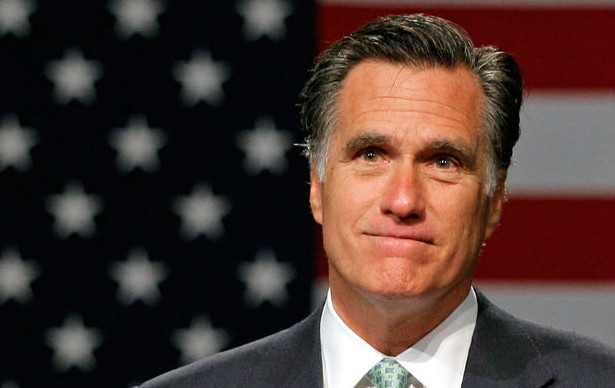
That trademark Romney smirk. Image from policymic.

Mitt Romney lies to the world

Mitt Romney gave a rousing speech about how his foreign policy would be much more muscular than President Obama’s. But Romney displayed again his proclivity to lie on specifics and distort the broader reality.

By Robert Parry / Consortium News / October 10, 2012

While it’s true that all politicians play games with the facts, it is actually rare for a politician to be an inveterate liar. But Mitt Romney is one of that rare breed on matters both big and small. And with some polls showing his surge toward victory on November 6, his dishonesty may soon become an issue for the entire world.

Romney’s foreign policy speech on Monday, October 8, was another example of his tendency to lie on minor stuff as well as weighty issues. For instance, he claimed that President Barack Obama “has not signed one new free trade agreement in the past four years” though Obama secured passage of agreements with South Korea, Colombia, and Panama and signed them in October 2011.

Romney apologists suggest that the Republican presidential nominee was hanging his truthiness on the word “new” since negotiations on the agreements began late in George W. Bush’s presidency. But the work was completed by Obama and he pushed the deals through Congress despite resistance from some of his own supporters in labor unions.

So, by any normal use of the English language, Obama had signed new trade agreements, but Romney simply stated the opposite.

Romney also accused Obama of staying “silent” in the face of street protests in Iran over the reelection of President Mahmoud Ahmadinejad in 2009. But Obama wasn’t “silent.” He did speak out, with his comments becoming increasingly harsh as more images of violence emerged.

“The United States and the international community have been appalled and outraged by the threats, beatings and imprisonments of the last few days,” the President said on June 23, 2009. He added that he strongly condemned “these unjust actions.”

If Romney wished to criticize Obama for not condemning Iran in even stronger terms or for not using his harshest language immediately that might be one thing, but to say, the President was “silent” is just a lie.

More broadly, Romney’s depiction of U.S. foreign policy as weak and feckless under Obama is almost the inverse from the truth. For instance, Obama helped organize an international military force to wage war in Libya, enabling rebels to overthrow longtime dictator Muammar Gaddafi, but Romney acts as if that never happened.

Instead, Romney lays every foreign policy problem at Obama’s door and credits others with every accomplishment, including the killings of Osama bin Laden and other al-Qaeda leaders.

On that topic, Romney said: “America can take pride in the blows that our military and intelligence professionals have inflicted on Al-Qaeda in Pakistan and Afghanistan, including the killing of Osama bin Laden.” But Romney gives no credit to Obama for ordering these strikes and taking criticism from many on the Left for his aggressive use of drone attacks.

The Palestine flip-flop

Another jaw-dropping example of Romney’s dishonesty was his sudden embrace of negotiations leading to a Palestinian state after he was recorded in his infamous “47 percent speech” last May as deeming such talks hopeless.

“I look at the Palestinians not wanting to see peace anyway, for political purposes, committed to the destruction and elimination of Israel, and these thorny issues, and I say there’s just no way,” Romney told a group of wealthy donors. “The Palestinians have no interest whatsoever in establishing peace and that the pathway to peace is almost unthinkable to accomplish.”

As for what the U.S. policy would be in a Romney administration, he said, “we kick the ball down the field.”

However, on Monday, Romney declared: “I will recommit America to the goal of a democratic, prosperous Palestinian state living side by side in peace and security with the Jewish state of Israel.”

And again, all the blame for the impasse is placed on Obama: “On this vital issue, the President has failed, and what should be a negotiation process has devolved into a series of heated disputes at the United Nations. In this old conflict, as in every challenge we face in the Middle East, only a new president will bring the chance to begin anew.”

And then, there’s the traditional hypocrisy that you get from both parties but most notably from the Republicans, preaching the value of liberty and democracy but advocating ever closer ties with the oppressive monarchies of the Persian Gulf.

Romney declared about Obama’s approach to the Arab Spring that “the greater tragedy of it all is that we are missing an historic opportunity to win new friends who share our values in the Middle East — friends who are fighting for their own futures against the very same violent extremists, and evil tyrants, and angry mobs who seek to harm us.”

However, Romney then added, “I will deepen our critical cooperation with our partners in the Gulf.”

One reason that I criticized Romney’s debate performance — though many other Americans, including many Democrats, disagreed with my assessment — was that I felt his lying and his squirrely behavior were more important than Obama’s sluggishness.

Neocon revival

Besides the lies and misrepresentations in the speech, there were some genuine policy differences expressed by the Republican presidential nominee. For instance, he vowed to expand the U.S. military and to deploy it more aggressively around the globe.

Romney also repeated his pledge to yoke U.S. foreign policy to Israel’s desires. “The world must never see any daylight between our two nations,” he said.

And Romney renewed his belligerence against Russia, which he had previously deemed “without question, our Number 1 geopolitical foe.” In his speech on Monday, Romney said, “I will implement effective missile defenses to protect against threats. And on this, there will be no flexibility with [Russian President] Vladimir Putin.”

Despite the Depression-level economic crisis gripping Europe, Romney also announced that he “will call on our NATO allies to keep the greatest military alliance in history strong by honoring their commitment to each devote 2 percent of their GDP to security spending. Today, only three of the 28 NATO nations meet this benchmark.”

One might regard Romney’s neoconservative revival as delusional in a variety of ways — further driving the United States toward bankruptcy even as U.S. interventionism in the Muslim world would surely make matters worse — but it is Romney’s reliance on systematic lying that perhaps should be more troubling to American voters.

Romney has long been known as a serial flip-flopper who changes positions to fit the political season, but his pervasive mendacity has been a concern since the Republican primaries when his GOP rivals complained about him misrepresenting their positions and reinventing his own.

That pattern has continued into the general election campaign, with Romney telling extraordinary whoppers on the campaign trail and even during last Wednesday’s presidential debate, such as when he claimed his health-care plan covered people with pre-existing conditions when it doesn’t.

Strategic lying

One reason that I criticized Romney’s debate performance — though many other Americans, including many Democrats, disagreed with my assessment — was that I felt his lying and his squirrely behavior were more important than Obama’s sluggishness. Telling lies while waving your arms shouldn’t trump telling the truth in a moderate tone.

Indeed, as a journalist, I simply cannot abide politicians who lie systematically, who don’t just trim the truth once in a while but make falsehoods a strategic part of their politics and policies.

When I arrived in Washington in 1977 as a reporter for the Associated Press, the nation had just emerged from the Vietnam War and the Watergate scandal. To reassure the country that the government could be honest, President Jimmy Carter promised never to lie to the American people.

But then came the Reagan administration with its concept of “perception management,” i.e., the manipulation of the public’s fears and prejudices for the purpose of lining up the people behind new foreign adventures. A chief  “public diplomacy” goal of the administration was to cure the American people of “the Vietnam Syndrome.”

Thus, minor threats, like peasant uprisings in Central America, were portrayed as part of a grand Soviet strategy to invade the United States through Texas. The strength of the Soviet Union was itself exaggerated to justify a massive U.S. military build-up. Today’s neocons cut their teeth of such distortions and lies.

Post 9/11, with George W. Bush in the White House, this neocon strategy of fear-mongering led the United States into the debacle of the Iraq War (in pursuit of imaginary weapons of mass destruction).

Now, less than a year after U.S. military forces left Iraq — and with a withdrawal from Afghanistan finally underway — the latest polls suggest that the American voters are shifting toward the election of another neocon President who promises more soaring rhetoric about U.S. “exceptionalism” and more interventionism abroad.

It’s almost as if many Americans like being lied to.

[Robert Parry is the editor and founder of Consortium News. Parry broke many of the Iran-Contra stories in the 1980s for the Associated Press and Newsweek. His latest book, Neck Deep: The Disastrous Presidency of George W. Bush, was written with two of his sons, Sam and Nat, and can be ordered at neckdeepbook.com. His two previous books, Secrecy & Privilege: The Rise of the Bush Dynasty from Watergate to Iraq and Lost History: Contras, Cocaine, the Press & ‘Project Truth’ are also available there.]

The Rag Blog

Posted in RagBlog | Tagged , , , | 2 Comments

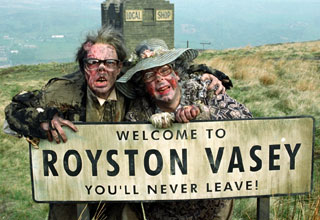
Alan Waldman : Brit TV’s ‘League of Gentlemen’ a Hilarious Small-Town Horror Spoof

The League of Gentlemen is a mind-blowing British horror spoof.

Waldman’s film and TV
treasures you may have missed:

The League of Gentlemen is a bizarre, hilarious Brit TV spoof of horror films. It is one of the most original and unpredictable comedy series ever.

By Alan Waldman | The Rag Blog | October 10, 2012

[In his weekly column, Alan Waldman reviews some of his favorite films and TV series that readers may have missed, including TV dramas, mysteries, and comedies from Canada, England, Scotland, and Ireland. Most are available on DVD and/or Netflix.]

The League of Gentlemen (not to be confused with the critically hated comic book movie The League of Extraordinary Gentlemen) is a mind-blowing British spoof of the small-town horror genre. Three of its four writers play about two-thirds of all the 100 roles — male and female. They are Steve Pemberton, Reese Shearsmith and Mark Gatiss (who co-created, wrote for and co-starred as Mycroft Holmes in the recent dazzling Brit mystery series Sherlock).

League ran in the U.K. for three six-episode seasons — 1999, 2000, and 2002 — and a Christmas special. It developed a cult following in Britain and was nominated for 13 British awards (winning seven).

From the opening shot, I knew this was comedy from a different world. In Britain, hearses have glass windows on the side so you can see, alongside the coffin, something sweet written in flowers (such as “mum” or “beloved”). In this first shot you see a hearse moving through the small town of Royston Vasey, and written in flowers by the coffin is the word “bastard.”

This is an extremely dark comedy, but it is very, very funny. The many characters include a hairy transsexual cab driver; a deranged couple who run a local shop (and who murder every customer who is not “local”); a family obsessed with toads, hygiene, and masturbation; an incompetent vet; and a carnival operator who kidnaps women into marriage. It is credited with reviving the British sketch comedy and is therefore a forerunner of Little Britain, which Gatiss helped write.

The three stars are astonishingly good in their many characters, and they look and sound very different from each other — thanks to their talent and the show’s award-winning costumes and makeup.

Because it is so macabre and twisted, League is not to everyone’s taste, but it will be greatly enjoyed by fans of offbeat, highly original comedy.

[Oregon writer and Houston native Alan Waldman holds a B.A. in theater arts from Brandeis University and has worked as an editor at The Hollywood Reporter and Honolulu magazine. Read more of Alan Waldman’s articles on The Rag Blog.]

The Rag Blog
Posted in Rag Bloggers | Tagged , , , , | 1 Comment

SPORT / Dave Zirin : The Player’s Tweet that Told the Truth

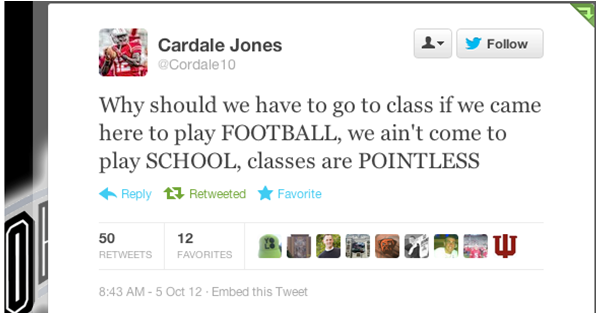
Cardale Jones’ revealing tweet. Image from BigLeadSports.

The smartest, or dumbest,
(or maybe smartest)

tweet an athlete ever sent

We are corrupting these young people by demanding that they become complicit in a sham.

By Dave Zirin | The Rag Blog | October 10, 2012

Many allegedly great minds from professors to school presidents have devoted peals of pages to the multi-billion dollar industry otherwise known as NCAA athletics. Yet no one has quite put their finger on the contradictions, frustrations, and tragicomedy of being the labor in this industry — a so-called student-athlete — quite like Ohio State’s third string freshman quarterback, Cardale Jones.

On Friday Jones tweeted, “Why should we have to go to class if we came here to play FOOTBALL, we ain’t come to play SCHOOL, classes are POINTLESS.”

Jones immediately deleted the tweet — as well as his entire twitter account — but as many have learned before him, deleting a tweet is like cleaning a grease stain with fruit punch. As soon as the 18-year-old sent his tweet out into the world, Cardale Jones was held up as yet another example of (altogether now) “everything that’s wrong” with today’s athlete.

Even worse, Jones, who hasn’t played one snap all season, was benched for Saturday’s game. As the Toledo Blade put it, “Mark it down as DNP (tweet).

But Jones’s crime wasn’t authoring what the Daily News called a “lame-brained tweet.” It was committing, to paraphrase Michael Kinsley, the greatest sin in sports: he was caught telling the truth. “We ain’t come to school to play classes” will most likely be a quote of mockery that rings through the ages.

But Cardale Jones has also hit on something factual. Ohio State football, like a select sampling of the sport’s aristocracy, has morphed over the last 30 years into a multi-billion dollar business. Even in the shadow of sanction and scandal, according to Forbes Magazine, the Buckeyes program creates $63 million in revenue every year and accounts for 73% of all the athletic departments profits.

Columbus is where legendary coach Woody Hayes was pushed out after striking an opposing player in 1978. He was making $40,000 a year when removed. Their coach today, Urban Meyer, draws a base salary of $4 million and is the highest paid public employee in the state. Meyer also gets use of a private plane, a swanky golf club membership, and a fellowship in his name. He can also earn six figure bonuses as well as raises for staying on the job.

The football coach earns three times Ohio State President Gordon Gee. As higher education lawyer Sheldon Steinbach said to USA Today. “The hell with gold. I want to buy futures in coaches’ contracts.”

The source of the contradictions and confusion that create this moral cesspool is not the riches earned by the Urban Meyers of this world. It’s that the players are given nothing but the opportunity for an education they often have neither the time nor desire to pursue.

These are 18-22-year-olds treated like a hybrid of campus Gods and campus chattel. I once had a former All-American tell me a story of hitting the books until an assistant coach stopped by his dorm room and said, “You know you don’t have to do that right?” This particular athlete persevered and graduated and good for him.

I can only say that when I was 19, if an authority figure told me I didn’t have to study, I would have held an impromptu book-burning in my dorm room. We are corrupting these young people by demanding that they become complicit in a sham. We are telling them to be grateful for the opportunity to be party to their own exploitation. We are telling them effectively to do exactly what Cardale Jones said, and “play school.”

This mentality of “play school” and get a shot at the NFL or the NBA is profoundly effective. It acts as a form of discipline that keeps players in line. This discipline doesn’t only come from coaches, academic advisors, and family members, but other student-athletes as well.

A culture is created through “amateur athletics” that incentivizes keeping your head down. If you’re going to cheat, or take easy classes with compliant professors, you do it quietly and keep the trains running on time. One thing you don’t do is point out that the Emperor is buck-naked.

I have a friend who is a professor at Ohio State and he outlined this to me very clearly. He told me that in the wake of Cardale Jones’s tweet that “many student-athletes are enraged. They feel he makes them all look bad when all of them are busting their butts.”

Their anger is what allows this system to continue as sure as the NCAA. They are angry because Cardale Jones just pulled back the curtain on an NCAA moral terrain built on a 21st century bedrock of bewildering moral confusion.

This only changes if Jones’s fellow football players stand with him and ask the question: “Are we all just ‘playing school’ so Urban Meyer can live like some sort of absurdist sports Sultan? Are my blood sweat and tears first and foremost a means to pay for the fuel for my coach’s private plane?”

We don’t know if this will cost Cardale Jones his scholarship in the days to come. But one thing we can be sure about: whether or not he stays will have less to do with his effrontery than whether the freshman can effectively throw a football.

[Dave Zirin is the author of The John Carlos Story (Haymarket). Receive his column every week by emailing dave@edgeofsports.com. Contact him at edgeofsports@gmail.com. Read more articles by Dave Zirin on The Rag Blog.]

The Rag Blog
Posted in Rag Bloggers | Tagged , , , , , | 1 Comment

Ron Jacobs : Turkey Plays Chicken for NATO

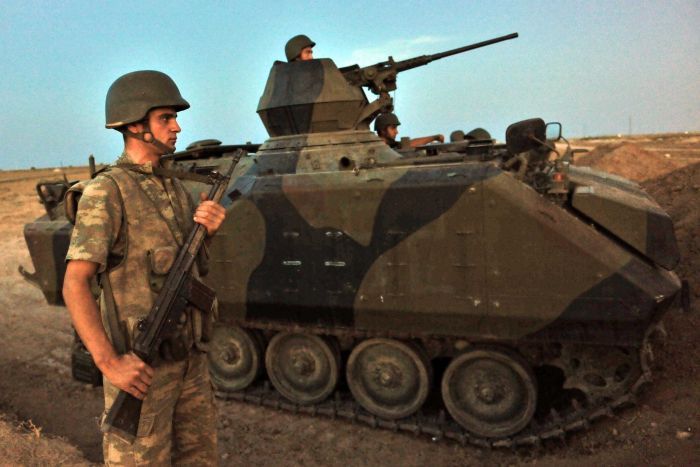
Turkish soldiers stand guard in Akcakale by the Turkish-Syria border. Photo by Bulent Kilic / AFP.

A page from Washington’s book:
Turkey plays chicken for NATO

They manipulated an incident into an act of war much like the U.S. used questionable incidents to attack Northern Korea in 1950 and Northern Vietnam in 1964.

By Ron Jacobs | The Rag Blog | October 9, 2012

Turkey took a page from Washington’s play book on October 4, 2012. After an errant shell landed in Turkish territory and killed a family there, the Turkish legislature authorized the Turkish military to enter foreign lands.

In other words, they manipulated an incident into an act of war much like the U.S. used questionable incidents to attack Northern Korea in 1950 and  Northern Vietnam in 1964. By passing legislation giving the Turkish military permission to enter foreign territory, Ankara declared an undeclared war on Syria. Claiming that their intention is not war, the Turkish military stepped up its alert status and prepared for war.

Of course, Turkey’s status as a NATO member brought forth a barely concealed hope from Brussels that this might finally be the entry it has been looking for since the protests against the Assad regime started looking as if they might result in that regime’s fall.

I have a sister who has been a nurse working psychiatric wards for most of the past 45 years. Although she has misgivings about the use of psychotropic drugs in many instances, she has explained that they serve a useful purpose in that they create a predictable response for staff to deal with. In other words, once the drugs take effect, the medical staff can be pretty certain how the patient will behave.

When nations go to war they operate under a similar thought process. In other words, once a nation is attacked, it will fight back or surrender. The root causes of the conflict will not be resolved, but the behavior of the attacked nation becomes more predictable.

Of course, once the dogs of war are unleashed, anything can happen. However, like the fool who makes the same mistake over and over again, war-making nations act as if the next war they enter will end as predicted.

The case of Syria is a tough one. The Assad regime is quite authoritarian and, at this point, the word “murderous” also applies. However, the opposition as it currently exists does not seem to be much better. Indeed, the increasing role of radical Islamists with an apparently reactionary agenda in the rebel forces creates a scenario where both sides in this civil war are difficult, if not impossible, to support.

The element of the resistance that seemed to express popular hopes for a democratic secular government in Syria seems to have disappeared in the car bombs and aerial bombardments that tend to increasingly characterize this conflict. From where I sit, it appears the U.S. and its alliance are arming forces (by proxy) very similar to those it armed in Afghanistan, while the nation of Syria is looking more and more like Iraq circa 2007, when sectarian conflict split that nation into many small and dangerous combat zones. Neither aspect of this scenario is a positive.

As for NATO and Israel, it is important to remember that Syria has been one of several nations in the Middle East that Tel Aviv and DC have wanted to control for decades. Always a proponent of pan-Arabism and Arab nationalism, the Damascus government has been a constant threat to Israel’s dream of a Greater Israel and, simultaneously, to Washington’s plans to dominate the region.

A co-founder of the United Arab Republic and now Tehran’s greatest ally in the Middle East, Damascus has long been on Washington’s short list of nations needing a reformat into a friendlier state. Tel Aviv, of course, would rather just take over the whole place and make it their own as part of their dream of lebensraum for the Jewish people.

Since the protests turned bloody in Syria last winter, the western public has been shown numerous videos and images of mutilated bodies and destroyed dwellings. The historical context and the nature of the forces involved have been minimized while the human toll has been magnified.

Much of this destruction was caused by the Syrian military and associated paramilitaries. As the conflict turned into civil war, much of it has also been caused by the rebel forces. The images of the former were usually provided by freelance sources that often have an agenda to push — that agenda involves the entry of foreign forces to support their side.

This is where the west comes in. It is also where the recent threat of military intervention from Ankara comes in. If Turkey does enter the fray, NATO will not be far behind. As part of the alliance, Ankara knows this and counts on it. Its opposition to the Assad regime has been present since the beginning of the resistance and the resistance’s turn to military conflict has been supported and propped up every inch of the way by Ankara.

There is no easy answer to the conflict in Syria. However, turning it into a regional war is definitely not the right one.

[Rag Blog contributor Ron Jacobs is the author of The Way The Wind Blew: A History of the Weather Underground. He recently released a collection of essays and musings titled Tripping Through the American Night. His latest novel, The Co-Conspirator’s Tale, is published by Fomite. His first novel, Short Order Frame Up, is published by Mainstay Press. Ron Jacobs can be reached at ronj1955@gmail.com. Find more articles by Ron Jacobs on The Rag Blog.]

The Rag Blog
Posted in Rag Bloggers | Tagged , , , , | 3 Comments

Harry Targ : From the Bay of Pigs to the Missile Crisis / 2

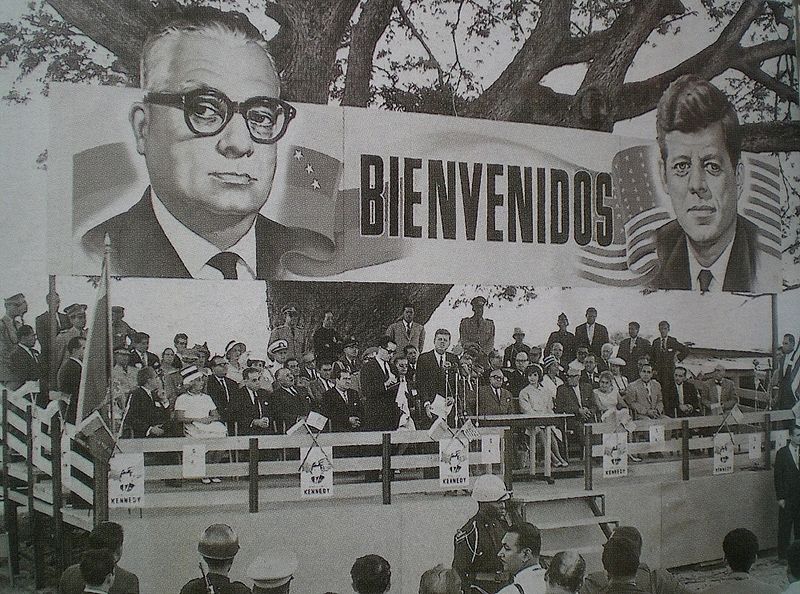
John F. Kennedy and Rómulo Betancourt at Alliance for Progress meeting in La Morita, Venezuela, Dec. 16, 1961. Image from Wikimedia Commons.

The Cuba story, Part 2:
The Bay of Pigs to the missile crisis

The Castros of this world, the Kennedy Administration believed (as has every administration since), had to be crushed at all costs.

By Harry Targ | The Rag Blog | October 9, 2012

“I have called on all the people of the hemisphere to join in a new Alliance for Progress — Alianza para Progreso — a vast cooperative effort, unparalleled in magnitude and nobility of purpose, to satisfy the basic needs of the American people for homes, work and land, health and schools — techo, trabajo y tierra, salud y escuela

“To achieve this goal political freedom must accompany material progress. Our Alliance for Progress is an alliance of free governments-and it must work to eliminate tyranny from a hemisphere in which it has no rightful place. Therefore let us express our special friendship to the people of Cuba and the Dominican Republic-and the hope they will soon rejoin the society of free men, uniting with us in our common effort.” (Address by President Kennedy at a White House reception for Latin American diplomats and members of Congress, March 13, 1961)

“Those who make peaceful revolution impossible will make violent revolution inevitable.” (Address by President Kennedy to diplomats one year after his Alliance for Progress speech. March 13, 1962)

[Part two of three.]

The Alliance for Progress as a “non-Communist” path to development 

The Kennedy Administration initiated a policy of foreign assistance in Latin America to complement the United States’ historic use of military force in the region. The President’s economic program was announced in the aftermath of long-standing complaints from Latin American dictators and some elected leaders that the United States had supported European recovery, the celebrated Marshall Plan of the 1940s, but ignored the Western Hemisphere.

Most importantly, the Kennedy Administration and anti-Communist friends in the Hemisphere became increasingly concerned about the enthusiasm the Cuban revolution was generating in the region.

In the midst of what was presented to the public as the “threat of Communism” in Latin America, Kennedy presented his “Alliance for Progress” aid package to diplomats and Congressmen on March 3, 1961 (about one month before JFK authorized the Bay of Pigs invasion).

The Alliance, the President promised, would provide public and private assistance equivalent to $20 billion to Latin American countries over a 10-year period. The plan projected annual growth rates in Latin America of 2.5 percent and would lead to the alleviation of malnutrition, poor housing and health, single-crop economies, and iniquitous landholding patterns (all campaigns underway in revolutionary Cuba).

Loans were contingent upon the recipient governments, and their political and economic elites, carrying out basic land reform, establishing progressive taxation, creating social welfare programs, and expanding citizenship and opportunities for political participation.

However, the effect of the Alliance, even before Kennedy’s death, was negative. Problems of poverty, declining growth rates, inflation, lower prices for export commodities, and the maintenance of autocratic and corrupt governments persisted. The reality of the Alliance and most other aid programs was that they were predicated on stabilizing those corrupt ruling classes that had been the source of underdevelopment in the first place.

The connections between the Alliance program and the interests of United States capital were clear. For example, a section of the Foreign Assistance Act of 1962 authorized the president to cut off aid to any nation that nationalized or placed “excessive” taxes on U.S. corporations or which terminated contacts with U.S. firms.

The act also emphasized monetary stability and the kinds of austerity programs common to U.S. and International Monetary Fund aid, requiring nations receiving aid to reduce public services and to maintain low wage rates to entice foreign investment.

Further, Alliance funds were often to be used to serve the interests of foreign capital; for example building roads, harbors, and transportation facilities to speed up the movement of locally-produced but foreign-owned goods to international markets.

Finally, the symbolism of the Alliance proclamation by President Kennedy was designed to promote the idea that U.S. resources, in collaboration with reformism in Latin America, would create societies that met the needs of the people and encouraged their political participation. The Alliance was presented as a response to Fidel Castro, a “non-Communist manifesto”for development.

The record of poverty and military rule throughout the Hemisphere suggested that there was no correspondence between symbol and reality. Kennedy, in a moment of unusual frankness, was reported to have said that the United States preferred liberal regimes in Latin America, but if they could not be maintained, it would much prefer a right-wing dictatorship to a leftist regime.

After Kennedy’s death, Thomas Mann, Assistant Secretary of State for Inter-American Affairs in the Johnson Administration, told reporters that U.S. policy in the Western Hemisphere was not about economic development or democratization, but fighting Communism and protecting U.S. economic interests.

In reality, the frankness about the motivations behind U.S. policy expressed by Kennedy after the Alliance speech and Thomas Mann after Kennedy’s death clearly showed that the bottom line in terms of U.S. policy remained support for international capital.

The Castros of this world, the Kennedy Administration believed (as has every administration since), had to be crushed at all costs. What remained significant over the next 60 years was that the Cuban revolution could not be defeated.

As the next essay in this series suggests, the Kennedy Administration, having failed to overthrow Cuban socialism at the Bay of Pigs, nor diminish its luster in the region through the economic bribery of the Alliance for Progress program, was willing to go to the brink of nuclear war, the Cuban Missile crisis, to combat socialism in the Western Hemisphere.

This essay is the second of three articles that address U.S./Cuban relations that culminated in a crisis over Cuba that almost led to nuclear war. These essays are adapted from my book, Strategy of an Empire in Decline: Cold War II, 1986.

[Harry Targ is a professor of political science at Purdue University who lives in West Lafayette, Indiana. He blogs at Diary of a Heartland Radical — and that’s also the name of his book from Changemaker Press which can be found at Lulu.com. Read more of Harry Targ’s articles on The Rag Blog.]

The Rag Blog

Posted in Rag Bloggers | Tagged , , , , , , , , | Leave a comment

Lamar W. Hankins : Ted Cruz Vs. Personal Liberty

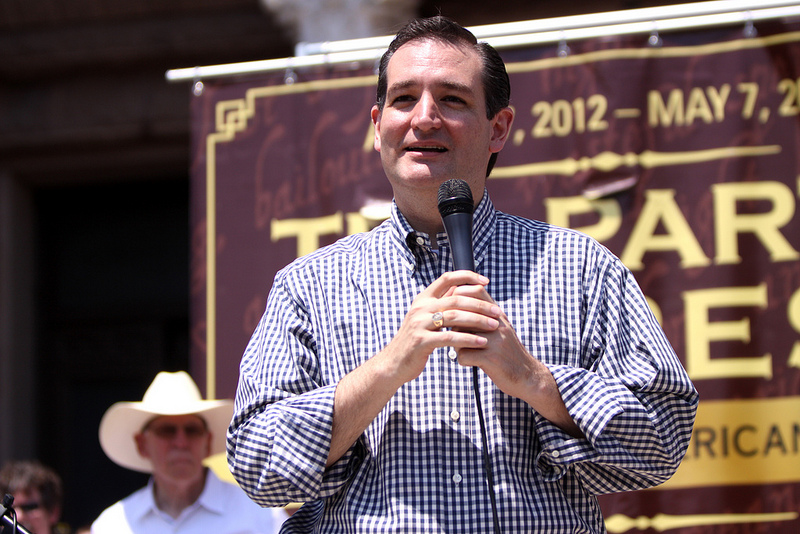
Tea Party darling Ted Cruz. Photo by Gage Skidmore / Flickr.

Ted Cruz:
Opponent of personal liberty

Like many right-wingers, Cruz has a limited understanding of our First Amendment rights.

By Lamar W. Hankins | The Rag Blog | October 9, 2012

Ted Cruz, the Republican candidate for the U.S. Senate from Texas, presents himself as a champion of personal liberty, but he is far from that. Based on what he writes on his own campaign website, Cruz is a proponent of restricting liberty in vast areas of our lives.

Cruz opposes the right of women to make their own medical decisions in consultation with their physicians. Like many other right-wingers, Cruz does not believe a woman should have control over her reproductive processes. He believes that the government knows best what a woman should do about unwanted pregnancies. To Cruz, a woman’s reproductive system is mainly the purview of the state. Apparently, this extends even to the decision to use birth control.

Cruz’s views on religious liberty revolve entirely around the right of the government to promote religious practices associated with Abrahamic monotheism, though his views on Islam, one of the Abrahamic religions (along with Christianity and Judaism) are not clear. But he does support the government’s promotion of the Abrahamic God to the exclusion of the religious beliefs of more than 65 million Americans, and about 5.5 million Texans.

 It is politically convenient to side with the majority on religious issues, even if that means that the majority’s religious beliefs are, with the help of the government, crammed down the throats of those who believe differently.

Cruz does not seem to see the nexus between the need for access to health care and liberty, but without health care the liberty one has is severely circumscribed. Not only does Cruz oppose access to health care for all, he opposes George W. Bush’s prescription drug benefit for seniors.

I admit that I have a vested interest in the drug benefit, since I receive Medicare benefits, including those for prescription drugs. Cruz would take from me the financial security that Medicare and all of its benefits provide. Without Medicare, my life would be more limited and its length undoubtedly shortened. The evidence shows that many, if not most, seniors are in the same situation I am in.

When Ted Cruz discusses voting, he apparently does not connect it to liberty. Instead, Cruz believes that voter fraud is a serious problem, though he is unable to find evidence for any significant voter fraud — just like everyone else who has studied the data. That hasn’t stopped him from supporting laws and regulations that make it difficult for seniors and low-income citizens to vote.

No one who claims to believe in democracy can justify regulations that suppress voting, but Cruz is in favor of taking away from thousands of Texans this seminal freedom, without which we will have little, if any, liberty. The voter suppression Cruz favors most seems to be voter ID laws that require a state-issued ID to register and vote. In Texas, 34 counties do not have a state office that issues photo IDs. Four of these counties have Hispanic populations over 75%. Cruz has not protected the liberty interests of these citizens.

In a 2007 report on voter fraud, the Brennan Center concluded: “The type of individual voter fraud supposedly targeted by recent legislative efforts — especially efforts to require certain forms of voter ID — simply does not exist.”

For five years during the George W. Bush presidency, the Justice Department conducted a “war on voter fraud,” which resulted in 86 convictions out of more than 196,000,000 votes cast. This result was not unexpected. It is absurd to believe that there is a systematic effort by large numbers of people to cast a vote as another person.

Such projects would be an enormous waste of time, yield few results, be easy to detect, and are adequately controlled by existing criminal laws with harsh penalties. But Ted Cruz cares so little about the liberty of all Texas citizens that he wants to keep them from voting with such voter suppression laws and regulations.

Cruz’s campaign website claims that he has played an important “role in the fight against infringement of private property rights,” including those arising from the use of eminent domain by government or allowed by government.

But where has Cruz been in the fight against the abuse of eminent domain allowed by Texas law for such companies as TransCanada, which is trying to take the land of Texas citizens to build a pipeline to transport tar sands oil to be refined at two Texas refineries and sold overseas to increase their profits? This pipeline will not lower any Texan’s gasoline bill or provide any long-term jobs that will benefit Texans, but Cruz has not stood up for the liberty interests of Texas landowners to protect and preserve their land.

For Cruz and many right-wingers, same-sex marriage is not seen as a matter of personal liberty. Cruz thinks he and the government have the right to tell citizens whom they can love and marry. In fact, he is proud to deny citizens the right to choose the mate of their choice unless that mate is someone of the opposite sex.

No liberty interest is more personal than the right to choose with whom to live, love, and marry, yet Cruz places his personal religious beliefs and preferences over the liberty interests of the entire gay population. To deny anyone such a basic liberty grounded in religious belief means that other liberties can be denied also for religious reasons. Cruz’s position is antithetical to the Constitution and basic morality — and personal liberty.

Like many right-wingers, Cruz has a limited understanding of our First Amendment rights. To his credit, Cruz opposes “groups that spout hatred and bigotry,” but to Cruz this means that such groups cannot participate in civic projects of benefit to all.

While I have opposed the Ku Klux Klan longer than Cruz has been alive, it violates the constitutional rights of association and free speech to deny that backward group the right to pick up litter along the highways as part of a government-sponsored program, which is an action that Cruz is proud to have pursued.

Cruz may think he supports the liberty interests of all of our citizens, but he is mistaken. He is an extreme right-wing ideologue, selected by the Republican Party of Texas, mainly through the efforts of Tea Party zealots and their rich friends, to go to Washington to destroy the social safety net that protects all our citizens from lives of misery and poverty.

He has spent his brief career in the service of corporations and the wealthiest 1% of Americans — the plutocracy that is very near to complete control of our political and economic systems.

Texans have risen up in the past to oppose injustice and fight for liberty. Electing politicians like Ted Cruz is a step in the wrong direction. It is the direction that will ensure that we will all have less liberty and more government control over our lives.

[Lamar W. Hankins, a former San Marcos, Texas, city attorney, is also a columnist for the San Marcos Mercury. This article © Freethought San Marcos, Lamar W. Hankins. Read more articles by Lamar W. Hankins on The Rag Blog.]

The Rag Blog

Posted in Rag Bloggers | Tagged , , , , , , , | Leave a comment