SPORT / Dave Zirin and Zach Zill : The Death of Socrates

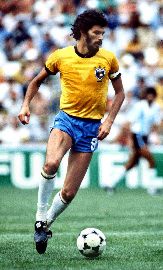
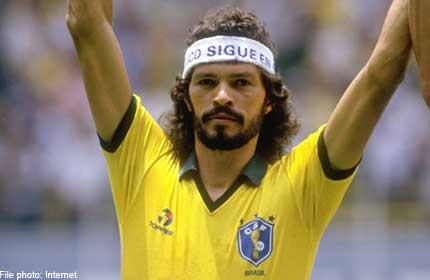
Brazilian soccer legend Socrates before a World Cup match in Guadalajara, Mexico, June 16, 1986. Photo by Wolfgang Ratta / Reuters.

The death of Socrates:
Celebrating the Brazilian soccer legend

Socrates was one of those rare athletes whose outsized personality and effervescent humanity transcended the game.

By Dave Zirin and Zach Zill | The Rag Blog | December 12, 2011

International soccer lost a hero last weekend when Socrates, the masterful Brazilian midfielder who captained Brazil’s famed 1982 World Cup squad, died from an intestinal infection at age 57.

The death of the lanky, bearded, 6-foot 4-inch field general with a philosopher’s name will be felt far beyond the sports world. Socrates — full name Socrates Brasileiro Sampaio de Souza Vieira de Oliveira — was one of those rare athletes whose outsized personality and effervescent humanity transcended the game.

Socrates’ interests, talents, and achievements were staggering. He was a medical doctor, a musician, an author and news columnist, a political activist, and a TV pundit. Somewhere in all of this, he managed not only to lead what may have been the most artful team to ever grace the pitch, but also to fearlessly challenge the decades-long military dictatorship that ruled Brazil.

Alongside the 1982 Brazilian midfield of Zico, Falcao, Cerezo, and Eder, Socrates brought a combination of technical prowess, deadly goal-scoring ability, and blissful creativity that has never been matched. If ever the uninhibited joy of children playing merged with raw competitive dominance, it was in the squad that Socrates led to the World Cup in Spain.

They embodied Eduardo Galeano’s description of Brazilian soccer as “the most beautiful soccer in the world, made of hip feints, undulations of the torso and legs in flight, all of which came from capoeira, the warrior dance of black slaves, and from the joyful dances of big city slums…There are no right angles in Brazilian soccer just as there are none in the Rio Mountains.”

Socrates approached soccer with the intensity and lack of restraint that he brought to every aspect of his life. He drank, he smoked, and he played without shin guards. His impetuosity as a player and a person was embodied in his signature move on the field: the blind heel pass.

Socrates became a professional player almost as an afterthought, not becoming a full-time professional until he signed with Corinthians at age 24. And unlike most professional athletes then and now, he refused to check his politics at the door.

Unlike the great Pele, Socrates never made financial or political peace with Brazil’s dictatorship. In fact, with his medical expertise, his flowing hair and full beard, and his resistance politics, he shared less in common with Pele than Che Guevara.

That’s not hyperbole. Socrates may be the only professional athlete to ever organize a socialist cell among his fellow players. He helped assemble Corinthians, a club team from Sao Paolo built on a radical political foundation. Corinthians proceeded to become a focal point for national discontent with Brazil’s military dictatorship.

The military had ruled Brazil since 1964, when it overthrew left-wing president João Goulart who promised land redistribution and nationalization of industry. By the early 1980s, as the dictatorship was beginning to strain under the weight of mass repression and economic stagnation, Socrates and his teammate Wladimir organized and played for Corinthians, known as the “Time do Povo” or “Team for the People,” to demonstrate the power of democracy.

With the consent of club president Waldemar Pires, the players established a democratic process to govern all team decisions. As Socrates explained, “Everyone at the club had the same right to vote — the person who looked after the kit and the club president, all their votes had the same weight.”

The players decided what time they would eat lunch, they challenged strict rules that locked players in their hotel rooms for up to 48 hours before a match, and they printed political slogans on their uniforms.

In this way, one of South America’s most popular teams became a beacon of hope, not just to Brazilians, but across a continent largely shackled by U.S.-backed dictators. Socrates, on his way to 297 appearances and 172 goals for Corinthians, was one of the most popular figures in the country, and thus nearly unassailable by the military rulers.

The tragedy of Socrates’ death lies both in his age, just 57, and the timing. As the World Cup and Olympics are thundering toward Brazil, his would have been a critical voice against the way these international sporting carnivals run roughshod over local communities, all for the benefit of a nation’s elite.

When asked earlier this year by the Guardian if the coming World Cup would help the poor of Brazil, Socrates said, “There will be lots of public money disappearing into people’s pockets. Stadiums will be built and they will stay there for the rest of their lives without anyone using them. It’s all about money. What we need to do is keep up public pressure for improvements in infrastructure, transport, sewerage, but I reckon it will be difficult.”

Speaking out against the World Cup in Brazil? Now that is true political courage. But Socrates, true to form in this interview, didn’t confine his commentary to soccer. He said, “What needs to change here is the focus on development. We need to prioritize the human being. Sadly, in the globalized world, people don’t think about individuals as much as they think about money, the economy, etc.”

Let’s hope that a new generation of young Brazilians will see fit to pick up where Socrates left off. As the World Cup and Olympics come to the new Brazil, expect the spirit of Socrates to echo in the streets.

[Dave Zirin is the author of The John Carlos Story (Haymarket) and just made the new documentary Not Just a Game. Receive his column every week by emailing dave@edgeofsports.com. Contact him at edgeofsports@gmail.com. Read more articles by Dave Zirin on The Rag Blog. Zach Zill is a freelance writer living in Washington DC. He can be reached at zach.zill@gmail.com. This article was also posted to The Nation.]

The Rag Blog

Posted in Rag Bloggers | Tagged , , , , | Leave a comment

The State of Indiana vs. the
Universal Declaration of Human Rights

By Harry Targ / December 12, 2011

The massive atrocities of World War II led nations to commit themselves permanently to the protection of basic rights for all human beings. Eleanor Roosevelt, the widow of the wartime President, Franklin Roosevelt, worked diligently with leaders from around the world to develop a document, to articulate a set of principles, which would bind humankind to never carry out acts of mass murder again.

In addition, the document also committed nations to work to end most forms of pain and suffering.

Over 60 years ago, on December 10, 1948, delegates from the United Nations General Assembly signed the document which they called “The Universal Declaration of Human Rights.” It consisted of a preamble proclaiming that all signatories recognize “the inherent dignity” and “equal and inalienable rights of all members of the human family” as the “foundation of freedom, justice, and peace in the world.”

The preamble declared the commitment of the signatories to the creation of a world “in which human beings shall enjoy freedom of speech and belief and freedom from fear and want…”

The Universal Declaration of Human Rights consisted of 30 articles, with varying degrees of elaboration. The first 21 articles refer primarily to civil and political rights. They prohibit discrimination, persecution for the holding of various political beliefs, slavery, torture, and arbitrary arrest and detention.

Persons have the right to speak their mind, travel, reside anywhere, have a fair trial if charged with crimes, own property, form a family, and in the main to hold the rights of citizenship including universal and equal suffrage in their country.

The remaining nine articles address what may be called social and economic rights. These include rights to basic social security in accordance with the resources of the state in which the persons reside; rights to adequate leisure and holidays with pay; an adequate standard of living so that individuals and families have sufficient food, clothing, shelter, and medical care; and education, free at least at the primary levels.

In addition, these nine articles guarantee a vibrant cultural life in the community, the right to enjoy and participate in the arts, and to benefit from scientific achievements.

While each article in the Universal Declaration of Human Rights provides a rich and vivid portrait of what must be achieved for all humankind, no article speaks to our time more than Article 23. It is one of the longer articles, identifying four basic principles:

  • Everyone has the right to work, to free choice of employment, to just and favorable conditions of work, and to protection against unemployment.
  • Everyone, without discrimination, has the right to equal pay for equal work.
  • Everyone who works has the right to just and favorable remuneration ensuring for himself (or herself) and his (her) family an existence worthy of human dignity, and supplemented, if necessary, by other means of social protection.
  • Everyone has the right to form and to join trade unions for the protection of his (her) interests.

Using the language of our day, the principles embedded in Article 23 of the Universal Declaration of Human Rights constitute a bedrock vision inspiring the global 99 percent to rise up against their exploiters from Cairo to Madison, to Wall Street, to cities and towns all over the world.

The global political economy is broken. The dominant mode of production, capitalism, increasingly cannot provide work, fair remuneration, rights of workers to speak their mind and organize their own associations, and the provision of a comfortable way of life all because the value of what they produce is expropriated by the top 1 percent of global society.

While each locale experiences this dilemma in its own way, the Republican-controlled legislative and executive branch of state government in Indiana is poised to pass legislation reestablishing itself as a so-called Right-to-Work State. The RTW laws which can be found in over 20 states allow workers to gain the benefits of union representation on the shop floor without joining unions or paying for union services which are provided to all workers.

The basic goal of RTW laws is to bankrupt the labor movement. The end result, as data suggests in every state, is to reduce rights, benefits, and working conditions for all workers. The National Right to Work Committee, the American Legislative Exchange Council, and other right-wing groups funded and organized by the 1 percent, want to eliminate hard-fought worker rights which will reduce the costs of labor, wages, working conditions, and the standard of living of all workers, unionized or not.

Data about the world and data about the United States make it clear that there has been a 30-year trajectory in the direction opposite to the rights enshrined in the Universal Declaration of Human Rights. Global inequality is growing. The rights and abilities of workers to form unions are shrinking. Standards of living of most of humankind are declining. The ability of most workers everywhere to acquire secure jobs is declining.

Globally there has been a quantum shift from agricultural, manufacturing, and service employment to the informal sector, oftentimes “street hustling.”

Not only is this condition being put in place in the state of Indiana but well-financed organizations such as ALEC foresee victory in Indiana setting off a “domino effect”; Indiana, then Michigan, Illinois, Ohio, and Wisconsin. To paraphrase a late nineteenth century geo-politician, “He who controls the heartland then can control the rimland.”

And in the end, anti-worker politics in the United States, like anti-worker politics virtually everywhere around the globe, violates the fundamental principles of the Universal Declaration of Human Rights, especially its precious Article 23. The workers’ agenda is fundamentally the human rights agenda.

[Harry Targ is a professor of political science at Purdue University who lives in West Lafayette, Indiana. He blogs at Diary of a Heartland Radical — and that’s also the name of his new book which can be found at Lulu.com. Read more of Harry Targ’s articles on The Rag Blog.]

The Rag Blog

Posted in RagBlog | Leave a comment

FILM / Lamar W. Hankins : 2008 Economic Crash Was an ‘Inside Job’


The economic crash of 2008:
An ‘Inside Job

By Lamar W. Hankins | The Rag Blog | November 8, 2011

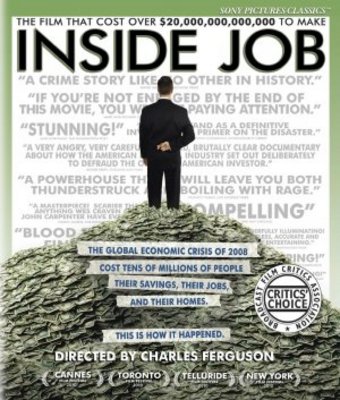
A fair summary of the award-winning documentary Inside Job is this: The economic crisis that culminated in bailouts in 2008 was caused by 30 years of deregulation of the financial services industry.

I have no way of knowing how many of the Occupy Wall Street participants have seen this film, released in 2010, but after seeing it, my first reaction is that occupying Wall Street and every other financial center from Chicago to your local guilty national bank is an appropriate response to what 99% of the American people have been going through.

Inside Job was nominated for at least eight film awards; it won the Academy Award for Best Documentary Feature earlier this year, the Directors Guild of America award for Best Documentary in December 2010, and the Writers Guild of America award for Best Documentary Screenplay early in 2011.

It deserves such awards for its clarity, reasoned argument, and presentation of damning evidence that Wall Street, several Congresses, and every president from Reagan through George W. Bush share responsibility for the wreck of the economy through actions of the financial sector and inactions of the government brought about by deregulation.

Had Barack Obama been president before the bailouts began, he would be implicated as a guilty party as well. What Obama has done since taking office in 2009 is appoint many of the major players who caused the debacle to positions of power and influence over the institutions that created the devastating failure that gave us soaring unemployment, massive home foreclosures, the failure or near-failure of most of the major financial institutions in the U.S., and a stock market that for the second time in a decade robbed the savings, investments, and pension plans of America’s middle class.

Film critic Roger Ebert described Inside Job as “an angry, well-argued documentary about how the American financial industry set out deliberately to defraud the ordinary American investor.” While some might take a less harsh view of the financial sector, the evidence supports Ebert’s statement.

We have known since the savings and loan debacle, junk-bond scandals, and accounting firms’ deceit in the 1980s, created largely by Reagan’s deregulation of S&L’s, that without significant regulation, the greed inherent in the financial sector will disrupt, if not destroy, the economy. That debacle was followed in 1998 by the collapse of the speculative hedge fund Long-Term Capital Management.

Then came the dot-com bubble in the late 1990s, which culminated in the stock market crash of 2001, caused by the failure of Internet stocks that were falsely rated as sound investments by investment banks. In 2001, we experienced the bankruptcy of the energy and commodities company Enron. In 2006, the housing bubble peaked, and prices began dropping nationwide. Here Inside Job picks up the deregulation story.

In 2005, the chief economist of the International Monetary Fund, Raghuram Rajan, at a meeting to honor retiring chairman of the Federal Reserve, Alan Greenspan, warned of a “catastrophic meltdown” of the economy. He argued that financial sector managers were encouraged by great financial rewards to take extraordinary risks with other people’s money that could “generate severe adverse consequences,” with no penalties for the financial sector managers.

Rajan presciently described what happened during the 2007-2008 economic collapse: the failure of the massively-issued subprime mortgages, the complicated investments known as derivatives and credit derivative obligations, the leveraging of the assets of investment banks by a factor of 33 to 1, the insuring against failures of these complicated investments (which led directly to the bankruptcy of AIG), the mismanagement of the public-private housing guarantors Freddie Mac and Fannie Mae, and the catastrophic stock market decline.

Rajan was ridiculed immediately for his views by Lawrence Summers, who called Rajan a “Luddite.” Summers, an economist, had worked in the Reagan administration on the staff of the Council of Economic Advisers, as Chief Economist for the World Bank in the early 1990s, had been Secretary of the Treasury under President Clinton, and was President of Harvard from 2001 to 2006.

During this time, Summers had promoted the deregulation of the financial sector, along with other notables, including Ben Bernanke, Robert Rubin, Hank Paulson, and Timothy Geithner, all of whom have also worked in some economic capacity for the Obama administration. Yet none of these men were willing to be interviewed for Inside Job about what caused the Great Recession in which we are still mired.

Many journalists and economists have written books and articles dissecting what went wrong with the economy three years ago, but none of them have made the subject as accessible to the average non-economist as Charles Ferguson does in this documentary.

Ferguson describes the inbreeding between the financial sector and government, with major players moving from government regulatory and policy positions into the financial companies and banks and back again, often being paid huge sums for speeches ($135,000 to Lawrence Summers for a speech to Goldman Sachs, for example) and economic opinions that bolster these private investment banks as well as whole countries, such as Iceland.

None of these speeches and reports were critical of the financial practices of the companies or of the countries involved. Ferguson also criticizes the lack of accountability of academic economists to their institutions or to the public for their uncritical income-producing extra-curricular work.

Many people have placed equal blame for the failure of sub-prime mortgages, which are provided with higher interest rates and higher mortgage payments, on consumers and on the mortgage companies. But Ferguson points out that more than half of the families that received sub-prime mortgages qualified for conventional mortgages with lower interest rates and monthly payments. They weren’t told this because the bankers made more money off sub-prime mortgages than they did off conventional ones.

And some of the mortgage derivatives sold by Goldman Sachs included mortgages written, on average, at 99.3% of the value of the homes that were mortgaged. This means that there was no room for any adverse circumstance. If a family doesn’t have income for even half a month, it is unlikely that they will be able to pay the mortgage. If a house is foreclosed on, the bank can’t possibly get back anything close to the amount of money it has loaned on the house because the loan approached 100% of its value.

No one has yet been successfully prosecuted for the financial disaster of 2008, probably because the financial sector has been so thoroughly deregulated in the last 30 years that very little of its conduct is criminal. But the financial sector’s conduct has had disastrous consequences for the country.

Inside Job makes clear that if the American public is to be the rescuer of the financial sector, spending trillions of dollars to bail out the irresponsible gambling industry we call investment banking, then it needs to be re-regulated to put back in place the rational rules and practices that prevented disasters such as the ones we experienced in 2001 and 2008.

From the time of the Great Depression until the early 1980s, we averted such massive failures in the financial sector by appropriate regulation. A prudent country would protect itself against a recurrence of such financial debauchery and irresponsible behavior as was exhibited for the last 30 years by the financial sector of our economy.

Inside Job can be rented through Netflix and other sources, as well as viewed free on-line. It is worth seeing, if for no other reason than it makes understandable what Occupy Wall Street is all about.

Woody Guthrie wrote a song many years ago about an outlaw and bank robber that included this verse:

Yes, as through this world I’ve wandered
I’ve seen lots of funny men;
Some will rob you with a six-gun,
And some with a fountain pen.

Those with fountain pens have the upper hand now, and they are not being held accountable. We the people need to change that.

[Lamar W. Hankins, a former San Marcos, Texas, city attorney, is also a columnist for the San Marcos Mercury. This article © Freethought San Marcos, Lamar W. Hankins. Read more articles by Lamar W. Hankins on The Rag Blog.]

The Rag Blog

Posted in Rag Bloggers | Tagged , , , , , , | Leave a comment

The Rag Blog : Technical Difficulties!


After the apocalypse:
We’re baaack!

By Editors | The Rag Blog | December 12, 2011

You may have noticed that there hasn’t been much activity on The Rag Blog for the last week or so. And, if you are a subscriber, you may have wondered what happened to last week’s Rag Blog Digest.

Well, we’ve had an onslaught of what are known in the trade as “technical difficulties.” We had a computer crash at our home base (editor Thorne Dreyer’s untrustworthy PC; he’s old school and isn’t the most proficient of techies), and lost a lot of data. (We won’t bore you with the details, but we will say this: Never. Ever. Rely on Dell Support. And, yeah, we know: Get a Mac…)

But — onward thru the fog — we’re back up and running.

We would like to take advantage of this opportunity to encourage everyone to become a part of the Rag Blog family. Please contact us at our new email address — editor@theragblog.com — if you would like to offer input about our work, contribute content to The Rag Blog, or be added to our mailing list. (We send out a weekly Rag Blog Digest and an email blast with information about each week’s radio show to an email list of more than 6,500.)

And you can subscribe to the Rag Blog feed here.

For those of you who are new to these parts, The Rag Blog is a noncommercial internet newsmagazine published by activist journalists committed to progressive social change. We are based in Austin, Texas, and are published by the New Journalism Project, a Texas 501(c)(3) nonprofit corporation. The Rag Blog has a world-wide following and has become an influential force in the progressive blogosphere.

One more thing: It’s the end of the year and The Rag Blog is an ever-needy (actually, now we’re needier-than-ever!) cause. We take no advertising and we depend on your financial support for our continued efforts. To donate to The Rag Blog, and help us keep fighting the good fight, please go here.

We also have a weekly radio show, Rag Radio, produced in the studios of KOOP 91.7-FM — a cooperatively-run community radio station in Austin. Rag Radio is broadcast live on KOOP Fridays from 2-3 p.m. (CST) and is streamed live on the World Wide Web. Rag Radio is also rebroadcast on Sundays at 10 a.m. (Eastern) on WFTE, 90.3-FM in Mt. Cobb, PA, and 105.7-FM in Scranton, PA. After broadcast, all episodes are posted as podcasts and can be downloaded at the Internet Archive.

The Rag Blog and Rag Radio are produced in the spirit of the Sixties underground press and represent a digital-age rebirth of Austin’s legendary undergrounder, The Rag, one of the earliest and most influential of the Sixties underground newspapers. The Rag was published from 1966-1977 and Rag Blog editor and Rag Radio host Thorne Dreyer was the original “Funnel” of The Rag.

The Rag Blog

Posted in RagBlog | Tagged , , | 2 Comments

Jenny Brown : Workers Challenge Big Food

Image from Food Chain Workers’ Alliance.

From farm to fork:
Workers challenge Big Food

By Jenny Brown / Labor Notes / November 7, 2011

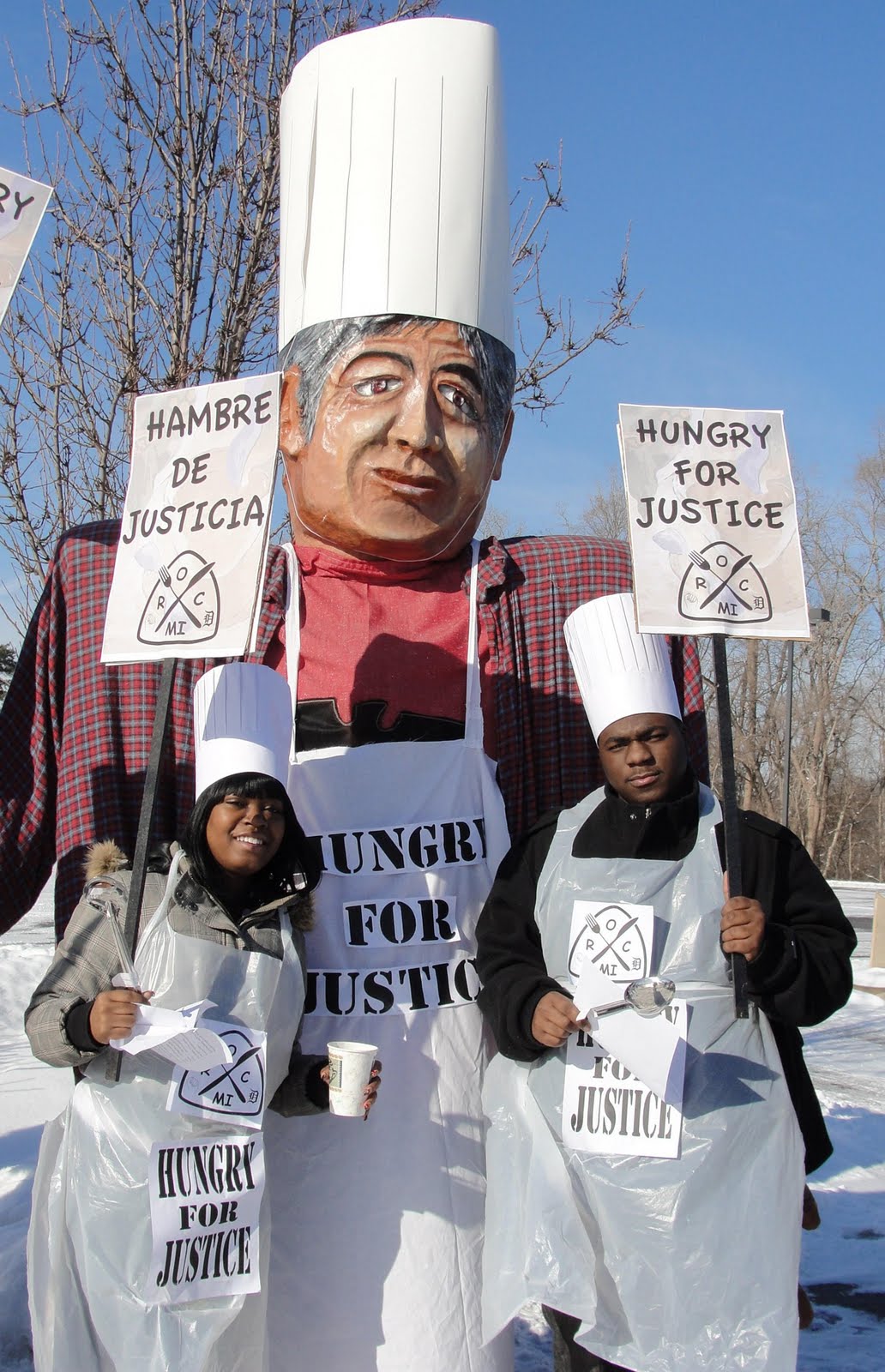
Workers and students gathered at “Food Day” events on dozens of campuses to link decent jobs to decent food. The event was so successful making connections that a week later Pomona College banned students and workers from talking to each other in the dining halls.

“Farm to fork” may sound like a doctrine for foodies, but for workers in food production struggling for decent jobs, it’s an organizing goal.

Workers along the food chain — on farms, in warehouses and supermarkets, in restaurants and cafeterias — are seeking to make common cause with each other and against the corporations that run the food industry.

Big food purveyors like Walmart and Sodexo indirectly set the pay of the farm workers who pick fresh vegetables in the sun and the warehouse workers who move the frozen variety in and out of windowless buildings.

They do so by setting low prices and squeezing their suppliers, pushing contractors to underpay workers all along the chain. They goad farms and food processors to cut corners in a production system that values quantity over quality and appearance over nutritional content.

Corporate consolidation in the food system has become so extreme that the Department of Justice held investigative hearings last year. Firms seek to control food “from gene to supermarket shelf,” said a report for the National Farmers Union, with five companies now controlling 50 percent of the retail food market and four firms controlling 85 percent of beef production.

Joann Lo of the Food Chain Workers Alliance says this means “workers need to be united across the food supply chain.” Her organization brings together farmworker groups, worker centers, and unions.

Supermarket workers in Food and Commercial Workers (UFCW) locals in the New York and Los Angeles areas are part of the alliance, as is the hotel and culinary union UNITE HERE, Restaurant Opportunities Center, Warehouse Workers for Justice, the Coalition of Immokalee Workers in Florida, and the Farmworker Support Committee (CATA) in New Jersey and Pennsylvania.

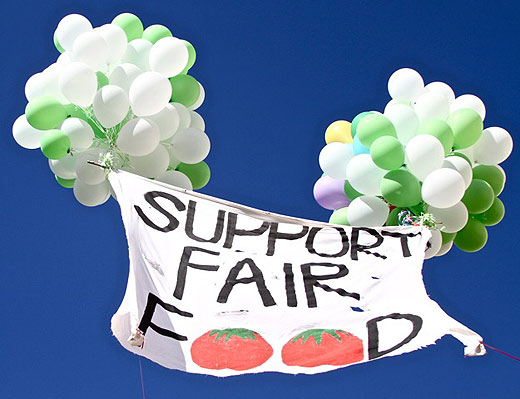
Fair food

The alliance is connecting workers with consumers — leveraging fresh interest in locally grown, healthy, and sustainable food into backing for sustainable jobs.

“You care about the food you’re eating?” asks Diana Robinson of UFCW Local 1500 in New York. “Well, let me tell you about the person behind your food.”

Campus food workers had a median wage of $17,176 in 2010, according to UNITE HERE, and 28 percent of cooks live in “food-insecure” households, where nutritionally adequate food is limited or uncertain. Many Florida pickers still make 45 cents per 30-pound bucket of tomatoes, the same rate they did decades ago.

Connections between food workers and consumers can make managers nervous. At Pomona College in Claremont, California, the administration has banned students from talking to dining hall workers, even during their breaks. The gag rule came down a week after workers cooked and shared a meal with students as part of a union-supported “Food Day” event in October.

But people who are concerned about getting healthy local food to low-income communities often aren’t making the connection to the workers involved in food production, Lo said.

That connection came into sharp focus in January when Michelle Obama, whose signature issue is healthy food, praised Walmart for its promise to reduce hydrogenated fats and salt in its brands, and to locate stores in underserved neighborhoods.

Unions shot back that Walmart is a prime cause of poverty, as it drives out unionized stores that pay better, squeezes its food suppliers, and pays its own workers so little they need food stamps to survive.

Food workers on bottom

Low pay and harsh working conditions face nearly every worker in the long food production chain, from farmworkers, meatpackers, and warehouse workers to grocery clerks, cooks, and servers.

“They’re stealing our wages, they’re treating us poorly, and they’re stealing our dignity, like it’s nothing,” said Deathrice Jimerson, a former warehouse worker who’s now a volunteer organizer with Warehouse Workers for Justice south of Chicago.

Farmworkers are still organizing for basic labor protections, while at the other end of the chain, kitchen staff working for food service companies like Sodexo and Aramark have been struggling over a decade to win union recognition.

Because of their low pay, food workers are disproportionately affected by nutrition-related illnesses — diabetes, high blood pressure, and heart disease, said Jessica Choy, a California UNITE HERE organizer. “Workers are affected not only where they work by this broken food system,” she said.

Image from Coalition of Immokalee Workers.

The union organized “Food Day” events at dozens of campuses in October, where students and kitchen staff cooked, ate, and talked together. UNITE HERE connects its union drives to students’ growing desire for cafeteria food that isn’t processed slop—favored by institutions to cut costs.

“Bringing in packaged food, to a lot of people that are passionate about feeding people, it’s sort of like an insult,” said LaShanda Bell, a cook at Northwestern University. “We want to mix sauces and make our own stocks and actually produce food with our hands versus unthawing, heating, and serving.”

Re-skilling the kitchen

Union food workers at Yale successfully fought back against a de-skilling of their kitchen and the closing of their bakery.

After Yale contracted with Sysco, the food distribution company, “we went right to canned sauce, processed cheese, pizza dough out of a box,” chef Stu Comen told the student paper. “Here we are, with our chef coats with our names on them, and we’re opening up cans of sauce.”

The workers, members of UNITE HERE Local 35, made common cause with students, holding taste tests and posting ingredient lists so students could compare the processed baked goods provided by Sysco to those produced in Yale’s bakeshop.

Now the college aims to get 40 percent of its food from sustainable sources in the next two years.

Harvard dining hall workers, members of UNITE HERE Local 26, ratified a contract in September that sets up a union-management committee to implement “environmentally responsible” food practices.

Dining hall workers say these initiatives lead to more work as well as better, healthier food. At Harvard, workers were getting hours cut. They hope to see those hours return as real cooking increases.

Pitfalls at Pomona

At Pomona College, it’s been easier to get the school to switch to unprocessed food than to win union recognition.

On Food Day kitchen staff reported that the sustainable-food initiative won by students and workers has led to speed-up in the kitchen rather than to more hours or more jobs.

“They’re putting skill back in the work, adding to the workload, and not taking into account how it may be affecting the workers,” said Choy.

More than 90 percent of kitchen staffers signed a petition for a union in March 2010, but the college doesn’t recognize their organization, despite many meetings in which management promised neutrality, a promise workers say has been broken.

In powerful videos the group has posted online, workers say they were fired for being sick, had vital medical care delayed due to management shenanigans, and were unable to afford health coverage, which runs up to $600 a month. Some workers were still making less than $12 an hour after 20 years of service.

All along the food chain

The Food Chain Workers Alliance is using worker-to-worker, worker-to-farmer, and worker-to-consumer connections to plan a larger campaign, expected to launch next year, focused on one corporate target that can impact work from farms to tables, Lo said.

Each group of workers will figure out specific demands, she said. They’re compiling their knowledge of the industry and studying winning models employed by members of their coalition:

  • Warehouse Workers for Justice has successfully used community outrage to win back jobs for 10 workers fired in warehouses southwest of Chicago. An ethnic food distributor charged with discriminating against Latino workers got an earful from community leaders who threatened to boycott.
  • In a 10-year campaign, Florida farmworkers and students joined forces to pressure highly advertised brands like Taco Bell to sign on to fair wages for tomato pickers. They have nipped other brands into line with marches, campus actions, and boycotts, and are now focused on specialty grocer Trader Joe’s and the Florida-based Publix supermarket chain.

But farmworkers are able to employ boycotts partly because they are excluded from U.S. labor law. Workers covered by the National Labor Relations Act are hogtied by legal restrictions on “secondary boycotts,” which target a company that is not their direct employer.

On campuses, kitchen workers usually labor for contractors like Aramark, rather than the university itself. In warehouses, workers are often temps, way down the chain from companies with a recognizable name. When confronted, the corporate behemoths point to their contractors as the culprits.

Successes have been won by cutting through the layers of subcontractors, finding where the real power lies, and then finding leverage to shift that target directly. By creating connections and a deeper understanding of what is at stake, food chain workers hope to scale up and “build a campaign that will fight for all of us on the supply line to America’s tables,” said Jimerson.

[Jenny Brown, staff writer for Labor Notes, was for 23 years the co-editor of the Iguana, a progressive monthly magazine in Gainesville, Florida. Eduardo Soriano-Castillo also contributed to this article, which originally appeared at Labor Notes and was distributed by Portside.]

The Rag Blog

Posted in RagBlog | Tagged , , , , | Leave a comment

Workers Challenge Big Food

By Jenny Brown / Labor Notes /

Workers and students gathered at “Food Day” events on dozens of campuses to link decent jobs to decent food. The event was so successful making connections that a week later Pomona College banned students and workers from talking to each other in the dining halls. Photo: UNITE HERE.

“Farm to fork” may sound like a doctrine for foodies, but for workers in food production struggling for decent jobs, it’s an organizing goal.

Workers along the food chain—on farms, in warehouses and supermarkets, in restaurants and cafeterias—are seeking to make common cause with each other and against the corporations that run the food industry.

Big food purveyors like Walmart and Sodexo indirectly set the pay of the farm workers who pick fresh vegetables in the sun and the warehouse workers who move the frozen variety in and out of windowless buildings.

They do so by setting low prices and squeezing their suppliers, pushing contractors to underpay workers all along the chain. They goad farms and food processors to cut corners in a production system that values quantity over quality and appearance over nutritional content.

Corporate consolidation in the food system has become so extreme that the Department of Justice held investigative hearings last year. Firms seek to control food “from gene to supermarket shelf,” said a report for the National Farmers Union, with five companies now controlling 50 percent of the retail food market and four firms controlling 85 percent of beef production.

Joann Lo of the Food Chain Workers Alliance says this means “workers need to be united across the food supply chain.” Her organization brings together farmworker groups, worker centers, and unions.

Supermarket workers in Food and Commercial Workers (UFCW) locals in the New York and Los Angeles areas are part of the alliance, as is the hotel and culinary union UNITE HERE, Restaurant Opportunities Center, Warehouse Workers for Justice, the Coalition of Immokalee Workers in Florida, and the Farmworker Support Committee (CATA) in New Jersey and Pennsylvania.
FAIR FOOD

The alliance is connecting workers with consumers—leveraging fresh interest in locally grown, healthy, and sustainable food into backing for sustainable jobs.

“You care about the food you’re eating?” asks Diana Robinson of UFCW Local 1500 in New York. “Well, let me tell you about the person behind your food.”

Campus food workers had a median wage of $17,176 in 2010, according to UNITE HERE, and 28 percent of cooks live in “food-insecure” households, where nutritionally adequate food is limited or uncertain. Many Florida pickers still make 45 cents per 30-pound bucket of tomatoes, the same rate they did decades ago.

Connections between food workers and consumers can make managers nervous. At Pomona College in Claremont, California, the administration has banned students from talking to dining hall workers, even during their breaks. The gag rule came down a week after workers cooked and shared a meal with students as part of a union-supported “Food Day” event in October.

But people who are concerned about getting healthy local food to low-income communities often aren’t making the connection to the workers involved in food production, Lo said.

That connection came into sharp focus in January when Michelle Obama, whose signature issue is healthy food, praised Walmart for its promise to reduce hydrogenated fats and salt in its brands, and to locate stores in underserved neighborhoods.

Unions shot back that Walmart is a prime cause of poverty, as it drives out unionized stores that pay better, squeezes its food suppliers, and pays its own workers so little they need food stamps to survive.
FOOD WORKERS ON BOTTOM

Low pay and harsh working conditions face nearly every worker in the long food production chain, from farmworkers, meatpackers, and warehouse workers to grocery clerks, cooks, and servers.

“They’re stealing our wages, they’re treating us poorly, and they’re stealing our dignity, like it’s nothing,” said Deathrice Jimerson, a former warehouse worker who’s now a volunteer organizer with Warehouse Workers for Justice south of Chicago.

Farmworkers are still organizing for basic labor protections, while at the other end of the chain, kitchen staff working for food service companies like Sodexo and Aramark have been struggling over a decade to win union recognition.

Because of their low pay, food workers are disproportionately affected by nutrition-related illnesses—diabetes, high blood pressure, and heart disease, said Jessica Choy, a California UNITE HERE organizer. “Workers are affected not only where they work by this broken food system,” she said.

The union organized “Food Day” events at dozens of campuses in October, where students and kitchen staff cooked, ate, and talked together. UNITE HERE connects its union drives to students’ growing desire for cafeteria food that isn’t processed slop—favored by institutions to cut costs.

“Bringing in packaged food, to a lot of people that are passionate about feeding people, it’s sort of like an insult,” said LaShanda Bell, a cook at Northwestern University. “We want to mix sauces and make our own stocks and actually produce food with our hands versus unthawing, heating, and serving.”
RE-SKILLING THE KITCHEN

Union food workers at Yale successfully fought back against a de-skilling of their kitchen and the closing of their bakery.

After Yale contracted with Sysco, the food distribution company, “we went right to canned sauce, processed cheese, pizza dough out of a box,” chef Stu Comen told the student paper. “Here we are, with our chef coats with our names on them, and we’re opening up cans of sauce.”

The workers, members of UNITE HERE Local 35, made common cause with students, holding taste tests and posting ingredient lists so students could compare the processed baked goods provided by Sysco to those produced in Yale’s bakeshop.

Now the college aims to get 40 percent of its food from sustainable sources in the next two years.

Harvard dining hall workers, members of UNITE HERE Local 26, ratified a contract in September that sets up a union-management committee to implement “environmentally responsible” food practices.

Dining hall workers say these initiatives lead to more work as well as better, healthier food. At Harvard, workers were getting hours cut. They hope to see those hours return as real cooking increases.
PITFALLS AT POMONA

At Pomona College, it’s been easier to get the school to switch to unprocessed food than to win union recognition.

On Food Day kitchen staff reported that the sustainable-food initiative won by students and workers has led to speed-up in the kitchen rather than to more hours or more jobs.

“They’re putting skill back in the work, adding to the workload, and not taking into account how it may be affecting the workers,” said Choy.

More than 90 percent of kitchen staffers signed a petition for a union in March 2010, but the college doesn’t recognize their organization, despite many meetings in which management promised neutrality, a promise workers say has been broken.

In powerful videos the group has posted online, workers say they were fired for being sick, had vital medical care delayed due to management shenanigans, and were unable to afford health coverage, which runs up to $600 a month. Some workers were still making less than $12 an hour after 20 years of service.
ALL ALONG THE FOOD CHAIN

The Food Chain Workers Alliance is using worker-to-worker, worker-to-farmer, and worker-to-consumer connections to plan a larger campaign, expected to launch next year, focused on one corporate target that can impact work from farms to tables, Lo said.

Each group of workers will figure out specific demands, she said. They’re compiling their knowledge of the industry and studying winning models employed by members of their coalition:

> Warehouse Workers for Justice has successfully used community outrage to win back jobs for 10 workers fired in warehouses southwest of Chicago. An ethnic food distributor charged with discriminating against Latino workers got an earful from community leaders who threatened to boycott.

> In a 10-year campaign, Florida farmworkers and students joined forces to pressure highly advertised brands like Taco Bell to sign on to fair wages for tomato pickers. They have nipped other brands into line with marches, campus actions, and boycotts, and are now focused on specialty grocer Trader Joe’s and the Florida-based Publix supermarket chain.

But farmworkers are able to employ boycotts partly because they are excluded from U.S. labor law. Workers covered by the National Labor Relations Act are hog-tied by legal restrictions on “secondary boycotts,” which target a company that is not their direct employer.

On campuses, kitchen workers usually labor for contractors like Aramark, rather than the university itself. In warehouses, workers are often temps, way down the chain from companies with a recognizable name. When confronted, the corporate behemoths point to their contractors as the culprits.

Successes have been won by cutting through the layers of subcontractors, finding where the real power lies, and then finding leverage to shift that target directly. By creating connections and a deeper understanding of what is at stake, food chain workers hope to scale up and “build a campaign that will fight for all of us on the supply line to America’s tables,” said Jimerson.

[Jenny Brown, staff writer for Labor Notes, was for 23 years co-editor of the Iguana, a progressive monthly magazine in Gainesville, Florida. Eduardo Soriano-Castillo contributed to this story which originally appeared at Labor Notes and was distributed by Portside.]

The Rag Blog

Posted in RagBlog | Leave a comment

David Bacon : From ‘Planton’ to Occupy

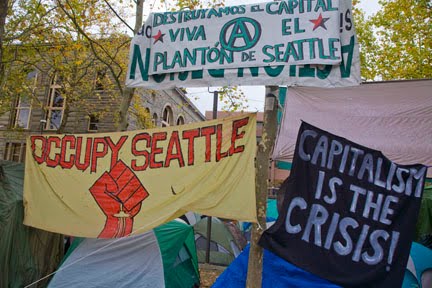
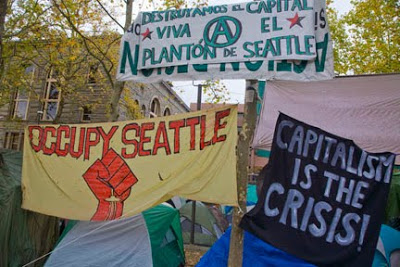
Banners at Occupy Seattle. Photo by David Bacon / The Rag Blog.

From planton to Occupy:
Unions, immigrants, and the Occupy movement

By David Bacon / Truthout / November 6, 2011

OAKLAND, California — When Occupy Seattle called its tent camp “Planton Seattle,” camp organizers were laying a local claim to a set of tactics used for decades by social movements in Mexico, Central America, and the Philippines.

And when immigrant janitors marched down to the detention center in San Diego and called their effort Occupy ICE (the initials of the Immigration and Custom Enforcement agency responsible for mass deportations), people from countries with that planton tradition were connecting it to the Occupy movement here.

This shared culture and history offer new possibilities to the Occupy movement for survival and growth at a time when the Federal law enforcement establishment, in cooperation with local police departments and municipal governments, has uprooted many tent encampments.

Different Occupy groups from Wall Street to San Francisco have begun to explore their relationship with immigrant social movements in the U.S., and to look more closely at the actions of the 1% beyond our borders that produces much of the pressure for migration.

Reacting to the recent evictions, the Coalition for the Political Rights of Mexicans Abroad recently sent a support letter to Occupy Wall Street and the other camps under attack. “We greet your movement,” it declared, “because your struggle against the suppression of human rights and against social and economic injustice has been a fundamental part of our struggle, that of the Mexican people who cross borders, and the millions of Mexican migrants who live in the United States.”

Many of those migrants living in the U.S. know the tradition of the planton and how it’s used at home. And they know that the 1%, whose power is being challenged on Wall Street, also designed the policies that are the very reason why immigrants are living in the U.S. to begin with.

Mike Garcia, president of United Service Workers West/SEIU, the union that organized Occupy ICE, described immigrant janitors as “displaced workers of the new global economic order, an order led by the West and the United States in particular.”

Criminalizing the act of camping out in a public space is intended, at least in part, to keep a planton tradition from acquiring the same legitimacy in the U.S. that it has in other countries. That right to a planton was not freely conceded by the rulers of Mexico, El Salvador, or the Philippines, however — no more than it has been conceded here. The 99% of those countries had to fight for it.

Two of the biggest battles of modern Mexican political history were fought in the Tlatelolco Plaza, where hundreds of students were gunned down in 1968, and three years later in Mexico City streets where more were beaten and shot by the paramilitary Halcones.

In both El Salvador and the Philippines, strikers have a tradition of living at the gates of the factory or enterprise where they work. But even today that right must be defended against the police, and (at least until the recent election of the Funes and Aquino governments) even the military.

Plantons or encampments don’t stand alone. They are tactics used by unions, students, farmers, indigenous organizations, and other social movements. Each planton is a visible piece of a movement or organization — a much larger base. When the plantons are useful to those movements, they defend them. That connection between planton and movement, between the encampment and its social base, is as important as holding the physical space on which the tents are erected.

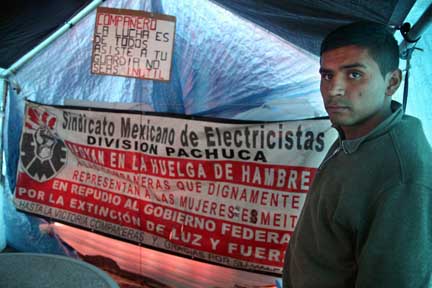
For the last two years that relationship has been very clear in the Zocalo, Mexico City’s huge central plaza. During that time, fired members of Mexico’s independent left-wing electrical workers union, the SME, have lived in a succession of plantons. They’ve often been elaborate, with kitchens, meeting rooms, and communications centers, in addition to the tents where people slept and ate.

At various times, the SME encampment was one of several in the huge square. A year ago the workers were joined by indigenous Triqui and Mixtec women from Oaxaca, who protested the violence used by their state’s previous governor against teachers’ strikes and rural organizations.

The social movement in Oaxaca, which the women represented in Mexico City, grew strong enough to finally knock the old ruling party, the PRI, from the governorship it had held for almost 80 years.

In the Zocalo plantons, people from different organizations mix it up. Last September’s Day of the Indignant brought together people from very diverse movements. Some see electoral politics as a vehicle for change, but many indigenous activists and SME members don’t. Even among those who do, there are deep disagreements over how to participate in the electoral process.

But the people in the Zocalo have two things in common. Different plantons may not see every political question eye-to-eye, but each represents a social movement in the world outside the plaza. And the planton itself has value primarily because it forces public attention to focus on the crisis that has led each group to set up its encampment.

The SME workers used their plantons to dramatize repression by the Federal government. When Mexican President Felipe Calderon dissolved the state-run power company for central Mexico and fired its 44,000 employees, he sought to destroy their union and move towards the privatization of the electrical system — to benefit Mexican and foreign 1%ers.

A year ago, several SME members conducted a hunger strike at the planton that generated front page headlines for weeks, and lasted so long that doctors warned participants they were risking death. At the height of the protest, the union battled police in front of the power stations, as it tried to exercise its legal right to strike and picket.

The planton and the movement outside it were intimately connected. The hunger strikers were few, but spoke for a union of tens of thousands of workers. In the end, the SME negotiated the removal of its last planton in return for government acknowledgement of its right to exist. It organized other unions to resist the government’s assault on labor rights, and mobilized electricity consumers to protest rising bills and cuts in service. The planton helped to focus attention on these demands, and to pull the union’s allies into action.

Clearly someone in Seattle knows this tradition of plantons in the Zocalo, perhaps even as a participant. When the painter made the Seattle banner, she or he also included, right next to the word “planton,” the anarchists’ “A” with the circle around it. This symbol was a reminder of another aspect of cross-border fertilization. Many anarchists or anarcho-syndicalists — members of the Industrial Workers of the World — fought in the Mexican Revolution.

Because of that revolutionary upheaval, even today, almost a century later, ordinary Mexicans expect certain rights, including the right to set up a tent in the Zocalo. U.S. workers crossed the border to fight alongside Mexicans in that insurrection long ago, for a government that would acknowledge that right. The planton, therefore, is a common heritage, with a history that makes it as legitimate on Wall Street as it is in Mexico City.

Not long after the OWS camp was set up in Zuccotti Park, the planton/occupy movement crossed the U.S./Mexico border. In Tijuana, home to a million people, mostly displaced migrants from Mexico’s south, activists came together and set up an occupation on the grassy median of the Paseo de los Heroes.

Their tents were pitched in the middle of the Zona del Rio, where the city’s 1% meet in fancy hotels and work in government offices. Then, on October 18 police reacted even earlier than they did in most U.S. cities, arresting two dozen activists at the urging of local businessmen. Occupy Tijuana condemned the detentions, declaring, “We are not assassins, delinquents, tramps, or crooks.”
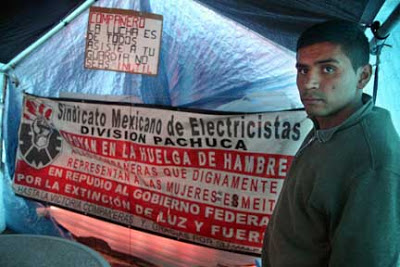
Leobardo Benitez Alvarez. a fired SME member, in the union’s planton. Photo by David Bacon.

In the U.S. we have our own history of defending public space for protest, and it isn’t necessary to reach back a hundred years to find it. In just the last few decades, immigrant workers have popularized the use of the planton here, helping unions recover the militant tactics of their own past.

In 1992 immigrants trying to join the United Electrical Workers mounted the first strike among production workers in Silicon Valley, and set up a planton and conducted a hunger strike to pressure their employer. A year later other Latino immigrants in San Francisco erected their tents on the sidewalk in front of Sprint’s headquarters, after their workplace was closed days before they were scheduled to vote in a union election.

A decade ago anti-globalization activists and unions shut down the meeting of the World Trade Organization in Seattle. Young protestors chained their arms together inside metal pipes, and lay down in the intersections of downtown Seattle. Tens of thousands took over the streets. Other anti-globalization protests followed, in which activists battled for their right to use public space to challenge the international policies of the 1%.

Working-class support for the battle in Seattle had its roots in the impact of the North American Free Trade Agreement. Workers could see the cost of free trade in the loss of their own jobs, as production moved south. Over the last two decades, many have also discovered that those same agreements and policies didn’t make Mexicans better off, but led to their impoverishment as well.

NAFTA and free market policies forced on developing countries produced opportunities for banks and corporations to reap profits. They drove down wages, forced farmers off their land, and destroyed the unions and livelihood of millions of people. This system was designed on Wall Street, by the same bankers Occupiers hold responsible for the current crisis of foreclosures and unemployment in the U.S.

The current economic crisis doesn’t stop at the border. In fact in Mexico, Central America, the Philippines, and elsewhere, it’s been a fact of life for a long time. This is the source of forced migration — what Garcia condemned at Occupy ICE.

The 99% live in all those countries where free trade agreements and structural adjustment policies are imposed. They also live in the communities of people who have come here as a result. Who, then, are more natural allies for Occupy protestors than people who’ve been on the receiving end of these policies for years?

In New York this connection wasn’t lost on Occupy Wall Street. In October a group, Occupy Wall Street-Español was formed at the first Asemblea en Español. They, in turn, translated the first issue of the Occupied Wall Street Journal.

Participants formed a subgroup, Occupy Wall Street Latinoamericano, to spread the movement to Spanish-speaking communities, recognizing that the city is home to so many Mexicans from the state of Puebla that its nickname is PueblaYork, as well as much older established communities of Puerto Ricans, Colombians, Ecuadorians, and other Spanish-speaking people.

The group will soon publish the first issue of its own newspaper, with articles talking about immigration, globalization, and the specific attacks by the 1% on Latinos.

Claudia Villegas, a women’s rights activist working with the group Occupy Wall Street Latinoamericano, helped organize a demonstration of immigrant women four days after police raided the Zuccotti Park encampment. “We decided to change our original plan for a march because we were afraid they would stop it,” she says. “Nevertheless, 23 organizations participated including women’s rights groups and, above all, those working with immigrant women.”

In San Francisco a joint march of immigrant activists and Occupy participants helped to defend that city’s encampment. In the general assembly meeting preceding it participants talked about the city’s offer to move the Occupiers into an abandoned building in the Latino Mission District several miles away.

Few wanted to give up the camp on Justin Herman Plaza, and most felt the city was just trying to move them out of sight. But many people also felt that having an Occupy camp in the barrio was a good idea.

“We’re still really working in parallel,” Villegas says. She draws attention to the potential power of the immigrant rights movement, and what it could mean to OWS.

“We have to include the movement that began in 2006, when there were hundreds of thousands of people in the streets across this country. People were reacting to the injustice of the system then too.”

They’re separate movements, though, she warns, and “our agenda has to come from immigrants themselves. We need to integrate, and at the same time the Occupy movement has to learn to accept us. But we’re all on the same path.”

Bringing the immigrant and Occupy movements together means more than setting up an encampment. The San Diego demonstration didn’t set up an overnight camp, but it brought thousands of workers and supporters down to the ICE detention center to protest the firings of immigrant janitors.

The Occupy ICE protest was intended to draw public attention to the Federal government’s immigration enforcement strategy that requires employers to fire undocumented workers. In Southern California, the multinational corporations that clean office buildings are terminating 2,000 union members.

Earlier waves of firings have targeted unionized building cleaners in Minneapolis, Seattle and San Francisco, sewing machine operators in Los Angeles, food service workers on university campuses, and thousands of others.

Garcia says ICE and the employers are in collusion. After firing union janitors with high seniority and benefits, using immigration status as a pretext, the companies can then hire new workers at lower wages with fewer benefits.

“To hide their greed the commercial real estate industry has used the tools of government to confuse and divide the 99%,” he charges.

“They first said we were unskilled workers who should be happy to be working. They then weakened worker protections to make organizing virtually impossible. Over the last decade the industry has used immigration as a wedge to intimidate and, if need be, replace our workers. ICE is doing what the 1% corporate real estate industry wants: using immigration laws to recycle well paid janitors in the hopes of taking back gains in pay and benefits our union has won.”

(Ironically, the week USWW organized Occupy ICE its parent union, SEIU, endorsed the reelection of President Obama, who is responsible for the ICE policy of firing workers.)

For Occupy, defending workers under attack is a way to survive, grow roots, and develop a strong base. That’s not always the direction activists take, however. Near Oakland, over 200 immigrant workers at the largest foundry on the west coast, Pacific Steel Casting in Berkeley, are being fired in another “silent raid” like that hitting the janitors.

Through the summer and fall, foundry workers went to city councils, unions, churches, and community organizations, seeking help to pressure ICE not to force them from their jobs. Their campaign held “the migra” off for months, but the firings began nevertheless in November. Now these immigrant families are trying to survive. Occupy Oakland has yet to respond, however.

Instead, some of its activists are trying to shut down work in Oakland’s port a second time, as well as others along the West Coast. An earlier march to close the port after the first eviction of Occupy Oakland drew thousands of people. The proposal for a second Coast-wide shutdown, however, is opposed by the longshore union.

The ILWU’s opposition does not come from conservatism. The union, whose members make a living from international shipping and trade, has been one of the most vocal critics of U.S. free trade agreements. ILWU members have taken action many times to defend the SME and unions in Mexico, as well as other countries. Its locals, however, had no role in the decision to try to close the ports, nor did other port workers.

Solidarity is a two-way street, based on mutual respect. In most cities, including Oakland and San Francisco, labor has welcomed Occupy and sought to defend the encampments. In New York, Occupy activists have been given resources in many union halls, and unions have mobilized against police raids at Zuccotti Park.

An alliance of unions, immigrants, and Occupiers has great potential strength, not just in numbers, but also in the exchange of ideas and tactics. Unions in particular might benefit from wider use of the planton or Occupy encampment. Occupy ICE challenges the Occupy movement to take up the firings of immigrant workers, but it’s also a challenge to unions themselves, many of which have watched in silence as longtime members have been forced from their jobs.

The vision of Occupy — the 99% vs. the 1% — has enormous support among immigrants and unions. In place of the tired rhetoric of politicians, shedding crocodile tears for the “middle class” while demonizing the poor, Occupy gives workers a vision of their commonality in the 99%.

This powerful message blows away illusions that higher-paid workers have more in common with stockbrokers than with immigrants laboring at minimum wage, or unemployed young people on the streets of African American ghettos or Latino barrios.

The Coalition for the Political Rights of Mexicans Abroad shares the same vision of class-based commonality.

“We are outraged,” it says, “that U.S. citizens, when they demand justice and expose the inequalities that exist in their society, are treated like criminals. With the same outrage, we condemn the criminalization of migrant Mexicans by the U.S. government, the raids by immigration authorities [and] the militarization of the border… No human being should be treated as a criminal because they struggle to find better conditions in which to live.”

[David Bacon is a California-based writer and photographer. His latest book, Illegal People: How Globalization Creates Migration and Criminalizes Immigrants, was published by Beacon Press. His photographs and stories can be found at dbacon.igc.org. This article was published at Truthout and was crossposted to The Rag Blog. Read more of David Bacon’s articles on The Rag Blog.]

The Rag Blog

Posted in Rag Bloggers | Tagged , , , , , , , | Leave a comment

Harry Targ : Vince Emanuele, Anti-War Vets, and the 99%

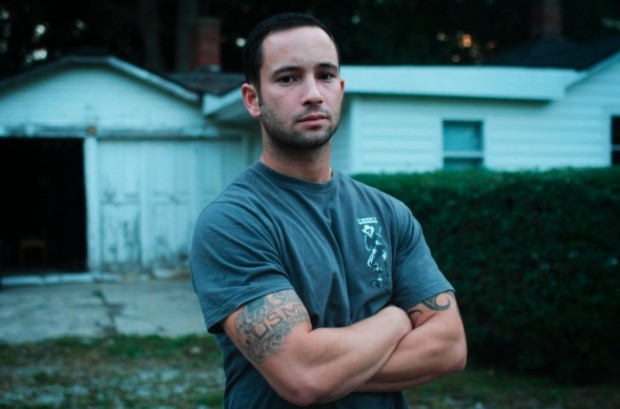
Anti-war vet Vince Emanuele. Photo by Jessica A. Woolf / nwtimes.

Veterans unplugged:
Hoosier anti-war activist connects
returning veterans to the 99%

By Harry Targ | The Rag Blog | November 6, 2011

“I grew up in Chicago and Northwest Indiana. Working-class family, father was a Union Ironworker… mother was a stay at home Mom.” Vince Emanuele joined the Marines after graduating from high school. “I came out of boot camp a hard chargin’ Devil Dog.”

He served in the Marines from 2003 until 2005 stationed in California, Kuwait, and Iraq. His eight month deployment in Iraq involved him in street patrols, looking for snipers and land mines, “along with shooting at innocent civilians, destroying their property and beating up prisoners.”

While in Iraq the fascination with war that he had acquired as a kid playing video games dissipated. His father sent him reading material — Noam Chomsky, Gore Vidal, Hunter Thompson, The Nation — and he and friends began to reflect on what they were doing in Iraq. He came to the view that the war was “illegal, immoral, unjustified, and unneeded.” He was not spreading “democracy” or “peace” and the U.S. war effort was not winning the “hearts and minds” of the Iraqi people.

After returning to the U.S., Emanuele joined Iraq Veterans Against the War, has been organizing vets in Indiana and Illinois, created a weekly radio show called “Veterans Unplugged” which is available online, and has become a prominent activist for social, economic, and political justice in the heartland of America while finishing an undergraduate political science degree.

Emanuele recently spoke on a panel organized by the Lafayette Area Peace Coalition. He elaborated on the current plight of veterans, particularly veterans who served in the two longest wars in U.S. history, Afghanistan and Iraq.

While acknowledging that the current military force has chosen to enlist in regular army or reserve units, the 21st century enticement to serve is really an “economic draft.” With declining incomes, wages, job opportunities, and rising educational costs, more and more men and women, he said, have seen military service as the only escape from lives of economic marginalization.

He spoke of the culture of militarization to which every new recruit is exposed: a process of dehumanization; the spread of racism, particularly targeting stereotypes of Muslims; sexism; and homophobia. In reality the military experience of young people, Emanuele said, involves placing raw, uneducated, teenagers in a war zone, with weapons and a license to kill. The victims of the actions of these raw recruits, schooled in video games and super-patriotism, were the millions of Iraqi and Afghan citizens who most fervently wanted the young foreigners off their land.

Emanuele presented some figures on the impacts of military service on returning veterans. (According to the Bureau of Labor Statistics in 2010 there were 20.2 million men and 1.8 million women who had served in the military). In 2011, Emanuele reported:

  • Rates of unemployment of returning veterans from Afghanistan and Iraq are higher than in the non-veteran population, both men and women;
  • African-American vets experience double the unemployment rate of white vets;
  • 80,000 returning veterans are currently homeless (56 % of homeless vets are African American or Latinos);
  • 20% to 50% of 21st century returning veterans suffer some form of Post Traumatic Stress Syndrome (an estimated 350,000 to 1 million vets);
  • 1,000 returning vets attempt suicide each month.

Emanuele, connected the plight of returning veterans to the military-industrial complex and imperial wars. As a member of Iraq Veterans Against the War, he highlighted the long tradition of soldiers resisting participation in unjust wars. He referred to patterns of resistance to war running throughout U.S. history:

  • In 1781 the Pennsylvania militia mutinied against war profiteers and for food;
  • Between the 1870s and the 1890s, National Guard soldiers often refused to fire on striking workers;
  • In 1919 unknown numbers of U.S. soldiers refused orders to go fight against the Bolsheviks who had come to power in Russia;
  • Thousands of World War I veterans, known as the Bonus Army, assembled in Washington D.C. in 1932 to demand back pay due them from their active duty experience;
  • From 1964-75 a massive GI anti-Vietnam war resistance movement emerged with over 300 GI anti-war newspapers produced, 10 % of all Vietnam era soldiers going AWOL or deserting, and a broad array of other forms of anti-war resistance and opposition to military recruiting.

Emanuele stressed the commonality of experience and vision that is shared by most veterans with the Occupy Movement. He suggested that peace and justice activists must understand that returning veterans are a vital part of the 99% movement committed to radically restructure American society.

He argued that the 99%, including vets, must see the vital connections between the global capitalist system, the military-industrial complex, and the pain and suffering that have generated war and economic insecurity in the 21st century.

Emanuele ended his talk with reference to the frank admission of General Smedley Butler who oversaw the effort to crush the army of Augusto Sandino in Nicaragua in the early 1930s. Butler admitted that he, as a Marine General, had served as an instrumentality of Wall Street, putting down popular rebellions in the service of profit.

  • To learn more about Vince Emanuele and his weekly radio show check out Veterans Unplugged.
  • To learn more about Iraq Veterans Against the War, go to the IVAW website.

[Harry Targ is a professor of political science at Purdue University who lives in West Lafayette, Indiana. He blogs at Diary of a Heartland Radical — and that’s also the name of his new book which can be found at Lulu.com. Read more of Harry Targ’s articles on The Rag Blog.]

The Rag Blog

Posted in Rag Bloggers | Tagged , , , , | 1 Comment

Carl Davidson : The Pundits’ Obsession About ‘Specific Demands’

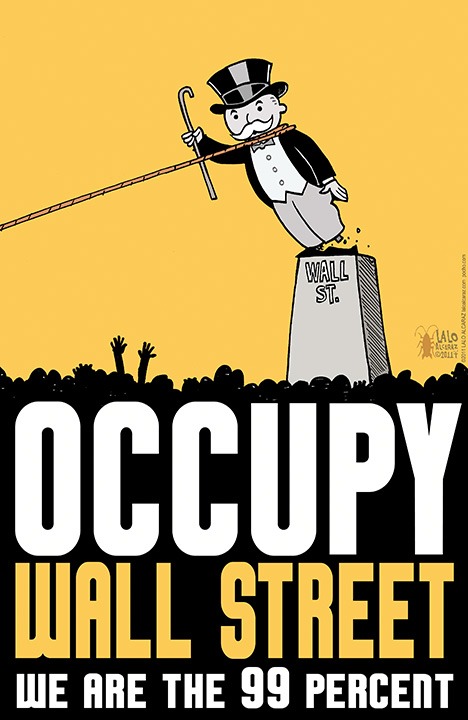
Occupy Wall Street poster from Lalo Alcaraz / laloalcaraz.com.

Occupy and the pundits:
Do we really want ‘specific demands?’

By Carl Davidson / The Rag Blog/ December 6, 2011

I’m getting fed up with pompous pundits lecturing the “Occupy!” movement for not having a set of specific demands.

A case in point: A case in point: New York Times financial columnist Joe Nocera quoted at length in a story by Phoebe Mitchell in the Daily Hampshire Gazette on November 29. He was speaking at the Amherst Political Union, a debate club at the University of Massachusetts, Amherst.

Nocera starts off with the now usual tipping of the hat to the protestors:

Nocera believes the anger caused by income inequality, a divisive issue across the country in this prolonged economic downturn, is the fuel for both popular uprisings. “If we lived in a country that had a growing economy and where the middle class felt that they could make a good living and had a chance for advancement and a decent life, there would be no tea party or Occupy Wall Street,” he said.

But we don’t live in such times, and the more interesting story is that OWS and its trade union allies are displacing the Tea Party, and energizing the progressive grassroots. Nocera, however, makes OWS the target.

He believes that for the Occupy Movement to be successful, it must frame clear demands that outline a plan for creating jobs and refashioning Wall Street to benefit the entire country and not just a select few wealthy investors. Without a solid plan for moving forward, he said, the Occupy protestors will be continued to be viewed by Wall Street supporters as little more than “a gnat that needs to be flicked from its shoulder blades.”

A “gnat” indeed. In due time, a progressive majority may well come to view our dubious “Masters of the Universe” on Wall Street as bothersome gnats to be flicked away.

But to get to the main point, Nocero knows perfectly well that there are any number of short, sweet and to the point sets of demands aimed at Wall Street finance capital and the Congress it works to keep under its thumb. Richard Trumka of the AFL-CIO has been hammering away at his six-point jobs program — one point of which is a financial transaction tax on Wall Street as a source of massive new revenues to fund the other five.

The United Steel Worker’s Leo Gerard has been tireless for years working for a new clean energy and green manufacturing industrial policy that could create millions of new jobs and get us out of the crisis in a progressive way.

So what happens when these demands are put forward? With our Wall Street lobbyists working behind the scenes, the best politicians money can buy declare them “off the table.” Nocera and others of like mind in punditocracy put the cart before the horse.

OWS arose as a result of a long train of abuses, year after year of sensible, rational, progressive demands, and programs swept off of Congress’s agenda like so many bread crumbs from a dining table. Not even brought to a vote. OWS and a lot of other people are fed up with being dismissed.

The pundits should watch what they wish for. The demands and packages of structural reforms will be back, much sharper and clearer, and with the ante upped by hundreds of thousands in the streets, as well as millions turning out for the polls.

In fact, the solutions have always been there for anyone with ears to hear. We’ll see if our voices are loud enough to crack the ceiling at the top, and let some light shine through.

[Carl Davidson is a national co-chair of the Committees of Correspondence for Democracy and Socialism, a national board member of Solidarity Economy Network, a writer for Beaver County Blue, the website of PA’s 4th CD Progressive Democrats of America, and a member of Steelworkers Associates. He is the author of several books, including New Paths to Socialism, available online. In the 1960s, he was a national leader of SDS and a writer and editor for the Guardian newsweekly. This article was also published at Beaver County Blue. Read more articles by Carl Davidson on The Rag Blog.]

The Rag Blog

Posted in Rag Bloggers | Tagged , , | Leave a comment

Ted McLaughlin : It’s Everyone’s Fight

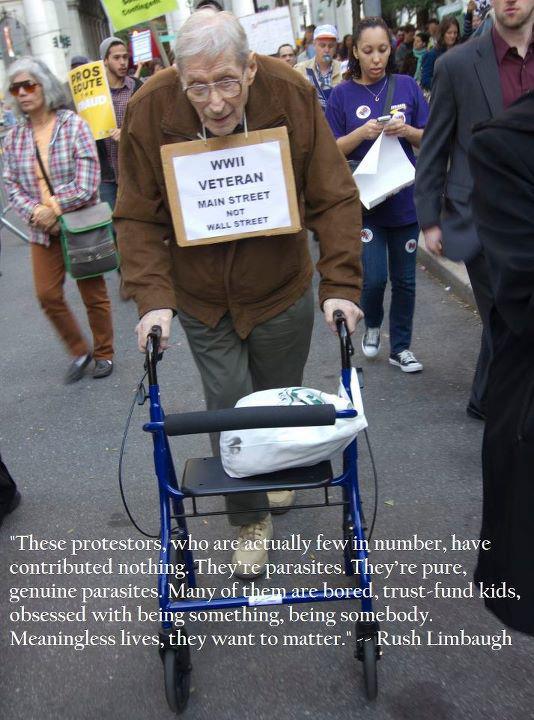
Typical 99% parasite. Image from Jobsanger.

CLICK ON IMAGE TO ENLARGE

It’s everyone’s fight

‘The natural progress of things is for liberty to yield and for government to gain ground.’ — Thomas Jefferson

By Ted McLaughlin / The Rag Blog/ December 6, 2011

The quote at the bottom of the picture above shows what the right wing would like for Americans to believe — that the Occupy Wall Street movement is nothing more than a few bored young people, parasites with meaningless lives who have contributed nothing to America. But this picture shows that argument is a pathetic lie (designed to protect the 1% and the failed Republican economic policy).

This gentleman has contributed much to his country. As a World War II veteran, he put his life on the line for his fellow citizens — to defend freedom for not only his generation, but also for all the generations that followed.

And I suspect that he has worked hard all his life to support his family and contribute to our economy. He certainly doesn’t look like a “trust fund baby.” And he’s not the only older American who has joined in the protests. There are many — they may not be camping out with the younger folks, but they are there for the marches and demonstrations.

For many of these older demonstrators — even if they and their younger cohorts are able to finally affect the change that is needed in this country — that change will probably not benefit them much. That is not why they are there. They are there because they love their country and they want to protect the constitutional rights for those who come after them. And they want some economic justice for their children and grandchildren and great-grandchildren.

These people know something that far too many Americans seem to have forgotten — that rights, even constitutional rights, must be fought for continuously, or they will disappear. It is simply the nature of ALL governments to assume as much power as they can — and this is true even of rather benign democratic forms of government. Every form of government will slowly eat away at the rights of its citizens if allowed to do so. As Thomas Jefferson so wisely told us, “The natural progress of things is for liberty to yield and for government to gain ground.”

These governments always have a seemingly justifiable reason for eroding the rights of citizens — the most popular being that it is necessary to defend the country, or to maintain law and order, or to please some god.

A perfect example of this was the Bush administration’s imposition of the Patriot Act. They said it was needed to prevent another 9/11 disaster. But 9/11 did not happen because of a lack of intelligence gathered — the plans were known before the incident happened.

9/11 happened because of incompetent leadership that did not take the proper precautions after learning of the plan to attack America. And preventing another 9/11 was just an excuse government used to seize a few more of the people’s rights.

And now we have the Occupy Wall Street demonstrations. These protests were started to point out the economic injustices of our present society. The deck has been stacked in favor of the richest Americans (because they own far too many members of Congress) and this has resulted in a serious recession and the loss of millions of jobs — not to mention a vast gulf in wealth and income between the richest Americans and the rest of America. And much of America has responded favorably to these demonstrations, because they recognize that change must come.

In fact, the demonstrations have been so popular and widespread (blanketing the nation) that the 1% and their government lackeys are beginning to get scared. They want to stop the movement before it grows large enough to actually affect the needed change.

This is normal, as no group in power has willingly given up any of their power or economic advantage. The sad part is that, like past governments here and around the world, they are willing to deny the rights of the people in an attempt to hold on to their power and advantages.

It is written in the United States Constitution that the people of this country have certain rights, and among these are the right to free speech, the right to peaceably assemble, and the right to redress the government for their grievances. The Occupy Wall Street movement is simply trying to exercise those rights in its quest for economic justice. And the authorities are trying to deny them those rights — often through the use of violence.

The stakes were already high, as they will be in any quest for economic justice. But now those stakes have been heightened even more. It has now become a fight to either keep or cede to the government the basic rights given citizens by the Constitution. Whatever anyone might think of Occupy Wall Street’s goals, it is now imperative for all Americans to step up and demand that our constitutional rights be respected and obeyed by the government.

These rights have always been guaranteed to the rich and powerful but are often denied to those without political power. Now it is time for the Americans of this generation to fight for those rights to be extended to every citizen, and that fight can only be won if everyone becomes involved — regardless of age, sex, race, color, or national origin. It is everybody’s fight, and it is too important a fight to lose.

It is not good enough for those rights to be written in the Constitution. Government must be forced to honor those rights, or they mean nothing.

[Ted McLaughlin also posts at jobsanger. Read more articles by Ted McLaughlin on The Rag Blog.]

Source /

The Rag Blog

Posted in Rag Bloggers | Tagged , , | Leave a comment

The Occupy Wall Street movement has captured the attention and imagination of the country — and with it’s advent have come some stylistic innovations. One of those, known as “mic check,” has served as a unique means of communication among demonstrators — and has more recently been used as a technique to interrupt speeches, including one by Karl Rove. Our old friend and colleague Allen has serious reservations about “mic check” which he shares with us — along with an email discussion about the subject. The post includes a video of the Karl Rove disruption.

Posted in RagBlog | Leave a comment

Bill Meacham : What is Truth? (In 400 Words)

The Chinese character for truth.

(In 400 words)
What Is Truth?

By Bill Meacham /The Rag Blog/ November 30, 2011

Philosophy Now magazine runs an occasional contest: Write an answer to a philosophical question in 400 words or fewer. The winning essays are printed in the magazine. My essay in answer to the question “What is Truth” was selected[1], and I am pleased to present it here, followed by another winning essay by my colleague Robert “Little Bobby” Tables.

Several factors determine the truthfulness of a theory or an explanation of events: congruence, consistency, coherence, and usefulness.

  • A true theory is congruent with our experience. It fits the facts. No fact is left unexplained. It is falsifiable, and nothing falsifying has been found. People think truth is correspondence to reality, understood as something independent of us. But we don’t have direct contact with reality, only with our experience of it.
  • When what we experience is predictable then we can infer that our theory corresponds with reality. Our theory is congruent with the facts, as we experience them. When we discover new facts, we can change our theory. Truth is always provisional, not an end state.
  • A true theory is internally consistent. It has no contradictions within itself, and it all fits together elegantly. Consistency allows us to infer things from what we already know. An inconsistent theory, one that contains contradictions, does not allow us to do this.
  • A true theory is coherent with everything else we consider true. It confirms, or at least fails to contradict, the rest of our knowledge, where “knowledge” means beliefs for which we can give rigorous reasons. The physical sciences, for example, hold together quite well. Physics, chemistry, geology, biology and astronomy all reinforce each other.
  • A true theory is useful. It has predictive power, allowing us to gain control of the world by making good choices concerning what is likely to happen, choices that pan out. It gives us mastery. When we act on the basis of a true theory or explanation, our actions are successful.

Truth enables us to exert our power, in the sense of our ability to get things done, successfully. We master both the world of physical things and the world of ideas, of theory. What is true is what works to organize our practice and our thought, so that we are able both to handle reality effectively and to reason with logical rigor to true conclusions.

Truth is useful. Does that mean that what is useful is true? That is not a useful question. Let’s not ask what truth is; let’s ask instead how we can recognize it reliably when it appears. If a theory is congruent with our experience, internally consistent, coherent with everything else we know, and useful for organizing our thinking and practice, then we can confidently consider it true.

The following is Robert Tables’ essay on Truth:

Truth is interpersonal. We tell each other things, and when they work out we call them truths. When they don’t, we call them errors or, if we are not charitable, lies.

What we take as truth depends on what others around us espouse. For many centuries European Christians believed that men had one fewer rib than women because the Bible says that Eve was created from Adam’s rib. Nobody bothered to count because everyone assumed it was true. And when they finally counted, it was because everyone agreed on the count that the real truth became known.

Even when we are alone, truth is interpersonal. We express these truths or errors or lies to others and to ourselves in language; and, as Wittgenstein pointed out, there can be no private language.

But the most essential truth, the truth by which we all live our lives, is intensely personal, private. We might call this “Truth,” with a capital T. Even though each of us lives our life by it, it can be different for each person. Shall I believe and obey the Torah, the New Testament, the Quran, the Bhagavad Gita, the Zend Avesta, the Dhammapada? Or none of the above: shall I find my own Truth in my own way? Am I more authentic if I do so? What if I find my Truth and it sets me apart from others? Am I then authentically lonely?

We need a community of seekers with a commitment to meta-Truth, recognizing that everyone’s personal Truth is to be respected, even though it might differ from someone else’s.

But even in such a community, some beliefs would be acceptable and others not. My belief that I am exceptional and deserve preferential treatment, perhaps because I alone have received a special revelation, is not likely to be shared by others. Whether that changes my mind or not depends on how compelling are my reasons for believing it and how deeply I feel the need for acceptance.

From within the in-group we look with fear and revulsion on those who deny the accepted beliefs. From outside, we admire those who hold aloft the light of truth amidst the darkness of human ignorance.

And in every case it is we who judge, not I alone. Even the most personal Truth is adjudicated within a community and depends on the esteem of others.

[1]Philosophy Now magazine, “What Is Truth?” Issue 86 Sept/Oct 2011, pp. 34-37. London: Anya Publications, 2011. Also online publication, URL = http://www.philosophynow.org/issue86/What_Is_Truth as of 22 November 2011.

[Bill Meacham is an independent scholar in philosophy. A former staffer at Austin’s 60s underground paper, The Rag, Bill received his Ph.D. in philosophy from the University of Texas at Austin. Meacham spent many years working as a computer programmer, systems analyst, and project manager. He posts at Philosophy for Real Life, where this article also appears. Read more articles by Bill Meacham on The Rag Blog.]

The Rag Blog

Posted in Rag Bloggers | Tagged , | 1 Comment