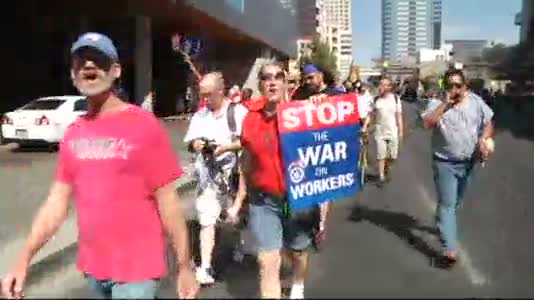
Joan Wile : Granny for Peace Welcomes Iraq Withdrawal

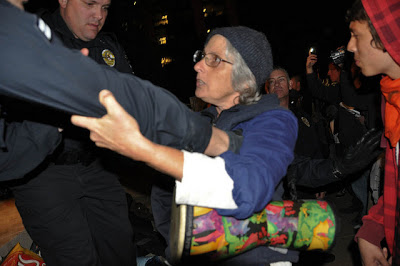
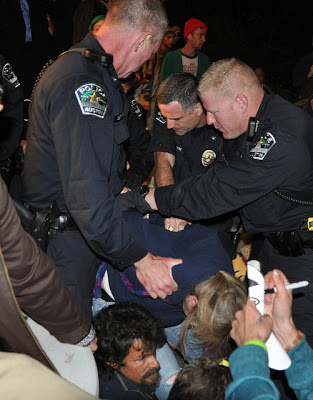
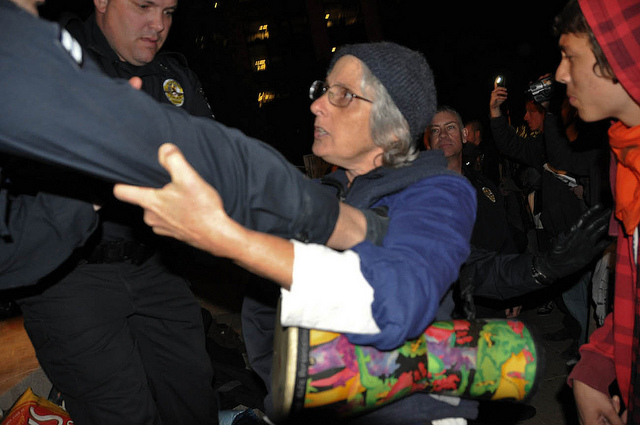
Members of Granny Peace Brigade at Lincoln Center. Photo from the New York Observer.

As Iraq troops come home:
Peace granny is ‘cautiously optimistic’

By Joan Wile / The Rag Blog / October 26, 2011

NEW YORK — The news hit me like an electric shock. Was this for real? I stared at the words on the TV screen in disbelief: “President Obama says all U.S. troops in Iraq will be home by the end of the year.” That meant that 41,000 troops will be leaving Iraq.

This welcome announcement was somewhat tempered when further news reports produced the information that on January 1, 2012, the State Department will command a hired army of about 5,500 security contractors, all to protect the largest U.S. diplomatic presence anywhere overseas. There will also apparently be a “significant C.I.A. presence,” according to The New York Times.

What was I to make of that?

Since the fall of 2003, my anti-war grandmother friends and I had been struggling, demonstrating, petitioning, organizing, yelling, marching, traveling, with one singular objective — to end the illegal, immoral war and occupation in Iraq causing so much death and destruction. We later added ending the war in Afghanistan to our agenda.

When we first hit the streets, we were a small minority and met with anger. Most Americans backed the war. CNN promoted it like it was the latest blockbuster action movie, and the public cheered as the news channel repeatedly showed the fires ignited by our bombs lighting up the Baghdad sky.

I began Grandmothers Against the War with a vigil in front of Rockefeller Center with just two of us nervous, shivering old ladies on Jan. 14, 2004. Gradually, more and more people joined us — mostly grannies, but also Veterans for Peace and other lone individuals sick about the war. We endured hecklers who would shout such things as “Traitors” at us. One of our Vets for Peace almost got into a fist fight with a particularly obnoxious and persistent passerby.

But, we kept on, heartened that more and more of the crowd gave us thumbs up and yelled “Thank you” as the public began to realize what a debacle our occupation was. Foreigners, in particular, applauded us — an Italian man came over to us one day and kissed all 24 grannies standing there on the cheek.

We decided to ramp up our opposition when we became aware that the Bush administration was impervious to the growing public outcry to end the war. Eighteen grandmothers, me included, tried to enlist at the Times Square recruiting station on Oct. 17, 2005, in order to replace young people in harm’s way for a lie.

Actually, none of us had grandkids in the military. We did it as a matter of principle on behalf of America’s grandchildren. We figured they were entitled to long lives like we had all enjoyed and should not be forced to endanger their lives and limbs for an unjust cause.

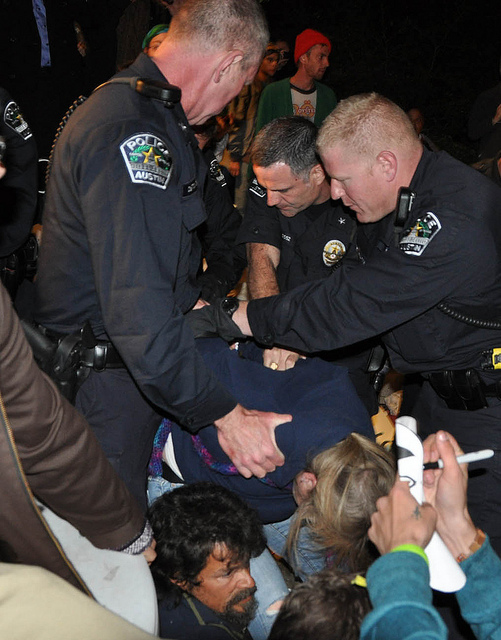
When we were denied entrance into the recruiting station, we sat down on the ground and refused to move. The police arrested us and took us to jail. We knew we were entitled to peaceably dissent, but the cops apparently didn’t! After a six-day trial in criminal court, defended by eminent civil liberties attorney Norman Siegel and his co-counsel Earl Ward, we were acquitted. The resultant world-wide publicity put the peace grannies on the map, and I like to think that our action was perhaps the first significant anti-war protest with legs.

And, that was just the beginning. We launched a mind-boggling series of actions and never paused — even only three days ago, the Granny Peace Brigade, an outgrowth of Grandmothers Against the War, held a silent vigil at Lincoln Center which received wide attention from the media.

Over the years, we went on a 10-day trek to Washington, D.C., traveled abroad to speak before peace groups, sent 100 grannies to lobby 100 U.S. senators, orchestrated colorful marches across Brooklyn Bridge, performed a whole show written and performed by us, and did numerous other creative actions (it’s all chronicled in my book, Grandmothers Against the War: Getting Off Our Fannies and Standing Up for Peace.

I must say, painfully, that though I enthusiastically supported President Obama during his election campaign, I became disillusioned and disappointed at his failure to bring our troops home from both Iraq and Afghanistan. At times as I stood in front of Rockefeller Center, often in heavy rain or blazing heat, I would wonder if there was any point in putting myself through such discomfort. I began to feel discouraged and doubted these wars would ever end in my lifetime. I fully expected to be out there standing on Fifth Avenue until the day I died.

But, now, with this hopeful and unexpected news, I feel that perhaps it’s all been worthwhile. I like to think our granny efforts have been part of the pressure that contributed to Obama’s decision. I don’t know the political maneuvers behind his move — maybe it has to do with tangled foreign policy machinations I can’t begin to understand. Maybe it’s designed to help him get reelected. Or maybe — just maybe — he did it out of sheer moral principle. I like to think that is his main reason, anyway.

Of course, the more urgent matter is Afghanistan. He says he will bring them home soon. My long immersion in the anti-war struggle, however, has taught me that we can’t count on his doing so unless we keep the pressure on him to end that occupation as well. It will inevitably end some day, but more quickly if we stay mobilized. We can’t clap our hands with joy, unfortunately, until it does.

For now, I will be cautiously optimistic. Dare I say “Mission Accomplished” in Iraq, with reservations, as far as the peace grannies are concerned?

I dare.

[Joan Wile is the author of Grandmothers Against the War: Getting Off Our Fannies and Standing Up for Peace (Citadel Press, May 2008) This article was originally published at Waging Nonviolence. Read more articles by Joan Wile on The Rag Blog.]

The Rag Blog

Posted in Rag Bloggers | Tagged , , , , , | Leave a comment

Type your summary here

Type rest of the post here

Source /

The Rag Blog

Thorne Dreyer

http://en.wikipedia.org/wiki/Thorne_Webb_Dreyer

Posted in RagBlog | Leave a comment

Texas’s Hidden History Revisited—Part 6: 1860-1865

In 1861, the slave-owning Anglo political leaders of Texas decided that the state should secede from the United States and join the Confederacy during the U.S. Civil War. According to Alwyn Barr’s Black Texans book, “as their declaration of causes repeatedly proclaimed, white Texans seceded in 1861, primarily to defend `the servitude of the African to the white race.’” And “as Union armies pushed into Arkansas and Louisiana,” the “slaveholders from each state became refugees to Texas” and “they brought their slaves,” according to Barr’s “Black Texans During the Civil War” essay that appeared in Donald Willett and Stephen Curley’s Invisible Texans book. As a result, “by 1864, the slave population” in Texas “probably grew to 250,000.” In addition, in 1862, in Texas’s Smith County, authorities “arrested over 40 slaves and hanged one after hearing rumors of a plot to revolt,” according to the same essay.

White opponents of Texas seceding from the United States to join the Confederacy who lived in Texas were also repressed between 1861 and 1865. As Randolph Campbell’s Gone To Texas recalled, for example, “some of the more vocal Unionists had to leave Texas” and “James P. Newcomb, editor of the San Antonio Alamo-Express, fled to New Mexico after a mob attacked his press.”

Although most white Texans “continued throughout the war to support the Confederacy as they had supported secession in the first place,” according to Gone To Texas, some organized support for the U.S. government’s Lincoln Administration and the cause of the Union Army did develop inside Texas during the Civil War. As the same book recalled:

“Small groups of Unionists living in regions that voted against secession organized internal opposition to the Confederacy…Germans in the Hill County northwest of San Antonio formed a Union Loyal League with its own military companies…In the Spring of 1862 Confederate officials sent Texas troops into the region to disband the military companies and enforce the conscription law, whereupon 61 of the Unionists, mostly Germans led by Frederick `Fritz’ Tegener, decided to go to Mexico and from there join the United States Army. They…were overtaken by a detachment of 91 Texas Partisan Rangers…while camped on the Nueces River. Attacking before dawn on Aug. 10, 1862, the Confederates killed 19 of the Germans and captured 9 who were badly wounded. The remaining Unionists escaped…After the battle, state troops executed the 9 wounded Germans, and 9 of those who escaped were caught and killed before they reached Mexico…”

Armed Anglo supporters of the Confederacy in Texas also repressed supporters of the North and the Union in Cooke County between 1861 and 1865. As Gone To Texas also notes:

“In Cooke County…the passage of conscription led to the formation of a secret Peace Party that opposed the draft and supported the Union. Rumors that the Peace Party planned to…foment a general uprising led to the arrest on October [1862] of more than 150 suspected insurrectionists by state troops…An extralegal `Citizen’s Court’…found 7 leading Unionists guilty of treason and sentenced them to death. At this point, a mob…lynched 14 more of the prisoners and killed 2 who tried to escape…When unknown assassins killed Col. Young [of the Eleventh Texas Cavalry]…the jury then sentenced another 19 men to hang, bringing the total number of victims to 42. Texas authorities condoned this `Great Hanging at Gainesville’…”

The military conscription law that provoked more organized internal opposition in Hill County and Cooke County, Texas to the South’s Confederate Government had been passed in April 1862 by the Confederate Congress. As a result, all white males in Texas who were between 13-years-old and 46-years-old in 1860—except for any white males whose work involved them in supervising 20 or more slaves—were now in danger of being drafted into the Confederate Army for as long as the U.S. Civil War continued. So, not surprisingly, “nearly 5,000 Texans deserted from Confederate and state service, and an unknown number avoided conscription” by hiding “in isolated areas throughout the state—for example, the Big Thicket in Hardin County and the swamp bottoms of northeast Texas” or “in the northwestern frontier counties,” according to Gone To Texas. And, according to David Humphrey’s Austin: An Illustrated History, “draft-dodging was especially common among Austin’s unionists.”

But slightly more than 50 percent of the white males in Texas who were subject to the Confederate government’s draft during the Civil War were still unable to avoid being drafted; and between 1861 and 1865 between 60,000 to 70,000 white men in Texas served in either the Confederate Army or in Texas state military units. And thousands of these military conscripts from Texas died during the U.S. Civil War. As Gone To Texas observed:

“Approximately 20 to 25 percent of Texas soldiers died while in the army. More than half of these deaths resulted from a variety of illnesses…Deaths in battle and Union prisoner-of-war camps accounted for the other lives lost. The final death toll can be estimated at between 12,000 and 15,000 men, most of them in their twenties and thirties.”

According to Austin: An Illustrated History, Texas’s “loss `in bone and blood’” during the Civil War was “proportionately higher than that of any northern state.”

While between 12,000 and 15,000 people in Texas lost their lives as a result of the Civil War, some other people in Texas, however, apparently made some good money between 1861 and 1865 in Texas, as a result of the Civil War. As W.E.B. Du Bois’s Black Reconstruction 1860-1880 recalled:

“Texas was one of the Southern states that had considerable prosperity during the war. She was outside the area of conflict; excellent crops were raised and slave labor was plentiful. Many slaves were deported to Texas for protection…so that Texas could furnish food and raw material for the Confederate States; and on the other hand, when the blockade was strengthened, Texas became the highway for sending cotton and other goods to Europe by way of Mexico.”


Type rest of the post here

Source /

The Rag Blog

Posted in RagBlog | Leave a comment

PEACE GRANNY CAUTIOUSLY OPTIMISTIC AT IRAQ WAR’S END
by Joan Wile, Author
“Grandmothers Against the War: Getting Off Our Fannies and Standing Up for Peace” (Citadel Press)

The news hit me like an electric shock. Was this for real? I stared at the words on the TV screen in disbelief — PRESIDENT OBAMA SAYS ALL U.S. TROOPS IN IRAQ WILL BE HOME BY THE END OF THE YEAR. That meant that 41,000 troops will be leaving Iraq.

This welcome announcement was somewhat tempered when further news reports produced the information that on January 1, 2012, the State Department will command a hired army of about 5,500 security contractors, all to protect the largest U.S. diplomatic presence anywhere overseas. There will also apparently be a “significant C.I.A. presence,” according to the New York Times.

What was I to make of that?

Since the fall of 2003, my anti-war grandmother friends and I had been struggling, demonstrating, petitioning, organizing, yelling, marching, traveling with one singular objective — to end the illegal, immoral war and occupation in Iraq causing so much death and destruction. We later added ending the war in Afghanistan to our agenda. When we first hit the streets, we were a small minority and met with anger. Most Americans backed the war. CNN promoted it like it was the latest blockbuster action movie, and the public cheered as the news channel repeatedly showed the fires ignited by our bombs lighting up the Baghdad sky.

I began Grandmothers Against the War with a vigil in front of Rockefeller Center with just two of us nervous. shivering old ladies on Jan. 14, 2004. Gradually, more and more people joined us — mostly grannies, but also Veterans for Peace and other lone individuals sick about the war. We endured hecklers who would shout such things as “Traitors” at us. One of our Vets for Peace almost got into a fist fight with a particularly obnoxious and persistent passerby.

But, we kept on, heartened that more and more of the crowd gave us thumbs up and yelled “Thank you” as the public began to realize what a debacle our occupation was. Foreigners, in particular, applauded us — an Italian man came over to us one day and kissed all 24 grannies standing there on the cheek.

We decided to ramp up our opposition when we became aware that the Bush administration was impervious to the growing public outcry to end the war. Eighteen grandmothers, me included, tried to enlist at the Times Square recruiting station on Oct. 17, 2005, in order to replace young people in harm’s way for a lie. Actually, none of us had grandkids in the military. We did it as a matter of principle on behalf of America’s grandchildren. We figured they were entitled to long lives like we had all enjoyed and should not be forced to endanger their lives and limbs for an unjust cause.

When we were denied entrance into the recruiting station, we sat down on the ground and refused to move. The police arrested us and took us to jail. WE knew we were entitled to peaceably dissent, but the cops apparently didn’t! After a six-day trial in criminal court, defended by eminent civil liberties attorney Norman Siegel and his co-counsel Earl Ward, we were acquitted. The resultant world-wide publicity put the peace grannies on the map, and I like to think that our action was perhaps the first significant anti-war protest with legs.

And, that was just the beginning. We launched a mind-boggling series of actions and never paused — even only three days ago, the Granny Peace Brigade, an outgrowth of Grandmothers Against the War, held a silent vigil at Lincoln Center which received wide attention from the media. Over the years, we went on a ten-day trek to Washington DC, traveled abroad to speak before peace groups, sent 100 grannies to lobby 100 U.S. senators, orchestrated colorful marches across Brooklyn Bridge, performed a whole show written and performed by us and did numerous other creative actions (it’s all chronicled in my book, Grandmothers Against the War: Getting Off Our Fannies and Standing Up for Peace (Citadel Press)).

I must say, painfully, that though I enthusiastically supported Pres. Obama during his election campaign, I became disillusioned and disappointed at his failure to bring our troops home from both Iraq and Afghanistan. At times as I stood in front of Rockefeller Center, often in heavy rain or blazing heat, I would wonder if there was any point in putting myself through such discomfort. I began to feel discouraged and doubted these wars would ever end in my lifetime. I fully expected to be out there standing on Fifth Avenue until the day I died.

But, now, with this hopeful and unexpected news, I feel that perhaps it’s all been worthwhile. I like to think our granny efforts have been part of the pressure that contributed to Obama’s decision. I don’t know the political maneuvers behind his move — maybe it has to do with tangled foreign policy machinations I can’t begin to understand. Maybe it’s designed to help him get re-elected. Or maybe — just maybe — he did it out of sheer moral principle. I like to think that is his main reason, anyway.

Of course, the more urgent matter is Afghanistan. He says he will bring them home soon. My long immersion in the anti-war struggle, however, has taught me that we can’t count on his doing so unless we keep the pressure on him to end that occupation as well. It will inevitably end some day, but more quickly if we stay mobilized. We can’t clap our hands with joy, unfortunately, until it does.

For now, I will be cautiously optimistic. Dare I say “Mission Accomplished” in Iraq, with reservations, as far as the peace grannies are concerned?

I dare.

(This article was originally published in Waging Nonviolence.)

Type rest of the post here

Source /

The Rag Blog

Posted in RagBlog | Leave a comment

Harvey Wasserman : Occupy Nukes!

Occupy Wall Street image from eleven degrees north.

Merge and win:
Occupy Wall Street and
the ‘No Nukes’ movement

By Harvey Wasserman / The Rag Blog / October 25, 2011

The global upheaval that is the Occupy Movement is hopefully in the process of changing — and saving — the world. Through the astonishing power of creative nonviolence, it has the magic and moxie to defeat the failing forces of corporate greed.

A long-term agenda seems to be emerging: social justice, racial and gender equality, ecological survival, true democracy, an end to war, and so much more. “When the power of love overcomes the love of power,” said Jimi Hendrix, “the world will know peace.”

Such a moment must come now in the nick of time, as the corporate ways of greed and violence pitch us to the precipice of self-extinction. At that edge sits a sinister technology, a poisoned cancerous power that continues to harm us all even as three of its cores melt and spew at Fukushima. Atomic energy, the so-called “Peaceful Atom,” has failed on all fronts.

Once sold as “too cheap to meter,” it’s now the world’s most expensive electric generator. Once embraced as a corporate bonanza, it cannot obtain private liability insurance. Once hyped as the world’s energy savior, it cannot attract private investment.

Once worshiped as a technology of genius, it cannot clean up its own radioactive messes. Once described as the “magic bullet” that could power the Earth, it’s now the lethal technology threatening to destroy it.

The nonviolent campaign against this agent of the apocalypse has helped raise the use of peaceful mass action to an entirely new level.

In the wake of the movements for labor unions, nuclear disarmament, civil rights — including minorities, women, and gays — peace in Southeast Asia, and more, the messages of Eugene V. Debs, Dorothy Day, Martin Luther King, and so many great apostles of nonviolence have become part of an emerging new culture.

For decades, the No Nukes campaign has conducted hundreds of demonstrations involving thousands of arrests in dozens of countries. Violence has been renounced and almost entirely avoided. Injuries have been present but minimal. There’s been at least one murder, that of the anti-nuclear activist Karen Silkwood. But overall, given the magnitude of the movement over more than 40 years of confrontation, individual casualties have been slight.

And the accomplishments have been historic. Whereas Richard Nixon once promised 1,000 U.S. reactors by the year 2000, there are now 104. These dangerous relics are now under attack, especially at Vermont Yankee and Indian Point, New York.

Worldwide we have seen Germany renounce atomic energy and commit to renewables. Siemens, once a corporate nuclear flagship, has turned instead toward Solartopian technologies. Like Japan, now horribly contaminated by Fukushima, Switzerland, Italy, Spain, and others are following suit.

But the final fight remains to be won. While pouring billions into cornering the global solar market, China is still poised to build some 30 reactors. India, Britain, Korea, and a few others are also toying with more. But especially in the wake of Fukushima, they are not a done deal.

In the United States, the key is to deny the nuclear industry the federal funding without which it can’t build new reactors.

And here is where the Occupy and No Nukes movements intersect. Wall Street has actually retreated, and will not finance new commercial reactors.

So the industry has gone straight to the White House and Congress to force taxpayers to underwrite new construction loans. In the past decade reactor backers have spent more than $60 million per year lobbying Congress and the White House to get this money. With no such budget, the national No Nukes movement has been defeating these give-aways.

Now comes the turning point. In 2011, for the first time, solar and wind are being recognized by mainstream economists as cheaper than new nukes. And renewables overall in the United States generate more usable power than operating reactors.

If we can hold off these loan guarantees for another year or two, and shut some older reactors like Vermont Yankee and Indian Point, the dam will break, and the corporate impetus to build new reactors may finally go away.

Atomic energy is, after all, a means of centralizing power in corporate hands. But there is only so far the one-percenters can ride a dead horse, especially if it’s radioactive.

Our struggle then comes with fighting to keep the Solartopian conversion in the people’s hands. We will love defeating fossil and nuclear fuels. But we want to guarantee our energy supply — even if it’s driven by the wind and sun — is controlled by the community, not the corporations.

And here is where Occupy/No Nukes can jump the power of democracy to a whole new level.

Human society is on the brink of its most significant technological conversion ever. Green power will be a multi-trillion-dollar industry, outstripping even computers and the internet.

But who will own the sun? Will the corporations again monopolize a nascent revolution? Or can the Occupy and No Nukes movements keep this technology decentralized, with the power Mother Earth gives us resting in the hands of the people?

In this struggle, longevity is the key. The grassroots No Nukes campaign is some four decades young and going strong. Every few years the corporate media runs features about how it has died and gone away, and they have always been wrong. We will not disappear until the nukes do.

The same must be the case for Occupy. Any day now the Foxists will proclaim the movement dead and failed. It will be nonsense. But in the long term, it’s up to us to prove them wrong. All the bright futures above come true only if we stay with it as long as it takes.

At the intersection of No Nukes and Occupy, we know that true democracy can only come when our energy supply is owned by the people. A grassroots-based energy supply is at the core of a sustainable Solartopian future.

In the 1970s a grassroots movement led by the Clamshell Alliance nonviolently occupied a reactor site at Seabrook, New Hampshire, and sparked a global green powered revolution whose completion may be in sight.

This year the Occupy movement took to Wall Street, and has exploded into a global democratic revolution with unbound potential.

There are innumerable hurdles along the way.

But as these two movements flow together like a mighty stream, let them wash away forever the corporate plague of atomic energy, and free at last the path to a democratized, green-powered Earth.

[Harvey Wasserman’s Solartopia! Our Green-Powered Earth is at www.harveywasserman.com. His “Solartopia! Green-Power Hour” is podcast from www.talktainmentradio.com. Read more of Harvey Wasserman’s writing on The Rag Blog.]

The Rag Blog

Posted in Rag Bloggers | Tagged , , , , , , | 1 Comment

Texas’s Hidden History Revisited—Part 6: 1860-1865

In 1861, the slave-owning Anglo political leaders of Texas decided that the state should secede from the United States and join the Confederacy during the U.S. Civil War. According to Alwyn Barr’s Black Texans book, “as their declaration of causes repeatedly proclaimed, white Texans seceded in 1861, primarily to defend `the servitude of the African to the white race.’” And “as Union armies pushed into Arkansas and Louisiana,” the “slaveholders from each state became refugees to Texas” and “they brought their slaves,” according to Barr’s “Black Texans During the Civil War” essay that appeared in Donald Willett and Stephen Curley’s Invisible Texans book. As a result, “by 1864, the slave population” in Texas “probably grew to 250,000.” In addition, in 1862, in Texas’s Smith County, authorities “arrested over 40 slaves and hanged one after hearing rumors of a plot to revolt,” according to the same essay.

White opponents of Texas seceding from the United States to join the Confederacy who lived in Texas were also repressed between 1861 and 1865. As Randolph Campbell’s Gone To Texas recalled, for example, “some of the more vocal Unionists had to leave Texas” and “James P. Newcomb, editor of the San Antonio Alamo-Express, fled to New Mexico after a mob attacked his press.”

Although most white Texans “continued throughout the war to support the Confederacy as they had supported secession in the first place,” according to Gone To Texas, some organized support for the U.S. government’s Lincoln Administration and the cause of the Union Army did develop inside Texas during the Civil War. As the same book recalled:

“Small groups of Unionists living in regions that voted against secession organized internal opposition to the Confederacy…Germans in the Hill County northwest of San Antonio formed a Union Loyal League with its own military companies…In the Spring of 1862 Confederate officials sent Texas troops into the region to disband the military companies and enforce the conscription law, whereupon 61 of the Unionists, mostly Germans led by Frederick `Fritz’ Tegener, decided to go to Mexico and from there join the United States Army. They…were overtaken by a detachment of 91 Texas Partisan Rangers…while camped on the Nueces River. Attacking before dawn on Aug. 10, 1862, the Confederates killed 19 of the Germans and captured 9 who were badly wounded. The remaining Unionists escaped…After the battle, state troops executed the 9 wounded Germans, and 9 of those who escaped were caught and killed before they reached Mexico…”

Armed Anglo supporters of the Confederacy in Texas also repressed supporters of the North and the Union in Cooke County between 1861 and 1865. As Gone To Texas also notes:

“In Cooke County…the passage of conscription led to the formation of a secret Peace Party that opposed the draft and supported the Union. Rumors that the Peace Party planned to…foment a general uprising led to the arrest on October [1862] of more than 150 suspected insurrectionists by state troops…An extralegal `Citizen’s Court’…found 7 leading Unionists guilty of treason and sentenced them to death. At this point, a mob…lynched 14 more of the prisoners and killed 2 who tried to escape…When unknown assassins killed Col. Young [of the Eleventh Texas Cavalry]…the jury then sentenced another 19 men to hang, bringing the total number of victims to 42. Texas authorities condoned this `Great Hanging at Gainesville’…”

The military conscription law that provoked more organized internal opposition in Hill County and Cooke County, Texas to the South’s Confederate Government had been passed in April 1862 by the Confederate Congress. As a result, all white males in Texas who were between 13-years-old and 46-years-old in 1860—except for any white males whose work involved them in supervising 20 or more slaves—were now in danger of being drafted into the Confederate Army for as long as the U.S. Civil War continued. So, not surprisingly, “nearly 5,000 Texans deserted from Confederate and state service, and an unknown number avoided conscription” by hiding “in isolated areas throughout the state—for example, the Big Thicket in Hardin County and the swamp bottoms of northeast Texas” or “in the northwestern frontier counties,” according to Gone To Texas. And, according to David Humphrey’s Austin: An Illustrated History, “draft-dodging was especially common among Austin’s unionists.”

But slightly more than 50 percent of the white males in Texas who were subject to the Confederate government’s draft during the Civil War were still unable to avoid being drafted; and between 1861 and 1865 between 60,000 to 70,000 white men in Texas served in either the Confederate Army or in Texas state military units. And thousands of these military conscripts from Texas died during the U.S. Civil War. As Gone To Texas observed:

“Approximately 20 to 25 percent of Texas soldiers died while in the army. More than half of these deaths resulted from a variety of illnesses…Deaths in battle and Union prisoner-of-war camps accounted for the other lives lost. The final death toll can be estimated at between 12,000 and 15,000 men, most of them in their twenties and thirties.”

According to Austin: An Illustrated History, Texas’s “loss `in bone and blood’” during the Civil War was “proportionately higher than that of any northern state.”

While between 12,000 and 15,000 people in Texas lost their lives as a result of the Civil War, some other people in Texas, however, apparently made some good money between 1861 and 1865 in Texas, as a result of the Civil War. As W.E.B. Du Bois’s Black Reconstruction 1860-1880 recalled:

“Texas was one of the Southern states that had considerable prosperity during the war. She was outside the area of conflict; excellent crops were raised and slave labor was plentiful. Many slaves were deported to Texas for protection…so that Texas could furnish food and raw material for the Confederate States; and on the other hand, when the blockade was strengthened, Texas became the highway for sending cotton and other goods to Europe by way of Mexico.”


Type rest of the post here

Source /

The Rag Blog

Posted in RagBlog | Leave a comment

Where Occupy & No Nukes merge & win

By Harvey Wasserman / The Rag Blog / October 25, 2011

The global upheaval that is the Occupy Movement is hopefully in the process of changing — and saving — the world. Through the astonishing power of creative nonviolence, it has the magic and moxie to defeat the failing forces of corporate greed.

A long-term agenda seems to be emerging: social justice, racial and gender equality, ecological survival, true democracy, an end to war, and so much more. “When the power of love overcomes the love of power,” said Jimi Hendrix, “the world will know peace.”

Such a moment must come now in the nick of time, as the corporate ways of greed and violence pitch us to the precipice of self-extinction. At that edge sits a sinister technology, a poisoned cancerous power that continues to harm us all even as three of its cores melt and spew at Fukushima. Atomic energy, the so-called “Peaceful Atom,” has failed on all fronts.

Once sold as “too cheap to meter,” it’s now the world’s most expensive electric generator. Once embraced as a corporate bonanza, it cannot obtain private liability insurance. Once hyped as the world’s energy savior, it cannot attract private investment.

Once worshiped as a technology of genius, it cannot clean up its own radioactive messes. Once described as the “magic bullet” that could power the Earth, it’s now the lethal technology threatening to destroy it.

The nonviolent campaign against this agent of the apocalypse has helped raise the use of peaceful mass action to an entirely new level.

In the wake of the movements for labor unions, nuclear disarmament, civil rights — including minorities, women, and gays — peace in Southeast Asia, and more, the messages of Eugene V. Debs, Dorothy Day, Martin Luther King, and so many great apostles of nonviolence have become part of an emerging new culture.

For decades, the No Nukes campaign has conducted hundreds of demonstrations involving thousands of arrests in dozens of countries. Violence has been renounced and almost entirely avoided. Injuries have been present but minimal. There’s been at least one murder, that of the anti-nuclear activist Karen Silkwood. But overall, given the magnitude of the movement over more than 40 years of confrontation, individual casualties have been slight.

And the accomplishments have been historic. Whereas Richard Nixon once promised 1,000 U.S. reactors by the year 2000, there are now 104. These dangerous relics are now under attack, especially at Vermont Yankee and Indian Point, New York.

Worldwide we have seen Germany renounce atomic energy and commit to renewables. Siemens, once a corporate nuclear flagship, has turned instead toward Solartopian technologies. Like Japan, now horribly contaminated by Fukushima, Switzerland, Italy, Spain, and others are following suit.

But the final fight remains to be won. While pouring billions into cornering the global solar market, China is still poised to build some 30 reactors. India, Britain, Korea, and a few others are also toying with more. But especially in the wake of Fukushima, they are not a done deal.

In the United States, the key is to deny the nuclear industry the federal funding without which it can’t build new reactors.

And here is where the Occupy and No Nukes movements intersect. Wall Street has actually retreated, and will not finance new commercial reactors.

So the industry has gone straight to the White House and Congress to force taxpayers to underwrite new construction loans. In the past decade reactor backers have spent more than $60 million per year lobbying Congress and the White House to get this money. With no such budget, the national No Nukes movement has been defeating these give-aways.

Now comes the turning point. In 2011, for the first time, solar and wind are being recognized by mainstream economists as cheaper than new nukes. And renewables overall in the United States generate more usable power than operating reactors.

If we can hold off these loan guarantees for another year or two, and shut some older reactors like Vermont Yankee and Indian Point, the dam will break, and the corporate impetus to build new reactors may finally go away.

Atomic energy is, after all, a means of centralizing power in corporate hands. But there is only so far the one-percenters can ride a dead horse, especially if it’s radioactive.

Our struggle then comes with fighting to keep the Solartopian conversion in the people’s hands. We will love defeating fossil and nuclear fuels. But we want to guarantee our energy supply — even if it’s driven by the wind and sun — is controlled by the community, not the corporations.

And here is where Occupy/No Nukes can jump the power of democracy to a whole new level.

Human society is on the brink of its most significant technological conversion ever. Green power will be a multi-trillion-dollar industry, outstripping even computers and the internet.

But who will own the sun? Will the corporations again monopolize a nascent revolution? Or can the Occupy and No Nukes movements keep this technology decentralized, with the power Mother Earth gives us resting in the hands of the people?

In this struggle, longevity is the key. The grassroots No Nukes campaign is some four decades young and going strong. Every few years the corporate media runs features about how it has died and gone away, and they have always been wrong. We will not disappear until the nukes do.

The same must be the case for Occupy. Any day now the Foxists will proclaim the movement dead and failed. It will be nonsense. But in the long term, it’s up to us to prove them wrong. All the bright futures above come true only if we stay with it as long as it takes.

At the intersection of No Nukes and Occupy, we know that true democracy can only come when our energy supply is owned by the people. A grassroots-based energy supply is at the core of a sustainable Solartopian future.

In the 1970s a grassroots movement led by the Clamshell Alliance nonviolently occupied a reactor site at Seabrook, New Hampshire, and sparked a global green powered revolution whose completion may be in sight.

This year the Occupy movement took to Wall Street, and has exploded into a global democratic revolution with unbound potential.

There are innumerable hurdles along the way.

But as these two movements flow together like a mighty stream, let them wash away forever the corporate plague of atomic energy, and free at last the path to a democratized, green-powered Earth.

[Harvey Wasserman’sSolartopia! Our Green-Powered Earth is at www.harveywasserman.com. His “Solartopia! Green-Power Hour” is podcast from www.talktainmentradio.com. Read more of Harvey Wasserman’s writing on The Rag Blog.]

The Rag Blog

Posted in RagBlog | Leave a comment

Lamar W. Hankins : Free Speech and the Texas Confederate License Plate

Speciality license plate proposed by the Sons of Confederate Veterans. Image from the Texas Department of Motor Vehicles.

Texas Confederate Battle Flag:
License plates, racism, and free speech

By Lamar W. Hankins / The Rag Blog / October 25, 2011

At first glance, the effort by the Sons of Confederate Veterans to have a Confederate Battle Flag license plate approved by the Texas Department of Motor Vehicles may seem like a conflict between offensive speech and free speech, but the matter is more complicated than that simple contrast suggests.

By way of disclosure, I am a descendant of Confederate soldiers, but I have never considered participating in a group that sought in any way to promote that war as a brave, noble, and just venture. To me, the Confederacy engaged in treason against the United States. A founder of Texas, Sam Houston, opposed secession, but was overridden by those concerned with the economics of slavery, a practice that permeated at least half of what is now the State of Texas.

As recently as 30 years ago, I knew where old slave quarters were located in Georgetown, Texas. The artifacts of slavery can be found all over the eastern half of the state, along with Confederate relics. These reminders of a tragic past are not a part of history in which I take any pride.

The Confederate Battle Flag has been to me a symbol less of the Confederacy than of the Ku Klux Klan. Rightly or wrongly, whenever I see that symbol, I assume the person displaying it is racist. I avoid such people if I can.

But even if that flag had never been used by those opposed to civil rights, I would not see it as something to revere. Why would I revere a symbol of treason that is inextricably tied to the maintenance and promotion of slavery unless I favored those positions? I don’t want to honor my progenitors for their willingness to go to war against the United States of America to preserve a system that permitted the owning of other human beings.

Bravery and courage on behalf of folly are nothing to be proud of. Confederate Texans weren’t defending Texas, as Texas Land Commissioner Jerry Patterson asserts in support of the Confederate Battle Flag license plate. They were trying to destroy the Union. They set in place animosities that linger to this day.

Their insurrection was a terrible mistake, and I’d like to keep that mistake in perspective, not celebrate it. But that is a personal choice, deeply rooted in the right of all Americans to engage in speech of their own choosing, no matter how offensive it is to others. But the Texas organizational vanity license plate system creates a problem even broader than whether the Confederate Battle Flag should appear on a Texas license plate.

The way the Texas Legislature chose to establish organizational vanity plates is at least foolish, if not unconstitutional, but it was another way to raise some money for the state without raising taxes, an approach dear to the heart of almost all legislators. If a tax-exempt, nonprofit organization wants to have its own organizational vanity plate, it must find a state agency to sponsor the vanity plate or get the Department of Motor Vehicles to sponsor it. Once a cooperative state agency is found, the application is presented to the Department for approval.

The Sons of Confederate Veterans secured the sponsorship of Patterson’s Texas General Land Office for its application for their vanity license plate. The Texas Department of Motor Vehicles license board reached a tie vote (4-4) when the matter came up for consideration this past summer, so for now the application has not been approved. But Gov. Rick Perry has appointed a ninth person to the board, so if it comes up for another vote, the matter could remain the same if the new appointee abstains, or be decided one way or the other.

The problem with this system is that an organization is required to get a governmental agency to support its application. This requirement is deeply offensive because it will usually, if not always, assure that organizations promoting controversial views will not be able to have organizational vanity plates.

If a group favoring a woman’s right to choose an abortion wants an organizational vanity plate that has a logo that says “Support a woman’s right to choose,” which governmental agency will be its sponsor? I can’t imagine that any state agency would do so. What if an atheist group wants a vanity plate that says “You can be good without God”? Is there any state agency that would ever sponsor that message?

What about a socialist group that wants to promote its message “Jesus was a Socialist”? No state agency would touch that one. If the Texas Medical Association wanted a special license plate that read “Support Medical Marijuana,” I doubt that any state agency would be the sponsor. And what about a plate that honors the service of conscientious objectors who have done alternate service in lieu of serving in the military? About a dozen specialty plates honor veterans of various sorts, but none honor conscientious objectors.

A few other ideas that would not likely find support from any Texas government agency are “Jews for Jesus,” “Ban all abortions,” “Keep the races pure,” “Republicans for interposition and nullification,” “Wives should obey their husbands,” “Government prayer pleases God,” “The Bible is infallible,” “Gays violate God’s law,” “Evolution is a lie,” and dozens of other bumper-sticker thoughts supported by one group or another, but not popular with everyone.

The Texas organizational vanity license plate scheme discriminates against unpopular viewpoints, just as it may discriminate against the views of the Texas Sons of Confederate Veterans. It’s a tossup right now just how unpopular their viewpoint is, about the only content standard the Department has to follow.

The law provides in part: “The department may refuse to create a new specialty license plate if the design might be offensive to any member of the public, … or for any other reason established by rule.” The Department could not point me to any such rules it has adopted regarding content (though there are rules about size and legibility), and I could find no content rules in the Texas Administrative Code, where such rules would be published.

Many specialty plates are offensive to me, and I’m a member of the public. There is one for the Boy Scouts, for instance. I find the Boy Scouts license plate offensive because the Boy Scouts discriminate against atheists, agnostics, and gays. I don’t like the ones with religious messages: “God Bless America,” “God Bless Texas,” “Knights of Columbus,” and “Texas Masons.” But apparently the Texas Department of Motor Vehicles didn’t take my offense into consideration, in spite of the law.

With such an amorphous, broad, non-specific standard, discrimination on the basis of the message proposed by some organizations is inevitable. In fact, I don’t see any way to avoid content discrimination on proposed speech under this scheme.

It is never permissible for the government or an agency of government to censor the views of its citizens. To arbitrate the views we can express on license plates is an improper role for government to play. But short of eliminating organizational vanity license plates, there may be a solution to this constitutional dilemma.

The Texas Department of Motor Vehicles could produce a generic design that leaves a small block of an appropriate size into which anyone with such a plate could paste whatever message the person chooses. In this way, all Texans — including the Texas Sons of Confederate Veterans — would be free to let everyone know their position on any issue, no matter how offensive or how popular. With this arrangement, the government can make some extra money and the Texas Sons of Confederate Veterans should be as pleased as a hog in mud.

[Lamar W. Hankins, a former San Marcos, Texas, city attorney, is also a columnist for the San Marcos Mercury. This article © Freethought San Marcos, Lamar W. Hankins. Read more articles by Lamar W. Hankins on The Rag Blog.]

The Rag Blog

Posted in Rag Bloggers | Tagged , , , , , | 5 Comments

Mike Davis sees prophesies of today’s Occupy Wall Street movement in John Carpenter’s classic “date-night terror” flick, They Live. “As Carpenter foresaw, force enough Americans out of their homes and/or careers… and something new and huge will begin to slouch toward Goldman Sachs.” In assessing the surging movement, scholar/activist Davis notes that, “although old radicals like me are too apt to declare each new baby the messiah, this child has the rainbow sign.”

Posted in RagBlog | Leave a comment

An exclusive Rag Blog interview with Bernardine Dohrn — the leader of late Sixties SDS and the Weather Underground who now teaches law at Northwestern University and is an advocate for children and family justice — by an old colleague, Jonah Raskin. When asked why Americans are so docile today, Dohrn says, “The trick is to avoid cynicism. Ordinary people have the wisdom but they don’t know they have the power.”

Posted in RagBlog | Leave a comment

Mike Davis : No More Bubblegum

Nada’s magic glasses in John Carpenter’s They Live.

No more bubblegum:
Occupy Wall Street’s magic glasses

As [John] Carpenter foresaw, force enough Americans out of their homes and/or careers… and something new and huge will begin to slouch toward Goldman Sachs.

By Mike Davis / Los Angeles Review of Books / October 20, 2011

Who could have envisioned Occupy Wall Street and its sudden wildflower like profusion in cities large and small?

John Carpenter did. Almost a quarter of a century ago (1988), the master of date-night terror (Halloween, The Thing, etc.) wrote and directed They Live — depicting the Age of Reagan as a catastrophic alien invasion. It remains his subversive tour de force.

Indeed, who can ever forget the brilliant early scenes of the huge third-world shantytown reflected across the Hollywood Freeway by the sinister mirror-glass of Bunker Hill’s corporate skyscrapers?

Or Carpenter’s portrayal of billionaire bankers and evil mediacrats ruling over a pulverized American working class living in tents on a rubble-strewn hillside and begging for casual jobs?

From this negative equality of homelessness and despair, and thanks to the magic dark glasses found by the enigmatic “Nada” (played by Roddy Piper), the proletariat finally achieves interracial unity, sees through the subliminal deceptions of capitalism, and gets angry. Very angry.

Yes, I know, I’m reading ahead. The Occupy the World movement is still looking for its magic glasses (program, demands, strategy, and so on) and its anger remains on Gandhian low-heat.

But, as Carpenter foresaw, force enough Americans out of their homes and/or careers (or at least torment tens of millions with the possibility) and something new and huge will begin to slouch toward Goldman Sachs. And unlike the “Tea Party,” so far it has no puppet strings.

One of the most important facts about the current uprising is simply that it has occupied the street and created an existential identification with the homeless.

Quite frankly, my generation, trained in the civil rights movement, would have thought first of sitting in the buildings and waiting for the police to drag and club us out the door. (Today, pepper spray and “pain compliance techniques” are preferred by the cops.)

In 1965, when I was just 18 and on the national staff of Students for a Democratic Society, I planned a sit-in at the Chase Manhattan Bank, “a partner in Apartheid” for its key role in financing South Africa after the massacre of peaceful demonstrators. It was the first protest on Wall Street in a generation

I still think that taking over the skyscrapers is a splendid idea, but for a later stage in the struggle. The genius of Occupy Wall Street, for now, is that it has temporarily liberated some of the most expensive real estate in the world and turned a privatized square into a magnetic public space and catalyst for protest.

Our sit-in 46 years ago was a guerrilla raid; this is Wall Street under siege by the Lilliputians. It’s also the triumph of the supposedly archaic principle of face-to-face, dialogic organizing. Social media is important, sure, but not omnipotent. Activist self-organization — the crystallization of political will from free discussion — still thrives best in an actual urban fora.

Put another way, most of our internet conversations are preaching to the choir; even the mega-sites like MoveOn.com are tuned to the channel of the already converted, or at least their probable demographic.

The occupations likewise are lightning rods, first and above all, for the scorned, alienated ranks of progressive Democrats, but, in addition, they appear to be breaking down generational barriers, providing the missing common ground, for instance, for imperiled middle-age school teachers to compare notes with pauperized young college graduates.

More radically, the encampments have become symbolic sites for healing the divisions within the New Deal coalition inflicted during the Nixon years. As Jon Wiener observes in his always smart blog at www.TheNation.com, “hard hats and hippies — together at last.”

Indeed. Who could not be moved when AFL-CIO president Richard Trumka — who had brought his coalminers to Wall Street in 1989 during their bitter, but ultimately successful strike against Pittston Coal Company — called upon his broad-shouldered women and men to “stand guard” over Zucotta Park in the face of an expected attack by the NYPD?

Photo by magneticart / Street Art Utopia.

Although old radicals like me are too apt to declare each new baby the messiah, this child has the rainbow sign. I believe that we’re seeing the rebirth of the quality that so markedly defined the ordinary people of my parents’ generation (migrants and strikers of the Great Depression): a broad, spontaneous compassion and solidarity based on a dangerously egalitarian ethic:

Stop and give a hitch-hiking family a ride. Never cross a picket line, even when your family can’t pay the rent. Share your last cigarette with a stranger. Steal milk when your kids have none and then give half to the little kids next door (this is what my own mother did repeatedly in 1936). Listen carefully to the quiet profound people who have lost everything but their dignity. Cultivate the generosity of the “we.’”

What I mean to say, I suppose, is that I’m most impressed by those folks who’ve rallied to defend the occupations despite often significant differences in age, social class, and race. But equally, I adore the gutsy kids who are ready to face the coming winter on freezing streets, just like their homeless sisters and brothers.

But — back to strategy — what’s the next link in the chain (in Lenin’s sense) that needs to be grasped? How imperative is it for the wildflowers to hold a convention, adopt programmatic demands, and thereby put themselves up for bid on the auction block of the 2012 elections? Obama and the Democrats will certainly and perhaps desperately need their energy and authenticity.

But the occupationistas are unlikely to put themselves or their extraordinary self-organizing process up for sale. Personally I lean toward the anarchist position and its obvious imperatives.

First, expose the pain of the 99 per cent, put Wall Street on trial. Bring Harrisburg, Laredo, Riverside, Camden, Flint, Gallup, and Holly Springs to downtown New York. Confront the predators with their victims. A national tribunal on economic mass murder.

Second, continue to democratize and productively occupy public space (i.e. reclaim the Commons). The veteran Bronx activist-historian Mark Naison has proposed a bold plan for converting the derelict and abandoned spaces of New York into survival resources (gardens, campsites, playgrounds) for the unsheltered and unemployed. The Occupy protestors across the country now know what it’s like to be homeless and banned from sleeping in parks or under a tent. All the more reason to break the locks and scale the fences that separate unused space from urgent human needs.

Third, keep our eyes on the real prize. The great issue is not raising taxes on the rich or achieving a better regulation of banks. It’s economic democracy — the right of ordinary people to make macro-decisions about social investment, interest rates, capital flows, job creation, global warming, and the like. If the debate isn’t about economic power, it’s irrelevant.

Fourth, the movement must survive the winter in order to fight the power in the next spring. It’s cold on the street in January. Bloomberg and every other mayor and local ruler is counting on a hard winter to deplete the protests. Thus it’s all important to reinforce the occupations over the long Christmas break. Put on your overcoat.

Finally, we must calm down — the itinerary of the current protest is totally unpredictable. But if one erects a lightning rod, we shouldn’t be surprised if lightning eventually strikes.

Bankers, recently interviewed in The New York Times, seem to find the Occupy protests little more than a nuisance based, they claim, on an unsophisticated understanding of the financial sector.

They should be more humble. Indeed, they should probably tremble before the image of the tumbril

Four-and-one-half million manufacturing jobs have been lost in the United Sates since 2000 and an entire generation of college graduates now face the highest downward mobility in American history. Since 1987, African Americans have lost more than half of their net worth; Latinos, an incredible two-thirds.

Wreck the American dream and the common people will put some serious hurt on you. Or as Nada explains to his unwary assailants in Carpenter’s great film:

“I have come here to chew bubblegum and kick ass… and I’m all out of bubblegum.”

[Mike Davis is a Distinguished Professor in the Department of Creative Writing at the University of California, Riverside. An urban theorist, historian, and social activist, Davis is the author of City of Quartz: Excavating the Future in Los Angeles and In Praise of Barbarians: Essays against Empire. This article was written for the Los Angeles Review of Books and was cross-posted to The Rag Blog. Read more articles by Mike Davis on The Rag Blog.]

Listen to Thorne Dreyer’s Oct. 14, 2011 Rag Radio interview
with scholar, activist, and urban theorist Mike Davis:

The Rag Blog

Posted in Rag Bloggers | Tagged , , , , | 3 Comments

Jonah Raskin : A Rag Blog Interview with Bernardine Dohrn

Bernardine Dohrn. Photo by Thomas Good / Next Left Notes.

Never the ‘good girl,’ not then, not now:
A Rag Blog interview with Bernardine Dohrn

By Jonah Raskin / The Rag Blog / October 20, 2011

Bernardine Dohrn will be Thorne Dreyer‘s guest on Rag Radio on KOOP 91.7-FM in Austin (and streamed live on the Internet), Friday, Oct. 21, 2011, 2-3 p.m. (CDT). Also, go here to listen to Thorne Dreyer’s Oct. 7, 2011, Rag Radio interview with journalist/activist Jonah Raskin.

Who doesn’t have a reaction to the name and the reputation of Bernadine Dohrn? Is there anyone over the age of 60 who doesn’t remember her role at the outrageous Days of Rage demonstrations, her picture on FBI “wanted posters,” or her dramatic surrender to law enforcement officials in Chicago after a decade as a fugitive?

To former members of SDS, anti-war activists, Yippies, Black Panthers, White Panthers, women’s liberationists, along with students and scholars of Weatherman and the Weather Underground, she probably needs no introduction.

Sam Green featured her in his award-winning 2002 film, The Weather Underground. Todd Gitlin added to her iconic stature in his benchmark cultural history, The Sixties, though he was never on her side of the ideological splits or she on his. Dozens of books about the long decade of defiance have documented and mythologized Dohrn’s role as an American radical. Of course, her flamboyant husband and long-time partner, Bill Ayers, has been at her side for decades, aiding and abetting her much of the time, and adding to her legendary renown and notoriety.

Born in 1942, and a diligent student at the University of Chicago, she attended law school there and in the late 1960s “stepped out of the role of the good girl,” as she once put it. She has never really stepped back into it again, though she’s been a wife, a mother, and a professional woman for more years than she was a street fighting woman.

Since 1991, she has served as the director of the Children and Family Justice Center at the Northwestern University School of Law. At the same time, she has never been admitted to the bar in any state in the United States and has never practiced law. Her past might not haunt her, but it certainly has haunted character committees established by the legal profession to keep lawyers in line.

I first met Dohrn in the late 1960s when she worked for the National Lawyers Guild, and from afar began to follow her radical activities as reported in underground newspapers. It wasn’t until she was on the lam, a fugitive, and went by the name Molly that I spent days with her in discussion and debate about all the global and local issues of the 1970s, and began to see the woman behind the image.

She turned out to be much more vulnerable, nuanced, and sensitive than I had been led to believe. Since then, I have heard her speak at conferences, visited her in Chicago, and continued our conversation that began more than 40-years ago.

I don’t know any other woman of her generation who has been as controversial, as optimistic and hopeful, and as committed to what I’d have to call “political struggle” as she. The word alacrity fits her better than any other single word in my vocabulary.

While many of the men around her — her husband, Bill Ayers, her former Weatherman comrade, Mark Rudd, and her own son, Zayd — have written accounts of their experiences in, around, and after the revolution, Dohrn never has and perhaps never will. Probably someday someone will write her biography and attempt to reconcile what The New York Times described, in an article about her published in 1993, as “the seeming contradictions” in her life.

That author might also attempt to show how her own personal contradictions have reflected the larger contradictions of the society to which she belongs and at the same time has opposed, confronted, and aimed to reform as well as overturn. On the cusp of her 70th birthday, I asked her if she’d be willing to be interviewed. “Sure,” she said without missing a beat. “Love to have a reason to be in touch with you.”

Bernardine Dohrn, a leader in the Weather Underground (originally the Weathermen) that grew out of SDS in 1969, was on the FBI’s most-wanted list for more than a decade.

A Rag Blog interview with Bernardine Dohrn

What would you say is the predominant thread that runs through your life?

The great good fortune to have come of age at a time of revolutionary upheaval at home and abroad, which opened a path to lifelong justice and antiwar activism. The equally predominant thread is the joy and challenge of raising our children and now, grandchildren.

Why is 2011 not 1968?

U.S. economic and social domination of the world is now obviously declining, although fierce military dominance continues to exercise a cruel grip. We now know that the damage done to the planet from unlimited plunder and exhaustion of oil, coal, and non-renewable resources may not be reversible. That reality weighs more heavily, perhaps, than the bomb in our childhood. As Dr. King said in 1967 — “the greatest purveyor of violence on this earth is my own country.” That gives us all a great responsibility.

How do you think living and working in Chicago has shaped you?

I’m such a Midwest gal, summer lightening over the lake, city-stopping snowstorms, the spirits of Ida B. Wells-Barnett, Jane Addams, Clarence Darrow, Gwendolyn Brooks, Studs Terkel — all the real deal, unpretentious and intrepid. Always an immigrant city but characterized by Black and white, and now Chicago has one million Mexican-Americans, plus newcomers from everywhere. Here, you can make a difference. Visiting the coasts and the south is essential but this is home.

What are your main impressions of Occupy Wall Street?

Smart, savvy, horizontal, participatory, resisting leaders, spokespeople, and demands, growing, listening, innovative and zesty. I’m in!

How have your feelings about Obama changed over the past four years?

The President was and remains a centrist, intelligent, compromising politician, first in Illinois and since in DC. As the highly financed hard right, finance titans, and the military machine have gained influence and consolidated power, politicians who try to occupy the center move right. Howard Zinn explains it perfectly, writing about JFK.

In what ways does this generation of protesters remind you of yourself and the young rebels of the 1960s?

They are smarter, more global, curious, courageous, and diverse, and open to elders at the get-go. But yes, they do remind me of our generation in their determination to act, to make meaning, to be smitten and inspired by Tunisia and Egypt, Madison and Greece, but to be local, to make art by shifting the frame of the possible.

Once upon a time we read Che, Mao, Marx, and Malcolm. Who do you read now that gives you insights and inspiration?

Vijay Prashad, Barbara Ransby, Adam Green, Martha Biondi, Grace Lee Boggs, Rashid Khalidi, James Bell, Charles Dickens. Lots of murder mysteries and spy novels.

What lessons about an underground organization do you think are worth remembering now?

I have no idea. Maybe that what looks invincible and dominant can be also vulnerable.

Sexism, racism, imperialism seem awfully powerful today. What differences, if any did we make on the society?

We helped remind people that white supremacy is tenacious, takes new forms, and has not been uprooted. The big “we” could not end the Vietnam War, but our resistance helped limit U.S. military intervention options from 1975-1990. Ditto modest constraints on the FBI and CIA, totally unleashed since 9/11. And our progeny have transformed the world we know: women, LGBTQ, Native Americans, the disabled, environmental activists, new stirrings among labor.

Why do you think Americans are so docile and so deferential to the 1% that owns 99% of the wealth?

Not docile, I don’t think. Mad, cheated, scared, self-doubting, and envious. But also poking fun, using humor to ridicule the 1%, savvy about the naked theft. The trick is to avoid cynicism. Ordinary people have the wisdom but they don’t know they have the power.

You’re about to celebrate your 70th birthday. How has aging surprised you?

Are we really still on our feet? Aren’t you 35 Jonah?

I never understood why so many 1960s radicals became lawyers and judges. Can you explain that for me?

Lawyers, teachers, and midwives, I thought. Because we needed great lawyers and we cared about justice. Law’s a great place from which to fight the power. I still love our work of representing individual youth accused of crime and delinquency and working to downsize, close, and abolish the mass incarceration/prison system.

What is your most vivid memory of the 1960s?

Meeting with the Vietnamese in Budapest and Cuba. Grasping the gravity of our location and our responsibility.

[Jonah Raskin is a regular contributor to the Rag Blog and a professor at Sonoma State University. He was active in SDS and the Yippies in the Sixties. Read more articles by Jonah Raskin on The Rag Blog.]

The Rag Blog

Posted in Rag Bloggers | Tagged , , , , , , , | 10 Comments