Harry Targ : Salamis, Not Bombs

Send a salami to the troops.

Memorial Day:
‘Salamis, not bombs’

By Harry Targ / The Rag Blog / May 29, 2011

Since I live in North Central Indiana I use every opportunity I can to import bagels from Chicago. In the past I have publicly defined socialism as including “bagels for all” (particularly garlic or onion ones). Also I have written about the political economy of the bagel , arguing on good authority that during periods of intense class struggle workers have used day old bagels as weapons against the ruling class.

On a recent visit to a Chicago area bagel bakery, I came across a big sign in front that puzzled me. The sign said:

Naborhood* Bagel and Delicatessen
Join Naborhood and
the USO Sending
A Salami to the Troops

(*Fictitious name.)

My first reaction was to laugh. This sign sounded pretty funny. But on reflection I began to ask myself what it meant. I began to think of different responses to the question and, after I sent out a picture of the sign, some of my friends offered their views on the subject as well.

One interpretation, the patriotic one, suggests that the delicatessen wishes to mobilize all its customers to support our troops in Afghanistan. From a delicatessen point of view, sending salamis is a way that it could support the troops. Salamis could reflect support for the troops alone or for the troops and the U.S. military presence in Afghanistan.

Another, perhaps more neutral, interpretation is about selling salamis, using the patriotism in the old neighborhood to make a few extra bucks. Since the salamis they sell are really good, it could entice troops and Afghan peoples to want more salamis. Before you know it, they could be hooked on them. Who knows: bagels could be next. But this view, I think, is unfairly harsh in its evaluation of the motivations of the delicatessen; too economistic.

Finally, it can be argued, and frankly this was my first thought, that the delicatessen saw the U.S. war in Afghanistan as a mistake that had to be ended as soon as possible. The salami, from this perspective, was a metaphor for a “dud,” a smelly, greasy, and heavy food that can lead to ulcers or heartburn. The 10-year war in Afghanistan therefore was a colossal heartburn in the body politic. (One of my friends wrote that Bush and Obama already had sent Afghanistan the salami.)

This intellectual puzzle, I realized, reflects the various ways in which the sign could be interpreted. Perhaps the delicatessen owners wanted to create a mental construct that could be appreciated by every side of the issue.

That is classic American politics. I bet the Democrats and Republicans who are debating resolutions on the war in Afghanistan in Congress right now would love to come up with a metaphor like this. Maybe Congress should pass an appropriations bill, HR 111: The U.S./Afghanistan Military Nourishment and Rehabilitation Act, or the Send Salamis to Afghanistan Act.

This Memorial Day, as we reflect on the pain and suffering that our wars have caused, perhaps we would all agree that sending salamis overseas is preferable to sending drones and bombs.

[Harry Targ is a professor of political science at Purdue University who lives in West Lafayette, Indiana. He blogs at Diary of a Heartland Radical. Read more of Harry Targ’s articles on The Rag Blog.]

The Rag Blog

Posted in Rag Bloggers | Tagged , , , | 1 Comment

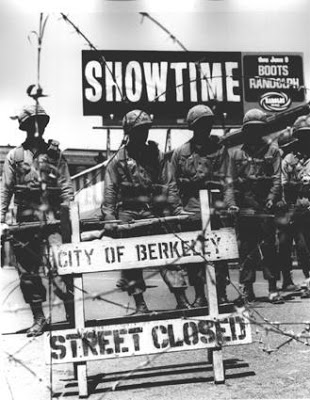
A colorful, evocative (and action-filled) reminiscence of Sixties activist Berkeley. Glendinning, now an award-winning writer living in Bolivia, was in the thick of things — running from teargas, facing down bayonet-wielding National Guardsmen, and, in a “pre-feminist” moment, sharing a jail cell with 100 women rounded up in a “mass bust.” Later, she and husband Bill hightailed it to Europe and then retreated to a maple-sugar farm in Vermont.

Posted in RagBlog | Leave a comment

Chellis Glendinning : The Way We Were

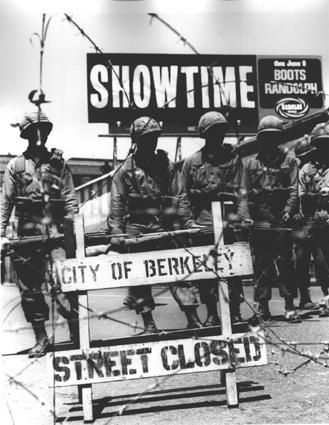
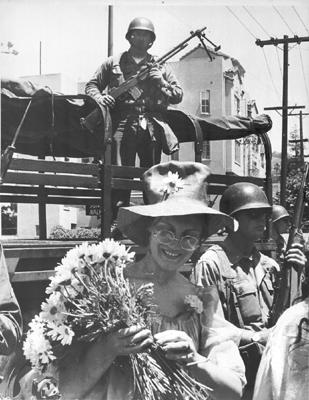
On Memorial Day, May 30, 1969, 30,000 students and Berkeley citizens marched past barricaded People’s Park to protest events of recent days, including the death of James Rector, the blinding of Alan Blanchard, and the many injuries inflicted by police. Photo by Suellen Bulow / Peoples Park.

People’s Park and beyond:
The way we were

By Chellis Glendinning / The Rag Blog / May 26, 2011

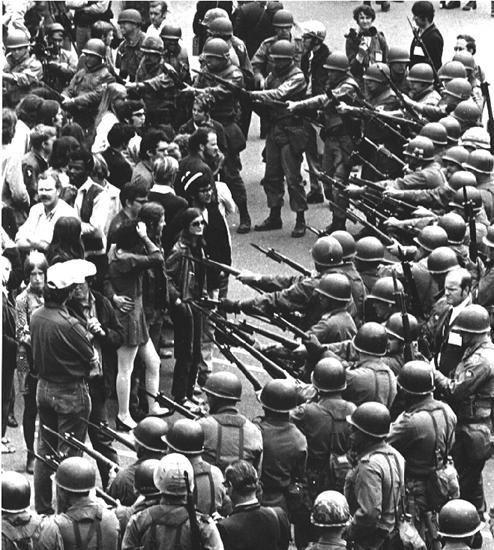
I plopped down onto the sidewalk in the first row of cross-legged protestors, eye-level with the shin-guards of the first row of National Guardsmen. My hair dropped down my back in a braid, and I was wearing a shirt made of an Indian-print bedspread. The blonde next to me leaned over and disclosed that she was on acid, in fact that she took acid every day.

I know all the details because a photograph of us showed up in Newsweek a few days later: me, the acid head, the dudes with their gas masks and rifles. It was snapped by photojournalist Peter Barnes, who later broke from the “objectivity” of press work, wrote a book on the oppression of soldiers, founded the progressive credit-card company Working Assets, wrote some more books — and even later than that, by 20 years and wild providence, became lovers with the subject of his camera aim whose Indian-print shirt had long since shredded into compost.

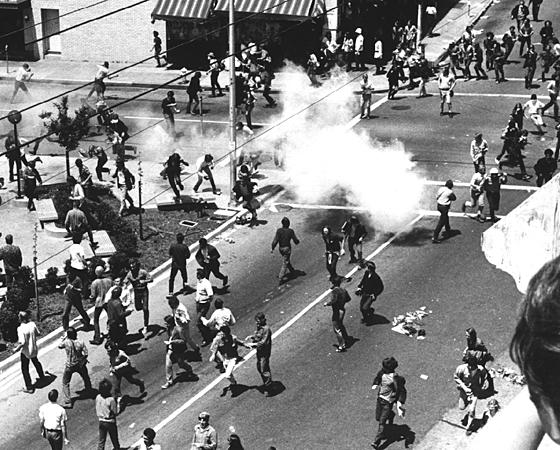
Another photo appeared in that article about the rabble-rousers in Berkeley: a helicopter soaring between the Campanile and Sproul Hall dropping toxic CS gas into the plaza like it was Vietnam. Down at ground level people were screaming, fainting, falling down, blinded, retching, and the National Guard was advancing into the crowds cracking skulls with their batons.

My husband Bill and I somehow ratcheted our bodies away from the toxic clouds, into the cafeteria, down the spiral staircase of the kitchen, and out into the lower plaza. It was the first (and last) time I ever hurled a rock through a window, I was so appalled by the military exercise, and I wonder to this day whatever happened to the woman on acid.

On Bloody Thursday, May 29, 1969, a crowd at Dwight Way and Telegraph is despersed with teargas, a few minutes before the Alameda County deputies came down the street with their shotguns. Photo by Kathryn Bigelow / Peoples Park.

The Third World Liberation Strike demanded that we students skip classes, so I regrouped in the Victorian house that Bill and I rented on Walnut Street, turned my attention to cooking Adele Davis-style, shook my fist during protests against racism, played volleyball with my professor-pal Troy Duster and his social-science comrades… and quietly kept up with my homework.

I was taking The Sociology of the Family. At the end of the quarter, when I decided I’d hand in my paper on women in the Soviet Union and take the final so I could still graduate, the template was laid for a nightmare that plagued my dreams for decades after.

I nervously approached the lecture hall that I hadn’t stepped Swedish clog into for three months. To my terror it was empty. Abandoned, reassigned, unavailable, gone. No students. No prof. No sign redirecting the Returning Striker.

Panic emanated from The Sociology of the Family again when I sheepishly edged toward the departmental office to retrieve the paper and final exam I had somehow managed to hand in. I rifled through the pile to no avail: neither was there — and I felt as adrift as a hippie waif on Telegraph Avenue. I finally mustered the courage to ask the secretary, and she offered that I must be “the one” who was instructed to see the prof.

He had a beard and glasses (as if I even remembered what he looked like). With a stern voice he told me to sit down, and I felt the axe about to fall. He then smiled and explained that there had been only two A’s in the whole quarter… and they were my paper and my exam. It was hardly the moment to speak of irony, as he blubbered on encouraging me to pursue graduate sociology. I had a flare for it, apparently. Somehow the news was more stultifying than if he’d announced I’d been kicked out for fraud.

The strike was a raging success, laying the ground for what then became a norm in higher education: Black, Chicano, Asian, and Native American studies. I went on to write books that sprang from such experiences as our Third World Liberation Strike — and at least hinted that I might have kind-of taken some sociology classes.
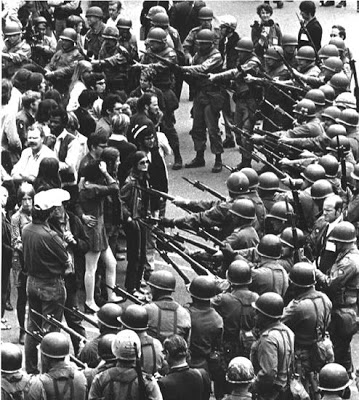
National Guardsmen confront students at Sproul Hall on the Berkeley campus, May 20, 1969. Photo Dick Corten / Peoples Park.

I really can’t figure out how I have wrangled my way through this life, somehow doing the most out-there-outrageous things — and at the same time being so timid.

The Café Mediterraneum was clearly the place to hang out. Michael Delacour was always there in his pea coat, earnestly talking revolution. There was Moe, with his waning hairline and cigar. Marty Schiffenbauer with his shorts, combat boots, and curly red locks flying every which-way. Old Carroll, the ghetto astrologer. Street poet Julia Vinograd in her yellow cap.

It was all I could do to go in there, I was so nervous: the place was that cool.

It was where the hot-and-heavy political strategizing took place. Where the Red Family grabbed a break from haggling about who did the dishes in the commune. Where the seekers from Shambhala Bookstore talked Krishnamurti, astrology, and Tibetan Buddhism. Where Simone de Beauvoir mixed it up with Martin Heidegger. Where the espresso machine swooshed, Vivaldi’s “Primavera” echoed, and folks sported Mao caps. Where, for Chrissake, everyone smoked… Galoise.

I went, at first ordering cappuccino dusted with chocolate and toting the de rigueur blue pack of cancer sticks, later (after I launched a brief stint with a two-hour-a-day yoga-meditation practice), the far thinner rose-hips tea.

But I always felt a tad “thin” in the cool department.

I cottoned right up to the fashion side of things, though. I mean, how many cases of scabies can be traced to the ultra-wide bell-bottoms scrounged from piles of threads on the concrete floor of the San Pablo army-navy store?

As my signature, I donned the Pirate Coat I paid $15 for at the Paris flea market. Some days I boasted a green leather jacket hinting of London Mod, purchased at the hippest of boutiques, Red Square, and my closet burst with slinky 1930s dresses.

But maybe the finest of couture happened when we dressed up in garb appropriate to the film we were seeing: tux and gowns for Fred Astaire-Ginger Rogers; trench coats for noir; boxy 1940s suits and spectators for Preston Sturges; kimonos for Rashomon.
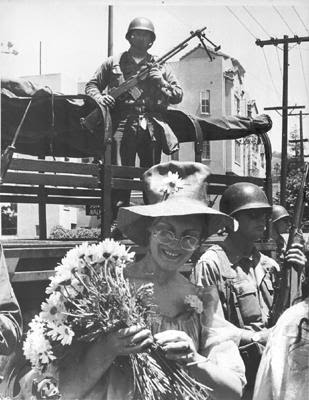
Cool threads and the National Guard, May 30, 1969. Photo by Suellen Bulow / Peoples Park.


Being in jail had its perks.
Quiet time, good food, ample bedding, exercise, books for illumination, freedom to roam — they were not among them.

But it was a pre-feminist moment for us women to be together. I know now that we could have done things differently. There simply did not have to be that pre-midnight crescendo of panicked voices in a solitaire cell that some 100 women from the Mass Bust were now crammed into; we could have gathered into small groups to quietly discuss terror and claustrophobia. We could have been more supportive of our disparate needs. We could have meditated. Or done a ritual.

But what did we know?

We did know that the big bust was coming. Our own private rendition of Deep Throat within the police department had tipped us off, and a few had met in a living room just off campus to weigh our options. Tom Hayden was there. Wendy Schlesinger. Delacour. Bill Miller.

But somehow any planning we mustered had zero effect when the shit hit the fan and the cops cordoned off Shattuck Avenue, hemming in not just us anti-war protestors, but also innocent mailmen and shopping mothers. I was one of the Health Food 15. Guilty as all get-out, we had rushed into Goodson’s, grabbed wire shopping baskets, and pretended to be buying organic oatmeal — but sure enough, a policeman emerged tall and angry through the back door and rounded us up for the bus ride to Santa Rita Detention Center.

Knowing it was coming, I had made my own plan for bail. It’s not a plan that — what with post-9-11 paranoia — would fly today, but it did back then. I had hand-penned a letter to Wells Fargo bank authorizing my commune-mate to take out $300 from my savings account, and when he showed up at the jail with papers for my release, I was never happier to see a parking lot.

The stories that came out of the men’s section were grim. While we women had had the freedom to fashion the plastic bags filled with Wonder-bread-bologna sandwiches into “volleyballs” for our nervous amusement, the men had been jammed face down in the yard and made to lie there without flinching through the night. One had his head tied to an iron pipe, and an officer had banged the pipe till blood gushed from his eyes, nose, and mouth.

In the end, the Health Food 15 got off through the efforts of our pro bono lawyer Bob Treuhaft. And in the end, the perk was seeing the system from the inside out.
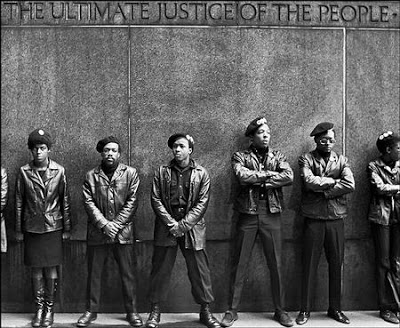
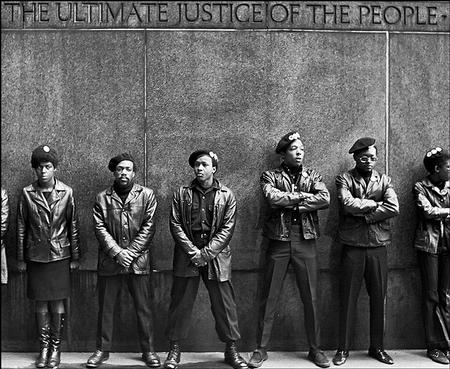
Members of the Black Panther Party in their “humongous leather jackets.” Image from Ancestry in Progress.


In their humongous leather jackets
, the Black Panthers came on as fierce as the police they were bucking. One day a militaristic line-up of them made the trek from downtown Oakland to hold forth at the noon rally in Sproul Plaza.

Their message was kind of confusing to those of us who had grown up on “We Shall Overcome” and sharpened our political teeth in the South during Mississippi Summer. Bristling with the radicalism of the international liberation/decolonization movements, the Black Panthers announced that the new revolutionary tack was to stand alone, Whitey not invited. At the same time, they demanded our support.

After that, a lot of interracial marriages broke apart in a frenzy of political realignment. Along with everyone else, I was reading Eldridge Cleaver’s Soul on Ice, and Frantz Fanon’s notion of violence against whites as a cleansing act was flying through the halls of academia, so I wasn’t completely in the dark about rage, separatism, and self-empowerment.

Just then something began to appear in the dark, hung on a peg in the hallway of the apartment we shared with a university secretary, who was white. It was the fiercest black-leather jacket of all. Every time it was there, a heavy silence emanated from behind her closed door, and soon she began to show up in a black beret behind the card table, taking the money and handing out leaflets, at Panther events.

I could only think that she, among very few, had mastered the delicacies of white support.

Mario Savio, standing atop a police car in Sproul Plaza, Oct. 1, 1964, speaks to thousands during the Free Speech Movement. Photo courtesy Bancroft Library / Berkeley Daily Planet.


I had no idea that we activists
— sometimes amassed in crowds of 3,000, sometimes 100,000 — had, through the years of rampaging around campus and in the streets, developed an unspoken method: a way of forming, spreading, taking over the city, then dispersing, and finally re-congealing like a dance that was in our genes.

That is, until the neophytes arrived — which happened the summer after People’s Park when every Tom, Dick, and Hari Krishna east of Sproul Plaza decided that Berkeley was the place to hone one’s revolutionary skills. Suddenly, up against the Alameda County Sheriff’s Department “Blue Meanies,” the streets became a place of edginess, chaos, and utter lack of method.

I said, “To Hell With It,” and retired to my commune on Vine Street. It was a good time to pull back for a spell. The obvious next step was something akin to what we’d seen in the film Battle of Algiers, and indeed many in the New Left were joining gun clubs, just as some Students for a Democratic Society radicals back East were morphing into the Weather Underground.

Bill and I hightailed it to Europe, bought a second-hand Deux Chevaux in Amsterdam, and tooled at 40 m.p.h. through Holland, Denmark, Sweden, France, Andorra, Spain, and Morocco. When we got back and retreated to a maple-sugar farm in Vermont, sure enough, the FBI tracked us down and paid a visit to see what we were up to.

Things being as they were, Bill refused to ID any of the folks in the photos and told the FBI dude to shove it.

[Chellis Glendinning is the author of five books, including My Name Is Chellis and I’m in Recovery from Western Civilization. Her Off the Map: An Expedition Deep into Empire and the Global Economy and Chiva: A Village Takes on the Global Heroin Trade, both won the National Federation of Press Women book award in nonfiction, in 2000 and 2006 respectively. She lives in Marquina, Bolivia, and can be reached via www.chellisglendinning.org.]
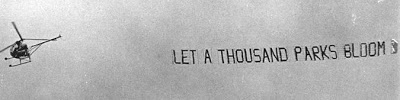
Photo by Gil Madrid / PeoplesPark.

The Rag Blog

Posted in Rag Bloggers | Tagged , , , , , | 6 Comments

VERSE / Mariann G. Wizard : Fire in the Hole

Cartoon by Dan Piraro / Bizarro.

Fire in the Hole

The powder keg is full
and the fuse is lit.

Daily before our eyes
men and women speak truth to power,
power crushes them,
they rise up again and again –

the powder keg is full
and the fuse is lit.

Daily before our eyes
spoiled executives flaunt
staggering profits while
staggering veterans beg for alms –

the powder keg is full
and the fuse is lit.

Daily before our eyes
arrogant legislators slash
funds for education while
prisons strain to contain more youths –

the powder keg is full
and the fuse is lit.

Daily before our eyes
scowling agents of morality
insert themselves into the
private cracks and crannies of our lives –

the powder keg is full
and the fuse is lit.

Daily before our eyes
decent working people,
having done the right thing all their lives,
find they have nothing to show for it –

the powder keg is full
and the fuse is lit.

The Mayan calendar ends in the year
twenty-twelve: an election year.
Some believe the world will end as well.
But if it continues, hear this:
the world of Obushma and Rottemney,
Bi(nLa)den and Palahuck,
Trumpette and Gingrinchvitis, is ending.
It ended, in fact, on Nine-One-One,
when the Twin Towers tumbled,
and the scraps of our freedom
were swapped for “security”;
ended when the feds
bailed out “securities” firms that
bilked retirees’ accounts;
ended when the promise of peace
became the reality of multi-war;
ended (finally?) when

before our eyes we saw
poor downtrodden camel-jockeys
stand up in the dust of centuries
and say “No more!”

Are we free people or slaves?
Will we be “Left Behind”?

The powder keg is full
and the fuse is lit.


Mariann G. Wizard
/ The Rag Blog
22 May 2011

[Mariann G. Wizard, a Sixties radical activist and contributor to The Rag, Austin’s underground newspaper from the 60s and 70s, is a poet, a professional science writer specializing in natural health therapies, and a regular contributor to The Rag Blog. Read more poetry and articles by Mariann G. Wizard on The Rag Blog.]

The Rag Blog

Posted in Rag Bloggers | Tagged , | 4 Comments

VERSE / Mariann G. Wizard : Fire in the Hole

Cartoon by Dan Piraro / Bizarro..

Fire in the Hole

The powder keg is full
and the fuse is lit.

Daily before our eyes
men and women speak truth to power,
power crushes them,
they rise up again and again –

the powder keg is full
and the fuse is lit.

Daily before our eyes
spoiled executives flaunt
staggering profits while
staggering veterans beg for alms –

the powder keg is full
and the fuse is lit.

Daily before our eyes
arrogant legislators slash
funds for education while
prisons strain to contain more youths –

the powder keg is full
and the fuse is lit.

Daily before our eyes
scowling agents of morality
insert themselves into the
private cracks and crannies of our lives –

the powder keg is full
and the fuse is lit.

Daily before our eyes
decent working people,
having done the right thing all their lives,
find they have nothing to show for it –

the powder keg is full
and the fuse is lit.

The Mayan calendar ends in the year
twenty-twelve: an election year.
Some believe the world will end as well.
But if it continues, hear this:
the world of Obushma and Rottemney,
Bi(nLa)den and Palahuck,
Trumpette and Gingrinchvitis, is ending.
It ended, in fact, on Nine-One-One,
when the Twin Towers tumbled,
and the scraps of our freedom
were swapped for “security”;
ended when the feds
bailed out “securities” firms that
bilked retirees’ accounts;
ended when the promise of peace
became the reality of multi-war;
ended (finally?) when

before our eyes we saw
poor downtrodden camel-jockeys
stand up in the dust of centuries
and say “No more!”

Are we free people or slaves?
Will we be “Left Behind”?

The powder keg is full
and the fuse is lit.

Mariann G. Wizard / The Rag Blog
22 May 2011

[Mariann G. Wizard, a Sixties radical activist and contributor to The Rag, Austin’s underground newspaper from the 60s and 70s, is a poet, a professional science writer specializing in natural health therapies, and a regular contributor to The Rag Blog. Read more poetry and articles by Mariann G. Wizard on The Rag Blog.]

The Rag Blog

Posted in RagBlog | Leave a comment


Posted in RagBlog | Leave a comment

Lamar W. Hankins : The Latest Plan for Perpetual War

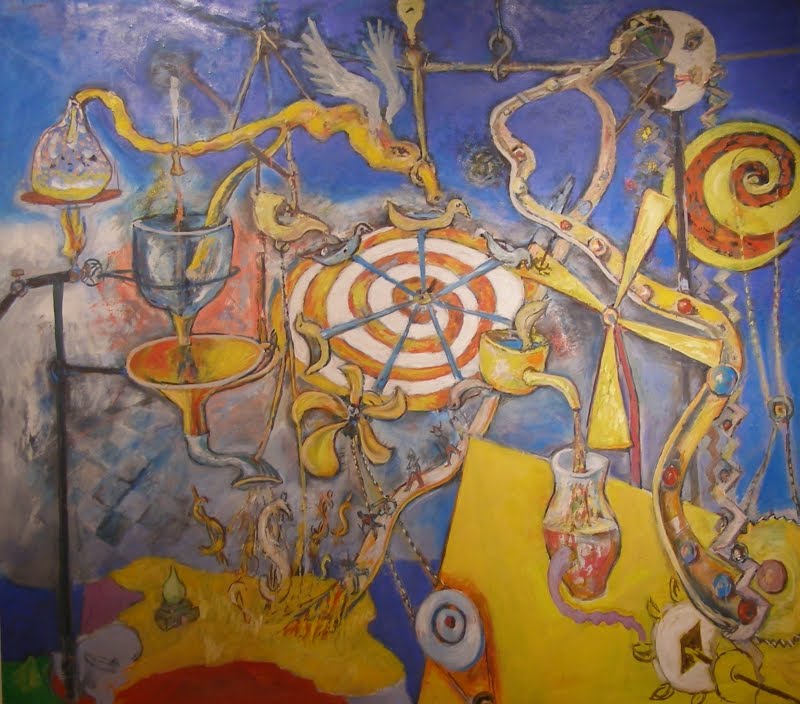
“Perpetual War Machine” by Peter Passuntino / Painting Matters.

The Congress, the President, and
the latest plan for perpetual war

By Lamar W. Hankins / The Rag Blog / May 25, 2011

What difference does it make to the dead, the orphans, and the homeless, whether the mad destruction is wrought under the name of totalitarianism or the holy name of liberty and democracy? — Gandhi

The wise men and women of the U.S. Congress are in the midst of deciding that the perpetual war desired by the military-industrial-Congressional complex (Eisenhower’s original formulation before it was edited) will soon become the law of the land.

A defense authorization bill recently passed by the House Armed Services Committee includes a provision that recognizes that we are at war “with al Queda, the Taliban, and associated forces” and gives the president war powers until “the termination of hostilities,” which could mean forever.

President Obama and his successors will be permitted to engage in war until the last terrorist is dead. There was a time — when George W. Bush was president — that I would have thought giving such power to the president to be among the most foolish acts of our political class. After nearly two and a half years of President Obama, I find that I harbor the same thought.

To be clear, I have seen one report that President Obama has not sought this expanded authority. It may be that he does not believe the extra authority is necessary for him to adequately fight terrorism, perhaps because he has found it easy to ignore the consultation-with-Congress requirements of our current law with respect to the bombing of Libya.

Nevertheless, a few representatives enamored with war-making are pushing to give this new unfettered discretion to the president and his replacements.

After considering the history of more than a hundred plus years since the reign of President Teddy Roosevelt, I can’t imagine a worse idea than giving one person the right to engage in war unimpeded by the wise limitations imposed upon the presidency by our founders.

Modern presidents have failed to honor the Constitutional requirement that the country not engage in war without a declaration of Congress approving war. In fact, we have had war under every president since Franklin Roosevelt, who was the last president to seek and get a declaration of war from Congress.

Of course, these violations of the Constitution are as much the fault of Congress as of the presidents who decided that war was the answer to a problem they faced. One explanation is that defense contractors supply an enormous amount of the money our politicians need to get elected. As long as contractors enjoy endless profits from war, they will keep funding politicians who keep those profits coming.

The primary author of the constitutional check on a president’s war power was James Madison, whose thinking is instructive two and a third centuries later:

Of all the enemies of true liberty, war is, perhaps, the most to be dreaded, because it comprises and develops the germ of every other… War is the parent of armies; from these proceed debts and taxes; and armies, and debts, and taxes are the known instruments for bringing the many under the domination of the few. In war, too, the discretionary power of the executive is extended; its influence in dealing out offices, honors and emoluments is multiplied; and all the means of seducing the minds are added to those of subduing the force, of the people… No nation can preserve its freedom in the midst of continual warfare.

And Madison wrote further,

War is in fact the true nurse of executive aggrandizement. In war, a physical force is to be created; and it is the executive will which is to direct it. In war, the public treasuries are to be unlocked; and it is the executive hand which is to dispense them. In war, the honors and emoluments of office are to be multiplied; and it is the executive patronage under which they are to be enjoyed; and it is the executive brow they are to encircle. The strongest passions and most dangerous weaknesses of the human breast, ambition, avarice, vanity, the honorable or venal love of fame, are all in conspiracy against the desire and duty of peace.

From these comments, it is clear that Madison did not anticipate that we would have a huge standing military, always available to be sent throughout the world to protect perceived American interests. He would have been sickened to contemplate 820 U.S. military bases located in 135 countries imposing U.S. hegemony throughout the world.

Congressman John Conyers, in looking at the authorization included in the proposed spending bill, concluded that it “would appear to grant the President near unfettered authority to initiate military action around the world without further congressional approval. Such authority must not be ceded to the President without careful deliberation from Congress.”

Thirty-three members of the President’s own party have requested that the chair of the House Armed Services Committee, Buck McKeon, schedule this perpetual war-making authority provision for public hearings so that the American public can be made aware of it and have a chance to discuss it with their representatives.

The provisions which trouble Conyers and others are found in H.R. 968, the Detainee Security Act of 2011, which will likely be considered as part of the National Defense Authorization Act of Fiscal Year 2012. These provisions would give any president the right to use military force anywhere in the world where terrorism suspects are believed to be present, even if no U.S. citizen has been harmed and the U.S. has not been attacked, or is not under the threat of attack.

The president would be empowered by these new provisions to use military force even within the U.S. and against American citizens. These provisions dishonor both the intent of our founders and the actual words of the Constitution, which provide that the Congress shall declare war, not the president. In our system, it is important that 535 representatives decide when and whether we should go to war, not one person, no matter how well-intentioned or how smart he or she may be.

If you are concerned about the Congress giving unchecked authority to the executive branch to use military force worldwide, there is still time to let your representatives know your views before we embark on what may be irremediable perpetual war.

[Lamar W. Hankins, a former San Marcos, Texas, city attorney, is also a columnist for the San Marcos Mercury. This article © Freethought San Marcos, Lamar W. Hankins. Read more articles by Lamar W. Hankins on The Rag Blog.]

The Rag Blog

Posted in Rag Bloggers | Tagged , , , , , | 3 Comments

Thursday, May 19, 2011
MORE ON IDEOLOGICAL HEGEMONY:THE EDUCATION SYSTEM

By Harry Targ / The Rag Blog / May 24, 2011

I have been thinking a lot about “ideological hegemony;” how and why we think about the political world in the ways we do. I do so not to add another layer of theory to an already complex set of arguments about economics and politics. Nor am I interested in immobilizing political activists. Rather, I think progressives need to think about how to challenge the ideas that most of us are supposed to accept and believe.

Of course, the primary public institutions that transmit ideas and ways of thinking to people, from the start to the end of their educational careers, are schools. Our friends on the Right know how important it is to shape schools at all levels. Early in this century I remember hearing Rush Limbaugh say on one of his radio programs that “the only institutions we do not yet control are the schools”

With this as a goal, just the other day we read stories about Koch brothers’ money financing faculty positions at Florida State University in economics (presumably Marxist or structural economists need not apply). Just a week earlier a story broke about rightwing efforts to cut and splice public recordings of lectures in a labor studies class at the University of Missouri to leave the impression that the instructors are advocates for labor violence. Using the methods of vilification and distortions that worked successfully against green jobs advocate Van Jones, community action group ACORN, and Shirley Sherrod, an African American employee of the Department of Agriculture, attacks on education are growing. The use of more sophisticated technologies than in the days of McCarthy or David Horowitz’s print crusades against “dangerous professors” are becoming common.

In addition to smear campaigns and using money to shape hiring practices at universities, access to varieties of knowledge remains very much constrained by institutional and political pressures, from kindergarten through high school and college. For example, we can talk about two subject areas, militarism and economic orthodoxy. Both subjects were prominently featured at an elementary school, Mayflower Mill Elementary School in Lafayette, Indiana.

As the local newspaper, the Journal & Courier reported approvingly on May 12, 2011:

“When Mayflower Mill Elementary students were told they would be able to hear the approaching helicopter that would land behind the school before they saw it, their ears perked up.” Although the noise they first heard was only a delivery truck, soon a Bell UH-1H Huey helicopter which was used in Vietnam, and piloted by a group of veterans, arrived. The pilots were part of an organization committed to maintaining a positive public image of the helicopter.

The helicopter and its veteran pilots spent the day at the elementary school, called by the school “Operation American Pride,”

“After Wednesday’s landing, students broke into groups…..including lessons on flag etiquette and the life of the soldier.” Kids got to go in the helicopter, sit behind a Humvee, and a military truck. The whole day was a celebration of the military, military values, super-patriotism. One student referred to experiencing the helicopter as “cool” and “exhilarating.”

Organizing the day’s activities took combined efforts of members of military families, community donations, support from the Army National Guard and members of Purdue University’s ROTC. Of course, the activities required the full cooperation of teachers, the principal, and members of the school board.

I wonder what would have happened if a parent or brave teacher had proposed that “Operation American Pride” include an historical discussion of the millions of Vietnamese people who died in the U.S. war in that country; or perhaps, if course material include reference to the 57,000 American soldiers who died in the war or the lingering effects of Agent Orange on subsequent generations of Vietnamese and U.S. veterans.

In addition the J & C reported on May 16, that fourth and fifth graders at the same school recently completed a class project simulating commerce and manufacturing. Students designed and sold products to their school mates (and the money earned went to recognized charities such as the American Heart Association and the local fire department). Kids produced “slime,” decorated pencils, and chocolate coated plastic spoons. Students designed their products, shopped for supplies, and produced and sold them. The teacher, it was reported, has done a similar project every year because she said about students that “they need to understand finance.”

The newspaper reported that the project was supported by long-time economics education lobbyist and think tank, the Indiana Center for Economic Education. An ICEE spokesperson, who offered a program that the teacher had taken years ago, spoke about the lessons kids learned: “The basics of operating their own business, the fact you’ve got to produce a product customers want and counter the cost of resources you need.” The spokesperson claimed the exercises such as at Mayflower Mill highlight real issues which sometimes get lost in teaching more dominant subjects.

I wonder if students learned anything about the historic role of organized labor in the state, high unemployment in Indiana, growing economic inequality, the forty year deindustrialization of the state economy, and the differences in economic opportunity between African Americans, other minorities, and whites, and between men and women.

Almost accidentally, I accessed stories about political struggles from 2004 until today at my old high school, Senn High School, in Chicago. It seems that the high school which over forty years ago was white and middle class was now populated by young people from working class and poor African American, Latino, and immigrant families.

By the new century it was experiencing problems in reference to academics and social order. The authorities, the City alderwoman, the head of the Chicago Public Schools, Arne Duncan, Mayor Daley, and the military came up with a “great” idea. They created in 2005, over the objections of students, teachers, and community activists, the Hyman Rickover Naval Academy which occupies a large physical space in the high school and has enrolled at least 25 per cent of the student population.

Meanwhile programs to teach English as a second language and advanced placement courses for college preparation were reduced. The teaching staff in the non-military portion of Senn High School was cut by 33 per cent. CORE (Caucus of Rank and File Educators) continues to challenge the militarization of the Chicago school system.

In our communities we need to work in solidarity with those immediately involved in educational institutions. Where issues of militarism and economic orthodoxy shape school curricula our voices need to be heard. Our political agenda, in sum, needs to address as best our resources allow what we learn, how we learn it, and who controls the institutions that shape our thinking and the thinking of young people.

[Harry Targ is a professor of political science at Purdue University who lives in West Lafayette, Indiana. He blogs at Diary of a Heartland Radical. Read more of Harry Targ’s articles on The Rag Blog.]

The Rag Blog

Posted in RagBlog | Leave a comment

The latest plan for perpetual war

By Lamar W. Hankins / The Rag Blog / May 25, 2011

What difference does it make to the dead, the orphans, and the homeless, whether the mad destruction is wrought under the name of totalitarianism or the holy name of liberty and democracy? — Gandhi

The wise men and women of the U.S. Congress are in the midst of deciding that the perpetual war desired by the military-industrial-Congressional complex (Eisenhower’s original formulation before it was edited) will soon become the law of the land.

A defense authorization bill recently passed by the House Armed Services Committee includes a provision that recognizes that we are at war “with al Queda, the Taliban, and associated forces” and gives the president war powers until “the termination of hostilities,” which could mean forever.

President Obama and his successors will be permitted to engage in war until the last terrorist is dead. There was a time — when George W. Bush was president — that I would have thought giving such power to the president to be among the most foolish acts of our political class. After nearly two and a half years of President Obama, I find that I harbor the same thought.

To be clear, I have seen one report that President Obama has not sought this expanded authority. It may be that he does not believe the extra authority is necessary for him to adequately fight terrorism, perhaps because he has found it easy to ignore the consultation-with-Congress requirements of our current law with respect to the bombing of Libya.

Nevertheless, a few representatives enamored with war-making are pushing to give this new unfettered discretion to the president and his replacements.

After considering the history of more than a hundred plus years since the reign of President Teddy Roosevelt, I can’t imagine a worse idea than giving one person the right to engage in war unimpeded by the wise limitations imposed upon the presidency by our founders.

Modern presidents have failed to honor the Constitutional requirement that the country not engage in war without a declaration of Congress approving war. In fact, we have had war under every president since Franklin Roosevelt, who was the last president to seek and get a declaration of war from Congress.

Of course, these violations of the Constitution are as much the fault of Congress as of the presidents who decided that war was the answer to a problem they faced. One explanation is that defense contractors supply an enormous amount of the money our politicians need to get elected. As long as contractors enjoy endless profits from war, they will keep funding politicians who keep those profits coming.

The primary author of the constitutional check on a president’s war power was James Madison, whose thinking is instructive two and a third centuries later:

Of all the enemies of true liberty, war is, perhaps, the most to be dreaded, because it comprises and develops the germ of every other… War is the parent of armies; from these proceed debts and taxes; and armies, and debts, and taxes are the known instruments for bringing the many under the domination of the few. In war, too, the discretionary power of the executive is extended; its influence in dealing out offices, honors and emoluments is multiplied; and all the means of seducing the minds are added to those of subduing the force, of the people… No nation can preserve its freedom in the midst of continual warfare.

And Madison wrote further,

War is in fact the true nurse of executive aggrandizement. In war, a physical force is to be created; and it is the executive will which is to direct it. In war, the public treasuries are to be unlocked; and it is the executive hand which is to dispense them. In war, the honors and emoluments of office are to be multiplied; and it is the executive patronage under which they are to be enjoyed; and it is the executive brow they are to encircle. The strongest passions and most dangerous weaknesses of the human breast, ambition, avarice, vanity, the honorable or venal love of fame, are all in conspiracy against the desire and duty of peace.

From these comments, it is clear that Madison did not anticipate that we would have a huge standing military, always available to be sent throughout the world to protect perceived American interests. He would have been sickened to contemplate 820 U.S. military bases located in 135 countries imposing U.S. hegemony throughout the world.

Congressman John Conyers, in looking at the authorization included in the proposed spending bill, concluded that it “would appear to grant the President near unfettered authority to initiate military action around the world without further congressional approval. Such authority must not be ceded to the President without careful deliberation from Congress.”

Thirty-three members of the President’s own party have requested that the chair of the House Armed Services Committee, Buck McKeon, schedule this perpetual war-making authority provision for public hearings so that the American public can be made aware of it and have a chance to discuss it with their representatives.

The provisions which trouble Conyers and others are found in H.R. 968, the Detainee Security Act of 2011, which will likely be considered as part of the National Defense Authorization Act of Fiscal Year 2012. These provisions would give any president the right to use military force anywhere in the world where terrorism suspects are believed to be present, even if no U.S. citizen has been harmed and the U.S. has not been attacked, or is not under the threat of attack.

The president would be empowered by these new provisions to use military force even within the U.S. and against American citizens. These provisions dishonor both the intent of our founders and the actual words of the Constitution, which provide that the Congress shall declare war, not the president. In our system, it is important that 535 representatives decide when and whether we should go to war, not one person, no matter how well-intentioned or how smart he or she may be.

If you are concerned about the Congress giving unchecked authority to the executive branch to use military force worldwide, there is still time to let your representatives know your views before we embark on what may be irremediable perpetual war.

[Lamar W. Hankins, a former San Marcos, Texas, city attorney, is also a columnist for the San Marcos Mercury. This article © Freethought San Marcos, Lamar W. Hankins. Read more articles by Lamar W. Hankins on The Rag Blog.]

The Rag Blog

Posted in RagBlog | Leave a comment

Marc Estrin : Up, Up, and Away

Digital montage image by T.J. Griffin.

Wings over Vermont:
Up, up, and away…

By Marc Estrin / The Rag Blog / May 25, 2011

BURLINGTON, Vermont — Though two summers away, an invitation by the mayor to discuss inviting another Burlington air show, “Wings Over Vermont,” has elicited some interesting letters to the Burlington Free Press, the state’s largest paper.

For those outside of Vermont who may not have seen a similar event, such an air show consists of “a blend of high-performance military jets and much more sedate civilian aircraft, such as biplanes.” As the Free Press notes without comment, “The sound impact of jets, generated by the likes of the Blue Angels and other precision flying teams, probably would fill up to two hours of the five-hour program.”

In practice, the show takes place down at Lake Champlain during a crowded day with a July 4th atmosphere. For those not at the event, the cross-overs and low-altitude fly-arounds of the team of “high-performance military jets” is admittedly an auditory trial. Many people leave town while others just gripe.

The virtues or sins of the show are not my subject here. Rather, what interests me is the nature of some of the commentary from the supporters of the show addressing those against.

A most common notion among them is that American freedom to publicly express opinions has been made possible by the existence of the military.

“They are the reason why we all have the freedom to meet,” wrote one. And another: “Your freedoms to express freely your ‘opinions’ have been protected and insured by generations of men and women who proudly served in the military.” (The quotations marks around “opinions” are also interesting.)

To one letter writer, the sound of the jets is “the sound of freedom,” and another asserts that true patriots are “not bothered by the sounds of the people who allow them to live their dream in freedom.”

It seems to me, rather, that the freedom to form and speak our opinions and to freely assemble is not a military issue, but rather a basic gift of the U.S. constitution. If the military is functioning to protect those constitutional rights, you’d never know it as they serve to support administrations in hot pursuit of those rights, dead or alive.

For all the high- and low-tech wonders of flight (it still astounds me to see a huge plane take off), there is a disturbing leitmotif of jingoist war chants among some of the comments:

“There is no better sight in the world than one of those ‘fast movers’ streaking into the battle delivering their payload on top of the enemy,” rhapsodizes one, the enemy, of course, being anyone upon whom a payload is dropped. “Is it noisy? You bet,” writes another. “Does it burn fossil fuel? It sure as heck does. Is it patriotic? You better well believe it.”

Speaking against an anti-show writer, one letter predicts that “When the bad guys from across the pond attack again, he’ll be grateful for our military, but it will be too late.” Concerning his probable reference, 9/11, one may note that our jets — for reasons still unclear — were unable to scramble that day against four errant airliners clearly bent on destruction.

(This has been a week containing a rape by a power-driven, hyper-sexual world leader, and the postponed invitation by a Savior for meeting in the skies with his elect. It is hard for me to avoid sensing a relation of themes here. But I will leave such meta-interpretations to readers so disposed.”)

Perhaps the most disturbing aspect of these freedom-loving comments has been the depiction of those who oppose the air show: “Moonbats,” they are, “whack jobs,” “tree-hugging wing nuts” (these descriptors from different letters). What to do with them? “Progressives and liberals should be MADE to watch the air show. Maybe then they will pack up and leave.”

And a warning: “If you don’t stand behind our troops, PLEASE feel free to stand in front of them.”

The vibes are chilling.

[Marc Estrin is a writer, activist, and cellist, living in Burlington, Vermont. His novels, Insect Dreams, The Half Life of Gregor Samsa, The Education of Arnold Hitler, Golem Song, and The Lamentations of Julius Marantz have won critical acclaim. His memoir, Rehearsing With Gods: Photographs and Essays on the Bread & Puppet Theater (with Ron Simon, photographer) won a 2004 theater book of the year award. He is currently working on a novel about the dead Tchaikovsky. Read more articles by Marc Estrin on The Rag Blog.]

The Rag Blog

Posted in Rag Bloggers | Tagged , , , , | Leave a comment

Thursday, May 19, 2011
MORE ON IDEOLOGICAL HEGEMONY:THE EDUCATION SYSTEM

By Harry Targ / The Rag Blog / May 24, 2011

I have been thinking a lot about “ideological hegemony”; how and why we think about the political world in the ways we do. I do so not to add another layer of theory to an already complex set of arguments about economics and politics. Nor am I interested in immobilizing political activists. Rather, I think progressives need to think about how to challenge the ideas that most of us are supposed to accept and believe.

Of course, the primary public institutions that transmit ideas and ways of thinking to people, from the start to the end of their educational careers, are schools. Our friends on the Right know how important it is to shape schools at all levels. Early in this century I remember hearing Rush Limbaugh say on one of his radio programs that “the only institutions we do not yet control are the schools.”

With this as a goal, just the other day we read stories about Koch brothers’ money financing faculty positions at Florida State University in economics (presumably Marxist or structural economists need not apply). Just a week earlier a story broke about right-wing efforts to cut and splice public recordings of lectures in a labor studies class at the University of Missouri to leave the impression that the instructors are advocates for labor violence.

Using the methods of vilification and distortion that worked successfully against green jobs advocate Van Jones, community action group ACORN, and Shirley Sherrod, an African American employee of the Department of Agriculture, attacks on education are growing. The use of more sophisticated technologies than in the days of McCarthy or David Horowitz’s print crusades against “dangerous professors” are becoming common.

In addition to smear campaigns and the use of money to shape hiring practices at universities, access to varieties of knowledge remains very much constrained by institutional and political pressures, from kindergarten through high school and college. For example, we can talk about two subject areas, militarism and economic orthodoxy. Both subjects were prominently featured at an elementary school, Mayflower Mill Elementary School in Lafayette, Indiana.

As the local newspaper, the Journal & Courier, reported approvingly on May 12, 2011:

“When Mayflower Mill Elementary students were told they would be able to hear the approaching helicopter that would land behind the school before they saw it, their ears perked up.” Although the noise they first heard was only a delivery truck, soon a Bell UH-1H Huey helicopter which was used in Vietnam, and piloted by a group of veterans, arrived. The pilots were part of an organization committed to maintaining a positive public image of the helicopter.

The helicopter and its veteran pilots spent the day at the elementary school. The school named the event, “Operation American Pride.”

“After Wednesday’s landing, students broke into groups… including lessons on flag etiquette and the life of the soldier.” Kids got to go in the helicopter, sit behind a Humvee, and a military truck. The whole day was a celebration of the military, military values, super-patriotism. One student referred to experiencing the helicopter as “cool” and “exhilarating.”

Organizing the day’s activities took the combined efforts of members of military families, community donations, support from the Army National Guard and members of Purdue University’s ROTC. Of course, the activities required the full cooperation of teachers, the principal, and members of the school board.

I wonder what would have happened if a parent or brave teacher had proposed that “Operation American Pride” include an historical discussion of the millions of Vietnamese people who died in the U.S. war in that country; or perhaps, had asked if course materials include references to the 57,000 American soldiers who died in the war or the lingering effects of Agent Orange on subsequent generations of Vietnamese and U.S. veterans.

In addition the J & C reported on May 16 that fourth and fifth graders at the same school recently completed a class project simulating commerce and manufacturing. Students designed and sold products to their school mates (and the money earned went to recognized charities such as the American Heart Association and the local fire department).

Kids produced “slime,” decorated pencils, and chocolate coated plastic spoons. Students designed their products, shopped for supplies, and produced and sold them. The teacher, it was reported, has done a similar project every year because she said about students that “they need to understand finance.”

The newspaper reported that the project was supported by long-time economics education lobbyist and think tank, the Indiana Center for Economic Education. An ICEE spokesperson, who offered a program that the teacher had taken years ago, spoke about the lessons kids learned: “The basics of operating their own business, the fact you’ve got to produce a product customers want and counter the cost of resources you need.” The spokesperson claimed the exercises like that at Mayflower Mill highlight real issues which sometimes get lost in teaching more dominant subjects.

I wonder if students learned anything about the historic role of organized labor in the state, high unemployment in Indiana, growing economic inequality, the 40-year deindustrialization of the state economy, and the differences in economic opportunity between African Americans, other minorities, and whites, and between men and women.

Almost accidentally, I accessed stories about political struggles from 2004 until today at my old high school, Senn High School, in Chicago. It seems that the high school which over 40 years ago was white and middle class is now populated by young people from working class and poor African American, Latino, and immigrant families.

By the new century it was experiencing problems in reference to academics and social order. The authorities, the City alderwoman, the head of the Chicago Public Schools, Arne Duncan, Mayor Daley, and the military came up with a “great” idea. They created in 2005, over the objections of students, teachers, and community activists, the Hyman Rickover Naval Academy which occupies a large physical space in the high school and has enrolled at least 25 per cent of the student population.

Meanwhile programs to teach English as a second language and advanced placement courses for college preparation were reduced. The teaching staff in the non-military portion of Senn High School was cut by 33 per cent. CORE (Caucus of Rank and File Educators) continues to challenge the militarization of the Chicago school system.

In our communities we need to work in solidarity with those immediately involved in educational institutions. Where issues of militarism and economic orthodoxy shape school curricula our voices need to be heard. Our political agenda, in sum, needs to address as best our resources allow what we learn, how we learn it, and who controls the institutions that shape our thinking and the thinking of young people.

[Harry Targ is a professor of political science at Purdue University who lives in West Lafayette, Indiana. He blogs at Diary of a Heartland Radical. Read more of Harry Targ’s articles on The Rag Blog.]

The Rag Blog

Posted in RagBlog | Leave a comment

Kate Braun : Lady Moon in Gemini for Fourth Phase

Fourth Quarter Moon. Image from illuminated Journey.

Moon Musings:
The Fourth Quarter Moon finds
Lady Moon in Gemini
(May 25 – 27, 2011)

By Kate Braun / The Rag Blog / May 24, 2011

Lady Moon is in Gemini for this moon phase. Gemini: the active, masculine, Air sign. This is not only a good moon phase in which to continue releasing the old in preparation for the new that arrives with the New Moon phase, it is also a good moon phase for communicating and dealing with the public.

You would do well to remember that Pluto is retrograde until September 16, 2011; a Pluto retrograde prompts each of us to take care of unfinished business, to finalize whatever we said we could let wait until later. With a Pluto retrograde, “later” is “now.”

Use caraway seed, lavender, and spearmint in your menu; they are connected to Gemini and will facilitate your communications. Remember to eat enough to maintain energy for your rituals but not so much that you feel heavy.

If you choose to celebrate on Wednesday, May 25, incorporate the color purple into your dress and/or decorations. Lavender, whether as a color or an herb or a scent, would be a way to easily bring purple into your plan. Mixed colors are also appropriate, but purple is the most important. Call on Jupiter (the planet of expansion) energy as well as Mercury (the messenger of the gods).

If you choose to celebrate on Thursday, May 26, the appropriate color to emphasize is blue and you should also call on Jupiter energy. Blue represents Water, the passive feminine element. The color blue also represents healing, nurturing, loving, blessing energies and can lend a calming element to Jupiter’s sometimes overwhelming enthusiasm.

If you choose to celebrate on Friday, May 27, the appropriate color to emphasize is green. Call upon the planet Venus and wear copper jewelry. Green represents Earth, the active feminine element. This color also represents growth, prosperity, success, abundance, and romance (in medieval times, green was considered the color of romantic love). Drinking some spearmint tea during your celebration will easily involve the color green into your activities.

Copper is reputed to have the ability to conduct spiritual energy back and forth between individuals, crystals, auras, the mind and the spirit worlds. It is also said to ease the pain of sciatica, arthritis, and rheumatism. (Anne Boleyn gave Henry VIII a copper ring to mitigate his arthritic pain.)

The folk song lyrics “Lavender’s blue, dilly-dilly, Lavender’s green” prompt the idea that sprigs of lavender would be an appropriate addition to your decor, whatever the day you choose for your celebration.

As with any ritual in the waning phases of the moon, your energies would be best used in activities relevant to: endings, resolution, final outcomes, conscious movement, clearing, releasing, harvesting, end, rebirth, preparation, rest.

Releasing the old opens the door to the new, so let’s be about it!

[Kate Braun’s website is www.tarotbykatebraun.com. She can be reached at kate_braun2000@yahoo.com. Read more of Kate Braun’s writing on The Rag Blog.]

The Rag Blog

Posted in Rag Bloggers | Tagged , , , , , | 1 Comment