Ed Felien : Words Have Consequences


Words have consequences:
Political rhetoric and the attempted
assassination of Gabrielle Giffords

By Ed Felien / The Rag Blog / January 17, 2011

Gabrielle Giffords had just won her reelection in a race so tight it took three days to count the votes. Her opponent, Jesse Kelly, a Republican candidate with Tea Party backing, assailed her on health care and immigration. He attacked her for supporting the stimulus package.

Jim Nintzel in the Tucson Weekly quoted him on Feb 18:

“It must stop now,” says Kelly, who promises to not seek any federal earmarks if he defeats Democratic Congresswoman Gabrielle Giffords in November. “This is bribery with taxpayer money, and it’s a disgrace.”

Kelly dismisses any notion that federal spending helps the economy.

“Government is not a job-creator,” Kelly said last week at a debate with his fellow Republican candidates, including state Sen. Jonathan Paton and political newcomers Brian Miller and Andy Goss. “It is a job-crusher.”

But for Don Kelly Construction, the firm where Kelly manages pipeline projects, government funding would appear to create quite a few jobs.

Kelly himself estimates that close to 90 percent of the firm’s work comes from government contracts worth tens of millions of dollars. And around the country, the firm — which is owned by Kelly’s father, Don Kelly — frequently bids on public-works projects funded by both stimulus dollars and federal earmarks.

Kelly was supported in his campaign by ALIPAC (Americans for Legal Immigration PAC). John McCain spokesman Brian Rogers said of the group, “It is backed by white supremacists, neo-Nazis and anti-Semites.”

He was also supported by Sarah Palin. She appeared with him on Fox News and said, “I don’t feel worthy to lace his combat boots.” Giffords’ Congressional District was one of 20 Democratic districts that McCain carried in 2008 where the incumbent voted for health care reform.

On her website Palin said, “We’ll aim for these races and many others. This is just the first salvo in a fight to elect people across the nation who will bring common sense to Washington.” Their districts were on a U. S. map located by crosshairs. After the shooting Palin’s campaign denied the crosshairs were meant to appear as targets, even though she had also said on March 23, “Don’t Retreat, Instead, RELOAD!”

The imagery and the rhetoric is clear, and it’s consistent with Republican rhetoric throughout the 2010 campaign:

Robert Lowry, Republican candidate in Florida, fired at a target with his opponent’s initials written on it.

Representative Allen West’s first choice for chief of staff, Joyce Kaufman, said, “If ballots don’t work, bullets will.”

Sharron Angle talked about 2nd Amendment remedies in her race against Harry Reid in Nevada. Michele Bachman said she wanted her supporters “armed and dangerous.”

John Boehner and Eric Cantor referred to health care reform as “Job Killing Obamacare.”

And Jesse Kelly held a fundraiser in June where he advertised: “Get on Target for Victory in November. Help remove Gabrielle Giffords from office. Shoot a fully automatic M16 with Jesse Kelly.” Minimum donation: $50.

Just last April, former President Bill Clinton recommended that both the media and politicians be responsible with their rhetoric since it falls on the “serious and the delirious alike.”

Henry David Thoreau said, “Most men lead lives of quiet desperation and go to the grave with the song still in them.” The appeal of war is the promise of glory and meaning in men’s eyes: one desperate act and the world crowns you a hero. How tempting then to run to the head of the mob and storm the barricades. All revolutionary camps are a haven for malcontents.

And the Tea Party pretends it is a revolution with earnest patriots dressed in 18th Century tri-cornered hats, manipulated so cleverly by the Koch brothers, the Bush family, and Dick Armey for the benefit of the rich and powerful. It is a fraud perpetrated on the poor.

And Jesse Kelly is a party to the fraud. He campaigns mightily against the Stimulus and the Government, and his family collects millions in federal contracts. He pretends he is a revolutionary at the barricades. According to the Jan. 11 New York Times: “These people who think they are better than us, they look down on us every single day and tell us what kind of health care to buy,” he said at a rally in October. “And if you dare to stand up to the government they call us a mob. We’re about to show them what a mob looks like.”

Jared Loughner was not a mob. He was one pathetic deranged individual, but, because of the heated rhetoric of Jesse Kelly, Sarah Palin, John Boehner, Eric Cantor, Michele Bachman, and others in the Republican Party, he could delude himself into thinking he was (for one shining moment) the leader of a revolution. There probably is a revolution going on out there, but it seems we’re all on the wrong side.

The grand nineteenth century capitalist, Jay Gould, once said, “I can hire one-half the working class to kill the other half.”

How did they succeed in getting us to take up arms against each other and not against them?

[Ed Felien is publisher and editor of Southside Pride, a South Minneapolis monthly.]

The Rag Blog

Posted in Rag Bloggers | Tagged , , , , , | 1 Comment

Danny Schechter : Fascism, and the Past as Prologue

Image from The Silent Majority.

The past as prologue:
What would American fascism look like?

By Danny Schechter / The Rag Blog / January 17, 2011

Fascism is one of those words that sounds like it belongs in the past, conjuring up, as it does, marching jack boots in the streets, charismatic demagogues like Italy’s Mussolini or Spain’s Franco, and armed crackdowns on dissent and freedom of expression.

It is a term we are used to reading in histories about World War II — not in news stories from present day America.

And yet the word, and the dark reality behind it, are creeping into popular contemporary usage.

Radical activists on the left have never been hesitant to label their opponents with this “F word” whenever governments support laws that limit opposition or overdo national security or abuse human rights. Government paranoia turns critics paranoid.

One example is writer Naomi Wolf, who forecast fascism creeping into America during the Bush years accelerated by the erosion of democracy:

It is my argument that, beneath our very noses, George Bush and his administration are using time-tested tactics to close down an open society. It is time for us to be willing to think the unthinkable — as the author and political journalist Joe Conason, has put it, that it can happen here.

Wolf feared Americans couldn’t see the warning signs:

Because Americans like me were born in freedom, we have a hard time even considering that it is possible for us to become as unfree — domestically — as many other nations. Because we no longer learn much about our rights or our system of government — the task of being aware of the constitution has been outsourced from citizens’ ownership to being the domain of professionals such as lawyers and professors — we scarcely recognize the checks and balances that the founders put in place, even as they are being systematically dismantled.

Because we don’t learn much about European history, the setting up of a department of “homeland” security — remember who else was keen on the word “homeland” — didn’t raise the alarm bells it might have.

Now, those bells are being rung by John Hall, an outgoing Democratic Congressman from upstate New York. His fear of fascism has less to do with repressive laws and militarism than the influx of corporate money into politics, swamping it with special interests that buy influence for right wing policies and politicians.

“I learned when I was in social studies class in school that corporate ownership or corporate control of government is called Fascism,” he told the New York Observer. “So that’s really the question — is that the destination if this court decision goes unchecked?”

Reports New York’s Observer,

The court decision he is referring to is Citizens United, the controversial Supreme Court ruling that led to greater corporate spending in the midterm elections, much of it anonymous. In the wake of the decision, Democrats tried to pass the DISCLOSE Act, which would have mandated that corporate donors identify themselves in their advertising, but the measure failed amid GOP opposition. Ads from groups with anonymous donors were particularly prone to misleading or false claims.

Hall said the influx of corporate money in the wake of Citizens United handed the House of Representatives to Republicans “Fascism should more appropriately be called Corporatism because it is a merger of State and corporate power.”

Many in mainstream politics understand that big money can dominate elections although they do not necessarily share Hall’s fears. In California, two well-known female candidates from the corporate world raised millions but still went down in defeat.

So money alone is not the be all and end all of a shift towards a red, white, and blue brand of fascism. Other ingredients are needed and some may be on the way — like an economic collapse, defeat in foreign wars, rise in domestic terrorism and the emergence of a right-wing populist movement that puts order before justice and wants to crush its opponents

Some argue we have just such a movement in the Tea Party although other critics focus on the rise of the Christian right that promotes fundamentalist politics in the name of God.

The Tea Party is not just after Democrats; it has started a campaign against the liberal Methodist Church. It is not internally democratic either with no elected officers or set of by-laws. It seems to be managed and manipulated by shadowy political operatives and PR firms, financed by a few billionaires who support populism to defang it.

Already militias are forming because of fears of immigration, and there is also concern that if unemployment remains high there is likely to be more violence with police forces understaffed because of government cutbacks. Gun sales went up after the recent violent incidents in Arizona.

The erosion of economic stability with the rise of foreclosures and the shredding of social services is already turning a financial crisis into a social one.

We already have a sharp partisan divide and inflation of hateful rhetoric with vicious put-downs of the President and condemnations by members of Congress calling him corrupt, even a traitor.

According to a set of the characteristics of fascist nations, there is “a disdain for the recognition of human rights.” Because of fear of enemies and the need for security, the people in fascist regimes are persuaded that human rights can be ignored in certain cases because of “need.” The people tend to look the other way or even approve of torture, summary executions, assassinations, long incarcerations of prisoners, etc.

“In place of human rights enemies are turned into scapegoats as a Unifying Cause — The people are rallied into a unifying patriotic frenzy over the need to eliminate a perceived common threat or foe: racial ethnic or religious minorities; liberals; communists; socialists, terrorists.”

This process is already far along in the USA.

Among the classical characteristics of fascism is a shutting down of debate and a focus on the state — which in our country is controlled by lobbyists and private interests. Wall Street and the military-industrial complex have far more clout than elected officials.

In the past, during the depression, there was a plot to overthrow Franklin Delano Roosevelt. It was exposed and neutered. Could something like that happen again?

Maybe it doesn’t have to, what with hawks already in control of Congress, major media outlets, the military, and poised to slash the power of unions and curb progressive social programs including public education.

Several writers believe that if and when fascism comes to America it will be packaged in a friendly form tied to benevolent advertising slogans and public interest messaging. It will be sold, 1984-style, as being unavoidable, even cool, and in our best interest.

Louisiana Senator Huey Long, a mesmerizing agitator, once said, “Fascism will come to America in the name of anti-fascism.”

[“News Dissector” Danny Schechter is a journalist, author, Emmy award winning television producer, and independent filmmaker. Schechter directed Plunder: The Crime of Our Time, and a companion book, The Crime of Our Time: Why Wall Street Is Not Too Big to Jail. Contact him at dissector@mediachannel.org.]

The Rag Blog

Posted in Rag Bloggers | Tagged , , , , , | Leave a comment

Bruce Melton, who writes regularly for The Rag Blog on issues of climate change, explains why recent occurrences of especially cold winter weather in no way contradict scientific theories about global warming. “On a warmer planet,” he tells us, “winter weather becomes more volatile. The extremes get more extreme.” In fact, some scientists now say that the chance of having extreme winter weather has increased by a factor of three, due to “feedbacks” from Arctic warming and icemelt.

Posted in RagBlog | Leave a comment

Marc Estrin : The Ethics of Infiltration

Cartoon from Brainstuck.com.

THE ETHICS OF INFILTRATION

By Marc Estrin / The Rag Blog / January 17, 2011

We began two weeks ago with Hallelujah in the mall, and last week contrasted that with theatrical infiltrations less in service to consumer capitalism.

When I began publishing these in various theater journals, I was met with a storm of protesting letters concerning my unethical “manipulation” of the poor bystanders. I wrote a piece in response describing what I thought to be a continuum of manipulations, from those which decreased understanding and degrees of freedom to those which increased them.

It might be good to look at such a continuum in the light of what is going on today. Let’s start with the bad news:

A recent article by George Monbiot reports a training session organized by the right wing libertarian group, American Majority on “How to Manipulate the Medium”:

Here’s what I do. I get on Amazon; I type in “Liberal Books.” I go through and I say “one star, one star, one star.” The flipside is you go to a conservative/libertarian whatever, go to their products and give them five stars… This is where your kids get information: Rotten Tomatoes, Flixster. These are places where you can rate movies. So when you type in “Movies on Healthcare,” I don’t want Michael Moore’s to come up, so I always give it bad ratings. I spend about 30 minutes a day, just click, click, click, click… If there’s a place to comment, a place to rate, a place to share information, you have to do it. That’s how you control the online dialogue and give our ideas a fighting chance.

On a wider scale, we have the current Israeli government support for a special undercover team of workers paid to surf the internet and spread positive news about Israel. The deputy director of the Foreign Ministry’s hasbara (“public diplomacy,” aka propaganda) department has admitted the team will be working undercover:

Our people will not say: “Hello, I am from the hasbara department of the Israeli Foreign Ministry and I want to tell you the following.” Nor will they necessarily identify themselves as Israelis, he said. They will speak as net-surfers and as citizens, and will write responses that will look personal but will be based on a prepared list of messages that the foreign ministry developed.

The new team is expected to increase the ministry’s close coordination with a private advocacy group, giyus.org (Give Israel Your United Support). About 50,000 activists are reported to have downloaded a program called Megaphone that sends an alert to their computers when an article critical of Israel is published. They are then supposed to bombard the site with comments supporting Israel.

A justification for much of this — a story we broke on The Rag Blog — was shamefully enunciated by our own government’s Cass Sunstein — Obama’s Harvard Law School bud, and recently appointed Administrator of the White House Office of Information and Regulatory Affairs.

Writing in a scholarly journal, (J. Political Philosophy, 7 (2009), 202-227), Sunstein proposes the following:

[W]e suggest a distinctive tactic for breaking up the hard core of extremists who supply conspiracy theories: cognitive infiltration of extremist groups, whereby government agents or their allies (acting either virtually or in real space, and either openly or anonymously) will undermine the crippled epistemology of believers by planting doubts about the theories and stylized facts that circulate within such groups, thereby introducing beneficial cognitive diversity.

From cognitive infiltration of websites, groups and meetings, it is a short enough step to the entrapments by agents provocateur we read about so commonly today. The missteps of suckered individuals have enormous life consequences — for them, and for all of us — in the age of Patriot Act paranoia and power.

If these kind of infiltrations populate one end of the continuum, what is the other end – the “good” end?

The most obvious current example lies in the operation of Wikileaks and the brave individuals that feed it sequestered material. A person working in a dishonest, destructive organization has every right to transform him or herself into an infiltrator, making available to Wikileaks or other publicity groups secret material the organization would otherwise have hidden.

As Julian Assange wrote on the Wikileaks homepage, “The goal is justice; the method is transparency.” It is paradoxical that it takes invisible infiltration to create public transparency, but there it is, and the effectiveness of this tactic can no longer be in question. Nor can the public good resulting.

While the theatrical infiltrations I described last week may be trivial compared to these larger examples, both good and bad, they do raise the question of whether all arts — Art itself — does not function as an infiltration.

One innocently goes to a bookstore to buy a book. But the contents of that book, if it be a good one, will infiltrate and infect one’s heartmind. The infiltrating virus will lie within, creating biopsychical response, spiritual molecules unlabeled, unacknowledged, perhaps unknown, but potentially agents provocateur for new thinking and action.

It is with this infiltrating image in mind that my wife, Donna, and I have recently begun a new publication project called Fomite. A fomite is a medium capable of transmitting infectious organisms from one individual to another.

“The activity of art is based on the capacity of people to be infected by the feelings of others.” — Tolstoy, What is Art?

Art, writing, music are the kinds of infiltrations which — if ethically and mindfully done — have the capacity to increase, not decrease, degrees of freedom.

[Marc Estrin is a writer, activist, and cellist, living in Burlington, Vermont. His novels, Insect Dreams, The Half Life of Gregor Samsa, The Education of Arnold Hitler, Golem Song, and The Lamentations of Julius Marantz have won critical acclaim. His memoir, Rehearsing With Gods: Photographs and Essays on the Bread & Puppet Theater (with Ron Simon, photographer) won a 2004 theater book of the year award. He is currently working on a novel about the dead Tchaikovsky.]

Also see:

And see:

The Rag Blog

Posted in Rag Bloggers | Tagged , , , , , , | Leave a comment

The Rag Blog and Rag Radio present acclaimed Latina rocker Patricia Vonne and folk-rock singer-songwriter Gina Chavez at Jovita’s, 1617 South First Street, Austin, Texas, on Sunday, Jan. 23, from 6:30-10 p.m. It’s a benefit for the New Journalism Project, inc., publisher of The Rag Blog, the Austin-based progressive newsmagazine Suggested donation is $10.

Posted in RagBlog | Leave a comment

Jordan Flaherty : Corporate Profiteering One Year After Haiti Earthquake

The Haitian national flag stands at half mast at the National Palace during the one-year anniversary of the 2010 quake in downtown Port-au-Prince, January 12, 2011. Photo by Allison Shelley / Reuters.

One year after Haiti earthquake:
Corporations profit while people suffer

By Jordan Flaherty / The Rag Blog / January 16, 2011

One year after an earthquake devastated Haiti, much of the promised relief and reconstruction aid has not reached those most in need. In fact, the tragedy has served as an opportunity to further enrich corporate interests.

The details of a recent lawsuit, as reported by Business Week, highlights the ways in which contractors — including some of the same players who profited from Hurricane Katrina-related reconstruction — have continued to use their political connections to gain profits from others’ suffering, receiving contracts worth tens of millions of dollars while the Haitian people receive pennies at best. It also demonstrates how charity and development efforts have mirrored and contributed to corporate abuses.

Lewis Lucke, a 27-year veteran of the U.S. Agency for International Development (US AID) was named U.S. special coordinator for relief and reconstruction after the earthquake. He worked this job for a few months, then immediately moved to the private sector, where he could sell his contacts and connections to the highest bidder. He quickly got a $30,000-a-month (plus bonuses) contract with the Haiti Recovery Group (HRG).

HRG had been founded by Ashbritt, Inc., a Florida-based contractor who had received acres of bad press for their post-Katrina contracting. Ashbritt’s partner in HRG is Gilbert Bigio, a wealthy Haitian businessman with close ties to the Israeli military. Bigio made a fortune during the corrupt Duvalier regime, and was a supporter of the right wing coup against Haitian president Aristide.

Although Lucke received $60,000 for two months work, he is suing because he says he is owed an additional $500,000 for the more than 20-million dollars in contracts he helped HRG obtain during that time.

A symbol of political corruption

As Corpwatch has reported, AshBritt “has enjoyed meteoric growth since it won its first big debris removal subcontract from none other than Halliburton, to help clean up after Hurricane Andrew in 1992.” In 1999, the company also faced allegations of double billing for $765,000 from the Broward County, Florida school board for clean-up done in the aftermath of Hurricane Wilma.

Ashbritt CEO Randal Perkins is a major donor to Republican causes, and hired Mississippi Governor Haley Barbour’s firm, as well as former U.S. Army Corp Of Engineers official Mike Parker, as lobbyists. As a reward for his political connections, Ashbritt won 900 million dollars in Post-Katrina contracts, helping them to become a symbol of political corruption in the world of disaster profiteering, even triggering a congressional investigation focusing on their buying of influence. MSNBC reported in early 2006 that criticism of Ashbritt “can be heard in virtually every coastal community between Alabama and Texas.”

The contracts given to Bush cronies like Ashbritt resulted in local and minority-owned companies losing out on reconstruction work. As Multinational Monitor noted shortly after Katrina,

…by turning the contracting process over to prime contractors like Ashbritt, the Corps and FEMA have effectively privatized the enforcement of Federal Acquisition Regulations and disaster relief laws such as the Stafford Act, which require contracting officials to prioritize local businesses and give 5 percent of contracts to minority-owned businesses. As a result… early reports suggest that over 90 percent of the $2 billion in initial contracts was awarded to companies based outside of the three primary affected states, and that minority businesses received just 1.5 percent of the first $1.6 billion.

Alex Dupuy, writing in The Washington Post, reported a similar pattern in Haiti, noting that

of the more than 1,500 U.S. contracts doled out worth $267 million, only 20, worth $4.3 million, have gone to Haitian firms. The rest have gone to US firms, which almost exclusively use U.S. suppliers. Although these foreign contractors employ Haitians, mostly on a cash-for-work basis, the bulk of the money and profits are reinvested in the United States.

The same article notes that

less than 10 percent of the $9 billion pledged by foreign donors has been delivered, and not all of that money has been spent. Other than rebuilding the international airport and clearing the principal urban arteries of rubble, no major infrastructure rebuilding — roads, ports, housing, communications — has begun.

The disaster profiteering exemplified by Ashbritt is not just the result of quick decision-making in the midst of a crisis. These contracts are awarded as part of a corporate agenda that sees disaster as an opportunity, and as a tool for furthering policies that would not be possible in other times. Naomi Klein exposed evidence that within 24 hours of the earthquake, the influential right-wing think tank the Heritage Foundation was already laying plans to use the disaster as an attempt at further privatization of the country’s economy.

Relief and recovery efforts, led by the U.S. military, have also brought a further militarization of relief and criminalization of survivors. Haiti and Katrina also served as staging grounds for increased involvement of mercenaries in reconstruction efforts. As one Blackwater mercenary told Jeremy Scahill when he visited New Orleans in the days after Katrina, “This is a trend. You’re going to see a lot more guys like us in these situations.”

And it’s not just corporations who have been guilty of profiting from Haitian suffering. A recent report from the Disaster Accountability Project (DAP) describes a “significant lack of transparency in the disaster-relief/aid community,” and finds that many relief organizations have left donations for Haiti in their bank accounts, earning interest rather than helping the people of Haiti.

DAP director Ben Smilowitz notes that “the fact that nearly half of the donated dollars still sit in the bank accounts of relief and aid groups does not match the urgency of their own fundraising and marketing efforts and donors’ intentions, nor does it covey the urgency of the situation on the ground.”

Haitian poet and human rights lawyer Ezili Dantò has written,

Haiti’s poverty began with a U.S./Euro trade embargo after its independence, continued with the Independence Debt to France and ecclesiastical and financial colonialism. Moreover, in more recent times, the uses of U.S. foreign aid, as administered through USAID in Haiti, basically serves to fuel conflicts and covertly promote U.S. corporate interests to the detriment of democracy and Haitian health, liberty, sovereignty, social justice and political freedoms. USAID projects have been at the frontlines of orchestrating undemocratic behavior, bringing underdevelopment, coup d’etat, impunity of the Haitian Oligarchy, indefinite incarceration of dissenters, and destroying Haiti’s food sovereignty, essentially promoting famine.

Throughout its history, Haiti has been a victim of many of those who have claimed they are there to help. Until we address this fundamental issue of corporate profiteering masquerading as aid and development, the nation will remain mired in poverty. And future disasters, wherever they occur, will lead to similar injustices.

[Jordan Flaherty is a journalist, an editor of Left Turn Magazine, and a staffer with the Louisiana Justice Institute. He was the first writer to bring the story of the Jena Six to a national audience, and his award-winning reporting from the Gulf Coast has been featured in a range of outlets including The New York Times, Mother Jones, and Argentina’s Clarin newspaper. His new book is FLOODLINES: Community and Resistance from Katrina to the Jena Six. He can be reached at neworleans@leftturn.org. and more information about his work can be found at floodlines.org. This article was also published at the Monthly Review.]

  • NEW ORLEANS RESIDENTS: See Jordan Flaherty and Asia Rainey at Maple Street Book Shop on Wednesday, January 19 at 6:00pm. For more info, go to theFacebook event page.

Resources mentioned in article:

Other Resources:

The Rag Blog

Posted in Rag Bloggers | Tagged , , , , | 2 Comments

Austin native Marilyn Buck — activist, poet, and long-time political prisoner — was released from prison last December after serving 25 years for crimes related to her actions in support of the black liberation movement in the late ’70s and early ’80s. Twenty days later she died of cancer. Felix Shafer, a long-time friend and artistic collaborator, has written a poetic tribute to Marilyn that puts her life and legacy into the context of her times, and that shows why she gained a very special place in the hearts of her many friends and supporters.

Posted in RagBlog | Leave a comment

Felix Shafer : Mourning for Marilyn Buck, Part I

Mourning for activist, poet, and political prisoner Marilyn Buck, shown at three stages of her life.

The blue afterwards:
Mourning for Marilyn

By Felix Shafer / The Rag Blog / January 13, 2011

First of three parts

[On December 13, Marilyn Buck, U.S. anti-imperialist political prisoner, acclaimed poet, former Austinite, and former original Ragstaffer, would have been 63 years of age. Scheduled for parole last August after nearly 30 years in federal prisons, Marilyn planned to live and work in New York. She looked forward to trying her hand at photography again, taking salsa lessons, and simply being able to walk in the park and visit freely with friends.

Instead, after 20 days of freedom, Marilyn died of a virulent cancer.

Her death was a great blow to her friends and supporters, to fellow poets around the world, and to the many women she mentored while a prisoner, teaching literacy, solidarity, and survival skills without condescension or pride. In Oakland and New York and Dallas, hundreds gathered to mourn her and to celebrate her life. As a poet of oppression, as a friend, and in fortitude and selflessness, she had no peer.

Yet the acts of violence for which she was sent to prison cloud Marilyn Buck’s revolutionary legacy. Was she a mixed-up kid who had good intentions but fell in with the wrong crowd? Was she a cold-blooded terrorist? Will she be remembered only for her remarkable empathy with the oppressed? Or will she come to be seen as a revolutionary icon worthy of respect for her mind as well as her heart?

Here, a long-time friend and artistic collaborator sets out to mourn Marilyn in a manner appropriate to her life, placing her in the context of her times and showing how she rose above the crowd.

This is the first of three parts.

— Mariann G. Wizard / The Rag Blog]

You’ve gone past us now.

beloved comrade:
north american revolutionary
and political prisoner
My sister and friend of these 40 years,
it’s over
Marilyn Buck gone
through the wire
out into the last whirlwind.

With time’s increasing distance from her moment of death on the afternoon of August 3, 2010, at home in Brooklyn, New York, the more that I have felt impelled to write a cohesive essay about Marilyn, the less possible such a project has become. She died at 62 years of age, surrounded by people who loved and still love her truly. She died just 20 days after being released from Carswell federal prison in Texas. Marilyn lived nearly 30 years behind bars. It was the determined effort of Soffiyah Elijah, her attorney and close friend of more than a quarter century that got her out of that prison system at all.

Her loss leaves a wound that insists she must be more than a memory and still so much more than a name circulating in the bluest afterwards. If writing is one way of holding on to Marilyn, it also ramifies a crazed loneliness. Shadows lie down in unsayable places. I’m a minor player in the story who wants to be scribbling side by side with her in a cafe or perched together overlooking the Hudson from a side road along the Palisades.

This work of mourning is fragmentary, impossible, subjective, politically unofficial, lovingly biased, flush with anxieties over (mis)representation, hopefully evocative of some of the “multitude” of Marilyns contained within her soul, strange and curiously punctuated by shifts into reverie and poetic time.

It’s my hope that others, who also take her life and death personally, will publish rivers of articles, reminiscences, essays, tributes, poems, in print and online. May the painters paint, the ceramicists shape clay, and the doers do works and with her spirit!

Will someone come to write a book-length biography, one capable of fairly transmitting Marilyn Buck’s many sided significance: her character, political commitments, creative accomplishment, and all-too-human failings, to people who never knew about her life? Is such a work possible about someone who lived nearly 30 years behind bars?

Shift: From the back pews of reverie a tinny reel-to-reel replays my voice in 1975 chanting the words of the legendary early 20th century labor organizer and member of the Industrial Workers of the World (IWW), Joe Hill: “Don’t mourn, Organize!” But right now, across the cemetery of dogmas, I have neither strength nor militant nostalgia for any such renunciation of mourning. Others may, but I cannot exhort myself or anyone else to refuse the dolorous walk.

Her precise twang shreds the air: cautioning against overindulgence, saying, Felix, brother, you better chill. I know you’re sentimental just don’t you dare go too far. It’s true. I’m from schmaltzy Brooklyn and she’s straight out of the lanky plains of west Texas. (As her friends say: “the Buck started here.”)

Parts of this piece are written with a 1960s-1970s vocab and it’s more my own writerly failing than anything else, because for sure she’s not a relic of the bygone at all. If I write that she was amazing would it be better to say awesome?

Marilyn was a writer, a dialectical materialist, a freedom fighter, yoga teacher and Buddhist meditator, who did not suffer fools gladly. She was modest and graceful. Behind the wall she was a teacher and a mentor to young women new to being locked up. Decade after decade in the drab visiting rooms of MCC-NY, DC Jail, Marianna Florida, Dublin-Pleasanton California, dressed first in her own clothes — then later in mandatory uniform khaki — she emanated dignified Marilynness: that unforgettable, natural style.

Nowadays, when things go inexplicably lost in the house or pictures fall from the walls of her studio my partner Miranda (who was Marilyn’s commune roommate in 1969-1970) says… oh that’s Marbu moving stuff around again… One night in late September, I dreamed that a note was slipped under our front door. It read:

Dear anguish, you know an end is not the end it’s never only an end at all

When I woke up I wrote: Keywords: woman, sister, freedom lover, contra racismo y sexismo, yogi, theorist from internal exile, poet, collective worker, student, madrina, artist, reader/writer, comrade-compañera, john brown, antigone, she who cuts through revolutionary enemy of the state

Marilyn Buck in 1971. Photo by Jeff Blankfort.

Accounts of mourning sometimes cross over or, more accurately because mourning is a resistant and achingly tender verb, create a transient bridge from the bereaved privacy of the self — to some sense of shared community. Some will, accurately, point out that this human connection is always a bridge-too-far but even so, gaps and all, it’s what we have.

While she was alive and even more humbly now, I find myself in far reaching debt to Marilyn Buck and hope through the process of writing to move closer to what this relation means and might aspire to. Debt implies relationship. In ancient times, the symbol of suspended balance scales signified a weighing of life/death, good/evil and justice/injustice, not money-debt. It’s no accident that in western myth and culture these scales are balanced by the figure of a woman — often blindfolded to signify impartiality and holding a sword, which represents the power to enforce justice (re-balance).

In her fascinating 2008 non-fiction book, Payback (Debt and the Shadow Side of Wealth) Margaret Atwood clarifies that in ancient Egyptian Africa a miniature of the goddess Ma’at (or her feather — representing justice and truth) was used on the cosmic scale to weigh good and evil in the heart of one who has died. The heart needed to be as light as a feather for the soul to be granted eternal life.

Atwood goes on to say that, along with justice and truth, Ma’at meant balance, the proper comportment towards others, and moral standards of behavior. I don’t know if Marilyn ever read about Ma’at, but she tried her best to embody these principles in steady resistance to our death-driven culture, which equates human value with money.

In our culture, psychologically “normal” citizens are produced to be consumers in the market. That’s the bottom line for this dang shabang. Wrap around, cradle-to-the grave conditioning (branding) creates a default position for the self that our worth=money. People are left fearful, commodified, and habitually driven: hating the never-ending lack (of money, power, status, looks, products, sex) in themselves and envying one another.

Marxists refer to this as commodity fetishism. The tragic human dimension of vulnerability, loss, failing, mortality, and mourning, which is also at the core of our being, is manically denied.

Remember how after the terror attacks of September 11, 2001, the government exhorted everyone to go out shopping to show that our society was unbowed? Then we were taken into a seemingly endless series of wars. Without the humility of mourning there is no learning from experience. Along with the three interlocking oppressions more traditionally named by the left — race, class, and gender — envy and the avoidance of mourning constitute a base from which evil acts and fascist movements spring.

Marilyn worked to renounce this deathly dynamic and sustained, in her everyday life, a radical ethic of gratitude, care, and equality among people. She studied history/herstory and understood that human rights must be fought for and defended if they are to exist at all. There was nothing bogus about her.

I do not believe that I’m alone, among the many, many people who visited and whom she befriended after she was captured, in this feeling of a political and personal obligation to, or better to say: with Marilyn.

Those of us fortunate enough to have known her before she became “notorious” and “iconic” — representations that never sat well with her and which being in Marilyn’s presence were easily dispelled — remember how serious, determined, outspoken, beautiful, and far from perfect she was. It’s no secret that she made political mistakes along the way. The collective political-resistance project she was part of was defeated. Its members paid and some are still paying a very high price.

She came of age in the red-hot crucible of the 1960s and ’70s when large movements from every corner of the earth were on the upsurge, challenging capitalist-imperialism with demands for revolution. It was an era of overturnings and extremes. Marilyn grew up in Texas — where racist and sexist dominator culture combined the toxic violence of america’s segregated south and cowboy west. She witnessed racism everyday and, by high school and college, grew determined to do something to help bring an end to war and white supremacy.

keywords: Mercurial time, oh old space Capsule: Go ahead crack the kernel’s hard discontinuous shell; revisit our more innocent and less destitute history with this bite-sized Almanac backgrounder:

When Marilyn left home to find her way into the popular movement(s), Dylan was singing The Times They Are A Changin’ & Masters of War, the SNCC Freedom Singers, Motown, R&B galore and Nina Simone’s thunderous Mississippi Goddamn! got people up and moving.

It was the overflowing era of Vietnam, Black, Brown, Native American, and Asian people’s power movements, the war of the cities: Watts, Detroit, Newark, and hundreds of urban rebellions brought the fire this time.

Draft cards were torched and many G.I.’s revolted against the war. Feminism and Gay Liberation insisted that the personal-is-political. Student and youth cultural revolt(s) on a worldwide scale (including, although quite uniquely, the massive Chinese cultural revolution) had not yet been pacified and co-opted by the market.

National liberation movements in Southern Africa were bringing an end to direct, foreign, and settler-colonial domination of their countries. The Palestinian people began asserting their national rights. Revolutionary organizations and guerrilla movements, partly inspired by the Cuban example, were organizing above and below ground to strike against “imperialismo yanqui” in Latin America. Radicals spoke of creating “2,3 many Vietnams” against empire.

Inside the United States, the vital foundation of all radical cultural and political developments was the civil rights and Black Liberation struggle. Black people sang, “I aint scared of your jail ’cause I want my freedom!” This movement’s organizing cries of Black Is Beautiful and Black Power! actually inspired people all over the world to throw off internalized oppression and fight the power.

Marilyn joined SDS (Students for a Democratic Society — the country’s largest student organization), worked with The Rag in Austin, and then helped edit the SDS newspaper New Left Notes in Chicago. She stood up against sexism in the organization.

Moving to the Bay Area in late 1968, Marilyn joined in building the San Francisco Newsreel collective, which, like its counterpart in New York, made and distributed radical film documentaries about contemporary struggles. Some influential S.F. Newsreel films taught people about the Black Panther Party; the San Francisco State student strike (led by a coalition of Third World organizations, this was the longest student strike in U.S. history); the Richmond California oil refinery worker’s strike (“On Strike“); the Mission High School Rebellion; and many others. These films, used by organizers spreading news across the country, were an important part of an alternative press movement made up of hundreds of underground newspapers, radio, and press services.

In western Europe and the USA, especially, white people in motion mainly expressed a middle class idealism, rage, and utopian aspiration. Some younger white folks were learning that struggling in alliance with Third World peoples at home and abroad could actually help end the genocidal war in Vietnam, and advance civil and human rights. A new left was born.

For many radical activists, leadership flowed — not from the Democratic Party — but from movements of color and figures like Dr. King, Rosa Parks, Malcolm X, Fannie Lou Hamer, Cesar Chavez. Importantly, we worked with and looked to grassroots leaders of color — in our schools, workplaces, and communities — for direction.

We challenged our personal racism and the social system of white supremacy. Consciousness raising and women’s liberation broke through to identify and challenge patriarchy. By the later 1960s, lesbian and gay liberation was gathering force.

Marilyn Buck.

This was a cultural revolution(s) involving radically new, alternative sources of authority and legitimation which threatened the (mostly white, male, straight) powers that be. The rejection of 1950’s Jim Crow apartheid/segregation and northern white suburbia, begun by the civil rights movement in the South, communist resisters to McCarthyism, early 2nd-wave feminism, and artists from the beat/hip/hippie generation(s) ignited a mix and mojo that many people, including yours truly, embraced.

You might say, without falling for romantic nostalgia, that a historical crack opened up and it seemed just possible to break through the myopia, prejudice, and privilege of empire into a better world. Or put it another way we, and this was by no means limited or merely conditioned by the exuberance of youth, had the experience of being deeply engaged with living history.

Even as society was fast becoming more of a spectacle, during this brief pre-postmodern, pre-internet era, we knew that we wanted to be more than spectators. It was as if sleepwalkers in death’s hollow empire were suddenly waking up.

In the advanced capitalist areas of Europe, Japan, and the U.S. anti-empire activity led some small yet significant sectors of the new lefts to move towards increased clandestine militancy, including bombings and armed actions against their repressive governments.*

Inside the U.S. solidarity with Black, Puerto Rican, Native American, Chicano/ Mexicano as well as international liberation movements, were a powerful motivating force for Marilyn and others.

The spirit of this global, historical moment is revealed by Karma Nabulsi, a Palestinian, writing about being a young revolutionary in the 1960s and 70s working to free his country:

The experience of revolutionary life is difficult to describe. It is as much metaphysical as imaginative, combining urgency, purposefulness, seriousness and hard work, with a near celebratory sense of adventure and overriding optimism — a sort of carnival atmosphere of citizens’ rule. Key to its success is that this heightened state is consciously and collectively maintained by tens of thousands of people at the same time. If you get tired for a few hours or days, you know others are holding the ring. (2)

keywords: the hammer this time

Within the Unites States, all movements, organizations, and individuals ranging from Dr. King to Malcolm X, from artists Nina Simone to John Lennon, were targeted because they inspired people to organize for real change. Under the rubric of FBI-COINTELPRO (short for Counter-Intelligence Program) a vast campaign of ruthless and unconstitutional counter-insurgency against the people was sanctioned by both Democratic and Republican Whitehouses.

Far from a “rogue” program led by a “racist and demented” J. Edgar Hoover, what we call COINTELPRO grew to involve the coordination of Pentagon, CIA, local and state police, as well as the FBI. Its mandate was destroy/neutralize radical leaders, organizations and grass roots people through assassinations, fratricidal murders, frame-ups, psychological warfare and forced exile.(3)

Malcolm X, Martin Luther King Jr., Fred Hampton, scores of Panthers and American Indian Movement members were assassinated, as were some key members of the Chicano/Mexicano and Puerto Rican movements. Several Black Panther members were tortured so badly in New Orleans — in a manner consistent with current government torture practices — that trial courts threw out cases against them.

The federal government unleashed a wave of high profile conspiracy trials, most of which, after sowing fear and draining resources, ended in acquittals. Nasty blackmails and bribery were used to recruit informers. This low intensity warfare, along with inner city drug plagues, wars on drugs leading to criminalization of black and brown youth, concessionary pacification (i.e., temporary poverty programs) and the end of the Vietnam war, succeeded in halting much of our forward motion. We were young idealists and we didn’t see this coming.

Vastly expanded federal and state prison systems became the leading form of long-term social control over people of color. Today, with at least 2 million people warehoused under criminal justice control, the U.S. has the world’s highest incarceration rate. One result of the hidden, domestic war is that there are over 100 political prisoners, essentially COINTELPRO captives of the FBI, courts, and prisons, who have remained locked up for the past 25-40 years. They are some of the longest held political prisoners on earth.(4)

There are also people in permanent foreign exile, one of whom died recently at 63 years of age in Zambia. Michael Cetewayo Tabor was a former Black Panther leader in New York, a member of the Panther 21 conspiracy case (of which all were acquitted) and author of the incisive pamphlet: “Capitalism Plus Dope Equals Genocide.” While countries the world over have released their political prisoners from the 1960s and ’70s, some through amnesty and others paroled after serving long sentences, the U.S. still refuses to do so.

All this was a long time ago, but I believe that in many telling ways, when applied to empire and resistance, what the writer, William Faulkner, said in another context is true:

The past is not dead. In fact, it isn’t even past.

In the introductory essay to her translation of Christina Peri Rossi’s poetry book, State of Exile (5), Marilyn writes of the trauma of imprisonment as an exile:

Exile may also be collective, as in the case of the Palestinian people, forced from their homeland, or the people of Darfur, murdered and driven from their lands. And there is another form of exile as well — internal exile — in which one is taken from the location of one’s home and life and is transported to some other outlying, isolated region of their own country. We think of the gulags of the former Soviet Union, for example, or stories from centuries past, but the fact is that internal exile exists here and now, in the United States a country of exiles, refugees and survivors. Prison is a state of exile.

…I a political militant did not choose external exile in time and was captured. I became a U.S. political prisoner and was sentenced to internal exile, where I remain after more than twenty years.


More to come

[Felix Shafer became an anti-imperialist/human rights activist while in high school during the late 1960’s and has worked around prisons and political prisoners for over 30 years. He is a psychotherapist in San Francisco and can be reached at felixir999@gmail.com.]

Footnotes:

(1)This is a very incomplete and utterly heterogeneous list. UK: The Angry Brigade; France: Accion Directe; West Germany: Red Army Faction & Revolutionary Cells; Italy: Red Brigade & Prima Linea. Japan: United Red Army; The IRA in Ireland and the Basque ETA in Spain (both larger and with more support) grew out of centuries long colonization. Within the U.S. some of the revolutionary armed organizations were: Black Liberation Army, Fuerzas Armadas de Liberacion Nacional & EPB-Macheteros(Puerto Rico), Weather Underground, Symbionese Liberation Army, New World Liberation Front, George Jackson Brigade, Red Guerrilla Resistance and United Freedom Front. To my knowledge, there has been no serious historical study of this global phenomenon

(2)London Review of Books, Vol. 32, No. 20 21 October 2010

(3)See the books: Agents of Repression & The Cointelpro Papers, by Ward Churchill and Jim Vander Wall. The Reports of the U.S. Senate Hearings (The Church Committee) 1975, U.S. Government Printing Office. And, the new film, Cointelpro 101 available from www.freedomarchives.org.

(4)The Jericho Amnesty Campaign has been involved in efforts to win amnesty for many years. A campaign is underway to win the release of N.Y. State political prisoners.

(5)City Light Books Pocket Poets Series Number 58, San Francisco, 2008.

The Rag Blog

Posted in Rag Bloggers | Tagged , , , , , , , , , | 1 Comment

Bruce Melton : It Is Colder Because It Is Warming


It is colder because it is warming

On a warmer planet, winter weather becomes more volatile. The extremes get more extreme.

By Bruce Melton / The Rag Blog / January 13, 2010

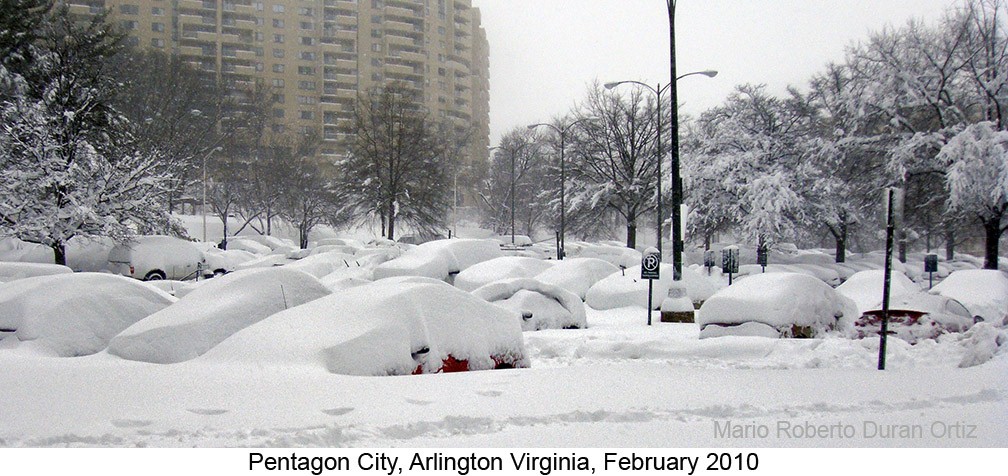
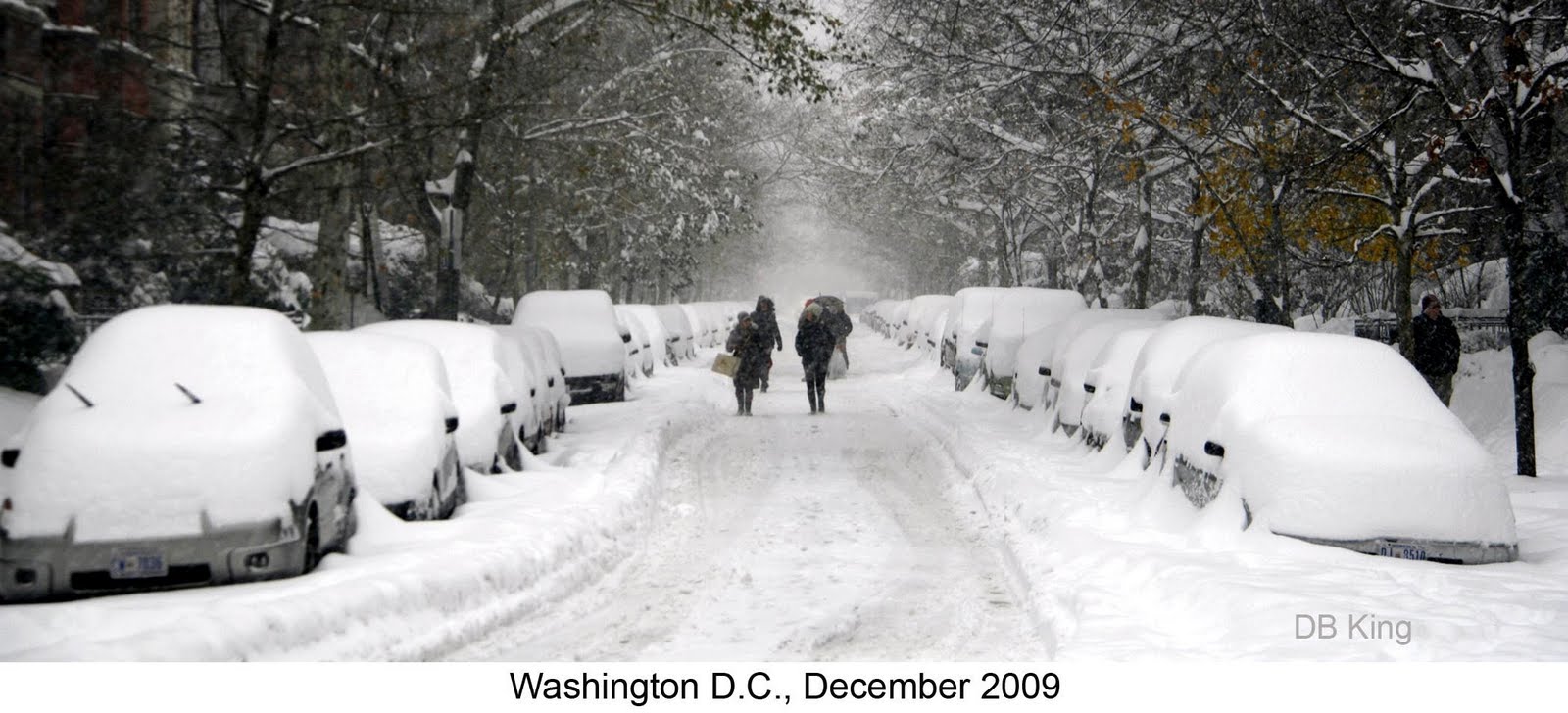
Global warming refers to climate, not weather. Snowpocalypses and icetastrophes are not climate, even when year after year they cover subcontinental size areas on multiple continents.

They are however, very similar to the climate that we had before the 1990s. So why do we keep having these blizzasters if we are supposed to be warming?

Even three years of snowmegeddons cannot keep our climate from warming. Even when large areas of multiple continents are involved. There is one little problem though… Blizzards, no matter how cataclysmic, are still just weather. Climate is much, much bigger than weather.

The academic world has started to unravel the clues about why we are seeing more extreme winter weather in some places, and the answers are the same as the climate models have been telling us. On a warmer planet, winter weather becomes more volatile. The extremes get more extreme. Not necessarily extremely cold, but it only has to be below freezing to snow. And the warmer it is, the more snow can fall. Warmer air holds more moisture — it is the reverse of “it is too cold to snow.”

A paper in the journal The Cryosphere Discussion (cryosphere is that part of the Earth that is covered with ice), by Mark Serreze at the National Snow and Ice Data Center in Boulder Colorado says that the Arctic has warmed 5.4 to 9 degrees F, or five to 10 times the global average of 0.9 degrees. This is just for warming relative to the 1970 to 2007 average time period. (1).

The reason that the Arctic has warmed so much more than the rest of the planet is called Arctic amplification, and the same thing is happening in high altitude mountains around the world. This “Arctic amplification” is nothing more than additional warming caused by the loss of snow and ice on a warmer planet. The scientists call it a warming feedback.

A “feedback” happens when a little bit of warming melts a little bit of ice. Ice reflects sunlight harmlessly back into space without causing warming. Sunlight striking dirt or rocks, water or vegetation, warms that object. This warming is trapped by the greenhouse effect and causes more ice to melt.

This mostly explains why the Arctic is warming so much more than the rest of the world. (The Antarctic is different because it is surrounded by ocean and has a completely different set of dynamics than the Arctic, which is surrounded by land.)

So, the Arctic is warming a lot more than the rest of the planet — how does this make winters colder? First: It has not really been earth-shattering cold. The winter temperature across the U.S. last year (2009) ranked 18th coldest out of 115 years, but for the entire year the U.S., ranked 34th warmest out of 115 years of records.

The year 2008 ranked 38th warmest of 114. and 2010 ranked 18th warmest through November. Northern Canada however had its second warmest winter ever recorded in 2009 and the combined global average temperature was the fifth warmest ever recorded. This year (2010) tied 1998 as the warmest year ever recorded. (2)

Just because it was one of the coldest winters in decades in some parts of the U.S. for the last few years does not mean it was very cold. It means that it has been warmer than normal for decades.


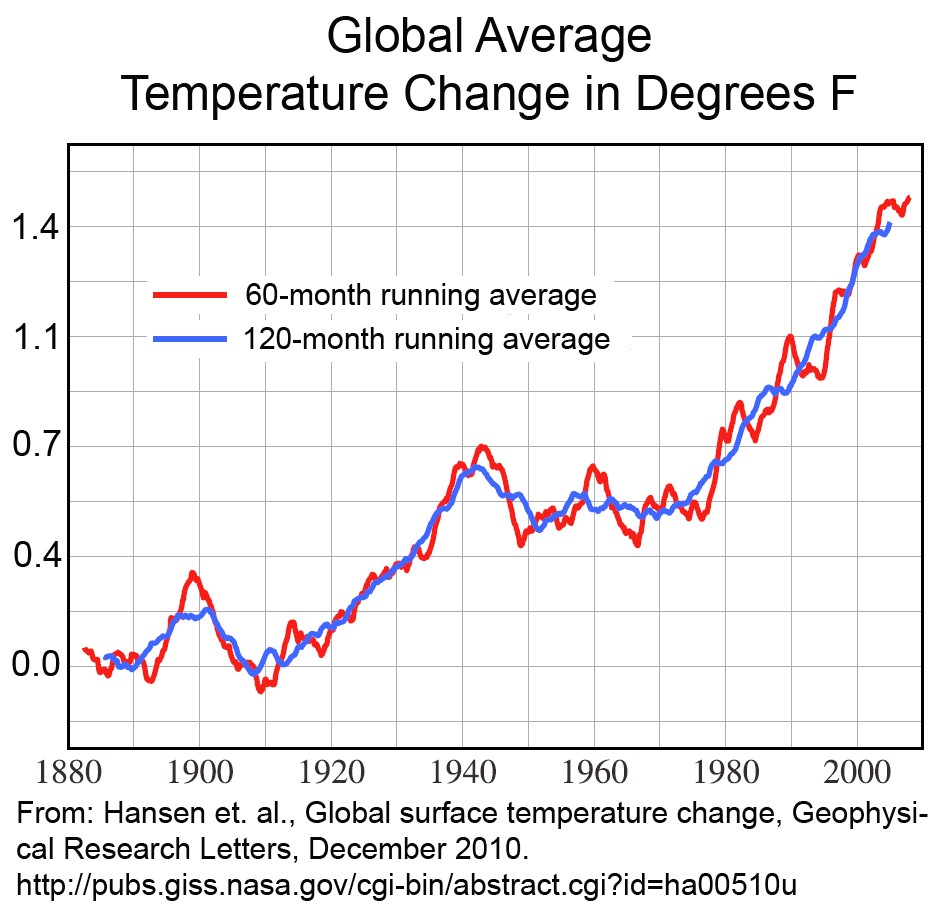
Beginning in the late 1970s, our climate really started to warm. The warming has only been a little more than a degree, but most of the warming comes in the winter. So we have been lulled into complacency by decades of warmer than usual temperatures, and even warmer winters. I remember in the 1960s and 70s when I was a kid, I was fascinated when arctic air invaded the northern tier of the United States and temperatures plummeted to 40 below and just hung there for weeks. That just does not happen anymore

The latest global temperature analysis from the main U.S. climate modeling agency, NASA’s Goddard Institute for Space Studies, looks at the long-term running average global temperature. Using a running average smooths out the chaos of monthly weather changes. This technique plots successive averages instead of each individual record point. (3)

A running average removes a lot of the chaos in the temperature records. This is a different way of looking at the numbers that acts like a fine-tuning knob. It makes the “picture” clearer. It allows the “music” to be heard without static. That static is the chaos of weather.

In a single day, the temperature at any given spot can change as much as 40 degrees or more. In a year at any given place, the temperature can change over 100 degrees or more. This natural variability makes it difficult to see the small changes associated with climate change. But these small changes can have tremendous impacts.


Think of our atmosphere as a pot of water on the stove. After a little bit of warming, movement can be seen in the water. These are convection currents. The same thing happens in our atmosphere, only a little bit of convection can create a big thunderstorm.

The warming we have seen because of the unintended carbon dioxide enrichment of our atmosphere is less than two degrees averaged across the globe. This may only be a couple of degrees, but it is a really big deal.

The difference in global temperature between the depths of the ice ages and the warmest it has been in the last 10 million years is only about 9 degrees F. The global temperature today is within one and a half degrees of being as warm as it has been in 1.35 million years. (4) By the end of the century, the global temperature will be similar to when the dinosaurs were around and sea level was 200 feet higher. (5)

But one of the really dangerous things about climate change, published in Thresholds of Climate Change in Ecosystems, by the U.S. Geological Survey, National Oceanic and Atmospheric Administration, National Science Foundation, U.S. Department of Agriculture, U.S. Forest Service, U.S. Department of Energy, and the U.S. Environmental Protection Agency, under the U.S. Climate Change Science Program, in January 2009, is that just a few degrees of change is all it takes to push an ecosystem over the edge. (6)

It turns out our weather is highly sensitive to a few degrees of change as well. The Beaufort High is a semi-permanent, seasonal weather phenomenon similar to the Bermuda High or the Aleutian Low. (The Beaufort High forms over the Beaufort Sea in the Arctic, north of the border between Alaska and Northwest Territories.)

These big high or low-pressure areas form every year, and hang around for months and months. The Bermuda High is most notable in the summer and the Aleutian Low and Beaufort High in winter. They are responsible for influencing weather patterns across the Northern Hemisphere because they shape and change the path of the jet stream.

An article published in the Journal of Climate, led by a researcher from Duke University, has found that the Beaufort High has recently intensified. This is something that the models have been predicting because of planetary warming, and now it has happened. What it means for you and me is that the jet stream path has changed. The Beaufort High, because it is larger now, pushes the jet stream further south. It just so happens that it pushes it south right into central and northeastern North America. (7)

This high-pressure system has increased in size because there is more heat in the Arctic now. This heat is especially apparent in the fall and early winter, because arctic sea ice coverage has fallen so precipitously. Even when sea ice begins to regrow in the fall, the impacts of the extra heat hang around.

This extra heat hanging around is a normal seasonal temperature lag just like we see everywhere else. Maximum heating in the summer and maximum cooling in the winter are not centered on the longest or shortest day of the year. The temperature lags behind. It takes Mother Earth some time to adjust. So the big Beaufort High impacts Northern Hemisphere weather far into the winter.

The jet stream has changed and it is throwing arctic storms further south. Even though arctic temperatures have risen five to 10 times as much as the rest of globe, the Arctic blasts are still cold. And remember that pot of water we left on the stove? A warmer atmosphere is more energetic; the storms are more intense. They may not be colder, but they can make more snow because they have more energy.

Even people like me, who grew up in south Texas with citrus trees, have heard that it can be too cold to snow. This old saying reflects a simple scientific principle. As air cools, it can hold less moisture. When it gets colder, it snows less and less because there is less and less moisture in the air. But warm it up to nearer to the freezing point and the amount of snow increases.

So, the Beaufort High is kicking arctic storms further to the south because the jet stream has changed, and those storms are more energetic because it is warmer in the Arctic. We seem to be getting clobbered with cold, when in reality, the Arctic has warmed a tremendous amount. This is one of those things that makes climate change so counterintuitive.

Last month was number 310 in a row where the average global temperature was above the 20th century average. That’s 25 years and 10 months. Last winter’s NOAA Climate Extremes Index was six percent above average (nothing to write home about.) Mid-March ice coverage of the Great Lakes was at an all-time low, and North American snow cover for April was the smallest ever recorded in 2010. (8)


The relatively cooler winter in the U.S. northeast and Europe in 2005-6 has also been recreated in the climate modeling world. The climate science guys have been predicting that this would happen, but until now these predictions have not been confirmed. Using actual sea ice coverage, a study led by Vladimir Petoukhov at the Potsdam Institute for Climate Impact Research in Germany, has recreated the extreme winter events of the northeastern U.S. and Europe in the winter of 2005-6. (9)

The cause is warming in the Arctic. The decrease in Arctic sea ice caused by warming is another natural phenomenon that has a feedback component. More warming means more melt of course. Water absorbs nearly 90 percent of the sun’s light and changes it into heat. Snow and ice reflect up to 90 percent of the sun’s light harmlessly back into space without it being changed into heat. (Water absorbs eight times more heat than snow and ice.)

This extra heat hangs around to continue the feedback. Summer melt then extends further into the fall; warmer ocean waters prevent thicker ice from forming and because the freeze up started later, there is less time for thicker ice to form. Warmer temperatures also cause more snow, which insulates sea ice from the cold temperatures above. The extra warmth increases high pressure over the Arctic, which increases the energy level of storms and the jet stream then pushes Arctic weather further south than normal. Clear as mud.

These scientists are calling this the “new normal.” They now say that the chance of having extreme winter weather has increased by three times because of this series of Arctic warming feedbacks. Only the winter of 2005-6 has been modeled so far, but the same conditions in the Arctic continue as the continued stormy winters in the Northeast and Europe attest.

The models also show that this change in global weather patterns in these two areas tends to disappear as sea ice melt becomes more complete. The reasoning is as yet unclear, but it likely has to do with the jet stream unbuckling, or by the time the Arctic is ice free it will be too warm for big snowstorms in areas where we normally have them.


The National Oceanic and Atmospheric Administration (NOAA) has a website called Future of Arctic Sea Ice and Global Impacts. In addition to the above papers, NOAA lists the University of Washington, Japan Agency for Marine Earth Science and Technology, University of Wisconsin, Institute of Marine and Coastal Sciences, Rutgers University, University of Illinois, National Center for Atmospheric Research, and the Lamont Doherty Earth Observatory of Columbia University as institutions that have published evidence showing that “warming really does make it colder.” (10)

But the list does not stop here. Winter snowmelt in the Arctic has been shown to be starting 15 days earlier and ending 30 days earlier over the past 30 years. (11) Arctic sea ice has even been shown to have been present, even in the summer season, for 14 million years; meaning that the last time the arctic was ice free in summer was 14 million years ago. (12)

Another researcher at the National Snow and Ice Data Center has shown us that Arctic sea ice is declining much more rapidly than the supercomputer models have predicted. Comparing real world measurements of sea ice coverage to Intergovernmental Panel on Climate Change scenarios and model predictions, sea ice coverage today is as low as it is projected to be, under the worst-case scenarios, in the year 2080. This is 70 years ahead of schedule. (13)

One of the biggies in climate science, however, is that a researcher at the Center for Earth Observation Science at the University of Manitoba in Canada has found that the Arctic Sea is functionally ice-free in the summer season now — today. (This was in 2009 when this paper was published.) (14)

This team of Canadian scientists, led by David Barber, whose Arctic expedition discoveries were published in the journal Geophysical Research Letters, says they found a much different sea icescape in the Southern Beaufort Sea than anticipated based on their satellite ice sensors.

The satellites had shown 70 to 90 percent coverage of multi-year or thick first-year ice throughout most of the southern Beaufort Sea in the deep water of the Canada Basin. When the crew visited the area in their icebreaker, the Amundsen, what they found was heavily decayed, very small remnant multi-year and first-year flows mixed with brash and bergy bits. In other words, they found a giant Slurpee where there was supposed to have been ice that was nearly impassible to all but a few nuclear icebreakers.

This greatly surprised the team, as they cruised through the rotten ice of the Beaufort Sea at top speed (15 miles an hour.) The Amundsen was designed to break three-foot thick sea ice at a speed of three and a half miles per hour. The ice they found was so rotten that the Amundsen could break 19 to 26 feet of rotten multi-year ice at three and a half miles an hour.

When the ice sensing satellites were put into operation, these warmer conditions that we are seeing now did not exist, or it was still cold enough, year-long, to keep the ice from beginning to disintegrate like it is doing now. The ice then was as hard as integral calculus and twice as stubborn. Since then we have seen what has apparently been the crossing of a threshold in terms of Arctic sea ice melt. What the science guys and girls did not know back then, was that the rotten Slurpee ice looks very similar to the plain old hard stuff that has been there for 14 million years.

The expedition was well described in an article interviewing Barber by Reuters News Service: Barber spoke shortly after returning from an expedition that sought — and largely failed to find — a huge multi-year ice pack that should have been in the Beaufort Sea off the Canadian coastal town of Tuktoyaktuk. Instead, his icebreaker found hundreds of miles of what he called “rotten ice” — 20-inch thin layers of fresh ice covering small chunks of older ice.

“From a practical perspective, if you want to ship across the pole, you’re concerned about multi-year sea ice. You’re not concerned about this rotten stuff we were doing 15 miles per hour through. It’s easy to navigate. I would argue that we almost have a seasonally ice-free Arctic now, because multi-year sea ice is the barrier to the use and development of the Arctic,” said Barber. (15)

[Bruce Melton is a registered professional engineer, environmental researcher, trained outreach specialist, and environmental filmmaker. He has been translating and interpreting scholarly science publications for two decades. His main mission is filming and reporting on the impacts of climate changes happening now, unknown to the greater portion of society. Austin, Texas is his home. His writing and films are on his website.]

References:

(1) Arctic Amplification: How the Arctic warms so much more rapidly than the rest of the world…
Serreze, et .al., The emergence of surface based Arctic amplification, The Cryosphere Discussion, February 2009.
http://www.the-cryosphere.net/3/11/2009/tc-3-11-2009.pdf
(2) National Climatic Data Center: Average temperatures for the U.S. and the world…
http://www.ncdc.noaa.gov/temp-and-precip/maps.php?ts=3&year=2010&month=2&imgs[]=Nationaltrank&submitted=Submit
(3) Running average temperature… Hansen et. al., Global Surface Temperature Change, Geophysical Research Letters, December 14, 2010.
http://pubs.giss.nasa.gov/cgi-bin/abstract.cgi?id=ha00510u
(4) Global Temperature is within one degree of being as warm as it has been in 1.35 million years… Hansen, et. al. Global temperature change, Proceedings of the National Academy of Sciences, September, 2006.
http://www.pnas.org/content/103/39/14288.full
(5) By the end of the century, global the global temperature will be similar to when the dinosaurs were around and sea level was 200 feet higher…
Church et. al., Understanding Sea Level Rise and Variablility (2010), Australia’s Commonwealth Scientific and Industrial Research Organization (CSIRO).
http://www.cmar.csiro.au/sealevel/sl_pubs_sl_book.html
(6) Just a few degrees of change is all it takes to push an ecosystem over the edge… Thresholds of Climate Change in Ecosystems, U. S Climate Change Science Program, U.S. Geological Survey, National Oceanic and Atmospheric Administration, National Science Foundation, U.S. Department of Agriculture, U.S. Forest Service, U.S. Department of Energy and the U.S. Environmental Protection Agency, U.S. Climate Change Science Program, January 2009.
http://www.climatescience.gov/Library/sap/sap4-2/default.php
(7) The Beaufort High… Li, et. al., Changes to the North Atlantic Subtropical High and Its Role in the Intensification of Summer Rainfall Variability in the Southeastern United States, Journal of Climate, October 2010.
Duke Press Release: http://www.nicholas.duke.edu/news/increasingly-variable-summer-rainfall-in-southeast-linked-to-climate-change
(8) 308th consecutive month above average…
http://www.ncdc.noaa.gov/sotc/?report=global
(9) The Winter of 2005-6 recreated by climate models… Petoukhov and Semenov, A link between reduced Barents-Kara sea ice and cold winter extremes over northern continents, Journal of Geophysical Research, November 2010.
http://www.agu.org/pubs/crossref/2010/2009JD013568.shtml
(10) NOAA has a website called Future of Arctic Sea Ice and Global Impacts…
http://www.arctic.noaa.gov/future/index_impacts.html#event
(11) Arctic snowmelt 15 to 30 days earlier… Tedesco, et. al., Pan Arctic terrestrial snowmelt trends, 1979 to 2008, from spaceborne passive microwave data, Geophysical Research Letters, November 2009.
http://www.agu.org/journals/ABS/2009/2009GL039672.shtml
(12) Arctic sea ice coverage, 14 million years…
Darby, Arctic perennial ice cover over the last 14 million years, Paleoceanography, February 2008.
http://www.agu.org/journals/ABS/2009/2009GL039672.shtml
(13) Arctic sea ice melt 70 years ahead of schedule… Stroeve, et. al., Arctic Sea Ice Decline Faster than Forecast, Geophysical Research Letters, vol. 34, 2007.
http://www.agu.org/pubs/crossref/2007…/2007GL029703.shtml
IPCC Fourth Assessment Report, Technical Basis, Chapter 10 Global Climate Projections, November 2007, page 771.
(14) Arctic is essential ice-free now… Barber et. al., Perennial pack ice in the southern Beaufort Sea was not as it appeared in the summer of 2009, Geophysical Research Letters, December 2009.
http://www.arcus.org/search/seaiceoutlook/2009_outlook/summary_report/downloads/pan-arctic/pdf/barber-etal-2009-summary-report.pdf
(15) Barber Interview from Reuters News Service…
http://www.reuters.com/article/idUSTRE59S3LT20091029?sp=true

The Rag Blog

Posted in Rag Bloggers | Tagged , , , , | Leave a comment

Bruce Melton : It Is Colder Because It Is Warming


It is colder because it is warming

Blizzards, no matter how cataclysmic, are still just weather. Climate is much, much bigger than weather.

By Bruce Melton / The Rag Blog / January 12, 2010

Global warming refers to climate, not weather. Snowpocalypses and icetastrophes are not climate, even when year after year they cover subcontinental size areas on multiple continents.

They are however, very similar to the climate that we had before the 1990s. So why do we keep having these blizzasters if we are supposed to be warming?

Even three years of snowmegeddons cannot keep our climate from warming. Even when large areas of multiple continents are involved. There is one little problem though… Blizzards, no matter how cataclysmic, are still just weather. Climate is much, much bigger than weather.

The academic world has started to unravel the clues about why we are seeing more extreme winter weather in some places, and the answers are the same as the climate models have been telling us. On a warmer planet, winter weather becomes more volatile. The extremes get more extreme. Not necessarily extremely cold, but it only has to be below freezing to snow. And the warmer it is, the more snow can fall. Warmer air holds more moisture — it is the reverse of “it is too cold to snow.”

A paper in the journal The Cryosphere Discussion (cryosphere is that part of the Earth that is covered with ice), by Mark Serreze at the National Snow and Ice Data Center in Boulder Colorado says, the Arctic has warmed 5.4 to 9 degrees F, or five to 10 times the global average of 0.9 degrees. This is just for warming relative to the 1970 to 2007 average time period. (1).

The reason that the Arctic has warmed so much more than the rest of the planet is called Arctic amplification, and the same thing is happening in high altitude mountains around the world. This “Arctic amplification” is nothing more than additional warming caused by the loss of snow and ice on a warmer planet. The scientists call it a warming feedback.

A “feedback” happens when a little bit of warming melts a little bit of ice. Ice reflects sunlight harmlessly back into space without causing warming. Sunlight striking dirt or rocks, water or vegetation, warms that object. This warming is trapped by the greenhouse effect and causes more ice to melt.

This mostly explains why the Arctic is warming so much more than the rest of the world. (The Antarctic is different because it is surrounded by ocean and has a completely different set of dynamics than the Arctic, which is surrounded by land.)

So, the Arctic is warming a lot more than the rest of the planet — how does this make winters colder? First: It has not really been earth-shattering cold. The winter temperature across the U.S. last year (2009) ranked 18th coldest out of 115 years, but for the entire year the U.S., ranked 34th warmest out of 115 years of records.

The year 2008 ranked 38th warmest of 114. and 2010 ranked 18th warmest through November. Northern Canada however had its second warmest winter ever recorded in 2009 and the combined global average temperature was the fifth warmest ever recorded. This year (2010) tied 1998 as the warmest year ever recorded. (2)

Just because it was one of the coldest winters in decades in some parts of the U.S. for the last few years does not mean it was very cold. It means that it has been warmer than normal for decades.


Beginning in the late 1970s, our climate really started to warm. The warming has only been a little more than a degree, but most of the warming comes in the winter. So we have been lulled into complacency by decades of warmer than usual temperatures, and even warmer winters. I remember in the 1960s and 70s when I was a kid, I was fascinated when arctic air invaded the northern tier of the United States and temperatures plummeted to 40 below and just hung there for weeks. That just does not happen anymore

The latest global temperature analysis from the main U.S. climate modeling agency, NASA’s Goddard Institute for Space Studies, looks at the long-term running average global temperature. Using a running average smooths out the chaos of monthly weather changes. This technique plots successive averages instead of each individual record point. (3)

A running average removes a lot of the chaos in the temperature records. This is a different way of looking at the numbers that acts like a fine-tuning knob. It makes the “picture” clearer. It allows the “music” to be heard without static. That static is the chaos of weather.

In a single day, the temperature at any given spot can change as much as 40 degrees or more. In a year at any given place, the temperature can change over 100 degrees or more. This natural variability makes it difficult to see the small changes associated with climate change. But these small changes can have tremendous impacts.


Think of our atmosphere as a pot of water on the stove. After a little bit of warming, movement can be seen in the water. These are convection currents. The same thing happens in our atmosphere, only a little bit of convection can create a big thunderstorm.

The warming we have seen because of the unintended carbon dioxide enrichment of our atmosphere is less than two degrees averaged across the globe. This may only be a couple of degrees, but it is a really big deal.

The difference in global temperature between the depths of the ice ages and the warmest it has been in the last 10 million years is only about 9 degrees F. The global temperature today is within one and a half degrees of being as warm as it has been in 1.35 million years. (4) By the end of the century, the global temperature will be similar to when the dinosaurs were around and sea level was 200 feet higher. (5)

But one of the really dangerous things about climate change, published in Thresholds of Climate Change in Ecosystems, by the U.S. Geological Survey, National Oceanic and Atmospheric Administration, National Science Foundation, U.S. Department of Agriculture, U.S. Forest Service, U.S. Department of Energy and the U.S. Environmental Protection Agency, under the U.S. Climate Change Science Program, in January 2009, is that just a few degrees of change is all it takes to push an ecosystem over the edge. (6)

It turns out our weather is highly sensitive to a few degrees of change as well. The Beaufort High is a semi-permanent, seasonal weather phenomenon similar to the Bermuda High or the Aleutian Low. (The Beaufort High forms over the Beaufort Sea in the Arctic, north of the border between Alaska and Northwest Territories.)

These big high or low-pressure areas form every year, and hang around for months and months. The Bermuda High is most notable in the summer and the Aleutian Low and Beaufort High in winter. They are responsible for influencing weather patterns across the Northern Hemisphere because they shape and change the path of the jet stream.

An article published in the Journal of Climate, led by a researcher from Duke University, has found that the Beaufort High has recently intensified. This is something that the models have been predicting because of planetary warming, and now it has happened. What it means for you and me is that the jet stream path has changed. The Beaufort High, because it is larger now, pushes the jet stream further south. It just so happens that it pushes it south right into central and northeastern North America. (7)

This high-pressure system has increased in size because there is more heat in the Arctic now. This heat is especially apparent in the fall and early winter, because arctic sea ice coverage has fallen so precipitously. Even when sea ice begins to regrow in the fall, the impacts of the extra heat hang around.

This extra heat hanging around is a normal seasonal temperature lag just like we see everywhere else. Maximum heating in the summer and maximum cooling in the winter are not centered on the longest or shortest day of the year. The temperature lags behind. It takes Mother Earth some time to adjust. So the big Beaufort High impacts Northern Hemisphere weather far into the winter.

The jet stream has changed and it is throwing arctic storms further south. Even though arctic temperatures have risen five to 10 times as much as the rest of globe, the Arctic blasts are still cold. And remember that pot of water we left on the stove? A warmer atmosphere is more energetic; the storms are more intense. They may not be colder, but they can make more snow because they have more energy.

Even people like me, who grew up in south Texas with citrus trees, have heard that it can be too cold to snow. This old saying reflects a simple scientific principle. As air cools, it can hold less moisture. When it gets colder, it snows less and less because there is less and less moisture in the air. But warm it up to nearer to the freezing point and the amount of snow increases.

So, the Beaufort High is kicking arctic storms further to the south because the jet stream has changed, and those storms are more energetic because it is warmer in the Arctic. We seem to be getting clobbered with cold, when in reality, the Arctic has warmed a tremendous amount. This is one of those things that makes climate change so counterintuitive.

Last month was number 310 in a row where the average global temperature was above the 20th century average. That’s 25 years and 10 months. Last winter’s NOAA Climate Extremes Index was six percent above average (nothing to write home about.) Mid-March ice coverage of the Great Lakes was at an all-time low, and North American snow cover for April was the smallest ever recorded in 2010. (8)


The relatively cooler winter in the U.S. Northeast and Europe in 2005-6 has also been recreated in the climate modeling world. The climate science guys have been predicting that this would happen, but until now these predictions have not been confirmed. Using actual sea ice coverage, a study led by Vladimir Petoukhov at the Potsdam Institute for Climate Impact Research in Germany, has recreated the extreme winter events of the northeastern U.S. and Europe in the winter of 2005-6. (9)

The cause is warming in the Arctic. The decrease in Arctic sea ice caused by warming is another natural phenomenon that has a feedback component. More warming means more melt of course. Water absorbs nearly 90 percent of the sun’s light and changes it into heat. Snow and ice reflect up to 90 percent of the sun’s light harmlessly back into space without it being changed into heat. (Water absorbs eight times more heat than snow and ice.)

This extra heat hangs around to continue the feedback. Summer melt then extends further into the fall; warmer ocean waters prevent thicker ice from forming and because the freeze up started later, there is less time for thicker ice to form. Warmer temperatures also cause more snow, which insulates sea ice from the cold temperatures above. The extra warmth increase high pressure over the Arctic, which increases the energy level of storms and the jet stream then pushes Arctic weather further south than normal. Clear as mud.

These scientists are calling this the “new normal.” They now say that the chance of having extreme winter weather has increased by three times because of this series of Arctic warming feedbacks. Only the winter of 2005-6 has been modeled so far, but the same conditions in the Arctic continue as the continued stormy winters in the Northeast and Europe attest.

The models also show that this change in global weather patterns in these two areas tends to disappear as sea ice melt becomes more complete. The reasoning is as yet unclear, but it likely has to do with the jet stream unbuckling, or by the time the Arctic is ice free it will be too warm for big snowstorms in areas where we normally have them.


The National Oceanic and Atmospheric Administration (NOAA) has a website called Future of Arctic Sea Ice and Global Impacts. In addition to the above papers, NOAA lists the University of Washington, Japan Agency for Marine Earth Science and Technology, University of Wisconsin, Institute of Marine and Coastal Sciences, Rutgers University, University of Illinois, National Center for Atmospheric Research, and the Lamont Doherty Earth Observatory of Columbia University as institutions that have published evidence showing that “warming really does make it colder.” (10)

But the list does not stop here. Winter snowmelt in the Arctic has been shown to be starting 15 days earlier and ending 30 days earlier over the past 30 years. (11) Arctic sea ice has even been shown to have been present, even in the summer season, for 14 million years; meaning that the last time the arctic was ice free in summer was 14 million years ago. (12)

Another researcher at the National Snow and Ice Data Center has shown us that Arctic sea ice is declining much more rapidly than the supercomputer models have predicted. Comparing real world measurements of sea ice coverage to Intergovernmental Panel on Climate Change scenarios and model predictions, sea ice coverage today is as low as it is projected to be, under the worst-case scenarios, in the year 2080. This is 70 years ahead of schedule. (13)

One of the biggies in climate science however, is that a researcher at the Center for Earth Observation Science at the University of Manitoba in Canada has found that the Arctic Sea is functionally ice-free in the summer season now — today. (This was in 2009 when this paper was published.) (14)

This team of Canadian scientists, led by David Barber, whose Arctic expedition discoveries were published in the journal Geophysical Research Letters, says they found a much different sea icescape in the Southern Beaufort Sea than anticipated based on their satellite ice sensors.

The satellites had shown 70 to 90 percent coverage of multi-year or thick first-year ice throughout most of the southern Beaufort Sea in the deep water of the Canada Basin. When the crew visited the area in their icebreaker the Amundsen, what they found was heavily decayed, very small remnant multi-year and first-year flows mixed with brash and bergy bits. In other words, they found a giant Slurpee where there was supposed to have been ice that was nearly impassible to all but a few nuclear icebreakers.

This greatly surprised the team, as they cruised through the rotten ice of the Beaufort Sea at top speed (15 miles an hour.) The Amundsen was designed to break three-foot thick sea ice at a speed of three and a half miles per hour. The ice they found was so rotten that the Amundsen could break 19 to 26 feet of rotten multi-year ice at three and a half miles an hour.

When the ice sensing satellites were put into operation, these warmer conditions that we are seeing now did not exist, or it was still cold enough, year-long, to keep the ice from beginning to disintegrate like it is doing now. The ice then was as hard as integral calculus and twice as stubborn. Since then we have seen what has apparently been the crossing of a threshold in terms of Arctic sea ice melt. What the science guys and girls did not know back then, was that the rotten Slurpee ice looks very similar to the plain old hard stuff that has been there for 14 million years.

The expedition was well described in an article interviewing Barber by Reuters News Service: Barber spoke shortly after returning from an expedition that sought — and largely failed to find — a huge multi-year ice pack that should have been in the Beaufort Sea off the Canadian coastal town of Tuktoyaktuk. Instead, his icebreaker found hundreds of miles of what he called “rotten ice” — 20-inch thin layers of fresh ice covering small chunks of older ice.

“From a practical perspective, if you want to ship across the pole, you’re concerned about multi-year sea ice. You’re not concerned about this rotten stuff we were doing 15 miles per hour through. It’s easy to navigate. I would argue that we almost have a seasonally ice-free Arctic now, because multi-year sea ice is the barrier to the use and development of the Arctic,” said Barber. (15)

[Bruce Melton is a registered professional engineer, environmental researcher, trained outreach specialist, and environmental filmmaker. He has been translating and interpreting scholarly science publications for two decades. His main mission is filming and reporting on the impacts of climate changes happening now, unknown to the greater portion of society. Austin, Texas is his home. His writing and films are on his website.]

References:

(1) Arctic Amplification: How the Arctic warms so much more rapidly than the rest of the world…
Serreze, et .al., The emergence of surface based Arctic amplification, The Cryosphere Discussion, February 2009.
http://www.the-cryosphere.net/3/11/2009/tc-3-11-2009.pdf
(2) National Climatic Data Center: Average temperatures for the U.S. and the world…
http://www.ncdc.noaa.gov/temp-and-precip/maps.php?ts=3&year=2010&month=2&imgs[]=Nationaltrank&submitted=Submit
(3) Running average temperature… Hansen et. al., Global Surface Temperature Change, Geophysical Research Letters, December 14, 2010.
http://pubs.giss.nasa.gov/cgi-bin/abstract.cgi?id=ha00510u
(4) Global Temperature is within one degree of being as warm as it has been in 1.35 million years… Hansen, et. al. Global temperature change, Proceedings of the National Academy of Sciences, September, 2006.
http://www.pnas.org/content/103/39/14288.full
(5) By the end of the century, global the global temperature will be similar to when the dinosaurs were around and sea level was 200 feet higher…
Church et. al., Understanding Sea Level Rise and Variablility (2010), Australia’s Commonwealth Scientific and Industrial Research Organization (CSIRO).
http://www.cmar.csiro.au/sealevel/sl_pubs_sl_book.html
(6) Just a few degrees of change is all it takes to push an ecosystem over the edge… Thresholds of Climate Change in Ecosystems, U. S Climate Change Science Program, U.S. Geological Survey, National Oceanic and Atmospheric Administration, National Science Foundation, U.S. Department of Agriculture, U.S. Forest Service, U.S. Department of Energy and the U.S. Environmental Protection Agency, U.S. Climate Change Science Program, January 2009.
http://www.climatescience.gov/Library/sap/sap4-2/default.php
(7) The Beaufort High… Li, et. al., Changes to the North Atlantic Subtropical High and Its Role in the Intensification of Summer Rainfall Variability in the Southeastern United States, Journal of Climate, October 2010.
Duke Press Release: http://www.nicholas.duke.edu/news/increasingly-variable-summer-rainfall-in-southeast-linked-to-climate-change
(8) 308th consecutive month above average…
http://www.ncdc.noaa.gov/sotc/?report=global
(9) The Winter of 2005-6 recreated by climate models… Petoukhov and Semenov, A link between reduced Barents-Kara sea ice and cold winter extremes over northern continents, Journal of Geophysical Research, November 2010.
http://www.agu.org/pubs/crossref/2010/2009JD013568.shtml
(10) NOAA has a website called Future of Arctic Sea Ice and Global Impacts…
http://www.arctic.noaa.gov/future/index_impacts.html#event
(11) Arctic snowmelt 15 to 30 days earlier… Tedesco, et. al., Pan Arctic terrestrial snowmelt trends, 1979 to 2008, from spaceborne passive microwave data, Geophysical Research Letters, November 2009.
http://www.agu.org/journals/ABS/2009/2009GL039672.shtml
(12) Arctic sea ice coverage, 14 million years…
Darby, Arctic perennial ice cover over the last 14 million years, Paleoceanography, February 2008.
http://www.agu.org/journals/ABS/2009/2009GL039672.shtml
(13) Arctic sea ice melt 70 years ahead of schedule… Stroeve, et. al., Arctic Sea Ice Decline Faster than Forecast, Geophysical Research Letters, vol. 34, 2007.
http://www.agu.org/pubs/crossref/2007…/2007GL029703.shtml
IPCC Fourth Assessment Report, Technical Basis, Chapter 10 Global Climate Projections, November 2007, page 771.
(14) Arctic is essential ice-free now… Barber et. al., Perennial pack ice in the southern Beaufort Sea was not as it appeared in the summer of 2009, Geophysical Research Letters, December 2009.
http://www.arcus.org/search/seaiceoutlook/2009_outlook/summary_report/downloads/pan-arctic/pdf/barber-etal-2009-summary-report.pdf
(15) Barber Interview from Reuters News Service…
http://www.reuters.com/article/idUSTRE59S3LT20091029?sp=true

The Rag Blog

Posted in RagBlog | Leave a comment

Alyce Guynn : On the Passing of Poet Susan Bright

Susan Bright at the Poet’s Tree, Barton Springs, Austin, Texas.

Poet, publisher, and environmental activist:
Honoring Susan Bright

By Alyce Guynn / The Rag Blog / January 12, 2011

See details about the memorial service for Susan Bright below.

When family, friends and fans of Susan Bright assemble at Barton Springs on Sunday, January 16, to honor and remember her, the crowd will likely be as varied as Susan’s life. She was widely known and well loved.

Susan Bright died December 29, 2010, at the age of 65. She is survived by her husband John Andrews and son Daryl Bright. She was a poet, author of 19 collections of poetry, founder of Plain View Press, which has published over 350 books with works by over 500 writers. She was a peace and environmental activist, educator, wife, mother, grandmother, friend, and feminist. She lived in Austin, Texas, where she was a year-round lap swimmer at Barton Springs.

Susan was much to many. Her efforts to preserve Barton Springs (a landmark three-acre spring-fed pool in Austin’s Zilker Park) led environmental activist Bill Bunch to call her the “oracle of Barton Springs.” According to Bunch, the executive director of the Save Our Springs Alliance, “She knew the springs like no one else. Her poetry will guide community efforts to save the springs for decades to come.”

To me she was a mentor, publisher, poet, but most of all a dear and generous friend. Although we had known each other peripherally during the 1970s, we became friends in the late 1990s when I enrolled in one of Susan’s workshops.

Walking into Susan’s living room was walking into a womb of creativity. She opened her house for writing workshops and poetry readings and invited the muse to make herself at home. I am among many who are indebted to Susan for encouragement and support; one among many to whom she helped give voice.

To me Susan embodied the feminine principles of strength and gentleness in one package. She could be fierce in defending people she loved, causes she felt just. And she could be just as gentle in her nurturing, generosity, caring. I picture the Tarot card, where Strength is depicted as a woman gently holding open the mouth of a lion.

Susan’s inviting me to be part of a publishing lab provided a platform from which I was able to dive deeper into my creativity. Although I had written, even performed, for years, it was Susan who convinced me that my collected work deserved to be published. And she did it. She believed in me. I am not unique as a recipient of her confidence and commitment.

We shared so much more than our writing. We shared the joys and sorrows of parenting. We shared the appreciation of beautiful jewelry, interesting tales, good food. She and John and Daryl welcomed me into their home, where I felt like a member of the family, right along with the menagerie of dogs and cats and the bird in the bathroom. They lavished me with love and acceptance, gave me practical gifts like a computer. Oh, I owe so much.

But our love and enthusiasm for writing formed the foundation of our friendship. Susan and I wrote poems for/about each other.

Swimming to Avalon
for Susan Bright

She submerges her holy temple
every day for the sake of the song
she swims long miles in cold water

This earthy mother
goddess daughter

Seeing sparkling emeralds glistening
listening to the babies’ gurgling
laughter lit up

Her daily bathing builds strong muscles
to support dry bones
builds strong friendships, sense of community
among other holy dippers swimming to Avalon
or Jerusalem, one mile at a time

Stretching to salute the sun
she hums a familiar Beatles’ tune
while she listens in waves to the orchestra
playing water
she dives into bright green deep of Barton Springs
while one, more shy, studies a pale mauve
shadow emerging from stones in the shallow end

She is healed in the honored history
steeped in the watery mystery
renewed, day and day again

Raising her poet’s voice
to sing the eternal hymn
of these revered waters

© Alyce Guynn, 2001

(first published in 2001 in a di-verse-city odyssey)

__________________________________

Goin’ down on Alyce

(for Jesse Guitar Taylor, 1951-2006,
written several years ago after a cool birthday party
for Alyce Guynn)

Upstairs, in the back room, at Threadgills
where someone, sometime before 1971
spray painted “Janis sang here” on the cement front
of an old gas station cafe, there’s a Texas
Music Museum now, a bar and a party room —
where you can buy a country turkey
dinner for Thanksgiving, or Christmas.

Alyce held her 61st birthday party there tonite
and invited her musician friends to play —
music legends like John Reed, and Jesse Guitar Taylor.
Mandy Mercier played and belted out song after
song. It was hopping and Alyce was in heaven
or thought she was —

We are proud of our musicians here, the ones who
stay up all night, work all day, fill our rooms with
virtuosity, delight our hearts, make us laugh, cry,
sing along. There are three John Reeds Butch Hancock
explained after I met one’s grandmother
in Amarillo — which one I never figured out,
and he wasn’t there tonite.

There is one Jesse Guitar Taylor, one winding complex
guitar lick that’s danced around every West Texas singer/
songwriter for 30 years. We call him Mr. Guitar. He sings
like Wolfman Jack, a deep growling sound I’m not sure
he can still hear, after years of standing next to
rock and roll speakers. But he can play —

There is one Mandy Mercier, finger picking and wailing
on the violin, deep blues voice belting out rich tones,
brilliant songs. Mandy is a friend of mine, reminding me
why we have voices and like to tap our feet. I met
her through Alyce, who was on cloud nine, having
her picture taken with her children, listening to music
with her friends, at least she thought she was.

But it wasn’t until the end of the show, when the
flajitas and queso were almost gone and the iced tea
in the container marked lemonade was half full.
It was about the time the chocolate cake was replaced
by mysterious and delicious brownies. The room was
still full, old friends hanging on to the moment
and the music, when Jesse stepped over to the table
right up front where Alyce held court, and reached
to touch lightly one finger on her left hand.

And then he played. To Alyce — he bowed down,
let that old guitar wail out the most beautiful riffs
I’ve heard him do, this musician who can stop
anyone mid-step, hold our attention in a swell
of embroidered melody, which he did, for Alyce
who thought she was in heaven, honored,
knowing she was part of a new piece of Texas
music history, on her birthday. But she wasn’t
there yet.

And she didn’t care, or even know it because the
ride was wondrous, all those notes, weaving
us into a rich Alyce fabric, silky and fine —
which was about the time Jesse knelt down,
bending again sweetly, gray hair tied back,
a thinner, aging face that might end up
beautiful, odd, because Jesse has always looked
like a prize fighter. But tonight, as he knelt down to
play for Alyce, as the most delicate guitar
sounds possible laughed around us,
Jesse was a melodic angel.

And when he let go of the last exquisite note —
he reached out and again softly touched her hand.
And bowed. And turned back to the band, turned
again, spread out his arms and called out,

“We love you Alyce.”

Susan Bright
March 21, 2006
earthfamilyalpha

People talk about Susan’s brilliance. One spoke of her as a bright star that will continue to illuminate our sky. A participant from one of her writing workshops speaks of her Bright Legacy. So many of us whose lives she touched, were made a little lighter with her laughter, brighter through her radiance.

Susan’s passing is a huge loss to our community — to the world — and a deep, personal grief for me. It has been impossible to comprehend. Yet, she has left us a Bright Legacy that will live on through her words, through the poets and writers for whom she provided platforms from which to dive deeper, leap higher.

[Alyce Guynn’s poetry appears in Feeding the Crow and Deal Me In, a book of her love poems illustrated by Jesse “Guitar” Taylor. A former reporter for the Austin American-Statesman in the ‘60s, Alyce never wrote for The Rag, but read it regularly. Alyce also works as an antitrust investigator for the State of Texas.]

Other places to read about Susan Bright:

Susan Bright.

Susan Bright Memorial and Swim

The Susan Bright Memorial and Swim will be Sunday, January 16th at 11 a.m., at (and in) Barton Springs pool in Austin, Texas. It will be an open service. Afterwards, there will be a pot luck gathering in the Tree Court.

The gate on the south side will be open for free parking and the pool area has been secured for this purpose. The celebration will include an open mic for all to share their stories. The pool will be open for swimming. Please join us for this event to honor the life of Susan Bright and the gifts of words she honored and we carry forward.

You can contribute to the Susan Bright Writer’s Memorial Fund to support writers and poets in lieu of flowers or gifts. Website orders also support the press and the current writers.

Caring Bridge

The Rag Blog

Posted in Rag Bloggers | Tagged , , , , , , , | 2 Comments

Tom Hayden : The Right and the Shooting in Tucson

Image from Jesse Kelly’s website (now removed). The article about Kelly’s appearance in Sierra Vista originally appeared in the Sierra Vista Herald.

Getting on target:
The Right and the shooting in Tucson

By Tom Hayden / The Rag Blog / January 12, 2010

It appears that Arizona is ground zero in a right-wing war against the democratic process.

Rep. Giffords was on Sarah Palin’s “target list” of 20 2010 incumbents, a list which featured a graphic showing the crosshairs of a gun. Giffords’ office was was one of those vandalized by the right-wing in March 2009 in a protest against national health care bill. [Judge John Roll, killed in the incident, also was subject to significant threats due to his positions on immigration.]

As recently as June 12, 2010, leaflets appeared in Giffords’ district proclaiming: “Get on Target” and help remove Gabrielle Giffords. “Shoot a fully automatic M16 with Jesse Kelly.”

Jesse Kelly is a Marine veteran, and right-wing Republican who lost to Gifford November 4, by 48.8%-47%. Kelly was strongly supported by the Tea Party.

Salon.com named Kelly the Number 1 “most terrifying candidate” in the 2010 Congressional elections. He was criticized for taking funds and support from Americans for Legal Immigration [ALIPAC], an anti-immigrant group once denounced by Sen. John McCain’s office as “white supremacists, neo-Nazis, and anti-semites.” [The Hill, campaign blog, Oct. 26, 2010]. The Anti-Defamation League shared McCain’s office view of ALIPAC.

Kelly’s campaign site favored 10,000 U.S. troops being sent to the Arizona-Mexico border “in an active enforcement mode.” Gifford supported the president’s overall immigration reform legislation.

Image from Talking Points Memo.

The anti-Gifford campaign generated a climate infected by hate and violent rhetoric. But who pulled the trigger? Little has been released about Jared Lee Loughner, but at first look he seems to fit the profile of an individual prone to far-right rhetoric. Here is an apparent excerpt from Loughner’s diary:

You don’t have to accept the federalist laws.

Nonetheless, read the United States of America’s Constitution to apprehend all of the current treasonous laws.

You’re literate, listener?

If the property owners and government officials are no longer in ownership of their land and laws from a revolution then the revolutionary’s from the revolution are in control of the land and laws.

The property owners and government officials are no longer in ownership of their land and laws from a revolution. Thus, the revolutionary’s from the revolution are in control of the land and laws.

In conclusion, reading the second United States Constitution, I can’t trust the current government because of the ratifications: The government is implying mind control and brainwash on the people by controlling grammar.

No! I won’t pay debt with a currency that’s not backed by gold and silver!

On the evidence so far, this is not a case of an “isolated psychopath.” Nor can Sarah Palin and the Tea Party excuse themselves from responsibility by expressing best wishes for Giffords’ recovery. There is a connection between the politics of vitriolic hate, symbolized by crosshairs and calls to “lock and load” or “shoot an automatic M16,” and the outcome in Tucson Saturday morning.

[Tom Hayden is a former California state senator and leader of Sixties peace, justice, and environmental movements. He currently teaches at Pitzer College in Los Angeles. His latest book is The Long Sixties. This article was also published at Progressive America Rising.]

Thanks to Carl Davidson / The Rag Blog

Posted in Rag Bloggers | Tagged , , , , , , , , | 3 Comments