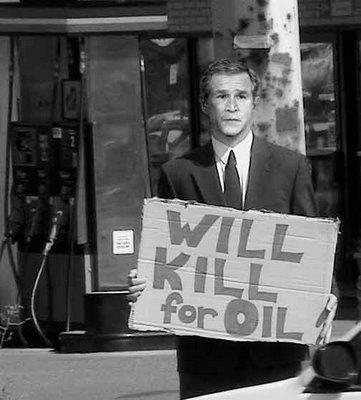
Dubya : The Gift That Keeps on Giving

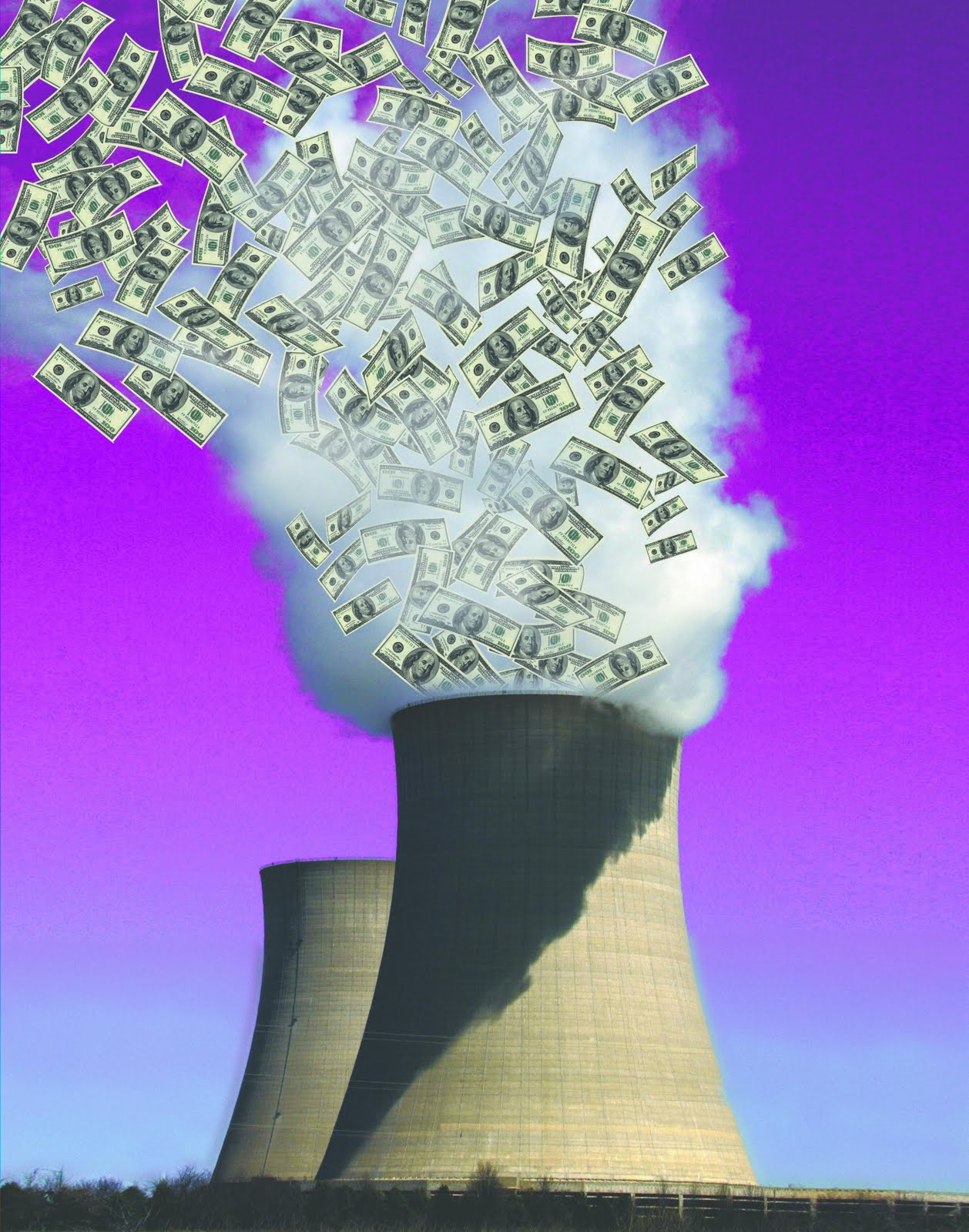
Image from SodaHead.

Bush, Cheney and Halliburton:
The making of a disaster

By Ed Felien / The Rag Blog / May 21, 2010

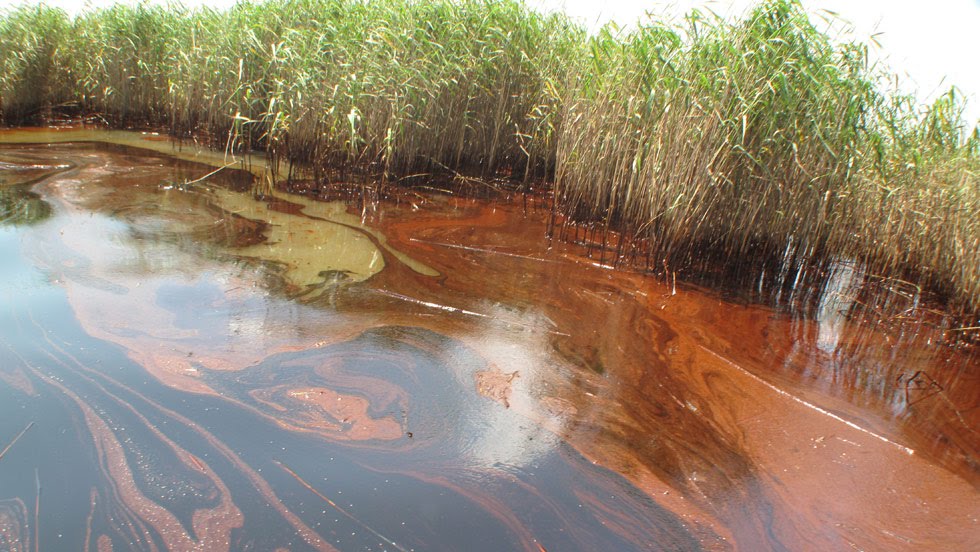
He gave us the war in Afghanistan, the war in Iraq, an economic collapse, tax cuts for the wealthy that bankrupted the treasury, and, now, we can credit him with giving us the greatest man-made ecological disaster in history.

But how can we lay the blame for the Gulf oil disaster at Bush’s door? In 1998, when Clinton was President, Dick Cheney was CEO of Halliburton. He arranged a sale of stock whereby Dresser Industries, owned by the Bush family, bought controlling interest in Halliburton.

Bush didn’t stop owning Halliburton when he became President in 2000 and Dick Cheney didn’t really stop being CEO — they just took advantage of greater opportunities to make lots more money.

They funneled multi-billion dollar no-bid contracts to Halliburton through Defense appropriations for Iraq and Afghanistan, and they let the oil industry write the regulations that covered drilling so that Halliburton and Dresser Industries (the only companies that manufacture and supply oil drilling equipment to the industry) would have an easy time getting the oil out of the ground without having to worry about a lot of
environmental safeguards.

When they were deciding on new regulations for drilling offshore, the Bush Administration rejected the idea of requiring an acoustic trigger that could by remote control turn off an oil well that is out of control. They thought it would be too great a burden on the oil industry, even though Norway and Brazil have required acoustic triggers for years, specifically to prevent the kind of disaster that happened in the Gulf of Mexico.

In 2003 a report by the Minerals Management Services of the Bush Administration said, “acoustic systems are not recommended because they tend to be very costly.”

The cost of $500,000 for the acoustic trigger was considered too high a price to pay. As a result, 11 lives were lost, the Deepwater Horizon oil rig that cost $560 million was lost, and British Petroleum is spending $6 million a day trying (unsuccessfully) to clean up the mess. Last week the Wall Street Journal and Huffington Post reported:

Though the investigation into the explosion that sank the Deepwater Horizon site is still in its early stages, drilling experts agree that blame probably lies with flaws in the “cementing” process — that is, plugging holes in the pipeline seal by pumping cement into it from the rig. Halliburton was in charge of cementing for Deepwater Horizon.

The initial likely cause of gas coming to the surface had something to do with the cement,” said Robert MacKenzie, managing director of energy and natural resources at FBR Capital Markets and a former cementing engineer in the oil industry.

The problem could have been a faulty cement plug at the bottom of the well, he said. Another possibility would be that cement between the pipe and well walls didn’t harden properly and allowed gas to pass through it.

The possibility of Halliburton’s culpability was first reported Monday by Marcus Baram of The Huffington Post.

According to a lawsuit filed in federal court by Natalie Roshto, whose husband, Shane, a deck floor hand, was thrown overboard by the force of the explosion and whose body has not yet been located, Halliburton is culpable for its actions prior to the incident.

The suit claims that the company “prior to the explosion, was engaged in cementing operations of the well and well cap and, upon information and belief, improperly and negligently performed these duties, which was a cause of the explosion.”

And Congressman Henry Waxman, the chairman of the House Energy and Commerce Committee, sent a tough letter on Friday to Halliburton, asking for an explanation of its work on the rig, according to a spokesperson for the committee.

Last year, Halliburton was also implicated for its cementing work prior to a massive blowout off the coast of Australia, where a rig caught on fire and spewed hundreds of thousands of gallons into the sea for ten weeks. In that incident, workers apparently failed to properly pump cement into the well, according to Elmer Danenberger, former head of regulatory affairs for the U.S. Minerals Management Service, who testified to an Australian commission probing that accident.

“The problem with the cementing job was one of the root causes in the Australian blowout,” Danenberger told Huffington Post, adding that the rig crew didn’t pick up on indications of an influx of fluids coming back in after they cemented the casing. “The crew didn’t pick up on them and didn’t take action.”

Senator Bill Nelson of Florida warned that if the leak flows for three months while the relief well is being completed, then, “It’s going to cover up the Gulf Coast and the wind is eventually going to keep it going south, and it’s going to get into the Loop Current.” The Loop Current could take the contamination around the Florida Keys and into the Gulf Stream.

Representative Henry A. Waxman, Democrat of California, the chairman of the House Energy and Commerce Committee said, in hearings before his committee: “If the largest oil and oil service companies in the world had been more careful, 11 lives might have been saved and our coastlines protected.”

[Ed Felien is publisher and editor of Southside Pride, a South Minneapolis monthly.]

The Rag Blog

Posted in Rag Bloggers | Tagged , , , , , | 2 Comments

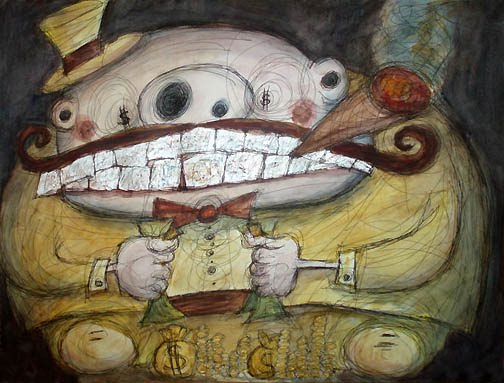
Greed Exposed : The ‘Naked Credit Default Swap’

“Greed” (2006). Mixed media from natalie.org.

What they are and why they should be banned:
Naked Credit Default Swaps

By Ted McLaughlin / The Rag Blog / May 21, 2010

Don’t let your eyes glaze over and stop reading this post because you don’t know what a “naked credit default swap” is. This is very important and I’ll try to make it easily understandable. It is important because these “naked credit default swaps” are one of the major reasons for Wall Street troubles that kicked off this recession, and if nothing is done about them, we could easily see a repeat of these problems in the near future.

First, let us examine what a “credit default swap” (CDS) is, and then what a “naked credit default swap” (NCDS) is. Say a company needs to raise some money, so they create some bonds and sell them. A second company (or individual) buys those bonds, but gets to thinking that they’d like some protection in case of the bond-seller failing to redeem the bonds. They buy an insurance policy that protects them if the bond-seller defaults on the bonds. This insurance policy is called a CDS.

Now I don’t really have a problem with CDS’s, since the buyer of the bonds should have the right to protect their investment. The problem starts with the NCDS’s. These are insurance policies on those bonds that are bought by someone who didn’t buy any of the bonds. They would not lose a single penny if the seller defaulted (failed to redeem) the bonds, because they don’t own any of the bonds.

Those who buy a NCDS are not trying to protect any investment they made (because they didn’t make any investment). They are simply making a cheap bet that the bonds will default. If the bond-seller doesn’t default, they are out a small fee, but if the default happens then they stand to make many millions of dollars. To put it bluntly, they are betting against the economy.

And this actually happened during the failure of the financial institutions on Wall Street. Many people who did not have an interest in those institutions made millions of dollars (sometimes hundreds of millions) because they had bet against the financial institutions (and our economy) by buying NCDS’s. While these people got rich over other’s misfortunes, the NCDS’s just made the whole economic situation worse for everyone else (including the people on Main Street who had no interest in Wall Street).

Let me use an analogy. If you own a house, laws prevent me from buying insurance on your house. That’s because I don’t have a legitimate interest in your house. If your house burns down, I won’t be out any money. You are the only person who will lose if your house burns down, and that is why you are the only person who can buy insurance on that house (to protect your investment). That’s just common sense. I shouldn’t have the right to get rich off your misfortune, while you just get reimbursed for your loss.

But the same rules that apply to you and me don’t apply to Wall Street. Why? That’s simple — GREED! They have fixed the rules so they make money regardless of what happens to the economy. Even worse, they make money off the misery of others without any danger of losing their own money (as would happen if they actually had to make an investment). And the Wall Street financial gurus let this happen because they get fees on the sale of these NCDS’s, which increases their own salaries and bonuses.

Why should you care about this? Because it is your tax dollars that bail out the financial and insurance giants when it all comes crashing down (just like last time). Consider this. There is currently, according to Senator Byron Dorgan (D-North Dakota), about $10 trillion (yes, I said trillion) worth of CDS’s bet on the performance of Wall Street’s giant banks, and the holdings of these banks are guaranteed by the taxpayers (just like your community bank).

The problem is that 80% of these CDS’s are NCDS’s — people betting they can get rich off the failure of these banks (or at least the failure of their bonds). And if that happens, it is the taxpayers who will get stuck with the bill. And while the taxpayer is footing the bill to make these people rich, our economy takes another nosedive — perhaps even worse than the one we are currently in. It cost us 12 million jobs this time. Can we survive the next one?

This is a problem that has a simple solution. The solution is simply to outlaw NCDS’s. Limit the “credit default swaps” to the people or companies that actually have an interest in protecting themselves from a default — that is, the buyers who would be hurt by a default. But don’t let those without a legitimate interest purchase a “naked credit default swap.” Don’t let them bet against our economy.

Sadly, the current financial reform bill being considered by the Senate does not ban the NCDS’s. Senator Dorgan has proposed an amendment that would do this, but he cannot get the Senate to even consider his amendment. He is being ignored by both Democrats and Republicans. It looks like the $1 million a day that Wall Street has sunk into lobbying is paying off for them.

The financial reform bill does contain some good things, but it doesn’t get down to the real reform that would keep the Wall Street disaster which caused our country’s economic disaster from happening again. A good start on this would be to ban NCDS’s. But at this point it doesn’t look like that will happen.

It would be nice if our senators cared as much about Main Street as they do about Wall Street, but it doesn’t look like that’s a possibility either.

[Rag Blog contributor Ted McLaughlin also posts at jobsanger.]

The Rag Blog

Posted in Rag Bloggers | Tagged , , , , | 3 Comments

An exhibit at Houston’s vibrant Museum of Printing History shows the rich role that alternative publications — including African-American, Latino, gay, Jewish, and Feminist papers — have played in the city’s history. More than 40 different titles are represented, with an emphasis on the 60s and 70s. Highlighted is Space City! — the influential underground weekly whose founders included The Rag Blog’s Thorne Dreyer. Article by shane patrick boyle.

Posted in RagBlog | Leave a comment

Type your summary here

Type rest of the post here

Source /

The Rag Blog

Posted in RagBlog | Leave a comment

Warrior-Poet Marilyn Buck : No Wall Too Tall

In prison but clearly in bloom. Marilyn Buck at Dublin FCI, 1994. Photo by Mariann G. Wizard / The Rag Blog.

Supporters call for release:
Free Austin’s Marilyn Buck!

For her acts of selfless courage on behalf of victims of American criminal behavior, Marilyn has spent 25 years as a political prisoner of the United States government.

By Mariann G. Wizard / The Rag Blog / May 19, 2010

AUSTIN, Texas — Marilyn Buck and I have been friends since 1966, a world or so ago. For the two and a half decades that her life has been narrowly circumscribed by a prison cell, our friendship has remained strong through all too few visits, many letters, phone calls, books shared, other friends met, and poems critiqued.

But before that, there were her fabulous boots, working together on The Rag (Austin’s pioneering underground paper), Students for a Democratic Society, my husband George Vizard, our well-meant matchmaking, George’s death, GI organizing, hippie dancing, every visit I ever made to San Francisco, and unconditional love.

For all its state-imposed limits, Marilyn is one of my closest and dearest friends, one of those, for me, of whom The Who sang, “You can count ’em on your one hand.” I mention this only to let you know up front that mine is not an unbiased report. And there are hundreds of people around the world who love her as much as I do. She has earned every bit of our affection.

Marilyn Buck dared to dream of a world without racism, without American imperialism. More important, for those who dream this dream today, she dared to act. She dared to try to make this dream a reality. For her acts of selfless courage on behalf of victims of American criminal behavior, Marilyn has spent 25 years as a political prisoner of the United States government.

A year ago, it looked as if Marilyn’s long exile from the free world was coming to an end. After uncounted rejections, a new hearing brought a positive decision: she would be released on parole in August 2010! Supporters in the Bay Area began to raise funds for her expected transition.

She’d never talked about what she would do when — or if — she was released. When you’re doing an 80-year sentence, you do it, as they say, “one day at a time.” Suddenly she was full of questions: “What kind of computer should I get, a laptop or a desk top?” Like most prison inmates, she’s never been in cyberspace. (I told her to get a smart phone for the first six months and see if she even needs a computer.)

The Rag Blog’s Mariann Wizard (left) with Marilyn Buck at Dublin FCI in 1996.

Unconvinced that digital cameras are now as good as film, the gifted photographer talked about how she might find work in a darkroom. Although she’s tried hard to stay in touch with social and technological changes, it’s hard to do so behind the bricks and razor wire fence, with your legs in shackles any time you’re moved, restricted in every daily choice.

But she was coming out. Nothing else mattered.

Then, last December, right around her 62nd birthday, she was diagnosed with a rare form of uterine cancer, a sarcoma, dangerous as a rattlesnake, potentially lethal. Another friend sent me a clinical description of the disease, but I couldn’t bear to read it all the way through.

Marilyn had symptoms for months before diagnostic tests were made, but not wanting any “fuss” over herself, not wanting to worry her friends, she kept her “health issues” vague and low-key with most people she spoke to or corresponded with, while she and her lawyer tried to get medical tests done.

Health care in the federal Bureau of Prisons is not renowned for its excellence. But, as her friend Penny Schoner reminded me gently, “This is a woman who wakes up every morning thinking about the plight of women in Afghanistan and Palestine, not about herself.”

Marilyn had surgery in the Bay Area pretty quickly after the diagnosis was made and should have started chemotherapy six weeks later, when the surgical wounds had healed. But when she was finally admitted in mid-March to Carswell Federal Medical Center in Ft. Worth, where thousands of seriously ill federal prisoners are treated, the tests performed revealed new tumors and growths outside the original cancer site.

Now at last, the chemo has started, and she is full of hope. She has so much pent-up energy, so many dreams, desires, abilities, concerns — so much life to live! Her experiences in America’s prisons have illuminated a hundred worthwhile projects and pressing needs to which she wants to contribute, as well as a whole new world of experiences that so far she has been denied.

Marilyn Buck with “Resistance Conspiracy” codefendant Susan Rosenberg circa 1985.

Marilyn was accused of sensational acts of insurrection — including jail break, bombings, and a robbery attempt in which two police officers were shot and died. Many otherwise liberal-minded Americans are unable to get past the violence of the confrontations between the police and the small groups of Black and white revolutionaries with whom Buck was linked. Many committed leftists criticized the militants as foolhardy adventurists.

Neither give due weight to the extraordinary repressive measures undertaken by the U.S. government to crush lawful dissent against unjust policies at home and abroad. Behind the shadow of COINTELPRO (the FBI’s Counter Intelligence Program), law enforcement agencies operated outside the rule of law against Movement activists.

To be an African-American dissident, especially, meant walking around with a “shoot-to-kill” sign pinned on your chest. Being Black or Brown or Red, or even white and “hippie-looking,” was to face hatred and brutality (and possible death) day and night at the hands of racist white police and their allies in the U.S. Justice Department.

Marilyn Buck saw her friends being hunted down like dogs on the streets of Oakland. It may be that the murder of her friend (and my husband) George Vizard, in the summer of 1967 in Austin, by person or persons then unknown, also led to her belief that right action lay in helping victims of oppression defend themselves, as the saying went, “by any means necessary.”

Marilyn Buck in 1971. Photo by Jeff Blankfort.

Part of Marilyn’s story is told on a website, Friends of Marilyn Buck, created by friends and supporters. There is a lot more to her story of activism, self-sacrifice, and achievement. But it is her story to tell, and she’s not yet able to tell it — and, until she is free, perhaps not yet able to see it whole.

Meanwhile, the simple facts, and a few errors (e.g., she was born in Temple, Texas, not Jasper, as Wikipedia reports), are scattered in bits and pieces through Wikipedia entries, New York Times archives, and websites or various organizations supporting the rights of political prisoners in the U.S. and abroad.

After a 1973 arrest for buying two boxes of ammunition under a false name, Marilyn Buck was sentenced to 10 years in federal prison. It was a harsh sentence for the actual crime, but those were harsh times.

It’s not unreasonable, given the circumstances, to suspect that the real accusation against Buck was that a middle-class, educated white woman had acted as quartermaster for the Black Liberation Army, an offshoot of the Black Panther Party. She was charged and convicted for the same reason that University of California professor Angela Davis had been arrested: she gave material support to Black people to defend themselves against white supremacist attacks and the racist police who allowed and, in some cases, even enabled them.

After four years at Alderson (West Virginia) Federal Women’s Prison — and after being denied parole for, I think, the third time — Marilyn was given a furlough to consult with her lawyers. She didn’t come back.

During the next few years Marilyn allegedly participated in the prison escape of BLA leader Assata Shakur, a bank robbery to assist the New Afrikan independence movement, and, with other militant activists, was involved in a concussion-bombing of the U.S. Capitol to protest the U.S. invasion of Grenada and the bombing of Lebanon by U.S. warships.

When she was captured in 1985 and charged in what became known as the “Resistance Conspiracy case,” she and three women co-defendants took a plea to secure the release of a male co-defendant, a physician whose non-Hodgkin’s lymphoma had recurred in prison. Marilyn received a total sentence of 80 years.

Marilyn Buck.

As a prisoner, Marilyn has always embodied the old-school principle, “Don’t mourn, organize!” Ever since her first arrest, she has steadfastly resisted diverting “movement resources” to her defense or benefit. In her interactions, she directs attention away from her personal inconveniences as a high-security prisoner (she is considered a “terrorist” by the government) to social and political issues — or at least to the personal lives of her friends and correspondents with whom she unfailingly empathizes, even when pointing out occasionally that I’m being whiny.

Her character is like the finest steel: it resists corrosion, shakes off the grime of daily use, and shines forth. Her level-headedness alone is enough to make her a valued friend!

Despite her selflessness, an active support group has grown up with members all over the world. It is centered in San Francisco, across the bay from Dublin Federal Correctional Center where Marilyn was sent after human-rights lawsuits forced the closure of a brand-new “supermax” prison in Marianna, Florida, where she began her second incarceration.

She has been upheld throughout her captivity by a multicultural, multi-gendered group of working class supporters, poets, former prisoners, prison reform activists and others, enabled to buy postage stamps, prepaid phone minutes, paper and pens, and kept in books and periodicals (she’s a daily reader of the New York Times).

During those years, Marilyn became an accomplished, highly acclaimed poet and translator, the result, she says, of being “a censored person. In defiance, I turned to poetry, an art of speaking sparely, but flagrantly.” Marilyn’s poems can be found in many collections, in her chapbook, Rescue the Word, and on her CD Wild Poppies. She was awarded the P.E.N. American Center poetry award in 2001.

Marilyn has developed a significant artistic talent as a sculptor; organized prisoners to raise funds for AIDS education through a pledge walk-a-thon; and taught untold hundreds of other women how to read, how to think things through, and how to survive and even transcend their prison sentences. She has mentored and inspired scores of poets inside and outside the walls.

All along, her principled conduct has brought many new friends and supporters along with the old. She had a steady stream of visitors at Dublin FCI, including Sixties radical icons and the now-grown children of friends and former neighbors. She corresponds with poets and artists around the world. Thirty or more poets participated in making Wild Poppies, including South Africa’s liberation laureate Dennis Brutus and Amiri Baraka (formerly known as LeRoi Jones), who introduces the compilation.

1966 UT-Austin police surveillance photo from anti-war rally. From left, Liz Jacobsen (Liz Helenchild), Terry Dyke, and Marilyn Buck.

Both of Marilyn’s parents passed away during her incarceration, and she could neither see them before their deaths nor attend their funeral services. There have been other serious personal hardships, but that was, I think, the most difficult for her to bear. Even the shock of the 9-11 terrorist attacks in 2001, when Marilyn — along with scores of other prisoners in many facilities around the country, completely uninvolved in the attacks — was suddenly removed from her cell and placed in solitary confinement, without access to her attorneys for many days, didn’t really compare with not being able to properly mourn her parents.

Marilyn’s Episcopal minister father, Louis Buck, was a noted Austin civil rights activist when I first got involved in that cause as a college freshman in 1965. I heard about Dr. Buck, and met him once or twice, before I ever met his daughter. Marilyn had an upper-middle-class private school education, but crosses had been burned on the family lawn north of the University of Texas campus. When her father’s denomination defrocked him because he started an integrated congregation that still exists today, Austin’s St. James Episcopal, he became a veterinarian to support his family.

Early on, Marilyn saw that racism was wrong, that she needed to oppose it, and that those with the political power to make changes could not be counted upon to do the right thing. Ironically, her dad sent her to college at the University of California at Berkeley to keep her away from the crazy radicals (SDS and others) at UT Austin. Smart as a whip and curious about everything, the innocent young lady who went to “Berzerkly” soon discovered psychedelics, rock music, and “high” society.

Despite the protection the elder Bucks attempted to provide their daughter, there was no hiding place for anyone with a minimal curiosity about national and world affairs on the college campuses of 1965-66. When she returned to Austin the following summer, she and I, and George, became fast friends. We were fascinated with her West Coast sophistication; she with our close-knit and eclectic community of activists, artists, musicians, and dopers. It was in Austin that she joined Students for a Democratic Society (SDS), worked on The Rag, and met a national SDS organizer on his way out of town. She went with him.

In Chicago, she worked in the SDS National Office and edited New Left Notes, the group’s national news organ, then returned alone to the Bay Area, with a sharply honed and newly militant outlook on the state of the world and what needed to be done to change it.

There she worked with Third World Newsreel; this was back when video cameras weighed 30-plus pounds and needed two people to operate, running in tandem through the tear gas-choked streets, taping demonstrations as the San Francisco TAC Squad closed in! It wasn’t long before she met and became friends with members of Bay Area Black liberation groups.

Nor was it long before she emerged as a target of special interest in FBI COINTELPRO operations against the Black Panthers and other anti-imperialist organizations.

Marilyn Buck with Kwame Ture (formerly Stokely Carmichael) at Dublin FCI, 1994.

So why, now, with parole already scheduled and her serious illness, is she still imprisoned at all? She’s been incarcerated longer than most other political prisoners of the Sixties. Former Chicago Black Panther, working class artist, and Houston’s “Mayor of da 5th Ward” Robert al-Walee says, “If Marilyn was a Black woman, she would be free by now; there would have been a public outcry for her release.”

Lee compares Buck to famed abolitionist leader John Brown, demonized in the American historical record. Whites who stand steadfastly against racism and discrimination become “race traitors,” and the label of “terrorist” — by which Brown was also known — drives away liberal support.

Assata Shakur, who has lived in exile in Havana, Cuba, for many years, agrees. She wrote,

When I think of Marilyn as a preacher’s daughter, I think of her as someone who wrestled with the moral problems of our times and who was not afraid to take principled positions around those issues.

Marilyn had a choice. She could have remained silent; she could have reaped the benefits of white-skin privilege. But instead she chose the path of righteousness. She has defended the have-nots, the powerless, and as a woman she has struggled for the liberation of all women. The only reason that she remains incarcerated is because of her political activism.

She needs and deserves the support of all those who are committed to freedom and the abolition of pain and suffering on this earth. She deserves to be supported, she deserves to be respected, and she deserves to be free.

Austin author and “candyman” Robert King, a former prisoner and Panther activist at Louisiana’s notorious Angola Prison, where his two comrades from the Angola 3, Herman Wallace and Albert Woodfox, remain imprisoned, expressed his wishes for Buck’s recovery and remarked on her “indomitable spirit.” He says,

Marilyn’s self-directed commitment shows her evolution towards the ideal of the revolutionary ‘New Wo/Man’ of whom George Jackson spoke. This is what enables her to weather the storms of life. She has given so much and has asked for nothing. She has kept the faith and continues to fight the good fight. She will always have my love and respect.

Kathleen Cleaver, professor of law at both Yale and Emory Universities and a veteran of both the Black Panther Party and the Student Nonviolent Coordinating Committee (SNCC), states that “Marilyn has always been stalwart and devoted in her dedication to the liberation of Black and all oppressed peoples. Unlike some, she never withdrew from that struggle.”

Marilyn Buck with Kathleen Cleaver at Dublin FCI cica 2007.

Akwasi Evans, editor and publisher of Austin’s NOKOA: The Observer, is another long-time admirer. He says,

Marilyn Buck is a truly courageous woman who sacrificed her liberty in the struggle for the liberation of all of America’s oppressed. She has paid a great price for her crimes against capitalist exploitation and ought to be released from prison now so she can fight her cancer in freedom instead of incarceration!

Marilyn’s support has always been strong in the Black community and among “minorities” in general. But some of us, her white sisters and brothers, may have let her slip from mindfulness. She dared to support with deeds what we only said we supported: the right of oppressed people to defend themselves.

Her experience underground, after her 1977 escape from prison, is of special relevance today. Marilyn has had a long time to meditate upon the mutually reinforcing beliefs, held then by some, that armed revolution was imminent and that the duty of the revolutionary was to make a revolution. Reading her letters, poems, and essays over all these years, I’ve seen her extraordinary evolution, witnessed the maturation of an articulate, responsible, disciplined, ethical mind.

In her 1999 master’s thesis in fine arts (she’s earned undergraduate and graduate degrees by correspondence while incarcerated), she wrote,

The artist creates the concept and framework for a different cultural paradigm. Political speeches, leaflets, and pamphlets that exhort and condemn the old oppressive order rarely do that. Without the imagination, there is little daring to confront the old.

We need her out here in the world; need her insight, her experience, and her creative imagination. I can’t wait to hear her speak freely.

James Retherford and Sarito Carol Neiman contributed to this article.

[Mariann Wizard, a Sixties radical activist and contributor to The Rag, Austin’s underground newspaper, is a poet, a professional science writer specializing in natural health therapies, and a regular contributor to The Rag Blog.]

Marilyn Buck in her trademark boots, at offices of the San Francisco Express-Times, 1968. Photo by Jeff Blankfort.

Free Marilyn Now!

There will be a “Free Marilyn Now!” benefit in Austin on Friday, June 25, from 7 – 11 p.m., at 3105 E. Cesar Chavez Street, with a suggested donation of $10 at the door, and all proceeds from food, refreshments, an art sale, and other events going to Marilyn’s freedom fund.

Bands are still being confirmed at this time, but a diverse lineup is planned, along with healing meditation exercises and special guests.

Marilyn will need medical monitoring and care while she convalesces, and for a good while to come, and her plans for working right away will need to be put on hold. She needs some good nutrition, too, after 25 years of prison chow, and for crying out loud, this woman is going to need some good new boots!

Sponsors are quickly coming on board for the event, but include The Rag Blog, NOKOA News, Resistencia Bookstore/Red Salmon Arts, OneLove Kitchen, Ex-pinta Support Alliance (ESA), Texas Jail Project, Austin Cab, and Youth Emergency Service/Phogg Phoundation — that I know of so far.

Save the date and start saving your pennies! Have something cool to donate? Willing to volunteer? Watch The Rag Blog for more details!

— MGW

M. Buck, Poet. Photo taken at Dublin FCI, 1998.

The Rag Blog

Posted in Rag Bloggers | Tagged , , , , , , , , | 35 Comments

Underground in H-Town : A Rich History of Alternative Media

Museum of Printing History: Saluting Houston’s alternative media.

space city! cover kerry

On display at the Museum of Printing History: Cover of Space City! from January, 1970. Cover art by Kerry Fitzgerald (Kerry Awn). All images not credited are courtesy the Museum of Printing History.

By shane patrick boyle | The Rag Blog | May 19, 2010

HOUSTON — Houston has a problem, a memory problem. This is particularly true when it comes to the history of the city’s underground and alternative culture. Underground in H-Town, an exhibit at Houston’s Museum of Printing History, attempts to address this problem.

The exhibit, curated by the Museum of Printing History’s Amanda Stevenson and Jo Collier of the Houston Public Library’s Houston Metropolitan Research Center, explores the history of minority and alternative publications in Houston.

The Museum of Printing History, founded in 1979, is a lively Houston museum whose mission, in part, is “to promote, preserve, and share the knowledge of printed communication and art…” with, in the words of Texas Highways, a “collection of objects and artifacts devoted to the history, science, and art of printing.”

The show includes sections on Jewish, Asian, Latino, African American, LGBTQ, and feminist media as well as a display which showcases Space City!, a radical newspaper of the late 60s and early 70s (and it’s spin-offs) and another which focuses on Public News, a popular alternative paper of the 80s and 90s, and a centerpiece comparing alternative and mainstream coverage rounds out the exhibit.

Anyone who thinks there is no alternative media in Houston may be surprised to learn that over 40 titles are represented and these are only scratching the surface of what is actually a rich and diverse history.

The longest running title included in the exhibit is the Jewish Herald Voice which was founded in 1908 and is still published today. The oldest issue displayed in the exhibit is a February 18, 1939, copy of the Houston Defender which is also believed to be the oldest physical copy in existence of the African-American newspaper founded nine years earlier.

OutSmart (founded in 1994) is the youngest title represented while the most recent item in the exhibit is a 1997 issue of Public News.

One newspaper that is not from Houston is also included. The May 14, 1978, issue of Corpus Christi-based Tejas News finds a place in the exhibit for its extensive coverage of the Moody Park Riots of May 5 that year and is paired with other papers, including La Prensa which covered this story.

The ’60s and ’70s are the emphasis of the exhibit and a large part of this focus is Space City! (originally called Space City News). The collective-run paper was edited by a group including Thorne Dreyer, who previously was a founder of The Rag in Austin, which also had a substantial Houston presence. (Dreyer continues to publish The Rag Blog, an online reincarnation of The Rag.) Several issues are included as well as some internal pages including an editorial that recounts the paper’s first year, including the name change and the bombing of their offices by the Ku Klux Klan.

Mockingbird, which split off from Space City!, is also included. An editorial from the first issue (April 1972) discusses what they perceived as failures in the collective process and their reasons for forming a separate paper. Ironically, there was also a split from Mockingbird, leading to the creation of a publication called Abraxas, which is also included in the exhibit.

An audio presentation of an oral history interview with Thorne Dreyer, which can be heard in the adjacent theater, compliments this section. The interview was originally recorded in 1976 by Dr. Louis Marchiafava of the Houston Metropolitan Research Center.

The opening reception was attended by a large contingent from Space City! and other veterans of the ’60s-’70’s Houston counterculture.

Space City! oldsters

Out of the past: Former staffers of Houston underground paper Space City! and other luminaries from the period’s counterculture reunite at opening reception for Underground in H-Town, April 8, 2010, at Museum of Printing History. From left: Cindy Soo, Bobby Ray Eakin, Ray Hill, Deborah Osborne, Thorne Dreyer (dark cap), Bruce Litvin (kneeling), Gary Chason (white cap), Sophia, George Banks, Jeffery Shero Nightbyrd, Michael Condray, Jim Ohmart (kneeling), John Wilson, and Eileen Hatcher. Not pictured: Russell Noland, Tom Curtis. Photo by Amanda Stevenson / The Rag Blog.

The section on gay and LGBTQ media presents pictures of the protests over a Houston visit by singer Anita Bryant who led the campaign against the gay rights ordinance in Florida and became a national symbol of anti-gay hysteria. Publications in this section date back to the mid ’60s.

Albatross, the oldest known gay publication in Houston, began as a newsletter in 1965. But if some of the LGBTQ publications of yesterday look unfamiliar, some of the faces might look very familar including activist and radio personality Ray Hill on the cover of Montrose Voice, and Annise Parker (now mayor of Houston) on the cover of The Wand from 1990.

Several issues of Houston Breakthrough, a free feminist publication edited by Janice Blue and Gabrielle Cosgriff (now on the editorial board of the Houston Chronicle) which ran from 1976 to 1981, are also included in the exhibit. Unfortunately they are in what seems to be a catch-all section with the Houston Peace News and some labor publications. This may be a question of space or it may be that few examples of local feminist and labor publications have been archived.

Public News, the alternative news weekly of the ’80s and ’90s which began as a two-sided photocopy (not displayed), closes out the exhibit. Not only are several issues presented, but the sign from the paper’s last offices on West Alabama is also included. A 1997 issue looks back at Houston in the ’60s.

underground in h-town display

The centerpiece of the exhibition features coverage of the shooting of black activist Carl Hampton, as it was handled by mainstream and alternative media outlets.

The highlight of the exhibition is the centerpiece which illustrates the need for alternative media to provide a counterpoint to the mainstream press. It shows how the same story was covered by alternative and mainstream media outlets. The display shows how the murder of Carl Hampton 40 years ago this July, was covered by the Houston Chronicle, The Houston Post, Space City!, the Voice of Hope, and the Forward Times. Hampton was a charismatic black activist who was shot by Houston police.

The most disappointing part of the exhibit, and this may be just a question of space, is that it stops with the ’90s rather than presenting the history of alternative press as a phenomenon that continues today, and is also very thin on any examples after 1980.

Fortunately, there is some sense of a continuum established with the show’s poster which is illustrated by Shelby Hohl of Free Press Houston, one of Houston’s most popular alternative papers established in the past decade.

Also, several newsracks at the end of the exhibit offer a look at current publications. To be sure, some of the publications in these racks are not actually alternative. One of those is the Houston Press, the corporate owned weekly that bought Public News, a purchase believed by many as designed to suppress it, is represented here.

public news cover

Public News, Houston’s major alternative publication from the 80s.

However, dig through and you will find that some of the publications in the exhibition, still being published today, are represented in these racks. And even though not all the publications in the racks are alternative, the racks themselves certainly are. None of them would be considered street legal under the terms of the Houston’s newsrack ordinance.

Underground in H-Town runs through July 24 at the Museum of Printing History, 1324 W. Clay.

In conjunction with the exhibit, the Museum is presenting a Roundtable Discussion on Alternative Media in Houston on Thursday, May 20, from 6:30-8:30 p.m. The panel will be moderated by Michael Berryhill, a professor of journalism at the University of Houston and award-winning investigative journalist. Panelists include Gabrielle Cosgriff, Tom Curtis, and Space City!‘s Dreyer, veterans of the alternative and mainstream media. (See details below.)

[shane Patrick boyle is the founder of Zine Fest Houston. Last year he had the privilege of working with Jo Collier to bring Thorne Dreyer and Sherwood Bishop to the Zine Fest for a Space City! 40-year reunion. The title “Underground in H-Town” came from a zine he was working on during that time which has not been released.]

underground in h-town poster

Photo by Rob Block / Houston Indymedia.

Roundtable Discussion on Alternative Press in Houston

Museum of Printing History
1324 W. Clay
Houston, Texas
Thursday, May 20, 6:30-8:30 p.m.

The Museum of Printing History is pleased to host a Roundtable Discussion on Alternative Media in Houston. The panel will be moderated by Michael Berryhill, a professor of journalism at the University of Houston and award-winning investigative journalist. Panelists include Gabrielle Cosgriff, Tom Curtis, and Thorne Dreyer, three freelance journalists with an intimate knowledge of print media in Houston from the 1970s to the present, including the alternative and mainstream press. Topics that will be explored include the history of alternative media in Houston, as well as current and future trends.

This event is held in conjunction with Underground in H-Town, an exhibition that highlights the importance of minority and alternative publications in the construct of local history. Organized in partnership with the Houston Metropolitan Research Center, Underground in H-Town presents original documents and images from community papers and the alternative press from the second half of the twentieth century, with a special focus on the 1960s, 1970s, and 1980s. Publications represent the many diverse communities of Houston. Papers presented in the exhibition include historic issues of Forward Times, Voice of Hope, Space City!, The Jewish Herald Voice, El Papel Chicano, El Sol De Houston, Houston Breakthrough, among others.

Gabrielle Cosgriff was the editor for Houston Breakthrough, a free monthly feminist publication that was recognized locally and nationally in its 5-year existence, 1976 through 1981. Cosgriff moved on to editorial work with local Houston magazines and People Magazine. She currently serves on the editorial board of the Houston Chronicle.

Tom Curtis is an award-winning investigative reporter, who has written since the 1970s for, among many others, the Houston Chronicle, Space City!, Fort Worth Press, The New York Times, the Washington Post, Dallas Times Herald, Texas Monthly, and Rolling Stone. Curtis co-founded Houston City Magazine in April 1978, and was a senior editor at Texas Monthly 1987-1990. A freelancer throughout most of the 1990s, Curtis now freelances from Galveston.

Thorne Dreyer was a pioneering underground journalist in the 1960s and 1970s, as founding editor of two of the nation’s most important underground papers, The Rag in Austin and Space City! (originally Space City News) in Houston, and was a member of the editorial collective at Liberation News Service in New York. Dreyer now lives in Austin where he is a director of the New Journalism Project, edits The Rag Blog, an internet news magazine, and hosts a weekly radio show on KOOP-FM.

space city news #1

Volume 1, Number 1 of Space City News (later, Space City!). Cover art by Kerry Fitzgerald (now Kerry Awn).

The Rag Blog

Posted in Rag Bloggers | Tagged , , , , , , , , , , , , , | 3 Comments

Roger Baker : The Economic Side Effects of Peak Oil

Image from Urban Sprout.

Resource economics:
It’s not just about peak oil anymore

By Roger Baker / The Rag Blog / May 17, 2010

Anyone broadly devoted to the study of resource economics and peak oil sooner or later has to break away from the comfortable and reasonably well known foundations of geologic science, and face up to the much messier and less predictable economic side effects implied by oil supply constraints.

The growing peak oil problem is now deeply intertwined with the growing sovereign (national government) debt problem in such a way that treating either problem tends to make the other problem worse.

Economics is no more predictable than politics and mass psychology. There have indeed been long periods in U.S. history when economic conditions have been sufficiently stable and uneventful that capital plus advancing technology have generated many profitable cycles of investment, based on predictable consumption behavior. During such times, economic rules based on mass self-interest behavior can even allow economics to make a claim of being a science.

However, in unsettled investment times like we see now, the unruly psychology of fear, or self-interest based on geopolitical competition, can easily overturn the normal economic rules, which assume a predictable investment environment based on predictable public marketplace demands.

Three gifted analysts of the political economy, Goldman, Williams, and Wallerstein, recently seem to be in agreement on some important basics. Notably that the prospect for many economically stressed countries, especially the USA, to try to create enough fiat money to stimulate demand to revive their domestic economies is not likely to work out very well or for very long. Once you start down this always-seductive path, it keeps getting harder to turn back.

As a matter of past experience, (see Rogoff and Reinhart’s This Time is Different and Jens O. Parson’s Dying of Money) the initial stages of economic stimulation through the injection of money into the economy are broadly seen as welcome and beneficial. The big problem comes later, when the psychology of spending starts to turn around.

At some point, people tend to discover that there is really more money around than there are certain types of real goods in the market to buy, typically food and energy (which has a lot to do with why the U.S. dropped these from the official accounting of U.S. inflation, and which Williams now estimates at over 5%).

When prices start to rise noticeably, average people start to hedge further price increases by hoarding physical goods — much as they had previously hoarded their money before buying power started to noticeably shrink. As the “velocity of circulation” of the previously sluggish money increases, it comes off the sidelines and its apparent abundance increases, even if no more money is printed. This makes the situation worse. This is a classic self-reinforcing economic behavior cycle that leads easily to hyper-inflation.

As David Goldman points out, and here nicely documents with official bank data, the giant U.S. investment banks and the U.S. government are locked into a codependency that forces them to cooperatively inflate the money supply, like running faster and faster, to delay a general economic collapse.

Now that the state and the banks have merged in a corporatist alliance, all market news is political news. The market got clobbered today on news that New York State would investigate banks for rigging credit ratings on mortgage-backed securities by providing bad information to the ratings agencies.

In my experience, the banks and the ratings agencies had a common purpose, which was to make money. The ratings agencies would advise the banks on how to tweak the portfolios behind Collateralized Debt Obligations so as to squeeze out more incomes.

It wasn’t simply a matter of the banks hiring ratings agency experts and gaming the models for their own benefit; the ratings agencies themselves were making most of their money from the CDO market, and volunteered their time and advice to help the banks issue more.

These issues come up because the banks and governments are partners in the attempt to reflate the world economy through deficits comprising a double-digit proportion of GDP in most of the major economies. The banks finance the governments, with money that they borrow from the governments. That’s why many banks showed a profit during every single trading day of the first quarter: with a steep yield curve and nearly zero-cost funding, you have to go out of your way to lose money…

Like Goldman, Williams points toward a general governmental inability to control spending. Deficit spending will, despite a depressed economy, at some point lead to another rise in oil prices through competitive bidding for a limited supply. Williams sees oil price as a major factor leading the way to renewed cost-push inflation. When the price of oil rises, the price of nearly everything else is soon to follow.

…You can also have inflation, which is driven by factors other than strong economic activity. That’s what we’ve been seeing in the last couple of years. It’s been largely dominated by swings in oil prices. That hasn’t been due really to oil demand, as much as it has been due to the value of the U.S. dollar. Oil is denominated in U.S. dollars. Big swings in the U.S. dollar get reflected in oil pricing. If the dollar weakens, oil rises. That’s what you saw if you go back to the 1973-1975 recession, for example. That was an inflationary recession.

Indeed, the counterpart to what you were suggesting earlier about the strong demand and higher inflation is that usually in a recession you see low inflation. The ’73 to ’75 experience, however, was an inflationary recession because of the problem with oil prices.

That’s what we were seeing early in this cycle, where a weakening dollar rallied oil prices, and then the dollar reversed sharply and oil prices collapsed. We have passed through a brief period of shallow year-to-year deflation in the consumer price index, but, as oil prices bottomed out and headed higher since the end of 2009, we’re now seeing higher inflation, again…”

The U.S. government has no way to deal with its imported oil bill, which is nowadays mostly determined by foreign supply and demand. Uncontrollable commodity price inflation combined with the economic stagnation implies severe stagflation, described by Williams as a hyper-inflationary depression. One central feature of Williams’ reasoning is that, with real inflation now above five percent, the M3 (broad definition) money supply in terms of its buying power is actually shrinking.

This signals recession, even as the government increases its role, trying to inject enough new money to prevent a shrinkage of total real GNP. Average consumers are meanwhile so stressed, and the markets are so distorted by the process, that the banks are now avoiding real world productive investments in favor of the purely paper profits being generated with help from government policy. The good news is that Williams thinks the U.S. will probably manage to survive, but under distinctly different circumstances.

…People will find to their happy surprise that they’ll be able to survive. Most businesses are pretty creative. The thing is, the U.S. economic activity accounts for roughly half that of the globe. There’s no way that the U.S. economy can turn down severely without there being an equivalent, at least a parallel downturn outside the U.S. with its major trading partners.

When I talk about a great depression in the United States, it is coincident with a hyper-inflation. We’re already in the deepest and longest economic contraction seen since the Great Depression. If you look at the timing as set by the National Bureau of Economic Research, which is the arbiter of U.S. recessions, as to whether or not we have one, they’ve refused to call an end to this one, so far. But assuming you called an end to it back in the middle of 2009, it would still be the longest recession seen since the first down-leg of the Great Depression.

In terms of depth, year-to-year decline in the gross domestic product, or GDP, as reported in the third quarter of 2009, was the steepest annual decline ever reported in that series, which goes back to the late ’40s on a quarterly basis. Other than for the shutdown of war production at the end of World War II, which usually is not counted as a normal business cycle, the full annual decline in 2009 GDP was the deepest since the Great Depression.

There’s strong evidence that we’re going to see an intensified downturn ahead, but it won’t become a great depression until a hyper-inflation kicks in. That is because hyper-inflation will be very disruptive to the normal flow of commerce and will take you to really low levels of activity that we haven’t seen probably in the history of the Republic…

Finally, Wallerstein views the big picture of investment fear, much like a global psychologist might. He describes the global nature of the deteriorating market situation and the expanding problem of unsecured sovereign debt. Investors require stability for rational long-range planning.Thus Wallerstein, like Williams, sees a permanent slump in the global economy ahead.

…The Greek government’s problem is quite simple. Its tax revenue is too small and its expenditure level too high for its current and prospective future income. So it must either raise taxes (if it could collect them) or cut expenditures or both — and drastically. This is however also the problem of Germany, France, Great Britain, the United States, and the list goes on. Nor are the few countries that seem to have their fiscal heads above water at the moment (such as Brazil or China) exempt from this contagion. The Greeks are taking to the streets to protest. But this will spread. And, as it spreads, the world market will become ever more volatile, and the fears will expand, not contract.

The major policy response everywhere has been to buy time with paper money that is borrowed or printed. The hope is that, somehow, during the borrowed time, renewed economic growth will occur and restore confidence, ending the real and latent panics. Politicians grasp every little sign of such growth and over interpret it. A good example is applauding recent job creation in the United States, when that job creation was less than the size of the population growth in the same period.

The fear is not irrational. It is the consequence of the structural crisis of the world-system. It cannot be solved by the band-aids that governments are using to treat the serious ailments we confront today. When fluctuations get too great and too rapid, no one can rationally plan. So people no longer act as reasonably rational actors in a relatively normal world-economy. And it is this degree of heightened fear that is the fundamental reality of the present era.

[Roger Baker is a long time transportation-oriented environmental activist, an amateur energy-oriented economist, an amateur scientist and science writer, and a founding member of and an advisor to the Association for the Study of Peak Oil-USA. He is active in the Green Party and the ACLU, and is a director of the Save Our Springs Association and the Save Barton Creek Association. Mostly he enjoys being an irreverent policy wonk and writing irreverent wonkish articles for The Rag Blog.]

The Rag Blog

Posted in Rag Bloggers | Tagged , , | 6 Comments

is a journalist, a community organizer, an editor of Left Turn Magazine, and a staffer with the Louisiana Justice Institute. He was the first writer to bring the story of the Jena Six to a national audience, and audiences around the world have seen the television reports he’s produced for Al-Jazeera, TeleSur, GritTV, and Democracy Now!.

Flaherty’s articles from the Gulf Coast after Hurricane Katrina have appeared in periodicals around the world. His post-Katrina writing in ColorLines Magazine shared a journalism award from New America Media for best Katrina-related coverage in the Ethnic press. Haymarket Press will release his new book, FLOODLINES: Stories of Community and Resistance from Katrina to the Jena Six, this summer.

Jordan Flaherty’s writing appears regularly on The Rag Blog.

Read “Jena, Louisiana: Drug Bust or Racist Revenge?” by Jordan Flaherty / The Rag Blog / May 14, 2010

Posted in RagBlog | Leave a comment

Noted adventure and travel writer Miller, researching a book on Cervantes, visits Madrid for “El Dia del LIbro,” where the “Lectura Continuada” takes place. Tom joins in this marathon reading of the thousand-page “Don Quixote,” the world’s best-loved and most translated novel. The winner of the Cervantes Prize — Mexican poet José Emilio Pacheco — kicks things off, followed by more than a thousand readers, including politicos, actors, and cultural bureaucrats, each reading a paragraph or two from the magnum opus.

Posted in RagBlog | Leave a comment

Environmental Warrior : Remembering Judi Bari

Judi Bari celebrates March 3, 1995, outside the Oakland Federal Courthouse after winning a round in her civil rights lawsuit against the FBI and Oakland Police. Photo by Xiang Xing Zhou / San Francisco Daily Journal.

Earth First! and the FBI:
The bombing of Judi Bari

By Penelope Rosemont / The Rag Blog / May 17, 2010

Twenty years ago — on the 24th of May, 1990 — sensationalist headlines across the country announced the arrest of two leading environmentalists, Judi Bari and Darryl Cherney. Their car had been bombed — but it was they who were arrested, charged with their own bombing! The environmental activist movement and Earth First! in particular were branded as terrorist organizations.

This incident fell just after the very successful Earth First! campaign to save the old growth Redwoods, labeled “Redwood Summer,” that brought in young people from all over the country. They sang, they sat down in the roads, and they filled the jails like the old time Wobbly organizers, like Civil Rights activists, like the Peace Movement. It looked like the timber industry was in for big trouble.

But then the car bombing. What followed was an interesting and frightening revelation of political intrigue, collusion among the police, the FBI, and the timber companies.

This remarkable history is being observed with a series of “Revolutionary Ecology” activities and an historical exhibit in Berkeley on May 23, 2010, and with an anniversary observance in Oakland on May 24.

Judi Bari and Darryl Cherney filed a civil rights lawsuit against four FBI agents and three Oakland police officers, and in a landmark decision on June 11, 2002, a federal jury found unanimously against six of the seven defendants, saying they had attempted to frame the defendants in an effort to stop their political activities. The jury awarded $4.4 million in damages.

In an editorial on June 13, 2002, the San Francisco Chronicle said that the verdict “reminds law enforcement advocates that Americans are not panicked by the threat of terrorism into abandoning their civil rights… The overzealous pursuit of [Bari and Cherney] was unacceptable — and unconstitutional — regardless of what one thinks of the activists’ politics.”

Attorney Dennis Cunningham of the People’s Law Office in Chicago was interviewed by Michael James on “Live from the Heartland,” at Chicago’s Heartland Cafe, June 6, 2004.

James asks Cunningham about the outcome of the Judi Bari case, and for “background on who she was and what the case was about?”

Dennis Cunningham replies,

Judi Bari was an environmentalist organizer with Earth First!. She and Darryl Cherney, another EF! Organizer, were bombed in their car in Oakland. A pipe bomb was put under the driver’s seat and rigged with a motion device that would ignite on the motion of the car. When the bomb went off the cops came — the FBI came right away — and they told the cops ‘we know these people, they are terrorist suspects, we’ve been investigating them, and we believe this was their own bomb and they were on their way to plant it someplace — you should bust them.’ Oakland cops say ‘okay boss’ and did.

They arrested them and charged them with possession and transportation of an illegal explosive device — it made headlines all over the country — the front page of The New York Times, and everywhere else — it was the top of the news around the country. They were vilified as terrorists by virtue of those headlines and by connecting them to the bomb, which in fact had been used to try to kill them or kill her. Judi Bari was a leading voice and an amazingly skilled, experienced, and persuasive organizer and public speaker — those who planted the bomb were out to shut her up.

The bombed car. Photo from Judi Bari Web Photo Gallery.

Michael James asked Cunningham why he thought Earth First! was the main environmental organization getting headlines at that time, and added that he heard they “had been chaining themselves to trees to trying to stop the cutting of the redwoods.”

Cunningham replied,

True, true. They were organizing for a summer project. They called it Redwood Summer. They modeled it after the 1960s Civil Rights Project, Mississippi Summer — they were trying to bring people, students, and activists from all over the country to the redwood region to do direct action in the summer of 1990. They wanted to try to slow down the timber harvest and protect the old-growth redwoods.

A big local timber company in Humboldt County had been bought up by corporate raiders with junk bonds, to pay off the junk bonds, they tripled the timber harvest. There was an initiative put on the ballot for November that would have limited the clear cutting and the kind of destructive logging that they do now, which fills up the streams with silt and kills the fish, and kills the fishing industry, and leaves the hillsides unstable and prone to mud slides — a disaster. After the bombing, the timber companies hired a Washington public relations firm, Hill and Knowlton, to fight the ballot initiative.

Cunningham continued,

And then as soon as the bombing had taken place Timber Companies labeled the bill ‘the bomber initiative… terrorists want to pass this thing, it’s too radical. Earth First! shouldn’t be allowed to dictate public policy.’ The Initiative ultimately lost by a point and a half.

A researcher concluded that there was more than three billion dollars in timber revenues that the companies had been able to realize in the 12 years since the bombing, that they wouldn’t have got if the initiative had passed. So there was a big motivation to shut Judi up, besides that she and EF! were reaching out to the timber workers.

Judi was trying to make common cause between the environmentalists and the workers, saying, ‘where you gonna work when the trees are gone?’ The timber industry is clear cutting as fast as they can. In Mendocino County at that time 95% of big trees were already gone, and they closed mills.

Judi led an Earth First! contingent and with a group of workers went to a county board meeting right after the big timber company in Mendocino announced it was closing the mills. They got up at the county board meeting and said that the board should take over the mill, preserve the jobs, keep the economy stable. For the timber companies that was pretty much the last straw. But they didn’t want to make a martyr out of her.

They hoped to shut her up for good. They thought they did, but she didn’t die in the bombing. It was a miracle she didn’t die. But then they had her accused of the bombing. Within three hours and five minutes of the explosion, they were under arrest.

James asked Cunningham when he got involved with the case. He replied that “Bill Simpich, a lawyer in San Francisco and Oakland, had started a suit against the FBI and the Oakland Police for false arrest, but that after he joined the group of defense attorneys they were able to reverse the charges so, in fact, they were able to accuse the Oakland police and the FBI of arresting Bari and Cherney on purpose in order to discredit them in a COINTELPRO type operation.

Cunningham explained that “COINTELPRO stands for Counter Intelligence Program — a J. Edgar Hoover undercover dirty operation that the cops used and that the FBI used against the Black Panthers, against the anti-war movement, against the Communist Party, against who knows…”

James commented that it was often used against anyone who challenged them.

Cunningham added,

Yes, everyone who seemed to present a popular threat against the status quo, they did what they could to mess up their work; and they didn’t have any boundaries of legality on what they allowed themselves to do. So there were frame-ups… the murder of Fred Hampton arose out of COINTELPRO operations…

We had a lawsuit that lasted 10 years and went to trial in 2002, in trial for about six weeks, and we were waiting for the jury for another three weeks. The jury came back with a 4.4 million total award for the two of them. It was half punitive damages and half what they call compensatory damages.

About 80% of the total of the money was assigned to the First Amendment cause — meaning that the claim that it had been done on purpose to mess up their political work was the thing that most appealed to that jury, and they gave the most damages for that. It was going to be appealed, and then we started talking about settling and getting it over with since by then it was 12 years of litigation.

James pointed out that Judi had since died of cancer, and never got to see this victory.

Cunningham added that she had endured incredible suffering,

Judi died in 1997 from breast cancer. She had been horribly injured in the bombing. She was crippled, and she had a lot of pain. She kept right on doing her political work and got deeply involved in the case because she felt it was really important to fight back against the FBI attack on the environmental movement.

The FBI were so intent on creating the effect they wanted — headlines of the arrest of the victims as the perpetrators — that they really didn’t bother to cover their tracks very well…

Michael James’ interview with James Cunningham will be excerpted in a book now under development by Charles H. Kerr Publishing Company.

Today it seems everybody is an “environmentalist” — but it doesn’t seem to mean anything except that they want a car with better mileage, and may have a recycle bin. That’s it, they fill up the world with more and more junk and the oceans with plastic bottles. Even capitalism has adopted “green” as the new thing since the financial and real estate crash, trying to exploit what minimal interest people have in preserving the planet.

The great tragedy of the Gulf Oil Spill has not yet been felt. The spill is still going on! Why aren’t BP officials being arrested and charged with reckless homicide? The ocean is being killed, so why aren’t the army, the navy, young unemployed kids, being mobilized to do some good for a change and try to clean this thing up. Oil, like water and air, should belong to the people, it should be used wisely, not wasted.

Such actions would honor the legacy of Judi Bari.

Here is more about the upcoming activities in the Bay Area:

  • On Sunday, May 23, an event dubbed “Revolutionary Ecology” (the title of one of Judi’s best essay collections) will take place at La Pena Cultural Center in Berkeley, with a panel of speakers, music, film and an exciting historical exhibit.
  • On Monday, May 24, the actual anniversary, people from near and far will gather at the site where a motion-triggered bomb exploded under Judi’s car seat, nearly killing her and forever changing the Earth First! movement. The location is on Park Blvd. in Oakland just south of the MacArthur Freeway.
  • [Penelope Rosemont is a writer, editor, publisher, radical activist, and surrealist artist. She is the author of Dreams and Everyday Life: André Breton, Surrealism, Rebel Worker, SDS and the Seven Cities of Cibola, and the editor of Surrealist Women : An International Anthology.]

    Go to:

    Judi Bari always livened up rallies with her fiddle. Photo from Judi Bari Web Photo Gallery.

    The Rag Blog

    Posted in Rag Bloggers | Tagged , , , , , , , , | 6 Comments

    Arizona’s Crackers : ‘Illegal is Not a Race’

    Image from Reform America.

    Arizona’s Crackers:
    Jim Crow is alive and well

    Maintaining a whip hand, southern politicians once calculated, was the best way to defend white power. The same calculation drives contemporary Arizona politics.

    By Char Miller / The Rag Blog / May 17, 2010

    CLAREMONT, California — Standing in the middle of a busy rotary intersection in Orange, California, was a clutch of anti-immigrant protesters; these young white males were demonstrating their solidarity with what they presumed to be embattled Arizonans.

    As a steady stream of cars revolved around the circle, they held up hand-lettered signs, the most blunt of which read: “Illegal is not a race. It’s a Crime!”

    That is a distinction without a difference in Arizona, however, where being Latina/o has become criminalized. When Governor Jan Brewer signed legislation requiring local and state police to demand identification of those they “suspect” are undocumented, she and the state legislature went on record establishing a two-tier caste system: those who look white will get a pass; those who do not will get rousted. Jim Crow is alive and well in the Grand Canyon State.

    Like white Southerners’ intense efforts to segregate public space after the destruction of slavery, contemporary Arizona politicians are determined to define who is “legal” and who is not; who looks like an American and who does not; who can walk down the sidewalk without fear of harassment and who must hide in the shadows.

    They have also decided — as did their white-supremacist predecessors of the late nineteenth century — that controlling the movement of a suspect people is but one part of the battle to dominate social life. As essential is managing who gets educated and on what terms. In the postwar south this was accomplished through the creation of a flawed and inequitable educational system that received constitutional sanction in Plessy v. Ferguson (1896). Until repudiated by Brown v. Board of Education (1954), Plessy succeeded in deflecting Blacks’ intellectual aspirations, lowering their economic horizons, and shackling their political ambitions.

    In Arizona, legislators are just as serious about cracking down on the educational hopes of what is increasingly looking like a captive population. Within days of the passage of the anti-immigration law, another bill swept through the legislature: HB 2281. Its language is disturbing, for it “prohibits a school district or charter school from including in its program of instruction any courses or classes that: Promote the overthrow of the United States government. Promote resentment toward a race or class of people. Are designed primarily for pupils of a particular ethnic group. Advocate ethnic solidarity instead of the treatment of pupils as individuals.”

    HB 2281’s goal is clear — to tar Chicano Studies programs in state universities and public schools as insurrectionary, denounce them as anti-white, and condemn them as sources of suspicious group cohesion. Its rhetoric may be different from the Black Codes that white southerners once enacted to manipulate former slaves, but the legislation’s desires are the same — keep the downtrodden down.

    Maintaining a whip hand, southern politicians once calculated, was the best way to defend white power. The same calculation drives contemporary Arizona politics. Three years ago, for instance, Tom Horne, the state superintendent of education, lashed out at ethnic studies programs. As author of HB 2281, and now a Republican candidate for state attorney general, he rails against “ethnic chauvinism” to scare up voters. More inflammatory still is his department’s recent ruling “that teachers whose spoken English it deems to be heavily accented or ungrammatical must be removed from classes for students still learning English.” In Horne’s Arizona, only whites have the right to be chauvinistic.

    We have been here before. In his incisive critique of segregated America, The Souls of Black Folk (1903), W.E.B. DuBois recorded the “many things which if read with patience may show the strange meaning of being black here in the dawning of the 20th Century. This meaning is not without interest to you, Gentle Reader; for the problem of the Twentieth Century is the problem of the color-line.” That same deeply troubling divide, as Arizona has demonstrated, is staining the 21st.

    [Char Miller is director of the environmental analysis program at Pomona College, Claremont, CA. and is the former chair of the History Department and Director of Urban Studies at Trinity University in San Antonio. He is author of Deep in the Heart of San Antonio: Land and Life in South Texas and editor of River Basins of the American West. This article also appears in the Rio Grande Guardian.]

    The Rag Blog

    Posted in Rag Bloggers | Tagged , , , , , , , | 6 Comments

    Bob Feldman : A People’s History of Afghanistan / 6

    Afghan Prime Minister Mohammad Hashim Maiwandwal meets with President Lyndon Johnson in Washington, March 28, 1967. Photo by Francis Miller / Life.

    Part 6: 1953-1967
    A People’s History of Afghanistan

    By Bob Feldman / The Rag Blog / May 16, 2010

    [If you’re a Rag Blog reader who wonders how the Pentagon ended up getting stuck “waist deep in the Big Muddy” in Afghanistan (to paraphrase a 1960s Pete Seeger song) — and still can’t understand, “what are we fighting for?” (to paraphrase a 1960s Country Joe McDonald song) — this 14-part “People’s History of Afghanistan” might help you debate more effectively those folks who still don’t oppose the planned June 2010 U.S. military escalation in Afghanistan? The series so far can be found here.]

    In 2010, hundreds of thousands of Afghans are still displaced from their homes as a result of the U.S.-led or U.S.-supported military operations in Afghanistan and Pakistan that have taken place since the Pentagon began its endless war in Afghanistan in October 2001. Yet most graduate students in history at U.S. universities were apparently never even required to take a course in the history of Afghanistan when they were undergraduates.

    But in a 1953 palace revolution in Afghanistan , for example, Afghan Prince Mohammad Daoud — a cousin and brother-in-law of King Zahir Shah — became the Afghan monarchical regime’s Prime Minister, with the backing of the Afghan royal family; and Daoud then governed Afghanistan in an autocratic way between 1953 and 1963.

    As a result, “avowed Marxists like Dr. [Abdul Rahman] Mahmoodi… spent the entire Daoud decade in jail” and other Afghan leftist dissidents, like Mir Akbar Khyber and Afghan leftist student dissident Babrak Karmal, “were released in 1956 on condition that they did not persist in their political activities,” according to Afghanistan: A Modern History by Angelo Rasanayagam.

    But after being released from prison in 1956, serving two years in the Afghan military and then becoming a student again, Babrak Karmal — the politically radicalized son of an Afghan general and provincial governor — began to recruit dissident left-wing Afghan intellectuals and activists to begin meeting in secret “study circles” inside Afghan private homes during the early 1960s.

    Four secret Afghan study circles of radical left Afghan dissidents were formed, one of which was led by Karmal. Another one of the four secret Afghan study circles during the early 1960s was led by an Afghan writer named Noor Mohammad Taraki, who had become politically radicalized while working in India between 1934 and 1937, when India was still a UK colony.

    After Daoud involved the Afghan government in a dispute with Pakistan’s government that provoked a closing of the Afghan-Pakistan border (which led to a decline in Afghan government revenues), Daoud was forced to resign as prime minister on March 9, 1963. A new, more democratic constitution was then drafted and promulgated in 1964 by the Afghan monarchical government.

    Meanwhile, in January 1965, 30 members of the four secret study circles of dissident radical left Afghan intellectuals and activists met at Noor Mohammad Taraki’s house to secretly form the People’s Democratic Party of Afghanistan [PDPA] a/k/a Khalq (“Masses”) and to elect a seven-member Central Committee and four alternate Central Committee members. In 1965 an election was also held in Afghanistan to choose members of a two-house Afghan parliament and Mohammad Yusuf was chosen to succeed Daoud as the new Afghan government’s prime minister.

    Running as individuals, four members of the PDPA were then elected to Parliament in the early 1965 Afghan elections. In Kabul , for example, two PDPA members were elected to the lower house of the Afghan Parliament: Babrak Karmal and Dr. Anahita Ratebzad. An Afghan woman physician, Dr. Ratebzad won through election one of the only four Afghan parliamentary seats in the lower house that were reserved for Afghan women in 1965.

    Both Karmal and Ratebzad also led the Afghan student demonstrators outside the opening session of parliament which demanded further democratization of Afghan political life and that the open formation of political parties in Afghanistan now be legalized.

    But in October 1965 Afghan government troops opened fire on protesting students who were shouting slogans outside the home of Afghan Prime Minister Yusuf; and three of the students were killed. Dr. Mohammad Hashim Maiwandwal, the leader of the Hezb-I Demokrat-I Mottarki social democratic party (which was less politically radical than the underground PDPA), was then named to replace Yusef as the new Afghan prime minister in November 1965.

    In 1965 — the same year that the PDPA was formed — a group of professors and teachers who were led by the head of Theology of Kabul University, Gholam Mohammad Niazi, started the Society of Islam (“Jamiat-i-Islam”). These leaders of the Society of Islam in the late 1960s were on the Afghan monarchical government’s payroll; and the Society of Islam’s student group, the Organization of Muslim Youth, “operated openly, organizing demonstrations and fighting” leftist Afghan students in the late 1960s, before winning student elections at Kabul University in 1970, according to Afghanistan: A Modern History.

    Within the radical leftist PDPA between 1965 and 1967, meanwhile, two factions developed: one faction led by Karmal and one faction led by Taraki; and in May 1967, the original PDPA split apart into two parties calling themselves the PDPA, with each party having its own central committee and general secretary (Karmal and Taraki). Karmal’s PDPA faction/party was called Parcham (named after its newspaper, Parcham/”Banner”), while Taraki’s PDPA faction/party was called Khalq (named after its newspaper, Khalq/”Masses”).

    Following the release from prison and death in 1966 of the “doyen of Afghan Marxism,” Dr. Abdul Rahman Mahmoodi, some followers of Mahmoodi also formed a smaller pro-Beijing Maoist party in Afghanistan, which gained some support for awhile from Afghan industrial workers that enabled it to lead some strikes of workers in Afghanistan.

    Next: “A People’s History of Afghanistan—Part 7: 1968-1976″

    [Bob Feldman is an East Coast-based writer-activist and a former member of the Columbia SDS Steering Committee of the late 1960s.]

    • Previous installments of “A People’s History of Afghanistan” by Bob Feldman on The Rag Blog can be found here.

    The Rag Blog

    Posted in Rag Bloggers | Tagged , , , | 3 Comments