Ragamuffin Reverie : Star Wars and Repubs

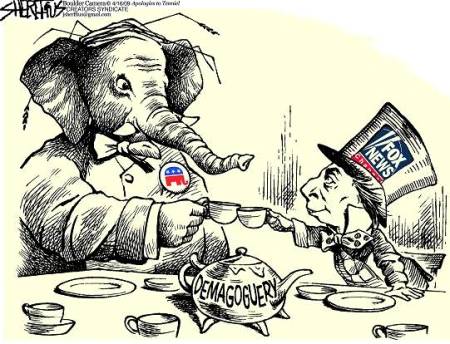
Republican singles bar?

Enough crooks to go around…

On the left as well as on the right, there are those who anthropomorphize ‘government’ as a criminal conspiracy that has existed since H. sap crawled out of the slime.

By Steve Russell / The Rag Blog / September 23, 2009

Am I the only one who wonders how the Republican Party got to looking like the cabaret scene from Star Wars? Or the only one that sees the lack of a sane and loyal opposition as bad for the country?

I’ve never been so much a Dem as an independent who saw the Dems on the correct side most of the time. But I never voted a straight ticket in my life until the midterms before Obama, when I was so pissed about the Iraq War that it overwhelmed everything else and led me to cast a vote that I knew would disadvantage perfectly competent local officeholders.

I guess I couldn’t be a yellow dog Dem because I grew up in a one party state where all the crooks were Dems. When the FBI ran the Brilab sting they nailed at least one county commissioner in EVERY county in Oklahoma. Sheesh.

We’re now, nationally, in a position where there are about as many high profile Dem crooks as Repug crooks and I will be surprised if the Dems do not take the lead before the next presidential election.

One party rule is just not a good idea. Never has worked in the public interest and never will. China is prospering now but if you think that’s really a one party state you don’t get out much.

I know some will answer up that both U.S. parties are bought by the same folks. That’s certainly true in a sense, but down at the lick-log those of that opinion are not as interested in government as they are in dogma. There are mundane choices to be made that affect people’s lives but are not susceptible to the Monopoly board theory of government.

On the left as well as on the right, there are those who anthropomorphize “government” as a criminal conspiracy that has existed since H. sap crawled out of the slime. They think it is something other than those among our neighbors who choose to show up and offer to do what needs doing. That way lies a proud irrelevance.

Luckily, most of the Ragamuffins [folks involved with The Rag, Austin’s 60’s-70’s underground newspaper and The Rag Blog’s antecedent and inspiration], not being lazy, involved themselves on the local level such that we progressed beyond the days when we discovered that the only black person to ever serve on a Travis County grand jury was a porter at the Cadillac dealer. Austin had a major duke-out between preservation and progress-at-any-price and over who shall pay the costs of growth.

We won some and lost some and no, I’m not totally satisfied, but I think the fight probably produced a better result than would have come from the downtown boosters just walking away and leaving us to run everything.

I guess the best possible outcome would be that the loyal opposition to Obama comes from the left, and I do see some stirrings of that in those races in Arkansas where the left has produced ads whacking the Blue Dogs for being bought by the insurance industry. Blue dogs, yellow dogs — I call that green shoots.

Green shoots of democracy.

The Rag Blog

Posted in Rag Bloggers | Tagged , , , , | 1 Comment

Republicans Profit by Abandoning Conservatism for Demagoguery


Behind Republican Success:
They Are No Longer ‘Conservatives’

By Sherman DeBrosse / The Rag Blog / September 22, 2009

Pundits have been writing that the Republicans will pay a heavy price for their tactics of distortion, rejection of bipartisan outreach, and hysteria. But the facts suggest that Negativism has paid off in spades.

President Barack Obama’s popularity this summer has plummeted from around 70% to 50% and approval of his handling of the health care problem has fallen from 57% to 46%. What is troubling is that more than a few of the people who moved from “approving” Obama have moved to “strongly disapprove.”

The last polling indicates that 41% of voters trust Democrats on health care compared to 39% for the Republicans. This represents a dramatic improvement for the Republicans and the highest score they have had in this area in decades. Scare tactics work!

Dishonest and irresponsible tactics

In this time of strong party cohesion and ideological unity, the Republicans are able to keep their few moderates in line and seem to win points among voters for a consistent refusal to be open to bipartisanship. They have not forgotten that in 1994, the voters rewarded them handsomely for torpedoing health care reform and hanging tough on almost everything else. Over the years, they have convinced so many Americans that government can do nothing right that a long term strategy of opposing government activism yields big rewards.

Recently Salon correctly noted that “Now more than ever, bipartisanship is for suckers.” Democrats have kept reaching out to a few moderate Republicans long after it was clear there probably was no one to talk to. Of course, they have little choice because they are, in far, burdened with the problem of trying to appease the large conservative element in their own party.

Republicans have said that they are for health care reform while doing everything possible to block it. Senator Mike Enzi of Wyoming, a member of the “Gang of Six” — which is supposed to be working for a bipartisan compromise — tipped his hand when giving the party’s radio address. He denounced every single Democratic proposal in the most partisan of language.

His colleagues, led by always-simpering Mitch McConnell dutifully repeated talking points about bureaucrats making health care decisions and big government seizing the entire industry. They were reading off of talking points manufactured by pollster Frank Luntz. Each point was tested in polls for its effectiveness at getting people excited.

Politics is not beanbags and there are no Marquis of Queensbury rules. But the Luntz talking points, except the one about the possibility of cost overruns, are entirely untrue.

One can understand putting a bit of pepper on the gloves in an argument, but the GOP was resorting to complete untruths. Government was not taking over the industry, and even the doomed “public option” would be in the hands of a company that would enjoy a temporary up-front loan.

No Republican generated more headlines about wanting a bipartisan plan than Senator Charles Grassley, but even he was spouting the party line about “death panels” at the Iowa State Fair. Clearly these Republican politicians were out to block any reform.

With nearly 50 million people lacking health care and high health costs burdening efforts at industrial recovery, one would expect something other than opportunism and obstructionism from the Republican Party.

Senator Jim De Mint, a South Carolinian, gave away the strategy when he said that “if we’re able to stop Obama on this, it will be his Waterloo. It will break him.” When Obama tried to rescue health care reform by addressing Congress, Joe Wilson shouted “You lie!”

The debate over the propriety of this act almost completely derailed discussion of Obama’s speech and dominated the news cycle for a week. One might almost wonder if the Wilson outburst was planned. The House Democrats stupidly prolonged the distractive discussion by scheduling a vote of mild censure.

Race

Some might recall that Mr. Wilson had led the campaign to smear a young African American woman who claimed to be the daughter of segregationist Senator Strom Thurmond. Tea Bagger organizer and pundit Glenn Beck says that Obama hates white people, offers no proof, and remains on television.

People at anti-health care rallies have been carrying signs showing Obama as an African witch doctor or signs saying that a village in Kenya is missing its local idiot. There were signs denouncing “Afro-Socialism” — whatever that is. Some pass out leaflets with a dummied up Kenyan birth certificate for Obama. At the most recent tea bagger rallies, a very slick video was often shown which depicted most advocates of health care reform as being black, but there were some Jews included.

Angry demonstrators at the Capitol on September 12 carried signs saying “Traitors Run Our Government,” “Don’t Blame Me; I Voted for ‘The American’,” and “Is This Russia?” Mike Pence, the number three Republican in the House, told the assemblage that America was on the edge of “the abyss that has swallowed much of Europe in an avalanche of socialism.”

One can only wonder why. When Jimmy Carter raised the obvious point that some of the opposition to Obama was racial, he was accused of unfairly interjecting the question of race. Obama and his White House, of course, have had to deny that any of the opposition was racial.

Since Tom Corker used a racist advertisement that suggested that Harold Ford parties with white women at a Playboy Club to win a Tennessee Senate seat, it has become possible to use racial appeals and not get called on it. The new conventional wisdom is that the nation has moved beyond racism, so Representative Ford had to say his defeat had nothing to do with race.

More recently we heard a lot about Reverend Jeremiah Wright but very little about a few of the white extremists who endorsed John McCain and Sarah Palin. During that campaign, Jerome Corsi, a Republican writer, slyly noted that Obama’s mother seemed to prefer black men, but no one called him on exploiting race. Rush Limbaugh referred to Obama as “a little black man child” and few protested. He still uses the word “reparations” to refer to social programs and integration. Now we have conservative talk show host Tammy Bruce calling Michelle Obama “trash,” and there is little hubbub.

There has been a 400% increase in threats against the president. Guns and ammo are flying off of store shelves. But race is no longer a problem, and no one is exploiting it.

Of course, not all or even a majority of Obama’s critics are racists. But the size of the “birther” movement suggests that many of his critics are either racists or are very uncomfortable with a black man in the Oval Office. Despite many failed law suits and abundant evidence that the president was born in Hawaii, the birther movement has persisted and Republican Congressmen from the North and South continue to feed it. A recent Daily Kos poll showed that 58% of Republicans either thought the president was born in Kenya or were unsure if he was born in the United States.

Tea Baggers and effective demagoguery

Of course, the Tea Baggers are not a new phenomenon. They are the same kind of people who protested integration, denouncing it as “Big Government.” Yes, they don’t like taxes either. They are to be found out on the fringes in militias and survivalist movements, in among white supremacists, in the Christian Identity movement, and in the Alaska Independence Party. Since Obama’s election, membership in militias has swelled.

The Republican Party has long been known for its Southern Strategy, and Ronald Reagan even began his campaign speaking about state’s rights at a place where two young civil rights workers were murdered. Talk about code — but it was only recently that the GOP has made overt appeals to these fringe elements and enlisted them as its shock troops.

For years, Republicans have borrowed a little of the extremists’ rhetoric; now they are taking it in dollops. These people are zealots and work hard at politics, and, given these uncertain times, their wild and extremist views seem to be contagious.

Sarah Palin threw red meat to people on the lunatic fringe and did so out of habit and mental inclination. Before her selection, a 24 year-old West Virginia man recently said that he supported John McCain because he was “a full blooded American.” One’s first reaction might be to welcome the news that McCain was a 100% native American.

Columnist Kathleen Parker tried to put the best face possible on the young man’s comment. This was not a racial comment , she says, because American politics have moved beyond all that. People at Palin and McCain rallies were responding with anger directed at Obama and Democrats, including the openly gay Representative Barney Frank.

They used thumbs down and middle finger up gestures, and they yelled “traitor,” “treason,” “liar,” “terrorist,” “Kill him, Kill Him,” “Off with his head.” They were responding to the tactic of associating Barack Obama with William Ayers, a Moslem spokesman, and Reverend Dr. Jeremiah Wright.” It was all about saying Obama was the strange OTHER who was to be feared, especially if he is of a different color.

Eventually, John McCain decided to dial down the hysteria, explaining to a confused woman that Obama really was not a socialist or evil man. McCain probably could not have won even if the party kept appealing to these ugly emotions because the terrible economic crisis temporarily overshadowed all else.

Now, the GOP has consciously opted to go back to the demagogic tactics that seemed to temporarily invigorate the McCain campaign. The massive demonstration before the Capitol on the second weekend of September could not have come off without much advanced planning, staff work, and money.

Republicans still insist that the Tea Bagger movement was organic and spontaneous, but evidence mounts that it was carefully orchestrated. Some of the work was done by a few organizations with close ties to former House Majority Leader Dick Armey. During the 2008 election he insisted that race would be a big factor. It called it the “Bubba vote” and said that, deplorable as it is, “There’s an awful lot of people in America, bless their heart, who simply are not emotionally prepared to vote for a black man. “

He added that the Bubba vote is invisible because people will not admit that they have problems with Obama’s race. Armey added that Obama’s “funny name” would hurt, and that there would be concerns about the possibility that he could be a Muslim.

Armey was right on all counts — especially that racial antipathy is deplorable. The former Congressman is busy now activating bubbas for the Tea Bagger movement. His intention may not be to appeal to racism, but the movement necessarily attracts bubbas. The word “socialist” is now being used freely, though it is doubtful if those employing it could write three coherent sentences defining it. Some use that word and “fascist” in the same sentence.

The resort to extremism seems to have no down-side. The media talking heads have joined the Republicans in defending the hysterical people who continually make claims that are far removed from reality and facts. They are even being praised for being “passionate,” as though this kind of discourse enhances the democratic process.

The initial shock over bullies shouting down speakers at meetings and preventing speakers from leaving has been replaced with observations that these people had good intentions but somehow became too exuberant in presenting their views. All but a few House Republicans even saw no reason to vote for a resolution chastising Joe Wilson for his unacceptable conduct. On the Sunday talk shows, Republican spokesmen refuse to admit that any opposition to Obama is racially motivated.

Obama, like former Representative Ford, does not dare admit that a substantial part of opposition to him is racially motivated. To state the obvious would be called exploiting race. Though the Tea Baggers remind some of the crowds that thronged Nuremberg zeppelin field in the 1930s, no one dares say that these people arouse fears of fascism. On the other hand, leaders of the Republican Party have taken to talking about socialism on a daily basis. The contrast is instructive and underscores how well the so-called conservatives have shaped conventional wisdom.

How prescient was Henry Fairlie?

Henry Fairlie was a gifted British Tory who wrote for The New Republic and noted that the Republicans represented a fake form of conservatism. Yes, like the British Conservatives, Republicans represented a union of corporate capitol and provincial-thinking “masses” that concerned Ortega y Gusset, but the Republicans were moving away from preservation of historic wisdom, institutions, and civility.

Thirty years ago, he called Ronald Reagan a “slippered pantaloon” and wrote that both Reagan and Nixon were “simply…vulgar.” With Reagan, H.L. Mencken’s “Homo bubus” became ruler because his party came to represent “the America of fear.” Reagan’s followers were “ungenerous, envious, intolerant…trivially moral, falsely patriotic” and beneath their soaring rhetoric lacked the true conservative’s “steady, unvolatile, almost unconscious confidence in the resources and resilience of his country.”

Thirty years ago, those words were a bit over the top, but they were prophetic. Today they fit the modern Republican Party and even seem a bit gentle. Reagan was probably no “homo bubus,” but more than a few Republican leaders have earned that description. Today’s Republican Party is not “conservative” in the historic sense of the term. It appeals to reactionaries and untutored radicals, seeking to cash in on the political might of bubbas, militiamen, and white supremacists.

Media concerns

Another reason for Republican success is the massive media campaign that has been mounted against health care reform. Sean Parnell of the right-wing Center for Competitive Politics says we need not worry about corporations entering the political process, If they overstep, people will not buy their products. Who can refuse to buy the meds he needs? Of course, we do not know who pays for most of the very effective but misleading attack advertisements.

If this sort “independent” spending is not monitored, it will grow worse. The recent decision of the Supreme Court to reopen consideration of the McCain-Feingold Act could be a step toward opening the floodgates to corporate political spending under the rubric of corporate free speech.

The late Walter Cronkite observed that “We are not educated enough to perform… the act of intelligently selecting our leaders.” The mainstream media cannot be expected to educate citizens, identify gross distortions, or call out demagoguery for the evil it is. The media approach to political questions is essentially the he said-she said approach. That is, assume the equal legitimacy of claims on both sides, report them, and usually ignore the role of fact checker. The fact that the MSM is the tool of corporate America is another reason why it cannot be expected to educate. Nor can we look to schools and colleges to do these things; they would be denounced as being partisan.

Democrats

Democrats in 2009 have shown little skill in communicating and defending their positions on the stimulus package, the budget, and health care. The Democrats need to fully realize what they are up against. They need to take seriously the communications lessons of George Lakoff, start counterattacking, and demonstrate to ordinary folks that their interests are very different from the agenda of corporate America.

It would be unwise to talk about fascism or the Klan, but it is necessary to recognize the possibility that right wing populism can be transformed into things far more ugly and threatening. Without great Democratic improvement in educational and communicative skills, it is likely that Republicans will reap substantial gains in 2010 and 2012.

[Sherm spent seven years writing an analytical chronicle of what the Republicans have been up to since the 1970s. It discusses elements in the Republican coalition, their ideologies, strategies, informational and financial resources, and election shenanigans. The New Republican Coalition : Its Rise and Impact, The Seventies to Present (Publish America) can be acquired by calling 301-695-1707. On line, go here.]

The Rag Blog

Posted in Rag Bloggers | Tagged , , , , | 3 Comments

A Magic Film : The Butterfly Circus


Stop and Watch: The Butterfly Circus

By Larry Ray / The Rag Blog / September 22, 2009

This is not my usual post. This is something very special I want to share with you. Something, I feel, that is very needed in the shrillness of our times. It will take 20 minutes of your time, and it will, I can almost certainly promise, give you a refreshed view of hope and accomplishment.

This is a magnificently produced short film that is magic. It will grab your soul and hold it up to the light for a few moments… and might even recharge it a little.

“At the height of the Great Depression, the showman of a renowned circus leads his troupe through the devastated American landscape, lifting the spirits of audiences along the way. During their travels they discover a man without limbs at a carnival sideshow, but after an intriguing encounter with the showman he becomes driven to hope against everything he has ever believed.”

I hope you will watch this amazing short film. It has the quality of a feature film, and if you have a good monitor you may watch it in high quality full screen. Your ticket is RIGHT HERE… click the familiar “Play” diamond!

[Retired journalist Larry Ray is a Texas native and former Austin television news anchor. He also posts at The iHandbill.]

The Rag Blog

Posted in Rag Bloggers | Tagged | 5 Comments

Going Nuclear : Tom Friedman’s ‘Idiocy Atomique’


‘Green Advocate’ Tom Friedman is nuclear booster

In denial verging on psychosis, Friedman says France has ‘managed to deal with all the radioactive waste issues without any problems or panic.’

By Harvey Wasserman / The Rag Blog / September 22, 2009

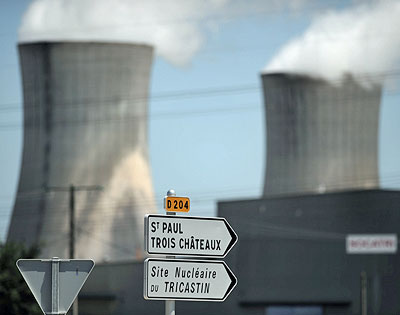
France’s atomic power industry is a failed radioactive flame. Its 58 reactors are unpopular, unsafe, uneconomical, dirty, direct agents of global warming, weapons proliferators and major generators of atomic waste for which there is no management solution.

But self-proclaimed “green advocate” Thomas Friedman seems to think otherwise. In his just published New York Times op ed “Real Men Tax Gas” Friedman applies the term “wimp” to those who fail to fight global warming. But in true corporate style, he can’t face the hard truths about France’s industrie atomique. To wit:

1) In denial verging on psychosis, Friedman says France has “managed to deal with all the radioactive waste issues without any problems or panic.” In fact, France’s unsolved waste problem has thousands of ultra-hot fuel rods building up at reactor sites, just like here. Its hugely expensive attempts to reprocess spent fuel cause devastating radiation releases into the English Channel and elsewhere, prompting continual demands from around Europe that they stop.

2) Friedman says “France today generates nearly 80 percent of its electricity from nuclear power plants.” But he ignores “wimpy” French public opinion that has turned decisively against building new reactors while strongly approving new wind production. The big “Non” to new nukes stems in part from massively inefficient, unreliable reactors, some of which have recently been forced shut because they are overheating the rivers meant to cool them. Is this Friedman’s “macho” solution to global warming?

3) Friedman complains that the U.S. has “not been able or willing to build one new nuclear plant since the Three Mile Island accident in 1979, even though that accident led to no deaths or injuries to plant workers or neighbors.” Friedman misses those 2400 “wimpy” central Pennsylvania families who sued for widespread death and disease they suffered after TMI’s radiation releases showered their homes and fields. The utility responsible quietly paid out more than $15 million in secret settlements.

Friedman has also missed important new findings by nuclear engineer Arnie Gundersen and epidemiologist Stephen Wing indicating far more extensive TMI radiation releases and far more widespread health impacts than previously believed.

4) Friedman complains that “we’re too afraid to store nuclear waste deep in Nevada’s Yucca Mountain — totally safe — at a time when French mayors clamor to have reactors in their towns to create jobs.” But Yucca’s ability to store anything except rusting rail lines is as yet untested. The earthquake fault that runs through it is tangible and visible. So is perched water that threatens to rain down on any radioactive waste stored there. Yucca is surrounded by dormant volcanoes — and by 80% opposition from “wimpy” Nevadans angry for a wide variety of economic, health, safety and geological reasons. Nobody in France is planning on storing high level radioactive waste in their town squares and nobody else — here or there — wants it.

5) Friedman says “the French stayed the course on clean nuclear power, despite Three Mile Island and Chernobyl, and we ran for cover.” France’s first shot at a “new generation” reactor — in Finland — is an engineering, economic and ecological catastrophe. French taxpayers are enraged about funding an Olkiluoto project that’s years behind budget and billions of Euros over budget. Anne Lauvergeon, the chief of AREVA — France’s nuclear front group — told me she blames Finland’s regulatory framework for her woes. But a parallel project at Flamanville, France, isn’t faring much better. AREVA’s fortunes have plummeted, throwing the government-controlled agency into deep financial crisis.

6) Friedman goes on to laud “Little Denmark” for imposing “a carbon tax, a roughly $5-a-gallon gasoline tax.” He fails to credit its “wimpy” but fiercely effective No Nukes movement, which has kept Denmark totally free of atomic reactors, while moving it further into wind power percentage-wise than any other nation on Earth. Angry Danish opposition has helped force neighboring Sweden to shut its Barsebaeck reactors, upwind from Copenhagen.

Friedman’s bizarre reactor advocacy reflects a corporate mindset too wimpy to embrace the true Solartopian solution to our energy crisis. Mycle Schneider, Paris-based author of “What France Got Wrong” in Nuclear Engineering International, gets it right: “For least cost and greatest security, the energy future lies in affordable, distributed, superefficient technologies, smart grids and sustainable urbanism. France’s centralised, autocratic nuclear policy symbolizes the opposite.”

The true green technologies of a Solartopian Revolution are proven, ecologically sound and economically essential. They are also ready for rapid installation.

But they are decentralized and subject to community control rather than corporate domination. While Friedman and his moneyed elite continue to grasp at the failed, centralized straw of atomic energy, technology and history have passed them by.

“Real men” — and women — know we will never get to a green-powered Earth by trying to ride a dead radioactive horse — even if it’s French.

[Harvey Wasserman’s Solartopia: Our Green-Powered Earth is at solartopia.org. He is senior advisor to Greenpeace USA and senior editor of freepress.org, where this piece also appears.]

The Rag Blog

Posted in Rag Bloggers | Tagged , , | 2 Comments

Wall Street Tycoons : Why Are None Behind Bars?

Royal / Capitalist Banker series / mejuan.

Why haven’t any Wall Street tycoons been sent to the slammer?

The absence of what many would call justice stands out all the more because past financial crises always had their villains.

by Kevin G. Hall / September 22, 2009

WASHINGTON — More than a year into the gravest financial crisis since the Great Depression, millions of Americans have seen their home values and retirement savings plunge and their jobs evaporate.

What they haven’t seen are any Wall Street tycoons forced to swap their multi-million dollar jobs and custom-made suits for dishwashing and prison stripes.

There are plenty of civil and class-action lawsuits from aggrieved investors angered by the losses in their mortgage bonds, hedge funds or pensions. Regulators have stepped up their vigilance after the fact. But to date, no captain of finance tied to the crisis has walked the plank.

There have been some high-profile arrests and federal convictions of financial giants — such as Ponzi scheme king Bernard Madoff and Stanford Financial Group chairman Robert Allen Stanford. They weren’t among the causes of the financial meltdown, however, just poster boys for an era of lax enforcement, weak regulation and devout faith in free markets.

“A lot of people who are responsible (for the crisis) seem to have gotten awfully rich in the process,” said Barbara Roper, the director of investor protection for the Consumer Federation of America.

The absence of what many would call justice stands out all the more because past financial crises always had their villains. The depression-era had electricity and railroad magnate Samuel Insull, who partly inspired the movie “Citizen Kane.” The savings and loan crisis of the 1980’s had banker Charles Keating. Energy giant Enron Corp.’s spectacular collapse offered the late CEO Kenneth Lay, a Texas crony of President George W. Bush.

Yet there’s no such poster child for the Great Recession, as today’s crisis is now called.

One may yet emerge. The FBI has more than 580 large-scale corporate fraud investigations under way. At least 40 of them are scrutinizing players in sub-prime mortgage lending, which was the first domino to fall and triggered a global financial crisis.

“The investigations are very complex; it’s not something that’s going to turn overnight,” said Bill Carter, a spokesman at FBI headquarters. “They are labor intensive. They involve a review of records.”

To date, the closest thing to a prosecution of a major actor in the financial meltdown is a civil fraud case that the Securities and Exchange Commission brought on June 4 against Angelo Mozilo, the perma-tanned CEO of mortgage-lending giant Countrywide.

The SEC, in documents filed in a federal courtroom in central California, accuses Mozilo of “deliberately misleading investors” by misrepresenting the risk that Countrywide posed. The SEC also accused him of insider trading because he sold large shares of company stock and options ahead of what he allegedly knew was a coming collapse of mortgage lending.

Unless the Justice Department brings corresponding criminal charges, however, Mozilo could be hit with penalties and a ruined reputation if convicted — but he wouldn’t see the inside of a jail cell.

Another big trial is imminent, however. On Oct. 13, a Brooklyn jury will begin hearing the federal prosecution of former Bear Stearns investment fund founder Ralph Cioffi and his fund manager Matthew Tannin.

Two of their hedge funds, offered to mega-wealthy investors and heavily weighted with investments in mortgage bonds backed by sub-prime loans to the weakest borrowers, collapsed in June and August of 2007. Their collapse signaled a gathering storm in mortgage finance that culminated in March 2008 with the government-brokered fire sale of their bank to JP Morgan Chase.

Both men were charged on June 19, 2008, with defrauding investors, passing off as safe the investment in mortgage bonds even though they described the market for sub-prime mortgages as “toast” in their own e-mails. Cioffi also faces charges of insider trading.

Lawyers for both men declined comment to McClatchy, but when their clients were arrested they called the pair scapegoats for the broader financial crisis.

Court documents filed in August show attorneys for the two are trying to suppress evidence that the executives’ special trading notebooks have disappeared. The government suspects that Cioffi and Tannin, or someone helping them, made them disappear to cover their tracks.

Cioffi’s attorneys also asked in August that the presiding judge quash the use of evidence that points to their clients’ lavish lifestyle, including mansions and Ferraris. The documents accused federal prosecutors of “improper appeal to class prejudice.” Tannin’s attorneys joined the motion on Sept.15.

Royal / Capitalist Banker series / mejuan.

Class prejudice against bankers is what many Americans feel, evident in the death threats made against some former or current executives at insurer American International Group and other financial firms earlier this year. Wall Street switchboard operators at some institutions no longer provide addresses to phone callers.

Americans are angry because the suffering on Main Street is a spillover from the excessive risk taking and lavish compensation of executives who invested on behalf of the ultra-wealthy. Investors seeking outsized “alpha” returns turned to Wall Street, both seeking to make a short-term killing even if doing so eventually brought the near collapse of the financial system.

President Barack Obama alluded to this on Sept. 14 in a New York speech to commemorate the anniversary of the collapse of investment bank Lehman Brothers, which sent off a global financial panic.

“We will not go back to the days of reckless behavior and unchecked excess at the heart of this crisis, where too many were motivated only by the appetite for quick kills and bloated bonuses,” Obama said, promising new rules. “Those on Wall Street cannot resume taking risks without regard for consequences.”

There are persistent but unconfirmed reports that the FBI and grand juries are looking at the e-mails of executives of failed institutions such as Bear Stearns, which pioneered the process of pooling sub-prime loans for sale to investors, and Lehman Brothers, which was a leader in these toxic products when it collapsed.

Records from AIG, which the Federal Reserve saved from collapse on Sept. 17, 2008, are also thought to be under review. The FBI reportedly is also looking at rating agencies Fitch, Moody’s and Standard & Poor’s to determine if they knowingly gave pools of sub-prime mortgages AAA investment-grade ratings, the best possible, despite evidence to the contrary.

Carter, the FBI spokesman, declined comment on ongoing investigations.

The lack of any prosecution to date doesn’t mean authorities aren’t investigating, added Ian McCaleb, a spokesman for the Department of Justice.

“There are ongoing cases. But from a prosecution standpoint, it takes a significant amount of time to develop these things. Most financial fraud cases are very complex and it could take a while to unravel the specifics of each case,” he said. “I would characterize financial fraud as one of our top priorities.”

Another possibility is that a new politically appointed Financial Crisis Inquiry Commission could turn up something that leads to prosecution. The 10-member panel, created by Congress this month, began probing the origins of the crisis, has subpoena power and could compel testimony. This could, however, lead to conflicts with ongoing legal investigations.

Another reason that there’ve been no arrests of the perpetrators of the financial meltdown is that agencies such as the SEC, which regulates trading in stocks and bonds, and the Commodity Futures Trading Commission, which oversees the trading of contracts for future delivery of energy and farm products, lack powers of criminal prosecution.

They can bring civil charges that result in fines or pass information to federal prosecutors or the FBI, which under the Bush administration was reorganized to focus less on white-collar crime and more on national security matters and crimes against children.

Legislation introduced in the House and Senate would make it easier for the CFTC to prosecute, especially allegations of market manipulation. Measures would lower the current high threshold for determining manipulation. In 35 years, the agency has won only a single manipulation case, and it’s under appeal. The bills also would give commodities regulators powers to bring criminal cases.

“Folks who do the crime shouldn’t just pay a fine, but do the time,” said Bart Chilton, a CFTC commissioner who’s championed the need for prosecutorial powers.

Because it saves time and money, regulators traditionally have negotiated settlements with bad actors, and fines often amount to a business cost.

That, too, may be changing, however. The SEC on Sept. 14 was hit with a stinging judicial rebuke for its half-hearted efforts to punish Bank of America for alleged disclosure failures in the government-brokered purchase of investment bank Merrill Lynch.

U.S. District Judge Jed Rakoff tossed out a $33 million settlement between the SEC and Bank of America, effectively calling it a fig leaf. The agency, he said, looked as if it was enforcing the law while the bank and its CEO, Kenneth Lewis, got away with a slap on the wrist.

“It is not fair, first and foremost, because it does not comport with the most elementary notions of justice and morality, in that it proposes that the shareholders who were the victims of the bank’s alleged misconduct now pay the penalty for that misconduct,” Rakoff wrote in a scathing 12-page opinion that ordered the complaint to proceed to trial.

© McClatchy Newspapers 2009

Source / McClatchy / CommonDreams

The Rag Blog

Posted in RagBlog | Tagged , , , , | 1 Comment

A Lifestyle Alternative : The Gift Economy

Jesse James Retherford.

The gift economy and the sustainable community

Within a moral economy the social significance of individuals is defined by their obligations to others, with whom they maintain continuing relationships. It is the extended reproduction of the relationship that lies at the heart of a gift economy, just as it is the extended reproduction of financial capital which lies at the heart of a market economy.

David J. Cheal, The Gift Economy

By Jesse James Retherford / The Rag Blog / September 21, 2009

[Jesse James Retherford is a sustainable lifestyle and fitness coach in Austin.

Believing “the only way individuals can truly become sustainable is by fortifying our bonds with our community through involvement and empowerment,” he and his partner Katy Hamill also present grassroots networking, educational, and fun events, including community happy hours, discussion groups, nutritional guidance, cooking classes, workshops, and gardening demonstrations.

They are part of an Austin subculture experimenting with ways to live a genuinely sustainable lifestyle.

Jesse was born in New York City and grew up in Houston and Austin as a tie-dyed red diaper baby. He lives and works in South Austin with Katy and their almost two-year-old son Julian.]

In an impersonal market economy, individuals are taught to create and continue relationships that produce the greatest financial profit.

With profit being the overriding factor of all relationships, individuals lose touch with the hidden non-monetary rewards of their relationships. They no longer have time for the friend who provided emotional or spiritual wealth, but rather seek out relationships with those who can provide financial reward.

This is the major factor in the dismantling of smaller localized communities into globalized economies. An example of this would be: what are the reasons you chose the state, city, and neighborhood in which you live? Was it for a higher paying job? To move up in prestige or social class? Do you have true interpersonal relationships beyond mere formality with your neighbors?

Individuals pursue their self-interests through economic exchange, the least profitable social relationships are progressively broken off and replaced with more profitable ones. When people do not receive “pay-offs” for the benefits they give kin, their motivation to maintain kinship ties break down and the kinship network ceases to be a viable social structure.

— David J. Cheal, The Gift Economy

As individuals are separated from relationships with greater emotional reward in favor of those offering financial reward, they create an interpersonal abyss that cannot be filled with money or material possessions. This is why online social networking communities have become so prevalent in modern life; individuals no longer make the time to create true interpersonal relationships due to the desire to improve their self-interests in terms of financial prosperity.

Unfortunately these online communities do not fulfill the basic needs of interpersonal interaction. As Self-conscious creatures, we have core needs when it comes to our community relationships: we need physical contact (a handshake or a hug), eye contact for affirmation, the visual signs of body posture and facial expressions, and the transference of love and acceptance found through sharing with each other.

These are things that cannot be found online, and so the abyss continues to be void of significant satisfaction.

Gift Economy

I would like to suggest another option. In my work, I offer all of my services as a gift to my community. I assign no financial value and have no expectation of any exchange of value. I consider my work to be a form of community service.

What is gift economy to me?

I view the gift economy as humankind’s original economy. The human species has been around for over 35,000 years. Just as every other species of life, nature provided us with all of the resources for continued life. Until sometime in the last millennium, humans have practiced gift economy, because there was no need or use for material possessions or private ownership.

By respecting nature’s creative but fragile power and working with common purpose to nurture and replenish the natural environment, humans were able to supply their basic needs — food, water, and shelter — and live sustainably.

In the past few centuries this time-tested economic model has been deconstructed and untaught to us. Industrialization and materialism view everything (not only humans but nature itself) as resource commodities. This practice at its inception was unsustainable, and the effects can now be seen around us each and every day: economic collapse, peak oil, consumer/government debt bubbles, global warming, environmental pollution, food shortages, poverty, disesase, war, and on and on and on.

The only way to change from this unsustainable economic model to a sustainable one is through the relearning of the gift economy.

In our society, the typical model of exchange is that money is traded for a commodity or a service. The principal glue that holds this together is fairness. At its best, both parties feel good about the exchange. In a family, the typical model of exchange is based on giving. The principal glue that holds this together is love. At its best, all parties appreciate this unspoken bond of support and everyone contributes in their own way.

— “Circle of Giving: The Gift Economy of Seva Café”

In its simplest definition, the gift economy is an arrangement for the transfer of goods or services without an agreed-upon method of quid pro quo. The description I prefer is “respect-based giving.”

What this means to me is the removal of money as our agreed-upon currency of exchange; instead we create a currency based on love and mutual respect. We build relationships within our community that are founded on serving that community. We practice an economic model with an orientation to others instead of our own narrow self-interests.

Imagine what your world would look like if you could choose work based on personal fulfillment as opposed to financial reward. Would you choose a new vocation? How many hours a week do you think you would dedicate to that work? How would that change the time you spent in your own personal development? Or the time you spent with your family and friends?

Jesse addresses a “Sustainability Now!” seminar at “Fuente Eterno,” held at Canyon de Guadalupe, Baja California, Mexico, earlier this year.

How I came to practice gift economy

Although I did not realize it at the time, I started using gift economy while I was in massage school. I was already an established fitness coach with a regular clientele. I wanted to learn as much as I could about massage, and the best way to do so was hands on. To that end, I began to give 10-16 hours of massage each week to my clients and the community at no charge.

I found the act of giving to be incredibly freeing. I realized that in the old paradigm — in which I defined my own value, i.e., my rate — this so-called value reflected nothing about my own professional worth. It was based on the “going rate” in the industry which in turn was based on market research about what the average consumer would pay.

If I priced myself too high, people would think I was a shark. If I priced too low, then the opinion may be that I must not be very good at what I do. Beyond that, once I set a price, I had to wait for a client to contact me, then work to sell myself to that client. I had always felt this system was flawed, but didn’t know any other.

One of the contradictions that I found was this: while I represent the kind of client I want to work with, I realized that I could not afford my own rates. How could I justify pricing someone like myself out of my own services? Why was it that the only people who could benefit from my services had to come from a higher economic class? Aren’t my services just as important to someone like myself as they are to someone more financially fortunate?

With this new paradigm of giving, I no longer have to wait for a client to hire me. Now I can hire my own clients! I no longer have to consider the financial circumstances of an individual; rather I can base my services on need, and thus I can give it freely to everyone in my community. At the same time, my clients are empowered to determine their value of my work, instead of relying on a predetermined price schedule.

Once I finished school, I decided to offer all of my services (sustainable lifestyle and fitness coaching and massage) to the community as a gift, and it has been remarkably successful. I have not had a drop in income due to gifting. In fact, I have actually seen an increase. I have formed tremendous relationships with new people, growing my community to a size I could not have imagined during the ten years I worked prior to gifting.

The most common question about gift economy I receive is:
How do you pay your bills?

The most notable factor is my family’s choice of lifestyle. We have aligned ourselves toward a life of simplicity and sustainability. At first we considered such a lifestyle choice to be a bit of a sacrifice. The choices we’ve had to make are sometimes difficult, but ultimately we’ve found the challenge to be fun.

Each month we evaluate our lifestyle choices and find over and over again that the best things in life are still simple and free. Our goal is to live each month spending less money than the same month from the previous year while continuing to find more ways to enjoy life without spending money. This helps to keep our costs down. Thus we need very little to maintain our lifestyle.

The second answer is that as somebody that gives gifts, I also receive gifts. While I have chosen to remove myself from any expectation of return, I realize that most people do give a tangible gift in return for the services I provide. Since the currency system is common to all of us, money is the most convenient form of gift.

In addition to monetary gifts, I have received a massage table, lemon tree, food, drink, a vacation, a bread machine, labor, and many more things, as well as the intangible gifts of gratitude, appreciation, and friendship that can never be measured.

I am finding that there is no greater value than the gift of selfless service to others.

[Jesse James Retherford’s website is The Art of Fitness.]

The Rag Blog

Posted in Rag Bloggers | Tagged , , , | 2 Comments

A Few Bad Acorns and the Right Wing Crusade


In defense of ACORN:

The right-wing crusade against ACORN is a far bigger fraud than any misdeeds a few employees might have committed

By Joe Conason / September 21, 2009

For many years the combined forces of the far right and the Republican Party have sought to ruin ACORN, the largest organization of poor and working families in America. Owing to the idiocy of a few ACORN employees, notoriously caught in a videotape “sting” sponsored by a conservative web site and publicized by Fox News, that campaign has scored significant victories on Capitol Hill and in the media.

Both the Senate and the House have voted over the past few days to curtail any federal funding of ACORN’s activities. While that congressional action probably won’t destroy the group, whose funding does not mainly depend on government largesse, the ban inflicts severe damage on its reputation.

In the atmosphere of frenzy created by the BigGovernment videos — which feature a young man and an even younger woman who pretend to be a prostitute and a pimp seeking “advice” from ACORN about starting a teenage brothel — it is hardly shocking that both Democrats and Republicans would put as much distance as possible between themselves and the sleazy outfit depicted on-screen.

Like so many conservative attacks, the crusade against ACORN has been highly exaggerated and even falsified to create a demonic image that bears little resemblance to the real organization.

Working in the nation’s poorest places, and hiring the people who live there, ACORN is not immune to the pathologies that can afflict institutions in those communities. As a large nonprofit handling many millions of dollars, it has suffered from mismanagement at the top as well — although there is nothing unique in that, either.

Yet ACORN’s troubles should be considered in the context of a history of honorable service to the dispossessed and impoverished. No doubt it was fun to dupe a few morons into providing tax advice to a “pimp and ho,” but what ACORN actually does, every day, is help struggling families with the Earned Income Tax Credit (whose benefits were expanded by both Ronald Reagan and Bill Clinton). And while the idea of getting housing assistance for a brothel was clever, what ACORN really does, every day, is help those same working families avoid foreclosure and stay in their homes.

Perhaps the congressional investigation now demanded by some Republican politicians would be a useful exercise, if conducted impartially. A fair investigation might begin to dispel some of the wild mythology promoted by right-wing media outlets.

Among the most popular canards on the right, repeated constantly by conservative pundits and politicians, is that ACORN has been found guilty of engaging in deliberate voter fraud, using federal funds. In reality, ACORN has registered close to 2 million low-income citizens across the country over the past five years — a laudable record with a very low incidence of fraud of any kind.

Over the past several years, a handful of ACORN employees have admitted falsifying names and signatures on registration cards, in order to boost the pay they received. When ACORN officials discovered those cases, they informed the state authorities and turned in the miscreants. (That was why the Bush Justice Department’s blatant attempt to smear ACORN with rushed, election-timed indictments became a national scandal for Republicans rather than Democrats.)

The proportion of fraud is infinitesimal. For example, a half-dozen ACORN workers were charged with registration fraud or other election-related crimes in the 2004 election. They had completed fewer than two dozen false registrations — out of more than a million new voters registered by ACORN during that cycle. The mythology that suggests that thousands or even millions of illegal registrants voted is itself a fraud.

If only the Republicans who have worked up a frenzy over ACORN’s alleged crimes were so indignant about real and damaging voter fraud — such as the amazing case of Young Political Majors, the firm that ran GOP registration efforts in California, Massachusetts, Florida, Arizona and elsewhere before the authorities in Orange County, Calif., busted its president, Mark Anthony Jacoby, and sent him to jail last year.

He had built a lucrative partisan career by teaching his minions to deceive thousands of voters into registering as Republicans rather than Democrats, among other scams. Of course, the only on-air mention of the Young Political Majors scandal on Fox News was made by blogger Brad Friedman — and the national media, mainstream and conservative, generally ignored it. They were too busy generating “controversy” over ACORN.

So now the overhyped voting registration tales are metastasizing into wild accusations about ACORN’s finances and programs, including claims that the group will receive billions in federal bailout funding and that it is a hotbed of corruption, perhaps even murder.

In fact, ACORN affiliates — those not involved with voter registration — have received a few million dollars annually in federal funding. The group is not scheduled to receive any bailout money (although working people would probably benefit more from subsidizing ACORN than greasing AIG and Goldman Sachs).

The fans of Rush Limbaugh and Glenn Beck regard ACORN as a criminal enterprise that fosters tax fraud, prostitution, child prostitution and even murder (thanks to a satirical “confession” by an employee filmed surreptitiously in the San Bernardino ACORN office). But ACORN chief organizer and CEO Bertha Lewis swiftly dismissed the employees caught on those videotapes and set about reforming the flawed processes that enabled those individuals to speak for the organization.

No overt acts were committed by any of the people caught on those tapes — and so far nobody has found that any of those theoretical “crimes” ever took place.

To claim that the stupid behavior of a half-dozen employees should discredit a national group with offices in more than 75 cities staffed by many thousands of employees and volunteers is like saying that Mark Sanford or John Ensign have discredited every Republican governor or senator.

Indeed, the indignation of the congressional Republicans screaming about ACORN and the phony streetwalker is diluted by the presence of at least two confirmed prostitution clients — Rep. Ken Calvert and Sen. David Vitter — in their midst. Neither of those right-wing johns has been even mildly chastised by their moralistic peers. Nobody is cutting off their federal funding.

ACORN has pledged to institute reforms, with the appointment of a distinguished outside panel to oversee that process. Let us hope they succeed. Even now they seem far more likely to improve their performance — and to be more sincere in their intentions — than the Washington hypocrites who are trying to destroy them.

Source / Salon.com

Also see

The Rag Blog

Posted in RagBlog | Tagged , , , | 5 Comments

Jack Herer : Cannabis Champ Stricken

Jack Herer, champion for legalization of cannabis.

Author, leader of movement to legalize cannabis:
Jack Herer has massive heart attack

By Mariann G. Wizard / The Rag Blog / September 21, 2009

Jack Herer, the father of the U.S. cannabis legalization movement, has been stricken by a massive heart attack. This is seriously upsetting news for Herer’s millions of fans, readers, listeners, and friends — Jack never met a stranger.

A formerly middle-class, straight family man and ad executive, Jack became interested in the economic machinations that led to marijuana prohibition in the U.S. His persistent research led eventually to his seminal work, The Emperor Wears No Clothes: The Authoritative Historical Record of Cannabis and the Conspiracy Against Marijuana.

Emperor has proven to hundreds of thousands of pot smokers and non-users, through historical documentation from government and industry’s own records, that the real reason our recreational substance of choice is illegal is because of the plant’s mild-mannered alter ego, hemp, source of food, fiber, fuel, and medicine since before human history began. Herer shows that hemp became too much of an economic threat to the powerful timber and plastics industries in this country.

Herer was aided for years in his once-quixotic quest by his best friend and runnin’ buddy Edwin “Captain Ed” Adair. The two men pledged to work, if necessary, until they both turned 80 years old to re-legalize what was once America’s moral fiber. Adair didn’t make it to that self-imposed retirement age.

Now U.S. Rep. Barney Frank is introducing the first federal legislative proposal EVER to legalize and regulate marijuana, treating it like alcohol. While victory may still be far from won, Jack Herer’s illness at this historic moment is analogous to Teddy Kennedy’s illness as health care reform was being introduced. Kennedy should have lived long enough to see the fruits of his labor, but he didn’t.

Herer has already fought his way back from one heart attack/stroke some years ago that left him speechless and in a wheelchair for months, and friends fear this new episode may be too much.

Please hold a good thought, light a candle, say a prayer, or whatever floats your boat, for Jack Herer.

And, be sure to read William Martin’s feature in the October issue of Texas Monthly: “Texas Highways: Why the unlikeliest of states — ours — should legalize marijuana.” You can find the entire article here.


Find The Emperor Wears No Clothes: The Authoritative Historical Record of Cannabis and the Conspiracy Against Marijuana by Jack Herer on amazon.com

Read The Emperor Wears No Clothes online here.

The Rag Blog

Posted in Rag Bloggers | Tagged , , , , | 5 Comments

Glenn W. Smith : Coyote Nation

Our wily neighbor. Photo by Scott Stewart / AP.

You know why coyotes do so well? Because they are not ideologues.

By Glenn W. Smith / The Rag Blog / September 21, 2009

Coyotes have come to the city. I sit here writing in the foreshortened suburban night and listen to them howling and singing out back, hidden in what we used to call a gulch but is now called a green belt. A coyote can hold a note a lot longer than you think.

To many, they are a dangerous nuisance. Pet cats and puppies disappear. Coyotes, or “ghosts of the city” as a recent study calls them, get the blame. That study (pdf), by Ohio State’s Stanley Gehrt, says coyotes “have become the top carnivores in an increasing number of urban areas across North America…”

If pets disappear, though, so do skunks and rats. I think it’s a fair trade.

Years ago I sat on a little rise near the Rio Grande with my father and watched a pair of coyotes tag-team a deer, one resting while the other ran the deer in circles. The next, fully rested, took up the game so the partner could rest. It took four cycles. I’ll spare you the end of the story, except to say the coyotes seemed skilled and well-fed.

It’s almost too easy to paint a romantic metaphor here: wild things persist and thrive, despite human gated communities, speed bumps, stop-lights, WalMarts, chin-pulling urban planners and beleaguered city councilmen who themselves get tag-teamed at churches and Christmas parties by suburban couples who’ve lost cocker spaniels and tabbies.

You know why coyotes do so well? Because they are not ideologues.

They take great advantage of an evolved mammalian trait too often derided by humans as lack of conviction or commitment: mental flexibility, a willingness to live with uncertainty and unpredictability so that more alternative courses of action are opened.

Coyotes, we say, are wily. As regards humans, the English poet John Keats called it “negative capability, that is when man is capable of being in uncertainties, Mysteries, doubts without any irritable reaching after fact & reason.”

Every ideologue in human history has failed. That’s because most ideas are contingent and bound up with current or past circumstances and often unsuited to tomorrow’s risks and opportunities. The Framers of the U.S. Constitution recognized this. It’s why Jefferson said we need a revolution every generation. The U.S. Constitution is not an idea, and it’s a terrible mistake to read it like a list of commandments. The Constitution’s greatest feature is the inbuilt recognition of the need for its own mutability.

Jefferson, however, did hold one truth as immutable or “self-evident”: human equality. Does this contradict the fundamental insight of the Enlightenment, the insight that truth is man-made and fallible?

Maybe, but the recognition of human equality was a truth made necessary by the fact that every other idea for ordering or enforcing human inequality by economic prowess, religion, skin color, geographic origin, I.Q., or arm strength was doomed from the start.

The trouble is, of course, that technology has now empowered ideas with the ability to take us all down with them when they go.

A further trouble is, in politics those of “negative capability” often seem to be at a disadvantage in debate with stubborn ideologues. The former are made to seem weak and uncertain, the latter strong and certain, no matter how demonstrably false the ideas they cling to (the free, unregulated market comes with an invisible hand that blesses all; fossil fuels are infinite in supply and safe for the environment; war is peace, et cetera).

But who is really stronger, the coyote or the domesticated dog?

I think Barack Obama is the first president in my lifetime to possess Keat’s negative capability. The trait was made more politically attractive by its juxtaposition with the many failures of George W. Bush’s stubborn clinging to ideas already bled to death during the world’s most violent century.

I fear Obama’s attraction to Abraham Lincoln is already being trivialized by the press, but it’s a fact that Lincoln might have been the last president to possess this quality.

We should be cautious about judging Obama in the light of our own sticky ideas. It’s not that anyone should quit advocating for what they believe. Democracy depends upon it. It’s simply to put into action the recognition that in America’s gulch or green belt, if we want to survive, we’re going to have to eat a skunk or two.

[Glenn W. Smith, according to Daily Kos founder Markos Moulitsas, is a “legendary political consultant and all-around good guy.” This article has also been published at FireDogLake and at Glenn’s excellent new blog, DogCanyon.]

The Rag Blog

Posted in Rag Bloggers | Tagged , , , , | 4 Comments

Fear and Loathing in Mexico : A Pandemic of Paranoia

Coming back to earth: Preacher Jose Mar Flores Pereira (Josmar) and federal cop after faux hijacking of AeroMexico plane in Mexico City, September 9, 2009. Photo by Jorge Dan Lopez / Reuters.

Fear and Loathing south of the border:
Paranoia goes pandemic in jittery Mexico

By John Ross / The Rag Blog / September 21, 2009

MEXICO CITY — More virulent than last spring’s Swine Flu panic here and cranked up by Mexico’s two-headed TV demon, a pandemic of paranoia is sweeping this neighbor nation as Felipe Calderon embarks on the back half of his battered presidency.

In the past weeks, the nation’s 107 million citizens have borne witness to a foiled and much-questioned skyjacking and prominent politicians have been the victims of assassins’ bullets.

Heeding urgent warnings from Mexican and U.S. intelligence sources, September 15th-16th Independence Day celebrations converted public plazas into armed camps and with good reason — September 15th marked the one-year anniversary of a presumed narco-bombing in Morelia, the capital of west-central Michoacan state that killed and dismembered ten celebrants.

A newly-released study by the Public Security Secretariat (SSP) calculates that the civilian death toll in Calderon’s ill-advised war on Mexican drug cartels dating from December 2006 when tens of thousands of troops were dispatched to quell violence in 11 states through August of this year has now topped 14,000 and the violence is on the uptick — 5000 were killed in 2008, 13.6 victims a day. So far in 2009, 4500 have died, an average of 18.5 per diem.

Josmar, the ‘celestial messenger’

To animate the paranoia that this unrelenting orgy of homicidal violence had bred, this September 9th a Bolivian-born evangelical preacher Jose Mar Flores Pereira “skyjacked” an Aeromexico Boeing 737 with 104 passengers aboard, including a number of U.S. citizens, bound from Cancun to Mexico City. Initially identified as a Venezuelan or a Colombian or some such dangerous South American, Flores turned out to be neither a drug thug nor a “21st Century Socialist” but rather a self-anointed messenger of Jesus Christ sent to save Mexico.

As the flight approached Mexico City, “Josmar” (his Christian music recording name) stepped into the aisle with a bible in one hand and a fake bomb (two empty Jumex pineapple juice cans and some Christmas lights) in the other and politely requested the stewardess to instruct the pilot to circle the airport seven times.

Heralding himself as “a celestial messenger,” Josmar insisted that he urgently needed to communicate directly with President Calderon who either by coincidence or design was waiting on the ground in the presidential hanger about to board a jet for a junket to Campeche.

The preacher’s intended message: the date was 9/9/09, 666 upside down, and the Mark of the Beast was on the land — he had seen the Devil in the Mexican flag. Now monstrous calamity impended — Mexico City would be riven asunder by an apocalyptical earthquake (the bizarre “skyjacking” took place just days before the 24th anniversary of the 1985 8.1 Mexico City quake that took up to 30,000 lives.) Only the righteous would be saved from the conflagration.

Josmar invited God-fearing Mexicans to get on board the flight to heaven. The Christian terrorist told Captain Ricardo Rios that he had three accomplices aboard, information that put security forces on the ground on red alert. The preacher later revealed his accomplices to be God the Father, God the Son, and the Holy Ghost.

The terrorist threat triggered emergency communication on both sides of the border — U.S. citizens were on the flight and the incident unfolded just 48 hours before the marking of the 9/11 terror attacks on New York and Washington. As Commander-in-Chief, Calderon mulled scrambling jets and forcing the 737 down over neighboring Puebla state but held off, instead ordering Public Security Secretary Genero Garcia Luna to take charge of the explosive situation.

Aeromexico Flight #576 landed at Benito Juarez International Airport (Mexico City) without incident 37 minutes late (the flight had been delayed in Cancun) and taxied to an open runway near the presidential hanger.

In addition to phalanxes of federal police and military personnel, the flight was met by an army of camerapersons and reporters from the mainstream press led by the two-headed television dragon Televisa and TV Azteca that had been invited to cover the show (albeit from a respectable distance) and the denouement of Josmar’s caper was transmitted live at lunchtime to millions of wide-eyed witnesses.

Ironically, those aboard Flight 576 were the last to know they had been skyjacked, only finding out when they punched in cell phones to call homes and offices to announce their arrival. The Christian Terrorist made no effort to hold anyone hostage and women and children were invited to exit first — several passengers were injured when they were forced to use the emergency slide after the requested stairs did not show up. Then ski-masked commandos casually stormed the plane.

Josmar, resplendent in a white tunic, was led off in handcuffs, praising the Lord. Seven presumed “accomplices,” including a Quintana Roo state senator, were hauled from the airplane and thrown roughly to the ground (they were freed hours later.) Josmar’s “bomb” was blown up on the tarmac for the TV cameras — if it had been a real bomb, one commentator fretted, the explosion could have taken out half the airport, including the nearby presidential hanger.

An hour later, smiling and snapping gum, Jose Mar Flores appeared at a chaotic press conference under the watchful eye of SSP chieftain Garcia Luna where he waved his bible around and preached a primetime sermon. Later in the afternoon, the would-be savior of Mexico was taken before a federal judge and charged with terrorism, skyjacking, and sabotaging the nation’s air defenses. When asked if he had a lawyer, Josmar affirmed that Jesus Christ was his attorney.

By 7 p.m., non-stop coverage was wrapped up just in time for the Mexico-Honduras football match from which Mexico would emerge victorious, assuring the Aztecs of a ticket to the World Cup next year in South Africa.

Reporters who accompanied Calderon to Campeche that afternoon found the president oddly gleeful about the dramatic events. “That was a close call, a real test for the government and the Mexican people,” he boasted. But many in the Fourth and Fifth Estates were not convinced. In fact, public skepticism at the spectacle was unprecedented, at least in the memory of this reporter who has spent the past quarter of a century covering public skepticism in Mexico.

“Sabotage or Masquerade?” the left daily La Jornada editorialized, pointing out that the plane had never really been hijacked and the passengers never held hostage and describing the government response as “exaggerated and suspect.”

Writing in Proceso magazine, Miguel Angel Granados Chapa, the dean of the nation’s political commentators, speculated that the shadow show had been staged to distract public attention from an onerous tax hike announced by the Calderon administration just the day before. One couldn’t even pass through airport checkpoints with a pair of kids’ scissors, Granados noted, yet Josmar had managed to smuggle a (fake) bomb aboard Flight 576.

Granados Chapa and others also suggested that the hoax had been engineered to spotlight the SSP’s Garcia Luna who has been engaged in a years-long firefight with (former) Attorney General Eduardo Medina Mora over leadership of Calderon’s blood-soaked drug war. It would not be the first time that the Public Security Secretary had used the media to toot his own horn, Granados recalled — in 2007, Garcia Luna gave carte blanche to TV Azteca to “recreate” the rescue of a kidnap victim and the capture of a criminal gang featuring the French citizen Florence Cassiz who has since become the object of an international tug of war between Calderon and French premier Nicolas Sarkozy.

Genero Garcia Luna’s center stage role during the “skyjacking” drama earned him juicy airtime on Televisa‘s flagship station “La Canal de las Estrellas” (The Channel of the Stars) and came just two days after his rival Medina Mora resigned as attorney general and was handed a golden parachute (he will become ambassador to the UK), presumably to keep his mouth shut about widespread corruption in the drug war bureaucracy.

In effect, Medina’s removal was a visible admission by Calderon that his anti-drug crusade had flopped and must have dismayed the ex-attorney general’s U.S. counterpart Eric Holder with whom he had collaborated on logistics in the implementation of drug war strategies under Washington’s billion buck Merida Initiative. Just days before, Holder had issued an unusual warning that drug cartels in Mexico would attack public buildings and target U.S. citizens.

Crime scene in Ciudad Juarez where nearly 200 women have been murdered or disappeared. Photo from El Porvenir.

Las Muertas’ of Juarez

On deck to replace Medina Mora is a Calderon crony Arturo Chavez Chavez. As Chihuahua state prosecutor in the 1990s, Chavez Chavez was charged with the investigation of the murders and/or disappearances of nearly 200 women in the hardscrabble border city of Ciudad Juarez. The attorney general-designate failed to clear even one case.

Instead, he blamed “Las Muertas” (“The Dead Girls”) for their own murders, accusing them of provoking their killers by wearing mini-skirts. “Good people stay home at night — only bad people are out in the street,” was one of his more memorable conclusions. Many of the murdered women were slain after coming off late shifts at maquiladora factories.

Chavez Chavez’s crimes of omission as chief prosecutor have been denounced by the National Human Rights Commission (CNDH, the InterAmerican Human Rights Commission (CIDH), members of the European Parliament, and the international human rights community. In spite or because of the attorney general-designate’s inept administration of justice, Las Muertas of Juarez have become international feminist icons — Eve Ensler, creator of “The Vagina Monologues,” and actress Sally Fields led marches through that grimy industrial city.

Victims’ organizations are appalled by the nomination and are resolved to battle Chavez Chavez’s ratification by Congress as Medina’s successor. Last week, Norma Ledezma, whose daughter’s remains were returned to her in a sealed coffin in 2002, stood before the Mexican Senate and wept at the prospect of Chavez Chavez’s confirmation: “this man put pain in all of our hearts.”

Ledezma counts 24 women who have been murdered or disappeared in Juarez so far in 2009, a number that is lost in the sea of death that has engulfed that desert city — more than 1400 have been mowed down in the last year (30 at local drug treatment centers in the past 10 days) despite the fact that Juarez is occupied by thousands of Mexican army troops.

Last year’s Independence Day bombing in Morelia invoked unprecedented security measures at 2009 public commemorations in provincial capitals and the capital of the country, upping the paranoia quotient to the breaking point.

In Mexico City, a few hundred souls endured metal detectors, close questioning, and three federal police pat downs to access the great Zocalo plaza where Calderon was to deliver the traditional “Grito” of “Viva Mexico”, a record low turnout. Those who did get through the police barricades were kept a football field away from the National Palace upon whose balconies the president would appear by a labyrinth of metal barriers and 1500 troops.

The stringent security measures were installed as much to discourage supporters of Calderon’s arch-nemesis Andres Manuel Lopez Obrador from protesting as they were to detect incoming terrorists — the leftist ex-mayor of Mexico City was holding his own “Grito” just blocks away. “They treat us like sheep!” one elderly street vender hawking patriotic paraphernalia complained loudly, “they are the ones who are afraid of the bombs. We are citizens and this is our fiesta!”

Meanwhile in Morelia, the scene of last year’s Independence Eve massacre, the center of the old colonial city was locked down by thousands of armed-to-the-teeth federal and state robocops and only a handful of locals braved the curtain of fear to join Governor Lionel Godoy of the left-center Party of the Democratic Revolution (PRD) for his Grito.

It remains unclear who precisely tossed the fatal bomb during the 2008 ceremonies — the killings appear to be one more bloody chapter in the on-going turf war between “La Familia,” a home-grown cartel with ties to the Evangelical “Theology of Prosperity” and “Los Zetas,” experts at beheading their rivals whose ex-military founders were trained at the Center for Special Forces in Ft. Bragg, North Carolina. In the wake of the bombing, three purported perpetrators were dragged before the TV cameras covered with contusions but skepticism about their guilt reigns.

Twenty eight Michoacan mayors whose names appeared on a so-called La Familianarco-list” have been jailed by Calderon’s drug fighters and an elected federal deputy, Julio Cesar Godoy, the governor’s half-brother, is on the lam. Both the PRD and the once-and-future ruling PRI party charge that Calderon, a leader of the rightist PAN, is turning the drug war into a political witch hunt. Whatever the merits of the accusations, the brouhaha underscores increasing ties between the cartels and the political class.

A pandemic of paranoia

A skein of political assassinations has gilded the paranoia sweeping Mexico.

  • Item. In neighboring Guerrero, PRD bigwig Armando Chavarria, the president of the state congress and former state attorney general, was gunned down in a gangland-style execution August 20th. No suspects have been collared.
  • Item. In Tabasco state this September 7th, Jose Francisco Fuentes, a rising star in the PRI firmament and candidate for the state congress, his wife, and two children were murdered in what the New York Times described as “an apparent drug hit.” Three teenagers have been accused of the killings but, as in Michoacan and in the Josmar imbroglio, incredulity is rife. The Mexican justice industry is famous for “fabricando cupables” (literally “manufacturing guilty parties”).
  • Item. On September 10th, a gang of gunsels perhaps tied to the Zetas opened fire on a motorcade in which Zacatecas Governor Amalia Garcia, a PRD honcho, was thought to be traveling. Although two of her drivers were grievously wounded, Garcia was unhurt.

President Calderon has also received an undisclosed number of death threats.

This pandemic of paranoia is surging just as the Bicentennial of Independence from Spain and the 100th year anniversary of the start of the Mexican Revolution hove into view. Despite continuing economic collapse that has added 10,000,000 citizens to the ranks of the country’s 70,000,000 poor, President Calderon budgeted billions of pesos for the festivities, rejecting the cautions of his peers.

The new U.S. Ambassador Carlos Pascual recently expressed concern that as the downturn deepens and unemployed youth are sucked up by the drug cartels or join the armed opposition in frustration, the level of violence could soon be uncontainable. Seventy per cent of the 14,000 drug war victims counted by the Public Security Secretariat were between the ages of 20 and 35.

Anticipating destabilization in the 2010 Bicentennial year, it is no secret that Calderon has stepped up surveillance of radical sectors. Despite slashed budgets, the National Security and Information Center (CISEN), Mexico’s lead intelligence agency, has been ascribed 2.4 billion pesos for the coming year, a quarter of the Interior Secretariat’s total allocation — Interior oversees national security. CISEN budgets have tripled since 2007 when the clandestine Popular Revolutionary Army (EPR) thrice bombed PEMEX petroleum pipelines.

The “Focos Rojo” (red lights) are flashing in Chiapas, Guerrero, Oaxaca (Chavez Chavez was the government negotiator during the 2006 uprising in that southern state in which 26 activists lost their lives), Mexico state, and Mexico City. By most counts, a half dozen guerrilla formations are active in Mexico but more are lurking in the wings.

Three bombings in Mexico City during the past two weeks (a bank, an auto showroom, a luxury clothing store) have been claimed by the previously unknown “Subversive Front For Global Liberation” and “The Autonomous Cells of The Immediate Revolution — Praxides C. Guerrero.” (Guerrero was an anarchist fighter a hundred years ago during the Mexican revolution who once wrote “our violence is not justice — it is just necessary.”) Anarchist symbols and scrawled “pintas” (slogans) at the bombing scenes decried animal abuse and the building of new prisons.

But more worrisome to the Mexican and U.S. security apparatuses than pierced youths sporting Mohawks, is the very real possibility that narco-commandos and the guerrilla movements will strike an accord to move together against the “mal gobierno” (bad government.) Although guerrilla groups like the Zapatista Army of National Liberation distance themselves from the drug gangs, the prospect of creating havoc during the bicentennial celebrations may be too tempting to pass up. Indeed, several recent attacks by drug gang commandos have resembled classic guerrilla actions.

As fear and loathing ratchet upwards south of the border, paranoia is the password. But as psychoanalysts reason, if there is something real to fear the pathology is not paranoia at all but rather what’s really happening.

[John Ross’s monstrous tome El Monstruo — Dread & Redemption in Mexico City, will be published by Nation Books this November. His Iraqigirl (Haymarket Books), the diary of a teenager growing up under U.S. occupation, is in the stores. The author will soon embark on a 2009-2010 “Ross & Revolution” U.S. tour and is hunting venues at which to present both volumes. If you have further info take a minute to contact johnross@igc.org.]

The Rag Blog

Posted in Rag Bloggers | Tagged , , , | 5 Comments

Central Texas Roads : Not Enough Money or (Soon) Water

This graphic from the Austin American-Statesman presents an optimistic funding projection.

Road Planners face huge budget shortfalls, try to ignore looming water shortages

By Roger Baker / The Rag Blog / September 20, 2009

Consider the emerging factors affecting most transportation planning. Four important basic constraints on long-range transportation plans are: funding trends, population and population distribution trends, and fuel prices.

And in Central Texas, the available water supply counts too.

All these factors are now working against road building, acting to impede sprawl growth like a perfect storm.

At their August meeting CAMPO planners hinted that CAMPO’s long range plans may be unfundable. Then on Monday, Sept. 14, the funding news got worse. CAMPO admitted that it does not look like CAMPO will have the money to fund EITHER of its long range planning alternatives.

From the Austin American-Statesman:

“…Maintenance and operation of the current roads and transit would get $15.5 billion under the CAMPO estimate, and $9.6 billion would go to new roads and transit facilities. CAMPO principal planner Stevie Greathouse said the greater emphasis on maintenance of existing systems reflects a growing awareness in the transportation industry that infrastructure has been allowed to deteriorate. Given projected inflation in construction costs, Greathouse said the actual ability to build road and rail capacity would fall by as much as 50 percent…”

The three alternatives proposed in CAMPO’s long-range 2035 plan are Build Nothing, the Current Trends Concept, and then the environmentally greener clustered growth Centers Concept. The latter, which is generally seen as preferable by the planners, tries to cluster greener, denser growth in satellite cities like Manor, Cedar Park, and Kyle.

CAMPO might only have half the money they expected to do the long range 2035 stuff, and even the short range TIP is facing severe cutbacks — and the potential impact has not been fully calculated.

There is no money for SH 45 SW.

Judge Biscoe told CAMPO at the Sept. 14 meeting that building SH 45 SW, a new road over the Edwards Aquifer opposed by environmentalists, would cost $100 million. Then the potential bond lenders would probably require about a $30 million local match, local skin in the game, to get the other $70 million. The local match is not there, because all the local transportation budgets are under stress.

If there was any good news at the CAMPO meeting, it was that Austin may manage to escape tougher federal transportation planning rules due to the city’s having exceeded ozone limits. The money news at CAMPO essentially was all bad. Even some federal stimulus funded sidewalks in Manor may not get funded because of TxDOT shortfalls.

As in most places, Texas road funding is closely tied to the fuel tax, meaning that fuel prices ultimately rule over road funding. The CAMPO assumptions and models have tended historically to assume that vehicle travel and thus fuel taxes will always increase. But the federal federal stimulus funds are falling way short of balancing the shortfalls.

TxDOT has mismanaged and over-committed its TIP funds, meaning only about 20% of this major category of funds will be available, which drags down other funding categories within a highly complex leveraged system built on growth, credit, and business as usual.

As a starting handicap to its long term plans, the CAMPO population projections that get approved are completely unscientific and are political in their nature. The choice is a political decision whereby the population projections and distribution are usually chosen to inflate and perpetuate profitable suburban sprawl growth, favored by the development interests with the most political clout.

Roads in Texas are a form of public subsidy for land developers. As such, they tend to be blind to recent travel trends, funding trends, or resource constraints, whether energy or water.

In Central Texas, the available water supply limits growth more than the transportation planners want to admit. The reality is that most of the total Colorado River flow, although buffered by the Highland Lakes, gets used up by the adjacent cities and agriculture before it reaches the Gulf of Mexico. During drought periods like the current one, the wells dry up, and there may not be enough stored river water to fulfill existing commitments.

I recently requested via the public Information Act any CAMPO documents that would indicate that CAMPO planners are taking into account the water supply constraints on Central Texas growth that were documented and incorporated in the future population projections for the various Texas river basins, developed by the Texas Water Development Board.

Following is the specific section of federal transportation law that says that MPOs like CAMPO should take other regional environmental plans, (like the TWDB’s long term plans based on Texas water supply), into account when doing long range CAMPO transportation
planning:

The federal code that regulates CAMPO planning is Title 23, Chapter 1, section 134,

(D) Consultation, comparison, and consideration. –

(i) In general. – The long-range transportation plan shall
be developed, as appropriate, in consultation with State,
tribal, and local agencies responsible for land use
management, natural resources, environmental protection,
conservation, and historic preservation.
(ii) Comparison and consideration. – Consultation under
clause (i) shall involve comparison of transportation plans
to State and tribal conservation plans or maps, if available,
and comparison of transportation plans to inventories of
natural or historic resources, if available.

However, as Mr. Caltalupo noted in his Aug 7 reply,

“Mr. Baker; We don’t have any direct requirement to include water-related and water supply/availability factors in the development of our long range plan…”

In other words the federal law indicates that you really should — but stops short of saying that you must — take limited natural resources like water into account when planning roads that must serve a vastly expanded future population and its distribution.

Such a planning oversight can get those who invest in toll roads and sprawl development in lots of trouble once somebody bothers to figure out that the water for residential development just isn’t there.

Let us look at an extreme case of the CTRMA toll road promoters ignoring natural water supply limits. As background, one should understand that the CTRMA is in financial trouble, unable to build US 290 E as planned, and is beating the bushes looking for toll road lenders. Here the CTRMA director Mike Heiligenstein suggests emulating China as the Texas model for funding toll roads, which implies that traditional funding alternatives assumed in the past are not there anymore.

In their pitch to potential toll road investors on the CTRMA website — entitled “Mobility Authority Investor Update” — they boost the hypothetical 2040 population of Williamson County up to an astonishing 1.7 million, far above what even CAMPO projects in 2035 (the January 2008 State Data Center population estimate for Williamson County was 380,000).

CLICK IMAGE TO ENLARGE

The CTRMA got this high number by cherry-picking a period of intense nationwide and Austin area sprawl development from 2000 to 2007, an increase that was cited by the Texas State Data Center. The CTRMA planners then extended this growth spurt at full force for thirty years into the future. This is an assumption apparently calculated to prove that Williamson County toll roads are bound to be sure fire moneymakers.

Such investment planning strategies look like the homegrown Texas equivalent of sub-prime loans packaged for naive investors. In fact, the CTRMA investment promotion document comes with a heavy-duty legal disclaimer, cited in part below. Translation: Let the CTRMA toll road bond buyer beware!

“…In no event shall The Authority [the CTRMA], J.P. Morgan or First Southwest be liable for any use by any party of, for any decision made or action taken by any party in reliance upon, or for any inaccuracies or errors in, or omissions from, the information contained herein and such information may not be relied upon by you in evaluating the merits of…”

Could Williamson County really grow to 1.7 million? Let us compare this toll road promotion fantasy with the sober Texas Water Development Board projections that predict water shortages will occur over much of Williamson County within the next ten years. This chart of anticipated water shortages in Williamson County is from the long range TWDB water plan for the Brazos basin that includes Williamson County.

CLICK IMAGE TO ENLARGE

Go here then get the pdf by clicking on: “Section 4A – Comparison of Demands with Water Supplies to Determine Needs; page 4A-8.”

The Rag Blog

Posted in Rag Bloggers | Tagged , , , , | 9 Comments

Just What We Needed: A New Cluster Bomb

What cynicism – “clean battlefield operation.” There is no reality left in those in the power of the military-industrial complex. I believe even Dwight Eisenhower, as reactionary as he was, would be astounded at the thinking and the behavior of these people today.

Richard Jehn / The Rag Blog


Made in Mass., bomb stirs global debate: Textron seeks to quash cluster munitions pact
By Bryan Bender / September 20, 2009

WASHINGTON – The Sensor Fuzed Weapon is a marvel of military technology, says its maker, Textron Defense Systems. An advanced “cluster bomb,’’ it is designed to spray 40 individual projectiles of molten copper, destroying enemy tanks across a 30-acre swath of battlefield.

But the bomb – which is made at a Textron facility in the Boston suburb of Wilmington – violates terms of a landmark international treaty limiting cluster bombs to 10 bomblets or less. The pending treaty, signed by 98 nations last year in Oslo, has been sought for decades by human rights groups, which say that cluster bombs kill indiscriminately and leave behind duds that kill or maim unsuspecting civilians.

Now Textron, with the support of the Pentagon and the State Department, is mounting a campaign to derail the cluster-bomb treaty and write a new set of rules under the United Nations that would make it easier to sell its weapon around the world.

Textron’s primary argument for scrapping the treaty is that 99 percent of the bomblets released by the Sensor Fuzed Weapon will explode in combat, leaving only a tiny amount of unexploded ordinance that could be picked up by a child or hit by a farmer’s plow. Textron calls this capability “clean battlefield operation.’’

“It really is an extremely sophisticated weapon,’’ said Mark D. Rafferty, vice president of business development for Textron Defense Systems, which employs about 1,000 people at its Wilmington plant. Rafferty stood in front of a full-scale mock-up of the bomb, a 6-foot-long cylinder with tail fins, at an arms show in Washington, D.C., last week.

“Knowing that we are in no way, shape or form contributing to [civilian suffering] is really a very satisfying place to be,’’ he said.

The United States is among several major powers including Russia, China, and Israel that have refused to sign the Oslo treaty.

The US Air Force has purchased 4,600 of the new weapons, at a cost of several billion dollars. Textron has also sold them to Turkey, Oman, and the United Arab Emirates. And it is in the final stages of reaching a deal with India for 510 of the weapons at an estimated cost of $375 million.

Textron wants the international community to rewrite the treaty to allow weapons with large numbers of bomblets, if they can be shown to avoid the potential for civilian casualties from unexploded components.

The initiative has outraged many arms control advocates, however, who secured signatures from Britain, France, and 96 other countries at last year’s Oslo negotiations. The treaty needs to be ratified by 30 countries to take effect; so far, 17 of them have done so.

“It’s a disgraceful attempt to throw mud at the most important achievement in humanitarian affairs and disarmament in the last decade,’’ said Thomas Nash, coordinator of the London-based Cluster Munition Coalition, a network of 400 nongovernmental organizations from about 90 countries.

Textron Defense Systems is a division of the Providence-based conglomerate Textron Inc., which makes products as diverse as helicopters and passenger planes and defense and intelligence systems. It had annual revenue of more than $14 billion in 2008. The Wilmington facility makes a variety of air-launched munitions, as well as both air and ground surveillance systems.

As part of its public relations push, Textron has established a new website, dontbanthesolution.com, replete with expert testimony and computer-generated battle scenes to demonstrate its weapon’s pinpoint accuracy and fail-safe design. Textron Systems chief executive Frank Tempesta, has penned an oped in a leading international trade magazine contending that the proposed treaty, the Convention on Cluster Munitions, will do more harm than good by leading militaries to use more powerful, and less accurate, weapons to achieve the same effect. And the company has dispatched officials to foreign capitals and the conference rooms of skeptical human rights groups to make their case.

Dropped from a high-flying aircraft, the Textron weapon releases 10 canisters that parachute downward, scanning for the enemy with a built-in sensor. When they reach an optimum altitude, the canisters, spinning at high speed, release four separate bomblets, or “skeets,’’ each with its own rocket motor and targeting system.

Each skeet has a 2.2-kilogram warhead, sufficient to pierce and disable a 70-ton tank, and weighs a little less than 4 kilograms including its motor and electronics.

Just two of the weapons, released from a B-52 bomber, destroyed 24 Iraqi tanks in 2003.

If they don’t find a target, the company says, the 40 bomblets are designed to self-destruct. For example, if the skeet reaches a height of 50 feet without homing in on the heat from a tank or armored vehicle, it will explode in midair. And once armed, the projectile is only capable of exploding for eight seconds before it disarms. As a third safety mechanism, any unexploded skeets lying on the ground will disarm after two minutes.

The Pentagon has certified in testing that the Sensor Fuzed Weapon leaves unexploded bomblets only 1 percent of the time or less. That is a standard that Secretary of Defense Robert M. Gates has stipulated all cluster munitions must meet by 2018.

Arms control advocates remain unconvinced, however.

“They think technology is the answer,’’ said Nash, the Cluster Munition Coalition coordinator. His group contends that Textron’s claims of accuracy and reliability have historically been overstated.

“It is not reasonable to base your policy on the continued failure of weapons manufacturers to make reliable weapons,’’ he said. “They make money from selling weapons, and I think that compromises to a certain extent the credibility of their humanitarian analysis.’’

Other experts, including supporters of the Oslo treaty, acknowledge that Textron has made significant breakthroughs to minimize harm to civilians. Ove Dullum, chief scientist at the Norwegian Defense Research Establishment, said in an interview that based on tests he considers the Sensor Fuzed Weapon a minimal risk to civilians.

Still, he says that may not hold true under battle conditions.

“My experience . . . is that even if carefully conducted tests of ammunition show a very low dud rate, that will not represent the dud rate in war,’’ he said, citing the aging of munitions, environmental impact, and the handling of the weapons in a real war environment.

Moreover, even if the weapon can achieve the level of reliability advertised, it is still highly dangerous for civilians on the battlefield, said Jeff Abramson, deputy director of the Arms Control Association, a nonpartisan Washington think tank. He said that, depending on how many are used in a future conflict, a 1 percent dud rate could still affect many innocent bystanders.

“If you have 1 percent of 10,000 submunitions, that is 100 left that could possibly explode in the future,’’ he said.

Textron and the US military say that, without the ability to use cluster bombs with 40 bomblets, military forces will inevitably use greater numbers of traditional bombs. That, Gates concluded in a policy memorandum last year, “could result, in some cases, in unacceptable collateral damage and explosive remnants of war.’’

Nations that do not sign the treaty could have trouble selling their weapons. Cluster bombs made by Diehl and Rheinmetall in Germany and by Bofors Defence and GIAT Industries in France meet the requirements of the treaty, with two bomblets contained in each. They would be expected to pick up market share at Textron’s expense if the treaty is ratified as written.

Also, nations that ratify the treaty may place restrictions on cooperating with any military that doesn’t abide by it.

UN negotiations to craft a new agreement are at a standstill. “There is still a wide divergence,’’ said a US defense official involved in the talks who declined to be identified because he was not authorized to do so. Another meeting is scheduled in Geneva in November.

But a State Department spokesman, Jason Greer, argued that a new treaty that takes into account the potential to reduce civilian casualties would be an improvement over the Oslo pact, which merely sets standards for bomblets and their size.

The US government also argues that the current treaty will have little effect if the holdouts – which have the largest militaries and explosive stockpiles – refuse to participate. A new treaty, said Greer, would probably include “more of the countries that actually produce cluster munitions.”

© Copyright 2009 Globe Newspaper Company.

Source / Boston Globe

The Rag Blog

Posted in RagBlog | Tagged , , | Leave a comment