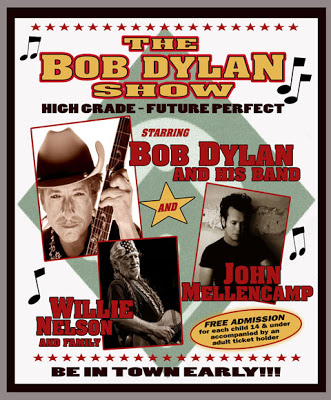
Greg Moses : The Dylan Show Plays Corpus Christi


The Geometries of the Bob Dylan Show in South Texas

Instantly the night is dark. Orchestra music plays from hanging speakers. Time to cheer and squint into the black box that has become the stage. There is a man in white hat moving into center position.

By Greg Moses / The Rag Blog / August 17, 2009

CORPUS CHRISTI — The Bob Dylan Show this summer reaches its south-most destination at 27 degrees 48 minutes north latitude, half past four degrees into the Tropic of Cancer where fat velocities of rotation spin hysterical contradictions between centrifugal ups and centripetal downs.

Or if it’s not about cosmic number tonight why does this latitude trace eastward to Qalandul where southbound priests of Egypt would disembark from lotus-flower boats for a three mile walk to the moon temple of Khmounoun named for the number eight? If mathematics is beside the point why does the latitude of Corpus Christi — named after the body of Christ — line up with that place in Egypt identified by the Catholic Encyclopedia as the residence of the boy Jesus when his family carried him into exile?

Nor is any of this geometry too heavy for tonight’s three stars: Dylan, Willie Nelson, or John Cougar Mellencamp, whose converging chords have capacities to re-curve time and space for our drought and debt saturated landscapes. If ticket-holders hadn’t already calculated the likelihood of some momentary resurrection in cosmic geometries why would any of us have put up dollars to broil under this August sun?

Of course, for the most part, the dollars in question will be advanced courtesy of MasterCard – Visa and reallocated as a leveraged put toward one last long play on the possibilities of a harmonic salvation against the dissonance and entropy of all things coming undone. De-leverage and stay home? That would be like losing faith in daily bread.

Why these three stars chose the first week of August to play five Texas concerts outdoors says something about their heroic confidence, their leather skins, and their complete indifference to the pain of making a living. July Fourth is hard enough down here — that day in mid-summer when Willie Nelson and his good man Poodie (God rest his soul) gathered head-popping tribes of rednecks and hippies at open-sky picnics across Texas, year after year — where you might have exhaled on David Carradine floating by in a long white cloak or kicked over a cow patty passing David Allen Coe in an oasis of grinning mesquite, a blonde on one arm and a brunette on the other.

But August Fifth! Jesus, what a date to pick for playing Corpus Christi outdoors. To the west of Whataburger Field there will be nothing very tall to stand up against the sun as it takes its ever loving time going down. These are the Dog Days for Christ’s sake, named since the beginning of time by those very priests who studied the high heavens at 8-Town until they figured out that when Sirius, the Dog star, came out from behind the sun, it was a visible promise that the river was fixin’ to rise again, thank God.

And so the boys have chosen a dog day to put down for the evening in Corpus Christi harbor, up against the south bank of Tule Lake Channel, a mainline canal for barges of the planetary chemical coast, toting eastward past Whataburger Field and then northward past Dagger Island and Ransom Island as they cut eastward again thru Aransas Pass into the Gulf of Mexico all kinds of fluids drawn up from the arteries of Mother Earth and alchemized into kerosene or feed stocks for Naugahyde, depending. Along this third coast, clear up to Texas City, is where better living thru chemistry begins.

Sales by the chemical giants are down twenty to thirty percent or more and, like other industries these days, chemical profits are being sustained through layoffs. Investors were kind in July to chemco stock prices, but the cost of that form of prosperity means that the labor market around here is a bear, with unemployment on the rise.

Likewise with the other four stops on this tour, whether you’re looking at the energy companies who built the Woodlands, the tech sector that built Dell Diamond, the bankers who anchored Dallas as a regional center for the Federal Reserve just 13 miles from Quick Trip Park in Grand Prairie, or the cotton and cattle enterprises that undergird the stadium facilities at Texas Tech’s Jones AT&T stadium.

Interestingly enough, if you look at some of the breakout hits for tonight’s three stars, such as Dylan’s “Like a Rolling Stone,” Mellencamp’s “Hurts so Good,” or Nelson’s “Shotgun Willie” album — they all soared into our hearts at well-defined market lows. Riding a three-wave bounce thru Texas, therefore, is a trio of bear-market bards. When the chips are down, these are the fellas we want to hear most.

5pm August 5 at the crossroads of federal highway 37 and state highway 59 — there is no way to be at Whataburger Field on time to catch the warm-up act by the Wiyo’s who say they are from Brooklyn but look like they should be from Kentucky or some Hollywood movie show. Up there on stage with their washboard and dusty clothes you wouldn’t be surprised if they started pitching you some all-purpose elixir to fix everything from charley horse to heartache. They have the perfect attitude for a band that’s prepping for today’s top billers, pitching nothing too heavy to weigh down a grin.

Maybe some day the Wiyo’s will return triumphant as top bills and contribute a poster to the wall of fame that’s collected here at the crossroads Burger King – signed posters from Linda Escobar, D.J. Kane, Kevin Fowler, Ruben Ramos, and other troubadours who have crossed here going in one of four directions, maybe even Southbound on federal 37 toward Whataburger Field.

But since this is mostly an arithmetic excursion so far, the fifth at five thing reminds me that the classic Mayans named the daystar God-5 in honor perhaps of the fifth direction you could always hope to go at any crossroads. In first people rituals on this very continent 5-God is dressed in pants with yellow stripes, the emblematic color of the sun and the third age back when grandmothers — not their grandsons — were in charge.

Yes we are driving toward the beach as they say, but on this coastline your playtime scenery has an industrial backdrop. Signs say Seafood and Scrap Metal. Redbird Lane turns into Railroad Ave. And right over the tracks, Five Points Road turns into Leopard, a Mayan math trick for sure. By the time I get to Whataburger Field the clock over the entrance is a perfect straight-up six, but I’m too busy to do the math right now. There is no music coming out of the place, which means Willie’s roadies are setting up. I do not want to miss those first chords of Whiskey River.

Bottled water first. The layout of this stadium is very similar to last night’s venue at the Dell Diamond, probably because the same designer landed both jobs. So it’s not difficult to find a well-staffed concession stand upon the mezzanine before turning toward the stage. From about first base over to the left field bleachers there is shade thrown down by the stadium. And just like yesterday afternoon, all the shaded seats have been filled up first. The sunny seats over along right field are nearly completely empty.

The infield has been blocked off with some temporary barriers made of plastics that didn’t fall too far from the chemical towers that rise up all around these parts. Just outside second base is a white pyramid-topped canopy for equipment and cameras. Between the canopy and the stage they have laid down some heavy white rubber mats that protect the outfield Astroturf and hide some hefty electrical wires underfoot.

Upon the white mats in center field is the temple of the sun, where worshippers are dedicated and few. It would be easy to get very close to the stage, but like most folks this afternoon I hang back in the shade. What does 98 degrees in the full sun feel like when you’re standing on a rubber mat? At yesterday’s concert I ran into an old, old friend who had a twenty-something son, and we followed the kid right down there onto a quilt in the midst of the sun worshipping crowd, which was larger last night. It turned out not to be as fatal as it sounds although the official temperature was 101.

This evening at short-stop position I take my stand just about the time the sun worshippers start cheering to let everyone know that Willie has stepped into view. Then those chords. Of course the last thing you think about is how Willie’s spotlight right now is the third coast sun. Just like last night he takes the sun shift full in the face and it seems to bother him not a bit.

Something is different tonight about Willie. Usually he plays with a guitar backup. Last night the honor was done by the legendary Ray Benson. Tonight Willie has other familiar members of the family on stage, and a bass player, but there is only one guitar. You’ve probably seen it. It sounds great. My ears are telling me the ticket price has already been returned with interest.

As Willie switches tunes to “Still is Still Moving” we can see the high backs of trucks flying over his head as they move up and down the steel trussed harbor bridge along the east side of Whataburger Field. “La la la,” sings the singer. When Mickey Raphael steps up to blow the harmonica, Willie lifts his right hand to point toward the sky. Cheers fly up from a commotion of ballcaps and shorts.

At a peace concert a few years back, Willie introduced “Beer for my Horses” as the homeland security song, so that’s the way I’ve thought about it ever since. He stops his own singing to let the audience fill in the title lyric, as they did last night. Mothers in cowboy hats walk to and fro. A snuff dipper wearing a bud cap raises a plastic bottle to his lips. An extra large man walks out of the sun crowd wearing an extra large red t-shirt that reads “Big Frank.”

“Well Hello There,” is the way Willie opens the fourth song to immediate cheers. With Paul English hitting the backbeat and Willie pointing to folks here and there, everyone is enjoying the chance to get reacquainted. We’re thinking about last time and next time. T-shirts walk by texting Dynamo or smiling in the image of Jackson Browne.

“Crazy!” is a song that Willie always seems to begin abruptly, and it always produces an abrupt reply. As Willie hits the four notes down, here comes a mother in pale pink boots. Holding mom’s hand is her waist-tall daughter whose boots are pale green. Here are your green shoots people. Before you have time to figure out what to say about the teen boy in the BIMBO shirt, an image of Hendrix reminds your mind to take a deep breath.

Literally, it’s a little too early for that “Night Life” song, because the sun is still pretty much all up in his face, but Willie is in the mood to give Trigger a good workout. “Listen what the blues are playing.” A Motown insider once assured me that when Willie comes to town, the Motown session musicians get front row seats. That’s the first thing he told me after asking me where I was from.

Coming off the field now is a young tall buck in a big black hat, hefty silver buckle, brand new jeans draping down over calf-brown boots holding hands with a wide-eyed doe in boots, cutoff jeans, and purple top. Are my sunglasses dark enough for this? “Thank y’all very much. I love y’all. How y’all doing out there?” is what Willie says next.

As Little Sister Bobbie hits her “Down Yonder” piano solo, Willie tosses his black hat into the crowd, puts the red bandana over his forehead, and tops it with a wide and flat straw hat that someone has tossed up. After asking Sister Bobbie to give the crowd a wave over top of the grand piano, Willie introduces drummer Paul and plays the song about “Me and Paul.” The lyric about almost getting busted in Laredo draws a response from this South Texas crowd, probably because Laredo is a name they hear all the time.

Buck and doe are easing back toward the sun worshippers now. A silver fuel truck flies down the Harbor Bridge followed by a gleaming red pickup riding high on the back of a tow. Willie introduces Paul’s little brother Bobby and Mickey Raphael. I don’t recall seeing Mickey this tan before. He’s been playing the sun shift beside Willie for a few weeks. Coming out of the crowd now is a serious looking fellow in sunglasses and camo pants. He is followed by a couple with a vast age difference. I take the older man to be a grandfather and the younger woman in the Hooks shirt to be his daughter, but I wonder. The main thing is their smiles.

Willie hits stride with “Money Honey” then slows it down for “Blue Eyes Crying in the Rain.” A young mom has stepped out of the sun into the shaded area where she waltzes with the boy she carries. The boy climbs down to the turf and starts running a diamond of bases, preparing his imagination for the big leagues. A daddy steps into the shade carrying his daughter dressed in a yellow shirt. The sea breeze kicks up the smell of salt. And I’ll be darned if it’s not buck and doe coming this way again.

Tom T. Hall wrote “Shoeshine Man” declares Willie introducing the novelty tune which seems to have replaced “Kiss Big Booty Goodbye” in this year’s lineup. Willie does the video for the shoeshine song by playing with his web cam and, according to the definitive stillisstillmoving blog, Jackass Johnny Knoxville sez it’s the best video of all time (lower case letters inserted). Little Sister Bobbie kicks up a storm on the pinanny as Mickey and Willie hop onto her musical dust devil. Cheers and whistles swirl all around.

As Willie kicks it up one more notch with “Mammas Don’t Let Your Babies Grow Up to Be Cowboys,” the little base runner is swept up by mom for more dancing. But there is only so much will a momma can have over the boy who pushes himself back down to run some more diamonds. Walking through this little drama is a high-contrast image of young Dylan’s face carried forward on a purple t-shirt by a proud teen grrrl walking beside her proud gramps. “Thank you very much,” says Willie, because the applause is getting pretty loud.

Tenderness returns to the fading day with “Angel Flying too Close to the Ground.” A big brother and little sister come off the field side-by-side with some serious responsibilities showing in their faces. Probably they have been given a time limit, maybe even some cash. High above the stage, gulls dive after each other, energized by an updraft. A young momma steps confidently under black hat, platoon leader to passing images of Kid Rock, pink sunglasses, and Bob Marley.

At “On the Road Again” a beverage salesman comes striding out of the crowd, slinging an empty blue bucket. As he turns North along the left field foul line his back draws my eyes toward Willie’s bus parked behind the stage with its painted horse always ready to ride. Time to reload that bucket. On a blanket thrown down near second base, a young family claps in unison. Mommy and baby girl dress in matching outfits.

With Sister Bobbie’s piano striking a melancholy mood, Willie eases into an apology song. “Maybe I didn’t love you quite as.” A young Dad with trimmed beard, gator boots, and beaded belt dances. A youngster’s t-shirt advises us to save water. Arms go up in applause.

“I had a carpal tunnel operation and my doctor told me to go home and shut up,” explains Willie as he sets the stage for the next ditty about being Superman Not. “Too many pain pills, too much pot.” Willie has lost his big straw hat. The bandana he wears now looks more like a head wrap for a wounded man. And Sister Bobbie helps to strike the appropriate musical pose. In the lengthening shadows, a personage in chrome boots and white hat is busy talking up something they’ll probably get from someone they probably know.

“How about a little Hank Williams?” asks Willie, which is not really a question so much as a cue to start hoo-ing and whistling and shouting things like hell yeah as he hops right onto the bayou song. Self, sez I to me, I told you this was going to be a mathematical event. There will be three (count ‘em three) Hank songs. “Hey Good Lookin” might be dedicated to more than half the crowd tonight and Willie is still pointing them out. A woman prettier than gold passes by, talking on her cell phone. The kid runs a diamond around her knees. Time for a little riff from Trigger and before you know it the cosmos has been segued into Hank’s “Big Dog” song.

Okay, dear reader, you are thinking how long is this going to go on? Are you going to report on each and every one of these songs and fashions and dramas as if you were responsible for something like memory itself? Yes ma’am, and without commercial interruption.

So while we were finishing up the triangulation of Hank there was this ACDC t-shirt that I forgot to mention just before all hands went up in applause, which is good a time as any to start “City of New Orleans” while an independent woman in plaid top, shorts, and boots keeps her attention split between the ground, the stairs ahead, and the text message she is sending: IYKWIMAITYD. “I Just Want My Noodles” is what it says on the next t-shirt immediately followed by a grrrl in dayglo sunglass frames and a hint of leopard-skin fabric worked in to the waist line.

The beverage salesman who we lost in the direction of Willie’s bus has returned now walking with a bit of a strain against the weight of the filled bucket that he has strapped across a broad shoulder. He’s handling his job with sweat and good cheer as Willie kicks up the melody for “Pipeliner” and sings about a man who’d walk from Corpus to Wichita Falls.

A double-dating foursome probably with fresh memories of the prom is enjoying a stroll around left field as Willie begins to ease his way off stage. “Thank y’all very much. We love y’all. I hope you’ll stay for John and Bob.” But no Willie show is over until the Gospel tune sings, so he and Sister Bobbie and the family treat us all to “I Saw the Light.” Talk about your understatement. More thanks, more love. The man in the black hat blows kisses. The bleacher folks stand up to clap and cheer. Mickey gives a hearty wave. And cut.

Up on the mezzanine a Skol can hits the concrete floor and a big man reaches down to retrieve it. Big red plastic carts on big plastic wheels are rolled into place as drink stations for the surge between acts. Over by the Whataburger counter the plastic coated picnic tables are keeping themselves occupied as diners wait for their numbers, grab their bags, sit and eat, and make room for the next shift. A woman with a long braid holds out her walkie-talkie with one hand as she pushes down trash with the other. It’s beginning to look like evening. The breeze is strong enough that I set my full water bottle on the floor instead of the railing.

By now the empty seats in right field have some shade moving onto them. I sit down behind folks who have traveled some distance to see Mellencamp mostly. A walkway at ground level is guarded gently by a young woman dressed in the lightly printed pattern of the Whataburger Field staff. She either nods to let you pass or shakes her head to stop you. Near the entrance to the walkway a few women stand on the field wearing USO t-shirts. Here comes a couple holding hands. Dad wears a Grand Funk Railroad t-shirt.

A guy big enough and about the right age to be the real thing wears a t-shirt that says Notre Dame Football. On the field a littler kid kneels, tucks his head down and rolls completely over into a sitting position, rolls again, and again, and again. He comes up smiling each time. When he’s finished, he gets up to pull a cell phone from mom’s back pocket. Mom is having a live conversation with friends. Cheers. Spring-loaded fans jump up and walk quickly onto the field. It’s Mellencamp time and here he comes.

“You guys ready?” asks Mellencamp. “Then someone’s going to have to count to four. One. Two.” His band hits the opening chords for “Little Pink Houses.” Right field is dancing. Hands are high up and clapping. We’re feeling that electric violin. Down on the field grandpa in his yellow shirt tosses grandson two feet to the kid’s father. Catch! The three of them are laughing loud. Dad puts the boy down next to little sister. Dad picks up little sister. And the whole family rocks. All hips are in motion. A surfer cowboy grabs his date for a closer dance. A blonde grrrl and brunette grrrl come strolling hand in hand. “Home of the Free!” Binoculars turn to John.

The violin is smoking hot tonight as it plays the riff for “Paper and Fire.” A young man with light brown dreds strolls out to meet the music. As the violin saws into “Check It Out” hands go up to clap the beat. Mellencamp pitches back pictures of our lives. On the highway of this song we’re all making very similar trips. Check out that Harley Davidson t-shirt passing by. There’s a long message on it that we can’t quite make out at walking speed in fading daylight. Bet it sums something up about living.

Mellencamp’s band leaves him solo with an acoustic guitar explaining how he’s “sicker than a mf*r up here” and how he’d seriously considered canceling tonight’s performance. “But I can’t do it to these people!” Applause and good cheers for that. “Glad you all showed up!” Then he polls the audience for their mood in terms of “old song” or “new.” For the “old song” landslide majority he presents a chorus of “Club Cherry Bomb” a capella – to which they all sing along in remembrance of when “groovin’ was groovin’.”

Having done his best to prepare his fans for something completely new, Mellencamp introduces a dream song that he very recently recorded in a Savannah Georgia Baptist Church. Here come the dredlocks back out. A tall daddy carries his baby girl high up on his shoulders. A pair of toddlers walk unsteadily together, still finding their legs.

Mellencamp begins “Small Town” as an acoustic solo, but the song ends with the band in full electric swing. A man with freshly trimmed gray hair nods and smiles as the Cougar sings about being born and raised in a small town. But when the singer sings about probably dying in a small town, the man emphatically shakes his head not me.

Now it’s the band’s turn to give Mellencamp a little break as they play a violin powered song that haunts the spirit of something Irish, Dixified, and Gospel. A double date of teens walks in formation, smiling and chatting about all kinds of possibilities for this life. A mom strolls hand in hand with her daughter. A big guy with big hands stuffs three empty bottle necks between the fingers of one hand and walks confidently upstairs.

“Scarecrow” pulses through the crowd in the form of chest-thumping full-frontal rock. A woman in pink dress and high heels bounces out along the right foul line, veers into fair play, returns toward first base with a friend. Mellencamp turns around to the drummer and raises his arms. Five cases of beer go rolling toward an ice-cold oasis. From every face a glow of something like I’m proud to be who I am. Nobody who’s not somebody far as you can see.

Power chords for “Troubled Land” introduce Mellencamp’s prayer for peace. Palm trees pose in silhouette against the last horizontal light of the day. Police lead a woman upstairs with a couple of thick deposit bags. In this mood right now, they could probably just ask the audience to pass the cash. A tall thin man with arms outstretched comes floating across the foul line toward the right field steps, lifted up and carried by event staff who sit down with him in the bleachers. Grins and grumbles ripple out.

“If I Die Suddenly” is a resurrection song about leaving it all behind. Even the preacher would be too late to do anything useful. All the necessary arrangements have been taken care of through family and prayer. Stage lights glow purple as twilight darkens the sky into various shades of charcoal blue. Backlit advertisements for K Triple Eye TV and the Gulf Coast Federal Credit Union contribute softening glows. Corpus Christi cops stroll relaxed as five cases of empties get pushed westward for disposal. A fat supply plane passes southbound overhead.

It’s 1-2-3 and all hips are swinging for the crumblin’ wall song. The bass player takes center stage, and he’s just spanking that thing. Then the drummer rolls in with a solo. Lights strobe. There’s hollering all around. Blackberries get lifted up to capture the ecstasy. Whistles. Applause. “This is good!” shouts a Mellencamp fan from the right field bleachers. This is exactly what he came for.

“When I put this band together in the early 70’s it was a garage band,” says Mellencamp after introducing the players. “We went from the garage to the bar and back to the garage. After years of doing that I was surprised to see that you could play on stages where your feet didn’t stick to the floor.” Mellencamp explains how his breakout hit “Hurts So Good” was written as a way to catch the spirit of bars at 5 a.m. But with a voice busted by the August weather in Texas, Mellencamp says that he’d like to throw the vocal part to a fan who has been up front singing along with every note.

“So come on up here. What’s your name?” As Tom Cruise is to Bob Seeger, Mike is to Mellencamp. He grabs the microphone and hits the song like a punching bag, scoring every word. Of course the audience sings the chorus, too, as Mellencamp swoops in for the closing lines. Before Mike leaves the stage, he grabs Mellencamp and lifts him high off his feet! No sticking to the floor tonight.

“Thanks a lot you guys,” says Mellencamp, “good bye,” leaving us Mellen-heads with wide grins. Up on the mezzanine food and drinks are still selling fast. In a kitchen on the south side of Whataburger Field a woman scrubs a pile of steel pans. Nearby a couple of guys open an exhaling cooler and roll out a frosted keg. I grab a fresh bottle of water and get back down to the outfield.

As I take up position in center-left field, the party is in full swing. Under bright ballpark lights, friends gather into a hundred small circles chattering and laughing. Oops, down goes a full cup of beer. Oops, down goes a bottle. Behind the stage three candy red semi trucks rest side by side as their long steel trailers are emptied and refilled by more than a dozen roadies in sportive uniforms who roll cases of equipment one way or the other over a steel plank. After a while the stage empties of workers. A senior operator comes out to check a few final details at the keyboard station.

Instantly the night is dark. Orchestra music plays from hanging speakers. Time to cheer and squint into the black box that has become the stage. There is a man in white hat moving into center position. Time to cheer again. No way to keep up with the rapid intro, a biograph of Dylan that takes us from rock legend, through drug haze, then into Jesus and beyond. But as it (not absolutely) always was, he remains the Columbia recording artist. Cue lights and trilling notes of “Watching the River Flow.”

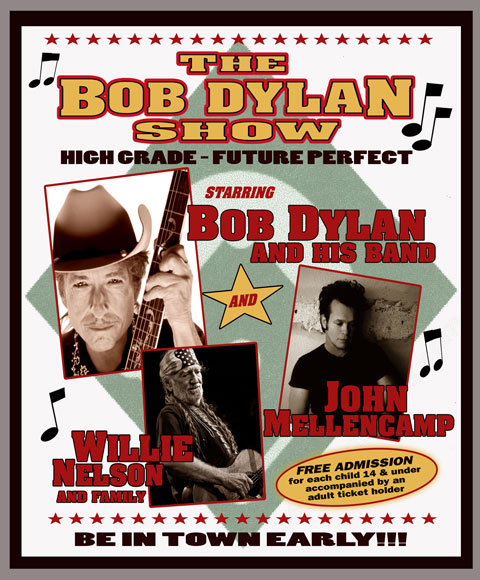
Dylan holds the fat neck of his guitar up like in the promo pics. Makes me think of the way you hold a shotgun and what Woodie Guthrie wrote on his own guitar. And if you read the reports after every ballpark show you can tell it begins to work pretty quickly. Also, in the context of today’s show, Dylan’s opening guitar work feels like a kind of tribute to Willie Nelson’s guitar style with alternating riffs and hard-scrubbed chords.

“Don’t Think Twice” was the song that pulled me into Dylan way back when I was skinny and lovesick. It’s a nice surprise to hear it as song number two. Magically the electric bass has been replaced with a full-sized acoustic. Down here among the ticketholders a woman with a sweet smile and twinkling eyes holds up two cups of foaming beer, pauses, looks around. Maybe she’s really lost? So many two’s all at once. Time for this party to double down.

With a shot from the drums that startles you into thinking explosion, the band hits the wailing chords of “Till I Fell in Love with You.” Dylan begins at the keyboards downstage right, facing three axemen stage left in black suits and hats. The fifth black-suited player sits upstage right behind a pedal slide. Dylan seems to be getting the feel of the stage, making eye contact with players. Then he turns to grab a well-placed harmonica and walks to center stage for a solo. On his pants, the outseam is covered by a broad yellow stripe that matches his yellow shirt. Could be a ritual Mayan dressing for a ceremony at high noon.

When the song feels done Dylan nods to the bass player and leader of the band — a familiar face to old fans of Saturday Night Live. The bass player cues the drummer, and the boys bring the thing to a stop. In the song the singer was “Dixie Bound.” Now the song is over, and look who’s here.

It’s a soft-pitch melody up next, with the yellow-breasted poet’s jacket unbuttoned for “a whoppin’ good time.” Last night The Vocalist stressed the lyrics a little more at that “over the hill” allegation. Tonight the emphasis shifts to the keyboard and the tall, acoustic bass. Cellphones are up and streaming rows of tiny screens over ballcaps and beer. Jupiter is chasing the moon up over the harbor bridge leaving plenty of clearance for more chemical trucks to go barreling down westward toward Laguna Madre.

Whistles come flying into the stage from various points. Someone tosses off a light scream. Dylan and the boys reply with a rollickin Muddy Waters takeoff, “and I tumbled, I cried the whole night long.” The gulf breeze offers a gusty supercharge. A southbound airplane blinks high overhead. Drum and bass beat CPR into each and every heart.

For me, Dylan’s “Workingman’s Blues #2” is a reminder of Jody Payne who for years sang the Merle Haggard original during Willie Nelson concerts. The Dylan reply has a sing-song rhythm that the crowd enjoys, hands up, clapping. For his part, The Vocalist is tossing the notes back and forth from guttural to nasal, playing with the range of possibilities. A few popcorn clouds wave at the Sturgeon Moon. A couple giggles together as they hold up a Willie Doll that can’t help but sway to the happy feel of things. I hear Payne is in retirement today enjoying time with his son, Waylon. Still, we missed him this evening at 6:15 or thereabouts.

Before Dylan pitches “Tweedle Dee and Tweedle Dum” he steps back in the dark, gives his arms a good stretch, and grabs a drink. Another tanker truck comes wheeling down the harbor bridge, shining its stainless steel body back at the moon. At the keyboard, Dylan turns and kicks to one side and then to the other. But don’t let that song and dance act fool you too much, because the serious side of Dylan’s art is just now kickin’ in.

“Ballad of a Thin Man” is a song you can lay back and enjoy a little more if it doesn’t catch you live taking notes. People can’t help but grin at you. They even start walking a little closer to you in the moonlight just so you can be sure to see they’re on the side that’s grinning. “With great lawyers and scholars,” sings the man with the thin mustache, pouring a little pepper onto your paranoia. Indeed you miss plenty and most of the time. But you’re no quitter, are you — dum, dum, dum, dum — Mr. Jones? When the song is finally over, I give it a four-finger whistle. Sportsmanship.

At last night’s show in Round Rock, “Highway 61” was the apex of the arc as it is tonight, even without the amazing center-stage guitar work of Charlie Sexton or the amusing lyrical antics of the vocalist. There’s just a way the song comes together. Dylan enjoys jamming the song on the keyboard, and the guitars enjoy answering him. Then the guitars start answering each other. Before you know it there is a full blown conversation going on between the drummer and the bass player, too. Everybody has something to say. The lighting crew starts mixing in a few tricks and pretty soon the Bob Dylan Show is taking us all down for a ride.

In the darkness before “Nettie Moore,” Dylan steps back to take a sip. The song is such a sweet and sad thing. The violin sounds perfect for it, and Dylan seems to place special emphasis on the lines, “I loved you then, and ever shall.” Meanwhile, the audience has divided itself in half between those who have inched ever forward and those who have stepped back. In the gap between them a 12-foot ring of rubber mat.

“Thunder on the Mountain” is a wide-ranging plaint. You’ve got the man, the woman, and the world all on the verge of some critical swerve. The beat is ferocious as a freight train. The crew up on stage is stoking the engine hotter than an August night with all the seriousness and concentration they can sustain. It’s like one little cotter pin could spring out of joint and the whole 46-box-car operation would come crushing down upon us all. The front rail audience is completely transfixed. It’s like they are just holding on for dear life. Then the grand conductor gives a quick nod to the leader of the band and the whole damn weight of things is braked to a smooth but quick stop.

When the band goes off-stage I wonder if they’ll come back for an encore. There is a hearty group of folks who are into the show, and they are trying to put up a ruckus, but they’ve been beered and beaten by the heat for about five hours, so it’s not clear they have much left inside to wring out. By rock concert standards, their cries for more would be deniable. But after a polite interlude the band does come back. Dylan’s return gait is loose and lanky. He seems to gesture something merciful with his body before returning to work.

The encore begins with Dylan’s signature song, the one that branded a glorious generation of rolling stones. At the keyboard, Dylan reminds us of Al Kooper’s licks. On the line — “How does it feel?” — the stage lights cast a flashing fishnet pattern over the near crowd. On the black backdrop is a lighted image of the new Dylan logo, an eye of Horus crowned as feathered serpent. Mayan math connected to Egyptian is what I say. And the all seeing stagemaster himself seems to signal something significant as his hand flies up from the keyboard to touch cheek, back of neck, and then quickly back down.

The seven-note riff for “Jolene” sashays through the sky. “Baby I’m the King,” declares the triumphant showman, “and you’re the Queen.” Dylan twists sideways for one more flash of that yellow stripe. A final, faint, and seedy whiff of freedom passes through the crowd. “Okay, git,” says a short man to a short woman as they turn toward the parking lot. Wednesday night is coming to a close.

“Thank you, friends,” says Dylan before introducing the four boys in the band. “There must be some kind of way out of here,” is not exactly what we hear next, but we can tell that’s what the song is supposed to be. A moth catches the spotlight, zigs toward Dylan’s white hat, then zooms up offstage. As the band hammers out the notes of this last song, Dylan pulls a hand up, wipes some of that (officially) 82 percent humidity from the back of his neck, pulls the other hand up, wipes the other side. Toward the Green Corn Moon a wispy cloud approaches in sickle form, making a perfect harvest. Cut.

“None of them along the line know what any,” Dylan stops, catches the word “any,” repeats it, punctuates the delivery of the next three words – “of . . . it . . . is” — and then grinds out a deep growl for all it is “wo-oo-rr-rr-th!” Music slams shut, lights go down. In the dark, Dylan assembles the band into two rows, then takes the front and center position. Lights up, Dylan raises his hands out above his elbows in a gesture that looks like a kind of blessing.

A dedicated pack of stage huggers want to go for one more encore, but it is no use. As the true few cheer and whistle (what good would it do to stomp?) the mostly many turn toward home. Before you know it, the band has disappeared, the crowd is up and out of Whataburger Field, and two dozen yellow-shirted event staffers swarm the brightly-lit outfield, picking up trash, breaking down settings, getting the ballpark ready for Friday night’s game against the Midland RockHounds.

“Bye Bye Bob,” says a mom sadly to no one in particular as she hauls an over-stuffed bag of supplies for her gaggle of grrrls that she leads to the steps.

“I love him!” rejoins one of the grrrls, barely teenaged, as security discreetly herds us out.

Past the blinking ATM machine and a pile of empty beer cartons we step off the field and up to the mezzanine where it’s nothing now but stragglers and cleanup crew.

“Last call for Willie Nelson t-shirts,” hollers a weary hawker. Next door over at the Dylan-Mellencamp booth the last sales of the evening are being resized. A pony-tailed blonde grandmother points to the next size in the Dylan ’63 t-shirt as a mom next to her negotiates with two daughters over which size purple Dylan T the girls are going to get.

Down the front steps, ticket takers stand their posts, retooled now into exit greeters. Three cops joke around in the street until the long black bus is ready to roll outbound with a smooth left turn.

The Rag Blog

Posted in Rag Bloggers | Tagged , , , , , | Leave a comment

Alice Embree : The Court Martial of Travis Bishop

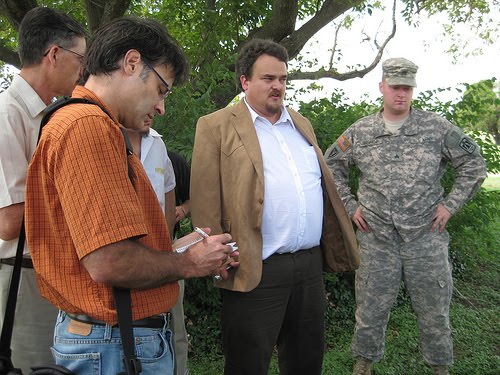
Travis Bishop (right), before his sentencing. With (left) journalist Dahr Jamail and attorney James Branum. Photo by Alice Embree / The Rag Blog.

Anti-war GI Travis Bishop found guilty;
joins Victor Agosto in Bell County jail

I can not say that a year in prison doesn’t scare me. I am terrified… (But) it would be scarier still to know that my fellow soldiers who feel as we feel would never find out what we are trying to accomplish. — Travis Bishop

By Alice Embree / The Rag Blog / August 16, 2009

See ‘Protesters support Bishop and Agosto’ by Alice Embree, Below.

In the second court martial in two weeks, another Fort Hood soldier was sentenced on August 14th for refusing to deploy to Afghanistan.

Sgt. Travis Bishop was brought before special court martial proceedings, found guilty and sentenced to one year in prison. His rank and pay were reduced. He is expected to be held in the Bell County Correctional Unit before serving his sentence in a military jail. His discharge status will be determined later. Because Sgt. Bishop has a prior honorable discharge, his GI benefits may not be reduced.

Sgt. Bishop faced four charges: willful disobedience of a Non-Commissioned Officer, absence without leave and two counts of missing movement. The charges were more serious than those faced by Spc. Victor Agosto on August 5th. Agosto’s case was resolved in a summary court martial and he is serving a one month sentence in the Bell County Correctional Unit.

The courtroom resembled a civil courtroom with the judge in black robes. An Army defense attorney was seated with Bishop and his civilian defense attorney, James Branum. The panel, however, was hardly a peer panel. The jury seats were filled by eight Colonels, Lieutenant Colonels and Majors who had to be warned once not to fall asleep while the Judge read instructions.

A Fort Hood Public Affairs representative told Bishop supporters during a recess that Bishop was being tried in the same courtroom where Army Staff Sgt. Shane Werst had faced a court martial for shooting an unarmed Iraqi citizen. “Five privates turned a dime on him,” he said. Despite testimony that soldiers were ordered to plant a gun on the Iraqi citizen to make the death appear to be self defense, Werst was acquitted May 26, 2005. Bishop’s sentence for not deploying is a sobering contrast.

Bishop’s court martial began on Thursday and Bishop’s defense attorney and supporters had expected the arraignment, designation of a jury panel and testimony of one witness to be brief. Instead, the trial began in earnest and lasted five hours. At one point on Thursday, supporter Cynthia Thomas was asked by a Killeen police officer and an Army MP to leave the courtroom and explain her relationship with the defendant. Thomas asked if she were being detained and to speak to her attorney. She was not stopped from returning to the courtroom.

The prosecution brought Captain Chrisopher Hall in to testify that the absence of Travis Bishop from his unit had caused hardship to his unit. The defense presented four witnesses who testified to Travis Bishop’s sincerity of beliefs. Bishop filed a request for Conscientious Objector status in late May and the request is still pending.

Charles Luther, a defense witness with a background as a lay Baptist minister, spoke of Bishop’s religious beliefs. The defense attorney established that psychiatrist, Lt. Col. Adams, to whom Bishop had been referred, approved Bishop’s Conscientious Objector claim and that it was one of only two claims in his ten years that Adams had approved.

In a surprise moment at the end of testimony, the Prosecution decided to call Lt. Colonel Ronald Leininger to the stand. Leininger was the Brigade Chaplain to whom Bishop was referred for pastoral counseling. Bishop has described his deep disappointment in speaking to someone he thought would be attentive to his religious beliefs. Bishop said the Chaplain reduced his interview time and interrupted the interview repeatedly by receiving phone calls.

In the statement issued by the Chaplain after his visit with Bishop, he focused almost no attention on Bishop’s religious beliefs. Instead, he wrote that Bishop had been coached by Iraq Veterans Against the War and other antiwar activists. He went further to say that the affiliation that best described Bishop’s religious heritage was “Conservative Evangelicals” who the Captain said are “generally pro-military service with no pacifist tendencies in doctrine or practice. In fact, they make good soldiers.”

Bishop has received letters of support from a number of pastors who cite their church’s doctrine and practice supporting conscientious objection to war.

The court was recessed as the panel considered the verdict for about one hour. They found Sgt. Bishop guilty. In the sentencing phase, the civilian defense attorney, James Branum, asked for a three months sentence in light of Sgt. Bishop’s sincerity and previous good conduct, including a fourteen month deployment in Iraq. In particular, Branum focused on the fact that soldiers are never given information about their rights to Conscientious Objection. Branum said that a soldier who changes his or her belief about war doesn’t understand that there are options.

Maj. Matthew McDonald, who served as the judge, discounted the relevancy of whether Bishop was notified about his right to file for CO status. McDonald was quoted in the Killeen Daily Herald (8/14/09) as saying: “If every soldier in the Army who disobeyed an order could claim it was because they weren’t notified of conscientious objector status, we probably wouldn’t have a military any more.”

Prior to sentencing, Bishop’s testimony was forceful and moving. He cited several articles that protect a soldiers rights and noted that soldiers often are not informed of their rights, but that doesn’t relieve the Army of its responsibility to honor those rights. Bishop said that the right to pursue a claim of Conscientious Objection requires protection. He said that he was unaware that he could pursue a claim of Conscientious Objection until right before his deployment.

“The truth is, as soon as I discovered this process [C.O.] existed, I acted upon it. I left because I did not feel that I would have a sympathetic, understanding command structure to fully take my problems to, and also to give myself time to prepare for my C.O. application process, and the legal battle I’m currently fighting. These are not excuses. These are explanations. My hope is that you truly treat them as such during your sentencing deliberations.”

After being sentenced to the maximum jail term allowable under a Special Court Martial, Bishop had time to handwrite a note:

“To everyone who still cares: I can not say that a year in prison doesn’t scare me. I am terrified… But still, though I am terrified, it would be scarier still to know that my fellow soldiers who feel as we feel would never find out what we are trying to accomplish… Everyone who hears or reads this should know that I love you all, and my life is forever changed because of you. Victor and myself are starting something and it is now up to all of you to continue on. With all my heart. Travis.”

As Bishop was escorted from the Justice Center to a waiting van, supporters who were active duty soldiers or veterans stood at attention and saluted. Hands cuffed together, Bishop flashed a peace sign in return.

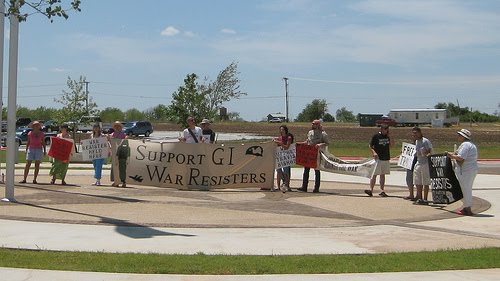
Demonstrators outside the Bell County Correctional Unit where Victor Agosto and Travis Bishop are being held. Photo by Alice Embree / The Rag Blog.

Protesters support Bishop and Agosto

Protesters gathered Saturday, August 15th, in support of two Afghanistan war resisters held in the Bell County Correctional Unit. Under a blazing Texas sun, protesters held signs and chanted.

Victor Agosto is incarcerated at the Bell County facility after being court martialed August 5th for refusing to deploy to Afghanistan. Agosto was sentenced to one month. Travis Bishop will be held in Bell County for about two weeks before his transfer to a military prison. Bishop was court martialed August 14th and received a sentence of one year.

Supporters plan to be present every Saturday while the resisters are in jail at this facility. For more information, go to the Under the Hood Cafe website.

Alice Embree / The Rag Blog / August 16,2009

Also see Afghanistan War Resister Sentenced by Dahr Jamail / truthout / August 16, 2009

The Rag Blog

Posted in Rag Bloggers | Tagged , , , , , , , | 9 Comments

‘Socialized’ Medicine : It Works all Over the World

British Conservative leader David Cameron, certainly no “socialist,” calls the National Health Service (NHS), “one of the wonderful things about living in (England).”

[The Republicans have] told so many lies about the government health care in other countries, that some of those countries are starting to get angry.

By Ted McLaughlin / The Rag Blog / August 16, 2009

As the health care reform debate heats up, we’ve heard all sorts of ridiculous things from the Republicans and right-wingers about “socialized medicine” — the name they give to the government-run health care systems adopted by almost all industrialized countries. They call it “evil” and tell all kind of horror stories about how bad it is.

In fact, they’ve told so many lies about the government health care in other countries, that some of those countries are starting to get angry. When the right-wing put Canadian Shana Holmes on American TV to lie about the Canadian system, tens of thousands of Canadians were incensed, and let it be known they don’t appreciate Americans lying and spreading falsehoods about their system.

The English are starting to react also. They have started a Twitter group expressing pride in their National Health System (NHS), and tens of thousands of people have expressed their support for the NHS. Prime Minister Gordon Brown even joined the fray, twittering, “PM: NHS often makes the difference between pain and comfort, despair and hope, life and death. Thanks for always being there.” His wife then added, “#welovetheNHS — more than words can say.”

An American business magazine recently said under the British system, scientist Stephen Hawking would be dead. Evidently they didn’t know he was born and lived all his life in Great Britain. Hawking himself says, “I wouldn’t be here today if it were not for the NHS. I have received a large amount of high-quality treatment without which I would not have survived.”

You might say those are the liberal views, but what do the conservatives think? Well, here’s what Conservative Party leader David Cameron has to say, “Millions of people are grateful for the care they have received from the NHS — including my own family. One of the wonderful things about living in this country is that the moment you’re injured or fall ill — no matter who you are, where you are from, or how much money you’ve got — you know that the NHS will look after you.”

In Canada, Great Britain, France, Sweden and most other industrialized nations, the people like their “socialist” health care that gives all citizens decent health care. Some politicians might like to tweak the system to make it even better, but none would dare suggest doing away with it and going to a system like ours. If they did, they’d be voted out of power in a heartbeat (and they know it).

That poses a question. Since all of these countries love their government-run systems that covers all their citizens, and most Americans agree that our own system is badly broken, why is health care reform so difficult in America? Why are we so sure none of the systems used by other nations would not work here? And why are we so terrified of the word “socialism” — especially since most Americans don’t even know what it is?

MediCare is socialist, and it has done a pretty good job of providing health care for our elderly. The fact is that there are some things government can do better than private industry (regardless of what Republicans may tell you).

Would you want the police or military to be private and only work for those who can pay? How about the fire department — should they let your house burn because you can’t meet their profit expectations? The same is true of health care. The government can eliminate the profit and the overhead and provide cheaper and better health insurance. That’s a fact even the private companies recognize (which is why they’re fighting it so hard).

Government-run health insurance is not evil. It’s just the fairest and least expensive way to give all citizens decent health care. And that’s what we should be trying to do.

[Rag Blog contributor Ted McLaughlin also posts at jobsanger, an excellent Texas political blog.]

The Rag Blog

Posted in Rag Bloggers | Tagged , , , , | 10 Comments

Thomas McKelvey Cleaver : Why We Need Obama’s ‘Death Panels’


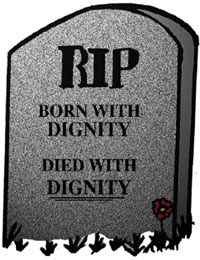
Death with dignity:
Why we need those ‘death panels’

…my father had gone into a coma that afternoon, and it was time for the family to fly to Denver and gather ’round for his final time on earth.

By Thomas McKelvey Cleaver / The Rag Blog / August 14, 2009

The Right claims that “Obamacare” will provide “death panels” that will decide who lives and who gets euthanized.

True to form, the most spineless political party on the planet — the Democratic Party of the United States — has decided they can’t stand up to outrage manufactured by the pharmaceutical industry, the health insurance industy, and their far right Republican allies who seek any issue they can find to oppose the Democrats. They know that health care reform, once passed, will mean that once the very people now screaming at Congresspeople experience the ehhanced quality of care, that they will have no political future. Thus, they have to strangle the baby in its crib.

Here’s the kind of scenario they’re fighting to defend:

In late March, 1988, I got a call from my mother that I had been expecting and dreading for a week. After getting sick while out to dinner a week earlier and being hospitalized for it, my father had gone into a coma that afternoon, and it was time for the family to fly to Denver and gather ’round for his final time on earth.

My father was dying of colon cancer, which he was pretty fairly certain was the result of his having walked around for six weeks in his work pants at the government lab he worked in 50 years earlier, with a piece of unranium as big as my fist in the front pocket.

Mom and Dad had been out to visit me in Los Angeles the summer before, and he’d told me he figured from what the doctors were saying that he had maybe a year left. He’d also talked to me about what he would want done if he was unable to tell people how he wanted to be cared for when the end came. I asked him to write that down somewhere, tell mom where it was, go visit a lawyer, do something to be sure more people than I knew this. He said he would.

As they say, the road to hell is paved with good intentions. When I got to Denver the next day, the first thing I did was ask my mother if she knew where Dad’s letter was. He’d never written it.

Things were hard enough. “Dysfunctional” described my family going back at least two generations, before anyone knew what the word meant. For me, it was a case of “the wrong one’s dying.” My mother and I had never had a functional relationship, and I was pretty certain everything bad that could happen was about to cut loose. I wasn’t wrong.

My sister, the recently-converted Mormon, came hoping to convince dear old Father Dearest — who detested her religious choice — that it was time for him to join the community of Heavenly Father and let her copy down all the family names in a bible going back to the 18th Century, to offer them “life everlasting.” She and her husband had no interest in dealing with me, my brother or my mother. My brother was his mother’s son, and unlikely to ever oppose any decision she would make.

Things simmered thus for four days, with Sister Dearest demanding a schedule with a two-hour block of time in the afternoon when she would know she and her husband could visit the hospital without having to deal with the rest of the family.

My brother and I got the late evening “watch” that day; I was alone with my father while my brother went to get coffee. Wouldn’t you know it. that was when he chose to “come to” for a few minutes. He couldn’t talk, but I was able to determine he did know what was going on, and where he was, and who I was. I needed to know if he had changed his mind. I told him I would ask some questions with yes and no answers, that one squeeze of his hand would be “no” and two would be “yes”; I wanted to be as certain of any yes answers as I could be.

Yes, he knew he was dying. No, he hadn’t changed his mind. Yes, he wanted no more heroic measures. Yes, he wanted to be taken off medicines. Yes, he wanted to leave this world now.

And then, just as my brother walked back into the room with the two cups of coffee, Dad went back into his coma.

I told my brother what had happened. Amazingly, he believed me, and said he had hoped this would be the case. He also said he knew Mormons never allowed such a decision by the dying to stop the attempt to “save” them, which would mean my sister would have a religious reason to do what she would have done anyway, which was to oppose anything I said.

Convincing Mom was going to be the only way. When we got back home that night, she was still up. I was the one chosen to make the presentation. She didn’t like it at first and asked my brother what he thought. His good intentions went out the door.

It took several hours and everything I had in me not to scream back at her when she screamed at me how I had always hated my family, but in the end her love for her husband of 45 years and her own desire not to end up in a coma unable to communicate led her to agree.

World War III came when my sister was informed of the decision. Unfortunately, it came after we had told the hospital to remove everything but the saline drip, with a nurse whose religious convictions wouldn’t allow for such actions telling my sister we had decided to “kill” her father.

Fortunately, Mom stayed strong during the final two days of my father’s time on earth, and he was able to die in peace, or at least as much peace as someone in my family will ever get.

To this day, 20 years later, my sister would tell you — if you asked — that I killed my father because an atheist like me had never loved my family.

Had Dad written that letter, even better had he given it to the family lawyer, none of the drama described above would have happened. I wish I had kept on him about taking care of it, but who wants to be the one to be constantly telling someone you love that they’re going to die and have to do something about it — particularly when you don’t want to think of them going any more than they do?

And that is why it is so necessary that people be provided the option of deciding for themselves, while they are in control of their lives, how they will be allowed to leave. There is too much drama in the best family for anyone other than that person to make such a decision without suffering some sort of adverse consequences.

The Rag Blog

Posted in Rag Bloggers | Tagged , | 8 Comments

Town Hall Crazies : Too Nuts for Jerry Springer?

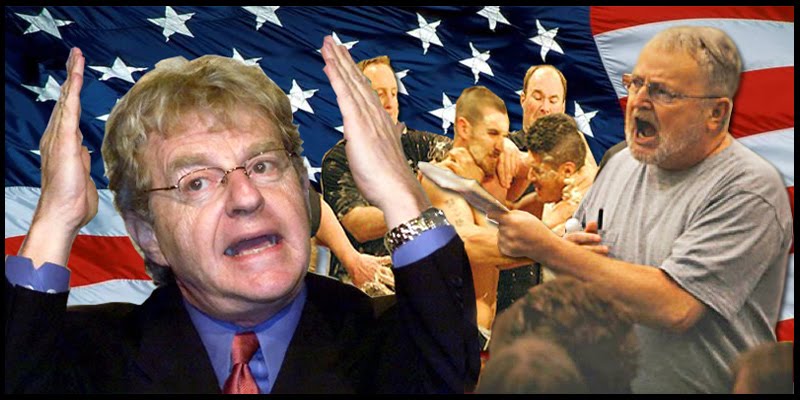
Graphic by Larry Ray with apologies to Jerry Springer.

Out of Control Town Hall mobs:
Probably even be too much for Jerry Springer!

By Larry Ray / The Rag Blog / August 14, 2009

It would not surprise me if former politician and TV show host, Jerry Springer, would even ban some raving and ranting health care town hall meeting audience members from his show. Springer, known for the raucous and outrageous behavior of his show’s guests is a former Mayor of Cincinnati and knows the politics of stage-managed dissent. Many recent summer break town hall meetings televised on cable TV and the evening news look very much like the Jerry Springer show . . . complete with beefy security guards hauling off screaming, threatening audience members.

News and opinion columns are full of reasons why rude sign-toting mobs are shouting down their U.S. Senators and Congressmen at town hall meetings across the nation. Common findings about this rage and nastiness show much of it has to do with more than constructive health care debate. Almost all the red-faced, loud, finger-pointing folks are up in arms over totally incorrect or out of context information they believe to be true. Many also erupt over things to do with immigration and topics other than health care. And the meetings may also be serving as a pop-off valve for racial hatred in some instances.

Senator Arlen Specter was assailed by 59 year old Craig Anthony Miller who did not like the seating plan for the meeting. He bellowed at Specter, “”One day, God is going to stand before you and he’s going to judge you!” Then he walked out of the meeting. Later Specter noted, “There is more anger in America today than any time I can remember.”

Much of this disinformation is fed by mindlessness opportunists like Sarah Palin and her Twittered warning of Obama “Death Panels,” and from endless talking-point emails loaded with falsehoods and half-truths.

I was recently emailed “20 Questions for your Congressman . . . what to ask at a Town Hall Meeting.” The list is the work of Robert Tracinski, and distributed by the right-wing “TIA Daily.” I looked up Tracinski and remembered his ultra-conservative ravings from the presidential campaign. He was opposed to McCain for president for not being a true conservative and was a Rudy Guliani champion. In January 2008 he wrote:

So how is he (McCain) supposed to stand up to the Democrats on any part of their socialized medicine agenda? In addition to fighting the Democrats on socialized medicine, a Republican president would also have to fight in Congress for the extension of President Bush’s tax cuts, which are set to begin expiring in 2009 and 2010.

Tracinski’s talking-point list is full of total fiction and fear mongering. Here’s an example:

When the government starting(sic) portraying people in the financial industry as villains and started limiting their pay and subjecting them to more regulations, banks reported a “brain drain” as smart and well-educated people left the industry or went overseas looking for better pay and less stress. But the term “brain drain” was originally coined in the 1960s when doctors and medical researchers left Britain to escape socialized medicine. Aren’t you afraid we might see the same kind of brain drain from the medical profession here in America?

That simply is not true at all, but is typical of chauvinistic claims ignorant Americans love to make about “foreign countries” they know nothing about. Tired of hearing their National Health Service, England’s cheap, efficient and universal health-care system, smeared in the American debate, the Brits have started responding to them with a lively Twitter forum, “welovetheNHS.”

A serious example of chauvinistic ignorance is the conservative Los Angeles, California based, “Investor’s Business Daily” which asserted in an editorial, “People such as scientist Stephen Hawking wouldn’t have a chance in the UK, where the National Health Service would say the life of this brilliant man, because of his physical handicaps, is essentially worthless.”

This prompted a quick counter response from London’s “Guardian,” by Hugh Muir an editorial columnist for the paper. Muir, contacted the internationally famous, wheelchair-bound Prof. Hawking for comment which was easy to do since Muir and Hawking are both UK citizens, a fact the LA IBD clearly did not know. Muir reported on his contact with Professor Hawking:

We say his life is far from worthless, as they do at Addenbrooke’s hospital, Cambridge, where Professor Hawking, who has motor neurone disease, was treated for chest problems in April. As indeed does he. “I wouldn’t be here today if it were not for the NHS,” he told us. “I have received a large amount of high-quality treatment without which I would not have survived.” Something here is worthless. And it’s not him. Investor’s Business Daily, incidentally, has now deleted the offending line from their editorial and published a correction. “This version corrects the original editorial which implied that physicist Stephen Hawking, a professor at the University of Cambridge, did not live in the UK,” reads the addendum.

But that’s not a correction at all. IBD never claimed that Hawking didn’t live in the UK. It claimed that the NHS would judge him worthless and leave him to die. That was what was wrong. And that has not been corrected by the IBD — which says a lot about how much trust readers should place in their work. Instead, it has been corrected by Hawking himself.

This kind of calculated misinformation easily leads to anger and violence. Fortunately this unforgivable US editorial garbage was called to task. All too many Americans still repeat the old saw that America has “the best health care in the world,” which of course has not been true for decades when looked at in detail. America, indeed, has some of the very best physicians and surgeons in the world and amazing medical technology. But when you look at the overall health care provided to our citizens, we are failing miserably. The statistics are nothing to be proud of:

US expenditure for health care (2008) was $2.4 trillion, and estimated to be $4.3 trillion by 2017. 46 million uninsured and another 25 million underinsured. 18% of US citizens can’t pay for medicines or health care their family needed in last 12 months (April, 2009).

A telling and truly sad confirmation of this lack of health care for all Americans was published in The New York Times last night, August 12th. The story’s headline is “Thousands Line Up for Promise of Free Health Care.”

Hundreds of volunteer doctors, dentists, optometrists, nurses and others have set up a huge M*A*S*H unit in an arena just outside Los Angeles. For eight days they hope to help more than 8,000 people. “Remote Area Medical” is offering basic medical exams, mammograms, eye exams and glasses as well as dental services, all offered for free from medical professionals who understand the huge problem too many Americans face.

Of the thousands standing in lines for hours, many have some sort of insurance but it does not cover all their needs. Most still cannot afford a dentist, preventive medical tests or the cost of an eye exam and glasses.

It is extremely generous for individual physicians, nurses and others to make this all possible a few times a year. But this Tennessee based group is now spending more time helping the under served in America than in rural India where they have helped for years.

You would never see such a pitiful band-aid approach to health care anywhere in Europe, Japan, and other modern societies where all citizens are guaranteed quality universal health coverage. The USA is a singular holdout, not placing a high value on guaranteed quality health care for all its citizens.

Shouts of “socialized medicine” by conservatives clearly mean that they feel many Americans actually do not deserve quality health care. Shouting down this obvious need for universal health care, especially if the rich and powerful are urging frightened people to do the shouting, may appeal to Jerry Springer fans but for most reasonable Americans it is a disgusting show.

[Retired journalist Larry Ray is a Texas native and former Austin television news anchor. He also posts at The iHandbill.]

After Larry sent us the article above we ran across the following:

The Rag Blog

Posted in Rag Bloggers | Tagged , , | 4 Comments

Monsanto : Those Genetically-Modified Self-Destructing Seed Planting Blues

Image from photobucket.

Monsanto : Ripe for the plucking

By Steve Russell / The Rag Blog / August 14, 2009

I see in the business news, Midwest version, that Monsanto is raising the price of seed 42%.

These jerkwads make genetically modified seeds that are supposed to self-destruct so farmers can’t plant “legacy” crops. They also make farmers sign a contract to that effect and they DO sue if their customers don’t rebuy but still appear to be growing the same stuff.

In the Midwest, that’s called “turning farmers into sharecroppers.”

Anyway, one of the first things the Obamites did was move Antitrust out of the Department of Commerce, where Bush had parked it (Can you say “Too big to fail?”), and put it back in Justice.

By contrast, the first thing the Bush Administration did was give away everything the government won in the Microsoft anti-trust case… and then they moved the whole deal out of Justice.

With any luck, Monsanto will be the first “victim” of the new Obama attitude. Would be good for farmers.

While I’m up here in Indiana, I have to pay attention to what happens to farmers, since I teach their kids.

The Rag Blog

Posted in Rag Bloggers | Tagged , , | 3 Comments

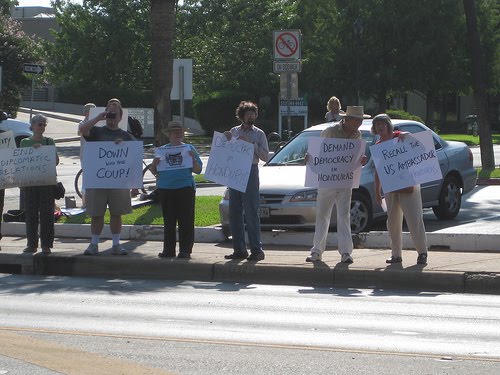
Honduras : Resistance and Repression Intensify

Photos from Indymedia Honduras.

Thousands march in Tegucigalpa
Military responds with force

By David Holmes Morris / The Rag Blog / August 14, 2009

Resistance and repression continue to intensify in Honduras after a week-long march by opponents of the golpista government.

After as long as eight days on the road, thousands of citizens from throughout the country walked into the capital, Tegucigalpa, and the second-largest city, San Pedro Sula, on Tuesday and Wednesday, August 11 and 12, where they were met by the military and the police in full riot gear and armed with tear gas, rubber bullets and M-16s. There are reports of large numbers of injuries and arrests.

Photo from Ja Jornada / Mexico City.

On Tuesday, marchers and students at the Universidad Pedagógica, in Tegucigalpa, a teacher’s college, set fire to a bus and to a fast-food restaurant identified with the U.S. and broke windows at a second U.S.-identified restaurant near the campus.

Photos from Indymedia Honduras.

In recent days, the U.S. State Department and President Barack Obama have angered Hondurans opposed to the coup by declining to take decisive action against the de facto government. At a press conference in Guadalajara, Mexico, last Friday, Obama said in response to a question about the coup, “I can’t press a button and suddenly reinstate Mr Zelaya.”

Obama further stated, “It is important to note the irony that the people that were complaining about the U.S. interfering in Latin America are now complaining that we are not interfering enough.”

The Rag Blog

Posted in Rag Bloggers | Tagged , , , | 2 Comments

Whole Foods Founder John Mackey : Reactionary on Health Care Reform


Whole Foods founder John Mackey speaks out against health care reform in Wall Street Journal

…we should be trying to achieve reforms by moving in the opposite direction — toward less government control and more individual empowermentWhole Foods founder John Mackey.

By Aptoklas / August 12, 2009

The typical Whole Foods customer tends to be educated, liberal and urbane and I would venture to guess supportive of President Obama and his attempt to reform health care so the richest country on earth no longer has a health care system ranked 37 in terms of coverage and efficiency. It is cruel that we are the only industrialized country on earth that does not mandate universal healthcare coverage for our citizens.

Whole Foods advertises their values as including:

Caring about our communities & our environment

Whole Foods does not care about the members of its communities who need true health care reform. It comes as a shock that John Mackey, Co-Founder and CEO of Whole Foods has an OpEd in todays Wall Street Journal titled: The Whole Foods Alternative to ObamaCare

He offers talking points straight out of the GOP and Health Insurance lobby play book such as:

the last thing our country needs is a massive new health-care entitlement that will create hundreds of billions of dollars of new unfunded deficits and move us much closer to a government takeover of our health-care system. Instead, we should be trying to achieve reforms by moving in the opposite direction — toward less government control and more individual empowerment.

He in essence recommends high deductible policies i.e. $2,500-5,000 with HSA’s. He also advocates the end of consumers having the rights to file lawsuits.

He also states that state laws should be curtailed that mandate the type of coverage Insurance Companies should be required to offer. Pray tell what mandates is he referring to? Cancer treatments, mammograms?

Whole Foods is known to be anti-union. Their founder has now thrown down the gauntlet and shown them to be anti-progressive and frankly a threat to the health and well being of millions who do not have health insurance and those who could barely afford it. So much for being a “Holistic Caring Company.”

It’s up to you to decide whether to frequent this store but remember, their superficial catering to liberal sensibilities is enriching those opposed to all you hold sacred.

Up to you if you want to be taken for a sucker.

Feel free to contact them:

U.S. National Offices
World Headquarters
Whole Foods Market, Inc.
550 Bowie Street
Austin, TX 78703-4644
512.477.4455
512.477.5566 voicemail
512.482.7000 fax

Source / Daily Kos

For previous Rag Blog articles on Whole Foods Market, the increasingly reactionary politics and policies embraced by founder John Mackey and the increasingly conventional nature of the “organic” giant’s inventory, go here.

The Rag Blog

Posted in RagBlog | Tagged , | 16 Comments

Red-Baiting and Racism : Socialism as the New Black Bogeyman

Obama as Joker: Poster currently being distributed in Los Angeles.

Red-baiting and racism:
When ‘socialism’ isn’t really about socialism

This noise is about race. It is about ‘othering’ a President who is seen as a symbol of white dispossession: dispossession of white hegemony, white entitlement, white expectation, and white power…

By Tim Wise / August 12, 2009

Throughout the first six months of his administration, President Obama — perhaps one of the most politically cautious leaders in contemporary history — has been routinely portrayed as a radical by his opponents on the far-right. In particular, persons who have apparently never actually studied Marxism (or if they did, managed to somehow find therein support for such things as bailing out banks and elite corporations) contend that Obama is indeed a socialist.

Reducing all government action other than warmaking to part of a larger socialist conspiracy, the right contends that health care reform is socialist, capping greenhouse gas emissions is socialist, even providing incentives for driving fuel efficient cars is socialist. That the right insists upon Obama’s radical-left credentials, even as they push an Obama=Hitler meme (something they apparently think is fair, since, after all the Nazis were National Socialists, albeit the kind who routinely murdered the genuine article) only speaks to the special brand of crazy currently in vogue among the nation’s reactionary forces.

As real socialists laugh at these clumsily made broadsides, and as scholars of actual socialist theory try and explain the absurdity of the analogies being drawn by conservative commentators, a key point seems to have been missed, and it is this point that best explains what the red-baiting is actually about.

It is not, and please make note of it, about socialism. Or capitalism. Or economics at all, per se.

After all, President Bush was among the most profligate government spenders in recent memory, yet few ever referred to him in terms as derisive as those being hurled at Obama. Even when President Clinton proposed health care reform, those who opposed his efforts, though vociferous in their critique, rarely trotted out the dreaded s-word as part of their arsenal. They prattled on about “big government,” yes, but not socialism as such. Likewise, when Ronald Reagan helped craft the huge FICA tax hike in 1983, in a bipartisan attempt to save Social Security, few stalwart conservatives thought to call America’s cowboy-in-chief a closet communist.

And many of the loudest voices at the recent town hall meetings — so many of which have been commandeered by angry minions ginned up by talk radio — are elderly folk whose own health care is government-provided, and whose first homes were purchased several decades ago with FHA and VA loans, underwritten by the government, for that matter. Many of them no doubt reaped the benefits of the GI Bill, either directly or indirectly through their own parents.

It is not, in other words, a simple belief in smaller government or lower taxes that animates the near-hysterical cries from the right about wanting “their country back,” from those who have presumably hijacked it: you know, those known lefties like Tim Geithner and Rahm Emanuel. No, what differentiates Obama from any of the other big spenders who have previously occupied the White House is principally one thing — his color. And it is his color that makes the bandying about of the “socialist” label especially effective and dangerous as a linguistic trope.

Indeed, I would suggest that at the present moment, socialism is little more than racist code for the longstanding white fear that black folks will steal from them, and covet everything they have. The fact that the fear may now be of a black president, and not just some random black burglar hardly changes the fact that it is fear nonetheless: a deep, abiding suspicion that African American folk can’t wait to take whitey’s stuff, as payback, as reparations, as a way to balance the historic scales of injustice that have so long tilted in our favor.

In short, the current round of red-baiting is based on implicit (and perhaps even explicit) appeals to white racial resentment. It is Mau-Mauing in the truest sense of the term, and especially since Obama’s father was from the former colonial Kenya! Unless this is understood, left-progressive responses to the tactic will likely fall flat. After all, pointing out the absurdity of calling Obama a socialist, given his real policy agenda, will mean little if the people issuing the charge were never using the term in the literal sense, but rather, as a symbol for something else entirely.

To begin with, and this is something often under-appreciated by the white left, to the right and its leadership (if not necessarily its foot-soldiers), the battle between capitalism and communism/socialism has long been seen as a racialized conflict. First, of course, is the generally non-white hue of those who have raised the socialist or communist banner from a position of national leadership. Most such places and persons have been of color: China, Vietnam, North Korea, Cuba, assorted places in Latin America from time to time, or the Caribbean, or in Africa. With the exception of the former Soviet Union and its immediate Eastern European satellites — which are understood as having had state socialism foisted upon them, rather than having it freely chosen through their own revolutions from below — Marxism in practice has been a pretty much exclusively non-white venture.

And even the Russians were seen through racialized lenses by some of America’s most vociferous cold warriors. To wit, consider what General Edward Rowney, who would become President Reagan’s chief arms negotiator with the Soviets, told Manning Marable in the late 1970s, and which Marable then recounted in his book, The Great Wells of Democracy:

“One day I asked Rowney about the prospects for peace, and he replied that meaningful negotiations with the Russian Communists were impossible. ‘The Russians,’ Rowney explained, never experienced the Renaissance, or took part in Western civilization or culture. I pressed the point, asking whether his real problem with Russia was its adherence to communism. Rowney snapped, ‘Communism has nothing to do with it!’ He looked thoughtful for a moment and then said simply, ‘The real problem with Russians is that they are Asiatics’.”

In the present day, the only remaining socialists in governance on the planet are of color: in places like Cuba or Venezuela, perhaps China (though to a more truncated extent, given their embrace of the market in recent decades) and, on the lunatic Stalinist fringe, North Korea. These are the last remaining standard-bearers, in leadership positions, who would actually use the term socialist to describe themselves.

Given the color-coding of socialism in the 21st century, at the level of governance, to use the label to describe President Obama and his administration, has the effect of tying him to these “other” socialists in power. Although he has nearly nothing in common with them politically or in terms of his policy prescriptions, he is a man of color, so the connection is made, mentally, even if it carries no intellectual or factual truth.

Secondly, and even more to the point, we must remember what “socialism” is, especially in the eyes of its critics: it is, to them, a code for redistribution. Of course, some forms of socialism are more redistributive than others, and even late-stage capitalism tends to engage in some forms of very mild redistribution (as with the income tax code). But if you were to ask most who grow apoplectic at the mere mention of the word “socialism” for the first synonym that came to their mind, redistribution is likely the one they would choose. Surely it would be among their top two or three.

Now, given the almost instinctual connection made between socialism and redistribution, imagine what many white folks would naturally assume when told that this man, this black man, this black man with an African daddy, was a socialist. Even if those using the term didn’t intend it to push racial buttons (and that is a decidedly large “if”), the fact remains that for many, it would almost certainly prompt any number of racial fears and insecurities: as in, the black guy is going to take from those who work and give to those who don’t. And naturally, we all know (or at least our ill-informed prejudices tell us) who’s in the first group and who’s in the second one.

Thus, the joke making the rounds on the internet, and likely in your workplace, about Obama planning on taxing aspirin “because it’s white and it works.” Or the guy with the sign at the April teabagger rally, which read, Obama’s Plan: White Slavery. Or others who have carried overtly racist signs to frame their message: signs suggesting that Obama hopes to provide care for all brown-skinned illegal immigrants, while simultaneously murdering the white elderly, or that cast the President in decidely simian imagery, and refer to him, crudely but clearly as a monkey.

Or Glenn Beck’s paranoid screed from late July, which sought to link health care reform, and virtually every single piece of Obama’s political agenda to some kind of backdoor reparations scheme. This, coupled with Beck’s even more unhinged claim to have discovered a communist/black nationalist conspiracy in the administration’s Green Jobs Initiative. All because the initiative is headed up by author and activist Van Jones: a guy whose recent book explains how to save capitalism through eco-friendly efforts at development and job creation.

So even there, it isn’t about socialism, so much as the fact that Jones is black, and was once (for a couple of months) a nationalist, and has a goatee, and looks determined (read:mean) in some of his more contemplative press photos.

Fact is, the longstanding association in white minds between social program spending and racial redistribution has been well-established, by scholars such as Martin Gilens, Kenneth Neubeck, Noel Cazenave, and Jill Quadagno, among others. Indeed, it was only the willingness of past presidents like FDR to all but cut blacks out of income support programs that convinced white lawmakers and the public to sign on to any form of American welfare system in the first place: a willingness that waned as soon as people of color finally gained access to these programs beginning in the 50s and 60s.

But even as strong as the social program/black folks association has been in the past, it has, until now, never had a black face to put with the effort. With a man of color in the position of president, it becomes far more convincing to those given to fear black predation already. It isn’t just that the government will tax you, white people. It’s that the black guy will. And for people like him. At your expense.

Much as the white right blew a gasket at the thought of bailing out homeowners with sub-prime and exploding mortgages a few months back (and if you listened to the rhetoric on the radio it was hard to miss the racial animosity that undergirded much of the conservative hostility to the idea, since they seemed to think only persons of color would be helped by such a plan), they now too often view Obama’s moves to more comprehensive health care as simply another way to take from those whites who have “played by the rules” and give to those folks of color who haven’t.

Even as millions of whites would stand to benefit from health care reform — and all whites, as with people of color would enjoy greater choices with the very public option that has drawn the most fire — the imagery of the recipients has remained black and brown, as with all social programs; and the imagery of the persons who would be taxed for the effort has remained hard-working white folks.

By allowing the right to throw around terms like socialist to describe the President and socialism to describe his incredibly watered-down, generally big business friendly approach to health care, while not recognizing the memetic purpose of such arguments, is to ensure that the right will succeed in their demonization campaign. To respond by pointing out how the plan really isn’t socialist, or how Obama really isn’t a socialist misses the point, which was never, in the end, about economic systems or philosophies: none of which the folks on the right raising the most hell show any signs of understanding anyway.

This noise is about race. It is about “othering” a President who is seen as a symbol of white dispossession: dispossession of white hegemony, white entitlement, white expectation, and white power, unquestioned and unchallenged from the darker skinned other. This is what animates the every move of the angry masses, individual exceptions notwithstanding.

Unless the left begins pushing back, and insisting that yes, the old days are gone, white hegemony is dead, and deserved its demise, and that we will all be better off for it, the chorus of white backlash will only grow louder. So too will it grow more effective at dividing and conquering the working people who would benefit — all of them — from a new direction.

Source / Progressives for Obama

The Rag Blog

Posted in RagBlog | Tagged , , , , , , , | 6 Comments

Former Insurance Exec Says Industry Behind Town Hall Disruptions

Wendell Potter on Rachel Maddow Show

Whistleblower: Insurance firms ‘very much’ behind town hall disruptions

The health insurance companies ‘are very much behind the town hall disruptions that you see and a lot of the deception that’s going on in terms of disinformation that many Americans, apparently, are believing.’ — Wendell Potter, former insurance executive.

By David Edwards and Daniel Tencer / August 11, 2009

Health insurance companies deserve “a great deal of the blame” for the sometimes violent disruptions to town hall meetings on health care, says a former health insurance company executive turned whistleblower.

Wendell Potter, a former executive with health insurer Cigna who now works as the senior fellow on health care at the Center for Media and Democracy, told MSNBC’s Rachel Maddow that health insurance companies “are very much behind the town hall disruptions that you see and a lot of the deception that’s going on in terms of disinformation that many Americans, apparently, are believing.”

On her show Monday night, Maddow cited statistics from the Securities and Exchange Commission showing that profits at the U.S.’s ten largest health insurance companies skyrocketed more than 400 percent between 2000 and 2007, from $2.4 billion in 2000 to $12.7 billion in 2007.

“Apparently while they quadrupled their profits, the number of Americans without health insurance grew by 19 percent,” Maddow said.

And she also pointed out that the average total take-home pay for the CEOs of those health insurance companies was $11.9 million each, per year, “while the number of Americans without health insurance, for whom a burst appendix can mean bankruptcy, has gone through the roof.”

Asked why health care costs are going up, Potter told Maddow: “Since 1983… the amount of money that insurance companies take in in premiums — less and less of that is going to pay medical claims.”

Potter said that the money health insurers spend on health care for their policy-holders has dropped from 95 percent of revenue to around 80 percent. Although Potter did not elaborate on why that is, presumably it has to do with higher bureaucratic costs, increased advertising budgets, other tangential activities not directly related to health care — and higher profit margins.

“Another thing is they kick people off the rolls when they do get sick or injured,” Potter said. “Also, they’re paying fewer claims.”

Potter suggested that health insurers’ fears of a public health alternative are unfounded, because they can still make money with a public plan in place.

“They could [turn a profit], absolutely. I’ve seen the health insurance industry change its business models many times. The insurance companies who operate now are very different from the companies that operated a few years ago and the one thing they know how to do is make money.”

Source / the raw story

The Rag Blog

Posted in RagBlog | Tagged , , , | 6 Comments

Texas : Transportation Projects in Big Trouble

Moving right along. From Mr. Ed’s Old Car Pictures.

“If the physical scientists who warn about limits to growth are right, confronting the global economic meltdown implies far more than merely getting the banks and mortgage lenders back on their feet. Indeed, in that case we face a fundamental change in our economy as significantas the advent of the industrial revolution.

“We are at a historic inflection point — the ending of decades of expansion and the beginning of an inevitable period of contraction that will continue until humanity is once again living within the limits of Earth’s regenerative systems.

“But there are few signs that policy makers understand any of this. Their thinking appears to be shaped primarily by mainstream economists’ assurances that growth can and must continue into the indefinite future, and that the economic contraction the world is currently experiencing is only temporary–a problem that can and must be solved.”

Richard Heinberg, author and commentator

CAMPO Meeting:
Screwups mean financial problems, delays, for transportation projects

By Roger Baker / The Rag Blog / August 11, 2009

CAMPO is the federally mandated bureaucracy responsible for approving federal funds for roads in Austin and its surrounding counties. (Campo is the Capital Area Metropolitan Planning Organization.)

At the CAMPO meeting last night in Austin, the big news was huge new money problems facing TIP (Transportation Improvement Program) projects (mostly roads) the next few years.

Basically, TxDOT (Texas Department of Transportation) screwed up once again on a massive scale in terms of its binding commitments around the state. As a result, CAMPO will only be getting a small fraction of the anticipated Category 2 Metropolitan Mobility funds going into the Austin area for TIP projects for 2010 and 2011.

(This probably stems from expensive commitments that TxDOT made in the salad days of yore, like pass-through tolling and whatever. Under Ric Williamson, TxDOT didn’t take financial constraints very seriously). Perhaps on the order of $4 million now expected to be going into the CAMPO area instead of the anticipated $20 million or more for these years. These funds are considered by TxDOT to be approved but postponed.

But a delay of two years for the many projects in the TIP not funded by stimulus money is a big deal, meaning that many of these projects will likely NEVER get built. Some idea of the difficulty that CAMPO now faces is that it is hiring a financial guy just to scrounge up money.

CAMPO is reserving big money for new corridor studies that it indicated may be handled by other agencies. These are barely described in the backup but will cost about $1.7 million. This corridor study funding may, I suspect, signal a big shift in thinking, perhaps toward
rail, since road funding is in such trouble, locally, statewide, and nationally (oil addiction is an expensive habit).

Austin is VERY close to exceeding (if one critical reading moves up a bit more than 1% in the next few months, bang!, its over) its federal ozone limits that would trigger a whole new and (from the standpoint of CAMPO, nightmarish) redoing of their existing planning effort.

CAMPO actually admitted last night that its long-range planning effort might be pretty academic given its current finances. I would go on to say it’s total garbage already, due to the combined effect of oil, water, and dollar shortages. (Since world oil production has probably already peaked, there is likely to be another debilitating oil price spike before CAMPO’s TIP funds from TxDOT could be restored to “normal” in 2012.)

CAMPO is now getting proprietary NEPAssist software free from TxDOT. TxDOT is apparently encouraging all its MPOs to use this software to speed up environmental studies on roads. Its database has maps of stuff like recharge features. And even the form letters where you fill in local data to generate form letters to federal officials, all according to the proper protocol.

The Rag Blog

Posted in Rag Bloggers | Tagged , , , | 1 Comment

Leonard Peltier : Your Support Could Make the Difference


The clock ticks ever faster for Leonard Peltier

Leonard’s release would do much to begin the healing process between the native community and the U.S. government.

By Harvey Wasserman / The Rag Blog / Austust 11, 2009

By Tuesday, August 18, the four sitting members of the Federal Parole Commission must decide whether they will let Leonard Peltier rejoin his family.

Leonard has been in prison for a staggering 33 years, six more than Nelson Mandela. When he was locked up, Three Mile Island was three years away, and Ronald Reagan had barely begun to run for President.

Leonard has great grandchildren he has never held.

His most recent hearing was June 28. According to his lawyer, Eric Seitz, it went very well. The Parole Commission had 21 days from then to issue its decision.

We are now in the final week.

All those familiar with the case agree that a positive political climate can affect the decision. Calls to politicians (202-224-3121) could make all the difference, as could overnight letters to the Parole Commission.

Below are two draft letters the attorney has termed “a little melodramatic but otherwise OK.” Your own versions are more than welcome.

Leonard’s release would do much to begin the healing process between the native community and the U.S. government. He has handled himself through this torturous third of a century with astonishing dignity, grace and eloquence.

Please do not let this moment go by without doing SOMETHING.

DRAFT LETTER ONE:

Dear Commissioners,

Isaac Fulwood, Jr., Cranston Mitchell, Edward Reilly and Patricia Cushware

Leonard Peltier is a man of deep sensitivities and compassion. It’s no accident he has become a figure of tremendous empathy and personal pain all over the world.

For 33 years he has maintained his dignity and composure under incredibly difficult circumstances. He is now approaching the age of 65, and suffers from a wide range of ailments that threaten his continued existence. He has grandchildren and great-grandchildren he has never seen.

Leonard has a community of relations and supporters desperately awaiting his return. His freedom will come as a huge boost to our country’s standing in the world. It will begin a desperately-needed healing process between our government and the native peoples of our own country and around the globe.

I urge you to look into your hearts at this man who has spent more than half his life behind bars and reunite him at last with his family.

Thank you,

DRAFT LETTER TWO:

To: US Parole Commission

Commissioners Isaac Fulwood, Jr., Cranston Mitchell, Edward Reilly and Patricia Cushware

Dear Commissioners.

It is in your power to right a great wrong, to grant a man and his children, grandchildren and great-grandchildren the right to live the rest of their lives together in peace, and to remove a great stain from the global reputation of the American justice system.

For more than half his life, Leonard Peltier has been held in prison for a crime millions of people worldwide do not believe he committed.

Throughout his imprisonment, Mr. Peltier has conducted himself with extraordinary dignity and grace. His behavior has become an inspiration to countless citizens within the United States and virtually everywhere else on Earth.

Leonard Peltier’s time in prison now exceeds that of Nelson Mandela by six years. Yet he is viewed with much the same reverence and respect as the man who went from a jail cell to the presidency of the nation that put him there. When Mandela was finally set free, the system of racial hatred and separation that plagued South Africa began to crumble, to the betterment of all.

Leonard Peltier was a young man when he entered the prison system; he is now nearly 65. He is plagued with diabetes and a range of other serious illnesses that make it highly possible further imprisonment could result in his death, an outcome of horrific personal and political implications for all Americans. We would all have his blood on our hands.

To follow the history of the legal proceedings that put Leonard Peltier in prison is to journey enter a nightmare of missing documents, perjured testimony, implausible accusations and an impossible conviction.

It is not our intent here to reproduce the massive record surrounding this case. But we would be remiss to say any thing other than this incarceration is viewed throughout the world as a blight on the reputation of American jurisprudence.

We believe that 33 years of imprisonment meets the standard of cruel and unusual punishment set out in the Eighth Amendment to the Constitution of the United States. Its drafters would have freed Leonard Peltier long ago. Indeed, we do not believe great legal thinkers such as James Madison, Thomas Jefferson and John Adams would have put Mr. Peltier in prison in the first place.

Every day Leonard Peltier is kept behind bars drives a wedge that grows deeper between this nation’s government and its native population. His time in jail is viewed with great antipathy by native populations, and their supporters, throughout the world.

This is a five-century wound that can only begin to heal when Leonard Peltier is released. We ask that you bring to yourselves and the rest of this nation the great relief that will accompany Leonard Peltier’s return to his family.

Thank you,

For more information go to leonardpeltier.net.

For previous material on The Rag Blog by and about Leonard Peltier, go here.

The Rag Blog

Posted in Rag Bloggers | Tagged , , , , , , | 4 Comments