What’s in a Name? ‘César Chávez Blvd’ and Dallas’ Own Border Fence

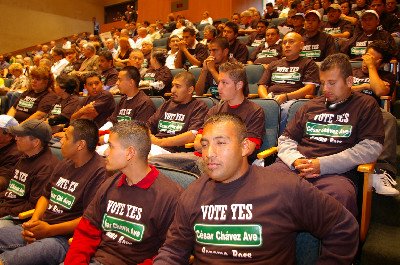
Supporters of renaming a Dallas street for César Chávez crowd a City Planning Commission meeting at Dallas City Hall.

Dallas: Latino Heroes Need Not Apply

right-wing, anti-immigrant forces… dig in their heels and draw their own border fence to block Latino street names…

By Randy Shaw

Although Latinos are the largest ethnic community in Dallas, comprising 43% of the population, few streets are named for Latinos. This could have changed after Dallas’s political leadership announced that in May 2008 that it would rename a major thoroughfare (now Industrial Blvd.) on the basis of an online/telephone poll among twelve potential names. The winner, with 52% of the 22000 votes cast, was César Chávez Blvd.

But the committee supervising the vote, which included City Council members, clearly did not anticipate such an outpouring for César Chávez. It announced that the vote was not binding — i.e., irrelevant due to the outcome — and recommended changing the name to Riverfront Blvd. The Council approved this.

The Council’s flagrant ignoring of the city’s poll results did not sit well with the Latino community.

Alberto Ruiz, Chairman of the César Chávez Task Force, told the North Dallas Gazette, “When they do call for a vote, the citizens take the time to vote and give input to the city and to have that vote overwhelming in favor of one outcome. Then to have that outcome rejected outright was seen by many as a slap in the face.”

Since the Council refused to rename Industrial Blvd after Chávez, activists have pushed to rename another street. City political leaders indicate a desire to find the appropriate street, but the slow pace of their efforts continues to frustrate Latinos and other Chávez backers.

Is the Problem Chavez, or Street Renaming?

As noted above, many oppose street renaming for fiscal and business reasons, as well as out of a desire to preserve the past. But for many others, a group perhaps disproportionately represented on newspaper comment blogs, renaming a street for César Chávez is part of a continuum of increasing demands made by Latino immigrant rights advocates and their supporters.

To the extent that right-wing, anti-immigrant forces feel under siege from a “liberal” media and now the Obama presidency, they at least have control of their local communities. Until, that is, Latino and labor activists start demanding that streets be renamed for César Chávez.

At that point, nothing is safe. So people dig in their heels and draw their own border fence to block Latino street names.

Source / BeyondChron.com / Posted May 15, 2009

Thanks to Jeff Jones / The Rag Blog

Posted in RagBlog | Tagged , , , | 1 Comment

Democracy in Israel with No Freedom of the Press?

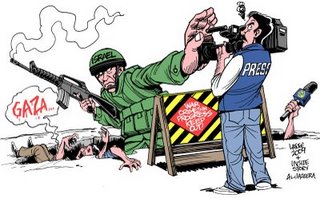
©Khalil Bendib

Stop The Press! This is What Israeli Democracy Looks Like
By Nima Shirazi / The Rag Blog / May 18, 2009

Telling the truth can be dangerous business.
Honest and popular don’t go hand in hand.
– Lyle Rogers and Chuck “The Hawk” Clarke, Ishtar (1987)

Last Tuesday, prominent Israeli journalist Amira Hass was arrested by Israeli authorities upon entering Israel from Gaza. Hass, a correspondent for the daily Ha’aretz, had been living and working in Gaza for months, reporting on the lives of Palestinians and revealing many devastating truths about the brutalized and besieged community.

Journalists are forbidden to enter Gaza, upon orders from the Israeli military. Clearly, where there are reporters, there may be reports. Where there are reports, there may be knowledge. And when there is knowledge, especially about the Israeli policy of constant aggressive oppression of the Palestinian people, there is sure to be outrage. Truth and dissent are the eternal enemies of history’s oppressors, therefore it is no surprise that Israel wishes to suppress knowledge and publicity of its own indefensible actions.

International press organizations have long condemned Israel’s media ban. Recently, in November 2008, journalists were prevented from acquiring travel visas required to cross into Gaza at the Erez checkpoint – the only entrance to the territory from Israel. Steve Gutkin, the Associated Press bureau chief in Jerusalem and head of the Foreign Press Association, said that the length of the media ban was unprecedented and that there was no “plausible or acceptable” explanation for the ban.

The Foreign Press Association condemned the closure, saying: “We regard this as an unconscionable breach of the Israeli Government’s responsibility to allow journalists to do their jobs in this region,” further explaining that “the international media serve as the world’s window into Gaza providing vital coverage of all aspects of Gazan life to news consumers around the world.”

At a time when Israel had sealed off almost all commercial and humanitarian crossing into the Gaza Strip, the reason was perfectly clear:

“This is Israel’s policy, to not show what’s going on in Gaza,” said Conny Mus, a reporter for Dutch television.

Once the Israeli military began dropping bombs on the residents of Gaza in late December 2008, the freedom of the press to its job was even further curtailed as Israel instituted a complete media blackout. In its attempt to prevent reporters from telling the truth about the massacre in Gaza, the Israeli military defied a ruling from its own Supreme Court that would allow reporters access to the Strip. John Ging, Gaza operations director for the United Nations Relief and Works Agency, agreed: “For the truth to get out, journalists have to get in.”

In defense of limiting press freedoms, Former spokesman for the Israeli army, Nachman Shai, claimed that full news coverage helps “the enemy,” confuses and “destabilizes” the Israeli public. “Today, Israel is trying to control the information much more closely,” he told the New York Times. Israel was intent on controlling public opinion based on its own propaganda, a decision made clear by Aviv Shir-On, deputy director general for media in the Israeli Foreign Ministry, who told the Times during the winter bombardment, “We are trying to coordinate everything that has to do with the image and content of what we are doing…We have talking points and we try to disseminate our ideas and message.”

The Foreign Press Association released another statement, as the Palestinian death toll in Gaza increased horrifically, condemning Israel’s restriction of the press: “The unprecedented denial of access to Gaza for the world’s media amounts to a severe violation of press freedom and puts the state of Israel in the company of a handful of regimes around the world which regularly keep journalists from doing their jobs.”

Controlling the message is vital for Israel and its apologists because truth, morality, and justice are inherently anathema to Zionism. It is through this control that, for decades now, the word Palestinian has been nearly synonymous with the word terrorist, and therefore any resistance to colonialism, imperialism, military occupation, and economic hegemony is deemed irrational, unprovoked, inhuman terrorism. By controlling this message, the Zionist propagandists are able to pull off an astounding slight of hand on reality: the oppressed becomes the oppressor, the culprit becomes the victim, illegal colonization is cultural liberation, aggressive expansion is righteous reclamation, genocide is self-defense, apartheid is security, and ethnic cleansing is peace.

Zionism must rewrite the past in order to somehow gain legitimacy as anything but a wholly racist ideology. In so doing, the Bible becomes a land deed and the displacement, dispossession, and disenfranchisement of an indigenous population becomes the unhappy, though inevitable, consequence of religious nationalism. Without erasing or ignoring the historical and cultural narratives of Palestinians, Israel cannot hide from the painful truth about its ugly past.

This is precisely why, last month, Itamar Shapira, a docent at Yad Vashem, was fired for making reference to the 1948 Deir Yassin massacre and the subsequent Palestinian Nakba during his guided tours. He had pointed out the ruins of the Palestinian village, which can be seen from the grounds of the Holocaust memorial, to a school group. The group’s teacher complained to his superiors and his job was terminated. Shapira, a tour guide for three and a half years, told Ha’aretz, “Yad Vashem talks about the Holocaust survivors’ arrival in Israel and about creating a refuge here for the world’s Jews. I said there were people who lived on this land and mentioned that there are other traumas that provide other nations with motivation…The Holocaust moved us to establish a Jewish state and the Palestinian nation’s trauma is moving it to seek self-determination, identity, land and dignity, just as Zionism sought these things.”

Officials at Yad Vashem, called the “Holocaust Martyrs’ and Heroes’ Remembrance Authority,” claim that Shapira was acting unprofessionally by relating the Holocaust to other historical events. It is the policy of Yad Yashem to classify the Holocaust as a singular and unprecedented occurrence in human history, never to be compared to anything else ever, thereby classifying Jewish suffering as unique and unlike anything any other group of people has ever, or will ever, endure. By promoting this “superiority of suffering,” Yad Vashem is able to deflect all criticism or even acknowledgement of the injustice of Israeli national history and, as a result, the truth of Palestinian history – both past and present – is not only ignored, but denied.

Shapira identified this policy of selective education at Yad Vashem, saying, “It is being hypocritical. I only tried to expose the visitors to the facts, not to political conclusions. If Yad Vashem chooses to ignore the facts, for example the massacre at Deir Yassin, or the Nakba, it means that it’s afraid of something and that its historic approach is flawed.”

Obviously, ignoring facts is the age-old modus operandi of the Zionist enterprise, as evidenced by the “land without a people for a people without a land” propaganda put forth by Zionism’s very first advocates. The whitewashing of historical truths continues to threaten the validity of the Palestinian cultural narrative as newly proposed legislation by Israel’s far-right, ultranationalist party clearly proves. Yisrael Beitenu, the party of Foreign Minister Avigdor Lieberman, is attempting to ban any commemoration of the 1948 Nakba by Israel’s Arab citizens, which make up about 20% of the Israeli population. In its effort to promote ethnosupremacism, the party wishes to punish those that mark the anniversary of Palestinian displacement – when over 700,000 Palestinians were forced from or fled their homes during the Zionist effort to establish a Jewish state on Palestinian land – with jail terms of up to three years.

“The draft law is intended to strengthen unity in the state of Israel and to ban marking Independence Day as a day of mourning,” party spokesman Tal Nahum told Ha’aretz. This type of mandatory unity is deliberately undemocratic and unrepresentative of the whole Israeli population – an unsurprising proposal from a political party that has suggested loyalty oaths for Arab citizens, has specifically denied support for Palestinian self-determination and national sovereignty by not endorsing efforts to establish an independent Palestinian state, and which has been described by many as fascist.

In other undemocratic news, the homes of Israeli peace activists working with the anti-militarist organization New Profile were raided by police, resulting the confiscation of computers and numerous arrests on suspicion of incitement and assisting draft dodgers. Gideon Levy, a stalwart voice for justice and truth in Israel, wrote in Ha’aretz,

The public reacted to the raid with typical indifference; it came just as we were busy enjoying the cheesy Independence Day holiday, complete with songs of self-praise about Israel being the only democracy in the Middle East. But a democracy that raids the homes of political activists is no democracy. Democracies are tested by how they treat the fringes of society.

Locking up three and a half million Palestinians in the occupied territories and denying them basic human rights has already undermined Israel’s pretensions of democracy, but now dangerous cracks are appearing in our Jews-only democracy.

These so-called cracks include, not only the attempt to silence any and all dissent from Israeli peaceniks, but also the (sometimes fatal) shooting of Palestinian and international activists who dare protest the illegal Apartheid Wall that serves to annex even more land in the West Bank. Levy exposes the double standard of the Israeli authorities when it comes to the treatment of peace activists versus that of settlers: “Israel Defense Forces has never shot and killed settlers during a protest, even though they are much more violent than anti-fence protesters.”

Reporter Amira Hass’ arrest came right after her publication of a new article describing why the Israeli government is intent not to promote peace and justice – citing the socio-economic benefits of continued Israeli occupation, land theft, and control over natural resources.

According to Ha’aretz, “Hass was arrested and taken in for questioning immediately after crossing the [Gaza] border, for violating a law which forbids residence in an enemy state.” This explanation can only be followed with a question: How long will it be until Avigdor Lieberman, who dwells in the illegal West Bank settlement of Nokdim, will be arrested on similar charges? Once again, the oxymoronic paradox of Israeli democracy is clear. Colonial expansion is encouraged; reporting the truth is criminal.

Fittingly, Hass’ arrest occurred a mere two days after Freedom House, a US-based NGO that conducts research and advocacy on democracy, political freedom and human rights, downgraded Israel’s press status from “free” to “partly free.” The organization, co-founded in 1941 by Eleanor Roosevelt, justified its reclassification by citing the Israeli government’s actions during the recent Gaza attacks, “including the barring of foreign and local journalists from Gaza, alleged attempt to influence media coverage within Israel and alleged heightened self-censorship by local media outlets.”

Government Press Office head Daniel Seamans, who described Freedom House as a “useless and ridiculous” organization, said that the Israeli government’s decision to prohibit journalists from covering Operation Cast Lead in person was a strategic move. Had the foreign press been allowed into Gaza, he said, “their reports would have had a harsh effect on world public opinion and endangered our ability to meet our goals.” Limiting press freedoms in order to strategically control the message and public opinion? That’s called propaganda.

The Israeli Ministry of Foreign Affairs’ own website has this to say:

Israel is still a young, developing democracy. Although some members of the public question the motives of the press in criticizing the state during wartime, in general, Israeli society comprehends that a free, robust press is crucial to the existence of a strong democracy and a value worth fighting for. Instilling recognition of the dangers of trying to place restrictions on the press, and an understanding by the public of the role played by the Israeli media even under trying conditions, are part of Israel’s challenge in meeting its vision to become a true democratic nation.

Clearly, this is a challenge Israel has yet to overcome and, as such, is not even considered a truly democratic nation by its own government.

George Orwell famously wrote, “During times of universal deceit, telling the truth becomes a revolutionary act.” When journalists and human rights activists face imprisonment – or worse – for doing their jobs, but still do it anyway, we know, not only that Orwell was right, but how vital and necessary it is for the truth to be told in order to fight the forces of repression and silence. Yes, the risks of retribution or fear of intimidation for opposing injustice may be great, but, in the immortal words of Ishtar’s Rogers and Clarke, “being human, we can live with the pain.”

[Nima Shirazi was born and raised in Manhattan. He now lives in Brooklyn and writes the weblog Wide Asleep In America under the moniker Lord Baltimore, where this article was also posted. He can be reached at wideasleepinamerica@gmail.com.]

The Rag Blog

Posted in RagBlog | Tagged , , , | Leave a comment

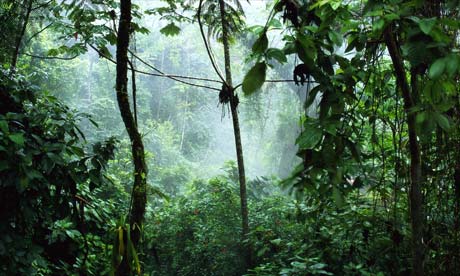
Peruvian Rainforest : Tribes Blockade Roads and Rivers, Government Troops Move in

Huge parts of Peru’s rainforest are threatened by government deals with several multinationals. Photo by / Paul A Souders / Corbis.

Ecology and culture at stake say environmentalists, as government plans to exploit rainforest for oil, gas and timber.

By Rory Carroll / May 18, 2009

Peru’s army is poised to deploy in the Amazon rainforest to lift blockades across rivers and roads by indigenous people opposed to oil, gas, logging and mining projects.

The government has authorised the military to move into remote provinces where a state of emergency has been declared in the wake of a month-long stand-off between indigenous people and police.

President Alan Garcia said the state had the right and responsibility to develop mineral and hydrocarbon wealth to benefit all Peruvians. “We have to understand that when there are resources like oil, gas and timber, they don’t belong only to the people who had the fortune to be born there because that would mean more than half of Peru’s territory belongs to a few thousand people.”

In the past two years the centre-right government has signed deals with multinationals to open swaths of rainforest, including a £1.3bn agreement last month with the Anglo-French oil company Perenco.

Indigenous groups, backed by environmentalists and Catholic bishops, have protested that the developments will devastate the area’s ecology and their culture.

About 65 tribes have mobilised 30,000 people to disrupt roads, waterways and pipelines, leading to skirmishes with police. Up to 41 vessels serving energy companies are stuck along jungle rivers, paralysed by the protests, one private sector source told Reuters.

One of the most tense areas is along the Napo river in northern Peru, said Survival International, a London-based rights advocacy group. “After local indigenous people blockaded the river with a nylon cable, a naval gunboat and three boats belonging to Perenco broke through the blockade, sinking some of the protesters’ canoes in the process.”

The National Organisation of the Amazon Indigenous people of Peru said last week’s declaration of a state of emergency, which suspended some constitutional rights in four jungle provinces, amounted to a declaration of war by the government.

The group responded by calling for an “insurgency” but retracted the term on Saturday after being threatened with 10 years in jail for sedition. Protests will continue but within the rule of law, it said.

The Peruvian rainforest is the largest swath of Amazon outside Brazil. According to one study oil, gas and timber deals would cover an estimated 70% of the forest.

The government says such developments are needed to boost economic growth and state revenues in one of South America’s poorest countries. The projects, which could turn Peru into a net oil exporter, are in line with a free trade deal with the United States.

Alberto Pizango, an indigenous leader, said the tribes – who claim the forest as ancestral land – were not seeking a blanket ban on projects. “What we want is development from our perspective.”

Each side has blamed the other for breakdown in negotiations.

© Guardian News and Media Limited 2009

Source / The Guardian, U.K. / Common Dreams

The Rag Blog

Posted in RagBlog | Tagged , , , , , , | 1 Comment

Howard Zinn : Obama Must Find the Courage to Fight the Old Ways

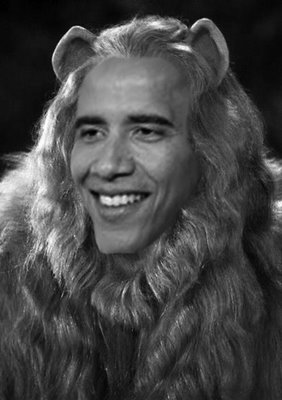
Obama the Politician must find the courage to act on a true vision — of a nation ‘that uses its resources, its wealth, and its power to help people, not to hurt them…’ Image from Cinie’s World.

Finally, someone — Howard Zinn — has publicly addressed Obama’s total failure to confront the employment needs of the almost 10% of the population who are out of work.

The media’s fixation on the bank bailout, climate change, torture, same-sex marriage and health insurance have buried the unemployment issue. Not a single elected official or progressive labor union has called for “full-employment” or subsidized public service jobs. What does that say about the class consciousness of the Democratic Party’s progressive left?

Jeff Jones / The Rag Blog / May 18, 2009

Changing Obama’s Mindset

Obama once said, ‘It’s not enough to get out of Iraq; we have to get out of the mindset that led us into Iraq.’ What happened to that Obama?

By Howard Zinn / May 15, 2009

We are citizens, and Obama is a politician. You might not like that word. But the fact is he’s a politician. He’s other things, too—he’s a very sensitive and intelligent and thoughtful and promising person. But he’s a politician.

If you’re a citizen, you have to know the difference between them and you—the difference between what they have to do and what you have to do. And there are things they don’t have to do, if you make it clear to them they don’t have to do it.

From the beginning, I liked Obama. But the first time it suddenly struck me that he was a politician was early on, when Joe Lieberman was running for the Democratic nomination for his Senate seat in 2006.

Lieberman—who, as you know, was and is a war lover—was running for the Democratic nomination, and his opponent was a man named Ned Lamont, who was the peace candidate. And Obama went to Connecticut to support Lieberman against Lamont.

It took me aback. I say that to indicate that, yes, Obama was and is a politician. So we must not be swept away into an unthinking and unquestioning acceptance of what Obama does.

Our job is not to give him a blank check or simply be cheerleaders. It was good that we were cheerleaders while he was running for office, but it’s not good to be cheerleaders now. Because we want the country to go beyond where it has been in the past. We want to make a clean break from what it has been in the past.

I had a teacher at Columbia University named Richard Hofstadter, who wrote a book called The American Political Tradition, and in it, he examined presidents from the Founding Fathers down through Franklin Roosevelt. There were liberals and conservatives, Republicans and Democrats. And there were differences between them. But he found that the so-called liberals were not as liberal as people thought—and that the difference between the liberals and the conservatives, and between Republicans and Democrats, was not a polar difference. There was a common thread that ran through all American history, and all of the presidents—Republican, Democrat, liberal, conservative—followed this thread.

The thread consisted of two elements: one, nationalism; and two, capitalism. And Obama is not yet free of that powerful double heritage.

We can see it in the policies that have been enunciated so far, even though he’s been in office only a short time.

Some people might say, “Well, what do you expect?”

And the answer is that we expect a lot.

People say, “What, are you a dreamer?”

And the answer is, yes, we’re dreamers. We want it all. We want a peaceful world. We want an egalitarian world. We don’t want war. We don’t want capitalism. We want a decent society.

We better hold on to that dream—because if we don’t, we’ll sink closer and closer to this reality that we have, and that we don’t want.

Be wary when you hear about the glories of the market system. The market system is what we’ve had. Let the market decide, they say. The government mustn’t give people free health care; let the market decide.

Which is what the market has been doing—and that’s why we have forty-eight million people without health care. The market has decided that. Leave things to the market, and there are two million people homeless. Leave things to the market, and there are millions and millions of people who can’t pay their rent. Leave things to the market, and there are thirty-five million people who go hungry.

You can’t leave it to the market. If you’re facing an economic crisis like we’re facing now, you can’t do what was done in the past. You can’t pour money into the upper levels of the country—and into the banks and corporations—and hope that it somehow trickles down.

What was one of the first things that happened when the Bush Administration saw that the economy was in trouble? A $700 billion bailout, and who did we give the $700 billion to? To the financial institutions that caused this crisis.

This was when the Presidential campaign was still going on, and it pained me to see Obama standing there, endorsing this huge bailout to the corporations.

What Obama should have been saying was: Hey, wait a while. The banks aren’t poverty stricken. The CEOs aren’t poverty stricken. But there are people who are out of work. There are people who can’t pay their mortgages. Let’s take $700 billion and give it directly to the people who need it. Let’s take $1 trillion, let’s take $2 trillion.

Let’s take this money and give it directly to the people who need it. Give it to the people who have to pay their mortgages. Nobody should be evicted. Nobody should be left with their belongings out on the street.

Obama wants to spend perhaps a trillion more on the banks. Like Bush, he’s not giving it directly to homeowners. Unlike the Republicans, Obama also wants to spend $800 billion for his economic stimulus plan. Which is good—the idea of a stimulus is good. But if you look closely at the plan, too much of it goes through the market, through corporations.

It gives tax breaks to businesses, hoping that they’ll hire people. No—if people need jobs, you don’t give money to the corporations, hoping that maybe jobs will be created. You give people work immediately.

A lot of people don’t know the history of the New Deal of the 1930s. The New Deal didn’t go far enough, but it had some very good ideas. And the reason the New Deal came to these good ideas was because there was huge agitation in this country, and Roosevelt had to react. So what did he do? He took billions of dollars and said the government was going to hire people. You’re out of work? The government has a job for you.

As a result of this, lots of very wonderful work was done all over the country. Several million young people were put into the Civilian Conservation Corps. They went around the country, building bridges and roads and playgrounds, and doing remarkable things.

The government created a federal arts program. It wasn’t going to wait for the markets to decide that. The government set up a program and hired thousands of unemployed artists: playwrights, actors, musicians, painters, sculptors, writers. What was the result? The result was the production of 200,000 pieces of art. Today, around the country, there are thousands of murals painted by people in the WPA program. Plays were put on all over the country at very cheap prices, so that people who had never seen a play in their lives were able to afford to go.

And that’s just a glimmer of what could be done. The government has to represent the people’s needs. The government can’t give the job of representing the people’s needs to corporations and the banks, because they don’t care about the people’s needs. They only care about profit.

In the course of his campaign, Obama said something that struck me as very wise—and when people say something very wise, you have to remember it, because they may not hold to it. You may have to remind them of that wise thing they said.

Obama was talking about the war in Iraq, and he said, “It’s not just that we have to get out of Iraq.” He said “get out of Iraq,” and we mustn’t forget it. We must keep reminding him: Out of Iraq, out of Iraq, out of Iraq—not next year, not two years from now, but out of Iraq now.

But listen to the second part, too. His whole sentence was: “It’s not enough to get out of Iraq; we have to get out of the mindset that led us into Iraq.”

What is the mindset that got us into Iraq?

It’s the mindset that says force will do the trick. Violence, war, bombers—that they will bring democracy and liberty to the people.

It’s the mindset that says America has some God-given right to invade other countries for their own benefit. We will bring civilization to the Mexicans in 1846. We will bring freedom to the Cubans in 1898. We will bring democracy to the Filipinos in 1900. You know how successful we’ve been at bringing democracy all over the world.

Obama has not gotten out of this militaristic missionary mindset. He talks about sending tens of thousands of more troops to Afghanistan.

Obama is a very smart guy, and surely he must know some of the history. You don’t have to know a lot to know the history of Afghanistan has been decades and decades and decades and decades of Western powers trying to impose their will on Afghanistan by force: the English, the Russians, and now the Americans. What has been the result? The result has been a ruined country.

This is the mindset that sends 21,000 more troops to Afghanistan, and that says, as Obama has, that we’ve got to have a bigger military. My heart sank when Obama said that. Why do we need a bigger military? We have an enormous military budget. Has Obama talked about cutting the military budget in half or some fraction? No.

We have military bases in more than a hundred countries. We have fourteen military bases on Okinawa alone. Who wants us there? The governments. They get benefits. But the people don’t really want us there. There have been huge demonstrations in Italy against the establishment of a U.S. military base. There have been big demonstrations in South Korea and on Okinawa.

One of the first acts of the Obama Administration was to send Predator missiles to bomb Pakistan. People died. The claim is, “Oh, we’re very precise with our weapons. We have the latest equipment. We can target anywhere and hit just what we want.”

This is the mindset of technological infatuation. Yes, they can actually decide that they’re going to bomb this one house. But there’s one problem: They don’t know who’s in the house. They can hit one car with a rocket from a great distance. Do they know who’s in the car? No.

And later—after the bodies have been taken out of the car, after the bodies have been taken out of the house—they tell you, “Well, there were three suspected terrorists in that house, and yes, there’s seven other people killed, including two children, but we got the suspected terrorists.”

But notice that the word is “suspected.” The truth is they don’t know who the terrorists are.

So, yes, we have to get out of the mindset that got us into Iraq, but we’ve got to identify that mindset. And Obama has to be pulled by the people who elected him, by the people who are enthusiastic about him, to renounce that mindset. We’re the ones who have to tell him, “No, you’re on the wrong course with this militaristic idea of using force to accomplish things in the world. We won’t accomplish anything that way, and we’ll remain a hated country in the world.”

Obama has talked about a vision for this country. You have to have a vision, and now I want to tell Obama what his vision should be.

The vision should be of a nation that becomes liked all over the world. I won’t even say loved—it’ll take a while to build up to that. A nation that is not feared, not disliked, not hated, as too often we are, but a nation that is looked upon as peaceful, because we’ve withdrawn our military bases from all these countries.

We don’t need to spend the hundreds of billions of dollars on the military budget. Take all the money allocated to military bases and the military budget, and—this is part of the emancipation—you can use that money to give everybody free health care, to guarantee jobs to everybody who doesn’t have a job, guaranteed payment of rent to everybody who can’t pay their rent, build child care centers.

Let’s use the money to help other people around the world, not to send bombers over there. When disasters take place, they need helicopters to transport people out of the floods and out of devastated areas. They need helicopters to save people’s lives, and the helicopters are over in the Middle East, bombing and strafing people.

What’s required is a total turnaround. We want a country that uses its resources, its wealth, and its power to help people, not to hurt them. That’s what we need.

This is a vision we have to keep alive. We shouldn’t be easily satisfied and say, “Oh well, give him a break. Obama deserves respect.”

But you don’t respect somebody when you give them a blank check. You respect somebody when you treat them as an equal to you, and as somebody you can talk to and somebody who will listen to you.

Not only is Obama a politician. Worse, he’s surrounded by politicians. And some of them he picked himself. He picked Hillary Clinton, he picked Lawrence Summers, he picked people who show no sign of breaking from the past.

We are citizens. We must not put ourselves in the position of looking at the world from their eyes and say, “Well, we have to compromise, we have to do this for political reasons.” No, we have to speak our minds.

This is the position that the abolitionists were in before the Civil War, and people said, “Well, you have to look at it from Lincoln’s point of view.” Lincoln didn’t believe that his first priority was abolishing slavery. But the anti-slavery movement did, and the abolitionists said, “We’re not going to put ourselves in Lincoln’s position. We are going to express our own position, and we are going to express it so powerfully that Lincoln will have to listen to us.”

And the anti-slavery movement grew large enough and powerful enough that Lincoln had to listen. That’s how we got the Emancipation Proclamation and the Thirteenth and Fourteenth and Fifteenth Amendments.

That’s been the story of this country. Where progress has been made, wherever any kind of injustice has been overturned, it’s been because people acted as citizens, and not as politicians. They didn’t just moan. They worked, they acted, they organized, they rioted if necessary to bring their situation to the attention of people in power. And that’s what we have to do today.

[Howard Zinn is the author of “A People’s History of the United States,” “Voices of a People’s History” (with Anthony Arnove), and “A Power Governments Cannot Suppress.” Thanks to Alex Read and Matt Korn for transcribing Zinn’s talk on February 2 at the Busboys and Poets restaurant in Washington, D.C., from which this is adapted.]

© 2009 The Progressive All rights reserved.

Source / The Progressive / AlterNet

The Rag Blog

Posted in RagBlog | Tagged , , , | 2 Comments

Climate Change Disaster : Too Late for Prevention?

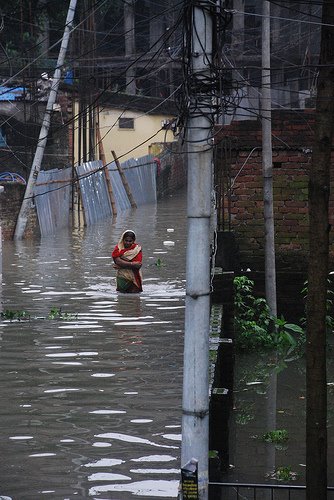
Flooding in Bangladesh in 2007. A serious rise in sea levels seems impossible to prevent. Photo by Sumaiya Ahmed / Flickr.

Low-lying island nations like the Maldives — they’re goners now, let alone in a couple of generations, when they will be interesting places for scuba outings.

By Steve Russell / The Rag Blog / May 18, 2009

I was supposed to be in Nashville this weekend with Al Gore, getting updated on the very latest climate science. A family problem has kept me away, but I’ve been paying enough attention regularly to be pretty pessimistic.

I’m thinking that it’s time to give up prevention, more or less, and focus policy on mitigation.

For some areas of the country, that means building codes should start now to anticipate a serious rise in sea level that it seems impossible to prevent. We are talking about either copping technology from The Netherlands or allowing some of the most expensive real estate in the country to be immersed: South Florida, the Bay Area in California, Manhattan Island. Adjust the building codes now and mitigation is cheaper in the coming generations.

For those who would get nasty with China and India — pish and tosh. Not only is there a lot of truth in their arguments, they are going to hurt so much more than us from their own failure to see the writing on the wall that anything we could do would be piling on. As in, two of the largest urban areas of China and most of the Ganges Delta under water.

Low-lying island nations like the Maldives — they’re goners now, let alone in a couple of generations, when they will be interesting places for scuba outings.

Agriculture will be disrupted, not destroyed. We are better fixed than less developed countries to keep our farmers up to date on which crops will no longer work and which will.

But countries where agriculture is focused in river deltas — say, Egypt — are going to have problems unless wheat learns to drink salt water.

Is it possible to advocate mitigation policies when we could not sell prevention policies? I dunno, but what are the choices?

Cap and trade didn’t accomplish shit in Europe, something Obama knows and could account for… if the Repugs and Conservadems were not poised to kill ANY cap and trade, while a direct carbon tax (the simpler solution) is as off the table as single payer health care and for the same reason — smart people know it’s the best idea but there are too many knuckledraggers remaining in Congress for the best ideas to have traction.

When will we learn that there’s no negotiation with Mother Earth?

The Rag Blog

Posted in Rag Bloggers | Tagged , , , | 4 Comments

Singin’ on Sunday – Madeleine Peyroux


Madeleine Peyroux – Bare Bones

The third album in four years from song interpreter extraordinaire Madeleine Peyroux, Bare Bones is both an extension of the currents of 2004’s Careless Love and 2006’s Half the Perfect World and a bold step into previously unexplored psychological terrain. Produced, like its two predecessors, by Larry Klein, this fluid and enthralling new work is Peyroux’s most personal yet, hardly surprising considering she had a hand in writing each of the 11 songs, marking the fulfillment of a lifelong dream.

River of Tears – Larry Klein/Madeleine Peyroux, 2009

“This really is a new experience for me. It’s almost as if I got to make my first record again,” she says. “Larry really was the first person who ever said to me, ‘Let’s write every song on the record. You should do this.’ I’d co-written with Larry a couple of times in the past, but this was a big leap for me as a writer, and also a deep exploration as a co-writer,” Peyroux continues, “not only in the experience of writing but also the message I wanted to portray. Like the end of any event being up all night, or when the rain stops and the sun comes out, it’s a transitional moment of getting past some kind of struggle.”

Each of these 11 songs is like a gem, revealing its myriad facets one by one as it turns in the mind of the listener ‘Instead,’ co-written with her friend Julian Coryell, begins the album on a marvelously life-affirming note: “Instead of feelin’ bad, be glad you’ve got somewhere to go,” she purrs in her stunningly evocative alto, “Instead of feelin’ sad, be happy you’re not all alone / Instead of feelin’ low, get high on everything that you love/ Instead of wastin’ time, feel good ’bout what you’re dreamin’ of.”

Madeleine Peyroux Web site

Madeleine on MySpace

Madeleine on Wikipedia

Source / Madeleine Peyroux Bio

The Rag Blog

Posted in RagBlog | Tagged , | Leave a comment

Oil: The Equalizer in US/Cuba Relations?


Cuba’s Undersea Oil Could Help Thaw Trade With U.S.
By Nick Miroff / May 16, 2009

Deep in the Gulf of Mexico, an end to the 1962 U.S. trade embargo against Cuba may be lying untapped, buried under layers of rock, seawater and bitter relations.

Oil, up to 20 billion barrels of it, sits off Cuba’s northwest coast in territorial waters, according to the Cuban government — enough to turn the island into the Qatar of the Caribbean. At a minimum, estimates by the U.S. Geological Survey place Cuba’s potential deep-water reserves at 4.6 billion barrels of oil and 9.8 trillion cubic feet of natural gas, stores that would rank the island among the region’s top producers.

Drilling operations by foreign companies in Cuban waters are still in the exploratory stage, and significant obstacles — technological and political — stand between a U.S.-Cuba rapprochement eased by oil. But as the Obama administration gestures toward improved relations with the Castro government, the national security, energy and economic benefits of Cuban crude may make it a powerful incentive for change.

Limited commercial ties between U.S. businesses and the island’s communist government have been quietly expanding this decade as Cuban purchases of U.S. goods — mostly food — have increased from $7 million in 2001 to $718 million in 2008, according to census data.

Thawing relations could eventually open up U.S. investment in mining, agriculture, tourism and other sectors of Cuba’s tattered economy. But the prospect of major offshore reserves that would be off-limits to U.S. companies and consumers has some Cuba experts arguing that 21st-century energy needs should prevail over 20th-century Cold War politics.

“The implications of this have the potential to be a sea change, literally and figuratively, for the Cubans,” said Jonathan Benjamin-Alvarado, a political scientist at the University of Nebraska-Omaha who studies Cuba’s energy sector.
ad_icon

At a House subcommittee hearing last month on U.S.-Cuba policy, former oil executive Jorge Piñón told lawmakers that the United States has a strategic interest in helping Cuba tap its potentially vast hydrocarbon stores and that U.S. companies should receive special permission to do so.

“American oil and oil equipment and service companies have the capital, technology and operational know-how to explore, produce and refine in a safe and responsible manner Cuba’s potential oil and natural gas reserves. Yet they remain on the sidelines because of our almost five-decade-old unilateral political and economic embargo,” said Piñón, a member of a Brookings Institution advisory group on Cuba policy reform.

Cuba has said it welcomes U.S. investment, but American companies remain largely silent on the issue, at least in public, bound by trade sanctions that were established under the Kennedy administration. When Cuban oil officials and U.S. companies attended a joint energy conference at an American-owned hotel in Mexico in 2006, the Bush administration forced the facility to expel the Cuban delegation, attempting to thwart any potential for partnership.

“Until trade barriers are removed, Chevron is unable to do business in Cuba,” said Chevron spokesman Kurt Glaubitz. “Companies like us would have to see a change in U.S. policy before we evaluate whether there’s interest.”

Robert Dodge, a spokesman for the American Petroleum Institute, said his organization is not lobbying for access to Cuba, and Texas congressional representatives with ties to the oil industry said they are focused on opening U.S. territorial waters to drilling. But observers of U.S.-Cuba relations say American companies haven’t been sitting on their hands and remain in conversations with Cuban counterparts.

At the 2006 Mexico energy conference, U.S. oil companies “all had plans to move forward as soon as the U.S. government gives them the go-ahead,” said Benjamin-Alvarado, who attended the conference.

If that go-ahead is granted, American companies would be entering a drilling contest crowded with foreign competitors. Several global firms, including Repsol (Spain), Petrobras (Brazil) and StatoilHydro (Norway) are exploring in the Gulf of Mexico through agreements with the Castro government, and state companies from Malaysia, India, Vietnam and Venezuela have also signed deals.

Sherritt International, a Canadian company, has had oil derricks pumping heavy crude along Cuba’s north coast for more than a decade, extracting about 55,000 barrels a day, mostly for Cuba’s domestic energy consumption.

But most of Cuba’s undiscovered reserves are thought to be in two offshore areas. The oil and gas that make up the USGS estimate lie in an area known as the North Cuba Basin, a short distance off the island’s northwest coast.

The larger deposit is thought to be in a section of the gulf known as the Eastern Gap, to which Mexico and the United States also have a claim. Cuban officials believe there are 10 billion to 15 billion barrels of crude stored there under more than 5,000 feet of seawater and 20,000 feet of rock– costly to extract but accessible with existing technology. By comparison, U.S. proven reserves total 21 billion barrels.

The Eastern Gap area is also coveted by American companies, but in Florida, where anti-Castro and anti-drilling sentiments run high, the Cuban government’s energy ambitions have alarmed lawmakers who see the threat of ecological calamity in Cuba’s plans to drill in that part of the gulf.

“They’d be drilling right in the Gulf Stream,” Sen. Bill Nelson (D-Fla.) said in a telephone interview, describing a nightmare scenario in which ocean currents could carry spilled crude into Florida’s marine sanctuaries and blacken beaches along the Eastern Seaboard.

“There would be a monumental disaster,” he said. “There simply should not be drilling out there.”
ad_icon

Other U.S. lawmakers said oil deals with the Cuban government would throw a lifeline to the island’s feeble economy and the 50-year rule of Fidel and Raúl Castro. They also question how reliable a partner Cuba would be.

“What if we make those investments and then U.S. assets are nationalized?” Rep. Darrell Issa (R-Calif.) asked after last month’s subcommittee hearing.

Because it would take three or more years for Cuba to fully develop its energy resources, according to Piñón, U.S. participation in the island’s energy sector could benefit a Cuban government not necessarily led by Fidel, 82, or Raúl, 78. Helping Cuba develop its own reserves, he said, would allow the island to gain the political independence and economic footing needed to negotiate a reconciliation with the United States without outside interference.

“Since Fidel Castro’s 1959 revolution, Cuba’s communist government has had to largely rely on foreign providers — first the Soviet Union, now Venezuela — to fulfill its energy needs,” Piñón said.

Cuba’s “petroleum dependency” on Hugo Chávez’s government “could be used by Venezuela as a tool to influence a Cuban government in maintaining a politically antagonistic and belligerent position toward the United States,” he said.

Source / Washington Post

Thanks to Jeff Segal / The Rag Blog

Posted in RagBlog | Tagged , , , | Leave a comment

Has Liberalism ‘Jumped the Shark?’

Image from The Lockeroom.

Just like the right-wing would like to force their religion on all Americans ‘for their own good,’ many liberals would like to pass ‘Nanny State’ laws for the good of all Americans.

By Ted McLaughlin / The Rag Blog / May 17, 2009

The 1950’s was a low point for liberalism in the United States. Due to organizations like the House Committee on Un-American Activities and the John Birch Society, and individuals like Joseph McCarthy and Roy Cohn, liberals were driven underground or out of the country. Being a liberal meant losing the right to work or even being imprisoned. By the end of the 50’s, Liberalism was nearly dead in America.

But in the mid-sixties, it experienced a re-birth. It began at the University of California at Berkley, when Mario Savio and his cohorts started what they called the “Free Speech Movement.” It was originally intended just to give students at that university the right to speak freely about their political views. It accomplished that, but became much more, as it spread across the country — first in the colleges and then in society at large.

Fueled by the “baby boomers” born right after World War II, this new liberalism was different than pre-war liberalism. It was no longer socialist-based, although it pushed many of the same causes like economic justice and civil rights, but was a more general freedom-based movement. It preached equality and the right of the individual to believe what they wanted and to act like they wanted and live like they wanted, as long as they didn’t step on the rights of others to do the same.

No longer was the individual expected to be an automaton — a replica of their parents who said and did what they were told. The individual had rights which must be respected by authority and the highest value was freedom. Frankly, it was exciting to be a part of this movement in the 60’s and 70’s.

But some time in the 80’s and 90’s, liberalism began to go “off the track.” I don’t quite know how it happened, but “free speech” gave way to “political correctness.” While mouthing a belief in free speech, many liberals will be quick to condemn and sometimes even try to outlaw certain forms of speech. They seem to have forgotten that when you outlaw offensive speech, you have outlawed freedom (and the very thing that gave birth to modern liberalism).

Just as bad is the “Nanny State.” Just like the right-wing would like to force their religion on all Americans “for their own good,” many liberals would like to pass “Nanny State” laws for the good of all Americans. They want to force Americans to stop smoking with exorbitant tobacco taxes, or tell them where they can and can’t smoke. They want to pass laws punishing Americans for drinking sodas high in sugar. They want to pass laws to outlaw certain cooking oils in resturants. They would like to force all Americans to recycle their trash.

Maybe all these things are good and would probably improve a person’s life and maybe even prolong it, but I have to wonder what ever happened to freedom — the idea that an American has the right to make his/her own choices? In a truly free country, doesn’t a citizen have the right to make a poor choice?

These days, those of us on the left understand that the right-wing can result in tyranny, but many seem to have forgotton that just like you can have a right-wing tyranny, you can also have a left-wing tyranny. And it’s my opinion that both are equally bad.

If you believe something is good and citizens should do it to make their life better or longer or healthier, then by all means do what you can to educate people about it. But when you pass a law forcing that behavior, you have gone too far.

In a free country, each citizen has the right to make their own choices, even if those in power believe those choices to be bad ones. Liberalism used to mean freedom, but for many these days it means something else. That’s why I no longer call myself a liberal. I am a leftist, a radical, a socialist or a progressive, but I believe liberalism has strayed from its meaning and prefer not to be labeled as such.

That’s what I think. What do you think — especially those of you on the left? Am I wrong? Should government have the right to force people into making better decisions?

[Rag Blog contributor Ted McLaughlin also posts at jobsanger, an excellent Texas political blog.]

The Rag Blog

Posted in Rag Bloggers | Tagged , , | 4 Comments

Cartoon: The Health Care Reform Plan


Source / Seattle P-I

Thanks to Jeffrey Segal / The Rag Blog

Posted in RagBlog | Tagged , , | 1 Comment

Dick Cheney and The Curse of the Pomegranate Seeds

Image by Larry Ray / The Rag Blog.

No one is happier than Hades, chortling down in his dark homey hell while topside the earthly GOP, Guardians of Pomegranates, urged on by Hades’ emissary, Dark Dick, pass out the fruit’s sweet seeds to their dwindling hard core members. . .

By Larry Ray / The Rag Blog / May 17, 2009

There are emerging scholarly theories about former Vice President Dick Cheney’s lifelong allergy to pomegranates which could be at the center of his secretive, imperious, angry and delusional behavior and his lifelong health problems.

Mr. Cheney is part of the estimated 1.24% to 16.8% of the population considered “at risk” for having an anaphylactic reaction if they eat, are injected with or even inhale one or more allergens. Anaphylaxis comes from the Greek, meaning “against protection.” Anaphylactic shock can attack those severely allergic to a bee sting, or even a pomegranate, causing a serious blockage of the airway, an extreme drop in blood pressure and can lead to death in a matter of minutes if left untreated.

For this reason, Mr. Cheney has always had within arm’s reach what is commonly called a “bee sting kit” which has a preloaded syringe containing epinephrine (adrenaline) to keep the heart beating, and other compounds to keep one breathing. Early in his political career a staffer, and more recently a Secret Service agent, has constantly been at the ready with the little zippered pouch in case a bit of killer pomegranate makes it down the Veep’s gullet.

So with this bit of basic Mr. Wizard science background under our belts, let’s look at why Dick Cheney might have been a nice guy with, say a peanut or bee sting allergy instead of the curse of the pomegranate. It all has to do with the Greek connection.

The pomegranate features mightily in the complex Greek story of Zeus’s daughter Persephone who was snatched by Zeus’s brother Hades, Lord of the underworld, and taken below to become his Queen. Now, when you get snatched and taken to the dark side, the deal is that if you don’t eat, you can eventually return back up to light and goodness. Persephone’s mother, Demeter, became so distraught at the loss of her daughter she neglected the earth which had droughts and became barren. It got so bad that Hades relented and called Hermes to take Persephone back home to momma.

But, just as Persephone was leaving, Hades gave her a pomegranate to eat. She knew the deal about eating and not being able to return to earth, but she was famished and ate seven pomegranate seeds. Well. . . you can figure out the ending. She got to return to the happy world to be with mom and dad, but poor Persephone had cut a deal with the devil. She wound up having to return to Hades four months out of the year. It wound up giving us winter and summer, but, those damned pomegranate seeds!

Actually pomegranate juice has powerful antioxidant properties and is used to treat a variety of maladies, most notably cardiovascular disease, stroke and heart attack. Medical researchers also claim great benefit in interrupting the process of atherosclerosis which is the clogging of arteries due to excessive fat deposits.

Mr. Cheney has earned the diagnostic title of “vasculopath” with an almost 30-year history of coronary atherosclerosis, with his first heart attack when he was only 37. No one is sure when he ate his first pomegranate seeds, or how many he ate, but clearly he was damned to the dark side early on, and as a result was not even allowed to have any more of the sweet, potentially health benefiting fruit. The deal with Hades was already made.

To many, it is clear that Cheney didn’t get a short four-month deal like Persephone. He clearly spends lots more time down in the underworld’s dark side than she did. Cheney’s official press releases have conveniently described him as being in “an undisclosed location.”

His buddy Hades has lately been giving Mr. Cheney more weekend passes than in years past so he can spend more time up here in the light to appear on radio and TV to spread his dark message. He has been reveling in his angry, convoluted attacks upon truth, transparency and change by America’s new Democratic leaders and majority voters.

Hades and Cheney working together, make Machiavelli’s schemes pale by comparison. They have even cleverly lured Speaker Pelosi into a torturous lose-lose series of public appearances and defensive statements where her political armor has finally been pierced. . . by her own spear.

No one is happier than Hades, chortling down in his dark homey hell while topside the earthly GOP, Guardians of Pomegranates, urged on by Hades’ emissary, Dark Dick, pass out the fruit’s sweet seeds to their dwindling hard core members, and unsuspecting malcontents.

Hopefully Hades will soon cut out the weekend passes, and Dark Dick will return to his undisclosed location. . . for good. But he mustn’t forget his bee sting kit because there is always the possibility he will eventually finally even tee off Hades, who certainly will have his pomegranate waiting for him.

[Retired journalist Larry Ray is a Texas native and former Austin television news anchor. He also posts at The iHandbill.]

The Rag Blog

Posted in Rag Bloggers | Tagged , , | 1 Comment

Meditation Helps Veterans with PTSD

Dr. David Kearney, standing, a veterans-hospital physician, conducts a mindfulness-based stress-reduction class that uses meditation and yoga techniques to combat chronic pain, depression, anxiety and post-traumatic stress disorder. In front is Stephen Brakus. Photo: Courtney Blethen, Seattle Times.

Seattle hospital teaches meditation to troubled vets
By Michelle Ma / May 17, 2009

The Seattle veterans hospital is teaching patients a form of meditation to ease their post-traumatic stress disorder. The technique called mindfulness-based stress reduction helps patients deal with anxiety, chronic pain and other health issues.

After four combat tours — two in Iraq and two in Afghanistan — normal life seemed impossible for one Seattle Army veteran.

His heart raced when driving under an overpass, and he had trouble breathing when stuck in snarled traffic. As a soldier in combat, he wouldn’t dare slow down for fear of being bombed or shot.

Crowded rooms were just as bad. He locked himself away at home and drank instead of facing large groups or loud, sudden noises. He responded to the slightest sense of threat with all-out aggression.

Last summer, the 34-year-old sergeant sought help at the Seattle veterans hospital, enrolling in group and individual therapy and starting medication to treat what doctors diagnosed as post-traumatic stress disorder (PTSD).

He also practices a form of meditation he learned through the VA Puget Sound Health Care System that has eased the horrific memories that bombarded his mind.

The technique, called mindfulness-based stress reduction, seeks to help patients deal with anxiety, chronic pain and other health issues through meditation, yoga and deep-breathing exercises.

“It’s like the thoughts lost their hook,” the Seattle veteran said. “Before, they were just ripping me. With mindfulness, it opens up the blinders, and you realize (those thoughts) are not the totality of your existence forever.”

He asked not to be named because he’s looking for a job and worries employers won’t hire him if they know about his PTSD.

Dr. David Kearney, a veterans-hospital physician and associate professor at the University of Washington, has offered veterans the eight-week course in mindfulness-based stress reduction for more than a year.

Kearney is running the first study of its kind to determine whether the course is effective in treating PTSD among veterans. Those taking classes this spring and summer will contribute to Kearney’s study, which is funded by Puget Sound Partners for Global Health, a local research consortium funded by the Gates Foundation.

Mindfulness treatment asks participants to be aware of their thoughts and physical pain without judgment. It’s easy to stew over negative thoughts, which can cause more stress and frustration.

By simply pausing to pay attention, people can notice patterns in their thinking and put thoughts into perspective to improve their lives. Deep breathing, meditation and yoga help with this process.

Scientific studies have shown the technique can help patients with a range of issues, including anxiety, depression, chronic pain and rheumatoid arthritis. Kearney hopes to add PTSD to that list.

“I quickly found that people with PTSD sought out the class to find additional ways of dealing with this problem,” he said. “We’ve had many patients report to us the ability to be present in the actual moment helped their PTSD.”

Lessens anxiety

PTSD is an anxiety disorder caused by traumatic experiences such as war or sexual assault. At the local veterans hospital, psychologists estimate 10-20 percent of combat veterans have the disorder.

Matthew Brazerol of Bremerton recently retired after serving 20 years in the U.S. Coast Guard. He enrolled in the VA’s mindfulness class last spring after chronic pain and PTSD became debilitating.

“I came in with an open mind willing to try anything,” he said.

Brazerol’s responsibilities included recovering bodies and rescuing people. He said those cumulative experiences probably contributed to his anxiety. As the years progressed, Brazerol, 47, felt jumpy and anxious, and he would flinch at the sound of footsteps from anyone he couldn’t identify.

After completing the mindfulness course, Brazerol said, his symptoms are less frequent. Practicing the meditation throughout the day helps him adjust his reaction to a painful memory, and he isn’t as anxious.

“If you incorporate this into your life, it will help you regardless of what’s going on,” Brazerol said.

Not based on religion

Mindfulness treatment uses some Buddhist meditation principles, but the course isn’t based on religious teachings. The classes were designed several decades ago by a physician at the University of Massachusetts Medical School.

In the last decade, mindfulness treatment has spread to hundreds of hospitals and clinics. In Seattle, Swedish Medical Center, Evergreen Healthcare and the veterans hospital are among those offering the technique.

Studies show that our thoughts can initiate a stress response in our bodies. First, we start thinking about a problem or concern. As we ruminate on these thoughts, the brain can send stress-response signals to other parts of the body, causing a faster heartbeat, shallow breathing and tense muscles. Prolonged stress can cause health problems.

But if we train ourselves to pause when that first thought enters the mind, we can largely control our physical response, studies have shown. Exercises such as deep breathing and meditation also help calm the body.

“The story we tell ourselves has a lot to do with the whole unfolding of the actual situation,” said Dr. Jeff Brantley, director of the mindfulness program at Duke Integrative Medicine at Duke University Health System.

Wary of yoga mats

For people with PTSD, sounds and situations resembling a past traumatic event can trigger an anxious reaction. Kearney says his patients usually don’t forget their traumatic experiences but can learn to live comfortably without having those memories take charge.

In other types of PTSD treatment, patients talk through painful memories and immerse themselves in experiences that cause the anxiety. While that form of therapy can be successful, veterans typically have a 25 percent dropout rate, said Matthew Jakupcak, a psychologist at the local VA’s deployment health clinic.

In Seattle, the mindfulness classes have steadily drawn more interest among veterans — though many at first are wary of the yoga mats and meditation.

“It works, but I was skeptical,” said Herb Washington, 46, who completed the course last year. The Oak Harbor resident fought in the first Gulf War and has suffered from chronic pain and diabetes. Washington was born with a foot condition that became aggravated in the military.

His pain isn’t gone, but he doesn’t depend so much on pain medication. He said he feels anger and frustration slip away when he does his mindfulness routine.

“It’s a structured discipline,” Washington said. “That’s why I think it’ll be effective for veterans.”

More information

Mindfulness-based stress reduction

University of Massachusetts Center for Mindfulness: www.umassmed.edu/content.aspx?id=41252

Swedish Medical Center: www.swedish.org/body.cfm?id=1207

VA Puget Sound Health Care System mindfulness course: 206-277-1721

PTSD information

National Center for Post Traumatic Stress Disorder: www.ncptsd.va.gov/ncmain

Copyright © 2009 The Seattle Times Company

Source / Seattle Times

The Rag Blog

Posted in RagBlog | Tagged , , | 2 Comments

What Will We See with the Democratic Majority? Probably Not Much …

Speaker of the House Nancy Pelosi (D-CA) (2nd R) talks about tax legislation during a news event with (L-R) Rep. Gary Peters (D-MI), Majority Leader Rep. Steny Hoyer (D-MD), Ways and Means Committee Chairman Rep. Charles Rangel (D-NY) and Rep. Steve Israel (D-NY). Photo: Chip Somodevilla/Getty Images.

Excuses You Might Believe In: Democrats Are More Powerful Than Ever. How Will They Justify Doing Nothing?
By Ted Rall / May 15, 2009

NEW YORK – The defection of Pennsylvania’s Arlen Specter and the imminent certification of Al Franken as the winner of Minnesota’s election recount has handed Democrats what they always said they lacked in order to pass a progressive agenda: a filibuster-proof majority in the U.S. Senate. Now they face the awful problem of coming up with new excuses for not doing anything.

How will Obama, Nancy Pelosi, Harry Reid and other fake liberals weasel out of making good on their promises for real action on healthcare, the economy and the war? It won’t be easy. They control both houses of Congress and the White House. Obama is about to fill a new vacancy on the Supreme Court. The Times of London writes that “Mr. Obama, by some assessments, has more political leverage than any president since Franklin Roosevelt in 1937”–at the peak of the New Deal, just before he overreached by trying to pack the Supreme Court.

The Republican Party, on the other hand, is suffering a crisis of faith–too much God-cheering and not enough adherence to core values like small government, fiscal conservatism, isolationism and protectionist trade policy. A mere 21 percent of Americans still call themselves Republicans, the lowest number since 1983. Similarly, reports the latest ABC News/Washington Post poll, “just 21 percent say they’re confident in the Republicans in Congress ‘to make the right decisions for the country’s future,’ compared with 60 percent who express that confidence in Obama.”

Democrats have never been as powerful. Republicans are weak. Obama won with a decisive, sweeping rejection of the Republican status quo. Harry and Louise, call your agents–socialized medicine is on the way! Not.

Be careful what you wish for–what you say you wish for, anyway. “The left is going to push Obama–now that he’s got a veto-proof majority–to drive an agenda that a smart president would realize is a long-term political disaster,” GOP pollster Rick Wilson tells ABC. “Long-term political disaster” is mainstream media code for “stuff that corporations hate.”

Well, yes. What passes for the left in this country (center-right everywhere else, because they read) now has some not-unreasonable questions for Barack Obama. Such as:

Pretty please, can we now live in a country where people don’t have to spend $800 a month to health insurance companies that deny their customers’ claims?

Why are we still in Iraq?

How about some help for the victims of Katrina, many of whom never collected one red cent after losing everything?

Why are we paying billions to banks and still letting them gouge us with 25 interest credit card rates? Speaking of which:

How about doing something that might actually help people who live in the economy, rather than just capital markets?

These queries seem all the more relevant coming, as they do, from the liberal base of the Democratic party–the people who got Obama elected.

The trouble for our cute, charming prez is that he has no intention whatsoever of introducing a true national healthcare plan: one that covers everybody for free. He wants to expand the war in Afghanistan and drag out the one against Iraq. He will not punish Bush or his torturers, rescue homeowners in foreclosure, or nail scumbag banks to the wall. These changes would cost trillions of dollars to multinational insurance companies, defense contractors and other huge financial concerns who donate generously to candidates of both political parties and have a history of using their clout to manipulate elections in favor of their favorite candidates. A classic example is oil companies, who push down gas prices before elections in order to help Republicans.

The most that Democratic voters can expect from Democratic politicians is incremental, symbolic change that doesn’t cost their corporate sponsors any serious coin. The New York Times marked Obama’s 100th day in office with an editorial that approvingly encapsulated his accomplishments to date: “He is trying to rebuild this country’s shattered reputation with his pledge to shut down the prison camp in Guantánamo Bay, Cuba, his offer to talk with Iran and Syria, and, yes, that handshake with Venezuela’s blow-hard president, Hugo Chávez…The government is promoting women’s reproductive rights. It is restoring regulations to keep water clean and food safe. The White House has promised to tackle immigration reform this year.”

Trying. Promoting. Has promised.

Guantánamo isn’t being closed; it’s being moved. Gitmo’s detainees will be transferred to a new harsher gulag under construction in Afghanistan. Thawed relations with Iran and Syria would create new business opportunities for big oil. Defending the right to an abortion is popular and doesn’t cost Bank of America a dime. Immigration reform is code for legalizing illegal immigrants, not closing the border. Safety regulations reassure consumers and pump up the economy. Closing the border would raise wages. Corporations won’t allow that.

Unfortunately for Obama’s Democrats, small-bore initiatives only go so far, especially with the economy in meltdown. When people are desperate and angry they don’t care as much about flag-burning or creationism or a handshake with Hugo Chávez. They want action–real action.

How will the Democrats avoid genuine change now that they enjoy the ability to enact it? Will they blame obstructionist Republicans? Will Democrats cross the aisle to vote with the Republicans? A new war, perhaps?

If nothing else, whatever dog-ate-my-homework excuse they come up with for sitting on their butts is bound to be amusing. If nothing else.

[Ted Rall is the author of the new book “Silk Road to Ruin: Is Central Asia the New Middle East?,” an in-depth prose and graphic novel analysis of America’s next big foreign policy challenge. Visit his website www.tedrall.com.]

Source / Information Clearing House

The Rag Blog

Posted in RagBlog | Tagged , , | Leave a comment