Pakistanis Not So Optimistic About US Policy

Taleban supporters in Swat, 21 February 2009.

Pakistan pessimism at Obama revamp
By M Ilyas Khan / March 27, 2009

Pakistan’s foreign minister may have welcomed the new Obama regional initiative but the immediate feeling among political commentators was generally one of pessimism.

In Moscow for a conference on Afghanistan, Foreign Minister Shah Mehmood Qureshi said: “I think the new Obama administration’s approach is a very positive approach. They are looking towards a regional approach to the situation.

“Pakistan is willing to play an active, constructive role in this because we feel our peace and security is linked to Afghanistan’s,” he told Reuters news agency.

For Pakistan, the key issue in the strategy review will be the so-called “safe havens” for militants in the Afghan border regions and what the US intends to do about them.

Drone attacks

It was what Barack Obama did not say rather than what he did that exercised some analysts.

There was no mention of the increasing US drone missile attacks on militants on Pakistani soil.

[Obama] has also said there won’t be any blank cheques, which means Pakistan will have to do their bidding to earn that money. Rahimullah Yusufzai

“The drift of the speech suggests that drone attacks will increase, and their area may be expanded to Balochistan [province] as well,” leading journalist Rahimullah Yusufzai told Geo TV.

Analyst Zahid Hussain agreed it appeared that “in the coming days the Americans would be more aggressive in the border region, with US troops possibly pursuing the militants into Pakistani tribal areas”.

“This is likely to create more pressure on Pakistan,” he told the BBC.

Former army man Lt Gen Talat Masood disagreed with the new regional US policy.

“Lumping Pakistan with Afghanistan means that Afghanistan’s problems have been heaped on Pakistan.”

Gen Masood said he believed that an increase of foreign troops in Afghanistan would only bring a matching Taleban response.

“So there will be a greater level of militant activity and it will affect both Afghanistan and the Pakistani tribal areas,” he told the BBC.

“This will apparently bring more American focus on Pakistan, with concomitant pressure to take actions which are only likely to increase terrorist activities.”

Gen Masood did welcome the tripling of aid.

The drone attacks have caused anger among many in Pakistan.

But, as Mr Yusufzai pointed out, it will come with strings attached.

“[Obama] has also said there won’t be any blank cheques, which means Pakistan will have to do their bidding to earn that money.”

He added: “The reconstruction opportunity zones (ROZ) date back to the Bush era, but nothing was done about it. We’ll see if the Americans put it into practice.”

Mr Hussain agreed that the cash would only come “when Pakistan is able to contain al-Qaeda”.

And while cash for infrastructure was important, he said military aid was just as vital.

“Many military officials complain they are obliged to fight the highly-armed militants with peace-time equipment,” Mr Hussain said.

Former Finance Minister Sartaj Aziz summed up a general sense of disappointment, saying the Afghan side of the strategy was “not enough of a change”.

“It is mostly a continuation of Bush policy, the only difference being the addition of US civilian officials being brought in to help boost Afghanistan’s economic and social sectors.”

He added: “If the presidential elections in August go well, there may be some hope for a change, but Obama’s new strategy does not identify any new direction as such which could improve the situation.”

Source / BBC News

The Rag Blog

Posted in RagBlog | Tagged , , , | Leave a comment

Militarizing the US/Mexico Border Is Not the Solution to the Drug Battles Taking Place There

Operation Jump Start training in Phoenix, Ariz., Feb. 21, 2007, teaches U.S. Customs and Border Patrol procedures while observing the Arizona-Mexico border for illegal activity. (U.S. Air Force photo by Senior Airman Trisha Harris)

We shouldn’t militarize the U.S.-Mexico border
By Yolanda Chávez Leyva / March 23, 2009

We should not send troops to the U.S.-Mexico border, despite the drug-related violence on the Mexican side.

President Obama, Homeland Security Secretary Janet Napolitano and a variety of other government officials have discussed the possibility of sending the National Guard. Texas Gov. Rick Perry has requested 1,000 troops on his southern border.

To be sure, violence has risen dramatically across the border in the past year and a half. There have been almost 2,000 murders since the beginning of last year in Ciudad Juarez in Mexico, across from my hometown of El Paso in Texas.

I hear stories from friends and acquaintances almost daily of the robberies, kidnappings, carjackings and shootouts.

The local university has undertaken a study of women in Juarez who are experiencing post-traumatic stress syndrome as a result of living in the chaos of ever-increasing violence.

While once a frequent visitor to Juarez, I haven’t crossed the border in months. I grew up on the Texas-Mexico border, but I have never seen this level of violence on the Mexican side.

But do I want troops sent to the border in the name of protecting me?

No.

For more than twenty years, those of us who live on the border have witnessed the increasing militarization of the border. The border wall is a daily reminder of this, as are the helicopters that fly over our neighborhoods, the checkpoints manned by the Border Patrol and local law enforcement, as well as the daily harassment of citizens who happen to have darker skin. We are frequently the target of various “wars” —against undocumented migration, against terrorism and now against drugs. I am tired of living in a war zone.

The model of “war” has not worked, and it will not work.

Too often the war against drugs or terrorism or undocumented immigration turns into violence against innocent civilians.

Too often it turns into human rights abuse.

Too often it becomes a justification for even more violence.

What is the price that those of us living on the U.S. side will be asked to pay because of the possibility that the violence will “spill over” the border?

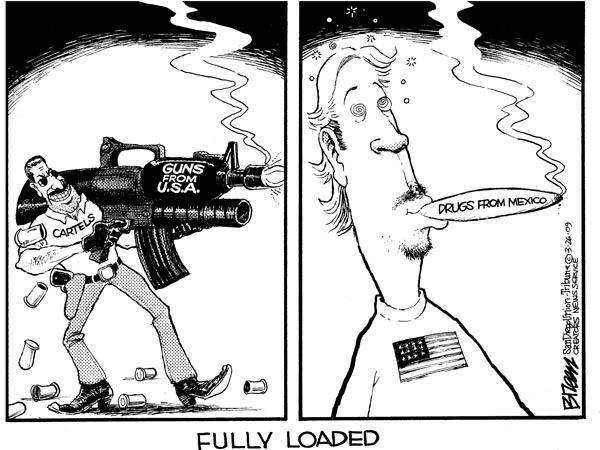
For a change, look at what is spilling over from the United States into Mexico — illegal arms and ammunition from U.S. dealers, laundered drug money and an increasing demand for drugs.

Instead of further funding a military solution that will not work, let’s fund more drug rehabilitation, enforce existing gun laws, and take responsibility for our part in creating the violence.

I look forward to crossing over the border once again in safety.

But that won’t be possible until we stop militarizing this problem and start addressing it at its roots.

[Yolanda Chávez Leyva is a historian specializing in Mexican-American and border history. She lives in Texas. She can be reached at pmproj@progressive.org.]

Source / The Progressive

The Rag Blog

Posted in RagBlog | Tagged , , | 10 Comments

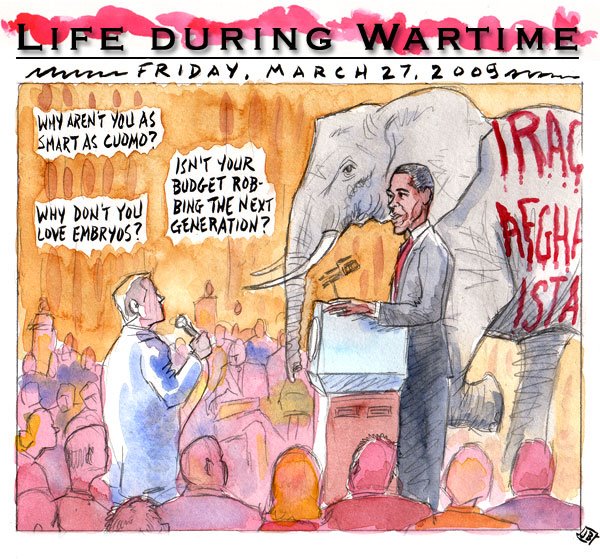
Life During Wartime

Political cartoon by Joshua Brown / Historians Against the War / The Rag Blog

Thanks to Dr. S. R. Keister / The Rag Blog

Posted in Rag Bloggers | Tagged , , | Leave a comment

Star Trek and the ‘Prime Directive’ : We’re Still Meddling

Star Trek’s post-cold war, multi-ethnic, multi-gender and multi-specie crew: early imperialist warriors or noble seekers?

Aboard the Imperial Star Ship Ameriprise…
Heading for the Final Frontier

By William Astore / March 27, 2009

I grew up in the 1970s on reruns of the original Star Trek with Captain James Tiberius Kirk at the helm, backed by that ever logical Vulcan, Mr. Spock, Dr. “Bones” McCoy, and the rest of the intrepid, space-faring crew of the USS Enterprise. During the tumultuous 1960s, that sci-fi series — before being canceled — had pointed to a more promising future in which humanity would be united. Star Trek, after all, offered a vision of a post-racial society in which blacks and Asian-Americans would serve alongside whites as equals, and a post-nationalistic society in which Russian-accented Ensign Chekov could loyally follow a WASPy captain from Iowa.

Even as the Enterprise cruised the distant reaches of our galaxy, the show was distinctly a creature of its moment, of the tensions released by the rise of the civil rights movement and by the Cold War superpower standoff. Minorities were still struggling for equal rights when the first Star Trek aired in 1966, while the U.S. government was just putting the finishing touches on a nuclear command center buried under 2,000 feet of granite that was meant to ride out a possible apocalyptic Russian sneak attack. So, having a black female officer like Lieutenant Uhura and a Russian one like Chekov on the starship’s bridge certainly seemed like one small leap for mankind.

In a way, the Enterprise and its multi-national, alien-inclusive crew was the ultimate American melting pot (and, if you happened to be an aficionado of war films, the ultimate “lost patrol” as well). It was also “a wagon train to the stars.” At least that was how its creator here on Earth, Gene Roddenberry, pitched the series concept to TV network executives at the time. In the early 1960s, remember, such execs were accustomed to green-lighting Westerns like Gunsmoke or Bonanza with lily-white casts, not a sci-fi series set elsewhere in the galaxy with a multi-racial line-up.

Not surprisingly then, Roddenberry re-imagined space as the “final frontier” and sent Kirk and crew off each week, like so many American pioneers of earlier centuries, to “boldly go where no man has gone before.” They were to ride their high-tech wagon into the unknown in search of “new life and new civilizations.” Of course, exploring that final frontier could be dangerous, whether in the American West of the 1800s or hundreds of years later among the stars and planets of the Milky Way.

Accordingly, the Enterprise space wagon was heavily armed with phasers and photon torpedoes: precision weapons that, on rare occasions, may have missed their targets, but in the emptiness of space never left behind embarrassing collateral damage. Besides, wherever our heroic crew journeyed, the Prime Directive of the United Federation of Planets went with them. Peaceful exploration was the singular goal of the Federation, and General Order No. 1 precluded interference, even for humanitarian reasons, in the lives of any developing alien cultures that might be discovered.

Not that that stopped Captain Kirk and crew. They often found themselves in situations where, Prime Directive or not, they were forced to meddle in an alien society’s development. In the Star Trek universe, these attempts at social engineering — in our time they would be termed “humanitarian interventions” or “nation building” — usually yielded promising results. They certainly didn’t lead to the deaths of hundreds of thousands or the displacement of millions. Indeed, we rarely saw such dire results on the show precisely because, unlike American ground troops stationed on other “frontiers,” whether in the 1960s in Vietnam or today in Iraq and Afghanistan, the Enterprise and its crew could always head off at warp speed from ill-judged experiments in social and cultural engineering.

And this being an American vision of the future, even in space the Enterprise never lacked conflict with evildoers. The ship was almost constantly confronted by aggressively hostile aliens, most commonly the militaristic Romulans and Klingons. (In later versions of the series, created on Earth as the Cold War wound down and ended, the Klingons would eventually ally with the Federation and come on board the Enterprise.)

On Board the USS Ameriprise

Looking back at Star Trek, more than four decades after Roddenberry’s vision entered our homes, what’s remarkable is how much it captured a still extant American optimism and an American cultural smugness. The optimism today has been muted, but the smugness — not so much. After all, official American “expeditionary forces” continue to travel the “final frontiers” of our own planet, if not the galaxy, armed to the teeth with our own versions of phasers and photon torpedoes. At the same time, most of us continue to see ourselves as a peace-loving, Federation-like crew, a force for progress, for international cooperation, and above all for good.

Yes, our acts may — these days, more than occasionally — misfire (or quagmire), but our intentions are benevolent, motivated primarily by a desire to serve a higher purpose, even as we seek to enlarge our peaceful federation of allied nations. Unfortunately, like the Star Trek crew, Americans are meddlers. We want to help others even when they don’t want our help, even when our “help” is counterproductive to the normal development of other cultures and countries.

Worse yet: Despite our aspirations, the American spaceship of state — let’s call it the USS Ameriprise — not only resembles the USS Enterprise of the (mostly well-meaning but distinctly meddlesome) Federation, but also, on too many occasions, the Enterprise from a barbarous parallel universe pictured in “Mirror, Mirror,” an episode from the show’s second season.

In it, thanks to a “transporter” accident, four members of the Star Trek crew, including Captain Kirk, switch places with their evil twins and find themselves aboard the Imperial Star Ship (ISS) Enterprise. Among the ISS crew, might makes right. Alien cultures that refuse to provide scarce energy sources (the dilithium crystals that power the starship, not mundane oil as on this planet) are massacred and their resources stolen. Perceived mistakes by crewmembers are punished with “agonizers,” Taser-like miniature zappers applied to the chest just above the heart. Disloyal crewmembers are tortured to extract confessions, or simply slowly tortured to death, by being placed in “the agony booth.” The booth is the ultimate “stress position,” without all the inconvenience of shackles or the messiness of waterboarding. Officers advance in rank by assassination, with Kirk possessing the choicest precision weapon: a device in his quarters capable of killing any person on board with just the touch of a button.

Let’s recap: Alien cultures shocked, awed, and bludgeoned into submission in order to gain control over scarce energy resources; torture used liberally to extract information; precision weapons capable of decapitating the enemy and controlled from a distance via the push of a button.

It’s disturbing how closely the recent journeys of our Ameriprise have come to resemble those of that imperial Enterprise. Yet we’ve hardly seemed to notice, convinced as we were that our ship of state is still the good Enterprise, spreading democracy and freedom, even if meddling in other cultures as well. Perhaps we’ve forgotten that another way to express the wisdom contained in the Prime Directive is: “The road to hell is paved with good intentions.”

But let’s rejoin Kirk on the ISS Enterprise. Aghast to find himself surrounded by such barbarity, he adapts just enough to survive until he is able to rejoin the “good” universe. The question is: Can we, like Kirk, recognize and reject the barbarity around us, even as we resist the temptation to interfere in the lives of others, unless they well and truly ask for, and really need, our help?

Early signs are not good when it comes to the latest Obama-led Ameriprise. Our spaceship of state still seems remarkably addicted to phasers and photon torpedoes, an addiction we refuse to own up to, even as we send one variety of our own spaceships, which we call unmanned aerial drones, over the tribal lands of Pakistan and Afghanistan armed with Hellfire missiles. We also refuse to admit that we’re an imperial power, even as we build new military bases along the final frontiers of our planet, while our military seeks “full spectrum dominance” from the deepest oceans to “the shining stars and beyond” (as one U.S. Air Force advertisement recently put it). We demonize our enemies, turning them into so many Romulans, aliens who are incapable of understanding anything but the blunt, unsparing use of force.

When we look in the mirror, we want to see a peace-loving Federation member staring back at us, not a barbarian from the ISS Enterprise. I certainly do. But even the far friendlier visage of the benevolent Kirk and the logical Spock needs to be considered seriously and critically. For if the Captain and the Vulcan no more saw themselves as imperial meddlers than we normally do, they often found themselves fighting to expand the boundaries of their friendly Federation — and so do we.

In the long run, we may well be able to reject naked barbarity and lust for power. But can we resist the power of our own illusions, of the notion that, despite missteps, mishaps, and mistakes, we’re always a force for good in the world? Can we affirm our own Prime Directive — a reversal of our Monroe Doctrine that defined our boundaries in a different age and time — and vow not to meddle in the affairs of others? For our Ameriprise has its limits, as well as its own pressing problems to solve.

[William J. Astore, a retired lieutenant colonel (USAF), taught for six years at the Air Force Academy. A TomDispatch regular, he currently teaches at the Pennsylvania College of Technology and is the author of Hindenburg: Icon of German Militarism (Potomac Press, 2005), among other works. He may be reached at wastore@pct.edu.]

Copyright 2009 William Astore

Source / TomDispatch

Thanks to Tom Cleaver / The Rag Blog

Posted in RagBlog | Tagged , , , , , | 1 Comment

Economic Crisis Yielding More Homelessness

An encampment of tents under an overpass in Fresno. Photo: Jim Wilson/The New York Times.

Cities Deal With a Surge in Shantytowns
By Jesse McKinley / March 25, 2009

FRESNO, Calif. — As the operations manager of an outreach center for the homeless here, Paul Stack is used to seeing people down on their luck. What he had never seen before was people living in tents and lean-tos on the railroad lot across from the center.

“They just popped up about 18 months ago,” Mr. Stack said. “One day it was empty. The next day, there were people living there.”

Like a dozen or so other cities across the nation, Fresno is dealing with an unhappy déjà vu: the arrival of modern-day Hoovervilles, illegal encampments of homeless people that are reminiscent, on a far smaller scale, of Depression-era shantytowns. At his news conference on Tuesday night, President Obama was asked directly about the tent cities and responded by saying that it was “not acceptable for children and families to be without a roof over their heads in a country as wealthy as ours.”

While encampments and street living have always been a part of the landscape in big cities like Los Angeles and New York, these new tent cities have taken root — or grown from smaller enclaves of the homeless as more people lose jobs and housing — in such disparate places as Nashville, Olympia, Wash., and St. Petersburg, Fla.

In Seattle, homeless residents in the city’s 100-person encampment call it Nickelsville, an unflattering reference to the mayor, Greg Nickels. A tent city in Sacramento prompted Gov. Arnold Schwarzenegger to announce a plan Wednesday to shift the entire 125-person encampment to a nearby fairground. That came after a recent visit by “The Oprah Winfrey Show” set off such a news media stampede that some fed-up homeless people complained of overexposure and said they just wanted to be left alone.

The problem in Fresno is different in that it is both chronic and largely outside the national limelight. Homelessness here has long been fed by the ups and downs in seasonal and subsistence jobs in agriculture, but now the recession has cast a wider net and drawn in hundreds of the newly homeless — from hitchhikers to truck drivers to electricians.

“These are able-bodied folks that did day labor, at minimum wage or better, who were previously able to house themselves based on their income,” said Michael Stoops, the executive director of the National Coalition for the Homeless, an advocacy group based in Washington.

The surging number of homeless people in Fresno, a city of 500,000 people, has been a surprise. City officials say they have three major encampments near downtown and smaller settlements along two highways. All told, as many 2,000 people are homeless here, according to Gregory Barfield, the city’s homeless prevention and policy manager, who said that drug use, prostitution and violence were all too common in the encampments.

“That’s all part of that underground economy,” Mr. Barfield said. “It’s what happens when a person is trying to survive.”

He said the city planned to begin “triage” on the encampments in the next several weeks, to determine how many people needed services and permanent housing. “We’re treating it like any other disaster area,” Mr. Barfield said.

Mr. Barfield took over his newly created position in January, after the county and city adopted a 10-year plan to address homelessness. A class-action lawsuit brought on behalf of homeless people against the city and the California Department of Transportation led to a $2.35 million settlement in 2008, making money available to about 350 residents who had had their belongings discarded in sweeps by the city.

The growing encampments led the city to place portable toilets and security guards near one area known as New Jack City, named after a dark and drug-filled 1991 movie. But that just attracted more homeless people.

“It was just kind of an invitation to move in,” said Mr. Stack, the outreach center manager.

On a recent afternoon, nobody seemed thrilled to be living in New Jack City, a filthy collection of rain- and wind-battered tents in a garbage-strewn lot. Several weary-looking residents sat on decaying sofas as a pair of pit bulls chained to a fence howled.

Northwest of New Jack City sits a somewhat less grim encampment. It is sometimes called Taco Flats or Little Tijuana because of the large number of Latino residents, many of whom were drawn to Fresno on the promise of agricultural jobs, which have dried up in the face of the poor economy and a three-year drought.

Guillermo Flores, 32, said he had looked for work in the fields and in fast food, but had found nothing. For the last eight months, he has collected cans, recycling them for $5 to $10 a day, and lived in a hand-built, three-room shack, a home that he takes pride in, with a door, clean sheets on his bed and a bowl full of fresh apples in his propane-powered kitchen area.

“I just built it because I need it,” said Mr. Flores, as he cooked a dinner of chili peppers, eggs and onions over a fire. “The only problem I have is the spiders.”

Dozens of homeless men and women here have found more organized shelter at the Village of Hope, a collection of 8-by-10-foot storage sheds built by the nonprofit group Poverello House and overseen by Mr. Stack. Planted in a former junkyard behind a chain-link fence, each unit contains two cots, sleeping bags and a solar-powered light.

Doug Brown, a freelance electrical engineer, said he had discovered the Village of Hope while unemployed a few years back and had returned after losing his job in October. Mr. Stoops, of the homeless coalition, predicted that the population at such new Hoovervilles could grow as those without places to live slowly burned through their options and joined the ranks of the chronically homeless, many of whom are indigent as a result of illiteracy, alcoholism, mental illness and drug abuse.

That mix is already evident in a walk around Taco Flats, where Sean Langer, 42, who lost a trucking job in December and could pass for a soccer dad, lives in his car in front of a sturdy shanty that is home to Barbara Smith, 41, a crack addict with a wild cackle for a laugh.

“This is a one-bedroom house,” said Ms. Smith, proudly taking a visitor through her home built with scrap wood and scavenged two-by-fours. “We got a roof, and it does not leak.”

During the day, the camp can seem peaceful. American flags fly over some shanties, and neighbors greet one another. Some feed pets, while others build fires and chat.

Daniel Kent, a clean-shaven 27-year-old from Oregon, has been living in Taco Flats for three months after running out of money on a planned hitchhiking trip to Florida. He did manage to earn $35 a day holding up a going-out-of-business sign for Mervyn’s until the department store actually went of out business.

Mr. Kent planned to attend a job fair soon, but said he did not completely mind living outdoors.

“We got veterans out here; we got people with heart, proud to be who they are,” Mr. Kent said. “Regardless of living situations, it doesn’t change the heart. There’s some good people out here, really good people.”

But the danger after dark is real. Ms. Smith, who lost an eye after being shot in the face years ago, said she had seen two people killed in New Jack City, prompting her to move to Taco Flats and try to quit drugs. Her companion, Willie Mac, 53, a self-described youth minister, said he was “waiting on her to get herself right with the Lord.”

Ms. Smith said her dream was simple: “To get out of here, get off the street, have our own home.”

Source / New York Times

The Rag Blog

Posted in RagBlog | Tagged , , | 1 Comment

Health Care and the Arrogant Republican Elite

Aristocrat 01 by Gabriel Dzieslaw / mixmedia on canvas, 2007.

Also see, ‘Single-payer health reform bill introduced in Senate,’ Below.

‘…one watches the Republican Senate and House “leadership” posturing on television, in their Seville Row suits, sporting their salon or golf course tans, and one wonders why these folks dislike the poor, the ill, and the mentally impaired so very, very much…’

By Dr.Stephen R. Keister / The Rag Blog / March 26, 2009

‘All conservatives are such from personal defects. They have been effeminated by position or nature, born halt and blind, through luxury of their parents, and can only, like invalids, act on the defensive.’ — R.W. Emerson, 1860.

Digressing briefly, from my topic of health care, one watches the Republican Senate and House “leadership” posturing on television, in their Seville Row suits, sporting their salon or golf course tans, and one wonders why these folks dislike the poor, the ill, and the mentally impaired so very, very much. Why do they look on the homosexual as the folks of the 13th century looked upon the leper, confusing central nervous system developmental problems or illnesses with cultural or theological issues? Where do they develop the self assurance that they are right, and everyone else wrong, akin to the judges of the Inquisition? Where do these arrogant, hypocritical, intolerant folks arise from?

If one listens for long to their rantings one feels that they really believe that it is the insolvency of mortgages purchased by the poor that has caused the current financial collapse, while the majority of the so called TV “journalists” shake their heads in agreement. Yet in an editorial in The National Catholic Reporter, March 20, 2009, former Federal Reserve Governor, Randall Kroszner, speaking late last year, pointed out that half of subprime loans went to middle-class or higher-income borrowers, while fewer than 6% of loans made went to low-income borrowers.

This is the same group of our elected representatives, joined by many of the “blue-dogs,” that tell us that national health insurance is “too expensive,” or falsely assert that under a nationally sponsored health care plan one would not have a free choice of physician, or would encounter long waits to be seen. These are the same folks who howl in concert with the NRA that “Obama plans to take our guns,” i.e., the “blue helicopters are coming.” These prostitutes to the insurance and pharmaceutical industries recall Machiavelli’ statement in “The Prince” from 1513: “Men are so simple and yield so readily to the wants of the moment that he who will trick will always find another who will suffer himself to be tricked.”

It is pleasing to see that every day a number of unions and organizations are endorsing universal, single payer, health care. There is a ground-swell among the public to either enact HR 676 or a lesser, and much more fallible plan, the Obama option of an adjunctive public health care plan, i.e. “Medicare for All.” Even the latter throws our Republican and blue-dog friends into uncontrolled rage, for a public plan, administered as well as Medicare, would attract, in time, the majority of citizens, thus decreasing the billions of dollars of profits of the insurance and pharmaceutical industries and reducing the funds available to their lobbyists to buy the votes of “the peoples representatives.”

Early in my days of practice I became aware of one common scam used by the insurers of the sick. As I recall, it was in the 1950s I saw a lady who had cancer of the stomach. Her insurance carrier contended that the “cancer predated her purchase of insurance.” She had purchased the insurance seven years earlier. I sent documentation of the entire episode to the Pennsylvania Insurance Commissioner, and by George, the insurer paid the claim. Over the years when confronted by like foolishness I never failed to find that the Insurance Commissioner was fair and open minded.

The other frequently used ploy by the private insurance companies is hidden in the fine print, i.e., exceptions for a variety of disease conditions. Always remember any insurance company is a business and businesses are formed to make money. Of course, this is in the interest of any of the great American corporations as the Washington Post pointed out in an article by E.J.Dionne, Jr., March 19, 2000. “A study of compensation levels in 2007 found that the average CEO pay at S&P 500 Companies was 344 times higher than the average worker’s wage, and that the top 50 investment fund managers took home 19,000 times as much as the typical workers earned.”

Harper’s Magazine, in April, 2009, issue, points out that a single-payer health care system would create 2,600,000 jobs. The same article notes that the current recession will cause an extra 71,000 deaths. Of these 1,800 will be suicides and 13,000 homicides. The author does not allude to the thousands of deaths yearly, commented upon in prior articles, occurring from pre-existing poverty or lack of health insurance.

The Republicans, when they develop any positive attitude towards health care, appear to like the Massachusetts model. Remember Gov. Romney helped write it! Yet, The Smirking Chimp, of Feb. 27, 2009, quotes Dr. David Himmelstein of Harvard Medical School, who recountes the shortcomings of the plan. The plan has cost much more than anticipated, covering fewer than the promised universal claims and left states like Massachusetts and those who came before them in the same mess now faced throughout the land with soaring costs, inadequate delivery of what is sold as the financial protection called “health insurance” and begging with health systems for more cash. In the same article Dr. Himmelstein recounts the case of a lady with cancer who was obliged to decline chemotherapy because she could not afford to pay the insurance co-payments.

Then there is that now famous case of the McDonalds employee in Arkansas who came to the defense of a female customer who was being attacked by another man. The abuser shot the employee in the chest. The McDonalds workers comp insurance would not pay the $300,000 medical bill because “the employee was not acting during the normal scope of employment.” Unbelievable, yet the Republicans tell us there is nothing better than private insurance.

Whether we have single payer or Medicare for all, the cost of health care must be reduced. Let us start with the costs of pharmaceuticals and eliminate the absurd practice of TV advertising that must add millions to the cost of prescription medications. There is no real point in these ads since no competent physician gets his information from this source and if he bends to the desires of his/her patient who pushes for these items to placate the patient he is an obvious quack. Let us regulate the price of prescription drugs as we do in this country via V.A. pharmacies, or is done by government regulations in the remainder of the civilized world. For instance I am receiving treatment for cancer of the prostate with a drug named Lupron. I get an injection every four months. In looking at my latest Medicare report the cost of my last injection was $4228! I find that I can get the same medication, in generic form, from various Canadian pharmacies for roughly $1000.

We must, as previously noted, do away with the give away of Medicare money to the “Medicare Advantage Plans.” I have before me an ad widely dispersed locally announcing 10 “seminars” in various locations to explain to our seniors the advantage of joining the UPMC for Life Medicare Advantage HMO. These plans even provide a ‘Personal Health Concierge.”

I would suggest that the tremendous cost of “end of life” care be evaluated by a panel of ethicists and hospice physicians to achieve a realistic, compassionate way of exiting this world. Perhaps we could go as far as to legalize cannabis to lighten the discomfort of those final days.

We must look hard at Medicare fraud and the fraud that indirectly impacts costs because of unholy alliances between pharmaceutical companies and researchers. It is well documented that various clinical studies at well known teaching hospitals, underwritten by pharmaceutical companies, are published or suppressed at the discretion of the pharmaceutical industry. It was recently reported by the New York Times that a student in a first year pharmacology class at Harvard Medical School became wary of a professor promoting the benefits of anti-cholesterol drugs and belittling the side effects. The student did a bit of research on Google and found that the professor was a paid consultant for 10 drug companies, including the makers of cholesterol treatments.

We who support health care for all must push both the House and Senate, No health care legislation will ever get through the Senate unless it is attached to a budget reconciliation resolution or unless the “nuclear option” is employed. Whether our elected officials have the courage to do so is another matter. Whether they have acceded to the largesse of the lobbyists is another matter. The wave of populism inherent in our nation could force the issue; however, as I have noted before, this is a two edged sword. Mass demonstrations, sans violence, are tolerated in Europe; however, my fear, as posed in the writings of Naomi Klein, and others, is that mass nonviolent disobedience in the USA will give the well indoctrinated right wing here a like opportunity to that they seized in Germany in 1932.

I would suggest that someone with the means on the internet start a widespread petition for universal/single payer care to be sent to our elected representatives, and that citizen groups make peaceful visits to the offices of our senators and representatives in home districts and in Washington, and make our desires known. The more the better, but keep it civil. I understand that the target date for debating health care is June at the latest.

[Dr. Stephen R. Keister, a regular contributor to The Rag Blog, lives in Erie, PA. He is a retired physician who is active in health care reform. His previous articles on The Rag Blog can be found here.]

Single-payer health reform bill introduced in Senate

Would save $400 billion on bureaucracy, enough to cover all 46 million uninsured Americans

Challenging head-on the powerful private insurance and pharmaceutical industries, Vermont’s Sen. Bernie Sanders introduced a single-payer health reform bill, the American Health Security Act of 2009, in the U.S. Senate Wednesday. The bill is the first to directly take on the powerful lobbies blocking universal health reform in the Senate since Sen. Paul Wellstone’s tragic death.

The single-payer approach embodied in Sanders’ new bill stands in sharp contrast to the reform models being offered by the White House and by key lawmakers like Senators Max Baucus (D-Mont.) and Edward Kennedy (D-Mass.). Their plans would preserve a central role for the private insurance industry, sacrificing both universal coverage and cost containment during the worst economic crisis since the Depression.

In contrast, Sanders’ new legislation would cover all of the 46 million Americans who currently lack coverage and improve benefits for all Americans by eliminating co-pays and deductibles and restoring free choice of physician. The most fiscally conservative option for reform, single payer slashes private insurance overhead and bureaucracy in medical settings, saving over $400 billion annually that can be redirected into clinical care.

“This is excellent news for the nation’s health,” said Dr. Quentin Young, national coordinator of Physicians for a National Health Program and a past president of the American Public Health Association. “There is now an affordable cure for our dysfunctional health care system. In the face of our present economic calamity, this is an urgent necessity.”

Highlights of the bill include the following:

  • Patients go to any doctor or hospital of their choice.
  • The program is paid for by combining current sources of government health spending into a single fund with modest new taxes amounting to less than what people now pay for insurance premiums and out-of-pocket expenses.
  • Comprehensive benefits, including coverage for dental, mental health, and prescription drugs.
  • While federally funded, the program is to be administered by the states.
  • By eliminating the high overhead and profits of the private, investor-owned insurance industry, along with the burdensome paperwork imposed on physicians, hospitals and other providers, the plan saves at least $400 billion annually – enough money to provide comprehensive, quality care to all.

  • Community health centers are fully funded, giving the 60 million Americans now living in rural and underserved areas access to care.
  • To address the critical shortage of primary care physicians and dentists, the bill provides resources for the National Health Service Corps to train an additional 24,000 health professionals.

“We are confident that Sen. Sanders’ bill will accelerate the national drive for the only reform that we know will work,” Young said. “A majority of physicians endorse such an approach. Fifty-nine percent of U.S. physicians support national health insurance. Two-thirds of the public also supports such a remedy. We remember well that President Obama once acknowledged that single-payer national health insurance was the best way to go. It still is.”

Sanders, who serves on the Senate Committee on Health, Education, Labor, and Pensions, is a longtime advocate of fundamental health care reform. His new bill draws heavily upon the single-payer legislation introduced by the late Sen. Paul Wellstone (D-Minn.) in 1993, S. 491, and closely parallels similar legislation pending before the House, H.R. 1200, introduced by Rep. Jim McDermott (D-Wash.).

A single-payer bill introduced by Rep. John Conyers Jr. (D-Mich.), H.R. 676, obtained 93 co-sponsors in the House during the last session. It has been reintroduced in the new Congress as the U.S. National Health Care Act with the same bill number.

A copy of the bill is available here. (PDF)

Source / Physicians for a National Health Care Program

The Rag Blog

Posted in Rag Bloggers | Tagged , , , | 1 Comment

Amazon’s Kindle: A New Way to Burn Books?

“Empty Bookshelves.” (Library for the Faculty of Philology at the Free University Berlin, Germany. Architect: Norman Foster.) Photo by svenwerk.

Kindle e-reader: A Trojan horse for free thought

Amazon and other e-media aggregators know that digital text is the irrational exuberance of the day, and so are seizing the opportunity to codify, commodify, and control access for tomorrow.

By Emily Walshe

[Emily Walshe is a librarian and professor at Long Island University in New York. This article originally appeared in the March 18, 2009, issue of the Christian Science Monitor.]

BROOKVILLE, N.Y. – All you really need to know about the dangers of digital commodification you learned in kindergarten.

Think back. Remember swapping your baloney sandwich for Jell-o pudding? Now, imagine handing over your sandwich and getting just a spoon.

That’s one trade you’d never make again.

Yet that’s just what millions of Americans are doing every day when they read “books” on Kindle, Amazon’s e-reading device. In our rush to adopt new technologies, we have too readily surrendered ownership in favor of its twisted sister, access.

Web 2.0 and its culture of collaboration supposedly unleashed a sharing society. But we can share only what we own. And as more and more content gets digitized, commercialized, and monopolized, our cultural integrity is threatened. The free and balanced flow of information that gives shape to democratic society is jeopardized.

For now, though, Kindle is on fire in the marketplace. Who could resist reading “what you want, when you want it?” Access to more than 240,000 books is just seconds away. And its “revolutionary electronic-paper display … looks and reads like real paper.”

But it comes with restrictions: You can’t resell or share your books – because you don’t own them. You can download only from Amazon’s store, making it difficult to read anything that is not routed through Amazon first. You’re not buying a book; you’re buying access to a book. No, it’s not like borrowing a book from a library, because there is no public investment. It’s like taking an interest-only mortgage out on intellectual property.

If our flailing economy is to teach us anything, it might be that an on-demand world of universal access (with words like lease, licensure, and liquidity) gets us into trouble. Amazon and other e-media aggregators know that digital text is the irrational exuberance of the day, and so are seizing the opportunity to codify, commodify, and control access for tomorrow. But access doesn’t “look and read” like printed paper at all – just ask any forlorn investor. Access is useless currency.

Why is this important? Because Kindle is the kind of technology that challenges media freedom and restricts media pluralism. It exacerbates what historian William Leach calls “the landscape of the temporary”: a hyper mobile and rootless society that prefers access to ownership. Such a society is vulnerable to the dangers of selective censorship and control.

Digital rights management (DRM), which Kindle uses to lock in its library, raises critical questions about the nature of property and identity in digital culture. Culture plays a large role – in some ways, larger than government – in shaping who we are as individuals in a society. The First Amendment protects our right to participate in the production of that culture. The widespread commodification of access is shaping nearly every aspect of modern citizenship. There are benefits, to be sure, but this transformation also poses a big-time threat to free expression and assembly.

When Facebook, for example, proposed revisions to its terms of service last month – claiming ownership of user profiles and personal data – the successful backlash it spawned caused complex (even existential) ideas about property, identity, and capitulation to bubble up: Is my Facebook profile the essence of who I am? If so, who owns me?

The hallmark of a constitutionally governed society, after all, is the acknowledgment that we are the authors of our own experience. In an Internet age, this is manifest not only in published works, but also an ever-evolving host of user-generated content (Twitter, Blogger, Facebook, YouTube, etc.). If service providers lay claim to digital content now, how will it all end?

Print may be dying, but the idea of print would be the more critical demise: the idea that there needs to be a record – an artifact of permanence, residence, and posterity – that is independent of some well-appointed thingamajig in order to be seen, touched, understood, or wholly possessed.

“You don’t have to burn books to destroy a culture,” Ray Bradbury once said. “Just get people to stop reading them.”

Access equals control. In this case, it is control over what is read and what is not; what is referenced and what is overlooked; what is retained and what is deleted; what is and what seems to be.

To kindle, we must remember, is to set fire to. The combustible power of this device (and others like it) lies in their quiet but constant claim to intangible, algorithmic capital. What the Kindle should be igniting is serious debate on the fundamental, inalienable right to property in a digital age – and clarifying what’s yours, mine, and ours.

It should strike a match against the winner-take-all casino economies that this kind of technology engenders; revitalize American libraries and other social institutions in their quest to preserve the doctrines of fair use and first sale (which allow for free and lawful sharing); and finally, spark Americans to consider the extent to which they are handing over their baloney sandwich for a plastic spoon.

Like a lot of people, I’m a sucker for a good book. But not at the expense of freedom, or foreclosure of thought.

Source / The Christian Science Monitor

Thanks to Carlos Lowry / The Rag Blog

Posted in RagBlog | Tagged , , , , | 1 Comment

Counteracting the Backlash Against Clean Energy

What I think we miss is that probably less than a quarter of the population of the planet have heard of global warming, and of those left who have, at least half of them are in denial. And sadly, the deniers have plenty of backup from scientists. Although this is largely a factual argument, there is plenty of grassroots talking to be done to convince those who are in denial that this is an urgent issue. I don’t know about you, but I really worry about my grandkids.

Richard Jehn / The Rag Blog

Barrie Maguire/NEWSART.

The fierce urgency of now
By Bill McKibben / March 25, 2009

Yes, windmills and dams deface the landscape but the climate crisis demands immediate action

Don’t be too “Canadian” about the backlash – this is no time for Mr. Nice Guy

Watching the backlash against clean energy projects build in Canada has moved me to think about what Americans have learned from facing this same problem. I have been thinking and writing for several years about overcoming conflict-avoidance and the importance of standing up for “Big Truths” even at the price of criticizing fellow environmentalists.

It’s not that I’ve developed a mean streak. It’s that the environmental movement has reached an important point of division, between those who truly get global warming, and those who don’t.

By get, I don’t mean understanding the chemistry of carbon dioxide, or the importance of the Kyoto Protocol, or those kinds of things – pretty much everyone who thinks of themselves as an environmentalist has reached that point. By get, I mean understanding that the question is of transcending urgency, that it represents the one overarching global civilizational challenge that humans have ever faced.

In the U.S., there are all manner of fights to stop or delay every imaginable low-carbon technology. Wind, solar, run-of-river hydro – these are precisely the kinds of renewable energy that every Earth Day speech since 1970 has trumpeted. But now they are finally here – now that we’re talking about particular projects in particular places – people aren’t so keen.

Opponents of renewable energy projects point out (correctly) that they have impacts – there are (overstated) risks to birds from wind turbines, to fish from run-of-river hydro, that the projects mean “development” somewhere there was none and transmission lines where there were none before.

They point out (again correctly) that the developers are private interests, rushing to develop a resource that, in fact, they do not own, and without waiting for the government to come up with a set of rules and processes for siting such installations.

The critics also insist that there’s a “better” site somewhere – and again they’re probably right. There’s almost always a better site for anything. The whole business is messy, imperfect.

If we had decades to burn, then perhaps the opponents would be right that there’s a better site, and a nicer developer. There’s always a better site and a nicer developer. But in the real world, we have at most 10 years to reverse the fossil fuel economy. Which means we have to do everything quickly – conservation and plug-in cars and solar panels and compact fluorescents and 100-mile food and tree planting. And windmills, windmills everywhere there is wind, just like off the shores of Europe.

Whatever natural endowments a region is blessed to have, these are the basis for your green economy: solar in the deserts, wind where it’s windy, hydro where water’s falling, geothermal if you’ve got it. Do it all, and do it quickly.

In the ideal world, we’d do everything slowly and carefully – but this planet is rapidly becoming the worst of all possible worlds, a place that before my daughter dies may well see temperatures exceeding anything since before the dawn of primate evolution. A planet facing hundreds of millions of environmental refugees as a result of rising seas, with heat waves like the one that killed 35,000 in Europe becoming commonplace occurrences.

The evidence gets worse by the day: already whole nations are evacuating, the Arctic is melting and we have begun to release the massive storehouse of carbon trapped under the polar ice. Scientists figure the “safe” level of carbon dioxide in the atmosphere is about 350 parts per million. This is the most important number in the world. Go beyond it for very long and we will trigger “feedbacks” that will result in runaway warming spiralling out of any human control and resulting in a largely inhospitable planet.

We are already well beyond 350 and accelerating rapidly in the wrong direction.

So when local efforts to delay or stop low-carbon energy projects come into conflict with the imperative to act urgently on global warming, they have to take second place. Because even if we win every other battle, if we lose 350, it won’t make any difference at all. You can “keep” every river and bay and lake and mountain and wilderness, but if the temperature goes up 3 degrees globally, it won’t matter. The fish that live there won’t be able to survive, the trees that anchor the landscape will die, the coral reefs will bleach and crumble. Whatever the particular part of the world that we’re each working on, it’s still a part of the world. Global warming is the whole thing.

Believe me that I understand how difficult this is. I have spent a lifetime loving and fighting for the Adirondacks and other treasured areas. Perhaps you’ve spent your life fighting for birds, and I understand how wrenching it must be to acknowledge that “some birds may die from this wind farm.” But what 350 forces us to say is: every bird, every fish, and everything else that we know, is fundamentally at risk in the next few decades.

In the name of birds, I want that windmill on my ridge. In the name of rivers, I want run-of-river hydro. In the name of wild beauty, I want that windmill out my window.

350 means it is too late to be arguing for theories or cool ideas. In the real world, the one where CO2 inconveniently traps solar radiation, you don’t get to argue for perfection.

You can say, as opponents of clean energy projects have said, that we’d do more to fight global warming by improving gas mileage in our cars. You can say that we should insulate our homes and build better refrigerators. You can say that we should plant more trees and have fewer kids.

And you would be right, just as every Earth Day speech is “right.” I’ve given my share of Earth Day speeches. And if we’re to have any chance of heading off catastrophic temperature increase, we have to do everything we can imagine, all at once. Hybrid cars and planting trees, windmills, energy conservation, carbon taxes, emissions caps, closing the coal plants and pressuring our leaders.

I understand the opposition to clean energy projects. And I would have supported the opponents years ago – before climate science became clear. I live in the mountains above Lake Champlain, where the wind blows strong along the ridgelines. I’ll battle to keep windmills out of designated wilderness if that ever comes up, but right now I’m joining those who are battling to get them built on the ridgeline nearest our home. And battling to see them not as industrial eyesores, but as part of a new aesthetic. The wind made visible.

The slow, steady turning that blows us into a future less hopeless than the future we’re steaming toward now.

[Bill McKibben is co-founder of www.zerocarboncanada.ca.]

Source / Toronto Star

The Rag Blog

Posted in RagBlog | Tagged , , | 4 Comments

Sometimes People Know Better Than Governments


Palestinian children sing for Holocaust survivors
March 25, 2009

The Palestinian youths from a tough West Bank refugee camp stood facing the elderly Holocaust survivors on Wednesday, appearing somewhat defiant in a teenage sort of way. Then they began to sing.

The choir burst into songs for peace, bringing surprised smiles from the audience. But the event had another twist: Most of the Holocaust survivors did not know the youths were Palestinians from the West Bank, a rare sight in Israel these days. And the youths had no idea they were performing for people who lived through Nazi genocide – or even what the Holocaust was.

“I feel sympathy for them,” said Ali Zeid, an 18-year-old keyboard player, who added that he was shocked by what he learned about the Holocaust, in which the Nazis killed 6 million Jews in their campaign to wipe out European Jewry.

“Only people who have been through suffering understand each other,” said Zeid, who said his grandparents were Palestinian refugees forced to flee the northern city of Haifa during the war that followed Israel’s creation in 1948.

The 13 musicians, aged 11 to 18, belong to Strings of Freedom, a modest orchestra from the Jenin refugee camp in the northern West Bank, the scene of a deadly 2002 battle between Palestinian militants and Israeli soldiers.

The event, held at the Holocaust Survivors Center in this tree-lined central Israeli town, was part of Good Deeds Day, an annual event run by an organization connected to billionaire Shari Arison, Israel’s richest woman.

The two-hour meeting starkly highlighted how distant Palestinians and Israelis have become after more than eight years of bloody Palestinian militant attacks and deadly Israeli military reprisals.

Most of the Palestinian youths had not seen an Israeli civilian before – only gun-toting soldiers in military uniforms manning checkpoints, conducting arrest raids of wanted Palestinians or during army operations.

“They don’t look like us,” said Ahed Salameh, 12, who wore a black head scarf woven with silver.

Most of the elderly Israelis wore pants and T-shirts, with women sporting a smear of lipstick.

“Old people look different where we come from,” Salameh said.

She said she was shocked to hear about the Nazi genocide against Jews. Ignorance and even denial of the Holocaust is widespread in Palestinian society.

Amnon Beeri of the Abraham Fund, which supports coexistence between Jews and Arabs, said most of the region’s residents have no real idea about the other.

The youths said their feisty conductor, Wafa Younis, 50, tried to explain to them who the elderly people were, but chaos on the bus prevented them from listening.

The elderly audience said they assumed Arab children were from a nearby village – not from the refugee camp where 23 Israeli soldiers were killed, alongside 53 Palestinian militants and civilians, in several days of battle in April 2002.

Some 30 elderly survivors gathered in the center’s hall as teenage boys and girls filed in 30 minutes late – delayed at an Israeli military checkpoint outside their town, they later explained.

Some of the young women wore Muslim head scarves – but also sunglasses and school ties.

As a host announced in Hebrew that the youths were from the Jenin refugee camp, there were gasps and muttering from the crowd. “Jenin?” one woman asked in jaw-dropped surprise.

Younis, from the Arab village of Ara in Israel, then explained in fluent Hebrew that the youths would sing for peace, prompting the audience to burst into applause.

“Inshallah,” said Sarah Glickman, 68, using the Arabic term for God willing.

The encounter began with an Arabic song, “We sing for peace,” and was followed by two musical pieces with violins and Arabic drums, as well as an impromptu song in Hebrew by two in the audience.

Glickman, whose family moved to the newly created Jewish state in 1949 after fleeing to Siberia to escape the Nazis, said she had no illusions the encounter would make the children understand the Holocaust. But she said it might make a small difference.

“They think we are strangers, because we came from abroad,” Glickman said. “I agree: It’s their land, also. But there was no other option for us after the Holocaust.”

Later, she tapped her feet in tune as the teenagers played a catchy Mideast drum beat. After the event, some of the elderly Israelis chatted with students and took pictures together.

The encounter was not absent of politics. Younis dedicated a song to an Israeli soldier held captive by Palestinian militants in the Gaza Strip – and also criticized Israel’s occupation of the West Bank.

But she said the main mission of the orchestra, formed seven years ago to help Palestinian children overcome war trauma, was to bring people together.

“I’m here to raise spirits,” Younis said. “These are poor, old people.”

Source / AP / Haaretz

The Rag Blog

Posted in RagBlog | Tagged , , , | 1 Comment

US Financial Institutions: Corrupt to the Core?

This graphic shows Bank of America’s loans to directors, executives and other insiders since 2001. Graphic by David Puckett, Research by Stella Hopkins.

Secrecy shrouds insider loans
By Stella M.Hopkins / March 23, 2009

Experts see potential conflicts of interest in banks’ $41 billion in insider lending, some during credit crunch and bailout.

Banks nationwide hold $41 billion in loans to directors, top executives and other insiders, a portfolio that experts say should be stripped of secrecy.

Insider lending to directors is particularly troublesome because it could cloud the judgment of people charged with protecting shareholders and overseeing bank management, the experts say.

Charlotte’s two big banking names are among the biggest insider lenders.

At Bank of America, those loans more than doubled last year, to $624 million – the biggest dollar jump in the country. The largest of them likely went to three directors or their companies. The surge came during the third quarter as credit markets froze, the government prepared to infuse banks with billions in tax dollars and the board approved the purchase of troubled Merrill Lynch.

Wachovia ended 2008 with $747 million of insider loans, second only to the much larger JPMorgan. All of the loans were held by Wachovia directors or their companies, with just five holding the largest. Last year, the company had to sell itself amid staggering losses in part due to a 2006 deal.

Insider loans, ranging from home mortgages to multi-million-dollar lines of credit for big companies, are legal but largely shrouded from public scrutiny.

Banks don’t have to explain increased insider lending. They don’t have to disclose individual loan amounts or terms for any insiders, including executives. Directors and their businesses, often the largest insider borrowers, are completely shielded. Directors must approve insider loans greater than $500,000, so they sometimes vote on loans for each other or the executives they oversee.

Insider favoritism is against the law. Bankers and regulators say the loans are subject to greater scrutiny to ensure insiders aren’t getting better terms and are creditworthy.

But top corporate governance experts contend that insider lending carries serious potential for conflict of interest among bank officials and must be stripped of secrecy. They argue that lending to directors, the watchdogs of management, must be revealed so shareholders can gauge their independence. And disclosure should be paramount for banks receiving government aid, said Ed Lawrence, a University of Missouri-St. Louis finance professor and co-author of a 1989 study that was a rare look at insider lending.

Seven of the 10 banks with the largest insider loans received a total of more than $50 billion in the banking bailout late last year, according to an Observer analysis of banks’ federal filings.

“It’s good for the public to know…where the money is going,” Lawrence said. “When you start taking public money, we hold them to a much higher standard.”

Terms of loans a key issue

The majority of the nation’s 8,000-plus banks make insider loans, some very small. At the end of last year, banks had $41billion of insider loans, up 5.7 percent from a year earlier, according to the Observer’s analysis.

Insider loans accounted for less than 2 percent of the banks’ assets, amounts that are generally unlikely to seriously damage banks if the loans go sour. The loans tend to make up a larger percentage of business for smaller banks.

Not all large banks are big insider lenders. Wells Fargo, for example, was about the size of Wachovia before the San Francisco bank swooped up the wounded Charlotte institution late last year. Wells ended last year with $20 million of insider loans, a fraction of Wachovia’s $747 million. Neither bank would discuss the disparity.

Most publicly traded companies were banned from making insider loans in 2002, part of the regulatory rush following the collapse of Enron and other accounting scandals.

But banks were excluded from the ban, partly because they’re in the business of lending and also because the loans have been subject to extensive regulation for more than 25 years.

The loans were blamed for bank problems during the nation’s S&L crisis. Lawrence and others have linked insider lending to bank failures. In December, the chairman of a large Irish bank resigned after revelations he had $109 million of secretive insider loans. In January, the government seized the Dublin bank.

“Studies of bank failures have found that insider abuse, including excessive or poor quality loans made, … is often a contributing factor to the failure,” says the “Insider Activities” handbook from the Comptroller of the Currency, the lead regulator for big national banks.

Banks can be hurt by even the perception of insider favoritism, the guide says.

“We don’t have a difficulty with insider loans when they’re properly written and extended,” said Ray Grace, the N.C. deputy banking commissioner who heads bank supervision for state-chartered firms. “It makes a certain amount of sense that a director or bank officer take that business to their own bank rather than shop it to a competitor.”

A key requirement is that insider loans be on the same terms as those to similar outsiders.

“This is a highly scrutinized area, so usually any problems would be caught early,” said Mindy West, a Federal Deposit Insurance Corp. chief whose job includes crafting instructions for bank examiners.

Large banks, such as Bank of America, have regulatory officials on site. Smaller banks are typically examined every 12 to 18 months. Regulatory officials request insider loan details for review prior to their regular bank examinations, West said. The FDIC has regulatory authority over about 5,100 banks.

New loans and increases in existing loans are especially likely to be scrutinized, West said. And a loan balance that doubled would probably trigger a second look.

Objectivity may be at risk

Longtime governance expert Charles Elson doesn’t advocate banning insider loans, although he was startled the loans can run into hundreds of millions. But, he said, banks need to make full disclosure, revealing names, amounts and terms. He is especially concerned about disclosure for loans to directors and their interests.

“Management, who can dictate the terms of the loan, are being overseen by the director who is a beneficiary,” said Elson, director of the University of Delaware’s Weinberg Center for Corporate Governance. “It compromises the director’s ability to be objective.”

As borrowers, directors might be less rigorous when evaluating the CEO or other executives, he said. They might be unwilling to buck management when approving deals.

Wachovia’s board approved its 2006 acquisition of mortgage lender Golden West Financial, a vote that ultimately helped push the bank near collapse. Shortly before that approval, the bank had $1.47 billion in insider lending. Fifteen borrowers held the largest loans. Banks aren’t required to disclose details of past lending, so there’s no way to identify those borrowers.

At the end of 2008, all of the bank’s $747 million in insider loans was held by directors or their companies, said Julia Bernard, a spokeswoman for Wells Fargo, which bought Wachovia last year. Five borrowers held the largest loans. Bernard said most of the loans were made before 2008.

Wachovia’s former chairman and longtime director, Lanty Smith, did not respond to two calls for comment.

Nell Minow, co-founder of The Corporate Library, said directors should take their business elsewhere if they aren’t comfortable with disclosure.

“Do you want them as directors or do you want them as customers?” she said. “To the extent there’s even the perception of conflict of interest, it’s very important for them to be very transparent.”

TOP 10 INSIDER LENDERS

JPMorgan Chase, New York, $1.48 billion

Wachovia, Charlotte, N.C., $747 million

M&I Marshall & Ilsley, Milwaukee, $644.4 million

Bank of America, Charlotte, $624.2 million

Northern Trust, Chicago, $523.5 million

Union Bank, San Francisco, $499.3 million

BB&T, Winston-Salem, N.C., $493.8 million

Commerce Bank, Kansas City, Mo., $467.9 million

Regions Bank, Birmingham, Ala., $444.3 million

Comerica Bank, Dallas, $391.5 million

(Note: Wells Fargo, based in San Francisco, bought Wachovia on Dec. 31.)

Source / Charlotte Observer

Thanks to Mike Woods and Mariann Wizard / The Rag Blog

Posted in RagBlog | Tagged , , , | Leave a comment

The War on Drugs: Humiliating 13-Year-Olds

Savana Redding, 19, was strip searched six years ago when teachers suspected she had brought prescription pills to school. Phtot: Chris Hinkle for The New York Times.

Strip-Search of Girl Tests Limit of School Policy
By Adam Liptak / March 23, 2009

SAFFORD, Ariz. — Savana Redding still remembers the clothes she had on — black stretch pants with butterfly patches and a pink T-shirt — the day school officials here forced her to strip six years ago. She was 13 and in eighth grade.

An assistant principal, enforcing the school’s antidrug policies, suspected her of having brought prescription-strength ibuprofen pills to school. One of the pills is as strong as two Advils.

The search by two female school employees was methodical and humiliating, Ms. Redding said. After she had stripped to her underwear, “they asked me to pull out my bra and move it from side to side,” she said. “They made me open my legs and pull out my underwear.”

Ms. Redding, an honors student, had no pills. But she had a furious mother and a lawyer, and now her case has reached the Supreme Court, which will hear arguments on April 21.

The case will require the justices to consider the thorny question of just how much leeway school officials should have in policing zero-tolerance policies for drugs and violence, and the court is likely to provide important guidance to schools around the nation.

In Ms. Redding’s case, the United States Court of Appeals for the Ninth Circuit, in San Francisco, ruled that school officials had violated the Fourth Amendment’s ban on unreasonable searches. Writing for the majority, Judge Kim McLane Wardlaw said, “It does not require a constitutional scholar to conclude that a nude search of a 13-year-old child is an invasion of constitutional rights.”

“More than that,” Judge Wardlaw added, “it is a violation of any known principle of human dignity.”

Judge Michael Daly Hawkins, dissenting, said the case was in some ways “a close call,” given the “humiliation and degradation” involved. But, Judge Hawkins concluded, “I do not think it was unreasonable for school officials, acting in good faith, to conduct the search in an effort to obviate a potential threat to the health and safety of their students.”

Richard Arum, who teaches sociology and education at New York University, said he would have handled the incident differently. But Professor Arum said the Supreme Court should proceed cautiously.

“Do we really want to encourage cases,” Professor Arum asked, “where students and parents are seeking monetary damages against educators in such school-specific matters where reasonable people can disagree about what is appropriate under the circumstances?”

The Supreme Court’s last major decision on school searches based on individual suspicion — as opposed to systematic drug testing programs — was in 1985, when it allowed school officials to search a student’s purse without a warrant or probable cause as long their suspicions were reasonable. It did not address intimate searches.

In a friend-of-the-court brief in Ms. Redding’s case, the federal government said the search of her was unreasonable because officials had no reason to believe she was “carrying the pills inside her undergarments, attached to her nude body, or anywhere else that a strip search would reveal.”

The government added, though, that the scope of the 1985 case was not well established at the time of the 2003 search, so the assistant principal should not be subject to a lawsuit.

Sitting in her aunt’s house in this bedraggled mining town a two-hour drive northeast of Tucson, Ms. Redding, now 19, described the middle-school cliques and jealousies that she said had led to the search. “There are preppy kids, gothic kids, nerdy types,” she said. “I was in between nerdy and preppy.”

One of her friends since early childhood had moved in another direction. “She started acting weird and wearing black,” Ms. Redding said. “She started being embarrassed by me because I was nerdy.”

When the friend was found with ibuprofen pills, she blamed Ms. Redding, according to court papers.

Kerry Wilson, the assistant principal, ordered the two school employees to search both students. The searches turned up no more pills.

Mr. Wilson declined a request for an interview and referred a reporter to the superintendent of schools, Mark R. Tregaskes. Mr. Tregaskes did not respond to a message left with his assistant.

Lawyers for the school district said in a brief that it was “on the front lines of a decades-long struggle against drug abuse among students.” Abuse of prescription and over-the-counter medications is on the rise among 12- and 13-year-olds, the brief said, citing data from the Office of National Drug Control Policy.

Given that, the school district said, the search was “not excessively intrusive in light of Redding’s age and sex and the nature of her suspected infraction.”

Adam B. Wolf, a lawyer with the American Civil Liberties Union, which represents Ms. Redding, said her experience was “the worst nightmare for any parent.”

“When you send your child off to school every day, you expect them to be in math class or in the choir,” Mr. Wolf said. “You never imagine their being forced to strip naked and expose their genitalia and breasts to their school officials.”

In a sworn statement submitted in the case, Safford Unified School District v. Redding, No. 08-479, Mr. Wilson said he had good reason to suspect Ms. Redding. She and other students had been unusually rowdy at a school dance a couple of months before, and members of the school staff thought they had smelled alcohol. A student also accused Ms. Redding of having served alcohol at a party before the dance, Mr. Wilson said.

Ms. Redding said she had served only soda at the party, adding that her accuser was not there. At the dance, she said, school administrators had confused adolescent rambunctiousness with inebriation. “We’re kids,” she said. “We’re goofy.”

The search was conducted by Peggy Schwallier, the school nurse, and Helen Romero, a secretary. Ms. Redding “never appeared apprehensive or embarrassed,” Ms. Schwallier said in a sworn statement. Ms. Redding said she had kept her head down so the women could not see that she was about to cry.

Ms. Redding said she was never asked if she had pills with her before she was searched. Mr. Wolf, her lawyer, said that was unsurprising.

“They strip-search first and ask questions later,” Mr. Wolf said of school officials here.

Ms. Redding did not return to school for months after the search, studying at home. “I never wanted to see the secretary or the nurse ever again,” she said.

In the end, she transferred to another school. The experience left her wary, nervous and distrustful, she said, and she developed stomach ulcers. She is now studying psychology at Eastern Arizona College and hopes to become a counselor.

Ms. Redding said school officials should have taken her background into account before searching her.

“They didn’t even look at my records,” she said. “They didn’t even know I was a good kid.”

The school district does not contest that Ms. Redding had no disciplinary record, but says that is irrelevant.

“Her assertion should not be misread to infer that she never broke school rules,” the district said of Ms. Redding in a brief, “only that she was never caught.”

Ms. Redding grew emotional as she reflected on what she would have done if she had been told as an adult to strip-search a student. Dabbing her eyes with a tissue, she said she would have refused.

“Why would I want to do that to a little girl and ruin her life like that?” Ms. Redding asked.

Source / New York Times

The Rag Blog

Posted in RagBlog | Tagged , , | 4 Comments

Stop Drug Violence? End Prohibition. Simple as That.

This is the most cogent argument against drug prohibition that I have read. And it couldn’t be more timely.

The logic here is so clear that one wonders how so many have been so blind for so long. Or might it have something to do with the established economic interests served by maintaining the status quo and the political cowardice that has stood in the way of change?

Thorne Dreyer / The Rag Blog / March 24, 2009

The face of the drug war on the U.S.-Mexico border.

‘The only way to reduce violence… is to legalize drugs. Fortuitously, legalization is the right policy for a slew of other reasons.’

By Jeffrey A. Miron / March 24, 2009

[Jeffrey A. Miron, is senior lecturer in economics at Harvard University.]

CAMBRIDGE, Mass. — Over the past two years, drug violence in Mexico has become a fixture of the daily news. Some of this violence pits drug cartels against one another; some involves confrontations between law enforcement and traffickers.

Recent estimates suggest thousands have lost their lives in this “war on drugs.”

The U.S. and Mexican responses to this violence have been predictable: more troops and police, greater border controls and expanded enforcement of every kind. Escalation is the wrong response, however; drug prohibition is the cause of the violence.

Prohibition creates violence because it drives the drug market underground. This means buyers and sellers cannot resolve their disputes with lawsuits, arbitration or advertising, so they resort to violence instead.

Violence was common in the alcohol industry when it was banned during Prohibition, but not before or after.

Violence is the norm in illicit gambling markets but not in legal ones. Violence is routine when prostitution is banned but not when it’s permitted. Violence results from policies that create black markets, not from the characteristics of the good or activity in question.

The only way to reduce violence, therefore, is to legalize drugs. Fortuitously, legalization is the right policy for a slew of other reasons.

Prohibition of drugs corrupts politicians and law enforcement by putting police, prosecutors, judges and politicians in the position to threaten the profits of an illicit trade. This is why bribery, threats and kidnapping are common for prohibited industries but rare otherwise. Mexico’s recent history illustrates this dramatically.

Prohibition erodes protections against unreasonable search and seizure because neither party to a drug transaction has an incentive to report the activity to the police. Thus, enforcement requires intrusive tactics such as warrantless searches or undercover buys. The victimless nature of this so-called crime also encourages police to engage in racial profiling.

Prohibition has disastrous implications for national security. By eradicating coca plants in Colombia or poppy fields in Afghanistan, prohibition breeds resentment of the United States. By enriching those who produce and supply drugs, prohibition supports terrorists who sell protection services to drug traffickers.

Prohibition harms the public health. Patients suffering from cancer, glaucoma and other conditions cannot use marijuana under the laws of most states or the federal government despite abundant evidence of its efficacy. Terminally ill patients cannot always get adequate pain medication because doctors may fear prosecution by the Drug Enforcement Administration.

Drug users face restrictions on clean syringes that cause them to share contaminated needles, thereby spreading HIV, hepatitis and other blood-borne diseases.

Prohibitions breed disrespect for the law because despite draconian penalties and extensive enforcement, huge numbers of people still violate prohibition. This means those who break the law, and those who do not, learn that obeying laws is for suckers.

Prohibition is a drain on the public purse. Federal, state and local governments spend roughly $44 billion per year to enforce drug prohibition. These same governments forego roughly $33 billion per year in tax revenue they could collect from legalized drugs, assuming these were taxed at rates similar to those on alcohol and tobacco. Under prohibition, these revenues accrue to traffickers as increased profits.

The right policy, therefore, is to legalize drugs while using regulation and taxation to dampen irresponsible behavior related to drug use, such as driving under the influence. This makes more sense than prohibition because it avoids creation of a black market. This approach also allows those who believe they benefit from drug use to do so, as long as they do not harm others.

Legalization is desirable for all drugs, not just marijuana. The health risks of marijuana are lower than those of many other drugs, but that is not the crucial issue. Much of the traffic from Mexico or Colombia is for cocaine, heroin and other drugs, while marijuana production is increasingly domestic. Legalizing only marijuana would therefore fail to achieve many benefits of broader legalization.

It is impossible to reconcile respect for individual liberty with drug prohibition. The U.S. has been at the forefront of this puritanical policy for almost a century, with disastrous consequences at home and abroad.

The U.S. repealed Prohibition of alcohol at the height of the Great Depression, in part because of increasing violence and in part because of diminishing tax revenues. Similar concerns apply today, and Attorney General Eric Holder’s recent announcement that the Drug Enforcement Administration will not raid medical marijuana distributors in California suggests an openness in the Obama administration to rethinking current practice.

Perhaps history will repeat itself, and the U.S. will abandon one of its most most disastrous policy experiments.

Source / CNNPolitics.com

Thanks to Mariann Wizard / The Rag Blog

Posted in RagBlog | Tagged , , , | 9 Comments