Racism in the New York Post? Sharpton Spanks the Monkey Cartoon

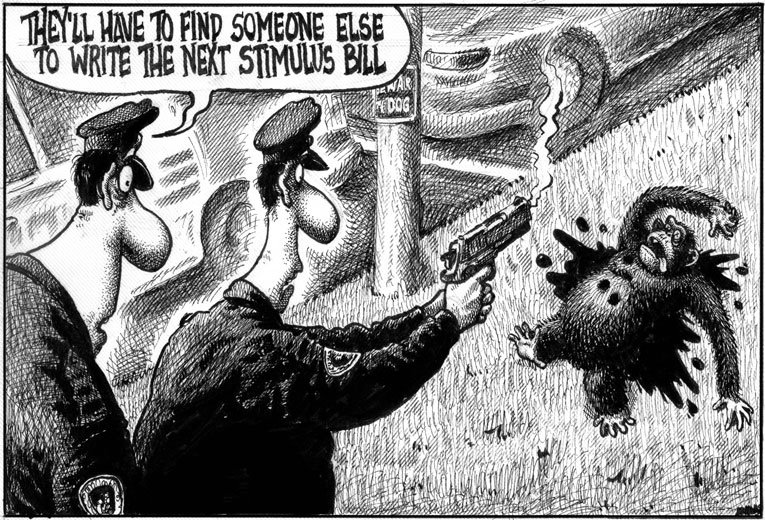
Cartoon by Sean Delonas in today’s New York Post.

‘The cartoon in today’s New York Post is troubling at best given the historic racist attacks of African-Americans as being synonymous with monkeys.’ — Rev. Al Sharpton

By TMZ / February 18, 2009

The Reverend Al Sharpton is putting the smack down on the New York Post — suggesting racism could be a factor in a political cartoon featured in this morning’s edition.

The cartoon (by Sean Delonas) comes in the wake of yesterday’s national news story about the cop who shot and killed a rampaging chimp in Connecticut. But the controversy in the comic comes from the dialogue between the two officers — which reads, “Now they will have to find someone else to write the stimulus bill.”

Before most of you woke up, Sharpton already fired off a statement saying, “The cartoon in today’s New York Post is troubling at best given the historic racist attacks of African-Americans as being synonymous with monkeys. One has to question whether the cartoonist is making a less than casual reference to this when in the cartoon they have police saying after shooting a chimpanzee that “Now they will have to find someone else to write the stimulus bill.”

“Being that the stimulus bill has been the first legislative victory of President Barack Obama (the first African American president) and has become synonymous with him it is not a reach to wonder are they inferring that a monkey wrote the last bill?”

Calls to the Post have not been returned.

Source / TMZ

The Rag Blog

Posted in RagBlog | Tagged , , | 3 Comments

Rabbi Arthur Waskow to the Senate : We Need Cloture

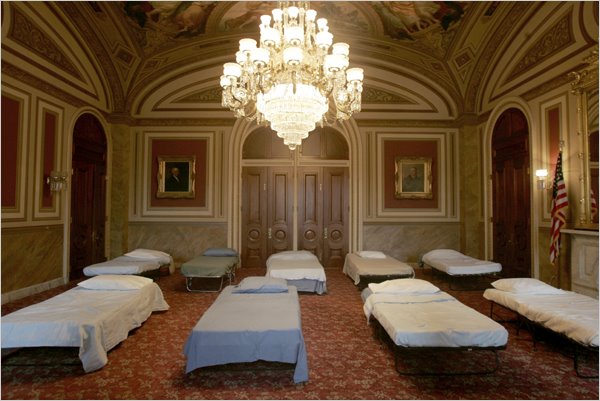
Sometimes cots have been set up at the Senate during filibusters. Photo by Stephen Crowley / NYT.

Is it possible that an anti-filibuster campaign, grounded on the importance of letting a majority of Americans address this crisis that endangers us so deeply, would win instant and strong support in the country?

By Rabbi Arthur Waskow / The Rag Blog / February 18, 2009

I am wondering whether it would make sense to aim for a national campaign to reduce the number of Senators necessary to call cloture from 60 to 55, or 51.

The question arises from what happened to the Recovery Act in the Senate. I think Paul Krugman is right, and we are standing on the brink of an economic disaster that will destroy our economy and with it the Obama Administration and every possibility of progressive change.

Many if not all of the anti-cloture Republicans know this perfectly well, and are seeking it. Like Limbaugh, they want Obama to fail. They think that their own insular constituencies, now that they have lost “moderate” districts and states, will stick with them, and they will not lose in 2010. (In fact, it will be a lot harder to make Democratic gains in the Senate in 2010, because the one third class of Senators up for reelection then are more slanted to Democrats than the class of ‘06 or ‘08. There are fewer Republicans to defeat.)

The conservatives expect that Obama’s failure would put the country back under their control. What they may or may not have taken into account is that if a liberal Presidency and Congress cannot deal with this crisis, we know from the ‘30s there is likely to be a furious upwelling of not conservative but ultra-right-wing energy. (Remember that in the Great Depression, it was a conservative administration — Hoover —that failed. Turning leftward made sense. But if a liberal administration fails?)

Progressive/liberal responses to the only half-success of the final Recovery Act has taken two basic tacks: (1) Obama screwed up by trying for bipartisanship too hard and long [Krugman]; (2) Obama had no choice because there weren’t 60 votes in the Senate, and he pulled off the best possible result [Herbert]. But what if they’re both right — Obama did the best he could, and it isn’t good enough to save him or the country — and the real problem is that the Senate rules are heavily skewed toward giving a conservative minority a veto, on top of the minority rule that is built into the two-senators-per-state structure?

Indeed, adding up the number of constituents of the Senators who voted for cloture on the Recovery Act vs. the number of constituents of those who voted against it would make very impressively clear how the will of a great majority of Americans to address the danger of Great Depression II is being thwarted.

And this goes beyond the Recovery Act. What will happen to health care, capping CO2, another Recovery Act, etc? It seems likely that any attempt to deal with the major issues we face will fail unless the filibuster is taken out of play.

Is it possible that an anti-filibuster campaign, grounded on the importance of letting a majority of Americans address this crisis that endangers us so deeply, would win instant and strong support in the country?

Certainly a national campaign would be necessary; the Senate will not take this step on its own. The Senate rules, of course, make it hard. According to a review of them by the Congressional Reference Service of the Library of Congress, this is the situation:

The Senate sees itself as a “standing body” because two thirds of its membership are always incumbents. Therefore the standing body always has a set of standing rules, unlike the House of Reps, which adopts new rules at the beginning of each new congress. The standing rules of the standing body say that it does take a super-majority to amend the rules (and thus to reduce cloture to 55 or 51 votes).

BUT — there is a long-standing and unresolved argument that when the Constitution says “the Senate” makes its rules, that means a majority of the Senate is free to do so. Just four years ago the GOP was threatening to do that by majority vote, about confirming judicial nominations — it’s what people then called the “nuclear option” — and they were certainly saying it was legal. But the Senate has never, even when VP Mondale ruled that it could, accepted the proposition and changed the rules by majority vote.

So it’s rough. But — if we don’t do this, what do you think is going to happen to health insurance, to cap-and-trade, to any more than marginal reform? The question is whether there is energy in the country to raise enough hell to make the Senate change — maybe demanding majority vote will make them go to 55? Is there more energy for this than for, let’s say, a decent healthcare bill? Is it just inside baseball? Could it break loose if the filibuster threat damages enough bills that people care about?

“Bring democracy to the Senate!” Could it work, or does it make more sense to focus on the bread-and-butter issues like healthcare?

For background, see How the Filibuster Became the Rule by David Herszenhorn / The New York Times / Dec. 2, 2007

The Rag Blog

Posted in Rag Bloggers | Tagged , , | Leave a comment

Cable TV : A Republican Punch and Judy Show

Graphic by Larry Ray / The Rag Blog.

Cable TV news and commentary channels seem to make little distinction between featuring a live two-headed mule on their shows or a live falsehood-spouting politician.

By Larry Ray / The Rag Blog / February 17, 2009

America’s Cable TV carnival midway is more and more becoming our modern day equivalent of the old traveling Punch and Judy Shows. Viewers gaze at the loud animated talking heads, following the verbal head-bopping, screaming and whining as the partisan puppeteers perform almost hourly on TV.

This has been a boon, especially to angry deluded and ignored Bush-era Republicans. They still do not want to admit that the only way to fight rising joblessness is for the US Government to spend lots of cash, in a hurry. Even though they have no moral right to lecture America after the past eight disastrous years, they loudly repeat the old disproved arguments that tax cuts and tax credits alone will solve our growing problems. The truth or logic of what they say matters little. Their show must go on, for re-elections are not far off.

Lovable Lindsey Graham, South Carolina’s bachelor Senator who is disliked not only by liberal progressives, but also by ultraconservatives back in his home state, has a way with words. When he uttered, on live TV, “If I may say, if this is going to be bipartisanship, the country’s screwed,” there were looks of puzzlement and incredulity. His House minority party voted against the stimulus bill. That’s what opposition parties do. But America is not “screwed” to use Lindsey’s eloquent oratory, just because the Republicans marched in lock step with their No vote. They offered no new or remotely useful alternatives to help reverse the course of the deepening recession. The lack of help from impotent Republicans in an historic time of crisis caused no screwing whatsoever . . . of America or anything else.

Virginia’s Representative and Minority Whip, Eric Cantor, the only Jewish Republican in the US House of Representatives, is being touted as a latter day Newt Gingrich. Cantor has been all over the airwaves with his authoritative, stentorian monologue, kvetching about the fatal flaws in the Democrat’s stimulus bill. It is mostly so much hysterical bull. Cantor, performing on Fox News a few weeks ago, gave one of his examples of fraud and waste, recounting that in a meeting with President Obama, he asked if the President “could use his influence on this process to try and get the pork barrel spending out of the bill. I mean, there’s $300,000 for a sculpture garden in Miami.”

What a ghastly picture of utter waste . . . on art! Except it was totally false. Cantor staffers pulled an example of a National Endowment for the Arts project funded under its budget last year then said it was in the projected stimulus bill. It is not. Even after Politifact.com awarded Cantor a “Pants on Fire” false rating for his claim, he has continued to make it repeatedly. But he puts on a real righteous show for TV. Never matter it is tacky Punch and Judy drama.

And let’s not forget TV’s crying soap opera star, Senator John Boehner. Even his own party seems to be trying to lower the Minority Leader’s profile on TV after repeated gaffes. A master of the mis-quote, Boehner announced, “Israel is a critical American ally and a beacon of democracy in the Middle East, not a ‘constant sore’ as Barack Obama claims.”

Well, President Obama said no such thing. The ‘constant sore’ reference was to the entire problematic Middle East situation. The public should still have that image of Boehner, like a jolly Punch character, actually handing out checks from the tobacco industry on the House floor. Yet he would lecture the new President.

Cable TV news and commentary channels seem to make little distinction between featuring a live two-headed mule on their shows or a live falsehood-spouting politician. Both can astound, disgust and amaze viewers. But the mule cannot talk. However, it can bray just like politicians. More and more, the off button on the TV remote seems the best choice.

[Retired journalist Larry Ray is a Texas native and former Austin television news anchor. He also posts at The iHandbill.]

The Rag Blog

Posted in Rag Bloggers | Tagged , , , | 1 Comment

US Military: Just an Imperial Police Force?

Not to quibble, but the US military has been an imperial police force since time immemorial, or at least since the Monroe Doctrine. Thinking otherwise has frequently led this nation to murder (not to war) for no particularly good reason.

Richard Jehn / The Rag Blog


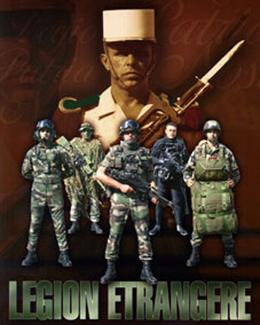
An American Foreign Legion: Is the U.S. Military Now an Imperial Police Force?
By William Astore / February 15, 2009

A leaner, meaner, higher tech force — that was what George W. Bush and his Secretary of Defense Donald Rumsfeld promised to transform the American military into. Instead, they came close to turning it into a foreign legion. Foreign as in being constantly deployed overseas on imperial errands; foreign as in being ever more reliant on private military contractors; foreign as in being increasingly segregated from the elites that profit most from its actions, yet serve the least in its ranks.

Now would be a good time for President Barack Obama and Secretary of Defense Robert Gates to begin to reclaim that military for its proper purpose: to support and defend the Constitution of the United States against all enemies, foreign and domestic. Now would be a good time to ask exactly why, and for whom, our troops are currently fighting and dying in the urban jungles of Iraq and the hostile hills of Afghanistan.

A few fortnights and forever ago, in the Bush years, our “expeditionary” military came remarkably close to resembling an updated version of the French Foreign Legion in the ways it was conceived and used by those in power — and even, to some extent, in its makeup.

For the metropolitan French elite of an earlier era, the Foreign Legion — best known to Americans from countless old action films — was an assemblage of military adventurers and rootless romantics, volunteers willing to man an army fighting colonial wars in far-flung places. Those wars served the narrow interests of people who weren’t particularly concerned about the fate of the legion itself.

It’s easy enough to imagine one of them saying, à la Rumsfeld, “You go to war with the legion you have, not the legion you might want or wish to have.” Such a blithe statement would have been uncontroversial back then, since the French Foreign Legion was — well — so foreign. Its members, recruited worldwide, but especially from French colonial possessions, were considered expendable, a fate captured in its grim, sardonic motto: “You joined the Legion to die. The Legion will send you where you can die!”

Looking back on the last eight years, what’s remarkable is the degree to which Rumsfeld and others in the Bush administration treated the U.S. military in a similarly dismissive manner. Bullying his generals and ignoring their concerns, the Secretary of Defense even dismissed the vulnerability of the troops in Iraq, who, in the early years, motored about in inadequately armored Humvees and other thin-skinned vehicles.

Last year, Vice President Dick Cheney offered another Legionnaire-worthy version of such dismissiveness. Informed that most Americans no longer supported the war in Iraq, he infamously and succinctly countered, “So?” — as if the U.S. military weren’t the American people’s instrument, but his own private army, fed and supplied by private contractor KBR, the former Halliburton subsidiary whose former CEO was the very same Dick Cheney.

Fond of posing in flight suits, leather jackets, and related pseudo-military gear, President Bush might, on the other hand, have seemed overly invested in the military. Certainly, his tough war talk resonated within conservative circles, and he visibly relished speaking before masses of hooah-ing soldiers. Too often, however, Bush simply used them as patriotic props, while his administration did its best to hide their deaths from public view.

In that way, he and his top officials made our troops into foreigners, in part by making their ultimate sacrifice, their deaths, as foreign to us as was humanly possible. Put another way, his administration made the very idea of national “sacrifice” — by anyone but our troops — foreign to most Americans. In response to the 9/11 attacks, Americans were, as the President famously suggested only 16 days after the attacks, to show their grit by visiting Disney World and shopping till they dropped. Military service instills (and thrives on) an ethic of sacrifice that was, for more than seven years, consciously disavowed domestically.

As the Obama administration begins to deploy U.S. troops back to the Iraq or Afghan war zones for their fourth or fifth tours of duty, I remain amazed at the silent complicity of my country. Why have we been so quiet? Is it because the Bush administration was, in fact, successful in sending our military down the path to foreign legion-hood? Is the fate of our troops no longer of much importance to most Americans?

Even the military’s recruitment and demographics are increasingly alien to much of the country. Troops are now regularly recruited in “foreign” places like South Central Los Angeles and Appalachia that more affluent Americans wouldn’t be caught dead visiting. In some cases, those new recruits are quite literally “foreign” — non-U.S. citizens allowed to seek a fast-track to citizenship by volunteering for frontline, war-zone duty in the U.S. Army or Marines. And when, in these last years, the military has fallen short of its recruitment goals — less likely today thanks to the ongoing economic meltdown — mercenaries have simply been hired at inflated prices from civilian contractors with names like Triple Canopy or Blackwater redolent of foreign adventures.

With respect to demographics, it’ll take more than the sons of Joe Biden and Sarah Palin to redress inequities in burden-sharing. With startlingly few exceptions, America’s sons and daughters dodging bullets remain the progeny of rural America, of immigrant America, of the working and lower middle classes. As long as our so-called best and brightest continue to be AWOL when it comes to serving among the rank-and-file, count on our foreign adventurism to continue to surge.

Diversity is now our societal byword. But how about more class diversity in our military? How about a combat regiment of rich young volunteers from uptown Manhattan? (After all, some of their great-grandfathers probably fought with New York’s famed “Silk Stocking” regiment in World War I.) How about more Ivy League recruits like George H.W. Bush and John F. Kennedy, who respectively piloted a dive bomber and a PT boat in World War II? Heck, why not a few prominent Hollywood actors like Jimmy Stewart, who piloted heavy bombers in the flak-filled skies of Europe in that same war?

Instead of collective patriotic sacrifice, however, it’s clear that the military will now be running the equivalent of a poverty and recession “draft” to fill the “all-volunteer” military. Those without jobs or down on their luck in terrible times will have the singular honor of fighting our future wars. Who would deny that drawing such recruits from dead-end situations in the hinterlands or central cities is strikingly Foreign Legion-esque?

Caught in the shock and awe of 9/11, we allowed our military to be transformed into a neocon imperial police force. Now, approaching our eighth year in Afghanistan and sixth year in Iraq, what exactly is that force defending? Before President Obama acts to double the number of American boots-on-the-ground in Afghanistan — before even more of our troops are sucked deeper into yet another quagmire — shouldn’t we ask this question with renewed urgency? Shouldn’t we wonder just why, despite all the reverent words about “our troops,” we really seem to care so little about sending them back into the wilderness again and again?

Where indeed is the outcry?

The French Foreign Legionnaires knew better than to expect such an outcry: The elites for whom they fought didn’t give a damn about what happened to them. Our military may not yet be a foreign legion — but don’t fool yourself, it’s getting there.

[William J. Astore, a retired lieutenant colonel (USAF), taught for six years at the Air Force Academy. He currently teaches at the Pennsylvania College of Technology. A TomDispatch regular, he is the author of Hindenburg: Icon of German Militarism (Potomac Press, 2005), among other works. He may be reached at wastore@pct.edu.]

Copyright 2009 William Astore

h/t Juan Cole / Source / TomDispatch

The Rag Blog

Posted in RagBlog | Tagged , , | 2 Comments

Compassion Is the Only Course, Even When the Crimes Are Atrocious

This is a profoundly important piece, written by a victim of a Cambodian war criminal. When the author writes that “We shall all be at the trial — not just as judges, but also as victims, and the accused,” his words penetrate to the core of many human issues we have always faced.

Richard Jehn / The Rag Blog

Graphic: Emiliano Ponzi.

My Savior, Their Killer
By François Bizot / February 16, 2009

Phnom Penh, Cambodia — AFTER 10 years of detention, Kaing Guek Eav, alias Comrade Duch, is to appear today before the Extraordinary Chambers in the Courts of Cambodia, charged with war crimes and crimes against humanity. He was arrested in 1999, after 20 years of living incognito, for crimes committed on his orders as commander of the Tuol Sleng prison in Phnom Penh from 1975 to 1979, when the Khmer Rouge controlled Cambodia and were responsible for the deaths of more than a million people.

I was his prisoner for three months in 1971, in a camp known as M13 hidden in the forest of the Cardamom mountains. I had been doing field work in the Cambodian countryside, searching for ancient Khmer Buddhist manuscripts, when I was ambushed by Khmer Rouge militants fighting Cambodia’s American-backed government. I was accused of being a C.I.A. spy and sentenced to death.

Duch was in charge of the jungle camp, both my jailer and my prosecutor. I was kept in chains and interrogated daily by him. Somehow, during the strange dialogue that began between us, he became convinced that I really was just a Frenchman who wanted to study Buddhist texts. Duch undertook to secure my release. My two Khmer assistants did not have the same good fortune: despite Duch’s promise to me, they were executed soon after I left the camp, as so many thousands were in the years to come under his meticulous supervision.

I did not see Duch again until 2003, in the military prison in Phnom Penh. Conditions there were rudimentary, but the general feel was not that of a jail. I remember that he had the same look of determination that he had had 32 years earlier, though the smile that he had occasionally flashed when he ruled over my fate was gone.

In the whirl of conflicting emotions provoked by seeing him again, I asked him: “How are things here? Is it all right?” Compelled to repeat the question, I felt its incongruity: the executioner was now on the other side of the gate, as I had foreseen in my dreams, in the place once occupied by his victims.

In July 2007, he was transferred to one of the eight cells in the detention center that is part of the vast complex where the war crimes court is based and where his trial will take place. I visited him there. At the time, he enjoyed the relative comfort of his new surroundings. Four other elderly Khmer Rouge leaders were also incarcerated there. They were well cared for; food, cells, a television room, a visiting room — everything was in conformance with international rules, enough to make the guards jealous.

But Duch may today regret having left the tedium of the military prison. After years of stalling, and many months of thorough preliminary investigations, the trial that so few people wanted is about to begin. The sound of the preparations for it rings out in the detention center as if it were an execution.

The death penalty, which Duch ordered at least 12,380 times, does not exist in United Nations-backed tribunals like this one. His condemnation will not have the too-familiar instantaneousness of the Khmer Rouge hoe striking the back of the neck, but his sentence will be long and relentless.

The worst that he risks, however, is not imprisonment itself, but seeing his reasons for living disappear. His life now revolves around the visits from his children, a right that was denied to his victims, and his faith in the judicial process — a process that did not exist at Tuol Sleng.

Duch does not raise any objection to his trial. In his heart lie the same fears that haunted each of his victims — ancient fears that have never ceased to haunt mankind. Thus he has admitted his guilt, bowed over and humbled by the horror of what he has done.

Last February, Duch was led, with his consent, to the scenes of his crimes. The visit was a shock for all who witnessed it. This major judicial step took place in an atmosphere of intense, palpable emotion.

“I ask for your forgiveness — I know that you cannot forgive me, but I ask you to leave me the hope that you might,” he said before collapsing in tears on the shoulder of one of his guards.

I was not there — it was a closed hearing — but those who were reported that the cry of the former executioner betrayed such suffering that one of the few survivors of Tuol Sleng screamed out, “Here are the words that I’ve longed to hear for 30 years!”

It could be that forgiveness is possible after a simple, natural process, when the victim feels that he has been repaid. And the executioner has to pay dearly, for it is the proof of his suffering that eases ours.

Let us not fool ourselves. Beyond the crimes that Duch committed against humanity, those of the Khmer Rouge will also be judged. And beyond the crimes of the Khmer Rouge, the capacity of the tribunals to mete out justice will be tested, as well as our ability to judge man himself, and history. We shall all be at the trial — not just as judges, but also as victims, and the accused.

The genocide of the Khmer Rouge will be judged as a “crime against humanity,” a crime against ourselves. As such, Duch’s guilt exceeds his immediate victims; it becomes the guilt of humanity, in the name of all victims. Duch killed mankind. The trial of the Khmer Rouge should be an opportunity for each of us to gaze at the torturer with some distance — from beyond the intolerable cry of the suffering, which may veil the truth of the abomination. The only way to look at the torturer is to humanize him.

[François Bizot is the author of “The Gate,” a memoir. This essay was translated by The Times from the French.]

Source / New York Times

The Rag Blog

Posted in RagBlog | Tagged , , | 2 Comments

Acorn: Fighting the Banks to Counter Foreclosures

Jonathan Westin, an Acorn organizer, comforted Denise Parker, whose house was being foreclosed on, after she spoke at an Acorn training session in Brooklyn. Photo: James Estrin/The New York Times.

A Bid to Link Arms Against Eviction
By Fernanda Santos / February 17, 2009

As resistance to foreclosure evictions grows among homeowners, community leaders and some law enforcement officials, a broad civil disobedience campaign is starting in New York and other cities to support families who refuse orders to vacate their homes.

The community organizing group Acorn unveiled the campaign with a spirited rally on Friday at a Brooklyn church and will roll it out in at least 22 other cities in the coming weeks. Through phone trees, Web pages and text-messaging networks, the effort will connect families facing eviction with volunteers who will stand at their side as officers arrive, even if it means risking arrest.

“You want to haul us out to jail? Fine. Let the world see how government has been ineffective,” Bertha Lewis, Acorn’s chief organizer, said in an interview. “Politicians have helped banks, but they haven’t helped families in the way that it’s needed, and these families are now saying, enough is enough.”

At the onset of the foreclosure crisis, the problem was regarded by some as one of a homeowner’s own making, the result of irresponsible decisions made by families who chose to live beyond their means. But as foreclosures spread across the country, devastating even solidly middle-class communities, the blame has slowly shifted to the financial companies that made questionable loans and have received billions of dollars in federal aid to stave off collapse.

In recent months, a budding resistance movement has grown among Americans who believe they have been left to face their predicament on their own — and the Acorn campaign is an organized expression of that frustration, Ms. Lewis said. Instead of quietly packing up and turning their homes over to banks, homeowners are now fighting back.

On Feb. 9, a man scrawled a message on the roof of his house in a suburb of Los Angeles: “I Want 2 Be Heard.” Then he barricaded himself inside when deputies showed up to evict him, surrendering after a few hours. In October, a woman in San Diego chained herself to her front porch after the bank that held her mortgage refused to renegotiate the terms. She remains in her home, but has received a second eviction notice.

And last year in Boston, neighbors and activists locked arms outside eight buildings that had been foreclosed upon to prevent the authorities from forcing residents onto the streets.

Sheriffs in some places have also taken a stand. In Wayne County in Michigan, Sheriff Warren C. Evans, suspended all evictions starting Feb. 2 until the federal government implements a plan to help homeowners facing foreclosures.

In Cook County in Illinois, which includes Chicago, Sheriff Thomas J. Dart directed a lawyer to review all eviction orders to protect people who kept on paying rent after the buildings where they lived had been seized by banks. In Butler County in Ohio, Sheriff Richard K. Jones ordered his deputies not to evict people who had no place else to go.

“This is a cold place in the winter and I will not give people a death sentence for not paying their debts,” Sheriff Jones said in an interview. “These are human beings, responsible middle-class people who fell on hard times, and I just can’t toss them out onto the streets.”

Acorn’s strategy is modeled on a movement the group led in the 1980s, when squatters occupied and set out to renovate thousands of abandoned city-owned buildings in New York, Philadelphia and Detroit, among other cities. The motivation was to solve what Ms. Lewis has called “the working family’s housing crisis.”

In cities like Orlando, Fla., which has one of the nation’s highest foreclosure rates — and Boston, Houston, Baltimore, Oakland, Calif., and Tucson, Ariz. — Acorn organizers have been creating networks to alert a homeowner’s neighbors when an eviction has been scheduled or deputies are on the way. Some volunteers will summon friends and relatives to converge at the home, while others will be in charge of notifying the news media. Organizers are also recruiting lawyers willing to defend for no fee those who are arrested.

The campaign, called Home Defenders, enlisted about 500 participants during meetings held Friday and Saturday in New York and five other cities. Ms. Lewis and other organizers said that they believed the number will reach into the tens of thousands within weeks.

“This is a desperate, last-ditch effort by folks who are working two or three jobs, single mothers, elderly people who don’t know what else to do to save their homes,” said Ginny Goldman, Acorn’s lead organizer in Texas, where the campaign began in Houston on Saturday.

The rally in Brooklyn, at Brown Memorial Baptist Church in Fort Greene, drew about 150 people. There were homeowners, Acorn members, community advocates and candidates for the City Council. One councilman, Mathieu Eugene, was carrying a slab of papers as thick as a large dictionary, each sheet representing, he said, a family facing foreclosure in his district, which includes parts of Crown Heights, Flatbush and Kensington.

The church’s pastor, the Rev. Clinton M. Miller, opened the gathering with this prayer: “If anybody here is facing foreclosure, God, we ask that a miracle be made and a home be saved.”

Then, between homeowners’ sharing their plight, the crowd chanted, “Enough is enough.”

One homeowner, Myrna Millington, 73, who lives in Laurelton, Queens, said that she had to take a second mortgage on her home of 38 years to pay for repairs that turned out to be more extensive than originally planned. What Ms. Millington did not know was that she had signed for a subprime loan, which carried interest rates so high she could not keep up with the payments. Her house was foreclosed on in September.

“I may lose my home, but I’m only leaving in handcuffs,” Ms. Millington said.

Another homeowner, Denise Parker, a mother of three who works as a housekeeper at two Midtown Manhattan hotels, bought a home in Springfield Gardens, Queens, in 2005 with an adjustable interest rate that, after two years, went up every six months. Her payments started at $3,500 and now are $5,050 a month, she said. She fell behind last year and her house is scheduled to be auctioned off on Friday.

“I refuse to leave the home that I’ve worked so hard to keep,” Ms. Parker, 42, told the audience. “I will not let the bank take my home and I will not leave.”

Eviction resistance actions are scheduled for Thursday in cities including New York, Oakland and Houston. Organizers will try to recruit enough volunteers to form a human wall on the sidewalk to avoid being arrested for trespassing. But occupying a house or having people attach themselves to a home could also be a tactic.

The campaign has earned praise and raised concern. Sheriff Dart, in Illinois, said it was a “slippery slope when you have individuals deciding whether they can lawfully remain in their homes.”

Sheriff Jones, in Ohio, equated the planned resistance to “chaining yourself to a tree that’s about to be cut down” and said that though he may not agree with it, he sympathizes.

In Washington, Acorn has found a staunch supporter in Representative Marcy Kaptur of Ohio, who, during a discussion last month about the $700 billion bailout package for financial companies, took to the floor of the House and instructed people to “stay in your homes — if the American people, anybody out there, is being foreclosed, don’t leave.”

In an interview, Ms. Kaptur said, “I’m thrilled that the American people are rising up and exercising the power that Wall Street has taken away from them.”

Source / New York Times

The Rag Blog

Posted in RagBlog | Tagged , , , | Leave a comment

Paul Krassner on The Virtues of Irreverence, Indecency and Illegal Drugs

The Right Irreverent Paul Krassner.

‘In the wishful-thinking corner of my mind, pushing the limits and fostering social change are inextricably connected, but I don’t have any delusions that I’ve inspired an epidemic of epiphanies.’ — Paul Krassner.

By David Kupfer

[David Kupfer’s interview with Paul Krassner appears in Issue 398, February, 2009, of The Sun magazine.]

Paul Krassner has been spreading his witty, sometimes snide, and often political brand of humor since the late 1950s. His publication the Realist was the underground journal of the counterculture during the sixties and seventies, breaking political stories and covering topics that were taboo for the mainstream press. Krassner became known for interweaving current events, social criticism, and satire in a manner not previously seen in print.

Born and raised in New York City, Krassner was a violin prodigy, and in 1939, at the age of six, he became the youngest person ever to perform at Carnegie Hall. In the 1950s he worked as a writer for comedian Steve Allen and for Mad magazine, and he became friends with stand-up comic Lenny Bruce. Krassner edited Bruce’s autobiography, How to Talk Dirty and Influence People, and at Bruce’s encouragement began performing stand-up comedy himself at the Village Gate nightclub in New York City.

As editor of the Realist, Krassner approached journalism not as an objective observer but as a participant in many of the stories he covered. After he interviewed a doctor who performed illegal abortions, Krassner ran an underground abortion referral service. He wrote about the antiwar movement while he was an active member of it. And in addition to publishing articles on the psychedelic revolution, he took lsd with the revolution’s unofficial leader, Harvard psychologist Timothy Leary, and the spiritual teacher Ram Dass, a former associate of Leary’s at Harvard. Later Krassner joined novelist Ken Kesey’s Merry Pranksters, who traveled the country spreading the gospel of psychedelics.

In 1967 Krassner cofounded (with Abbie Hoffman and Jerry Rubin) the Yippies, a countercultural political party that led theatrical demonstrations outside the 1968 Democratic convention in Chicago. At the height of the Vietnam War, Krassner was on an fbi list of radicals to be rounded up in the event of a national emergency. His friends John Lennon and Yoko Ono financed a 1972 issue of the Realist that exposed the Watergate break-in before journalists Bob Woodward and Carl Bernstein did so in the mainstream press. In 1978 publisher Larry Flynt hired Krassner to take over the pornographic men’s magazine Hustler. The job lasted only six months, during which time Krassner appeared as a centerfold in the magazine.

In 2004 Krassner received an American Civil Liberties Union Upton Sinclair Award for his dedication to freedom of expression, and at the fourteenth annual Cannabis Cup in Amsterdam, Krassner was inducted into the Counterculture Hall of Fame by the publication High Times. His articles have been published in Rolling Stone, Playboy, Penthouse, Mother Jones, the Nation, the New York Press, National Lampoon, the Village Voice, the Los Angeles Times, and Funny Times. The Realist printed its last issue in 2001, but Krassner is still active as a writer, contributing a monthly column to High Times and a bimonthly column to Adult Video News Online. He is a regular columnist for the Huffington Post website and has been actively involved in movements to end the Iraq War and to legalize marijuana. (“Cigarettes are legal, and smoking them causes the death of twelve hundred people a day,” he says. “Marijuana is illegal, and the worst side effect is maybe you’ll raid your neighbor’s refrigerator.”)

Krassner has released six comedy albums and authored numerous books, including his autobiography, Confessions of a Raving, Unconfined Nut: Misadventures in the Counter-Culture (Touchstone) — which he is currently updating and expanding for a possible new edition — and One Hand Jerking: Reports from an Investigative Satirist (Seven Stories Press). His most recent collection, Who’s to Say What’s Obscene? Politics, Culture, and Comedy in America Today, will be published by City Lights Books in July of this year.

Krassner lives in southern California’s Desert Hot Springs with his wife, Nancy Cain, whom he married on April Fool’s Day twenty years ago. When I arrived at their home, just prior to last year’s presidential election, he answered the door wearing jeans and a black t-shirt that said, “Stop Bitching — Start a Revolution.” He walks with a cane because of a beating he suffered at the hands of two San Francisco cops during the riot following the voluntary-manslaughter verdict in the trial of Dan White, who had assassinated Mayor George Moscone and City Supervisor Harvey Milk. Krassner’s dark, curly hair and youthful demeanor make him appear younger than seventy-six.

On the walls of Krassner’s home office hang a portrait of Albert Einstein with the maxim “Imagination is more important than knowledge,” a photo of the Great Pyramid of Giza (from when Krassner traveled to Egypt for the Grateful Dead concerts there in 1978), and a trickster icon from a healers-and-shamans expedition in Ecuador. Outside the window, in a part of the yard he calls “Birdland,” doves, finches, and starlings were bathing, and hummingbirds hovered by huge blossoms. We were serenaded by a mockingbird Krassner had nicknamed “Plagiarist.” True to form, halfway through our conversation, Krassner lit up a fat joint.


Kupfer: Who are your influences?

Krassner: I come out of a tradition of American humorists that includes Mark Twain, H.L. Mencken, and Will Rogers. My first modern influence was Lyle Stuart, who published the Independent, where I did my apprenticeship in journalism and wrote a column titled “Freedom of Wit.” Another of my mentors was Jean Shepherd, the radio humorist. In the middle of the night he’d talk about how you might explain an amusement park to a Venusian, or about a man who could taste an ice cube and tell you the make and model of the refrigerator it came from. Comedian Lenny Bruce was my role model as a stand-up performer, and novelist Joseph Heller was my biggest influence as a satirical writer. Heller explained to me how, in his book Catch-22, he used exaggeration so gradually that unreality became more credible than reality.

Kupfer: You have done stand-up comedy for nearly fifty years. How have your audiences changed?

Krassner: I think they’re more aware now of the contradictions in society: the phony piety, the hypocrisy. And I’ve evolved right along with them. Performing, for me, is a two-way street. English is my second language. Laughter is my first.

Kupfer: Do you aspire to foster social change with your satire, or do you just want to see how far you can push the limits?

Krassner: In the wishful-thinking corner of my mind, pushing the limits and fostering social change are inextricably connected, but I don’t have any delusions that I’ve inspired an epidemic of epiphanies. People don’t like to be lectured to, but if you can make them laugh, their defenses come down, and for the time being they’ve accepted whatever truth is embedded in your humor. When a large audience of people are all laughing together, no matter how disparate their backgrounds are, it’s a unifying moment. But who’s to say how long that moment of truth or unity lasts and whether it leads to any action? It’s one more positive input, but rarely a tipping point.

Kupfer: What pushed you into the role of provocateur?

Krassner: I couldn’t help but notice the difference between what I experienced in the streets and the way it was reported in the mainstream media, which acted as cheerleaders for the suppression of dissent.

Kupfer
: Was there some early life event that led you to this calling?

Krassner: I was a child-prodigy violinist and at the age of six played the Vivaldi Concerto in A Minor at Carnegie Hall. A year later I saw my first movie, Intermezzo, which was also Ingrid Bergman’s first major movie, and I fell in love with the theme song. I couldn’t fathom why it felt so good to hear a certain combination of notes in a certain order with a particular rhythm, but it gave me enormous pleasure to hum that melody over and over to myself. It was like having a secret companion. When I told my violin teacher that I wanted to learn how to play the movie theme, he sneered and said, “That’s not right for you.” His words reverberated in my head. That’s not right for you. How could he know? For me, this was not merely a refusal of my request; it was a declaration of war upon the individual. In self-defense I drove him crazy during lessons, and after he died, I bought the sheet music to “Intermezzo” and taught myself to play it. That was the end of my musical career. I had a talent for playing the violin, but I had a passion for making people laugh.

A couple of decades later I heard different metaphors for that kind of experience. Timothy Leary talked about the way “people try to get you onto their game board.” And Ken Kesey warned, “Always stay in your own movie.”

Kupfer: How did you maintain your integrity as the editor and publisher of the Realist?

Krassner: I didn’t have to answer to anyone. There was no board of directors and no advertisers, and the readers trusted me not to be afraid to offend them — though sometimes they said, “Well, now you’ve gone too far.” Money was always tight, and I had to subsidize the magazine by doing interviews for Playboy and speaking at college campuses. I was forced to stop publishing in 1974 when I ran out of money, but in 1985 I got a five-thousand-dollar grant to start it up again as a newsletter, which lasted until 2001.

Kupfer
: What was it like in the early days of the underground press?

Krassner
: When People magazine labeled me “father of the underground press,” I demanded a paternity test. “Underground” is a misnomer, because it wasn’t a secret who published those weeklies or where you could get copies. A truly underground paper was the Outlaw, which was clandestinely published by inmates and staffers at San Quentin State Prison.

Kupfer: It seems as if “underground” publications are even more accessible today. You can get Earth First! Journal at Borders and Barnes & Noble now.

Krassner: That’s good news in terms of infiltrating the mainstream. Of course, with the possibility of Barnes & Noble buying out Borders, there may soon be one book giant: Barnes & Noble without Borders.

Kupfer: When you relaunched the Realist as a newsletter, you said in your editorial statement, “Irreverence is still our only sacred cow.”

Krassner: I’ve had second thoughts about that since then. There seems to be too much irreverence for its own sake these days. In some cases victims, rather than oppressors, have become the target.

Read the rest of this interview here/ The Sun.

Thanks to Bob Simmons / The Rag Blog

Posted in RagBlog | Tagged , , , , , , , | 1 Comment

Israeli Jew : Bring the Suffering Gazans Home

Israelis, led by Peace Now, demonstrate for peace in Gaza.

The following article by an Israeli Jew may at first blush seem a bit idealistic. But there are times when idealism may be the only practical answer. Thanks to Rag Blog resident poet Larry Piltz for passing along this inspirational call to (open) arms by Deb Reich.

— Thorne Dreyer / The Rag Blog / February 17, 2009

‘Speaking as an Israeli Jew, I say that we (Israeli Jews and our friends abroad) ought to embrace EVERYONE who wants to live here among us, so long as they truly love the land and have some reasonable claim to it.’

By Deb Reich / February 17, 2009

Most people will say I’m delusional; that’s okay. I will say what I have to say anyway. When your opinion is way out on the periphery, it may mean you are delusional – or it may just mean that the so-called center has gradually drifted closer and closer to a very high cliff, and finally fallen off the edge, while the majority of the population follows along like a horde of doomed lemmings. In that scenario, someone needs to stake out a position at the other extreme and drag the locus of the center back from oblivion. So here goes.

After this futile, criminal, pornographic war in Gaza (Shmuel Amir rightly termed it a “hunt” rather than a war) and yet another national election in Israel ending basically in impasse, but this time with a distinctly fascist motif, we are no closer to sustainable peace in the Middle East. We need a drastic revisioning of what we are doing here.

So we start with this: Speaking as an Israeli Jew, I say that we (Israeli Jews and our friends abroad) ought to embrace EVERYONE who wants to live here among us, so long as they truly love the land and have some reasonable claim to it. This would not include, say, tourists from Zanzibar or Antarctica – but would naturally include the Palestinians, whose claim to the land is (or ought to be) beyond dispute and whose deep and enduring love for the land is richly evident to any observer not in a vegetative state.

I say we bring all the long-suffering, besieged, shell-shocked Gazans home to Israel now! They miss their homes. They want to come home. Let us welcome them! We can all move over a little bit and make room. Believe me, there is still plenty of room.

Dayenu! (Enough!). Enough suffering inflicted on the surviving families in Gaza who are hungry, thirsty, cold, frightened, wounded, traumatized for life, and bereaved. Enough. And enough suffering on the other side of the fence in Sderot and environs, too. (Their fates are inextricably intertwined; all our fates are inextricably intertwined.)

The generals and the militants have had their day, for the nth time – and at the end of it, as usual, all that we (any of us) have now, as a result, is war crimes and grief. War crimes and grief and fear. War crimes, grief, fear, hatred, and despair… with thousands of injured and disabled people bearing the burden most directly, forever.

Enough! Israelis are more afraid now than before, and more at risk, too. Time to ABANDON this insane strategy that we (any of us) can force people to love us, or anyhow accept us, by killing them!

Let us in Israel who have so much, open our homes and our communities to the victims of this insane war who have so little – exactly as we once opened our homes to refugees from northern Israel when the Katyushas were falling. Our traditional ethos is full of charity and generosity; we know all about providing refuge and succour; we have taken in wave after wave of refugees over the decades, most recently more than a million Russian émigrés deemed essential to our future, for whom we moved over and made room.

So let’s get going. Let every family in Israel who wants to live in peace in this region, open their home to a Gaza family until new housing can be built. Let the participating families declare a hudna between themselves. Now. Today.

You start by not picturing these neighbors as “the enemy”; picture them instead as families who have suffered a tsunami like the one that flattened coastal Indonesia a few years ago – and in fact, the order of magnitude of what they have been through is about the same. Presto! Reaching out to help suddenly makes perfect sense. Moreover, professional planners have already minutely addressed the question of exactly where Palestinians coming home to Israel could reside, eager to make their best contribution to a shared future. What is missing in Israel is not sufficient space, but sufficient imagination to envision how much there is to be gained by all concerned. Now is a good time to change that.

The Gaza disaster can become the turning point. Let the Gazan expatriates whose families came from Ashdod (Issdod) be matched with Ashdod-area families. Let the expatriates from Lod (Lydd) be matched with Lod/Lydd-area families – Jewish or Palestinian. And so forth. And let no time be lost! They have lost everything and their situation is dire. We in Israel have lost our moral compass and we want to reclaim it. Bingo!

Let the governments of the world, led by the USA, immediately stop sending Israel aid for military ordnance, and earmark it instead for a massive rehabilitation and reconciliation program.

Let all the tens of thousands of Palestinian professionals who are citizens of Israel, born and raised here – doctors, social workers, nurses, dentists, psychiatrists, lawyers, engineers, teachers, designers, journalists – join gladly and wholeheartedly in this effort, finally and at long last, to bring their fellow Palestinians home from exile in Gaza. Let us bind up the wounds and become whole, together. All of us. Let us build a really wonderful society together, for the sake of ALL OUR CHILDREN. Rewrite the national anthem! Why not? It’s a SONG, folks. No song is holier than the life of even one child (anyone’s child).

The Gaza families who actually lived in Gaza before 1948 will want to stay and rebuild their homes and communities. Volunteers would doubtless throng to Gaza from all over the world to help them. Imagine them turning what was the world’s largest open-air prison into the world’s largest open-air Reconciliation Park – with facilities for tourism, education, environmental studies, cultural attractions, and museums (including a Palestinian Nakba Museum). Imagine Gaza as the reconciliation capital of the world – people in Israel could commute to work in Gaza for a change, instead of the other way around. Very refreshing.

This is a blueprint for a SHARED LIFE. If it sounds crazy, just ask yourself: Which is crazier — rampant slaughter, or rampant cooperation? Rivers of blood, or the free flow of joint prosperity? Rampant mass cooperation could break out here tomorrow – and in a week or two, or maybe a month or two, we would feel like we have always believed in it.

A political accommodation would follow the humanitarian one – probably some creative form of federation, with complete, reciprocal, national-cultural autonomy based on each group’s granting the other group the same perks it wants for itself. The technical restructuring follows the vision, not the other way around. There are several good plans, already fully elaborated, for political power-sharing here. Anyone can read them; they’re on the web. Once we dare to envision a shared future, we can make it happen. And if not now, when?

We Jews consider it rational and wonderful to rejoice in our emergence as a modern nation in the ancient homeland, after… not twenty years, not two hundred years, but two thousand years of exile!! Yet the idea of repatriating all those homesick Palestinian families, exiled from their homes a mere 60 years ago, is considered delusional. Something there does not compute.

So think it over and let’s put the guns away for good. Let the tribunals meet to apportion blame and responsibility, by all means, but as for the rest of us: we have other tasks. Treat the wounded, yes, of course, and heal the traumatized… And beat the swords into ploughshares and recycle the tank parts into computer equipment. Retool the death factories to make swimsuits instead of parachutes, irrigation pipes for farmers instead of M16 rifles. No time for missiles; we’ll all be too busy getting a life. The only phosphorous I ever want to see around here again is in a spelling contest for the kids (ALL our kids). Haul out the welcome mat for the long-lost cousins and let’s get busy – there’s a lot of work to do here. It’s not too late, even now, but you have to take the first step: Choose life!!!

[Deb Reich is a writer and translator in Israel/Palestine – debmail@alum.barnard.edu.]

Source / AMIN Media

Thanks to Larry Piltz / The Rag Blog

Posted in RagBlog | Tagged , , , | 1 Comment

Afghanistan : Hello? Obama Actually Wants Plan Before Sending Troops?

War scene at the time of then Presidential candidate Barack Obama’s July 28, 2008, visit to Afghanistan.

President Barack Obama is refusing to be rushed into his first decision to send troops into combat, an early sign he may be more independent-minded than U.S. military leaders expected.
[…]
Rather than sign off quickly on all or part of a long-standing Pentagon request for three Army combat brigades and Marine units, totaling over 10,000 troops, Obama and his aides are questioning the timetable, the mission and even the composition of the new forces, officials familiar with the deliberations said.

David S. Cloud / Politico / February 17, 2009

See complete Politico story, Below

‘If the mission is containment of the hive of villainy in the borderlands to its caves, that’s fine in the short term but, as Colin Powell would say, we need an exit strategy. That strategy needs more focus on nuclear Pakistan than Stone Age Afghanistan.’

By Steve Russell / The Rag Blog / February 17, 2009

What a novel concept!

Mission first; sending troops second.

I’m not opposed to sending troops and barring a complete pullout — which would be really dumb at this moment in time — we need to send SOME troops.

The question is the mission and de debil is in dose details.

If the mission is “a democractic and peaceful Afghanistan” or some such crap, we are well and truly fucked.

If the mission is containment of the hive of villainy in the borderlands to its caves, that’s fine in the short term but, as Colin Powell would say, we need an exit strategy. That strategy needs more focus on nuclear Pakistan than Stone Age Afghanistan. The internal politics of Pakistan really drive what is going to happen.

We are overdue in resolving the Kissinger “tilt” in favor of Pakistan in the Pakistan-India disagreements dating from the Nixon years. The only way I can explain no major hoo-hah in the US when we took the side of a military dictatorship against a democracy because that democracy was not on board with our Cold War moves was that Nixon was into so much bad stuff elsewhere nobody noticed. Well, now let’s see where that “tilt” got us.

Is India a problem? Well, they want to compete for our tech jobs. But it’s Pakistan that is willing to sell nukes to North Korea.

Haven’t we been clever? Thanks again, Dr. K!

Obama slows troop boost decision
By David S. Cloud / February 17, 2009

President Barack Obama is refusing to be rushed into his first decision to send troops into combat, an early sign he may be more independent-minded than U.S. military leaders expected.

The new president’s methodical decision-making offers an early insight into how the new commander in chief will approach the war in Afghanistan and has surprised some Pentagon officials, who had predicted repeatedly in the past two weeks that Obama would decide within days on additional forces, only to find the White House taking more time.

Rather than sign off quickly on all or part of a long-standing Pentagon request for three Army combat brigades and Marine units, totaling over 10,000 troops, Obama and his aides are questioning the timetable, the mission and even the composition of the new forces, officials familiar with the deliberations said.

The latest sign of crossed signals occurred Friday, when White House spokesman Robert Gibbs told reporters Obama “hasn’t made a decision on augmenting our force structure in Afghanistan,” three days after Pentagon officials said he would likely do so that week. Defense Secretary Robert Gates called Obama’s deliberate approach on his first troop decision “entirely appropriate.”
Gibbs said Monday he expects Obama to decide “shortly” on sending more troops to Afghanistan but declined to be pinned down on exactly when.

Obama’s deliberate pace represents yet another break with the usual style of his predecessor. Former President George W. Bush usually signed off quickly on requests for additional troops from his commanders, and, especially early in his presidency, he rarely engaged in lengthy discussions about what the troops would be used for. Those decisions were generally worked out ahead of time between field commanders and Defense Secretary Donald Rumsfeld, who favored holding down troop levels in both Iraq and Afghanistan.

The major exception to this approach was when Bush got directly involved in pressing his reluctant commanders for the “surge” — the decision to send nearly 30,000 additional troops to Iraq in late 2006 and early 2007.

At least in the early weeks of his presidency, Obama in some ways resembles the Bush of late 2006 as he considers his own mini-surge to reverse the worsening situation in Afghanistan and appears to be immersing himself in the details of the policy shift.

“I’m personally hopeful that President Obama will do something that President Bush didn’t do particularly well,” said John Nagl, president of the Center for a New American Security and a retired Army officer. “I think he’s thinking through the implications of committing troops, not just the first order but the second and third order effects.”

The request for additional forces from Gen. David McKiernan, the senior commander in Afghanistan, came before the administration has completed a review of Afghanistan strategy that is likely to make far-reaching changes in how U.S. and NATO forces are being deployed.

As a result, officials said, though the troop decision was once seen as an almost routine matter, Obama’s discussions with Gates and Adm. Mike Mullen, the chairman of the Joint Chiefs of Staff, has evolved into a broader discussion about goals and methods in Afghanistan, even before the conclusion of the review.

The delay in deciding reflects at least in part Obama’s determination not to be rushed by the Pentagon brass into a decision before he fully understands the implications, several officials said.

The slow pace also is an indication of the influence being exerted by Gates, who has warned repeatedly in recent weeks about rushing into a greater U.S. commitment in Afghanistan without carefully weighing the risks. The Pentagon has asked McKiernan for a study that would examine the risks of sending additional troops to a part of the world that has a long history of resisting the presence of foreign forces.

McKiernan has sought at least some of the additional forces in time for them to be on the ground ahead of expected spring fighting. But the White House appears more concerned with getting troops in place ahead of the Afghan presidential elections, now scheduled for August, an official said.

The White House’s longer timetable is likely an indication of its intention to shift the military strategy over the coming year.
Instead of using U.S. forces primarily to kill and capture insurgents, the strategy review is likely to recommend placing more emphasis on protecting the Afghan population, several officials said. In that case, getting McKiernan the troops by spring is not the primary concern, an official said.

Obama also faces a decision on whether to shift forces equipped with Stryker vehicles, an armored troop carrier, from Iraq to Afghanistan. Commanders in Iraq particularly value the Stryker units, which can move quickly and with greater protection from roadside bombs than conventional convoys using Humvees.

But with the security situation worsening in Afghanistan, commanders there are also seeking vehicles with greater protection that can also move forces around the vast country more quickly.

The Stryker decision illustrates the real tradeoffs that Obama is facing early in his presidency as he juggles his campaign vow to shift resources to Afghanistan with the need to protect the security gains achieved in Iraq.

The White House is also exploring whether at least one of the three requested brigades should be designated to train the Afghan Army, rather than used primarily in combat operations, the official added. Shifting the unit’s mission would require additional training that could delay the date when the unit could arrive in Afghanistan, an official said.

The U.S. Army is currently supplying only around 1,000 advisers to the Afghan National Army, around 2,000 short of the necessary number, according to Anthony Cordesman, military analyst with the Center for Strategic and International Studies, a Washington think tank. The administration is hopeful that NATO allies will contribute more personnel to assist in training Afghan security forces, especially the police.

There are currently 33,000 U.S. troops in Afghanistan, including 15,000 under NATO command and another 18,000 under exclusive U.S. command involved in fighting insurgents and training Afghan forces. Another roughly 30,000 troops are in the country from NATO allies.

Obama appears likely to approve one or two additional brigades, totaling between 3,500 and 9,000 soldiers and put off a decision on the third brigade until later. But he has been given multiple options, officials said, including sending no additional forces now or approving all three of the requested brigades and Marine units, the last of which would not arrive in Afghanistan until next year. The Pentagon is also shifting additional helicopters and other assets to Afghanistan as part of the ramping-up of capabilities there.

Even if all three brigades are sent now, that would still only total less than half of the 30,000 additional troops that U.S. commanders once said they needed in the country. Gates said last week that he would be reluctant to recommend sending more forces beyond those now under consideration.

© 2009 Capitol News Company, LLC

Source / Politico

The Rag Blog

Posted in Rag Bloggers | Tagged , , | 3 Comments

No Wealth Creation Since the Turn of the Millennium


Decade at Bernie’s
By Paul Krugman / February 15, 2009

By now everyone knows the sad tale of Bernard Madoff’s duped investors. They looked at their statements and thought they were rich. But then, one day, they discovered to their horror that their supposed wealth was a figment of someone else’s imagination.

Unfortunately, that’s a pretty good metaphor for what happened to America as a whole in the first decade of the 21st century.

Last week the Federal Reserve released the results of the latest Survey of Consumer Finances, a triennial report on the assets and liabilities of American households. The bottom line is that there has been basically no wealth creation at all since the turn of the millennium: the net worth of the average American household, adjusted for inflation, is lower now than it was in 2001.

At one level this should come as no surprise. For most of the last decade America was a nation of borrowers and spenders, not savers. The personal savings rate dropped from 9 percent in the 1980s to 5 percent in the 1990s, to just 0.6 percent from 2005 to 2007, and household debt grew much faster than personal income. Why should we have expected our net worth to go up?

Yet until very recently Americans believed they were getting richer, because they received statements saying that their houses and stock portfolios were appreciating in value faster than their debts were increasing. And if the belief of many Americans that they could count on capital gains forever sounds naïve, it’s worth remembering just how many influential voices — notably in right-leaning publications like The Wall Street Journal, Forbes and National Review — promoted that belief, and ridiculed those who worried about low savings and high levels of debt.

Then reality struck, and it turned out that the worriers had been right all along. The surge in asset values had been an illusion — but the surge in debt had been all too real.

So now we’re in trouble — deeper trouble, I think, than most people realize even now. And I’m not just talking about the dwindling band of forecasters who still insist that the economy will snap back any day now.

For this is a broad-based mess. Everyone talks about the problems of the banks, which are indeed in even worse shape than the rest of the system. But the banks aren’t the only players with too much debt and too few assets; the same description applies to the private sector as a whole.

And as the great American economist Irving Fisher pointed out in the 1930s, the things people and companies do when they realize they have too much debt tend to be self-defeating when everyone tries to do them at the same time. Attempts to sell assets and pay off debt deepen the plunge in asset prices, further reducing net worth. Attempts to save more translate into a collapse of consumer demand, deepening the economic slump.

Are policy makers ready to do what it takes to break this vicious circle? In principle, yes. Government officials understand the issue: we need to “contain what is a very damaging and potentially deflationary spiral,” says Lawrence Summers, a top Obama economic adviser.

In practice, however, the policies currently on offer don’t look adequate to the challenge. The fiscal stimulus plan, while it will certainly help, probably won’t do more than mitigate the economic side effects of debt deflation. And the much-awaited announcement of the bank rescue plan left everyone confused rather than reassured.

There’s hope that the bank rescue will eventually turn into something stronger. It has been interesting to watch the idea of temporary bank nationalization move from the fringe to mainstream acceptance, with even Republicans like Senator Lindsey Graham conceding that it may be necessary. But even if we eventually do what’s needed on the bank front, that will solve only part of the problem.

If you want to see what it really takes to boot the economy out of a debt trap, look at the large public works program, otherwise known as World War II, that ended the Great Depression. The war didn’t just lead to full employment. It also led to rapidly rising incomes and substantial inflation, all with virtually no borrowing by the private sector. By 1945 the government’s debt had soared, but the ratio of private-sector debt to G.D.P. was only half what it had been in 1940. And this low level of private debt helped set the stage for the great postwar boom.

Since nothing like that is on the table, or seems likely to get on the table any time soon, it will take years for families and firms to work off the debt they ran up so blithely. The odds are that the legacy of our time of illusion — our decade at Bernie’s — will be a long, painful slump.

Source / New York Times

The Rag Blog

Posted in RagBlog | Tagged , | 1 Comment

The Missing Billions from Iraq Reconstruction: A Story That Won’t Go Away

The missing billions – the story that no one ever really cared to follow to its conclusion. Why? I could probably make a pretty fair case that it’s a function of racism – most of the money wasn’t American taxpayer cash; it was Iraqi money that was held in the Federal Reserve after the US decided that Saddam was a despot and garnisheed everything possible from the Iraqi government. When it is only money from the Iraqi people, who fuckin’ cares, eh?

Blood Money, Christian Miller’s book about this was published in August 2006, and everyone ignored it. The Vanity Fair article below made the airwaves in October 2007. And everyone ignored it. And it is clear that the rudiments of the blatant theft were already known as early as 2004 (if not earlier). What conceivable reason would anyone have for believing that this new investigation will somehow make a difference? Fools errands.

Richard Jehn / The Rag Blog

Dale C. Stoffel, an American contractor in Iraq, described cash delivered in pizza boxes and payoffs dropped in paper sacks. Photo: courtesy David Stoffel.

Inquiry on Graft in Iraq Focuses on U.S. Officers
By James Glanz, C.J. Chivers and William K. Rashbaum / February 14, 2009

Federal authorities examining the early, chaotic days of the $125 billion American-led effort to rebuild Iraq have significantly broadened their inquiry to include senior American military officers who oversaw the program, according to interviews with senior government officials and court documents.

Court records show that last month investigators subpoenaed the personal bank records of Col. Anthony B. Bell, who is now retired from the Army but who was in charge of reconstruction contracting in Iraq in 2003 and 2004 when the small operation grew into a frenzied attempt to remake the country’s broken infrastructure. In addition, investigators are examining the activities of Lt. Col. Ronald W. Hirtle of the Air Force, who was a senior contracting officer in Baghdad in 2004, according to two federal officials involved in the inquiry.

It is not clear what specific evidence exists against the two men, and both said they had nothing to hide from investigators. Yet officials say that several criminal cases over the past few years point to widespread corruption in the operation the men helped to run. As part of the inquiry, the authorities are taking a fresh look at information given to them by Dale C. Stoffel, an American arms dealer and contractor who was killed in Iraq in late 2004.

Before he was shot on a road north of Baghdad, Mr. Stoffel drew a portrait worthy of a pulp crime novel: tens of thousands of dollars stuffed into pizza boxes and delivered surreptitiously to the American contracting offices in Baghdad, and payoffs made in paper sacks that were scattered in “dead drops” around the Green Zone, the nerve center of the United States government’s presence in Iraq, two senior federal officials said.

Mr. Stoffel, who gave investigators information about the office where Colonel Bell and Colonel Hirtle worked, was deemed credible enough that he was granted limited immunity from prosecution in exchange for his information, according to government documents obtained by The New York Times and interviews with officials and Mr. Stoffel’s lawyer, John H. Quinn Jr. There is no evidence that his death was related to his allegations of corruption.

Prosecutors have won 35 convictions on cases related to reconstruction in Iraq, yet most of them involved private contractors or midlevel officials. The current inquiry is aiming at higher-level officials, according to investigators involved in the case, and is also trying to determine if there are connections between those officials and figures in the other cases. Although Colonel Bell and Colonel Hirtle were military officers, they worked in a civilian contracting office.

“These long-running investigations continue to mature and expand, embracing a wider array of potential suspects,” a federal investigator said.

The reconstruction effort, intended to improve services and convince Iraqis of American good will, largely managed to do neither. The wider investigation raises the question of whether American corruption was a primary factor in damaging an effort whose failures have been ascribed to poor planning and unforeseen violence.

The investigations, which are being conducted by the Special Inspector General for Iraq Reconstruction, the Justice Department, the Army’s Criminal Investigation Command and other federal agencies, cover a period when millions of dollars in cash, often in stacks of shrink-wrapped bricks of $100 bills, were dispensed from a loosely guarded safe in the basement of one of Saddam Hussein’s former palaces.

Former American officials describe payments to local contractors from huge sums of cash dumped onto tables and stuffed into sacks as if it were Halloween candy.

“You had no oversight, chaos and breathtaking sums of money,” said Senator Claire McCaskill, a Missouri Democrat who helped create the Wartime Contracting Commission, an oversight board. “And over all of that was the notion that failure was O.K. It doesn’t get any better for criminals than that set of circumstances.”

In one case of graft from that period, Maj. John L. Cockerham of the Army pleaded guilty to accepting nearly $10 million in bribes as a contracting officer for the Iraq war and other military efforts from 2004 to 2007, when he was arrested. Major Cockerham’s wife has also pleaded guilty, as have several other contracting officers.

In Major Cockerham’s private notebooks, Colonel Bell is identified as a possible recipient of an enormous bribe as recently as 2006, the two senior federal officials said. It is unclear whether the bribe was actually offered or paid.

When asked if Major Cockerham had ever offered him a bribe, Colonel Bell said in a telephone interview, “I think we’ll end the discussion,” but stayed on the line. Colonel Bell’s response was equally terse when asked if he thought that Colonel Hirtle had carried out his duties properly: “No discussion on that at this time.”

The current focus on Colonel Bell is revealed in federal court papers filed in Georgia, where he has a residence and is trying to quash a subpoena of his bank records by the Special Inspector General. The papers, dated Jan. 27, indicate that Colonel Bell’s records were sought in connection with an investigation of bribery, kickbacks and fraud.

Colonel Bell said that he sought to quash the subpoena not because he had anything to hide, but because the document contained inaccuracies. “If they clean it up, I won’t have a problem,” he said, suggesting that he would cooperate. He declined to detail the inaccuracies, although his handwritten notations on the court papers indicated that the home address and the bank account number on the subpoena were incorrect.

Asked whether he knew why the records had been subpoenaed, he said, “That is not for me to direct what they’re going to do.”

Another case that has raised investigators’ suspicions about top contracting officials involves a company, variously known as American Logistics Services and Lee Dynamics International, that repeatedly won construction contracts for millions of dollars despite a dismal track record.

One contracting official committed suicide in 2006 a day after admitting to investigators that she had taken $225,000 in bribes to rig bids in favor of the company. At least two other former contracting officials in Iraq have admitted to taking bribes in the case and are cooperating with investigators. It is unknown what information they may have provided on Colonel Hirtle, a high-ranking contracting official in Baghdad. But Colonel Hirtle signed the company’s first major contract in Iraq in May 2004, a roughly $10 million deal to build arms warehouses for the fledgling Iraqi security forces, according to a copy of the contract and federal officials. The warehouses went largely unbuilt. Investigators said the inquiry into the Lee case was continuing.

“I can’t talk to any media right now, because I don’t know anything about this and I’ve got to do some research on it,” Colonel Hirtle said when reached by phone in California, before abruptly hanging up.

The next day, Colonel Hirtle said he had been “taken aback” by questions about an investigation involving himself. “I try to keep things as transparent and aboveboard as I can,” he said, referring questions to an Air Force public affairs office.

The Air Force referred questions to the United States Army Criminal Investigation Command, where a spokesman, Christopher Grey, said the command “does not discuss or confirm the names of persons who may or may not be under investigation.”

An extraordinary element of the current investigation is a voice from beyond the grave: that of Mr. Stoffel, who died with a British associate, Joseph J. Wemple, in a burst of automatic gunfire on a dangerous highway north of Baghdad in December 2004 as he returned from a business meeting at a nearby military base.

A previously unknown Iraqi group claimed responsibility for the killings, which remain unsolved. The men may simply have been unlucky enough to be engulfed in the violence that was then just beginning to grip the country.

On May 20, 2004, a little more than a week after Colonel Hirtle signed the Lee company’s warehouse contract, Mr. Stoffel was granted limited immunity by the Special Inspector General for what amounted to a whistle-blower’s complaint. Copies of the immunity document were obtained from two former business associates of Mr. Stoffel.

The picture of corruption Mr. Stoffel painted, including the clandestine delivery of bribes, was “like a classic New York scenario,” said a former business associate.

“Fifty thousand dollars delivered in pizza boxes to secure contracts,” said the former associate, a consultant in the arms business with whom Mr. Stoffel sometimes worked in the former Eastern bloc. “Of course, it just looked like a pizza delivery.”

It was Mr. Stoffel’s experience with Eastern bloc weaponry that helped him win a contract to refurbish Iraq’s Soviet-era tanks as part of a program to rebuild Iraq’s armed forces. Mr. Stoffel’s company remains locked in a dispute over payments it says are owed by the Iraqi government.

His problems with American officials were what led him to make the accusations of corruption. Mr. Stoffel, the associate said, “was trying to do this as quietly as possible, to blow the whistle.”

“He knew enough about what was going on, and he was getting pretty frustrated.”

Source / New York Times

And lest we forget, this article from Vanity Fair, October 2007:

Illustration by John Blackford. By Peter van Agtmael/Polaris (desert), Konstantin Inozemtsev/Alamy (money).

Billions over Baghdad
By Donald L. Barlett and James B. Steele / October 2007

Between April 2003 and June 2004, $12 billion in U.S. currency — much of it belonging to the Iraqi people — was shipped from the Federal Reserve to Baghdad, where it was dispensed by the Coalition Provisional Authority. Some of the cash went to pay for projects and keep ministries afloat, but, incredibly, at least $9 billion has gone missing, unaccounted for, in a frenzy of mismanagement and greed. Following a trail that leads from a safe in one of Saddam’s palaces to a house near San Diego, to a P.O. box in the Bahamas, the authors discover just how little anyone cared about how the money was handled.

Hidden in plain sight, 10 miles west of Manhattan, amid a suburban community of middle-class homes and small businesses, stands a fortress-like building shielded by big trees and lush plantings behind an iron fence. The steel-gray structure, in East Rutherford, New Jersey, is all but invisible to the thousands of commuters who whiz by every day on Route 17. Even if they noticed it, they would scarcely guess that it is the largest repository of American currency in the world.

Officially, 100 Orchard Street is referred to by the acronym eroc, for the East Rutherford Operations Center of the Federal Reserve Bank of New York. The brains of the New York Fed may lie in Manhattan, but xeroc is the beating heart of its operations—a secretive, heavily guarded compound where the bank processes checks, makes wire transfers, and receives and ships out its most precious commodity: new and used paper money.

Pallets of American currency arriving in Baghdad.

On Tuesday, June 22, 2004, a tractor-trailer truck turned off Route 17 onto Orchard Street, stopped at a guard station for clearance, and then entered the eroc compound. What happened next would have been the stuff of routine—procedures followed countless times. Inside an immense three-story cavern known as the currency vault, the truck’s next cargo was made ready for shipment. With storage space to rival a Wal-Mart’s, the currency vault can reportedly hold upwards of $60 billion in cash. Human beings don’t perform many functions inside the vault, and few are allowed in; a robotic system, immune to human temptation, handles everything. On that Tuesday in June the machines were especially busy. Though accustomed to receiving and shipping large quantities of cash, the vault had never before processed a single order of this magnitude: $2.4 billion in $100 bills.

Under the watchful eye of bank employees in a glass-enclosed control room, and under the even steadier gaze of a video surveillance system, pallets of shrink-wrapped bills were lifted out of currency bays by unmanned “storage and retrieval vehicles” and loaded onto conveyors that transported the 24 million bills, sorted into “bricks,” to the waiting trailer. No human being would have touched this cargo, which is how the Fed wants it: the bank aims to “minimize the handling of currency by eroc employees and create an audit trail of all currency movement from initial receipt through final disposition.”

Forty pallets of cash, weighing 30 tons, were loaded that day. The tractor-trailer turned back onto Route 17 and after three miles merged onto a southbound lane of the New Jersey Turnpike, looking like any other big rig on a busy highway. Hours later the truck arrived at Andrews Air Force Base, near Washington, D.C. There the seals on the truck were broken, and the cash was off-loaded and counted by Treasury Department personnel. The money was transferred to a C-130 transport plane. The next day, it arrived in Baghdad.

That transfer of cash to Iraq was the largest one-day shipment of currency in the history of the New York Fed. It was not, however, the first such shipment of cash to Iraq. Beginning soon after the invasion and continuing for more than a year, $12 billion in U.S. currency was airlifted to Baghdad, ostensibly as a stopgap measure to help run the Iraqi government and pay for basic services until a new Iraqi currency could be put into people’s hands. In effect, the entire nation of Iraq needed walking-around money, and Washington mobilized to provide it.

What Washington did not do was mobilize to keep track of it. By all accounts, the New York Fed and the Treasury Department exercised strict surveillance and control over all of this money while it was on American soil. But after the money was delivered to Iraq, oversight and control evaporated. Of the $12 billion in U.S. banknotes delivered to Iraq in 2003 and 2004, at least $9 billion cannot be accounted for. A portion of that money may have been spent wisely and honestly; much of it probably wasn’t. Some of it was stolen.

Once the money arrived in Iraq it entered a free-for-all environment where virtually anyone with fingers could take some of it. Moreover, the company that was hired to keep tabs on the outflow of money existed mainly on paper. Based in a private home in San Diego, it was a shell corporation with no certified public accountants. Its address of record is a post-office box in the Bahamas, where it is legally incorporated. That post-office box has been associated with shadowy offshore activities.

Coalition of the Billing

The first shipment of cash to Iraq took place on April 11, 2003—it consisted of $20 million in $1, $5, and $10 bills. It was arranged in small bills on the theory that these could quickly be circulated into the Iraqi economy “to prevent a monetary and financial collapse,” as one former Treasury official put it. Those were the days when American officials worried that the gravest threat facing Iraq might be low-grade civilian unrest in Baghdad. They didn’t have a clue as to the power of the insurgency that was to come. The initial $20 million came exclusively from Iraqi assets that had been frozen in U.S. banks as long ago as the Gulf War, in 1990. Subsequent airlifts of cash also included billions from Iraqi oil revenues controlled by the United Nations. After the creation of the Development Fund for Iraq (D.F.I.)—a kind of holding pit of money to be spent for “purposes benefitting the people of Iraq”—the U.N. turned over control of Iraq’s oil billions to the United States.

When the U.S. military delivered the cash to Baghdad, the money passed into the hands of an entirely new set of players—the staff of the American-led Coalition Provisional Authority. To many Americans, the initials C.P.A. would soon be as familiar as those of long-established government agencies such as D.O.D. or hud. But the C.P.A. was anything but a conventional agency. And, as events would show, its initials would have nothing in common with “certified public accountant.” The C.P.A. had been hastily created to serve as the interim government of Iraq, but its legality and paternity were murky from the start. The Authority was in effect established by edict outside the traditional framework of American government. Not subject to the usual restrictions and oversight of most agencies, the C.P.A. during the 14 months of its existence would become a sump for American and Iraqi money as it disappeared into the hands of Iraqi ministries and American contractors. The Coalition of the Willing, as one commentator observed, had turned into the Coalition of the Billing.

The first mention of the C.P.A. came on April 16, 2003, in a so-called freedom message to the Iraqi people by General Tommy R. Franks, commander of the coalition forces. A week after mobs ransacked Iraq’s National Museum of its treasures, unchallenged by American troops, General Franks arrived in Baghdad for a six-hour whirlwind tour. He met with his commanders in one of Saddam Hussein’s palaces, held a video conference with President Bush, and then quickly flew off. “Our stay in Iraq will be temporary,” General Franks wrote, “no longer than it takes to eliminate the threat posed by Saddam Hussein’s weapons of mass destruction, and to establish stability and help Iraqis form a functioning government that respects the rule of law.” With that in mind, General Franks wrote that he created the Coalition Provisional Authority “to exercise powers of government temporarily, and as necessary, especially to provide security, to allow the delivery of humanitarian aid and to eliminate weapons of mass destruction.” Three weeks later, on May 8, 2003, the U.S. and British ambassadors to the United Nations sent a letter to the U.N. Security Council, effectively delivering the C.P.A. to the United Nations as a fait accompli.

Read the rest of this remarkably informative article here. / Vanity Fair

See also, A ‘fraud’ bigger than Madoff, Patrick Cockburn’s expose dated today of this issue of the missing billions.

Thanks to Mariann Wizard / The Rag Blog

Posted in RagBlog | Tagged , , , | 1 Comment

The Pentagon : Attack of the Killer Robots

The Pentagon’s dream of a techno army is doomed to fail.

‘They don’t get hungry,’ Gordon Johnson, who headed a program on unmanned systems at the Joint Forces Command at the Pentagon told the New York Times in 2005. ‘They’re not afraid. They don’t forget their orders. They don’t care if the guy next to them has just been shot. Will they do a better job than humans? Yes.’

By Eric Stoner / February 15, 2009

‘You don’t want your defenses to bankrupt you. If it costs $100,000 to defeat a $500 roadside bomb, that doesn’t sound like such a good strategy—as pretty as it may look on YouTube.’ Share Digg del.icio.us Reddit Newsvine One of the most captivating storylines in science fiction involves a nightmarish vision of the future in which autonomous killer robots turn on their creators and threaten the extinction of the human race. Hollywood blockbusters such as Terminator and The Matrix are versions of this cautionary tale, as was R.U.R. (Rossum’s Universal Robots), the 1920 Czech play by Karel Capek that marked the first use of the word “robot.”

In May 2007, the U.S. military reached an ominous milestone in the history of warfare—one that took an eerie step toward making this fiction a reality. After more than three years of development, the U.S. Army’s 3rd Infantry Division based south of Baghdad, deployed armed ground robots.

Although only three of these weaponized “unmanned systems” have hit Iraq’s streets, to date, National Defense magazine reported in September 2007 that the Army has placed an order for another 80.

A month after the robots arrived in Iraq, they received “urgent material release approval” to allow their use by soldiers in the field. The military, however, appears to be proceeding with caution.

According to a statement by Duane Gotvald, deputy project manager of the Defense Department’s Robotic Systems Joint Project Office, soldiers are using the robots “for surveillance and peacekeeping/guard operations” in Iraq. By all accounts, robots have not fired their weapons in combat since their deployment more than a year and a half ago.

But it is only a matter of time before that line is crossed.

Future fighting force?

For many in the military-industrial complex, this technological revolution could not come soon enough.

Robots’ strategic impact on the battlefield, however—along with the moral and ethical implications of their use in war—have yet to be debated.

Designed by Massachusetts-based defense contractor Foster-Miller, the Special Weapons Observation Remote Direct-Action System, or SWORDS, stands three feet tall and rolls on two tank treads.

It is similar to the company’s popular TALON bomb disposal robot—which the U.S. military has used on more than 20,000 missions since 2000—except, unlike TALON, SWORDS has a weapons platform fixed to its chassis.

Currently fitted with an M249 machine gun that fires 750 rounds per minute, the robot can accommodate other powerful weapons, including a 40 mm grenade launcher or an M202 rocket launcher.

Five cameras enable an operator to control SWORDS from up to 800 meters away with a modified laptop and two joysticks. The control unit also has a special “kill button” that turns the robot off should it malfunction. (During testing, it had the nasty habit of spinning out of control.)

Developed on a shoestring budget of about $4.5 million, SWORDS is a primitive robot that gives us but a glimpse of things to come. Future models—including several prototypes being tested by the military—promise to be more sophisticated.

Congress has been a steady backer of this budding industry, which has a long-term vision for technological transformation of the armed forces.

In 2001, the Defense Authorization Act directed the Pentagon to “aggressively develop and field” robotic systems in an effort to reach the ambitious goal of having one-third of the deep strike aircraft unmanned within 10 years, and one-third of the ground combat vehicles unmanned within 15 years.

To make this a reality, federal funding for military robotics has skyrocketed. From fiscal year 2006 through 2012, the government will spend an estimated $1.7 billion on research for ground-based robots, according to the congressionally funded National Center for Defense Robotics. This triples what was allocated annually for such projects as recently as 2004.

The centerpiece of this roboticized fighting force of the future will be the 14 networked, manned and unmanned systems that will make up the Army’s Future Combat System—should it ever get off the ground. The creation of the weapons systems is also one of the most controversial and expensive the Pentagon has ever undertaken.

In July 2006, the Defense Department’s Cost Analysis Improvement Group estimated that its price tag had risen to more than $300 billion—an increase of 225 percent over the Army’s original $92 billion estimate in 2003, and nearly half of President Obama’s proposed stimulus package.

‘War in a can’

Despite the defense world’s excitement and the dramatic effect robots have on how war is fought, U.S. mainstream media coverage of SWORDS has been virtually nonexistent.

Worse, the scant attention these robots have received has often been little more than free publicity. Time magazine, for example, named SWORDS one of the “coolest inventions” of 2004. “Insurgents, be afraid,” is how its brief puff piece began. And while most articles are not that one-sided, any skepticism is usually mentioned as a side note.

On the other hand, prior to the deployment of SWORDS, numerous arguments in their defense could regularly be found in the press. According to their proponents—generally the robot’s designers or defense officials—robots will not have any of the pesky weaknesses of flesh-and-blood soldiers.

“They don’t get hungry,” Gordon Johnson, who headed a program on unmanned systems at the Joint Forces Command at the Pentagon told the New York Times in 2005. “They’re not afraid. They don’t forget their orders. They don’t care if the guy next to them has just been shot. Will they do a better job than humans? Yes.”

Ronald Arkin, a leading roboticist at Georgia Tech, whose research the Defense Department funds, argues without a sense of irony that autonomous robots will be more humane than humans. Atrocities like the massacre by U.S. troops in Haditha, Iraq, would be less likely with robots, he told The Atlanta in November 2007, because they won’t have emotions that “cloud their judgment and cause them to get angry.”

Robots are also promoted as being cost-effective. On top of the annual salary and extra pay for combat duty, the government invests a great deal in recruiting, training, housing and feeding each soldier. Not to mention the costs of healthcare and death benefits, should a soldier be injured or killed.

By comparison, the current $245,000 price tag on SWORDS—which could drop to $115,000 per unit if they are mass-produced—is a steal.

After attending a conference on military robotics in Baltimore, journalist Steve Featherstone summed up their function in Harper’s in February 2007: “Robots are, quite literally, an off-the-shelf war-fighting capability—war in a can.”

And the most popular talking point in favor of armed robots is that they will save U.S. soldiers’ lives. To drive the point home, proponents pose this rhetorical question: Would you rather have a machine get blown up in Iraq, or your son or daughter?

Remove from reality

At first glance, these benefits of military robots sound sensible. But they fall apart upon examination.

Armed robots will be far from cost effective. Until these machines are given greater autonomy—which is currently a distant goal—the human soldier will not be taken out of the loop. And because each operator can now handle only one robot, the number of soldiers on the Pentagon’s payroll will not be slashed anytime soon. More realistically, SWORDS should best be viewed as an additional, expensive remote-controlled weapons system at the military’s disposal.

A different perspective is gained when the price of the robot is compared with the low-tech, low-cost weaponry that U.S. forces face on a daily basis in Iraq.

“You don’t want your defenses to be so expensive that they’ll bankrupt you,” says Sharon Weinberger, a reporter for Wired’s Danger Room blog. “If it costs us $100,000 to defeat a $500 roadside bomb, that doesn’t sound like such a good strategy—as pretty as it may look on YouTube and in press releases.”

The claim that robots would be more ethical than humans similarly runs contrary to both evidence and basic common sense.

Lt. Col. Dave Grossman writes in his 1996 book On Killing that despite the portrayal in our popular culture of violence being easy, “There is within most men an intense resistance to killing their fellow man. A resistance so strong that, in many circumstances, soldiers on the battlefield will die before they can overcome it.”

One of the most effective solutions to this quandary, the military has discovered, is to introduce distance into the equation. Studies show that the farther the would-be killer is from the victim, the easier it is to pull the trigger. Death and suffering become more sanitized—the humanity of the enemy can be more easily denied. By giving the Army and Marines the capability to kill from greater distances, armed robots will make it easier for soldiers to take life without troubling their consciences.

The Rev. G. Simon Harak, an ethicist and the director of the Marquette University Center for Peacemaking, says, “Effectively, what these remote control robots are doing is removing people farther and farther from the consequences of their actions.”

Moreover, the similarity that the robots have to the life-like video games that young people grow up playing will blur reality further.

“If guys in the field already have difficulties distinguishing between civilians and combatants,” Harak asks, “what about when they are looking through a video screen?”

Rather than being a cause for concern, however, Maj. Michael Pottratz at the Army’s Armament Research, Development and Engineering Center in Picatinny Arsenal, N.J., says in an e-mail that developers are in the process of making the control unit for the SWORDS more like a “Game Boy type controller.”

It is not only possible but likely that a surge of armed robots would lead to an increase in the number of civilian casualties, not a decrease.

The supposed conversation-ender that armed robots will save U.S. lives isn’t nearly as clear as it is often presented, either. “If you take a narrow view, fewer soldiers would die,” Harak says, “but that would be only on the battlefield.”

As happens in every war, however, those facing new technology will adapt to them.

“If those people being attacked feel helpless to strike at the robots themselves, they will try to strike at their command centers,” Harak says, “which might well be back in the United States or among civilian centers. That would then displace the battlefield to manufacturing plants and research facilities at universities where such things are being invented or assembled… The whole notion that we can be invulnerable is just a delusion.”

The new mercenaries

Even if gun-totting robots could reduce U.S. casualties, other dangerous consequences of their use are overlooked.

Frida Berrigan, a senior program associate at the New America Foundation’s Arms and Security Initiative and In These Times contributing editor, argues that similar to the tens of thousands of unaccountable private security contractors in Iraq, robots will help those in power “get around having a draft, higher casualty figures and a real political debate about how we want to be using our military force.”

In effect, by reducing the political capital at stake, robots will make it far easier for governments to start wars in the first place.

Since the rising U.S. death toll appears to be the primary factor that has turned Americans against the war—rather than its devastating economic costs or the far greater suffering of the Iraqi people—armed robots could also slow the speed with which future wars are brought to an end.

When Sen. John McCain (R-Ariz.) infamously remarked that he would be fine with staying in Iraq for 100 years, few noted that he qualified that statement by saying, “as long as Americans are not being injured or harmed or wounded or killed.”

Robot soldiers will be similar to mercenaries in at least one more respect. They both serve to further erode the state’s longstanding monopoly on the use of force.

“If war no longer requires people, and robots are able to conduct war or acts of war on a large scale, then governments will no longer be needed to conduct war,” Col. Thomas Cowan Jr. wrote in a March 2007 paper for the U.S. Army War College. “Non-state actors with plenty of money, access to the technology and a few controllers will be able to take on an entire nation, particularly one which is not as technologically advanced.”

This may not be farfetched.

In December 2007, Fortune magazine told the story of Adam Gettings, “a 25-year-old self-taught engineer,” who started a company in Silicon Valley called Robotex. Within six months, the company built an armed robot similar to the SWORDS—except that it costs a mere $30,000 to $50,000. And these costs will drop.

As this happens, and as the lethal technology involved becomes more accessible, Noel Sharkey, a professor of Artificial Intelligence and Robotics at the University of Sheffield in the United Kingdom, warns that it will be only a matter of time before extremist groups or terrorists develop and use robots.

Evidence now suggests that using armed robots to combat insurgencies would be counterproductive from a military perspective.

One study, published in the journal International Organization in June 2008, by Jason Lyall, an associate professor of international relations at Princeton, and Lt. Col. Isaiah Wilson III, who was the chief war planner for the 101st Airborne Division in Iraq and who currently teaches at West Point, looks at 285 insurgencies dating back to 1800.

After analyzing the cases, Lyall and Wilson conclude that the more mechanized a military is, the lower its probability of success.

“All counterinsurgent forces must solve a basic problem: How do you identify the insurgents hiding among noncombatant populations and deal with them in a selective, discriminate fashion?” Lyall writes in an e-mail.

To gain such knowledge, troops must cultivate relationships with the local population. This requires cultural awareness, language skills and, importantly, a willingness to share at least some of the same risks as the local population.

The Counterinsurgency Field Manual, which was released in December 2006 and co-authored by Gen. David Petraeus, would seem to agree.

“Ultimate success in COIN [counterinsurgency] is gained by protecting the populace, not the COIN force,” the manual states. “If military forces remain in their compounds, they lose touch with the people, appear to be running scared, and cede the initiative to the insurgents.”

Mechanized militaries, however, put greater emphasis on protecting their own soldiers. Consequently, Lyall and Wilson argue in their study that such forces lack the information necessary to use force discriminately, and therefore, “often inadvertently fuel, rather than suppress, insurgencies.”

Given such findings, deploying armed robots in greater numbers in Iraq or Afghanistan would likely only enflame resistance to the occupation, and, in turn, lead to greater carnage.

To understand this point, put yourself in the shoes of an Iraqi or Afghani. How could seeing a robot with a machine gun rumble down your street or point its weapon at your child elicit any reaction other than one of terror or extreme anger? What would you do under such circumstances? Who would not resist? And how would you know that someone is controlling the robot?

For all the Iraqis know, SWORDS is the autonomous killer of science fiction—American-made, of course.

The hope that killer robots will lower U.S. casualties may excite military officials and a war-weary public, but the grave moral and ethical implications—not to mention the dubious strategic impact—associated with their use should give pause to those in search of a quick technological fix to our woes.

By distancing soldiers from the horrors of war and making it easier for politicians to resort to military force, armed robots will likely give birth to a far more dangerous world.

[Eric Stoner is a New York-based contributor to Foreign Policy in Focus. His articles have appeared in The Nation, NACLA, The Indypendent and The Huffington Post.]

Source / In These Times

The Rag Blog

Posted in RagBlog | Tagged , , , | Leave a comment