Jonah Raskin : Outsiders in El Norte

Undocumented Mexican immigrant awaits deportation. Photo by Los Angeles Times / Calisphere.

This is an except from my new, forthcoming book about farmers, farm workers, the environment, food for the Rag Blog. — Jonah.

Field Days:
Outsiders in El Norte

By Jonah Raskin / February 6, 2009

[Jonah Raskin is a prominent author, poet, educator and political activist. His newest book, from which the following is excerpted, is Field Days. It is to be published May, 2009, by the University of California Press. Go here to learn more about the book.]

Over the past century, the plight of migrant Mexican farm laborers in California has been documented, photographed, studied, and analyzed as thoroughly as that of any other group of workers in the Americas. “What about the farmworkers?” people ask, even if they have never actually known a real farmworker. “Who are they?” “Why do they come here, and what do they want?” These are fair questions. Some of the answers to these questions are available in popular movies such as El Norte, A Day Without a Mexican, and Under the Same Moon. Steven Street’s monumental and moving Beasts of the Field: A Narrative History of California Farm Workers, 1769–1913 covers the subject magnificently. TV documentaries that expose atrocious living and working conditions provoke shock, outrage, and condemnation. Yet worker exploitation and oppression has often remained largely unchanged for decades, especially in California’s Great Central Valley.

Refugees from the so-called underdeveloped world who live and labor in the shadow of immense wealth and power, farmworkers are indispensable to the political economy of two nations. Again and again they have been pushed back and forth across borders and forced to work in mechanized agriculture and toxic environments. Perhaps this will sound melodramatic and even grotesque, but they strike me as living skeletons haunting the American Dream. Jorge Posada, the Mexican artist who saw skeletons everywhere, would certainly view them this way and depict skeletons holding hoes and planting crops. Indeed, farmwork has exposed migrants to deadly poisons.

That’s the big picture. Now, what about the lives Mexican farmworkers lead today? Could we perhaps learn something about the subject by looking at one life? I think so. Let me, therefore, introduce you to Uriel, who was born in the 1960s in the village of Chamacuaro, in the state of Guanajuato, and who now lives in Santa Rosa, California, in a multiracial working- class neighborhood. His house looks like every other house on the street, though the Obama sign on the front lawn makes it stand out. It’s the only sign in the whole neighborhood. Uriel’s story is dramatic and reflects much beyond the arc of his own immediate experience.

I’ve known Uriel and his wife, Molly, a native-born Californian, for more than a decade. I attended their wedding, and I’m an unofficial uncle to their daughter, Maya, who is bilingual and perhaps a sign of things to come in our multicultural future. Uriel and Molly exemplify the ways in which the Anglo and Latino worlds have come together to create something new and exciting. But the two worlds continue to be deeply divided. I’ve attended celebrations, for example, where Latinos, at once proud and subservient, praised their Anglo bosses, after which the same bosses, sometimes paternalistic but usually genuinely caring, praised the Latinos. And then the Anglos and the Latinos sit at opposite ends of the fiesta without any further contact. Speeches are one thing, behavior another. I’ve also been to fiestas with Uriel where one group spoke English, the other Spanish, and no one from either group reached out to the other.

It takes real effort to bridge the gulf between the two cultures, and I’ve worked at it for decades in the United States and Mexico. I’ve watched Uriel work as a mason and a tile setter, and I’ve seen him make woodcuts of César Chávez, one of which hangs on the wall above my computer. He taught me to make salsa and use words like tejolate and molcajete. Uriel is a good storyteller, too. I especially like his story about the time he tried to walk across the border on a crowded street by pretending to be a paperboy but gave himself away by forgetting to collect the money owed him. On another occasion, he and an ex-girlfriend pretended to be cachondos, two people lusting for each other. The police wouldn’t notice them, they thought, if they were kissing passionately. But they weren’t good enough at faking lust, and two California police officers sent them back across the border. Uriel made it across by climbing a chain-link fence that separated Mexico from the United States.

I’ve heard Uriel talk about his life: poverty and unemployment; hunger and loneliness; deadly rattlesnakes in vineyards where he picked grapes. But was he complaining? Maybe he was simply describing what he had experienced. In fact, Mexicans—and especially farmworkers who are illegal—rarely complain, and it can be a fault. They collude with the system that exploits them. Uriel is unique. He expresses himself and complains loudly. What I find most vivid are his accounts of his own feelings, which can be as significant and revealing as actual facts. “From the moment I arrived in El Norte, I felt like an outsider,” he told me. “I still feel that way. For years, I lived in fear of arrest and deportation. I knew that everything about me gave me away—the way I walked and talked, the clothes I wore, the expression on my face.” More than anyone else I know, Uriel helped me to understand that Mexicans often feel—and are made to feel, too—like aliens in the United States. They are the proverbial strangers in a strange land.

One warm spring afternoon I sat with him behind the house that he didn’t yet own. Possibly he never would own it, for his mortgage payment is $2,200 a month, and he hadn’t had a decent paying job in months. But he wasn’t panicking. As always he seemed cool and self-confident; having come this far in life, he wasn’t about to accept a return to poverty and homelessness, especially with another child on the way. “I feel as if I’ve struggled my whole life,” he said. “I’m struggling right now. The reason I came here—the reason every single one of us has come to El Norte—is because we have to come here to survive. We don’t want to starve to death. It’s all about work, work, work. Before I came here I was naive. I thought you could pick up mounds of money with a shovel on a street. I was rudely awakened. I jumped from job to job, and from trade to trade, to get out of the hole I was in. For years I had no steady job or work, no home, no car, no support system, and no legal status. In the eyes of America I was a nobody. Almost everyone I know has been in the same place.”

Uriel saw a lot of injustices, and he also saw that Mexicans often seemed to contribute to perpetuating the inequality between them and the Anglo establishment. They live and work largely outside the American dream, but at the same time they are living advertisements for that dream. It is ingrained in them not to dwell on their exploitation, alienation, and homesickness but instead to be positive and upbeat. “People in my village would always talk about the wonders of El Norte,” Uriel said. “They came home and boasted about the car, the TV, and the cell phone they bought. I never heard anyone say, ‘I’m killing myself in the fields’ or ‘I’m dying every day I’m at work in California.’ This was after I’d been in the United States. I had gone back to my village to visit. I would ask, ‘What about the time you were cut and bleeding from the knife you were using to harvest grapes? What about the fact that the bank owns the car you drove?’ ”

Uriel came to the United States for the first time in the late 1970s and became an American citizen in 1996. While he has made something of himself here and adapted well, he doesn’t want to end his days here, where time and money seem to drive everyone. He wants to go back to Chamacuaro in Guanajuato, where, as he put it, “never have to wear a watch or use a cell phone. I can sit and look at the church on the hill, visit with my mother, and drink a beer without having to rush off.” That Sunday, when we spoke in his backyard, I heard the longing in his voice. But of course he won’t be going home for a while. He has to find work and pay his mortgage or be out on the street.

The closest we could get to Mexico that day was a taqueria, that ubiquitous Mexican institution that can be found from Texas to Maine, California to New York. I like to think that Uriel finds solace in eating genuine Mexican food at El Patio, just a few minutes from his Santa Rosa home, but perhaps it only makes the distance from Chamacuaro feel all the greater. Eating our tacos at a table surrounded by murals of traditional Mexican scenes, Uriel remembered that as a teenager he was hungry, alone, and without a car. “I had to go miles on foot to a fast food restaurant to eat, then walk back to the apartment in the darkness,” he said. “That was a lonely time.”

The Rag Blog

Posted in Rag Bloggers | Tagged , , , , | 1 Comment

RAGBLOGAPALOOZA! Benefit Party a Great Success

Ragblogapaloozers. Photo by Cindy Bloom / The Rag Blog.

See more photos from the Ragblogapalooza, Below.

The Ragblogapalooza was a blast

The Rag Blog threw a benefit bash Tuesday night, Feb. 3, at Scholz Garten in Austin. The wonderful folk band The Melancholy Ramblers performed and some 100 friends hobbed and nobbed. The event raised $1,200 for the New Journalism Project, the Texas nonprofit corporation that publishes The Rag Blog.

The response of our friends has been heartwarming, but we still need the financial help of our online community. We take no advertising and have no source of support other than your contributions. The money you give goes to our operating expenses and to much needed upgrades and, in the future, to expanding The Rag Blog’s online presence.

We want to thank those who attended the Ragblogapalooza and all of you who have sent in donations. We also want to acknowledge our followers around the world; it’s your support that provides us with our inspiration. We consider all of you to be part of our community and we encourage you to send us your feedback and ideas.

Contact Thorne Dreyer at tdreyer@austin.rr.com or Richard D. Jehn at RDJehn@aol.com.

If you are able to help, please send us $10, $20 or $50 — or whatever you can. Use the “DONATE” button on the sidebar or make out a check to “The New Journalism Project” and send it to:

The New Journalism Project
P.O. Box 14672
Austin, TX 78761-4672

The Melancholy Ramblers performed at the Ragblogapalooza, Tues, Feb. 3, 2009. Photo by Cindy Bloom / The Rag Blog.

Thorne Dreyer, co-editor of The Rag Blog and founding editor of the Austin Sixties underground paper The Rag, speaks to the benefit crowd. Photo by Carlos Lowry / The Rag Blog.

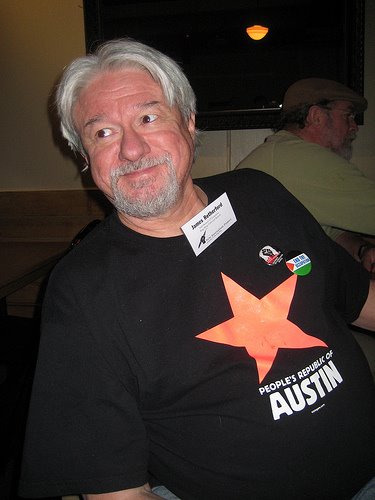
Writer, graphic designer and activist Jim Retherford, member of the editorial board of the New Journalism Project. Photo by Carlos Lowry / The Rag Blog.

Texas state Rep. Elliot Naishtat talks with New Journalism Project president David Hamilton at the Ragblogapalooza. Photo by Carlos Lowry/ The Rag Blog.

The Rag Blog

Posted in RagBlog | Tagged , | Leave a comment

The Ethanol Alternative: Still Highly Questionable

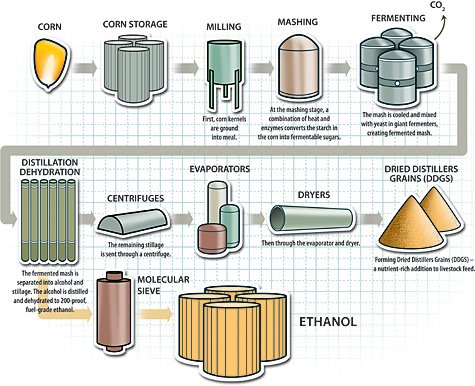
Ethanol Production Process. The process of converting corn into ethanol results in approximately 2.8 gallons of denatured ethanol and 18 lbs. of Distillers Grains from every bushel of corn. Graphic: Verasun Energy.

The Unraveling of the Ethanol Scam: 15 Studies Have Exposed the High Cost of Ethanol and Biofuels
By Robert Bryce / February 5, 2009

On its website, Wisconsin-based Renew Energy says it is the “biofuels industry leader for innovation and efficiency.” It goes on, saying that its new 130 million gallon per year ethanol plant in Jefferson, Wisconsin is “the largest dry mill corn fractionation facility in the world” which uses 35 percent less energy and 33 percent less water than similar ethanol plants.

That would be impressive but for one fact: Renew Energy just filed for bankruptcy.

The failure of Renew is the latest bankruptcy in the corn ethanol industry, a sector that despite billions of dollars in federal subsidies, hasn’t been able to prove its long-term economic viability. About 9 percent of all the ethanol plants in the US have now filed for bankruptcy and some analysts believe the numbers could go as high as 20 percent.

Even if the 20 percent figure is never reached, it’s readily apparent that billions of investment dollars will be lost on the corn ethanol scam, a darling of farm state legislators. Today, about four years after Congress increased the mandates on the use of corn ethanol in gasoline, the US is nowhere close to the much-promised goal of “energy independence.” Instead, the increasing use of corn to make motor fuel has caused a myriad of problems. Chief among them: increased food prices.

While it’s true that other factors have helped inflate food prices, including rising energy prices and increased grain demand in other countries, it’s also abundantly obvious that the corn ethanol industry has had a major effect on food prices. The reason is obvious: in 2008, some 4.1 billion bushels of corn – fully one-third of the US crop – was used to make motor fuel. And the results are being seen in the supermarket.

In mid-January, the Bureau of Labor Statistics reported that in 2008, food prices jumped by nearly 6 percent. That comes on the heels of food price increases of 4.8 percent in 2007. Some agricultural economists are now predicting that food prices could increase by as much as 10 percent in 2009. Worse still, those increases are coming at the same time that the global economy is foundering and U.S. unemployment rates are soaring.

Some of that unemployment is happening within the ethanol sector itself. Renew, which had $184.2 million in revenue in 2008, filed Chapter 11 papers on January 30, just nine days after it posted an article on its website from Ethanol Producer Magazine which touted their new ethanol production process as one that “adds up to higher profitability and sustainability.”

The failure of Renew occurred just two days after Oregon-based Cascade Grain Products filed for Chapter 11. Cascade began operating its 108 million gallon per year distillery in Clatskanie, Oregon last June. Another distiller, New York-based Northeast Biofuels, filed for bankruptcy on January 14. That company’s plant, a $200 million facility with 100 million gallons per year of capacity, began operating last August. In October, VeraSun Energy, the second-largest ethanol producer in the country, declared bankruptcy. Other recent failures in the sector include Greater Ohio Ethanol and Gateway Ethanol.

It may be unkind to kick the ethanol industry while it is circling the drain, but little of this financial news is overly surprising. The corn ethanol industry has always depended on federal handouts for its existence. And given this string of bankruptcies, it’s worth reviewing the many studies produced over the past two years that have shown the high costs of ethanol and biofuels. Thus far, I’ve found 15 of them. If readers find more, please send them along.

1. In May 2007, the Center for Agricultural and Rural Development at Iowa State University released a report saying the ethanol mandates have increased the food bill for every American by about $47 per year due to grain price increases for corn, soybeans, wheat, and others. The Iowa State researchers concluded that American consumers face a “total cost of ethanol of about $14 billion.” And that figure does not include the cost of federal subsidies to corn growers or the $0.51 per gallon tax credit to ethanol producers.

2. In September 2007, Corinne Alexander and Chris Hurt, agricultural economists at Purdue University, found that “about two-thirds of the increase” in food price increases from 2005 to 2007 was “related to biofuels.” The report also says, “Based on expected 2007 farm level crop prices, that additional food cost is estimated to be $22 billion for U.S. consumers compared to farm prices for the crops produced in 2005. A rough estimate is that about $15 billion of this increase is related to the recent surge in demand to use crops for fuel.”

3. October 2007, the International Monetary Fund said, “Higher biofuel demand in the United States and the European Union (EU) has not only led to higher corn and soybean prices, it has also resulted in price increases on substitution crops and increased the cost of livestock feed by providing incentives to switch away from other crops.”

4. In March 2008, a report commissioned by the Coalition for Balanced Food and Fuel Policy (a coalition based in Washington, D.C. of eight meat, dairy, and egg producers’ associations), estimated that the biofuels mandates passed by Congress will cost the U.S. economy more than $100 billion from 2006 to 2009. The report declared that “The policy favoring ethanol and other biofuels over food uses of grains and other crops acts as a regressive tax on the poor.” It went on to estimate that the total cost of the U.S. biofuels mandates will total some $32.8 billion this year, or about $108 for every American citizen.

5. An April 8 internal report by the World Bank found that grain prices increased by 140 percent between January 2002 and February 2008.
“This increase was caused by a confluence of factors but the most important was the large increase in biofuels production in the U.S. and E.U. Without the increase in biofuels, global wheat and maize [corn] stocks would not have declined appreciably and price increases due to other factors would have been moderate.” Robert Zoellick, president of the Bank, acknowledged those facts, saying that biofuels are “no doubt a significant contributor” to high food costs. And he said that “it is clearly the case that programs in Europe and the United States that have increased biofuel production have contributed to the added demand for food.”

6. In May, the Congressional Research Service blamed recent increases in global food prices on two factors: increased grain demand for meat production, and the biofuels mandates. The agency said that the recent “rapid, ‘permanent’ increase in corn demand has directly sparked substantially higher corn prices to bid available supplies away from other uses – primarily livestock feed. Higher corn prices, in turn, have forced soybean, wheat, and other grain prices higher in a bidding war for available crop land.”

7. Also in May, Mark W. Rosegrant of the International Food Policy Research Institute, testified before the U.S. Senate on biofuels and grain prices. Rosegrant said that the ethanol scam has caused the price of corn to increase by 29 percent, rice to increase by 21 percent and wheat by 22 percent. Rosegrant estimated that if the global biofuels mandates were eliminated altogether, corn prices would drop by 20 percent, while sugar and wheat prices would drop by 11 percent and 8 percent, respectively, by 2010. Rosegrant said that “If the current biofuel expansion continues, calorie availability in developing countries is expected to grow more slowly; and the number of malnourished children is projected to increase.” He continued, saying “It is therefore important to find ways to keep biofuels from worsening the food-price crisis. In the short run, removal of ethanol blending mandates and subsidies and ethanol import tariffs, and in the United States—together with removal of policies in Europe promoting biofuels—would contribute to lower food prices.”

8. In mid-June, Kraft Foods Global sponsored a report by Keith Collins, the former chief economist for the U.S. Department of Agriculture economist. In his 34-page analysis of grain prices, Collins concluded the ethanol scam “may account for up to 60 percent of the increase in corn prices between 2006/07 and 2008/09.

9. In late June, Oxfam, the non-profit group that fights global hunger, released a report declaring that biofuels are responsible for about 30 percent of the recent increases in global food prices, and are pushing 30 million people into poverty. Rob Bailey, Oxfam’s biofuel policy adviser, summarized the report: “Rich countries’ demands for more biofuels in their transport fuels are causing spiraling production and food inflation.”

10. In early July, Britain’s Renewable Fuels Agency concluded, “Biofuels contribute to rising food prices that adversely affect the poorest.” The report, known as the Gallagher Review, also said that demand for “[biofuels] production must avoid agricultural land that would otherwise be used for food production. This is because the displacement of existing agricultural production, due to biofuel demand, is accelerating land-use change and, if left unchecked, will reduce biodiversity and may even cause greenhouse gas emissions rather than savings. The introduction of biofuels should be significantly slowed.”

11. On July 16, the Organization for Economic Cooperation and Development (O.E.C.D.) issued its report on biofuels that concluded: “Further development and expansion of the biofuels sector will contribute to higher food prices over the medium term and to food insecurity for the most vulnerable population groups in developing countries.”

12. Also in July, the U.S.D.A., the federal agency that has long been one of the corn ethanol sector’s biggest boosters, admitted that corn ethanol is driving up food prices. That’s somewhat remarkable given that the agency’s leaders have consistently downplayed the link. Nevertheless, in July 2008, the department released a report called “Food Security Assessment, 2007,” which states very clearly that the biofuels mandates are pushing up food prices. The first page of the report says:

…the persistence of higher oil prices deepens global energy security concerns and heightens the incentives to expand production of other sources of energy including biofuels. The use of food crops for producing biofuels, growing demand for food in emerging Asian and Latin American countries, and unfavorable weather in some of the largest food-exporting countries in 2006-07 all contributed to growth in food prices in recent years.

While that admission is noteworthy, the July 2008 report’s importance lies with its projections about the growing numbers of people around the world who are facing food insecurity. And while the U.S.D.A. report does not correlate this increasing food insecurity with soaring ethanol production, the connections are abundantly clear: As the U.S. uses more corn to make motor fuel, there is less grain available on the market. That means higher prices. And that’s a key factor for residents of poor countries who generally spend a higher percentage of their income on food than their counterparts in the developed world.

For instance, in the U.S. only about 6.5 percent of disposable income is spent on food. By contrast, in India, about 40 percent of personal disposable income is spent on food. In the Philippines, it’s about 47.5 percent. In some sub-Saharan Africa, consumers spend about 50 percent of the household budget on food. And according to the U.S.D.A., “In some of the poorest countries in the region such as Madagascar, Tanzania, Sierra Leone, and Zambia, this ratio is more than 60 percent.”

The July 2008 U.S.D.A. report goes on saying that the number of people facing food insecurity jumped from 849 million in 2006 to 982 million in 2007. And those numbers are expected to continue rising. By 2017, the number of food-insecure people is expected to hit 1.2 billion. And, says the U.S.D.A., “short-term shocks, natural as well as economic” could make the problem even worse.

13. In September 2008, the International Monetary Fund estimated that 70 percent of the recent increase in corn prices was due to the ethanol scam. In a report to the United Nations, Olivier de Schutter, a Belgian academic, said “Policies aimed at promoting the use of agrofuels from feedstock, having an inflationary impact on staple foods, could only be justified under international law if very strong arguments are offered.”

14. On October 7, 2008 the United Nations Food and Agriculture Organization weighed into the debate with a 138-page report called “Biofuels: prospects, risks and opportunities.” In the section on food, the report concludes that “Rapidly growing demand for biofuel feedstocks has contributed to higher food prices, which pose an immediate threat to the food security of poor net food buyers (in value terms) in both urban and rural areas.”

15. On January 30, the University of Minnesota announced the results of a new study which compared the overall cost of corn ethanol with that of gasoline. “Total environmental and health costs of gasoline are about 71 cents per gallon, while an equivalent amount of corn-ethanol fuel costs from 72 cents to about $1.45, depending on the technology used to produce it,” said the university. Stephen Polasky, a professor in the university’s applied economics department, said that “These costs are not paid for by those who produce, sell and buy gasoline or ethanol. The public pays these costs.”

[Robert Bryce is the author of Gusher of Lies: The Dangerous Delusions of “Energy Independence.”]

Source / CounterPunch

The Rag Blog

Posted in RagBlog | Tagged , , | 5 Comments

Behind the Daschle Headlines : Blacklisting of Progressive Economists


Progressive left out of the picture: Portrait of Leo Hindery from the July 14, 2007 New York Times. Photo by Damon Winter / NYT.

‘Leo Hindery, one of the few business leaders to use his wealth to challenge deregulation, corporate trade deals and anti-worker policies was blacklisted by the Obama administration well before the Daschle flap ever happened…’

By David Sirota / February 5, 2009

Amid the swirling headlines about Tom Daschle withdrawing his nomination for Health and Human Service Secretary is a very dark, very foreboding story that tells us a lot more about what to expect from the Obama administration than a single nomination fight. It is a story that every single voter who supported Barack Obama because of his progressive economic platform should know about – and worry about.

As every newspaper in America has been happy to report, Daschle worked with venture capitalist Leo Hindery after he left the Senate. Hindery was a top economic adviser to John Edwards and later to Barack Obama, and many had floated his name for U.S. Trade Representative or Commerce Secretary. Now, though, that won’t be happening, as anyone mentioned near the Daschle flap is being shunned by the Obama administration.

But is that really why someone as accomplished as Hindery was never seriously considered for a top economic post in the administration? The media and the Obama administration would like us to believe yes – but the answer is no. It has far less to do with the Daschle situation and far more to do with Hindery’s progressive economic ideology.

Buried in a Politico dispatch , we get the real story:

Hindery did his best to carve out his own public profile, with generous contributions to a range of Democratic-leaning organizations and a 2005 book, “It Takes a CEO,” decrying outsourcing, Wal-Mart, and “an ethical and aesthetic ‘race to the bottom'” in the media industry.

He also hoped to land a job in the Obama administration, and he had a close Obama adviser – Daschle — in his corner, the two Democrats said. United Steeelworkers union officials also backed him.

But while Hindery complained that he “waited for the phone to ring,” a source said, Obama’s aides appear never to have taken his bid seriously. One possible source of friction: Hindery had set himself up in opposition to Obama’s top economic advisors, many of whom were associated with The Hamilton Project, an economic think tank that was the inheritor of former Treasury Secretary Rubin’s generally pro-trade position.

In the same story, of course, we get hedge fund shark Steve Rattner – a huge Democratic fundraiser on Wall Street – bashing Hindery for backing populist Democratic candidates for local and national office.

And that’s the big story here: Leo Hindery, one of the few business leaders to use his wealth to challenge deregulation, corporate trade deals and anti-worker policies was blacklisted by the Obama administration well before the Daschle flap ever happened – and he was blacklisted because he dared to clash with the same Wall Street Democrats whose corporate-backed policies destroyed the economy.

You can go ahead and tell yourself that this is just theory – just a single example. But that’s willful ignorance, as the Hindrey scalping is only one chapter in what has been one long narrative arc whereby economic progressives have been deliberately shut out of top administration jobs. Just step back and think about it for a minute: Amid a stable of eminently qualified and well-respected progressives like James Galbraith, Joseph Stiglitz, Dean Baker, Robert Reich, Paul Krugman and Larry Mishel, Obama has chosen Rubin sycophants like Larry Summers and Tim Geithner to run the economy – the same Larry Summers who pushed the repeal of the Glass-Steagal Act, the same Geithner who masterminded the kleptocratic bank bailout, the same duo whose claim to fame is their personal connections to Rubin, a disgraced Citigroup executive at the center of the current meltdown. And the list of Rubin sycophants keeps getting longer, from Peter Orszag to Jason Furman.

As the Nation’s Chris Hayes shows, its the same in other key regulatory positions, as free market fundamentalists who created the problem take the helm of the regulatory agencies they tried to destroy. Indeed, the only movement progressive in a top economic position is Jared Bernstein, and he was relegated to an amorphous job in the Vice President’s office.

And now we see that’s not an accident. Though Obama won states like Ohio, Pennsylvania and Indiana on promises to challenge Wall Street and reform our trade policies, there has been a deliberate and calculated effort to stack the administration with the very Wall Street Democrats who created the problems he lamented, and shun those who have been fighting the good fight.

© 2009 Open Left

[David Sirota is a bestselling author whose newest book is “The Uprising.” He is a fellow at the Campaign for America’s Future and a board member of the Progressive States Network-both nonpartisan organizations. His blog is here..]

Source / Open Left

Thanks to Roger Baker / The Rag Blog

Posted in RagBlog | Tagged , , | 1 Comment

Steven Chu : Energy Chief Says Family Farms an Endangered Species

“I don’t think the American public has gripped in its gut what could happen,” says Nobel winner Steven Chu.” Photo by Jose Luis Magana / AP.

Agricultural diversity can soften the blow of global warming.

By Janet Gilles / The Rag Blog / February 5, 2009

See ‘California farms, vineyards in peril from warming’ by Jim Tankersley, Below.

Now looks like the time to reconsider our agriculture subsidy, which funds Midwestern crops to make high calorie zero nutrient foods (corn oil, soy oil, high fructose corn syrup, white flour) and drives health costs up and the family farmers who actually grow food off the land. If we take the $50 billion annual subsidy and divide it up, cities of a million would be getting $100 million a year to subsidize local wholesome foods!

Diversity can soften the blow as major agricultural areas disappear with climate change.

California farms, vineyards in peril from warming, U.S. energy secretary warns:

‘We’re looking at a scenario where there’s no more agriculture in California,’ Steven Chu says. He sees education as a means to combat threat.

By Jim Tankersley / February 4, 2009

WASHINGTON — California’s farms and vineyards could vanish by the end of the century, and its major cities could be in jeopardy, if Americans do not act to slow the advance of global warming, Secretary of Energy Steven Chu said Tuesday.

In his first interview since taking office last month, the Nobel-prize-winning physicist offered some of the starkest comments yet on how seriously President Obama’s cabinet views the threat of climate change, along with a detailed assessment of the administration’s plans to combat it.

Chu warned of water shortages plaguing the West and Upper Midwest and particularly dire consequences for California, his home state, the nation’s leading agricultural producer.

In a worst case, Chu said, up to 90% of the Sierra snowpack could disappear, all but eliminating a natural storage system for water vital to agriculture.

“I don’t think the American public has gripped in its gut what could happen,” he said. “We’re looking at a scenario where there’s no more agriculture in California.” And, he added, “I don’t actually see how they can keep their cities going” either.

A pair of recent studies raise similar warnings. One, published in January in the journal Science, raised the specter of worldwide crop shortages as temperatures rise. Another, penned by UC Berkeley researchers last year, estimated California has about $2.5 trillion in real estate assets — including agriculture — endangered by warming.

Chu is not a climate scientist. He won his Nobel for work trapping atoms with laser light. He taught at Stanford University and directed the Lawrence Berkeley National Laboratory, where he reoriented researchers to pursue “clean energy” technologies to help reduce the use of greenhouse-gas-emitting fossil fuels in the U.S., before Obama tapped him to head the Energy Department.

He stressed the threat of climate change in his Senate confirmation hearings and in a video clip posted on Obama’s transition website, but not as bluntly, nor in as dire terms, as he did Tuesday.

In the course of a half-hour interview, Chu made clear that he sees public education as a key part of the administration’s strategy to fight global warming — along with billions of dollars for alternative energy research and infrastructure, a national standard for electricity from renewable sources and cap-and-trade legislation to limit greenhouse gas emissions.

He said the threat of warming is keeping policymakers focused on alternatives to fossil fuel, even though gasoline prices have fallen over the last six months from historic highs. But he said public awareness needs to catch up. He compared the situation to a family buying an old house and being told by an inspector that it must pay a hefty sum to rewire it or risk an electrical fire that could burn everything down.

“I’m hoping that the American people will wake up,” Chu said, and pay the cost of rewiring.

Environmentalists welcomed the comments as a sharp break from the Bush administration, which often minimized research about global warming.

“To say the least, it’s a breath of fresh air,” said Bernadette Del Chiaro, who directs the clean air and global warming program for Environment California. “We’ve been worried about the impacts of global warming for years, even decades. He’s absolutely right — California stands to lose so much in our way of life.”

Global warming skeptics were not swayed. “I am hopeful Secretary Chu will take note of the real-world data, new studies and the growing chorus of international scientists that question his climate claims,” Sen. James Inhofe (R-Okla.), the top Republican on the Environment and Public Works Committee, said in a statement. “Computer model predictions of the year 2100 are simply not evidence of a looming climate catastrophe.”

Source / The Los Angeles Times

The Rag Blog

Posted in Rag Bloggers | Tagged , , | 1 Comment

Jim Hightower : Stop Taking Bull From Wall Street

‘As a consequence of their avaricious grab for outrageous personal enrichment during the past decade, these arrogant titans of financial gimmickry have caused a vast economic collapse…’

Why Is the Government Hell-Bent on Rewarding Greed, Incompetence and Narcissism?

By Jim Hightower / February 5, 2009.

Washington shouldn’t reward Wall Street’s culture of excess. Instead, it should insist that those who wrecked the economy be fired.

Bankers have never been much loved, but gollies, this Wall Street bunch seems hell-bent on being loathed.

As a consequence of their avaricious grab for outrageous personal enrichment during the past decade, these arrogant titans of financial gimmickry have caused a vast economic collapse that is presently costing million of Americans their homes, jobs, pensions and dreams — while also bringing down the banks themselves.

As you would expect, the Wall Streeters who did this to us are now humbled and filled with deep remorse. HA! Just kidding.

Instead, the perpetrators keep grasping for all they can get, taking no responsibility for the damage they’ve done. Obtuse? Self-indulgent? Narcissistic? What’s with these people? A few examples of their bloated sense of entitlement:

• While Merrill Lynch was imploding last year, requiring a $25 billion salvage job from us taxpayers, CEO John Thain was merrily spending $1.2 million to redecorate his office, including buying a $13,000 “custom” coffee table, a $1,400 wastebasket and a $35,000 antique commode (add your own toilet joke here).

In such tough times, why didn’t he just make do with the perfectly luxurious office of his predecessor?

“Well … his office was very different than the … the general decor of Merrill’s offices,” Thain told a CNBC interviewer. “It really would have been … very difficult … for … me to use it in the form it was in.”

• Citigroup, which lost $28 billion in the past 15 months, has now received a $345 billion bailout from Washington. Time to cut nonessential spending, right? Yes — as long as “essential” includes a new $50 million Dassault Falcon 7X jet for top executives.

Never mind that the bank already has five executive jets in its fleet. It took a public expression of outrage from President Barack Obama to get Citigroup’s honchos to back off this extravagance, and it’s said that they’re still sulking about it.

• Despite their historically disastrous year in 2008, Wall Street investment bankers awarded themselves a total of $18.4 billion in bonuses — the sixth-largest payout on record! Shouldn’t they be embarrassed, you ask? Of course, but a January poll of the bankers found that 46 percent of them felt they deserved a bigger bonus.

By the way, the Street’s rationalization for such giveaways is that top bankers must be showered with treasure in order to keep them hitched to the corporate plow. “Retention bonuses,” they’re called. Merrill Lynch’s Thain, for example, doled out $4 billion in bonuses last fall while the firm was awaiting its bailout check, explaining that it’s essential to “pay your best people,” or they’ll leave.

Shouldn’t he have to wear a clown costume when saying silly stuff like that? Leave to where? The whole Street is on fire. Besides, these are the geniuses who lit the match — who would want them?

Which brings us to the “Obama stage” of the banker bailout. At its core, his plan looks like more of the same. The government (you and I) will buy the bad loans now held by the banks, paying an inflated value for them. This gift will make us by far the biggest investor in Wall Street — yet, even though we’re putting up the capital, Obama’s team does not require a commensurate decision-making role for the public.

One decision in particular needs our say-so: Who’s going to manage the money? Under Obama’s plan, the same old obtuse, self-indulgent, narcissistic — and failed — bankers would keep their jobs and control the bailout. It seems the president’s top economic advisors, Timothy Geithner and Lawrence Summers, don’t have the stomach for the real housecleaning needed to set Wall Street right. Instead, they cower behind knee-jerk ideological platitudes, scoffing that “governments make poor bank managers.”

Hello? It’s hard to be a poorer manager of America’s financial system than the current group of greed-headed “free marketers.” They lost hundreds of billions of dollars in bank assets during the past year or so, wrecking our economy in the process, and now they want to be rescued.

Rescue the system, yes. But not those who wrecked it. Wall Street’s culture of excess should not be rewarded, and any bailout should begin by insisting that all of those who did this to America be fired.

[To find out more about Jim Hightower, and read features by other Creators Syndicate writers and cartoonists, visit the Creators Syndicate Web page at www.creators.com.]

Copyright 2009 Creators Syndicate Inc.

Source / Creators Syndicate / AlterNet

Thanks to David Hamilton / The Rag Blog

Posted in RagBlog | Tagged , , , , | Leave a comment

Gaza Doctors : Victims Suffering from White Phosphorus Burns

John Ging, head of the UN aid agency in Gaza, said that “three rounds that emitted phosphorus” hit a corner of the UN’s Gaza City facility on, above, on Jan. 15, 2009.

White phosphorus sticks to human skin and will burn right through to the bone, causing death or leaving survivors with painful wounds which are slow to heal. — BBC News.

Gaza doctors find signs of white phosphorus bombs in burn victims
By Amira Hass / February 5, 2009

See ‘US Sold Phosphorus Shells to Israel,’ by Jason Ditz, Below.

GAZA – Palestinian doctors at a number of hospitals in the Gaza Strip informed foreign medical experts allowed into the area over the past two weeks that they were witnessing an unexpected deterioration in the condition of their burn victims.

They described the same phenomenon: Two weeks after being injured, the burn victims seemed to be getting worse, requiring skin grafts abroad.

In other instances, internal tissue was also destroyed. Some of the wounded died a week to 10 days after being injured, even though they had not appeared to suffer extensive injuries. The doctors only later discovered that their liver and kidneys had been affected. But at this point, it was already too late to save many of the wounded.

The precise number of those who suffered burn wounds and then died is still uncertain.

Doctors take care to note that until the necessary laboratory work is done, they will be unable to determine with certainty if the burns were caused by the white phosphorus bombs the IDF dropped during its ground offensive in the Gaza Strip.

They are also unable to state with certainty whether the patients’ deterioration and the spread of infection stemmed directly from being hit with the phosphorus mortars.

However researchers from Amnesty International and Human Rights Watch, who have spent the past three weeks in the Gaza Strip, have concluded with certainty that the white phosphorus bombs struck residential neighborhoods.

The initial treatment of the burns, before the doctors in the Gaza Strip had realized that they were caused by white phosphorus, was deemed useless.

“We had never seen phosphorus burns before,” a veteran foreign surgeon told Haaretz. “In the [medical] literature, what is known about these burns is what was done as experiments, in lab conditions, or in military bases, perhaps as the result of accidents.”

However, three Israeli documents Haaretz received, which were written during Operation Lead Cast, describe the sort of burns caused by white phosphorus and match the descriptions of the medical personnel in the Gaza Strip. The documents were prepared by the office of the IDF chief medical officer, the Medical Field Operations HQ and Magen David Adom.

A document bearing the signature of Dr. Zvi Feinberg, chief of medicine at Magen David Adom, and Rami Miller, a senior paramedic, writes that “white phosphorus contained in a bomb or a missile ignites when it comes into contact with oxygen … the phosphorus that comes into contact with skin causes serious and deep burns.”

Another document, this one signed by Dr. Gil Hirschorn, who is also a colonel in the army and head of trauma in the office of the IDF’s chief medical officer, states: “During Operation Cast Lead, intelligence was received that Hamas was making use of an ordinance that contains phosphorus. Phosphorus is a poisonous substance, white-yellowish, similar to wax, that is used in mortar shells and hand grenades.

“When the phosphorus comes in contact with living tissue it causes its damage by ‘eating’ away at it. Characteristics of a phosphorus wound are: chemical burns accompanied by extreme pain, damage to tissue … the phosphorus may seep into the body and damage internal organs. In the long run, kidney failure and the spread of infection are characteristic … In conclusion: a wound by an ordinance containing explosive phosphorus is inherently dangerous and has the potential to cause serious damage to tissue.”

A document entitled “Exposure to White Phosphorus,” prepared by Medical Field Operations HQ and sent from the Health Ministry notes that “most of the data on phosphorus wounds stems from animal testing and accidents. Exposure to white phosphorus is highly poisonous, according to many lab experiments. Burns covering a small area of the body, 12-15 percent in lab animals and less than 10 percent in humans, may be lethal as a result of its effects, mostly on the liver, heart and kidneys.”

Haaretz visited a number of homes in the Gaza Strip that show clear signs of being hit by phosphorus shells. At least one of the children hurt in such an attack will require a skin graft abroad. In another instance, four children and the father died as a result of a white phosphorus bombing.

Source / Haaretz

US Sold Phosphorus Shells to Israel
By Jason Ditz / February 5, 2009

The Pine Bluff Arsenal, a United States Army installation in Arkansas, specializes in chemical and biological weapons. The military touts them as the only facility in the Northern Hemisphere which fills white phosphorus munitions. That’s the important point here, as it once again ties the US military directly into the Israeli war in the Gaza Strip, and one of its most unseemly practices.

State Department officials told the Associated Press that the United States provided Israel with white phosphorus rounds, and photos taken during the Israeli conflict show the military readying rounds with Pine Bluff Arsenal serial numbers.

The use of white phosphorus is not in and of itself a war crime, and is generally considered acceptable as a means of obscuring troop movements or illuminating areas. Its use in civilian areas however, even if not directed at the civilian population, is banned under the Geneva Convention on Certain Conventional Weapons. Preliminary investigations show indisputable evidence that Israel used white phosphorus in some of the most densely populated portions of Gaza, and still burning fragments were found after the war ended wedged into civilian buildings.

The Israeli military officially denied using such munitions during the war, though they eventually conceded to it. Their official story now is that the use was not illegal and that Hamas was the one committing war crimes by provoking such attacks. The treaty prohibits the use of such weapons against military targets in civilian regions however, and makes no exception allowing the nation violating it to transfer blame to others in case they really wanted to hit those targets.

Source / Antiwar.news

Also see Rights groups says laws of war violated in Gaza / by Ben Hubbard and Alfred de Montesquiou / AP / Feb. 5, 2009

The Rag Blog

Posted in RagBlog | Tagged , , , , | 4 Comments

Loving: The Truth About the War in Afghanistan

Cartoon by Charlie Loving / The Rag Blog

Posted in Rag Bloggers | Tagged , | 2 Comments

Republicans and the Stimulus Plan : Betting on Hard Times

Kentucky Republican Sen. Mitch McConnell has stopped short of threatening a filibuster to stop the stimulus plan. Photo by AFP.

It is in the interest of the GOP to complain endlessly about waste and to throw up road blocks at every turn. Obama has unwittingly handed them the bipartisanship card to play. No matter what the Democrats offer them, they demand more and claim the Senate and House Democratic leadership is ignoring them.

By Sherman DeBrosse / The Rag Blog / February 4, 2009

The polls show that the vast majority of Republican voters want Republicans in Congress to reject the stimulus plan. The greatest part of their base has somehow blended right-wing populism, religion, and market fundamentalism in such a manner that only enormous economic pain over a very long period would lead to questioning Republican economics and Rush Limbaugh, who now seems to be the party’s most powerful spokesman. The 177 House Republicans had no incentive to support it because they come from solidly red districts. Some of the Senators do not have completely safe seats, but they know that voters have short memories and they have become accustomed to a lock step party discipline unparalleled in American history.

Some savvy Republicans may realize that recessions are good for their wealthiest and most powerful constituents. When unemployment is low, labor expenses are high. Hard times present excuses to cut hours, vacations, sick days and other benefits. A declining stock market forces little people to sell out and provides wonderful buying opportunities for those with surplus cash — often the people with enough knowledge to sell when it was high. Recessions also offer huge interests that seek oligopoly power the opportunity to swallow up smaller competitors.

No Republicans voted for the stimulus bill in the House, and eleven Democrats voted with the Republicans. Something similar will occur in the Senate. But first the GOP will extract a pound of flesh for not preventing a vote on the measure.

It looks like there are at least 35 solid Republican Senate votes against the stimulus plan. There is no indication that the remaining six GOP Senators will support it. There are some undecided votes. In the end, it may only be Susan Collins of Maine who might support it or at least not join in a serious filibuster. There are two Democratic Senators likely to vote against the stimulus plan, Ben Nelson of Nebraska and Kent Conrad of North Dakota. It is unlikely that either would support a GOP filibuster. There are other wavering Democratic senators.

Senator Mitch McConnell has stopped short of threatening a filibuster to block the stimulus bill. It is not in the interest of the Republicans to permanently block the plan. Should they do so, the fate of the economy would be their problem, and the people of the United States might finally learn that 41 negative votes in the Senate is about the same as a veto.

The slippery Kentuckian could probably produce a filibuster on a short term basis if he wished to do so in order to extract some concessions for letting the Democrats pass the bill. The most likely concession is leaving the Bush tax cuts for the rich in place for two more years. Senator Harry Reid has no choice but to allow amendments to the bill, so we can expect more money for tax cuts and considerably less for social programs to help those most hurt by the recession.

One wavering Democratic Senator is insisting that the stimulus bill include a program to rescue doubtful mortgages, and the Republicans have offered a similar plan. The Senate Democrats would be wise to include a substantial mortgage rescue plan in this bill. It might give a few reluctant Democrats the cover they need to vote for it. It would also give the appearance of reaching out to Republicans and perhaps save the Democrats from adding Republican tax reduction suggestions. It would gain popularity for the bill and make it less necessary to use TARP funds for rescuing home mortgages. It is important that TARP money not be used for home mortgages as it is needed to fuel industrial revival, which includes restructuring the domestic automobile industry. It is clear that that kind of legislation will not pass the Senate.

Senator Kay Bailey Hutchinson has greatly exaggerated the amount of social spending in the bill and has demanded that it all be cut. The truth is that social spending is very much needed as the number of people now receiving cash welfare payments is the lowest in 40 years. That is due to the infamous Republican welfare reform bill that Bill Clinton mistakenly signed. Every dollar that goes to the poor is an effective stimulus in that it will be spent immediately. On the other hand, tax cuts for folks higher up the ladder often go into savings or to pay off debt, and are less efficient in stimulating the economy.

Over the course of the New Deal, FDR invested about 25% of the GDP in stimulus and was not able to completely rescue the economy. The present stimulus package is a little less that 6% of the GDP. It is only the first installment of many similar steps if we are to escape a “lost decade” similar to that experienced in Japan.

This recession promises to last a number of years and will certainly extend well beyond 2012, in part because the problems of repairing a collapsed financial system are nothing short of enormous. Everyone in Washington must grasp this, and it offers the GOP a good shot of regaining power in 2012. Limbaugh was probably wrong in seeing 2010 as the comeback year, but it could be if the party is successful in delaying and trimming stimulus and bailout legislation. If they are successful in 2010, Republicans would have the opportunity to gerrymander themselves into a much better position in the House.

It is in the interest of the GOP to complain endlessly about waste and to throw up road blocks at every turn. Obama has unwittingly handed them the bipartisanship card to play. No matter what the Democrats offer them, they demand more and claim the Senate and House Democratic leadership is ignoring them. They are already using in an attempt to drive a wedge between Obama and his allies on the hill. Some among them might recall European history in the 1920s and 1930s, when there were revolts of the masses that brought rightists to power in many countries. The Republicans lost the 2008 election, but their base remains large and solid. They are betting that continued hard times will assist them in 2010 and 2012.

As usual, the Republicans are proving very good at getting out their message and their corporate media allies are helping them win the spin war. Congressional Democrats need to learn how to match their opponents in message management. They must also tag the GOP with responsibility for dragging us into this economic pit.

The Rag Blog

Posted in Rag Bloggers | Tagged , , , | Leave a comment

Paul Craig Roberts : The War on Terror is a Hoax

War on Terror: The Board Game
.
‘The “war on terror” is a hoax that fronts for American control of oil pipelines, the profits of the military-security complex, the assault on civil liberty by fomenters of a police state, and Israel’s territorial expansion.’

By Paul Craig Roberts / February 4, 2009

According to US government propaganda, terrorist cells are spread throughout America, making it necessary for the government to spy on all Americans and violate most other constitutional protections. Among President Bush’s last words as he left office was the warning that America would soon be struck again by Muslim terrorists.

If America were infected with terrorists, we would not need the government to tell us. We would know it from events. As there are no events, the US government substitutes warnings in order to keep alive the fear that causes the public to accept pointless wars, the infringement of civil liberty, national ID cards, and inconveniences and harassments when they fly.

The most obvious indication that there are no terrorist cells is that not a single neocon has been assassinated.

I do not approve of assassinations, and am ashamed of my country’s government for engaging in political assassination. The US and Israel have set a very bad example for al Qaeda to follow.

The US deals with al Qaeda and Taliban by assassinating their leaders, and Israel deals with Hamas by assassinating its leaders. It is reasonable to assume that al Qaeda would deal with the instigators and leaders of America’s wars in the Middle East in the same way.

Today every al Qaeda member is aware of the complicity of neoconservatives in the death and devastation inflicted on Muslims in Iraq, Afghanistan, Lebanon and Gaza. Moreover, neocons are highly visible and are soft targets compared to Hamas and Hezbollah leaders. Neocons have been identified in the media for years, and as everyone knows, multiple listings of their names are available online.

Neocons do not have Secret Service protection. Dreadful to contemplate, but it would be child’s play for al Qaeda to assassinate any and every neocon. Yet, neocons move around freely, a good indication that the US does not have a terrorist problem.

If, as neocons constantly allege, terrorists can smuggle nuclear weapons or dirty bombs into the US with which to wreak havoc upon our cities, terrorists can acquire weapons with which to assassinate any neocon or former government official.

Yet, the neocons, who are the Americans most hated by Muslims, remain unscathed.

The “war on terror” is a hoax that fronts for American control of oil pipelines, the profits of the military-security complex, the assault on civil liberty by fomenters of a police state, and Israel’s territorial expansion.

There were no al Qaeda in Iraq until the Americans brought them there by invading and overthrowing Saddam Hussein, who kept al Qaeda out of Iraq. The Taliban is not a terrorist organization, but a movement attempting to unify Afghanistan under Muslim law. The only Americans threatened by the Taliban are the Americans Bush sent to Afghanistan to kill Taliban and to impose a puppet state on the Afghan people.

Hamas is the democratically elected government of Palestine, or what little remains of Palestine after Israel’s illegal annexations. Hamas is a terrorist organization in the same sense that the Israeli government and the US government are terrorist organizations. In an effort to bring Hamas under Israeli hegemony, Israel employs terror bombing and assassinations against Palestinians. Hamas replies to the Israeli terror with homemade and ineffectual rockets.

Hezbollah represents the Shi’ites of southern Lebanon, another area in the Middle East that Israel seeks for its territorial expansion.

The US brands Hamas and Hezbollah “terrorist organizations” for no other reason than the US is on Israel’s side of the conflict. There is no objective basis for the US Department of State’s “finding” that Hamas and Hezbollah are terrorist organizations. It is merely a propagandistic declaration.

Americans and Israelis do not call their bombings of civilians terror. What Americans and Israelis call terror is the response of oppressed people who are stateless because their countries are ruled by puppets loyal to the oppressors. These people, dispossessed of their own countries, have no State Departments, Defense Departments, seats in the United Nations, or voices in the mainstream media. They can submit to foreign hegemony or resist by the limited means available to them.

The fact that Israel and the United States carry on endless propaganda to prevent this fundamental truth from being realized indicates that it is Israel and the US that are in the wrong and the Palestinians, Lebanese, Iraqis, and Afghans who are being wronged.

The retired American generals who serve as war propagandists for Fox “News” are forever claiming that Iran arms the Iraqi and Afghan insurgents and Hamas. But where are the arms? To deal with American tanks, insurgents have to construct homemade explosive devices out of artillery shells. After six years of conflict the insurgents still have no weapon against the American helicopter gunships. Contrast this “arming” with the weaponry the US supplied to the Afghans three decades ago when they were fighting to drive out the Soviets.

The films of Israel’s murderous assault on Gaza show large numbers of Gazans fleeing from Israeli bombs or digging out the dead and maimed, and none of these people is armed. A person would think that by now every Palestinian would be armed, every man, woman, and child. Yet, all the films of the Israeli attack show an unarmed population. Hamas has to construct homemade rockets that are little more than a sign of defiance. If Hamas were armed by Iran, Israel’s assault on Gaza would have cost Israel its helicopter gunships, its tanks, and hundreds of lives of its soldiers.

Hamas is a small organization armed with small caliber rifles incapable of penetrating body armor. Hamas is unable to stop small bands of Israeli settlers from descending on West Bank Palestinian villages, driving out the Palestinians, and appropriating their land.

The great mystery is: why after 60 years of oppression are the Palestinians still an unarmed people? Clearly, the Muslim countries are complicit with Israel and the US in keeping the Palestinians unarmed.

The unsupported assertion that Iran supplies sophisticated arms to the Palestinians is like the unsupported assertion that Saddam Hussein had weapons of mass destruction. These assertions are propagandistic justifications for killing Arab civilians and destroying civilian infrastructure in order to secure US and Israeli hegemony in the Middle East.

[Paul Craig Roberts was Assistant Secretary of the Treasury in the Reagan administration. He is coauthor of The Tyranny of Good Intentions.He can be reached at: PaulCraigRoberts@yahoo.com.]

Source / counterpunch

Thanks to David Hamilton / The Rag Blog

Posted in RagBlog | Tagged , , , , | Leave a comment

Bush Scandals : The List. (Not a Pretty Picture)

British Artist Jonathan Yeo created this portrait of President Bush using a collage of images cut out from 100 porn magazines. This piece was unveiled in August 2007 at the Lazarides Gallery in London. Interestingly enough, Yeo was commissioned by the George W. Bush Presidential Library to paint an official portrait of the 43rd President, but before he could begin working on the portrait he was fired. Instead of scrapping the project all together he decided to change directions and finish the piece anyway…with porno mags. Image by Jonathan Yeo / WebUrbanist.

Hugh’s List of Bush scandals: ‘Most are breaches of the public trust, many violations of Bush’s Oath of Office. The rest are crimes and War Crimes.’

By Larry Ray / The Rag Blog / February 4, 2009

Any American who has a simmering anger after eight years of George W. Bush as president will want to bookmark the links below to a web site simply titled:

“Hugh Makes a List … because there are just too many scandals to remember”

A progressive named Hugh started making a list of Bush scandals in late 2006. A blog, firedoglake, provided its initial exposure. Firedoglake loves challenges, so Hugh didn’t even have to ask for help. The first entries were very brief. One site remembers,

Hugh edited each entry by adding enough information so that even a mainstream media reporter would understand what event or action the entry implied or recognized. All of these entries – there are finally 400 – are worse than a president getting a hummer from another adult under the Oval Office desk. Most are breaches of the public trust, many violations of Bush’s Oath of Office. The rest are crimes and War Crimes.

Hugh’s List is a Creative Commons Attribution-Noncommercial 3.0 site. We are offering our readership free access to this scholarly and unique undertaking.

The Table of Contents itself is breathtaking:

The detailed list is here.

Here is a brief excerpt from the first paragraph of the last entry.

# 400: An Absent President

Of the 2922 days Bush was President he spent all or part of 1,020 of them on vacation (35% of his time in office). This includes 487 days at Camp David, 490 at his ranch in Crawford, and 43 days at his family’s compound in Kennebunkport. If there is one word which typifies this and Bush, it is AWOL. The man has been AWOL his whole life. You have only to look at his academic career or his lack of it. […]

Unfortunately for us, the Presidency is a real full-time job. In it, Bush stayed true to form. He was not just physically absent from it much of the time. He was intellectually and morally absent from it all the time.

But the blame does not belong to him. It never does with an AWOL man. No, it belongs with us who, as a nation, for 8 years took a vacation from ourselves and our responsibilities. We had not just an AWOL President with Bush but an AWOL age. Now Bush is gone, as AWOL as ever, and we are left to deal with his legacies.

The Rag Blog

Posted in Rag Bloggers | Tagged , , , | Leave a comment

Palin Endorses Perry : Birds of a Feather

All in the Family: Texas Gov. Rick Perry directs Willow Palin(carrying infant Trig Palin)as Republican veep candidate Alaska Gov. Sarah Palin arrives at San Antonio International Airport. Oct. 3, 2008.

Whoopie Doo! The yahoo guv of the nation’s “largest” state (if you include all the ice) steps into Texas political doo-doo as she throws her gun into the Rick Perry-Kay Bailey Hutchinson gubernatorial shoot-out. — .td / The Rag Blog.

‘He walks the walk of a true conservative. And he sticks by his guns – and you know how I feel about guns,’ Sarah Palin said.

By Wayne Slater / February 3, 2009

AUSTIN – Alaska Gov. Sarah Palin has endorsed Rick Perry for re-election, calling him the “true conservative” in a primary election showdown with fellow Republican Kay Bailey Hutchison.

Palin, who electrified the GOP base as the party’s vice presidential nominee last year, has strong support among the party’s social conservatives. Her endorsement appeared aimed at undercutting Hutchison’s appeal with GOP women. Both groups will be important in picking the party’s nominee in next year’s GOP primary.

In a letter to “Texas Republican women” distributed by the Perry campaign, Palin touts the Texas governor’s conservative credentials.

“He walks the walk of a true conservative. And he sticks by his guns – and you know how I feel about guns,” she said.

Palin cited one of the Perry campaign’s top issues – opposition to federal financial bailouts. And she singled out Perry’s opposition to abortion rights.

“Not every child is born into ideal circumstances, but every life is sacred,” Palin said in the mail appeal. “Rick Perry knows this – it is at the core of his being.”

Hutchison supports abortion rights, although with restrictions, including parental notification and a ban on certain late-term procedures.

The GOP primary draws a large number of social conservatives for whom abortion and gay marriage are litmus-test issues. And in recent weeks, Perry has made high-profile appeals to abortion opponents.

Perry spokesman Mark Miner called Palin, seen as a potential future GOP presidential nominee, “a star of the Republican Party.” Hutchison spokesman Todd Olsen said the senator has broad support among Texas Republicans “who know what is going on in Texas,” adding: “We look forward to having the [Alaska] governor’s support after the primary.”

According to the Perry campaign, the letter went to 10,500 members of the Texas Federation of Republican Women, an influential organization whose members have been an important part of Hutchison’s political base.

The letter does not mention Hutchison by name.

Taffy Goldsmith of Dallas, a past president of the Texas federation and a Hutchison supporter, said Monday that she doesn’t think the endorsement will have much effect.

“There is a lot of admiration for Governor Palin and what she has done both in her own state and to energize the party,” Goldsmith said.

“But women in this organization are so state-oriented and so well-grounded they will base their decisions on what they know, not what somebody else recommends.”

As Republican governors, Perry and Palin have both been advocates of domestic drilling for oil and energy issues. Perry served last year as head of the Republican Governors Association and introduced Palin when she spoke to the group.

Source / Dallas Morning News

The Rag Blog

Posted in RagBlog | Tagged , , , , | 1 Comment