Supremes Take Case Challenging President’s Right to Indefinite Detention of Suspects


Supreme Court to decide if the president can order the indefinite military detention of people living in the United States?
By Adam Liptak / December 5, 2008

WASHINGTON — The Supreme Court on Friday agreed to decide the most fundamental question yet concerning executive power in the age of terror: Can the president order the indefinite military detention of people living in the United States?

The case concerns Ali al-Marri, the only person on the American mainland being held as an enemy combatant, at the Navy brig in Charleston, S.C. Mr. Marri, a citizen of Qatar, was legally in the United States when he was arrested in December 2001 in Peoria, Ill., where he was living with his family and studying computer science at Bradley University.

Eighteen months later, when Mr. Marri was on the verge of a trial on credit card fraud and other charges, President Bush declared him an enemy combatant, moving him from the custody of the Justice Department to military detention. The government says Mr. Marri is a Qaeda sleeper agent sent to the United States to commit mass murder and disrupt the banking system.

The case, which will probably be argued in the spring, will present the Obama administration with several difficult strategic choices. It can continue to defend the Bush administration’s expansive interpretation of executive power, advance a more modest one or short-circuit the case by moving it to the criminal justice system.

In July, the United States Court of Appeals for the Fourth Circuit, in Richmond, Va., issued a fractured decision in the case. In one 5-to-4 ruling, the court ruled that the president has the legal authority to detain Mr. Marri.

But a second, overlapping 5-to-4 majority of the court ruled that he must be given an additional opportunity to challenge his detention in federal court. An earlier court proceeding, in which the government had presented only a sworn statement from a defense intelligence official, was inadequate, the second majority ruled.

The government had urged the Supreme Court to put off consideration of the case, al Marri v. Pucciarelli, until the trial-court do-over was completed.

Two other men have been held as enemy combatants on the American mainland since the Sept. 11 attacks. Rulings in their cases will inform the Supreme Court’s treatment of Mr. Marri.

In 2004, in Hamdi v. Rumsfeld, five Supreme Court justices said Congress had granted the president power to detain at least those enemy combatants captured on the battlefield in Afghanistan, even if they are American citizens, for the duration of hostilities there. But the detainee in that case, Yaser Hamdi, was freed and sent to Saudi Arabia not long after the court’s decision, which also allowed him to challenge his detention.

Based on the Hamdi decision, the Fourth Circuit in 2005 upheld the detention of Jose Padilla, an American arrested at a Chicago airport. Although Mr. Padilla was said to have ties to Al Qaeda, the Fourth Circuit decision largely turned on his own activities on the battlefield in Afghanistan. Just before the Supreme Court was to decide whether to hear his case for a second time, Mr. Padilla was transferred to the criminal justice system and convicted on charges related to terrorism last year.

In a recent brief, the government provided the justices with a sworn 2004 statement from Jeffrey N. Rapp, the defense intelligence official. The statement, declassified in 2006, said that Mr. Marri had met with Osama bin Laden and Khalid Shaykh Muhammed in the summer of 2001.

“Al-Marri offered to be an al Qaeda martyr or to do anything else that al Qaeda requested,” Mr. Rapp said. The Qaeda officials told Mr. Marri, the statement said, to leave for the United States and to make sure he got there before Sept. 11.

The government’s brief said the Congressional authorization must have intended to allow the detention of people like Mr. Marri and called a contrary interpretation absurd. Such a reading, the brief said, “relies on the assumption that when Congress authorized the use of military force to respond to the Sept. 11 attacks, it did not intend to reach individuals virtually identically situated to the September 11 hijackers.”

In a brief filed three weeks ago, lawyers for Mr. Marri, who has been held without charge in isolation for more than five years, said the court should not delay consideration of the case.

“Since the nation’s founding,” the brief said, “persons lawfully residing in this country have correctly understood that they can be imprisoned for suspected wrongdoing only if the government charges them with a crime and tries them before a jury.”

Source / The New York Times

The Rag Blog

Posted in RagBlog | Tagged , , | Leave a comment

Eschenbach: On Letting Go of Religion, Part II


The Case for Intolerance of Religion, Part II
By Sid Eschenbach / The Rag Blog / December 5, 2008

The Ecumenical Experiment

Our tolerance of religion simply prolongs the agony of an ethical system in crisis and conflict. “Ecumenicalism”, the noted Catholic theologian Dr. Hans Kung states, “is based in a critical attitude about one’s own religious tradition, but also a steadfastness of belief that one’s own religion is the true religion”. This concept is to theocratic survival what Mutually Assured Destruction was to national survival. Instead of attempting to resolve our differences and move forward together, it postulates the formalization of a permanent state of conflict, distrust and enmity which must be tolerated…. because open warfare is worse. Of course it is no surprise that religion doesn’t suggest or act on the obvious solution… redefine ethics in non-theocratic terms. This crisis of ethics, which grows ultimately out of the failure of religious intolerance and now the failure of religious tolerance, gives rise to conflicts like the situation in the Middle East. It is no coincidence that the Jewish Palestinian conflict is now seen in terms of the conflict without a solution… because, like ecumenicalism, it postulates the formalization of contradictory and mutually incompatible realities.

While quantum physics postulates much the same type of simultaneously occurring contradiction, in human affairs it doesn’t work so well, and any good 9th to 18th century leader knew this all too well. But in 1776 there was lots of free space in this new place called America, and coming from centuries of intolerant religious madness in Europe,… tolerance seemed like the only way to a create a peaceful society. From then to now, the world has shrunk, and the temporary convenience of condoning mutually unacceptable and contradictory dogma, even with the introduction of modern ecumenicalism, stretches tolerance and reason past the breaking point.

In their hearts, the Baptist /Moslem /Jew /Catholic/ Mormon /Hindi really believes the others are all pagans and that they alone are right. Period. Religious leaders of the 18th century turned to religious tolerance not because they wanted to… but as usual, because they had to. It is nothing less than what they clearly saw it as… a dilution of their power, and it was not given up easily. And if they in their hearts don’t accept nor tolerate others, why should they be tolerated? This reality is seen in world and national events daily.

By definition, no resolution to the conflict between the competing religions is intended to ever come from the practice of ecumenism. It attempts to treat the symptom of strife, not the disease of inherent contradiction…. and no amount of wax on the hood has ever made a motor run better. Not only is it a defeatist theory that religions had to accept in order to survive, in its earliest incarnation, before “modern” inter-faith ecumenism gained “politically correct” status, it was just the opposite! It was an effort to consolidate power between like groups and gain market share… not an effort to foster understanding and respect among conflictive, contradictory religious faiths. It was an effort by the Christian churches to overlook their small differences and join in a common front the better to face the religious competition.

Because the roots of ecumenicalism are planted in deeply cynical soil, the tree and the fruits of ecumenism are tainted… and it is for these reasons that we can no longer tolerate tolerance of religious belief. It is an attempt to construct a peace where embedded conflict remains, a guardian of the status quo until one side or another gains the upper hand and declares victory. While we espouse “tolerance” of one another’s beliefs, we continue to preach, teach and spread the divisive poison of us versus them… the Middle East being just the most topical example.

What’s New?

So now, today in 2008…what has changed? Why would I argue the seemingly preposterous… that we can no longer tolerate tolerance of religion? How can this possibly be a step forward? Why was tolerance a very good idea in 1776, but a very bad one today? What has changed now is quite simply…. everything. Everything we now understand that we didn’t understand before. Everything we know now that we didn’t know before. Everything we can do now that we couldn’t do before. Every answer we have now that we didn’t have before. Every question we can ask now that we couldn’t have asked before.

What has changed is simply this: for the first time in our 500,000 year human history, we no longer have to be believe…. for we now can either a) know, or b) know what we don’t know. To paraphrase Hawking: “We’re working on it”. If in fact the reason for the creation of the major religions was to provide answers and control for growing and unmanageable populations of newly agrarian societies, we can now state (and what the Vatican readily admits) that the first raison d’être is no longer viable. While we clearly don’t understand (and certainly will never understand) everything, we do understand enough about everything not have to believe religious creation cosmologies any longer, and this is undeniable.

Unfortunately, the reality of this fact has yet to be integrated into our ethical thinking. The second part of the religious imperative, the need to create ethical frameworks for large societies… takes us back to the splitting of the atom. And clones. And stem cell research. And euthanasia. Social and political leaders still make ethical decisions based upon antiquated religious belief systems. While they and their societies struggle to manage the options provided by the sciences which defeated them, they find, not surprisingly, that their belief systems are not up to the task… and that is simply because they were never designed to do so. The questions which face us today are as new as the knowledge which produced them, and therefore it makes as much sense to base the ethics of modern societies on 2,000 year old religious models as it would to ask David with his slingshot to throw his rock to the moon… and bring it back.

The question then becomes more straightforward: what takes religion’s place in the cosmologic and ethical realms? If one can argue that science has displaced the need for religious cosmologies, where is the replacement for the overarching ethical guidance which all societies need… a role historically provided by religions?

It’s a Relative World

From Aristotle to Newton, the concept of “science” was not unlike the concept of the Gods with whom they shared their time. Definitive, omnipresent and immutable powers, absolute and perfect. Albert Einstein turned Newtonian science on its head when he discovered that science, that definitive model, was relative. And then to really make it relative, along came newer theories. Quantum theory, and string theory, theories of small and large force theories… all of them are relative, and all of them are redefining our understanding of the universe and our place in it.

These scientific discoveries, while rocking again and again the boat of science to its gunnels, simply reflected what many social thinkers had intuitively understood for some time: nothing is truly independent, and that all things are defined not by themselves but by their relationships to one another. Music is not a series of notes, but the relationship between the notes. Politics is not the policies, but the relationships created between the peoples. Poetry is not the individual words, but the relationship between them. Love is not the feeling but the relationship between the lovers. Theft is not the movement of the object, but the relationship between the owners when the object is moved. Murder is not the death, but the reasons for it. All of life is context, and therefore any system of ethics cannot be defined as immobile and inflexible, but rather entirely dependent upon the context of the events and the relationships between the actors.

It is for this reason that any religions version of the Ten Commandments can no longer be used as a foundation for any ethical system. “Thou shalt not kill” sounds great… until one is confronted by a psychopath threatening one’s family. What to do? Is the war veteran a vile murderer or a hero? It’s not a question that religiously based ethics can define, because they come from a simpler age…an age before humanity was educationally prepared to deal with the more intellectually mature questions of ethical relativity. In order to successfully build and execute a system of ethical relativity, the levels of both general and specific knowledge within a society must be fairly high… levels not attained within any society on the planet until the 20th century.

Common Answers

While this fact of relativity is at once simple and profound, with one notable exception the various efforts to formulate a system of relative ethics have floundered… and that notable exception is the bulk of Western common law. Something so omnipresent that we take it completely for granted… yet it has only been around for some 400 of the 500,000 years we’ve been on the planet. We don’t recognize the inherent contradictions between our new “relative” ethics system and the old “dogmatic” ethics system until a case like stem cell research comes along. And then it’s all too painfully obvious. It’s the equivalent of calling Newton out of the past to adjudicate an argument among sub-atomic particle physicists. It simply can’t work, as Newton’s version of science makes no account of the relationships between the actors… but because we haven’t yet moved beyond religiously derived ethics, we have no other tools to bring to bear. (But not to be too hard on Newton. As perhaps the greatest mind of the millennia, were such a time travel event to happen, it wouldn’t take him long to get up to 21st century speed!)

The Founding Fathers of the American experiment are often cited for their wisdom, and indeed they were wise. However, from an 18th century pragmatists point of view, if you wanted to design a system of governance that would have even a remote chance of success, there were in fact very few options, and as is often the case, one fundamental decision dictates all those that follow. As I stated above, the warfare generated by centuries of religious intolerance lead to the experiment with religious tolerance, which demanded and then stipulated freedom of religion. Freedom of religion demands, in government, only one possible relationship between church and state… their formal separation (clearly one cannot codify an individuals right to freedom of religion if there is an official state religion). And that separation of the state from an underlying religiously defined code of ethics… which now seems so obvious, but had never in the history of mankind happened before… demanded the creation and the formalization of a secular system of ethics…. otherwise known as common law. The founding fathers fear of religious strife lead inexorably to the creation of the western worlds first codified, highly evolved, and widely accepted system of secular ethics.

Interestingly, not only does this new ethical system examine action, but more importantly it examines in great detail the context in which the action took place… and this is a huge step forwards from religiously based ethical systems. Questions not just of action, but of intent and context are commonly and dealt with… attempting through legal ethics to find answers to questions such as those posed by Dostoyevsky and others. For example, if I am brilliant and starving… and you are rich, fat and stupid, is it still theft if I steal the bread you don’t need anyway? The problem, of course, was that we didn’t have the knowledge necessary to design and build a flexible system of ethics… and we had to rely on simple dogmatic answers to what are often not simple ethical questions, answers which try and take into account all aspects of the relationships involved in the situation.

And so Today…

We find ourselves for the first time in all of human history able to solve through secular means the two problems which men invented the gods to solve… first, the problem of providing general cosmologic answers, and second, the problem of designing satisfactory social controls. Science and law have become our sources for the solutions to these two problems. While they are obviously incomplete models, perfect solutions cannot be made the enemy of partial but workable answers. While we continue to struggle with them as they and we evolve, they are clearly at a far higher level and are systems of knowledge far more satisfactory than the two thousand year old systems that they must replace.

In the final analysis, the following is clear: as the original reasons for the creation of religious dogma no longer exist, and as it is also clear that the ongoing practice of all of the various and highly competitive religious systems in a highly populated world is clearly causing more friction than peace… we have arrived at the point in human history that we must abandon the dogma of the past and embrace the systems which today provide us with answers that work.

There has never been a single war waged over whether two and two is four, or whether two atoms of hydrogen plus one of oxygen make water. These are trans-nation, trans-tribal and trans-cultural realities which join the human race rather than divide it. In fact, during the most recent and, due to the level of the weaponry involved, the most dangerous confrontation ever between human groups, scientists and jurists on both sides of the cold war continually found common ground, and without the presence of a religious conflict, actual warfare was finally and successfully avoided. To the degree that we tolerate divisive religious practices and let them take precedence over our newfound unifying social and empirical structures, we continue to use systems which are not only broken but actually dangerous to use.

And as I said at the beginning, this in not just an irrelevant or irreverent poke at the religious powers that be, for we continue to suffer at the hands of ignorance in very real ways, and it happens each and every day. In the U.S., attitudes towards AIDS, reproductive rights and birth control, fundamental medical research, taxation, sexual preferences and their associated legal rights, life and death themselves are just some of the areas where religiously guided ethics intervene and try to control. Internationally, the age old abuses and exploitation of the ignorant by religious groups and the rise of militant fundamentalism are by far the most important factors in this unending cycle of warfare we find ourselves stuck in.

We are consciously and unconsciously bound to ancient religious archetypes, and suffer directly from their use. Why else would many turn to a (probably) gay male who has never personally experienced any long-term intimate human bond in order to receive marriage counseling? Why else would we listen respectfully to a Billy Graham, and treat him with a deference wholly unearned as he mouths irrelevant platitudes? Why else would we accept the ethical legitimacy of a system of institutionalized slavery such as the caste system? How else can we continue to tolerate, in the name of religious tolerance, a religion which practices physical disfigurement of females as one of its fundamental practices? How else can we continue to express man’s dominion over nature as “god given”, and sacrifice all other forms of life before the needs of humankind? As a society we continue to express respect for and subservience to systems of social and ethical controls which in fact have absolutely no relevance to the huge body of our recently earned knowledge, and enjoy no standing in our courts. To continue to pretend that they do and respect them for it is to accept bigotry, to accept ignorance, to foster warfare, and to halt progress.

The case for intolerance of religion is clear, and to the degree we continue to equate tolerance of religion with maturity and religion with virtue, we hobble our newfound abilities to find real virtue where it may lay, and make real progress in real ways to generate real wellbeing for real people. At this dawn of the 21st century, we can simply no longer tolerate the tolerance of religion.

The Rag Blog

Posted in RagBlog | Tagged , , | Leave a comment

Gov’t. Outsourcing Has Been Nothing But Trouble

Here is another legacy of the Bush administration: a government gutted by corporate crony outsourcing. The two articles here tell the story of that legacy: corruption, lies, inefficiencies, and incessant problems, whether health, compensation, or otherwise. It will take decades to repair the damage this corrupt administration has caused.

Richard Jehn / The Rag Blog


Warehoused Asian workers in Iraq will be sent home
By Adam Ashton / December 4, 2008

BAGHDAD — Asian men who’ve been living in warehouses near the Baghdad airport while awaiting promised jobs with a military subcontractor now are in line to be sent home, and they’re still not sure how they’ll be paid for their time in Iraq.

Tensions simmered throughout the week at a compound where about 1,000 men from Bangladesh, India, Nepal and Sri Lanka spoke out against their treatment by Najlaa International Catering Services, the Kuwaiti company that hired them for work in Iraq.

Jobs didn’t materialize for the men, who’ve spent one to three months living in three pale blue warehouses packed with bunk beds along an airport side road.

Najlaa officials broke up a protest outside the warehouses Tuesday by pledging to pay the men. Marwan Rizk, the company’s chief executive, told McClatchy that it would repatriate the workers and give them salaries for their time in the country.

Manoj Kodithuwakku, 28, a Sri Lankan living in one of the warehouses, said he and others were still waiting to be paid.

“It’s very difficult for us to believe them after everything,” he said.

Most of the men don’t want to return to their countries yet. Most of them paid middlemen about $2,000 to link them up with work and get them to Iraq. Many, including Kodithuwakku, will owe on loans they took out to pay those fees.

Kodithuwakku said that the wages he’d earn at a Sri Lankan hotel, his job before he came to Iraq, wouldn’t help him pay down that debt.

“It will be only sufficient for survival,” he said.

Those fears contributed to a hectic scene Wednesday, when the men in the warehouses reportedly staged another raucous protest. At one point, Iraqi police fired over their heads to end the revolt, Kodithuwakku said.

About 400 were taken on buses to the airport Wednesday to board planes for Dubai, a hub for flights in and out of Iraq. Flights weren’t available, however, and the men were returned to the warehouses.

Kodithuwakku said that about 160 were asked to get on buses again Thursday night, but they were holding out for stronger guarantees that Najlaa would pay them.

Najlaa is a subcontractor to KBR, a former Halliburton subsidiary that provides a range of services for the U.S. military in Iraq.

Rizk told McClatchy this week that the company had encountered unspecified obstacles to its contracts in Iraq that delayed the jobs it anticipated giving the men. He said Najlaa took care of the men’s basic health and safety needs, though the workers have complained about poor food and inadequate restrooms.

Spokesmen for the Multi-National Forces-Iraq have declined several requests for comment about the warehouses this week.

Source / McClatchy

Also see Iraq : KBR Subsidiary Confines Asian Workers in Warehouse by Adam Ashton / The Rag Blog / Dec. 2, 2008

Then there’s this fiasco:

US troops launch Iraq toxins case
By Rajini Vaidyanathan / December 4, 2008

Sixteen American soldiers who served in Iraq are suing the defence contractor KBR, accusing it of knowingly exposing them to a cancer-causing chemical.

The soldiers say they were exposed to the chemical while working at a water pumping plant in southern Iraq.

Their lawsuit, filed in a US District Court, claims that KBR managers knew the site was contaminated but “downplayed and disregarded” the risk.

KBR denies the accusation and has vowed to fight the lawsuit.

‘Nasal tumours’

The claims go back to 2003, when the soldiers, from the Indiana National Guard, were protecting the Qarmat Ali water pumping plant in Southern Iraq.

Map of Iraq showing Qarmat Ali. Source: BBC news.

The 23-page lawsuit argues that KBR managers knew as early as May of that year that the site was contaminated with sodium dichromate, which contains the highly dangerous chemical hexavalent chromium, said to cause cancer.

The soldiers say that they and other civilian contractors there were repeatedly told there was no danger, and that when they reported health problems such as nose-bleeds to their bosses, they were told they were simply “allergic to the sand”.

The court papers claim that these symptoms were the early side-effects of the chemical, and that some who served on the site went on to suffer severe breathing problems and nasal tumours.

In a statement issued to the BBC, KBR said it intended to vigorously defend itself.

It denied it harmed troops, saying that managers notified army engineers about the substance on site, and were told that their efforts to remedy the situation were effective.

Source / BBC News

The Rag Blog

Posted in RagBlog | Tagged , , | 1 Comment

Texas : Mental Health Care a Disgrace

Farhat Chishty, right, spends time with her mentally retarded son Haseeb Chishty at Denton State School in Denton, Texas, Jan. 16, 2008. In 2002 Haseeb nearly died after a beating by a care worker and is now confined to a wheelchair and unable to feed himself or use the bathroom. Photo by Donna McWilliam / AP.

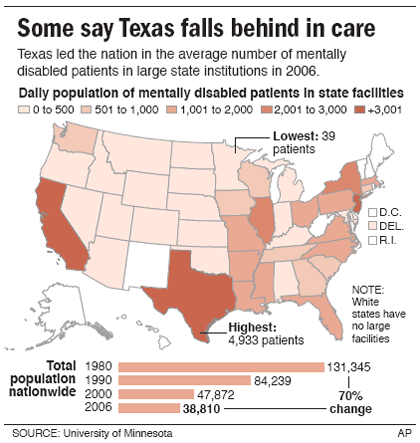
Texas has more mentally disabled patients in institutions than any other state, and the federal government has concluded that the state’s care system is stubbornly out of step with modern mental health practices.

December 3, 2008

DENTON, Texas – For more than a century, thousands of mentally disabled Americans were isolated from society, sometimes for life, by being confined to huge public hospitals.

In at least one place, they still are.

Texas has more mentally disabled patients in institutions than any other state, and the federal government has concluded that the state’s care system is stubbornly out of step with modern mental health practices.

Critics allege that Texas remains stuck in an era when the mentally disabled were hidden away in large, impersonal facilities far from relatives and communities.

“In Texas, it’s like a time warp,” said Jeff Garrison-Tate, an advocate who wants to close the 13 hospitals called “state schools” and move patients into group homes.

For the third time in three years, the criticism has attracted the attention of the Justice Department, which on Tuesday accused Texas of violating residents’ constitutional rights to proper care.

Investigators found that dozens of patients died in the last year from preventable conditions, and officials declared that the number of injuries was “disturbingly high.”

In addition, hundreds of documents reviewed by The Associated Press show that some patients have been neglected, beaten, sexually abused or even killed by caretakers. Inspection reports also describe filthy rooms and unsanitary kitchens.


‘Institution capital of America’

Many of the nation’s mental hospitals were first built in the 1800s, when they were often called insane asylums. But by the 1960s, most experts concluded that patients fared better in smaller, community-based settings.

The American Association on Intellectual and Developmental Disabilities says large care facilities — usually those with at least 16 residents — “enforce an unnatural, isolated, and regimented lifestyle that is not appropriate or necessary.”

Because of those concerns, eight states have abolished large institutions for the mentally disabled. Another 13 states closed most of their largest facilities, leaving just one open in each state.

But Texas has remained “the institution capital of America,” said Charlie Lakin, director of the Research and Training Center on Community Living at the University of Minnesota.

The 13 facilities in Texas house nearly 5,000 residents — more than six times the national average.

On a per-capita basis, Texas has 20.4 people per 100,000 in large institutions, Lakin said. The national average is 12.2 people.

Other states with large populations such as New York and California — which have rates of 11.2 and 7.5 people, respectively — rely far less on large institutions.

‘Warehousing’ patients

Federal law requires the mentally disabled to be treated in “the most integrated setting” possible — a factor that led to the Justice Department rebuke of Texas.

Laura Albrecht, a spokeswoman for the Texas Department of Aging and Disability Services, said the agency is expanding community-based services. Texas officials say keeping the facilities open is a matter of preserving as many treatment options as possible.

But critics allege that “warehousing” patients in large institutions invites abuse. Patients are isolated from their families and communities, making regular contact with loved ones more difficult. And caretakers often get overwhelmed by the large numbers of patients, Garrison-Tate said.

In Texas, officials verified 465 incidents of abuse or neglect against mentally disabled people in state care in fiscal year 2007. Over a three-month period this summer, the state opened at least 500 new cases with similar allegations, according to federal investigators.

An AP investigation earlier this year revealed that more than 800 state employees have been fired or suspended since the summer of 2003 because they abused, neglected or exploited mentally disabled residents.

And in the one-year period ending in September, as many as 53 deaths in the facilities were due to potentially avoidable conditions such as pneumonia, bowel obstructions or sepsis, the Justice Department said. Some families tell horror stories of their loved ones in the state facilities. For instance, Michelle Dooley said her son spent three months in the Austin State School, which she described as a place of “dingy yellow floors and patients running around without any clothes on.”

During his time there, he refused to leave his bed and often languished in his own excrement, she said.

Dooley eventually moved her son into a group home in Denton where treatment costs average about $50,000 per year — roughly half as much as the costs at state schools, Garrison-Tate said. Medicaid often picks up most of those costs.

“It was just horrible,” Dooley said. “If he goes back to a state facility, he will shut down and die.”

At the San Angelo State School, inspection reports from 2007 took note of scuffed walls pocked with holes, rotting food, dirty kitchens, broken furniture and missing shower curtains.

More seriously, two employees were fired after throwing a resident into a pool while he was wearing a restraint jacket. The employees had made a bet with the resident that he would be unable to dunk another resident under water. When he lost the bet, the employees restrained him and threw him in the water, according to the reports.

Other families say they are happy with the state care.

Neil Davidson said his daughter Susan, who has cerebral palsy and is mentally retarded, has flourished during her 10 years at the Lubbock State School.

“I’m very impressed with the level of care she has received,” Davidson said. “As far as I am concerned, it’s Mr. Rogers’ neighborhood. Everybody is looking out for everybody else.”

‘Happy, homelike atmosphere’

A visit to the Denton State School, the largest in Texas, reveals a sprawling campus spread across well-kept lawns. Superintendent Randy Spence described the place as a “happy, homelike atmosphere.”

“The vast majority of our employees love the people they work with,” said Cecilia Fedorov, another spokeswoman for the Department of Aging and Disability Services. “They think of them as extended family.”

But Denton is also the site of Texas’ most notorious case of state school abuse.

In 2002, a care worker repeatedly kicked and punched a resident in the stomach and groin. Haseeb Chishty nearly died after that beating. He is now confined to a wheelchair and unable to feed himself or use the bathroom.

“It got to the point where it was fun beating him, torturing him,” said former care worker Kevin Miller, who is now serving 15 years for aggravated assault.

In a statement videotaped by Chishty’s lawyer, Miller said he and many of his fellow care workers used methamphetamines, cocaine and Oxycontin on the job.

Chishty’s mother filed a lawsuit against the facility, but it went nowhere. In Texas, government entities are all but immune from lawsuits.

Trouble in closing schools

Some critics want to close the state schools. But because the Texas Legislature created each one, only lawmakers can close them.

Many of the institutions are large employers in small towns, and they often pay more than other jobs in rural areas. Lawmakers fear taking action that would lead to layoffs, Garrison-Tate said.

“Even if we said we wanted to close all state schools, the community resources aren’t there at this time,” said state Rep. Larry Phillips, chairman of a legislative committee studying the facilities.

Kelly Reddell, the lawyer whose client’s son was beaten nearly to death, said the state is not doing right by its mentally disabled.

“The very nature of the institutional setting, I think, creates the environment for the abuse to take place,” she said. “How in the world can you think this system is the best and it makes sense?”

© 2008 The Associated Press.

Source / AP / MSNBC

Thanks to Wayne Johnson / The Rag Blog

Posted in RagBlog | Tagged , , , | 3 Comments

Producer Marc Shaiman on Prop 8 – the Musical (With Video!)

The musical itself is the brainchild of Marc Shaiman, the composer of the film and stage musical “Hairspray,” as well as some of the filthier songs in “South Park: Bigger, Longer & Uncut.”

By Dave Itzkoff / December 4, 2008

In just one day of online existence, the Funny Or Die video “Prop 8­ — The Musical” has received more than 1.2 million hits. The comedic song-and-dance diatribe about the California ballot initiative to define marriage as existing only between a man and a woman stars a cast of dozens, including John C. Reilly, Neil Patrick Harris, Maya Rudolph, and Jack Black as Jesus Christ.

Assembled in a week, it’s also the result of a process that began when Mr. Shaiman, who splits his time between New York and Los Angeles, alerted his friends and colleagues that Scott Eckern, the musical director of Sacramento’s California Musical Theater, had donated money to a Yes-on-Prop 8 campaign. The proposition has already passed, and Mr. Eckern has since resigned, so what has Mr. Shaiman gained from this video? He discusses the creation of “Prop 8­–The Musical” in a Q&A below.

How did your mass e-mail message about Scott Eckern and the California Musical Theater end up spawning this video?

I sent an e-mail to a lot of people, anyone who’s in my phone book, and said, “Can you believe this guy?” I’d rather almost not talk about him and that situation anymore, because he’s certainly gone through enough. But that e-mail, one of the people it went to was Adam McKay [a co-founder of FunnyOrDie.com]. He wrote me back, basically, just saying, “Why don’t you write a song about it for Funny Or Die?” Which was like, the slapping-my-head moment. Oh yeah, why didn’t I think of that? Or why didn’t I do that in the first place?

It took a few weeks to calm down enough to be able to find the humor in it all. So once he planted that seed in my head, I basically went the next day to the piano and started to write – a week later we were filming it.

Is this the first time you’ve created a viral video for the Internet?

I’m so old, I can’t remember. To this extent, certainly. I have done things that have ended up on the Internet. Luckily, nothing sexual. Yet. But the night is still young.

How do you feel, given that it took the passage of Proposition 8 to motivate you to create a video opposing it?

In my credit, it says, “Written (six weeks too late) by Marc Shaiman.” I mean, yeah, it’s totally bittersweet. Barack Obama’s ascension just had us all so giddy. We were thinking of how to film it, and I said, “Well, maybe that first section should be all of us on a hill, with poppies, and it snows and we’re put to sleep, and then the Proposition 8 people are looking through the crystal ball, like the Wicked Witch of the West in ‘The Wizard of Oz.’” Because that’s what happened. We stupidly allowed ourselves to be lulled into a sense of, everything’s fantastic now, look – everything’s changing. And this couldn’t possibly be voted into law. This is just like some little pesky thing that we’re swatting at, and it will go away immediately.

How did you react to the news that Mr. Eckern had resigned from the theater?

There’s certainly nothing joyous about being partially responsible for a man resigning from his job. I mean, I did not ask for his resignation, nor would it be my place to ask for someone’s resignation. He resigned, though, and I was part of that, and that is a very heavy weight, and I don’t take it lightly. But it has certainly opened up our eyes, and made me get off the couch and out on the street with a picket sign, for the first time in my life. And it felt fantastic.

So this experience has made you more of an activist?

Yeah, I was marching in New York, and that was just the greatest experience. And of course this video is just a viral picket sign. And hopefully funny. I hope that doesn’t get lost. I hope that’s what most people get out of it.

Source / Arts Beat / The New York Times

The Rag Blog

Posted in RagBlog | Tagged , , , , , , , | Leave a comment

Eschenbach: On Letting Go of Religion, Part I


The Case for Intolerance of Religion, Part I
By Sid Eschenbach / The Rag Blog / December 4, 2008

It has been said that “God did not create man; man created God”. The case for this argument is clearer with each passing day, as today’s vast sea of rationally derived knowledge continues to erode the once solid and fertile soil where “God”, since man created him, had firmly planted his feet. It has been estimated that over 95% of all human knowledge has been generated in the last 50 years, and today new knowledge is being created daily by the tetra-byte (1012 bytes). Unfortunately, the deep roots of religious traditions have not allowed social and cultural change to occur at the same pace, and we are constantly confronted with the inherent contradictions of this reality.

The case for intolerance of religions rests upon the assertion that the original reasons for the creation and use of religions no longer exist. The case for the intolerance of religions rests upon the assertion that in the modern world the continued acceptance and practice of religions does more harm than good. It rests upon the assertion that as long as we ‘respect’ all religious dogmas and accept them as a legitimate basis for a behavioral and social ethics, we will never progress as a species and shall remain locked within the confines of anachronistic, dangerous and wholly irrelevant behavioral models. It rests on the assertion that the idea that we must venerate what he have historically revered is false and without value.
.
It rests upon the rejection of the idea that ethics can only be derived from divine thought. It rests upon the fact that there now exists (in the West) nearly five centuries of rational secular thinking, a chain of thoughts, decisions and reflections which reflect an effort to define, moderate and order human activity based upon logic and reason rather than the dogma of one religion or another. This reservoir of ethics is found in common law and science, a fact which eliminates the argument for and the historical need for religion to intrude into questions of societal order. Behavioral ethics should gain their legitimacy and respect not from their relationship to divinity, but to common sense, common law, and communal consensus. Under this system, thievery is not to be tolerated not because it says somewhere “Thou shalt not steal”, but rather because it makes no sense to live in a society that would permit it. It is what we use and do daily; a complete system of stand-alone, secular ethics.

In his preface to “A Brief History of Time”, Steven Hawking relates a meeting he had with the Pope. In it, he (the Pope) recognizes the many mistakes the church has made over the centuries vis-à-vis science (Copernicus, Galileo, Darwin, etc.), but declares that there is one essential element which will always and forever be the Church’s domain…. “Creation”. Hawking’s reply, and we can only wish we’d been there, was to the effect of… “Well, your Holiness… we’re working on it!”

Unfortunately, and to the great detriment of all life here on the planet, we humans continue our love affair with ourselves. We continue to believe the age old beliefs….. that we are either gods, children of them, or can transform ourselves into them. We believe that we are divine, separate from the animals, the trees, the stars, the air and the rocks… that we are the chosen, the special. And we know all this because our Gods… the ones we made…. have told us so…. and of course they did, because our priests say they did.

In short, the two millennia old cultural inertia of the major salvation-based homocentric mega-religions (Judaism, Christianity, Buddhism, Hinduism and Islam) continues to be the major impediment to mankind’s development of a new ethical understanding of the universe and our place in it; a new ethical understanding to parallel our new scientific understanding of the same. Could we do this, were we to do this, we would finally be free to use all that we have so recently learned and all that we could so easily become… for the benefit of all.

Galileo Revisited

The metaphor of the splitting of the atom… a gift that man was smart enough to discover but has not yet proven wise enough to control… stands as the classic example of the type of real phenomenon our knowledge can create for us… and the insoluble ethical problems that their very creation begets. The reason knowledge creates these “ethical application” problems is because of the fundamental disconnect, growing wider each day, between knowledge and faith. While our sciences progress, our faith-based ethical systems do not, and as a result we (and they) simply do not possess the tools to deal with the new situations.

We continue to look at the world through two thousand year old glasses… and to act based upon two-thousand year old thinking. Its time we set about to break those glasses, to smash these anachronistic prisms which so distort our view of what can be called nothing other than ‘reality’. Its time to define issues of ethics in secular terms, and keep the discussion there! The time for religious tolerance has passed, and to coin a phrase, the tolerance of religious tolerance should no longer be tolerated. As an example, while we cannot simply stop the belief that one race is superior to another, we can legislate against the practice of that belief. Bigotry as a belief cannot be outlawed, but the practice of bigotry can be… and so too with ‘faith’.

It is important that there be no confusion between intolerance of religion and intolerance of beliefs. If one chooses to believe that the world was created by an angry warrior God, and this God demands that war be waged on the neighbors and that in order to satisfy his needs their heads should be cut off and posted on stakes… that, as a philosophy, is o.k. Crazy, counter-productive and even dangerous … but o.k. Its o.k., that is, until the believer leaves home with his hatchet and, together with other believers or alone… puts this belief into practice. Within himself and without the conversion of belief into action, there’s no harm done. Converted into action, he’s an Aztec warrior acting on behalf of the Aztec priest/king… or an Islamic fundamentalist, or a Zionist or an Inquisitor. “Belief” by itself, while often silly, isn’t overtly dangerous to others. Religion clearly is.

This line of thought is not simply a dry, intellectual question, for the stakes are very real and the impact upon us enormous. Religion and religiously driven ethics intrude into all of our lives in fundamental and generally detrimental ways. As Stevie Wonder sang:

“When you believe in things
that you don’t understand
then you suffer……
superstition ain’t the way!”

Aside from the all too obvious ‘war on terror’ effects, a recent cause célèbre regards the ethics of the investigative use of “stem” cells; undifferentiated cells found in all living things at certain stages of their development, is illustrative of this intrusion. Like other “ethical” issues generated by new scientific endeavor (cloning, euthanasia, reproductive rights, etc.) It also demonstrates the fact that the ignorance and desperate arrogance displayed by the church in Galileo’s time is still very much alive and well… and that we continue to suffer in huge numbers and in very real ways the impact of the decisions defined in religious terms.

In spite of its stated claims to the contrary, religion continues to work to the detriment of us all. In this particular case (and this in one of the most educationally advanced countries on the planet), religion carried the day. Nothing less than a Presidential decision means, at least until we move into the modern equivalent of post-Galilean days, that millions of people will continue to suffer diseases which science could most probably cure within a relatively short time through work based upon this research. Make no mistake… had the Church been able to halt all manner of scientific inquiry in Galileo’s time, it would have… and it would also do so today. And the question is, knowing that this is absolutely true… why should we tolerate it? Science is at war with religion, but is not fighting back.

What just this one issue (out of many) means is that we will again suffer at the hands of religion and religiously defined ethics. It means that you, your friends, your family, your nation and mine will all suffer. Cures to many of our most common diseases have been postponed unnecessarily and indefinitely. Exactly how many will continue to suffer and die because of this particular exercise of religious views that were out-dated 400 years ago is unknown, although guesses range into the tens of millions. This is a monstrous crime, but it hasn’t been described as one. And it is not reported as one because no one has to nerve to assail this, the holiest of holy grails… the concept that religious tolerance is a virtue, and the concept that ethics can ultimately only be defined in religious terms.

It’s a Crazy World

We live in a world which, as the comic George Carlin says, “If I say that I believe in extraterrestrial life… I’m crazy. But if I say I believe that 2,000 years ago a guy was born of a virgin mother and he could walk on water…. I’m sane. Well… THAT’S crazy!” It is crazy. Something is fundamentally wrong with this reality… and what is wrong is not that people continue to believe two thousand year old explanations, for there are always those in whom foolish ideas can and will exist.

What is wrong is that we collectively feel that we have an obligation to tolerate and even respect this insanity, foolishness and criminality… if it is properly dressed in religious garb. While we no longer tolerate bigots, slave owners or wife beaters, we continue to respect the faiths that produce Catholic pedophiles, Jewish and Christian extremists, and Islamic fundamentalists! While we no longer humor flat-earthers, we do tolerate creationists! In spite of the ravages caused by these deluded madmen, ecumenicalism and religious tolerance is not only currently politically correct, it is progressive political dogma of the most fundamental and compelling kind, the holiest of holy cows; doctrine stated clearly in documents no less important than the Constitution of the United States of America, and later in the U.N Charter.

And we got here because we played favorites. We got here because it was the only way out, in the mid-18th century, of centuries of religious wars… of the state backing one religion and persecuting another. Well aware of the centuries of continual religiously driven strife and turmoil on the old continent, the U.S. founding fathers found the only solution available…tolerance, freedom of religion, and the separation of church and state. The growth from intolerance to tolerance has thus been seen as a virtue, and unquestionably was at that time. Unfortunately, our social evolution has stopped there, because no better solution to the fundamental problems caused by religious behavior has been proposed since.

Ethical Evolution

How did this happen? How is it that we have allowed ourselves to become hostages to social philosophies and solutions whose day has clearly long since passed? Because we know no other social reality, we accept it. Imagine, if you can, the kind of world we’d live in if we had stopped scientific inquiry with Aristotle, geography with Vespucci, or music with Pan. It is an unimaginable world… but that is in fact the shape of the social and cultural world we live in now.

While the then revolutionary ideas of freedom of religion and religious tolerance are undoubtedly and deservedly counted among the great socio-political inventions of the 18th century… they are relics of their time. They no more represent a definitive solution to the real and overarching issues of mass population control than did Newton’s “Principia” or Darwin’s “Origin of the Species” represent the final evolution of thought for their respective fields. The “religious tolerance” way-station, a temporary solution at best, grabbed by the framers of the Constitution like a drowning man grabs a life jacket, has now been elevated to the status of “destination”, and is blindly accepted as the final solution to the problems caused by religions.

The Crisis of Ethics

More importantly, and remarkably without the risk of hyperbole, the recognition of the need to replace the religiously based codes of ethics which have served as the very foundations for the creation and control of the political states around the world for the past four thousand years must be recognized as being the most urgent problem that we face as a species. To not recognize this is to continue down this so well trodden cycle of war and peace and war and peace and war… governed by behavioral ethics derived from religious dogma.

“If it ain’t broke, don’t fix it” states the country wisdom. Well, its broke. And it will remain broke for as long as the world’s ethics are grounded in a religious framework. The reason for that is clear, because from within these very religious codes of ethics which make possible the socio-political organizations they support are planted the seeds of conflict: the cultivation of ethnicity, nationalism, xenophobia and religio-centrisim which create the divisions that spur the friction between us.

Recent studies done by the U.S. Institute of Peace, the Institute on Religion in an age of Science, and the United Nations study on Religious Tolerance and Freedom all identify religion as being either the primary cause, or one of a few fundamental causes behind man’s identification with ethnic and national groups, they being the most common causes for conflicts between peoples. Seminal thinkers like Max Weber likewise identified religion as one of the root identifying elements of the ethnic and national identification which create the divisions which lead to conflicts.

That being the case, it is clear that any serious attempt to ameliorate the levels of global conflict must address the religious underpinning to those conflicts, be they direct or indirect. If must be recognized that separate beliefs create separate peoples…and separate peoples with separate beliefs invariably see each other as competitors…and ultimately, as enemies. The very words make it clear. Separate. Divided. Different. From totemic tribes to world cup soccer to thermo-nuclear powers, it remains the same. We become us in the moment that they become them. And the role of religion, not so much in its “spiritual” role, but rather in its socio-political power-brokering role, is one of the most fundamental of the divisions which lead us time and again down the road to hell. And not the Catholic or allegorical hell. Hell on earth. War.

The Rag Blog

Posted in RagBlog | Tagged , , | 1 Comment

Junior’s Legacy: Hundreds of Needlessly Dead Americans

Clinton Fein’s latest exhibition, Torture, which opened at Toomey Tourell Gallery in San Francisco in January 2007 is a shocking and defiant exploration of America’s approach to torture under the Bush administration. A series of staged and digitally manipulated photographic images recreate the infamous torture scenes from Abu Ghraib prison in Iraq, transforming the diffuse, muted and low-resolution images into large-scale, vivid, powerful and frightening reproductions. Photo: ClintonFein.com.

How Many Americans Died Because of Bush’s Torture Program?
By Scott Horton / December 2, 2008

According to a special operations intelligence officer, the answer is a number north of three thousand–not counting the tens of thousands maimed or seriously wounded, the destruction of the nation’s reputation as a moral leader, or the damage done to our Constitution. In a stunning op-ed published in Sunday’s Washington Post, a special operations intelligence officer details his direct experience with torture practices put into effect in Iraq in 2006 — long after the Pentagon had forsworn them, but while Donald Rumsfeld was still running the shop.

Amid the chaos, four other Air Force criminal investigators and I joined an elite team of interrogators attempting to locate Zarqawi. What I soon discovered about our methods astonished me. The Army was still conducting interrogations according to the Guantanamo Bay model: Interrogators were nominally using the methods outlined in the U.S. Army Field Manual, the interrogators’ bible, but they were pushing in every way possible to bend the rules — and often break them. I don’t have to belabor the point; dozens of newspaper articles and books have been written about the misconduct that resulted. These interrogations were based on fear and control; they often resulted in torture and abuse.

The Pentagon’s claims that it had returned to interrogations based on the venerable Field Manual, was, it seems, conscious disinformation. But the officer offers an assessment. The torture techniques consistently failed to produce actionable intelligence, he said. But the old techniques — which rest on confidence building — consistently worked and gave the interrogators access to information that saved lives. Moreover, the strategies employed to effect later were used as a much broader tactic, accentuating differences between native Iraqi Sunnis and foreign fighters, in what came to be known as the “Sunni Awakening.”

But then we come to the most chilling part of the op-ed, which the writer discloses the Bush Administration struggled to suppress:

I learned in Iraq that the No. 1 reason foreign fighters flocked there to fight were the abuses carried out at Abu Ghraib and Guantanamo. Our policy of torture was directly and swiftly recruiting fighters for Al Qaeda in Iraq. The large majority of suicide bombings in Iraq are still carried out by these foreigners. They are also involved in most of the attacks on U.S. and coalition forces in Iraq. It’s no exaggeration to say that at least half of our losses and casualties in that country have come at the hands of foreigners who joined the fray because of our program of detainee abuse. The number of U.S. soldiers who have died because of our torture policy will never be definitively known, but it is fair to say that it is close to the number of lives lost on Sept. 11, 2001. How anyone can say that torture keeps Americans safe is beyond me–unless you don’t count American soldiers as Americans.

The torture techniques developed by the Bush torture team were the most effective recruitment tool we could ever have given terrorists. They cost thousands of American lives. And that’s a key element of the legacy of the forty-third president.

Source / Harper’s Magazine

The Rag Blog

Posted in RagBlog | Tagged , , , | 2 Comments

Obama : A Healthy Use of the Internet

The health-care mobilization taking shape before Obama even takes office will include online videos, blogs and e-mail alerts as well as traditional public forums. Already, several thousand people have posted comments on health on the Obama transition Web site.

By Ceci Connolly / December 4, 2008

Barack Obama’s incoming administration has begun to draw on the high-tech organizational tools that helped get him elected to lay the groundwork for an attempt to restructure the U.S. health-care system.

Former senator Thomas A. Daschle, Obama’s point person on health care, launched an effort to create political momentum yesterday in a conference call with 1,000 invited supporters culled from 10,000 who had expressed interest in health issues, promising it would be the first of many opportunities for Americans to weigh in.

The health-care mobilization taking shape before Obama even takes office will include online videos, blogs and e-mail alerts as well as traditional public forums. Already, several thousand people have posted comments on health on the Obama transition Web site.

“We’ll have some exciting news about town halls, we’ll have some outreach efforts in December,” Daschle said during the call. And tomorrow, when he appears at a health-care summit with Sen. Ken Salazar (D-Colo.) in Denver, Daschle said, “we’ll be making some announcements there.”

It is the first attempt by the Obama team to harness its vast and sophisticated grass-roots network to shape public policy. Although the president-elect is a long way from crafting actual legislation, he promised during the campaign to make the twin challenge of controlling health-care costs and expanding coverage a top priority in his first term.

Daschle, who is expected to become the next secretary of health and human services, is waging the outreach campaign by marrying old-fashioned Washington-style lobbying and cutting-edge social-networking technologies. Although he has yet to be formally nominated, he has already met with more than 100 insiders, ranging from union leaders and the seniors group AARP to hospital executives and representatives of corporate America.

“In the last three days I’ve exchanged three sets of e-mails with him,” said Ron Pollack, executive director and vice president of the advocacy group Families USA.

The Obama team, which recruited about 13 million online supporters during the presidential campaign and announced its vice presidential selection via text message, is now moving to apply those tools to the earliest stages of governing.

“This is the beginning of the reinvention of what the presidency in the 21st century could be,” said Simon Rosenberg, president of the center-left think tank NDN. “This will reinvent the relationship of the president to the American people in a way we probably haven’t seen since FDR’s use of radio in the 1930s.”

In seeking to translate its political skills to policymaking, the incoming administration faces potential legal and political pitfalls. It is not clear, for instance, whether Obama can legally use his list of campaign supporters in the White House; the database would probably become government property. So far, the transition team has gotten around that issue by encouraging people to register on its Web site, Change.gov. Those names and e-mail addresses go into a new database, which can be tapped to generate activities such as house parties, YouTube videos and viral discussions to rally support.

Daschle’s telephone call, which was not open to the news media, and his speech in Denver tomorrow provide hints as to how the new administration might tackle major health-care legislation.

“President-elect Obama believes that change really comes from the ground up, not from Washington,” Salazar said in an interview. “The drumbeat for change is one which goes across every single state — red, blue and purple. That kind of a drumbeat will be very effective in achieving the change needed on health care.”

The Obama team chose to begin its high-tech grass-roots experiment on the issue of health care because “every American is feeling the pressure of high health costs and lack of quality care, and we feel it’s important to engage them in the process of reform,” said spokeswoman Stephanie Cutter.

It started with a simple 63-second video posted on Change.gov, in which health advisers Dora Hughes and Lauren Aronson posed the question “What worries you most about the health-care system in our country?”

That triggered 3,700 responses, from personal tales of medical hardship to complaints about “socialized medicine.” The cyber-conversation was interactive, allowing individuals to reply to one another and rate responses with a thumbs up or down. The top-scoring comment, a pitch for a “paradigm shift” toward prevention, had 82 thumbs up.

The Obama technology gurus then built a “word cloud” showing the 100 most frequently used words in the responses. The cloud’s biggest words — indicating those used most — include “insurance,” “system,” “people” and “need.”

“The Obama administration has learned that listening may be even more important than talking, because it diffuses opposition,” said Andrew Rasiej, co-founder of Personal Democracy Forum, a nonpartisan Web site focused on the intersection of politics and technology.

Obama used the same strategy during the campaign, Rasiej said. When many of his most liberal supporters became enraged that he voted in favor of a surveillance law, Obama assigned staffers to monitor and respond to comments posted on the campaign’s Web site. After a sort of cyber-catharsis of complaints, the controversy died down, Rasiej observed.

“It will be a lot easier to get the American public to adopt any new health-care system if they were a part of the process of crafting it,” he said.

By moving early, Daschle and Obama are also applying a central lesson learned in past failed efforts to overhaul the health system, said Andrew Stern, president of the Service Employees International Union.

“This is an opportunity to deepen the education work and build the ultimate coalition for change before it’s demonized or people try to oppose it,” he said.

After the first health comments poured in to the transition Web site, Aronson made a second video, this time with Daschle, seated in shirt sleeves and a tie.

“We want to make sure you understand how important those comments and your contributions are,” Daschle says into the camera. “Already we’ve begun to follow through with some of the ideas.”

Daschle praises the suggestion of creating a “Health Corps” of volunteers, modeled after President John F. Kennedy’s Peace Corps.

Aronson, who was a congressional health aide to incoming White House chief of staff Rahm Emanuel, then recounts the story of a small businesswoman struggling to provide affordable health insurance to her workers.

Says Daschle: “When I was in the Senate, it was stories like that, probably more than all the factual information, that really moved you to want to act.”

Research director Lucy Shackelford contributed to this report.

Source / /Washington Post

The Rag Blog

Posted in RagBlog | Tagged , , , , , | 1 Comment

Cole: Rising Tuition, Prison Populations, and Pot

Click on image to enlarge.

State Universities versus State Prisons;
And Marijuana Legalization as a Solution

By Juan Cole / December 4, 2008

Why is tuition so high in state universities that the NYT is wondering if families will go on being able to afford it?

As someone who has observed this rise in tuition over an academic career of 30 years, as graduate student and professor, I have some theories from an insider perspective.

State universities have had to raise tuition because state legislatures have continually cut back every year the amount of state funding for them. Already in 2005 this article in Philanthropy News Digest explained:

For example, less than 14 percent of the University of Oregon’s total revenue came from state funds in 2003-04, compared to 32 percent in 1985-86, while tuition fees accounted for more than 33 percent of the university’s budget, compared to 22 percent twenty years ago. Meanwhile, the University of Michigan has lost 12 percent of its state funding, or $43 million, over the past two years. According to UM spokeswoman Julie Peterson, state money now only accounts for 8 percent of the university’s budget. “We can’t rely on state funding alone,” said Peterson. “It simply isn’t enough.”

That statistic, whereby the University of Oregon went from having 33 percent of its total revenue from state sources in 1985 to 14 percent in 2005, was typical of what happened throughout the whole country. The typical revenue streams for state universities used to be 1) State support, 2) tuition and fees, 3) Federal grants, and 4) alumni donations and the resulting endowment. At some state universities, the state contribution may now be the fourth largest source.

Memorial Union, Oregon State University. Photo: Oregon State University.

Now, why did states cut back the universities so much? It wasn’t that the state legislators were bad people or anti-intellectuals for the most part.

The Reagan/ Grover Norquist line that government is not the solution, government is the problem, and the demand for lower taxes (especially on the wealthy) was influential in many states. So essentially the American big business class of about 3 million people was given the opportunity to quadruple its vast wealth through lower taxes (when you lower taxes on a particular segment of the public, that is wealth distribution in their favor). Meanwhile public functions of government are cut back and everybody else gets potholes, closed public libraries, underfunded state universities, etc.

I can remember when I started grad school at UCLA in 1979 I heard on the radio that because of steep cutbacks in property taxes, the state would no longer be able to afford to spray for mosquitoes. I thought to myself, lord, they’ll end up giving themselves malaria to avoid a millage!

A big drain on state budgets is the penitentiary system. In just the decade 1980 to 1990, the prison and jail population in the US doubled. Since 1980, the prison population has quadrupled. By the end of 2006, over 2 million persons were in prison and another 5 million were on probation or on parole.

I remember reading in the Ann Arbor News in 1988 about a big debate at the statehouse in Lansing over funding for prisons versus funding for universities. The prisons won.

In these same nearly four decades, there have been substantial declines in violent crimes and crimes against property in the US. The vastly increased prison population was produced by unreasonably long prison sentences for non-violent crime, by ridiculous 3-strikes-and-you-are-out life sentences and by the completely failed ‘war on drugs’ and by mandatory sentencing guidelines imposed by legislatures on judges in drug cases. Half of prisoners in state prisons did not commit a violent crime, and 20% are drug offenders.

This vast expansion in the number of imprisoned Americans required states to build prisons and to pay large amounts of money to keep people in them.

The states had to put their money into prosecuting, trying, imprisoning and then supporting to the tune of like $20,000 a year a bunch of . . . potheads.

So obviously the states had no money to spend on state universities, which were cut loose, and had to raise tuition and hit their alumni up for contributions just to try to keep their heads above water.

Of course, universities faced increased costs at the same time. European monopolies drove up the costs of medical journals in ways that the European Union should look into. Digitalization has been a huge added cost that cannot be escaped (in many cases it means paying twice for books and other materials, once in hard copy and once in digital form.) Universities with medical schools face the high costs of acquiring increasingly high tech, state of the art medical equipment. Etc.

But I think the ‘war on drugs’ and the cost of prisons has deeply harmed state economies and has hurt access to state universities for working and middle class families.

Marijuana in particular may well have important medicinal properties, and it should just be legalized.

This is a conclusion a lot of frustrated law enforcement officials have come to, and they are campaigning for an end to prohibition. Reuters has more.

It is true that some proportion of the population may face addiction problems from marijuana. But it is not as if it isn’t already a multi-billion dollar business and widely available. About 15 percent of Americans regularly use it. And about 1/5 of the population is susceptible to alcohol addiction, but that doesn’t impel us to a second Prohibition in its regard. Use some of the tax receipts on the industry to fund treatment of those who can’t handle it. A lot of the deleterious effects of being high come from people driving under the influence. But actually you could just mandate that the auto industry put in ignition switches that only a sober person has the reflexes to make work. Since we are likely to own the auto industry soon, we should be able to do what we want. And besides, green mass transit is much better than individuals driving around wreaking mayhem,and a pothead on a subway isn’t much of a threat to anyone. We should move in that direction for all sorts of reasons.

I can remember reading an op-ed in the NYT years ago arguing that there are 60 million crimes a year in the United States, but only a tiny fraction of the perpetrators is ever actually prosecuted and a smaller fraction still brought to trial. I thought to myself, and a good thing too! How would we pay for 60 million prisoners? And, if you have a country of 280 million people committing 60 million crimes a year, you clearly just have way too many laws.

The baneful impact on the United States of Puritanism, which comes in part from the Religious Right, has diverted our energies from educating ourselves, and developing our society, toward instead creating a Nanny State that employs people to make sure you only get high from alcohol, not from other substances. Bush even created an FBI porn squad. As if wealthy Republican hoteliers weren’t the primary distributors of porn (via pay per view channels) in the country.

If the Religious Right could, it would just close down all the biology classes in the country (because after all they teach that wicked Darwin) and leave the development of biotech to the South Koreans, with Americans–denied the wealth that biotechnological innovation will bring in–turned into unemployed riffraff.

It turns out that if we had more personal freedoms, we’d have more state monies and could educate ourselves to develop our potential as free human beings.

In the past 40 years, the snowball has been going in the other direction– fewer personal freedoms, a vast gulag of the incarcerated, and less and less state money for the development of the minds of the public. We’ve built ourselves a big ignorant prison, with a loud-mouthed fundamentalist preacher for a warden, and called it America.

We should legalize pot, and tax the resulting industry. We should repeal mandatory sentencing guidelines and develop rehabilitation strategies rather than putting the ill-behaved in expensive state hotels. And we should go back to having state-funded state universities.

Source / Informed Comment

The Rag Blog

Posted in RagBlog | Tagged , , | 3 Comments

Israel Coiled for Potential Iran Strike


‘While its preference is to coordinate with the US, defense officials have said Israel is preparing a wide range of options for such an operation.’
By Yaakov Katz / December 4, 2008

The IDF (Israel Defense Forces)is drawing up options for a strike on Iranian nuclear facilities that do not include coordination with the United States, The Jerusalem Post has learned.

While its preference is to coordinate with the US, defense officials have said Israel is preparing a wide range of options for such an operation

“It is always better to coordinate,” one top Defense Ministry official explained last week. “But we are also preparing options that do not include coordination.”

Israeli officials have said it would be difficult, but not impossible, to launch a strike against Iran without receiving codes from the US Air Force, which controls Iraqi airspace. Israel also asked for the codes in 1991 during the First Gulf War, but the US refused.

“There are a wide range of risks one takes when embarking on such an operation,” a top Israeli official said.

Several news reports have claimed recently that US President George W. Bush has refused to give Israel a green light for an attack on Iranian facilities. One such report, published in September in Britain’s Guardian newspaper, claimed that Prime Minister Ehud Olmert requested a green light to attack Iran in May but was refused by Bush.

In September, a Defense News article on an early warning radar system the US recently sent to Israel quoted a US government source who said the X-band deployment and other bilateral alliance-bolstering activities send parallel messages: “First, we want to put Iran on notice that we’re bolstering our capabilities throughout the region, and especially in Israel. But just as important, we’re telling the Israelis, ‘Calm down, behave. We’re doing all we can to stand by your side and strengthen defenses, because at this time, we don’t want you rushing into the military option.'”

The “US European Command (EUCOM) has deployed to Israel a high-powered X-band radar and the supporting people and equipment needed for coordinated defense against Iranian missile attack, marking the first permanent US military presence on Israeli soil,” Defense News wrote. The radar will shave several precious minutes off Israel’s reaction time to an Iranian missile launch.

In a related article at about the same time, TIME magazine raised the possibility that through the deployment of the radar, America wants to keep an eye on Israeli airspace, so that the US is not surprised if and when the IAF is sent to bomb Iran, a scenario Washington wants to avoid.

The US army sent 120 EUCOM personnel to Israel’s Nevatim Air Base southeast of Beersheba to man the new radar.

Last week, Iran’s nuclear chief Gholam Reza Aghazadeh revealed that the country was operating more than 5,000 centrifuges at its uranium enrichment plant in Natanz and would continue to install centrifuges and enrich uranium to produce nuclear fuel for the country’s future nuclear power plants.

“At this point, more than 5,000 centrifuges are operating in Natanz,” said Aghazadeh, who is also the head of the Atomic Energy Organization of Iran. This represents a significant increase from the 4,000 Iran had said were up and running in August at the plant.

The Islamic republic has said it plans to move toward large-scale uranium enrichment that will ultimately involve 54,000 centrifuges.

Israeli officials said last week that the drop in oil prices and the continued sanctions on Iran were having an effect, although they had yet to stop Teheran’s nuclear program. The officials said that while Iran was making technological advancements, it would not have the necessary amount of highly-enriched uranium for a nuclear bomb until late 2009.

“There is still time and there is no need to rush into an operation right now,” another Israeli official said. “The regime there is already falling apart and will likely no longer be in power 10 years from now.”

The IAF was preparing for a wide range of options, OC Air Force Maj.-Gen. Ido Nehushtan recently said, adding that all it would take to launch an operation was a decision by the political echelon.

“The air force is a very robust and flexible force,” he told Der Spiegel. “We are ready to do whatever is demanded of us.”

On Monday, Teheran dismissed the possibility of an Israeli strike, saying it didn’t take Israel seriously.

“We think that regional and international developments and the complicated situation faced by Israel itself will not allow it to launch military strikes against other countries,” Iranian Foreign Ministry spokesman Hassan Qashqavi told reporters in Teheran, according to the Press TV Web site. “Israel makes threats to promote its psychological and media warfare,” he said.

Source / The Jerusalem Post

The Rag Blog

Posted in RagBlog | Tagged , , , , | Leave a comment

Photo of the Day: Hoot for Peace


What will you be doing when you’re ninety?
By Lee Jordan

This is Louis, 90 years of age !!!.. it was a freezing night in Bristol city, yet Louis was standing there, waiting for a hoot !

I have a real admiration for this young lady, such passion in her beliefs.. i’ve seen her in all conditions, waiting there with an empty road, waiting for a hoot of agreement.

During rush hour there is a hoot every ten seconds if not more, Louis will give a happy nod to each approving driver, this is why the focus isn’t so sharp on her face.

Source / Onexposure / 1x

Thanks to Betsy Gaines / The Rag Blog

Posted in RagBlog | Tagged , | Leave a comment

Recession: Delusional Politics meets Lewis Carroll


‘”It’s a poor sort of memory that only works backwards,” the Queen remarked.’
By Larry Ray
/ The Rag Blog / December 4, 2008

“The rule is jam tomorrow and jam yesterday – but never jam today!” Young Alice Bernanke stared at the ranting Queen and mumbled, “I don’t understand you. It’s dreadfully confusing!”

Monday’s top news headline could have been read through Lewis Carroll’s Looking Glass: “It’s Official: U.S. is in Recession” What a surprise. But even as the National Bureau of Economic Research read its formal pronouncement that, “A US recession began in 2007” the evil royalty and aides in Wonderland’s White house still refused to say the word “recession.”

“ `And you do Addition?’ the White Queen asked. `What’s one and one and one and one and one and one and one and one and one and one?’

`I don’t know,’ said Alice. `I lost count.'”

Instead of fessing up and accepting what has been abundantly clear to most all of us as the economic sky is falling all around, White House spokesman “Foxy Loxy,” Tony Fratto, instead, breezily remarked upon the fact that the NBER “determines the start and end dates of business cycles.”

Too late for doublespeak. Bush’s last parade had all ready been undone. Hans Christen Anderson wrote about such parades in 1837. And the ending of his tale about another deluded emperor fits the Bush political legacy perfectly:

“The Emperor is naked,” the child said.

“Fool!” his father reprimanded, running after him. “Don’t talk nonsense!” He grabbed his child and took him away. But the boy’s remark, which had been heard by the bystanders, was repeated over and over again until everyone cried:

“The boy is right! The Emperor is naked! It’s true!”

The Emperor realized that the people were right but could not admit to that. He thought it better to continue the procession under the illusion that anyone who couldn’t see his clothes was either stupid or incompetent. And he stood stiffly on his carriage, while behind him a page held his imaginary mantle.”

But hundreds of thousands of Chicken Littles were all ready out of their coop of delusion having heard Bush and company formally described by everyone as being buck naked! A flapping, frantic flock followed including Goosey Loosey, Henny Penny and a Thanksgiving survivor, Turkey Lurkey, all squawking, panic selling and sending the Dow down 680 points, almost 8%.

Lewis Carroll had yet another explanation for things, that also might fit the end of the delusional politics of the Bush era while also acknowledging that no one has a clue about what is happening economically right now:

`It’s a poor sort of memory that only works backwards,’ the Queen remarked.

`What sort of things do you remember best?’ Alice ventured to ask.

`Oh, things that happened the week after next,’ the Queen replied in a careless tone. `For instance, now,’ she went on,`there’s the King’s Messenger. He’s in prison now, being punished: and the trial doesn’t even begin till next Wednesday: and of course the crime comes last of all.’

`Suppose he never commits the crime?’ said Alice.

`That would be all the better, wouldn’t it?’ the Queen said.

With apologies to Mssrs. Carroll and Anderson.

[Retired journalist Larry Ray is a Texas native and former Austin television news anchor. He also posts at The iHandbill.]

The Rag Blog

Posted in Rag Bloggers | Tagged , , , , | 3 Comments