To Begin Healing the Nation, Accept Responsibility


Shame! Shame! Come Back Shame
By Joel Hirschhorn / October 3, 2008

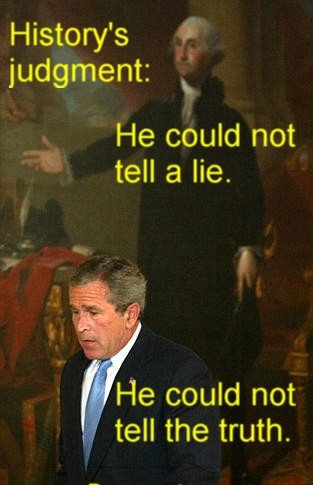
Shame on them (the politicians) and shame on us (the public). We live in the United States of Shame. Why? Because everywhere we see nothing but disgrace, dishonor and infamy, yet a complete absence of shame. In a nation where religion supposedly plays such a big role, people seem to have used it to suppress shame and avoid blame.

Republicans should feel nothing but shame over the worst presidency in American history. Democrats should feel utter shame for a Congress that has sold out ordinary citizens. Lesser evil voters should feel heart-attack pain for their shameful behavior in maintaining the status quo two-party plutocracy. All those millionaires and billionaires that made it big in corporate America should have SHAME tattooed on their foreheads.

I have been thinking about shame as I reflect on how our nation has sunk so low and how little confidence I have that any Democrat or Republican – not Barack Obama or John McCain – will truly reform a totally corrupt and dysfunctional political system. I keep waiting to hear either of these two or any of the so-called leaders in Congress say something as simple as “As an American and an elected public official I feel nothing but shame for being part of this awful political system that has let you down.”

When those with power feel no shame over their incompetence and ineptitude they clearly have no ability to own up to it. Without the expression of shame there is no genuine apology.

I do not want to keep seeing a grinning John McCain and a smiling Barack Obama. I want to see them and Nancy Pelosi and Harry Reid and all the other losers in Congress plea publicly for forgiveness from the nation they have shamed. This is what we all should demand of them. Say this clearly; say it every freaking day every time you get in front of a microphone and camera: “I am ashamed to be part of this system. Forgive me. I will set aside all my ambitions and excuses and try to earn your forgiveness.” Write it 1,000 times every damn day. Make it your mantra. Say it every time you shake the hand of an American.

When you automatically say yet another lie to the public stop yourself, pause and say “Forgive me, bad habits are so hard to break. What I just said is really a lie. I am ashamed. Here is the truth…”

Until all those with power in the public and private sectors totally recognize, accept and proclaim their shame there is no hope for returning our nation to greatness.

Until ordinary people also accept their shame for their cowardly behavior in supporting our shameful two-party plutocracy that has given us nothing but a fake democracy, there is no way that we will vote our way out of this awful mess.

Where there is no shame there is no acceptance of blame. And we know who to blame.

Shame! Shame! Come back shame.

[Contact Joel S. Hirschhorn through www.delusionaldemocracy.com.]

Source / Associated Content

The Rag Blog

Posted in RagBlog | Tagged , , | 1 Comment

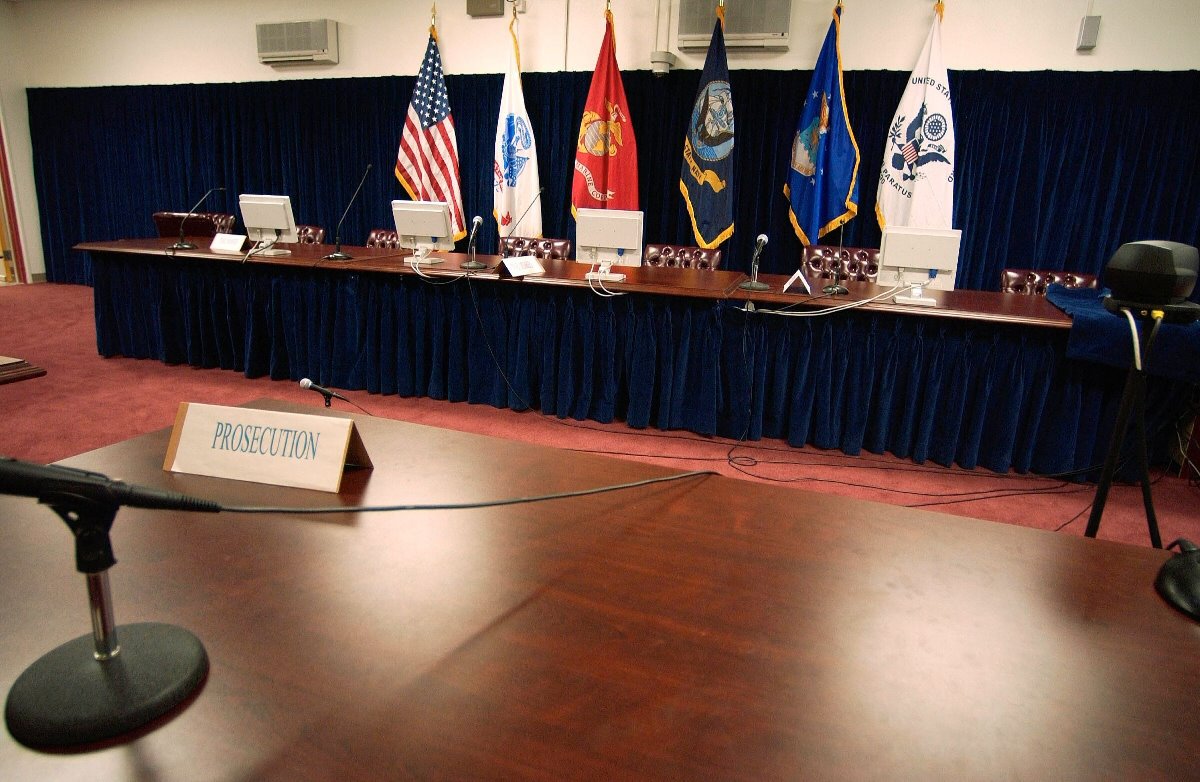
The Guantanamo Military Commissions: A Parody of Justice


Who’s Pulling the Strings? The Dark Heart of the Guantánamo Trials
By Andy Worthington / October 3, 2008

On September 24, Col. Lawrence Morris, the chief prosecutor of Guantánamo’s Military Commission trial system, announced that Lt. Col. Darrel Vandeveld, the prosecutor in the case of Mohamed Jawad (an Afghan — and a teenager at the time of his capture — who is accused of throwing a grenade at a jeep containing two US soldiers and an Afghan translator), had asked to quit his assignment before his one-year contract expired.

Although Col. Morris attempted to explain that Lt. Col. Vandeveld was leaving “for personal reasons,” the real reasons were spelled out in a statement issued by Vandeveld (PDF), in which he expressed his frustration and disappointment that “potentially exculpatory evidence” had “not been provided” to Jawad’s defense team:

My ethical qualms about continuing to serve as a prosecutor relate primarily to the procedures for affording defense counsel discovery. I am highly concerned, to the point that I believe I can no longer serve as a prosecutor at the Commissions, about the slipshod, uncertain “procedure” for affording defense counsel discovery. One would have thought … six years since the Commissions had their fitful start, that a functioning law office would have been set up and procedures and policies not only put into effect, but refined.

Instead, what I found, and what I still find, is that discovery in even the simplest of cases is incomplete or unreliable. To take the Jawad case as only one example — a case where no intelligence agency had any significant involvement — I discovered just yesterday that something as basic as agents’ interrogation notes had been entered into a database, to which I do not have personal access … These and other examples too legion to list are not only appalling, they deprive the accused of basic due process and subject the well-intentioned prosecutor to claims of ethical misconduct.

Vandeveld also stated, “My view of the case has evolved over time,” and proceeded to explain how he had come to suspect that Jawad, who has always denied throwing the grenade, was duped into joining a militant group, and was drugged before the attack. Michael Berrigan, the Commissions’ deputy chief defense counsel, added that prosecutors also knew that the Afghan Interior Ministry said that two other men had confessed to the same crime, although Vandeveld did not mention this in his statement.

Vandeveld added, “Based on my view of the case, I have advocated a pre-trial agreement under which Mr. Jawad would serve some relatively brief additional period in custody while he receives rehabilitation services and skills that will allow him to reintegrate into either Afghan or Pakistani society.” This, however, was turned down by his commanding officers. He continued: “One of my motivations in seeking a reasonable resolution of the case is that, as a juvenile at the time of capture, Jawad should have been segregated from the adult detainees, and some serious attempt made to rehabilitate him. I am bothered by the fact that this was not done.”

On October 26, as Jawad’s defense lawyer, Maj. David Frakt, sought to have the case dismissed due to “gross government misconduct,” Lt. Col. Vandeveld testified for the defense by video link from Washington D.C., explaining, as the Associated Press described it, that “the embattled military tribunal system may not be capable of delivering justice for Jawad or the victims.” “They are not served by having someone who may be innocent be convicted of the crime,” Vandeveld said, reiterating that, even after six years, “it is impossible for anyone in good conscience to stand up and say he or she is provided all the discovery in a case.”

Explaining more of his reasons for quitting his job, Vandeveld told the court that he “reached a turning point” when he chanced upon “key evidence among material scattered throughout the prosecutors’ office.” In another case file, he said he “saw for the first time a statement Jawad made to a military investigator probing prisoner abuse in Afghanistan,” and described it as “an episode that helped convert him from a ‘true believer to someone who felt truly deceived.’” He added that he had “even developed sympathy” for Jawad. “My views changed,” he said. “I am a father, and it’s not an exercise in self-pity to ask oneself how you would feel if your own son was treated in this fashion.”

Lt. Col. Vandeveld’s departure — and his reasons for leaving — are another serious blow to the credibility of the Military Commissions, which were established by Dick Cheney and his close advisers in November 2001. In June 2006, they were ruled illegal by the US Supreme Court, and although they were revived by Congress later that year in the much-criticized Military Commissions Act, they have never escaped accusations that they are a parody of justice, designed to secure convictions at all costs. Even so, Lt. Col. Vandevelt’s profound criticisms of a system that imprisons juveniles instead of rehabilitating them, and that suppresses evidence relevant to the defense, is just part of a much darker narrative that has been unfolding for the last 18 months.

The role of Brig. Gen. Hartmann

From this perspective, an even more significant event was the Pentagon’s announcement, on September 19, that Brig. Gen. Thomas Hartmann had been removed from his post as legal adviser to the Convening Authority overseeing the Commission process, which, as the Washington Post recently explained, is “a Pentagon office that is required to exercise a neutral role in the commissions, overseeing but not dictating the work of prosecutors and allocating resources to both the prosecution and defense.”

Hartmann, a reservist whose civilian job is chief counsel to the Connecticut-based Mxenergy Holdings Inc., became the legal adviser to the Convening Authority in July 2007, and was also required to “exercise a neutral role.” According to the rules set up for the Commissions, he was “supposed to provide impartial advice” to the Convening Authority (retired judge Susan Crawford), and was also supposed to “make an independent and informed appraisal of the charges and evidence,” to help Crawford “decide whether charges proposed by the prosecutors are sufficient to go to trial.”

However, complaints arose almost as soon as Hartmann was appointed. Just two months after he took the job, the Wall Street Journal revealed that Col. Morris Davis, the Commissions’ chief prosecutor, had filed a formal complaint alleging that he had “overstepped his mandate by interfering directly in cases.” In a letter, Davis suggested that both he and Hartmann should resign “for the good of the process,” adding, “If he believes in military commissions as strongly as I do, then let’s do the right thing and both of us walk away before we do more harm.”

Officials who spoke to the Journal’s Jess Bravin made it clear that Col. Davis was not alone in his complaints. A lawyer close to the process explained that, although Hartmann had complained that, after four years, the prosecution was “still unready to try cases,” and was frustrated with their “can’t do” approach, some of the prosecutors regarded him as “‘micromanaging’ cases he doesn’t fully understand.”

Brig. Gen. Hartmann escaped unscathed from Col. Davis’ accusations — and in fact it was Davis, alone, who resigned on October 4 — and he also escaped censure the following month, when, during a pre-trial hearing for Omar Khadr (the Canadian who was just 15 years old when he was captured in July 2002), Khadr’s defense team announced that they had just been informed of the existence of an eyewitness to the main crime for which Omar was being charged — the death of a US soldier in a grenade attack — whose testimony could exonerate their client. This was extraordinary enough, in and of itself, but what made the story particularly shocking was prosecutor Jeff Groharing’s admission that, as the Los Angeles Times described it, “he had been prohibited from talking about the case” by Brig. Gen. Hartmann.

Hartmann is barred from three trials

Hartmann’s luck finally ran out in May, when, after Col. Davis reprised his complaints in pre-trial hearings for Salim Hamdan (a driver for Osama bin Laden whose trial took place this summer), the judge in Hamdan’s case, Capt. Keith Allred, disqualified him from playing any role in Hamdan’s trial, ruling that he was “too closely allied with the prosecution,” and that “national attention focused on this dispute has seriously called into question the legal adviser’s ability to continue to perform his duties in a neutral and objective manner.” Allred added, “Telling the chief prosecutor (and other prosecutors) that certain types of cases would be tried and that others would not be tried, because of political factors such as whether they would capture the imagination of the American people, be sexy, or involve blood on the hands of the accused, suggests that factors other than those pertaining to the merits of the case were at play.”

In August, Hartmann was excluded from Mohamed Jawad’s trial for the same reasons. Jawad’s lawyer, Maj. David Frakt, told the judge, Col. Stephen Henley, that Hartmann “usurped the role of a prosecutor — rather than acting dispassionately — and pushed to get Jawad charged because the case involved battlefield bloodshed.” Frakt also pointed out that Hartmann had “failed to turn over defense documents” to Susan Crawford, even though these documents “outlined mitigating circumstances that might have altered her decision to endorse the charges.” He also secured testimony from an unlikely ally, Brig. Gen. Zanetti, the deputy commander of Guantánamo’s Joint Task Force, who declared that Hartmann’s demeanor was “abusive, bullying and unprofessional … pretty much across the board,” and described his approach to the Commissions as, “Spray and pray. Charge everybody. Let’s go. Speed, speed, speed.”

Three weeks ago, Hartman was barred for a third time, this time from any post-trial review in Omar Khadr’s case. The judge, Col. Patrick Parrish, had refused a request from Khadr’s lawyers to disqualify Hartmann from involvement in Khadr’s trial, but he barred Hartmann from reviewing it, in the case of a conviction, for the same reasons as those described above.

To add to the criticism, Lt. Col. Vandeveld also tore into Hartmann as he announced his departure from the Commissions. The Los Angeles Times spoke to a Pentagon official, who explained that “Vandeveld had defended Hartmann against the undue-influence allegations in the Jawad case in recent weeks but lost,” and Hartmann “had retaliated against him, causing the prosecutor emotional distress and prompting him to quit and go public with his concerns.”

News of Brig. Gen. Hartmann’s departure was telegraphed three weeks ago, in the wake of the Khadr ruling, when Charles “Cully” Stimson, a former deputy assistant secretary for detainee affairs, stepped forward to suggest that, under a “three strikes and you’re out” philosophy, Hartmann should resign. Stimson explained that he was particularly concerned about challenges and appeals frustrating the forthcoming trial of Khalid Sheikh Mohammed and his co-conspirators in the 9/11 attacks, which Hartmann “helped shepherd.”

Hartmann’s extraordinary promotion

Instead of losing his job, however, Brig. Gen. Hartmann was actually promoted to a new post, as Director of Operations, Planning and Development for the Commissions, responsible, as the Associated Press put it, for “such activities as the hiring of dozens of lawyers and paralegals and ensuring there are adequate resources for the massive legal undertaking.” His deputy, retired Army Col. Michael Chapman, took over as legal adviser.

In the Miami Herald, Carol Rosenberg shrewdly realized that the Pentagon had hoped to bury the news of Hartmann’s reassignment. Explaining that the announcement “ended weeks of speculation on the fate of Hartmann with little fanfare,” she noted that it was issued “on Friday afternoon, a time considered in Washington circles to be when the Defense Department disposes of uncomfortable business.” This was certainly true, but it soon became clear that what was particularly “uncomfortable” about the “business” was not Hartmann’s removal as legal adviser, but the significance of his effective promotion to a new job.

Although the Associated Press reported that the new job “takes Hartmann away from direct supervision of the prosecution,” other observers were not convinced. The Washington Post reported that Human Rights Watch had stated that “instead of trying to clean up house, the Pentagon has now moved a man accused of bullying prosecutors to bring cases to trial and dismissing concerns about evidence being tainted by torture into a position coordinating all matters relating to the commissions.”

In addition, Col. Davis compared the reassignment to that of Russia’s former Premier and his newly promoted protégé, saying, “Elevating his deputy and leaving him in the process, I’m afraid, will be like the Vladimir Putin-Dmitry Medvedev relationship where there’s some real doubt over who pulls the strings.” Speaking to the AP, Davis was even blunter, comparing Hartmann to a “cancer” that had infected the entire Commission process. “The only way to ensure cancer can do no harm,” he said, “is to get it out of the body.”

Noticeably, Hartmann himself confirmed that his reassignment was anything but a punishment. “I feel like it’s an elevation, a promotion, because it recognizes … the exponential growth of the commissions,” the AP reported him as saying, and in the Washington Post he claimed that, although “the recent court rulings forced him and others at the Pentagon to think about his role,” the reason for his new assignment was that “he and his superiors thought that the ‘best way to run the system was to take this more senior leadership position.”

Hartmann continued crowing in comments to the Miami Herald. Likening his new job to that of a “chief executive officer at a 250-staff corporate headquarters,” and adding that he “had no fixed budget,” he declared that his biggest challenge was “to keep the process moving, really intensely.” He added, “Everybody needs to start seeing more trials. I want those courtrooms to be as filled up as they can possibly be — six days a week.”

While this is nothing short of despicable, given the condemnation of Hartmann’s pro-prosecution bias by three government-appointed judges, what no one has yet done in the last two weeks is to look behind the scenes to see what Hartmann’s reassignment reveals about the whole command structure of the Military Commissions. And when this is looked at in detail, Hartmann appears, shockingly, to be little more than a puppet (albeit a willing and hard-working one), whose reassignment is a reward to prevent him from being a sacrifice, which was bestowed upon him by his masters — in the Pentagon, and in the Office of the Vice President — who have no interest in establishing a fair or just process at Guantánamo.

Who’s pulling the strings?

To understand this story we need to look back, beyond Hartmann’s appointment, to February 2007, when Susan Crawford was appointed as the Commissions’ Convening Authority. In a revelatory article for Harper’s Magazine this February, Scott Horton examined the source of the “cancer” referred to by Col. Davis, and traced it back to a plea bargain struck, for political reasons, in the first trial by Military Commission to go ahead: that of the Australian David Hicks, who admitted to providing material support for terrorism in March 2007, in exchange for a nine-month sentence to be served back in Australia.

What happened, it was later revealed, was that Australian Premier John Howard, who was seeking re-election, had been struggling in the polls, partly because the previously ignored plight of Hicks had become a political hot potato. Anxious to help one of his few stout allies in the “War on Terror,” Vice President Dick Cheney paid Howard a quick visit, and on returning home appointed a new Convening Authority for the Military Commissions, retired judge Susan J. Crawford, who, as Horton noted, was “a Cheney protégée,” and was, moreover, “particularly close to Cheney’s chief of staff David Addington,” the prime architect not only of the Commissions, but also of the majority of the administration’s post-9/11 flight from the Geneva Conventions and the UN Convention Against Torture.

With Crawford in place — and assistance from William J. Haynes II, the Pentagon’s General Counsel, who was “known for his tight connections with the Vice President’s Office” — a plea bargain was negotiated with Hicks’ lawyers, and the sidelining of Col. Davis began in earnest.

As Hicks’ trial got underway, Col. Davis “confidently delivered a searing opening promising to make Hicks out as a bloodthirsty figure who had betrayed his homeland and turned to a path of ‘Islamic’ violence,” as Scott Horton described it. He was both humiliated and dismayed when the plea bargain was revealed, as neither he, nor any of the other prosecutors, had been informed of the deal cut by Cheney, Addington, Crawford and Haynes.

This, of course, explains why, although Col. Davis maintained a dignified silence at the time, his frayed patience began to unravel in July, when Brig. Gen. Hartman assumed his new role as Susan Crawford’s legal adviser. Hartmann took charge of the prosecution office while Davis was away, recovering from surgery, and he proceeded to take advantage of Davis’ absence to shake things up as he — and his masters — saw fit.

The most significant date, however, is October 3, the day before Col. Davis’ resignation, as it was then, as Scott Horton described it, that Haynes “crafted and secured Deputy Secretary of Defense Gordon England’s signature on two documents,” which sealed a significant change in the command structure of the Commissions. The first established that Hartmann would report to Paul Ney, the Defense Department’s Deputy General Counsel (Legal Counsel), who in turn reported to Haynes, and the second placed Col. Davis in the chain of command under Hartmann. This second memorandum, as Horton explained, “was particularly necessary as an after-the-fact adjustment to cover Haynes’s manipulation of the Hicks case, establishing a chain-of-command justification for his intervention to direct the plea bargain resolution of the case.”

The former chief prosecutor turns

This, then, was the specific reason why, in a blistering op-ed in the Los Angeles Times two months after his resignation, Col. Davis stated, “I was the chief prosecutor for the military commissions at Guantánamo Bay, Cuba, until Oct. 4, the day I concluded that full, fair and open trials were not possible under the current system. I resigned on that day because I felt that the system had become deeply politicized and that I could no longer do my job effectively or responsibly.”

Although Col. Davis was critical of Brig. Gen. Hartmann, he explained that the particular trigger for his decision was the memo described above, informing him that he had been placed in a chain of command under Haynes. Stating that he resigned “a few hours after” being informed of this, he mentioned that “Haynes was a controversial nominee for a lifetime appointment to the US 4th Circuit Court of Appeals, but his nomination died in January 2007, in part because of his role in authorizing the use of the aggressive interrogation techniques some call torture.” He added, “I had instructed the prosecutors in September 2005 [shortly after taking the job] that we would not offer any evidence derived by waterboarding, one of the aggressive interrogation techniques the administration has sanctioned.”

Haynes, of course, was not only involved in the approval of “enhanced interrogation techniques” for use at Guantánamo; he also helped develop the concept of holding prisoners as “enemy combatants” without charge or trial, and without the protections of the Geneva Conventions, and played a part in the process that led to holding an American citizen, Jose Padilla, as an “enemy combatant” on the US mainland.

Col. Davis was also critical of the role played not only by Hartmann and Haynes, but also by Susan Crawford, and he was dismayed by what he described as Hartmann and Crawford’s desire to conduct trials “behind closed doors.” “Transparency is critical,” he wrote, adding that it was “absolutely critical to the legitimacy of the military commissions that they be conducted in an atmosphere of honesty and impartiality,” and pointing out that “even the most perfect trial in history will be viewed with scepticism if it is conducted behind closed doors.”

Davis also directed a specific attack at Susan Crawford, explaining that “the political appointee known as the ‘convening authority’ — a title with no counterpart in civilian courts — was not living up to that obligation.” As he described it, Crawford, unlike her predecessor Maj. Gen. John Altenburg, whose staff had “kept its distance from the prosecution to preserve its impartiality,” had overstepped her administrative role, and “had her staff assessing evidence before the filing of charges, directing the prosecution’s pre-trial preparation of cases (which began while I was on medical leave), drafting charges against those who were accused and assigning prosecutors to cases.” He continued: “Intermingling convening authority and prosecutor roles perpetuates the perception of a rigged process stacked against the accused.”

In this first, considered outburst, Col. Davis laid out, with admirable clarity, a contaminated chain of command — indifferent to the use of torture by US forces, dedicated to using the poisoned fruit of that torture in trials at Guantánamo, and committed, essentially, to conducting “a rigged process stacked against the accused” — that led from Hartmann to Crawford and Haynes, and from there to Dick Cheney and David Addington.

“No acquittals”

And if further proof were needed that Haynes was the link connecting the supposedly impartial Convening Authority and her legal adviser from the ferociously biased Vice President and his chief of staff, this came in February this year, when Col. Davis told Ross Tuttle of the Nation about a conversation he had with Haynes in August 2005.

“[Haynes] said these trials will be the Nuremberg of our time,” recalled Davis, referring to the Nazi tribunals in 1945, considered the model of procedural rights in the prosecution of war crimes. In response, Davis said he noted that at Nuremberg there had been some acquittals, which had lent great credibility to the proceedings.

“I said to him that if we come up short and there are some acquittals in our cases, it will at least validate the process,” Davis continued. “At which point, [Haynes’s] eyes got wide and he said, ‘Wait a minute, we can’t have acquittals. If we’ve been holding these guys for so long, how can we explain letting them get off? We can’t have acquittals. We’ve got to have convictions.’”

Although Haynes announced his sudden retirement shortly after his conversation with Col. Davis was revealed, his place as the intermediary between the Office of Military Commissions and the Vice President’s Office has been seamlessly filled by the Pentagon’s Acting General Counsel, Daniel Dell’Orto.

A “career official at the Pentagon,” as Philippe Sands described him in Vanity Fair, Dell’Orto had accompanied Haynes and then-White House Counsel Alberto Gonzales when they presented the media with a carefully calibrated justification of the administration’s actions in the wake of the Abu Ghraib scandal in June 2004, and in July 2006, after the Supreme Court had struck down the Commissions’ first incarnation as illegal (in Hamdan v. Rumsfeld), he told the Senate Committee on the Judiciary that the Commissions were “an indispensable tool for the dispensation of justice in the chaotic and irregular circumstances of armed conflict.” Ignoring the fact that prisoners seized in wartime should be granted the protections of the Geneva Conventions, he also claimed, “It would greatly impede intelligence collection essential to the war effort to tell detainees before interrogation that they are entitled to legal counsel, that they need not answer questions, and that their answers may be used against them in a criminal trial.”

The dark heart

What I find particularly fascinating, however, is the way in which Susan Crawford has, to date, been shielded from allegations of impropriety by the activities of Brig. Gen. Hartmann. I’m grateful to Scott Horton not only for demolishing notions of Crawford’s independence by pointing out her close ties with Dick Cheney and David Addington, but also for including a specific anecdote that demonstrates the strength of her relationship with the Vice President’s chief of staff. “At an event held last year to mark Crawford’s retirement as a military appeals judge,” Horton wrote, “she went out of her way to note the presence of and thank just one person, her friend David Addington.”

In addition, one reporter, William Glaberson, raised pertinent questions about Crawford’s role after Salim Hamdan’s trial this summer. “There were unknowns,” Glaberson wrote in the New York Times. “A Pentagon official, Susan J. Crawford, has broad power over the entire tribunal process, including naming the military officers eligible to hear the case. Her title, convening authority, has no civilian equivalent. Her decisions to grant or deny financing for items like the defense’s expert witness fees or defense lawyers’ transportation were not explained during the trial. She has never granted an interview to a reporter.”

Crawford’s mentor, David Addington, never grants interviews either, but Brig. Gen. Hartmann’s cynical promotion, and Lt. Col. Vandeveld’s resignation, will hopefully bring the crucial role in the Commission process that is played by Susan Crawford, David Addington and Dick Cheney into sharper relief. This is of critical importance, as the deliberate suppression of evidence that is essential to the defense appears to be endemic.

In Mohamed Jawad’s case, this has been highlighted twice — first in August, when Col. Henley not only excluded Hartmann from involvement in Jawad’s case, but also ordered “potentially exculpatory information” to be sent to Susan Crawford, and on Wednesday by Lt. Col. Vandeveld, who, as the Los Angeles Times reported, “said military prosecutors routinely withhold exculpatory evidence from the defense in terrorism cases.”

In August, Henley refused to order the charges against Jawad to be dropped entirely, and, instead, made a request for Crawford to review the charges, indicating that it was up to her to decide whether to “drop or reduce them,” but I believe that this analysis of the Commission’s chain of command, and the exposure of Crawford’s spectral impartiality, casts serious doubt on the trust that Henley placed in Crawford, and indicates that, seven weeks after Henley made his ruling, the Convening Authority either has not received the exculpatory information, or has chosen to ignore it.

We end, therefore, where we began, with Lt. Col. Vandeveld, and his courageous refusal to play out his role in a rigged and one-sided process that would imprison a young Afghan for life by suppressing inconvenient evidence — such as the fact that he may not have actually been responsible for the alleged crime of which he is accused. What happens next is unknown, but it’s certain that lawyers for other prisoners facing trial by Military Commission — Omar Khadr, for example, and British resident Binyam Mohamed, whose lawyers recently took his case to the British High Court in an attempt to secure access to exculpatory evidence — will be doing their damnedest to ensure that they pursue those responsible for rigging the system all the way up the chain of command.

Andy Worthington is a British historian, and the author of ‘The Guantánamo Files: The Stories of the 774 Detainees in America’s Illegal Prison’ (published by Pluto Press). Visit his website at: www.andyworthington.co.uk. He can be reached at: andy@andyworthington.co.uk.

Source / CounterPunch

The Rag Blog

Posted in RagBlog | Tagged , , , | Leave a comment

Ike Destroyed 45,000 Homes and the First Amendment

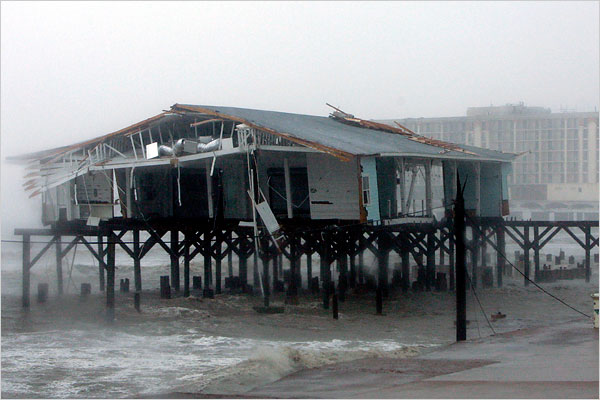
Hurricane Ike damage. Photo: Matt Slocum/Associated Press

Ike: The Silent Storm
By Teresa Van Deusen / October 3, 2008

The evacuees from Hurricane Gustav had just returned home September 5th when Hurricane Ike began to head for the Gulf of Mexico. National news covered the track of Ike through the Gulf non-stop in the five days leading up to landfall. More than a million Texans sought shelter away from the coast and countless more piled in with family and friends. The storm came aground on around 1:00 AM on Saturday, September 14th with a category 5 surge of saltwater and category 2 winds of 115 mph.

In the dark of the night 45, 000 homes were destroyed and millions of residents lost electricity, water, and roofs. Then Ike turned north, leaving hundreds of thousands more Americans without power in a 200 mile wide swath from the Gulf Coast to the Great Lakes.

And then there was silence. No hum of air conditioners. No stereos blasting or people singing off key. No loudspeaker from the football games on Friday night. Just an eerie quiet as people emerged from their hiding places to survey the damage.

The Media was not allowed to film people being rescued from rooftops in Texas. They were prohibited from flying over the small towns and beaches isolated by flooding and decimated by the hurricane. Local press raged about the conditions, then fell silent in a game of play-nice hoping to be allowed at least limited access. Not once did the national press report this suspension of the first amendment. The sound of black hawk helicopters could be heard for miles.

With cable TV down, and electricity at a premium, the primary source of information was local radio. Listeners tuned in hoping for updates and relevant information which seemed to come irregularly between endless chatter. If you had an antennae and power you might have been able to tune into the local news. For seven days after the storm only local news was broadcast. Not a whisper of Caylee, or OJ, or Palin, nor the economic crises was heard for an entire week. Most relied on neighbors and friends for information in shared conversations over piles of debris.

Phone service was completely unreliable and is still spotty in most areas. Sometimes a call would randomly go through only to be randomly dropped. For a while only text messages got through. My mother finally tackled the texting learning curve from her closet as the storm raged outside. It’s hard to express how you are really feeling in a simple text message while water pours into your bedroom. Nobody can hear you groan.

One day after the storm it rained, re-flooding homes and washing out roads. People started to clean up the debris and looters targeted homes instead of businesses. Some people went shopping and ice skating in the Houston Galleria, a surreal bubble of air conditioned normalcy. Local power trucks went out to assess the damage. 2000 people were rescued off Boliver by the Coast Guard. Stories began to roll in of residents who had tried to evacuate but found the ferry closed and the roads blocked by water. Evacuees in remote shelters began to check out, determined to get information on their home towns. The sound of cars driving around trees in the road began to weave its way back into the landscape.

24 hours after landfall, Ike began to disappear from the national news. 48 hours after landfall CNN and the Weather Channel evacuated Galveston Island and the airwaves fell silent.

Most people thought they would be back to work on that first Monday, but they were largely wrong. Millions of addresses did not have power. Elevators did not work. Trees blocked roads. A mere 100 traffic lights were working. A million people had no running water. Broken glass littered the streets of downtown. No local shelters had been opened, 14 regional hospitals were closed, and FEMA had not yet begun to distribute ice or water. Press conferences were relegated to sound bytes and Ike disappeared completely the front page of the most papers. Thousands who had ridden out the storm were bussed off Galveston Island. Evacuees who had left before the storm began being bussed back “closer to home and work”. Employers booked hotel rooms for employees to keep their businesses running. Stillness fell over 3 million customers still in the dark. The hum of generators, a distinct growling, failed to drown out the buzz of mosquitoes.

On Tuesday, after President Bush had concluded his tour of the area, an army of repair trucks was finally deployed and PODs were set up. Rice University resumed classes and students bagged free ice for the neighbors. City, state and federal teams tried to stay calm with one other, a strained exercise at best. Local news continued to be purely local. And inversely, not many locals had power or a TV signal, so they hardly noticed. Information increased as a premium, Where can I buy gas? Are the banks open? Where can I charge my nebulizer? Sleep with my c-pap machine? Find safe drinking water? Buy a tarp? Or a generator? Price gouging ran amok. Half a million people finally had running water after 3 days, but the sound of flushing toilets and running showers seemed oddly loud by candlelight.

By the first Wednesday after the storm plans were announced, then changed, and changed again. 3.5 million people sought ice and water and gas and more food as they lived without power. FEMA announced hotel vouchers available online or via phone, the two services least reliable for days to come. Elderly Houston residents, living in high rise independent living facilities, were discovered left to their own devices without a/c or elevators. The shuffling of their determined feet in the dark stairwells could be hard as they climbed to check on their friends.

One week after Ike struck less than 50% of electricity had been restored. 250,000 people lived without water, most had missed a paycheck, and temperatures were rising. The bars hopped on Friday night. People clustered on brightly lit restaurant patios sharing a hot meal and telling tales. Entrepreneurs ran generators and beaconed to patrons who went home to inky black bedrooms and non-perishable pop top snacks. Normalcy resumed to some degree for those who could get it. For many it did not. Suspended somewhere between shelters and flooded homes, people still went back to work if they could. Jaws were clenched, but the recovery moved forward. Pride kept words from being said out loud.

The second Monday brought the long run home. Less than 1000 traffic lights were in working order. Rush hour resumed and a seven mile drive took four hours. There was a sort of togetherness among the people. It was important to be polite. There was surprisingly little honking. Miles of drivers hunkered down in their air conditioned cars talking on cell phones and reassuring themselves that this was a sign of normalcy.

Two weeks after this disaster 1.5 million people still go home to no power but that which they provide for themselves. The blue light of televisions run by generators blares out into the darkness. The sound of the newscasters voices are more frequently replaced by a game or movie. Cable is restored with news that never mentions Hurricane Ike. The remote shelters have all closed. All evacuees have been bussed back to their city of origin, found the rare hotel room, or bunked wherever they could. People in Galveston sleep in tents. FEMA ceased distributing ice and water days ago. Only two regional hospitals are reopened. Warnings about mold, vermin, mosquitoes, and “germs” are issued with reminders that medical care is not readily available. Restoration of power schedules are pushed back for lack of parts. Debris will not be removed until after Thanksgiving, or New Year’s if we are lucky. 245, 000 Texans applied for emergency food stamps. Food banks are distributing four times their normal amount in an attempt to meet demand. More than 250,000 households have applied for FEMA assistance. There are no empty hotel rooms for 300 miles. The scurrying of bugs and rustling rodents amid the debris keeps people up at night.

I like to think that if America knew of the suffering in the south that help might be forthcoming. That maybe Galveston residents would not be sleeping in tents and fire stations might have the gas they need to go out on calls. I imagine that children would not be forced to sleep in cars because they can’t find a FEMA hotel room. I would like to believe that the nation would protest the thought of waiting to bring in FEMA trailers until next week or the policy of bussing people “closer to home and work” when those places don’t even exist anymore. But the rest of the nation doesn’t know all these things because more reporters are covering OJ and Caylee than the millions of Americans disrupted by Ike.

It’s been three weeks and it will certainly be many more before this is over. The Texas Guard is rolling out. Clean up crews and tow trucks rattle down the streets. Chainsaws replace generators. But still, the silence is deafening. Seriously deafening. As if no one is paying any attention at all.

Teresa Van Deusen is a freelance writer living in Austin, TX. She has been volunteering her skills to disaster relief efforts since 1998. For the past three weeks she has been working on Hurricane Ike recovery travelling from Austin to Houston delivering much needed supplies.

Source / Common Dreams

The Rag Blog

Posted in RagBlog | Tagged , , | 1 Comment

Afghanistan : The Slaughter of Innocents Is an American Policy


The War to Promote Terror: What it is, indeed, is racism
By Robert C. Koehler / October 2, 2008

The “necessary war” in Afghanistan, which both presidential candidates support — the one, you know, that’s really about terrorists and Osama and all — raises as many troubling questions about who we are as the other war we’re fighting and losing.

Consider the details of this war. The aggregate civilian death toll, at the hands of the U.S. and NATO — between 6,800 and more than 8,000, according to economics professor Marc Herold of the University of New Hampshire — is a start. But Herold’s about-to-be-released report on the bombing campaign in Afghanistan, “The Matrix of Death,” is a disturbing analysis not only of the collateral damage churned up by our terrorist-hunt in this broken nation, but of the attitude and rationality that are driving it. The report is subtitled: “The (Under)Valuation of an Afghan Life.”

This is a report on the flawed premise from which ultimate failure flows — the flawed premise that keeps hell active and guarantees an endless supply of enemies. And the more of these “enemies,” and their children, that we kill, the less safe we are, and we know this, so we lie about the numbers of dead. Most of all we lie about what we are, in fact, doing, which is fighting an irrational war, most accurately called the war to promote terror. We will not win it unless we revert to the morality of Ancient Rome: “create a wasteland and call it peace.” But that’s not winning, either.

What it is, indeed, is racism, especially the use of what is called close air support: In order to protect the lives of American and NATO (mostly white) troops, we do much of our fighting from the air, with 500- and 2,000-pound bombs, lacerating a (non-white) Afghan population we don’t even have to face.

Herold quotes John MacLachlen Gray in the U.K. Globe and Mail: “. . . the slaughter of innocent people, as a statistical eventuality is not an accident but a priority — in which Afghan civilian casualties are substituted for American military casualties.” Herold adds: “What I am saying is that when the ‘other’ is non-white, the scale of violence used by the U.S. government to achieve its stated objectives at minimum cost knows no limits.”

This is a description of U.S. policy stripped of the pretense in which it is usually cloaked. Not only are the numbers of dead downplayed significantly in official military statements and the sympathetic (mainstream) media, but those civilian dead who are acknowledged are instantly rendered “regrettable, but not our fault” by the circular, all-purpose justification that they were not deliberately targeted.

When you bomb a village, the dead are random and anonymous — and therefore, thanks to some legalistic moral loophole, no one’s fault. And this is one of the military advantages of air war, as far as I can tell. However horrific the results it produces on the ground — “I saw pieces of bodies scattered around . . . I couldn’t even make out which part was which . . . it was just flesh everywhere” — the perpetrators maintain an easy moral purity that forestalls self-doubt and revulsion.

Aerial bombardment, therefore, because of the psychological insulation of distance that it provides — especially when added to the psychological insulation of racism, which makes non-white deaths matter little or not at all — is a particularly insidious form of warfare, and its perfection is in and of itself a dire threat to humanity’s future.

And, as Herold writes: “The recent increasing reliance upon unmanned drones to dispense death and destruction in the border regions is in a sense the penultimate disconnect between killing them and saving ours.”

To put this all another way, the simple math of conventional national security — the zero-sum game of kill or be killed, our lives matter and theirs don’t — is terrifyingly counterproductive in the 21st century. It always has been, of course, but we used to be protected from its consequences by distance and ignorance. Humanity is connected now like never before, and possesses the technology of self-annihilation. Such technology cannot be contained, and thus true security has nothing to do with national borders. We cannot afford to devalue any portion of the human race.

For that reason, the most disturbing part of Herold’s report may have been his discussion of the “condolence” money paid, occasionally, to the survivors of Afghan civilians killed by our actions. These payouts have ranged from as low as $400 per dead civilian to several thousand dollars.

Herold puts this into perspective: “Approximately $80,000 was spent on the rehabilitation of every sea otter affected by the Exxon Valdez oil spill, that is, ten times the condolence amount offered by the U.S. military to the family of an Afghan killed.”

This does not make me feel safe. I can’t even fathom the values that are operating here, even though they are stamped: “U.S.A.” We are already reaping what the Bush legacy has sown, but there’s a lot more that awaits us, and we have no right to be surprised when it comes.

Robert Koehler, an award-winning, Chicago-based journalist, is an editor at Tribune Media Services and nationally syndicated writer. You can respond to this column at bkoehler@tribune.com.

Source / Huffington Post

The Rag Blog

Posted in RagBlog | Tagged , , | Leave a comment

Greed and Disaster Politics (Burp.)


‘This is a gun to our head by our own people. The Republicans and Democrats are both doing this.’
By Dennis Thompson
/ The Rag Blog / October 3, 2008

I called my congressman’s office to weigh in on the “debate”. I asked the lady taking the calls how she was holding up and she said she was above ground. I asked her if that was in relation to being alive or in a bunker?

In an op-ed piece I saw this morning, the best advice that could be recommended for a position to take in this mess was in cash and fetal. What is terror then? As the piece said, I don’t think in my lifetime I have felt this defenseless as a country and on a personal level. Not JFK assassination, not 9/11. This is a gun to our head by our own people. The Republicans and Democrats are both doing this. B. Frank et al are up to their eyeballs in the deregulation and engorgement of Freddie & Fannie scenario. Bush and family have always worked directly or indirectly for the investment bankers (Brown Harriman), what’s new. Do we really believe this just happened, somehow walking out of the dark to surprise us. If we don’t wake up now, the mountains may be where you end up, maybe as a sophist but more likely as a partisan.

This whole thing comes out of the playbook of the disaster politics scenario that Friedman liked. Screw them up bad enough and change things while they are on the ropes. Move in after a natural disaster or create an economic one, doesn’t matter. We have seen this before. Can we have a little war on this terror? And if you are worrying which side Obama is on look at this.

Greed and Disaster Politics, this trail leads directly to Cheney’s bunker: Naomi Klein on Mutant Egg Plant.

Good literary blog by the way.

If democracy still works, it better start working now.

The Rag Blog

Posted in Rag Bloggers | Tagged , , | Leave a comment

What’s missing from this election? Molly Ivins!

Former Texas Observer editor and columinist extraordinaire Molly Ivins at her Austin home in 2001. Photo by Carolyn Mary Bauman / WpN.

“The House passed (by one vote) a bill to eliminate barriers between banks, brokerage firms and insurance companies. This sets up financial holding companies that can offer all three types of services simultaneously. The most obvious risk is that a blunder in the insurance or brokerage end of the business could bring down a bank, putting insured deposits at risk. The taxpayers, of course, then wind up with the tab, as we did with the savings-and-loan mess.”

Molly Ivins / September 23, 1998
Thanks to Harry Edwards and the Austin Chronicle.

‘The late buckaroo populist and freedom fighter would have had a ball with the insanity of this current news cycle.’
By Anne Lamott / October 3, 2008

It breaks a girl’s heart to know that Molly Ivins does not get to have a go at the Republican slate this year. I can see that big, rosy, sunflower face watching this all with astonishment and roaring with laughter. Ivins — the legendary buckaroo populist, journalist, freelance hell-raiser and freedom fighter — would be pounding her fists on the arms of her easy chair, stomping her feet as if listening to live bluegrass.

She would have had such a ball with Sarah Palin — the trooper scandal, her love of moose (between buns), the flamboyantly botched television interviews, the bravery of people who hunt wolves for sport, from the air. Even though Molly was a Texan — who would have been on guard for the sneering tone of liberal criticism toward anyone with a gun or a double-wide — she still would have obliterated Palin as a faux populist wingnut with a tanning bed instead of a heart. She would have made great hay with the capacity of certain politicians to reinvent themselves in entirely new realities, as newfound populist Brotherman McCain has done, and his desperate, icky laugh of contempt might have raised some worries for her.

She would not have been happy with either McCain or Obama for opting out of public finance: She would mention Phil Gramm at the drop of a hat, McCain’s chief financial guru, whom she always called the senator from Enron. I think she would have been intrigued by Obama, for all the game-changing aspects he’s brought to the arena, for upending all the assumptions about whether someone could win with such a spooky name. She’d have cheered his speech on race, been amazed by his speech in Berlin. She’d have been pissed at the Democrats for not being as robust as they should have been on civil liberties, even as she reasserted her heartbreaking faith in American democracy, the faith that if we stuck together, we’d figure it out in the end. We’d somehow help the poor.

She would have celebrated the tidal roar of support from younger voters, who have the vision and stamina to fight for someone who would hold the nation’s leaders to account, people who would fight to make this a country where it was once again safe to be a small child, or a very old person, which it has not been for approximately 7.6572 years.

She would have known all along that this election was going to be as tight as a tick. She would have had the sense to be afraid but to not let her fear hurt her. She would have done one constructive thing after another: Sent money to swing states, offered her car to volunteers from out of town, let young campaign workers sleep on her couch.

The last time I saw her, she was several weeks away from death, spending most of her time in bed, hanging out with her best friends and her dog. And you know what she was doing, off and on, the weekend I spent with her? She was working on her last column, about the need for Americans to fight like hell to stop Bush’s proposed surge in Iraq. All she had at that point was a great ending: “We are the deciders. And every single day, every single one of us needs to step outside and take some action. We need people in the streets, banging pots and pans and demanding, ‘Stop it, now!'”

She was also rereading parts of her favorite books when suddenly she wanted to have a dinner party, because I had never met her great friends, “Shrub” co-writer Lou Dubose or populist heavyweight Jim Hightower. This was a major obstacle to happiness for all concerned. She adored those two men, and I was commanded to call them. Unfortunately, Lou, her longtime collaborator, was out of town. So, instead, she told me Lou stories for half an hour.

No one loved her stories more than Molly, especially those about the art and absurdity of politics. This was part of her greatness. She reigned like a queen — imposing carriage, great sense of style, with a mind and smile that radiated warmth.

In between trying to write her column, she would call out to me. “Associate Party Planner!” she would say. “Front and center! We have a problem!” So I would appear with the clipboard I had been issued, stretch out next to her and her dog, and we’d fiddle with our menu or grapple with the despair and bitterness of having discovered that none of the cloth napkins matched. Lou couldn’t come, and two of the good plates chipped. We agreed: It was a nightmare.

Her brother Andy was in town, though, as was her great assistant Betsy Moon, with her boyfriend. Jim Hightower and his wife, DeMarco, could be there.

It was really not an ideal weekend for a party, what with her being close to death, unable to walk much anymore or to stay awake. Also, she had to get chemo that morning. But I ask you — what are you going to do?

Obviously, have the party. Everything she loved, one more time.

Her niece and nephew came.”I don’t have any children,” she once wrote, “so I’ve decided to claim all the future freedom-fighters and hell-raisers as my kin.” And she adored these two (although later we conspired to set the table so that they got the two chipped plates).

She was so excited about her party that she insisted I make place cards.

She slept a lot the day of the party. The chemo had knocked her for a loop. But she managed to work on her column a little. I Googled it just a moment ago. Here’s what she wrote, “About the only politician out there besides Bush actively calling for a surge is Sen. John McCain. In a recent opinion piece, he wrote: ‘The presence of additional coalition forces would allow the Iraqi government to do what it cannot accomplish today on its own — impose its rule throughout the country. By surging troops and bringing security to Baghdad and other areas, we will give the Iraqis the best possible chance to succeed.’ But with all due respect to the senator from Arizona, that ship has long since sailed. A surge is not acceptable to the people in this country — we have voted overwhelmingly against this war in polls (about 80 percent of the public is against escalation, and a recent Military Times poll shows only 38 percent of active military want more troops sent) and at the polls. We know this is wrong. The people understand, the people have the right to make this decision, and the people have the obligation to make sure our will is implemented.”

She got up from bed a few times to sit with me at the table. We drank tea and ate dried cherries and told each other stories. She was such a performer, with that marvelous Texas Hill Country accent that used to get stronger with every drink. But she and I had both been sober for some time by the end of her life. Her stories were precisely delivered, and her face so in control, as if she had trained with Marcel Marceau. I can see her looking over the tops of her reading glasses — mugging, mimicking, liberally using old lines even as she pulled new whoppers out of the ether. Sometimes being with her was like watching fireworks on a small scale. Finally, she’d lean forward to deliver the money line, while fluttering her eyelids, then throw herself backward into her chair, roaring up at the ceiling, as if she were laughing at God.

Then she’d lean forward again, hoping that you might have a story, too, and get the log rolling again.

I swear, she might be the only person who can help get me through these last 33 nerve-wracking days. She would not have taken Sarah Palin lying down. She would laugh her ass off, and do something every day to defeat McCain. She would eat with beloved friends, put people together who simply had to know one another, who might together be able to throw a wrench in McCain’s Rube Goldberg machine. She makes me want to move around on the floor with her one more time, standing on her shoes like I used to with my father when I was a little girl, and he was teaching me how to waltz.

Source / salon.com

Thanks to Doug Zabel / The Rag Blog

Posted in RagBlog | Tagged , , , , , | Leave a comment

Emergency Room : Diagnosing the Candidates’ Health Care Programs


‘The McCain “health care” plan is a pure cop-out to the insurance industry.’
By Dr. S. R. Keister / The Rag Blog / October 3, 2008

It would appear to be a very simple exercise to write down in two columns what the candidates have to offer the public for future health care. Yet, upon delving into this I encounter a much more formidable task. This is much bigger and more complex than comparing two lists. I consider health care as a profession as I knew it when I started practice in 1950 and the evolution of health care into a business which it has become. We are looking at a cultural renaissance, not just taking care of the ill and injured, we are talking about a complex social revolution.

Let me start with two examples. I had a colleague who organized a “future physicians club” at a local high school in about 1970. This was a source of inspiration and enjoyment to he and the students. Somewhere in the 1980s he stopped the entire program as the students were no longer interested in the art and science of medicine, but as a business to make money. Second, I recall in 2004 watching CNN and the reporter was interviewing a family in the Middle West. The father was an out of work diabetic, two children were ill, they had no health insurance, were facing foreclosure. The correspondent asked the woman who they were going to vote for for president, and the answer was George Bush because he is against gay marriage.

Currently 60-70% of the public “want something done about health care.” According to the New England Journal of Medicine some 60% of physicians are in favor of single payer, universal health care as outlined by Physicians For A National Health Program. Yet the public is being inundated by a series of TV commercials sponsored by the AARP and AMA both of which do not support single payer, universal health care, but in a subtle manner espouse more of the same with minor revisions of health care dominated and run by the insurance industry with subtle suggestions that “we do not want socialized medicine, do we?”

In 1950 when I started practice in Internal Medicine/Rheumatology the local hospitals demanded that to obtain admission privileges we give two months a year taking care of charity patients in the hospital, and as well spend one morning a week working with charity patients in outpatient clinics. When the insurance industry swept up passive physicians into the HMO movement the hospitals ceased the programs that had been their earmark dating back to medieval times. Now both physicians and hospitals are, by and large, the vassals of the insurance industry. In short, if either candidate attempts to promote universal health care as is indigenous in most European nations, with excellent universal coverage, with generous government subsidy, that candidate will be berated, libeled, and defamed by those who are the financial beneficiaries of the present system. With the American public slave to ads on TV the candidate has not the chance of a snowball in hell if he speaks of universal care.

The physician is not immune to our culture of greed, of the machinations of the neo-liberals (that term always seems to be an anachronism). Further, he is a victim of corporate capitalism and works in fear of his survival and the well-being of his family. He, as the balance of our society, has been overwhelmed by the forces discussed by Naomi Klein in her book “Shock Doctrine.” Believe me, most honest, dedicated physicians are very unhappy with the status quo but they are afraid. Happily, 15,000 dedicated souls involved in Physicians For A National Health Program have risen above the morass and are attempting to move forward.

The greed runs rampant with “non-profit” homes for the elderly, nursing homes, free standing dental and medical centers. We see pharmaceuticals advertised on TV hour after hour, thus making prescription drugs more expensive in the United States than elsewhere in the world. We see the Bush administration following the neo-liberal format of 1) Privatization, 2)Deregulation and 3)Doing away with government subsidized social programs, in instituting “Medicare Advantage Plans,” a backhanded way of turning Medicare over to the Insurance Industry. We see the crony relationship of the Pharmaceutical Industry and the congress in enacting the absurd Medicare part D, which enriches the pharmaceutical and insurance industries.

The McCain “health care” plan is a pure cop-out to the insurance industry. It will make insurance coverage less accessible and affordable for those with high health care needs. It will increase coverage among the currently insured through the non group market, but reduce the number already covered by employers, leaving about the same number uninsured (45 million). Provide a tax credit to purchase insurance, but the credit for the average working family would only pay a fraction of the cost of a policy for a family of four.

The Obama plan is a step in the right direction, greatly increasing health insurance coverage but still leaving about 6% of the non- elderly uninsured, as compared with 17% today. Increase access to affordable coverage for those with the highest health care needs, including the chronically ill. Increase the affordability of care for low-income families. For the currently uninsured offer a program akin to that provided for members of congress.

Obama appears to be moving in the right direction if his program can be facilitated after the current Wall Street bailout. Funding may indeed be a problem. The PNHP plan would be much less expensive and provide universal coverage, but would be a political disaster to overtly espouse.

We have a long way to go and it will require much more than simple legislation unless many of our elected representatives have their umbilical cords cut to the insurance and pharmaceutical lobbies and much of the physician population can be encouraged to stand up and throw off the yokes of the HMOs.

Go to Physicians For A National Health Program.

And see the comparitive analysis of the Obama and McCain health care plans at the Urban Institute’s Health Policy Center.

The Rag Blog

Posted in Rag Bloggers | Tagged , , , , , , , | 2 Comments

The All-Encompassing Argument Over Souls


Showdown at Tombstone
By Mariann Wizard / The Rag Blog / October 3, 2008

This is hilarious; a little something on the lighter side — but beyond the laugh, offering some really very freaky insight into the fundamentalist “soul”!! Thanks to Cousin Karen in the country!

Years ago I started buying my Mom a set of collector plates illustrated with Biblical themes; the artwork is cute and humorous, with a wide cast of creatures in addition to whatever human characters were involved. The first one, as I recall, showed Noah’s Ark right after the Flood, as the animals and birds, two by two, head out into a fresh-washed world — next came Moses parting the Red Sea, the Israelites crossing over with all their flocks, herds, dogs, cats, etc. I got all the way through the set until the sixth and final plate was announced, supposed to be “Heaven”, where all the little human angels sat around on clouds and played musical instruments, w/ not a dog or a cat or a bird in sight. I dunno about the Presbyterians, as seen in this sequence of church signboard statements, but Mama was a Methodist, and none of her kids would go to a Heaven without animals. I only bought five plates.

The Rag Blog

Posted in Rag Bloggers | Tagged , , | 1 Comment

Ron Ridenour: Sounds of Venezuela, Part IV

Source: Global Exchange

Click here to view the entire series.

Sounds of Venezuela
Part IV: “This is the revolution of women”
By Ron Ridenour / The Rag Blog / October 3, 2008

CHU CHU CHU
CHUG CHUG CHUG
CHE CHE CHE

What! Is that right? Did I hear Che?

Coming out of a liturgical dream or awakened by revolutionary chanting, I throw off my sheet, pull on my kimona and rush downstairs and out the door into pitch black darkness. A booming united chant pulls me around the corner. The people are struggling in ardent enthusiasm for the cause. My legs move quickly now, taking me toward the ever-moving revolution. The chant surges and wanes in the wind.

Ron Stop! Now! You are running in the streets in a kimona. People will not understand this. The chanting is far away now and if you did catch up with the cantors what would you do and what would be their reaction to you? Can you be one with them, a gray-haired man in a blue kimona and sandals? They would be bewildered or insulted. No one will understand that you are driven with emotion hearing revolutionary chants.

I rush back as darkness begins to lighten. I pull on trousers and t-shirt and rush out again still in semi-darkness. The united voice fluctuates in volume. I’m reminded that these people are Catholic and some may be partaking in a sacred canticle. I see a man standing before a closed work center and ask him about the chanting. Does it have to do with evangelical spirits or the upcoming commemoration of the liberty of La Victoria, in 1814, by university and seminary students led by General José Félix Ribas?

“No,” he chuckles, “that’s just soldiers running their early morning exercises.”

* * * * *

Diego had earlier introduced me to a master sergeant at the military training base on the edge of town. The base was preparing a pageant of teenage girl beauties for “youth day”, part of the military-community solidarity policy. Diego’s friend’s daughter was a contender for “Queen of La Victoria”, and he invited me to attend. The evening following my crazy escapade, I entered the base plaza to see the show, feeling uneasy. Pretty girls sauntered about in high heels and white gowns, round buttocks vibrating, breasts pushed forward from low-cut necklines, they nervously caressed their long black hair. The audience milled about or sat on folding chairs, many drank Colombia’s Death Squads’ drink, Coca-Cola. Teenage boys and fathers watched the girls with pleasure and mothers smiled proudly.

Humans are filled with contradictions. Male-chauvinist inspired beauty contests continue to be popular. On the other hand, María León, president of the National Institute of Women, asserted, in an interview on Women’s Day: “This is the revolution of Women”. That same day, President Chavez announced a new Ministry of Women’s Affairs and named Ms. León its minister. She is unrelated to Rosa León, who was not even born when María took up arms alongside fellow members of the Communist Party against the oppressive regime of Rómulo Betancourt, in the 1960s.

By the summer of 2008, the new ministry had representation in most communities, helping the recently and newly created programs designed for women, including Banmujer—the world’s only government bank for women. It was established on Women’s Day in 2001 and has since granted small loans to two million women, mainly to help them in business ventures aimed at bringing them out of poverty and encourage participation in society. The ministry also has Meeting Points and Madres del Barrio. The “Mothers of the Barrio” Mission, started in March 2006, provides a monthly stipend (80% of the minimum wage) to poor women with children and who do not have full-time employment.

Women suffrage arrived late in Venezuela, 1946. Not until constitutional changes in 1960 were women formally granted equality under the law. It wasn’t until the 1980s, though, that women were allowed to manage their own affairs, including signing official documents without the approval of a spouse or common law lover. Women began organizing for equal rights, in the 1970s, but most efforts were based on signal issues, such as the right to abort. There were few female public leaders before Chavez won the presidency. In the1997 National Assembly, for instance, only six percent of the deputies were women.

With Chavez’ 1998 electoral victory, a new constitutional campaign was initiated and with women’s rights at its core. Thousands of proposals were forthcoming by women’s organizations. The new constitution of December 15, 1999 is the first in the world written in a non-sexist language, meaning that both genders are used in referring to positions and titles, and it is known as the non-sexist Magna Carta, because of establishing full rights and benefits in all arenas. All forms of discrimination, also in the home, are forbidden.

In the first Chavez-led National Assembly women deputies doubled and have since tripled. Thirty-eight percent of the work force is female as are 56% of university graduates. Six women have earned the rank of general. Six of the 15-member executive committee of the new Socialist United Party of Venezuela are women. There are 11 female ministers, making up forty percent of the 29 ministries. And most spectacular is that four of the five highest public leaders are women. Standing beside executive leader Hugo Chavez, women are the President of the National Assembly, leaders of the National Electoral Council and Human Rights Office, and Chief Justice of the Supreme Court (TSJ).

Inspired by the current female Chief Justice, a judgeship on the Supreme Court is an aspiration held by Rose León. Although she, and presumably most if not all of the beauty queen contestants, seek equality and power this does not prevent them from continuing some traditional sexual roles and with pink frills. Rosa, for example, affords herself the luxury—or affectation—of having her own bathroom in the offices where dozens of mayoral employees work. There are two bathrooms but the workers and visitors must only use one. A sign on one door states that this one is exclusive for Rose. Unable to resist the temptation, I used it. I found the light on—something a cleaning woman insists upon so that Rosa does not need to switch it on—and the toilet seat covered in pink clothe; a pink hand towel hung beside the immaculately clean sink. Nothing was amiss except my presence, which the cleaning woman let me know in no unspoken terms when I came out.

Throughout my two months exploring the Venezuelan revolution everywhere I spoke with people working or organizing the majority were women. Black women are more often political activists and community organizers than black men as is the case for indigenous women, who represent or are active among the some 50 tribes in the country. They carry out Mission Guaicaipuro, the program to restore communal land titles and human rights for the half-million indigenous peoples.

I did not witness any brute macho treatment of women and most women accompanied by men did not look down or fear to speak up. In fact, women are most outspoken and many are not shy about showing other aspects of themselves, such as gyrating hips and breasts springing forth, a sight fair to this dirty old man.

But, yes, there is violence against women, especially in the homes. And there are rapes; prostitution too. Prostitutes are offered free tests for venereal diseases by local clinics. The courts do not prosecute prostitutes. Many judges are women. The new women’s affairs ministry addresses both violence against women and prostitution through information, conferences at the community Meeting Points and hotlines for women abused by men.

The Bolivarian Revolution is truly a transformation for women, an empowerment that half the population is not about to let disappear.

The Rag Blog

Posted in Rag Bloggers | Tagged | 2 Comments

The End of America As We Know It?


A Father Sounds An Alarm
By Ray Zwarich / The Rag Blog / October 3, 2008

Like many readers of the Rag Blog, I have been a leftist since the Tet Offensive set off a political awakening in a nice middle class college student’s mind. As we watch current events unfold, I hope that others share my disappointment that we, as leftists, are not better prepared for what may be about to befall us.

I have only been reading the Rag Blog for a few months, but when I do I feel a sense of ‘community’ with its writers, and with its other readers. Surely all of us belong to several, or many, such ‘communities’.

I am not a ‘chicken little’, but I know that I am surely not alone in such communities in the concerns, and even fears, I am feeling today. Surely all of us who read The Rag Blog, as leftists, are cognizant of the possible implications of current events, depending on how ‘things’ play out.

We have no way of knowing what decisions we may be called upon to make, possibly in the not so distant future. Whenever survival becomes a direct issue, people’s chances are greatly enhanced if they have the option of functioning collectively with people they trust. I trust that as we read each day’s new headlines, we realize that we may very well be called upon, possibly very soon, to turn to our ‘clans’ to enhance our chances for survival.

I hope that we all have clans of family and friends to turn to. But if our fears come to pass, we must quickly exploit the full potential of each and every ‘clan’ or ‘community’ of which we might be a part. It is a shame that we are not better prepared. We have squandered the opportunity to make preparations that might have proven valuable to us, (and we may yet have time to make such plans), but our recent history has perhaps taught us that people need to be more directly motivated than we have yet been before we will do what we need to do.

Perhaps the looming events we fear will not come to pass. Perhaps we will be granted more time. But if chaos soon visits us, I trust that we all realize that the time will be at hand when we need to make connections between the clans and communities that exist. If these events do not befall us in the near future, (as they very well may not), we might give more serious thought to using the reprieve we have been granted to re-think what we have or have NOT yet done to prepare for such events.

I am not an alarmist by nature, but there are times when any prudent person must consider sounding whatever alarm that she or he can. When is it time to ‘break the glass’? Each must decide for herself or himself. Copied below is an ‘alarm’ I have sent to my own family, (together with an excellent article from Richard Cook). This is not nearly yet a ‘breaking of the glass’, but I can feel my nose open, and hackles rising, when I watch and read the news. My eyes are at least on ‘the glass’ these days, even though I know that the time for breaking it is not yet here.

In light of current events, I hope others are making similar contacts with those they love and trust the most.

The End of ‘America’ As We know It?

I know that in the busy flow of our daily lives, some of us pay more attention to current events than others. But I would assume that we all understand that what is happening these days is very serious, and might potentially have immense impact on our own lives.

I read a lot of articles written by people who say ‘the sky is falling’, and I tend to dismiss most of them. I have lived through other lean times when many people were saying the same sorts of things, but the sky never did fall, and the economy straightened itself out instead. But what I am seeing and hearing now seems to be much more serious than anything I have seen or heard during my lifetime.

The credentials of the author of the article copied below are impressive. (They appear at the end). This writer , Richard Cook, is certainly not a ‘left wing’ nut. The allegations he makes are astoundingly and horrifically serious, (if they are true). They are every bit as serious as the conspiracy theory allegations that 9/11 was either an ‘inside job’, or was intentionally allowed to happen, (which I personally don’t ‘believe’, although I have read the evidence, which is very compelling, and I think that it is entirely possible that such allegations could be true) . This writer contends that the bubble that is now threatening to bring down our economy was created intentionally by those ‘super rich’ barons who effectively exert control over much of the world. (I have long known that these people are much more powerful that mere governments). Their alleged motive is a fascist takeover of the nation.

Assuming nothing dramatic happens, (as it very well may not), we may never know what is true or not, as far as what plots might be afoot, but many current facts are well established. Mass detention camps HAVE been built. For what purpose? For the time being, that is not ours to know. Just a few days ago a military division of the US Army was assigned a duty station within the borders of the United States itself, which is a violation of the Posse Comitatus Act, which was passed in 1878, and forbids the military from being used within US borders for law enforcement. These are very foreboding, (and well established), facts. The allegations made by Richard Cook in this article may or may not be true, but it certainly ‘feels’ to me that it is entirely possible that they could be true. (I don’t think that they ARE true. Just that they COULD be).

Whether or not such ‘conspiracy theories’ are true is secondary (at least for the moment) to the rather stark and obvious reality that our lives as we know them are teetering on the edge of substantial change, and possibly even ruin. We all hope that this ‘ruin’ does not come about, and it very well may not. But surely we recognize that there is a substantial risk that something very bad MAY happen. If the weather man tells us that there is a 30% chance of rain, most of us would probably bring an umbrella, or at least a hat, with us before going out. There is no way for us to know what our risk is in neat terms of a percent. This writer, Cook, however, thinks that monumental events are “inevitable”.

I told J***** recently that we are all lucky to have each other, and that whatever happens, we will be able to help each other survive. History has told a story many times over, in which people like us fell back on their family bonds in order to survive. We all hope that things will not come to that, but at this point it sure seems to me that circumstances merit that we should at least start thinking about contingencies, at least in the backs of our minds. It is WAY too soon to start making ‘plans’. The economy may yet pull through. But surely we all harbor our own fears that haunt us in quiet and private moments. It is at those times when we should remember that none of us is alone. We are a ‘clan’. We have each other, and in times when survival becomes an issue, people have a much better chance when they function collectively with their ‘clans’.

I am not an ‘alarmist’ guys. But I am certainly ‘alarmed’ these days. Here’s the article, (and once again, this writer’s substantial credentials are at the end).

Hope all are well this morning …… Papa

Grand Larceny” on a Monumental Scale: Does the Bailout Bill Mark the End of America as We Know It?
By Richard C. Cook / October 2, 2008

OCTOBER 1, 2008—Tonight the Senate passed the $700 billion Wall Street bailout bill by a vote of 74-25. This follows the rejection of the bill by the House on Monday. In an MSNBC poll, 62 percent of Americans oppose the giveaway, but the lobbyists are doing everything possible to assure the rejection is overturned. According to Bob Borosage, co-director of The Campaign for America’s Future, House leaders “are bringing in the small business lobby and the banking lobby to buy the twelve Republican votes they need.”

The Senate took up the bill in order to pressure House members who voted against it to change their positions when it returns to a vote on the House floor on Friday. This procedure may be unconstitutional, because revenue bills must originate in the House, but there is no time or political will for anyone to mount a challenge on constitutional grounds. As another means of inducement—or blackmail—the bill includes the repeal of the wildly unjust alternative minimum tax.

Every reputable economist commenting on the bill opposes it, including NYU’s Nouriel Roubini, who says the plan is “totally flawed.” He says the plan is:

“a disgrace: a bailout of reckless bankers, lenders, and investors that provides little direct debt relief to borrowers and financially stressed households and that will come at a very high cost to the US taxpayer.”

My own view is that the plan is worse than that: a crime; grand larceny on a monumental scale.

Here’s why: We know that the debacle started with homeowner defaults on subprime mortgages and that it has now spread to other types of mortgages as foreclosures spread. We know that the unhealthy use of subprime mortgages started during the Clinton administration, as did the bundling and sale of these mortgages into mortgage-backed securities sold in the financial markets.

What has not been reported is that the Bush administration turned these acts of reckless lending into a national program of mortgage fraud. Soon after George W. Bush became president in 2001, meetings at the White House between Federal Reserve Chairman Alan Greenspan and administration officials became more frequent. According to mortgage industry insiders I have interviewed, direction soon began to come down from the banks to mortgage brokers to falsify borrower income information to allow them to qualify for loans that were otherwise out of reach.

The FBI has investigations underway to prosecute some of these cases of mortgage fraud. But they are not reaching above the brokers’ level. The FBI is not gaining access—or at least they have not reported it publicly—to information about collusion at the political level or at the level of the banks which provided the leveraged funding for mortgage money.

But at the time the housing bubble was inflating, no one was watching. Note that when Secretary of the Treasury Henry Paulson testified before the Senate Banking Committee last week, he said he was shocked to learn when assuming office in June 2006 that no federal agency regulated mortgage lending. Rather this was an area left to the states.

What Paulson did not say was that when the states attempted to intervene, they were blocked by the Treasury Department’s Office of the Comptroller of the Currency. In a February 14 article in the Washington Post written before he resigned, New York governor Eliot Spitzer wrote:

“In 2003, during the height of the predatory lending crisis, the OCC invoked a clause from the 1863 National Bank Act to issue formal opinions preempting all state predatory lending laws, thereby rendering them inoperative. The OCC also promulgated new rules that prevented states from enforcing any of their own consumer protection laws against national banks. The federal government’s actions were so egregious and so unprecedented that all 50 state attorneys general, and all 50 state banking superintendents, actively fought the new rules. But the unanimous opposition of the 50 states did not deter, or even slow, the Bush administration in its goal of protecting the banks. In fact, when my office opened an investigation of possible discrimination in mortgage lending by a number of banks, the OCC filed a federal lawsuit to stop the investigation.”

Why did the Bush administration do this? The only possible answer is that it had every intention of producing the housing bubble, one that had the effect of not only inflating the cost of homes and real estate but also pumping billions of dollars of borrowed cash into the economy through mortgage and home equity loans.

The bubble enriched huge numbers of executives, managers, and shareholders throughout the financial and real estate industries, and provided jobs to millions of people. The bubble also brought back foreign capital to U.S. markets that had been scared away by the dot.com bust of 2000-2001.

Everyone seemed to benefit, but it was those at the top who skimmed the greatest profits. And for an economy that had already given away millions of its best manufacturing jobs through NAFTA, Most-Favored-Nation trading policies with China, World Trade Organization agreements, etc., the bubble acted as a kind of substitute economic engine.

It also resulted in tax revenues that allowed the Bush administration to implement its 2001 and 2003 tax cuts for the rich and provide funding for the Afghanistan and Iraq wars. Of course these tax revenues were not enough, as the national debt soared to over $9 trillion during the Bush years as well.

Economist Dean Baker of the Center for Economic and Policy Research makes the point:

“The near hysterical discussion (count the times ‘Great Depression’ appears in news stories) of the bailout still largely fails to recognize the roots of the economy’s current problems in the collapse of the housing bubble. Much of the discussion assumes that the problem is just bad subprime loans and that house prices will bounce back once the credit markets are working properly.”

The point is critical, because what the Senate and House leaders are telling us, as are President George W. Bush, presidential candidates Barack Obama and John McCain, and Federal Reserve Chairman Ben Bernanke, is that the bailout is to get the American economy moving again. Credit, they say, is the lifeblood of the economy, and without credit no one can make a move.

But credit is the lifeblood of the economy only because people are broke. Purchasing power in the U.S. has collapsed, and it is getting worse as the recession which has now begun worsens.

People can’t get loans, not because the credit markets are stalled, but because they have no savings for down payments and can’t afford to repay what they wish to borrow. If they could repay their loans, plenty of credit would be available. But there is no money—and no savings—within the economy for it to get moving again. The only possible source is more federal borrowing to prime the pump Keynesian-style. That is what the politicians claim the bailout will do. But it won’t.

Then what is happening?

What is happening is that the Bush administration is engineering a massive raid on the Federal treasury to pay off the people within the financial industry who have been operating the housing scam because the politicians told them to do it. This is hush money.

The people in the financial institutions who are getting the money will be passing it on to the big banks that leveraged their criminal lending practices. The giant sucking sound you hear is almost a trillion dollars of future taxpayer earnings going into the vaults of the nations’s biggest banks, such as Citibank, Bank of American, and—the pet bank of the Rockefeller family—J.P. Morgan Chase. Much will also go into the vaults of foreign investors such as the Bank of China.

And these banks have no intention of recycling the money into productive U.S. investments. Despite the political posturing, where much of it will go at the second or third tier is into executive salaries and bonuses. The fat cats are “gittin’ out while the gittin’s good.”

What happens next?

Well, it is already happening. In the post-bubble era there will be no more economic engines for the American economy. A long term recession and depression are inevitable, and they are expected by those in the know. In fact, there has been a plan in the works for a very long time to bring down the U.S. economy, and it will be happening over the coming months.

This is why the government is also preparing to implement martial law, or something close to it, in case public unrest breaks out. We will likely also see a clampdown on free speech, the right to protest, and use of the internet. Federal facilities are being prepared all around the country to backstop state prisons and local jails that are already bursting at the seams.

This is the plan, so people need to begin to take whatever measures they can to cut their cost of living, get out of debt, and protect themselves and their families.

Richard C. Cook is a former U.S. federal government analyst, whose career included service with the U.S. Civil Service Commission, the Food and Drug Administration, the Carter White House, NASA, and the U.S. Treasury Department. His articles on economics, politics, and space policy have appeared in numerous websites and print magazines. His book on monetary reform, entitled We Hold These Truths: The Hope of Monetary Reform, will soon be published. He is the author of Challenger Revealed: An Insider’s Account of How the Reagan Administration Caused the Greatest Tragedy of the Space Age, called by one reviewer, “the most important spaceflight book of the last twenty years.” His website is www.richardccook.com. Comments or requests to be added to his mailing list or to purchase his special report on the 2008 election may be sent to EconomicSanity@gmail.com.com.

Source / Black Listed News

The Rag Blog

Posted in RagBlog | Tagged , , , | 3 Comments

Using Depression-Era Tactics for Survival


Weathering the Coming Crisis, Part II
By Diane Stirling-Stevens / The Rag Blog / October 3, 2008

A week or so ago, I wrote up some of the things we’re doing to minimize problems in our lives, with this bail-out and any repercussions. We have 6 weeks of foods in supply; we have 3 months of cash for all expenses. We’ve kept our car ‘topped off’ with gas; our motor-home is filled with gasoline as well as our refrigerator is full of propane, as back-up. After putting these measures in place and wondering if we were ‘over-reacting’, this morning I read this article – it’s lengthy, but part of the story includes the potential for banks to declare a one-week ‘holiday’, and close down. The reasons for this decision are in the article, but I’d suggest you take the kinds of steps that don’t put you in a predicament should they go this far.

Most seem to feel the bail-out will pass; yet, there are some in the House who are saying they can hold off approving anything more than $50,000,000,000 which will get the immediate problems remedied. They then suggest they can wait until they reconvene on November 17, to discuss the remaining amount. Should this create some type of credit problem (even though they feel it won’t), you should consider that between now and November 17, that banks might pull this ‘holiday stunt’, essentially to ‘black-mail’ the House/Senate/Congress, to release added funds.

Here’s the entire article – share, and don’t get too complacent and confident that all of this will pass without incident. I think most can deal with this one week bank holiday, but we have to remember there would be a run on food as people ‘stock up’; gasoline as people would do the same, and many would be forced to use credit cards for any purchases (including food), if they haven’t got ‘cash’ in their pockets. Whether or not the ‘holiday’ means they wouldn’t be processing checks, I don’t know (I’m guessing they won’t stop processing your payments because this benefits them). If you can’t easily store a decent food supply in your own home, you can consider getting together with friends and family to see how you could find storage and distribute that food supply in a way that assures you that you’ve all going to have access to what you need.

We tend to take life ‘for granted’ because most of us haven’t lived through any major down-turns like this. We’ve had ‘ups and downs’, but I do believe this one might just be the ‘tsunami’ we could underestimate. Anyhow, I wanted to get this off to you because I’m concerned, and also I think this well-written article by somehow who is MUCH more expert than I am, might give you a better explanation than I can. (below)

Breakdown Approaches Climax
By Jim Willie CB / October 2, 2008

Use this link to subscribe to the paid research reports, which include coverage of several smallcap companies positioned to rise during the ongoing panicky attempt to sustain an unsustainable system burdened by numerous imbalances aggravated by global village forces. An historically unprecedented mess has been created by compromised central bankers and inept economic advisors, whose interference has irreversibly altered and damaged the world financial system, urgently pushed after the removed anchor of money to gold. Analysis features Gold, Crude Oil, USDollar, Treasury bonds, and inter-market dynamics with the US Economy and US Federal Reserve monetary policy.

Pardon the brief and jumpy style, laced with more emotion than usual. The events of the last few days have been remarkable, alarming, chaotic, and surreal. Gonna attend the Toronto gold show hosted by the Cambridge House this weekend. If you are there, grab my arm and say hello. Let me know your perspective on the brewing crisis.

HEART ATTACKS & BANK HOLIDAYS

The banking system breakdown is very far along, but still early. Remember USFed Chairman Bernanke stated over a year ago that the mortgage problem was contained. Try not to laugh. The bond crisis is absolute, broad, deep, and all-inclusive, enough to kill the USTreasurys after it kills the US banking system. The heart attack signals are with the LIBOR spreads over USTreasurys, the money market, the TED spread (Treasury versus EuroDollar), and short-term USTreasurys. Charts resemble heart attacks and EKG electro-cardiogram monitors. Many details appear in the October Hat Trick Letter report just posted. The bank runs have begun in earnest. Nevermind the big banks for a moment. The smaller ones are entering seizures. The small and medium sized cities are also entering seizures. Here are two stories, one about a city and another about the bank holiday coming.

This from a friend in Seattle: “I was talking to my neighbor last night. He is in finance in the county government, King County (Seattle). He said there are some very secretive budget talks being held, very hush, hush. Apparently, the county has lost around $200 million of taxpayer money in toxic paper investments, with huge implications on the budget. He says he is not privy to the details, but he is taking a 10-day vacation starting today, because he has nothing to do since everything is in flux.”

This from a friend in Atlanta with strong banking connections: “Reliable word that Bank of America branch managers just received a letter or memo from the USFed instructing them to perhaps be ready for a one-week universal shut-down of the banking system, including access to checking accounts, savings accounts and credit cards. Reliable word has it that BofA bank branches received a shipment of signs last week, reading “WE’RE SORRY, BUT DUE TO CIRCUMSTANCES BEYOND OUR CONTROL, WE CANNOT BE OPEN AT THIS TIME.”

So the banks are in need of a respite, a break, a holiday. They need to shore up their positions. Economists and bankers avoid revealing the consequences of extended absence of short-term credit supply. Imagine all the supply chain DELIVERY routes being interrupted for lack of short-term credit, certain to interrupt the supply of food, gasoline, building materials, basic household wares, simple hardware, and more. The short-term credit would certainly also disrupt payroll streams for companies, inventory supply for retail chains, durable goods purchases by consumers (like washing machines & refrigerators), the maintenance of basic machinery (like cars, trucks, computer, communications), even cash dispensed at ATMachines.

BAILOUT BILL PASSAGE

The Senate passed the Wall Street bailout bill, by a 3:1 majority. Some sweeteners like tax cuts and raising the limit to $250k on individual accounts for bank depositors helped. Some people might think that finally the banking system can at last receive some meaningful fixes. Call me a killjoy, but this will accomplish next to nothing as a banking system remedy. It is more a paper seal to Wall Street corruption than to ANY solution. If passed by the House, as is likely, it puts an epitaph on the American badge of legitimacy. A decade of fraud has been underwritten, sanctioned, and sealed. Even foreigners might smile at the new & improved bill. Their impaired bonds can participate in the redemption process. The only trouble is they might have to accept hot shiny USTreasury Bonds in return, of certain questionable value.

Still the bill must be viewed as a giant paper net to catch a giant locomotive train, one that derailed and then went over the mountainside cliff 500 meters above and is hurtling downward with acceleration. Gravity is a bitch, and so is momentum! One should not doubt for a second that it will do much to halt the downward trajectory. One should remember that debt solutions accomplish nothing in providing remedy for debt abuse and damage inflicted by broken debt contraptions. Nothing is fixed, only accounts have been shifted and names have been changed. THE BANKING SYSTEM PROCEEDS ALONG ITS OWN CLEARLY DEFINED PATHOGENESIS, with great momentum and power, which no human devices can interrupt. The next shock will be why the bill has not fixed the banking system as Mini-Fuhrer Paulson claimed it would. The other next shock is why Wall Street will need another $700 billion within a year. The other other next shock is how much the AIG and Fannie Mae “INVESTMENTS” a la nationalization will each cost the USGovt conglomerate an unexpected extra $trillion. The bailout yesterday enables Wall Street executives to retire more comfortably, even as some seek asylum or face exile.

The irony of the lifted depositor insurance is that big financial conglomerates can now raid the private accounts worth over $100k now, with government coverage in the bankruptcy courts. The October Hat Trick Letter contains some multi-sided evidence of USFed open license to use subsidiary accounts toward the aid of liquidity strains. What constantly leaves me shaking my head is how intelligent people continue to attribute fair spirited motives to the system, when it resembles a crime syndicate more each year. The reason why it resembles one is that it IS a crime syndicate operating under the USGovt roof. There are three crime syndicates operating under the USGovt roof, the others identified in the report this month. Each has had a profound financial effect on the nation, as in killing its host.

One can make a fine balanced and credible argument that the Fannie Mae bailout package represented an aggregate parallel of the simple Trenton New Jersey home loan fraud. The parallels are argued, with conclusion being the USGovt bailout was tantamount to abandonment by the mafia gangsters, who walked away from the $250k loan on the $50 crack house dilapidated property. Parallels are disturbing, as Wall Street and USGovt players fill out the example carried to the aggregate. The other Fannie Mae fraud is the simple bond certificate counterfeit, just plain paper printing without bother of Wall Street involvement. That fraud helped to run up the total Fannie Mae fraud past the $1 trillion mark. Given the sleazy guys who ran Fannie Mae, and all the protection run for it by politicians averse to reform, the fraud was quite easy. Who would want to question a shiny Fannie bond, a device which powered the great housing boom?

FDIC AS NEW I-BANK RAIDER

A new role seems to have come to the Federal Deposit Insurance Corp. They are the newest brokers on Wall Street, the new investment bankers, raiders true to the name. They do not protect depositors any more than Christopher Cox at the SEC protects stock investors. The FDIC has minimal funds, most likely co-mingled with the USTreasury anyway, just like the Social Security Trust Fund. The measly $45 billion lying around in the FDIC fund would not cover more than one or two decent sized banks, or one Washington Mutual or one Wachovia. So what does Sheila Bair do in response? She defends Wall Street, avoids liquidation by dead banks, and steers them to the JPMorgan chop shop and slaughterhouse. A great arbitrage results, as JPMorgan obtains bond assets for nothing, and can sell them to a stupid captive customer, us taxpayers.

In doing so, several things happen:

1) JPMorgan obtains the entire corporate asset kit & kaboodle for next to nothing

2) deposits are used to help the JPM asset ratios

3) bond assets can be sold to the USGovt bailout fund

4) senior bond holders for the dead banks are screwed, receiving a pittance

5) dangerous credit derivatives are placed in the JPM Garbage Can

6) the Wall Street Consolidation Plan continues.

The Big 3 Banks are JPMorgan, Citigroup, and Bank of America. Just how on earth can Citigroup even consider acquiring Wachovia? Buy it with what? Citigroup is insolvent. That does not stop the Wall Street firms from spreading their cancer. Besides, King Cox has a plan, to remove ‘Mark to Market’ asset accounting rules. Poof! The US banks are solvent again. Only trouble is they become Walking Zombies. Couple this desperate policy change with short stock restrictions, and the Third World Finances label fits even better, from lack of credibility. The new Wall Street I-Bank is on the scene. The modern FDIC might make Michael Milken proud, the junk bond king from Drexel Burnham. By the way, he only served two of his ten years in prison. Wall Street does have its privilege. The Wall Street investment bank model is dead & buried, with the door slamming shut by Goldman Sachs changing its coat to read bank holding company.

The group likely to initiate lawsuits is the senior bond holders to the broken banks. They should have entered an orderly procedure led by the FDIC. They face ruin when they should salvage something. The FDIC sets up banks to be raped. The label of pimp is too generous and connotes too much respect. To think that Sheila Bair at the FDIC is being praised for her leadership lately is enough to make a bond holder vomit. These mergers are nothing but disguised ‘Chop Shop’ rapes. At least the FDIC receives fees. JPMorgan donated $1.9 billion to the FDIC cause. By the time the dust clears after the locomotive crashes, three giant hollow monoliths were be standing, a tribute to Manhattan, in the Big 3 Banks. Their glass and aluminum fittings might be in much better shape than the World Trade Center though. It is doubtful that they possess any gold bullion in basement vaults. Let’s hope the third of these buildings does not suffer a structural sympathy, only to collapse.

LOOMING TIME BOMBS

Clearly they are AIG with its raft of Credit Default Swaps, and Fannie Mae with its raft of mortgages and their bonds. Fannie also has a scad of Interest Rate Swaps. As explained in past Hat Trick Letter reports, the quarterly bills payable to JMPorgan and Goldman Sachs might be considerable on these swaps. The USGovt swallowed two really big ugly hairy hungry tapeworms, that will possibly each cost an extra $1 trillion in unplanned expenses. Actually, my guess is the figure might be conservative. A year ago, when clowns like Bernanke and harlots on Wall Street were estimating the entire mortgage fiasco would result in $100 to $200 billion losses, my figure was $1.5 to $2.0 trillion. As the time bombs go off, they will do so in dribs & drabs, actually giant dribs & giant drabs. The costs will take esteemed senators in the august body of the USCongress off guard.

An interesting thought came to me tonight as the Senate Bailout Bill was written. Actually, more sinister than interesting. The Fannie bill, the AIG bill, and the Wall Street omnibus bill might have been greased by private bribes. Imagine the hefty $138 billion paid to JPMorgan by the USFed, ostensibly from counterfeit Dept of Treasury hotmoney, during the Lehman Brothers failure and confusion, approved by Bankruptcy Court judge James Peck in Manhattan, all executed in pre-dawn during the weekend. Sorry, wanted to paint the background accurately but succinctly. If the 74 senators were each given $2 million in a basic traditional bribe, located safely in a Cayman Island account, then the total cost to JPMorgan would only be $148 million, in the neighborhood of 1 part in 1000 on that disgusting under-the-table handout of $138 billion. It makes good business sense in a day and age when rules mean nothing, when preserving the system is paramount, especially when BS bylines can be spouted about helping the common man.

RUN ON BANKS, RUN ON BONDS

Those talking perpetual campaign managers known as USCongressional members, they like to talk about “the fact of the matter” a lot, as thought they have some innate ability to recognize facts. Here are some facts. A broad and deep run is occurring on US banks, small, medium, large. Banks rely upon deposits and bank equity (stocks and bonds) to supply themselves with capital. The bank runs strip banks from their ability to continue operations, at a time when their stocks have cratered. Stock price declines of over 70% and 80% are common, the norm, not the exception. Insolvency plus illiquidity means bankruptcy, without benefit of time extensions. As Meredith Whitney (the intrepid bank analyst from Oppenheimer) said in a recent interview, “There are a ton of regional banks that also face a similar predicament.” She correctly forecasted much bank distress, and expects a flood of FDIC activity to deal with failing banks.

Europeans have also lost respect for the US financial leadership, public statements having been made by the German Finance Minister Peer Steinbrueck to the effect that the United States has lost its geopolitical leadership mantle. A powerful reversal in investment flow endangers the US bond markets. Private flow of money resulted in the movement of $92.9 billion out of the US in July, after $46.8 billion entered the nation in June. A profound new trend is in place, whereby the three major continents of North America, Europe, and Asia are bringing home money. With a US budget deficit easily eclipsing the $1 trillion mark this coming year, demands for USTreasury sales will be left wanting, as USTBonds will be left on the table. The money printing machines will be the main recourse, as US$ monetary inflation will enter at least one and maybe two new gears in higher usage.

THE RISK LIES WITH HIGHER USTBOND YIELDS OFFERED, OR LOWER USDOLLAR EXCHANGE RATES FORCED. Either way, foreign US$-based bondholders face big losses. The nationalization demands will quickly force the issue of USTreasury Bond default. Bear in mind that now 52.7% of USTreasury debt is held by foreigners, and that proportion is fast rising. At yearend 2007, a hefty $9.4 trillion in US$-based securities were in foreign hands, as in liquid assets, easily divested. Risk to foreigner reserve accounts grows. They recognize their risk of becoming bagholders of greatly damaged debt paper. Amidst this pressure and isolation, the US Federal Reserve might simply resign its contractor position with the USCongress. After all, their balance sheet is decimated. It is not unlimited. It does have creditors.

The gold price will respond, as the USDollar faces a trashing. On the other side of this storm, characterized paradoxically as a USDollar rally at a time of truly devastated fundamentals, the USDollar will get trashed. To this end, a shocking admission came from New York City mayor Michael Bloomberg. He is a bit of a maverick, speaking his mind. He actually stated, “The next cause for concern in the battered US economy is whether there will be buyers abroad for the nation’s billions in debt.”

USDOLLAR AT RISK, USFED RATE CUTS SOON

The USDollar is at extreme high risk. Since its bounce in July, behavior is erratic, volatile, and fully dependent upon central banks and market rule changes. The US$ money supply had been steadily growing at a 15% growth rate, give or take. Expect it to surpass 20% soon, and the US$ to reflect the debased currency from a flood of supply. The United States will be the first nation to cut interest rates, from desperation financially and economically. Other nations will eventually follow, but not right away. The effect few talk about regarding the mammoth nationalization and bailouts underway is the powerful jump in price inflation, along with currency debasement. Both are inevitable, sure to lift the gold price in powerful steps. The isolation of the US in geopolitical circles, the utter shock at failed leadership witnessed the world over, the widely perceived national bankruptcy will translate into shunned USTreasury auctions and outright divestment of US$-based assets. The only buyers will be central banks. The USDollar is at very very very high risk of serious declines, exactly like the US stock markets.

A trump factor has entered the room. THE USDOLLAR & GOLD WILL SOON RESPOND TO THE FAILURE OF THE US FINANCIAL SYSTEM, WHICH COULD QUICKLY RESULT IN NATIONAL EMERGENCY, BANK HOLIDAY CLOSURES, AND TOTAL FRUSTRATION BY BANK LEADERS, AS NOTHING SUCCEEDS. The Wall Street bailout bill fixes nothing in bank system structure and integrity and function, as problems remain intact tragically. The United States controls the world reserve currency in the USDollar. In Hat Trick This late summer, my analysis stated that gold must make a difficult transition from an anti-US$ trade to a hedge against monetary inflation, a hedge against realized price inflation, and a hedge against geopolitical risk, even a national US banking collapse. Some movement has been made on the transition from the tunnel vision anti-US$ trade. One should keep focus on how the US official lending rate at 2.0% is more than 3% below the current suppressed Consumer Price Inflation rate. So money is actually free for those who can access that rate.

The USDollar increasingly is being defended by market interference mechanisms of the worst and most egregiously shameful order, such as a) restrictions to short financial stocks, even though they are insolvent and more illiquid by the week, b) calls to eliminate ‘Mark to Market’ accounting of bank assets, and c) the trusty Plunge Protection Team devices used to prop up stocks, bonds, and the US$ itself. The major currencies are all at risk actually. One contact with international connections recently wrote me, “The US$ will drop to 2.00 against the EUR not before long. And then the EUR will crash shortly thereafter.” Many fine analysts expect the USDollar to suffer a severe markdown as the recent US nationalizations and bailouts are fully digested. Their forecasts would coincide with the notion that the USTreasury Bond suffers a severe market interruption like a suspension or possible default, but then later the euro is victimized by new global gold-backed currencies. This is a very possible scenario.

Jim Willie CB is a statistical analyst in marketing research and retail forecasting. He holds a PhD in Statistics. Jim Willie CB is also the editor of the “Hat Trick Letter.” His career has stretched over 25 years. He aspires to thrive in the financial editor world, unencumbered by the limitations of economic credentials. Visit his website at www.GoldenJackass.com.

Source / 321Gold

The Rag Blog

Posted in RagBlog | Tagged , , | 2 Comments

Bernie Sanders: Alternatives to the Massive Bailout


Bailout Passes Senate; 9 Reasons That’s Bad News for You
By Sen. Bernie Sanders / October 1, 2008.

Forcing each American to fork over $2,200 at a time when median family income has declined by as much is no way to improve the economy.

This country faces many serious problems in the financial market, in the stock market, in our economy. We must act, but we must act in a way that improves the situation. We can do better than the legislation now before Congress.

This bill does not effectively address the issue of what the taxpayers of our country will actually own after they invest hundreds of billions of dollars in toxic assets. This bill does not effectively address the issue of oversight because the oversight board members have all been hand picked by the Bush administration. This bill does not effectively deal with the issue of foreclosures and addressing that very serious issue, which is impacting millions of low- and moderate-income Americans in the aggressive, effective way that we should be. This bill does not effectively deal with the issue of executive compensation and golden parachutes. Under this bill, the CEOs and the Wall Street insiders will still, with a little bit of imagination, continue to make out like bandits.

This bill does not deal at all with how we got into this crisis in the first place and the need to undo the deregulatory fervor which created trillions of dollars in complicated and unregulated financial instruments such as credit default swaps and hedge funds. This bill does not address the issue that has taken us to where we are today, the concept of too big to fail. In fact, within the last several weeks we have sat idly by and watched gigantic financial institutions like the Bank of America swallow up other gigantic financial institutions like Countrywide and Merrill Lynch. Well, who is going to bail out the Bank of America if it begins to fail? There is not one word about the issue of too big to fail in this legislation at a time when that problem is in fact becoming even more serious.

This bill does not deal with the absurdity of having the fox guarding the hen house. Maybe I’m the only person in America who thinks so, but I have a hard time understanding why we are giving $700 billion to the Secretary of the Treasury, the former CEO of Goldman Sachs, who along with other financial institutions, actually got us into this problem. Now, maybe I’m the only person in America who thinks that’s a little bit weird, but that is what I think.

This bill does not address the major economic crisis we face: growing unemployment, low wages, the need to create decent-paying jobs, rebuilding our infrastructure and moving us to energy efficiency and sustainable energy.

There is one issue that is even more profound and more basic than everything else that I have mentioned, and that is if a bailout is needed, if taxpayer money must be placed at risk, whose money should it be? In other words, who should be paying for this bailout which has been caused by the greed and recklessness of Wall Street operatives who have made billions in recent years?

The American people are bitter. They are angry, and they are confused. Over the last seven and a half year, since George W. Bush has been President, 6 million Americans have slipped out of the middle class and are in poverty, and today working families are lining up at emergency food shelves in order to get the food they need to feed their families. Since President Bush has been in office, median family income for working-age families has declined by over $2,000. More than seven million Americans have lost their health insurance. Over four million have lost their pensions. Consumer debt has more than doubled. And foreclosures are the highest on record. Meanwhile, the cost of energy, food, health care, college and other basic necessities has soared.

While the middle class has declined under President Bush’s reckless economic policies, the people on top have never had it so good. For the first seven years of Bush’s tenure, the wealthiest 400 individuals in our country saw a $670 billion increase in their wealth, and at the end of 2007 owned over $1.5 trillion in wealth. That is just 400 families, a $670 billion increase in wealth since Bush has been in office.

In our country today, we have the most unequal distribution of income and wealth of any major country on earth, with the top 1 percent earning more income than the bottom 50 percent and the top 1 percent owning more wealth than the bottom 90 percent. We are living at a time when we have seen a massive transfer of wealth from the middle class to the very wealthiest people in this country, when, among others, CEOs of Wall Street firms received unbelievable amounts in bonuses, including $39 billion in bonuses in the year 2007 alone for just the five major investment houses. We have seen the incredible greed of the financial services industry manifested in the hundreds of millions of dollars they have spent on campaign contributions and lobbyists in order to deregulate their industry so that hedge funds and other unregulated financial institutions could flourish. We have seen them play with trillions and trillions dollars in esoteric financial instruments, in unregulated industries which no more than a handful of people even understand. We have seen the financial services industry charge 30 percent interest rates on credit card loans and tack on outrageous late fees and other costs to unsuspecting customers. We have seen them engaged in despicable predatory lending practices, taking advantage of the vulnerable and the uneducated. We have seen them send out billions of deceptive solicitations to almost every mailbox in America.

Most importantly, we have seen the financial services industry lure people into mortgages they could not afford to pay, which is one of the basic reasons why we are here tonight.

In the midst of all of this, we have a bailout package which says to the middle class that you are being asked to place at risk $700 billion, which is $2,200 for every man, woman, and child in this country. You’re being asked to do that in order to undo the damage caused by this excessive Wall Street greed. In other words, the “Masters of the Universe,” those brilliant Wall Street insiders who have made more money than the average American can even dream of, have brought our financial system to the brink of collapse. Now, as the American and world financial systems teeter on the edge of a meltdown, these multimillionaires are demanding that the middle class, which has already suffered under Bush’s disastrous economic policies, pick up the pieces that they broke. That is wrong, and that is something that I will not support.

If we are going to bail out Wall Street, it should be those people who have caused the problem, those people who have benefited from Bush’s tax breaks for millionaires and billionaires, those people who have taken advantage of deregulation, those people are the people who should pick up the tab, and not ordinary working people. I introduced an amendment which gave the Senate a very clear choice. We can pay for this bailout of Wall Street by asking people all across this country, small businesses on Main Street, homeowners on Maple Street, elderly couples on Oak Street, college students on Campus Avenue, working families on Sunrise Lane, we can ask them to pay for this bailout. That is one way we can go. Or, we can ask the people who have gained the most from the spasm of greed, the people whose incomes have been soaring under president bush, to pick up the tab.

I proposed to raise the tax rate on any individual earning $500,000 a year or more or any family earning $1 million a year or more by 10 percent. That increase in the tax rate, from 35 percent to 45 percent, would raise more than $300 billion in the next five years, almost half the cost of the bailout. If what all the supporters of this legislation say is correct, that the government will get back some of its money when the market calms down and the government sells some of the assets it has purchased, then $300 billion should be sufficient to make sure that 99.7 percent of taxpayers do not have to pay one nickel for this bailout.

Most of my constituents did not earn a $38 million bonus in 2005 or make over $100 million in total compensation in three years, as did Henry Paulson, the current secretary of the Treasury, and former CEO of Goldman Sachs. Most of my constituents did not make $354 million in total compensation over the past five years as did Richard Fuld of Lehman Brothers. Most of my constituents did not cash out $60 million in stock after a $29 billion bailout for Bear Stearns after that failing company was bought out by J.P. Morgan Chase. Most of my constituents did not get a $161 million severance package as E. Stanley O’Neill, former CEO Merrill Lynch did.

Last week I placed on my Web site, http://www.sanders.senate.gov/, a letter to Secretary Paulson in support of my amendment. It said that it should be those people best able to pay for this bailout, those people who have made out like bandits in recent years, they should be asked to pay for this bailout. It should not be the middle class. To my amazement, some 48,000 people cosigned this petition, and the names keep coming in. The message is very simple: “We had nothing to do with causing this bailout. We are already under economic duress. Go to those people who have made out like bandits. Go to those people who have caused this crisis and ask them to pay for the bailout.”

The time has come to assure our constituents in Vermont and all over this country that we are listening and understand their anger and their frustration. The time has come to say that we have the courage to stand up to all of the powerful financial institution lobbyists who are running amok all over the Capitol building, from the Chamber of Commerce to the American Bankers Association, to the Business Roundtable, all of these groups who make huge campaign contributions, spend all kinds of money on lobbyists, they’re here loud and clear. They don’t want to pay for this bailout, they want middle America to pay for it.

Source / AlterNet

Thanks to Diane Stirling-Stevens / The Rag Blog

Posted in RagBlog | Tagged , , , | Leave a comment